« We all know interspecies romance is weird. » — Tim Burton
It’s Bill Ward‘s birthday! No, not Black Sabbath’s Bill Ward — that’s on the 5th of May — save the date, as the suits say. It’s also Will Eisner’s anniversaire, but as he holds a category of his own, let’s let ol’ Bill have his turn, shall we?
Now, while most of the attention devoted to Ward (1919-1998) centres on his enormous output for Marvel founder (and Stan and Larry‘s uncle) Moe ‘Martin’ Goodman, I’m more intrigued by the brief period of his career when he truly seemed invested in his work, namely his passage at Quality Comics, where his craft rivalled that of such illustrious stablemates as Eisner, Jack Cole, Reed Crandall and Lou Fine.
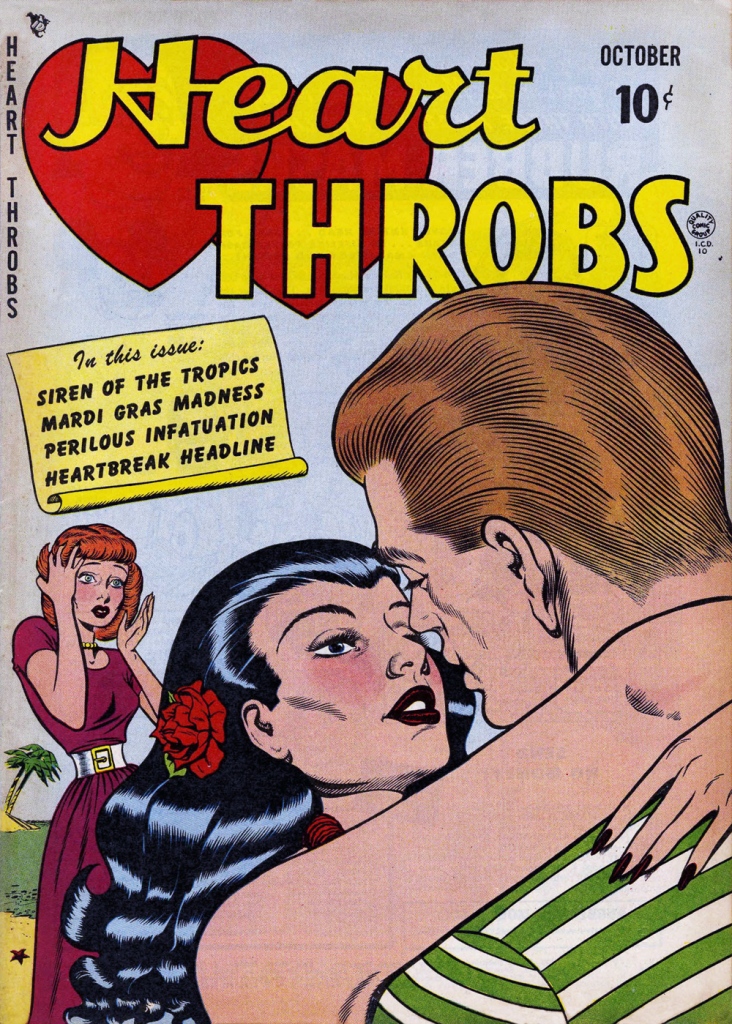
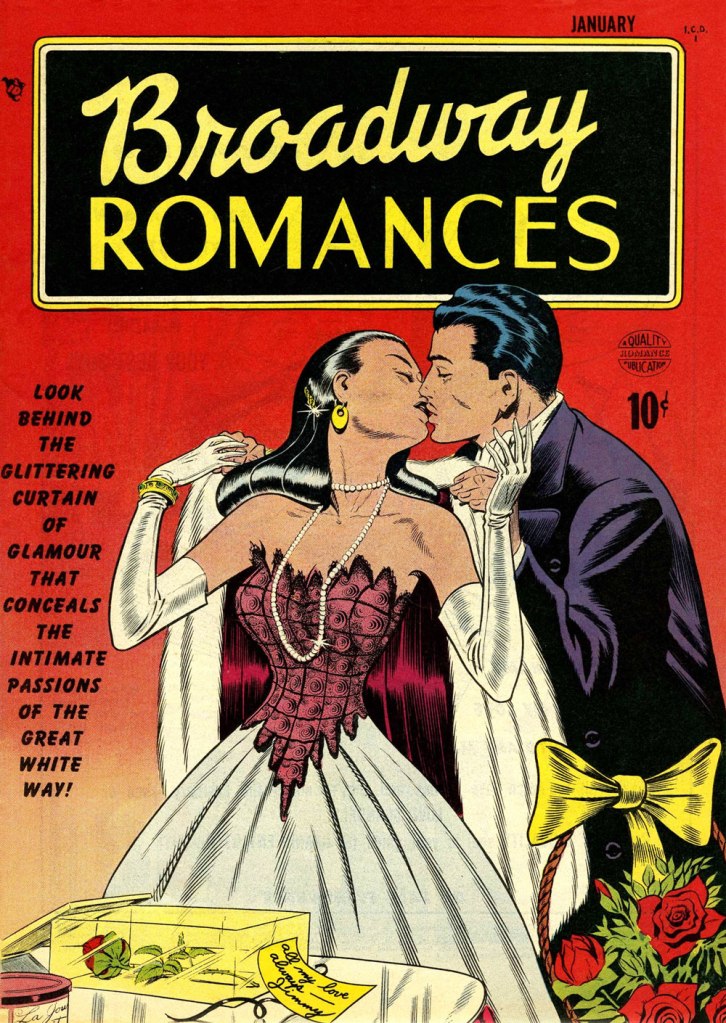
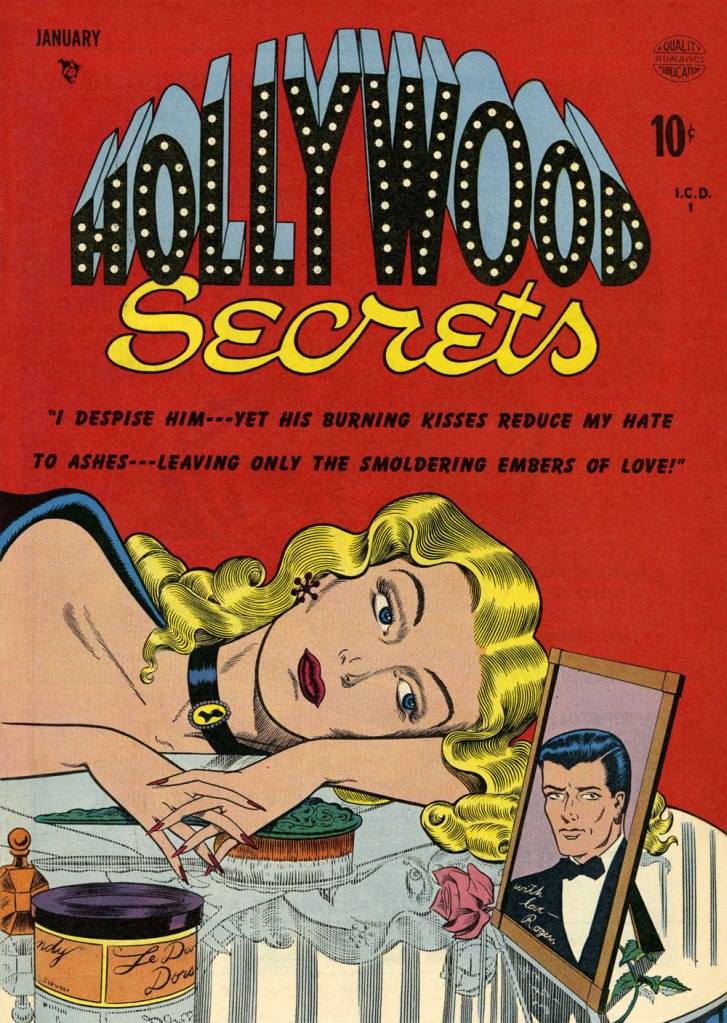
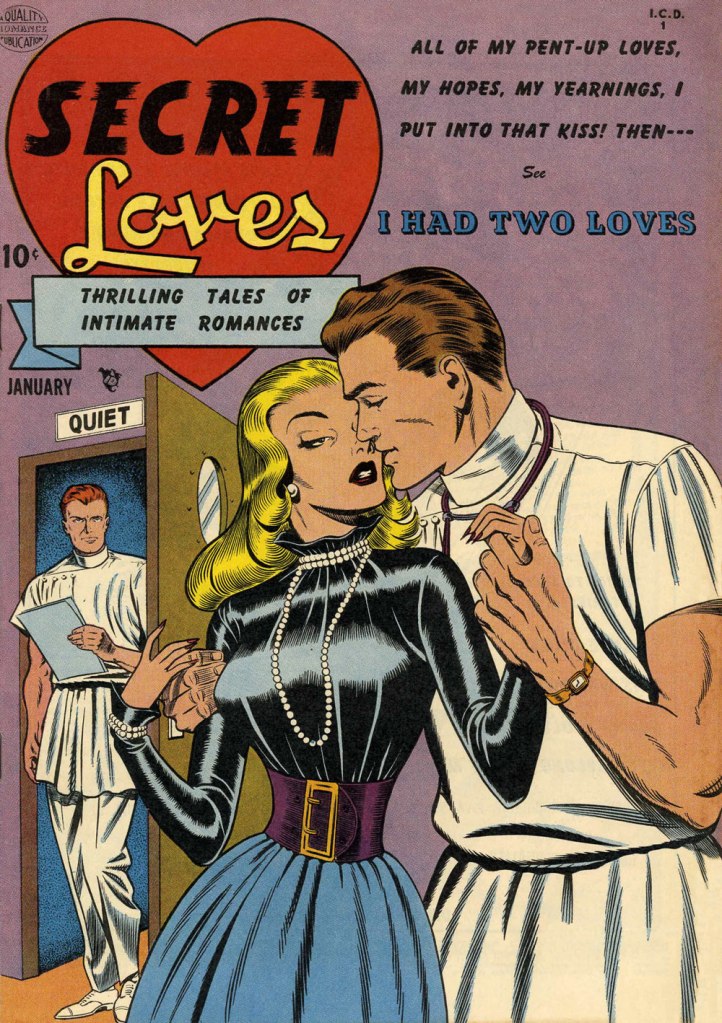
While he worked on such features as Blackhawk and Doll Man, Ward clearly preferred — was it ever in doubt? — depicting beautiful women dressed to the nines, a passion most readily indulged in romance comics, a genre then in its infancy, Joe Simon and Jack Kirby having just set it on its way with 1947’s Young Romance.
This is Heart Throbs no. 1 (Aug. 1949, Quality). Ever the fetishist, Bill never could resist a well-fitted pair of opera gloves.This is Heart Throbs no. 2 (Oct. 1949, Quality). Quality’s flagship romance title, Heart Throbs lasted one hundred issues, 46 published by Quality, and an even hundred by DC (1956 to 1972) after they picked up what remained of the publisher’s assets, among them Blackhawk, Plastic Man, Doll Man, Uncle Sam, Phantom Lady, and some war (G.I. Combat) and romance titles.This is Hollywood Secrets no. 1 (Nov. 1949, Quality). An unusual colour scheme!This is Campus Loves no. 1 (Dec. 1949, Quality).This is Flaming Love no. 1 (Dec. 1949, Quality). The gloating guy is the prototypical Ward creep.This is Broadway Romances no. 1 (Jan. 1950, Quality). It’s so refreshing to see Ward devote the same level of attention to detail to background items as to the female figure and her accoutrements.This is Hollywood Secrets no. 2 (Jan. 1950, Quality).This is Love Letters no. 2 (Jan. 1950, Quality). Interesting how all these romance covers — the majority of Ward’s production in that genre — all came out within the span of a year or so.This is Secret Loves no. 2 (Jan. 1950, Quality). Ward liked his women to have tiny, needle-like digits — I mean, just compare the lovers’ respective paws!This is Torchy no. 5 (July 1950, Quality), Ward’s signature creature. With the years, as his women grew ever more buxom, his men became ever more grotesque — these are some of the archetypes, but noses got longer, legs got skinnier and shorter, bellies more bulging — until men and women in no way seemed to belong to the same species. While that device of exaggeration was a mainstay of « girlie » art, Ward took it further than just about anyone.
Over the years, things got more… pneumatic. And then some more.
One from an issue of Zip (1967, Marvel); that particular cartoon had probably been around the block a few times by then… it sure doesn’t scream ‘1967!’
Incidentally, the elaborate background textures found in Ward cartoons were achieved by a technique called rubbing, or frottage, « … a reproduction of the texture of a surface created by placing a piece of paper or similar material over the subject and then rubbing the paper with something to deposit marks, most commonly charcoal or pencil. » Not to be confused with the *other* kind of frottage, although, come to think of it, that’s also quite relevant to Ward cartoons.
One of Ward’s ‘Phone Girls’, she saw print in Snappy no. 24 (1958, Marvel)… and likely numerous times thereafter.
« We can lick gravity, but sometimes the paperwork is overwhelming. » — Wernher von Braun
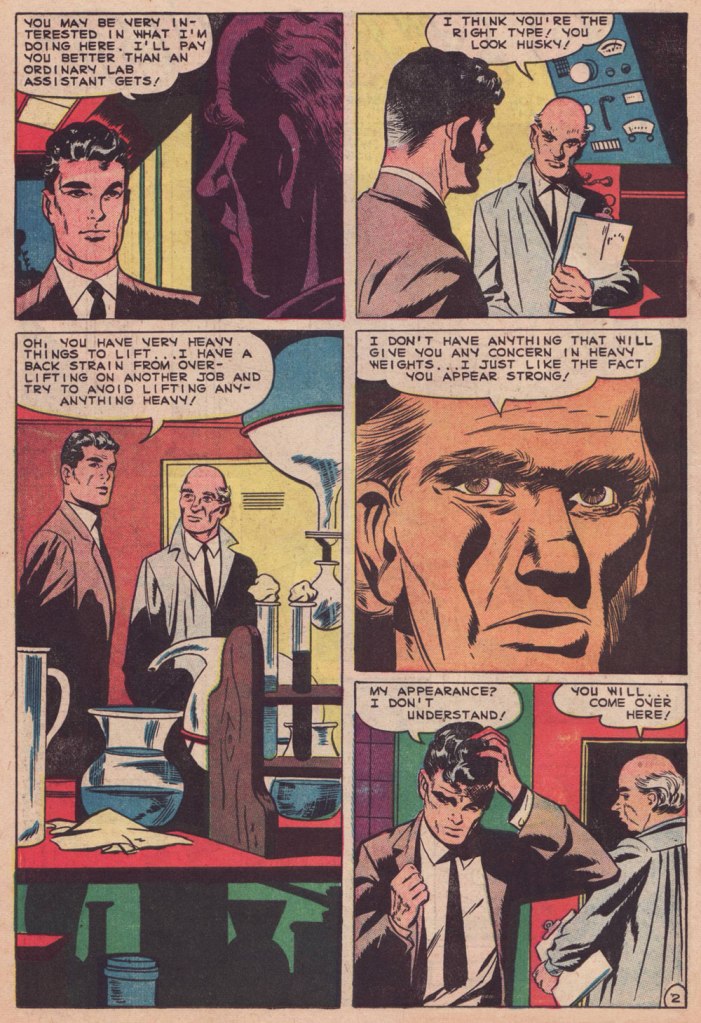
The other day, I was digging through my to-read pile, and came upon a 1950s Charlton science-fiction title I’d picked up for a song during a trip to the Maritimes (that’s New Brunswick in this case), last Fall. Its second story struck me as slight but quite fun, which is pretty much the best one could hope for in those strict, early years under the Comics Code’s oppressive authority. Despite the quickly executed job under overpowering Colletta varnish, I surmised I could identify the penciller’s style: none other than Matt Baker, whom I wrote about almost exactly a year ago, in Matt Baker’s Disquieting Romance. I’d advise you to begin there.
In his review of Matt Baker: The Art of Glamour (2012, TwoMorrows), cartoonist Eddie Campbell provided a useful bit of context: « A final phase, in which Baker had a hard time getting any work at all, is also examined briefly. Between 1955 and ‘59 he mostly pencilled for Vince Colletta, who was somehow well enough placed to pick up as much work as he could handle from Atlas and Charlton. He farmed a great deal of it out to others to pencil, leaving the inking for himself, which is one way to make a living and I’ve never had any problem with it. Colletta is a figure that comic book fans love to vilify. There’s him, Fredric Wertham, and the Red Skull, making the triumvirate of evil. »
But enough telling for now, time for some showing!
This is Mysteries of Unexplored Worlds no. 14 (Aug. 1957, Charlton); cover art by Charles Nicholas and Vincent Alascia. Yes, there was a time when the profligate Alascia was a decent inker.
*
*
*
*
*
Though uncredited, the story was evidently written by Joe Gill. Typical of him, the story is driven by straightforward but purposeful dialogue, in which much is intimated between the lines. It takes the rare gift of economy that tell such a story — and make it work — in just a handful of pages.
So what was in it for Vince Colletta? Basic economics aside — it’s easier to ink well-executed layouts — perhaps he harboured sympathy for this massively talented Black man who couldn’t get work, as all but a few did — regardless of talent — after the massive contraction of the comics field in the mid-Fifties. As a native Sicilian, it couldn’t be far from Colletta’s mind that in America, his own people, not so long before, were forcibly excluded from the ‘Whites’ club.
As Brent Staples wrote in How Italians Became ‘White’ (The New York Times, Oct. 12, 2019): « Italian immigrants were welcomed into Louisiana after the Civil War, when the planter class was in desperate need of cheap labor to replace newly emancipated black people, who were leaving backbreaking jobs in the fields for more gainful employment.
These Italians seemed at first to be the answer to both the labor shortage and the increasingly pressing quest for settlers who would support white domination in the emerging Jim Crow state. Louisiana’s romance with Italian labor began to sour when the new immigrants balked at low wages and dismal working conditions.
The newcomers also chose to live together in Italian neighborhoods, where they spoke their native tongue, preserved Italian customs and developed successful businesses that catered to African-Americans, with whom they fraternized and intermarried. In time, this proximity to blackness would lead white Southerners to view Sicilians, in particular, as not fully white and to see them as eligible for persecution — including lynching — that had customarily been imposed on African-Americans. »
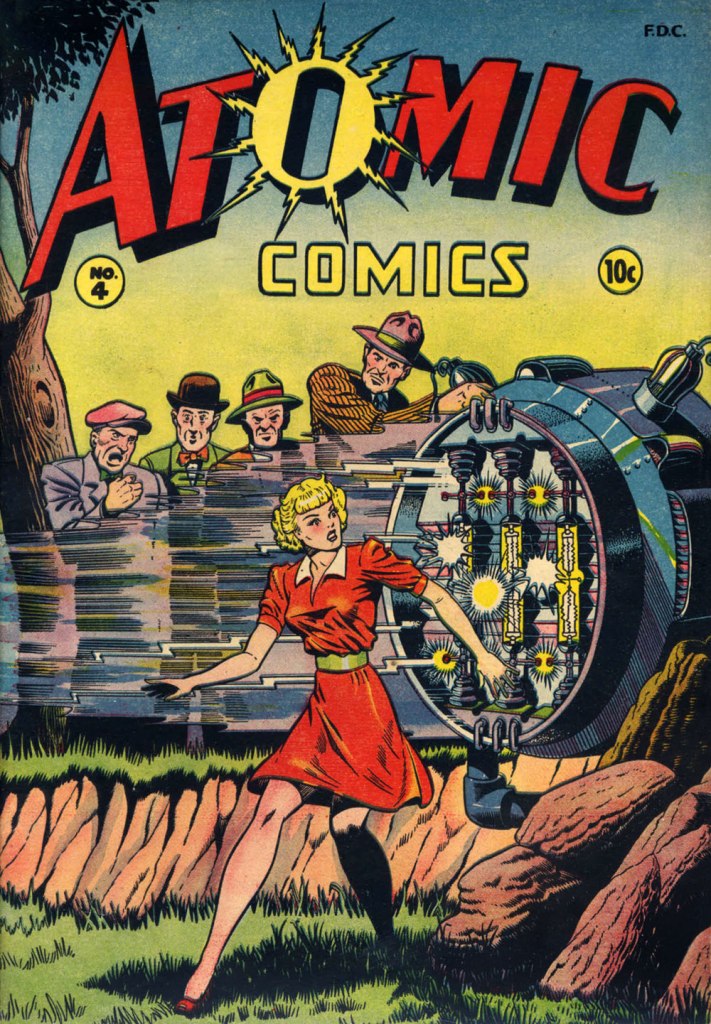
Baker didn’t delve much into the science-fiction genre, but here’s one such case: this is Atomic Comics no. 4 (July-Aug. 1946, Green Publishing). Read it here!Another rarity in Baker’s œuvre: blackness — despite being undermined by the colourist here. This is Amazing Ghost Stories no. 15 (Dec. 1954, St. John). On comicbookplus.com, where you can read this entire issue, a reader commented approvingly: « There are a lot of horror comics set in Haiti. This is the first one I’ve read where it looks like the author did some research on the history of Haiti. »
« There will be no questions asked if I kill you here, gringo! » — Bad hombre Alejandro Roja
On February 5, 2024, versatile veteran cartoonist José Delbo (born in Buenos Aires, Argentine, on December 9, 1933) left us at the most respectable age of ninety. Comics fans of a certain age will no doubt recall him chiefly from his long stint on DC’s Wonder Woman (1975-1981, issues no. 222-286), but to my mind, that’s hardly his finest hour: he wasn’t done any favours there, hobbled as he was by pedestrian (or worse) writing and indifferent (or worse) inking. Same goes for his run on Batgirl (1976-82) in Batman Family and Detective Comics.
For a detailed rundown of his remarkably long and varied career, you can’t go wrong with this excellent bio.
This post’s title gave away my candidate for Delbo’s magnum opus, such as it is; but I would be remiss in failing to also note his charming work on Dell’s The Monkees (fifteen issues), where he got to demonstrate his deft hand at humour; and his winningly bizarre collaboration with Tony Tallarico, Geronimo Jones (nine issues, 1971-73, plus one that remains unpublished).
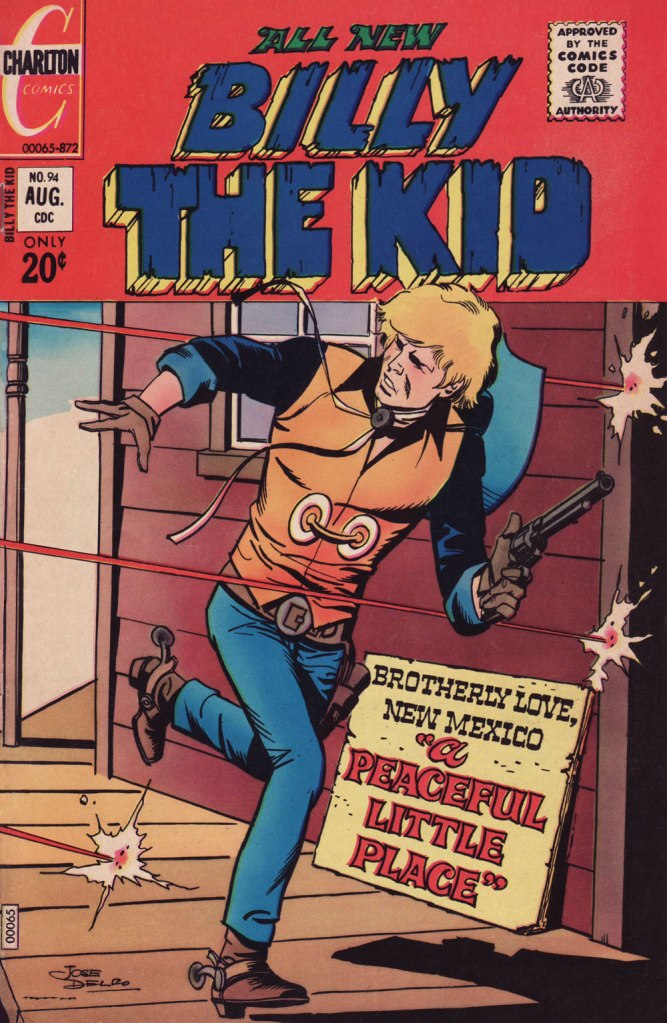
This is Billy the Kid no. 58 (Nov. 1966, Charlton), Delbo’s second issue on the title but his first cover. After this one, he would go on to pencil and ink the subsequent fifty or so covers and most of the inside features. When you find an artist who can draw horses, you hold on to him (or her)! How many, among the current generation, could successfully handle that particular mission?
Incidentally, Billy’s distinctive steed appears to be an Appaloosa: « The Appaloosa’s eye-catching pattern comes from the spotted horses brought into the Americas by Spanish Conquistadors. Known as the Dalmatian horse breed, it was bred in the mid-18th century by the Native American Nez Percé people. Its name comes from the Palouse River that flows through what used to be Nez Percé territory. » [ source ]
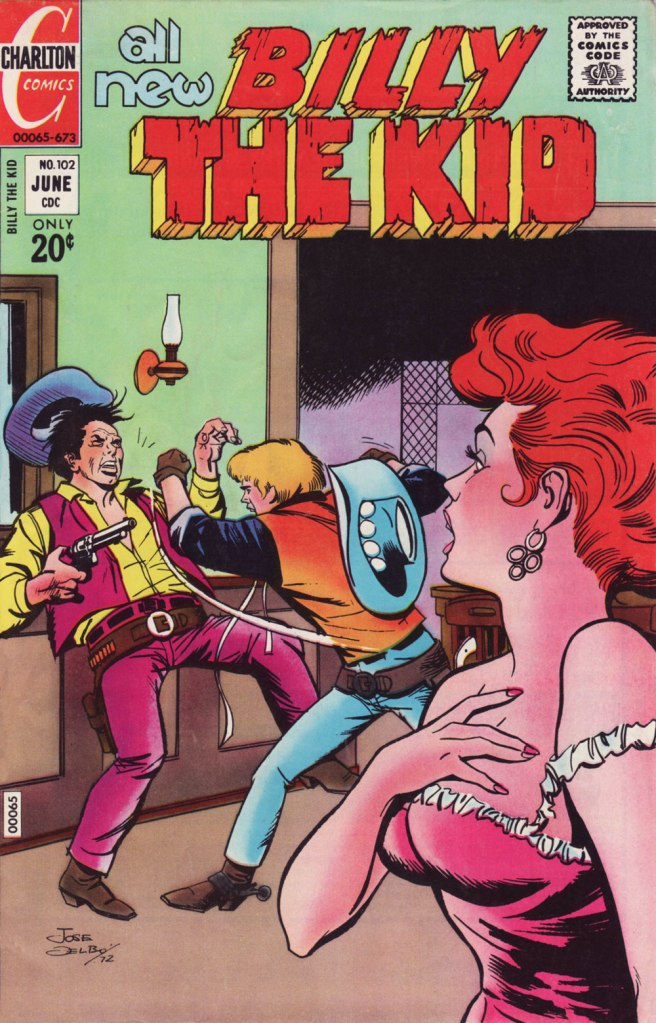
Charlton Comics’ flagship western title, Billy the Kid (153 issues, 1955-1983, including its first five as “Masked Raider”), endured as long as it did for good cause: notable runs by accomplished artists, among them John Severin, Rocco Mastroserio, Luis Domínguez, Delbo, and finally Warren Sattler. Yet, for my money, it’s Joe Gill’s spare but psychologically consistent and highly humane scripting that holds the enterprise together.
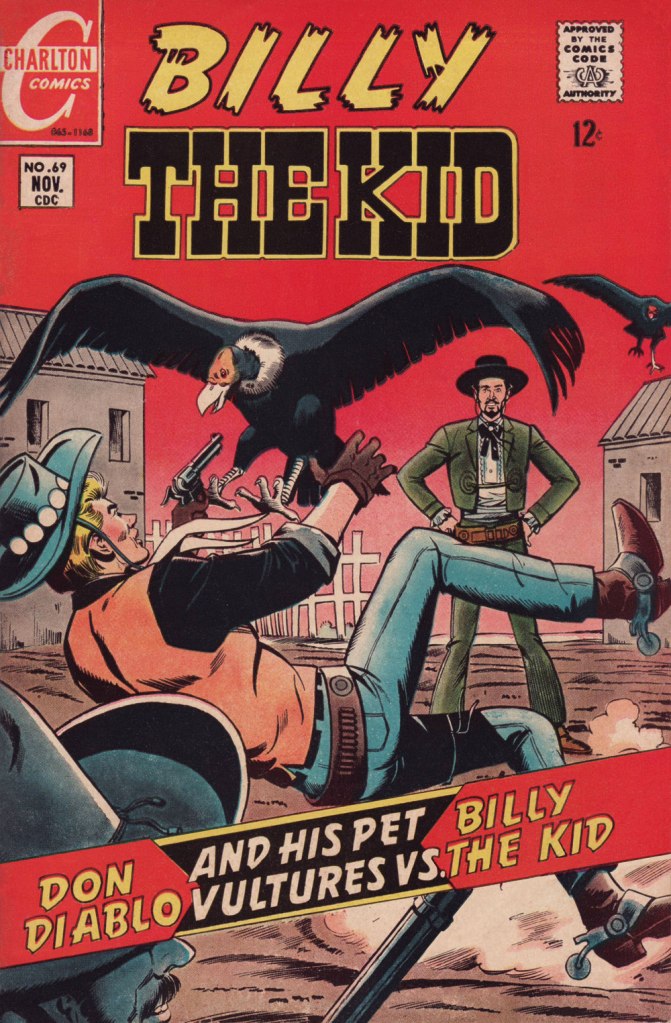
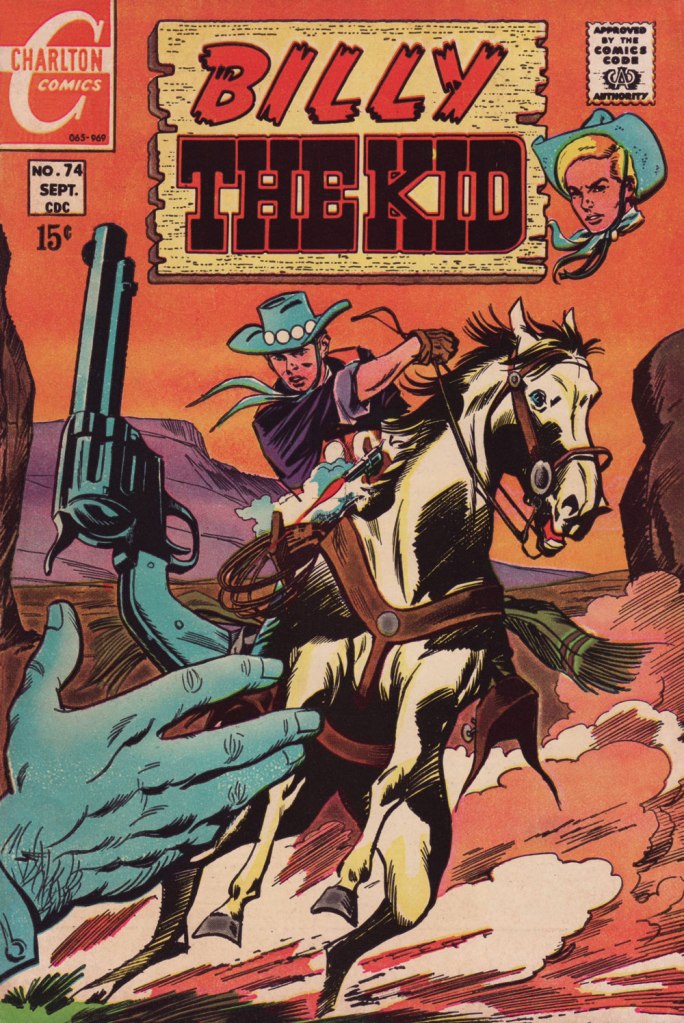
This is Billy the Kid no. 69 (Nov. 1968, Charlton).This is Billy the Kid no. 74 (Sept. 1969, Charlton).This is Billy the Kid no. 80 (Sept. 1970, Charlton).This is Billy the Kid no. 94 (Aug. 1972, Charlton); I love the clever signpost integration of the featured title.This is Billy the Kid no. 98 (Jan. 1973, Charlton). Readers accustomed to Marvel and DC-style hype may notice how light on text these covers are. A lot of shouting isn’t what sells a cover: an arresting visual will do that.This is Billy the Kid no. 102 (June 1973, Charlton).This is Billy the Kid no. 103 (Aug. 1973, Charlton).This is Billy the Kid no. 106 (Dec. 1973, Charlton). The foxy villainess Billy’s tussling with is La Duquesa, featured in “Slave of Beauty”.
Happy trails, and gracias for everything, Señor Delbo!
« Advertising – A judicious mixture of flattery and threats. » — Stephen Leacock
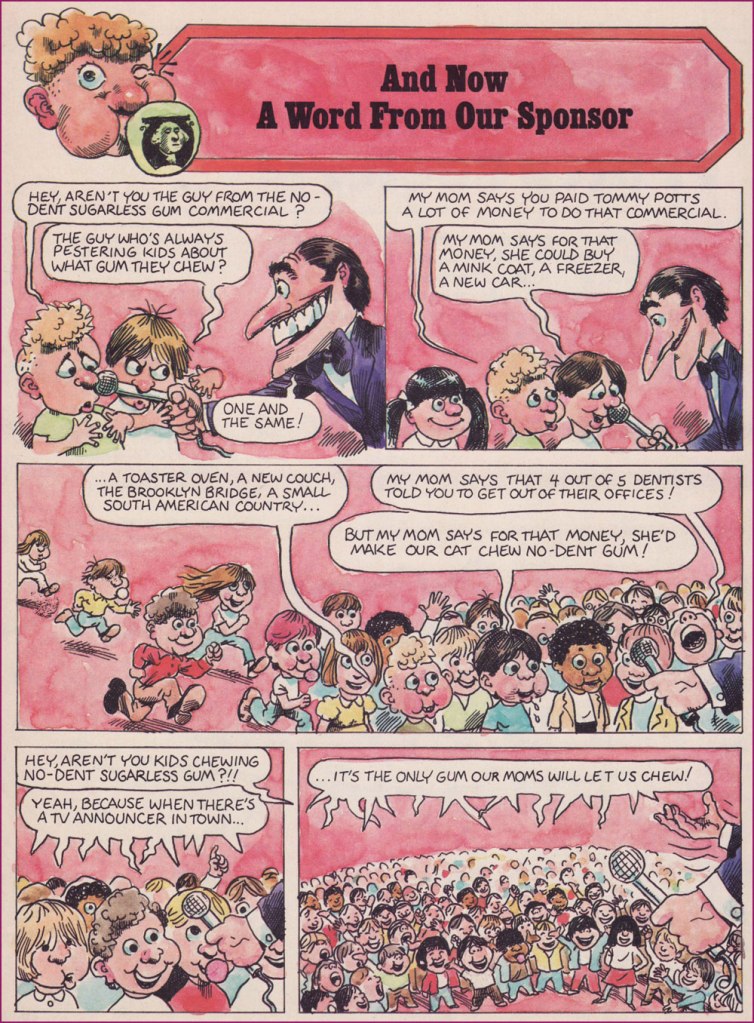
It’s long been established that one can scarcely be too skeptical in the face of advertising, and the sooner one starts questioning its wooly claims, the better. In the early 1950s, Harvey Kurtzman‘s Mad shone the giddily harsh light of truth on, well, just about everything, but Madison Avenue‘s tactics were a favourite and frequent target, and for good reason. In 1956, Kurtzman heatedly left his creation after a mere 28 issues; while it retained much of its cultural influence as its reach increased, it degenerated into rigid formula in the hands of his too-cautious successor at the helm, Al Feldstein.
Fast-forward to 1974, and Dynamite Magazine‘s sixth issue. Readers presumably too young for Mad could now receive their monthly inoculation against the advertising industry’s tainted baloney.
From 1974 to 1981, the feature was illustrated by Calvin Sanford “Sandy” Huffaker, Sr. (1943 – 2020); then the reins were passed into the able paws of future Mad art director (small world!) Sam Viviano. But that’s a tale for another day.
Since Huffaker was only credited for illustrating the feature, it stands to reason that it was written in-house, and that narrows it down to two main candidates: editor Jane Stine or Linda Williams Aber (aka “Magic Wanda”); my money’s on Aber, who also wrote Count Morbida’s Puzzle Monthly Puzzle Pages.
As Dynamite’s ‘Inside Stuff’ table of contents always billed it, here’s « A Dynamite look at BADvertising »!
The feature’s inaugural entry, from Dynamite no. 6 (Dec. 1974, Scholastic). The voracious oldster lampooned here is Euell Gibbons, who shilled for Post Grape-Nuts (which contain neither grapes nor nuts!) in this vintage commercial.From Dynamite no. 7 (Jan. 1975, Scholastic). You might recognize Nancy Walker, aka Rhoda’s mom Ida, and future director of Can’t Stop the Music! (trigger warning: Steve Guttenberg); here she is, pre-orange hair, in a Bounty Paper Towel spot from the Me Decade.From Dynamite no. 9 (Mar. 1975, Scholastic). Here’s a 1971 Bufferin vs. Aspirin ad. Place your bets!From Dynamite no. 19 (Jan. 1976, Scholastic). You just may be familiar with the object of this parody.From Dynamite no. 25 (July 1976, Scholastic). Here’s another ‘wonderful, quick‘ Jell-o recipe from those gelatin-happy days.From Dynamite no. 26 (Aug. 1976, Scholastic). Remember Morris? Here’s the famously fussy feline in a 1974 Nine Lives ad.From Dynamite no. 27 (Sept. 1976, Scholastic). Here’s a Hamburger Helper commercial of the corresponding vintage.From Dynamite no. 28 (Oct. 1976, Scholastic). Here’s our pal Poppin’ Fresh in a 1972 commercial.From Dynamite no. 37 (July 1977, Scholastic). On that topic, here’s our look at the 1970s bubble gum explosion!This subscription ad appeared in Dynamite no. 26. I suspect it was a draft for issue 28’s more focused Laverne and Shirley cover, which had been previewed in ads as a photo cover.From 1971, young Sandy wears his Ed Sorel influence a little heavily, but he was learning fast and from the best! For those who may not know — or who’ve forgotten — David Frye was possibly the nation’s premier Tricky Dick Nixon imitator. Was he? Listen here and judge for yourself!
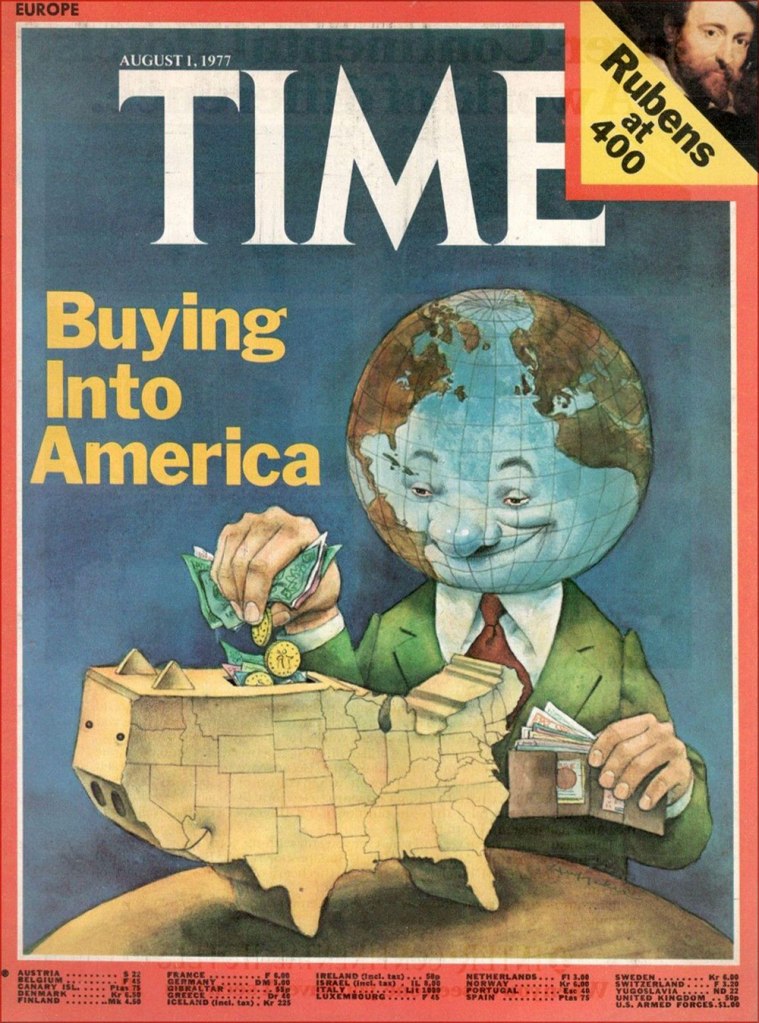
Thanks to his versatility and ability to nail a likeness, Huffacker was among the most sought-after illustrators of the 1970s. Quoting from the Chattanoogan.com’s obituary:
« Huffaker was a highly acclaimed political cartoonist who started his career with The Birmingham News and the Raleigh News and Observer. He later moved to New York City and illustrated covers and articles for such publications such as Time Magazine, The New York Times, Sports Illustrated, Businessweek, People and Fortune Magazine. Some of the accolades awarded for his artwork include two Page-One Awards from the New York Newspaper Guild, three nominations for Cartoonist-of-the-Year by the National Cartoonists Society, A Desi Award of Excellence (Graphic Design Magazine), 20 Award of Merit citations from the Society of Illustrators, and was twice nominated for a Pulitzer Prize for illustration. »
Here’s one of his aforementioned Time covers.
In a 2012 interview, he recalled those halcyon days: « During one week at the peak of his career as an illustrator, Sandy Huffaker had assignments from Time, Sports Illustrated and Businessweek. He had to turn down a fourth assignment that week from Newsweek. “I just didn’t have time.” »
Once again, my initial instinct when I hit upon the notion of showcasing the work of Jean-Michel Folon was: « is he too obvious a subject? ». Then reason stepped in with: « to whom, exactly? »
Which brings me to my own tiny Folon anecdote: about twenty years ago, I was helping out a friend, who usually took off the month of January to travel. As it happened, it was usually the worst month for art freelancers, at least in my experience, so he was helping me out too.
Anyway, instead of working from home or some ad agency’s offices, I would work from his boutique, manning the four telephone lines while his regular employees handled the in-person traffic. One day, I took an order from a nice lady who, while I was filling out the relevant papers, gave her last name as Folon. « Like the illustrator? », I asked. « Yes indeed, he’s my cousin! », she replied, clearly delighted. « I’ve been living here in Canada for thirty years, and you’re the first person who’s ever asked! ». Which goes to show that one should think twice before extrapolating from one’s familiarity with a given subject. Or to put it simply, just because you’ve heard of someone, don’t assume everyone else does… whether they should have or not.
I can’t make mention of Folon without bringing up his strongest formative influences, Saul Steinberg (1914-1999) and André François (1915-2005); we’ll return to these gentlemen in due time.
To put it succinctly, Steinberg brought greater graphic and thematic purity to the gag cartoon… by dispensing with the gag, at least in the traditional sense. Not everyone dared to follow that perilous path, but Folon did, and similarly thrived.
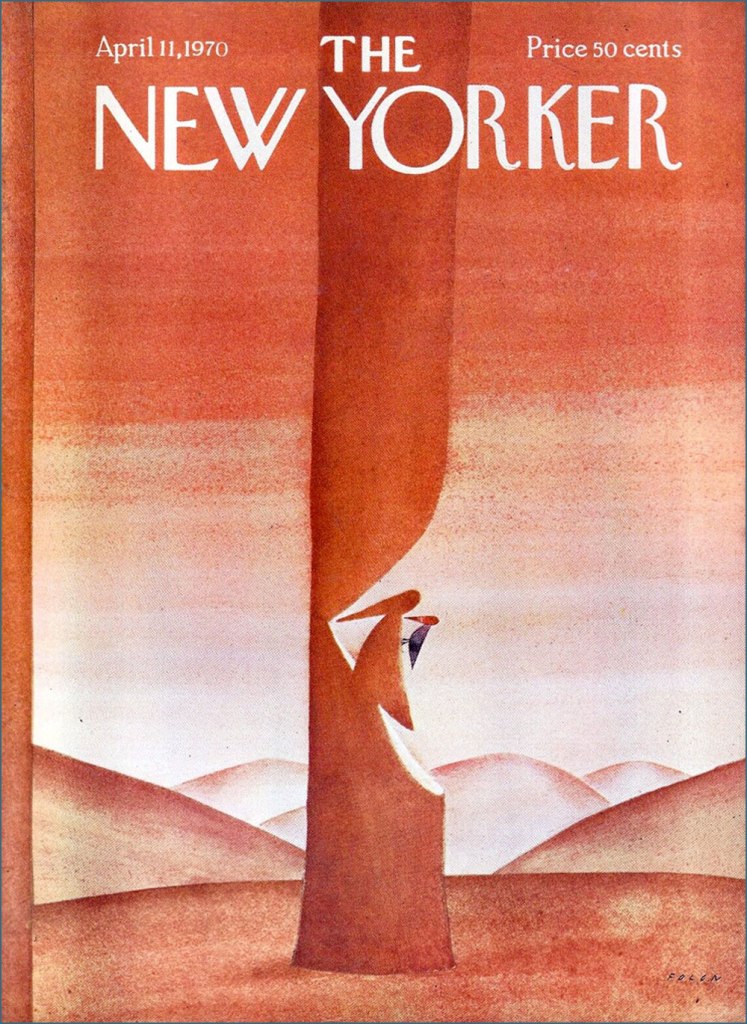
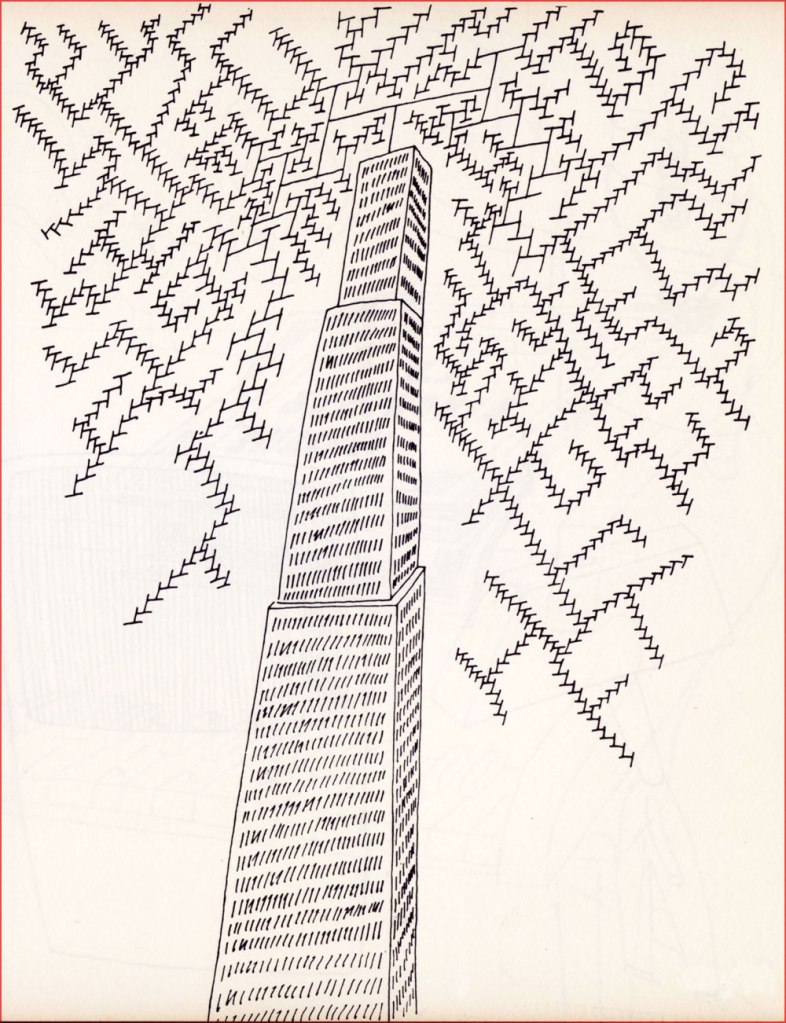
Born in Brussels in 1934, Folon initially studied architecture, but soon detoured into drawing and never returned to his early vocation, though he certainly erected his share of edifices… on paper. He timidly began submitting drawings in 1957. A decade later, he had scaled and conquered the lofty North American market, landing cover assignments with The New Yorker, Esquire and Fortune, among others.
For example, this model of witty understatement from the week of April 11, 1970.
He turned his confident, limpid vision across all printed media, but also sculpture, tapestry, stained glass and animation. He passed away in 2005, but not before designing and establishing his own museum. Be sure to check this stunning place out!
Such a multifaceted career and œuvre being too gargantuan in scope for a simple blog post, I’ll mostly stick to a sampling of some of Jean-Michel’s drawings, produced during his first decade as a professional artist.
*
*
*
*
*
*
*
And here’s some of his later work:
This is Folon’s jacket for the 45 RPM single issue of Michel Colombier’s music (his adaptation of a baroque adagio by composer Alessandro Marcello). It had originally been recorded in 1971 for his US debut album, Wings (for Herb Alpert and Jerry Moss’ A&M label), which bore a variation of this Folon image as its European cover; the North American one was, to put it mildly, hideous.
Colombier, incidentally, belonged to that coterie of poor souls who did all the heavy lifting while their ‘collaborator’, Serge Gainsbourg, received and happily hogged all the credit.
In 1975, Colombier recycled the recycled adagio as the opening and closing theme for French public national television channel Antenne 2’s daily programming, accompanied by an appropriately graceful animated sequence by Folon. Another local connection: Folon handled the artwork for this 1979 LP by musical whiz Jean Robitaille, who’d recently co-written the lovely 1976 Summer Olympics’ theme song. But my favourite Robitaille song has to be his duet with beloved songstress Renée Claude (1939-2020), St-Jovite, a fiendishly clever song about a singular sort of voodoo.I must say I’m gobsmacked at the idea of the French post office selecting a Belgian artist to illustrate its stamp commemorating the 1989 bicentennial of the French Revolution. But what do I know? Folon did a great job. When I state that Belgium seems to truly value its artists (see another example here), this is the sort of thing I mean: in 2010, five years after his passing, his native land issued a set of ten postage stamps saluting “The Magic of Folon”. ’nuff said.
« The first hundred years are the hardest. » — Wilson Mizner
Having just learned this morning that today marks a century since the birth of André Franquin (1924-1997), I again pushed my planned post to the back burner. So, instead of writing about a celebrated Belgian genius, I’ll write about *another* celebrated Belgian genius.
Spirou’s ‘Albums’ were a handy way to dispose of unsold copies of the weekly magazine by collecting a trimester’s worth of issues in an attractive hardcover format. This one’s from March 1948, just to give you an idea of Franquin’s early style.A panel from Le dictateur et le champignon (1953). The ripe banana-coloured critter with the long tail, if you don’t already know, is Le marsupilami, Franquin’s homage to Elzie Segar‘s Eugene the Jeep (introduced in 1935 and known as ‘Pilou-Pilou’ in French Europe).This panel took my breath away as a kid when I first saw it, and it still does. It’s from Spirou et Fantasio no. 8, La mauvaise tête (1954). How many contemporary artists could pull off such a scene — let alone the entire sequence, wherein Fantasio ends up winning the race cycling backwards — at all convincingly? I’ve been reading, for the first time, Franquin’s collected Modeste et Pompon (1955-59). After Franquin was tricked into surrendering his creation to Tintin magazine publisher Les Éditions du Lombard, M&P became just another long-running mediocre domestic strip in many successive pairs of (necessarily) lesser hands… but seeing Franquin bring it to life is a most refreshing pleasure.A dynamic Modeste et Pompon sample from near the end of Franquin’s run. During Franquin’s relatively brief passage at Tintin magazine, he set a new standard of graphic freedom, opening a breach for his successors that Georges “Hergé” Rémi himself did *not* welcome. Tintin’s papa, in fact, deemed Franquin’s supple and organic line ‘vulgar’. Album Spirou no. 70 (March 1959, Dupuis), gathering issues 1081 to 1091 and depicting a scene from Le Prisonnier du Bouddha.Album Spirou no. 96 (April 1965, Dupuis), collecting issues 1395 to 1407. Gaston Lagaffe*, like Le Marsupilami before him, was a minor character introduced by Franquin to relieve the tedium of setting down the adventures of Spirou et Fantasio. The popularity of both these would-be background creations wound up dwarfing that of the intended protagonists. Franquin’s original painted artwork for the cover of Album Spirou no. 100 — well, duh — (March 1966, Dupuis), containing issues 1447 to 1459.
In 1977, a depressed yet inspired Franquin, suffocating within the confines of his much-imitated (at his publisher’s clueless insistence) style, created — with kindred confederate Yvan Delporte — Idées noires (Black, or perhaps more fittingly Bleak notions) as an outlet. It first appeared in the short-lived* Spirou mag supplement Trombone illustré, then moved to the more welcoming pages of Fluide glacial. An English-language edition, entitled Die Laughing, was published by Fantagraphics in 2018. Check it out here.
Here are a couple of Idées noires punchlines, which should give you an idea of their tone.
Marcel Gotlib wittily hijacked/paraphrased Sacha Guitry‘s bon mot about Beethoven : « After reading a page of Idées noires by Franquin, we close our eyes, and the darkness that ensues is still Franquin’s. »In countless instances, Franquin even used his signature to expressive comic effect.
-RG
*These days, thinking about Gaston Lagaffe puts me in an ugly mood, I’m afraid. Franquin had expressly, and all along, requested that his creation be put to rest with him. But did his publisher – having built an empire upon Franquin’s creations — honour his wishes? No more than usual. Another arrogant slap — post-mortem this time — in the face of a genius exploited and mistreated his entire adult life. In this world, the interest of the characters… oops, pardon my French, ‘properties’ obviously trumps that of the flesh-and-blood creators. Every time. For there’s always some scab hack or other backstabber (and they *always* claim to be huuuge fans, as Miller said to Eisner, betraying him with a kiss) to aid and abet venal publishers. That’s how we got a pointless Sugar and Spike revival and all those Watchmen prequels. Hopefully, Monsieur Franquin’s daughter will prevail in her lawsuit against Dupuis to settle the matter in a just and fitting manner. [ Update: it didn’t end well. The suits won. ]
**« It is upon the publication of a Franquin article that the supplement is cancelled. In his piece, the fervently antimilitarist Franquin takes to task Thierry Martens, Spirou’s then editor-in-chief, for running articles about Nazi war plane models. » (translated quote from L’histoire de la bande dessinée pour les débutants by Frédéric Duprat, p. 131, Jan. 2011)
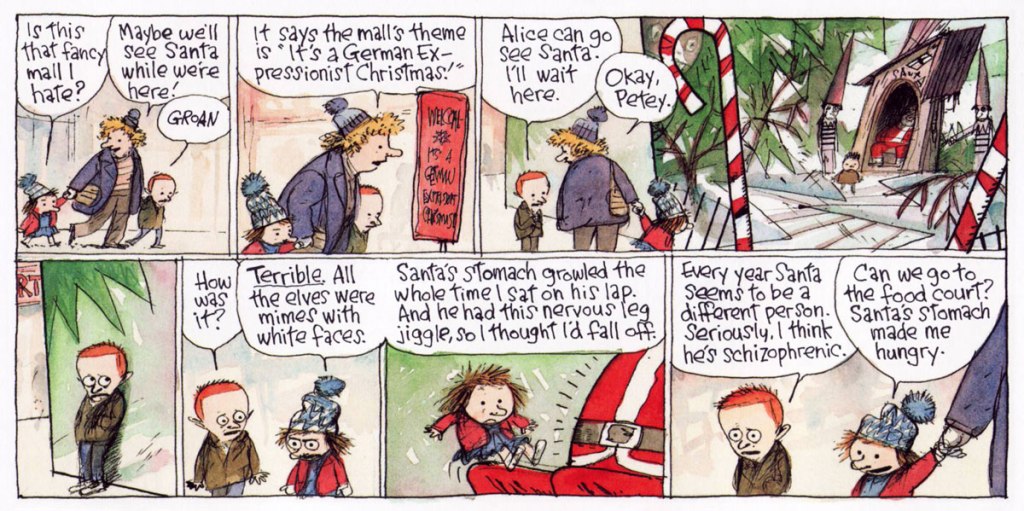
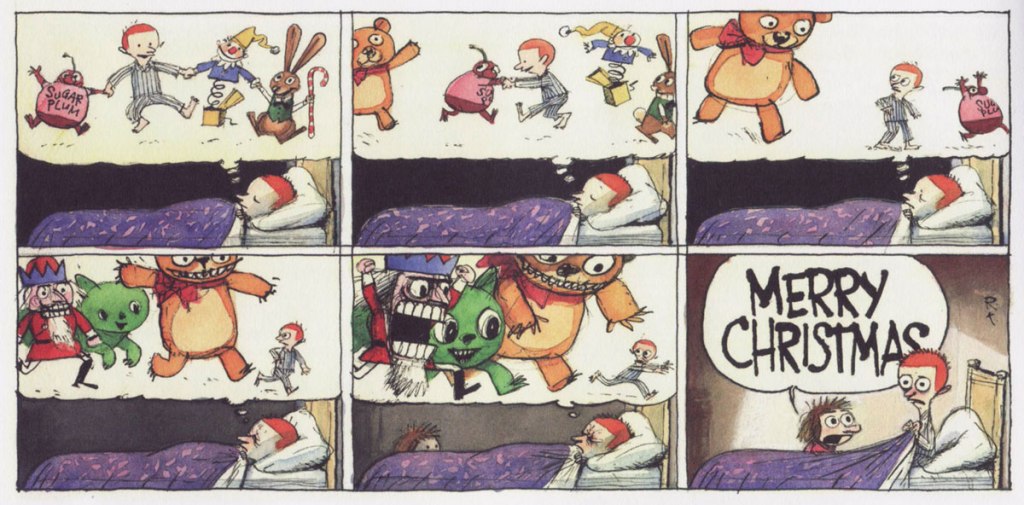
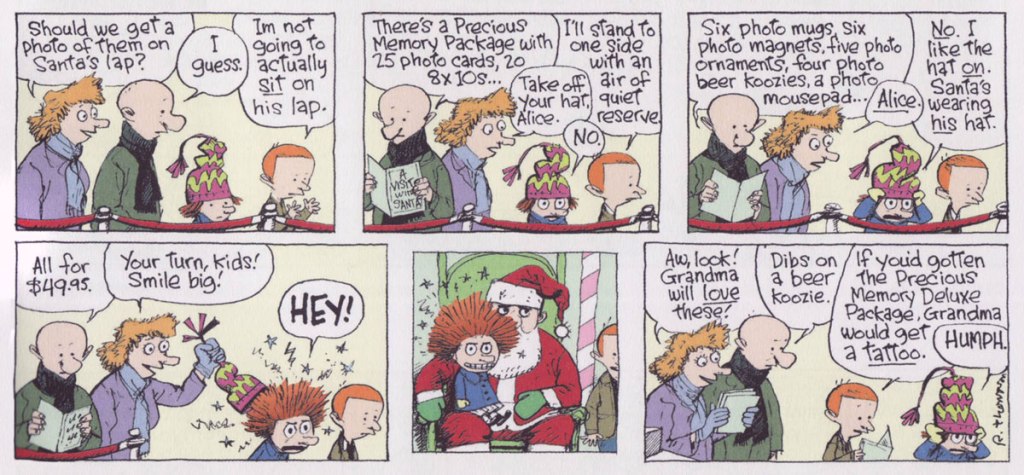
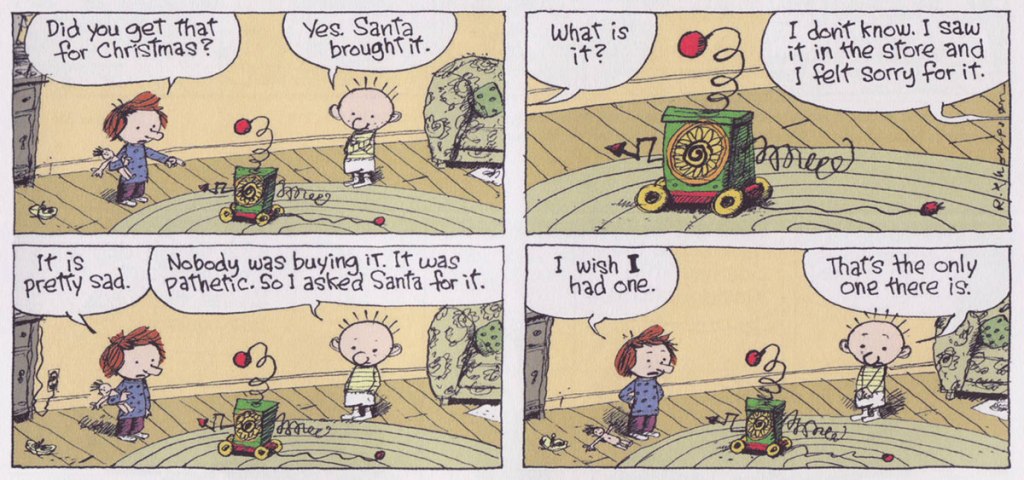
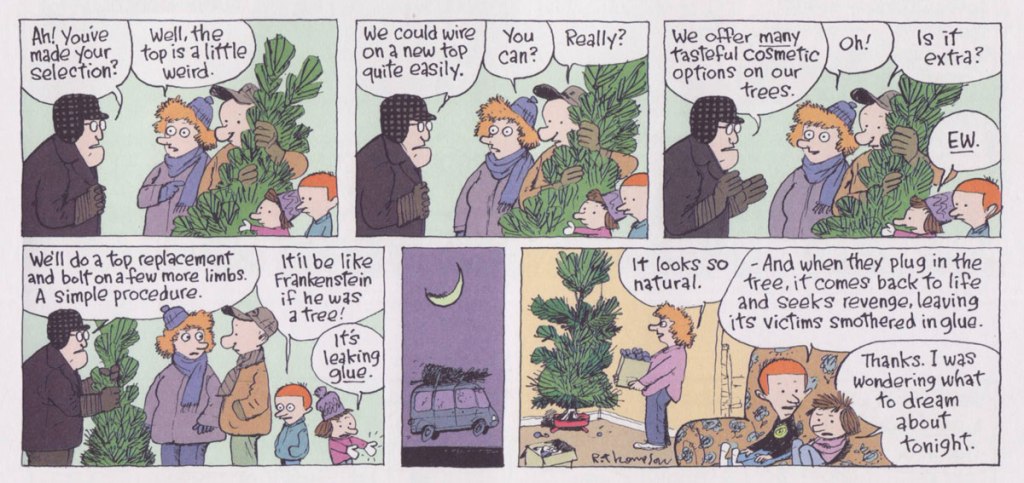
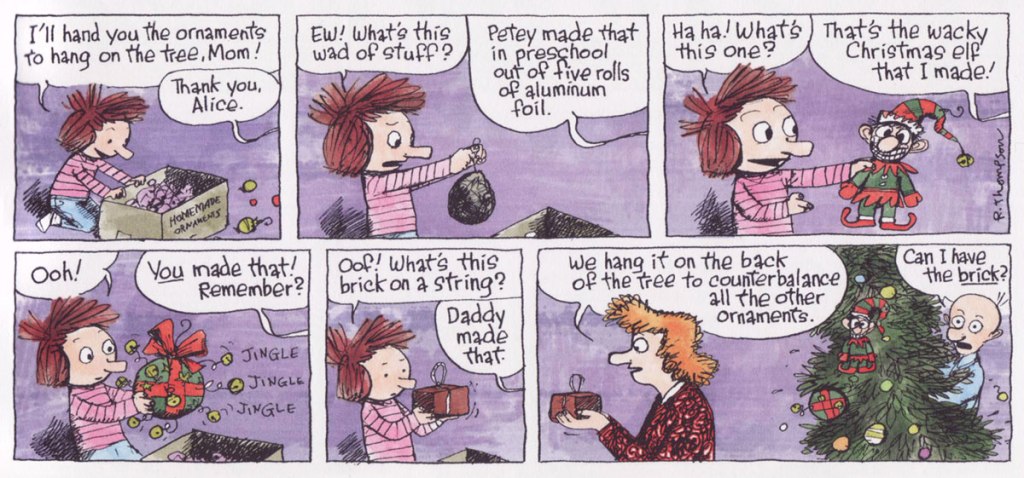
I’ve gathered most of the yule-themed Cul de Sac Sundays… one of these days, I might devote an entire post to Madeline Otterloop’s Christmas sweater dailies.
Merry Christmas, everyone!
RT: « The creepier side of Christmas. A German Expressionist Christmas has been done by someone, somewhere, I’m sure. » December 11, 2005.RT: « Taking down Christmas is always so hard. I like the timing here. » January 1st, 2006.RT: « Petey dreams of Christmas with music by Tchaikovsky. » December 24, 2006.RT: « Santa Claus commands a lot of fear and awe in children.I could never get a coherent sentence out when sitting on his lap when I was a kid, and I doubt I could today. Thank God I don’t believe in him anymore! » December 23, 2007.RT: « The first appearance of Dill’s mysterious, malignant, poignant, and possibly educational toy. I just wanted something that’d be easy and repetitive to draw, because I was behind. » December 30, 2007.RT: « What I like the most is the tree seller’s resemblance to a mortician. » December 21, 2008.December 28, 2008.RT: « Drawn from life. Nothing more need be said. » December 19, 2010.RT: « Petey’s faith in his commentaries’ scathing qualities is misplaced. » December 4, 2011.RT: « Doing this was a joy. The hard part was doing it in pantomime. » December 11, 2011.
« A merry Christmas to all my friends except two. » — W. C. Fields
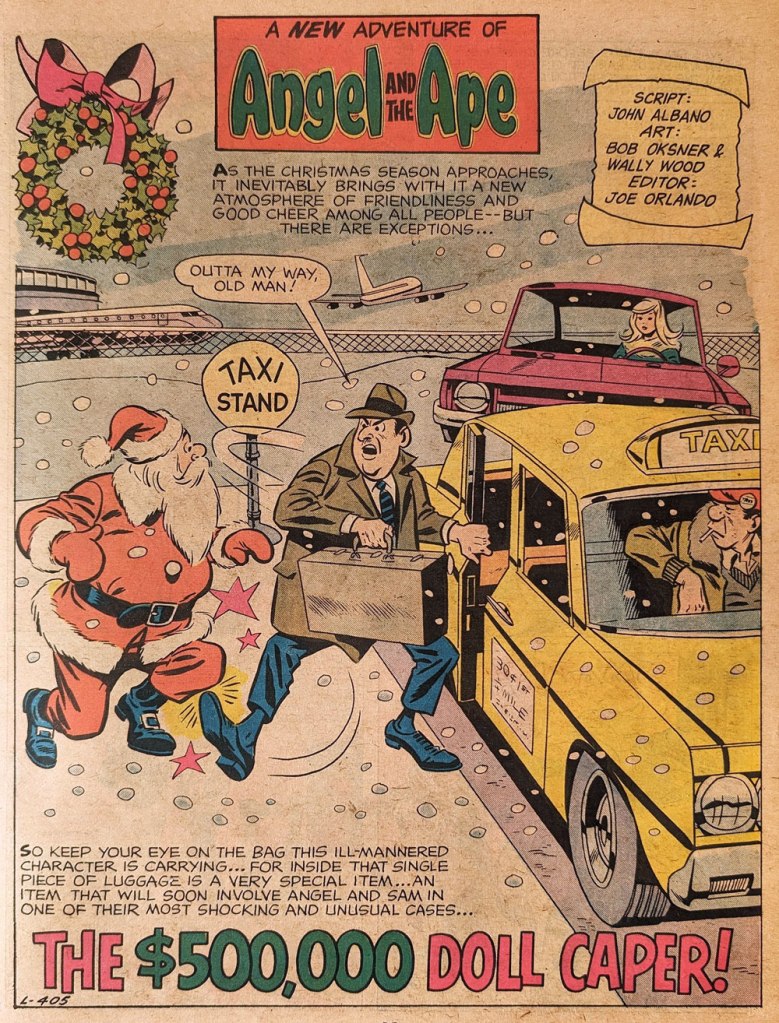
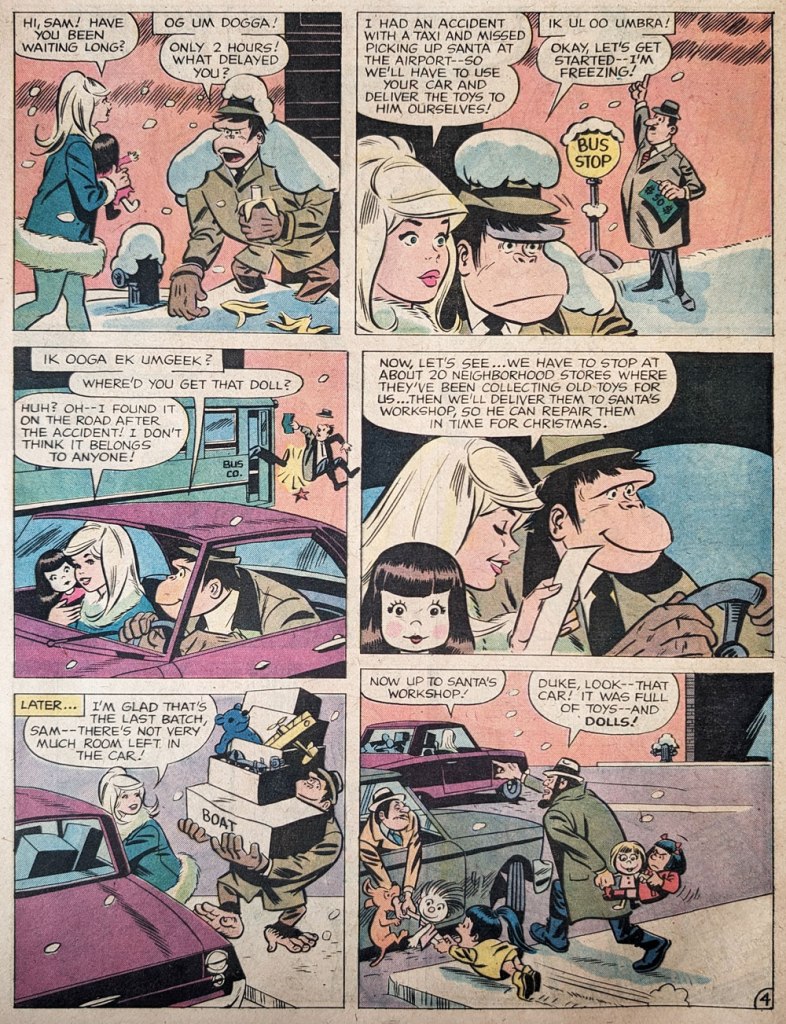
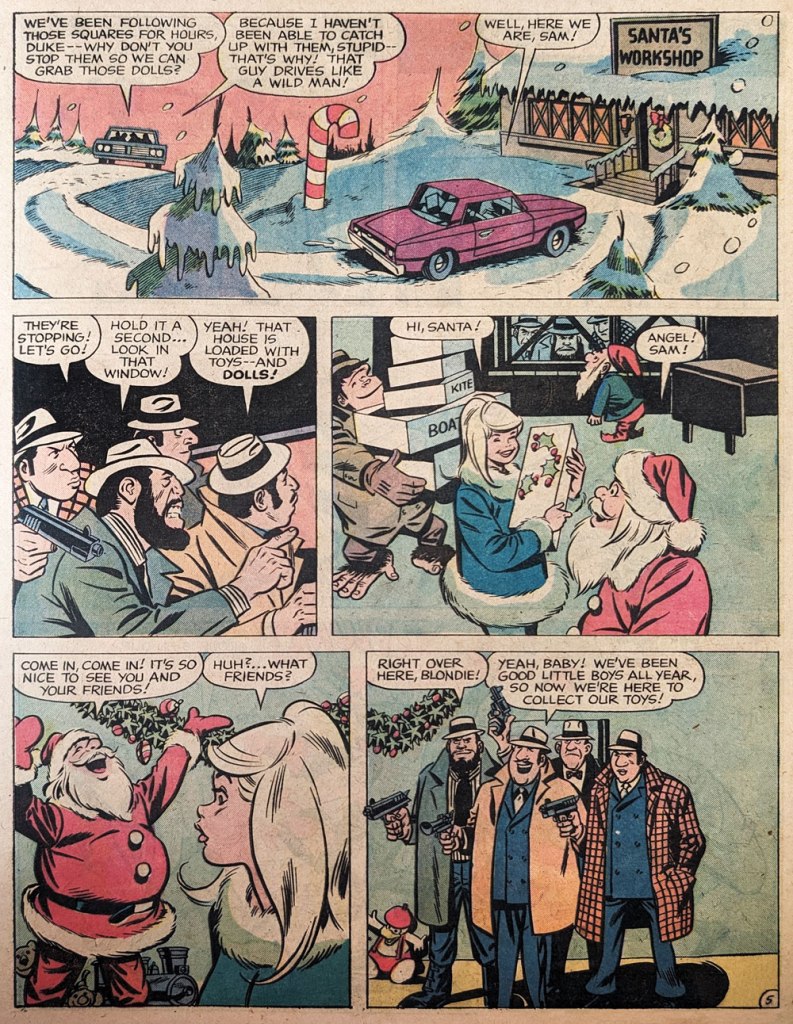
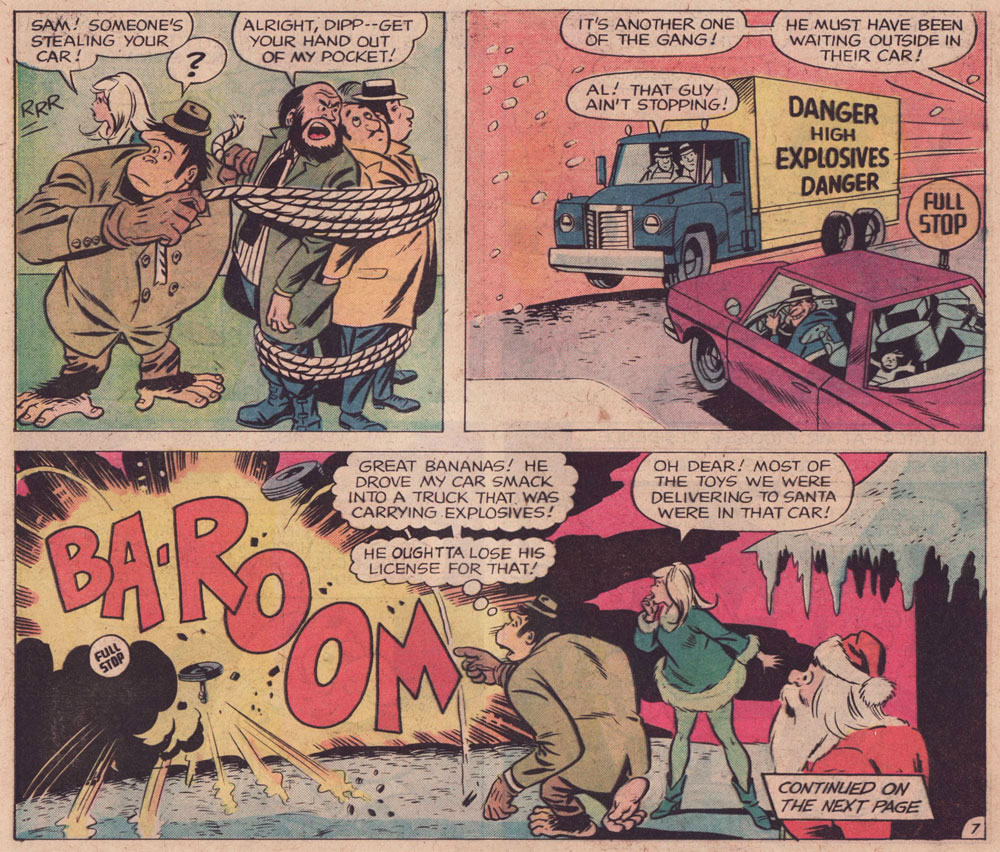
I was in the middle of writing a post on another topic, getting bogged down in its complexities, and then it dawned on me that Christmas was fast approaching, and I’d better switch gears pronto.
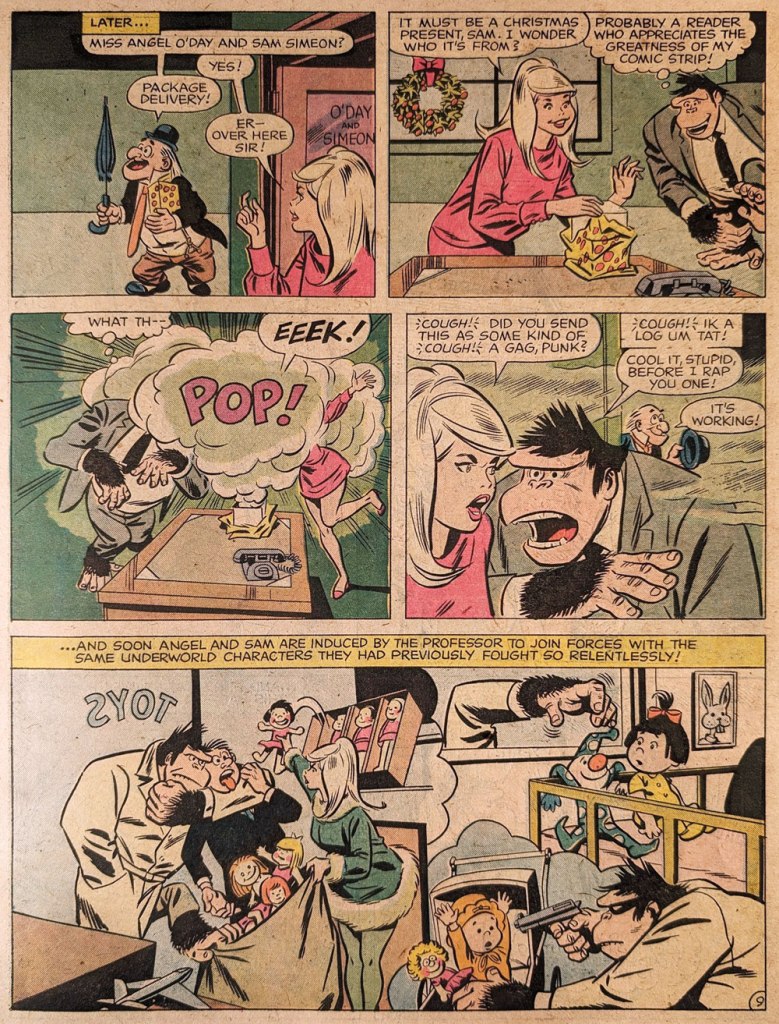
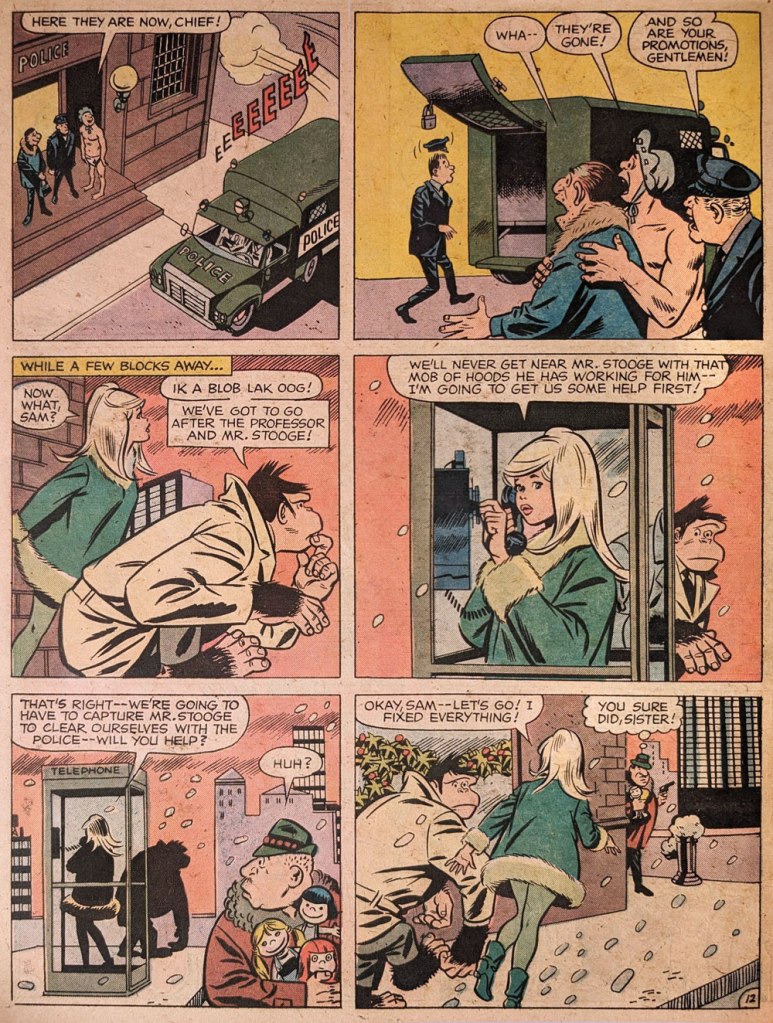
Thankfully, I had something in mind: an Angel and the Ape tale initially produced in the late 1960s but orphaned with the book’s cancellation. It was half-heartedly released from limbo –shall we say buried? — in one of those awkward tabloid format volumes, Limited Collectors’ Edition C-34: Christmas With the Super-Heroes (Feb.-Mar. 1975, DC) and not even advertised on the front or back cover… which is why it took me decades to learn of its existence.
On average, Angel and the Ape was only marginally funnier than the rest of DC’s humour books (save of course for Shelly Mayer’s consistently hilarious Sugar and Spike), but still leagues ahead of Marvel’s painful Not Brand Ecch et al. A&A was, imho, at its peak when E. Nelson Bridwell wrote it, lobbing some choice barbs at the esteemed competition.
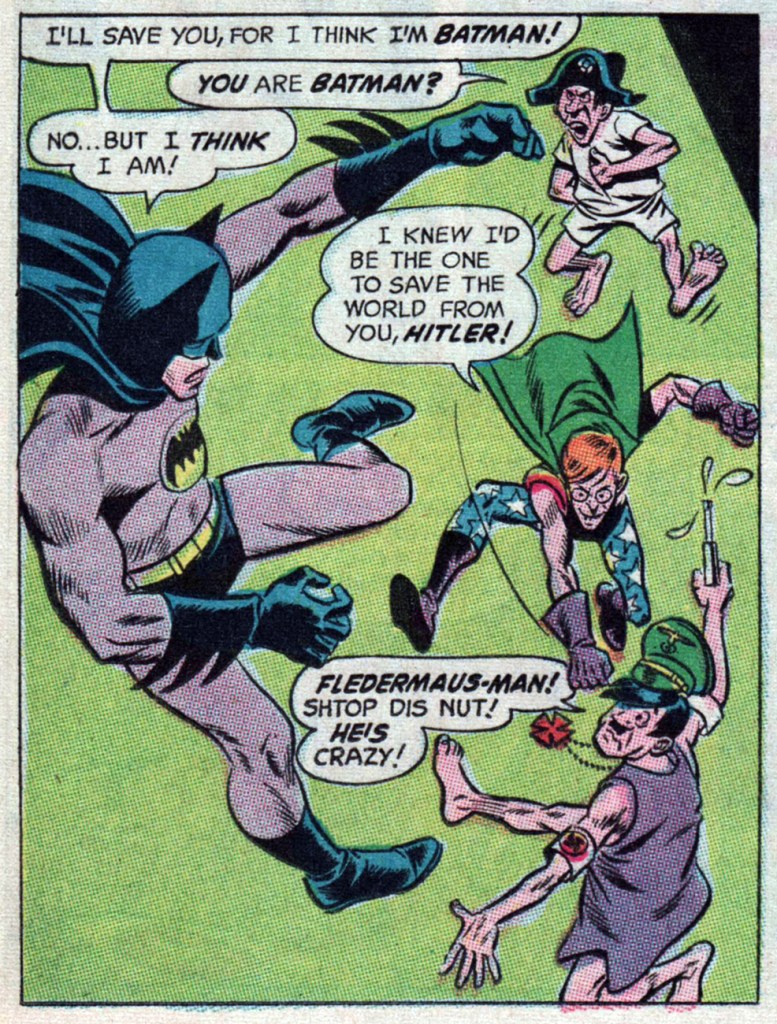
To briefly illustrate my point, here’s a relevant panel from Angel and the Ape no. 3 (Mar. 1969, DC).
Script by Bridwell, pencils by Oksner, inks by Wood. The redhead in the green cape and star-spangled tights is Stan Bragg, editor-in-chef at Brainpix Comics, a clever amalgam of the Smilin’ One and his Rascally subordinate. “When you write good stories and do good artwork, don’t I sign it?“
« It’s easy, from our 21st-century perspective, to condemn Waldman as nothing but a sleazy bottom-feeder eking out a precarious living by pirating the marginal dregs of an industry he was only peripherally a part of. » — Don Markstein
It’s been suggested to me several times that I should devote some column space to Rostislav “Ross Andru” Androuchkevitch (though my co-admin ds certainly has, by dint of the man’s long stint on Bob Kanigher’s regressive Wonder Woman), but the trouble is, unlike the many of my generation who, presumably more through circumstance than discernment, imprinted on Andru and Gerry Conway*‘s The Amazing Spider-Man (1973-76), I had already lost all interest in Spidey after Steve Ditko‘s rightly acrimonious 1966 departure; I just wasn’t buying what they were selling.
My own, somewhat less agreeable run-in with Andru was through his ill-advised residency as DC’s principal cover artist (under “art director” Vinnie Colletta) paired up with Dick Giordano**, who reportedly slapped inks, and likely some coffee, on a few covers each day before catching his train to work.
However, as I always say, with a career that lengthy and prolific, there’s bound to be exceptions. Which brings me to a comment a dear friend and old comrade in ink-slinging made — just this week! — regarding an Andru cover I featured during last month’s Hallowee’n Countdown:
« Mmmm… that Ross Andru cover. Such a delightful classic! Who knew he was so good back then compared to his later work, which was pretty damn awful. »
So, like John Severin, Andru (with inking partner, for better — though mostly for worse — Mike Esposito in tow) was approached by Israel Waldman to gussy up his shoddy, oft-illegal reprints.
Redoubtable comics historian Don Markstein (1947-2012) did a breathtaking job of compiling a dossier of the whole I.W./Super Comics operation, complete with the cross-referencing of most — if not all — the ‘borrowed’ properties and personages. Essential reading if you’re at all intrigued by crafty reprobates of Waldman’s ilk.
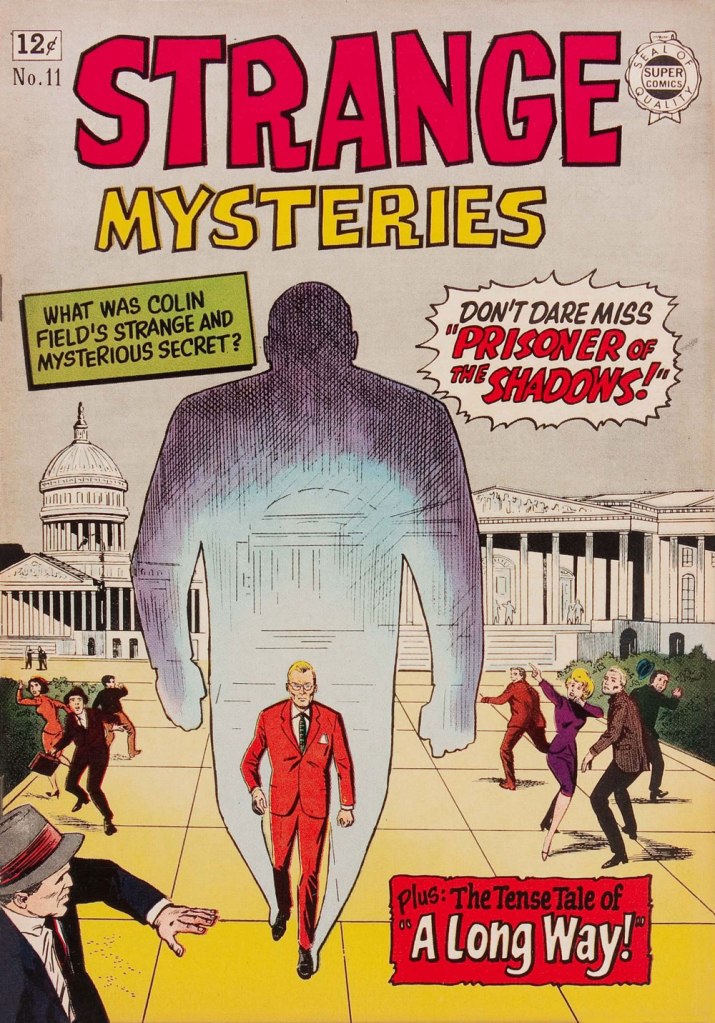
This is Doll Man no. 11 (1963, Super Comics). Read it here!This is Strange Mysteries no. 11 (1963, Super Comics). Read it here! The 60s Marvel colouring gimmick of leaving the background grey to make the foreground figures stand out (not to mention spare much time and effort) leads me to think that resident Marvel hues-man Stan Goldberg (no Rube he) may have been moonlighting for Izzy Waldman. This is Danger no. 12 (1963, Super Comics). Read it here!
Mr. Markstein on The Black Dwarf: « The first question, of any character, is — why? Putting on a bizarre outfit to battle crime on an unpaid, freelance, anonymous basis seems pretty strenuous, requiring strong motivation. But his isn’t much. He just hates crime, no particular reason cited.
Next, what’s with the name? He was shorter than average, but not so short he qualified as a Little Person. Santa Claus would reject him on sight. And would identifying himself as a dwarf instill fear in criminals, confer fighting prowess on himself, or in any other way be an asset in his war on evildoers? It just sends a message that he’s small, so the evildoers can probably beat him up. At least he made up for his shortcomings by packing a gun. »
This is Mystery Tales no. 16 (1964, Super Comics). Read it here!This is Strange Planets no. 16 (1964, Super Comics). Read it here!This is Danger no. 16 (1964, Super Comics). Read it here! I was tempted to quip that it takes tremendous chutzpah to hire the then-current Wonder Woman artist to illustrate a cover featuring one of her numerous knock-offs… but I’m pretty sure Waldman, hardly a comics insider, didn’t know and didn’t care.
Of this particular breed of characters, Markstein wrote: « Superheroes first turned up in American comic books just before World War II, and flourished during the early war years. Especially flourishing were a sub-species of superhero that wrapped themselves in the U.S. flag like a cheap politician. Inexplicably, these are referred to as “patriotic” heroes, indicating that wearing the flag like Captain Freedom or Miss Victory was deemed a mark of patriotism higher and more… »
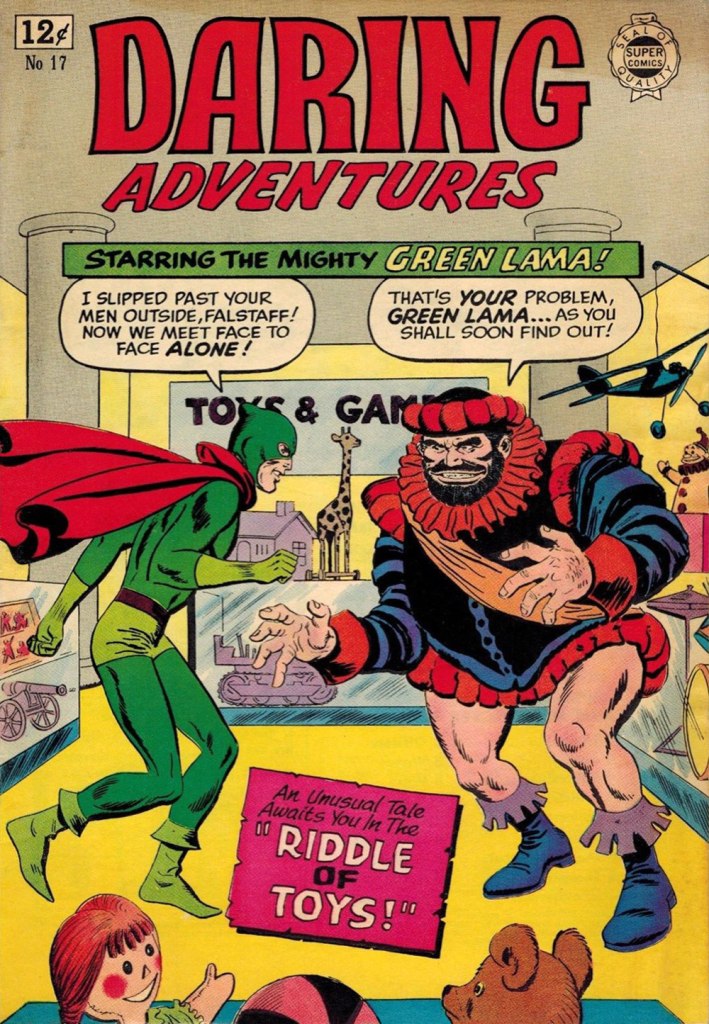
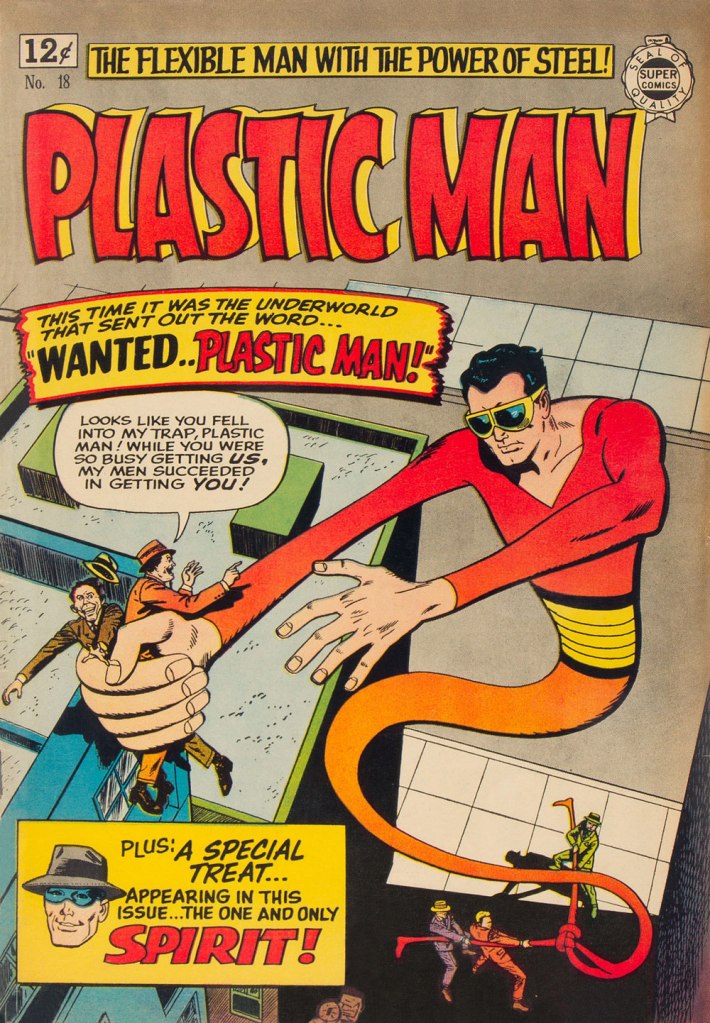
This is Fantastic Adventures no. 16 (1964, Super Comics). Read it here!This is Strange Mysteries no. 17 (1964, Super Comics). Read it here!This is Daring Adventures no. 17 (1964, Super Comics). Read it here! « May I have this dance, Green Lama? » « Why, I thought you’d never ask, Falstaff! »This is Police Trap no. 18 (1964, Super Comics). Read it here! In my opinion, this is one of the best-composed of Andru’s Super/I.W. covers: very nice sense of depth, though the effect would play out far better without the quite superfluous ‘We proudly present...’ blurb, which breaks the visual flow. I think the guy on the left is a bit ticklish. This is Plastic Man no. 18 (1964, Super Comics). This is actually a pretty spiffy issue, featuring classic work by masters Jack Cole and Will Eisner. Read it here! DC, who owned the character — having bought it from its original publisher, Quality, when it left the field (along with Doll Man, Phantom Lady, Blackhawk…) — would resurrect Plas in 1966. That didn’t click. It wasn’t until the Steve Skeates / Ramona Fradon revival of 1976-77 that someone managed to grasp the appeal of Jack Cole’s unique creation. But again, sales were low. In 1980, Andru would again depict Plastic Man on Adventure Comics covers spotlighting Jean-Claude “Martin Pasko” Rocheford and Joe Staton‘s unfunny, misguided and mercifully brief run. And hey, if you’d always longed to see Andru’s version of Eisner’s The Spirit, this is all you get!
-RG
*Harlan Ellison on Conway, circa 1979: « I mean, the first time I met Gerry Conway, who the hell would’ve known that Gerry Conway would single-handedly ruin the entire comics industry. He’s a classic example of the deification of no-talent in all industries. He’s not good, but he has it in on Thursday. And that’s all they care about. You know, fill them pages. » [ source ]
**taking over from Mike Esposito and actually making him look good in comparison!
« I’m going to Boston to see my doctor. He’s a very sick man. » — Fred Allen
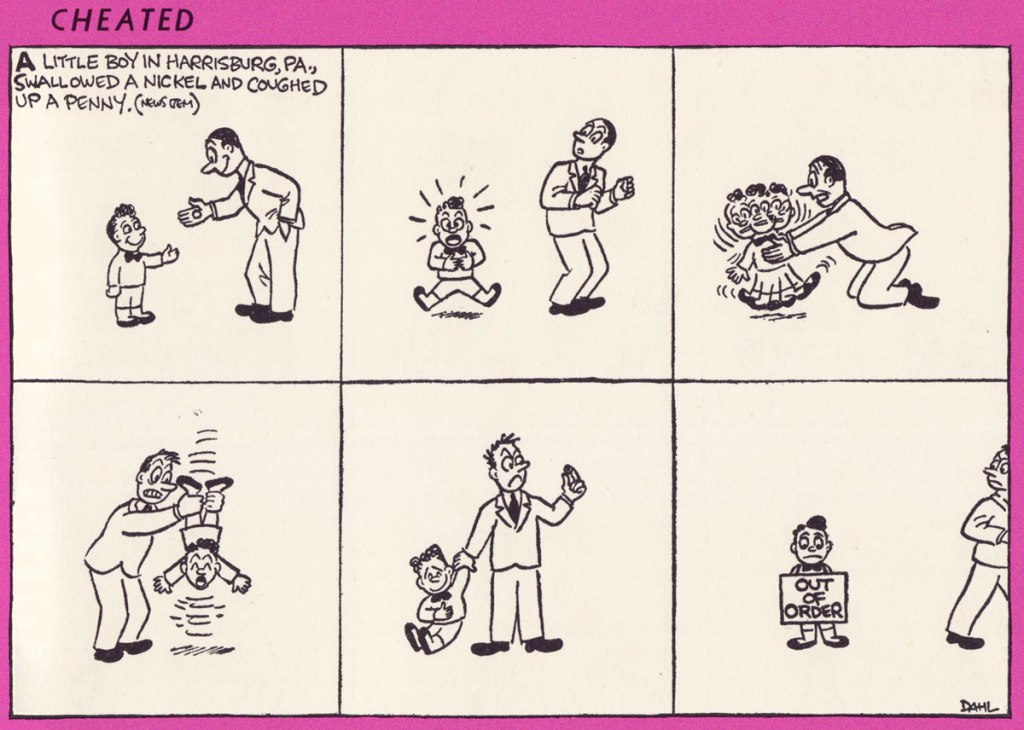
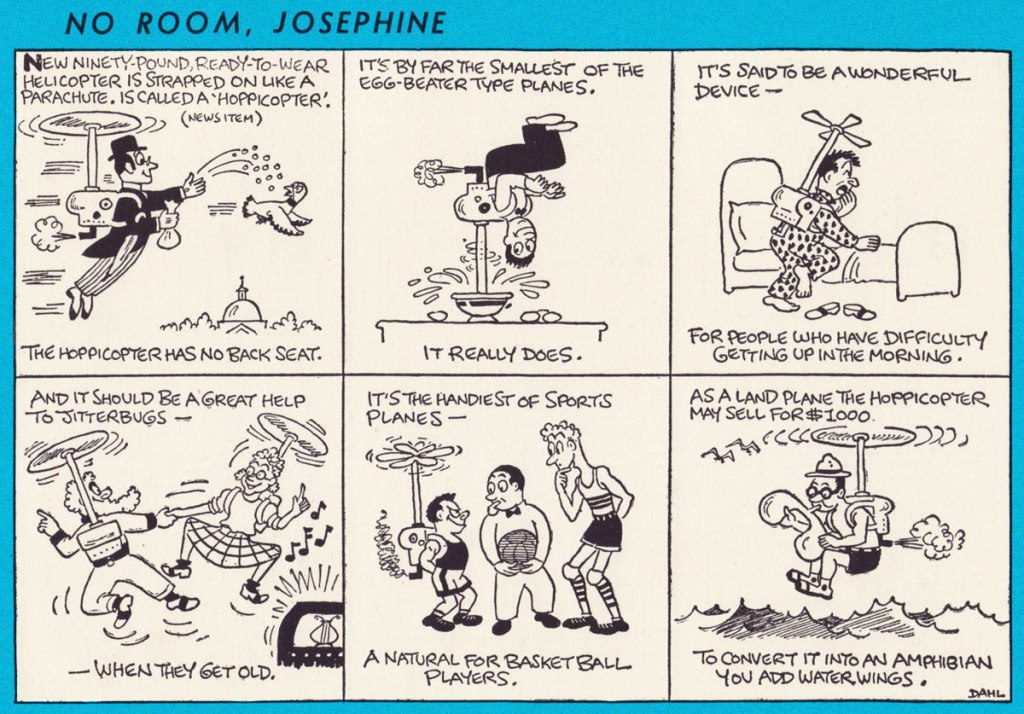
My turn to spotlight a recent find: last month, during a fruitful visit to Ellsworth, ME’s The Big Chicken Barn, I spotted — among others — an item of interest in the humour section: a hardcover volume entitled Dahl’s Brave New World, published 1947. Spare but effective cartooning, plenty of imagination and wit. See what you make of it.
Replace ‘miniature plane’ with ‘drone’ and you’ve got a cartoon for these here times.While the ordinary citizen has been waiting for his long-promised, personal jet pack for decades on end, a ready-to-wear helicopter would be, it seems to me, a reasonable substitute.
I love knowing that there’s a world of talented folk I’d never gotten wind of. Even if a lifetime is too short, even if I’ll miss out on some great art, both capital A and lower-case, I prefer to hold the optimistic view and raise the half-full glass in a heartfelt toast.
By way of biography, Mr. Dahl (1907-1973) thankfully rated an obit in the New York Times on May 7, 1973. Allow me to quote liberally from it:
« Francis W. Dahl, Boston’s best‐known cartoonist, whose works have appeared in newspapers here for 45 years as well as in a series of books, died today at his home in Newton. He was 65 years old.
Mr. Dahl’s cartoons focused on Bostonians and their politics, customs, costumes and foibles, with most of his subjects growing out of local news items.
From 1928, when he began his newspaper career as an $20‐a‐week illustrator, until last June, Mr. Dahl drew his cartoons for The Boston Herald and its successor, The Herald Traveler. When the paper was purchased by The Record‐American last June, he joined The Boston Globe.
Collections of the cartoons also appeared in a number of books, including “Left Handed Compliments,” “Dahl’s Cartoons,” “What, More Dahl?” “Birds, Beasts and Bostonians,” “Dahl’s Boston” and “Dahl’s Brave New World.”
Stories about Mr. Dahl have become part of Boston’s journalistic legends. Once, for example, a Herald engravers’ plate broke just before deadline and 144,000 copies were printed without his cartoon. A printed box asked readers if he was missed, and 4,000 letters were sent to the editor saying yes.
On another occasion, Mr. Dahl broke his right arm — his drawing arm — but rather than miss a day the paper had him draw left‐handed for six weeks. »
While the NYT piece itself draws heavily from a 1946 Time Magazine profile of Dahl, it left out the juiciest part of the anecdote: « Since draftsmanship is the least of Dahl’s assets, the switchover didn’t show much. »
It’s refreshing to see — especially in light of the era it was produced in — the lady take the amorous initiative.I couldn’t pass this one up: I mean… mushrooms, bats, moles and skinks!
And here’s some insight into Dahl’s relative obscurity: « Because he concocts his cartoons out of local news items, and refuses to change his ways, mild-mannered Francis Dahl has never been syndicated. But for his collections of reprints, he would be unknown outside New England. » [ source ]






































 Who's Out There?