It’s kind of sobering to chance across some regional comics… sometimes they’re of such high quality that I tend to wonder at, and regret, the vast bounty cast aside and left in the dust. How much more similarly fine stuff is out there is anyone’s guess. It makes me long for the days of greater cultural variety on a smaller scale, of humble local stations, local stardom and the unpredictable crazy quilt of regional popularity.
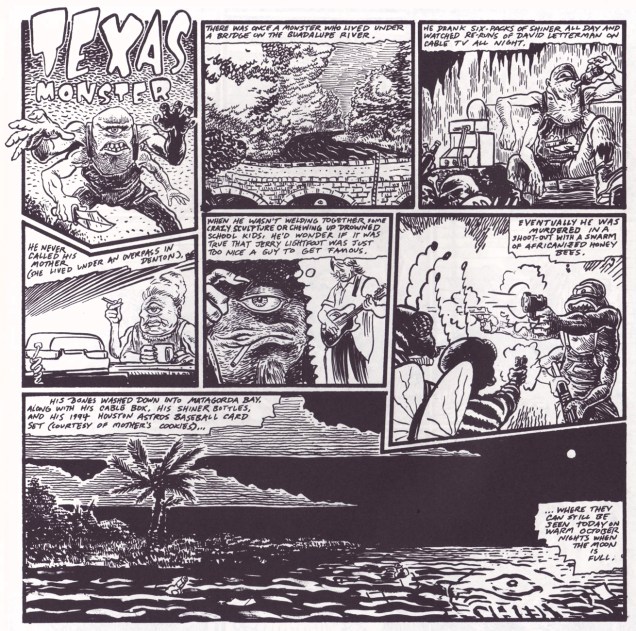
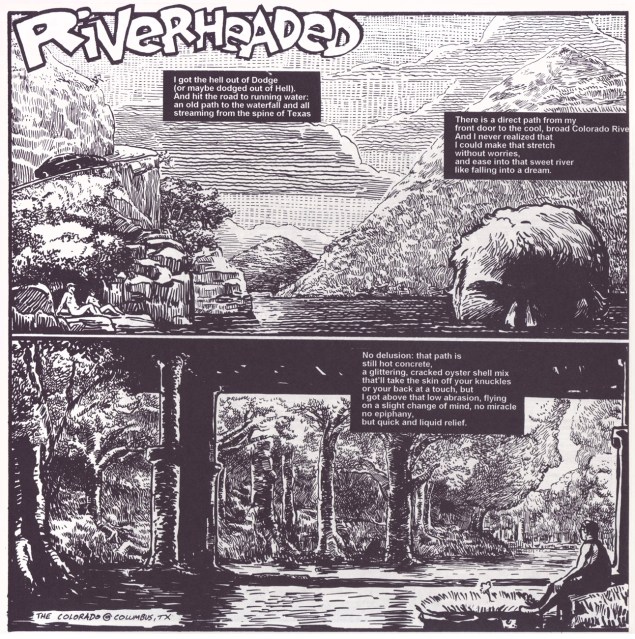
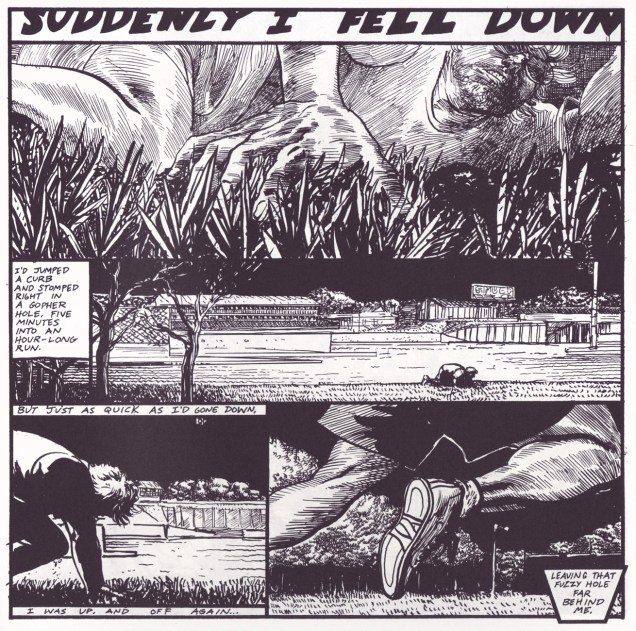
Houston, Texas’ Scott A. Gilbert is a prime example. If not for his being awarded a Xeric Grant in 1995, which financed the publication of It’s All True!, a concise 52-page collection of his favourite True Artist Tales, even fewer of us would have been exposed to his freewheeling talent. Without further ado, here are some of my picks from the booklet.
A Whiff of Hypocrisy (1992)One Art History (1993)Texas Monster (1994)Riverheaded (1994)I Fell (1994)
Gilbert’s True Artist Tales was published in rival alternative weeklies Public News (1988-97), and Houston Press (1997-2000). To answer our opening question, Gilbert got $25 a strip at Public News and $30 at Houston Press.
And for a bit more context, here’s an illuminating presentation that former Comics Journal managing editor Robert Boyd gave last year during a retrospective of Gilbert’s art Boyd was curating (now there’s something you don’t often see these days: the use of “curating” in its proper context!)
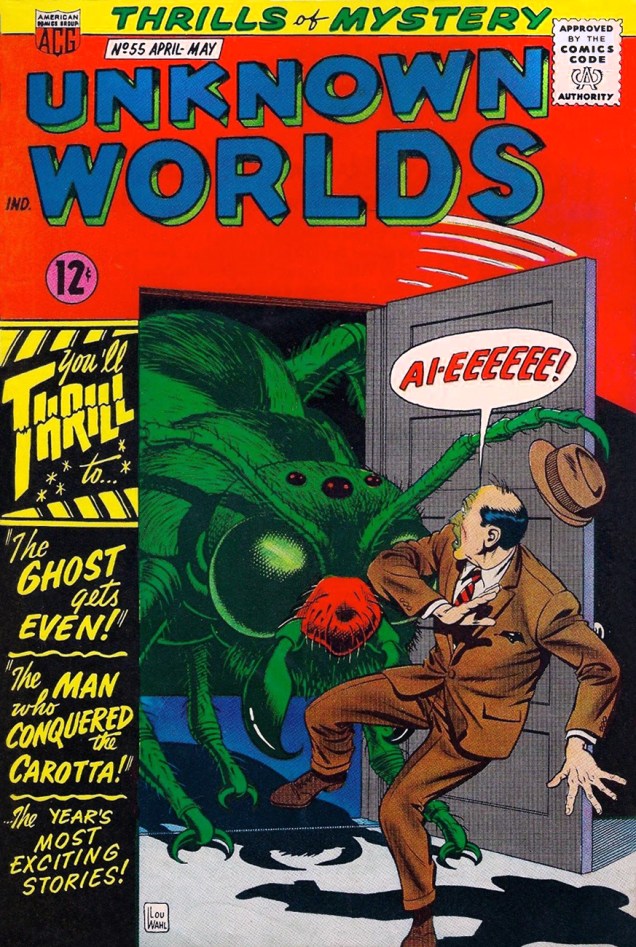
Surprise! Happy birthday to Lois Lane artist supreme Kurt Schaffenberger (December 15, 1920 – January 24, 2002), here working under the alias of Lou Wahl, (he was also Jay Kafka, which would have been fitting here!) a popular and entertaining practice at ACG and Marvel. The DC brass were presumably *not* amused by these moonlighting shenanigans. I’m looking at you, “Adam Austin”, “Mickey DeMeo” (aka Joe Gaudioso), “Jay Gavin” and “George Bell”…
This is Unknown Worlds no. 55 (April-May 1967, ACG), one of the final issues of this fine anthology title.
In case you were wondering: Adam Austin was Gene Colan‘s alias, Mickey DeMeo and Joe Gaudioso were Mike Esposito‘s nomsdeplume, and Jay Gavin and George Bell were pseudonyms respectively favoured by Werner Roth and George Roussos.
« What are you mumbling about? »
« Oh, nuthin’! … just that my false teeth get loose an’ make a lot of noise! »
Today marks the one hundred and third anniversary of the enigmatic Jack Cole (December 14, 1914 – August 13, 1958) a man embodying, in equal parts, hilarity, talent and torment. Just when everything seemed to be going his way, he took his own life in 1958, for reasons still surmised about. His widow was the only one to know, and she took her secret to the grave.
Let’s move past this morbid stuff and concentrate on the man’s creative legacy, shall we?
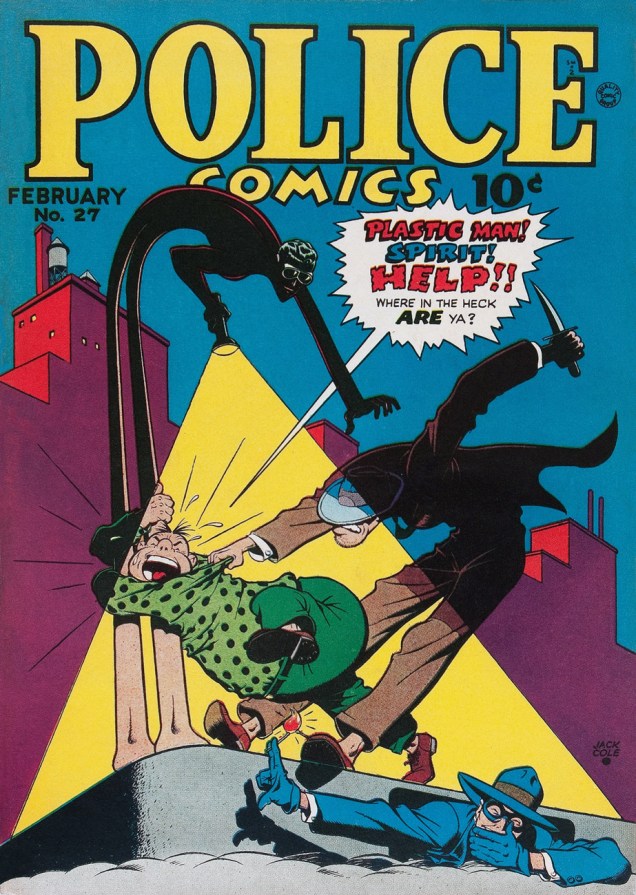
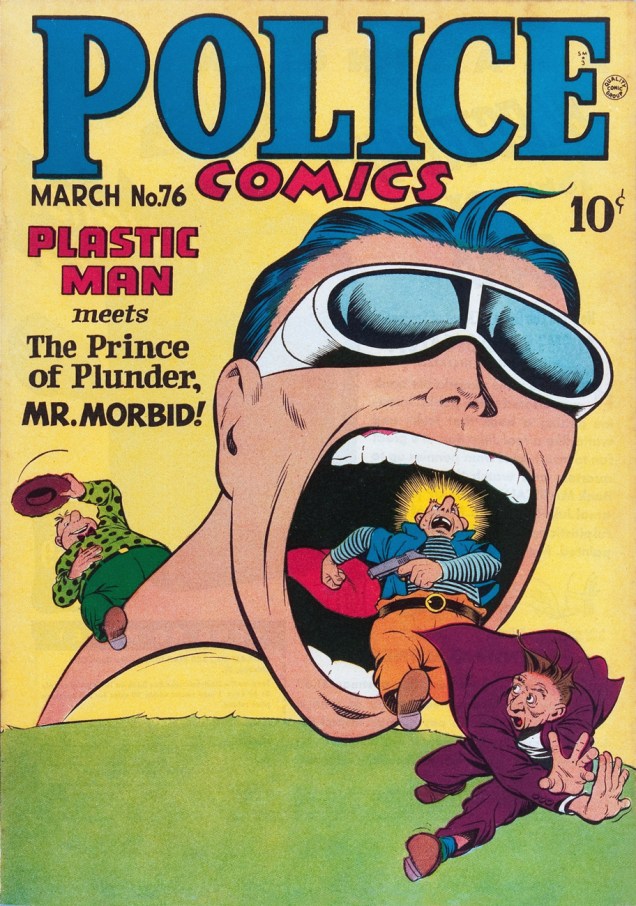
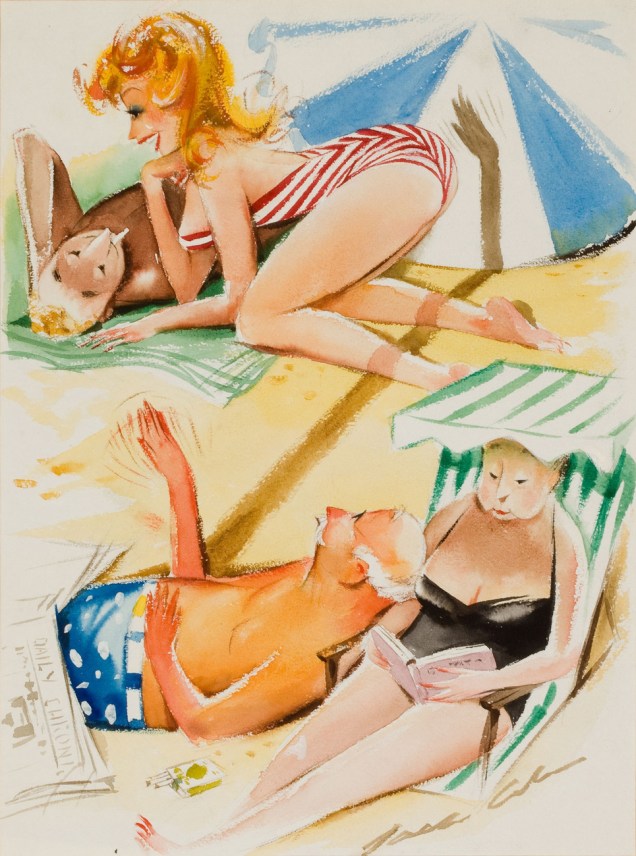
Cole’s cover for his Plastic Man story « The Rare Edition Murders » (originally called « The Bookstore Mystery », judging from the cover art) cleverly ties in the mag’s other features. And they do need to be mentioned: Flatfoot Burns by Harvey Kurtzman, The Darson Twins by Jack Keller, The Spirit by Will Eisner (or his talented ghosts), Manhunter by Reed Crandall… This is Police Comics no. 25 (December 1943, Quality).Routine, the same old grind… another issue of Police Comics, another splendid Jack Cole cover. This is Police Comics no. 27 (February, 1944), featuring Plastic Man in « Woozy Winks, Juror », and tales of Dewey Drip, Flatfoot Burns, Destiny, Manhunter, Dick Mace, The Human Bomb, Burp the Twerp (by Cole), and of course The Spirit. Sounds potentially entertaining? Read it here, then: http://comicbookplus.com/?dlid=37421Cole’s Plastic Man, one of the timeless wonders of comics’ Golden Age, a character only his creator truly knew how to handle properly. This is Police Comics no. 72 (November 1947, Quality).Another vivid (what else?) example of Mr. Cole’s boundless inventiveness, featuring his flagship creation, Plastic Man (and rotund sidekick Woozy Winks). This is Police Comics (1941-1953, 127 issues) no. 76 (March 1948, Quality).« You mean this guy had nine slugs in his chest and still choked the other one to death? » Web of Evil no. 5 (July 1953, Quality).Web of Evil no. 6 (September 1953, Quality).This lovely watercolour ran in Playboy Magazine‘s August, 1955 issue. It’s titled « The Elongated Hand ».« Like they say in the travel folders, Miss Duncan – ‘Getting there is half the fun’ ». Playboy Magazine, August, 1956.
« Comics! If you wanna read, read a newspaper like normal people. »
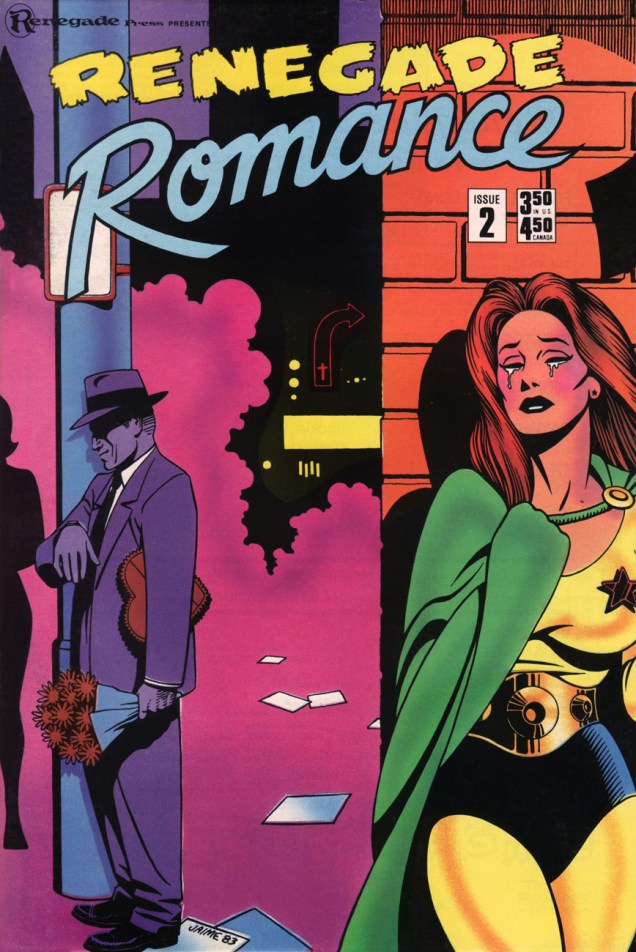
In the late 1980s, Deni Loubert’s Renegade Press published two issues of this neo-romance anthology. While the results were perhaps a smidge uneven, it was a worthy enterprise, a refreshing change from the often out of touch romance titles from earlier decades… RR’s feminine perspective wasn’t a token one and the boys were, for once, in the minority. Among the contributors: Lee Binswanger, Angela Bocage, Jackie Estrada, Colleen Doran, Krystine Kryttre, Cynthia Martin, Barb Rausch, Mary Wilshire… and some guys.
« I know what’s the matter with your comic artists, they’re all crazy. »
« Of course they’re crazy, they wouldn’t be worth a whoop if they weren’t crazy. »
Today we commemorate the birthday of Popeye creator Elzie Crisler Segar (December 8, 1894 – October 13, 1938). The man succumbed to leukaemia and liver disease at the distressingly early age of 43… but not before making his everlasting mark on the world of cartooning and the world at large.
In this Popeye Sunday strip dated August 14, 1938, J. Wellington Wimpy ably demonstrates his solid-gold mooching wiles.
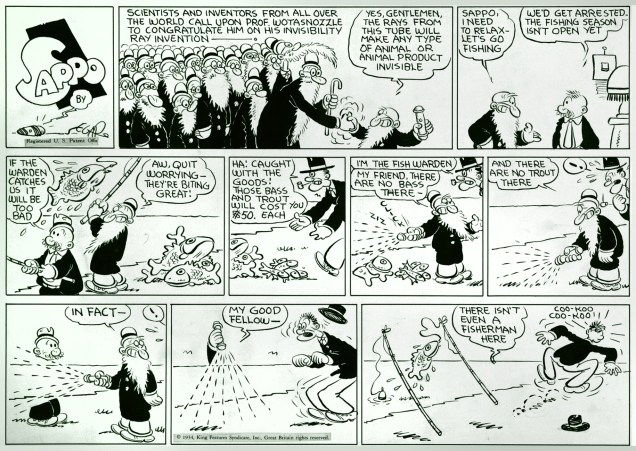
And for dessert, have a chaser of Segar’s even more endearing (in my opinion) companion strip, Sappo, featuring his delightfully bonkers Professor O. G. Wotasnozzle.
Sappo appeared as Thimble Theatre / Popeye’s “topper” on Sundays. This out of sight entry appeared on April 8, 1934.
Happy Birthday and bon appétit, Mr. Segar, wherever you are!
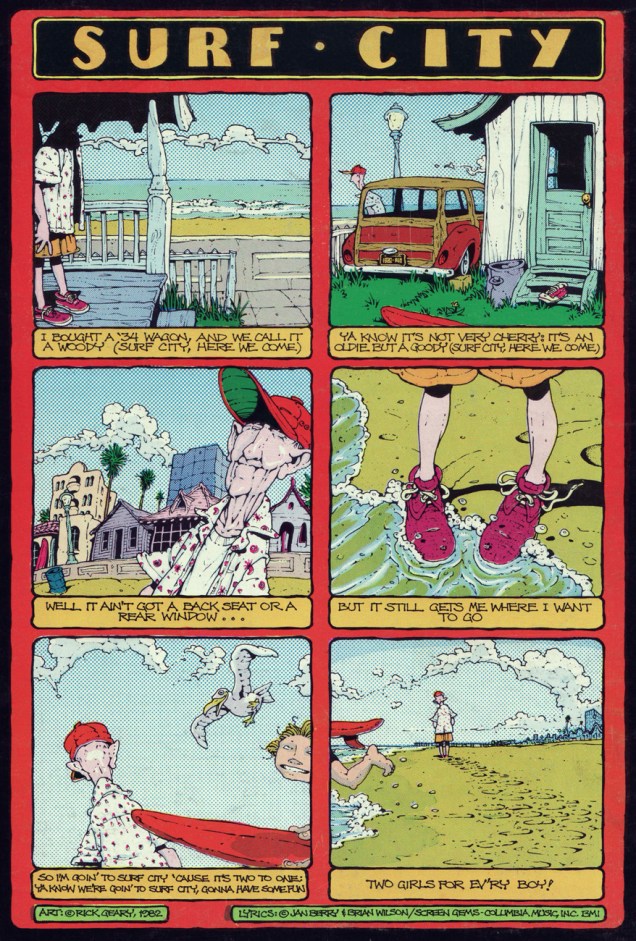
Rail-Bangin’ Rick Geary gives us a not-entirely-literal, yet oddly fitting visual representation of Brian Wilson and Jan Berry’s timeless classic, a number one hit for Jan & Dean in the Spring of 1963. Wilson’s original working title for the tune was “Goody Connie Won’t You Come Back Home“, perhaps a tad less catchy appellation.
Surf City, the strip, appeared on the back cover of the lone issue of Bop, “America’s First & Only Music Comix Magazine“ (1982, Kitchen Sink Press.) Edited by Catherine Yronwode.
« In the big wrinkled world, it would be like looking for a straw in a needle stack…»
Based upon, but with savvy improvements, Peter Sellers‘ Inspecteur Jacques Clouseau from the popular series of films launched with 1963’s “The Pink Panther“, the animated Inspector and the titular feline (who first appeared in the opening credits of the film) were spun off into a pair of successful series of animated shorts. Produced by DePatie-Freleng Enterprises, these series have earned their place as highlights of 1960s animation, though the competition was pretty toothless, compared to prior decades.
As for funnybooks, Gold Key’s “The Pink Panther and the Inspector” title was a solid success, lasting 84 issues (73 under the GK imprint, then 11 more under Whitman, 1971-1984), leading to a solo spinoff for The Inspector (19 issues, 1974-78). This is surprisingly witty stuff, written and drawn with assurance and verve. Comic strip great Warren Tufts (creator of Casey Ruggles) was reportedly involved, though when it comes to Gold Key and Dell, credits are at best sketchy.
This is issue 2 of The Inspector (Oct. 1974, Gold Key.)Speaking of the « Case of the Stolen Kiss », here’s a rather… daring public display of affection! This being Gold Key, the material was not submitted for approval to the industry’s censorship body, the Comics Code Authority.
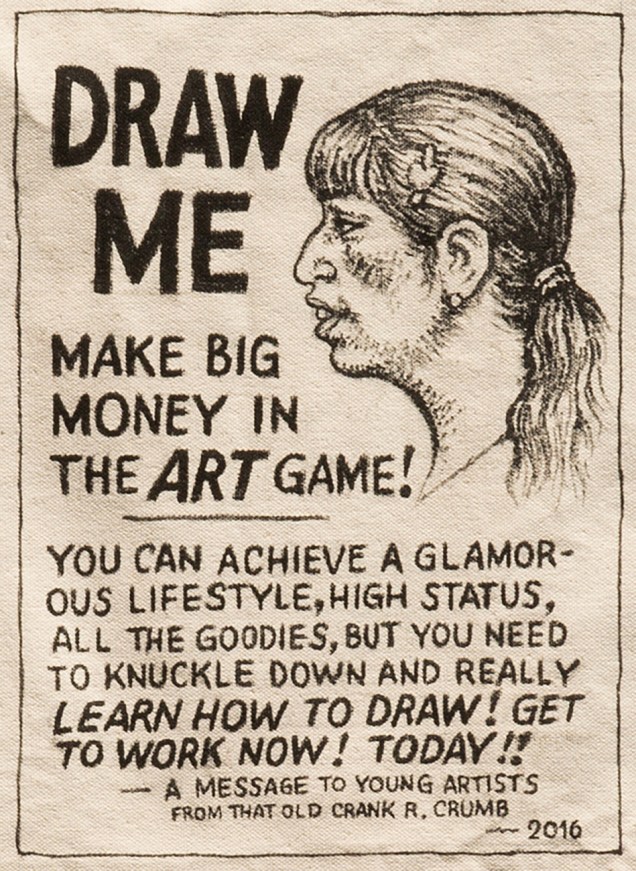
A couple of days ago, I came upon a recent piece by the one-and-only Robert Crumb, one that’s currently up for (well-heeled) grabs through the auspices of Heritage Auctions.
Quoting Heritage’s description: « Robert Crumb and Others – ‘Spike and Mike’ Jam Mural on Canvas (2015-16). An approximately 80″ x 60″ sheet of canvas, with sketches on both sides. Chief among them is a “Draw Me” ad parody by Robert Crumb. Getting Mr. Crumb’s involvement was not easy; it took a friend lugging this oversized piece of canvas around Europe to track down the elusive artist, but the results were worthwhile. Crumb’s art measures 8″ x 11″, and is on the “unfinished” (cream-colored) side of the canvas, with several other sketches. »
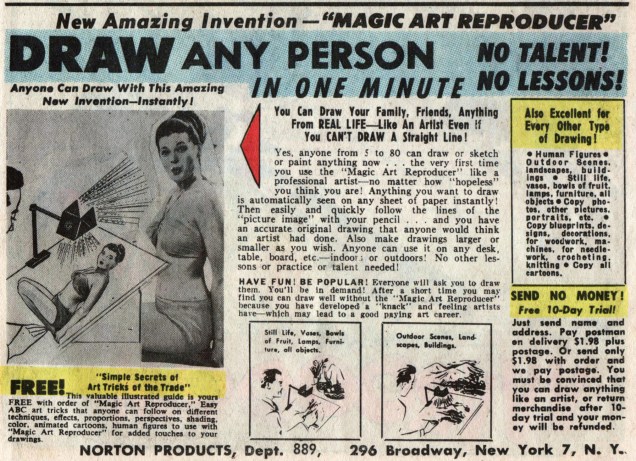
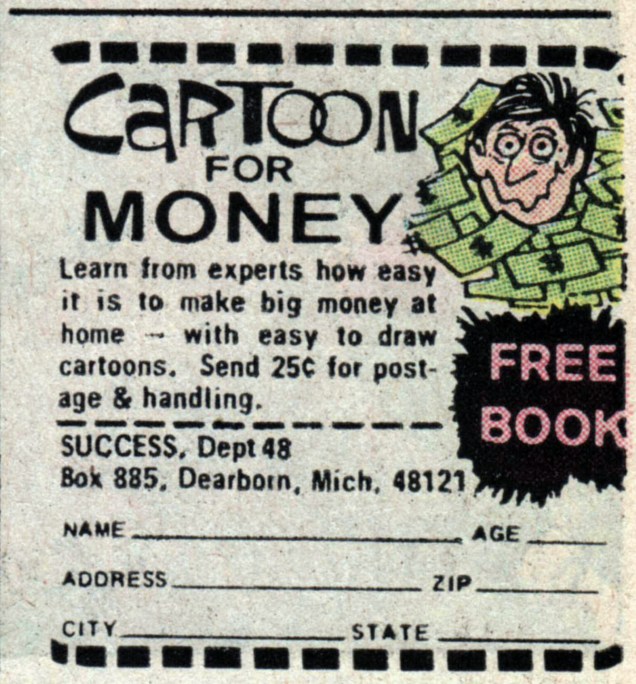
It brought to mind the rich, if often sordid, history of art lessons offered in comic book ad spaces. Here’s a sampling.
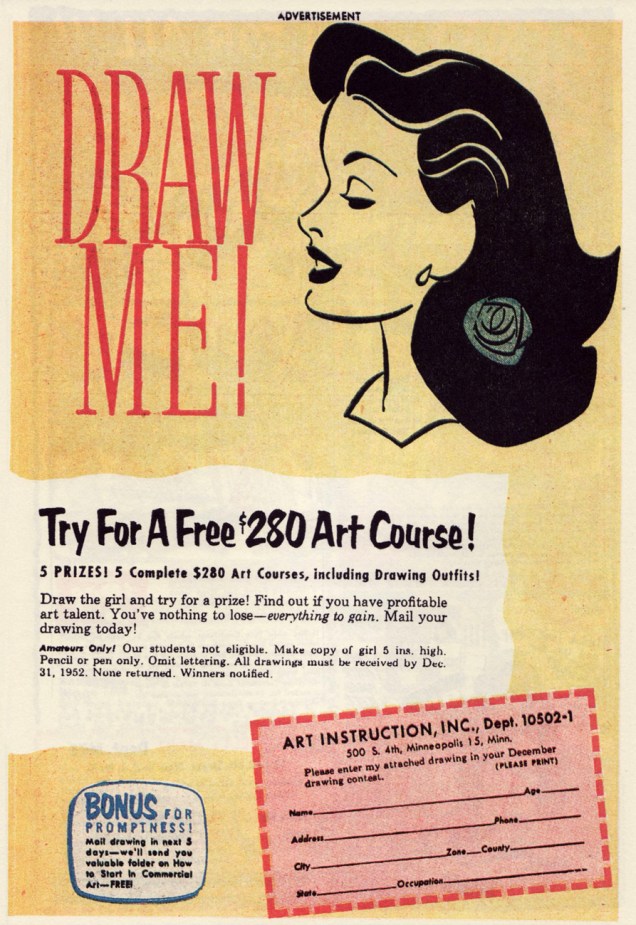
The face that launched a thousand backroom businesses, and the object of Crumb’s homage/parody (1952). Note the sharp bit of self-serving credibility-boosting: « Amateurs Only! Our students not eligible. » The implication being that, naturally, their students are now all successful, seasoned pros… but you still need to tell them to butt out of the contest. The beautifully-drawn girl anticipates Jaime Hernandez‘s stripped-down style, if you ask me.Apparently a dry run (1954) for the great Joe Kubert’s School of Cartoon and Graphic Art (established in 1976, and still around); its (early) graduates include Stephen Bissette, Rick Veitch and Timothy Truman. Joe’s then-partner Norman Maurer, aside from being a fine cartoonist himself, was the son-in-law of Stooge Moe Howard, for which Maurer produced many 3 Stooges cartoons and comic books. Maurer and Kubert were also co-originators (with Leonard Maurer) of 3D Comics in 1953.Well, if you can’t draw… there’s always tracing; though even there, talent is an asset (1963.) According to Kirk Demarais‘ excellent book, Mail-Order Mysteries, this was « a rip-off. »This little ad was quite ubiquitous in 1970s comics. Was the product offered worth a damn? The mystery endures; well, that and the newly-wealthy cartoonist’s memorably frazzled expression.Roy Wilson’s book can still be found with a little digging. It certainly boasts a great cover. I’d mark this one as an honest enterprise (1973.)According to Kirk Demarais, You received « A thirty-two page booklet that teaches you, not only to draw monsters, but how to draw, period. Art history and artists’ tools and techniques are covered, along with a gruesome collection of creeps. It’s all presented with a healthy dose of encouragement for young pencil bearers. » Monsterman (aka Harry Borgman) earned himself a thumbs-up verdict from Mr. Demarais: « In a sea of shysters, Borgman is the real deal. » (1975)Mail Sack, Inc.? Still, a quarter doesn’t seem like too much of a gamble… (1971)Corner-cutting maestro and Marvel yes-man Big John B.’s art class gave the world such enduring talents as… er, Bob Hall. (1976)For some reason, this one leaves me… somewhat skeptical (1978.) Nice perspective, chump.And of course, we can’t leave out the cream of the crop (1982.)
Mr. Crumb is right, of course: the bottom line is that « You need to knuckle down and really learn how to draw! »
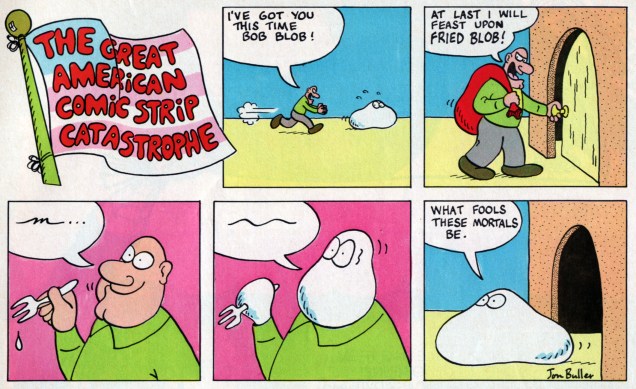
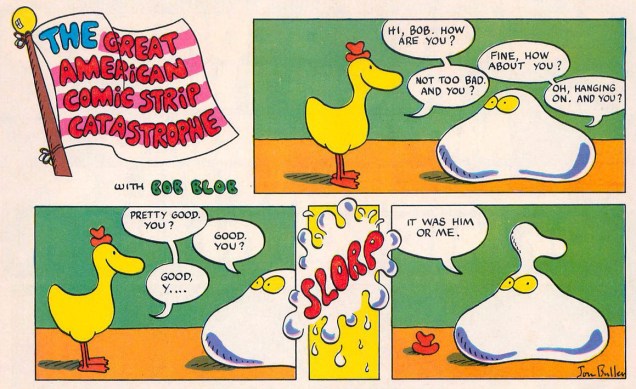
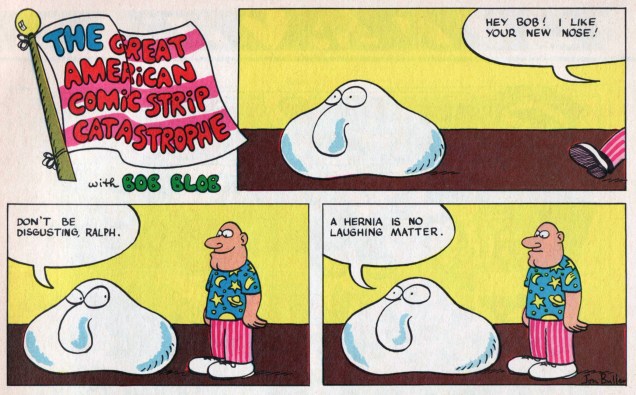
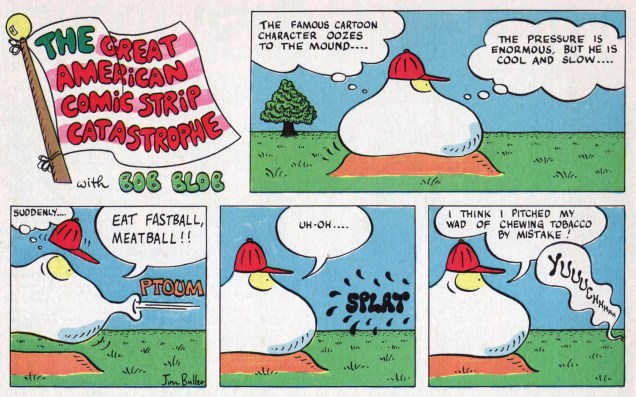
If you’ll just bear with me, we’ll take a peek at a bit of an obscurity, one that’s struck a resonant chord in me. It’s called Bob Blob, and I first encountered it in the June, 1978 issue of Marvel’s Dynamite Magazine knockoff, Pizzazz (1977-79). “The Great American Comic Strip Catastrophe” had been part of the magazine’s lineup since its inaugural issue, but had pretty thoroughly failed to live up to the promise of its title. With issue 9, the magazine’s “First National Edition“, Jon Buller‘s Bob Blob oozed into view and relieved readers from the pedestrian ‘funny animal’ antics just taking up space and failing to bring about the announced, and hoped-for, comic strip catastrophe.
For its final four issues, Pizzazz adopted as its motto “Humor in the Marvel Manner“. If you ask me, that’s what dragged the magazine down: Dr. Doom knock-knock jokes? Er, no thanks. It’s when the humour veered away from said ‘Marvel Manner’ that Pizzazz acquired some actual pizzazz. Bob Blob was at once hi-concept and lowbrow, and one gets the sense that Jon Buller could have spun endless, increasingly surreal variations on his theme, but the magazine lasted but a scant sixteen issues, and ran only eight Bob strips.
Here they are, in order of publication and everything!
This particular strip anticipates Larry Cohen‘s cautionary horror satire The Stuff (1985).
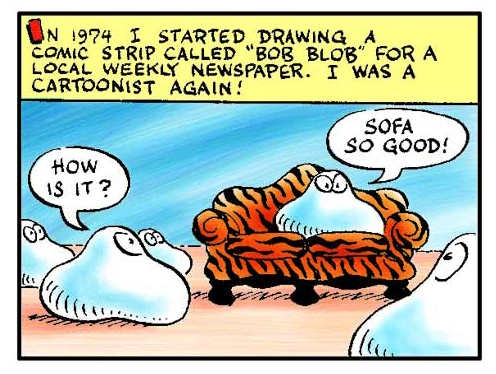
According to Jon Buller, Bob was born… well, let him tell the story:
Read in full Jon Buller’s story in cartoon form, of which this is panel 8 of 13 (go ahead, it’s concise, splendidly told, and well worth your time)
Buller went on to illustrate countless books (sixty at last count!) written by his equally talented wife, Susan Schade. To name but a few: Riff Raff Sails the High Cheese, Anne of Green Bagels, Dracula Marries Frankenstein, No Tooth, No Quarter!, Baseball Camp on the Planet of the Eyeballs, Ron Rooney and the Million Dollar Comic…
« What’s that noise comin’ up from the cellar? It’s the restless bones of Boris and Bela* »
It’s a cinch that William Henry Pratt, back when he was eking out a living in Canada, digging ditches or driving a truck, never suspected that his name, his stage name that is, would still elicit shivers of recognition long after his passing. Here we are, a whole hundred and thirty years past his birth, in Camberwell, South London, on Wednesday, November 23, 1887.
From his ascent to stardom in the early 1930s until his passing in 1969, he certainly lived to see his likeness appear in a bewildering array of toys and games and bedsheets and mugs and a zillion knicknacks and gewgaws, a parade that continues to this day. But he was likely never represented more consistently and abundantly than he was in comic books.
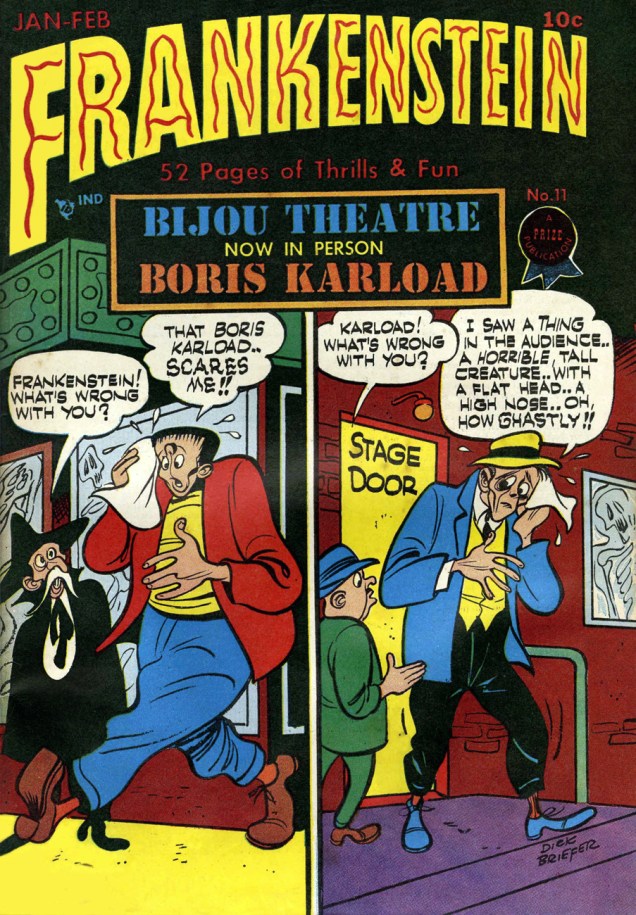
Here, the Monster meets his… inspiration, in « Boris Karload, Master of Horror ». Dick Briefer‘s Frankenstein is a definite highlight of the Golden Age of comics. This is Frankenstein no. 11 (Jan.-Feb. 1948, Prize Comics). Read it here: http://comicbookplus.com/?dlid=39937 And if you, er… dug that, treat yourself to Craig Yoe‘s selection of Briefer’s rendition(s) of the Famous Monster. It’s a great package, and Mr. Yoe can always use the money… to unleash further wonders.
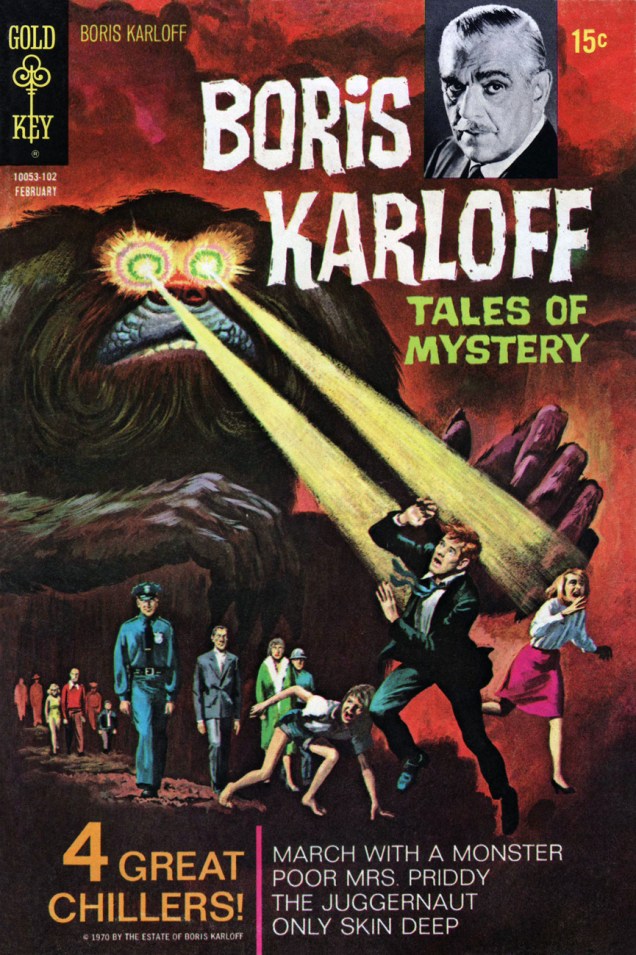
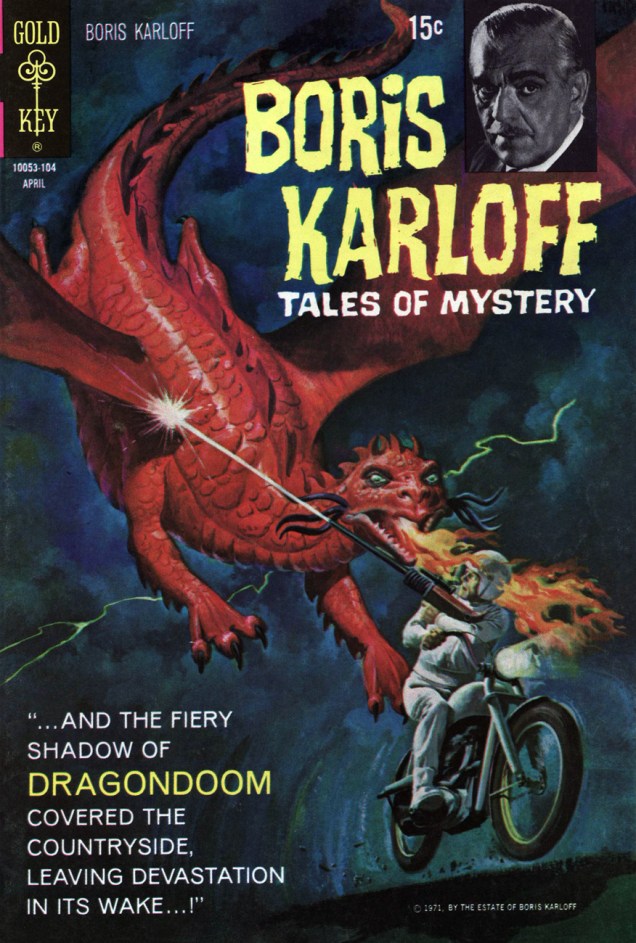
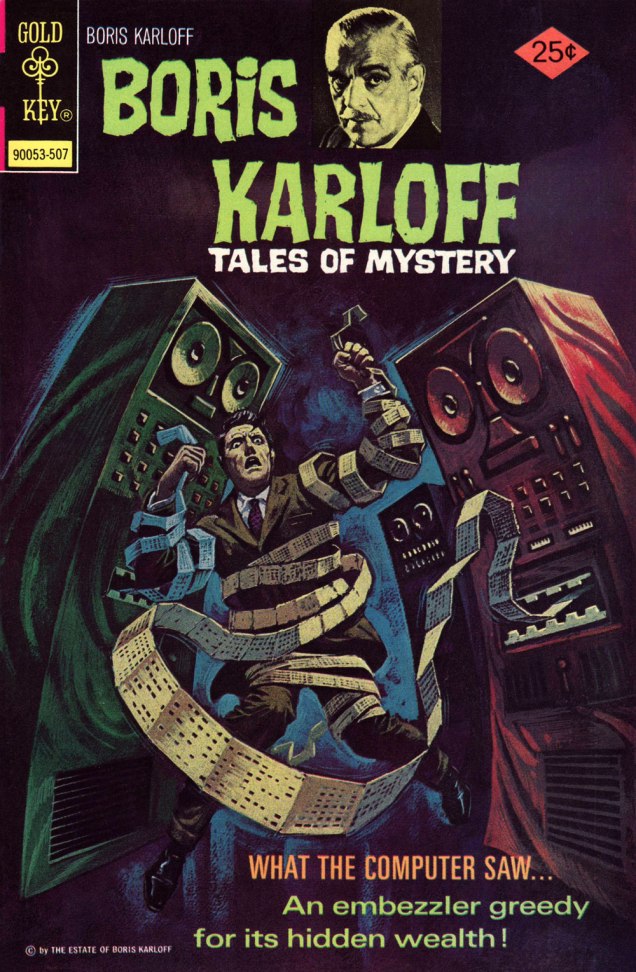
Here’s a gallery of cover highlights from Gold Key Comics’ long-running Boris Karloff Tales of Mystery (95 issues, 1962-80).
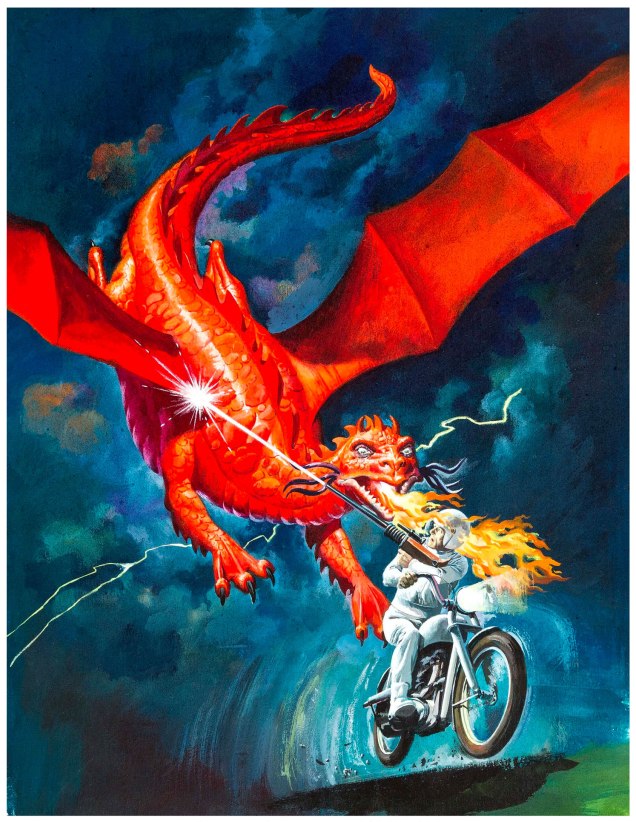
Before there was called Boris Karloff Tales of Mystery, there was, for two issues, Thriller, based on the by-then-cancelled NBC series. Gold Key were often quite slow in making their licensing moves. The TV Thriller was often terrifying (“Pigeons From Hell”, “The Hungry Glass”…), but the comic book never scaled such heights, even sans the emasculating influence of the Comics Code Authority.« You know that one sideways glance from that bug-eyed banshee can turn your brains to prune-whip! » Boris Karloff Tales of Mystery no. 33 (Feb. 1971), Cover painted by George Wilson, illustrating Len Wein, Tom Gill and John Celardo’s March with a Monster.« I’m being scorched by something that shouldn’t even exist! » A laser cannon-equipped Evel Knievel tussling with a badass reptilian nightmare? That’s the Seventies for you. Gold Key’s mystery comics were generally pretty tame fare, but their covers, such covers! This one’s painted by Saint George Wilson. Boris Karloff Tales of Mystery no. 34 (April 1971.) You just know that Dragondoom is written by Lein Wein, because its damsel-in-distress shares his wife’s name, Marvel and DC colourist Glynis.A look at Mr. Wilson’s original painting gives us an idea of just how much was lost in the transition from brush to print. Sometimes it’s better *not* to know.« Feast your eyes upon them, mortal! Do they satisfy your appetite for witchcraft? Hee Hee! » Wayne Howard conjures up some decent monsters inside, but Psychotomimetic George Wilson, who painted this mind-melting cover, shows how it’s *really* done. Boris Karloff Tales of Mystery no. 43 (Oct. 1972.)« The car — being sucked in by this blasted fetid swamp! Goodbye car… goodbye, convention! » Roadside George Wilson strikes again! Boris Karloff Tales of Mystery no. 49 (March 1973.)
« These computer cards are wonderful… almost as if they were alive! They tell me everything! » Boris Karloff Tales of Mystery no. 62 (July 1973). Luis Angel Dominguez‘s painted cover depicts a scene from Arnold Drake‘s witty It’s in the Cards.
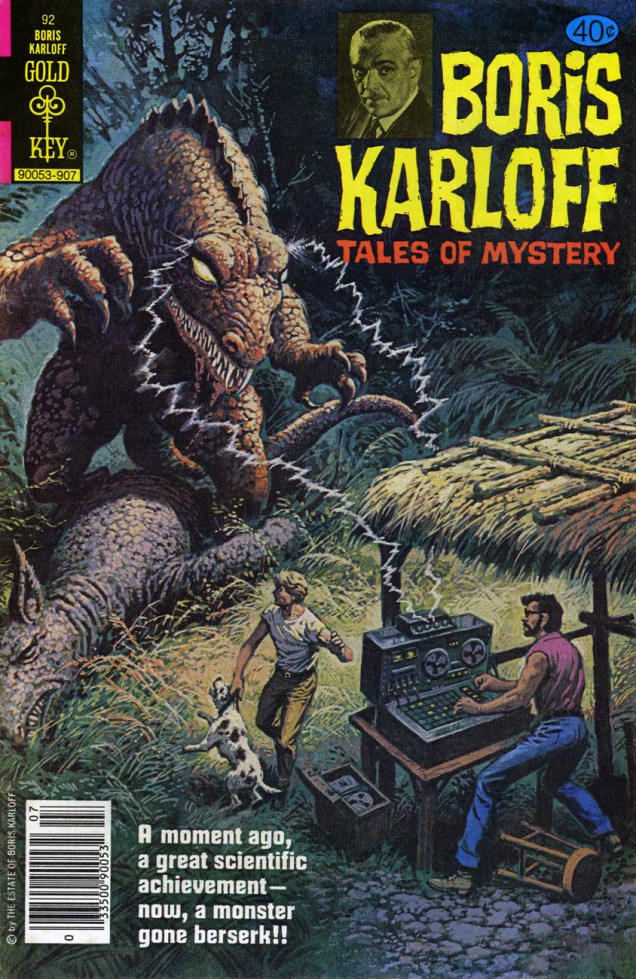
« G-g-get away, B-Bobby! There’s a living horror out there! » « Aww, gee, dad! I’m sorry about that! It’s just my sea monster! » Meet The Mail-Order Monster, a gem from an uncredited scripter (likely Arnold Drake, if the sparkling wit is any indication), and illustrated by Ed Robbins. It’s a fabulously wacky yarn, combining to fine effect good old Sea-Monkeys (brine shrimp, really) and a generous sampling of Ray Bradbury’s Boys! Raise Giant Mushrooms in Your Cellar! This is Boris Karloff Tales of Mystery no. 65 (Dec. 1975), edited by Paul Kuhn. Also within: Don’t Put It on Paper, another of the handful of jobs José Luis García-López did for Gold Key, before settling down at DC later that year. The plot is basically that of Clark Dimond/Terry Bisson & Steve Ditko’s The Sands That Change! (Creepy no. 16, Aug. 1967, Warren), but with a much gentler outcome.« But — why would anyone create something so — so terrifying? » One thing you can nearly always count on in any given issue of BKToM: “scientific” experiments always go awry, and they nearly always yield rampaging monsters. Fitting! Luis Angel Dominguez provides this electrifying cover for issue no. 92 (July, 1979.) The man had such a peerless colour sense.
Let’s reserve our closing words for the man (monster) himself: « Certainly I was typed. But what is typing? It is a trademark, a means by which the public recognizes you. Actors work all their lives to achieve that. I got mine with just one picture. It was a blessing. »





















 Who's Out There?