It’s birthday number one hundred and twelve for pulp wordsmith Robert Ervin Howard (January 22, 1906 – June 11, 1936) who, in his tragically short lifespan, yet found time to unleash upon the world Conan the Barbarian, Solomon Kane, Kull of Atlantis and, more significantly for this reader, the chilling classic Pigeons From Hell, a short story posthumously published in Weird Tales’ May, 1938 issue.
Howard’s The Horror From the Mound, originally published in the May, 1932 issue of Weird Tales Magazine, presumably had its title sanitized here because the H-word was still verboten in the early 1970s. Hailing from the second issue of Marvel’s Chamber of Chills (January, 1973), it was reprinted in glorious black and white in 1975’s Masters of Terror no. 1 (original title restored, hurrah!)
And here it be. Seems a bit inaccurate to refer to a group of mostly pulp writers (some long dead) from the 30s to 50s as “Modern-Day Masters of Terror”, but I suppose it depends on one’s definition of “Modern-Day”. Cover illustration by Gray Morrow from a drawing by noted fabulist, fervent Trump supporter and fellow Hair Club for Men habituéJim Steranko.
Gardner Fox and Brunner give it their all, but the story could have used more pages to truly do justice to Howard’s moody proto-weird western.
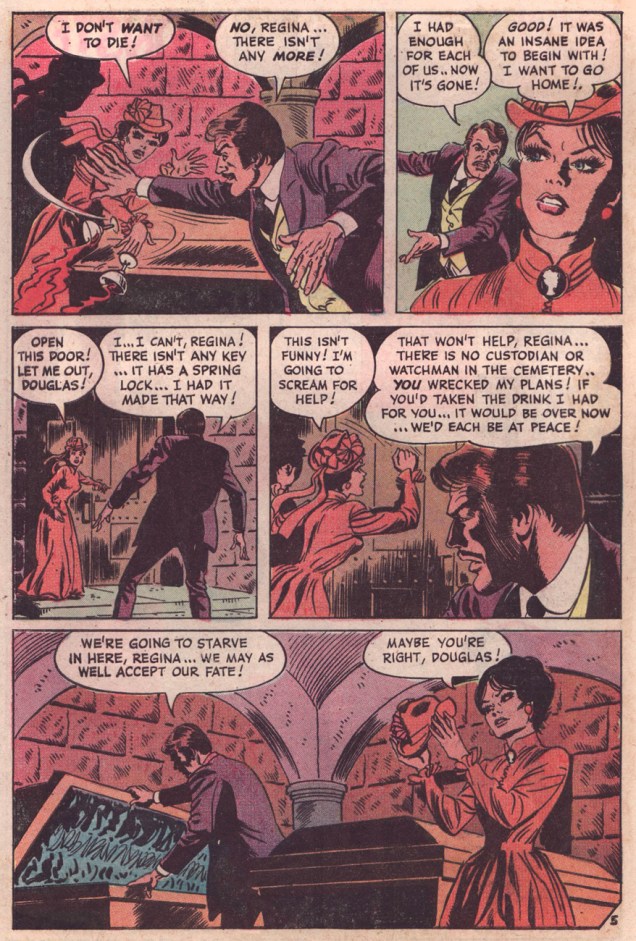
« She stared at Douglas… at this man she had judged to be an ideal mate… yet he had this very fatal flaw. »
Even to the occasional reader of mystery or ghost comic books from the late 60s to early 80s, the absurdly narrow range of plot variations must have been glaringly obvious. Same goes for any genre, of course…
For instance, at DC, mainstays Jack Oleck and Carl Wessler drove the same hoary scenarios into the old sod with numbing insistence (editor Joe Orlando‘s insistence, presumably): the greedy nephew murdering his rich, elderly uncle, the avaricious white explorer / big game hunter / mercenary purloining the sacred idol and incurring its terrible vengeance, the bank robber on the lam getting his ironic comeuppance, satanists vs werewolves vs vampires vs witches and so on… Still, the occasional inspired yarn did crop up, often to the outraged bafflement of readers.
On the other hand, Charlton was the field’s top producer of ghost stories, wisely keeping away from Marvel and DC’s spandex preserve. While one hears (correctly) about artistic laisser-faire attracting maverick stylists, Charlton’s ace in the hole, and the backbone of its comics line, was the remarkably prolific and versatile writer Joe Gill (1919-2006). Unlike his counterparts at DC, Warren, and most famously EC Comics before them, Gill rarely resorted to the O. Henry “twist” ending. An overplayed strength becomes a weakness, and so the “sting in the tail” soon was anything but. Having to write most of Charlton’s line, Gill could afford to experiment and improvise. Fact is, he pretty much had to. In my view, Gill’s work stands out from most of his peers’ in that it seems nourished by high and extensive erudition. When a Gill character discusses business deals or the combustion engine, it’s not just hot air and a family-size tub of Fluff.
Here’s a favourite of mine, a tale scripted by Gill and illustrated by Sururi Gümen (1920-2000). It appeared in Ghost Manor no. 23 (May, 1975, Charlton). The nearest it skirts a ghost story is when Regina says « I… I’ve heard that people who die unhappily haunt the place where they die! »
I love how Abide With Me carves out its own niche between romance and horror without calling upon any of these genres’ habitual devices. It’s like a well-played game of chess, a philosophic two-character play, a gravesite deliberation. Hope you’ve enjoyed it too!
This splendid Bob White cover brings to mind science-fiction satirist Douglas Adams‘ prescription for achieving flight: « … all one must do is simply miss the ground. »
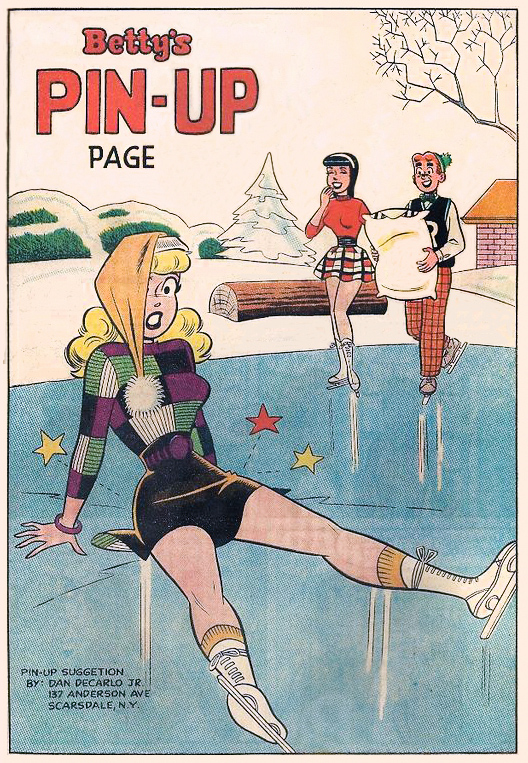
Judging from the distribution of stars, it would appear that Archie’s left cheek took more of a hit.
Betty gets her turn: This pin-up theme was sugge(s)ted to Dan DeCarlo by his son, Dan Jr., who grew up assisting his father on Betty and Veronica stories and later (early 80s) became one of the feature’s main artists. Originally published in Archie Giant Series no. 10 (Archie’s Christmas Stocking, 1961.)
« The only escape from the miseries of life are music and cats » – Albert Schweitzer
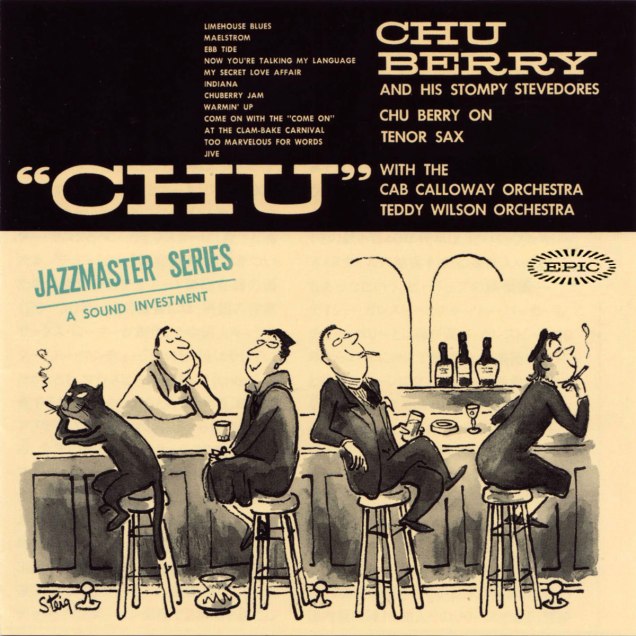
In the mid-50s, New Yorker cartoonist (and children’s book author, sculptor and Orgone Box owner) William Steig (1907-2003) was called upon to throw together some illustrations for Epic Records’ “Epic in Jazz” LP series, which featured classic 30s recordings from the likes of Johnny Hodges, Chu Berry, Count Basie, Barney Bigard and Cootie Williams. One might safely opine that the good Mr. Steig outdid himself. You be the judge.
John Cornelius “Johnny” Hodges (1906 – 1970) was a saxophone giant of the big band era, and closely associated to Duke Ellington’s band. This 1955 compilation gathers some key recordings from the mid-to-late 30s, including Rent Party Blues, Skunk Hollow Blues and Dooji Wooji.Bobby Hackett (1915-1976) was a trumpet, cornet and guitar player who performed with Benny Goodman and Glenn Miller’s bands. Among my very favourite of his recordings are some he made in the 1950s with trombonist supreme Jack Teagarden. There was tremendous musical and personal camaraderie between these two.Trumpeter Roland Bernard “Bunny” Berigan (November 2, 1908 – June 2, 1942) had, according to Al Rose, the custom of carrying « several packages of chewing gum in his pocket, not because he was addicted to the vigorous mastication of chicle. He had an even more practical use for the stuff. He’d put three or four sticks of gum in his mouth as we approached a boîte with liquor in mind. Once inside, we’d sit at the bar and order our drinks. Then he’d excuse himself, promising to come back in a moment. He would walk purposefully off, to the men’s room I assumed incorrectly. Early on I discovered that what he was doing was finding the jukebox, putting a wad of Wrigley’s Doublemint through the coin slot, then pushing the slide in to assure the device’s inoperability for at least as long as we’d be there enjoying our drinks. He’d return to the bar secure and relaxed in the knowledge that our ears wouldn’t be assaulted by bad music. »The great Rex Stewart recalls Chu: « Chu Berry was a big bear of a man and, as a matter of fact, he resembled a great big teddy bear. He was always in good humor and never had an unkind word to say about anyone. His given name was Leon Berry, his home town was Wheeling, West Virginia, and he hove onto the Harlem scene with his tenor saxophone. While he lived, he loved the life of a musician, late to bed and even later to rise. His favorite hangouts were Tillie’s Chicken Shack on Lenox Avenue and the Victoria Cafe on Seventh Avenue, where they used to serve good barbecue. Later he’d frequent the Woodside Hotel along with the fellows with Count Basie’s band when they lived there. Chu loved to talk, drink and eat, and if he could do all three while playing he was in his particular seventh heaven. »« Probably no other band has brought such fame to sidemen as the Duke Ellington band », sagely states Shirley Hoskins Collins in the liner notes of this peerless LP showcasing four of the Duke’s finest acolytes: Barney Bigard, Rex Stewart, Cootie Williams and Johnny Hodges.If I need to tell you who Count Basie and Lester Young are, you need to treat your ears to some fine vintage jazz, pronto.
These sets were reissued over the years, often with bland photo covers (oh, the infamy!), but Sony Japan has done right by the series a few years ago, reissuing it on cd while retaining the essence of its visual allure and, in most cases, adding four tracks of the same calibre and vintage to each disc.
Did I mention that Cab Calloway and Dizzy Gillespie are also in attendance? Sorry, it must have slipped my mind, what with all the excitement and bathtub gin.
« My neighbours listen to good music whether they like it or not. » – Unknown
Mr. Lubbers (pronounced LEW-bers) , born January 10, 1922, left us last summer at the venerable age of ninety-five. As it happens, he also left us some fine, fine artwork.
My initial encounter with Bob Lubbers‘ work came in 1978, when he provided a handful of covers and a couple of issues to Marvel’s Human Fly, a book about masked Canadian stuntman Rick Rojatt, whose real-life, non-funnybook story is a gripping read**. Anyway, the series was usually pencilled either by Lee Elias*** or by the mighty Frank Robbins; by the time Lubbers came along, Robbins had rightly had his fill, given the comics industry the one-finger salute and decamped to México to retire and paint in peace. Wise man.
Lubbers’ fourth and final The Human Fly cover (no. 16, Dec. 1978, Marvel). Inks by Bob McLeod. Inside, “Niagara Nightmare!” is written by Bill Mantlo, with art by Lubbers and Ricardo Villamonte.
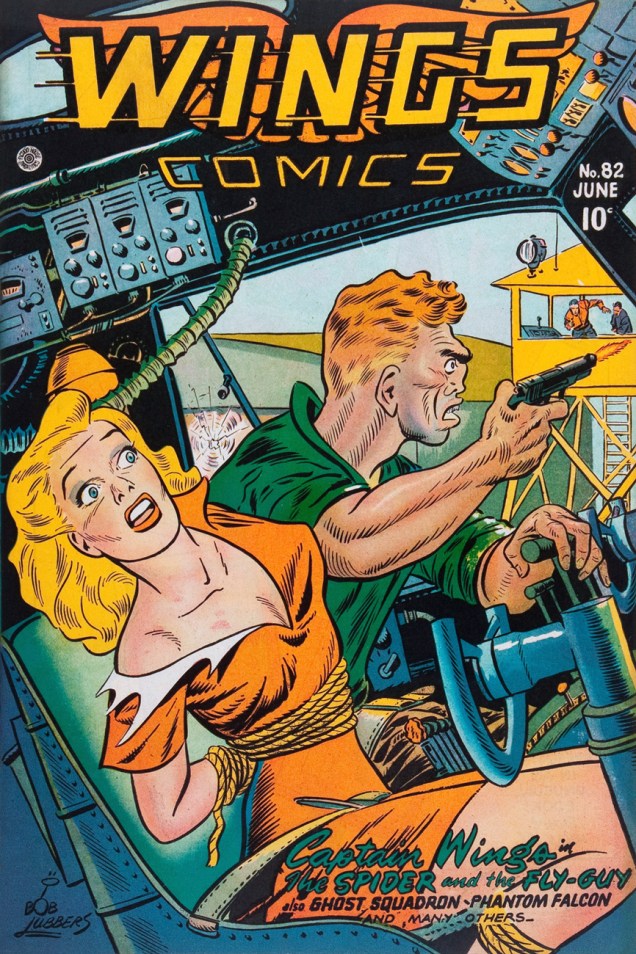
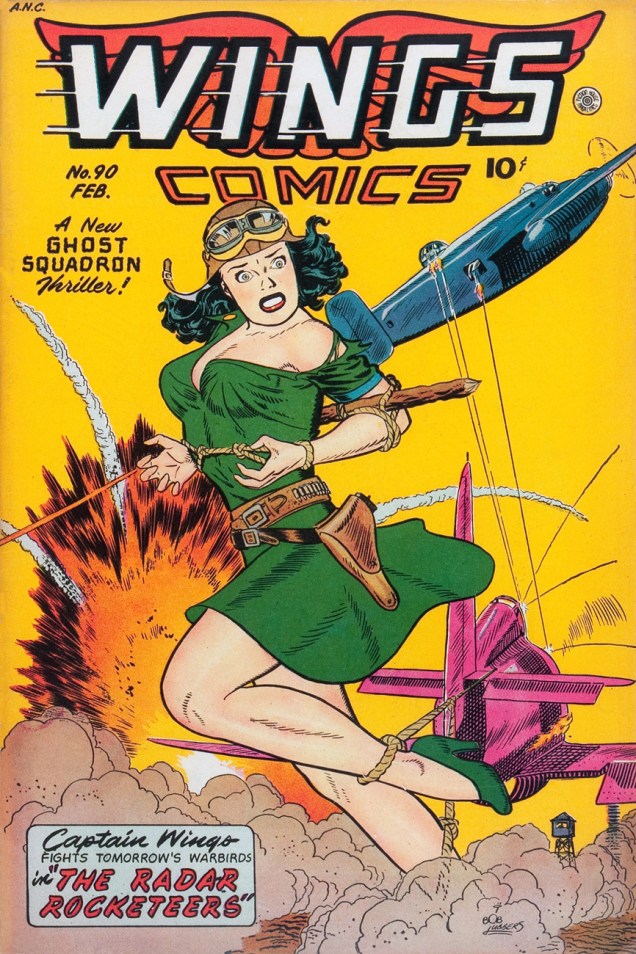
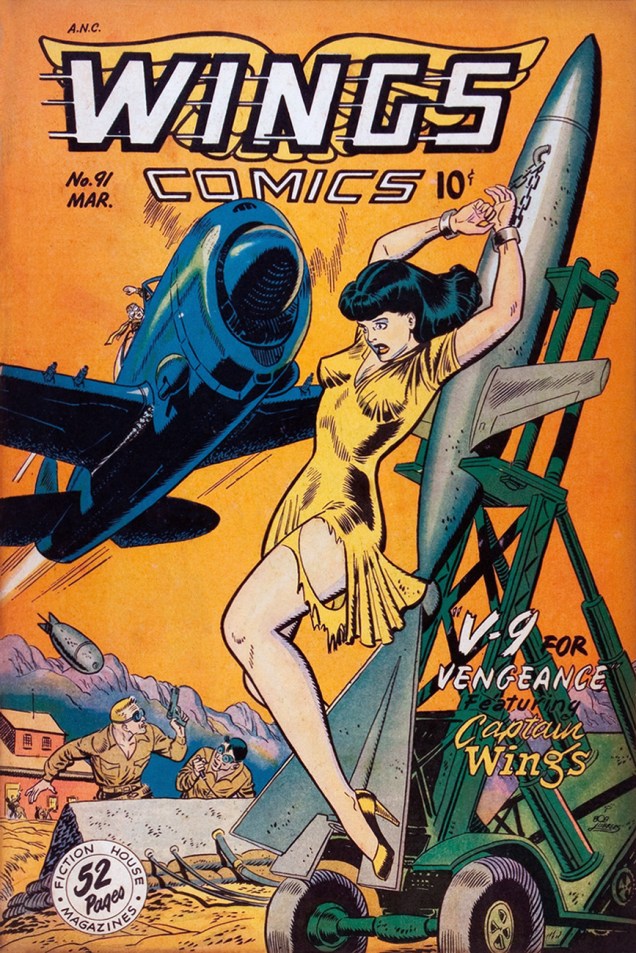
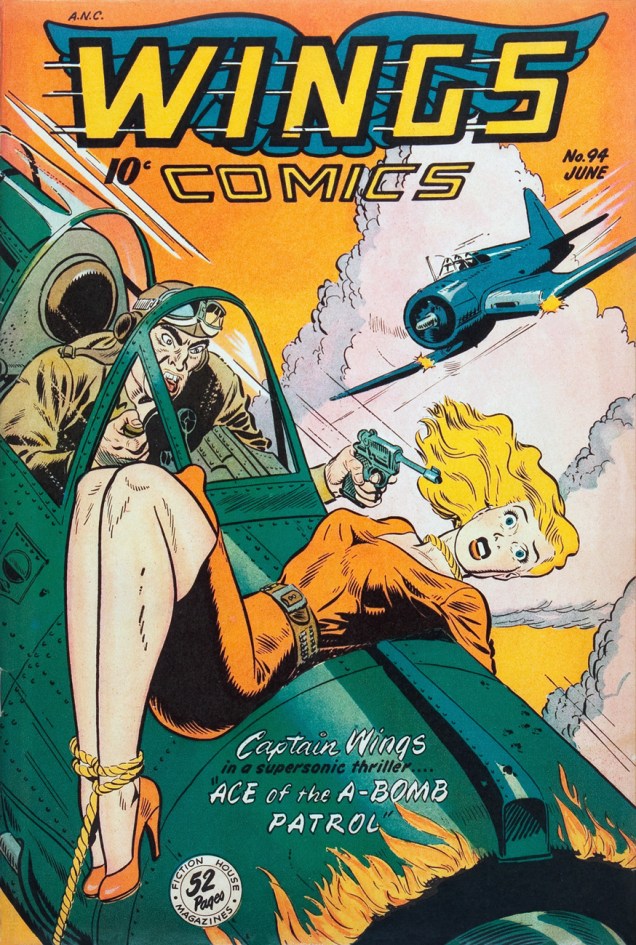
I then became aware of Mr. Lubbers as one of the Golden Age’s primo ‘good girl’ cover artists, with Fiction House, no less. That’s what I’ll chiefly focus on here. Can you honestly blame me? Unlike some of his peers (hello, Bill Ward), he wasn’t just good at, and interested in, the saucy depiction of lightly-clad sirens: he could draw anything with finesse and brio.
Mouth-breathing, slope-browed… I guess he’s not the hero in this one. Wings Comics no. 82 (June 1947, Fiction House.)Arguably the most (in)famous of Lubbers’ Wings covers. “Classic bondage and headlights cover!”, cry the ancient fanboys. Wings Comics no. 90 (Feb. 1948, Fiction House.)If our man of the hour had rescue in mind for the imperilled damsel, dropping a payload (you heard me!) a hundred feet away from her is likely to… make the situation a bit messy. Wings Comics no. 91 (March 1948, Fiction House.)« Seriously? The engine is on fire, we’re being strafed, I’m hogtied and helpless, and he’s still going to threaten me with a gun? » Wings Comics no. 94 (June 1948, Fiction House.)The life of a crocodile dentist isn’t an easy one, but the satisfaction of a job well done is its own reward. Wings Comics no. 98 (Oct. 1948, Fiction House.)Here comes the mother of all rope burns, sister. You’re supposed to grab the loop! Wings Comics no. 100 (Dec. 1948, Fiction House.)The exception to the Fiction House Wings set: Authentic Police Cases no. 5 (Oct. 1948, St. John.) The babes never could resist a bad boy.
Yet farther along, I would learn of his large and distinguished body of comic strip work: Long Sam, Secret Agent X-9, Tarzan, The Saint, Lil’ Abner, and best of all, his most personal work, Robin Malone (1967-70). On the latter, I can’t praise enough Tom Heintjes‘ definitive article (Hogan’s Alley no. 19, 2014), here’s a version of it: www.hoganmag.com/blog/the-life-and-death-of-robin-bob-lubbers-robin-malone
… and don’t forget to scroll down, down, down so you can sample (though it’s never enough!) the article’s lavish bounty Robin Malone Sunday strips.
**speaking of which, check out this fine piece about The Human Fly’s rocket bike and the stunt that ended his career: http://kymichaelson.us/human-fly. You have to admit that jumping over 27 buses is a tad ambitious… and he was originally going to try for 36!
***likely picked for the job due to his fine work on another masked stuntperson character, Harvey’s The Black Cat.
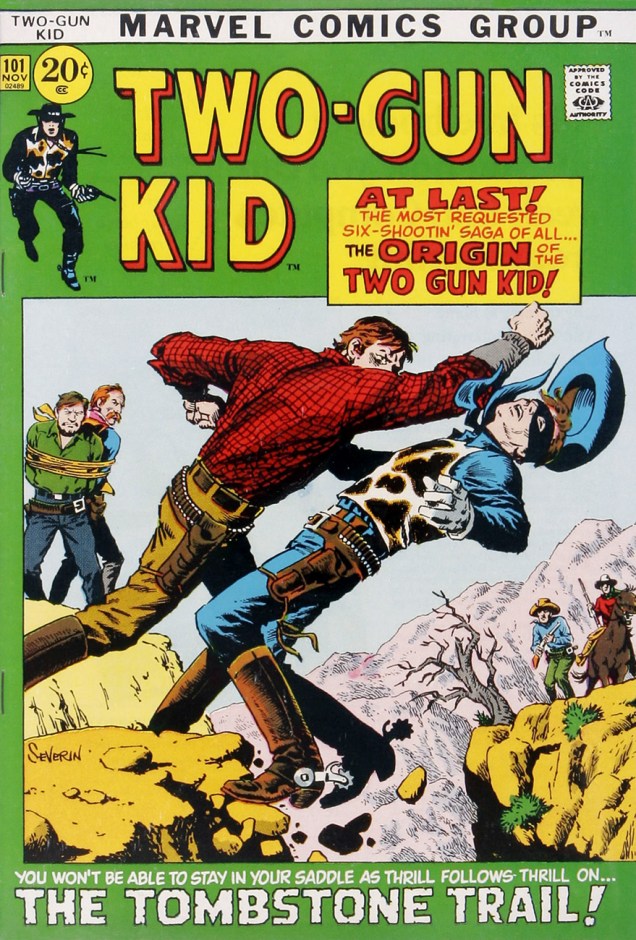
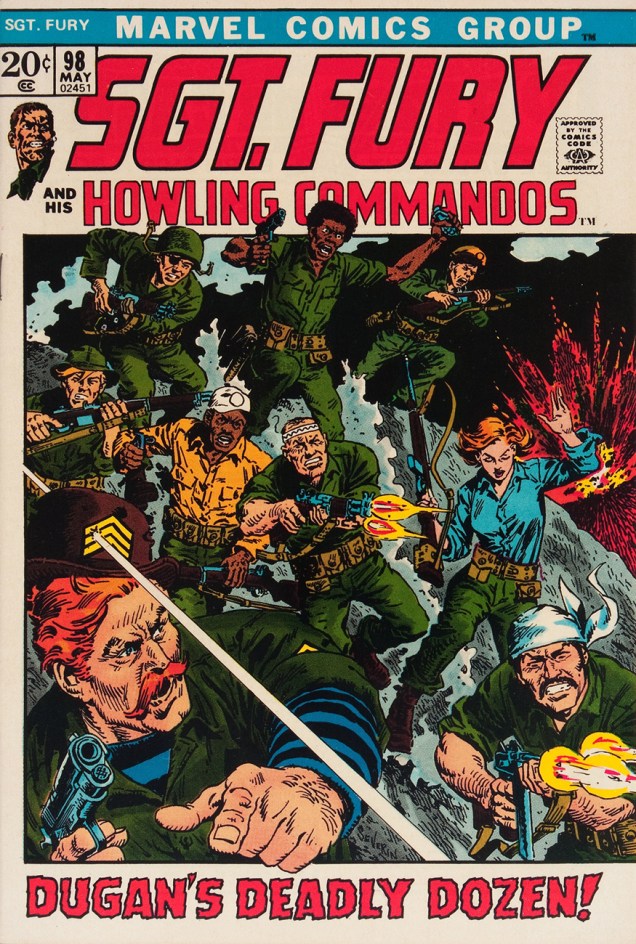
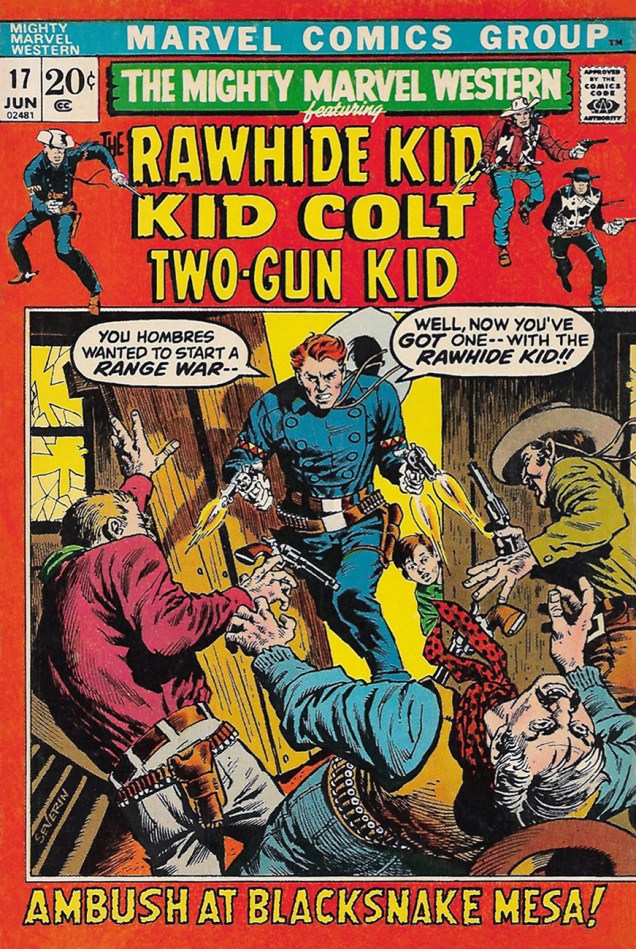
I’m inordinately fond of Marvel’s brief flirtation with “picture frame” covers, which lasted but a year, opening with books cover-dated November 1971, at the tail end of Stan Lee’s run as editor-in-chief, and fading away less than a year later during Roy Thomas’ tenure. Figures.
This period coincided with one of John Severin’s passages at Marvel. At the time, the self-proclaimed « House of Ideas » was endeavouring to flood the market with crap, aiming to force DC to overextend itself to retain its market share, and, reportedly, to drive Gold Key out of business. So Marvel let loose a torrent of unannounced and unnecessary reprints, at most commissioning new covers to sell the bill of goods.
Tactically, it was a tawdry page out of the infamous Israel Waldman* book: in the late 1950s to mid-60s, the canny cheapjack publisher issued a line of comics (IW/Super) reprinting material he owned and often didn’t, in the case of some of the more nebulous copyrights (namely Quality’s The Spirit, Doll Man and Plastic Man)… accidentally on purpose. Anyhow, Waldman paid a few handpicked freelancers top dollar (to get his money’s worth… I did say he was canny) to create enticing new covers to adorn his shoddy reprint rags. And I do mean rags: the paper stock used was even worse than the low industry standard… just try to find any IW comic book in decent shape nowadays!
But getting back to 1971-72, here’s a chronological and alphabetical sampling of my favourite Severin turd-polishing covers from Marvel’s brief « picture frame » flirtation, out of the 35 or so he created solo at the time. Several of these are refreshingly uncluttered and moody… for Marvel.
Someone at Marvel loved to rip-off the 1967 Lee Marvin-led epic “The Dirty Dozen“; probably Gary Friedrich. The very next month, the Deadly Dozen would team up with another Irishman stereotype to form “Combat Kelly and The Deadly Dozen”, I kid you not. Oh, and a diverse cast in a Marvel war comic? Oh, right, they’re ex-convicts… and they get slaughtered in the last issue. Oops.
Ah, Severin’s Rawhide Kid. Don’t miss Severin and writer Ron Zimmerman’s brilliant and daring 2003 reboot of the Kid, “Slap Leather”.
Ninety-three years ago today (January 3, 1924, that is), master bédéisteAndré Franquin was born in Etterbeek, Belgium.
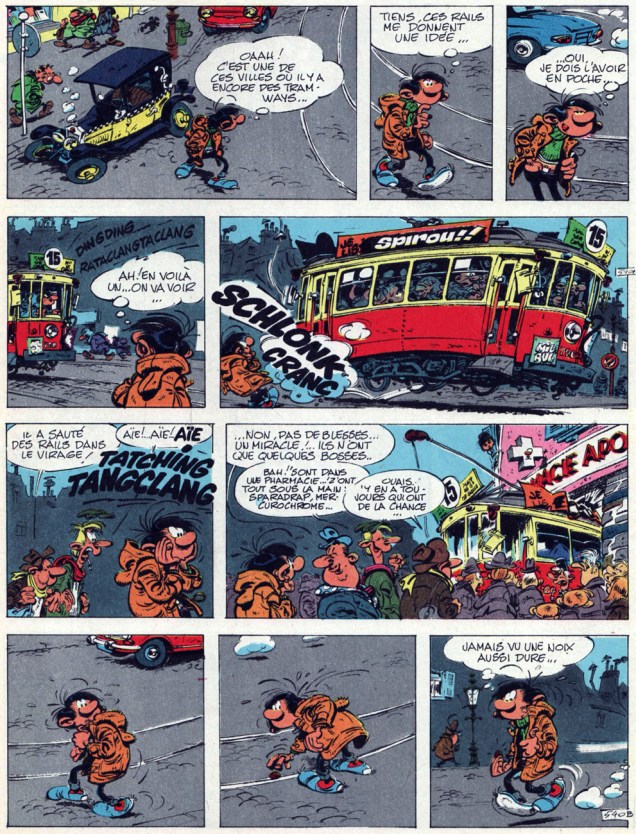
His œuvre is an embarrassment of riches, but heck, here’s a diabolically ingenious Gaston Lagaffe strip whose mise-en-scène is so solid and visually limpid that the only dialogue needed to truly “get it” is the punchline: « Never seen such a tough nut… »
Originally published in Spirou no. 1599 (Dec. 5, 1968, Éditions Dupuis.)
It would be unfair and inaccurate to single anything out as André Franquin’s «masterpiece», given the consistently high calibre of his output. Let’s settle for stating that Gaston was in all likelihood his most popular creation, as luck would have it.
The legendary gaffeur first messed up in a two-panel cameo in the Spirou et Fantasio adventure Le voyageur du Mésozoïque in 1957. Later S&F tales were dotted with Gaston cameos, and the accident-prone office boy soon (crash-) landed his own half-page strip, which ran from the late 50s to the late 90s, though mostly consisted of reprints after the early 80s.
Gaston’s second strip collection, issued in 1963 in the original “landscape” format, deemed an oddity at the time.
As for translations, Gaston’s popular in a bevy of languages, but not, of course, in English. Fantagraphics’ Kim Thompson was a huge fan, and translated a handful of strips, which were published (as Gomer Goof) in issues of the anthologies Prime Cuts and Graphic Story Monthly.
Speaking of Gomer, Anglophone readers are in for a treat: UK publisher Cinebook has, just last October, issued a collection (only 48 pages, but you have to start somewhere… and perhaps small) entitled Mind the Goof! Check it out here.
I understand that this image has to do with the tradition of greeting the new year by banging on pots and pans and generally making a racket, but I presume that both sailor-garbed primate and pneumatic drill were optional, particularly in times of scarcity.
Art by Stephen Douglas, from Famous Funniesno. 138 (January, 1946). FF number one (July, 1934) was likely the second comic book issued, and the first one *sold*. It was published by Eastern Color / Dell Comics.
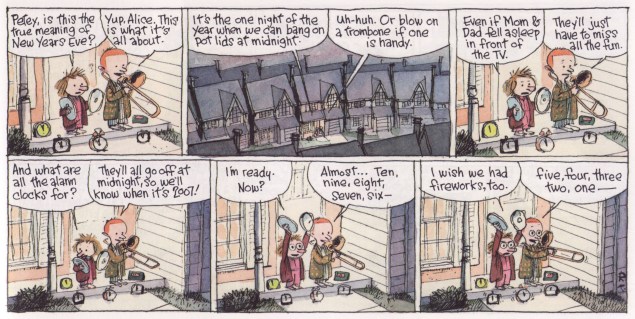
And while we’re on the subject of ushering in the New Year by making a hellacious din, let’s treat ourselves to a couple of relevant Cul de sac pieces. The first returns us to the strip’s formative, water-coloured years, when it appeared weekly (2004-2007) in The Washington Post‘s weekly magazine section.
The Washington Post Magazine, Dec. 31st, 2006. Richard Thompson: « From when Petey played the trombone, and I found it too hard to draw. »The master tackled the theme again in this brief sequence from Dec. 31, 2008- Jan. 1st, 2009.
Nothing left to do now but to wish a joyful 2018 to all you monkeys and assorted critters!
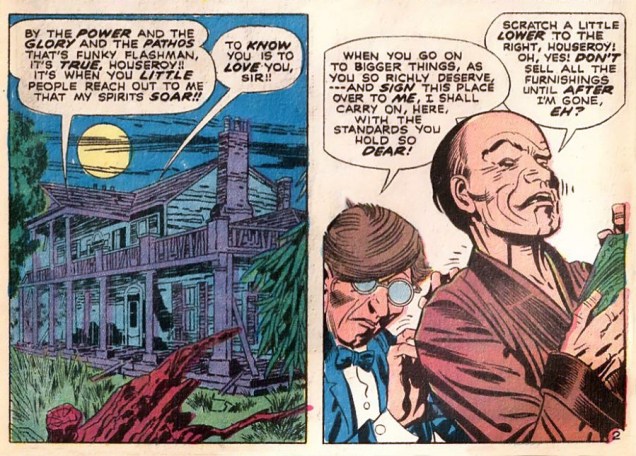
Today is birthday number ninety-five for Stanley Lieber, aka Stan Lee. He was hatched on December 28, 1922. Have a good one, Stan.
Jack Kirby recalls with fondness his former editor and his toady, in “Funky Flashman!” (Mister Miracle no. 6, January-February 1972, DC).
On this momentous occasion, let’s hear about Stan from some of his colleagues, who knew The Man and obviously loved the experience:
Wally Wood:
« Did I say Stanley had no smarts? Well, he DID come up with two sure fire ideas… the first one was ‘Why not let the artists WRITE the stories as well as draw them?’… And the second was … ‘ALWAYS SIGN YOUR NAME ON TOP… BIG’. And the rest is history… Stanley, of course became rich and famous … over the bodies of people like Bill [Everett] and Jack [Kirby]. Bill, who had created the character that had made his father rich wound up COLORING and doing odd jobs. »
EC legend Bernie Krigstein, who collaborated with Stan at Atlas, and whose « Suppressed Desire » is featured in Spellbound no. 17 (September 1953) , with a glorious cover by the above-mentioned Bill Everett.
In the course of a 1960s interview with comics scholar John Benson, Krigstein responded to Benson’s statement of « I guess you know that Stan Lee has been the spearhead of the so-called current revitalization of comics »:
« I’m delighted to learn that. Twenty years of unrelenting editorial effort to suppress the artistic effort, encourage miserable taste, flood the field with degraded imitations and non-stories have certainly qualified him for this respected position. »
Then Gil Kane, who was Marvel’s principal cover artist for much of the 70s, and who collaborated with Lee on The Amazing Spider-Man in some of its most popular years, including the infamous, comics-code unapproved “drug” issues (nos. 96-97, May-June 1971), on the respective creative roles of Stan and Jack Kirby:
« On each page, from 1964 – 1970 next to every single panel Jack wrote extensive margin notes explaining to Lee what was taking place in the story. It took Jack about 2 weeks to do a single story, it may have taken Lee as little as 4 hours to add text to Jack’s art. »
And Steve Ditko, in a letter to the editor of Comic Book Marketplace, published in the magazine’s 63rd issue in 1998, on his and Stan’s respective roles in crafting an issue of Spider-Man:
« The fact is we had no story or idea discussion about Spider-Man books even before issue no. 26 up to when I left the book. Stan never knew what was in my plotted stories until I took in the penciled story, the cover, my script and Sol Brodsky took the material from me and took it all into Stan’s office, so I had to leave without seeing or talking to Stan. »
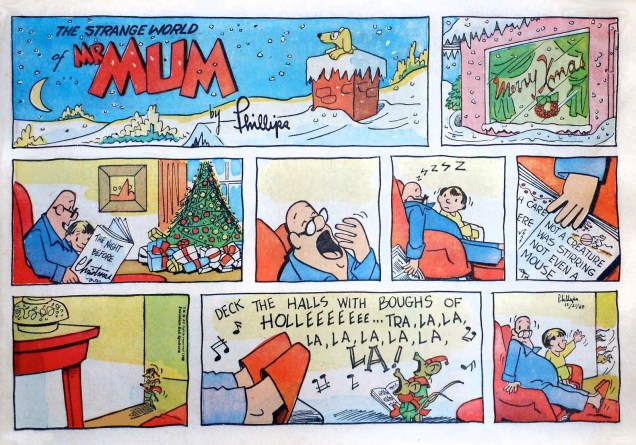
Irving Phillips (1904-2000)…« has been an actor, a violinist, a Hollywood script writer, the Humor Editor of ‘Esquire’ magazine, a playwright, as well as a very successful syndicated cartoonist.* »
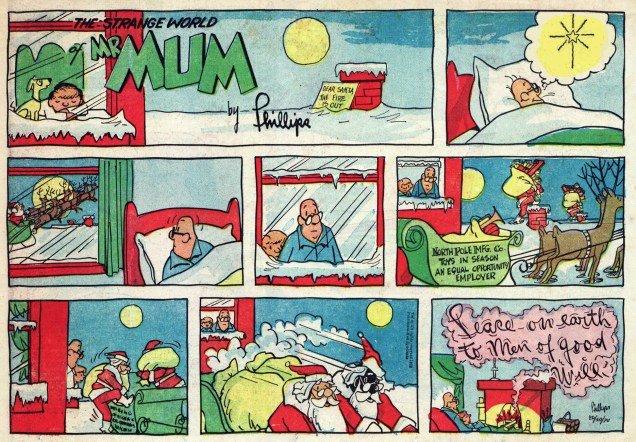
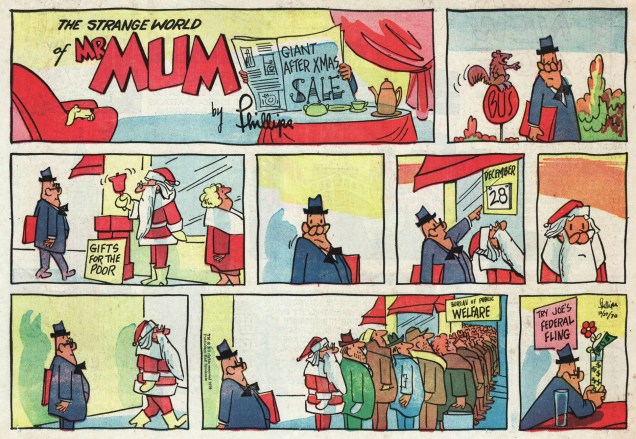
He was most notably the creator of The Strange World of Mr. Mum, which was published from 1958 to 1974 (the Sunday edition began in 1961); at its peak, the strip appeared in 180 newspapers.
Mr. Mum, as his name suggests, is the silent observer of various strange happenings. Anything can, and does, happen in Mum’s world, and much of it is delightfully surreal.
Today, as befits the season, we propose a handful of Christmas (and post-holiday) themed Mr. Mum Sundays.
Originally appeared on December 21, 1969.Originally appeared on January 4, 1970.Originally appeared on December 20, 1970.Originally appeared on December 27, 1970.
As Mr. Mum himself might say, were he ever inclined to chime in: « Have a Merry Christmas! » May you find some good comics in your holiday stash. And try Joe’s Federal Fling… it’s tastier than eggnog.
Craving more Mr. Mum? Then scoot over to Ger Apeldoorn’s The Fabulous Fifties blog, where a veritable Mum trove awaits !
– RG / ds
*quoted from a interview with Mr. Phillips in Cartoonist Profiles no. 4, (November, 1969).




















 Who's Out There?