On This Day: November 16, 1902

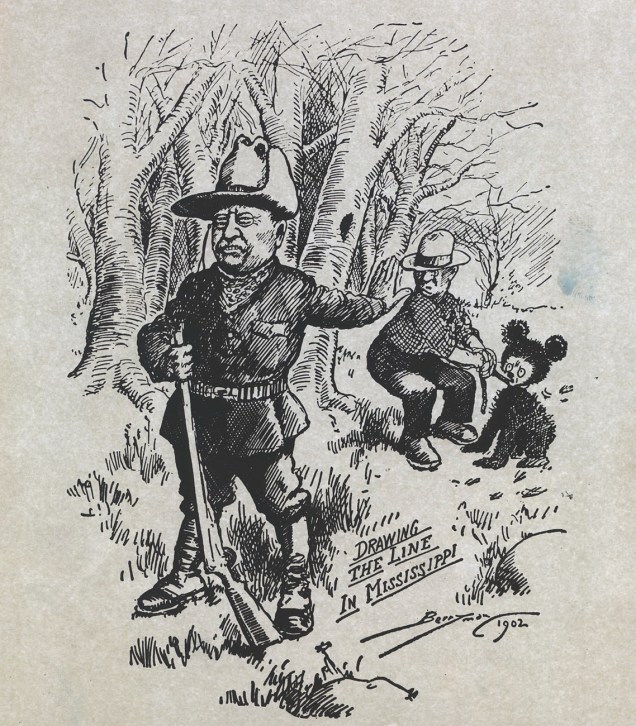
A cartoon appears in the Washington Post, prompting the Teddy Bear Craze, after President Teddy Roosevelt refused to kill a captive bear tied up for him to shoot during a hunting trip to Mississippi.

Boy, American presidents sure were different back in those days.

TeddyRooseveltBerryman1902A
The history-making cartoon by Pulitzer Prize–winning cartoonist Clifford K. Berryman (1869-1949), who worked with the Washington Post from 1891-1907, then with the Washington Star from 1907-1949.

Which brings us to Teddy Bears (as they became known henceforth) returning the favour of protecting the vulnerable and innocent.

The earliest instance that comes to mind is Johnny Craig and “Ghastly” Graham Ingels’ holiday charmer, Shoe-Button Eyes!, which appeared in The Vault of Horror no. 35 (Feb.-Mar. 1954, EC), wherein a blind, put-upon little boy gets a new set of peepers… the hard way.

Post-Code, this sort of harsh poetic justice had to be handled very gingerly, if at all. The vengeful bear turned up again in Nicola Cuti and Jack Abel’s elegantly-told The Teddy Bear, in Haunted no. 15 (Nov. 1973, Charlton.)

TeddyAbelA
Quoth the plush companion: « I was sent to you to protect you and I will! » Spoiler alert: the butler did it.

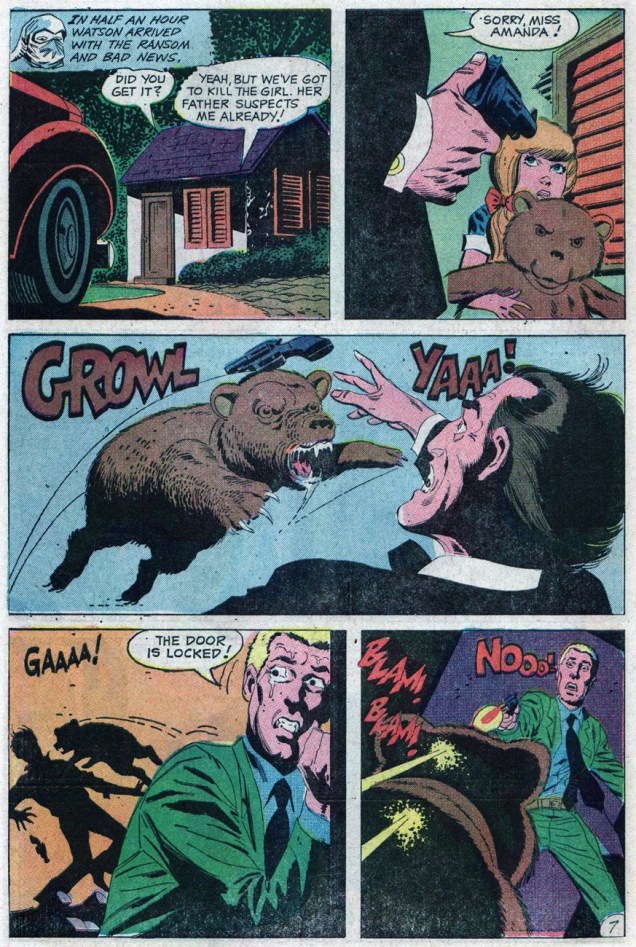
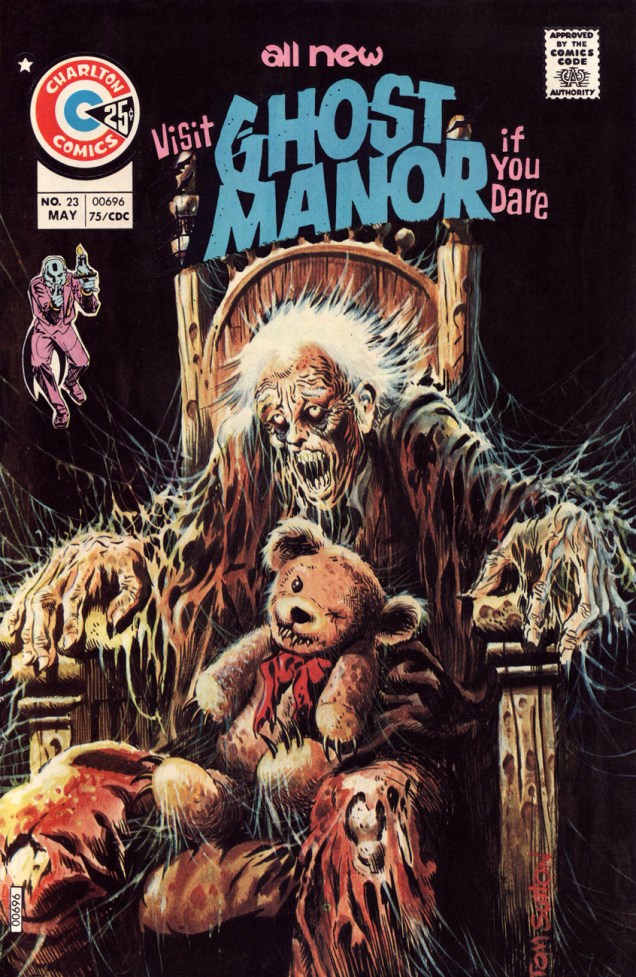
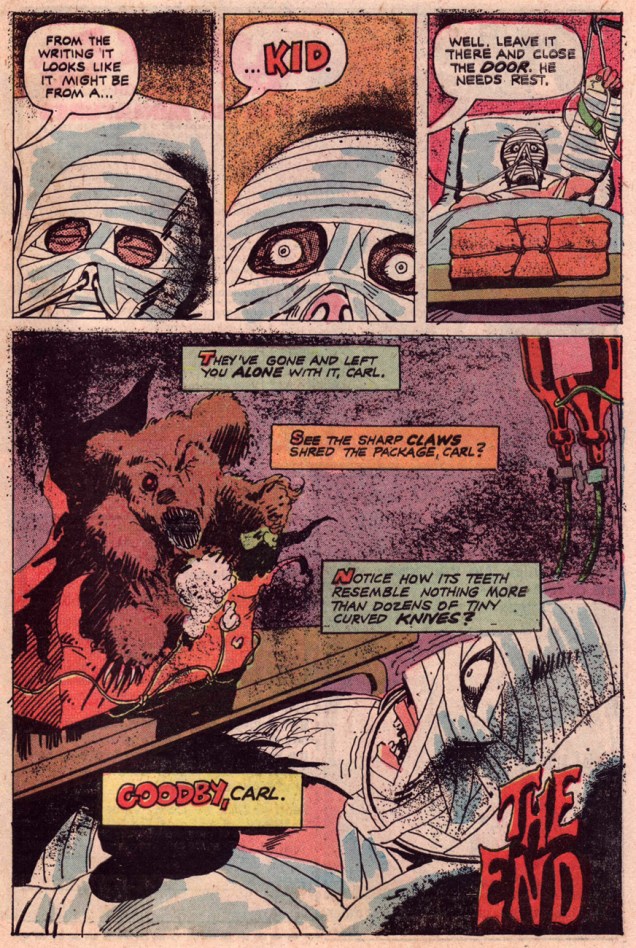
A couple of years down the pike, “Grisly”* Tom Sutton took up the gauntlet with his «Terrible Teddy!», from Ghost Manor no. 23 (May 1975, Charlton). Here it is, presented in its glorious entirety (including Sutton’s gnarly painted cover).

Ghost-Manor23A

TerribleTeddy1ATerribleTeddy2ATerribleTeddy3ATerribleTeddy4ATerribleTeddy5ATerribleTeddy6A

– RG
*perhaps more appropriately “Grizzly”, in this instance.

Remembering Don Newton (1934-1984)

« Herbal tea. My own recipe.
It’s added years to my life.
May I offer you a cup? »

After producing some exceptionally solid fan art (chiefly for the long-lived Rocket’s Blast Comicollector (153 issues, 1961-1985), Arizona art teacher Don Newton made his jump into the pro leagues in 1974 with Charlton, where he got his chance to show off his considerable painting skills. After a handful of mystery stories, he took over Charlton’s version of Lee Falk and Ray Moore‘s The Phantom, which he drew for six issues (and one cover) before the title was cancelled… along with the rest of Charlton’s original comics line, really.

Phantom68ORIG_A
Newton’s original cover painting for issue 68 (December, 1975, Charlton) of The Phantom, illustrating the tale of The Beasts of Madame Kahn by Nicola Cuti and Newton.
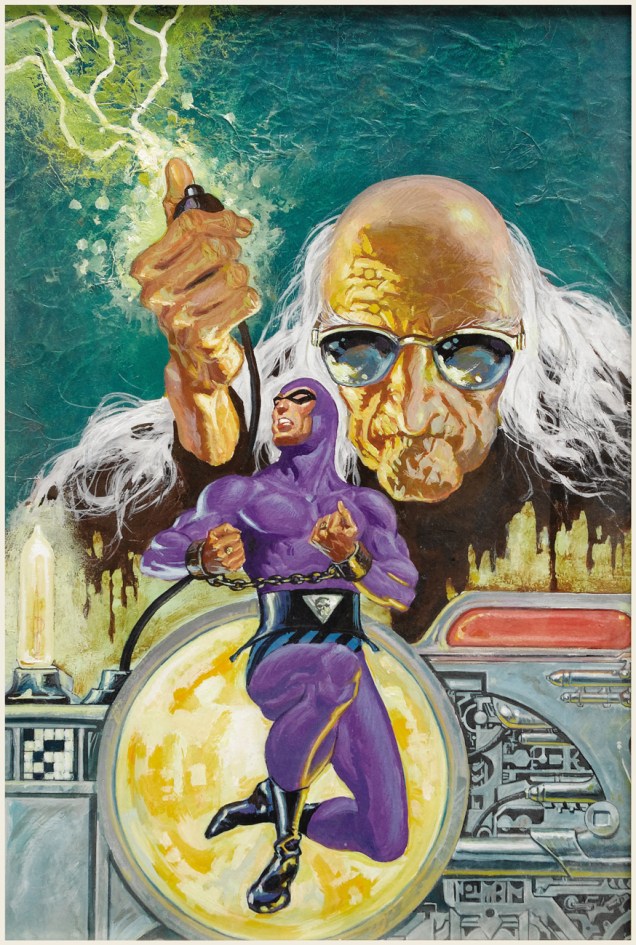
NewtonPhantom73A
Newton’s cover painting (in acrylics, if you must know) for the penultimate issue of The Phantom’s Charlton run, no. 73 (October, 1976), “The Torch”, written by Ben S. Parillo (alias Bill Pearson), pencilled and inked by Don Newton. The wizened mastermind is a fella who simply goes by the name of ‘Raven’.
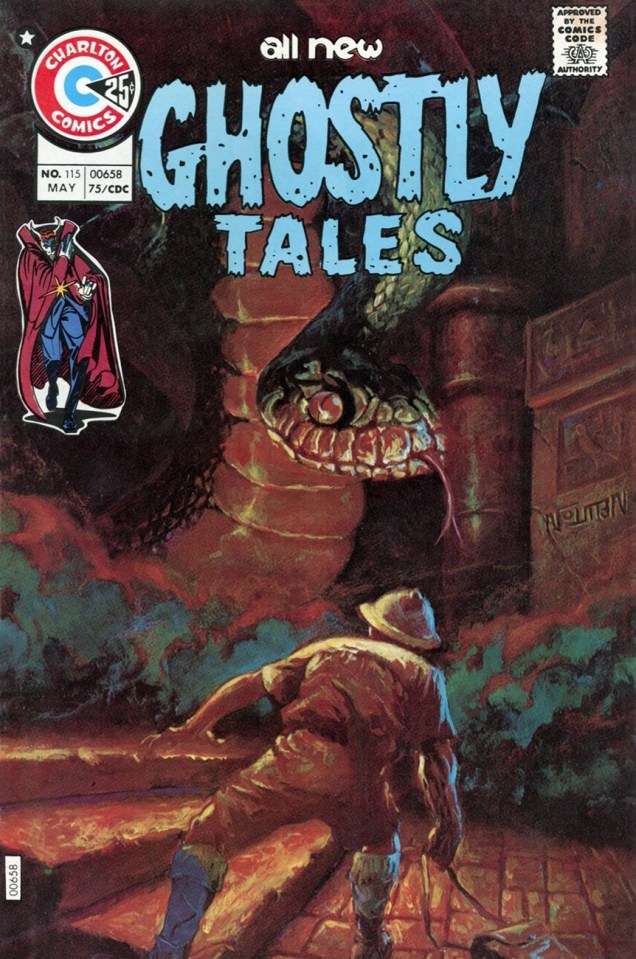
GhostlyTales115A
« How could a snake be alive here, buried deep in the earth for thousands of years? » Don Newton’s painting (Ghostly Tales no. 115, May, 1975) depicts a scene from Joe Gill and Steve Ditko’s “Wings of Death!”
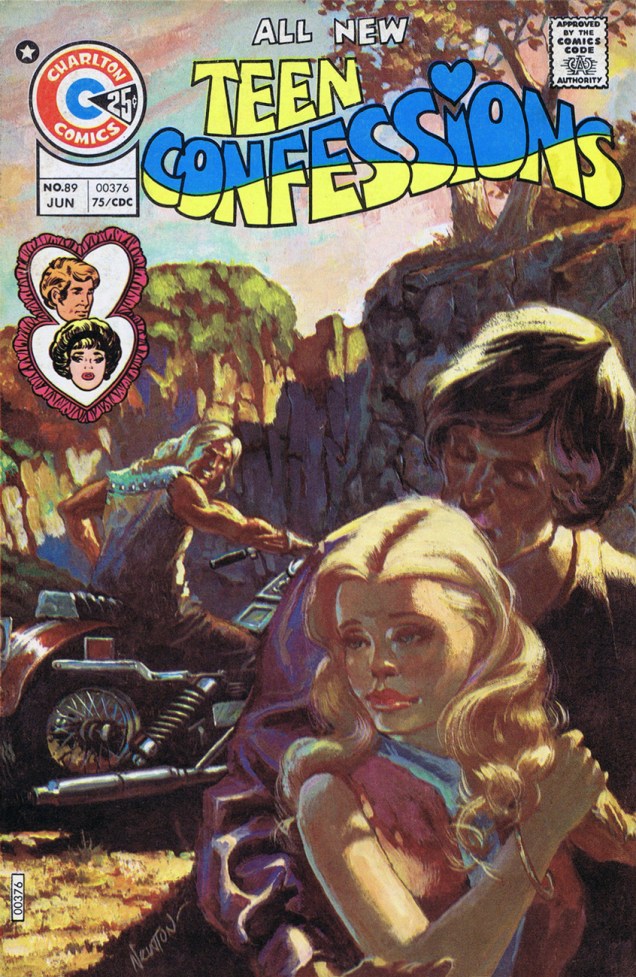
TeenConfessions89A
« Turn her loose, Pike… I want to road-test the new talent! » Mr. Newton illustrates the Unknown Scribe and Demetrio Sánchez Gómez‘s biker operetta “Running Wild!”, from Teen Confessions no. 89 (June, 1975, Charlton.)

Newton would go on to DC (and a couple of brief dalliances with Marvel), illustrating Batman, Captain Marvel (er, “Shazam!”), Aquaman, Star Hunters, and The New Gods for DC, before being, all too soon, felled by a heart attack at the age of 49. Most of the time, though, he provided great art to ho-hum stories.

Against all odds, around 1982, scripter Gerry Conway, a name synonymous with half-assed, content-free hackwork since the early ’70s, actually blossomed into a decent writer. Fortuitously, while assigned to pencil Batman’s adventures in Detective Comics, Newton was paired with prolific* Filipino legend Alfredo Alcala, and the stars were in proper alignment. You won’t have to take my word for it, however. Feast your eyes on the palpable ambiance from the Conway-Newton-Alcala trio.

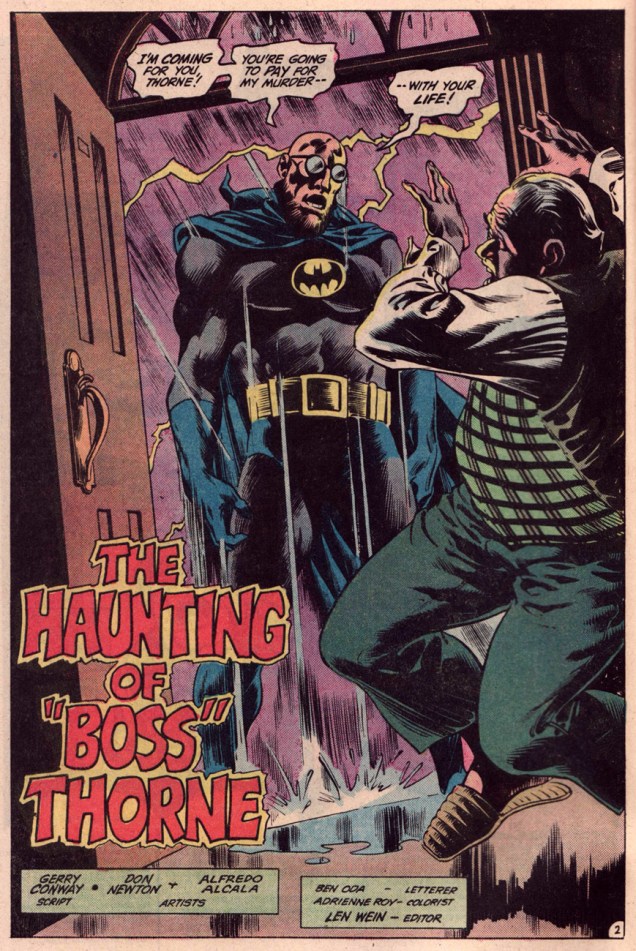
NewtonHugo1A
Picking up strands from Steve Englehart‘s  run on the book (nos. 469–476, in 1977-78), creepy-but-buff scientist Hugo Strange returns to pester his murderer, crooked politician Rupert Thorne. Colourist Adrienne Roy’s hand is betrayed by the 100% magenta/30% black mix.
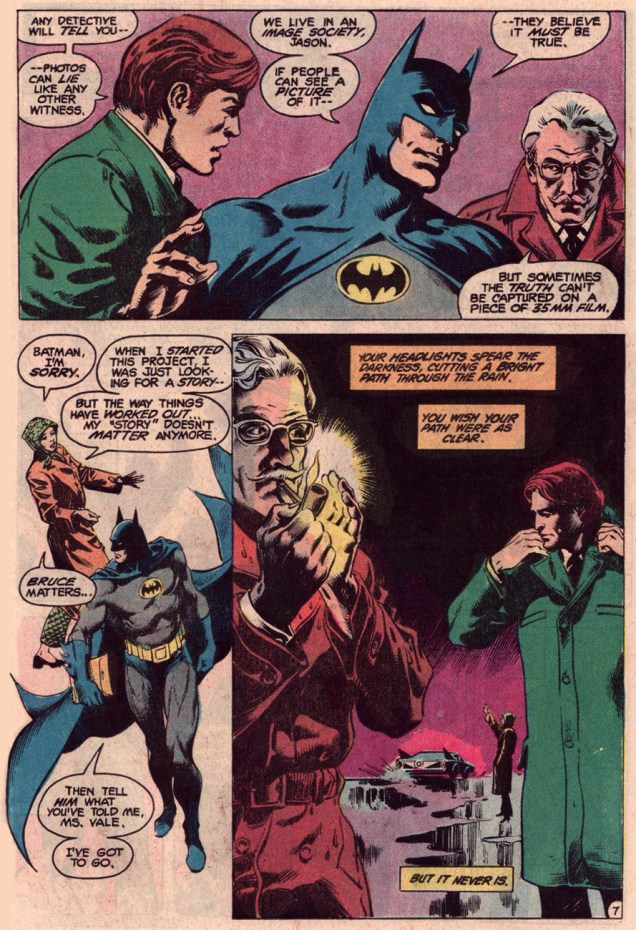
NewtonHugo2A
Well, I have to show Newton’s actual Batman, don’t I? His was one of the few characterizations that were physically believable. You could buy this guy as an acrobat, as a fighter *and* as detective. Alcala often overwhelms whomever he’s inking, but since Newton’s pencils were probably tight as a camel’s ass in a sand storm, both men’s contributions mesh splendidly with no loss of identity. Pages 2 and 7 from Detective no. 520 (Nov. 1982).

– RG

*How prolific was Alcala? « It is said that his fastest page rate was twelve pages in a nine-hour sitting. » And the scary thing is that it hardly ever looked rushed or less than committed, unlike the work of some other inkers we could name. What a guy.

Add Vice for Children

« It’s kind of like a spider web, only sweeter, and also it’s more pink »

Today would have been the 91st birthday of the great Jack Mendelsohn (1926-2017), who passed away last January, leaving behind a life well-lived and a sumptuous, if often unsung or anonymous, legacy.

Yet Mendelsohn will be no stranger to those accustomed to reading the small print and staying for the credits crawl: he co-wrote Yellow Submarine (the film, and got credit for it, unlike Donovan for the song), episodes of Laugh-In, The Carol Burnett Show, then decades of soul-killing animation scripting, not to mention, er… Three’s Company.

Ah, but today we salute him for his greatest triumph, though probably not the one his fans brought up when they met him*: the short-lived Sunday-only King Features comic strip Jackys Diary** (1959-61). In 1960, Dell Comics (were good comics, so they said) in a fit of mad inspiration, issued a one-shot (Four Color 1091, April-June 1960) drawing from the strip’s run… a flashback to the early practices of the comic book industry, when its product consisted of repackaged comic strip reprints.

JackysProverbsA
Jackys Diary, October 30, 1960.

For a more comprehensive sample, hunt down the comic book, or Dan Nadel’s excellent Art Out of Time (2006, Abrams), which may just turn you on to further neglected but worthy visions. Or get thee hence swiftly to Sam Henderson‘s wonderful blog, The Magic Whistle. Sam saved me a lot of work (and stole my thunder) by graciously providing top-quality scans of the entire Dell comic book.

Then, if you’re good and hooked, you’ll be chuffed to hear that a complete collection of the strip’s run was miraculously assembled and published a few years ago, and finer than even the most fervent optimist could have envisioned. Once again, international treasures Craig Yoe & Clizia Gussoni and their crack production team have delivered a dream.

Produced with utmost attention to detail, as well as the full and clearly enthusiastic coöperation of the auteur himself, this handsome tome boasts, in addition to the full complement of excellently-reproduced strips, a fascinating and richly-illustrated retrospective article by Mendelsohn and a fondly witty foreword and backword by colleagues and accomplices Mort Walker (then 90 1/2) and Mell Lazarus (then 86 1/2). As they say, get yours now!

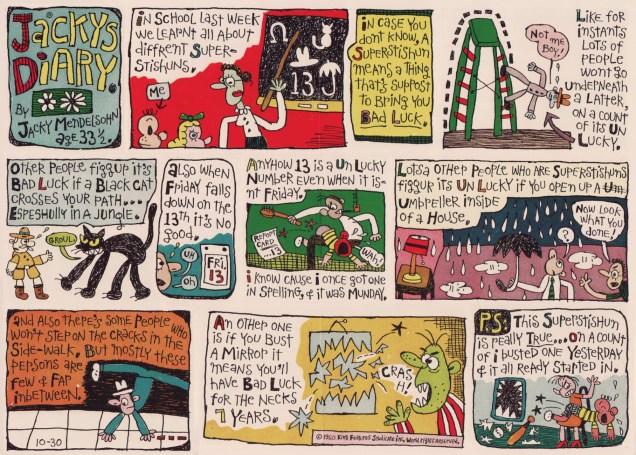
JackysSuperstitionA
Jackys Diary, August 6, 1961.

*On that very topic, from his interview with John Province, published in Hogan’s Alley no. 10 (2002): « What fans? I have no fans! Why do you think I’m clinging to you? »

**that’s how it was intentionally spelled, for effect. Unlike spelling nowadays…

-RG

Happy 90th birthday, Mr. Ditko!

« Don’t be so sure! A guy that popular — he’d be a fool to fold up his act while he’s such a hot item!* »

I’ve been a Steve Ditko fan for as long as I can remember. In fact, I was a fan even before I actually saw his work. “How’s that even possible?”, you may ask. Well, when I was five, this neighbour from across the street was showing off a comic book he had just picked up, which was Teen Titans no. 29**. I was instantly captivated by two costumes on the cover: Hawk and Dove’s, designed by Ditko a couple of years earlier.

I do believe I had encountered a Ditko comic book just a bit earlier, a copy of The Many Ghosts of Doctor Graves no. 20 (June, 1970), acquired by my brother en route to the family vacation on Prince Edward Island. But that one had a (fine) cover by Pat Boyette, and I don’t recall the Ditko story within, « An Ancient Wrong ».

The bottom line is that Ditko’s been a precious part of my life for a spell. It would be easy to take him from granted, so let’s not, if you don’t mind.

Which brings us to our little tribute: running ninety covers covers would be about as practical as ninety candles on our birthday boy’s cake, so I’ll just drop a decimal and stick to a more manageable nine… I won’t even give a nod to such fickle and hollow notions as popularity, historical importance, or iconicity. I’m going with my favourites. That’s the way Steve would do it… and even if he wouldn’t, I’d still go this route.

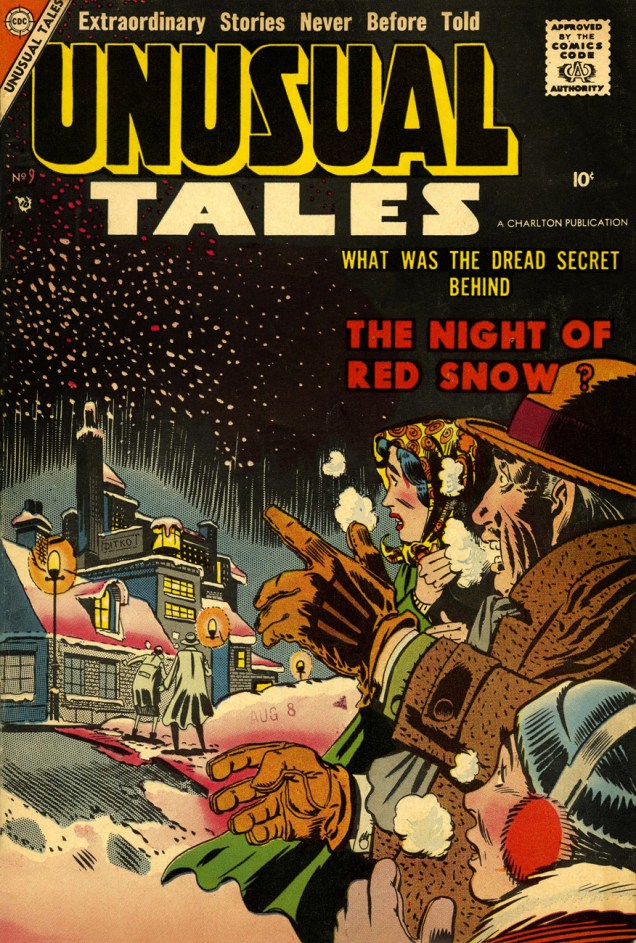
UnusualTales9A
« Nobody here in Crestville will ever forget that night! »
A tiny reproduction of this cover, that of Unusual Tales no. 9 (Nov. 1957, Charlton), in some late-70s edition of the Overstreet Comic Book Price Guide hooked me, and still grabs me. In the post-code era, particularly in its early days, you had to be mighty resourceful to fruitfully mine the mystery genre, what with all the verboten topics and tropes. The issue holds a whopping four, 1957-vintage Ditko stories, including the title piece, which you can read here:
http://ditko.blogspot.ca/2012/01/unusual-tales-night-of-red-snow.html
ASM2A
The Amazing Spider-Man no. 2 (May 1963, Marvel). Beyond Ditko’s departure (no. 38 was his final contribution), I have no further interest in Peter Parker and his costumed alter-ego.
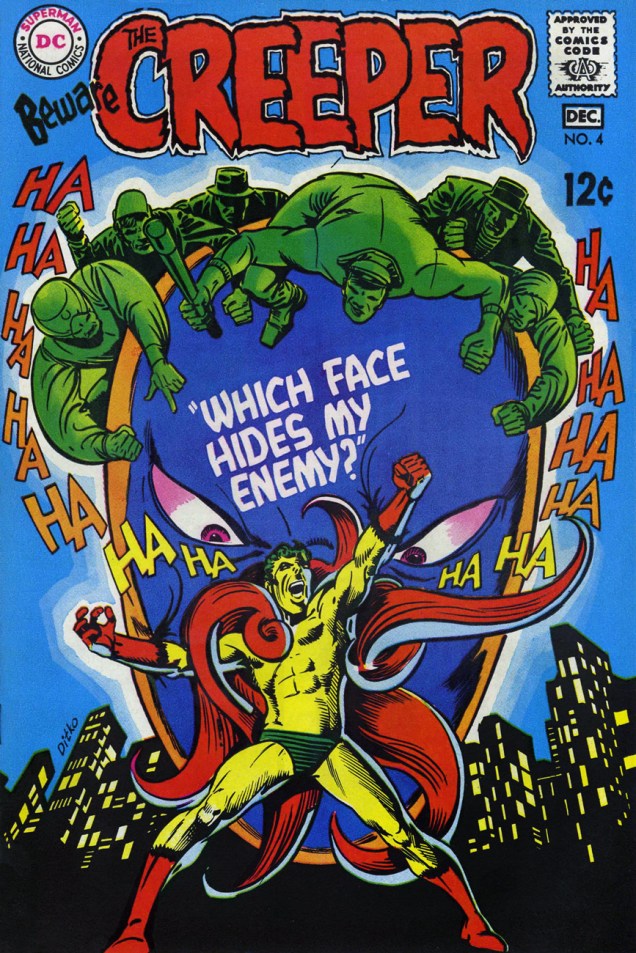
Creeper4A
« Name’s Bulldog Bird! This is Sumo! We’re secret agents from the sovereign kingdom of Offalia! »
For most of the brief run of his book (issues 2 to 6), the Creeper had to contend with a faceless enemy, Proteus, who turns out to be someone very close to him. It was as though Ditko felt the need to replay the Spider-Man – Green Goblin secret identity dynamic, not the way *he* had envisioned it (which was to make the Goblin a total stranger, a situation he’d meticulously set up in the background), but the way Lee had, as if to show his former editor how to do it properly.
This is Beware the Creeper no. 4 (Nov.-Dec. 1968, DC), “Which Face Hides My Enemy?” Pencils and inks by Steve Ditko, plot and dialogue by Dennis O’Neil
Hawk&Dove2A
« You’re still wasting your time reading! Why don’t you build up that sickly body of yours? »
DC’s Hawk and Dove (introduced in Showcase no. 75, June 1968, DC) was, as its title and covers amply make clear, a study in contrast and opposition: aggression vs pacifism, the letter of the law vs the spirit of the law, Steve Ditko vs Steve Skeates…
The concept may have been of its time, but the industry as it stood wasn’t ready to explore the issues without stacking the deck. This was still, after all, a mainstream superhero comic book of the Sixties. This is issue 2, “Jailbreak!” (Oct.-Nov. 1968), Ditko’s third and final issue with his creations. As for Ditko’s abrupt departure from DC is concerned, the reason cited at the time was a relapse of tuberculosis, a disease that had plagued Ditko in his youth. Others have invoked more political explanations, but Ditko *was* out of the game for several months, which fits the convalescence scenario. His absence until 1975 from DC fits the politics one. Why credit one single factor when several, taken together, are more plausible?
GhostManor5A
« Come off it, yer Lordship! This ain’t no blinkin’ time ter do the art connoisseur bit! »
The rakish 14th Lord Garland proves a bit of a disappointment to his forebears. Sir Steve Ditko’s cover proffers a scenic victim’s perspective… but who’s the hazy, phosphorescent figure shambling down the stairs to meet us?
This is Charlton Comics’ Ghost Manor no. 5 (second series, June 1972, Charlton). Inside, you’ll find a trio of Joe Gill chillers: “Dead Man’s Eyes”, illustrated by Joe Staton; “Devils at My Door”, illustrated by Charles Nicholas and Vincent Alascia, and of course, the pièce de résistance, “The Last Garland”, brought to you in panoramic Ditko-vision.
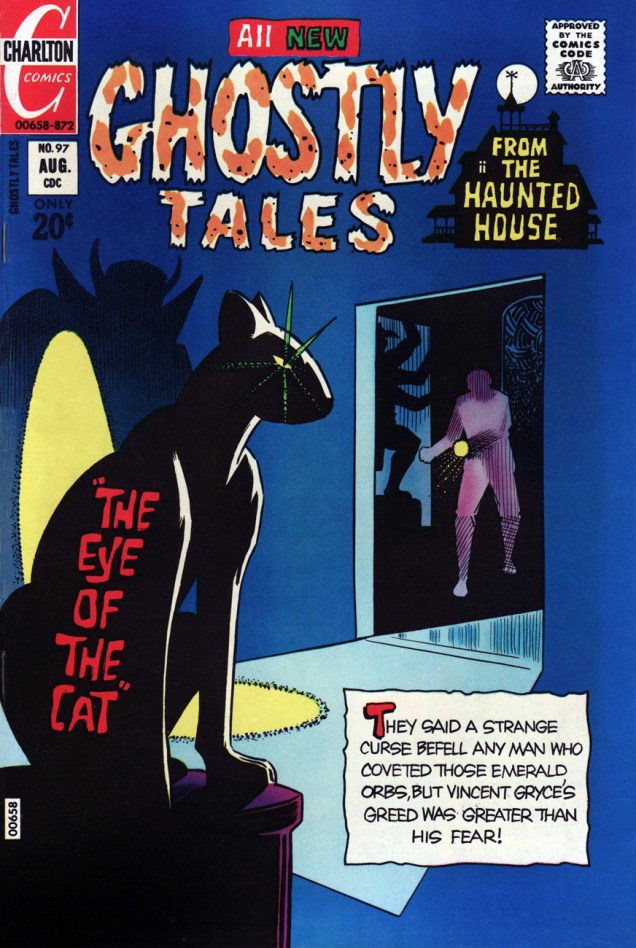
GhostlyTales97A
Ah, the largely lost art of the *soft* sell. Charlton’s cadre of artists hewed much closer to the ambience favoured by aficionados of the spectral than did the esteemed competition. You know, more Montague Rhodes James than, say, Rob Zombie.
Here, Ditko demonstrates how (dis)quiet and mystery is evoked. Dignified silence can be very attractive when everyone around is shouting. Ghostly Tales no. 97 (August 1972, Charlton) features “The Eye of the Cat”, actually handled by Don Perlin, while Ditko delivers visuals for Joe Gill’s “Journal of a Hanged Witch”. The issue also features “Poltergeist”, an effective collaboration between Creepy Magazine founder Russ Jones and the multitalented Bhob Stewart.
Haunted16A
My particular favourite among Ditko’s covers for Charlton’s Haunted (75 issues, 1971-84.) The merrily saturated colour scheme, the composition and its geometric simplicity, that well-chosen angle… the contagious joy of a master at play. This be Haunted no. 16 (June 1974, Charlton.)
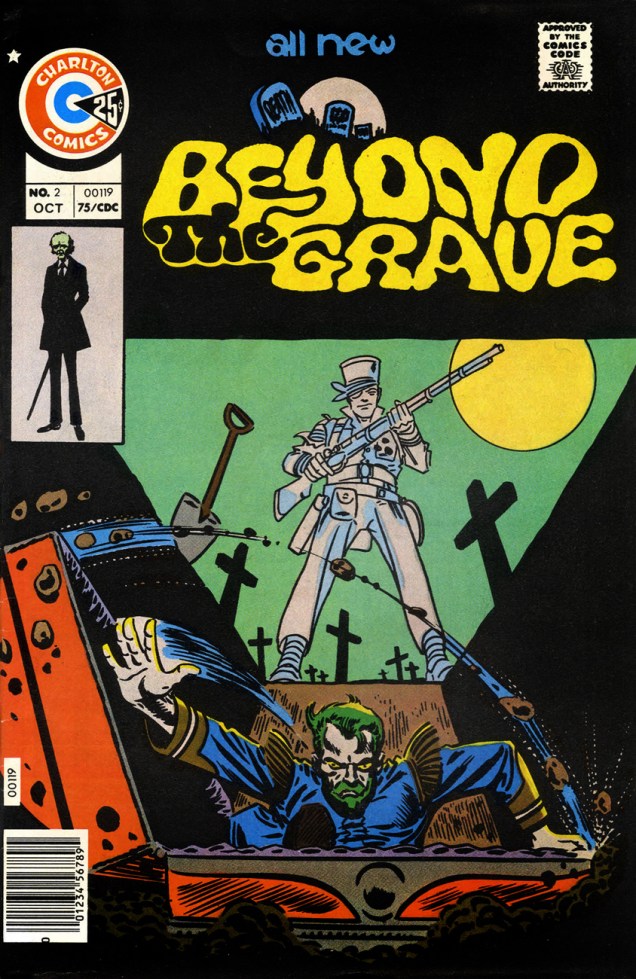
BeyondtheGrave2A
« If you visit that grave on a dark night, you may be surprised… for there is a sentry stationed there…to honor the dead? Or to make sure that General Kugar never leaves his grave? »
Here’s a cover showing the sort of solemn dignity and restraint that made Charlton’s line of ghost books so attractive to me right off the (vampire) bat. No one’s shouting deceptive hype or explaining the action; the elusive allure is undisturbed, unlike the sanctity of the tomb. 
DC, under Infantino and Cardy, generally understood this, but Marvel virtually never did or cared to. But hey, what sold and what I liked rarely sat at the same table.
Beyond the Grave no. 2 (Oct. 1975, Charlton).
Shade3A
Ah, Shade. Ditko’s last great creation, cut off in its prime by the Great DC Implosion of ’78. Later misunderstood and corrupted by hacks. Finally reprinted, including formerly unpublished issue 9, in volume 1 of The Steve Ditko Omnibus (2011). It’s still a frustrating experience, but at least issue 8’s cliffhanger has been resolved, and what happens in the Zero Zone doesn’t stay in the Zero Zone, if you know what I mean. This is Shade the Changing Man no. 3 (Oct.-Nov. 1977, DC)

*Jack Ryder (aka The Creeper)’s closing quip from “The Coming of the Creeper!”, plot and art by Steve Ditko, script by Don Segall (Showcase #73, Mar.-Apr. 1968, DC)
**Since it played such a crucial rôle in my Ditko inculcation, here’s the Teen Titans issue in question.

TeenTitans29A
Teen Titans no. 29 (Sept./Oct. 1970, DC) Cover by Nick Cardy (likely co-designed by Carmine Infantino and coloured by Jack Adler), illustrating “Captives!”, written by Hawk & Dove scenarist Steve Skeates and illustrated by Nick Cardy.

– RG

Hallowe’en Countdown, Day 31

« I’m going to die and they’re laughing! »

It surely won’t shock you that the most difficult decision, in such a countdown, lies in crowning numero uno. There are, after all, plenty of worthy candidates. But one also seeks to avoid undue repetition. After a couple of false starts, I opted for a long-time favourite that’s never received its due.

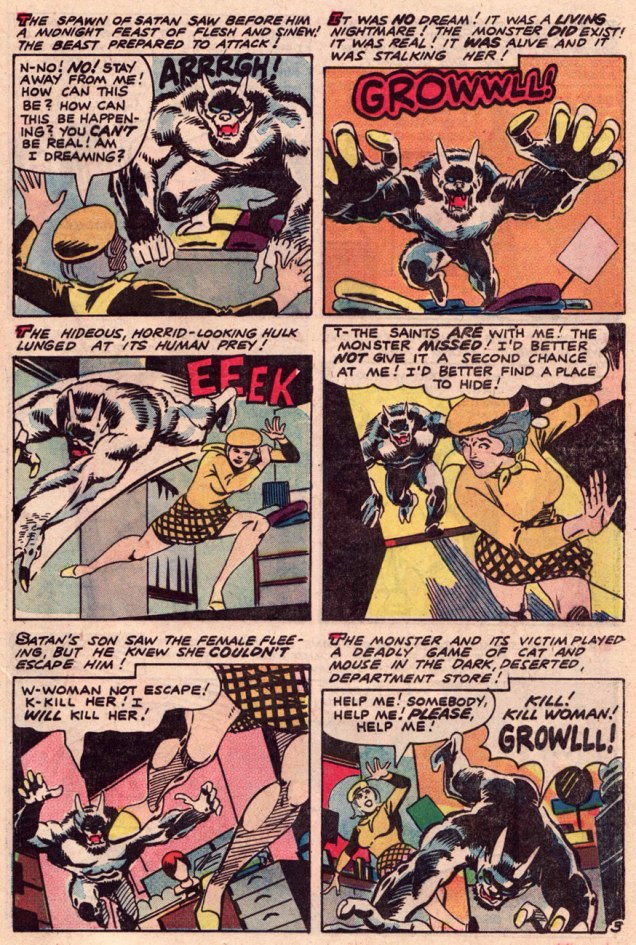
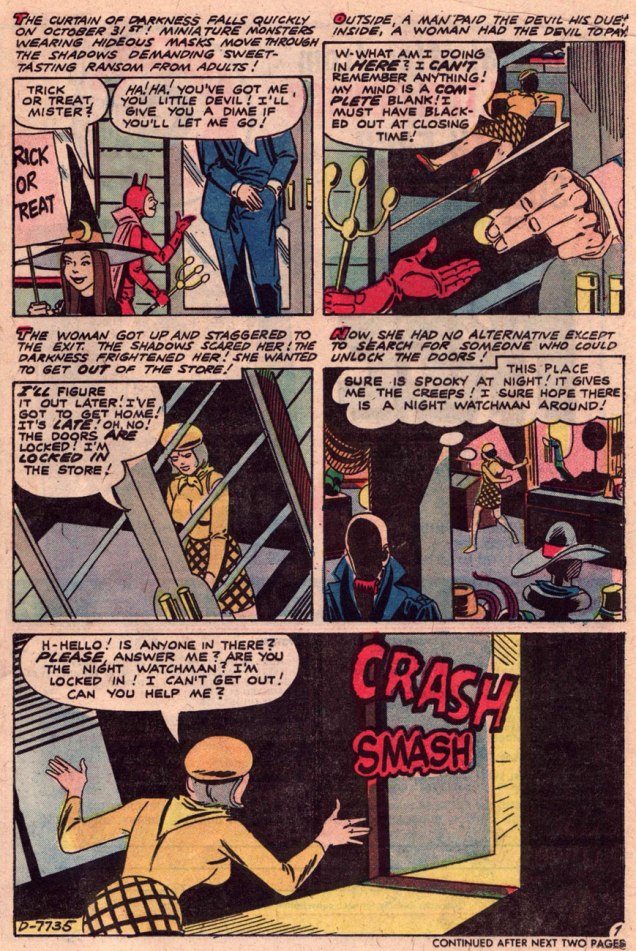
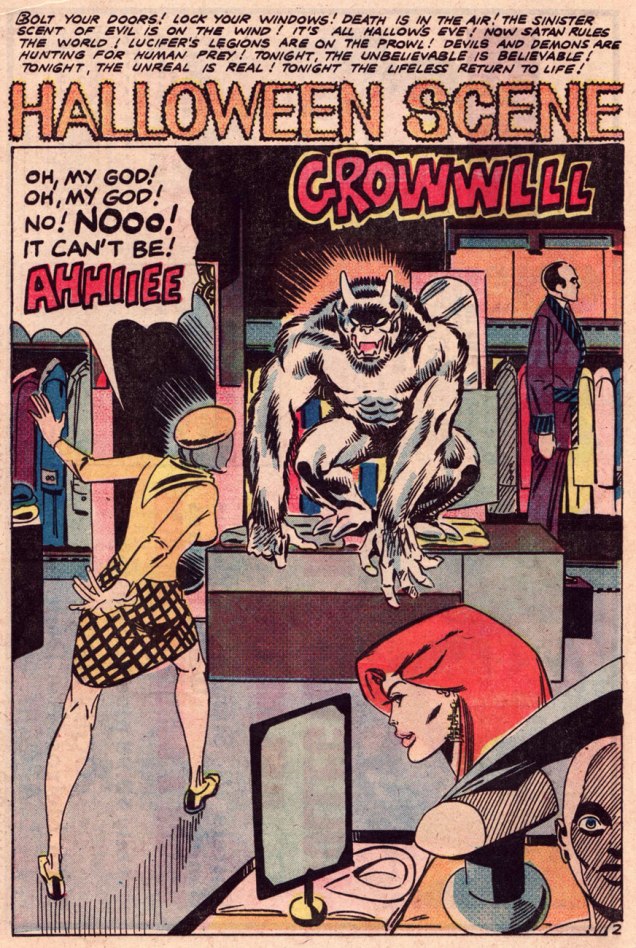
Here, then, is Steve Ditko (and an unknown scenarist)’s expertly-paced department store nightmare, “Halloween Scene”, from Scary Tales #7 (Sept. 1976, Charlton). It occurs to me that Mr. Ditko is about to turn 90 in a couple of days… they didn’t call him “Sturdy Steve” for the alliteration alone, as it turns out.

HalloweenScene1AHalloweenScene2AHalloweenScene3AHalloweenScene4AHalloweenScene5AHalloweenScene6A

HalloweenScene7A

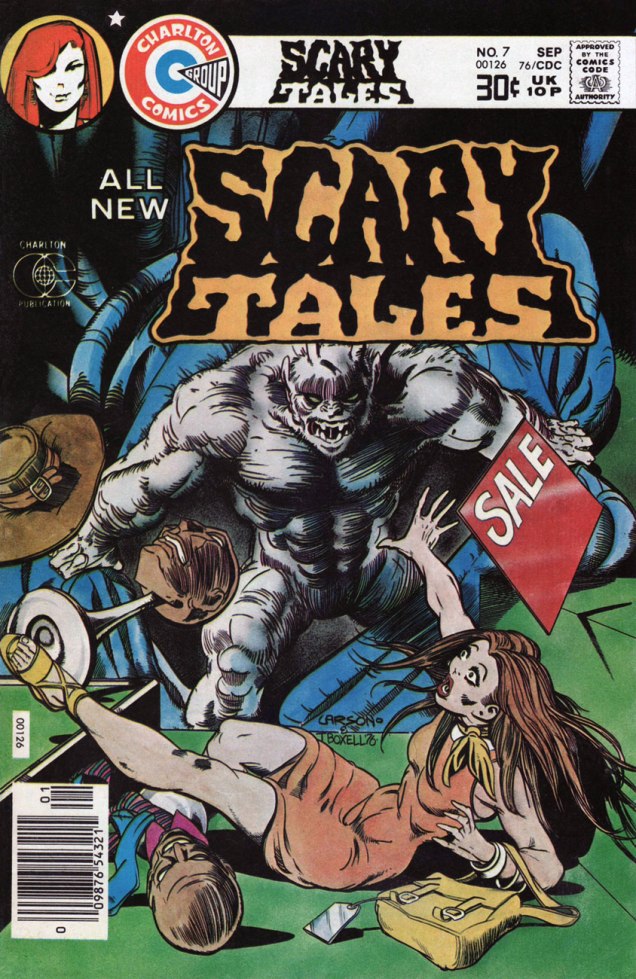
As a bonus (Hallowe’en comes but once a year, after all!), have a peek at the issue’s fine cover and its original art.

ScaryTales07ORIG
Pencils by future “Good Girl” specialist (see his Haunted House of Lingerie series, in the name of research, of course) Rich Larson (with ink and airbrush work by artistic partner Tim Boxell).
ScaryTales07A
The published version offers reasonably accurate reproduction, though one misses some of the details hidden behind the logo. Nature of the Beast of Commerce…

Well, that’s it for this year. Happy spookfest to all, and see you next time, hopefully.

I pity inanimate objects
Because they cannot move
From specks of dust to paperweights
Or a pound note sealed in resin
Plastic Santas in perpetual underwater snowstorms
Sculptures that appear to be moving but aren’t
I feel sorry for them all.

Godley and Creme – I Pity Inanimate Objects (1979)

-RG
Hallowe’en Countdown, Day 30

« Thought I’d inject a little excitement into this initiation… do I look any worse for wear? »

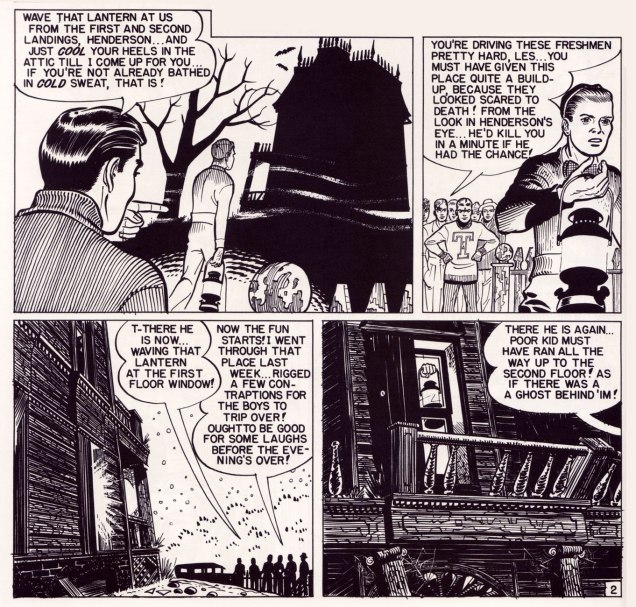
When EC überfan Russ Cochran launched his incredibly ambitious series of hardcover sets of the complete EC Comics in the late 1970s, there was simply no way I could afford the lot… so I gathered my shekels and mail-ordered a single volume of Tales From the Crypt (no. 3, midway through the run) and further managed to sweet-talk a nice lady at the local public library into ordering the first volume of Weird Science (years later, I would meet a couple of kids who’d become obsessed with the book, signing it out dozens of times and wondering how it had ever come to be acquired by our small, mostly francophone library).

Since the EC formula (meaning Bill Gaines & Al Feldstein) does wear thin with prolonged exposure, I gravitated to the outliers: Harvey Kurtzman, Johnny Craig, Bernie Krigstein, the Bradbury adaptations… but the true revelation in these volumes turned out to be John Benson and Bhob Stewart’s superb documentary notes, comprising astute analyses and eloquent interviews with the surviving participants… which are nowadays down to, well, colourist Marie Severin.

Anyhow, I was particularly intrigued by Gaines and Feldstein’s early system of “springboards”, which is to say that they based stories upon anecdotes encountered in newspapers and magazines. One title evoked time and again is Try and Stop Me (1944)*.

From John Benson’s documentary notes in Haunt of Fear, Volume 1 (1985):

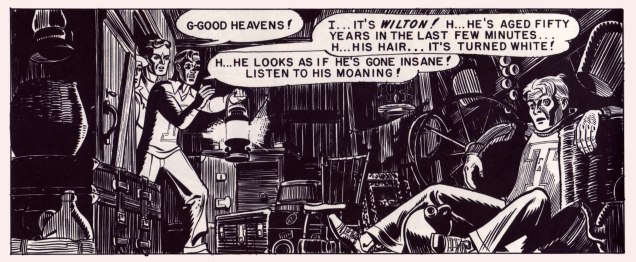
« ‘House of Horror’ [Tales from the Crypt no. 21, Dec. 1950 – Jan. 1951] is even more directly derivative; the story is merely an elaborated version of an anecdote from the Trail of the Tingling Spine chapter of Bennett Cerf’s Try and Stop Me, which was the source of a number of EC stories. Kurtzman remembers the story as ‘an ass-breaker.‘ It was the first story he did for the EC line and he wanted to make a good impression. ‘It was the effort that got me the EC account. ». 

House of Horror was scripted by Ivan Klapper, who contributed a few stories, early in the EC horror titles’ run. He went on to work on John Newland‘s 1959-61 anthology show, One Step Beyond.

If you’re used to the usual rubbery, sketchy (but deceptively spontanous-looking) Kurtzman, brace yourself.

HOH1A
« At initiation time it was my idea to take the three neophytes we had selected and brundle them out to a deserted house about fifteen miles from the campus. It had been unoccupied for years, was windowless, sagging and ugly, and was said by the villagers to be haunted. We picked a black, starless night for the initiation, and all the way out to the place poured tales of horror and the supernatural into the ears of our three apprehensive freshmen. »
HOH2A
« I watched him enter the deserted house. It was about two hundred yards from where we were gathered. His instructions were to stay inside for a half-hour, and then come back to us. When forty-five long minutes went by without any sign of him, I experienced my first uneasiness, and dispatched the second freshman to fetch him. Ten more minutes went by. Nothing happened. There wasn’t a sound anywhere. The fire was burning low – we just sat there, quietly watching. »
HOH3
« ‘These kids are a little too smart for their own good’, I said at last. ‘Davis, get in there and bring them back fast,’ Davis was our prize conquest – a handsome, two-hundred-pound boy whose scholastic records foreshadowed an almost certain place on the next year’s All-American squad. He had already been elected president of the freshman class. »
HOH4
« The first thing that struck me when I entered was a musty smell like the smell of an attic full of old books and newspapers. I yelled for the boys, and poked my flashlight into every corner but there wasn’t a sign of them. Only a faint, steady tap that seemed to come from the roof. »
TinglingA
The relevant illustration, by Carl Rose, from Try and Stop Me’s original version. « I stuck my head through the open skylight. There was Davis, stretched out on his stomach! His hair had turned snow-white. His eyes rolled in his head. He was mad as a hatter. In his hand he held a hammer covered with blood. » « He died in the college hospital the next morning without uttering a single syllable. We never found any trace of the other two boys… »

*I lucked out and found a nice copy in the 1980s… for $4.50, according to the usual lightly-pencilled note on the flyleaf.

– RG
Hallowe’en Countdown, Day 29

« Hasn’t the weather been gray, drizzly, foggy and oppressive? »
« Yes, just lovely! »

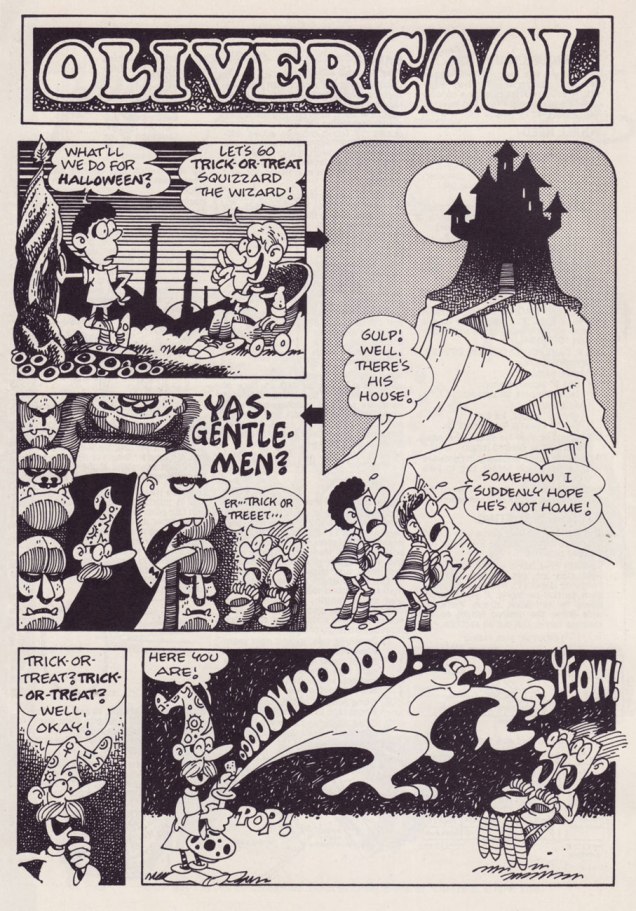
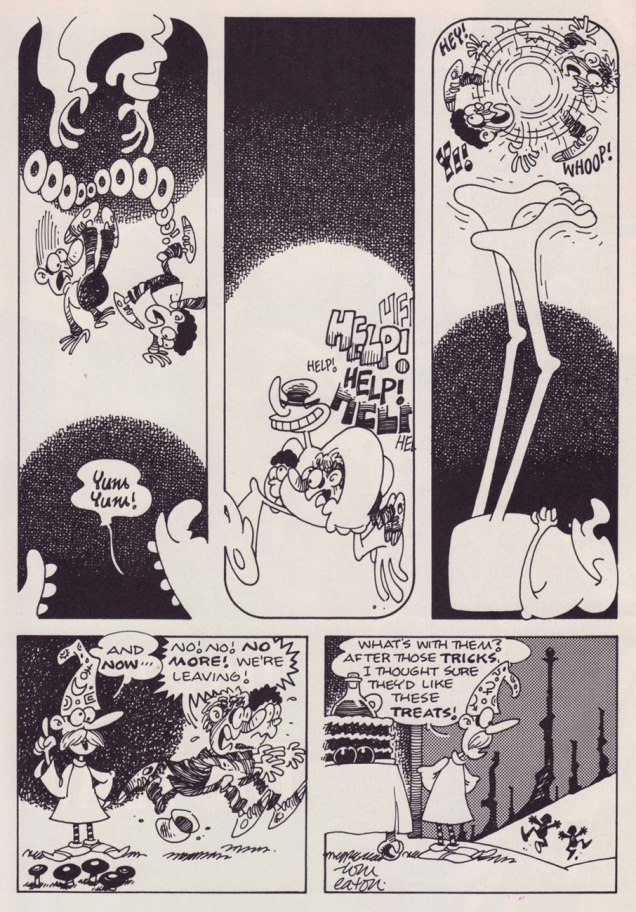
OliverCoolOct75AOliverCoolOct75B

Tom Eaton’s Oliver Cool strip appeared in The Saturday Evening Post Company’s Young World. YW had picked up, in 1972, the numbering (but not the title) of Western Publishing’s Golden Magazine. Of writer-illustrator Tom Eaton, little is to be found online, though he’s left a considerable body of work, such as fun books like Chicken-Fried Fudge and Other Cartoon Delights (1971), Captain Ecology, Pollution-Fighter (1974), Book of Marbles Marvels (1976) and The Beastly Gazette (1977). His Fizz & Farra in the Year 2250 comic strip also ran in Child Life magazine in the late ’70s.

A snatch of autobiography found on the back cover of Captain Ecology, circa 1974: « Tom Eaton is probably 30 or 40 years old, and lives with a tribe of baboons in a water tower on the outskirts of Chanute, Kansas. He writes and draws everything himself, with almost no help from his dog, Oscar. This is not his first book. His goal in life is to buy the state of Massachusetts and change its name to something he can spell. »

YoungWorldA
The issue in question bore a spiffy Halloween-themed cover by George Sears… so here it is.

– RG

Hallowe’en Countdown, Day 28

« I hope I will not be accused of undue vanity if I publicly thank Mr. Addams for immortalizing me in the person of the witch’s butler, to say nothing of the rather hairy gentleman whose clothes are strangely cut and who appears to subsist on a diet of bananas. » — Boris Karloff, from his foreword to the Addams collection Drawn and Quartered (Random House, 1942)

At the risk of being obvious, the ghoulish wit of Charles Addams brings us Hallowe’en on any old day of the year… but it’s no reason to take him for granted when the proper season slinks into view. Here’s a small selection of favourites. I’ve noticed that many latter-day collections have been plagued by terrible reproduction (heads should roll for that particular crime against art!), so I’ve gone back to the original collections in my library. Enjoy, fiends!

AddamsWitchesA
A lovely piece originally featured on the cover of The New Yorker‘s November 2, 1963 issue. This logo-free version was reprinted in The Groaning Board (Simon and Schuster, 1964.)
AddamsBusA
Addams at his understated best. A 1953 cartoon collected in Homebodies (1954, Simon and Schuster.)
AddamsSewerA
« Well, here’s where I say good night. » A Morticia prototype from an undated cartoon collected in the first Addams collection, Drawn and Quartered (Random House, 1942.)
AddamsSqueakyA
« While you’re here, there’s a squeaky trap-door I’d like you to look at. » That’s the Morticia we’ve come to know. Also reprinted in Drawn and Quartered (Random House, 1942.)

-RG

Hallowe’en Countdown, Day 27

« Trent’s home under th’bed! »

Marvel’s Dynamite Magazine ersatz, Pizzazz (15 issues, 1977-79), despite ratcheting its model’s celebrity coverage by several notches, while providing the House of Ideas’ usual rabid circle-jerking… wasn’t all bad. For one thing, there was its inspired recycling of Harvey Kurtzman’s splendid Hey Look! one-pagers from the 1940s, lovingly recoloured and presented with painstaking attribution. Fan on board!

And when Pizzazz reached beyond the Bullpen for ink slingers, it often struck paydirt, landing a heady mix of established and burgeoning talent, such as Jon Buller, John Holstrom, Bobby London, Ken Weiner (aka Ken Avidor), Rick Meyerowitz… and Graham Hunter.

PizzazzHalloweenA
The original caption: « Have a HAPPY HALLOWEEN! PIZZAZZ SAYS THANKS… Look at this picture. If you’ve ever written us, you may find your name in it. If not, take a look next month, or a few months after.PIZZAZZ says a big, warm THANK YOU to everybody who’s written us. And KEEP THE MAIL COMING – some month maybe your name will be in the picture! » The feature ran for the final seven issues of the magazine (including a gorgeous Xmas double spread.) This was Pizzazz no. 13 (October, 1978, Marvel). Say, is that your name in there?

Hunter was a bafflingly brilliant pick: his career in comics, as far as I know, consists in the main of a string (1946-47) of one-pagers featuring early soft drink product placement shill/mascot, the prosaically-named Pepsi, the Pepsi-Cola Cop. Guess what he was pushing!

TCV17N4AB
This is Treasure Chest of Fun and Fact vol. 17 no. 4 [310] (October 26, 1961). The issue features TC’s strident screed This Godless Communism, illustrated by EC veteran Reed Crandall. It still sucks. I said they were entertaining, but I draw the line at reactionary politics. Read it for yourself right here, but don’t say I didn’t warn you.
Of greater interest is the handful of covers Hunter created for the surprisingly entertaining Catholic comic book Treasure Chest of Fun and Fact, and this is what must have landed him the Pizzazz gig, a couple decades down the pike.

Nailing this sort of humorous bird’s-eye-view crowd action scene requires some rather astonishing artistic chops. Perspective, proportions, movement, comic exaggeration… and that’s just the basics. This sort of thing was popularized by Dudley Fisher’s Right Around Home strip, which débuted in 1938.

RAHTouristsA
A Right Around Home Sunday from 8-20-39 (King Features Syndicate). Here’s a fine, informative article about the strip, from the indispensable comics mag Hogan’s Alley.

– RG

Hallowe’en Countdown, Day 26

« I’m doing some new phony ghost effects and these hicks just eat it up! Show ‘em a ghost and they’ll swear they recognize it! »

Is it just me, or are horror covers more effective when they’re basically wordless? EC and DC and Charlton got it, but Marvel never did, with its protagonists/victims standing around uselessly pointing out the obvious: “Oh no! We’re trapped with… the Thing that walks!” “Uh, honey, I think it’s more of a Thing that shambles!”

HOM236A
This is House of Mystery no. 236 (October, 1975, DC) and it’s quite an issue on the inside too: Steve Ditko with Mike Royer inks (“Death Played a Sideshow“), and Paul Kirshner with Neal Adams inks (“Deep Sleep“.) Lest we forget: this fine cover palette brought to you by Tatjana Wood.

… and since this is our first, sadder Hallowe’en without the macabre Bernie Wrightson  (1948-2017) to inspire us, let’s have one more shot, shall we?

HOM219Intro
This is the frontispiece ushering us into issue 219 (Nov. 1973) of DC’s House of Mystery.

Interestingly, BW’s signature (at bottom, on the spine of a book in the centre) is reversed, which makes one wonder whether the image was flipped before dialogue was added. On the other hand, perhaps it made for better arcane lettering for a dusty grimoire.

– RG