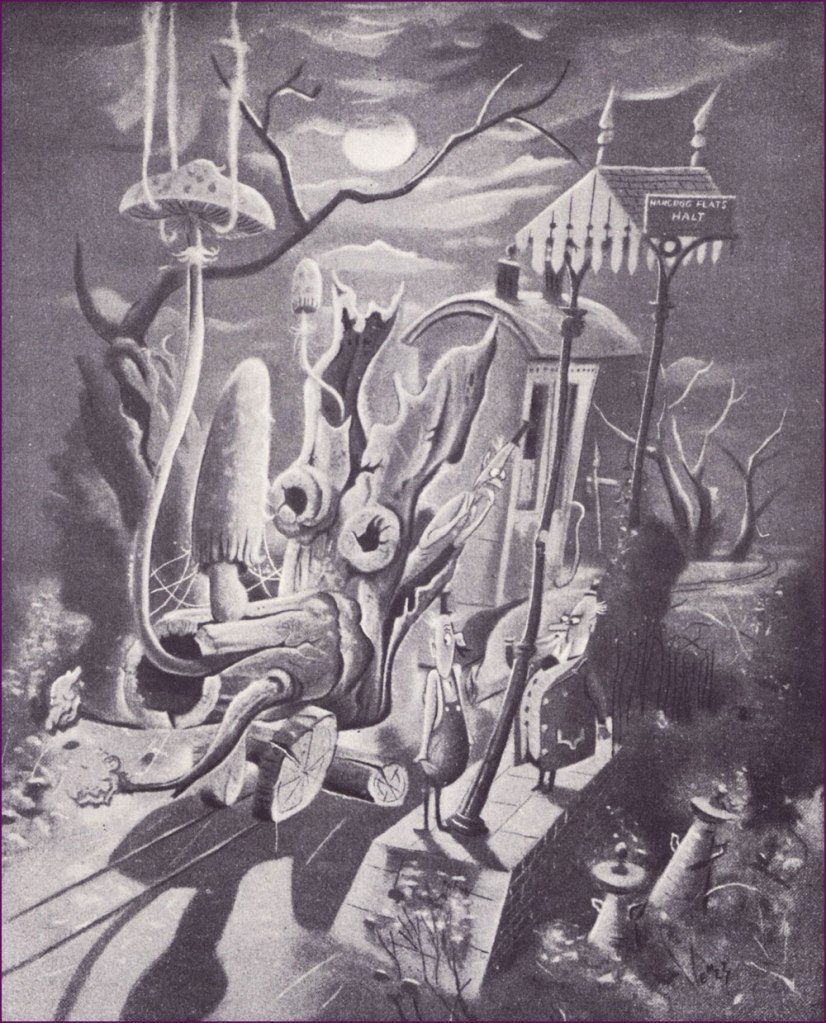
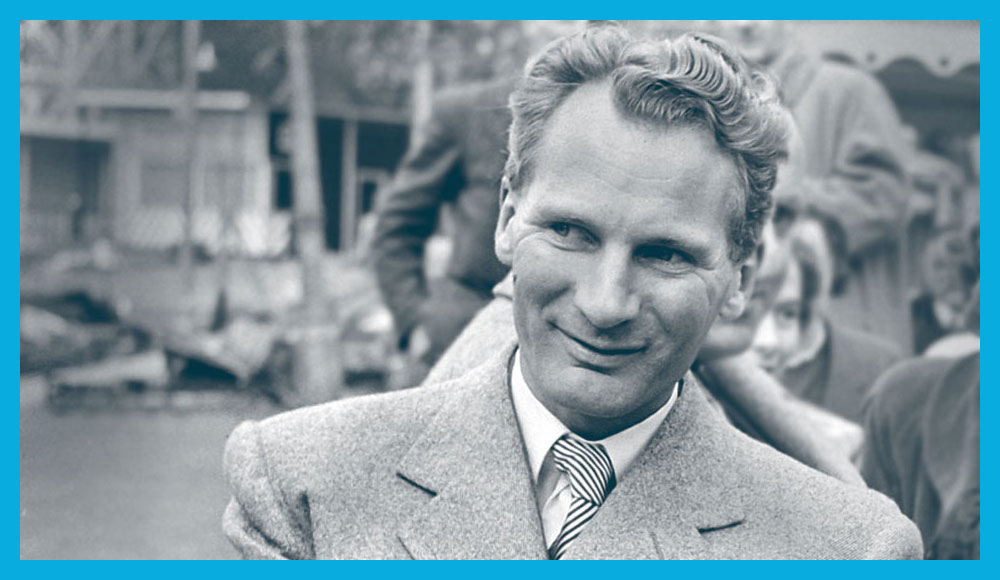
Nature Always Wears the Colours of the Spirit: Roy Raymonde

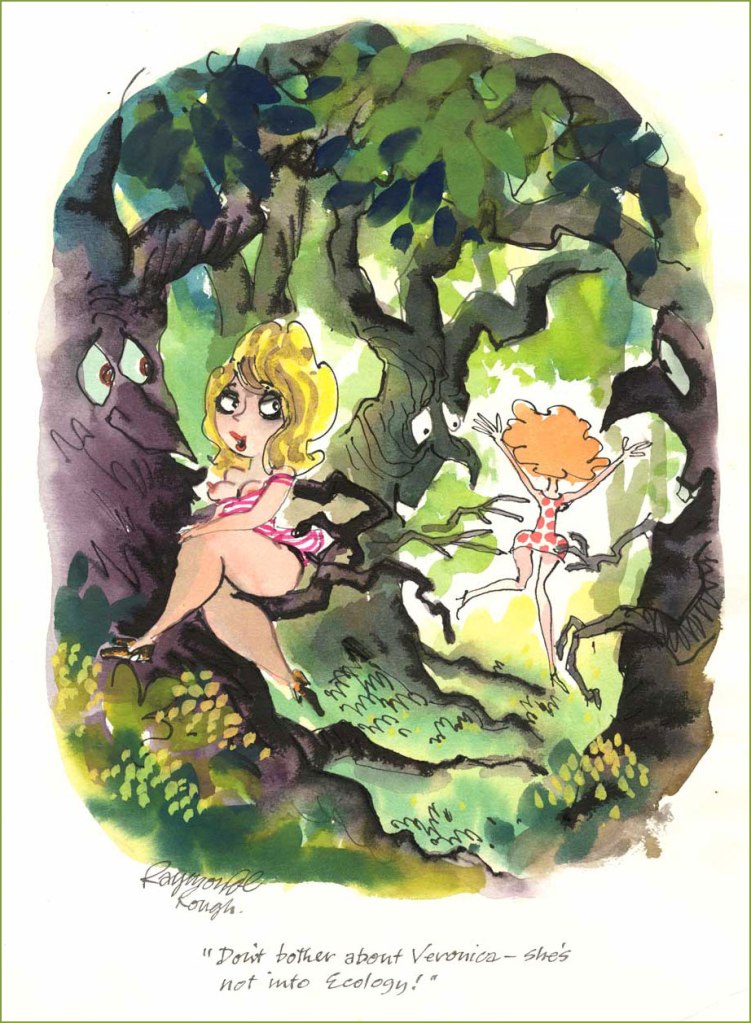
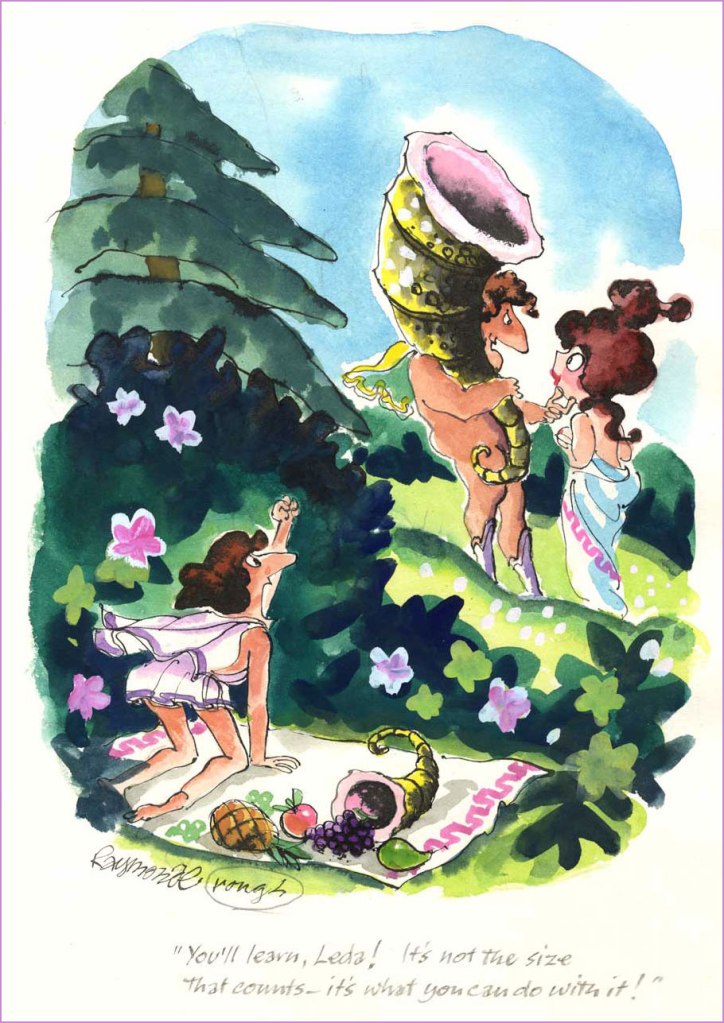
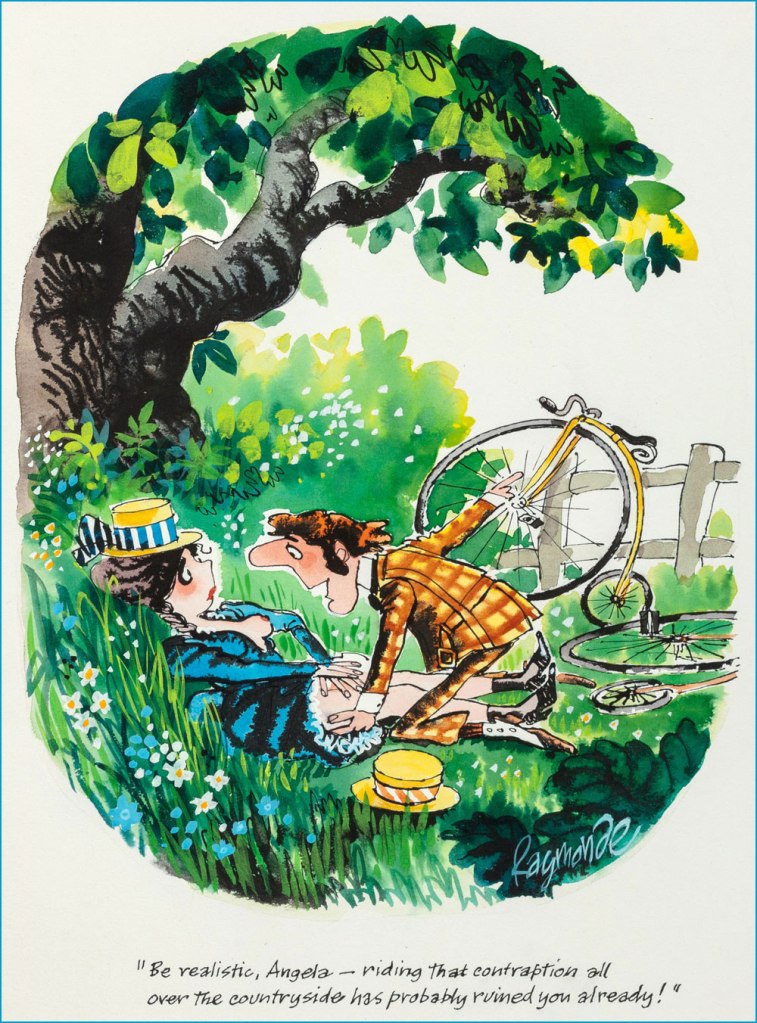
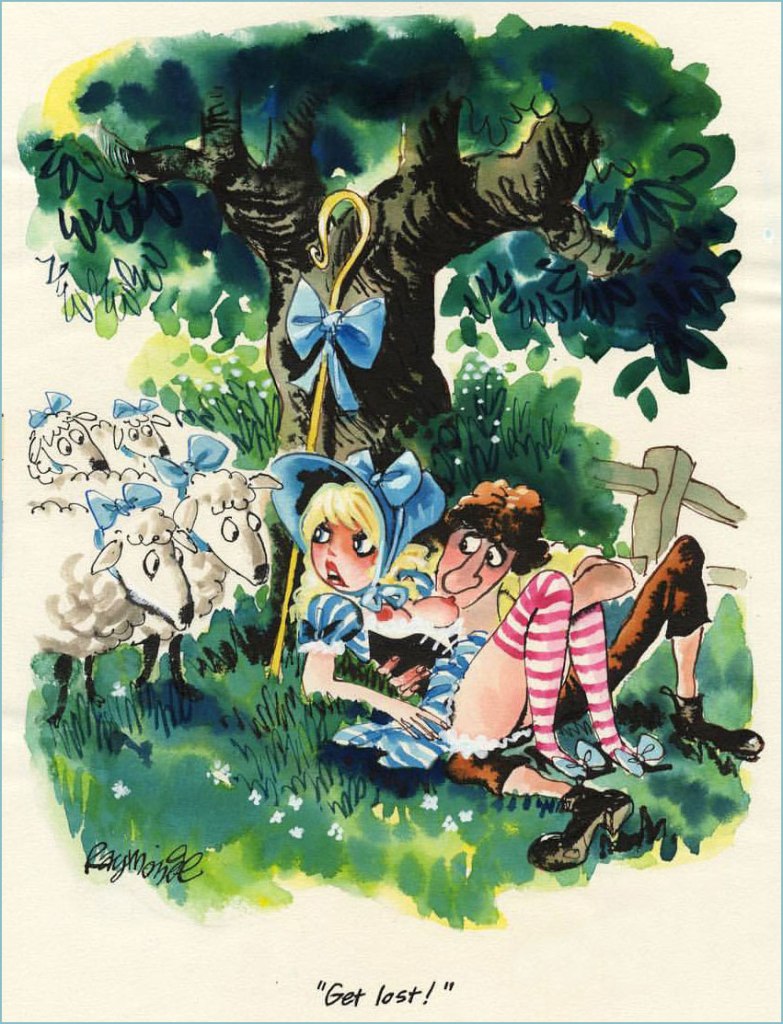
British cartoonist Roy Stuart Raymonde, who died in 2009 at 79 years old, first intrigued me with vivid watercolours and episodes oftimes set in mushroomy forests or secluded glens dotted with babbling brooks. Our anglophilically-minded readers may recall his work for Punch Magazine, and the rest of us will recognize him from the pages of Playboy, to which he contributed a monthly full-colour page for some 30 years.

The rambunctious Raymonde started out in advertising, cushioning his finances by freelancing as a cartoonist, mostly notably for Tit-Bits, a British tabloid-type magazine with an amusing name which reminds me of this George Carlton sketch. By 1960, Raymonde had amassed enough contacts to become a full-time cartoonist.
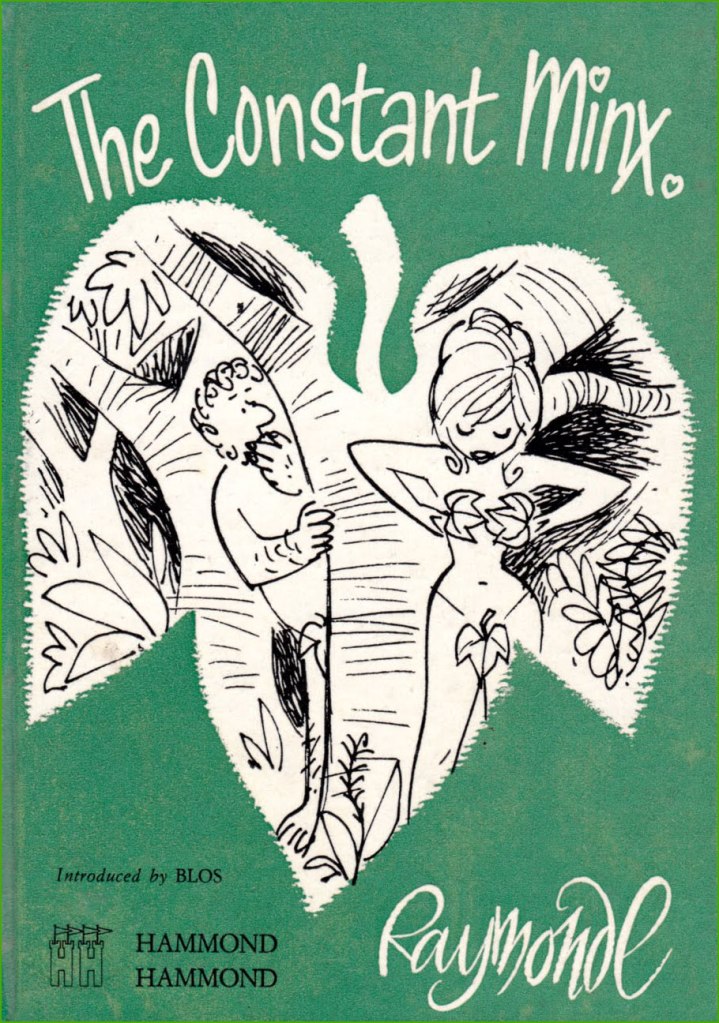
A collection of Raymonde cartoons published in 1961. Head over here to see some of the insides.
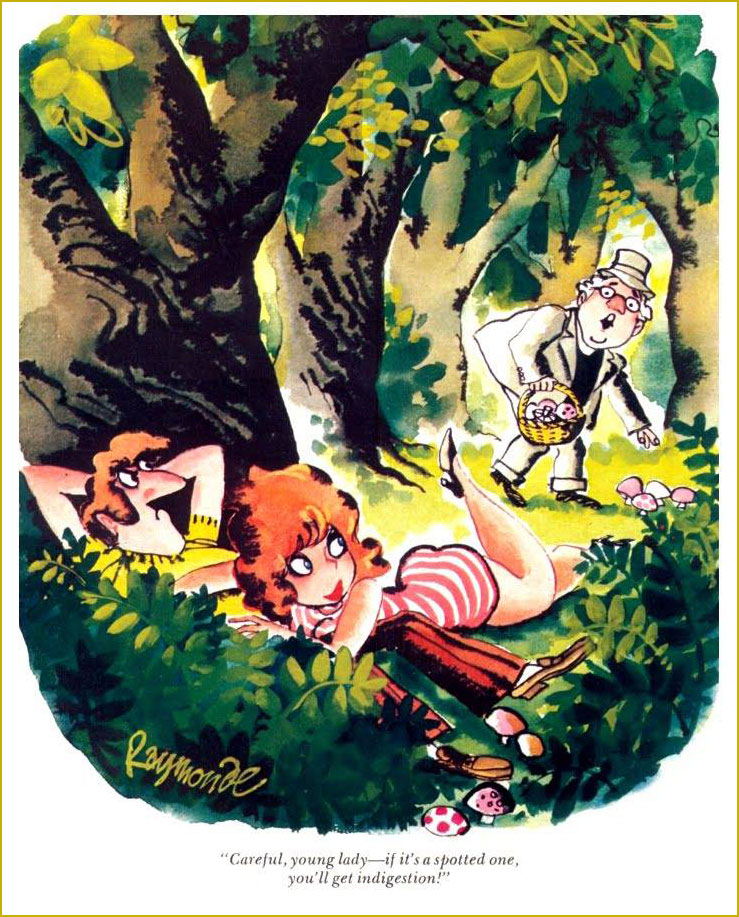
July 1974. This is the cartoon that first attracted my attention… with mushrooms, naturally.

I didn’t know this until writing this post, but delightfully Raymonde was friends with WOT favourite Gerard Hoffnung (see co-admin RG’s posts Gerard Hoffnung’s Constant Readers and Off to the Isle of Cats — and Back by Teatime!), whom he met at the Harrow School of Art (a subdivision of University of Westminster) in 1944, when RR was but 15. The two became lifelong friends, with Hoffnung, then a junior tutor (on his way to becoming a schoolmaster) a mere four years his senior, playing the role of Raymonde’s mentor. This friendship was cut abruptly short by Hoffnung’s premature death, so they were not able to re-enact Simon & Garfunkel’s Bookends, alas. I wasn’t able to find the exact source of this quote, as various websites just parrot the same paragraph over and over, but it seems that Raymonde was nearly expelled after adding funny captions to one of Hoffnung’s instructional drawings, a story hopefully as true as it is hilarious. Hoffnung (never bereft of a sense of humour) came to his defense and argued that this act was a sign of talent.
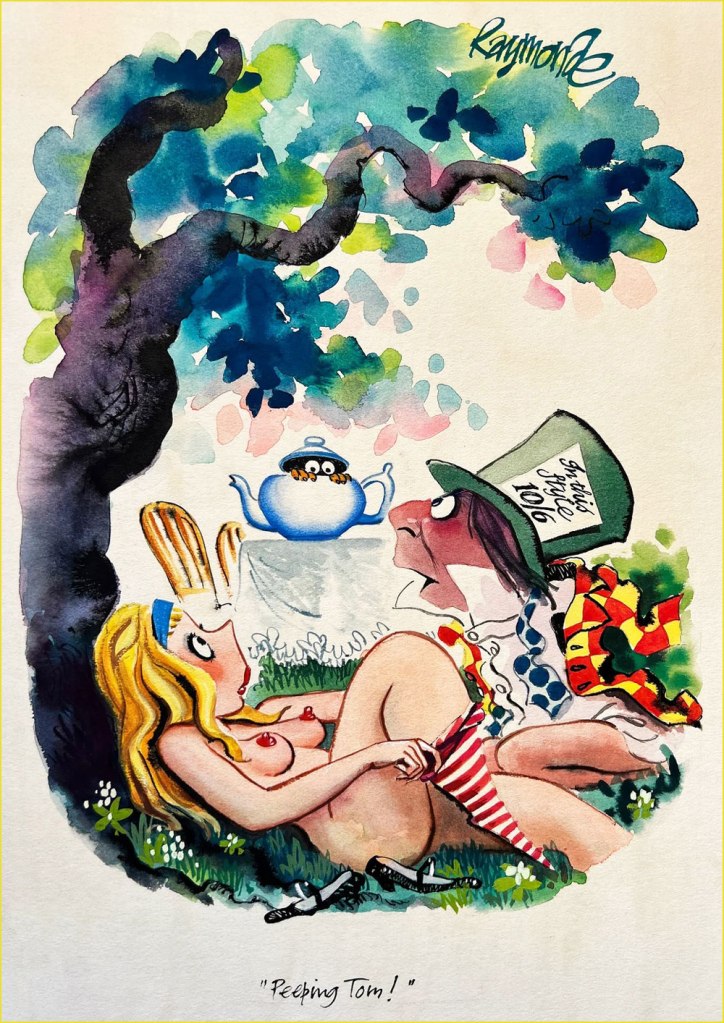
September 1972. What kind of Brit cartoonist worth his Yorkshire Pudding hasn’t spoofed Alice in Wonderland?
1973.
Preliminary sketch of unknown vintage.
Another preliminary sketch.

Given his evident love for the outdoors, I wasn’t surprised to find out that Raymonde bought a thatched cottage at the age of 34 and lived there for the rest of his life, voyages to Japan (where his work was very appreciated, to the point of winning the Gold Prize at the Kyoto International Cartoon Festival in 1996) and such notwithstanding.
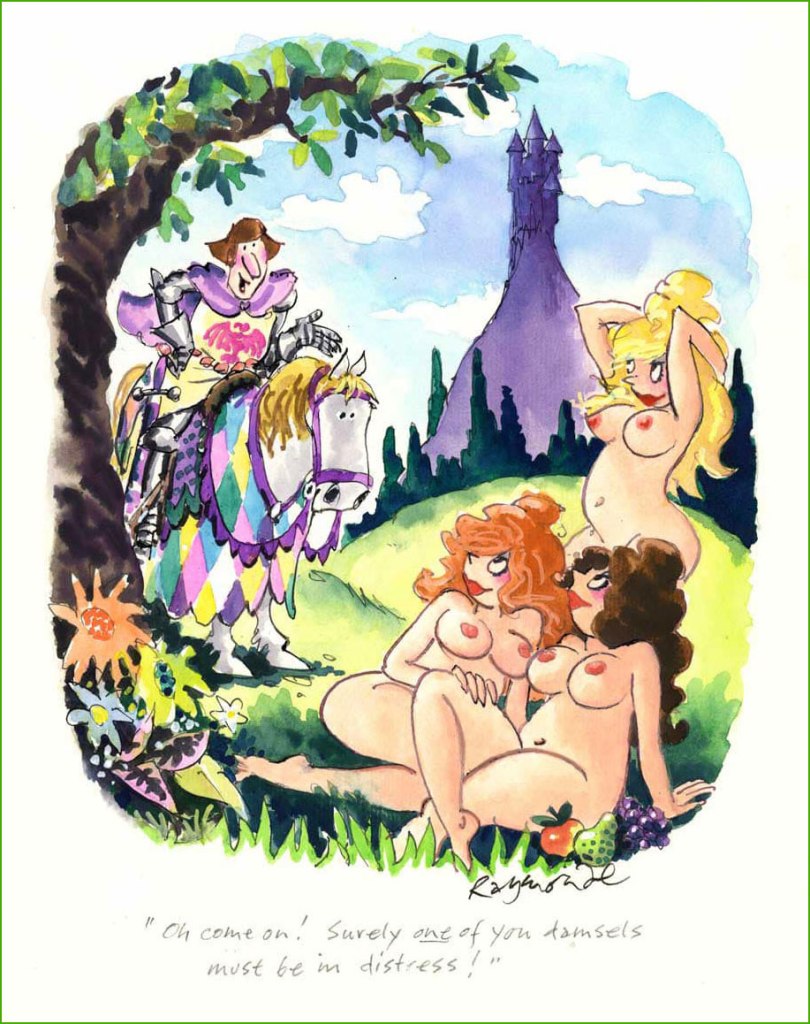
1997.
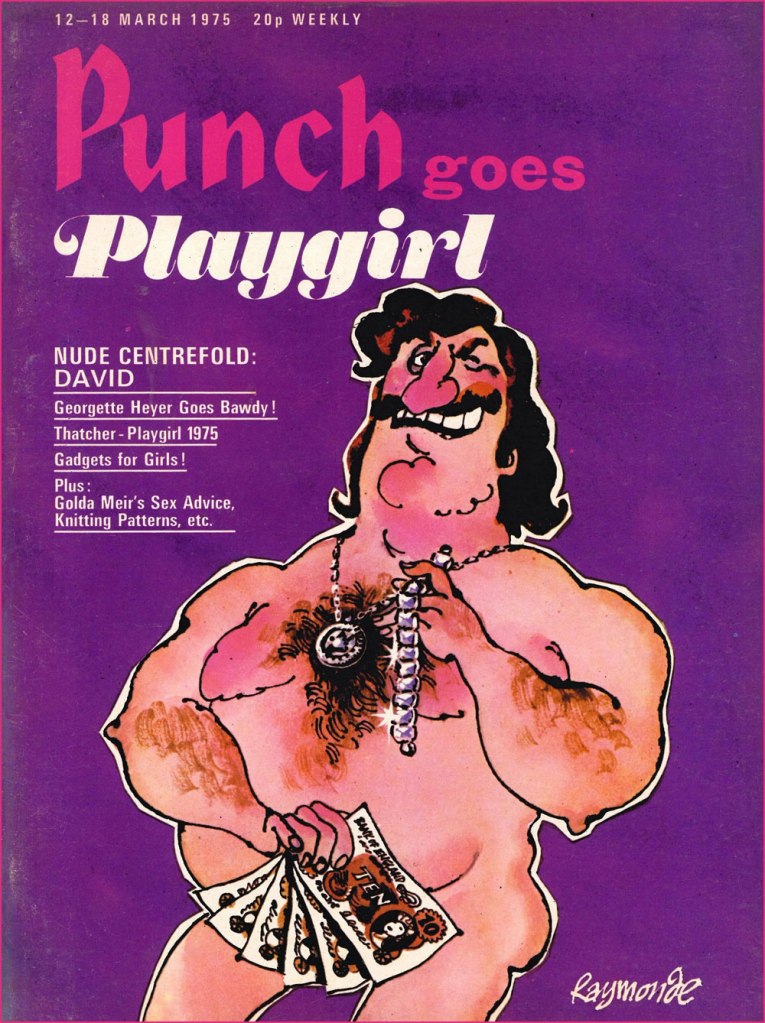
Punch Does Playgirl, March 1975. Raymonde created quite a few covers for Punch… as to the guy depicted, he’s like something out of a Charles Rodrigues sketchbook (see Charles Rodrigues’ Pantheon of Scabrous Humour).
July 1974.
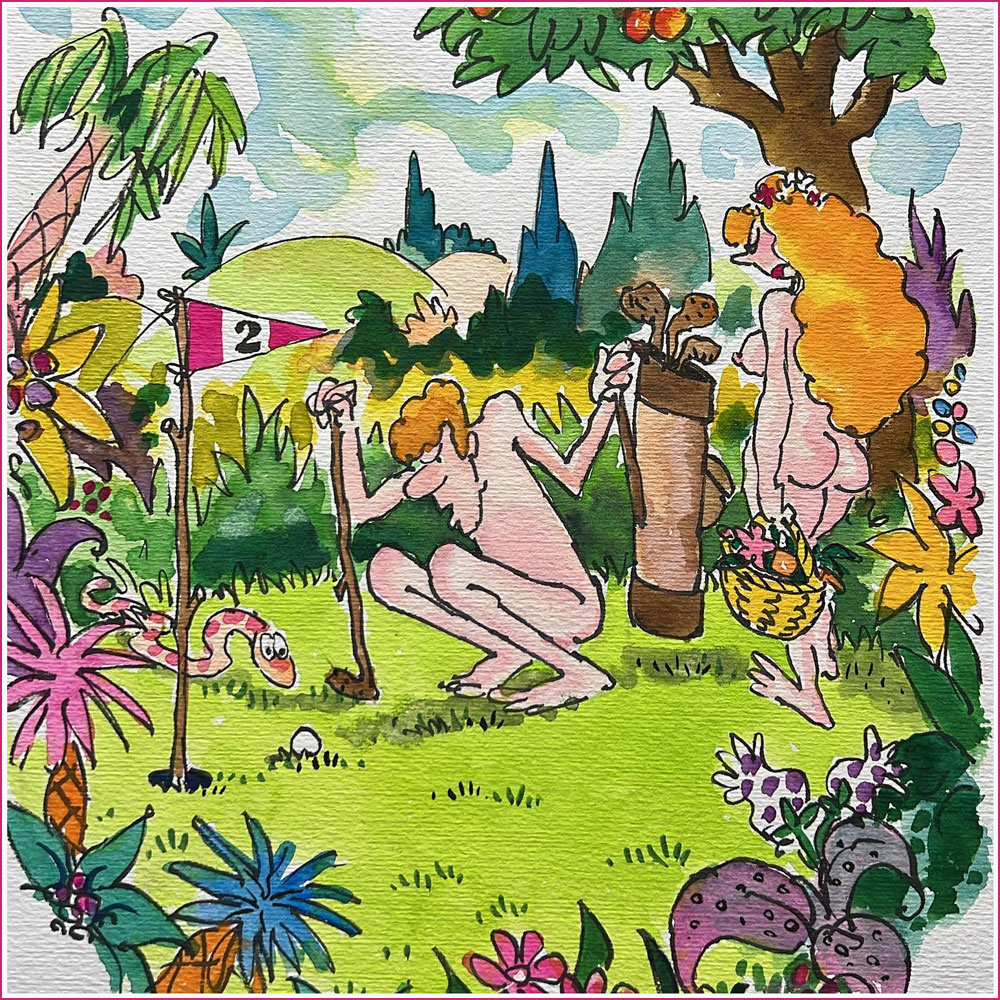
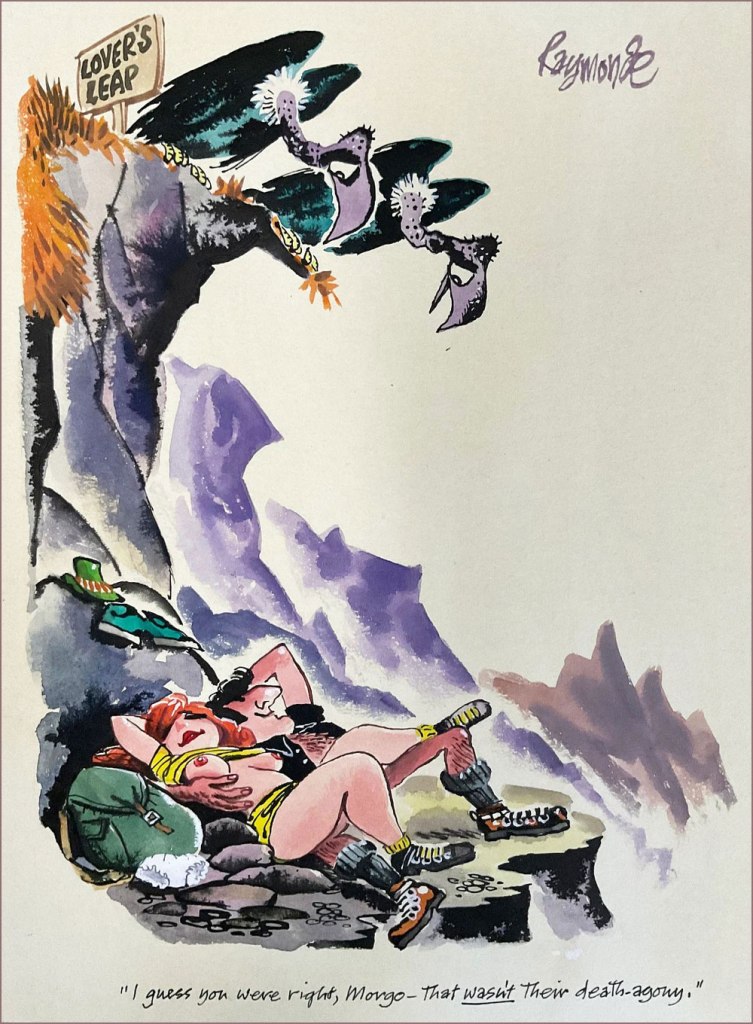
A cartoon used in Fore Play: The Very Best of Playboy’s Classic Golf Humor Paperback (January 1, 1995).

Want to see more? Head over here… and don’t forget to rest your weary head in some spring grass while you’re at it (perhaps with a friendly companion).

~ ds

Adverts With Punch!

« All advertising advertises advertising. » — Marshall McLuhan

When you move house, as I did a few months ago, some items inevitably get buried while others get kicked loose. For instance, several decades ago, I had picked up (at a dollar fifty apiece, apparently) a tidy little pile of Punch issues from 1946 and 1955. Punch (1841-2022) of course, boasted at the time what was likely the world’s finest roster of cartoonists. Not only were the cartoons splendid — and now I’m old enough to actually get most of the jokes — but even the ads, often produced in-house, were exquisitely illustrated. And so, instead of the cartoons (you can still scratch that itch with our recent Rowland Emett’s Ramshackle Poesy in Motion, for instance), I’m proposing a sampling of adverts from my pile o’ Punches.

Remember the days before built-in obsolescence? Me neither. I note with pleasure that the grand old Scottish firm of Saxone still stands. For more Anton, check out Anton’s Spivs and Scoundrels, Baronesses and Beezers.
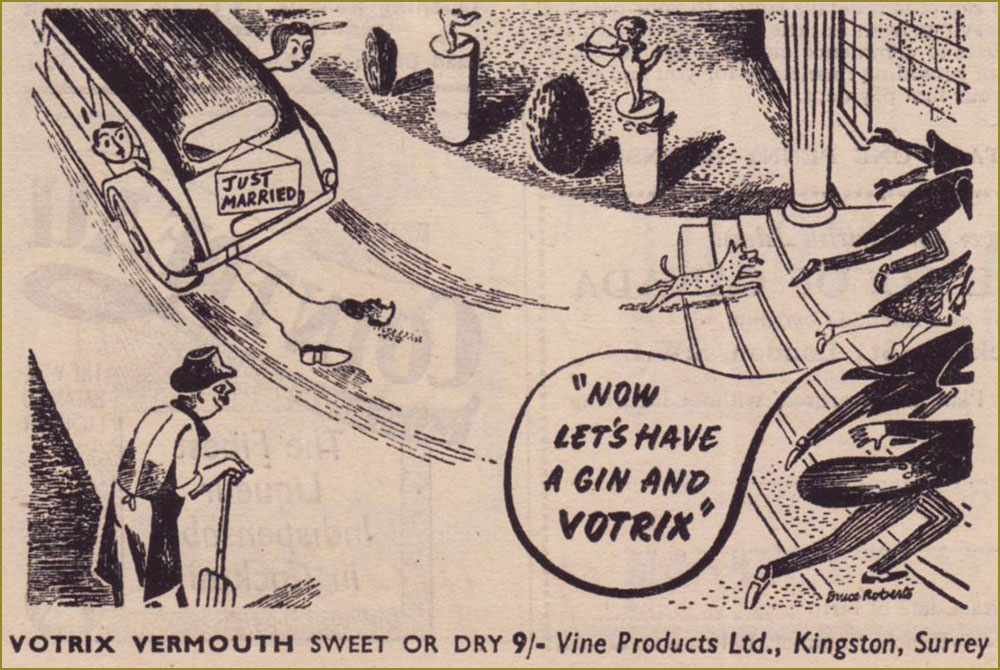
From the June 3, 1946 edition of Punch, the Summer Number. This Votrix stuff wasn’t very good, it would appear. « As the second world war started to take hold, the export of vermouth from Italy and France become non-existent. Given the devastation left behind, it was slow to start back up again once the conflict was over.
In England Vine Products based in Kingston, Surrey (whom had been making British copies of Sherry and Port for some years) launched Votrix Vermouth advertising it as “Indistinguishable” from pre-war Vermouths from Europe.
They claimed it was made with the finest grape juice blended with genuine vermouth herbs. There was a lot of controversy and even several court cases as to how this grape juice was made (and if it was actually wine made from raisins rather than grapes). It was never any real challenge to the vermouths from Italy and France.
» [ source ]
While Rothman still exists in name, the company’s true lifespan was 1890-1999. Mergers and acquisitions, that same old story…
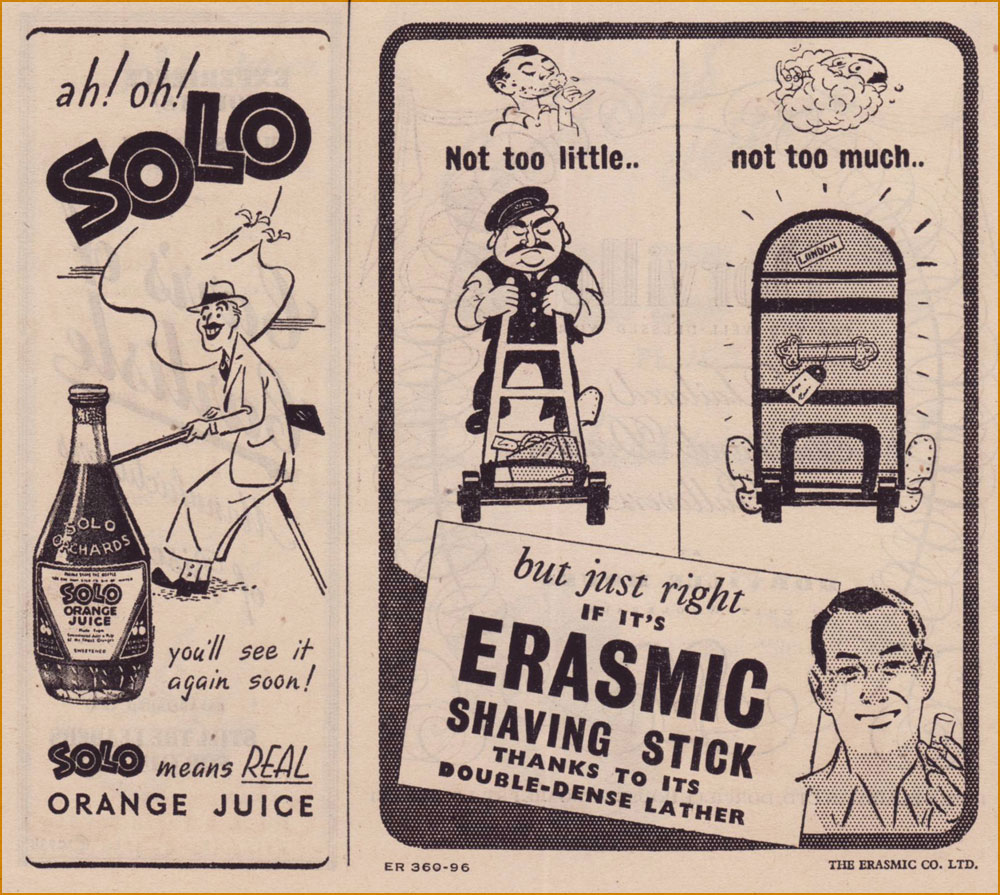
Solo is gone. « Pablo Utrera owned Solo Orchards, an orange juice business. In 1960 Idris Ltd., the soft drinks firm, acquired the whole of the issued share capital of Solo Orchards (“A small but well-known company making quality products“) for a consideration of 143,500 ord. 5s. shares in the company, worth £130,000. By April 1962 Idris had disposed of the Totteridge (Barnet, north London) premises of Solo Orchards, moving production to other factories. » [ source ]
Erasmic (founded in 1869), on the other hand, still operates, its products widely available.
An interesting soft sell approach to selling brakes! Established in 1926, Lockheed merged with Martin Marietta in 1995 to constitute Lockheed Martin.
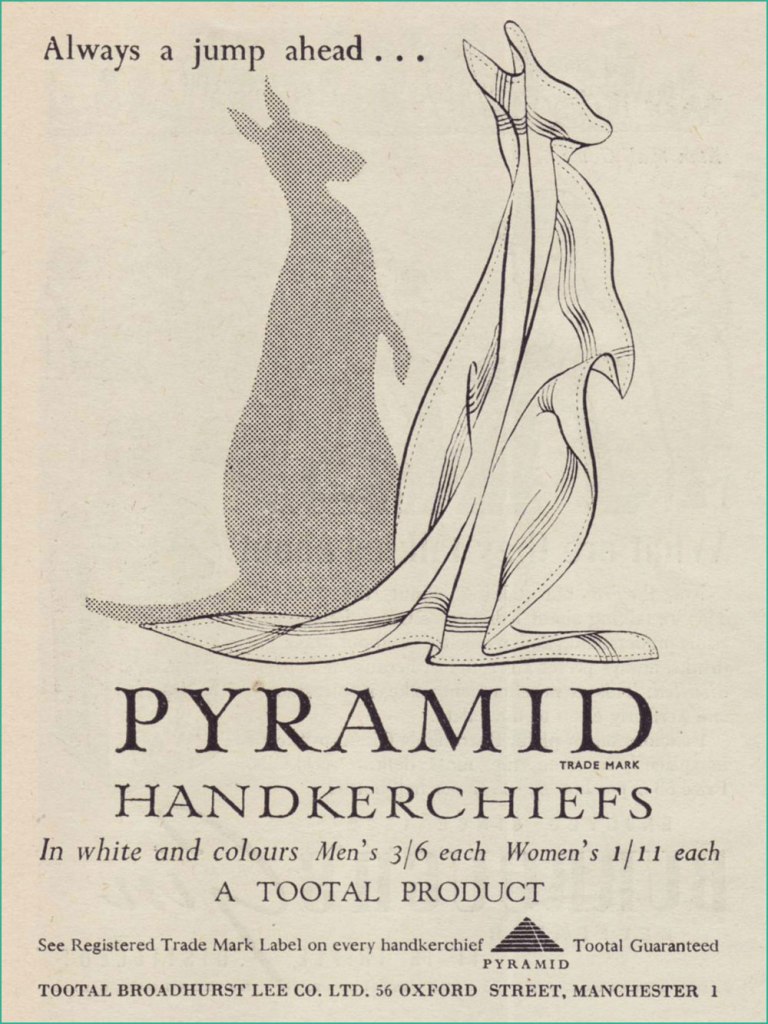
Despite the advent of disposable tissues, Pyramid handkerchiefs appear to have survived. I believe they were named so because they were made from Egyptian cotton. That said, what a clever ad… as a product, hankies hardly strike me as a boundless fount of exciting visual ideas. Get yours here!
Having toiled in advertising illustration for some years, I can tell you that the privilege of signing one’s name in an advert is a rarely-accorded one. Unless, of course, your famous name was part of the pitch. This one’s from the pen of Bruce Angrave (1912 – 1983). From the Nov. 28, 1951 issue. Read about the history of the International Wool Secretariat.
Guinness for Strength, went the famous slogan. But was there anything to the Irish brewer’s bold claim? CNN looked into the question. Here, the artwork was provided by John Lobban, who went on to be “one of Britain’s foremost numismatic artists”…. and Paddington Bear illustrators.
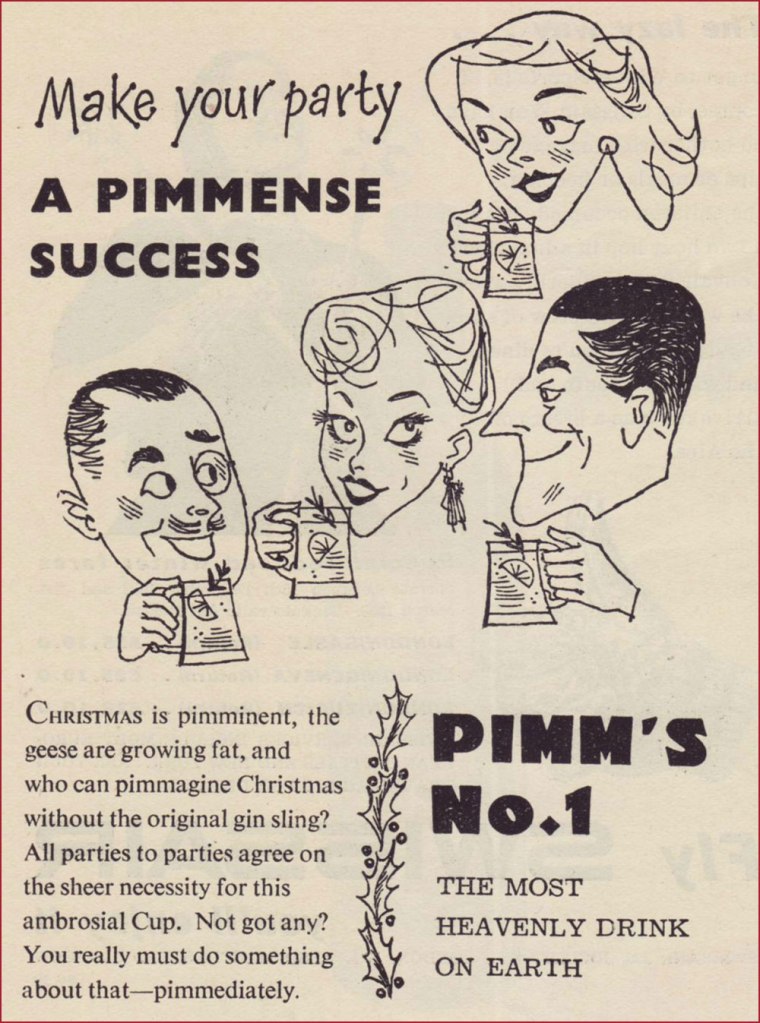
« Every day we left the house in his Phantom V, always with a big pitcher of Pimm’s close at hand. Then we went into this little studio and Richard took his place at the mic with a tall stool to his left and the Pimm’s on the stool. Then we started recording, for maybe three or four hours or until the Pimm’s was gone. He did like to lubricate his voice chords but that was as far as it went – he could have never got through that music in a drunken state. » A decade or so ago, upon reading this quote from songsmith Jimmy Webb about his work with Irish rapscallion Richard Harris, I wondered just what this Pimm’s might be. It was a bit hard to find at the time, and kind of costly for a matter of idle curiosity, but I’m happy to report that it’s delicious.
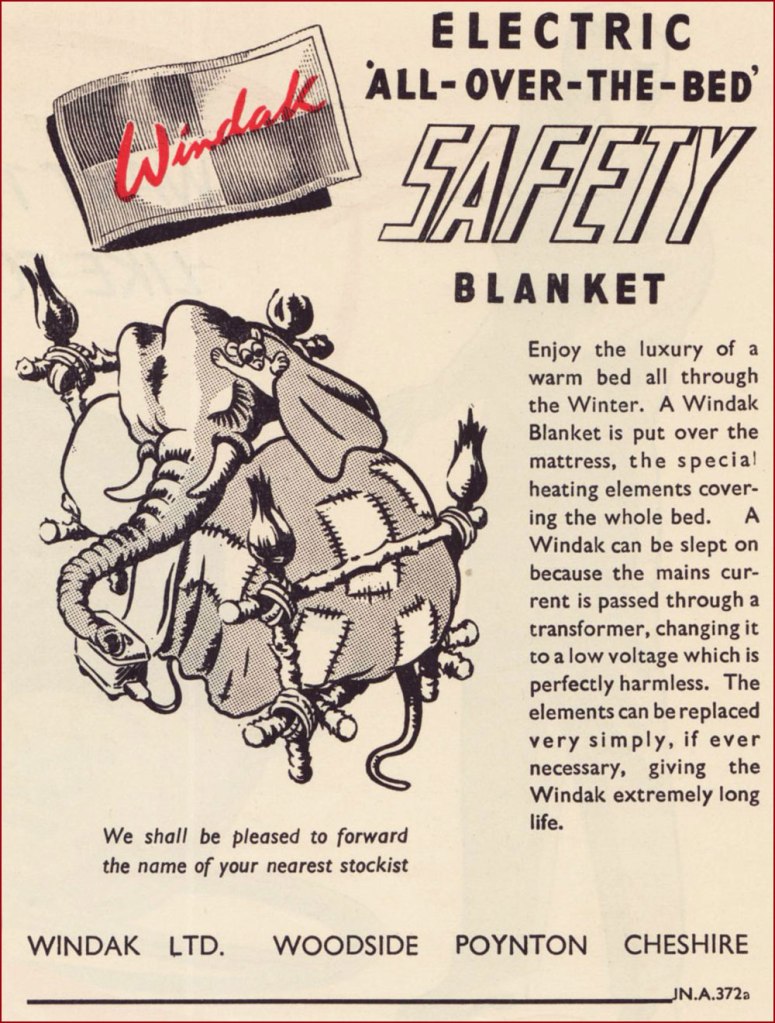
Windak was an offshoot of Baxter Woodhouse Taylor (still around!). Here’s an intriguing bit of trivia: « The Cold-War era of High Altitude flying led there to be an array of different flying suits and helmets trialled for this purpose. At the time, nobody really knew the effects of flying at high altitudes, or what the adverse affects of a sudden cabin depressurisation could be (such as the fear of canopy blowing off). To protect the aircrew against this perceived danger, initial efforts were placed on developing fully enclosed pressure suits.
The life span of the development full pressure suits was short lived, as it was soon realised that partial pressure helmets and a pressure jerkin, and eventually just a demand oxygen mask and pressure jerkin was sufficient to “
get you down” safely after a cabin depressurisation event.
Of the array of full pressure suits tried, this series, known collectively as the “
Windak” suit and helmet has become the most well known, due to many television and film appearances in science-fiction works, as space suits.
“Windak” was a trade name used by Baxter Woodhouse Taylor, and had been in use since the second world war on items of heated flying clothing. However, people seem to solely refer to this series of full pressure suits as “
The Windak Suit“, even though the series contains a few variants. » [ source ]
Heinz, as surely you know, is still around.
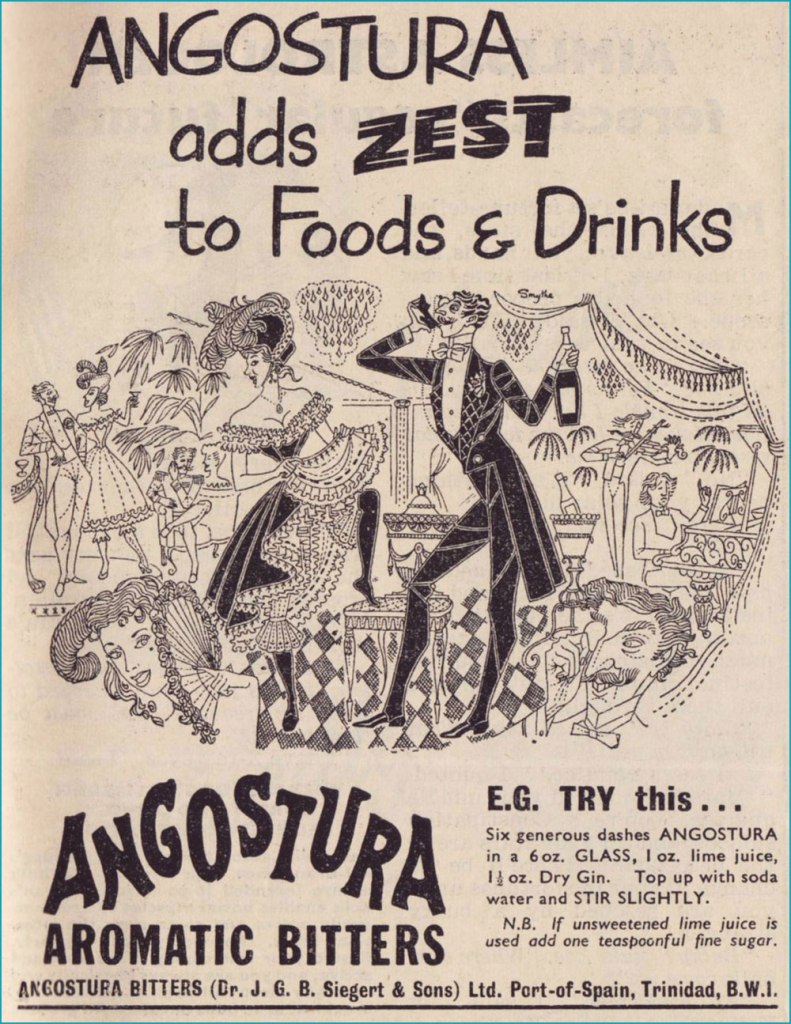
Angostura Bitters remain an essential tool in the mixologist’s attirail.
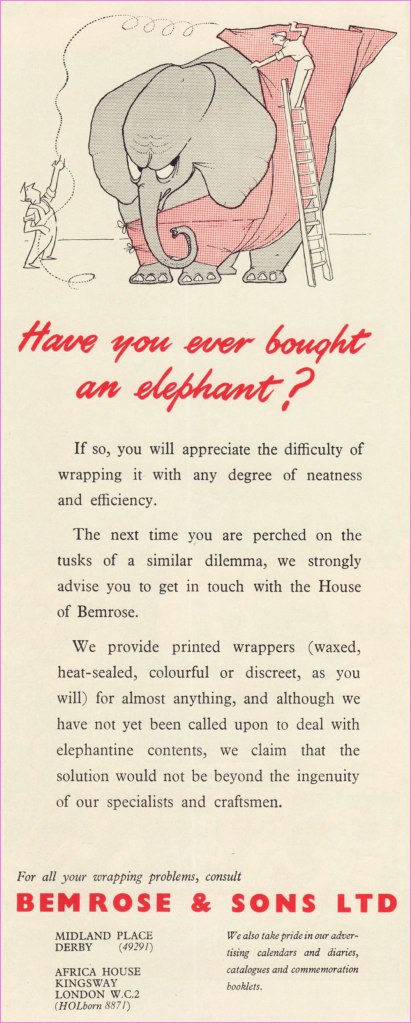
Despite several changes in name and vocation over the years, the firm of Bemrose & Sons abides in some fashion to this day. A perfect example of adapting to survive.
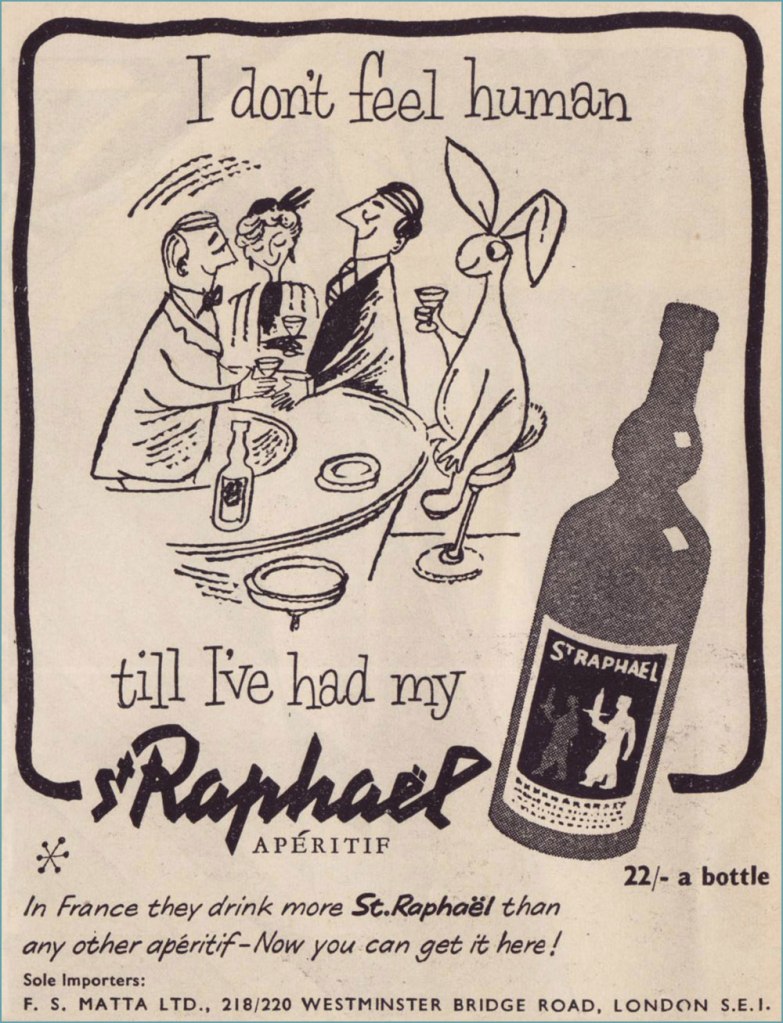
A pair of examples from a series of themed ads. The first saw print in the Aug. 10, 1955 issue, the second in the Sept. 14 one. They didn’t go much for repetition, did they? First concocted in 1830, St Raphaël remains a highly popular apéro. Read its history here. I’m getting a sense that in the liquor business, if you’re hawking a decent quality product, you’re in for the long haul, barring Edgar Bronfman Jr.-level greed and incompetence. But in the business world, that’s as rare as rocking-horse poo, right?

-RG

Rowland Emett’s Ramshackle Poesy in Motion

« The whistle of the old steam trains … could conjure up visions of bleak distances with one solitary wail. » — M.C. Beaton

A couple of years back, I gave our readers an introductory sample of the genius (hardly too strong a word in his case) of Rowland Emett (1906-1990), and vowed I would return with a fuller, more lingering look.

Since I got the biographical trimmings out of the way that time, today, I’ll merely offer you an even dozen of my favourites.

Can’t tell a trébuchet from a catapult from a ballista? This handy guide will steer you right!
Prof. Lightning’s moniker is evidently well-earned.
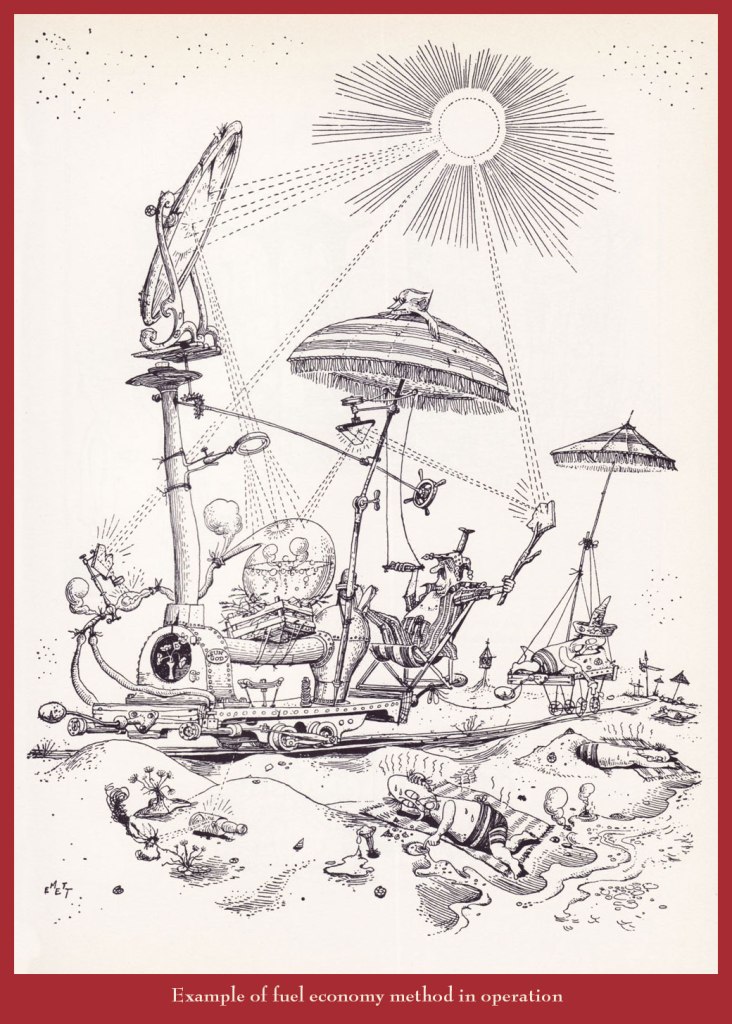
Another inventive step in the harnessing of solar power.
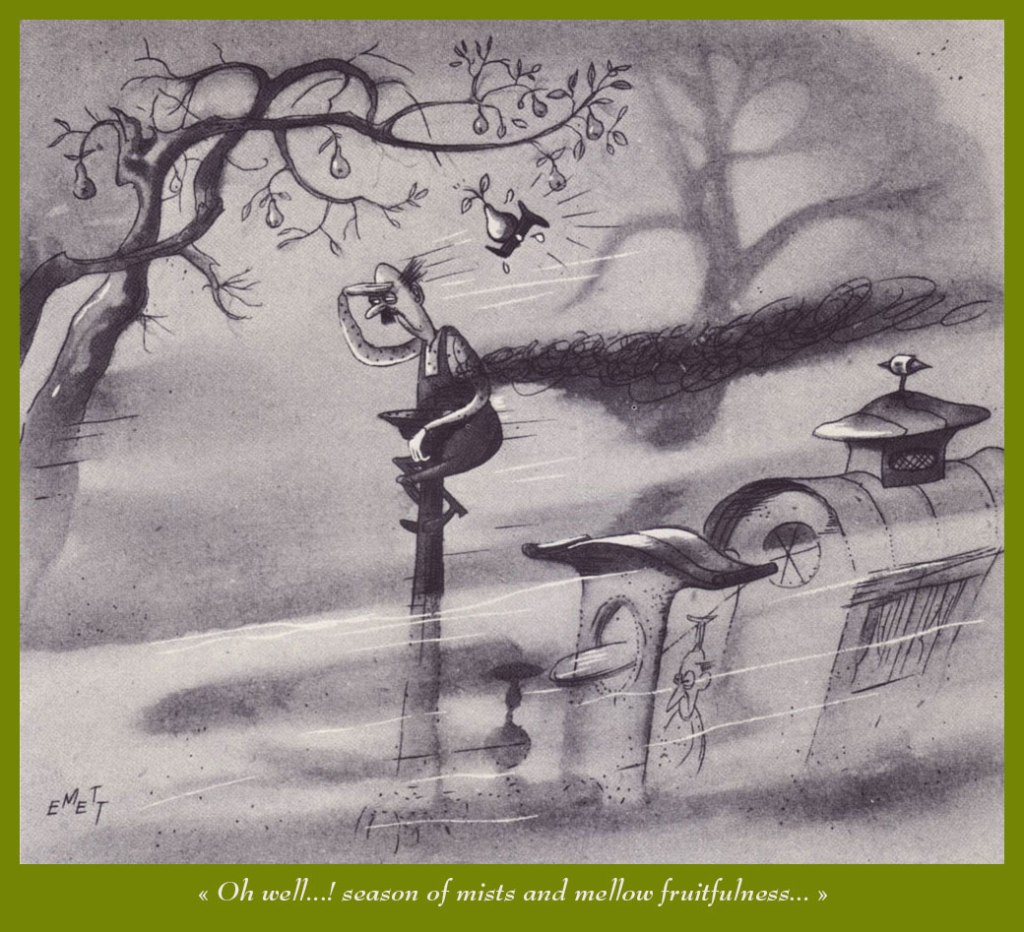
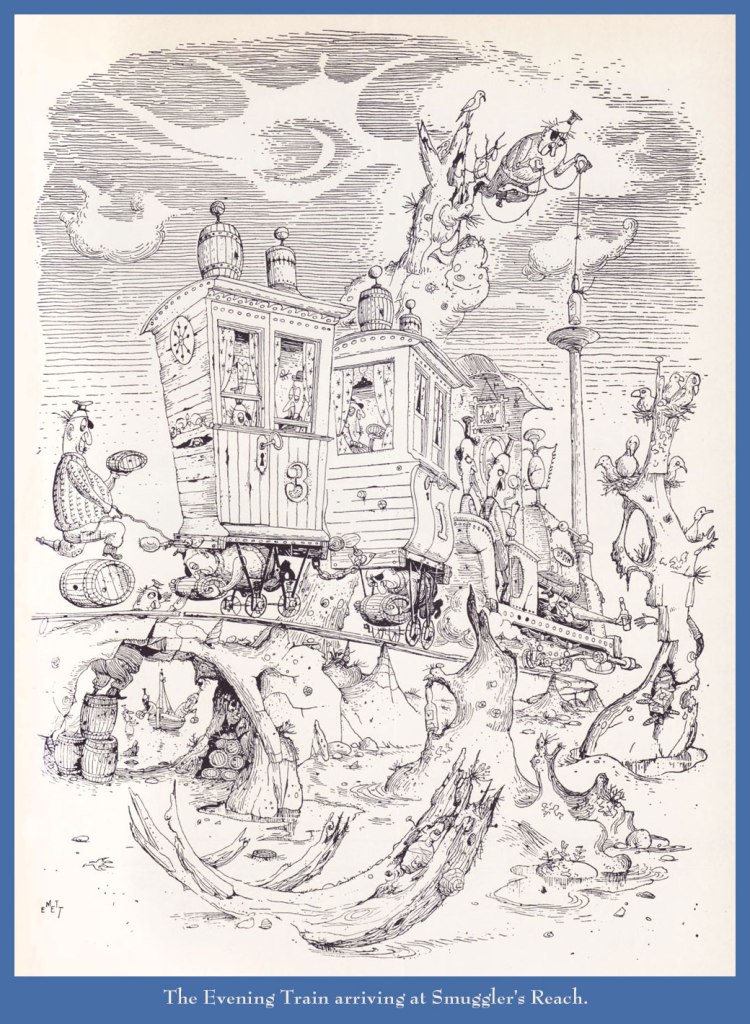
While this particular train route sadly does not exist (as an editor once wrote, “the great Emett, whose crazy world seems so much saner than our own…”), there are some lovely birding tours available throughout that green and pleasant land, from Land’s End to John o’Groats.
Said nationalisation took place in 1948. Here’s a bit of background on that historic endeavour.

-RG

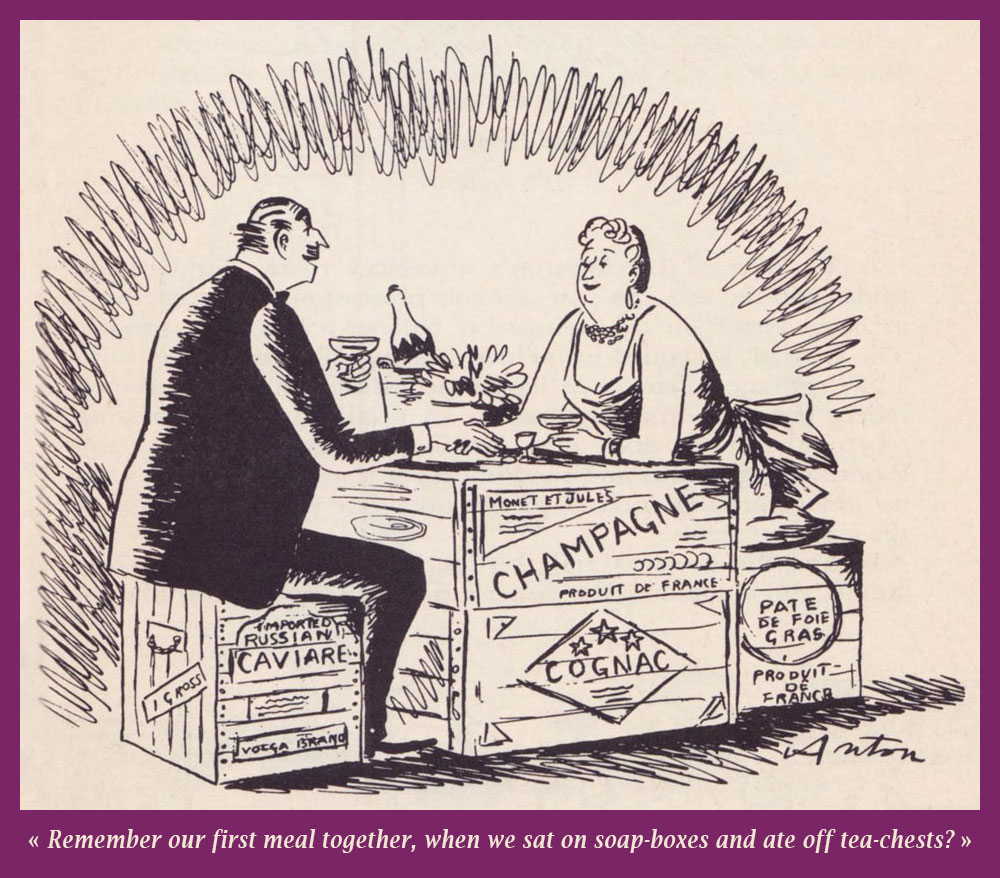
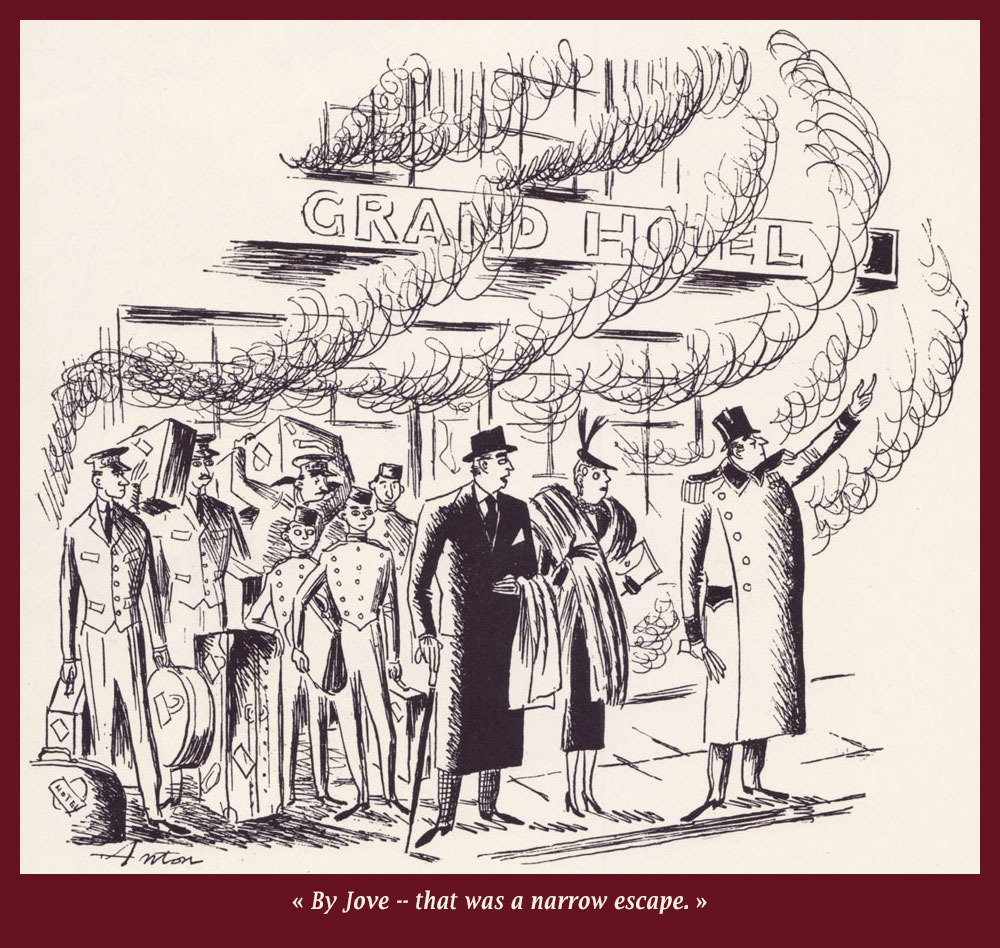
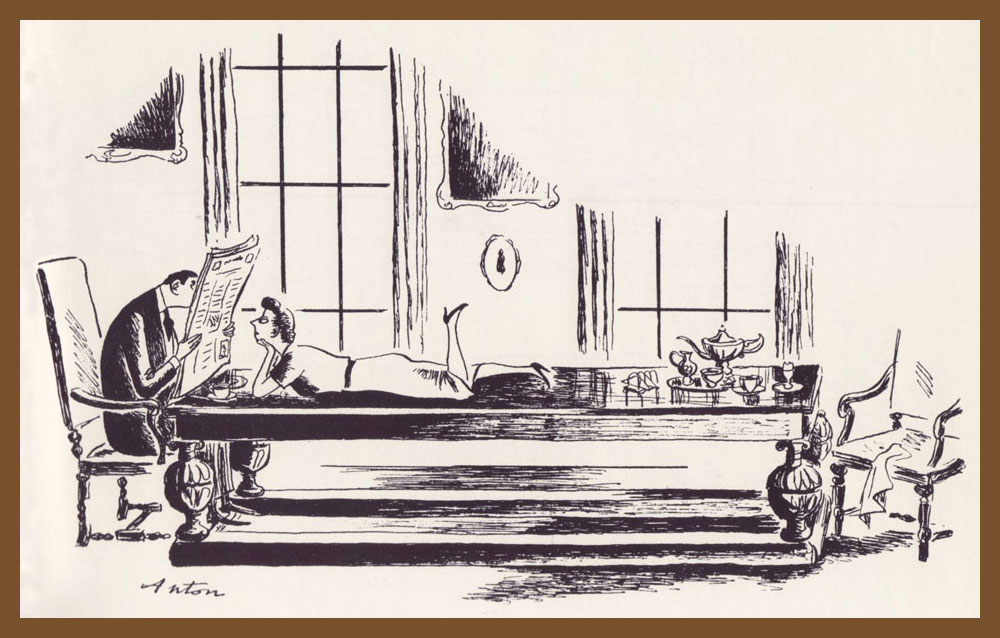
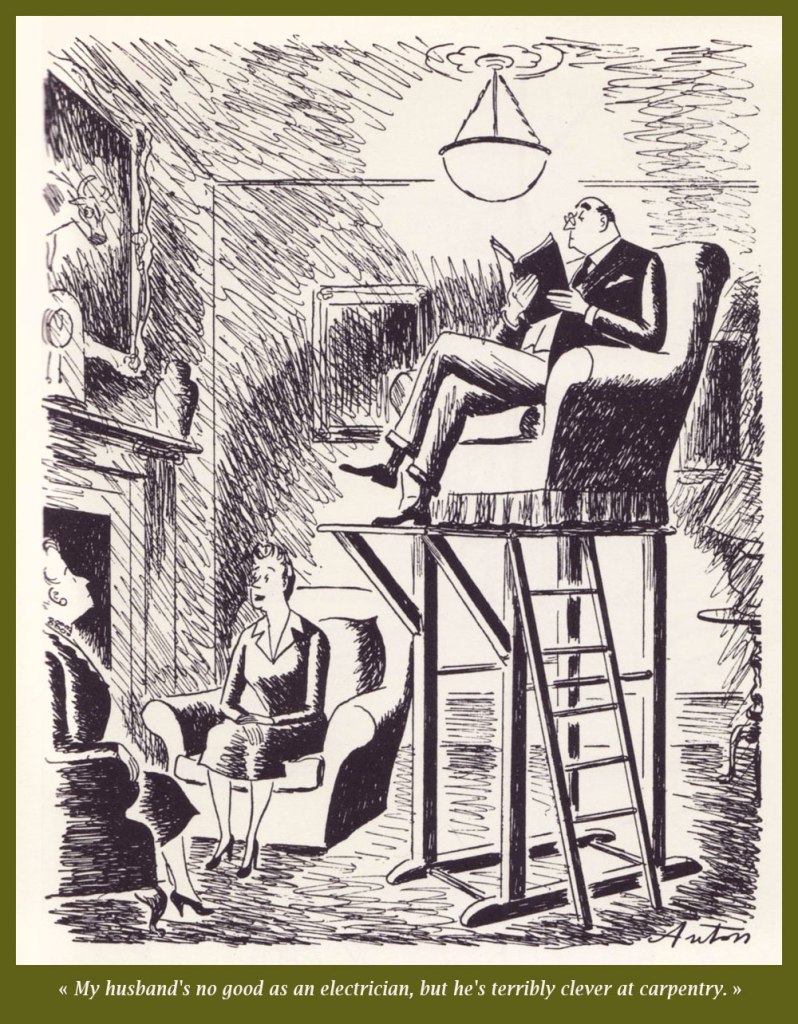
Anton’s Spivs and Scoundrels, Baronesses and Beezers

« I was told a couple of bishops had given up Punch when I started drawing for them. » — Beryl Antonia Botterill Yeoman

Ever since I featured my very favourite of her cartoons, way back in October of 2019 — how different the world was then! — I’d intended to return to the topic of Australian-English cartoonist Beryl Antonia Botterill Yeoman (1907-1970) for a more sustained and substantial look… and now I have.

The Anton nom de plume has a rather storied history: at first — their professional collaboration began in 1937 — Beryl and her brother Harold were a two-headed cartoonist who signed ‘Anton’. In 1949, Harold dropped out of the partnership, owing to the rigorous demands of running an advertising agency, and thereafter Antonia and Anton were one and the same, a left-handed (not by birth or choice, having lost two fingers on her right in her teens), female cartoonist in a decidedly male-dominated field.

All of today’s selections first saw print prior to 1952 in the august pages of Punch (1841-2002); it’s entirely possible that Harold had a hand in some of them.

Ah, that reminds me of a certain song: « And tomorrow’s show will say / what they left out yesterday / And that gives me one good reason I should live. »

In case you’re puzzled, this one requires knowledge of a certain English nursery rhyme, which went:
Jack Sprat could eat no fat,
His wife could eat no lean;
And so betwixt them both,
They lick’d the platter clean.

Should you find yourself down Somerset way, drop by The Crown at Wells, a 15th century inn (featured in 2007 in Edgar Wright’s Hot Fuzz!) that houses Anton’s Bistrot, whose venerable walls are adorned with some choice Anton original art.

This must be the place — order us a couple of pints, won’t you?

-RG

Hallowe’en Countdown V, Day 3

« Changing from the ghosts of faith to the spectres of reason is just changing cells. » — Fernando Pessoa

Today, let’s transport ourselves to the foggy, boggy British Isles, where every crumbling castle holds its lot of revenants and spectres within its mouldering walls.

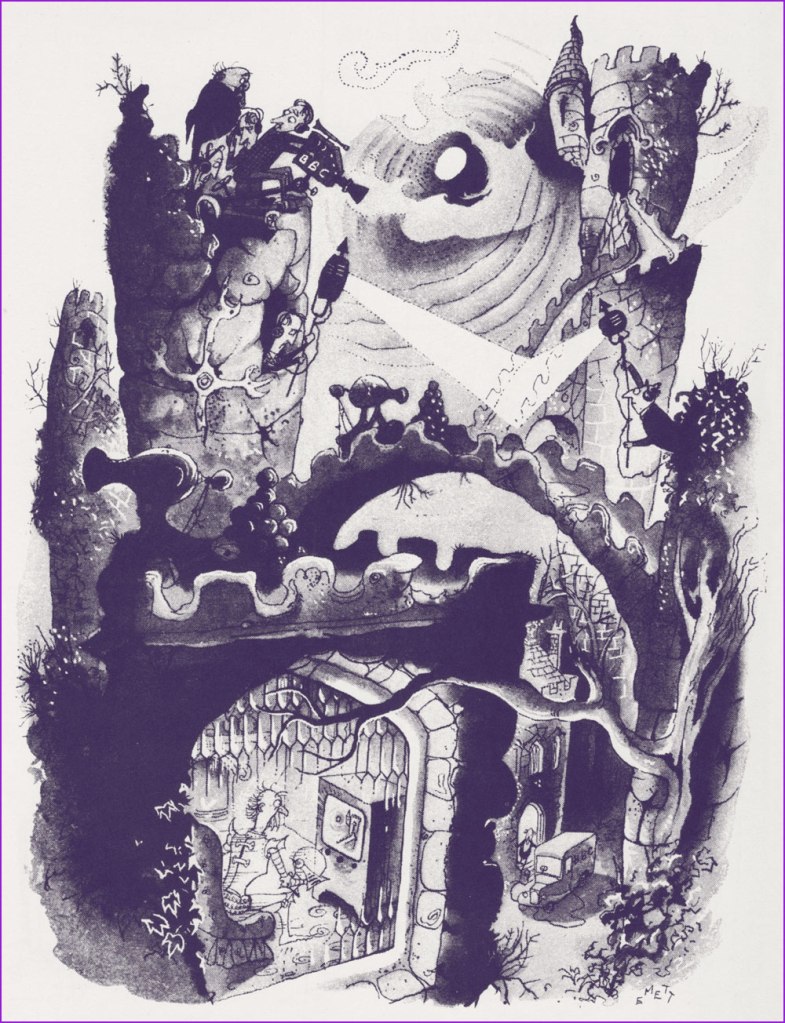
The great cartoonist, tinkerer and beloved eccentric Frederick Rowland Emett (1906 – 1990) was evidently quite at ease within this spooky world, as you shall see. He first came to prominence as a prolific Punch cartoonist, beginning in the late 30s. In the 1950s, though at the height of his powers, he found himself struggling with waning eyesight (an exacting style was his!), so he brilliantly shifted his creative focus to building what he had hitherto been drawing. You may have encountered some of these creations in the 1968 film Chitty Chitty Bang Bang (Emett and Roald Dahl… fancy that!).

Scores of his cherished kinetic sculptures — trains (“Far Tottering and Oyster Creek Branch Railway“), flying machines (“Featherstone-Kite Openwork Basketweave Mark Two Gentleman’s Flying Machine“), mechanical computers (“The Forget-Me-Not Computer“), musical hydraulic clocks (“Aqua Horological Tintinnabulator“), musical instruments and nonpareil assemblages… are scattered far and wide across the world’s museums, many of these works restored and in fine functioning order. For instance, Toronto’s Ontario Science Centre owns ten or so (see them in action here!), and the Smithsonian’s National Air and Space Museum possesses a choice few.

Obviously, there is much to discuss about this astonishing creative soul (watch him at work!). In the spirit of manageable narrow focus, I’ve kept it to three of his spookiest Punch cartoons from the late 40s-early 50s. Just consider it an amuse-gueule, an opening salvo. We shall return with a more panoramic view, you just wait.

« But Sir Bedivere always walks the battlements at this hour. Can’t think what’s keeping him. »
« Some say it’s haunted by the First Earl AND the Ninth Earl… I wonder how they’d get on together… ? »
« Go on! You ask Him!… Ask him if he’s on essential business ». This magnificent scratchboard creation was completed in 1947.
In a similar mood, here’s an excerpt or, as the Brits would say, an extract, from Far Twittering or The Annals of a Branch Line, being Some Interesting and Unusual Aspects of the Far Twittering and Oysterperch Railway Presented by Emett (1949, Faber and Faber, London). The caption tells us: « Locomotive No. 3 (Hector) at Mrs. Bristow’s Folly, now used as a water-tower. »
« I TOLD you never to take the 11:50 round by the Witch Hollow loop… ! »
A portrait of the artist, circa the mid-1950’s. Oh, he’s a wily one, all right.

« It is a well known fact that all inventors get their first ideas on the back of an envelope. I take slight exception to this, I use the front so that I can include the stamp and then the design is already half done. » — Rowland Emett

-RG

Hallowe’en Countdown III, Day 18

« There is nothing new under the sun but there are lots of old things we don’t know. » — Ambrose Bierce

Here’s an unusual specimen: a two-headed, twin-gendered Australian cartoonist. Beryl Antonia Yeoman (1912-1970, b. Brisbane, Queensland) formed, in 1937, a cartooning partnership with her brother, Harold Underwood Thompson (1911-1996, b. West Kirby, Cheshire) when they adopted the nom de plume of Anton.

AntonGhostStoryA

From the sound of it, Beryl was the power behind the throne, as she produced the Anton cartoons on her own during Harold’s active duty in the Royal Navy during WWII. The pair reconvened after the war and created wonderful cartoons for such publications as Punch, Lilliput, Men Only (ha!), Tatler, The Evening Standard (solo Harold!) and Private Eye. Beryl was the only female member of Punch’s exclusive Toby Club.

Today, a charming bistro named in honour of the artful siblings still operates in Wells, Somerset; it features Anton’s art on its walls. How’s that for posterity?

This slyly cozy cartoon made the cut for the splendid 1952 anthology The Best Cartoons From Punch.

And while we’re on the subject of ghostly radio stories, give one of these a try.

– RG