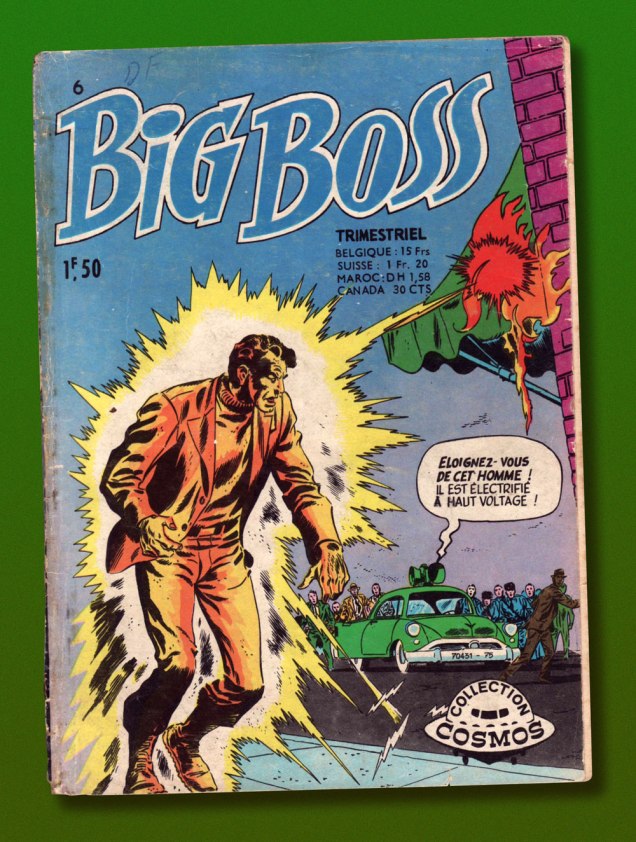
This is Big Boss no. 6 (Oct. 1971, Arédit-Artima); cover by Ruben Moreira.
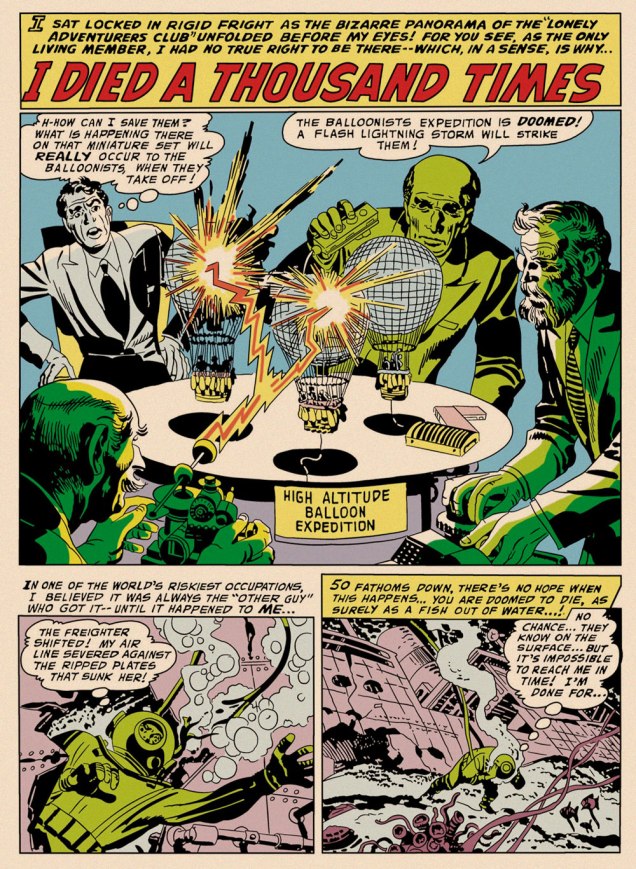
One might be inclined to say that, with its themes of adventurers cheating death or living on borrowed time, I Died a Thousand Times inspired Kirby’s Challengers of the Unknown, except that Ace, Rocky, Prof and Red had burst into print a few months earlier. Suffice it to say that they sprang from the same fertile well. It’s always intriguing to observe how the particular seed of an idea can be grown in a myriad of directions.
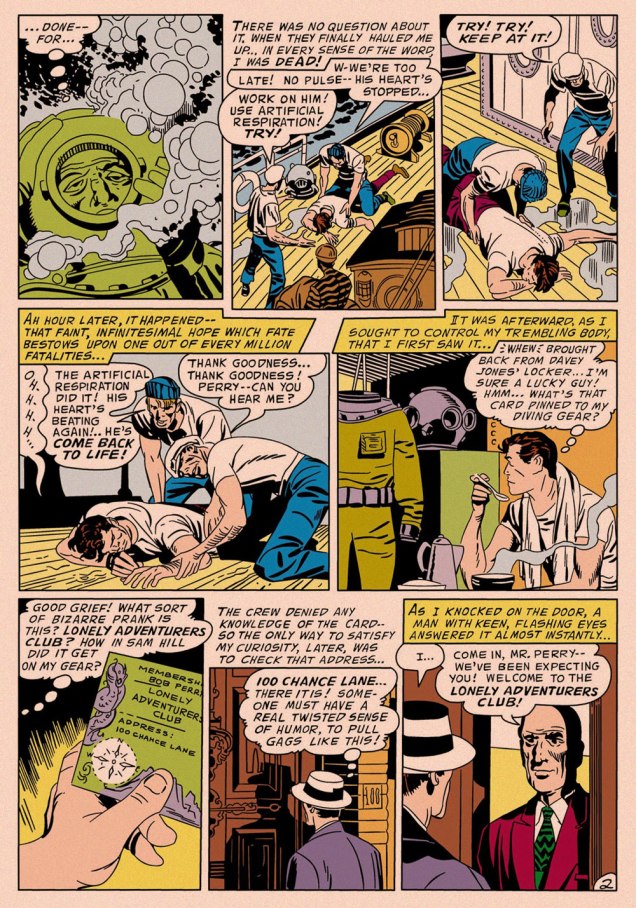
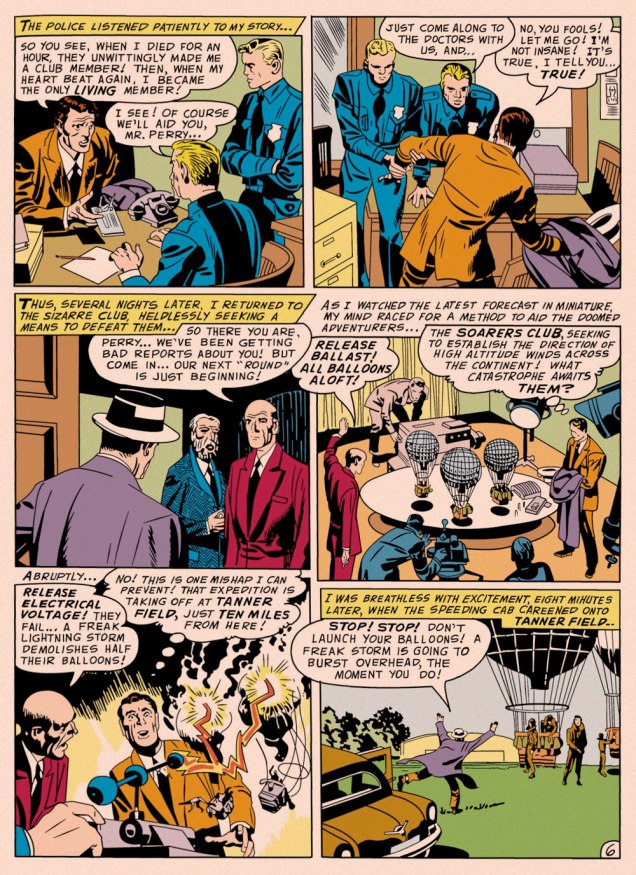
If you’ll forgive me the intrusion, this is how the opening panel appeared in the Big Boss reprint. In order to make things more readable in the digest format — and in black and white — Arédit‘s in-house art department routinely reframed and even augmented the artwork, with varying degrees of competence and success. This is one of the more accomplished efforts. The story’s writer is unknown (though it features a most Kirbyesque plot); it was pencilled and likely inked by King Kirby, and originally appeared in My Greatest Adventure no. 16 (July-Aug. 1957, DC); edited by Whitney Ellsworth; Jack Schiff; Murray Boltinoff and George Kashdan… let’s just say DC *was* a tad heavy on the management side in those days.
Though Kirby’s standalone short stories of this period are as charming and inventive as you’d expect, this modest trove of material has by and large been neglected. While a handful of these tales (The Thief of Thoughts; The Creatures from Nowhere!; The Cats Who Knew Too Much!; The Man Who Betrayed Earth; The Negative Man; and The Stone Sentinels of Giant Island) were semi-randomly reprinted in the early 1970s when DC had lots of pages to fill, this one didn’t resurface in North America until 2011’s pricey-then-and-pricier-now hardcover Jack Kirby Omnibus no. 1.
« With pen and ink, I can achieve a scratchy, foggy effect that is appropriate. It was a continual process of learning. » — Nick Cardy
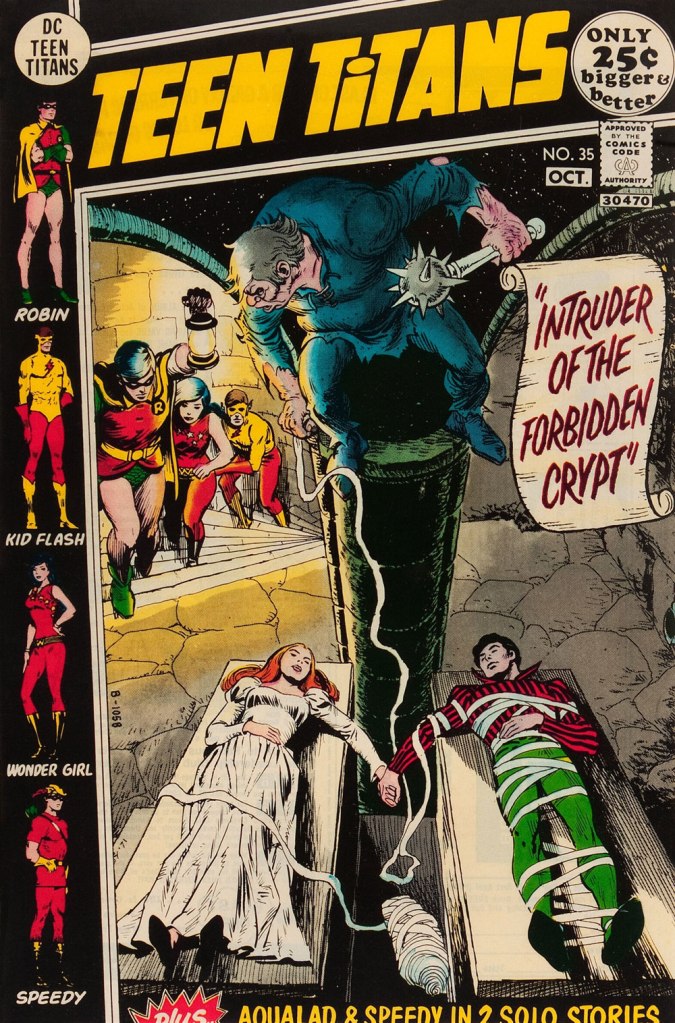
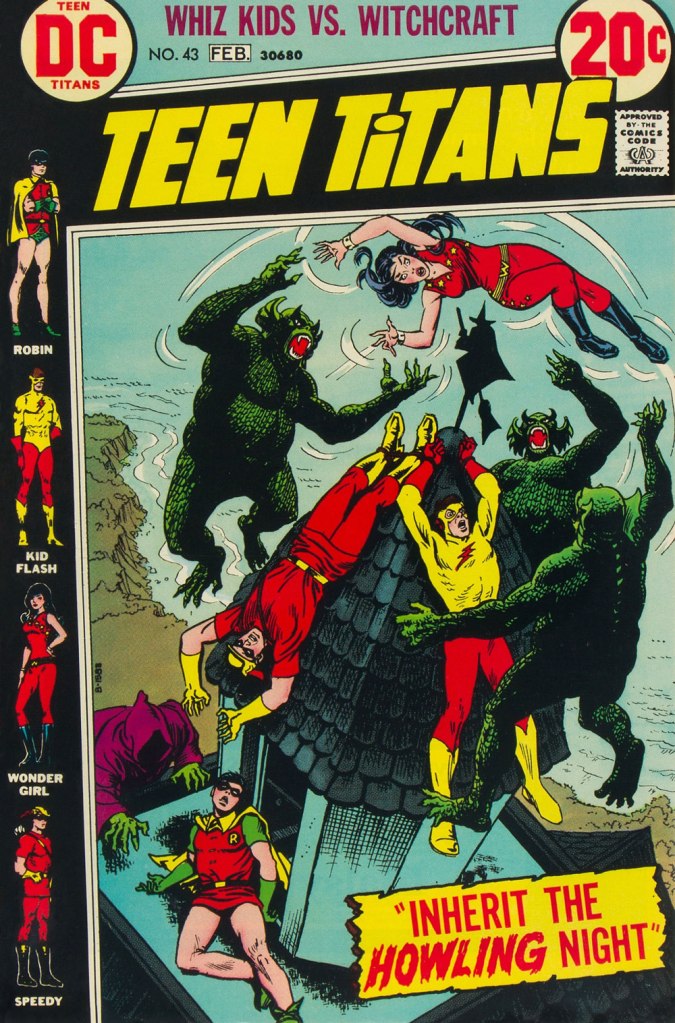
While WOT? favourite Nick Cardy (1920-2013) — who would turn one hundred and four years old today! — spent a lot of time chronicling the undersea adventures of Aquaman, his lingering true love, despite his busy schedule as DC’s premier cover artist, was the Teen Titans — he contributed, either as penciller, inker… or cover artist — to all forty-three issues of the original series.
And what I loved most about editor Murray Boltinoff‘s books is that they were packaged as horror books even when they nominally featured superheroes, a welcome respite. The costumes seemed an afterthought, a most unusual and refreshing attitude. Here, then, is a gallery of Mr. Cardy’s moodiest, most sinister Teen Titans cover artwork.
This is Teen Titans no. 33 (May-June 1971, DC). This is Teen Titans no. 34 (July-Aug. 1971, DC). Lettering by Ben Oda.This is Teen Titans no. 35 (Sept.-Oct. 1971, DC).This is Teen Titans no. 36 (Nov.-Dec. 1971, DC).This is Teen Titans no. 41 (Sept.-Oct. 1972, DC).This is Teen Titans no. 42 (Nov.-Dec. 1972, DC).This is Teen Titans no. 43 (Jan.-Feb. 1973, DC).
« I’ve had great success being a total idiot. » — Jerry Lewis
Hey, it’s Bob Oksner‘s birthday! I hope you’ll forgive me for double-dipping into that particular well — he also illustrated our earlier Mary Marvel entry — but I still wanted to highlight the occasion, incorrigible Oksner booster that I am.
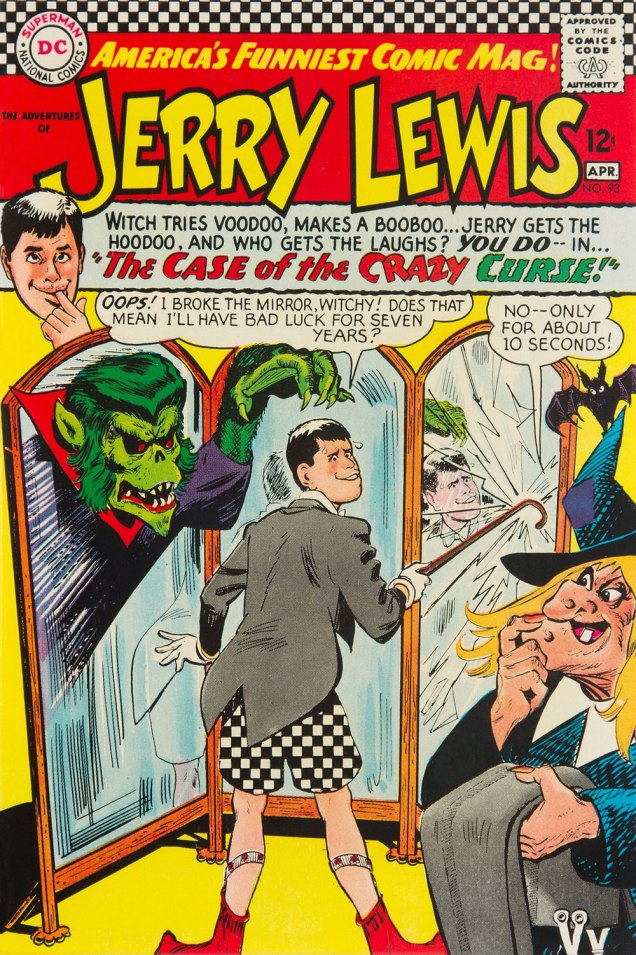
DC’s Jerry Lewis (or Bob Hope, or Dobie Gillis…) comics weren’t even remotely funny, but they sure boasted some spiffy covers. Here’s a gallery of the most Hallowe’en-appropriate, from the pencil and pen of Mr. Oksner.
This is The Adventures of Jerry Lewis no. 87 (Mar.-Apr. 1965, DC).This is The Adventures of Jerry Lewis no. 88 (May-June 1965, DC).
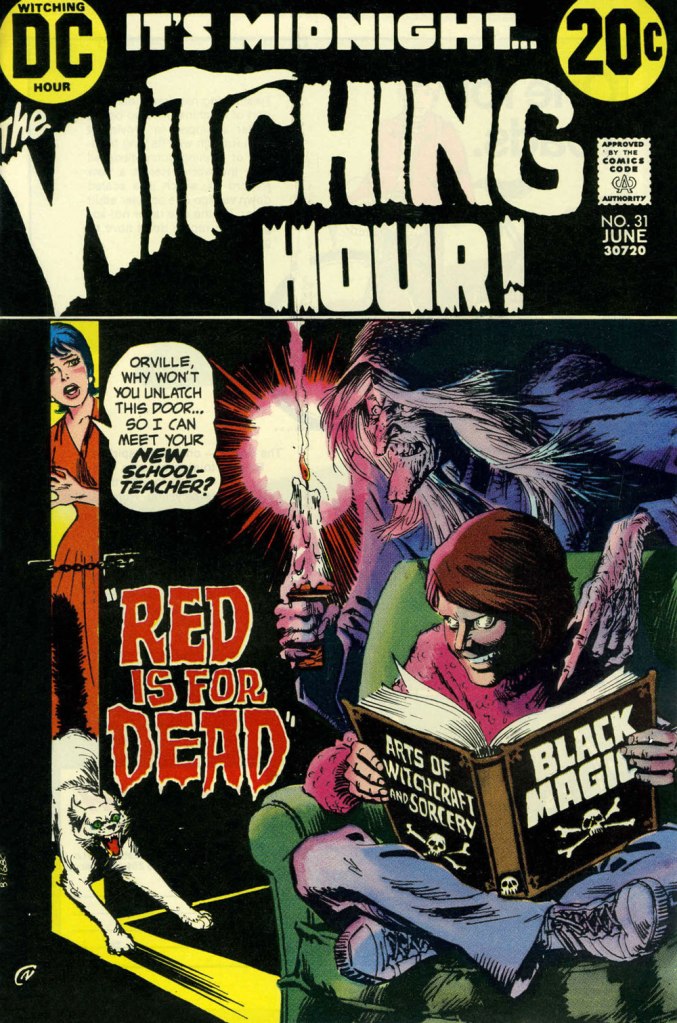
TAoJL editor Murray Boltinoff (1911-1994) had a soft sport for that particular cover concept, since he recycled it, eight years later and with a different tone, for another title he was overseeing:
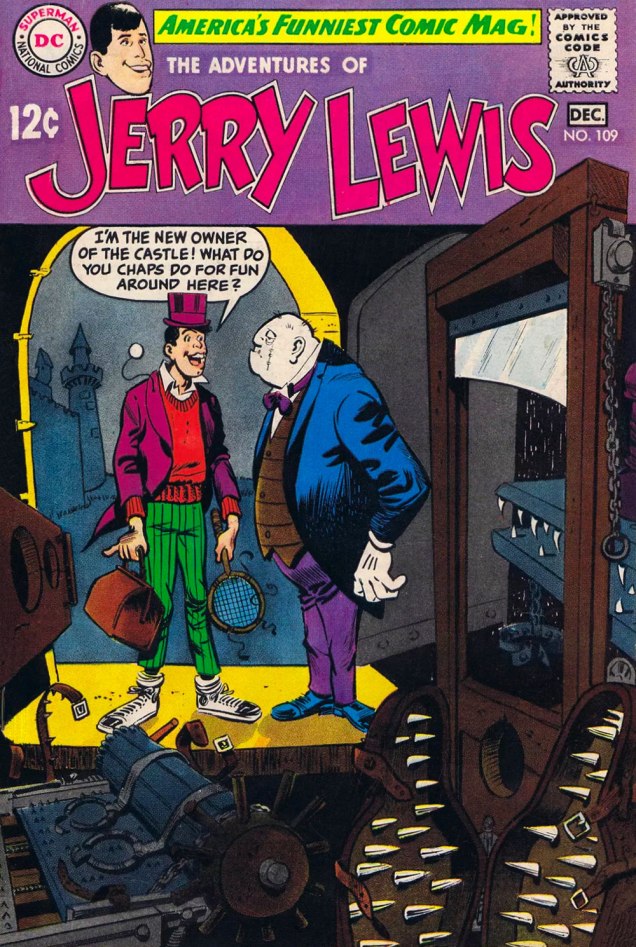
Here, for comparison, is It’s Midnight… the Witching Hour no. 31 (June 1973, DC). Art by Nick Cardy.This is The Adventures of Jerry Lewis no. 93 (Mar.-Apr. 1966, DC).This is The Adventures of Jerry Lewis no. 94 (May-June 1966, DC).This is The Adventures of Jerry Lewis no. 98 (Jan.-Feb. 1967, DC).And finally, The Adventures of Jerry Lewis no. 109 (Nov.-Dec. 1968, DC). This one’s another riff on a rather hoary theme.
« Every poem should remind the reader that they are going to die. » — Edgar Allan Poe
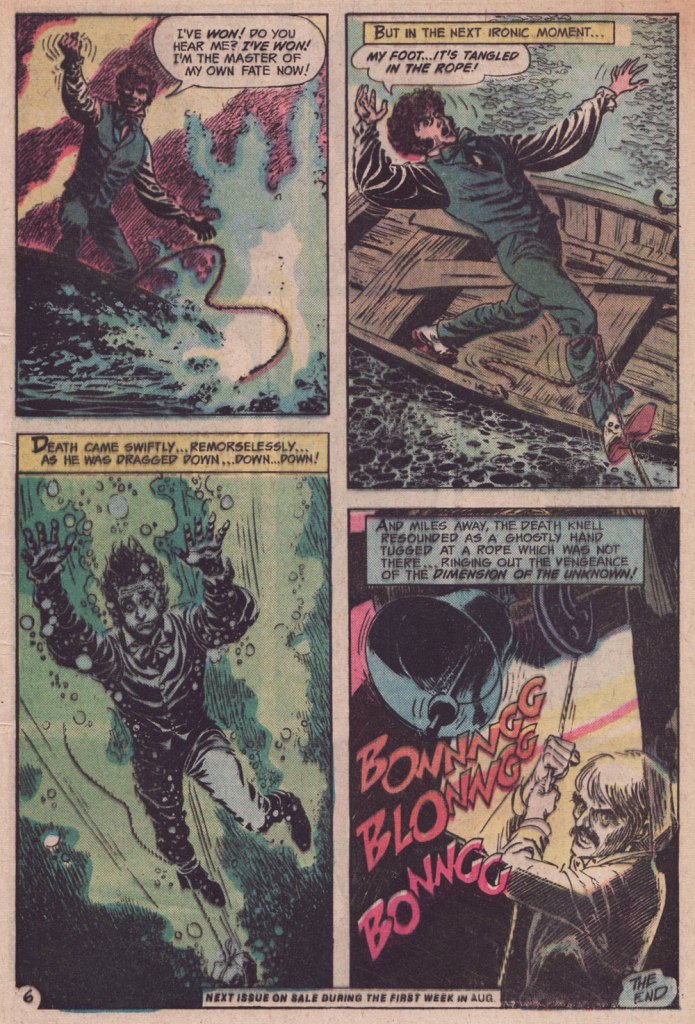
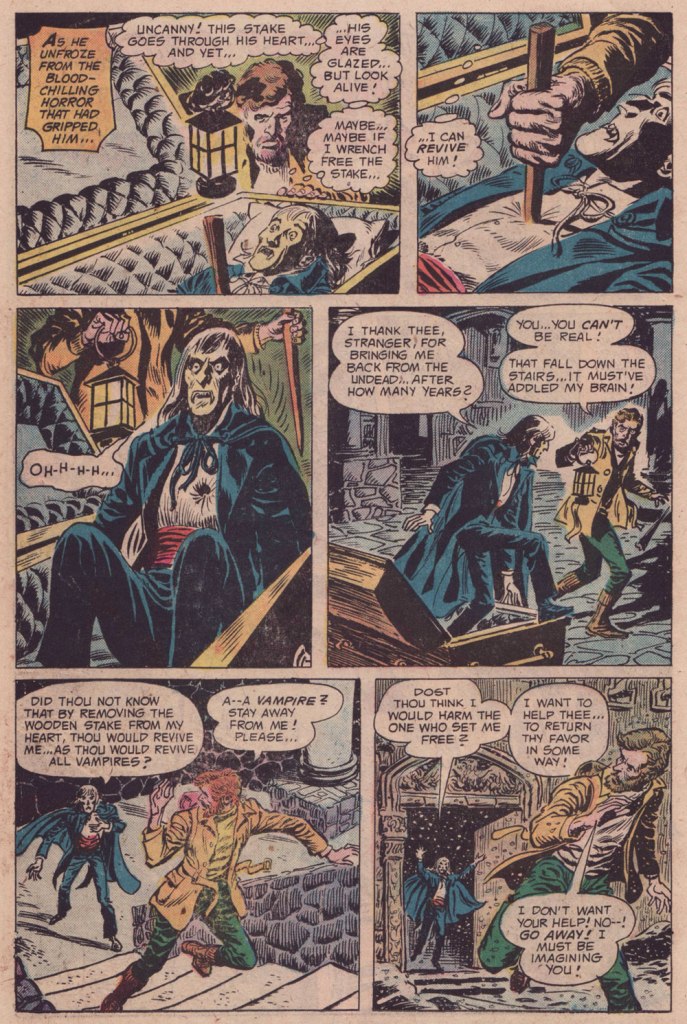
Ah, mixing fact with fiction — such an honoured tradition. In the mid-1970s, DC editor Murray Boltinoff (Ghosts, The Unexpected, The Witching Hour, Teen Titans, The Brave & the Bold) hit upon the notion of featuring historic writers encountering in daily life the supernatural object of their eventual inspiration.
The formula was tweaked a bit for the Edgar Poe entry, in that the tale opens after Poe’s burial, and the late writer is not the protagonist. Read on!
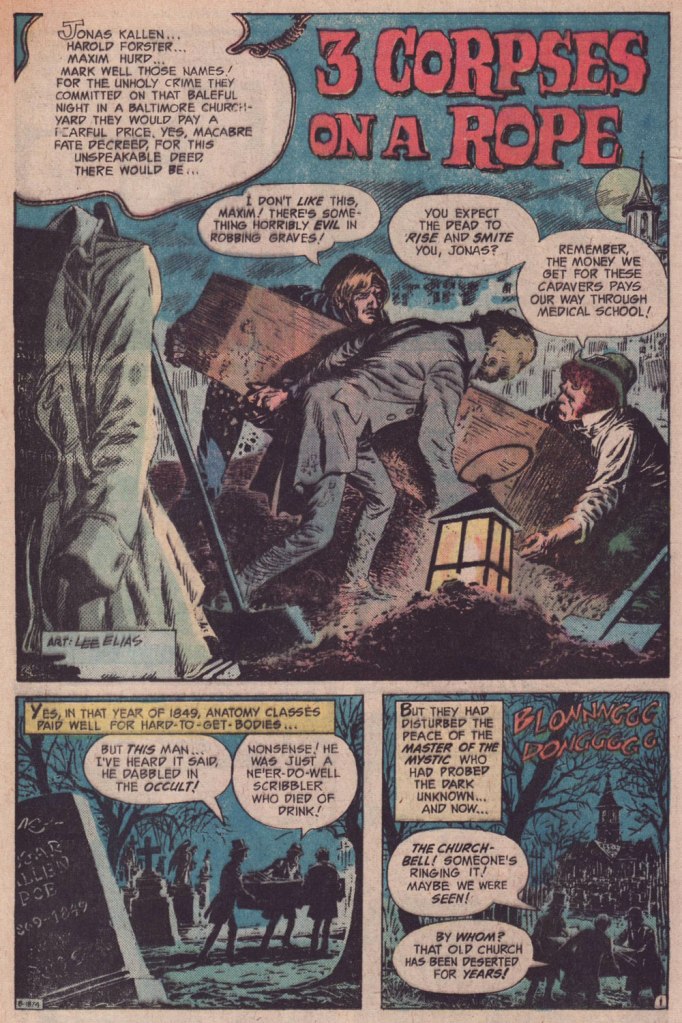
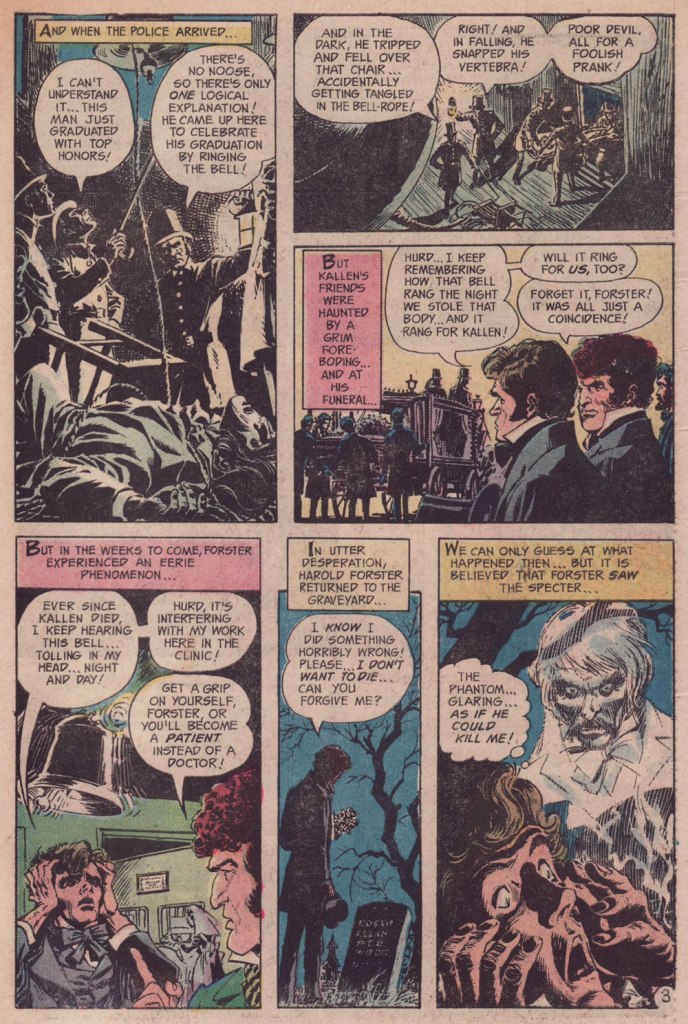
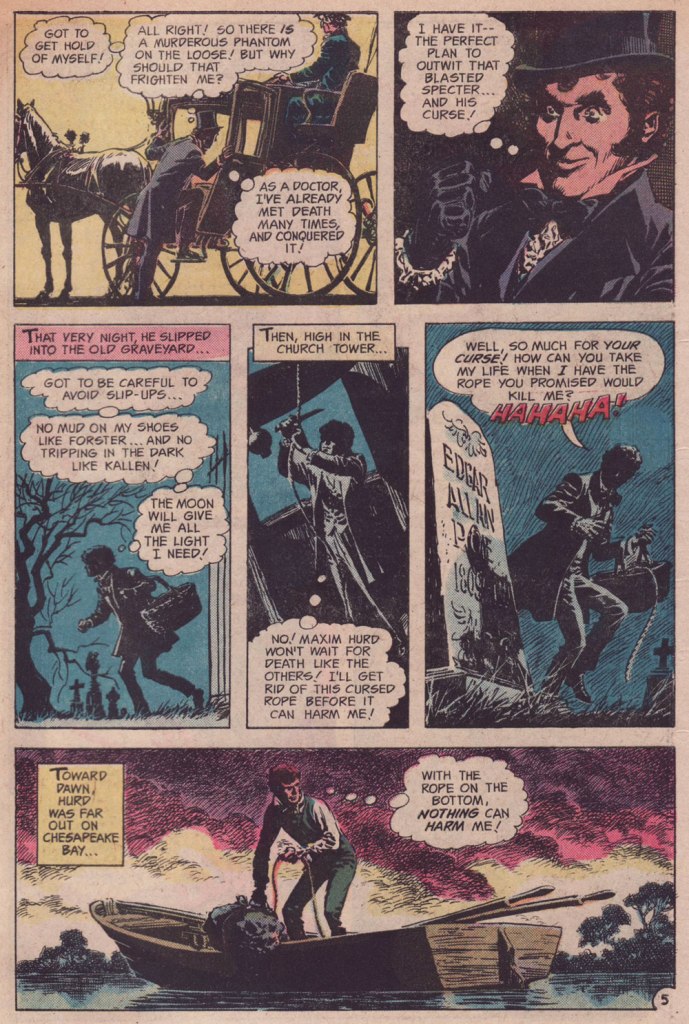
“3 Corpses on a Rope“, written by Carl Wessler and illustrated by Lee Elias, originally appeared in Ghosts no. 43 (Oct. 1975, DC).If you ask me, despite his evident illustrative gift, Elias’ depiction of the revenant ends up looking more like Poe’s fellow Baltimorean John Astin, whom I envision starring in a one-man show entitled ‘An Evening With Edgar Allan Poe‘.
« It is the job of thinking people not to be on the side of the executioners. » — Albert Camus
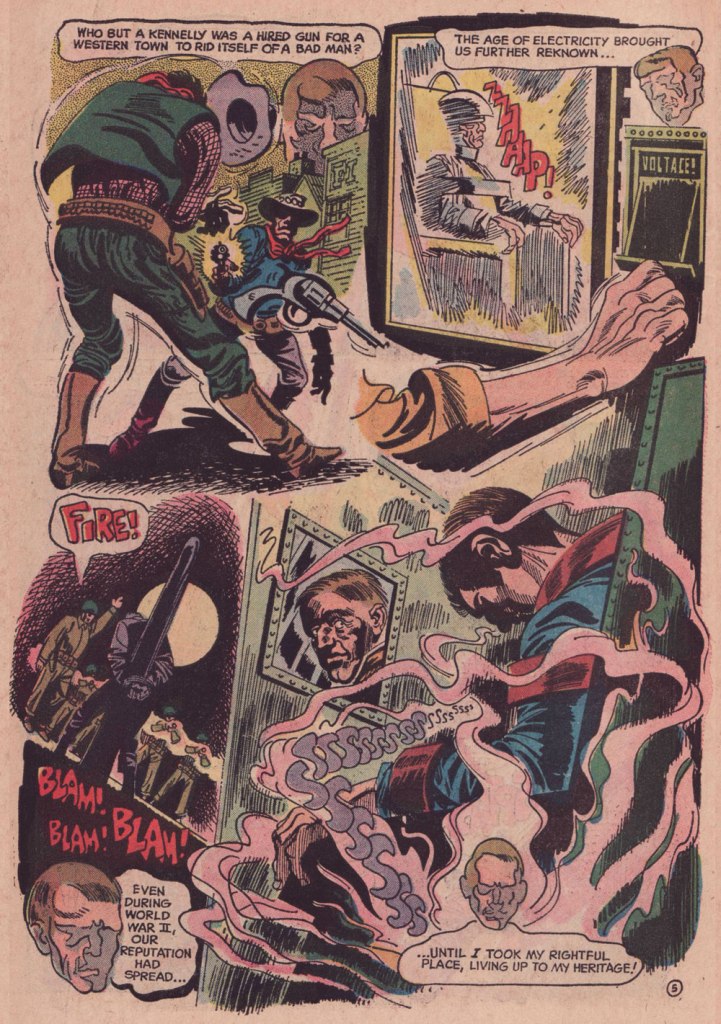
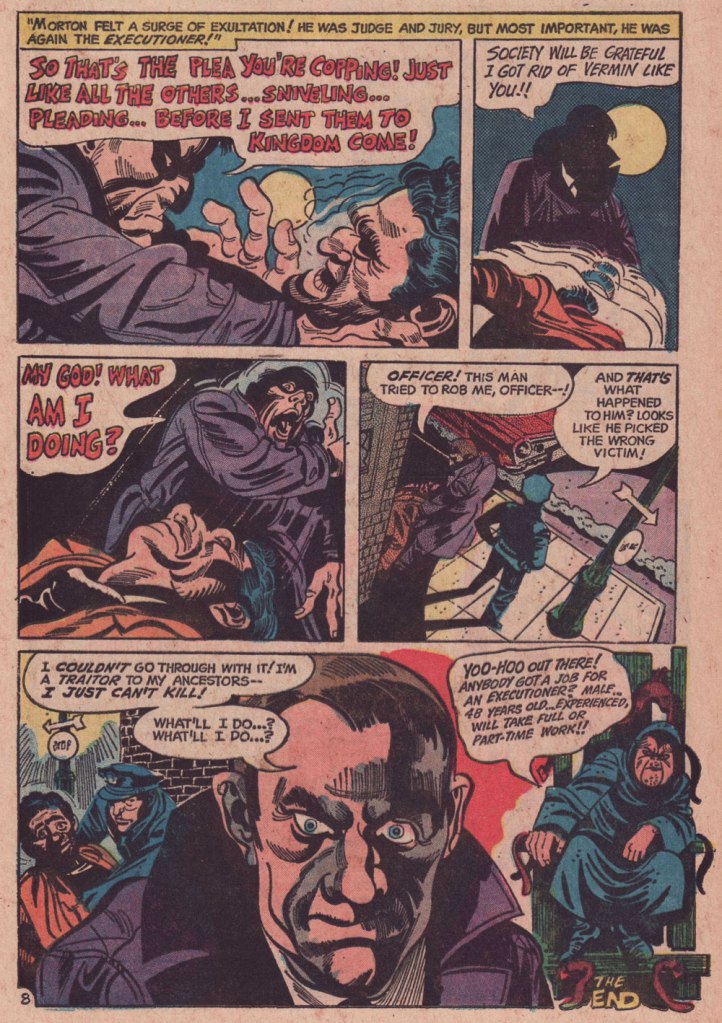
Another day, another executioner… funny how these patterns emerge unbidden.
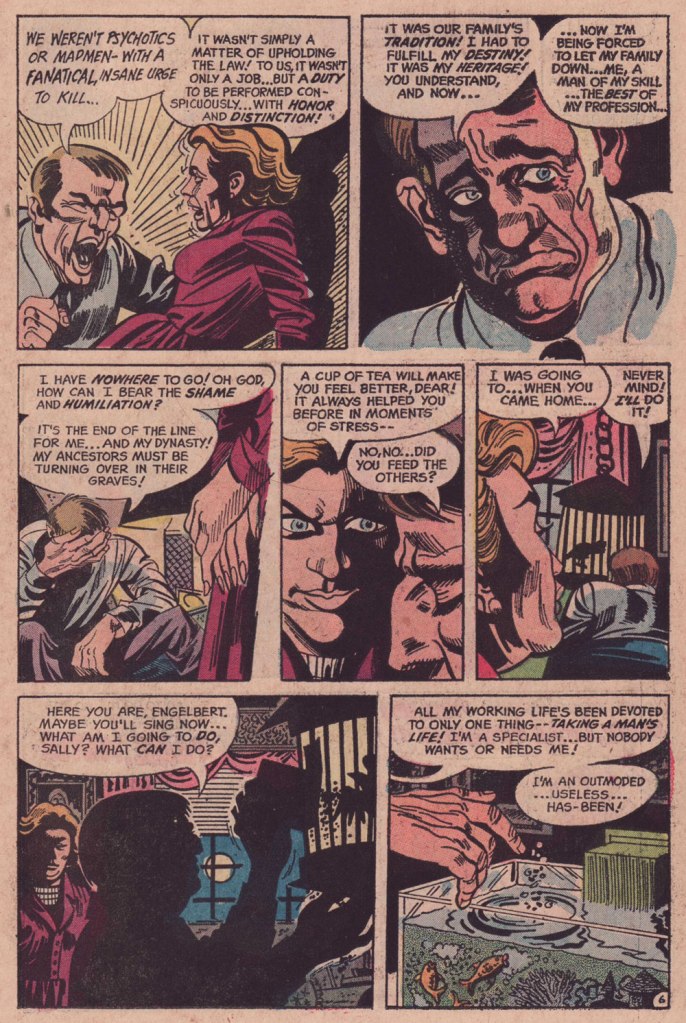
Jerry Grandenetti, with his tenebrous depths and oppressive angles, is another artist I’ve always strongly associated with Autumn and Hallowe’en. While the greater part of his work at DC Comics was war fare for Bob Kanigher, my heart pounds for his spooky work for editor Murray Boltinoff‘s 70’s stable of titles (The Witching Hour, Ghosts, and The Unexpected).
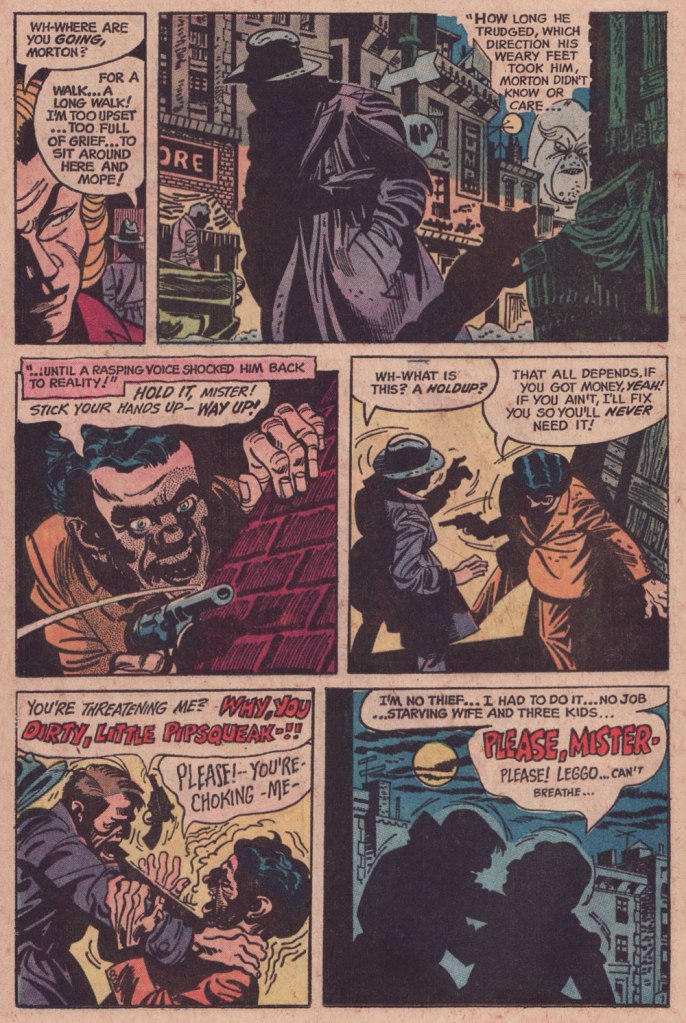
This particular tale marks a rare foray outside of the well-trod paths of formula and so-called ‘O. Henry’, or twist endings. Writer Bill Dehenny (an alias of editor Boltinoff’s, actually) ushers in midlife doldrums and attendant shades of moral grey, an unusually open, downright existential ending, elements scarcely encountered in DC ‘mystery’ comics of the era. Hell, there’s even a bird named Engelbert!
End of an Executioner was published in The Witching Hour no. 26 (Dec. 1972, DC), just after Brian Garfield’s Death Wish and well before Michael Winner’s film adaptation/distortion.
What’ll he do? Will he go the Bronson /Neeson vigilante route — or turn his back on the old family tradition?
« The last I saw of Count Dracula was his kissing his hand to me, with a red light of triumph in his eyes, and with a smile that Judas in hell might be proud of. » — Bram Stoker
Comics fans of my generation might be forgiven for not fully appreciating Lee Elias‘ artistic assets if they encountered him, say, in Mystery in Space when he took over its lead feature, Adam Strange, from visionary Carmine Infantino. The series was mercifully soon discontinued, the victim of a game of editorial musical chairs designed to save the Batman titles, then — believe it or not — facing cancellation thanks to Jack Schiff‘s mismanagement.
While I do have a soft spot for Elias’ work on Ultra, the Multi-Alien (in Mystery in Space) and Eclipso (in House of Secrets), it wasn’t until I found out about his earlier, far edgier pre-Code shenanigans at Harvey Comics (with art director/designer/co-conspirator Warren Kremer) and, more directly and subtly his handful of stories for editor Murray Boltinoff‘s spooky titles (Ghosts, The Unexpected, The Witching Hour) in the 1970s, that I came to discern his light.
Boltinoff wisely played to Elias’ strengths in interests, handing him historical gothics to play with, and he delivered some of the finest work of his career.
Written by George Kashdan, The Most Fearful Villain of the Supernatural was published in Ghosts no. 50 (Nov.-Dec. 1976, DC).
Editor Boltinoff had this amusing idée fixe, commissioning purported ‘true’ stories wherein famous authors were “inspired” to pen their immortal works by some supernatural encounter earlier in life. From what I recall, Mary Shelley, Charles Dickens, Robert Louis Stevenson and — in this case — Bram Stoker were among the elected.
« I lived on a houseboat in Amsterdam for a year. It was intense, and it’s possible that I even had a few blackouts. » — Wolfgang Beltracchi
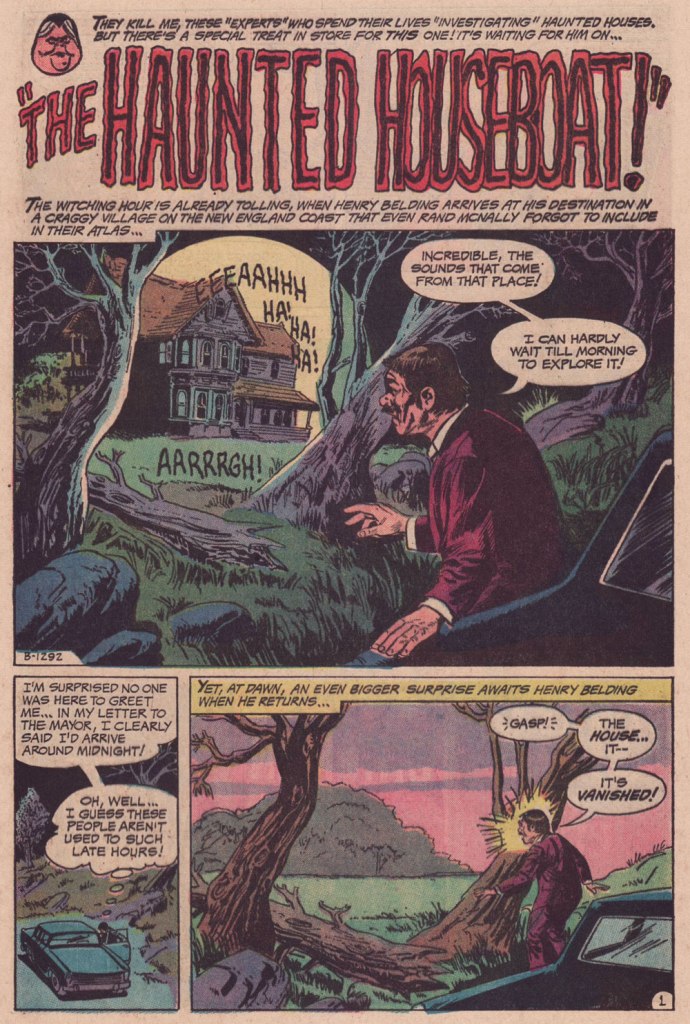
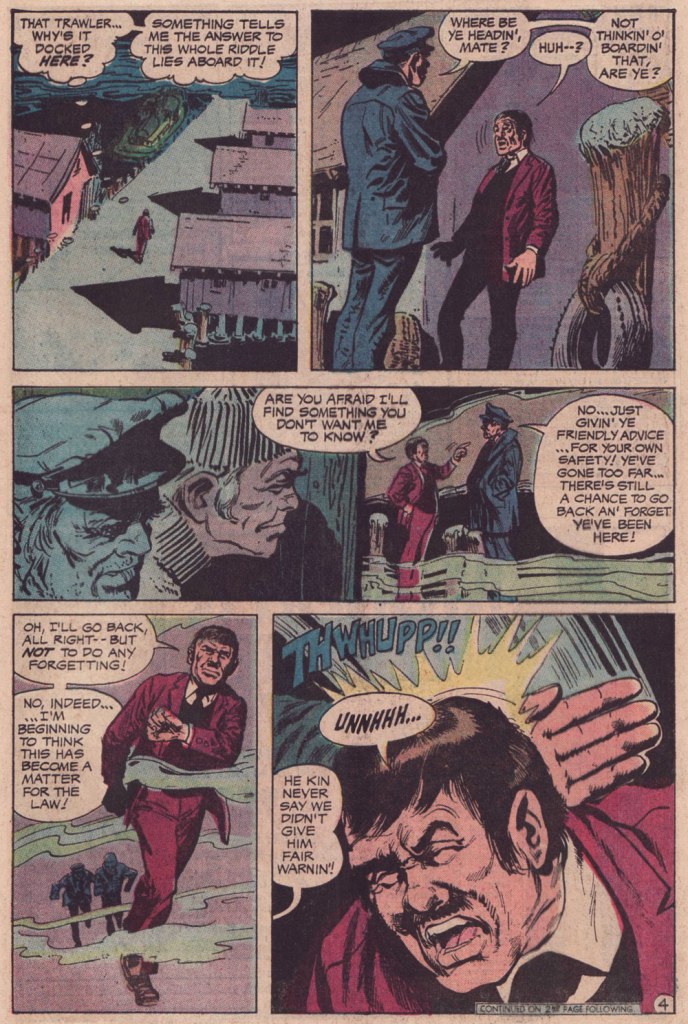
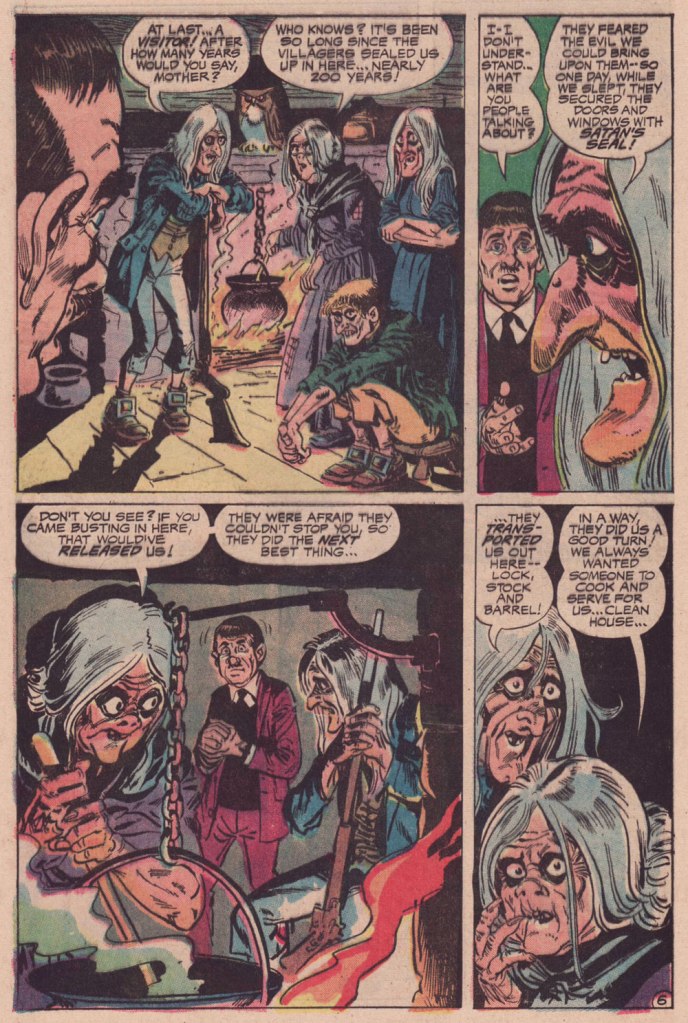
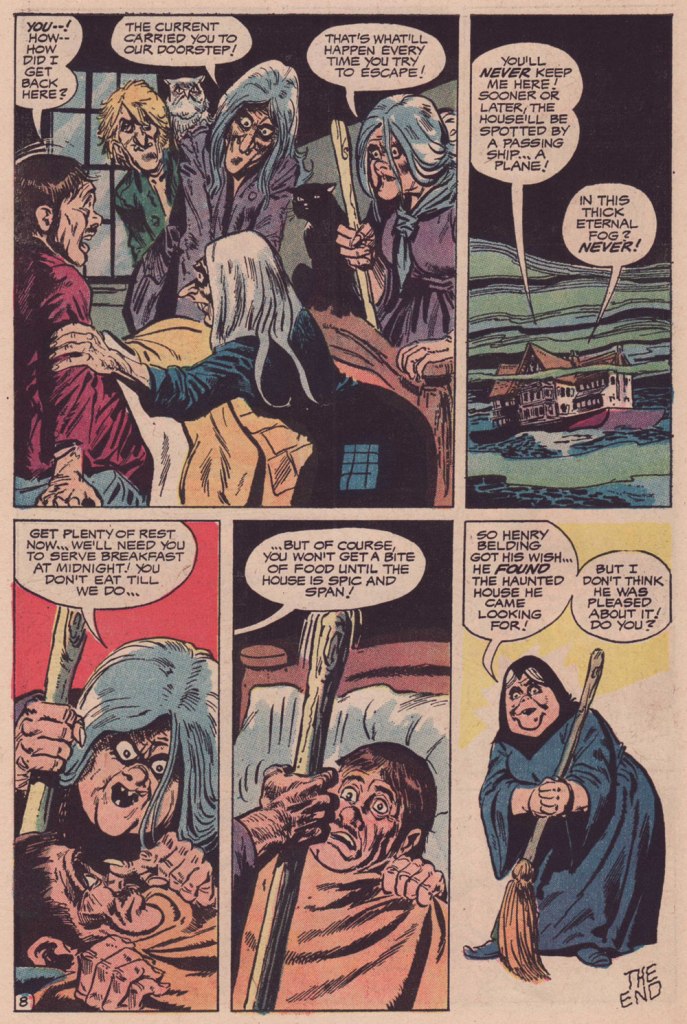
Today’s featured tale is an old favourite illustrated by one of American comics’ perennial mal-aimés, the much-maligned Jack Sparling (1916-1997), a prolific, reliable, distinctive stylist who toiled for just about every publisher on the block. Of course, he’s persona non grata with the superhero set (a compliment in my book!) but his chief strengths lay just about everywhere else, in humour, horror, crime and adventure… you name it.
I love how cosy — that pervasive, foggy ambience! — yet harrowing this tale is. Nice to see one of those insufferable, know-it-all ‘ghost busters’ get his bitter requital. And who knew that some witches were so neat, so domestically inclined? Work that mop, boy!
The writer’s uncredited, and that’s a shame, because this is anything but formulaic — and DC’s mystery books were formulaic to a fault, especially under Joe Orlando‘s guidance. I suspect the author to be editor Murray Boltinoff — he often pitched in, under sundry bynames.This is It’s Midnight… The Witching Hour!no. 21 (June-July 1972, DC), edited by Murray Boltinoff and with cover art by Nick Cardy.
« This world is run by clowns who can’t wait for it to end. » — Too Much Joy, ‘Clowns‘
Well, the topic of this post kind of snuck up on me. I’ll explain: last Saturday, as we were out of Russian marinated mushrooms (a simply unacceptable state of affairs in this household), we ventured into a European deli in quest of something to tide us over until we could properly restock. They had some button mushrooms in oil, fair enough. As we reached the counter to tally up our purchases, something caught my eye: a display for a French confection called Carambar, which I’d known about for most of my life, but never encountered in the wild.
After a moment’s hesitation (which baffled my partner), we picked up a sample and added it to our bounty.
It happens that Caram’ Bar (as it was called until 1977, when the apostrophe was dropped) ties into a minor childhood incident whose recollection elicits, in equal parts, snickers of amusement and pangs of guilt. It was in, oh, the second or third grade. We were standing in rows, about to return to class after recess. I turned to my neighbouring classmate, and asked him whether he knew… oh, never mind — it went exactly like this:
“Mister Pipo! I will pose you a riddle!” “Do you know what the difference is between a Caram’ Bar…” (I love riddles!) “… and a Super Caram’ Bar?” (They’re the same!) “But of course not, Mister Pipo!” “The Caram’ Bar was this long…“
“The Super Caram’ Bar is THIS LONG!” The full-length Super Caram’ Barfumetti, as it appeared in the pages of Pif Gadget no. 171 (May 1972, Vaillant).
Regrettably, the back of my hand connected with my classmate’s nose, not his cheek, and he wound up with a nosebleed. Désolé, Germain!
The acquired item.
…. unwrapped. CaramBar wrappers have, since the 60s, famously featured corny gags, which once were selected from entries provided by consumers. A kid whose joke got the nod could win his weight in candy. Here’s one of the pair I got here (the other doesn’t work in English)… Q: Why are elephants grey? A: Because if they were pink, they’d get confused with strawberries. It may come as no surprise that in France, a ‘blague Carambar’ has become shorthand for a lame joke.
The preceding Super Caram’ Bar ad was quite unusual in that it was a full-colour three-pager, which must have cost the candy maker a bundle. Indeed, it only ran au complet once or twice; thereafter, only its concluding page appeared.
Looking back at this campaign, I wondered whether these clowns were merely company mascots, or something more. As it turns out, Sergio (né Serge Drouard in 1950, so 21 years old at the time) was in the early stages of a remarkable career in the circus, first as Clown blanc Sergio (here are a brief video profile from 1970 and a lovely 1975 performance at Paris’ legendary Cirque d’hiver) and then as ringmaster M. Fidèle. Now seventy, he more-or-less retired after the 2010-2011 season. As for poor Pipo, I’m afraid I don’t know. He’s similar to the famous Dutch clown Pipo de Clown, but they’re merely homonyms.
Clowns are a curious proposition. Kids used to (presumably) find them amusing and endearing, but several generations of thin, gruelling antics and downgrading of the brand and métier, not to mention the sinister hijinks of the infamous Pogo the clown, have flipped the cultural perception of these once-beloved entertainers. At this point, Coulrophobia is impressively widespread, and not just among the wee ones.
For my part, I’m not so eager to condemn en bloc. Your run-of-the-mill, unqualified local kids’ show, mall-opening Bozo is but a faint, hopelessly distorted echo of the great clowns of history. They were the fruits of a complex, nuanced and codified tradition with its thick, gnarled roots in early 16th century Italy’s Commedia dell’ Arte.
But I don’t need to reach quite that far: I grew up on Radio-Canada’s absurd, minimalist masterpiece Sol et Gobelet (1968-71). Sol (Marc Favreau) was a naïve tramp clown who creatively mangled language and logic and Gobelet (Luc Durand) was the poetic, reasonable, refined Pierrot type. Here’s a classic episode. Such is the duo’s cultural significance that a public library (Favreau) and a nearby public park (Durand) have been christened in their posthumous honour.
And since we’re on comics and clowns, here’s a bonus short tale.
« Sergio has also learned that one must never try to catch a falling performer. One should only push them to redirect their path and cushion their fall. One day at the Paradis latin, he had no choice but to tackle in flight a trapeze artist who was about to land on a table. The outcome : a few collapsed vertebrae. » Also, « When a lion attacks, it always goes for the testicles. » Keep these sage verities in mind, next time you’re under the big top!
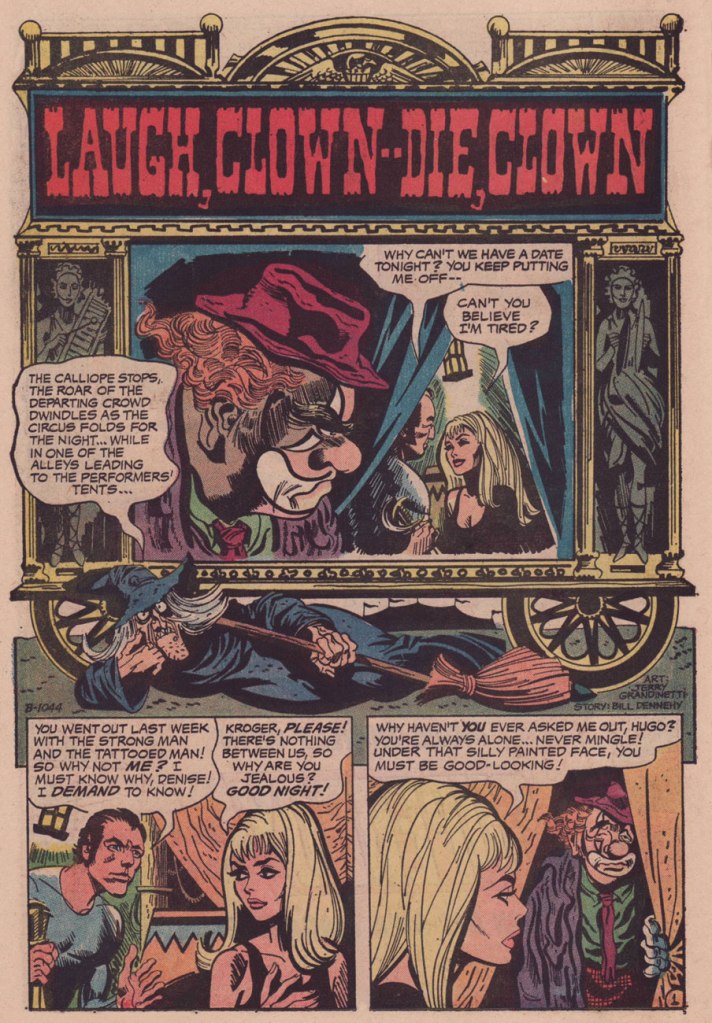
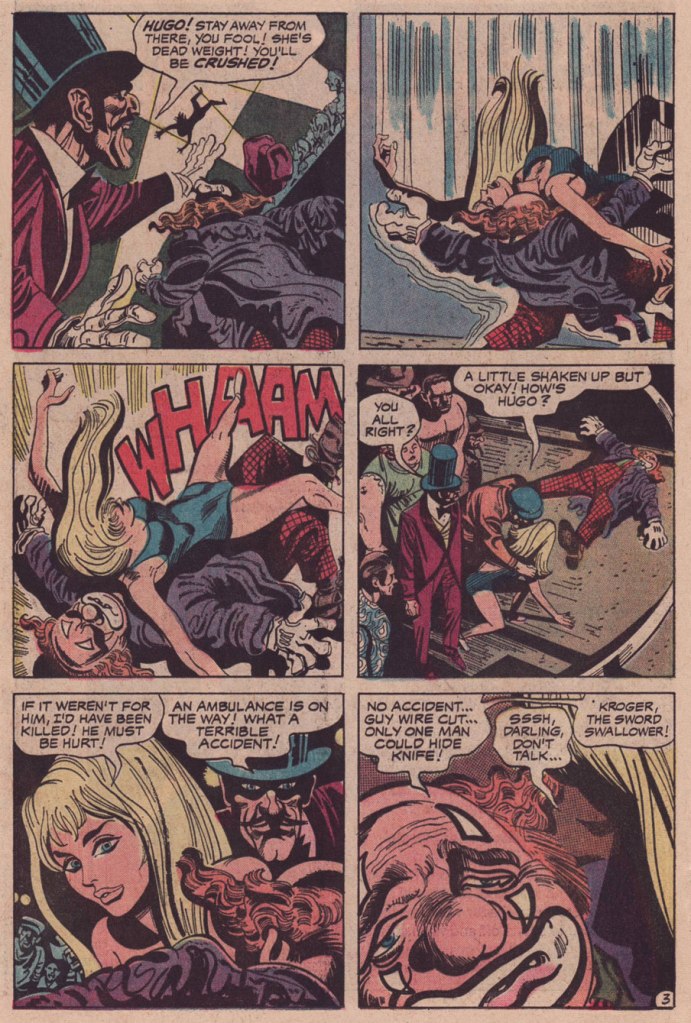
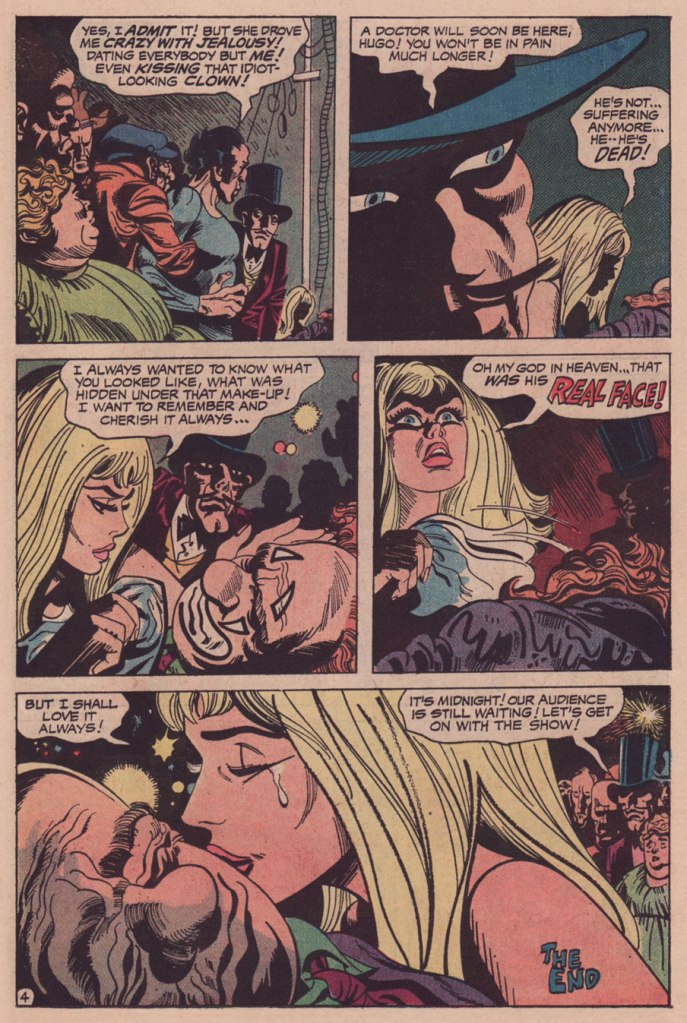
Laugh Clown — Die, Clown appeared in It’s Midnight… The Witching Hour no. 21 (June-July 1972, DC). It was scripted by editor Murray Boltinoff under his Bill Dehenny nom de plume and illustrated by Jerry Grandenetti.
While LCDC is the flimsiest of stories, just a troupe of stock characters going through their hoary paces, Grandenetti’s artwork elevates the affair. It’s as if, having precious little to work with, the artist opted to push against the material, moulding it oddly, imbuing the proceedings with unstated implications. Consider, for instance, how sinister is the depiction of the ringmaster. Nothing in the dialogue or plot indicates that the man is up to anything untoward or malicious, quite the contrary. The second panel of page four is quintessential Grandenetti.
And how was my first Carambar, you may ask. We both tried it, and… were singularly underwhelmed. Perhaps it was a question of freshness, but it was disappointingly brittle in the beginning, almost chalky, hardly what you’d expect from a caramel product. Then it just fell apart and faded, like third-rate taffy.
« I found something in one of my pockets. It was about as big as your shoe, but it was shaped like a rocket! » — a not-at-all ambiguous statement from litigious chuckler Bozo the Clown.
« I don’t know what’s wrong with him! He’s in hellish torment! » — there’s witchery afoot, clearly
I’ll grant you in a heartbeat that Nick Cardy‘s (and, to a lesser extent, Neal Adams’) earlier The Witching Hour (full original title: It’s 12 O’Clock… The Witching Hour!, hence its twelfth day appearance) covers beat out subsequent entries on the overall quality front, but this particular beauty, in my opinion, takes home the terror tiara as the very creepiest of the bunch. Is it the otherwise-innocuous daytime setting, the tension between the pastoral and the grotesque? In the end, it induces shivers, and that’s what counts.
Though it comes as the tail end of their involvement, Carmine Infantino and Cardy still had a hand in, as publisher and art director, and took an active rôle in the design of each DC cover of the era.
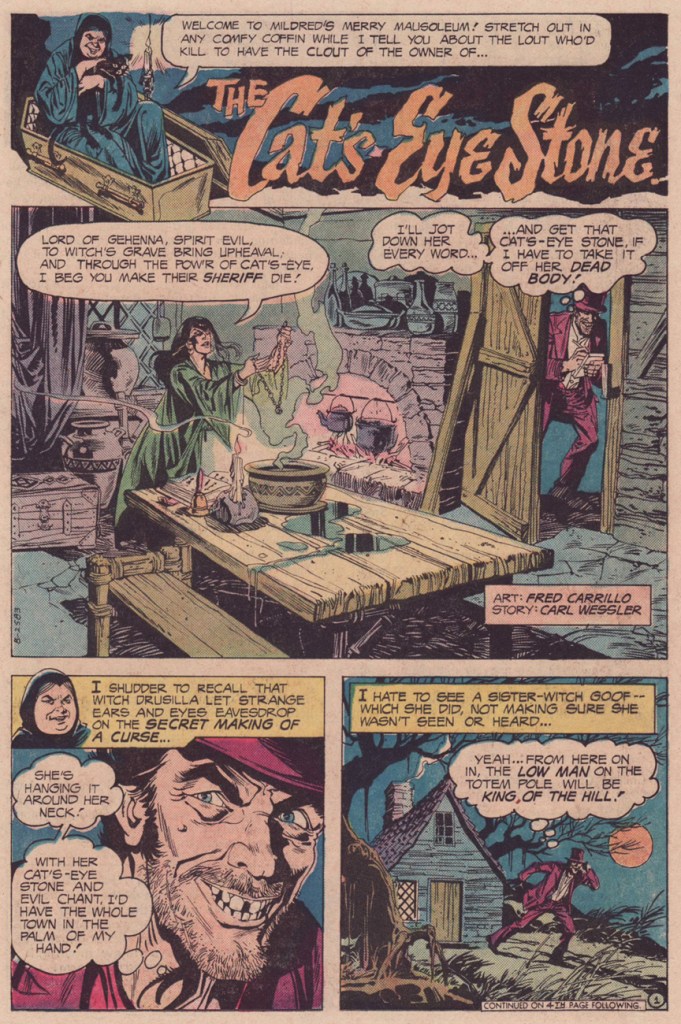
This is It’s Midnight… the Witching Hour no. 62 (Feb.-Mar 1976, DC). Edited by Murray Boltinoff. Argentine grand master Luis Dominguez’s cover art is loosely based on Carl Wessler and Fred Carrillo’s The Cat’s-Eye Stone. That aside, is it actually a picnic that Mr. Romantic has in mind, what with a “picnic place that no one will ever find“? Suspicious, to put it mildly.
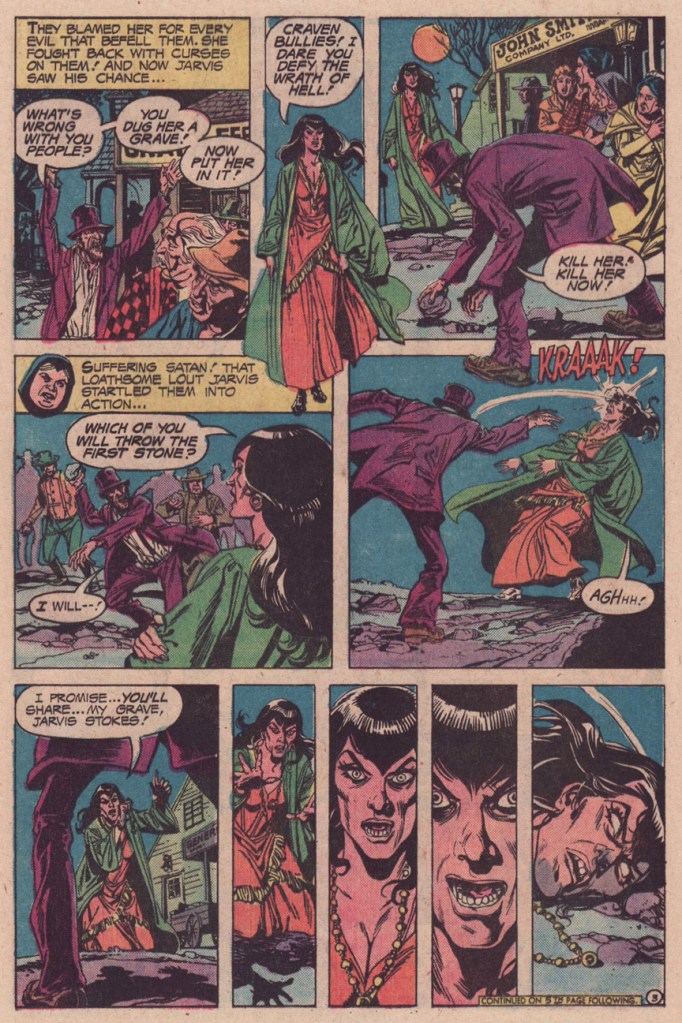
And so — why not? — here’s the full tale, so that you may judge for yourself.
One small quibble: doesn’t Drusilla’s witch’s brew count for something in the spell? Surely the words won’t suffice…
For a devil-worshipper, she’s pretty biblical (‘cast the first stone’). Or maybe that’s the point.
This story anticipates the shock ending of Carrie by almost a year. Or had this twist already made the rounds? Perhaps the cycle began with Let’s Scare Jessica to Death… but I’m not sure.
Wilfredo Limbana ‘Fred’ Carrillo (1926–2005) was an underrated Filipino artist who produced some quite fine work for DC Comics’ mystery titles in the 1970s. I was particularly fond of his work on The Phantom Stranger, when he illustrated both the titular feature and its worthy backup, The Black Orchid, at the tail end of the title’s run.






























 Who's Out There?