Greetings all! Today we play whack-a-mole with a few warriors in loincloths – or at least that’s how I felt when looking for material in this post. Every time I found an instance of tentacles in some Conan the barbarian or Kull the destroyer tale, there was yet another one just an issue or a couple down the line. Let’s then consider this the end of a story begun with Tentacle Tuesday: the Savagery of Conan’s Savage Sword and continued with Tentacle Tuesday: Conan-o-rama: after this, I’ll be all Conan-ed out for a few years to come. So drink a shot of some concoction you like (be it coffee or the potent Zombie), and join me for this last foray into the dark, mysterious, predictable world of sword-and-sorcery heroes who run around half-naked (for better freedom of movement, no doubt).
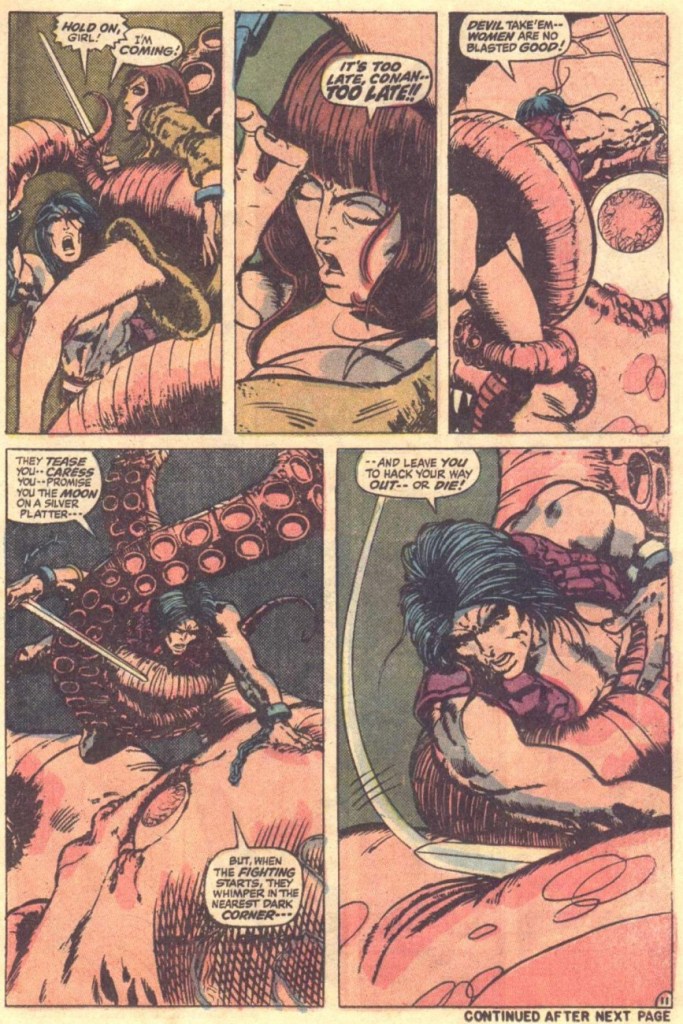
Poor octopus, by far the most tragic figure of this story… These two pages are from The Dweller in the Dark, scripted by Roy Thomas and illustrated by Barry Smith, was published in Conan the Barbarian no. 12 (December 1971, Marvel).
You can’t have it both ways – praising a woman for exhibiting quintessentially ‘feminine’ characteristics and then getting pissed off at her dismay and fright when grabbed by a murderous monster.
The Sunken Land, scripted by Denny O’Neil (from a short story by Fritz Leiber), is pencilled by Walter Simonson and inked by Al Milgrom. This story was published in Sword of Sorcery no. 5 (Nov-Dec 1973, DC). I like Leiber, and I’ve been meaning to get to the Gray Mouser for a while – but I’m reading Andrzej Sapkowski’s Witcher right now, and one sword-and-sorcery saga at a time seems reasonable.
Page from Flame Winds of Lost Khitai!, scripted by Roy Thomas, pencilled by John Buscema and inked by Ernie Chan, published in Conan the Barbarian no. 32 (November 1973, Marvel). Interestingly, barbarians seem to universally abhor striking a woman; an attempt at primitive ethics from the part of the scripters.
One more Conan before we move on to Kull…
Page from Isle of the Dead, scripted by Bruce Jones and illustrated by Val Mayerik, published in Conan the Barbarian no. 138 (September 1982, Marvel). This page has the rare distinction of having the warrior-hero being less clothed than the girl he’s with.
As promised, here’s Kull the destroyer, engaged in battle with an eighties octopus (check out that mohawk!)
Two pages from The Thing from Emerald Darkness, scripted by Doug Moench, pencilled by Ed Hannigan and inked by Alfredo Alcala. This story was published in Kull, the Destroyer no. 17 (October 1976, Marvel). Why does a traitor (that’s not ‘traiter’) deserve better than to die from tentacles? That seems like no worse a death than any other in battle.
A page from City of the Crawling Dead, scripted by Don Glut, pencilled by Ernie Chan, and inked by Rick Hoberg. It was published in Kull, the Destroyer no. 21 (June 1977, Marvel).
Just before you pass out from over-consumption of alcoholic drinks (I’m having a gin and tonic over here!), I’d like to enliven this parade of humdrum tentacles a bit with this Conan pin-up:
« The tentacles had burned where they’d touched our skin… and the oozing slime they’d rubbed into the wound didn’t help. We panted and trembled… »
I have little interest in werewolves, despite just having finished one in wool. I’d say I place them somewhere between Frankenstein’s monster (in which I have zero interest – sorry!) and Dracula (whom I am generally intrigued by, depending on whose version we’re talking about). Having said that, the bizarre concept of werewolf vs tentacles grabbed my imagination by its incongruity. “Grarr”, as the werewolf might say.
The author and her werewolf; he doesn’t have a name, yet.
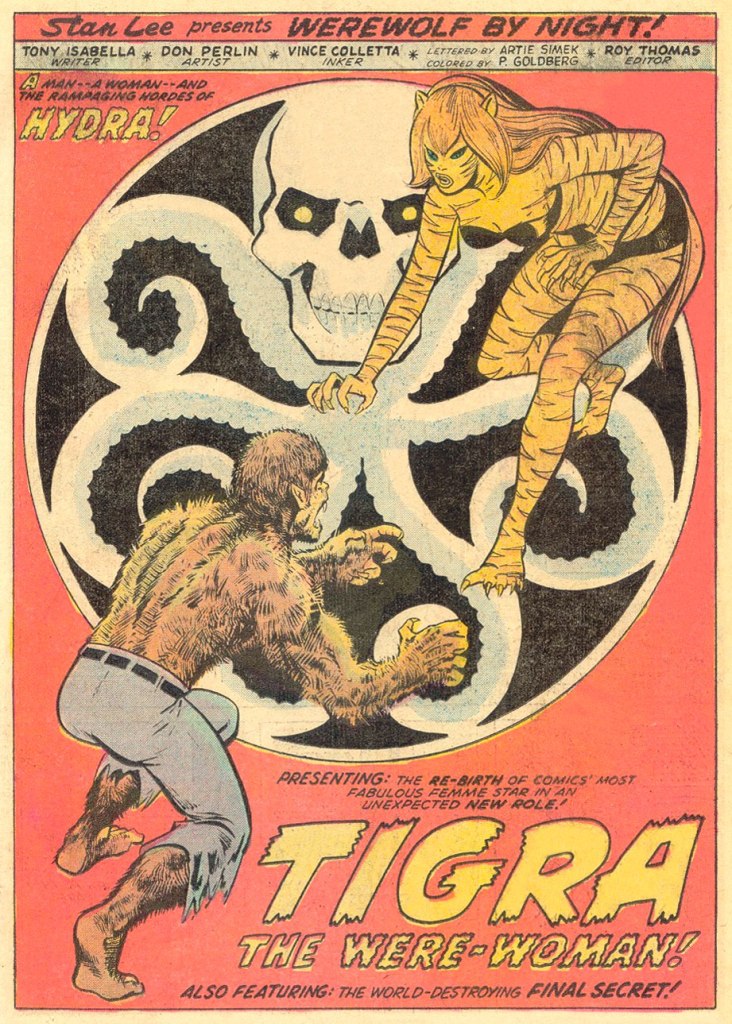
The Giant-Size Werewolf may not be as rife in tentacles as the Giant-Size Dracula, but it has its moments. “A man, a woman… and rampaging hordes” has a certain nice ring about it!
A page from Tigra the Were-Woman!, published in Giant-Sized Creatures no. 1 (July 1974). Script byTony Isabella, pencils by Don Perlin and inks by Vince Colletta.
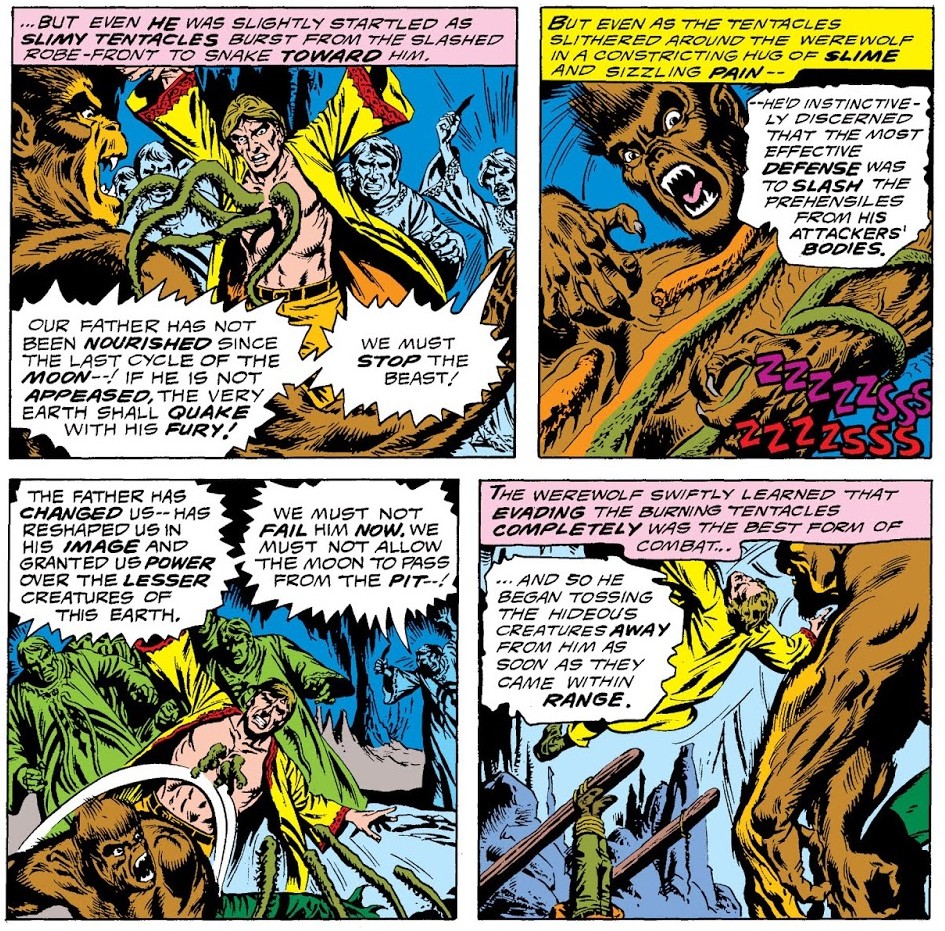
When the Moon Dripped Blood!, scripted by Doug Moench and illustrated by Yong Montaño, was published in Giant-Size Werewolf no. 4 (April 1975):
Anybody would be startled by slimy tentacles coming out from under a robe… slimy and burning, at that.
Doug Moench continues his tentacle shenanigans one month later in Werewolf by Night no. 7 (March 1975).
The Amazing Doctor Glitternight was scripted by Doug Moench and illustrated by Don Perlin:
Likely beating all records for how much text you can cram into one splash page.
The “yecch-monster” awakens as Glitternight somehow manages to exude both light and darkness, and simultaneously nourish and feed. I get the impression somebody was paid by the word for this story.
Has the werewolf ever heard that “words are very unnecessary“? Was it essential to inform us that he might have been stunned, or maybe paralyzed, and it doesn’t matter anyway, as both are just words?
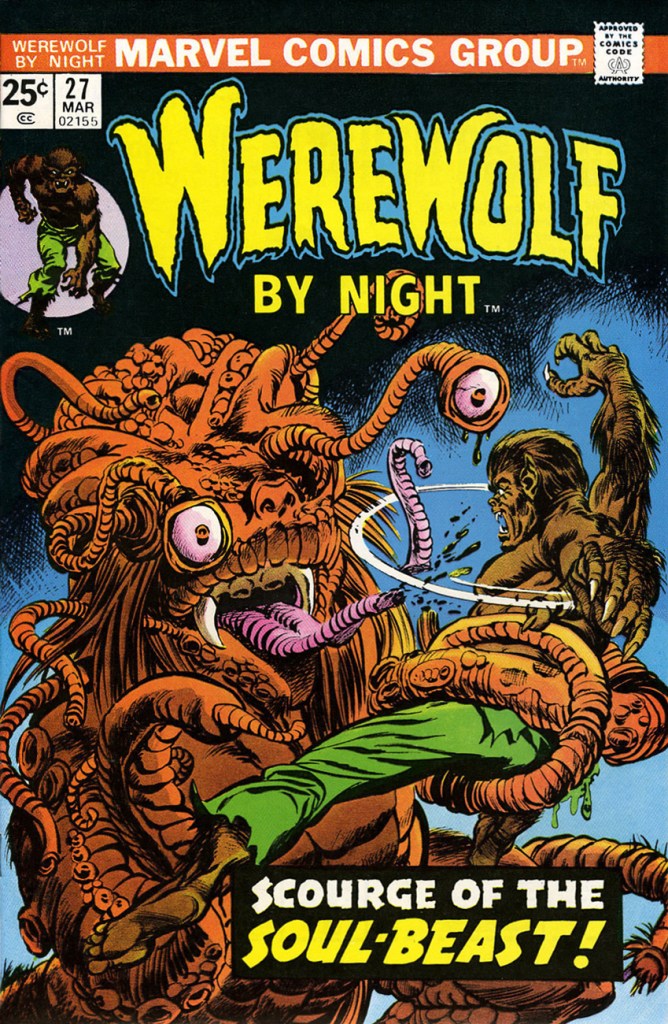
Next time the Werewolf encounters tentacles, it’s an epic, 2-issue tale of the desperate fight against ‘soul-eater’ Marcosa, an ectoplasmic wraith who occasionally takes a physical form and often deploys tentacles to do his dirty work for him.
Werewolf by Night no. 36 (January 1976). Cover Don Perlin.
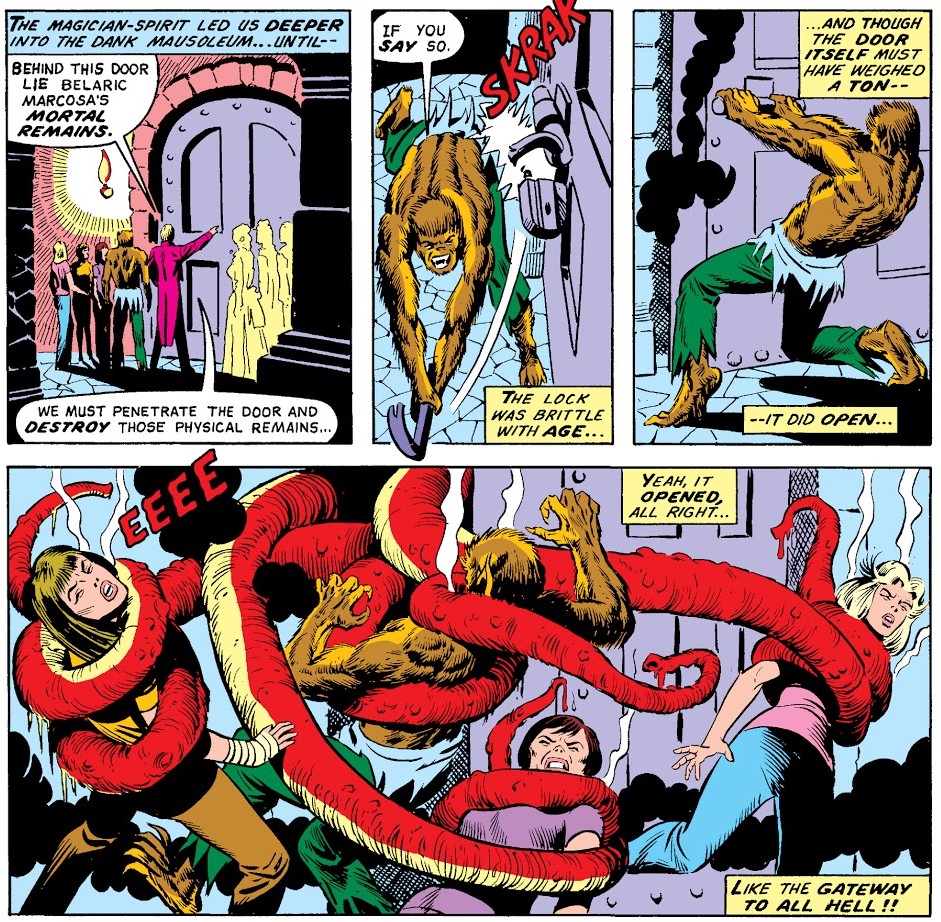
Marcosa in Death (plot-spoiler: death is not actually involved) was scripted by Doug Moench and illustrated by Don Perlin:
Moral of the tale: don’t open doors when you don’t know what’s behind them.
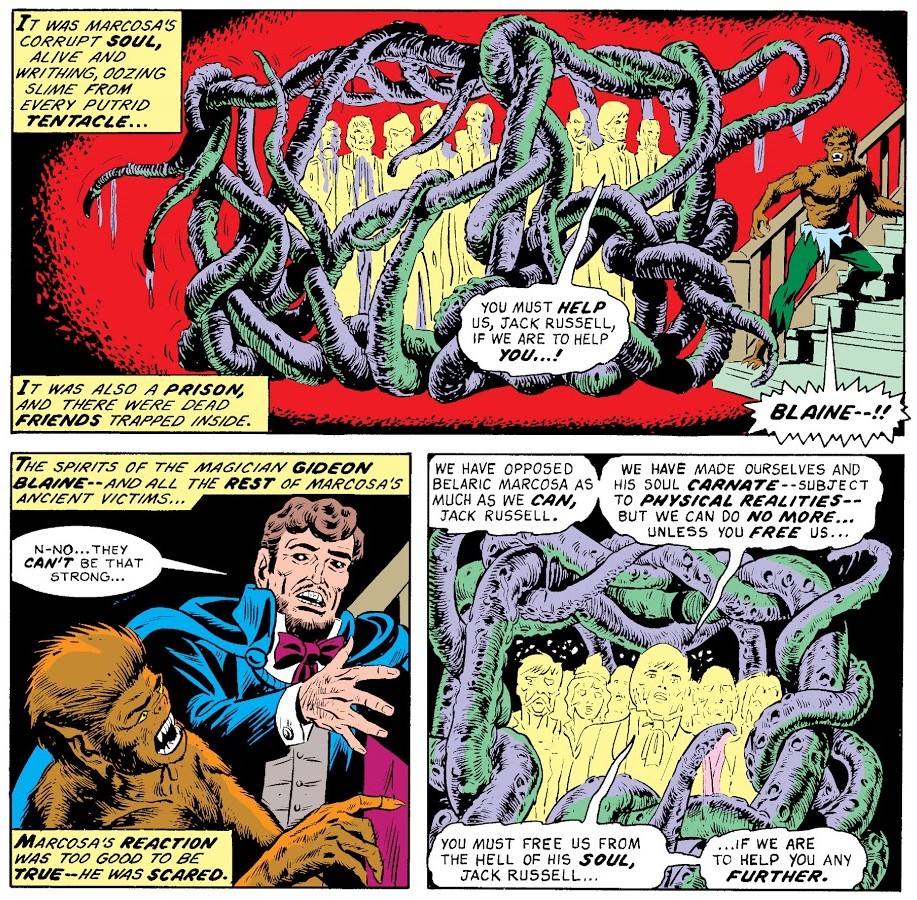
Marcosa doesn’t quite die despite all the gnashing of teeth and ripping of tentacles, so the story continues to its grim conclusion in the next issue. The End, scripted by Doug Moench and illustrated by Don Perlin, was published in Werewolf By Night no. 37 (March 1976).
Perlin goes wild drawing teeth! An orthodontist’s worst nightmare (or perhaps a nice little earner).
What other giant-sized topic will we continue with next time? Only time will tell! Stay tuned…
« The beginning of wisdom is to call things by their proper name. » — Confucius
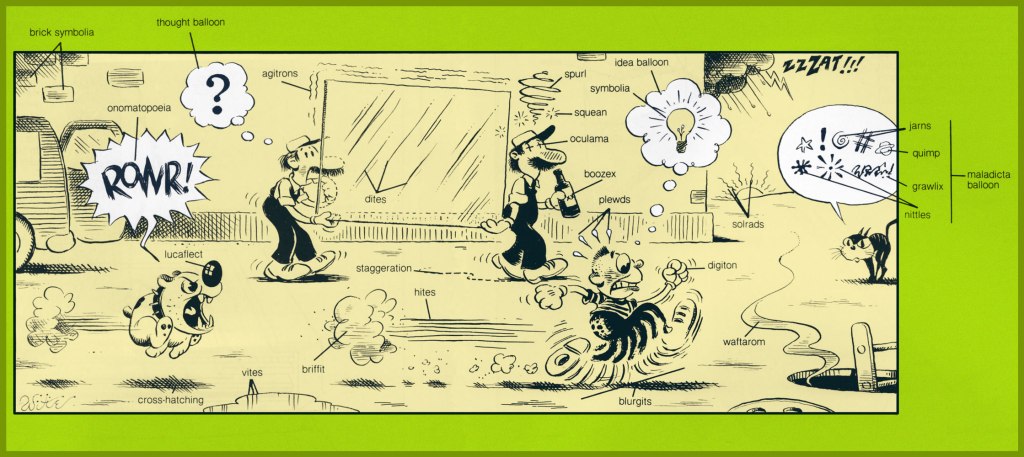
To a bibliophile, shelf space is precious. In recent years, I’ve happily purged my library of many a bulky and obsolete reference tome. With the sheer mass of information that’s migrated online, it’s frequently far simpler to tap a few key words than to scan the shelves in order to pull out and peruse some quaint and curious volume of forgotten lore. Frequently — but not always. One significant exception is my copy of What’s What, accurately touted as « a visual glossary of everyday objects — from paper clips to passenger ships ». Obviously, it covers the expected doohickeys and other dinguses, contraptions and doodads, esteemed constituents of our flora and fauna… but, on occasion, it drifts deep into left field, and that gives it spice. To wit, its entry on cartooning:
Cartooning: Many one-panel cartoons use captions or labels below the illustration for dialogue or explanation. Those appearing on the editorial pages of newspapers are called editorial or political cartoons and usually feature an exaggerated likeness, or caricature, of some well-known figure, as the main character. Comics, or comic books, use cartooning throughout. A complete shericasia, or shallop, is used by a cartoonist to depict a complete swing at an object, be it a golf ball or another person.
This most edifying illustration was the work of Mike Witte (b. 1944), who later chucked this charming infusion of the old ‘big foot’ school of cartooning to settle into an in-demand but pasteurised version of Ralph Steadman‘s style (itself, I would argue, a more grotesque version of Ronald Searle‘s approach). Still, bully for him — it’s a hard business to earn a proper living in. Sure, the classic big foot tradition already had a modern master in Elwood Smith… but the more the merrier! (and speaking of Onomatopeia…)
Mort Walker‘s Beetle Bailey Sunday strip from July 9, 1978, a most judicious choice, was dissected.
Here’s my well-thumbed, yellowing copy of What’s What: it’s the first book trade edition (Nov. 1982, Ballantine), copies of which, or the updated edition, circa the early 1990s, can still be obtained dirt cheap. And “Nose leather?” Awww.
To this array of clever cartooning terms, we simply must remedy one omission, and it’s a crucial one: Kirby Krackle!
A page from Nazi “X” (Captain America no. 211, July 1977, Marvel) with the wild and wooly Arnim Zola – the Bio-Fanatic – flexing his mental muscles. Written, pencilled and edited by Jack Kirby, inked and lettered by our dear Mike Royer, and coloured by Glynis Wein.
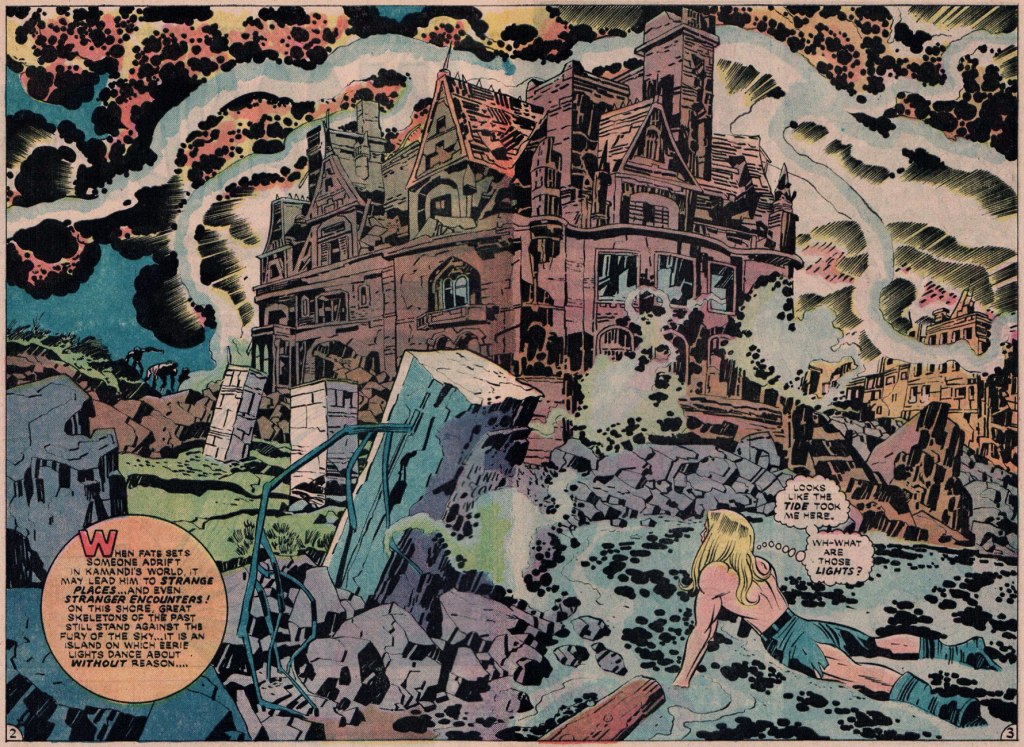
Another example, to make sure everyone gets it straight? The sky’s ablaze with Kirby Krackle in this ominously magnificent splash from Kamandi no. 24 (Dec. 1974, DC) and its tale of The Exorcism! Written, pencilled and edited by Jack Kirby, inked and lettered by Douglas Bruce Berry, and most likely coloured by Jerry Serpe.
« My imagination grew wilder, the most unexpected associations flared up in my mind, and as I kept trying, the reception room kept filling with strange objects. Many of them were born, apparently, out of the subconscious, the brooding jungles of hereditary memory, out of primeval fears long suppressed by the higher levels of education. They had extremities and kept moving about, they emitted disgusting sounds, they were indecent, they were aggressive and fought constantly. I was casting about like a trapped animal. All this vividly reminded me of the old cuts with scenes of St. Anthony’s temptations. » [source]
Today’s topic does not involve a man becoming a cockroach: that has been discussed often enough. My current area of interest concerns the many strange and striking ways in which a living form becomes a completely different form under the influence of a supernatural power or its natural inclination, of witchcraft or the whimsy of a writer whose imagination flares up much like it did for poor A. I. Privalov, depicted above trying to create a a sandwich and a cup of coffee and ending up with a roomful of horrors…
This strange creature surely illustrates the perils of getting stuck mid-metamorphosis!
The Doom Patrol no. 95 (May 1965). Cover by Bob Brown. While transforming into god-knows-what, Dr. Sven Larsen is careful to preserved his impeccably coiffed chevelure. Perhaps he inspired Ted Baxter.
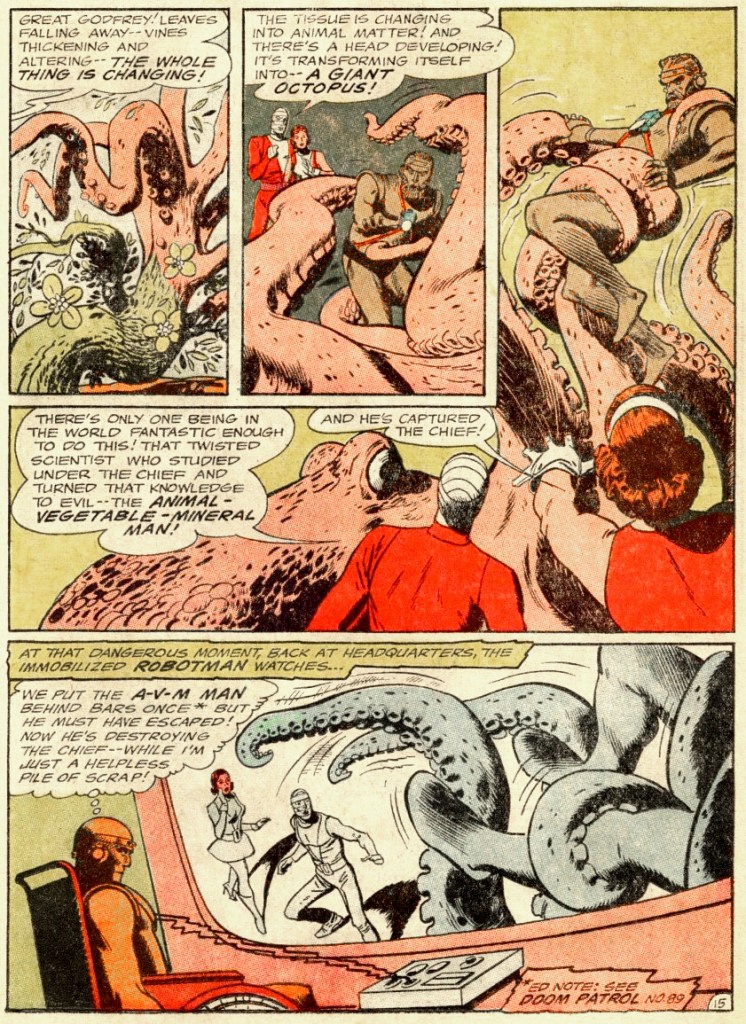
In Return of the Animal-Vegetable-Mineral Man, scripted by Arnold Drake and illustrated by Bruno Premiani, the Doom Patrol battle a scientist crazed with power-lust (while dealing with trouble of their own, like being unable to control their powers – it was apparently decided that a scientist who can become anything he likes is not interesting enough).
That this AVM (animal, vegetable, mineral) man decided to transform into an octopus will not surprise regular readers of Tentacle Tuesday: we know that the octopus is the most perfect form there is!
In the rest of the story, AVM also transforms himself into electric eels, tungsten birds, a building-tall neanderthal man, liquid mercury, a grizzly bear, etc., but it’s all a bit of a let-down after the giant octopus, if you ask me.
I’ll continue with this rather evocative cover by Bernie Wrightson, in which we get a preview peek at a gruesome scene just a few seconds before it actually happens.
House of Mystery no. 204 (July 1972). Cover by Bernie Wrightson.
It all starts with a nasty dream of cranberry jelly…
… and ends with an unwelcome transformation of future bride into hungry monster. In this case, a pretty girl is not so much like a melody, but yet another helping of aforementioned cranberry jelly… perhaps I should have kept this story until Christmas.
All in the Family was scripted by Mary Skrenes and Bernie Wrightson; illustrated by Bernie Wrightson.
If this story of transmogrification made your teeth itch, just have a gander at the following histoire d’amour…
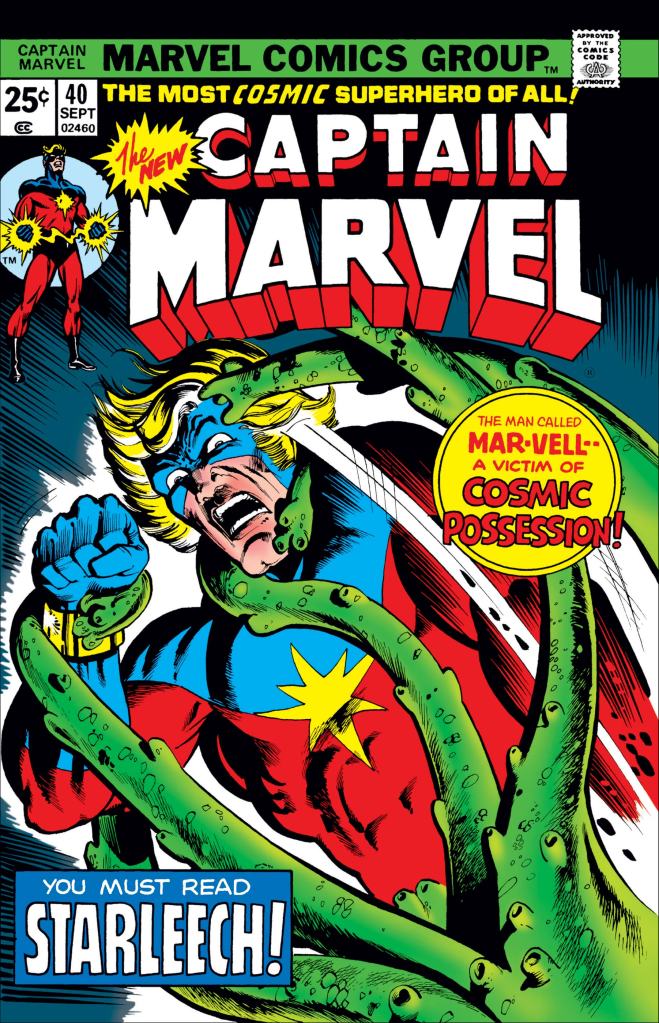
Captain Marvel no. 40 (September 1975). Cover pencilled by Al Milgromand inked by Klaus Janson.
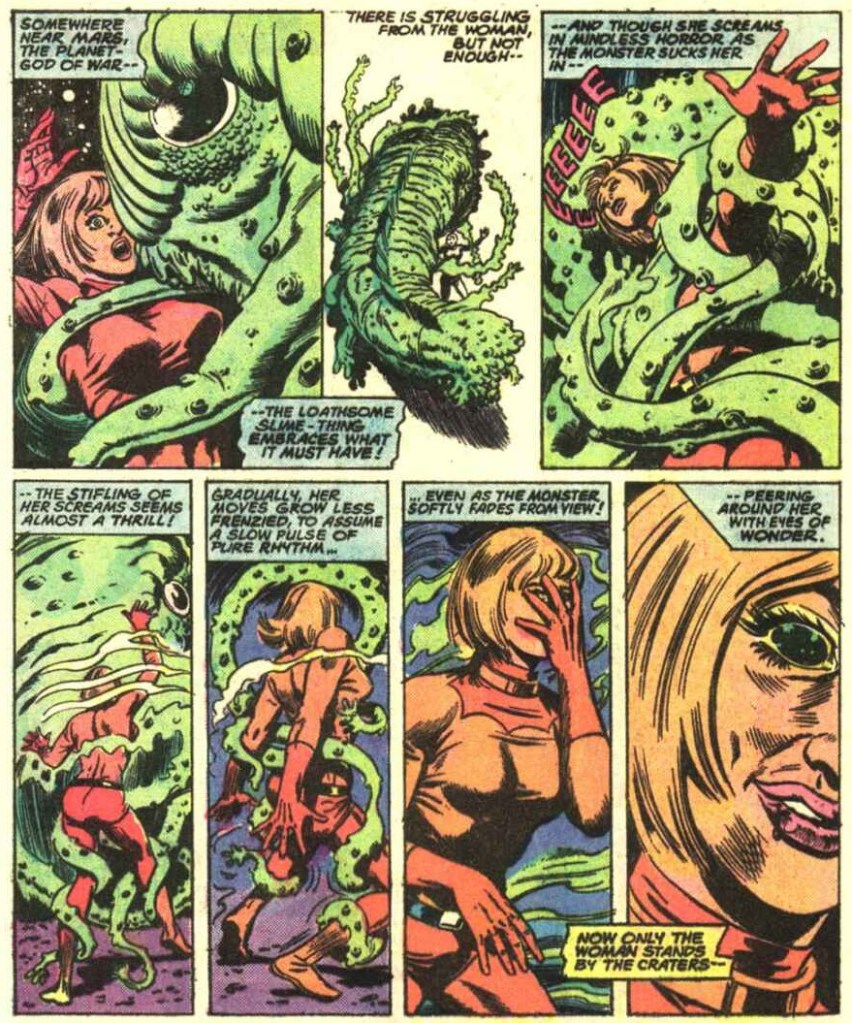
No, hold your horses, I’m not implying anything untoward about Captain Marvel. That thing he’s tangled up with is his lover (or should I say ex-lover) Una. Just a little case of demonic possession!
Um, those are not “eyes of wonder”, more like a demented gaze.
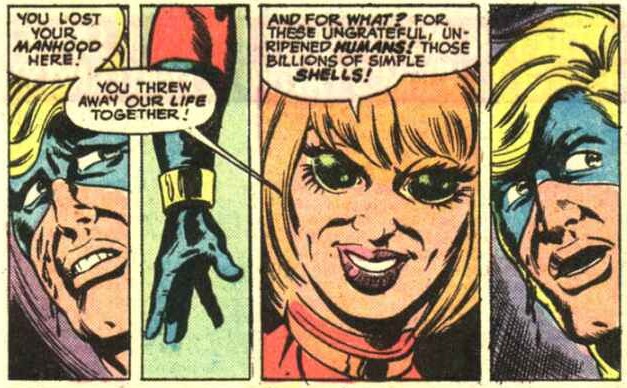
Will Captain Mar-vell be able to kill the woman he loves, even if she’s more of a shell inhabited by a tentacled psychic monstrosity, and despite having lost his manhood, whatever that was?
Stay put for the exciting finale of Rocky Mountain ‘Bye! was scripted by Steve Englehart and Al Milgrom, pencilled by Milgrom, and inked by Al McWilliams!
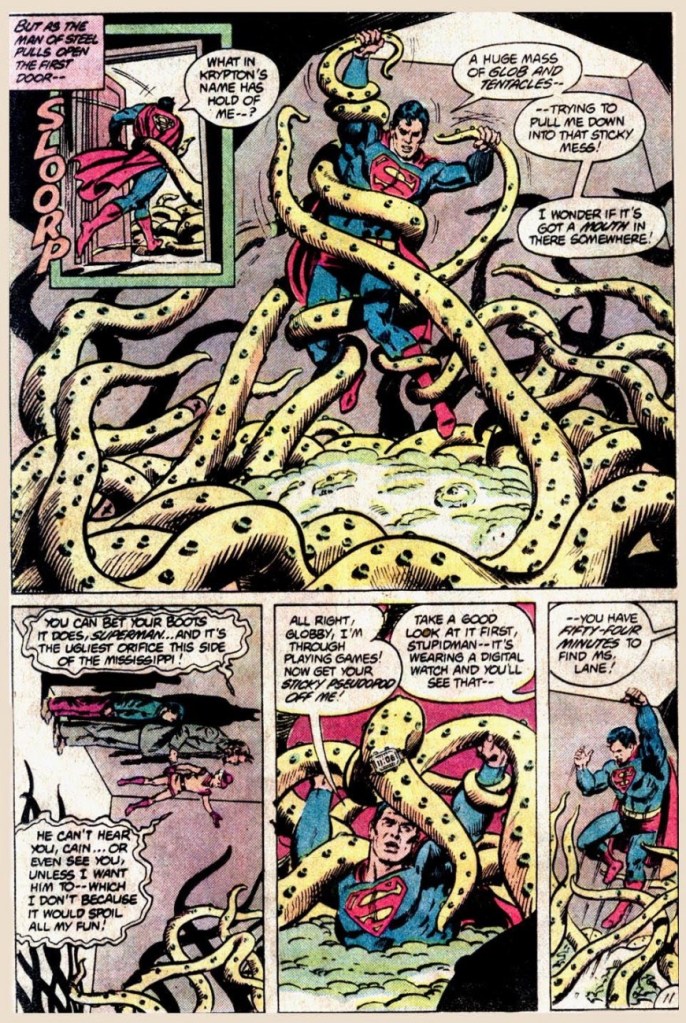
What do we have here? A harmless trick-or-treating kid transformed by Mr. Mxyzptlk into a malefic octopus? It’s business as usual for Superman in this goofy tale (who, incidentally, was the star of Tentacle Tuesday: It’s a Bird! It’s a Plane! It’s a Tentacle!) I’m sure most children would relish the opportunity to become an actual ghost or werewolf…
But I am not convinced that anybody would want to be transformed into, err, “Globby”.
Nothing as stylish as an octopus with a digital watch.
These pages were from The Haunting Dooms of Halloween!, scripted by Dan Mishkin, pencilled by Curt Swan and inked by Tony de Zuñiga, published in DC Comics Presents no. 53 (January 1983).
« He was offered a sloe gin fizz in a pink frosted glass by a young woman who removed her glass eye and sucked on it while discussing the moral imperatives of the sponge boycott in Brooksville, Florida. » — Harlan Ellison, ‘Neon’.
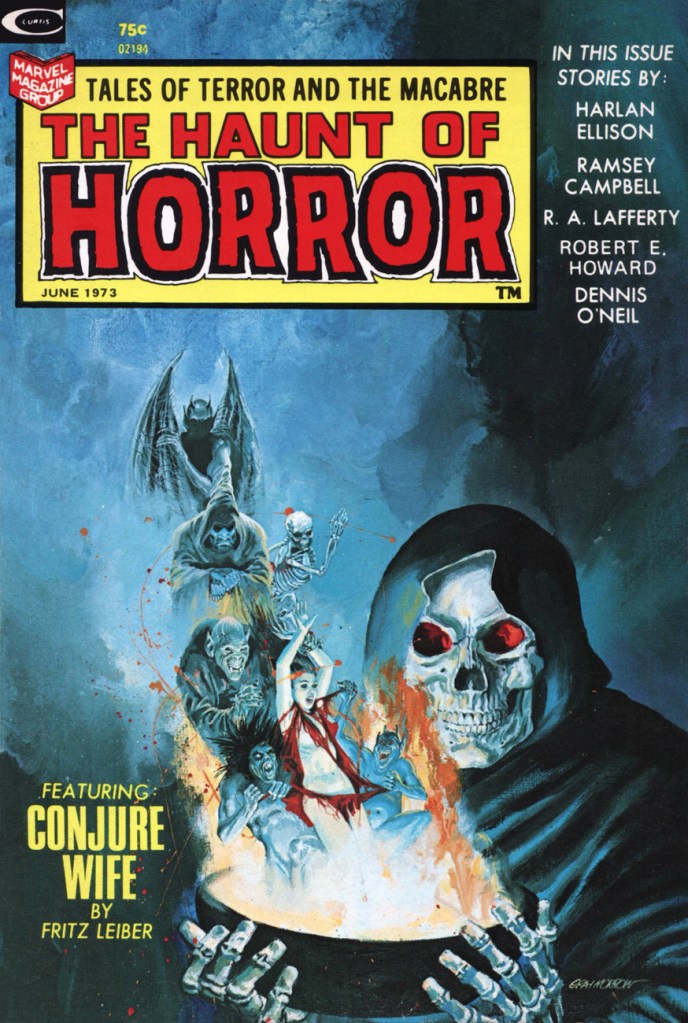
In 1973, Marvel was trying all sorts of things to bolster its market presence. They even dared to tread where even the venerable Weird Tales had never quite succeeded. The Haunt of Horror was a prose fiction digest that strongly showed its comics roots. It offered a mixture of classic material (Fritz Leiber’s Conjure Wife, a piece by Robert E. Howard) and of contemporary genre practitioners: Harlan Ellison, Ramsey Campbell… featuring a score of illustrations slapped together by Marvel’s less superhero-limited alumni, namely Gene Colan, Mike Ploog, Frank Brunner, Walt Simonson and Dan Green. After two issues, Marvel called the whole thing off, licking its wounds, but soon revived the title as a b&w comics magazine, this time eking out five issues (May 1974 – Jan. 1975) plus a 1977 issue of Marvel Preview.
This is The Haunt of Horror no. 1 (June, 1973), edited by Gerry, no, make that *Gerard* Conway (in full ‘take me seriously, I’m not just a hack comics writer!‘ mode), with a striking cover by Gray Morrow.
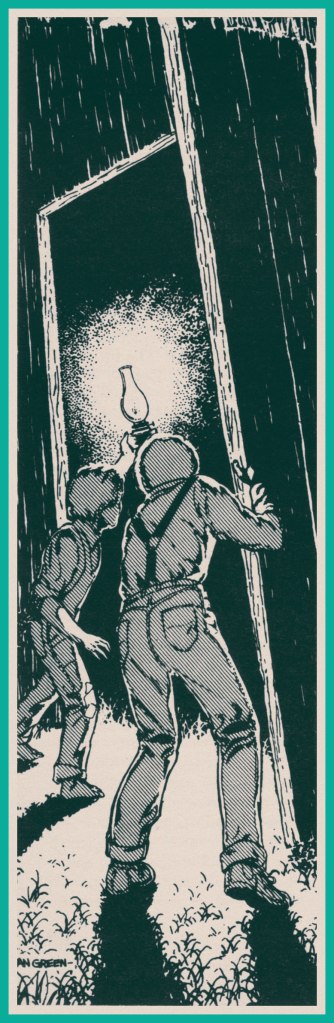
As for me, I picked it up for the rare short story by the nonpareil R. A. Lafferty, Ghost in the Corn Crib.
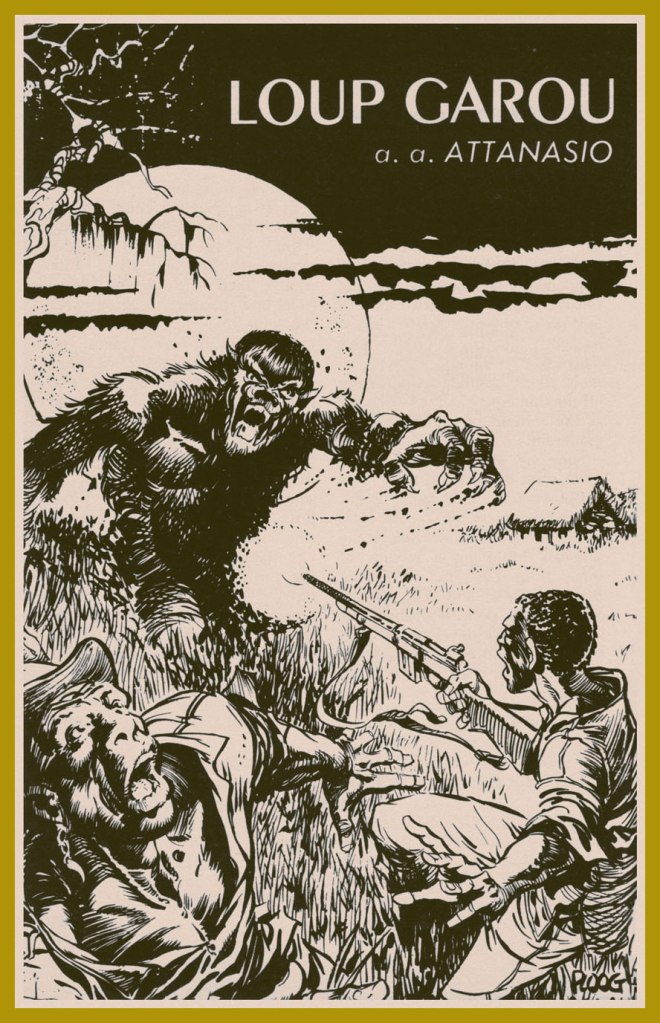
Werewolf by Night originator Mike Ploog didn’t have to stretch far beyond his comfort zone for this illustration for Alfred Angelo Attanasio‘s Loup Garou (french for Werewolf, if you still feel the need to ask).
It’s nigh-impossible to fully scan some these images without destroying the source document, but here’s the opening splash for Haunt of Horror’s publication of Fritz Leiber’s 1943 classic Conjure Wife, adapted in the movies as Night of the Eagle (in the UK) and Burn, Witch, Burn (in the US). Here, a fine, committed but uncredited Gray Morrow pebble board illustration is ‘corrected’ by Marvel’s number two Yes Man (Consulting Editor Rascally Roy Thomas would surely be numero uno), who replaces whichever figure Gray had drawn by an image of Mary Jane Watson, not even bothering with the slightest effort to match the style. John Sr. had gotten plenty of practice ‘fixing’ Kirby and Ditko, so Gray Morrow was just ‘all in a day’s work‘.
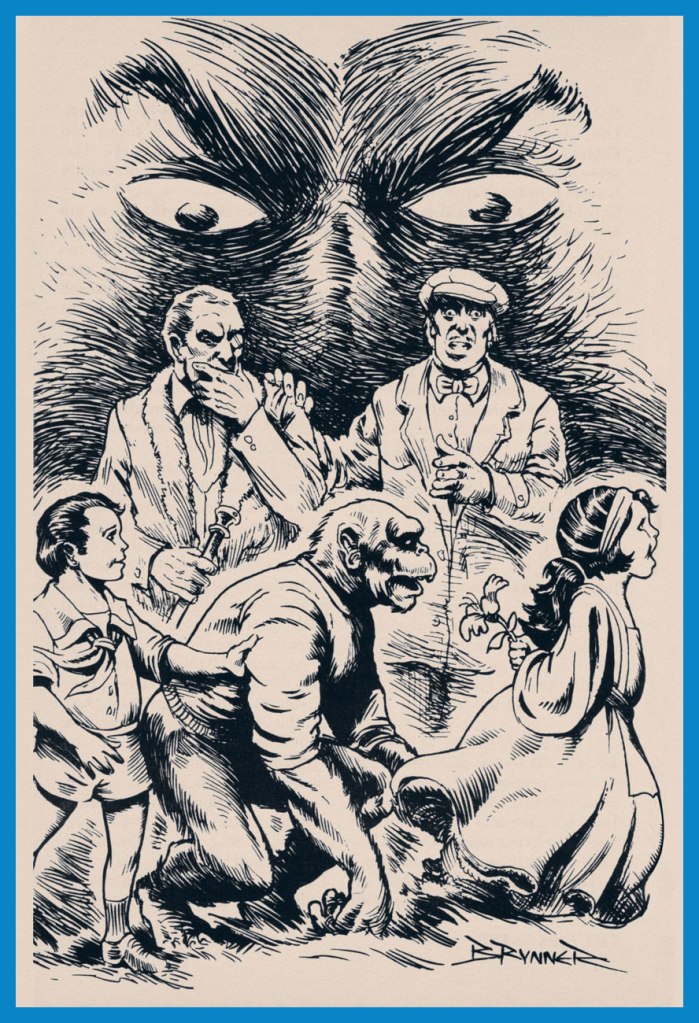
Gene Colan was called upon to whip up a few quick pieces for the rest of the feature.
The Haunt of Horror ran just one more issue, graced by a lovely, quite pulpy cover by the nonpareil Frank Kelly Freas, whose efforts Romita Sr. has also seen fit to ‘fix’. See Unknown World of Science-Fiction no. 1 (Jan. 1975). This, however, is The Haunt of Horror no. 2 (Aug. 1973, Marvel). Come to think of it, that evil priest kind of anticipates a latter-day Nicolas Cage, doesn’t he?
In the end, you might say that this short-lived publication is best known for a screwup: indeed, the notoriously disorganized Marvel Bullpen messed up the page order of Harlan Ellison‘s contribution to the first issue, Neon. Never one to let such things slide, Harlan made sure that a correct version was printed in the second issue. Score one for the good guys.
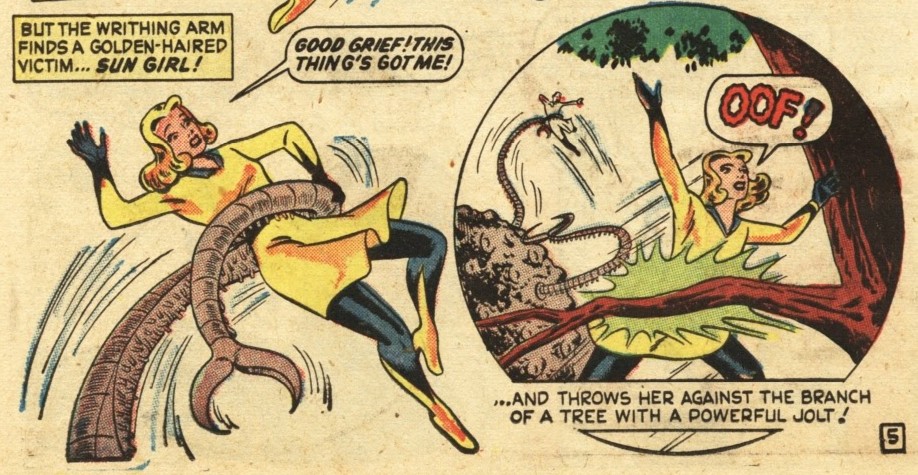
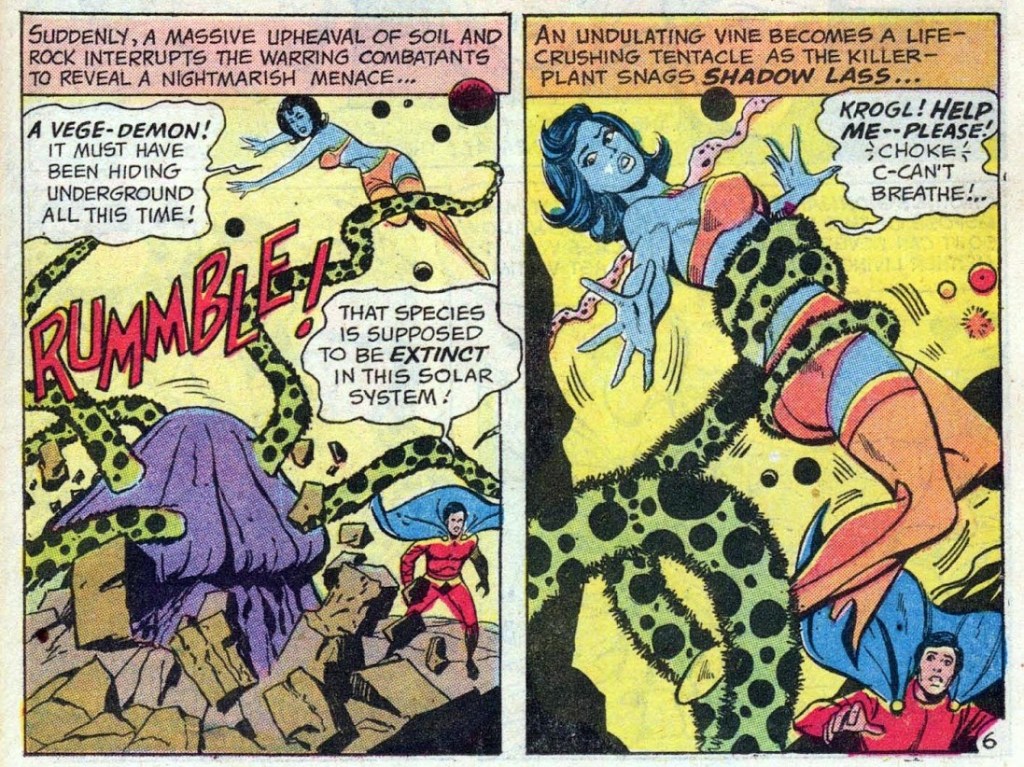
It occurs to me that I haven’t focused on the good old mademoiselle-embraced-by-tentacles cliché in a while. If today has a further theme, it’s of women (both human and alien) being grabbed by the midriff. Polka-dotted tentacles in a swamp and furry tentacles on Venus, whether they’re latching on to a humanoid woman with four breasts or a blue-skinned Talokian, all basically behave the same way.
As usual, this is a chronological progression that takes us from early Golden Age days all the way to mid flamboyant 80s.
The Robot Masters of Venus, illustrated by Max Plaisted (of Spicy Mystery fame!), was published in Exciting Comics v. 1 no. 3 (June 1940, Pines).
The Vengeance of the Space Monster!, pencilled by Ken Bald and inked by Syd Shores (both names are, however, guesses), was published in Marvel Mystery Comics no. 90 (February 1949, Atlas).
I agree that having one’s ribcage crushed does not help with breathing, but still, I am not sure why Shadow Lass is choking on the panel on the right when the vege-demon has her by the midriff.
War of the Wraith-Mates!, scripted by Cary Bates, pencilled by George Tuska and inked by Vince Colletta, was published in Superboy no. 183 (May 1972, DC).
For a little variety, I’m also including the following warrior vixen as a pleasant exception to the rule – she is not only not being grabbed, but also has an octopus for an obedient pet.
Girl on Octopus by Brian Lewis, painted sometime in the mid 1970s.
Our next stop is a proposed illustration for the 1984 movie The Warrior and the Sorceress, painted by Bob Larkin. The movie in question (which I have never seen) is apparently “noted chiefly for containing extensive nudity and violence and for being one of the more extreme examples of the sword-and-sorcery genre. It is also considered by some to be a cult classic.“
The sorceress has 4 breasts – a logistical nightmare when selecting a bikini, no doubt.
As… questionable… as this is, the illustration that was chosen in the end is in a whole other class of cheesiness. The sorceress has also died her hair blonde, presumably because she wants to have (even more) fun! We also lost the cephalopod, unfortunately, but the maxim “one can’t have everything” comes to mind – and David Carradine in a pearly loincloth is plenty.
Art by Joanne Daley, who at least makes some sort of attempt at designing a functional four-breast-bra.
After *that*, the following cover looks quite humdrum by comparison. It’s difficult to imagine how Red Sonja will extricate herself from this situation…
Red Sonja no. 5 (January 1985, Marvel). The cover is by Pat Broderick.
Incidentally, there are tons of Red Sonja cover with tentacles, mostly of recent vintage, and most of them are ugly as sin. This one is decent:
The cover art for Red Sonja no. 21 (April 2007, Dynamite). This is a variant cover by Roberto Castro.
« He was homicidal. He was a real nut, a really tooty-fruity nut… he killed for fun… now society is avenged… avenged avenged avenged… and minus expensive court costs too… » — writer-editor Al Hewetson loved ellipses
For a few years in the early 70s, longtime Atlas/Marvel production manager Sol Brodsky joined forces with canny schemer Israel Waldman in order to give monster mag publisher James Warren a good scare, and it worked. During its relatively brief existence (1970-75), brassy upstart Skywald Publications gave Warren pause and cause to nervously peer over his shoulder and strong incentive to improve his product, which was hardly at its peak in 1970.
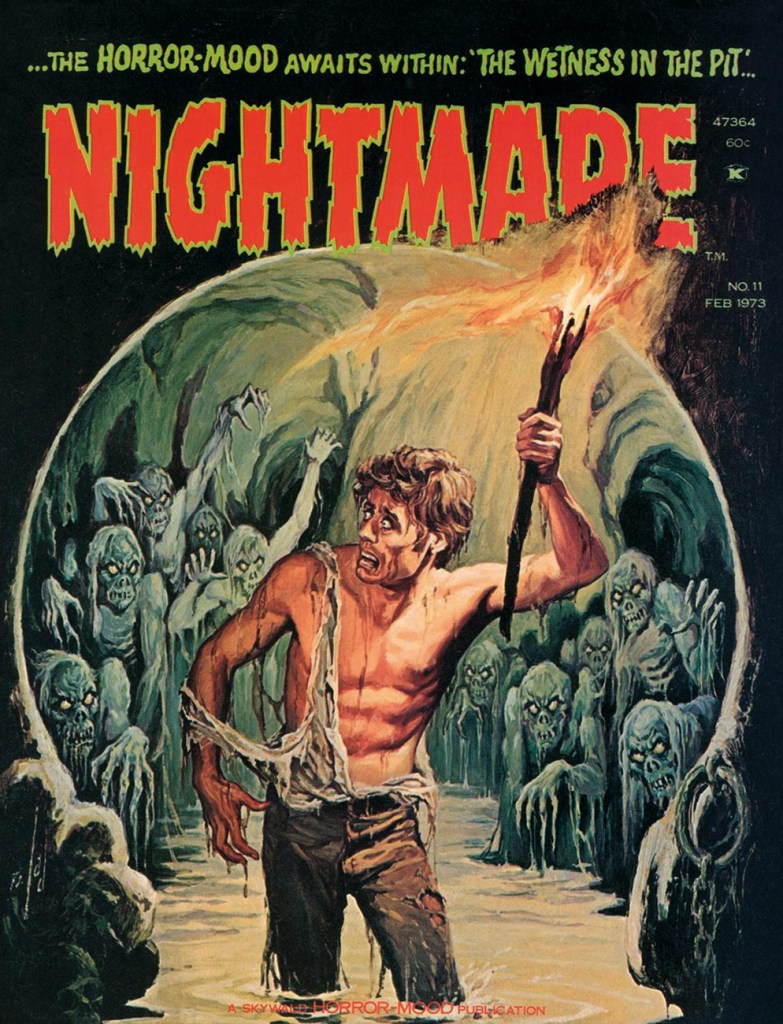
This is Nightmare no. 11 (February, 1973, Skywald). The spooky, claustrophobic cover is the brushwork of José Antonio Domingo, who also contributed a handful of painted covers to Marvel’s concurrent b&w magazine line.
By all means, do read this intriguing issue, which is available in its entirety right… here.
Oh, and why not? Here’s the finest of Domingo’s Marvel covers, à mon avis… despite the rather inept text placement.
The thing kept coming. “Die, die!” Parke screamed, his nerves breaking. But the thing came on, grinning broadly. “I like quiet protoplasm,” the thing said as its gigantic mouth converged on Parke. “But I also like lively protoplasm.” It gulped once, then drifted out the other side of the field. — excerpt from The Last Weapon by Robert Sheckley
I Am the Living Ghost!, illustrated by Steve Ditko, was published in Tales of Suspense no. 15 (Mar. 1961, Marvel). I came across a reprint of this story while looking for Draculian tentacles (which you can see in Tentacle Tuesday: Dracula Drops In).
Call it goo, label it as a giant amoeba, christen it ectoplasm or protoplasm, but when it starts crawling your way, do remember to beat a hasty retreat.
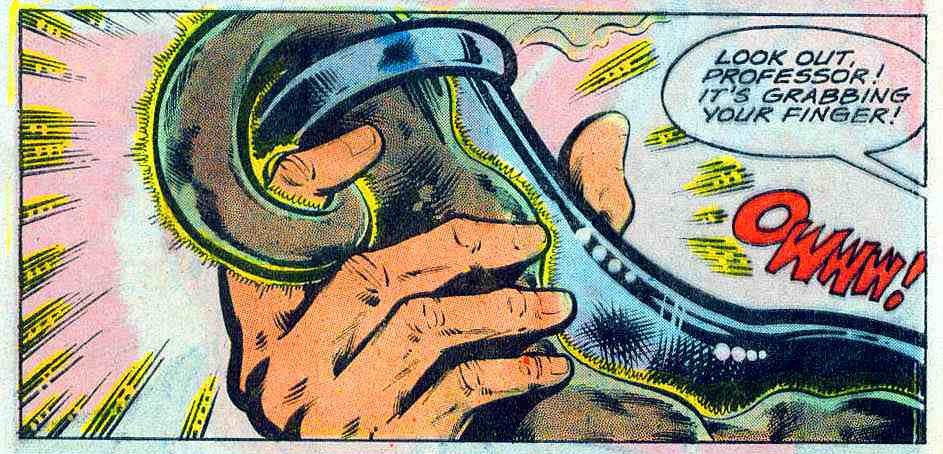
Oh, yeah, and keep your fingers away from it, too.
Coo! this page has everything: a prehensile amoeba, tentacled plants, aliens with cephalopod appendages…
Spawn of Venus was scripted by Bill Gaines and Al Feldstein, and illustrated by the latter. It was published in Weird Science no. 6 (Mar.-Apr. 1951, EC).
… but it’s the amoeba that’s of current interest to us (yes, the one devouring everything in its path, including dawdling professors).
Continuing our literary delusions, a peek at the adventures of a ‘star vampire’, from a (somewhat lackluster) comic book adaptation of a Robert Bloch short story:
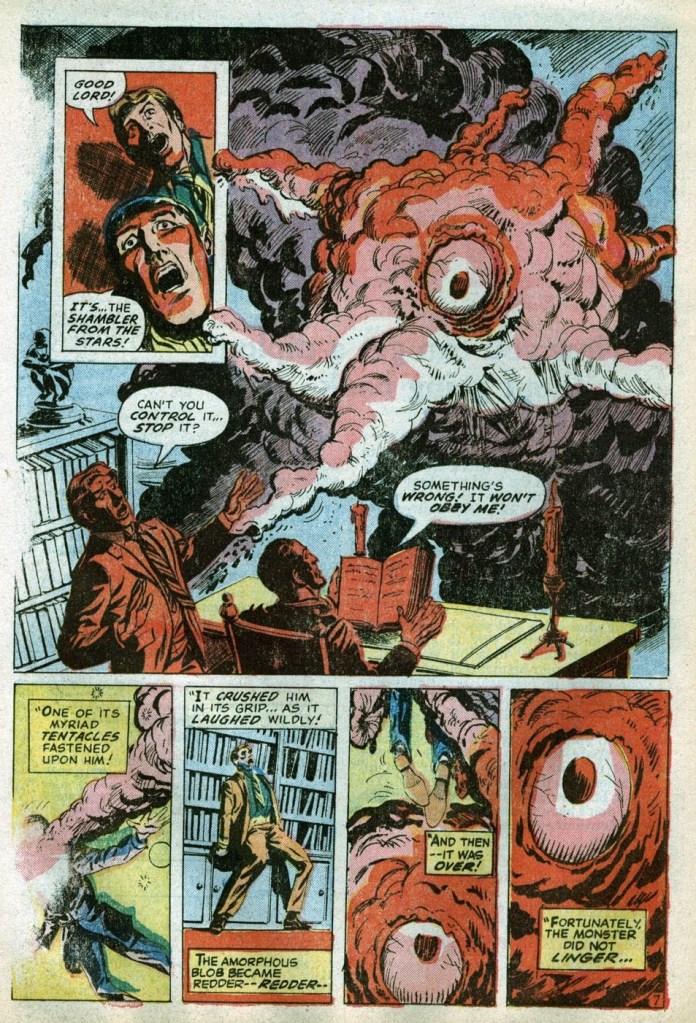
The Shambler from the Stars!, based on a story by Robert Bloch, was adapted by Ron Goulart, pencilled by Jim Starlin and inked by Tom Palmer. It was published in Journey into Mystery no. 2 (Feb. 1973, Marvel). An amorphous red blob is not a dog to be ordered around, which explains the poor results.
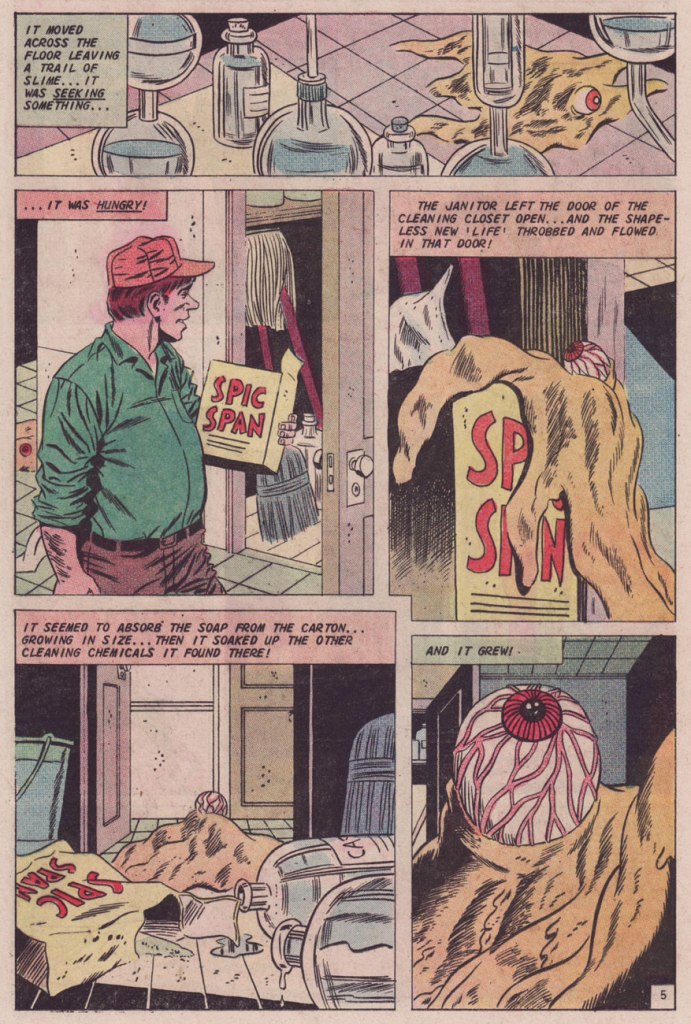
If a tentacled amoeba is scary, just think of how startling it is to run into an amoeba with a single bloodshot eyeball (that feeds on soap, among other things).
A page from Creator of Life, published in Ghost Manor no. 11 (Apr. 1973, Charlton). This story was written by Joe Gill and illustrated by Charles Nicholas and Wayne Howard.
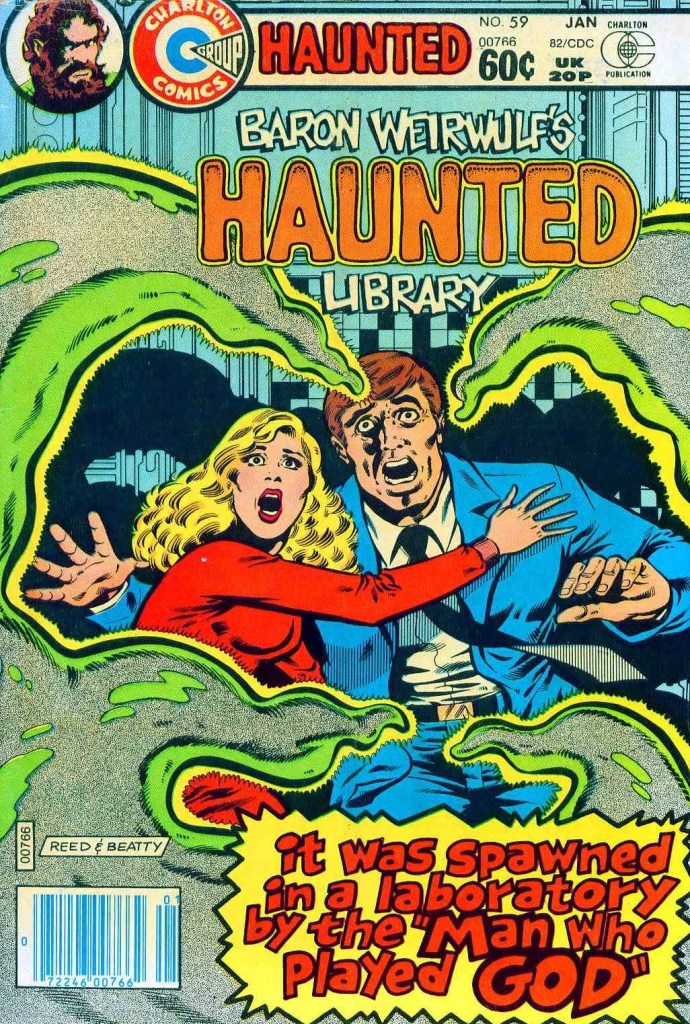
An eyeball in a turtleneck! Scary stuff.
Haunted no. 59 (January 1982), pencilled by Dan Reed and inked by John Beatty.
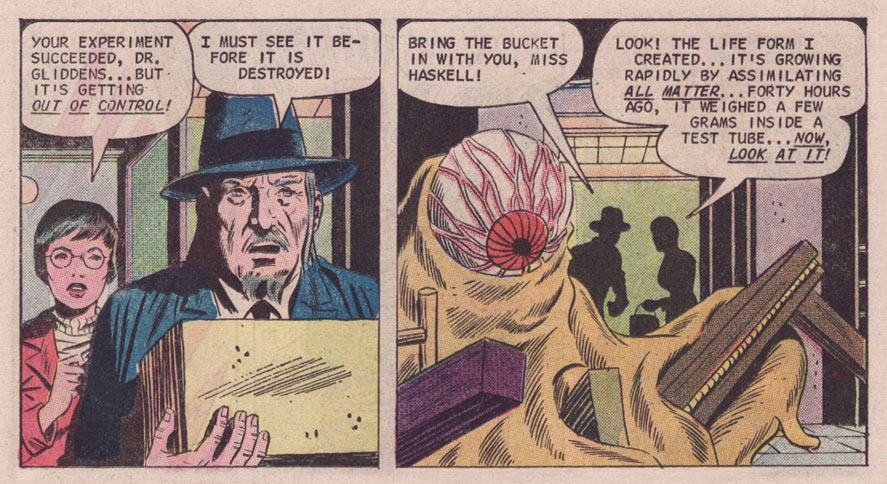
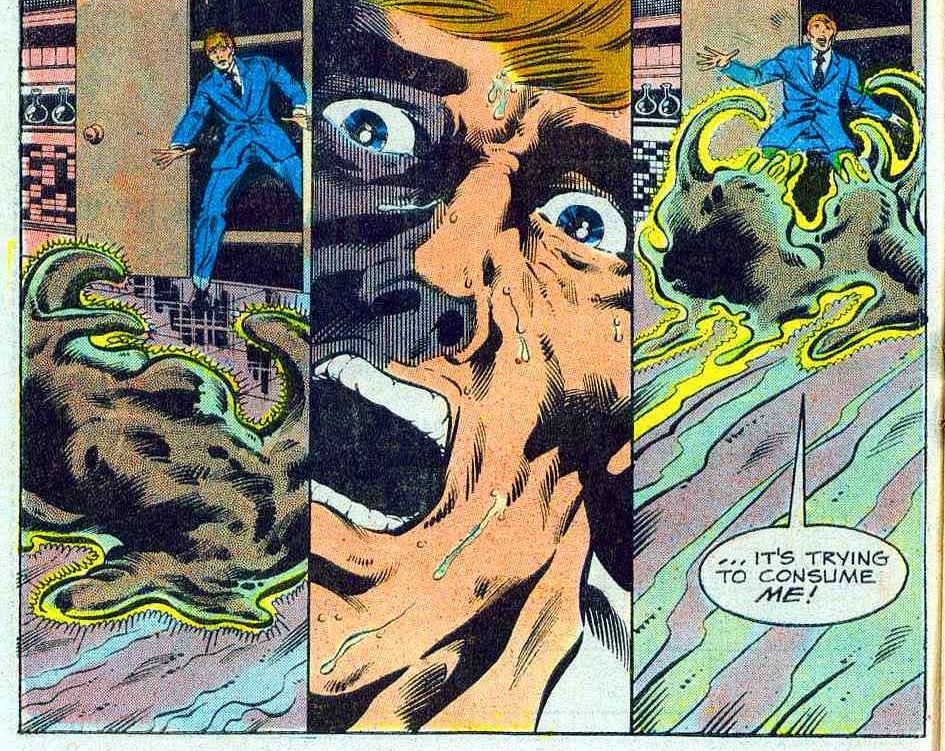
Not only does this monstrosity go after the scientist, instead of pursuing his absurdly attractive assistant…
The Man Who Played God was scripted by Joe Gill (again), pencilled by Dan Reed and inked by John Beatty.
But she’s also the one who saves the situation. Joe Gill, ladies and gentlemen!
I love his tough-guy stance at the end. He surely would have punched the amoeba out, if only the meddling female hadn’t interfered!
« The tentacles of my followers shall seek you out and destroy your swiftly! »
If you like joyous nonsense, this post is for you! As if humanity wasn’t besieged enough by actual cephalopods, evil-but-brilliant minds insist on creating machines with tentacles to horrify and maim. Pain to some, amusement for us!
First, some definite eye candy. The following story is not only convincingly illustrated, but also makes some sense on a scientific basis. The Menace of the Mechanical Octopus was scripted by Ed Herron, and pencilled and inked by Jack Kirby. It was published in Word’s Finest Comics no. 97 (October 1958).
Now we move on to that goofy-yet-fun series, DC’s House of Mystery. I will readily admit that I’m not always a fan. At worst, some of the stories published within its pages have plots so random that amusement becomes irritated incredulity. But keep an open mind, and there are also very creative (sometimes “were these people on drugs?” creative) plots to be enjoyed and great art to be relished.
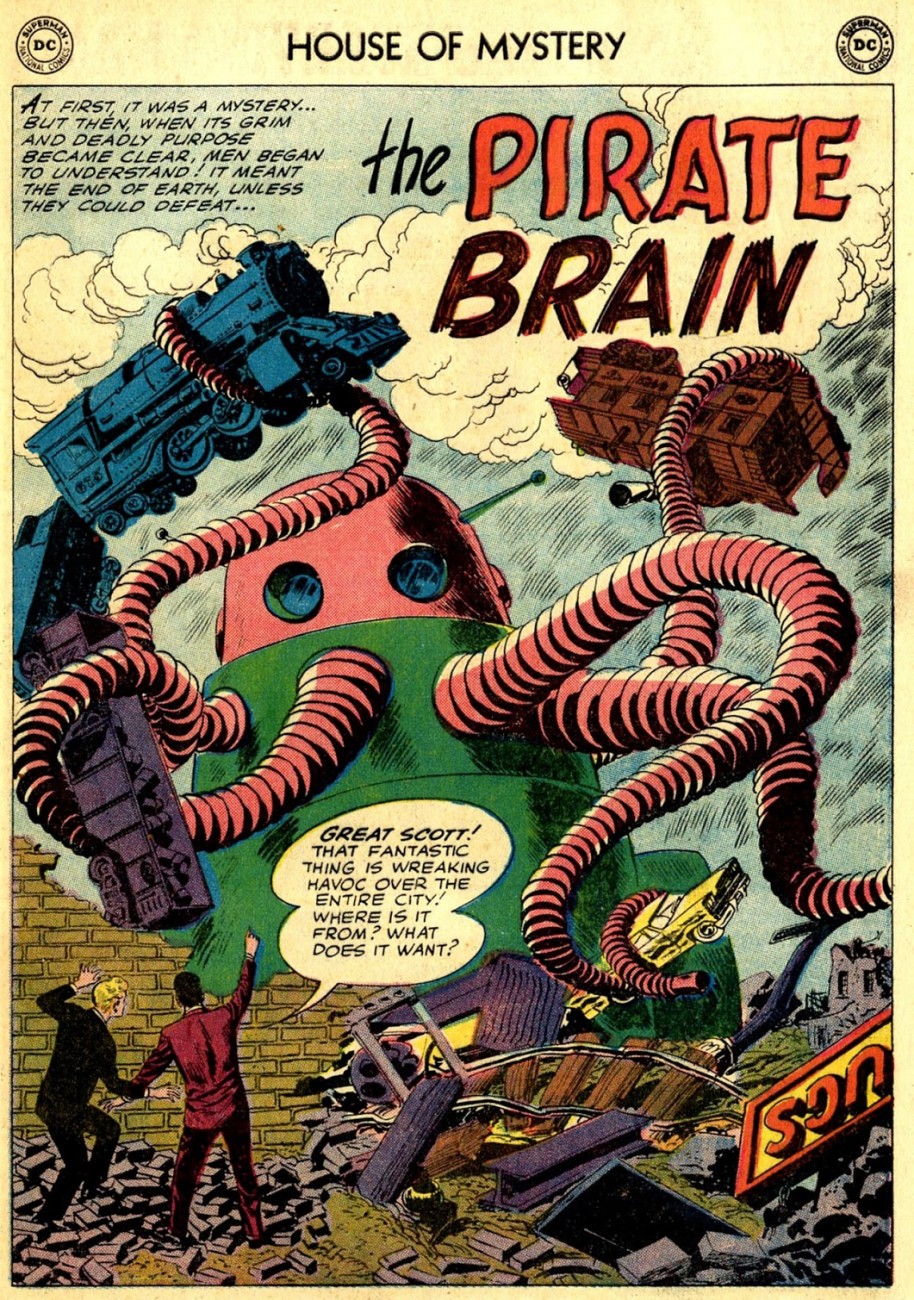
House of Mystery no. 96 (March 1960), cover is pencilled by Dick Dillin and inked by Sheldon Moldoff.
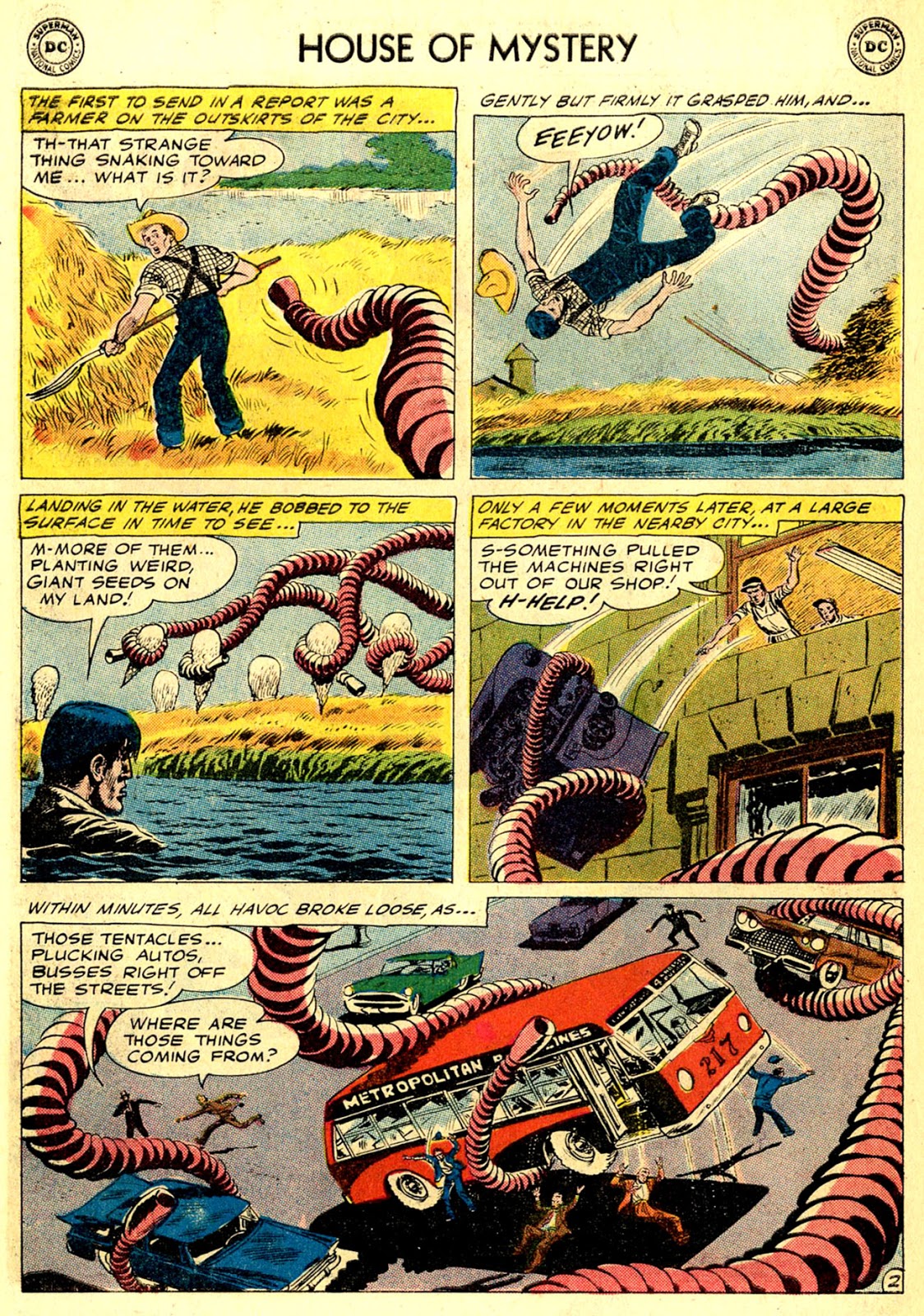
The cover story, The Pirate Brain, was illustrated by Lee Elias:
The ‘weird, giant seeds’ look remarkably like ice cream cones.
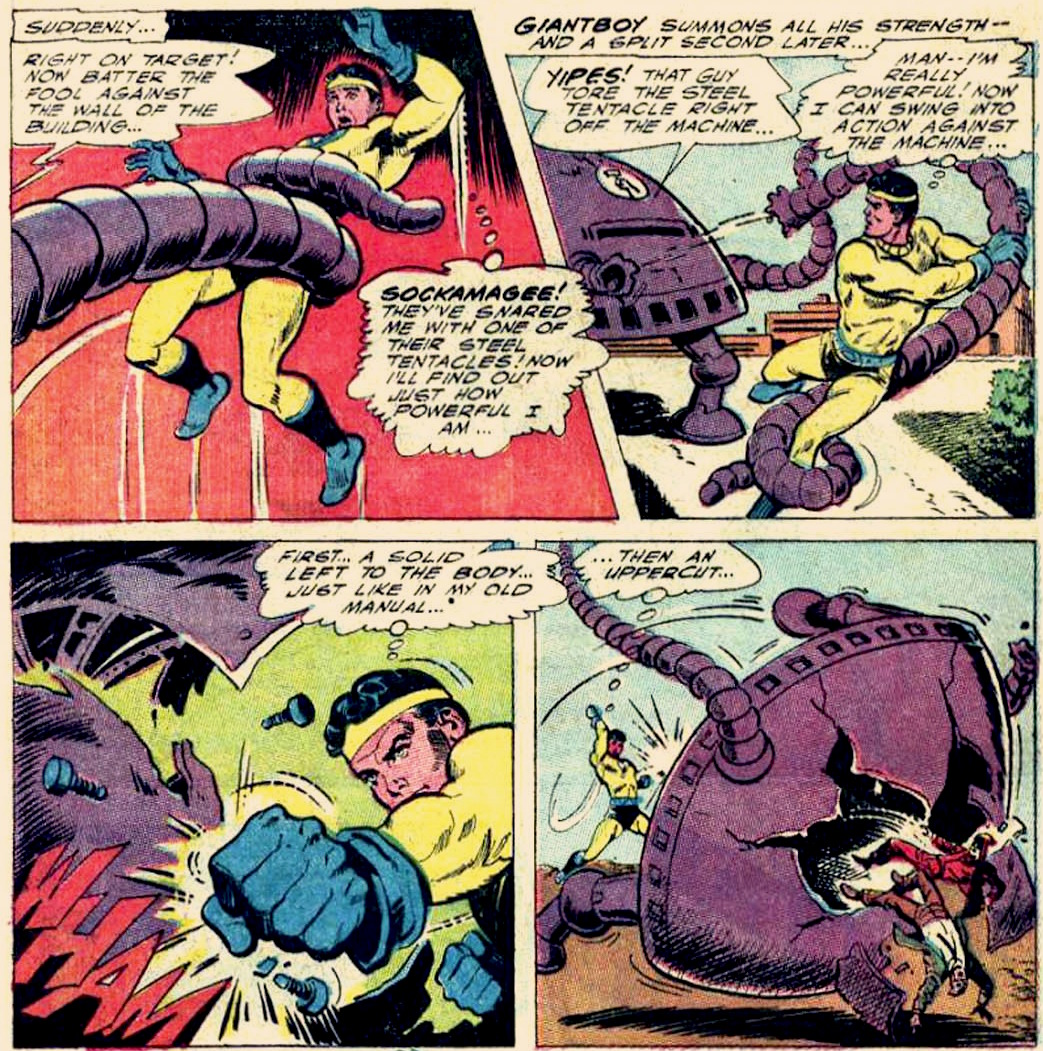
Our next stop concerns Robby Reed, the original owner of the Dial H for Hero gizmo, and his epic (of course) battle with… well, a whole bunch of villains. House of Mystery no. 156 (January 1966) is where he made his début, transforming into the Cometeer, Giantboy and the Mole. So many adventures, all in one (half) issue! This story was scripted by Dan Wood and illustrated byJim Mooney:
From Giantboy we move on to Colossal Boy, more precisely to Colossal Boy’s One-Man War, scripted by Jerry Siegel, pencilled byCurt Swan, and inked by Sheldon Moldoff. It was published in Adventure Comics no. 341 (February 1966).
A story in which everybody talks way too much, and only in clichés.
Skipping ten years ahead, we end up in Marvel territory –
Amazing Adventures no. 31 (July 1975). The cover is by PhilipCraig Russell with modifications by John Romita; lettering by Gaspar Saladino.
The cover story, The Day the Monuments Shattered, is scripted by Don McGregor and illustrated by Russell:
Not Russell’s best work, I think we can safely say.
As a final note, here are some indubitably mechanical, yet not-quite-tentacles – a worthy addition to this post, as far as I’m concerned.
Challengers of the Unknown no. 11 (Dec 1959 – Jan 1960). Cover by Bob Brown, with colours and grey tones by Jack Adler. I love the perturbed flying dinosaur, whose hooves suggest that he has some cow ancestors.
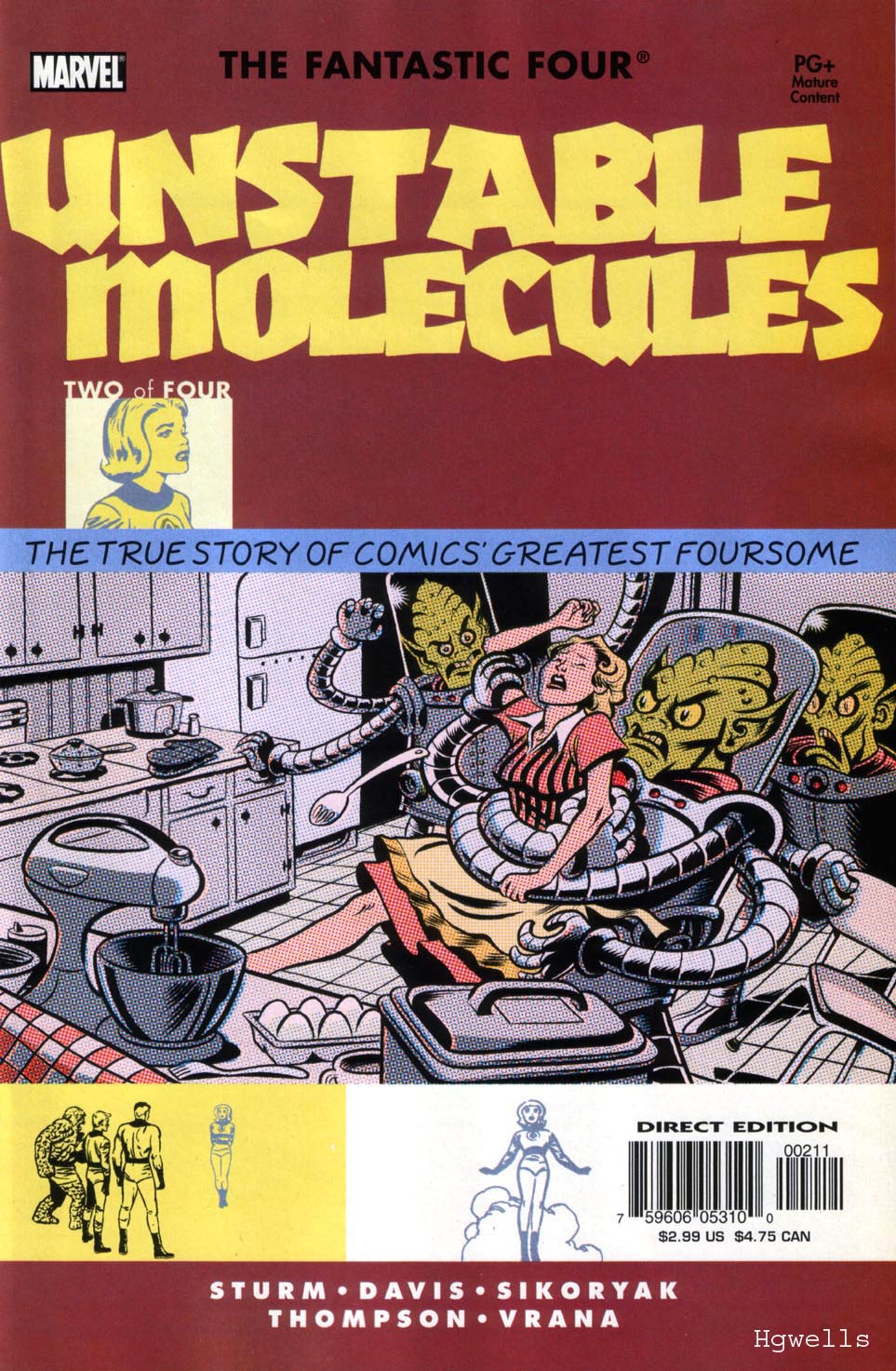
Startling Stories: Fantastic Four – Unstable Molecules no. 2 (April 2003). The cover is by Craig Thompson.
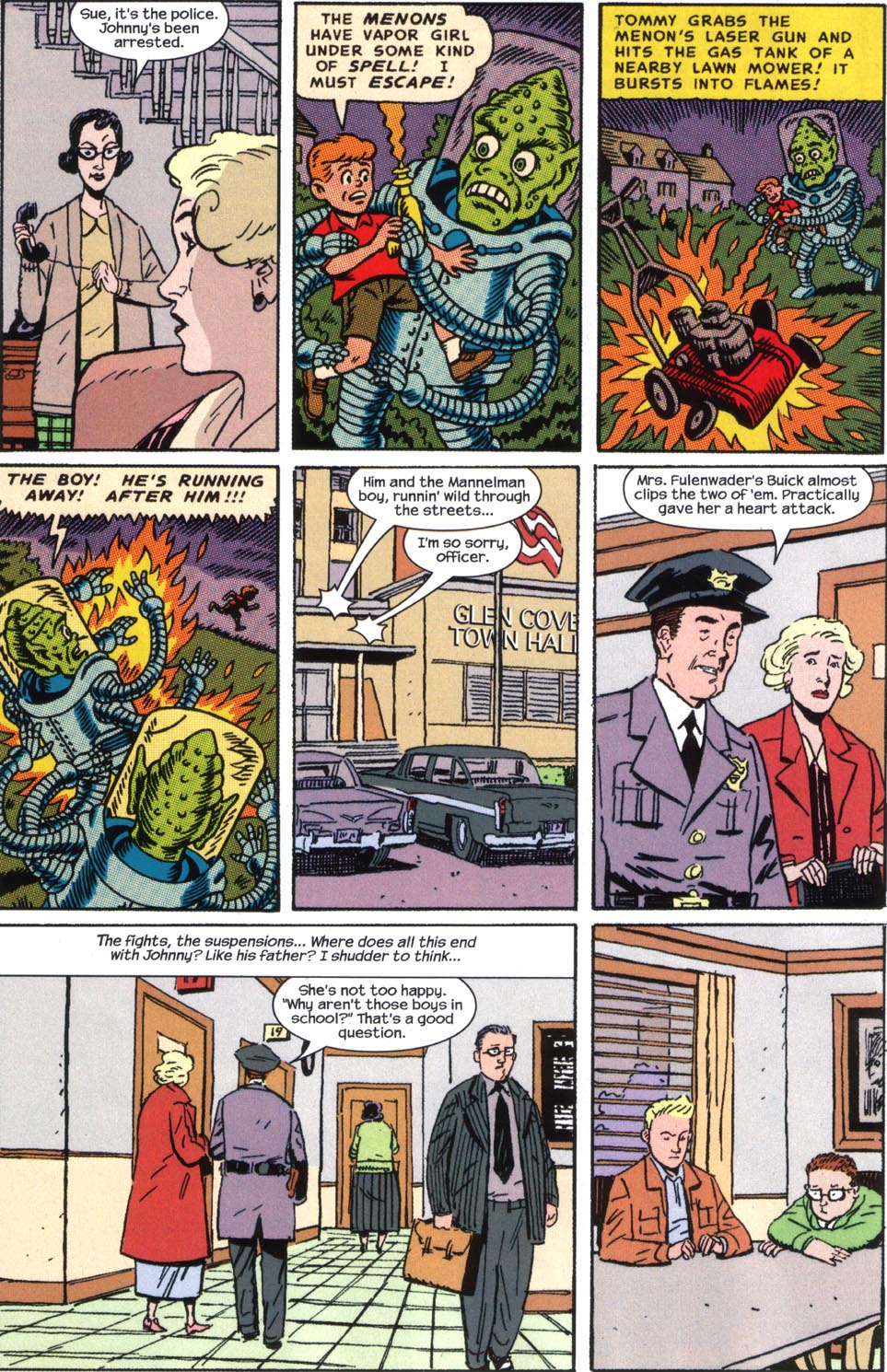
Disappearing Acts is scripted byJames Sturm and illustrated byGuy Davis with assistance from James Sturm. The Vapor Girl insertions (imaginary alien escapades) are by Robert Sikoryak.
It’s difficult to impress me with a magician, unless we’re talking real-life magicians with a strong skeptical streak, like James Randi or Ricky Jay. Given that the concept of a person who has access to ‘mystical’ forces and who can manipulate beings (supernatural or otherwise) has been around for as long as humans have been able to communicate with one another, be it through grunts and squeals, it’s pretty damn difficult to come up with a new wrinkle to this old tired nag. Having no previous experience with the series, I had no high expectations for Steve Ditko‘s Doctor Strange, but I was pleasantly surprised. I liked the earnest, solemn Dr. Strange from the beginning, but it’s Ditko’s mind-boggling, soaring surrealistic landscapes that bloomed over time that really impressed me. It’s not an easy feat to make the reader feel like he’s being transported into another dimension, but Ditko pulled it off beautifully, making us feel Dr. Strange’s disorientation as he gets sucked into yet another psychedelic terrain.
The Dr. Strange stories of the 1960s constructed a cohesive cosmology that would have thrilled any self-respecting theosophist. College students, minds freshly opened by psychedelic experiences and Eastern mysticism, read Ditko’s Dr. Strange stories with the belief of a recent Hare Krishna convert. Meaning was everywhere, and readers analyzed the Dr. Strange stories for their relationship to Egyptian myths, Sumerian gods, and Jungian archetypes.
What does this have to do with the current post? Precious little, actually. I’m a firm believer of not recycling dramatis personae past their due by date (defined, of course, as that time when their creator/author moves on to greener pastures, by design or because he has to). Doctor Strange moulded by other hands loses his raison d’être and becomes just another Joe in a funny cape, uttering ineffable, paranormal gobbledygook. Oh, sure, he’s aided by more mystical artifacts than before. How exciting… if you are excited by gadgets and gimmicks, that is.
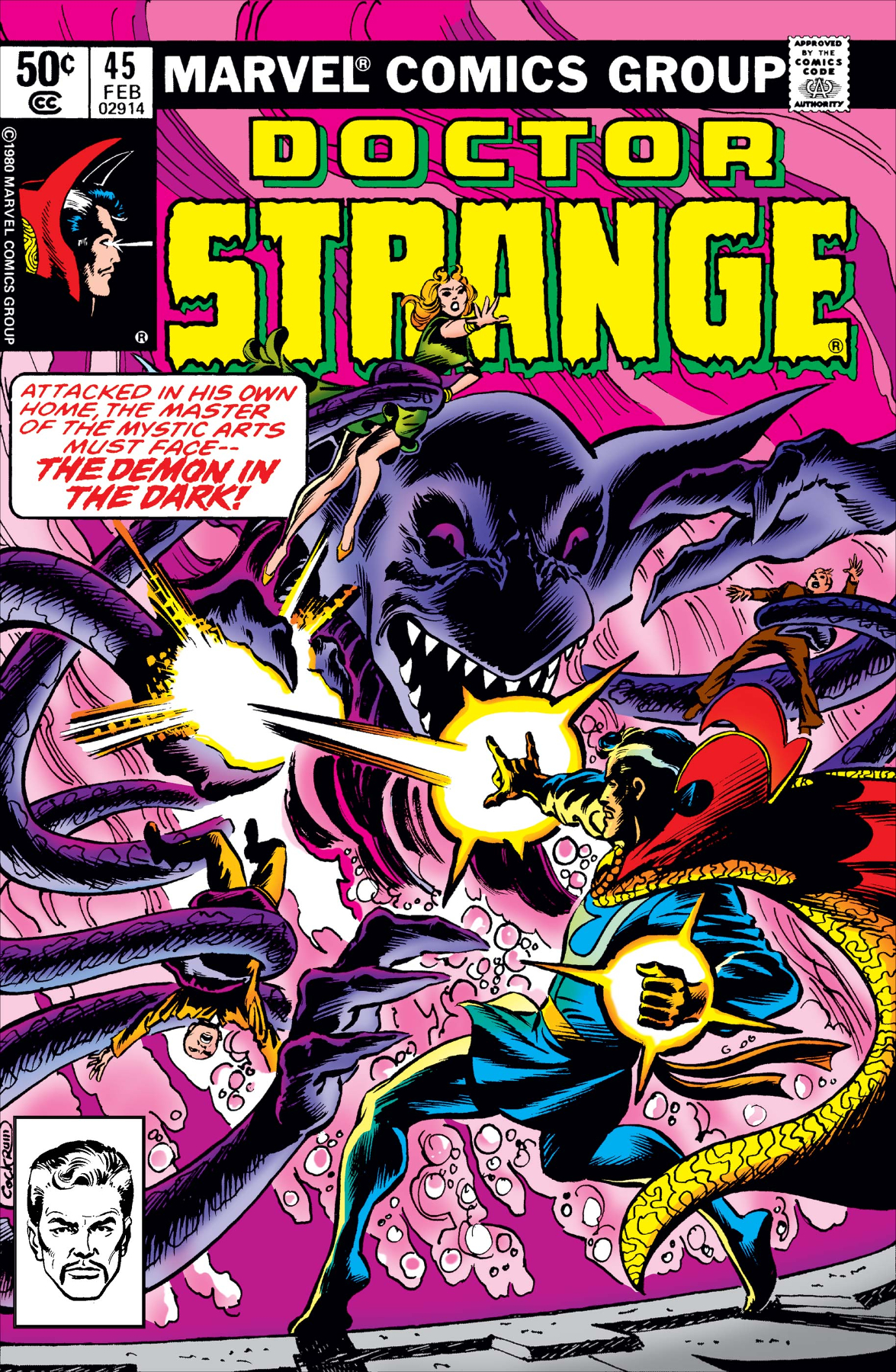
He also encounters a lot of tentacles, apparently the most mystical, otherworldly apparitions *this* crew could think of. Welcome to 70’s (for the most part) Doctor Strange!
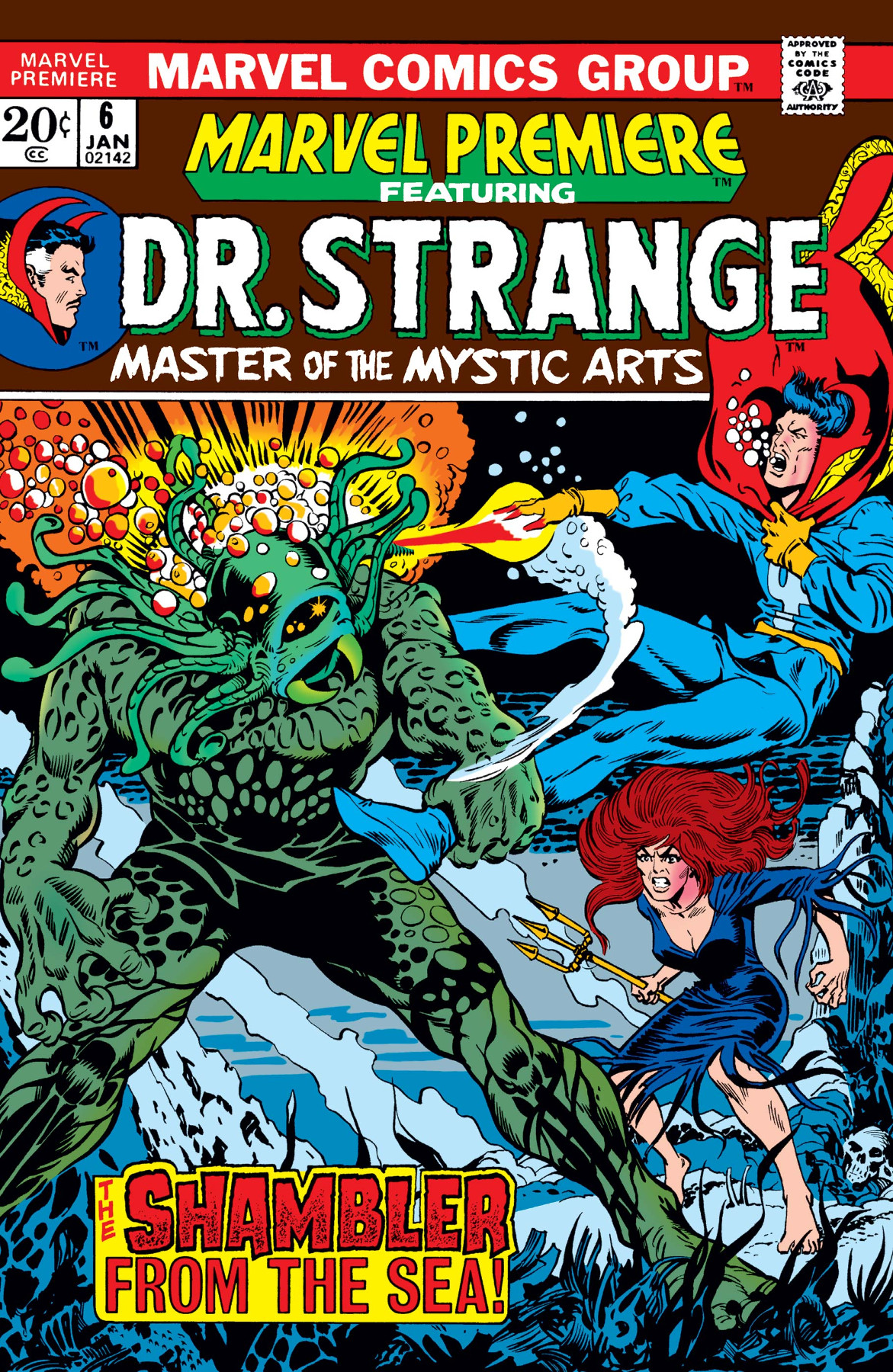
Marvel Premiere no. 6 (January 1973). Cover by Mike Ploog and Frank Giacoia.
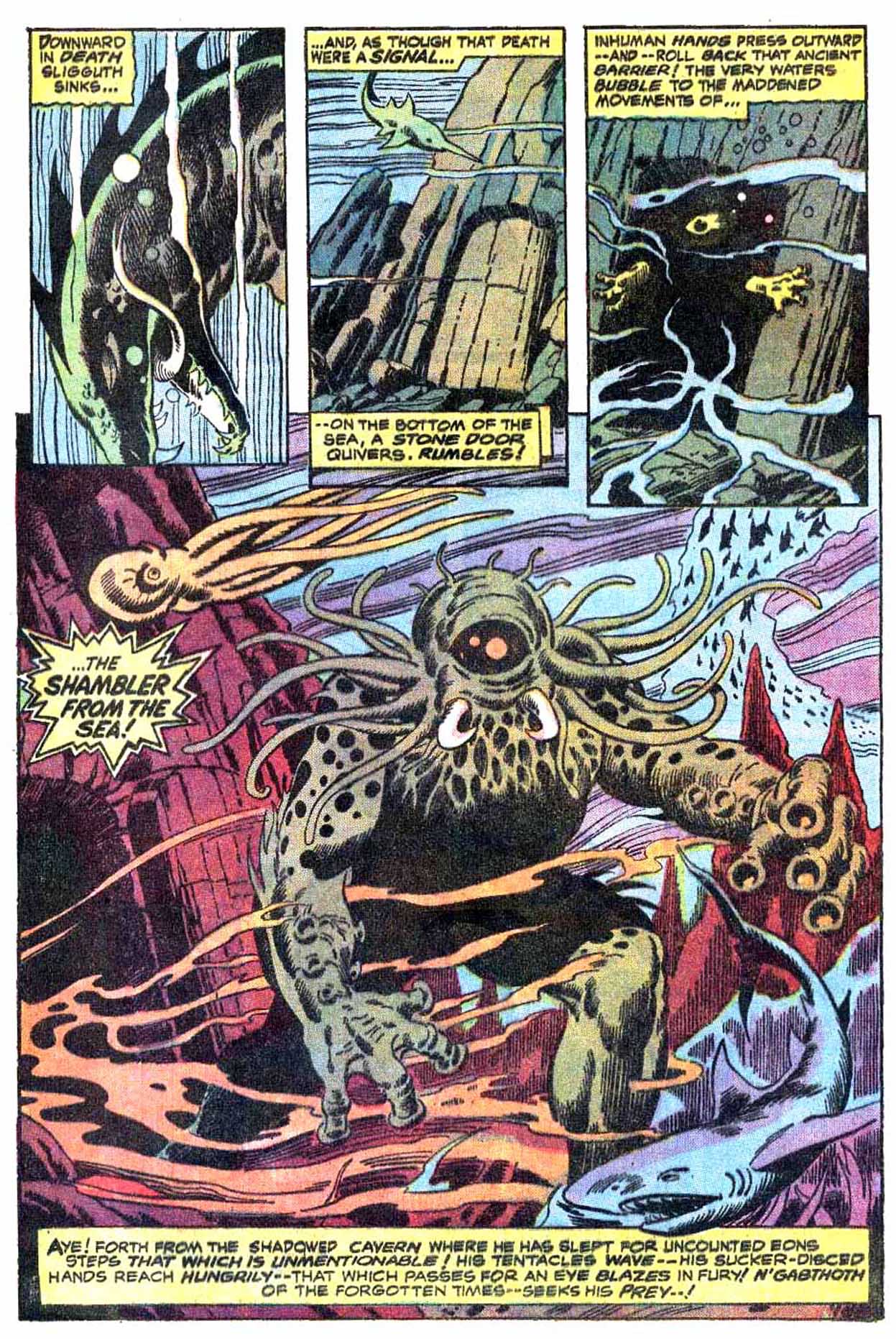
The Shambler from the Sea is scripted by Gardner Fox, pencilled by Frank Brunner, and inked by Sal Buscema and Ralph Reese:
Dr. Strange no. 1 (June 1974). Cover by Frank Brunner.
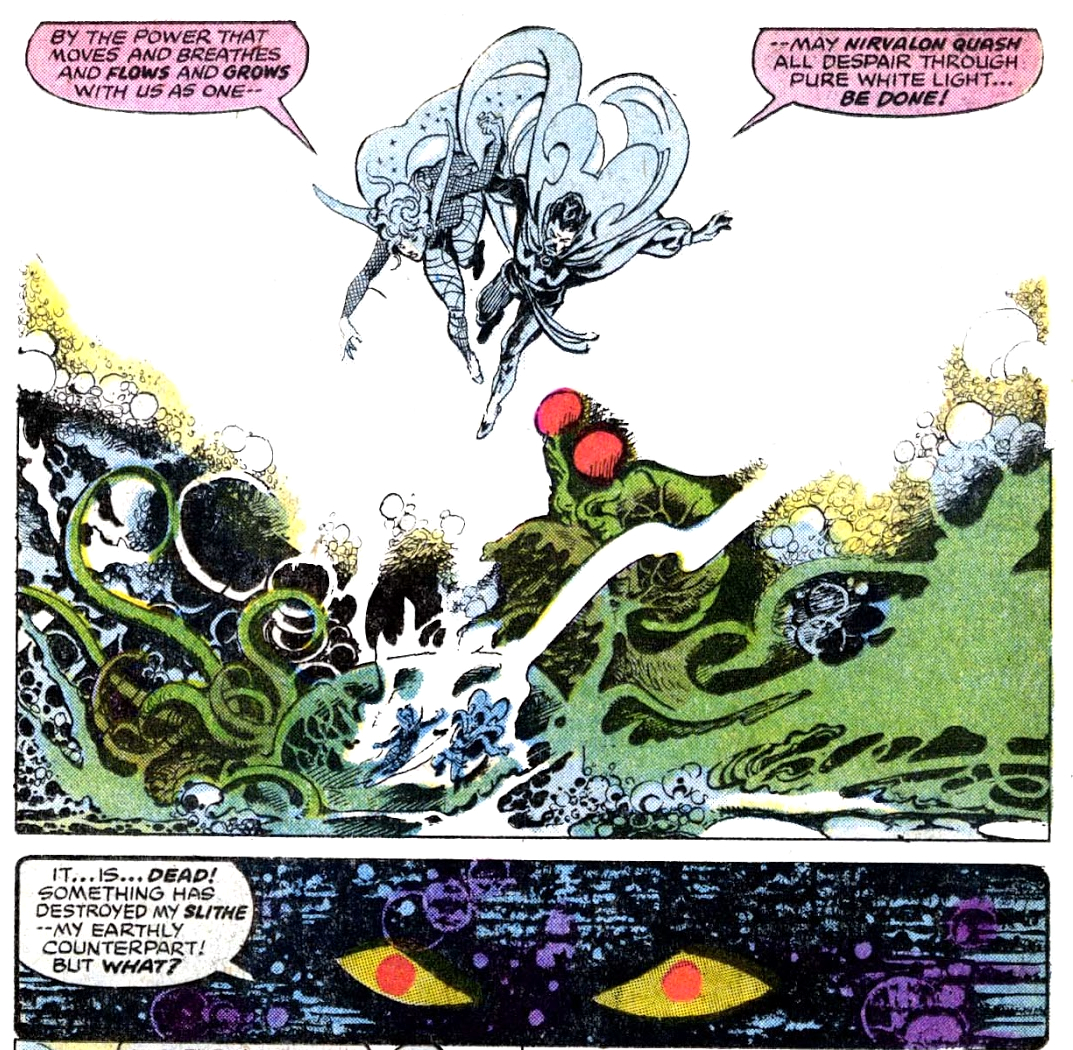
Through an Orb Darkly is scripted by Steve Englehart and Frank Brunner, pencilled by Frank Brunner and inked by Dick Giordano:
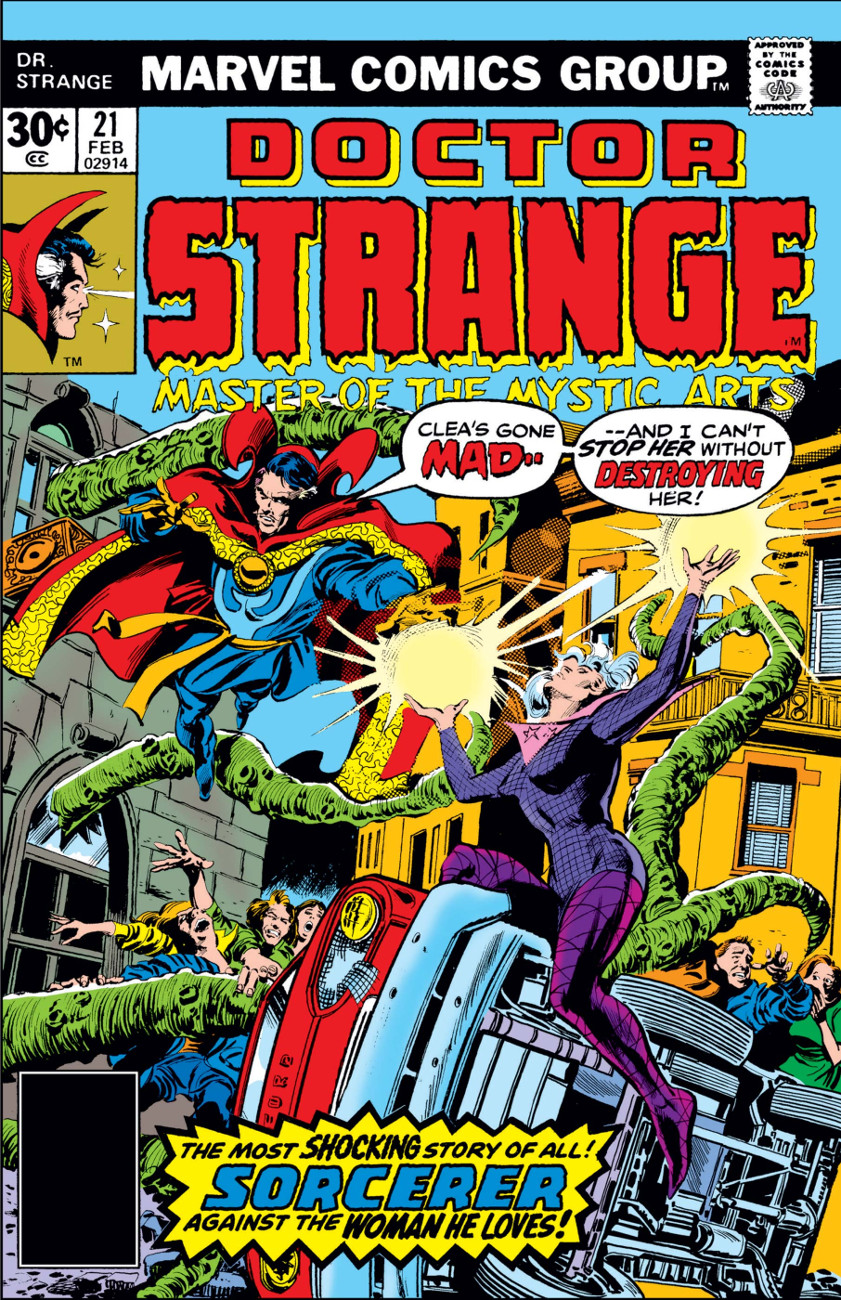
Doctor Strange no. 21 (February 1977). Cover pencilled by Gene Colan and inked by Tom Palmer. Is Clea basically humping the (impeccably, gleaming clean) side of the car, basically?
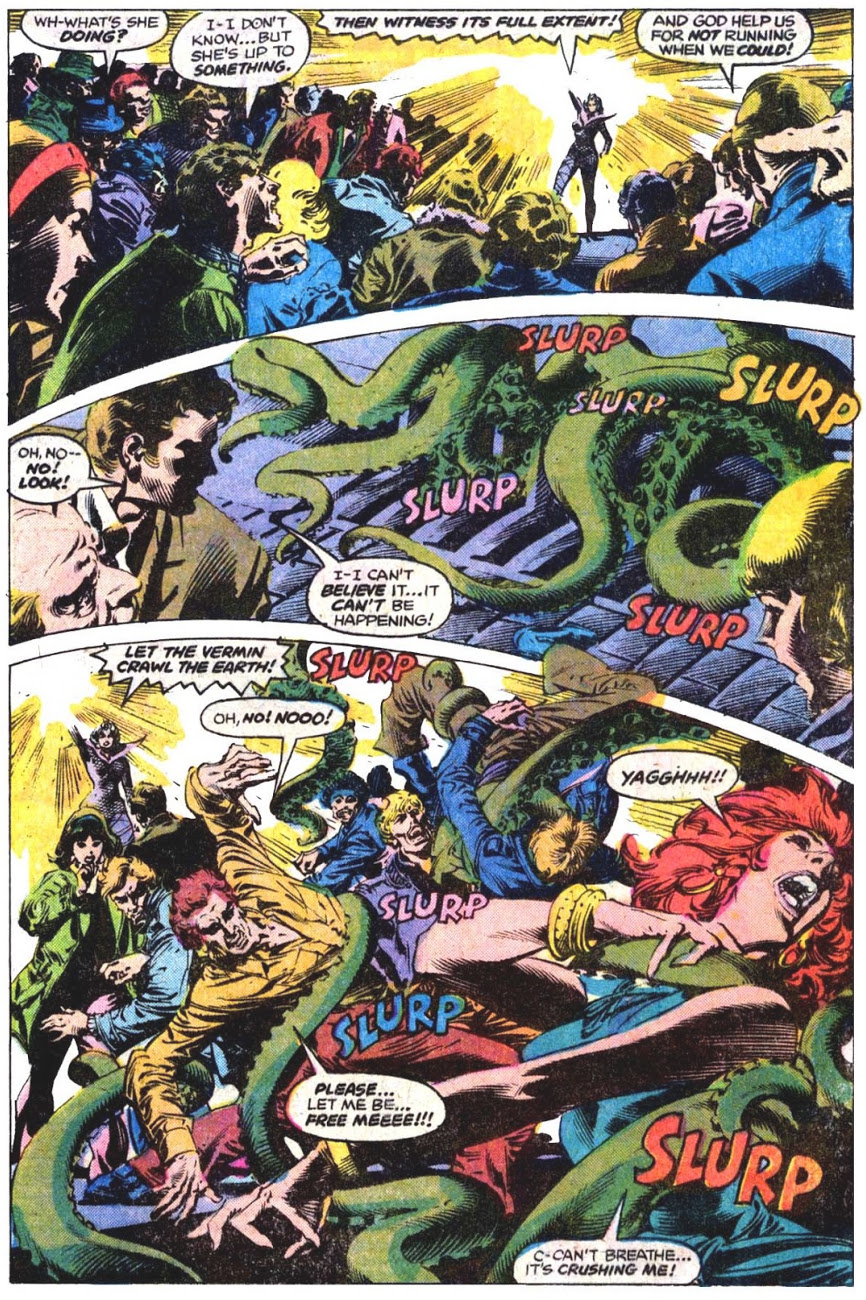
Mind Trip!, scripted by Marv Wolfman and drawn by Rudy Nebres, was published in Doctor Strange no. 22 (April 1977):
That’s quite a group scene *slurp slurp slurp*
“Why does your image haunt me? Why are my boobs perkily gravitating towards the light?” I can’t even muster a passing interest in figuring out what’s happening in this mess.
Doctor Strange no. 23 (June 1977). Cover pencilled by Gene Colan and inked by Tom Palmer.
Doctor Strange no. 30 (August 1978). Cover by Frank Brunner.
A Gathering of Fear! is scripted by Roger Stern and illustrated by Tom Sutton:






































 Who's Out There?