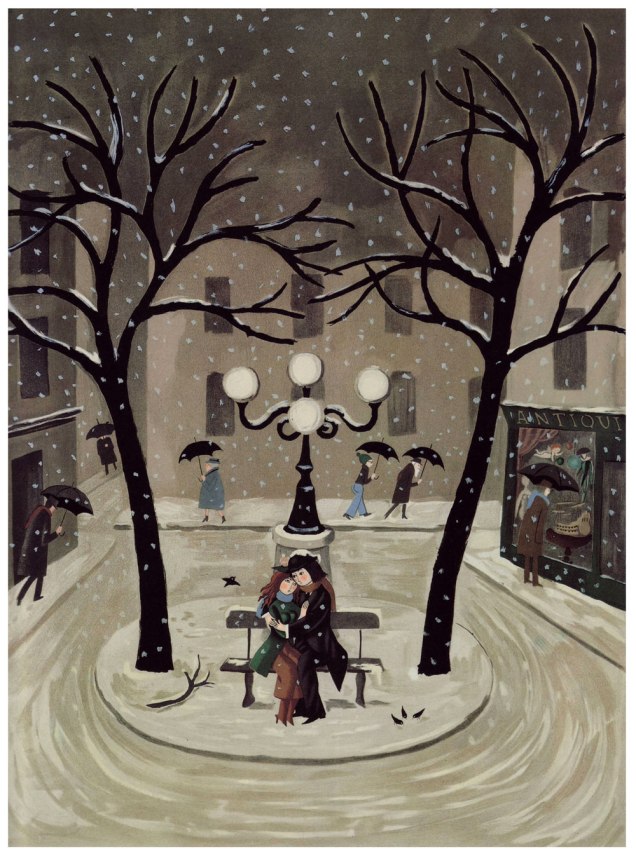
Les amoureux de Raymond Peynet

« It is through his creation that the artist translates most certainly the man. Elegance of line, subtlety of colour, freshness of inspiration, modesty of feelings without ever falling into mushiness, Peynet is the antidote of all that pollutes our spirits today. He offers to us the key, key to the enchanted world where he catches in his nets that which we strive to destroy. » — Max Favalelli

Hello again! I’d been considering devoting a post to Raymond Peynet (1908-1999) for some time, but I realised at some point that this was another textbook case of ‘The tip of the iceberg‘; sure, I’d seen his Les amoureux cartoons in most of my newer issues of Le rire — which is to say issues in the merely sixty to eighty years old range — but the tiniest modicum of research revealed an impressively sustained worldview, some rather breathtaking bits of mass-marketing, and, most significantly, consistent quality and conceptual integrity.

This topic, obviously, would have made for an ideal Valentine’s Day post, but since I was out of town on family business on that day, and, more pointedly, we don’t really feel the need to mark that random occasion, it didn’t happen. And yet here we are… one month later to the day.

Having done my homework, I now present to you Mr. Peynet and his ‘amoureux’, immortalised through some six thousand drawings, but also four (!) museums — two in France, and two in Japan, a a life-size bronze statue in Hiroshima’s Peace Memorial Park, some 250 distinct models of latex dolls, several postage stamps, posters, champagne bottle labels… you name it.

Obviously, I’m just scratching the surface. But since Peynet-mania seems to have largely skipped over North America, this might prove a useful, if belated, introduction.
« I will give you my flu, you will give me your bronchitis… we will share the medication. » A lithograph created between 1970 and 1986 for Éditions Les Maîtres contemporains.
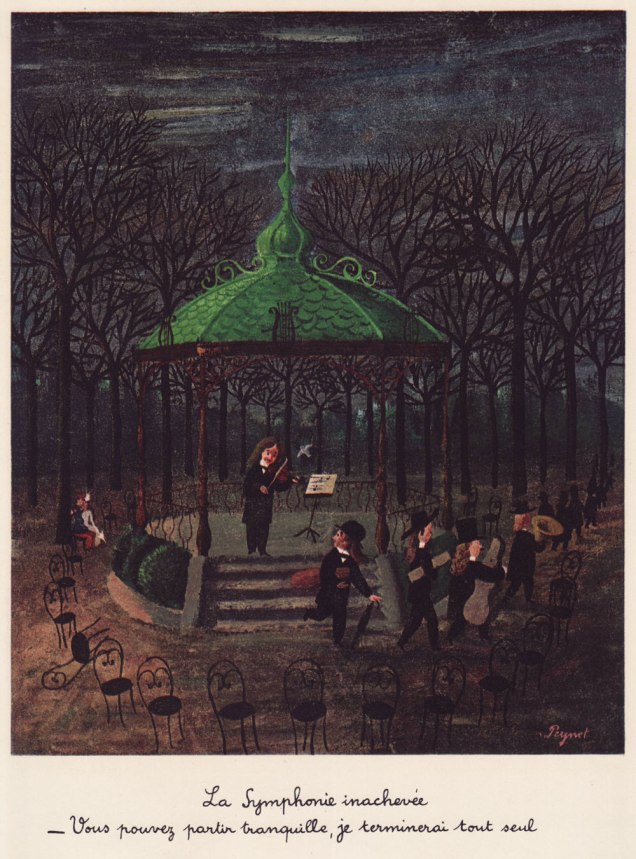
The Unfinished Symphony: « Don’t worry, you may leave, I’ll finish it by myself. » (Limited edition litograph, 1943). This is how it all began for Peynet. Here’s the whole story of the time and place, clumsily — but charmingly — translated.
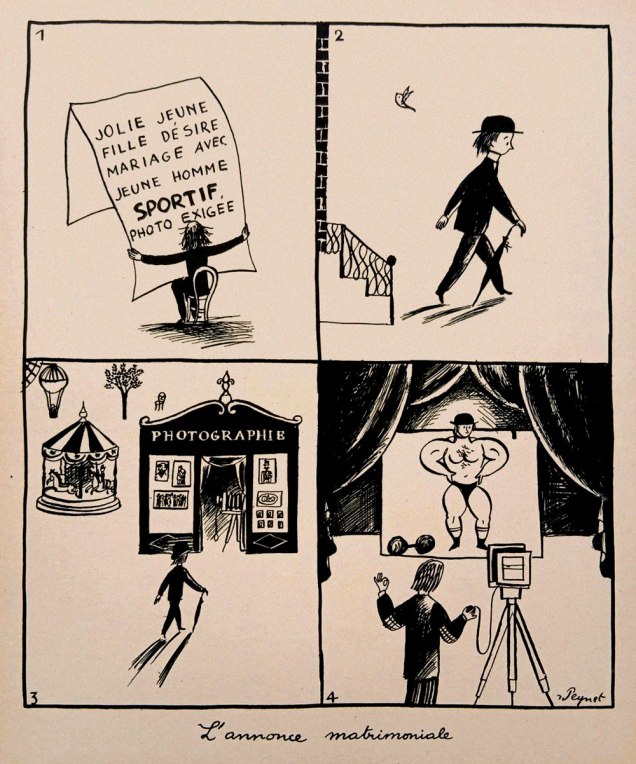
The Marriage Ad: « Pretty young lady seeks marriage with athletic young man, photo required. » I doubt that Richard Sala ever encountered Peynet’s work, but I can’t help but find that this particular piece prefigures his style somewhat.
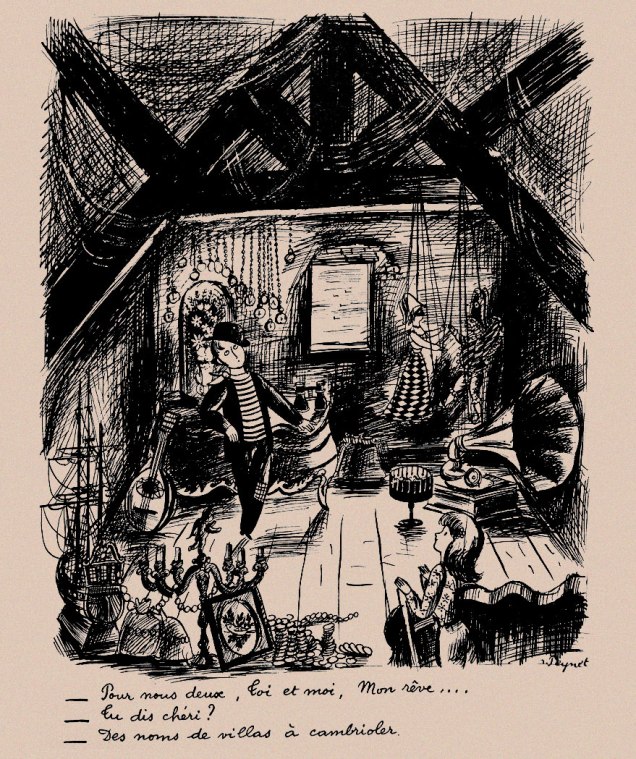
« –– For Us Two, You and I, My Dream… » « — I beg your pardon, darling? » « These are names of villas to burgle. »
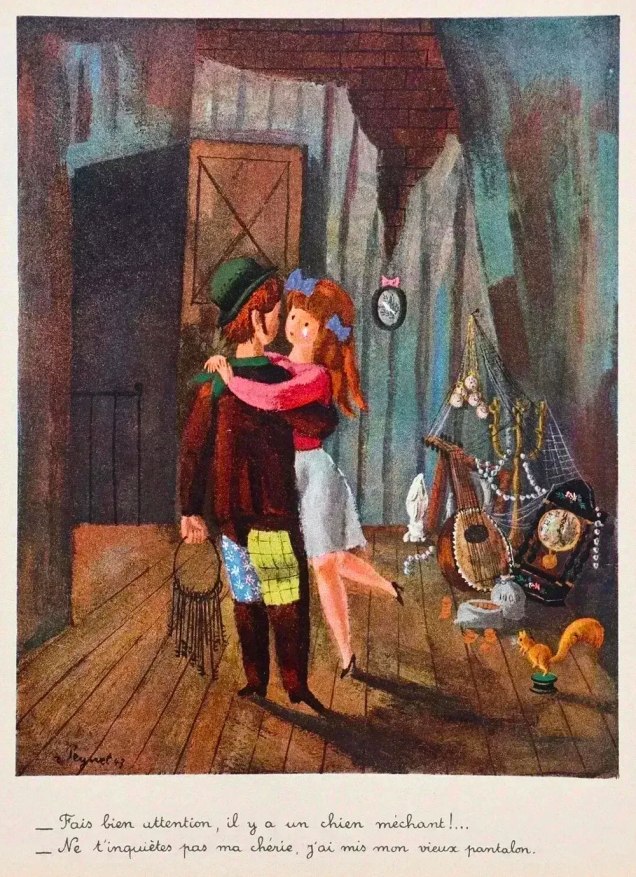
« — Be very careful, there’s a mean dog! » « — Don’t worry, my love, I’m wearing my oldest pair of pants. » (Limited edition litograph, 1943)
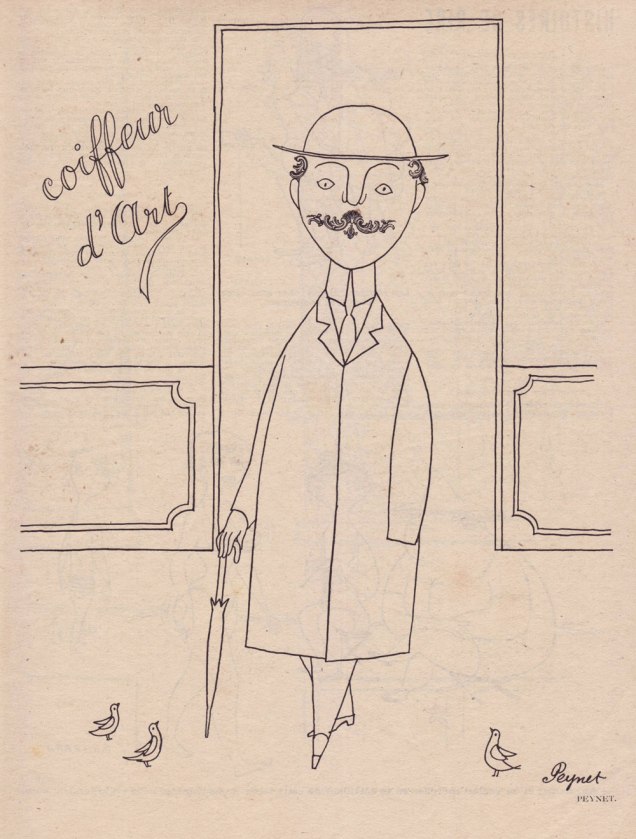
« The Artistic coiffeur ». From Le rire no. 22 (nouvelle série), July, 1953. Shades of the influential Saul Steinberg, which I *will* have to write about at some point.
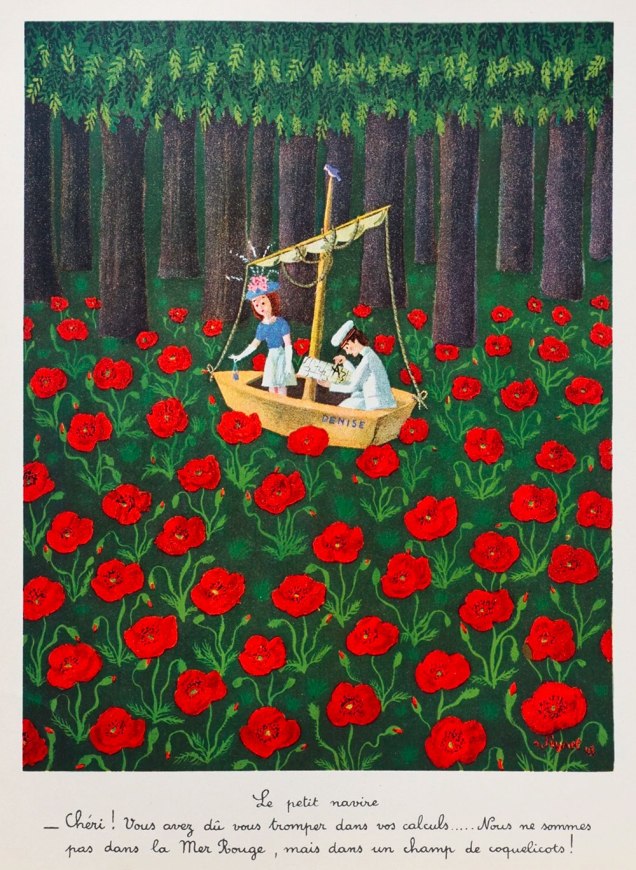
The Little Ship: « Darling! You must have erred in your calculations… we aren’t on the Red Sea, but rather in a field of poppies! » (Limited edition litograph, 1943).
« — You’re not accompanying him through his dreams? » « — Never on Sundays, I’ve too much to do around the house. »
« — No other lovers love each other as much as we do. » « — Well… take a look at these two below… » Lithograph created between 1970 and 1986 for Éditions Les Maîtres contemporains.
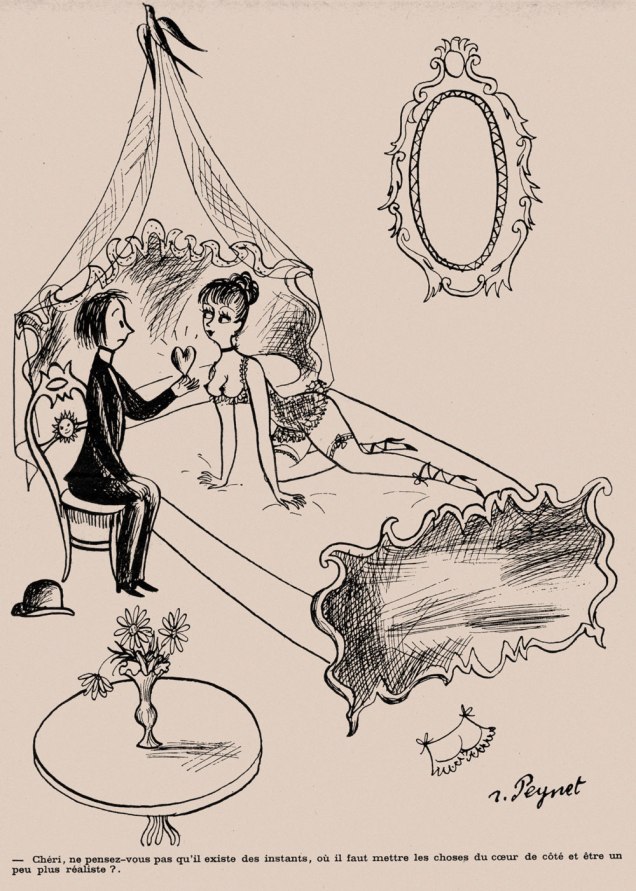
« Dearest, don’t you think that there are times when one must set aside things of the heart and be more down to earth? » From Le rire no. 26 (nouvelle série), Feb. 1948. Even back in the 1940s, it wasn’t all chaste naïveté.
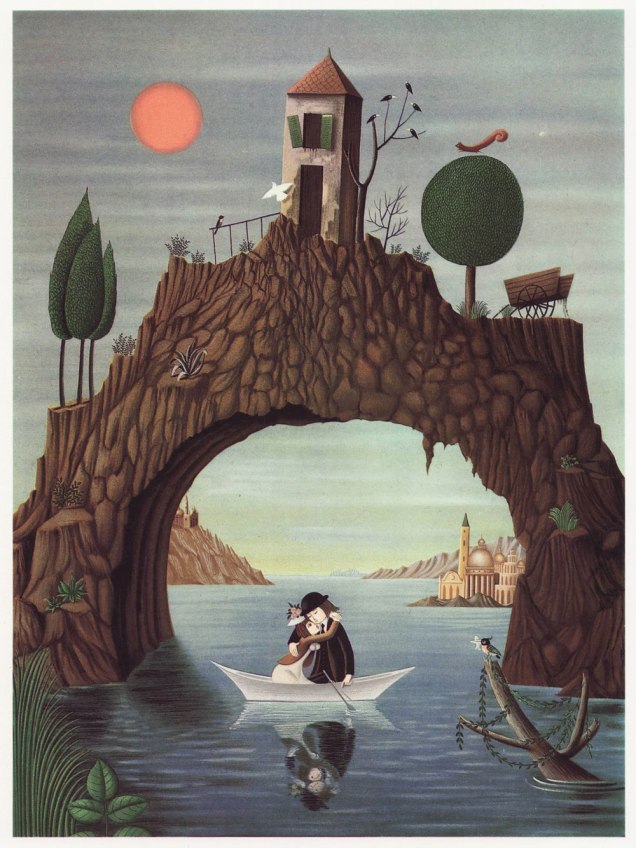
Lithograph, Éditions Arnaud de Vesgre, 1970. Without being derivative in the least, this piece pleasantly reminds me of Francisco Botero‘s work.
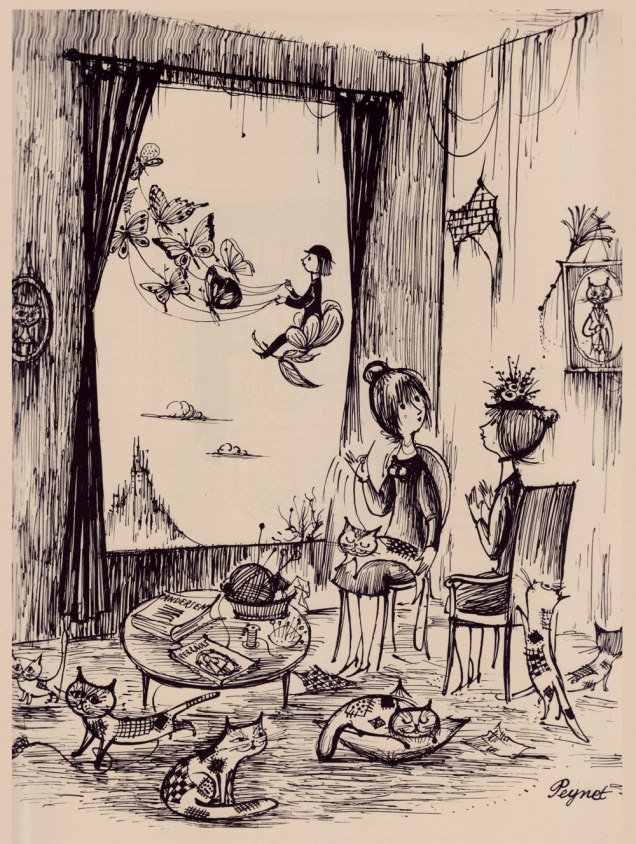
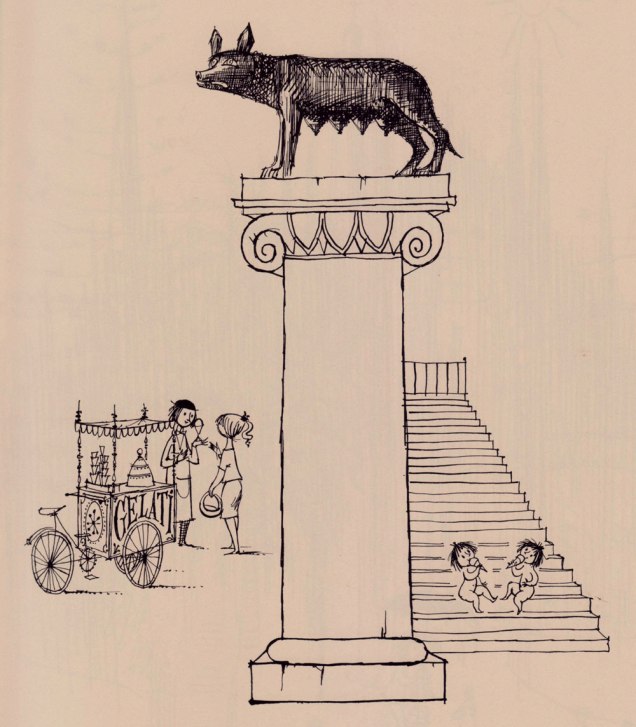
Okay, this one’s fairly subtle. I’ll give you a hint: the kids are named Romulus and Remus. Originally published in the collection Per le strade, per le nuvole (“Through the streets, through the clouds”) (Edizioni Elmo, Milan, 1953).
Likely another cartoon from Le Rire (Peynet rarely skipped a number), but I don’t own that particular issue.
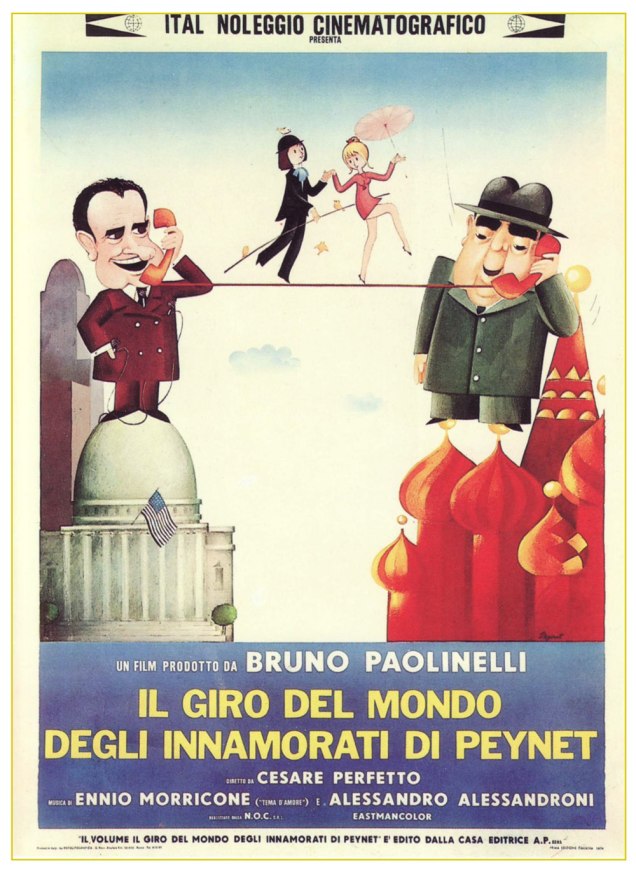
In 1974, out of Italy, came an animated feature (there had been a French short film in 1961), boasting — most appropriately — a gorgeous waltz composed by Ennio Morricone at his peak. The feature is available to watch here.
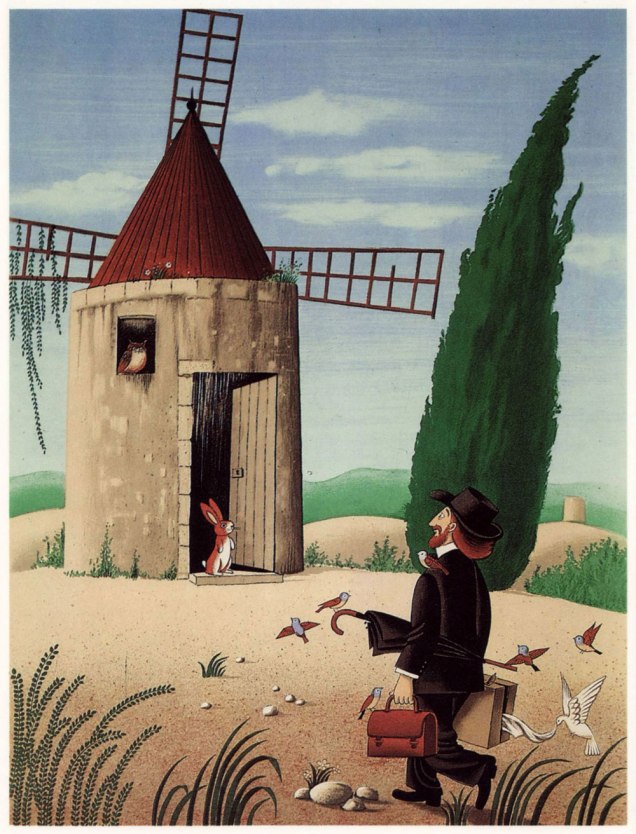
Lithograph from Alphonse Daudet‘s Lettres de mon moulinLetters From my Windmill »), Éditions Arnaud de Vesgre, 1985.

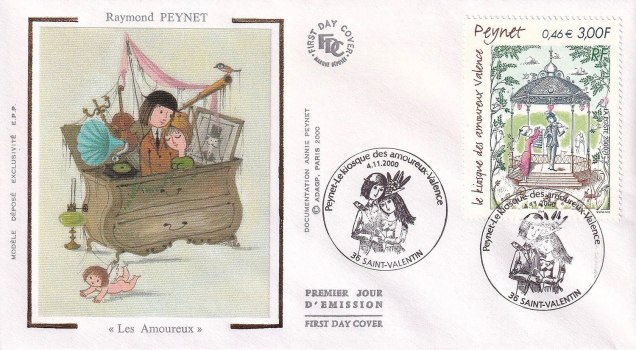
Peynet and his creations were twice honoured by the French post office with a clutch of different stamps. Here are some samples.
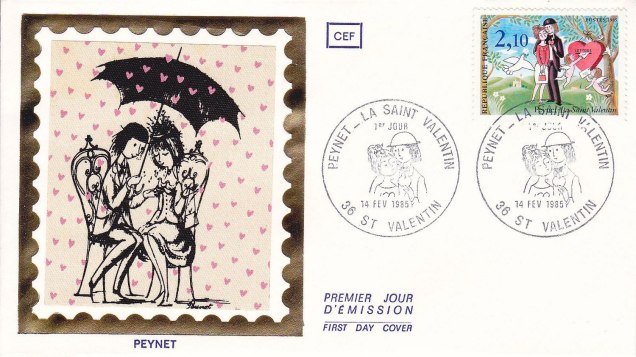
First day cover from Valentine’s Day, 1985.
First day cover from November 11, 2000, posthumously this time, Peynet having gone to his glory the previous year, joining his wife and muse of sixty-six years, Denise, who’d passed away in 1996. Here’s a lovely obituary from The Guardian.

To see you off musically, here’s a classic song that Peynet’s best friend, Georges Brassens, wrote about the illustrator’s petits amoureux.

-RG

Henri Gerbault, Leading Light of la Belle époque

« It took me some years to clear my head of what Paris wanted me to admire about it, and to notice what I preferred instead. Not power-ridden monuments, but individual buildings which tell a quieter story: the artist’s studio, or the Belle Époque house built by a forgotten financier for a just-remembered courtesan. » — Julian Barnes

Depending on where and when you are, this post will take you far away and to long ago.

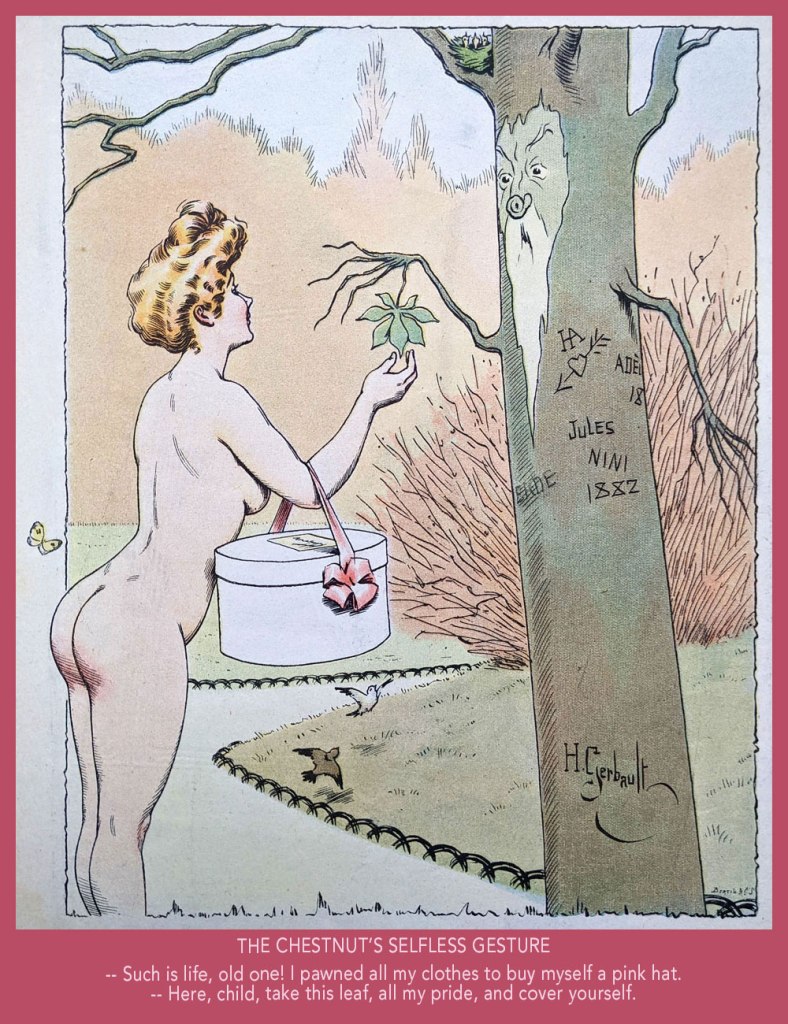
Having failed to launch a career as a painter after his studies at the Beaux-Arts de Paris, Henri Gerbault (1863 – 1930) tried his hand at satirical cartooning, and succeeded brilliantly, appearing in all the important magazines of the day, among them La Vie Parisienne, Le Rire, Le Bon Vivant, Le Frou-Frou, L’Art et la Mode, Fantasio, La Vie Moderne, Lectures pour tous… for France, it truly was a golden era for satirical, literary and cultural periodicals.

For instance, during the storied humour magazine Le Rire’s prime years (roughly the first quarter of the 20th century), Gerbault was featured in most issues, often on the front or back cover, and generally in sumptuous colour. Well, you’ll see what I mean. Clearly not one to rest on his laurels, he somehow found time to lend his sundry gifts to the theatrical, advertising, etching, and fine art fields.

Here’s a bit of context if you don’t know who Saint Denis was. Love his interaction with the initially skeptical doggo! Originally published in La Vie Parisienne, and collected in Parisiennettes (1897), with colours by J. Chauvet.
There’s the lad, Paris’ first Bishop, at the Cathédrale Notre-Dame de Paris. Hope he wasn’t damaged in the blaze.
Gage d’amour (“Token of Love”), originally published in La Vie Parisienne, and collected in Parisiennettes (1897), with colours by J. Chauvet.
Les Coulisses de l’Amour is a collection of cartoons published between 1893 and 1895 in La Vie Parisienne. Racist caricatures abound but, to be fair, everybody gets it in the neck.
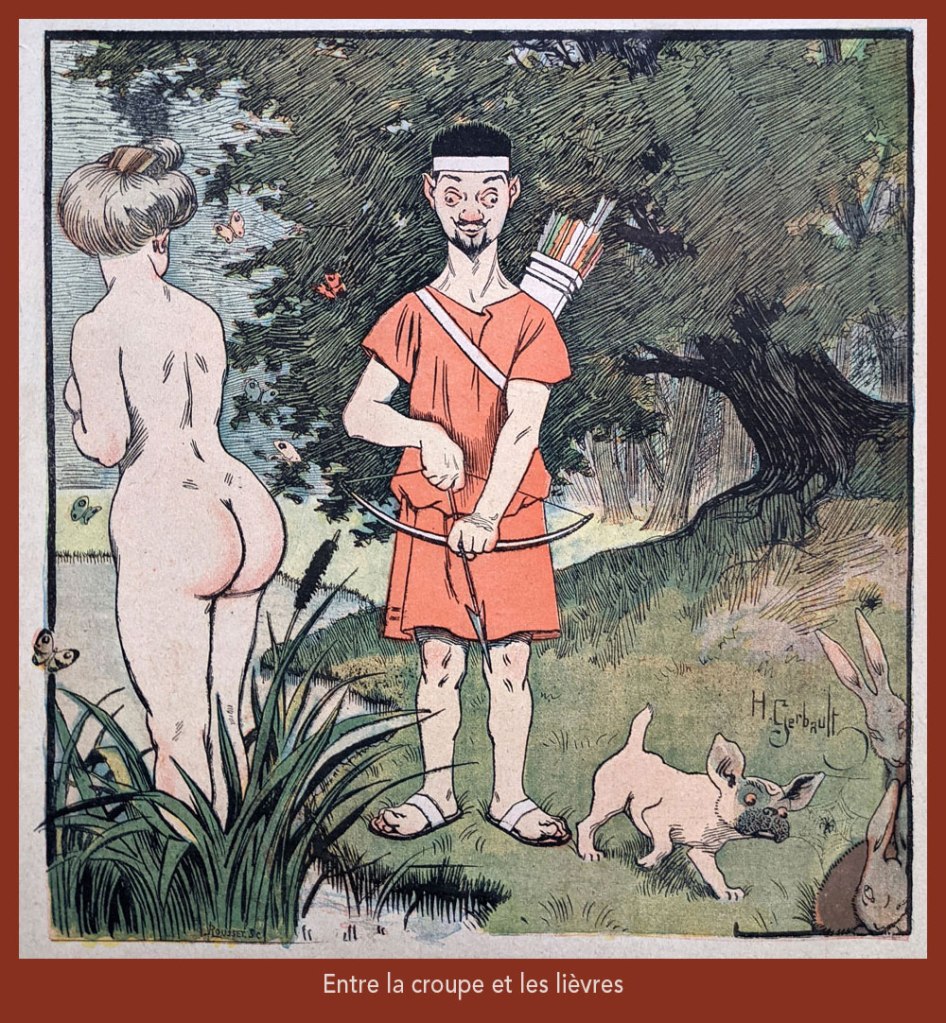
“Entre la croupe et les lièvres” is a play on “Il y a loin de la coupe aux lèvres” (English equivalent: “there’s many a slip ‘twixt the cup and the lip”), with ‘coupe’ replaced by ‘croupe’ (rump) and ‘lèvres’ by ‘lièvres’ (hares) — It was featured on the cover of Le Rire no. 261, (Nov. 4, 1899), eloquently demonstrating the vast cultural gulf between Edwardian England and Belle Époque France… not to mention the United States!
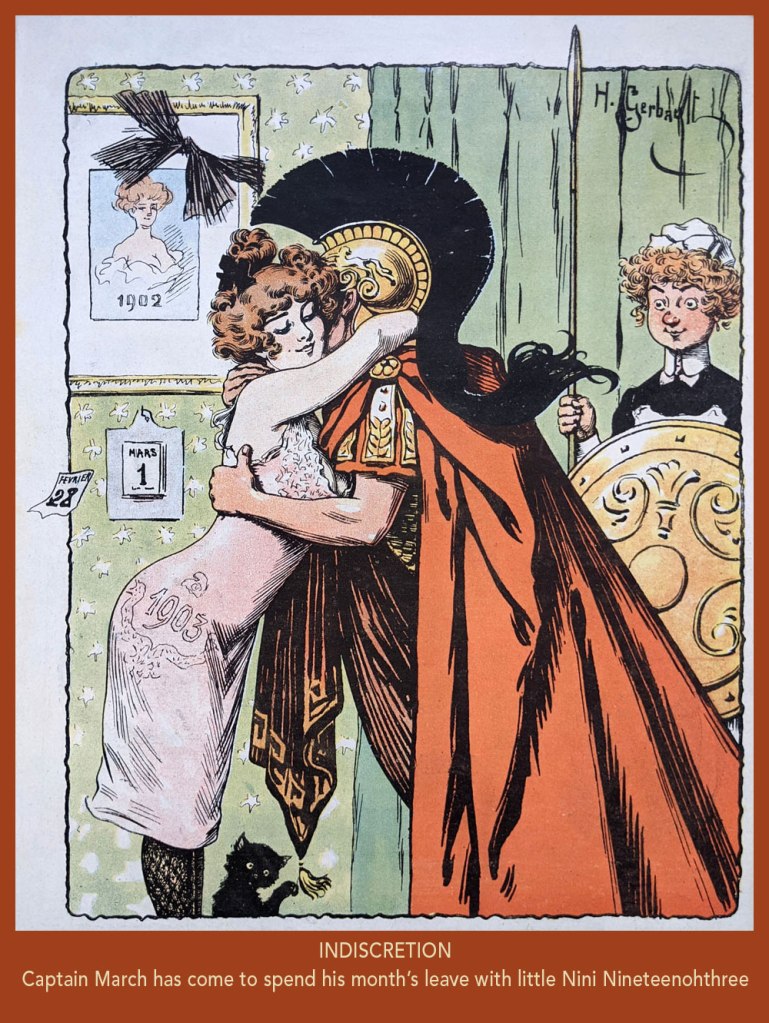
From Le Rire no. 7, (March 21, 1903). In French, the Roman God of war and the year’s third month are both “Mars”. Why is it even “March” in English?
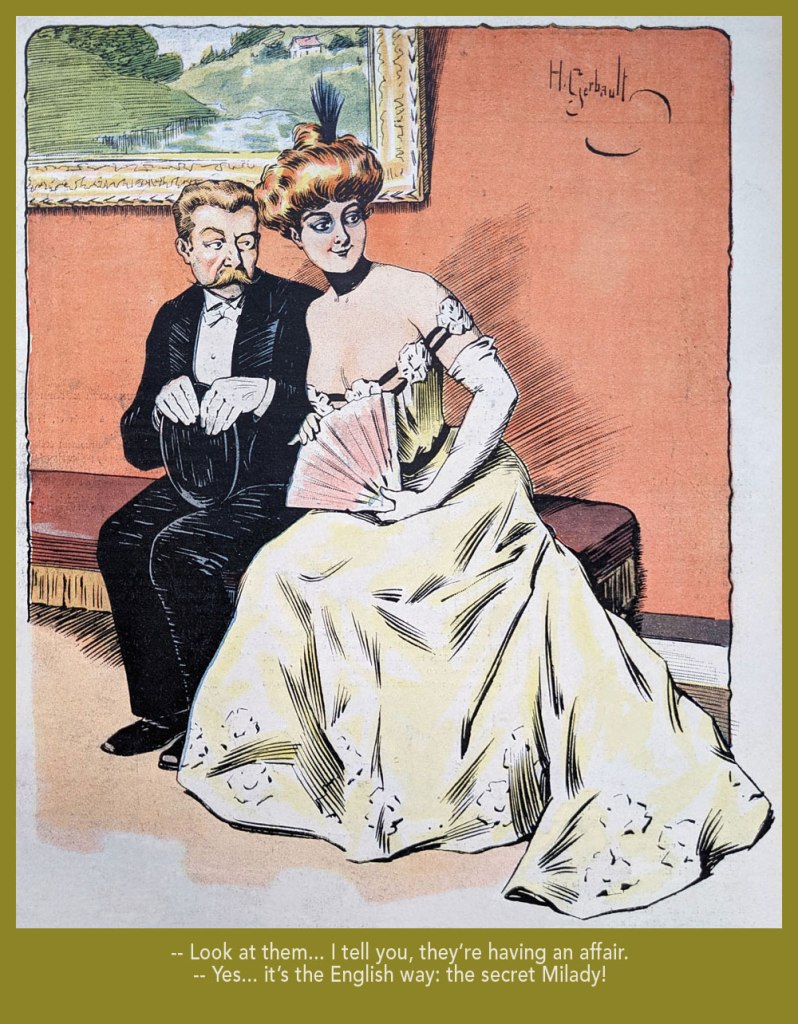
Taking the piss out of that old English discretion (some might call it hypocrisy); from Le Rire no. 18 (June 6, 1903).
From Le Rire no. 59, (March 19, 1904).
From Le Rire no. 160 (Feb. 21, 1906).
From Le Rire no. 380 (May 14, 1910). Missals are also known as ‘prayer books’.
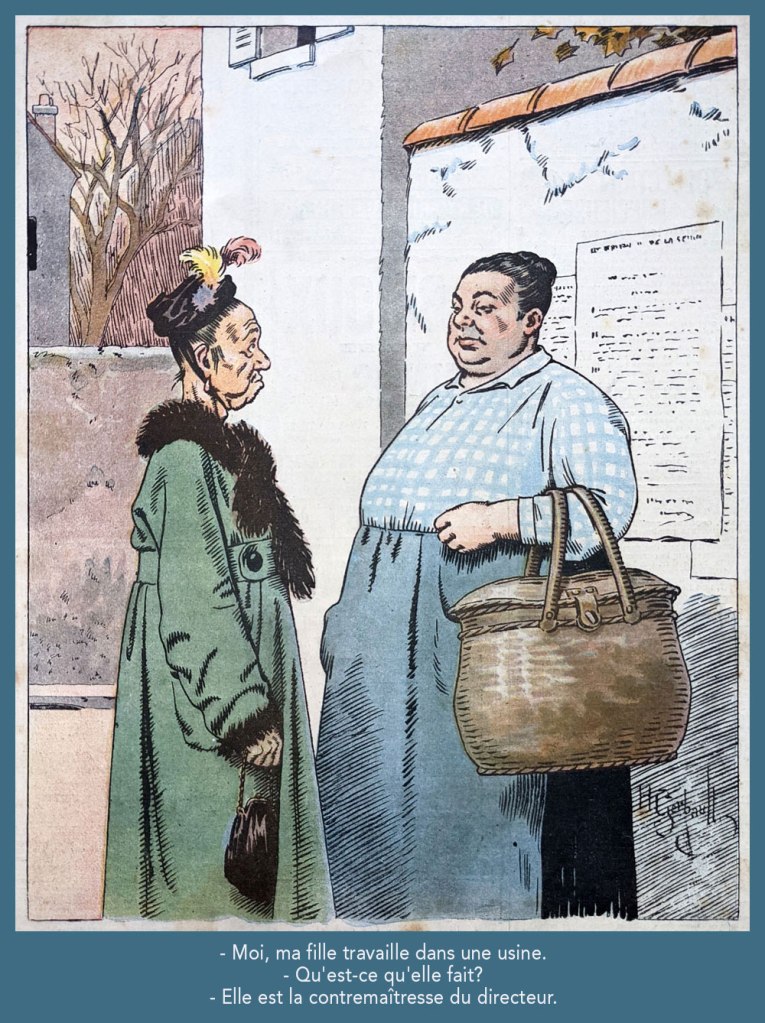
Despite being quite amusing, this one loses it all in translation. Still, “contremaître” is a foreman; its feminine form is “contremaîtresse”, which combines foreman and “mistress”; you’ll hopefully get the idea. This piece appeared in Le Rire rouge (as Le Rire was called during The Great War) no. 179 (Apr. 20, 1918). Note the beautifully understated colour work.
From Le Rire no. 189 (Sept. 10, 1922). « Je m’fiche à poil, rien que pour l’embêter! » in the original; sometimes it’s mighty hard to do proper justice to the source text.
The master’s self-portrait, circa 1904.

-RG

Georges Pichard: Throwing Curves

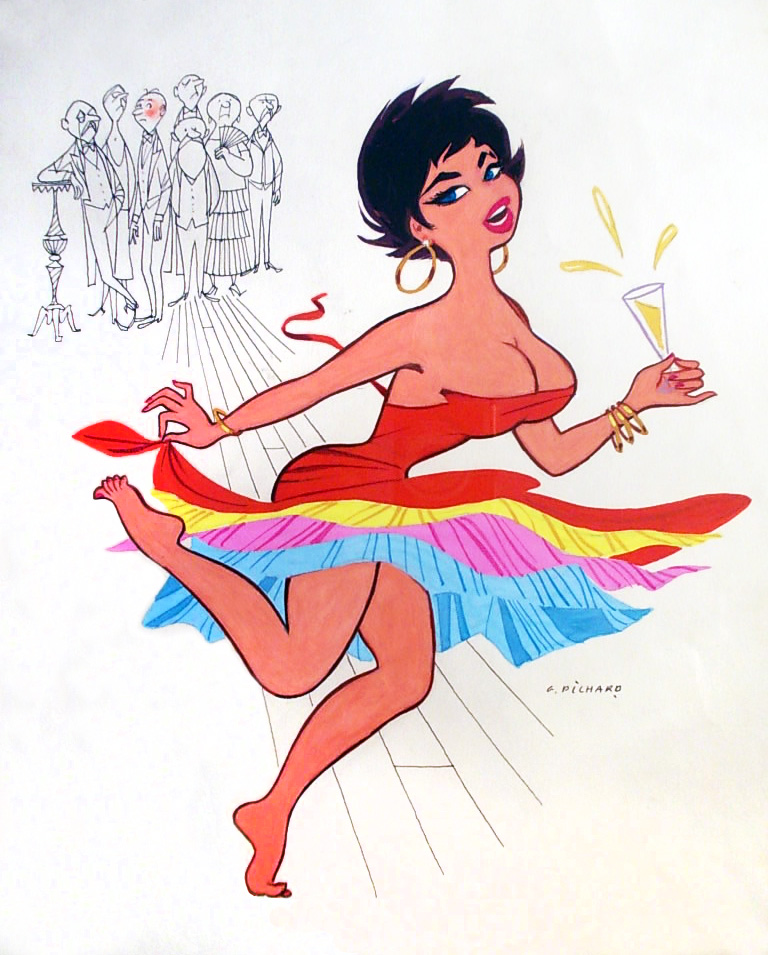
In 1946, Georges Pichard (not sure who he is? Visit our Pichard’s Distressing Damsels for an overview of his later work), heretofore toiling in a marketing agency, started his career as an illustrator. He worked for various French magazines and newspapers (like Le Rire, Fou-Rire and Les Veillées des Chaumières), providing them with covers, cartoons and pin-ups in black-and-white or gorgeous watercolour until the mid 70s, when he switched gears somewhat and dedicated himself to erotic bandes dessinées.

I left image imperfections (due mostly to yellowing of paper over time) and hand-written captions (when available) as is, as I find they provide pleasant texture and context. The jokes are really lame, but we translated them, anyway.

The following three cartoons were published in Le Rire. This first one saw print on the cover of Le Rire no. 22 (nouvelle série, July 1953).

George-Pichard-Sketch2

This one was featured on the cover of Le Rire no. 66 (nouvelle série, March 1957).

GeorgePichard-sketch

George-Pichard-sketch3
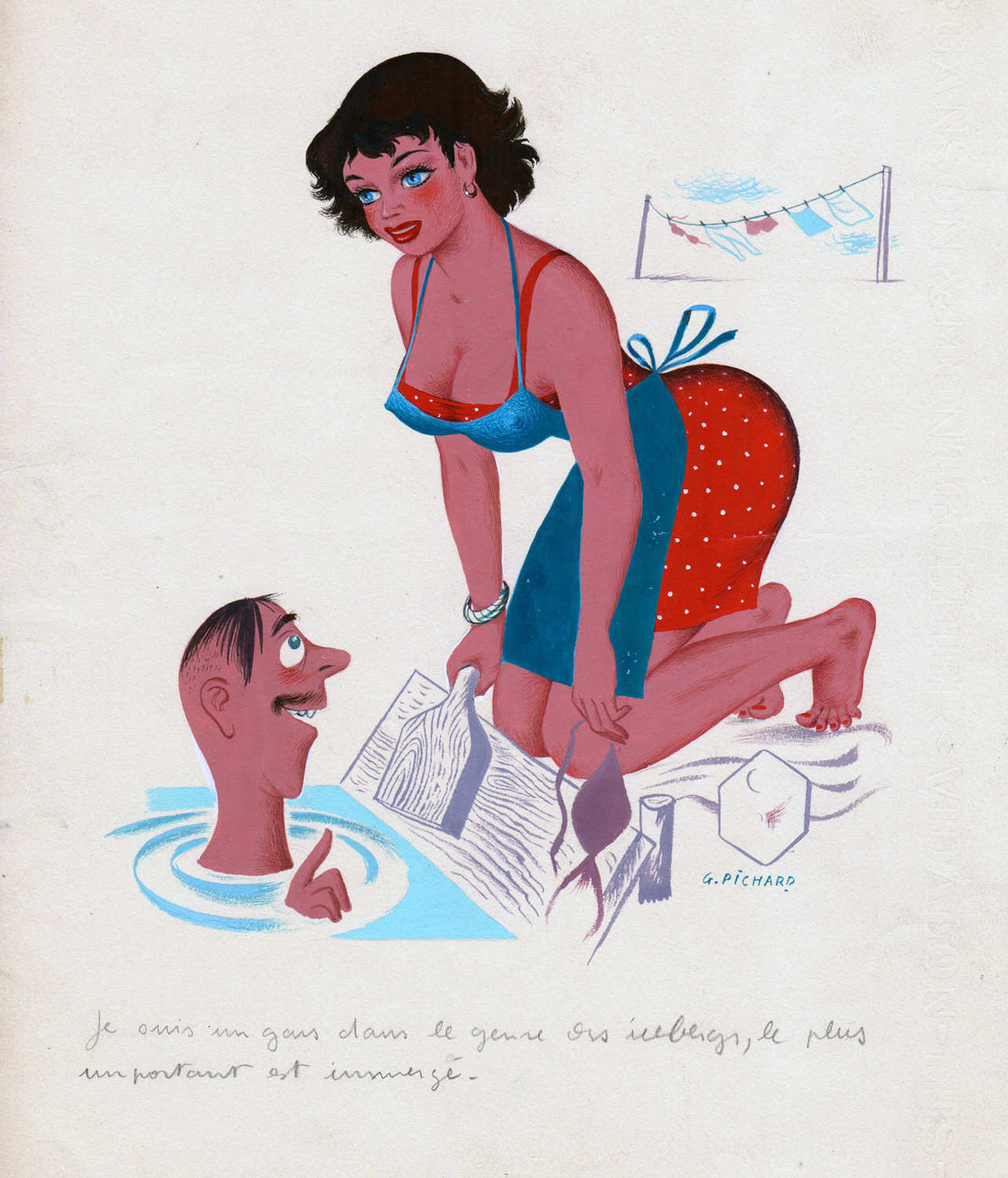
« I’m the sort of guy who’s kind of like an iceberg, the main part is beneath the surface. » The man in question looks very much like a V.I.P. type.

The following are all from Fou-rire:

GeorgesPichard-FourireA
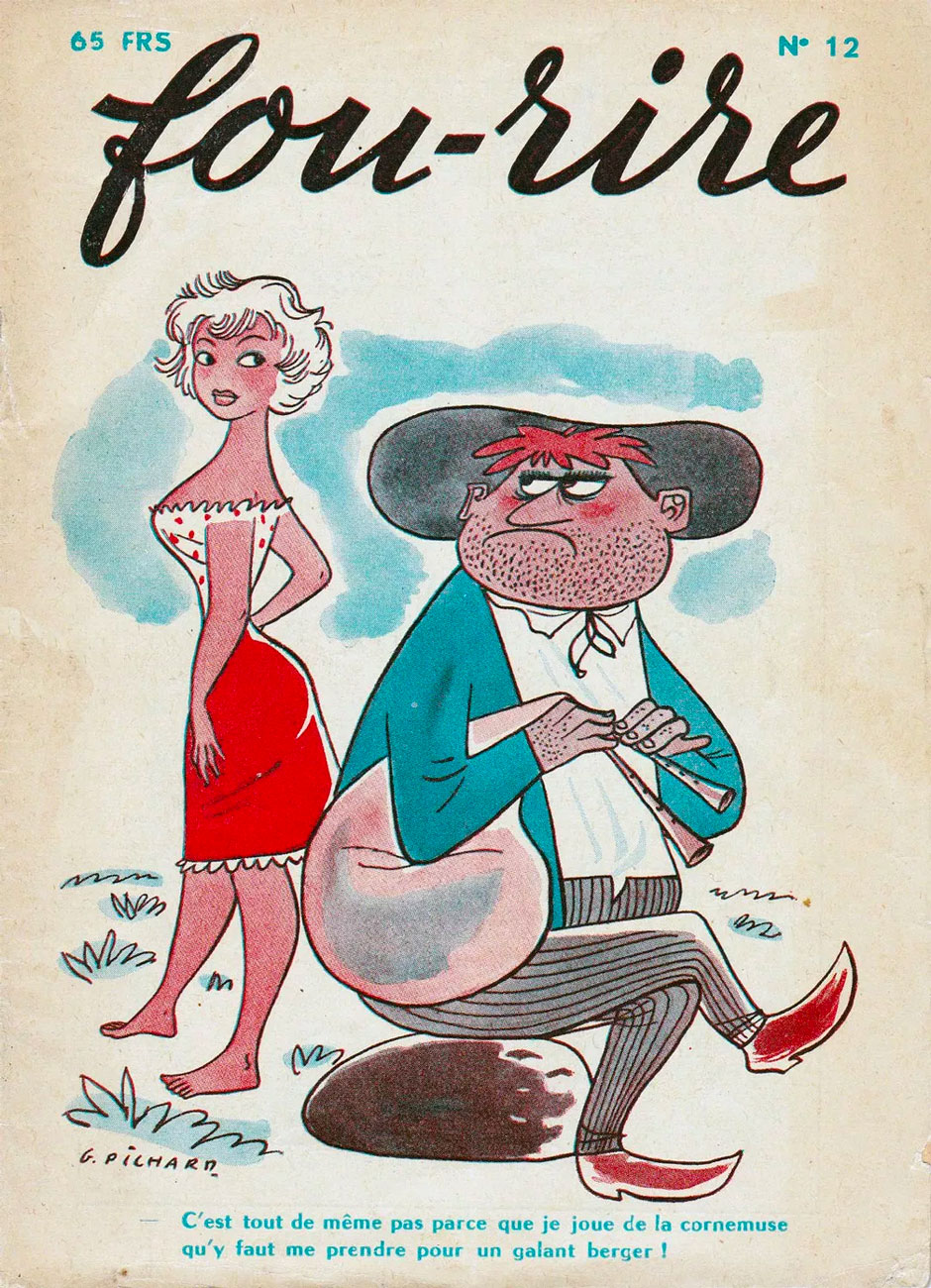
Cover of Fou-rire n°12, mid-50s. « It’s not because I’m playing the bagpipes that you have to take me for a gallant shepherd! »

GeorgePichard- LERIRE76- janvier 1958.
Cartoon from Fou-Rire n° 76, early 60s. « Please be assured, my dear friend, that we are all here quite touched by your wife’s endeavours to set a mood… ».

GeorgePichard=1962
Cartoon from Fou-Rire n° 118, early 60s.  « It would be prudent to seal up your chimney, because when I tell the boss about this… »

GeorgePichard-1961---1962;-French-Magazine-Le-Rire
Fou-Rire n° 118, mid 60s. « And to think that I’ve mislaid the key to this chest full of outfits, each more decent than the last… »

Finally, a couple of pretty loose ends:

GeorgePichard-Jarredor
Original art from Le Rire magazine, 1960s. « But the funniest part happened before I ran into the police officer! »

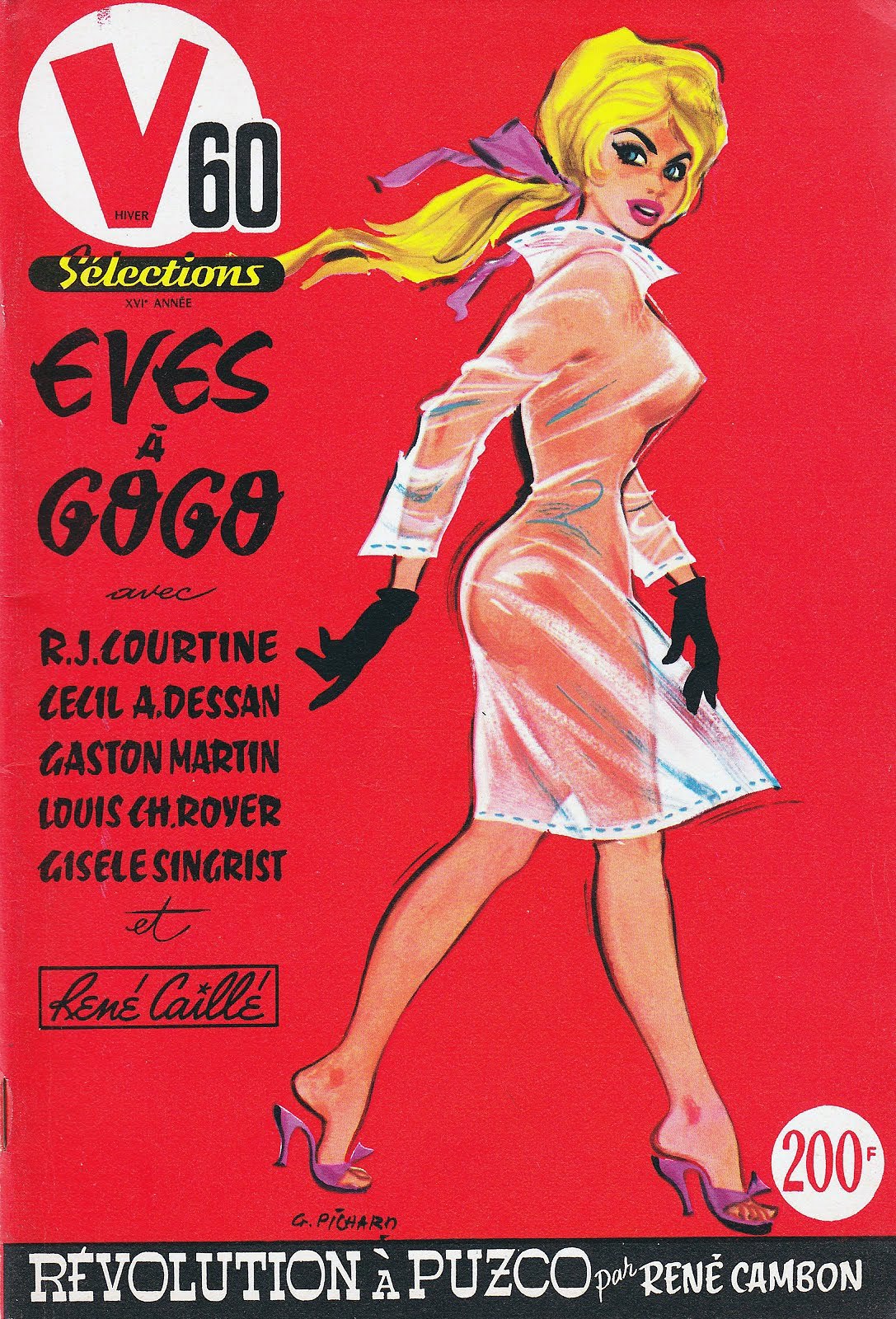
GeorgePichard-V60
Early 60s.

~ ds