Way Off-Model Archie, or ‘Escaping the Big Two’

« Our Betty Cooper is still the girl next door – she literally lives next to Archie. And she’s the blonde all-American girl; she’s so sweet and forgiving, gives people the benefit of the doubt and second chances, wears her heart on her sleeve. But she’s also incredibly broken on the inside, for many different reasons. » — Lili Reinhart

As a whole, comic book artists are not a happy lot, and for good reason. During the Golden Age, at least, there were countless publishers, so one could move around if unsatisfied with the working conditions.. even if meant finding out that things were rotten all over. After the mid-1950s, when the field violently contracted — you know the story — leaving scant players standing, you pretty much had to take the work, and the abuse, as they came. And certain publishers frowned upon ‘their’ creators playing what little remained of the field.

Kurt Schaffenberger had steady work at DC, but presumably — and understandably — sought to keep his options open, so he moonlighted for ACG, often under a pseudonym, probably unaware that the ‘competitor’ was covertly owned (at least in part) by DC co-founder and co-owner Harry Donenfeld. One can imagine Kurt’s distress when ACG folded in 1967. From what I can surmise, he did, in 1970, a lone, inexplicable cover for Stanley Morse… wildly outside his range but still kind of awesome. And then… he quietly boarded a bus to Riverdale.

A page from Voice of Doom; script by Frank Doyle, pencils by Schaffenberger, inks by Jon D’Agostino. Published in Archie’s TV Laugh-Out no. 16 (Dec. 1972, Archie).
The, er… punchline from Peace of Mind. Script by Frank Doyle, pencils by Schaffenberger, inks (likely) by Chic Stone; published in Archie’s TV Laugh-Out no. 18 (Mar. 1972, Archie).
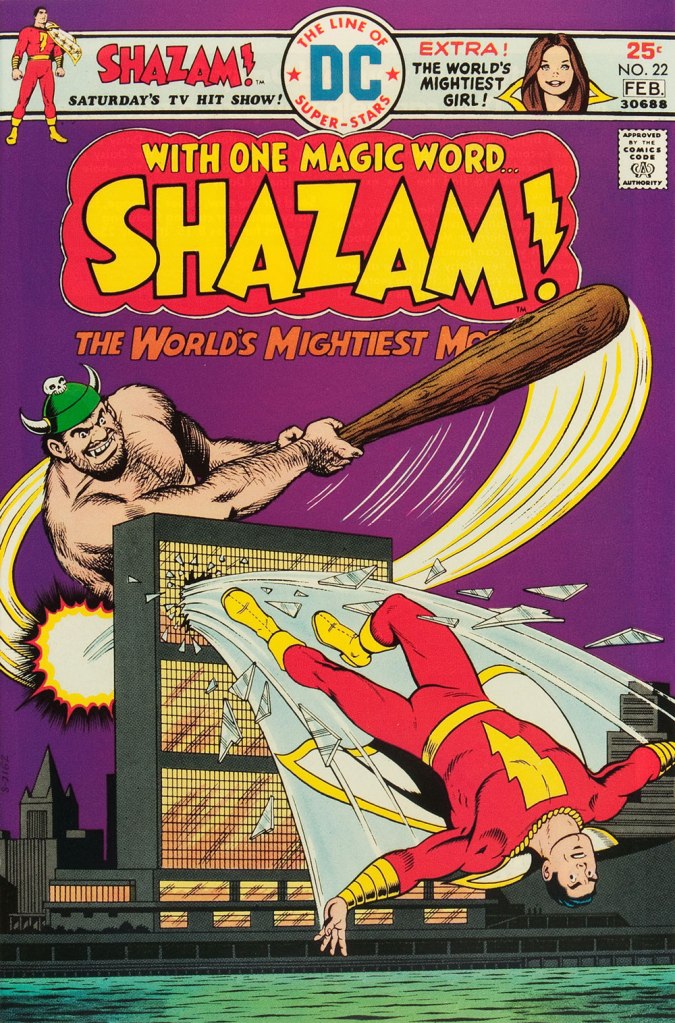
Drawing for Archie wasn’t too much of a stretch for Kurt; whether it was Reggie or The Big Red Cheese getting knocked on his ass, he had his stock posture. This is Shazam no. 22 (Jan-Feb. 1976, DC). Pencils and inks by Mr. Schaffenberger.

A couple more samples from Mr. Schaffenberger’s all-too-brief Archie period — solid, well-paced, ably-designed and economical storytelling:
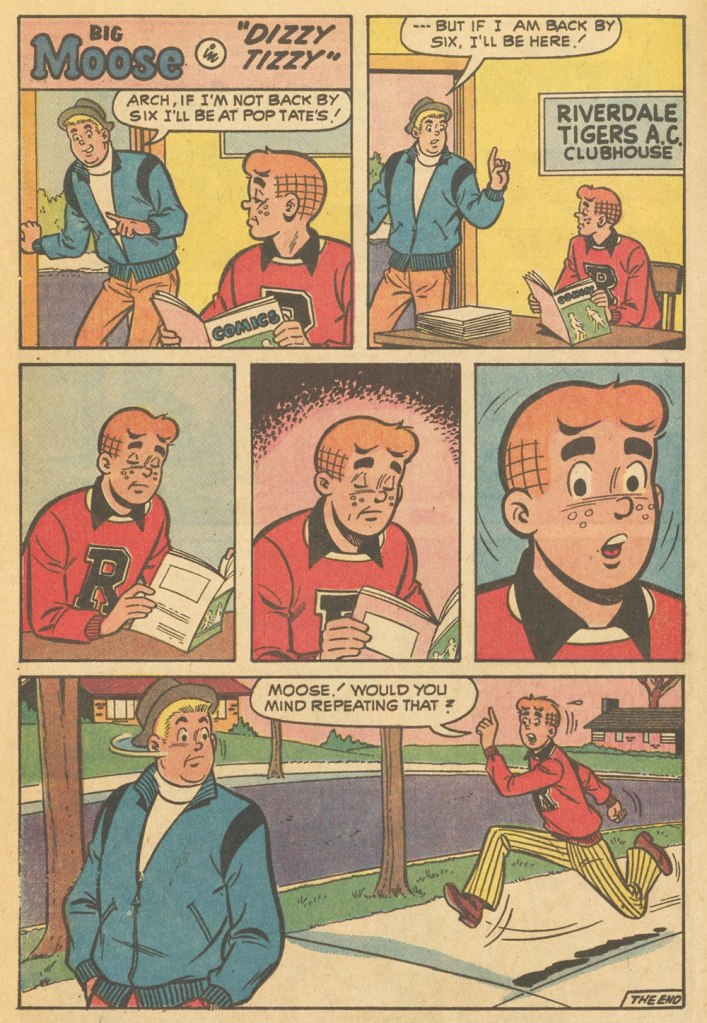
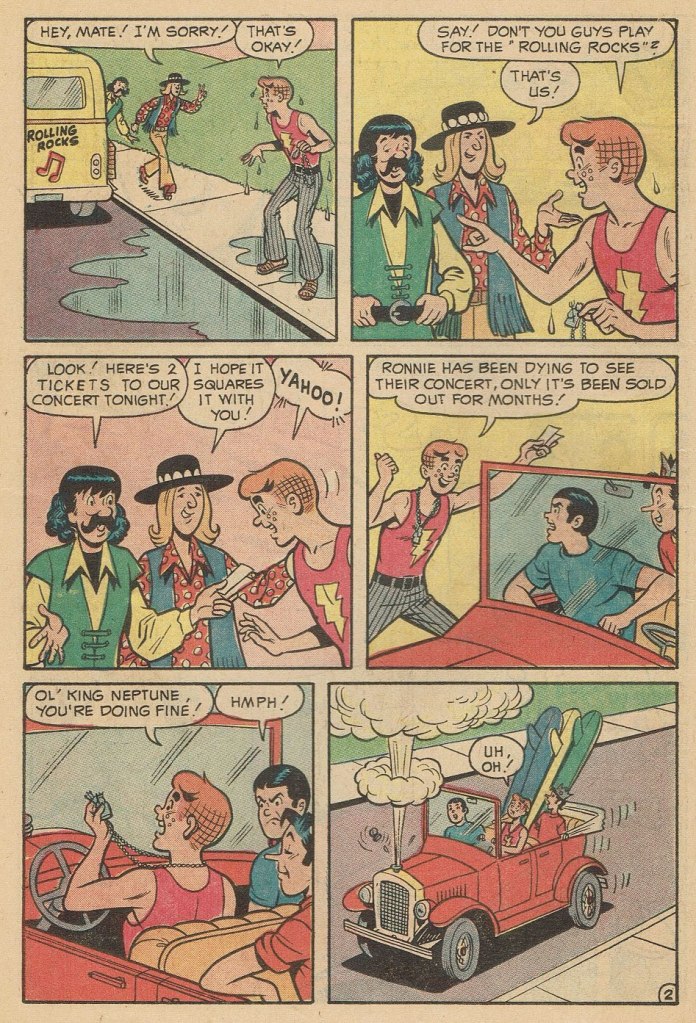
A slightly surreal one-pager from Archie’s Joke Book Magazine no. 150 (July 1970, Archie).
A page from Luck Struck, published in Archie’s Pals ‘n’ Gals no. 73 (Oct. 1972, Archie); note the Captain Marvel tank top young Mr. Andrews is sporting!

And then, there’s the case of Sal Amendola, a Neal Adams protégé whose reputation in comic books largely rests on a single Batman story, 1974’s ‘Night of the Stalker’, a highly praised tale whose chief conceit is that Batman never utters a word and weeps bitterly at the end. I’d apologise for the spoilers, but honestly, it’s been half a century, what mystery is there to dispel?
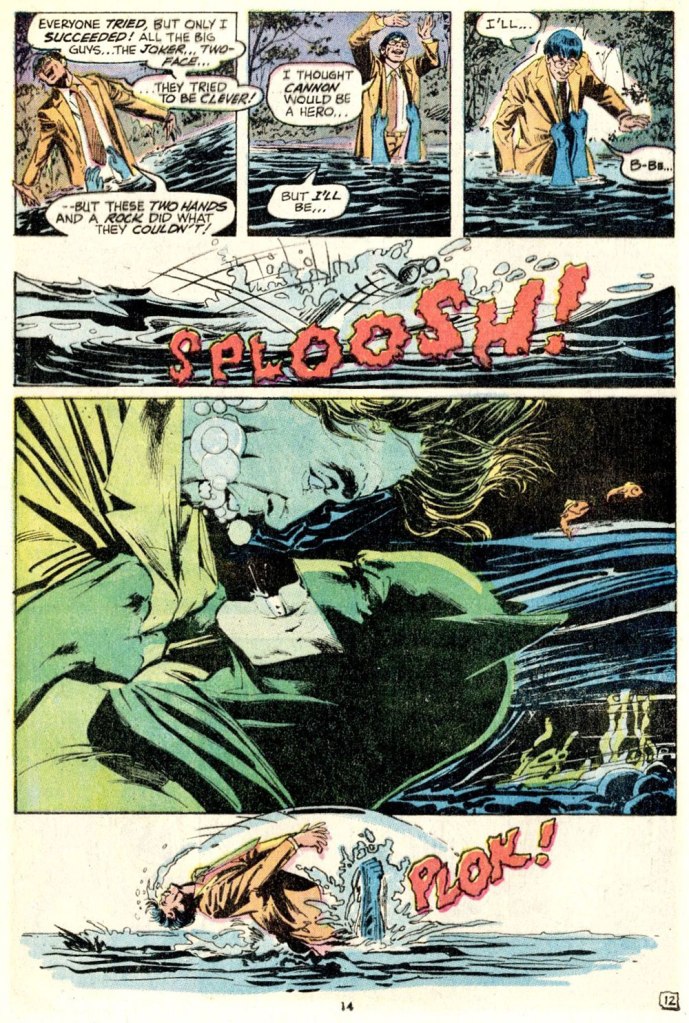
An excerpt from Detective Comics no. 439 (Feb.-Mar. 1974, DC); I’ll rarely say this, but Dick Giordano’s inks are an asset in this case, not a liability. The story’s scripting credits are at once hilarious and a bit sad: Steve Englehart, script; Vin and Sal Amendola, plot; and… “from an incident as described by Neal Adams.” Yeah, Neal; that’ll surely earn you a Pulitzer.

Anyway, after his turn in the Bat-spotlight and 1975’s Phoenix, one of the short-lived Atlas-Seaboard‘s more daring titles, Amendola turned up at… Archie. And it was not a good fit.

This, in fact, was the springboard for this post: a couple of years ago, I encountered an Archie story that so grotesquely missed the mark — stylistically speaking — that it bordered on the fascinating. You guessed it, Sal Amendola, utterly out of his element, not to mention, surprisingly… his depth.

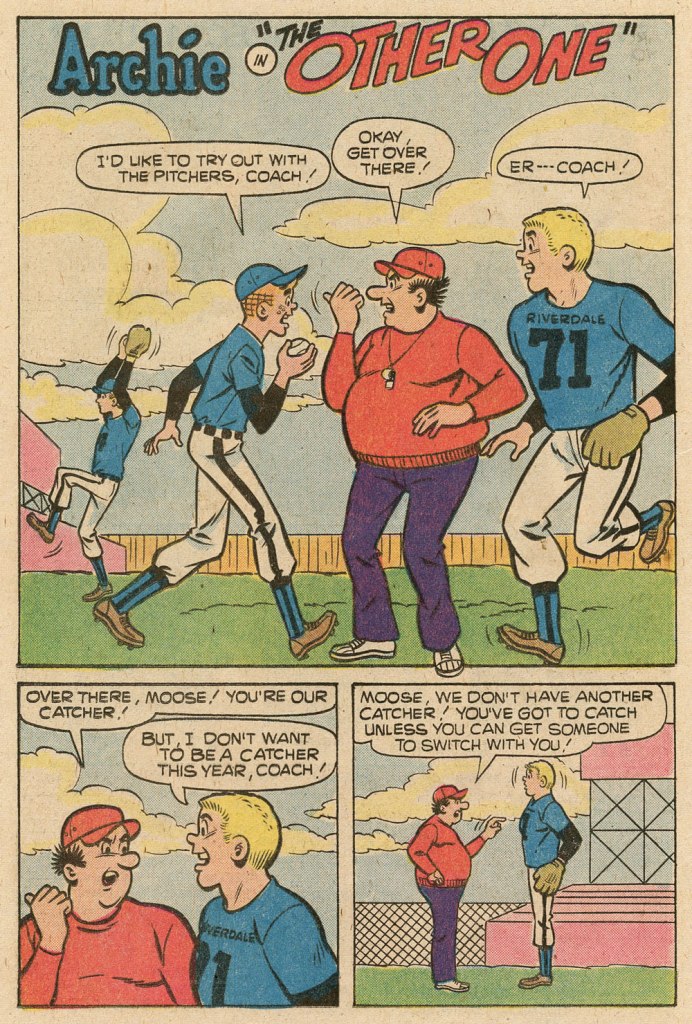
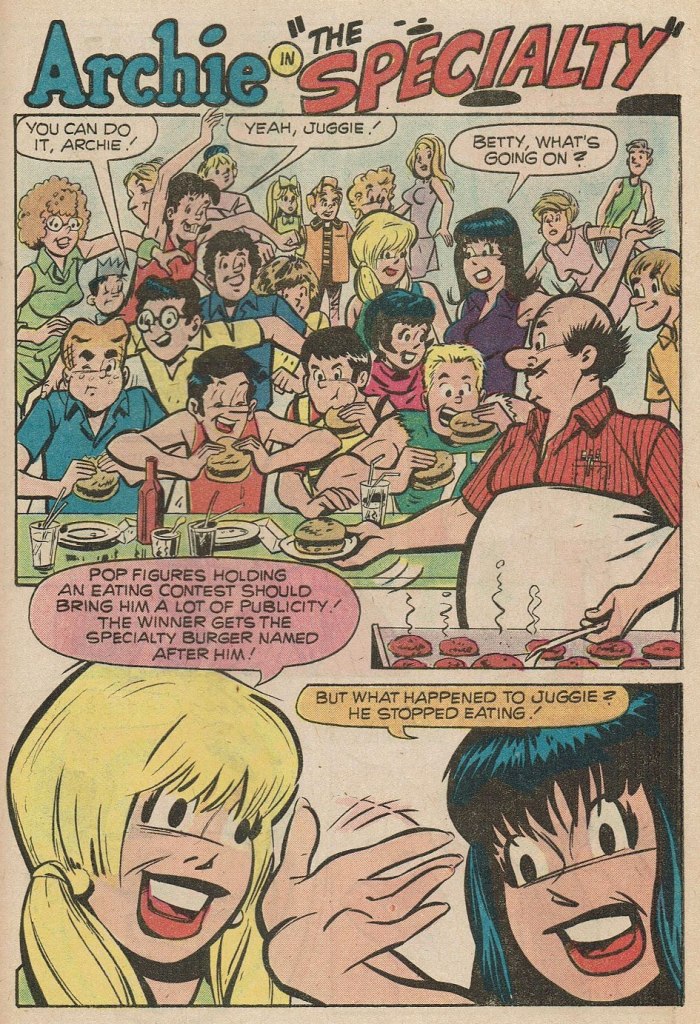
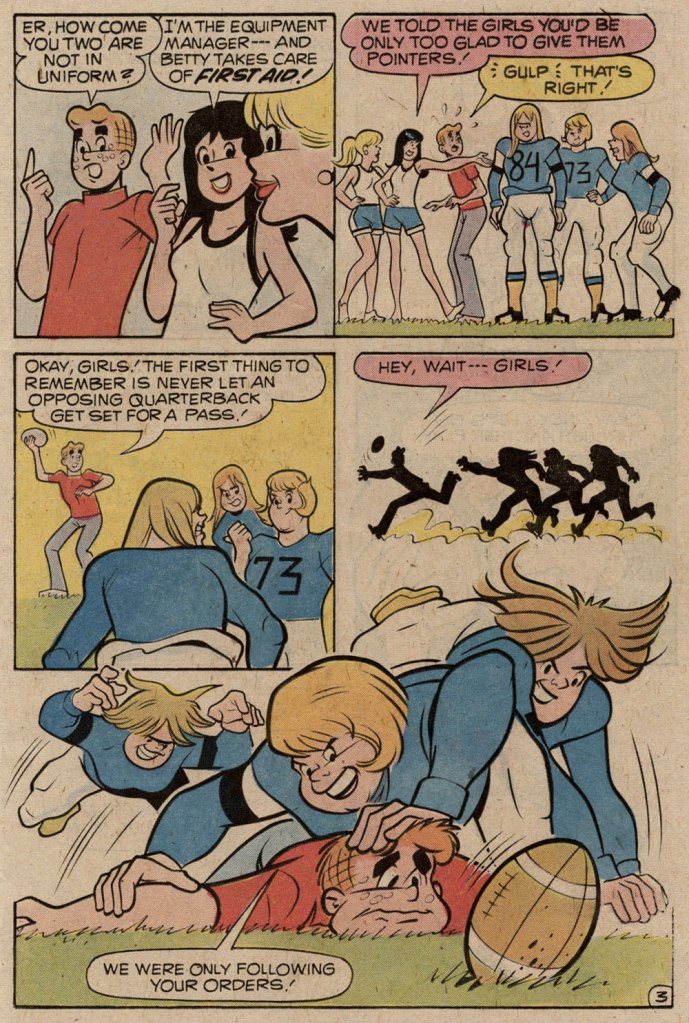
Here are a pair of pages from Coach Reproach, published in Everything’s Archie no. 71 (Dec. 1978, Archie), script by George Gladir, pencils by Amendola, inks by Jon D’Agostino.
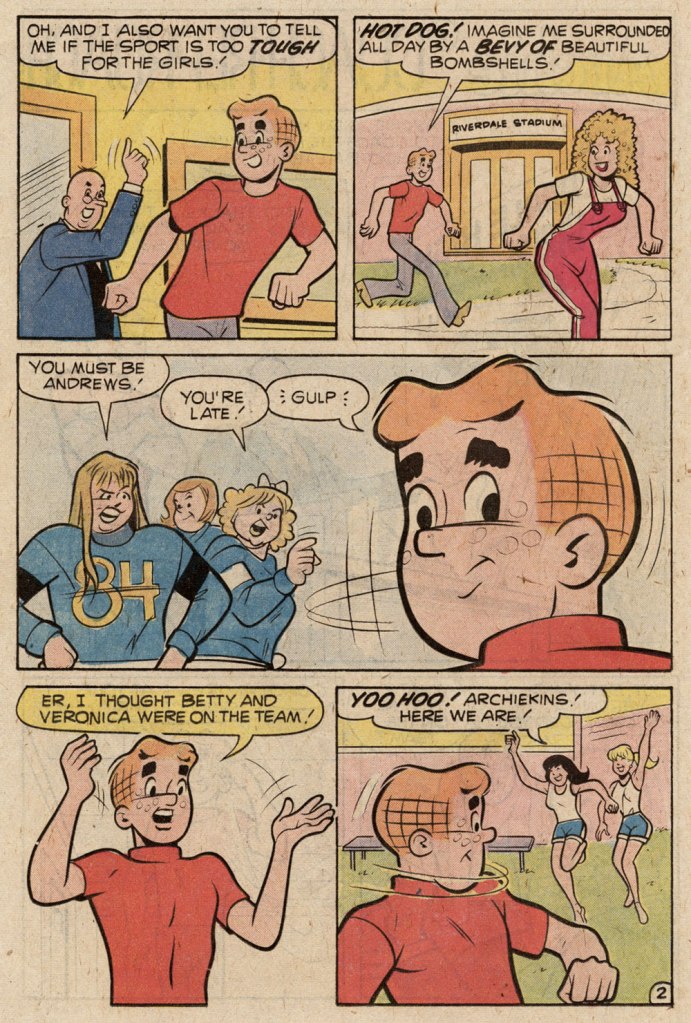
Where to begin? In the first panel, you give Archie a stiff, unnatural pose and you follow it up by repeating it on a background character in the very next panel. And Arch is due for a nasty case of whiplash if he keeps trying to make like Linda Blair.
At this point, I’m thinking Sal had learned plenty from his mentor on how to utterly fail at comedy.
If what I’ve observed about pitching stances is worth anything, Archie’s about to get brained by a baseball. Ginger boy is also looking right past Coach Kleats. Despite the low bar — issues of quality control were rampant at Archie in the 1970s — this is impressively incompetent storytelling,
What happens when you never learn basic inking principles: one creates depth by using thinner lines — and less detail — on background characters, otherwise… visual chaos ensues, as demonstrated here. And Sal’s Betty and Veronica sorely need a brand of shampoo that won’t leave their hair so oily and limp… but the anatomy is beyond help. This is the opening page of The Specialty, from Pep no. 342 (Oct. 1978, Archie).

Schaffenberger’s fellow Golden Age veteran, Gene Colan, also found himself moonlighting in the 1960s. In his case, it was for Marvel, under the alias of ‘Adam Austin’, but also for Dell (just a couple of covers mid-decade) and more significantly for Warren Magazines. In the 1970s, he concentrated on Marvel and was, in the chaos that was the so-called ‘House of Ideas’ at the time, the single most reliable artist in the maelström: surely none can match his seventy consecutive — and meticulously detailed — issues of Tomb of Dracula, in addition to lengthy runs on Howard the Duck, Daredevil, Captain America, Doctor Strange and so forth.

Enter Jim Shooter, a man only Vinnie Colletta could love.

« When writer Jim Shooter became Marvel’s editor-in-chief in the late ‘70s, the tension between Colan and the younger authors came to a head. By 1980, Shooter and Colan were totally at odds with one another over Colan’s approach to storytelling. »

« [Shooter] was harassing the life out of me. I couldn’t make a living,” Colan said. “He frightened me, he really did. He upset me so bad I couldn’t function.” Just as she had urged Colan to quit one job [in] the 1960s, wife Adrienne begged him to leave Marvel in 1980. After delivering his resignation, Colan was asked to sit down and seek resolution with Shooter and publisher Mike Hobson. Colan agreed to the meeting, but declined any overtures to stay at Marvel. “Shooter was in the same room,” Colan recalled, “and I said, ‘That man’s not gonna change. He is what he is. Whether it’s six days, six months or six years, it’s not going to be any different, so I’m not going to put up with it for another minute.‘ » [ source ]

He then scampered over to DC for a few years. His production there was hit-and-miss, but his Batman run (1981-86) was outstanding, pairing him with some of the rare inkers who could do his nuanced pencils justice: Klaus Janson, Tony De Zuñiga (to my amazed delight!) and especially Alfredo Alcala.

But once his contract ran out, he was out knocking on doors again. Against all odds, Archie beckoned.
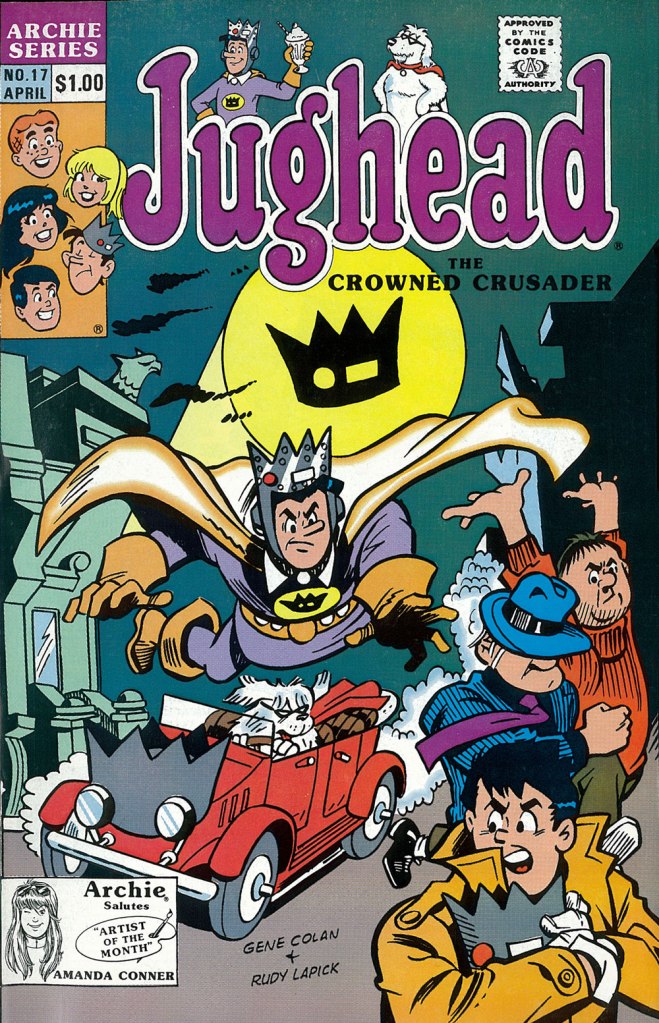
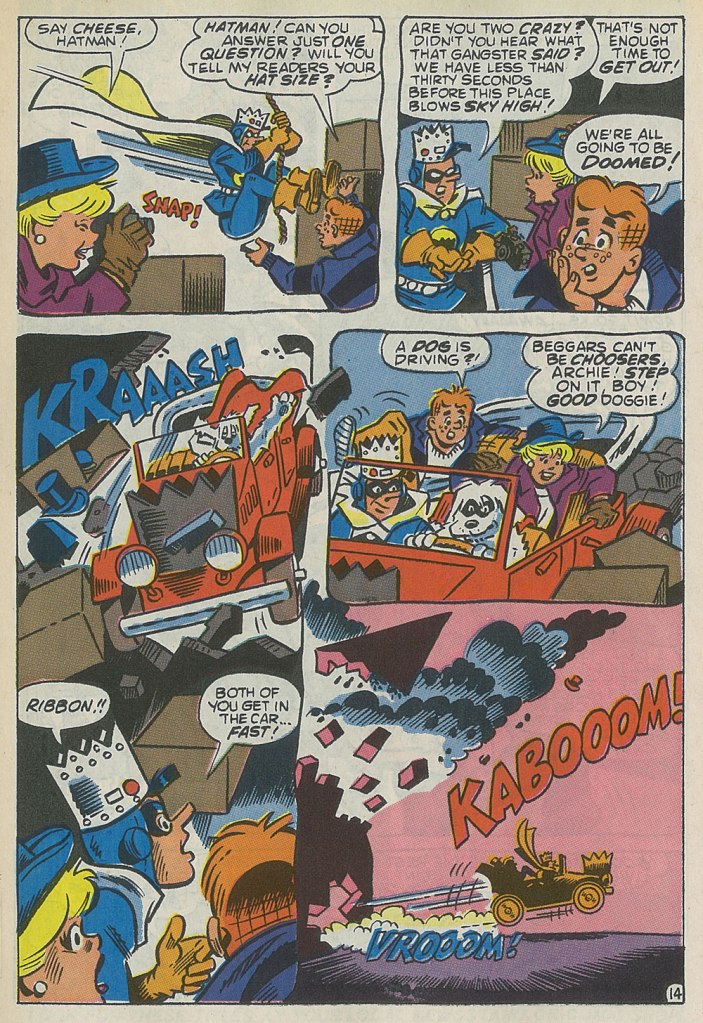
This is the cover — dreadful, I’m afraid — of Jughead no. 17 (Apr. 1990, Archie), reviving the opportunistic, Batman TV show-derived ‘Riverdale Gang as superheroes’ de trop move of the mid-1960s, with even less aplomb. But then the Archie folks were plumbing an especially low point with such ‘experimental’ titles as Jughead’s Diner, Archie 3000, Dilton’s Strange Science, Jughead’s Time Police, Archie’s R/C Racers, Explorers of the Unknown, and of course The Adventures of Bayou Billy.
An action-packed — and Colan-shambolic — excerpt from that issue’s Hatman saga, written by Robert Loren Fleming, pencilled by Colan and inked by Rudy Lapick. Notwithstanding his sticking out like the proverbial sore thumb, Colan clearly had a ball working on his Archie stories. He brought some urgently needed chutzpah to a perilously stale formula.
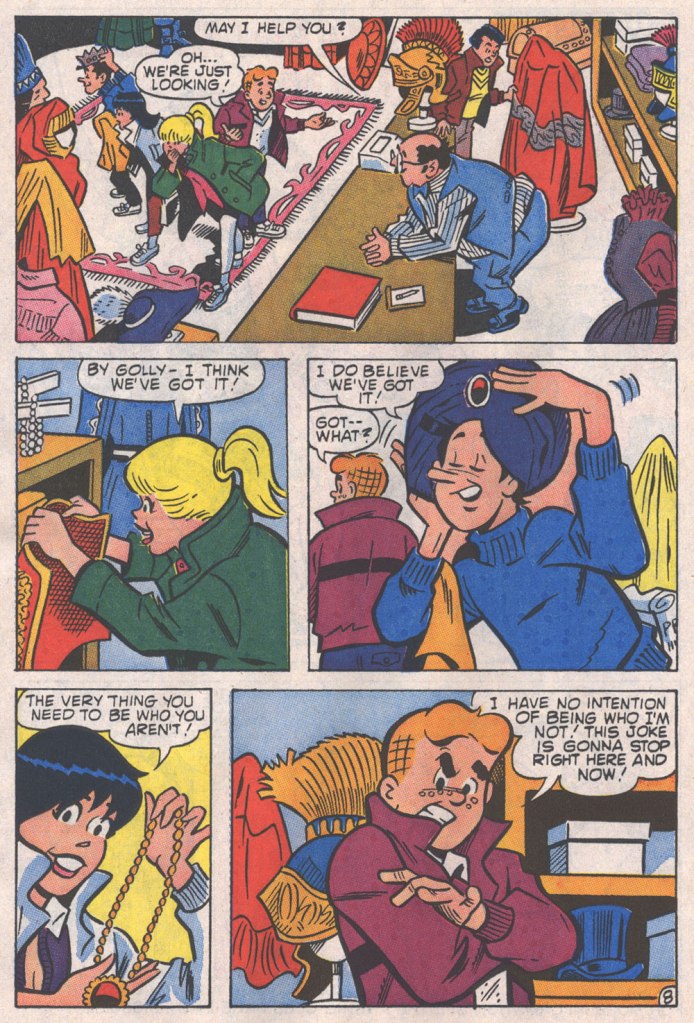
A page from Will the Real Archie Please Stand Up!, published in Life with Archie no. 273 (July 1989, Archie), wherein Archie is mistaken for his doppelgänger, a foreign prince named Kafoufi… but of course. Pencilled *and* scripted by Colan, which is most unusual. Oh, and inked by Mr. Lapick, who doesn’t quite know what to do with those ol’ Colan worm-fingers, seen wriggling in panel five.

-RG

Why the Long face? The Lighter Side of Batman

« The best thing for rich people to do is become Batman. » — Karl Heinrich Marx*

So we’ve got another dour, dark, mumbly, violent, grim ‘n’ gritty Batman movie making the rounds. I’ll pass — I’m afraid that’s not my Batman of choice. But I’m certainly game to provide an alternative view.

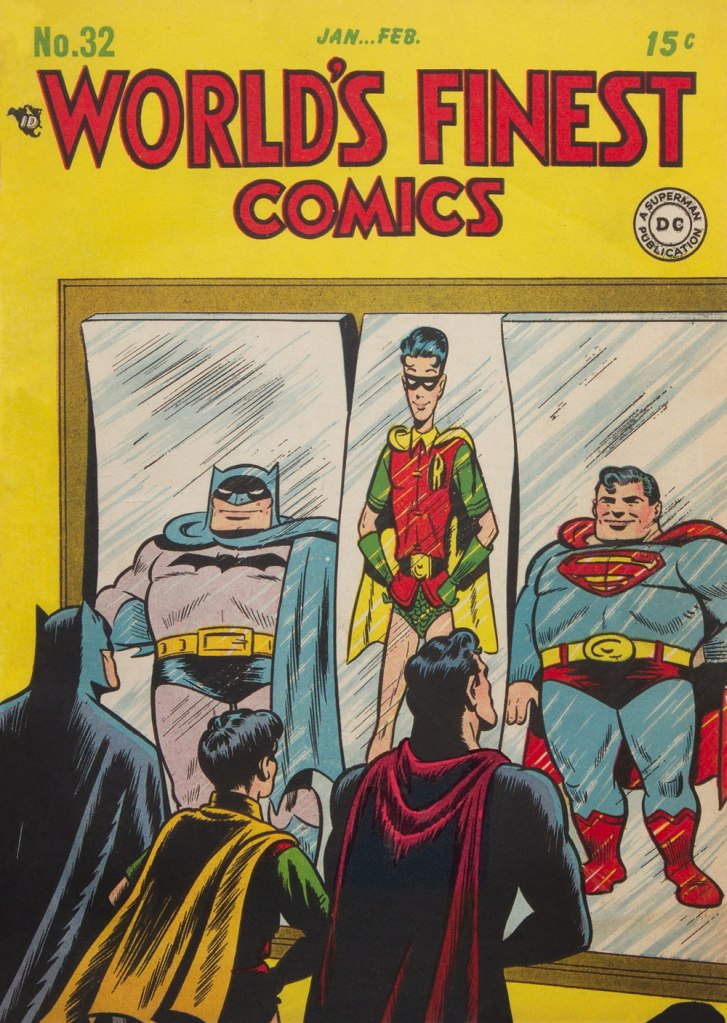
This is World’s Finest no. 32 (Jan.-Feb. 1948, DC); cover art by Hamilton, Ontario’s Win Mortimer (1919-1998), just one in a long, memorable series of frequently goofy scenes featuring this heroic trio.
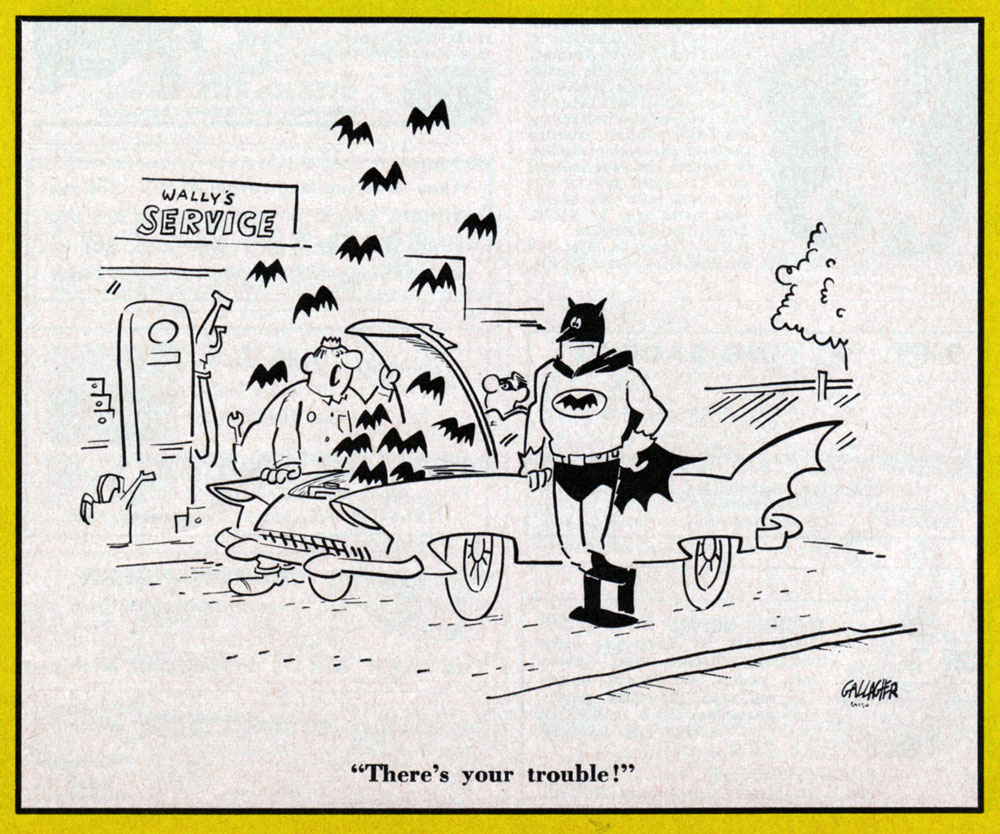
A cute one from John Gallagher (1926 – 2005), twice (1957, 1971) the winner of the National Cartoonists SocietyBest Gag Cartoonist‘ Award and elder brother of Heathcliff creator George Gately Gallagher. It was published in scouting monthly Boys’ Life‘s July, 1966 issue, smack dab in the heart of Batmania. We ran another bit of bat-drollery from John in an earlier post.
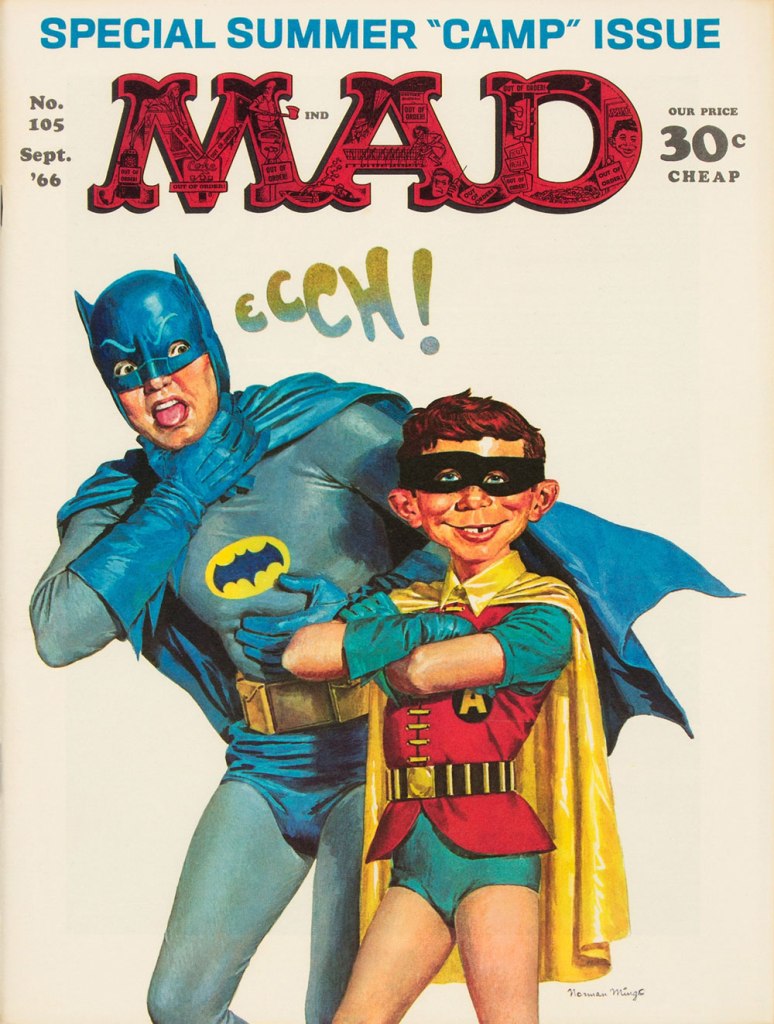
This is Mad Magazine no. 105 (Sept. 1966, EC); cover by Norman Mingo (1896-1980).
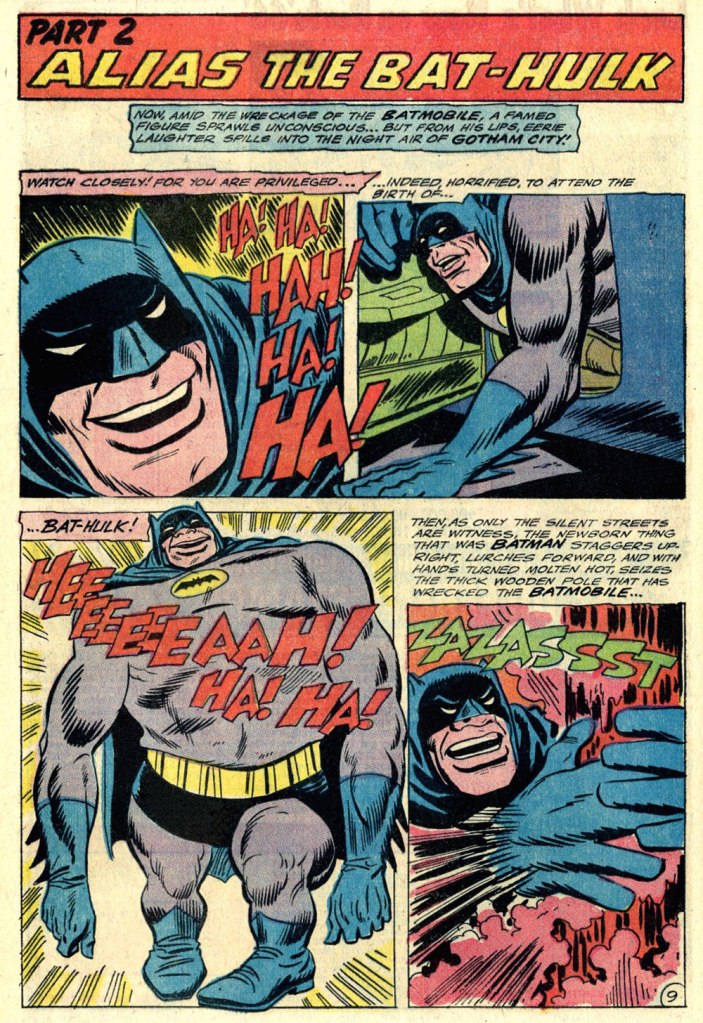
A pivotal page from ‘Alias the Bat-Hulk’ written by Bob Haney, pencilled by Mike Sekowsky and inked by Mike Esposito, from The Brave and the Bold no. 68 (Oct.-Nov. 1966, DC), edited by George Kashdan. We’re featured the issue’s fabulously batty cover in our earlier tribute to Mike Sekowsky. Bless you, gentlemen — you truly understood what fun meant and what comics should be.
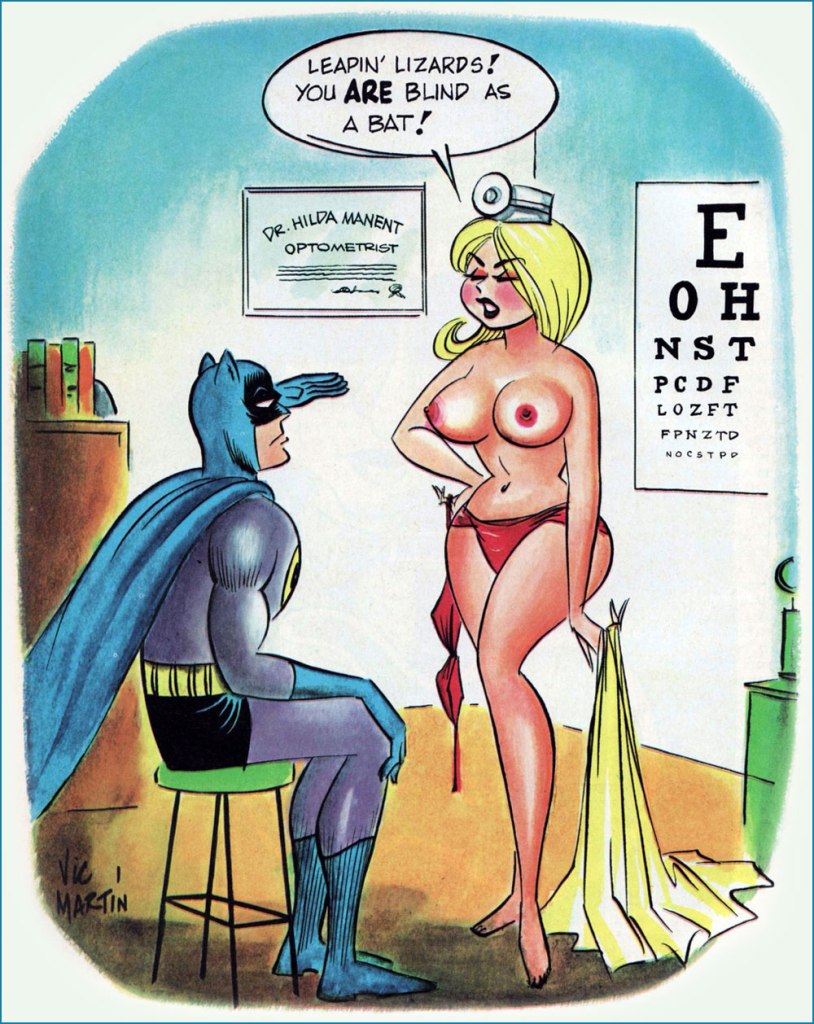
Prolific Argentine cartoonist Vic Martin (in his homeland, he drew the strip “Salvador” for Medio Litro magazine) moved to the US in the early 1950s, crafting a respectable body of work in the comic book field, chiefly for Ziff-Davis, before migrating to men’s magazines and girlie digests. By the 1970, he’d found a home with Cracked Magazine (He handled the Hudd & Dini feature), while also freelancing for Sick and Crazy. Everything but Mad, really. This particular cartoon comes from the March, 1967 issue of Avant Publishing’s “Escapade”. As Pat Masulli is listed under “production” in the masthead, a Charlton connection is more than likely. And speaking of “Leapin’ lizards!“, Martin would later (1973-74) work on the Little Orphan Annie comic strip.
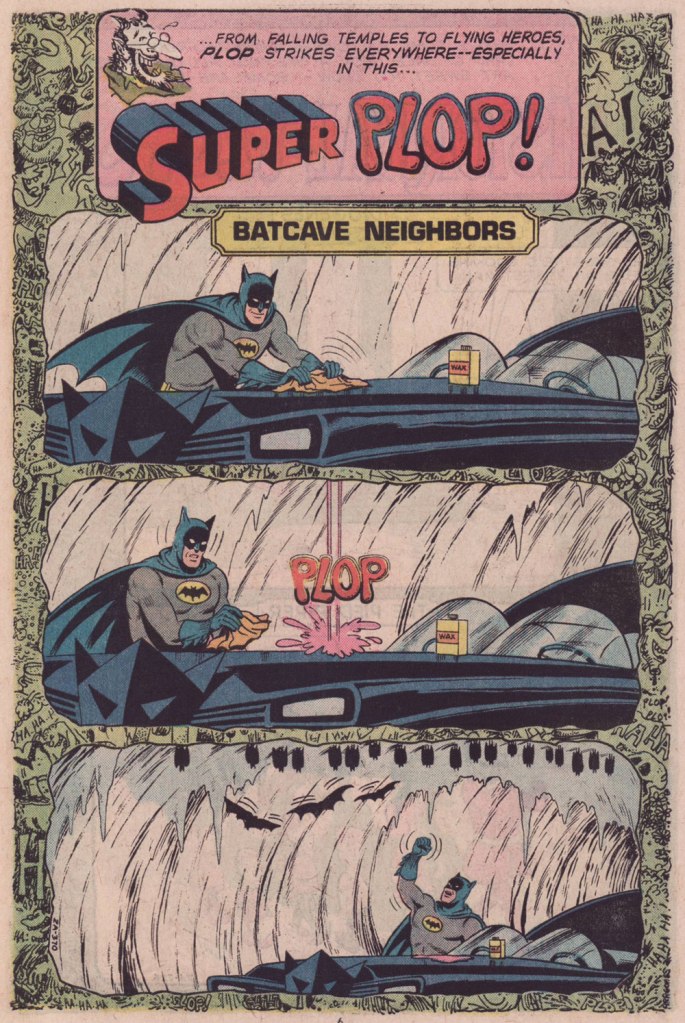
From Plop no. 9 (Jan.-Feb. 1975, DC); Writer unknown, art by Kurt Schaffenberger.
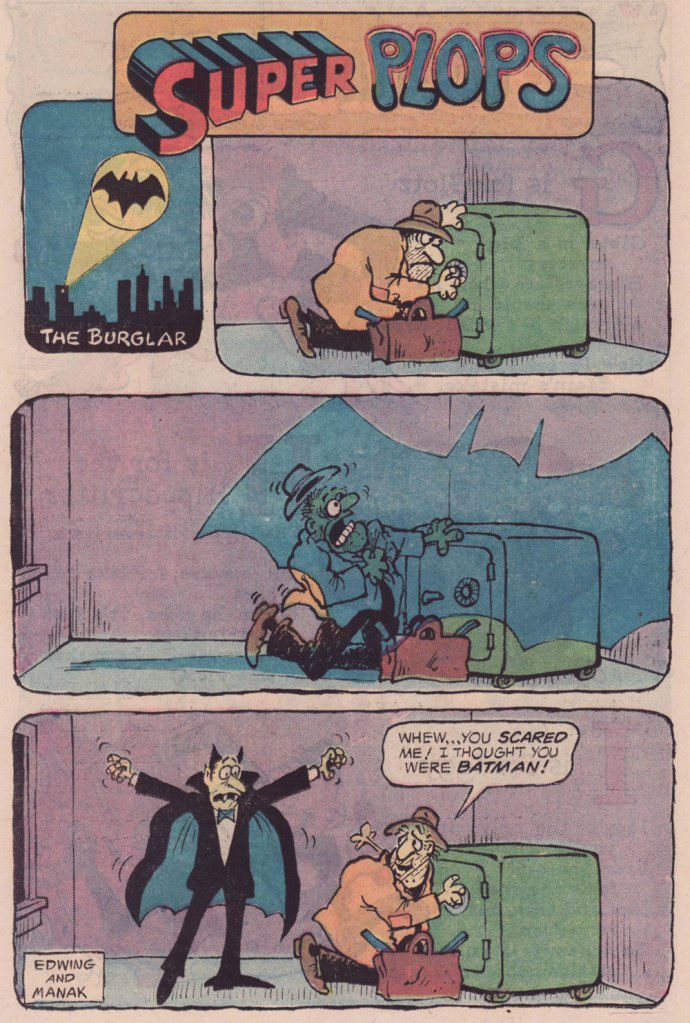
This one’s from Plop! no. 20 (Mar.-Apr. 1976), DC); idea by Don ‘Duck’ Edwing, art by Dave Manak.
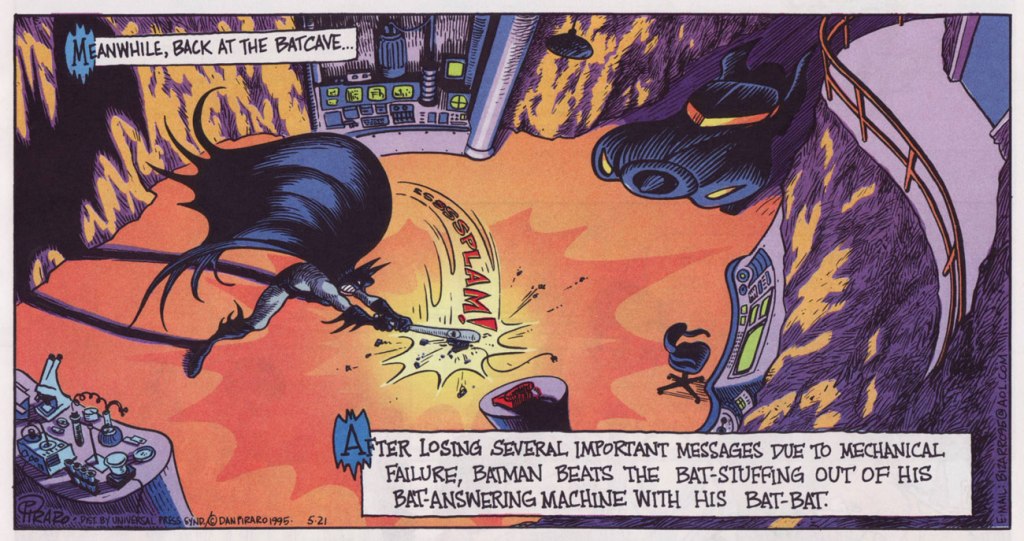
Dan Piraro‘s May 21, 1995 Bizarro Sunday strip. Between Piraro and his canny accomplice, Wayno, there have been scores of excellent bat-japes over the years. I must confess that the term ‘bat-bat’ triggers other associations. « To the Man-Mobile! »
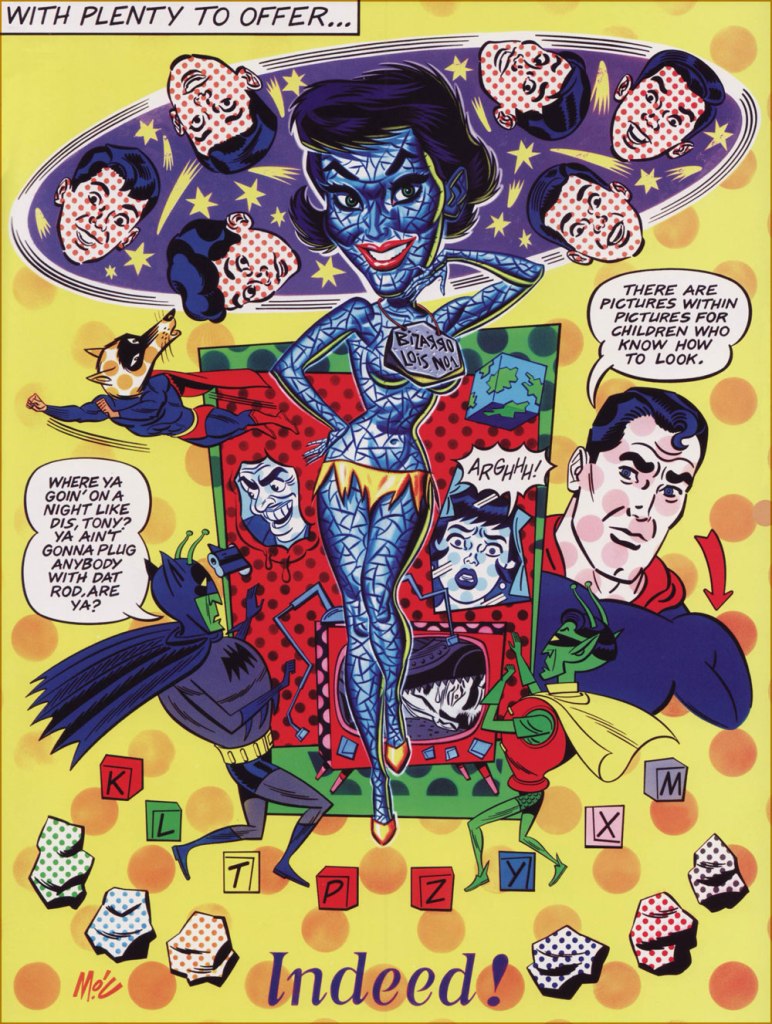
This is Pictures Within Pictures, a 1998 watercolour by Mitch O’Connell (not to be confused, of course, with this beloved, near-homonymous fella — yes, I can just hear Beavis and Butthead chortling). The piece is full of references to various Golden Age comics made infamous by Fredric Wertham‘s Seduction of the Innocent. For instance, er… Batman‘s speech balloon quotes from this particular comic book‘s opening splash. On a sobering note, let’s not forget that the 1950’s furore over comic books, as absurd as it may have seemed, still has relevance today.
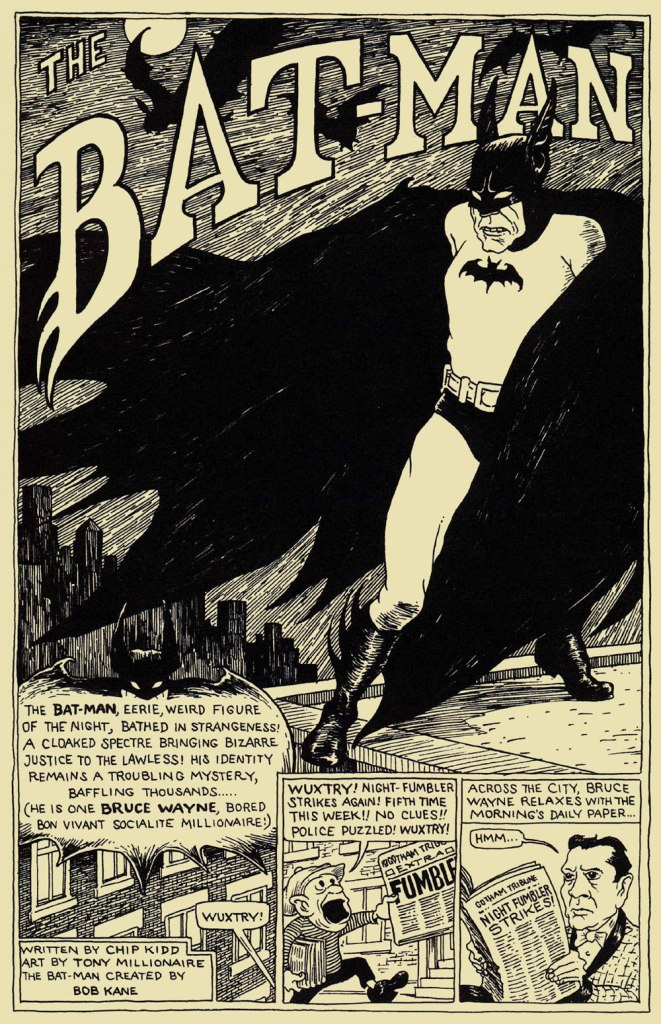
In a more deadpan vein, here’s the opening splash of Chip Kidd and Tony Millionaire‘s madcap homage to the very earliest of Batman’s exploits, with nods a-plenty to the 1943 film serial. “The Bat-Man” originally appeared in Bizarro Comics (Aug. 2001, DC).
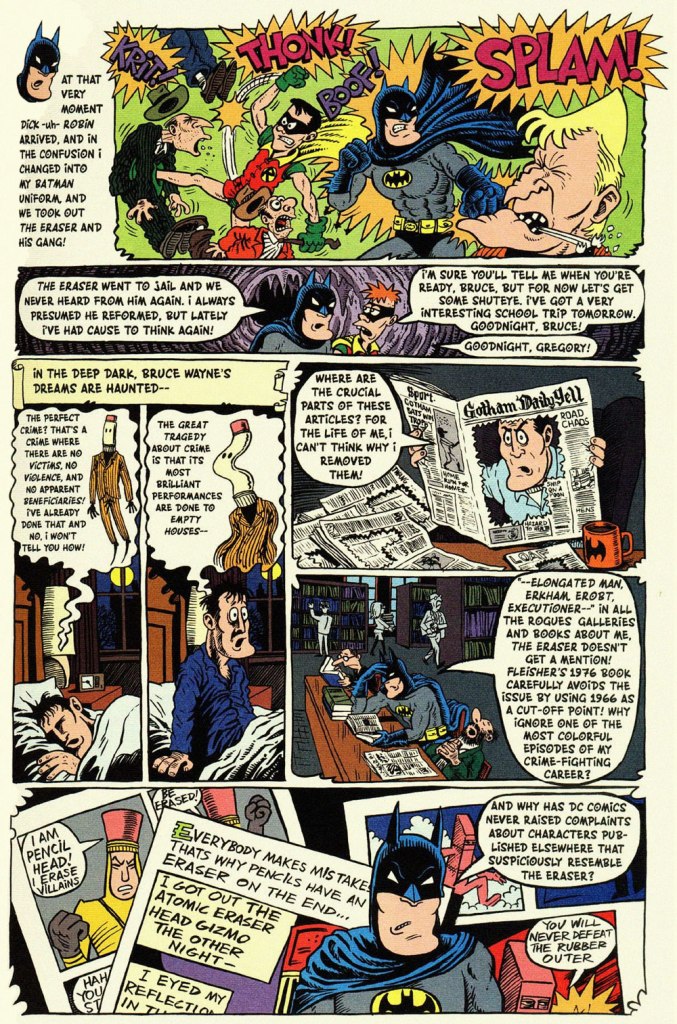
Another most decidedly dynamic duo, Eddie Campbell and Hunt Emerson, assembles to concoct an affectionate, thoughtful and yes, funny look at one of Batman’s most bizarre-yet-neglected members of the Bat’s rogues’ gallery, Lenny Fiasco, aka The Eraser, introduced in Batman no. 188 (Dec. 1966, DC) with The Eraser Who Tried to Rub Out Batman! This sequel, Who Erased the Eraser? also made its original appearance in Bizarro Comics (Aug. 2001, DC), edited by Joey Cavalieri.
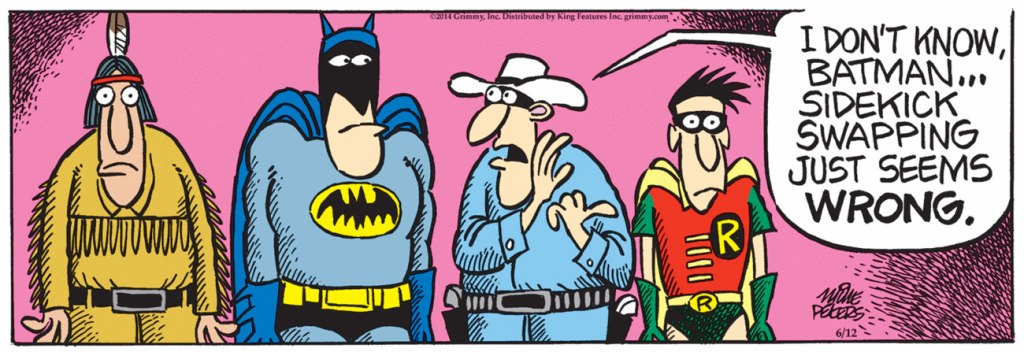
Here’s one (June 12, 2014) from Pulitzer Prize-winning (1981) editorial cartoonist Mike Peters (b. 1943). It’s from his unevenly written but always gorgeous comic strip Mother Goose and Grimm (created in 1984 and still going strong in over 800 newspapers worldwide). Like his colleagues Piraro and Wayno, Mr. Peters can scarcely resist a good bat-gag, so this is just one in a crowd of many.
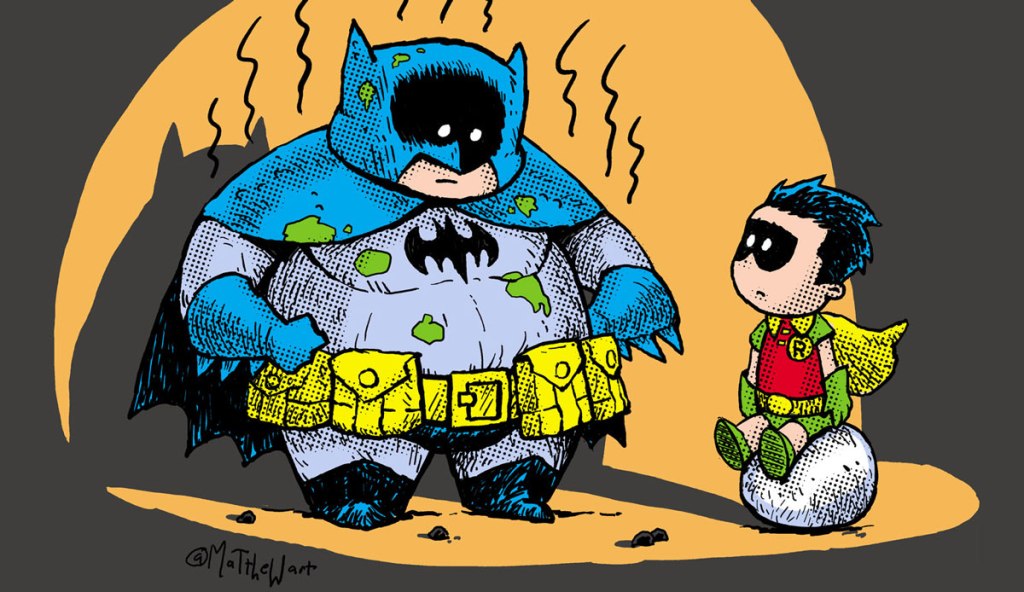
Everyone’s familiar with the famous playground song and staple of crooner Robert Goulet’s répertoire, right? The web is rife with visual adaptations, but this was my favourite, the work of Matthew S. Armstrong and available as a handsome t-shirt.

-RG
*the second-funniest Bat-related thing I encountered online this week is this attribution of a Batman (created in 1939) quote to Marx (1818-1883).

The funniest was the following deeply ironic quote from pathological liar and glory hog Bob Kane: « How can an article about me or the Batman be the true story when I am not consulted or interviewed? »

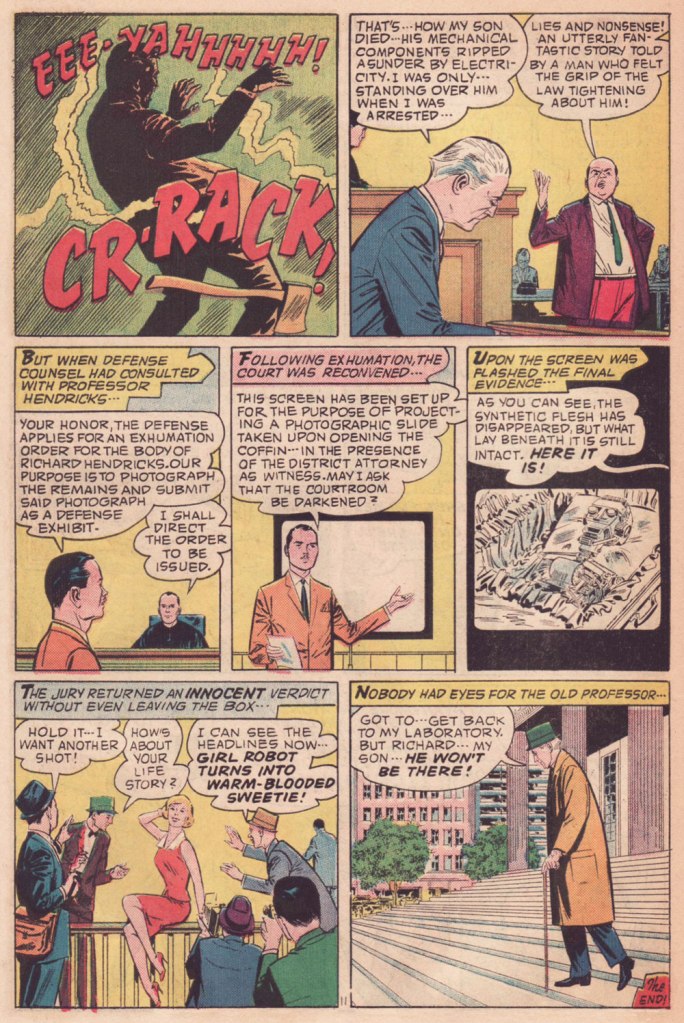
Treasured Stories: “The People vs. Hendricks!” (1964)

« Programmed for love, she can be quite tender
Treat her unkind, nothing offends her
She vacuums the carpet and doesn’t complain
She’ll walk the dog in the pouring rain.
» — Was (Not Was), Robot Girl

Today, on the occasion of his birthday (this would be number 112), we celebrate the great writer and editor Leo Rosenbaum (1909-1974), Potentate of Pseudonyms. If you know of him at all, odds are it’s under his nom de plume of Richard E. Hughes, pioneering chief writer and editor of the American Comics Group (ACG, 1943-67), and then perhaps under one of the numerous colourful aliases he adopted to conceal the fact that he was doing most, if not all, the company’s writing. In alphabetical order, meet Pierre Alonzo, Ace Aquila, Brad Everson, Lafcadio Lee (a salute to the Irish-born writer of Japanese ghost stories of Kwaidan fame, perhaps?), Kermit Lundgren, Shane O’Shea, Greg Olivetti (probably inspired by the brand of his typewriter!), Kurato Osaki, Pierce Rand, Bob Standish and Zev Zimmer.

Early in my comics collecting days, I spent a lot of time consulting Robert Overstreet‘s The Comic Book Price Guide (a practice I’ve utterly abandoned) gleaning random bits of trivia and dreaming about potential acquisitions. One item that greatly piqued my interest was this note:

From the 12th edition of The Comic Book Price Guide (1982, Overstreet Publications).

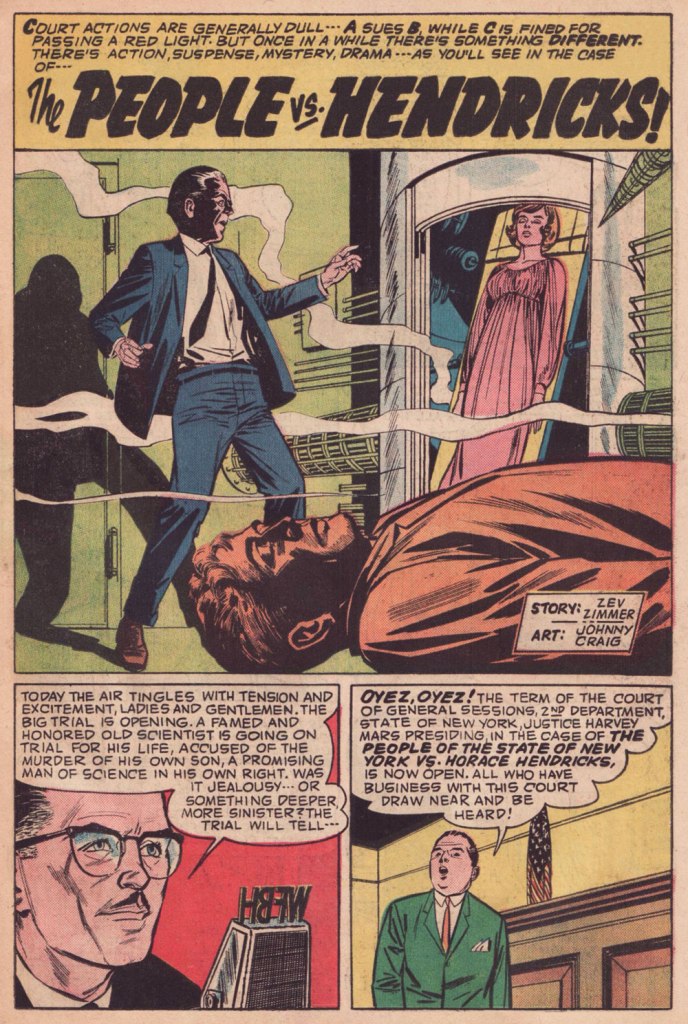
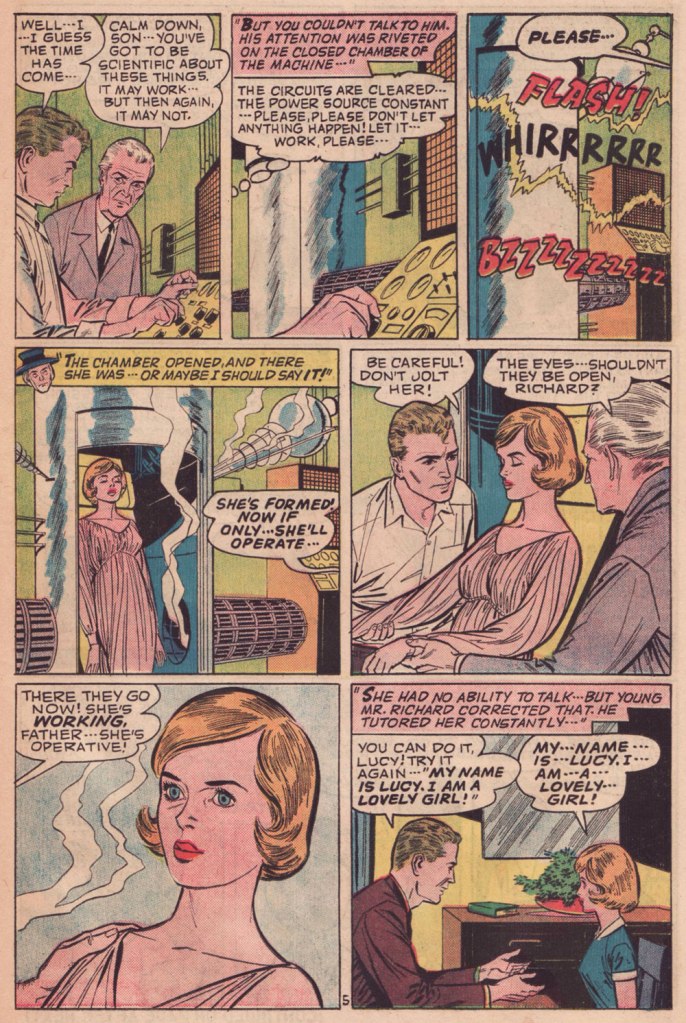
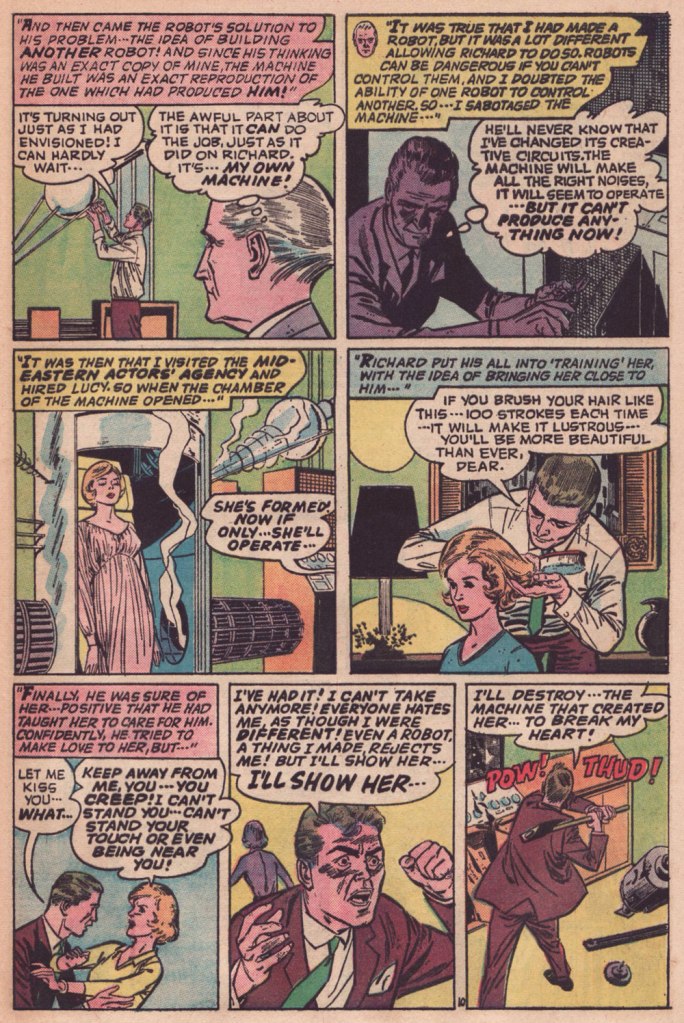
Well, I did eventually get my hands on a copy, and I must say wasn’t disappointed. And since I was taught to share with the other kids, here’s the story in question.

While “The People…” draws upon familiar elements of The Bride of Frankenstein and say, Inherit the Wind, I daresay that its heart-rending conclusion is its very own.
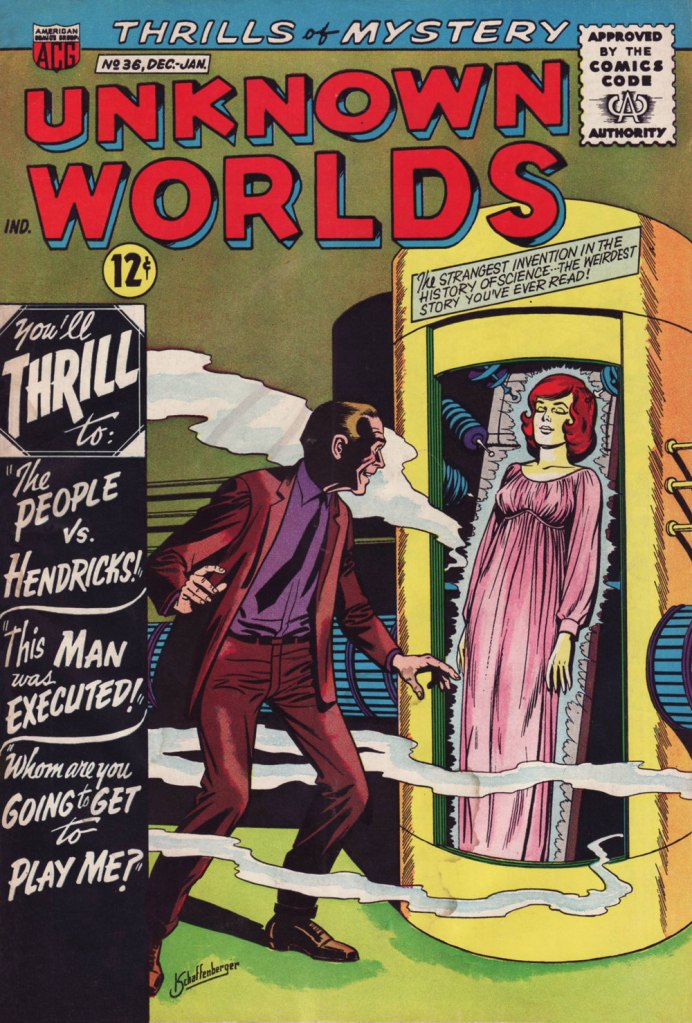
And here’s the cover. This is Unknown Worlds no. 36 (Dec. 1964 – Jan. 1965, ACG); art by Kurt Schaffenberger.

As for the artist: Johnny Craig (1926-2001) had been absent from the comics field most of the decade that followed EC Comics’ near-total collapse and the advent of the Comics Code, when he suddenly turned up at ACG (he’d been toiling in advertising). He would later do some work with Warren, Marvel and DC until the early 80s, at which point he more or less retired. Craig’s always been near the very top of my favourites at EC. Since he was, artistically-speaking, painstaking (‘slow as mollasses in February‘, my art school drawing teacher was fond of saying) and quite self-critical, Gaines entrusted him, as he did in the case of Harvey Kurtzman, with some editorial and scripting responsibilities to make up the income shortfall and keep him around and happy. And so the Craig-edited-and-led Vault of Horror is easily the finest of the company’s horror trio, largely thanks to Craig’s solid writing skills, not to mention his inspired artwork. Craig’s stories provided a much-needed breather from Gaines and Feldstein’s often powerful, but also formulaic and overwritten tales.

Interestingly, while Craig’s art style is overall understated and full of spit and polish, he created several of the company’s most transgressive images (such as this one and that one). Editor-writer Hughes knew precisely what he was doing (as any editor worth his salt should) when he conceived this story and assigned it to Craig. It plays superbly to the man’s strengths, if you ask me.

-RG
Hallowe’en Countdown V, Day 9

« I don’t know what the hell I published.
I never read the things.
» — Stanley P. Morse

In the sinister wake of Warren Publishing‘s success with Creepy, Eerie and Vampirella, old-school fly-by-night 1950s comics publisher Stanley P. Morse (Aragon Magazines, Gillmor Magazines, Medal Comics, Media Publications, S. P. M. Publications, Stanmor Publications, and Timor Publications…) dusted off some of his old pre-Code chillers in the late 1960s and early 1970s in black and white magazines such as Shock (15 issues), Chilling Tales of Horror (11 issues), Ghoul Tales (5 issues) and Stark Terror (5 issues). It certainly wasn’t all junk: after all, Morse had published Weird Tales of the Future and Mister Mystery, with their Basil Wolverton and Bernard Baily classics…

Unlike Eerie Publications’ grey-toned and blood-and-gore-ified reprints, these are, as far as I know, unretouched, not to mention decently printed.

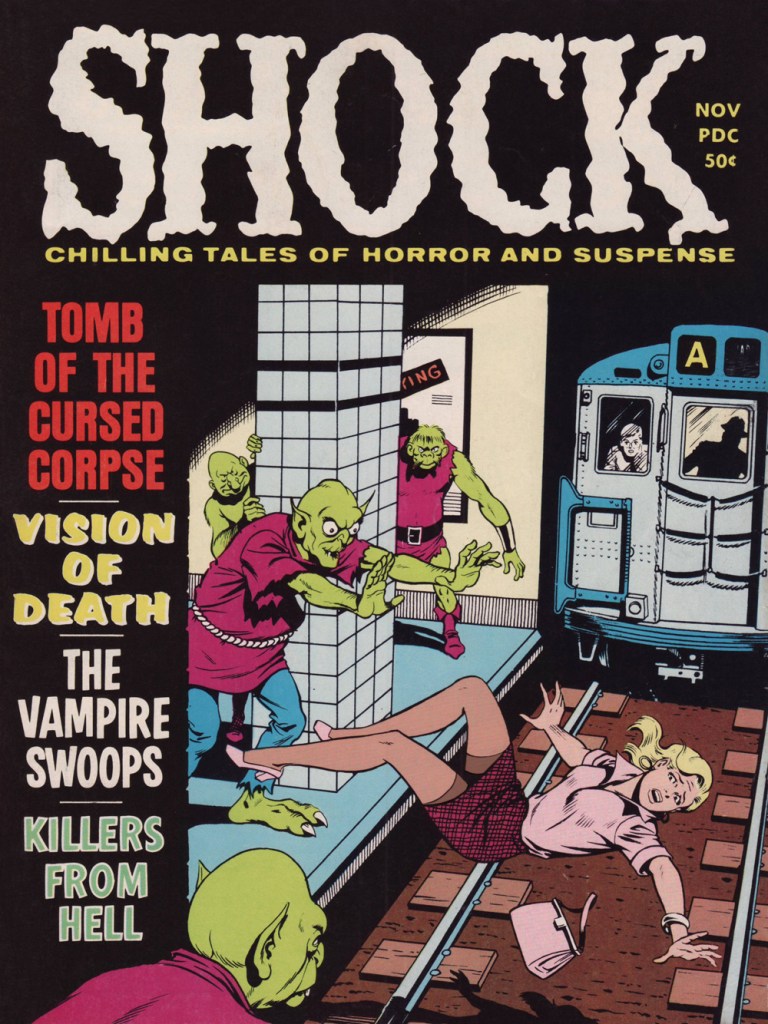
This is Shock Vol. 2 no. 5 (no. 10, November, 1970, Stanley Morse). Edited by Theodore S. Hecht.

Maybe it’s just me, but isn’t Kurt Schaffenberger just about the unlikeliest pick of cover artist for a pre-code horror anthology? Sure, he fit in nicely with ACG’s gentle moral fable aesthetic, but aren’t you just expecting the Man of Steel or The Big Red Cheese to swiftly sweep in, catching the damsel-in-distress before the A Train smooshes her?

To wit: one of Kurt’s fun ACG covers, this is Unknown Worlds no. 43 (Oct.-Nov. 1965, ACG).

-RG

Tentacle Tuesday: With One Magic Word…

« A slithering tentacle now seizes Billy, and a shuddery voice pours into his ears! »

Previously, we’ve talked about Captain Marvel (the original, the best, the… dare I say, unique!) in a post about his co-creator C.C. Beck. Today, I’ll concentrate on the World’s Mightiest Mortal’s exploits with all manner of tentacled monsters.

All C.C. Beck quotes in this post come from An Interview with C.C. Beck conducted in the late 1980s (shortly before Beck’s death in 1989) by the talented Tom Heintjes of Hogan’s Alley.

« When I looked at the first Captain Marvel story, I knew at once that here was a story worth illustrating. It had a beginning, a carefully constructed development of plot and characters leading to a climax and an ending, and nothing else. There was no pointless flying around and showing off, no padding, no “Look, Ma, I’m a superhero!” Out of 72 panels, Captain Marvel appeared in 18, or one-fourth. »

Whiz-Comics4A
« March, ye scalliwag, or I’ll curdle yer giblets! » Follow Captain Marvel’s fine example – don’t forget to hug a tree, folks! Although it will be better if you can find one without spines and prehensile appendages. This  is Whiz Comics no. 5 (May 1940), cover by C. C. Beck. Captain Marvel may “crash through”, but the cover story, « Beautia for President », contains no tentacles whatsoever… just a hypnotically beautiful woman, that some may settle for (not me). You may note that the cover has « number 4 » written on it, but 5 was the number reported to the Copyright Office, so go figure.

Whiz-Comics60A
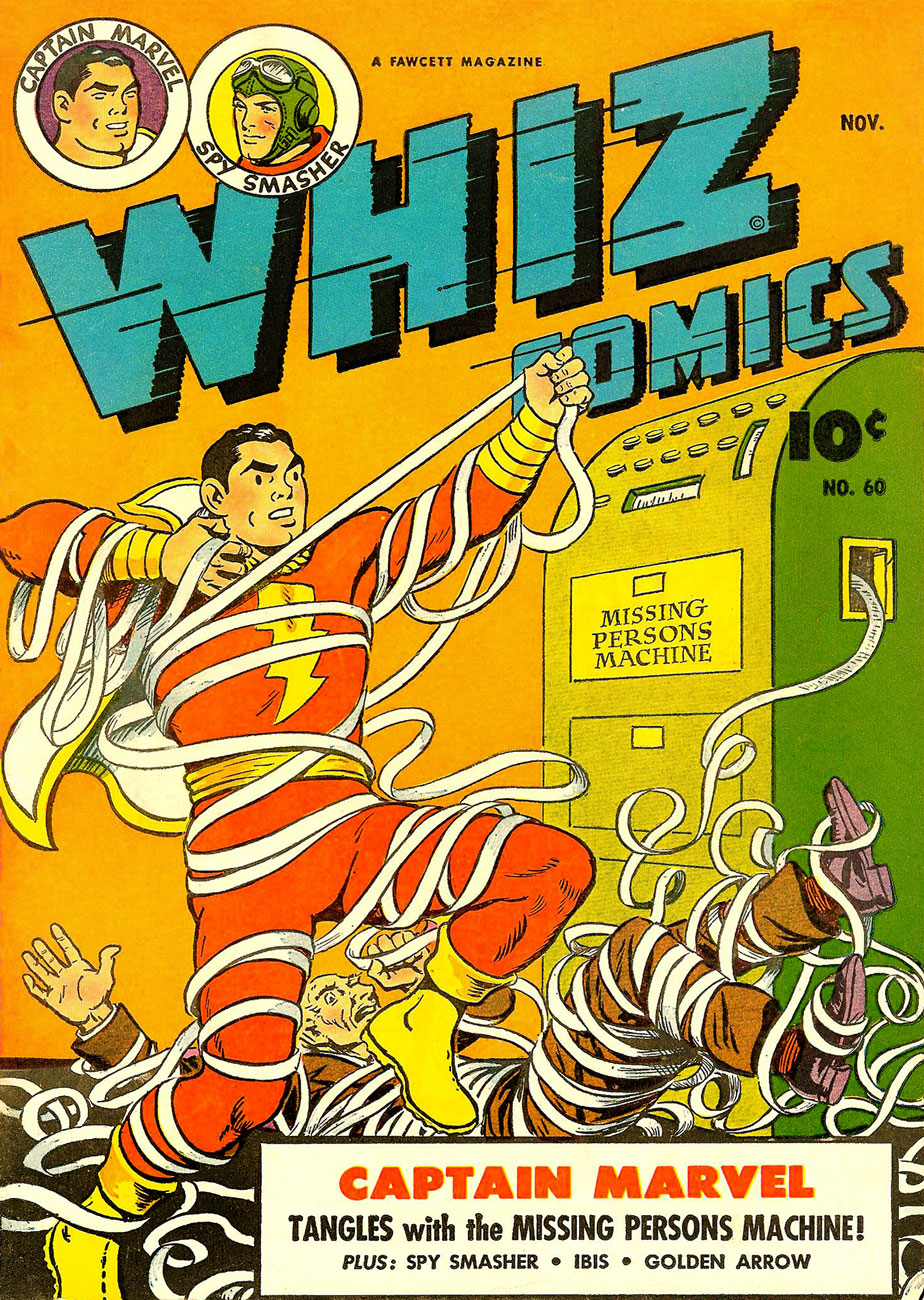
Whiz Comics no. 60 (November 1944), cover by C. C. Beck. Paper tentacles? I think they count! The main story is adorably goofy, in the best Otto Binder tradition… but unfortunately comicbookplus.com has only a seriously blurry scan of this issue (read it here, but it may cause headaches).

WhizComics146-CCBeck-CaptainMarvel
Whiz Comics no. 146 (June 1952), cover by Pete Costanza. Speaking of the latter and quoting (again) from C.C. Beck, « Pete Costanza was the first artist hired to assist me when Fawcett’s comic department started to expand in the latter part of 1940. We later went into partnership, and Pete was in charge of our studio in Englewood, New Jersey, while I operated out of our New York City office. Pete was an established illustrator at an early age, and I learned as much from him about story illustration as he learned from me about cartooning. »

The green, proudly toupée-d fellow appears in the opening panel of Terror Stalks the World’s Fair, but as it turns out, he has nothing to do with the rest of the story, really.

WhizComics#146-TerrorStalkstheWorld'sFair
Terror Stalks the World’s Fair is scripted by Otto Binder and drawn by Kurt Schaffenberger.

WhizComics155-CaptainMarvel
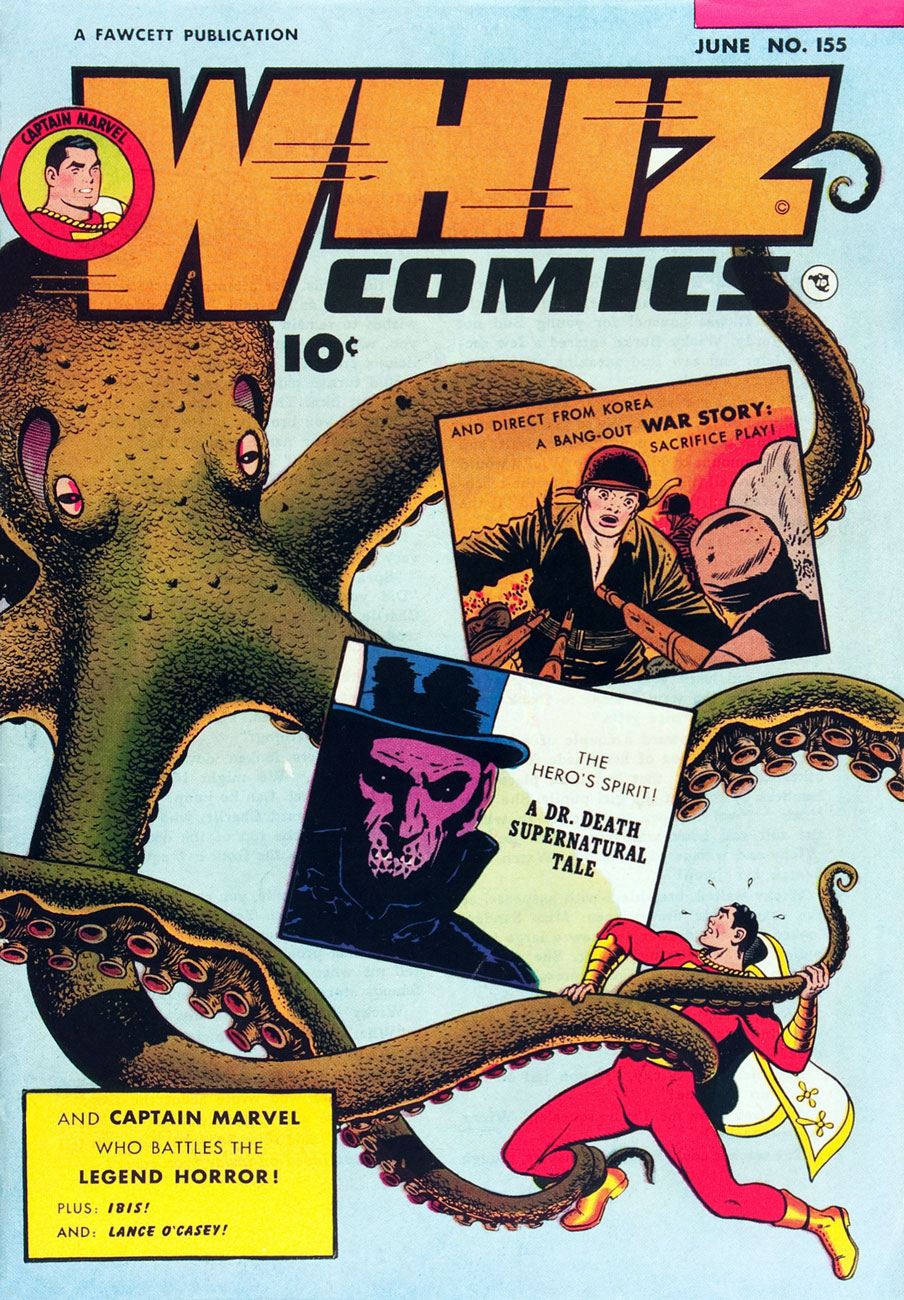
« A sinister mystery hangs over the city! Each night, screams are heard… human screams that gurgle away into deathly silence! » Whiz Comics no. 155 (June 1953), the final issue of Whiz Comics, cover by C.C. Beck.

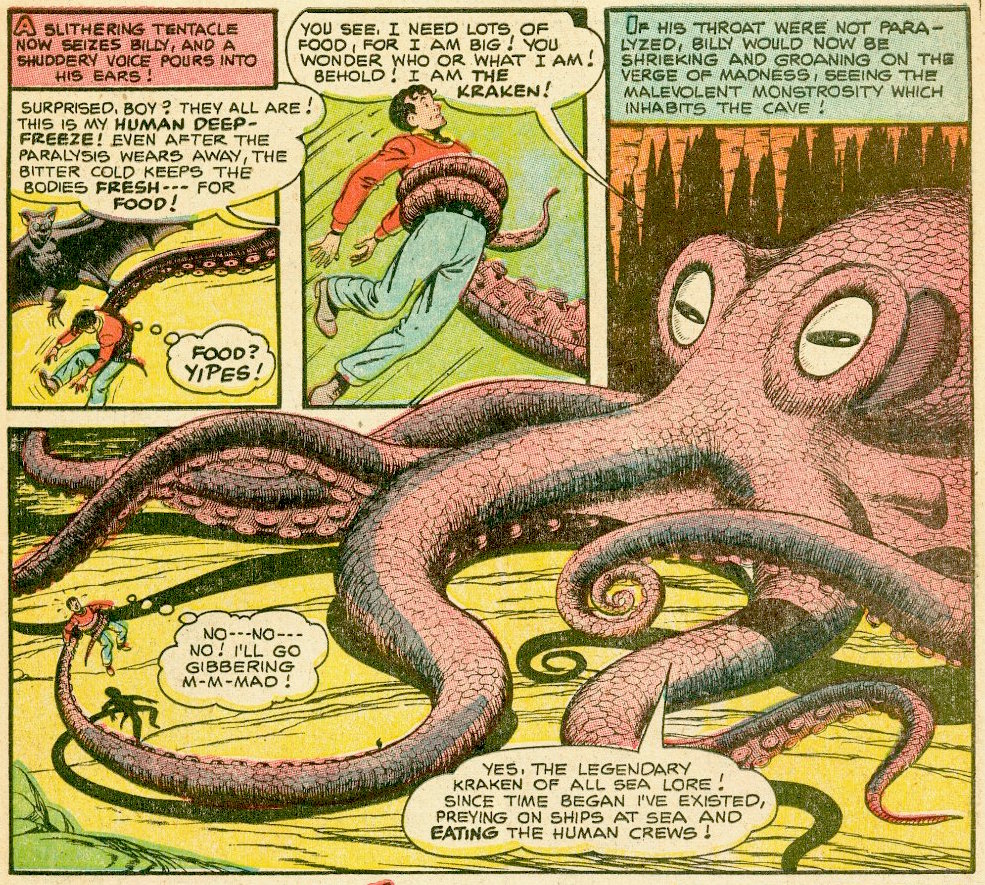
The cover story features an actual kraken with evil, myopic eyes! I rejoiced.

WhizComics#155-BattlesTheLegendHorror
Page from Captain Marvel Battles the Legend Horror, scripted by Otto Binder and drawn by Kurt Schaffenberger.

In an interesting plot twist, it is revealed that gigantic vampire bats and the Kraken (who has the gift of speech, sounding like somebody’s rather eccentric uncle) have struck up a partnership.

WhizComics#155-BattlesTheLegendHorror-vampirebats
Poor Kraken must get cold, consuming all those frozen bodies…

While we’re at it, Captain Marvel Battles the Legend Horror is a perfect demonstration of a point C.C. Beck made well:

« Billy Batson was the real hero of all the Captain Marvel stories, from the first issue until the last.  Without Bill Batson, Captain Marvel would have been merely another overdrawn, one-dimensional figure in a ridiculous costume, running around beating up crooks and performing meaningless feats of strength like all the other heroic figures of the time who were, with almost no exceptions, cheap imitations of Superman. In fact, I have always felt that flying figures in picture form are silly and unbelievable, and I would much sooner have never drawn them, but the publisher insisted on them. Most of the time Captain Marvel’s ability to fly had little or nothing to do with the plots of the stories in which he appeared. Billy Batson started every story and ended every story. In between, Captain Marvel appeared when he was needed, disappeared when he was not needed. The stories were about Billy Batson, not about the cavortings of a ridiculous superhero for whom the writers had to concoct new and more impossible demonstrations of his powers for each issue. »

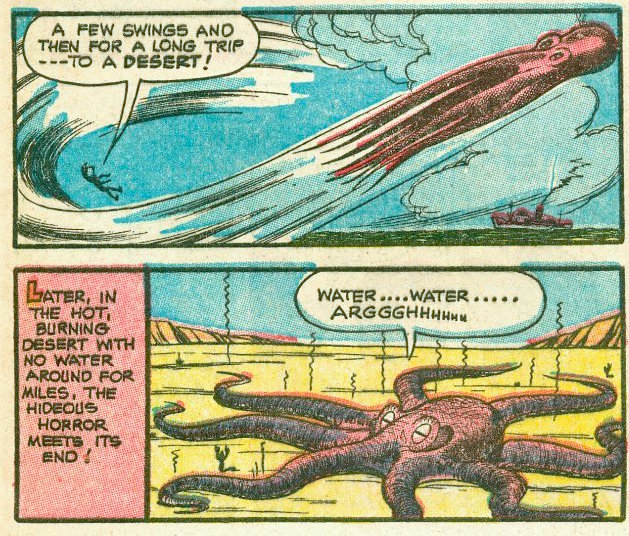
WhizComics#155-BattlesTheLegendHorror-Water
A terrible end for any creature, even a malevolent one.

And our last encounter with tentacles for today…

Captain-Marvel-Adventures65A
Captain Marvel Adventures no. 65 (September 1946), cover by C. C. Beck.

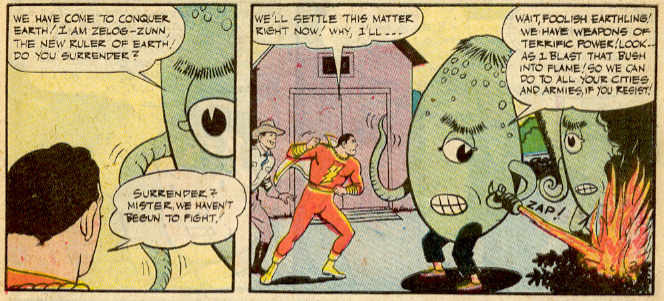
The Invasion From Outer Space, plotted by Otto Binder and drawn by C. C. Beck, offers us lots of cute little alien guys:

CaptainMarvel65-The Invasion From Outer Space
As usual, they wanna take over the world, but they’re cute, anyway. There’s that toupée again, this time (alien) flesh-coloured! That’s a mighty suggestive tentacle wiggle, Zelog-Zunn Sir.

CaptainMarvel65-The Invasion From Outer Space2

Have more time to kill? Visit The World’s Mightiest Mortal, a blog dedicated to the ol’ big red cheese.

~ ds

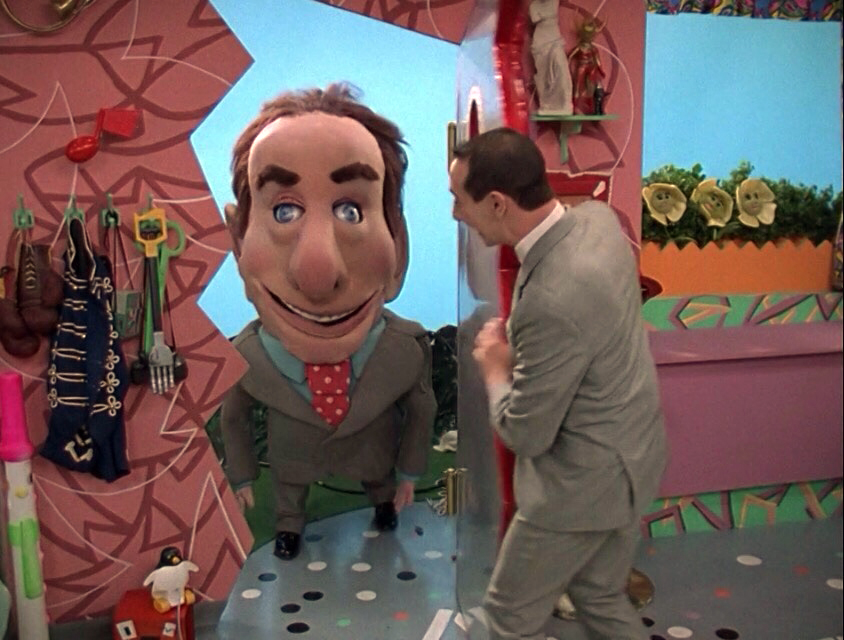
« I’m going door to door to make you this incredible offer! »

Surprise! Happy birthday to Lois Lane artist supreme Kurt Schaffenberger (December 15, 1920 – January 24, 2002), here working under the alias of Lou Wahl, (he was also Jay Kafka, which would have been fitting here!) a popular and entertaining practice at ACG and Marvel. The DC brass were presumably *not* amused by these moonlighting shenanigans. I’m looking at you, “Adam Austin”, “Mickey DeMeo” (aka Joe Gaudioso), “Jay Gavin” and “George Bell”…

UW55A
This is Unknown Worlds no. 55 (April-May 1967, ACG), one of the final issues of this fine anthology title.

In case you were wondering: Adam Austin was Gene Colan‘s alias, Mickey DeMeo and Joe Gaudioso were Mike Esposito‘s noms de plume, and Jay Gavin and George Bell were pseudonyms respectively favoured by Werner Roth and George Roussos.

PeeWeeColporteur
« Aaahhh!!! Salesmen! »

– RG