« The majority has no right to impose its stupidity on the minority. » — George Wolinski (1934-2015)
I realised this morning that yesterday was Mr. Wolinski’s birthday, so here’s a quick post. Despite what one might expect from the name, Wolinski was born in Tunisia; aged eighty, he perished in the terrorist attack on the Parisian offices of Charlie-Hebdo on that grim Wednesday of January 2015. For more context, see last year’s related post Never Forget: Cabu, le grand Duduche.
It would be futile to attempt to do justice to a brilliant, prolific and varied career spanning seven decades, so I won’t waste anyone’s time with such foolishness. Here’s Lambiek’s biographical essay, and here’s a conte cruel from Wolinski’s first solo collection, Histoires lamentables (1965, Hara-Kiri).
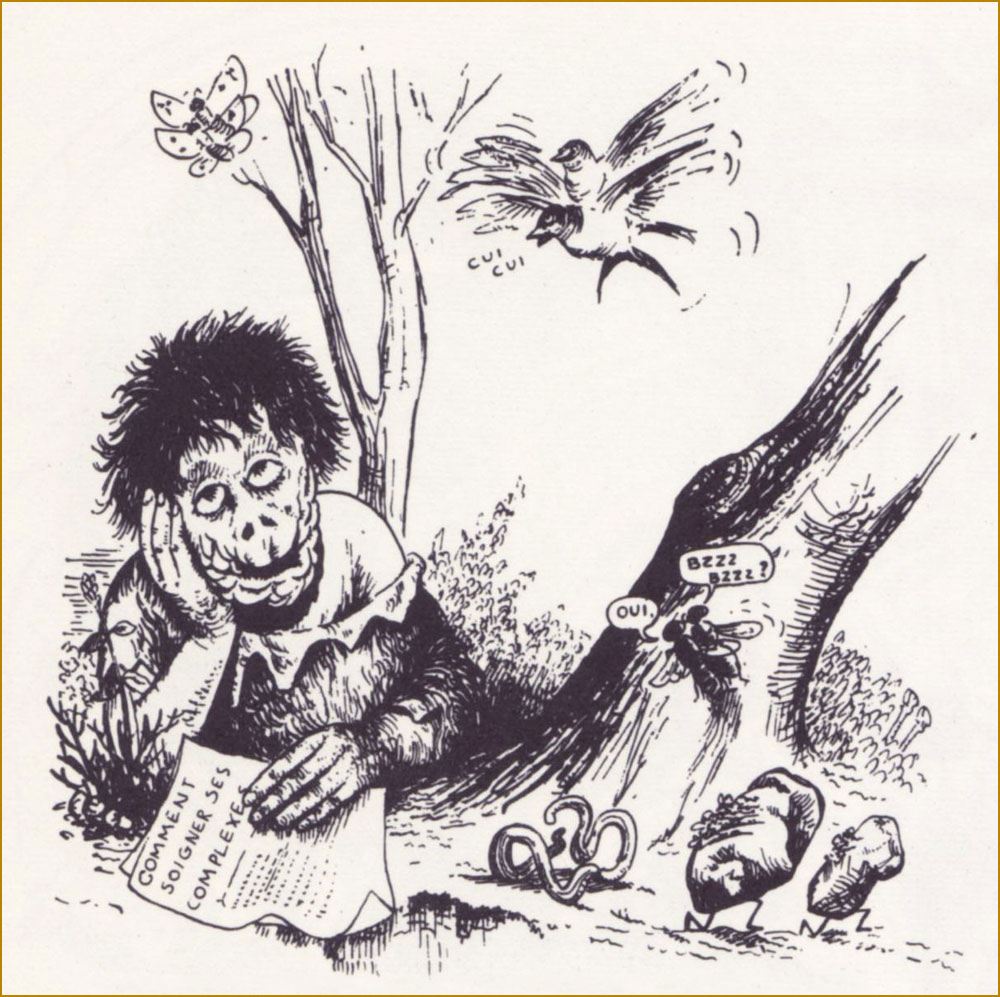
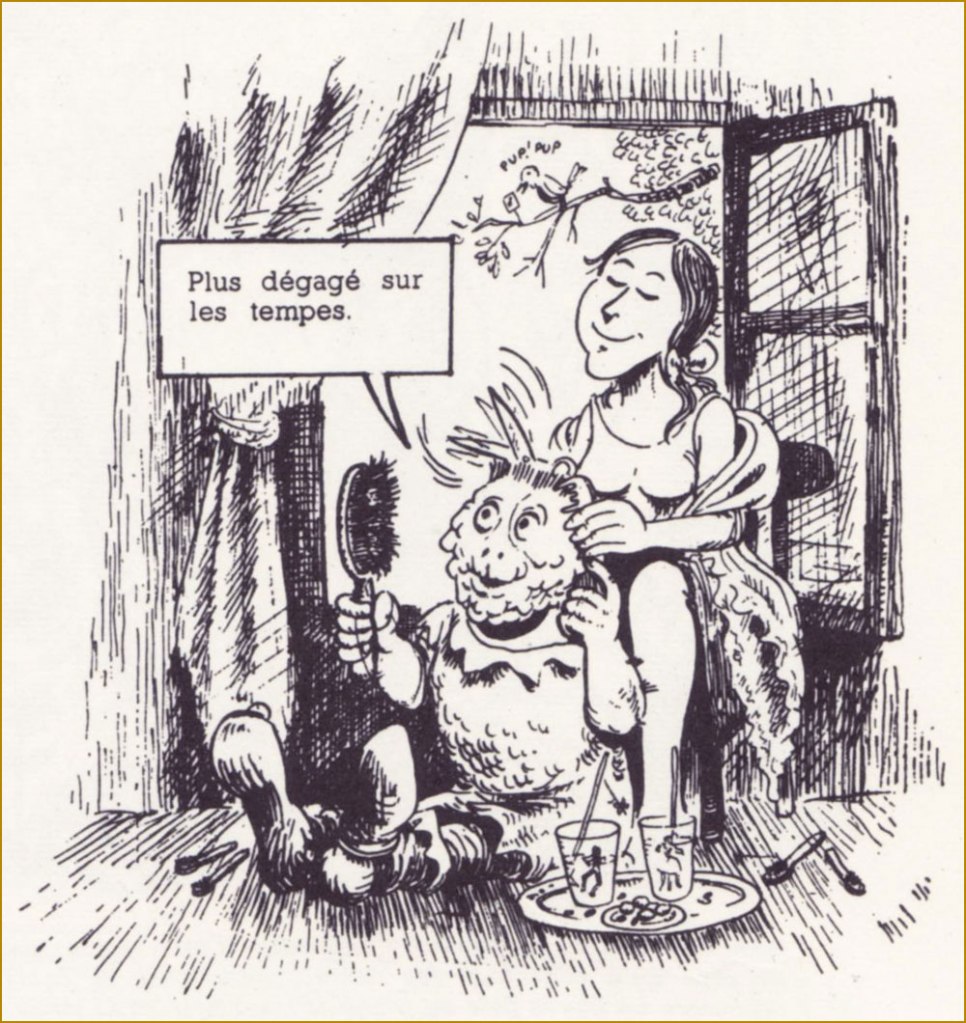
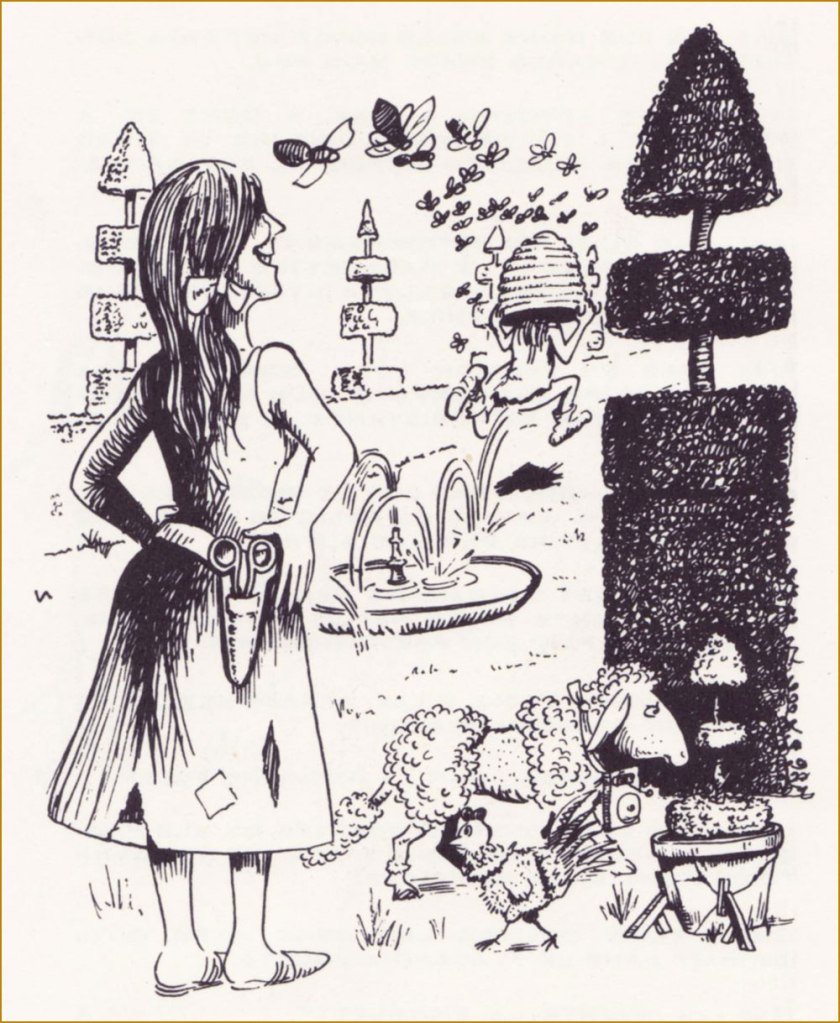
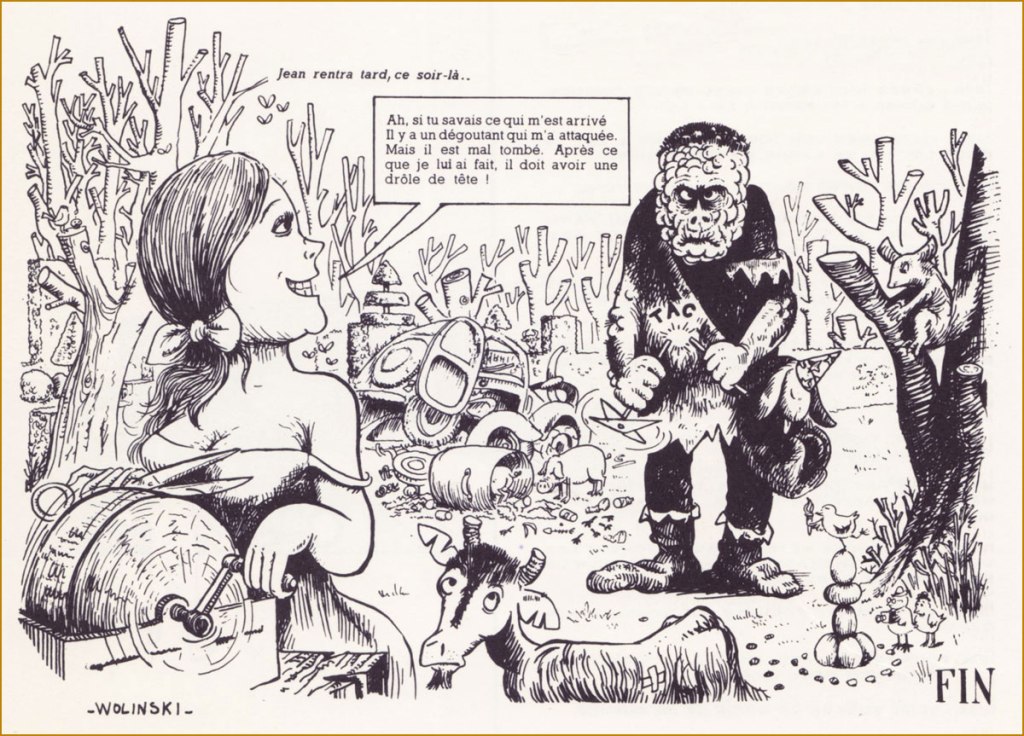
« Jean was the lone survivor of a fire that claimed his entire family. Having suffered atrocious burns to the face, he was as hideous as one could imagine. In order to avoid exposing others to that grim spectacle, he went to live deep in the woods with the wild beasts. However, each year, the returning Spring invoked in him strange reveries. » A PATHETIC TALE. « He then could not refrain from lurking about the homes of men. And so it was, one day, that he heard Isabelle’s song. Her voice made him forget his usual caution. » « Isabelle was blind. At the idea that she could not witness his ugliness, Jean felt an extraordinary emotion. He found the courage to speak to her. She responded with kindness, and he dared return. » « Soon, they became inseparable, and at last Isabelle agreed to follow him into the forest. »« Long months of happiness ensued. And then, Isabelle realised that, little by little, her sight was returning. When Jean learned the wonderful news, he was at once happy and desperate. Because he could no believe that Isabelle would remain by his side, now that she saw his ugliness. But Isabelle told him that his physical appearance mattered little to her, and that she would always love him. »« Jean, however, could not help but be miserable. One day, as he was hunting for mushrooms in the forest, he came upon a hare caught in a snare, pitied him and set him free. As it happened, that hare was a powerful genie who, in gratitude, transformed him into a handsome young man. »« Jean, delirious with joy, ran to meet Isabelle. The young girl was working at the beehive. Jean took her in his arms. »« Sweet Isabelle, assailed by this young stranger and fearing for her virtue, crowned him with the hive. »« Panicked with suffering, poor Jean fled like a madman. »« That evening, Jean returned late… » « Ah, if you only knew what happened to me. Some horrid masher attacked me. But I gave him a bad time. After what I’ve done to him, he must look quite a fright! »
from the look of this early style, I get the sense that young Wolinski was under the artistic sway of, say, Will Elder and Al Jaffee…. not a bad place to start!
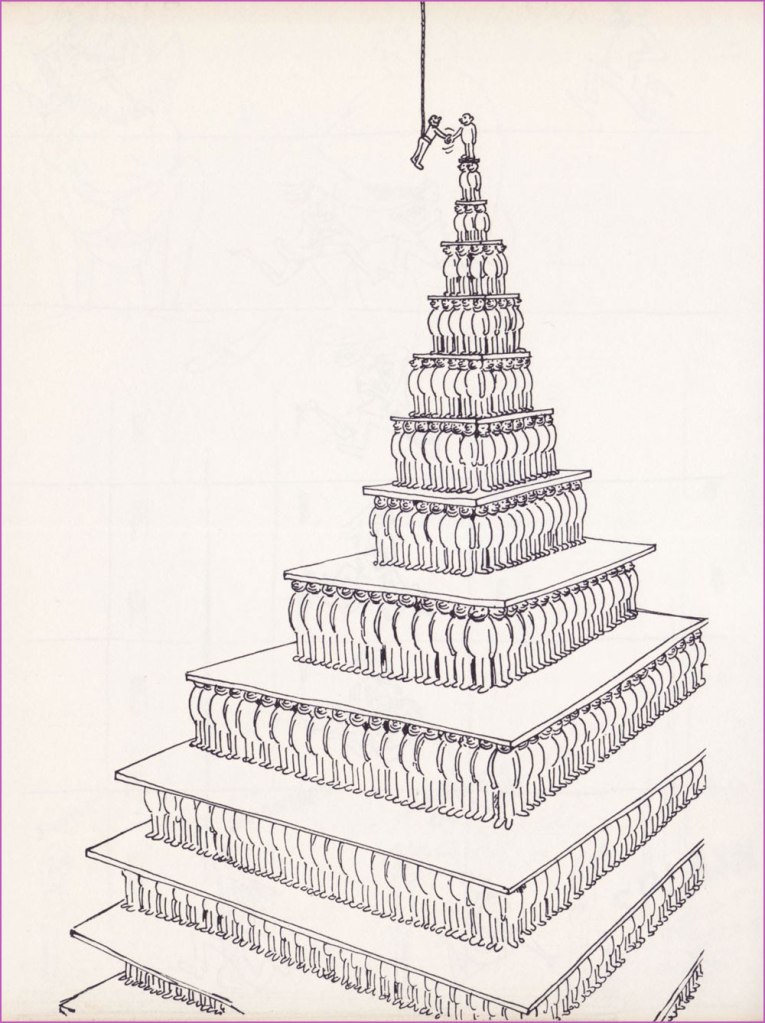
Here’s a trio of his early gag cartoons (circa the early 1960s), working in a more natural, more direct style:
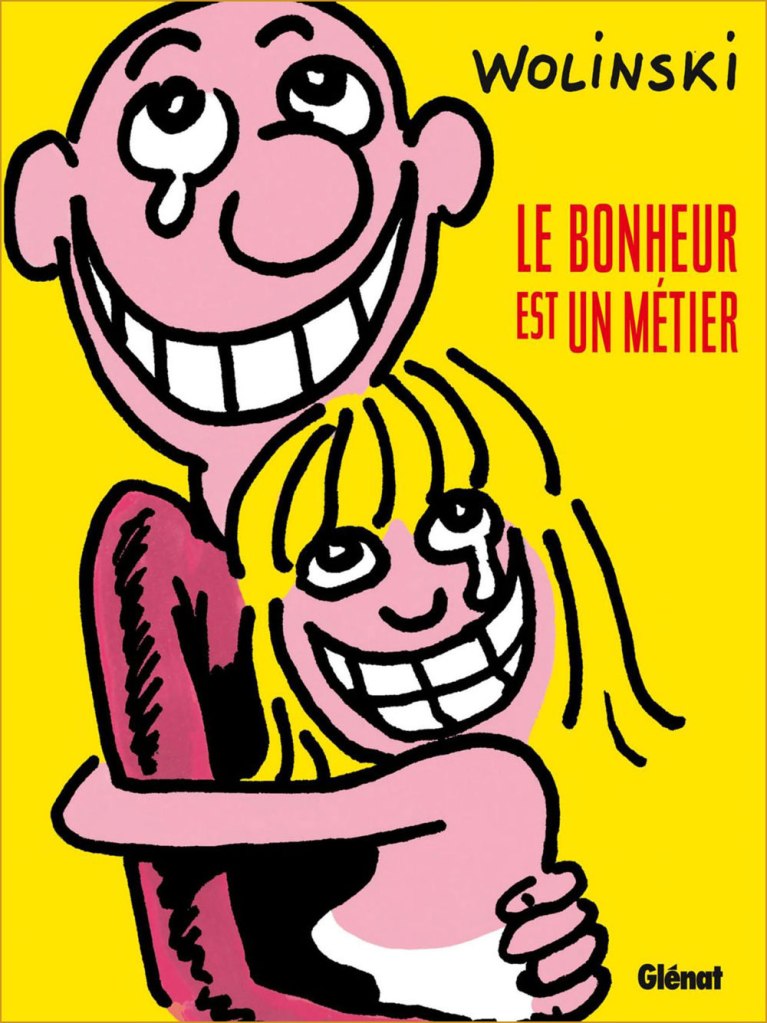
« Working in collaboration means spending half of one’s time explaining to the other that his ideas are stupid. » Wolinski served as the editor-in-chief of Charlie Mensuel from 1970 to 1981. His chief non-editorial contribution was his scripting, for his friend — and fellow Georges — Pichard, the adventures of Paulette, which ran in the magazine from 1970 to 1976. For more Pichard (and Paulette!), check out ds’ post Georges Pichard’s Distressing Damsels. This is Charlie Mensuel no. 80 (Sept. 1975), art — naturally — by Georges Pichard.« Happiness is an occupation » (2016, Glénat). Here’s an example of Wolinski’s fully evolved, more streamlined visual style, from the cover of a posthumous autobiographical collection. Wolinski was interred in Paris’ Cimetière du Montparnasse. Photo by Stéphane X. « Murdered on January 7 during the attack against Charlie-Hebdo. »
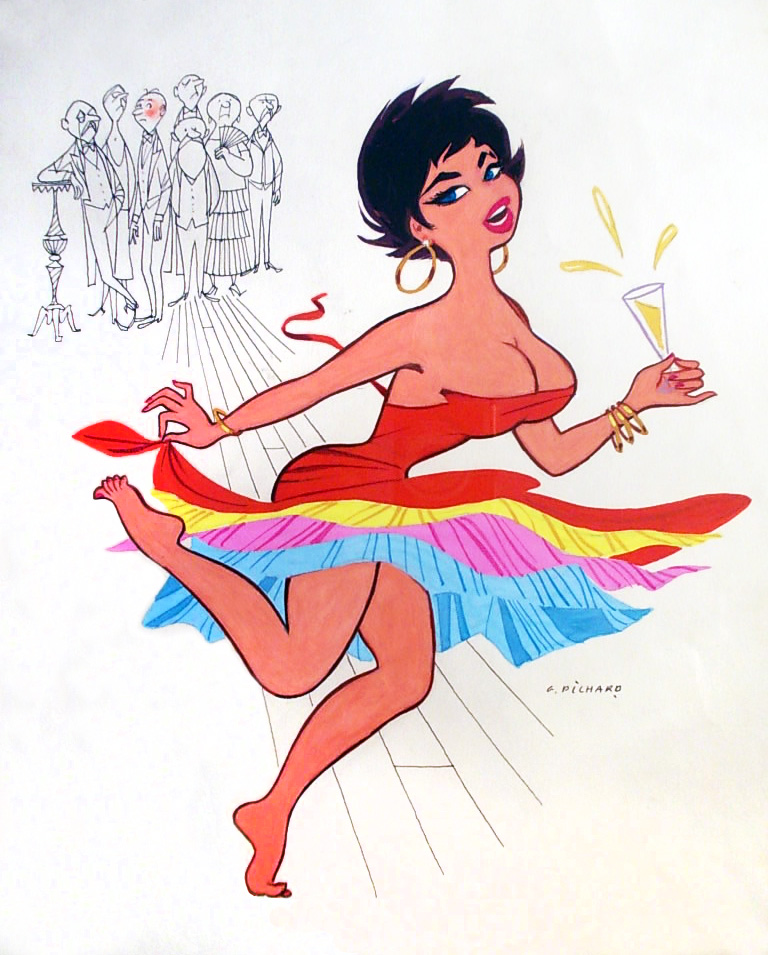
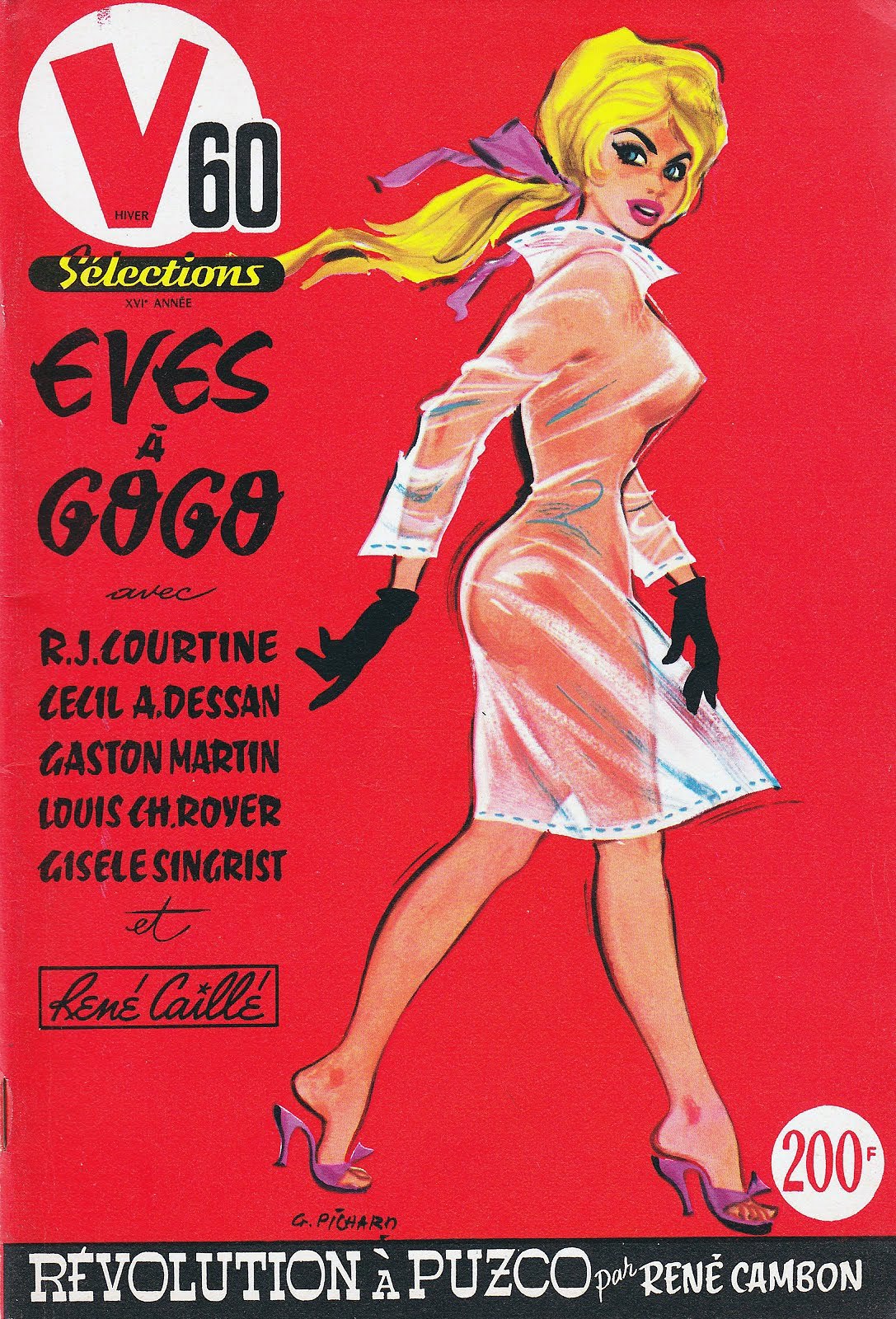
In 1946, Georges Pichard (not sure who he is? Visit our Pichard’s Distressing Damsels for an overview of his later work), heretofore toiling in a marketing agency, started his career as an illustrator. He worked for various French magazines and newspapers (like Le Rire, Fou-Rire and Les Veillées des Chaumières), providing them with covers, cartoons and pin-ups in black-and-white or gorgeous watercolour until the mid 70s, when he switched gears somewhat and dedicated himself to erotic bandes dessinées.
I left image imperfections (due mostly to yellowing of paper over time) and hand-written captions (when available) as is, as I find they provide pleasant texture and context. The jokes are really lame, but we translated them, anyway.
The following three cartoons were published in Le Rire. This first one saw print on the cover of Le Rireno. 22 (nouvelle série, July 1953).
This one was featured on the cover of Le Rireno. 66 (nouvelle série, March 1957).
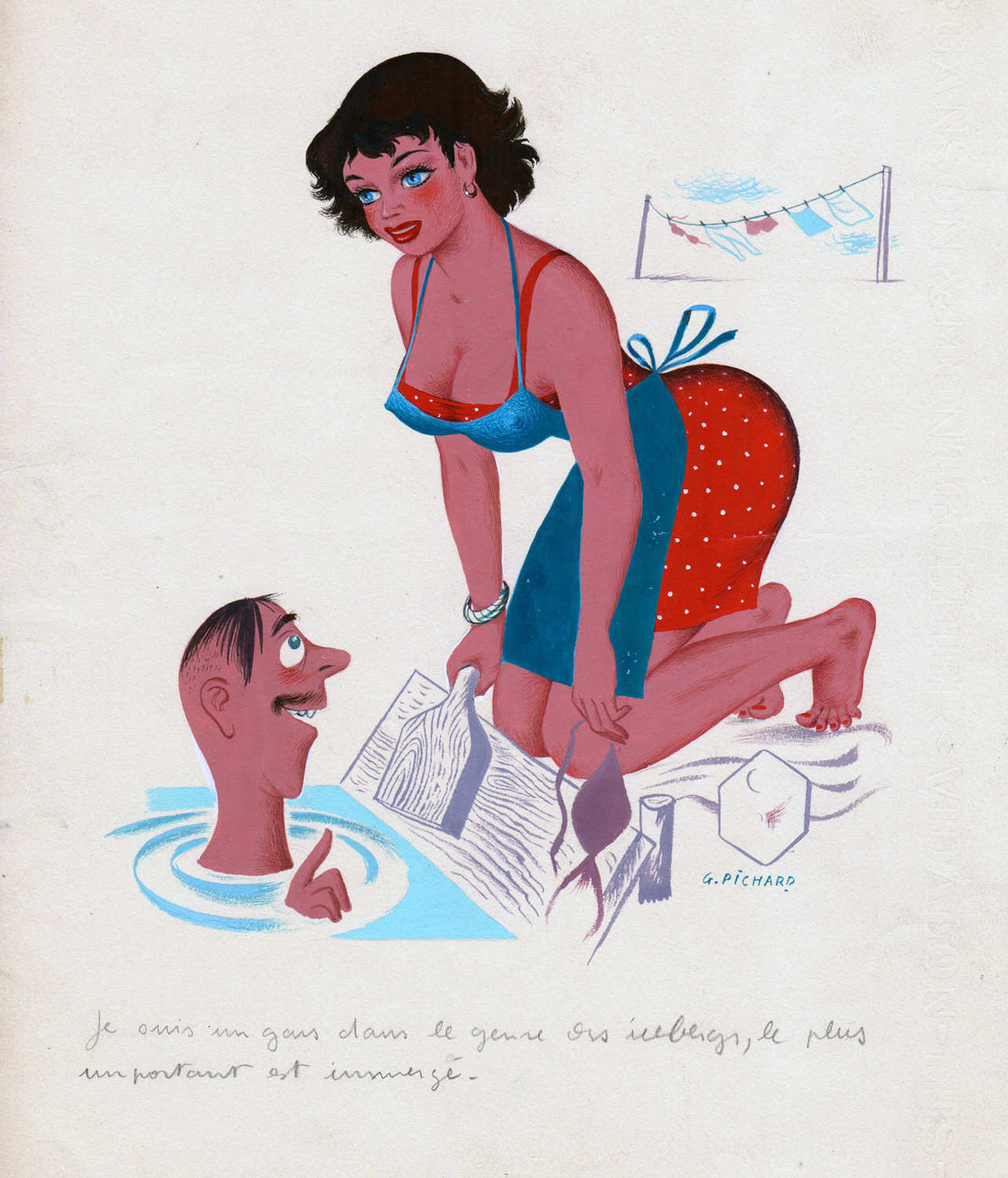
« I’m the sort of guy who’s kind of like an iceberg, the main part is beneath the surface. » The man in question looks very much like a V.I.P. type.
The following are all from Fou-rire:
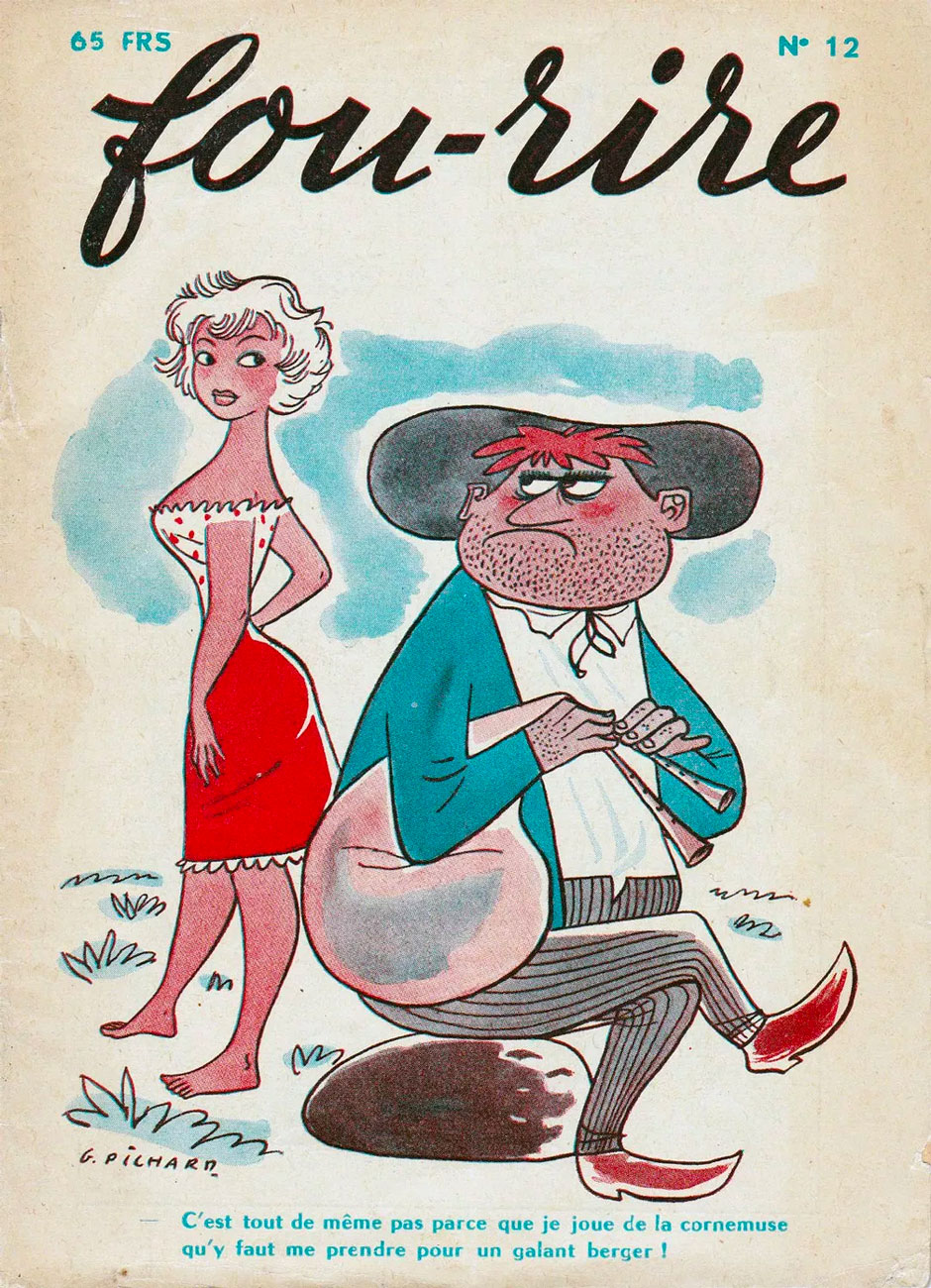
Cover of Fou-rire n°12, mid-50s. « It’s not because I’m playing the bagpipes that you have to take me for a gallant shepherd! »
Cartoon from Fou-Rire n° 76, early 60s. « Please be assured, my dear friend, that we are all here quite touched by your wife’s endeavours to set a mood… ».
Cartoon from Fou-Rire n° 118, early 60s. « It would be prudent to seal up your chimney, because when I tell the boss about this… »
Fou-Rire n° 118, mid 60s. « And to think that I’ve mislaid the key to this chest full of outfits, each more decent than the last… »
Finally, a couple of pretty loose ends:
Original art from Le Rire magazine, 1960s. « But the funniest part happened before I ran into the police officer! »
French comics artist Georges Pichard (1920-2003) specialized in erotic comics, and his work ranged from “just controversial” to “outright banned”. I have a soft spot for his excellently-endowed women with almond-shaped eyes – what they lack in sensuality (to my opinion, at least), they compensate with cantankerous personalities and odd liaisons with deities. Pichard also displays a preoccupation with labour and industrial themes, kind of a communist thing to my mind – his women are called upon (mostly unwillingly) to work with heavy hardware, build railroads, excavate mines, and undertake other menial tasks involving much metal and machinery. This, of course, is accomplished while naked, or nearly naked (shackles are frequently involved.) It doesn’t come off as sadistic or even sexist, however – it’s more like a grotesque comedy or satire. Anyway, I’ll get to all that in just a second.
First I’d like to show a few examples of his earlier work, which wasn’t “pushing moral boundaries” (as an anonymous admirer once put it). His two early series – Ténébrax and Submerman – were collaborations with comics artist Jacques Lob. Although Pichard’s eye for pretty women was already in evidence, his style was much cartoonier, which is lovely.
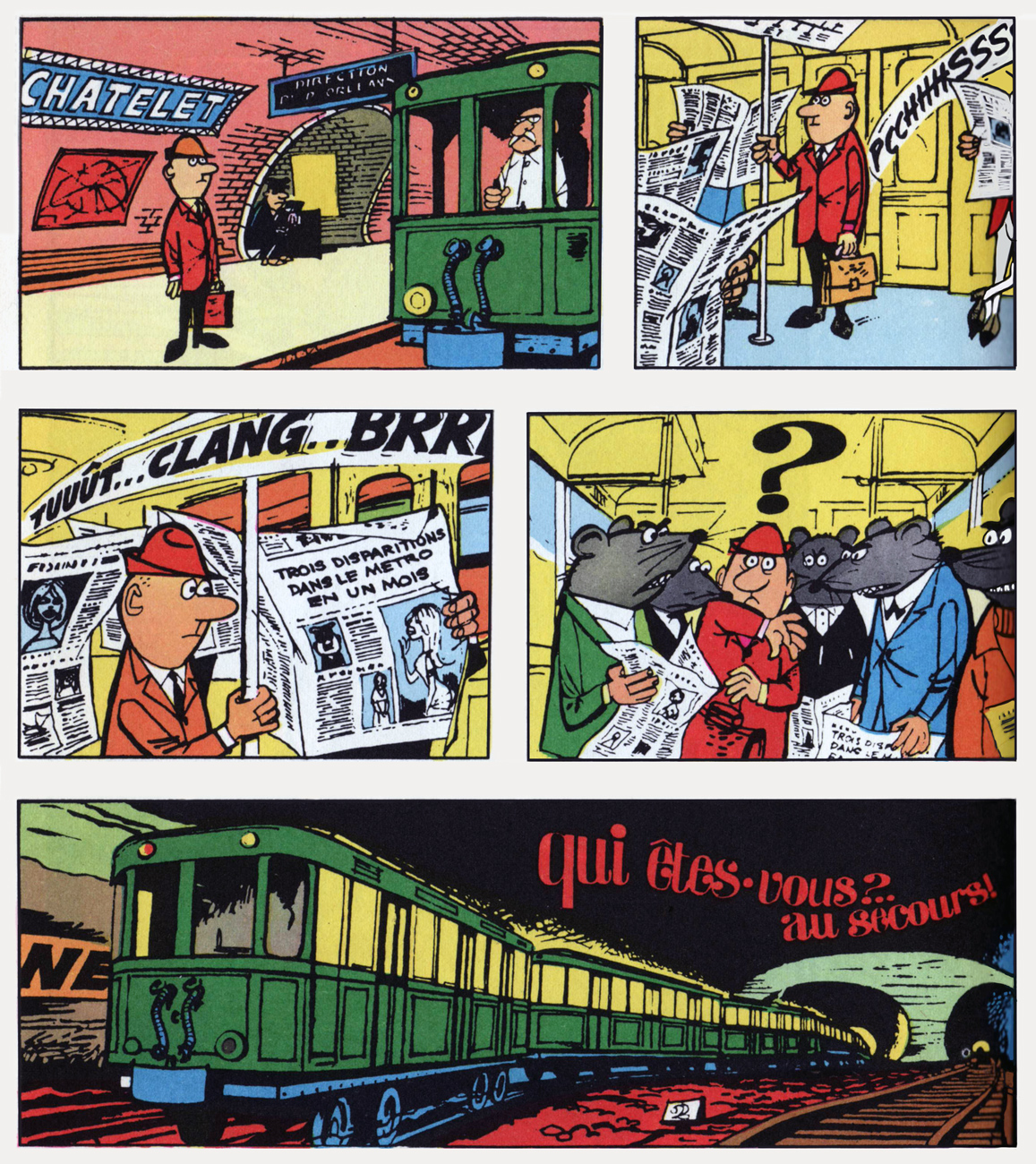
Ténébrax is an homage of sorts to the roman policier (the French genre of detective stories): a villain uses the Paris subway for his base while he whips his rat army into tip-top shape for world domination, but his heinous plans are foiled by a whodunit writer and his assistant, who manage to throw a spanner into his nefarious schemes.
Ténébrax, the first collaboration between scénariste Jacques Lob and Georges Pichard, was published in episodes in the short-lived weekly Chouchou (1964.)
The opening page of Ténébrax. The bottom panel says (or, rather, our human protagonist says), « Who are you? Help! »
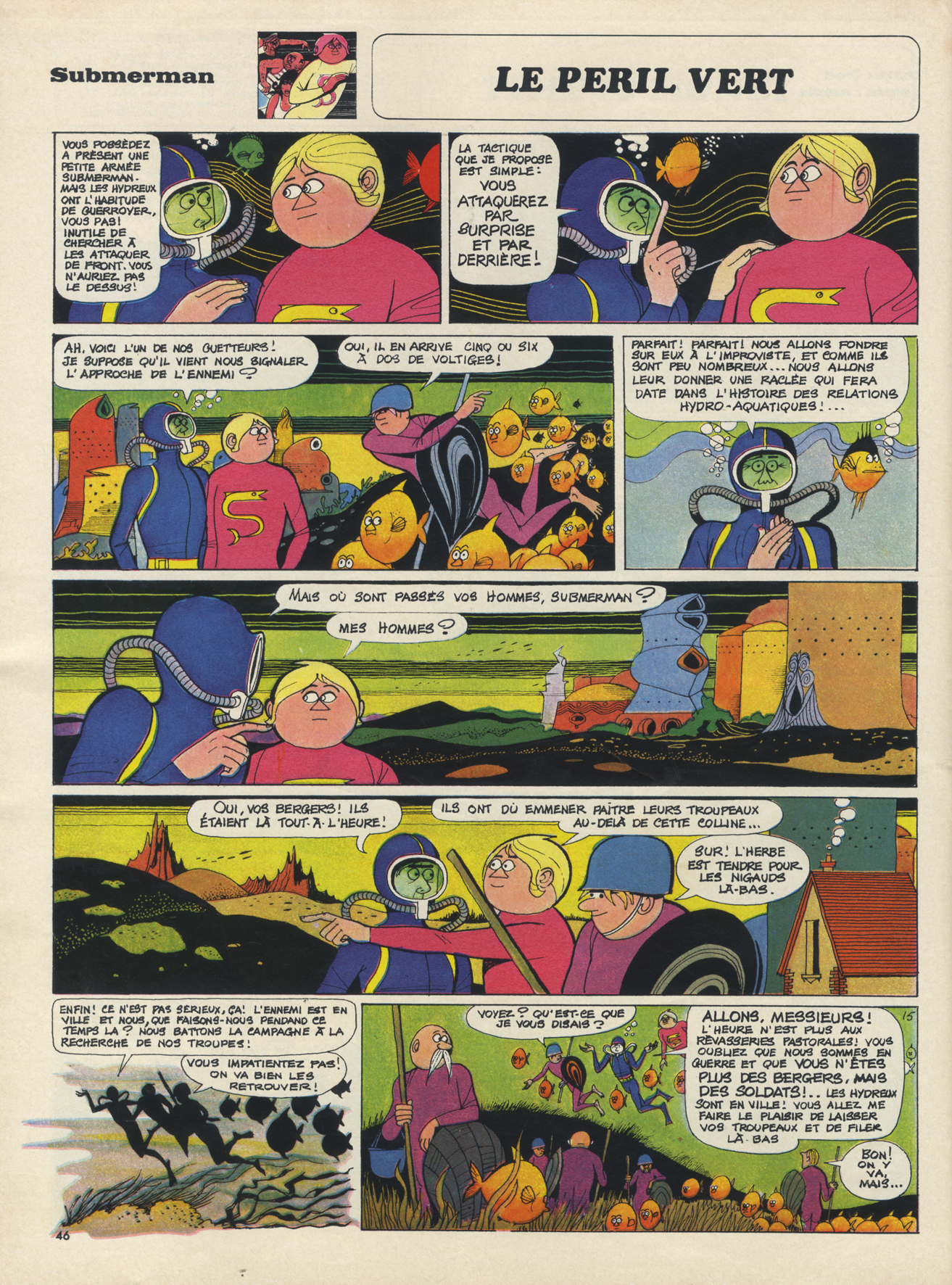
Submerman, on the other hand, is a superhero parody:
A page from Submerman from Pilote n°527 (1969). See all Pilote covers featuring Submerman here. The series was published between 1967 and 1970. People looking for a really obscure Halloween costume, take note of Submerman’s get-up: it wouldn’t be so hard to draw a yellow fish on a red onesie.
Submerman: La faune des profondeurs, published in Super Pocket Pilote n°4 (1969). « Sauve qui peut! » translates to « Run for your life! » Interestingly, English doesn’t have a « Save yourselves, those who can », but French and Russian do. I can’t vouch for other languages.
Now, I promised you some of Pichard’s women. An obvious place to start is the series Paulette, scripted by Georges Wolinksi (who, by the way, was killed in the terrorist attack on Charlie Hebdo in 2015) and illustrated by Pichard.
Paulette began in 1970 and chronicled the wild (and ever so slightly improbable) adventures of (who else?) Paulette. She gets kidnapped (more than once, by different parties), wooed, attacked, betrayed, saved, pregnant, communist-icated, converted to capitalism, harem-ed, and so on, not necessarily in that order. The only thing she doesn’t get is left alone. Poor girl. I wouldn’t say the series is entirely light-hearted, however – the authors used their pretty héroïne to ventilate all sorts of issues.
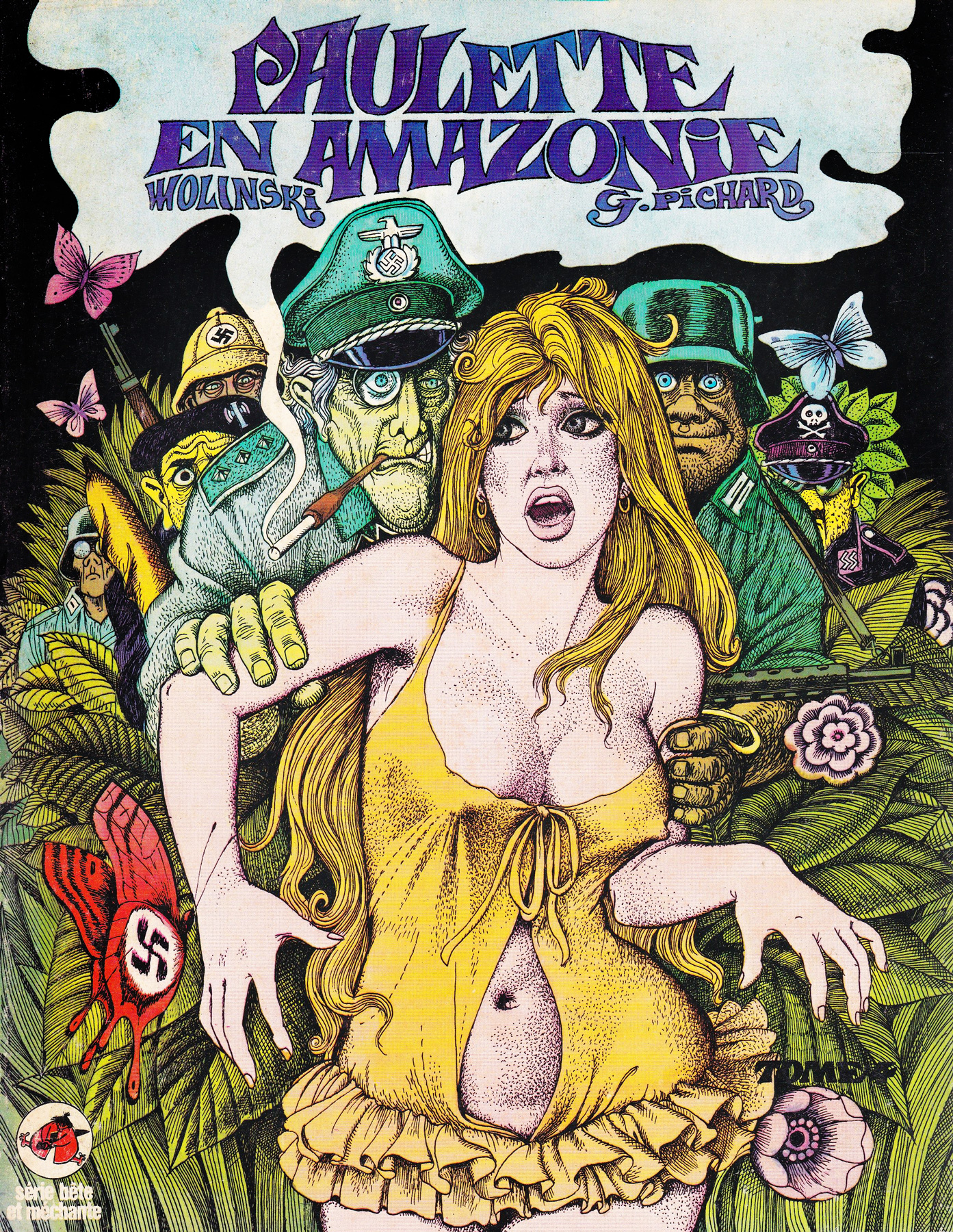
Paulette en Amazonie (Éditions du Square, 1975). Is it wrong that I love the drawing of evil Nazis and dumb soldiers a lot more than the damsel in distress? Pichard’s women all looked the same, but his villains had a lot more variety – which is not untypical of artists who are obsessed with the female form, actually. Silly, really; one would think that an obsession would lead one to exploring different shapes and forms, but somehow it rarely works out that way.
« Here she is, ready to climb aboard airplanes that are inevitably hijacked, to wind up in jungles, in wasp nests, in ambushes, to crash through panels, through traps, into the arms of men unworthy of her, and to come through all this with a smile, without blaming anyone, not even Pichard and Wolinski, whose main preoccupation it is to never leave her alone.» (Introduction to Paulette 4, 1975)
An illustration to the political-gone-absurd content of Paulette:
The colours make me think of a black light poster. Here Paulette wakes up her bearded beau (who figures that her « Something terrible has happened to me! » refers to a pregnancy, and responds with « Don’t worry, if you have money that’s nothing, In Switzerland or Morocco… ») to inform him that « I think I am a communist! »
Speaking of bearded beaus: one of my favourite Paulette plots – although I haven’t read the whole series – involves Joseph, the old perv we just saw in bed, whose job is to protect Paulette from… err, himself, I guess? When Paulette rescues a magical mole, it offers her one wish, and because she is terminally naïve (bordering on the cretinous, if with a heart of gold), she wishes for Joseph to become young again. The mole, however, is myopic like all others of its kin, and mistakes Joseph for a woman, so he gets transformed into a sultry brunette.
Moving on to other oeuvres…
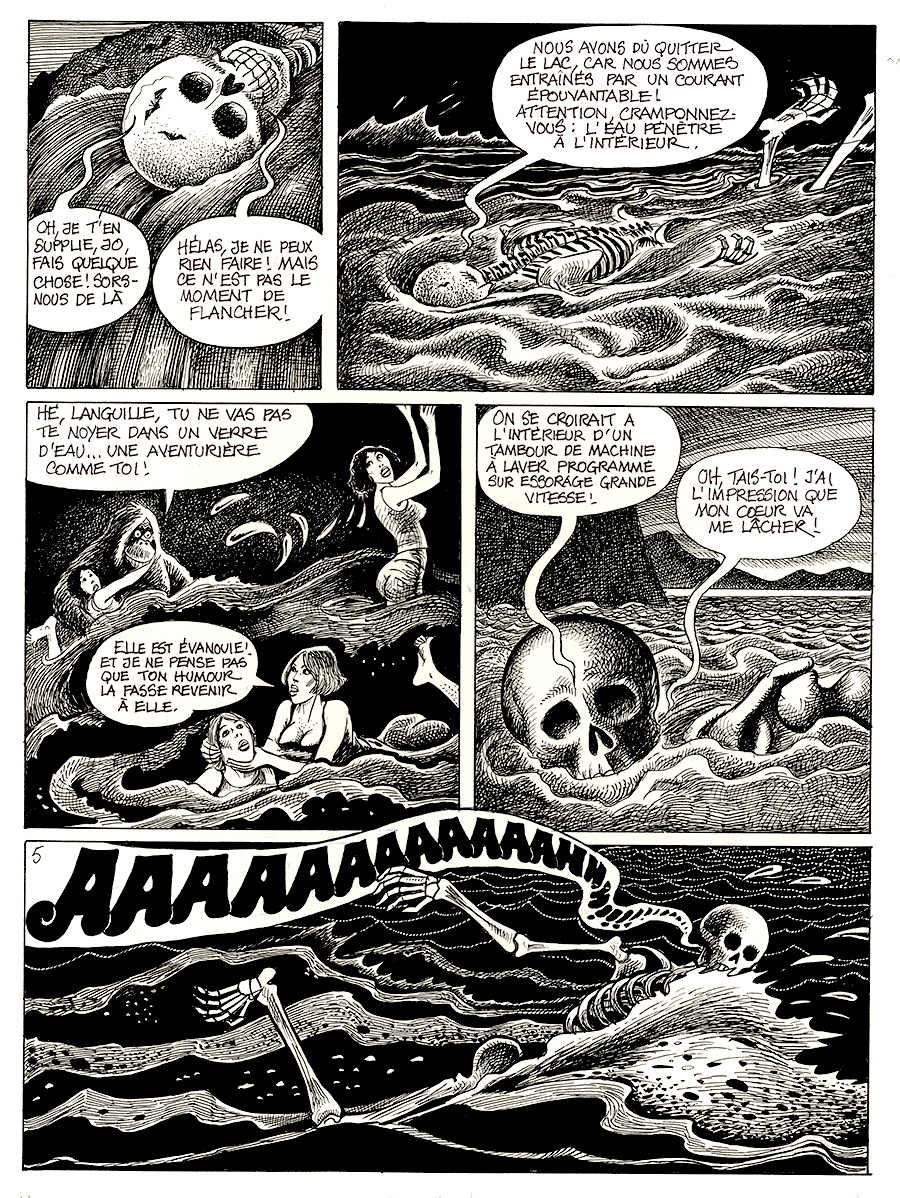
Original art from Bornéo Jo (Dargaud, 1983), with script by Danie Dubos and art by Pichard.
Marlène et Jupiter (Yes Company, 1988).
A panel from L’usine (Glénat, 1979).
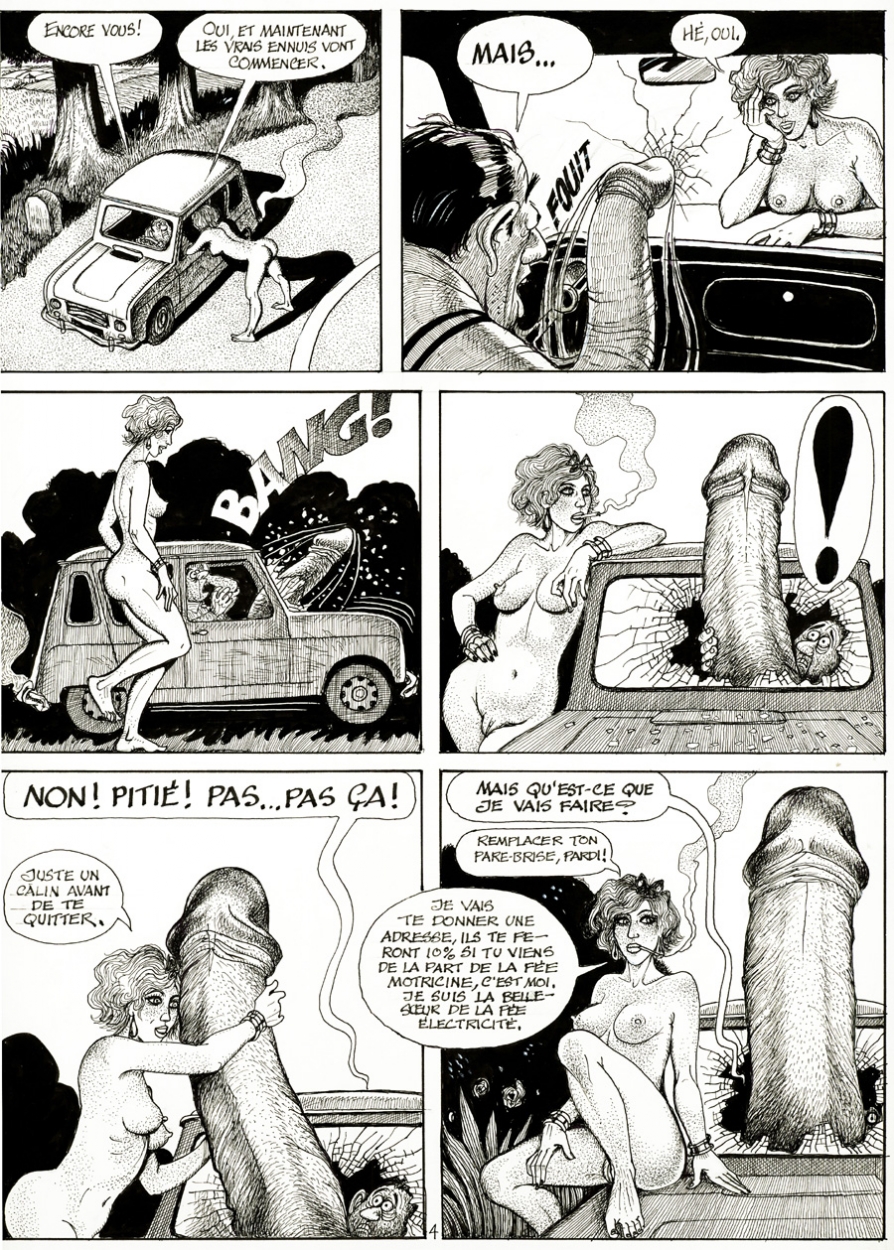
And I saved the funniest as a digestif: in the last panel, the man is saying « But what am I supposed to do now? », to which she responds with « Replace your windshield, of course! I’ll give you an address, they’ll give you a ten percent discount if you mention that you were sent by Fairy Motricine – I’m the sister-in-law of Fairy Electricity. » (Note: Motricine was a brand of gas.)
















 Who's Out There?