Jack Kirby’s ‘I Died a Thousand Times’

« Great Scott! What a mess! Did we walk away from that? » — Rocky Davis

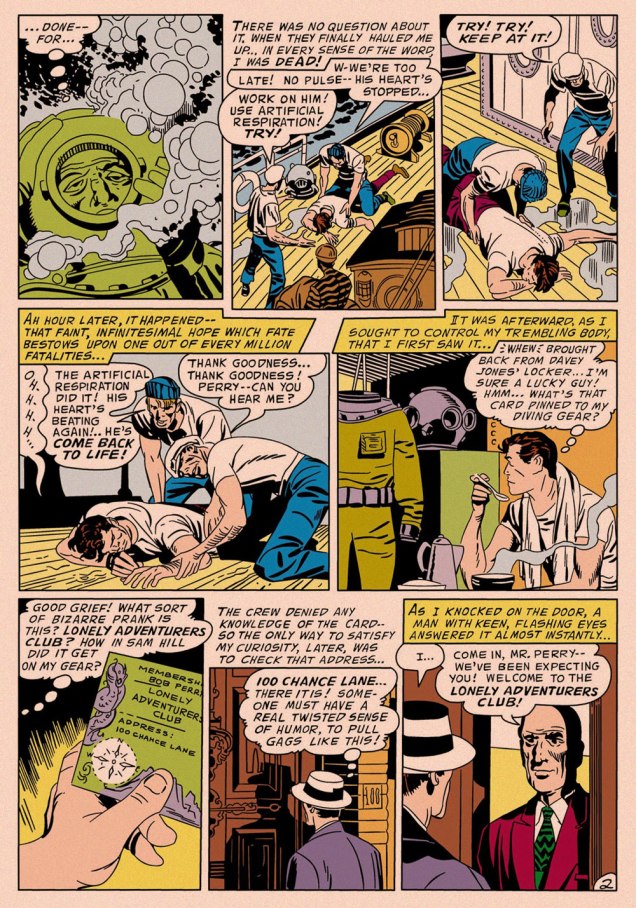
A couple of years after our big move, I’m still going through boxes, here at WOT? Headquarters. The other day, I came upon a stack of the long-running French anthology digest Big Boss (and its sidekick series, ‘Big Boy’), acquired who knows when and where… but surely for a song. Big Boss and ‘Big Boy’ (the quotation marks were part of the title!) were a most affordable source of vintage second-tier DC material like Roy Raymond, TV Detective; J’onn J’onzz, Martian Manhunter; Detective Chimp… and standalone tales from My Greatest Adventure, Tales of the Unexpected, House of Mystery and House of Secrets… essentially infamous editor Jack Schiff‘s row to hoe in the DC plantation.
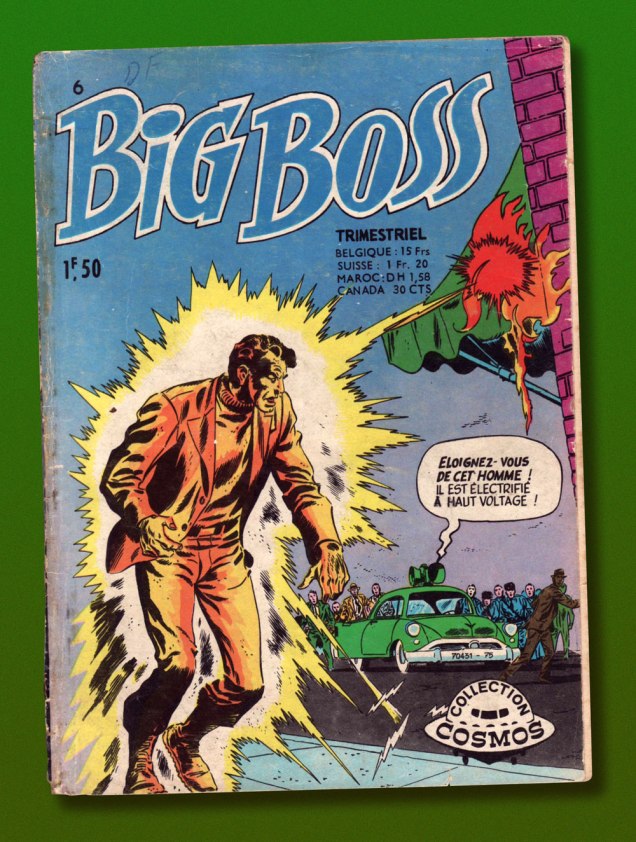
This is Big Boss no. 6 (Oct. 1971, Arédit-Artima); cover by Ruben Moreira.

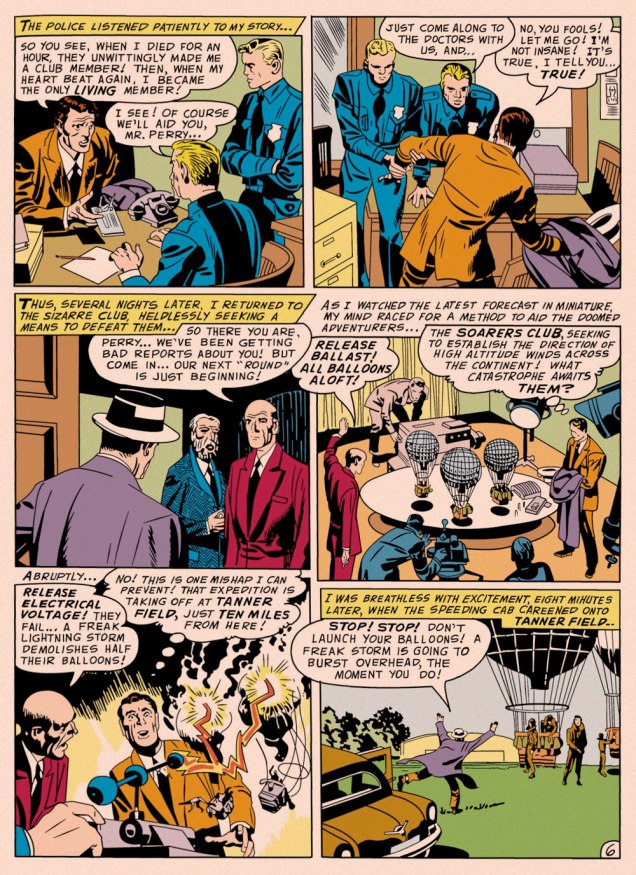
One might be inclined to say that, with its themes of adventurers cheating death or living on borrowed time, I Died a Thousand Times inspired Kirby’s Challengers of the Unknown, except that Ace, Rocky, Prof and Red had burst into print a few months earlier. Suffice it to say that they sprang from the same fertile well. It’s always intriguing to observe how the particular seed of an idea can be grown in a myriad of directions.
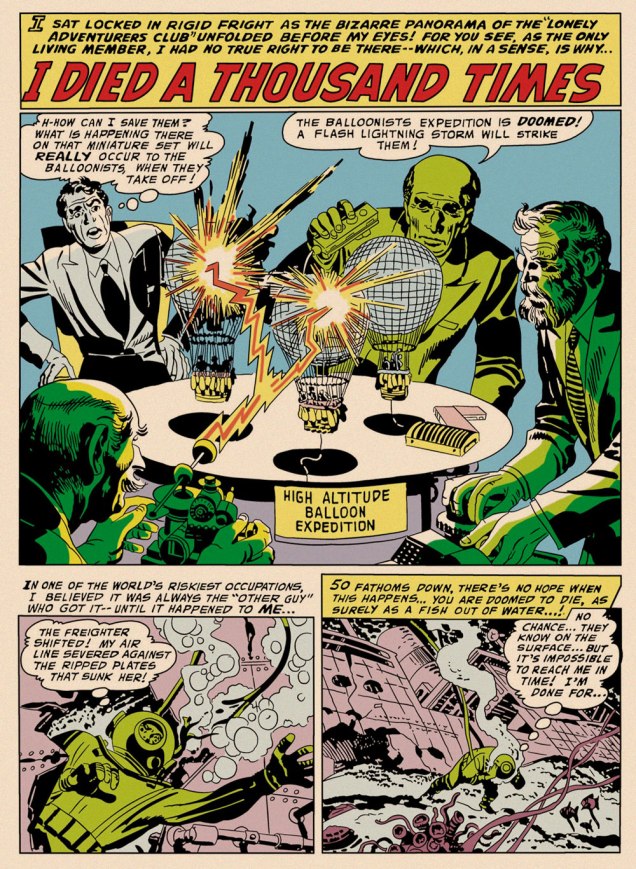
If you’ll forgive me the intrusion, this is how the opening panel appeared in the Big Boss reprint. In order to make things more readable in the digest format — and in black and white — Arédit‘s in-house art department routinely reframed and even augmented the artwork, with varying degrees of competence and success. This is one of the more accomplished efforts.

The story’s writer is unknown (though it features a most Kirbyesque plot); it was pencilled and likely inked by King Kirby, and originally appeared in My Greatest Adventure no. 16 (July-Aug. 1957, DC); edited by Whitney Ellsworth; Jack Schiff; Murray Boltinoff and George Kashdan… let’s just say DC *was* a tad heavy on the management side in those days.

Though Kirby’s standalone short stories of this period are as charming and inventive as you’d expect, this modest trove of material has by and large been neglected. While a handful of these tales (The Thief of Thoughts; The Creatures from Nowhere!; The Cats Who Knew Too Much!; The Man Who Betrayed Earth; The Negative Man; and The Stone Sentinels of Giant Island) were semi-randomly reprinted in the early 1970s when DC had lots of pages to fill, this one didn’t resurface in North America until 2011’s pricey-then-and-pricier-now hardcover Jack Kirby Omnibus no. 1.

– RG

Hallowe’en Countdown VII, Day 9

« The last I saw of Count Dracula was his kissing his hand to me, with a red light of triumph in his eyes, and with a smile that Judas in hell might be proud of. » — Bram Stoker

Comics fans of my generation might be forgiven for not fully appreciating Lee Elias‘ artistic assets if they encountered him, say, in Mystery in Space when he took over its lead feature, Adam Strange, from visionary Carmine Infantino. The series was mercifully soon discontinued, the victim of a game of editorial musical chairs designed to save the Batman titles, then — believe it or not — facing cancellation thanks to Jack Schiff‘s mismanagement.

So Schiff and Julius Schwartz traded workloads, Infantino grudgingly took over the Bat, and disaster was averted. But Adam Strange was the casualty.

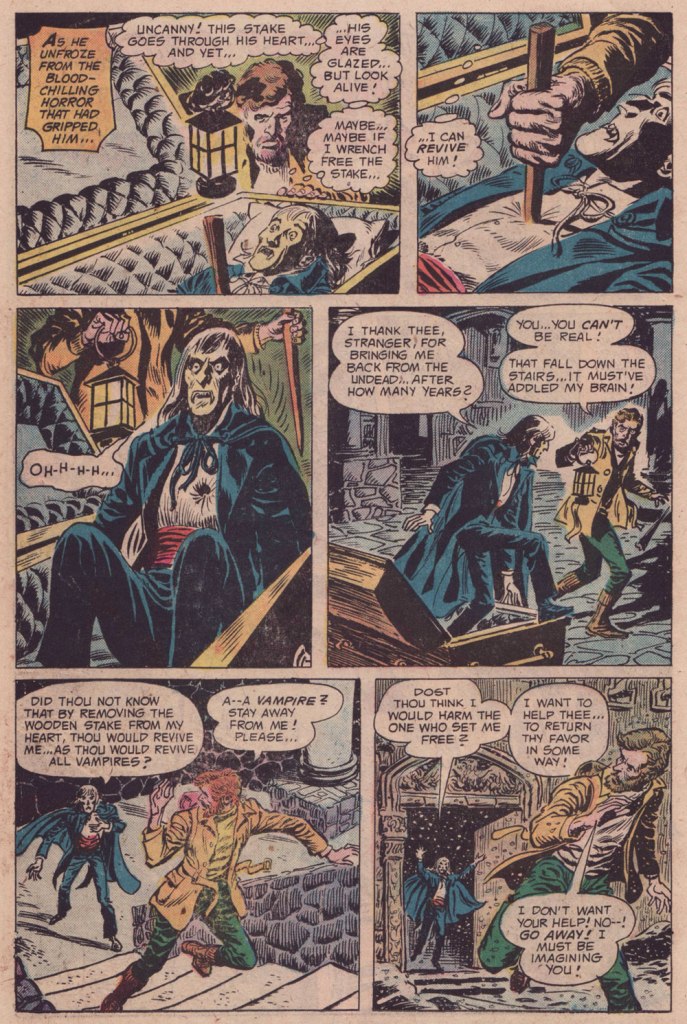
While I do have a soft spot for Elias’ work on Ultra, the Multi-Alien (in Mystery in Space) and Eclipso (in House of Secrets), it wasn’t until I found out about his earlier, far edgier pre-Code shenanigans at Harvey Comics (with art director/designer/co-conspirator Warren Kremer) and, more directly and subtly his handful of stories for editor Murray Boltinoff‘s spooky titles (Ghosts, The Unexpected, The Witching Hour) in the 1970s, that I came to discern his light.

Boltinoff wisely played to Elias’ strengths in interests, handing him historical gothics to play with, and he delivered some of the finest work of his career.

Written by George Kashdan, The Most Fearful Villain of the Supernatural was published in Ghosts no. 50 (Nov.-Dec. 1976, DC).

Editor Boltinoff had this amusing idée fixe, commissioning purported ‘true’ stories wherein famous authors were “inspired” to pen their immortal works by some supernatural encounter earlier in life. From what I recall, Mary Shelley, Charles Dickens, Robert Louis Stevenson and — in this case — Bram Stoker were among the elected.

-RG

Why the Long face? The Lighter Side of Batman

« The best thing for rich people to do is become Batman. » — Karl Heinrich Marx*

So we’ve got another dour, dark, mumbly, violent, grim ‘n’ gritty Batman movie making the rounds. I’ll pass — I’m afraid that’s not my Batman of choice. But I’m certainly game to provide an alternative view.

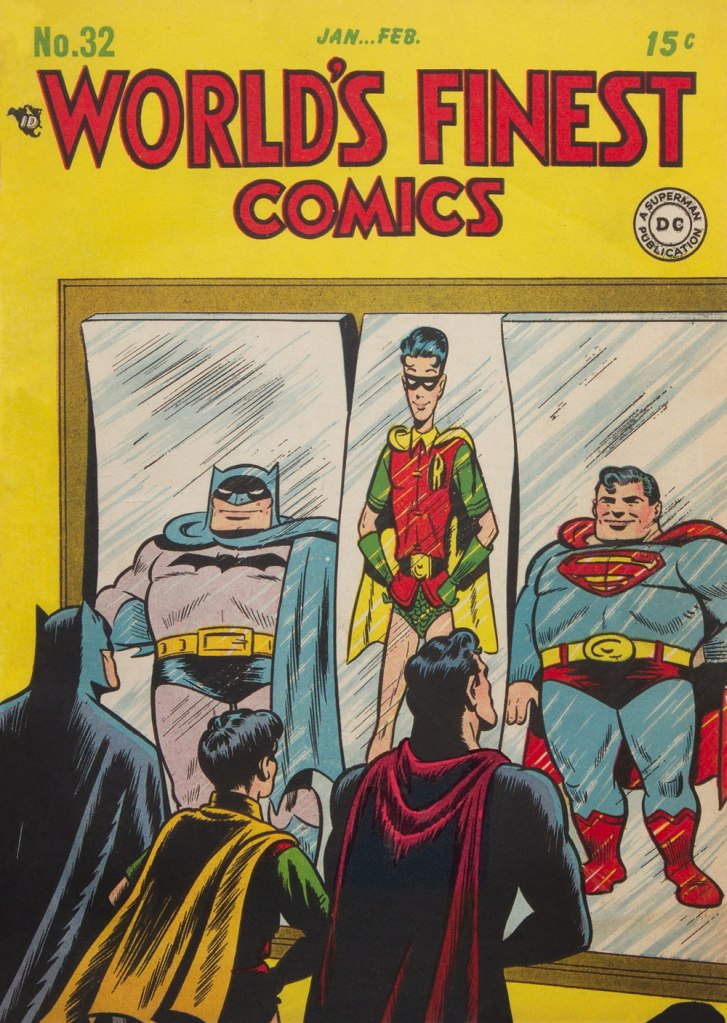
This is World’s Finest no. 32 (Jan.-Feb. 1948, DC); cover art by Hamilton, Ontario’s Win Mortimer (1919-1998), just one in a long, memorable series of frequently goofy scenes featuring this heroic trio.
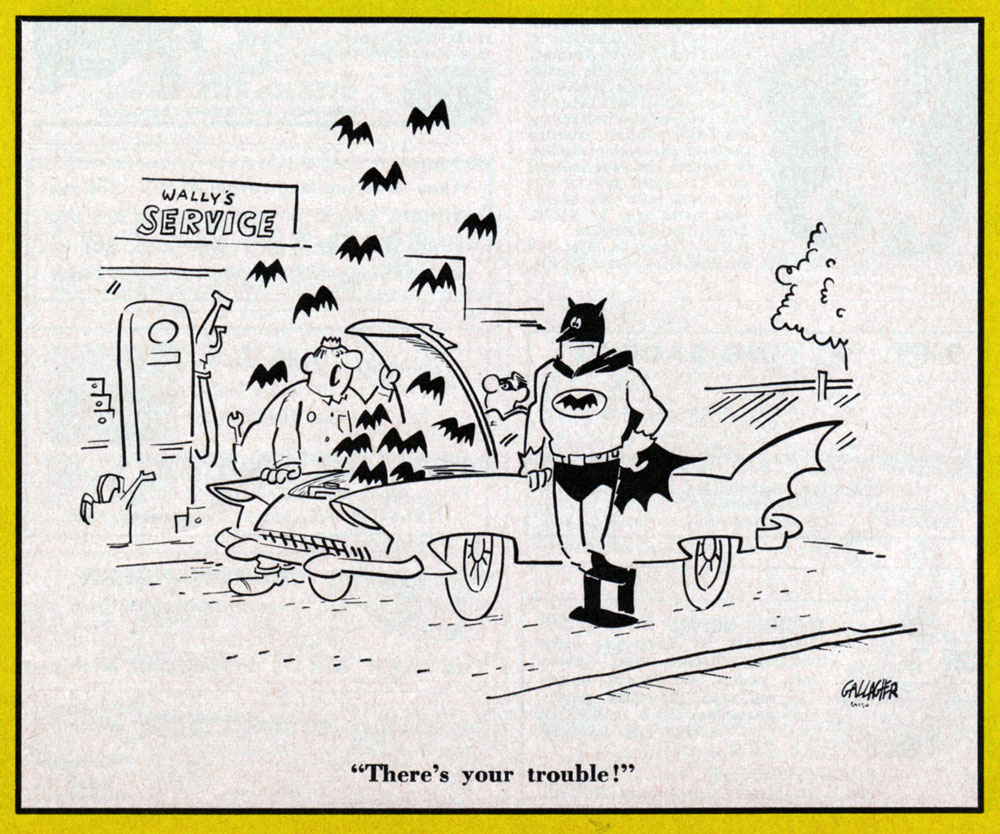
A cute one from John Gallagher (1926 – 2005), twice (1957, 1971) the winner of the National Cartoonists SocietyBest Gag Cartoonist‘ Award and elder brother of Heathcliff creator George Gately Gallagher. It was published in scouting monthly Boys’ Life‘s July, 1966 issue, smack dab in the heart of Batmania. We ran another bit of bat-drollery from John in an earlier post.
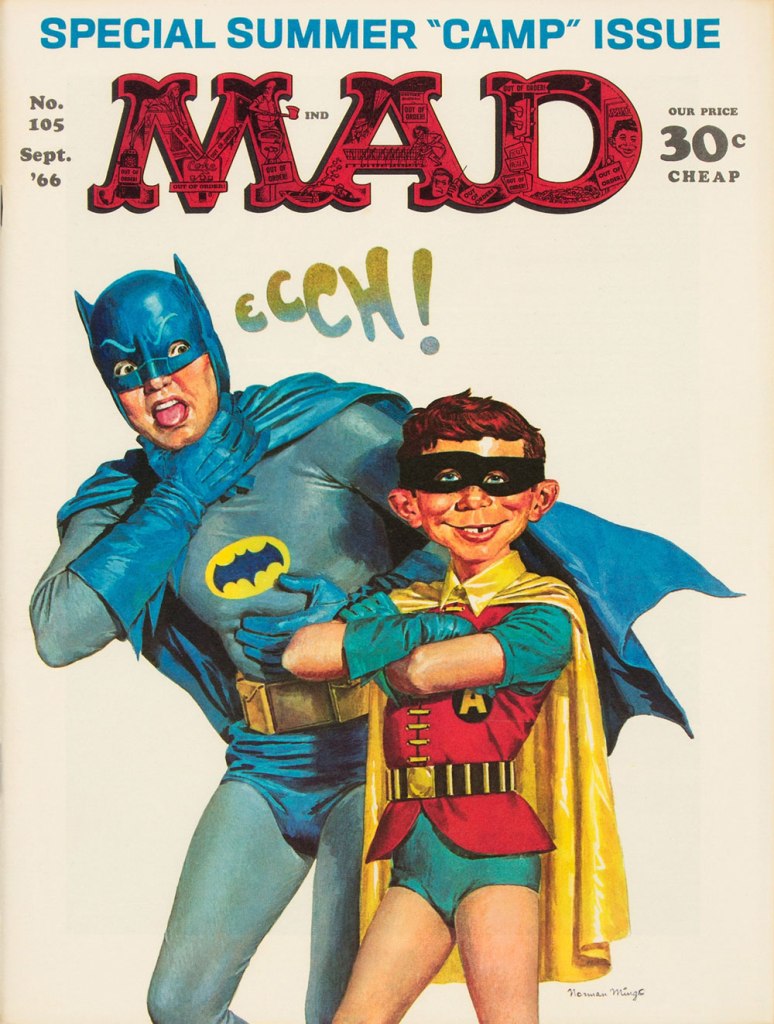
This is Mad Magazine no. 105 (Sept. 1966, EC); cover by Norman Mingo (1896-1980).
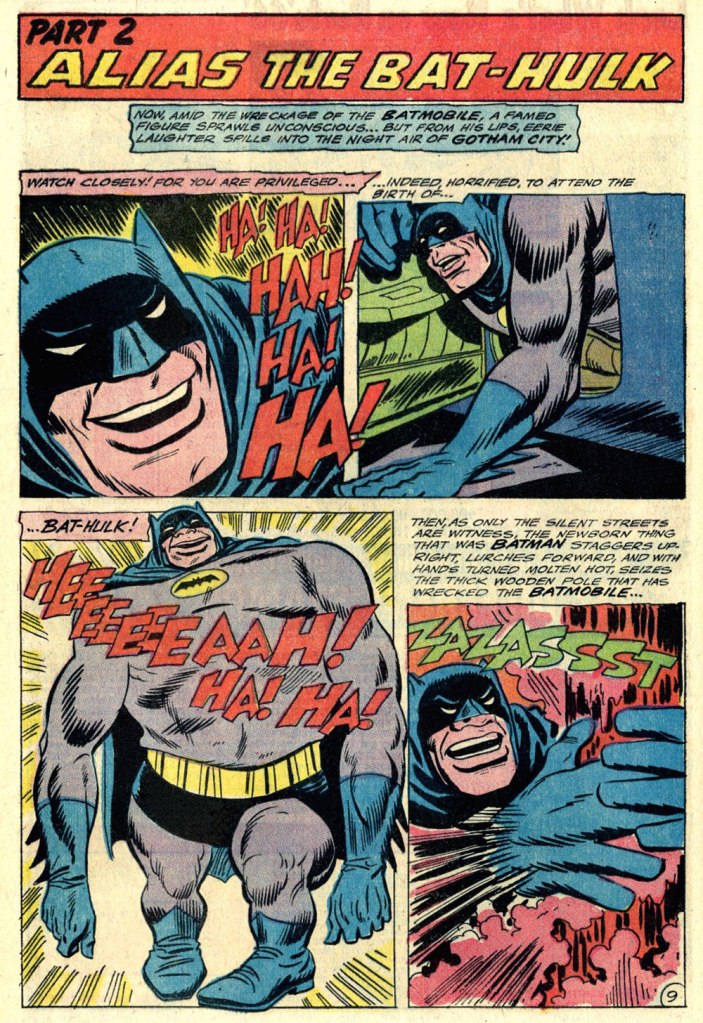
A pivotal page from ‘Alias the Bat-Hulk’ written by Bob Haney, pencilled by Mike Sekowsky and inked by Mike Esposito, from The Brave and the Bold no. 68 (Oct.-Nov. 1966, DC), edited by George Kashdan. We’re featured the issue’s fabulously batty cover in our earlier tribute to Mike Sekowsky. Bless you, gentlemen — you truly understood what fun meant and what comics should be.
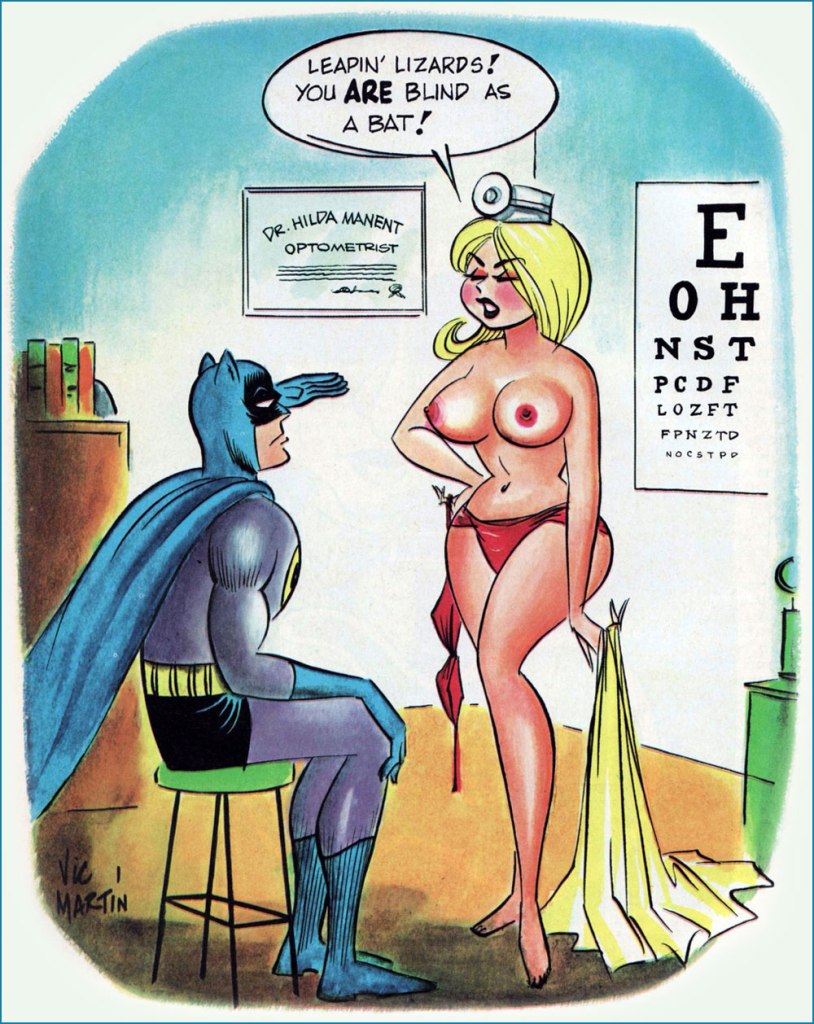
Prolific Argentine cartoonist Vic Martin (in his homeland, he drew the strip “Salvador” for Medio Litro magazine) moved to the US in the early 1950s, crafting a respectable body of work in the comic book field, chiefly for Ziff-Davis, before migrating to men’s magazines and girlie digests. By the 1970, he’d found a home with Cracked Magazine (He handled the Hudd & Dini feature), while also freelancing for Sick and Crazy. Everything but Mad, really. This particular cartoon comes from the March, 1967 issue of Avant Publishing’s “Escapade”. As Pat Masulli is listed under “production” in the masthead, a Charlton connection is more than likely. And speaking of “Leapin’ lizards!“, Martin would later (1973-74) work on the Little Orphan Annie comic strip.
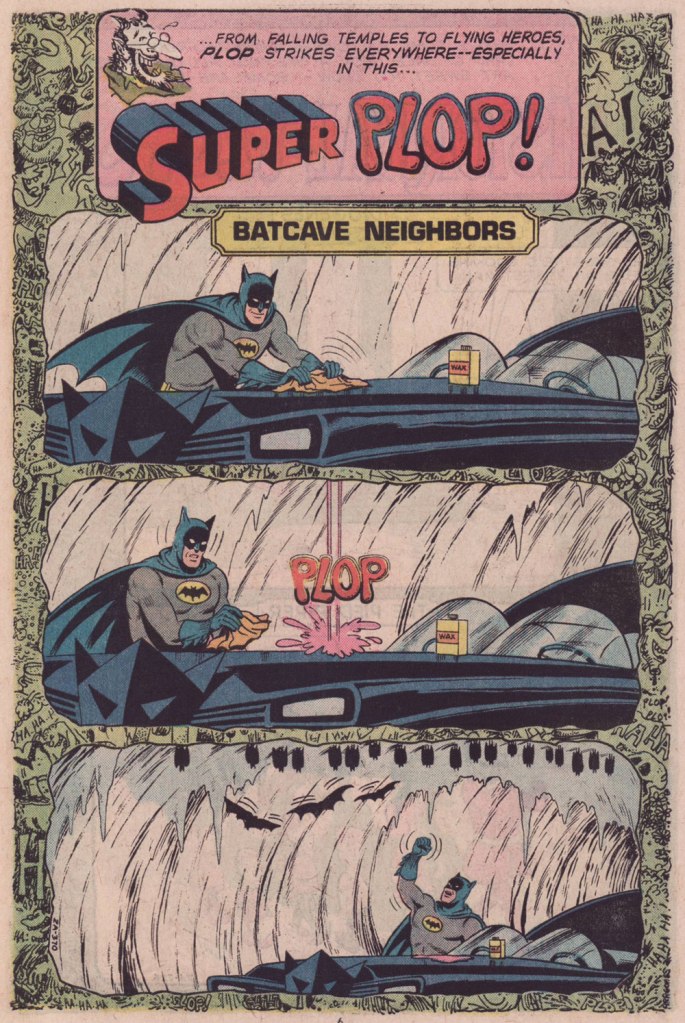
From Plop no. 9 (Jan.-Feb. 1975, DC); Writer unknown, art by Kurt Schaffenberger.
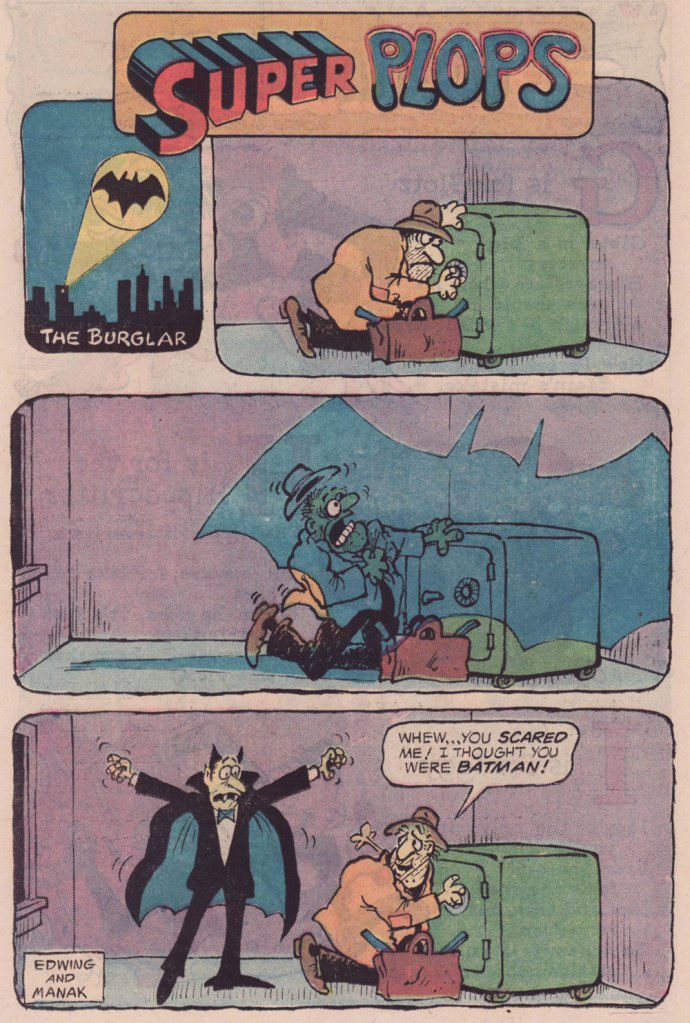
This one’s from Plop! no. 20 (Mar.-Apr. 1976), DC); idea by Don ‘Duck’ Edwing, art by Dave Manak.
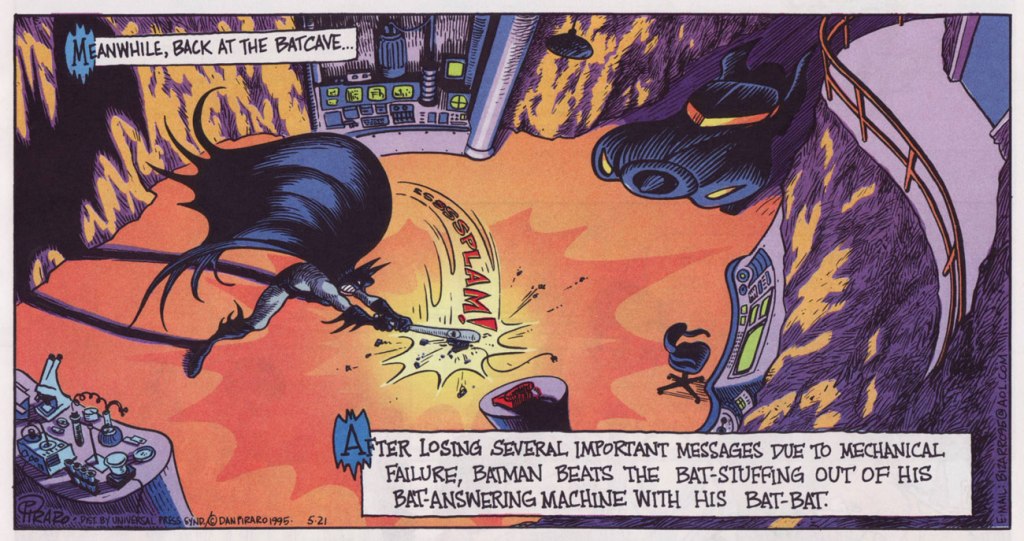
Dan Piraro‘s May 21, 1995 Bizarro Sunday strip. Between Piraro and his canny accomplice, Wayno, there have been scores of excellent bat-japes over the years. I must confess that the term ‘bat-bat’ triggers other associations. « To the Man-Mobile! »
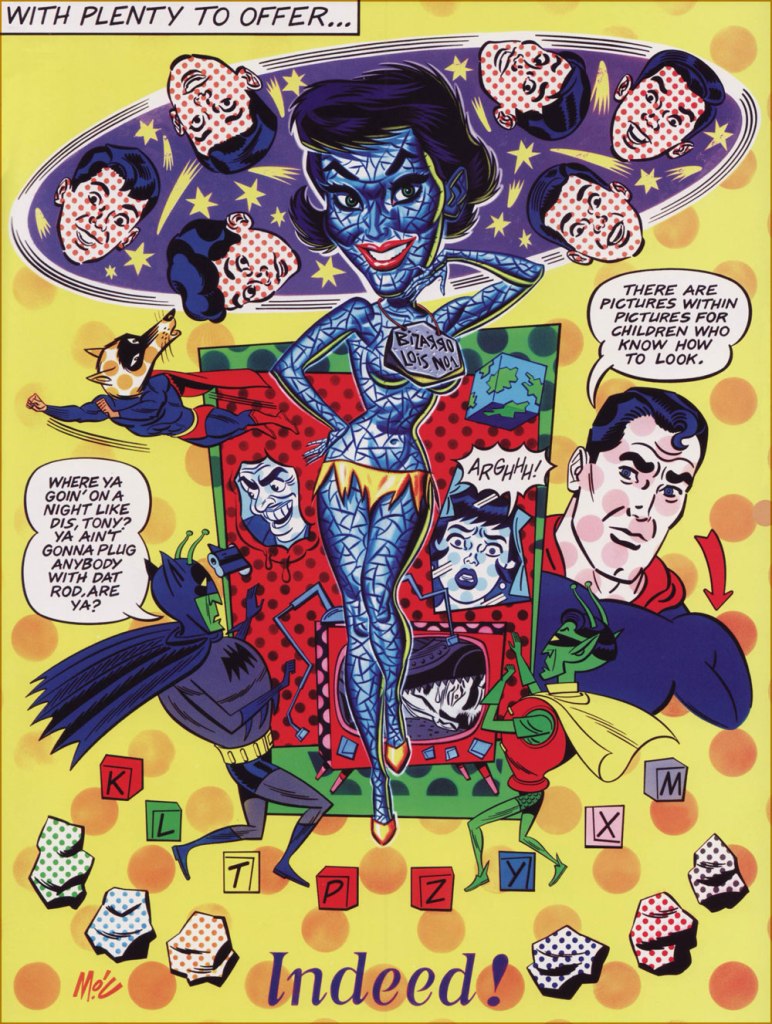
This is Pictures Within Pictures, a 1998 watercolour by Mitch O’Connell (not to be confused, of course, with this beloved, near-homonymous fella — yes, I can just hear Beavis and Butthead chortling). The piece is full of references to various Golden Age comics made infamous by Fredric Wertham‘s Seduction of the Innocent. For instance, er… Batman‘s speech balloon quotes from this particular comic book‘s opening splash. On a sobering note, let’s not forget that the 1950’s furore over comic books, as absurd as it may have seemed, still has relevance today.
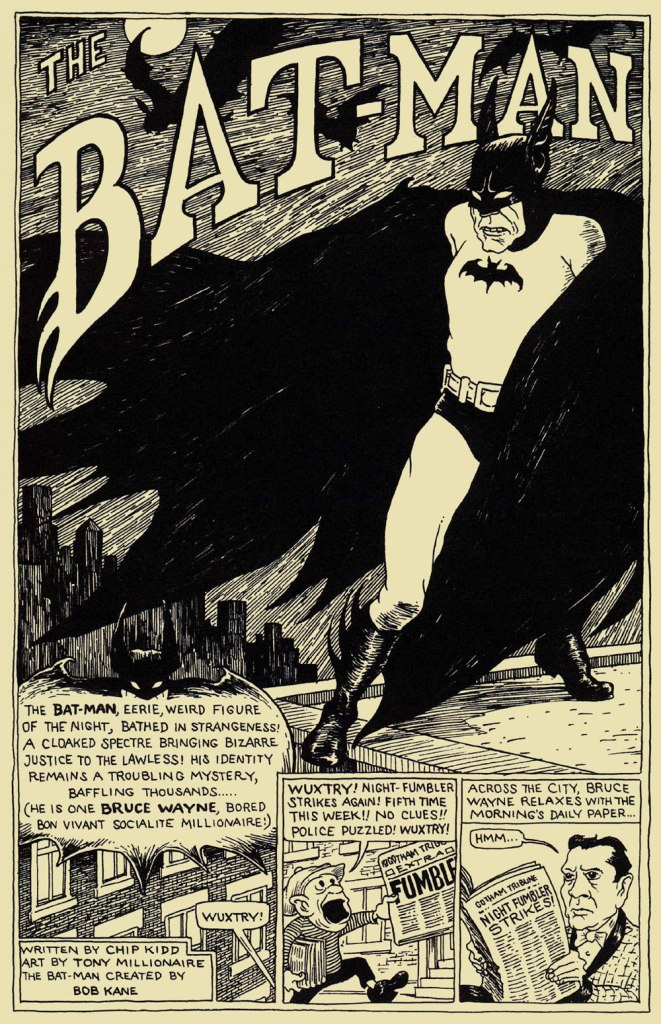
In a more deadpan vein, here’s the opening splash of Chip Kidd and Tony Millionaire‘s madcap homage to the very earliest of Batman’s exploits, with nods a-plenty to the 1943 film serial. “The Bat-Man” originally appeared in Bizarro Comics (Aug. 2001, DC).
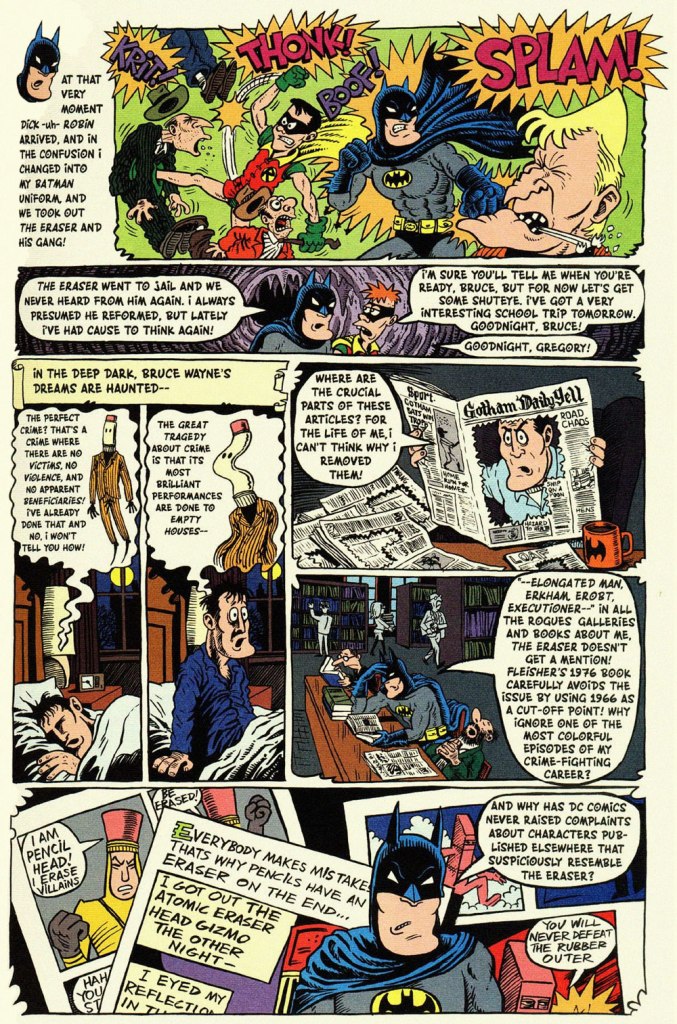
Another most decidedly dynamic duo, Eddie Campbell and Hunt Emerson, assembles to concoct an affectionate, thoughtful and yes, funny look at one of Batman’s most bizarre-yet-neglected members of the Bat’s rogues’ gallery, Lenny Fiasco, aka The Eraser, introduced in Batman no. 188 (Dec. 1966, DC) with The Eraser Who Tried to Rub Out Batman! This sequel, Who Erased the Eraser? also made its original appearance in Bizarro Comics (Aug. 2001, DC), edited by Joey Cavalieri.
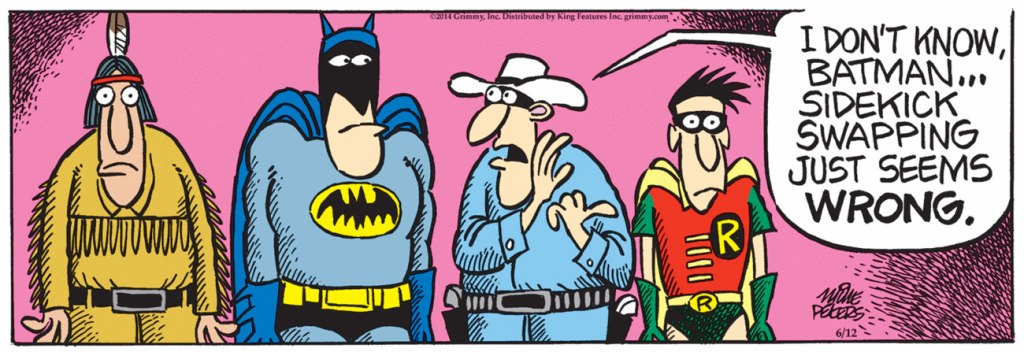
Here’s one (June 12, 2014) from Pulitzer Prize-winning (1981) editorial cartoonist Mike Peters (b. 1943). It’s from his unevenly written but always gorgeous comic strip Mother Goose and Grimm (created in 1984 and still going strong in over 800 newspapers worldwide). Like his colleagues Piraro and Wayno, Mr. Peters can scarcely resist a good bat-gag, so this is just one in a crowd of many.
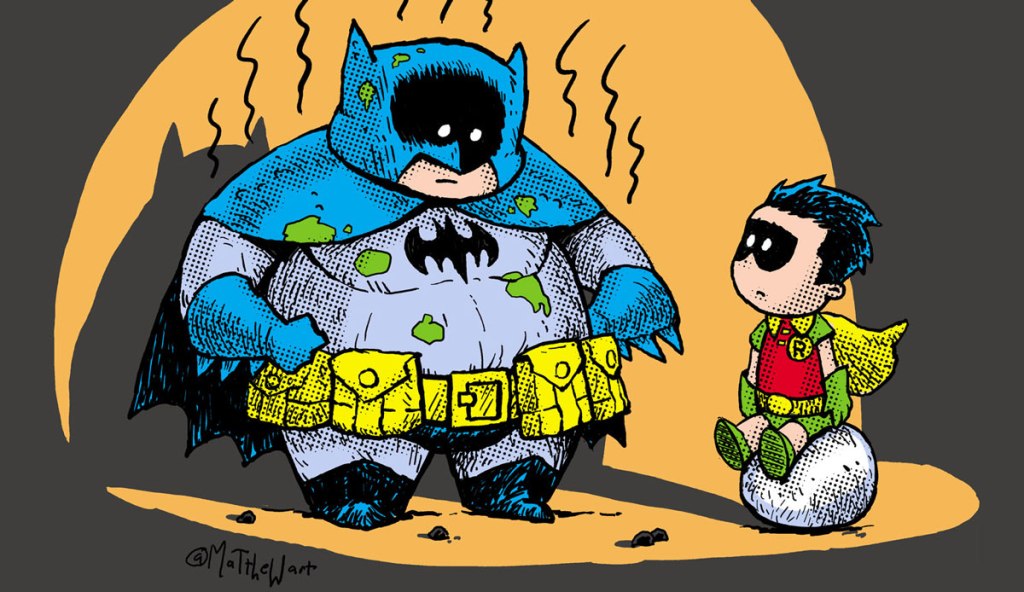
Everyone’s familiar with the famous playground song and staple of crooner Robert Goulet’s répertoire, right? The web is rife with visual adaptations, but this was my favourite, the work of Matthew S. Armstrong and available as a handsome t-shirt.

-RG

*the second-funniest Bat-related thing I encountered online this week is this attribution of a Batman (created in 1939) quote to Marx (1818-1883).

The funniest was the following deeply ironic quote from pathological liar and glory hog Bob Kane: « How can an article about me or the Batman be the true story when I am not consulted or interviewed? »

Tentacle Tuesday: Flash Gordon, Space Opera Saviour

« When I was a young writer if you went to a party and told somebody you were a science-fiction writer you would be insulted. They would call you Flash Gordon all evening, or Buck Rogers. » Ray Bradbury

We’ve talked about newspaper strip Flash Gordon in Tentacle Tuesday: Lurkers in the Newsprint, and now it’s time for its comic book version! Although I normally have very little interest in FG, this is no second-rate Tentacle Tuesday: there is some prime tentacular material to be enjoyed.

We first concern ourselves with the Flash Gordon Charlton Comics run, which picked up the count where King Comics had left it in 1967. From 1969 until 1970, Charlton published issues 12 to 18, all of which but the first had glorious covers and cover stories by Pat Boyette, an absolute WOT favourite ( you can visit co-admin RG’s Pat Boyette — Hillbilly Makes Good* for a deeper exploration of his career).

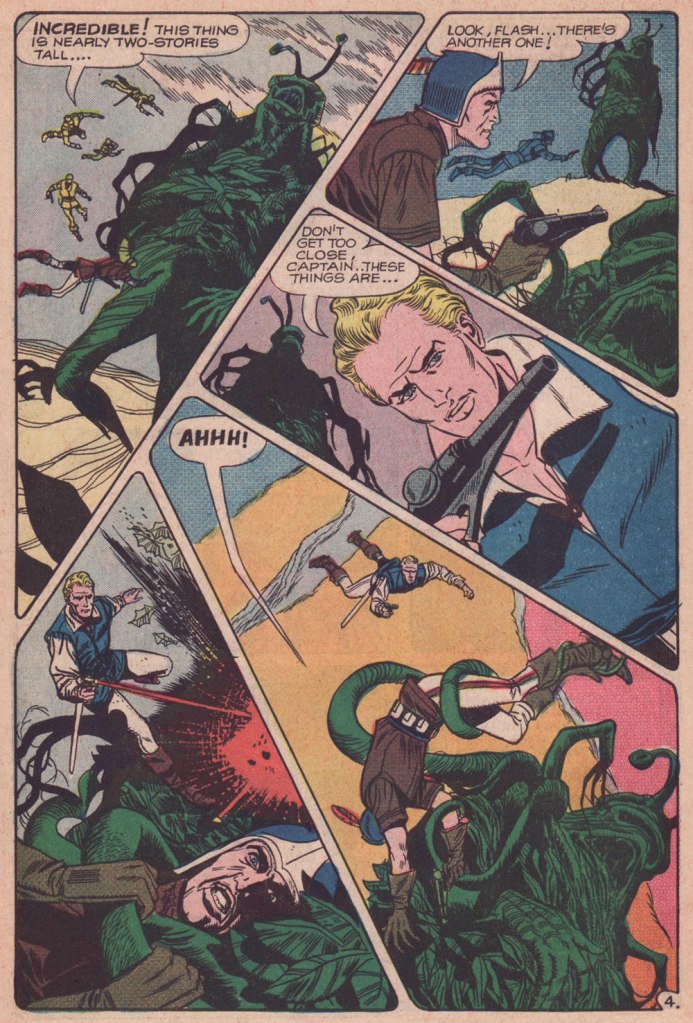
The cover of issue 14 has an octopus shortage (a serious flaw affecting many, many comic book covers!), but the monster o’nine-tentacled-tails the ’emotionless killers’ encounter is a beauty. The following page is also a good example of Boyette’s imaginative page layouts, in which things are kept dynamic, but never engender confusion about who is doing what and to whom.

Page from Rancor and the Seven Shadows of Flash Gordon, scripted by Bill Pearson and illustrated by Pat Boyette, was published in Flash Gordon no. 14 (June 1969).

Then we come to a real bevy of Boyette tentacles a few issues later –

Flash Gordon no. 17 (Charlton, November 1969). Cover by Pat Boyette.

The Creeping Menace, the cover story, is scripted by Joe Gill and illustrated by Pat Boyette. I am including two pages (and a panel) because it’s too difficult to choose between them – all boast the aforementioned dynamic layouts and striking tentacles.

Isn’t this a lovely, stylish panel? I want it on a t-shirt.

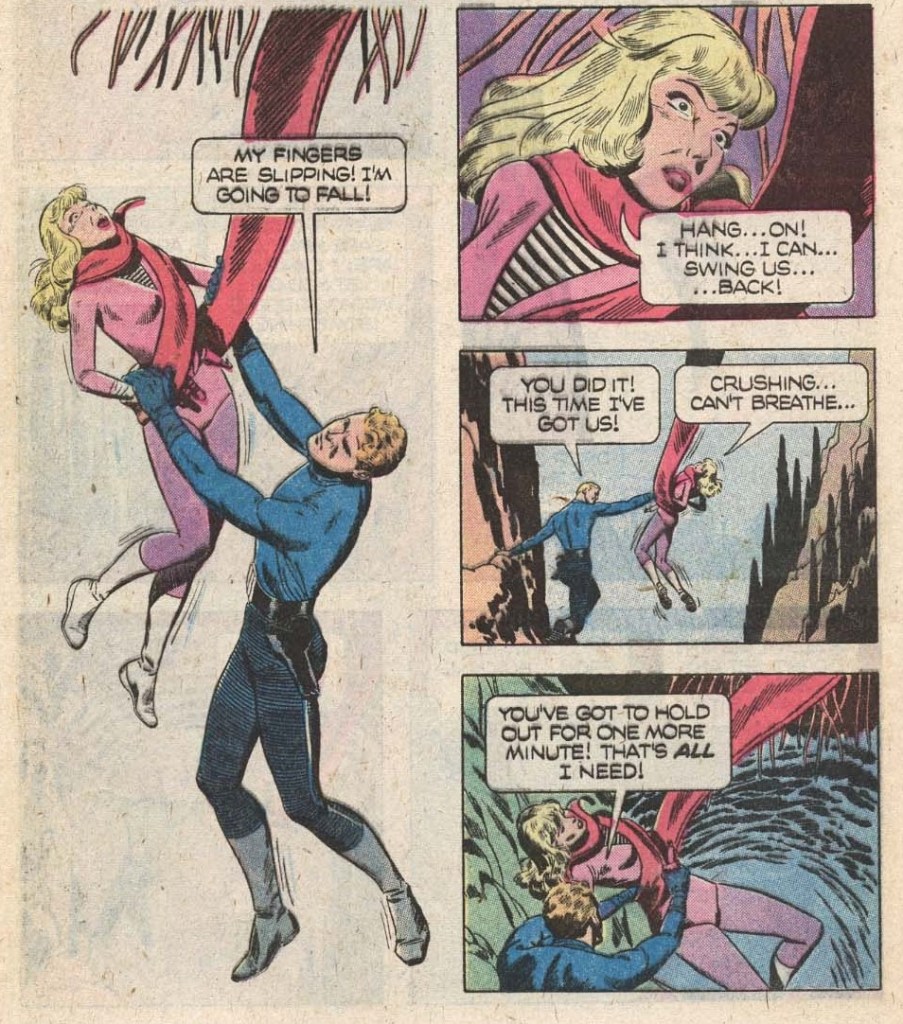
The publishing history of comic-book Flash Gordon was an interesting relay race: Gold Key Comics resumed the run with issue 19 (1978), and kept it up until issue 27 (1979); finally, issues 28 to 37 were published under its Whitman imprint between 1980 and 1982. The latter category offers two tentacled covers, and some inside goodies.

Original art (sadly by an unknown artist) for the cover of Flash Gordon no. 29 (Whitman, May 1980).

The cover story The Deadly Depths is scripted by John Warner and illustrated by Carlos Garzón. Oh, this thing is not hostile… just hungry.

The last Whitman issue also is of some interest, though on the cover Flash looks like he’s fighting caterpillars with an martini olive for a head.

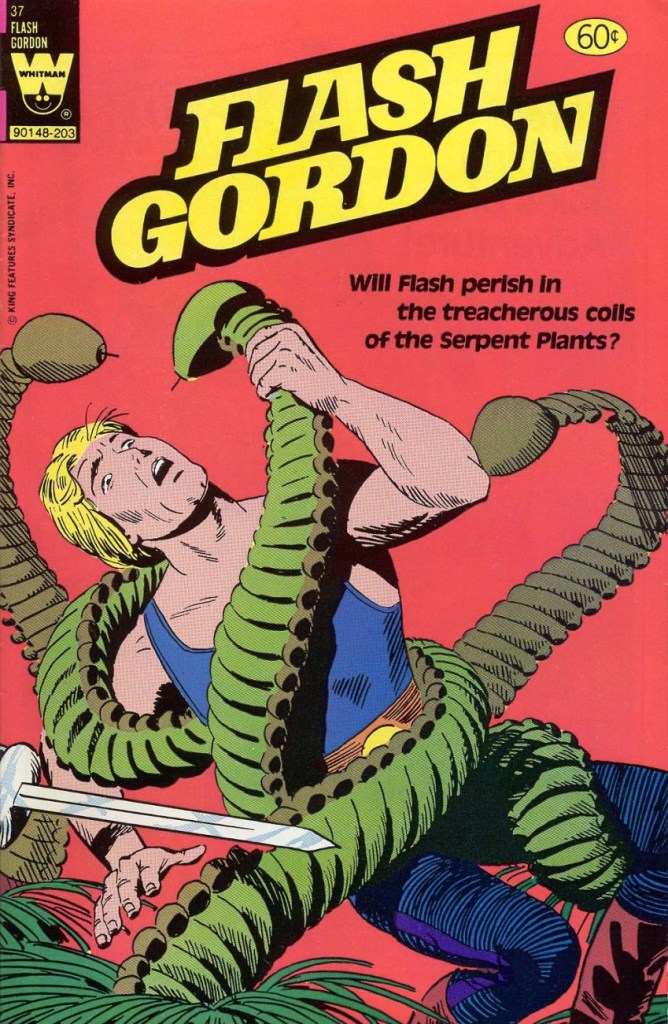
Flash Gordon no. 37 (Whitman, March 1982). Cover by Gene Fawcette.

Cover story My Friend, My Killer! is scripted by George Kashdan and illustrated by Gene Fawcette and features cute serpent plants that look like they’re wearing little hula skirts.

And that concludes our tour of Flash Gordon tentacles in the Silver Age (and with some forays into Bronze).

🌱 ds

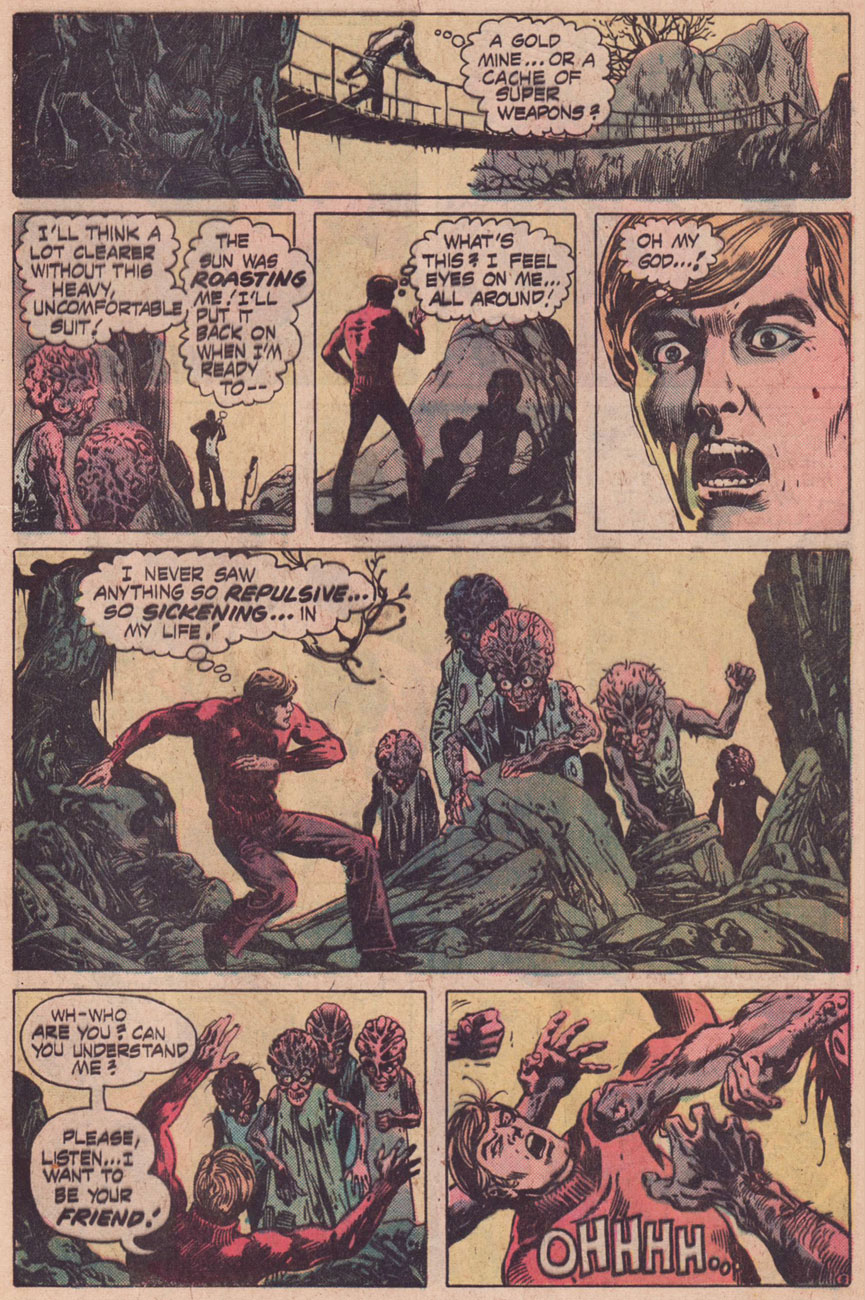
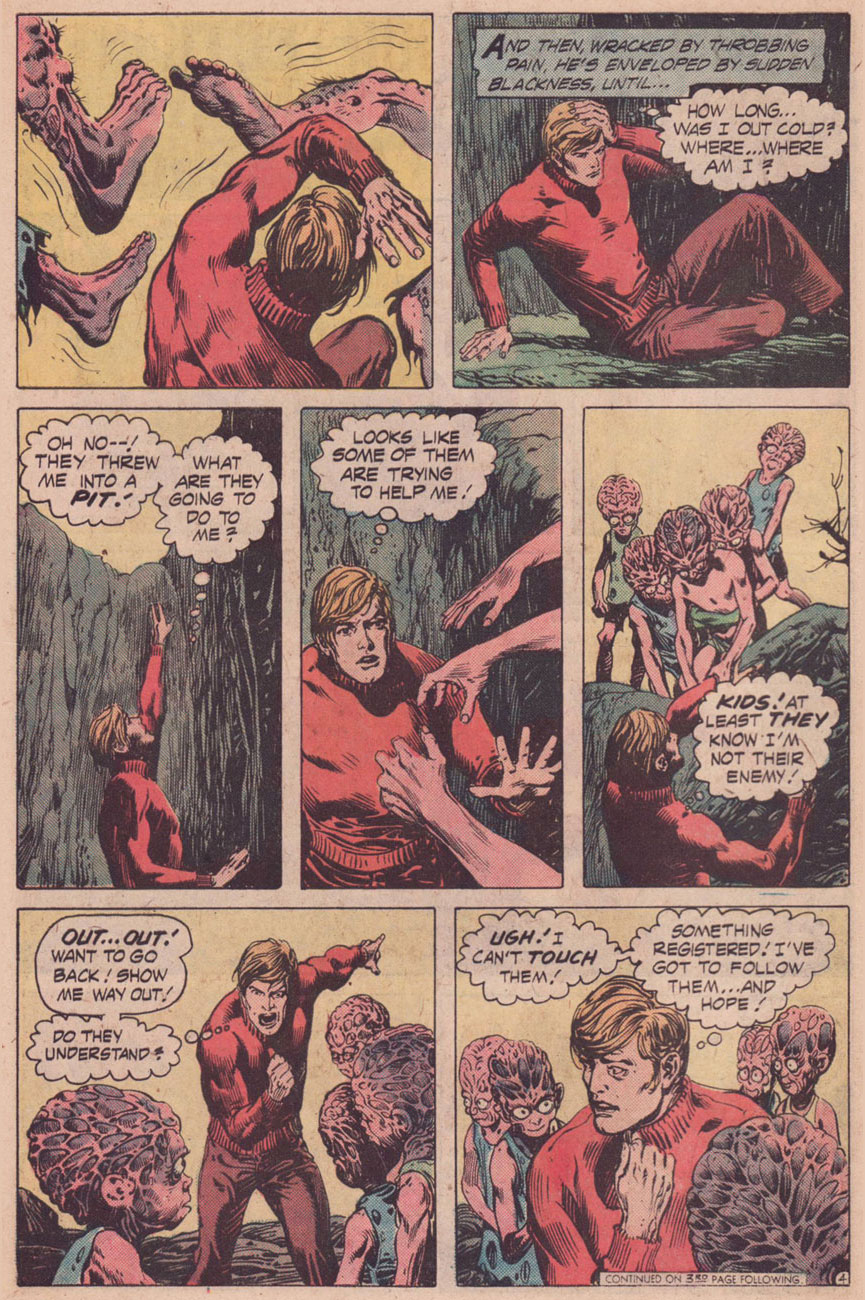
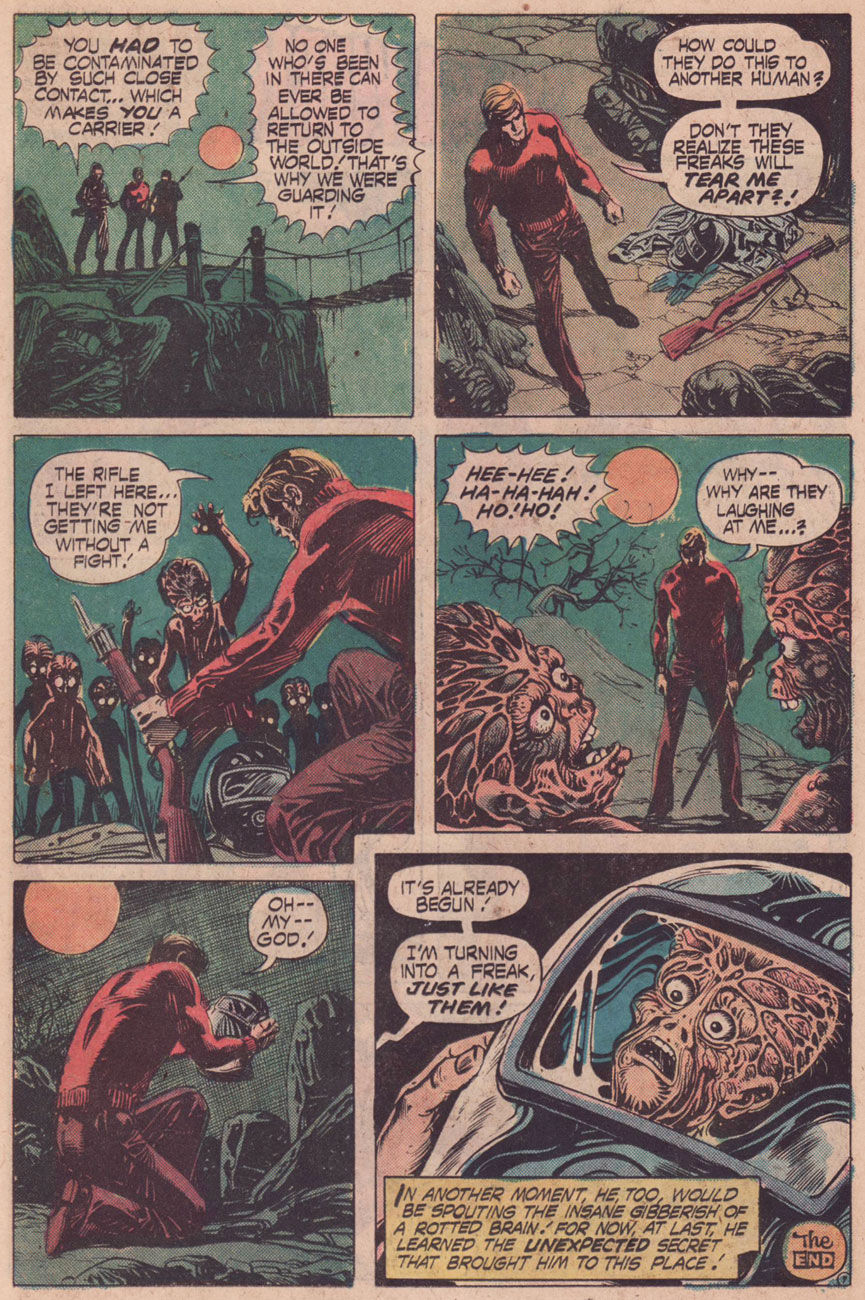
Quarantine Follies: Kashdan and Alcala’s “Freak Accident” (1975)

« Once you’ve lived the inside-out world of espionage, you never shed it. It’s a mentality, a double standard of existence. » — John le Carré (1931-)

Here I go again, featuring yet another 1970s Alfredo Alcala story. This time, Fate, writ large, has forced my hand, and it’s unofficially Contagion Week here on WOT?

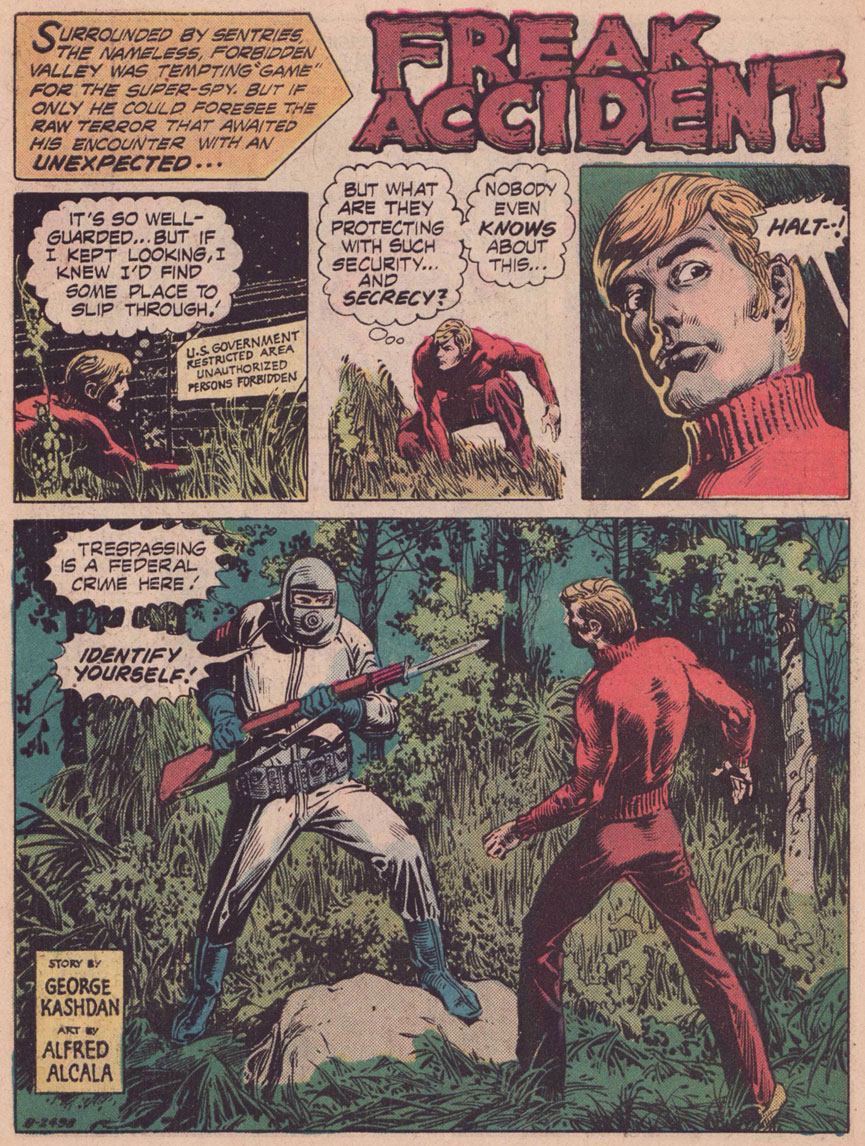
I’ve always had a soft spot for writer-editor George Kashdan (1928 – 2006). While he wasn’t what you’d term an outstanding writer, he was the most consistent bright spot of DC’s mystery books in the late ’60 to early ’80s. As opposed to the other workhorses in the stable, one still found trace amounts of passion and personal quirks in his work. His recurring themes for simply more fun than his colleagues’: he loved Sinister gentlemen’s clubs, wild conspiracies, strange carnivals, pre-ordained, thematically-twisted deaths (think of those Final Destination movies)…

In a thoughtful obituary, Mark Evanier tells us: « In 1968, as part of a program of editorial restructuring, Kashdan was let go by DC. Several people who worked with him said it was because he was “too nice” and had occasionally clashed with management in arguing that freelancers should be paid and treated better. » Ah, another victim of the anti-union purge of ’68*.

AlcalaFreak01AAlcalaFreak02AAlcalaFreak03AAlcalaFreak04AAlcalaFreak05AAlcalaFreak06AAlcalaFreak07A

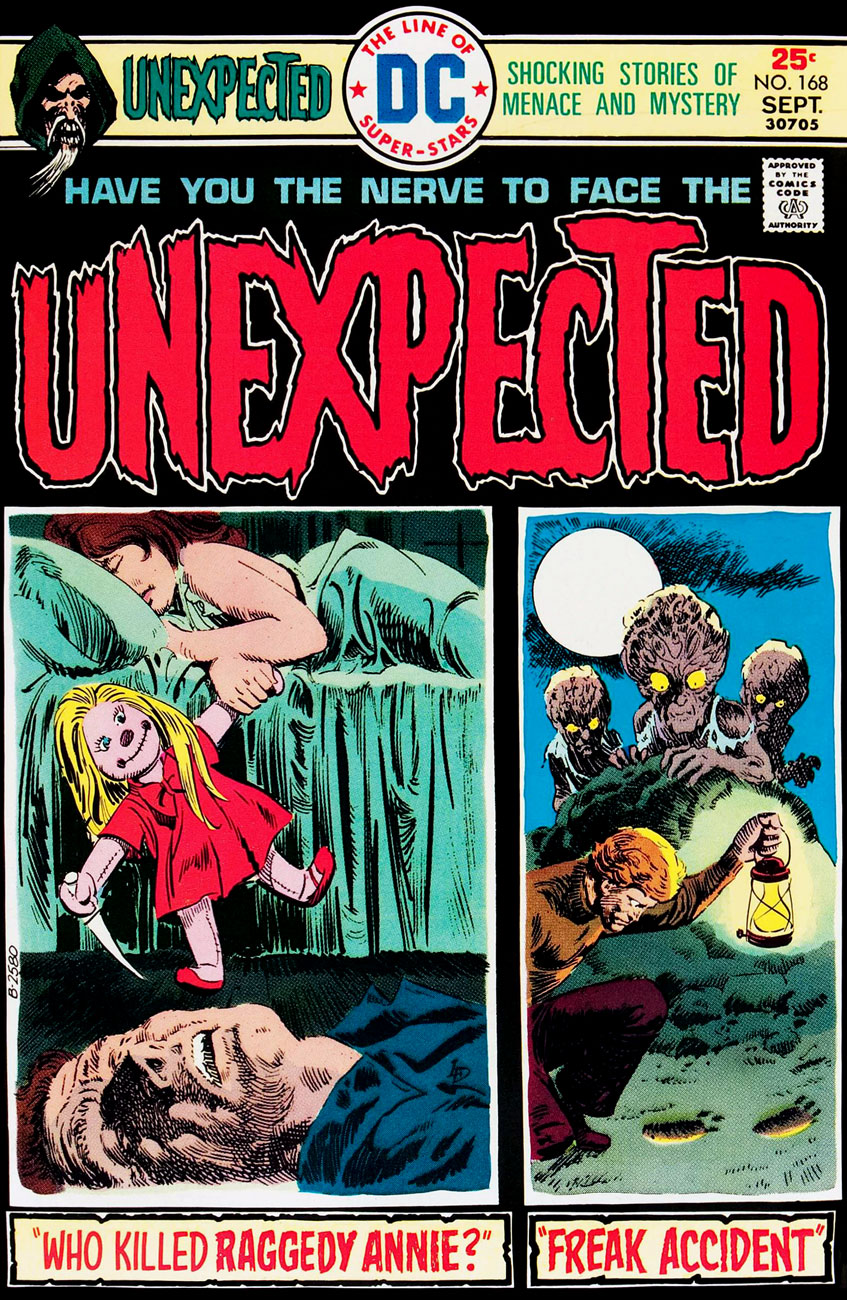
DominguezUnexpected168A
This is The Unexpected no. 168 (Sept. 1975, DC Comics; edited by Murray Boltinoff), cover art by Luis Dominguez. Aside from the six hundred-pagers (issues 157 to 162), this seems to be the only time a multi-panel cover was used, and little wonder: it doesn’t really work, and would fare even worse with the intrusion (five issues away) of the dreaded bar code.

No-one comes off particularly well in this one, really: Croker the spy is an impenitent, petulant slime bucket right to the finish, and the military, for their part, have been conducting sloppy biochemical experiments… for purely defensive purposes, I’m sure.

While the Geneva Protocol has prohibited the use of such barbaric means of warfare since 1925, the US didn’t sign on until… 1975, just before the fall of Saigon, marking the end of the Vietnam War. Let’s not ever forget the US Armed Forces’ generous and indiscriminate dispersion of Napalm and Agent Orange upon troops and civilians during the course of that conflict.

Given the timing, perhaps that bit of news inspired Kashdan to pen this sour little parable.

The guard’s high moral stance, « No one has the right to endanger the whole human race! » may ring a bit hollow and ironic given the circumstances, but he’s still right.

On a smaller, but no less tragic scale, consider the real-life story of what happened when a fan broke quarantine to catch a public appearance of her idol, actress Gene Tierney.

One simply can’t afford to mess around when it comes to quarantines and contagion.

Make-War-No-MoreA

Incidentally, Alcala really seemed to have a yen for those flay-headed mutants of his. To wit, here’s the opening page of The Children of the Bomb, Part 5, from Planet of the Apes no. 10 (July 1975, Marvel), written by Doug Moench and illustrated by Alcala.

AlcalaPOTA10A

-RG

* « [In 1968] Fox had joined other comics writers like Otto Binder, John Broome, Arnold Drake, Bill Finger and Bob Haney, signing a petition to ask DC for more financial benefits, particularly regarding health insurance. Since the company regarded writers as expendable people they were all fired without mercy and replaced by more obedient newcomers. » [ source ]