A Secret, Silken World: Max Andersson’s “Lolita’s Adventures” (1995)

« Most of us will still take nihilism over neanderthalism. » — David Foster Wallace

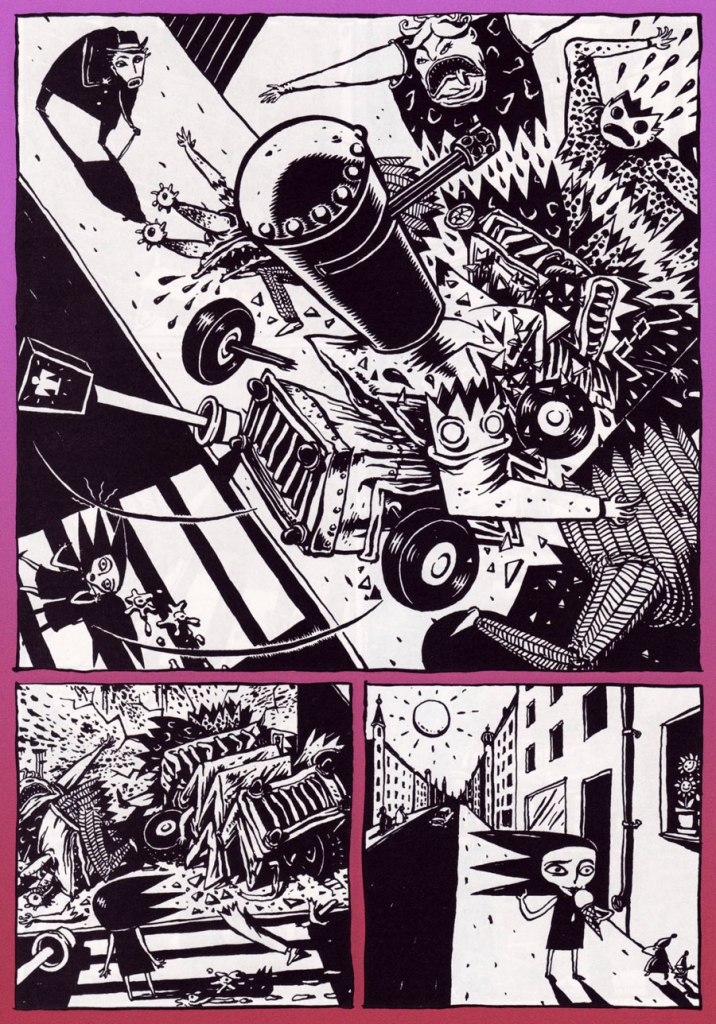
It’s become so quiet” “Yes“; from Galago no. 40 (1994, Atlantic Förlags AB)

Today, let’s dip a toe (at the risk of losing it) into the midnight domain of Swedish cartoonist and filmmaker Max Andersson (b. 1962). It’s a relentlessly-perilous scene, but like Kaz’s Underworld comic strip or Arnt Jensen‘s Limbo video game, I find it unexpectedly comforting in spite of (and thanks to) all the darkness, both thematic and in density of ink. In Andersson’s case, might it be owing to the author’s kindness to his protagonists? That’s a factor with odds I rather favour.

I don’t doubt that certain readers of a more sensitive cast will differ, but I posit that the cheerful lack of clemency the artist affords the callous, the cruel and the pernicious makes Andersson’s universe a profoundly moral one. Contrary to, say, your average American action blockbuster, such a purge of the villainous doesn’t restore the status quo… because here, malevolence is the status quo. Andersson’s put-upon little people are true outsiders, and his stories feel like Kafka, but blessed with dénouements far merrier yet merited.

Jolly carnage! Lolita’s Adventures appeared in the third issue (July, 1995) of Fantagraphics’ outstanding anthology title Zero Zero (27 issues, 1995-2000).

See? A happy ending and all, and even a rare glimpse of daylight.

Soon after he began to publish his work, Gary Groth spoke with Andersson (The Comics Journal no. 174 (Feb. 1995, Fantagraphics):

Groth: What would you point to as your defining influences? How did you develop this approach, style and point of view?

Andersson: What I always have in my backbone is the style of classic comics, the stuff I read when I was a kid.

G: I don’t see much Tintin.

A: No, but it’s there if you look closely. The basic technique of how to tell a story well. I try to do that because I want the storytelling to work, to be easy to read.

G: Were you influenced by sources outside of comics — film, literature?

A: Yeah, more of those than comics. The German Expressionist movies of the ’20s, Nosferatu; and artists from the period, like George Grosz.

And don’t leave out old cartoons! Andersson’s thoroughly animist way dovetails neatly with early animation’s unhinged, anything-can-happen mode. By which I mean that anything and everything possessed motion and sentience, be they boulders or pebbles, thunderclouds, petals or creepers, sparks or flames, pantaloons or braces, blunderbusses or bassoons…
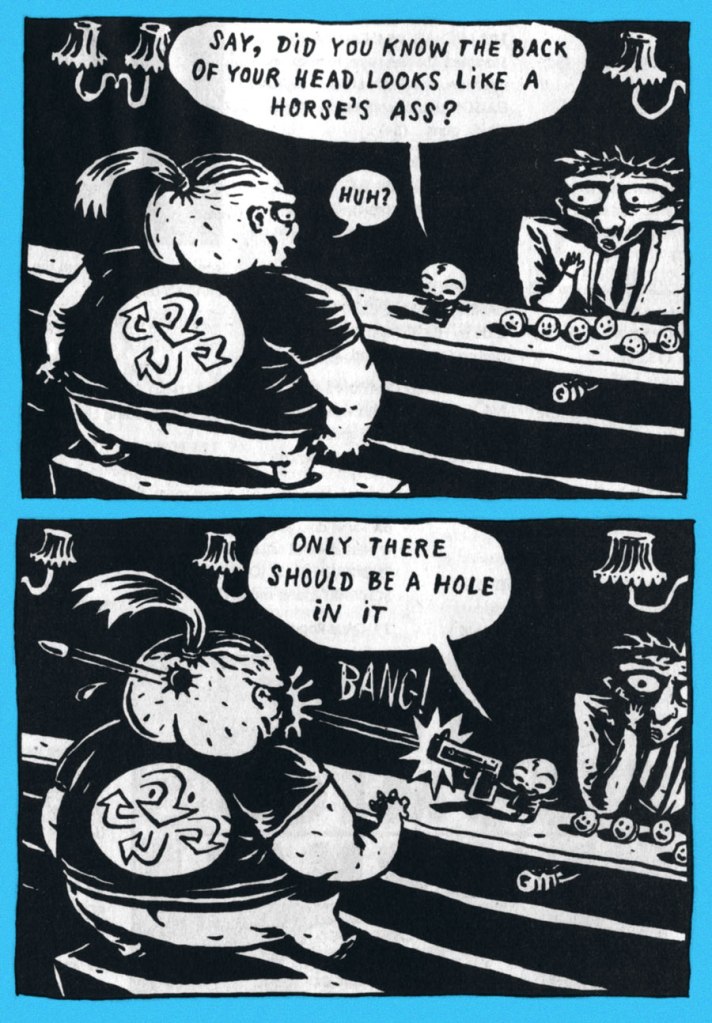
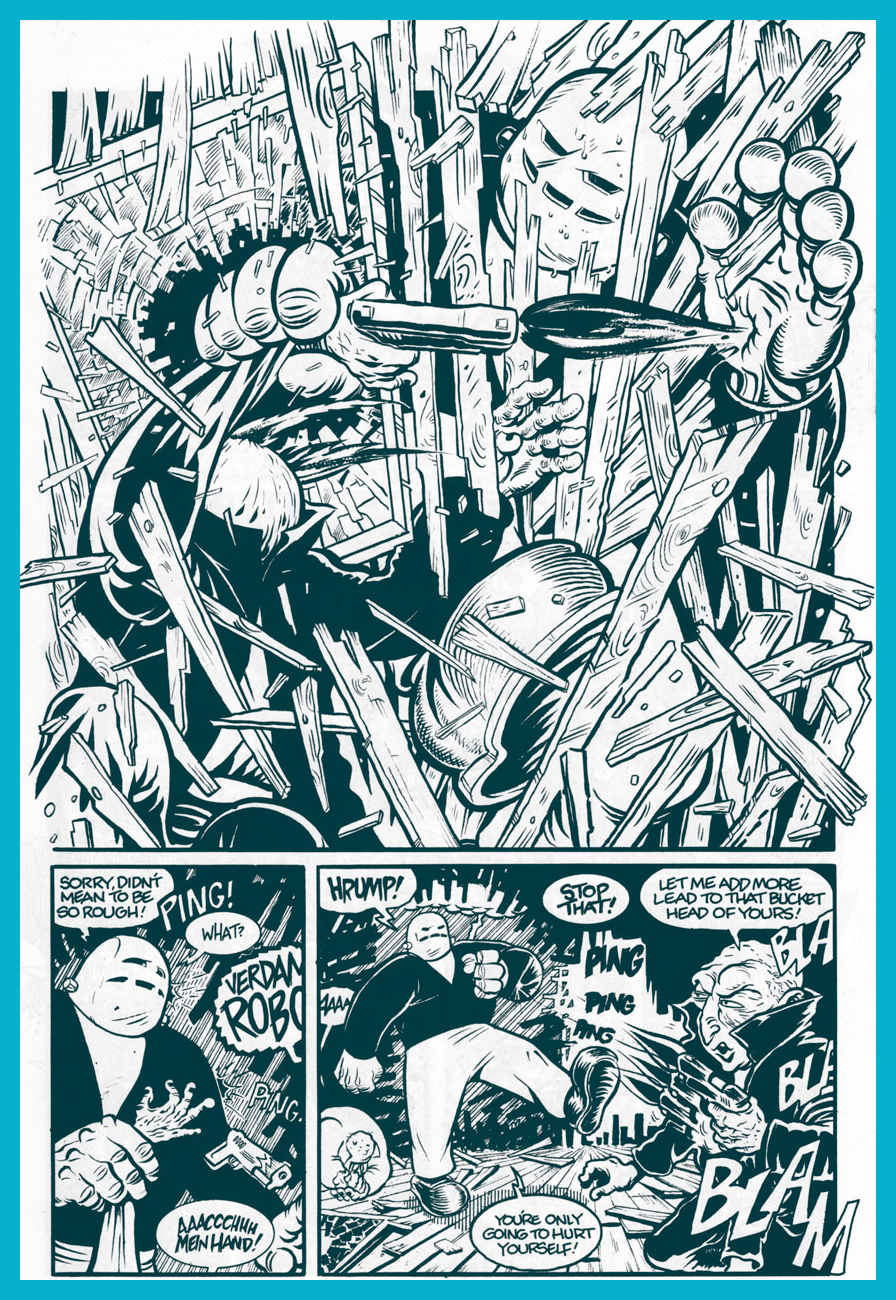
As a bonus, a sequence from Andersson’s breakthrough work, Pixy (1993). The title character is the fœtus with a pistol, and the happy little fellows on the counter are units of money. Highly recommended, and likely available in the language of your choice.

About Pixy, fellow dweller-in-darkness Charles Burns exulted: « So you think it’s a cold, creepy, world out there, huh? Hah! Just wait’ll you get a load of Max Andersson’s Pixy… safe sex suits, buildings that eat people, drunken fœtuses with bazookas, money that shits on you, recyclable bodies… hey, wait a minute, that’s not creepy, that’s fun. MY kind of fun. »

For more dope on this important creator’s endeavours, do sidle over to his official website!

-RG

Hallowe’en Countdown IV, Day 17

« I would rather sit on a pumpkin and have it all to myself, than be crowded on a velvet cushion. » — Henry David Thoreau

Have you picked out that special pumpkin for your fast incoming (dark, presumably) celebrations? If not, better get on it — someone (or something) else may be casting covetous glances and about to call dibs.

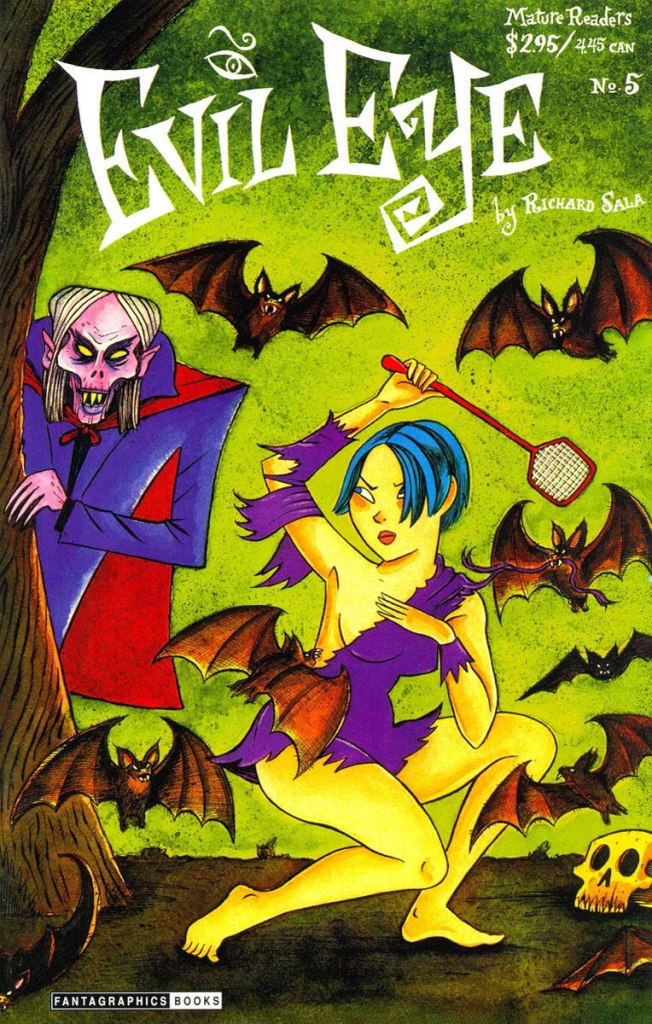
The lovely barefoot damsel is Richard Sala’s plucky heroïne (well, one of them!) Peculia. She was the star of Sala’s showcase title Evil Eye (1998-2004, Fantagraphics), as well as the graphic novel Peculia and the Groon Grove Vampires (2005). Fret not, she can fend for herself.

This is Evil Eye no. 2 (Oct. 1998, Fantagraphics).
This is Evil Eye no. 3 (Apr. 1999, Fantagraphics).
This is Evil Eye no. 5 (Mar. 2000, Fantagraphics).

As you may or may not have heard, Mr. Sala was one of the many notables we lost over the course of this nearly unparalleled Annus horribilis. Let’s remember him through this heartfelt eulogy penned by his closest friend and esteemed colleague, Mr. Daniel Clowes.

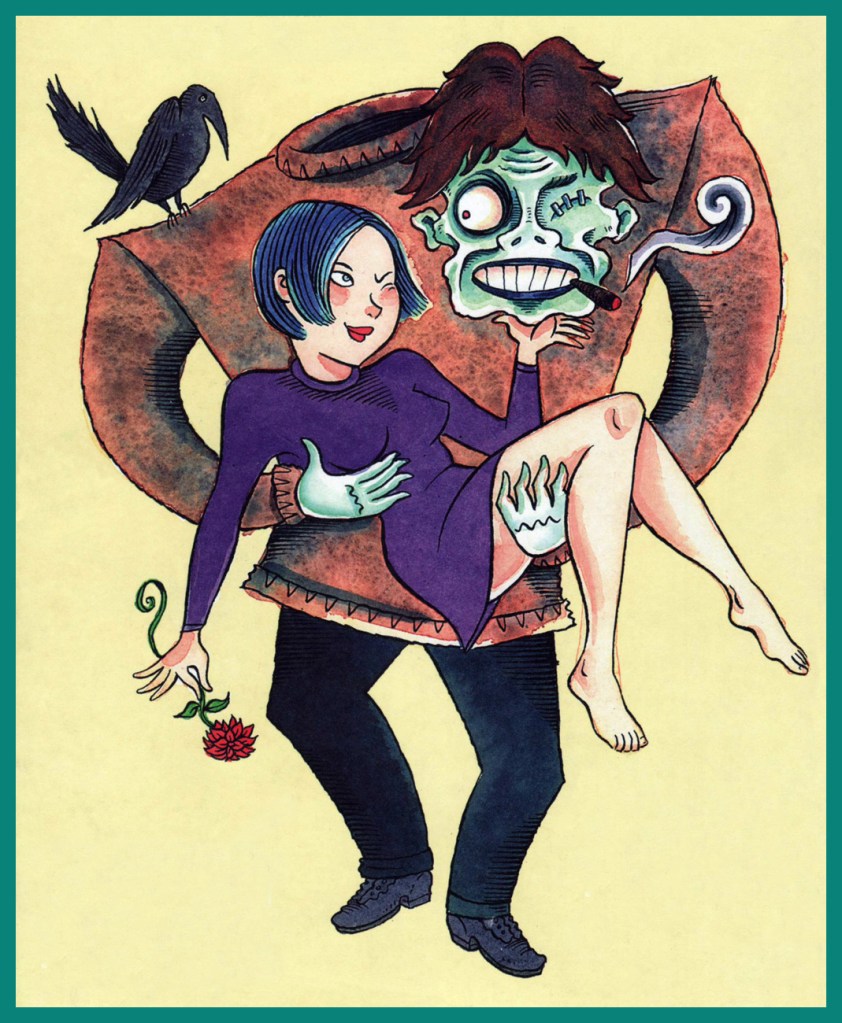
A fetching pinup from the back cover of the 2002 Peculia collection (2002, Fantagraphics).

– RG

Tentacle Tuesday Masters: Matt Howarth and His Keif Llama

Wasting the wide range of my xeno-tech training on a home office job was like putting a carpenter in charge of the psycho-ward. Like any fish out of water, I didn’t fit in. Bureaucracy said I didn’t belong.

So they finally shipped me out.

Murder on the O’Brien Express‘, published in Keif Llama – Xeno-Tech no. 4

« The ability to think like another species is a rare and galactically valuable gift. Those who are capable of it are called xenotechs. »

Technically, Kēif Llama (pronounced keef yamma) is a government official specializing in communication with alien species. Off record, she tends to poke her nose into beehives, and wards off attempts to deter her from doing so until she gets to the bottom of whatever’s happening, often pursuing the investigation far beyond formal confed business. When the government wants her to provide an quick’n’easy solution, or to hush things up, she kicks up a well-justified fuss. For this reason, despite being a top-notch xeno-tech, the planets to which she gets sent are further and further away from civilized life, the missions assigned to her increasingly inconsequential. Inconsequential to the government, that is – following the thread of a seemingly random event, Llama often stumbles upon some serious plot, often than not concocted by some evil corporation (and occasionally supported by the government itself).

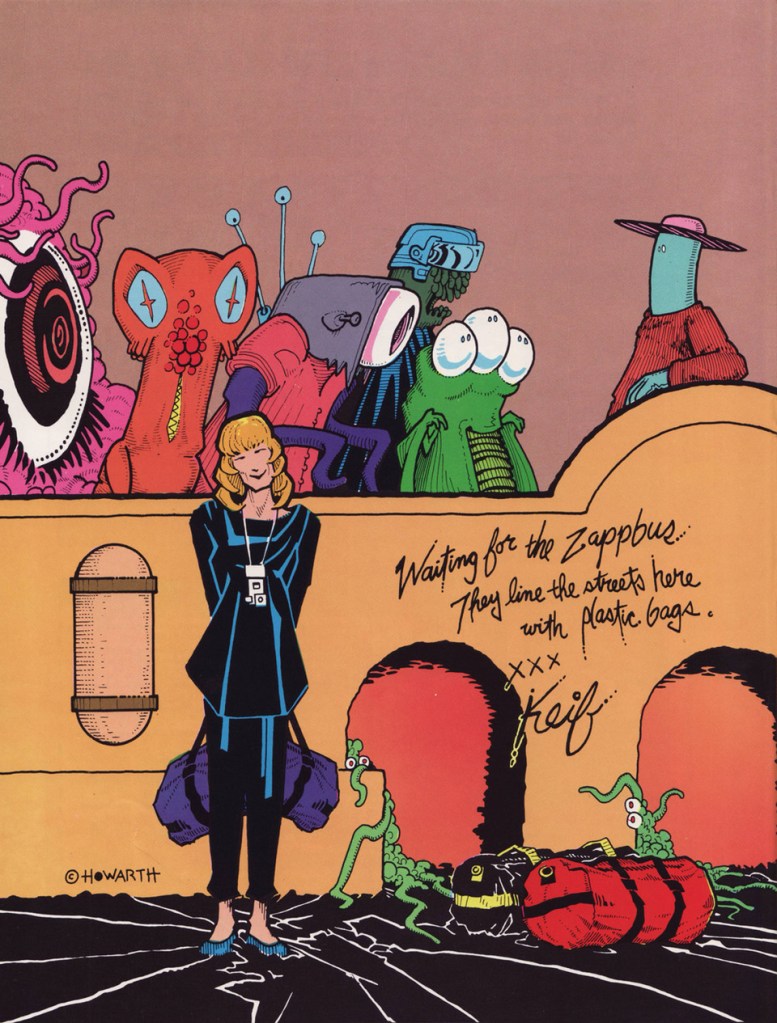
The back cover of Particle Dreams no. 1 (October 1986, Fantagraphics).

Her name is probably a sly wink to Keith Laumer, a sci-fi/fantasy writer whose Retief series is about a diplomat solving alien conflicts on various planets. Except that Retief always comes out with his nose clean and his credentials reinforced by his success. Llama, on the other hand, stumbles through the puzzling and melancholy worlds she’s banished to with an increasing sense of despondence and powerlessness. She often lacks information to make informed decisions, though not through lack of trying; and in this universe of shades of grey, it is often unclear which is right and which is wrong. Saving one alien life can lead to a whole planet perishing. Overlooking a minor detail means disaster, and when hindsight is 20/20, her burden of guilt is heavy to bear.

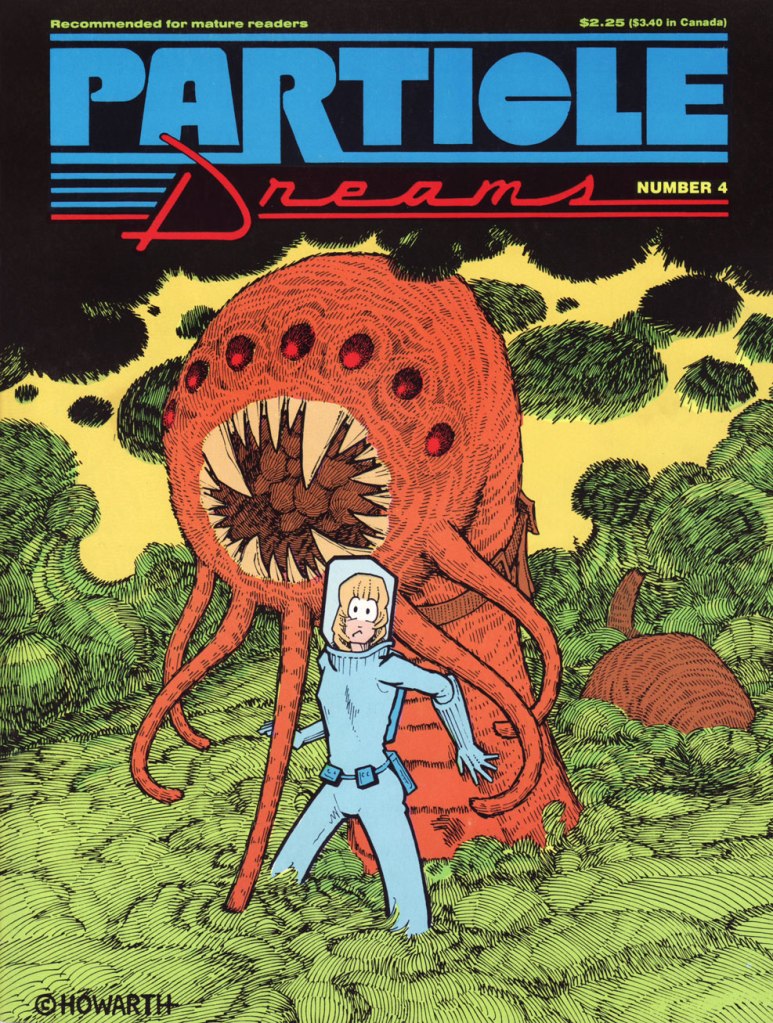
Particle Dreams no. 4 (June 1987, Fantagraphics).

In FF1986: Keif Llama, Lars Ingebrigtsen, who likes this series with a few reservations, argues that “The stories are problematic. More than a few of them end with a sense of “Huh? That’s the end? Did I miss something?” And most of them feature a genocide of some sort or another. After a while, it starts grating on you.” I would respectfully disagree: these stories are a bit like a slice of life. Sometimes we start in the middle of something that’s already under way, and sometimes we get but a small glimpse of some larger, out-of-reach picture. Not everything gets explained, but that’s not because Howarth couldn’t tie the ends of this plot together: he’s our guide through strange worlds, but even a guide doesn’t know everything. This is *excellent* science-fiction, as far as I’m concerned, imaginative and wide of scope. And Llama does have her moments of triumph (made more precious by their rarity), when she manages to outwit the fools, the bureaucrats, the religious fanatics whose actions would lead to a destruction of a precarious ecological balance or a grave injustice. Howarth’s hallmark humorous winks are scattered throughout the stories, giving the readers a welcome respite from the frequently heavy subject matter.

But more importantly, it’s those ‘problematic’ – whether downright cryptic or just lacking closure – endings that make Kēif Llama into a truly striking body of work. Depressing, it can certainly be (thus the importance to not binge-read your way through these comics, assuming you get your hands on a bunch of them at the same time). Yet as we accompany Llama on her ‘journey of discovery’ that leads her (and us) through a maze of corrupt (or just so weary they can’t be bothered) officials, profit-hungry conglomerates, macho idiots who can’t bear to take orders from women, and alien locals who mostly want to be left alone or refuse to explain their culture to an ‘ugly and smelly’ human, the weight of the universe Howarth has created settles squarely on our shoulders, and keeps us pinned until some uncomfortable truths are faced, commonly held beliefs are unravelled, and a few tears are shed. Happy endings often come at a heavy sacrifice.

Page from Particle Dreams no. 4 (June 1987, Fantagraphics).

On a lighter note, fans of Matt Howarth will indubitably have noticed the abundant presence of tentacles in all of his series. Howarth is exceptionally good at drawing aliens: tangible, ‘believable’ aliens who come in a staggering variety of shapes and sizes, and rarely look like some Earth animal with extra appendages (something artists of more limited imagination resort to quite a lot).

Patience, published in Particle Dreams no. 6 (November 1987, Fantagraphics).
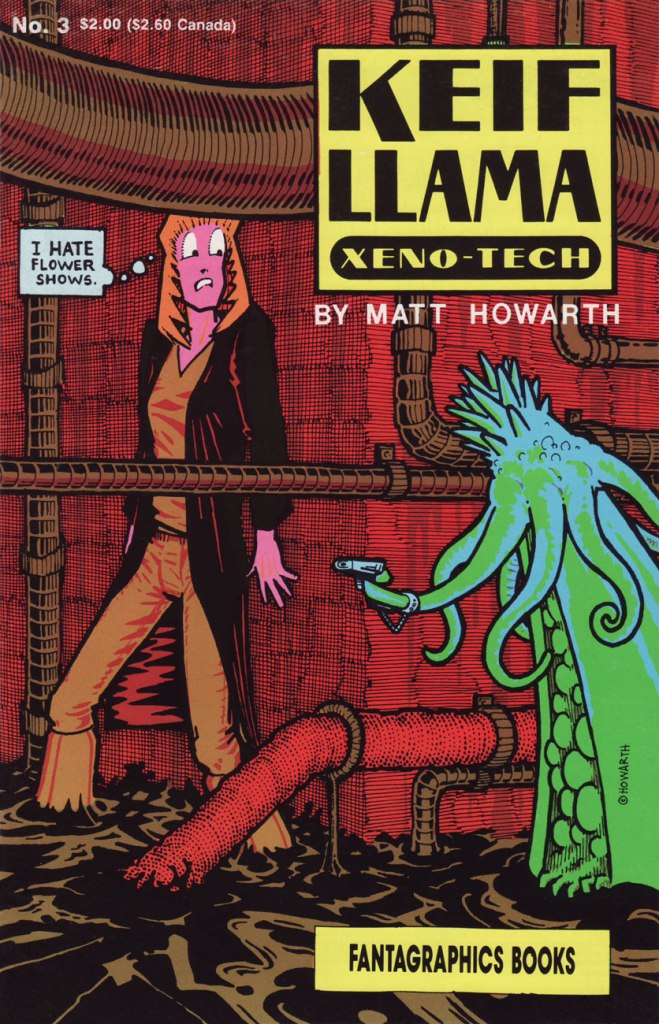
Keif Llama – Xeno-Tech no. 3 (November 1988, Fantagrahics).
A page from The Thorn Beneath the Rose, published in Keif Llama – Xeno-Tech no. 3 (November 1988, Fantagraphics).

A small-time sheriff, alien as he may be, summarizes the type of thanks Llama frequently gets in this tirade: « You’re an ambulatory disaster area, Llama. Smuggling fiascos, international incidents, they can’t even ship you to the frontier without trouble following you. You’re in transit to Edison-Blue, Llama. I don’t want you or your bad luck in my town any longer than is painfully necessary. »

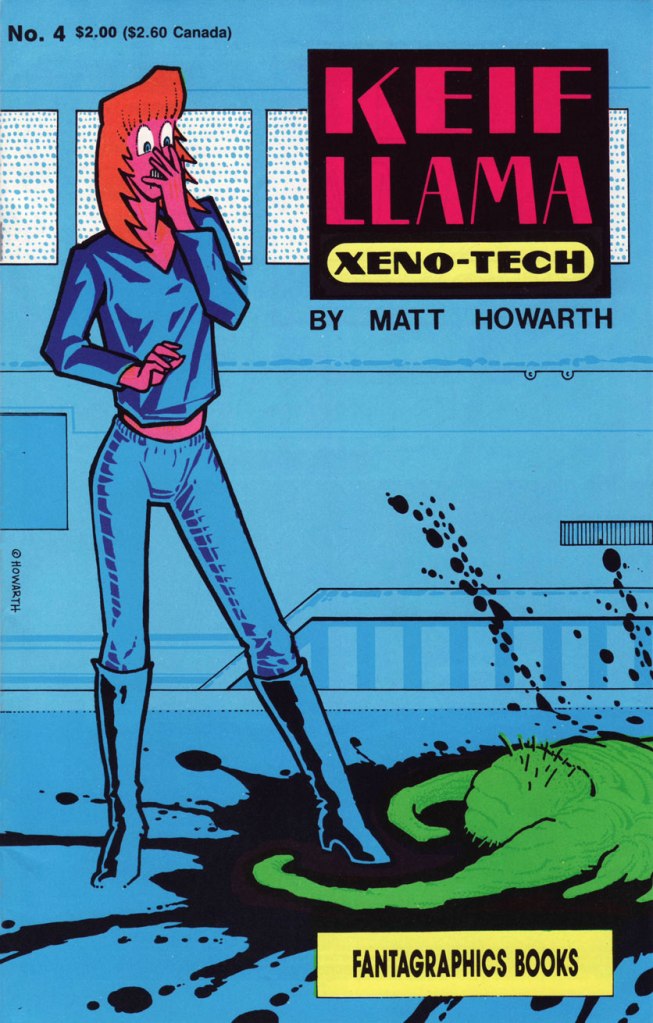
Keif Llama – Xeno-Tech no. 4 (December 1988, Fantagraphics).
A page from Down and Out There, published in Keif Llama – Xeno-Tech no. 5 (January 1989, Fantagraphics).
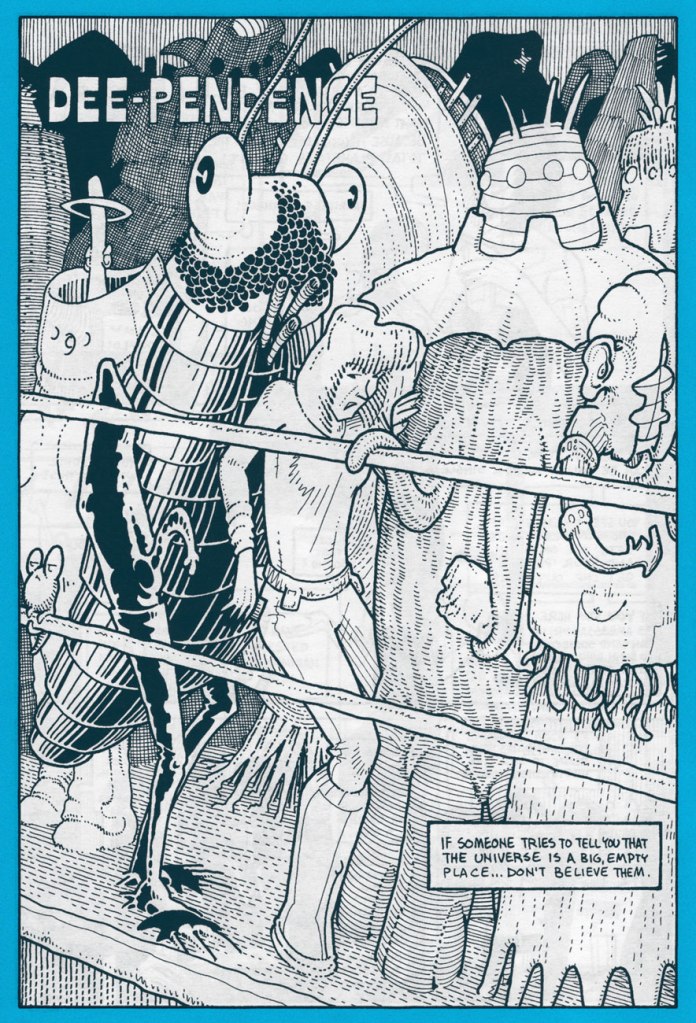
Page from Dee-Pendence, published in Keif Llama Xenotech vl 2. no. 3 (December 2005, Aeon).

✶ ds

Tentacle Tuesday: Up From the Murky Depths

« Down metal snake corridors
Steely grey engines hum for nobody but me
No sound comes from the sea above me
No messages crackles through the radio leads
They’ll never know, never no never
How strange life in dark water can be…
»*

Now that we’re finally enjoying proper autumnal weather – which is to say, grey, rainy and beautiful – my thoughts turn to the dark and the wet. Aquatic octopus scenes fit this mood beautifully: those mute scenes where characters are as if frozen in the clutches of a gargantuan octopus. In which overeager octopod grabbers get ferociously punished for their ill-advised enthusiasm, winding up, more often than not, on the wrong end of a sharp… implement.

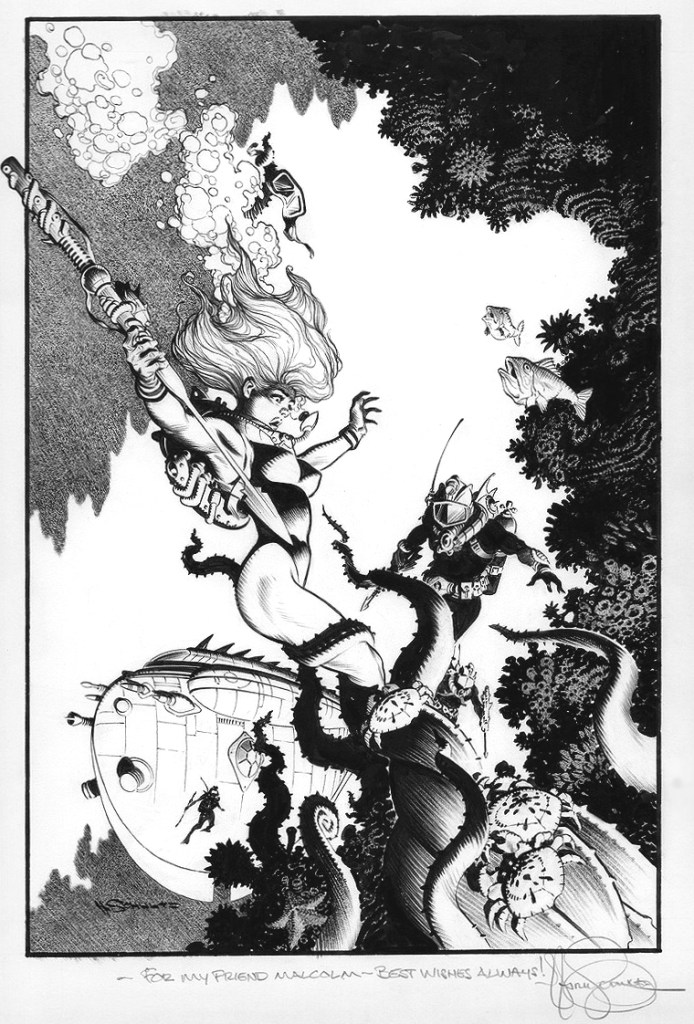
Original art by Mark Schultz intended for the Subhuman paperback collection (which, as far as I know, never saw print):

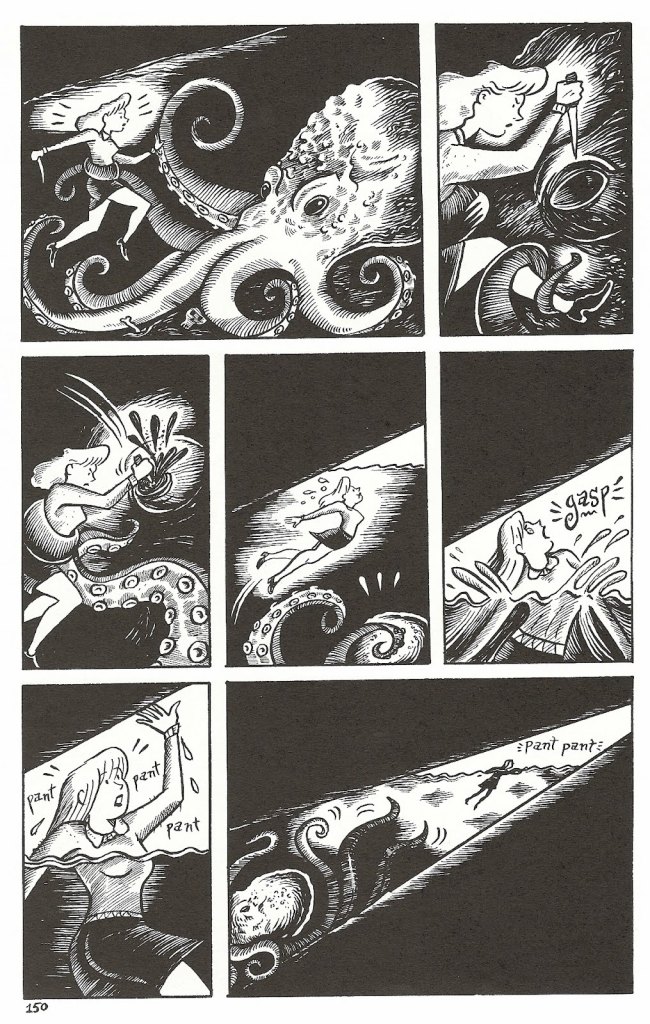
A few pages from Richard Sala‘s Mad Night (2005, Fantagraphics):

This book features not one, but two epic battle scenes with an octopus!

A painting by Vic Prezio, created for the front cover of a 1962 issue of Man’s Escape:

– ds

*Al Stewart, Life in Dark Water

Philosophy From the Foxholes: Bill Mauldin

« Wherever despotism abounds, the sources of public information are the first to be brought under its control. Where ever the cause of liberty is making its way, one of its highest accomplishments is the guarantee of the freedom of the press. » — Calvin Coolidge

Ah, the pitfalls of anchoring yourself to the news cycle: given the shocking news, last week, of the impending, unjustified closure of one of the greatest American journalistic institutions, the independent military daily newspaper The Stars and Stripes (founded in 1861!). I was all set to cobble together a series of posts showcasing the work of S&S’s greatest cartoonists, but then the massively unpopular decision was just as abruptly reversed. For now.

So I’ll stick to one post for the nonce (Shel and Tom will have to wait) and feature one of history’s greatest soldier cartoonists, William Henry “Bill” Mauldin (1921-2003), twice recipient of the Pulitzer Prize (1945, 1958), the Legion of Merit… and a host of other distinctions, both military and civilian.

Our baby-faced artist photographed during WWII.

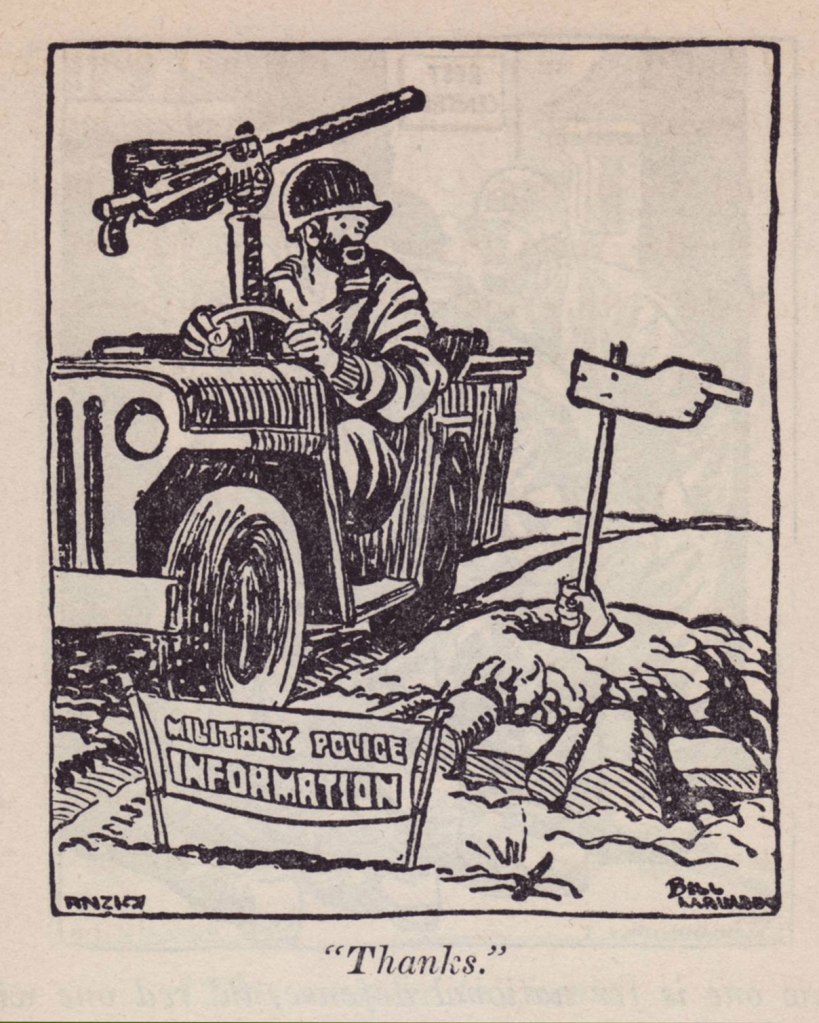
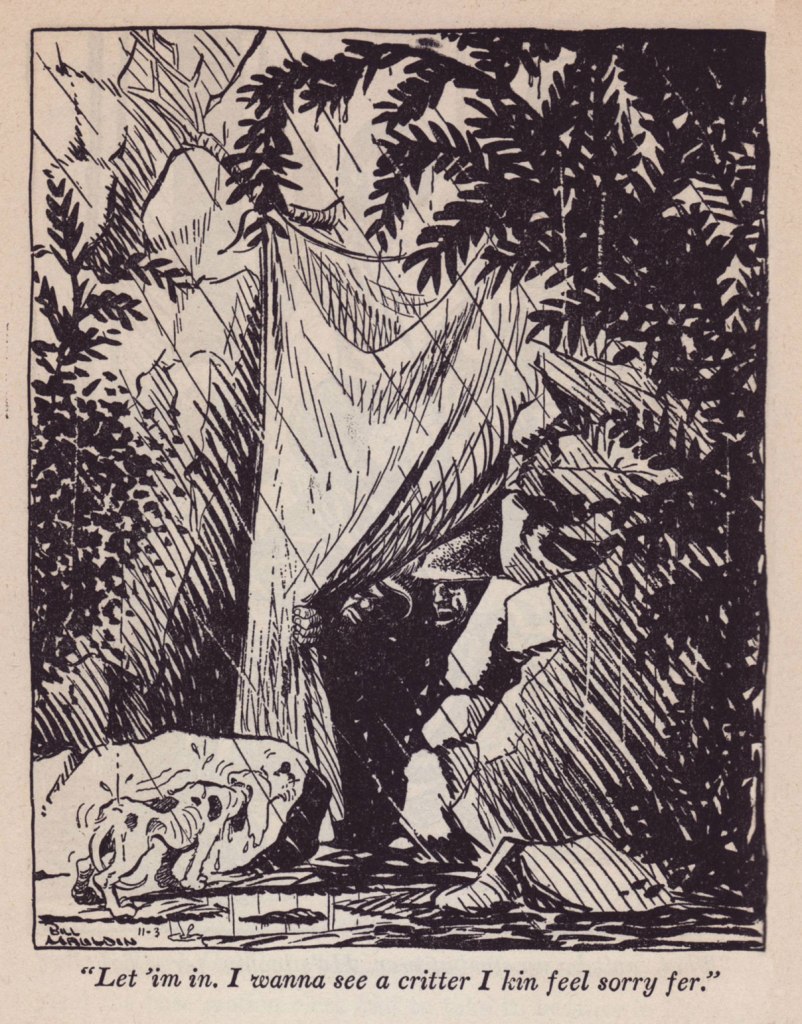
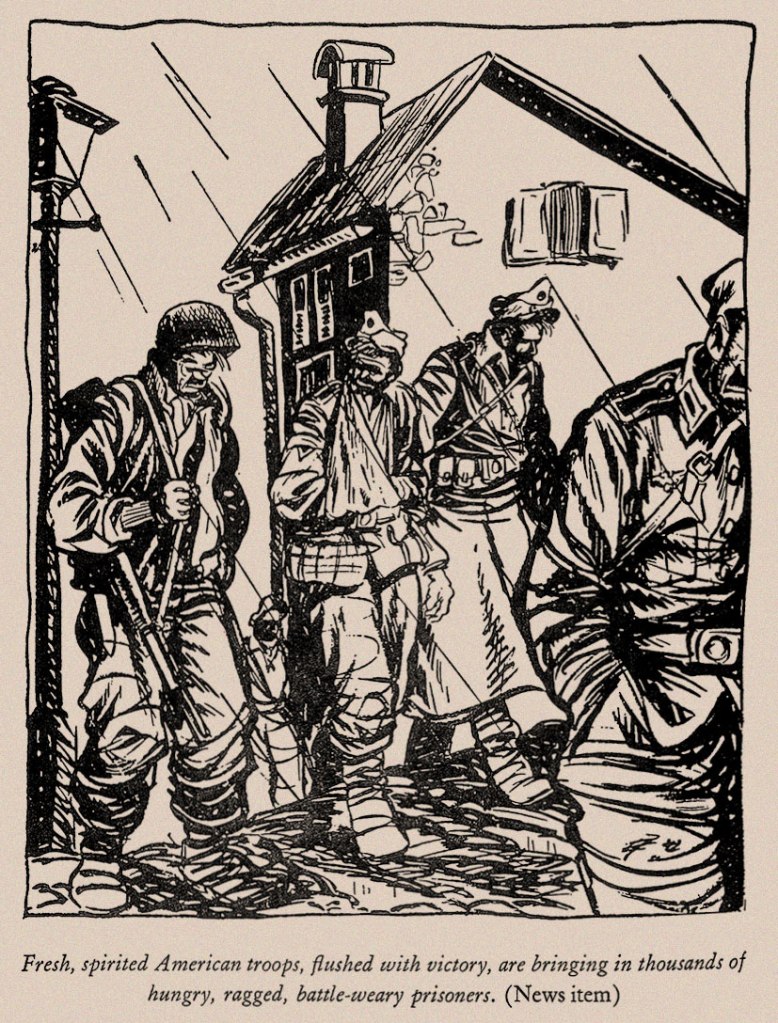
With but a single exception, the following are samples from his essential Up Front collection (1945), which Mauldin humbly opens with: « My business is drawing, not writing, an this text is pretty much background for the drawings. »

But such a background! Mauldin is, naturally, funny and insightful, but there’s much to learn therein, not merely about men in war, but just about everything under the sun. While so many nowadays mix up freedom and privilege, it’s good to be gently reminded of the high price of both.

« Until some intelligent brass hat repaired a big brewery in Naples and started to send beer to Anzio, the boys at the beach-head were fixing up their own distilleries with barrels of dug-up vino, gasoline cans, and copper tubing from wrecked airplanes. The result was a fiery stuff which the Italians called grappa. The doggies called it ‘Kickapoo Joy Juice’, and took the name from the popular ‘Li’l Abner’ comic strip which Stars and Stripes printed daily. It wasn’t bad stuff when you cut it with canned grapefruit juice. »
Mauldin’s biographer, Todd DePastino, wrote, in his Bill Mauldin: A Life Up Front: « First published on October 13, 1944, this cartoon made the 23-year-old Bill Mauldin the youngest Pulitzer Prize winner in history. Both he and his editors at Stars and Stripes were astonished by the selection, which did not seem to them particularly noteworthy. »

For a deeper dive into Mauldin’s war through the eyes of his ragged infantrymen, scrounge yourself a copy of Fantagraphics’ glorious Willie & Joe: The WWII Years (2008).

In closing, shall we hear from another president?

« I have great respect for the news and great respect for freedom of the press and all of that. » — Donald J. Trump

-RG

Kid Anarchy: Don’t go back to Yamston

« It is the beginning of wisdom when you recognize that the best you can do is choose which rules you want to live by, and it’s persistent and aggravated imbecility to pretend you can live without any. » — Wallace Stegner

It’s funny how, closing in on 300 posts, I’m only getting around to discussing some of my very favourite series. As my co-conspirator ds points out, these are far harder to do justice to.

Many of these were abject commercial failures, but providential glimpses into fully-formed universes we must leave forever unexplored save in our dreams. In the eighties and nineties, Fantagraphics were particularly courageous in following up on their principles (explicitly elaborated upon in the pages of The Comics Journal) and publishing material for which there wasn’t much of an obvious market. For instance, the four issues of Jim Woodring‘s pre-Frank anthology, Jim. Still my favourite work of his… but a definite commercial non-starter.

KidAnarchy01A
Meet Tommy Delaney, alias Kid Anarchy. This is Kid Anarchy no. 1 (Mar. 1991, Fantagraphics). Colours by Roberta Gregory.

He’s not really an anarchist, you know. This amusingly led an overly literal-minded, self-styled hardcore aficionado (from the nerve centre of American Punk, Monroe, LA) to testily complain to the authors: « Where do you get off calling your lame comic ‘Kid Anarchy’?!! Yup, I thought for sure this might have something to do with Anarchy, hardcore, social and political matters and so on, but what does it turn out to be? A deadbeat story about a bunch of rednecks sitting around a house. You guys suck! Why don’t you get your shit together and do something you understand, like a story about two posers wanking each other! Get a life! »

Ah, but Kid Anarchy could have been utter offal… had it conformed to that (mis)reader’s expectations. Anyway, see for yourself.

KidAnarchyIntro01AKidAnarchyIntro02AKidAnarchyIntro03AKidAnarchyIntro04A

KidAnarchyIntro05A
In full, the sequence that introduces our players. From Kid Anarchy no. 1.

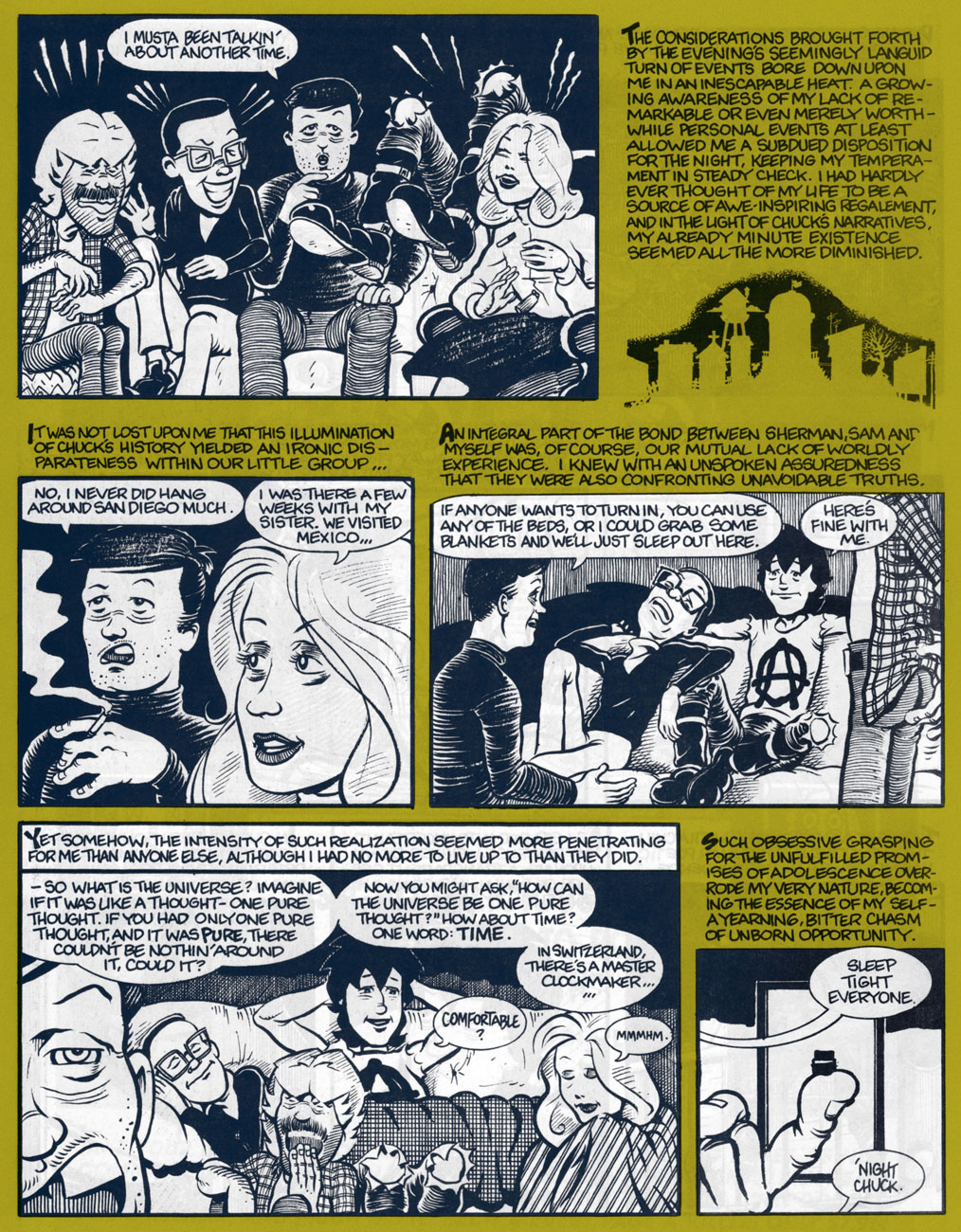
KidAnarchy01LanguidA
Trading tales of youthful escapades until the wee hours, also from the first issue. Worth noting is the complementarity of the narrative and the dialogue, always a plus for this reader.

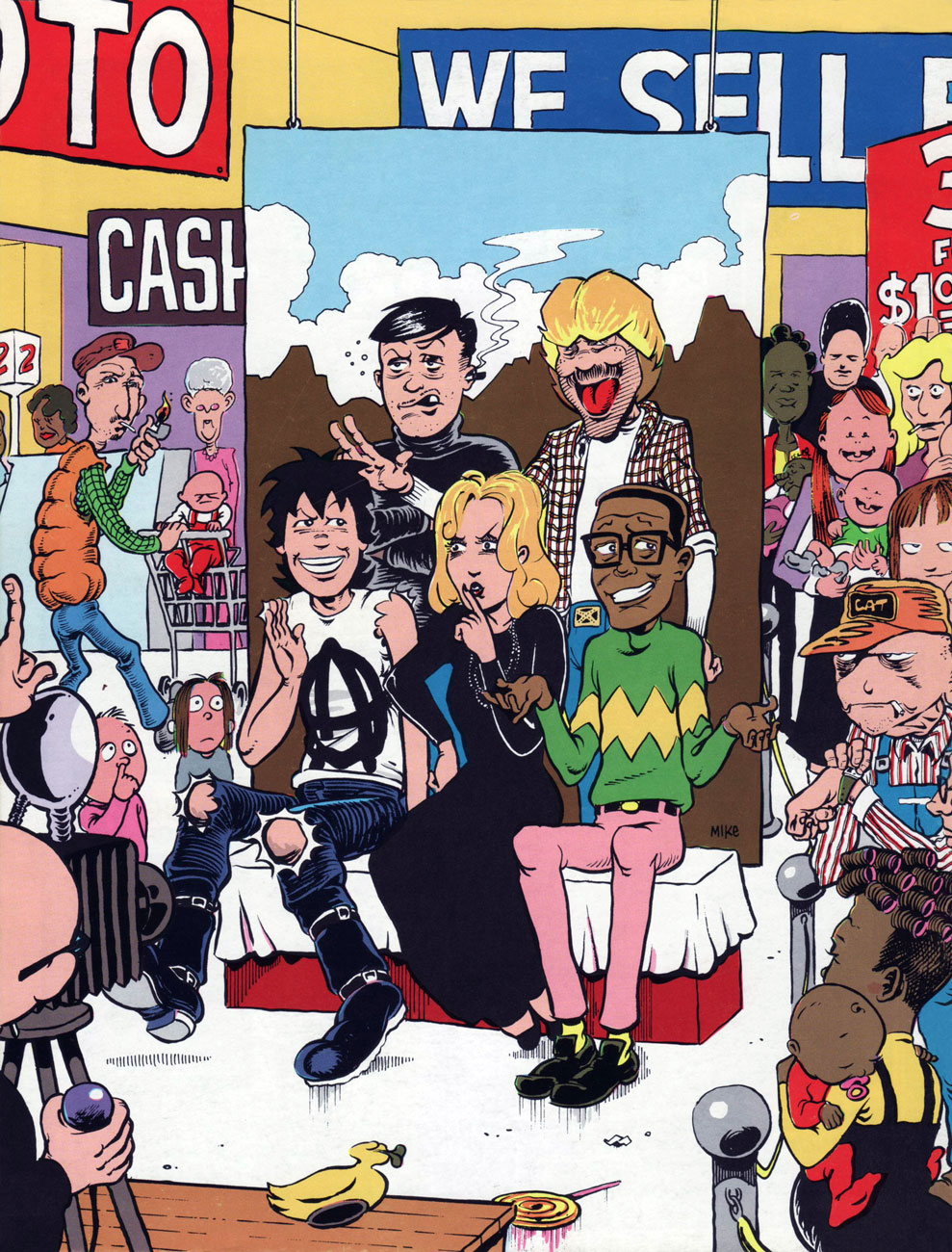
KidAnarchy01VersoA
Let’s head over to Sears and sit for a group portrait, from the back cover of the inaugural issue.

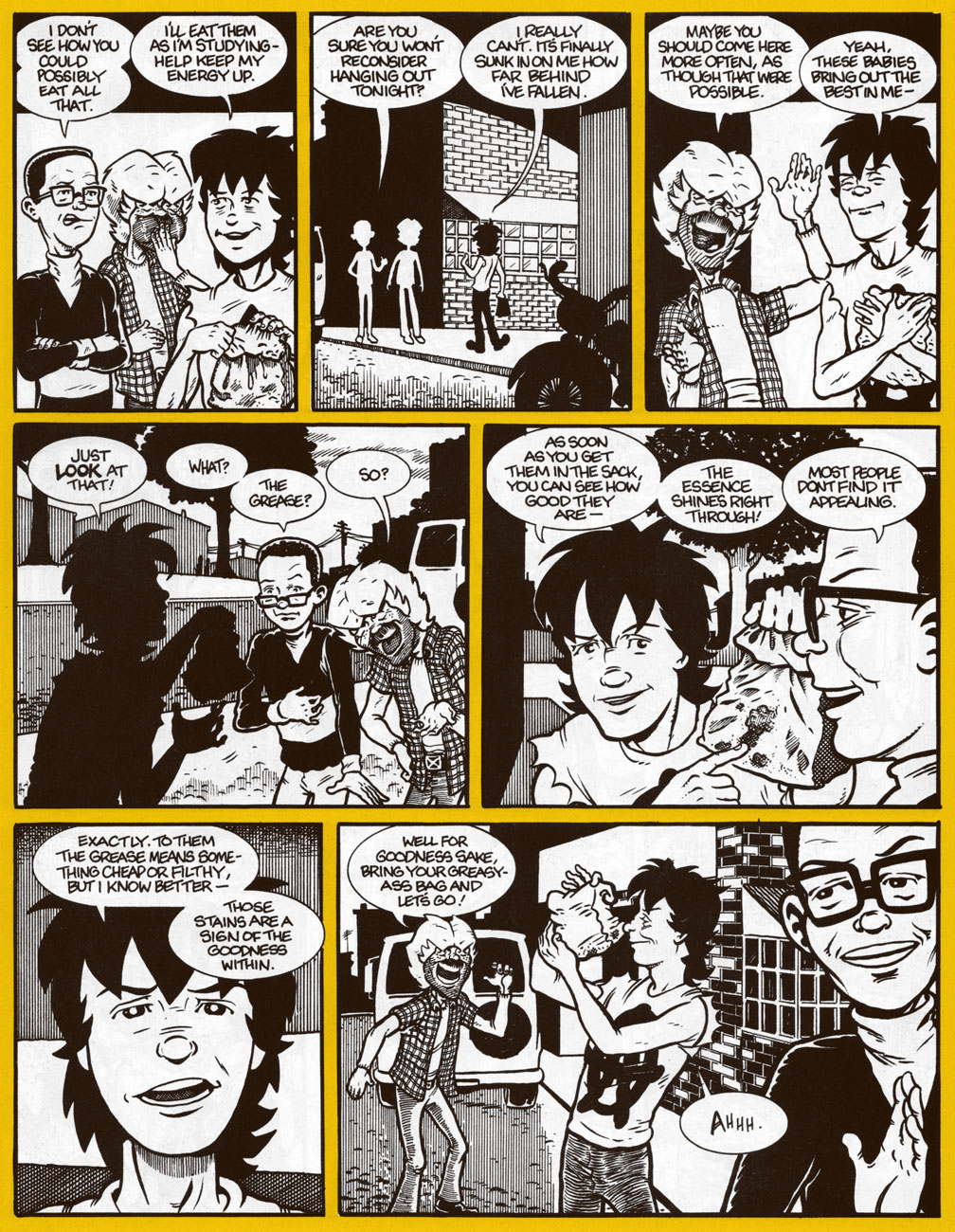
KidAnarchy2Burgers01A

KidAnarchy2Burgers02A
Two non-consecutive pages from a favourite sequence about the joys of grease. I no longer indulge in cheap-o burgers these days, but I get the same thrill from a paper bag full of samosas. One of the Kid’s wiser moments. The “goodness within”, indeed! Too bad he ends up accidentally leaving his “greasy-ass bag” behind in Sam’s van.

KidAnarchy03A
Nina gets her cover spotlight, showing us a glimpse of Pandemonium’s tatty arrière-boutique. This is Kid Anarchy no. 3 (Nov. 1992, Fantagraphics)

KidAnarchy03BounceA
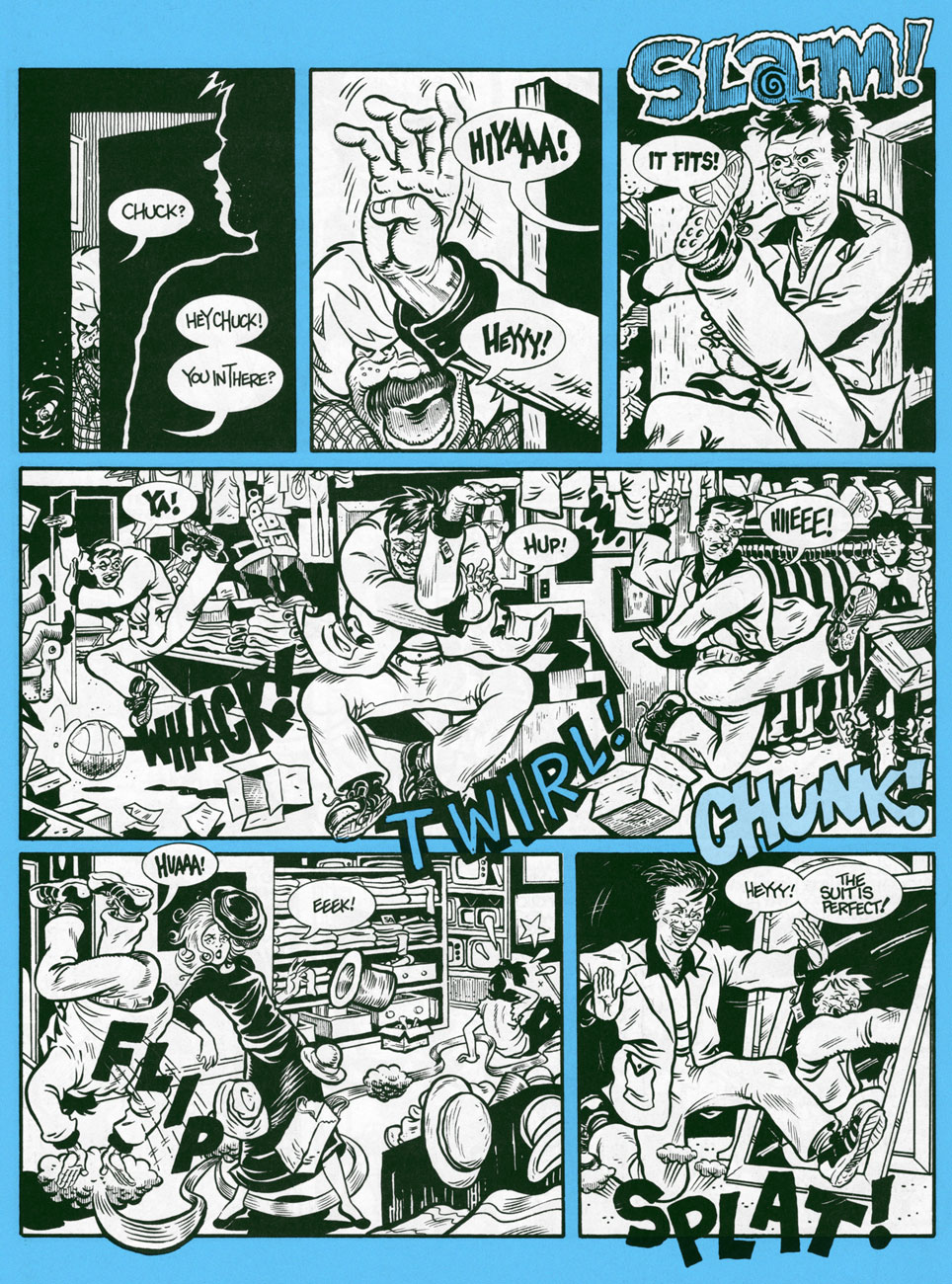
It’s not all quiet and introspection! Moonchow goes wild in the local Salvation Army dressing room! From Kid Anarchy no. 3.

To me, the deeply poignant charm of KA rests in its character study of a band of outsiders, drawn together by virtue of greater difference from the rest of the populace than from one another. While each of them outwardly appears to represent a ‘type’, this facile pigeonholing is defeated and contradicted at every turn. Not one of them fits the tidy category that convention and circumstance seek to wedge them into. Also notable is the tonal choice undergirding the narrative: let’s face it, young Tommy is generally a sullen, immature prick, while the authorial voice of his older self is honestly rueful and brimming with hard-earned insight. I would have loved to see where the story was bound: would the gang dissolve? Would we follow Tommy with a new entourage? What’s the sinister secret behind Pop’s low prices?

As it was, the third issue, appearing over a year after the second, made it clear that it was an indulgent boon from the publisher.

Artist John Michael ‘Jim’ McCarthy would go on to briefly (and often brilliantly) produce monster erotica for Fantagraphics’ company-rescuing Eros and Monster brands in the ’90s. Then the dusky lights of independent, impenitent, low-budget cinema beckoned! As for his old pal, writer George Cole… I just don’t know. Anyone?

-RG

Tentacle Tuesday Masters: Tony Millionaire

Once upon a time, in a kingdom beyond the seven seas, a little boy lived under the name of Scott Richardson in a seaside town (let’s call it Gloucester and pretend it’s in Massachusetts). His whole family were artists, and he would watch his grandparents paint the sea, the ships that sailed it and the people who commanded the ships. It must have come as no surprise at all when the boy, too, started to draw. Eventually, he grew up, moved around a lot, almost started a major war and somewhere along the way, acquired the nom de plume of Tony Millionaire (which, according to him, « comes from Old French. It means a person who owns a thousand slaves. Serfs, not slaves. »

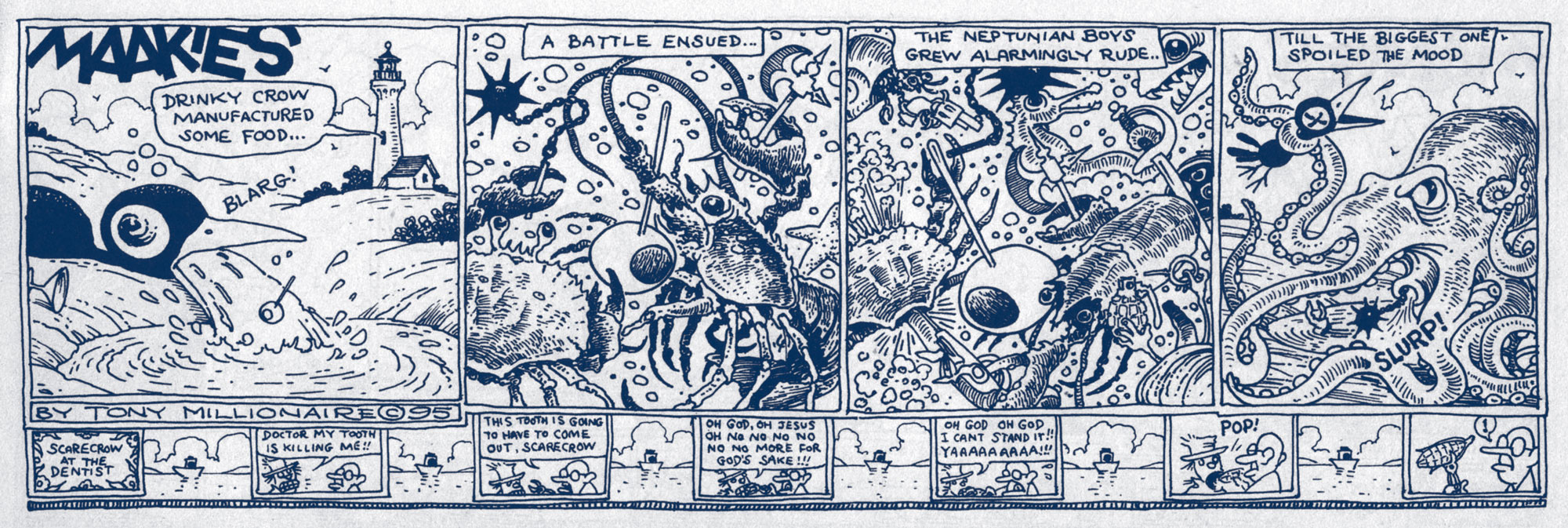
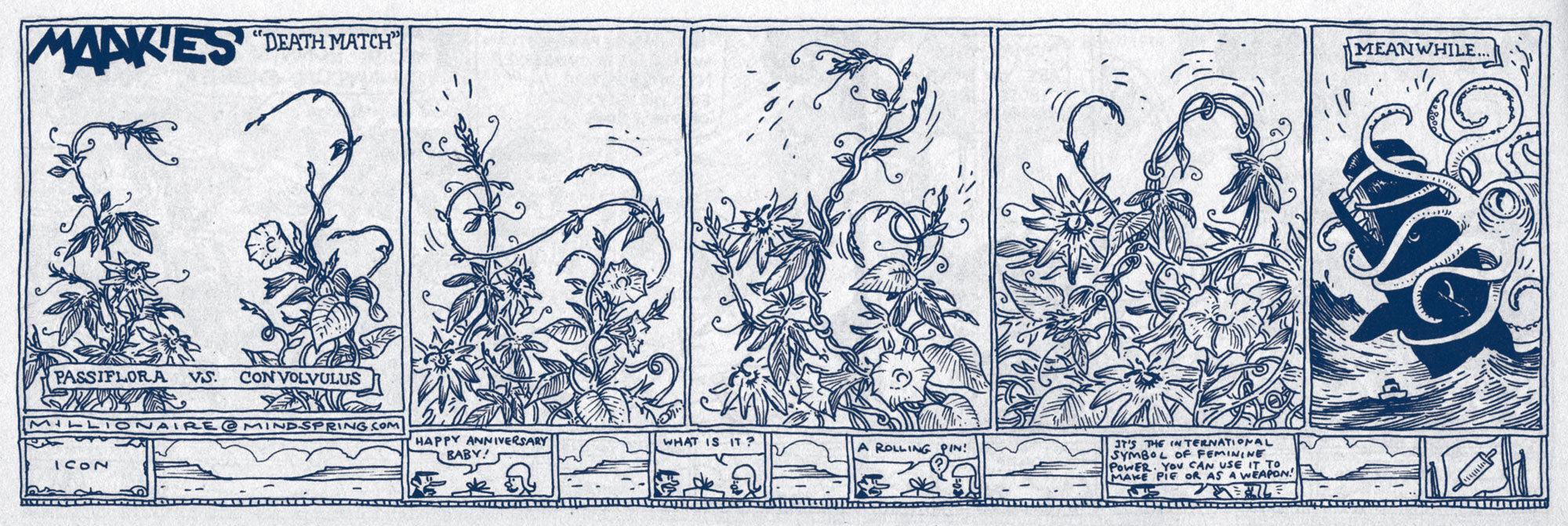
How’s that for a little fairytale? You will forgive me for the jejune introduction, but something about Millionaire’s art is magic. It is easy to underestimate how good an artist he is because his art is so cartoony, and his characters so outlandish: his award-winning, syndicated strip Maakies, for instance, concerns itself with a perpetually blotto stuffed crow (Drinky Crow) and his best pal, a sock monkey (Uncle Gabby). Both were TM’s childhood toys. All children make up stories about their playthings. What’s magic isn’t that he was able to create a world for his toys to inhabit, it’s that he was able to pull us, the audience, in with him.

TonyMPortrait

His art is also stunning on a purely technical level: the impeccable geometry of his Victorian houses, the zest of his epic battle scenes (often between a whale and a kraken, it should be noted), the lushness of the gardens inhabited by fairies, gossiping insects having tea, and mice with puritanical sensibilities.

A couple of other things about Tony Millionaire: he’s really funny (or “drunkenly charming”, if you prefer; read his interview with John F. Kelly from 1999), and he clearly loves drawing tentacles, gleefully sticking them hither and tither. He’s clearly long overdue for an inauguration into the elite hall of Tentacle Tuesday Masters. I’m not here to provide you with hard facts about when and how, either about the newspaper strip Maakies or about the comic series Sock Monkey. You can get that from elsewhere. But I do believe that this is the only website where you can get your tentacle fix *and* your TM fix all at once (courtesy of co-admin RG who did all the scanning work!)

Anyway, enough of this chit-chat, and let the tentacles abound!

Maakies01A

Maakies02A

« Maakies is me spilling my guts… Writing and drawing about all the things that make me want to jump in the river, laughing at the horror of being alive. »

Maakies03A

Maakies04A

Maakies05A

Maakies06A

Maakies07A

As fun as Maakies are, I find that one gets weary of them quickly – they’re like chips that burst with flavour to the point of causing desensitization. I believe that Sock Monkey is where Millionaire really gets to shine; I fondly remember being bowled over by Sock Monkey: the Inches Incident, in which TM really put his nautical sensibilities to use. The other books from this series only reinforced this impression – the art was so much lusher, and the moral complexity of these stories made each tale bittersweet. The artiste himself summarized it well, stating that « Sock Monkey is me trying to rise above all that bullshit, to be more poetic, looking at the bright side, remembering the things that used to delight me as a child. At the same time, the main theme to all the Sock Monkey books is the crashing of innocent fantasy into bone-crushing reality. »

SockMonkeyInches01A

Fantagraphics published a full collection of Sock Monkey strips, but you can also read three of them right here online. I would of course strongly suggest supporting the publishing house and the author by purchasing the book, but what kind of high moral ground can it be if one is not offered a choice?

sea-Octopus-getting-Drinky-Crow-740x584

tumblr_pmpz7ov3pF1qg5msoo1_1280

~ ds

Hallowe’en Countdown III, Day 29

« Sharon… Marilyn… Jayne… Eva… Claudia… plus bits and pieces of bit part actresses. » — Prof. Shelley recites Cadavera’s recipe

In the early 1990s, Seattle-based publisher Fantagraphics were in choppy financial waters. To save the ship, they went commercial… in their own fashion. Two speciality imprints were launched, most famously Eros Comix, but also the lesser-known Monster Comics.

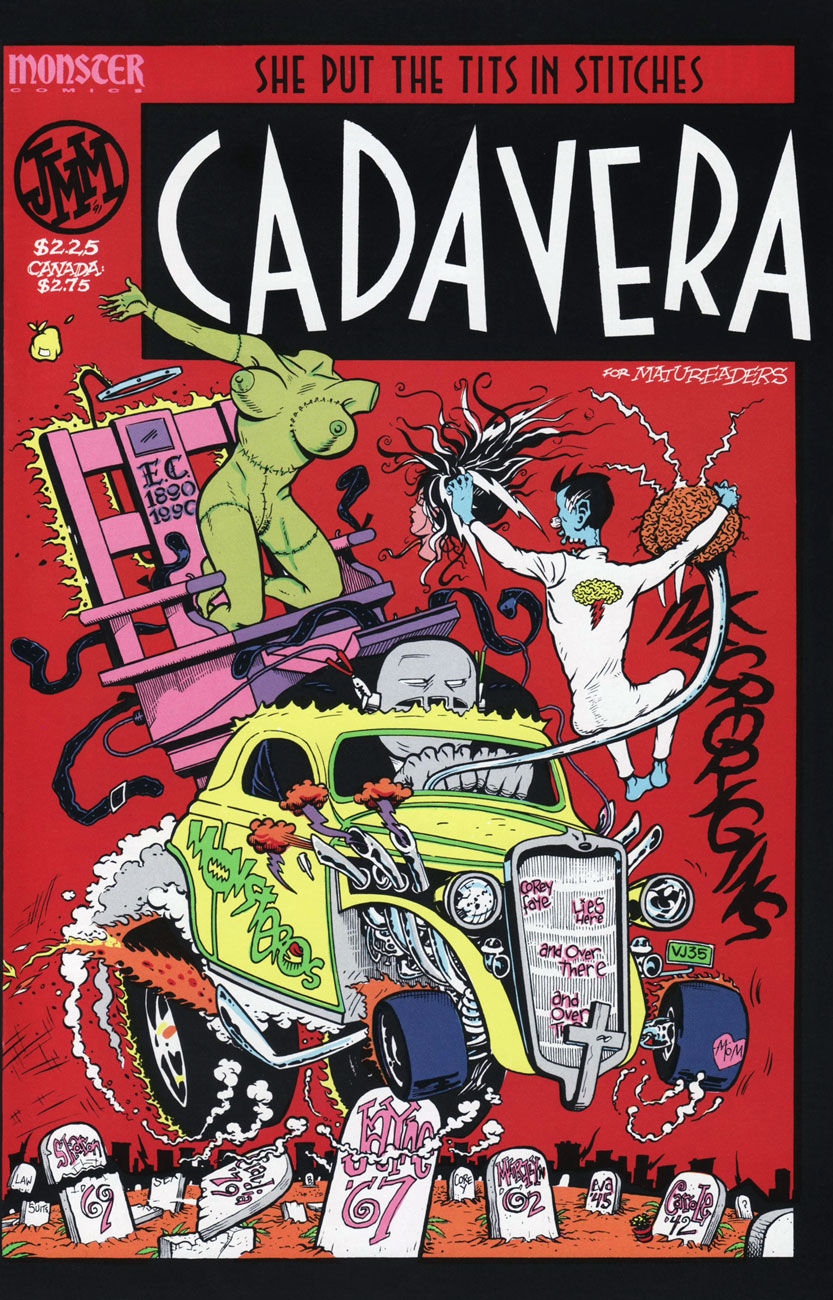
My own contender for the finest of Monster releases adroitly straddled both the erotic and the monstrous (and a few other genres besides): a two-issue wonder, Cadavera, was the hallucinatory, disembodied brainchild of Memphis cartoonist auteur John Michael McCarthy. Sadly, this raunchy-in-all-the-best-ways, rollicking saga-in-the-making, fireball of jolting ideas did nothing to help its publisher climb back into the black. But hot damn, did it ever give its all. However, in the speculator-frenzied, Image Comics-happy US marketplace of ’91? Oh, just forget it.

Cadavera2CoverA
This is Cadavera no. 2 (Nov. 1991); artwork by John Michael McCarthy, who helpfully tells us that the « cover car is a35 model Ford Model ’48 3-window coupe, original price $570. ». And isn’t that a doozy of a catchy slogan?

I know I could pull striking samples from these skinny pamphlets all the live long day, such is their level of visual craft and quotability, but I’ve checked, and you can still get copies for a song, so why spoil your eventual pleasure?

Cadavera1GoogogA
Meet Prof. Shelley’s hulking robot helper, Googog. From Cadavera no. 1 (March, 1991).

Cadavera2Splash01A
Cadavera no. 2, page 4.

Cadavera2XSlashA
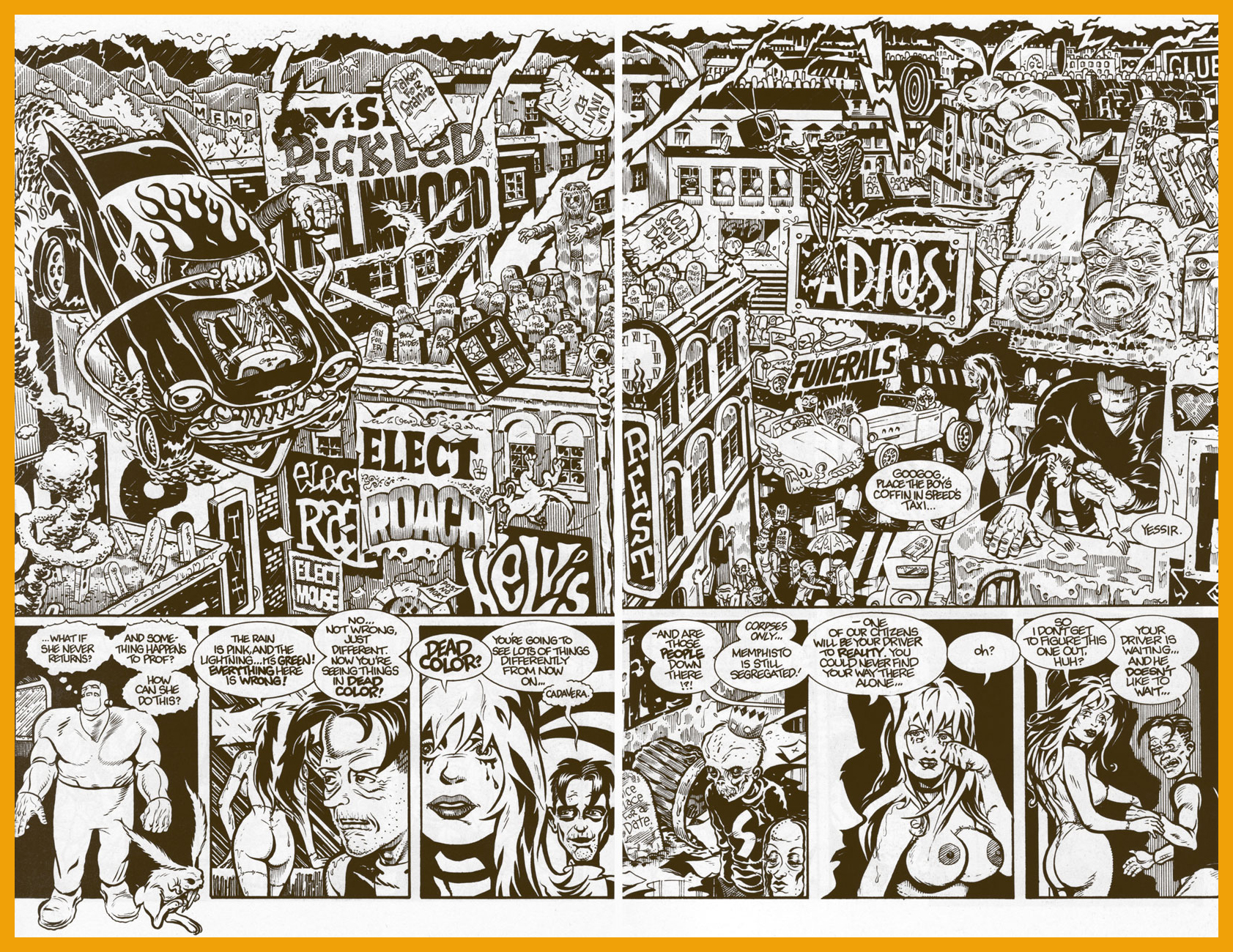
Cadavera no. 2, pages 22-23. No-one could accuse Mr. McCarthy of being a slouch.

Anyway, all the gooey goods are accounted for in this « unofficial death certificate for unpopular culture »: punk rock, tabloid journalism, fascism, hot rods, hillbillies, Nazis (the original and the currently popular Neo (in)breed), mad science, robots, bunnies, Vice-Prez Chas. Manson…

Cadavera02BackA
Oh, and model kits! This painting by Gary Makatura appeared on the back cover of Cadavera no. 2. « … and thanks to the Holland Company for allowing me ‘the look’ of authentic Aurora, here’s to a new world of plastic and glue! »

The amazing Mr. McCarthy, after giving comics his more-than-game try (with Eros entries Supersexxx and Bang Gang, the one-shot movie tie-in Damselvis Daughter of Helvis and one of my all-time favourite series, Kid Anarchy, written by his pal George Cole), went the Roger Corman route and became a micro-budget filmmaker. There may be zero bucks in it, but that’s still a rosier financial situation than comics could offer.

« To hell with all those near-fatal quests and celebrity body parts! »

-RG

Hallowe’en Countdown III, Day 17

« I may turn up as flies on your ceiling. »

From the earliest issues of  Love & Rockets (circa the early 1980s), it was quite evident that Jaime Hernandez was a cartoonist of the first order.

At first, he kept the tone of the proceedings fairly jovial; but gradually, a little darkness crept into the ambiance. Not systematically, mind you: it was just the natural course of things. For all that, he didn’t sacrifice one bit of his light touch; he was just expanding his range, the simple process of his artistic maturation.

The first time he fully demonstrated that he could evoke the texture and the essence of terror… was a milestone. In 1989’s Flies on the Ceiling, he stunned readers with a dizzying, yet understated tale that lifted the veil on a murky chapter of Izzy’s past. In the telling, he adroitly looses a startling panoply of techniques and ingredients that this reader wasn’t nearly prepared for. A true brain-singer.

JaimeFlies11A
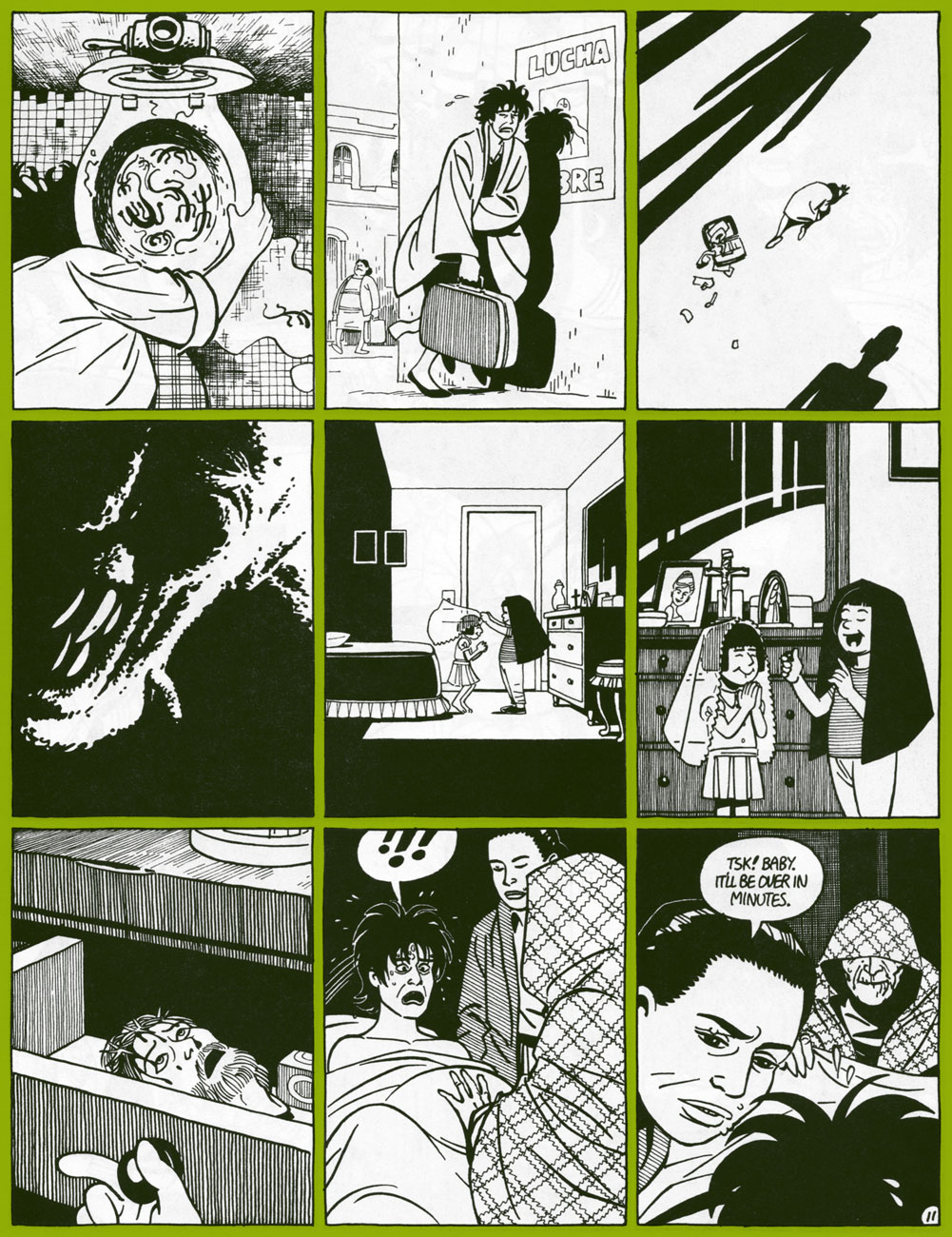
Roman Catholic iconography, traditional Mexican beliefs and rituals, dead-on psychology, awful things hinted at in the margins. An excerpt from Flies on the Ceiling: the Story of Isabel in Mexico (Love & Rockets no. 29,  Fantagraphics) [ Read it here. ]
Jaime occasionally returns to the realm of the uncanny (we’ve featured him in a past countdown entry), but never treads the same path twice. A few further samples, if you will:

JaimeRayNightmareA
Poor Ray has a singularly vivid nightmare. Hopefully, that’s all it is. This ghoulish entry appeared on the back cover of Penny Century no. 3 (Sept. 1998, Fantagraphics). Story and art by Jaime Hernandez, colours by Chris Brownrigg.

JaimeLaBlanca01A

JaimeLaBlanca02A
La Bianca: a True Story appeared in the Gilbert Hernandez-edited all-ages anthology Measles no. 2 (Easter 1999, Fantagraphics.)

JaimeScaryStoriesA
Jaime in a spooky-lite register, for a 1994 Rhino Records spoken-word anthology featuring such titans of the macabre as Boris Karloff, Brother Theodore and Nelson Olmsted.

– RG

Hallowe’en Countdown III, Day 1

« Of course I believe in ghosts. Doesn’t everybody? » — Red Skelton*

Quite a task it was, keeping to just a handful of Jim Flora’s illustrations from Grosset & Dunlap‘s 1965 anthology, A Red Skelton in Your Closet.

First, matched to Arthur Guiterman‘s 1918 poem, The Superstitious Ghost:

FloraSuperstitiousA

I’m such a quiet little ghost,
Demure and inoffensive,
The other spirits say I’m most
Absurdly apprehensive.

Through all the merry hours of night
I’m uniformly cheerful;
I love the dark; but in the light,
I own I’m rather fearful.

Each dawn I cower down in bed,
In every brightness seeing,
That weird uncanny form of dread —
An awful Human Being!

Of course I’m told they can’t exist,
That Nature would not let them;
But Willy Spook, the Humanist,
Declares that he has met them!

FloraNineGoblinsA
Nine Little Goblins, by James Whitcomb Riley

They all climbed up on a high board fence —
Nine little goblins, with green-glass eyes —
Nine little goblins that had no sense,
And couldn’t tell coppers from cold mince pies;
And they all climbed up on the fence, and sat —
And I asked them what they were staring at.

And the first one said, as he scratched his head
With a queer little arm that reached out of his ear
And rasped his claws in his hair so red —
“This is what this little arm is fer!”
And he scratched and stared, and the next one said,
“How on earth do you scratch your head?”

And he laughed like the screech of a rusty hinge —
Laughed and laughed till his face grew black;
And when he choked, with a final twinge
Of his stifling laughter, he thumped his back
With a fist that grew on the end of his tail
Till the breath came back to his lips so pale.

And the third little goblin leered round at me —
And there were no lids on his eyes at all —
And he clucked one eye, and he says, says he,
“What is the style of your socks this fall?”
And he clapped his heels — and I sighed to see
That he had hands where his feet should be.

Then a bold-faced goblin, gray and grim,
Bowed his head, and I saw him slip
His eyebrows off, as I looked at him,
And paste them over his upper lip;
And then he moaned in remorseful pain —
“Would — Ah, would I’d me brows again!”

And then the whole of the goblin band
Rocked on the fence-top to and fro,
And clung, in a long row, hand in hand,
Singing the songs that they used to know —
Singing the songs that their grandsires sung
In the goo-goo days of the goblin-tongue.

And ever they kept their green-glass eyes
Fixed on me with a stony stare —
Till my own grew glazed with a dread surmise,
And my had whooped up on my lifted hair,
And I felt the heart in my breast snap to,
As you’ve heard the lid of a snuff-box do.

And they sang “You’re asleep! There is no board fence,
And never a goblin with green-glass eyes! —
’tis only a vision the mind invents
After a supper of cold mince pies. —
And you’re doomed to dream this way,” they said, —
“And you sha’n’t wake up till you’re clean plum dead!”

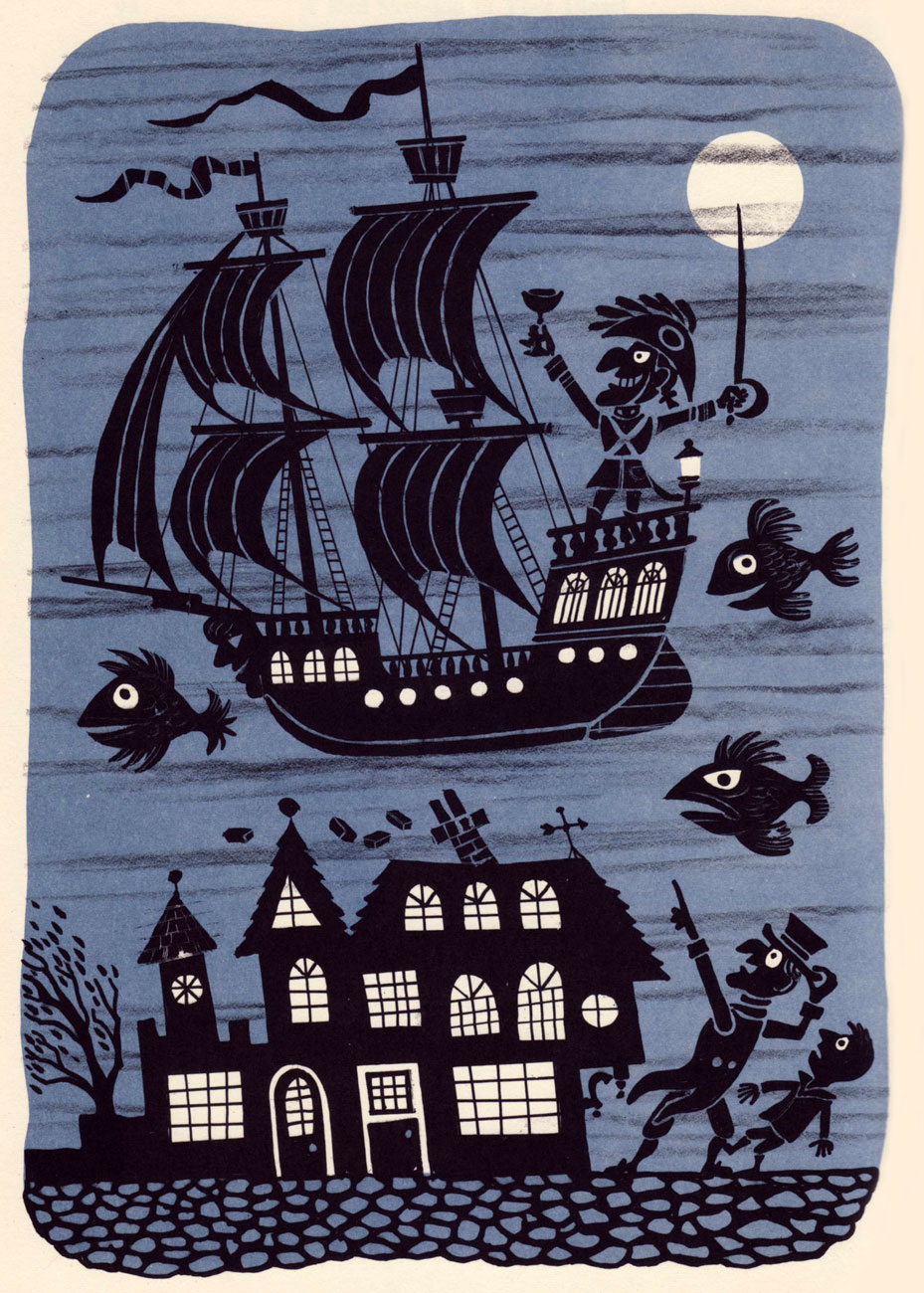
FloraGhostShipA
« It blew into the village from the sea one stormy night — a ghostly ship, with a ghostly crew and ghostly ways… » — Richard Middleton, The Ghost Ship. Read and/or listen to the entire yarn here!

FloraSpookStairA
The Spook Upon the Stair, by Andrew McCullen, aka Robert Arthur (1965)

I met a spook upon the stair;
He was a haunt who had no hair.
In fact, he didn’t have a head
(Which made me think he might be dead).

His head I saw beneath his arm,
Safely tucked away from harm,
But still to me it spoke, and said,
“Before you go on up to bed,
Please let me say you should not stare
At ghosts you meet upon the stair.”

Thus spoke that spook, I do not lie,
Before I could quite pass it by.
“The thoughtful, gentle thing to do,”
It said to me, as I say to you,
“Is act as if they were not there,
And never, never, never stare,
Even though beneath an arm
Their heads they carry, safe from harm.”

“However frightful they may be,
Act as if you did not see,
And if you  did, would not have cared.
Above all, never show you’re scared.”

This spook he spoke so plain and fair,
I heeded him, right then and there.

I hurried on up to the top
And as I went I heard a pop.
I turned — and there was nothing there.
The spot the spook had been was bare.


If you dig his work (of course you do!), Jim Flora (1914-1988) you’ll be right chuffed to learn that his œuvre has been the subject of a quartet (at last count) of definitive and definitely gorgeous monographs, The Curiously Sinister Art of Jim Flora, The Mischievous Art of Jim Flora, The Sweetly Diabolic Art of Jim Flora and The High Fidelity Art of Jim Flora. Dig in!

– RG

*actually (fittingly) ghost-writing editor Robert Arthur (1909-1969), chiefly remembered as the creator of the Three Investigators series. We took a not-so-furtive peek at one of his excellent anthologies during last year’s countdown.