« People think the show gave Letterman an opportunity, but they don’t see the table with 10 guys in shorts wearing baseball caps pitching jokes for things for him to say. They don’t see the index cards that say: ‘Ask this first.’ It’s all spelled out for him, and everything is pre-interviews. He’s basically had to be this hand puppet, with everybody’s hands up his butt to tell him what to say and do. » — Joyce Brabner on David Letterman
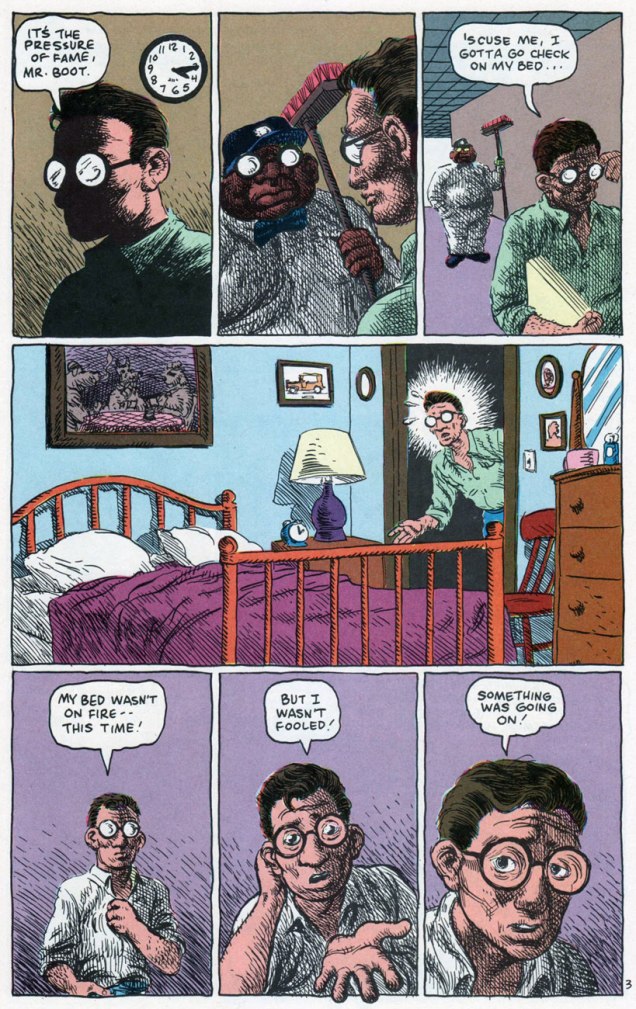
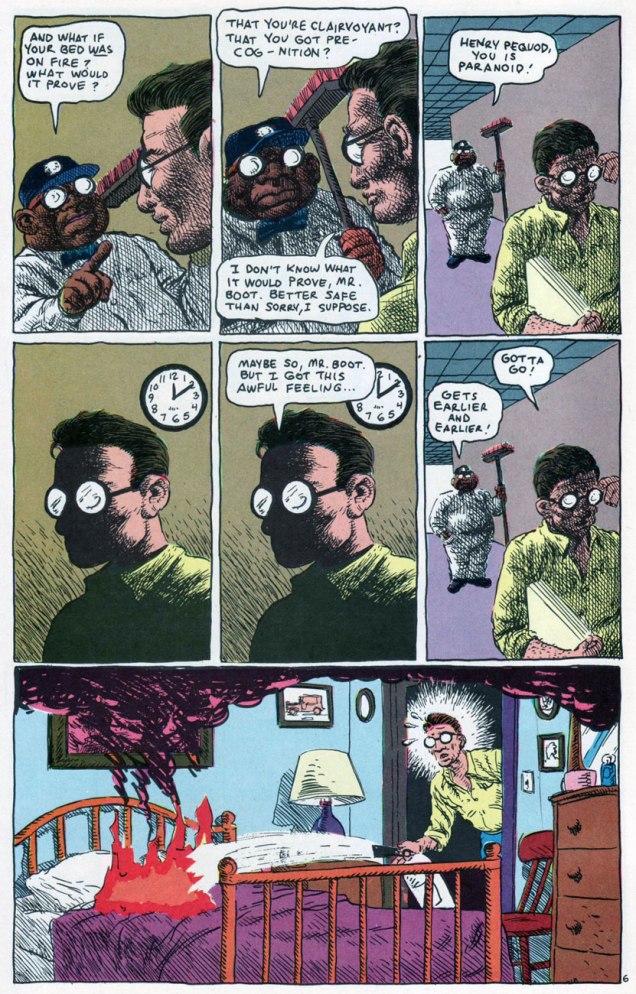
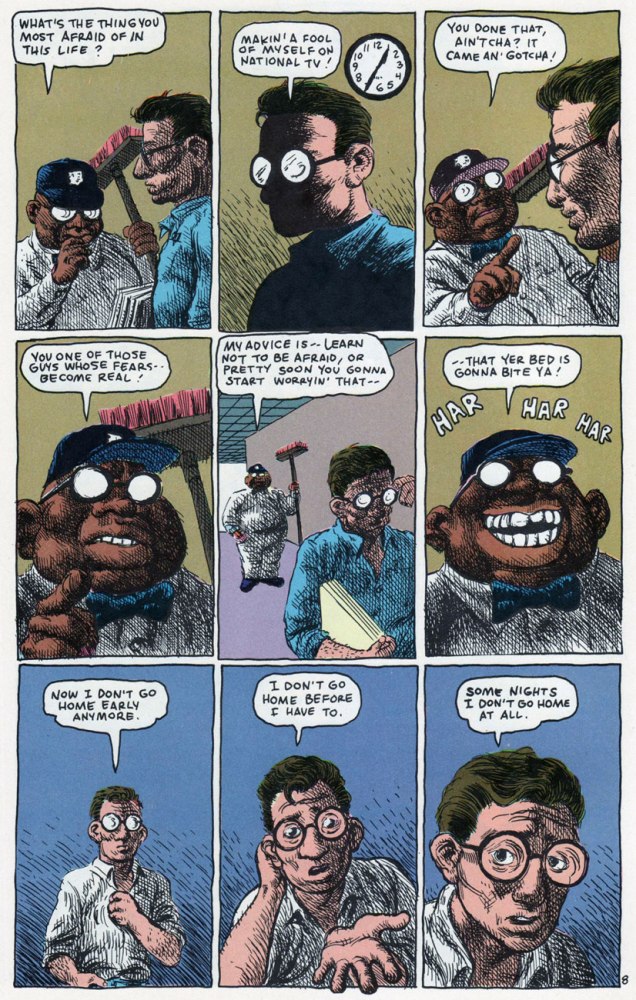
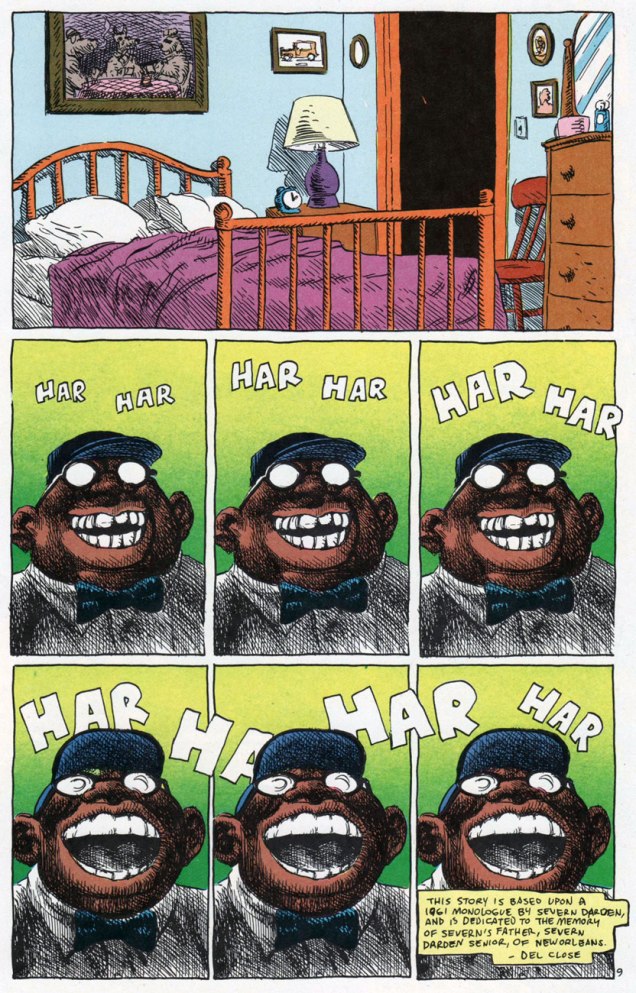
We already snuck a peek at the darker side of DC Comics’ short-lived ’80 mirage Wasteland (18 issues, 1987-89), but the title’s modus operandi was variety… within a set format. Here’s another highlight from one of the earliest and strongest issues, before its co-authors TheSecond City comedy legend Del Close and Grimjack co-creator John Ostrander lost the plot, interest, or both. This is American Squalor (Wasteland no. 3, Feb. 1988, DC Comics). The underrated Don Simpson, the Wasteland bullpen’s utility player, its most versatile and loyal member, gets to strut his stuff, albeit in a lovely Crumb ersatz, down to the lettering.
What I find so impressive about this story is the scope of its ambition, fulfilled on several unlikely levels: it achieves success as a parody, a pastiche, a tribute, and as its own, standalone bit of workaday folk philosophy. Clearly, calling upon the trappings and rhythms of Crumb and Pekar’s American Splendor was just the starting point.
I’d love to track down (Close’s old Second City colleague) the Severn Darden monologue Close claims to have used as a springboard, but not everything was dutifully recorded for “posterity” in those days…
« I loved Harvey. He was a wonderful guest. The kind you don’t see anymore. The only real problem with Harvey was my immaturity. » — David Letterman
The Golden Age of comics proffered quite a lot of anthropomorphic animals to its readers. The stuff on offer ran the gamut of different definitions of humour, from inane slapstick to pleasant goofiness, all the way to batshit surrealism. There’s at least one common streak running through this zoological revelry – tentacles!
Our first exhibit is a charming comic from the 40s. Land of the Lost was a radio series broadcast from 1943 to 1948 on Mutual Broadcasting System and ABC, written, produced and narrated by Isabel Manning Hewson. Each episode started with the line « In that wonderful kingdom at the bottom of the sea… », and presented a new under-the-sea adventure of Isabel and Billy, two kids lucky enough to have an adorable avuncular fish for an underwater guide. (The fish was called Red Lantern, and was most notably voiced by Art Carney.) You can listen to an episode from 1945 here.
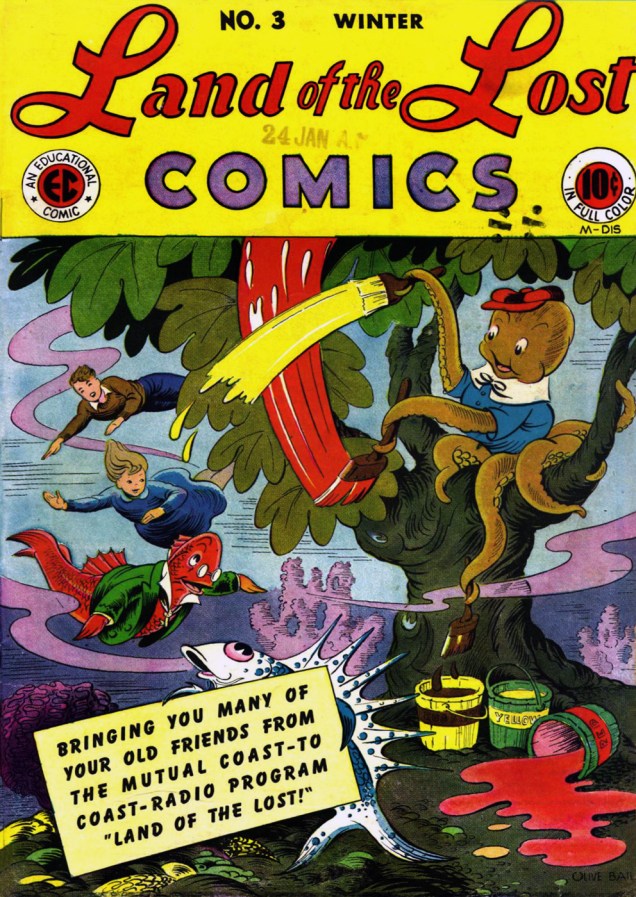
Coming back to our beloved cartoons: in 1946, EC Comics started publishing Land of the Lost Comics, a series that lasted for 9 issues. Hewson remained the writer, and the art was handled by Olive Bailey (not the Olive Bailey who helped crack Germans’ Enigma cipher machine in WWII.) The result was impressive: these comics are delectable, combining beautiful art with inventive plots that may be goofy, but have a solid internal logic. Hewson gave her sea-creatures vibrant personalities, and it’s so much fun to dive (not pun intended) into this world.
Land of the Lost Comics no. 3 (winter 1946), cover by Olive Bailey. Read the whole issue here… and then read other issues, too. Somebody needs to publish a collection of this stuff.
The following panels are from “Jack Frost“, scripted by Isabel Manning Hewson and drawn by Olive Bailey, published in Land of the Lost Comics no. 3.
Squidlet goes out of control, like all young octopuses are prone to doing.
Thank you, cool ladies, for all the fun!
Land of the Lost also became an animated cartoon as part of Famous Production Studios‘ Noveltoon series: Land of the Lost (1948), Land of the Lost Jewels (1950) and Land of Lost Watches (1951). I find the animation to be definitely subpar to the comics or the radio show, but I’ll let you judge for yourselves. (Jack Mercer is in it, albeit briefly!)
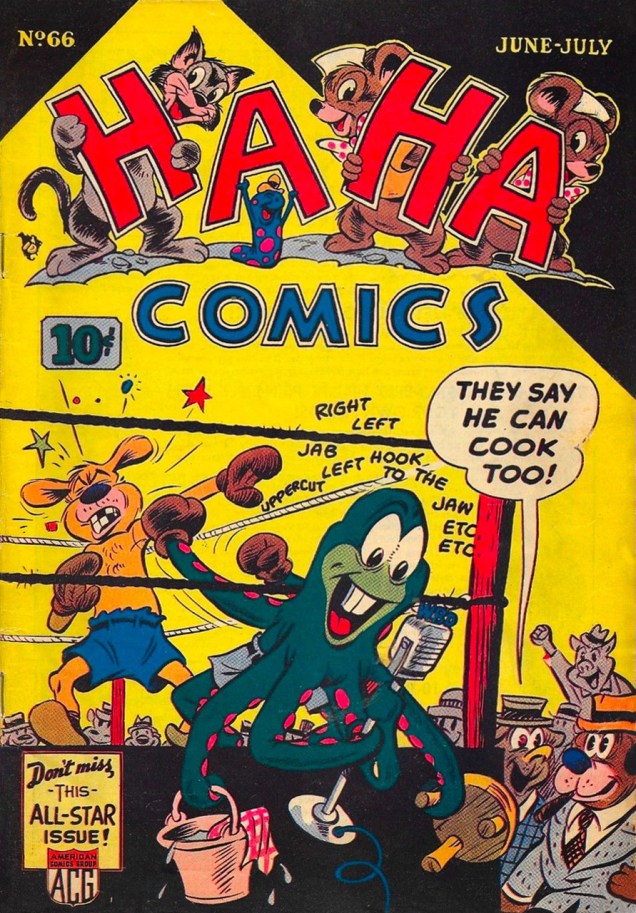
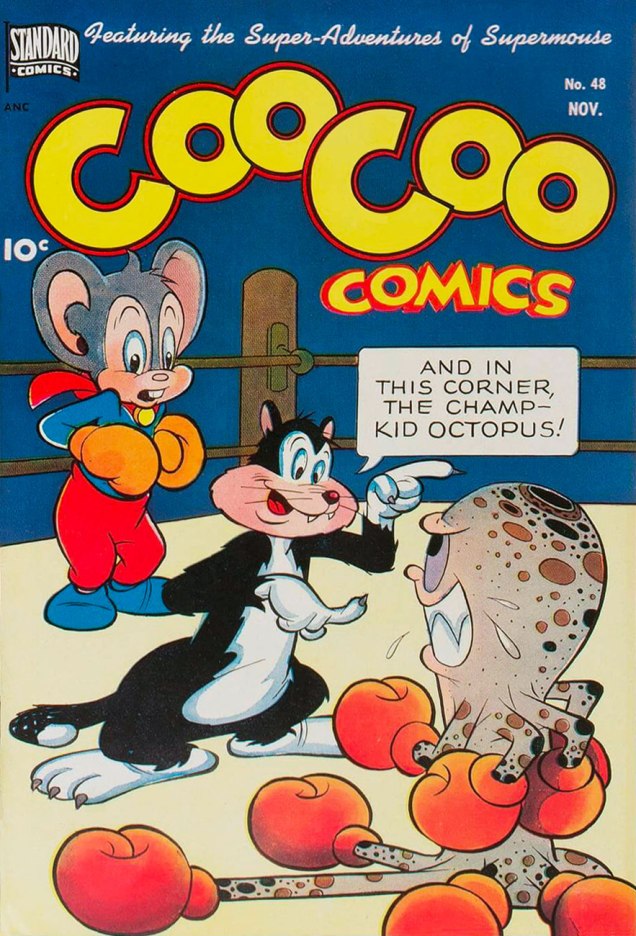
Did you know octopuses love to box? This implausible situation is definitely part of the lazy artist’s roster. To wit:
Ha Ha Comics no. 66 (June-July 1949), cover by Dan Gordon. It was really hard to find a scan of this issue in decent condition (thanks to co-admin RG), and comicbookplus doesn’t even have it in its database (you can read pretty much all the other issues of Ha Ha Comics, though).
Ha Ha Comics, a sister anthology of Giggle Comics, was published by ACG. (With issue #100, Ha Ha became Teepee Tim, going from animal hijinks to young Indian shenanigans for all of… three issues.) It’s quite a the playground of anything goes, but upon careful inspection, one easily finds good art shining among the dirt-pile of mediocrity, and diverting storytelling among hackneyed yarns.
Coo Coo Comics no. 48 (November 1949), cover by Carl Wessler. Published by Standard Comics under the imprint of Pines (from Ned L. Pines, publisher). Read the issue here (no tentacles whatsoever, though).
How many arms does the fellow up above have, nine? I suppose that’s why he’s the champ!
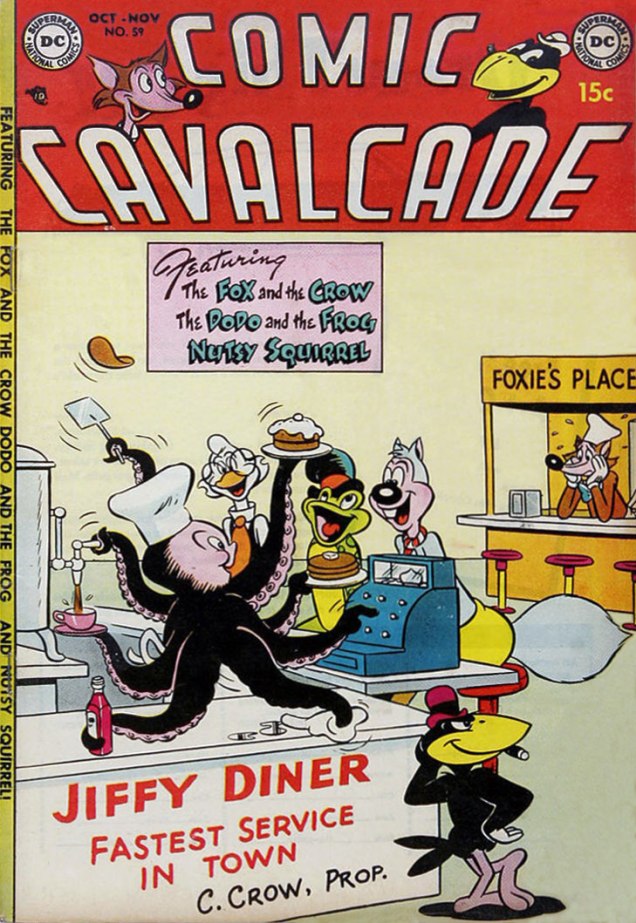
Comic Cavalcade went all funny-animals only with issue 30 (Dec-Jan 1948), when superheroes faded from popularity (oh man, that’s hard to imagine now, isn’t it?) It lasted until 1954, by which time it shrank from its original 96 pages to 76, however retaining its 15-cent cover price.
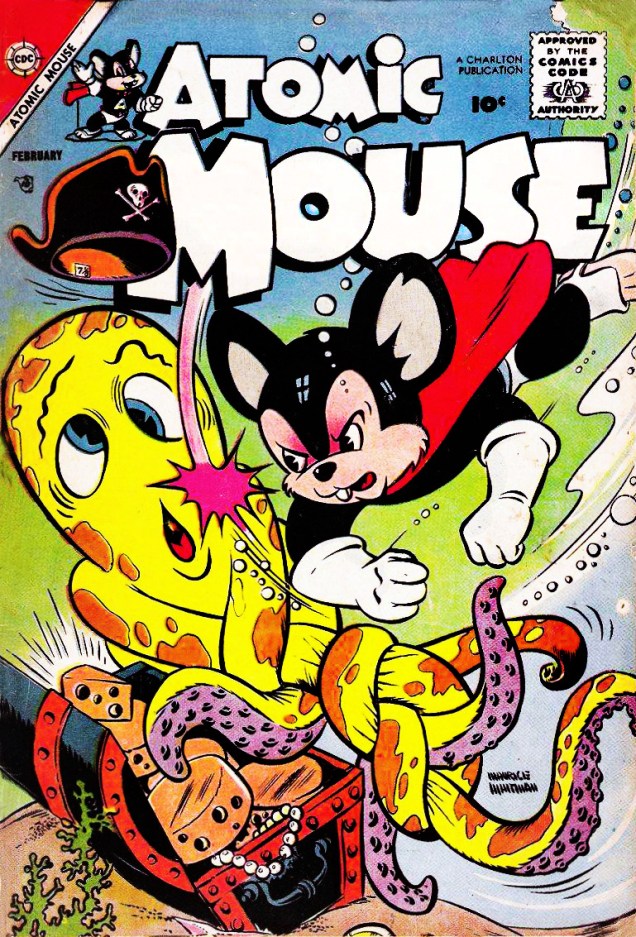
Comic Cavalcade no. 59 (Oct-Nov 1953), art probably by Rube Grossman. Read it here.Dinky Duck no. 10 (July 1954). WTF is a Dinky Duck? Terrytoons’ answer to Daffy Duck, says Toonopedia; or, tout simplement, a smaller-than-average duck. The poor duckling never caught on, but the cartoons did result in a comic series, published by Pines and then St. John.Atomic Mouse no. 25 (February 1958), cover by Maurice Whitman. Atomic Mouse was created in 1953 for Charlton Comics by Al Fago, their first animal superhero. The series was published for ten years (!), between 1953 and 1963, so it must have had at least a modicum of popularity.
« Calm down, Harris… this is no teleportational phenomenon we’re dealing with… » — Hawkman, “Yo-Yo Hangup in the Sky!”.
In 1968, though DC was still handily outselling Marvel, the industry leader was beginning to feel the heat. Now, to be fair, not nearly as much as revisionists would surmise: Marvel’s top-seller, The Amazing Spider-Man, was only in twelfth place. Of course, Marvel was hobbled by distribution issues, but that problem would come to an end that very year.
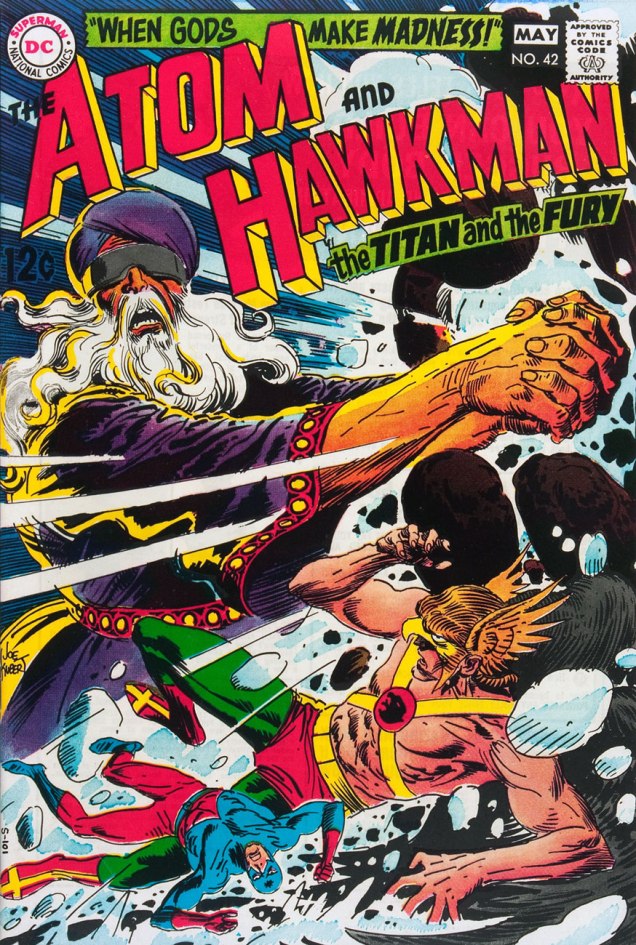
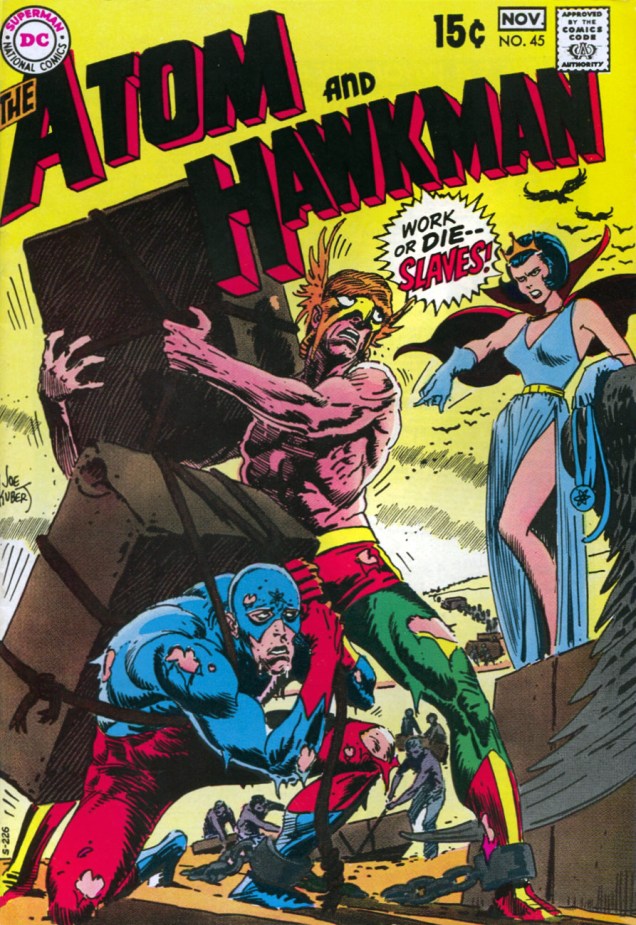
Anyway, as neither of DC’s solo titles The Atom (38 issues, June-July 1962 – Aug.-Sept. 1968) nor Hawkman (27 issues, Apr.-May 1964 – Aug.-Sept. 1968) were doing all that well (both of them missed the top sixty in 1968), it was decided to attempt to merge the books in order to perhaps save them. Well, it didn’t work, but some splendid covers were created, and that’s what brings us here.
The Atom and Hawkman no. 39 (numbering continued from Atom’s book, not Hawkman’s), November 1968. Insides by Robert Kanigher, Murphy Anderson and Joe Giella. Which one’s the Titan and which the Fury? They take turns. Check it out here.The Atom and Hawkman no. 40 (Jan. 1969) holds a rare treat: a highly unusual pairing, one that was only repeated once to my knowledge (in the following issue): Joe Kubert on pencils and Murphy Anderson on inks. The tale is The Man With an Inbuilt Panic Button, scripted by Gardner Fox. Peruse it here while you can.My candidate for the slightest cover of the Atom/Hawkman combo title, but only since the competition is so fierce, and well, it’s kind of busy. This is The Atom & Hawkman no. 41 (Feb.-Mar. 1969), edited by Julius Schwartz and featuring Return of the Seven-Year-Dead Man, written by Gardner Fox, pencilled by Dick Dillin and inked by Sid Greene, and Yo-Yo Hangup in the Sky!, written by Fox, illustrated by Kubert and Anderson. Feast your eyes here.This is The Atom and Hawkman no. 42 (Apr.-May 1969). Read it here!Robert Kanigher & Joe Kubert’s Gentleman Ghost, first appeared (so to speak) in Flash Comics no. 88 (Oct. 1947) had not been seen (hee hee) since the Golden Age, and he returned to pester Hawkgirl and Hawkman in Come to My Hanging, scripted by Kanigher and illustrated by Murphy Anderson. Meanwhile, The Atom stars in Buzzin’, Buzzin’ — Who’s Got the Buzzin’?, scripted by Dennis O’Neil, pencilled by Dick Dillin and inked by Sid Greene. This is The Atom and Hawkman no. 43 (June-July 1969). Read it here!Kubert clearly relished delineating his Gentleman Ghost, and who could blame him? That sticky-fingered filcher is one snazzy-looking felon. This is The Atom and Hawkman no. 44 (Aug.-Sept. 1969). Read it here!This is The Atom and Hawkman no. 45 (Oct.-Nov. 1969), featuring Queen Jean, Why Must We Die?, by Denny O’Neil, Dick Dillin and Sid Greene, whereas our heroes are enslaved by Ray “The Atom” Palmer’s girlfriend, Jean Loring. It was a common theme in DC Comics, just ask Superman and Green Lantern, for starters. Anyway, read the whacked-out tale here.
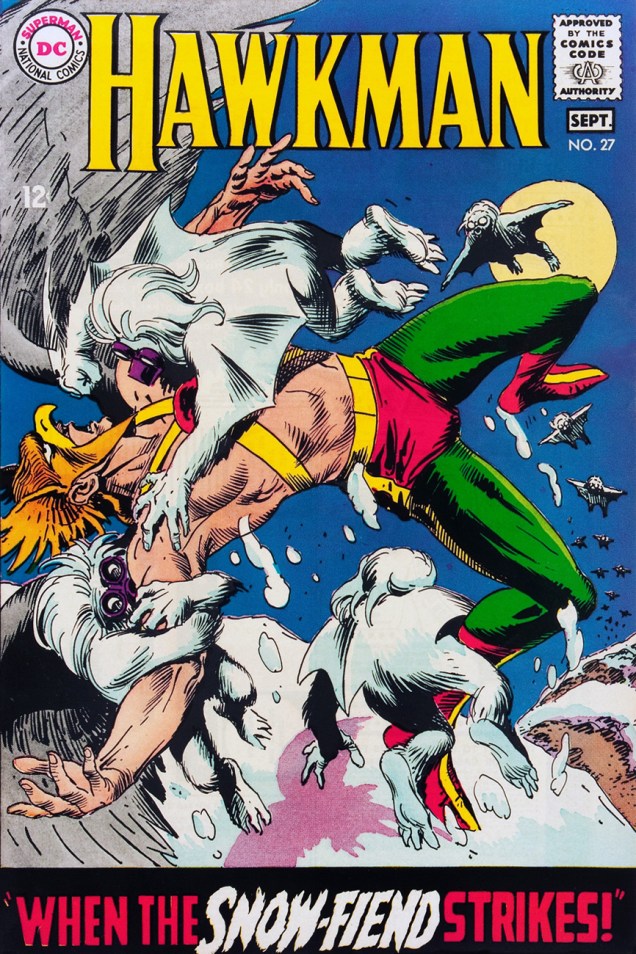
As a bonus, one could consider the final issue of Hawkman (no. 27, Aug.-Sept. 1968), the first entry in Kubert’s streak. Well, I do, and that’s that.
It is said that late each year, Thanagarians mark the winter solstice by taking to the snowy skies to join cuddly flying Yeti in frolic. Look at them cute lil’ buggers. When the Snow-Fiend Strikes! is scripted by Raymond Marais, pencilled by Dick Dillin and inked by Chuck Cuidera.
Poor Wonder Woman has gone through quite a few transformations during her lifetime. You can read about her kinky-yet-feminist beginnings elsewhere (for an interesting article about how this character was created, read The Surprising Origin Story of Wonder Woman at the Smithsonian; or take a gander at Wonder Woman, the sexualized superhero for a great discussion of how a character can be objectified or empowered by being portrayed in a sexy way) – today I’m concentrating on some goofy Silver Age covers from DC’s long-running Wonder Woman series.
My interest is twofold. On the positive side, I like the team that worked on WW covers in these days – Ross Andru on pencils and Mike Esposito inking. (All covers in this post are by them.) On a more sour note, I have a whole boneyard to pick with writer Robert Kanigher, whose scripts I generally like… as long as they don’t involve women. Who had the bright idea of choosing a hardened misogynist as writer of a major female superhero? (Purely a rhetorical question, I assure you.) Kanigher took over the scripting with Wonder Woman no. 98 (May 1958), “revamping” (as Wiki gracefully puts it) the character, giving her a new origin story and a new cast. It’s not that I object to the idea in principle, but this so-called revamping involved continually trying to marry the intrepid Amazon off to some schmuck, sticking her into stories that don’t make a lick of sense, making her burst into tears randomly – Like a Real Woman™ does – and forcing her to make Sophie’s choices between the lives of boyfriends and family, on random shuffle.
So here’s a gallery of covers I like and cover stories I don’t.
Wonder Woman no. 125 (October 1961).
Well, Mer-Man clearly doesn’t have a leg to stand on in this competition. Come to think of it, neither does Amœba-Man. How are these two even standing? And how would either of these consummate the marriage?
The cover story is Wonder Woman — Battle Prize, a good example of the “marrying Wonder Woman off” theme. “Ages of Heroes, Eras of Men” (by Julian C. Chambliss) explains that sort of thing is designed to « affirm [the super heroines’] proper femininity by regularly demonstrating their heterosexuality“. Now he’s right and all, but for that purpose one could easily come up with something more appealing than a romance with an amoeba, a unicellular organism that reproduces mostly by fission. Stay away from pseudopods and fishy scales, Wonder Woman.
Wonder Woman no. 143 (January 1964).
The Terror Trees (old Bob clearly liked alliteration) are trees that can move and attack, found on a “sinister, uncharted island”. For some reason there’s a Sun Sword (another alliteration) stuck in one of them, which Wonder Woman must retrieve to defeat some nasty alien invaders. At some point, a tree attempts to crush her, leading to an epic scene in which she whirls her head around, using her tiara (made of “amazonium… hardest metal known…”) like a “circular saw” and slicing her way out of the “ruthless tree”. I’m not even going to summarize the rest of this nonsense, but suffice it to say, the story ends – as it always does – on a happy note. Who’s the lizard on the cover, you may ask? No fucking idea, he’s not part of the plot.
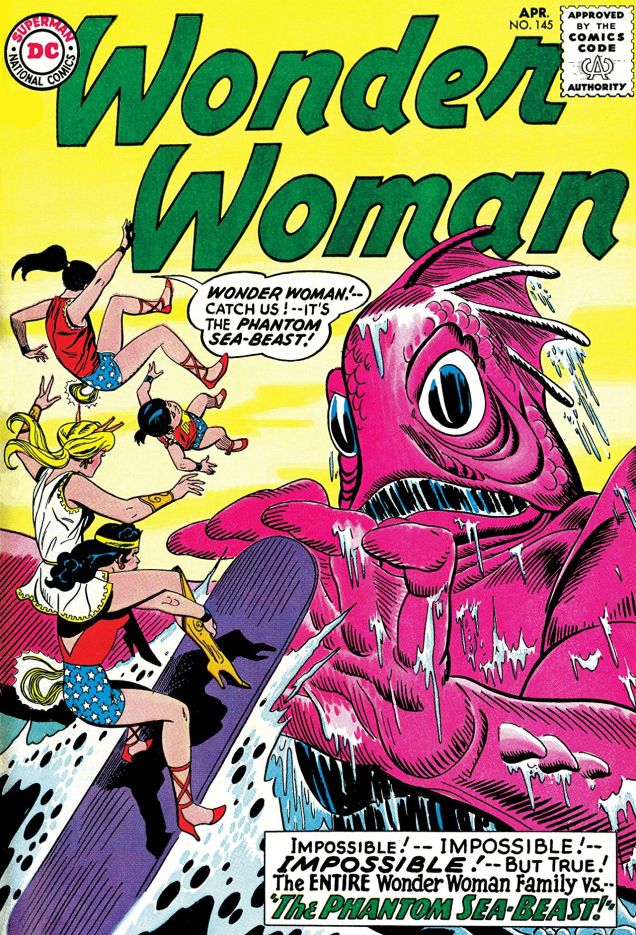
Wonder Woman no. 145 (April 1964).
The Phantom Sea-Beast is just such a tangled mess of claptrap that I don’t even know how to summarize it. It also involves some romance between Mer-Mite and Wonder Tot (in which the former tries to trick the latter into marriage), which is a good representation of what Kanigher seems to think as a Jolly Good Time. Bald zoo-keepers! A fight with a T-Rex! Go read Carol A. Strickland’s review of it, from which I shall quote a paragraph:
« Wonder Tot had just gotten out of the whale. As Wonder Tot surfs alone back to Paradise, she sees her family diving off a cliff and goes to meet them. They practice acrobatic stunts. Not only is Diana surfing in heels, as she is wont to do, but Wonder Girl conveniently wears a Wonder Woman tiara as she has never worn (she’ll need it later in the story). The queen’s pointy crown does not impale her daughter’s head. And even more oddly, gravity does not affect Hippolyta’s skirt. What can I say? It’s just a dream.»
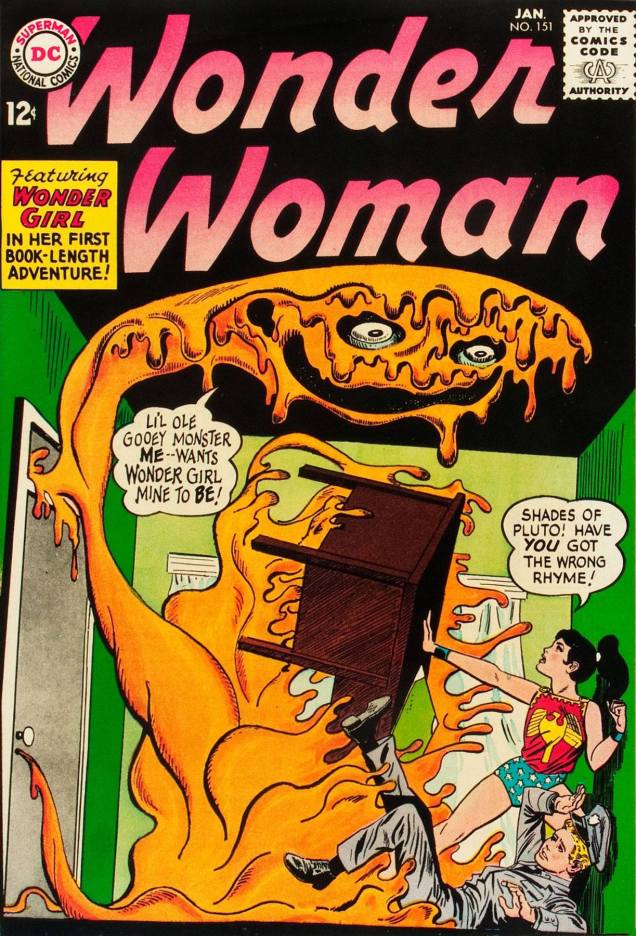
Wonder Woman no. 151 (January 1965).
In “Wonder Girl vs the Teenage Monster!“, the Glop, a blob-like alien, swallows 100 rock’n’roll records and proceeds to serenade Wonder Girl with regurgitated lyrics, coming up with gems like “Glop… glop… I’m not a mop! I want my pearl – wonder girl!” And by the way, it was all a dream (a convenient cop-out that Kanigher resorts to far too often): Wonder Girl fell asleep while looking through a photo album with Wonder Woman’s “boyfriends” and mourning her own romantic troubles. We hear you loud and clear, Sir Kanigher: women’s pretty little heads can only think of men and all manner of frilly, sweet things, even if the woman in question possesses great power and even greater intelligence.
That being said, this is probably my favourite cover of the lot. I just melt when presented with a blob of goo!
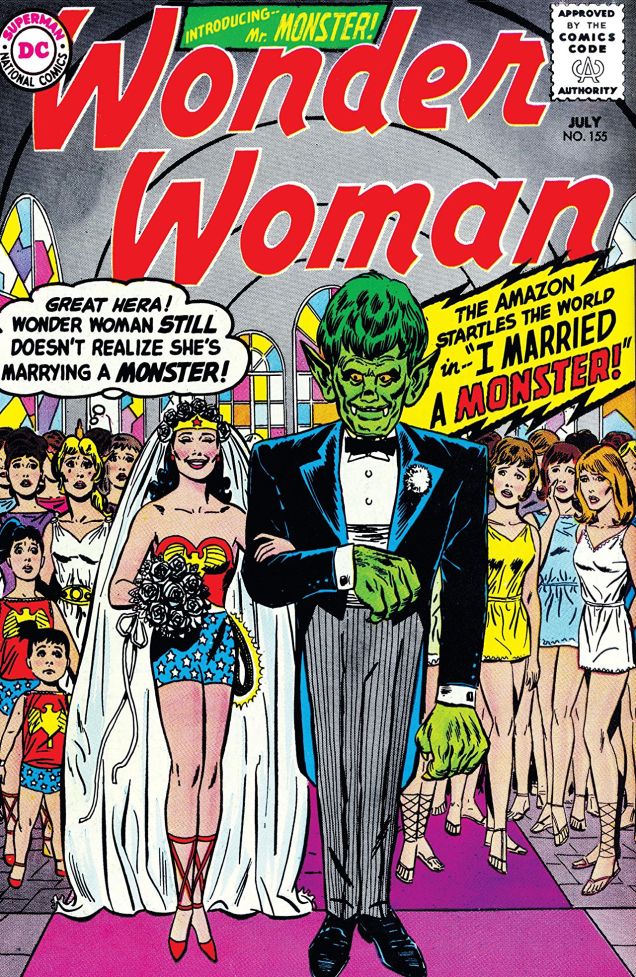
Wonder Woman no. 155 (July 1965).
Groan. Here we go again with this ridiculous obsession of marrying Wonder Woman off. After Wonder Woman is hounded by her usual three beaus who practically threaten her with matrimony (including the awesome line, uttered by Steve Trevor, “When are you going to marry me! Better hurry! Before you’re an old maid!“), she encounters Monster Prince, who, as it turns out later in the story, is handsome when he does good, and ugly when he does evil.
A sample of the romantic dialogue that leads to the altar for these two lovebirds:
Monster Prince: « Stop pretending I’m an ordinary man! You almost sacrificed yourself like a driver taking pity on a dog on the road — and risking her life to avoid hitting him!»
WW: « Only a man who thinks like a giant — could have defied a whole army of Amazons as you did before! You raged like a storm! You were magnificent! Anyone who married you — would be lucky! »
And that’s it, they’re betrothed! Except that the Prince ditches her at the altar, claiming that he doesn’t want a beautiful girl to sacrifice her life to a monster like him. Err…?? More nonsense follows. It becomes painfully evident that Wonder Woman is attracted to bipolar assholes who make her feel inadequate. It reminds us once again that according to you-know-who, women are emotional weaklings who need an overbearing male hand to tell them what to do (or where to get off). Brr. Read the full synopsis, if you dare, over here.
Wonder Woman no. 169 (April 1967).
You know how sometimes a restaurant proclaims to have a dish so original that it’s only on offer at that particular joint? It sounds like hype, but occasionally the claim is actually accurate… because the recipe in question combines elements that clash so badly that no normal person would think of combining them. This “most unique villain ever created” is in that category: he’s a bloody stupid idea. He’s not terrifying, he’s silly… though I did develop a headache while trying to figure out how he got into that tight outfit with his 8 sets of arms and 7 sets of legs.
Joanna Sandsmark, who wrote a hilarious review of the Crimson Centipede (be sure to read it here!), remarks that « I am thoroughly convinced that the germ of the story came to Bob Kanigher when his wife had a run-in with a centipede. Somehow, he thought it would be a good idea to have Wonder Woman afraid of it, as his wife was. Apparently, he forgot that Diana was a superhero who had all kinds of powers. Lucky for him, she was female. Problem solved! » (I think I’m not the only one who has a low opinion of Kanigher’s female-depicting prowess.)
So there we have it. Is this bigoted balderdash worthy of a man who co-created Sergeant Rock, or Enemy Ace or the Unknown Soldier? Nope. What do these have in common? There’s no women in these series, or at least no recurring female characters. (Well, okay, the other commonality is Joe Kubert.) Metal Men could have been great… but the presence (and more significantly, characterization) of a female character, Platinum, kills it for me. There’s no doubt that Kanigher *could* wrote emotionally resonant stories with complex characters and excellent internal logic. In the case of the Wonder Woman series, he just chose not to, preferring instead to produce a lot of hooey with giant plot holes and pepper it with sad clichés. It’s a pity.
« In YOUNG LOVE, how can people talk when they kiss? My mom can’t talk when she’s kissing. Can you? I am nine years old. » — Mary K, an astute young reader
It’s recently occurred to me that, in a year-and-a-half of posting, I’ve utterly neglected to feature one of my favourite artists, Nick Cardy (1920-2013); I suppose he’s been easy to take for granted, as he was DC’s main cover artist during most of Carmine Infantino‘s management years (1967-1976).
Much has been made, in various forums, of Cardy’s covers for Aquaman, the Superman titles, The Teen Titans, the Mystery books, and so on. I figured I’d have to dig a bit deeper. Cardy, ex aequo with the even more underappreciated Bob Oksner, was arguably DC’s primo portrayer of feminine pulchritude, and what I’d seen of his artwork for DC’s romance line was pretty stunning. It just turned out that there was far less of it than I had assumed.
DC’s romance books were sadly treated as the proverbial Siberia of the company’s roster. How else might one explain calling upon top illustrative talent, the likes of Jay Scott Pike, John Rosenberger, Ric Estrada, Werner Roth … then taking these fine men’s work and slathering it with wall-to-wall Vince Colletta… finishes. We’ll return to this topic, naturally. This time around, we’ll showcase the sentimental side of Mr. Cardy. He seems to have produced fewer than thirty covers for the romance line (not counting a handful of gothics he did), of which I’ve retained an even dozen. I’m reserving a handful for an eventual thematic post, plus one that Colletta “fixed” (in the criminal, rather than useful, sense.)
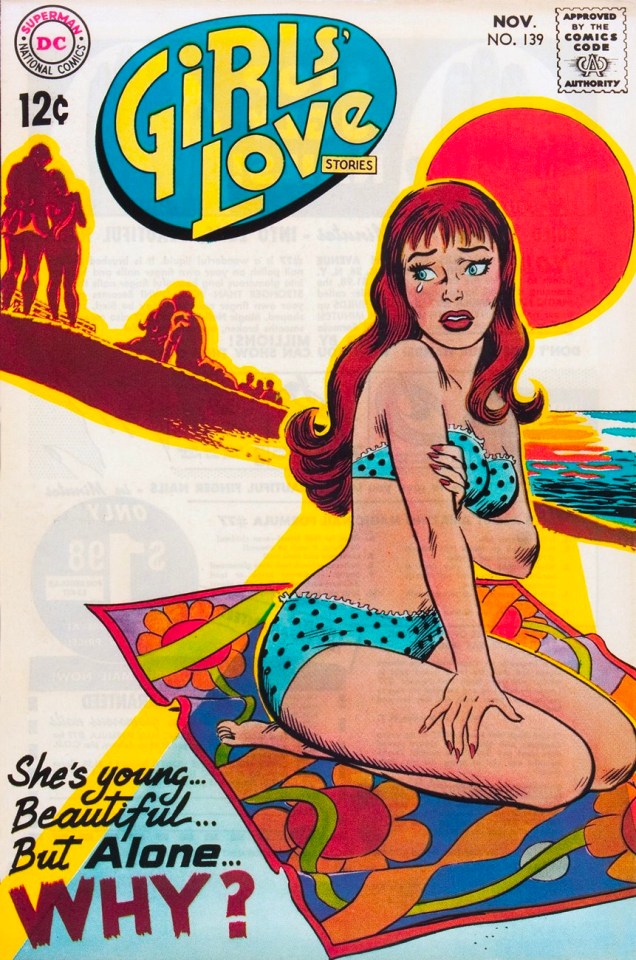
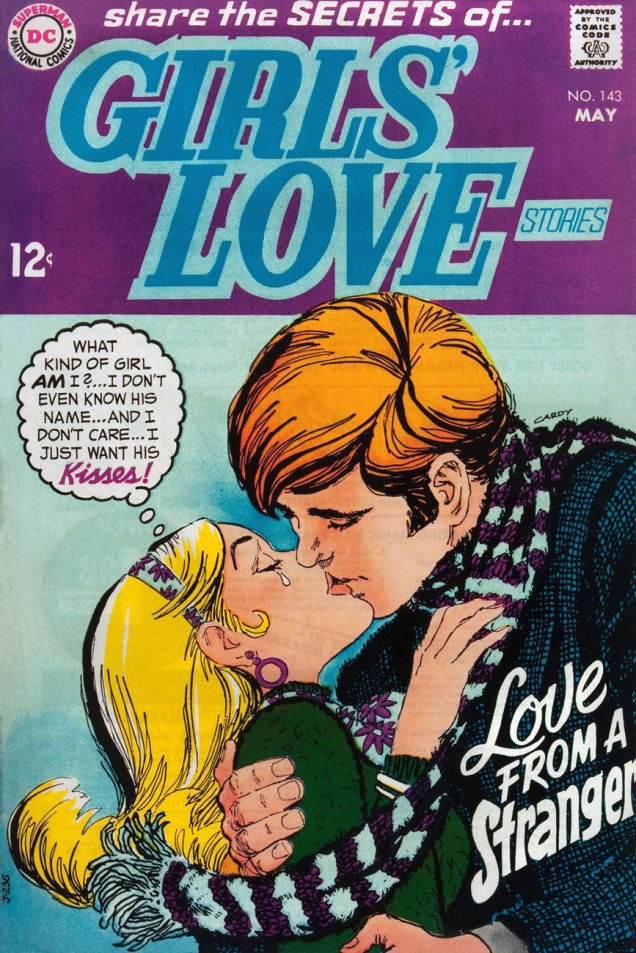
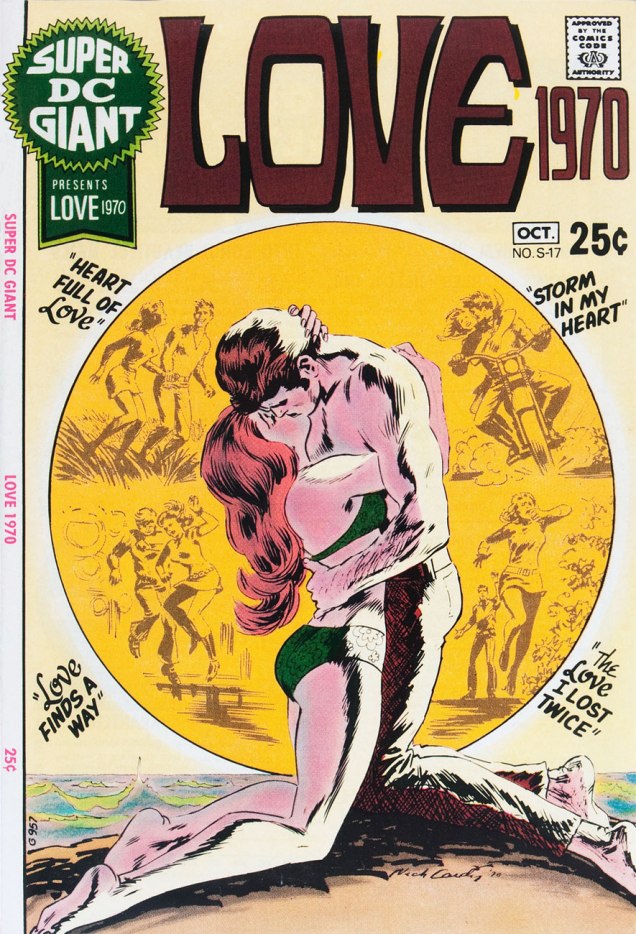
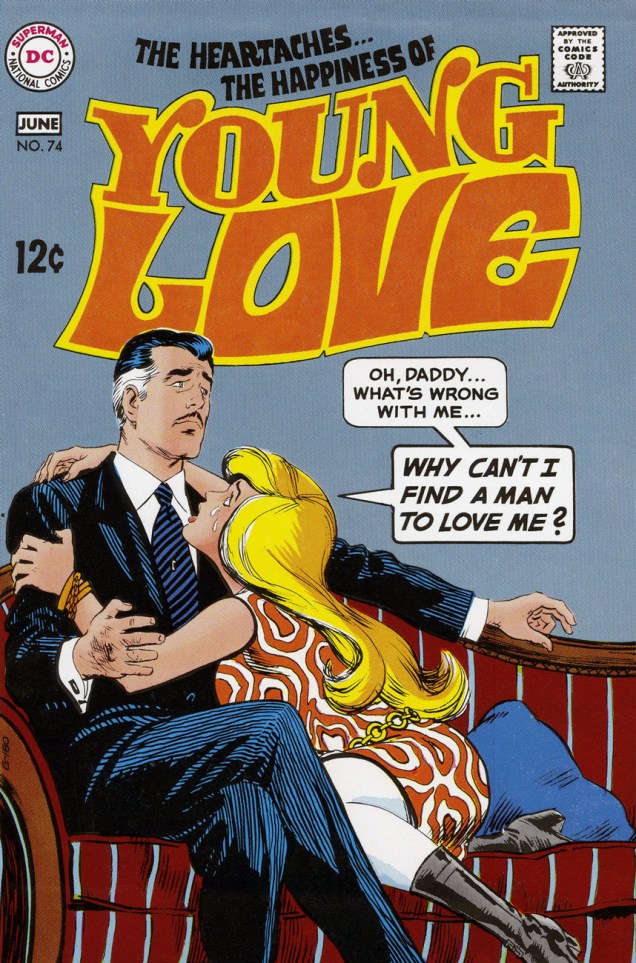
Falling in Loveno. 115 (Feb. 1970), edited by Murray Boltinoff.Falling in Loveno. 119 (Nov. 1970), edited by Murray Boltinoff. Something tells me Mr. Older Generation is holding a pipe off-panel.« Goodbye, and as my sister once said, good riddance! » This great Nick Cardy cover puts an attractive spin on an issue unfortunately marred by the omnipresent and indigestible Vinnie Colletta sauce over half the stories. Poor Ric Estrada and Werner Roth! Girls’ Romances enjoyed a healthy 160-issue run from 1950 and 1971. This is number 144 (Oct. 1969).« Rumors are carried by haters, spread by fools and accepted by idiots. » – Unknown purveyor of sage quips – This is Girls’ Love Stories no. 139 (Nov. 1968) Edited by Jack Miller. Inside: The Only Man for Me, illustrated by Ric Estrada, How Could He Stop Loving Me?, by Tony Abruzzo, a Mad Mad Modes for Moderns from Jay Scott Pike, a reprint from 1963, Kiss Me If You Dare, by John Romita, Sr. and Bernard Sachs, and our cover story, She’s Young, Beautiful–and Alone! … Why?, illustrated by John Rosenberger.Girls’ Love Stories no. 143 (May 1969), edited by Joe Orlando, who couldn’t be less suited to the genre. Cover wise, it’s not everyone’s cup of tea, I suppose, but I adore Cardy’s expressive, roughly organic inks. Still totally in control!Girls’ Love Stories no. 148 (Jan. 1970), edited by Joe Orlando.Girls’ Love Stories no. 151 (May, 1971), edited by Joe Orlando.Interesting, given that these were the prime days of women’s lib, how little actual sisterhood was in evidence in these comics. Too many *male* cooks, surely. Girls’ Romances no. 147 (Mar. 1970), edited by Murray Boltinoff. Carmine Infantino‘s fingerprints are all over this particular layout… which is more than fine: he’s a master.This is Super DC Giant no. S-17 (Sept.-Oct. 1970), “edited” by Dick Giordano. Despite comprising nothing but crappy reprints, the scarce item will cost you a pretty penny if you can find it in decent condition. Here’s its only worthy selling point, Mr. Cardy’s cover, of course.Talk about a question that provides its own answer… this is Young Love no. 74 (May-June, 1969). Edited by Dick Giordano (who lost the bet that month). Cardy’s Alex Toth-ish side rises to the surface.Young Romance no. 157 (Dec. 1968 – Jan. 1969), edited by Joe Orlando. Never was the “Have a Fling With…” tag more appropriate… and more disturbing. « Oh, Ann-Margret‘s your mom? »Young Romance no. 163 (Dec. 1969 – Jan. 1970), edited by Joe Orlando. YR, as you may know, was the original romance comic book, created way back in 1947 by Joe Simon and Jack Kirby. Things improved near the end of the series’ run, when Simon briefly returned to ride it into the sunset.
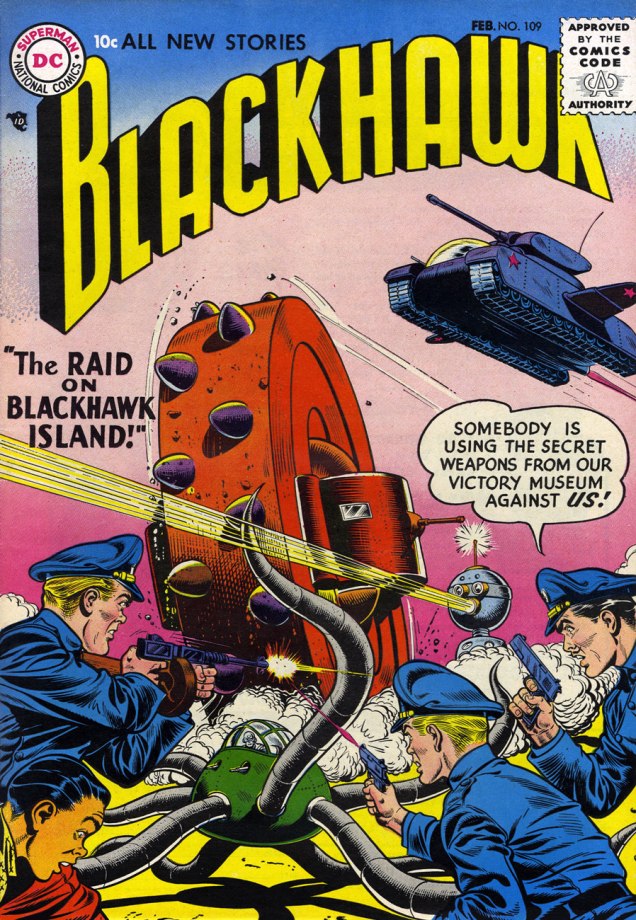
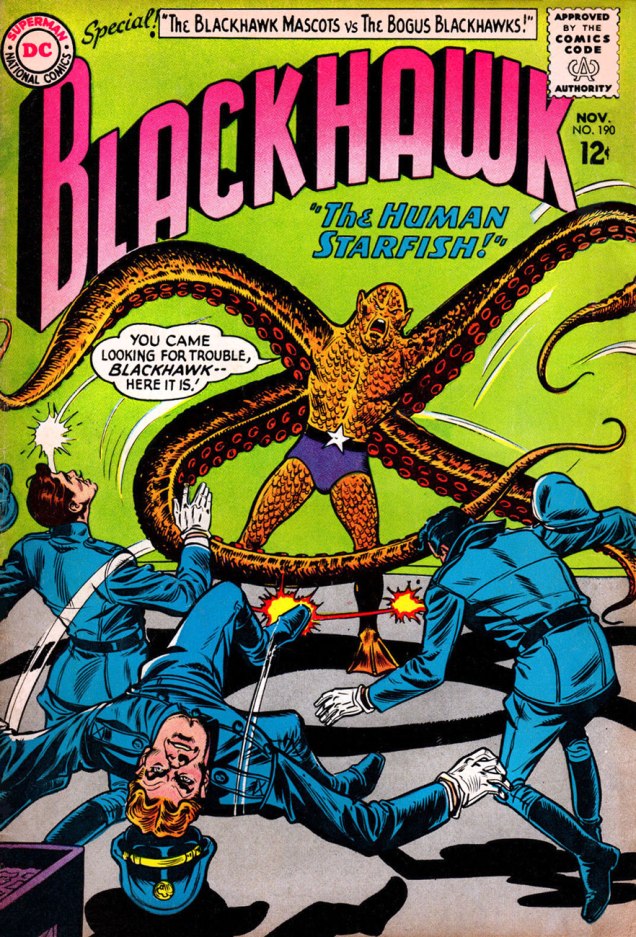
« Blackhawk is helpless! He’s being drawn up by that suction tentacle! »
When my co-admin learned that today’s Tentacle Tuesday is all about Blackhawk, he wanted the answer to an important question. Did I know who created the character? I did not. As some of our readers may be in the same boat, I’ll share what I gleaned.
Blackhawk, the leader of the Blackhawk Squadron, was supposed to have been created by Charles Nicholas ‘Chuck’ Cuidera with assistance from Bob Powell and Will Eisner. Why “supposed”? As with a lot of series that came into existence some 80 years ago (the first appearance of the Blackhawks Squadron was in a Quality Comics issue published from 1941! Holy crap!), and human memory and human’s desire for recognition being what they are, there’s a lot of squabbling about who actually did what.
« Will Eisner has at times been considered the characters’ primary creator, with Eisner himself acknowledging the contributions of Chuck Cuidera and writer Bob Powell. Over the years, Cuidera became increasingly vocal that he did much more work on Blackhawk than Eisner and that he had in fact already started creating the characters prior to joining Eisner’s studio. According to Cuidera, he and Powell fleshed out the concept, deciding on everything from names and nationalities, to the characters’ distinguishing traits, uniforms, and the aircraft they would fly. » |source|
In 1999, Eisner addressed his view of the matter during a Comic-Con panel:
« It’s not important who created it… it’s the guy who kept it going, and made something out if it that’s more important. Whether or not Chuck Cuidera created or thought of Blackhawk to begin with is unimportant. The fact that Chuck Cuidera made Blackhawk what it was is the important thing, and therefore, he should get the credit. »
To me, that sounds like yet another confirmation that Eisner was a really classy guy. At any rate, all we can say with certainty is that Eisner worked on early Blackhawk covers with Cuidera.
Oh, right, we’re here for the tentacles. The Blackhawks have fought a variety of bizarre war machines in their time (and by “bizarre”, I mostly mean preposterous). You can read quite a lot of the DC-published issues (up until no. 273) here, though I’d only recommend it for those of you who don’t mind *really* suspending disbelief while reading a story. If you’re one of those fuddy-duddies who actually insist on plots that make sense, move along!
On a more positive note, the art is usually quite nice. (However, there’s also usually *a lot* of dialogue – peppered with French and German exclamations, as The Blackhawks are an international crew – obscuring the nice art.) The full team consists of the following braves: Blackhawk (American), Olaf Friedriksen (Danish), André (French), Chuck Wilson (American), Hans Hendrickson (Dutch), Stanislaus (Polish), and Chop-Chop (Chinese… seriously, guys? You couldn’t come up with a better name for him?) Oh, and I should probably also explain that events unfold during WWII, and that the Blackhawks are fighting on the Allies’ side (well, obviously).
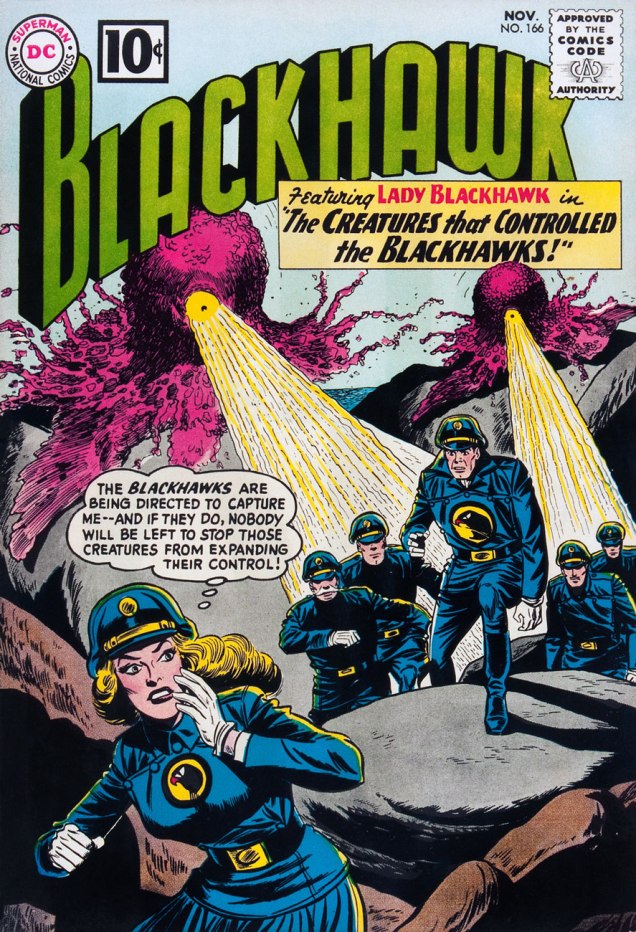
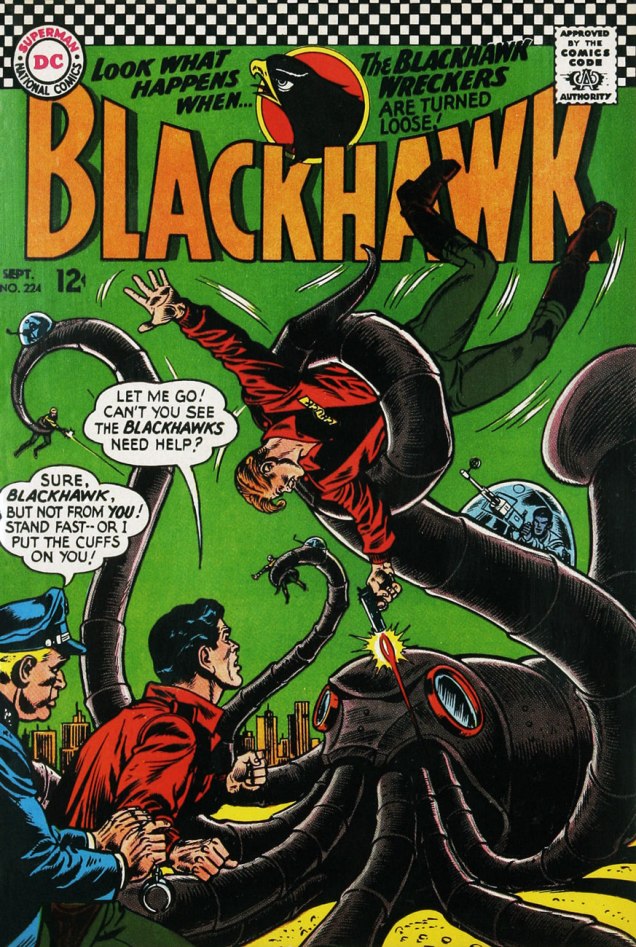
Blackhawk No.109 (February 1957), pencilled by Dick Dillin and inked by Charles Cuidera.Blackhawkno. 130 (Nov. 1958), pencilled by Dick Dillin and inked by Sheldon Moldoff.Blackhawkno. 166 (Nov. 1961), pencilled by Dick Dillin and inked by Sheldon Moldoff.Blackhawkno. 190 (Nov. 1963), pencilled by Dick Dillin and inked by Charles Cuidera.Blackhawkno. 211 (Aug. 1965), pencilled by Dick Dillin and inked by Charles Cuidera.
One of the rare cases where tentacles are promised *and* delivered inside:
Page from « Nobody Replaces a Blackhawk », pencilled by Dick Dillin and inked by Charles Cuidera. The evil guys here are the Octopus Gang!Blackhawkno. 224 (Sept. 1966), pencilled by Dick Dillin and inked by Charles Cuidera.Page from « The Blackhawk Wreckers », scripted by Ed Herron, pencilled by Dick Dillin and inked by Charles Cuidera.
I have to admit that while looking up stuff for this post, I grew rather fond of the Blackhawks. It’s fun to follow their adventures in completely improbable situations, to eagerly anticipate the introduction of yet another asinine machine hellbent on destruction. I also enjoyed the international flavour of the team – and Chop Chop, despite his ridiculous name, isn’t treated differently from his teammates.
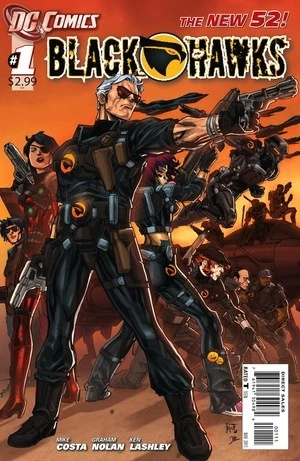
Y’know what the Blackhawks look like these days?
It’s important to update the image of old heroes so that new audiences can relate. Now let’s go rinse our eyes out with acid.
Signing off before I melt into a big puddle – this post comes to you courtesy of RG’s help cleaning up the images, and of my heavy cold which made me unusually verbose 😉
« When I was a boy, I always saw myself as a hero in comic books and in movies. I grew up believing this dream. » – Elvis Aaron Presley (1935 — ?)
Today, somewhere, the King of Rock ‘n’ Roll celebrates his eighty-fourth birthday, be he alive, dead or undead, he lives on. And never forget: Elvis is everywhere!
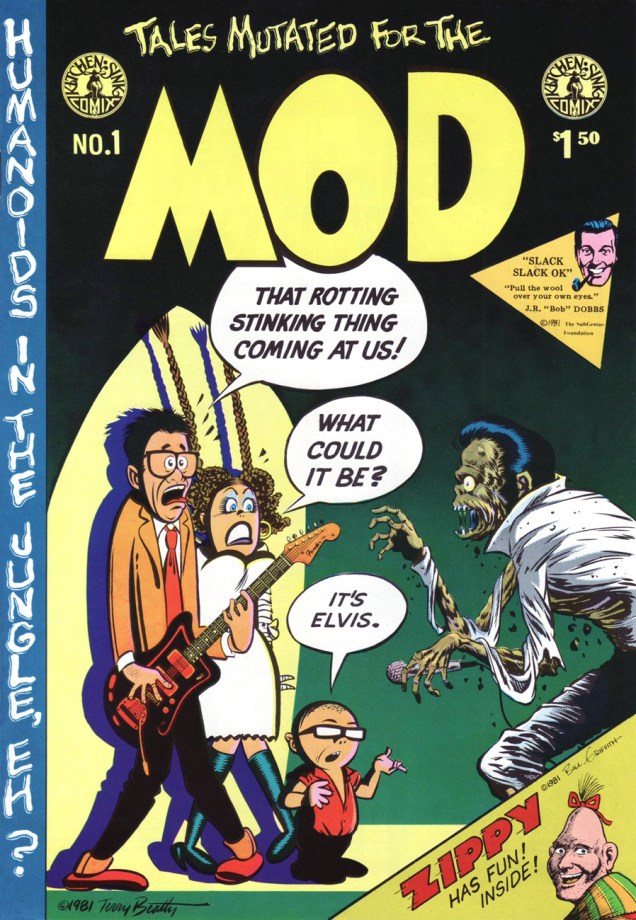
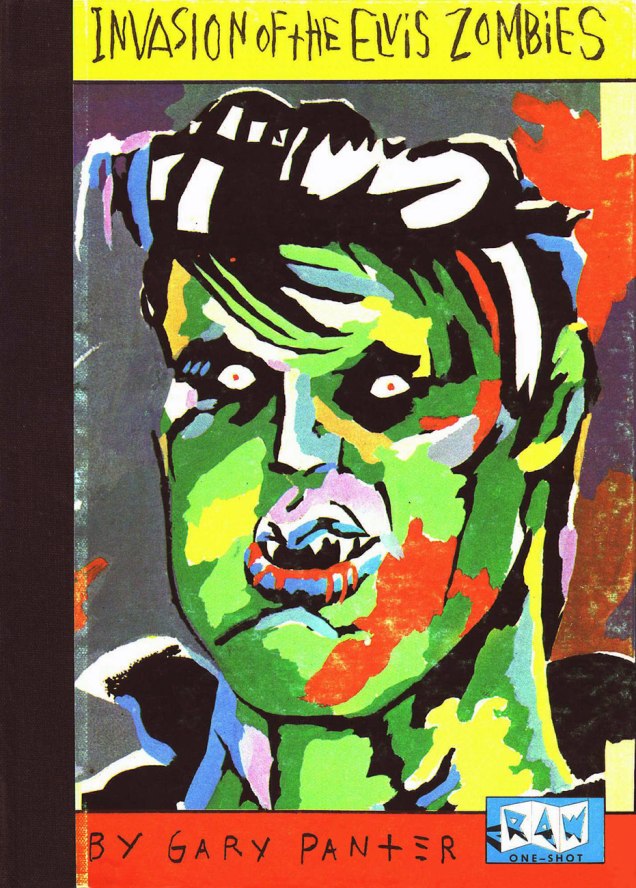
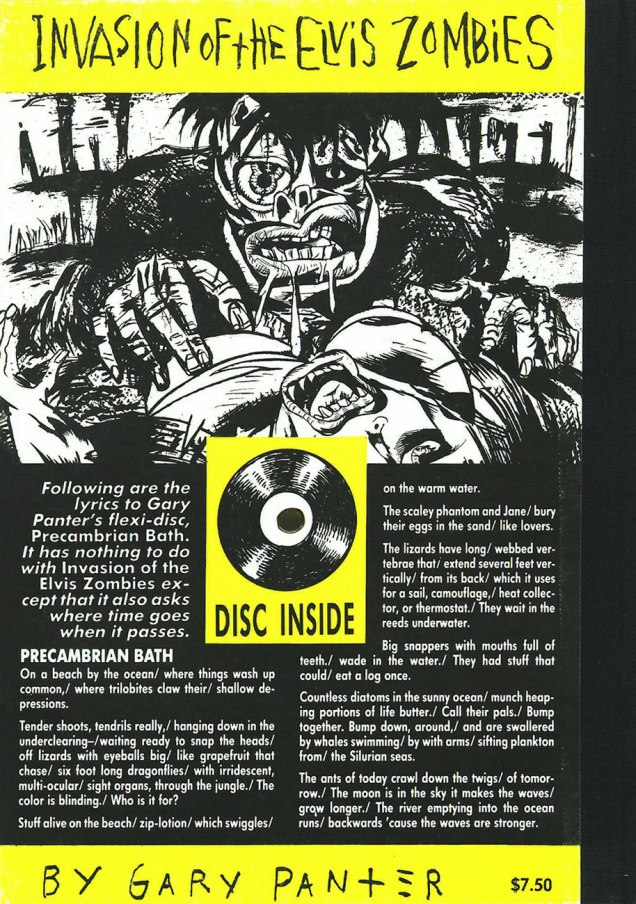
A most salty salute to the King of Rock ‘n’ Roll on his birthday! Compared to earlier decades, the 1980’s (and on!) were not kind to the anthology comic book. Thankfully, the meagre rewards and resounding indifference weren’t enough to quite dissuade some foolhardy souls from giving the format a go. But the fanboys wanted spandex, they wanted continuity and they soon wanted their « decompressed storytelling ». Bah. In 1981, Kitchen Sink Comix published the lone issue of Terry Beatty‘s labour of irradiated passion, Tales Mutated for the Mod. (June, 1981). Unlike John Byrne and others’ unceasing and pointless ‘tributes’ to Fantastic Four No. 1, this cover version of Harvey Kurtzman‘s Mad No. 1 is fiendishly clever. Kudos, Mr. Beatty!Gary Panter crafted this loving tribute in 1984, a one-shot published by RAW. Such heady stuff was well ahead of its time!The back cover… this beats Power Records‘ meek offerings flat!The oft-inaccurate Grand Comics Database really fumbles it this time: the instantly-recognizable icon on the right is, according to them… Fabian. Dopes. Hamilton, Ontario’s Win Mortimer (1919-1998), inducted into the Joe Shuster Hall of Fame in 2006, drew this cover for DC’s Heart Throbsno. 95 (April-May 1965); given the time period and The Pelvis’ shirt, he would presumably be shooting the dire Paradise, Hawaiian Style. If you’re of a mind to commemorate the King’s anniversary with one of his mid-60s cinematic offerings, better opt for the far finer Tickle Me (1965).His (alleged) paper boy claims, and I do want to believe him, that the Big E has peacefully decamped to the quietude of Eerie, Indiana. Looking good, Big E!
There are places and situations where one definitely expects to run into octopuses – in seas and oceans, on other planets, in brothels and harems (much like one can put a box in the middle of the room and a cat will suddenly appear to sit in it, even when one does not own a cat, a nearly-naked woman is almost guaranteed to summon an octopus). But sometimes the presence of tentacles is quite unexpected. Just when you think you’re safe – no, oops, a touch of the cephalopod springs abruptly into your life.
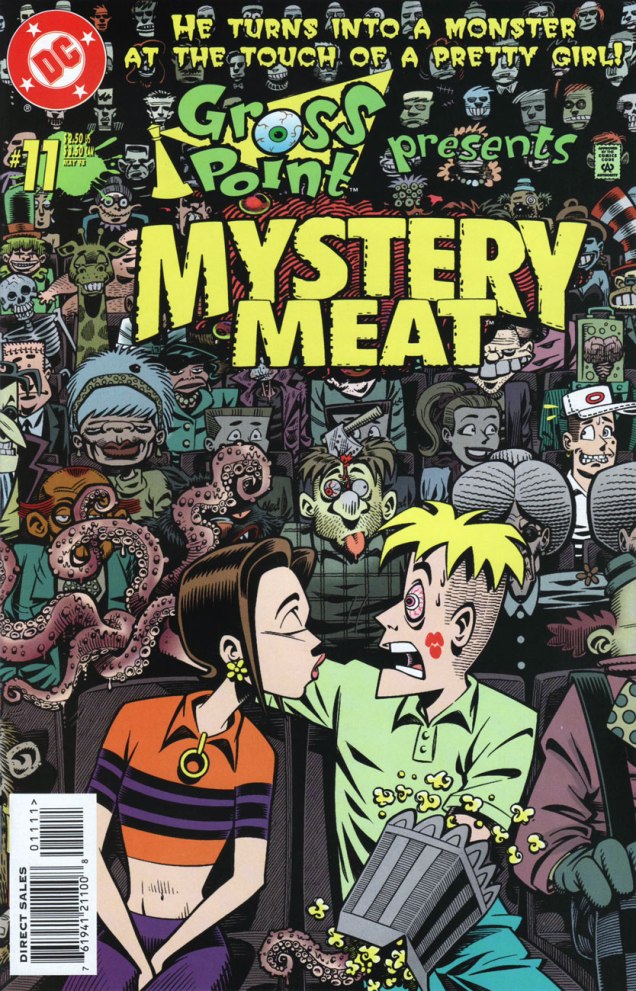
Tentacles at the cinema? No way. What would they be doing there?
« He turns into a monster at the touch of a pretty girl! » Say, that sounds familiar… This is Gross Pointno. 11 (May 1998), cover by Roger Langridge. This nearly-forgotten comic (so forgotten, in fact, that Google will try to correct you if you look its title up) is a delight for those of us who like to bask in a Halloween mood year-round. The plot is not exactly original, yet beautiful art by Roger Langridge makes it a very enjoyable read, especially given the latter’s propensity to add little jokes to the script. Unfortunately, too many issues are sloppily pencilled by Joe Staton, whose art cannot be entirely redeemed, even by Langridge inking it.
Because I’m nice and this January 1st, here’s a link to all the issues of Gross Point, to save you the trouble of hunting them down.
A page from “Welcome to Gross Point”, pencilled by S.M. Taggart and inked by Roger Langridge.
Or you purchase a box of doughnuts and then…
Wacky Packages no. 17 (All-new Series 7), 2010. Art by David Gross, I believe.
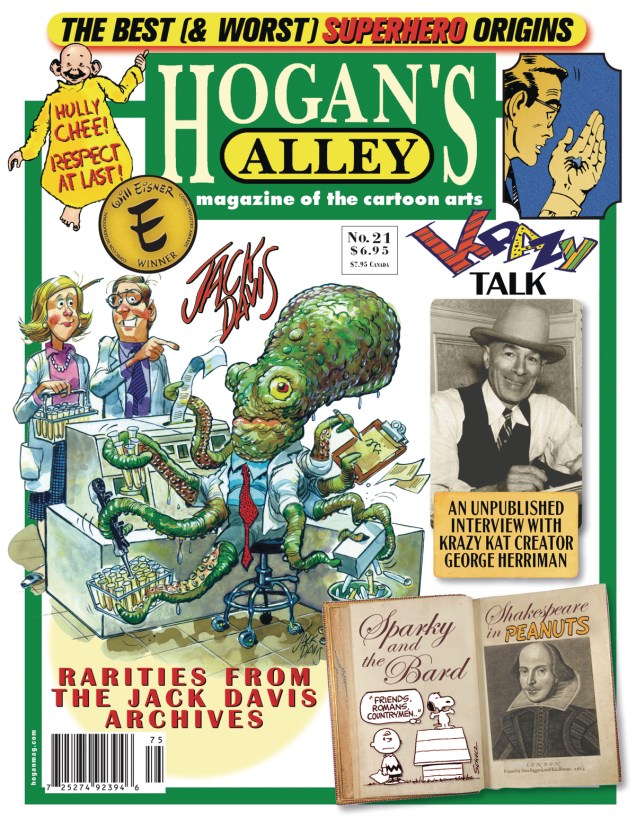
How would you feel about going back to the office after the holidays and finding a multi-tasking octopus taking over your duties?
Hogan’s Alleyno. 21, February 2017. The hard-working octopus (it must have been hard to find pants that fit him, but octopuses are dedicated workers!) is drawn by Jack Davis, of course.
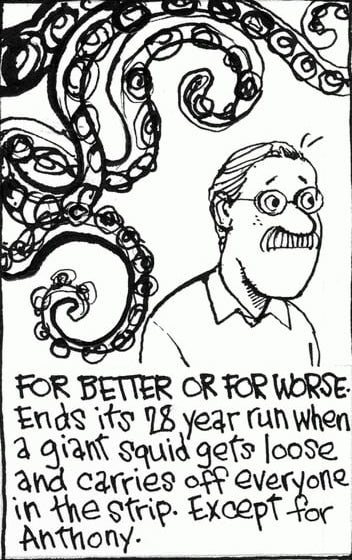
I’d say the most unexpected tentacles of all would be found in a For Better or For Worse strip. There’s no way that would happen.
« When comics came along in the 1930s there was a talent pool waiting. And one reason is so many areas were closed to Jews. Colleges, advertising agencies, many of the corporations – the doors that were closed led to the one that was open. » — Jerry Robinson
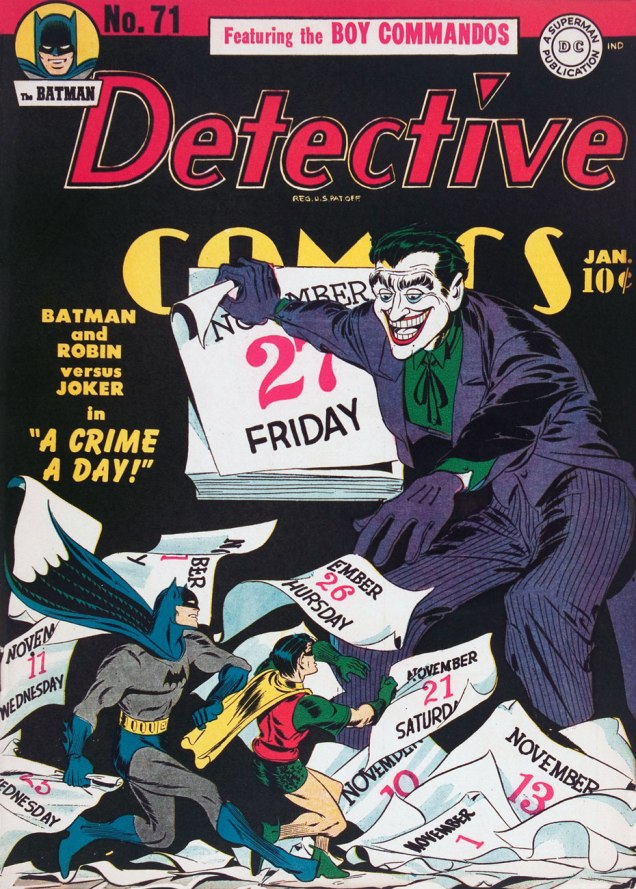
It’s New Year’s Day, which means it’s also the titanic Sherrill David ‘Jerry’ Robinson‘s birthday. Born on the first of January in 1922, he left us not so long ago, on December 7, 2011. He played at the very least a strong rôle in the creation of Batman’s sidekick Robin, his foes the Joker and Two-Face, his butler Alfred Pennyworth… and much more. Naturally, since we’re entering the murky world of Bob Kane, the whole process is mired in controversy, conflicting accounts and perhaps a little fibbing from certain parties.
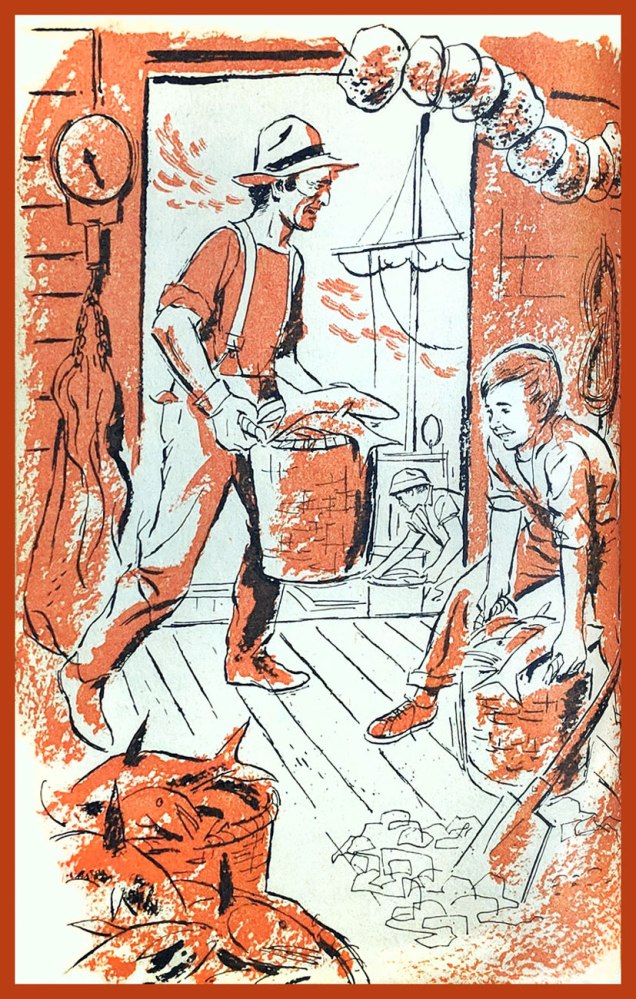
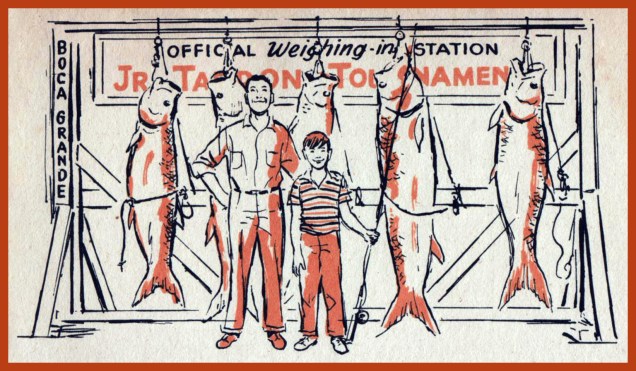
We won’t limit ourselves to the obvious Bat-imagery, which was mostly studio work anyway. Here, for instance, is a more obscure but purer œuvre, both pencilled and inked by Robinson: the original art from « Behind the Mask », page 2, originally printed in Atlas’ Marvel Talesno. 103 (Oct. 1951). Writer unknown.My earliest encounters with Mr. Robinson’s work were through a pair of books for young readers he illustrated in the late 1950s, in a beautifully free and expressive styles. Here’s the cover and one interior vignette from The Phantom Brakeman (1959, Scholastic), written by Freeman Hubbard, then editor of Railroad Magazine.
The following two pieces belong to Hurricane Luck (1959, Scholastic), written by Carl Carmer.Spoiler alert: Peter does, in the end, win the Tarpon fishing contest.
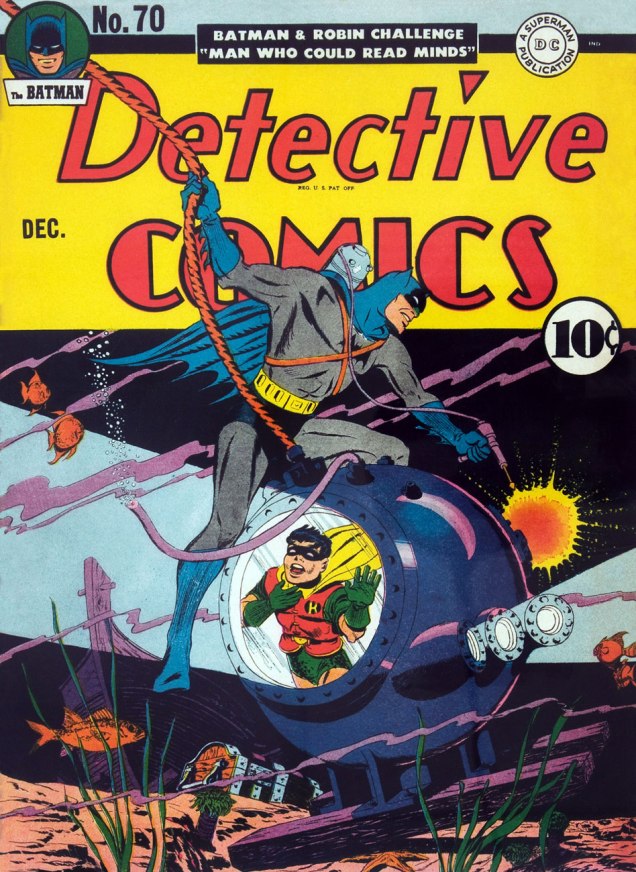
« What about Batman? », you might say. Okay, I admit I don’t have a prayer of getting away with a Jerry Robinson tribute devoid of the caped crusader and his trusty bird-themed sidekick, so here goes!
Detective Comics no. 70 (Dec. 1942). Pencils and inks by Robinson.Detective Comics no. 71 (Jan. 1943). Pencils and inks by Robinson.
This is the final Tentacle Tuesday of the year (the next one falls on January 1st). As few tentacles venture out into the snow, I had to find something else to celebrate the occasion. I’ve been hoarding some images for sharing at some later date, and I feel the moment has come to return to a topic that’s dear to my heart – for each girl, there must be some tentacles…
Amethyst, Princess of Gemworldno. 4 (August, 1983). This is a page from the story Dark Journeys!, drawn by Ernie Colón. I can’t vouch for the quality of the writing of this series, but the covers are a lot of fun for those of us who like Colón (I’ll hold my hand up there).Cinema Sewer no. 17 (2005), cover by Mike Hoffman. CS, in case you didn’t know, is a movie magazine (a mix of articles, illustrations and comics), the brainchild of Canadian Robin Bougie. Let’s give a polite round of applause to the strategically placed tentacles!
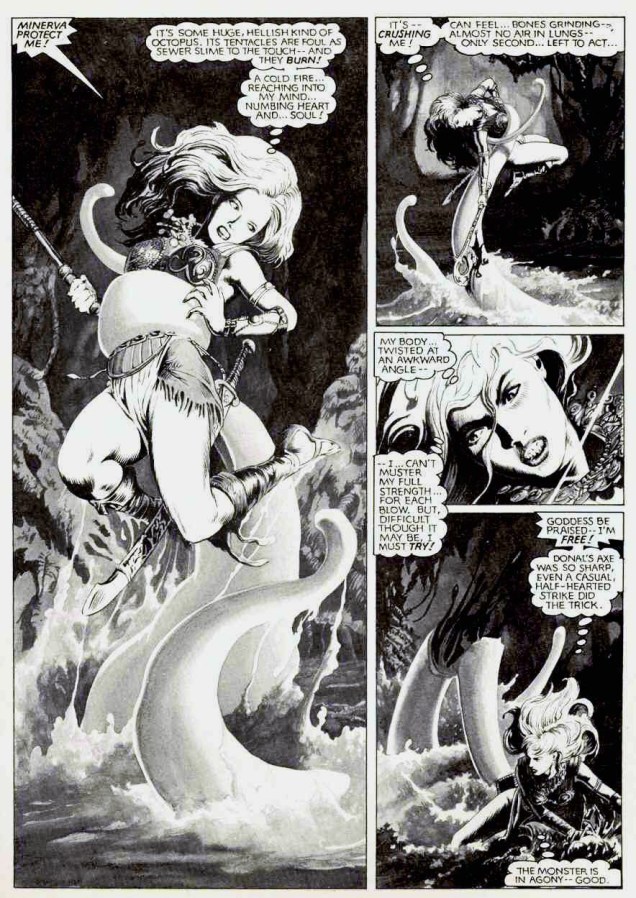
As long as we’re in the gutter, err, sewer… Sewer slime!
A page from “Marada the She-Wolf” , written by Chris Claremont and illustrated John Bolton, from Epic Illustratedno. 23 (April, 1984). I was convinced the octopus was attacking a pregnant girl until I looked closer. Damn deceptive black-and-white!
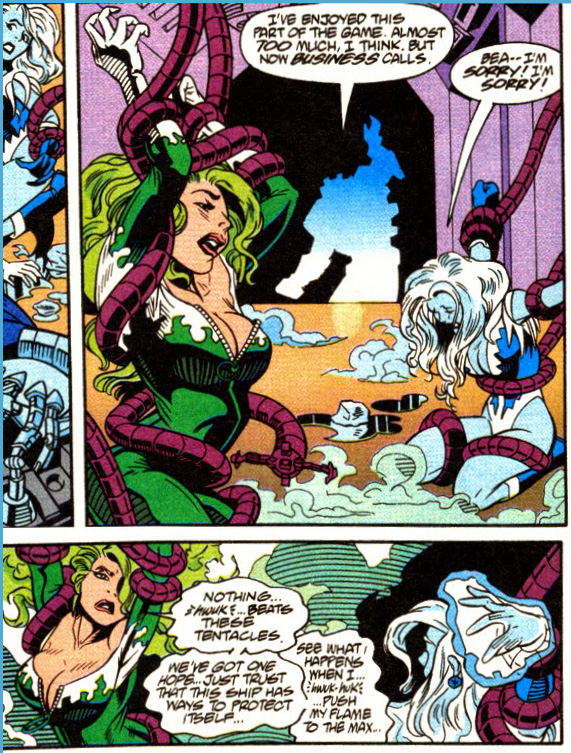
Next, a window with the world of superheroines… in which zippers magically stop just before full frontal nudity, every woman boasts a F cup size, hair writhes passionately all by itself, and pain looks like lust. “Nothing… beats these tentacles.” Thank you, Beatriz da Costa, for those immortal words.
Justice League Americano. 100 (June, 1995, DC). Opening Up the Game is scripted by Gerard Jones, pencilled by Chuck Wojtkiewicz, inked by Bob Dvorak and Doug Selogy. Wait, how many people had to get involved in this?!
The next one is an obvious – even boring – scene: girl tied up, blah blah, tentacles reaching for her *yawn* nether regions… Bonus points if she’s wearing some terrifically overwrought hair decoration/jewelry/shoes (and nothing else).
Original art for Warlord of Mars: Dejah Thorisno. 10, variant cover A by Joe Jusko (Feb. 2012, Dynamite).
Here’s to a new year of grabbery and slimy appendages, then!


































 Who's Out There?