Hallowe’en Countdown, Day 26

« I’m doing some new phony ghost effects and these hicks just eat it up! Show ‘em a ghost and they’ll swear they recognize it! »

Is it just me, or are horror covers more effective when they’re basically wordless? EC and DC and Charlton got it, but Marvel never did, with its protagonists/victims standing around uselessly pointing out the obvious: “Oh no! We’re trapped with… the Thing that walks!” “Uh, honey, I think it’s more of a Thing that shambles!”

HOM236A
This is House of Mystery no. 236 (October, 1975, DC) and it’s quite an issue on the inside too: Steve Ditko with Mike Royer inks (“Death Played a Sideshow“), and Paul Kirshner with Neal Adams inks (“Deep Sleep“.) Lest we forget: this fine cover palette brought to you by Tatjana Wood.

… and since this is our first, sadder Hallowe’en without the macabre Bernie Wrightson  (1948-2017) to inspire us, let’s have one more shot, shall we?

HOM219Intro
This is the frontispiece ushering us into issue 219 (Nov. 1973) of DC’s House of Mystery.

Interestingly, BW’s signature (at bottom, on the spine of a book in the centre) is reversed, which makes one wonder whether the image was flipped before dialogue was added. On the other hand, perhaps it made for better arcane lettering for a dusty grimoire.

– RG

Hallowe’en Countdown, Day 25

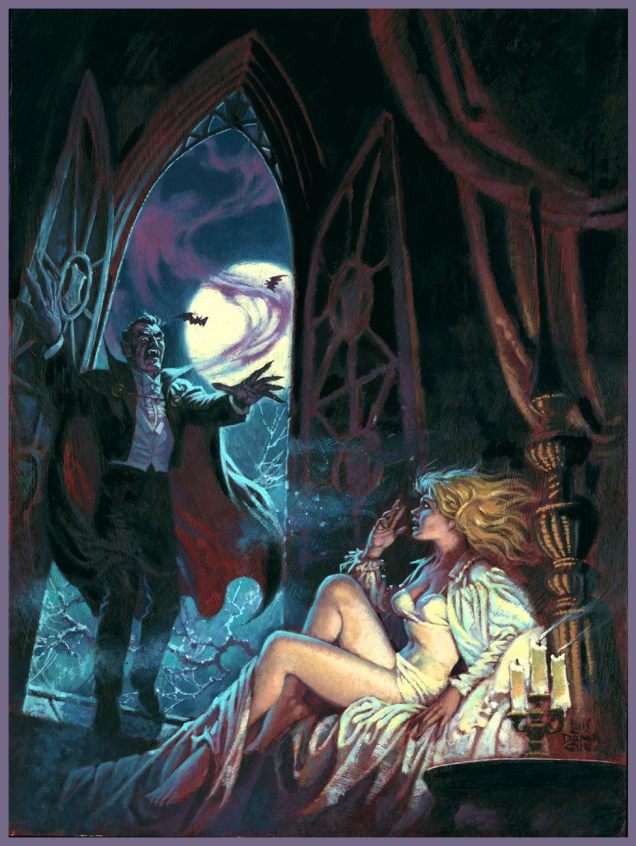
« No, obese one. I am not dead… not in a manner you would comprehend. »

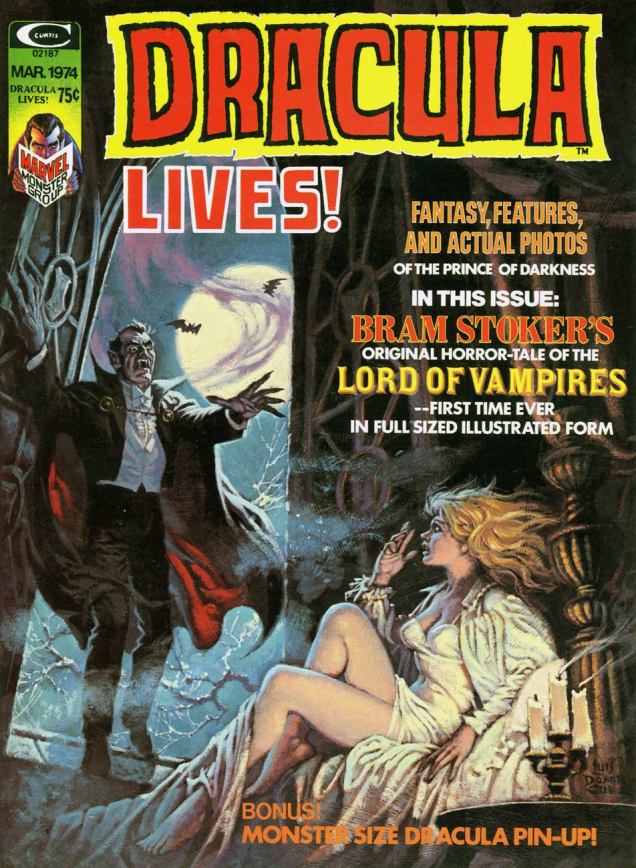
Here we present Luis Angel Dominguez’s (born 1923, Argentina) splendiferous cover painting for Marvel’s Dracula Lives no. 5 (March, 1974). Pure velvety ambiance.

DraculaLives5ORIG

… and the printed version, bogged down with the usual Marvel ’nuff said (as if) hard sell copy. Now you know what you were missing. Sorry about that… it can be disconcerting.

DraculaLives5ATo give credit where credit is due, the colour reproduction is fairly faithful (as these things go) and quite a bit of detail is retained. That hardly ever happened!
– RG

Tentacle Tuesday, Franco-Belgian Edition

Today’s Tentacle Tuesday comes to us courtesy of France and its long-suffering neighbour, Belgium. There’s an easy joke one could make about the reputation Frenchmen possess of having hands like grabby tentacles, but instead I’ll concentrate on their wonderful comic writers and artists and the classic bande dessinée. Let’s gracefully step over all the obscene connotations of a “French edition” and delve into exhibit A:

DavidBFroideA
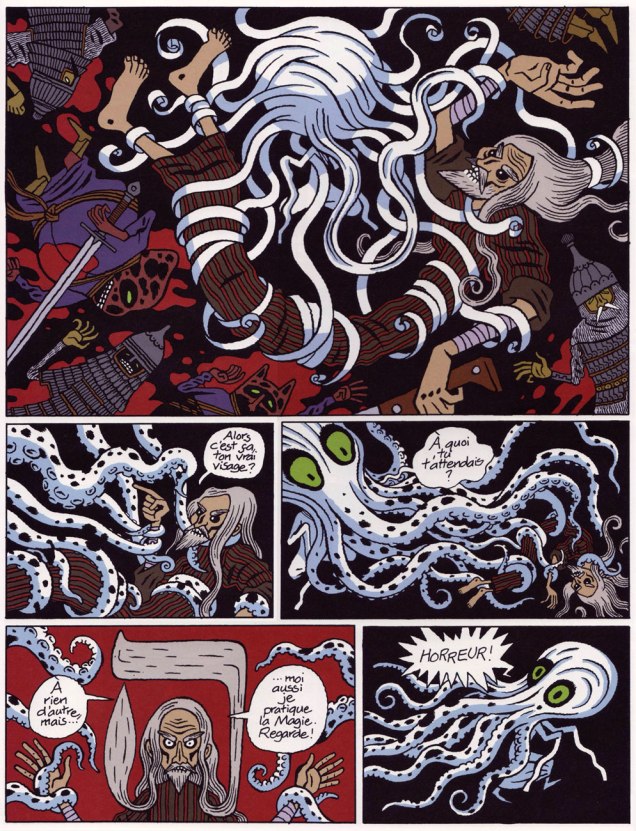
“So that’s it, your real face?” asks the old man. “What were you expecting?” asks the emerald-eyed cephalopod.  This is a page from Les chercheurs de trésor, volume 2: La ville froide, David B. (2004, Dargaud).

David B. is the nom de plume of Pierre-François David Beauchard. Non-Francophone audiences might know him from Epileptic, an autobiographical graphic novel that won accolades and awards from an international audience. And yet it’s not his most interesting œuvre, as far as I’m concerned. Although Epileptic is full of imagery and allegories, it’s when David B. lets his imagination soar without the constraints of real life that he creates his most dazzling worlds and astonishing stories. He’s one of those rare comic artists whose art is as accomplished as their storytelling.

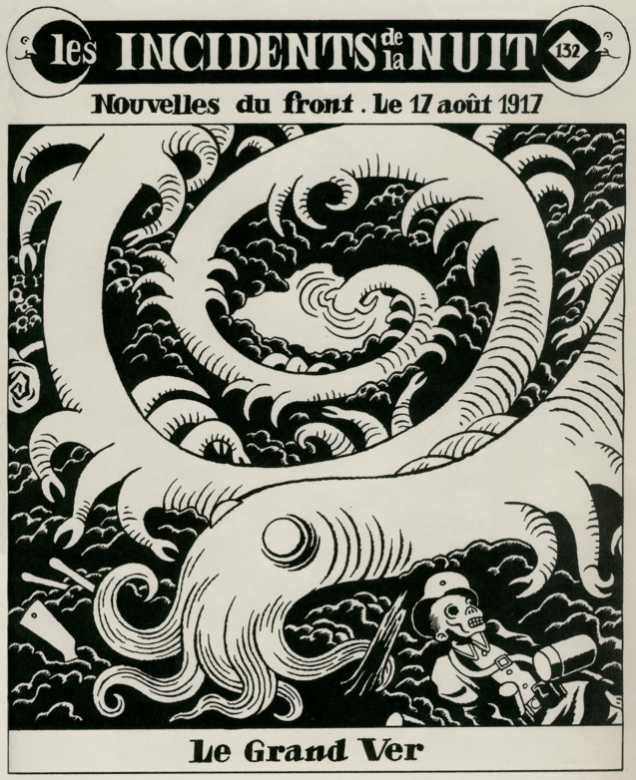
Here’s a bonus “tentacle” from Monsieur B.:

DavidBLesIncidentsdelaNuit
La lecture des ruines was published by Dupuis in 2001. (It loosely translates to “reading the ruins”, “study of the wreckage”.) It’s the story of a mad scholar who tries to find a mathematical equation for violence in the decayed rubble that war has left behind. Excerpted material from an imaginary periodical is appended, Les incidents de la nuit (Incidents of the Night). This tentacled worm – Le Grand Ver, the Great Worm – is one of the creatures that lurk within…

Give a hand of applause, ladies and gentlemen, to David B., and let’s move to our next topic.

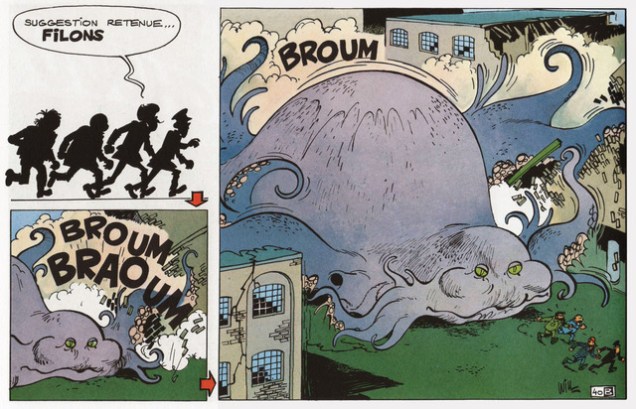
“Sorti des abîmes” translates to something like “Risen from the abyss” – and what sort of thing rises from an abyss? Why, tentacles, of course!

TifTonduSortiDesAbimes
Tif et Tondu: Sorti des abîmes (1972)

Tif and Tondu, an intrepid team of private investigators, were originally created by Fernand Dineur, but their most popular incarnation is by writer Maurice Tillieux and artist Willy Maltaite (who mostly went by the nickname Will), which is what you’re currently admiring. The strip saw birth in 1938 in journal Spirou and lasted a whopping number of years, ending in 1997, one year short of its 60th birthday.

Things are a bit tricky with the numbering, because Tif et Tondu are popular enough to have been anthologized several times. Sorti des abîmes appeared as the series’ 19th entry (1972), after being serialized in Spirou no. 1746 (September, 1971) to no. 1764 (February, 1972).

TifTonduSortiA(1)
A closer look at the creature from the abyss: not exactly an octopus, but in distinct possession of tentacles. “Armed and dangerous”, as they say! The poor thing is dissolved at the end of the story by some infrared rays.

Incidentally, “Tif” is slang for hair in French, and “Tondu” means “shaven, sheared”. Naturally, Tif is the bald guy, and Tondu is the hairy one.

Now that we’ve had our fill of scary, destructive tentacles, I’ll move on to something friendlier.

Pif2
Pif Poche no.72 (Aug. 1971) The last panel says “Paws off… Don’t touch! You’ve got cold hands!”
Pif3.jpg
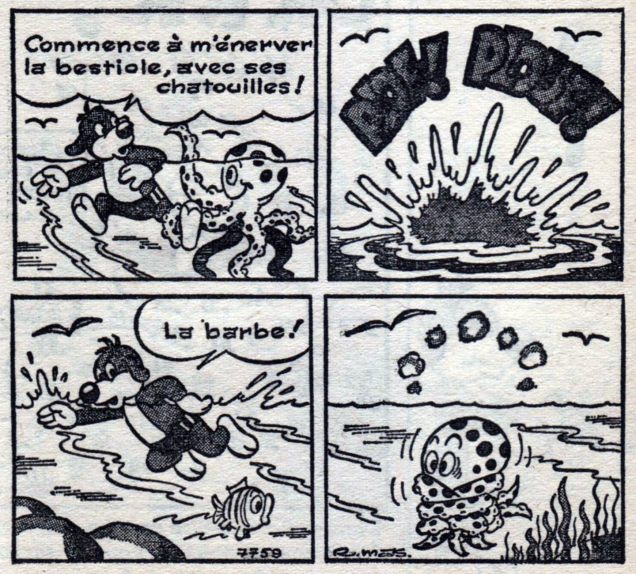
Pif Poche no.72 (Aug. 1971) “This creature is starting to annoy me with its tickling!”

Pif the dog was the mascot of the kid’s magazine Pif Gadget (« gadget » referred to the fact that each issue of the magazine was accompanied by some thingamabob to amuse the youngsters). Pif Poche were pocket-sized collections of short Pif strips, as well as jokes, games and such. The character was created by José Cabrero Arnal in 1948, who gradually abandoned the strip by the 1960s while other artists took over.

Pif1
 Pif Poche no.72 (Aug. 1971) “Even in a can… I adore seafood! Ripoff… it’s octopus!” Story and art by Arnal’s immediate and worthiest successor, the prolific Roger Mas (1924-2010)

~ ds

Hallowe’en Countdown, Day 24

« If you didn’t have a shootin’ iron, I’d give you a fust class spankin’! »

I bet you say that to all the boys.

Here’s a nostalgic entry cover-featuring the official bogeymen of Hallowe’en ’43: Adolf, Benito and Hirohito (Uncle Joe was still our “friend”.)

4Most
This is 4Most vol. 2 no. 4 (Novelty Press, Fall, 1943). This anthology ran for 36 issues, published between 1942 and 1949. Cover artwork by longtime Superman chronicler Al Plastino.

Gorsh dagnabbit, you can read the whole consarned issue right here, thanks to comicbookplus.com.

– RG

Hallowe’en Countdown, Day 23

« Join the Group Gripe by sending in your own Bummer, and our Dynamite artist might pick your idea to illustrate. »

Bummers was a long-running feature (from the first to the final issue, in fact) in the pages of Scholastic’s Dynamite Magazine (165 issues, 1974-92), whose success was due, in no small part, to the winningly wobbly style of its illustrator, Jared Lee (b. 1943).

Here’s a selection of the finest Halloween-themed bummers from issues 4 (Oct. 1974) and 65 (Oct. 1979). Was any one of these yours?

BummersHalloween1ABummers34A

BummersHalloween56A
It was bound to happen: two kids groused about the very same thing, and someone lost track. Well, kids, just be thankful the apples weren’t spiked with needles or razor blades. Left: the 1974 version. Right: the 1979 reprise. Note that Mr. Lee wasn’t about to repeat himself visually.

BummersHalloween78ABummersHalloween90A– RG

Borborygmi phobia

Yes, “borborygmi” is actually a word.
Borborygmi [bawr-buh-rig-mahy]
a rumbling or gurgling sound caused by the movement of gas in the intestines. Did you know you could have a whole conversation in borborygmese? But don’t take my word for it:
PoisChichesClaireBretecher
This page, entitled “Les pois chiches” (Chickpeas), comes from a comics collection called “Tourista”, published in 1984, about, what else? Tourists and their behaviour in foreign climes.

Claire Bretécher is a socio-satirical cartoonist from France, best known for her comics dealing with women and gender-related issues (Les frustrés, Aggripine…) Lots of them have been translated into English. A quick rundown of her career: her work has been published in Spirou and Pilote in 1972, and she co-founded the Franco-Belgian comics magazine “L’écho des savanes” (Echoes of the Savannah) together with Marcel Gotlib and Nikita Mandryka. She also has a pretty good handle on Weird Body Things and how people react to them.

And speaking of odd stomach noises, this pertinent little gem comes to mind:

cds090203
From Cul de Sac, an awesome comic strip (February 3, 2009) by the tragically deceased and much-missed Richard Thompson (1957-2016).

~ ds


Hallowe’en Countdown, Day 22

« Newly dead, the gases of decomposition moving in the stomach… moving the body like a rag doll whose lips flutter and belch… »

Atlas anthology Men’s Adventures (25 issues, 1950-54) was a pretty schizoid entity, with an editorial emphasis waffling from your typical would-be rugged he-man stuff (issues 4* to 8) to battle action (9 to 20) to mild horror (21-26) to, as a last resort, superheroes (27-28).

Men's-Adventures26A
Russ Heath delivers his usual fine job for Men’s Adventure no. 26 (March 1954, Atlas). I like the matching green outfits on the cadavers. Yay, team!

In the mid-1970s you could tell that Marvel was running low on reprintable pre-Code material when items from Men’s Adventure began to pop up in its mystery anthologies.

COC20A
Our cover story turned up then in Chamber of Chills no. 20 (Jan. 1976) announced by this ridiculous Ron Wilson/Dan Atkins cover.  There’s a Broadway musical in there, I swear.

Since this was 1970s Marvel, the corpse is not only well-preserved, he’s buff as it gets. For comparison, read “Midnight in the Morgue” (writer unknown, art by Dick Ayers), with our thanks and a fond tip of the hat to The Horrors of It All blog.

A more haunting variation on the “trapped in the morgue with the not-quite-dead” theme is Nostalgia Press’ historically significant Horror Comics of the 1950’s (1971, edited by Bhob Stewart, Ron Barlow and original publisher Bill Gaines), which gathered, in full colour, 23 EC classics, including one previously unpublished story, An Eye for an Eye. The cover revives (ha!) Al Feldstein’s Tales From the Crypt no. 23 art from 1951.

HC1950sA
Like many fellow modern-day EC Fan-Addicts, this book first came to my attention through the Captain Company catalogue that occupied the back pages of Warren Magazines. So many elusive, haunting grails… many of them turning out to be great beyond all reasonable expectations.

*the actual first issue… typical 1950s comics numbering scheme.

– RG

Satirical socio-cultural commentary from the Old Master

Alphonso Wong (also known as Wong Chak) is fondly remembered as the creator of Old Master Q, a truly long-running series that first appeared in newspapers/magazines in Hong Kong in 1962, was serialised in 1964, and is still in publication today. When Mr. Wong retired from his strip in the 90s, his son, Joseph Wong, took over the company, and he’s been managing the licensing ever since, as well as directing the team of artists writing and drawing the strip. Wong Chak passed away in 2017, at 93.

I’m no expert (the language barrier doesn’t help!), but people’s love for Old Master Q and Wong Chak is evident. To quote from Lambiek Comiclopedia,

[The strip] inspired its own magazine (“Old Master Q’s Crazy Comics”, 1965), toys, stationary, electronic scales, LED lamps, insulated cups, umbrellas and lunch boxes, as well as seven live-action film adaptations, four animated ones and two TV series. Copies of ‘Old Master Q’ can still be found in many Chinese hairdresser shops or doctor’s waiting rooms. Its success spread to the rest of Asia and translations in Europe, Latin America and Japan. Along with other well-known comic book characters, Old Master Q has his own statue in the “Hong Kong Avenue of Comic Book Stars” in Kowloon Park, Hong Kong. In August 2016 an Old Master-themed café opened on Nathan Road in Prince Edward, Hong Kong.

I prefer the art from the earlier days of OMQ, although I am glad that the strip is still around. (It’s a national institution!) To illustrate:

Please don’t forget to follow the numbers and read these top to bottom, right to left, as appropriate for a Chinese strip:

OldMasterQ1970aliens
“Space Monster”, 1970. In panel number 4 , Old Master Q is saying “I am the first person to land on Mars! Hee, hee!”. In panel 5, he says “Friend!” to the aliens; despite his attempts at friendliness, they flee in panel 6, alarmed by “the strange beast that comes from space”.

Judging how often jokes about mermaids crop up, Wong Chak had a thing for them.

Reminder-of-Love_1970
“Reminder of love”, 1970.

Wong Chak was impressively ambidextrous and could (and would) draw with either hand!

OldMasterQ1974

Here’s a strip from more recent days. As you can see, the reading order of the panels has been adapted to the Western palate, and there are English captions translating the Chinese text.

OldMAsterQSmallPersonBigGhost

There’s as many collections of these strips as one would expect from a series so popular, including special-theme collections released for various holidays.

OldMasterQCover

I eagerly await the day I’ll be able to read Old Master Q strips without having to painfully pore over a dictionary over every third character. (Especially given that I’m learning simplified characters, and Old Master Q uses traditional characters. Oof…) If that day ever comes, there’ll be a lot of material to dig into!

Old master Q

You can follow the modern-day strips by visiting the official website, https://www.oldmasterq.com/

~ ds

Hallowe’en Countdown, Day 21

Here’s a seasonal Sunday strip from Archie creator* Bob Montana (October 23, 1920 – January 4, 1975), from October 31, 1948. Do note (or try not to) how sultrily Veronica is portrayed in comparison to her more restrained depictions in subsequent, supposedly less prudish decades.

MontanaA.jpg

*You can safely ignore the outlandish claims of the Goldwater family on that. They may run the company, but they ain’t created squat, despite their long tradition of shoe-horning themselves into the credits. And of screwing over the actual creators of their flock of golden geese.

-RG

Hallowe’en Countdown, Day 20

On a damp and chilly night, is there a finer way to keep warm than huddling with your beloved?

DeckerGhostsA
From The New Yorker 1955-1965 Album, published by Harper & Row.

Richard Decker, (b. Philadelphia, PA, May 6, 1907, d. November 1, 1988) fruitfully spent four decades as a contract cartoonist for the New Yorker. His association with the magazine began in 1929.

Along the same ordre d’idées, here’s a bonus piece about the evocative magic of old time radio, by long-time Gasoline Alley cartoonist (and bluegrass fiddler) Jim Scancarelli (b. 1941), from the April, 1979 issue of Child Life Magazine.

ShadowKnowsA

Care to fully capture and bask in this delicious melancholy? Go ahead, pour yourself a snifter of your favourite poison, hunker down in your coziest chair, and enjoy an episode or three of the classic The Shadow radio show, starring Orson Welles.

– RG