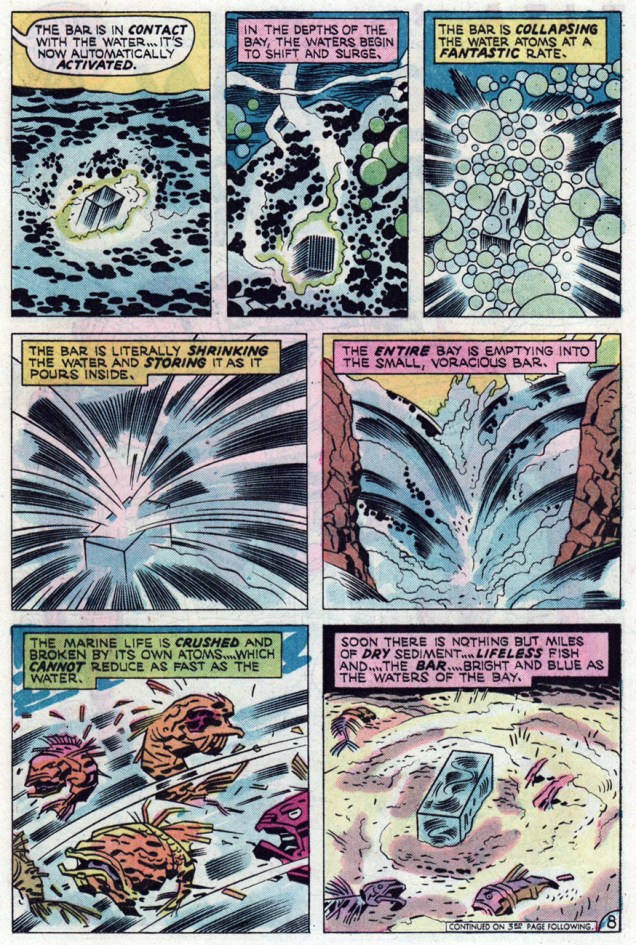
« The marine life is crushed and broken by its own atoms — which cannot reduce as fast as the water. »
I’ve been sitting on this particular entry awhile, having realized that the most opportune time to share it would be today, March 22, which happens to be World Water Day*.
In comics, few if any creators have generated so many explosive, pulse-pounding images as did Jack Kirby (1917-1994). And yet… this solemn, understated scene has likely haunted me most of all. The visuals are splendid, sure, but it’s the nature of the situation, the conceptual ramifications of the thing, that make it stick.
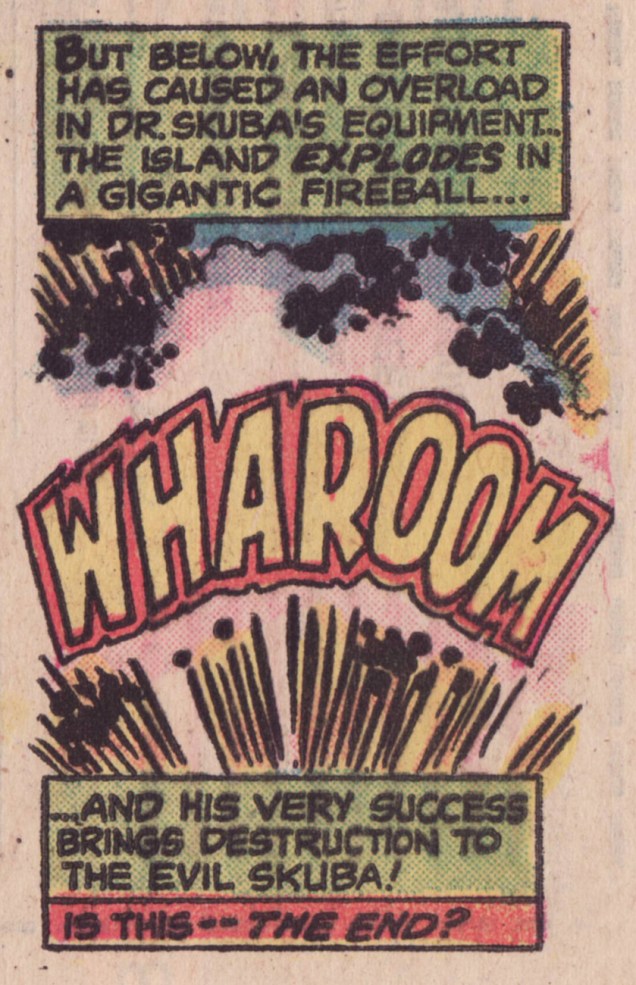
This splash appeared near the opening of OMAC’s final adventure, one that pitted him against Sandor Skuba, a rogue genius seizing and hoarding the planet’s water in view of controlling humanity. Threat-wise, all the adversaries that the One Man Army Corps had tangled with were mere preludes to this impressive madman. As Kirby left DC before he could wrap up the storyline as he intended, no-one walks away from this skirmish**, notwithstanding the final panel, subsequent revivals and reboots and corruptions of Kirby’s ideas by (inevitably) lesser hands and minds (and conversely bigger egos).
This is OMAC no. 7 (Sept.-Oct. 1975) and « The Ocean Stealers! », scripted, pencilled and edited by Jack Kirby, inked and lettered by D. Bruce Berry.Could that unseen appendage be Adam Smith‘s « invisible hand of the market » ?And here’s how it’s done.
In light of the current practices of certain corporations, notably the Swiss transnational Nestlé, Kirby was sadly prescient and clear-eyed again. As evidenced by recent events, given the technological means, today’s robber barons would not hesitate.
Writer and comics historian Mark Evanier, who spent some years as Kirby’s assistant in the ’70s, writes, in his foreword to the DC’s exemplary reprint collection Jack Kirby’s OMAC: One Man Army Corps (2008): « So consider this fair warning: the last issue comes to a whiplash-inducing sudden stop. Jack had been setting up something big for number 9, but since he was gone and there wasn’t going to be a number 9, a new last panel (not by Kirby) was inserted to remove the immediate cliffhanger.» … a panel created, at that, with the finesse of 10-year-old unburdened by a sense of pacing. “Wharoom” to you too.
-RG
*Don’t buy the duplicitous hype, though! A perfect example of the fox guarding the henhouse.
Where there be pirates, there be treasure; where there be treasure, there be a displeased octopus, irritable after being roused by some foolish fortune-hunter. I’d like to dedicate this Tentacle Tuesday to the murderous marauders who, in bold search for immeasurable treasure, have to tackle tentacles (and survive, hopefully).
Weird Terror no. 2, November 1952. Cover by H.C. Kiefer. Note the dead pirate’s hook embedded in the diver’s shoulder, while the former’s other hand is severing his umbilical cable… I think the octopus is the least of this treasure-hunter’s worries. By Weird Terror standards, this cover is actually pretty tame; this green octopus is not responsible for Fredric Wertham‘s nightmares.
Any octopus action inside, you may ask? Just two panels.
AAAGH-BLUB! Panels from « Wrath of Satan », pencilled by John Belcastro and inked by Joe Galotti.
I never thought I’d be posting something Garfield-related, but in Roger Langridge‘s hands, even the insipid orange cat acquires some charm.
A panel from « Pirate Cat », written by Scott Nickel and illustrated+lettered by Roger Langridge, published in Garfield no. 34: His 9 Lives Part 2, (KaBOOM!, February 2015).
Melvin the Menacing Sea Monster isn’t just a pretty eye; he’s got at least one excellent pitching arm, too.
All this proves is that there’s a simple solution to an inane plot and pedestrian characters: hire Langridge to illustrate your story, and it will magically transform into a fun yarn.
Our next selection doesn’t technically feature pirates, but it features sailors, Spanish smugglers, swindlers and cheats, as well an epic battle with an octopus and stolen treasure buried at the bottom of the sea, so it damn well qualifies.
Classics Illustrated no. 56, February 1949; cover by August M. Froelich. For one thing, I never knew Victor Hugo had written anything squid-related. As it turns out, Toilers of the Sea (French: Les travailleurs de la mer) is a novel from 1866. How educational! Classics Illustrated was created by Russian-born Albert Kanter (1897-1973), who wanted to use the power of comics to introduce young readers to “great literature” that they might not otherwise have deigned to read. “Classic Comics” began publication in 1941, with the name of the series changed to “Classics Illustrated” in 1947. The series lasted until 1971 for a total of 169 issues; various other companies reprinted its titles. I don’t know whether this series really made a difference in the edification of youth, but many of its issues are highly collectible, anyway.
As a little bonus, here’s a cover that’s somewhat lacking in swashbucklers, but boasts some decent treasure and (quintessential ingredient) some tentacles.
If Rex the Wonder Dog (created by Robert Kanigher and Alex Toth) can ride horses, show off as an expert bullfighter, use cameras, defeat a Tyrannosaurus Rex and swing on ropes (among his many other accomplishments), I don’t see why he wouldn’t be able to effortlessly fend off some pink tentacles. This is The Adventures of Rex the Wonder Dog no. 42 (Nov.-Dec. 1958). The cover is by Gil Kane on pencils, Bernard Sachs on inks, and Jack Adler on tones and colours.
A panel from « Return of the Swamp Beast! », story by Jane and Bob (RL) Stine, art by Stephen R. Bissette, originally published in Weird Worlds no. 3 (Oct. 1979, Scholastic.) This is the colour version from the one-shot Bissette & Veitch’s Fear Book (April, 1986, Eclipse.) Colours by Brendan McDonough.
Ah, that old Earth’s taken another whirl, and so today, the wonderful Stephen Bissette, that most erudite master of terror *and* one of the truest, most steadfast gentlemen the medium has known, observes another birthday. He first breached this plane of existence in the wilds of Vermont some sixty-odd years ago today, on March 14, 1955. Let’s wish him all the best, shall we?
The original art of this silk-spewing splash was reportedly acquired, by proxy, by erstwhile Calvin Klein Jeans model Brooke Shields. I like to envision it occupying a place of honour in the dining room of her favourite mansion. Or perhaps in the bedroom, right above the headboard?
This is from Saga of the Swamp Thing no. 19 (December, 1983, DC.) Quite respectably co-plotted and scripted by Martin Pasko (with Mr. Bissette), this predates epochal game-changer The Anatomy Lesson, but the Bissette/Totleben dream combo was already scorching eyeballs, en attendant Mr. Alan Moore’s accession.
Newlyweds Rich and Jamie meet this dusty fellow, for the first and final time, in Egyptian Graffiti, story by Jane and Bob Stine, art by Stephen R. Bissette, originally published in Weird Worlds no. 2 (March 1979, Scholastic), also collected in Bissette & Veitch’s Fear Book , with colours by Michele Wrightson.
-RG
*George Carlin may have said that, or something to that effect. Who knows, these days?
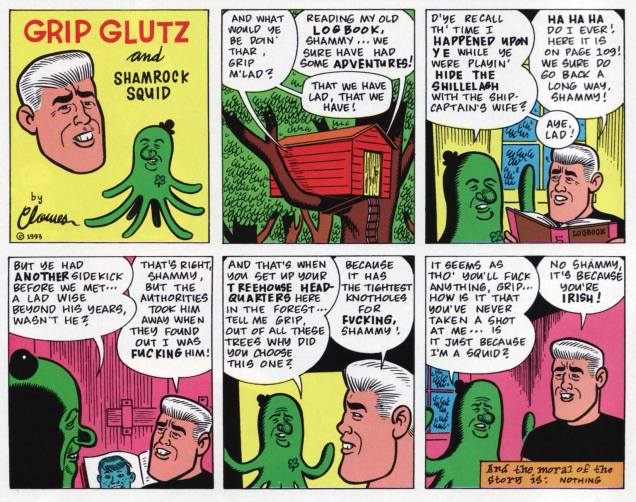
I’d like to interrupt the regularly scheduled Tentacle Tuesday with the double whammy of tentacles and kiss-me-I’m-Irish:
It’s Grip Glutz and Shamrock Squid! Originally published in Eightball no. 10 (February 1993.) Story and art by Daniel Clowes, of course. I love stories with no moral.
Shamrock Squid, created by Clowes, is an “open source” character, which is to say that other cartoonists have official permission to use him in their work.
« While Shamrock Squid was originally featured in Clowes’s comic book Eightball as a comic companion to “Grip Glutz” in a one-page ‘gag’, he has also made surprise or cameo appearances in other alternative comics such as Peter Bagge’s Hate and Rick Altergott’s Doofus. The most detailed, epic and perhaps final use of Shamrock Squid was done by Adrian Tomine and Peter Bagge in a 7 page piece in Hate #28 entitled “Shamrock Squid: Autobiographical Cartoonist”, which lampooned autobiographical alternative comics, teen angst, and fandom. It would seem that the gag has gone as far as it can. » (source)
I’m not sure what is implied by “the gag has gone as far as it can”, but since Adrian Tomine is involved, I’ll happily agree that enough is enough.
So if you’re planning to booze your woes away this Saturday on St-Patrick’s, happy drinking!
Moving on to the goofiness promised, here’s Tentacle Tuesday in all its glory.
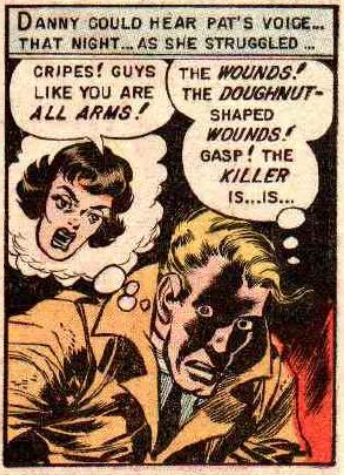
Many women get killed. Their corpses are covered in doughnut-shaped marks. A killer in a trench-coat sporting a wide-brimmed hat has been spotted retreating into the city’s aquarium after his crime. “Who Doughnut?”, the story’s title asks, and it is indeed a stumper.
The intrepid detective follows the killer! His mind struggles with the vital question of who or what could have possibly left such bizarre marks on his victims…
… and comes up with the answer! It’s…. (drumroll, please)…
Well, duh. Everyone knows octopuses suck blood (and have a weakness for stylish hats). « Who Doughnut? », written by Al Feldstein and drawn by Jack Davis, was published in Vault of Horror no. 30, April-May 1953. The art is glorious, and the story – while preposterous – is moody as hell, so do yourself a favour and read it here. As a matter of fact, it’s so well drawn that one forgets the farcical plot and shudders along with the protagonist.
The composition just pulls you in, doesn’t it? Although you might wanna watch that… lest you come face-to-face with a vampire octopus.
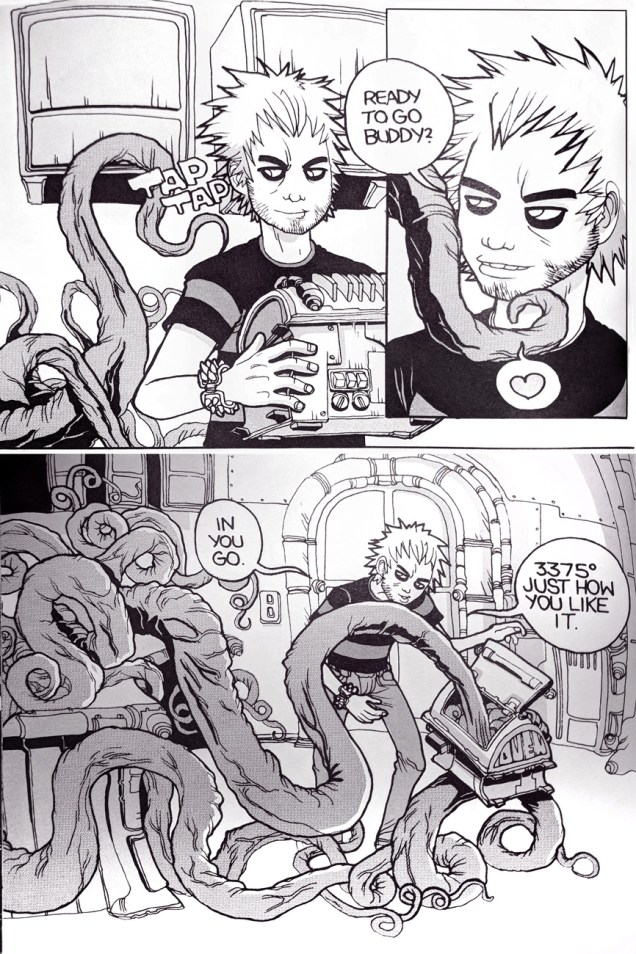
Quite on a different note, meet an alien lifeform with an appetite for self-destruction. Which is to say: it likes to be eaten.
« The CXL spice paste is made up of millions of hive-minded micro-organisms whose sole purpose in life is to be eaten in a delicious meal. If the lettuce is too thick and chunky, the CXL will realise they are being prepared wrong and will strangle the chef responsible. » Snippet from James Stokoe’s Wonton Soup, published by Oni Press in 2014. Thanks to RG for putting together my hasty photographs of this page from a completely unscannable, thick and tightly-bound book.
Canadian Stokoe is probably best known for his take on Godzilla, which comic left me frankly underwhelmed. However, I heartily recommend the unfortunately unfinished Orc Stain. As for Wonton Soup, it was loads of fun to read. Here’s a summary from Publisher’s Weekly: « Stokoe’s wittily vulgar debut graphic novel follows former-cook–turned–space trucker Johnny Boyo as he fights off space ninjas, returns to the planet of his ex-girlfriend Citrus Watts, and finally faces a cook-off duel with a pair of alien twins who’ll stop at nothing to achieve culinary victory. » That covers the gist of part 1; to which I’ll add that part 2 of Wonton Soup concerns itself largely with Johnny’s buddy Deac’s reminiscences about his mad escapades with a sex bear, which are not for the squeamish.
Let’s end this cephalopod festival not with a bang but with a whimper… the whimper of a wife who’s getting carried off by tentacles, that is.
“Sorry, dear.” Cartoon by Gahan Wilson, who can always be relied on to resort to tentacles whenever possible.
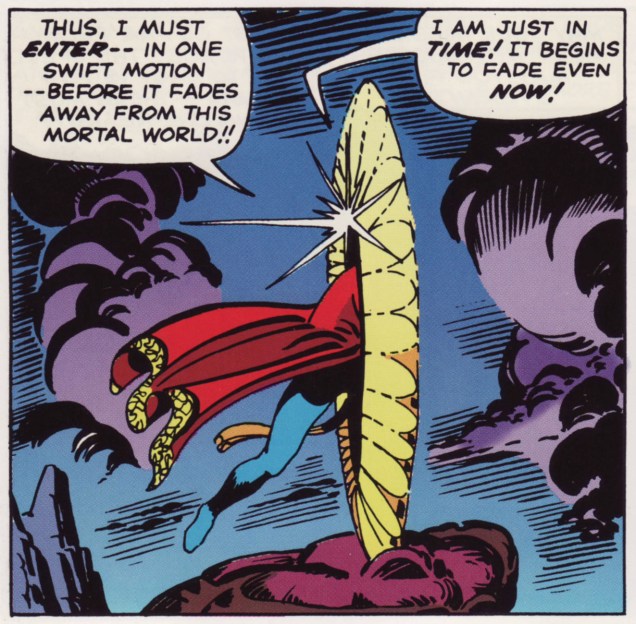
It’s Ditquotation time! In 1974, the ever-ingenious lads of legendary English art design studio Hipgnosis threw in a subtle Steve Ditko / Doctor Strange appearance in their (re)design (for the US release) of the cover of Al Stewart‘s Past, Present & Future LP in 1974. The image it quotes hails from Strange Tales no. 137‘s When Meet the Mystic Minds! (October, 1965), where the Master of the Mystic Arts seeks a doorway to Eternity. And finds it.
« I’m going nowhere with nowhere to go* »
However, according to the designers, it first leads him to the front yard of a castle depicted on Al Stewart’s following LP, Modern Times (1975). Now you guys are messing with our poor, befuddled minds.
« The blonde woman on the album cover is Pink Floyd guitarist David Gilmour’s first wife, Ginger. The Cord automobile Stewart is sitting in belonged to Led Zeppelin guitarist Jimmy Page. » And yes, there are other versions of this album cover, some of them far more familiar.
While Hipgnosis consisted primarily of Storm Thorgerson and Aubrey Powell and (later) Throbbing Gristle member Peter Christopherson, the main creative force on Past, Present & Future‘s artwork was one of the studio’s regular freelancers, Richard Manning. For those of us who love this sort of shop talk, here’s Mr. Manning’s recollection of the methods involved, in those halcyon pre-Photoshop days:
« If my memory serves me correctly, this was the first sleeve I worked on for Hipgnosis. Although, in the book ‘Walk Away Rene’ my good friend and mentor at that time,Terry Day (sadly no longer with us) is credited with working on it. A black and white montage. The figure was cut out physically and the back edges thinned and sanded and stuck in position with Columbia Cement. A Best Possible copy print was made, so now I have a flat print to work on, mounted on double weight mount board. Working to an elliptical guide on tracing paper, I carefully bleached to white the shape. Once washed and dried I then redrew some of the background with Photo Dye with a Sable brush, where the print had bleached a bit too far in the lighter areas. Finally, Permanent White was sprayed to make a sweet, soft edged shape. »
It wasn’t the first Dr. Strange reference Hipgnosis had inserted into an album cover: Pink Floyd’s A Saucerful of Secrets (the studio’s first LP cover, actually) borrows an image from the not-exactly-outstanding Roy Thomas/Marie Severin entry, The Sands of Time, from Strange Tales no. 158. Frankly, few characters have been as lost without their creator as the poor doctor has been, especially on the visual front.
Ditko’s final Dr. Strange panel (Strange Tales no. 146, The End — at Last!, July 1966) was no symbolic accident: both creator and creation were leaving the stage.
On the plus side, Al Stewart, seemingly impervious to the passage of time, remains a terrific performer and an inspired, if less prolific, songwriter. If he’s in town…
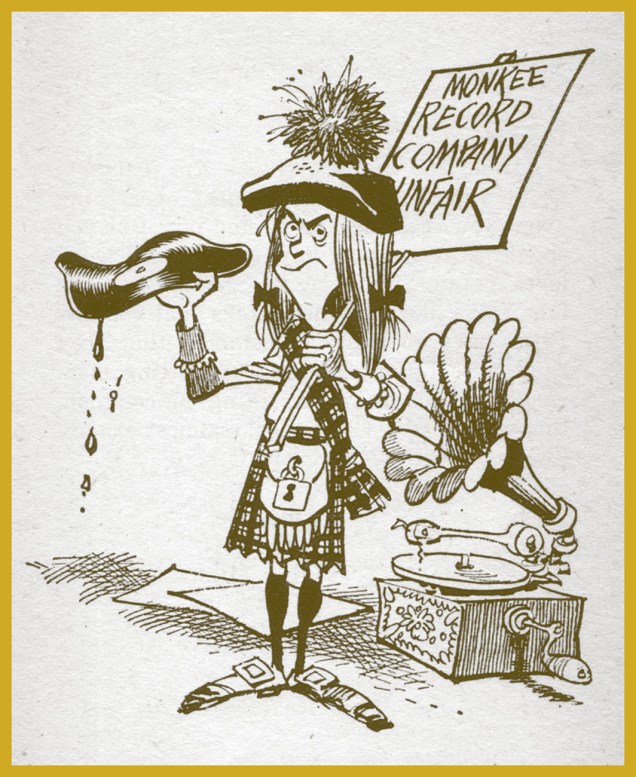
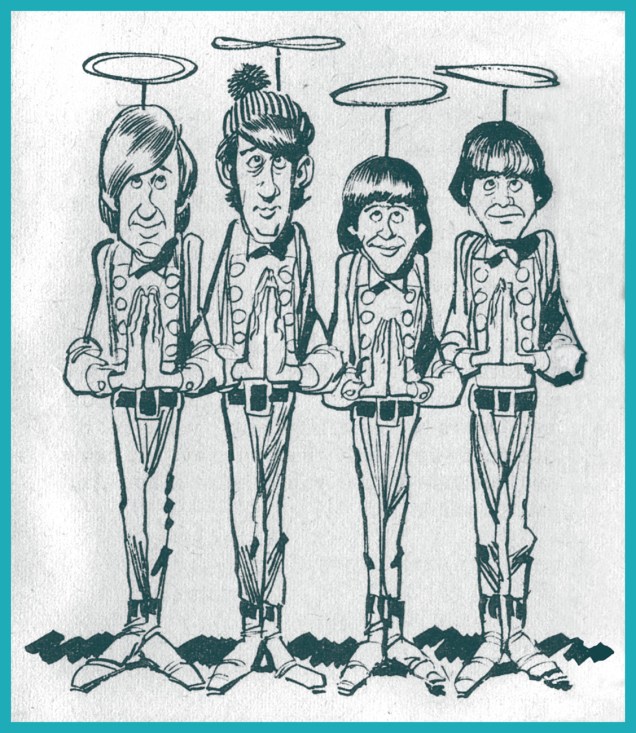
« If you did, you may find your letter printed in this book… If you haven’t written The Monkees yet, join the fun that’s going on inside this crazy, lovin’ book. »
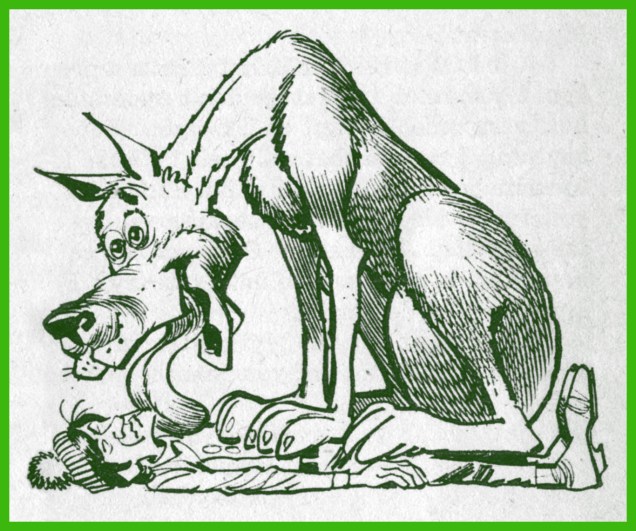
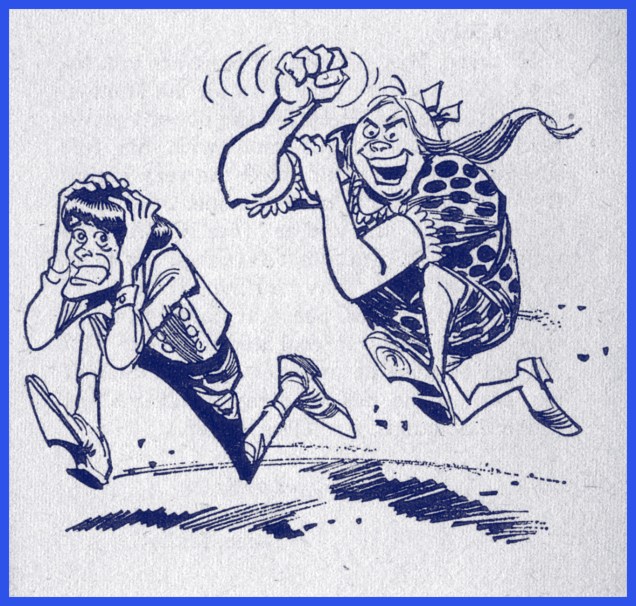
In 1967, the phenomenal Jack Davis (1924-2016), as prolific and versatile as an artist can get, provided twenty-one original cartoons and the cover to this snazzy little tome issued by the Popular Library.
Dear Davy — I am one of your greatest fans. I have all the Monkees records that have been released so far. But I have one problem. I played your first record so much that it began to melt, and now it wobbles so much that I can’t play it anymore. I know it’s not your fault, but I don’t think it’s fair that I should be punished for being such a Monkee-lover. I think the record company ought to give me my money back so I can buy a new album. You could even think of it as a kind of award for loyalty or something. Please, Davy, talk to the record company and make them send me the money? Yours truly, Diana V., Charleston, SCDear Mike — You know your record ‘Gonna Buy Me a Dog’? Well, if you really want a dog, I have a three-month-old Great Dane that a friend gave me six weeks ago that I have to get rid of. He’s a little too playful. Last week he knocked over my mom’s favorite vase and my kid brother. His name is Linus, but he’s not too attached to it. Your fan, Steve R., Coral Gables, Fla.Dear Monkees — I like your group very, very much. You probably never heard of Varna. It’s a little town near Ithaca. I wrote a poem for you: I think the Rolling Stones are great, I think the Beatles are fine, On the other hand, I think the Monkees are DIVINE. Your fan, Jeannie G.Dear Monkees — My name is Wendy. I like your records. Please send me a picture of you. I forgot all your names so please put your autographs on the pictures. Sincerely, Wendy K., Butte, MTDear Davy Jones — I like your shows very much. I like all your songs too. I like all your clothes and your hair. You are very very cute. You better come to Wichita or I’ll smash you one. Lover, Carol K., WichitaDear Monkees — Please send me Davy Jones in the mail. Send it to Cindy L, Louisville, Kentucky.
In closing, I see Micky Dolenz (b. March 8, 1945) turned seventy-three… yesterday. Happy belated birthday, Corky!
In this installment of Tentacle Tuesday, we shall bear witness to a somewhat surprising facet of superhero life: superheroes sometimes struggle with tentacles, too.
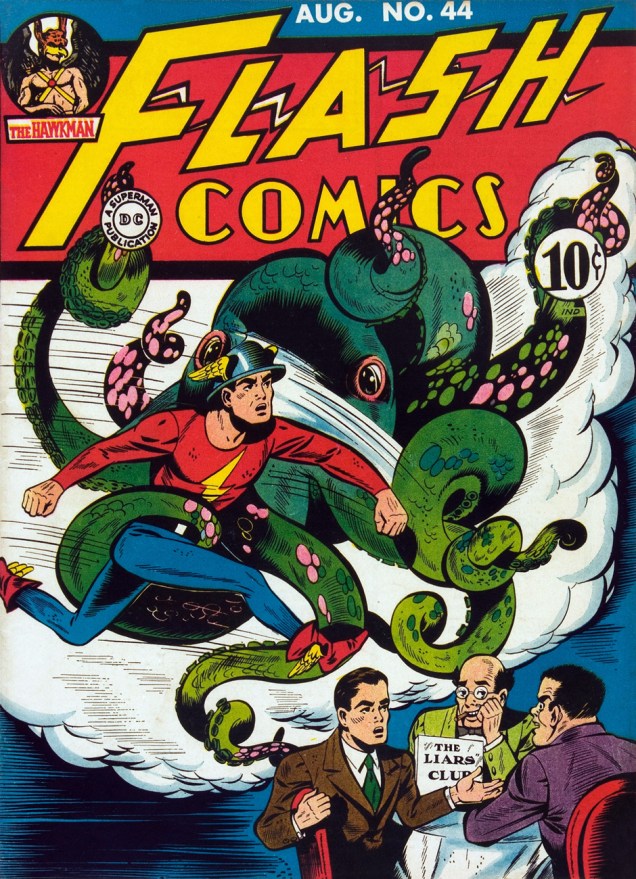
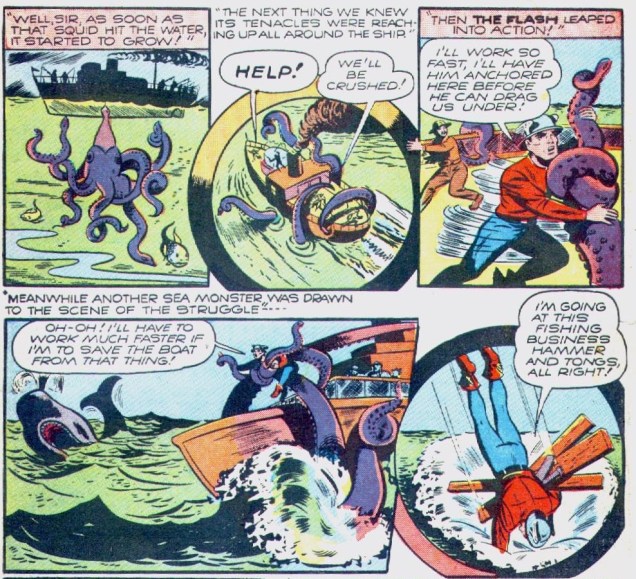
To kick off the festivities (and to respect a chronological order of creation and publication), here’s The Flash narrating a story of woe, his almost-deadly encounter with a green monstrosity (Judging by its coquettish pink tentacles, the monster wanted to woo him, not snuff him out.)
Flash Comics no. 44, 1943. Cover by Lou Ferstadt (1900-1954), and here’s a bit of trivia: in addition to being a comics artist, he was a muralist, creating works for the RCA buildings and the 8th Street Subway station in NYC.
« The Liar’s Club », scripted by Gardner Fox and drawn by Lou Ferstadt, concerns itself with three men (one of whom is Jay Garrick, secretly The Flash) holding a fibbing contest to determine who can tell the biggest Flash-whopper.
Sadly, this tale was not the winner in the contest.
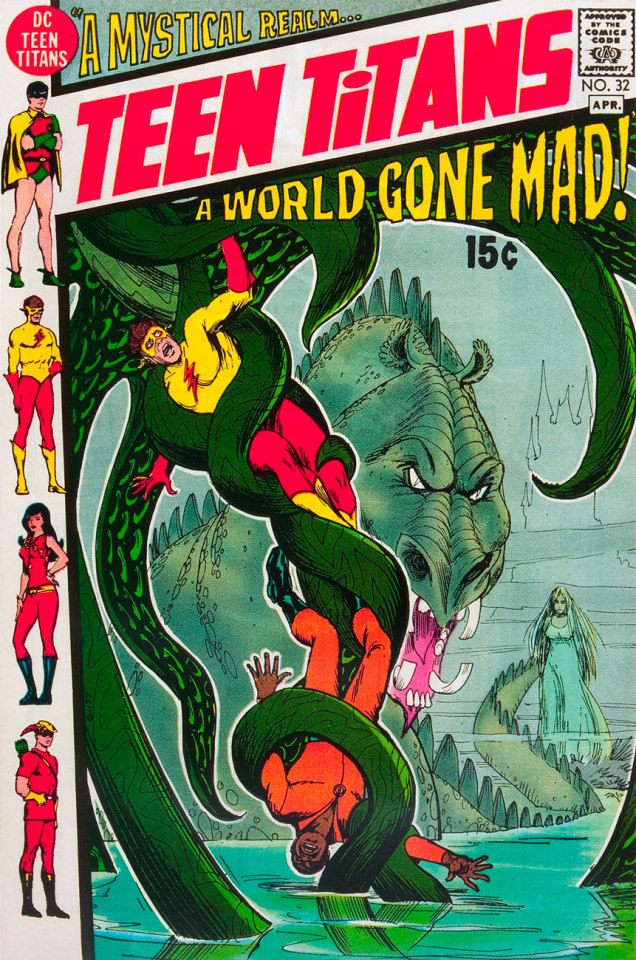
The Flash may have been embroiled in some purely imaginary tentacles, but his Earth-One counterpart’s teenage sidekick (it’s complicated), Kid Flash, encountered the real deal.
Teen Titans no. 32, March-April 1971. Drawn by Nick Cardy.
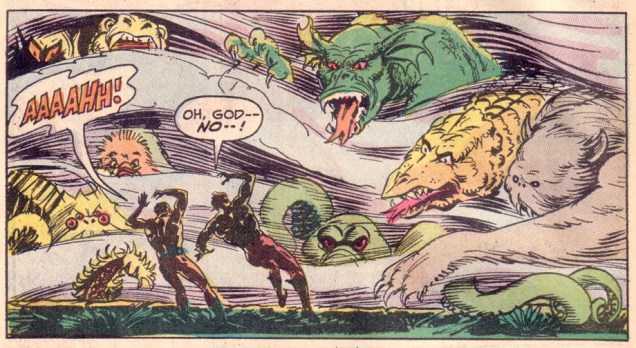
« A Mystical Realm, A World Gone Mad », scripted by Steve Skeates and drawn by Nick Cardy, is actually a pretty good read (with good art!), and I don’t even like superheroes. Just check out the beautiful results of a time travel experiment going wrong (when does one ever go right?), including the evil red eyes of a glaring octopus:
If we throw a whole bevy of superheroes at a tentacled monster, are they going to fare any better?
Fantastic Four no. 88, 1969. Pencils by Jack Kirby, inks by Joe Sinnott, letters by Sam Rosen. However… A house there was. Tentacles there weren’t.
This cover promises lots of tentacular fun. Instead of that, the Fantastic Four (and an infant) go looking for a new residence, something quiet and secluded – and the house that’s offered to them by a real estate agent appears to be haunted. At the very least, it causes migraines, gradually makes its inhabitants go blind, and shoots stun bolts out of its walls. The usual crap. I don’t want to tell you which super-villain is behind this mischief, but I will, however, point out that the bastard doesn’t have tentacles. Not even one. And neither does his lousy house.
The Flash is small fry, the Fantastic Four are mincemeat, but let’s see how Superman, the most superhero-like superhero of them all, fares when confronted with tentacles.
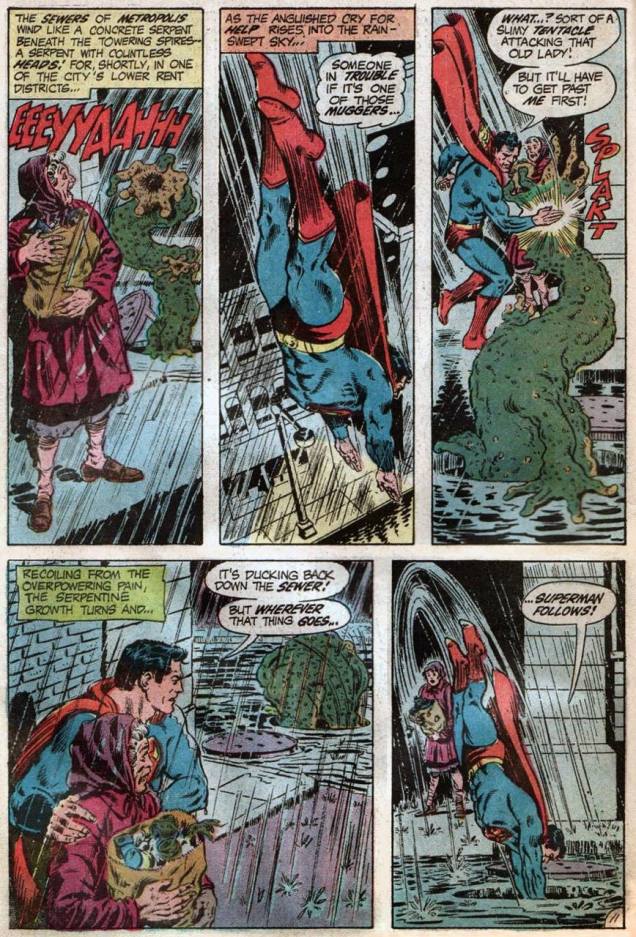
In “Danger — Monster at Work!”, the villain is a protoplasmic glob: some algae mutates after a lab accident and becomes an out-of-control, garbage-devouring, tentacled monster. Now, trash disposal is important, but when Superman realizes that everything on earth is impure to some degree, he has to stop the seaweed monstrosity before “it cleans Metropolis right off the map!”
This story was published in Superman no. 246 (December 1971), with a script by Len Wein, pencils by Curt Swan and inks by Murphy Anderson.
Incidentally, there *is* actually an algae farm that’s suspended over a highway in Geneva, Switzerland that gobbles up CO2 produced by car engines. I hope they’re keeping a close eye on it…
Tentacles? Well, “grasping appendages” anyway – let’s be generous. Superman no. 246, December 1971; pencilled by Curt Swan, inked by Murphy Anderson.
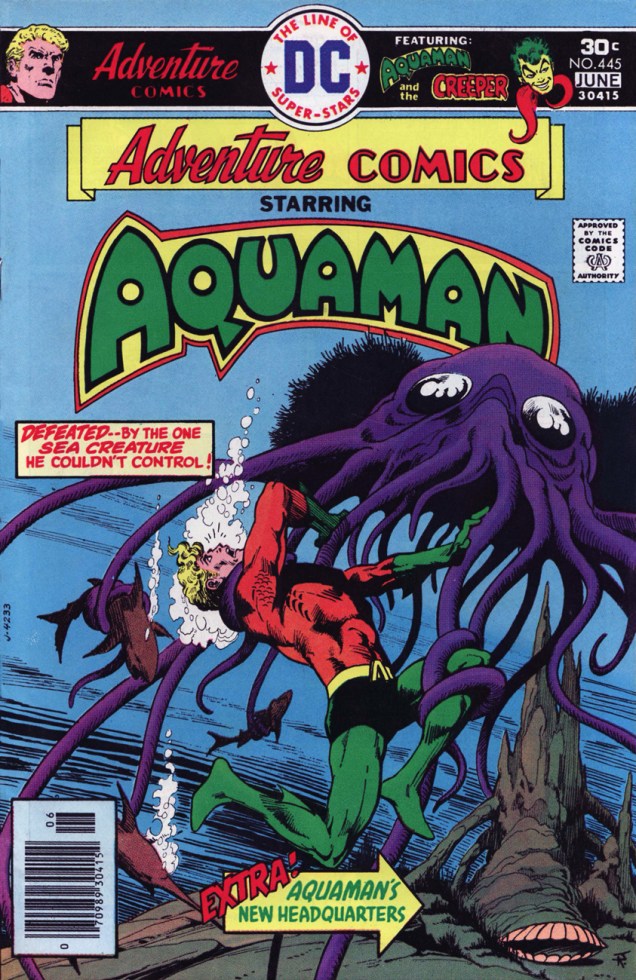
How about if we take a superhero who’s quite at ease with water, who can breathe H2O and communicate with sea life?
“Nope, sorry, still gonna gobble you.”
Adventure Comics no. 445 (May 1976). Cover by Jim Aparo, with colours by Tatjana Wood.This imposing figure of an octopus (even though he’s referred to as a “plant-thing” by Aquaman) is Krakor, the tentacled antagonist from “Toxxin’s Raiders” – the cover story written by Paul Levitz & David Michelinie and drawn by Jim Aparo.
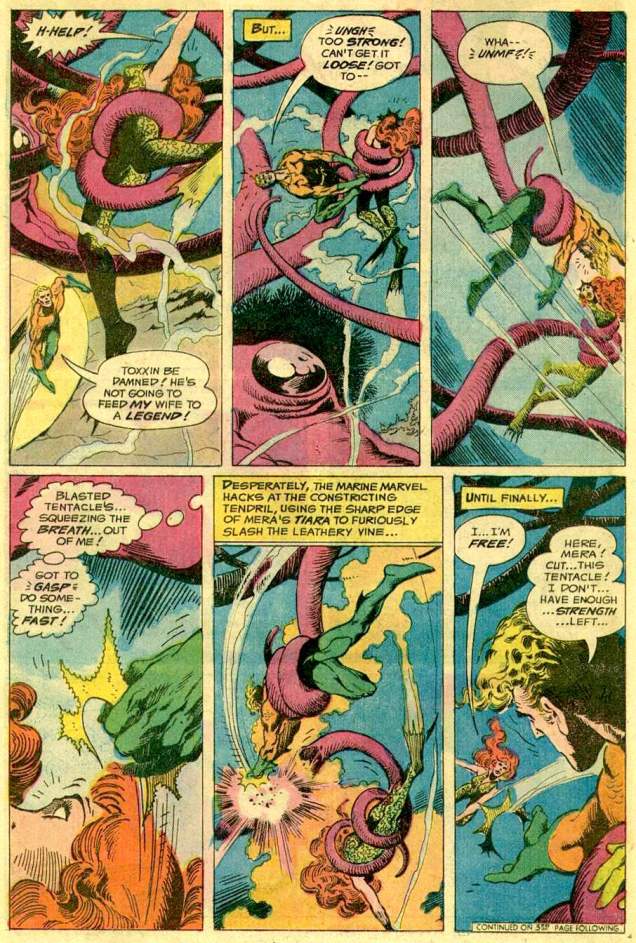
Oh, no! What is our hero going to do? Why, dispatch the octopus in the most far-fetched manner possible, of course!
In conclusion, no superhero is immune from a harrowing encounter with a tentacled creature… but sadly, the latter is more often than not annihilated in the struggle. Next time, I’ll make sure to present you with some material in which the octopus gets the upper hand, so to speak!
It pays to be kind to your cat, particularly if said feline happens to be more than your match. Between dimwit Fat Freddy Freekowtski and F. Frederick Skitty, esq., it’s clearly no contest.
This electrifyin’ strip first saw print in Rip Off Comixno. 23 (Rip Off Press, Summer 1989). Script and art by Gilbert Shelton.
A closer look at the wily furball, cover detail from The Fabulous Furry Freak Brothers no. 6 (Rip Off Press, 1980)
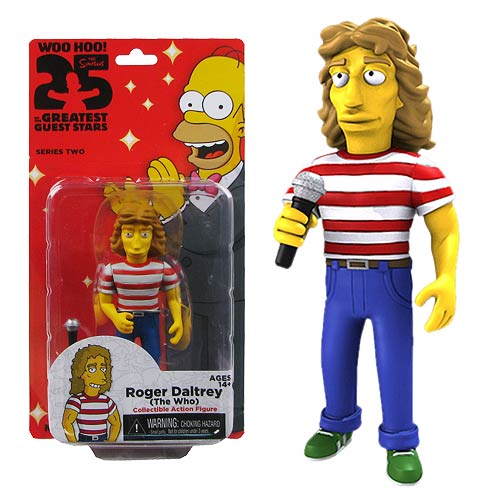
« We tend to think of age only in time, but I don’t think it has much to do with time at all; there’s a whole load of other things. I’ve met 16-year-olds who are old and 90-year-olds who are young. » — Roger Daltrey
Truly a master of all media, Roger is.
Today’s birthday number seventy-four for Sir Roger Harry Daltrey (born in London, England, on March 1st, 1944), Commander of the Most Excellent Order of the British Empire, noted thespian and lead vocalist of The Who. « And what’s this got to do with soddin’ comics? », the more boorish among you may ask. Well, thanks to the efforts of the genial Michael Kupperman, Sir Roger, and his unceasing quest for birds, have been duly immortalised in comics. Read on!
« Roger Daltrey’s Sex Diary », from Snake ‘n Bacon’s Cartoon Cabaret (2000, HarperCollins.) Story and art by Michael Kupperman, under his “P. Revess” nom de plume.
Farther along, having taken his quest below ground, our intrepid bird-rogerer encounters the dauntless duo of Mark Twain and Albert Enstein (of course!).
« SPECULATIVE PICTO-FICTION: What Might Happen if… Mark TWAIN and Albert EINSTEIN Were to TEAM UP to DIG a HOLE to the CENTER of the EARTH? », from Snake ‘n Bacon’s Cartoon Cabaret (2000, HarperCollins.) Story and art by Kupperman,
I’ve looked under chairs I’ve looked under tables I’ve tried to find the key to fifty million fables
They call me the Seeker I’ve been searchin’ low and high I won’t get to get what I’m after Till the day I die
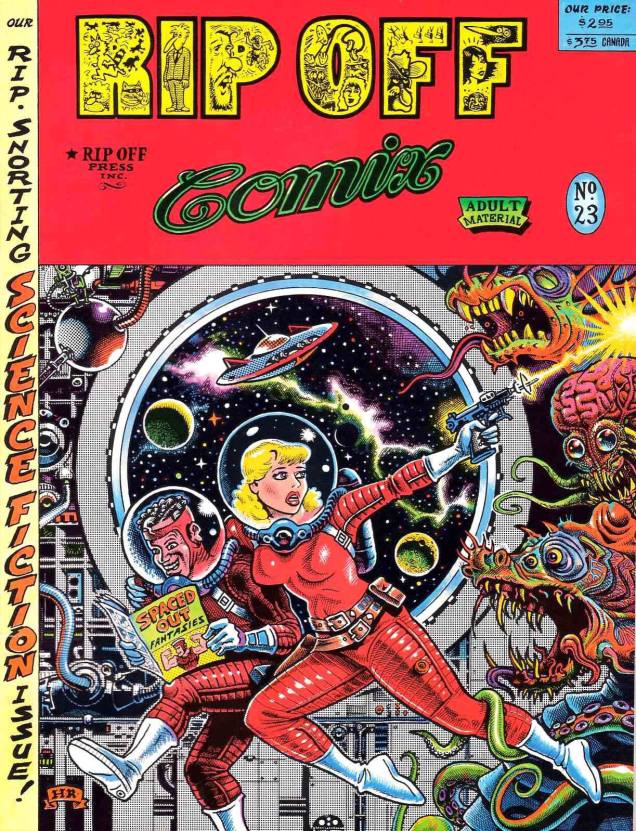
Let’s commence Tentacle Tuesday on a ticklish note (tentacles are itchy, you know, especially when they’re crawling up one’s leg) with Rip Off Comics no. 23, “the rip-snorting science fiction issue!”
Typical: the good-looking gal has to defend herself and her goofy-looking idiot of a partner from tentacles, claws, fangs, and other typical dangers of deep space. Rip Off Comics no. 23 (summer 1989), cover by Hal S. Robins, with colours by Guy Colwell. Look closely at the tiny drawings hiding inside “Rip Off”, and you’ll see Fat Freddy’s cat bouncing around merrily! Actually, you’ll see pretty much the whole cast of Furry Freak Brothers, and then some.
If a tentacle creeps out from the pages of a book you’re reading to gently prod you, you know you’ve made the right choice of reading material.
This Wacky Packages card (from the 14th series, released in April/June 1975) is painted by Norman Saunders from a concept by Jay Lynch (which looks like this). Given that the moon is grinning at them, I think these two are high on something (I’m willing to accept tentacles in space, but I draw the line at anthropomorphized satellites).
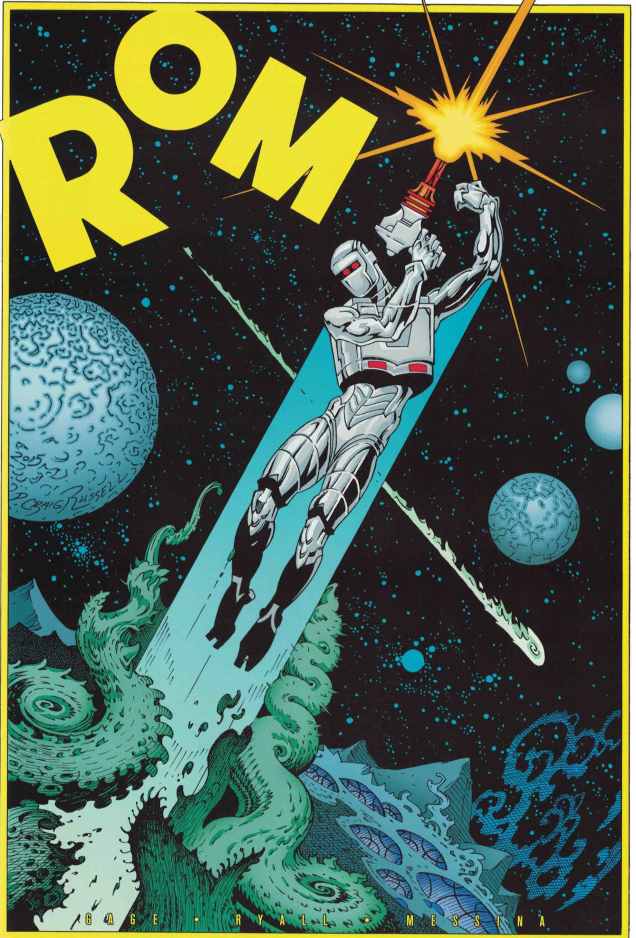
Sometimes tentacles masquerade as waves, but we know better! Dunno why some sea god would want a cyborg chunk of metal, though.
Rom no. 1, July 2016 (IDW), a variant cover from something called « Retailer Incentive ». Art by the ever-decorative and undeniably stylish P. Craig Russell, who unfortunately seems to mostly have squandered his talents on operatic and fairy tale adaptations (not counting a few marvelous short stories). Some people’s thing, no doubt, but not mine!
Rom the Spaceknight was a toy created by three men (Scott Dankman, Richard C. Levy and Bryan L. McCoy) in 1979. His creators called him COBOL (a programming language), but he was renamed into ROM (« read only memory ») by the executives of Parker Brothers, the company that bought rights to the this « beeping, thinking toy » (which Time predicted would « end up among the dust balls under the playroom sofa »). As part of a promotional effort, Parker Brothers promptly licensed him to Marvel. Rom the toy was a commercial failure, but Rom the comic book went on to last 75 issues, beeping its last bleep in 1986 (not counting the comic’s revival by IDW in 2016).
The comic may have passed from Marvel’s hands into IDW’s, but the description still seems to have been written by a hyper-ventilating lummox flinging spit everywhere as he croaks: “WE’VE BEEN INVADED AND ONLY A SPACE KNIGHT CAN SAVE US! Now the ongoing tale of ROM begins in earnest! Christos Gage, Chris Ryall, and David Messina kick off the wildest new series of the year as Rom’s war with the DIRE WRAITHS hits close to home in ‘Earthfall, part 1!’ ‘The long-beloved and even longer absent space hero returns at long last! First, we brought back MICRONAUTS! And Now… ROM! As if Rom’s return wasn’t enough, wait’ll you see how this one ends!” Brr.
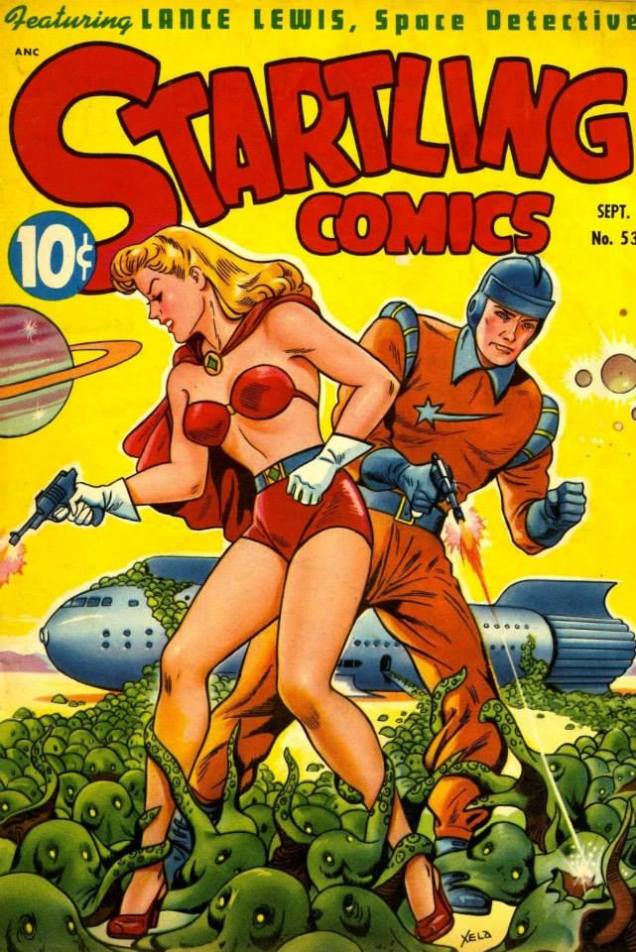
So far, the tentacles featured have been rather on the tame side. Let’s have something properly terrifying…
Lance Lewis (Space Detective) and his girlfriend Marna may be in a tight spot… but I’m sorry, I’m having trouble imagining the terror of being overcome by these teeny-tiny octopuses. They’re just too dang cute, clinging to Marna’s legs like puppies begging for food. Startling Comics no. 53, 1948, the last issue of this series. Cover by Alex Schomburg (1905-1998), a prolific Puerto Rican artist (this is signed as Xela).
Oh well, terror petered out today. I guess this Tentacle Tuesday is not going to scare anybody witless. There’s always next time!