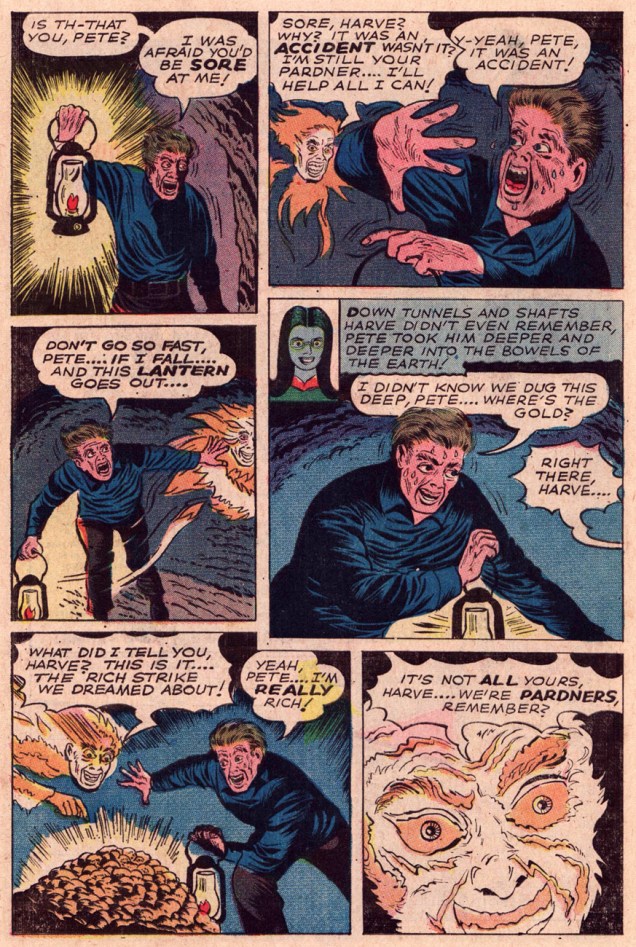
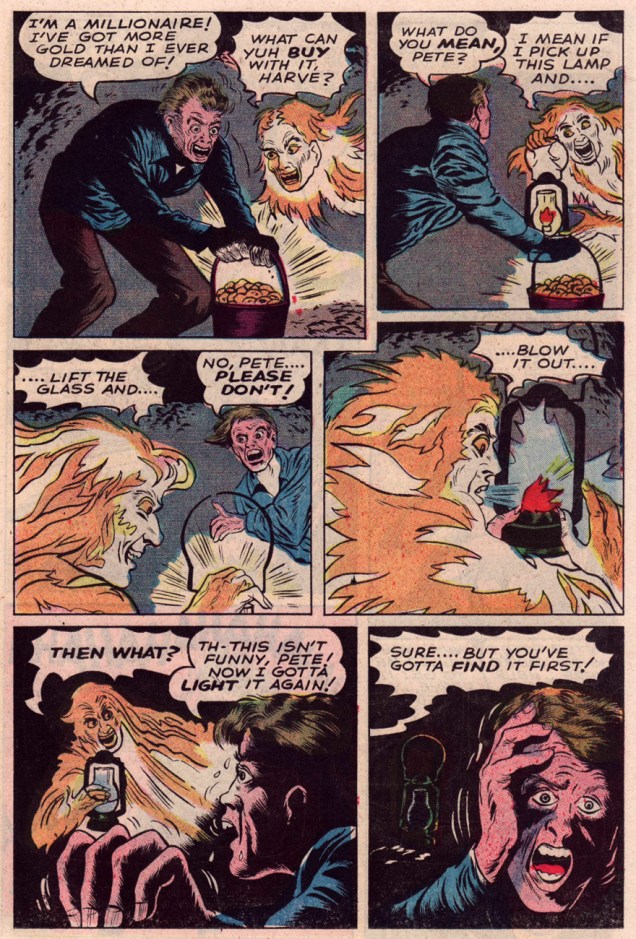
« That’s funny… I didn’t leave the lantern lit… wonder if anybody’s in there? »
In 1972, Golden Age journeyman cartoonist Stanley Josephs Aschmeier (1912-1992) wrapped up his career in comics with a single tale for Charlton, a publisher he’d briefly worked for two decades prior*, pre-Code. Yet earlier, at DC, he’d had a hand in creating Johnny Thunder and Thunderbolt (1939) and Dr. Mid-Nite (1941), the original sight-impaired costumed hero.
While Aschmeier’s already-manic drawing style hadn’t changed much in the intervening years, the industry certainly had, which made him a man well out of time. Still, as with his peer, sudoriparous Rudy Palais‘ final work for Charlton, the nervous energy and artistic freedom yielded something unusual and charming. While this sort of semi-primitive outsider approach decidedly isn’t for everyone, it’s a breath of fresh air. I found it unsettling and baffling when I first encountered it all those years ago, and it hasn’t lost its jolt, unlike many fan favourites I could name.
Without further preamble, here’s Joe Gill and Stan Asch (his abridged nom de plume)’s tale, from Ghostly Haunts no. 27 (Nov. 1972, Charlton.)
By this point, Aschmeier had evolved (or devolved) a highly stylized, woodcut-like approach. Bizarre as it may be, it sure works for me. That’s one of my favourite things about Charlton: leave your “house style” at the door!
Note Aschmeier’s interesting depiction of a revenant, quite unlike Steve Ditko’s lime green, vaporous wraiths or Pat Boyette’s rotting cotton shamblers. Pete Eklund’s shade is more akin to a dancing flame, an electric apparition.
Here’s a guy who *really* gets it! That final panel is one of the most unhinged I’ve had the pleasure of encountering.
As for the story, it’s the soul of the thing: to my mind, what made writer Joe Gill’s work special was his common-sense response to the meagre number of available plots: when the mood struck him, he focused on ambiance, tone and character, as he does here.
I love that our protagonist, Harve Davis, is so shiftless, so insignificant, that the reader can’t even be bothered to hate him: throughout the story, we witness his well-earned unpopularity, and what a shabby and piteous creature he is. He murdered the only man who gave him the time of day, and he was too dense and self-absorbed to be anything but resentful of it. I do feel that the tale’s very construction supports this view: it opens on the commission of his crime, and the aftermath is a fateful tumble of dominos.
And yes, the story is narrated by Winnie the Witch, the Nana Mouskouri of the ghostly storyteller set. Many have noted the resemblance.
*For stylistic comparison, take a gander at a 1944 Mr. Terrific tale by Mr. Aschmeier, and some of his crime comics work from Lawbreakers Suspense Stories no. 14 (Sept. 1953, Charlton), featuring three Aschmeier-illustrated pieces, Flight!, The Green Light and The Face in the Glass. Enjoy!
Welcome to the entertaining world of science-fiction/fantasy of the 60s! If you’re an admirer of extravagant creatures with improbable anatomy, or a fan of twisted stories that take questionable leaps of logic to arrive to an implausible conclusion, willkommen.
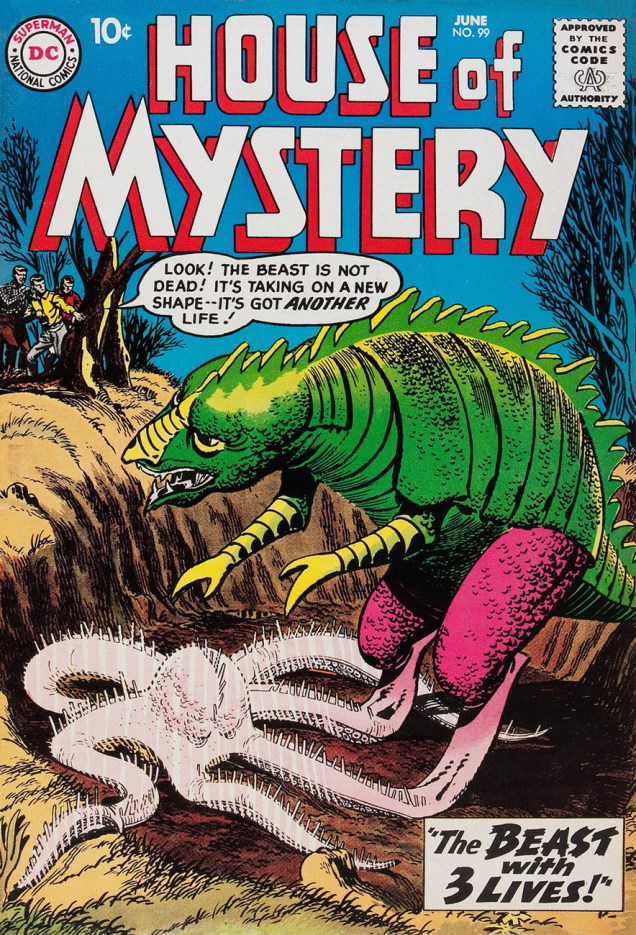
However, if, like me, you tend to root for strange creatures (most of which didn’t want to be discovered in the first place), tread gently. If there’s one pattern in House of Mystery stories, it’s that the “monsters” (that fly in from space/emerge from the sea/crawl out of the depths of the earth/are born in fire/whatever else we can think of) get slain, more often than not, by well-meaning people… or not-so-well-meaning people who are afraid of anything that looks different. If they somehow manage to escape getting shot or bombed out of existence, they’re buried under a convenient avalanche or volcanic eruption.
House of Mystery no. 99, June 1960. Art by Bernard Baily. Yep, the Beast gets killed by the military. It’s sad to think that our reaction to a friendly shape-shifting alien would be “kill first, ask questions later”… but it sadly rings true.
I know that it’s Tentacle Tuesday and everything’s possible, but… this? An octopus with spines on his tentacles (very conveniently placed, I might add) and the puffy eyes of a career alcoholic? A parrot-dragon with opposable thumbs?
House of Mystery no. 113 (1961), pencils by Dick Dillin, inks by Sheldon Moldoff and letters by Ira Schnapp. Err, guys… I don’t think either of these two monsters is all that interested in you, seeing as they both seem to be screaming in horror/pain. If the octopus is Water-Beast, the parrot must be Land-Beast – such wit! I would have gone with “pink thing” and “green bird thing”.
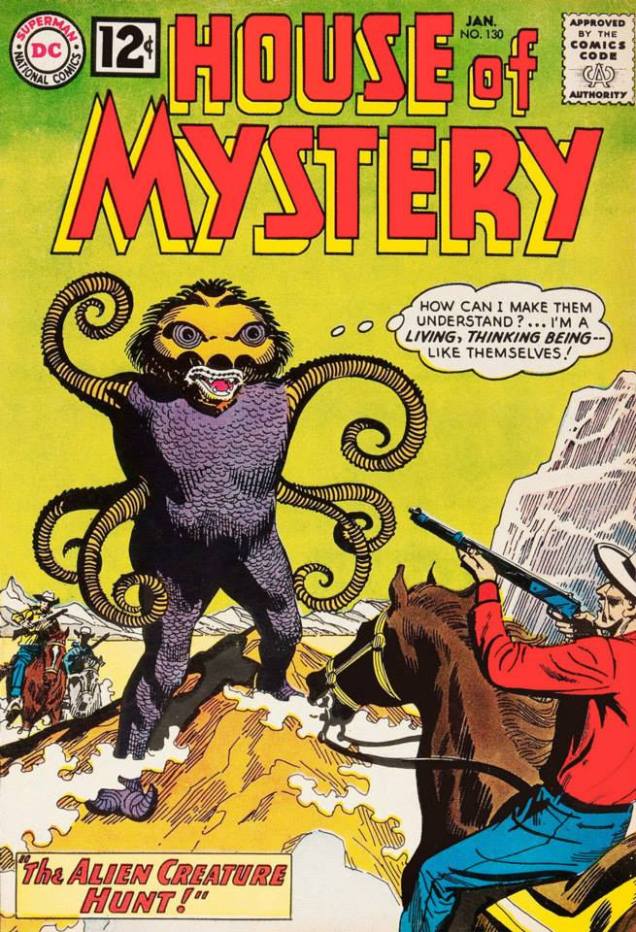
As Tentacle Tuesday continues, we are once again confronted with a situation where misunderstanding between species leads to needless conflict. Shoot first, sort it out later, is the mantra of any red-blooded man! I’m sorry, am I being a tad unsubtle?
House of Mystery no. 130, January 1963. Cover by George Roussos.
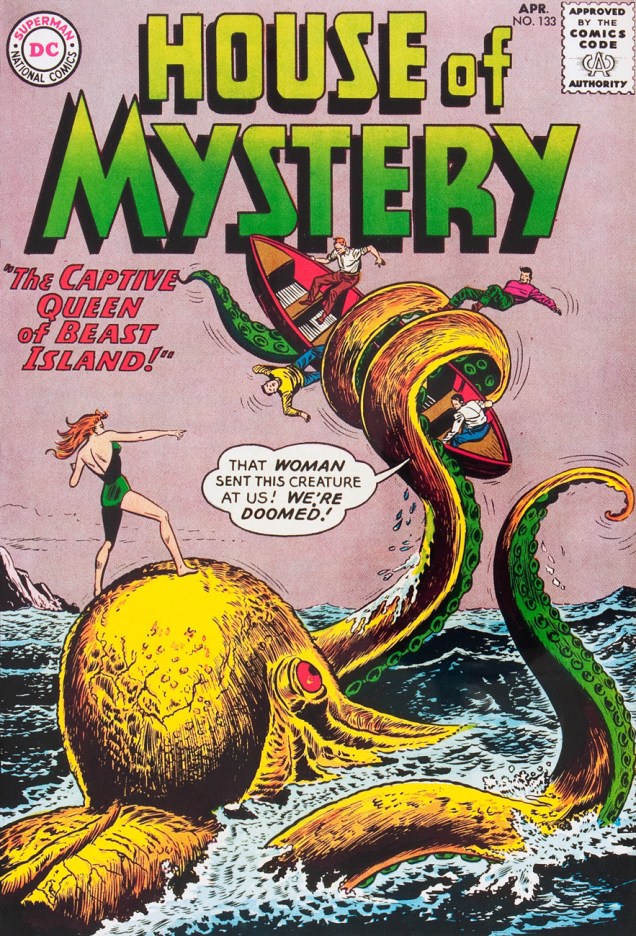
Some guys land on an island patrolled by creatures controlled by a beautiful woman. Well, there’s no need to quarrel, they can talk it out, right?
House of Mystery no. 133, April 1963. Pencils by Dick Dillin, inks by Sheldon Moldoff, letters by Ira Schnapp.
Okay, the woman seems to be friendly. So far, so good.
Art by Howard Sherman.
So perhaps everyone can go on their merry way and leave the island and its creatures alone? No, it’s not enough to just kill them. Oops! The whole fucking island explodes to smithereens when the guys detonate some explosives in a cavern and thus trigger an underwater eruption. I mean, the real threat to these “nice” people was the evil guy trying to gain control of the beasts, but do they try to attack *him*? Nah, they focus on killing the octopus, instead! And the giant armadillo! And the furry rhinoceros!
« And soon, Beast Island sinks beneath boiling, steaming waters… », the omniscient narrator tells us. « The island is gone now – and so are the terrible things that walked on it, flew over it — and swam around it! » The power-grabbing asshole is okay, though – he escaped just fine!
There’s plenty more tentacles in House of Mystery – to which we will no doubt return.
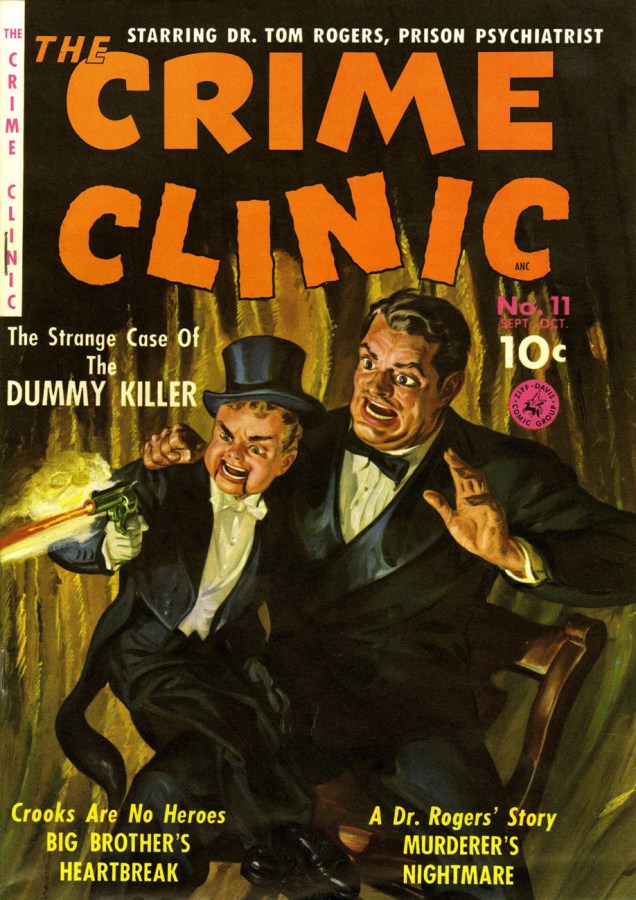
« Now, Carlos — put that gun away! »
« Why, Fernando, I thought I’d start the show with a bang! »
That guy in the audience with the irritating donkey laugh is finally getting his. This unforgettable cover is the work of the peerless Norman Saunders, whose long and prolific career blazed its way through pulps, comic books, slicks, men’s adventure magazines, paperbacks, trading cards… you name it!
This is Ziff-Davis’ The Crime Clinic no. 11 (actually its second issue, September-October 1951). And for once, the inside story kind of matches the cover mayhem.
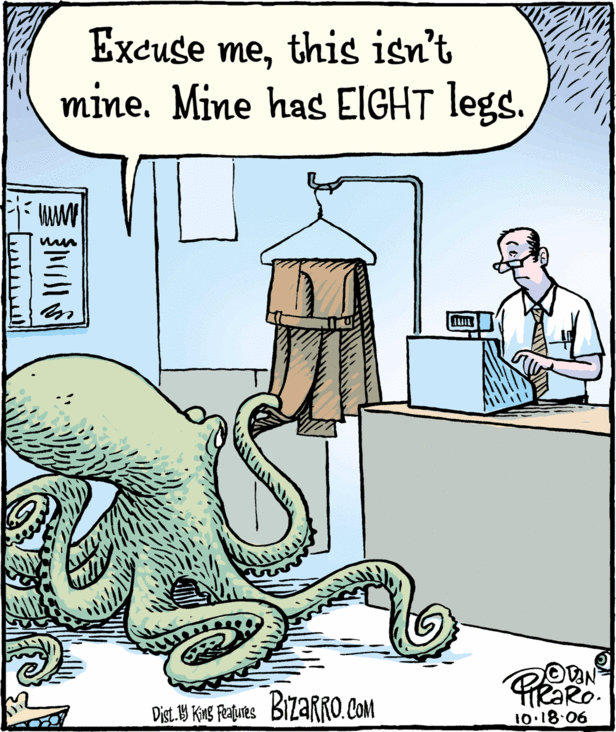
Today’s Tentacle Tuesday is home to that conventional, oft-seen beast, the comic strip. Without getting into the complexities of defining this term, I use “comic strip” here to refer specifically to the (syndicated) newspaper comic strip, although by now the newer ones may have never seen print in a newspaper, only online.
There’s one that doesn’t need an introduction. Go visit his website, though!
Most of these are available for perusal on one of the comics-clustering websites, such as gocomics.com, or sometimes directly on a strip’s own website (in which case it also becomes a webcomic strip, I guess). I’ve provided the links in the description.
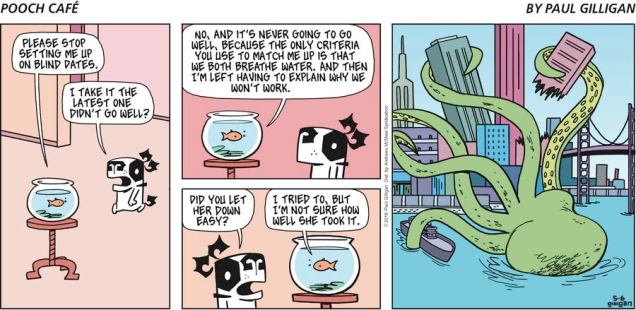
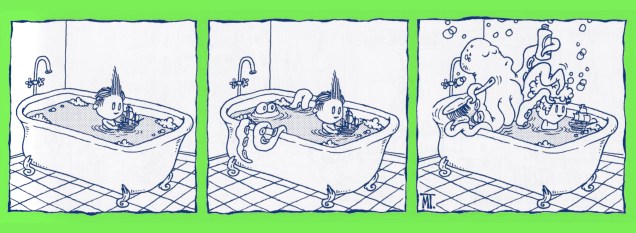
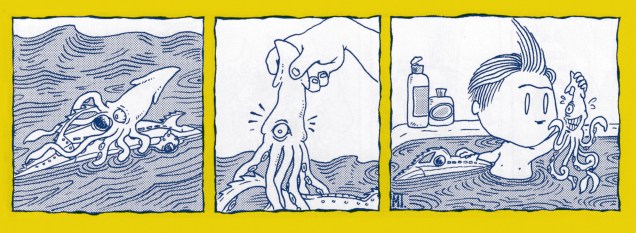
Overboard by Chip Dunham, July 3rd, 2010. Overboard’s been around for almost 30 years.Brevity, March 27th, 2011. This strip was created by by Guy Endore-Kaiser and Rodd Perry, and for the first couple of years (it’s been around since 2005), it was plotted and drawn by them. Dan Thompson took over at some point… around 2012 or something like it (I can’t find any hard and fast information online). The strip has a home here, but frankly it’s not really worth visiting (terrible art, dumb jokes).Once again, Poncho gets his fishy friend into trouble. Pooch Café, May 6th, 2018. I hate Poncho and think his owners should have kicked him out a long time ago, but there’s enough characters and surreal situations to tolerate his presence in this fun strip.Sherman’s Lagoon by Jim Toomey, 20th April 2016, also around for almost thirty years (it made its debut in 1991).Not to forget our classics! One of the nice things about Calvin and Hobbes is that it was never ghost-written – when Bill Watterson quit it in 1995, that was it. However, you can catch re-runs in many places, for instance here.Liō (not forgetting the accent!) by Mark Tatulli and distributed by the Universal Press Syndicate since 2006. This is the first appearance of Ishmael, Liō’s cephalopod best friend. Tatulli says that he at first wanted to make Ishmael into a mother figure for motherless Liō, but that’s not the way things worked out.Liō routinely encounters tentacles, so it would be a long list indeed, but here’s another favourite. Both strips were plucked from the collection Liō’s Astonishing Tales: From the Haunted Crypt of Unknown Horrors, 2009.
We started on a Bizarro note, so let’s wrap things up with another.
C’est un fou qui repeint son plafond et un autre fou arrive et lui dit: « Accroche-toi au pinceau, j’enlève l’échelle!*»
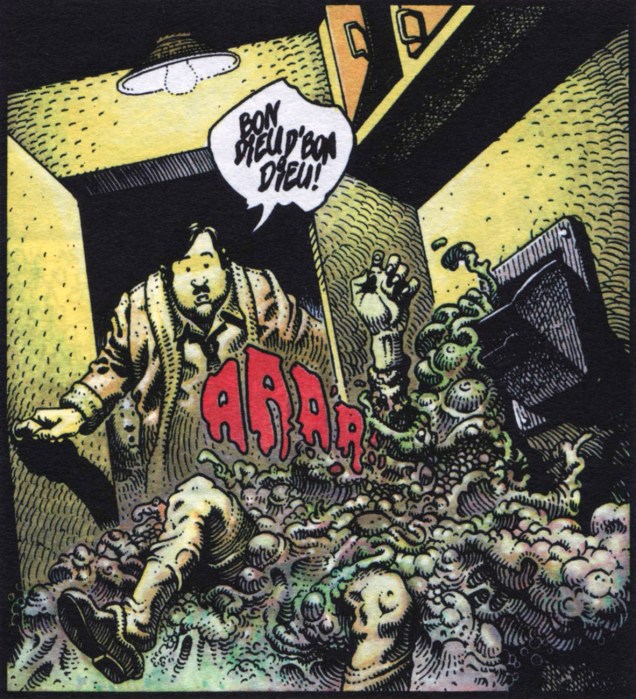
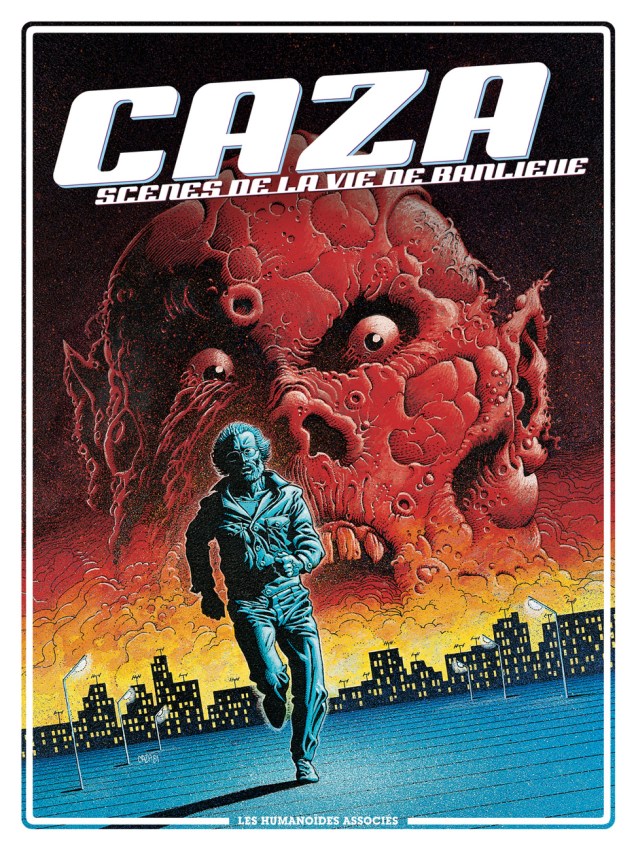
Marcel (and the hapless Yvonne) meet the Homo-Detritus. From Pilote no. 47-bis (April, 1978)
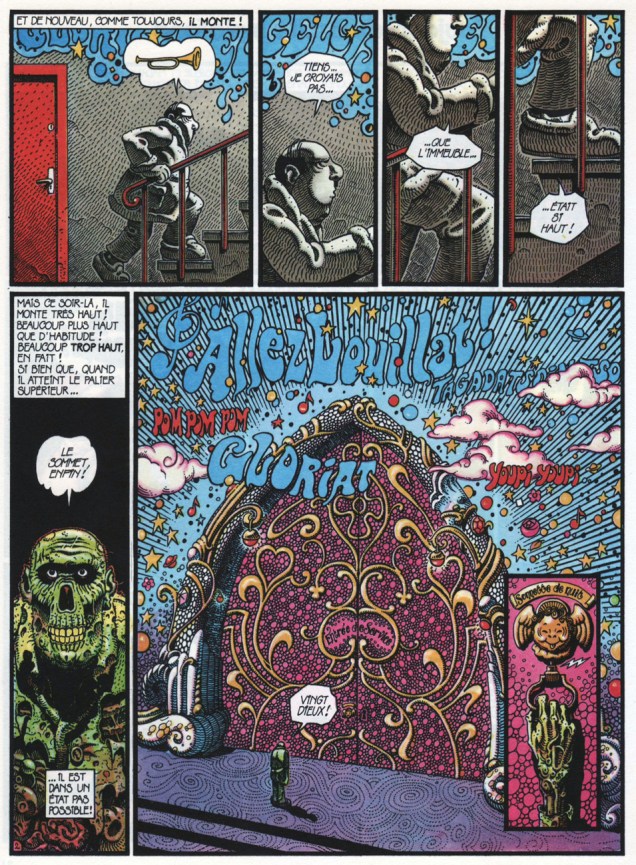
Poor Marcel Miquelon: a simple suburban nobody, he merely wants to get a good night’s sleep, but it’s never in the cards. When he and his Yvonne go to bed, each night at 10, some din from above invariably keeps him awake and frustrated. So what can he do but seize his faithful broom by the handle and bang on the ceiling to manifest his discontent? And dreadful things happen, in increasingly byzantine shades of dreadfulness.
These loosely-connected vignettes appeared sporadically from 1975 to 1979, under the portmanteau heading of Scènes de la vie de banlieue in the French monthly Pilote (1974-1989). They were the brainchild of Philippe Cazaumayou, alias Caza (b. November 14, 1941, Paris), also a renowned science-fiction illustrator, which should certainly surprise no-one.
This episode is titled Toujours du bruit au plafond (« Still some noise on the ceiling »); it originally saw print in Pilote Mensuel no. 34 (March, 1977). It’s the rare (possibly the only) one that ends peacefully for Marcel, perhaps because he didn’t bother with the broom. Better St. Peter than… well, everything else.
*One of the hoariest French jokes, everyone’s heard it, and its appeal has whirled countless times around the bend, deep into irony and meta-subtext. Thankfully, though, it’s actually translatable, at least verbally: A lunatic is painting the ceiling. Another madman comes along and says: « Hold on to the brush, I’m borrowing the ladder! »
A ‘Scènes de la vie de banlieue’ collection (Dargaud, 1982). I agree: for all he’s gone through, Marcel Miquelon does deserve his own statue.The collected works (Les Humanoïdes associés, 2017)
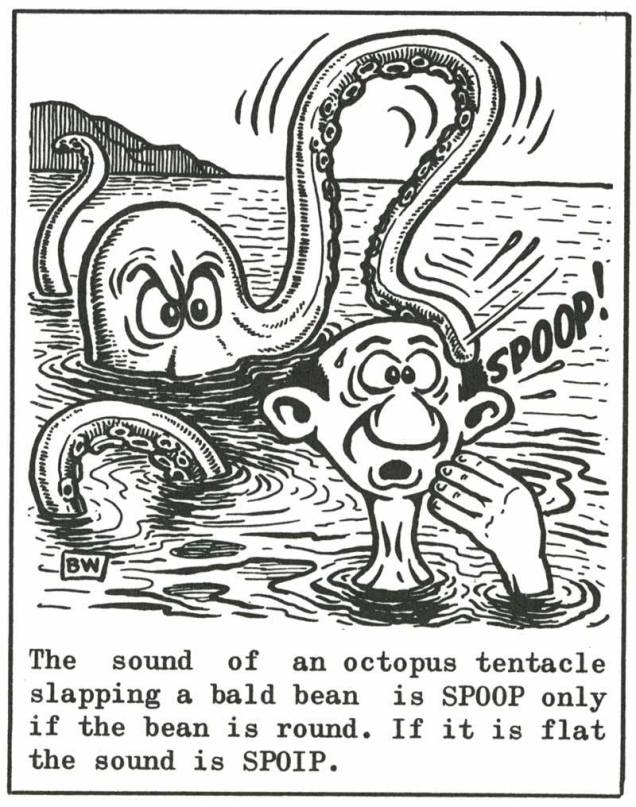
SPOOP! And a happy Tentacle Tuesday to you, too. Today’s feature is devoted to Basil Wolverton. A lot could be said about his sense of semi-slapstick, semi-surreal comedy and his unhinged-yet-meticulous drawing style, his delightful work in the realm of humour comics or his genuinely scary contribution to horror-in-pictures… but as I have a one-track mind, I’ll focus on his love of tentacles. No matter what sort of thing he was drawing, tentacles somehow managed to slip into it… and that’s understandable, for tentacles are both hilarious and fearsome. Without further ado, here’s your master of ceremonies and cephalopods… Basil Wolverton!
Here’s some more sounds you might like to know about, to be used indiscriminately to spice up humdrum conversations around the water cooler:
Hungry cannibal filing eyetooth: FWATCH! Man with calloused feet crossing rough linoleum: SKIRP! SKIRP! Thumb gouging eye: SPOP! Hot lava speweing on WCTU convention: FOOSK! Hot lava spewing on Elks’ convention: SSSCRISH! Person skidding on hot stove in bare feet: SCREESH! Beaver biting into wooden leg: CRASP! Car crashing into large vat of frogs’ eggs: SKWORP! False teeth falling through skylight: TWUNK! Sock in the face with Sears Roebuck catalog: PWOSH! Sock in the face with Montgomery Ward catalog: PWASH!
This mirth-inducing stuff is from an article that Basil Wolverton wrote for the Daily Oregon in 1948 called “Acoustics in Comics”. Here’s another excerpt of that article (which is definitely worth reading in its entirety, and is fortunately easily found online… here, for instance):
« ‘I want realism!’ he (my publisher) had bellowed. ‘No more of this wild imaginative stuff that’s causing some people to want to ban our comic books! From now on, get that realism in there, and your strips will be horribly funny! Then the readers will go into hysterics and laugh like crazy, and our books will be acclaimed the most laugh provoking on the stands!’ That meant that an imaginative word like CRANCH was taboo. It was up to me to get the real sound word. »
And, hoppin’ horse hocks, he did.
Enough of the rib-splitting stuff: this is a serious blog that discusses serious horror. *ahem*
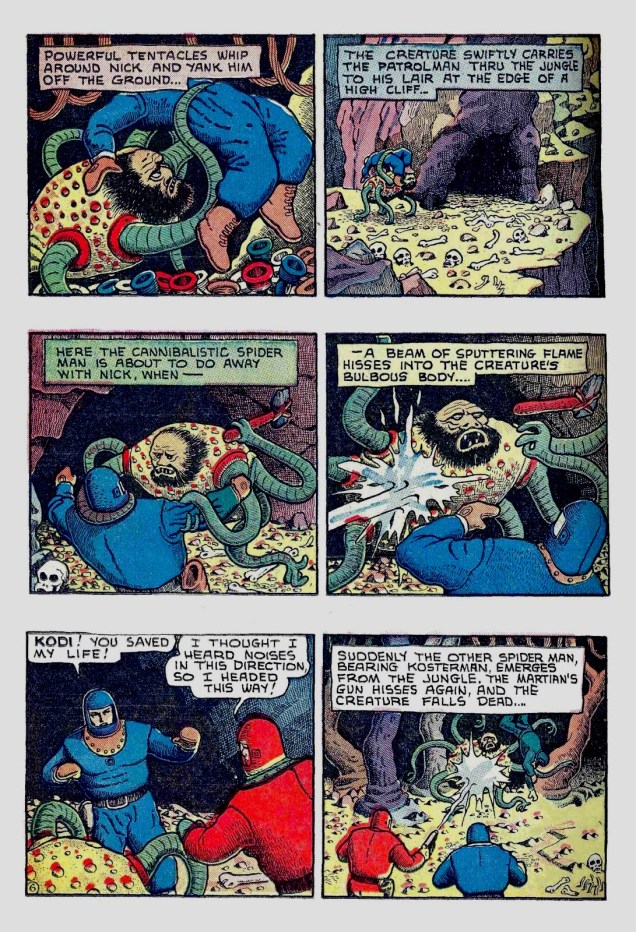
Page from Ethan Downing (1935), an early endeavour by Wolverton – unpublished.Amazing Mystery Funnies vol. 2 no. 12, December 1939. You may with to point out that this bandit is a cannibalistic spider, *not* a tentacled creature, but look at how he’s using his appendages, look me straight in the eye, and tell me that those aren’t tentacles. Besides, spiders have 8 legs, not 6, and this guy is definitely a 6-leg wonder… and they get called « tentacles », right from panel one.
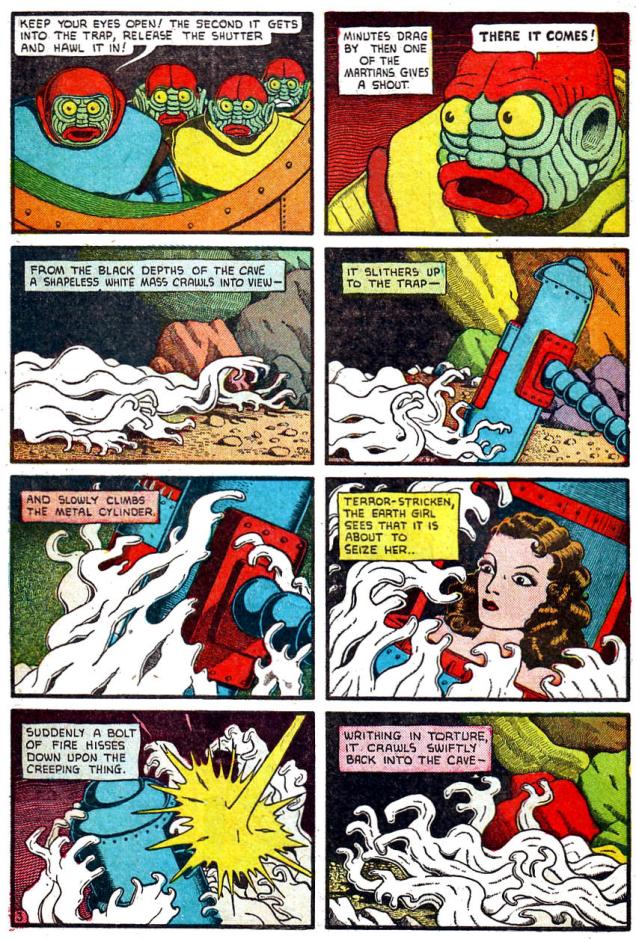
No inventory of Wolverton tentacles would be complete without the classic « Creeping Death from Neptune », first published in Target Comics vol. 1 no. 5 (June 1940), and reprinted many a time since, nearly as often the amazing Brain Bats of Venus (also quite heavy in quasi-tentacles. If aren’t familiar with it already, do yourself a favour and read it in full here.)
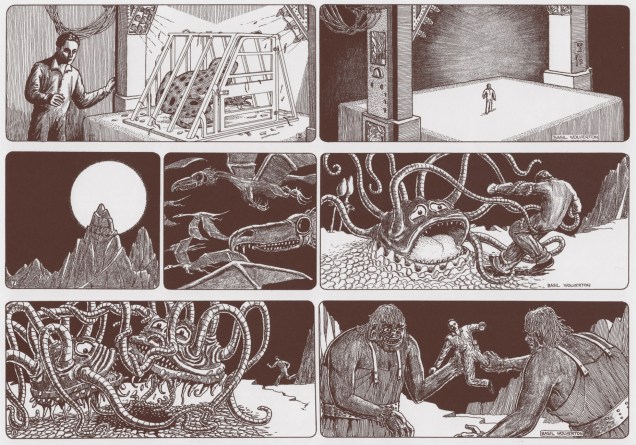
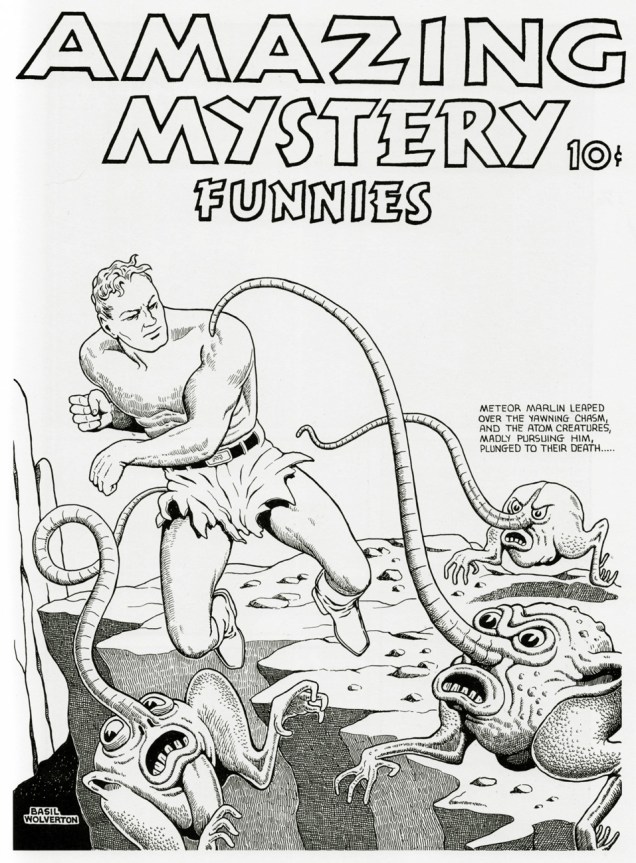
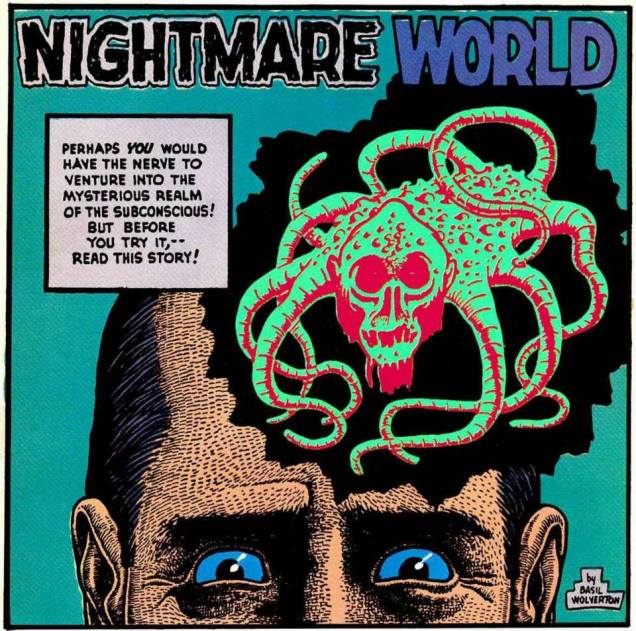
A page from Creeping Death from Neptune, first published in Target Comics vol. 1 no. 5 (June 1940). The earth-girl is interestingly deadpan about being consumed alive by some sort of slithering weirdness.This story also has « tentacle-like » metal arms. I’m telling you, pretty much everything’s a tentacle where Wolverton is concerned.Meteor Marlin, cover illustration for episode one, April 4th, 1940… never published. In this one, noses are tentacles!A panel from Nightmare World by Basil Wolverton that originally appeared in Weird Tales of the Future no. 3, 1952. This is a reprint from Mr. Monster’s Super Duper Special no. 8, 1987, re-coloured by Jeff Bonivert.
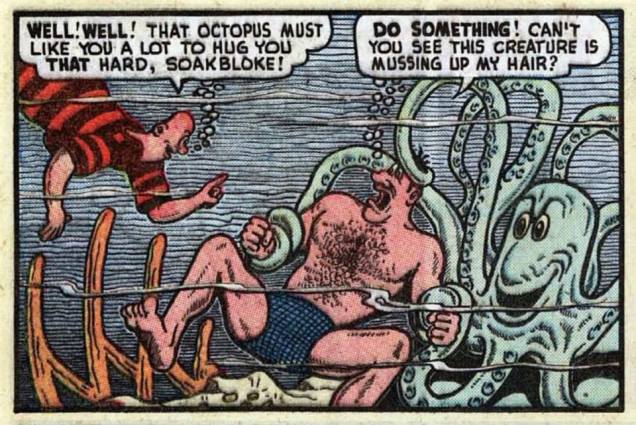
Phew! I’ll end this on a humorous note: octopuses evidently make fabulous hairdressers.
This is a panel from a Powerhouse Pepper story that doesn’t really have a title, being referred to as “Haw! Haw! Grab a good gander…” instead. Originally published in Tessie the Typist Comics no. 9, April 1947.
Sadly, Wolverton’s weirdly frightening villains did not always find favour with the powers-that-be. Back in 1940, Jim Fitzsimmons, assistant editor at Centaur, publisher of Amazing Mystery Funnies, wrote:
« Though the fantastic and weird are the essential selling point of this feature, we would advise that you keep away from the use of revolting characters such as Brain-Men. Some of these characters you have developed have actually sent shudders down my otherwise unconcerned vertebrae. »
Reading The Life and Comics of Basil Wolverton, Volume 1: 1909-1941 written by Greg Sadowski (2014, Fantagraphics), one gets the impression this brilliant master of spaghetti-and-meatballs* comics spent his artistic life trying to fit his imagination into the narrow guidelines imposed by editors, heads-of-companies and other pundits. He died in 1978, aged 69, but was active in the comics field until 1973 («Plop!») I’ll leave it for people more erudite than I to debate his success (or lack thereof) in the comics field…. I’m just happy to witness a resurgence of interest in this great artist, and enjoying the treasure-trove of material that’s available.
« Last year I went fishing with Salvador Dali. He was using a dotted line. He caught every other fish. » — Steven Wright
In 1974, prodigious underground cartoonist Rick Griffin was commissioned to design a cover for Welsh rockers Man’s ninth opus… and this is what he came up with.
The original version of Griffin’s proposal, cheekily titled « The Baptism of Alfred E. Neuman. »
While the image of the grinning fool popularly known as Alfred E. Neuman was, and remains in the public domain, Griffin was really pushing his luck, even without MAD Magazine’s distinctive typeface on bold display. Let’s just say William M. Gaines’ lawyers had far more than a leg to stand on.
Understandably reluctant to let such a lovely *and* provocative work of prime Griffin altogether go to waste, Man (and their legal counsel, presumably), engineered a clever and elegant design solution, shown below, which graces the band’s Slow Motion album, issued in late 1974, and still thumbs its nose at MAD Magazine, exceptionally cast in the thankless rôle of the fuddy-duddy villain.
However, here’s an account — circa 2023 — I recently discovered that casts the matter in a whole new light: « John Peel made ‘Day and Night‘ his Single of the Week in Sounds, but it was the album cover that attracted most comment. American counterculture artist Rick Griffin had come up with a design that prominently featured Mad magazine character Alfred E. Neuman, only for the cover to be subsequently cropped so that Mad’s cover boy was merely a peripheral presence. For years it was claimed that Mad had refused permission for Neuman to be shown, but it now appears they had actually given tacit verbal approval, and that it was the record company, United Artists, who made an executive decision to censor the design without contacting the magazine. »
This illuminating bit appears in David Wells’ (of Cherry Red Records) exhaustively researched — and exquisitely written — liner notes to Grapefruit Records’ Patterns on the Windows: The British Progressive Pop Sounds of 1974 boxed set. Recommended, as is the rest of this chronological series.
As a born-again Christian (circa 1970) *and* surfer, it follows that fish were, topic-wise, a natural fit for Griffin.
A painting from Griffin’s foremost undertaking of the 1970s, « The Gospel of John » (available to this day!); this one illustrates John 21:6, « And he said unto them, cast the net on the right side of the ship, and ye shall find. They case therefore, and now they were not able to draw it for the multitude of fishes. »
For the record, I prefer my fish alive and swimming free.
« That minuscule ogre on the throne must be the King. What a peculiar little man. »
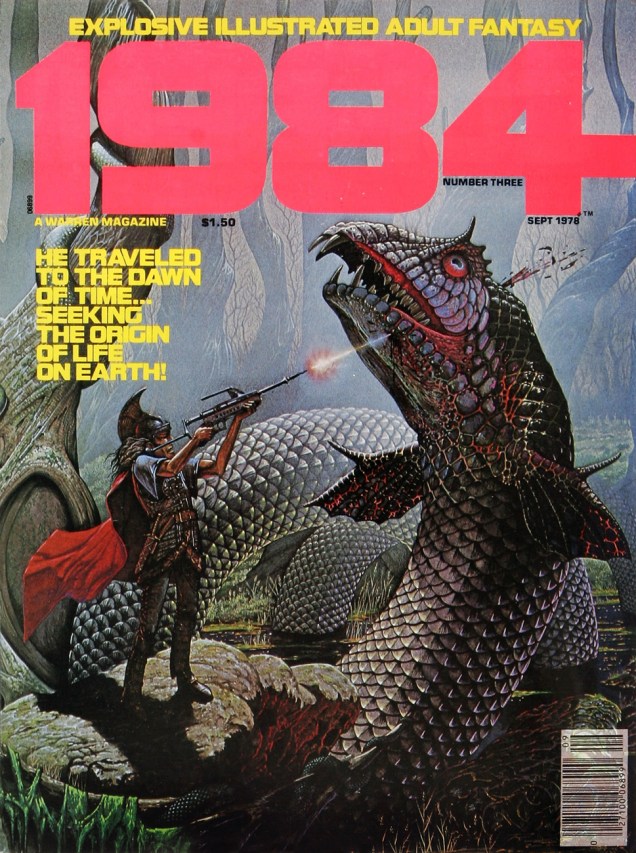
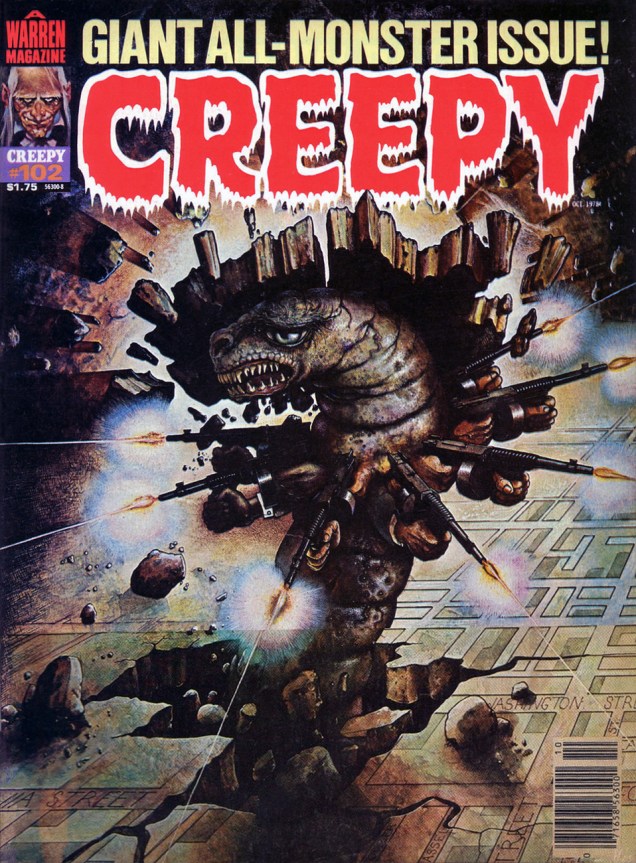
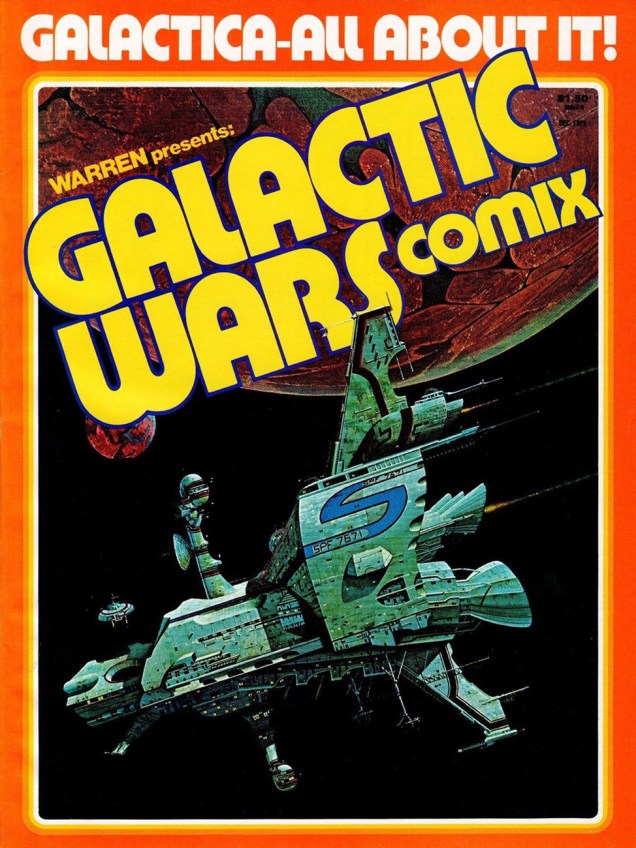
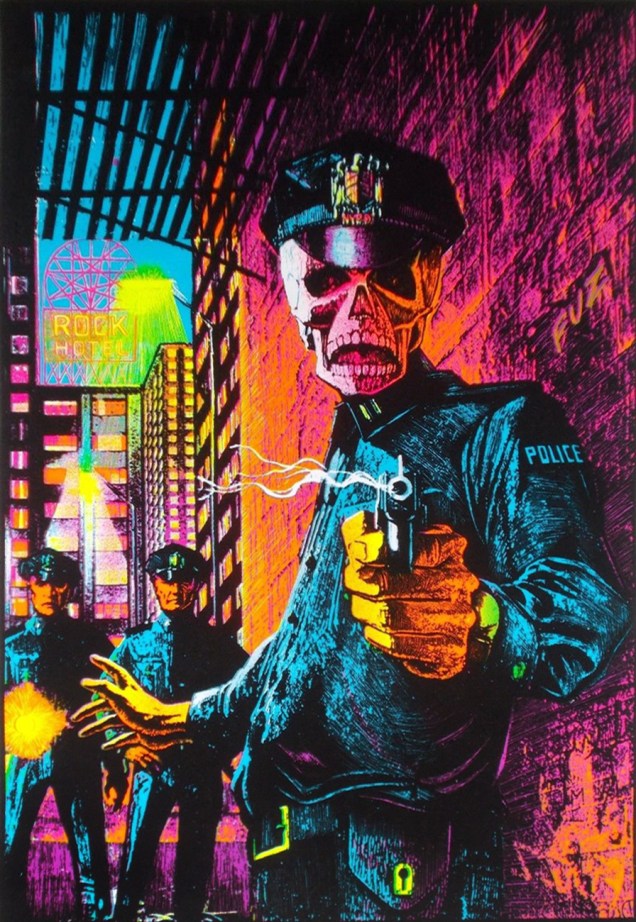
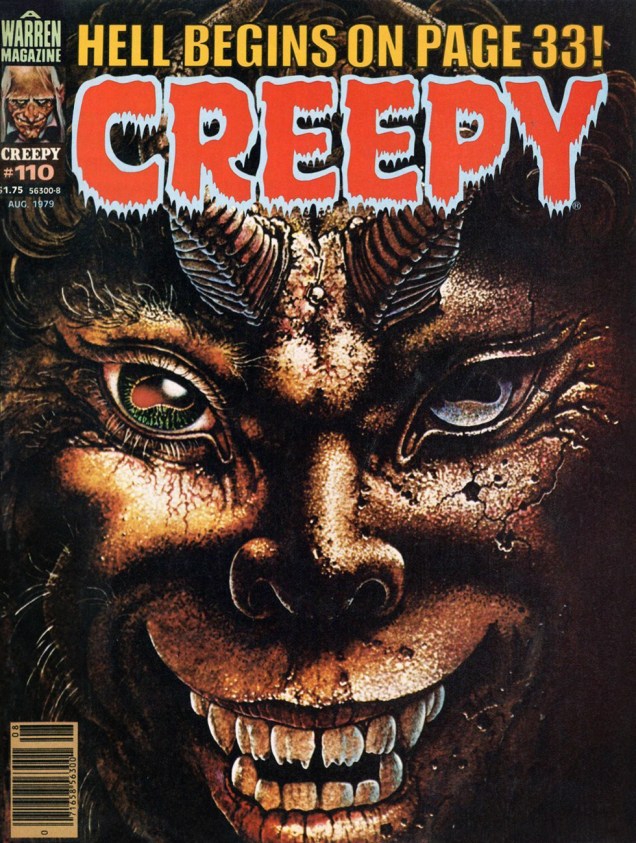
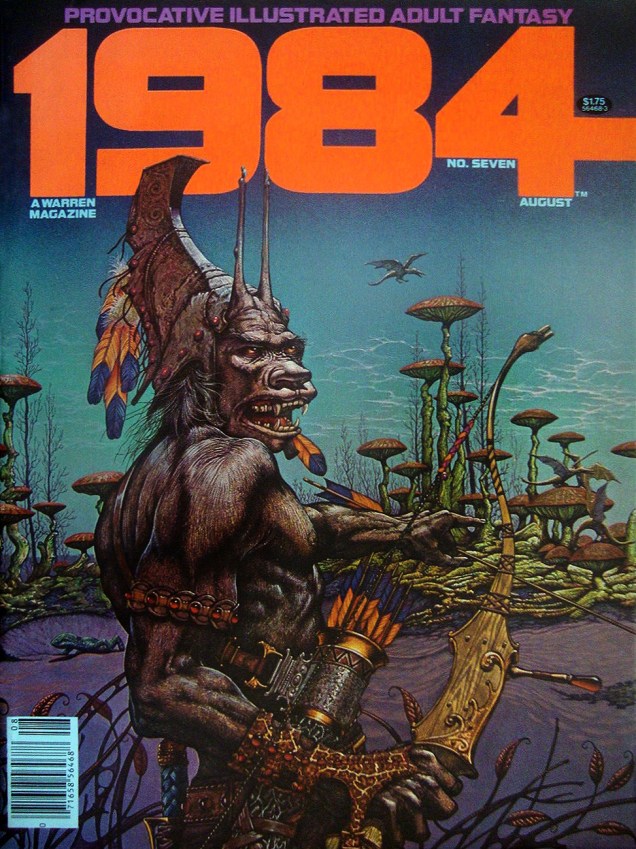
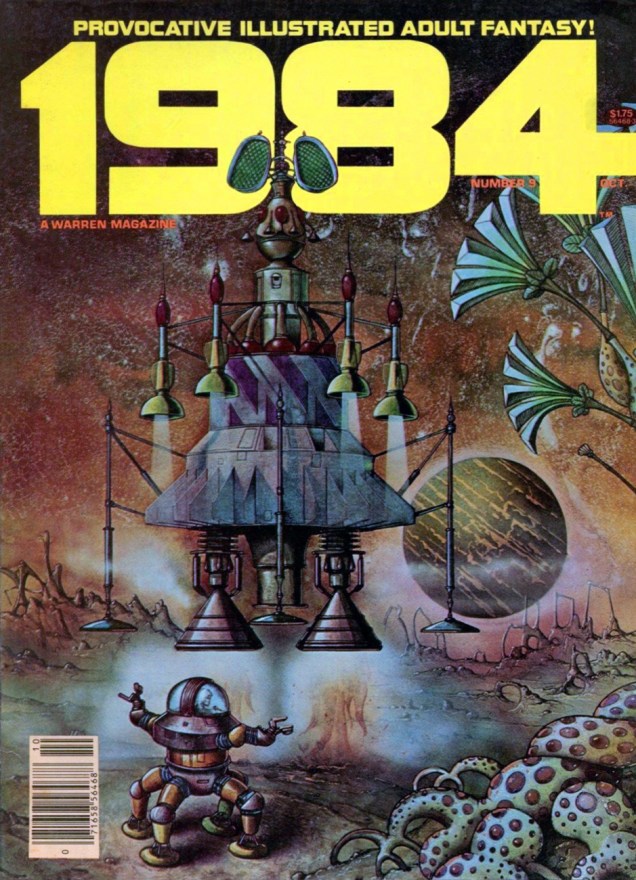
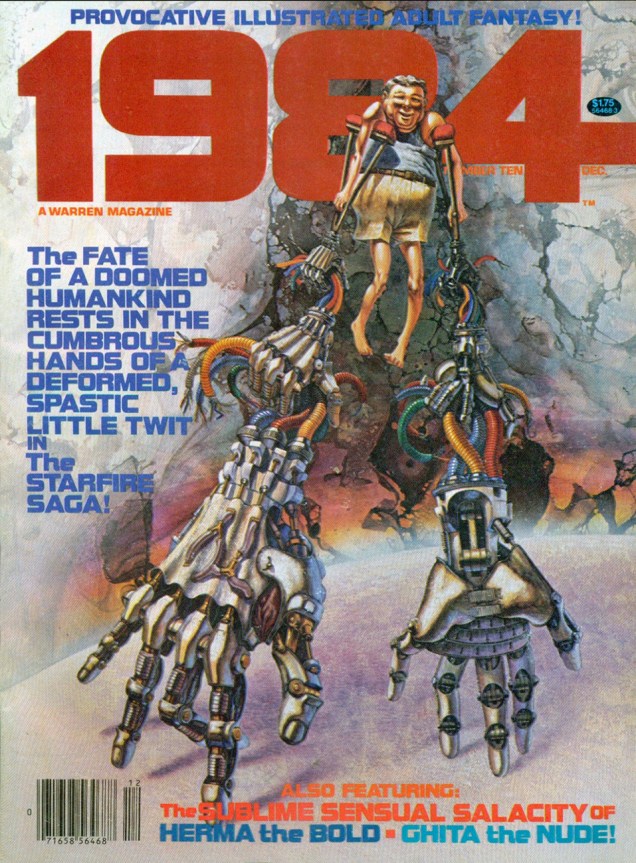
In 1978-79, the rightly-celebrated English fantasy artist Patrick James Woodroffe (b. Halifax, West Yorkshire, on October 27, 1940; d. May 10, 2014), fresh from his high-profile paperback (much Moorcock!) and album cover assignments (including Judas Priest’s splendid Sad Wings of Destiny), hired out his talented brush with Warren Publishing long enough to produce ten covers, a varied, eye-catching and often unusual lot. Let’s make the rounds, shall we?
« He isn’t a *bad* sort. He just lets his temperamental gonads get the best of him! » Using a laser rifle on a dragon? Hardly seems sporting, does it?
Here we make the acquaintance of a memorably omnidextrous lepidopteran gunner. This is Creepy no. 102 (October, 1978). Read the entire issue here: https://archive.org/stream/warrencreepy-102/Creepy_102#page/n91/mode/2upOne of Warren’s post-Star Wars, all-reprint cash grabs of the era… but it’s got a Woodroffe cover.Eerie no. 98 (January, 1979) Likely the darkest of the set in terms of subject matter. Visually, it certainly brings to mind the visual vibe of John Carpenter’s They Live, still nearly a decade away.Interestingly, the piece has also made the rounds, in a modified version (flipped, for one thing), as a “black light” poster titled « In the Name of the Law ». Speaking of the law, was the artist duly compensated?Don’t mess with the Surly Smurf! This dusky scene is dated 1975, so it’s safe to assume it wasn’t created expressly for this publication. This is Warren’s 1984 no. 5 (February, 1979.) Aside from the usual sex fantasies and space operetta from the usual suspects, the issue holds a single nonpareil gem, Nicola Cuti’s « I Wonder Who’s Squeezing Her Now? », gorgeously brought to life by Ernie Colón and Wally Wood. Bear with me, we’ll return to it in due time.« You may think this all strange nonsense; it may be strange, but it is true, and the ancients knew what lifting the veil means. They called it seeing the god Pan. » — Arthur Machen With his second and final Creepy cover (no. 110, August, 1979), Woodroffe lifts the veil, and how, on a troubling closeup of a gleefully sinister Greek God of the Wild.« Well, if that ain’t about the unfriendliest thing I’ve ever heard of… » 1984 no. 7 (August, 1979.)Aw, missed your ride home. This is 1984 no. 9 (October, 1979.)As it turns out, one couldn’t have picked a better artist to depict « the cumbrous hands of a deformed, spastic little twit », though he seems like a sweetheart, really. On this whimsical note ends our survey of Mr. Woodroffe’s Warren covers. This is also the last issue of 1984 under that title; it would leap a decade ahead to “1994” and carry on for another nineteen issues.
Mechanical tentacles! Cephalopod monsters communicating by mental telepathy! Even Jimmy Olsen playing the part of a monster in an alien horror movie! Yes, it’s all this and more in this Tentacle Tuesday post (after which I’ll quit bugging you with various cephalopods until next Tuesday).
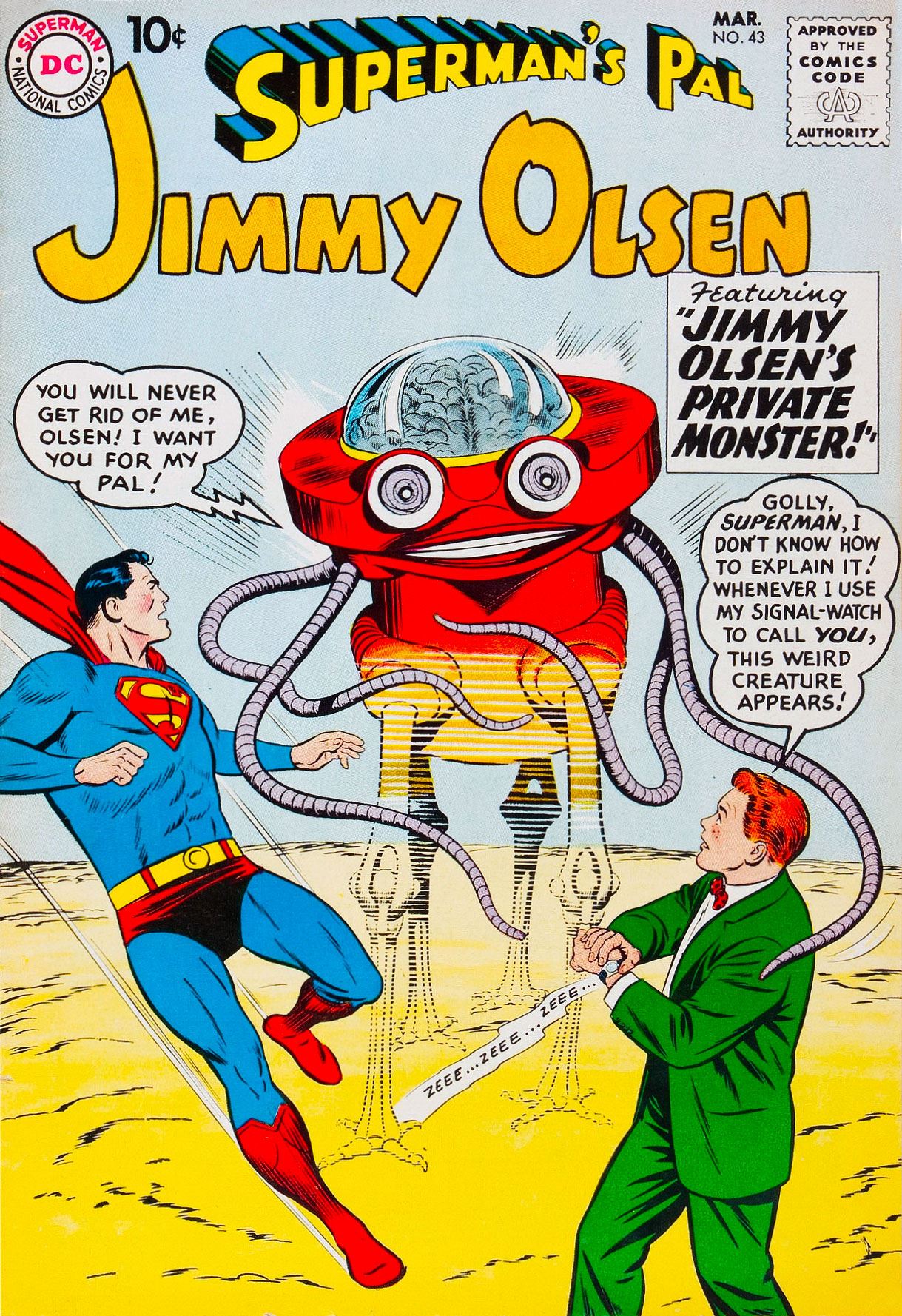
There’s nothing quite as annoying as someone who wants to be your friend against your wishes. Superman’s Pal, Jimmy Olsen no. 43 (March 1960), pencils by Curt Swan and inks by Stan Kaye.
Head over to the Fourth Age blog for a further discussion (with pictures!) of the cover story from this issue, “Jimmy Olsen’s Private Monster!”, written by Jerry Siegel (ahem…) and illustrated by the aforementioned Curt Swan (pencils) and John Forte (inks).
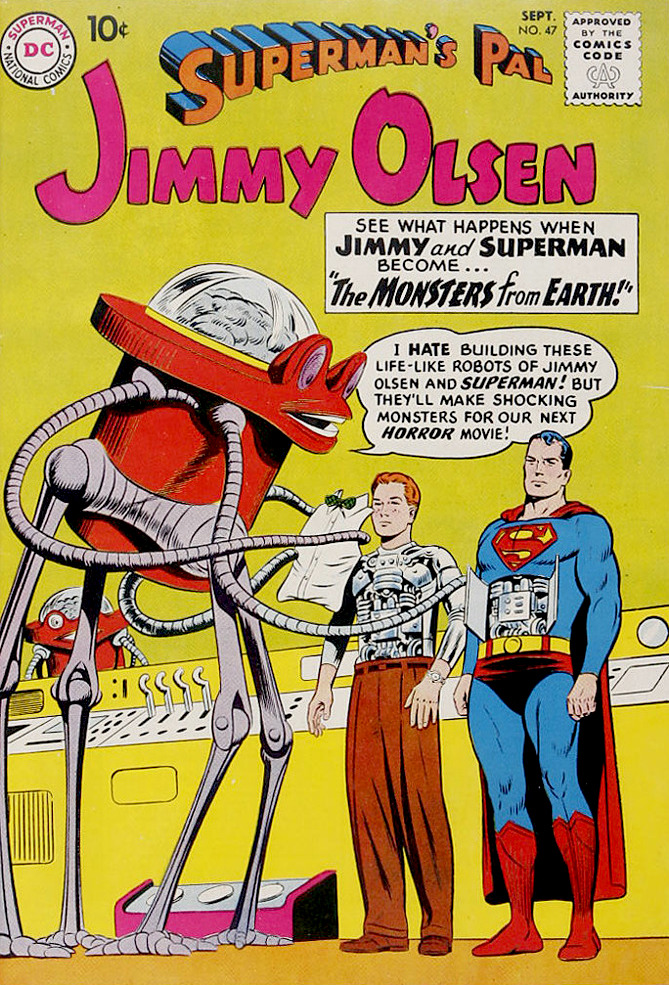
The two-eyed, many-tentacled mechanized wonder appears again in Superman’s Pal, Jimmy Olsen no. 47 (September 1960):
It’s the same cast: pencils by Curt Swan and inks by Stan Kaye; letters by Ira Schnapp.Freaking cute.
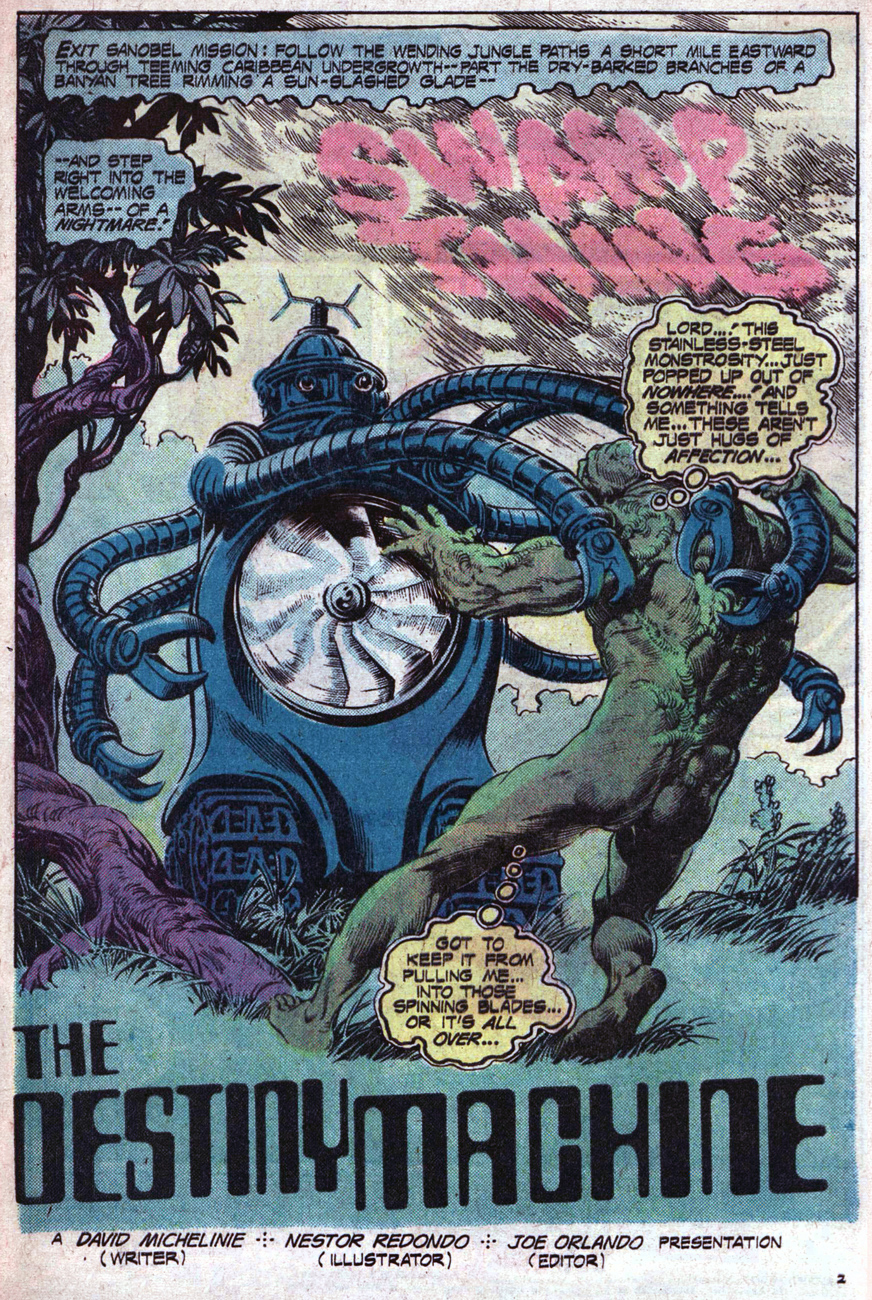
In a similar line of thought (but some 15 years later), a more steampunk relative of the creature above appears in Swamp Thing.
Swamp Thing no. 17 (July-August 1975). In case the credits are too small to read, script by David Michelinie, pencils and inks by Nestor Redondo, colours by Tatjana Wood, letters by Marcos Pelayos.
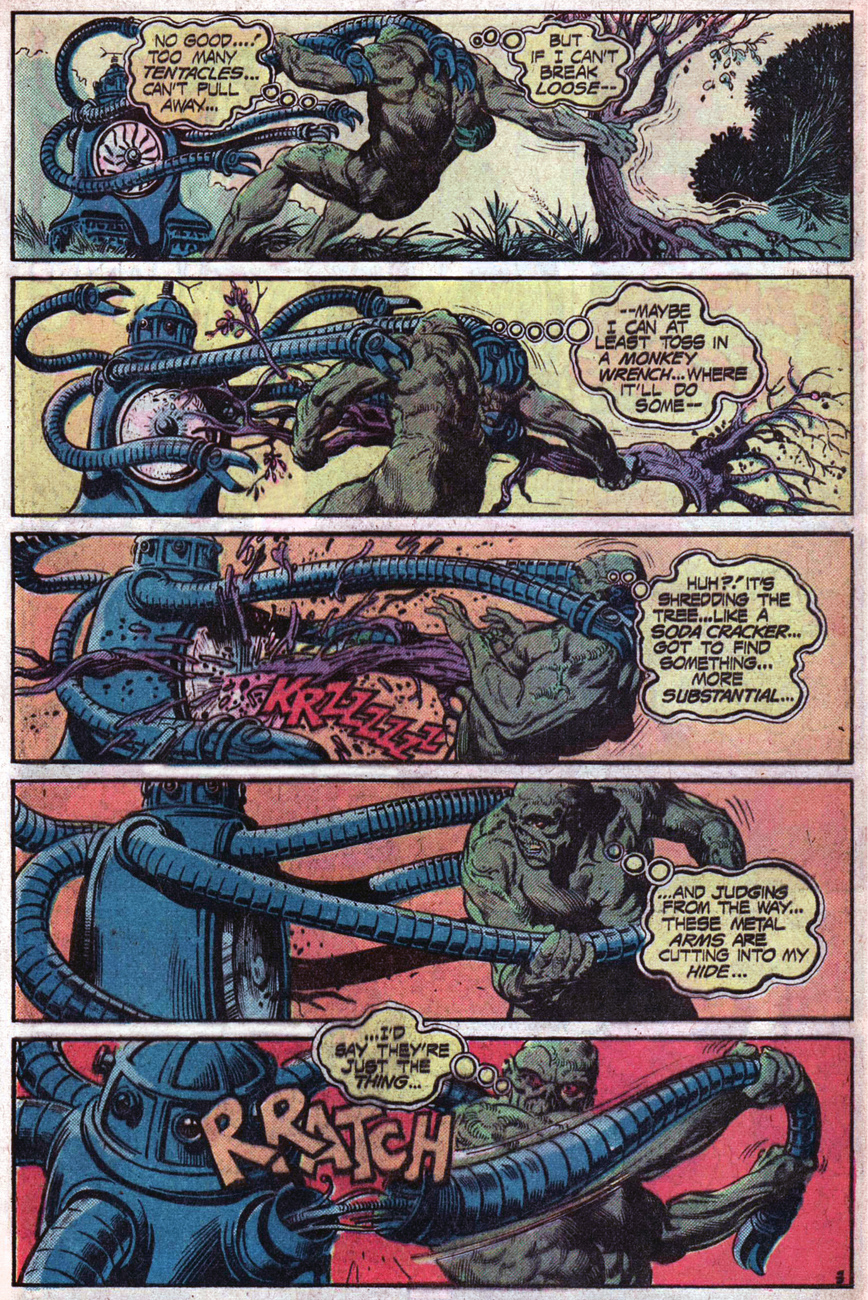
And here’s a peek at the glorious (I’m a fan of Redondo) inside:
« But destroying that thing doesn’t answer the questions it brought up… like what a stainless-steel octopus is doing in the middle of a jungle… » That’s an excellent question – but destroying this mechanized, tentacled abomination was still a good idea, answers or no.
Here’s another file for our records of Tentacular fascination: the Boy Commandos’ intrepid gang of feisty moppets, tired of fighting Nazis, switch it up by doing battle with some tentacled robots.
Boy Commandos no. 17 (September-October 1946). Cover by Jack Kirby.
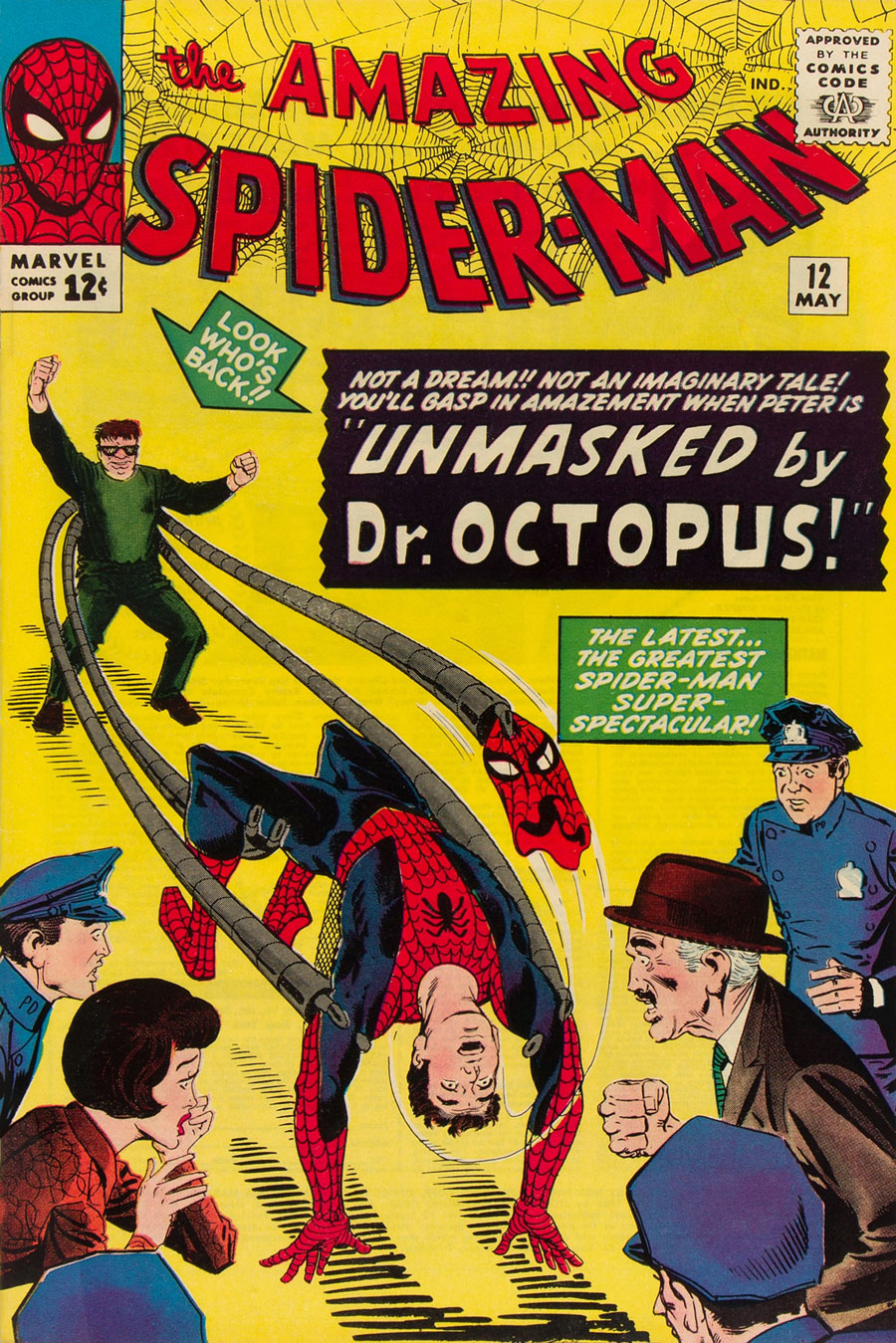
I couldn’t very well have a mechanically-minded Tentacle Tuesday without mentioning Dr. Octopus, one of Spider-Man’s most famous foes! Otto Gunther Octavius, a.k.a. Dr. Octopus, a.k.a. Doc Ock was created by Steve Ditko, and first appeared in The Amazing Spider-Man no. 3 (July 1963). Obviously I could feature a gallery of Dr. Octopus tentacles as long as your arm (pardon the confused anatomical terminology on my part), but I’ll limit myself to a couple.
First, The Amazing Spiderman no. 12 (May 1964), cover by Steve Ditko. The “Look who’s back!!” caption pointing to the Doc is rather mystifying, given that he was there in the previous issue.
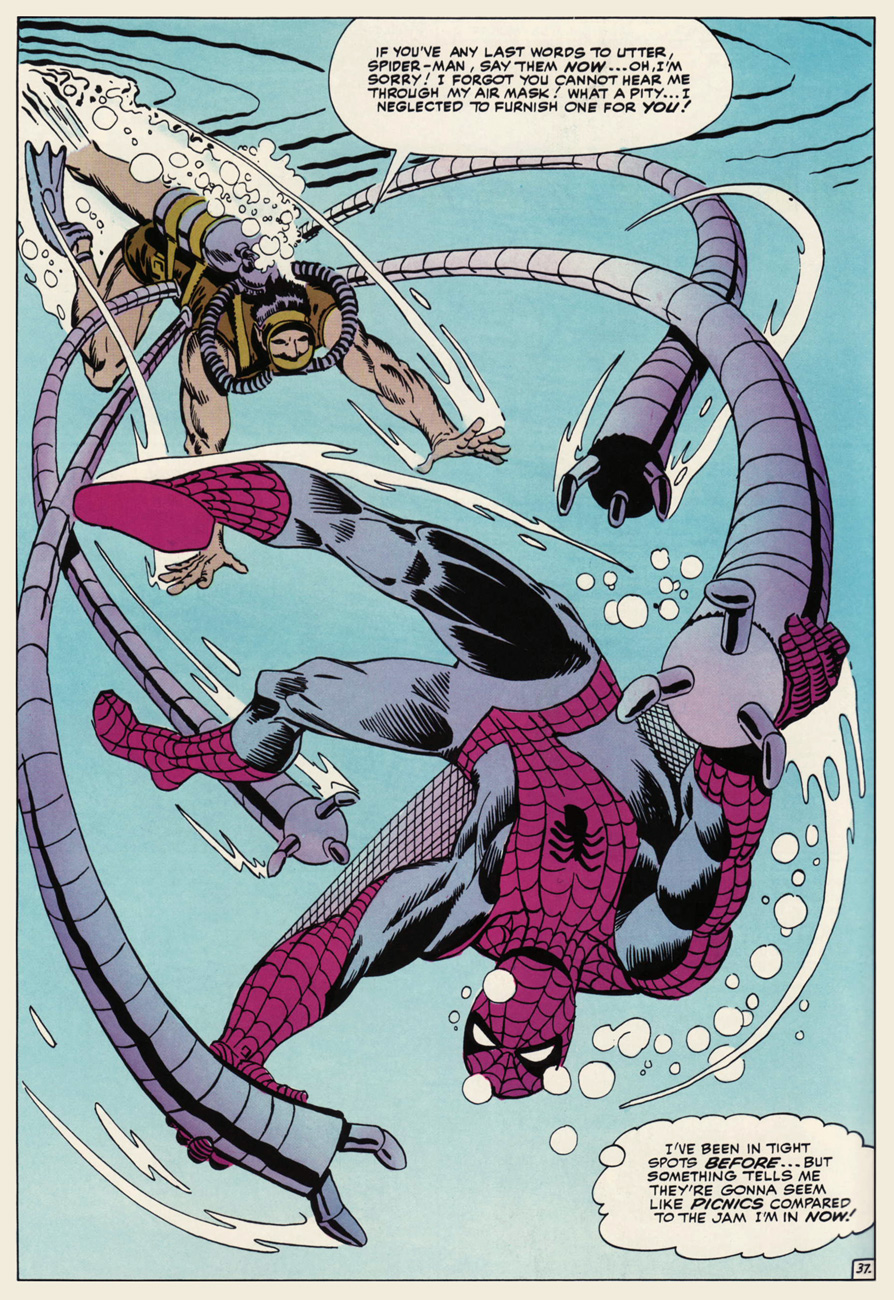
Second, an underwater scene, because what element more appropriate for tentacles? Kudos to Doc Ock for making his perfectly watertight.
JFC, does this guy ever shut up? Especially given that Spiderman can’t even hear him? Splash (no pun intended) page from The Amazing Spider-Man Annual no. 1 (September 1964), with art by Steve Ditko.
Dr. Octopus’ metallic appendages, resistant to radiation and of great strength and agility, were originally attached to a harness…. but became fused to his body after an explosion involving radioactivity (what else?) They were surgically removed, but he could now control them telepathically from a distance. Spooky.
Poor Spider-Man is always getting attacked by tentacles, even when Doc Ock isn’t around! These belong to a robot built by a “nutty professor” to trap anything spider-related. A prize will go to the perceptive reader who can tell us how many tentacles this thing possesses – like, a million, would be my guess. The Amazing Spider-Man no. 25 (June 1965); cover by Steve Ditko.Smythe’s robot in action, ensnaring Parker instead of the spider he’s holding in a globe (and nobody but us readers knows why!) J. Jonah Jameson, publisher of Daily Bugle, watches enthusiastically from the sidelines.Okay, maybe the robot doesn’t have as many tentacles as the cover seemed to suggest. Here’s Spidey hotly pursued by Mr. Jameson, whose maniacal glee is a little scary. (I will readily admit I partially chose this panel because of Parker’s jiggly butt).
A 1968 ad full of spooky, green-glowy fun for the kiddies. An… interesting appropriation of Jewish mysticism. After all, Zohar and Kabbalah don’t really fall within the usual range of docile toy industry gibberish, straying closer to the realm of sideshow hucksterism, with its fortune-telling automatons.
Wikipedia tells us: « The Zohar (Hebrew: זֹהַר, lit. “Splendor” or “Radiance”) is the foundational work in the literature of Jewish mystical thought known as Kabbalah.
There are people of religions besides Judaism, or even those without religious affiliation, who delve in the Zohar out of curiosity, or as a technology for people who are seeking meaningful and practical answers about the meaning of their lives… »
It’s hard not to draw a parallel between this toy’s name and eerie oculus and Charles Burns‘ Big Baby tale of a « Teen Plague » (from Raw vol. 2 no. 1, 1989). Be careful out there, kids!














 This episode is titled Toujours du bruit au plafond (« Still some noise on the ceiling »); it originally saw print in Pilote Mensuel no. 34 (March, 1977). It’s the rare (possibly the only) one that ends peacefully for Marcel, perhaps because he didn’t bother with the broom. Better













 Who's Out There?