« Yet another bloodthirsty alien invasion, led by a mad dictator with a brain harvested from a 60 year-old corpse. I get one of those every third Thursday… »
D’you know what today is? Well, Tentacle Tuesday, obviously. It’s also Radio Day. More relevantly to this post, however, May 7th is also the birthday of one Michael Terry Gilbert, confidant to the formidable Mr. Monster (a.k.a. Strongfort “Doc” Stearn) and fellow tentacle lover (at least judging from how many cephalopod-shaped creatures appear in his stories).
We’ve briefly mentioned Mr. Monster in Tentacle Tuesday: Superheroes Redux; now is the time to joyfully gallop through some more tentacle offerings from the merry crew of psychotic artists led by that sagacious shepherd, Michael T. Gilbert. Many happy returns, Sir!
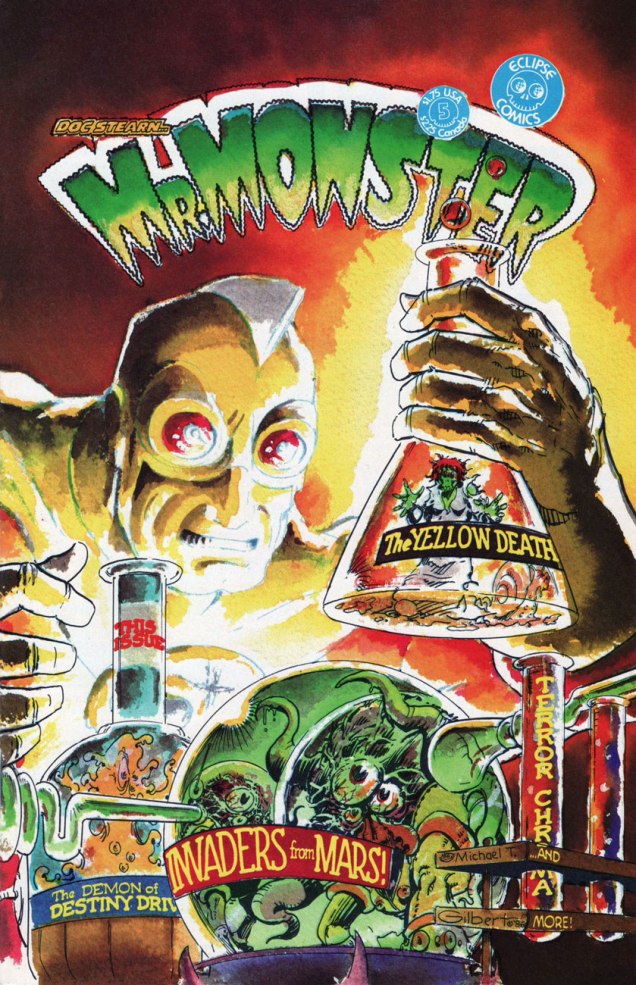
Doc Stearn… Mr. Monster no. 1 (Eclipse, January 1985). Cover by Michael T. Gilbert.Doc Stearn… Mr. Monster no. 5 (Eclipse, February 1986), cover by Michael T. Gilbert. The unwritten rules dictates that Mars inhabitants *must* have tentacles, and Gilbert clearly has respect for venerable traditions. Plus, they’re much cuter this way. Coochie-coochie-coo…
« The original Doc Stearne was a two-fisted adventurer along the lines of pulp hero Doc Savage, of whom he may have been intended as a knock-off. He was created by cartoonist Fred Kelly, whose other known credits are somewhere between sparse and nonexistent. Kelly did him for a small, virtually unremembered Canadian publisher called Bell Features (probably not related to Bell Syndicate, distributor of Mutt & Jeff, Don Winslow of the Navy and more). When Gilbert was asked to contribute to Vanguard Illustrated, the apparent purpose of which was to develop new properties for Pacific Comics to exploit, he drew on Kelly’s character as inspiration. The first new Mr. Monster story appeared in the seventh issue, which came out in 1984 without a specific cover date. Gilbert’s version was a fanatical monster hater, extreme not only in his attitude, but in his design and in every move he made. » |from Don Markstein’s Toonopedia|
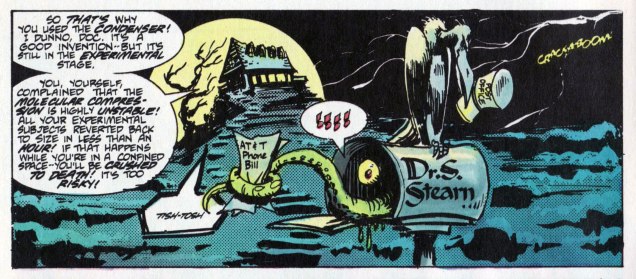
« The Demon of Destiny Drive », art by Michael T. Gilbert, published in Doc Stearn… Mr. Monster no. 5 (Eclipse, February 1986).« Mr. Monster’s Atomic Condenser » by Michael T. Gilbert was published in Doc Stearn…Mr. Monster no. 10 (Eclipse, June 1987).Is that an Oculothorax, by any chance? « Terror in 6-D », with script and layouts by Michael T. Gilbert and pencils and inks by Don Simpson, was published in Doc Stearn…Mr. Monster no. 10 (Eclipse, June 1987). Read the issue here.
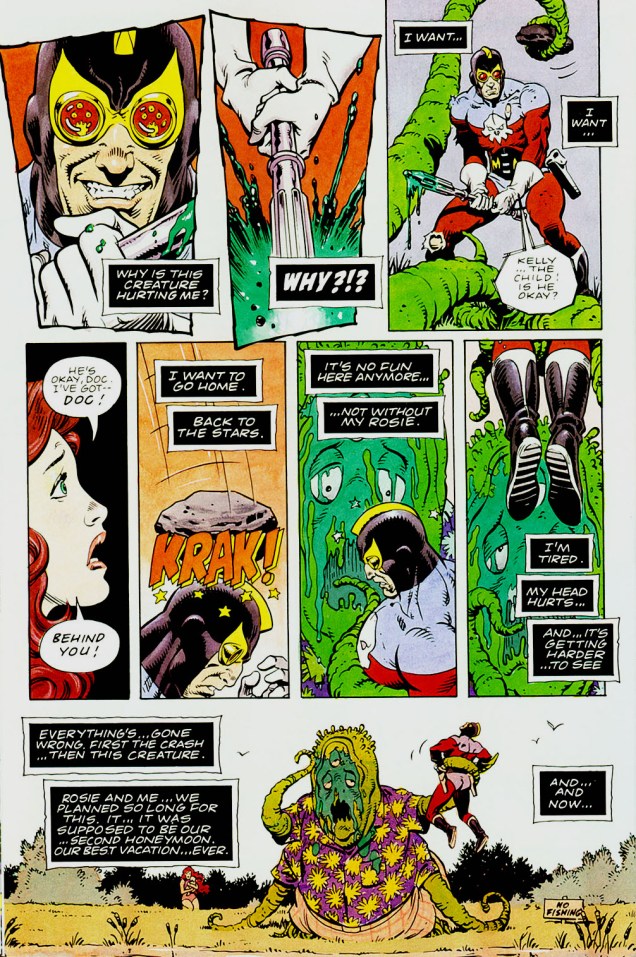
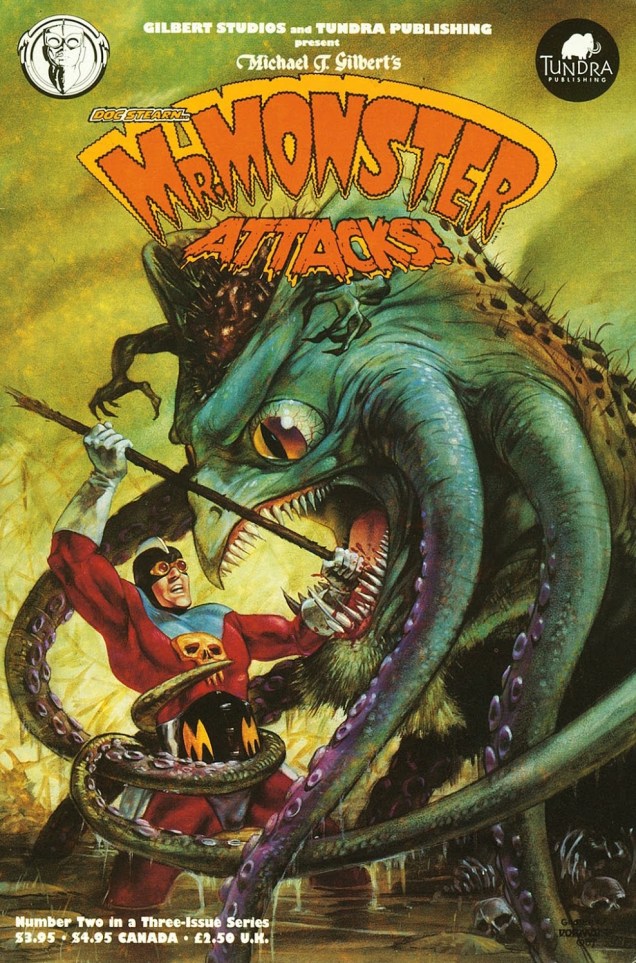
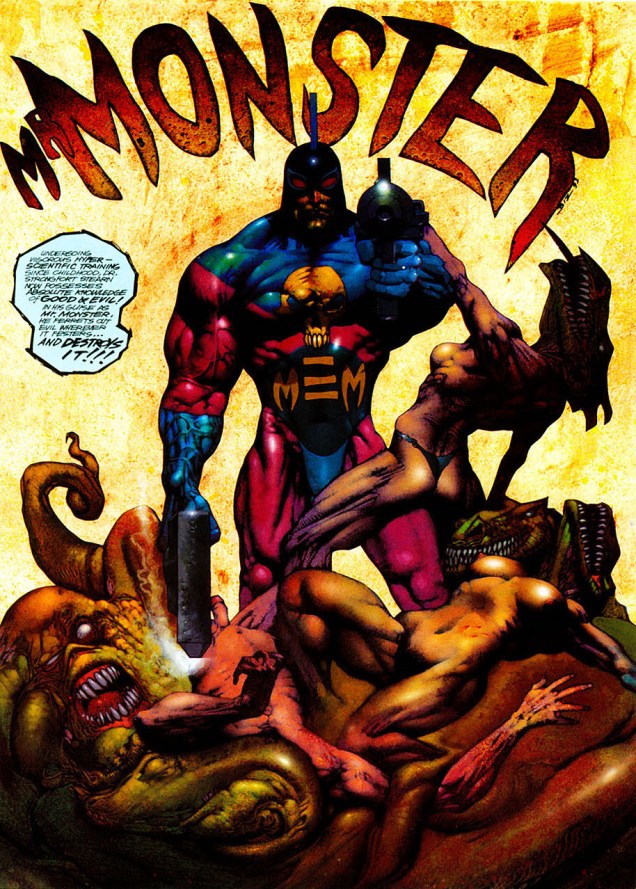
« Wish You Were Here », script and layout by Michael T. Gilbert, inks by Dave Gibbons, was printed in Mr. Monster Attacks! no. 1 (Tundra, August 1992).Want to know whether Mr. Bulletproof Monster ever gets back with Rosie? Read Mr. Monster Attacks! no. 1 (Tundra, August 1992) here.Mr. Monster Attacks no. 2 (Tundra, September 1992), cover pencilled by Michael T. Gilbert, and painted by Dave Dorman.Back cover of Mr. Monster Attacks no. 2 (Tundra, September 1992), drawn by Bernie Wrightson and Michael T. Gilbert. Read the issue here.« Lair of the Lizard Ladies », written and laid out by Michael T. Gilbert, and pencilled, inked and coloured by Simon Bisley, was printed in Mr. Monster Attacks! no. 3 (October 1992).Kelly, Mr. Monster’s Girl Friday, has been touched by his noodly appendage in this story featuring murderous tentacle spaghetti. « Just Desserts », scripted by Janet Gilbert (wife of Michael T. Gilbert) and drawn by Tom Buss, was printed in Mr. Monster Attacks! no. 3 (Tundra, October 1992). Read the full issue here.
« Ulp! That reminds me. I’m late for my 4:00! There’s a giant man-eating eyeball about to devour Cleveland! So if you’ll excuse me… »
« When a man steals your wife, there is no better revenge than to let him keep her. » — Sacha Guitry
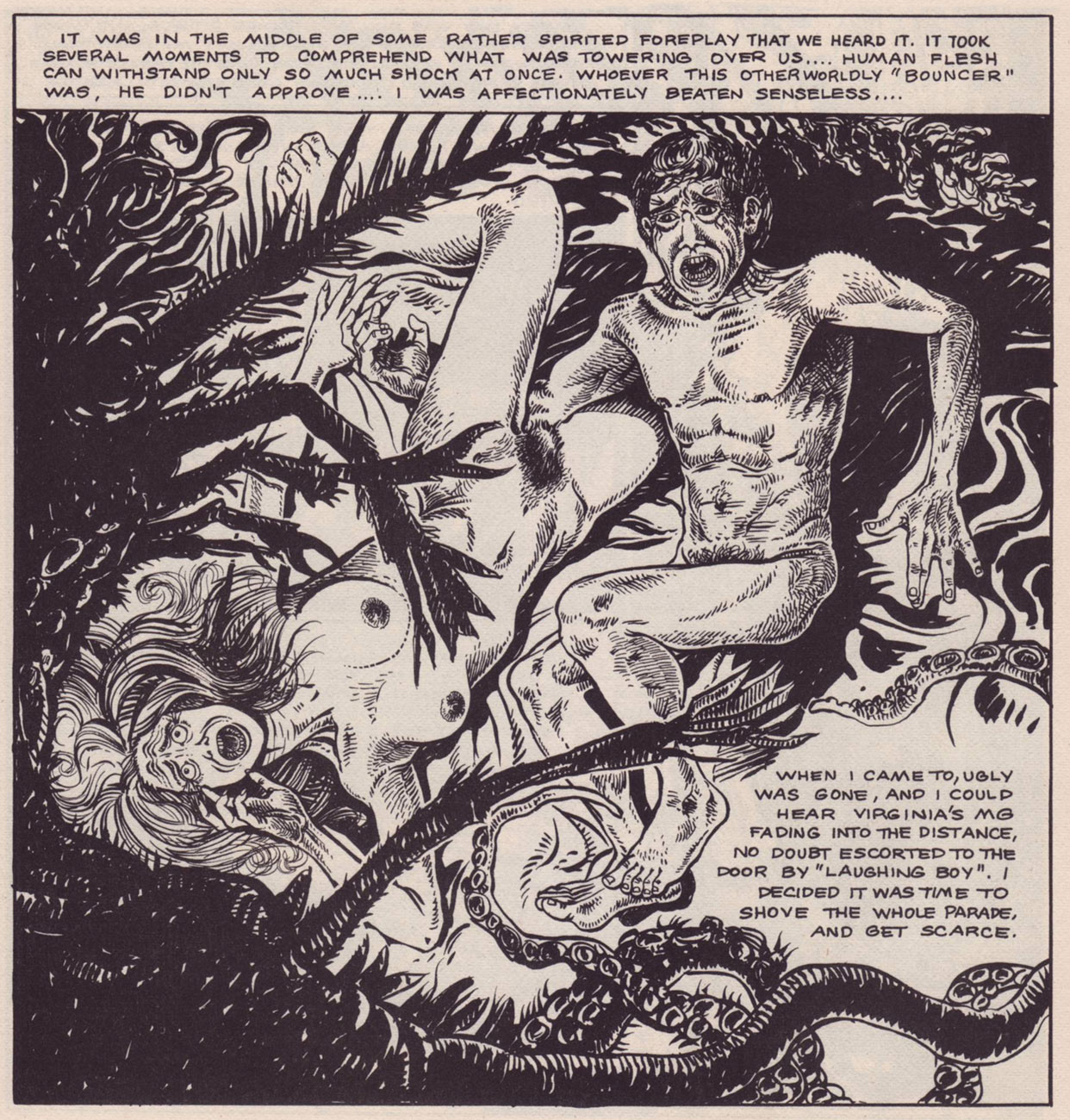
Here’s my contender for the most adult thing ever published in a Warren Magazine, as opposed to adolescent. It was also Wally Wood’s final significant contribution to his bibliography (though it was created around 1971); by the time of its belated publication Wood’s work had degenerated into depressing, crude porn before he tragically took his own life in November, 1981. As Witzend sadly proved, most comics creators, when handed a creative carte blanche, would merely regurgitate the same old thing they were doing for the mainstream, but with the addition of tits and/or gore. This, however, whilst featuring a generous dollop of T&A, is another breed of beast. It was published, of all places, in Warren’s SF anthology 1984 (issue 5, Feb. 1979). Go figure.
The marvellous Bhob Stewart queried Nick Cuti about the story during a roundtable gathering of former Wood assistants in Derby, Connecticut, in July 1985. The discussion later appeared in Against the Grain: MAD Artist Wallace Wood, edited by Stewart (2003, TwoMorrows Publishing)
Bhob: You worked on “Last Train to Laurelhurst“? [the story’s original title] Cuti: « As a matter of fact, I’m in it on the opening page. That’s me — right there [points to foreground figure in splash.] I used to wear muttonchops in those days. We wrote that together; Woody came up with the basic storyline, and I wrote a lot of dialogue. I hated his ending. I said, ‘Woody, you really ought to change the ending.’ The ending was that the guy blasted his faithless wife and her lover and then walked away. I said, ‘Gee, that’s what he’s intending to do in the very beginning. There’s no switch at the end. If you change it around somehow, it would make it a little bit more surprising.’ So he went home and rewrote the ending. I thought that the ending he came up with was far superior and made it a really brilliant story, to really tell you what life can be like.
Ernie Colón did the pencils. It was Woody’s idea, and I wrote some of the script, I don’t know how much because we used to toss things back and forth all the time when I was at the studio.It was for a magazine called Pow that never came to be. [Jim] Warren had approached Wood to do an adult humor magazine which would have had serious stories, very sexy, something that adults would enjoy reading. Unfortunately, Woody and Warren had diametrically opposed personalities, and they couldn’t seem to get together on it.
There was a funny story: Ernie had done the pencils with a soft pencil, and Woody and I were wondering what the heck we could do to make sure it didn’t get smudged. I was very carefully going over the pencils with an eraser to get out the smudges. I came in the next day with the pencils and said, ‘I found the perfect way to avoid smudging the pencils.’ Woody said, ‘What?’ And I said, ‘I sprayed them.’ Woody’s face dropped, and he almost reached over the strangle me before I stopped him and said, ‘Hey, Woody, I’m only kidding!’ [laughter] Because when you spray something, you can’t erase the pencils any more. You would have ink and pencil on the same paper. He almost had a heart attack right there; his mouth dropped open, and he said, ‘Oh, no!’ Then he started laughing after I told him it was only a joke. Later, when I walked into the house, and Marilyn said, ‘Oh, Woody, Nick’s here. You know, the fellow who sprays all your pencils?’ Obviously, he had thought enough of the joke to tell her about it. »
Speaking of Pow, here’s a cover sketch Wood did in 1971.An adult humour magazine? I guess they hadn’t quite settled on the tone.
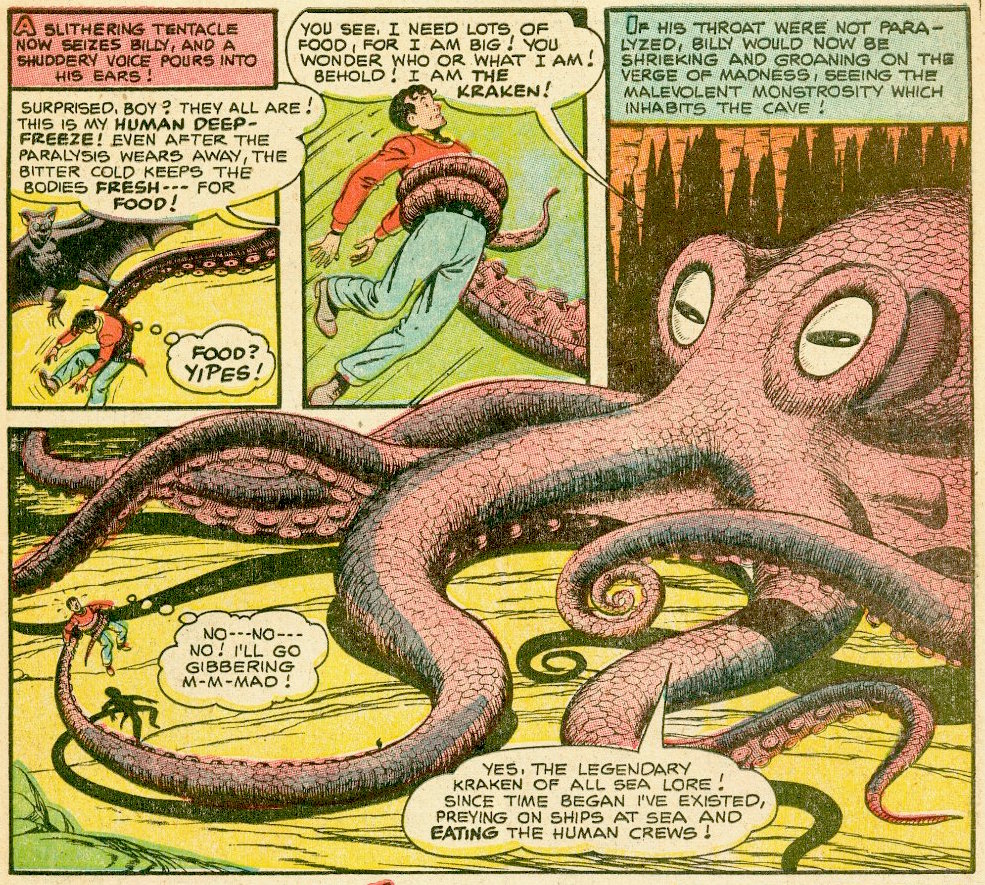
« A slithering tentacle now seizes Billy, and a shuddery voice pours into his ears! »
Previously, we’ve talked about Captain Marvel (the original, the best, the… dare I say, unique!) in a post about his co-creator C.C. Beck. Today, I’ll concentrate on the World’s Mightiest Mortal’s exploits with all manner of tentacled monsters.
All C.C. Beck quotes in this post come from An Interview with C.C. Beck conducted in the late 1980s (shortly before Beck’s death in 1989) by the talented Tom Heintjes of Hogan’s Alley.
« When I looked at the first Captain Marvel story, I knew at once that here was a story worth illustrating. It had a beginning, a carefully constructed development of plot and characters leading to a climax and an ending, and nothing else. There was no pointless flying around and showing off, no padding, no “Look, Ma, I’m a superhero!” Out of 72 panels, Captain Marvel appeared in 18, or one-fourth. »
« March, ye scalliwag, or I’ll curdle yer giblets! » Follow Captain Marvel’s fine example – don’t forget to hug a tree, folks! Although it will be better if you can find one without spines and prehensile appendages. This is Whiz Comics no. 5 (May 1940), cover by C. C. Beck. Captain Marvel may “crash through”, but the cover story, « Beautia for President », contains no tentacles whatsoever… just a hypnotically beautiful woman, that some may settle for (not me). You may note that the cover has « number 4 » written on it, but 5 was the number reported to the Copyright Office, so go figure.
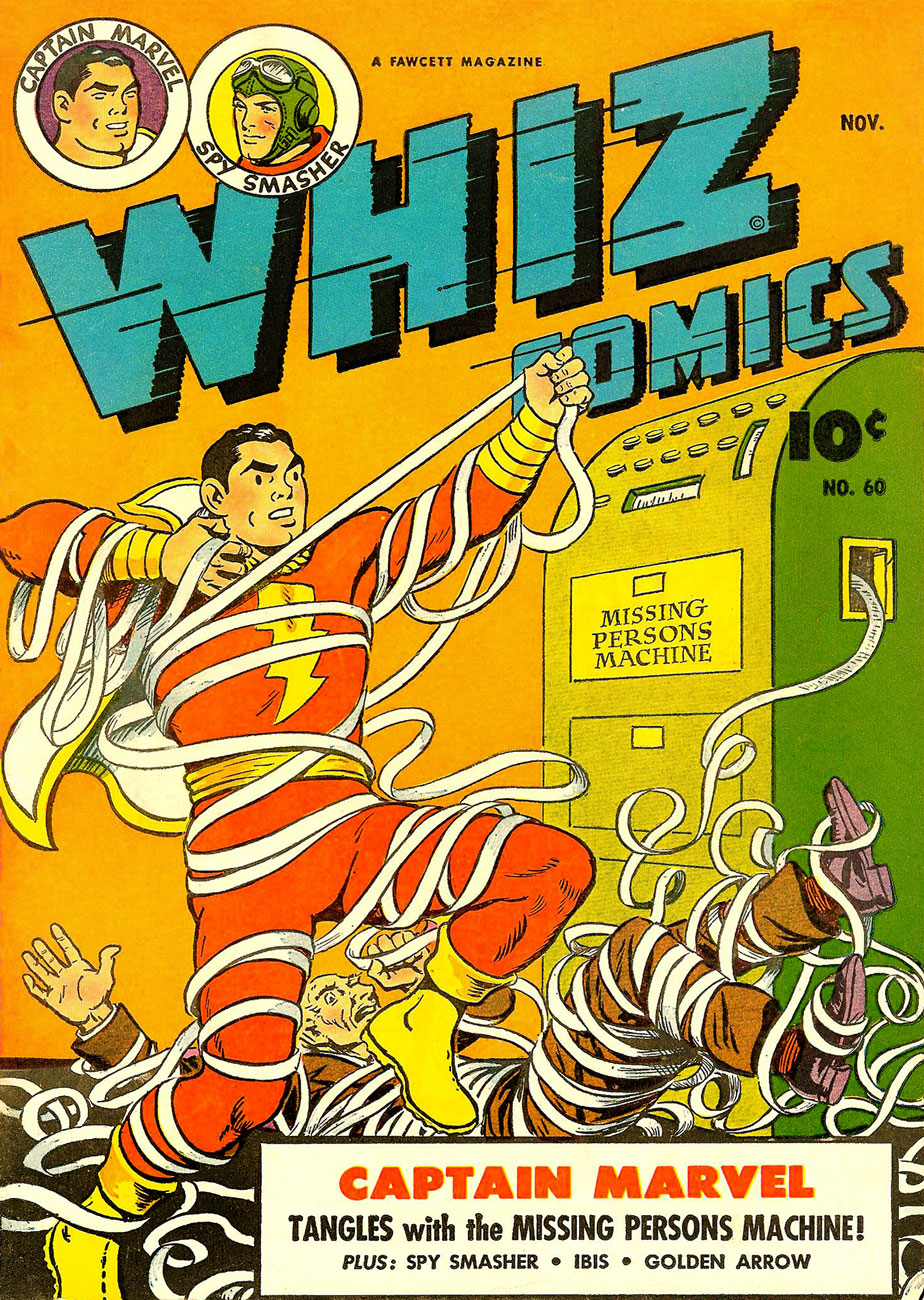
Whiz Comics no. 60 (November 1944), cover by C. C. Beck. Paper tentacles? I think they count! The main story is adorably goofy, in the best Otto Binder tradition… but unfortunately comicbookplus.com has only a seriously blurry scan of this issue (read it here, but it may cause headaches).
Whiz Comics no. 146 (June 1952), cover by Pete Costanza. Speaking of the latter and quoting (again) from C.C. Beck, « Pete Costanza was the first artist hired to assist me when Fawcett’s comic department started to expand in the latter part of 1940. We later went into partnership, and Pete was in charge of our studio in Englewood, New Jersey, while I operated out of our New York City office. Pete was an established illustrator at an early age, and I learned as much from him about story illustration as he learned from me about cartooning. »
The green, proudly toupée-d fellow appears in the opening panel of Terror Stalks the World’s Fair, but as it turns out, he has nothing to do with the rest of the story, really.
Terror Stalks the World’s Fair is scripted by Otto Binder and drawn by Kurt Schaffenberger.
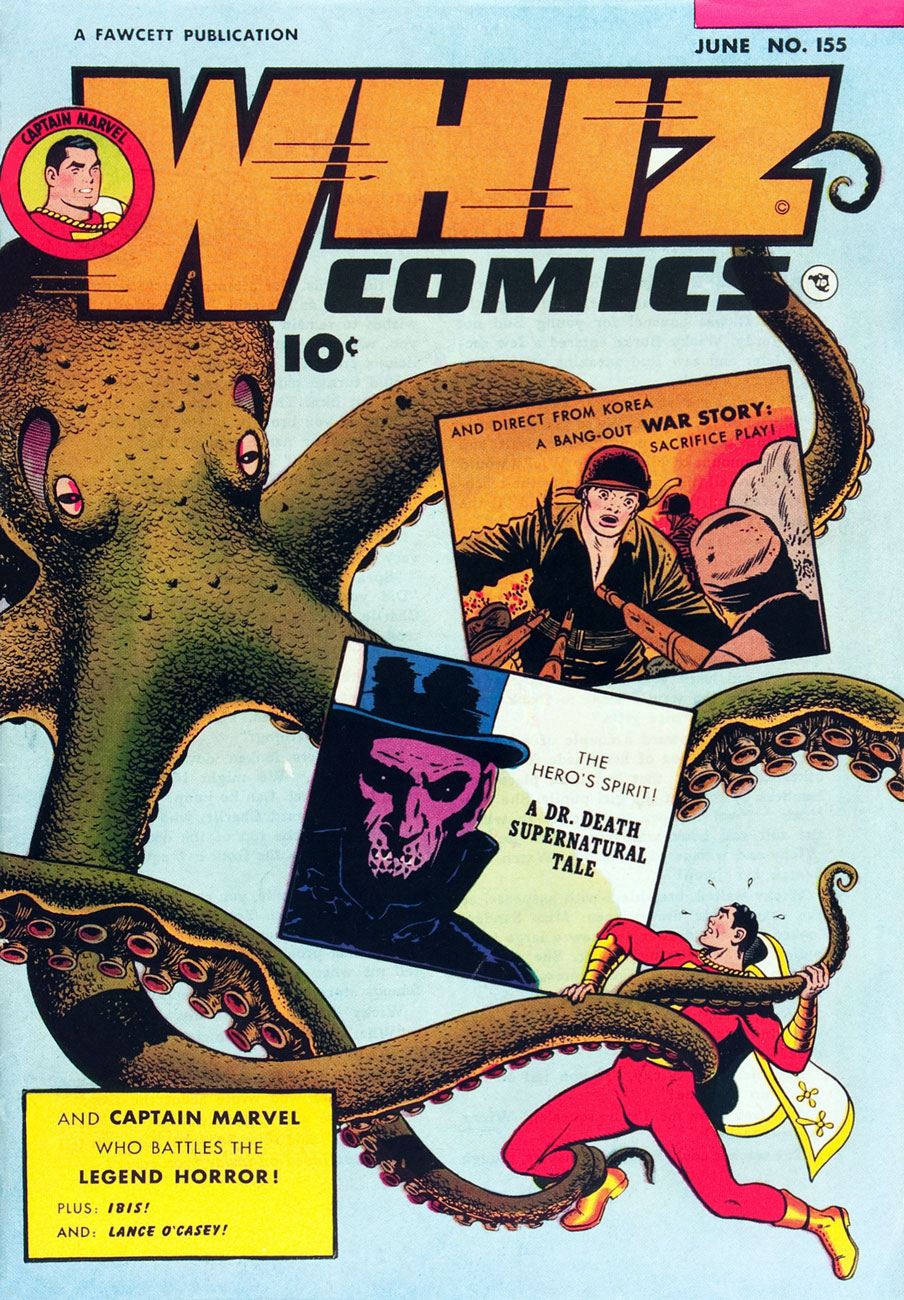
« A sinister mystery hangs over the city! Each night, screams are heard… human screams that gurgle away into deathly silence! » Whiz Comics no. 155 (June 1953), the final issue of Whiz Comics, cover by C.C. Beck.
The cover story features an actual kraken with evil, myopic eyes! I rejoiced.
Page from Captain Marvel Battles the Legend Horror, scripted by Otto Binder and drawn by Kurt Schaffenberger.
In an interesting plot twist, it is revealed that gigantic vampire bats and the Kraken (who has the gift of speech, sounding like somebody’s rather eccentric uncle) have struck up a partnership.
Poor Kraken must get cold, consuming all those frozen bodies…
While we’re at it, Captain Marvel Battles the Legend Horror is a perfect demonstration of a point C.C. Beck made well:
« Billy Batson was the real hero of all the Captain Marvel stories, from the first issue until the last. Without Bill Batson, Captain Marvel would have been merely another overdrawn, one-dimensional figure in a ridiculous costume, running around beating up crooks and performing meaningless feats of strength like all the other heroic figures of the time who were, with almost no exceptions, cheap imitations of Superman. In fact, I have always felt that flying figures in picture form are silly and unbelievable, and I would much sooner have never drawn them, but the publisher insisted on them. Most of the time Captain Marvel’s ability to fly had little or nothing to do with the plots of the stories in which he appeared. Billy Batson started every story and ended every story. In between, Captain Marvel appeared when he was needed, disappeared when he was not needed. The stories were about Billy Batson, not about the cavortings of a ridiculous superhero for whom the writers had to concoct new and more impossible demonstrations of his powers for each issue. »
A terrible end for any creature, even a malevolent one.
And our last encounter with tentacles for today…
Captain Marvel Adventures no. 65 (September 1946), cover by C. C. Beck.
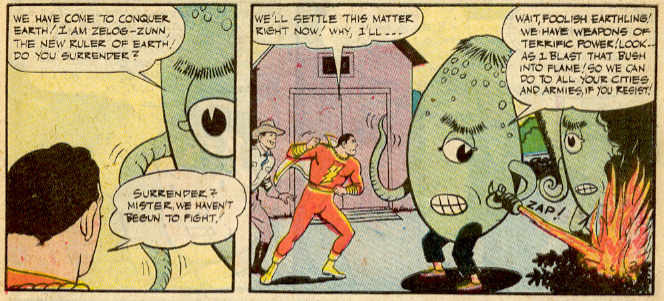
The Invasion From Outer Space, plotted by Otto Binder and drawn by C. C. Beck, offers us lots of cute little alien guys:
As usual, they wanna take over the world, but they’re cute, anyway. There’s that toupée again, this time (alien) flesh-coloured! That’s a mighty suggestive tentacle wiggle, Zelog-Zunn Sir.
« Never keep up with the Joneses. Drag them down to your level. » — Denis Charles Pratt (1908-1999)
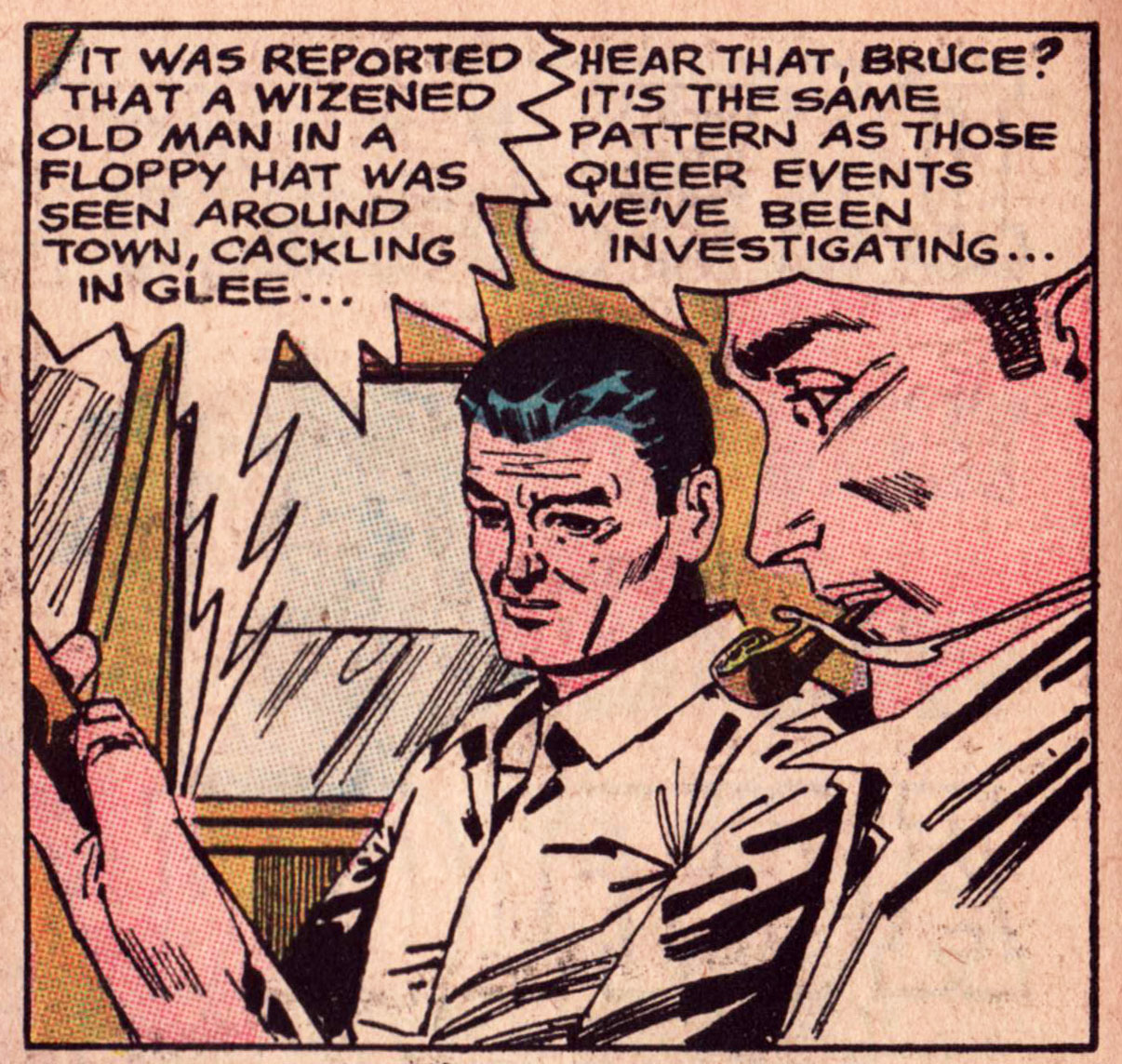
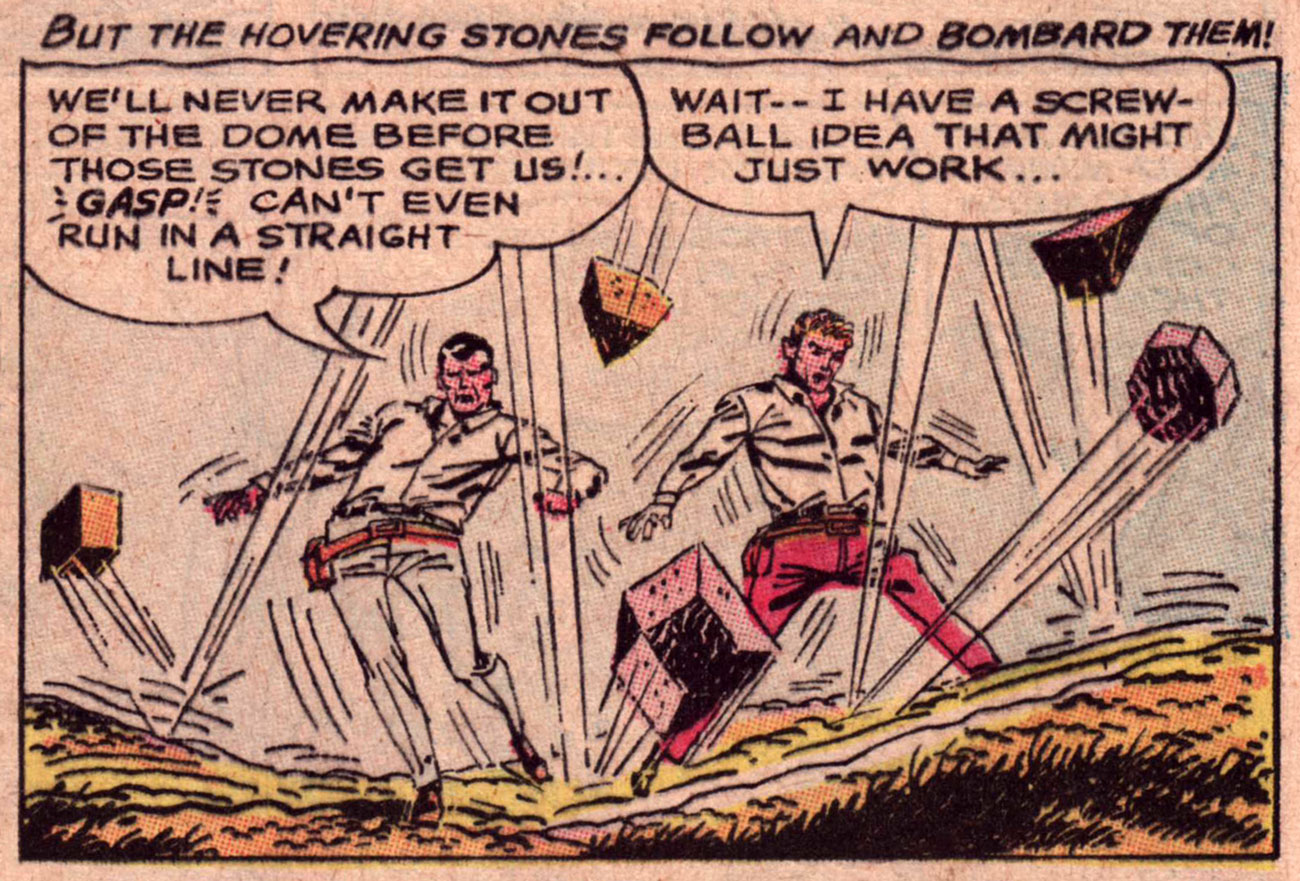
Longtime companions Bruce and Alex, who spend their days tracking down and investigating “queer events”, presumably for a guide they’re putting together, happen to drive near Oakville, where a gleeful oldster is on a tear.
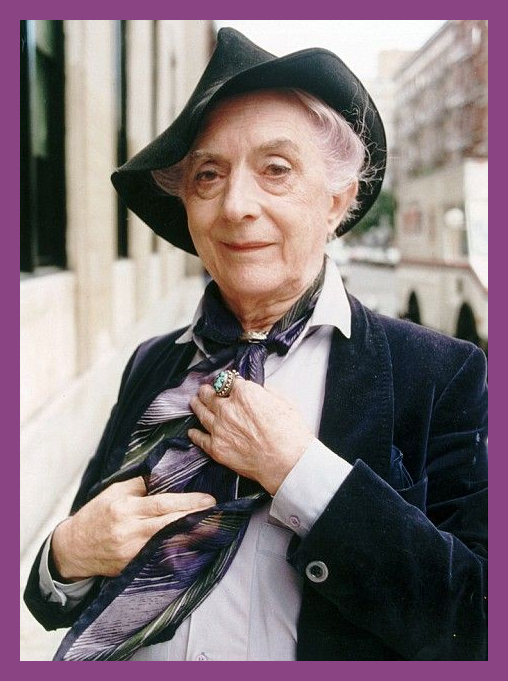
I’m thinking Quentin Crisp, because his fellow raconteur and bon vivantSir Noël Coward wasn’t especially into large, floppy hats.
« The very purpose of existence is to reconcile the glowing opinion we hold of ourselves with the appalling things that other people think about us. » — Quentin Crisp (né Denis Charles Pratt)
You don’t say, Bruce! Let’s face it, screwball ideas hardly ever fail to bear fruit in these zany yarns.
More action-packed merriment with Bruce & Alex, roving queerness inquirers!
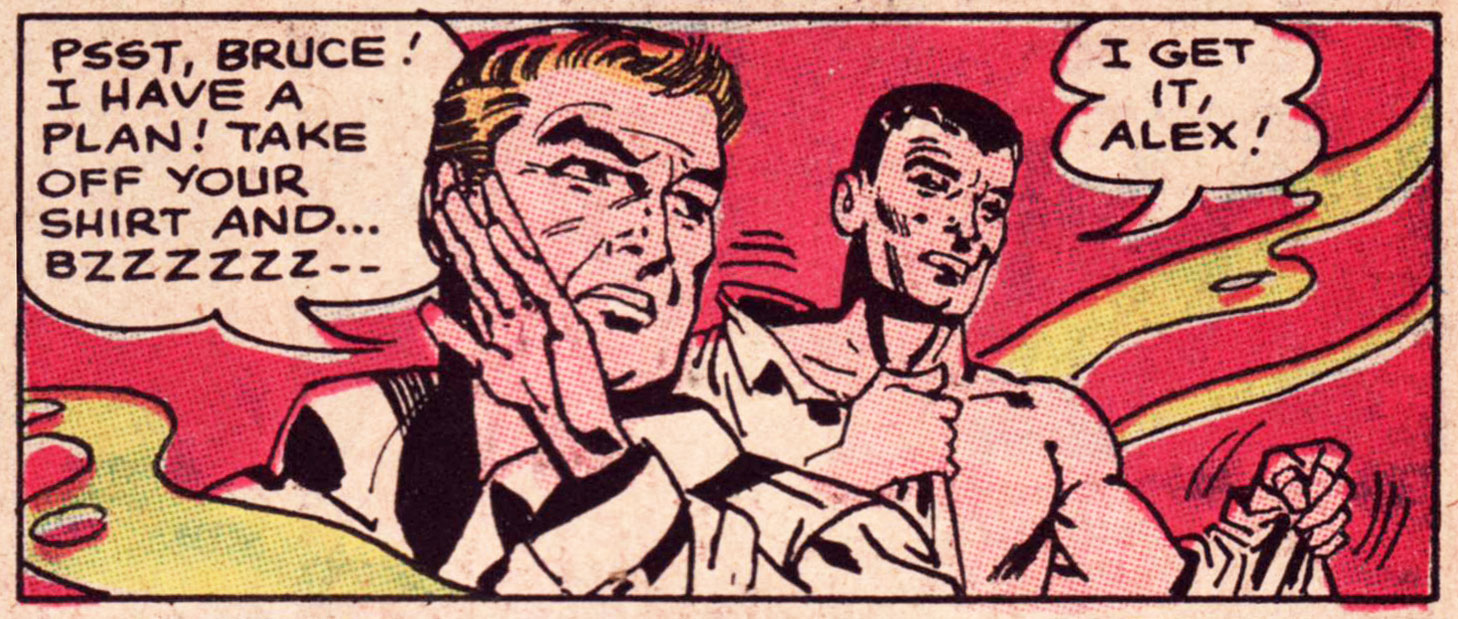
Alex has a plan, and Bruce grasps instantly what Bruce has in mind. It’s like they’ve done this before. Somehow, Alex’s brainstorms always involve Bruce disrobing, and, judging from his expression, he’s unfailingly eager to comply.
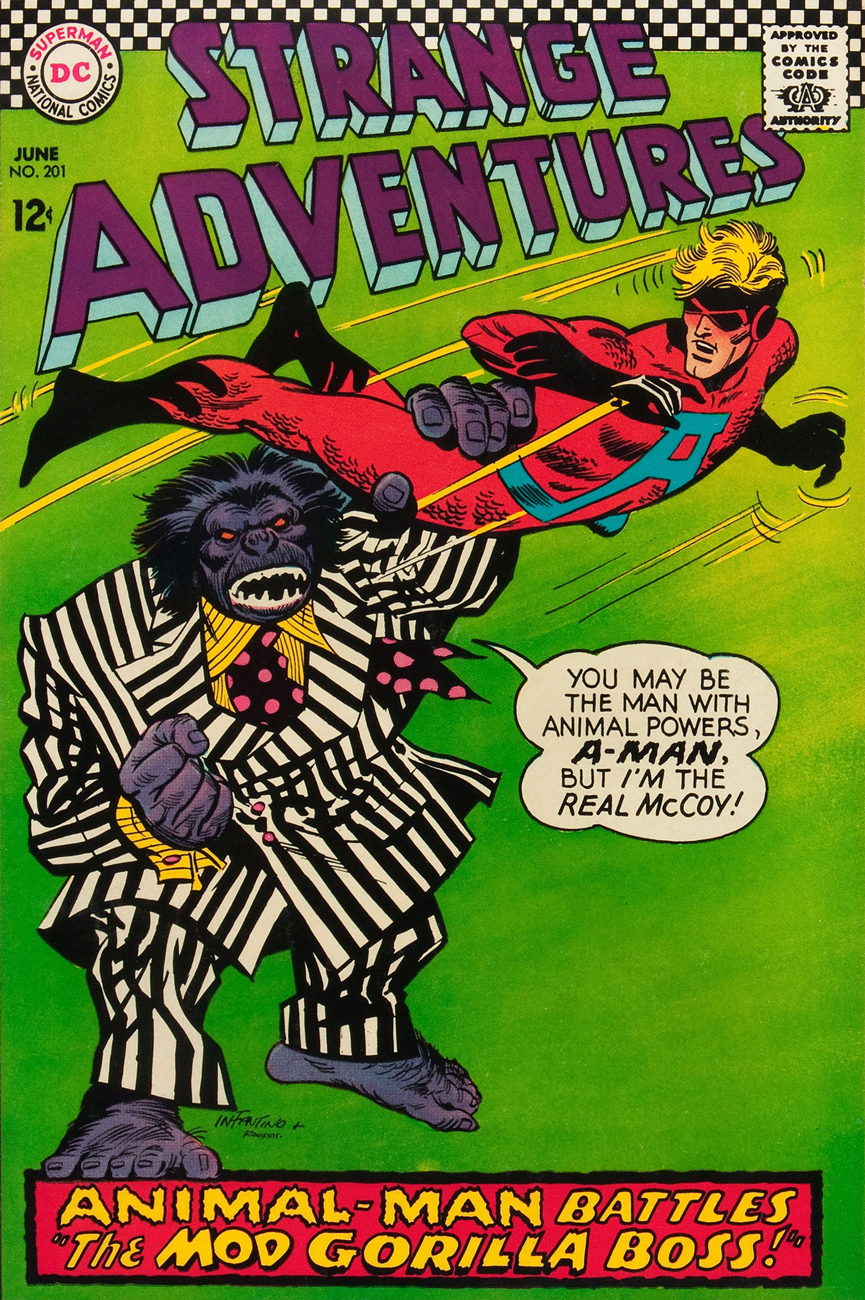
This saga is that of The Cackling Conjurer (Strange Adventures no. 201, June 1967, DC), writer regrettably unknown, art by that magnificent oddball Bernard Baily. Edited, of course, by Jack Schiff; he may have screwed DC out of Jack Kirby’s talent throughout the 1960s, and nearly drove the Batman titles over the cancellation cliff, but he certainly produced some perversely entertaining crap. Incidentally, Schiff retired from comics two issues after this one, but surely that’s mere coincidence.
As you can see, the rest of the issue was quite mundane and utterly devoid of eccentricity. Cover by Carmine Infantino and George Roussos. That’s a rather… intimate hold the Mod Gorilla Boss has on Animal-Man, don’t you think?
Death rat·tle (/ˈdeTH ˈˌradl/), noun: a gurgling sound heard in a dying person’s throat.
Greetings! Today we explore Kitchen Sink‘s mostly-black-and-white horror anthology (drum roll, please) Death Rattle, which ran between 1972 and 1996 in three distinct “volumes” (please don’t forget your professional spelunking gear, things might get messy). For the pedants in the audience (and let’s be honest, that’s probably the majority of us comic-loving freaks), the break-down goes like this:
Volume 1, 3 issues published between June 1972 until June 1973 under the Krupp Comic Words imprint; volume 2, 18 issues published between October 1985 and October 1988 under Kitchen Sink Comix; finally, volume 3, five issues published between December 1995 and June 1996, also under Kitchen Sink Comix. I must admit that that my favourite period is Volume 2, and it’s from these issues that most material presented below has been drawn.
There is already a Tentacle Tuesday devoted to Kitchen Sink (see Tentacle Tuesday: The Kitchen Sink Touch) featuring, among other things, two splendid Death Rattle covers. We have also previously ogled some DR inside art in Tentacle Tuesday Masters: Rand Holmes. Today we take a longer peek into the stories promulgated by this fantabulous anthology. Get ready for some nasty fun!
(Man, I’ve got to tone down my build-ups…)
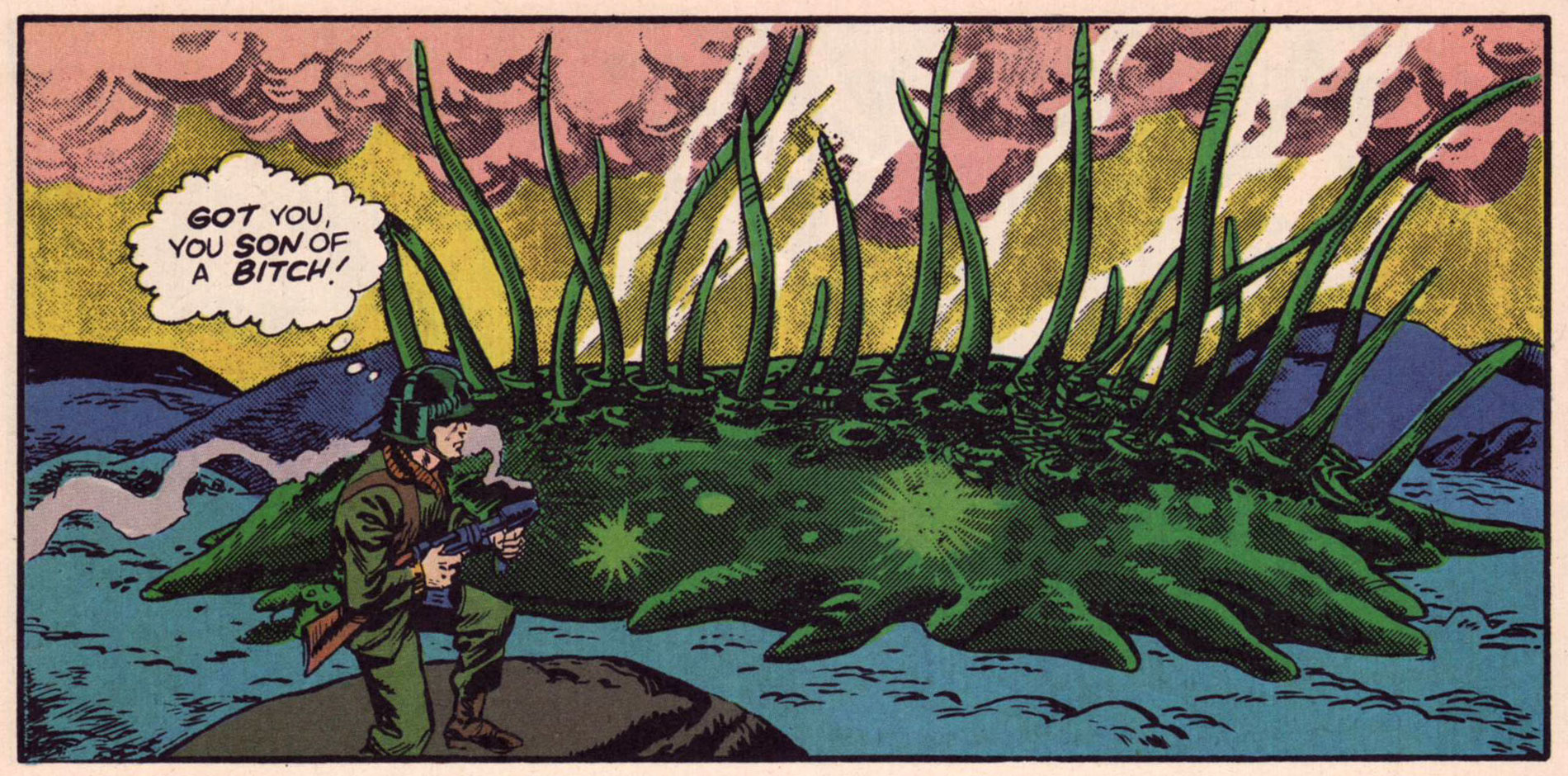
Panel from Mind Siege! by Steve Stiles, published in Death Rattle no. 3 (February 1986). The “my god!! so BIG!!” alien has the power to telepathically send mind-shattering hallucinations, eventually driving (nearly) everyone on earth insane. This issue also provides the first installment of Jaxon’s epic series Bulto… the Cosmic Slug (collected as Secret of San Saba: A Tale of Phantoms and Greed in the Spanish Southwest in 1989, for those interested).
The last soldier on earth killed it! …Or did he? Panel from Mind Siege! by Steve Stiles, published in Death Rattle no. 3 (February 1986).
The first 5 issues of Death Rattlevolume 2 appeared in glorious colour, after which the series reverted to its standard black-and-white (financial hurdles). Issue 7 came out proudly bearing the slogan “too gruesome for color!” Issue 5 gave more details of the change to come:
« It will still be printed on quality paper, so you archivists out there won’t have trouble preserving disintegrating, rotting, putrid copies that look like they’ve just risen zombified from a Graham Ingels story. We’ll still be printing atmospheric stories of the unusual, the eerie, the — dare we say it — ghastly. So let’s rejoice, not mourn. »
I remember being vaguely disappointed for just a little while (it was nice to have colour), but the high quality of (most) stories made it easy to get used to the switch, and I really liked the unapologetic way Kitchen Sink confronted their audience, making a good thing out of a bad thing.
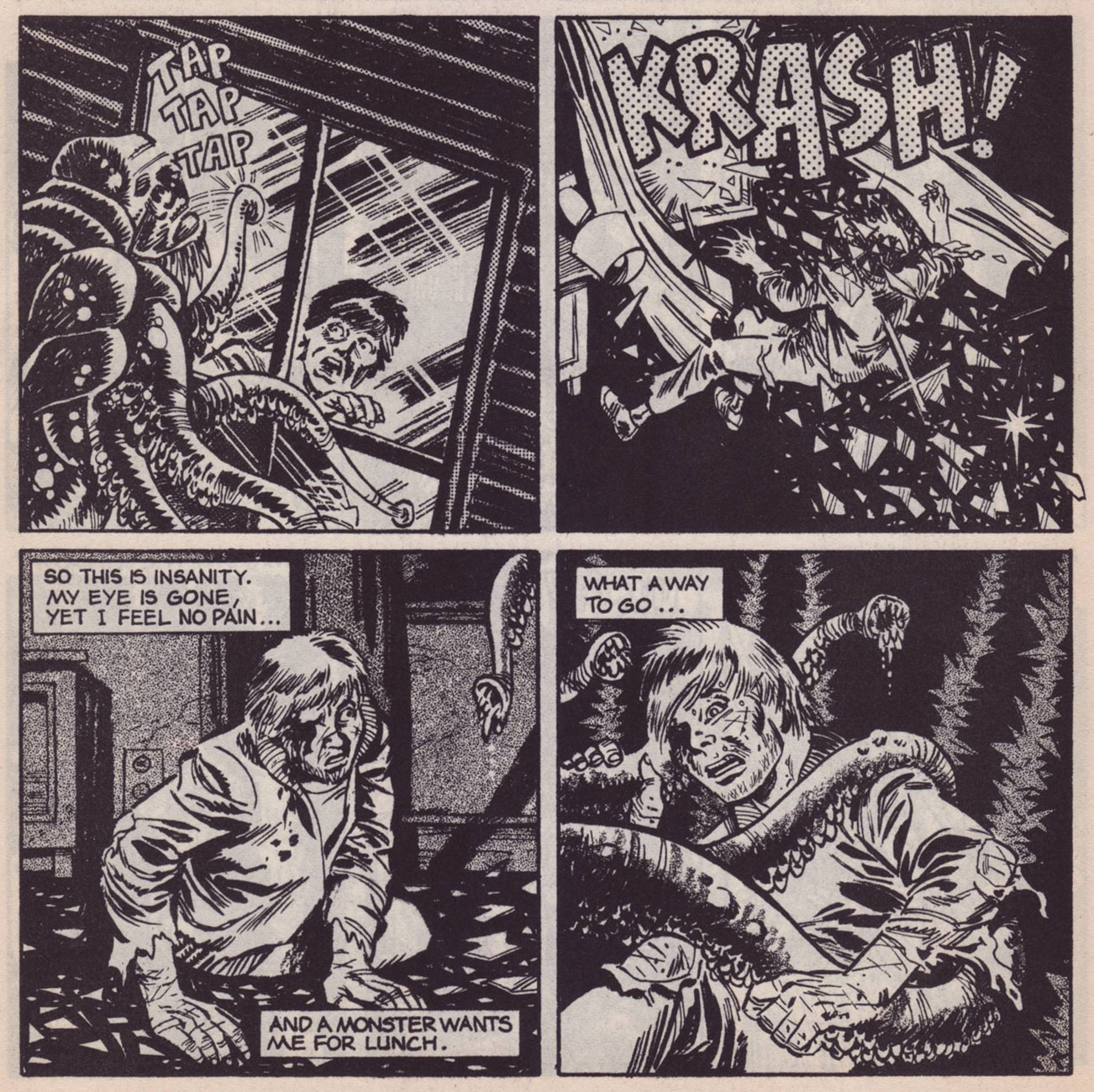
Polite monsters knock before smashing noisily through the window. Page from Old House, scripted by Kenneth Whitfield and drawn by Steve Stiles, published in Death Rattle no. 7 (October 1986).
Page from Old House, scripted by Kenneth Whitfield and drawn by Steve Stiles, published in Death Rattle no. 7 (October 1986).
I didn’t realize it immediately, but this post ends up being some sort of cephalopod love song to Steve Stiles. Speaking of the latter, I’d like to mention that he doesn’t get enough credit for his work on Mark Schultz’s Xenozoic Tales, even though he drew Schultz-scripted back-up stories for no fewer than 13 issues of XT – and, frankly, did an excellent job. Instead of getting interrupted smack in the middle of an intoxicating story, Xenozoic Tales could have continued to thrill us if Schultz scripted and Stiles illustrated. ‘Nuff said. Visit Stiles’ website – it has tons and tons of stuff.
If I may be allowed a slight digression, here are two examples of Stiles’ recent (and computer-coloured, I’m afraid) work taken from his Tumblr blog – I think tentacles still prey heavily upon his mind! 😉
Okay, no more distractions. Back to our regularly scheduled program:
Last Exit by Steve Stiles, published in Death Rattle no. 8 (December 1986). Comics *definitely* teach us that guns are useless against tentacles.
« Savoring my growing fear and horror… the crawl and prickle of my flesh.. waiting to feel the rapid feather-flutter or antennae… the clammy weight of tentacles… the jolt of pain as mandibles grip with steady pressure…» Panel from Mirrors by Eric Vincent, published in Death Rattle no. 11 (June 1987).
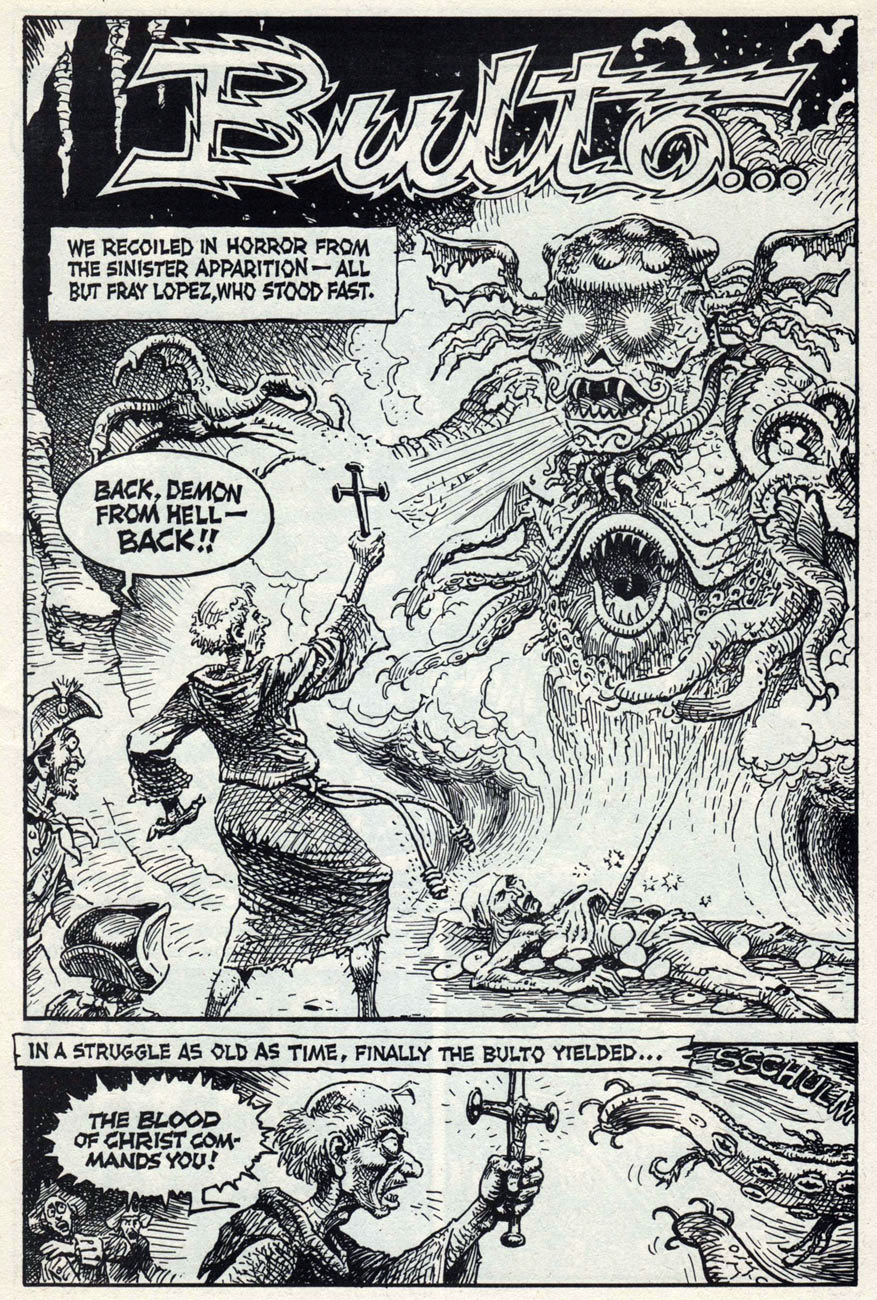
Page from Bulto – The Cosmic Slug (part 5) by Jaxon, published in Death Rattle no. 12 (September 1987). There simply isn’t anything Jaxon can’t ace: a lot of artists have no trouble depicting curvy vixens, few artists can draw an anatomically correct horse, and even fewer would be able to create a blood-curdling scene with a manic priest and a convincing Elder God.
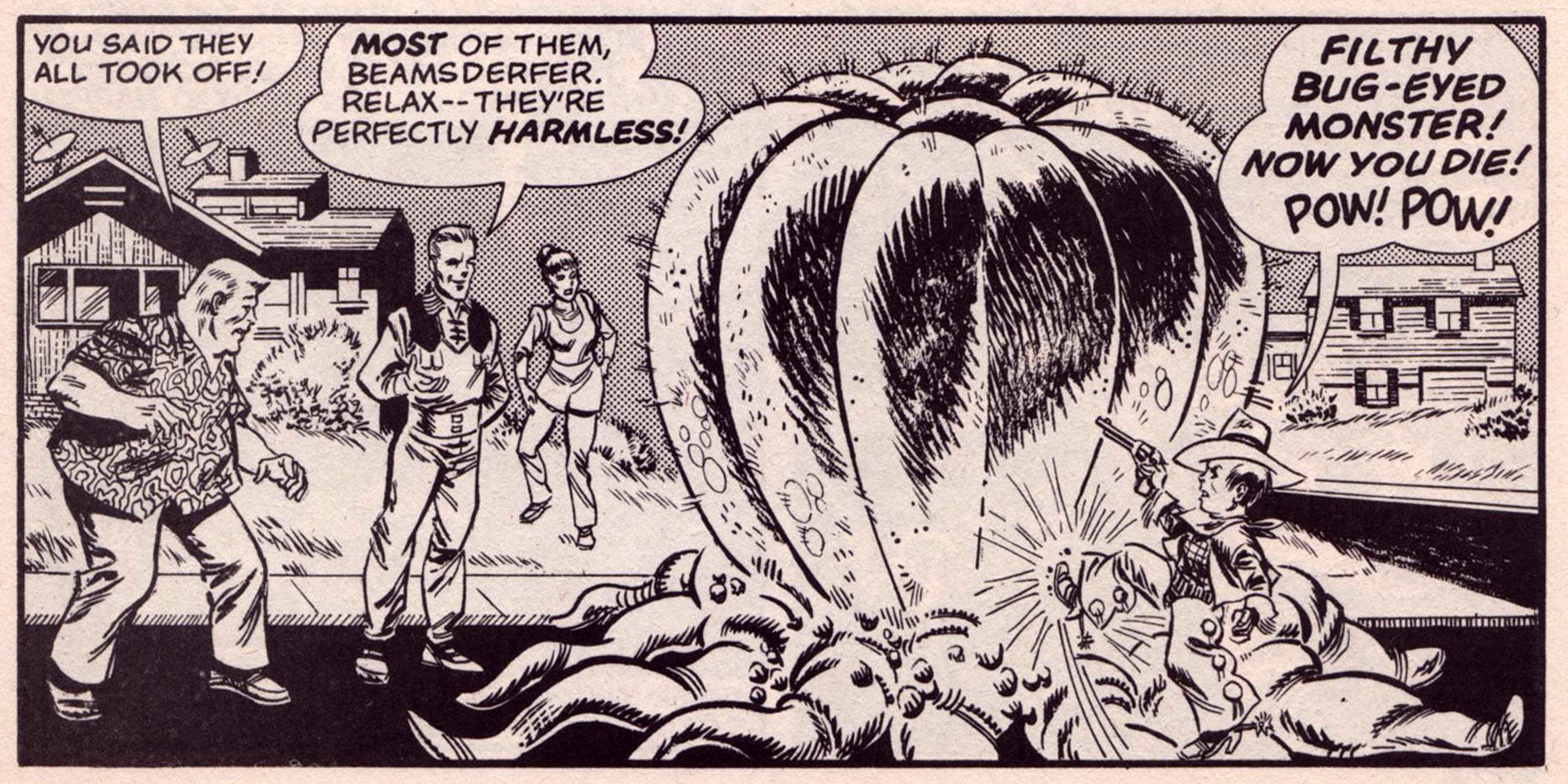
Panel from The Arrivals by Steve Stiles, published in Death Rattle no. 12 (September 1987). Watch who you’re calling filthy, kid – soon you’ll be one of them.
A bit of comic relief: panel from Dr. Stodge Rimperton, Otologist by Tony Millionaire, published in Death Rattle no. 2 (volume 3), December 1995.
« Yes, you may find yourself raving in the aisles when you read Death Rattle, although we sincerely hope not. We hope it will thrill, chill, slice, dice and possibly even amuse you. » (introduction from Death Rattle no. 4)
« Oh Beautiful for smoggy skies, insecticided grain, For strip-mined mountain’s majesty above the asphalt plain. America, America, man sheds his waste on thee, And hides the pines with billboard signs, from sea to oily sea. » ― George Carlin
On this day, the forty-ninth edition of Earth Day, we feature some little-seen work (by his usual audience, at any rate) by Jim Woodring and his collaborator Scott Deschaine*. Given the current political climate, an increasingly dire state of affairs, I’ll (mostly) skip the chit-chat and make with the visual riches.
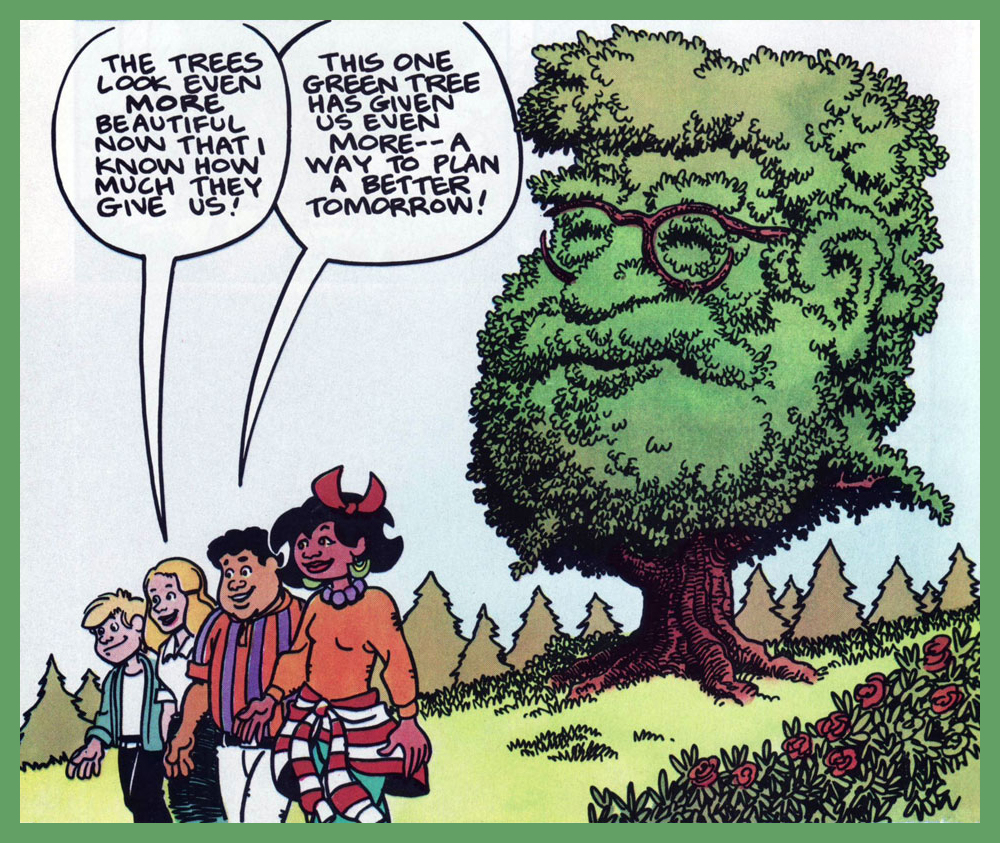
Among the Woodring / Deschaine collaborations, One Green Tree (1990) is the masterpiece, and the only full-on Woodring, visually-speaking, with its expressive inks, unsimplified art and lush palette.
An interior (in more than one sense) page from One Green Tree, a sixteen-pager. Full marks to Deschaine, a science popularizer of the first order, and a cartoonist himself, which goes a long way in explaining the success of these collaborations.
Incidentally, Woodring drew himself into the story as the friendly guide, Mr. Underwood.
As it happens, Earth Day 2019’s theme is « Protect Our Species », and few species need more protection than the gentle elephant.
An excerpt from An Elephant’s Life (1999), written by Mike Benton and Scott Deschaine, illustrated by Woodring.
Search for Soil (2000, Discovery Comics) features Woodring in a simpler style, but it’s still gorgeous and effective. And hey, a Tiny Perfect Mole!
And for those of you who may find this all too earnest, cute and family-friendly, I’ve saved a Woodring piece to soothe your savage brow. This is the one-shot Northwest Cartoon Cookery (1995, Starhead Comix), also featuring fine work by J.R. Williams, Donna Barr, Ellen Forney, Roberta Gregory, Michael Dougan, Mark Zingarelli… and a couple of pages of Ed Brubaker’s dismal artwork.
*French family names, after spending some time in English-speaking lands, tend to distort in interesting ways: “Deschaine” makes no grammatical sense. It likely started out as “Deschaînes” (of the chains), or its homonym, Deschênes ou Duchêne (of the Oaks or the Oak). Sometimes, the name gets so badly distorted that it’s quite unpronounceable: Shia LaBeouf (Leboeuf, the ox) or Cara Delevingne (Delavigne, of the vine)… not that I’d want to utter these names, save perhaps as curses.
«America’s top-flight intellectuals will one day hold entire conferences and seminars devoted to Sylviology. They will deconstruct her frame by frame with straight edge and compass, attempting to identify each tiny object as an Artifact of Our Time and a clue to our condition. They will bring in leading neurologists, phrenologists and psychoanalysts to study the blabbermouth pets, the thimble-sized martinis, the neurotic superheroes, to answer the inescapable question: What kind of a mind…?» \from the introduction to Planet Sylvia by Barbara Ehrenreich|
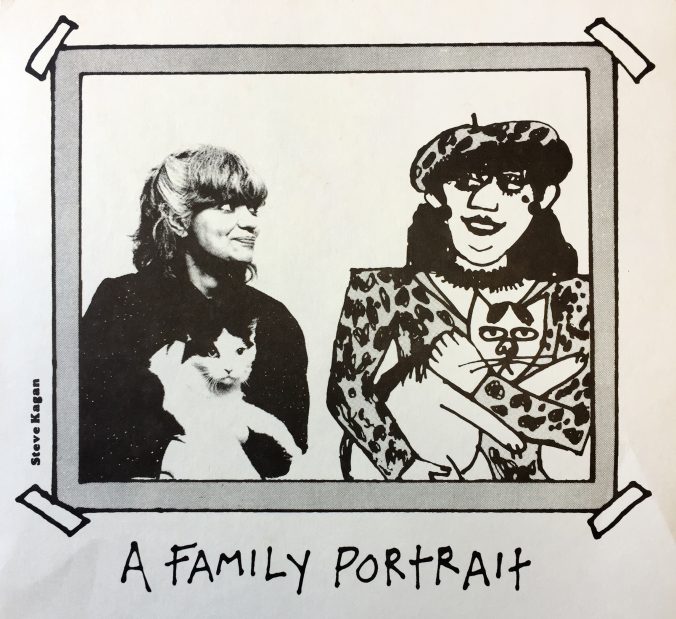
Many years ago, I was perching on a sofa in the corner of a cozy records store (the excellent Death of Vinyl in Montreal, in case anyone is wondering) when I noticed a stack of comics in a nearby bin. Something dishevelled and coverless, pages barely holding together, attracted my attention with its idiosyncratic drawing style and strangely articulated cats. There was also a big-nosed lady with giant earrings and a typewriter. I was hooked and purchased the book immediately, though I wasn’t even sure whether it was for sale or just placed there as reading material. (I located the cover, after all, albeit in a different bin.)
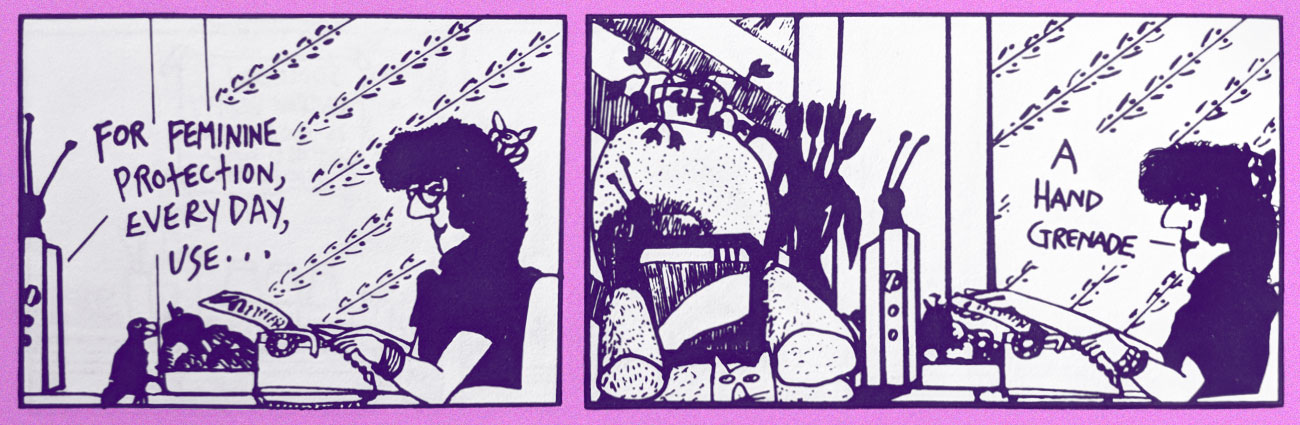
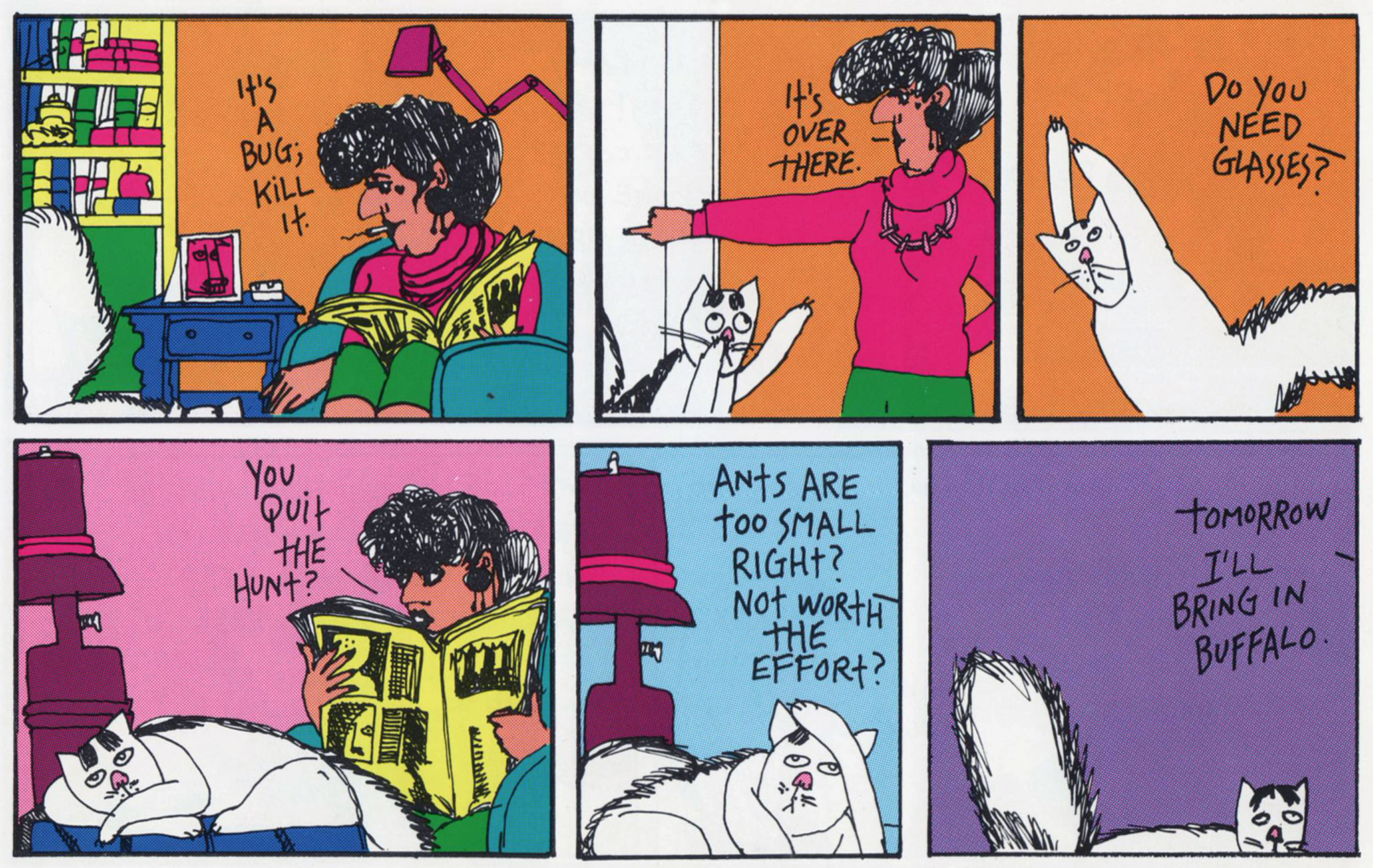
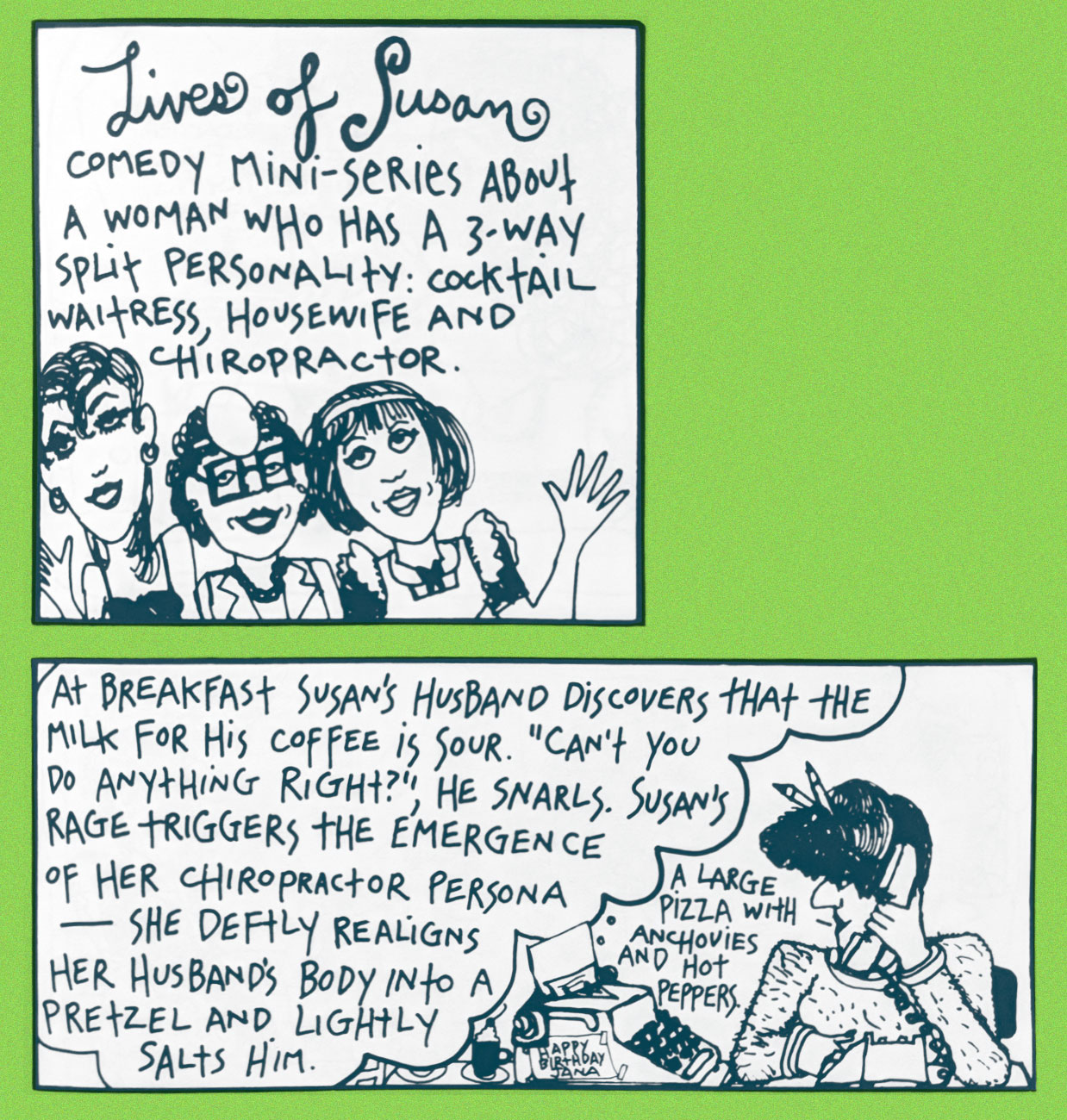
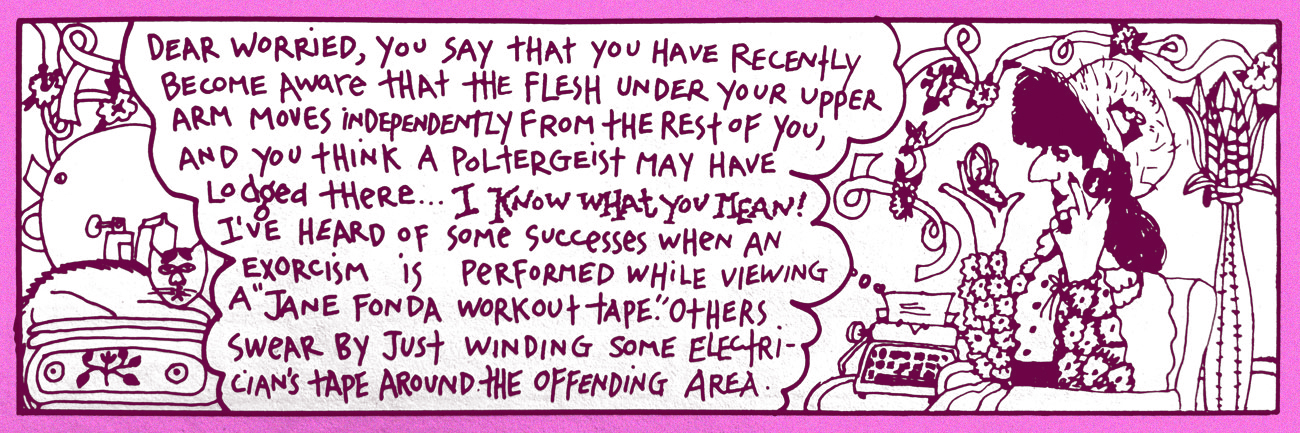
Sylvia is a more-than-slightly cantankerous woman with a wonderfully acerbic sense of humour. Sometimes she doles out social commentary from the bathtub, sometimes a local café serves as her headquarters — or she stays in her living room, dispensing wisecracks at yet another inane TV ad, or bestows advice to lost souls (typed on an honest-to-god typewriter). She’s clearly a feminist, and equally clearly fluent with clichés of womanhood, such a certain obsession with dieting and a definite obsession with cats. She embodies many tropes – she’s the crazy cat lady, an Apron Matron (albeit with a flowery hat instead of an apron), a Dear Abby-type adviser – and puts her peculiar tilt on them all. Extravagant earrings and the odd flamboyant hat (all the articles about Sylvia seem to overstate the presence of hats, yet Sylvia’s handsome head often boasts nought but big hair adorned with a hairnet or bow) are just the cherry on the cake.
As for Nicole Hollander, she is a Chicago native and brought forth something like 30 years of Sylvia. Born as a series of cartoons for the feminist magazine The Spokeswoman, it was syndicated in 1981 and continued until March 26th, 2012, upon which date Hollander declared that Sylvia was retiring.
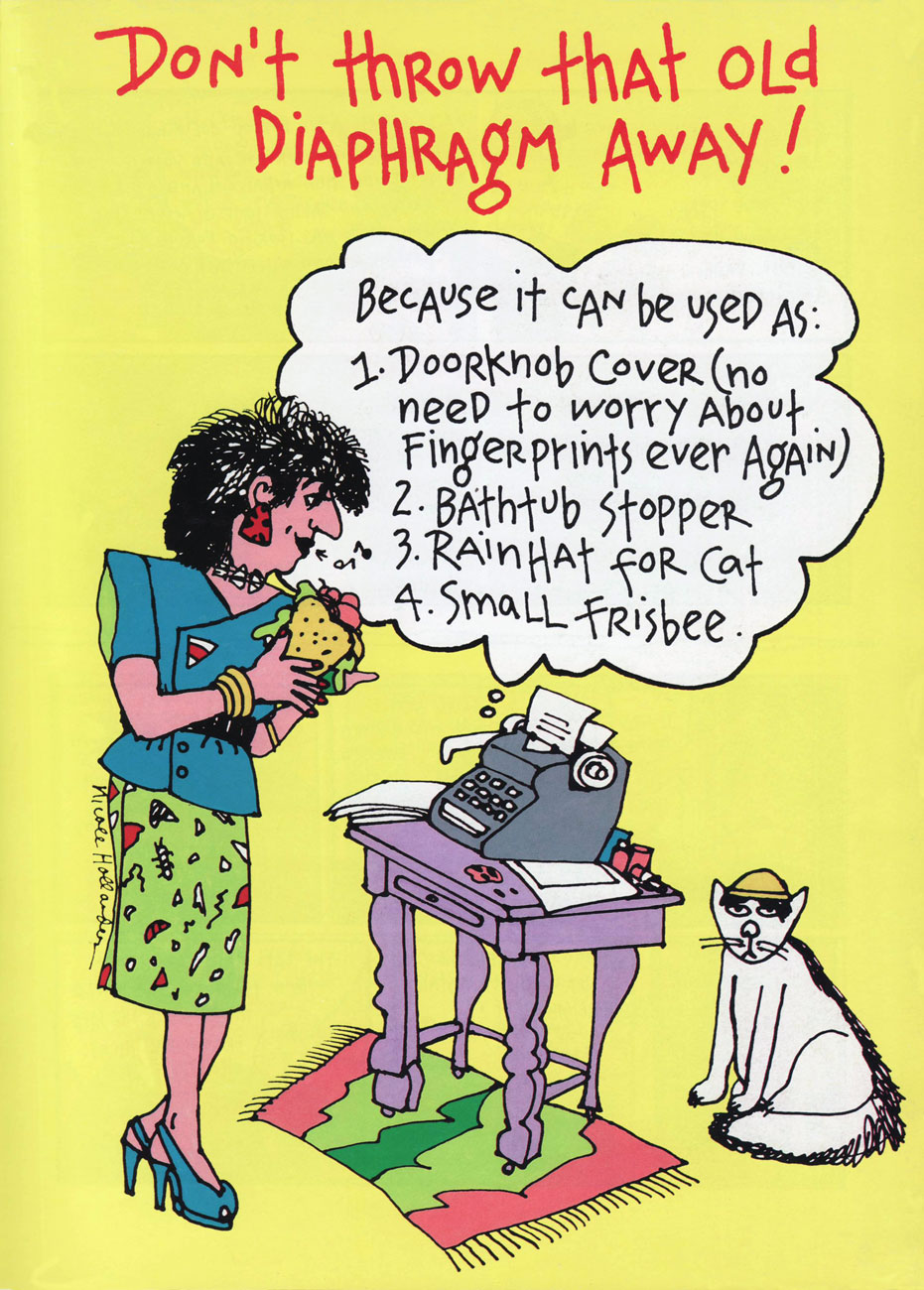
« In the old days, the disconcerting feel of the strip as well as Sylvia’s middle-aged ‘dame’ image and her biting humour gave the artist problems. After St. Martin’s had started publishing Sylvia, even the big syndicates were forced to sit up and take note of her. But they did so in a grudging, good-old-boy sort of way, taking away with one hand what they gave with the other. After Field Enterprises took Hollander on in 1981, a rep would intermittently call Nicole to shake a finger at her – for instance, the week on Sylvia cartoon mentioned hemorrhoids, and another mentioned Lightday pantyliners. “They said, It’s your life, but you’re ruining it. If you leave stuff like this in, a lot of papers will pull the strip. I gave up the hemorrhoids, but not the Lightdays. There was this voice in my head that said, You must take a stand. So I said, I will take my stand for Lightdays, and threw hemorrhoids to the dogs.”» |From Don’t Throw That Old Diaphragm Away! by Ellen Cantarow, published in Mother Jones (June/July 1987)|
In case you’re wondering what *can* you do with a diaphragm, this handy illustration might help:
For all its popularity, there aren’t a lot of Sylvia strips available online, let alone in decent resolution. Oh, sure, you can go to GoComics and read a whole bunch of them, but that seems to be just the strips from the 2000s. Somebody got started on a documentary about Hollander in 2015, but I get the impression that that was abandoned somewhere along the way, probably for lack of funds. Even Hollander’s website, Bad Girl Chats, doesn’t seem to exist anymore. Speaking of that, please watch this adorable video in which Nicole explains what sort of things she posts on her website.
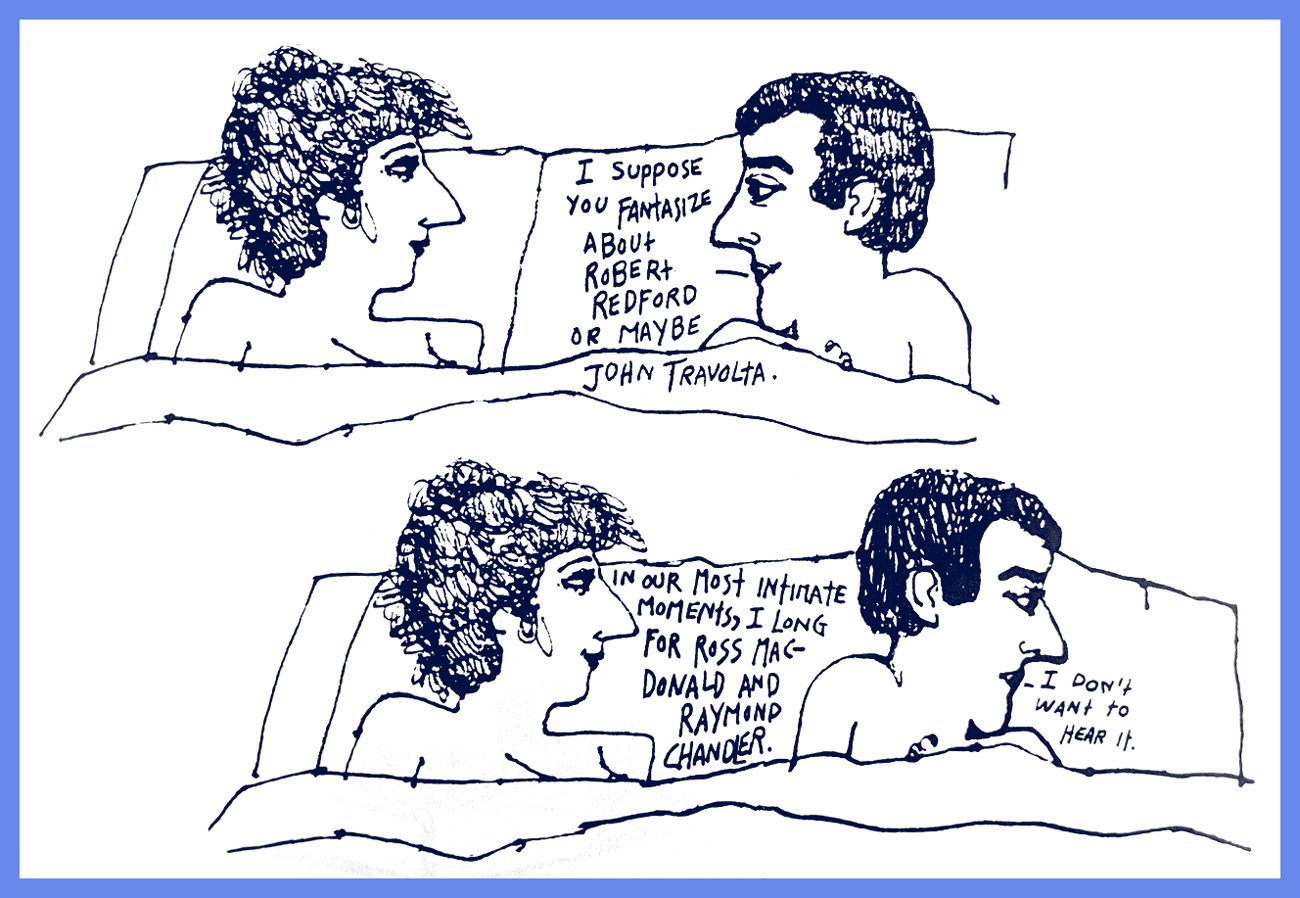
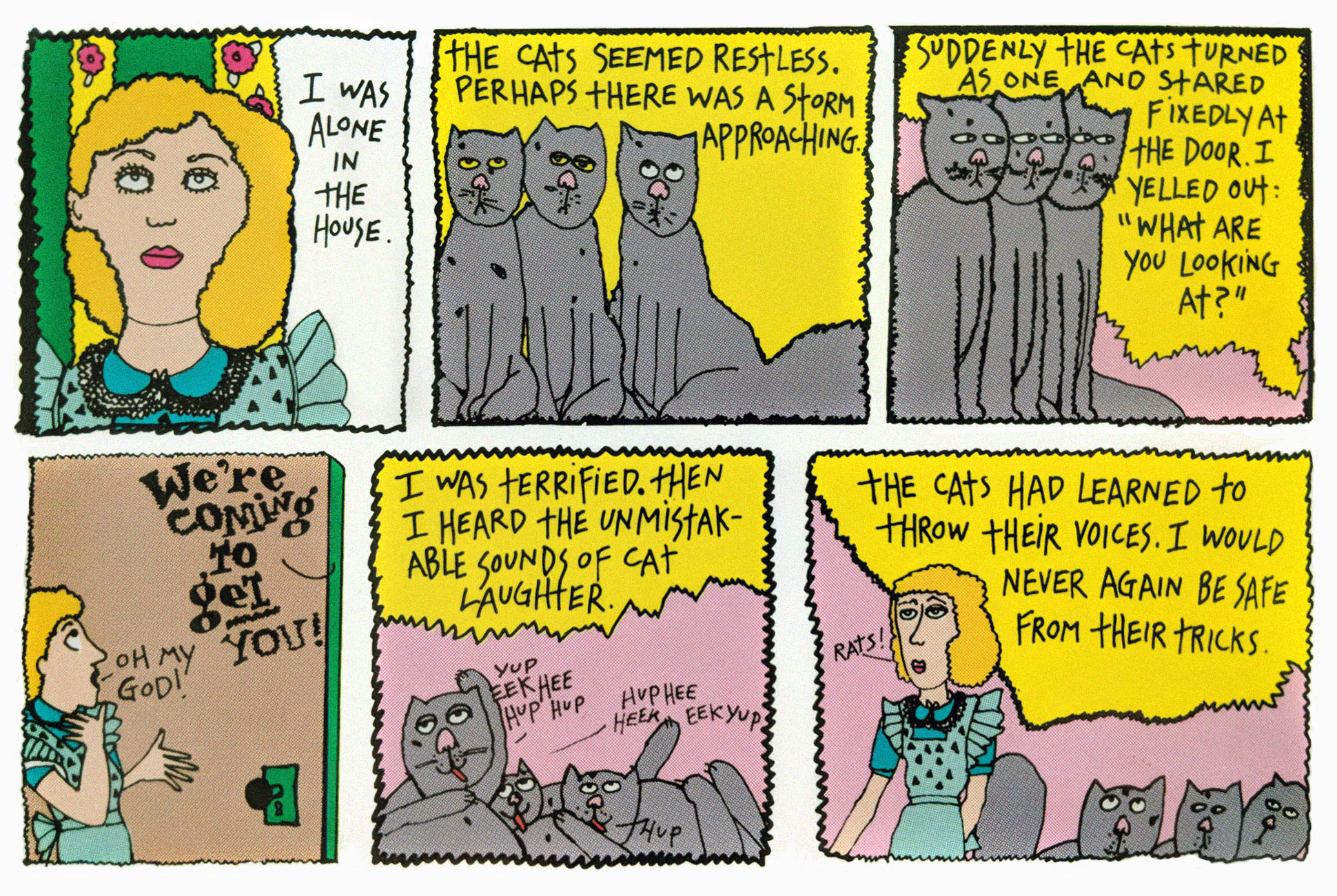
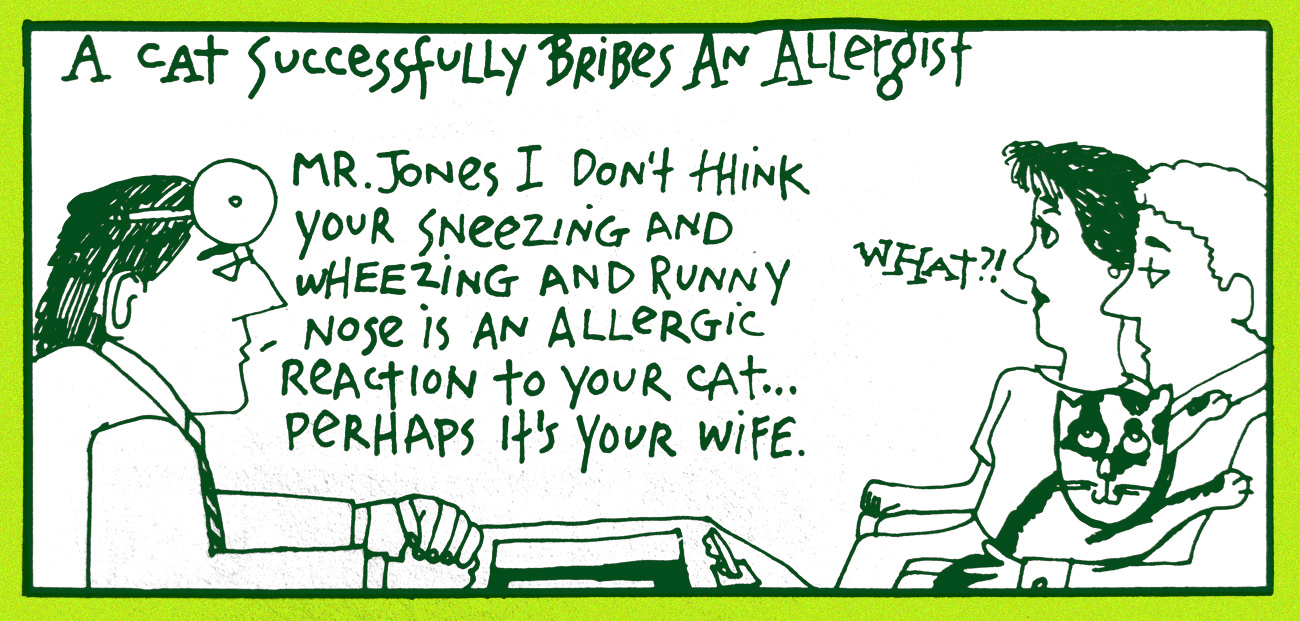
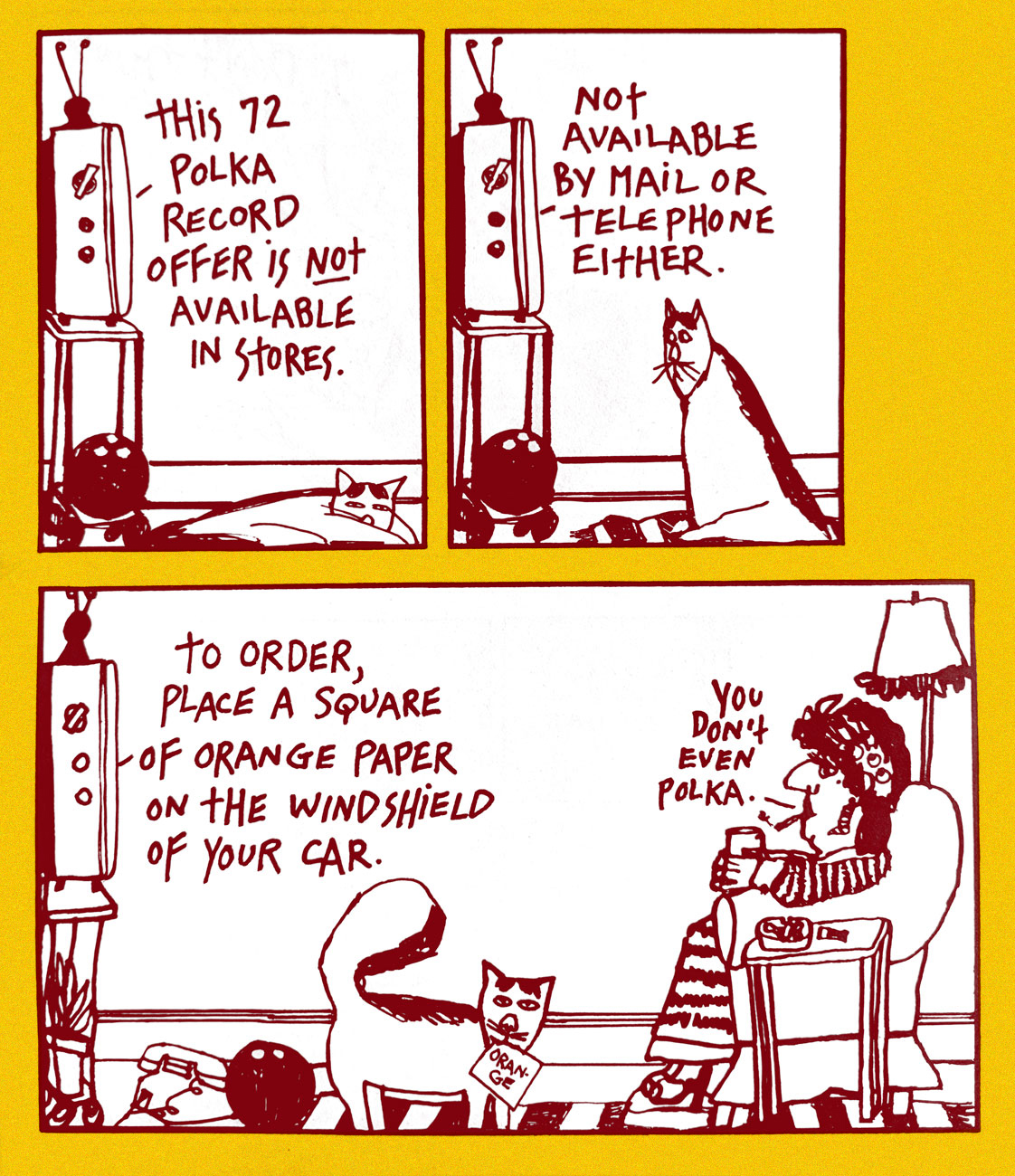
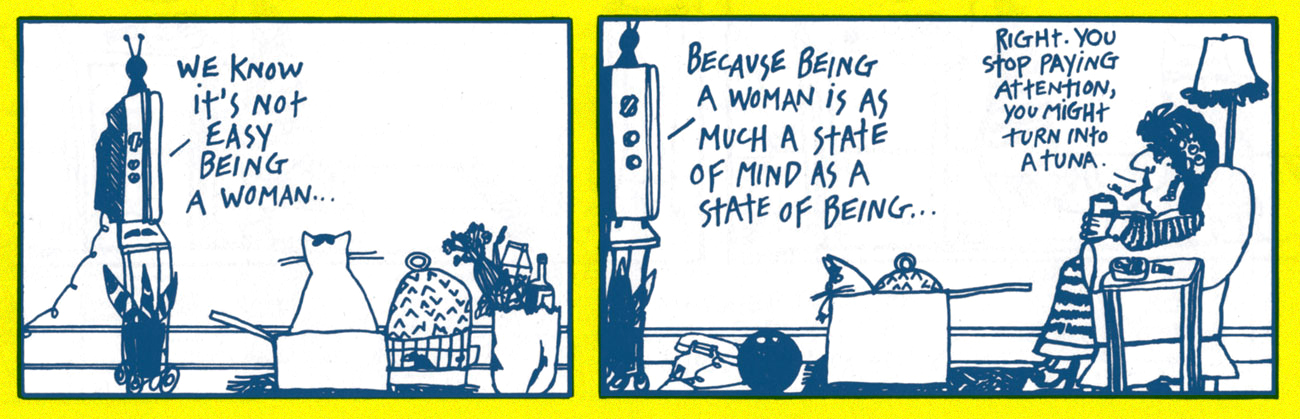
(On the brighter side, in 2018, Fantagraphics released Hollander’s autobiography-slash-graphic-novel, We Ate Wonder Bread.) I aim to remedy this situation at least a little bit, by showcasing some of my favourite strips (scanned from The Whole Enchilada, 1986 and also from Planet Sylvia, 1990; the black and white strips were “colourized” by co-admin RG, who abhors lousy greying paper.)
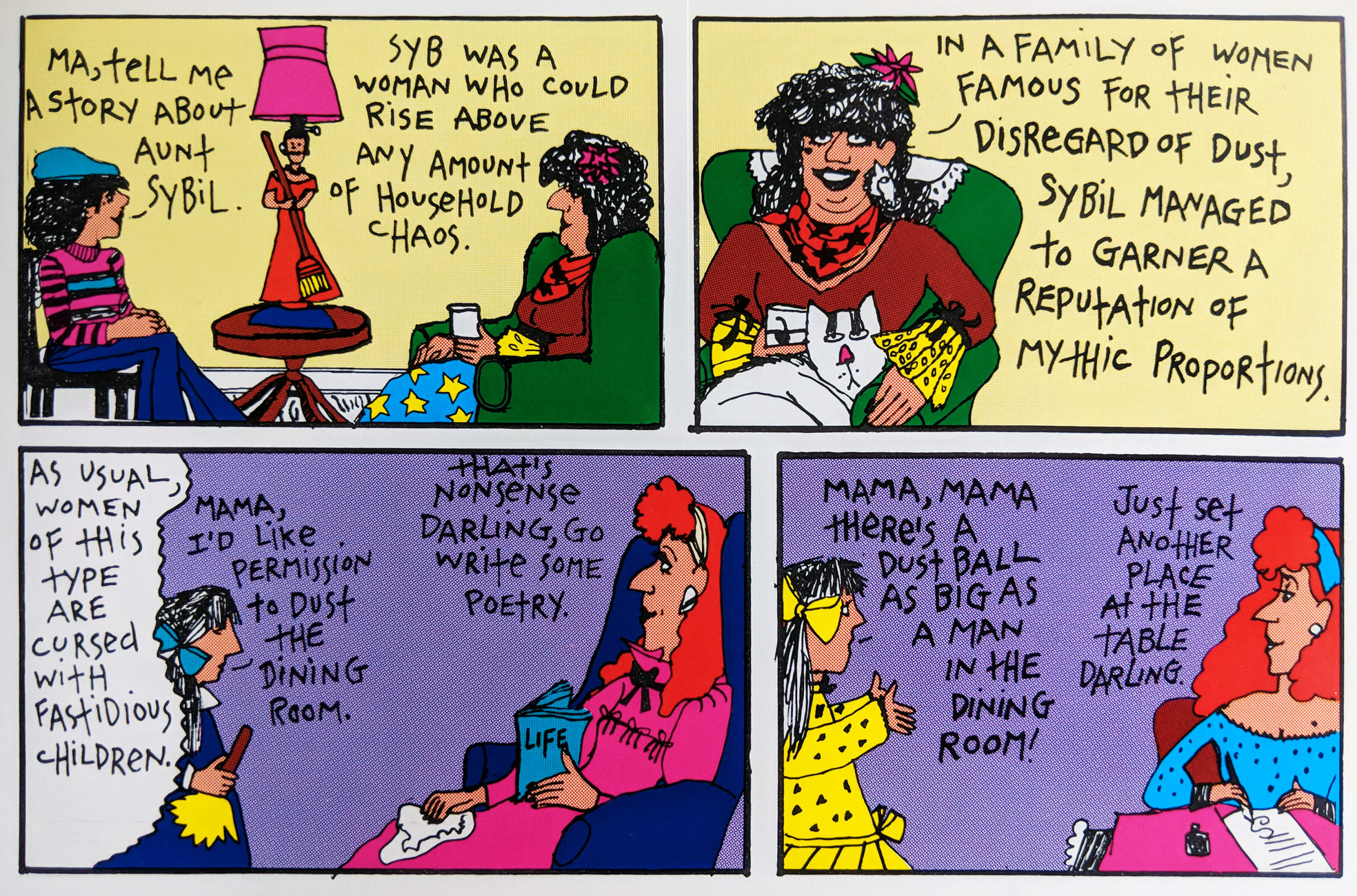
As Hollander points out, her mother had a whole network of witty women friends who liked to discuss events of the day over a cup of coffee. Auntie Sybil was surely one of them.
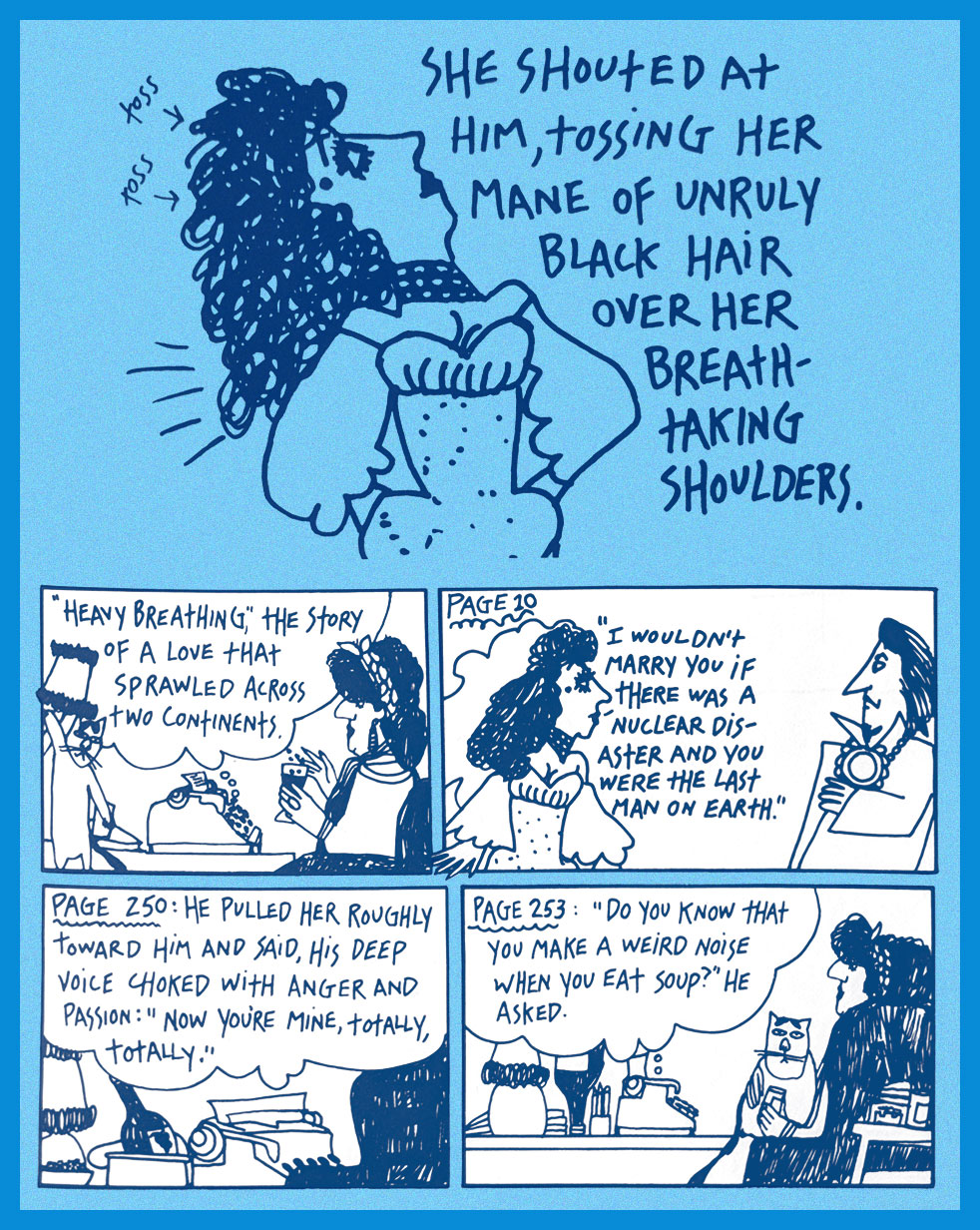
Occasionally, Sylvia ventures into writing romance novels, which do a delightful job of mocking common clichés of what passionate love is supposed to be like.
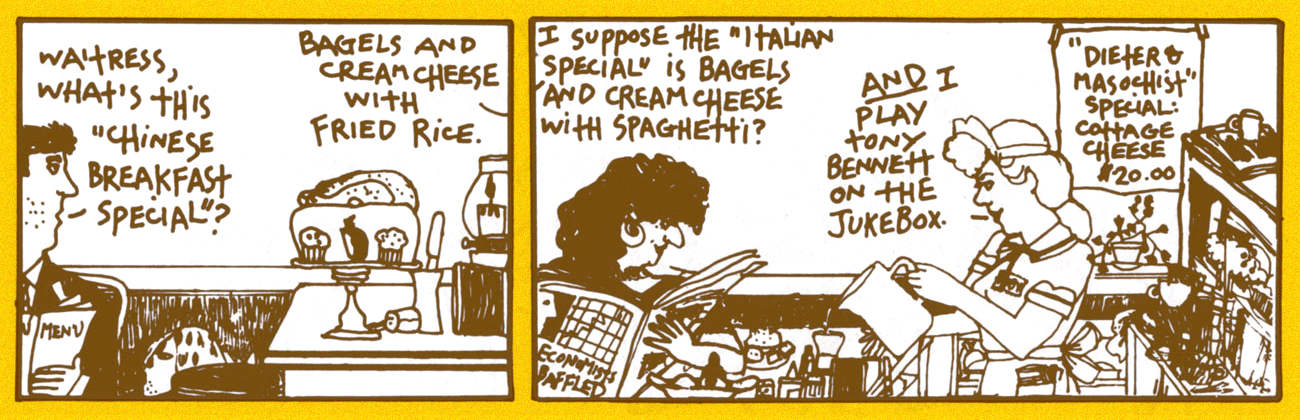
Waitress Beth Ann is every bit as sardonic as Sylvia, but with more of a food-centric accent.
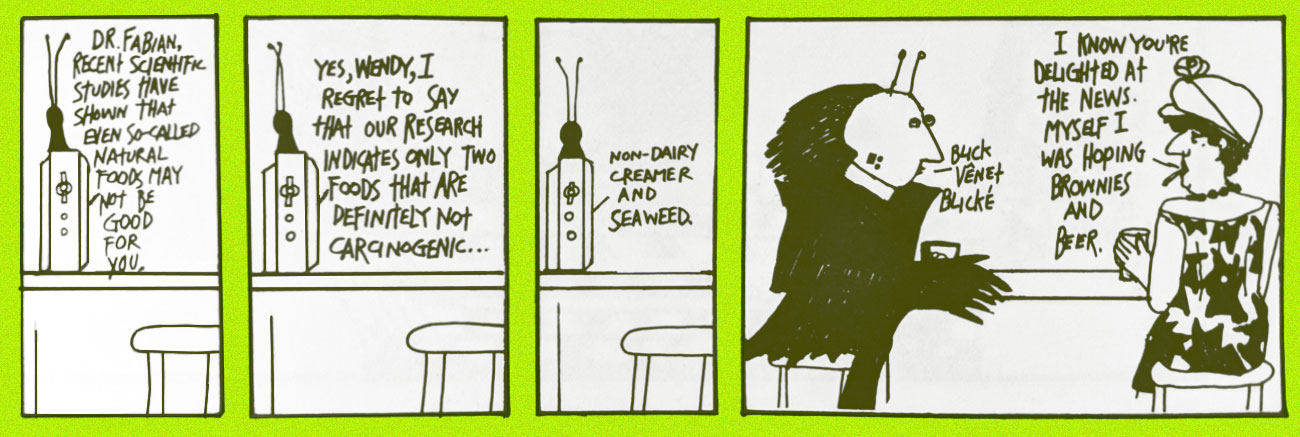
Gernif often shares a cup of… non-dairy creamer, I guess… with Sylvia. I wonder if she, like Broom-Hilda, stopped drinking and smoking when the proverbial Powers-that-be decreed that syndicated newspaper strips couldn’t feature characters indulging in sinful hobbies.
« When we sat down Hollander began talking about how she and her friends used to sit silent and wide-eared at a table in the deli while their mothers gabbed. I didn’t appreciate how vital a memory this is until I opened Wonder Bread and spotted a sketch of the women yakking, another of young Nicole sitting primly before a corned beef sandwich and a jar of dill pickles as the grownups dish. “We were avid listeners,” says the text, filling in details you sense from the art, “fearful of interfering with their talk, hoping they wouldn’t notice us so they would keep on talking. They were all witty women, fiercely loyal to their friendship, to the specialness of every woman in the group.”» |Life After Sylvia: Cartoonist Nicole Hollander publishes a memoir|
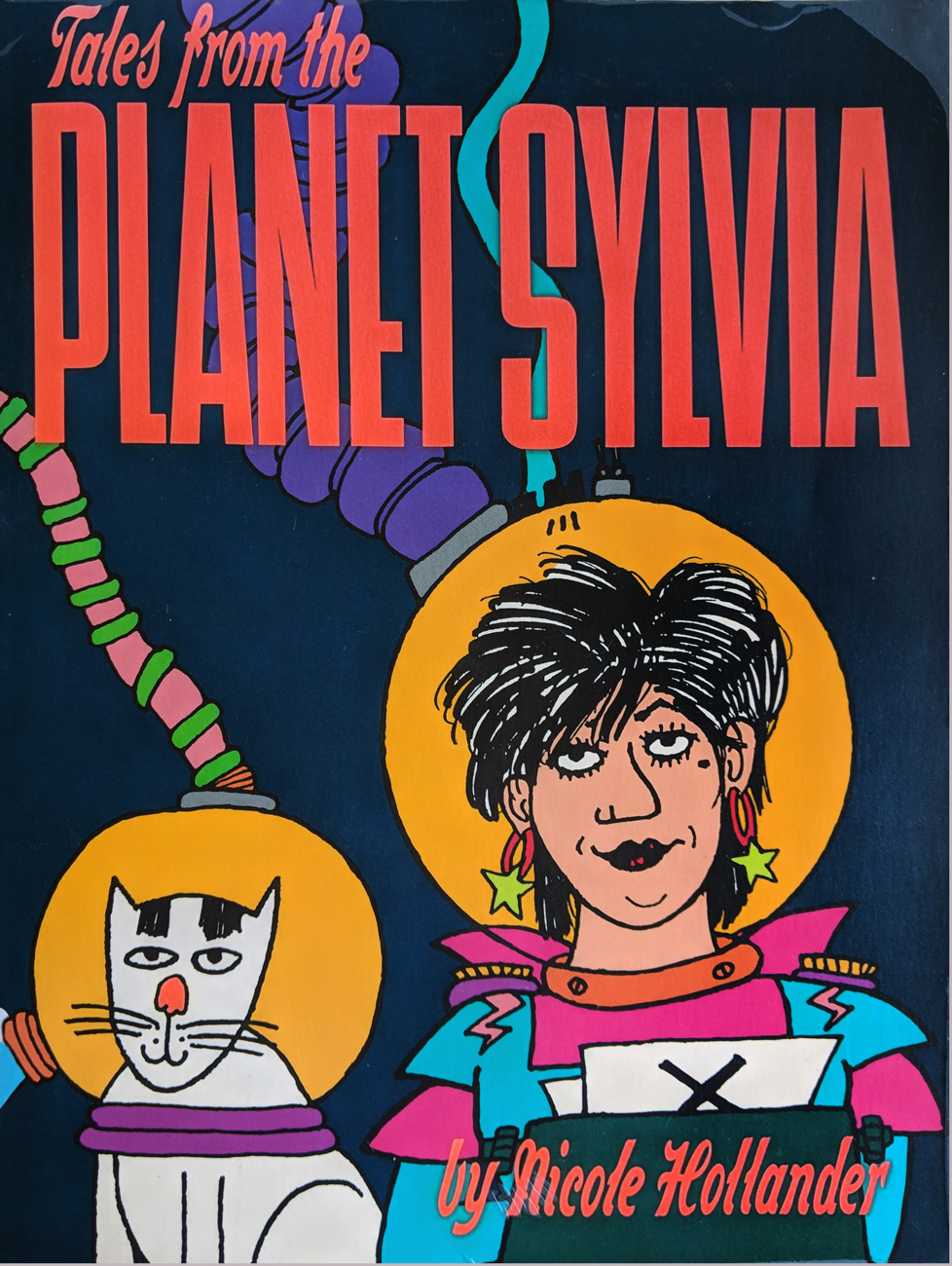
The cover for Planet Sylvia (St. Martin’s Griffin, 1990). « For all we know, there is a Planet Sylvia. We know that it is a place where cats write passable fiction, where ham has no cholesterol, where women are free to go out of doors without eyeliner and eat large portions of fries in public. Its atmosphere is not only breathable, but induces a delirious sense of lucidity, unknown to our own dank orb, except to the mystically enlightened and abusers of nitrous oxide. » (from the introduction)
I took this picture from Spotlight on the Nicole Hollander Collection, an article about the Billy Ireland Cartoon Library & Museum’s archival collection of Hollander strips and odd and ends.
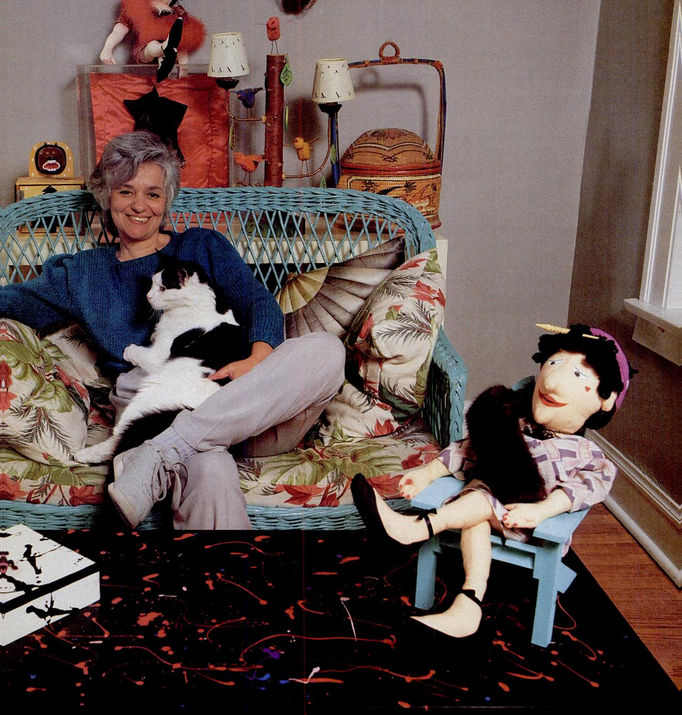
Nicole Hollander in 1987. I’d like to point out that even today it is highly controversial for a woman in her late 40s NOT to dye her hair grey. She’s one awesome lady.
One last tidbit: on 2012, Nicole Hollander’s “unique collection of condom packages and sex toys” entered the collection of the Kinsey Institute for Research in Sex, Gender, and Reproduction. That raises more questions than it answers, doesn’t it?
Web of Horror no. 1 (Major Magazines, December 1969). Painting by Jeff Jones.
I understand that the artist left quite a lot of empty space on purpose – to be filled with pointless text – but still, was it necessary to plaster nearly every inch of the image with captions yellow, red and purple? (I do like how the WEB seems to be made out of plasticine… and likely was.) Here’s the cover without all that wordy fluff:
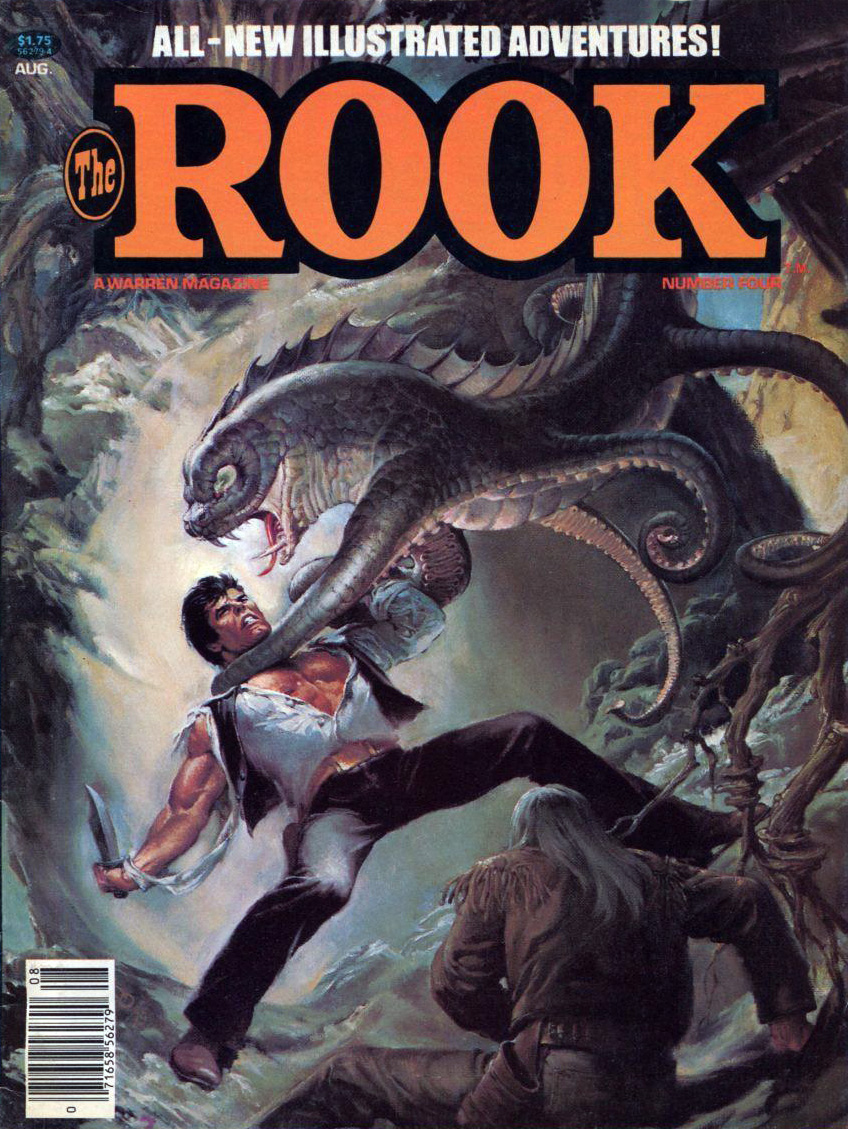
The Rook no. 4 (Warren, August 1980). Cover by Nestor Redondo.
The Rook couldn’t quite kill the fishy brute’s whole family in #4, so he had to confront its slightly more colourful cousin in issue 7:
The Rook no. 7 (Warren, February 1981). Cover by Jordi Penalva. It’s nice to see that men (not exclusively Doc Savage) get strategically ripped shirts, too, sometimes. Eye candy!
Co-admin RG suggested I check Eclipse Magazine‘s tentacular offerings for this post, and he was correct, there was one issue involving an octopus used as a coffee table.
Eclipse Magazine no. 4 (Eclipse, January 1982). Cover by Carl Potts. I went snorkeling a few months ago and the scene was not dissimilar (minus, sadly, the mermaid).
Marvel’s Epic Illustrated, with its 70-odd pages per issue, surely offered something for everyone. The aforementioned offerings were quite hit-or-miss, but the occasional presence of Stephen Bissette, Rick Veitch, Basil Wolverton (in reprints), Berni Wrightson, Ernie Colón, P. Craig Russell, et al. makes it worthwhile to go through its 34 issues (okay, maybe not all in one sitting, unless you have quite a few thermoses of tea prepared – or something stronger).
Epic Illustrated no. 12 (Marvel, June 1982), cover by Frank Brunner. You can read the whole issue here.
Brunner’s painting is rather nice – the mermaid and her friendly octopus both look so serene! – that here it is again. And read an interview with him while you’re at it: Legendary Feathers: Interview with Frank Brunner. (I apologize for linking to a website titled Fanboy Nation, though. Erk.)
Issues 10 to 17 of Epic Illustrated featured Rick Veitch’s Abraxas and the Earthman, a purported retelling of Moby Dick (although frankly, aside from a vengeful squid, the similarities are not striking). Naturally, tentacles abound. Really freaky, creepy tentacles, much like the rest of the story.
Page from “The Hunt: Chapter Three”, written and drawn by Rick Veitch, printed in Epic Illustrated no. 12.
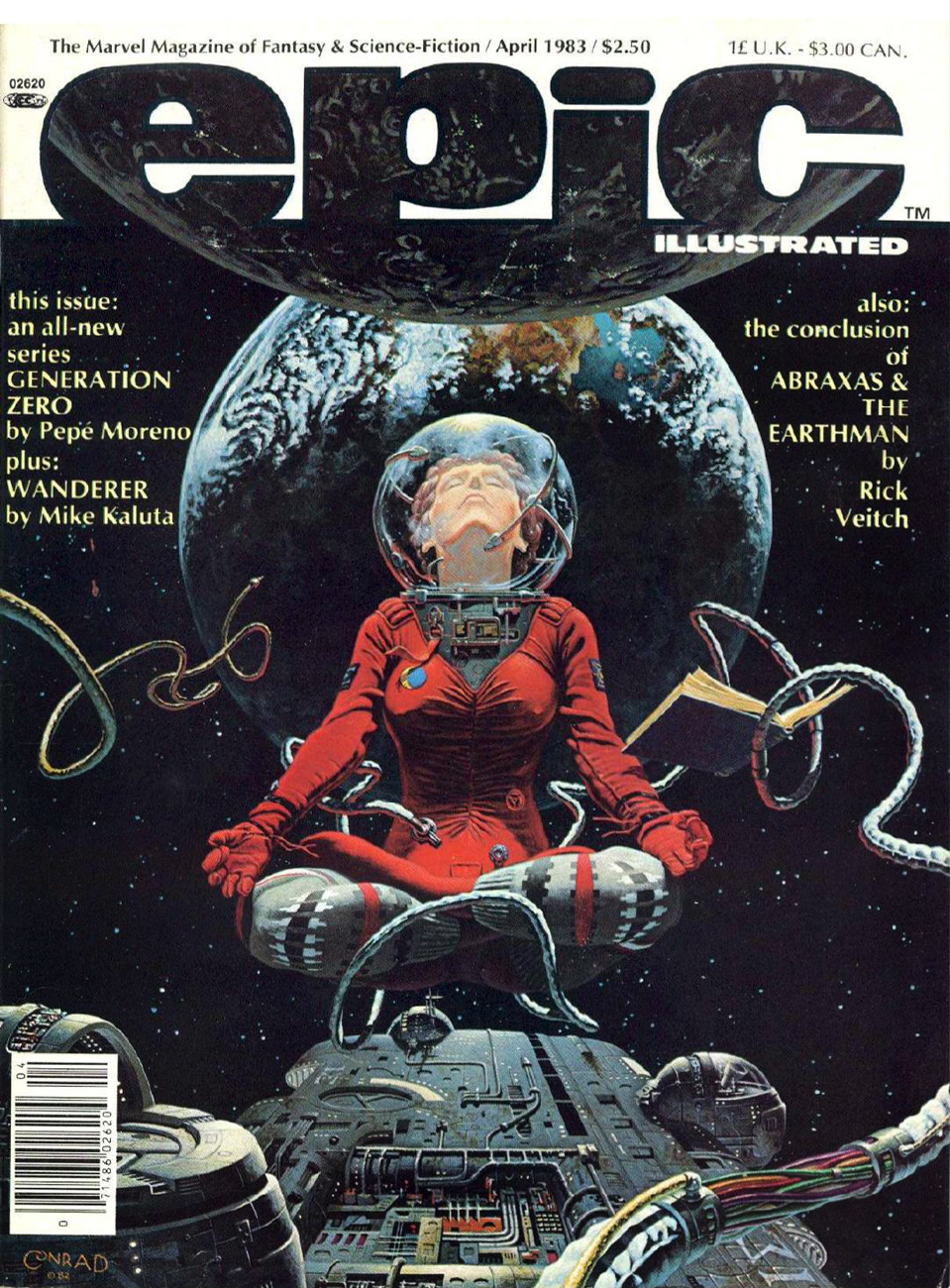
Epic Illustrated no. 17 (Marvel, April 1983), cover by Tim Conrad. Read it here.
Veitch’s fucked-up (I mean that as a compliment), imaginative tale continues with “Man and Whale (Chapter Eight)”, the final installment. Alongside a plethora of sea-creatures (no longer in the sea), there’s this Devourer of Awareness, Bearer of Tentacles:
Epic Illustrated no. 22 (Marvel, February 1984). Cover by John Bolton. Read the issue here. It’s a bad, unconvincing cover, but hey, this is an inclusive post.
Speaking of Bolton, he drew “Wizard’s Masque” (another chapter in the cycle of Marada the She-Wolf), a story scripted by Christopher Claremont.
Country Boy: What are you doing? City Boy: Drawing. Country Boy: Where are your guns? — Submitted by Steven Feinstein, 7, Philadelphia, PA (circa 1965)
Cracky the parrot was introduced in the role of mascot for Western Publishing‘s general-interest kids’ mag The Golden Magazine (1964-71), which heavily drew upon the successful Jack and Jill (published since 1938 by The Saturday Evening Post Society) formula.
For much of its existence, The Golden Magazine thrived, having access to top creative talent from the Western publishing empire (Whitman, Gold Key, Golden Press, Golden Book Encyclopedia…)
At first, Cracky stuck to sharing reader-submitted jokes. Then, around 1968, he began to show up on covers, generally depicted by versatile Canadian illustrator Mel Crawford (1925-2015). This is one such case, from April, 1969.
In 1970, Cracky saw his old job expanded, branching out into two titles, Jokes by Cracky and Pencil Puzzle Fun, the latter outlasting its parent, The Golden Magazine. This is Jokes by Cracky no. 2 (1970); Cover art by Mel Crawford.
Then, in 1972, it gets interesting: the lowly parrot mascot broke into comics.
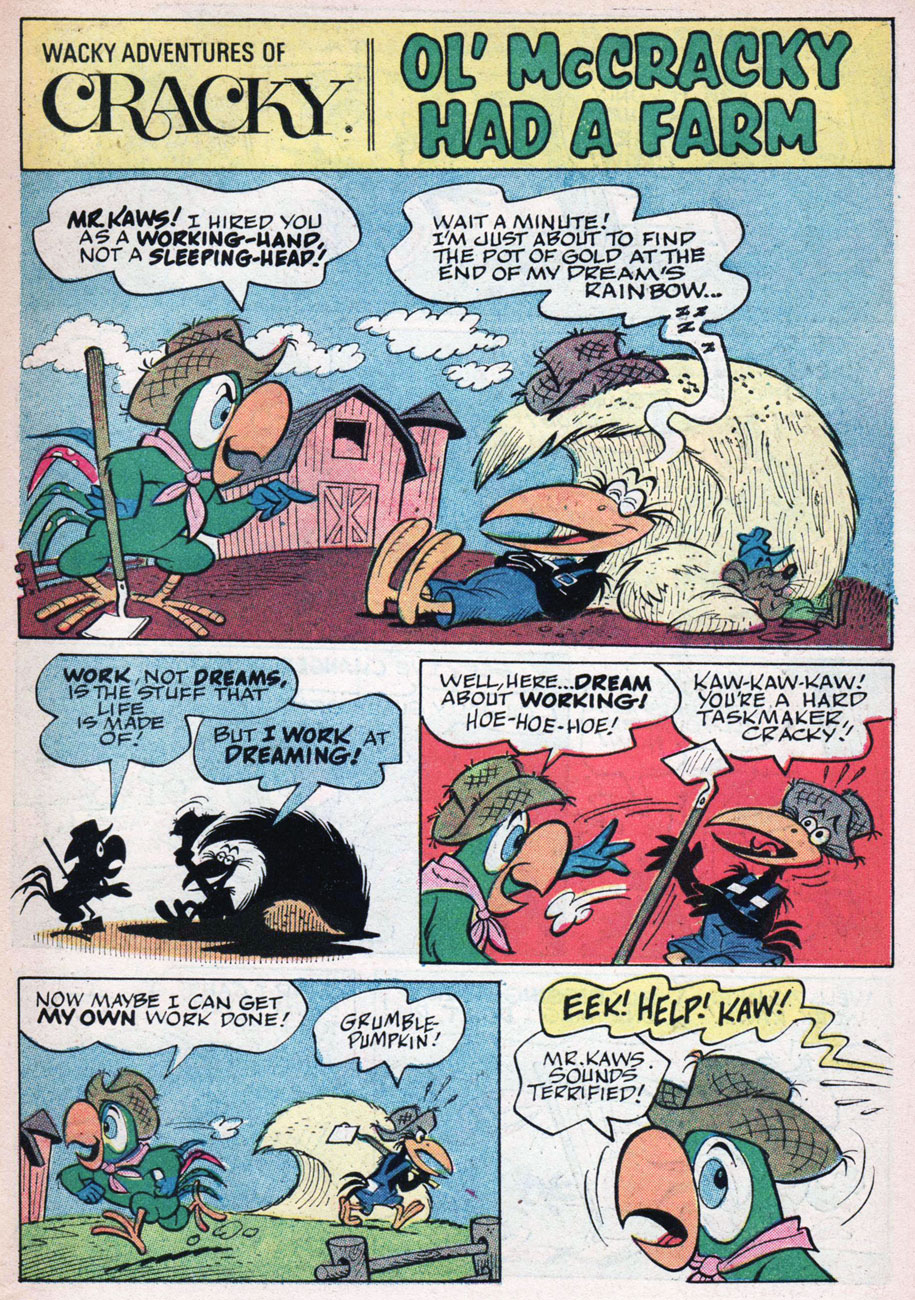
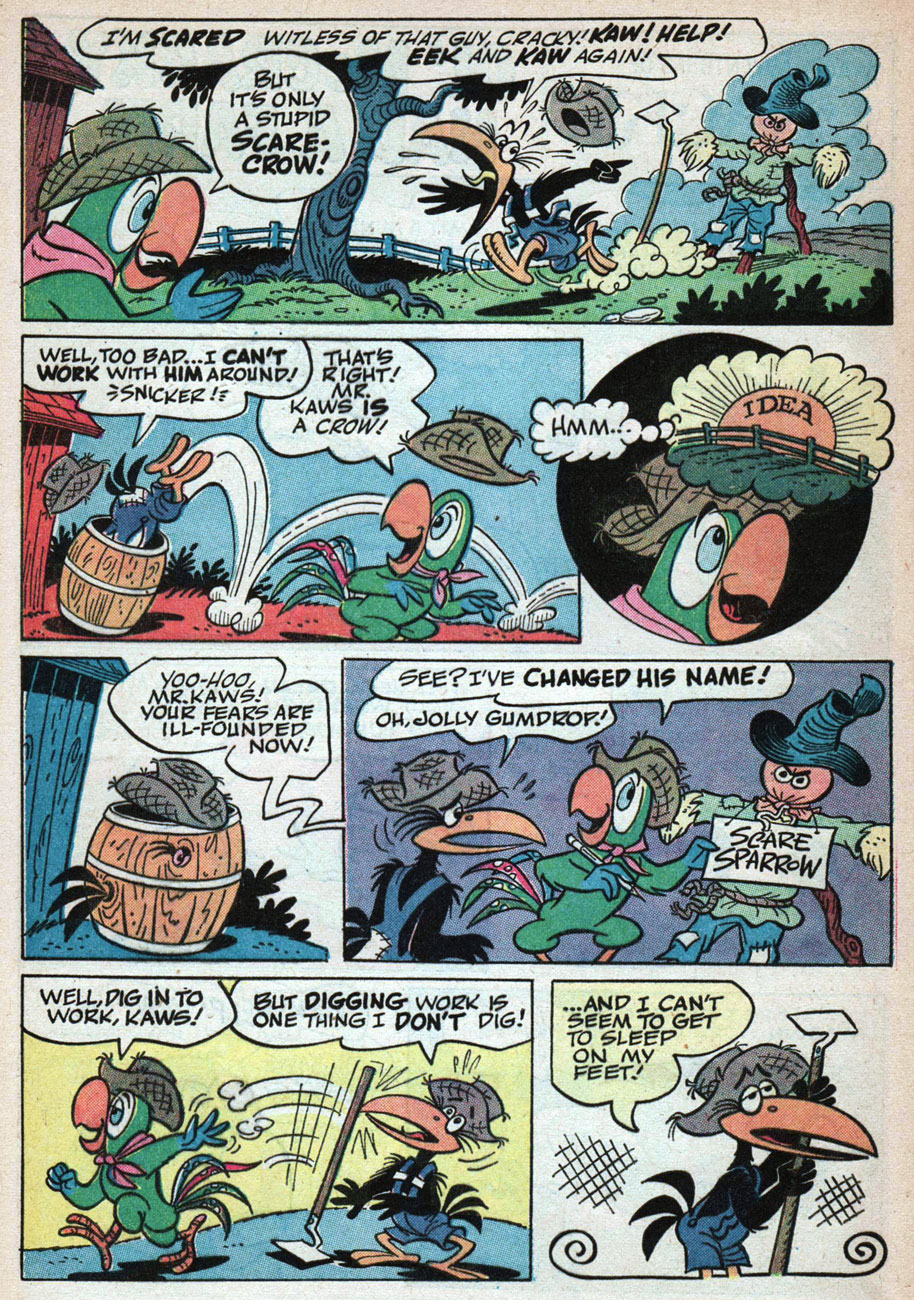
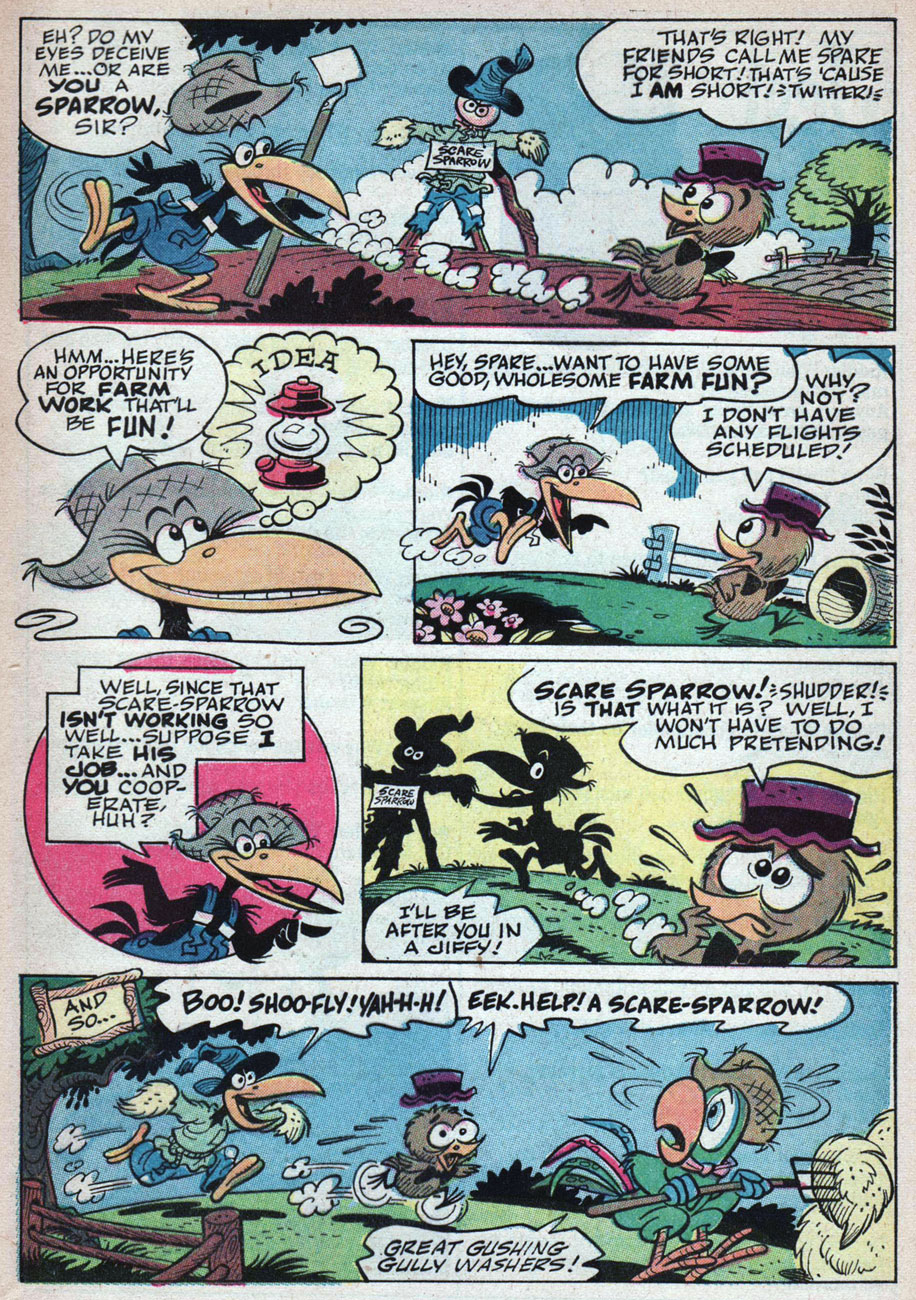
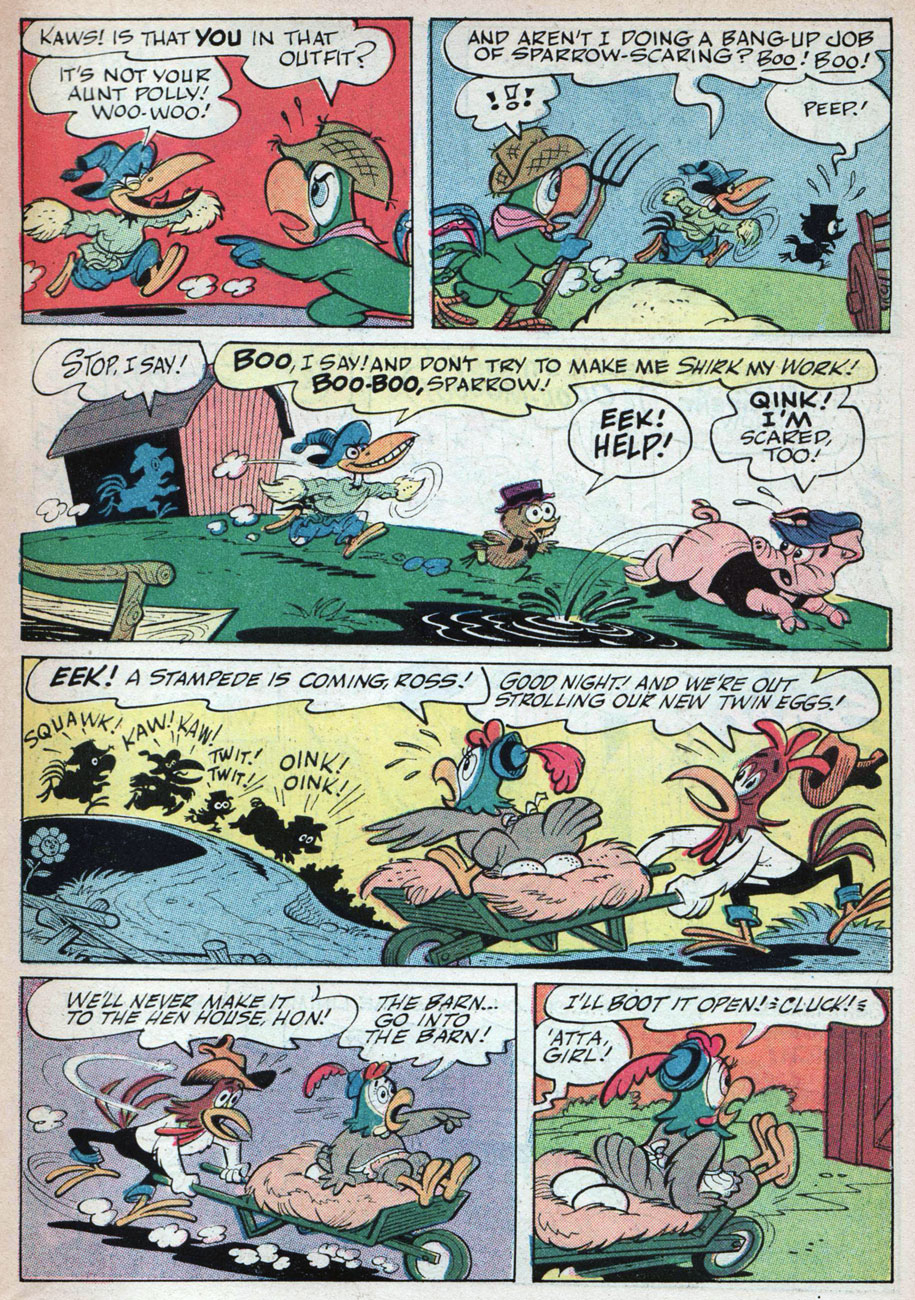
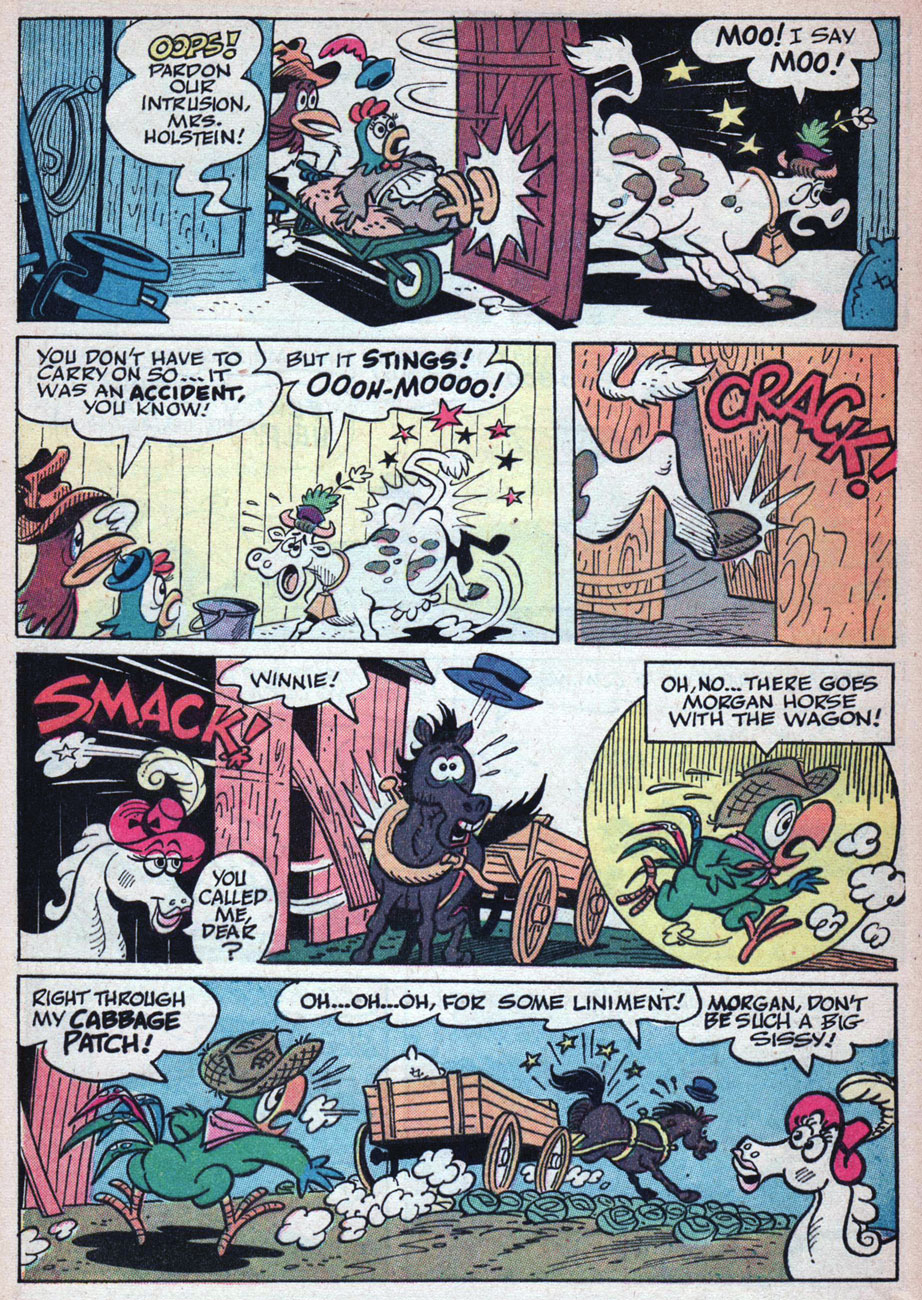
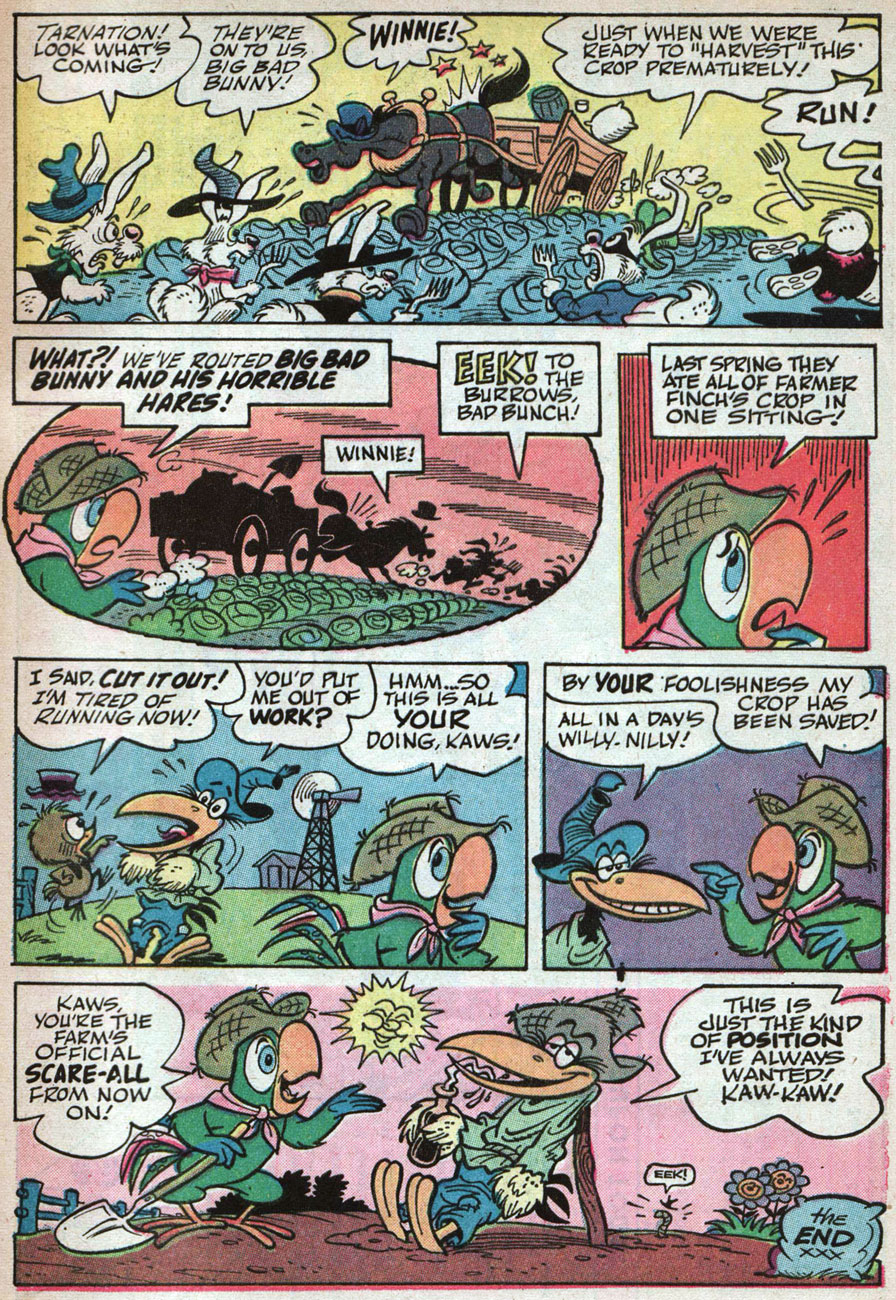
As Archie Comics had their Christian-zealot madman in Al Hartley, so did Western in the person of Vic Lockman. A significant difference, however, is that Hartley, despite quite stiff competition, is arguably the very worst Archie artist; he’s certainly got my vote [Seconded! ~ ds]. Lockman (1927-2016), a prolific but often terrible scriptwriter, was a terrific cartoonist, blessed with a gorgeously fluid line and exemplary design sense, lively and detailed. Here, then, is a story from Wacky Adventures of Cracky no. 3 (June, 1973). Script and art, including his distinctive lettering, by Mr. Lockman.
During the run of his comic book, Cracky (and sidekick Mr. Kaws) wore many hats: detective, inventor (presumably giving Lockman the chance to recycle some of his rejected Gyro Gearloose scripts), ship’s captain, escape artist, sheik… And yes, he did encounter some choice tentacles, but I leave it to my partner to conduct her own investigation. Lockman beautifully handled the first ten issues of WAOC; the instant he stepped away, the thing dissolved into tripe. Avoid accordingly.
Lockman, who seemed a loveable, well-meaning coot, was also twelve kinds of batty. Biblical Economics, anyone? For as full a picture as can be reasonably assembled, read Mark Evanier‘s fine, thoughtful obituary of Lockman.
Lockman was also among those sadly deluded souls (hello, Chuck Dixon) who tried to lay claim to the title of most published comics writer. Let’s face it: the most likely contenders (Joe Gill, Paul S. Newman, Gaylord DuBois) toiled in anonymity for most of their long careers.
In 1971, The Golden Magazine was sold (to The Saturday Evening Post Company!) and renamed, becoming Young World in 1972. Young World, in turn, got incorporated into Child Life in 1979, but that’s a story for another day. Many of TGM’s features were retained but slightly… tweaked. For instance, see who inherited Cracky’s old desk?
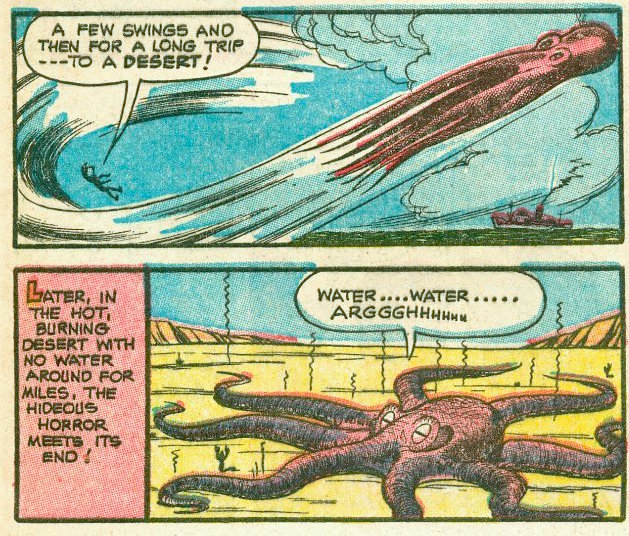
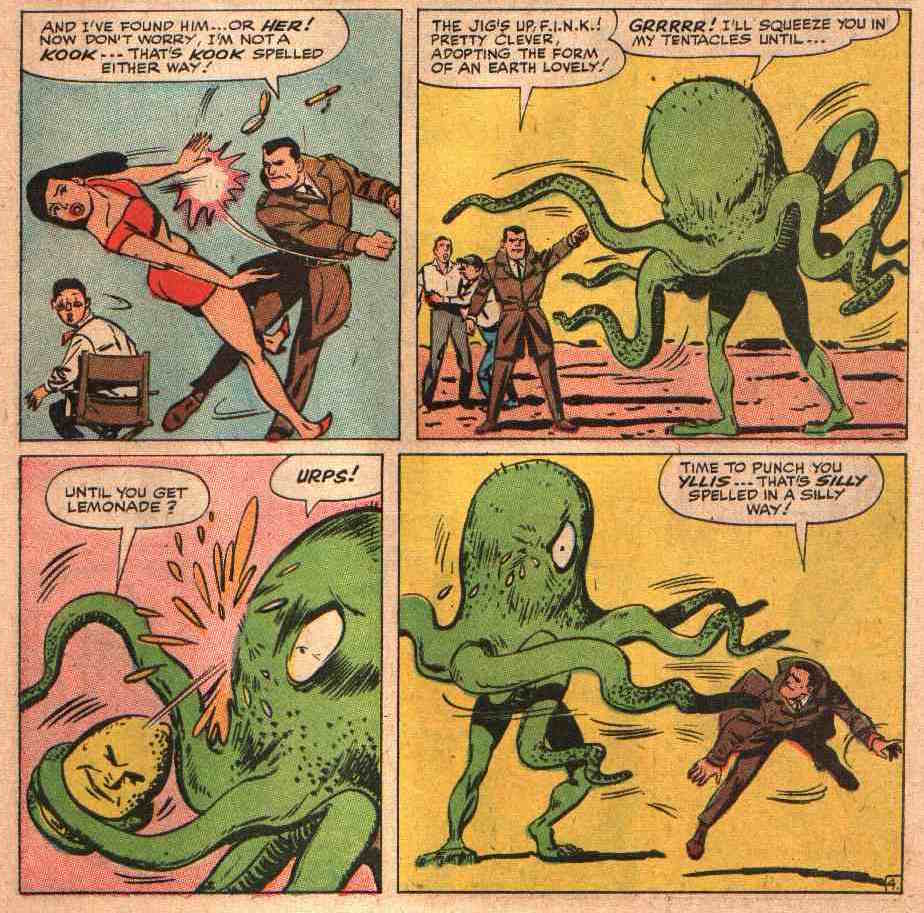
« Knock it off, squiddo! You couldn’t make a class-B horror picture on earth — you’re not even good for a milk shudder! Better skeddadle, or I’ll tie your tentacles into a bow! »
Tentacles are no cause for levity, you say? Ha! Their place in all manner of spoofs and parodies (and other silliness) is ensured. Peppered with a barrage of puns (never undersell puns, please!), whimsical tentacular entanglements abound in literature… err, comic literature, at any rate, and that’s good enough for me.
I meant “entanglements” very literally. Story published in Not Brand Echh no. 11 (December 1968, Marvel); script by Arnold Drake, art by Marie Severin.
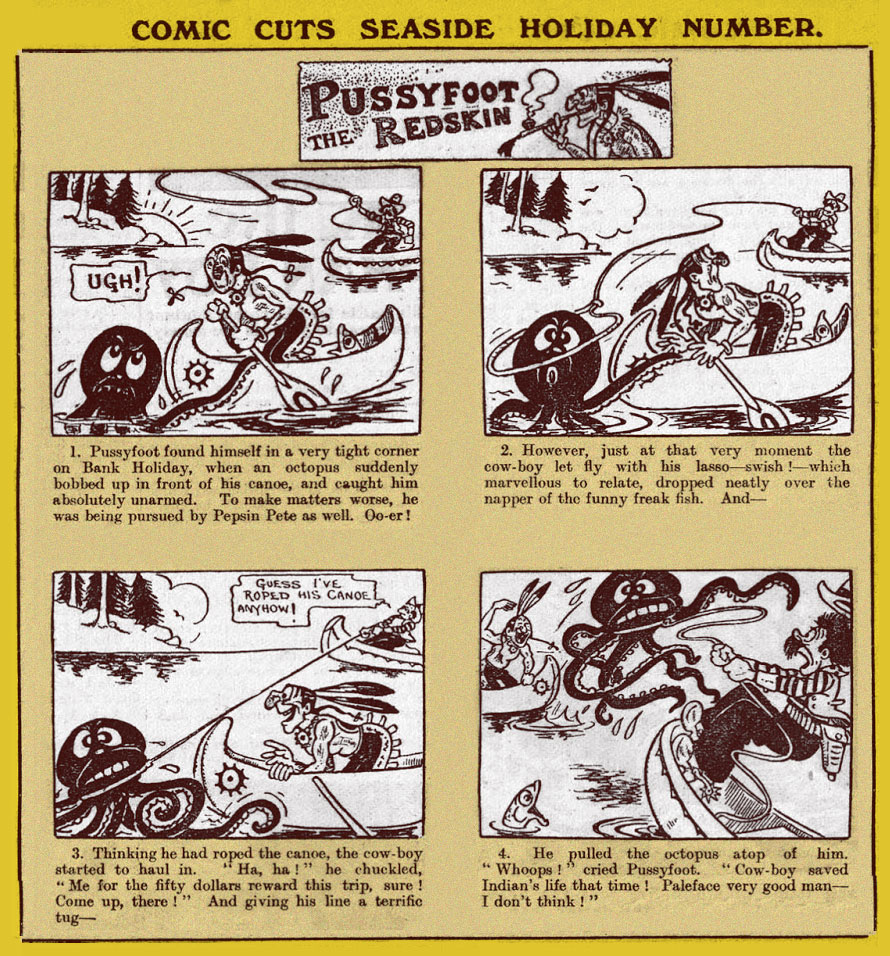
Even some 100 years ago (well, a little less), some unfortunate octopus could easily become a Figure of Fun if he wasn’t careful.
The story doesn’t say what happened to the freaking octopus, though. This edition of Pussyfoot the Redskin was printed in Comic Cuts no. 1735 (August 1923). Visit BLIMEY! The Blog of British Comics for more Comic Cuts.
I can’t mention équivoques and wordplay without mentioning Pogo, Walt Kelly‘s keenly intelligent comic strip. Sadly, this was the only appearance of Octopots, as far as I know (and I long to be corrected).
From Figmentality, from The Pogo Sunday Parade (1958). Art by Walt Kelly, of course!
In the competitive world of jokes in bad taste, the man from SRAM probably takes the cake. It’s lucky that he has no qualms about hitting females, or the world would be doomed… although his mirthless monologue would probably kill the creature with sheer ennui.
Madhouse in Hollywood (Man from SRAM), scripted by Otto Binder and drawn by Carl Pfeufer, published in Jigsaw no. 2 (December 1966, Harvey).
On the other hand, Superman‘s creative insults can easily shame a thin-skinned Tentacled Terror (was his spaghetti-and-meatball crack some sort of early Flying Spaghetti Monster reference, even though the latter was only officially created in 2005?)
Superman no. 184 (February 1966). The story is The Demon Under the Red Sun!, scripted by Otto Binder (again; he clearly has some unhealthy attraction to tentacles, like the best of us) and drawn by Al Plastino. Figure out what’s going on in this story (or not, for there’s not a lot of logic to be found, anyway) at Mark’s Super Blog.







 The marvellous
  An adult

























 Who's Out There?