Treasured Stories: “Dragstrip Paved With Gold” (1968)

« Alcohol is for drinking, gas is for cleaning parts, and nitro is for racing! » — Don Garlits

At this time each year, Montréal is beset by its own plague of greedy locusts: it’s Formule 1 Grand Prix time! While our fair city offers other crowd-pleasing events (for instance le Festival international de jazz de Montréal and le Festival Juste pour rire / Just for Laughs), the most glaring distinction between the Grand Prix and the others is that it essentially draws just one type of visitor, a Las Vegas/Florida Spring Break/Nascar sort of randy, aggressive, would-be Alpha Male yob. Imagine hosting the Republican National Convention year upon year, and at eardrum-tormenting sonic levels. Time and time again, the newspapers run the same stories about rampant prostitution and criminal exploitation and how the event only benefits bar, hotel, restaurant and cab operators and variegated pimps… and shafts everyone else. The usual one-percenter bait-and-switch appeal to everyday avarice, it never fails.

Oddly enough, despite my distaste for racing culture proper, I’m paradoxically quite fond of hot rod comics. I was as surprised as anyone when I chanced, several years past, to read an odd issue of Drag n’ Wheels that had come into my possession decades earlier in the midst of an assorted lot (this was no. 46, April 1971)… and greatly enjoyed it. Gripping stuff, as it turned out!

Now, there’s no question that the number one driver of Charlton Comics’ hot-rod line* was Jack Keller (1922-2003), a Golden Age artist who found his true niche with car comics. Around 1967, he was offered an exclusive contract with Marvel to work on their western titles, but Keller declined in order to focus on his Charlton account, where he could write, pencil, ink and letter his own stuff… without having to redraw anything. Moreover, he claimed to favour horsepower over horses.

Keller’s car stories are often a delight, full of knowing detail, clever humour and plenty of thrills. However, if Keller had produced the entire line on his own (as he did, in fact, when it was whittled down to a pair of titles in its final years), the growing bleakness in his work could have become wearying. Drawing from his direct involvement in the racing scene, Keller packed his stories with pompous asses, dangerous egomaniacs, slimy backstabbers, sociopathic glory hogs, and other representatives of a bloodthirsty, mean-spirited mob.

Charlton’s main writer, Joe Gill, filled out the rest of the book, aided by a rotating crew of artists, among them Don Perlin, the tireless Charles Nicholas ‘n’ Vince Alascia duo, Tony Tallarico, Bill Montes, Dick Giordano, Bill Molno, et al.

But in the line’s peak years (1964-1969, also an aesthetic apogee in automotive design), the number two illustrator in Charlton’s racing stable was Edd Ashe (1908-1986), another journeyman from the Golden Age of comics.

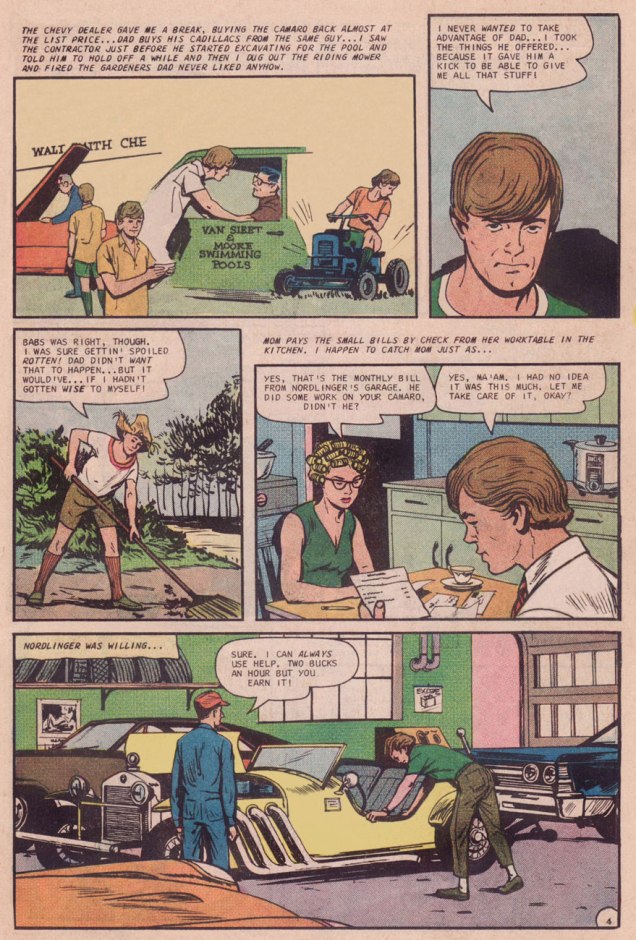
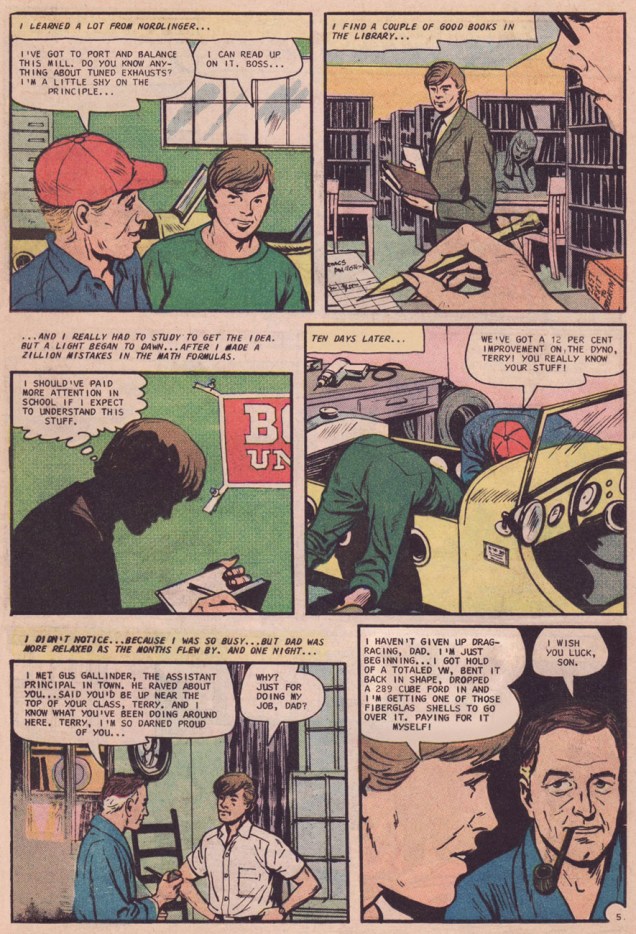
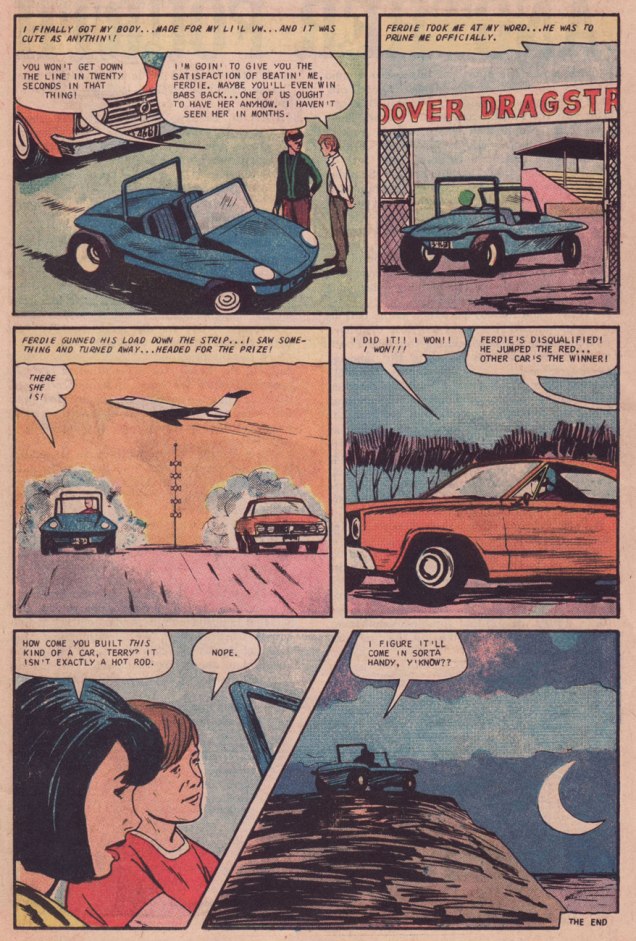
Here, at last, are some actual comics. Dragstrip Paved With Gold appeared in Hot Rods and Racing Cars no. 90 (June 1968, Charlton Comics), and was written by Joe Gill, pencilled by Edd Ashe, and inked by the mysterious and likely pseudonymous T. Roots.
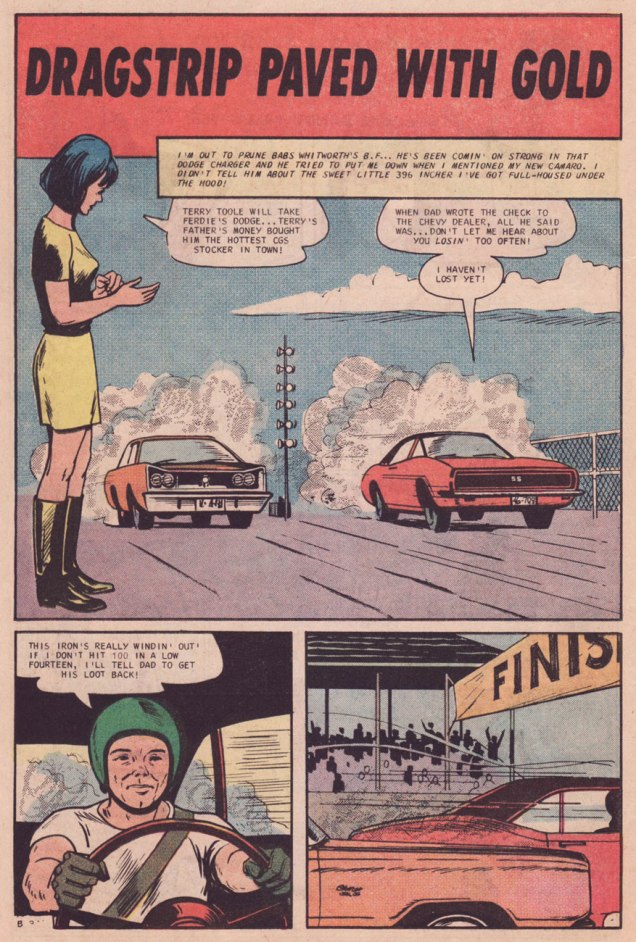
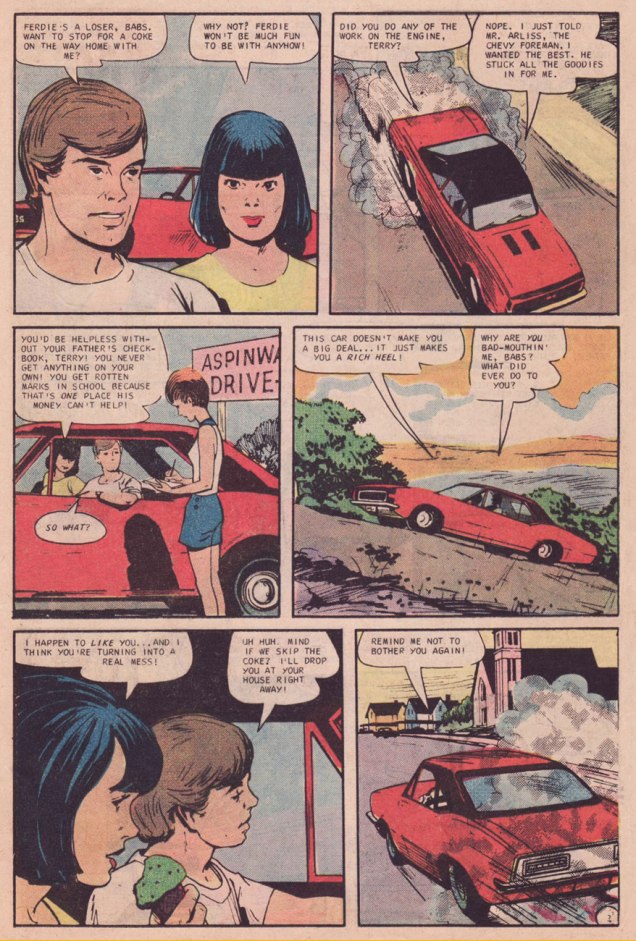
AsheDragstrip01AAsheDragstrip02AAsheDragstrip03AAsheDragstrip04AAsheDragstrip05AAsheDragstrip06A

It might be easy to miss some of the more unusual nuances of Gill’s tale. When faced with the daily task of coming up with material grounded in genres with a limited number of available plots (say, romance, war, horror, hot rods, sports), Gill kept the plot basic and tidy, but enriched his stories with unusual characterization, pertinent technical details, vernacular and jargon… and sometimes moral values quite at odds with the prevailing societal mores. In this story for instance, note that the ladies in Terry and Jim’s lives provide the voices of reason, prodding them gently away from blind ambition, excessive materialism and showboating and toward self-preservation and enlightened self-respect. Dead men can’t keep up with the Joneses… or rather ahead, in this case.

WhoThereLogotype

As a bonus, I’ve compiled a complete-as-far-as-I-know bibliography of Mr. Ashe’s contributions to Charlton hot rod comics (1964-1969); wherever available**, follow the links to read the issue on comicbookplus.com!

Hot Rod Racers 1 : Local Champ / The Compact Cavaliers / Back-Road Champ
Hot Rod Racers 2: The Avenger / Joe’s Jalopy / The Driver, not the Car
Hot Rod Racers 10: Quarter King
Hot Rod Racers 11: Fast Loser
Hot Rod Racers 12: Wrecks to Riches
Hot Rod Racers 13: The Spoiler
Hot Rod Racers 14: The Day the Creampuff Won
Hot Rod Racers 15: You Never Know!

Grand Prix 16: Bossin’ the Turns
Grand Prix 17: Twins’ Trouble / Constant Loser
Grand Prix 18: Gentleman Driver
Grand Prix 19: The Eagles Scream
Grand Prix 20: For Money or Marbles
Grand Prix 21: The Town Wreckers

Drag-Strip Hotrodders 2: Tamed Tiger / Falcon Flyer / Little Eliminator
Drag-Strip Hotrodders 3: English Cousin / 1320 in 13.20 / S/S King
Drag-Strip Hotrodders 5: Great Moments in Racing History: “Rods Across the Sea”
Drag-Strip Hotrodders 10: The Furious 40! / 200 Plus!
Drag-Strip Hotrodders 11: Match Champ
Drag-Strip Hotrodders 12: I’m a Lemon (A Car’s Own Story)
Drag-Strip Hotrodders 13: Speed in All Seasons
Drag-Strip Hotrodders 14: Playin’ the Role!
Drag-Strip Hotrodders 15: “Mighty Mustang”
Drag-Strip Hotrodders 16: Speed at Any Price

World of Wheels 17: Modified Madness
World of Wheels 18: The Astro Rod
World of Wheels 19: “Speedy”
World of Wheels 20: Beast From the East
World of Wheels 21: The Rat Pack
World of Wheels 23: The Wild Ones (Parents)
World of Wheels 27: The Sissy Wagon
World of Wheels 28: Home Town Driver / Lemon at Le Mans (Vince Colletta inks)

Hot Rods and Racing Cars 70: Nightmare at Le Mans
Hot Rods and Racing Cars 72: Farmboy at Le Mans
Hot Rods and Racing Cars 73: Outlaw Hot-Rod / 300 MPH Flying Jet / The Novice / Hold It!
Hot Rods and Racing Cars 74: Final Test (Colletta inks)
Hot Rods and Racing Cars 75: Great Moment in Racing History: “Race to the Sky”
Hot Rods and Racing Cars 78: Great Moment in Racing History: Sebring ’65
Hot Rods and Racing Cars 79: Mille Miglia of 1952
Hot Rods and Racing Cars 80: Great Moment in Racing History: The Vanderbuilt Cup Race of 1937
Hot Rods and Racing Cars 83: The Digyard Demon
Hot Rods and Racing Cars 85: Fast and Furious
Hot Rods and Racing Cars 86: Backyard Grand Prix
Hot Rods and Racing Cars 87: The Pigeon / Just a Country Boy
Hot Rods and Racing Cars 88: Wild Willie & the Black Baron
Hot Rods and Racing Cars 89: The Mighty Midgets
Hot Rods and Racing Cars 90: Dragstrip Paved With Gold
Hot Rods and Racing Cars 91: Piston Head
Hot Rods and Racing Cars 92: Dirt Track Digger
Hot Rods and Racing Cars 93: Tomboy Tornado
Hot Rods and Racing Cars 94: A Friendly Little Car
Hot Rods and Racing Cars 99: The New Breed

Teenage Hotrodders 15: Great Moment in Racing History: The World 600
Teenage Hotrodders 16: Great Moment in Racing History: The Detroit Special
Teenage Hotrodders 17: Great Moment in Racing History: Le Mans 24 Hour Race 1959
Teenage Hotrodders 21: His Big Dream
Teenage Hotrodders 23: Flying Failure

Top Eliminator 25: The Pigeon
Top Eliminator 27: RedLight Express / Mad for Matches
Top Eliminator 28: Blow-Up
Top Eliminator 29: Scarface and the Get Away Gasser

Drag ‘n’ Wheels 32: Weird Willy’s Wild Wagen
Drag ‘n’ Wheels 33: Smoked In
Drag ‘n’ Wheels 34: Wastin’ Time
Drag ‘n’ Wheels 35: The Firecracker 500

– RG

*These were Hot Rods and Racing Cars (1951-1973); Speed Demons (1957-58); Dragstrip Hotrodders / World of Wheels (1963-1970); Teenage Hotrodders / Top Eliminator / Drag ‘n’ Wheels (1963-1973); Hot Rod Racers / Grand Prix (1964-1970); and Surf ‘n’ Wheels (1969-1970).

**Until they wised up sometime in 1968, Charlton didn’t bother to copyright their publications; therefore, they wound up in the Public domain.

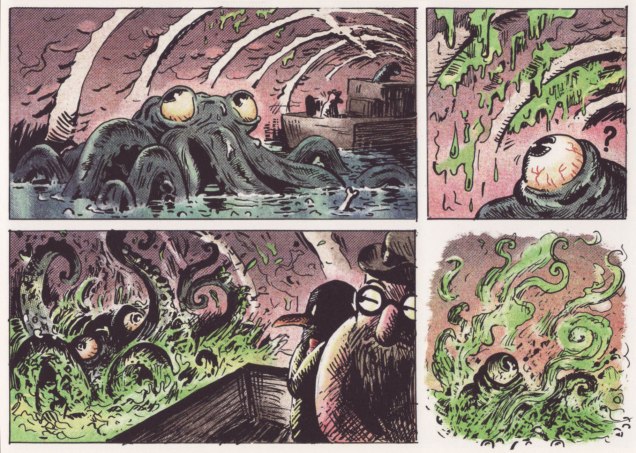
Tentacle Tuesday: The Jungle Queens

« Beware, bwana — beware its tentacles! »

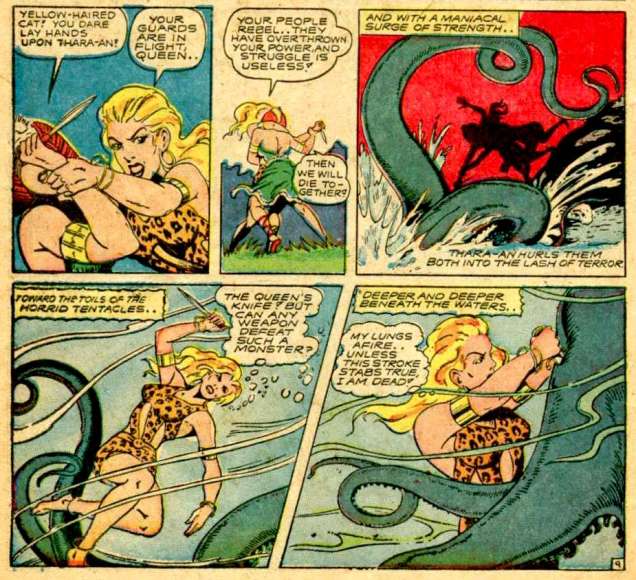
Cue in the taut, frantic jungle drums! Picture this: through a thick tangle of brush and tropical vegetation, prances a fair maiden who is quite unaffected by spiky plants or venomous insects. She’s the staunch defender of jungle animals, friend to jaguar or hippo (or whatever other animal the artist’s imagination conjures, even if it’s entirely inappropriate to a jungle… but who cares about zoological accuracy?) One creature this wild child is definitely not a friend to, however, is the octopus: anything with tentacles gets stabbed and killed, as expediently as possible. That’s little cause for concern, however – the real octopus, who lives only in oceans, has little use for a jungle… so whatever’s getting killed must be an impostor or a mutant.

I am amused by jungle comics, which perhaps require an even more dramatic suspension of disbelief than many an equally action-oriented genre.  The female protagonists, usually clad in some sort of leopard/jaguar skin (which makes one wonder why big felines even want to hang out with someone wearing their relatives’ pelt), are usually portrayed as guardians of the wilderness… but some of them kill an awful lot of animals for supposed protectors of the feral kingdom. The blonde Sheena (first female comic book character with her own series), equally blonde Lorna the Jungle Girl (Atlas-published, a rival to Fiction House’s Sheena), Avon’s Taanda – White Princess of the Jungle, Camilla – Wild Girl of the Congo (a case of Fiction House knocking off their own Sheena)… the list definitely goes on. That’s quite a few jungle queens bouncing around, dealing with hostile tribesmen getting uppity, lethal white hunters up to no good and would-be Romeos perpetually being held hostage. Sometimes they even have cat fights and overthrow one another. Very amusing indeed. Pepper the dialogue with lots of bwanas, toss in an epic rescue of hapless natives, and you’re all set.

To be fair, however, some Golden Age jungle comics boast fetching art and compelling stories in which natives are their own agents and her Royal Highness gets to show off her wits (and her gams) to best advantage. It’s hard to dislike stories in which a strong, clever woman gets to save the day.

Without further ado, I present Jungle Queen vs Octopus!

First up, there’s Sheena, who has struggled with quite a few tentacles in her day:

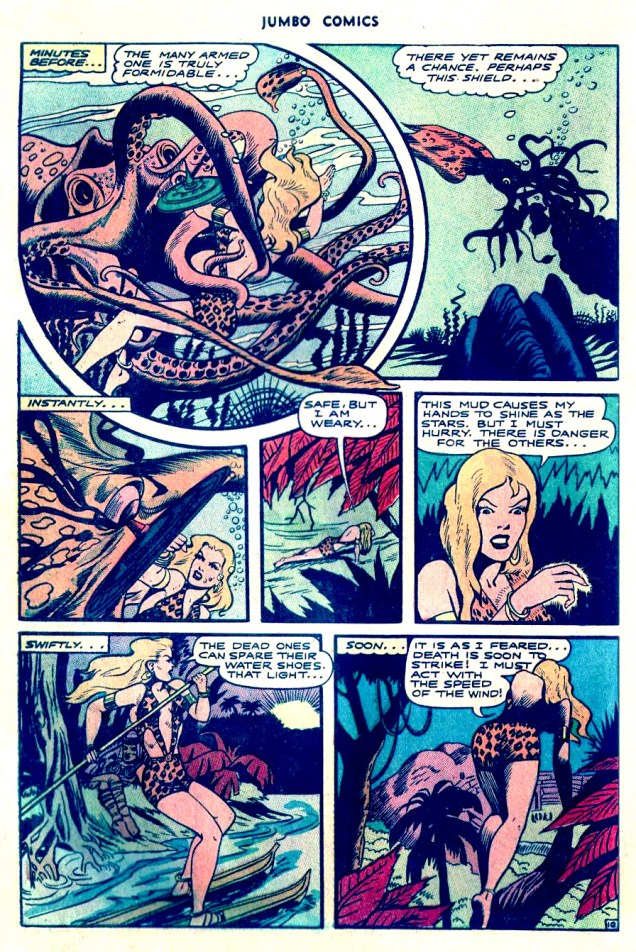
Jumbo Comics #31-Sheena-Voodootreasureofblackslavelake
Page from «Voodoo Treasure of Black Slave Lake», scripted by W. Morgan Thomas, pencilled by Robert Webb, and inked by David Heames, published in Jumbo Comics no. 31 (September 1941, Fiction House).
Jumbo Comics #87
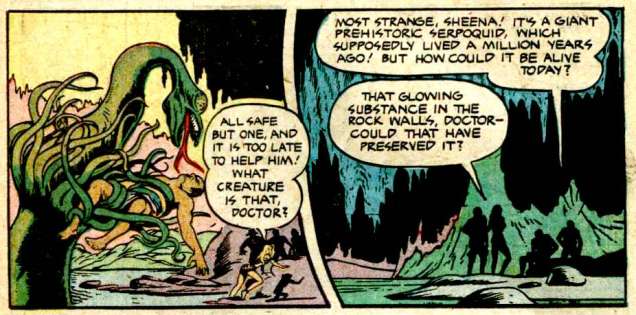
«Sargasso of Lost Safaris», pencilled by Robert Webb and inked by Ann Brewster, published in Jumbo Comics no. 87 (May 1946, Fiction House). What the heck does the Sargasso sea have to do with a jungle? I’d like to know.
Sheena, Queen of the Jungle #5
Untitled story from Sheena, Queen of the Jungle no. 5 (Summer 1949, Fiction House). Art by Robert Webb.
Sheena, Queen of the Jungle #12
Panels from «The Beasts That Dawn Begot!» drawn by Robert Webb, published in Sheena, Queen of the Jungle no. 12 (Summer 1951, Fiction House).

Time for other queens to borrow Sheena’s spotlight:

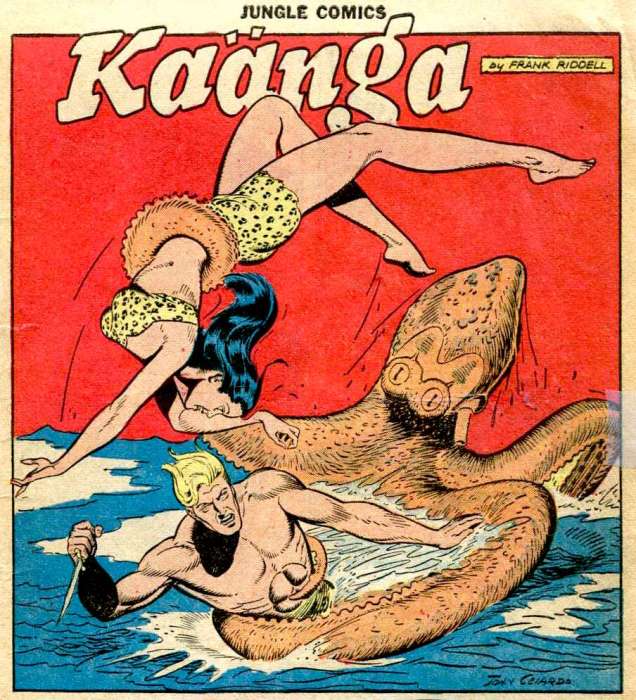
Jungle Comics #105-JohnCelardo
«The Red Witch of Ubangi-Shan», with art by John Celardo, published in Jungle Comics no. 105 (September 1948, Fiction House). Technically, this inclusion goes against my main theme – for Käanga has a very stupid mate who has to be rescued at every turn. She may wear a leopard bikini, but she’s nothing but a Damsel in Distress. Boo.

This Camilla story was scripted by Victor Ibsen and drawn by Ralph Mayo, and was published in Jungle Comics no. 144 (1951, Fiction House):

Jungle Comics #144

Jungle Comics #144 -2
A raft full of musclebound men and Camilla has to be the one to stab the octopus. Her contempt is well justified, as Asheley is clearly a loser.

We’ve had a lot of blondes so far, how about a redhead?

White-Princess-of-the-Jungle-#4
White Princess of the Jungle no. 4 (August 1952, Avon), cover by Everett Raymond Kinstler.

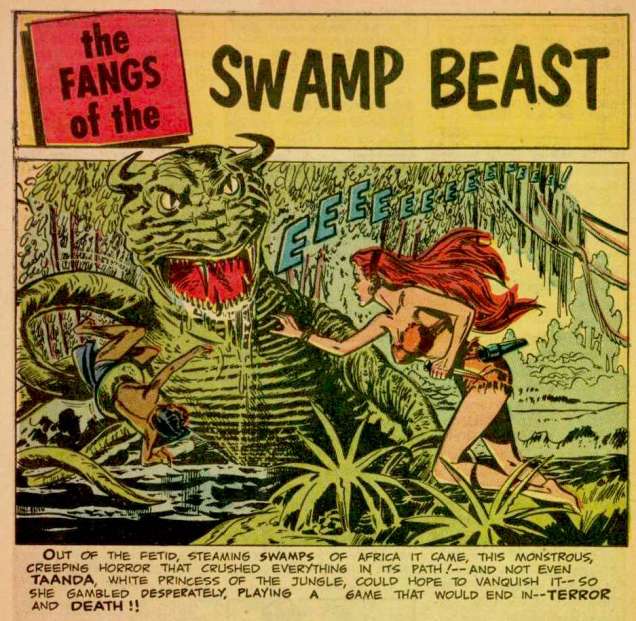
The cover story, «Fangs of the Swamp Beast»:

White Princess of the Jungle #4-swampbeast

White Princess of the Jungle #4-1

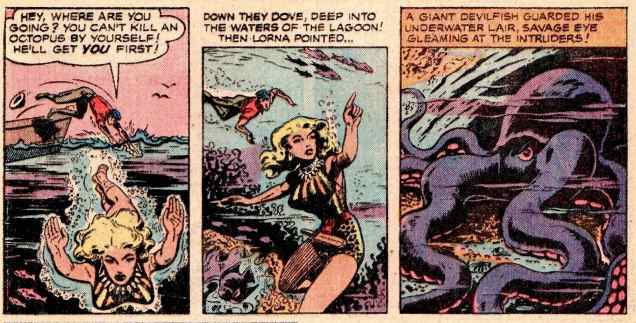
Back to our regularly scheduled blonde heroine! This is «The Devil’s Lagoon», scripted by Don Rico and drawn by Werner Roth, published in Lorna the Jungle Queen no. 4 (December 1953, Atlas):

Lorna the Jungle Queen #4-devil's lagoon
Lorna has the talent of plunging into water boobs first, and using them to optimize buoyancy.
LornaTheJungleQueen#4-devil'slagoon-savageye
Again with the bust-ridiculously-stuck-out pose in the first panel.

LornaTheJungleQueen#4-2

For a chuckle, read Stupid Comics‘ critique of Devil’s Lagoon here. Moving on, I have no wish to be unfair to brunettes, especially given that I generally prefer them:

AllTop16A
All Top Comics no. 16 (March 1949, Fox). Cover by Matt Baker. Sure features plenty of top, doesn’t it? That’s Rulah, by the way – you guessed it, Rulah, the Jungle Goddess (well, at least she’s not a queen), one of those run-amok women who has no qualms killing animal or human.

Here’s a rather amusing explanation for Rulah’s raison d’être from Toonopedia: «One day, while piloting a small plane across Darkest Africa, she crash-landed where civilization had scarcely been heard of. Her clothes were damaged to the point of leaving her butt naked (“like Eve in the Garden,” she mused), modesty preserved only by shadows and strategically-placed vegetation — yet, her skin wasn’t noticeably scratched or abraded. Fortunately, her plane had whacked a giraffe on the way down, so she skinned it and skillfully fashioned a fetching bikini from the raw, uncured pelt. Her uncovered parts were no more bothered by thorns, rough bark, poison ivy and the like, than were her bare feet. Next, she saved a tribe from the local tyrant, a white jungle queen much like herself, and was proclaimed its ruler — provided she could prove herself by killing a starving leopard with nothing but a dagger, which she did.»

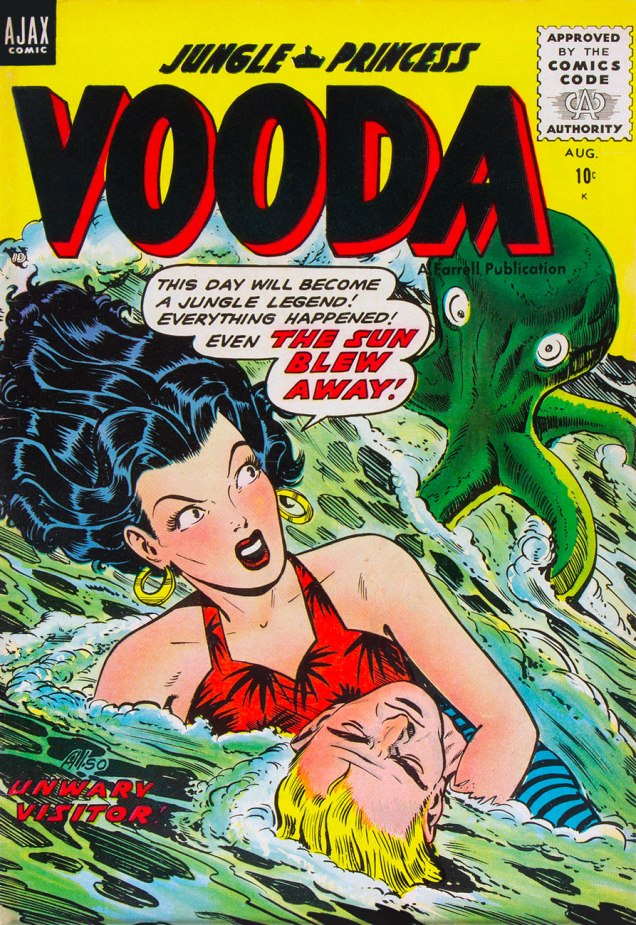
Vooda22A
Another brunette! Vooda no. 22 (August 1955, Farrell). Note that Jungle Queens are only allowed to have hoop earrings, preferably gold.

Phew, that tromp through the jungle wore me out! Until next Tentacle Tuesday…

~ ds

Jughead’s Pal, Samm Schwartz

« What is it about me, Pops? Am I different than normal people? »

One (more) thing I’ve learned in this world is that the vast majority of people, from the man or woman in the checkout line to the hard core of comics aficionados… can’t tell Archie artists apart, let alone name any of them.

If you scratch deep enough, one name will come up, like pebbles from a fallow field: Dan DeCarlo. I’m reminded of the annual restaurant poll a local alternative weekly used to hold: McDonald’s unfailingly took its category in a landslide, because of its ubiquitous familiarity. And so it is with Archie artists: DeCarlo must be the best because… well, that’s what we’ve always been told.

If you ask me, much of his peers’ work gets attributed to him. For instance, check out our gallery of Bob White covers. That Archie’s Mad House no. 27 cover, in particular…

WOT’s pick for top artist on the Archie totem is handily Samm Schwartz (1920 – 1997). He’s easily the smoothest, most inventive storyteller in the Archie universe. Despite his skill as a cover designer during Archie’s best years (1959-1965, a figure proposed by cartoonist-scholar Seth and worth carving in stone), there were no Schwartz covers chez Archie after 1965.

The likely reason? In ’65, Schwartz was hired away by Wally Wood‘s Tower Comics (by managing editor Harry Shorten, a former Archie writer-editor) to serve as their art director. While there, he conceived Tower’s relatively prolific teen humour line, featuring Tippy Teen, Go-Go and Animal, and Teen-In, often glibly dismissed as “Archie clones“, by people who clearly haven’t read the work. We’ll return to these eventually.

Now comes the clincher: Schwartz in turn hired some of his former Archie colleagues to pitch in (presumably at higher page rates); DeCarlo (a handful of stories in early issues of Tippy Teen), Harry Lucey (a decent batch, actually) and reportedly Bob White (no sign of him, though). But the bulk of the work was done by Schwartz and future Archie artist Doug Crane.

Now the Archie people didn’t like this one bit; it was a clear case of sedition, a threat to their tidy little work camp system. After the industry’s near-collapse in the mid-1950s, there weren’t a lot of options in the tight-knit little club that remained; let’s not forget that even Jack Kirby was driven to such humbling desperation in the early 1960s. It was all too easy to be blackballed. The Goldwater clan, Archie’s reigning dynasty, took careful note of Schwartz’s break for freedom and the names of his accomplices. After Tower called it a day in 1969, Schwartz went to DC for a year, but it didn’t take. He was forced to return to Archie, which certainly suited the publisher since Schwartz’s signature title, Jughead, had been wilting away in his absence.

The terms of his return are unknown… but against all odds, Samm proceeded to create the finest work of his career, pencilling, inking and lettering hundreds of inspired Jughead stories until, well, until he couldn’t any more. But no covers, considered a plum job: these went exclusively to DeCarlo (with an occasional Lucey) and later to versatile mediocrity Stan Goldberg, aping DeCarlo’s style and random design sense*.

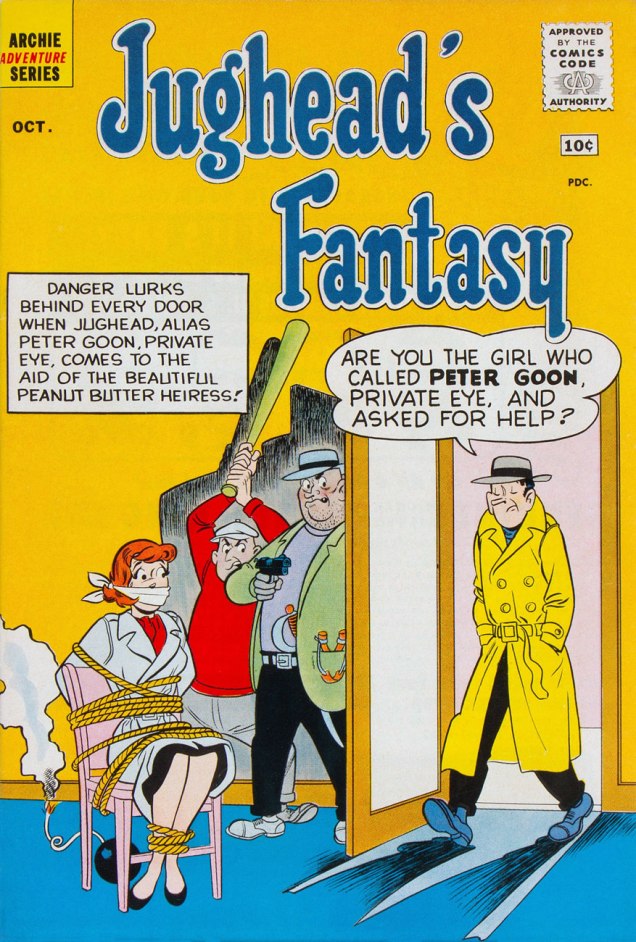
Jughead's-Fantasy02A
Jughead’s Fantasy no. 2 (Oct. 1960); a parody of the excellent 1958-61 detective show… and yes, Peter Gunn did get conked on the head an awful lot.
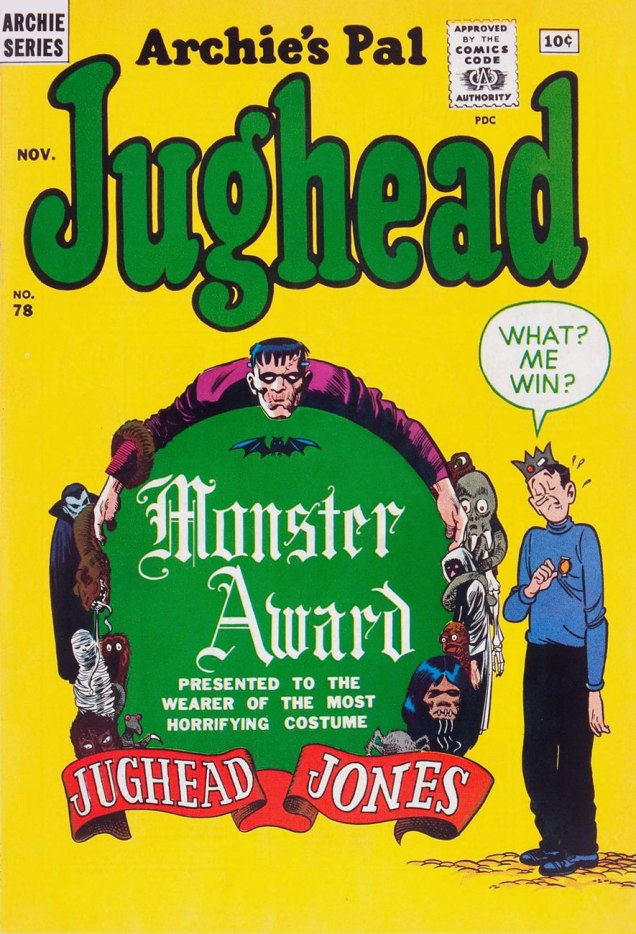
Jughead78A
Archie’s Pal Jughead no. 78 (Nov. 1961)
Jughead81A
Archie’s Pal Jughead no. 81 (Feb. 1962). Check out Reggie’s body language, in particular.
Archie's-Jokes17A
Archie Giant Series Magazine no. 17 (Archie’s Jokes, Summer 1962). There goes Archie, into the next county.
Laugh136A
Laugh Comics no. 136 (July 1962)
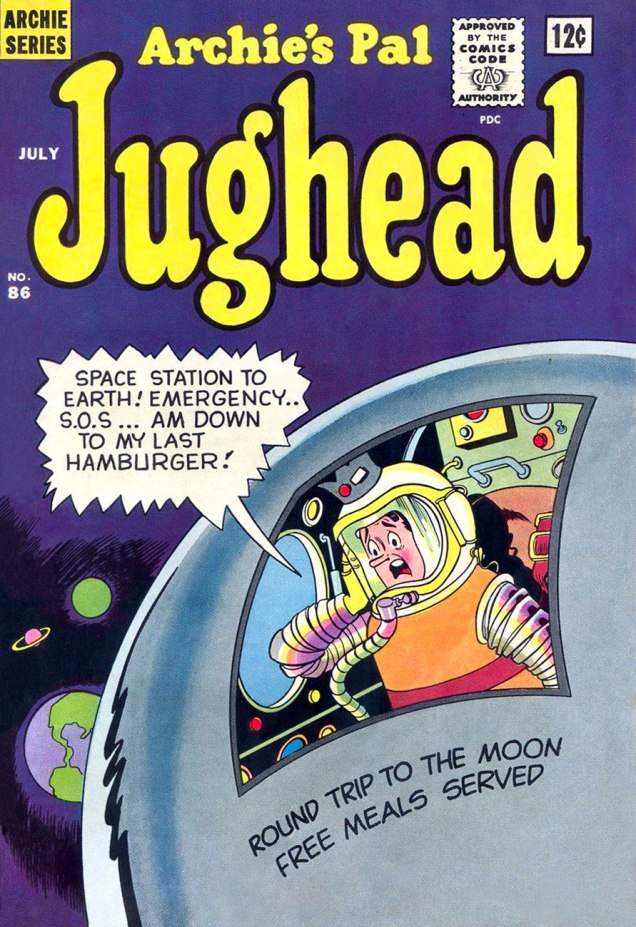
Jughead86A
Archie’s Pal Jughead no. 86 (July 1962)
Jughead89A
Archie’s Pal Jughead no. 89 (Oct. 1962)
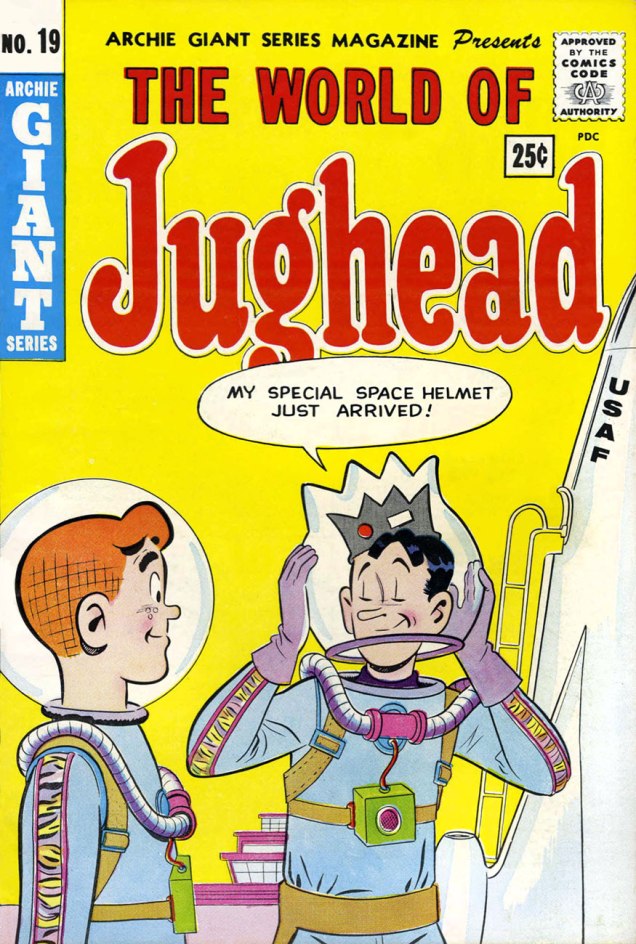
WorldofJughead19A
Er, interesting choice of space pioneers, USAF. Could this mission be some sort of tax dodge? Perhaps Mr. Lodge has a financial stake in it, and gently “suggested” Archie for the possibly one-way trip. Archie Giant Series Magazine no. 19 (World of Jughead, Dec. 1962)
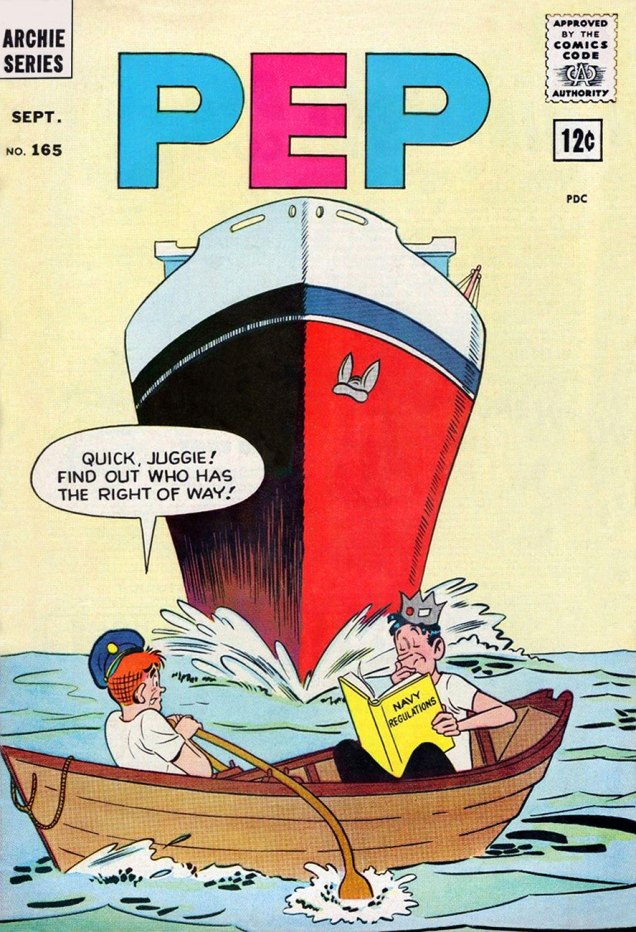
Pep165A
Pep no. 165 (Sept. 1963). My college graphic design teacher told our class that a poster should be “One Angry Fist”, which certainly applies to comic book covers, and this is a fine, fine example of making the most of a format.
Madhouse33A
Archie’s Mad House no. 33 (June 1964)
BettyVeronica102A
Archie’s Girls Betty and Veronica no. 102 (June 1964). The new, definitely not improved cover layout of the Archie line rears its homely head.
SammSchwartzA
Mr. Samm Schwartz, date unknown, though the cars should certainly serve as a clue.

To quote his daughter, Joanne Colt, from the introduction of 2011’s The Best of Samm Schwartz (it isn’t, but it’s pretty good): « He drew for Archie until his death on November 13, 1997, my birthday. There was an unfinished story on his drawing board. »

-RG

*the way I see it, the difference between a Bob White or a Samm Schwartz cover and a DeCarlo is the difference between a considered, effective layout and the act of pointing a camera at random and snapping the shutter. To be fair to DeCarlo, his girlie cartoons for Martin Goodman’s Humorama were excellent, and his first half-decade at Archie (60-65) was fine… then the company wore him down into a sad hack and the unfortunate protagonist-victim of a cautionary tale.

Tentacle Tuesday: “She was asking for it!”

You know how women aren’t advised to go out after dark, or to go to parties in revealing clothing because they might get raped and/or murdered? (This is purely a comic blog and we play nice, so I’m not developing that line of thought any further.) In the comic world, until relatively recently, that sort of thing couldn’t really be shown, but aren’t tentacles a rather handy stand-in for more realistic (and far scarier) violence? The only point I wish  to state is that a woman can’t even go for a fucking walk without encountering tentacles. Swimming? Just forgetaboutit. Sitting quietly on a log? As long as you’re female, the tentacles will still find you, it scarcely matters whether you’re clad in a swimsuit, a gunny sack, or a parka. If the monster finds you a tad overdressed, it will just rip your clothing off – problem solved!

blackstone-the-magician's-detective-#1
Blackstone no. 1 (Fall 1947, EC). Blackstone, Master Magician was created in 1946 by Elmer Cecil Stoner (1897-1969; one of the first black comic book artists!) for Vital Publications. The comic had a remarkably short life – one issue published by EC Comics (the one you’re currently looking at), and three more issues published by Timely. Somehow this was enough to spawn a radio series that aired from 1948 to 1950.

Stoner, who worked for a plethora of golden age companies (Timely, Fawcett, EC, Dell…) attracted some pretty heavy criticism in recent years. « Stoner’s drawing is the visual equivalent of fingernails scraped across a slate, and whenever he had a chance to botch the perspective, the composition, or even the inking, he did so with brio », opines Ron Goulart in his Great History of Comic Books. One could make the point that the above cover demonstrates this: the characters seem to be floating, not connected at all with one another or the landscape. However, whatever one thinks of his art, it has to be admitted even by the staunchest critic that Stoner was a pioneer who carved out a path for other African-American artists.

« On December 16, 1969, Elmer Stoner passed away. Since then he has been largely forgotten by the comic book industry and overlooked as a trailblazer. He was no Jackie Robinson, his presence in the comic industry didn’t alter its course. He did, however, pave the path for Al Hollingsworth, Matt Baker, Ezra Jackson, Cal Massey and for every African-American artist who followed. Stoner’s life is worthy of further exploration and his story deserving of wider recognition. He should not remain invisible. » |source, an article by Ken Quattro that’s well worth reading!|

tentacletuesdayicon

Vampirella-TheNamelessRavisher
« Miriam and Hester were insane. They took the severed head of a dead man, and sewed it back onto his body. Then, they stripped away their clothes and conjured up a demon! » As usual, Vampirella stories make perfect sense. The Nameless Ravisher, scripted by Flaxman Loew and drawn by Leopold Sanchez, was published in Vampirella no. 40 (March 1975, Warren). Flaxman Loew, by the way, was the somewhat ridiculous nom-de-plume of British Mike Butterworth. His stories seemed to get criticized a lot in the letters’ section, so maybe he deliberately picked a moniker guaranteed to be misspelled. One thing’s for certain – he had a vicious streak, qualified by a fan as a “fizzy, nasty run”. Read the full issue here, if you must; I can’t recommend it.
Vampirella40
Thank you for underlining the VIOLATING in the narration, Mr. Script Writer (what can you expect out of a man named Flaxman Loew?) – otherwise we would have never figured it out. This story also contains awe-inspiring quotes like « Vampirella! Rend her! Rip her! Now! », and « the water comes… and comes… ravishment by water…! »

tentacletuesdayicon

You know how I said that swimming is not recommended unless you want a tentacular encounter? Do keep that in mind, especially with summer just around the bend:

AlphaFlight14
Alpha Flight no. 14 (Marvel, September 1984). Cover by John Byrne. Co-admin RG would like to inform everyone that Lake Ontario is not teal-coloured. I’d rather take my chances with the octopus rather than be rescued by that horrible-looking man, but that’s just me (or Byrne’s so-called art).

A closer look at Heather’s rescuer:

AlphaFlight14-biologyclass.jpg

Puck is a dwarf, okay, but why does it seem like Byrne has never seen an actual dwarf in his life?

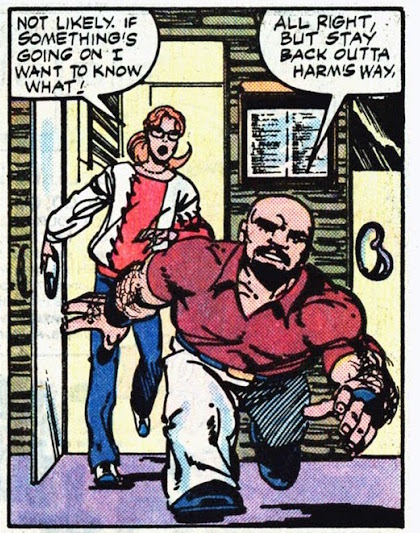
alphaflight14-biologyclass-heather
A page from « Biology Class », scripted and drawn by John Byrne. So why doesn’t the athletically-minded Puck jump into the water instead of Heather? She tells him not to: « Stop! You know you can’t swim worth spit! » (Err…?)  Is it just me, or do the “deep and dark waters of Lake Ontario” look like a swimming pool?

tentacletuesdayicon

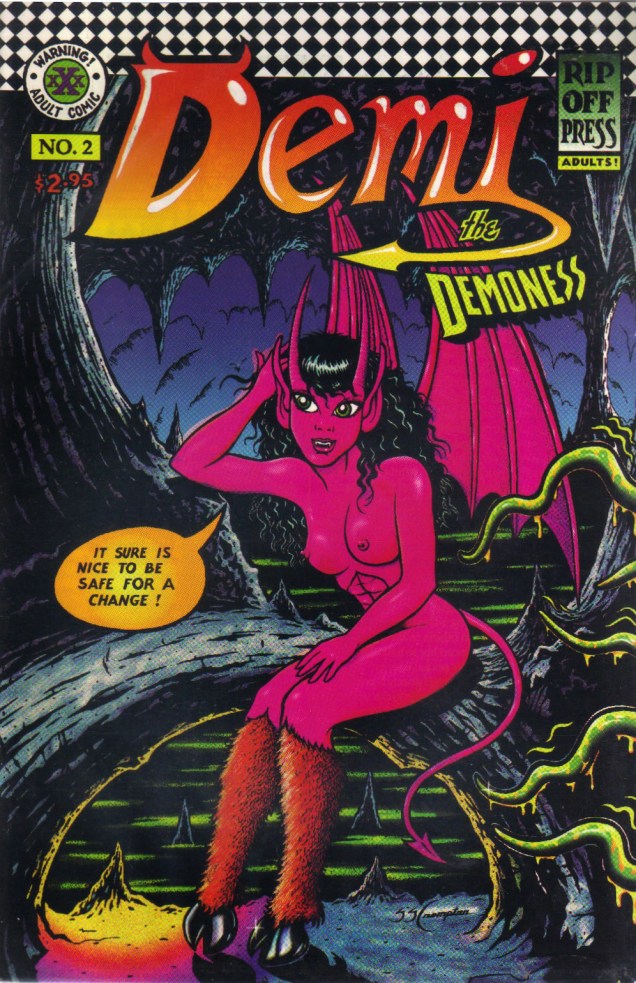
RipOffPress-Demi#2
O, cute Demi with your gleaming hooves, beware of the quiet before the (sexy) storm! Demi the Demoness no. 2 (1993, Rip Off Press). The cover is by Demi’s Canadian creator, Steven S. Crompton.

Crompton’s art is not *great*, but it has definite charm: somewhat childlike and proudly cartoony, it underlines Demi’s innocence perfectly, her huge puppy eyes beckoning to the reader while she gets ravished by yet another toothy monster, well-endowed Pegasus, or frisky cat goddess. And I don’t mean to make it sound like she’s lying back and thinking of England, either – in most cases, she’s an enthusiastic participant in the sexy shenanigans.

« Over 35 different Demi the Demoness comics have been published. Numerous artists and authors have worked on Demi comics over the years, including Frank Brunner, Tim Vigil, Seppo Makinen, Philo, Ryan Vella, Gus Norman, Enrico Teodorani, Silvano, Diego Simone, Jay Allen Sanford, and many others. Demi has appeared in numerous comics crossovers with other characters, including Shaundra, Captain Fortune, Mauvette, Vampirooni, Cassiopeia the Witch, Djustine, Crimson Gash, and adult film stars Tracey Adams, Tabitha Stevens, Deja Sin, and Bonnie Michaels.» |source|

DemitheDemoness#4-Crompton-angel
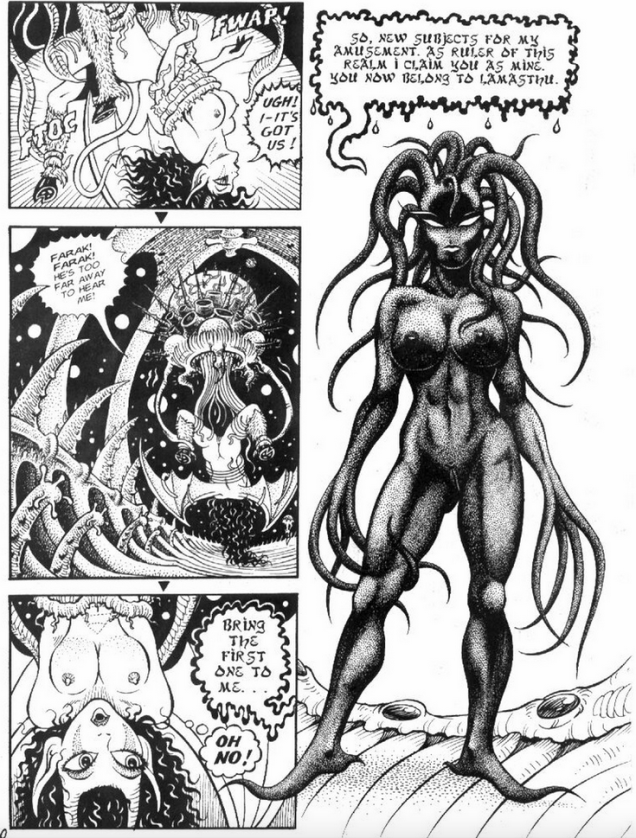
Page from « The cumming of Lamasthu », published in Demi the Demoness no. 4 (1994, Rip Off Press). Art by Steven S. Crompton.
DemitheDemoness#4-Crompton
Page from « The Cumming of Lamasthu », published in Demi the Demoness no. 4 (1994, Rip Off Press). Art by Steven S. Crompton.

You can read a dozen Demi issues on My Hentai Comics… the link is very much not safe for work, unless you work for a sex-obsessed Lord Cthulhu or something. But I can guaran-damn-tee a lot of tentacles!

tentacletuesdayicon

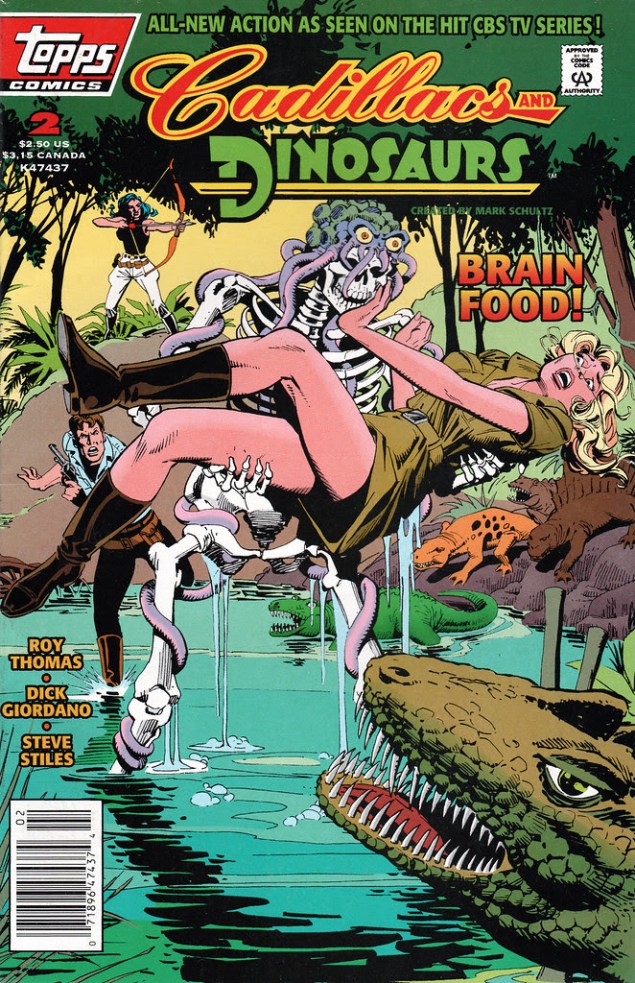
DinosaursCadillacs2-DickGiordano
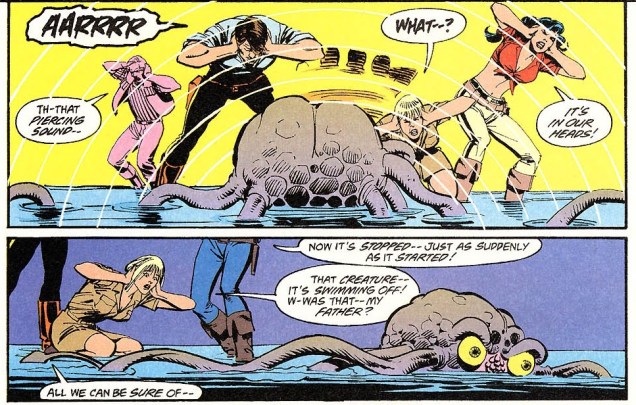
Cadillacs and Dinosaurs no. 2 (March 1994, Topps). Cover by Dick Giordano, who shouldn’t have been let anywhere near Mark Schultz’ characters. I see the lizard has decided to photobomb this romantic scene (the skeleton guy is clearly about to drop Felicia into the murky swamp water.. that’s teal-coloured for some reason… hardly swampy!)

Inside, we get Blood and Bones, Part II: Swamp Things (scripted by Roy Thomas and drawn by Dick Giordano), a Mœbius 2-pager, a couple of pages of captioned Schultz dinosaur illustrations, and – just in time to save this issue from being thoroughly dreadful – Sailor, Take Warning!, scripted by Roy Thomas and drawn by Steve Stiles.

DinosaursandCadillacs2-2
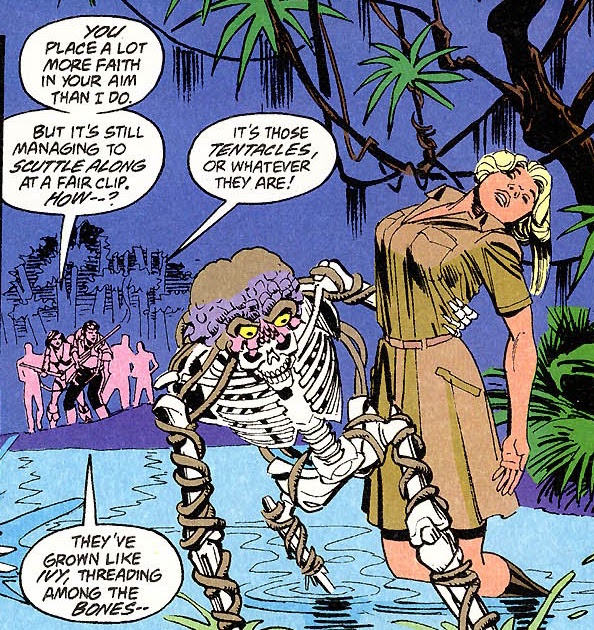
See? Definitely tentacles. Every self-respected brain has ’em.
DinosaursandCadillacs2-1
Felicia’s pose looks distinctly unnatural, but she’s doing a good job of letting everyone know she has an impressive bust (a girl has priorities, even while unconscious). Giordano doesn’t seem to know that human hands curl up when at rest.

You know what Blood and Bones, Part II: Swamp Things has, aside from a suspiciously blue and limpid swamp? Dinosaurs. More specifically a T-Rex skeleton controlled by a brain with tentacles, who’s actually the father of one of the characters! It takes a Roy Thomas to cobble up such classic plots.

DinosaursandCadillacs2-3
Maybe, instead of Brainosaurus Rex, he should have been called Daddysaurus, or maybe even Papasaurus Rex?

Read the issue here.

I hope I have impressed upon you the absolute necessity of caution when taking a stroll – whether your path lies next to a large body of water or leads through a forest. Above all, do not perch on a log when you need a rest, or lean against a tree. Hanging out with magicians is also not recommended.

Until next Tentacle Tuesday, I remain tentacularily yours…

~ ds

A Garrulous Dilettante and Her Pals: Tom Hachtman’s Gertrude’s Follies

« Everybody thinks that this civilization has lasted a very long time but it really does take very few grandfathers’ granddaughters to take us back to the dark ages. » — Gertrude Stein

Several years ago, while browsing in the comics section of a rather lousy bookstore (by which I mean a book shop in which none of the employees know a thing about books, let alone are actual readers… I suspect that this is becoming more common, with predictable results), I stumbled upon an oddball item, a faded-looking, obscure comic strip collection lost amidst the monotonous stacks of DC ‘n’ Marvel superhero fare and the perennial dusty Garfield and Doonesbury paperbacks.

This was Fun City (1985), the second recueil of Tom Hachtman‘s newspaper strip Gertrude’s Follies, which at the peak of its circulation appeared in… well, one paper, but a good one, at least. That was the SoHo Weekly News (1973-82). After the weekly’s demise, a handful of episodes appeared in the fast-fading National Lampoon. Much, much later (which is to say currently) the strip lives on within the pages of American Bystander, an astonishingly well-staffed humour magazine. I smell doom.

Anyway, here’s Hachtman’s recollection of the strip’s genesis, from a 1980 interview conducted by Maxine Fisher for Funnyworld no. 22 (”The world of Animated Films and Comic Art”):

MF: What was your inspiration for a strip about Gertrude Stein and her companion, Alice B. Toklas?

TH: I knew of them, but I didn’t know much about them. And then I saw a photograph of them [by none other than Man Ray] sitting in a room at the home on the rue de Fleurus in Paris. I looked at this famous lesbian couple sitting across from one another — so far apart– and I thought: ”Look at that! One of them is fat, and the other one’s skinny. That’s funny. They’re just like a comedy routine. I wonder if they had any fun.” It didn’t look like they were having any fun in that picture; they just looked like they were posing for a picture. But I thought: ”maybe they ran around and had lots of fun.” So I started drawing pictures of them, and drawing pictures of their friend Pabs, and looking at pictures of them, and looking at pictures of Picasso.

Anyway, I started drawing Gertrude and Alice and Pabs and Hemingway and putting them into situations in my sketchbook.

Basically, I was doing Abbott and Costello or I Love Lucy starring Gertrude, Alice, and their friends.

I knew if would make a nice comic strip in a newspaper. And that narrowed it down. Here was a comic strip about a lesbian couple and all their artist friends. There weren’t too many newspapers that were going to publish this. In fact, I thought, there’s only one. And I started to watch the SoHo News, wondering where it would fit. Where would they put this thing? Would they give me a whole page to do a comic strip?

More juicy details from another interview, this one conducted in 2018 by Martin Kozlowski:

MK: One of the unique features of the strip is the blending of Jazz Age Paris and Punk Rock New York. Was that a deliberate strategy or did it naturally evolve?

TH: I was living in NYC in the 1970s. I only know Paris from movies and books. That’s right; I have never been to Paris. So, when I draw a mailbox I am too lazy to research what a mailbox looks like in Jazz Age Paris. I just draw a mailbox as I know it. I have been told that my readers in Paris find this very amusing. So, the blending happens — naturally.

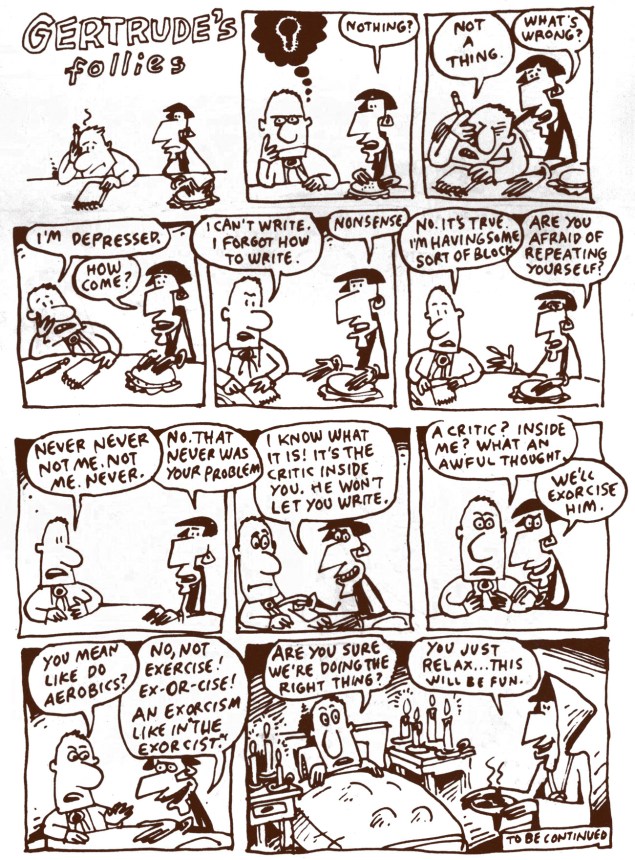
GertrudeFollies02A

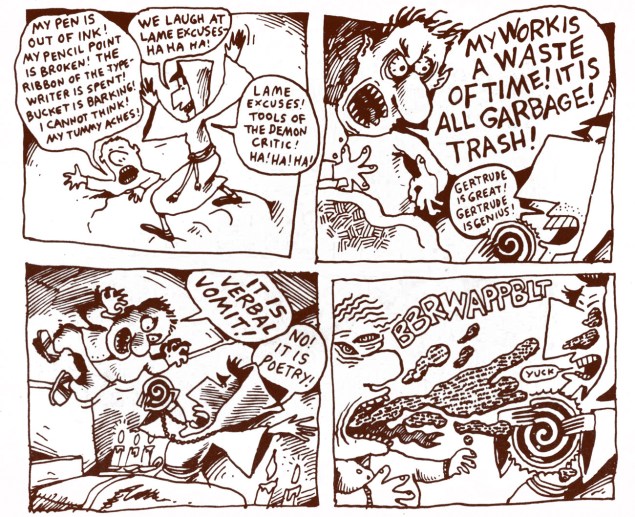
GertrudeExorcism02AGertrudeExorcism04AGertrudeExorcism05A

GertrudeExorcism07A
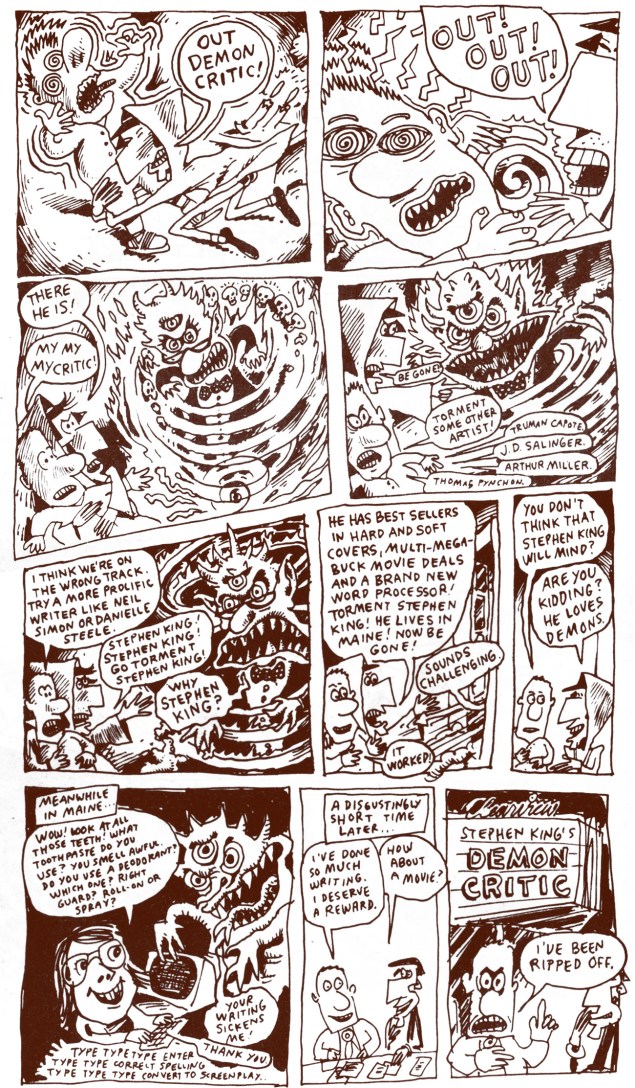
However, something that Stephen King does mind

GertrudeFollies01AGertrudeFollies03A

GertrudeBrideA
Oh, I’ll bet dear old Dr. Pretorius would be right chuffed with this Alice Bride. « To a new world of gods and monsters! », as the good doc famously exclaimed.
GertBucketAliceA
Our heroines in a more (or less) realistic vein. In the usual order: Gertrude, Bucket, Alice.
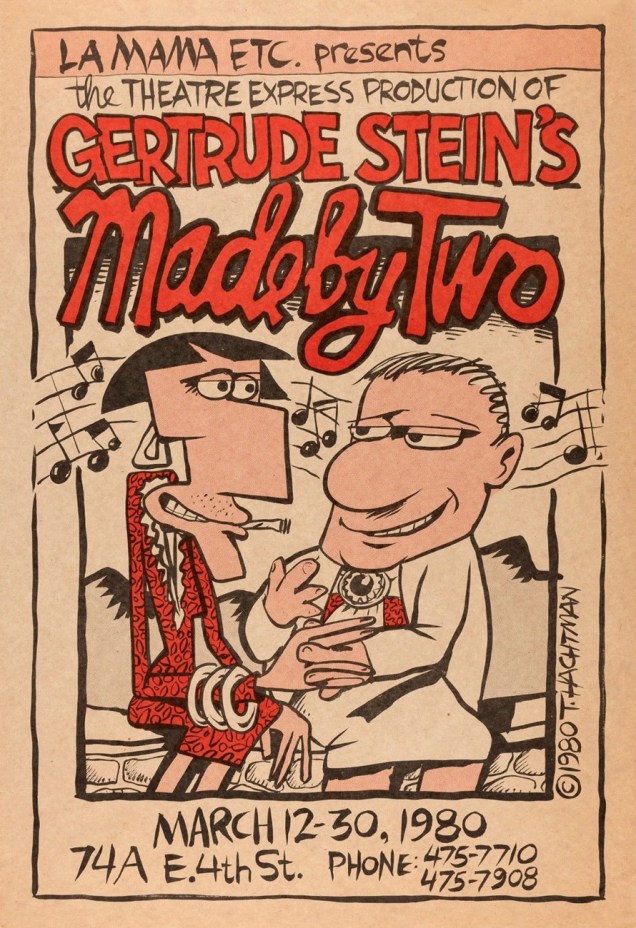
HachtmanCafeLaMamaPosterA
Despite, or perhaps because of the liberties he takes with these semi-sacred historical figures, Hachtman’s Gertrude appears to be rather beloved of the keepers of Gert and Alice’s mad flame. For example: « I look at the cover of the soon-to-be-reborn Follies several times a day and have a laugh each time. Too funny, Hemingway’s teeth, silly Picasso avec crayon, Basket’s slobbering excitement and Alice’s cigarette charm!! And Gert, yes sir, she is fierce!!! Rose flying like arrow ready to hit Alice’s nose. This can’t get any better! I hear the brooch ringing… Bravo! » –– Stein scholar Renate Stendahl
HachtmanPortraitA
The auteur, circa the late 70s. Say, what’s that he’s sporting?
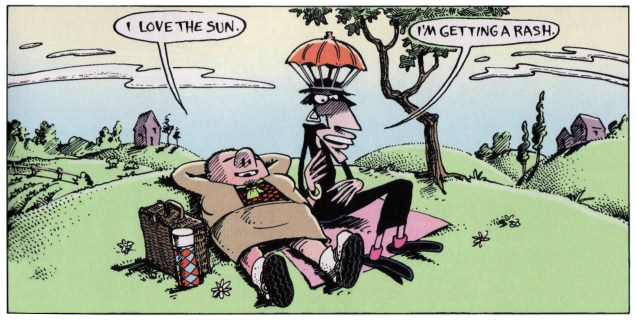
GertrudeFolliesSunA
Un mini-parasol, une ombrelle. For shade, not protection from the rain. Hachtman was fond of road-testing some of the props employed by his players. Gives the strip that je ne sais quoi of authenticity, don’t you know.

If  you like what you see, you may rejoice in the fact that Gertrude’s Follies has lately become more widely available (whilst retaining its elusive cachet) thanks to the efforts of Now What Media. Amble over to their website, where they provide a generous sampling of strips and biographical information, not to mention the possibility of acquiring the collections.

Oh, and do check out Alice’s unusual, lasting contribution to popular culture.

« I love you, Alice B. Toklas, and so does Gertrude Stein… »

-RG

Tentacle Tuesday: Tentacules à la mode

« Les artistes, c’est comme les pieuvres: ils crachent de l’encre pour se cacher. » — Julos Beaucarne*

It is time (again) for some French tentacles! (Upon closer inspection, a lot of these actually prove to be Belgian, but my point still holds.) We have all kinds in today’s post: tentacles merry and frightening, realistic or cartoony. There’s even an octopus in a bra (but don’t skip ahead)!

tentacletuesdayicon

Created for Le journal de Tintin in 1963 by Raymond Reding, Vincent Larcher was a professional football player who often used his athletic prowess to defeat evil guys (he also occasionally played football). The first Vincent Larcher story had no supernatural elements, and didn’t seem to make much of a ripple amidst Tintin’s audience. After a 4-year hiatus, Reding re-introduced Vincent Larcher, this time throwing him into a three-part tale with a mad scientist (as usual, hellbent on world domination) and scary aliens. This was later christened the Olympio Trilogy in honour of Olympio, Larcher’s telepathically gifted friend, who was an important figure in these stories. The pages below are from Le zoo du Dr. Ketzal, part three of the aforementioned trilogy, published in Tintin Magazine issues 1039 to 1059 (1969).

le zoo du docteur ketzal-vincentLarcher-1

le zoo du docteur ketzal-vincentLarcher-2

tentacletuesdayicon

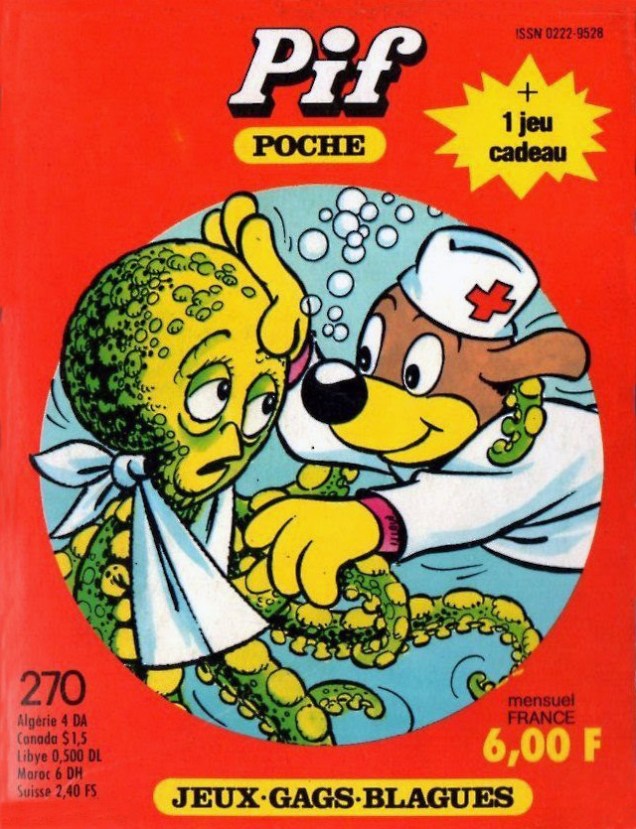
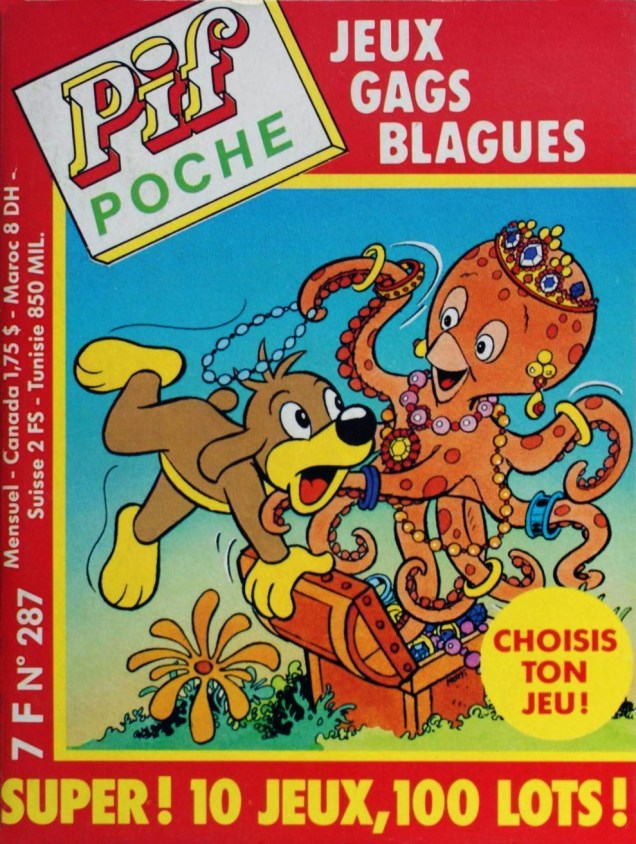
The friendly pooch fraternizing with octopuses is Pif, the mascot of Pif Gadget (« gadget » referred to the fact that each issue of the magazine was accompanied by some thingamajig to amuse the youngsters). Pif Poche were pocket-sized collections of short Pif strips (“poche” means pocket in French), meant to be easily carried to trips, picnics, and probably school as well. Pif was created by José Cabrero Arnal in 1948, who gradually abandoned the strip by the 1960s while other artists took over.

PifPoche-270
Pif Poche no. 270 (Vaillant, 1988)
PifPoche287
Pif Poche no. 287 (Vaillant, 1989)

TentacleTuesdayIcon

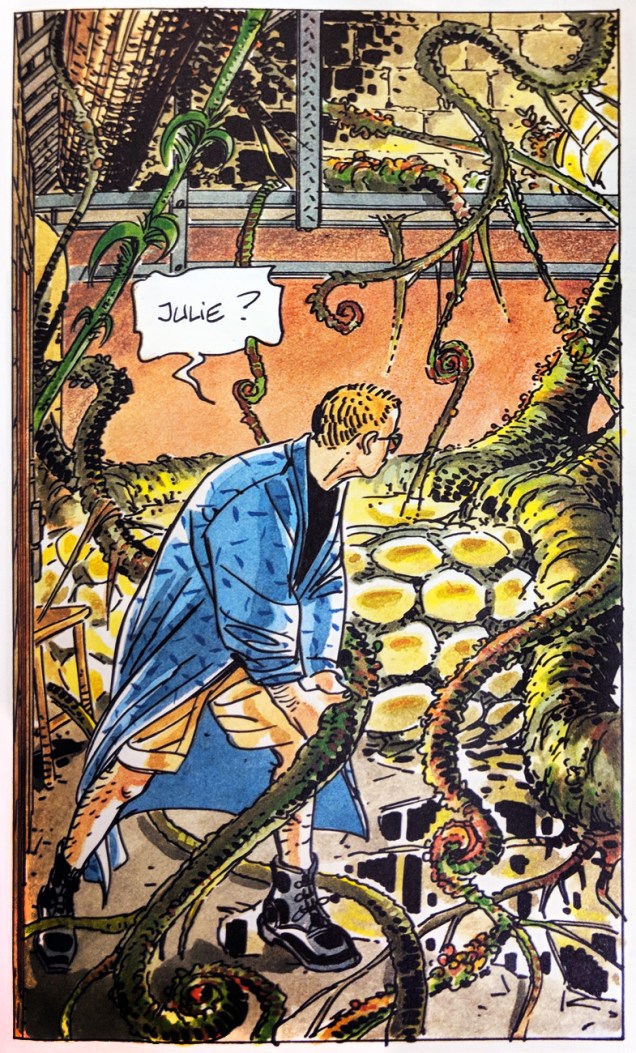
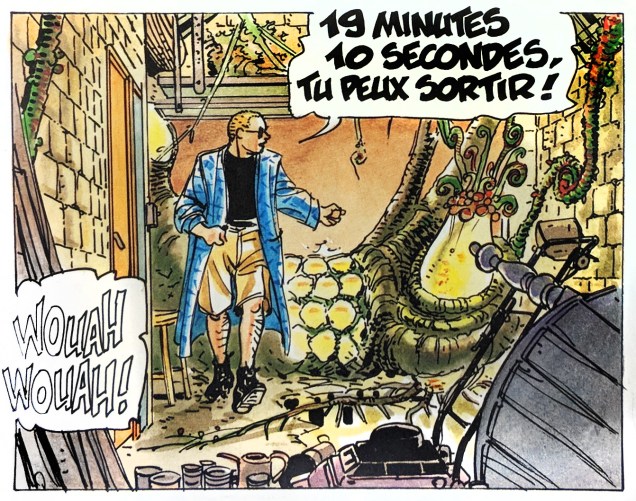
The following panels are from the series Tropique des étoiles by Christian Lamquet, more precisely from volume 4, Le réveil des poussières (1996, Claude Lefrancq).

LeReveilDesPoussieres-Tropiquedesetoiles4-ChrisLamquet1

LeReveilDesPoussieres-Tropiquedesetoiles4-ChrisLamquet2
« 19 minutes, 10 seconds, you can come out! » Experiments performed on a young woman seldom turn out as intended.

TentacleTuesdayIcon

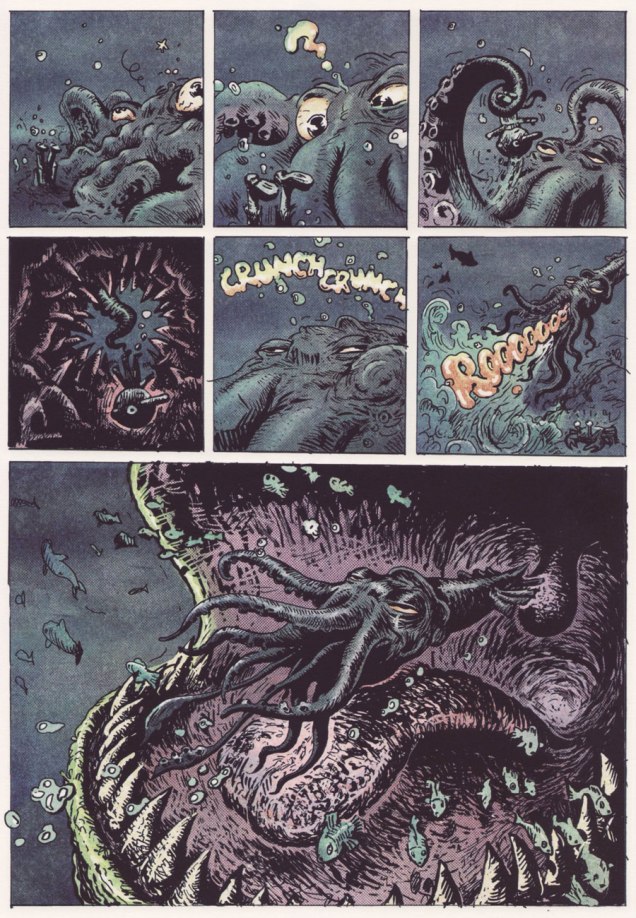
My next peace offering to the cephalopod gods comes in the form of a very loose interpretation of Carlo Collodi‘s Pinocchio, imagined by French artist Winschluss (real name Vincent Paronnaud) and executed with the help of some friends, most notably Cizo on colours. Winschluss’ art can be quite nice, but it gets a massive boost from the first-rate colouring job, so I’d like to emphasize that Cizo deserves a lot of credit for that (the tentacle pages are actually rather dark, as the action occurs undersea, but just take my word for it).

This graphic novel received a few prizes and has been lauded by many parties, but somehow I’ve managed to be quite unaware of its existence until recently. (Frankly, I am somewhat tired of picking up comics that are supposed to be superb and end up being just mediocre, so I don’t tend to pay much attention to awards and other plaudits.) A friendly comic book store clerk pointed it out to me, explaining that it was brought in by an older gentleman whose granddaughter had presented the book to him as a gift, but it wasn’t his thing at all. I was quickly won over by the art, and the story, well… it’s not for the faint-hearted or easily offended, but it’s a good one.

Winschluss’ Pinocchio was originally published in 2008 by Les Requins Marteaux, but has been reprinted several times in French (in increasingly fancier editions) as well as translated into English in 2011.

WinchlussPinocchio01A

« French comics artist Winshluss leaves his robot child hanging beneath a giant lollipop on a hill for a good quarter of his largely dialogue-free adaptation, as regimes fall, fake prophets rise and a pizza delivery girl is saved from torture at the hands of seven dwarves. It’s a grim, puerile and rather brilliant update, combining chaotic, inked panels and gorgeous full-colour paintwork to great effect. Pinocchio, designed as a killing machine, is plunged from crisis to crisis by a series of greedy men and women, his story interrupted by a tortured detective, a grieving couple and Jiminy the cockroach. » |source|

WinchlussPinocchio02A

Actually, don’t take my word for anything, you can admire the colours in this preview:

tentacletuesdayicon

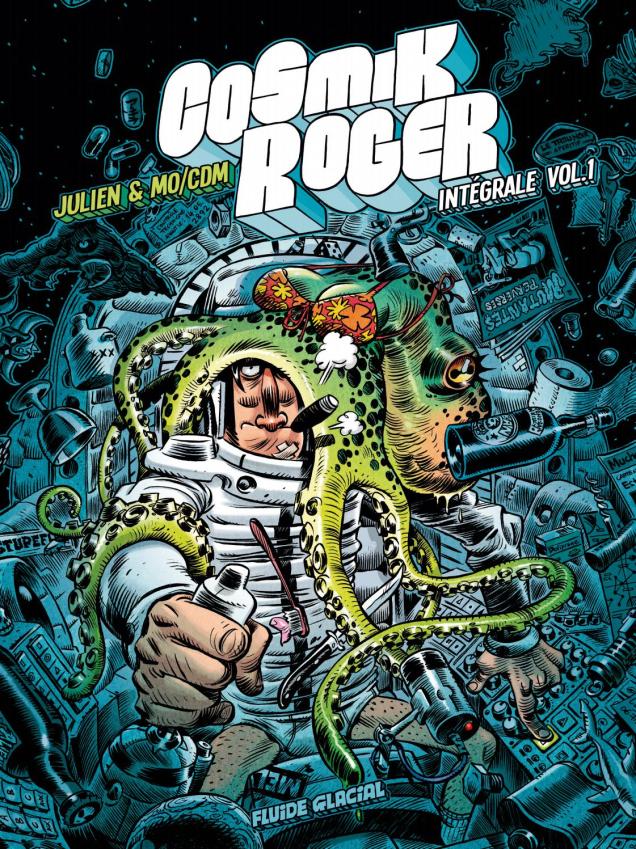
CosmikRoger

Cosmik Roger is a sci-fi/humour comic series scripted by mo/CDM (no, seriously, that’s his nom de plume, and no, I don’t know what it stands for) and drawn by Julien/CDM (real name Julien Solé – they used to go to school together, which apparently led them to adopting the same stupid monicker). This is the cover of the collected Cosmik Roger (volume 1), published in 2018 by Fluide Glacial.

Just tuning in now? Visit the previous Gallic Tentacle Tuesdays: Tentacle Tuesday: Franco-Belgian Edition, Part I and Tentacle Tuesday: Franco-Belgian Edition, Part II.

~ ds

*artists are like octopuses: they spit out ink to hide.

Bill Everett’s Restless Nights of Dread

Today, 102 years ago (!), on May 18th, 1917, William Blake Everett came into the world. He did not become a poet like his ancestor William Blake, nor a politician like Richard Everett, another famous forebear, who founded the city of Springfield, Massachusetts. Bill Everett’s father wanted him to become a cartoonist, and his wish came true, though the elder Mr. Everett died long before before the rebellious Bill found his place in the comics industry.

Bill Everett is best known for creating Namor the Sub-Mariner (visit out Tentacle Tuesday: Prince Namor for an overview of this character’s story and adventures… or read The Brilliance of Bill Everett’s Sub-Mariner, Marvel’s Superman, a great article from Sequart Magazine), but he also had his hand in the creation of Daredevil and Simon Garth, Zombie. Everett excelled in many genres – superheroes, horror, fantasy, science-fiction – but today, since there are far too many covers to feature, I will force myself to focus on horror. Welcome to the ghoulish gallery of my favourite Bill Everett covers! (They’re not necessarily the goriest or scariest – sometimes it’s a mood of quiet menace or a striking composition that sways me.)

BillEverett-Venus19
Venus no. 19 (April 1952). The silent, smirking watchers in the corner are far creepier than the skeleton embracing her!
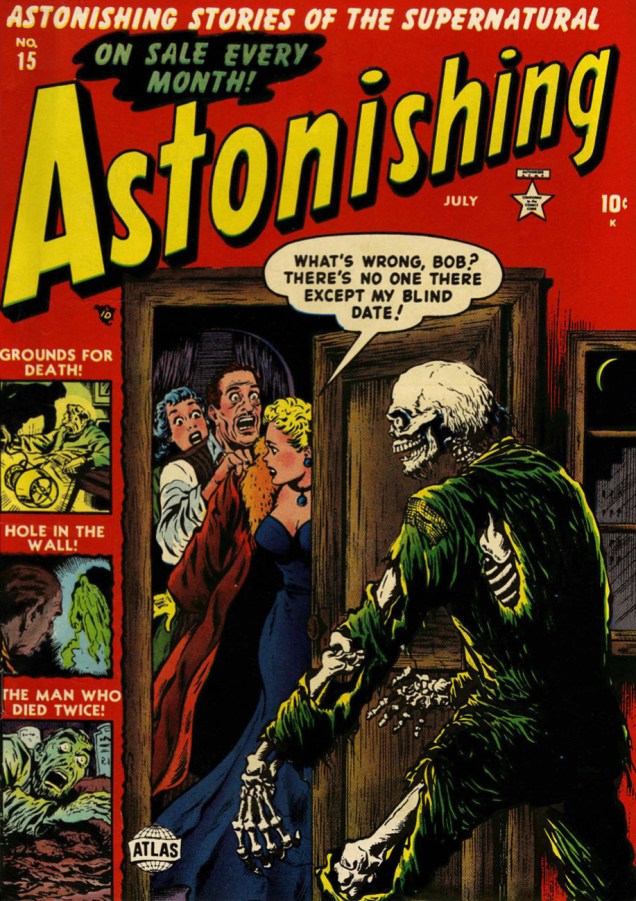
EverettAstonishing15A
Astonishing Tales no. 15 (July 1952). Do a lot of daughters address their fathers by their first name?
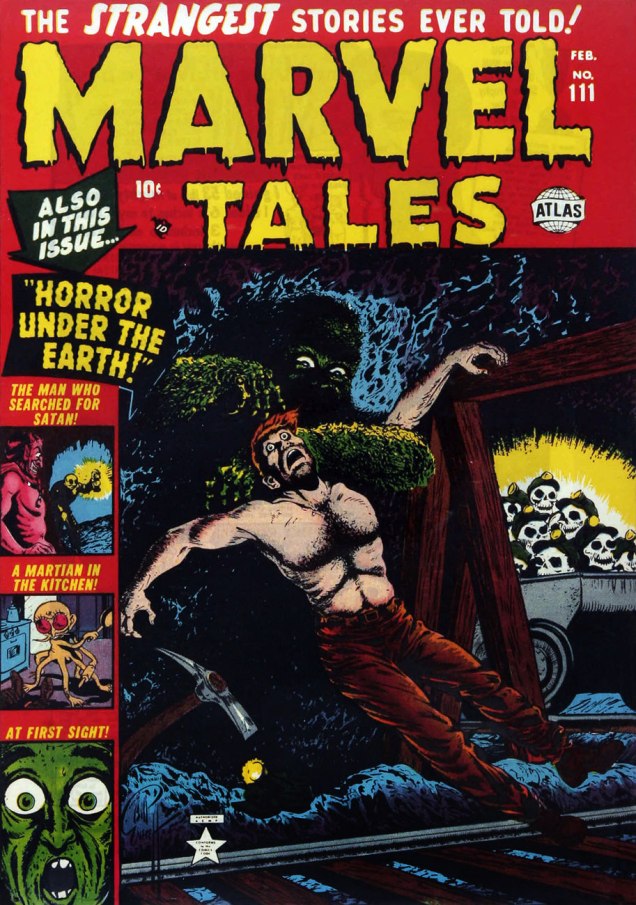
BIllEverett-Marvel-Tales111A
Marvel Tales no. 111 (February 1953)
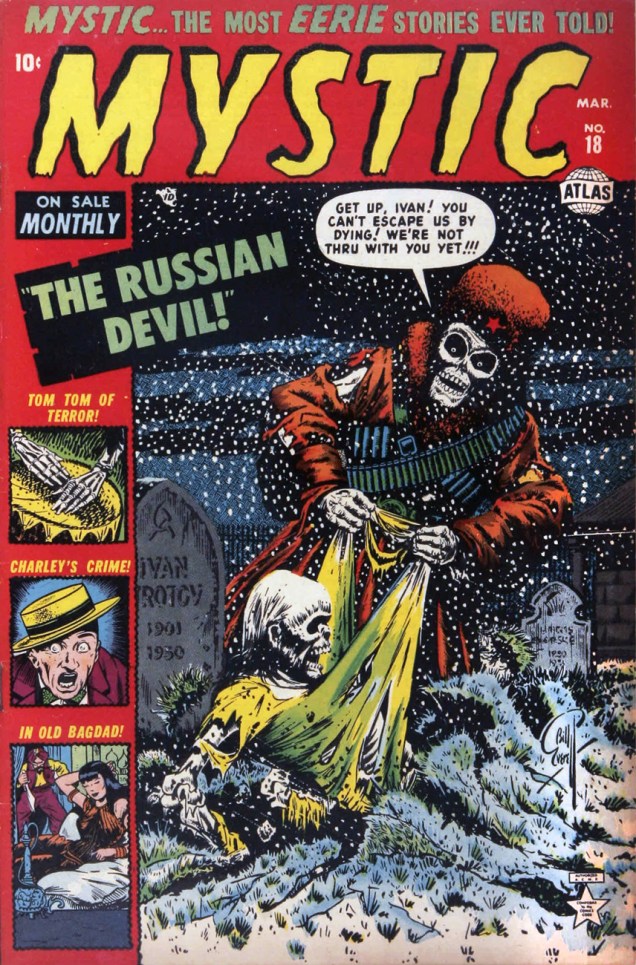
BillEverett-Mystic-#18
Mystic no. 18 (March 1953).
BillEverett-JourneyIntoMystery9A
Journey Into Mystery no. 9 (June 1953)
BillEverett-Marvel-Tales117A
Marvel Tales no. 117 (August 1953)
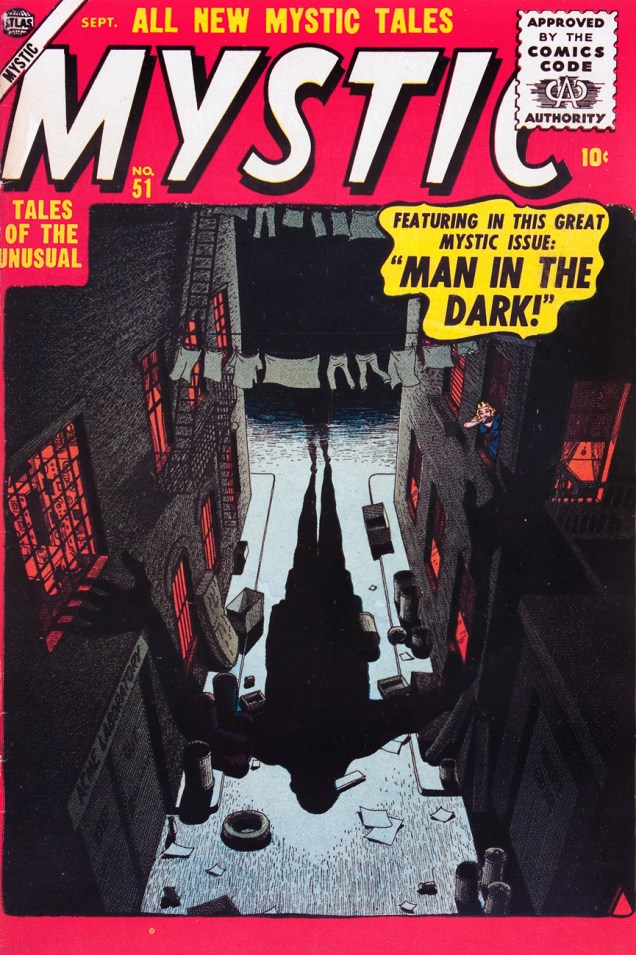
BillEverett-Mystic-#51-(Atlas,-1956)
Mystic no. 51 (September 1956). I love these silent covers where the menace is suggested rather than shown in detail.
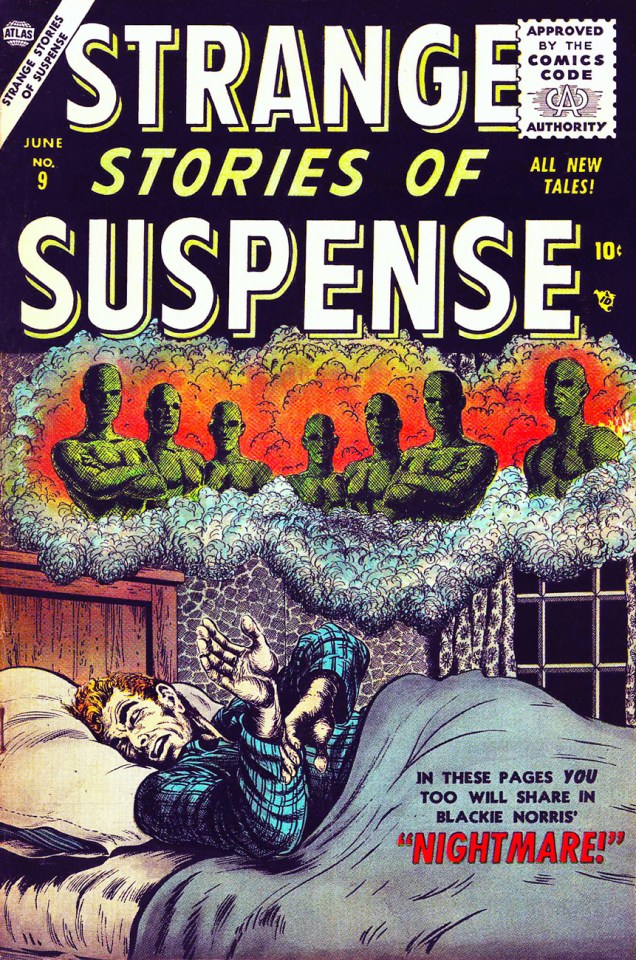
BillEverett-Strange-Stories-of-Suspense-#9
Strange Stories of Suspense no. 9 (June 1956)
BillEverett-MarvelTales151A
Marvel Tales no. 151 (October 1956). Here it’s the composition I especially like – the giant hair isn’t that scary.
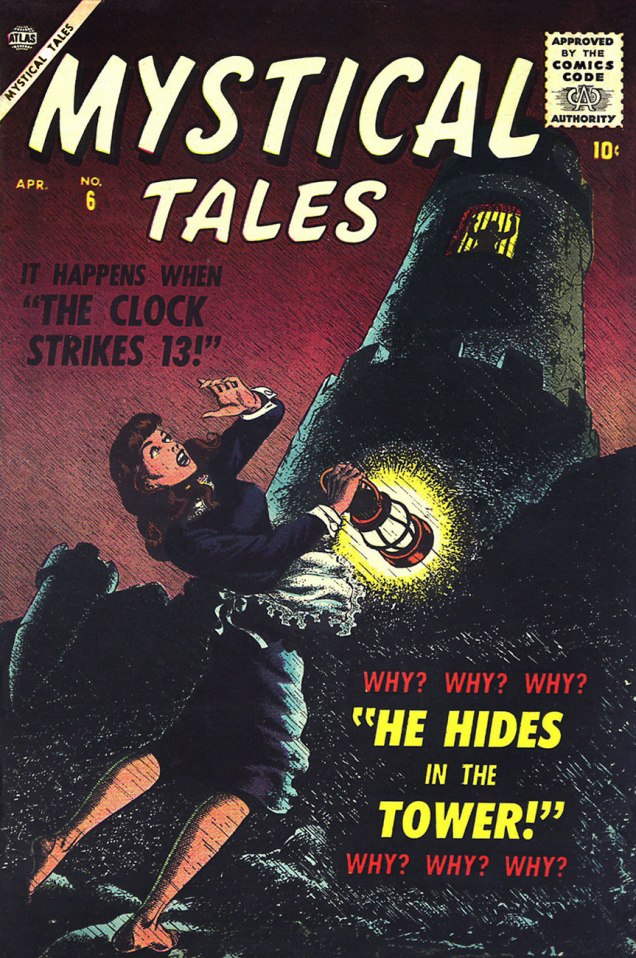
BillEverett-Mystical-Tales-6A
Mystical Tales no. 6 (April 1957). I admit the WHY? WHY? WHY? amuses me WHY? WHY? WHY?; – one inquiry should have sufficed. Speaking of “WHY?”… Why is she barefoot? Those rocks have to be treacherously slippery at the best of times, let alone in a rainstorm.

If you’d like more, you can visit Scott’s Classic Comics Comics Corner: Top 13 Bill Everett Horror Covers – only two of his entries overlap with my own selection, which shows how opinions vary and just how rich this vein is.

~ ds

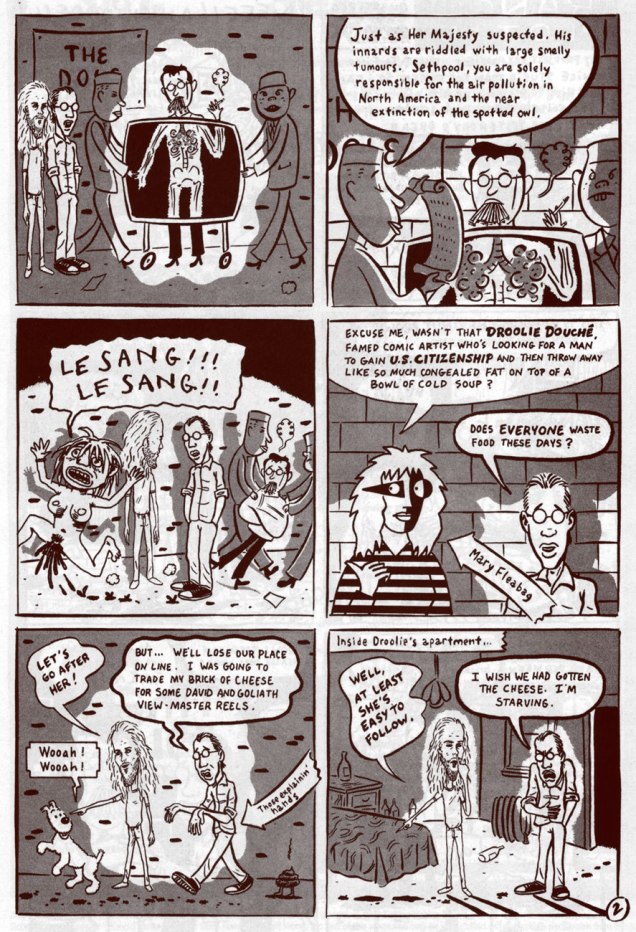
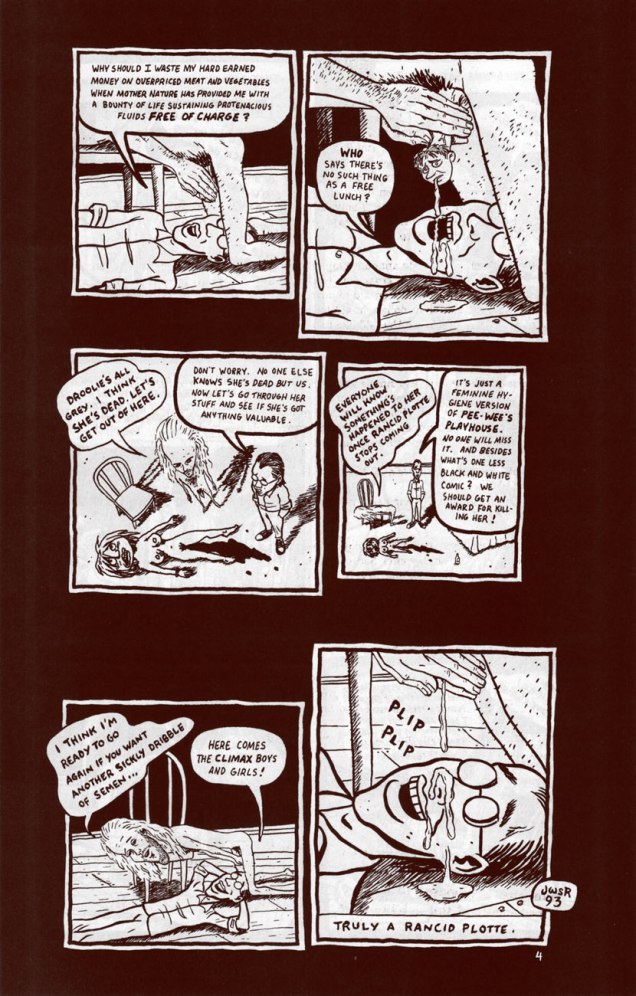
“Just a feminine hygiene version of Pee-Wee’s Playhouse”: Russo & Wong’s ‘Rancid Plotte’ (1993)

« We’re not very accepting of people who act strangely. » — Chester Brown

Scott Russo’s Jizz, published by Fantagraphics in 1991-93 (10 issues in all), was a fearless, often downright incendiary and frequently fascinating repository of vitriol from the heart and soul of Mr. Russo. As his own drawing style was pretty rudimentary (but clean and distinctive), the auteur drew upon collage, détournement and plain old text pieces for variety. Russo may have been embittered and misanthropic, but the entertainment he proffered was quite deliberate; a fine, dexterous trick to pull off.

Here, from Scott Russo’s Jizz no. 10 (March 1993, Fantagraphics), is his merciless but spot-on takedown of publisher Drawn & Quarterly‘s stable of neurotics: Julie Doucet, Joe Matt, Chester Brown and Seth, rendered in a breathtakingly accurate facsimile blend of their respective styles and schticks. Script by Russo, art by his trusted confederate ‘Master’ Jeff Wong. Not particularly ‘safe for work‘, I should say.

RussoRancidPlotte01ARussoRancidPlotte02ARussoRancidPlotte03ARussoRancidPlotte04A

Russoolive01A

Russoolive02A
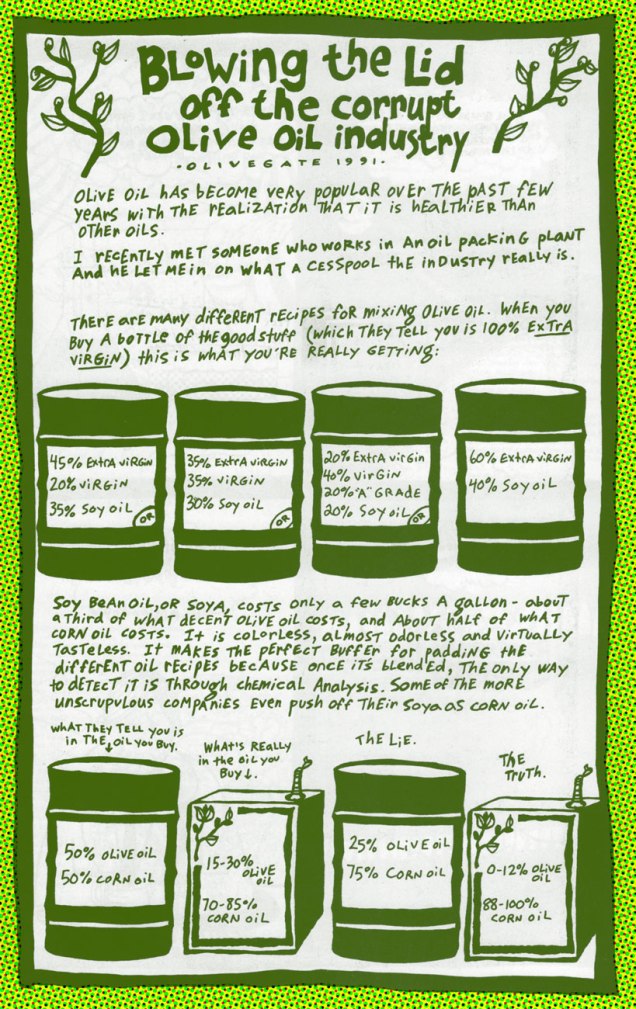
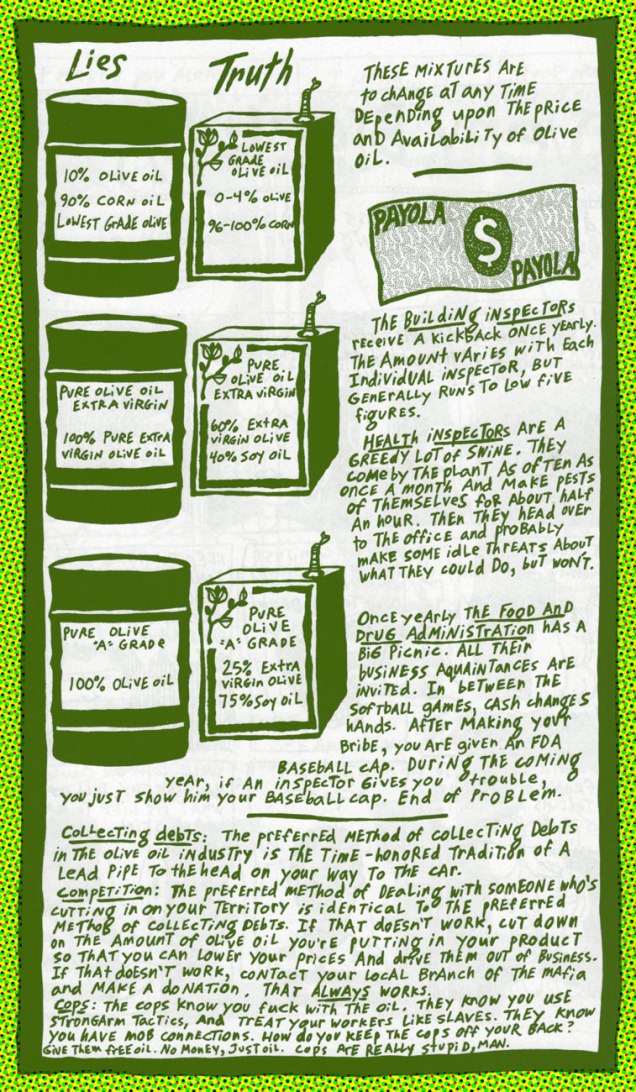
From Scott Russo’s Jizz no. 7 (Sept. 1991, Fantagraphics). I’ll always be grateful to Mr. Russo for this scathing exposé of the Olive Oil industry. My girlfriend at the time was taking a chemistry class at McGill University, during which they subjected various brands of olive oil to chemical analysis and essentially confirmed Russo’s claims. Now I merely snicker and shrug when I see someone shell out big bucks for the stuff… sometimes there’s no sense in trying to convince anyone.

-RG

Tentacle Tuesday: Let’s Get Bizarro

Dan Piraro‘s Bizarro is a ubiquitous newspaper comic that usually doesn’t need much in the way of introduction. Favourite strips are widely shared by fans – cut out or photocopied from newspapers (or, more recently, printed from a website) to be pasted on office doors, cubicle walls and school binders. As a matter of fact, that’s where I spotted my first Bizarro strip: scotch-taped to the office door of my college English teacher. Oh, I’ve seen them before, of course, but this was the first time I consciously noticed one of them. Teachers of all stripes seem to have a thing for Bizarro – I had a university psychology professor once who actually collaborated with Piraro on some strips, an achievement of which he was justifiably proud.

Bizarro-DanPiraro-p.20161015

As usual, one can rely on the intrepid Tom Heintjes of Hogan’s Alley to conduct a worthwhile interview with whichever artist one is interested in. Read it here: Mondo Bizarro: The Dan Piraro Interview. I’m not going to compete with Heintjes’ ability to summarize, so I’ll just quote:
« Since Bizarro’s January 22, 1986, debut, Piraro has taken his panel in directions simultaneously surreal and topical. In a comic universe where world-weary talking dogs exist alongside nihilistic housewives, Piraro gives his cartoons heft by skewering his own bêtes noires: wasteful consumerism, environmental destruction, corporate greed and sheeplike people, to name a few.  Though his humor is never didactic, Piraro’s work is remarkable in its unwillingness to pander, even when the occasional panel borders on the inscrutable. For example, he once used the Etruscans as a punchline; if you skipped history class that day, tough. Since sustained excellence like Bizarro‘s is rare in any medium, his willingness to shepherd his panel into its third decade is great news for comics fans and for the more than 200 papers that carry the strip. Though Piraro maintains that Bizarro is a comic strip for people who don’t read comic strips, we all know better: Bizarro is a comic strip for people who love comic strips. »

Bizarro-supportanimal-DanPiraro.jpeg

Piraro is not the only cartoonist spoofing social conventions, endowing animals with the gift of human speech or forging surreal situations out of everyday occurrences… but he does it consistently well. His easily recognizable, flowing art style is the frosting on the cake, and very nice frosting it is, too. Yet who can grasp the scope of such prodigious output? Bizarro collections (there have been thirteen of them – fitting number, isn’t it?-, all quite out of print) generally end up in the discount bin of bookstores (often neighbours to disheveled anthologies of Gary Larson‘s The Far Side, another omnipresent yet somehow underappreciated strip). For all my affection for Piraro’s goofy world, I only own Bizarro and Other Strange Manifestations of the Art of Dan Piraro (Harry N. Abrams Publisher, 2006). Some of the strips in this post have been scanned from it (others were found in the trackless depths of the Internet.)

Pleasantly, Piraro wears his politics, heart and sympathies on his (rather accommodatingly large) sleeve:

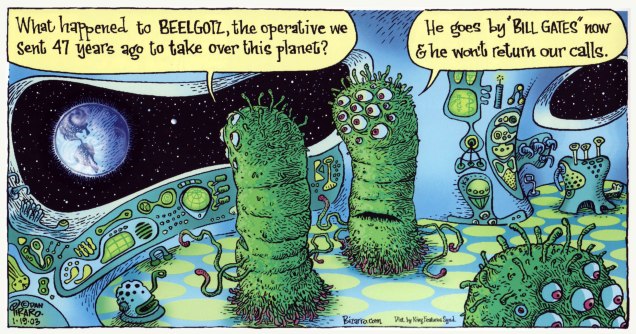
BizarroAliens02A

BizarroAliens01A

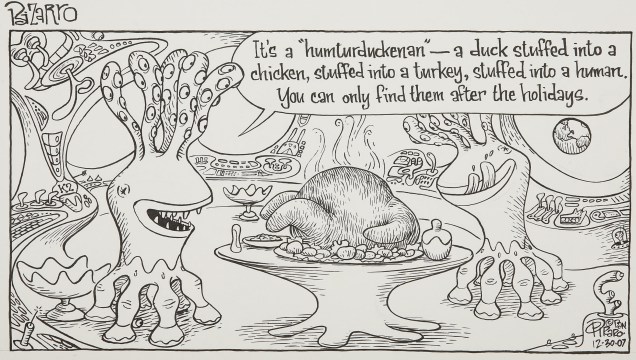
Bizarro-DanPiraro-Stuffed

Most Bizarro cartoons feature a recurring object or creature (added value for a comic strip that’s already rich in detail). Some of my favourites: the Eyeball of Observation, the Pie of Opportunity (a piece of pie – blueberry, I think), the Dynamite of Unintended Consequences, or Firecracker of Pop (a dynamite stick), the Fish of Humility (or at least its tail), and my very favourite, the Bunny of Exuberance. One can just tell that Piraro enjoys his work. What kind of jerk still enjoys drawing the same strip after 30 years*?!

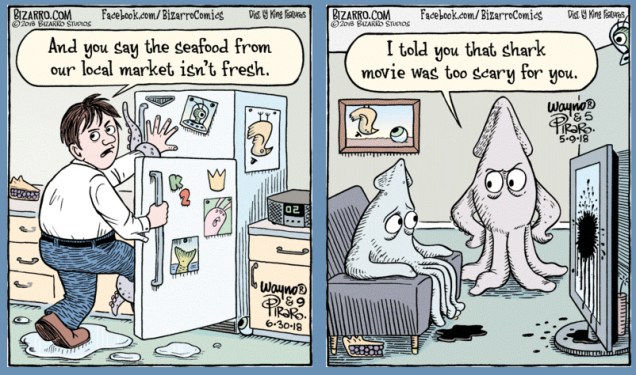
Bizarro-Freshfood

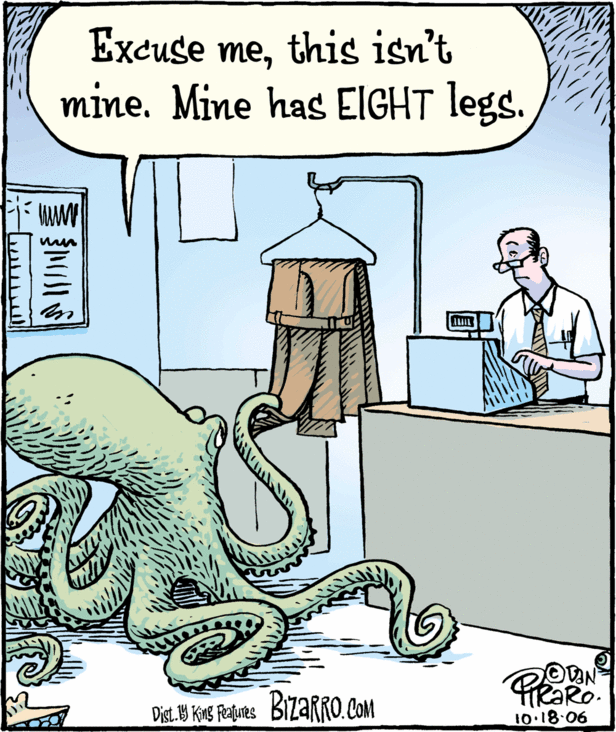
bizarrooc18-2006

Don’t forget to visit Bizarro’s official website!

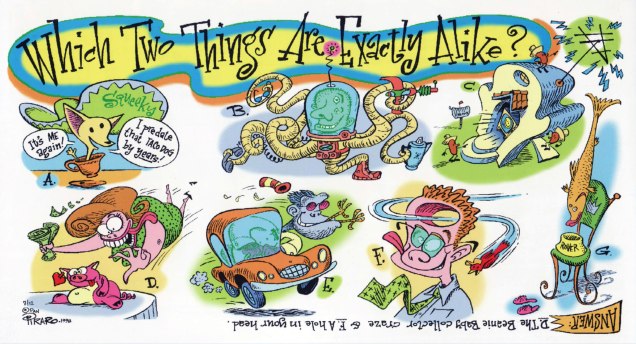
BizarroTwoThingsAlikeA

~ ds

*Since 2018, Piraro’s pal Wayno has been drawing the dailies, with Piraro keeping the Sundays all to himself.

Marooned in Time With Paul Gillon

« We all have our time machines. Some take us back, they’re called memories. Some take us forward, they’re called dreams. » — Jeremy Irons

Today, we note the birth anniversary of the powerful French bédéiste Paul Gillon (May 11, 1926- May 21, 2011). Working in a classical, realistic style, he began his career in comics with the weekly Vaillant. For daily newspaper France-Soir, he co-created the daily soap opera strip 13, rue de l’Espoir (1959-1962, scripted by Jacques Gall and François Gall), strongly inspired by Elliot Caplin and Stan Drake’s The Heart of Juliet Jones, but set in Paris.

Then, in 1964, for the short-lived bédé newspaper Chouchou (an eight-pager published for a mere 14 issues, a tragedy!), Gillon co-created, with scripter J.C. Valherbe (alias Jean-Claude Forest, of Barbarella fame), one of the great classics of French science-fiction comics, Les naufragés du temps (“Castaways of Time”). Several wonderful features (for instance, Georges Pichard‘s Ténébrax) were left stranded by Chouchou’s demise, including (literally) Les naufragés.

Fortunately, its authors deemed its premise too worthy to let the matter drop forever. Nearly a decade on, Gillon tweaked the saga’s opening pages and resumed the narrative, which France-Soir published. Forest scripted the first four collections (1974-76), then Gillon took full command of the strip, which found a warm new home in Métal hurlant from 1977 right to the end of the series with Le cryptomère (The Cryptomeria), collected in 1989.

GillonNaufragés01AGillonNaufragés02AGillonNaufragés03A

Les naufragés’ premise is this: In 1990, a man (Chris) and a woman (Valérie) are placed into suspended animation. A thousand years hence, the man is picked up and woken. Where’s the woman?, he wants to know. A futuristic bout of cherchez la femme ensues, to make a long story short.
Forest, wrote, in 1967, of his original plans for the saga: « Chris was searching for an image. After many adventures, he manages to find Valérie only to realize that this image no longer fitted that of his dream. »

The sequence presented here comprise the second, third and fourth pages of the first tale, as they appeared in Chouchou in 1964. Say, that cool metal creature reminds me of one of the most ridiculous Marvel super-baddies of the 1960s, disgruntled government employee Alexander Gentry, aka… (see below for the answer).

GillonNaufragésÉtoileA
The first album in the series, L’étoile endormie (The Sleeping Star) – 1974
GillonNaufragésCannibaleA
The fourth album in the series, L’univers cannibale (The Cannibal Universe) – 1976
GillonNaufragésChimèreA
The fifth album in the series, Tendre chimère (Sweet Illusion) – 1977

A peek at a page of original art from album 3, Labyrinthes (1976):

NaufragésOriginalA

More about the series: http://www.coolfrenchcomics.com/naufragesdutemps.htm

… and you can read the entire series here (if you can read French) or, if not, just admire the artwork.

– RG

… and here’s your answer:

TTA48PorcupineA
Stan Lee and Don Heck‘s The ‘Dreaded’ (ha!) Porcupine, or what happens when neither Steve Ditko nor Jack Kirby are on hand to design your costume (and ghost-write your story). Incidentally, Stan, porcupines don’t project their quills. Here he is depicted by Kirby, from the cover of his inaugural appearance, in Tales to Astonish no. 48 (October, 1963).