Tentacle Tuesday: Tentacles in Hiding

Greetings to all my dear tentacle zealots! This week I am rather exhausted from a move (not mine own, which somehow makes it worse?), and so I will retreat into my cozy shell, just like this handsome fellow:

But I don’t want this to be a complete disappointment, so I will leave you with these two panoramas:

Supper at Sea by Ben Boling, a freelance illustrator who posted this beauty on his deviant art profile.
Characters from left to right: Alice the Goon (topless!), the Sea Hag, Poopdeck Pappy, Brutus, Professor O.G. Wattasnozzle, Olive Oyl, Popeye, the Jeep, J. Wellington Wimpy, Rough House the cook, Swee’ Pea, George Geezil, Castor Oyl.

To quote the man in question: «  This, my dearies, is my takeoff on Leonardo’s Last Supper. All of the characters are from the Thimble Theater strip by E.C. Segar, which later became just the Popeye comic strip. I tried to keep most of the characters in the same positions as the apostles are in Leonardo’s version, and tried to put in a few little fun things relating to the original. For instance, putting Olive in the same place as the apostle John, who some believe to be Mary Magdelene. I also had to put Brutus in the place of Judas Iscariot, and have him holding money (pieces of silver). Some theories also say that both Judas and Christ were reaching for the Eucharist in Leo’s version, so I included that too, replacing the bread with limes so they don’t get scurvy. And the cigar in the ashtray is a tribute to Popeye’s creator E.C. Segar who used to sign his drawings with a little cigar with the smoke forming the letter “S” in his name. The halo effect in the wood around Popeye was pretty much an accident, perhaps there was divine intervention? »

Of course you can also revisit the past in the shape of Tentacle Tuesday: Popeye, the Sailor Man.

And, in a slightly different vein —

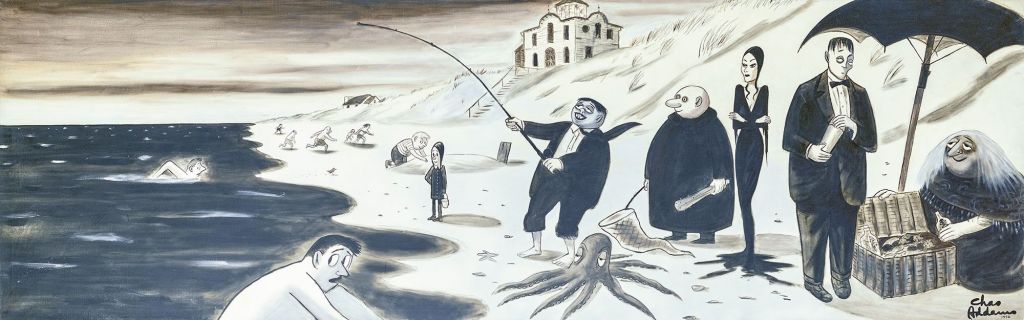
« In 1952, Charles Addams, at the height of his skills as a cartoonist, painted a lush, monochromatic mural on canvas for a bar at the Dune Deck, a hotel in the Hamptons. (The work is nearly fourteen feet long and more than four feet high.) When the hotel changed hands, the new owners—one of them a Penn State alumnus—donated the painting to the university’s Palmer Museum of Art. A few years later, it was transferred to the library, where it hung in the Lending Services area, until it was relegated to its current location, in 2000. Somewhere along the way, it picked up the name ‘An Addams Family Holiday.’ »

As seen from the quote, this ‘mysterious’ mural by (naturally) Charles Addams has a quite interesting, recent-ish discovery story. Read about it the excellent article in the New Yorker (excerpted above) here, or if you don’t have access, try the slightly less well-written, but nevertheless informative version here (sorry, Pennsylvania News).

The proud artiste:

~ ds

Some of Life’s Darkest Moments

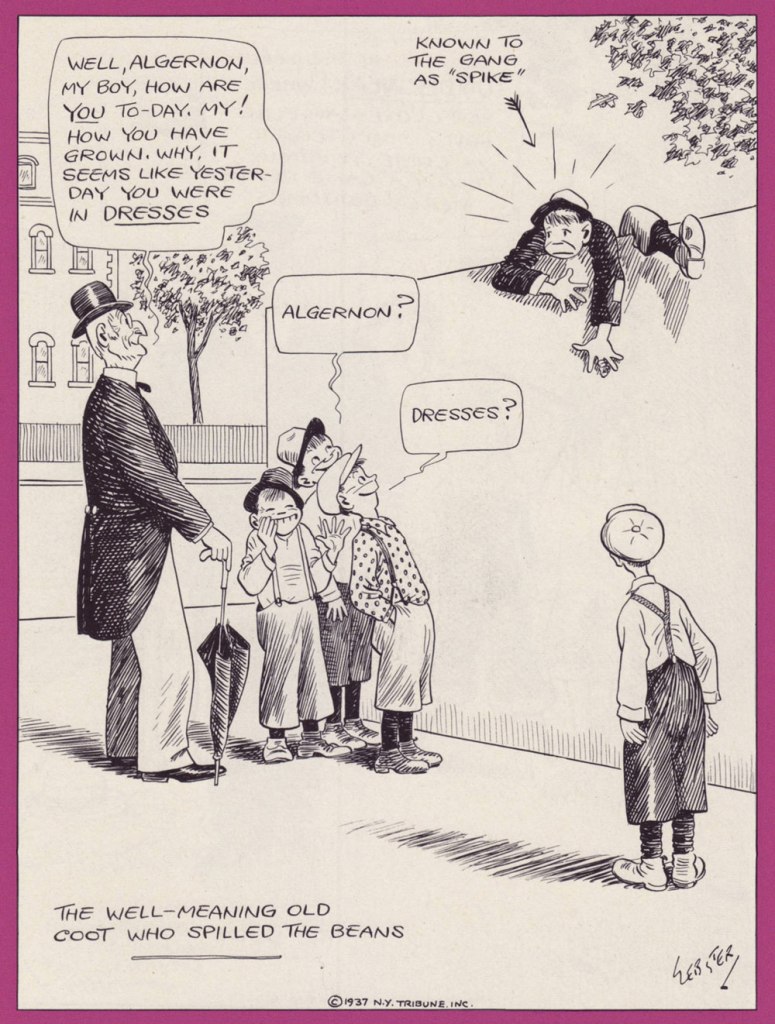
« This kind of accuracy, continued long enough, can ruin a man who is constructed as I am. I want to be pretty. I want to eliminate facts and fill up the gap with charm. » — Samuel Clemens, writing to a friend of a pen sketch sent to him by young admirer H.T. Webster

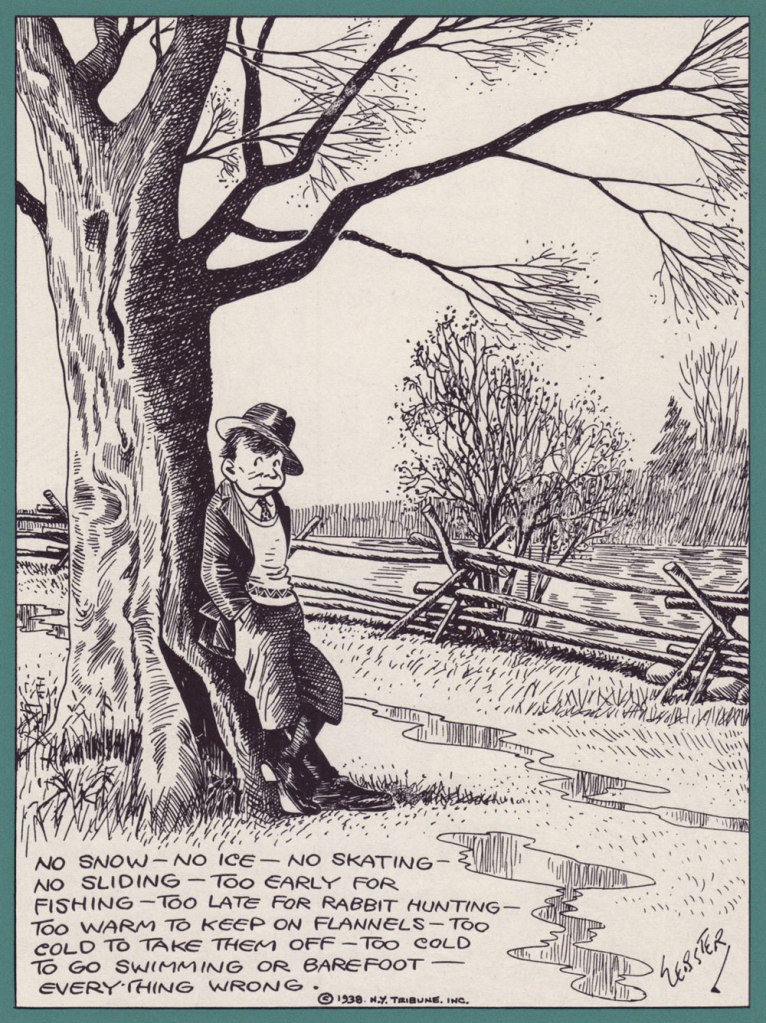
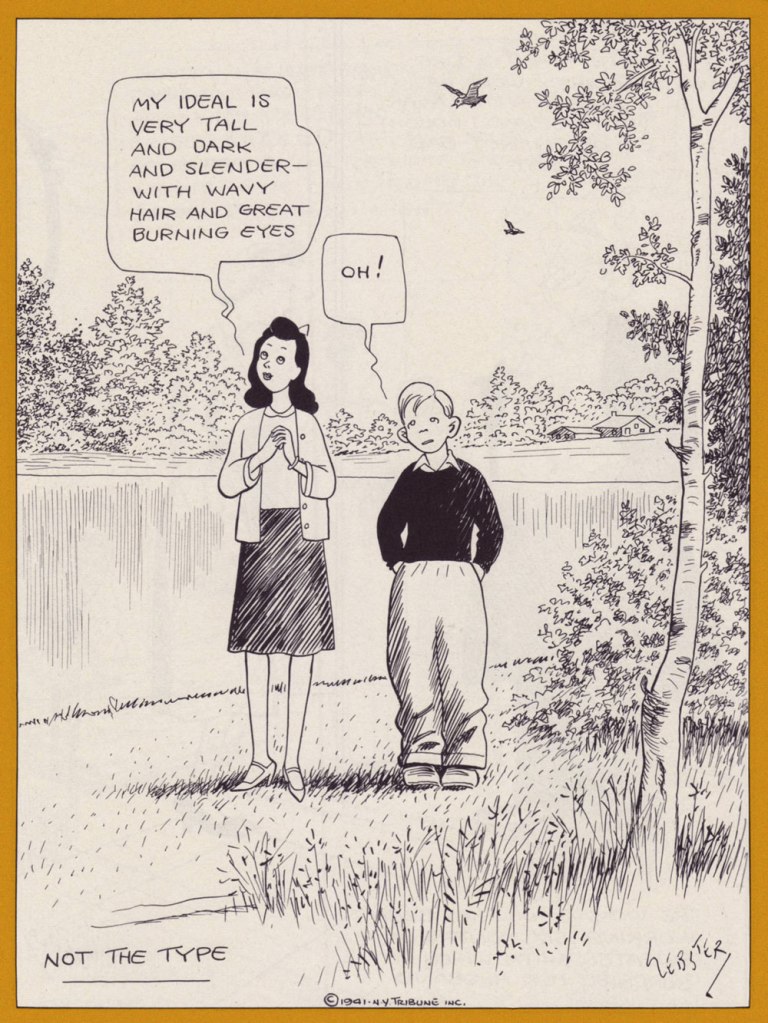
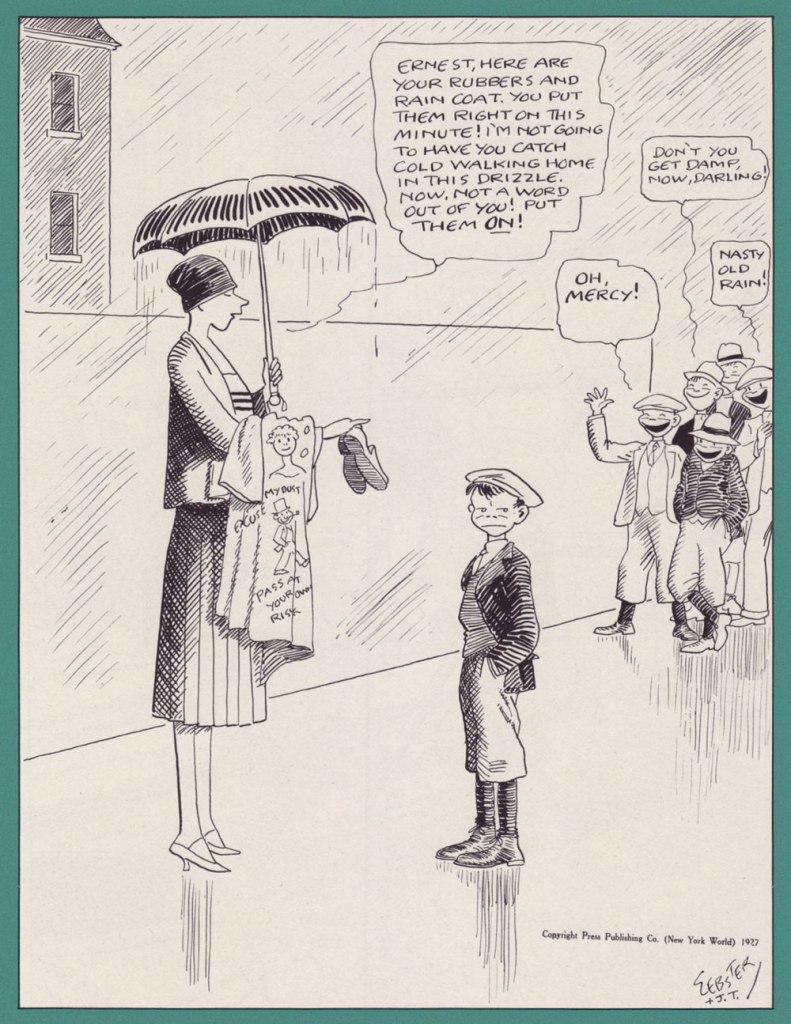
I had originally set out to write (and I may yet) of pioneering newspaper cartoonist (and honorary Southpaw*) Harold Tucker “Webby” Webster‘s most famous feature, The Timid Soul (starring Caspar Milquetoast, his contribution to the English language), but I noticed that Atlas Obscura had beaten me to the punch, and quite honourably at that.

Thankfully, it’s fair to say that Webster (1885-1952) had plenty more arrows in his quiver. According to a 1945 Time Magazine profile of the artist (who was even featured on the cover!):

« H. T. Webster has learned to slice and serve his generous chunks of U.S. life methodically. Caspar (The Timid Soul) appears Sundays and Mondays. The pitilessly fanatic and bad-mannered bridge players run Fridays. Boyhood’s lovingly elaborated triumphs (The Thrill That Comes Once in a Lifetime) and defeats (Life’s Darkest Moment) appear on Saturdays and Tuesdays. Thursdays bring How to Torture Your Husband (or Wife). On Wednesdays, in The Unseen Audience**, he pokes a sharp-pointed stick at radio—which of all mixed blessings most needs satirizing, and gets it least. Webster, in fact, is possibly radio’s most effective critic. »

Honestly, they’d each be rewarding choices, but I’ve opted, on this occasion, to draw from the cool, sombre well of Life’s Darkest Moment.

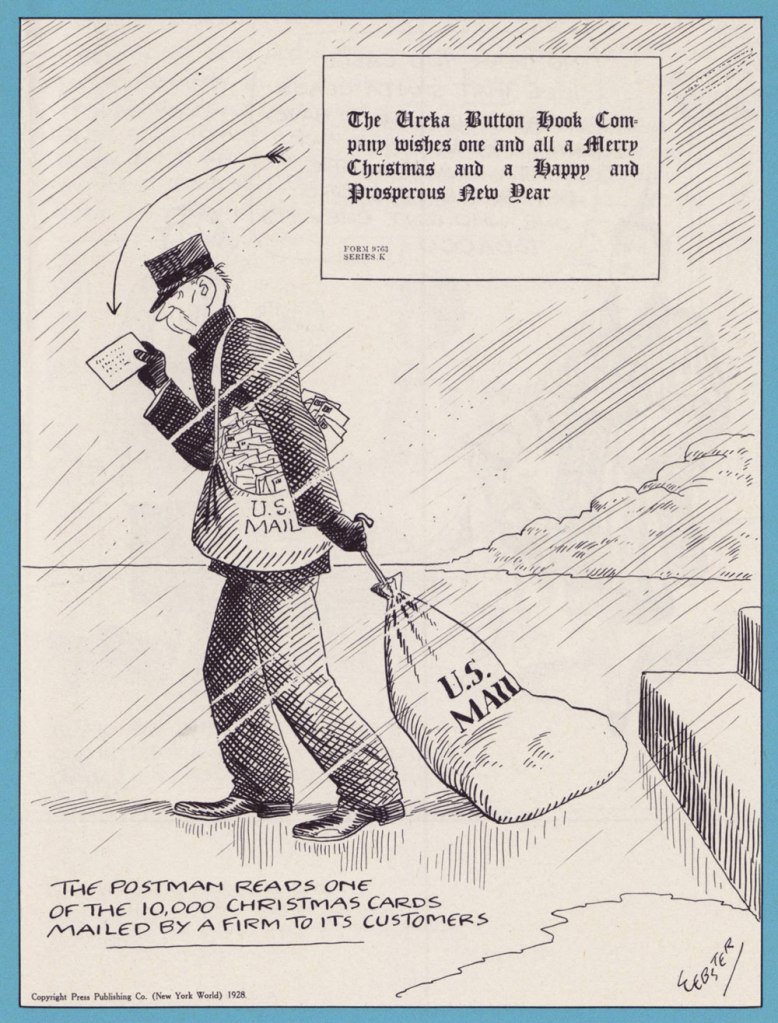
A glimpse at the infancy of spam.
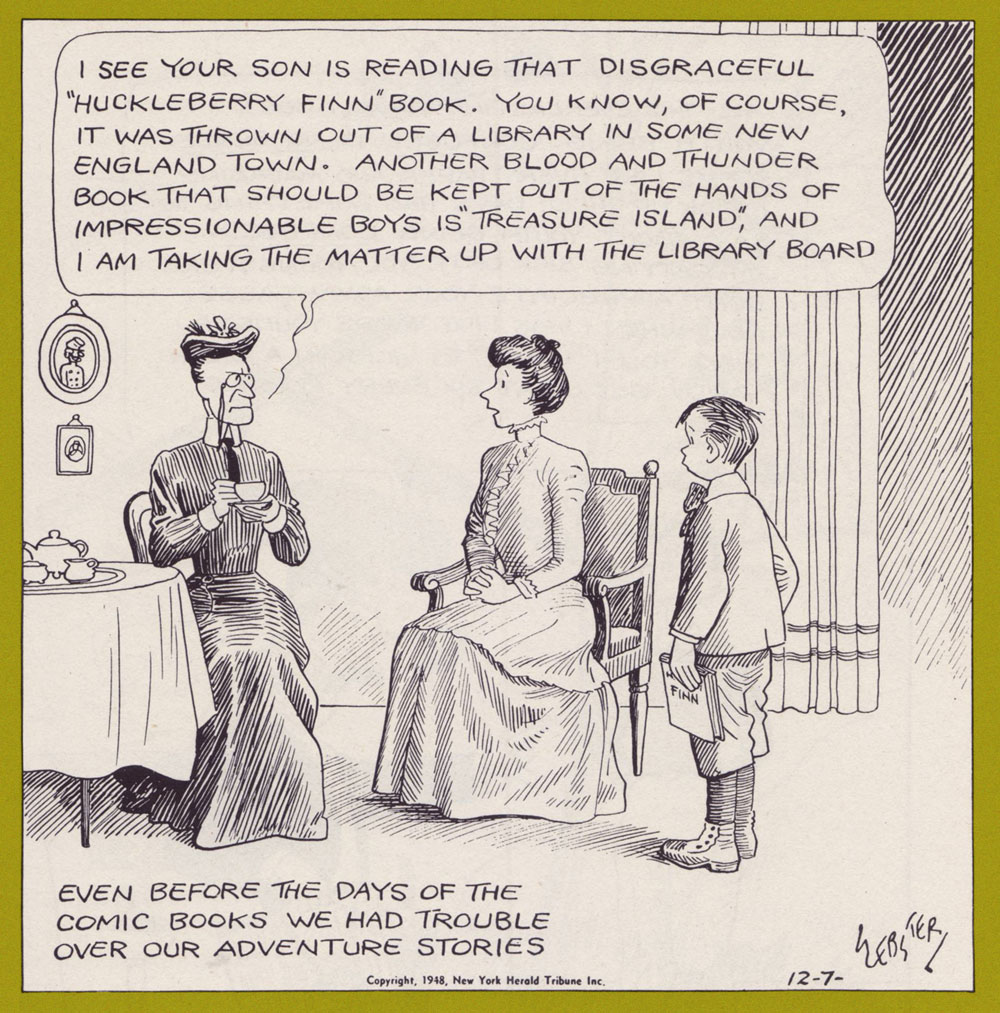
Up here in Canada, we recently had a bit of a furore over a sanctimonious (yet deceitful) fusspot spearheading the destruction of a bunch of graphic novels. Oh, and speaking of Robert Louis Stevenson, tomorrow’s his birthday, number one hundred and seventy one!
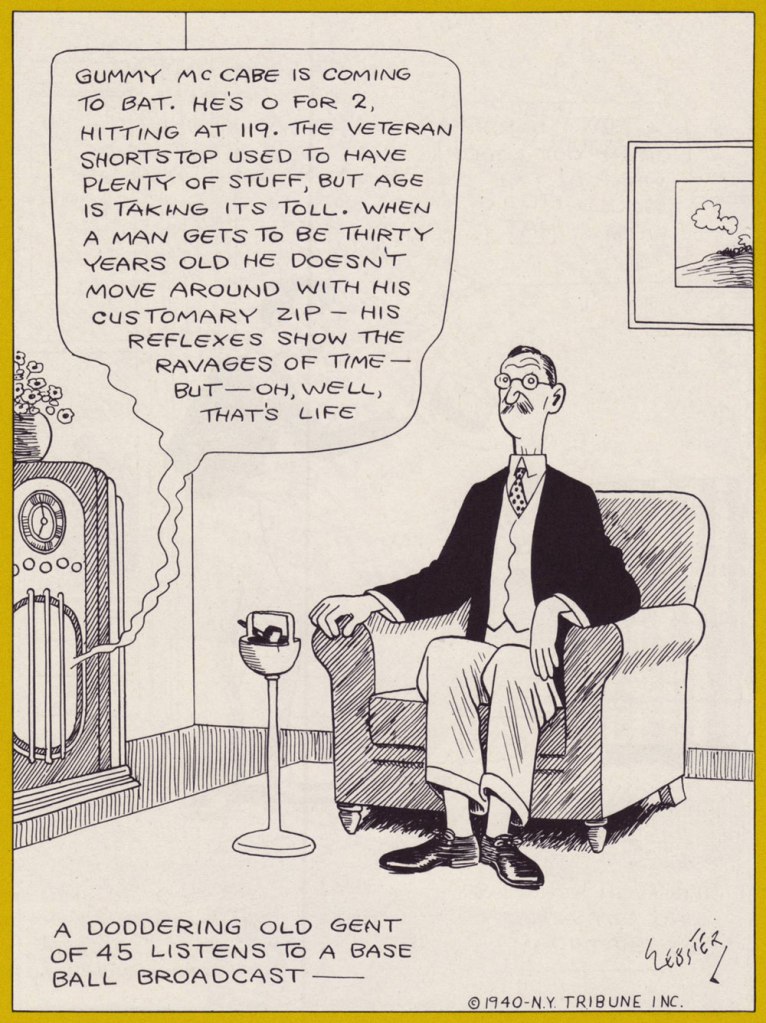
Then as now, one can generally rely on the news to be dire.
Another entry in our collection of Legendary Cartoonists With a Great Tousled Head o’ Hair.
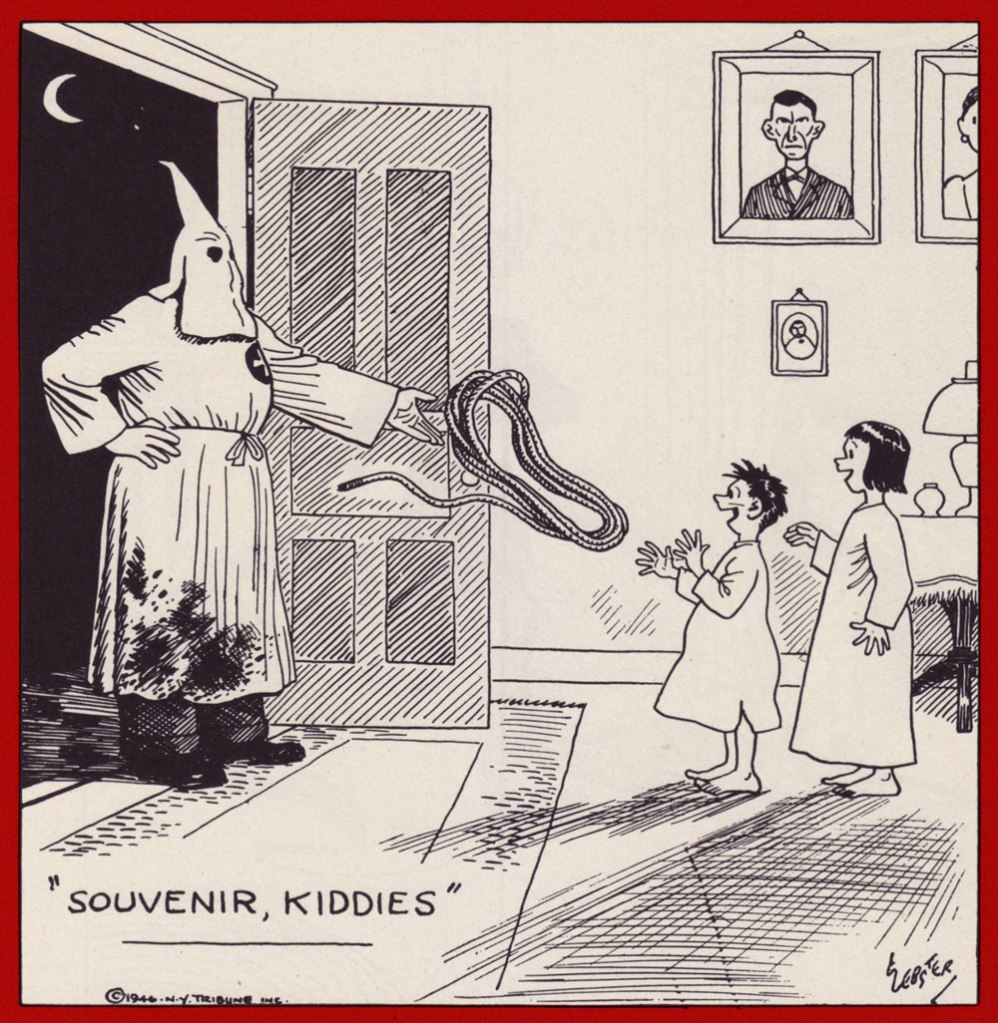
And just so you don’t conclude that Webster’s work was all about, and just about ‘poking gentle fun at life’s little foibles‘, here’s what has to be the darkest, most brutally scathing political cartoon*** I’ve ever seen come out of the mainstream US press (circa 1946!). Incidentally, Webster was a Republican. The original art of this masterpiece resides in the permanent collection of The Library of Congress, right where it belongs.

-RG

*For many years no one but his close friends knew of an acute arthritis which in 1927 cost him the use of his right hand. In three months he trained himself not only to write, but to draw, left-handed.” — Philo Calhoun in Biographical Sketch, The Best of H.T. Webster (1953, Simon and Schuster).

**In 1948, The Unseen Audience won him a Peabody Award for distinguished service to radio!

***He “… returned to Chicago, where he spent three years drawing front-page political cartoons for the Chicago Inter-Ocean, prompting one politician to introduce a bill in the state legislature forbidding unflattering cartoons.” (it didn’t pass.)

Tentacle Tuesday: « Do me up like one of your French girls! »

Tentacular greetings to all! Today’s post finds us with our feet firmly planted in France (well, maybe with one toe dipping into Belgium, as usual). As friend Barney might say, come for the Important & Serious Artist discussion, stay for the ‘naked man/nubile woman’ fringe benefits…

Many are fans of Jean Henri Gaston Giraud, far better known under his nom de plume, Mœbius. Co-admin RG and my humble self do not belong to this category, which is possibly why he has never been mentioned in WOT before. RG thinks he’s ‘the Serge Gainsbourg of French comics‘ (not a compliment); I do not specifically dislike his work… nor am I interested enough in it to investigate. We could argue about Mœbius’ profound influence on science-fiction and cyperpunk and his lasting impact on comics until we’re blue in the face, so I suggest we look at some tentacles instead!

The original art from Il y a un Prince-Charmant sur Phenixon (Pilote, 1973), published in English in Heavy Metal Magazine v. 4 no. 10 (January 1981) as ‘There Is a Prince Charming on Phenixon’.

The Long Tomorrow was written by American screenwriter Dan O’Bannon and illustrated by Mœbius in 1975. Published in Métal hurlant (nos. 7 and 8) in 1976, it was then picked by Heavy Metal in 1977 for the anglophone market. This story is credited with having heavily influenced a number of movies – Blade Runner gets mentioned a lot, for example. Read the full story (and a little interview with O’Bannon) here.

Page from the story published in Heavy Metal no. 5 (August 1977).

Speaking of Métal hurlant, this cover offers some quality tentacles from French comics artist/illustrator Jean Solé:

Métal Hurlant no. 3 (July 1975), cover by Jean Solé.

Solé liked the absurd, the grotesque, and the psychedelic, so naturally he has more tentacles on offer than just one cover!

Illustration painted for publication in Pilote in 1985.

The last offering of today’s TT is this very dramatic action scene by Claude Serre. Is the surgeon trying to stuff these tentacles back in, or extract them? We shall never know.

Scanned from Serre, a best-of collection published by Glénat in 2001. This illustration was an excerpt from Serre’s Humour noir et hommes en blanc (“Black Humour and Men in White”), a collection of sombrely jocular drawings on the topic of medicine.

~ ds

Treasured Stories: “The People vs. Hendricks!” (1964)

« Programmed for love, she can be quite tender
Treat her unkind, nothing offends her
She vacuums the carpet and doesn’t complain
She’ll walk the dog in the pouring rain.
» — Was (Not Was), Robot Girl

Today, on the occasion of his birthday (this would be number 112), we celebrate the great writer and editor Leo Rosenbaum (1909-1974), Potentate of Pseudonyms. If you know of him at all, odds are it’s under his nom de plume of Richard E. Hughes, pioneering chief writer and editor of the American Comics Group (ACG, 1943-67), and then perhaps under one of the numerous colourful aliases he adopted to conceal the fact that he was doing most, if not all, the company’s writing. In alphabetical order, meet Pierre Alonzo, Ace Aquila, Brad Everson, Lafcadio Lee (a salute to the Irish-born writer of Japanese ghost stories of Kwaidan fame, perhaps?), Kermit Lundgren, Shane O’Shea, Greg Olivetti (probably inspired by the brand of his typewriter!), Kurato Osaki, Pierce Rand, Bob Standish and Zev Zimmer.

Early in my comics collecting days, I spent a lot of time consulting Robert Overstreet‘s The Comic Book Price Guide (a practice I’ve utterly abandoned) gleaning random bits of trivia and dreaming about potential acquisitions. One item that greatly piqued my interest was this note:

From the 12th edition of The Comic Book Price Guide (1982, Overstreet Publications).

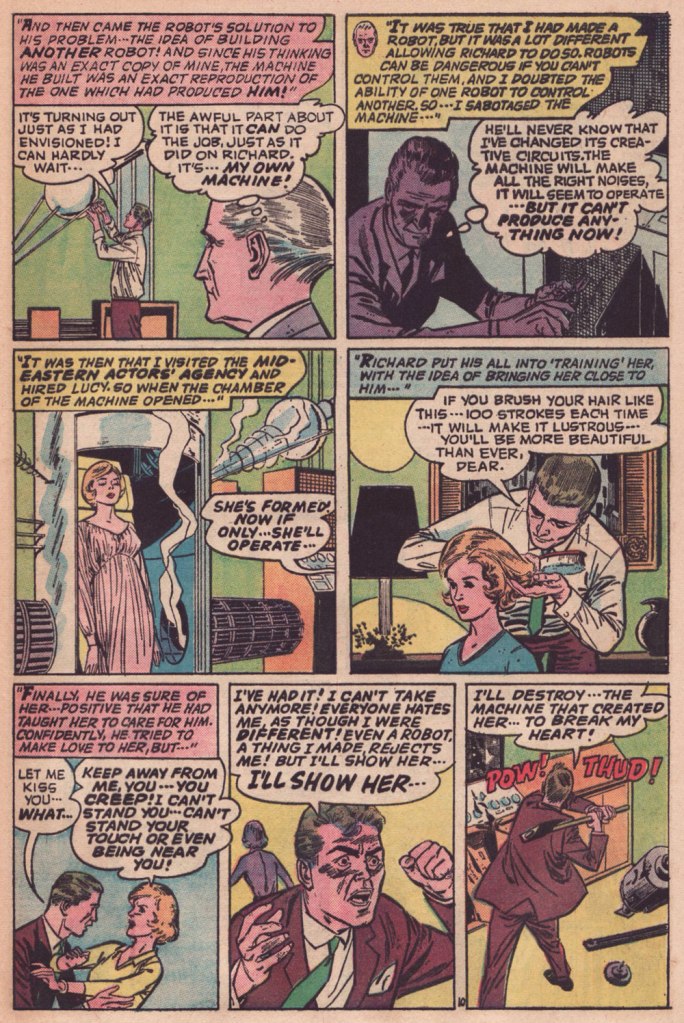
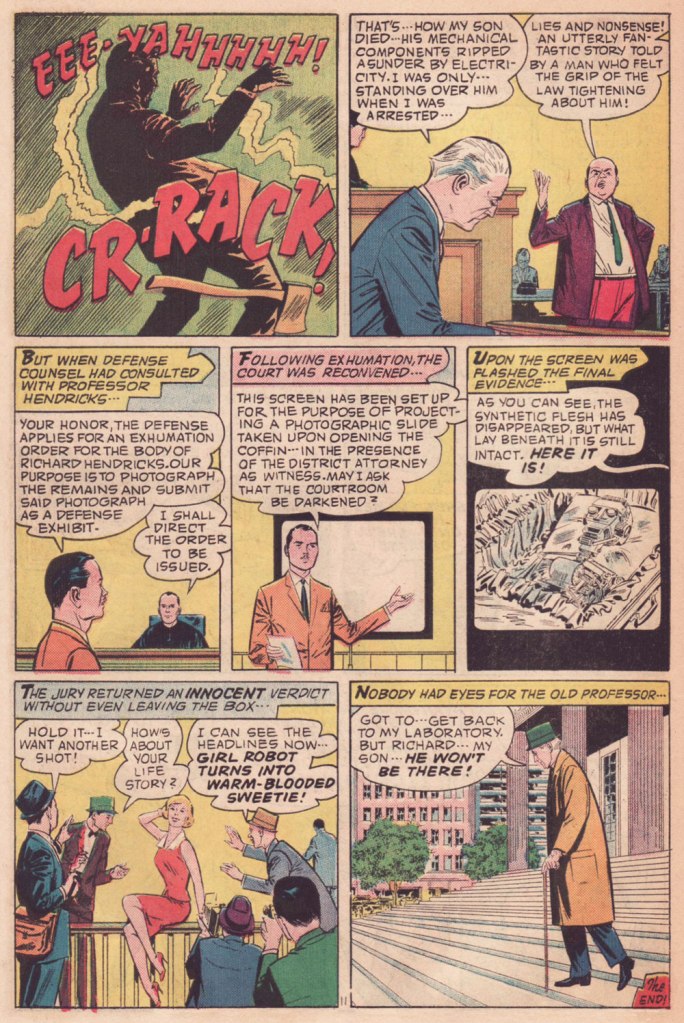
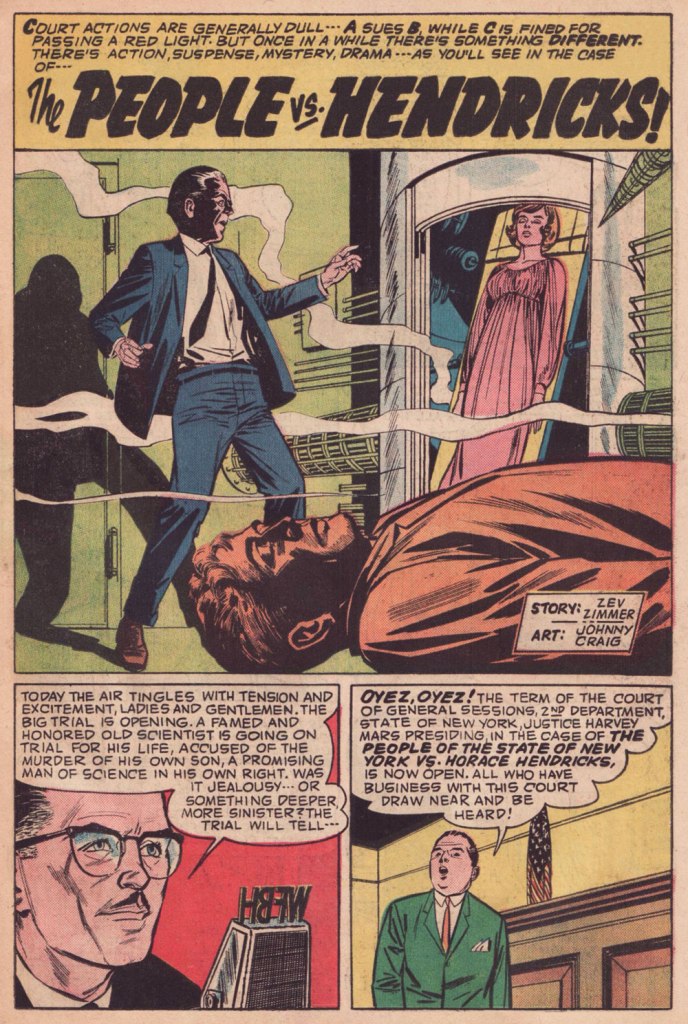
Well, I did eventually get my hands on a copy, and I must say wasn’t disappointed. And since I was taught to share with the other kids, here’s the story in question.

While “The People…” draws upon familiar elements of The Bride of Frankenstein and say, Inherit the Wind, I daresay that its heart-rending conclusion is its very own.
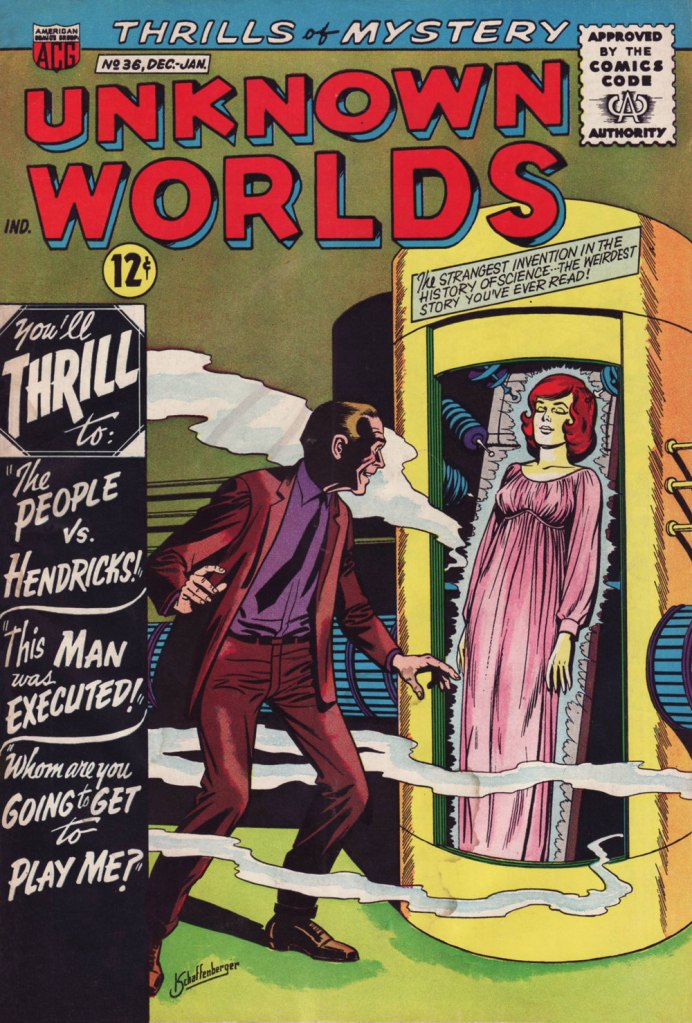
And here’s the cover. This is Unknown Worlds no. 36 (Dec. 1964 – Jan. 1965, ACG); art by Kurt Schaffenberger.

As for the artist: Johnny Craig (1926-2001) had been absent from the comics field most of the decade that followed EC Comics’ near-total collapse and the advent of the Comics Code, when he suddenly turned up at ACG (he’d been toiling in advertising). He would later do some work with Warren, Marvel and DC until the early 80s, at which point he more or less retired. Craig’s always been near the very top of my favourites at EC. Since he was, artistically-speaking, painstaking (‘slow as mollasses in February‘, my art school drawing teacher was fond of saying) and quite self-critical, Gaines entrusted him, as he did in the case of Harvey Kurtzman, with some editorial and scripting responsibilities to make up the income shortfall and keep him around and happy. And so the Craig-edited-and-led Vault of Horror is easily the finest of the company’s horror trio, largely thanks to Craig’s solid writing skills, not to mention his inspired artwork. Craig’s stories provided a much-needed breather from Gaines and Feldstein’s often powerful, but also formulaic and overwritten tales.

Interestingly, while Craig’s art style is overall understated and full of spit and polish, he created several of the company’s most transgressive images (such as this one and that one). Editor-writer Hughes knew precisely what he was doing (as any editor worth his salt should) when he conceived this story and assigned it to Craig. It plays superbly to the man’s strengths, if you ask me.

-RG

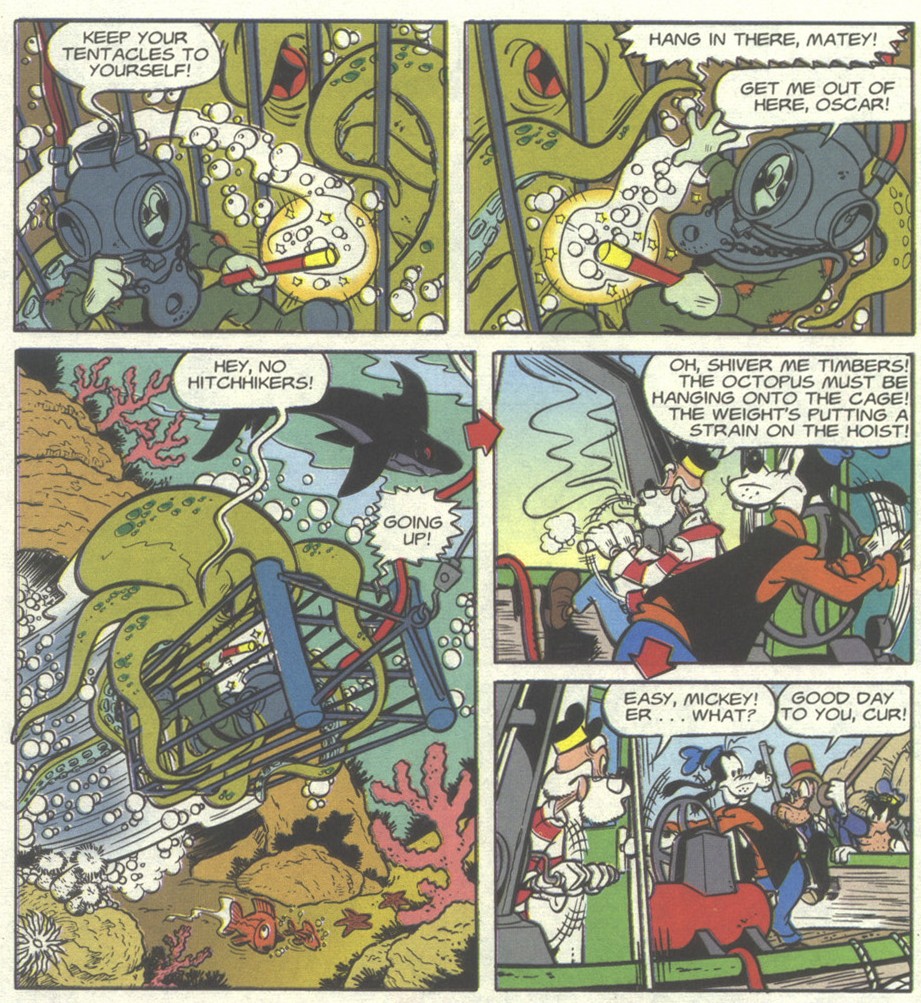
Tentacle Tuesday: The Time Has Come for Namor, Fish-Man

« Then suddenly, like some gigantic serpent out of the deep, a huge, quivering tentacle tose from out of the sea — a sight from any seaman’s maddest, most impossible nightmare –! »

Today we pay another visit to Subbie (or Subby), which every bit as horrible an abbreviation as ‘hubby’ for ‘husband’. We’ve gone over his history in a previous post (see Tentacle Tuesday: Prince Namor, the Sub-Mariner), so now we can concentrate on Action! Adventure!! Excitement!!! What’s on his charged schedule, you might ask? Why, a quick tussle with some Soviet submarines, a few pompous (I’m sorry, I meant ‘dramatic and exciting’) speeches, a plunge intro ‘wintry, unplumbed depths’, a lengthy trip to memory lane, and an epic fight with an unliving cyborg!

My favourite, naturally, are the Soviet submarines.

Sub-Mariner no. 35 (August 1954, Atlas), cover by Sol Brodsky. The insides of this issue actually don’t have tentacles, but do have pretty much everything else – it’s a fun, wacky read.

Moving forward by a little more than 15 years, we get embroiled in a slightly different kind of evil…

Sub-Mariner no. 27 (July 1970, Marvel), cover pencilled by Sal Buscema and inked by Mike Esposito.

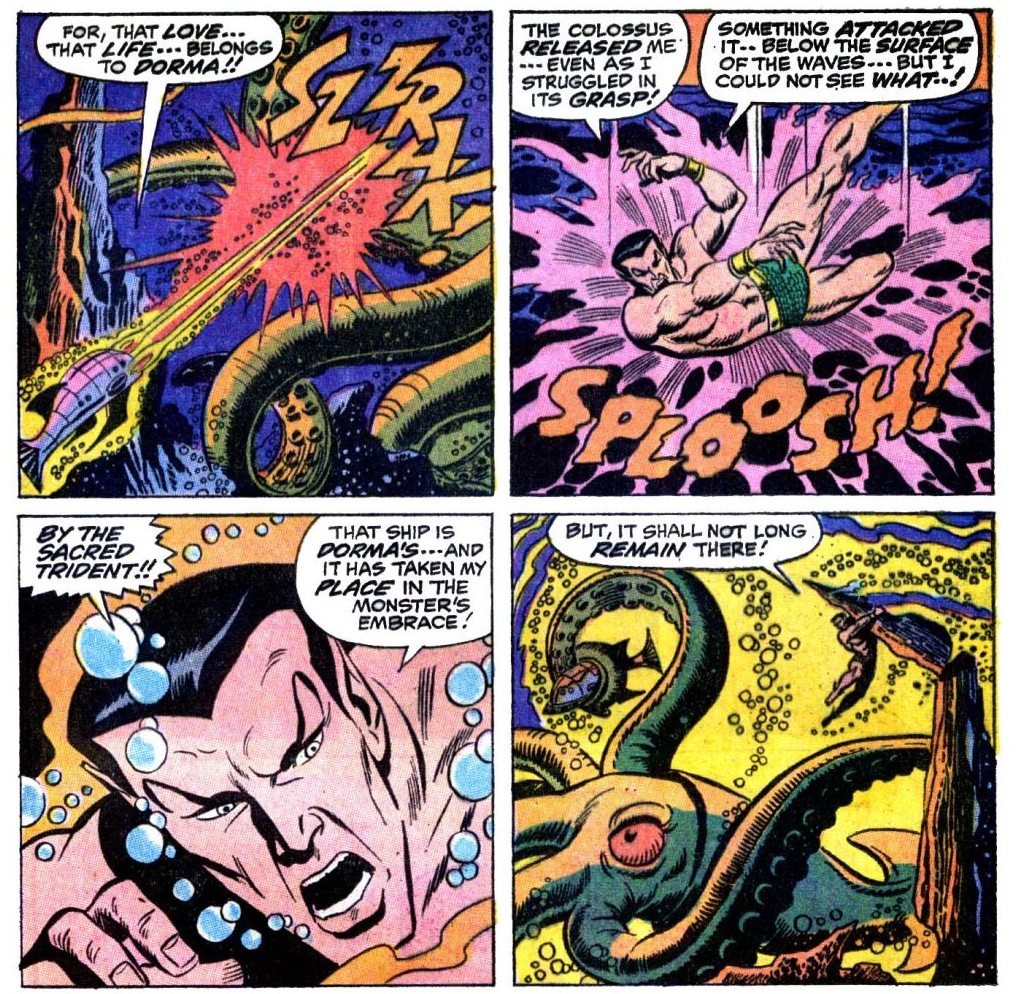
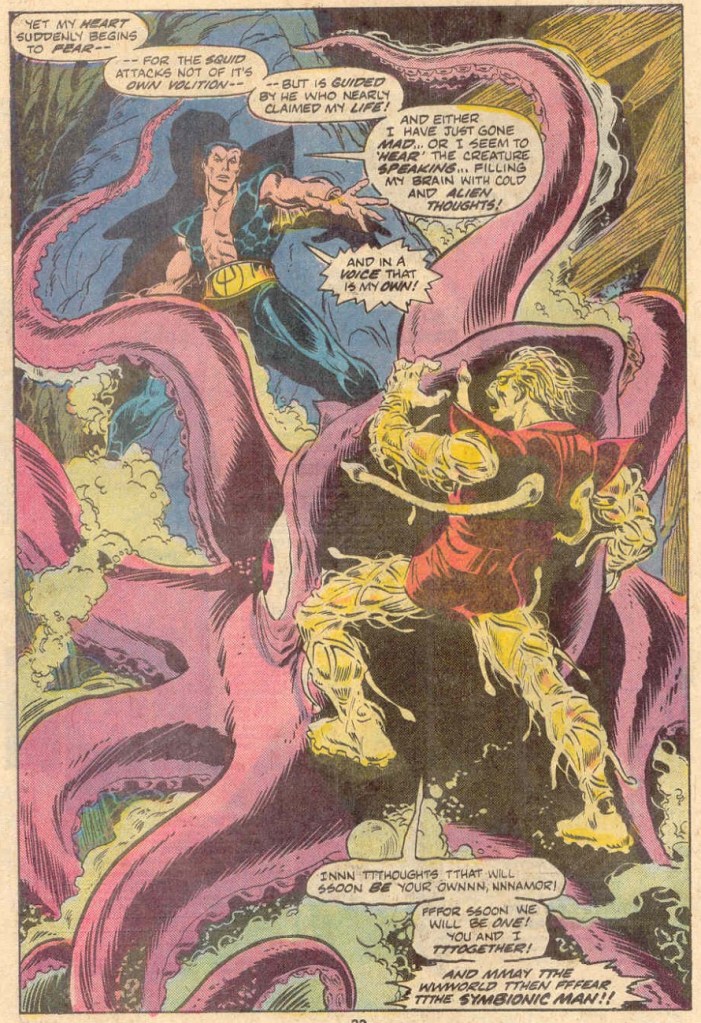
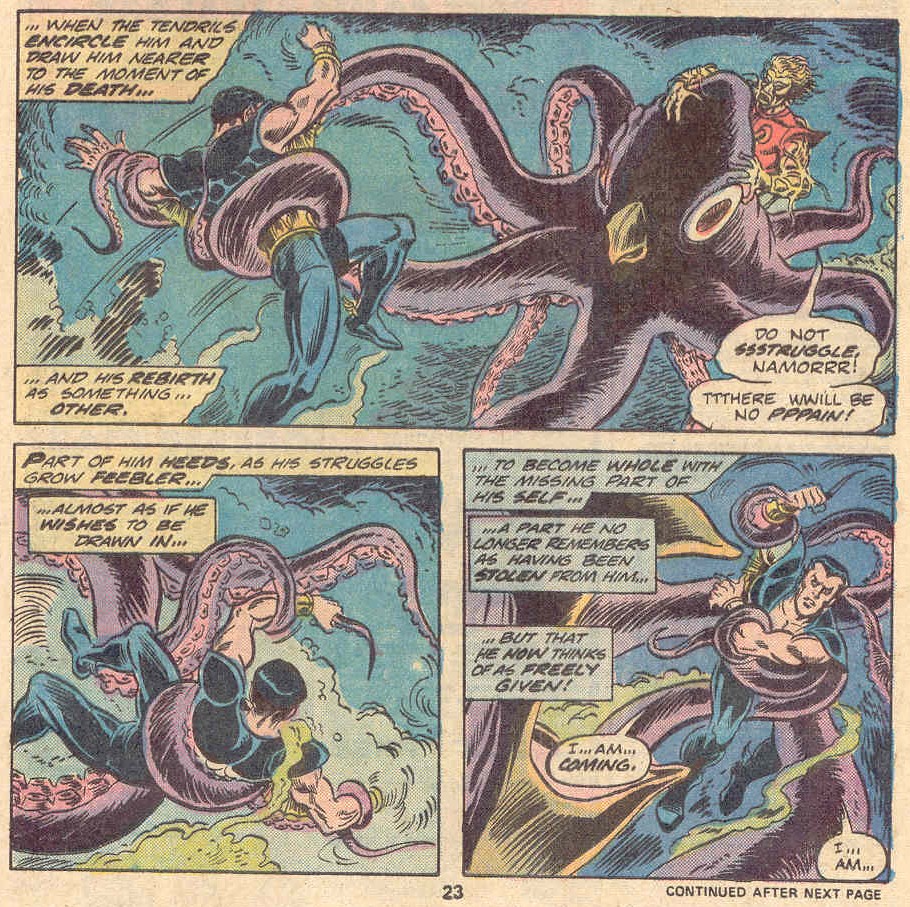
When Wakes the Kraken! was scripted by Roy Thomas, pencilled by Sal Buscema and inked by Mike Esposito. Aside from a lot of dialogue (check out the ‘ay, woman… but the time has come for battle… not words!‘), this story also has a lot of plump, high-quality tentacles.

This cover is fun, given that the Symbiotic Man appears to have tentacles on the soles of his feet and the ends of his hair as well. Did somebody actually demand that Namor should fight alone? I was under the impression that Marvel readers were more into ‘the more the merrier’ type of fun.

Marvel Spotlight no. 27 (April 1976). Cover pencilled by Gil Kane (Tentacle Tuesday dabbler!) and inked by Frank Giacoia.

The cover story is titled Death Is the Symbionic Man!, scripted by Bill Mantlo and illustrated by Jim Mooney. Note the typo in ‘its’ in the second speech bubble.

The octopus appears to be having serious doubts about his presence in this fight. “Aw, do I hafta?”
What’s the point of having a super cool symbiotic-cyborg creature if it needs an octopus do its dirty work? This beaked octopus would do well in Tentacle Tuesday: Notes on Anatomy.

~ ds

Hallowe’en Countdown V, Day 31

« Carve out a pumpkin and fill it full of cake mix and raisins and bake for half an hour and then write me and let me know how it turns out. » — one of Patrick Dean‘s ‘Party Tips’

I never met Patrick Dean in person, but I did consider him a friend. I became aware of his work when we both contributed to the second issue of Danny Hellman‘s Legal Action Comics anthology, back in 2003. Looking back, it strikes me that we were among the very few participants not going out of their way to offend.

We began to correspond. Geography aside, we had plenty in common, and so we kept in touch over the years. Then poor Patrick was diagnosed with ALS and fell victim to that relentless degenerative disease a couple of years later. But that’s a well-documented tragedy, so I won’t dwell on it.

I know I’ll always be thinking of Patrick when the leaves turn to red and gold, and I do believe he would have liked to be recalled in that fashion. His own countdowns to Halloween were always heartfelt and delightful.

My partner ds is also a fan, and she shared her own appreciation here.

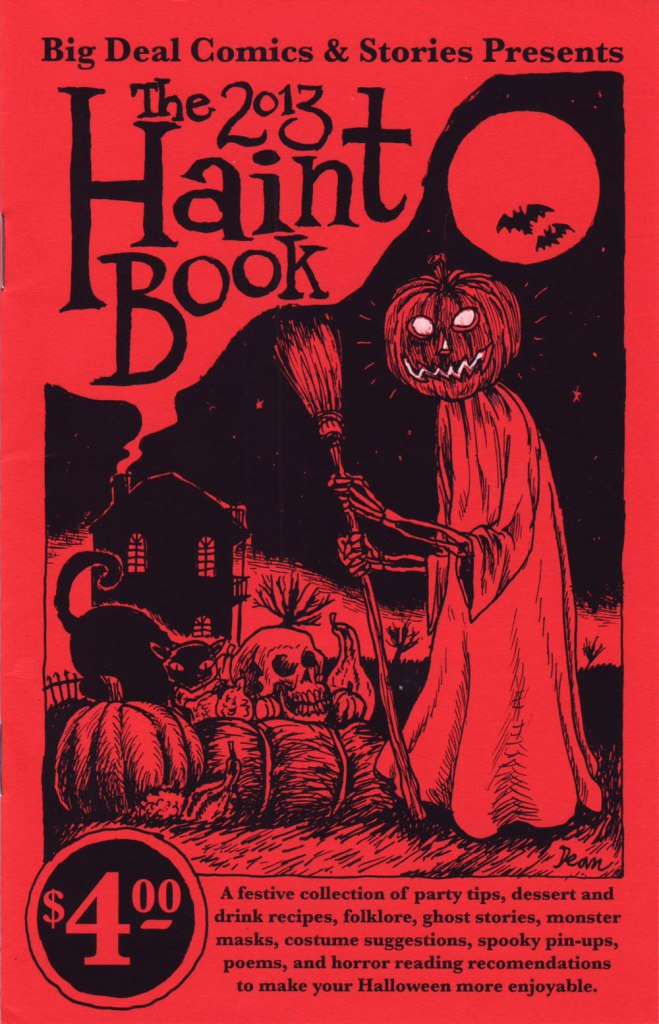
Patrick’s indispensable guide to all things Hallowe’en, The 2013 Haint Book (2013, of course).
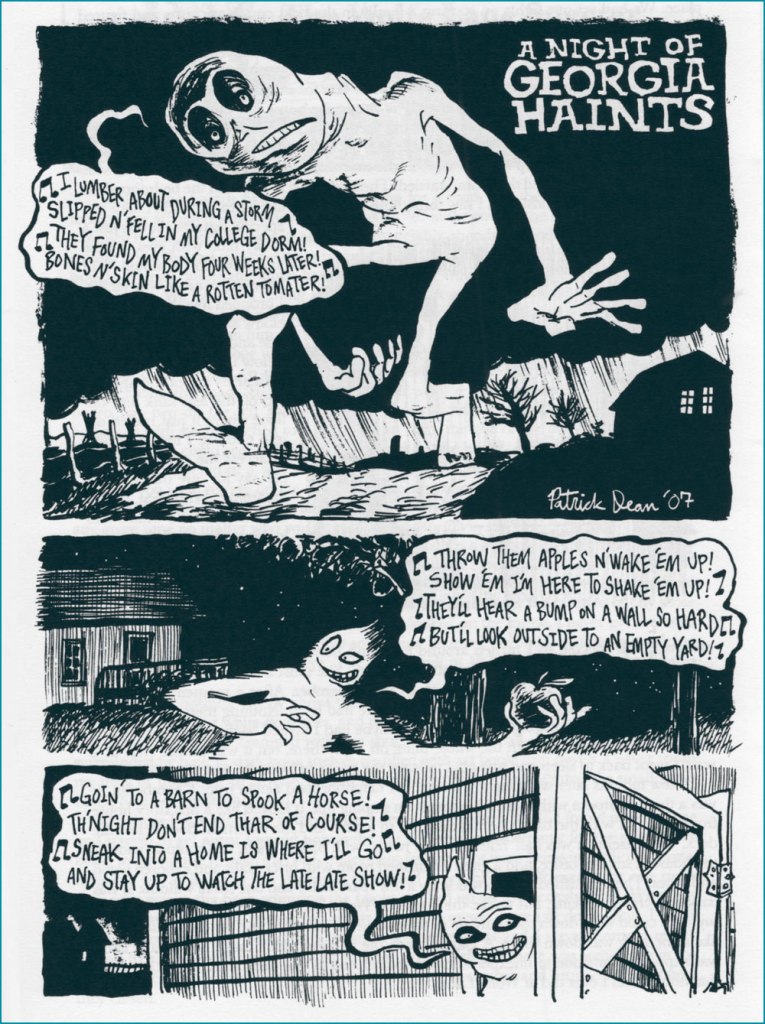
An early-ish strip, from Big Deal Comics & Stories no. 4 (Winter, 2004).
Illustration for The Legend of the Jack-O-Lantern, from The 2013 Haint Book.
From Big Deal Comics & Stories no. 7 (Spring 2006).
From The 2013 Haint Book. If you must ask, a haint is « a type of ghost or evil spirit that originated in the beliefs and customs of the Gullah Geechee people, descendants of African slaves who live predominantly in the Low Country and on the barrier islands off the coast of the Carolinas, Georgia, and north Florida. » [ source ]
A brew only a witch could love, presumably. From The 2013 Haint Book.
With the passing years, Patrick’s work was just getting deeper and (yet) more emotionally layered. This is the opening page from Sometimes I Think About You at Night, the overlapping stories of two estranged couples, one living, one deceased, from Big Deal Comics & Stories no. 11 (2012).
Over the course of our correspondance, Patrick never failed to winningly personalise his mailings: this envelope features a shared favourite, Charlton Comics host Dr. M. T. Graves, he of the Many Ghosts.
A fitting coda to this (or any) edition of our Hallowe’en Countdown. See you next year, hopefully!

If you’ve missed any of our 154 previous instalments, here they are in handy and tidy fashion:

Hallowe’en Countdown I (2017);

Hallowe’en Countdown II (2018);

Hallowe’en Countdown III (2019);

Hallowe’en Countdown IV (2020);

and, bien sûr, Hallowe’en Countdown V (2021).

For the optimal Hallowe’en experience, you may kiss the Old Witch’s Finger (discovered on a beach while on vacation, earlier this month) and make a wish: a pox on your enemies or a tremendous candy bounty… you call it.

-RG

Hallowe’en Countdown V, Day 30

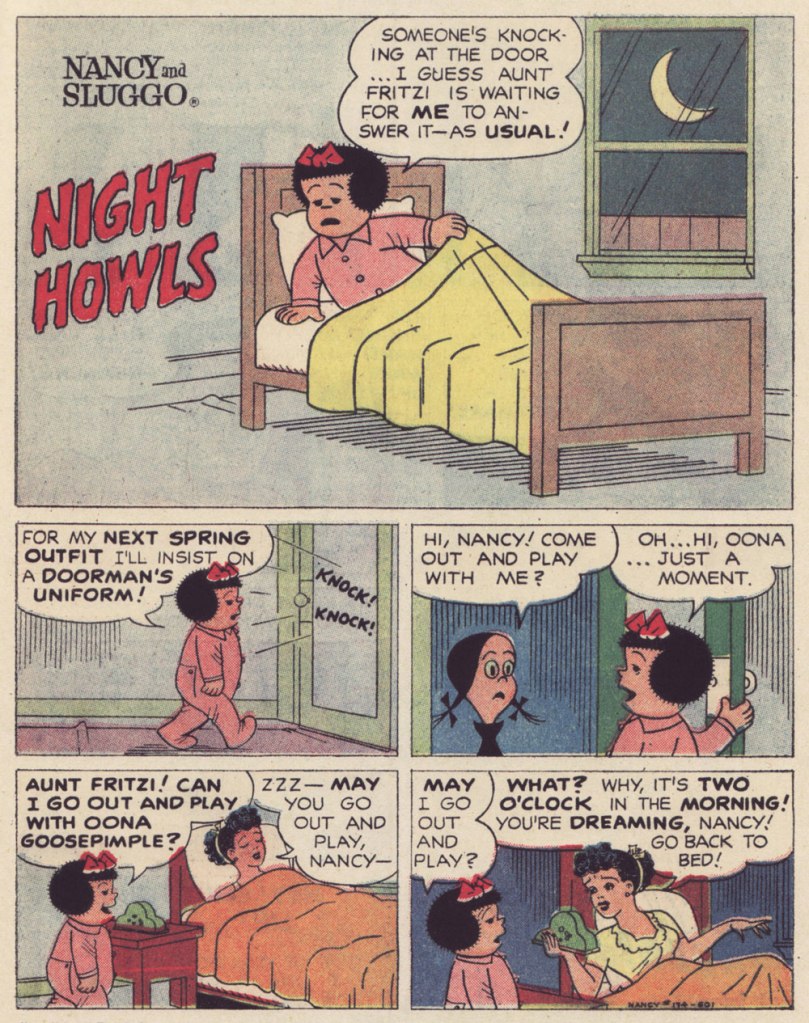
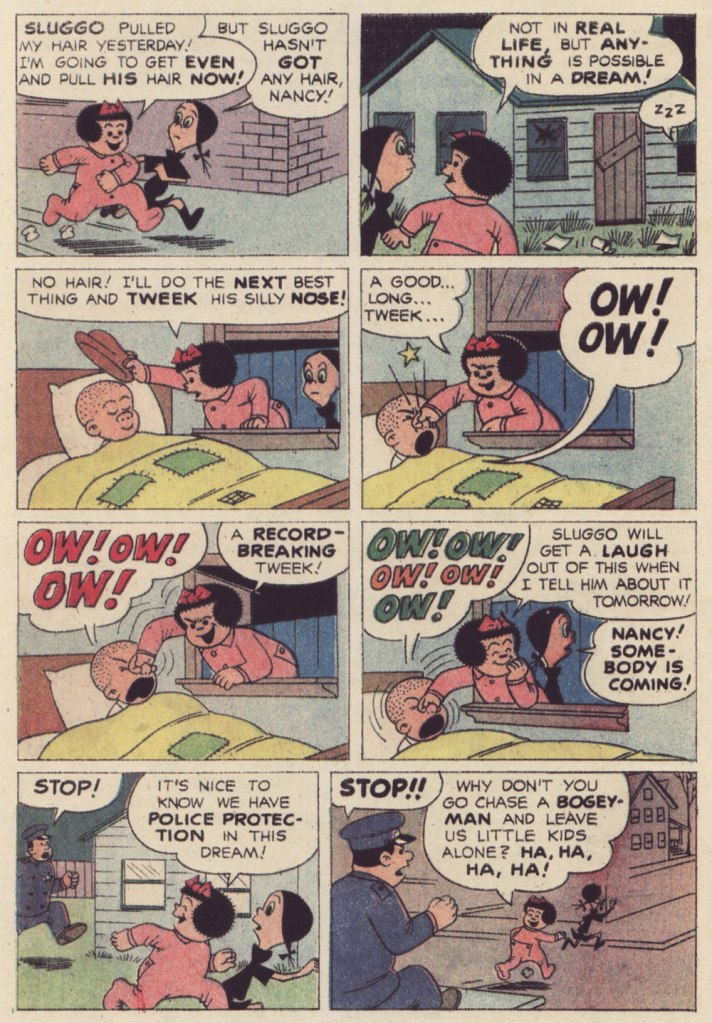
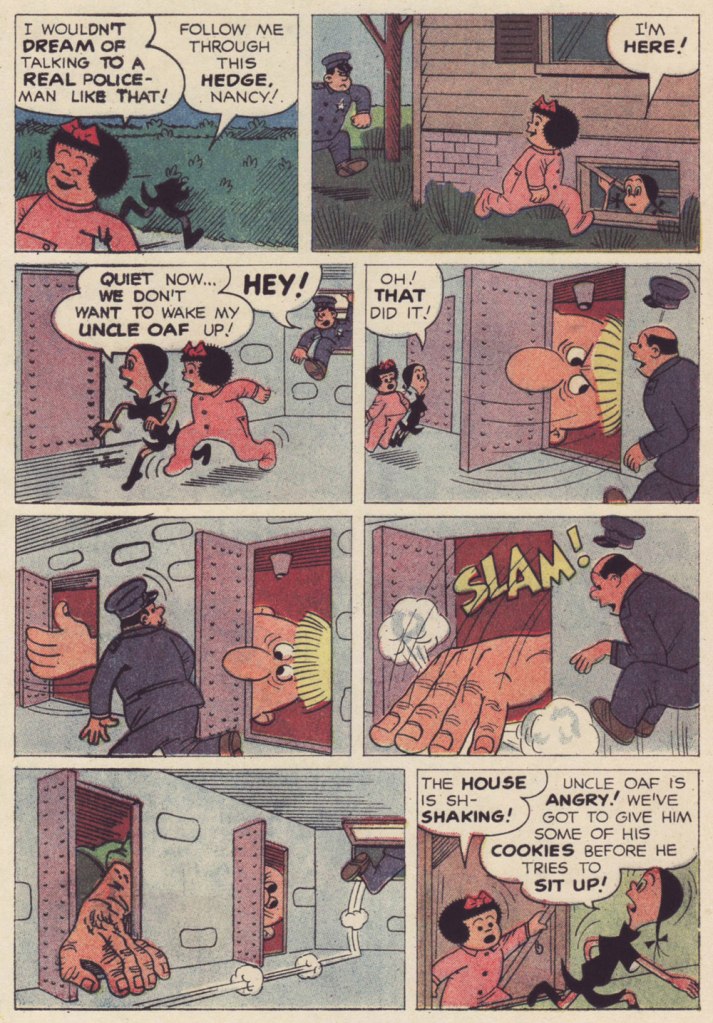
« Every time I go to Oona Goosepimple’s spooky old house something SCARY happens to me! » — Nancy

Back in the blog’s early days, my partner ds, wrapping up her tribute to John Stanley, stated:

« And I haven’t even mentioned Stanley’s Nancy, nor her friend (and my favourite character) Oona Goosepimple. Next time… »

Well, that time has come. Despite my deep and enduring love of John Stanley, I never could warm up to what’s generally considered the cornerstone of his œuvre, Little Lulu. It’s hardly Stanley’s fault: I just happen to dislike Lulu creator Marjorie ‘Marge’ Henderson Buell‘s visual conception of her characters.

On the other hand, I’ve always been in thrall to Ernie Bushmiller‘s world. Purists will, and surely have, objected to the bold liberties that John Stanley took with Nancy and Sluggo, but I don’t care a whit. This collision between the singular visions of a pair of cartooning geniuses is every bit as delightful as I might have hoped.

Night Howls first appeared in Nancy and Sluggo no. 174 (Jan.-Feb. 1960, Dell). It was reprinted in Nancy, Volume 4: The John Stanley Library (2013, Drawn & Quarterly). Script and layout by John Stanley, finished art by Dan Gormley.

One more short one?

The Ghost Story first appeared in Four Color no. 1034 – Nancy and Sluggo Summer Camp (Sept.-Nov. 1959, Dell). It was reprinted in Nancy, Volume 2: The John Stanley Library (2009, Drawn & Quarterly). Script and layout by John Stanley, finished art by Dan Gormley.
Fancy, uh? This is Nancy, Volume 2: The John Stanley Library (2009, Drawn & Quarterly); meticulous series design (and covers) by Gregory ‘Seth’ Gallant. Now if only D&Q would finish building the library, or at the very least give us Kookie and Dunc & Loo!
In 1975, when fandom movers and shakers Robert Overstreet and Donald Phelps visited Stanley in his home, « … he dug into a closet, and said, ‘I have something that might interest you.‘ He pulled out the roughs for the first Oona Goosepimple story for Nancy. Stanley told Phelps he could keep it. (Actually, it was the script for an unpublished story). » [ from the late Bill Schelly‘s illuminating Stanley bio, Giving Life to Little Lulu (2017, Fantagraphics). ]

-RG
Hallowe’en Countdown V, Day 29

« It don’t matter if I get a little tired
I’ll sleep when I’m dead.
» — Warren Zevon (1976)

Master stylist Rudy Palais (1912-2004) began his comics career in 1939 with the legendary Harry “A” Chesler shop, where passed such luminaries as Jack and Otto Binder, Mort Meskin, Jack Cole, Charles Biro, Mac Raboy, George Tuska, Edd Ashe

While he worked for just about every New York comics publisher under the sun (and certainly some under a rock), let’s note that he displayed and gleefully indulged his flair for the macabre at Harvey in the 1950s, and his versatility while Illustrating the Classics for Gilberton, tackling for instance Poe’s The Cask of Amontillado, Cooper’s The Prairie and Dostoyevsky’s Crime and Punishment.

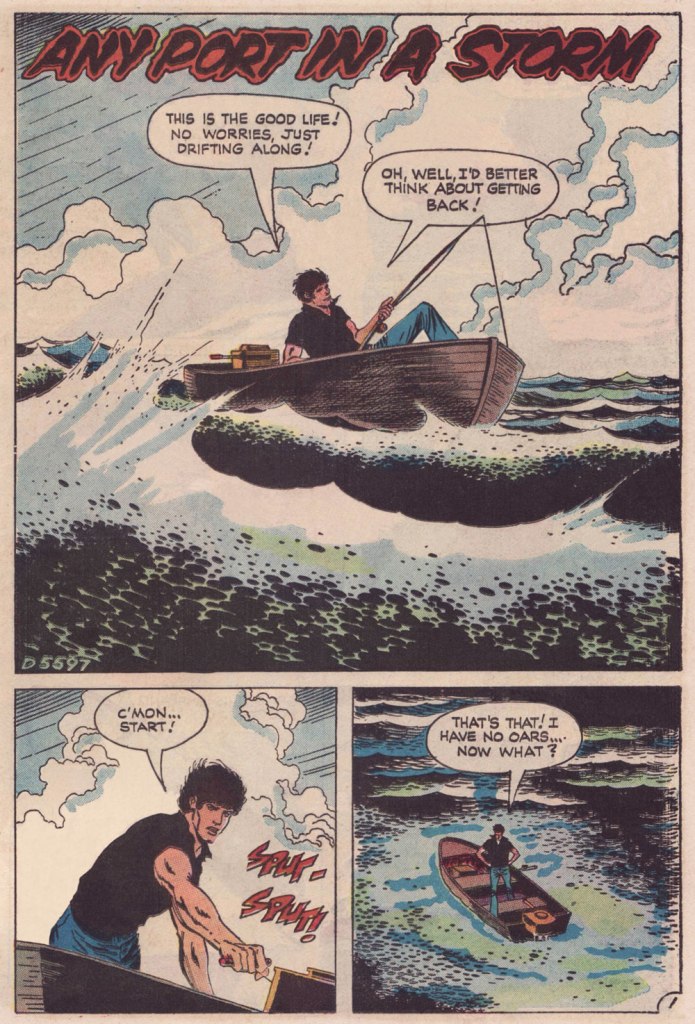
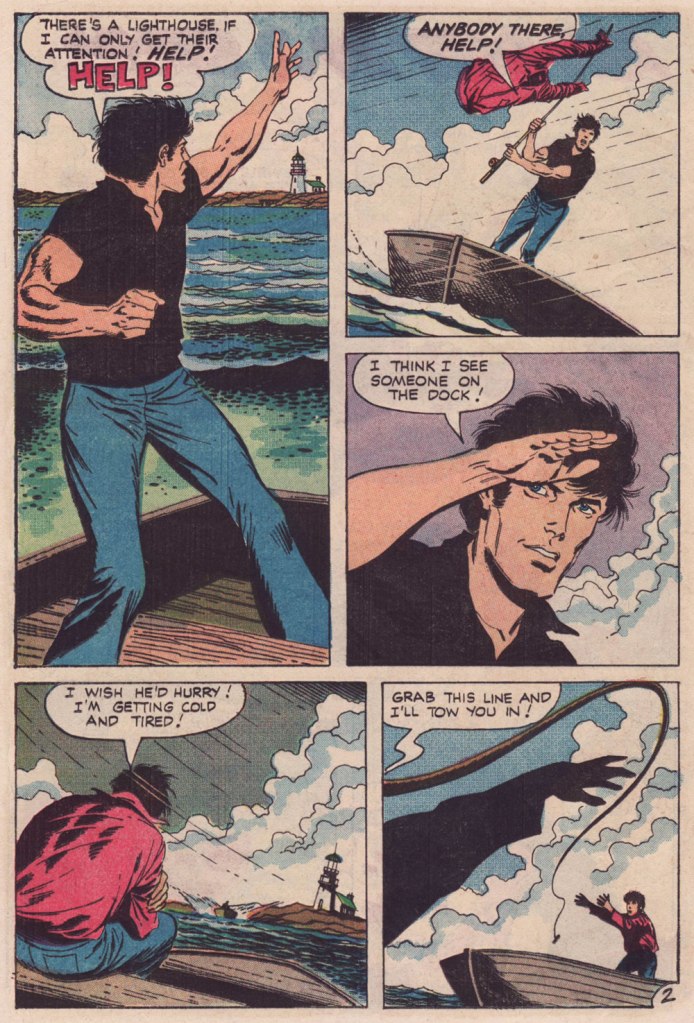
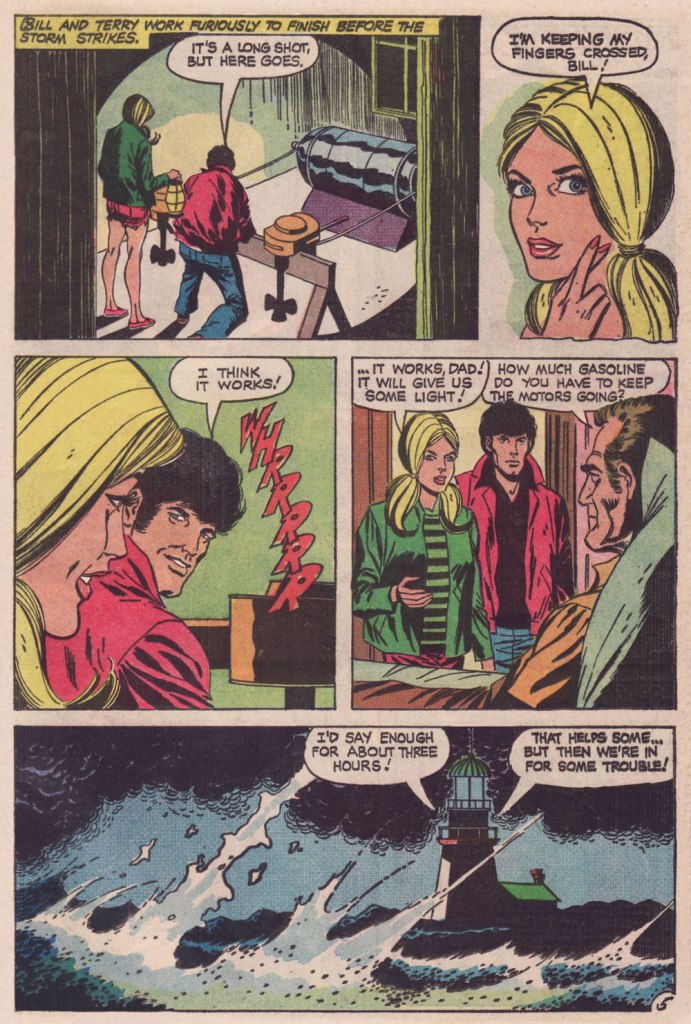
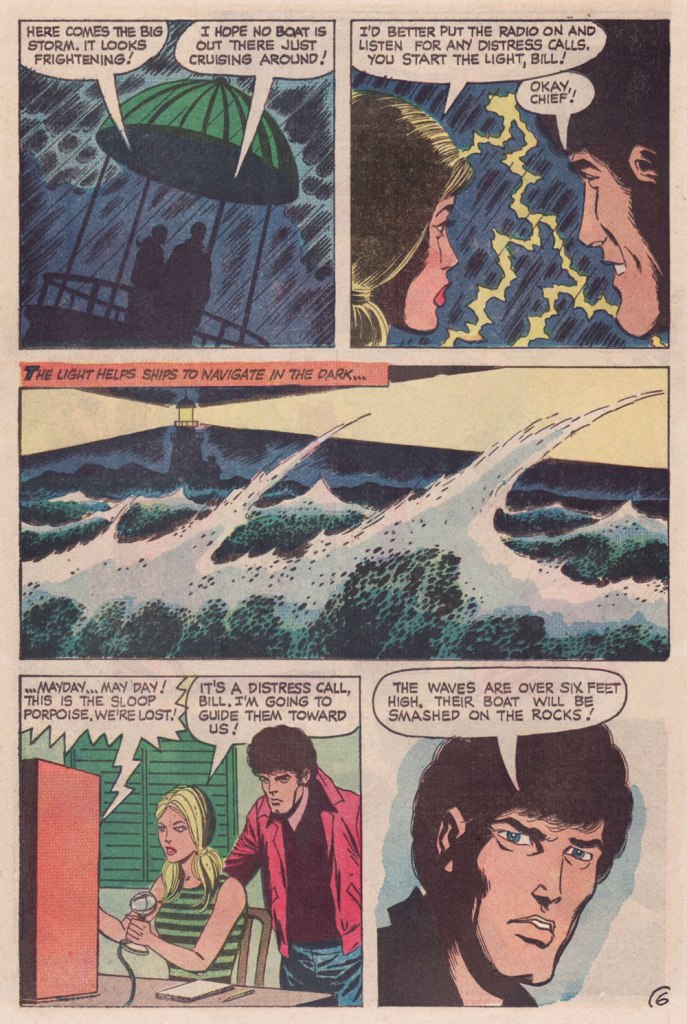
Palais kept a low profile during most of the Sixties, but turned up at Gold Key and Charlton around 1967. For the latter, he crafted his final work in comics. Between 1967 and 1974, he sporadically turned his hand to a handful of short tales in the western, war and mystery genres. As far as I can tell, his comics œuvre respectably concludes with the quite amusing Cry for Tomorrow, in Many Ghosts of Doctor Graves no. 46 and The Last Cruise of the Princess III in Ghostly Haunts no. 39 (both July 1974, Charlton), the latter also featuring some of Mike Vosburg‘s earliest pro work. As one door closes…

Beyond the Grave appeared in Ghostly Tales no. 61 (June 1967, Charlton). Script by Joe Gill, art by Rudy Palais. Mark Evanier called Palais’ Charlton work “very odd, impressionistic short stories“, and concludes, on a personal note: “I never met the man but I followed his work and you could tell that he really cared about doing good comic art.” I’m most inclined to agree.

If you enjoyed this one, here’s another Palais short from Ghostly Tales, from our third Hallowe’en Countdown.

-RG

Hallowe’en Countdown V, Day 28

« The fog comes on little cat feet. It sits looking over the harbor and city on silent haunches and then moves on. » — Carl Sandburg

The first novel I ever read was a Bob Morane… so we’re old friends.

This was the one. I ask you, how could any self-respecting, red-blooded boy resist the lure of a book entitled ‘Monsters From Space’? And no, I don’t remember a thing from it. Cover art by the prolific Pierre Joubert.

Bob Morane, created in 1953 by yet another Belgian writer* both talented and astoundingly prolific, Charles-Henri Dewisme aka Henri Vernes (1918-2021), has been the hero of over two hundred novels, movies, television shows, animated series, records, you name it.

A foray into comics logically followed in 1959, when, according to Vernes,

« Femmes d’Aujourd’hui, a women’s weekly, asked me to do a series. I said: ‘why not?‘ And so I did, that’s all. »

For brevity’s sake, we’ll stick to the comics, one album in particular at that (the series numbers, after all, over one hundred by now.) I’ve always been intrigued by this one, though I never have, as far as I know, encountered a copy in the wild. In fact, a couple of weeks ago, I queried my go-to bédé provider about it, and he responded that: « Bob Morane albums sell just as soon as they arrive. We can’t ever keep them in stock. » So I ordered a copy from Belgium. One must choose one’s battles with care.

This is Les yeux du brouillard (1971, Dargaud). First serialised in Belgian women’s weekly Femmes d’aujourd’hui (issues 1295 to 1316, 1970), which might seem odd… but said magazine regularly featured several pages of comics, and not just ‘women’s comics’, whatever that may be. What can I say? The Belgians, bless ’em, appreciate their comics. Cover art by William Van Cutsen, aka William Vance (1935-2018).
While I’ve never been much of Vance fan, finding him a bit stiff and generic, I’d never claim that he doesn’t get the job done, however. He’s clearly at his peak here.
Spoiler alert: disappointingly, the ‘Eyes of the Fog’ turn out to be more or less what this novelty comic book ad promised, though far cooler. Plus they did a great job of keeping the superstitious natives away and the phone booth repairmen puzzled (but gainfully occupied).

Want to see what you actually received upon (well, six to eight weeks later, if memory serves) ordering your very own U-Control Life-Size Ghost? Brace yourself, and look here.

-RG

*Maigret creator Georges Simenon (nearly 500 novels!) and my favourite writer, Jean Ray, readily come to mind. Something in the water, perhaps?

Hallowe’en Countdown V, Day 27

Yet what had he to fear if this place were evil – was he not an upright and godly man who held no traffic with evil? If wicked spirits had power over such men as he, there would be no justice in it.

“That’s true,”said a voice behind him, “there isn’t.” — The Gibsons*

I must confess I had something else planned for today’s post, but I learned, at the last minute, of the existence of material that would vastly augment my intended post — and I wouldn’t want to drop the ball on that topic. One less piece to plan for the next Countdown, then!

I suppose I had thus far refrained from touching upon DC’s long-running Ghosts (1971-82) — too obvious? Well, here we are. Ghosts, like its presumed model, Ripley’s Believe It or Not: True Ghost Stories (1965-80, Gold Key), was always tame and rather formulaic, but frequently boasted wonderful artwork, and definitely great covers.

Ambiance, ambiance, ambiance. This is Ghosts no. 23 (Feb. 1974, DC); cover art by Nick Cardy.

Within its pages lurks this gorgeous three-pager written by Carl Wessler, pencilled by the mysterious (how appropriate!) J. Noriega, and embellished by the peerless Alfredo Alcala.

Find out more about this Captain Marryat character right here.
The next time you find yourself ’round Norfolk way, you can drop by and visit the actual Raynham Hall and see for yourself if it’s truly crawling with spectres.
This is the tabloid-sized Limited Collectors’ Edition C-32 (Dec. 1974-Jan. 1975, DC); edited by Murray Boltinoff, cover by Nick Cardy.

-RG

*« A couple called ‘The Gibsons’ won a New Statesman competition in Britain with a 200-worder about a man who grows increasingly nervous while walking down a winding moonlit road. » — From Dr. Van Helsing’s Handy Guide to Ghost Stories, Part III, by Kurt Van Helsing, in Twilight Zone Magazine vol. 1 no. 7 (Oct. 1981, TZ Publications).