André Franquin: a Centenary in Ten Images

« The first hundred years are the hardest. » — Wilson Mizner

Having just learned this morning that today marks a century since the birth of André Franquin (1924-1997), I again pushed my planned post to the back burner. So, instead of writing about a celebrated Belgian genius, I’ll write about *another* celebrated Belgian genius.

Spirou’s ‘Albums’ were a handy way to dispose of unsold copies of the weekly magazine by collecting a trimester’s worth of issues in an attractive hardcover format. This one’s from March 1948, just to give you an idea of Franquin’s early style.
A panel from Le dictateur et le champignon (1953). The ripe banana-coloured critter with the long tail, if you don’t already know, is Le marsupilami, Franquin’s homage to Elzie Segar‘s Eugene the Jeep (introduced in 1935 and known as ‘Pilou-Pilou’ in French Europe).
This panel took my breath away as a kid when I first saw it, and it still does. It’s from Spirou et Fantasio no. 8, La mauvaise tête (1954). How many contemporary artists could pull off such a scene — let alone the entire sequence, wherein Fantasio ends up winning the race cycling backwards — at all convincingly?
I’ve been reading, for the first time, Franquin’s collected Modeste et Pompon (1955-59). After Franquin was tricked into surrendering his creation to Tintin magazine publisher Les Éditions du Lombard, M&P became just another long-running mediocre domestic strip in many successive pairs of (necessarily) lesser hands… but seeing Franquin bring it to life is a most refreshing pleasure.
A dynamic Modeste et Pompon sample from near the end of Franquin’s run. During Franquin’s relatively brief passage at Tintin magazine, he set a new standard of graphic freedom, opening a breach for his successors that Georges “Hergé” Rémi himself did *not* welcome. Tintin’s papa, in fact, deemed Franquin’s supple and organic line ‘vulgar’.
Album Spirou no. 70 (March 1959, Dupuis), gathering issues 1081 to 1091 and depicting a scene from Le Prisonnier du Bouddha.
Album Spirou no. 96 (April 1965, Dupuis), collecting issues 1395 to 1407. Gaston Lagaffe*, like Le Marsupilami before him, was a minor character introduced by Franquin to relieve the tedium of setting down the adventures of Spirou et Fantasio. The popularity of both these would-be background creations wound up dwarfing that of the intended protagonists.
Franquin’s original painted artwork for the cover of Album Spirou no. 100 — well, duh — (March 1966, Dupuis), containing issues 1447 to 1459.

In 1977, a depressed yet inspired Franquin, suffocating within the confines of his much-imitated (at his publisher’s clueless insistence) style, created — with kindred confederate Yvan DelporteIdées noires (Black, or perhaps more fittingly Bleak notions) as an outlet. It first appeared in the short-lived* Spirou mag supplement Trombone illustré, then moved to the more welcoming pages of Fluide glacial. An English-language edition, entitled Die Laughing, was published by Fantagraphics in 2018. Check it out here.

Here are a couple of Idées noires punchlines, which should give you an idea of their tone.

Marcel Gotlib wittily hijacked/paraphrased Sacha Guitry‘s bon mot about Beethoven : « After reading a page of Idées noires by Franquin, we close our eyes, and the darkness that ensues is still Franquin’s. »
In countless instances, Franquin even used his signature to expressive comic effect.

-RG

*These days, thinking about Gaston Lagaffe puts me in an ugly mood, I’m afraid. Franquin had expressly, and all along, requested that his creation be put to rest with him. But did his publisher – having built an empire upon Franquin’s creations — honour his wishes? No more than usual. Another arrogant slap — post-mortem this time — in the face of a genius exploited and mistreated his entire adult life. In this world, the interest of the characters… oops, pardon my French, ‘properties’ obviously trumps that of the flesh-and-blood creators. Every time. For there’s always some scab hack or other backstabber (and they *always* claim to be huuuge fans, as Miller said to Eisner, betraying him with a kiss) to aid and abet venal publishers. That’s how we got a pointless Sugar and Spike revival and all those Watchmen prequels. Hopefully, Monsieur Franquin’s daughter will prevail in her lawsuit against Dupuis to settle the matter in a just and fitting manner. [ Update: it didn’t end well. The suits won. ]

**« It is upon the publication of a Franquin article that the supplement is cancelled. In his piece, the fervently antimilitarist Franquin takes to task Thierry Martens, Spirou’s then editor-in-chief, for running articles about Nazi war plane models. » (translated quote from L’histoire de la bande dessinée pour les débutants by Frédéric Duprat, p. 131, Jan. 2011)

Hoping to See Your Face Again Next Year: Donald McGill’s Saucy Holiday Cheer

New traditions appear very easily – do something for a second time, and hey presto, it’s a tradition! Since last December was enlivened by some mushroom postcards — see Fungus Friday: Amanita New Year (To Get Over This One) — this year I’m bringing back English master Donald McGill, King of Saucy Postcards for an old-yet-new-to-us crop of festive offerings from some hundred + years ago (the following are from the 1910s and 1920s).

These run the gamut from cheeky to raunchy to creepy, in the classic vein of ghosts for Christmas*. Speaking of Christmas, it may now be over, but the spirit of holiday cheer sure isn’t gone (despite the total absence of snow in these normally snow-covered lands of ours), so let’s have a look!

Some involve all sorts of hivernal mishaps —

The consequences of pre-holiday, er… cheer.

Some of the usual daydreams brought about by possibly too many spirits**

— and the aforementioned ghosts, somehow especially startling when they’re born under McGill’s pen.

I’ve kept my absolute favourite for last: this revenant is so sad yet grotesque. I’d like to see the faces of people who got mailed this particular card!

~ ds

* As per another lovely tradition, we’ve recently been rewatching Christopher Lee’s Ghost Stories for Christmas. Highly recommended! Some are available on Youtube, like for example Number 13.

** As somebody who attended the Christmas office party this year, I can attest to the funny influence alcohol has on a bunch of normally restrained people when it comes to romantic advances.

Christmas With the Otterloops!

« Gaah! » — Petey Otterloop

Given that it’s Christmas Eve, it seems fitting to parade some of our favourite things, and Richard Thompson‘s (not to be confused with his musical homonym) Cul de Sac (not to be confused with Mr. Polanski’s 1966 psychological thriller) belongs front and centre in that festive cavalcade.

I’ve gathered most of the yule-themed Cul de Sac Sundays… one of these days, I might devote an entire post to Madeline Otterloop’s Christmas sweater dailies.

Merry Christmas, everyone!

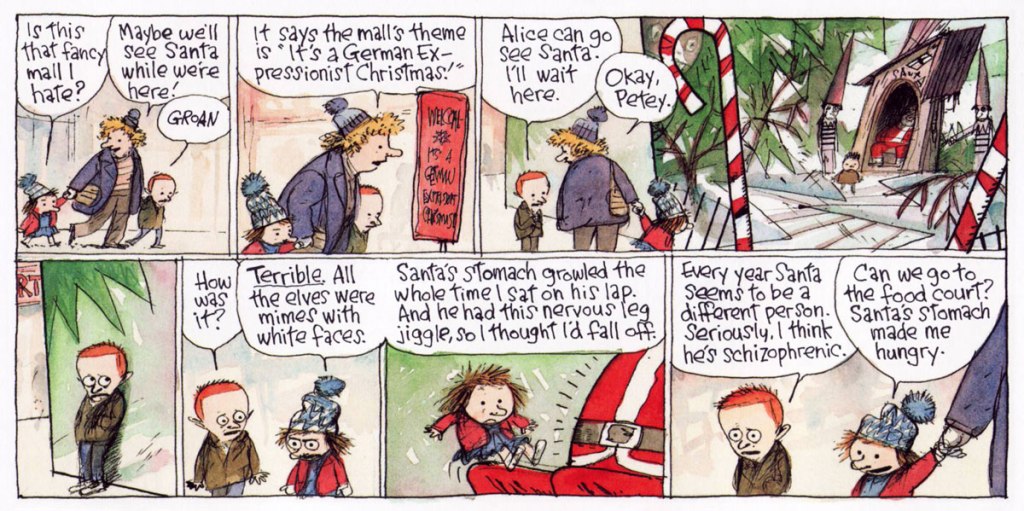
RT: « The creepier side of Christmas. A German Expressionist Christmas has been done by someone, somewhere, I’m sure. » December 11, 2005.
RT: « Taking down Christmas is always so hard. I like the timing here. » January 1st, 2006.
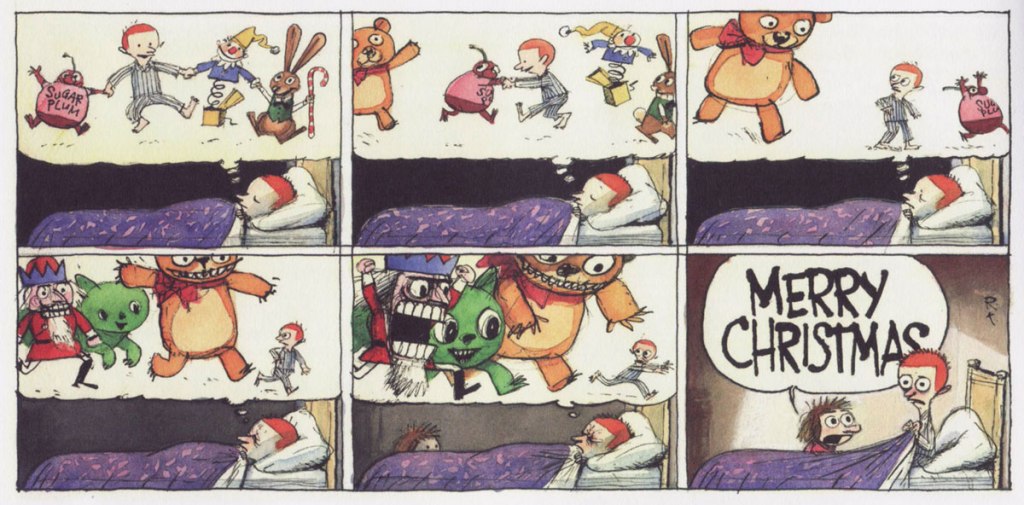
RT: « Petey dreams of Christmas with music by Tchaikovsky. » December 24, 2006.
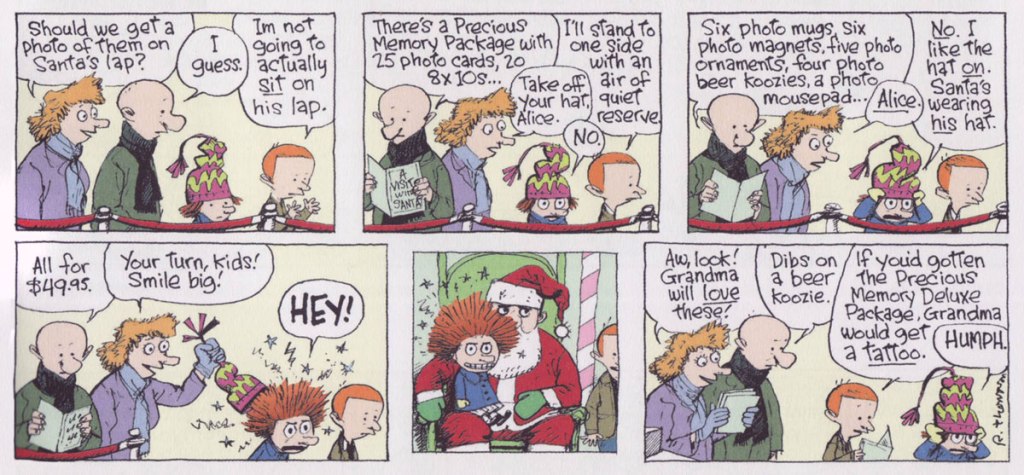
RT: « Santa Claus commands a lot of fear and awe in children. I could never get a coherent sentence out when sitting on his lap when I was a kid, and I doubt I could today. Thank God I don’t believe in him anymore! » December 23, 2007.
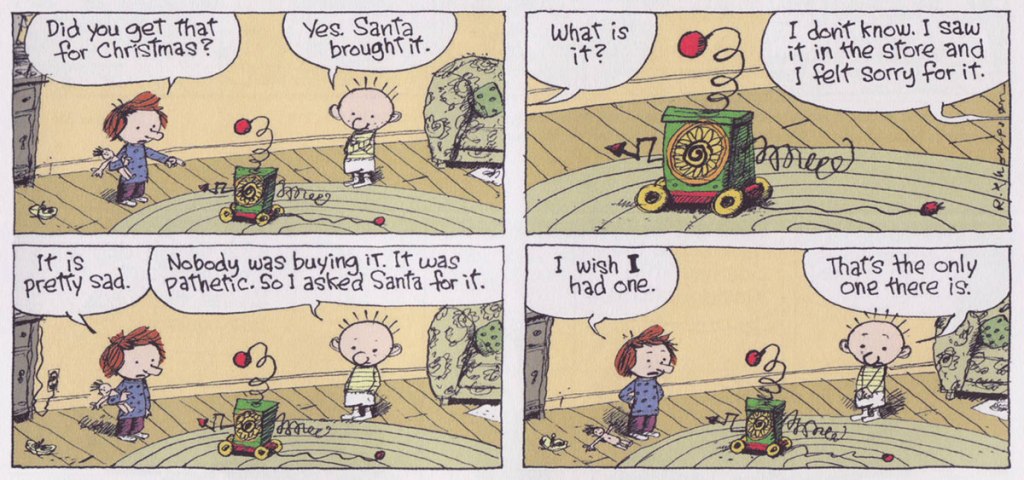
RT: « The first appearance of Dill’s mysterious, malignant, poignant, and possibly educational toy. I just wanted something that’d be easy and repetitive to draw, because I was behind. » December 30, 2007.
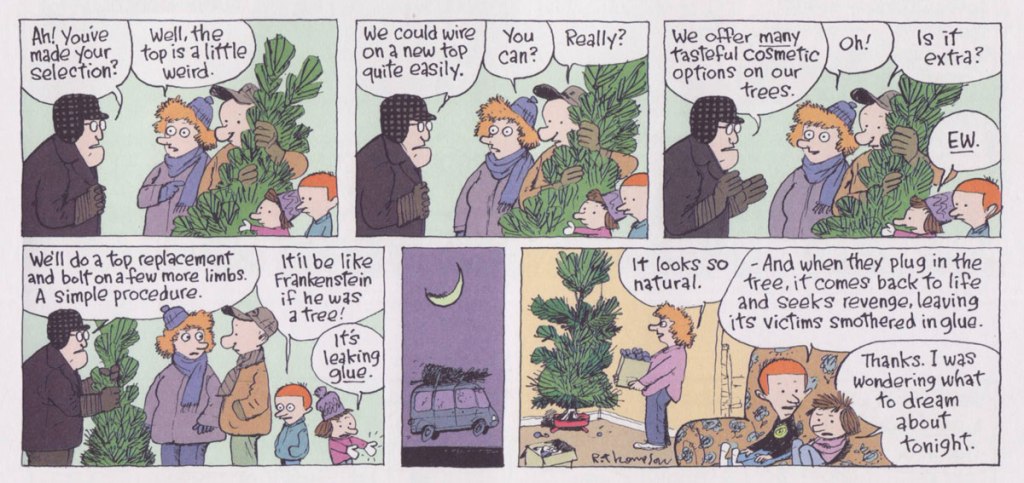
RT: « What I like the most is the tree seller’s resemblance to a mortician. » December 21, 2008.
December 28, 2008.
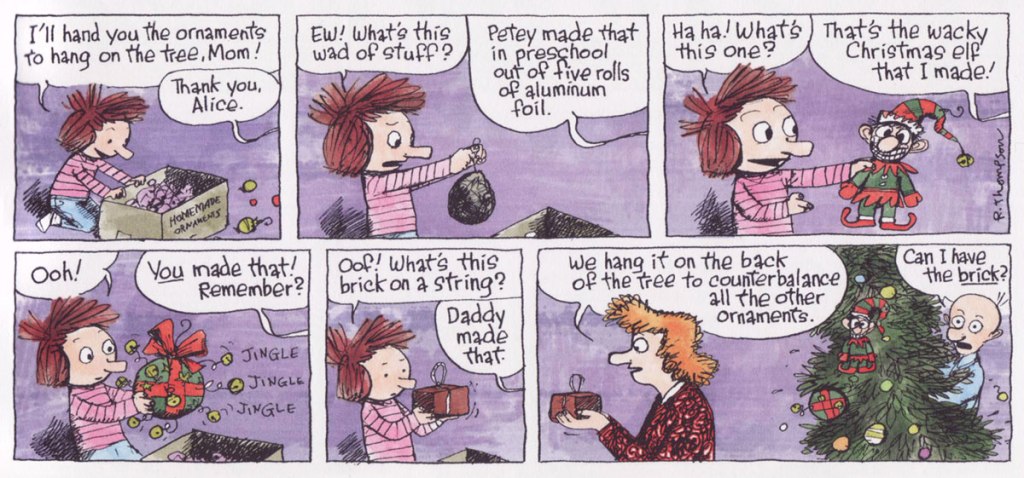
RT: « Drawn from life. Nothing more need be said. » December 19, 2010.
RT: « Petey’s faith in his commentaries’ scathing qualities is misplaced. » December 4, 2011.
RT: « Doing this was a joy. The hard part was doing it in pantomime. » December 11, 2011.

-RG (and ds!)

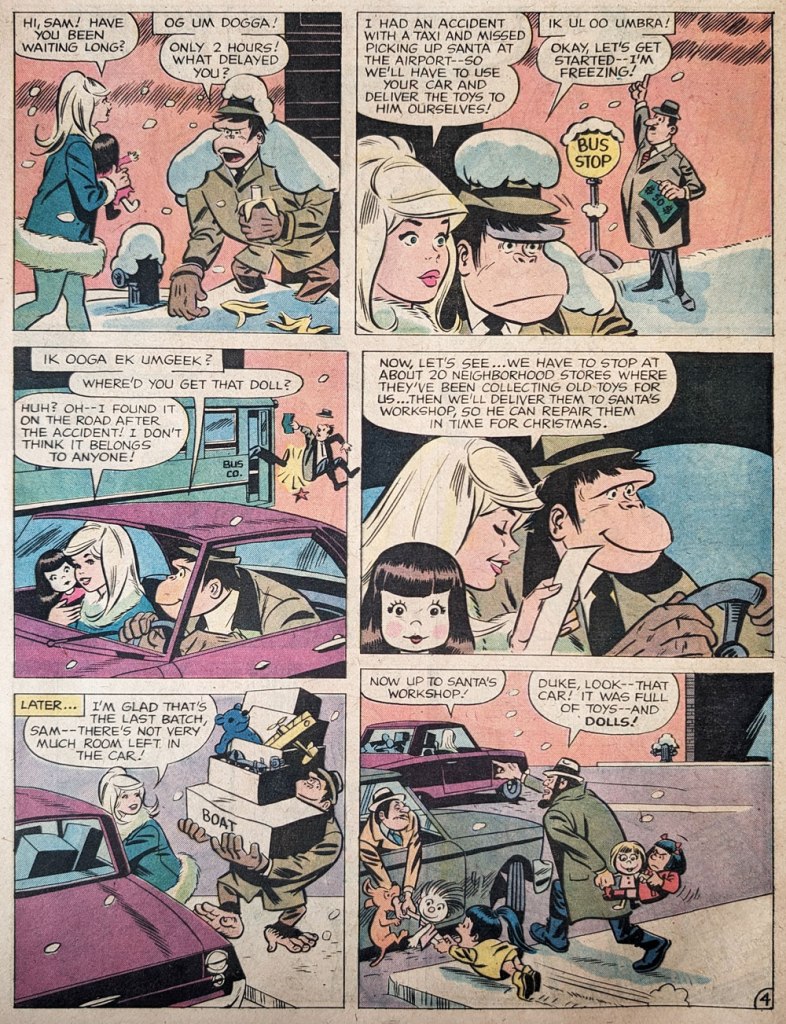
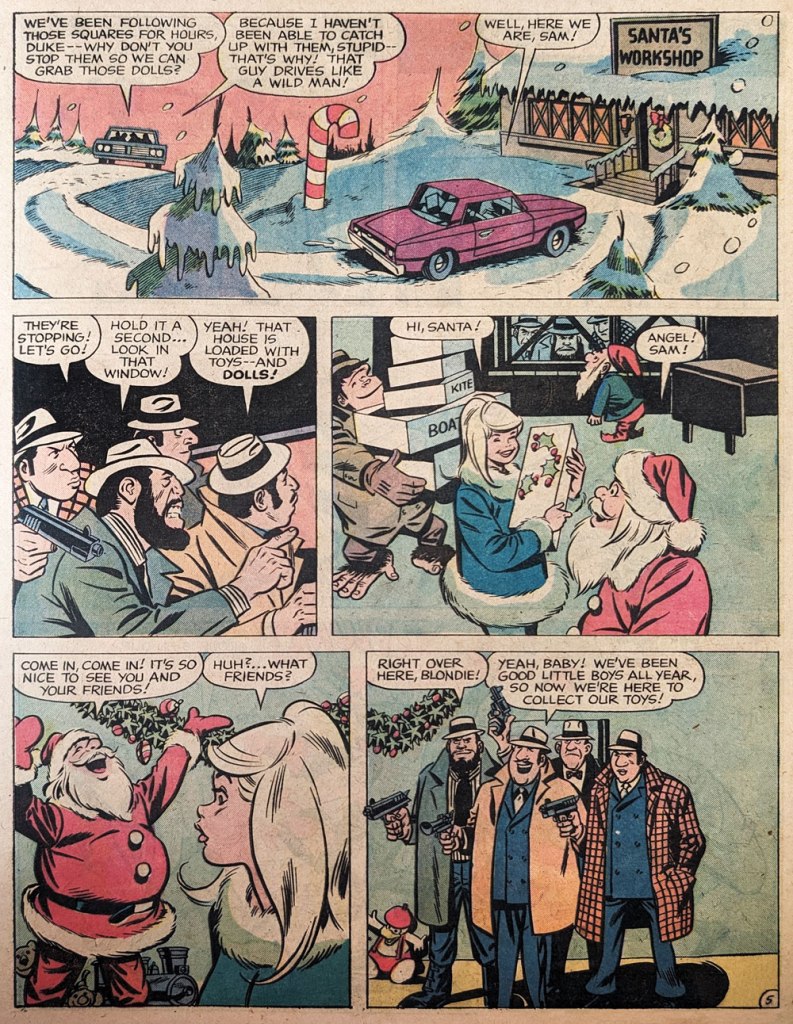
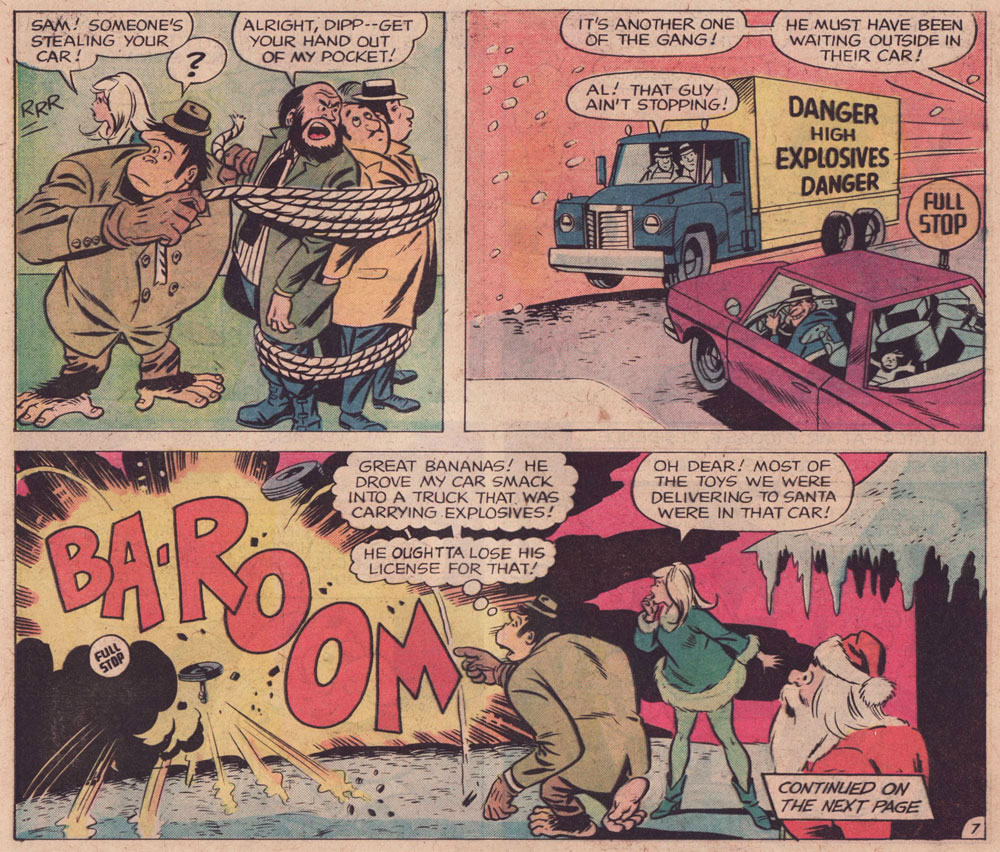
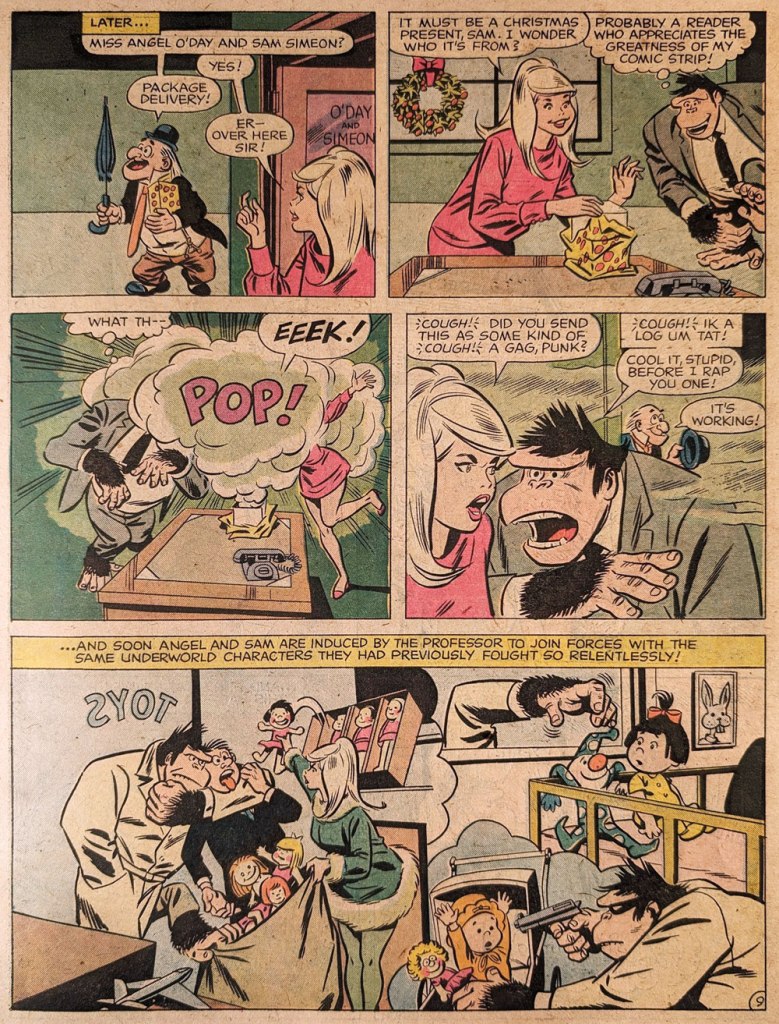
Holiday Havoc With Angel and the Ape!

« A merry Christmas to all my friends except two. » — W. C. Fields

I was in the middle of writing a post on another topic, getting bogged down in its complexities, and then it dawned on me that Christmas was fast approaching, and I’d better switch gears pronto.

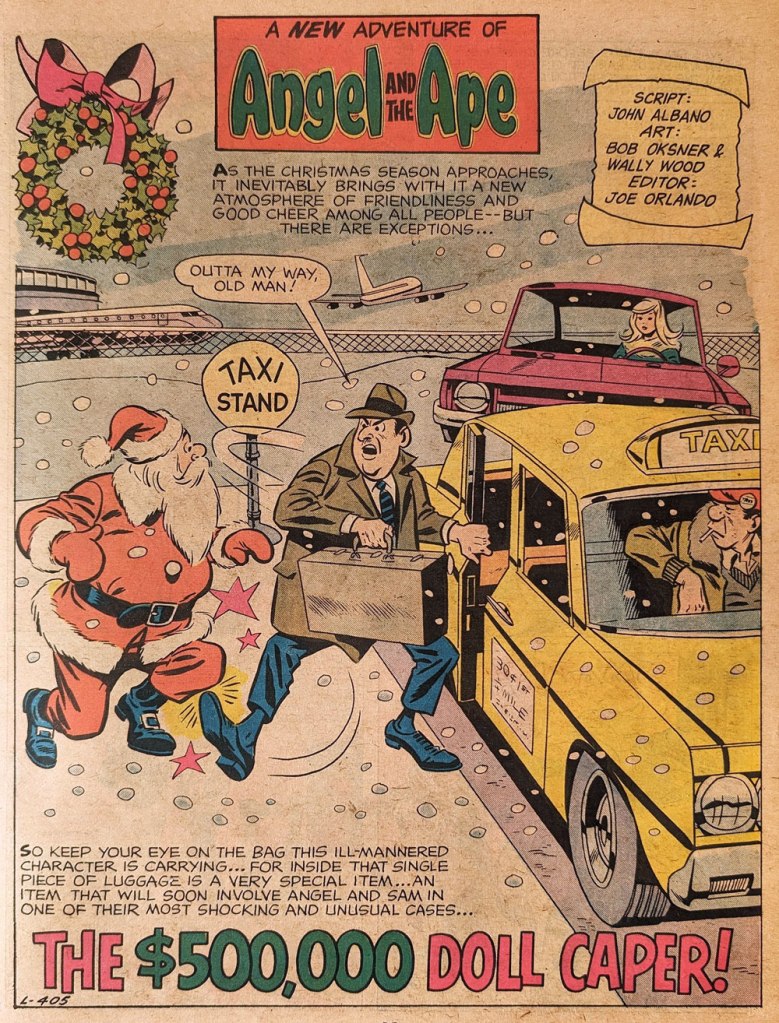
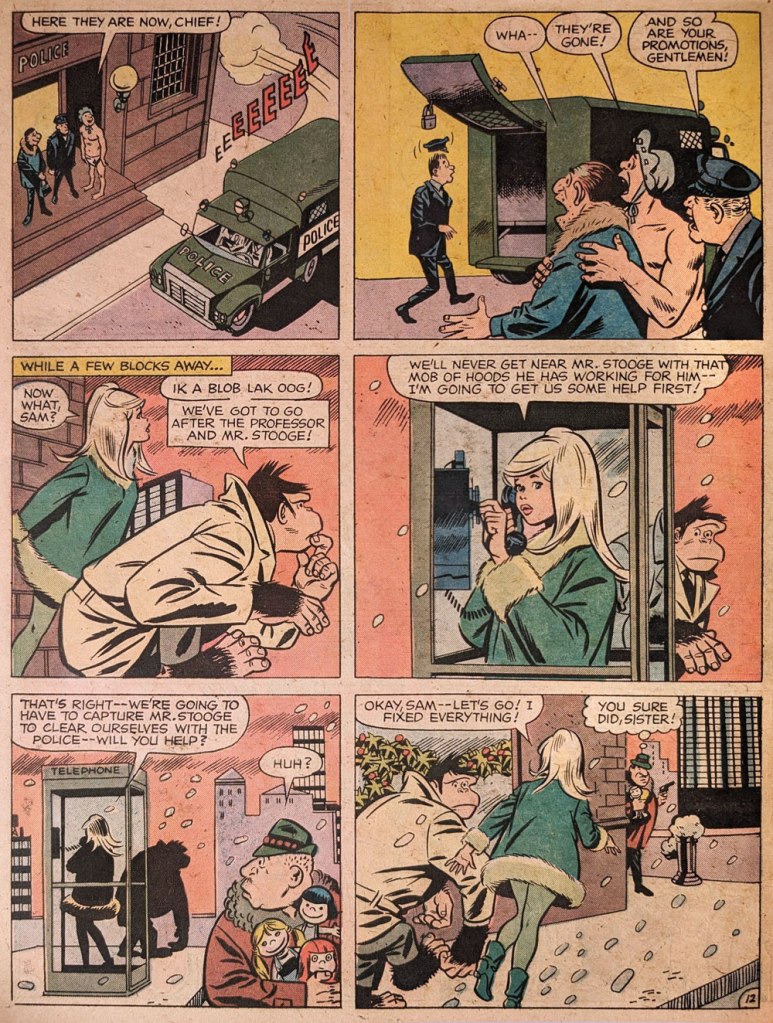
Thankfully, I had something in mind: an Angel and the Ape tale initially produced in the late 1960s but orphaned with the book’s cancellation. It was half-heartedly released from limbo –shall we say buried? — in one of those awkward tabloid format volumes, Limited Collectors’ Edition C-34: Christmas With the Super-Heroes (Feb.-Mar. 1975, DC) and not even advertised on the front or back cover… which is why it took me decades to learn of its existence.

On average, Angel and the Ape was only marginally funnier than the rest of DC’s humour books (save of course for Shelly Mayer’s consistently hilarious Sugar and Spike), but still leagues ahead of Marvel’s painful Not Brand Ecch et al. A&A was, imho, at its peak when E. Nelson Bridwell wrote it, lobbing some choice barbs at the esteemed competition.

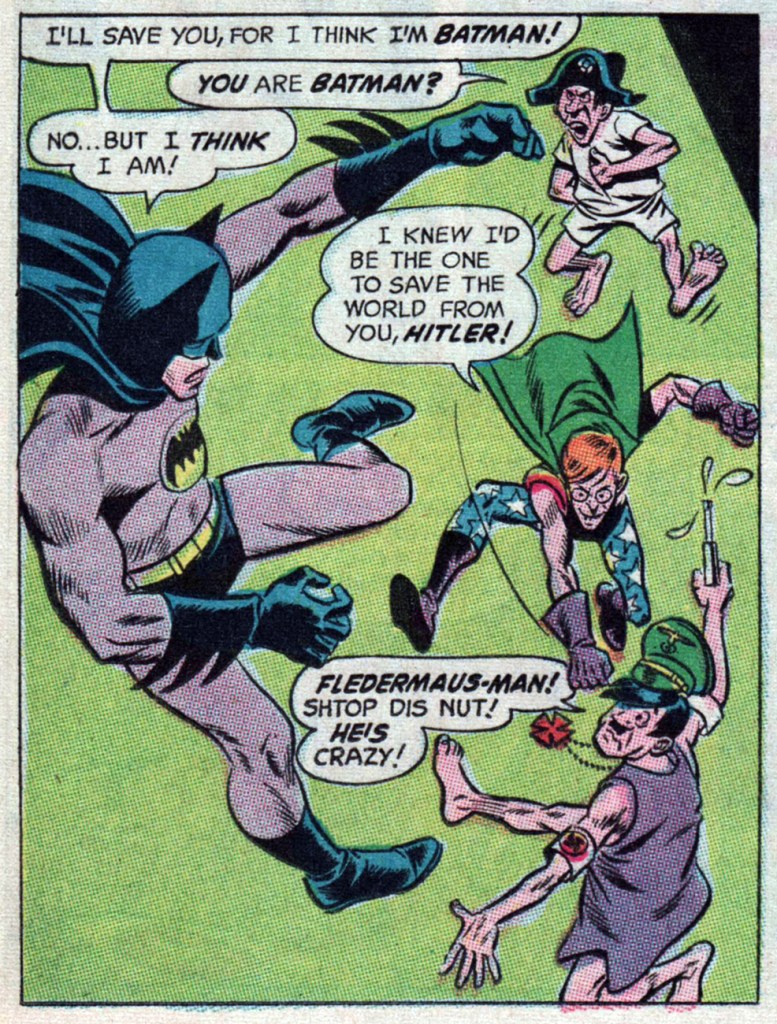
To briefly illustrate my point, here’s a relevant panel from Angel and the Ape no. 3 (Mar. 1969, DC).

Script by Bridwell, pencils by Oksner, inks by Wood. The redhead in the green cape and star-spangled tights is Stan Bragg, editor-in-chef at Brainpix Comics, a clever amalgam of the Smilin’ One and his Rascally subordinate. “When you write good stories and do good artwork, don’t I sign it?

-RG

More Minutes With Carol Lay!

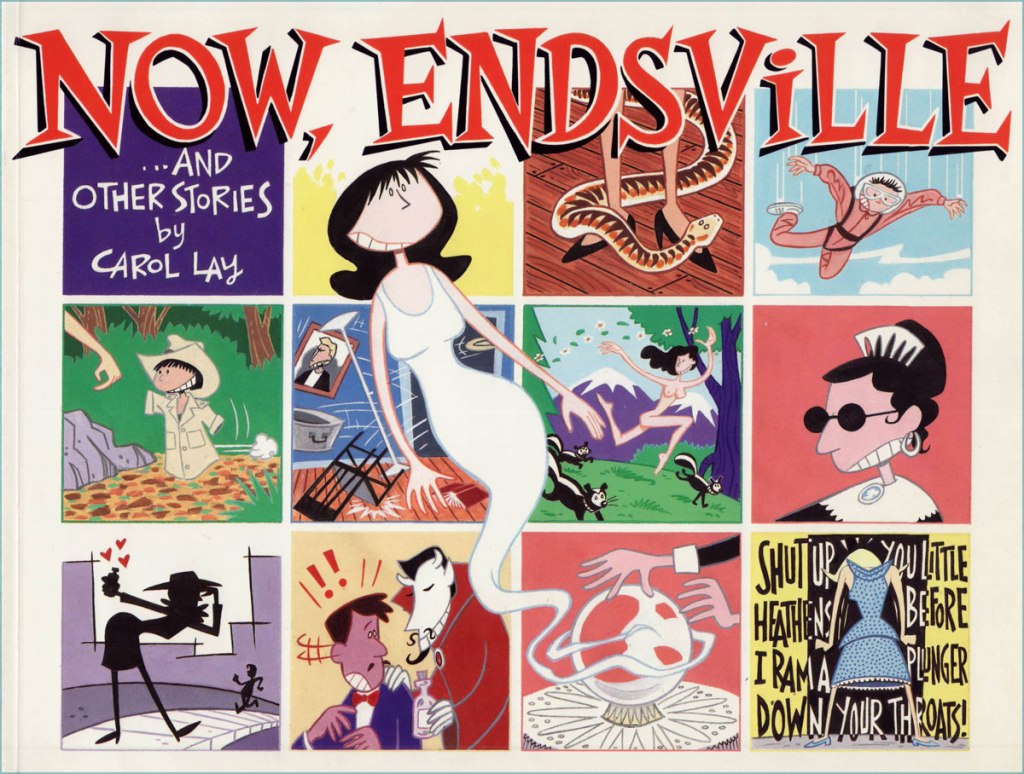
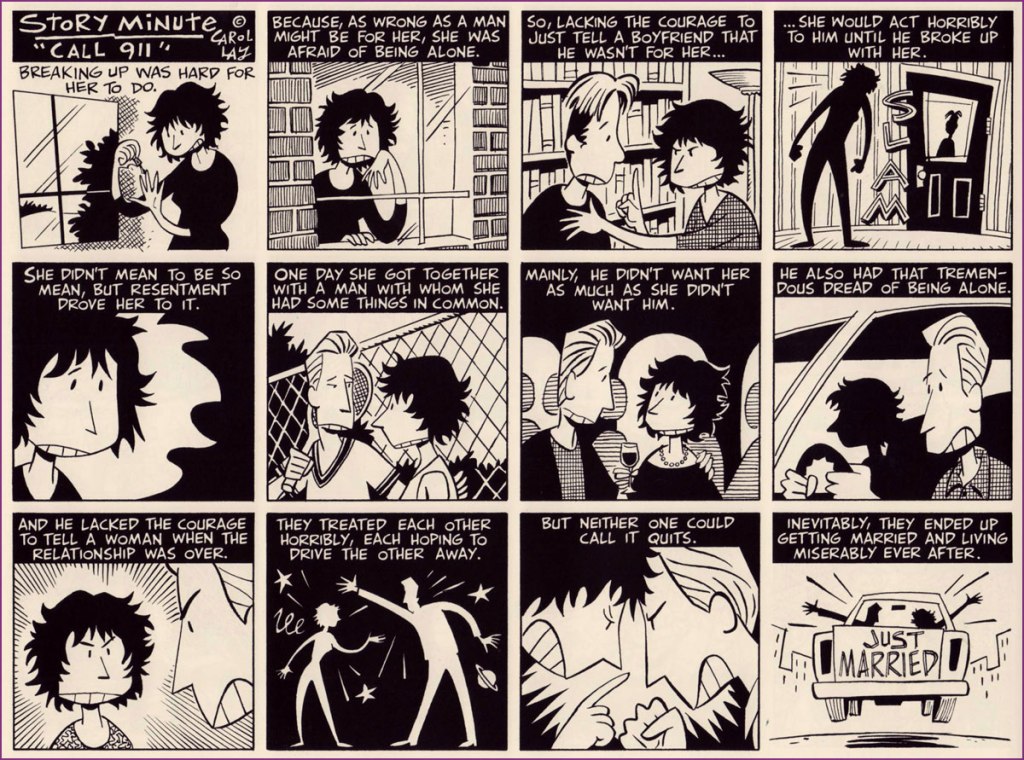
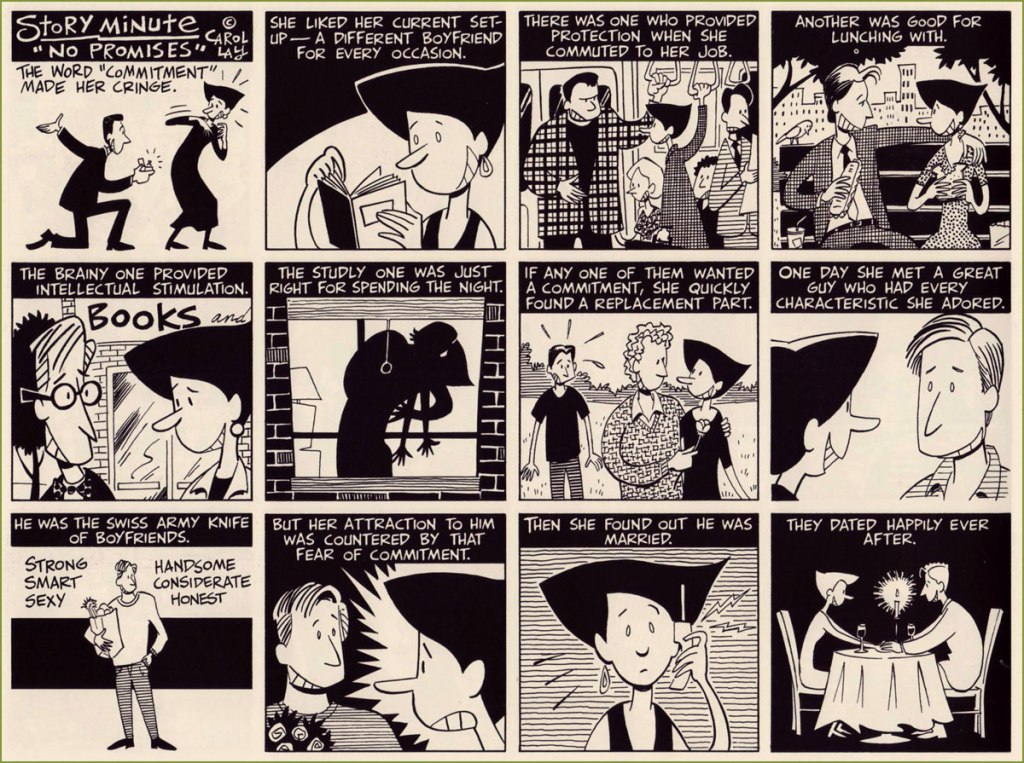
I talked about Carol Lay all the way back in 2017 (see The Giant Licking Machine), but did her a disservice by only featuring a single one of her Story Minutes. I am here to remedy that inadequacy.

In 1990, Lay drew a 5-page story for LA Weekly titled The Thing Under the Futon (read it here – the thing under the futon even has tentacles). « The pay was several times what independent comics paid and the audience was larger and included women », Lay quips on her website, so a one-time story planted the seed for a weekly comic strip called Story Minute, so named because it would just take you a minute to read a story (I might also add that it’s very difficult to stop at reading just one). That eventually was rechristened Way Lay and ran until 2008.

My introduction to the subject at hand.

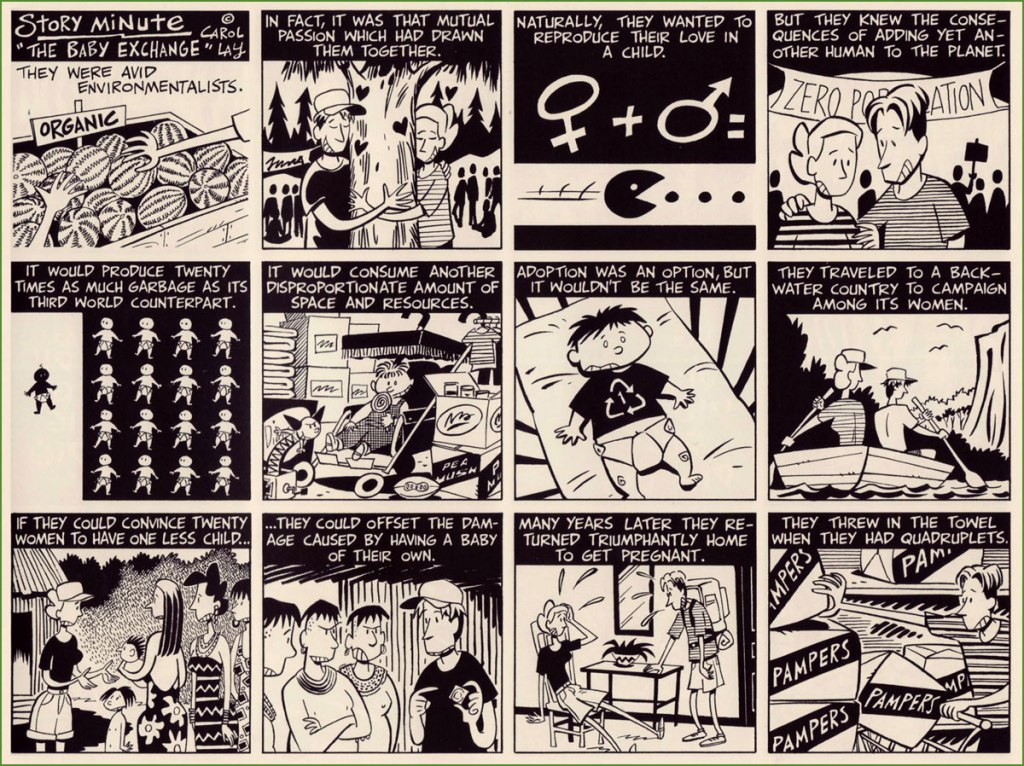
As I mentioned in the earlier post, the most recent collection of these is Illiterature, published in 2012, and it’s where the strips below have been selected from. Lay picks all kinds of topics as strip springboards, but since I am the one selecting the ones to feature, there’s a definite interpersonal tilt, as I think her forte is her ability to showcase the inner workings of a close relationship by plonking people into a slightly surreal or sci-fi context. The line between cynical and poignant is navigated with ease.

« I kept mostly to the order in which I produced the strips, but I took the liberty of tossing some clinkers or shuffling a few so that they flow better in book form… I also used my artistic license to improve on some of these older works – I’m a better writer and artist than I was when I created these strips… In a sense several of the strips in these volumes are ‘director’s cuts’ in that I’m a better director now than when I drew them. »

This one has a Ben Katchor-esque vibe.

Support Carol Lay on her Patreon here!

~ ds

Ross Andru, ‘Super Comics’ Cover Man

« It’s easy, from our 21st-century perspective, to condemn Waldman as nothing but a sleazy bottom-feeder eking out a precarious living by pirating the marginal dregs of an industry he was only peripherally a part of. » — Don Markstein

As some of you may have surmised from the title, this is a sequel to John Severin, ‘Super Comics’ Cover Man. Since I laid out the facts of the case in that previous entry, I refer you to it as an entrée en matière, an amuse-gueule.

It’s been suggested to me several times that I should devote some column space to Rostislav “Ross Andru” Androuchkevitch (though my co-admin ds certainly has, by dint of the man’s long stint on Bob Kanigher’s regressive Wonder Woman), but the trouble is, unlike the many of my generation who, presumably more through circumstance than discernment, imprinted on Andru and Gerry Conway*‘s The Amazing Spider-Man (1973-76), I had already lost all interest in Spidey after Steve Ditko‘s rightly acrimonious 1966 departure; I just wasn’t buying what they were selling.

My own, somewhat less agreeable run-in with Andru was through his ill-advised residency as DC’s principal cover artist (under “art director” Vinnie Colletta) paired up with Dick Giordano**, who reportedly slapped inks, and likely some coffee, on a few covers each day before catching his train to work.

However, as I always say, with a career that lengthy and prolific, there’s bound to be exceptions. Which brings me to a comment a dear friend and old comrade in ink-slinging made — just this week! — regarding an Andru cover I featured during last month’s Hallowee’n Countdown:

« Mmmm… that Ross Andru cover. Such a delightful classic! Who knew he was so good back then compared to his later work, which was pretty damn awful. »

So, like John Severin, Andru (with inking partner, for better — though mostly for worse — Mike Esposito in tow) was approached by Israel Waldman to gussy up his shoddy, oft-illegal reprints.

Redoubtable comics historian Don Markstein (1947-2012) did a breathtaking job of compiling a dossier of the whole I.W./Super Comics operation, complete with the cross-referencing of most — if not all — the ‘borrowed’ properties and personages. Essential reading if you’re at all intrigued by crafty reprobates of Waldman’s ilk.

This is Doll Man no. 11 (1963, Super Comics). Read it here!
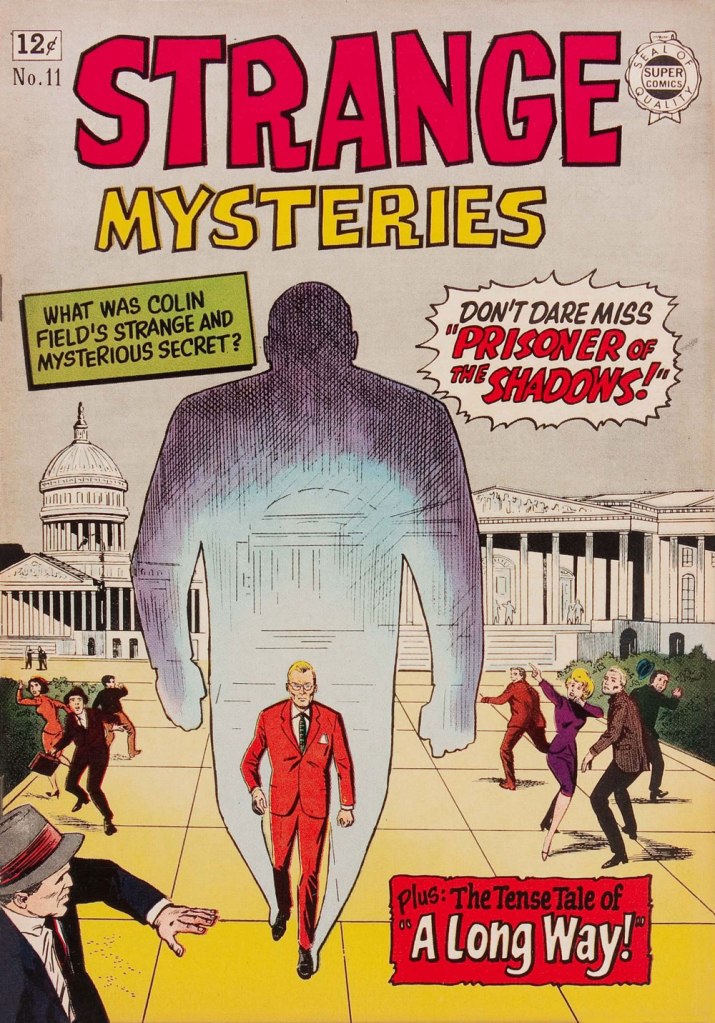
This is Strange Mysteries no. 11 (1963, Super Comics). Read it here! The 60s Marvel colouring gimmick of leaving the background grey to make the foreground figures stand out (not to mention spare much time and effort) leads me to think that resident Marvel hues-man Stan Goldberg (no Rube he) may have been moonlighting for Izzy Waldman.
This is Danger no. 12 (1963, Super Comics). Read it here!

Mr. Markstein on The Black Dwarf: « The first question, of any character, is — why? Putting on a bizarre outfit to battle crime on an unpaid, freelance, anonymous basis seems pretty strenuous, requiring strong motivation. But his isn’t much. He just hates crime, no particular reason cited.

Next, what’s with the name? He was shorter than average, but not so short he qualified as a Little Person. Santa Claus would reject him on sight. And would identifying himself as a dwarf instill fear in criminals, confer fighting prowess on himself, or in any other way be an asset in his war on evildoers? It just sends a message that he’s small, so the evildoers can probably beat him up. At least he made up for his shortcomings by packing a gun. »

This is Mystery Tales no. 16 (1964, Super Comics). Read it here!
This is Strange Planets no. 16 (1964, Super Comics). Read it here!
This is Danger no. 16 (1964, Super Comics). Read it here! I was tempted to quip that it takes tremendous chutzpah to hire the then-current Wonder Woman artist to illustrate a cover featuring one of her numerous knock-offs… but I’m pretty sure Waldman, hardly a comics insider, didn’t know and didn’t care.

Of this particular breed of characters, Markstein wrote: « Superheroes first turned up in American comic books just before World War II, and flourished during the early war years. Especially flourishing were a sub-species of superhero that wrapped themselves in the U.S. flag like a cheap politician. Inexplicably, these are referred to as “patriotic” heroes, indicating that wearing the flag like Captain Freedom or Miss Victory was deemed a mark of patriotism higher and more… »

This is Fantastic Adventures no. 16 (1964, Super Comics). Read it here!
This is Strange Mysteries no. 17 (1964, Super Comics). Read it here!
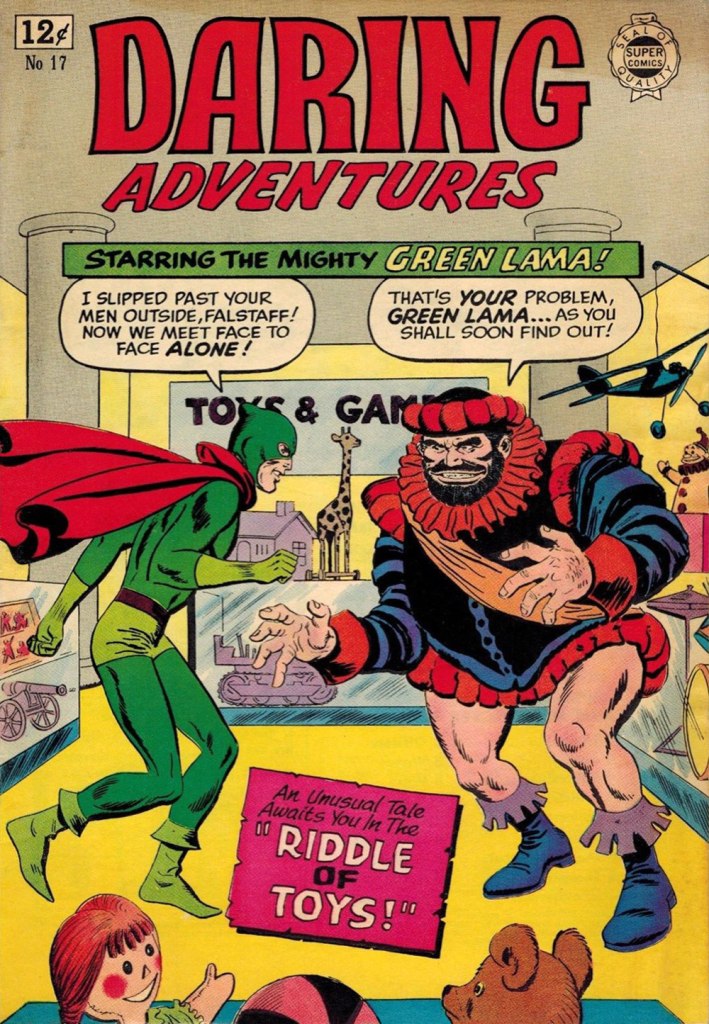
This is Daring Adventures no. 17 (1964, Super Comics). Read it here! « May I have this dance, Green Lama? » « Why, I thought you’d never ask, Falstaff! »
This is Police Trap no. 18 (1964, Super Comics). Read it here! In my opinion, this is one of the best-composed of Andru’s Super/I.W. covers: very nice sense of depth, though the effect would play out far better without the quite superfluous ‘We proudly present...’ blurb, which breaks the visual flow.
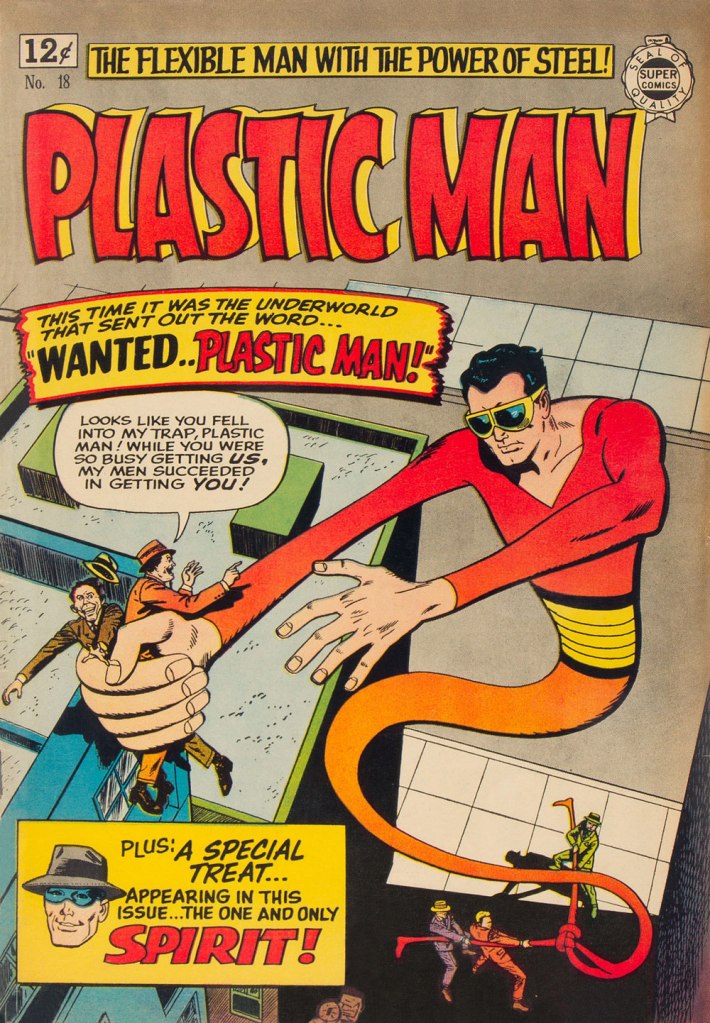
I think the guy on the left is a bit ticklish. This is Plastic Man no. 18 (1964, Super Comics). This is actually a pretty spiffy issue, featuring classic work by masters Jack Cole and Will Eisner. Read it here! DC, who owned the character — having bought it from its original publisher, Quality, when it left the field (along with Doll Man, Phantom Lady, Blackhawk…) — would resurrect Plas in 1966. That didn’t click. It wasn’t until the Steve Skeates / Ramona Fradon revival of 1976-77 that someone managed to grasp the appeal of Jack Cole’s unique creation. But again, sales were low. In 1980, Andru would again depict Plastic Man on Adventure Comics covers spotlighting Jean-Claude “Martin Pasko” Rocheford and Joe Staton‘s unfunny, misguided and mercifully brief run. And hey, if you’d always longed to see Andru’s version of Eisner’s The Spirit, this is all you get!

-RG

*Harlan Ellison on Conway, circa 1979: « I mean, the first time I met Gerry Conway, who the hell would’ve known that Gerry Conway would single-handedly ruin the entire comics industry. He’s a classic example of the deification of no-talent in all industries. He’s not good, but he has it in on Thursday. And that’s all they care about. You know, fill them pages. » [ source ]

**taking over from Mike Esposito and actually making him look good in comparison!

Brimstone Bureaucracy, Bah! Hyena Hell’s Demons

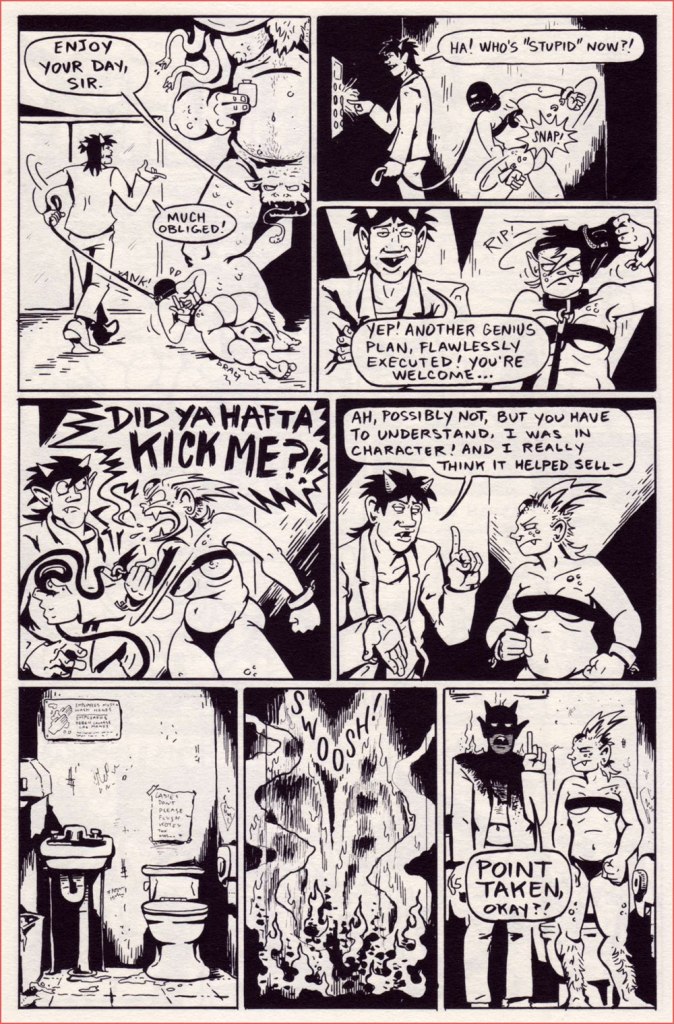
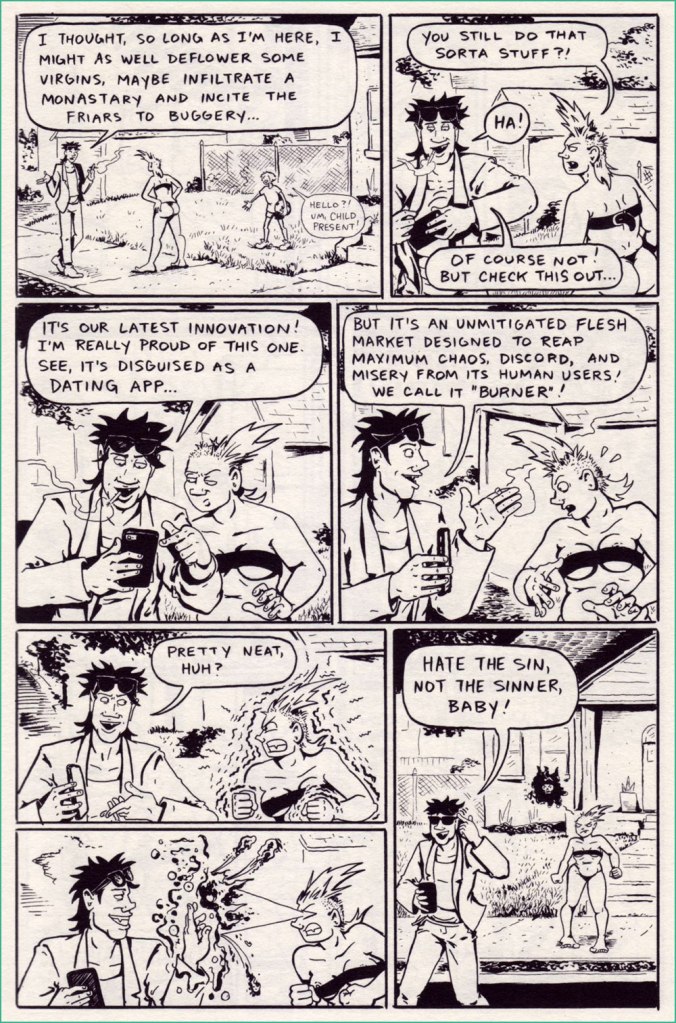
I was very excited to come across the comics of Hyena Hell. I don’t even remember where I got No Romance in Hell (2020), but it was cheap and intriguing. A funny comic about a cantankerous dick-driven demoness that also is excellently drawn? Well, sign me up, and pronto. Anyway, I read it, enjoyed it greatly, and stuck it on a shelf (after pursuing co-admin RG with it for a bit to get him to read it, which I’m still not sure he has done*). Recently, I discovered that there are two more instalments — Demons: To Earth and Back (2021) and Demons: Bloodlust (2022), and devoured them with great delight, one recent Sunday afternoon.

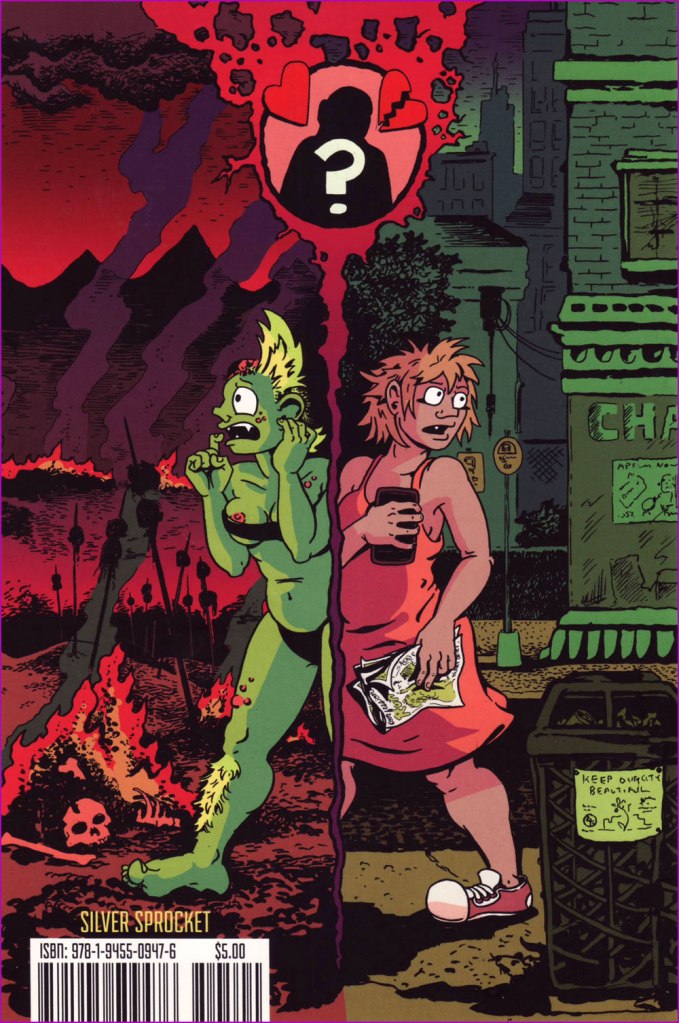
The transition from demon-girl to normal-girl and back again – back cover of No Romance in Hell.

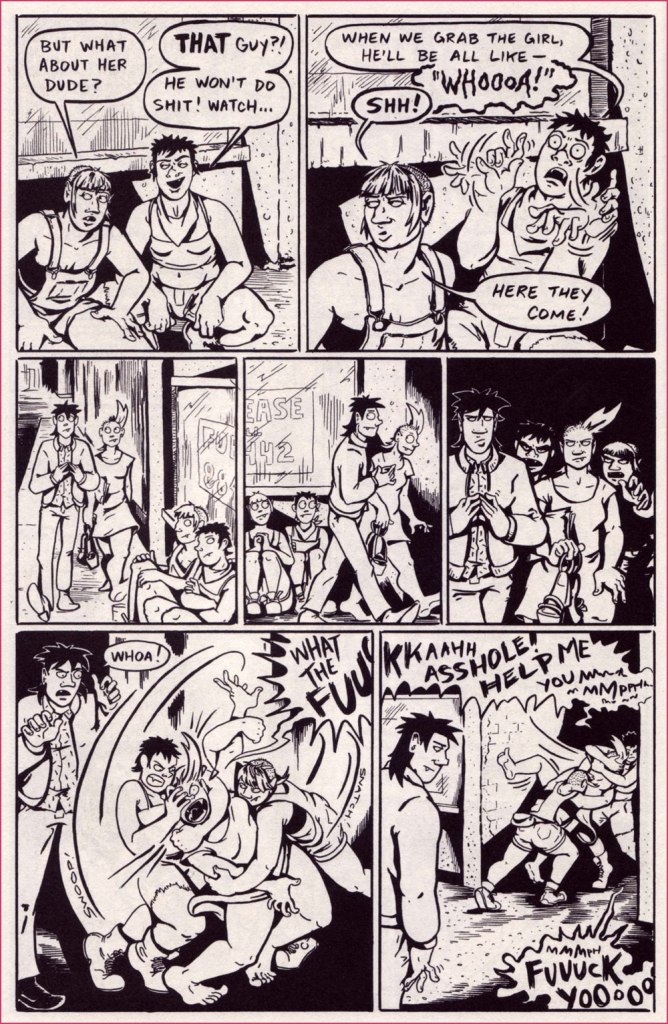
HH’s art is dynamic and convincing – bodies have real weight and a variety of shapes. There is also stuff happening in the background, so the reader feels like these are real… well, err, maybe not people, but real creatures walking on real streets (and equally tangible depths of hell). I love her main characters, fully-fleshed, quick-witted, and flawed in a way that makes one sympathise even when they’re being irrational. No Romance in Hell is a jaunty (if violent) romp with great social commentary on the state of the dating scene, happily skewering the endless parade of ‘nice’ guys who think life owes them.

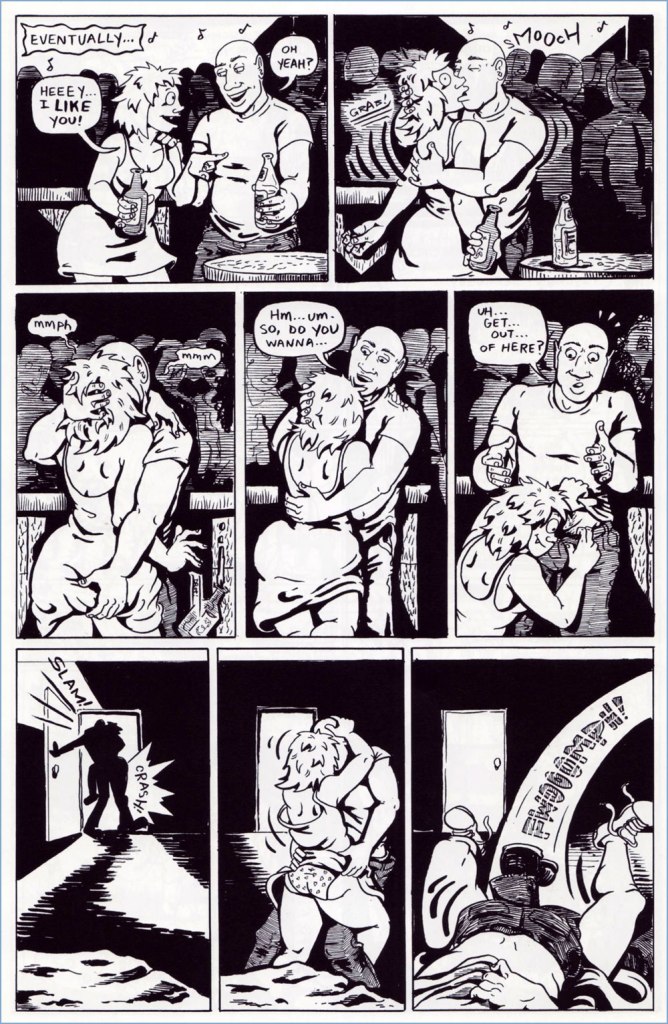
If that’s how it is… Maybe I’ll just LEAVE then!‘ — and our heroine makes her way to the surface to see whether humans can give her satisfaction where the demon failed.

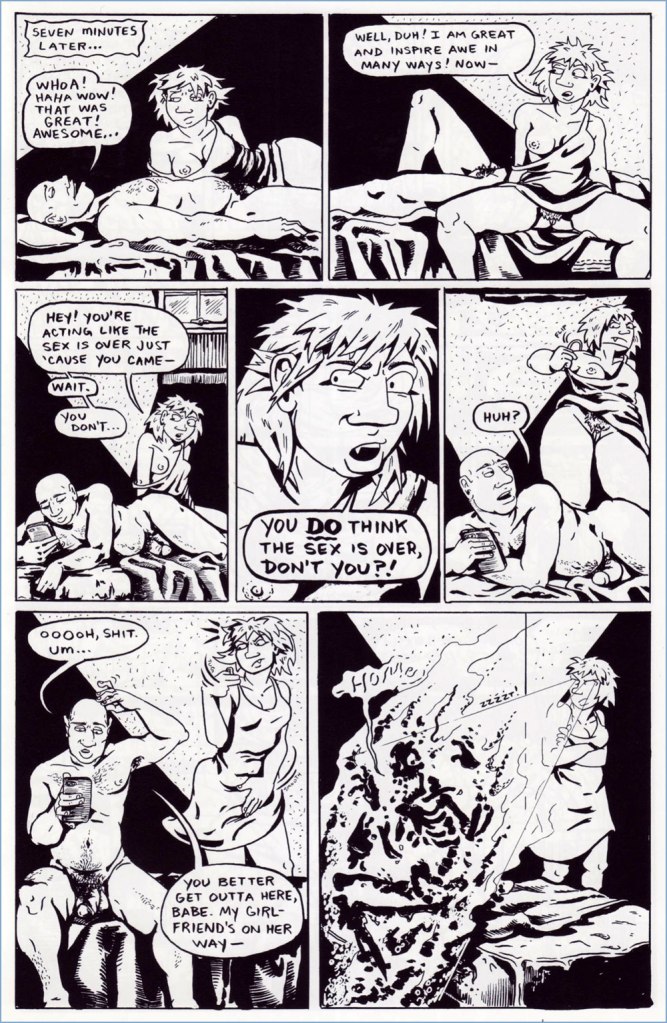
After a cavalcade of brief dates with men spouting the usual nonsense (distinctly not sex-worthy material), Bug finally comes across a contender…

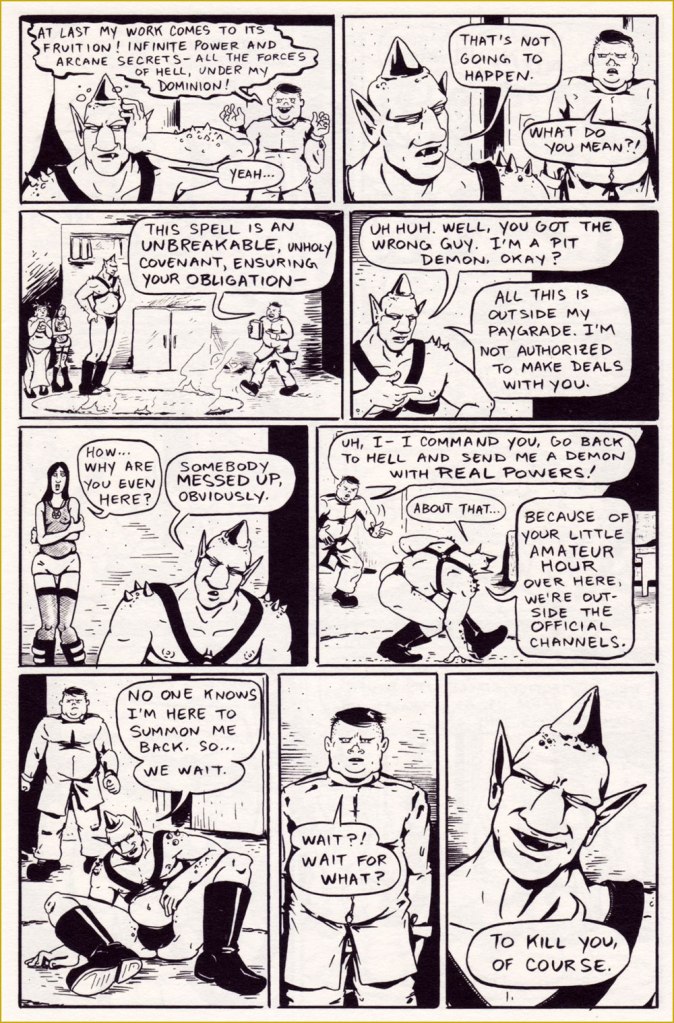
As much as I enjoyed No Romance in Hell, I was even happier to find that Demons: To Earth and Back featured a longer story and more glimpses into the organisation of the pits of Hell, home sweet home. When Bug needs to rescue her demon sweetie from his forced summoning to earth, Bug’s sibling Skud comes up with a plan to sneak her out of Hell, since obviously the former is built on the solid foundation of bureaucracy and endless pencil-pushing —

Hyena Hell says she has a tough time with spelling, but ‘monastery’ is the only typo I noticed.
This demon’s actually pretty bright-eyed and bushy-tailed, aside from badly wanting a cup of coffee. The pimple-faced fascist teenage jerk who summoned him, however, is in distinct danger of having his face smashed in.

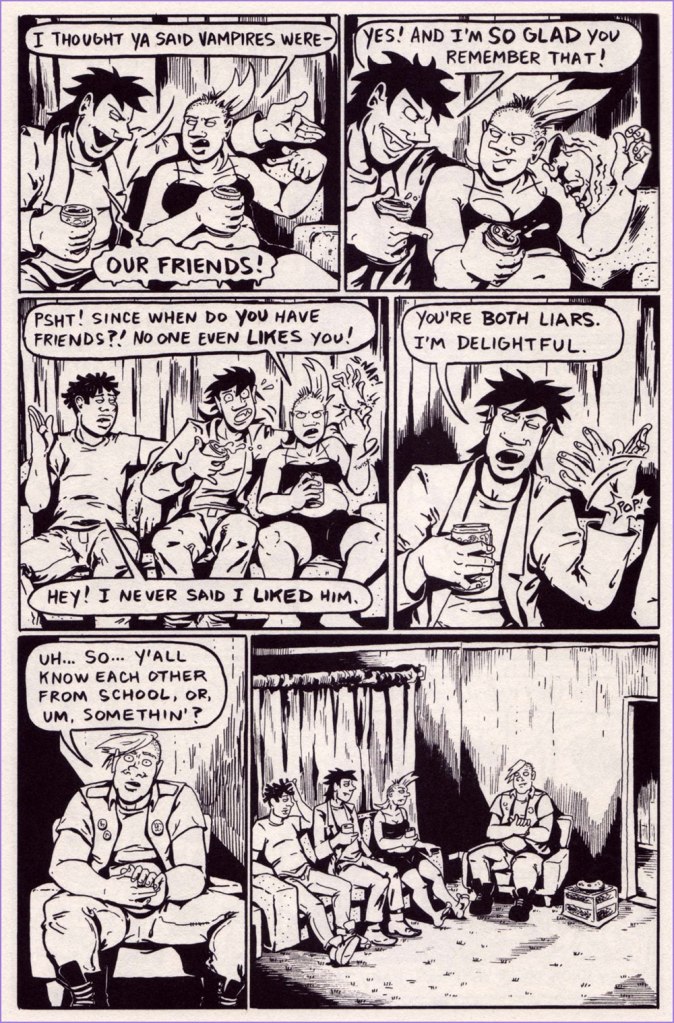
Demons: Bloodlust is even more ambitious, telling the gruesome (with many incinerations) tale of Bug and Skud embarking on a vampire-annihilating mission (and introducing a vampire trio of old friends whom I would love to hang out with).

Social anxiety, the vampire/demon edition.

At the end of the story, we are treated to a couple of ages of Cass, Marco and Baby Jay answering questions, which is possibly my favourite bit of the whole thing.

There is a fourth Demons book in production as we speak — follow HH on instagram to get a peek of the pages she’s working on. Also pay a visit to The Comics Journal for a sampling of the Fair Warning – Hyena Hell interview.

~ ds

* Given that he was kind enough to scan a bunch of pages for me, I’m sure he’s read some while scanning, at the very least.

Local Hero: Boston’s Francis W. Dahl

« I’m going to Boston to see my doctor. He’s a very sick man. » — Fred Allen

My turn to spotlight a recent find: last month, during a fruitful visit to Ellsworth, ME’s The Big Chicken Barn, I spotted — among others — an item of interest in the humour section: a hardcover volume entitled Dahl’s Brave New World, published 1947. Spare but effective cartooning, plenty of imagination and wit. See what you make of it.

Replace ‘miniature plane’ with ‘drone’ and you’ve got a cartoon for these here times.

While the ordinary citizen has been waiting for his long-promised, personal jet pack for decades on end, a ready-to-wear helicopter would be, it seems to me, a reasonable substitute.

I love knowing that there’s a world of talented folk I’d never gotten wind of. Even if a lifetime is too short, even if I’ll miss out on some great art, both capital A and lower-case, I prefer to hold the optimistic view and raise the half-full glass in a heartfelt toast.

By way of biography, Mr. Dahl (1907-1973) thankfully rated an obit in the New York Times on May 7, 1973. Allow me to quote liberally from it:

« Francis W. Dahl, Boston’s best‐known cartoonist, whose works have appeared in newspapers here for 45 years as well as in a series of books, died today at his home in Newton. He was 65 years old.

Mr. Dahl’s cartoons focused on Bostonians and their politics, customs, costumes and foibles, with most of his subjects growing out of local news items.

From 1928, when he began his newspaper career as an $20‐a‐week illustrator, until last June, Mr. Dahl drew his cartoons for The Boston Herald and its successor, The Herald Traveler. When the paper was purchased by The Record‐American last June, he joined The Boston Globe.

Collections of the cartoons also appeared in a number of books, including “Left Handed Compliments,” “Dahl’s Cartoons,” “What, More Dahl?” “Birds, Beasts and Bostonians,” “Dahl’s Boston” and “Dahl’s Brave New World.”

Stories about Mr. Dahl have become part of Boston’s journalistic legends. Once, for example, a Herald engravers’ plate broke just before deadline and 144,000 copies were printed without his cartoon. A printed box asked readers if he was missed, and 4,000 letters were sent to the editor saying yes.

On another occasion, Mr. Dahl broke his right arm — his drawing arm — but rather than miss a day the paper had him draw left‐handed for six weeks. »

While the NYT piece itself draws heavily from a 1946 Time Magazine profile of Dahl, it left out the juiciest part of the anecdote: « Since draftsmanship is the least of Dahl’s assets, the switchover didn’t show much. »

It’s refreshing to see — especially in light of the era it was produced in — the lady take the amorous initiative.

I couldn’t pass this one up: I mean… mushrooms, bats, moles and skinks!

And here’s some insight into Dahl’s relative obscurity: « Because he concocts his cartoons out of local news items, and refuses to change his ways, mild-mannered Francis Dahl has never been syndicated. But for his collections of reprints, he would be unknown outside New England. » [ source ]

-RG

A Fading Presence of Lived Memories: Denys Wortman’s New York

« I can’t decide whether to give up peanut butter on account of its calories, or to eat it on account of its vitamines… »

When it comes to what Amazon loosely classifies as ‘literary graphic novels’ (very much a meaningless category), it’s rare for me to stumble across something completely unfamiliar on a bookstore shelf, unless of course it’s something hot off the press. Denys Wortman’s New York: Portrait of the City in the 30s and 40s (Drawn & Quarterly*, 2010), which I spotted in the well-stocked The Comic Hunter (Moncton, Canada), looked unfamiliar and intriguing. 

The edition I purchased is from 2010; I wasn’t able to find out when this one, with an arguably more striking cover, was published. This illustration had the caption of ‘If I have to come down to buy them, you’ll have to come down on your prices’, and was drawn on August 30th, 1948.

I’d never heard of Wortman, but just a quick skim through this volume showed that he clearly had an amazing ability to evoke a certain place and time, and fill it up with characters so real that one wouldn’t be surprised to run into them on the street. Nostalgia for a place one never experienced is a recurring feature of the human mind – Wortman’s New York is one I am familiar with from books and movies, and that faded away long before I was born. One would also be remiss in failing to express admiration for DW’s living, breathing linework. His attention to the minutest details are used to recreate scenes from lives of people who certainly didn’t have an easy time of it, yet still inspire a sort of familiar comfort almost a hundred years later.

To get some bibliographical stuff out of the way (for a full story, I shall direct you to the website maintained by Wortman’s eighth son), Denys Wortman was born in 1887 and died in 1958 at 71. Among other things, he also drew Metropolitan Movies, a comic strip that ran between 1924 and 1954 and is mostly remembered (if that’s the right term here) for two of its characters, a couple of cheerful vagrants named Mopey Dick and the Duke.  

It was a tad difficult to decide which pages to feature, so I tried to go for a variety of scenery. Wortman must have been a Gerald Kersh character to possess such an intimate knowledge of all these industries, markets, streets, and types of human beings… I invite you to a bit of time travel.

« In art school days there was much talk about “character,” but I feel there was a small amount of misapprehension mixed up with its interpretation. I could not see then and I can’t now why a man with a lot of whiskers has any more character than one who is clean-shaven. Nevertheless I would prefer to draw the former. And I would prefer to draw him after he has lived long enough for Experience to have etched lines in his face — the more the better. Because the more lines and markings he has in his face the more chance I have of finding ones that I can match with lines on my paper to help create the illusion that the face I am drawing has bones under the skin, that the eyes are seeing things, that the mouth is speaking, and that the man has a soul. »

It must be mentioned that these drawings have been rescued from the mists of forgetful time by WOT favourite James Sturm (see Free Inside Package: James Sturm’s The Cereal Killings (1992-95)), who hunted down Wortman’s son and his astonishingly large, apparently languishing archive of his dad’s illustrations.

I’ll end this with a great quote from the foreword to Denys Wortman’s New York, written by Robert W. Snyder

« You can still see traces of Wortman’s New York in crowded Manhattan side streets, spirited New Deal Murals, and soaring skyscrapers**. Harder to find are the feelings and lived memories of this place. The sailors and their sweethearts who strolled the boardwalks of Coney Island are now, in their eighties, a fading presence. To understand them, and how they lived in a city that inspired hope and fear, idealism and wisecracks, solidarity and individuality, there is no better place to look than a Denys Wortman cartoon. »

~ ds

* I tend to not like what D&Q publishes, but this is another pleasant exception to the rule (here’s the original exception).

** This immediately comes to mind.

Hallowe’en Countdown VII, Day 31

« … but the rain is full of ghosts tonight » — Edna St. Vincent Millay*

Well, I made it through another countdown. Thanks for your interest and support!

In the proper spirit of the thing, I’ve indulged and reserved my very favourite Hallowe’en treat for last, and that’s a Joe GillSteve Ditko chiller — for the second consecutive year!

I’ve always adored this one for its adroit juggling of hushed atmosphere and giggles, its casually dropped hints and layered subtlety. Ditko really had no peer when it came to insinuating his narrator into the visual tapestry. In this case, his first and finest host, Mr. L. Dedd (or I. M. Dedd, depending on the source). Ditko is clearly having a ball.

Unless I’m mistaken, Steve Ditko always inked himself (and sometimes gloriously inked Kirby) until 1964, when George Roussos as ‘George Bell‘ (seemingly using the wrong end of the brush, sorry) inked Ditko’s pencils on a trio of early Doctor Strange episodes (Strange Tales nos. 123-125, if you must know).

Even while working at Marvel, Ditko (wisely) kept working for Charlton. At his busiest, he was assigned an inker on a revival of Captain Atom, Rocco ‘Rocke’ Mastroserio, and the combination bore splendid fruit. Ditko was one of those cartoonists who laid down the basics in the pencils, then had most of his fun in fleshing them out in ink. Finishing Ditko’s layouts wasn’t a task just any Joe could handle, as the ensuing years would bear out.

This is Ghostly Tales no. 60 (March 1967, Charlton), cover art by Rocco Mastroserio; edited by Pat Masulli.

And so we’re done, countdown-wise, for another year. If that’s not quite sufficient to slake your loathsome lust, promenade yourself through our bloated-by-now archives, at this point two hundred and seventeen posts strong :

Hallowe’en Countdown VII

Hallowe’en Countdown VI

Hallowe’en Countdown V

Hallowe’en Countdown IV

Hallowe’en Countdown III

Hallowe’en Countdown II

Hallowe’en Countdown I

Wishing you all a hair-raising Hallowe’en — thanks for all the creepy loitering!

-RG

*did I imagine that someone (David Mamet?) once said that her name sounded like ‘a bowling ball tumbling down the stairs’? It may have been meant as a compliment.