Fifty Years of Kotter: A Talk With Elliot S! Maggin

« I think people will believe anything about someone they haven’t seen for a while. » — Gabriel Kaplan

I’ve been meaning to do a Welcome Back, Kotter post for several years. But when I thought about it, I understood that hitching it to the show’s fiftieth anniversary made considerably more sense than, say, its forty-seventh. And while I adore William Johnston‘s sextet of tie-in novels, it would be quite a stretch for a comics blog to cover. Far closer to the mark lies Arnold Drake‘s trio of WBK storybooks, illustrated by Mel Crawford and Jack Sparling. But in the end, I bided my time and managed to get in touch with the scribe first assigned the Kotter Komic assignment, Elliot S! Maggin. And boy, am I glad I did. And so, fifty years to the day of the airing of its pilot episode*, let’s talk Kotter!

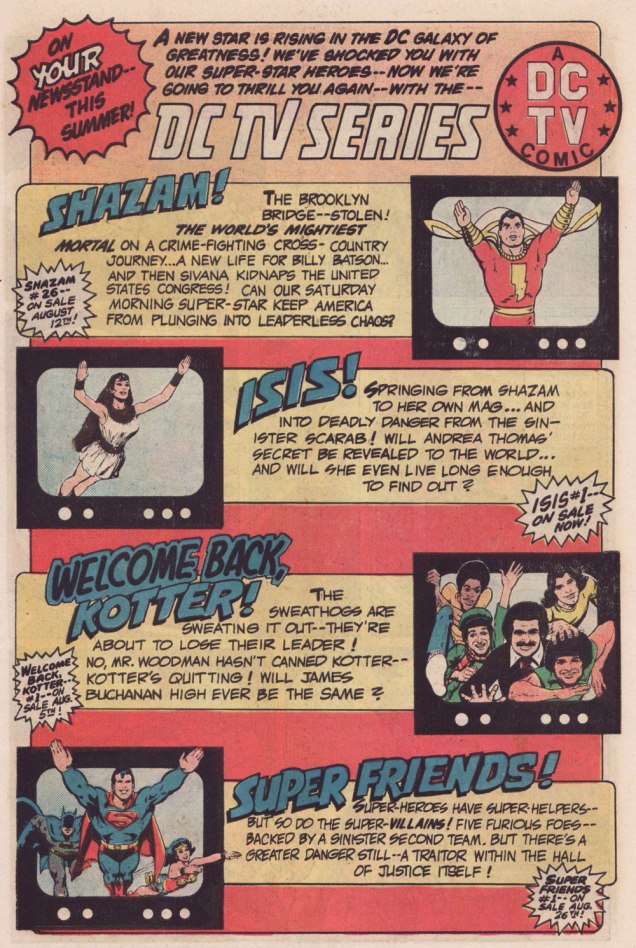
Remember the DC TV line? This ad ran in several DC titles over the summer of ’76.

ES!M: Well, Julie was kind of proprietary about me for most of the time I was working with him.

ES!M: I guess. At some point, Dorothy Woolfolk was editing the Lois Lane book, and… he introduced me to her. She just came into his office for some reason. She said: « Oh, you know, you should write some stuff for me! » And he said « No, he’s very busy, go away! » And he chased her out of the office. And I’m thinking, « Oh, okay. That’s how we’re doing it. »

So I didn’t really go about… I didn’t really make friends with many of the other editors. I tried to make friends with Joe Orlando. You know, I’d have lunch with him once in a while, I guess.

This is Welcome Back, Kotter no. 1 (Nov. 1976, DC); cover by Bob Oksner.

ES!M: But around the time Kotter came out…

You know, people used to hang out outside of Julie’s office door, listening to us plot, because it was so loud. We would yell and scream at each other constantly. He was this Jewish boy from the Bronx, and I was this Jewish boy from Brooklyn, and once I got comfortable working with a guy thirty-five years older than me, we’d just fight all the time. And every once in a while, we’d get serious.

ES!M: I guess at that point, he got mad at me, and I didn’t get work for a couple of weeks. I went to Joe, and I said: « What ya got? », and he said he’s doing this Welcome Back, Kotter book, and I said « Great! I watch that show, that’s fun. » So I wrote the first issue, and that was fine.

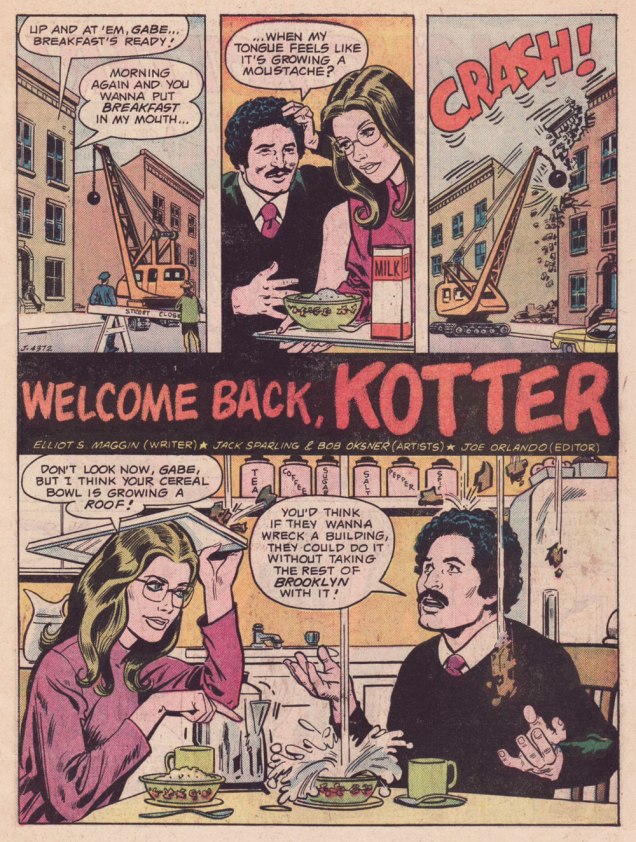
Here’s a quartet of pages from the première issue. Pencils by Sparling and finishes (and surely likenesses) by Oksner.
Aw, Maggin’s Mr. Pevey would have made a great addition to the TV show’s cast.

ES!M: They called me down in Carmine‘s office, to watch episodes of the show. It had been on maybe six weeks at that point. Episodes I had already seen, but I liked hanging out in Carmine’s office, because it was big, and he had a lot of toys around. So they set up this video tape… thing, and I watched the shows again, and I wrote the second issue.

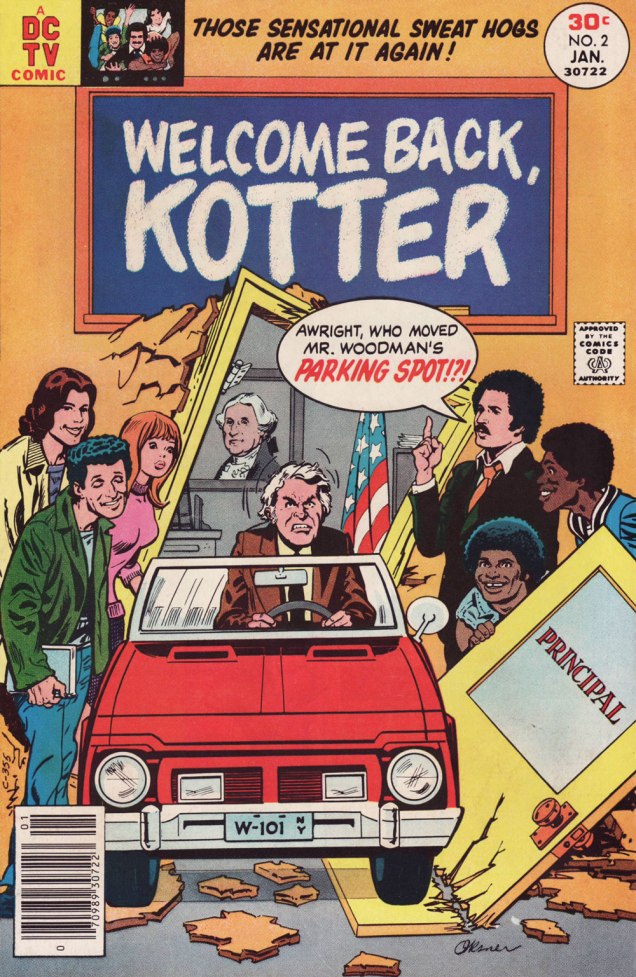
This is Welcome Back, Kotter no. 2 (Jan. 1977, DC); cover by Oksner.
Art-wise, the second issue seemed comparatively rushed, and sans Oksner, likenesses pretty arbitrary. See what I mean? The GCD attributes the inks to Sparling, but I lean towards Frank Springer.

ES!M: I was living in an apartment complex on Long Island, and there were all these kids around… little kids. And I would work at home, mostly. So they would hang around with me, whenever they realized I was home. They would… shoot me through the window or… something. At some point, whenever I’d write a gag, I would…

ES!M: Yeah! And they’d laugh, and run off and play some more. And I figured, as long as they laughed, it was okay. Because they were hearing the voice of Barbarino, or whoever. At some point Travolta would say, « Uh? », or « Duh », or « What d’you think? », something dull, that he delivered in a funny way. And the kids related what I wrote to what Travolta did on screen, so they were getting it. And at some point I realized that Joe [editor Orlando] didn’t watch the show.

ES!M: And he would then object to my Barbarino bits, or Horshack bits, or whatever. So I told him « You’ve got to watch the show, you’ll get it! » But you know, after maybe… how many issues did I write, three, four?

ES!M: I’m sure he (Evanier) watched the show — he watched everything.

ES!M: But Joe did not. I mean, he didn’t have time, and he was madly in love with his wife, and he didn’t watch television at all (laughs). He wasn’t paying attention to the source material.

ES!M: I wrote two issues, and at some point, Joe said: « You can’t write! ». He said « No, you can’t write! »
A blanket condemnation of everything I’d ever done.

ES!M: By that time, I’d made up with Julie, and I was writing more Superman stuff. After that, wherever any of my fights with Julie got serious, I’d go down the street to Marvel, and do something there. Then I would make up with Julie, and they’d never see me again… until I had another fight with Julie.

That was my experience writing Kotter.

And here’s what undoubtedly has to be the Guernica, if you will, of Kotter art: Bob Oksner‘s superlative cover for Limited Collectors’ Edition C-57, from 1978, DC’s final — and finest — WKB publication. Feel free to open it in another tab for a fuller view… I provided a larger image so you can fully take in the wealth of details.

ES!M: I just wrote a book called Lexcorp. A novel. Which you should probably plug.

ES!M: It’s a first-person story that Lex Luthor tells. And he identifies himself as an unreliable narrator, like… Huckleberry Finn. But it does tell the story of how he saves the world. Stuff like that.

I’m working on another book, working on a time travel story. And my ex-wife asked me to write an autobiography so my grandchildren know who I am.

I have all these people I know with Pulitzer Prizes; and at some point in the autobiography, I wrote: « I have about a dozen Pulitzers floating around through my life, and none of them are mine. This book is available for consideration. »

-RG

*the pilot episode, for some reason, was aired third, on September 23, 1975, while the show premiered on the 9th of September with ‘The Great Debate‘ (featuring a wonderfully smarmy James Woods).

Hallowe’en Countdown VIII, Day 30

« New mysteries. New day. Fresh doughnuts. »David Lynch

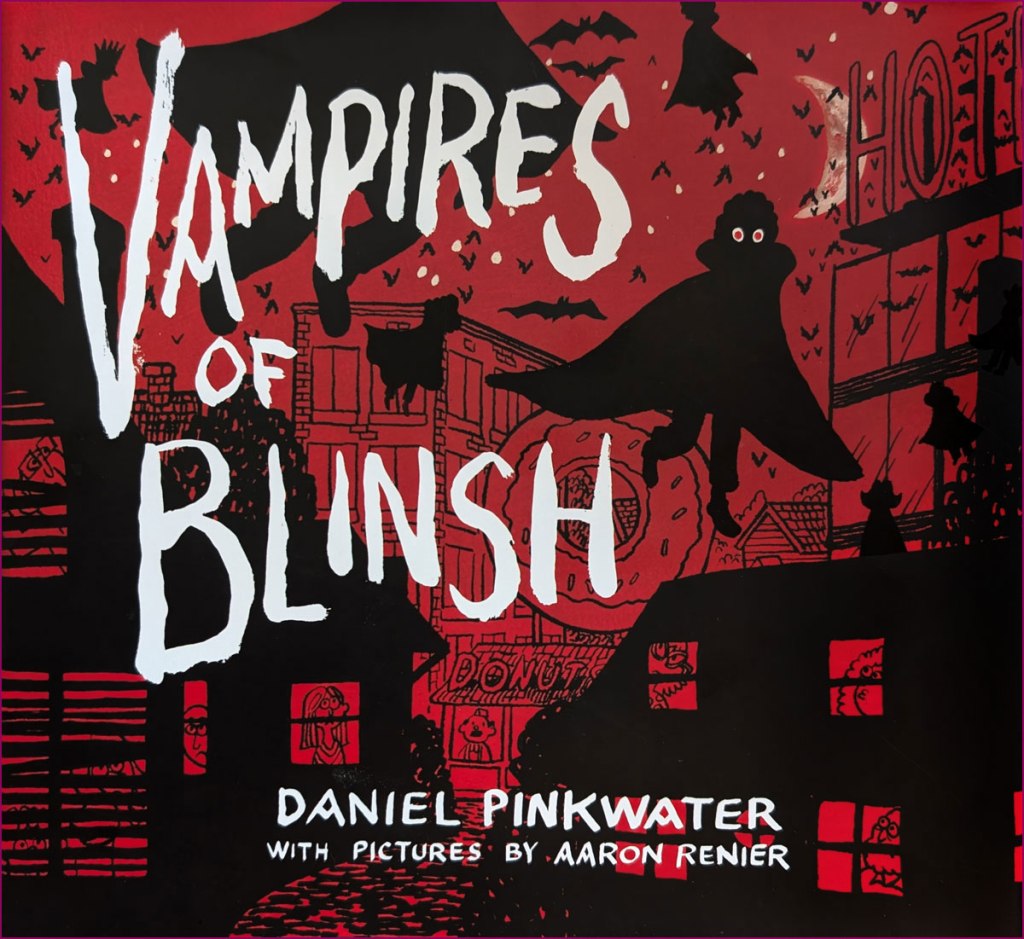
Welcome to the bewitching burg of Blinsh, Pinksylvania, where vampires peacefully coexist with ‘normal-type Blinshites’, though the latter do exhibit a touch of grumpiness when suddenly bitten by their fanged neighbours. Put on your cape (surely you own a cape?) and follow us to this land of boiled turnip and sauerkraut doughnuts… but I would recommend not going on an empty stomach.

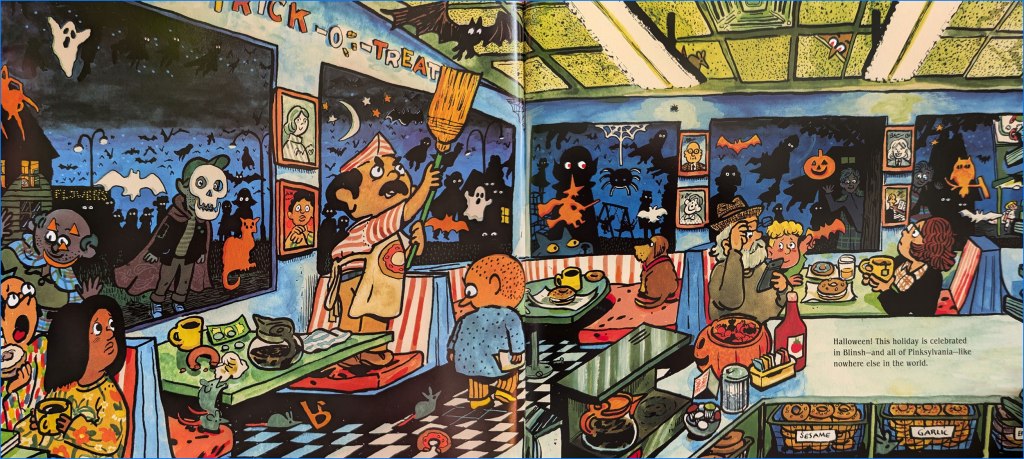
The pages of Vampires of Blinsh (Sept. 2020, Abrams Books for Young Readers) are positively overflowing with jolly vampires, promenading chickens, sneaky racoons, people tripping over bikes, floating basketball players, children munching doughnuts, janitors in eyepatches, and so on. In short, a typical Daniel Pinkwater creation, and I say this with the utmost delight.

This book was illustrated by Aaron Renier, whom I already knew from his young readers series The Unsinkable Walker Bean. The latter definitely has its heart in the right place, but failed to fully capture my interest, though I can confirm the art was great, so I was happy to see Renier’s drawing talent matched up with a story I could really sink my fangs* into. Not that Vampires of Blinsh has a story, per se – which seems to have baffled a few readers, some of whom, judging by their reviews, found it confusing and indecipherable. VoB is more of a quick dip into the non sequitur, somewhat absurd, always charming world of Pinksylvania, as readers are taken on a quick tour of Blinsh, its twin sister city Blorsh, as well as the capital of Pinksylvania, Farshningle. Many potential storylines are hinted at, but none are lingered upon, as Pinkwater effortlessly flings ideas (of which he clearly has an abundance) around and pirouettes on to the next vignette.

Hallowe’en in Blinsh!
« But there is no place like home, which is to say there is no place like Blinsh. »

It actually turns out that this book was in no way the result of a straightforward collaboration between artist and writer. Co-admin RG got the story from the horse’s mouth (the horse, naturally, being DP), and here I quote Pinkwater’s anecdote**:

« The book had a completely different text. It was one of those cumulative counting stories. […] The book was written before Covid, the illustrator did his thing, with no input from me at all. And when it was ready for publication, the editor, the illustrator and I all realized it would seem we were making sport of something that looked like going to be a worldwide catastrophe…making sport or trying to capitalize on an event that would cause millions of deaths. People would break our windows. So we decided to kill the book. For all I know the bound copies, (which may have already been on the boat), were dumped into the sea. I own two sets of proofs. I asked my colleagues if I could try to come up with a new text, not a single drawing to be changed. They let me do it. It was printed with my new words, and that’s the book you have. The three of us promised each other we would never tell the story I’ve just told you– (I am not to be trusted). Now I wish we had let the original version be published. We could have sent a copy to Donald Trump. If someone read it to him, he might have understood the nature of a pandemic, and lives could have been saved. »

Were Blinsh and Blorsh even part of the original tale? Who knows. Let’s chalk it all up to serendipity and wander off to procure Kat Hats (Sept. 2022, Abrams Books for Young Readers), another Renier-Pinkwater collaboration .

~ ds

* I used to have pointy canines, until my orthodontist decided to file them down without asking for my opinion first – and this is by no means a unique experience, as is evidenced from any discussion on social media about the delights of orthodontistry. Some of those ‘professionals’ are true ghouls.

** Pinkwater’s Anecdote is less known than, say, Occam’s Razor, Chekhov’s Gun or Russell’s Teapot, but maybe we can squeeze it into the pantheon of eponymous principles anyway, something like ‘entertaining stories can be found wherever Pinkwater goes‘.

Into The Black Hole With Kirby and Royer

« This is the very center of everything there is. A huge black hole eating up the galaxy. The end of everything. » — Clifford D. Simak

Early in the Fall of 1979, I was pleasantly surprised to discover some new work by Jack Kirby in our weekend paper’s comics section. Things had been awfully quiet on the Kirby front since late 1978, the ‘King’ having unhappily — and quite understandably — left Marvel for the second time that decade.

This new work was part of the long-running anthology strip Walt Disney’s Treasury of Classic Tales (1952-1987). I dutifully collected the shabbily-printed comics sections and patiently hoped for an improved presentation.

The October 28, 1979 Sunday strip, as it appeared in newsprint. Incidentally (and unoffically) here’s the whole story.
The surviving original art page from the same date, for comparison.

Western Publishing, usual licensee of Disney product since its acrimonious split from Dell in 1962, then issued a Black Hole adaptation, in both a slick magazine and comic book format. But — holy bait-and-switch! — it wasn’t the Kirby version!

A typical page from the Western Publishing adaptation. Written by Mary Carey and illustrated by Dan Spiegle (1920-2017), a perennial favourite of the publisher’s. Another mystery: since Spiegle had earlier proven himself well-capable of capturing likenesses, one must assume that the decision to dispense with likenesses of Anthony Perkins and Ernest Borgnine and replace them with those of, I dunno, ‘Weird’ Al Yankovic and Ontario prime minister Doug Ford must have come down from on high. But… why?

I’ve been musing over these riddles ever since (in my spare time). Recently, I decided to act by putting the question to one who was there… namely Mr. Michael Royer, who’s been most gracious to us with his time and recollections (check out our three-part interview with MR!) — and continues to be!

RG: Mr. Royer, I’ve long been baffled as to why Disney (or Western Publishing, at any rate), thought it necessary to commission two separate comics adaptations of The Black Hole. I’ve always surmised that Kirby was considered too wild for them, but that’s just speculation on my part.

Since you were working for Disney at the time, and you inked the Kirby adaptation, I presume that you played some kind of role behind the scenes as well. Could you share some of the facts with me (and my readers)?

MR: Jack Kirby was selected to draw THE BLACK HOLE Sunday comic strip on MY recommendation. Gold Key editors always selected their OWN artist for similar licensed material… plus they were in no position to pay their artist the fee I got Jack. I inked and lettered HOLE and made necessary changes to the robots to protect the image for toy, etc. sales trademarks. Jack was an impressionist and I made the robots “on model.”

Jack became so bored with the scripts, that were done “storyboard” like by someone who had NO understanding of how to make comic art interesting and exciting, that he asked me to layout the FINAL Sunday page, which I did. I had told the powers that be at Disney that Jack must get his originals back but, of course, being Disney, they did not return them as they had promised. Jack only got the remaining pages not yet sold by the Circle Galleries after threatening Disney with a lawsuit. Disney gave me one of the Sunday originals because someone had spilled a cup of coffee on it.

The head of our Creative Services dept. at Disney was not a big fan of Kirby* and after I had inked the first Sunday he had another staff artist “fix” the faces, which stood out like what they became: inept changes. I yelled “DON’T CHANGE THE FACES!” They gave in to my warning.

It was an interesting time back then. Bob Foster and I were the ONLY artists in Creative Services who had worked in comic books and strips. They would never take our word about things until our department head, Bob and I, were on a conference call with Sylvan Beck (King Features Strip Editor in New York) and then they believed what we had to say about the ways a Sunday strip could be drawn to fit many formats. It was very frustrating at times knowing more than your “bosses.”. But… it is the same old story. Middle management was loaded with MBAs who didn’t know shit from shinola! We used to joke that if one had an MBA anyone could get hired at Disney… You didn’t have to know a damn thing about anything else except how to get the MBA.

RG: I’ve read somewhere that the Black Hole scripts were the work of Carl Fallberg. I mean, if that’s true, surely he wasn’t the one who storyboarded the script, as it’s a bit hard to reconcile ‘NO understanding of how to make comic art interesting and exciting’ with a visual artist of Fallberg’s calibre… might he have delegated the task to some flunky?

MR: It was Fallberg… storyboard layouts for each panel/page. I liked Carl and he was a nice man, but he had no idea how to “jazz” up the film visually and Jack wasn’t about to rock the boat, by being his usual inventive self. The script layouts were just like the film… boring. Just a blow by blow of what was going on in the film. The comic strip could have been exciting if Carl hadn’t just “stuck” to the movie. But, perhaps I am being too critical. Carl was probably “following orders” from our department head. When I tried out to do strip art for Disney in the late 60s or early 70s that same department head told me NOT to worry about “likenesses” of the actors. So when I told in my samples they were turned down because “no one looked like the actors.” Gawrsh…as Goofy would say. As I said… Bob Foster and I were the only guys in Creative Services who had ever been intimately involved in comic book or strip art production in our department. Things did change a bit eventually.**

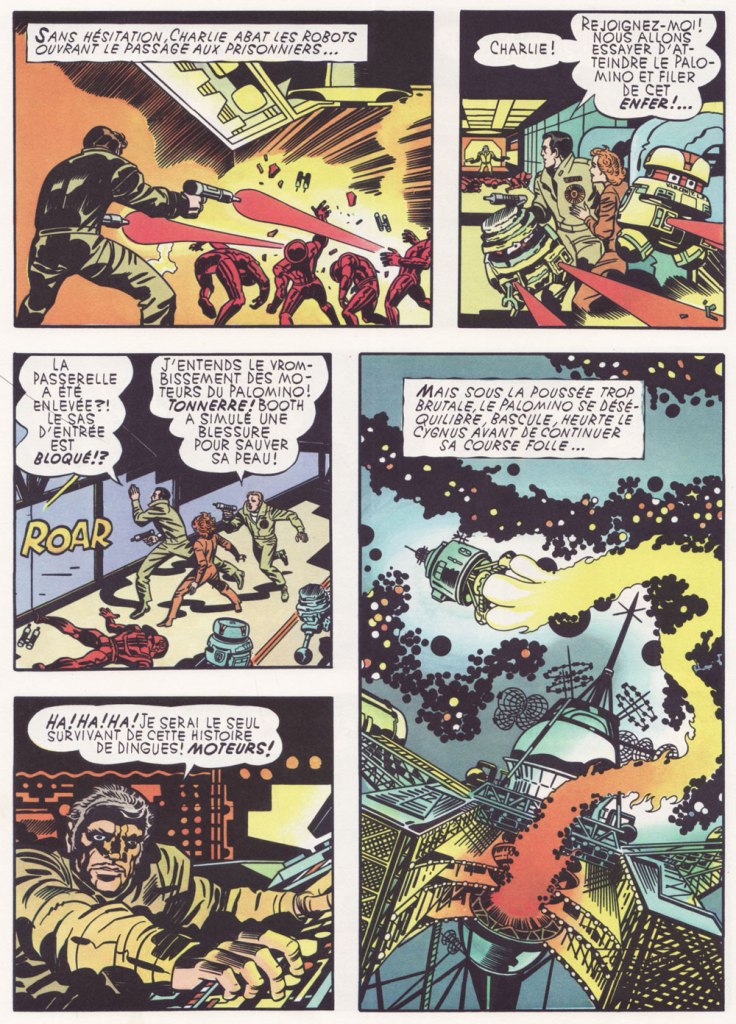
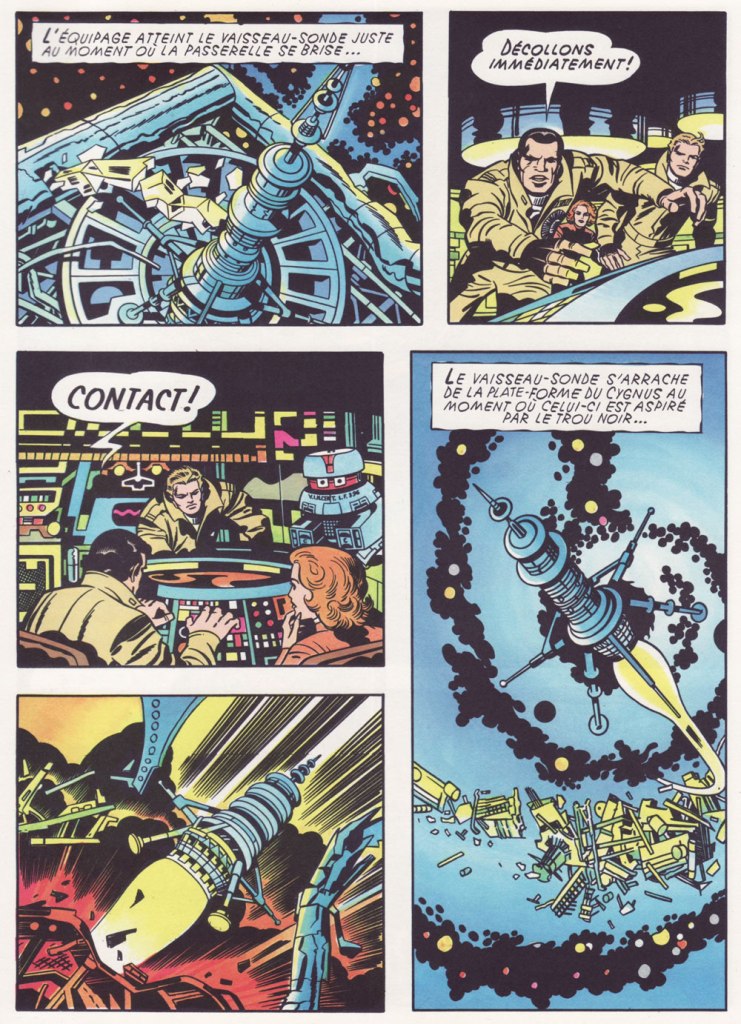
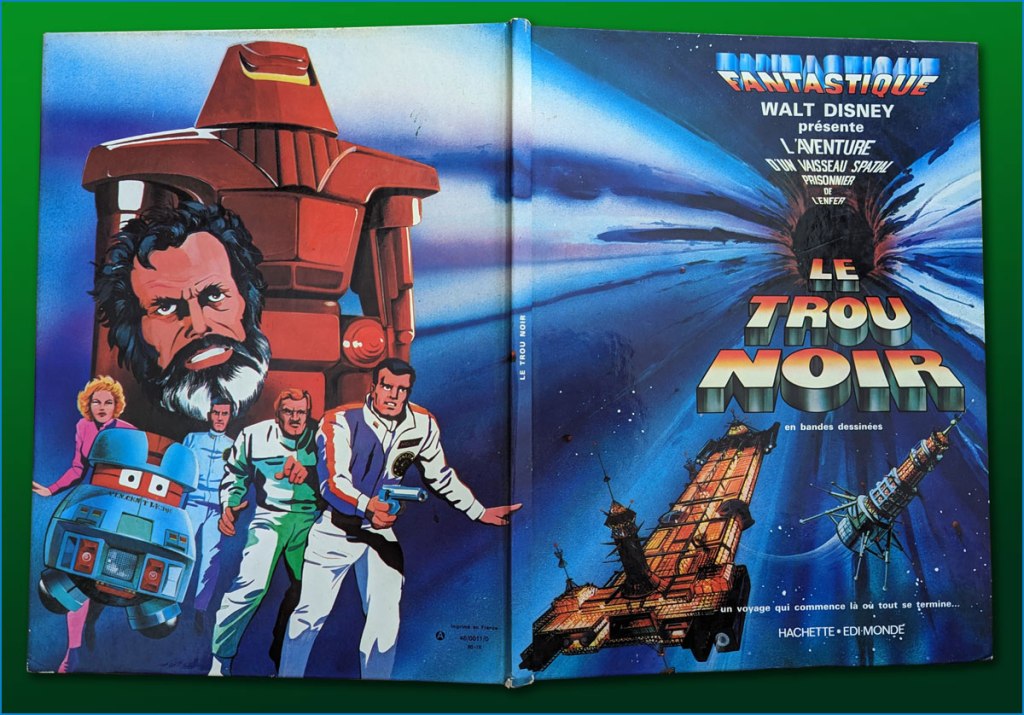
I’ve heard it said that the Kirby Black Hole material has never been reprinted or collected in full… which is only true if you only count English-language editions. I happen to have on hand the well-produced French collected edition (Fall 1980, Edi-Monde/Hachette). It was serialised earlier in the weekly Le Journal de Mickey (published continuously since 1934!).
I’ve mostly gone with the action sequences. In an episode of Sneak Previews, film critics Gene Siskel and Roger Ebert perceptively assessed The Black Hole‘s shortcomings.
Here’s a look at the hardcover collection in question, with its amusing cod-Kirby painted back cover.

I leave the final words to Mr. Royer, along with my earnest appreciation of his gregarious generosity!

MR: As a point of interest (or none at all), I designed and drew the Sunday page BLACK HOLE title panel as well as lettering, correcting robots and inking. I have a full set of B&W proofs if any one is interested in putting them into print. Offered to loan them to IDW but I guess they weren’t interested. My price must have been too high. Two comp copies of whatever they printed. LOL sigh.

*this was decades before Disney became perfectly fine with reaping billions upon billions from Kirby’s creations.

**but not soon enough to save Tron! Check out the impressively flat adaptation of the studio’s following foray into SF.

Hallowe’en Countdown VI, Day 29

« I’m alone with the ghost of the swamp, somewhere near the weeping willows. » — Steven Herrick

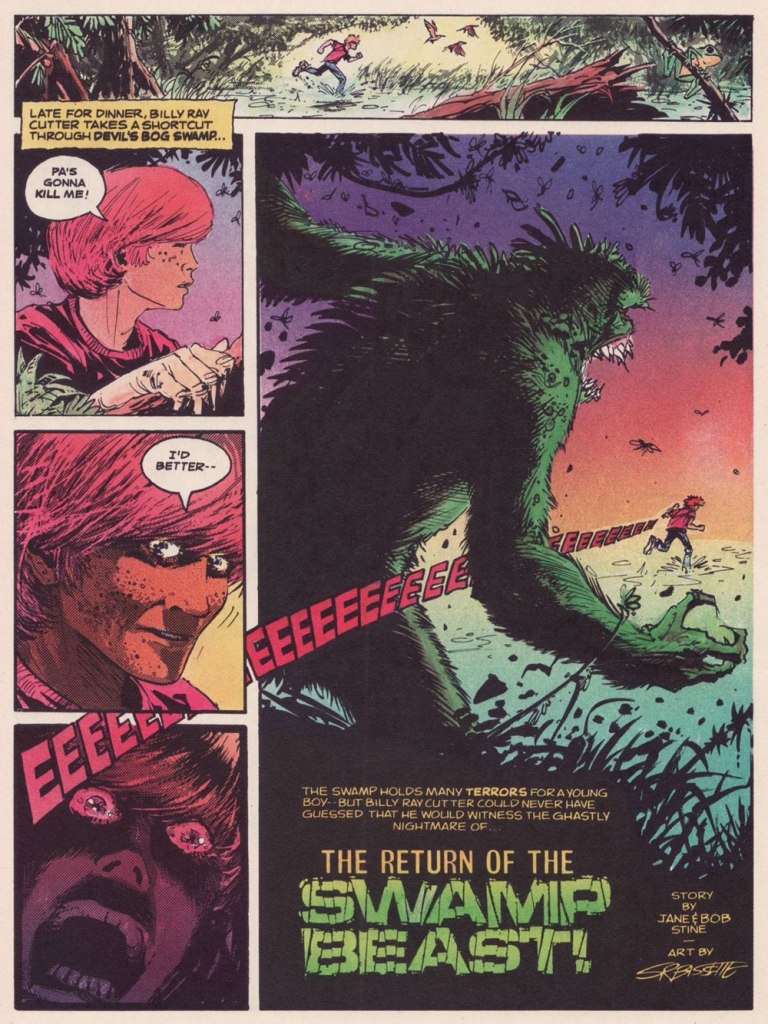
Today, we pull on our wellies and boldly venture into the depths of the mysterious swamp, but not entirely unprepared: on this occasion, I turn the microphone over to an acknowledged expert en la matière visqueuse, Mr. Stephen R. Bissette. I queried Steve about his early work for Scholastic and he most munificently lifted the veil on those wild days of youth:

« Well before my stint on Swamp Thing, I drew two swamp monster stories (one of which I’d also scripted) for Weird Worlds for Scholastic Magazines back in the day. The magazine’s editors were Bob and Jane Stine (Bob aka R.L. Stine), who wrote the first of the two stories; the magazine art director was Bob Feldgus, who was always a joy to work with, and trained me well.

The story titles are counter-intuitively reversed, in a way. “The Return of the Swamp Beast” was originally published in Weird Worlds no.3 (October 1979) in black-and-white, colored for its reprint in Yearbook no.1 (and only, 1986). Enjoy! »

The Return of the Swamp Beast was coloured by Brendan McDonough.

« These were among my favorite early freelance gigs, and remain my favorite magazine account and people I was fortunate enough to work with and for. The Stines and Bob Feldgus extended the best, most gracious, most responsive relations with this freelancer of any I had in those formative early years; it also was the best-paying of all the early freelance gigs, extending the greatest freedom for me to do the work itself, and they boasted the best production and printing of any publisher I worked for then (even better than Heavy Metal).

My entry into the Scholastic freelance pool was via a one-shot horror story for Scholastic’s then-new zine Weird Worlds. Joe Kubert brought me into his studio/office in the Baker Mansion (which has long since been the dorm for the Kubert School rather than its headquarters and main building, as it was during its first few years) and asked if I’d be willing to draw a short (three pages, if memory serves) horror story for a magazine intended for schools; I would be doing the whole art job working from a silly but fun script by Bob and Jane Stine, co-editors of the zine, and my name would not go on the job, it would be credited to The Joe Kubert School of Cartoon and Graphic Art, Inc. Fair enough! I was still a student after all, and this was my shot at doing something different.

I was overjoyed to have the shot, and did my best on it. Part of the appeal, mind you, was drawing a horror comic for schools. During my early ’60s childhood, any comics brought to school were verboten and usually confiscated, horror comics above (or beneath, in the minds of my teachers) all. So, drawing a horror story that was intended for distribution to junior high students—sanctioned horror comics for school!—was a hoot and a bit of karmic comeuppance I was happy to be part of.

Joe was delighted with what I did with the script, as was Scholastic. I wanted to do more. One of (many) great acts of generosity Joe extended my way was gifting me with the account with Scholastic when I graduated in the spring of 1978 from the Kubert School, and thus began my happy few years of working with Scholastic—an account that often paid the rent and kept me working when work in comics was hard to come by.

Scholastic treated me like a prince. They paid well, paid promptly upon delivery of the finished pages, and were always a joy to work with. Like all good things, this passed: Weird Worlds was cancelled after a few issues, and after a couple of jobs for Bananas I moved on to other things, including pencilling Saga of the Swamp Thing beginning in 1983. But I always loved working with and for Bob and Bob, and I miss ’em both. I eventually collected some of my work for Scholastic for two comicbooks in the late ’80s, and did so with Scholastic’s permission. »

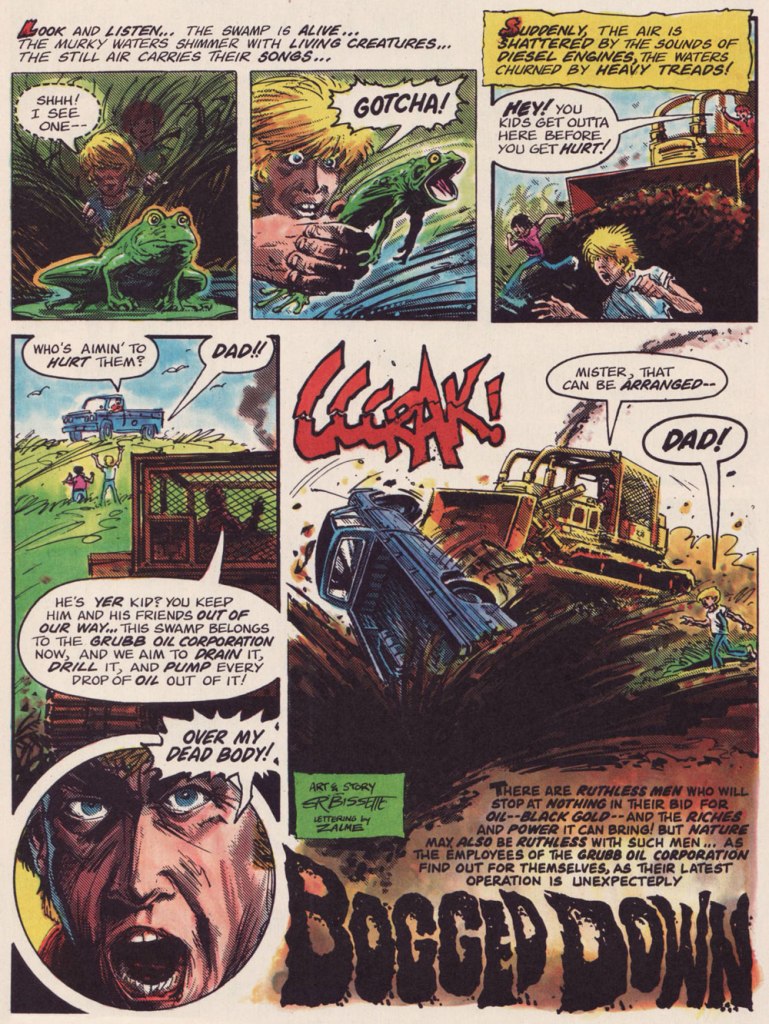
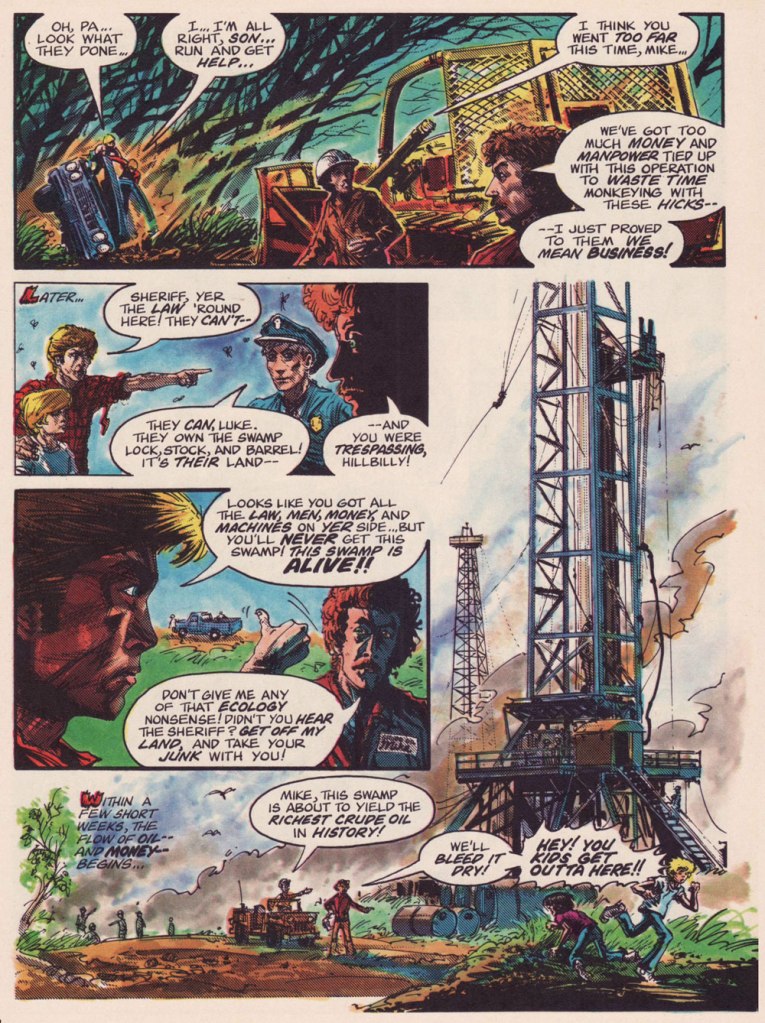
That source, Bissette & Veitch’s Fear Book (Apr. 1986, Eclipse) is the one we tapped for this post, and the most affordable solution should one crave more of these sharp little tales. Here’s another, this one a Bissette solo (including the colouring), originally from Weird Worlds no. 7 (Jan. 1981, Scholastic).

« Who remembers these magazines? Bananas and Weird Worlds seem to be lost in the limbo of all school zines; no comics sites acknowledge them or offer back issues for sale (none I can find, anyway), and general online searches turned up little. Back in 1995, The New York Times ran an interview/article on Bob Stine when his Goosebumps TV series was about to debut, making mention of Bananas magazine. There’s a number of online sites dedicated to Stine’s famous and beloved Goosebumps books series, but Bananas and Weird Worlds are less than footnotes in the long shadow of Goosebumps.

There’s a handful of affordable back issues of Weird Worlds available on various online venues and auction sites; I’m in almost every issue. One cautionary note: If you go looking on eBay, though, don’t confuse the Scholastic media zine Weird Worlds with the lurid, gore-splattered Eerie Publications 1970s newsstand horror comic magazine Weird Worlds. Those are fun in their way, too, but you won’t find me in there—just my eye-tracks from reading ’em three decades+ ago.

I’ve long wished to convince Scholastic to consider a collected edition of this body of work, but each & every attempt to engage has fallen on deaf ears. I’m still proud of this work, and as a precursor to the very successful R. L. Stine Goosebumps franchise & Scholastic graphic novels of today, can still hope that one day someone at Scholastic will have the “lightbulb” moment… »

I truly can’t thank Steve enough for this bounty of information — you just can’t beat going straight to the source, particularly with a source this friendly and eloquent!

-RG

Trust the Man From Cancer!

« I’ve always wanted to be a giant space crab. » — Gabe Newell

We have quite a treat for you this week. One of our very favourite creators, Mr. Glenn Dakin, has genially agreed to shed light on the inception of one of his lesser-known (but nonetheless striking) creations, Mr. Crusht Acean, aka ‘The Man From Cancer’. Take it away, Mr. Dakin!

Glenn Dakin: The phrase The Man From Cancer came to me when I was writing a song, referring to myself as a typical Cancerian.

It gave me the idea for a detective organisation where all its members were Cancerian. Of course it had that Man From U.N.C.L.E. association. As I was discussing this idea with my brother down the pub, I said – as a joke – that in order to get a magazine interested in the idea the character would have to actually BE a crab. As soon as I said this, I knew it could work…

Phil was the obvious choice to draw it, as the superb consistency of his style and great visual imagination would make readers accept the bizarre idea as a reality. Also we worked a lot together.

When I told Phil about it, he said ‘how did you know I was Cancer?‘ (much to my surprise). So it was clearly in the stars!

Marvel UK were just launching STRIP, in which creators could keep the rights to their work, so it was a natural place to send. Dan Abnett was the editor and he really got what we were trying to do with the absurd humour. After the first two-parter, he offered us a regular one-page slot.

This is Strip no. 11 (July 7, 1990, Marvel UK). Cover by Phil Elliott.

Who’s Out There?: Judging from the supplementary materials (Strip no. 11), you seem to have quite fully worked out Mr. Crush Tacean’s universe. Did you have lofty plans for the series?

GD: Not so much lofty plans, but whenever Dan Abnett gave us a chance to expand it, we enjoyed enlarging the madness of the world. These supplementary materials were created for STRIP to remind readers of the story half way through, and get new readers on board, after we had been dropped for a couple of issues.

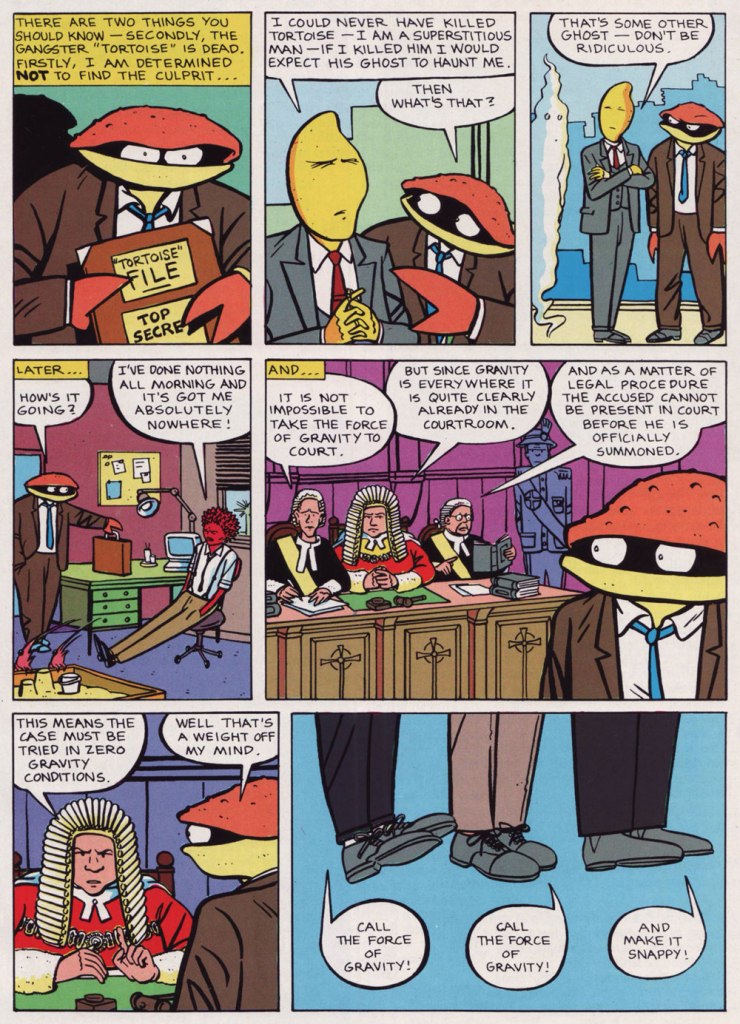
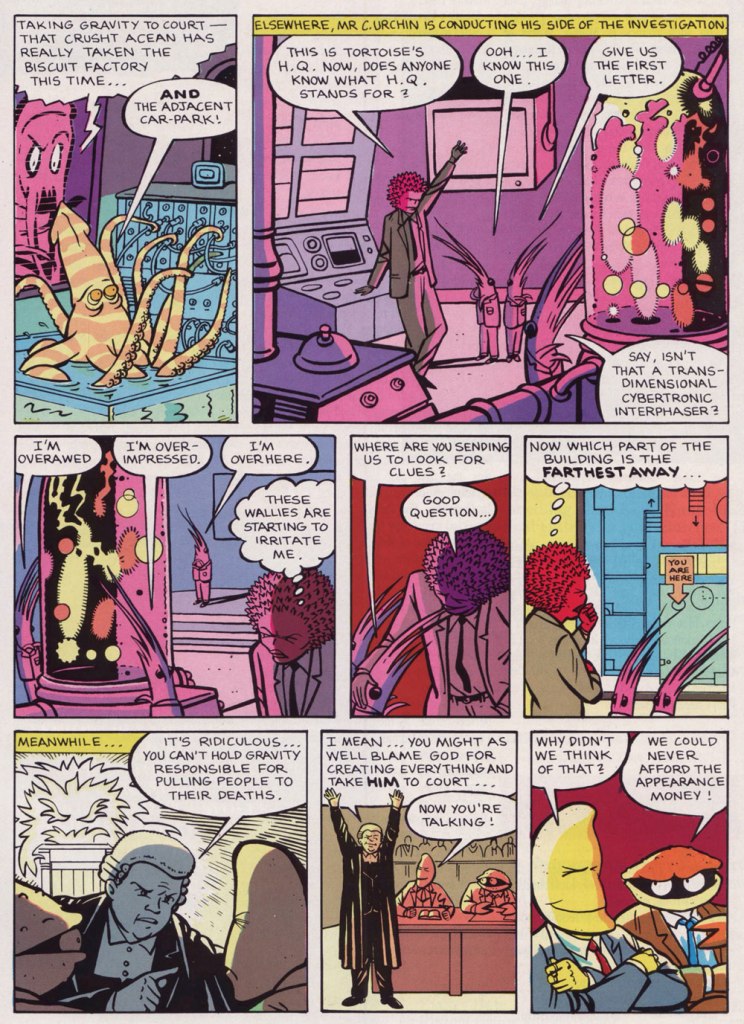
I remember that as my confidence on it grew, and we had the story where we took the force of gravity to court, I started to think of it as a kind of visual Goon Show, following its own absurd logic.

WOT?: Could you shed some light on the series’ publication history? Were the instalments that didn’t appear in ‘Strip’ published elsewhere before they were collected in ‘The Rockpool Files’? (by Slave Labor in Sept. 2009)

GD: You will have to ask Phil that, they might have appeared somewhere, but I don’t think so. We did have a two-pager in a Channel Tunnel magazine!

WOT?: What brought about the change of title? I was quite fond of ‘The Man From Cancer’, I must say.

GD: We were asked to change the name as ‘Cancer’ – we were told – was not exactly a fun buzzword.

« Sez who? »

I think that was the suggestion of Slave Labor, the publisher. The Rockpool Files was the first thing that came into my head, and Phil liked it. The Rockford Files had just been on TV, of course!

This is the book you have to get. While it’s rather… compact (14 x 21,5 cm), in glorious black and white, and out of print, it’s very nearly comprehensive… and most of all, it exists!

WOT?: What’s the story behind these huge gaps between appearances (issues 2 to 9, then 11 to 16)?

GD: As far as I remember, the second half of the Diukalakadu story appeared the next issue in STRIP [no.2 — RG]. Then Dan asked Phil and I to keep it going as a regular feature. We agreed, but as they were working many issues ahead, it took us a little while to launch the new stories.

The only problem was, as it was an anthology comic with multiple contributors, the page count was hard to level out every issue. As the only one-pager, Man From Cancer was the easiest to drop. I think getting asked to create the supplementary materials mentioned above, was a bit of an apology for us being so bumped around. Also the text story ‘Wallow’ in the Rockpool Files book, was originally created in 24 hours by special request of Dan, to solve a pagination crisis when a strip didn’t turn up in time. But then STRIP was canned before it could appear.

WOT?: You’ve collaborated quite a bit with other cartoonists. I presume that the division of labour varies from project to project. In this case, was there a clear line between the job titles? Did you serve strictly as the writer, or did you provide storyboards, layouts or conceptual sketches? And vice versa on Phil’s part?

GD: I never typed up a script for Phil, I just drew a rough of the strip. In this I visualised a lot of the characters, but it was up to Phil if he followed my suggestions. Sometimes he would create an amazing surprise like a giant octopus answering the phones at Cancer HQ. Phil didn’t write anything but he did loads of visual world-creation as we went along.

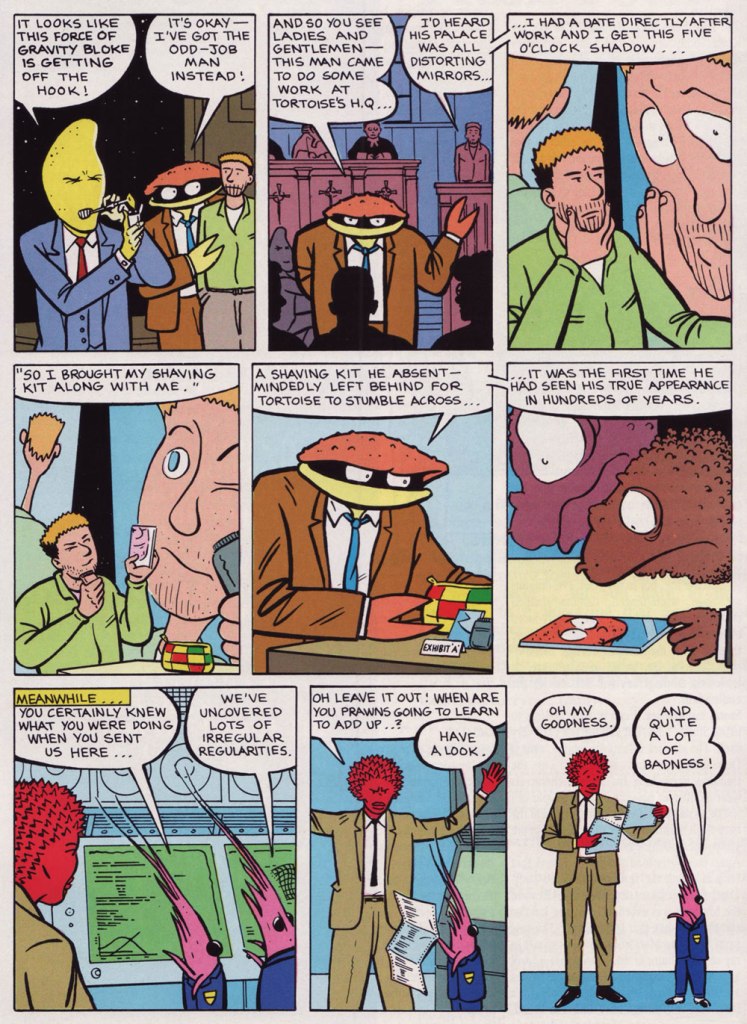
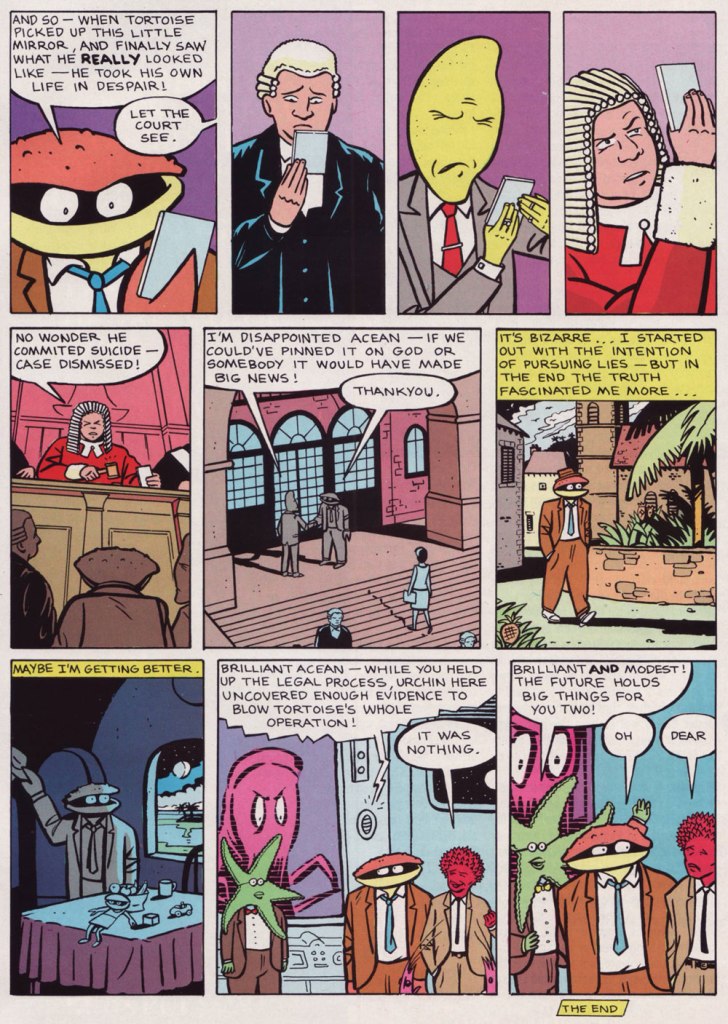
This tale, the second Man From Cancer investigation, appeared in Strip nos. 9-11, 16-19 (1990, Marvel UK). The lovely colours are by Steve White.

And since I hinted at the existence of ‘supplementary materials’, it would be callous of me to leave them unseen.

A bit of context from Mr. Dakin: « How nice to see this after all these years!
I read it with great trepidation, wondering what on earth I had said… The upbeat piece on the left ‘
I’m an optimum overview kind of guy…‘ was supposed to be by Mr C Urchin (Crusht’s cheerfully inept assistant), which is why it reads a bit odd, with Crusht at the top. I think the original plan got lost when it was given to the designer at Marvel UK. »

I hope you enjoyed our chat with Mr. Dakin, whom I cannot thank enough for his generosity and charming manner. In the event that your interest has been piqued, take a gander at our earlier post entitled Glenn Dakin’s Alter Ego, Abraham Rat.

-RG

At Last… Freff Speaks!

« Only times and places, only names and ghosts. »Aldous Huxley

Last November, after we spotlighted a pair of mid-70s Gold Key gems I had presumed to be the brainchildren of Connor Freff Cochran (as it turned out, I was only half right; see my revised original post), we heard from the gentleman himself (and I don’t use the term lightly), who generously shared with us his sharp recollections and insights. Once you’ve read them, I’m confident that you’ll agree that such goods would have been squandered as mere comments at the bottom of a post.

So I’ve picked out another Freff favourite to feature, which will be followed by the author’s commentary.

But first, let us set the stage through a bit of autobiography and an inestimable glimpse into the 1970s publishing scene.

Here’s the skinny. Heeding a suggestion Kelly Freas had made to me eight months earlier, I moved to New York City right after Labor Day 1973. (It was a two-step process. First I hitchhiked from San Francisco to Toronto for that year’s Worldcon, then I caught a ride the rest of the way to NYC from there.) I was six weeks away from turning 19, and gung-ho to launch a career as a professional cover artist and illustrator. I also wanted to work in comics, and thought the best way to break in and learn the ropes was to start as an inker. On the comics side I took my portfolio around to Marvel, DC, Gold Key, and Warren. On the book/magazine side, I went to any publisher where I could land an appointment.

It was not a stellar launch. My portfolio was full of SF convention art show pieces, some semi-prozine illustrations, and a handful of two-toned small press book covers. It wasn’t bad stuff, but it was certainly not well-targeted to the people I was trying to impress. A couple of magazines did pay me for spot illustrations. Jim Baen — brand-new managing editor at GALAXY and IF — liked my stuff, but he wasn’t in charge of art assignments. As for my attempt to break into comic inking, that was a complete washout. There was a paper shortage on, and because of publishing cutbacks there wasn’t enough work for established inkers, let alone a newbie like me. Marvel did give me a bunch of pencil Xeroxes to do vellum samples over…but I was a pen inker, not a brush guy, and pen inking wasn’t the Marvel house look in 1973. I did get to know and hang around with a bunch of people in the company, but I didn’t get any work there.

At Gold Key, though…

At Gold Key, Wally Green looked at my portfolio and said “We don’t need any more artists. But we do need writers. Can you write?” Years later I learned that Wally was trying to plug the production hole created when Len Wein stopped scripting for him. Most likely he put that same question to every stranger who walked through the door. In the moment, though, all I knew was that I’d be an idiot to say anything but yes. Wally then introduced me to his second-in-command, Paul Kuhn. Paul handed over some sample issues of TWILIGHT ZONE, and told me to come back when I had a five-page script to show him. A few days later I brought in a story called “The Stand-In”, which was read and bought on the spot. Thus did my accidental writing career begin. This was in early October 1973. At the beginning of 1974 I did the math and decided to quit my 9-5 job, because by then I was making more from three days per month of Gold Key scripting (at the princely sum of $10 per page) than my fulltime gig was generating. I’ve been self-employed ever since.

I wrote for GRIMM’S GHOST STORIES, RIPLEY’S BELIEVE IT OR NOT, BORIS KARLOFF TALES OF MYSTERY, TWILIGHT ZONE, DARK SHADOWS (for a different editor, Denise Van Lehr), ADAM-12, and even one issue of Gold Key’s STAR TREK. Roughly once a month Paul would agree to a pitch session. I’d bring 10-15 different story ideas with me, knowing I needed to sell at least five to meet my monthly minimum nut (which was low, since I lived in a 7’ x 12’ fifth-floor walkup room on the West Side that rented for $50). Paul would listen intently, but he couldn’t look me in the face most of the time because he had a permanent spastic tic in his neck. Inevitably he would reject all but a couple of ideas, at which point I had to invent more on the spot and talk him into buying them. It was GREAT story development training.

Paul had an eidetic memory for every damn comic book Gold Key had ever published, which was its own kind of problem. This is a real exchange we once had:

Paul: I don’t know…

Me: Paul —

Paul (shouting through the open door to Wally, in the next-over office): Hey, Wally! Freff has an idea for an art museum guard ghost story. Didn’t we do a museum guard ghost story, what, nine years ago?

Wally: I think so.

Paul: Sorry, Freff. That’s out. What else have you got?

Me: Paul, your readers are eight years old. They weren’t even born when that other story was published! And anyway, it’s an ART museum guard ghost story. What kind of museum was it last time?

Paul: History.

Me: So no art.

Paul: Okay, I’ll think about it.

(He did…and still passed on the idea.)

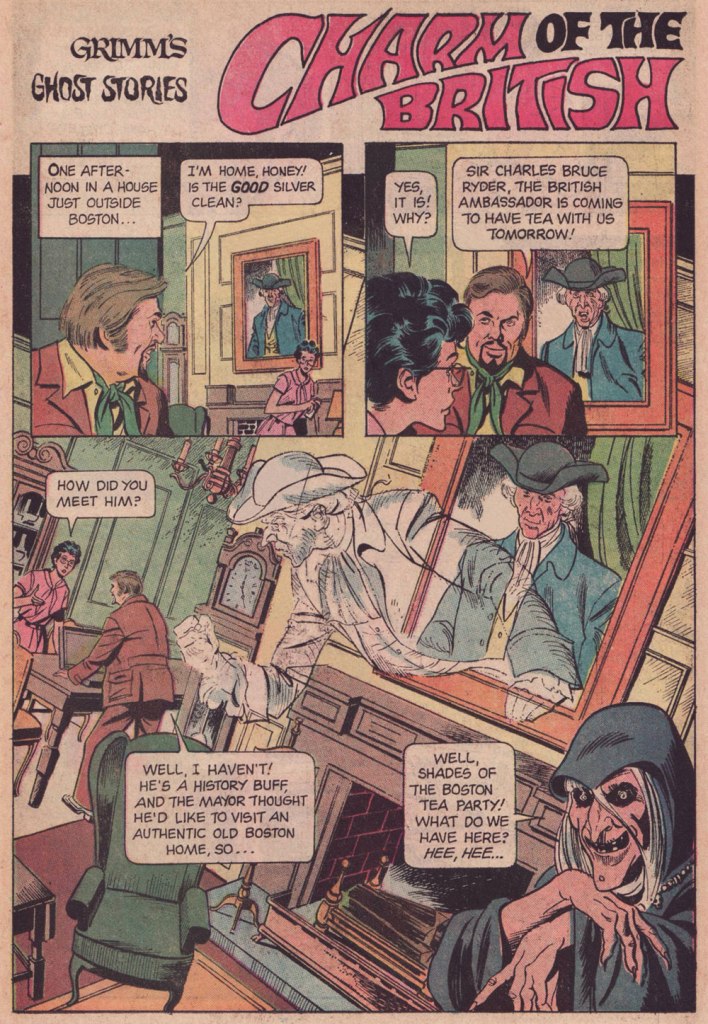
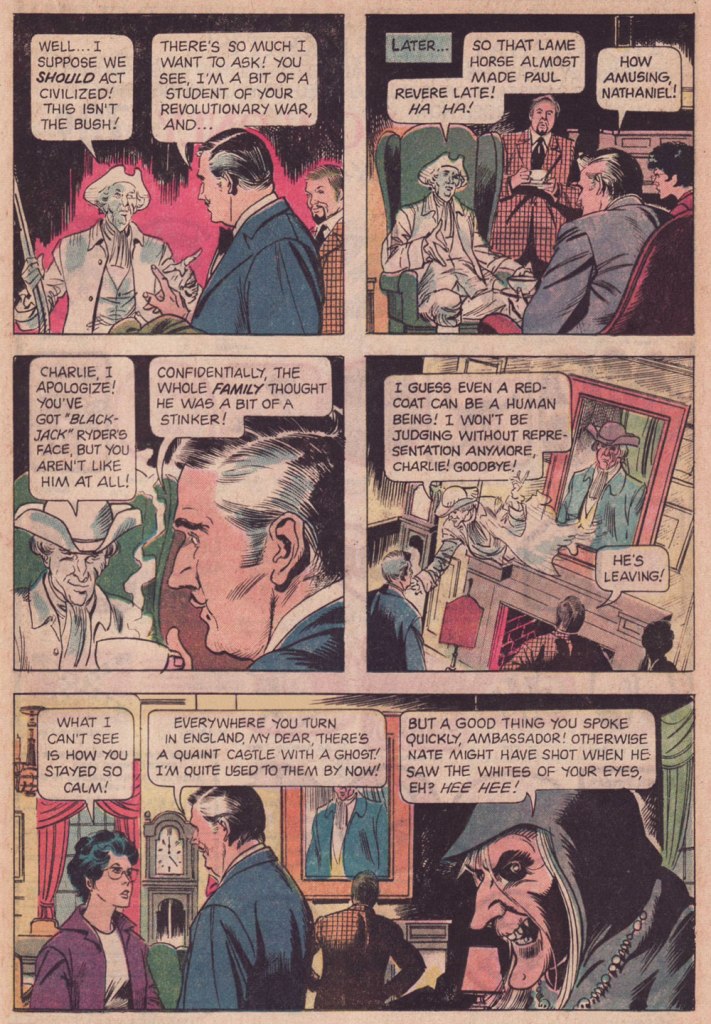
And here’s our featured tale: Charm of the British, first published in Grimm’s Ghost Stories no. 22 (March 1975, Gold Key).

Before I return the floor to Freff, it bears mentioning that this tale was illustrated by Argentine cartoonist José Delbo (born in 1933 and still among us), then on the cusp of a five-year run on DC’s Wonder Woman. Delbo was quite recently in the news for the astonishing windfall he received from a crypto artwork auction. In these uncertain times, what 87-year-old on a fixed income couldn’t use an extra million to top up his or her nest egg?

While I confess I’ve never quite warmed up to most of Delbo’s DC work (his inkers did him no favours), I do have a soft spot for his solid run on Charlton’s Billy the Kid (1966-74!), I dug his deft comic touch on Dell’s The Monkees, and let’s not forget his inspired work on the real ‘weird western tales’ series, Charlton’s gonzo Geronimo Jones (1971-72).

I hear James Mason as the British Ambassador. How about you?

And now, with a first-hand account of its genesis, Mr. Connor Freff Cochran!

The publication date of the issue with “Charm of the British” was March 1975. Gold Key comics typically hit the stand a month sooner than the official date, so that makes this a February 1975 release. From that, and some internal clues, I can narrow the writing window down to the first three weeks of September 1974.

I’d been away from NYC all the previous summer, living in Champaign-Urbana, IL, where I was self-training just in case my application to that year’s Ringling Brothers Clown College was accepted. I finally got word that I’d made it when I arrived at the World SF Convention, which was held over Labor Day weekend in Washington, DC. (One day later I went out for Chinese food and got a fortune cookie that read “You will visit a strange place and find fresh work.”) The Clown College started on September 23rd and ran for just over two months, during which time I would be unable to do any paying freelance work. So between the end of WorldCon and flying to Venice, FL on 9/22, I crammed in every job I possibly could – which included selling and writing as many Gold Key stories as I usually did in three or four months. Wally Green and Paul Kuhn knew I would be unavailable until late November/early December at the soonest, so they did something they hadn’t done with me before, and built up inventory.

“Charm of the British” was one of those inventory pieces. It paid $60 (my page rate for scripting was $10), and looking back I have no idea what the exact trigger for the idea was. Most likely it was improvised during a pitch & sell session with Paul. Those were always insane. The typical structure: I’d come in once a month with 8-10 ideas, knowing that I needed to sell five or six to guarantee my monthly budget. Paul would say yes to one or two and reject the rest. At which point the improv would begin, with me inventing more stories on the spot while he tried to get me to leave… something I would only do after getting him to say yes as many times as needed. I was 19 years old, and it was great training for a creative future. 

The title’s a minor bit of wordplay, of course – “charm” as in magic and manners, both.

Grimm  always had to have jokey intro and outro lines for each story. The outro on this one wasn’t anything to be proud of, but all these years later I’m still happy with the punny “shades” (of the Boston Tea Party) in the intro.

These were stories for young kids, so you couldn’t go into detail about anything. But I did enjoy slipping in as many real Revolutionary War references as I could, both direct (namechecking Paul Revere) and indirect (referencing Revere’s profession by having my lead character ask for “the good silver” in the first panel). “I won’t be judging without representation anymore” is obviously a riff on “no taxation without representation.” No child who read this comic book was ever going to remember it years later, when they encountered the real phrase in some history class, but maybe a bit of subconscious memory would help the knowledge stick, you know? In any case I enjoyed playing with all these references.

Page 2, panel 2: I absolutely did NOT write that unnecessary “Why, No!” Either Paul or Wally or the letterer added that. Didn’t make sense to me then, and makes no sense to me now. Similarly, the “Thinks they he can come in…” in panel 4 on that page is definitely an editing/letterer goof. I wrote “Thinks he can come in…” 

As usual, my character names referenced friends, sometimes combined with private jokes. Fan friends Eli Cohen and Susan Wood had begun dating recently, so I named the house owners “Eli and Susan Wood” (though all reference to the name “Susan” somehow vanished in the editing process). Susan eventually became one of the major academic names in the science fiction field, before she sadly passed, much too young, in 1980. Our visiting British Ambassador got the name of a junior high school friend of mine who had spent a lot of his childhood growing up in Europe. These days he’s a partner with the law firm of Thompson Coburn LLP, in St. Louis. Revolutionary War ghost Nathaniel Emerson is a combination of Nathaniel Hawthorne and Ralph Waldo Emerson (they were neighbors in Concord, MA for a time), with a sideways nod to NYC fan David Emerson. David had recently shared an apartment with Eli Cohen, so it amused me to have an “Emerson ghost” hanging around to haunt an Eli living space…

Looking back from today, it amuses me to think of Outlander’s evil British soldier “Black Jack Randall” and his nice-guy modern descendant, who both have the same face. It’s a neat coincidental lineup with my evil British soldier “Black Jack” Ryder and his nice-guy, same-face descendant.

Overall… confronted with this story after nearly 50 years, I’m pleasantly surprised. It’s got some nice lines, it turns in unexpected directions, and none of the characters are idiots (though they are all amazingly blasé about spectral appearances). I can imagine the Ambassador and the ghost of Nathaniel Emerson becoming the best of friends, making regular visits back and forth across the Pond… and hanging out together in the afterlife when the Ambassador finally dies from eating one too many diplomatic desserts.

Alternatively, of course, there’s a story to be written about the Ambassador coming home to England and being haunted by Black Jack’s ghost, who is appalled that any descendant of his would make nice with Yankee riffraff like Nathaniel…

Again, my heartfelt and slightly befuddled gratitude to Mr. Cochran for all his cordiality and patience. We’ve more of it to share with our readers, so expect a sequel in the near future. Cheers!

-RG

Dateline: Frontline – The Cary Burkett Interview, Part 3

« From time to time a sputtering doodle-bug shatters the torpor of the overcast sky. One second, sometimes two … at most three … of silence. Visualizing that fat cigar with shark fins as it stops dead, sways, idiotically tips over, then goes into a vertical dive. And explodes. Usually it’s an entire building that’s destroyed. » — Jacques Yonnet

Perhaps the title gave the game away, but we’re back with part three to wrap up (in style!) our talk with Cary Burkett on his and Jerry Grandenetti‘s (and Ric Estrada‘s) Dateline: Frontline (1977-1981).

Who’s Out There: How hands-on an editor was Paul Levitz?

CB: Paul was more hands-on at the beginning. We would have a plot conference and he would toss out suggestions and sometimes specific directions. But Paul was a very smart guy, and he had a way of figuring out how to best to work with individual writers. With me, it usually worked better to plant a seed and let it develop rather than to nail things down too tightly. I didn’t think fast in a plot conference setting, I was too intimidated by Paul’s creativity and confidence. I think Paul figured this out and found ways to drop a little guidance in that I could take time to mull over on my own.

Paul was also extremely busy, not just an Editor but the Editorial Coordinator for the whole line of DC comics, and that is a whopping responsibility. So as things progressed, he was less hands-on. I like to think he began to trust the material I was giving him.

WOT: Was there much distance between the précis Mr. Levitz assigned you to do and the scenario you handed in?

CBI don’t think so.

WOT: Dateline: Frontline is clearly a bit of a ‘pill in the hamburger’, that is to say, instructive, eye-opening material. Was this ‘Trojan Horse’ approach considered and deliberate? (Surely it wasn’t just intended as pure entertainment!)

CBIn a way, it was deliberate, although not carefully considered or planned out. The trajectory was set by Paul when he passed on to me the book The First Casualty as background guidance. The tone of that book and all the eye-opening material in it definitely influenced the approach to the series. The very idea that the main character would be a war correspondent, not a soldier or fighter, meant that these stories would have a different kind of focus. That concept came from Paul, along with the title of the series.

Of course, in comics, you could do a series with a war correspondent where the protagonist becomes a fighter, a behind-the-lines de-facto special forces soldier. If this had been a Jack Kirby strip in the ‘60’s, the correspondent would probably be thrown into situations every issue where he had to fight his way out to save threatened soldiers from some Nazi ambush. You know what I mean.

So we knew we weren’t going for pure entertainment, sure. And the more research I did, the more interested I became in the reality of what happened in the war, and the more I wanted to portray that. And since it was just a 6-page, irregular backup series, we could go in that direction.

WOT: If you were to write this series today, what, if anything, would you do differently? What effect might the intervening years and the current political climate have, for instance?

CBToo much to think about. But I will say this, I think to try to tie the series to any current political issue would tend to push it into something contrived to fit the agenda. In a way, then, it would become a kind of political propaganda, the very opposite of what the series grapples with.

That’s part of why I wasn’t so interested in setting it during the Vietnam War back in 1976 or ’77. Today, it could be put in that setting without triggering a firestorm of controversy which might drown out what the series is trying to show.

My point is that the issue of seeking truth in a time of war is not limited to any time or place. By attaching the theme to a current political hot button issue, it becomes weaker, not stronger. It becomes more limited, not broader. And it’s more difficult to hear.

My preference would be to see the series deal with the questions outside of the current political setting, and hopefully along the way to see in some way how they apply today.

Maybe that is the ‘Trojan Horse’ method you mentioned.

WOT: I’d say you nailed it.

WOT: Were you writing and planning much in advance? Are there any contemplated, but unpublished, plotlines you’d care to share?

CBI wasn’t planning specifically very far in advance. I was never sure which set of stories might be the last. But I had a vague outline in my head that I would progress through the major events of the war, choosing specific ones for Clifford to be present reporting. They would be chosen for their historical significance but also to advance general themes of the conflict between reporting the truth and trying to win a World War.

The final series of stories, I think, would have been centered on events in Hiroshima and Nagasaki, and somehow Clifford would have found a way to write a story about it which revealed some of the horrible details … which of course, would never have seen the light of day. Even now, thinking about this, some lines of dialogue closing out the series kind of come to my mind.

I see Clifford, exhausted and disappointed, having given his all to get this incredible story, bitter and at the breaking point. Like it happens to all of us sometimes, the fact that he can’t publish this story seems to him to be an event that sums up his whole life as a failure. He questions why he made such a herculean effort to get the story, why he ever even bothered to try. All his previous failures to get the truth out come back to accuse him.

Maybe it’s his old mentor, the older reporter who tried to ground him a few times, who has the last word. And those words would be about the truth, and the value of searching for it no matter the outcome. And that the truth itself will stand even if only one person knows it. And the old reporter, cynical as he might have seemed at times, would be shown to have his own ideals which have sustained him through the same battles that Clifford has fought.

Yeah, maybe it sounds a bit corny out of the context of the story. But I think I’d go there. I might even have the old reporter say something like, “Truth may seem to be the first casualty in a war. But Truth can never really die, right? Someday people will know the truth about what happened.”

HA! I never expected a story idea for Dateline:Frontline would pop into my head like that after all these years. Seems like this would be a good closing question for this interview. I appreciate you bringing it up, and thanks for giving me a chance to reminisce.

WOT: And thank you for doing it so thoughtfully and graciously.

WhoThereLogotype

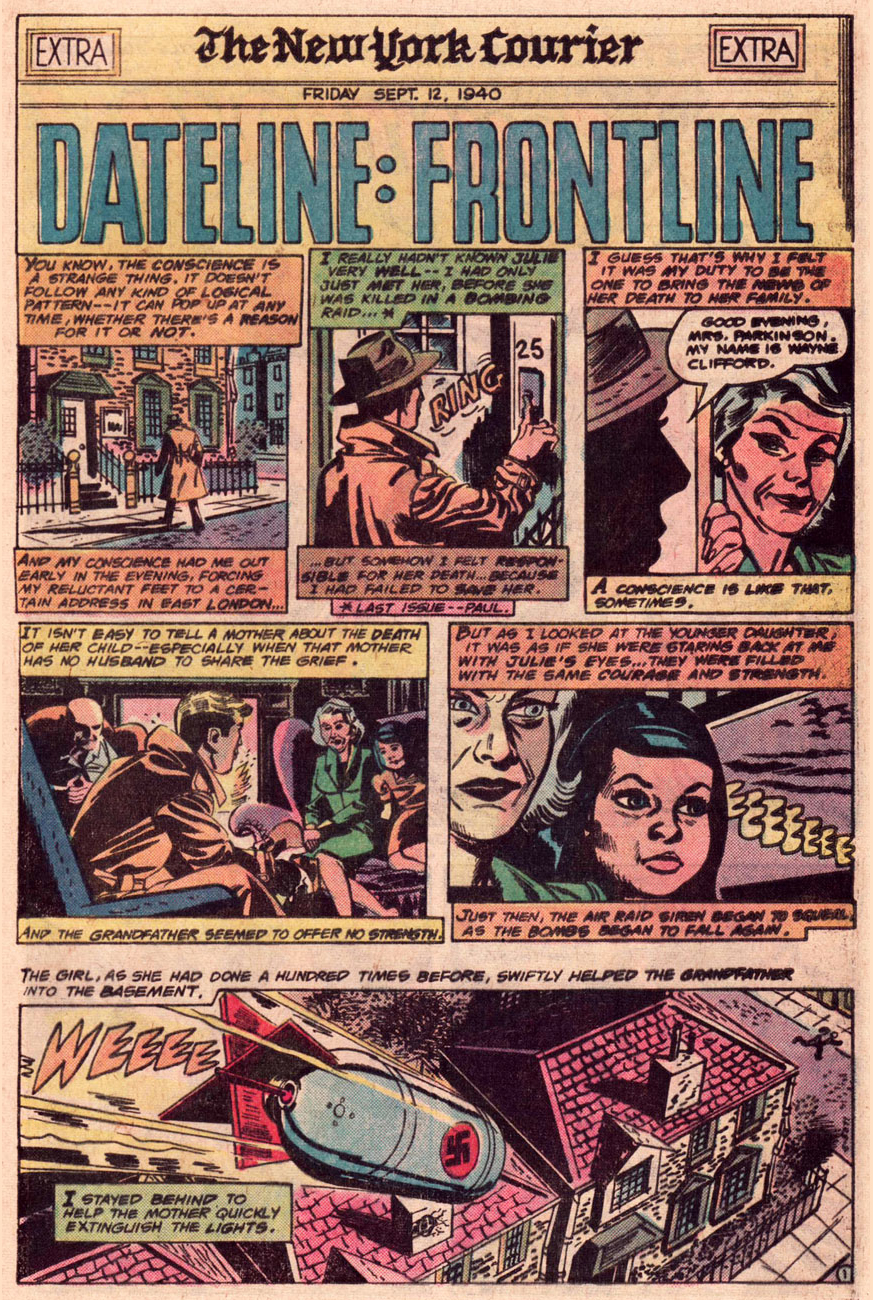
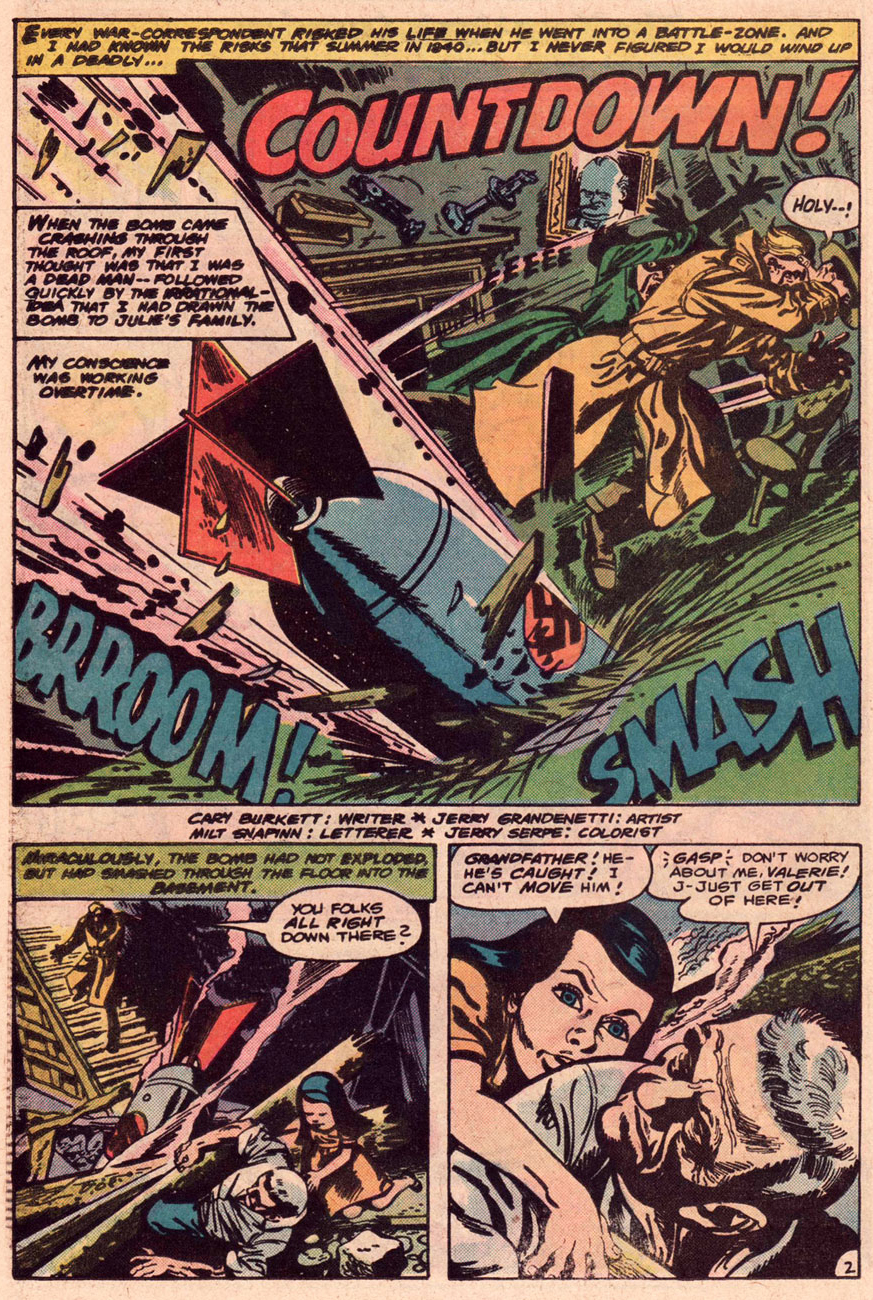
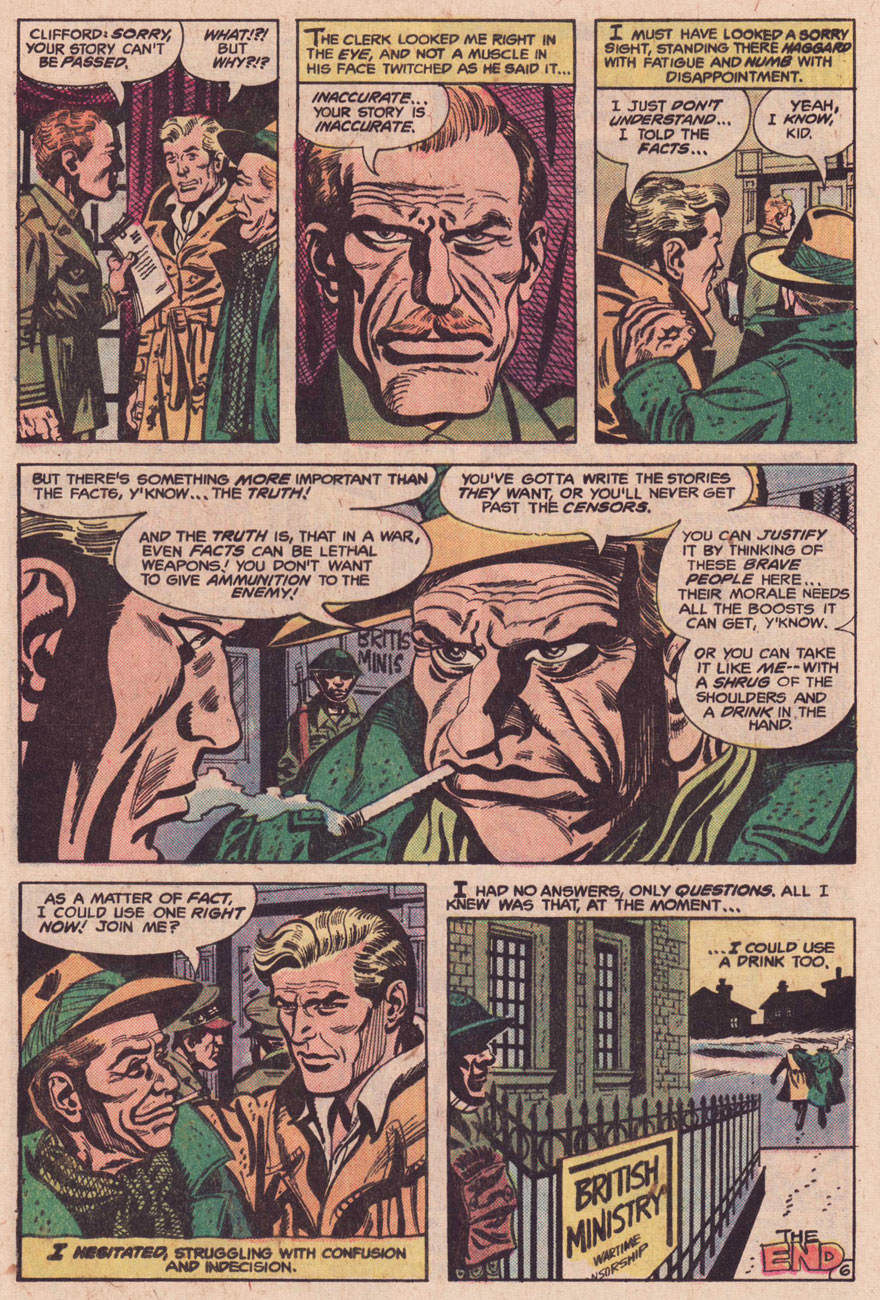
And now, to see our readers off with a story, here, as promised last time, is the concluding episode of Dateline:Frontline’s London trilogy.

Dateline3London01ADateline3London02ADateline3London03ADateline3London04ADateline3London05ADateline3London06A

And as a parting bonus, a vintage in-house biography of young Mr. Burkett!

BurkettBio78A

-RG

Dateline: Frontline – The Cary Burkett Interview, Part 2

« A reader has the right to ask for all the facts; he has no right to ask that a journalist or historian agree with him. » — Herbert Matthews

And we’re back with part two of our examination of Cary Burkett and Jerry Grandenetti‘s Dateline: Frontline (we’re not forgetting the famously-ambidextrous Ric Estrada, who took over illustrative duties in the second half of the series). In part one, Mr. Burkett graciously opened for us a window on the series’ genesis. In light of these privileged behind-the-scenes gleanings, as well as a reading of the series’ springboard text, Phillip Knightley’s The First Casualty, I formulated  a series of follow-up questions, of which we present the first half, along, of course, with Mr. Burkett’s insightful and modest responses, followed by chapter 2 of the first D:F trilogy.

Who’s Out There: Was there much deliberation on your part regarding the specific setting of the series?

Cary Burkett: I vaguely recall that in an early meeting with Paul Levitz we mentioned the possibility of setting the series during the Vietnam war. Or rather, I think he may have mentioned it. But I never had any interest in that from the beginning. That war was too close at the time, and I didn’t think I could do it. Research was a lot harder to do in those days, and I was too green as a writer to want to tackle that controversy.

If my memory is right, I think he left it up to me, and I very quickly settled on the World War II setting. There were a lot of reasons in my mind for that, including the wealth of research material available.

But the biggest thing was the fact that the U.S. started out as “neutral” in that war. I felt a story arc right away of a young reporter who began as a “neutral” observer, wanting to be an objective journalist, but over a series of events finding himself unable to keep from being drawn in and taking sides, despite his proclaimed neutrality.

At the time I didn’t know how long the series might last, but it was my intention to gradually move Wayne Clifford from a naïve journalist with laudable ideals into a conflicted character grappling with the very gray areas of war reporting and the messy questions of patriotism and propaganda.

WOT: In writing the series, did you ever find yourself at odds with the, er, ‘official record‘ of history?

CBI wouldn’t say that exactly. The truth is, I had only a sketchy knowledge of World War II history, and little idea of what the “official record” said. So I set about to educate myself.

One really good current documentary at the time was The World at War narrated by Laurence Olivier. I watched a number of episodes of that. What I realized from watching it was how much the history I had heard and read was centered on how the U.S. and England had won the war. This documentary was one of the first western pieces which really pointed out the importance of the Russian contribution.

That led me to other research and made me want to do a series of stories set in Russia. Of course, the insane difficulties of trying to report the truth during a war in the middle of Russia appealed vastly to me and provided a lot of opportunities for conflict on a lot of levels. I felt I barely scratched the surface in those Russia stories.

One thing about doing research; you start to get interested in all the little details. You want to include much more than you really can. You have to be careful to let the story reveal the details when it is important to the story, but not to let the research itself become the story.

I struggled with that in writing those Russia stories, because much of what I was finding out was really eye-opening to me. What I knew about the war in Russia I had learned mainly from watching Hogan’s Heroes. In that TV comedy, the Nazis all feared being sent to the Russian front, so you knew it was cold and terrible. But that’s about all I knew.

When I began to read about the scope of the tragedy and brutality of the war in Russia, I wanted to bring the reality of it into my stories. I wanted to shove it all in somehow. But my stories were a mere 6 pages long in each issue, so I had to just try to give little glimpses that implied a lot more.

Stephen King’s advice to writers is to “kill your darlings”, that is, to get rid of your pet favorite bits so they don’t bog down the story. Those Russia stories were ones where I felt I had to keep killing those “darlings” over and over.

WOT: Was there any friction with DC’s brass, or was the series too far under the radar for them to notice? If so, did that allow you more leeway?

CBWe were definitely way under the radar, but I don’t think that the stories would have caused any stir even if they had been noticed. I don’t think there was anything subversive or strongly controversial about them. They were different from the usual comic book war stories, but not in a way that would cause any issues.

The lead stories of the books featured Gravedigger, or later, The Unknown Soldier. These were the stories that were there to sell the book, and these would have gotten more scrutiny. They were the typical action-oriented comic book war stories, sometimes just a step away from fantasy. Sometimes not even a step.

With a long-running lead character in a war series, you have to be a bit looser with timelines in the war. I suppose it’s a convention of the genre that the character might pop up in Okinawa in one story, then many issues later have a story related to D-Day, even though D-Day would have happened well before Okinawa.

Maybe it’s because the main character was a journalist who was dedicated to getting the facts right, but I decided that my timeline was going to be accurate. The series would start with the U.S. as a neutral country, and we would later see the USA join the war, and all of the historical events would follow in the order they occurred.

WOT: Was the rotation of backup features decided from the start? Was it some sort of commercial compromise?

CBI don’t really know. I think the idea was mainly to have variety in the backups. It was a common template for older DC titles like Action Comics or Adventure Comics in the ‘60’s. One issue would have a Green Arrow backup, the next maybe Aquaman.

My own speculation is that as an editor, Paul was drawn to that kind of setup, and felt it gave the reader a little something extra. That’s just my own thought, he never told me that. But I know he was a comics fan, and I think he was glad to have a place where Enemy Ace could still fly through the pages of a DC Comic.

WOT: Given the wealth of material you dug up in the course of your research, it must have required considerable effort of concision to craft such spare chapters. Did you go through a lot of drafts?

I did struggle to find ways to get my stories into the six-page frame and did quite a few re-writes, trying to balance the pace so the story didn’t seem rushed but also had enough meat.

There were compromises, for sure. In what I considered to be one of the key stories, Clifford, still a neutral reporter, takes a rifle and kills an Axis soldier attempting to kill his English friend. I had been leading up to this decision since the beginning of the series. Here he is forced to admit that he is neither neutral nor objective as he thinks of himself.  I would have loved to have had a bit more room to let that sequence play out with more significance.

No doubt, I could have done a better job even in the space I had. In the end, I felt that it came out a bit weak and contrived.

WhoThereLogotype

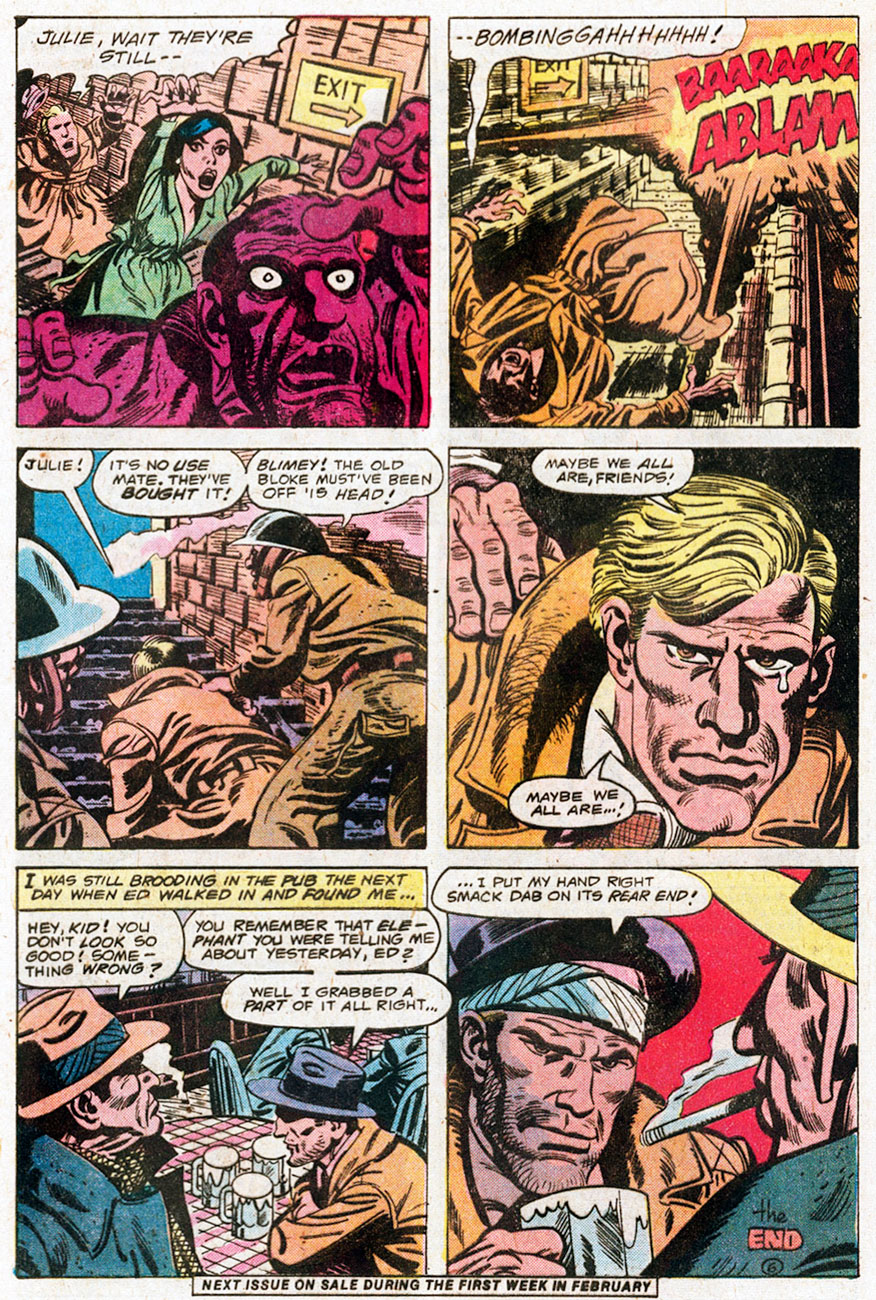
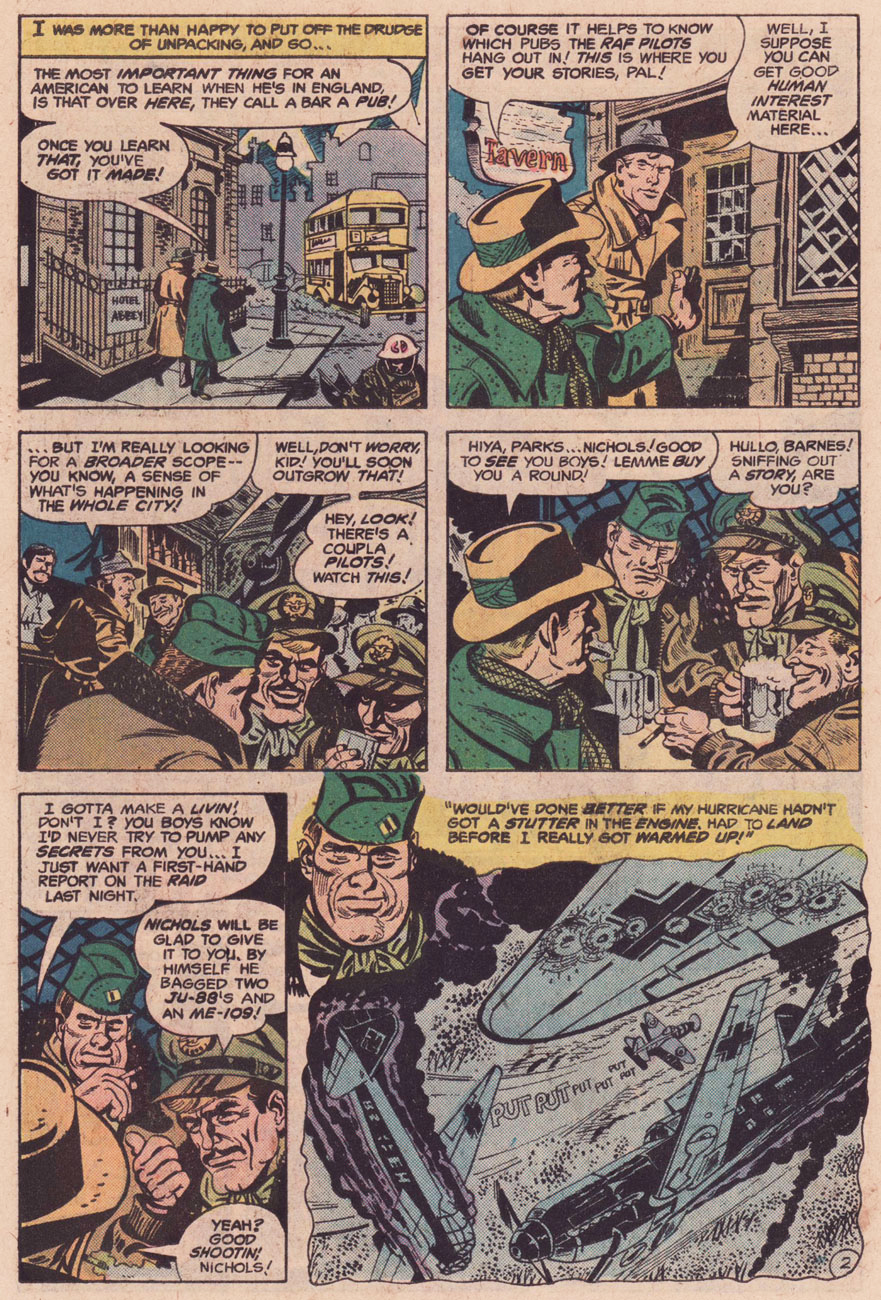
Now, let’s rejoin Wayne Clifford and his buddy Ed Barnes, who were, when we saw them last, off to the pub…

Dateline2London01ADateline2London02ADateline2London03ADateline2London04ADateline2London05ADateline2London06A

That’s it for now! Stay tuned for the conclusion of our talk with Cary Burkett, along with part three of Dateline:Frontline’s London trilogy.

-RG

Dateline: Frontline – The Cary Burkett Interview, Part 1

« All studies of propaganda tell what a powerful weapon it is; that since armies fight as people think, it is essential to control that thought. This means some form of managing the news, and the only question is the degree to which the news should be managed openly and the degree to which it should be managed subtly. » ― Phillip Knightley, The First Casualty: The War Correspondent as Hero, Propagandist, and Myth-maker from the Crimea to Vietnam

In most collectors’ lives, there’s a degree of more casual, automatic accumulation. Things you pick up for a song, just because the opportunity arises, and that you file away, planning half-heartedly to look them over when you find the time. As a devoted Jerry Grandenetti fan, I always pick up his work… but I favour some genres over others. Mr. G has crafted, for instance, a lot of war comics for DC over the years (1952-1984!), most of which I haven’t seen. For me, it’s always been about his horror/mystery work. So… I had picked up, somewhere along the line, a consecutive pair of issues of DC’s Men of War (26 issues, 1977-80), numbers 9 and 10, featuring the first two parts of a Dateline: Frontline backup sequence, « Bathtub Blues » and « Glory Soldier ». I was very, very impressed.

Now, most of DC’s war books were scripted by a small cadre of authors, namely the indefatigable Robert Kanigher, as well as Bob Haney, Ed Herron, Jack Miller… but mostly Kanigher. In the Seventies, things changed a bit, with solid help and variety coming from Frank Robbins and David Michelinie on The Unknown Soldier, for instance. I had encountered Cary Burkett’s name here and there, being a regular reader of Batman titles The Brave and the Bold and Detective Comics, where he scripted backups (Nemesis, Batgirl) and the occasional lead feature. But this was… different. Hard-hitting, quite free from convention, and damn well buried in the back of a second-tier war book.

I hunted down the rest of the D:F series, and my initial impression did not fade… quite the contrary, indeed. The third serial (MoW 21-23), set on the Russian front, actually brought some tears to my eyes. Why was this feature so little-known? Oh, I know… the usual reasons. But I wanted to find out more, and the next logical step was to reach out to the series’ surviving author, who was happy to oblige, to my delight. And so here we are. The stage is yours, Mr. Burkett.

Dateline: Frontline recollections, by Cary Burkett

« Paul Levitz was editor of a new war comic called ‘Men of War‘ featuring a character called ‘Gravedigger’.  He wanted to have backup stories in each issue, and he came up with the title ‘Dateline: Frontline‘ and the idea that it would feature a war correspondent as the main character. I was working as his assistant at the time (1976), and he asked me to do a series of 3 six-page stories.

He pointed me toward a book called ‘The First Casualty‘ by Philip Knightley. The title was inspired by a famous quote ‘The first casualty when war comes, is truth‘.  The book was a history of war correspondents from early days of reporting through the Vietnam War. It became a basis for the new comic series in terms of setting up the inner dilemma of the main character, which was how to report ‘the truth’ in time of war.

I chose to set the series in World War II and named the main character Wayne Clifford. My idea was that he would begin his career as a war correspondent being very idealistic and naïve. Over the series of stories, he would come face to face with wartime situations which challenged his assumptions about news reporting, war, ‘truth’ and about himself.

That, in a nutshell, was the core of the series.  I chose to set the narration in first person, which I guess is pretty much the standard in comics now, but was not common then.

After the first 3 stories, Paul asked me to continue the series. But we kept the idea that the series would be done in groups of 3 related stories.

I did a lot of research to depict true, historic wartime settings which I hoped would show more aspects of war than to just have the hero ‘fight the enemy’ and stop the Führer’s latest grand plan.

Paul had gotten Jerry Grandenetti to be the artist on the series from the very beginning. I admit, when I first heard this, it didn’t thrill me. I was not that familiar with Grandenetti’s work, but I had seen a few stories he had done and had been put off a bit by his strange, exaggerated style.

But when I saw his art for my first DF story, I realized why he was such a respected artist. His expressionistic kind of style emphasized certain qualities that gave a distinctive mood to the story.

But what I felt the most strongly was that Grandenetti understood how to make the story flow. If you could let yourself be drawn into the visual universe he created, it would come alive. The sequences of images he created would merge into one storytelling stream.

I didn’t know at the time that Grandenetti had worked on The Spirit with Will Eisner, but that strong storytelling aspect of his art was what I responded to most when I saw Jerry’s work on my stories.

My Dateline:Frontline stories were done ‘full-script’, meaning I wrote out full panel-by-panel breakdowns for the artist to follow. And I could see how Jerry would take my panel descriptions and make them flow into each other. If I was going for a specific kind of pace or mood with a sequence, Jerry immediately knew what I was after, and knew how to emphasize it visually.

I worked with very few artists who had Jerry’s instinctive grasp of this and his skill for executing it. »

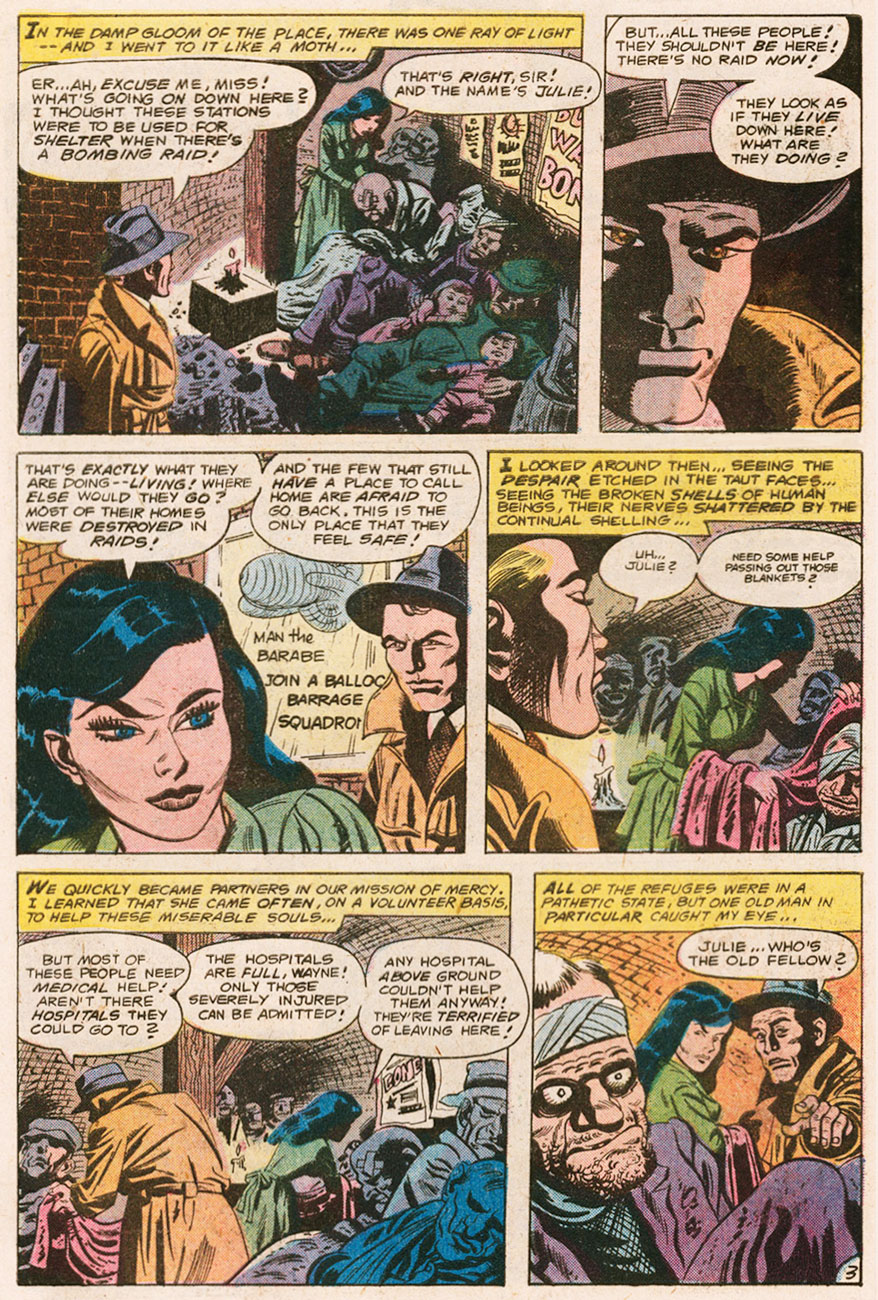
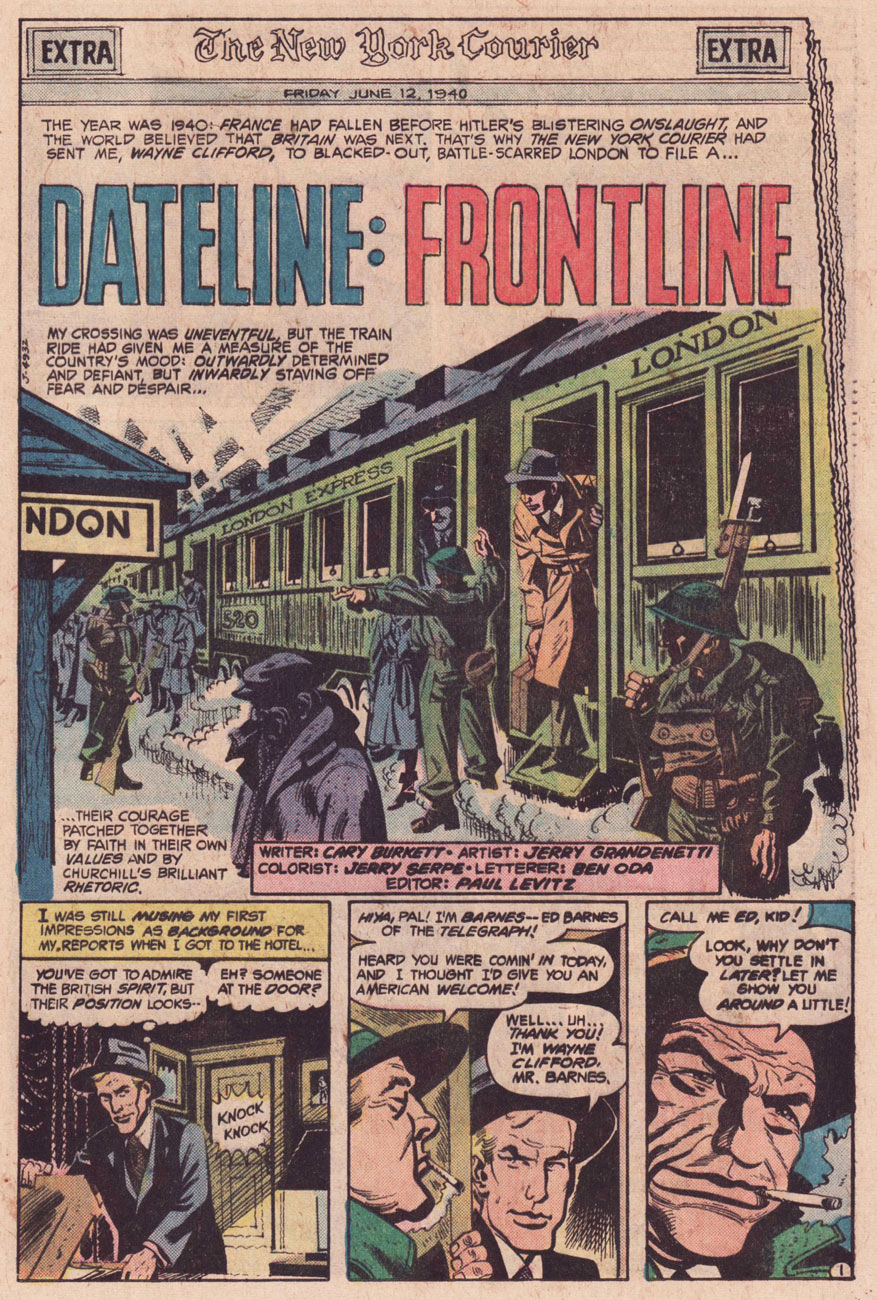
DatelineLondon01ADatelineLondon02ADatelineLondon03ADatelineLondon04ADatelineLondon05ADatelineLondon06A

Each Dateline: Frontline episode was conceived to stand on its own, but be part of a larger trilogy. This London entry, the series’ introduction, appeared in Men of War No. 4 (Jan. 1978). In part two of our talk with Cary Burkett, we’ll feature the second London chapter, « Human Interest Story » and our guest will generously answer some of WOT’s questions.

Incidentally, but not coincidentally, one hundred years ago today, on the 11th  of November, 1918, the Armistice of Compiègne was signed, formally ending the First World War. The event is commemorated each November 11 as Armistice Day or Remembrance Day.

Make-War-No-MoreA
This eloquent little tag appeared at the end of DC’s war stories, at least those edited by Joe Kubert, in the early 1970s.

Continue to Part 2 of the Cary Burkett interview.

-RG

Mike Royer’s Cruisin’ Years: the Interview, part 3

« And by the way, did I see you without a Pookie Snackenberg button? »

Concluding our exclusive conversation with Mr. Mike Royer, picking up the thread from where we left off in Part Two. And don’t forget to begin with Part One.

RoyerCruisin'YearsA
This illustration served double duty, first as a sampler released with the second batch of Cruisin’ albums in 1972, then on a box set collecting Cruisin’ 1955-56-57.

RoyerCruisin'YearsBox2A
Historical research in those days wasn’t as tidy and simple… and so here, either Peggy’s lying or…  Elvis Presley’s third and final appearance on Sullivan’s show was on January 6, 1957. And The Blob wasn’t released until September 10, 1958. Well, Peg?

RoyerCruisin'YearsBox3A
Royer’s new illustration for the third and final box set, the one gathering Cruisin’ 1961-62-63, issued in 1992.

WOT: Are you happy with the overall work?

Michael Royer: I would say… two-thirds of the covers, I’m really pleased with. I can look at them and pickle the living daylights out of them. The Cruising’ Years… I look at it, and some of the proportions bother me. The scrapbook is too small, compared to the photo on the desk, and other little things that, if I were gonna do that again, I would adjust those sizes. But then again, that’s the impression I get, I guess, that’s important.

WOT: True.

MR: The one where Peggy sees Eddie behind her in a car at the drive-in is my least favorite of all of them.

WOT: Do tell.

MR: Because Paul had given me an impossible thumbnail. To make it work, so that they were all on the same planet… Ah, it’s really easy to lay out something and have two cars and the drive-in theatre lot, and not worry about if they’re on the same plane, if they’re seen from the same point of view… and so to do that and make it work… I still look at that and I get disappointed.

MR: I really like the one where he’s outside and it’s snowing.

WOT: And he’s with a black lady? That’s 1966.

MR: The black lady is looking at him… kind of suspiciously, and it may have something to do… because he’s in her neighborhood. I’m trying to remember if his early career at the law firm was dealing with…

WOT: Social issues?

MR: And I can’t remember, every tv screen’s got the same thing on it. Is it the Batman logo?

WOT: Confirmed. You were right on the money.

MR: Here we are, all the Cruisin’ cds. They have changes on them. Okay, let’s see. ’55 was the first one.

WOT: Actually, from what I’ve read, ’55 was actually done later, part of the second batch produced [in January, 1972].

MR: Yes, it was added in, and I don’t care for that one. I really like ’56, only because in retrospect, I look at it and it speaks to me. ’57, okay. ’58, only because of the subject matter and Paul’s layout… ’59 is the one where I went to South East Los Angeles, to the car lot that had the dashboard. It had to be that, after so many years, if anybody had one, they just had to go “heyyy!“, you know.

MR: 1960 is… not as bad as I remember! At least I made his layout work…

WOT: That’s good news.

MR: And ’61, is, yeah, they’re about the break up. And Cruisin’ ’62 is.. ha. They *are* breaking up. No, I guess it was a three year breakup, okay?

WOT: (laughs) Okay!

MR: ’63, they’re in the coffee shop, and that’s the Studebaker… now waitaminit, what’s the one on… that’s not a Studebaker on ’61, that’s an Olds, so the Studebaker’s on ’63.

MR: ’64, there’s the announcement: “to wed Kevin Buchanan III…” And ’65 is ten years later, and it’s the same girl that was working at the library, but she’s gotten a little prettier.

WOT: No kidding? Subtle bit of continuity.

MR: And there’s Luthor on the board in the background… his concert, “New York Blacked Out” headlines, Up the Down Staircase… okay, ’66: oh yeah, “What this community needs is economic improvement and self-help!” Ah, yeah, all the TVs except one had Batman, and one of ’em has Luthor on it, singing.

MR: And ’67, that’s the one with Ron Jacobs coming out of the… through the beads in the back. And golly, it’s Genevieve again. Mmm!

WOT: The librarian from ’55!

MR: That’s her.

MR: And ’68 was the first one *after* The Cruisin’ Years. Ah, there it is; I should have them in the order they were released. So we redid 1968, “Vietnam Widows for Peace“, and I kinda liked the way that turned out. It was fun researching all of the fashions and things!

WOT: Good, because research wasn’t always a simple task.

MR: Ah, ’69, on their honeymoon, Niagara Falls Retreat; Newspaper headline: “Beatles to Split” “Eddie, I might want a career of my own“… I just sold the comp to that, I think in Charlotte.

WOT: Oh, wow. So I am being timely here.

MR: 1970: “Mike’s gonna give me another lesson”. I put myself in there, uh… idealized.

WOT: (laughs) So that’s what it is, then?

MR: And then there’s the Porky Chedwick, and somewhere in here… the Cruisin’ boxes. Whoa! There are… three of them.

WOT: What are they?

MR: The first box set has ’55, ’56 and ’57, and has the Cruisin’ Years cover, with the Peg and Eddie photographs, and the scrapbook, and the concert tickets and so on. The next one is ’58, ’59 and ’60, and that one is, Eddie is next to his Chevrolet with the tire kit on the bumper, and he goes “Come on, Peg! The Blob starts at 7:15!” “Eddie… we can’t go! Elvis is on Ed Sullivan tonight!

WOT: Poor girl’s chained to her TV!

MR: And the last box set was ’61, ’62 and ’63, and Eddie’s got the beard that he’s wearing in the college one, and Luthor’s leaning against a tree, and she says: “Oooh, Eddie… your whiskers tickle me!” and he says: “Peg… do you think Luthor sounds like Pete Seeger?”

WOT: These two were always moving in separate directions.

MR: Always! And so I wrote ’68, ’69, ’70, The Cruisin’ Years, and Porky Chedwick. And if I could the long box artwork, and one of the last ones I did, which I believe was gonna be another Cruisin’ Years, and it’s probably the sexiest Peg I ever did…

WOT: Aw…

MR: It’s Peg and Eddie… oh my God… *two* of them. I might have done another big box, because they’re at the beach, she’s in a bikini, and it’s another tension-filled thing…

WOT: Her bikini?

MR: Oh, he’s saying: “Who’s this Buchanan the third?“, so that fits in the chronology somewhere. And the last one would precede their wedding, it’s where they’re on a bridge, in New York City, it’s a big closeup, they’re dressed to the nines, he’s in… could have been a tux, she’s in a sexy evening gown. And leaning on the rail, exposing her… attributes. The program was for a big Broadway hit of ’69, and he’s got his finger under his collar, kinda saying something to the effect of: “You know, Peg, there’s something I should have asked you… a long time ago“. It’s the proposal cover, you know.

Now I don’t know if that was ever produced. I also did another cover, which I know was not produced, and it was a Cruisin’ Christmas Album.

WOT: Whoa.

MR: And I actually drew my living room, in the house I had in Simi Valley [California] and Eddie, in his Santa Claus outfit is putting presents under the Christmas tree in the center of the room. And Peg is coming down the stairs in her sexy négligé, with her robe blowing open…

WOT: That’s his present.

MR: ’twas drafty in the house that night. And she’s got a plate, and she’s saying: “Oh, Santa… don’t forget your milk and cookies!” So it’s the only cover in the series without any tension.

WOT: Or the most tension, depending on how you look at it.

MR: I think we discussed doing ’71, but figured that there wasn’t enough happening that year to make an interesting cover, or the songs were too new in the late ’80s to get clearances or rights on them, you know.

WOT: Things have changed quite a bit… even the cd reissues are significantly different from the LPs. Reissuing certain pop-song heavy tv shows has proven quite a financial ordeal in some cases because of astronomical increases in the cost of music rights.

For that reason, the Cruisin’ LPs each have a few more songs than the cds, even if the opposite should be true, if only in terms of storage capacity.

MR: They lost rights, and stuff like that.

WOT: People didn’t know back then what was to come, obviously. The Cruisin’ series came out at just the perfect time, and I think it was quite visionary to decide to preserve, or recreate, what must have seemed at the time a very recent piece of the past.

MR: I wish that I had not given all of my vinyl discs to my first… son-in-law… and replaced them all with the CDs before I realized that there were the differences.

WOT: Not to mention the size of the artwork and quality of reproduction.

MR: Once the series was over, I sold Ron Jacobs all of the originals. And I kind of regret that in a way, because I could sell them for a lot more today than I did, in the early ’90s, to him.

WOT: Sigh. They’re heirlooms.

MR: I don’t know why I didn’t think to pull these things off the shelves and look at them before we talked.

WOT: Ah, it’s okay. In fact, it’s probably better: I got your spontaneous responses out of it.

MR: Actually.. overall, I’m more proud of them than I am disappointed. And the things that disappoint me, I can point out why and it doesn’t necessarily mean that it excuses the problems…

MR: Oh, and there was also a full-page ad… that was in Billboard. Peg and Eddie are sitting in the front seat of… probably a 1955 or 56, I think Ford convertible. I cannot remember.

WOT: On the contrary, you clearly remember plenty! (laughs)

MR: I’ve got it somewhere out in the garage, in one of the custom filing cabinets I had made that I call “Mike’s Life in a File Cabinet“.

RoyerBillboardAdA
The ad in question, from the July 11, 1970 issue of Billboard Magazine. Make a wish!

WOT: I think that I think this series is a great artistic success. When people see these volumes individually, they work as snapshots… but put them together, and you realize that there’s so much happening between the panels.

MR: Yeah, it does tell a story!

WOT: It’s beautiful storytelling, and I think, one of your crowning achievements.

MR: You know, it’s funny: the early covers were put into two books. The first one was a… I don’t know if it was a hardcover, it was a oversized, glossy trade paperback called The Album Cover Album [original edition 1977], and it says: “Paul Gruwell, art director, art by Mike Noyer“.

WOT: Oh, lovely. They got one name right.

MR: And the second book they were in, which I didn’t bother to buy, because all they listed was the Art Director. I wasn’t even listed.

WOT: This kind of thing, which I’ve noticed also, is what prompted me to get in touch with you. And I think we’ve done our bit here to help set the record straight. Thank you so much, Mr. Royer!

MR: You’re welcome, Richard. Have a great day!

WOT: You’ve certainly done your part in it!

RoyerCruisin'67A
Read the liner notes, or hear Cruisin’ 1967 in its entirety here!

RoyerCruisin'68A
Read the liner notes, or hear Cruisin’ 1968 in its entirety here!

RoyerCruisin'69A
Read the liner notes, or hear Cruisin’ 1969 in its entirety here!

RoyerCruisin'70A
Read the liner notes, it’ll have to do for now; regrettably, Cruisin’ 1970 isn’t currently available on YouTube! What is this world coming to?

RoyerCruisin'PorkyA
At this time, Cruisin’ With Porky Chedwick would appear to be the final entry in the series (1995). Listen to the whole platter right here.

-RG