Hallowe’en Countdown VIII, Day 7

« I prefer hallucinations ’cause they tend to make more sense than experience. » — Todd Rundgren

Today, I’m mixing things up a bit and heading over to Europe. We’ll be looking at various versions of « Le seuil du vide » (Threshold of the Void) a story by André Ruellan (1922-2016), aka Kurt Steiner.

At left, the original novel, published in 1956; at right, the comics adaptation, published in 1973. Believe it or not , both covers are the work of the same man, the prolific Michel Gourdon (1925-2011). He had a predilection for a palette of green and blue hues.

The plot, in a few broad strokes: Young painter Wanda Leibovitz comes to Paris, hoping to forget a romance gone wrong. At the train station, upon her arrival in town, Wanda encounters a mysterious old lady offering to rent her a room, but under certain conditions…

Basically, it’s the ‘New Bodies for Old’ plot, and it ends as bleakly as you might imagine. Ruellan/Steiner wasn’t the least bit afraid to probe the darkness. The victim’s innocence was no protection against the forces besieging her, to put it mildly.

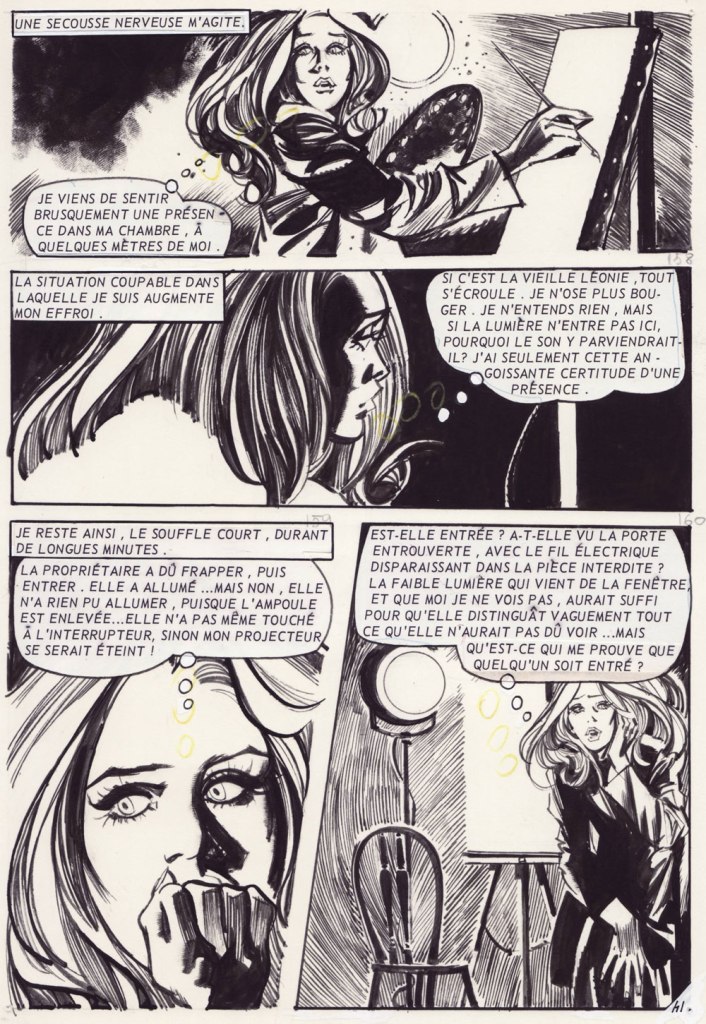
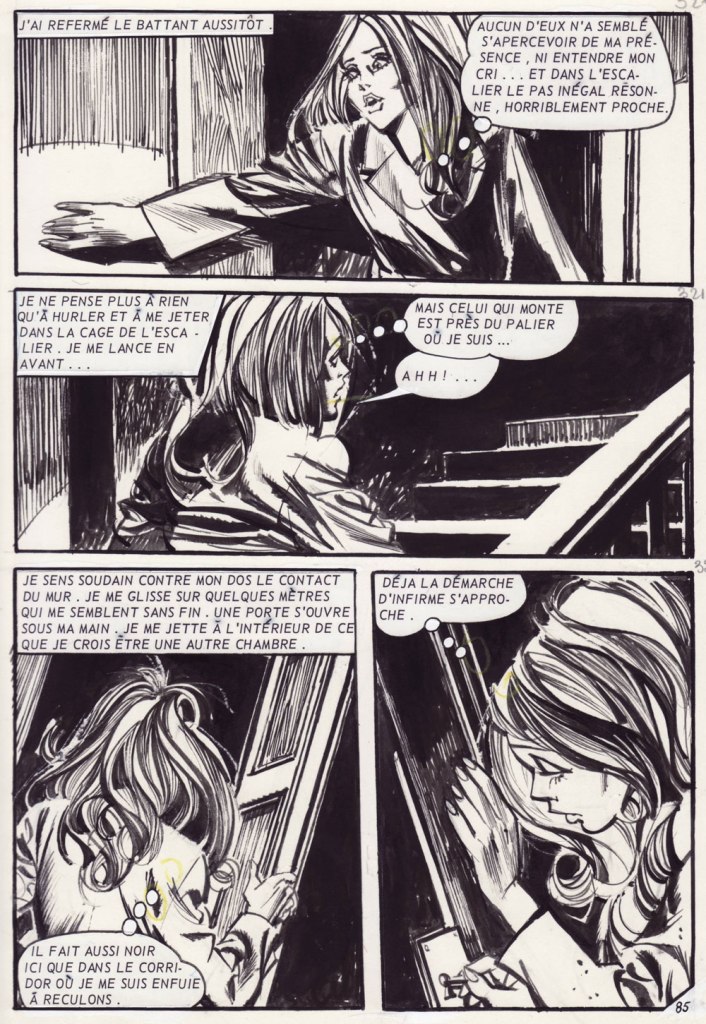
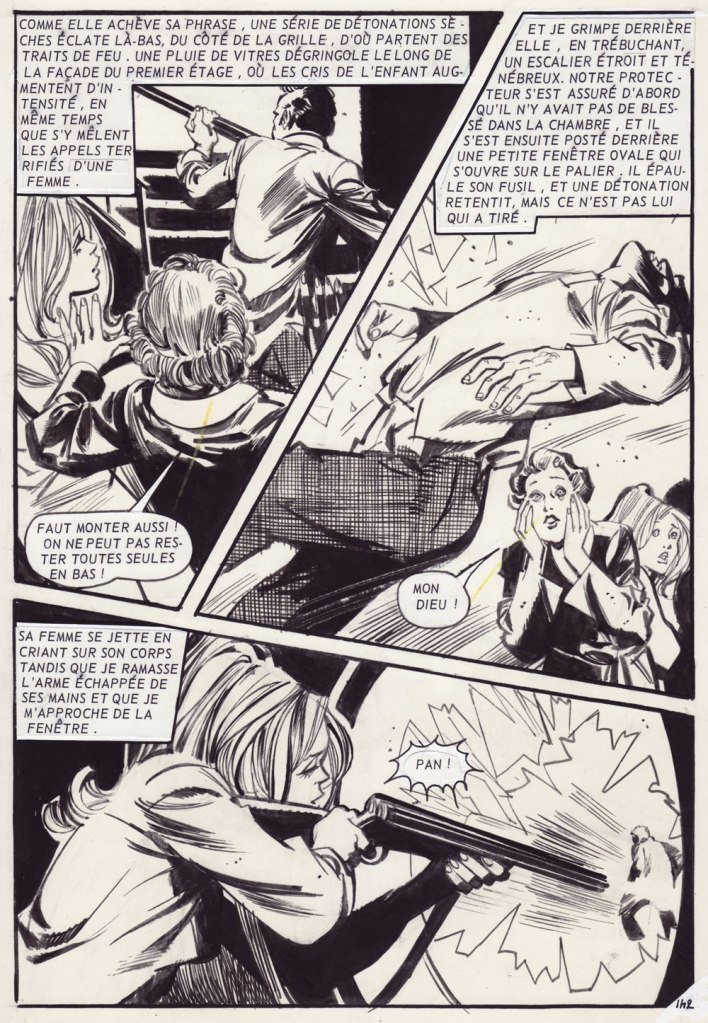
Here are a few interior pages from the Arédit adaptation, featuring art by Cándido Ruiz Pueyo.

There was also a movie adaptation by an ambitious young filmmaker by the name of Jean-François Davy. This was his third try at getting a project off the ground and into cinemas, and his only horror film. They just weren’t making such films in France in those days — the iconoclastic Jean Rollin being the notable exception — in Belgium, sure, but not in France. It took some doing to get the project (barely) financed, lensed and distributed, and its director wound up turning to porn for the rest of his career — hilariously titled porn, to be fair.

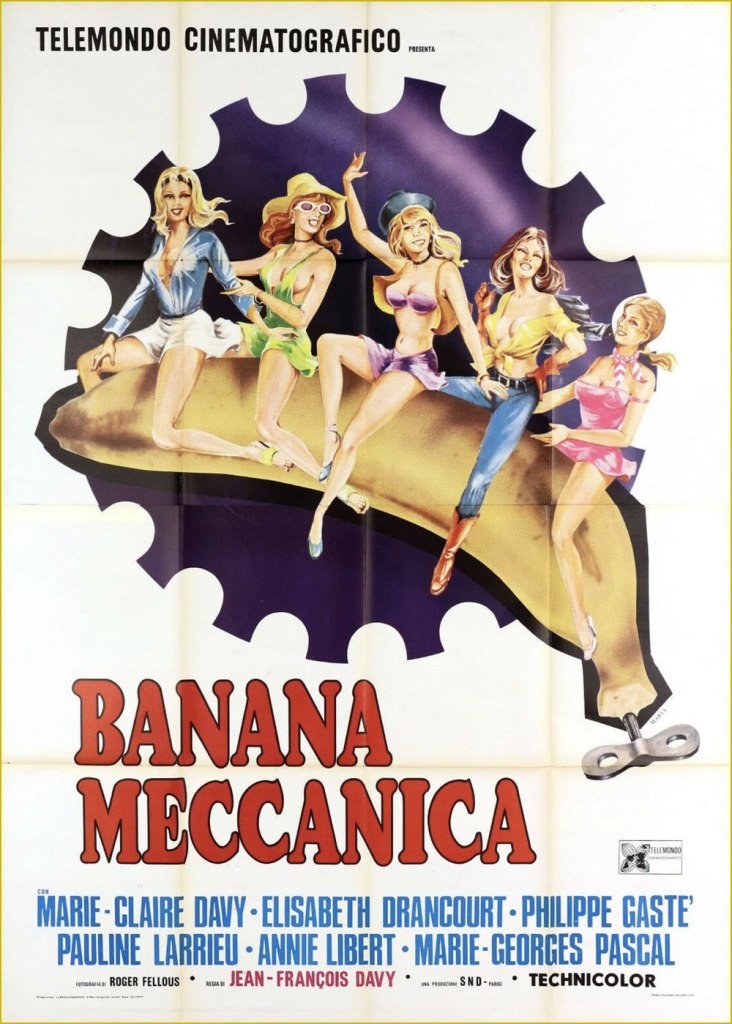
The film features such luminaries as Rififi‘s unforgettable Jean Servais, along with a non-coincidental cameo by (yet to be filmed) The Tenant author Roland Topor. Davy soon attained greater commercial success with his Bananes mécaniques, nominally a Clockwork Orange parody.

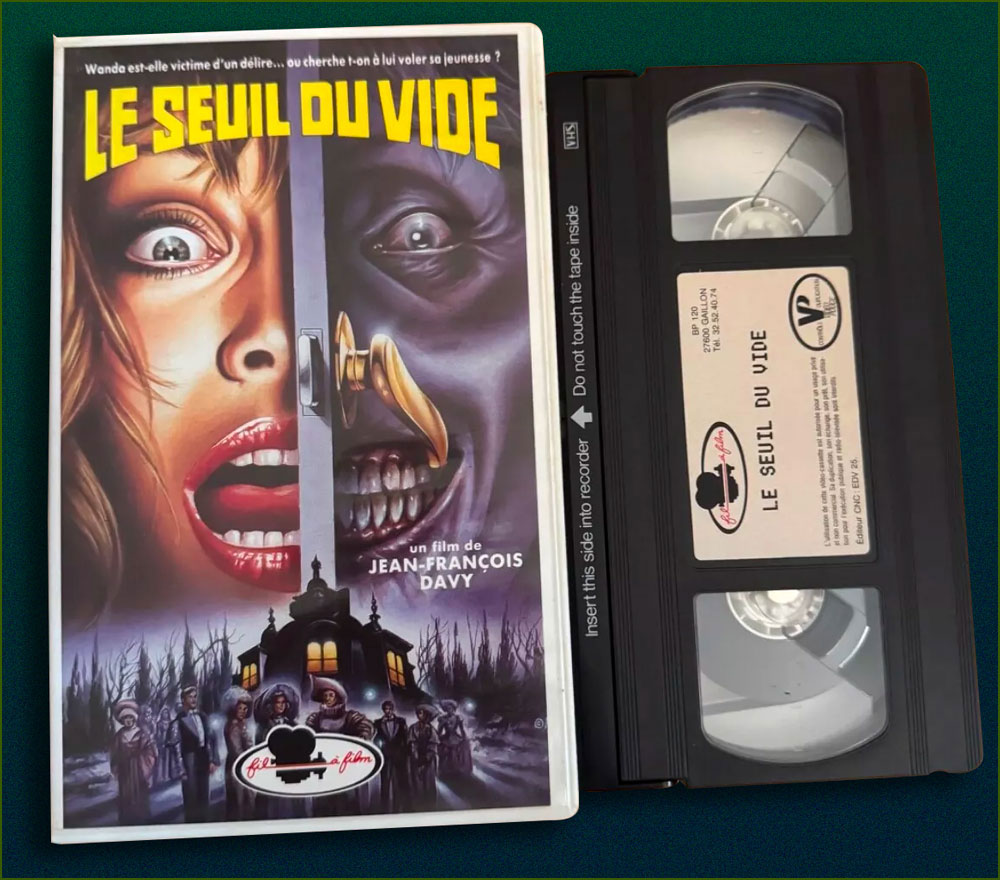
And here’s the VHS release, featuring the film’s original poster. Airbrush!
Bananes mécaniques’ Italian poster.

-RG
Hallowe’en Countdown VIII, Day 6

« Every poem should remind the reader that they are going to die. » — Edgar Allan Poe

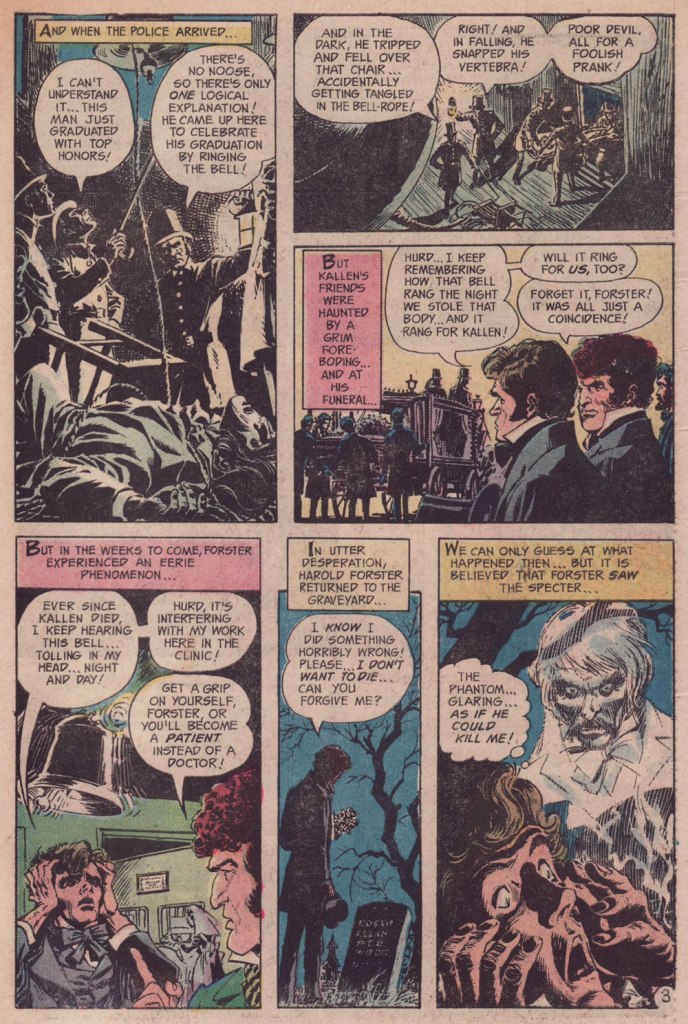
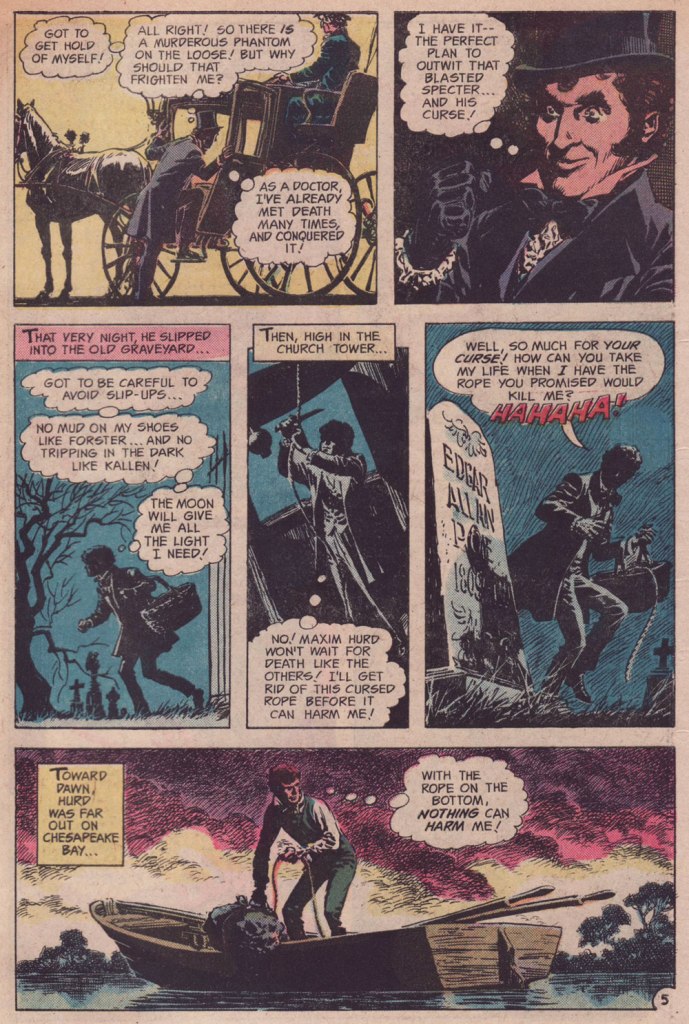
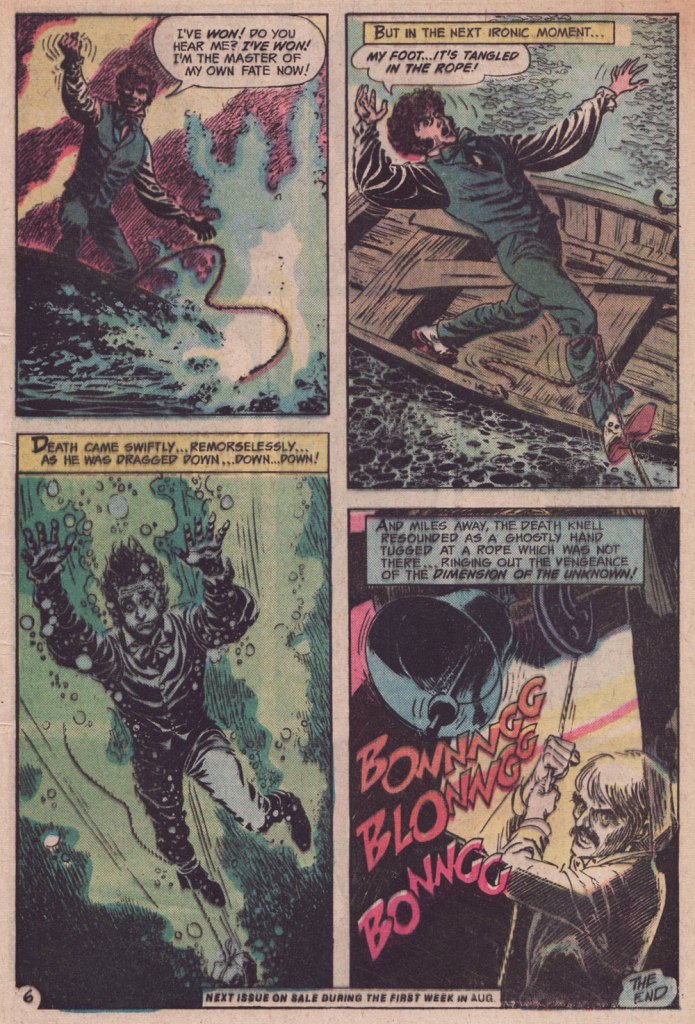
Ah, mixing fact with fiction — such an honoured tradition. In the mid-1970s, DC editor Murray Boltinoff (Ghosts, The Unexpected, The Witching Hour, Teen Titans, The Brave & the Bold) hit upon the notion of featuring historic writers encountering in daily life the supernatural object of their eventual inspiration.

Last year, I featured Bram Stoker‘s visit with a certain undead personage, The Most Fearful Villain of the Supernatural.

The formula was tweaked a bit for the Edgar Poe entry, in that the tale opens after Poe’s burial, and the late writer is not the protagonist. Read on!

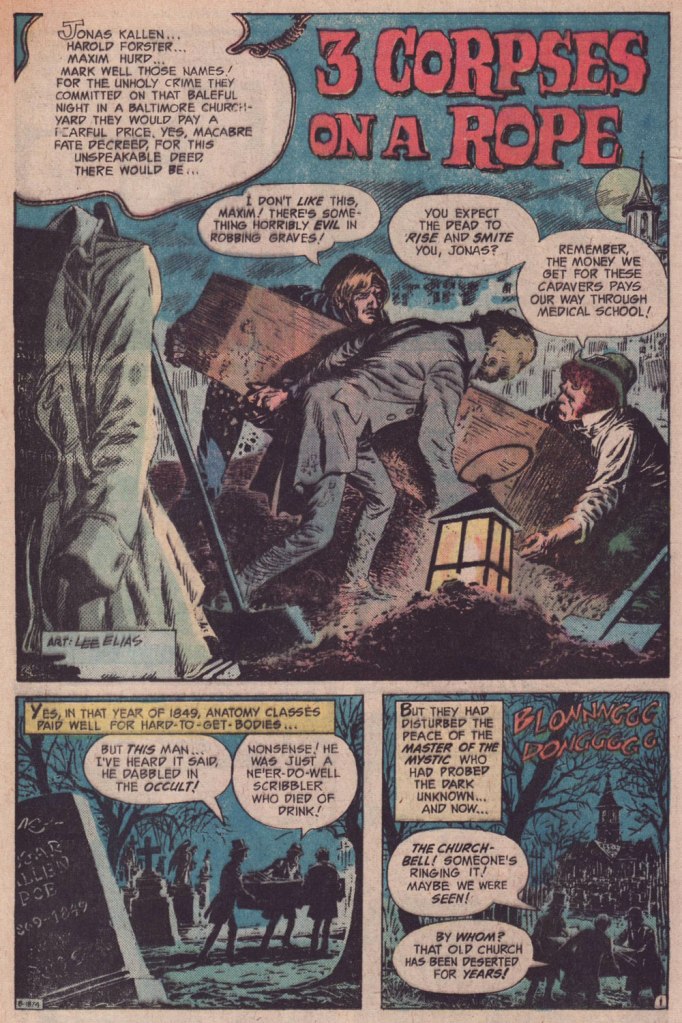
3 Corpses on a Rope“, written by Carl Wessler and illustrated by Lee Elias, originally appeared in Ghosts no. 43 (Oct. 1975, DC).

If you ask me, despite his evident illustrative gift, Elias’ depiction of the revenant ends up looking more like Poe’s fellow Baltimorean John Astin, whom I envision starring in a one-man show entitled ‘An Evening With Edgar Allan Poe‘.

-RG

Hallowe’en Countdown VIII, Day 2

« If he’s straightened out that overbite, I’ll kill him. » — Benjamin Franklin ‘Hawkeye’ Pierce

Like Hawkeye Pierce, Bob Oksner (1916-2007) was a gentleman who appreciated a cute overbite.

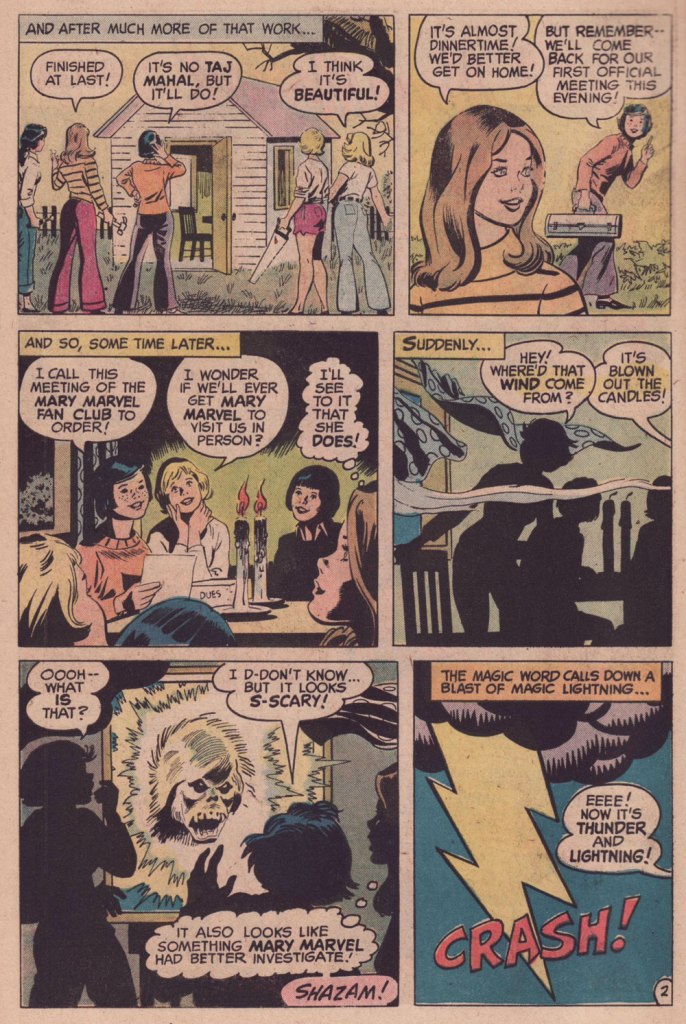
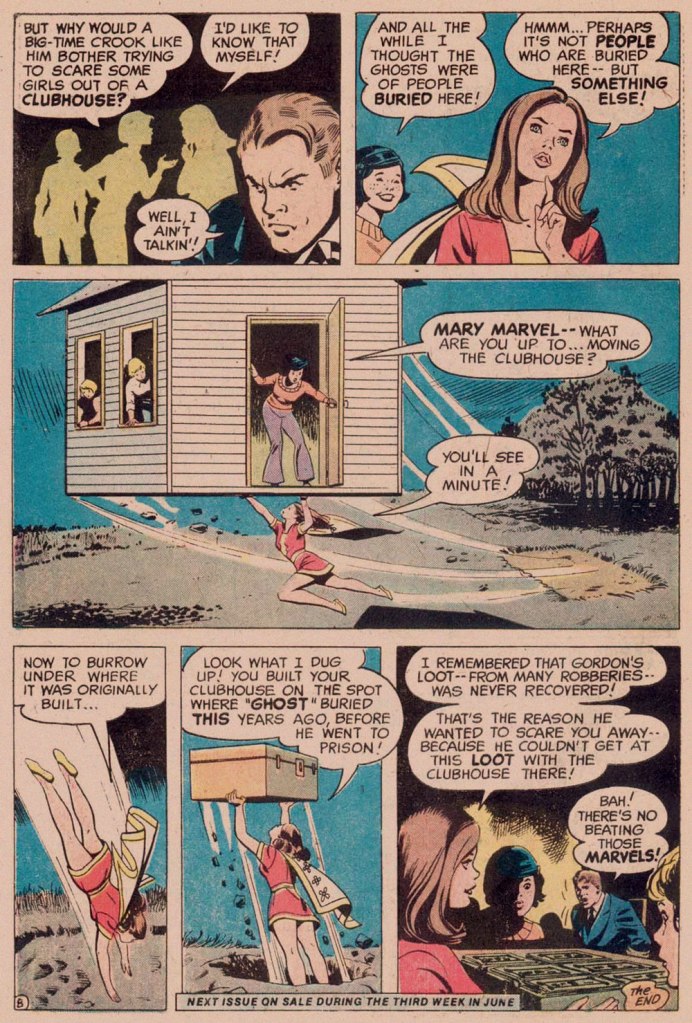
Here’s a seasonal Mary Marvel solo tale that originally saw print in the thirteenth issue of DC’s Shazam!, back in 1974. It was scripted by the erudite Edward Nelson Bridwell (1931-1987).

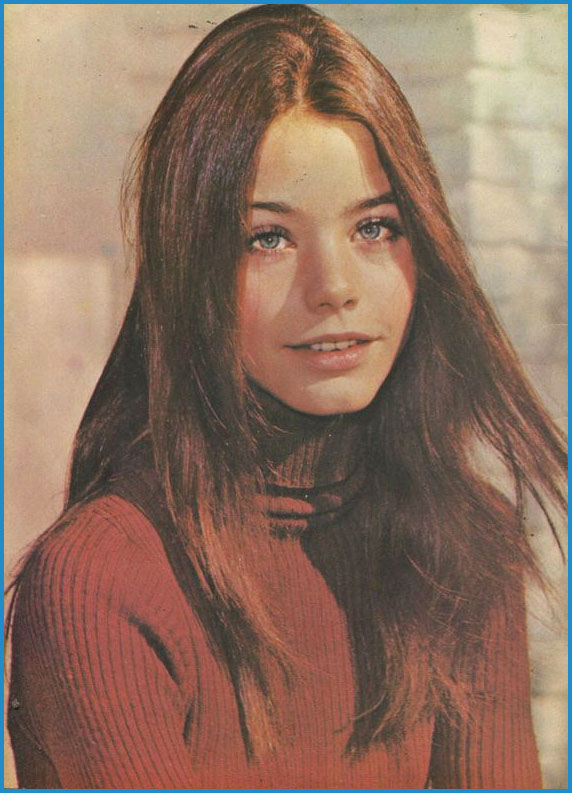
I can’t help but believe that Mr. Oksner might have modeled his Mary Marvel after model-actress and air harpsichordist Susan Dey. The flaw in that theory is that his girls had always looked like her — so it’s more of a case of Susan looking like an Oksner girl than the other way around.

« I fell in love with Laurie
on the Partridge Family
Yeah I stay up watching 70’s TV
And I get off on 70’s TV
» — John Easdale / Dramarama

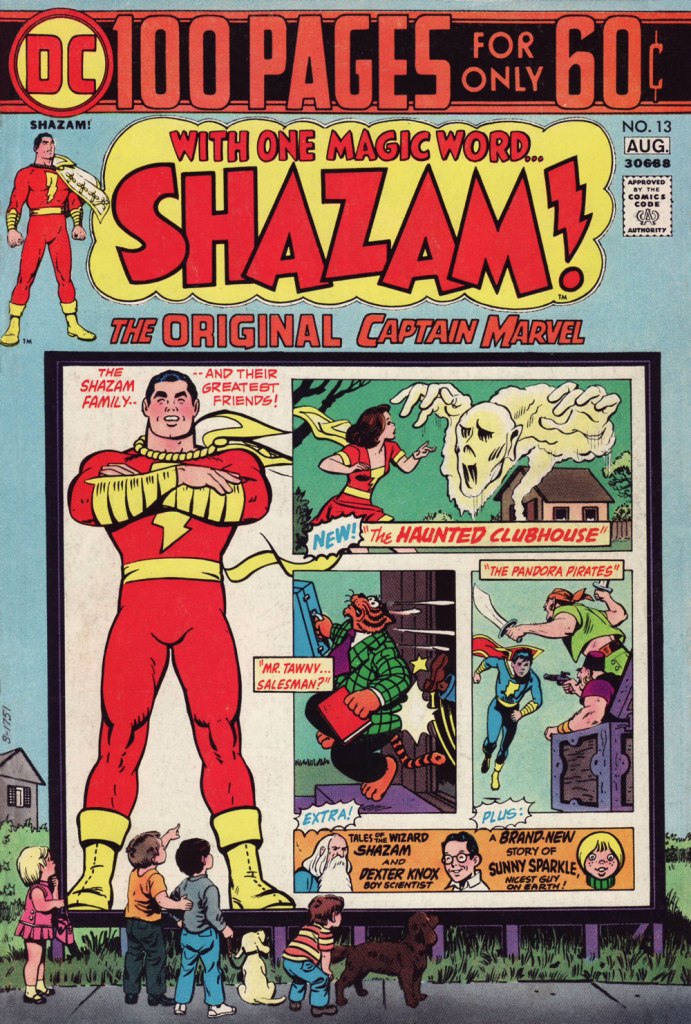
This is Shazam! no. 13 (Jul.-Aug. 1974, DC). Cover art by Mr. Oksner.

-RG

Fungus Friday: Meet… The Mushroom Man

Every once in a while, we celebrate the end of the working week with a leisurely walk through fungal pastures. This week’s installment is a bit on the spooky side, so if you are troubled by a little case of mycophobia, an affliction many suffer from, stick around for a spine-tingling experience. Me, I was definitely rooting for the mushrooms 🍄

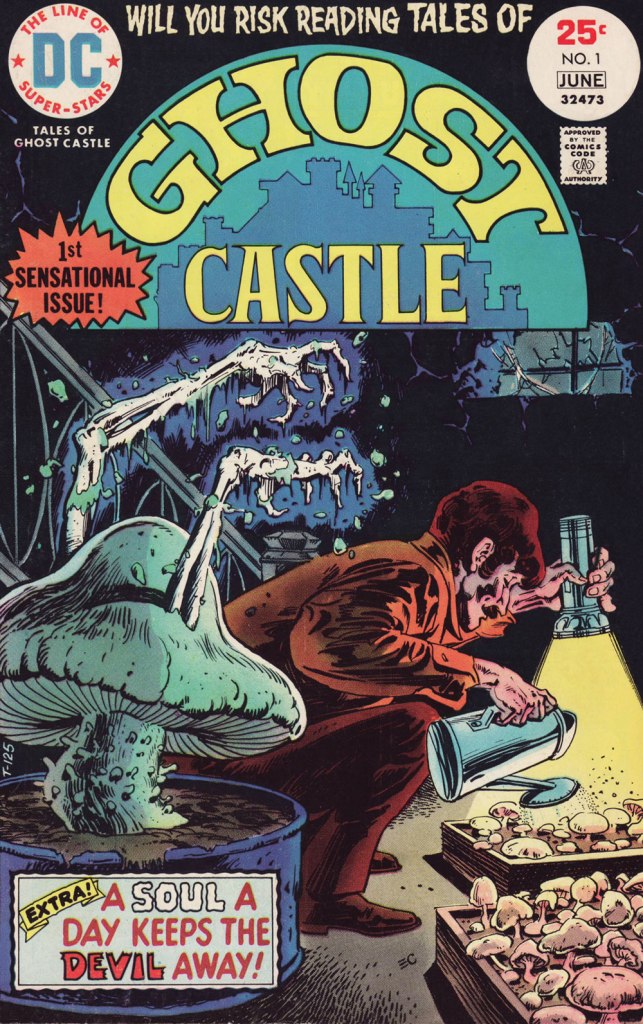
The cover of this issue promised some mushroom goodies, so of course my interest was piqued, even though it makes no sense whatsoever to have skeletal arms protruding out of a fungus. Tales of Ghost Castle no. 1 (May-June 1975, DC). Cover by Ernie Chan; Tex Blaisdell, editor.

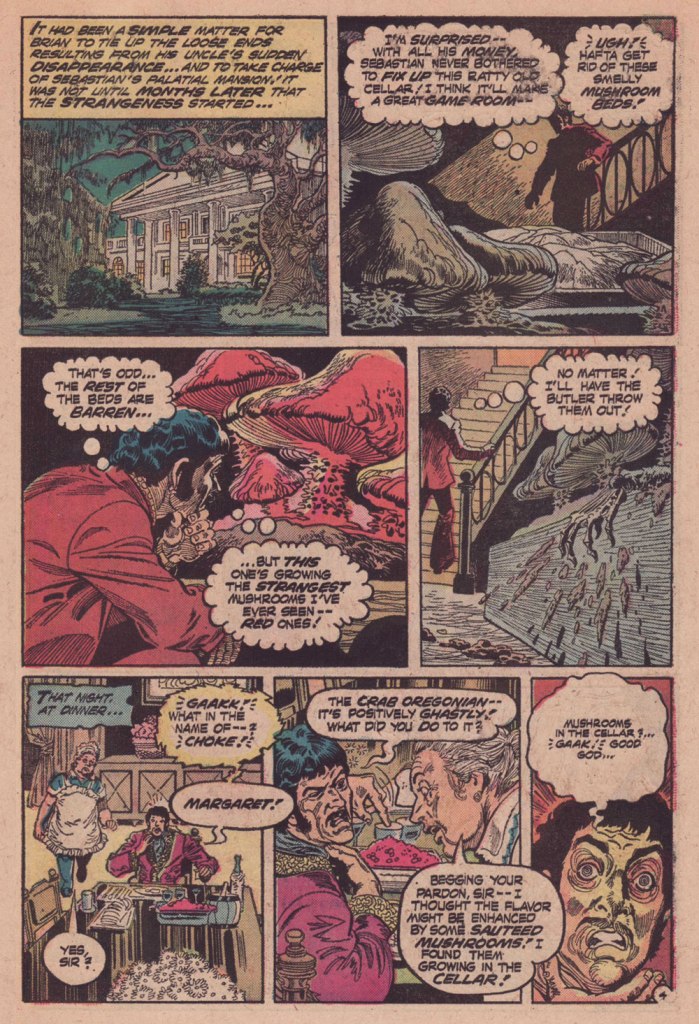
The cover story – 5-pager The Mushroom Man, plotted by David Michelinie, scripted by Martin Pasko, and illustrated by Buddy Gernale – is a tad more mycologically convincing.

Knowing that the fungus fancier is dead right from the beginning depressed me a little bit. However, starting at the scene of the crime to pursue in mushroomy flashbacks makes for good storytelling.
It’s possible for a mushroom to degrade super quickly (see, for example, shaggy manes aka Coprinus comatus that can deliquesce into a puddle of black goo in less than 24 hours after popping up), though 3 hours is pushing it a bit. ‘Nightdreamer’ sounds distinctly psychedelic, so we can take a guess about what kinds of ‘gourmets’ the uncle is referring to.
Did no-one wonder what happened to the uncle?
It’s not a ratty cellar, it’s an appropriately dark and humid cellar, you philistine. A ‘simple matter to tie up loose ends‘? Maybe the police had mycophobia, too, to let the matter drop so easily. One might add that cooking random mushrooms growing in the cellar is not recommended.
Hello, scene from Last of Us.

We are the champignons, my friends! Quite literally, in the case of this money-grabbing, murderous nephew.

~ ds

Hallowe’en Countdown VII, Day 26

« It is the job of thinking people not to be on the side of the executioners. » — Albert Camus

Another day, another executioner… funny how these patterns emerge unbidden.

Jerry Grandenetti, with his tenebrous depths and oppressive angles, is another artist I’ve always strongly associated with Autumn and Hallowe’en. While the greater part of his work at DC Comics was war fare for Bob Kanigher, my heart pounds for his spooky work for editor Murray Boltinoff‘s 70’s stable of titles (The Witching Hour, Ghosts, and The Unexpected).

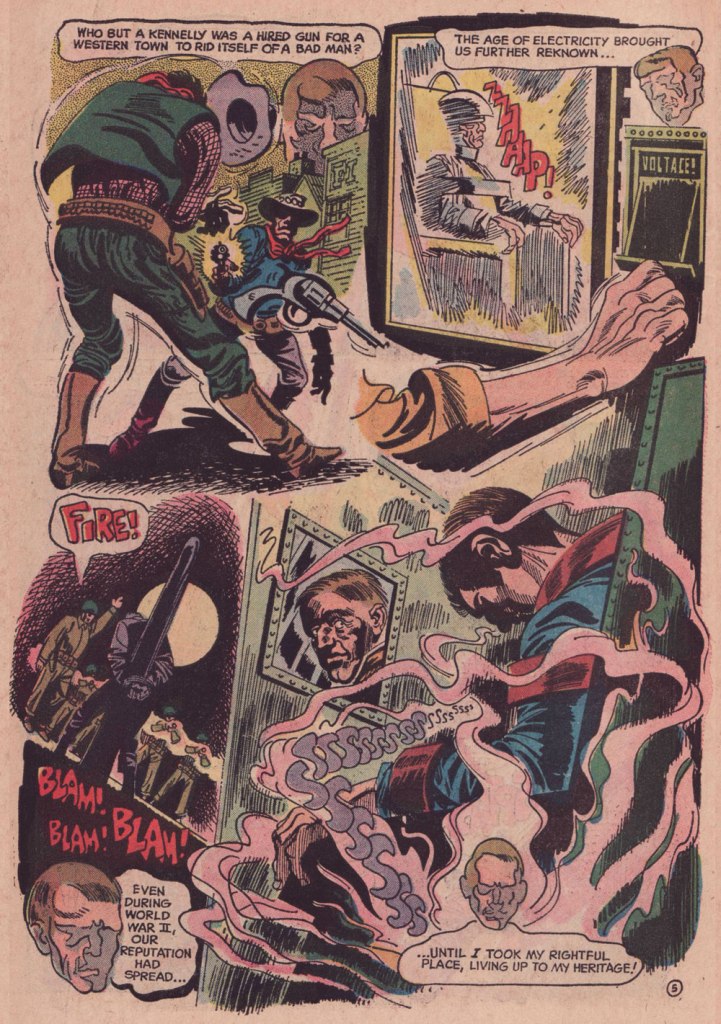
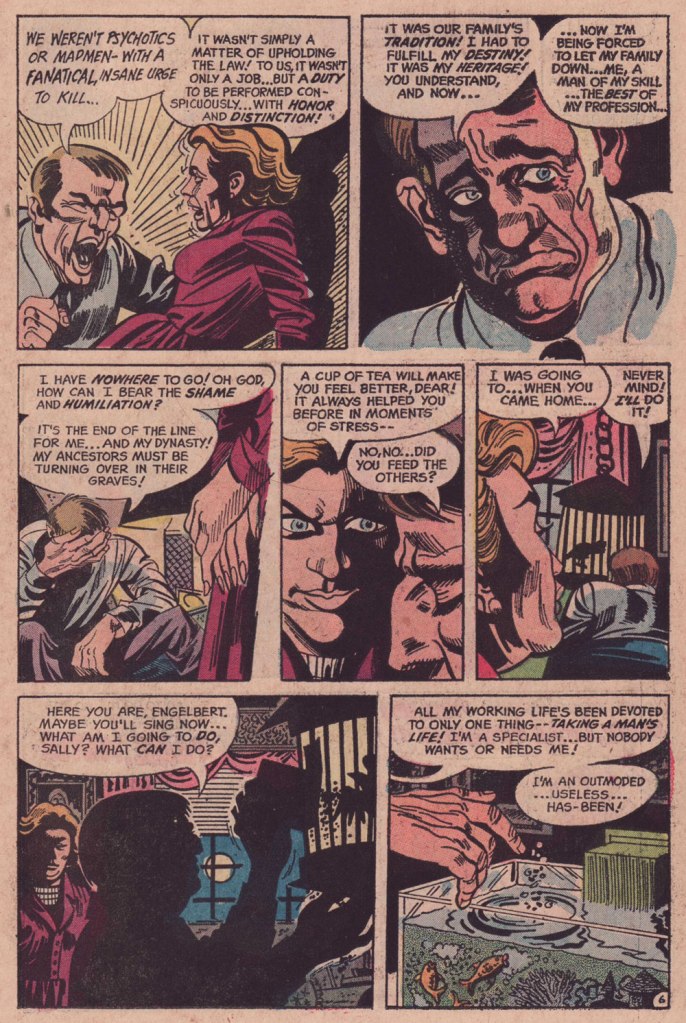
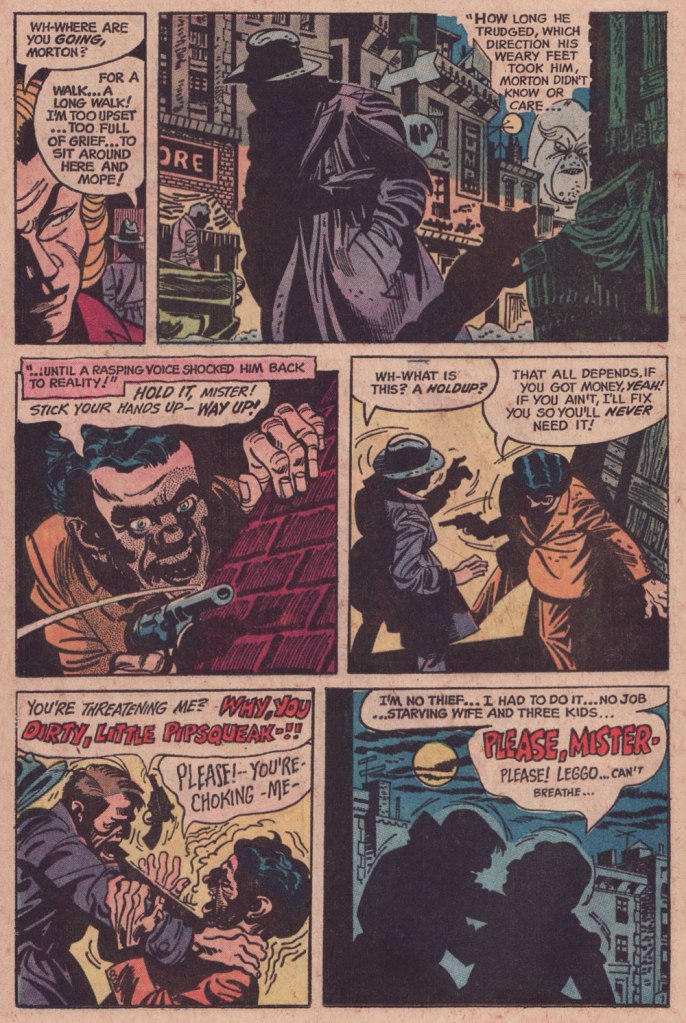
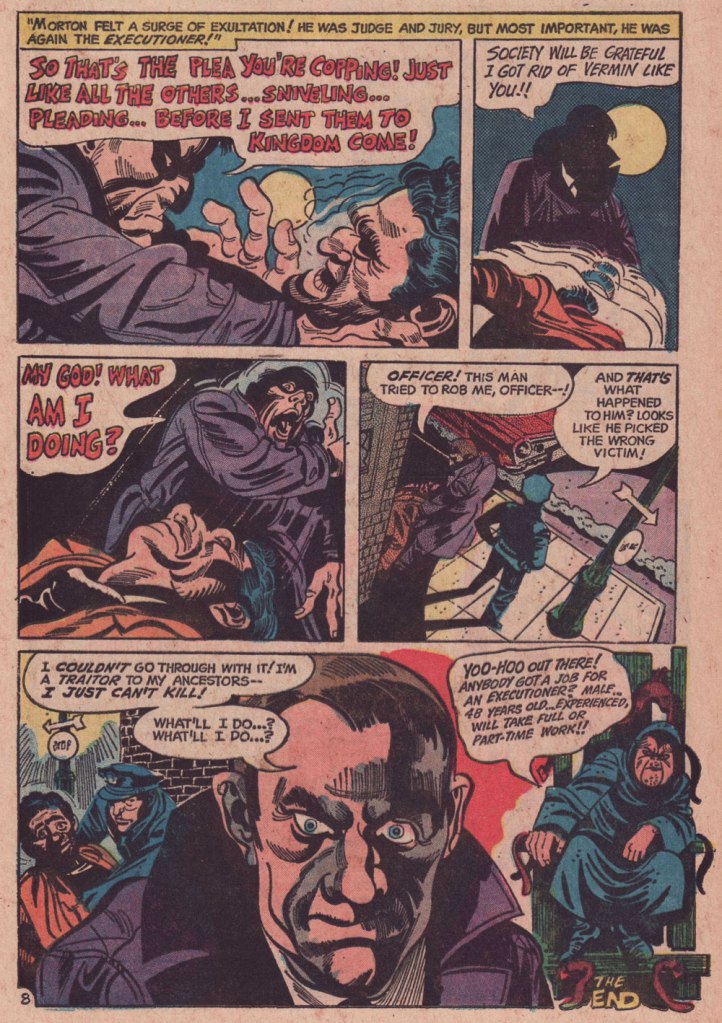
This particular tale marks a rare foray outside of the well-trod paths of formula and so-called ‘O. Henry’, or twist endings. Writer Bill Dehenny (an alias of editor Boltinoff’s, actually) ushers in midlife doldrums and attendant shades of moral grey, an unusually open, downright existential ending, elements scarcely encountered in DC ‘mystery’ comics of the era. Hell, there’s even a bird named Engelbert!

End of an Executioner was published in The Witching Hour no. 26 (Dec. 1972, DC), just after Brian Garfield’s Death Wish and well before Michael Winner’s film adaptation/distortion.

What’ll he do? Will he go the Bronson /Neeson vigilante route — or turn his back on the old family tradition?

-RG

Hallowe’en Countdown VII, Day 25

« Je suis American / Please cook my steak again. » — Ben Folds

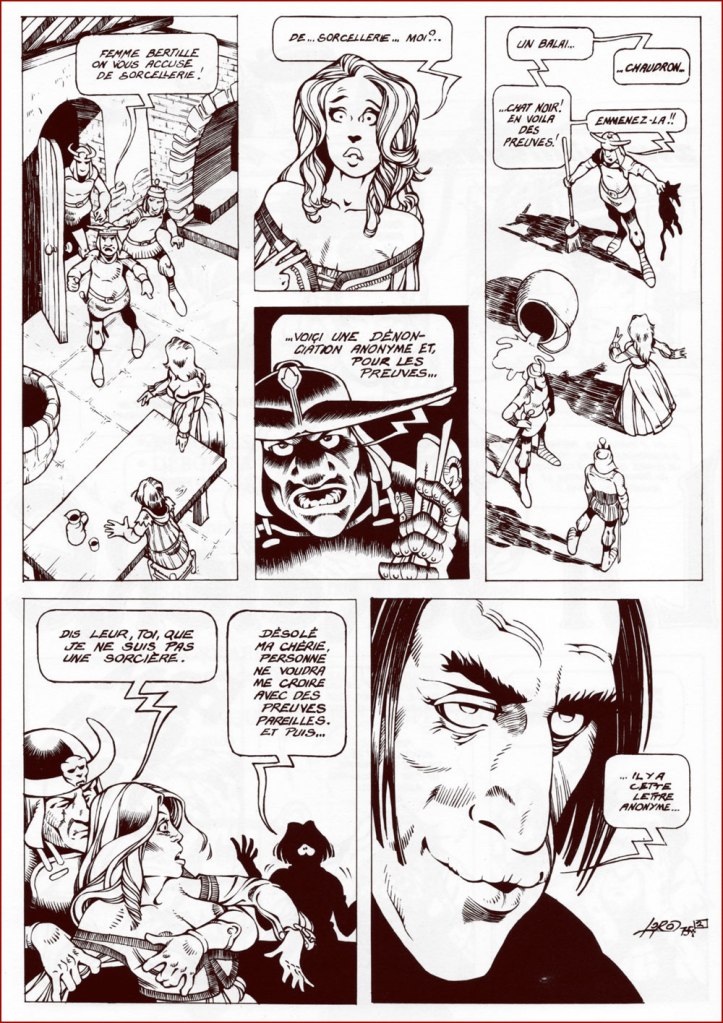
Serge de Bechetch (1946-2007) and Jean-Marc « Loro » Laureau (1943-1998)’s Déboires d’Outre-tombe was an off-and-on (1969-75) series of short pieces parodying horror movie tropes. It took its (clever!) title from diplomat-author François-René de Chateaubriand (1768-1848)’s Mémoires d’Outre-TombeMemoirs From Beyond the Grave »); “Déboires” signifies ‘a run of bad luck’ or, originally, ‘an unpleasant aftertaste’ from drinking wine. Nowadays, Chateaubriand is mostly associated with his chef’s favourite steak recipe.

To be honest, while Loro’s artwork was often inspired, Déboires’ gags mostly fell flat; I presume that the creators had no idea how hoary these monster jokes had become, not having been exposed to the likes of Famous Monsters of Filmland, Topps’ ‘You’ll Die Laughing‘ card set, Mad, Cracked, Sick… and all the glut of parody mags. However, Loro was for a time — and right from the start — editor of the French edition of Warren’s Creepy, which was, imho, superior to the original thanks to better printing and, most significantly, its brand-new, first-rate documentary material created by Midi Minuit Fantastique alumni, replacing Warren’s cool, but repetitive in-house Captain Company adverts.

Here are the strips I consider standouts. Just a few years on, Loro would attain his peak with the early cases of gumshoe Abel Dopeulapeul, whom we’ve featured a few years back. Contrast and compare!

Volume one of Déboires d’outre-tombe (1981, Éditions du Cygne).
Volume two of Déboires d’outre-tombe (1982, Éditions du Cygne).
« You can tell a good workman by his tools!!! »
Loro was clearly catching a lot of Hammer films of the era.
The plot, in a nutshell: Bertille constantly henpecks her husband because of his general rakishness and lack of gainful employment. Oh, but he’s found a job, he claims. Just then, she’s anonymously denounced as a witch. « I told you, Bertille. You see… I’ve found some work. »
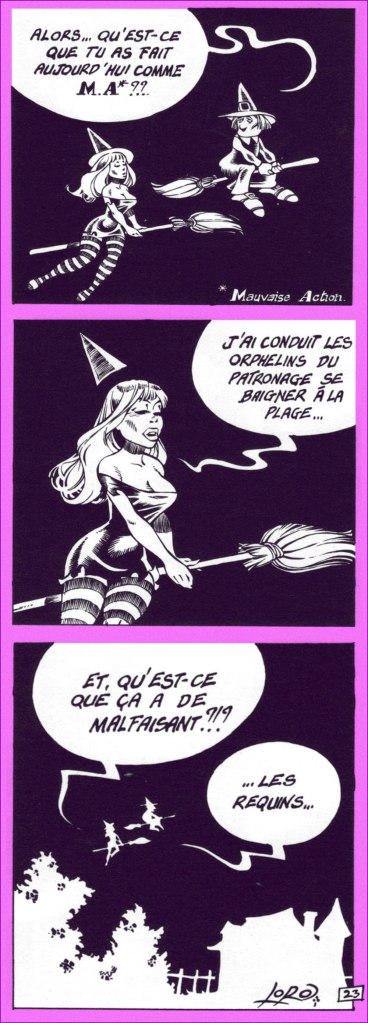
« So, what have you done today as a bad action? »
« I took the orphans from the youth club to the beach for a swim… »
« And what’s so evil about that? » « The sharks… »

-RG

Hallowe’en Countdown VII, Day 23

« I didn’t say she was dead, I said I killed her. » — Barnabas Collins

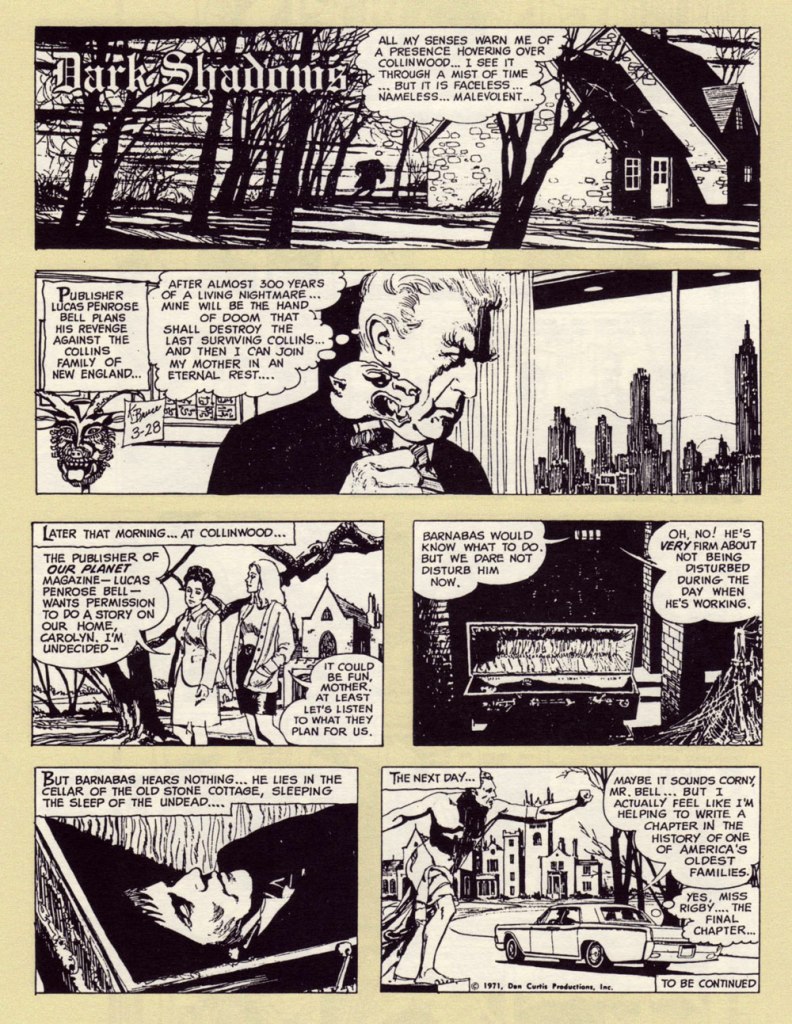
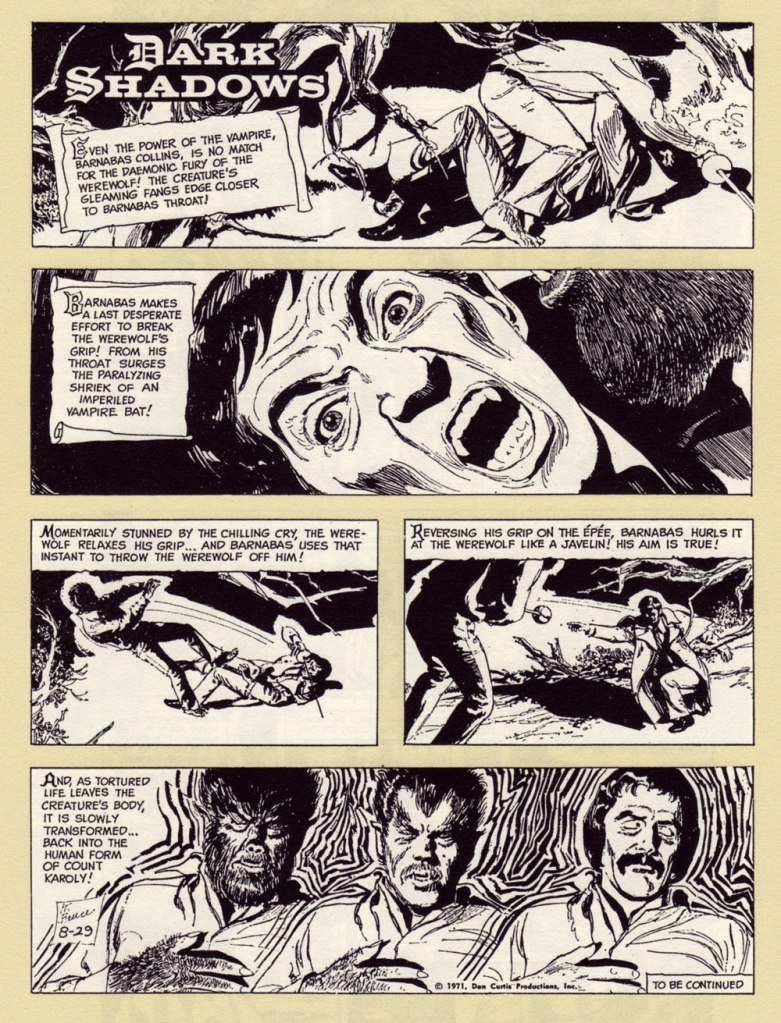
… and speaking of that tormented bloodsucker, Mr. Barnabas Collins — mentioned in passing just yesterday — here’s a look at the short-lived (fifty-two contracted-for weeks, just like Daniel Pinkwater and Tony Auth’s Norb) syndicated strip that appeared at the tail end of Dan Curtis‘ preeminent supernatural soap opera‘s run (1966-71). The strip was likely scripted — at least in part — by Little Abner creator Al Capp‘s prolific brother Elliot Caplin (who also had a hand in the creation of Russell Myers’ Broom Hilda around the same time!)

Dark Shadows, the comic strip, was illustrated by veteran cartoonist Kenneth Bald (1920-2019), who’d worked for Fawcett, ACG and Atlas before judiciously decamping to the more rewarding and respectable milieu of syndicated newspaper strips, first with Judd Saxon (1957-1963) and then with Doctor Kildare (1962-1984).

The March 28, 1971 strip. While I’m not inclined towards photo-aided realism in comics, Bald was such a master of the mise-en-scène — that is to say layout and pacing, that he rarely failed to draw me in, as opposed to, say, more acclaimed photo reference addicts such as Al Williamson or Gray Morrow.
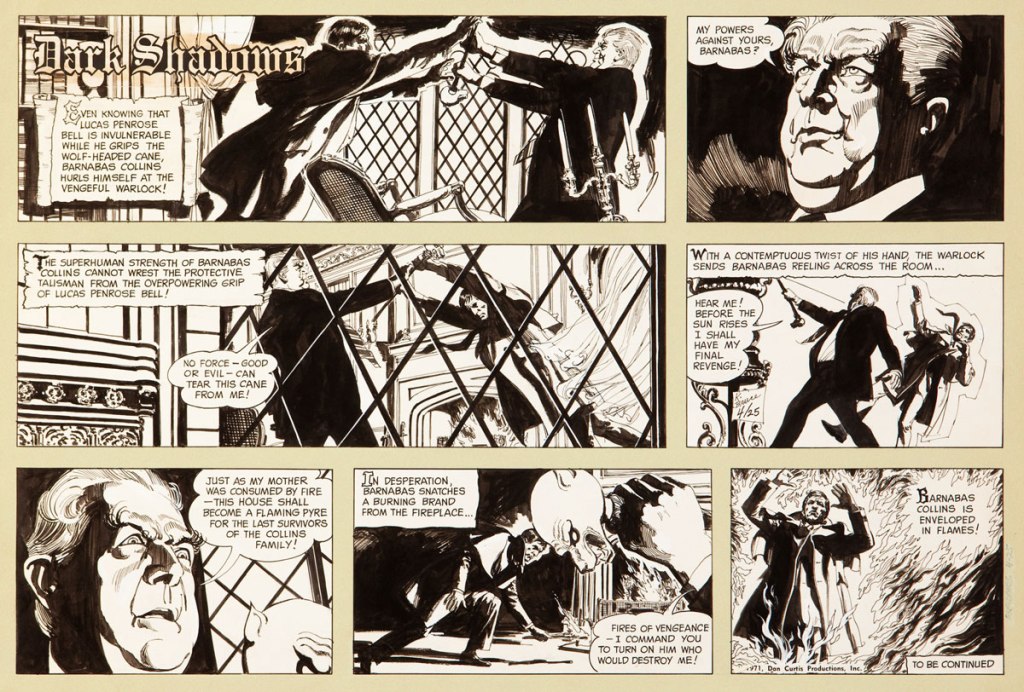
April 25, 1971.
June 6, 1971.
July 11, 1971.
August 29, 1971.

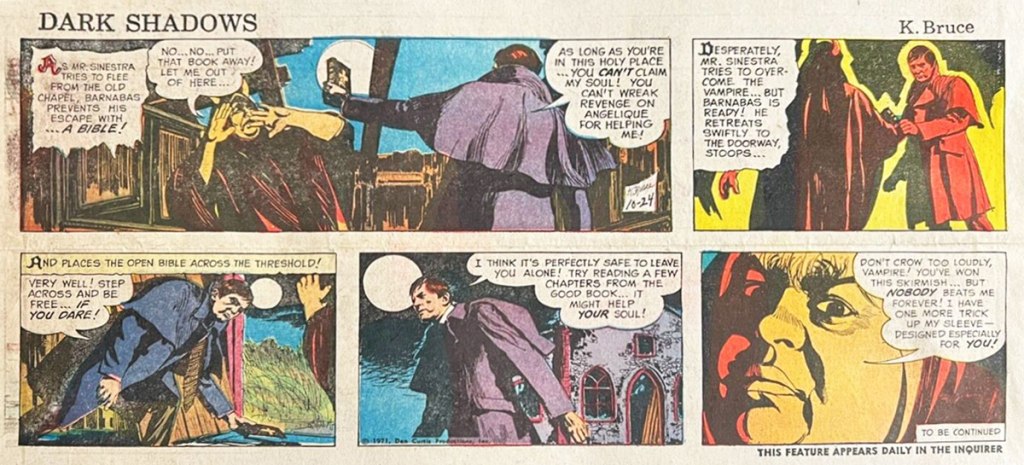
December 12, 1971. Richard Howell explains: « The Dark Shadows strip also invoked a very unusual use of coloring techniques (for the Sunday instalment), which eschewed a realistic look in favor of underscoring the strip’s mood (including a meaningful experimentation with color knock-outs done in harmonious gradations in the same color families). The first two Sundays were colored by Bald himself, who gave it up due to dissatisfaction after seeing the printed versions, and the extensive amount of time it took him to achieve the color effects he wanted. »

Here’s a trio of examples as they showed up in (news)print.

May 2, 1971.
September 26, 1971.
October 24, 1971.
In 1996, the strip was collected in more than satisfactory fashion by Pomegranate Press — colour might have been financially prohibitive — in no small part thanks to superb documentary material provided by Ken Bald and cartoonist and longtime DS fan Richard Howell. An actual fan, unlike, say, Tim Burton*.

-RG

*despite getting a free pass to see it, the abomination that was Burton and Depp’s franchise-murdering Dark Shadows (2012) made me want to scream for a refund. Or the perpetrators’ heads on spikes.

Hallowe’en Countdown VII, Day 21

« Insanity is believing your hallucinations are real. Religion is believing that other peoples’ hallucinations are real. » — Dan Barker

When they talk about ‘adult comics’, they mean this — as opposed to ‘comics for randy teenage boys’. By ‘this’, I refer to adaptations of slow-burning psychological horror (or ‘anguish’, really) novels. These weren’t often about literal demons and ghouls, they were about people slowly but surely losing their grip on reality, through natural circumstances or, in a yet more sinister vein, the process of being gaslit by malevolent parties.

These comics are often extremely understated, and I stayed well away from them as a kid, not that I would have understood what they were about. Returning to them, I’ve come to appreciate their low-key, droning power of fascination.

This is Hallucinations no. 2 (Sept. 1969, Arédit). Cover artist unknown. The prolific horror and SF writer André Caroff was a nom de plume of André Carpouzis.
This is Hallucinations no. 6 (Sept. 1970, Arédit). The splendid cover painting is the work of Carlo Jacono (thanks for the ID, Caspar!) and the insides by prolific Spanish cartoonist Adolfo Buylla (1927-1998), who contributed to Gold Key’s spooky titles in the 1970s. Marc Agapit was one of the literary pseudonyms used by Adrien Sobra (1897-1985).
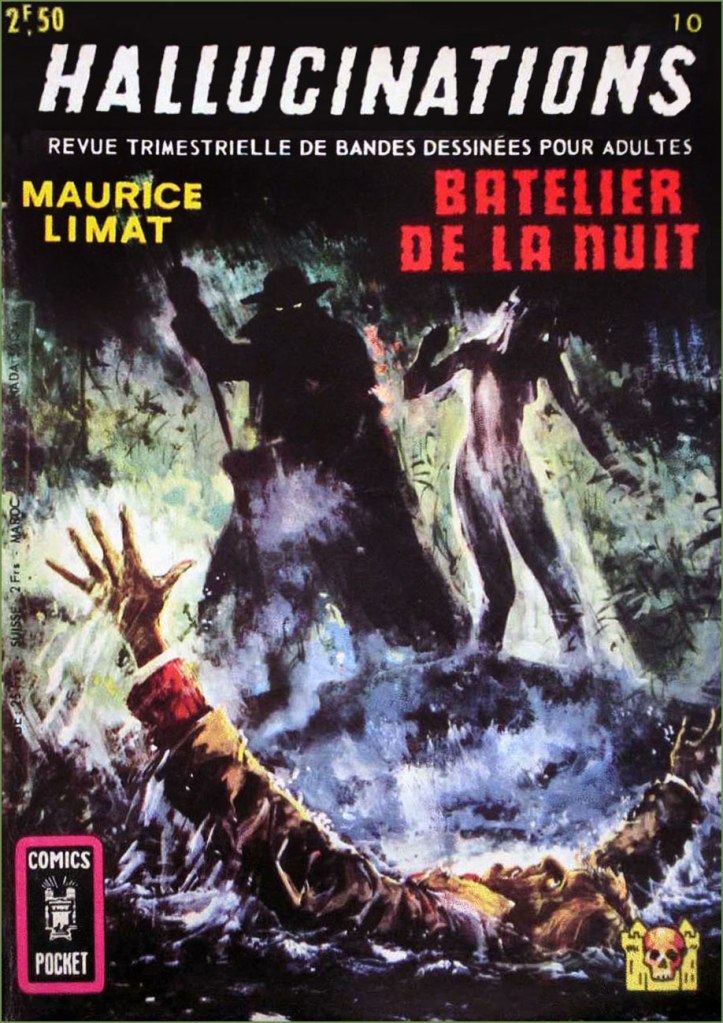
This is Hallucinations no. 10 (July 1971, Arédit). Cover artist unknown. Maurice Limat (1914-2002) was another busy — but sometimes excellent — writer of SF, crime and horror.

Batelier de la nuit (“Night Boatman”) was also illustrated by Mr. Buylla. Here’s a pair of moody pages involving — of course — hallucinations.

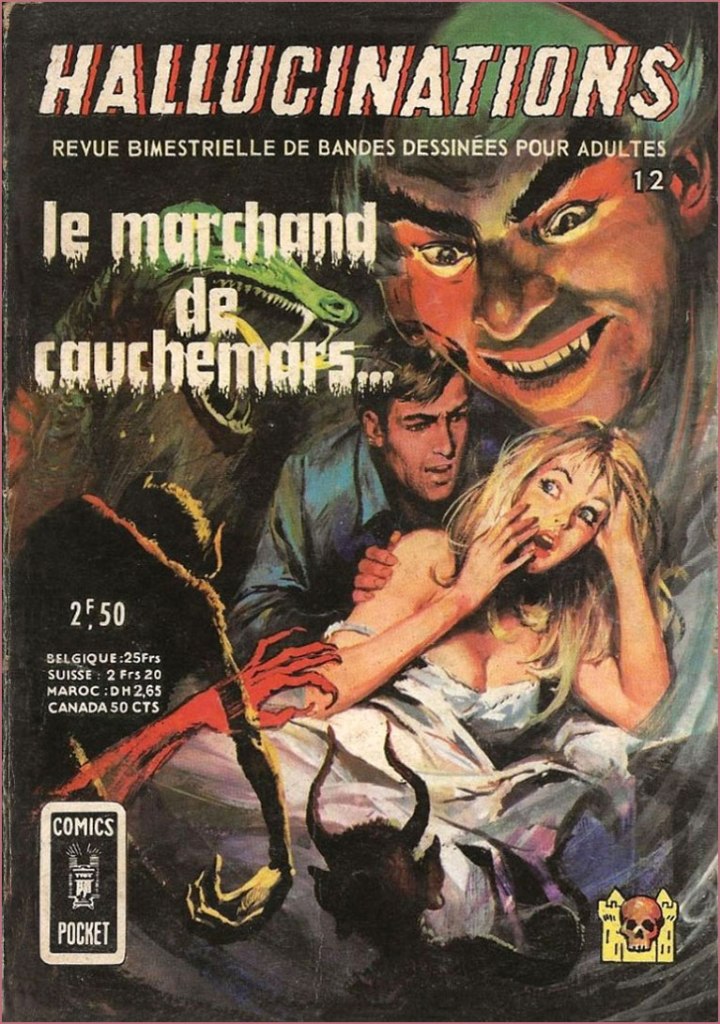
This is Hallucinations no. 12 (Nov. 1971, Arédit). Cover artist unknown. The series must have met with some success, as its publishing frequency increased from quarterly to bi-monthly. I swear I recognise that style; around 1980, I had a European sticker album of spooky scenes that this artist illustrated. I’ll dig it up yet…

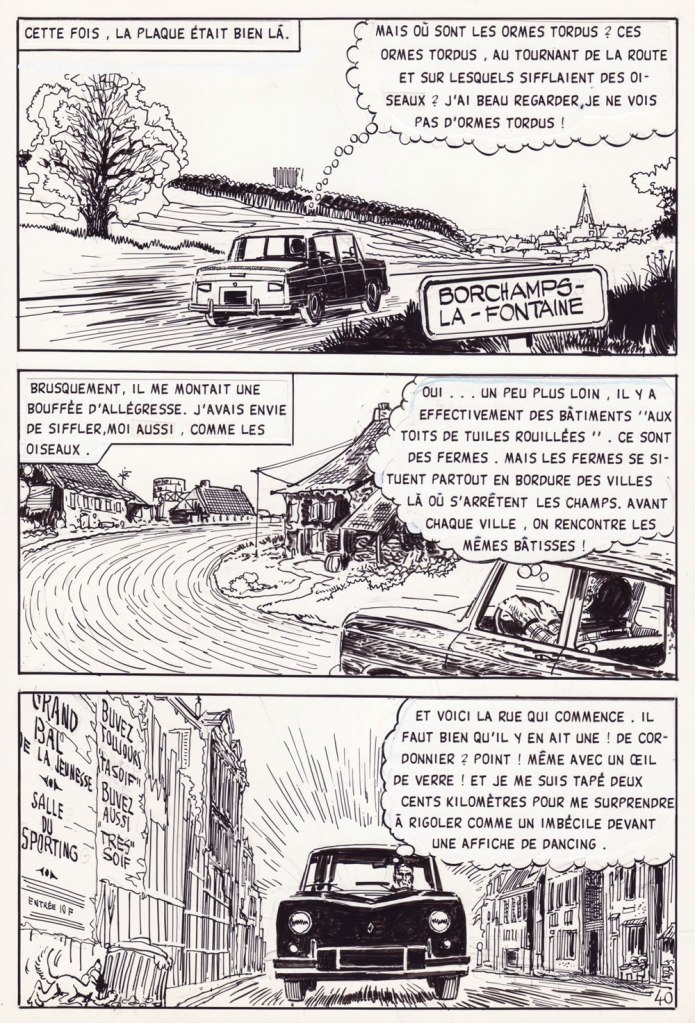
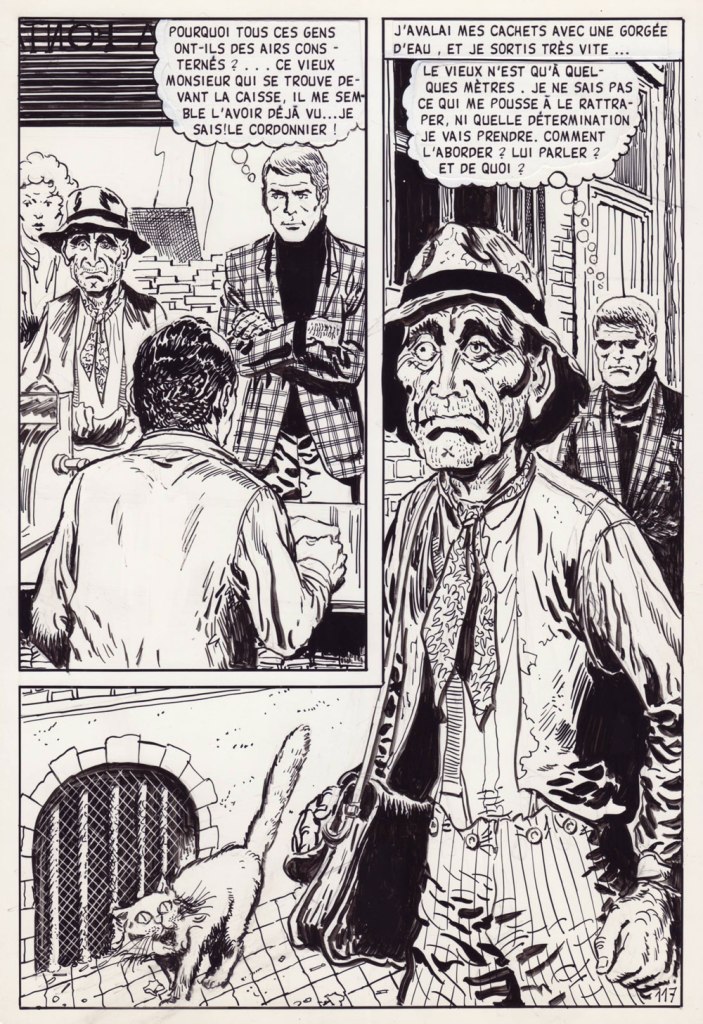
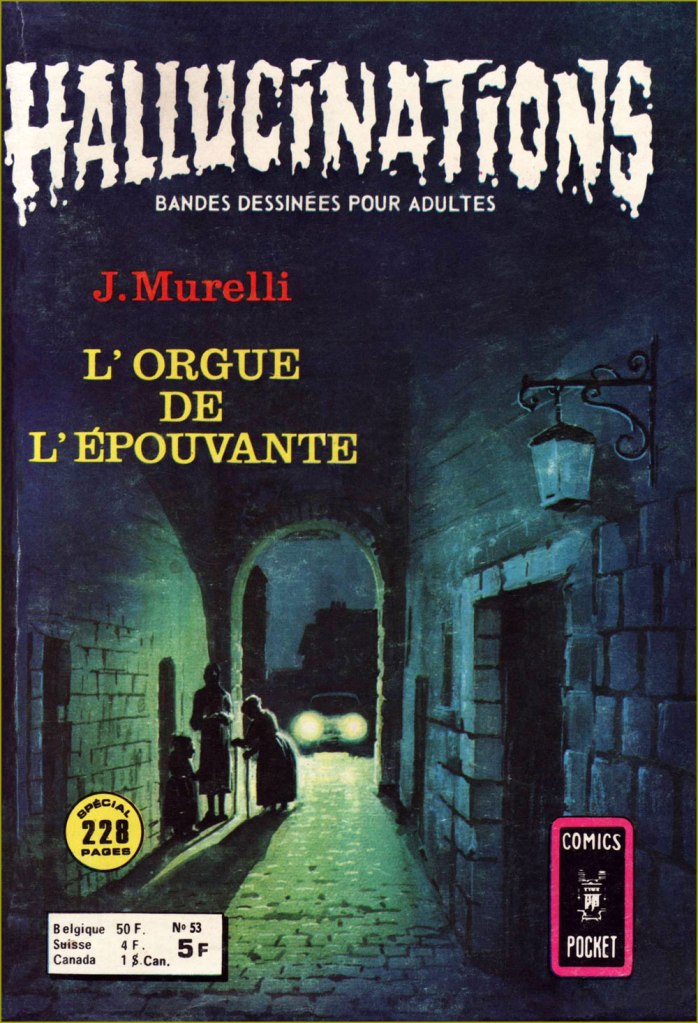
A decade ago, I got my hands on some original art from issue 53 of Hallucinations, “L’orgue de l’épouvante” (“Organ of Terror”, 1975), illustrated by Belgian cartoonist Jean Pleyers, and adapted from Jean Murelli’s novel.

Since I own only six pages of the 200+ tale, I have no solid idea what’s going on, but it’s intriguing. I’ve spotted a cheap copy and should soon be able to fill in the blanks. Here’s a plot blurb: « Reporter Luc Rohard is a hardcore skeptic who refuses to view his colleague Vérac’s disappearance in supernatural terms. His investigation leads him to a small village in which has retired sinister doctor Domitis. Is the latter a mad criminal who’s lost his mind in the course of obscure experiments on the human mind, or…? But who shall ever know the truth about the Vampire of the abbey and his troubling companion? » Cover painting by Michel Gourdon (1925-2011).

-RG

Hallowe’en Countdown VII, Day 20

« Physics should represent a reality in time and space, free from spooky action at a distance. » — Walter Isaacson

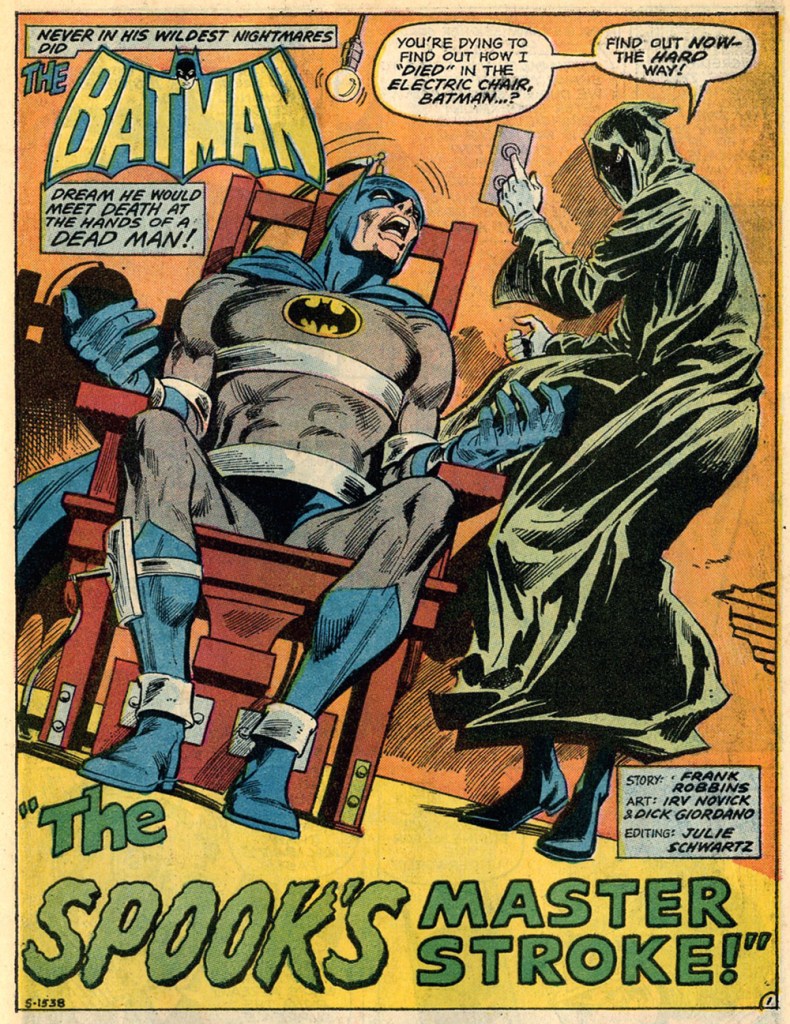
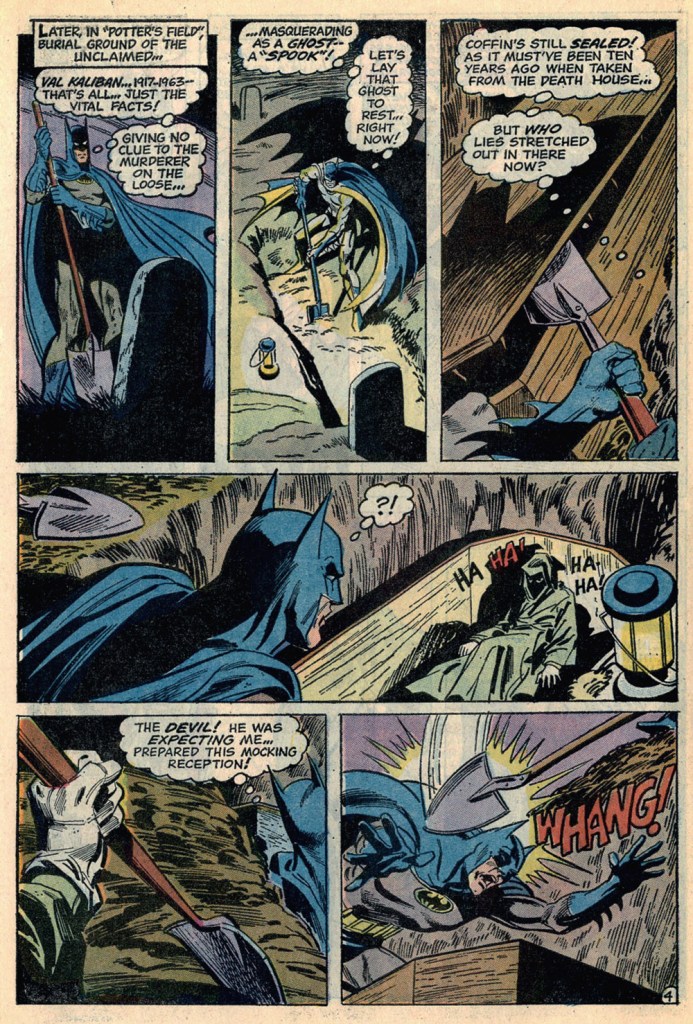
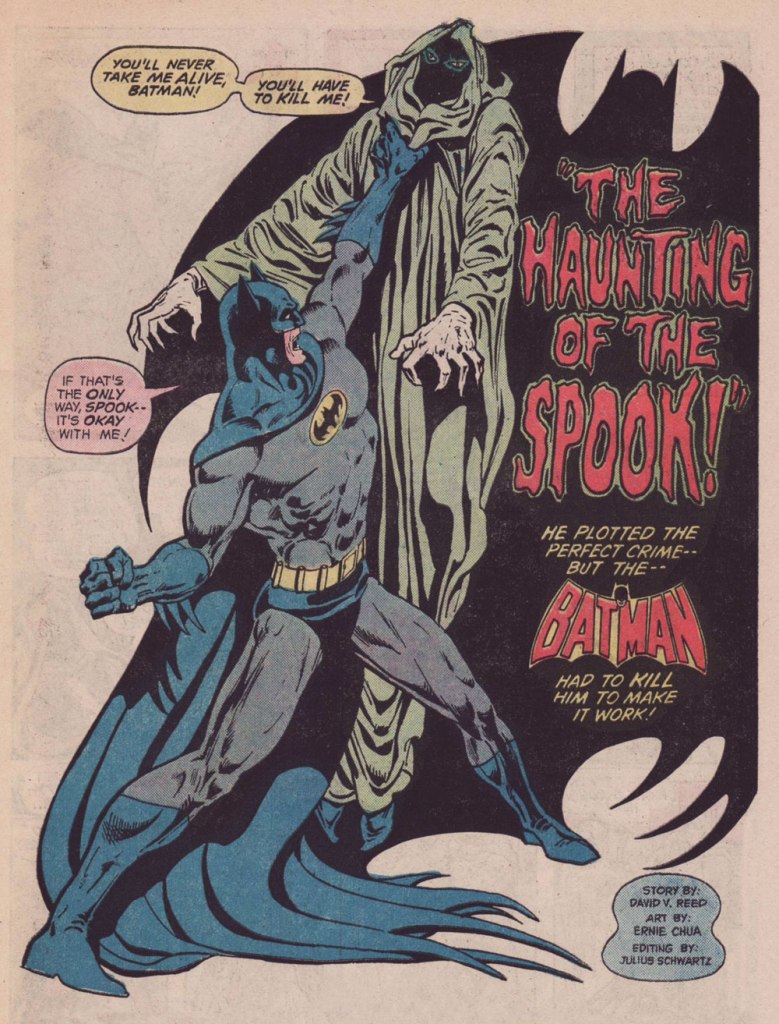
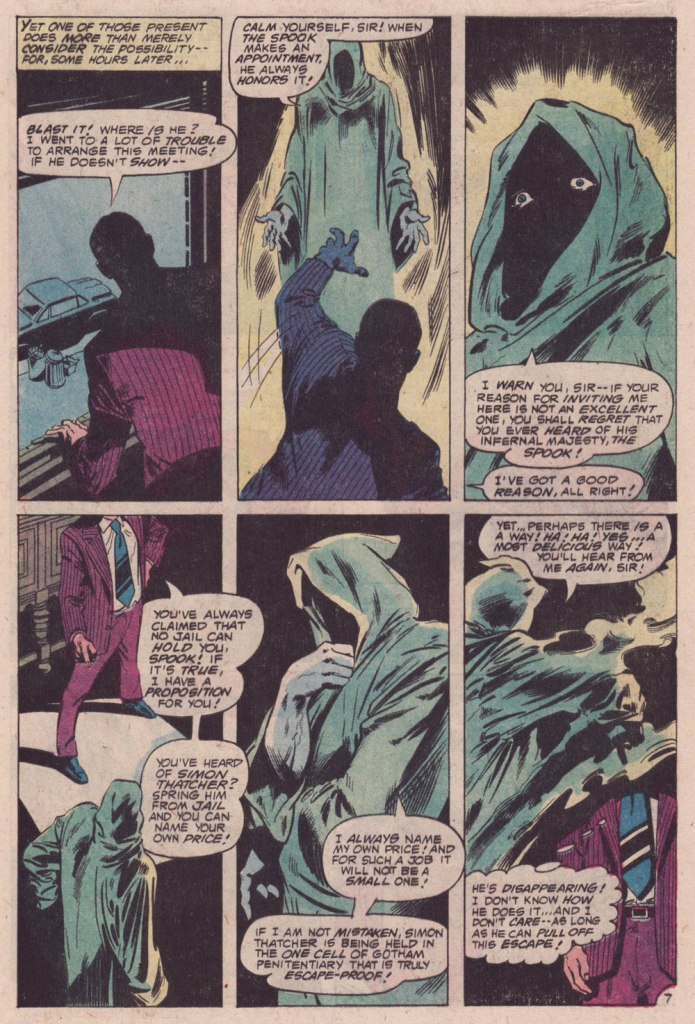
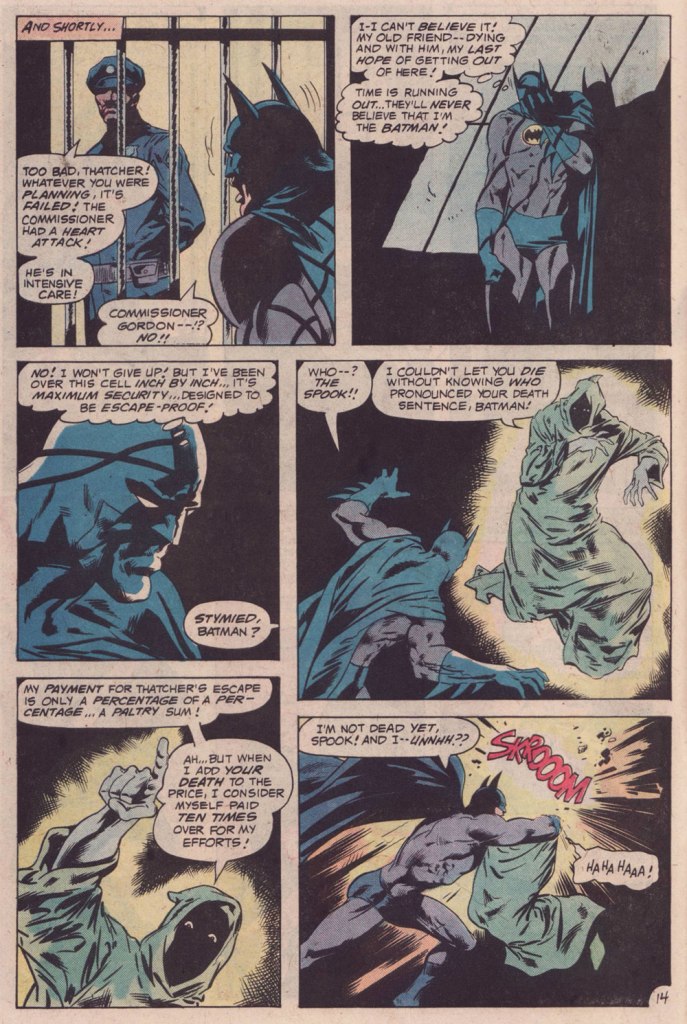
Who’s my favorite Batman foil? Why, The Spook, of course! A brilliant and patient (but twisted, natch) planner, engineer, escape artist and… businessman Val Kaliban was a most worthy opponent for the Batman in detective mode. Let’s sneak a gander at his earliest and most significant appearances.

This is Detective Comics no. 434 (Apr. 1973, DC). A middling cover, certainly not Michael Kaluta‘s best Batman cover… nor his worst. I mean, what’s Batman’s left leg doing exactly?

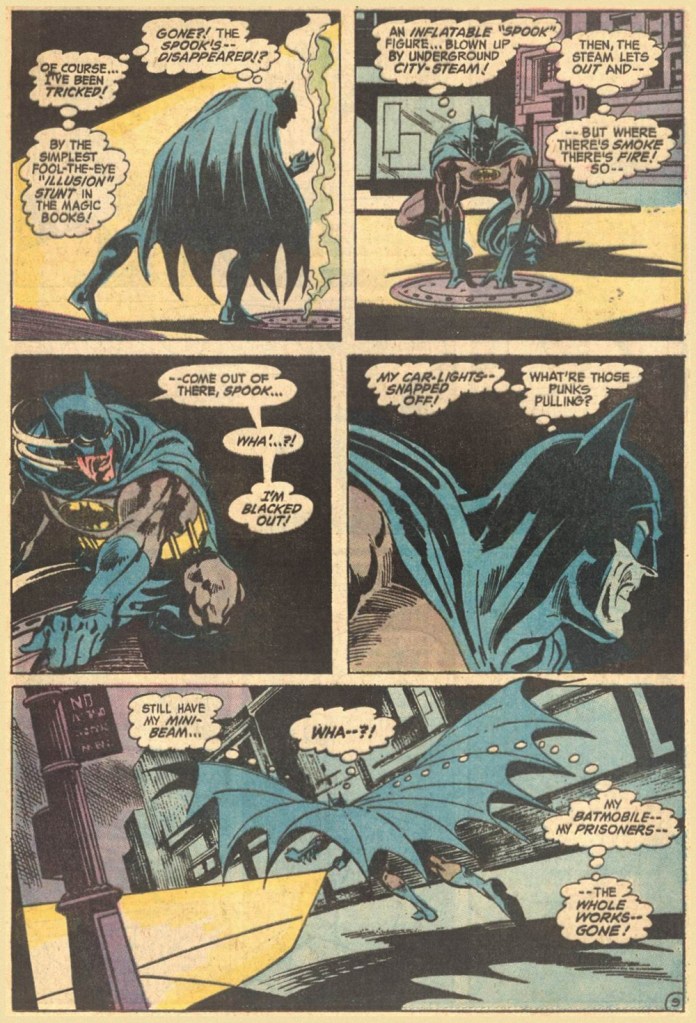
Here’s a fun sequence from the issue’s The Spook That Stalked Batman, scripted by Frank Robbins, pencilled by Irv Novick and inked by Dick Giordano.

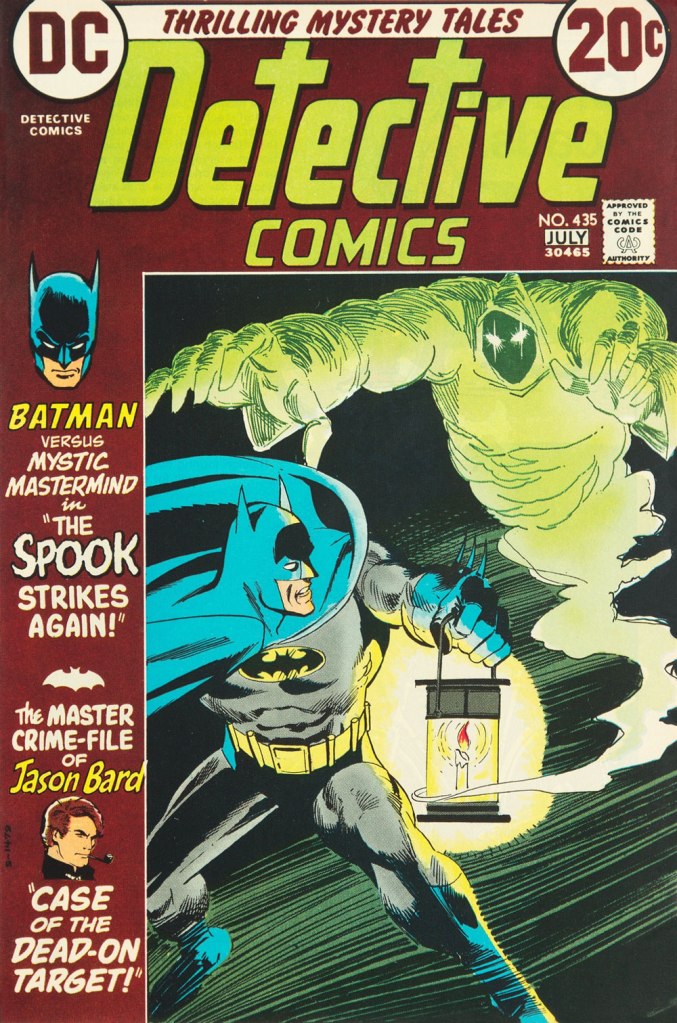
This is Detective Comics no. 435 (June-July 1973, DC); an okay cover by Dick Giordano.
Ah, finally… The Spook gets a cover worthy of his mettle. This is Batman no. 252 (Oct. 1973), cover design by Carmine Infantino, pencils and inks by Nick Cardy, and lettering by Gaspar Saladino (well worth mentioning!)

A pair of pages from the issue:

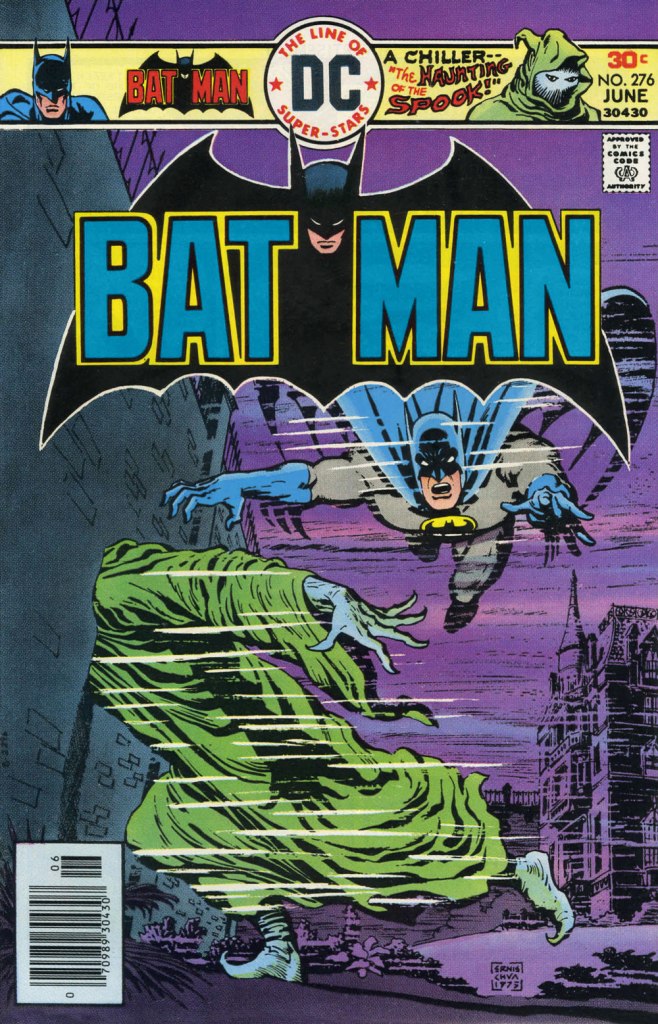
This is Batman no. 276 (June 1976, DC). For the first time, someone other than his creator, Mr. Robbins, handles The Spook. Fortunately, it was talented scribe David Vern (writing as David V. Reed), quite possibly my favourite Batman writer. A fine, moody cover by Ernie Chan.
The Spook’s following appearance, in which Dick Giordano demonstrated he could come up with a crappy Andru-Giordano cover… all on his own. This is Detective Comics no. 488 (Feb.-Mar. 1980, DC).

The Spook’s Death Sentence for Batman, written by Cary Burkett, pencilled and inked by the splendid team of Don Newton and Dan Adkins, was a worthy send-off for this fine character. Beyond that… I don’t much care. The Spook is a difficult personage to write for, but he got three solid writers to chronicle his exploits, and that suits me just fine.

-RG

Hallowe’en Countdown VII, Day 16

« When asked if they would like to have sex with me, 30 per cent said, “Yes”, while the other 70 per cent replied, “What, again?”Silvio Berlusconi

A certain subset of Italian Fumetti — namely the sex and horror digests of the 1970s — constitutes a quagmire of oft-truly repellent material in which indisputable gems yet glimmer bright. Mostly the covers… designed to lure the sailor — or reader — to his doom.

While several of the most prolific artists of the medium were evidently talented fellows, only a couple (Averardo Ciriello being the other one) truly draw my interest, since, despite low pay and a breakneck production pace, they didn’t swipe much… or at all — unlike their colleagues. For most of the industry and society, consent and copyright appeared to be pretty fuzzy, casually dismissed notions.

I favour the work of Fernando Carcupino (1922-2003) over that of his contemporaries because he always knew how to keep things light, bright and original — never wallowing in poor taste or sadism, even when the subject matter called for it, and I thank him for it. Here are some highlights from his illustrious career.

A piece from La Settimana Umoristica no. 5 (Apr. 1954) entitled “Celluloid Terror”. All the classic ghouls are there, even that very year’s Creature From the Black Lagoon. Carcupino could spot an enduring classic from a long way off!
A selection of our fine products, as they appeared in print.
Vampirissimo no. 11 (Nov. 1975, Edifumetto). “An Abyss of Terror”.
Leaned in too close and got poked in the eye! I Sanguinari no. 9 (July 1975, Edifumetto). “Flamenco of the Damned”.
Il Vampiro no. 5 (March 1974, Edifumetto). “The Black Snow”. Why, hello, Mr. Chaney!
Lo Scheletro no. 13 (July 1974, Edifumetto). “The Grim Bell Ringer”.
Zora la Vampira no. 1 (Jan. 1974, Edifumetto) — “Human Flesh” In French, Zora became ‘Zara‘, for some reason.
Lo Scheletro no. 3 (March 1975, Edifumetto). “The Abominable King Kong”.
Tabù no. 23 (Oct. 1975, Edifumetto). “Please Don’t Bite My Butt”.
I Notturni no. 9 (Sept. 1973, Edifumetto). “Peter the Fornicator”. Impressive, given his mug.
Vampirissimo no. 8 (Aug. 1974, Edifumetto). “Death by Fright”. Oh, he’s a spooky one, all right.
Vampirissimo no. 7 (July 1974, Edifumetto). “Monster Dimension”. This is the sort of composition and treatment that Bill Sienkiewicz would “introduce” to mainstream comics a decade later, blowing the minds of Marvel Zombies who’d consumed naught but the House of Ideas’ offal, just as Jim Steranko had blown their older brothers’, a decade prior.
Lo Scheletro no. 7 (Apr. 1974, Edifumetto). “Demon in Love”.
This fine* monograph from Korero Press (2019) spotlights a certain facet of Carcupino’s œuvre, though it’s pretty light on the horror, which is fine by me. The narrow thematic focus (on sex, the other half of the equation) does manage to render the proceedings a tad tedious after a while, but that’s to be expected. For a better sense of the man’s versatility, check out his website.

-RG

*marred somewhat by the usual We Italians...” introduction, yet another variation on the line of “we are so passionate, we love women so much, we can’t control ourselves” bullshit. I guess it’s perfectly commonplace, for some people, to confuse misogyny with love . Right…