Treasured stories: “Abide With Me” (1975)

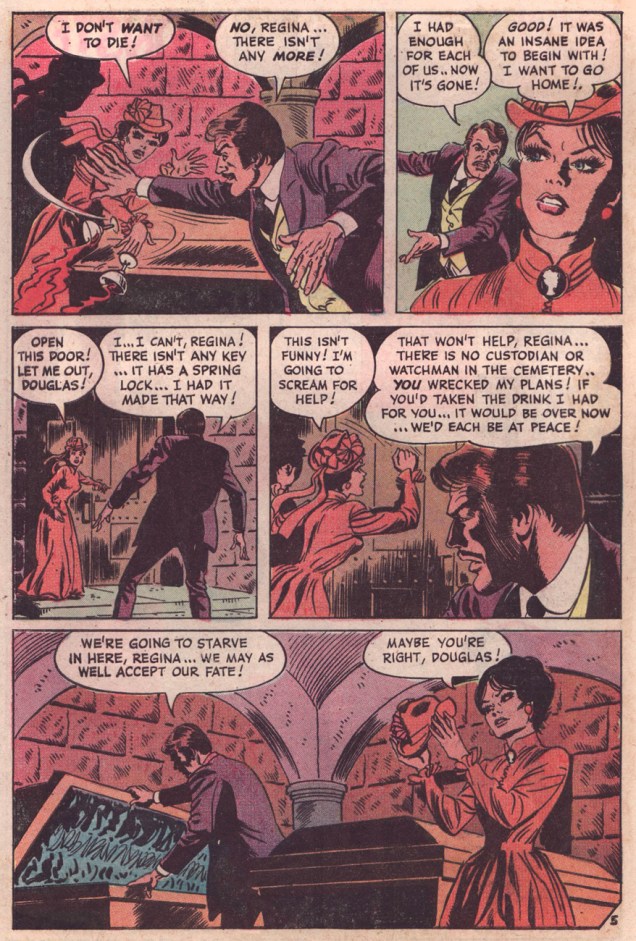
« She stared at Douglas… at this man she had judged to be an ideal mate… yet he had this very fatal flaw. »

Even to the occasional reader of mystery or ghost comic books from the late 60s to early 80s, the absurdly narrow range of plot variations must have been glaringly obvious. Same goes for any genre, of course…

For instance, at DC, mainstays Jack Oleck and Carl Wessler drove the same hoary scenarios into the old sod with numbing insistence (editor Joe Orlando‘s insistence, presumably): the greedy nephew murdering his rich, elderly uncle, the avaricious white explorer / big game hunter / mercenary purloining the sacred idol and incurring its terrible vengeance, the bank robber on the lam getting his ironic comeuppance, satanists vs werewolves vs vampires vs witches and so on… Still, the occasional inspired yarn did crop up, often to the outraged bafflement of readers.

On the other hand, Charlton was the field’s top producer of ghost stories, wisely keeping away from Marvel and DC’s spandex preserve. While one hears (correctly) about artistic laisser-faire attracting maverick stylists, Charlton’s ace in the hole, and the backbone of its comics line, was the remarkably prolific and versatile writer Joe Gill (1919-2006). Unlike his counterparts at DC, Warren, and most famously EC Comics before them, Gill rarely resorted to the O. Henry “twist” ending. An overplayed strength becomes a weakness, and so the “sting in the tail” soon was anything but. Having to write most of Charlton’s line, Gill could afford to experiment and improvise. Fact is, he pretty much had to. In my view, Gill’s work stands out from most of his peers’ in that it seems nourished by high and extensive erudition. When a Gill character discusses business deals or the combustion engine, it’s not just hot air and a family-size tub of Fluff.

Here’s a favourite of mine, a tale scripted by Gill and illustrated by Sururi Gümen (1920-2000). It appeared in Ghost Manor no. 23 (May, 1975, Charlton). The nearest it skirts a ghost story is when Regina says « I… I’ve heard that people who die unhappily haunt the place where they die! »

Abide1AAbide2AAbide3AAbide4AAbide5AAbide6AAbide7A

I love how Abide With Me carves out its own niche between romance and horror without calling upon any of these genres’ habitual devices. It’s like a well-played game of chess, a philosophic two-character play, a gravesite deliberation. Hope you’ve enjoyed it too!

– RG
Unexpected Delights: John Severin, 1971-72

« And you always get your finger in the frame* »

I’m inordinately fond of Marvel’s brief flirtation with “picture frame” covers, which lasted but a year, opening with books cover-dated November 1971, at the tail end of Stan Lee’s run as editor-in-chief, and fading away less than a year later during Roy Thomas’ tenure. Figures.

This period coincided with one of John Severin’s passages at Marvel. At the time, the self-proclaimed « House of Ideas » was endeavouring to flood the market with crap, aiming to force DC to overextend itself to retain its market share, and, reportedly, to drive Gold Key out of business. So Marvel let loose a torrent of unannounced and unnecessary reprints, at most commissioning new covers to sell the bill of goods.

Tactically, it was a tawdry page out of the infamous Israel Waldman* book: in the late 1950s to mid-60s, the canny cheapjack publisher issued a line of comics (IW/Super) reprinting material he owned and often didn’t, in the case of some of the more nebulous copyrights (namely Quality’s The Spirit, Doll Man and Plastic Man)… accidentally on purpose. Anyhow, Waldman paid a few handpicked freelancers top dollar (to get his money’s worth… I did say he was canny) to create enticing new covers to adorn his shoddy reprint rags. And I do mean rags: the paper stock used was even worse than the low industry standard… just try to find any IW comic book in decent shape nowadays!

Among the cover artists Waldman recruited were the Ross Andru / Mike Esposito team, Everett Raymond Kinstler, Jack Abel… and John Severin.

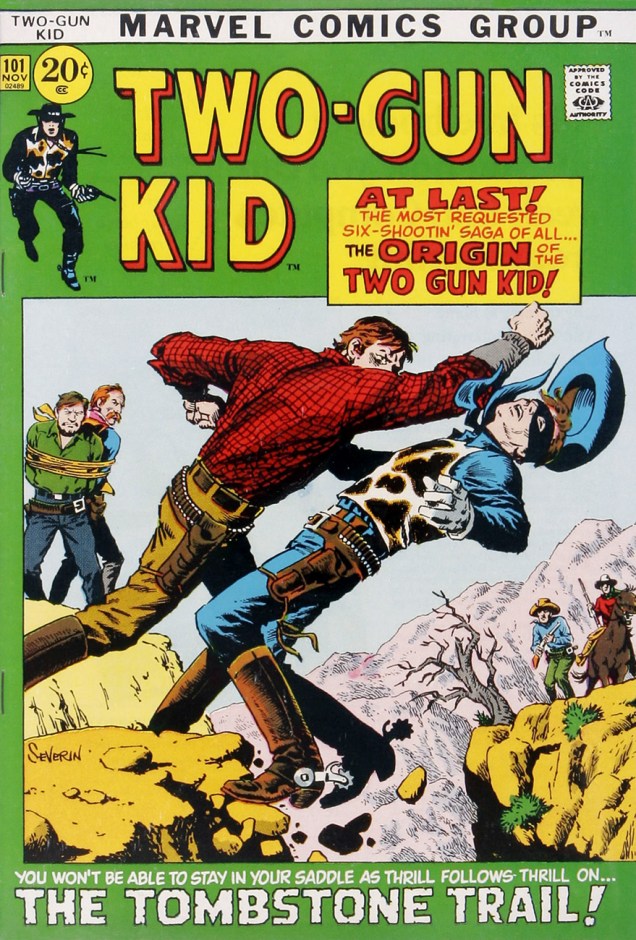
But getting back to 1971-72, here’s a chronological and alphabetical sampling of my favourite Severin turd-polishing covers from Marvel’s brief « picture frame » flirtation, out of the 35 or so he created solo at the time. Several of these are refreshingly uncluttered and moody… for Marvel.

TwoGunKid-101A

SeverinMOTP15A

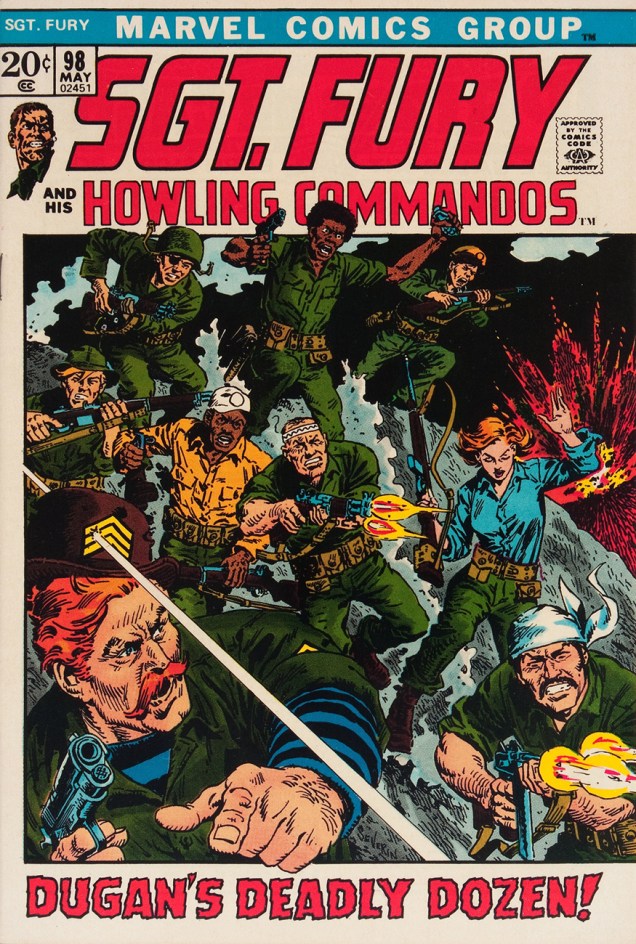
Sgt-Fury98A
Someone at Marvel loved to rip-off the 1967 Lee Marvin-led epic “The Dirty Dozen“; probably Gary Friedrich. The very next month, the Deadly Dozen would team up with another Irishman stereotype to form “Combat Kelly and The Deadly Dozen”, I kid you not. Oh, and a diverse cast in a Marvel war comic? Oh, right, they’re ex-convicts… and they get slaughtered in the last issue. Oops.

TombOfDracula2A

WesternGunfighters9A

WhereMonstersDwell15AFear8A

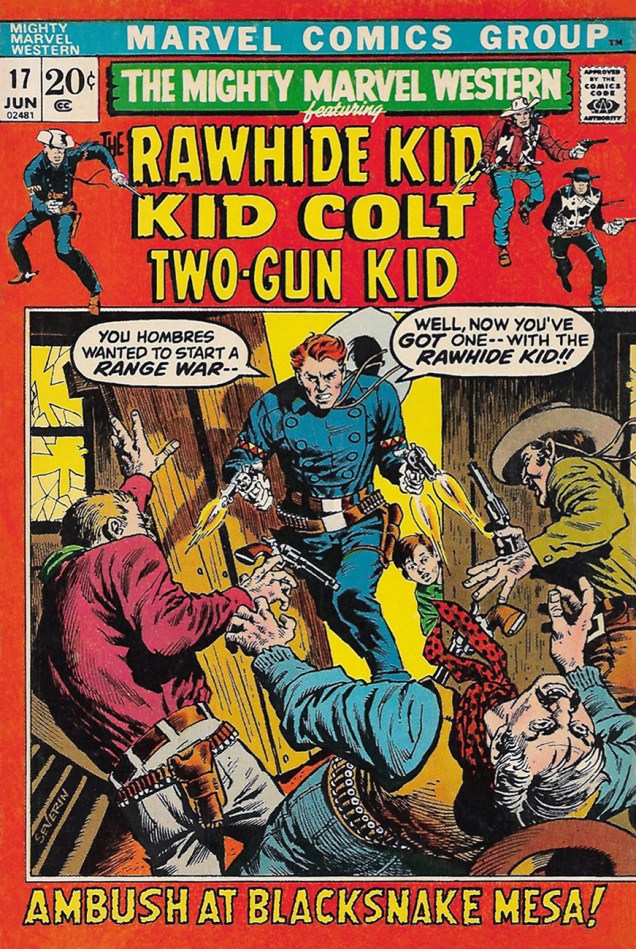
MightyMarvelWestern17A
Ah, Severin’s Rawhide Kid. Don’t miss Severin and writer Ron Zimmerman’s brilliant and daring 2003 reboot of the Kid, “Slap Leather”.

Kull3A

*Del Amitri, “In the Frame” (1995)

**all about Marvel’s “picture frame” era: https://www.cbr.com/marvel-comics-picture-frame-cover-era/

***The gory details on the IW/Super story: http://toonopedia.com/iw-super.htm

-RG

On This Day: Boris Karloff Crosses Over

« What’s that noise comin’ up from the cellar?
It’s the restless bones of Boris and Bela* »

It’s a cinch that William Henry Pratt, back when he was eking out a living in Canada, digging ditches or driving a truck, never suspected that his name, his stage name that is, would still elicit shivers of recognition long after his passing. Here we are, a whole hundred and thirty years past his birth, in Camberwell, South London, on Wednesday, November 23, 1887.

From his ascent to stardom in the early 1930s until his passing in 1969, he certainly lived to see his likeness appear in a bewildering array of toys and games and bedsheets and mugs and a zillion knicknacks and gewgaws, a parade that continues to this day. But he was likely never represented more consistently and abundantly than he was in comic books.

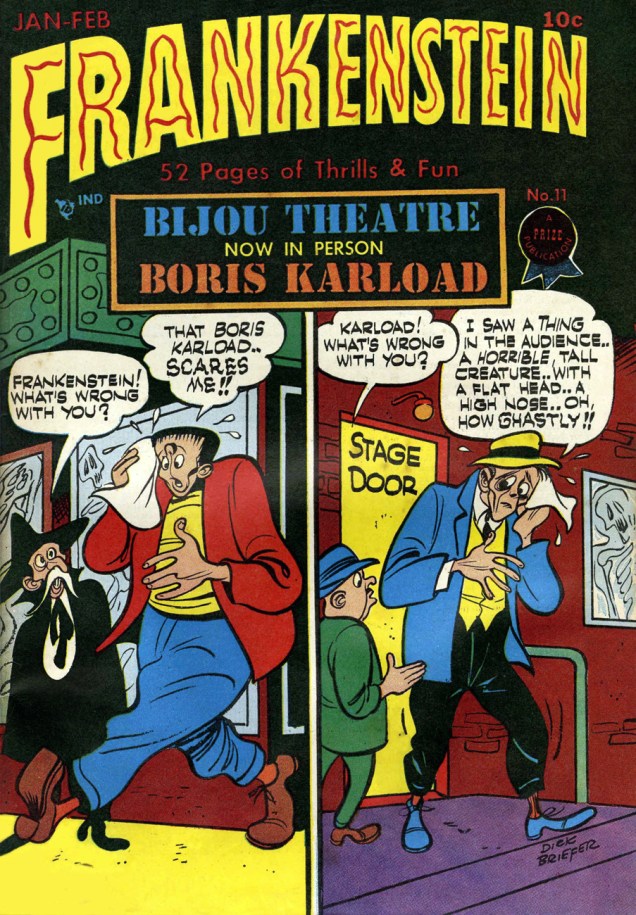
Frankenstein11A.jpg
Here, the Monster meets his… inspiration, in « Boris Karload, Master of Horror ». Dick Briefer‘s Frankenstein is a definite highlight of the Golden Age of comics. This is Frankenstein no. 11 (Jan.-Feb. 1948, Prize Comics). Read it here: http://comicbookplus.com/?dlid=39937 And if you, er… dug that, treat yourself to Craig Yoe‘s selection of Briefer’s rendition(s) of the Famous Monster. It’s a great package, and Mr. Yoe can always use the money… to unleash further wonders.

Here’s a gallery of cover highlights from Gold Key Comics’ long-running Boris Karloff Tales of Mystery (95 issues, 1962-80).

BorisThriller1A
Before there was called Boris Karloff Tales of Mystery, there was, for two issues, Thriller, based on the by-then-cancelled NBC series. Gold Key were often quite slow in making their licensing moves. The TV Thriller was often terrifying (“Pigeons From Hell”, “The Hungry Glass”…), but the comic book never scaled such heights, even sans the emasculating influence of the Comics Code Authority.
Boris33A
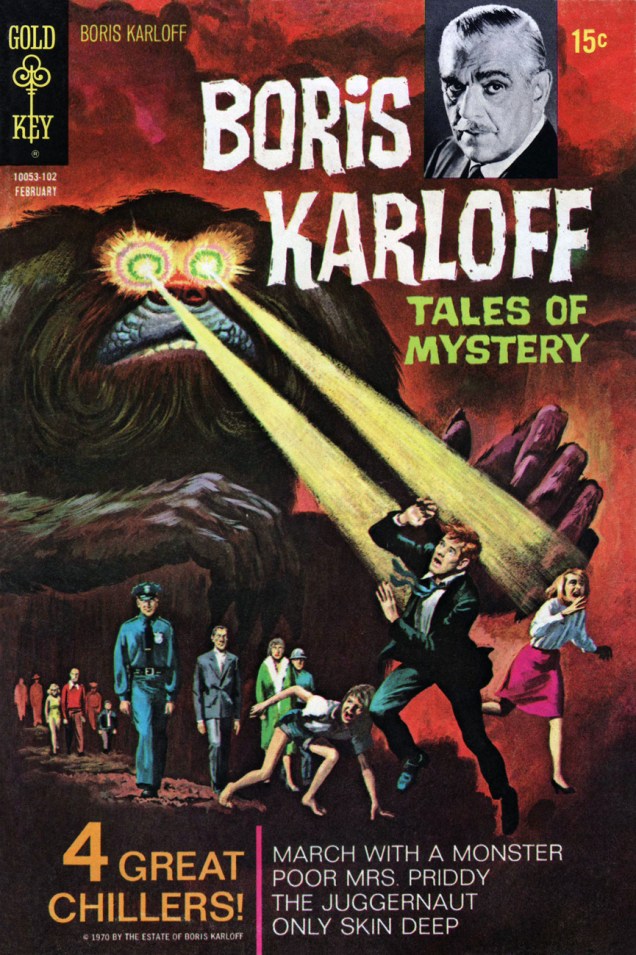
« You know that one sideways glance from that bug-eyed banshee can turn your brains to prune-whip! » Boris Karloff Tales of Mystery no. 33 (Feb. 1971), Cover painted by George Wilson, illustrating Len Wein, Tom Gill and John Celardo’s March with a Monster.
Boris34A
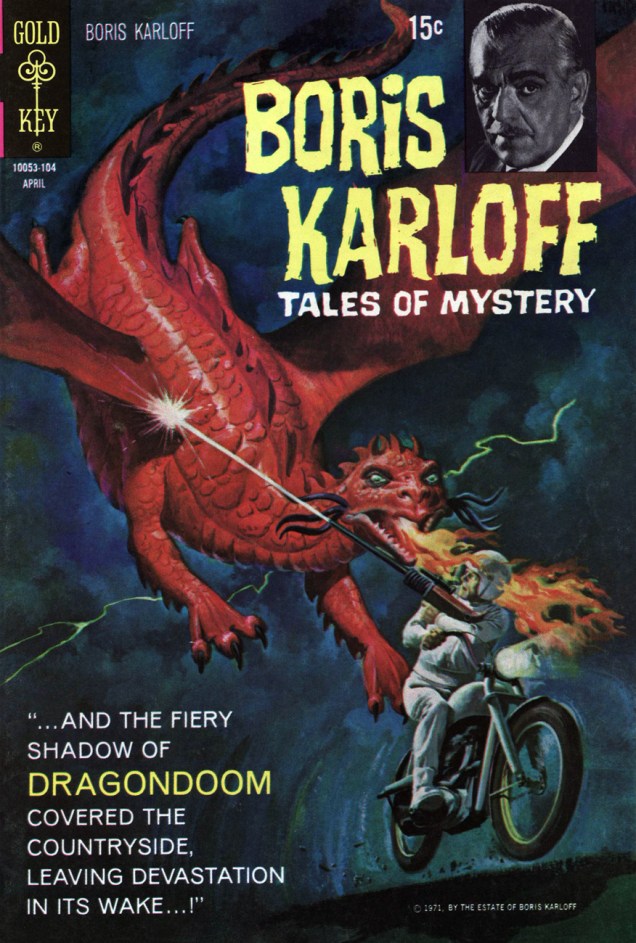
« I’m being scorched by something that shouldn’t even exist! » A laser cannon-equipped Evel Knievel tussling with a badass reptilian nightmare? That’s the Seventies for you. Gold Key’s mystery comics were generally pretty tame fare, but their covers, such covers! This one’s painted by Saint George Wilson. Boris Karloff Tales of Mystery no. 34 (April 1971.) You just know that Dragondoom is written by Lein Wein, because its damsel-in-distress shares his wife’s name, Marvel and DC colourist Glynis.
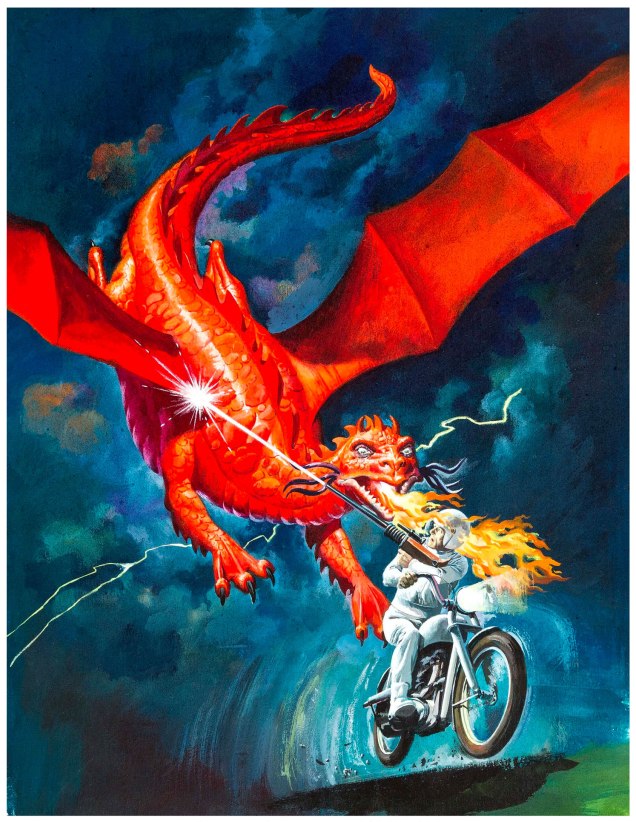
Boris34OriginalA
A look at Mr. Wilson’s original painting gives us an idea of just how much was lost in the transition from brush to print. Sometimes it’s better *not* to know.
Karloff43A
« Feast your eyes upon them, mortal! Do they satisfy your appetite for witchcraft? Hee Hee! » Wayne Howard conjures up some decent monsters inside, but Psychotomimetic George Wilson, who painted this mind-melting cover, shows how it’s *really* done. Boris Karloff Tales of Mystery no. 43 (Oct. 1972.)
Boris49A
« The car — being sucked in by this blasted fetid swamp! Goodbye car… goodbye, convention! » Roadside George Wilson strikes again! Boris Karloff Tales of Mystery no. 49 (March 1973.)

DominguezKarloff62A

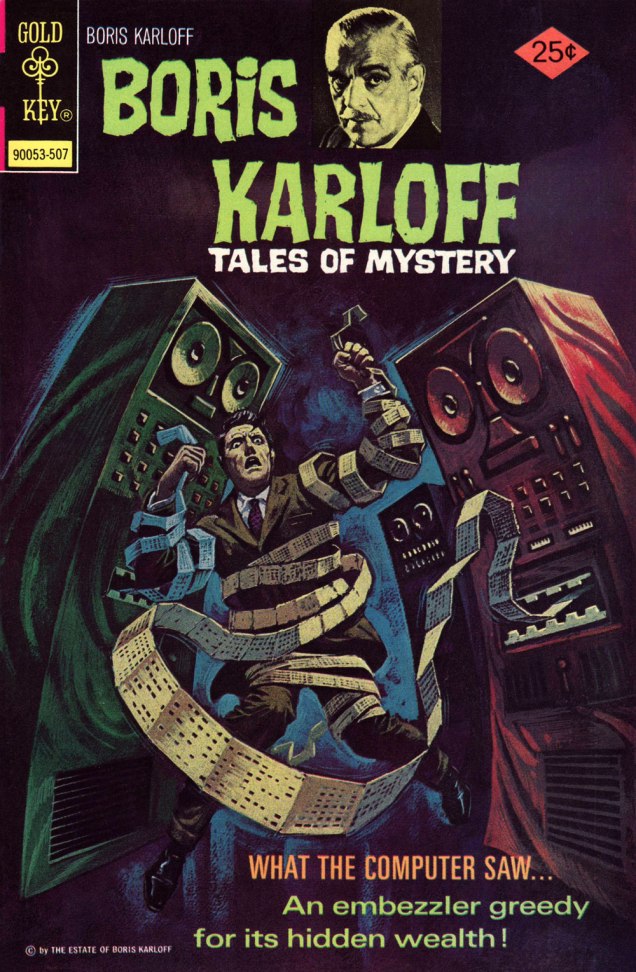
« These computer cards are wonderful… almost as if they were alive! They tell me everything! » Boris Karloff Tales of Mystery no. 62 (July 1973). Luis Angel Dominguez‘s painted cover depicts a scene from Arnold Drake‘s witty It’s in the Cards.

Boris65A
« G-g-get away, B-Bobby! There’s a living horror out there! » « Aww, gee, dad! I’m sorry about that! It’s just my sea monster! » Meet The Mail-Order Monster, a gem from an uncredited scripter (likely Arnold Drake, if the sparkling wit is any indication), and illustrated by Ed Robbins. It’s a fabulously wacky yarn, combining to fine effect good old Sea-Monkeys (brine shrimp, really) and a generous sampling of Ray Bradbury’s Boys! Raise Giant Mushrooms in Your Cellar! 
This is Boris Karloff Tales of Mystery no. 65 (Dec. 1975), edited by Paul Kuhn. Also within: Don’t Put It on Paper, another of the handful of jobs José Luis García-López did for Gold Key, before settling down at DC later that year. The plot is basically that of Clark Dimond/Terry Bisson & Steve Ditko’s The Sands That Change! (Creepy no. 16, Aug. 1967, Warren), but with a much gentler outcome.
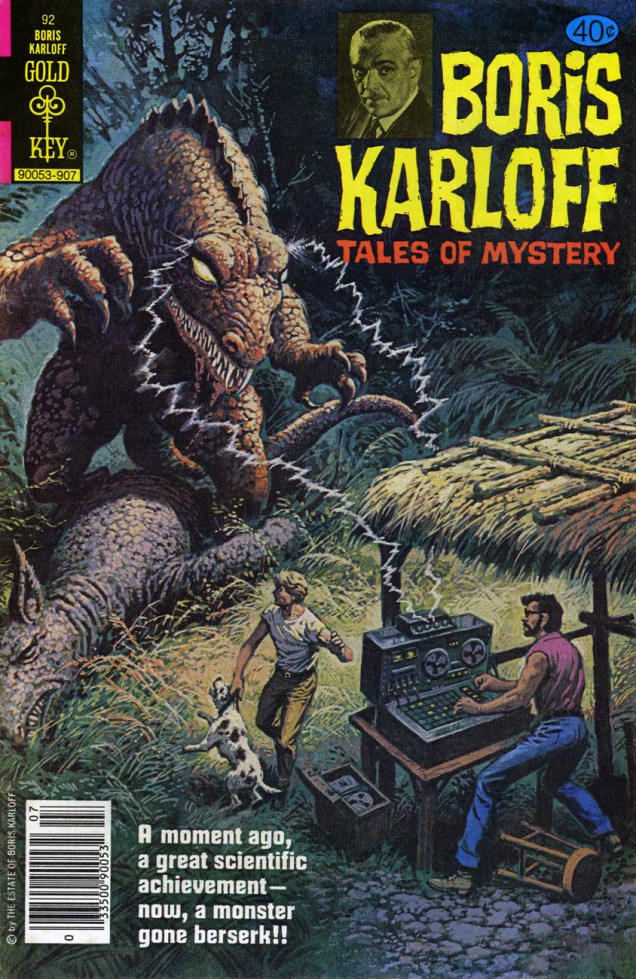
Boris92A
« But — why would anyone create something so — so terrifying? » One thing you can nearly always count on in any given issue of BKToM: “scientific” experiments always go awry, and they nearly always yield rampaging monsters. Fitting! Luis Angel Dominguez provides this electrifying cover for issue no. 92 (July, 1979.) The man had such a peerless colour sense.

And remember, there’s far more to Boris Karloff than Frankenstein’s Monster: for evidence of his talent, check out The Body Snatcher (1945, directed by Robert Wise and produced by Val Lewton) or Targets (1968, directed by Peter Bogdanovich.)

Let’s reserve our closing words for the man (monster) himself: « Certainly I was typed. But what is typing? It is a trademark, a means by which the public recognizes you. Actors work all their lives to achieve that. I got mine with just one picture. It was a blessing. »

– RG

*Ships Don’t Disappear In The Night (Do They?) by 10cc (1973)

On This Day: November 16, 1902

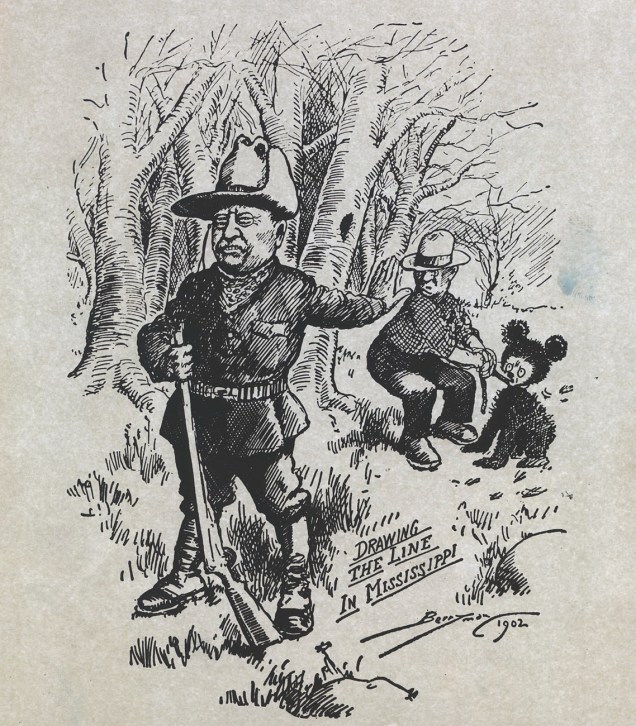
A cartoon appears in the Washington Post, prompting the Teddy Bear Craze, after President Teddy Roosevelt refused to kill a captive bear tied up for him to shoot during a hunting trip to Mississippi.

Boy, American presidents sure were different back in those days.

TeddyRooseveltBerryman1902A
The history-making cartoon by Pulitzer Prize–winning cartoonist Clifford K. Berryman (1869-1949), who worked with the Washington Post from 1891-1907, then with the Washington Star from 1907-1949.

Which brings us to Teddy Bears (as they became known henceforth) returning the favour of protecting the vulnerable and innocent.

The earliest instance that comes to mind is Johnny Craig and “Ghastly” Graham Ingels’ holiday charmer, Shoe-Button Eyes!, which appeared in The Vault of Horror no. 35 (Feb.-Mar. 1954, EC), wherein a blind, put-upon little boy gets a new set of peepers… the hard way.

Post-Code, this sort of harsh poetic justice had to be handled very gingerly, if at all. The vengeful bear turned up again in Nicola Cuti and Jack Abel’s elegantly-told The Teddy Bear, in Haunted no. 15 (Nov. 1973, Charlton.)

TeddyAbelA
Quoth the plush companion: « I was sent to you to protect you and I will! » Spoiler alert: the butler did it.

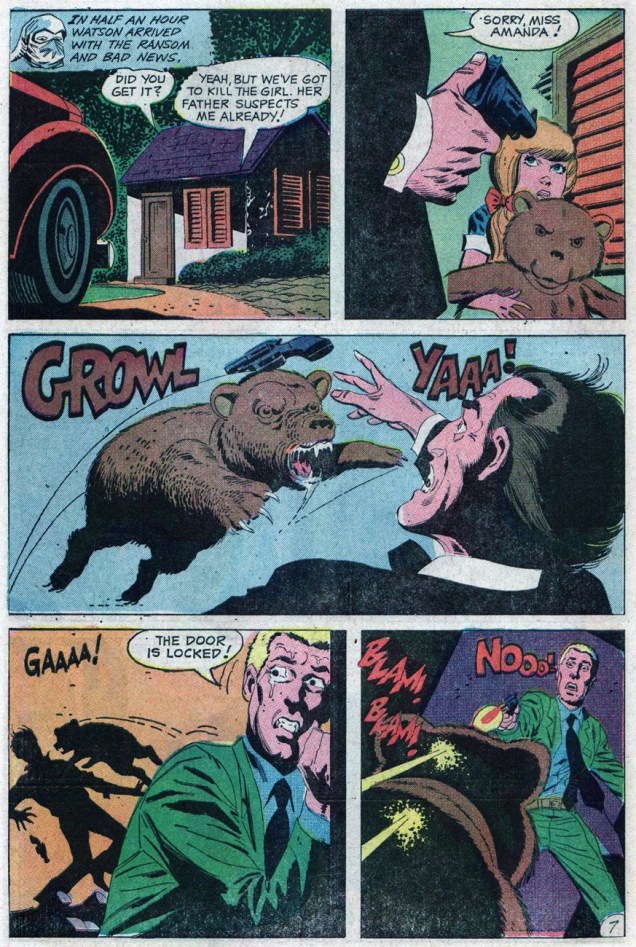
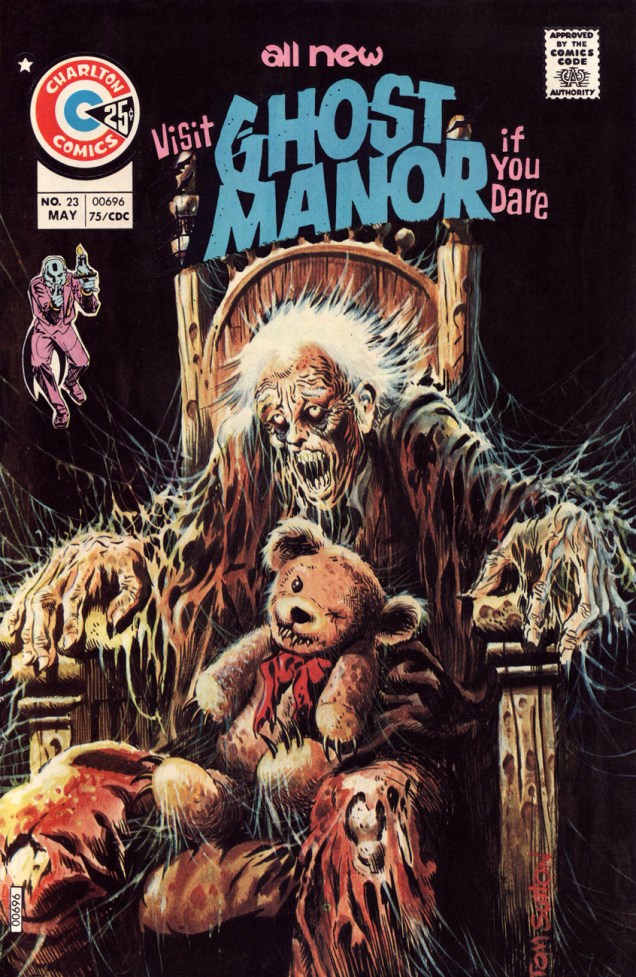
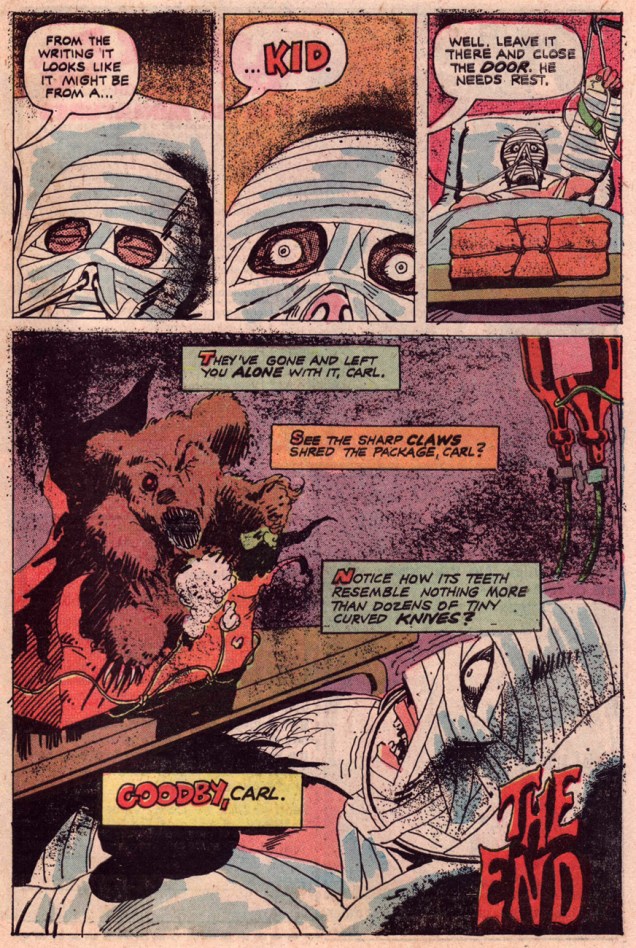
A couple of years down the pike, “Grisly”* Tom Sutton took up the gauntlet with his «Terrible Teddy!», from Ghost Manor no. 23 (May 1975, Charlton). Here it is, presented in its glorious entirety (including Sutton’s gnarly painted cover).

Ghost-Manor23A

TerribleTeddy1ATerribleTeddy2ATerribleTeddy3ATerribleTeddy4ATerribleTeddy5ATerribleTeddy6A

– RG

*perhaps more appropriately “Grizzly”, in this instance.

Purple Tentacle Tuesday

Greetings. Today’s theme: purple tentacles! (No, that’s not a euphemism.)

First up on our list is this beauty of an octopus, the Octo Rod.

This intrepid purple fella is part of Topps’ 1980 series, Weird Wheels, which had 55 cards in all. The credit for the gorgeous artwork is split between Norman Saunders and Gary Hallgren; nobody’s quite sure which artist worked on which card, and whether Saunders actually painted the images himself, or just retouched paintings by somebody else.

Sadly, Weird Wheels just didn’t sell all that well, so you can still purchase them for fairly cheap today. You can see the whole set here (and please do feast your eyes on them, they’re quite stunning).)

OctoRod21Hallgren
Octo Rod is no. 21, 1980. The art is by Gary Hallgren, at least according to David Saunders, Norman Saunders’ son.

Speaking of David Saunders and his dad, here’s a quote from “Norman Saunders” (a book written by David in 2009):

« In 1980, at the age of 73, with failing eyesight, cataracts, and advanced emphysema, Norman Saunders defied doctor’s orders and went back to work on one last card set. Weird Wheels are painted with full control of his creative powers, but with a morbid humor that reflects his attitude towards mortality. When reprimanded by his son for risking his life on low paying work, the artist said, ‘It’s fun! I gotta keep working! What the hell else am I gonna do?!‘ »

Saunders passed away in 1989, at 82, after a remarkably prolific and varied career.

Moving on, here’s a thrilling scene of purple tentacles vs Nemesis:

AdventuresIntoTheUnknownTentacles
This is ACG’s Adventures Into the Unknown no. 157 (June-July 1965). The cover is by Kurt Schaffenberger (who signed as Jay Kafka here). “Case of the Tittering Texan” sounded intriguing – I figured that the Texan was being tickled by a tentacle – but no, he’s just a stuttering, crazy, power-hungry villain in a cowboy hat and spurs. Same old, same old…

I would also like to mention that Nemesis *is* wearing pants (well, shorts, at any rate), but his costume is still gosh-darned stupid. You try wearing a hood under water and see how far it gets you. I’m normally a fan of ACG‘s Adventures, but Nemesis is by no means a favourite character of mine.

Further developing the theme of violaceous violence, here’s another:

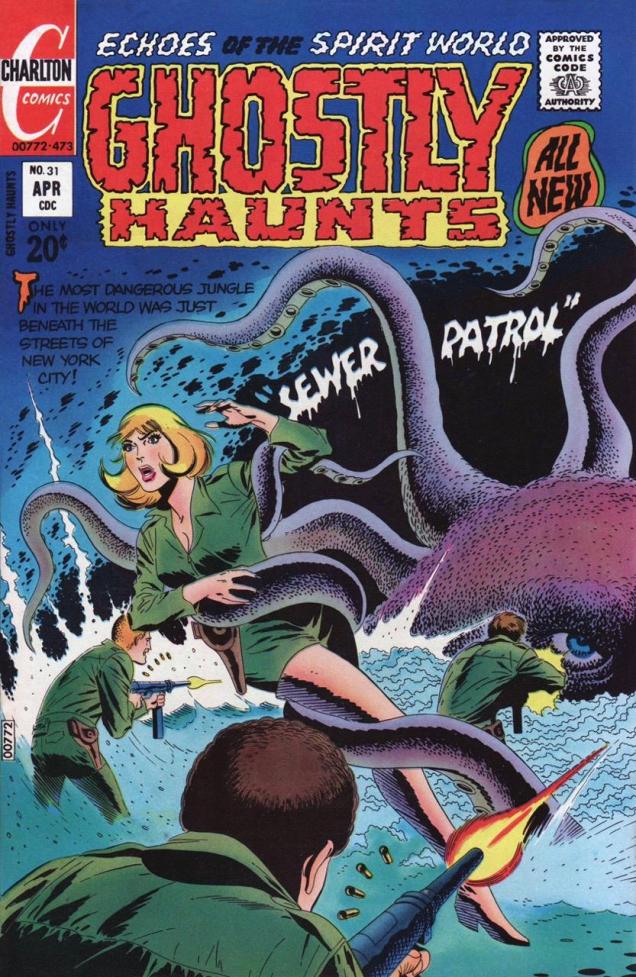
GhostlyHaunts31
« Giant squid, giant water rats! Are we in New York, or are we on Mars? Down here, it’s hard to tell! » Ghostly Haunts no. 31, April 1973, cover by Jack Abel.

“Sewer Patrol”, the cover story, is also illustrated by Abel, with an excellent script by Nicola Cuti – it’s a story about people who dump their pets (and still-alive food) when they don’t want them anymore… and where and how these pets end up. (The answer to that, of course, is “mutated, gigantic and in the sewers.”)

~ ds

Happy 90th birthday, Mr. Ditko!

« Don’t be so sure! A guy that popular — he’d be a fool to fold up his act while he’s such a hot item!* »

I’ve been a Steve Ditko fan for as long as I can remember. In fact, I was a fan even before I actually saw his work. “How’s that even possible?”, you may ask. Well, when I was five, this neighbour from across the street was showing off a comic book he had just picked up, which was Teen Titans no. 29**. I was instantly captivated by two costumes on the cover: Hawk and Dove’s, designed by Ditko a couple of years earlier.

I do believe I had encountered a Ditko comic book just a bit earlier, a copy of The Many Ghosts of Doctor Graves no. 20 (June, 1970), acquired by my brother en route to the family vacation on Prince Edward Island. But that one had a (fine) cover by Pat Boyette, and I don’t recall the Ditko story within, « An Ancient Wrong ».

The bottom line is that Ditko’s been a precious part of my life for a spell. It would be easy to take him from granted, so let’s not, if you don’t mind.

Which brings us to our little tribute: running ninety covers covers would be about as practical as ninety candles on our birthday boy’s cake, so I’ll just drop a decimal and stick to a more manageable nine… I won’t even give a nod to such fickle and hollow notions as popularity, historical importance, or iconicity. I’m going with my favourites. That’s the way Steve would do it… and even if he wouldn’t, I’d still go this route.

UnusualTales9A
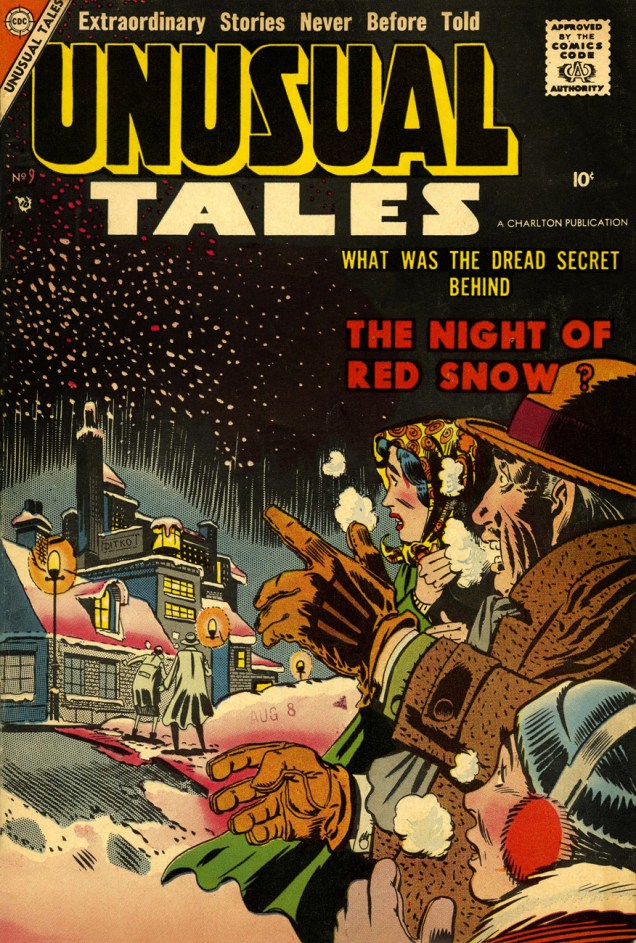
« Nobody here in Crestville will ever forget that night! »
A tiny reproduction of this cover, that of Unusual Tales no. 9 (Nov. 1957, Charlton), in some late-70s edition of the Overstreet Comic Book Price Guide hooked me, and still grabs me. In the post-code era, particularly in its early days, you had to be mighty resourceful to fruitfully mine the mystery genre, what with all the verboten topics and tropes. The issue holds a whopping four, 1957-vintage Ditko stories, including the title piece, which you can read here:
http://ditko.blogspot.ca/2012/01/unusual-tales-night-of-red-snow.html
ASM2A
The Amazing Spider-Man no. 2 (May 1963, Marvel). Beyond Ditko’s departure (no. 38 was his final contribution), I have no further interest in Peter Parker and his costumed alter-ego.
Creeper4A
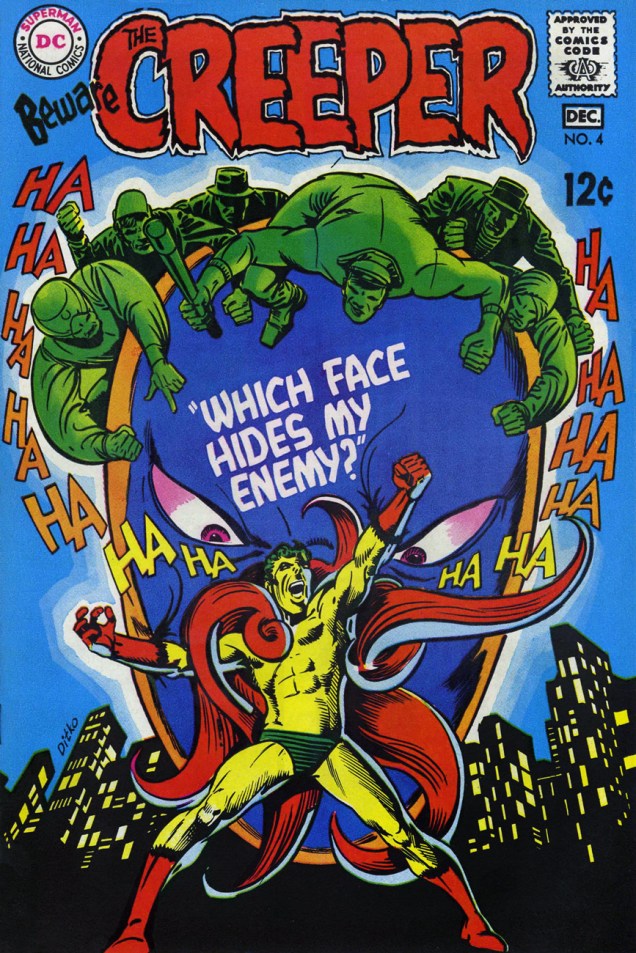
« Name’s Bulldog Bird! This is Sumo! We’re secret agents from the sovereign kingdom of Offalia! »
For most of the brief run of his book (issues 2 to 6), the Creeper had to contend with a faceless enemy, Proteus, who turns out to be someone very close to him. It was as though Ditko felt the need to replay the Spider-Man – Green Goblin secret identity dynamic, not the way *he* had envisioned it (which was to make the Goblin a total stranger, a situation he’d meticulously set up in the background), but the way Lee had, as if to show his former editor how to do it properly.
This is Beware the Creeper no. 4 (Nov.-Dec. 1968, DC), “Which Face Hides My Enemy?” Pencils and inks by Steve Ditko, plot and dialogue by Dennis O’Neil
Hawk&Dove2A
« You’re still wasting your time reading! Why don’t you build up that sickly body of yours? »
DC’s Hawk and Dove (introduced in Showcase no. 75, June 1968, DC) was, as its title and covers amply make clear, a study in contrast and opposition: aggression vs pacifism, the letter of the law vs the spirit of the law, Steve Ditko vs Steve Skeates…
The concept may have been of its time, but the industry as it stood wasn’t ready to explore the issues without stacking the deck. This was still, after all, a mainstream superhero comic book of the Sixties. This is issue 2, “Jailbreak!” (Oct.-Nov. 1968), Ditko’s third and final issue with his creations. As for Ditko’s abrupt departure from DC is concerned, the reason cited at the time was a relapse of tuberculosis, a disease that had plagued Ditko in his youth. Others have invoked more political explanations, but Ditko *was* out of the game for several months, which fits the convalescence scenario. His absence until 1975 from DC fits the politics one. Why credit one single factor when several, taken together, are more plausible?
GhostManor5A
« Come off it, yer Lordship! This ain’t no blinkin’ time ter do the art connoisseur bit! »
The rakish 14th Lord Garland proves a bit of a disappointment to his forebears. Sir Steve Ditko’s cover proffers a scenic victim’s perspective… but who’s the hazy, phosphorescent figure shambling down the stairs to meet us?
This is Charlton Comics’ Ghost Manor no. 5 (second series, June 1972, Charlton). Inside, you’ll find a trio of Joe Gill chillers: “Dead Man’s Eyes”, illustrated by Joe Staton; “Devils at My Door”, illustrated by Charles Nicholas and Vincent Alascia, and of course, the pièce de résistance, “The Last Garland”, brought to you in panoramic Ditko-vision.
GhostlyTales97A
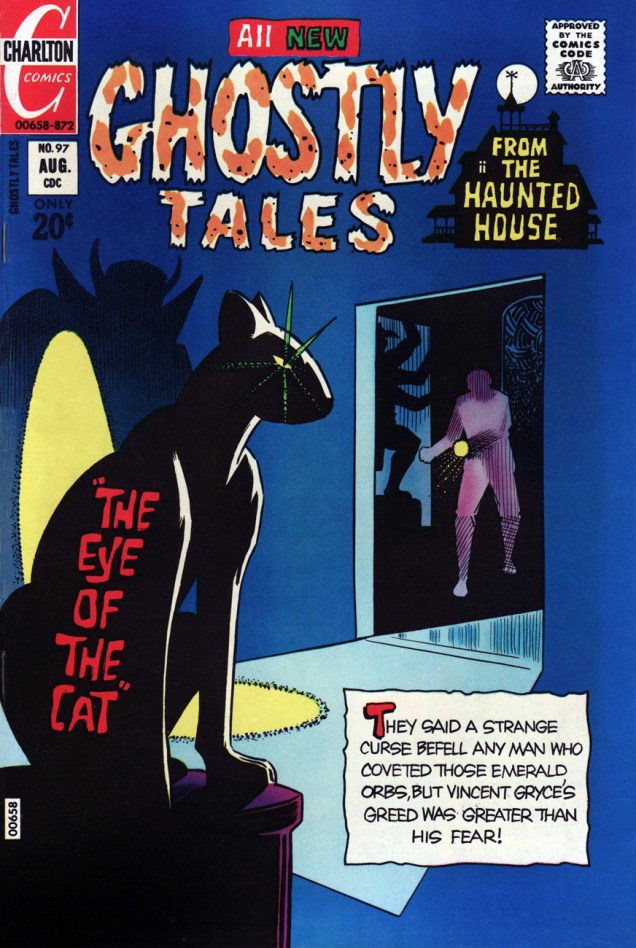
Ah, the largely lost art of the *soft* sell. Charlton’s cadre of artists hewed much closer to the ambience favoured by aficionados of the spectral than did the esteemed competition. You know, more Montague Rhodes James than, say, Rob Zombie.
Here, Ditko demonstrates how (dis)quiet and mystery is evoked. Dignified silence can be very attractive when everyone around is shouting. Ghostly Tales no. 97 (August 1972, Charlton) features “The Eye of the Cat”, actually handled by Don Perlin, while Ditko delivers visuals for Joe Gill’s “Journal of a Hanged Witch”. The issue also features “Poltergeist”, an effective collaboration between Creepy Magazine founder Russ Jones and the multitalented Bhob Stewart.
Haunted16A
My particular favourite among Ditko’s covers for Charlton’s Haunted (75 issues, 1971-84.) The merrily saturated colour scheme, the composition and its geometric simplicity, that well-chosen angle… the contagious joy of a master at play. This be Haunted no. 16 (June 1974, Charlton.)
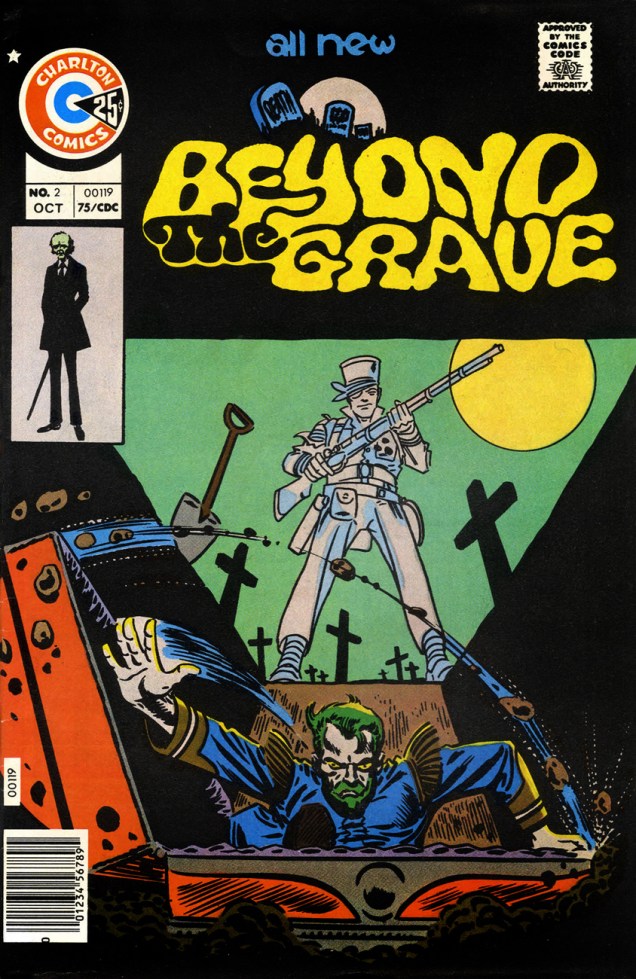
BeyondtheGrave2A
« If you visit that grave on a dark night, you may be surprised… for there is a sentry stationed there…to honor the dead? Or to make sure that General Kugar never leaves his grave? »
Here’s a cover showing the sort of solemn dignity and restraint that made Charlton’s line of ghost books so attractive to me right off the (vampire) bat. No one’s shouting deceptive hype or explaining the action; the elusive allure is undisturbed, unlike the sanctity of the tomb. 
DC, under Infantino and Cardy, generally understood this, but Marvel virtually never did or cared to. But hey, what sold and what I liked rarely sat at the same table.
Beyond the Grave no. 2 (Oct. 1975, Charlton).
Shade3A
Ah, Shade. Ditko’s last great creation, cut off in its prime by the Great DC Implosion of ’78. Later misunderstood and corrupted by hacks. Finally reprinted, including formerly unpublished issue 9, in volume 1 of The Steve Ditko Omnibus (2011). It’s still a frustrating experience, but at least issue 8’s cliffhanger has been resolved, and what happens in the Zero Zone doesn’t stay in the Zero Zone, if you know what I mean. This is Shade the Changing Man no. 3 (Oct.-Nov. 1977, DC)

*Jack Ryder (aka The Creeper)’s closing quip from “The Coming of the Creeper!”, plot and art by Steve Ditko, script by Don Segall (Showcase #73, Mar.-Apr. 1968, DC)
**Since it played such a crucial rôle in my Ditko inculcation, here’s the Teen Titans issue in question.

TeenTitans29A
Teen Titans no. 29 (Sept./Oct. 1970, DC) Cover by Nick Cardy (likely co-designed by Carmine Infantino and coloured by Jack Adler), illustrating “Captives!”, written by Hawk & Dove scenarist Steve Skeates and illustrated by Nick Cardy.

– RG

Hallowe’en Countdown, Day 31

« I’m going to die and they’re laughing! »

It surely won’t shock you that the most difficult decision, in such a countdown, lies in crowning numero uno. There are, after all, plenty of worthy candidates. But one also seeks to avoid undue repetition. After a couple of false starts, I opted for a long-time favourite that’s never received its due.

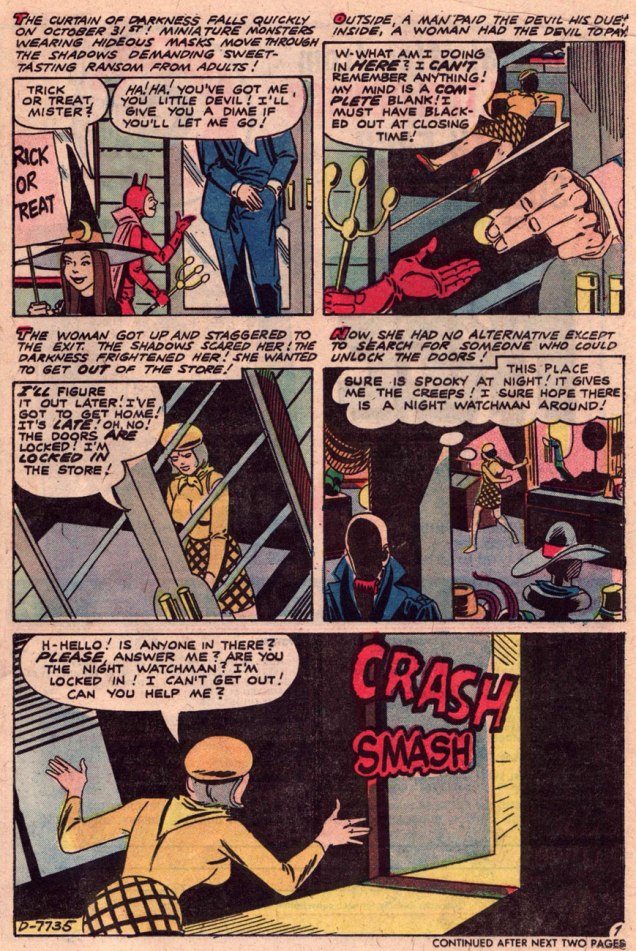
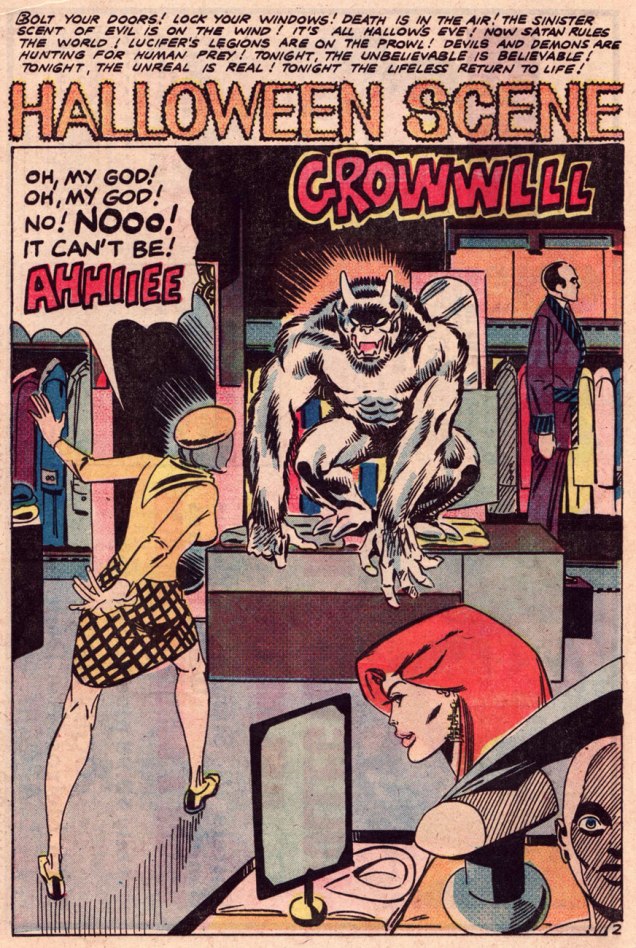
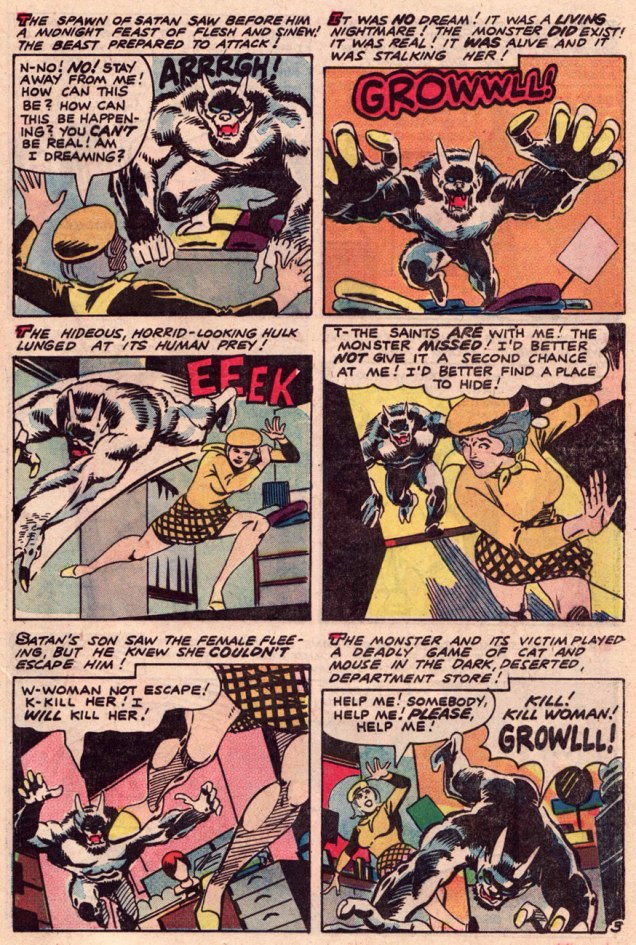
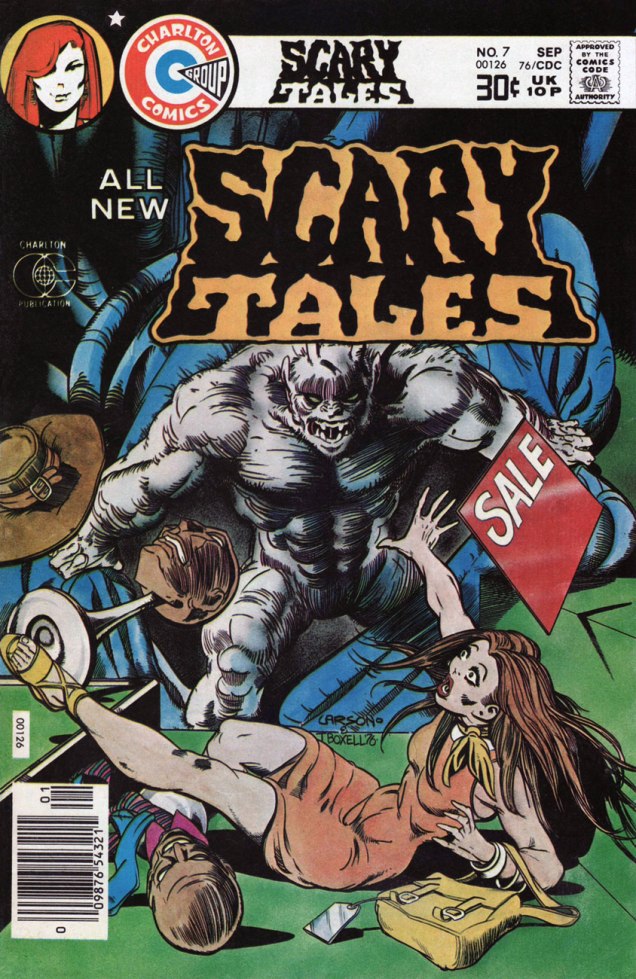
Here, then, is Steve Ditko (and an unknown scenarist)’s expertly-paced department store nightmare, “Halloween Scene”, from Scary Tales #7 (Sept. 1976, Charlton). It occurs to me that Mr. Ditko is about to turn 90 in a couple of days… they didn’t call him “Sturdy Steve” for the alliteration alone, as it turns out.

HalloweenScene1AHalloweenScene2AHalloweenScene3AHalloweenScene4AHalloweenScene5AHalloweenScene6A

HalloweenScene7A

As a bonus (Hallowe’en comes but once a year, after all!), have a peek at the issue’s fine cover and its original art.

ScaryTales07ORIG
Pencils by future “Good Girl” specialist (see his Haunted House of Lingerie series, in the name of research, of course) Rich Larson (with ink and airbrush work by artistic partner Tim Boxell).
ScaryTales07A
The published version offers reasonably accurate reproduction, though one misses some of the details hidden behind the logo. Nature of the Beast of Commerce…

Well, that’s it for this year. Happy spookfest to all, and see you next time, hopefully.

I pity inanimate objects
Because they cannot move
From specks of dust to paperweights
Or a pound note sealed in resin
Plastic Santas in perpetual underwater snowstorms
Sculptures that appear to be moving but aren’t
I feel sorry for them all.

Godley and Creme – I Pity Inanimate Objects (1979)

-RG

Hallowe’en Countdown, Day 26

« I’m doing some new phony ghost effects and these hicks just eat it up! Show ‘em a ghost and they’ll swear they recognize it! »

Is it just me, or are horror covers more effective when they’re basically wordless? EC and DC and Charlton got it, but Marvel never did, with its protagonists/victims standing around uselessly pointing out the obvious: “Oh no! We’re trapped with… the Thing that walks!” “Uh, honey, I think it’s more of a Thing that shambles!”

HOM236A
This is House of Mystery no. 236 (October, 1975, DC) and it’s quite an issue on the inside too: Steve Ditko with Mike Royer inks (“Death Played a Sideshow“), and Paul Kirshner with Neal Adams inks (“Deep Sleep“.) Lest we forget: this fine cover palette brought to you by Tatjana Wood.

… and since this is our first, sadder Hallowe’en without the macabre Bernie Wrightson  (1948-2017) to inspire us, let’s have one more shot, shall we?

HOM219Intro
This is the frontispiece ushering us into issue 219 (Nov. 1973) of DC’s House of Mystery.

Interestingly, BW’s signature (at bottom, on the spine of a book in the centre) is reversed, which makes one wonder whether the image was flipped before dialogue was added. On the other hand, perhaps it made for better arcane lettering for a dusty grimoire.

– RG

Hallowe’en Countdown, Day 25

« No, obese one. I am not dead… not in a manner you would comprehend. »

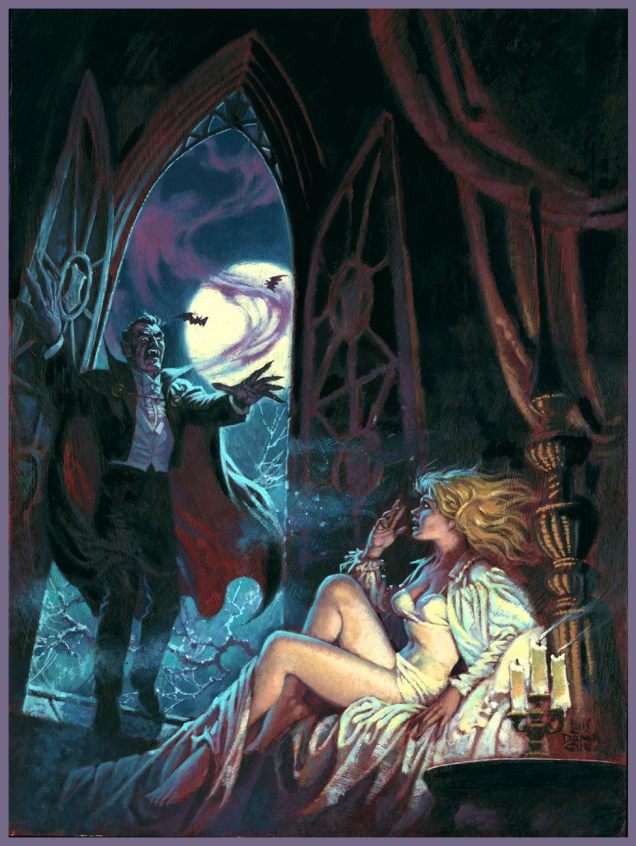
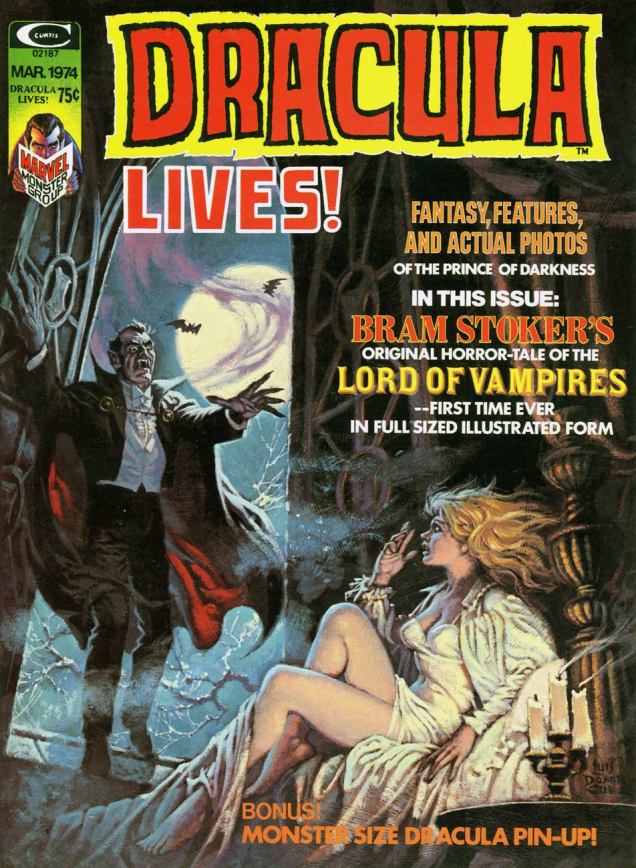
Here we present Luis Angel Dominguez’s (born 1923, Argentina) splendiferous cover painting for Marvel’s Dracula Lives no. 5 (March, 1974). Pure velvety ambiance.

DraculaLives5ORIG

… and the printed version, bogged down with the usual Marvel ’nuff said (as if) hard sell copy. Now you know what you were missing. Sorry about that… it can be disconcerting.

DraculaLives5ATo give credit where credit is due, the colour reproduction is fairly faithful (as these things go) and quite a bit of detail is retained. That hardly ever happened!

– RG
Hallowe’en Countdown, Day 18

« Sorry fella! But yuh fergot tuh git yore ticket punched! »

In the early 1970s, despite the western genre’s waning prospects in comics, DC found itself with a surprise hit in John Albano and artist Tony DeZuniga‘s antihero Jonah Hex, thanks to a healthy infusion of grit and spaghetti sauce. The battle-scarred Civil War veteran first reared his memorably homely puss in All-Star Western no. 10 (Feb.–Mar. 1972), which soon changed its title to Weird Western Tales with issue 12 to better accommodate its new star.

WWT’s reliably great covers probably didn’t hurt sales. Most of them were the work of Argentine Luis Dominguez, in tandem with the all-star design team of publisher Carmine Infantino, art director Nick Cardy and production manager / colourist Jack Adler. These covers all possess that elusive allure of « Mysterioso », as Infantino termed it.

WWT25A
This is Weird Western no. 25 (Nov.-Dec. 1974), featuring Showdown with the Dangling Man. Script by Michael Fleisher, art by Noly Panaligan.

– RG