Greetings, tentacle lovers! I’m here with a new batch of Warren-published tentacles – this time, some he-men macho types get tangled up in them, though damsels predominate as usual. Don’t forget to visit part I: Tentacle Tuesday: Warren and Its Many Tentacles.
One thing that can easily be generalized from tentacular covers is that women frequently have a lot more fun on them than their male counterparts. To wit:
Vampirella no. 39 (January 1975). Cover by Ken Kelly. The gal may not be Vampirella, but damn, she’s enjoying herself. I admit that having tentacle-shaped fingers would be… practical.
As for poor Vampi, she seems to encounter tentacles wherever she goes.
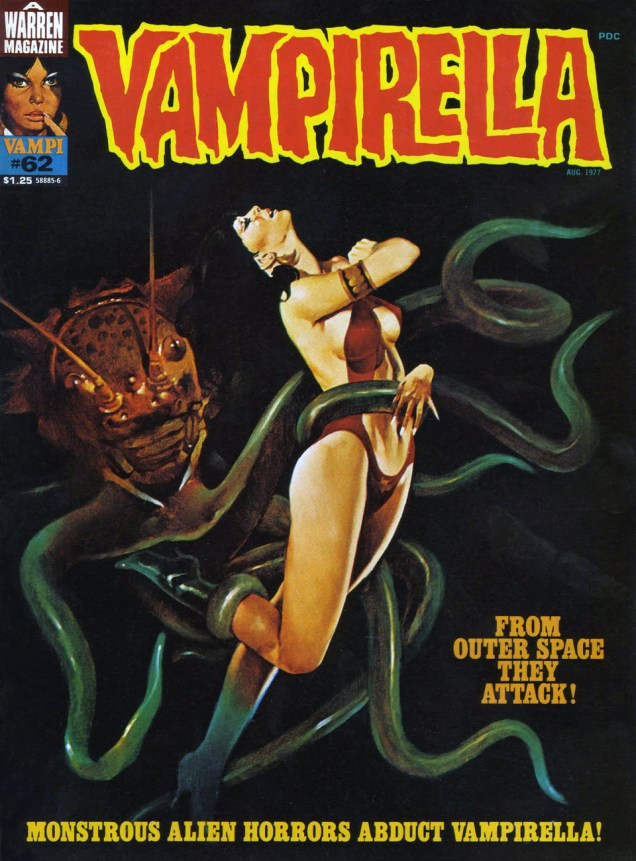
Vampirella no. 62 (August 1977), cover by Spanish artistEnrich, whose real name was Enrique Torres-Prat.
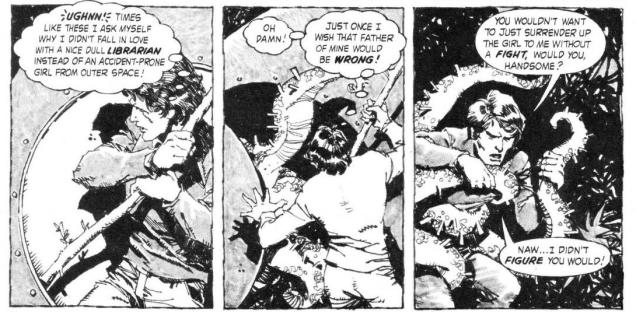
The cover story, Starpatch Quark & Mother Blitz (scripted by Bill DuBay and illustrated by Jose Gonzalez), contains some spectacular, spiky, nasty tentacles.
I tried saying « prasptam… hoodjum… billigam… POOT! », but no tentacled creature materialized. How very disappointing. I’d also like to know what kind of slap makes a « SPAKKT! » noise.The non-librarian girl in question is Vampi. Her eyeballs get ripped out by some vengeful queen and get accidentally conjured onto the desk of some random girl with an abusive husband, during which time blind, suffering Vampi is kidnapped by aliens while a handsome youth uses his father’s psychic connection with Vampi’s eyes to watch through them as they are retrieved by a tentacled monster, and… oh, never mind. Go read the story yourself.
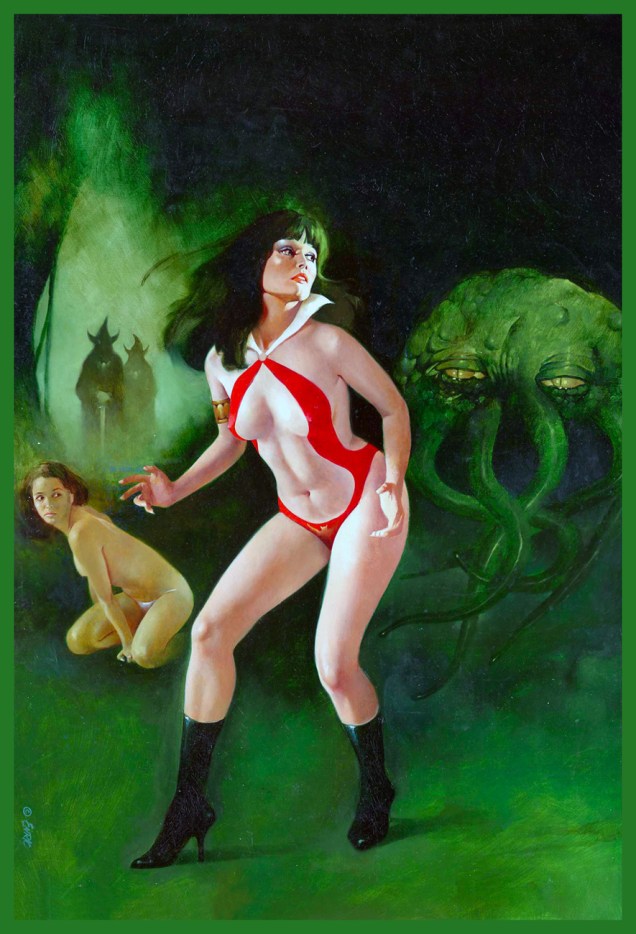
The original cover art of Vampirella no. 105 (May 1982), painted by Enrich. It was printed much darker, so one can barely see tentacles. Fuck that, I say! Let us admire the green creature in its full glory! (And its unfortunate slight family resemblance to Jabba the Hutt…) His gaze seems to be appraising Vampirella – “hm, I wonder if she would be as tasty a snack as she looks?”The printed version of said issue.
The cover story sounds like fun… let’s take a peek.
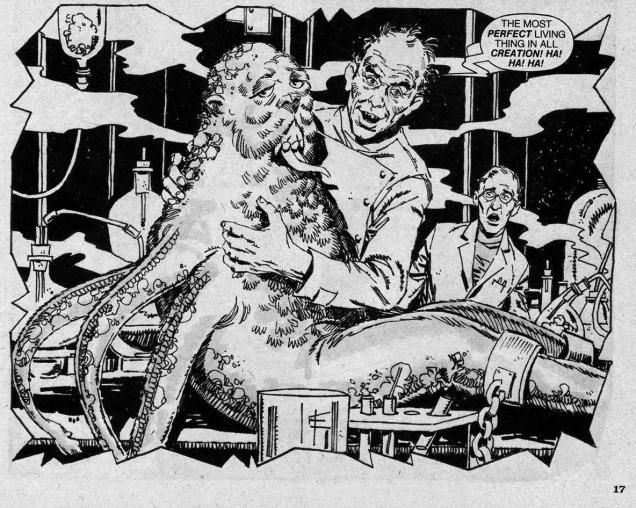
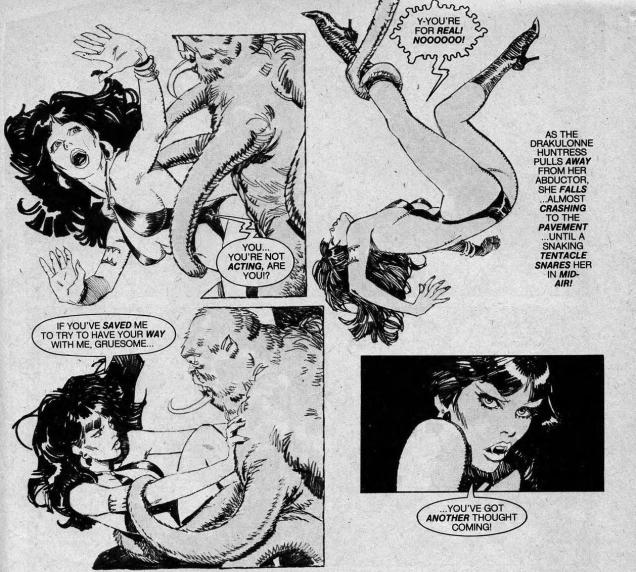
I’m sorry, but that is not what “Blobs and Behemoths” made me think of. I was expecting something in the class of Cthulhu, not an overweight human walrus with tentacles! Panel from “Horrors of Heartache City”, scripted by Bill DuBay and illustrated by Jose Gonzales (apparently this team specializes in tentacles).
« You’re worried that little Orphee is thinking of making a meal of that luscious girl…? He’s turned down everything from the choicest prime rib to the slimiest of insects, which leads me to believe that he filters nourishment from the very air! »
So much for scientific theories.
I think I promised you some men fighting tentacles. Sigh, so be it.
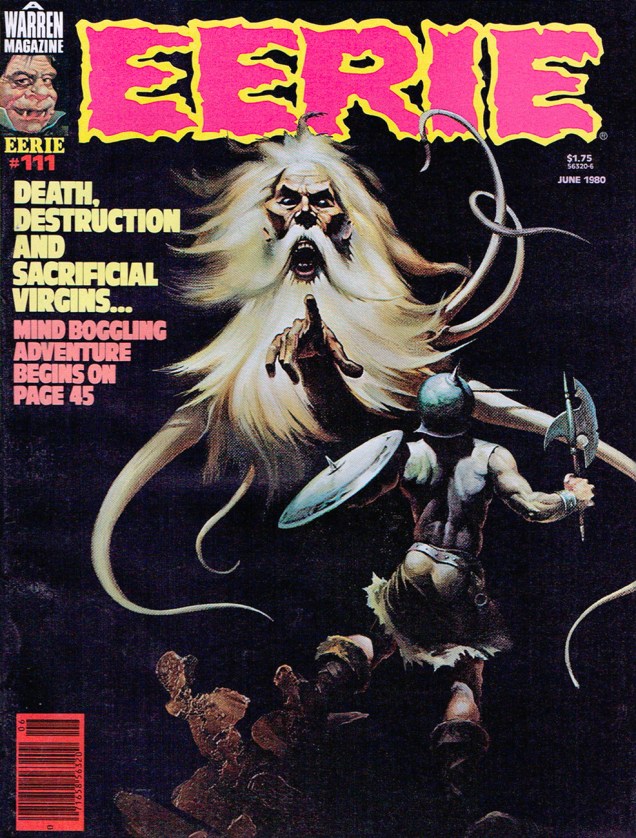
Eerie no. 66 (June 1975), cover by Manuel Sanjulian.Eerie no. 111 (June 1980), cover by Ken Kelly. What’s scarier than an old wizard with a majestic beard whipping in the wind? An old wizard whose head is attached to tentacles, obviously.1994 no. 19 (June 1981), cover by Jordi Penalva. I am totally fascinated by the girl’s expression. Whatever the tentacles behind her are doing, they’re doing it right. As for the guy, he looks like a sanctimonious asshole, from his scowl to his hairy legs.
I had to know what the hell is “The Holy Warrior” about. “Godless commie heathens”? Oh, very subtle, 1994. Given the mention of kicking the living crud out of ’em, it’s tempting to assume that this is satire… unless the author has an amputated sense of humour. I couldn’t find any scans of the story online, but someone on a Very Creepy Blog kindly summarized it as:
“Third is “The Holy Warrior!” by Delando Niño (art) and John Ellis Sech & Bill DuBay (story). This story takes place in a future where there are Jesus clones. Our hero, the Holy Warrior, is seeking to rescue one, which is just a child, from communist enemies. He is able to do so, but the two of them are so hungry that he ends up killing the clone and eating him! Quite a bizarre and heretical ending for this story.”
And I thought that Vampi story was written by someone on drugs. Same author, mind you (Bill DuBay) – there’s definitely a pattern… of nonsense, balderdash and malarkey.
By the way, you can read a bunch of Warren publications online – for free! – here.
« If i should sleep with a lady called death… » – E.E. Cummings
This time out, I’ve plucked a delicate story that’s resonated with me since our first encounter… somehow, the tragic plight of a lonely, vulnerable old man touched me deeply, even if I couldn’t have been more than ten years old when first I read it.
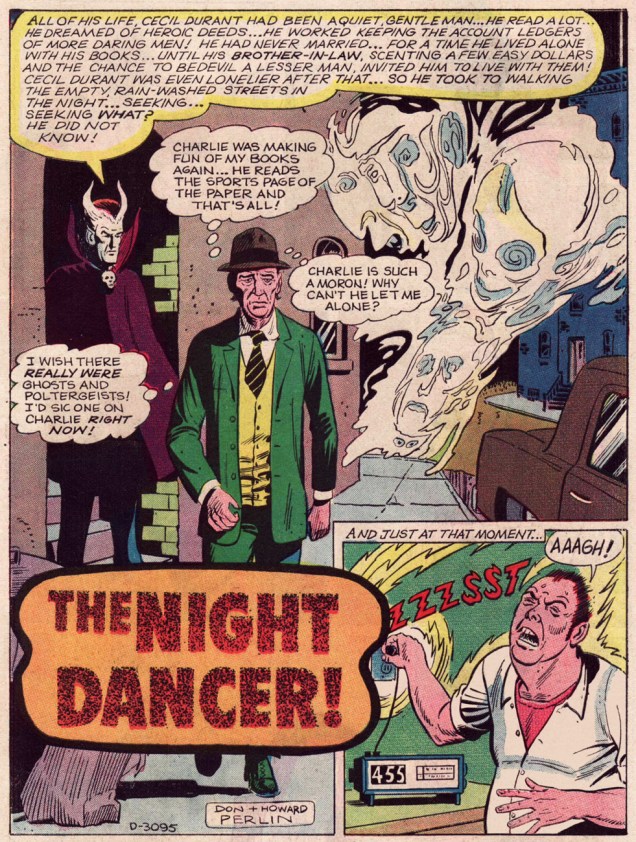
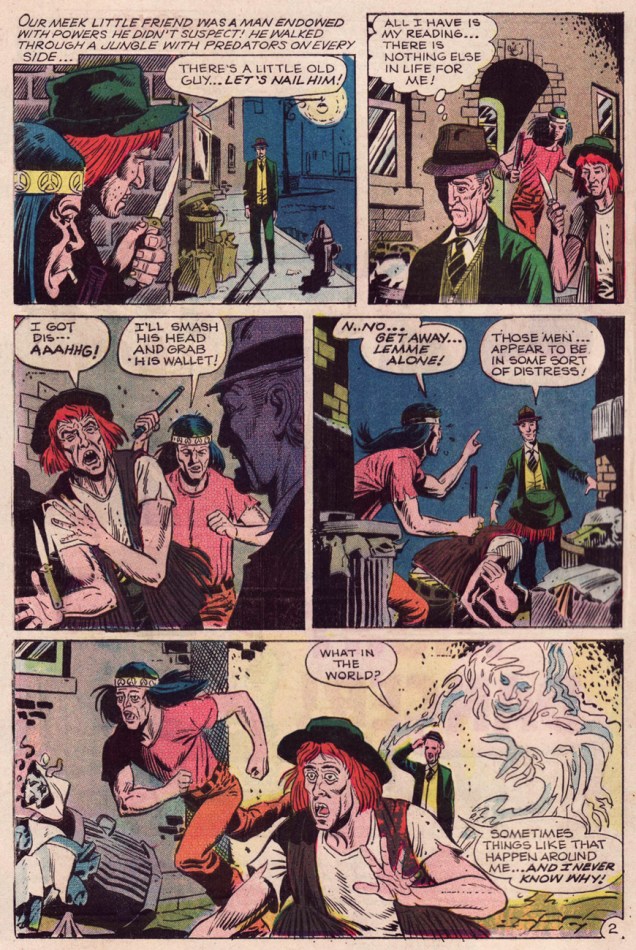
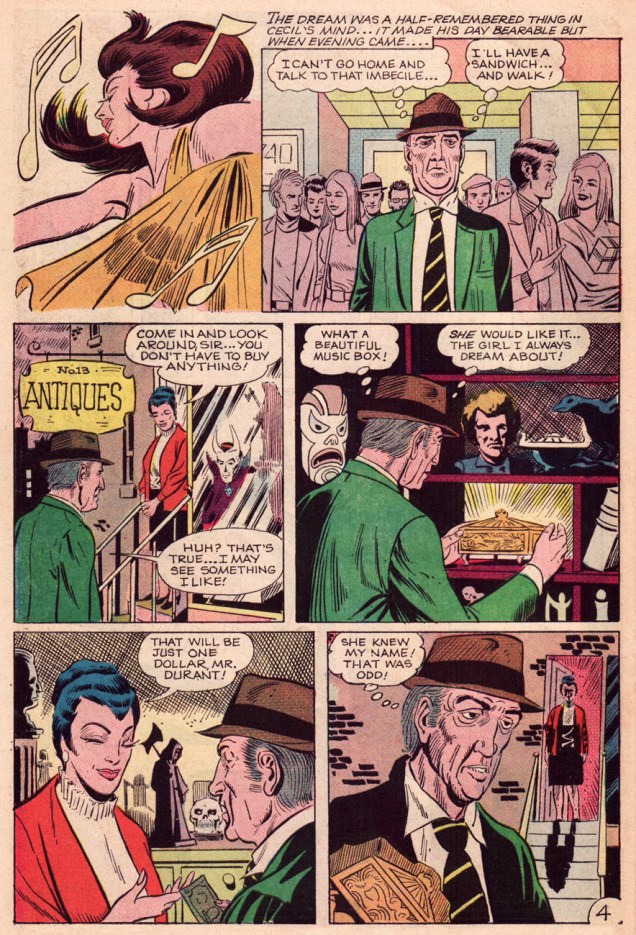
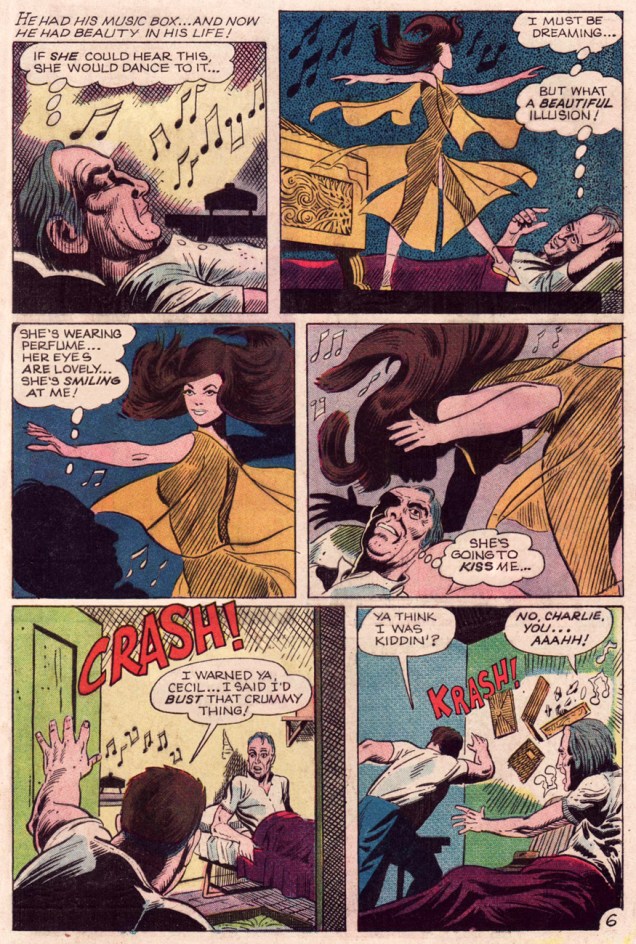
In the intervening years, witnessing the rise of elder abuse, the growing fragility of my own parents, and the sometimes desperate loneliness of acquaintances, old friends and strangers alike, Joe Gill and Don Perlin‘s The Night Dancer! (Ghostly Tales no. 99, Nov. 1972, Charlton) has steadily gained in poignancy. Its spirit, theme and mood remind me of some very fine tales by Joseph Payne Brennan*, who conveyed all too convincingly the quiet desperation of a near-destitute life lived with scant hope or companionship.
On a more cheerful note, it happens that (okay, it’s no accident) ‘Dauntless’ Don Perlin celebrates his eighty-ninth anniversary on this very day. While he’s most appreciated for his runs on Werewolf By Night, Ghost Rider, Moon Knight (his co-creation with writer Doug Moench) and The Defenders at Marvel Comics, I steadfastly cling to the notion that his finest efforts were brought to bear on hot rod and ghostly yarns for Charlton at the dawn of the 1970s. Judging by the results, I’d venture that he’s especially inspired by adventures set in the American Southwestern desert country. I’ll return to this topic in due time and present my case.
Without further tarrying ‘n’ foot dragging, meet our hapless protagonist, Cecil Durant… and his tormentors and benefactors.
While Mr. Perlin never became a superstar (and I suspect it never was his goal), the longevity of his career is easily explained: solid craft, excellent storytelling skills, a clean, unfussy line, and of course that supreme asset: reliability. Incidentally, co-credited Howard Perlin was Don’s young son, who was helping dad out around the studio that day.
Yom hu’ledet sameach, Mr. Perlin… and many happy returns!
– RG
*particularly The Way to the Attic (1967) and Mrs. Clendon’s Place (1984)
« Neither of us had seen a ghost, but I knew what he meant. »
I had planned to feature quite another tale this week, but seeing as we are in the torrid grip of quite the heat wave, I opted in the end for something more topical I’d been saving on the back burner.
Edward Nelson Bridwell (1931–1987) is one of those scarcely noticed but greatly accomplished figures of American comics. At DC from the mid-1960s to the end of his life, he edited, wrote, packaged and compiled his heart out. Most impressive, in my view, were his erudition and discerning eye for a fine short story.
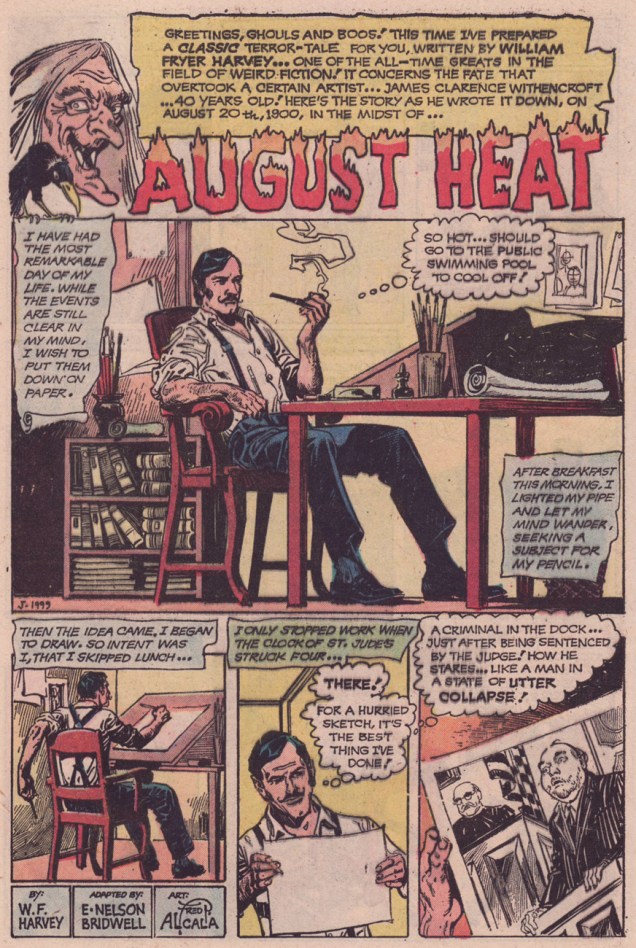
There’s always a blessed but mostly-powerless minority of comics creators that endeavours to improve the unwashed readership’s minds… nearly never at Marvel, most often at DC. In the mid-1970s, while working as Joe Orlando‘s editorial assistant, Bridwell adapted three excellent, but highly unconventional vintage spooky tales, as far afield as imaginable from the usual EC-by-homeopathy fare his boss favoured. These were William Fryer Harvey‘s August Heat (Secrets of Sinister House no. 12, July 1973), Ambrose Bierce‘s The Man and the Snake (Secrets of Sinister House 14, October 1973) and John Russell’s The Price of the Head (Weird Mystery Tales no. 14, Oct.-Nov. 1974); all three were splendidly brought to visual glory by WOT favourite Alfredo Alcala (1925-2000). All three are moody slow burners, with much introspection and little action.
On this scorching day (currently a sticky 35°C /95°F in Montréal, Canada) you’ll forgive me for not waiting until August to share this dark beauty with you.
August Heat was the issue’s cover feature. Illustration by Luis Domínguez.
As evidence of Mr. Bridwell’s skill as an adapter, feel free to read the full (yet quite brief) text of August Heat. Or listen to one its several fine radio adaptations, the choice is yours:
Today’s Tentacle Tuesday honours Filipino artists who laboured in the comics industry in the 70s. To quote from Power of Comics: Filipino Artists (read the essay here),
« The Filipino talent began to arrive in 1970, when immigrant Tony DeZuñiga began to work for National Comics. DeZuñiga began with assignments on various romance, horror, western, and war anthologies—a combination that many Filipino artists coming after him would also follow—but he made a lasting mark when he co-created Western anti-hero Jonah Hex in All-Star Western #10 (1972). By then, DeZuñiga had convinced then National Comics publisher Carmine Infantino that other talented artists were awaiting discovery back in his nation of origin. With a stable of graying veterans working for him, Infantino was faced with a paucity of new talent in the early 1970s and had trouble finding gifted artists who could work for what the going page rate in American comics would pay at the time. DeZuñiga accompanied Infantino on a recruiting trip to the Philippines in 1971.
As noted, first among the Filipino artists to make a move were Redondo and Alcala. Among his works, Redondo turned in a memorable run on Swamp Thing, and the prolific Alcala picked up a considerable fan following for his work on series like Batman and Arak. Other Filipinos followed. Alex Niño brought a distinct style to Warren Publishing’s 1984 and 1994 series. Ernie Chan’s talent for composition led to his becoming National’s principal cover artist between 1975 and 1977. Gerry Talaoc enjoyed an extended run on The Unknown Soldier. »
Without further ado, let’s have a look at some of the tentacles the artists mentioned above have dreamed up. In no particular order…
I like the styles of all the artists mentioned in this post, but a couple of these names will make me do a little dance of joy when I encounter their art. Alfredo Alcala (b. 1925, d. 2000) is a definite favourite. He could draw anything he wanted, convincingly… at an amazing speed, and with the sort of detail that other artists would kill for.
Alcala drew for all genres in the early portion of his career, and developed the speed and work ethic for which he later become known amongst his fellow professionals. His fastest page rate was 12 pages in a nine-hour sitting, while in one 96-hour marathon he produced 18 pages, three wrap-around covers and several color guides. During the portion of his career where he worked solely for Filipino publishers, Alcala worked without assistants and did his own inking and lettering. “I somehow always felt that the minute you let someone else have a hand in your work, no matter what, it’s not you anymore. It’s like riding a bicycle built for two…” (source)
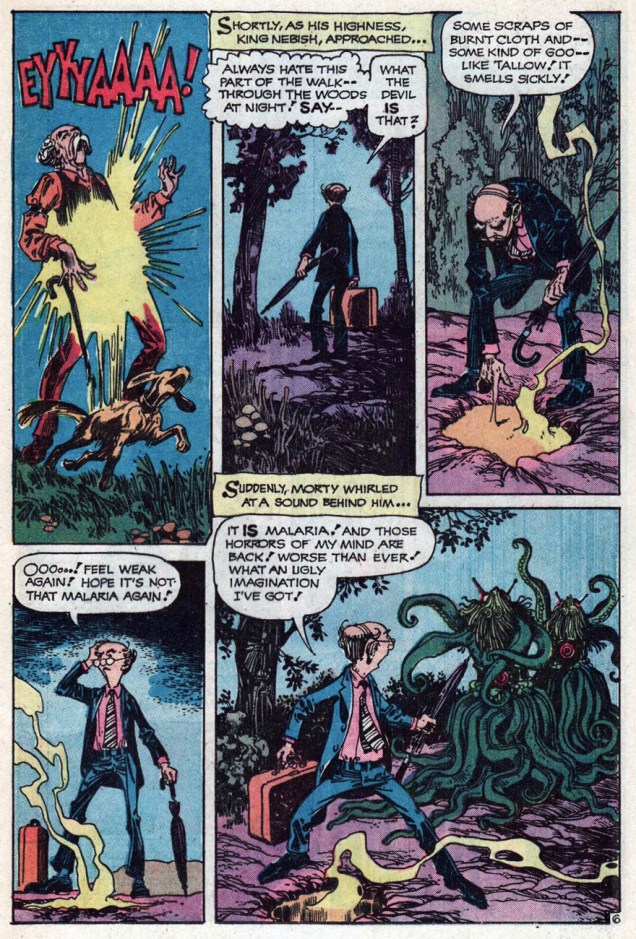
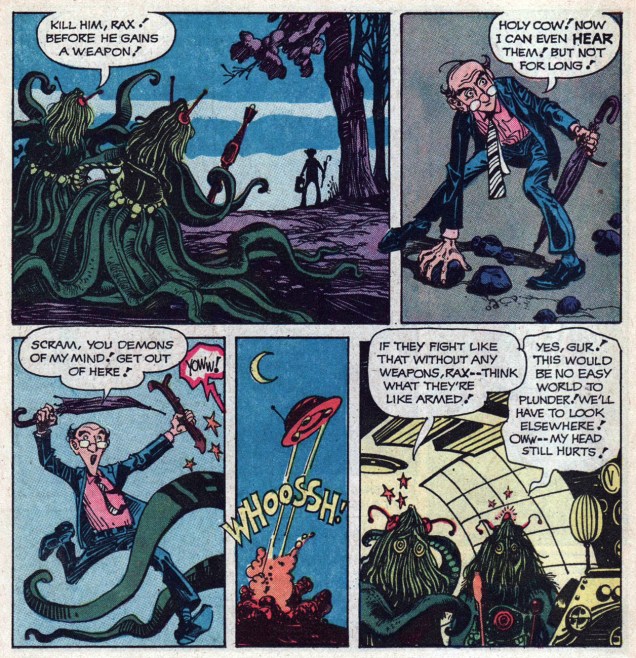
Here’s a gorgeous sequence from « The Night of the Nebish! », scripted by Arnold Drake and illustrated by Alfredo Alcala, published in House of Secrets #107 (April 1973).
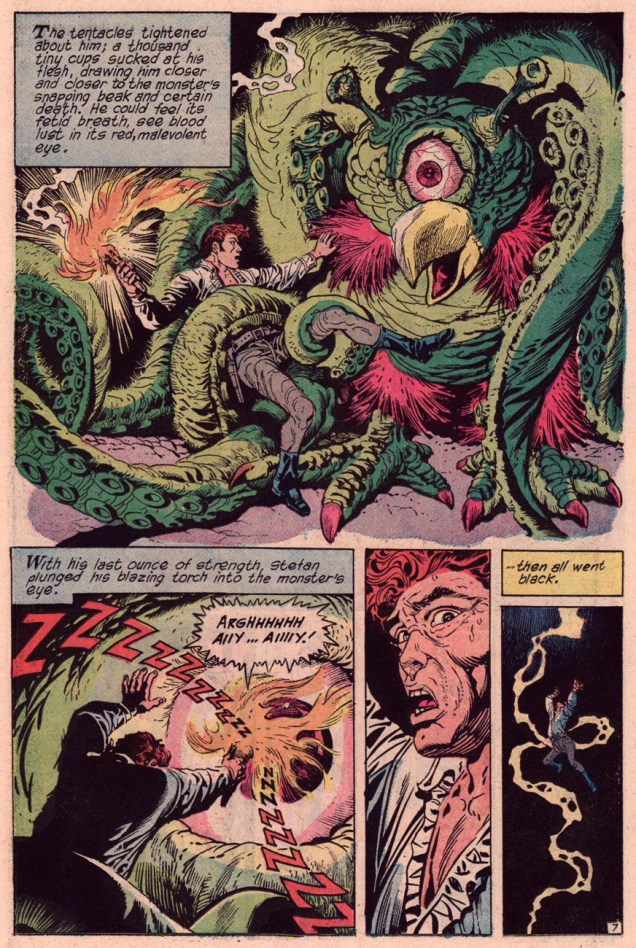
Ruben Yandoc (also known as Rubeny, 1927-1992) isn’t nearly as well-known as Alcala, yet he has a beautiful, half-decorative, half-sketchy style. He excelled at horror stories (published in DC’s Witching Hour, House of Mystery, Ghosts, House of Secrets..), and was a master at creating mood. His perfect grasp of architecture and anatomy enabled him to draw believable characters in incredible settings – none of this “figures floating about aimlessly” shit that you sometimes get from artists who can’t imbue their objects and subjects with mass. When Stefan gets grabbed by tentacles, you can feel their weight on his torso and feel the heat and painful brightness of the torch he’s holding, dammit!
« The Monster of Death Island », plotted by Maxene Fabe and illustrated by Ruben Yandoc. Published in Secrets of Sinister House no. 11 (April 1973).
Alex Niño’s art doesn’t give me butterflies. His stuff is quite weird, sometimes far too detailed, but his talent is nevertheless undeniable. For a good appreciation of his style (and more examples of it), go to this entry from Wizard’s Keep. As for me, I’ll limit myself to this humble, one-panel mass of tentacles, eyes, teeth, spikes, and god knows what else.
“Something on me”, indeed! A panel from « Evil Power », plotted by Jack Oleck and illustrated by Alex Niño from Weird Mystery Tales no. 9 (December 1973-January 1974). Niño was born in 1940, which makes him 78. He’s officially retired, but still holds art classes and takes commissions, as well as making the occasional appearance at conventions.
Redondo’s “memorable run on Swamp Thing” was mentioned at the beginning of this post. Well, we’ve already featured the tentacled robot who tries to finish Alec Holland off here, but rest assured – there’s more tentacles than just that in the career of Nestor Purugganan Redondo (1928-1995)! For example, this:
Original art for “Monsters From a Thousand Fathoms”, published in The Unexpected no. 185 (May-June 1978). You’ll note the art is attributed to the “Redondo Studio”; Nestor and his brother, Frank, often collaborated under that name.
By the way, he’s most assuredly another favourite in this household. His women are believably sexy, his monsters inventive and scary, his animals pitch-perfect… His style is realistic but lush, his nature almost prettier than in real life. And I like him much, much better than Bernie Wrightson, as far as Swamp Thing is concerned 😉
A perfect fit for any Tentacle Tuesday, here’s the requisite damsel-in-distress-with-tentacles:
Wench & Co. Book 1, a collection of drawings – of mostly naked women, what else? – by Ernesto Chan (1940-2012), born and sometimes credited as Ernie Chua. Published by Big Wow, 2005. Sadly, we will never get a Book 2.
We shouldn’t forget Tony DeZuñiga (1932-2012), who after all started all this. Among other accomplishments, he co-created Jonah Hex and Black Orchid, two pretty damn cool characters.
Page from “Home is the Sailor”, plotted by Len Wein and illustrated by Tony DeZuñiga, published in The Phantom Stranger no. 18 (March-April 1972).
I hope you enjoyed this (non-exhaustive) romp through Filipino-American tentacles! As historian Chris Knowles (1999) has noted about Filipino artists, « Here was a group of immensely talented and hard-working draftsmen who could draw absolutely anything and draw it well. They set a standard that the younger artists would have to live up to and that the older ones would have to compete with. » Amen to that!
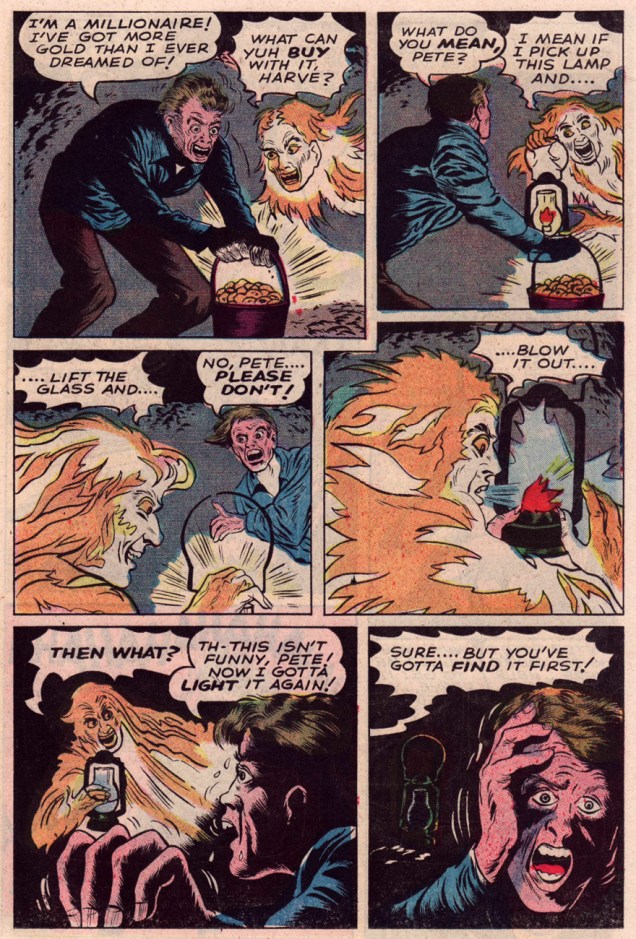
« That’s funny… I didn’t leave the lantern lit… wonder if anybody’s in there? »
In 1972, Golden Age journeyman cartoonist Stanley Josephs Aschmeier (1912-1992) wrapped up his career in comics with a single tale for Charlton, a publisher he’d briefly worked for two decades prior*, pre-Code. Yet earlier, at DC, he’d had a hand in creating Johnny Thunder and Thunderbolt (1939) and Dr. Mid-Nite (1941), the original sight-impaired costumed hero.
While Aschmeier’s already-manic drawing style hadn’t changed much in the intervening years, the industry certainly had, which made him a man well out of time. Still, as with his peer, sudoriparous Rudy Palais‘ final work for Charlton, the nervous energy and artistic freedom yielded something unusual and charming. While this sort of semi-primitive outsider approach decidedly isn’t for everyone, it’s a breath of fresh air. I found it unsettling and baffling when I first encountered it all those years ago, and it hasn’t lost its jolt, unlike many fan favourites I could name.
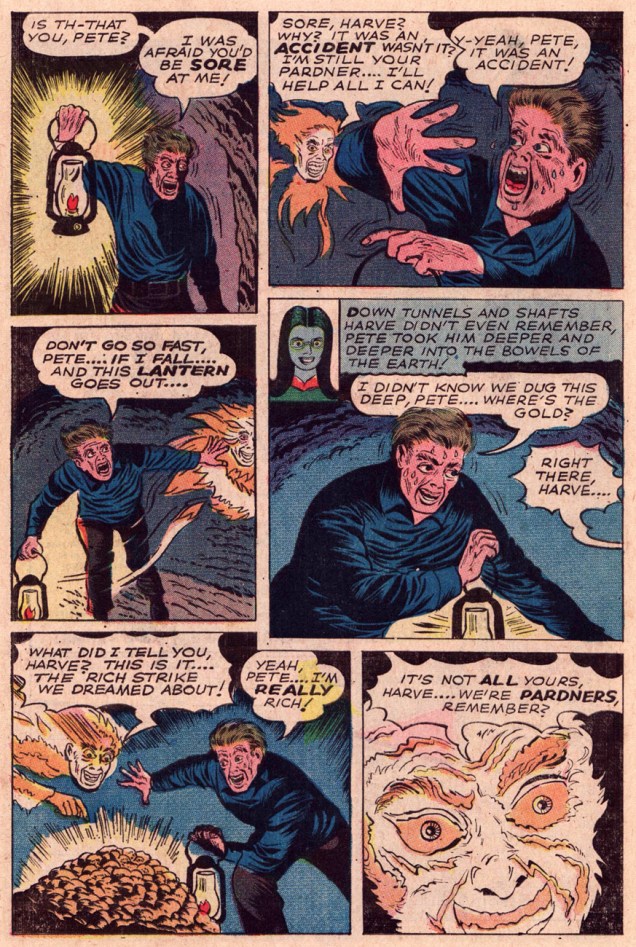
Without further preamble, here’s Joe Gill and Stan Asch (his abridged nom de plume)’s tale, from Ghostly Haunts no. 27 (Nov. 1972, Charlton.)
By this point, Aschmeier had evolved (or devolved) a highly stylized, woodcut-like approach. Bizarre as it may be, it sure works for me. That’s one of my favourite things about Charlton: leave your “house style” at the door!
Note Aschmeier’s interesting depiction of a revenant, quite unlike Steve Ditko’s lime green, vaporous wraiths or Pat Boyette’s rotting cotton shamblers. Pete Eklund’s shade is more akin to a dancing flame, an electric apparition.
Here’s a guy who *really* gets it! That final panel is one of the most unhinged I’ve had the pleasure of encountering.
As for the story, it’s the soul of the thing: to my mind, what made writer Joe Gill’s work special was his common-sense response to the meagre number of available plots: when the mood struck him, he focused on ambiance, tone and character, as he does here.
I love that our protagonist, Harve Davis, is so shiftless, so insignificant, that the reader can’t even be bothered to hate him: throughout the story, we witness his well-earned unpopularity, and what a shabby and piteous creature he is. He murdered the only man who gave him the time of day, and he was too dense and self-absorbed to be anything but resentful of it. I do feel that the tale’s very construction supports this view: it opens on the commission of his crime, and the aftermath is a fateful tumble of dominos.
And yes, the story is narrated by Winnie the Witch, the Nana Mouskouri of the ghostly storyteller set. Many have noted the resemblance.
*For stylistic comparison, take a gander at a 1944 Mr. Terrific tale by Mr. Aschmeier, and some of his crime comics work from Lawbreakers Suspense Stories no. 14 (Sept. 1953, Charlton), featuring three Aschmeier-illustrated pieces, Flight!, The Green Light and The Face in the Glass. Enjoy!
« That minuscule ogre on the throne must be the King. What a peculiar little man. »
In 1978-79, the rightly-celebrated English fantasy artist Patrick James Woodroffe (b. Halifax, West Yorkshire, on October 27, 1940; d. May 10, 2014), fresh from his high-profile paperback (much Moorcock!) and album cover assignments (including Judas Priest’s splendid Sad Wings of Destiny), hired out his talented brush with Warren Publishing long enough to produce ten covers, a varied, eye-catching and often unusual lot. Let’s make the rounds, shall we?
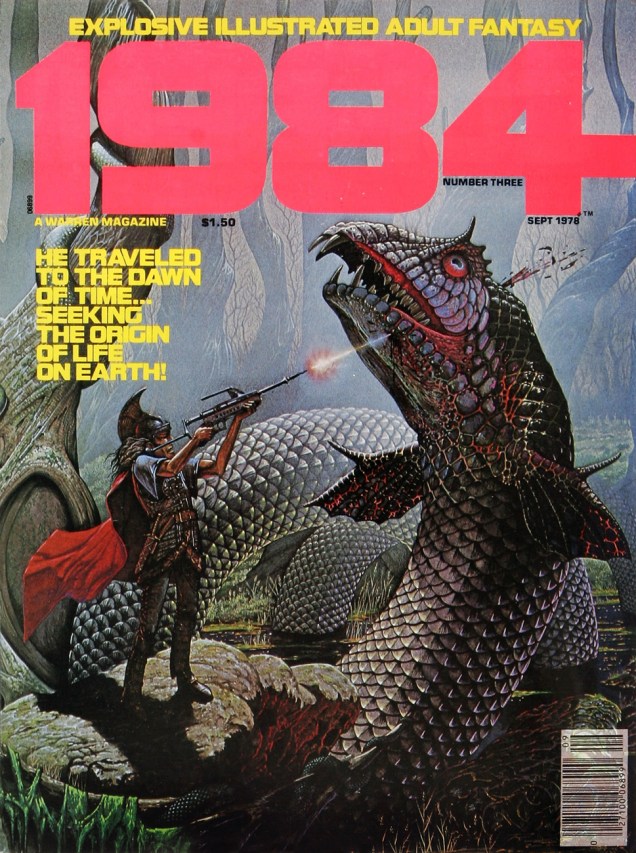
« He isn’t a *bad* sort. He just lets his temperamental gonads get the best of him! » Using a laser rifle on a dragon? Hardly seems sporting, does it?
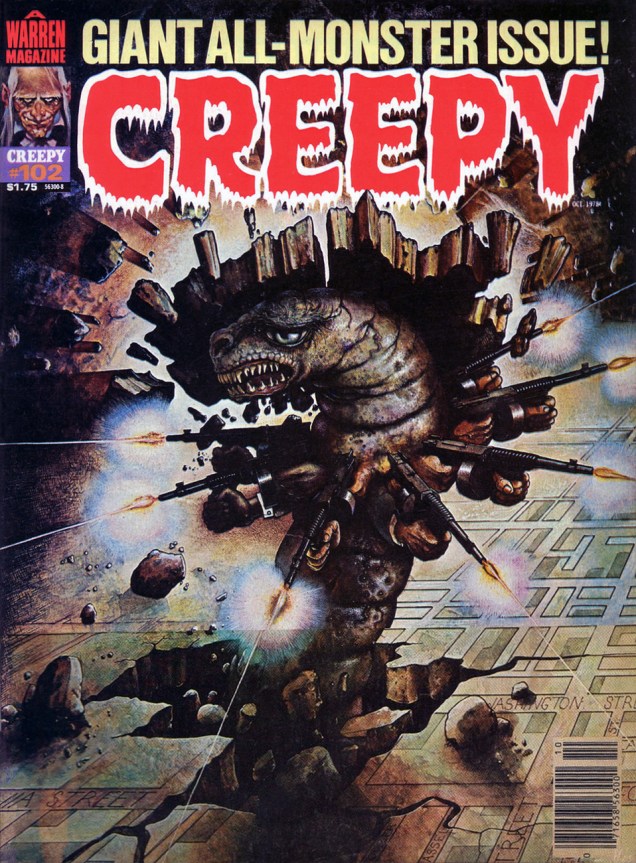
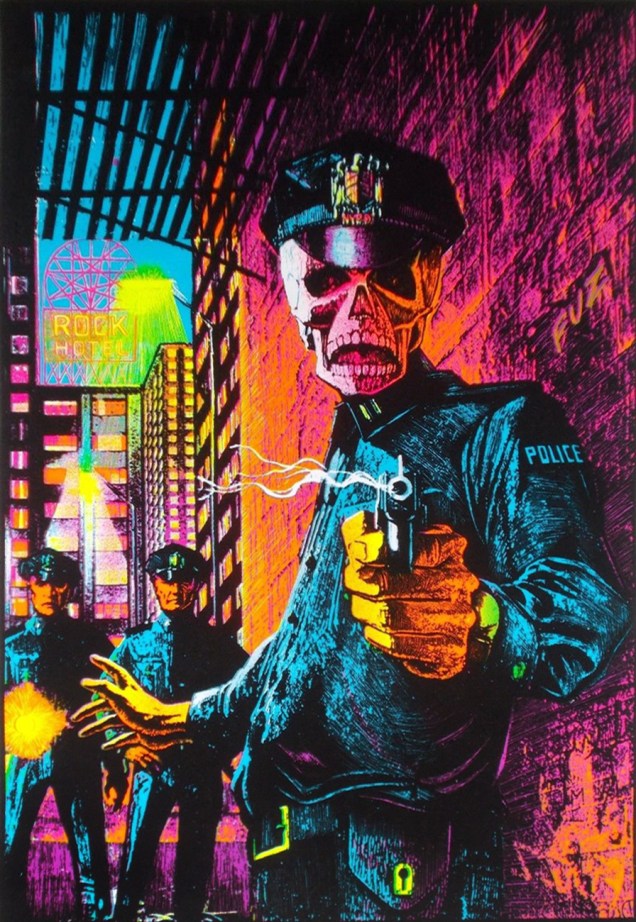
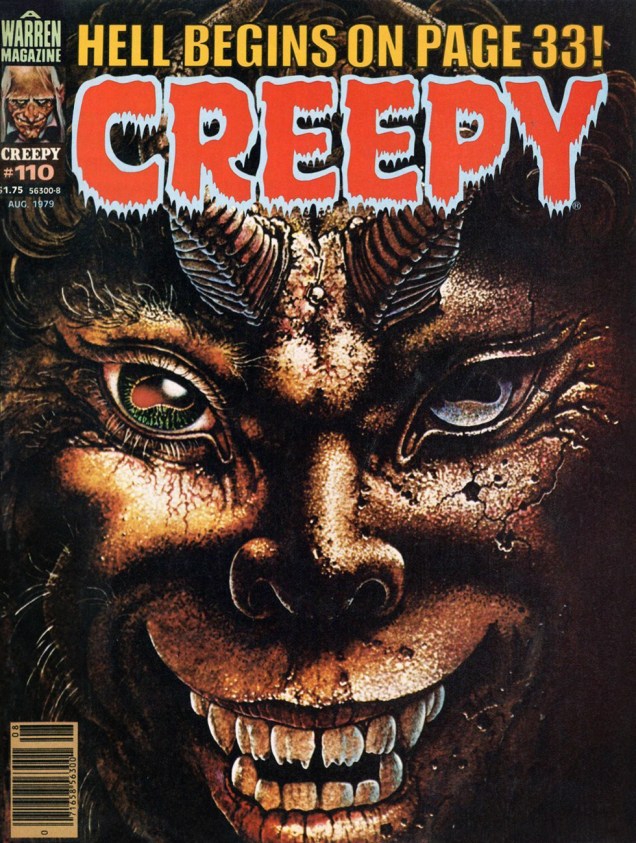
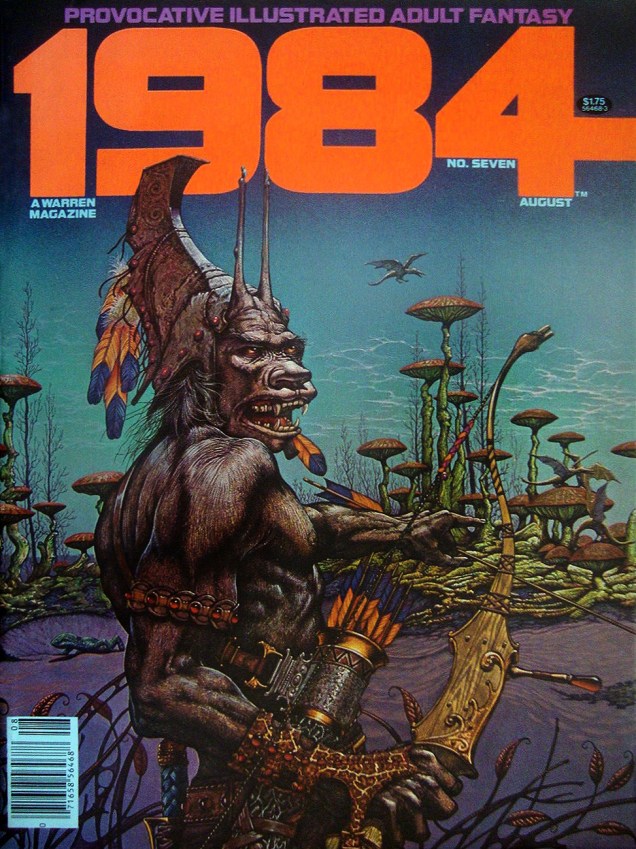
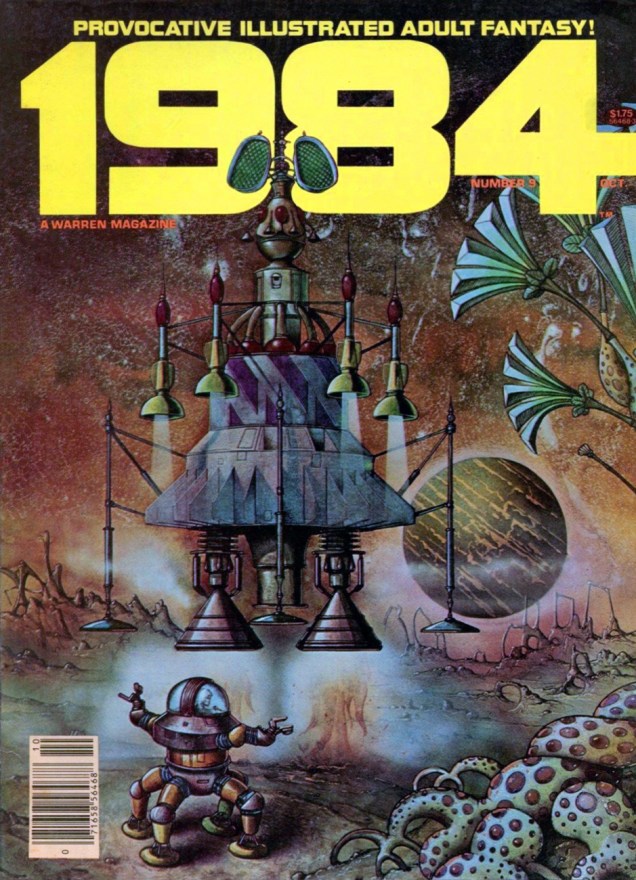
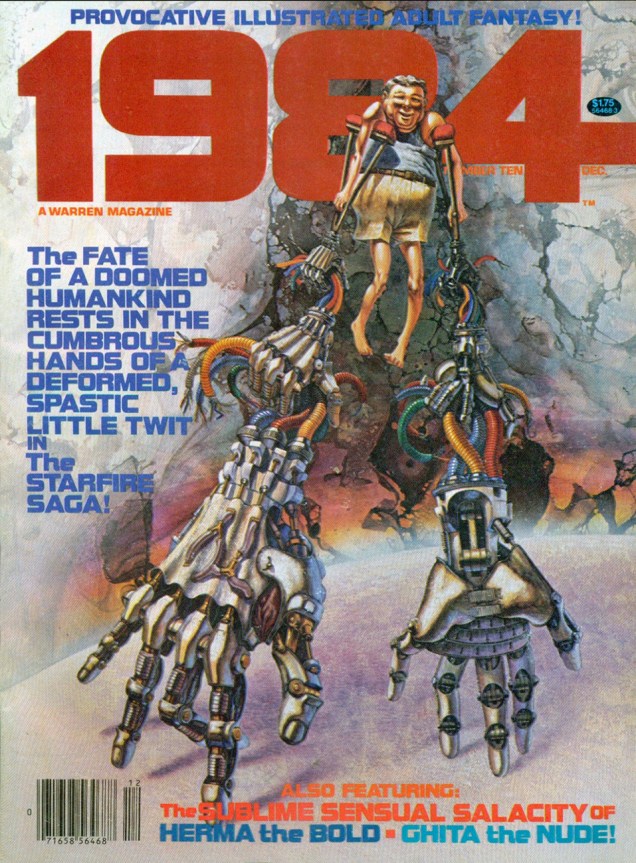
Here we make the acquaintance of a memorably omnidextrous lepidopteran gunner. This is Creepy no. 102 (October, 1978). Read the entire issue here: https://archive.org/stream/warrencreepy-102/Creepy_102#page/n91/mode/2upOne of Warren’s post-Star Wars, all-reprint cash grabs of the era… but it’s got a Woodroffe cover.Eerie no. 98 (January, 1979) Likely the darkest of the set in terms of subject matter. Visually, it certainly brings to mind the visual vibe of John Carpenter’s They Live, still nearly a decade away.Interestingly, the piece has also made the rounds, in a modified version (flipped, for one thing), as a “black light” poster titled « In the Name of the Law ». Speaking of the law, was the artist duly compensated?Don’t mess with the Surly Smurf! This dusky scene is dated 1975, so it’s safe to assume it wasn’t created expressly for this publication. This is Warren’s 1984 no. 5 (February, 1979.) Aside from the usual sex fantasies and space operetta from the usual suspects, the issue holds a single nonpareil gem, Nicola Cuti’s « I Wonder Who’s Squeezing Her Now? », gorgeously brought to life by Ernie Colón and Wally Wood. Bear with me, we’ll return to it in due time.« You may think this all strange nonsense; it may be strange, but it is true, and the ancients knew what lifting the veil means. They called it seeing the god Pan. » — Arthur Machen With his second and final Creepy cover (no. 110, August, 1979), Woodroffe lifts the veil, and how, on a troubling closeup of a gleefully sinister Greek God of the Wild.« Well, if that ain’t about the unfriendliest thing I’ve ever heard of… » 1984 no. 7 (August, 1979.)Aw, missed your ride home. This is 1984 no. 9 (October, 1979.)As it turns out, one couldn’t have picked a better artist to depict « the cumbrous hands of a deformed, spastic little twit », though he seems like a sweetheart, really. On this whimsical note ends our survey of Mr. Woodroffe’s Warren covers. This is also the last issue of 1984 under that title; it would leap a decade ahead to “1994” and carry on for another nineteen issues.
A panel from « Return of the Swamp Beast! », story by Jane and Bob (RL) Stine, art by Stephen R. Bissette, originally published in Weird Worlds no. 3 (Oct. 1979, Scholastic.) This is the colour version from the one-shot Bissette & Veitch’s Fear Book (April, 1986, Eclipse.) Colours by Brendan McDonough.
Ah, that old Earth’s taken another whirl, and so today, the wonderful Stephen Bissette, that most erudite master of terror *and* one of the truest, most steadfast gentlemen the medium has known, observes another birthday. He first breached this plane of existence in the wilds of Vermont some sixty-odd years ago today, on March 14, 1955. Let’s wish him all the best, shall we?
The original art of this silk-spewing splash was reportedly acquired, by proxy, by erstwhile Calvin Klein Jeans model Brooke Shields. I like to envision it occupying a place of honour in the dining room of her favourite mansion. Or perhaps in the bedroom, right above the headboard?
This is from Saga of the Swamp Thing no. 19 (December, 1983, DC.) Quite respectably co-plotted and scripted by Martin Pasko (with Mr. Bissette), this predates epochal game-changer The Anatomy Lesson, but the Bissette/Totleben dream combo was already scorching eyeballs, en attendant Mr. Alan Moore’s accession.
Newlyweds Rich and Jamie meet this dusty fellow, for the first and final time, in Egyptian Graffiti, story by Jane and Bob Stine, art by Stephen R. Bissette, originally published in Weird Worlds no. 2 (March 1979, Scholastic), also collected in Bissette & Veitch’s Fear Book , with colours by Michele Wrightson.
-RG
*George Carlin may have said that, or something to that effect. Who knows, these days?
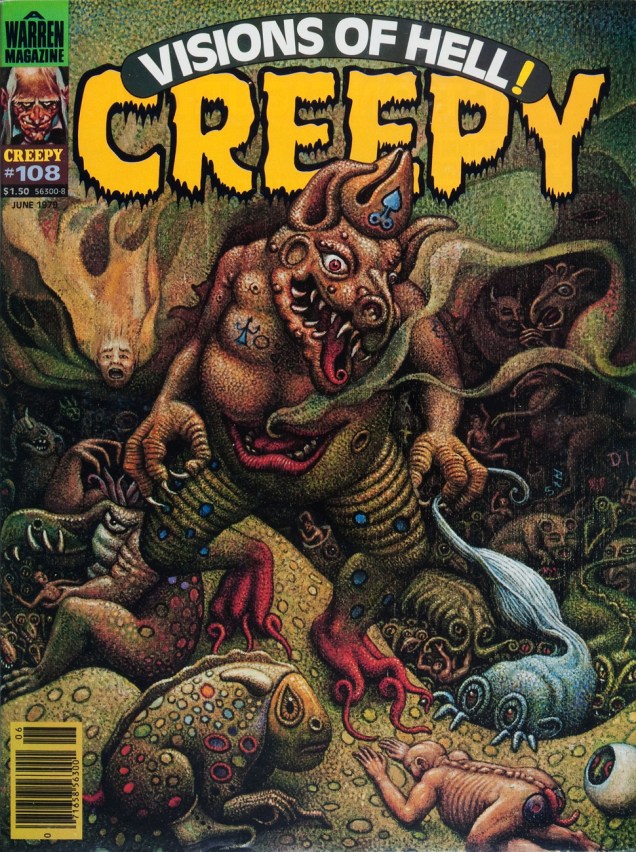
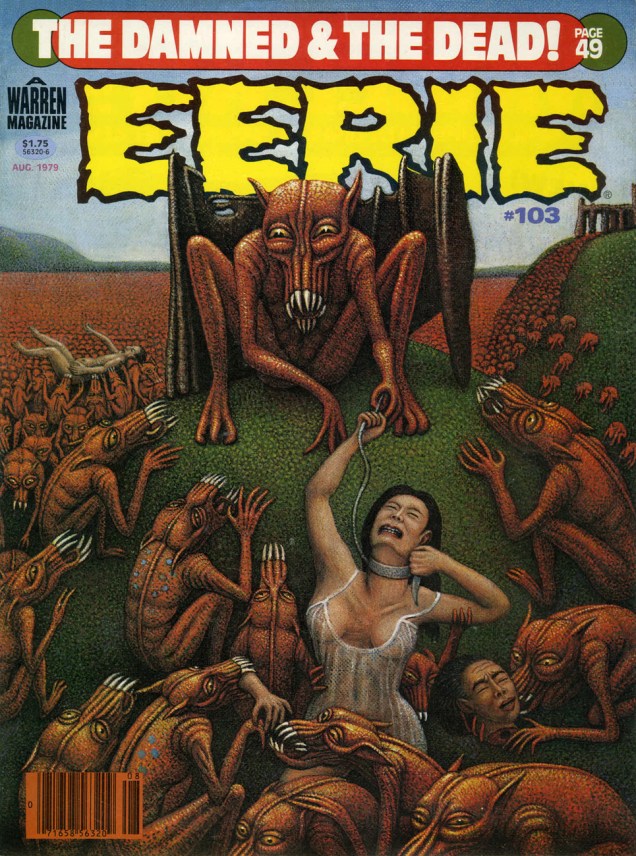
As the close of the 1970s neared, James Warren‘s magazine empire was inexorably crumbling. I like to imagine that it was decided, in desperation, that a little fiddling was in order… just a smidgen. Some enlightened soul (my pick is new editor Chris Adames) got the notion to bring on board Terrance Lindall (1944-) to produce some covers for the magazines. He painted a mere five, but made each one memorable, to say the least, evoking justified comparisons to Matt Fox, Lee Brown Coye, sans oublier the venerable Hiëronymus Bosch.
Well, then, let us bask in the comforting, bucolic visions of Terry Lindall at Warren, in their order of publication. Makes you want to pack a picnic lunch and go for a leisurely ramble through the countryside with your faithful Hound of Tindalos.
Creepy no. 108 (June, 1979.)Eerie no. 103 (August, 1979.)Creepy no. 116 (March, 1980.)What do you know? Terrance Lindall actually manages to make perennial fanboy wankbait Vampi look downright classy. This is Vampirella no. 86 (April, 1980.)And all too soon, it’s over, with Creepy no. 127 (May, 1981.)
Oh, how Creepy’s long-time readers must have wailed and moaned at these singular, quease-inducing mise-en-scènes! “Bring back Boris Vallejo!”
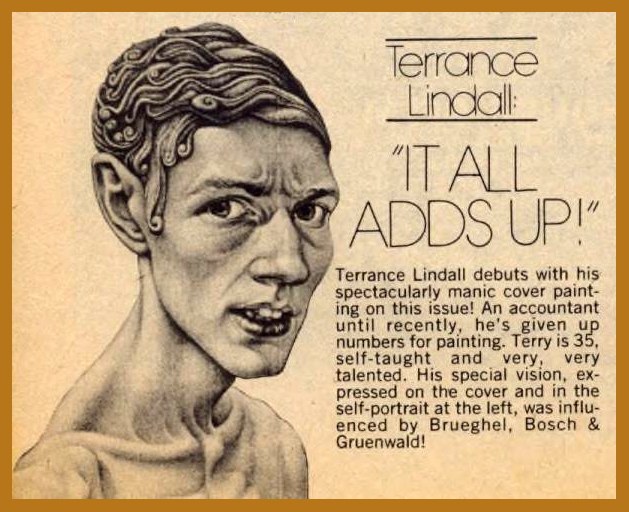
Nowadays, Lindall earns his keep as co-director and chief administrator of the Williamsburg Art and Historical Center in Brooklyn, New York. Doesn’t he just perfectly look the part?
The new kid’s mini-bio, as it appeared in Creepy 108 (June, 1979).
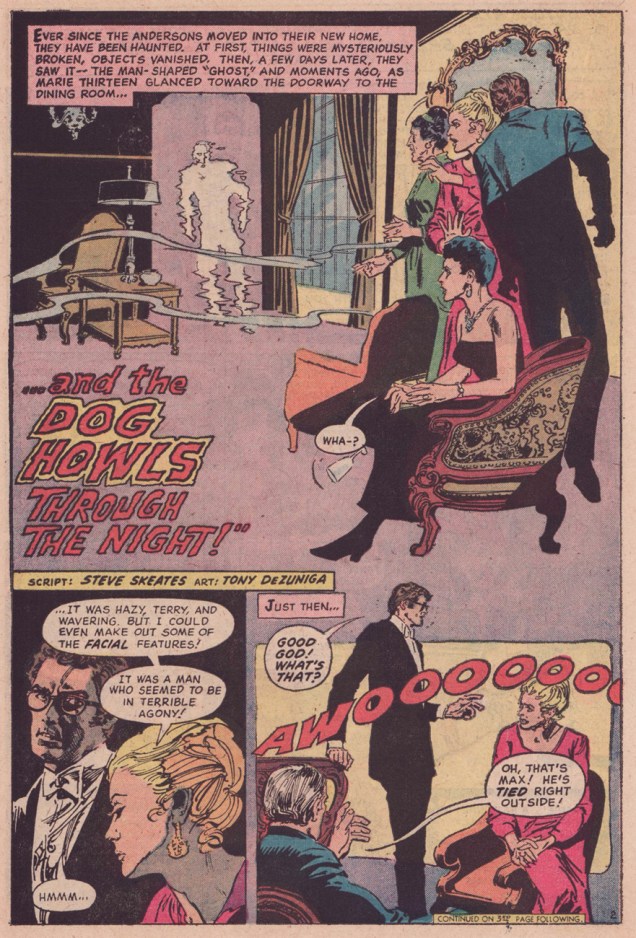
On this fine day, we pay tribute to shifty scribe Chester P. Hazel (who sometimes goes by the unlikely nom de plume of Steve Skeates). It is whispered that Stephen, along with his nefarious twin Warren Savin, first invaded this plane of existence on January 29, 1943. That would make him/them/it seventy-five earthly rotations old, should these windblown tattles hold any credence.
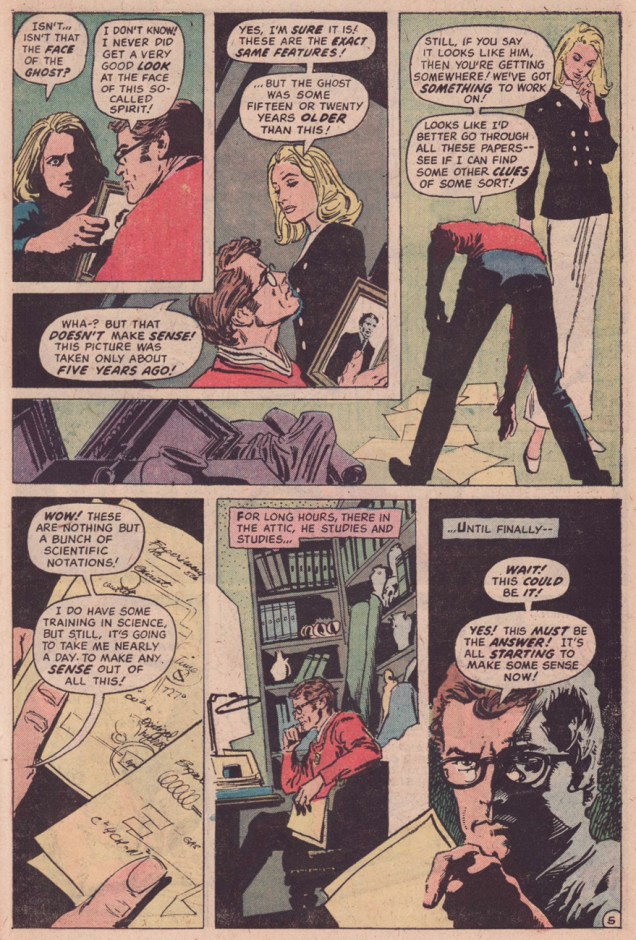
Happily, in this case, picking out a Skeates favourite to share was no ordeal: I’d been meaning for some time to shine a light on one of his neglected gems, one that salt-rubbingly ran without proper attribution in The Phantom Strangerno. 34 (Dec. 1974-Jan. 1975, DC Comics.)
The cases of Dr. Terrance Thirteen, ghost breaker, must have been easier to write back in the 1950’s, when DC Comics’ default setting in its mystery titles was to explain away the supernatural element before the curtain call. DC’s resident skeptic first shared his insights in Star Spangled Comics, his feature lasting from issue 122 (November, 1951) to issue 130 (July, 1952). He then moved to The House of Mystery for a handful of appearances, then faded away. He returned to action, along with his also long-dormant colleague and foil The Phantom Stranger, in 1969’s Showcase no. 80. In the Supernatural Seventies, all poor Dr. Thirteen could do is vainly and stubbornly play the cards of reason and logic against a house deck stacked to inevitably favour the uncanny and the unreal. He was doomed to be a comic book version of The X-Files’ Dana Scully, Fritz Leiber‘s Norman Saylor (Conjure Wife, 1943) or Night of the Demon‘s Dr. John Holden, all skeptics coming off as hopelessly obdurate and clueless in light of the “facts”.
Sounds like today’s so-called post-fact world… in which we need true skeptics (as opposed to deniers) and cool, rational minds more than ever.
Anyway, it wasn’t the first time wily Skeates had faced such a storytelling impasse: he’d had to ring the changes on pacifist character Dove (of Steve Ditko’s eternally squabbling Hawk & Dove) within a universe of hard-slugging super vigilantes.
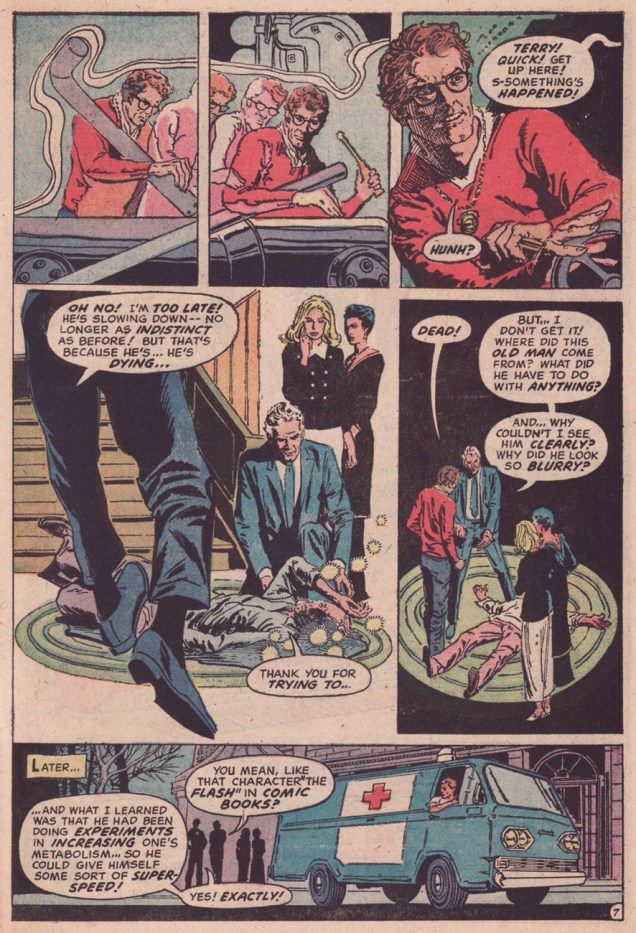
Dr. Thirteen bounced around various DC titles in the early-to-mid 70s. This is the series’ last bow in the back pages of The Phantom Stranger, and ironically its finest hour, alongside the penultimate entry, The Ghosts on the Glasses, which ran in Adventure Comicsno. 428 (August, 1973.) In both cases, the inspired artwork is that of Filipino master Tony DeZuñiga (1932 – 2012), who was clearly in his element.
A character likens the dead scientist’s ill-fated velocity experiments to comic book character The Flash… but it’s a cinch that what the impish* Mr. Skeates really had in mind was Virgil “Guy” Gilbert, aka Lightning, whose début, The Deadly Dust! he had scripted back in 1965 (T.H.U.N.D.E.R. Agents no. 4, April 1966). Here’s a relevant excerpt, featuring art by Mike Sekowsky and Frank Giacoia.
In closing, a biographical blurb from DC’s T.H.U.N.D.E.R. Agents Archives, circa 2002: « A native and longtime resident of the Empire State, Steve Skeates began his work in comics as an assistant editor at Marvel Comics in 1965 – a job which he quickly abandoned in favor of writing comics as a full-time freelancer. Over the next twenty years he did work for nearly every major comics publisher, including DC, Marvel, Charlton, Tower, Warren, and Gold Key. Since leaving mainstream comics in the mid-1980s, he has worked as a reporter, bartender, and Zamboni operator, as well as publishing his own comics titles, which he continues to do from his home base in Fairport, New York. »
Happy birthday, Mr. Skeates, and thanks for everything!
It’s birthday number one hundred and twelve for pulp wordsmith Robert Ervin Howard (January 22, 1906 – June 11, 1936) who, in his tragically short lifespan, yet found time to unleash upon the world Conan the Barbarian, Solomon Kane, Kull of Atlantis and, more significantly for this reader, the chilling classic Pigeons From Hell, a short story posthumously published in Weird Tales’ May, 1938 issue.
Howard’s The Horror From the Mound, originally published in the May, 1932 issue of Weird Tales Magazine, presumably had its title sanitized here because the H-word was still verboten in the early 1970s. Hailing from the second issue of Marvel’s Chamber of Chills (January, 1973), it was reprinted in glorious black and white in 1975’s Masters of Terror no. 1 (original title restored, hurrah!)
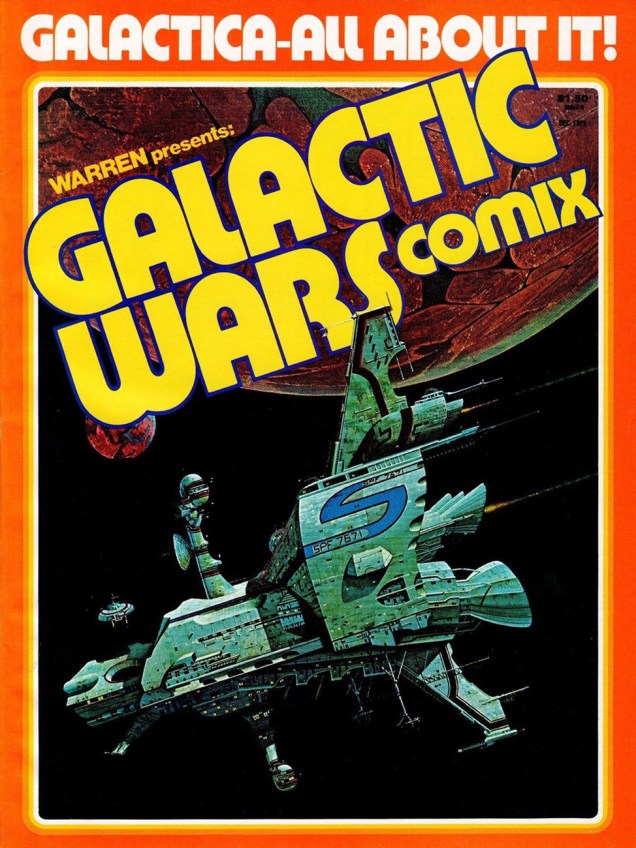
And here it be. Seems a bit inaccurate to refer to a group of mostly pulp writers (some long dead) from the 30s to 50s as “Modern-Day Masters of Terror”, but I suppose it depends on one’s definition of “Modern-Day”. Cover illustration by Gray Morrow from a drawing by noted fabulist, fervent Trump supporter and fellow Hair Club for Men habituéJim Steranko.
Gardner Fox and Brunner give it their all, but the story could have used more pages to truly do justice to Howard’s moody proto-weird western.
















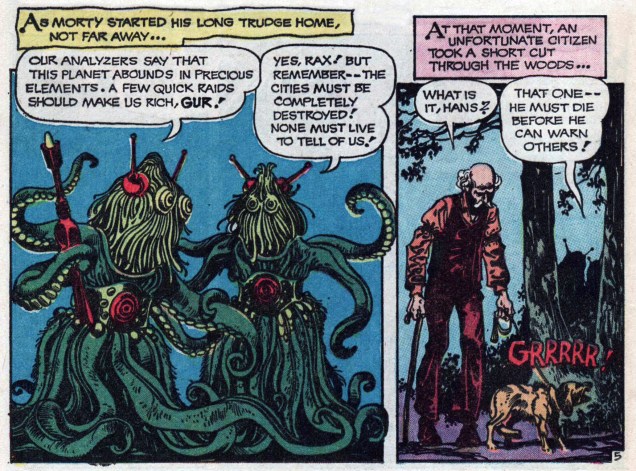


















 Who's Out There?