The Observant Ambulations of Julius Knipl, Real Estate Photographer

« This peephole was smeared when I moved in »

CheapNoveltiesCoverA
« A RAW One-Shot » (1991, Penguin Books)

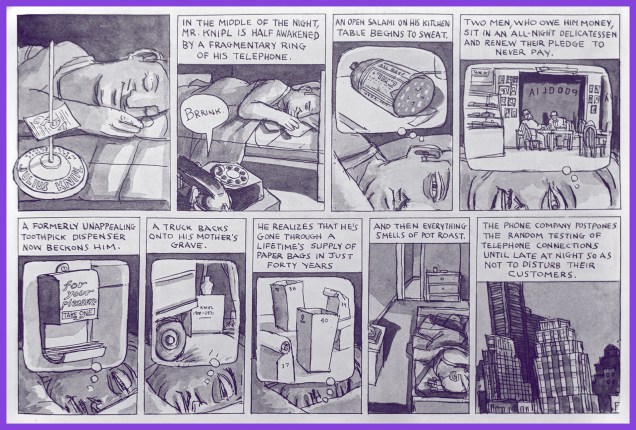
Originally appearing in alternative weekly The New York Press in the late 1980s, Ben Katchor’s Julius Knipl, Real Estate Photographer belongs to that most exotic breed of comic strips, those that suddenly awake the mind to the medium’s grand possibilities. Said experience can be abrupt and dizzying, but in this particular instance, it’s soothing and bittersweet, full of rightful yearning for things that possibly were or surely should have been, glimpsed in a daydream by the low flame of the fantastic mundane.

Mr. Katchor (born November 19, 1951 in Brooklyn, New York) is blessed with a vision of startling depth and singularity. By its nature and scope, it’s not everyone’s thing, but the rest of us likely wind up as lifelong admirers, and isn’t that just the ideal audience?

Much has been written elsewhere, often brilliantly, about Mr. Katchor and his œuvre; it’s work of a calibre to inspire theses, dissertations and papers, so I’ll mostly stick to presenting some samples. The passionate plaudits these strips have inspired tend to obscure the fact that most people just haven’t had the pleasure, or at least the opportunity, of encountering such rich material.

These vignettes were collected in 1991 as Cheap Novelties: The Pleasures of Urban Decay. Oddly enough, it was the only one of Katchor’s books to go out of print… the situation was remedied in 2016 by Montréal’s Drawn & Quarterly, who brought it back in a lovely hardcover edition.


KatchorCheapNovelties031A
While on vacation, my accountant fell in love with a hot sauce manufactured on the small Caribbean island of Dominica. He’s since devoted considerable energy to renewing his stock of the stuff, which has involved much international horse trading.
KatchorCheapNovelties043A
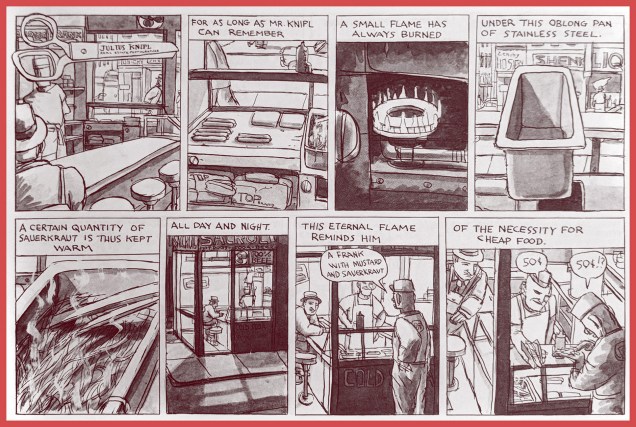
Montréal has its share of architectural remnants of bygone commercial enterprise; arguably, the most famous is the “Giant Milk Bottle“, but no, it isn’t full of milk.
KatchorCheapNovelties051A
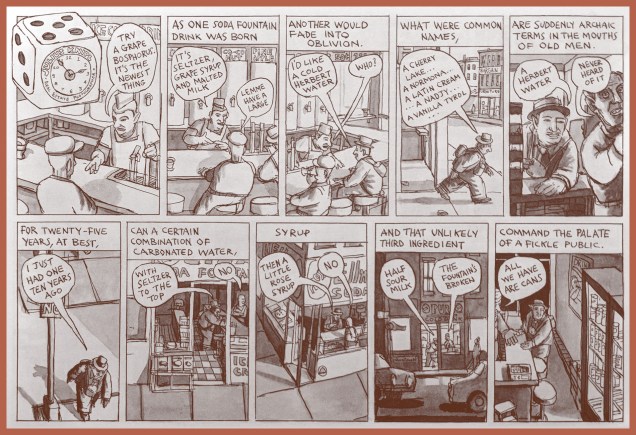
This melancholy vignette ties in quite nicely with a recent piece from Atlas Obscura noting the fading lingo and diminishing rôle of the soda jerks of New York City. Read it over a mug of murk with a choker hole.

KatchorCheapNovelties063AKatchorCheapNovelties073AKatchorCheapNovelties079A

From the collection’s back cover blurb: « In a vast and shadowy city of old skyscrapers, neglected warehouses, juice stands, and coffee shops, Julius Knipl, a rumpled, middle-aged man in a suit and hat, wanders the streets photographing buildings and pondering the details: the scent of the past that seeps into the present; the ghosts of other values and culture embedded in the urban landscape; people and behaviors almost gone that linger on. He sees what others overlook, a Borscht-belt Buster Keaton. »

Ben-Katchor
The esteemed Mr. Katchor.

-RG

Beware, the Eye of Zohar Is Watching!

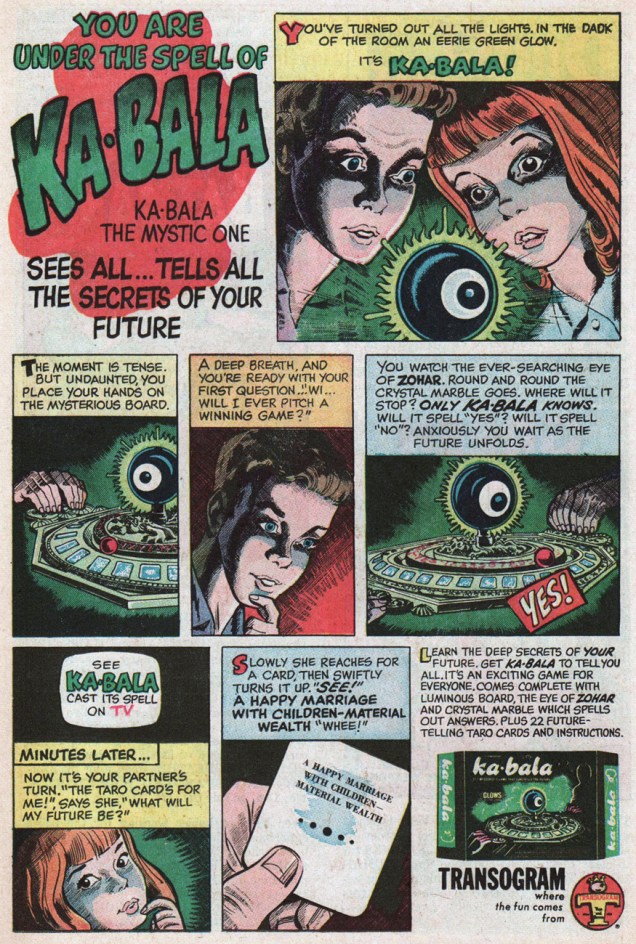
A 1968 ad full of spooky, green-glowy fun for the kiddies. An… interesting appropriation of Jewish mysticism. After all, Zohar and Kabbalah don’t really fall within the usual range of docile toy industry gibberish, straying closer to the realm of sideshow hucksterism, with its fortune-telling automatons.

Learn (a little) more about The Mysterious Game That Foretells the Future.

Ka-balaA

Wikipedia tells us: « The Zohar (Hebrew: זֹהַר, lit. “Splendor” or “Radiance”) is the foundational work in the literature of Jewish mystical thought known as Kabbalah.

There are people of religions besides Judaism, or even those without religious affiliation, who delve in the Zohar out of curiosity, or as a technology for people who are seeking meaningful and practical answers about the meaning of their lives… »

Why, hello there, Ms. Ciccone.

It’s hard not to draw a parallel between this toy’s name and eerie oculus and Charles Burns‘ Big Baby tale of a « Teen Plague » (from Raw vol. 2 no. 1, 1989). Be careful out there, kids!

BongaB
« Taste the Kiss of the Almighty Kaballa-Bonga! »
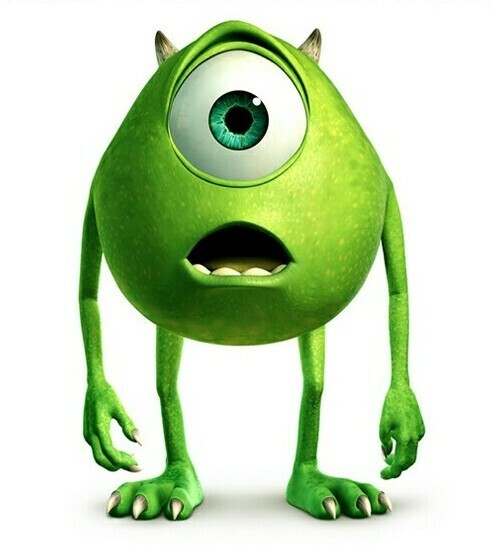
Mike-Wazowski2
I know, Mike. I can hardly believe it either.

-RG

Once More Around the Sun, Rick Geary!

« Hey — if you’re looking for that curly machine, I saw some beasts run off with it. »

Missouri native Rick Geary, born 72 years ago today, on February 25, 1946 (in Kansas City, which isn’t in Kansas, despite its name) is in a classe à part: a true iconoclast, he’s quietly, steadfastly carved out for himself (and his fans) a varied and consistently strong œuvre, seemingly free from petty compromise.

GearySelf85A
A 1985 self-portrait.

He first gained notice in the mid-70s through his fanciful contributions to National Lampoon and Heavy Metal, and just kept up the pace from there. These days, he mostly concentrates on his true crime graphic novels series, published by NBM. One gets a sense of a man who works in comics because he’s passionate about the possibilities the form offers. A 1994 recipient of the National Cartoonist Society’s Magazine and Book Illustration Award, he certainly doesn’t need to work in the comics industry.

GearyPetMiraclesA
This charming one-pager saw print in the anthology Animal Confidential (May 1992, Dark Horse.)

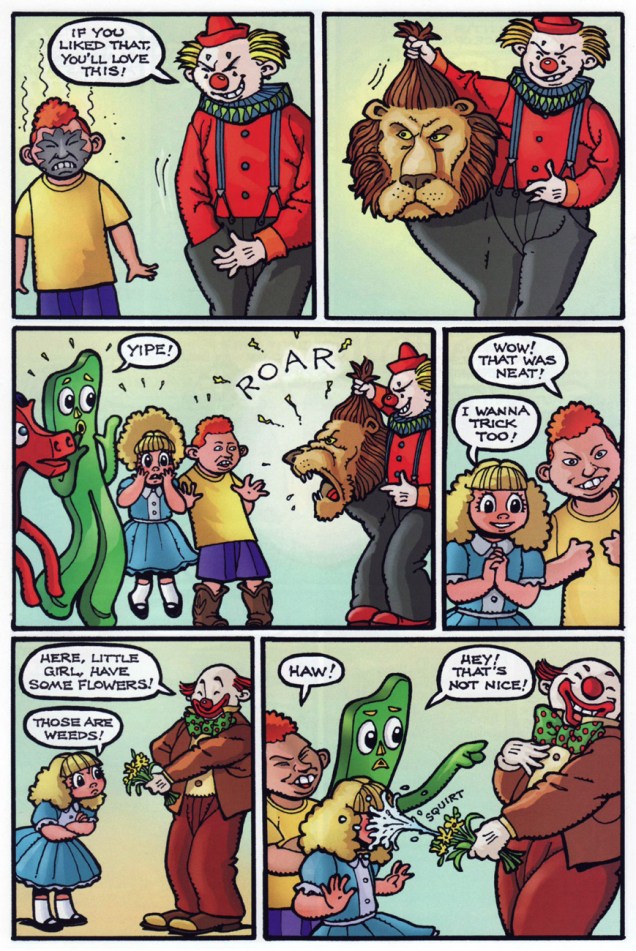
He’s collaborated with fellow oddball genius Bob Burden, of Flaming Carrot fame, a dream pairing that manages to surpass the lofty expectations it implies. Their take on Art Clokey‘s legendary claymation characters Gumby and Pokey manages to be true to its source and to espouse both Burden and Geary’s respective slants.

Here’s a sequence from Gumby no. 1 (July 2006, Wildcard Ink.) Story by Burden, art by Geary, and let’s not forget the contribution of hue ace Steve Oliff. When it comes to Gumby comics, however, mind your step: don’t settle for anything less than Burden (whether with Arthur Adams or Rick Geary). A recent revival fumbles the childlike mood of infinite possibility and mires itself in mere childishness instead.

GearyGumby1AGearyGumby2AThe Exploits of the Junior Carrot Patrol (2 issues, 1989-1990) was a solo Geary endeavour, but  « based upon characters and concepts created by Bob Burden ». Pictured here is #2. From left to right: Dusty, Ethel and Chuck.

JuniorCarrot2A

GearyStampA
Perhaps the ultimate bonafide as a Geary-head: I am the proud possessor of a rubber stamp designed by the great man himself. Furthermore, I have it on good authority that one of our regular readers proudly wields a genuine Geary rubber stamp of his own, albeit a different one. For this particular print, I took advantage of the vegetable world’s finest provider of ink: a slice of beet.

Happy birthday, dear Mr. Geary!

– RG

It’s Got a Beat and You Can Read to It

« They never roll the sidewalks up, no siree! »

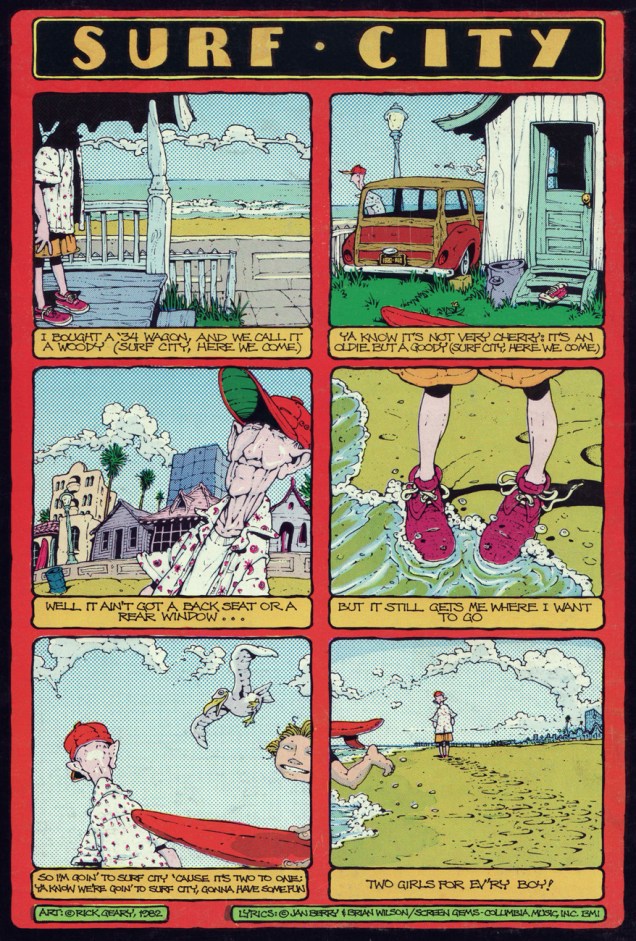
Rail-Bangin’ Rick Geary gives us a not-entirely-literal, yet oddly fitting visual representation of Brian Wilson and Jan Berry’s timeless classic, a number one hit for Jan & Dean in the Spring of 1963. Wilson’s original working title for the tune was “Goody Connie Won’t You Come Back Home“, perhaps a tad less catchy appellation.

SurfCityA

Surf City, the strip, appeared on the back cover of the lone issue of Bop, “America’s First & Only Music Comix Magazine“ (1982, Kitchen Sink Press.) Edited by Catherine Yronwode.

– RG

Hallowe’en Countdown, Day 19

« The rut I was in had once been a groove* »

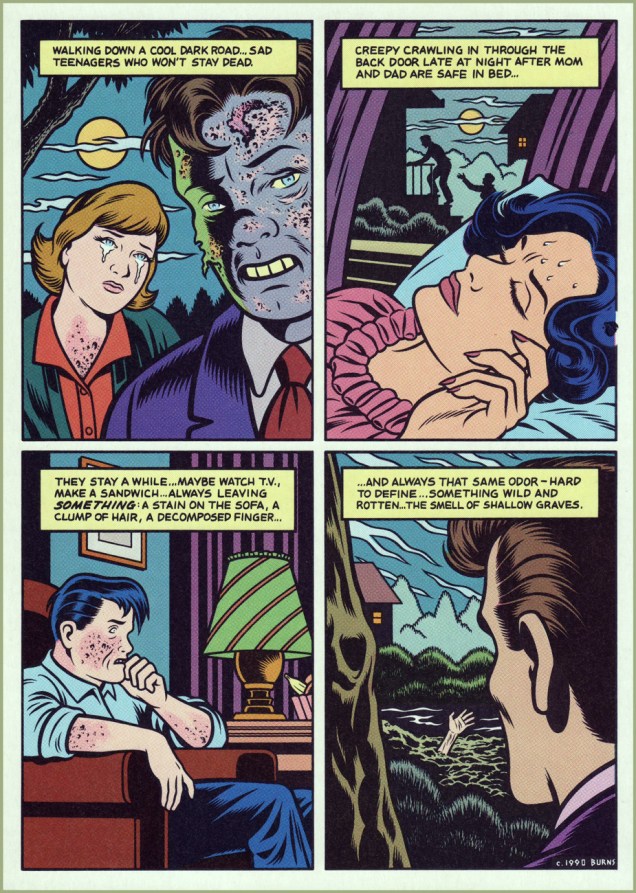
He wasn’t the first to seize upon the connection, but Charles Burns does evoke powerfully, and with tenebrous poetic grace, certain salient parallels between teenagers and the living dead, between decomposition and acne… I can’t help but be reminded of the undead masses shambling at the mall in George A. Romero‘s Dawn of the Dead (1978), trapped in the empty cycle of their old, ingrained habits.

BurnsZombiesA
Originally published in Raw Volume 2 no. 2 – Required Reading for the Post-Literate (May 1990, Penguin Books.) Edited by Art Spiegelman and Françoise Mouly.

– RG

*Nick Lowe, Rocky Road (1990)