Panning the murky old print stream for the odd glimmering nugget
Promo, Tools
For as long as they’ve been around, comics have been recruited in the name of commercial (or educational) enterprise. Or just plain propaganda. Here are some… notable examples.
« Oh Beautiful for smoggy skies, insecticided grain, For strip-mined mountain’s majesty above the asphalt plain. America, America, man sheds his waste on thee, And hides the pines with billboard signs, from sea to oily sea. » ― George Carlin
On this day, the forty-ninth edition of Earth Day, we feature some little-seen work (by his usual audience, at any rate) by Jim Woodring and his collaborator Scott Deschaine*. Given the current political climate, an increasingly dire state of affairs, I’ll (mostly) skip the chit-chat and make with the visual riches.
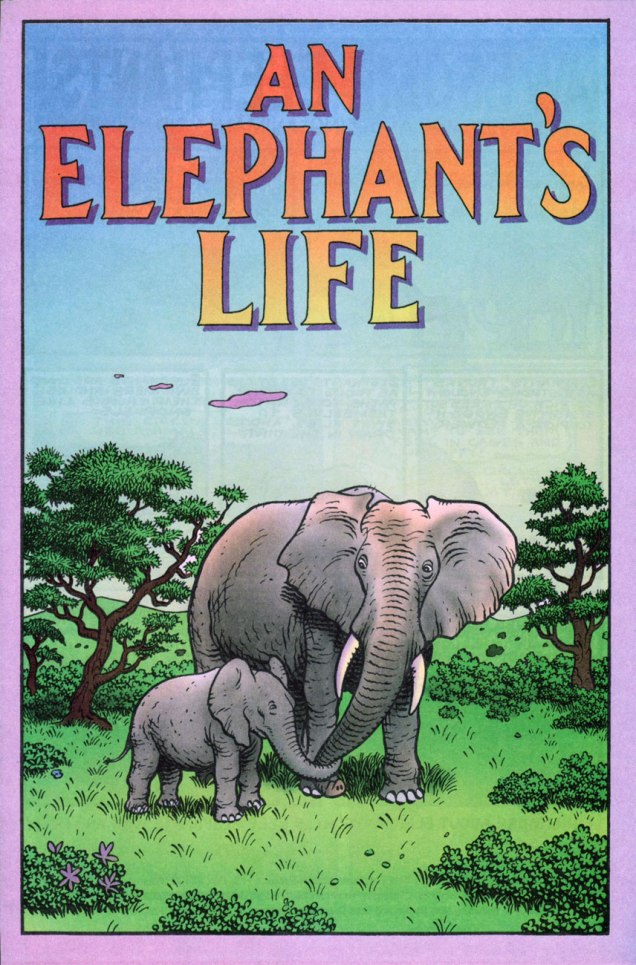
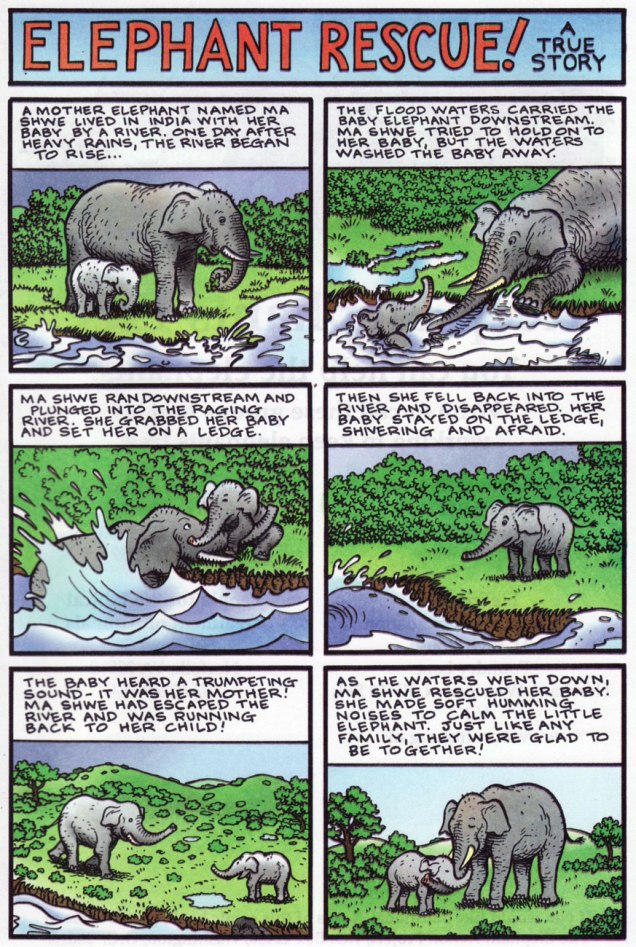
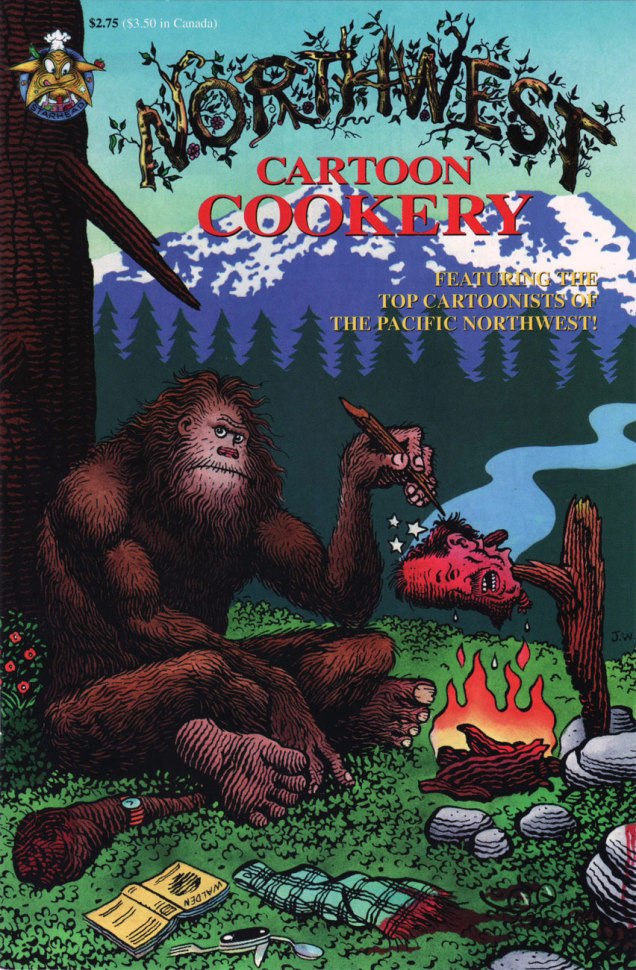
Among the Woodring / Deschaine collaborations, One Green Tree (1990) is the masterpiece, and the only full-on Woodring, visually-speaking, with its expressive inks, unsimplified art and lush palette.An interior (in more than one sense) page from One Green Tree, a sixteen-pager. Full marks to Deschaine, a science popularizer of the first order, and a cartoonist himself, which goes a long way in explaining the success of these collaborations.Incidentally, Woodring drew himself into the story as the friendly guide, Mr. Underwood.As it happens, Earth Day 2019’s theme is « Protect Our Species », and few species need more protection than the gentle elephant.An excerpt from An Elephant’s Life (1999), written by Mike Benton and Scott Deschaine, illustrated by Woodring.Search for Soil (2000, Discovery Comics) features Woodring in a simpler style, but it’s still gorgeous and effective. And hey, a Tiny Perfect Mole!And for those of you who may find this all too earnest, cute and family-friendly, I’ve saved a Woodring piece to soothe your savage brow. This is the one-shot Northwest Cartoon Cookery (1995, Starhead Comix), also featuring fine work by J.R. Williams, Donna Barr, Ellen Forney, Roberta Gregory, Michael Dougan, Mark Zingarelli… and a couple of pages of Ed Brubaker’s dismal artwork.
*French family names, after spending some time in English-speaking lands, tend to distort in interesting ways: “Deschaine” makes no grammatical sense. It likely started out as “Deschaînes” (of the chains), or its homonym, Deschênes ou Duchêne (of the Oaks or the Oak). Sometimes, the name gets so badly distorted that it’s quite unpronounceable: Shia LaBeouf (Leboeuf, the ox) or Cara Delevingne (Delavigne, of the vine)… not that I’d want to utter these names, save perhaps as curses.
Pete was born in Washington, D.C. on February 13, 1942, which makes him the doyen of the group. Like Mike “Wool Hat” Nesmith, he was a musician first, likely the group’s most instrumentally proficient. Peter wound up auditioning for the tv show after his name was suggested by Stephen Stills, who wasn’t quite right for the part… but definitely a good sport.
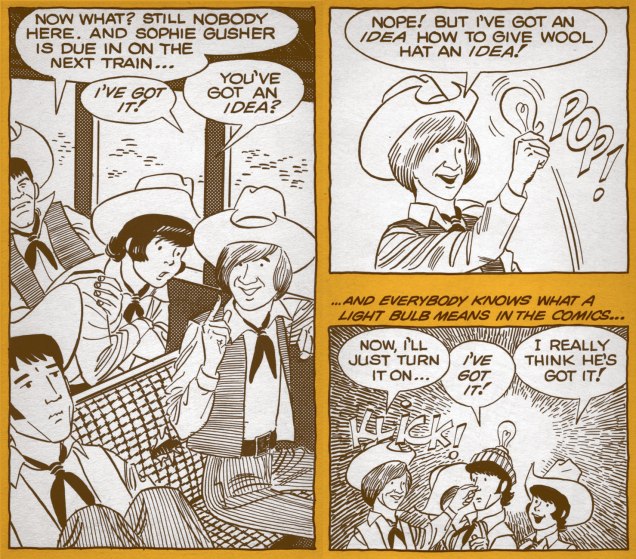
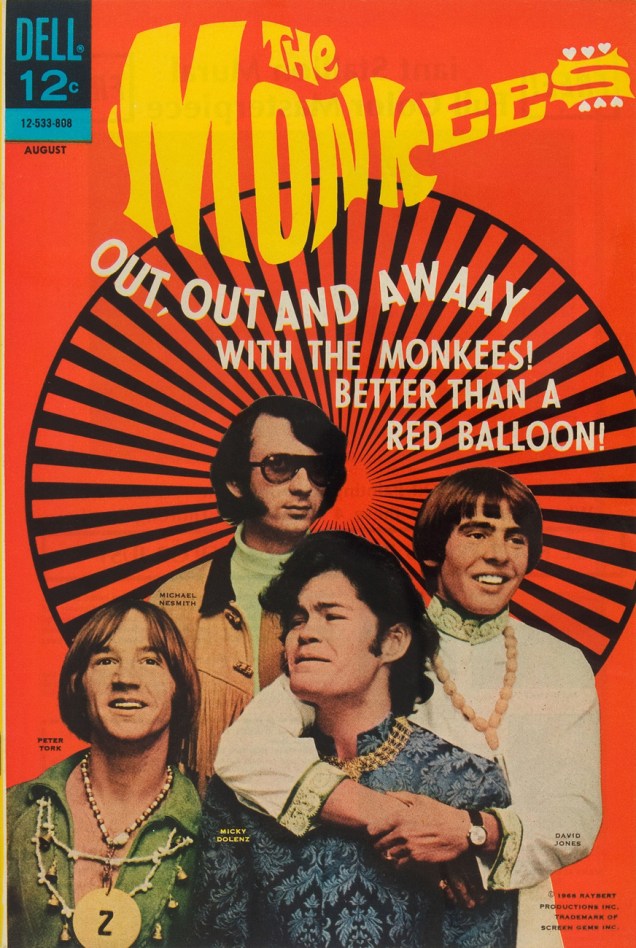
Peter and his fellow Monkees were featured in their own Dell comic book (is there any greater honour?), which lasted from March, 1967 to October, 1969, seventeen issues in all (with some reprinting.) That was one of Dell’s few savvy moves in their waning days, and one of their few readable titles outside John Stanley‘s output.
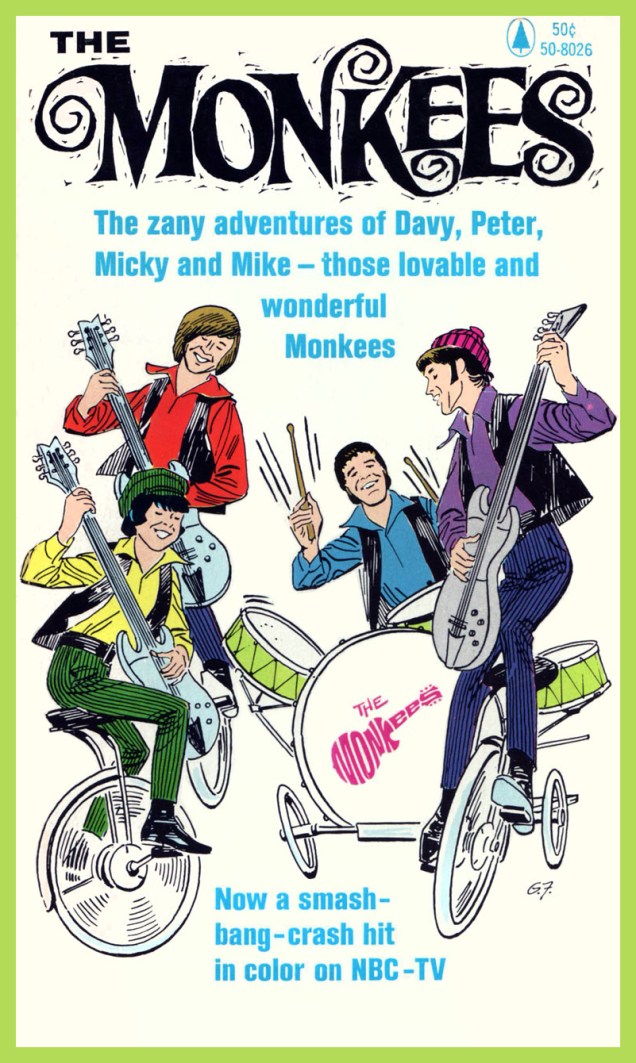
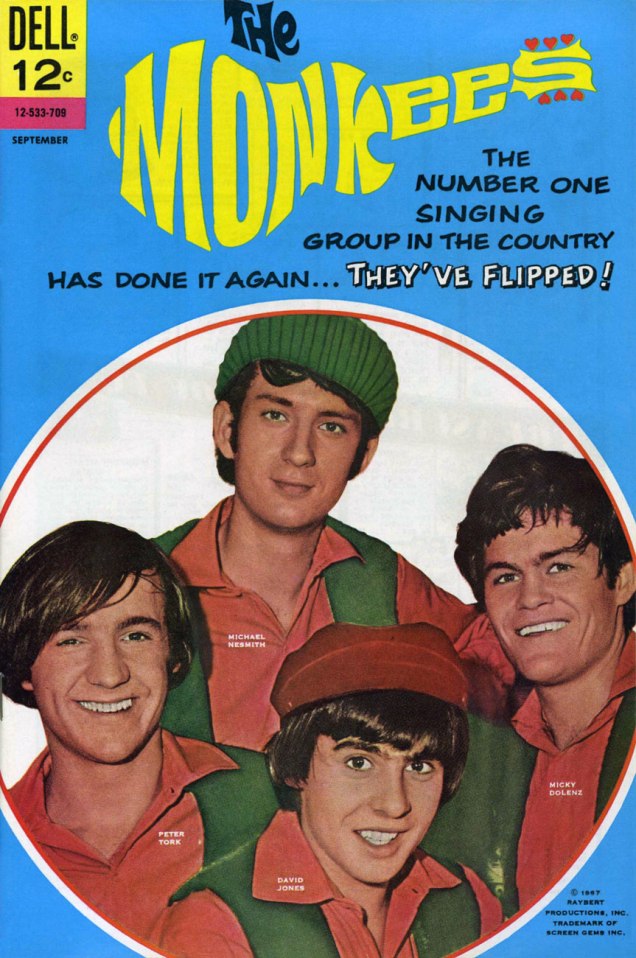
Peter the muse. From ‘Way-Out’ West, The Monkees (1966, Popular Library). See below!This cute lil’ volume contained a bunch of fun (what else) Monkees romps written by Howard Liss and ably illustrated by Eisner- Iger Studio veteran Gene Fawcette.José Delbo‘s splash page from Beezle, Beezle, Who’s Got the Beezle?, The Monkees no. 8 (Jan. 1968, Dell). Scripter unknown… but he’s pretty good.The issue in question: The Monkees no. 8 (Jan. 1968, Dell)The Monkees no. 4 (Sept. 1967, Dell)The Monkees no. 14 (Oct. 1968, Dell)Ah, but Dan Clowes has known it all along! From Eightball no. 13 (Apr. 1994, Fantagraphics)
Update: Peter Tork passed away on Thursday, February 21, 2019, barely a week beyond his 77th birthday. Au revoir, Peter!
« No other state of confusion is as interesting as yours. »
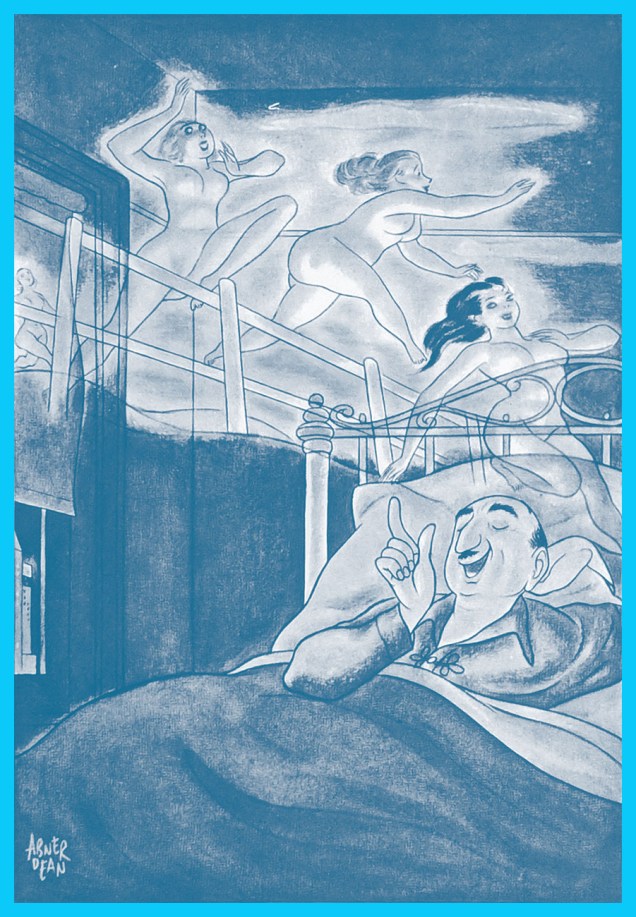
By the mid-1930s, Abner Dean (1910–1982), né Abner Epstein in New York City, had reached the pinnacle of his profession, and begun to make rewarding inroads into other pursuits and endeavours. Fruitfully and prolifically published in most of the top magazines of the era (and top era for magazines), such as The New Yorker, Life, Esquire, Coronet, Time, Newsweek, Collier’s, Look, Ladies’ Home Journal and so forth, he’d also scored in the advertising field (most notably through a fifteen-year association with Aetna Insurance).
Yet he was restless; he bristled at the limitations, conventions and formulae of the era’s gag cartooning world and had something grander in mind and up his sleeve. We’ll get to that.
But first, here’s a sampling of what Abner accomplished as a commercial illustrator and cartoonist early in his career.
The following four cartoons appeared in the pages of Esquire, for which Dean produced in excess of forty colour cartoons, and scads more in good old black and white (frequently with spot colour adornment) between 1934 and 1955.Spot the influence? The girl is a dead ringer for one of Jack Cole‘s celebrated beauties.
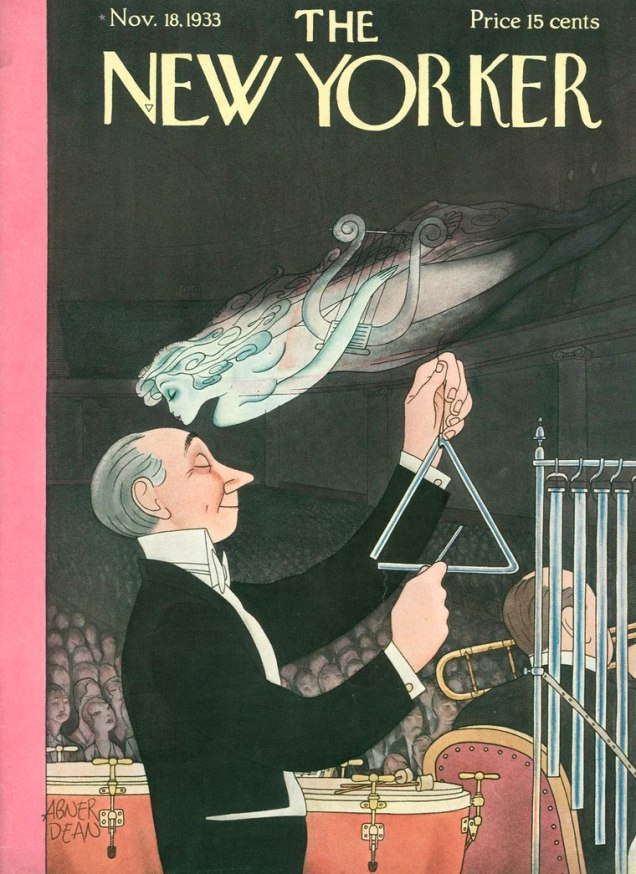
As Abner created five covers for The New Yorker (1933-35), it seemed absurd to leave any of them out, especially given their high calibre. Here they are, in order of their appearance.
Two examples of Dean’s illustrations for Aetna Insurance‘s long-running advertising and prevention campaign, for which Dean produced a whopping one hundred and ten drawings between 1940 and 1955. This one hails from 1946.To better convey the tone and tenor of the campaign, I’ve transcribed some of its text. This entry is from 1955.Our boy, wearing an appropriately skeptical expression, from the back cover of his Come As You Are (1955, Simon & Schuster).
Incidentally, what little remains publicly known about this once-famous man is the fruit of diligent research conducted by the eclectically erudite Ken Parille. As usual, we stand on the shoulders of giants. Thank you!
« Won’t you have a little rest when they turn out the lights A nice cup of tea and you’ll be feeling alright Don’t fret, you’ll recover yet you’ll see So keep on sending dirty postcards back to me Back to me, back to me » — James Warren/The Korgis (1980)
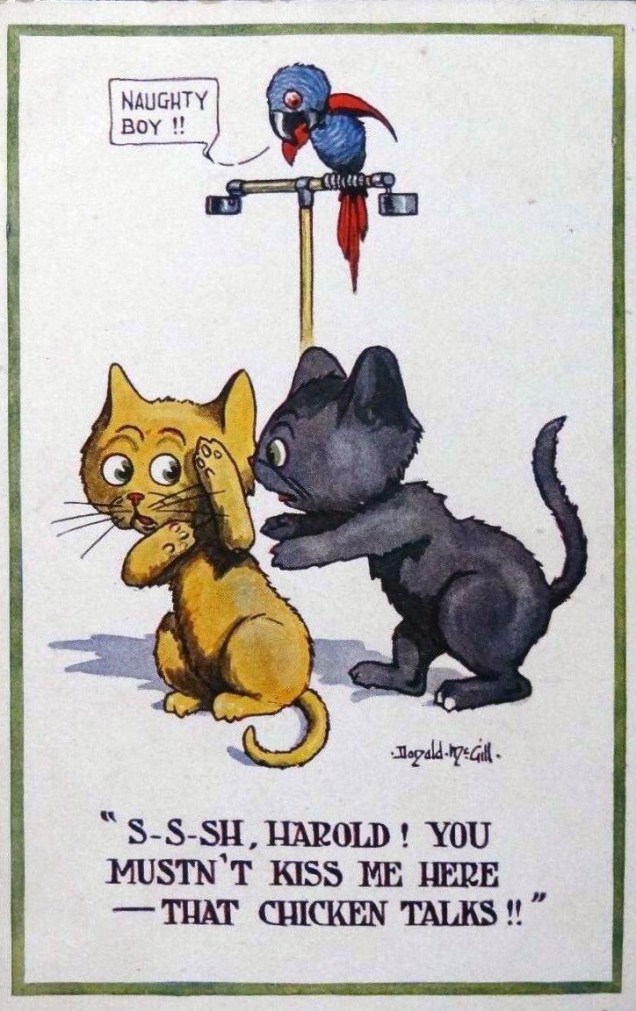
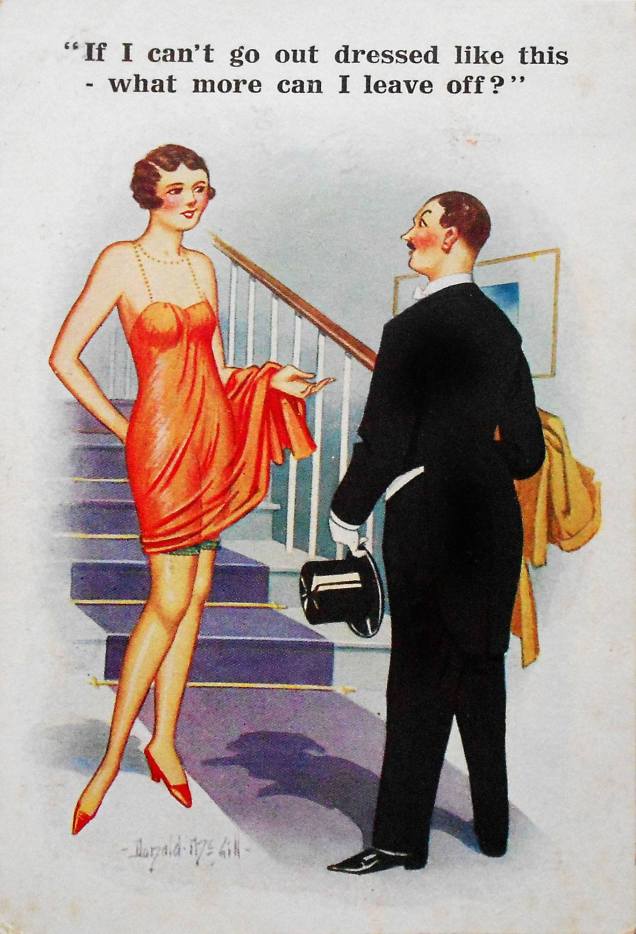
London-born Donald McGill (Donald Fraser Gould McGill, to be more precise, 1875-1962), was known for his risqué seaside postcards, sold mostly in souvenir shops in British coastal towns.
He painted the usual figures of fun in the noble tradition of British titillating humour: attractive young ladies, obese men, respectable drunks in the throes of a midlife crisis, cantankerous old ladies, religious personnel, courting couples (a lot of courting couples!), and so on. He painted well, he was prodigiously prolific… and he was not afraid of making jokes so off-colour they could possibly make a sailor blush. (I only have a vague idea of what sailors were like back then, you see.)
McGill ranked his own work according to its vulgarity, classifying it into “mild, medium and strong”. It goes without saying that the “strong” category sold in far greater numbers! Unfortunately (but not surprisingly), McGill’s postcards got him into trouble with upholders of the Moral Good (spoilsports!), culminating with McGill being dragged into court in 1954, when he was almost 80, for breaking the Obscene Publications Act of 1857. The result of this hearing was a hefty fine for McGill, and disaster for the companies producing saucy postcards, with several smaller companies going bankrupt as sales plummeted, cards were destroyed and retailers cancelled orders.
McGill very much died in the saddle: he continued to work until his death in 1962 (and with cartoons for 1963 already prepared). He certainly recycled some jokes, but I think it’s safe to say that he was not about to run out of material. The “king of the saucy postcard” is estimated to have produced around 12 thousand (!) paintings during his career, resulting in the sale of around 200 million postcards… and no royalties for McGill, mind, just his earnings of three guineas per design.
These days, he’s credited with an astute power of social observation and impressive artistic skill. He’s worthy of that praise, but what touches me most is that McGill gave people who surely needed some cheer in their lives a reason to smile, giggle and perhaps even daydream. Hell, some of these postcards made *me* daydream.
Okay, enough theoretical discussion! On to the indecency. I’ve roughly sorted these out by degree of (increasing) “vulgarity”. I honestly didn’t think the jokes would go beyond the “not indecent, but suggestive as hell” category, as per a definition my college best friend coined for something else altogether, yet some of them make surprisingly direct references. Isn’t it lovely to know that our great-grandmothers had their minds in the gutter, too?
In the category of “social commentary”.
I can’t decide whether this is just sweet and innocent or makes a reference to something far more lewd.
This particular postcard holds the world record for selling the most copies (a little over 6 million).
« McGill’s family was steadfastly respectable. He said of his two daughters: ‘They ran like stags whenever they passed a comic postcard shop.’ »
You can also take a gander at some sketches, which were unearthed in someone’s attic in 2015. As the article explains, « drawings feature fat old ladies, big busted women and lusty men. » While you’re at it, brush up on your Brit slang for the bedroom (entirely unnecessary for the current post, but fun!)
« My father had a lifelong interest in helping musicians. I even encountered his presence when reading the autobiography of Anita O’Day. She said that there was a real estate man in Chicago who always made sure her band had a place to stay. That was Pop. » – Justin Green
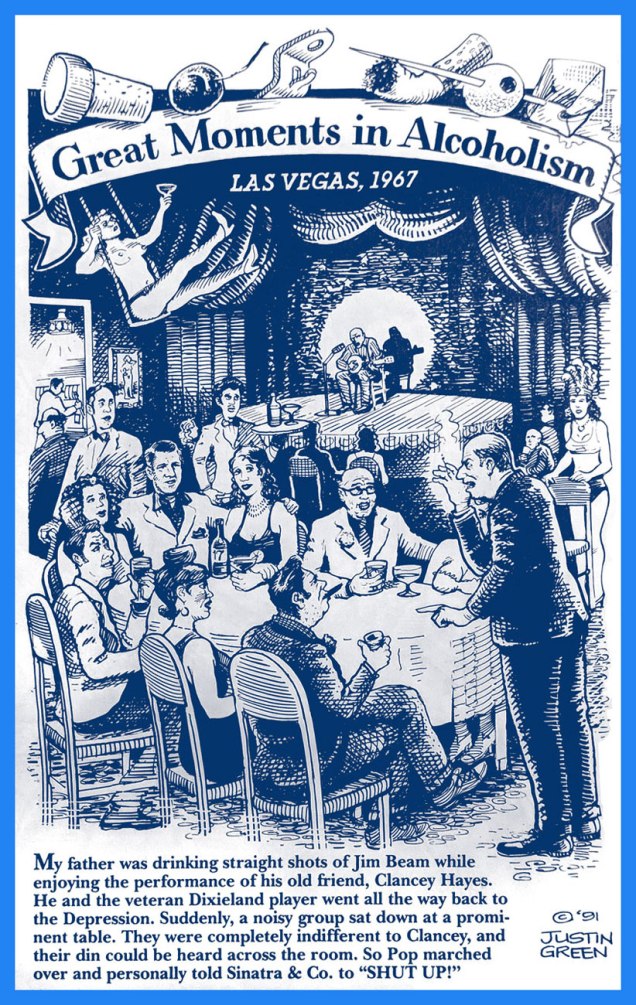
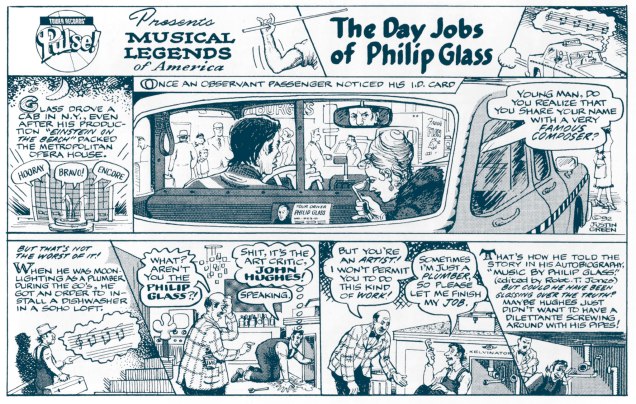
How did Justin Green, one of the Founding Fathers of the Underground Comix movement, wind up holding down a regular feature for a decade (1992-2002) in Tower Records‘ in-house magazine, Pulse!? The whole chain of events began with a strip about his dad’s drinking. Of course.
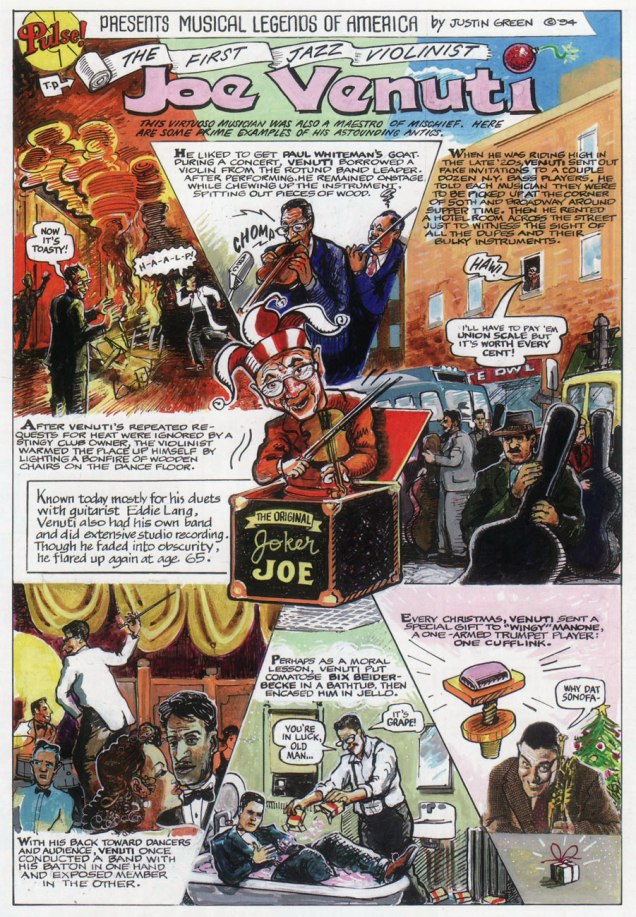
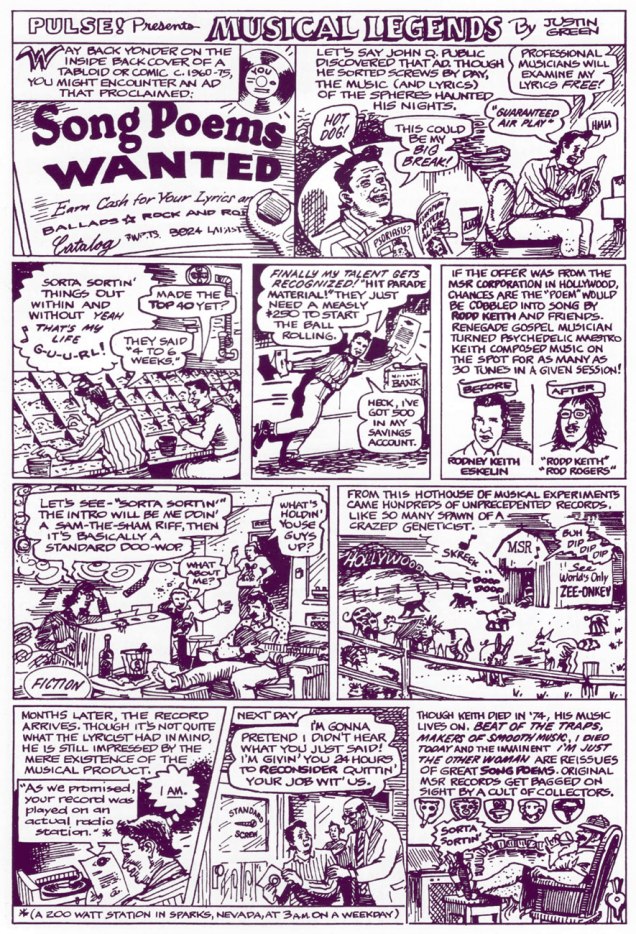
« It was my father’s spirit that instigated this cartoon project…. this was ’91 (Blab No.6, Summer 1991, Kitchen Sink Press), and I was living in Sacramento. Mark Weidenbaum was then an editor at Pulse! Magazine, published and distributed by Tower Records, which had its headquarters in West Sacramento. He had just seen the piece when he found out I lived nearby. He wanted to explore the idea of an ongoing musical biography cartoon feature. »The second instalment (April, 1992). A little Einstein on the Beach, anyone?August, 1992. Elvis certainly had his faults, but racism or ingratitude were not among these.My own introduction to the Reverend’s music came, as it surely came to many others, through Jackson Browne‘s fine cover of his Cocaine (Running on Empty, 1977). « I was talking to my doctor down at the hospital. He said, ‘Son, it says here you’re twenty-seven, but that’s impossible — you look like you could be forty-five’. »The strip frequently appeared in colour. Here’s my favourite example, from April, 1994. And here’s a fine Venuti performance. No, he wasn’t *always* joking.Ah, Rodd Keith, the main man behind those infamous Song Poems ads, comic book fixtures in the 1970s. The weren’t a scam… not in the traditional sense. November, 1996. Lend your ear to his Ecstasy to Frenzy.
While Green isn’t a native virtuoso draftsman like, say, R. Crumb or Rick Griffin, and he’s only fair-to-middling when it comes to likenesses, he *is* a born storyteller, and that’s really what’s most needed for an endeavour of this nature. Compressing a lifetime, or at least a career, into a single-page strip (two at the most!) is remarkably tricky and demanding, and if it looks deceptively easy here, he’s succeeded.
In selecting strips for this post, I didn’t lean towards my own favourite musicians, opting instead for what I felt were the strongest pieces, regardless of topic. However, I’m reserving my very favourite for a special New Year’s Eve post. Hope you enjoyed these musical time capsules! If you did, you’ll be happy to learn that the fine folks at Last Gaspcollected the set in 2003.
« Here, plainly, was a guy for whom cartooning held no mysteries. He was more than a master; he was a virtuoso, a source, an innovator whose style was completely natural and original and flexible enough to embrace dashed-off vulgarity and painstaking elegance, often in the same panel. » — Jim Woodring on Jack Davis
Here we are, coming to the end of our countdown (or count-up, depending on your point of view), and who better to convey the magic of Hallowe’en than the late, great Jack Davis (1924-2016)? Don’t answer that. 😉
Detail from Monster Rally (1959).
A 1959 collection of humorous horror songs by Alice Pearce and Hans Conried, Monster Rally (LPM/LSP-1923) sports a classic Davis painting – blending horror and humor into what amounts to a cutely-weird piece of art. Davis has mentioned that this scene is one he really enjoying doing and that he was quite pleased with. An ad for this album in issues of Famous Monsters of Filmland from back then read:
An insane and fantastically entertaining album featuring Hans Conried and Alice Pearce, singing and screaming ghoulish new songs like ‘Monster Rally’, ‘The Thing‘, ‘The Invisible Man‘, ‘Not of This Earth‘ and others. The album cover by Jack Davis is a masterpiece – suitable for framing.
[ Excerpted from Dick Voll‘s article Just for the Record: The LP Cover Art of Jack Davis (Fanfare no. 5, Summer 1983; edited and published by Bill Spicer). ]
And here are a mittful of extras, since I’m more inclined to treat than to trick on this special day.
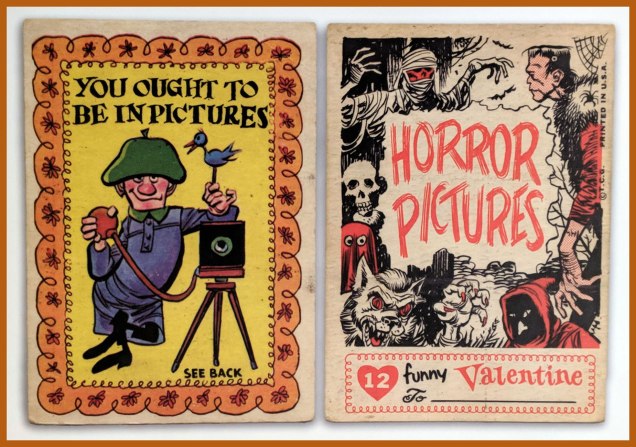
« From approximately ’59, Davis did a huge quantity of work for Topps Gum Co. Over the years, he did ‘Funny Monster Cards’, ‘Wanted Posters’, ‘Funny Valentines’, ‘Batty Book Covers’, ‘Wacky Packs’, ‘Silly Stickers’ as well as standard baseball and football tradings cards. » — Hank Harrison, The Art of Jack Davis (1986, Stabur Press). This, incidentally, is one of the ‘Funny Valentines’.
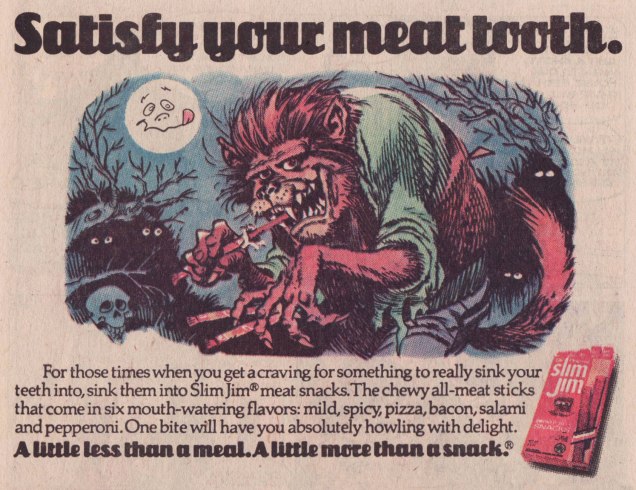
Davis’ classic Slim Jim commercials of the late 1970s. Of course. Can you believe they ran these earlier… with the bold-type, all-caps slogan of WHAT TO SINK YOUR TEETH INTO WHEN YOU’RE HUNGRY AND YOU’RE NOT A WEREWOLF… but sans Davis art? Thankfully, some bright kid at the ad agency saw the opportunity and managed to be convincing enough.
In closing, thanks for bearing with all my divagations through this second edition of WOT’s Hallowe’en Countdown, and let me wish you a most spooky Hallowe’en, one and all!
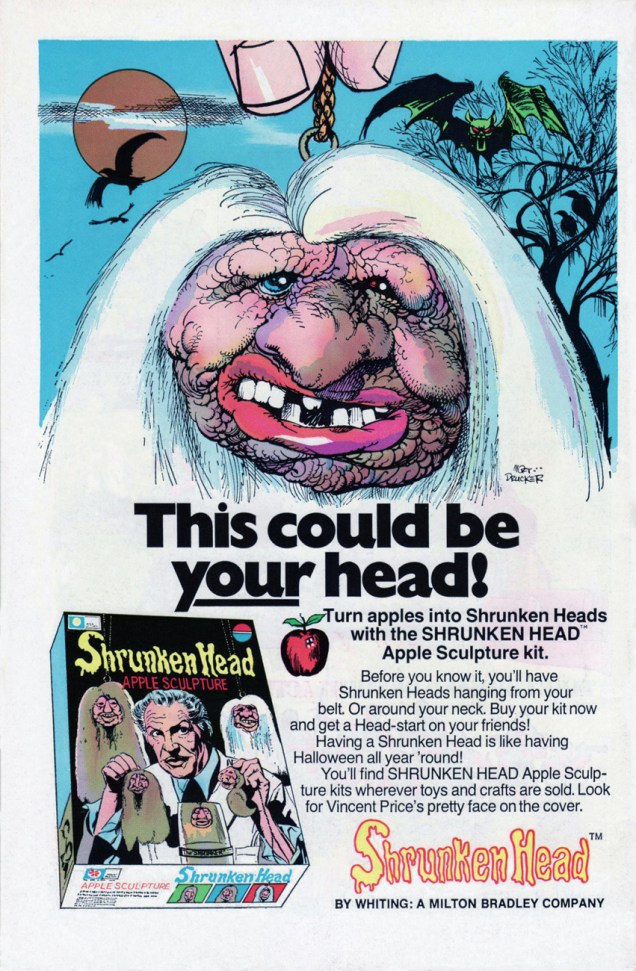
« Having a shrunken head is like having Halloween all year ’round! »
A classic, fondly-remembered ad from the back of comics published in the fall of 1975.
How cool is it that even the box art is hand-drawn? One of these will set you back a pretty penny on eBay these days.
The artwork is by Mad Magazine pillar (and arguably their artist most adept at capturing celebrity likenesses) Mort Drucker (b. 1929). Check out that fabulous signature!
Of course, I’d always longed to snag my own kit, and a few years ago, I succeeded.« Each apple will be different from any other; no two will be exactly alike. This is due to variations in many factors, but mostly in the moisture content of the apple. »« Caution: Do not use in excess of 40 watt bulb. »
Should you find yourself with some extra apples after a productive head-shrinking session, why not make the most of your leftovers with Vincent’s recipe for æblekage, which is to say Danish Apple Cake? Waste not, want not.
« I prefer drawing to talking. Drawing is faster, and leaves less room for lies. » – Le Corbusier
Carl Buettner (1905-1965) started out as an animator with Disney Studios and Harman-Ising Studio (founders of Warner Bros and MGM animation studios), then shifted to newspaper strips for a few years (Charlie McCarthy, 1938-40), then on to Western Publishing for the rest of his career, handling a bunch of Disney characters for Dell Comics (Joe Carioca, Bucky Bug, Dumbo The Flying Elephant, Bambi…) until the early 1950s, when he became editor of Western’s Little Golden Books line.
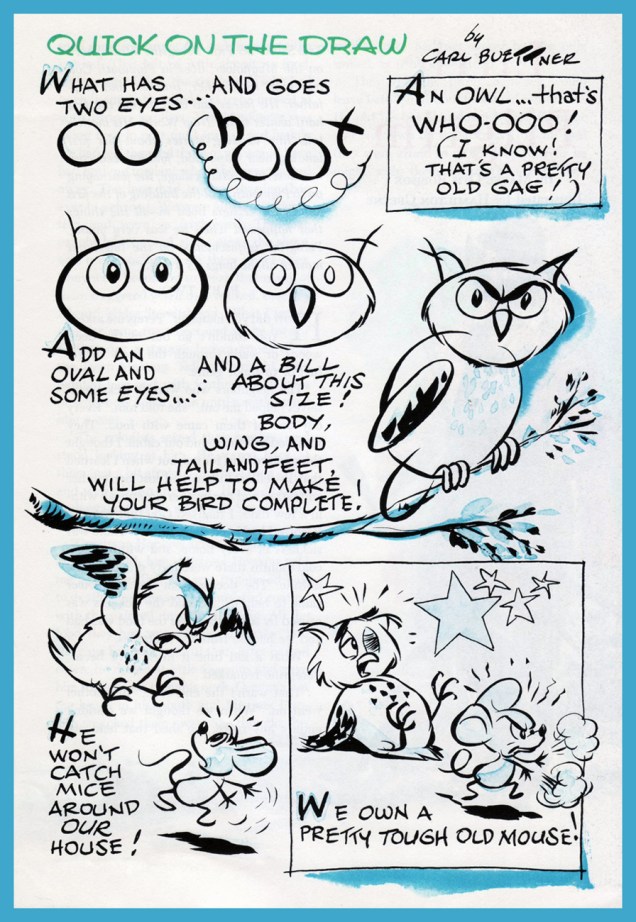
On the side, he kept his hand in with a nifty tutorial feature, “Quick on the Draw”, that ran in Western’s The Golden Magazine for Boys and Girls. Though he passed away early in 1965, Buettner’s QOTD ran well into the next year, since he was evidently working well ahead. The feature was then taken over by his fellow former Disney animator and scribbler Carl Fallberg (1915-1996). Fallberg spent most of his long career working on the scripting and story directing side, but he evidently kept his pencils sharp.
From Golden Magazine Vol. 2 No. 10 (October, 1965)From Golden Magazine Vol. 2 No. 11 (November, 1965)From Golden Magazine Vol. 4 No. 4 (April, 1967). Fallberg was a lifelong “narrow gauge” railroad enthusiast. His delightful Fiddletown and Copperpolis cartoons, published in Railroad Magazine in the late ’40s to the early ’50s, were collected in 1985 and still in print (and affordable!) to this day.From Golden Magazine Vol. 4 No. 9 (September, 1967)From Golden Magazine Vol. 4 No. 12 (December, 1967)
« Unless you’re some kind of masochist, I would imagine that you’d like to begin your plant experience with the easy, almost impossible-to-kill group. »
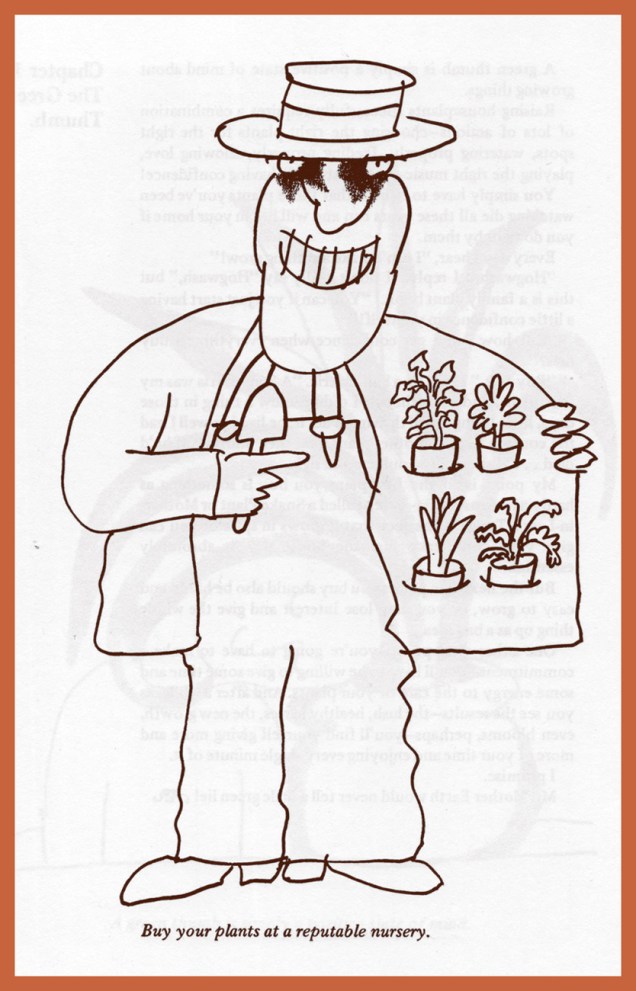
A sunny reminder of some of the plant world’s myriad of virtues, from 1973’s Mother Earth’s Hassle-free Indoor Plant Book by Lynn and Joel Rapp, a terrific little tome that bears the probably unique distinction of having yielded its own soundtrack. Not only that, but its own *excellent* soundtrack, Mother Earth’s Plantasia by Canadian-born songwriter, producer and electronic music pioneer Mort Garson. The LP was distributed through one of the wackiest marketing schemes I’ve ever encountered: it was given away with the purchase of a Simmons mattress from Sears. Uh?
« A green thumb is simply a positive state of mind about growing things. »
I see Plantasia’s even been reissued a few years back on fancy 180 gram vinyl (along with other formats and impressive ancillary products). But you can hear it in its entirety without making the considerable financial investment, thanks to this lovely tribute on the Music Is My Sanctuary blog.
The book (and LP booklet) are illustrated by « Marvelous » Marvin Rubin… who quite deserves the sobriquet, if you ask me.
« I was first introduced to Bromeliads by a 75-year-old semi-retired mechanic named Rafe ‘Frenchy’ DeLago. At least I thought I was. It turns out that I was actually first introduced to Bromeliads by my mother and the Dole Company, but neither my mother nor I knew it at the time. Truth is, my mother still doesn’t. You see, all pineapples are Bromeliads. In fact, all Bromeliads are pineapples! »
As confirmed by George Orwell’s sole comic novel, Keep the Aspidistra Flying.« Those plants will grow in your house, all right, but they’d grow better if you lived in a greenhouse. »« It is well known that plants grow best to classical music, but we have been told about a hip Dieffenbachia who loves The Rolling Stones. »« As people in the plant business, take it from us: the worst pest when it comes to killing plants is Homo sapiens. »
« I find television very educating. Every time somebody turns on the set, I go into the other room and read a book. » ― Groucho Marx
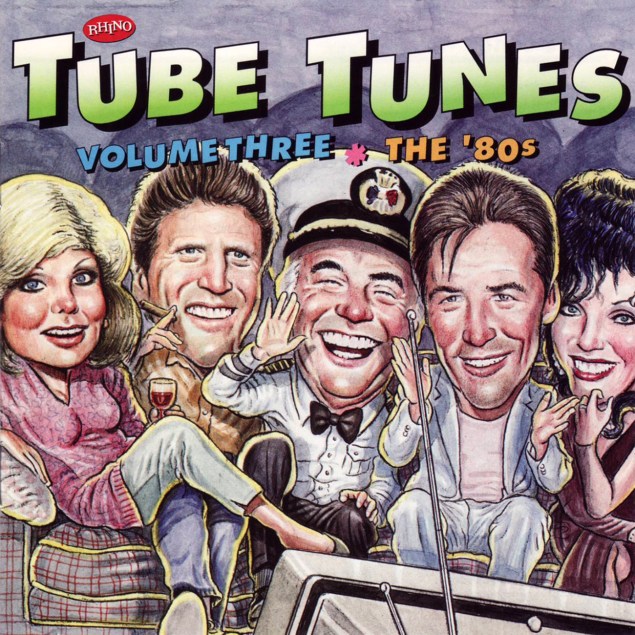
In the mid-90s, the always-discerning masterminds* at Rhino Records (they had, after all, picked William Stout to design their logo, back in 1974) called upon master satirist, caricaturist and of course pointillistDrew Friedman (1958-) to gather some perennial favourites on his old couch for the purposes of a three-volume compilation.
In this second entry in the trilogy, Mr. Friedman seems a bit out of his element, as drawing purdy gals and conventionally handsome men is hardly his forte. But he aces Gabe Kaplan, as you’d hope and expect. Judging from his expression, Gabe appreciates it.
This time, our artiste ably succeeds where he faltered earlier: he has no difficulty capturing the likenesses of Ms. Anderson and (5x so far) Mrs. Collins.
From volume 3’s liner notes: « The 1980s may well be remembered as the final decade of the television theme song. The disturbing trend of the ’90s seems to be the elimination of the title song in preference of an additional minute of commercial airtime – a sad state of affairs for fans of the opening anthem. »
Maybe it’s all for the better: I’d rather have an additional hour of commercial airtime than be subjected again to the opening jingle of, say, Charles in Charge. You have been warned.




























 Who's Out There?