Hallowe’en Countdown IV, Day 13

« Room for one more, honey! »
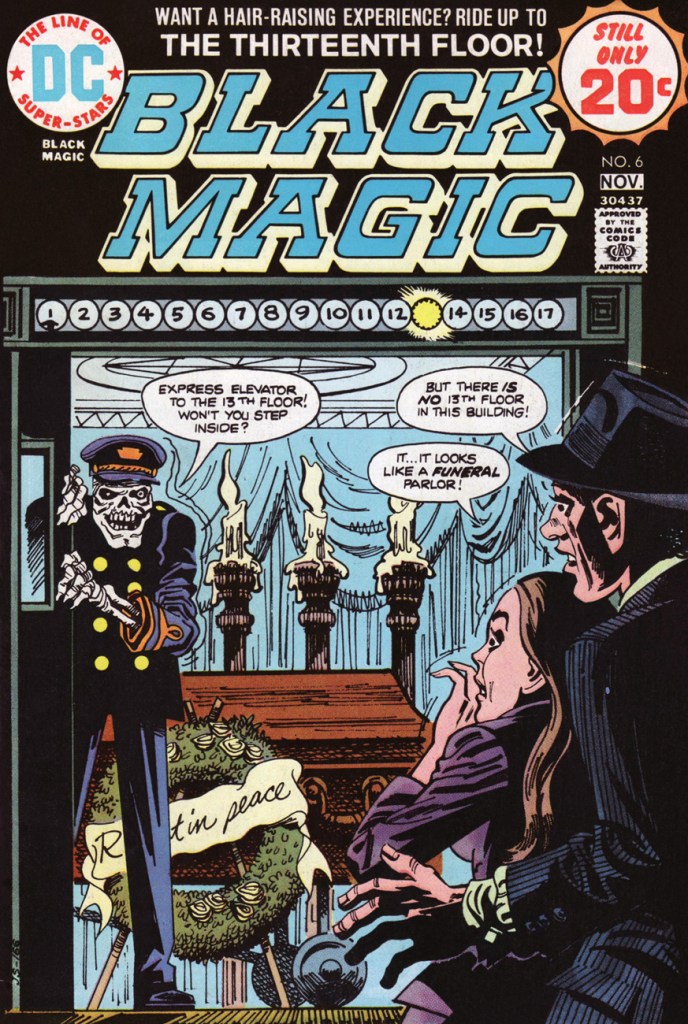
A Jack Kirby cover scene gets winningly recast for the 70s by Jerry Grandenetti, himself a contributor to the original series. This is Black Magic no. 6 (Oct.-Nov. 1974, DC).

When I was a kid (of twelve or so, if memory serves), I found a muddy and mildewed copy of this issue in the woods, which tremendously added to its allure, if not its readability.

And since I’ve mentioned it, here’s the original Kirby cover, regrettably one of the King’s least engaging, if you ask me. This is Black Magic no. 11 (vol. 2 no.5, Apr. 1952, Prize).

Well… little did I know what a protracted history this particular little scenario had. Let’s return to the presumed beginning, or at least the industrial age version.

Around the turn of the last century, the prolific English writer Edward Frederic Benson (1867 – 1940) wrote a story entitled The Bus Conductor [ read it here ] that saw print in Pall Mall Magazine in 1906. It was quite well-received, then began to widely make the rounds… as putative fact.

Things kicked into high gear in the mid-1940s, as the tale was recounted as an oft-heard anecdote in editor Bennett Cerf‘s 1944 short story anthology, Famous Ghost Stories, which contained a Benson contribution… but not The Bus Conductor.

That same year, Cerf shared the anecdote with the legion of readers who picked up his highly-entertaining (and still dirt-cheap and easy to find, over three-quarters of a century later, which gives you a sense of its original success and ubiquity) book of anecdotes, Try and Stop Me. The pertinent chapter was the splendidly-titled The Trail of the Tingling Spine. As examined earlier on this blog, this chapter was used by EC Comics’ Bill Gaines and Al Feldstein as what they termed ‘springboards’ for their earliest stories.

Cerf’s version, from Try and Stop Me:

When an intelligent, comely girl of twenty-odd summers was invited for the first time to the Carolina estate of some distant relatives, their lovely plantation fulfilled her fondest expectations. She was given a room in the west wing, and prepared to retire for the night in a glow of satisfaction. Her room was drenched with the light of a full moon.

Just as she was climbing into her bed, she was startled by the sound of horses’ hooves on the gravel roadway. Curious, she walked to the window and saw, to her astonishment, a magnificent old coach pull up to an abrupt stop directly below her. The coachman jumped from his perch, looked up and pointed a long, bony finger at her. He was hideous. His face was chalk-white. A deep scar ran the length of his left cheek. His nose was beaked. As he pointed to her, he droned in sepulchral tones, “There is room for one more!” Then, as she recoiled in terror, the coach, the horses and the ominous coachman disappeared completely.

The girl slept little, but the next day she was able to convince herself that she merely had a nightmare.

The next night, however, the horrible experience was repeated. The same coach drove up the roadway. The same coachman pointed at her and exclaimed, “There is room for one more!” Then, as before, the entire equipage disappeared.

The girl, now panic-stricken, could scarcely wait for morning. She trumped up some excuse to her hosts and left immediately for home.

Upon arrival, she taxied to her doctor from the station and told him her story in tremulous tones. The doctor persuaded her that she had been the victim of a peculiar hallucination, laughed at her terror, and dismissed her in a state of infinite relief. As she rang for the elevator, its door swung open before her.

The elevator was very crowded, but she was about to squeeze her way inside — when a familiar voice rang in her ear. “There is room for one more!” it called. In terror, she stared at the operator.
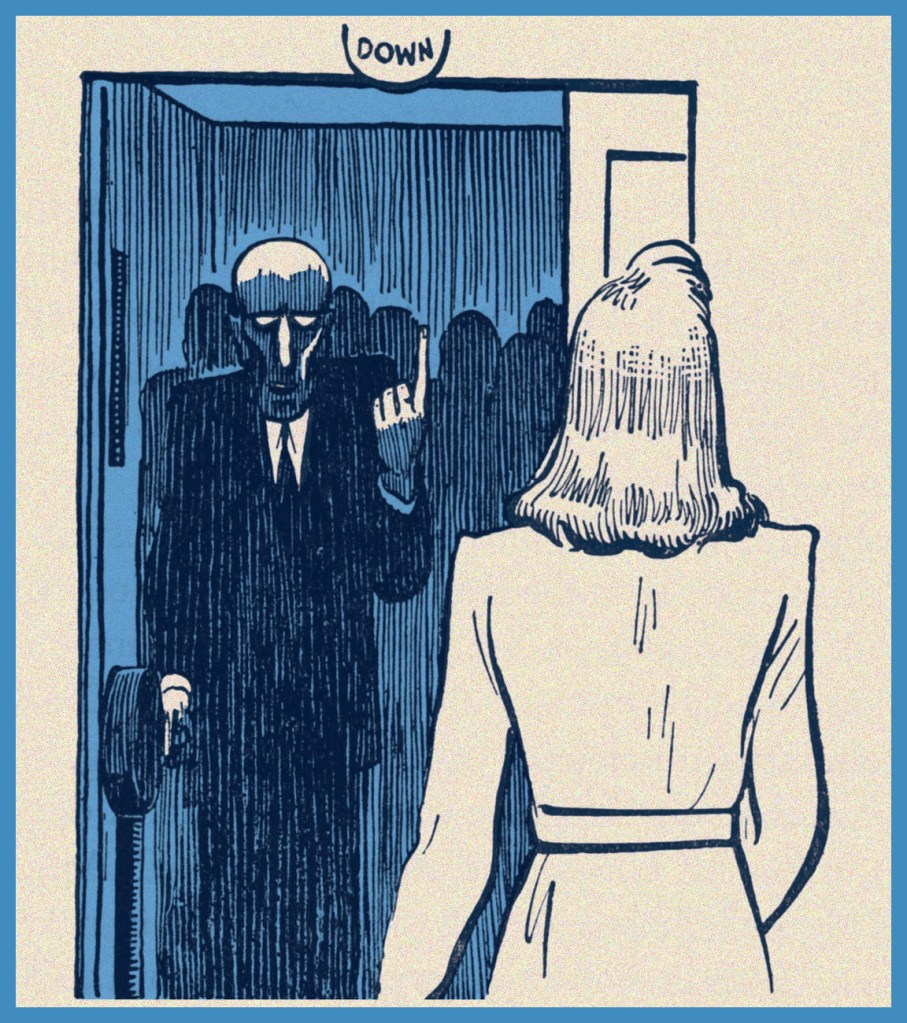
Try and Stop Me was lavishly and diversely illustrated by The New Yorker great Carl Rose, which surely must have contributed considerably to its success. I’d say Simon and Grandenetti were quite familiar with this striking image.

He was the coachman who had pointed at her! She saw his chalk–white face, the livid scar, the beaked nose! She drew back and screamed… the elevator door banged shut.

A moment later the building shook with a terrible crash. The elevator that had gone on without her broke loose from its cables and plunged eighteen stories to the ground. Everybody in it, of course, was crushed to a pulp.

Then followed Ealing Studios‘ legendary portmanteau film, Dead of Night, in which Benson received his due credit as the source for its The Hearse Driver segment [ look for the germane bit around the 1:25 mark ].

A moody still from Dead of Night.

Then came Simon and Kirby’s comics take.

On to the Sixties: Rod Serling also drew upon the Cerf anecdote as grist for his The Twilight Zone episode Twenty Two (season 2, episode 17, aired Feb. 10, 1961). Here’s a pivotal scene from it.
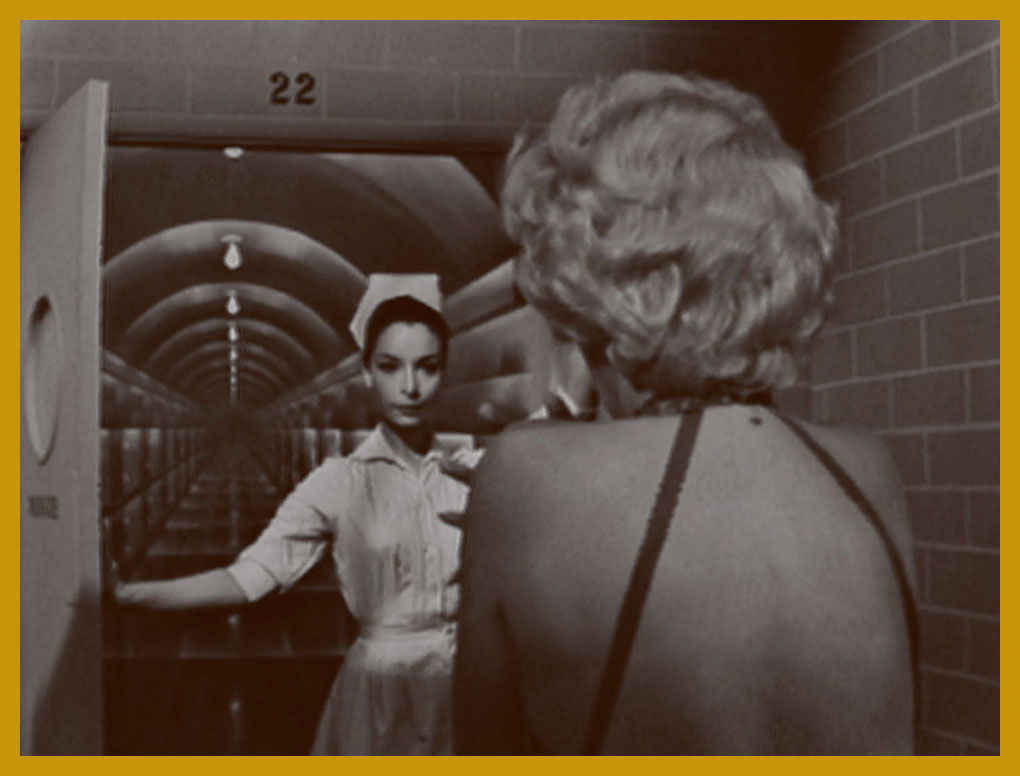
Well, that’s certainly easier on the eyes than that gaunt vulture of an elevator operator… but no less menacing. You may recognize Mr. Spock’s future bride, Arlene Martel.

The Twilight Zone’s continuing popularity pretty much killed the scenario’s urban legend potency (Snopes.com checked it out!) In 1999, Urban legend authority Jan Harold Brunvand wrote, in his Too Good to Be True – The Colossal Book of Urban Legends:

According to my readers when I wrote a newspaper column in 1989 about the old ‘Dream Warning’ legends, The Twilight Zone version was the only one most of them knew. After numerous reruns, the TV episode had virtually replaced the folk legend in the popular mind. Every reader who wrote me following my column mentioned this episode, with one exception, and this person mentioned that he saw the plot enacted in a mid-1940s film, called Dead of Night. I’ll bet my legend-hunting license that this film, too, borrowed from the Cerf version.

I wouldn’t make that wager if I were you, Mr. Brunvand… since Dead of Night properly credits Benson.

To give you a sense of how effectively these stories flit and flicker across storytelling modes and media, power pop wizard Scott Miller (1960-2013) opened his band Game Theory‘s 1988 album, Two Steps From the Middle Ages, with a haunting ditty entitled Room for One More, Honey, an acknowledged quotation of the Twilight Zone episode.

-RG

Hallowe’en Countdown IV, Day 10

« Ghosts! Haunted house! … wow!
I’m glad we don’t have to investigate
around a joint like
that! »
— Woozy Winks… who else?

How about some Golden Age Plastic Man Hallowe’en goodness? I thought as much. All this and Woozy Winks too!

This lovely splash opens Murder in Maniac Mansion, from Police Comics no. 17 (March 1943, Quality), edited by John Beardsley. Script, pencil and inks by Jack Cole.

Never mind the trick– treat yourself and read this sprightly ol’ comic book right here: http://comicbookplus.com/?dlid=14584

Mr. Cole’s splashy splash from another spooky Plas yarn, The Ghost Train, from Police Comics no. 23 (Oct. 1943, Quality). Read it here: https://comicbookplus.com/?dlid=37425

The supremely versatile Jack Cole could always be counted on to inject a bit of sinister ambiance (or over-amped sensuality, depending on his mood) to mix up the generally humorous proceedings of the stretchy exploits of the former Patrick “Eel” O’Brian. At times, things got pretty grand-gignolesque, as in the following case.

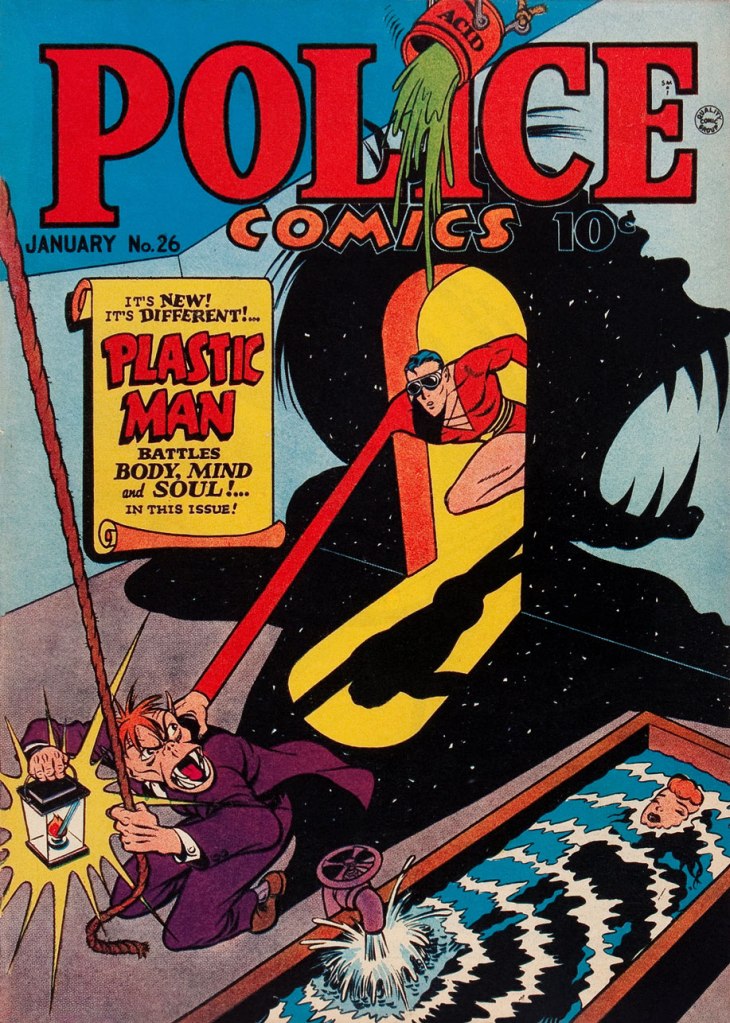
This is Police Comics no. 26 (Jan. 1944, Quality). Cover art by Jack Cole.
Double, double toil and trouble; Fire burn and caldron bubble. This is Plastic Man no. 33 (Jan. 1952, Quality); cover pencils by Jack Cole, inks by ‘Burly’ Sam Burlockoff.

By the 1950s, Jack Cole had moved on to other pastures and projects, but Plastic Man kept right on stretching, one of the few superheroes flexible enough to withstand the horror boom. But not without a few alterations to fit the times, as evidenced by the following pair of samples.

This is Plastic Man no. 38 (Jan. 1952, Quality); cover art by Alex Kotzky. You have to appreciate that boney Monk Mauley hung on to his lucky belt even as his pants lost their corporeality. That’s commendable dead-ication! (sorry); Oh, read all about it: https://comicbookplus.com/?dlid=30201
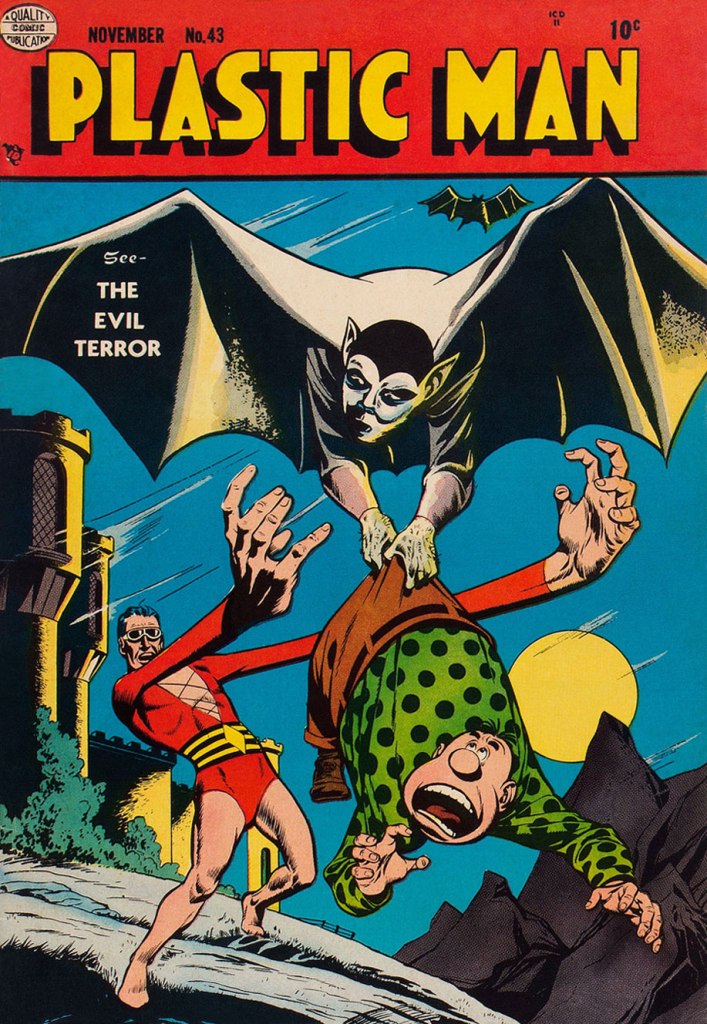
This is Plastic Man no. 43 (Nov. 1952, Quality); cover pencils by Dick Dillin, possible inks by Chuck Cuidera.

It must be stated that, even without the masterly Jack Cole, Plastic Man clearly brought the best out of the rest of Quality’s admittedly admirable bullpen, so his adventures remain worth reading… which is certainly not the case with most subsequent revivals, with the exceptions of DC’s 1976-77 mostly-ignored Ramona Fradon run and Kyle Baker‘s award-winning 2004-06 outing.

-RG
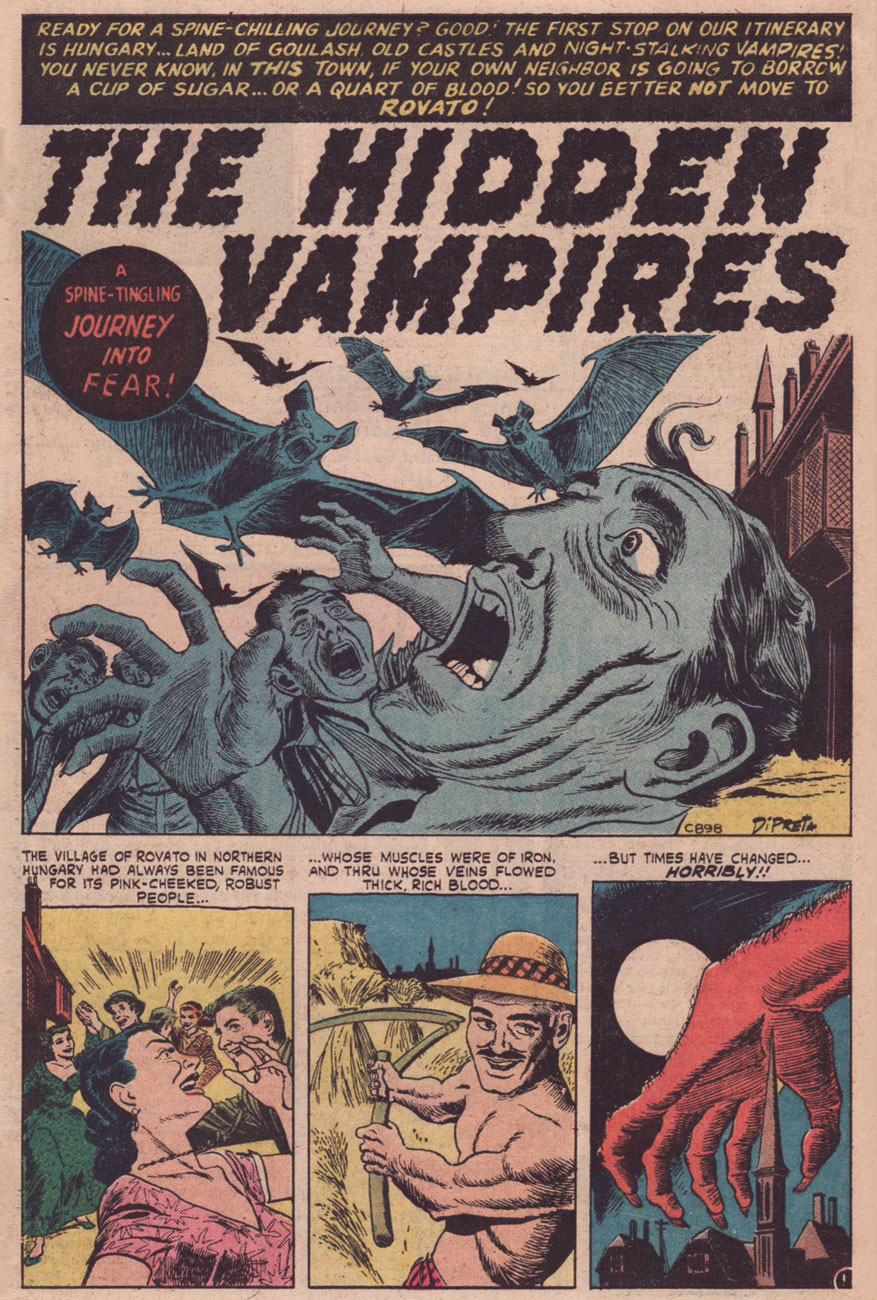
Hallowe’en Countdown IV, Day 9

« It was the spookiest horror ride anywhere! Mr. Awrus… a charming little old man, really… made it that way, because he liked to entertain people! But then the snake-thing arrived… and the others… heh-heh… and people went in… and didn’t come out… » — Horror Beasts Dine Tonight

Forrest J. Ackerman and James Warren’s Famous Monsters of Filmland, despite its own humble beginnings (or partly thanks to them!) went on to inspire quite a spate of imitators of… varying quality.

First out of the gate was Irwin Stein’s Magnum Publications, with Monster Parade (four issues). It was soon followed by Monsters and Things (two issues).

Define ‘Tunnel of Love‘… This is Monsters and Things no. 2 (April, 1959). Edited by Larry Shaw, with a cover by Stanley ‘Bob Powell’ Pawlowski (1916-1967).

As for the magazine’s grimy guts, there’s regrettably nothing outstanding: a couple of reprints of pre-Code material that was pedestrian to begin with… Curse of the Living Crossbones, illustrated by Ken Rice (a retitled Spectres of the Jolly Roger and True Tales of Unexplained Mystery #44, a one-pager about vengeful German gargoyles, illustrated by Sy Grudko, both plucked, minus colour, from Web of Mystery no. 22 (Jan. 1954, Ace Magazines).

The issue does contain a couple of fun wash illustrations, including this one by the esteemed Mr. Powell, also (along with the cover), accompanying the main feature, Horror Beasts Dine Tonight. “And will that be your usual table, sirs?“
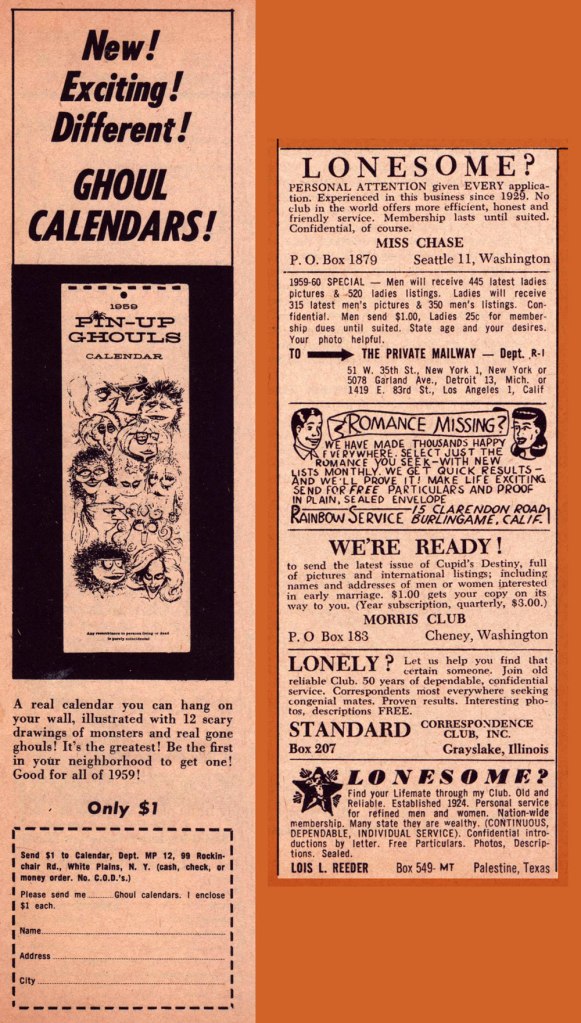
A sample of the classifieds. Do I, er… detect a certain pattern? One clear advantage of the Pin-Up Ghouls calendar is that you can reuse it next in 2026, so keep an eye out for gently-used copies!

Of further interest: An intriguing article about M&T’s predecessor, Monster Parade: http://frankensteinia.blogspot.ca/…/covers-of…

Still, it must be said that the dank, meandering back alleys of sleaze magazine publishing of the era are oddly fascinating, if decidedly disreputable places.

– RG

Hallowe’en Countdown IV, Day 5

« Merchant and pirate were for a long period one and the same person. Even today mercantile morality is really nothing but a refinement of piratical morality. » — Friedrich Nietzsche

This charming rogue doesn’t look like he’s going to share his pretties with just anyone, so be sure to ask nicely.

This is Weird Mysteries no. 7 (Oct. 1953, Stanley Morse). Cover by Bernard Baily (1916-1996), whom we’ve previously spotlighted.

Stanley P. Morse ran a rather fly-by-night operation, even by funnybook industry standards, but someone in there had some taste, as evidenced by the classic material produced under its various dodgy banners (Aragon, Gilmor, Key Publications, Media, S.P.M., Stanmor, Timor…) by such notables as the aforementioned Mr. Baily, Basil Wolverton (including his enduring The Brain Bats of Venus) and a fledgling Steve Ditko.

This particular issue includes Fredric Wertham favourite Mother’s Advice, but really, the whole issue’s pretty wacky.

You know, this one. Art by Tony Mortellaro.

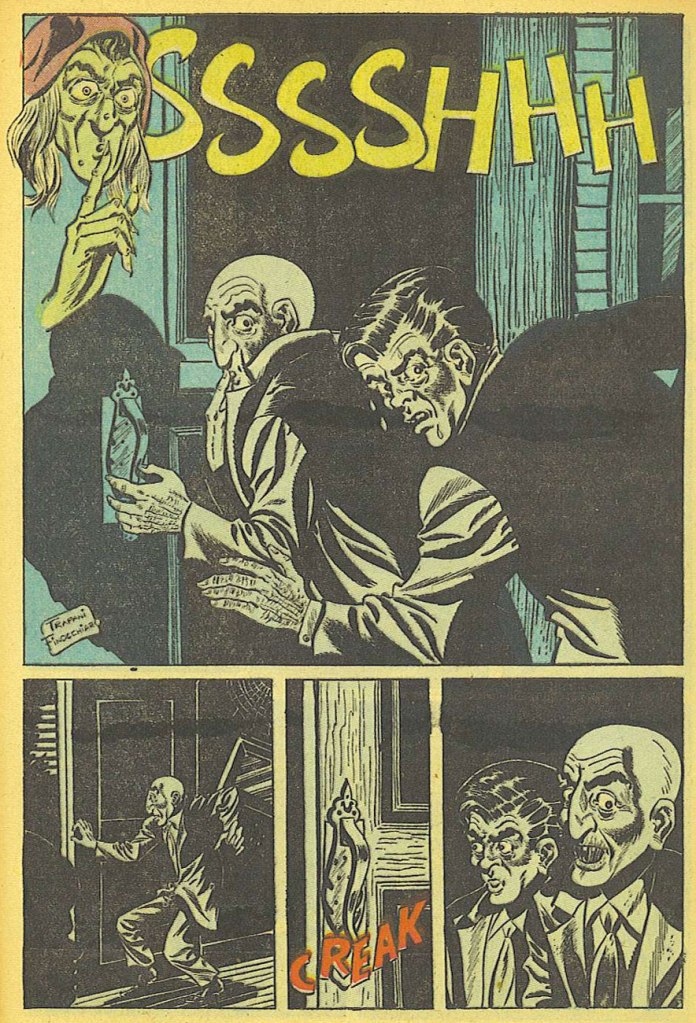
Still, the highlight of the issue has to be a brilliantly idiotic short tale intriguingly entitled… Sssshhh. Here it is:

In his spare time, Trapani was the driving force behind the Society of American Vintage-radio Enthusiasts, which makes him very cool indeed. Here’s a compelling account of the early days of the movement to preserve this crucial art form. And it wasn’t just passive preservation: here’s an original recording of classic radio plays he produced in 1972.

-RG
Hallowe’en Countdown IV, Day 3

« I’ve never gone to bed with an ugly woman… but I’ve sure woke up with a few » — Royal C. Bannon

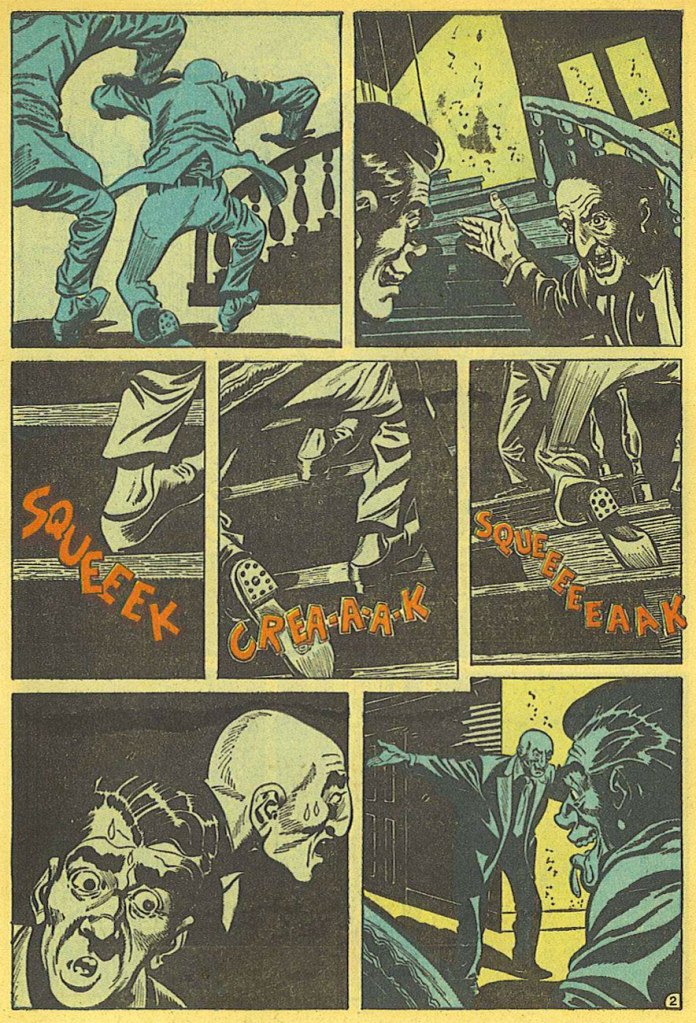
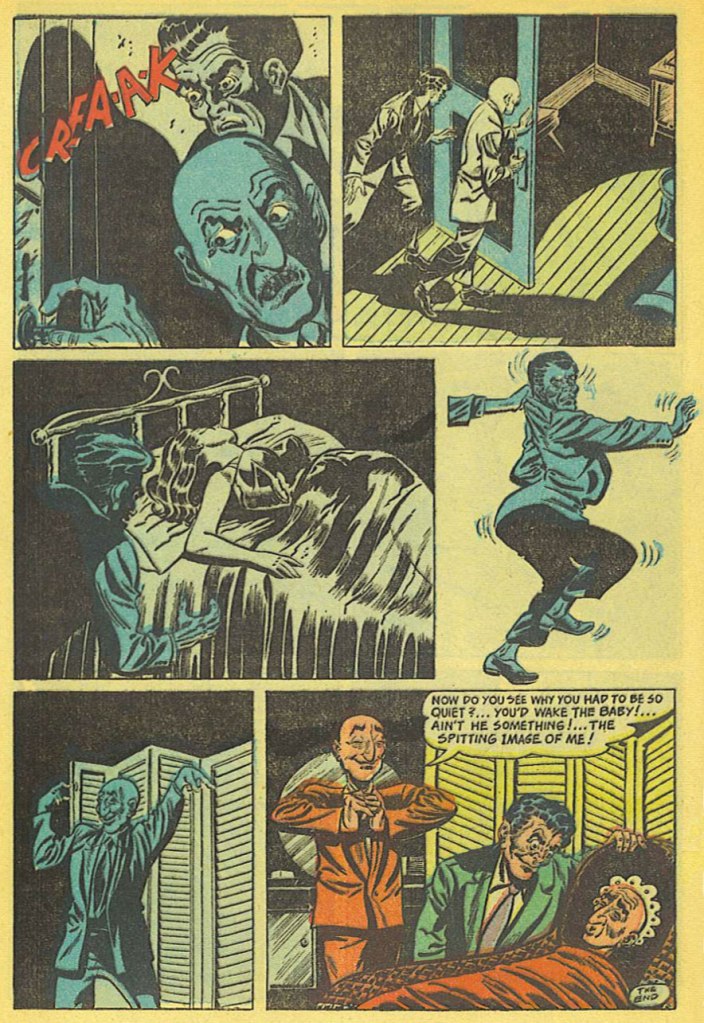
Clearly, some cravings die awfully hard. This is Strange Tales no. 28 (May, 1954, Atlas), featuring a most claustrophobic… cuddle. The rest of this scarce issue contains artwork by Pete Tumlinson, Jack Katz (who recently — just last week! — turned 93), Bob Forgione, Don Perlin (who recently turned 90) and Tony DiPreta.

Cover by by Harry Anderson (1911-1970), not to be confused with his namesake, alias Judge
Harry T. Stone.
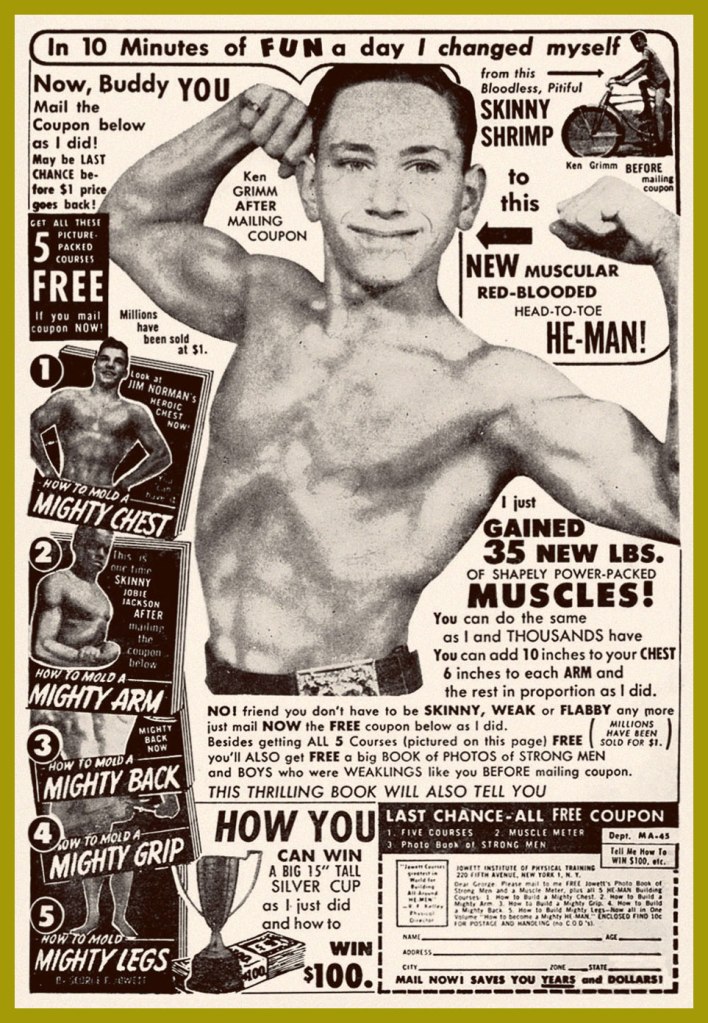
*Ken* Grimm, eh? Speaking of horror, they sure didn’t mince words to reel in the rubes, did they? This gentle, understated pitch appeared on the inside back cover of this issue of Strange Tales. « Mail the damn coupon with your shekels already, you bloodless, pitiful, skinny shrimp! », bellowed the bellicose drill sergeant.

[ psst! you can read the issue here! ]

-RG
Hot Streak: Bill Everett’s Menace

« I have learned to live each day as it comes, and not to borrow trouble by dreading tomorrow. It is the dark menace of the future that makes cowards of us. » — Dorothy Dix

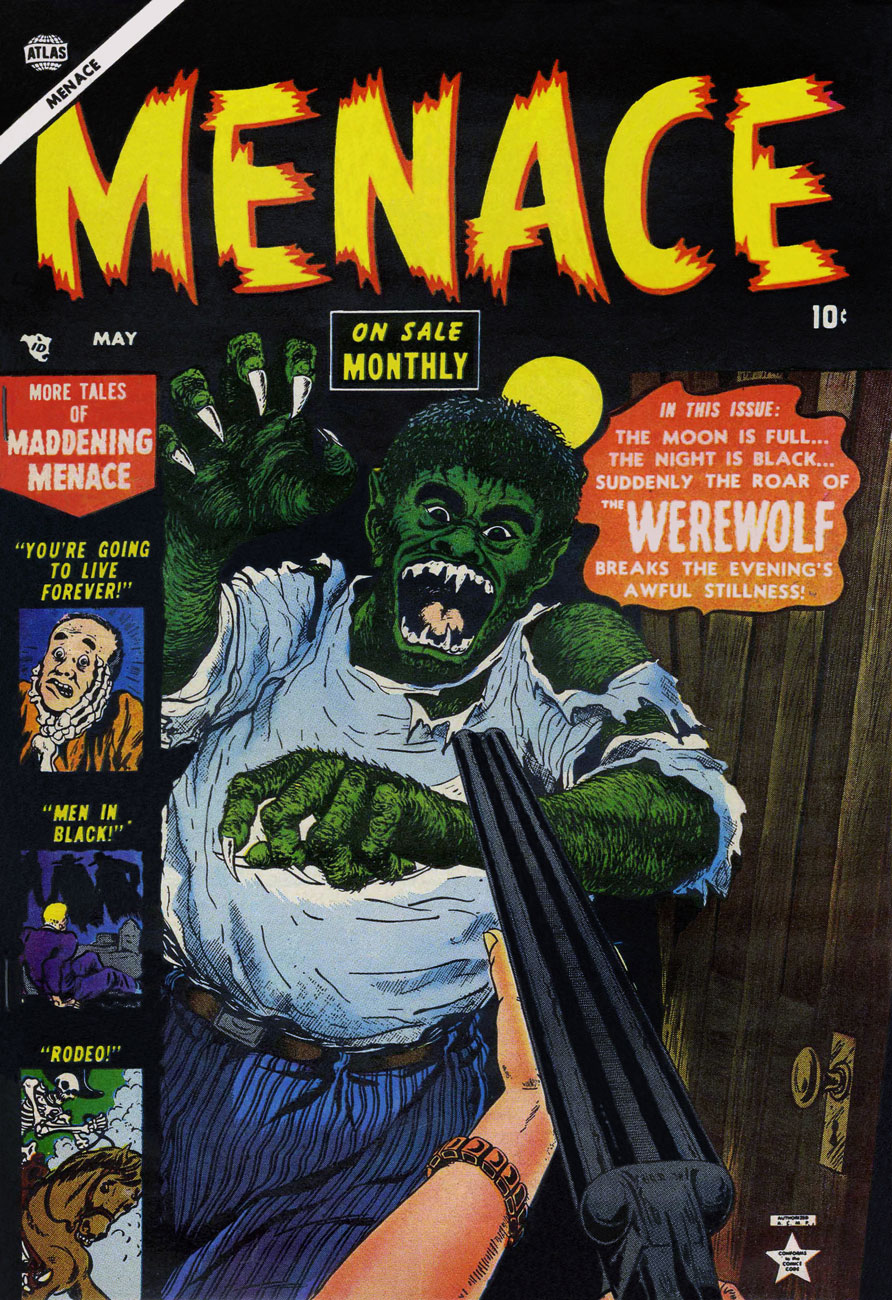
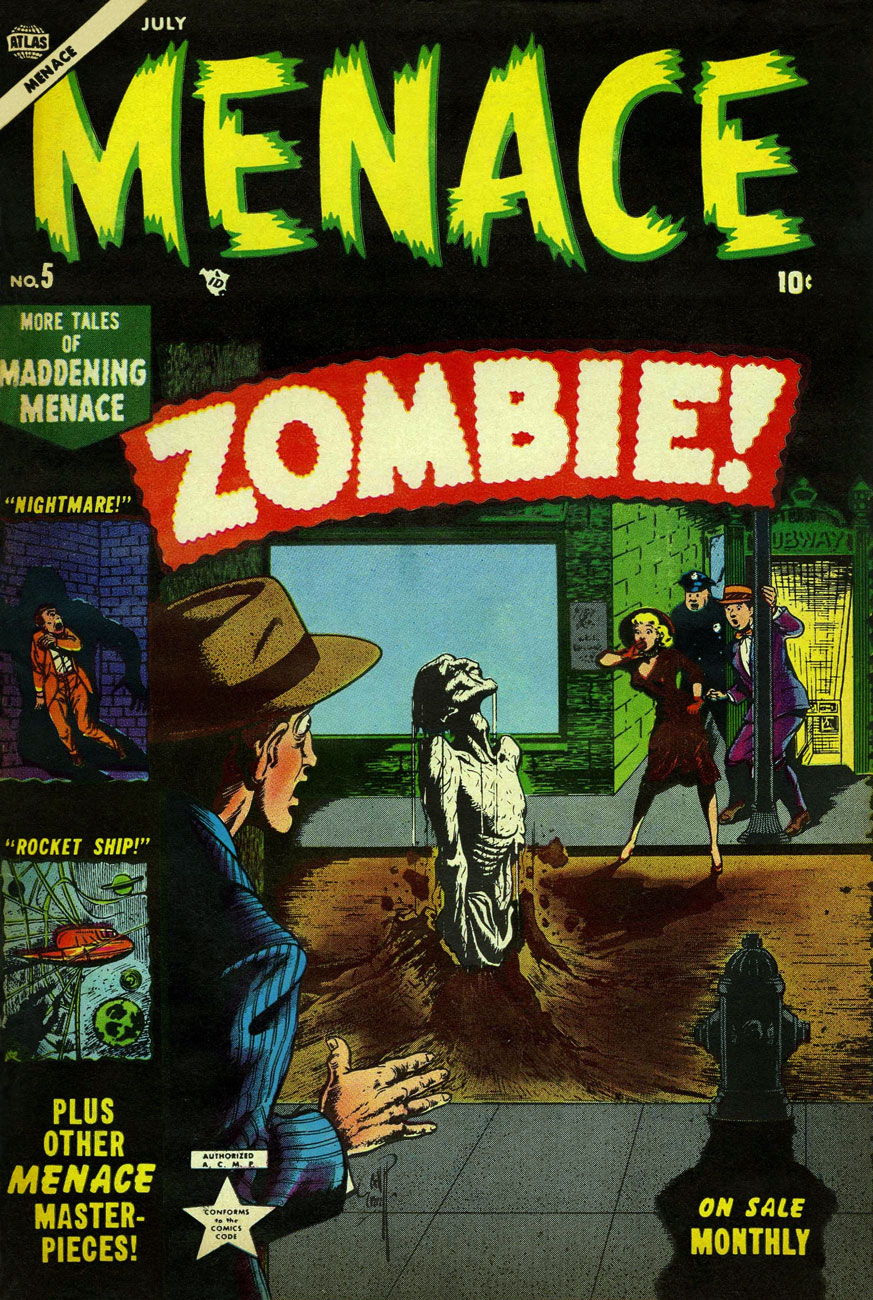
Menace was a short-lived (11 issues, 1953-54, Atlas) horror anthology title that’s mostly remembered*, if at all, for its one-shot introduction of a zombi by the name of Simon Garth. Because Atlas never really played the gore card, its successor Marvel was able to mine most of its Pre-code material as cheap filler in their 1970s bid to flood the market. Don’t get me wrong, though; these titles were still a lot of primitive fun, and in most cases, I’d pick an issue of Weird Wonder Tales, Where Monsters Dwell or Uncanny Tales From the Grave over the latest Fantastic Four or Spider-Man.

The writing was by no means daring or even coherent, but the artwork was frequently rather fine, with none quite finer than Bill Everett‘s, particularly his covers, which elegantly straddled the line between fearsome and goofy.

I’d be tempted to say that Everett (1917-1973) was at his peak when he created these, but the bittersweet fact of it is that Everett was still at the height of his artistic powers, even as he was slowly dying in the early 1970s.

This particular hot streak ends not because Everett turned in a lesser job, but because other hands provided covers for the rest of the run. Talented hands, at that (Carl Burgos, Gene Colan, Russ Heath, Harry Anderson), but none of the other Menace covers are a patch on Everett’s mighty half-dozen.

Menace01A
These monsters look kind of playful and kooky, don’t they? This is Menace no. 1 (March 1953, Atlas). Inside we find Everett, George Tuska, Russ Heath and Werner Roth art. Oh, and Stan Lee stories. Colours by Stan Goldberg.
Menace02A
This is Menace no. 2 (April 1953, Atlas). Colours by Stan Goldberg.
Menace03A
This is Menace no. 3 (May 1953, Atlas). Colours by Stan Goldberg. Was the title’s monthly schedule truly supposed to be a selling point?
Menace04A
This is Menace no. 4 (June 1953, Atlas). Colours by Stan Goldberg.
Menace05A
If you think that’s impressive, you should see what mushrooms can do to asphalt!** This is Menace no. 5 (July 1953, Atlas). Simon Garth was dug up (sorry) in 1973, likely at the behest of continuity addict Roy Thomas, to star (if you can call it that) in his own black & white magazine, Tales of the Zombie (10 issues, 1973-75). Like The Man-Thing, he was essentially mindless and shambling, and so mostly a pawn or an uncomprehending witness to others’ tragedies. The best of the mangy lot is, imho, The Blood-Testament of Brian Collier (TotZ no.7… read it here.) It’s not great, but it sure looks pretty, thanks to the sublime Alfredo Alcala, who’s quite in his element here.
BugEyedPair
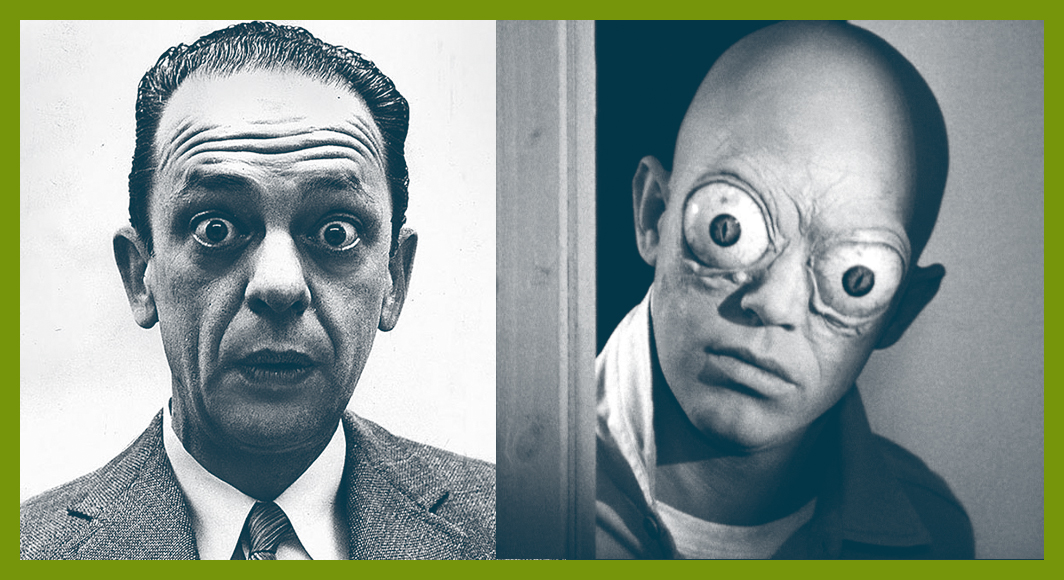
Don and Warren also met Simon. Read Lee and Everett’s 1953 Zombie!
Menace06A
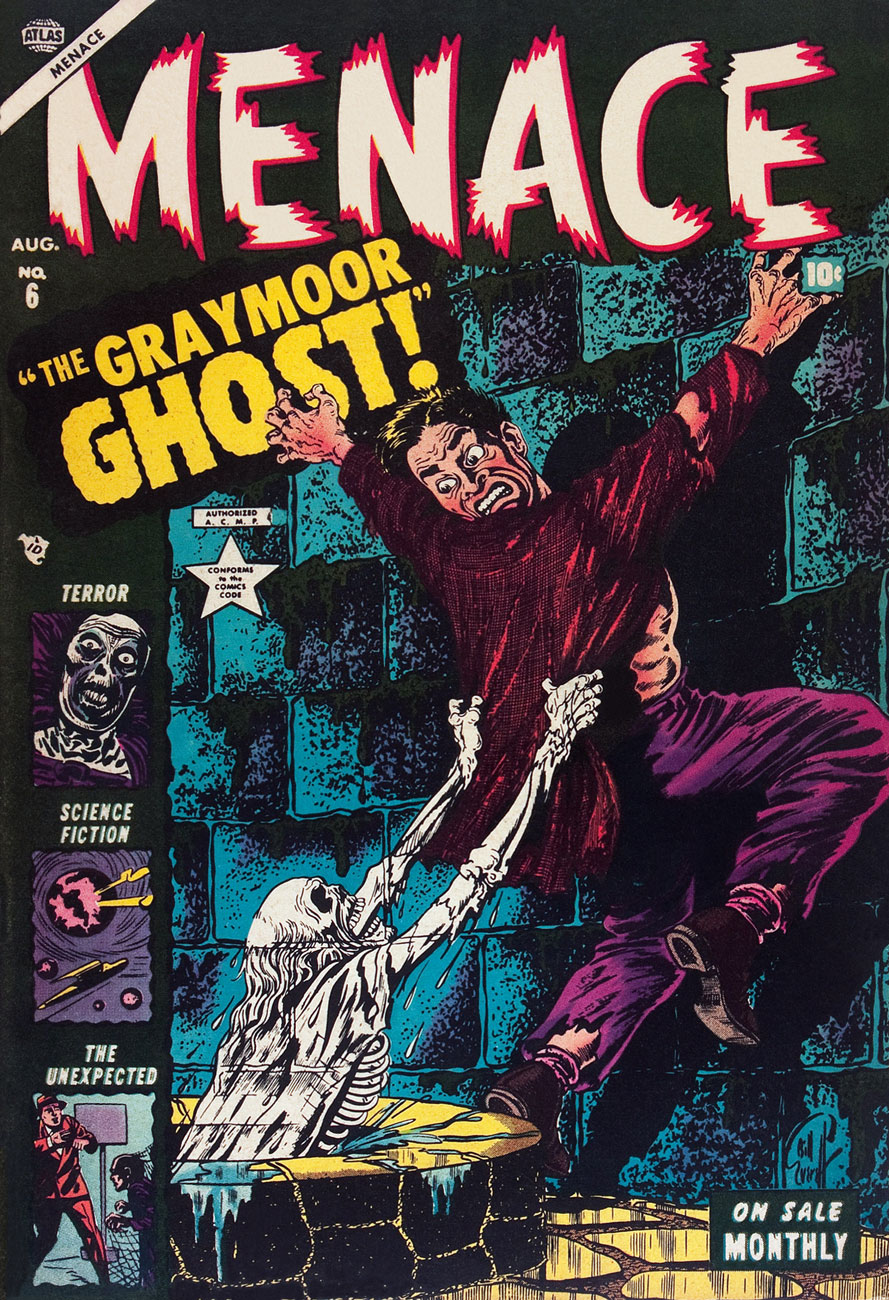
This is Menace no. 6 (August 1953, Atlas). Colours by Stan Goldberg.

That strange compulsion that’s creeping over you, that ungodly craving for more Bill Everett, cannot quite be slaked without incurring a terrible cost, be it in human lives, the forfeiting of your immortal soul, or both. But do check out my co-admin ds’ earlier tribute to Mr. Everett’s nightmares, Bill Everett’s Restless Nights of Dread, it might tide you over until dawn.

-RG

*these babies are rare, in any condition.

**Here’s an example:

« A bump in the garage floor turned into a half meter of mushrooms in little more than three days. It crushed its way through five centimetres of asphalt in Åge Reppes garage in Stord, western Norway. It is the water pressure in the cells of the fungus that makes it able to crack the asphalt, says a biologist at the local university. » [ source ]. These are inky caps. Edible, but some species are toxic when consumed with alcohol. These are commonly known as ‘tippler’s bane‘.

Hallowe’en Countdown III, Day 27

« And something horrible is going on in Foley’s body! Come at once! Come quickly! »

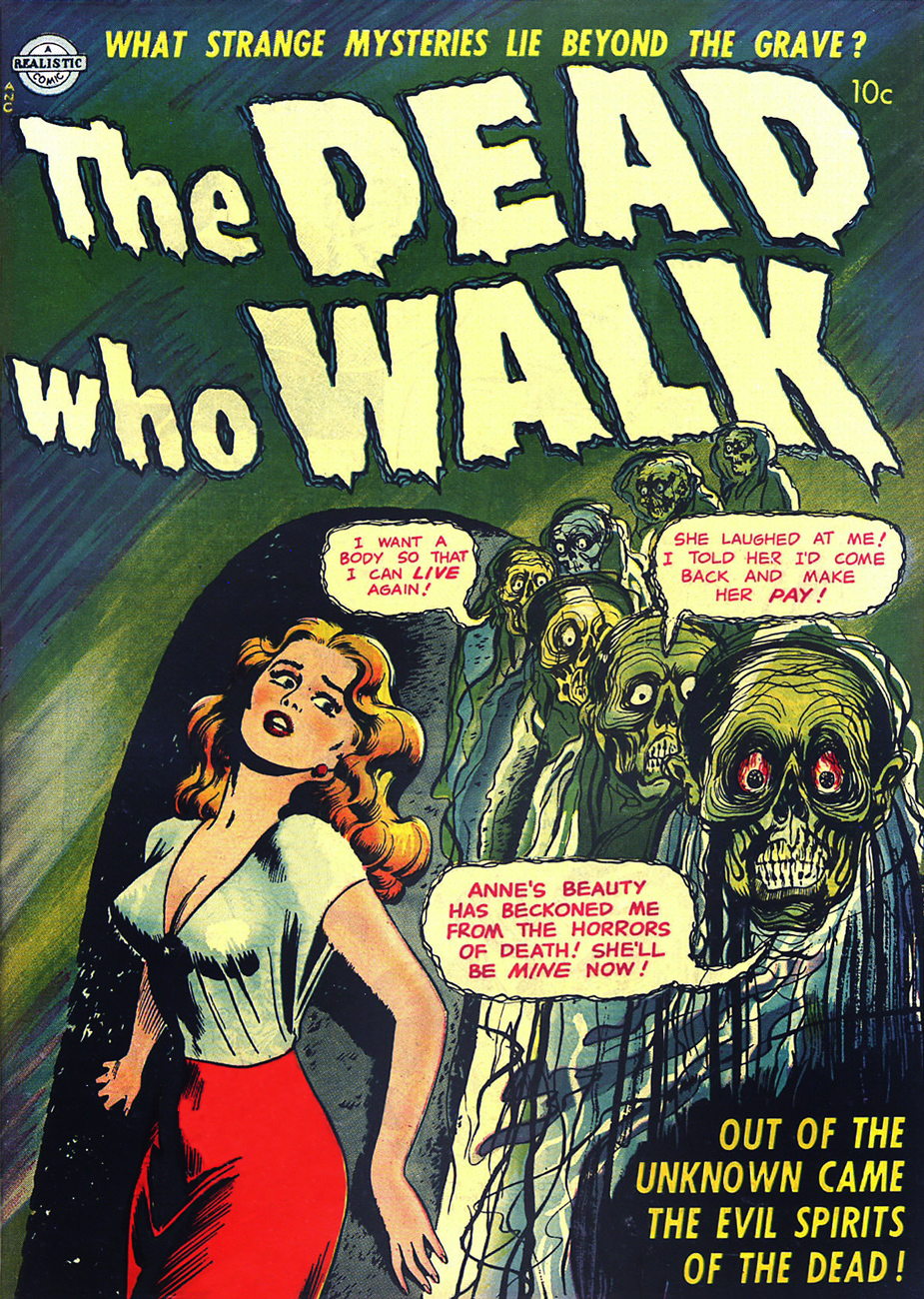
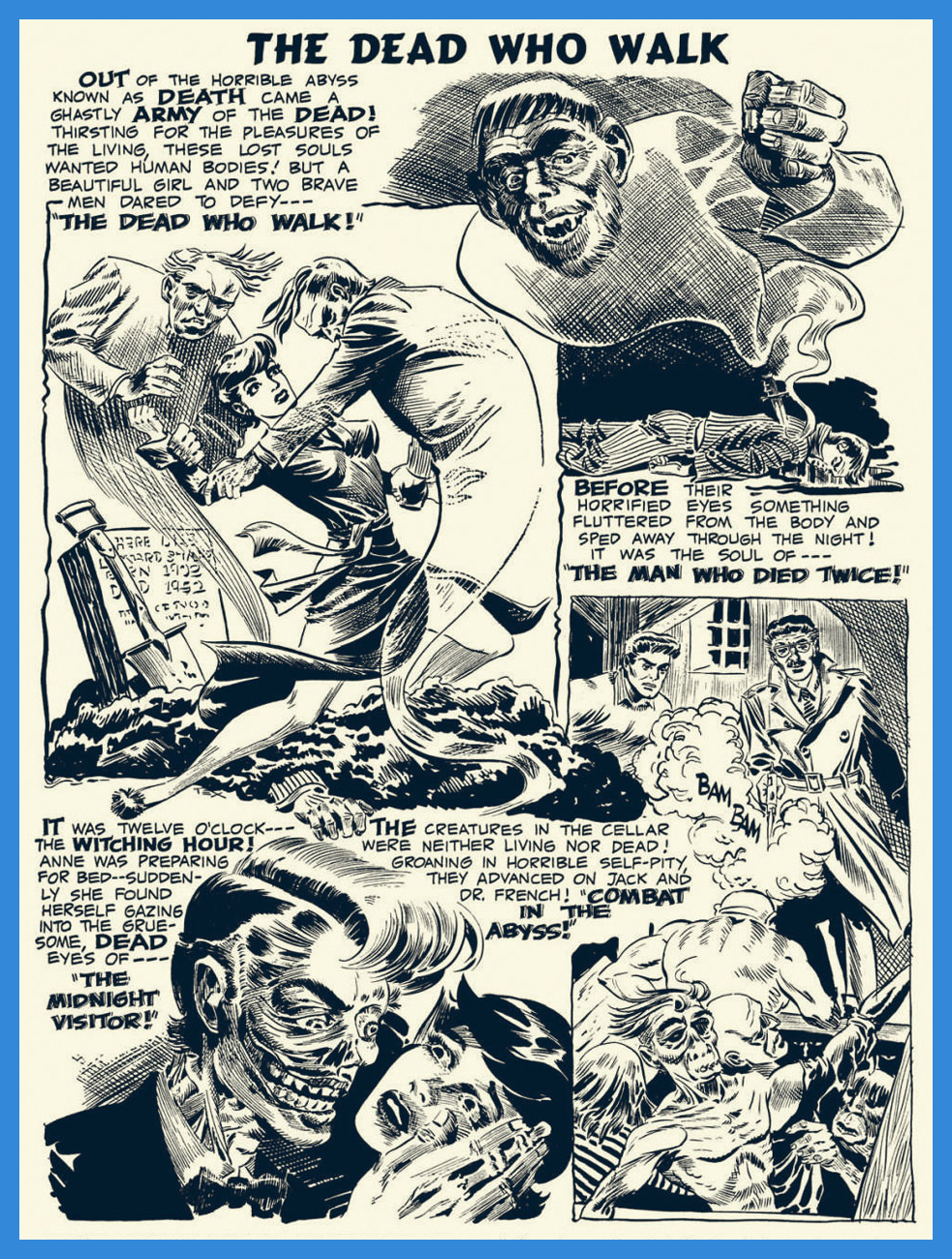
The Dead Who Walk is a mysterious one-shot from 1952. It was issued by Realistic Publications, an ephemeral publishing arm of Avon Books, during the decade that they haphazardly dabbled in the funnybook field.

DeadWalkA
Boy, whatever you can say about Anne, she certainly made an impression.

The pungent dialogue and its implications aside, what fascinates me about this lavishly grotesque cover is the jarring schism in art styles: the damsel in peril is of the classically-buxom Matt Baker–Nick Cardy species, while the revenants belong to an expressively oddball Edvard Munch–Manny Stallman–Jerry Grandenetti school. As far as I know, the cover artist(s)’s identity is lost to time and obscurity. It has been established, thanks to a signature, that the insides were provided by longtime jobber Tex Blaisdell… a rather stiff and workaday performance, regrettably. But the cover assuredly isn’t his, no matter what the good ol’ GCD says.

TheDeadWhoWalkP2A
The most accomplished interior page, in my view, is the inside front cover intro. Art by Tex Blaisdell.

You can pore over the sordid tale of The Dead Who Walk thanks to the excellent Pappy’s Golden Age Comics Blogzine, where the issue was examined  back in 2007: http://pappysgoldenage.blogspot.ca/search?q=Dead+Who+Walk

At the time, it was presumed that the inside art was the work of future EC and DC player Joe Orlando, which didn’t seem far off the mark.

-RG

Hallowe’en Countdown III, Day 24

« Somehow, this thing had caught the spark of life! And, anything that lives will fight to stay alive… even if it’s just a Rag-a Bone and a Hank of Hair! »

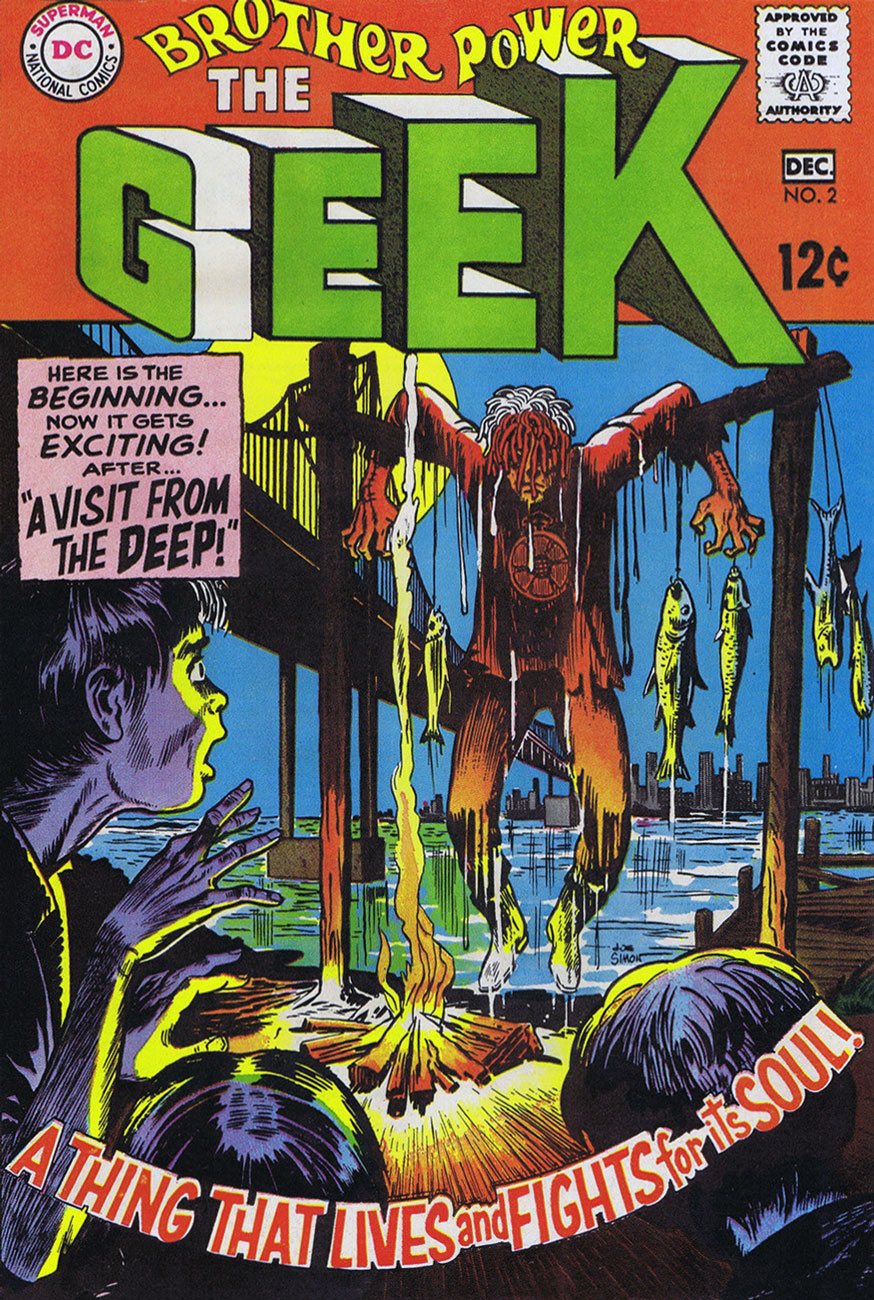
Ah, Brother Power, the Geek. A notorious flop for DC in 1968… or was it? At the time, it took several months for a book’s initial sales reports to make their way back to the publisher. Axing a title after two measly issues is quite a preemptive and premature strike against it. I suspect a case of toxic in-house politics. From the onset, editorial cold feet had the suits meddling with the project: the character of the animated rag doll was to be called The Freak, which was nixed in favour of the less druggy but more chicken-head-bite-y The Geek.

BrotherPowerGeek02A
This is Brother Power The Geek no. 2 (Nov.-Dec. 1968, DC); cover by Joe Simon, colours by DC’s peerless production manager Jack Adler, and logo presumably by Gaspar Saladino.

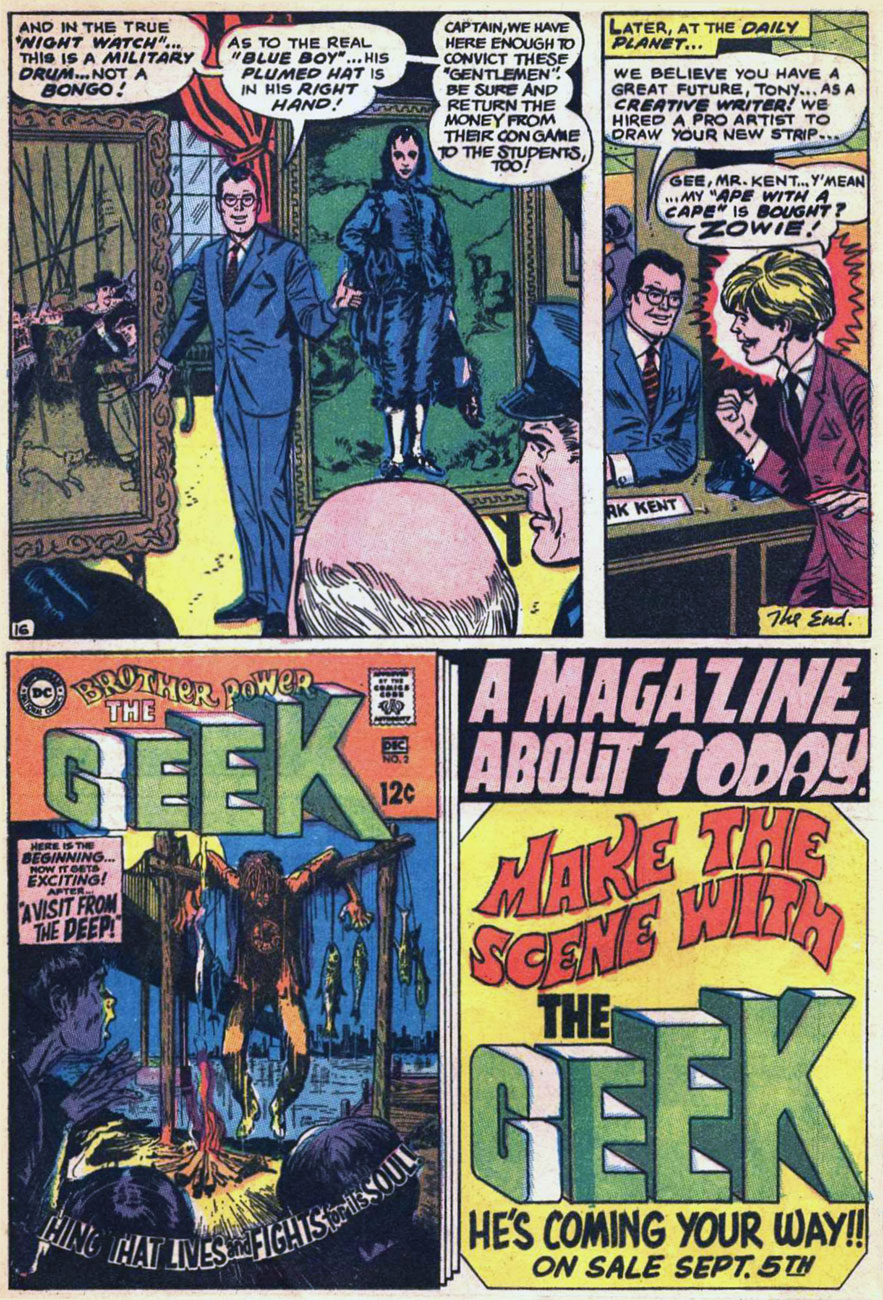
Superman211_p17A
I recall that this particular house ad seared itself into my brain at a very young age, but I had to wonder where exactly I’d first encountered it. As it turns out, it was in a random comic book that happened to land my way in childhood, namely Superman no. 211 (Nov. 1968), featuring You, Too, Can Be a Super-Artist!, written by Frank Robbins (I just found out!) and illustrated by Ross Andru and Mike Esposito.

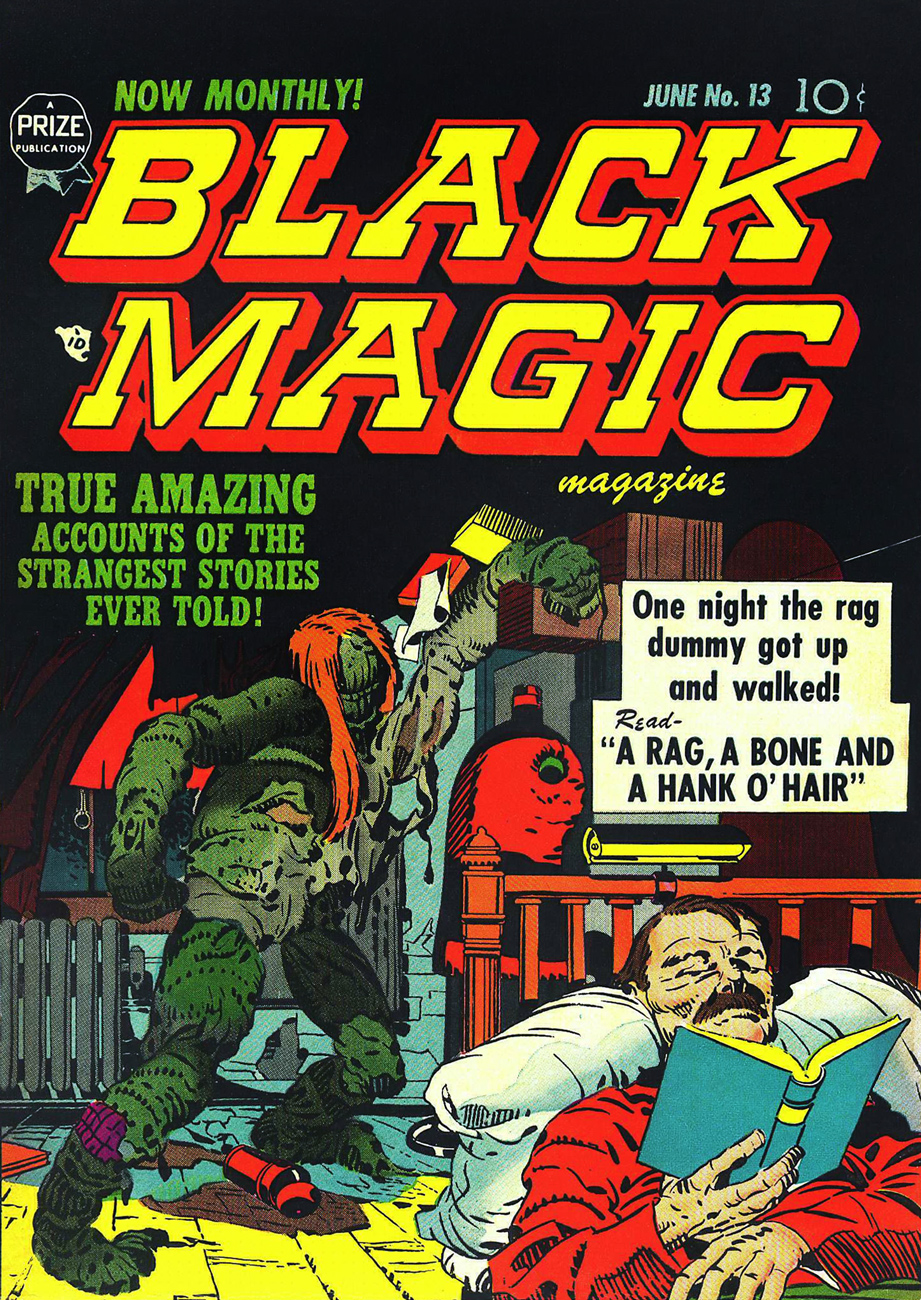
Ahem. Anyway, BPTG was the brainchild of Joe Simon, presumably expanding on his and partner Jack Kirby‘s far darker A Rag-A Bone and a Hank of Hair (Black Magic no. 13, i.e. vol. 2 No.7, June 1952), illustrated by Mort Meskin (likely inked by George Roussos).

BlackMagicRagsA
This is Black Magic no. 13, aka vol. 2 No.7 (June 1952, Prize); cover, of course, by Jack Kirby, with likely inks by Joe Simon. Read it here!

BrotherPowerA

This lovely panorama is from Brother Power The Geek no. 1 (Sept.-Oct. 1968, DC). Written, laid out and inked by Joe Simon, finished pencils by Al Bare.

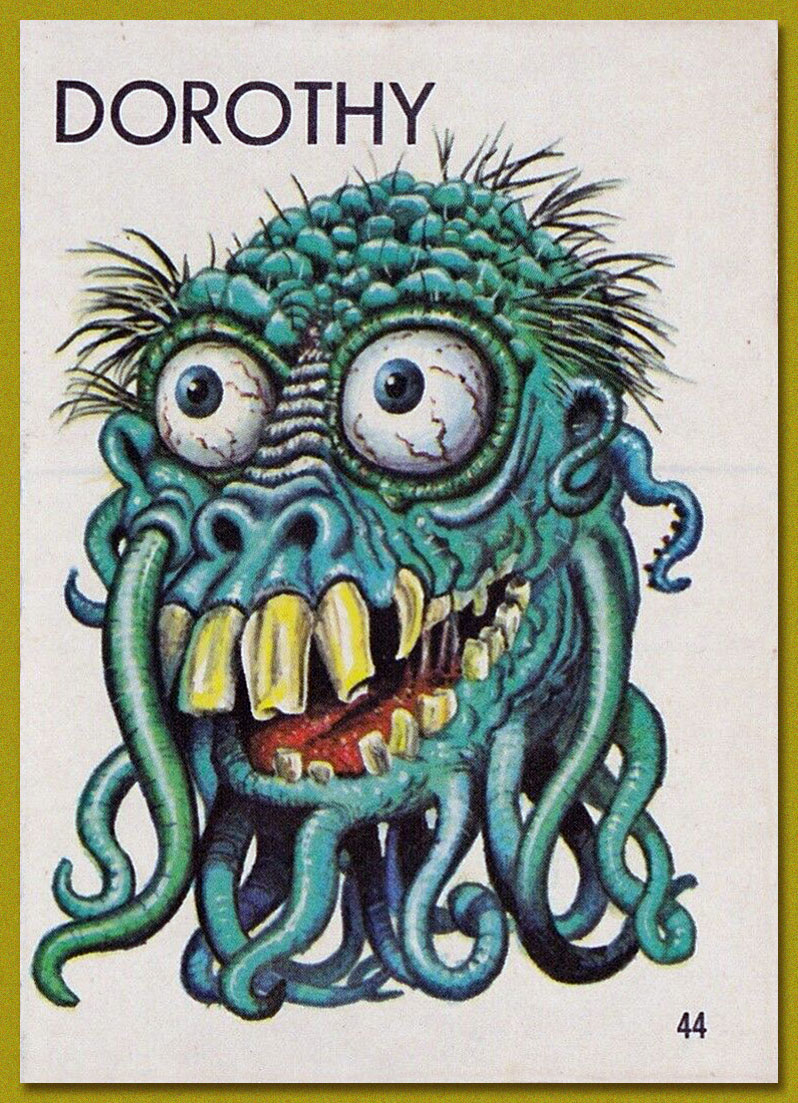
Say, have I seen Brother Power’s fellow detainees somewhere? Why, yes, of course! It’s Tentacle Master Wally Wood‘s Dorothy, Stanley and Doris, introduced to the world by Topps‘ Ugly Stickers back in 1965! Designed by Wood, they were painted by the masterful Norman Saunders.

WoodUgly44DorothyA

Ugly43A

Ugly36A

Brother Power the Geek, despite its commercial failure and infamy, offered a good-natured, unpretentious romp, even if didn’t quite show us « The Real-Life Scene of the Dangers of Hippie-Land! » You can’t always get what you want.

Brother Power was brought back under DC’s Vertigo imprint in 1993, but as with the revival of its fellow Joe Simon creation, Prez, it received a « groovy » and « ironic » hipster treatment. Bah.

– RG

Hallowe’en Countdown III, Day 23

« A knot you are of damned bloodsuckers. » — William Shakespeare

One of my favourite Atlas mood-masters was Anthony Lewis “Tony” DiPreta (July 9, 1921 – June 2, 2010); it appears Mr. DiPreta and his colleague Murphy Anderson share not merely a birthday, but a day of birth as well.

Tony DiPreta’s long career in comics began with his arrival at the “Busy” Arnold studio, with his first credits appearing in early 1942. He worked extensively for Hillman Periodicals, handling such features as Airboy (yay!), Skinny McGinty, Flying Dutchman and Stupid Manny; Lev Gleason Publications (various crime stories and The Little Wise Guys); and of course Atlas Comics, where he chiefly, but not exclusively, cut loose on moody-but-not-gory horror stories, often with a finely-turned streak of gallows’ humour.

Tony survived the post-Code near-collapse of the comics industry when he succeeded Moe Leff on Ham Fisher‘s Joe Palooka strip, which he carried until the feature’s final curtain in 1984. In the 1970s, he also did a bit of moonlighting for Charlton, contributing to a couple of issues of The Flintstones spin-off The Great Gazoo. In 1994, DiPreta took on another venerable, long-running newspaper strip, medical soap opera Rex Morgan, M.D., until his well-earned retirement (DiPreta’s, not Morgan’s) in 2000.

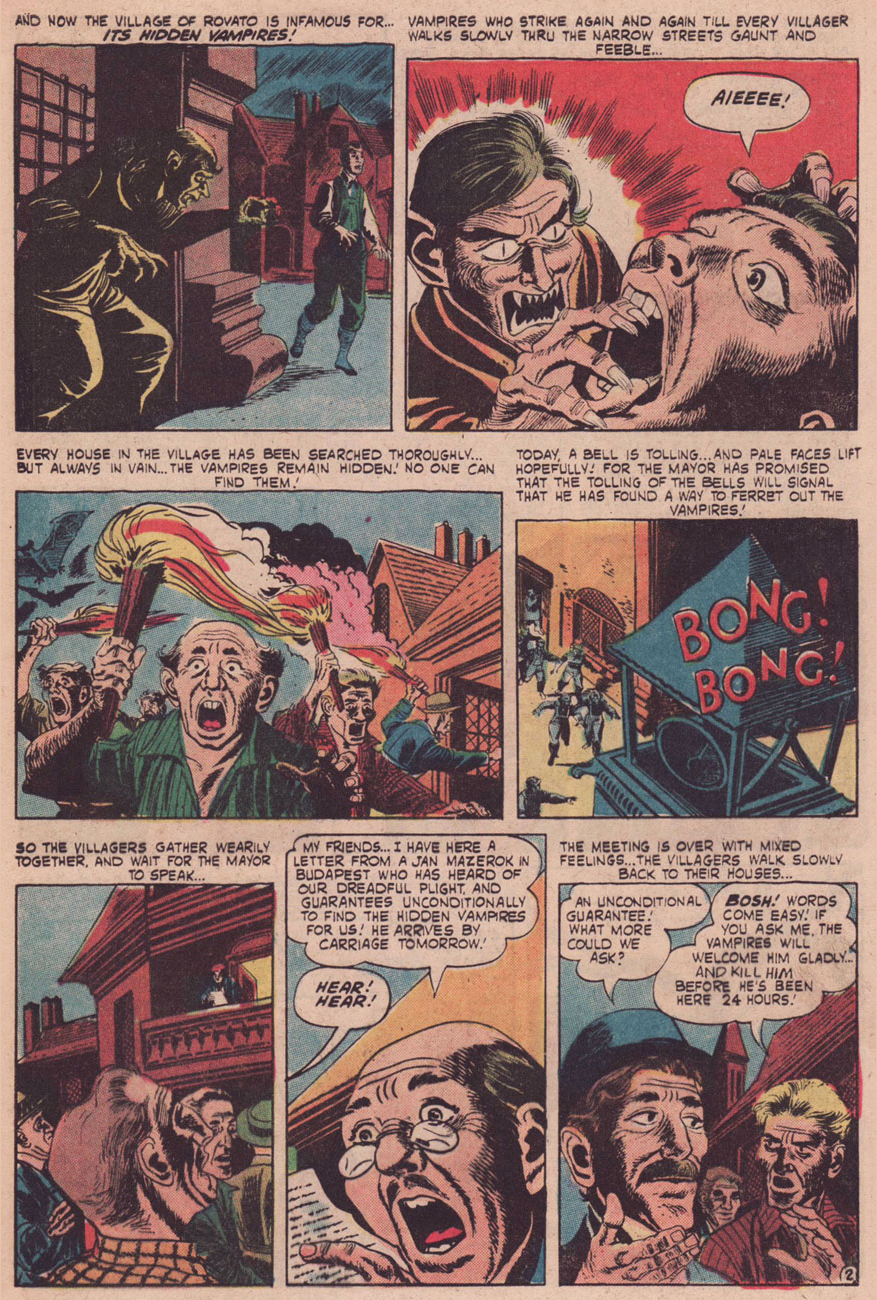
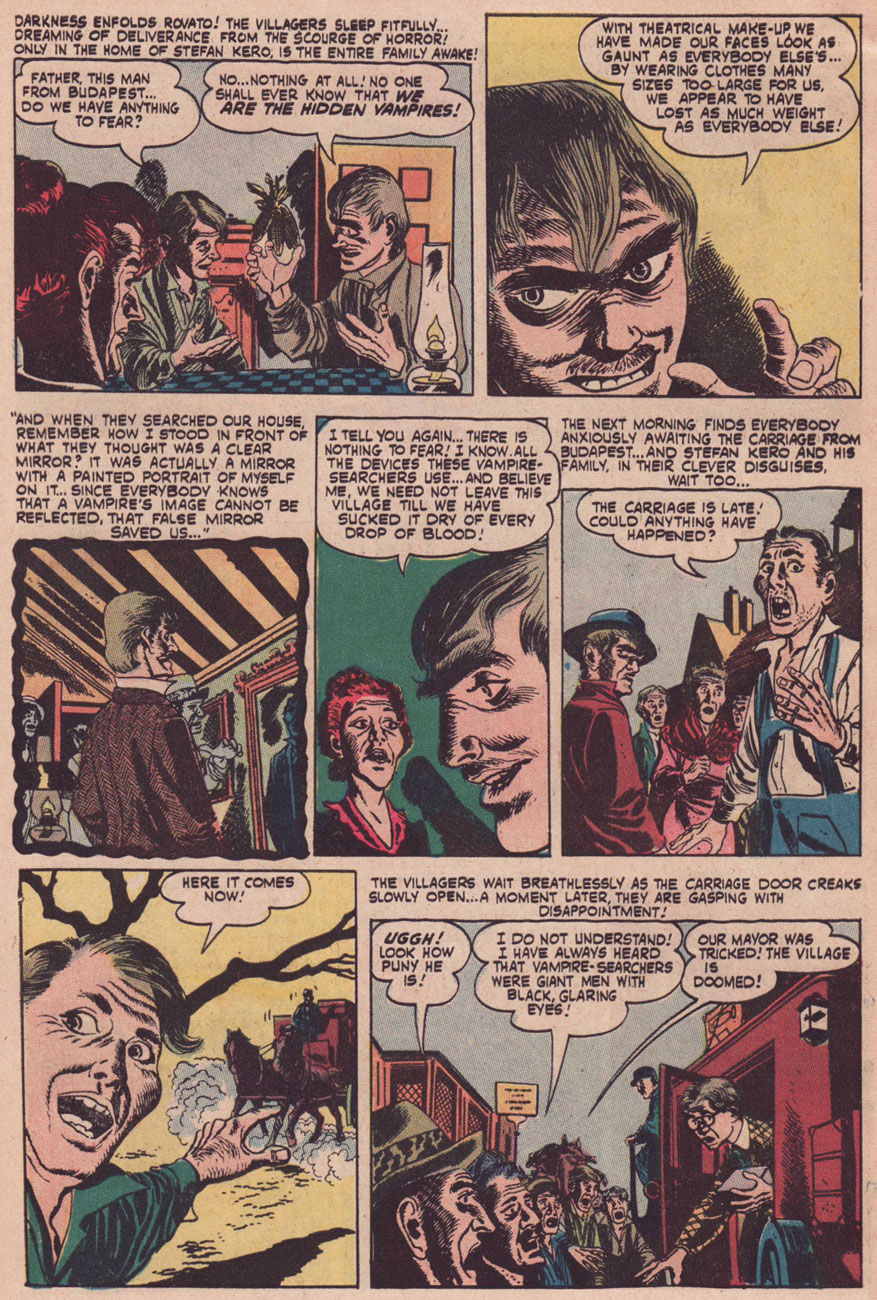
For your reading pleasure and mine, I’ve selected this adorably wacky tale from Atlas’ Journey Into Mystery no. 11 (August, 1953). Writer unknown, which is a shame.

DiPretaHidden01ADiPretaHidden02ADiPretaHidden03ADiPretaHidden04A

DiPretaHidden05A
Well, I suppose it might have been simpler to see who wasn’t around in the daytime, but let’s face it, Mazerok’s method is far more entertaining and original.

KaneWMD17A
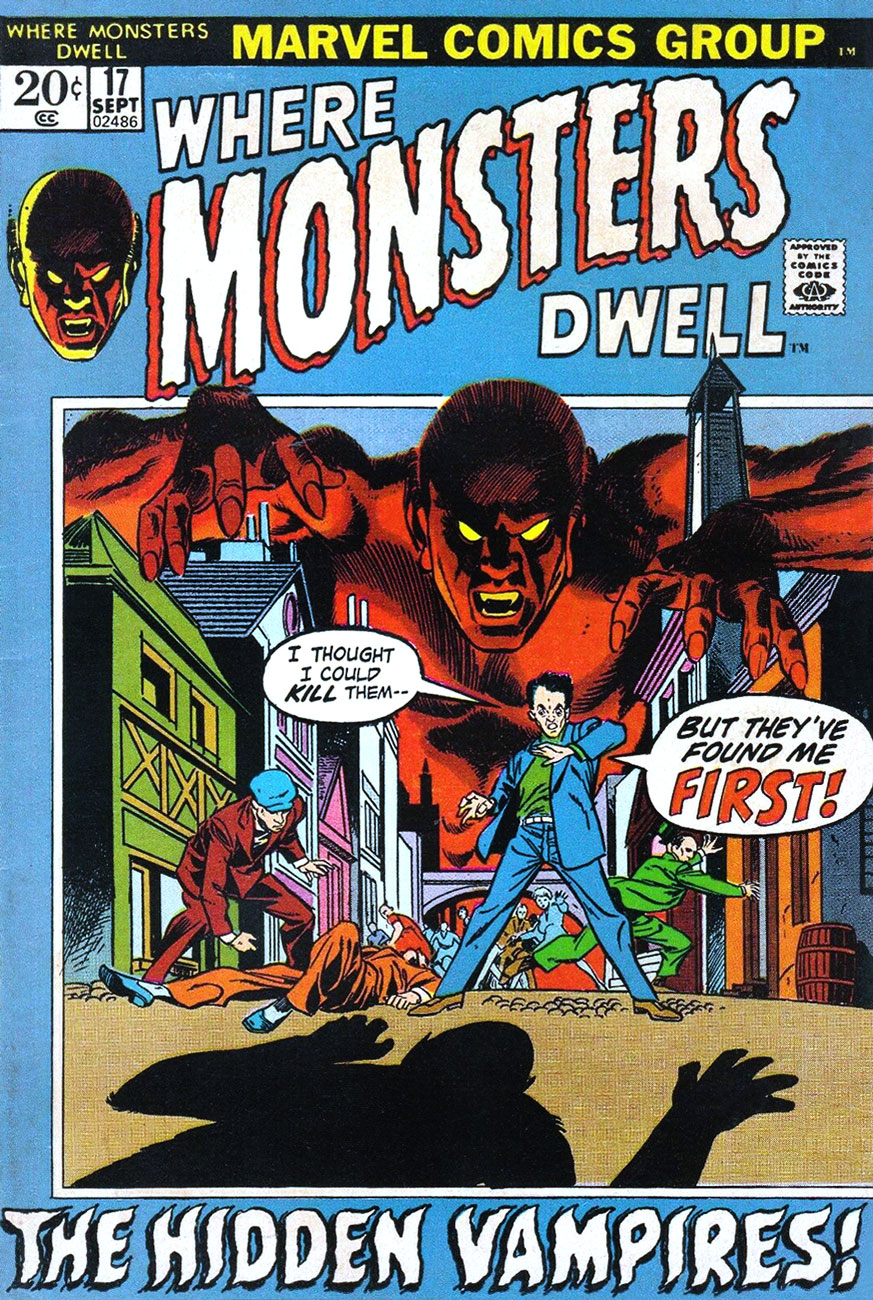
The story was reprinted in Where Monsters Dwell no. 17 (Sept. 1972, Marvel); though cover-featured, the cover itself was a lacklustre job by an overworked and uninspired Gil Kane, stuck here with Vinnie Colletta, though to be fair, there’s nothing here to ruin. Beyond the cover, the insides are great: two Ditko stories (« I Opened the Door to… Nowhere! » and « The World Beyond », a low-key Russ Heath (« If the Coat Fits », also from JIM 11), and our featured yarn.

HeathJIM11A
Now that’s more like it! The Hidden Vampires‘ original place of appearance, Journey Into Mystery no. 11 (Aug. 1952, Atlas), boasts a just-about-classic cover by Russ Heath, with a fine colouring job by Stan Goldberg.

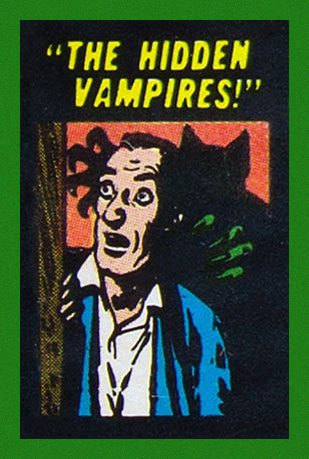
HeathHiddenCameoA
Heath did a lovely job with the small space allotted to preview the other stories. Pre-Code Atlas books were graced with a clever and attractive cover grid.

– RG

Hallowe’en Countdown III, Day 10

« Behind every tree there’s a new monster. » — Todd Rundgren

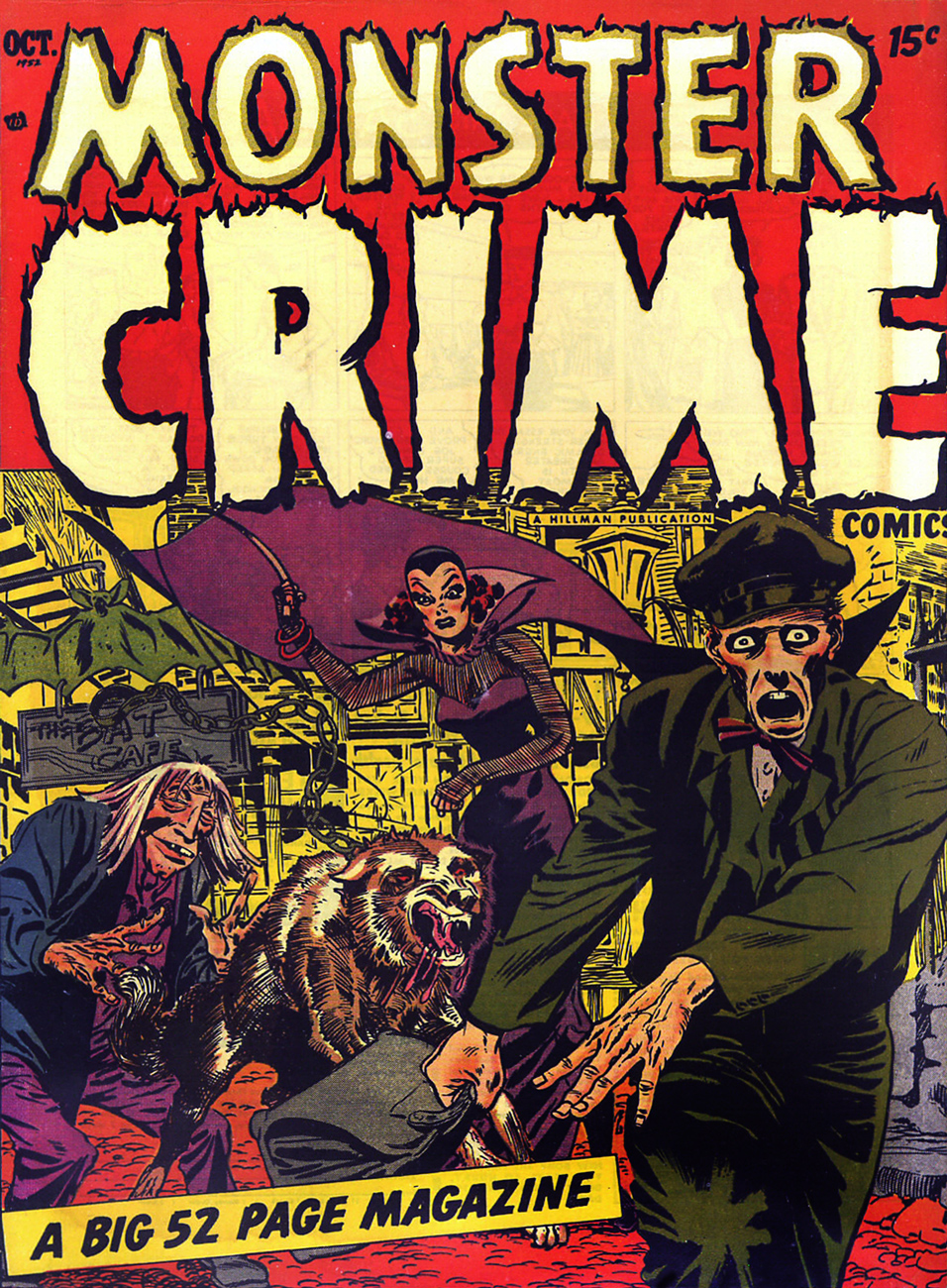
Now how can you go wrong with a genre-melding title like this? Did publisher Hillman Periodicals decide it was entirely too much of a good thing, and nip it in the bud? Who wrote and drew the darn thing? Nearly seventy years on, these are not easily-answered questions.

Monster-Crime1A

Anyway, the lone, unnumbered issue of Monster Crime Comics rolled off the presses in the fall of 1952, it’s a pretty scarce item, as they say in the trade, and it features the sordid tales of The Crutch to Paradise, Another Hallowe’en, The Boss of Ice Alley, Oregon Tiger, The Canvas Tomb, The Cold Doorstop, and The Two-Legged Newspaper.

« A low print run and high price for the time (15 cents!) combined to make this one-shot among the rarest of the era’s crime comics, with perhaps 20-100 copies surviving. The over-the-top cover contributes to the book’s fame, particularly because it has nothing to do with the contents. Pre-Code crime comics from Hillman, possibly printed to clear out a backlog before the publisher ended its comics lineup a few months later. » [ source ]

– RG