Panning the murky old print stream for the odd glimmering nugget
Oh, the Horror: the 1950s
The 1950s, as we all know, brought us the acme (and nadir) of horror comics. A zillion publishers, most of them long gone, got into the gore game before the censors stepped in. Let’s take a look at what led to the neutering of the comics industry…
« The whole planet reeks of mysticism without revelation. » — Dan Simmons
Last May, when I showcased Joe Maneely‘s Atlas cover art (see Joe Maneely, Atlas of Versatility), I intentionally left out his pieces for the horror titles, knowing them worthy of some attention of their own, an ideal topic for the Hallowe’en countdown. Besides, it took some pressure out of the selection process if I could save one whole genre for a rainy day — and today’s most certainly that day!
This is Mystic no. 7 (Mar. 1952, Atlas); colours by Stan Goldberg.
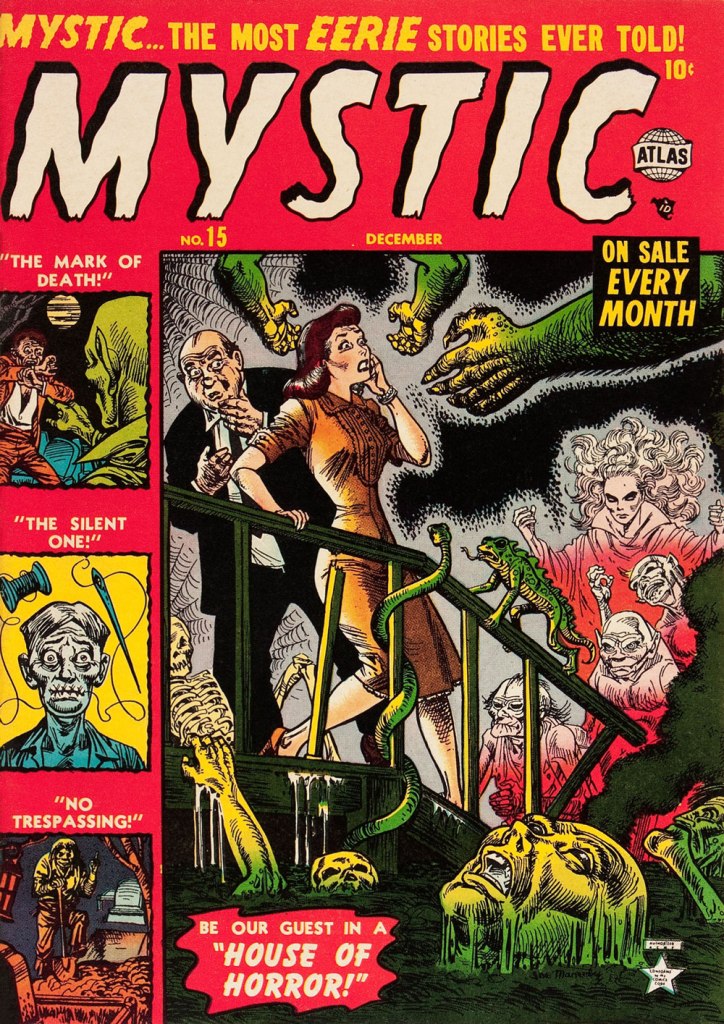
This is Mystic no. 15 (Dec. 1952, Atlas); colours by Stan Goldberg.
“Mystic” is evidently one of Marvel’s pet titles: the title was first used by Timely in 1940-42, then again in 1944-45; once more, most successfully in this Atlas horror series, for 61 issues from 1951-57. And lately in 2009 and 2011. I’ll bet that tradition’s not yet done with, but why on earth?
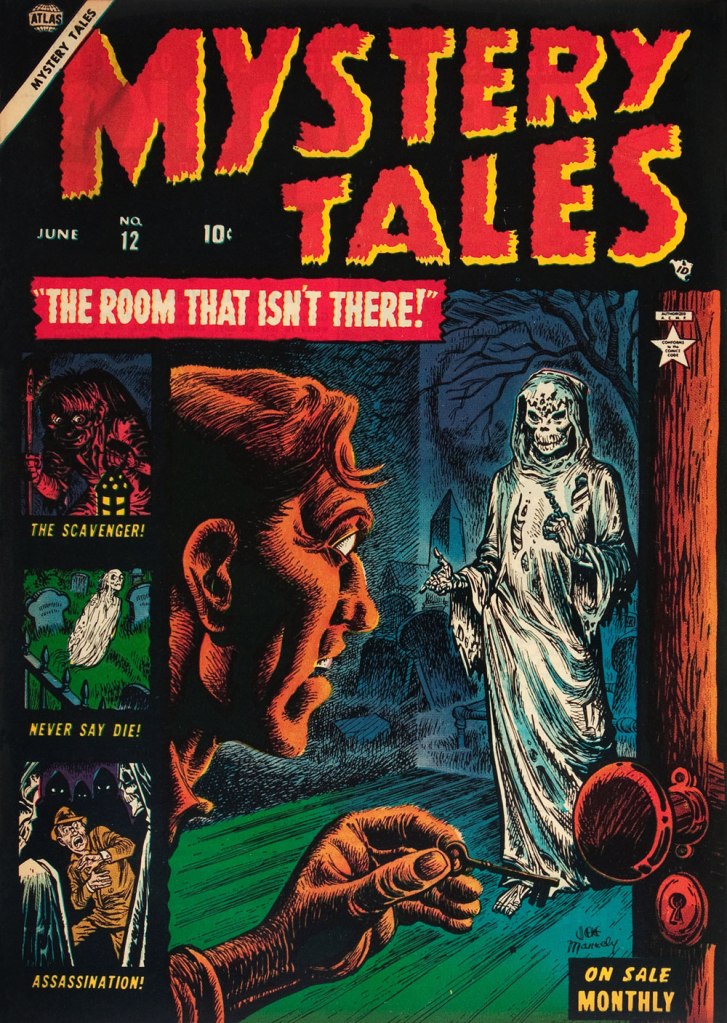
This is Mystery Tales no. 12 (June 1953, Atlas); colours by Stan Goldberg.
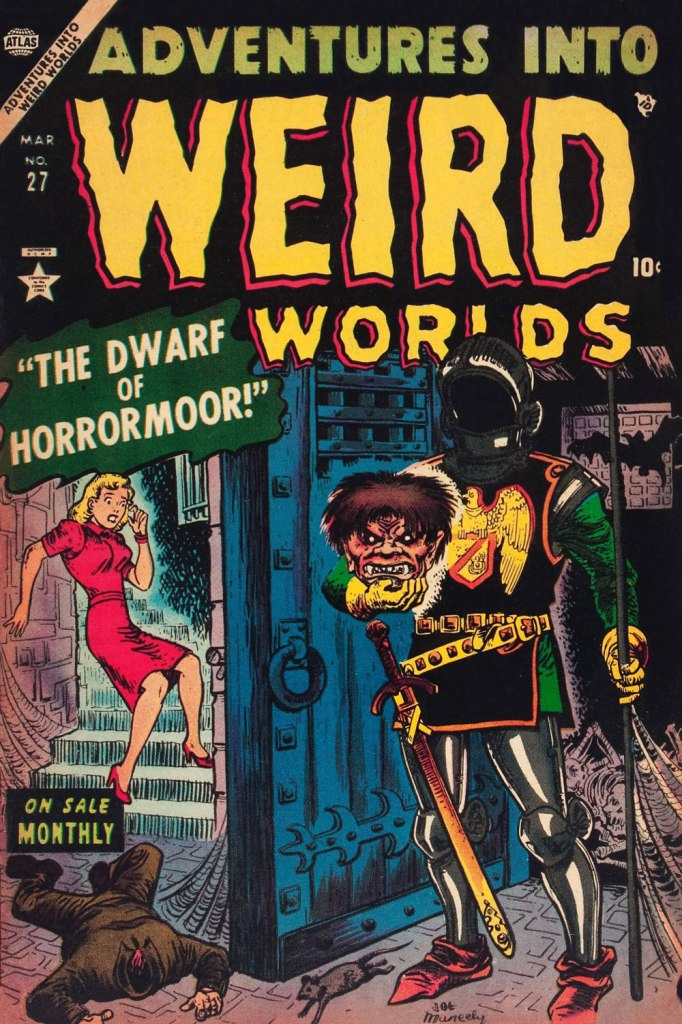
This one’s got it all! Here’s Adventures Into Weird Worlds no. 27 (Mar. 1954, Atlas); colours by Stan Goldberg.
This is Mystic no. 29 (Apr. 1954, Atlas); colours by Stan Goldberg. Maneely’s Atlas horror covers generally distinguished themselves by their goofiness.
Begging the question: What’s worse than having two left feet? Having three left hands, apparently. This is Riot no. 3 (Aug. 1954, Atlas); colours by Stan Goldberg.
This is Mystery Tales no. 24 (Dec. 1954, Atlas); colours by (need you ask?) Stan Goldberg. While I make no bones about my disdain for Goldberg’s work at Archie, he was a superb colourist in the 1950s. In terms of legibility, Atlas’ busy covers had to be quite a challenge to pull off, and he did it again and again.
« After that I never saw him again. He became the ‘phantom’ artist, whereabouts unknown! » — Bhob Stewart
Hello again. Last year, I touched upon the stint that Matt Fox (1905-1988) did as an occasional and unappreciated inker at Marvel in the Silver Age. While he’s assured a sort of immortality for the eleven winningly oddball covers he painted for Weird Tales, he also left his distinctive and lasting mark on horror comics of the 1950’s. Let’s give the old burying grounds the once-over, shall we?
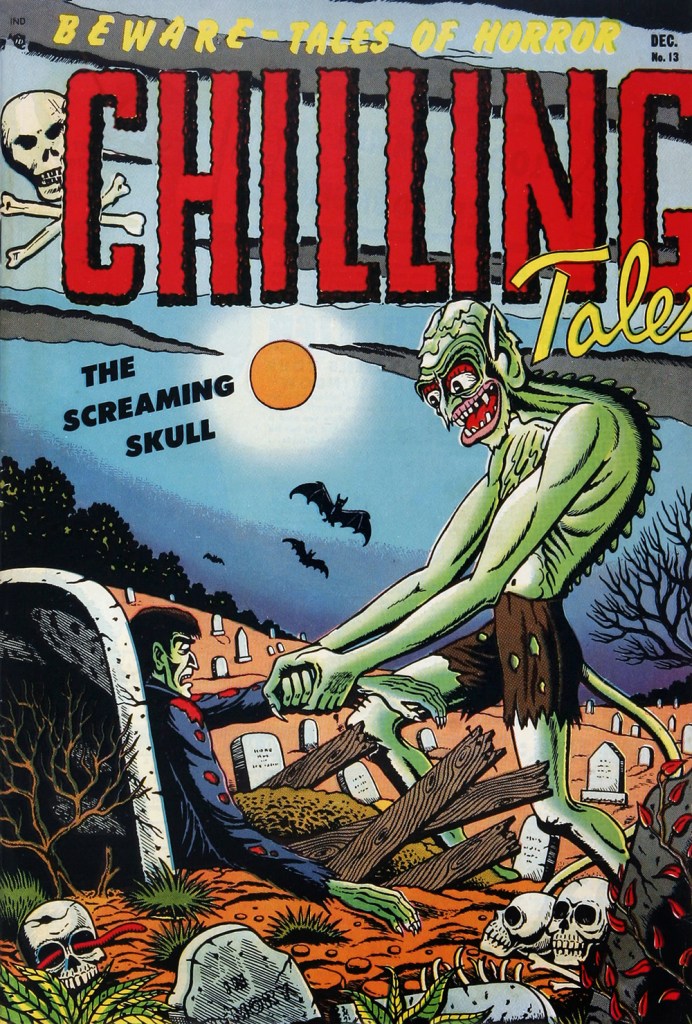
This is Chilling Tales no. 13 (Dec. 1952, Youthful), actually the title’s début, as it picks up its numbering from Beware. In addition to its cover, the issue features within a rare Fox story, The Hand of Glory. Read it here… at your own peril! (just kidding, it’s all perfectly safe).
This is Chilling Tales no. 15 (Apr. 1953, Youthful). What in tarnation is going on here?
This is Chilling Tales no. 17 (Oct. 1953, Youthful). Incidentally, this title was edited (anonymously) by Sally the Sleuth creator Adolphe Barreaux.
Here’s one of Fox’s all-too-infrequent forays between comic book covers. This one appeared in Uncanny Tales no.6 (March 1953, Atlas). Writer unknown… though that’s no great loss to history.
« There is an air of disquiet to his vision, yet it charms through a surreptitious blending of the primitive with the mockingly insane. His characters border on the lunatic, seemingly at home in his landscapes, concealing a darkness corruptive of the soul. »
And I leave the final word to my trusted accomplice ds, who observed that:
« I find that the art of Matt Fox reminds me of Terrance Lindall… Both can create disquieting monsters with eyes that speak of inner torment, reminiscent of Christian Art (mostly Spanish, I believe) from a few centuries ago. »
« I don’t know what the hell I published. I never read the things. » — Stanley P. Morse
In the sinister wake of Warren Publishing‘s success with Creepy, Eerie and Vampirella, old-school fly-by-night 1950s comics publisher Stanley P. Morse (Aragon Magazines, Gillmor Magazines, Medal Comics, Media Publications, S. P. M. Publications, Stanmor Publications, and Timor Publications…) dusted off some of his old pre-Code chillers in the late 1960s and early 1970s in black and white magazines such as Shock (15 issues), Chilling Tales of Horror (11 issues), Ghoul Tales (5 issues) and Stark Terror (5 issues). It certainly wasn’t all junk: after all, Morse had published Weird Tales of the Future and Mister Mystery, with their Basil Wolverton and Bernard Baily classics…
Unlike Eerie Publications’ grey-toned and blood-and-gore-ified reprints, these are, as far as I know, unretouched, not to mention decently printed.
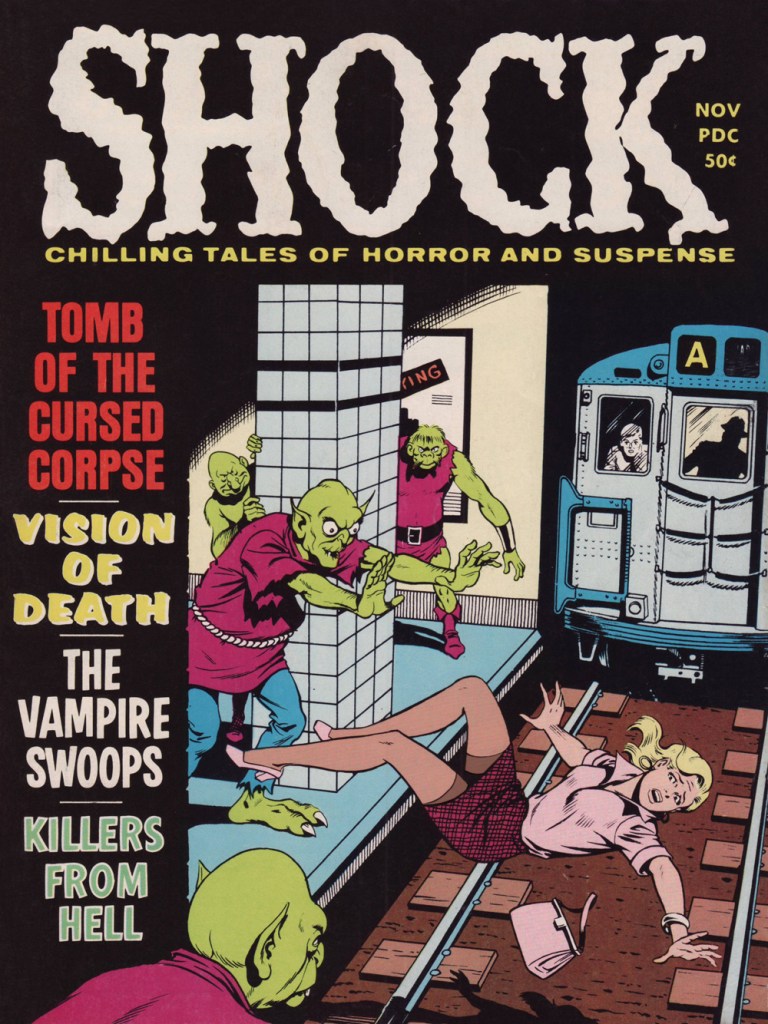
This is Shock Vol. 2 no. 5 (no. 10, November, 1970, Stanley Morse). Edited by Theodore S. Hecht.
Maybe it’s just me, but isn’t Kurt Schaffenberger just about the unlikeliest pick of cover artist for a pre-code horror anthology? Sure, he fit in nicely with ACG’s gentle moral fable aesthetic, but aren’t you just expecting the Man of Steel or The Big Red Cheese to swiftly sweep in, catching the damsel-in-distress before the A Train smooshes her?
To wit: one of Kurt’s fun ACG covers, this is Unknown Worlds no. 43 (Oct.-Nov. 1965, ACG).
« There’s money, all right! I quoted Mrs. Tarrent a hundred slugs for this trip and she never batted a tonsil! » — Ken Shannon’s on the job.
Reed Crandall (1917-1982), one of the final additions (mid-1953… late in the ballgame!) to EC Comics’ immortal roster, previously spent most of the Golden Age years (1941-53) exclusively working for Quality Comics, and it was only when the publisher began to scale back its output, in 1953, that Crandall began to look elsewhere for additional work. After EC, he would make landfall at George A. Pflaum’s Treasure Chest of Fun & Fact, a story we’ve touched upon earlier this year.
Hard-boiled private eye (was there any other kind?) Ken Shannon was introduced in Quality’s Police Comics with issue 103 (Dec. 1950), and right away grabbed the cover spot (dethroning Plastic Man, no less!), which he doggedly retained to the bitter end, namely Police’s final bow, issue 127 (Oct. 1953). Concurrently, Shannon’s investigations were spun off into his own book, over the course of ten issues (Oct. 1951 to Apr. 1953).
Shannon certainly had his share of unusual cases to puzzle out, and here are the spookiest!
This is Ken Shannon no. 3 (Feb. 1952, Quality). From what I’ve seen and heard, these babies are scarce.
The cover story’s introductory splash. Read the entire issue here!
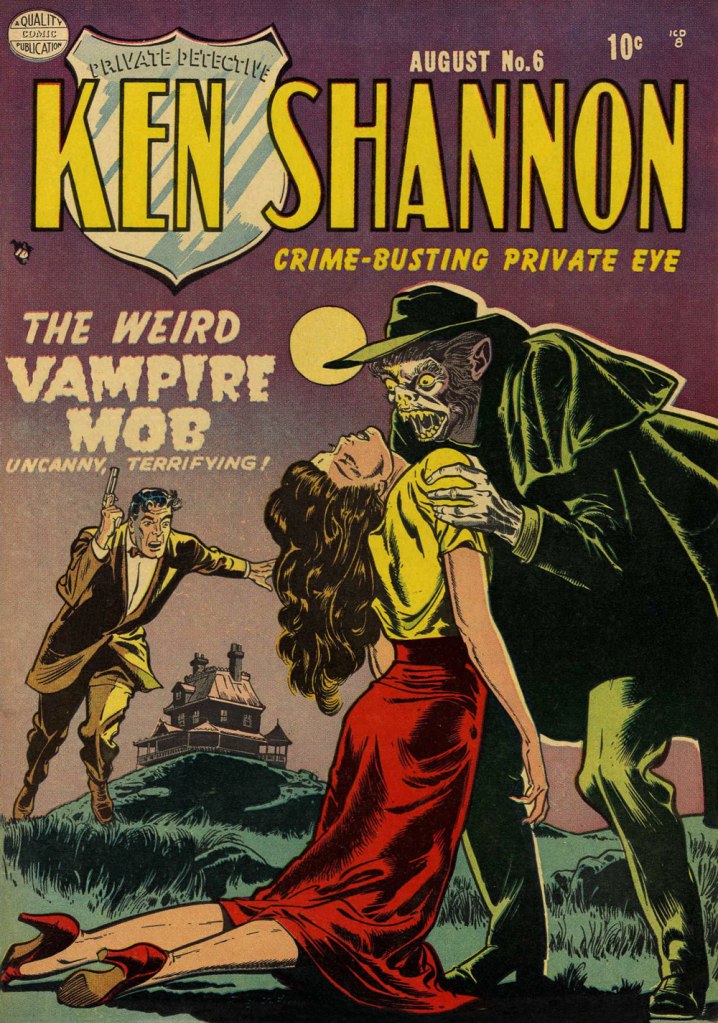
This is Ken Shannon no. 6 (Aug. 1952, Quality). Read the entire issue here!
And this is Ken Shannon no. 7 (Oct. 1952, Quality). Read the entire issue here!
« I don’t mind if my skull ends up on a shelf as long as it’s got my name on it. » —Debbie Harry
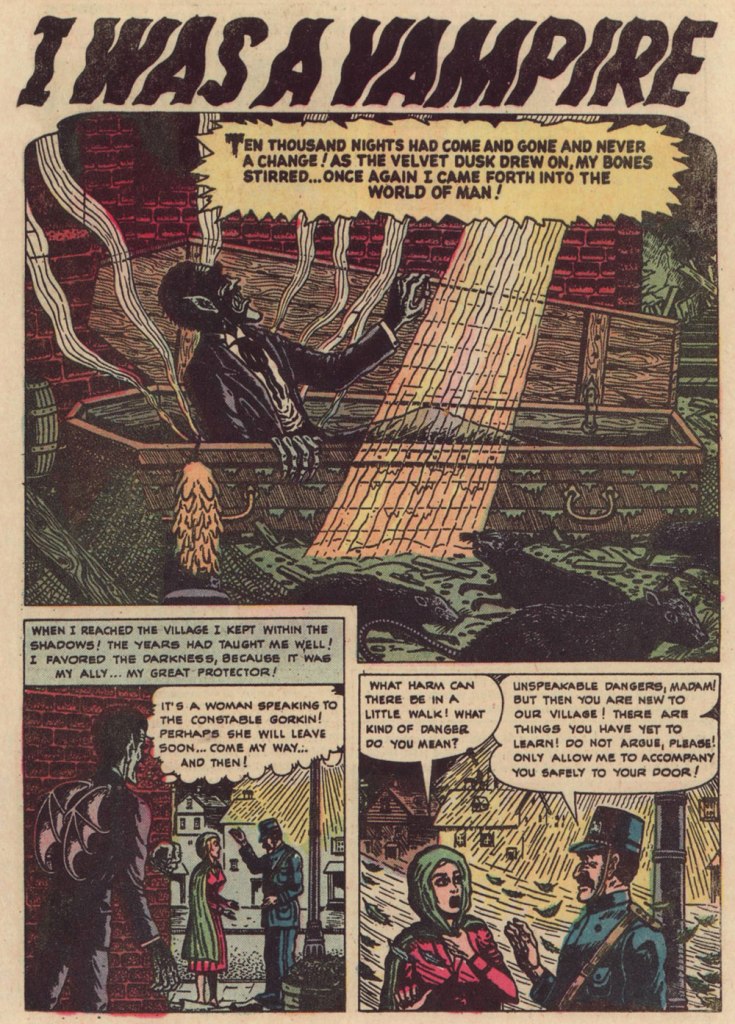
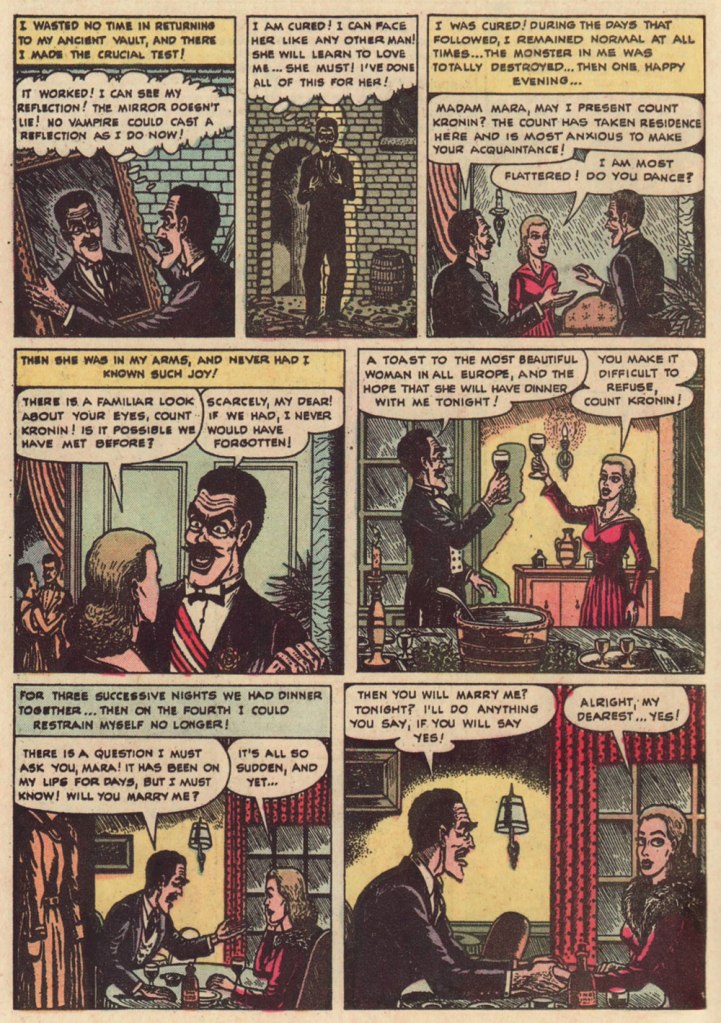
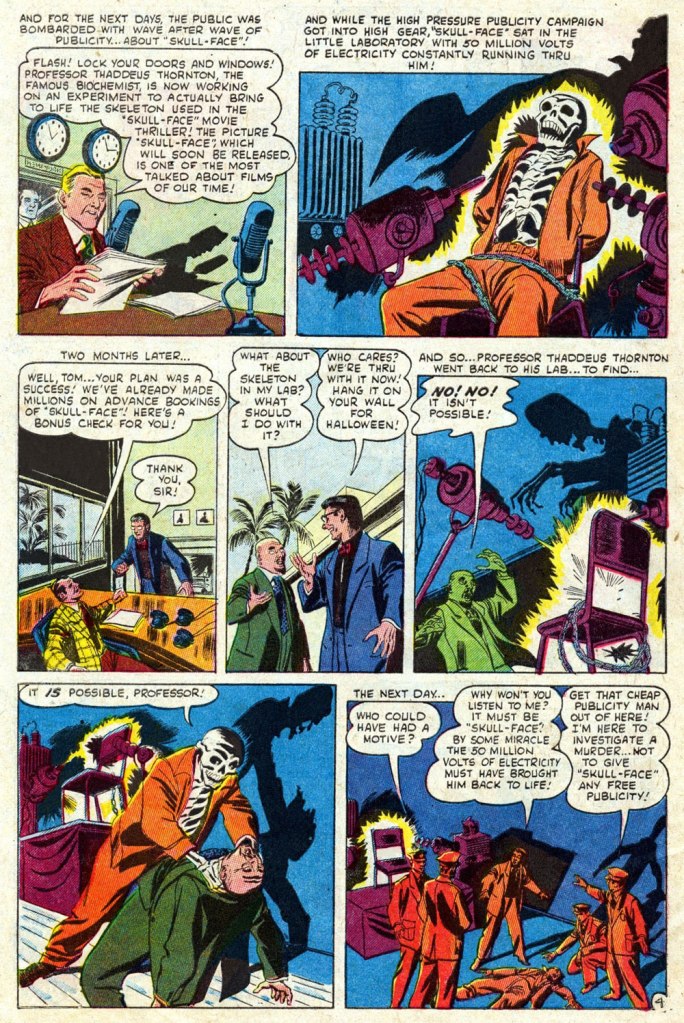
A couple of years back, I spotlighted a story by a neglected Golden Age favourite of mine, Anthony Lewis “Tony” DiPreta (July 9, 1921 – June 2, 2010), the wacky The Hidden Vampires! I advise reading it first for comparison (and a bit of background on the artist).
A whole hour! People were armed with unwavering patience back in the day.
So the suits’ great flash of inspiration is not to update a fifteen-year old movie (from 1937!), nor remake it: they’ll just trot it out again. Picture doing this with 2006’s biggest horror hit, Saw III. How do you think it would fare today?
You’d think a seasoned publicist would be a savvier negotiator. I mean, all he needs is some random skeleton. Adjusted for inflation, a thousand 1952 dollars would today be worth 9,829 bucks. But that’s nothing compared to his liberal waste of electric current: the voltage used to execute a convict in the electric chair is around 2,000 volts for less than a minute… and that makes the lights dim all over the area*. Now multiply the voltage by 25,000, and the duration (let’s round it off to a minute, for simplicity’s sake) 80,640 times longer. Picture the resulting electric bill, not to mention the repercussions on the power grid, all for a stunt that could have simply been faked (i.e. just say there’s live current… no-one’s going to check). Oh, and what’s a “famous biochemist” doing on a film studio’s payroll? Come to think of it, it’s not that odd: Thornton was a cynical, opportunistic money-grubbing parasite, the Dr. Memhet Oz of his day…
Note these stellar examples of one of DiPreta’s trademark horror ambiance moves: lighting from below, projecting stark, expertly-delineated shadows.
One has to wonder why Fenton insists on addressing the resurrected ‘Demon’ (he was a demon on the sousaphone) incorrectly as “Skull-Face” (that’ll only aggravate him, you dolt!). Would it have helped if he’d added air quotes?
The ho-hum Sol Brodsky cover of Mystery Tales no. 6 (Dec. 1952, Atlas), but hey, our pal “Skull-Face” is the featured attraction!
The comics industry’s traditional garish colour and murky reproduction fail (spectacularly!) to do justice to DiPreta’s spare, confident and elegant inking line. To remedy the situation, here’s a look at a surviving piece of original art. It hails from “One Must Die” (scripted by Carl Wessler), from Crime Can’t Win no. 11 (June 1952, Atlas), the publisher’s knockoff of Lev Gleason‘s influential Crime Does Not Pay.
A slick Joe Palooka Sunday from July 24, 1966. DiPreta enjoyed quite a run on the strip, illustrating it from 1959 to its 1984 finale.
I can’t help returning to Warren Kremer (today’s his birthday, not coincidentally; he was born on June 26, 1921, passing away on July 23, 2003), first because I adore his work, and second because I quite concur with Jon B. Cooke‘s bold but sensible assertion that Kremer…
« … is an extraordinarily talented artist. A master of design, character nuance and just plain exquisite drawing ability, he is perhaps the most underrated – or even worse, ignored – comic book creator of significance in the industry’s history. »
And why is that? A combination of working outside the superhero genre and of doing it, uncredited and for decades, on the ole Harvey Family Plantation.
This blog’sIt’s a Harvey World category might as well be called It’s a Kremer World, since he’s pretty much had the spotlight to himself.
But Kremer’s comics career precedes his arrival at Harvey; after working for the pulps in the late 1930s, he entered the comic book field, and a sizeable chunk of his early work was done for Ace Magazines (1940-56), and this is the area we’ll be exploring today.
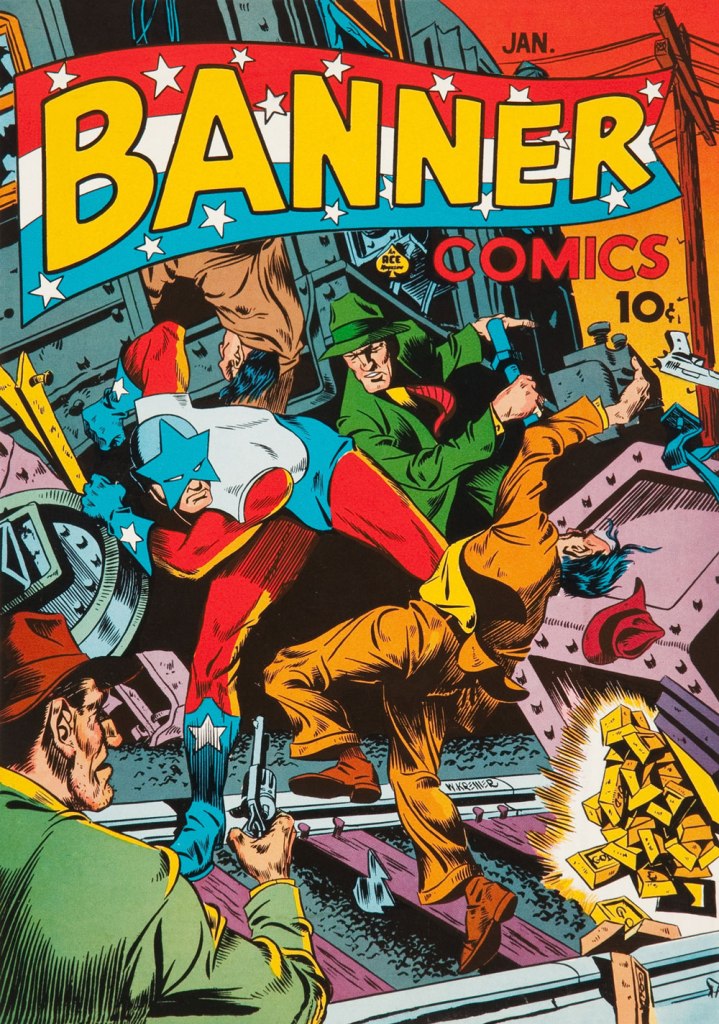
A rare foray into super-heroics, this is Banner Comics no. 5 (Jan. 1942, Ace); the guy with the star mask is ‘Captain Courageous’.
This is Super-Mystery Comics vol. 5 no. 6 (June 1946, Ace), featuring Mr. Risk in Riddle of the Revolutionary Portrait. Read it here! Kremer was signing as ‘Doc’ at the time.
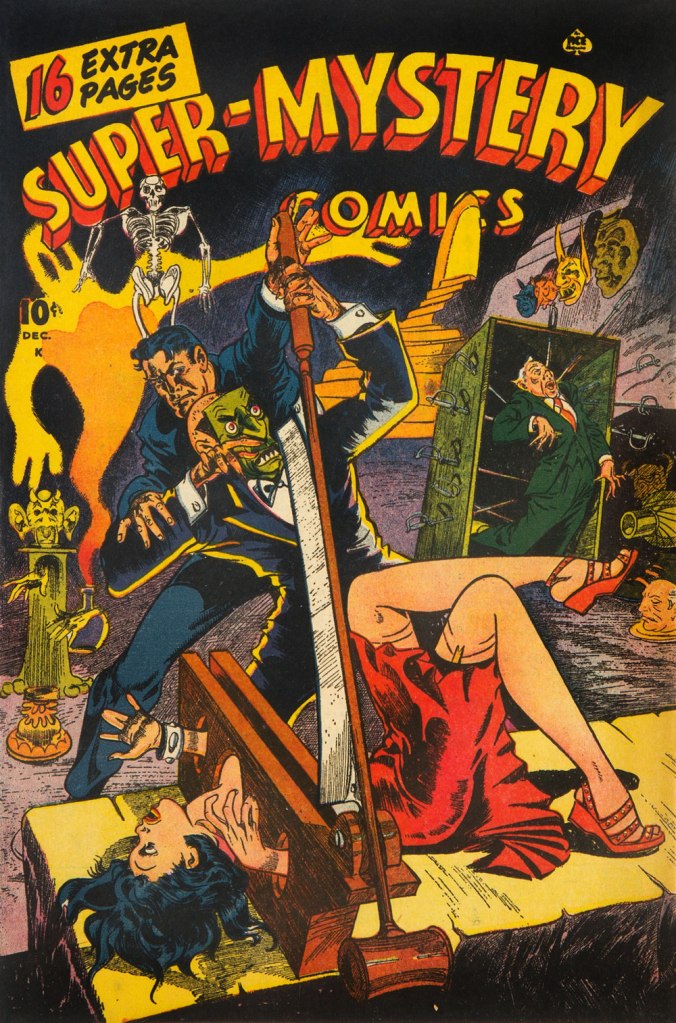
Dig all that detail! This is Super-Mystery Comics vol. 6 no. 3 (Dec. 1946, Ace), featuring Bert and Sue in The Adventure of the Murdered Medium; read it here!
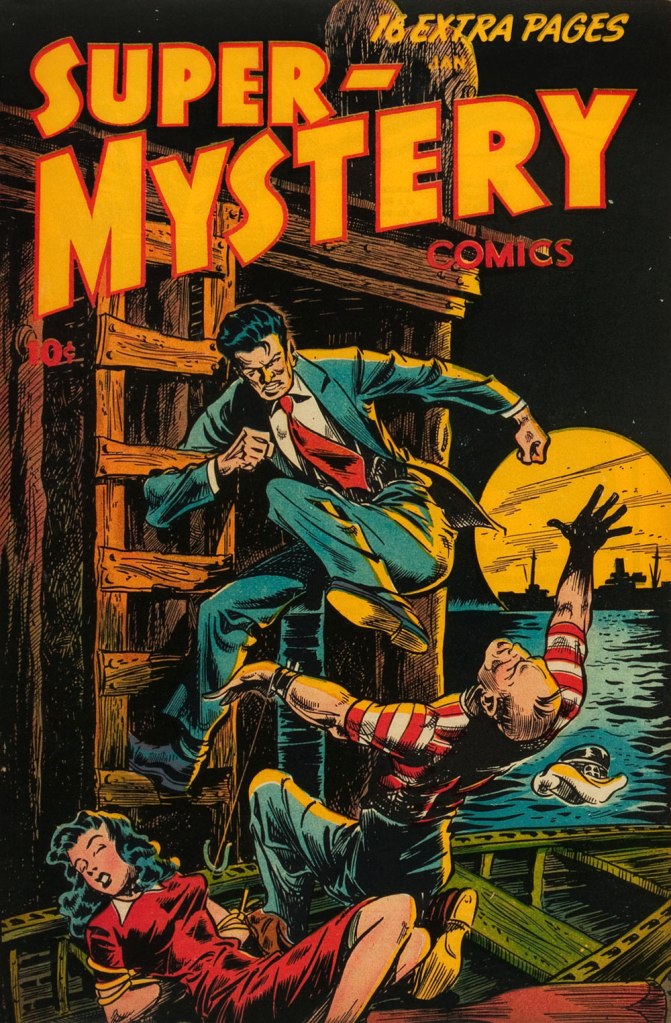
Boasting a snazzy new logo, this is Super-Mystery Comics vol. 7 no. 3 (Jan. 1948, Ace), featuring Bert and Sue (Ace’s Nick and Nora?) in Hell Bent for Election!. Read it here!
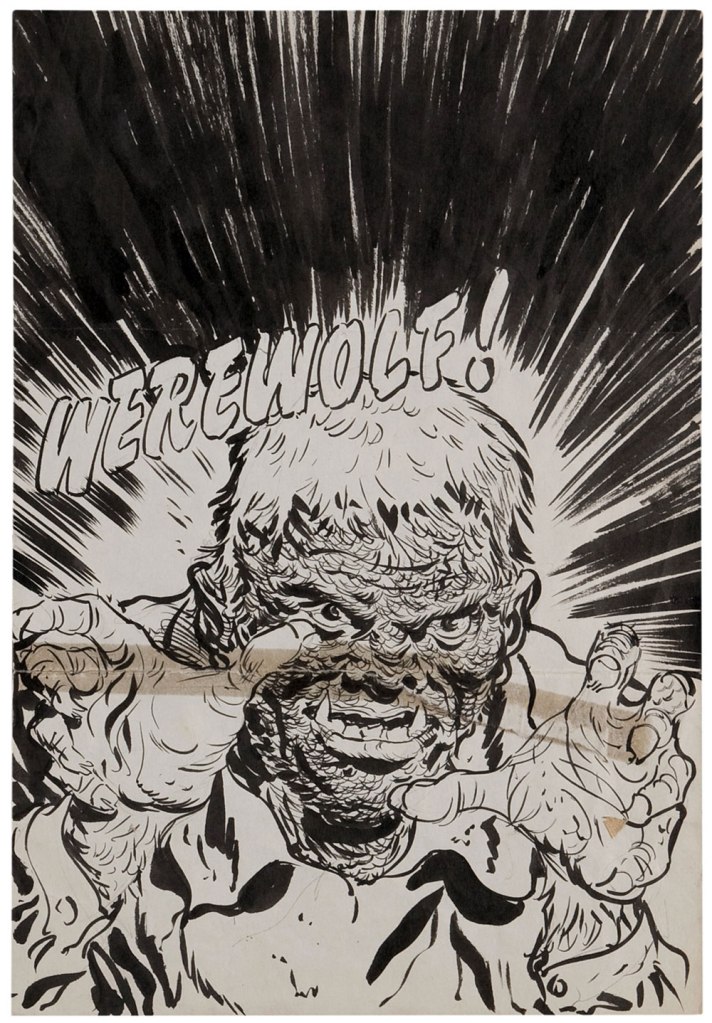
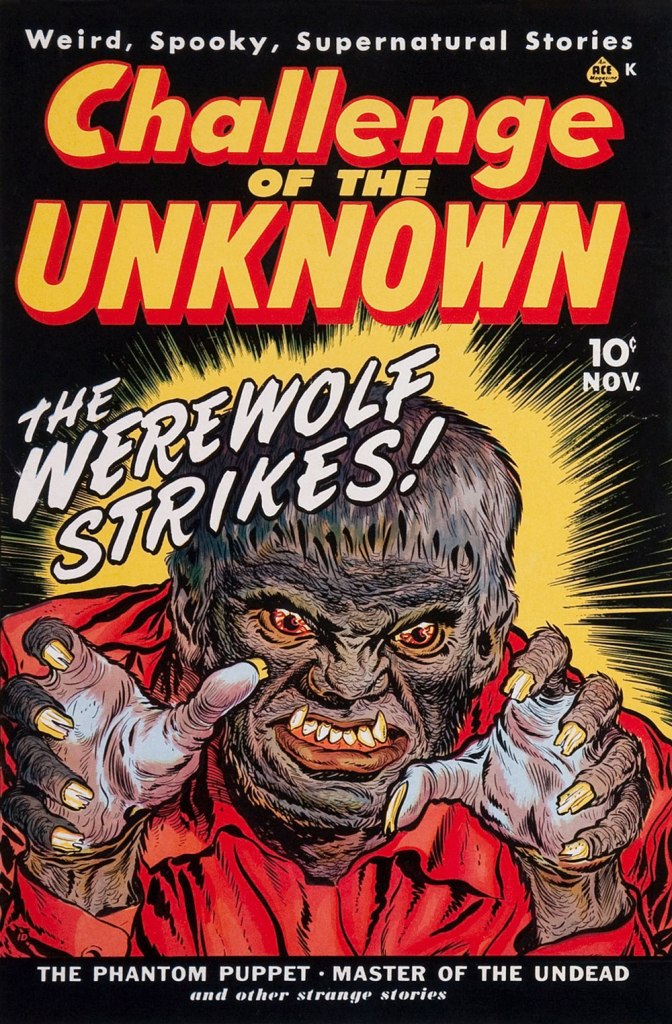
Eight years before DC’s Challengers of the Unknown, Ace came up with Challenge of the Unknown… àchacun son tour. This is the first of its two-issue run, no. 6 — but of course! (Sept. 1950, Ace); pencils by Kremer, inks possibly by Al Avison. Read it here!
Three steps to a Werewolf. Kremer’s rough cover design…
The printer’s cover proof…
… and final publication switcheroo! One might surmise that someone got cold feet about CotU. This is The Beyond no. 1 (Nov. 1950, Ace). Read it here!
This is The Beyond no. 2 (Jan. 1951, Ace). A solid demonstration of dramatic perspective.
Here’s Mr. Risk again, in the first and penultimate issue of his own series — no. 2 (Dec. 1950, Ace) featuring The Case of the Psychopathic Lady and The Case of the Jinxed Air Line — the next issue was number 7! Read this one here.
Again, all that beautifully-rendered detail. This is The Beyond no. 3 (Mar. 1951, Ace), featuring The Keeper of the Flames. Read it here (preferably by candlelight)!
One of the most rewarding things for the Kremer fan is that the man thoroughly documented his creative process. In other words, he saved a lot of his art, including sketches, notes and preliminaries.
And the final version, from The Beyond no. 30 (Jan. 1955, Ace). See how Kremer had it all worked out, down to the colouring? Amazing. Oh — and read it here!
Happy birthday, Mr. Kremer — wherever it is you may roam!
« The cemeteries are full of irreplaceable people who were all replaced. » — Georges Clemenceau
Commercially and creatively, the 1950s held some of the best and the worst years for the American comic book industry. Basically, the first half was a glut and the second, a massacre. This is all well-trod ground. Today, we’ll stick to one artist and his main employer.
In his one intensely-prolific decade as a professional cartoonist, Joe Maneely (1926 – 1958) produced the overwhelming bulk of his work for publisher Abe ‘Martin’ Goodman’s Timely/Atlas, which would become Marvel Comics by the decade’s end.
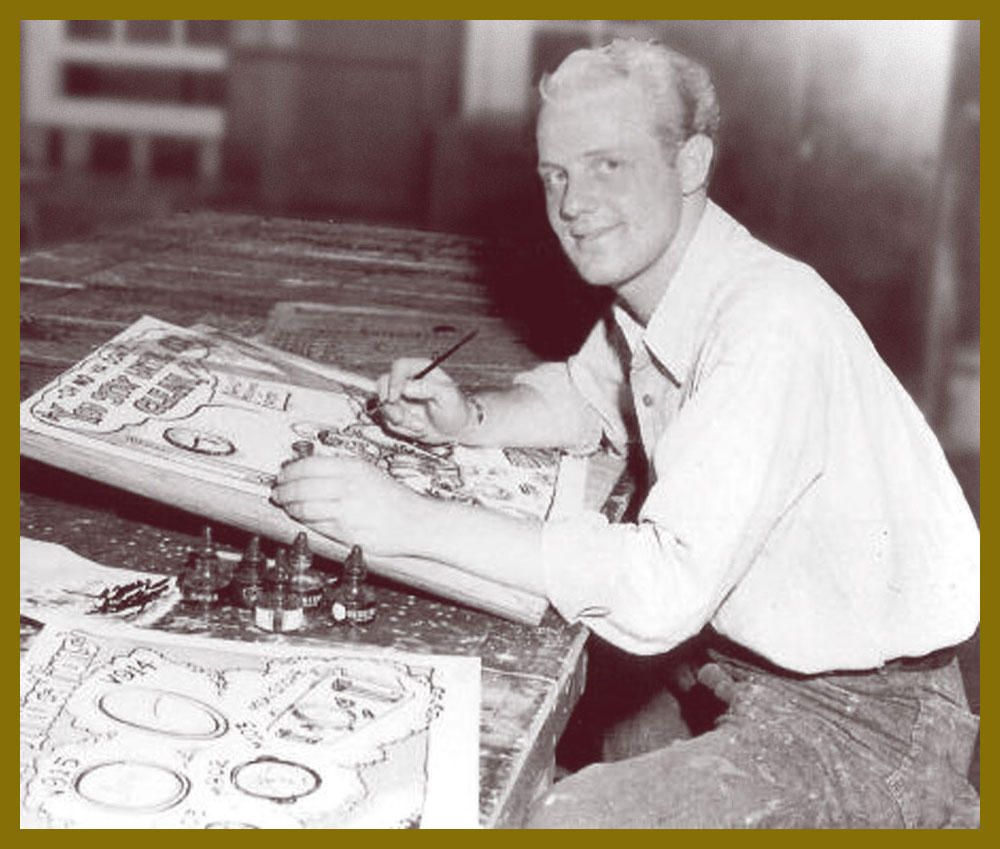
The artist at his table. Herb Trimpe lets us in on the secret of Maneely’s prodigious speed (said to produce up to six pages a day, pencils and inks): « his pencils [were] almost nonexistent; they were like rough, lightly done layouts with no features on the faces … It was just like ovals and sticks and stuff, and he inked from that. He drew when he inked. That’s when he did the work, in the inking! ». Talk about unerring confidence!
Atlas historian Dr. Michael J. Vassallo sums up the Tao of Goodman (and, by and large, Marvel’s):
« As one genre faded, another would add titles to compensate. It didn’t matter if the new titles were basically redundant titles with new names. Goodman followed all trends in the comic book industry and the publishing industry in general.
A savvy businessman, he rarely led, mostly followed, but had the resources to follow with gusto, overwhelming competitors with product. »
As Ger Apeldoorn tells it, Maneely was a mere thirty-two years of age and at his frenetic artistic peak when tragedy struck:
« … on June 7, 1958, after going out for the night (with old-time friends John Severin and Walt Kelly assistant George Ward) he stepped out on the balcony of the train to get some air, fell between two trains and died. For a long time the story was that he had been drunk, but according to Dan Goldberg* he had lost his glasses earlier that week and that may have been a contributing factor. »
If the inspiring story of Joe Maneely, and its heartbreaking and sudden end is at all remembered these days, it has chiefly been through the diligent efforts of aficionado-historians such as Jim Vadeboncœur Jr. and the aforementioned Dr. Vassallo. Now why would an artist of such calibre fade so swiftly from memory? Since that happens all of the time (what one might term ‘invisible evidence‘), let’s move past the realm of the rhetorical and be more… specific. But first, some samples of the late Mr. Maneely’s goodies.
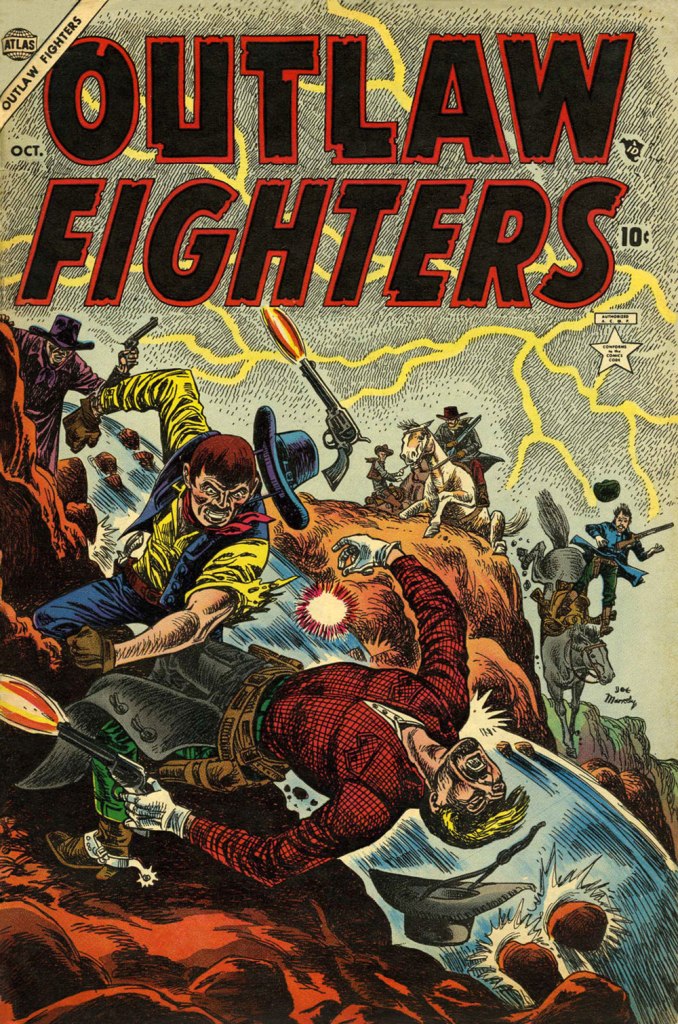
This is Outlaw Fighters no. 2 (Oct. 1954, Atlas).
This is Jungle Action no. 1 (Oct. 1954, Atlas). With spandex yet to hit the market (and even then), Leopard Girl’s costume must have been quite… stifling.
This is Mystery Tales no. 23 (Nov. 1954, Atlas).
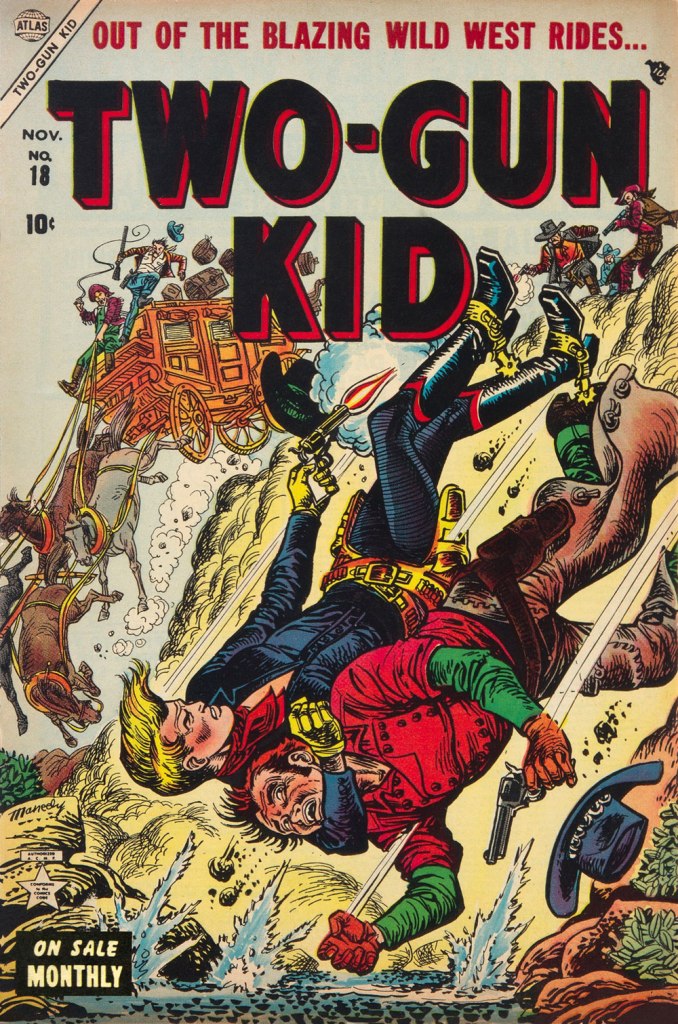
This is Two-Gun Kid no. 18 (Nov. 1954, Atlas). I doubt anyone’s going to land comfortably. Particularly those poor horses.
This is Journey Into Mystery no. 22 (Feb. 1955, Atlas).
“Oh, Stan — you’re so butch!” This is Rugged Action no. 2 (Feb. 1955, Atlas). To my eye, the bottom panel evokes Harvey Kurtzman‘s early style (think Two-Fisted Tales at EC); ironic, given that Maneely was as confident and speedy in his drawing as Kurtzman was painstaking and slow.
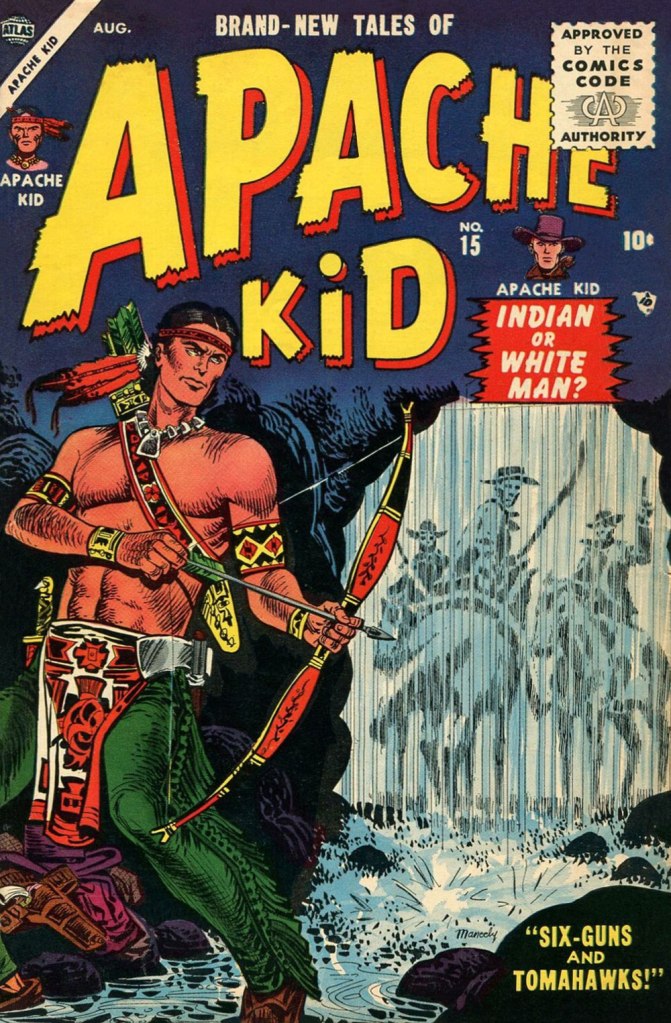
This is Apache Kid no. 15 (Aug. 1955, Atlas). The publisher also had in its roster Arizona Kid, Kid Colt, The Kid from Dodge City, The Kid from Texas, Kid Slade, The Outlaw Kid, Rawhide Kid, Ringo Kid, Texas Kid, Two-Gun Kid, The Gun-Barrel Kid… did someone say ‘redundant’? Why, yes, someone did.
This is Police Badge #479 no. 5 — the sole issue, really; its numbering picked up from Spy Thrillers… and went no further (Sept. 1955, Atlas). Maneely was another of that rare breed who could draw anything… because they enjoyed drawing everything. Dig all that well-observed detail!
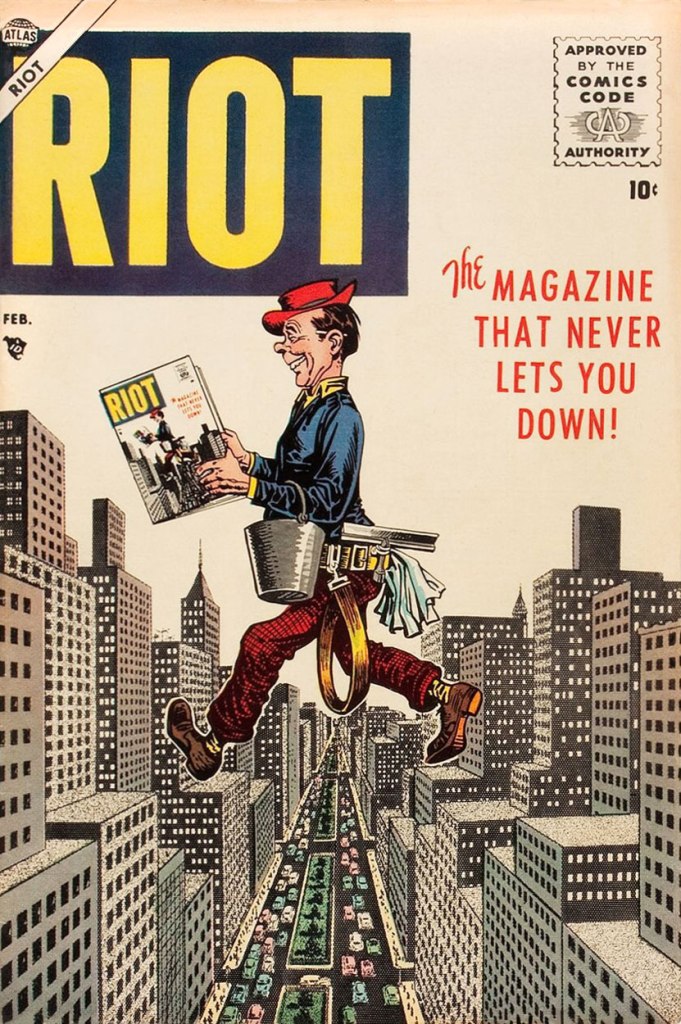
Atlas published, in quick succession, no less that four short-lived Mad clones: Crazy, Riot, Snafu and Wild, each lasting from three to seven issues. None were particularly funny either, even if they did look quite good. This is Riot no.4 (Feb. 1956, Atlas) featuring what is termed, in comic book circles, an ‘infinity’ cover.
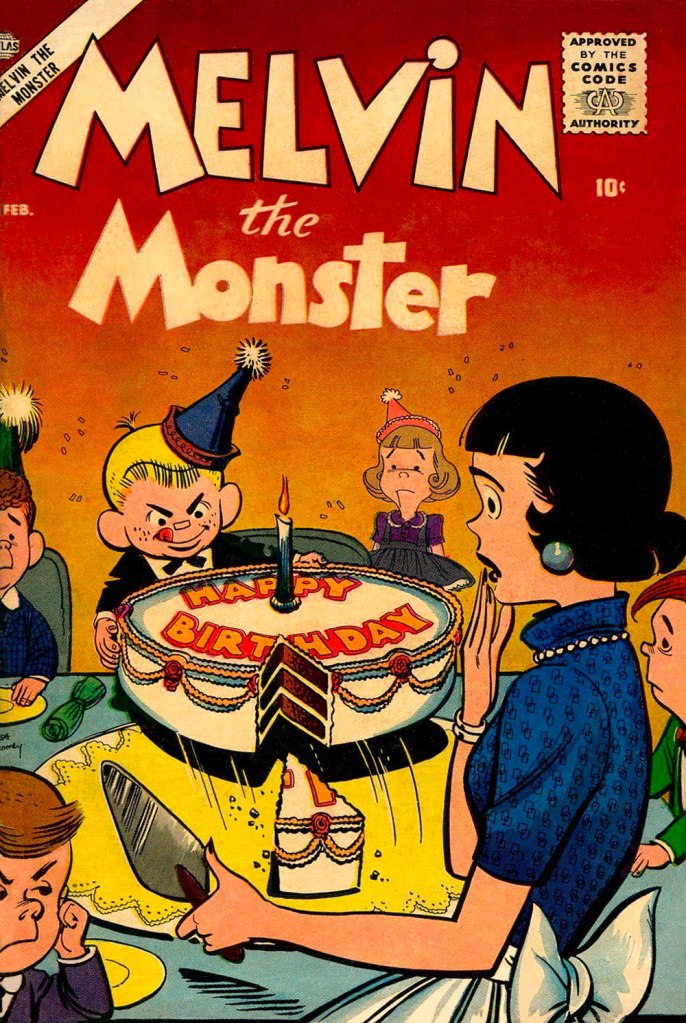
This is Melvin the Monster no. 4 (Feb. 1957, Atlas); Dr. Vassallo writes, in his in-depth Maneely overview for Alter Ego magazine (no. 28, Sept. 2003): « Stan Lee and Joe Maneely’s Melvin the Monster… duplicated everything they could about Hank Ketcham’s Dennis the Menace — art style, comic strip format, even upper-&-lower-case lettering style — everything except the warmth and innocence.»
This is Kid Colt Outlaw no. 69 (Feb. 1957, Atlas). Along with everything else, I love his way with flora and fauna. Incidentally, most of these covers were coloured by Stan Goldberg.
And so… why have Maneely’s star and memory dimmed so? It has been proposed, and I agree, that it’s because he just didn’t draw superheroes (a couple of Sub-Mariner covers being the lone exceptions), and Marvel itself hardly lifted a finger, over the years, to preserve the reputation of one of its principal architects.
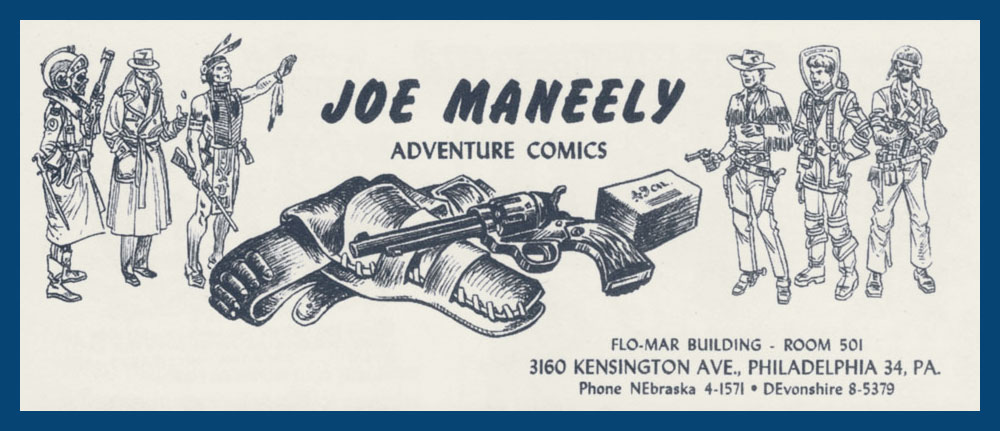
The artist’s promotional letterhead illustration, circa 1948.
There’s been much idle speculation as to what course comics history would have taken had Maneely lived. Stan Lee wrote, in his usual disingenuous way, that:
« How I wish the world (and I) could have seen what he’d have done with the F.F., Spidey, Thor and all the other Marvel super-heroes! It’s a true tragedy that we’ll never have the chance. »
Let’s be honest here: Maneely was an incredible artist, and he made Stan look good, but Joe wasn’t a writer, and certainly not a world-builder in the fashion and class of Jack Kirby, Steve Ditko, Walt Kelly, Carl Barks, John Stanley, Basil Wolverton… and precious few others. Without Kirby, the so-called Marvel Age never would have come to pass. Not to mention that Maneely, with a wife and three daughters to feed and support, had just begun to work for one of DC’s friendliest editors, Murray Boltinoff**. He would have been unlikely to drop a better-paying, likely secure gig to drop everything and return to Marvel’s uncertain prospects. Ah, and I see Mark Evanier views it along the same lines.
Oh, and I’ve mentioned in the past Maneely’s likely influence (mostly in the inks) on his contemporary Rocco Mastroserio. Take a look at this gallery of his covers and see if you agree.
-RG
*Stan Goldberg, actually.
**as a matter of fact my first encounter — as a child — with Maneely’s work was through a reprint of one of his DC stories: The Doomsday Drum (House of Secrets no. 9, March-April 1958).
« Is the spring coming? » he said. « What is it like?» «It is the sun shining on the rain and the rain falling on the sunshine…»| Frances Hodgson Burnett, The Secret Garden
Having been meaning for a while now to concentrate on tentacled plant life, I was hitherto stopped by the idea that it’s somewhat unseemly to talk about flora when most of our readership is buried in snow and ice. But now, well! – today was the first day of the year suitable for wearing shorts, and green shoots are popping up wherever one’s gaze happens to land.
We have waited for quite a long time before co-admin RG managed to get his hands on this issue… and it turned out that the insides vary from ‘lacklustre’ to ‘wow, that’s ugly!’ Still, the wonderful, striking cover makes it worth owning, I believe.
Horror: The Illustrated Book Of Fears no. 2 (February 1990, Northstar). Cover by Mark Bernal.
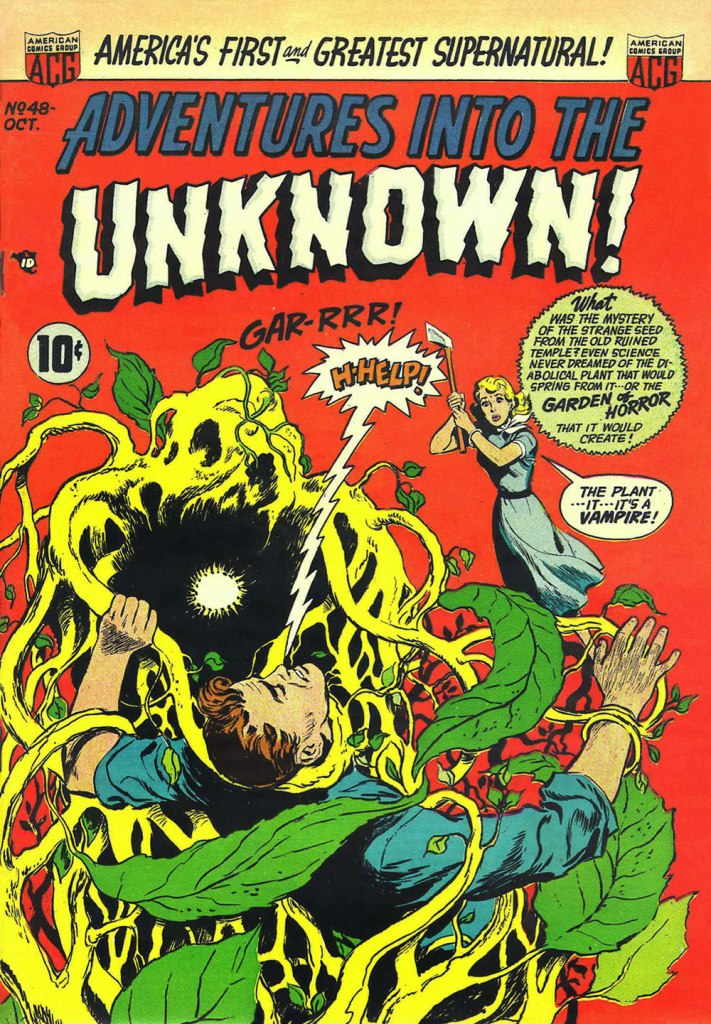
ACG got its tentacle parade in Tentacle Tuesday: ACG’s Adventures Into the Tentacles, but as usual, some material didn’t quite fit the theme, and I saved the following cover for a more appropriate occasion. This, I do believe, is the moment.
Adventures into the Unknown no. 48 (October 1953, ACG), cover by Ken Bald.
Speaking of adventures, let’s delve into Strange Adventures for a bit. The following story has a rather peculiar plot – « Star Hawkins is down on his luck and has to pawn Ilda, his robot secretary. Luckily, Star is hired to locate a fugitive who’s thought to be hiding on Vesta, an asteroid mining settlement, in the Red Jungle. But with a little tracking skill and the help of the creepy vegetation of the Red Jungle, he nabs the fugitive, gets his prisoner, and gets Ilda back from the pawn shop, promising never to pawn her again. »
Page from The Case of the Martian Witness!, scripted by John Broome, pencilled by Mike Sekowsky and inked by Bernard Sachs, published in Strange Adventures no. 114 (March 1960, DC).
Here’s another Earthman (who has dreamed of this moment, by his own admission!) struggling with some coquettish plant tentacles that just want to be friends.
A page from Super-Athlete from Earth!, scripted by Gardner Fox, pencilled by Gil Kane and inked by Bernard Sachs, published in Strange Adventures no. 125 (February 1961, DC).
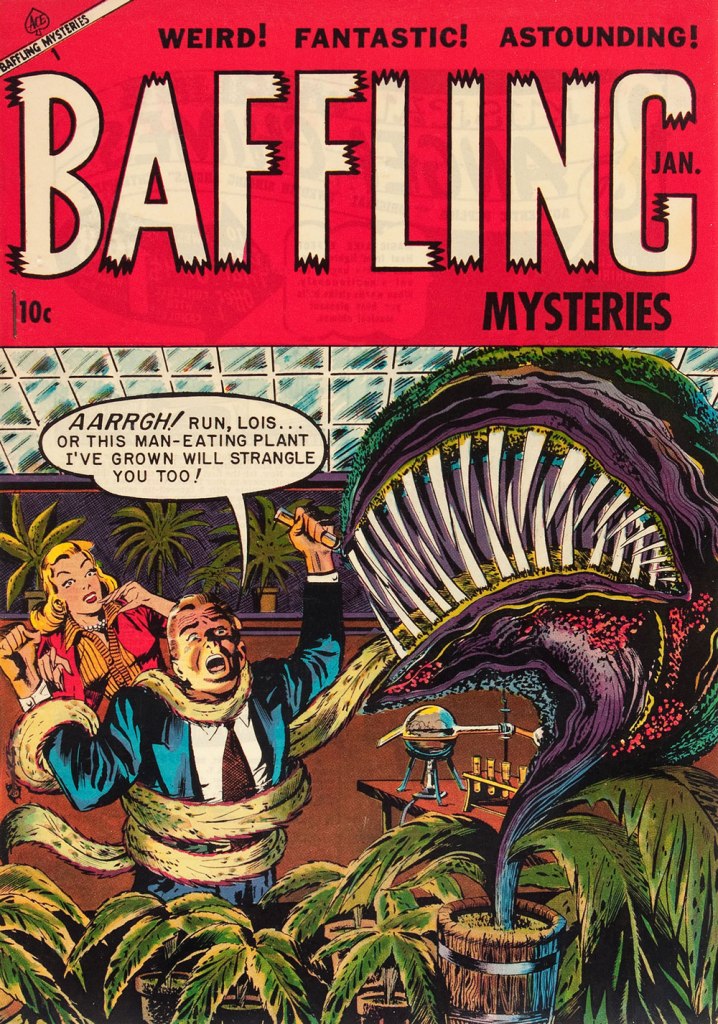
The next thing after adventures is, naturally, mysteries. If they’re strange, puzzling mysteries, even better… what’s that word I’m looking for… ah, yes: baffling! Another day, yet another ravenous man-eating plant.
Baffling Mysteries no. 19 (January 1954, Ace Magazines). Cover is presumed to be by George Roussos. I think strangulation is not even the worst option here.
One more happy tromp through the jungle? Sure, why not!
The following image was originally created as a cover for House of Mystery no. 251 (1977, DC), but was nixed in favour of another, Neal Adams-penned illustration, which we’ve already featured in a previous post (Tentacle Tuesday: Plants Sometimes Have Tentacles, Too). I prefer this gruesome version (complete with skeleton being digested!… also more detail, more dynamic layout and better anatomy of all involved), pencilled by José Luis García-López and inked by Bernie Wrightson.
« ‘A face like an oyster, huh?‘ Danny Lomax repeated, and swallowed hard. ‘That’s what it’s going to look like?‘ Nick Deene chuckled and nodded. ‘If there’s anything deader-looking than a watery blue oyster that’s been open too long,‘ he said, ‘I don’t know what it is.‘ » — Robert Arthur, The Believers (1941)
Today, we’ll peer through filmy years past at another example of cultural cross-pollination: a notion is born, seemingly out of nowhere, then it ineffably catches the collective fancy and is in some fashion absorbed into folklore, scattered like grain by wind and whisper. Then some soul, blessed with a way with words, polishes it for publication and some editor buys it for peanuts. Another wordsmith reshuffles and refines it, sprinkling some notions of his own, perhaps a glint of sardonic humour. Hungry for material, radio gets hold of the setup and reshapes it a little to fit another medium. Late one night, some comic book hack hears that presentation, and recollects its essence, some years on, in a frantic rush to fill some pages and scrape together a meagre living. Or perhaps he saw it in a competitor’s rag. Bah, no-one’ll remember… or give a toss. “I’ll give it a stab from another angle!“
First, there was… well, I’m not sure. But let’s begin with Henry Russell Wakefield‘s short story Ghost Hunt (either 1938 or 1948… sources differ), in which…
A radio host broadcasts a live ghost hunt in a house in London where there have been “no less than thirty suicides”. Most have run from the house at night to throw themselves off the cliff and into the nearby river. The radio broadcaster is joined by a paranormal investigator. The investigation proves all-too successful in this chilling story.
The Believers is a classic horror story by Robert Arthur. It’s about a radio host who decides to broadcast a live show from a haunted house. This story is also known as “Do You Believe in Ghosts?” and it was based on an older story by H. Russell Wakefield called “Ghost Hunt“. It also inspired a horror comic story and an episode of Tales From The Crypt, both of which were called “Television Terror“.
The Believers was featured in this 1963 Random House collection (which Robert Arthur himself edited as well as authored), under its alternate title of Do You Believe in Ghosts?. The splendiferous wraparound cover is by Arthur Shilstone (1922-2020).
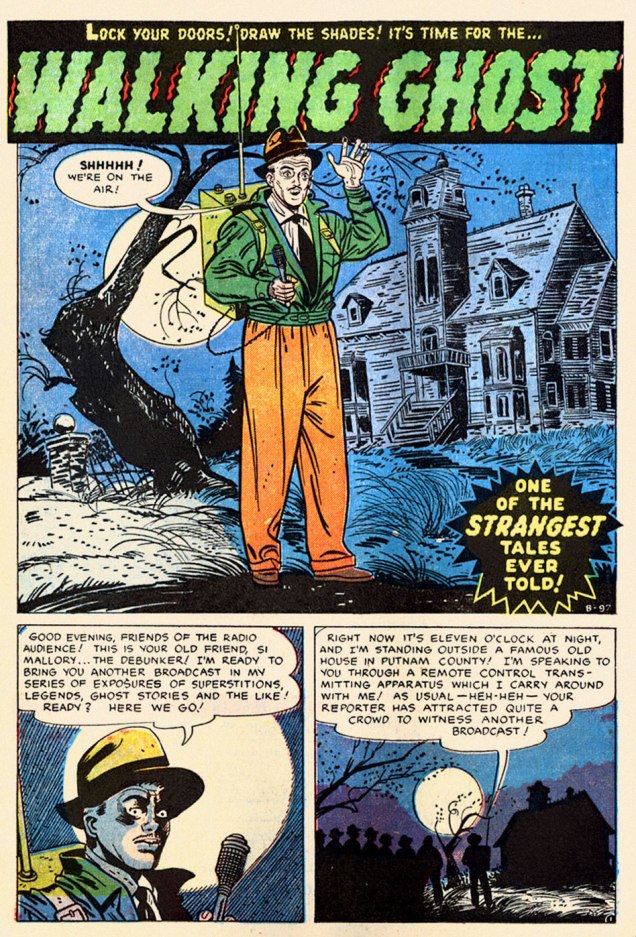
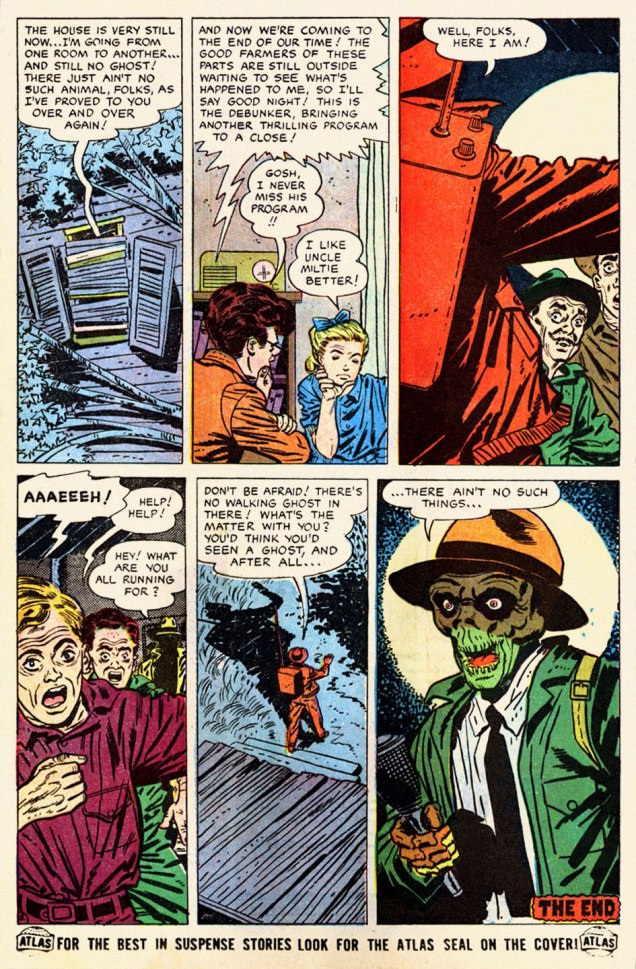
And more that just the one ‘horror comic story’ was inspired by this singular scenario. In 1952, The Unknown (or at least uncredited, which amounts to the same thing) Writer came up with The Walking Ghost, which will now break up the tedium of text, text, text, and provide you with some welcome visuals by Messrs. Mike Sekowsky on pencils and Bill Walton on inks.
This adaptation (if you will) strikes a middle ground between the Wakefield and the Arthur approaches.
The Walking Ghost was reprinted decades later in Crypt of Shadows no. 3 (May, 1973, Marvel), where I first encountered this tale, and this bit of dialogue was modified to better (but not by much) fit the times:
And what exactly was the matter with “Uncle Miltie“? Doesn’t having the biggest schlong in Hollywood buy you any respect anymore? The Twilight Zone wasn’t even a radio show!
The Walking Ghost first saw print in Strange Tales no. 11 (Oct. 1952, Atlas); cover by Bill Everett. It didn’t even rate the cover.
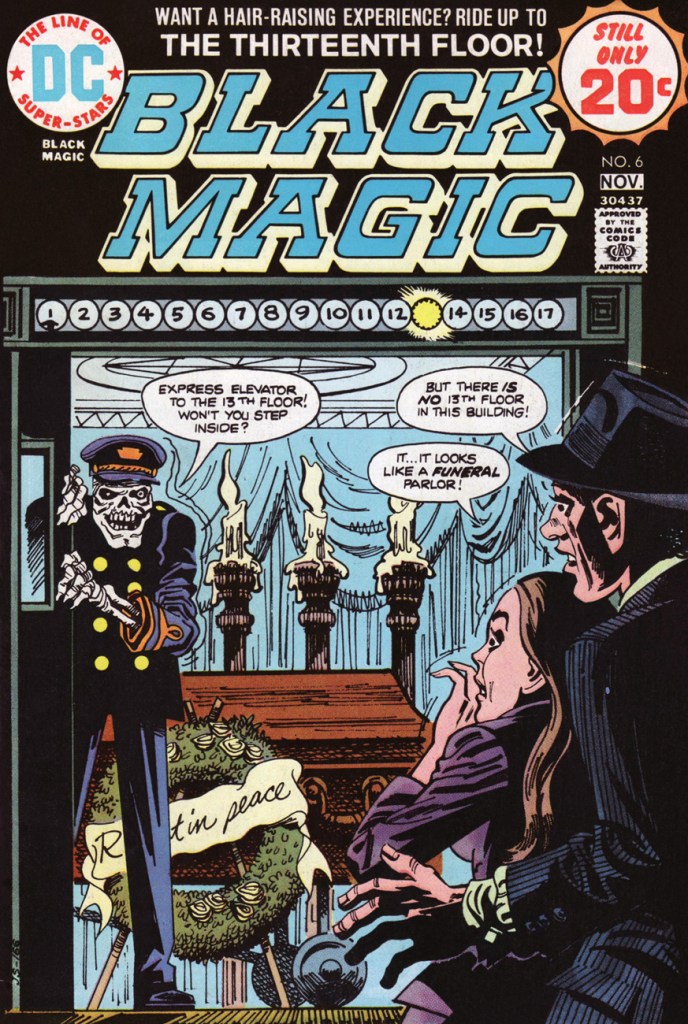
A Jack Kirby cover scene gets winningly recast for the 70s by Jerry Grandenetti, himself a contributor to the original series. This is Black Magic no. 6 (Oct.-Nov. 1974, DC).
When I was a kid (of twelve or so, if memory serves), I found a muddy and mildewed copy of this issue in the woods, which tremendously added to its allure, if not its readability.
And since I’ve mentioned it, here’s the original Kirby cover, regrettably one of the King’s least engaging, if you ask me. This is Black Magic no. 11 (vol. 2 no.5, Apr. 1952, Prize).
Well… little did I know what a protracted history this particular little scenario had. Let’s return to the presumed beginning, or at least the industrial age version.
Around the turn of the last century, the prolific English writer Edward Frederic Benson (1867 – 1940) wrote a story entitled The Bus Conductor [ read it here ] that saw print in Pall Mall Magazine in 1906. It was quite well-received, then began to widely make the rounds… as putative fact.
Things kicked into high gear in the mid-1940s, as the tale was recounted as an oft-heard anecdote in editor Bennett Cerf‘s 1944 short story anthology, Famous Ghost Stories, which contained a Benson contribution… but not The Bus Conductor.
That same year, Cerf shared the anecdote with the legion of readers who picked up his highly-entertaining (and still dirt-cheap and easy to find, over three-quarters of a century later, which gives you a sense of its original success and ubiquity) book of anecdotes, Try and Stop Me. The pertinent chapter was the splendidly-titledThe Trail of the Tingling Spine. As examined earlier on this blog, this chapter was used by EC Comics’ Bill Gaines and Al Feldstein as what they termed ‘springboards’ for their earliest stories.
Cerf’s version, from Try and Stop Me:
When an intelligent, comely girl of twenty-odd summers was invited for the first time to the Carolina estate of some distant relatives, their lovely plantation fulfilled her fondest expectations. She was given a room in the west wing, and prepared to retire for the night in a glow of satisfaction. Her room was drenched with the light of a full moon.
Just as she was climbing into her bed, she was startled by the sound of horses’ hooves on the gravel roadway. Curious, she walked to the window and saw, to her astonishment, a magnificent old coach pull up to an abrupt stop directly below her. The coachman jumped from his perch, looked up and pointed a long, bony finger at her. He was hideous. His face was chalk-white. A deep scar ran the length of his left cheek. His nose was beaked. As he pointed to her, he droned in sepulchral tones, “There is room for one more!” Then, as she recoiled in terror, the coach, the horses and the ominous coachman disappeared completely.
The girl slept little, but the next day she was able to convince herself that she merely had a nightmare.
The next night, however, the horrible experience was repeated. The same coach drove up the roadway. The same coachman pointed at her and exclaimed, “There is room for one more!” Then, as before, the entire equipage disappeared.
The girl, now panic-stricken, could scarcely wait for morning. She trumped up some excuse to her hosts and left immediately for home.
Upon arrival, she taxied to her doctor from the station and told him her story in tremulous tones. The doctor persuaded her that she had been the victim of a peculiar hallucination, laughed at her terror, and dismissed her in a state of infinite relief. As she rang for the elevator, its door swung open before her.
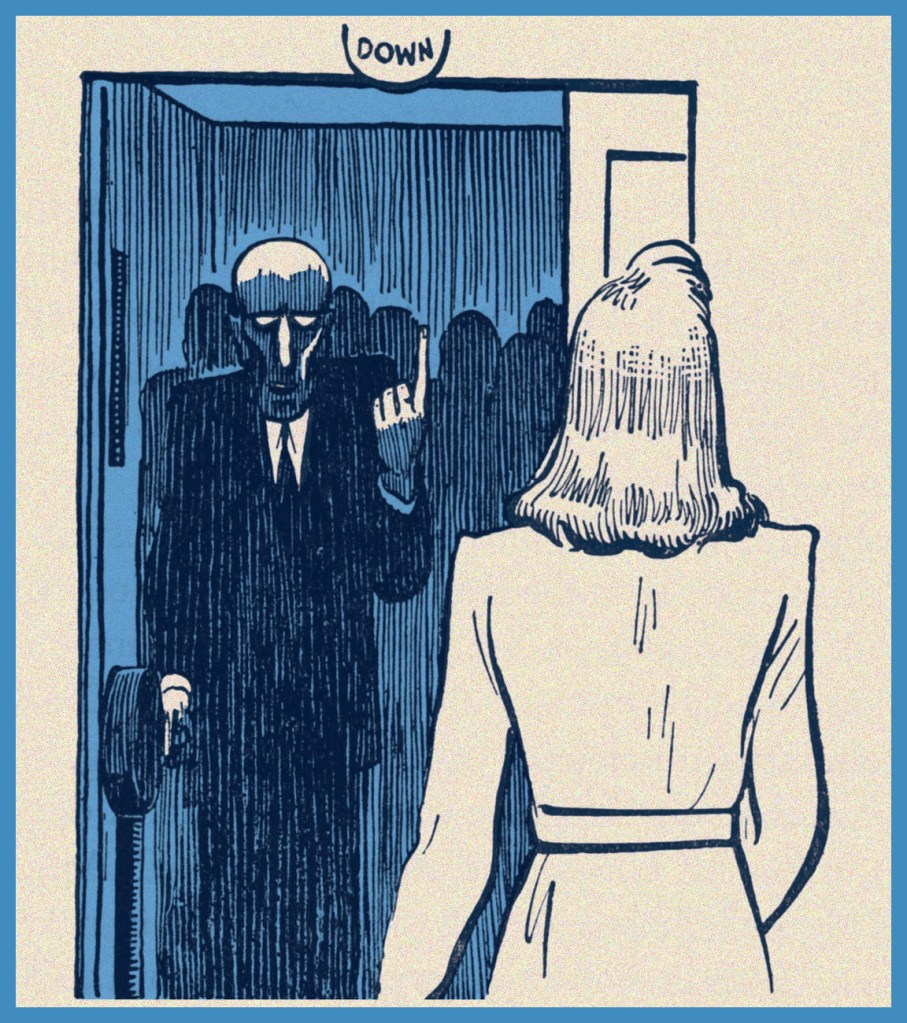
The elevator was very crowded, but she was about to squeeze her way inside — when a familiar voice rang in her ear. “There is room for one more!” it called. In terror, she stared at the operator.
Try and Stop Me was lavishly and diversely illustrated by The New Yorker great Carl Rose, which surely must have contributed considerably to its success. I’d say Simon and Grandenetti were quite familiar with this striking image.
He was the coachman who had pointed at her! She saw his chalk–white face, the livid scar, the beaked nose! She drew back and screamed… the elevator door banged shut.
A moment later the building shook with a terrible crash. The elevator that had gone on without her broke loose from its cables and plunged eighteen stories to the ground. Everybody in it, of course, was crushed to a pulp.
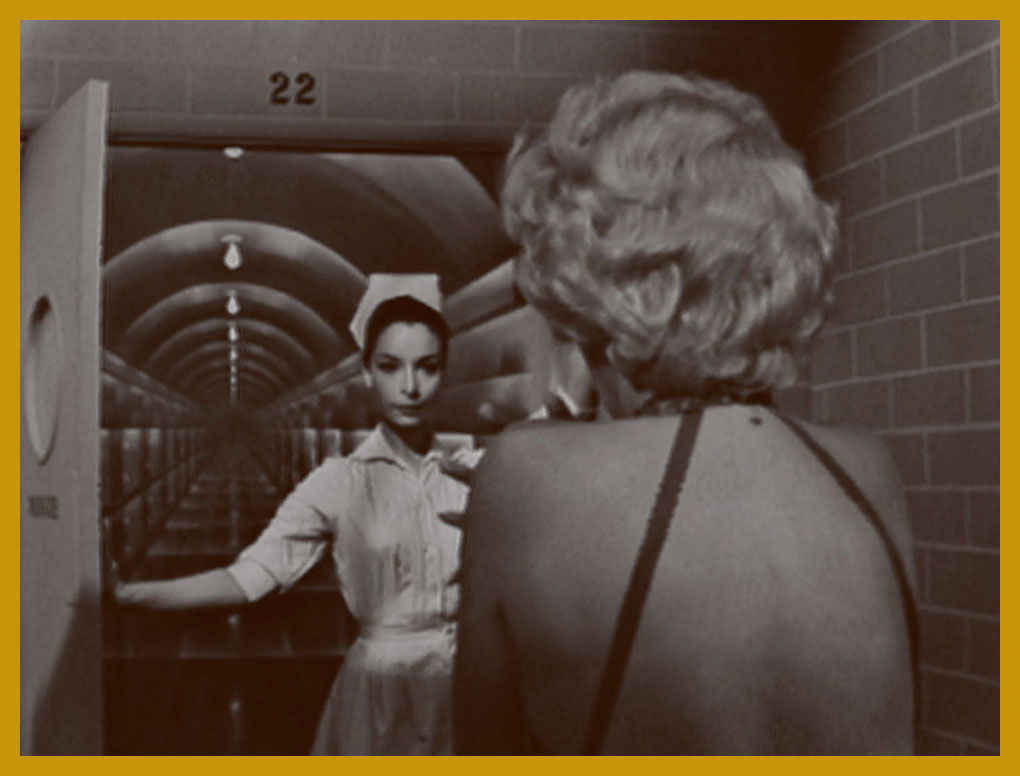
On to the Sixties: Rod Serling also drew upon the Cerf anecdote as grist for his The Twilight Zone episode Twenty Two (season 2, episode 17, aired Feb. 10, 1961). Here’s a pivotal scene from it.
Well, that’s certainly easier on the eyes than that gaunt vulture of an elevator operator… but no less menacing. You may recognize Mr. Spock’s future bride, Arlene Martel.
The Twilight Zone’s continuing popularity pretty much killed the scenario’s urban legend potency (Snopes.com checked it out!) In 1999, Urban legend authority Jan Harold Brunvand wrote, in his Too Good to Be True – The Colossal Book of Urban Legends:
According to my readers when I wrote a newspaper column in 1989 about the old ‘Dream Warning’ legends, The Twilight Zone version was the only one most of them knew. After numerous reruns, the TV episode had virtually replaced the folk legend in the popular mind. Every reader who wrote me following my column mentioned this episode, with one exception, and this person mentioned that he saw the plot enacted in a mid-1940s film, called Dead of Night. I’ll bet my legend-hunting license that this film, too, borrowed from the Cerf version.
I wouldn’t make that wager if I were you, Mr. Brunvand… since Dead of Night properly credits Benson.
To give you a sense of how effectively these stories flit and flicker across storytelling modes and media, power pop wizard Scott Miller (1960-2013) opened his band Game Theory‘s 1988 album, Two Steps From the Middle Ages, with a haunting ditty entitled Room for One More, Honey, an acknowledged quotation of the Twilight Zone episode.



































 Who's Out There?