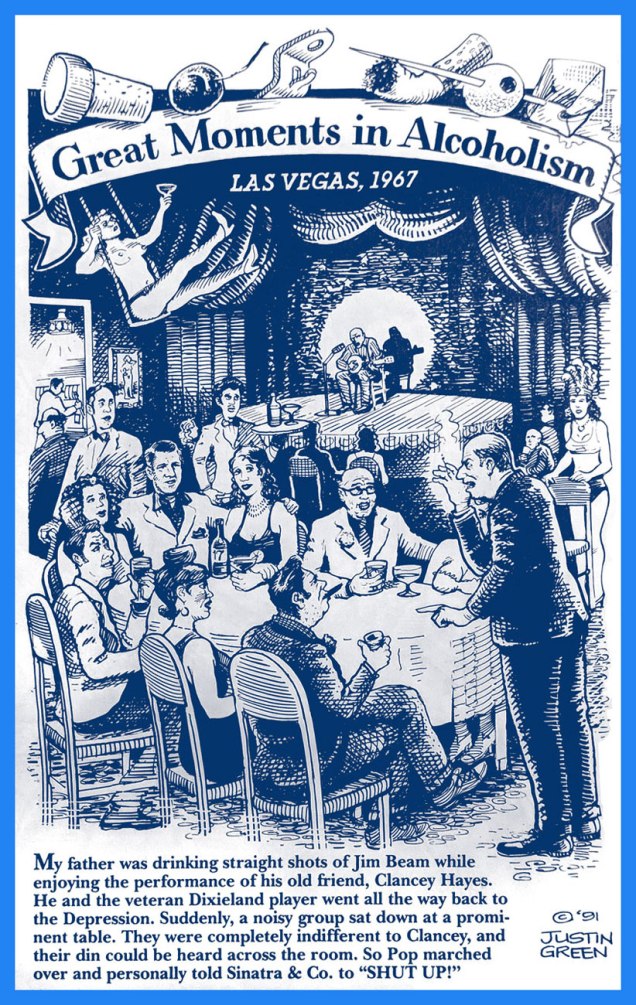
« My father had a lifelong interest in helping musicians. I even encountered his presence when reading the autobiography of Anita O’Day. She said that there was a real estate man in Chicago who always made sure her band had a place to stay. That was Pop. » – Justin Green
How did Justin Green, one of the Founding Fathers of the Underground Comix movement, wind up holding down a regular feature for a decade (1992-2002) in Tower Records‘ in-house magazine, Pulse!? The whole chain of events began with a strip about his dad’s drinking. Of course.
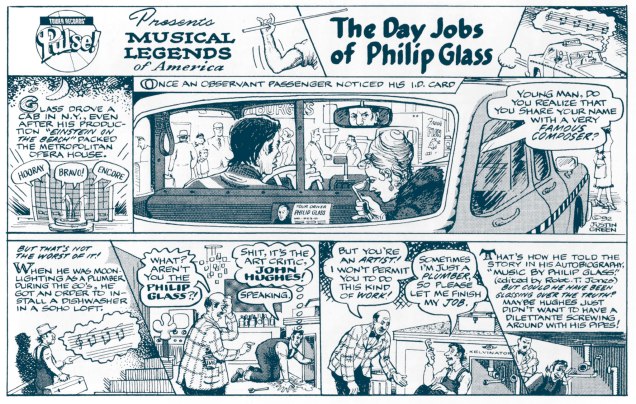
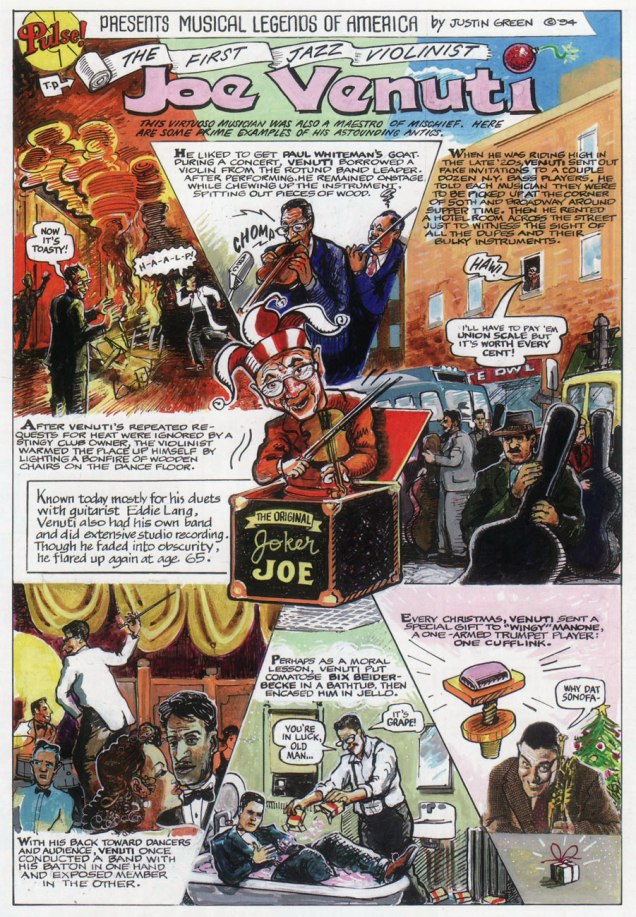
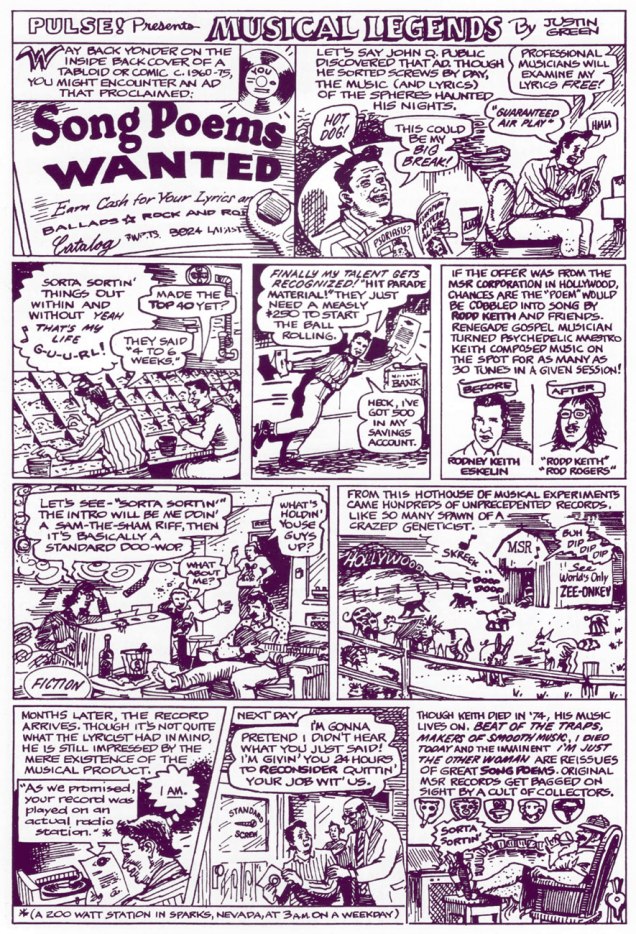
« It was my father’s spirit that instigated this cartoon project…. this was ’91 (Blab No.6, Summer 1991, Kitchen Sink Press), and I was living in Sacramento. Mark Weidenbaum was then an editor at Pulse! Magazine, published and distributed by Tower Records, which had its headquarters in West Sacramento. He had just seen the piece when he found out I lived nearby. He wanted to explore the idea of an ongoing musical biography cartoon feature. »The second instalment (April, 1992). A little Einstein on the Beach, anyone?August, 1992. Elvis certainly had his faults, but racism or ingratitude were not among these.My own introduction to the Reverend’s music came, as it surely came to many others, through Jackson Browne‘s fine cover of his Cocaine (Running on Empty, 1977). « I was talking to my doctor down at the hospital. He said, ‘Son, it says here you’re twenty-seven, but that’s impossible — you look like you could be forty-five’. »The strip frequently appeared in colour. Here’s my favourite example, from April, 1994. And here’s a fine Venuti performance. No, he wasn’t *always* joking.Ah, Rodd Keith, the main man behind those infamous Song Poems ads, comic book fixtures in the 1970s. The weren’t a scam… not in the traditional sense. November, 1996. Lend your ear to his Ecstasy to Frenzy.
While Green isn’t a native virtuoso draftsman like, say, R. Crumb or Rick Griffin, and he’s only fair-to-middling when it comes to likenesses, he *is* a born storyteller, and that’s really what’s most needed for an endeavour of this nature. Compressing a lifetime, or at least a career, into a single-page strip (two at the most!) is remarkably tricky and demanding, and if it looks deceptively easy here, he’s succeeded.
In selecting strips for this post, I didn’t lean towards my own favourite musicians, opting instead for what I felt were the strongest pieces, regardless of topic. However, I’m reserving my very favourite for a special New Year’s Eve post. Hope you enjoyed these musical time capsules! If you did, you’ll be happy to learn that the fine folks at Last Gaspcollected the set in 2003.
« It was long past midnight on a hot, wet June night many years ago… Central City lay choking for breath in an eerie fog… »
In this, part three of our chronicle following as we can the meandering and sometimes mystifying odyssey of Will Eisner’s The Spirit, we reach the most outré segments of the former Denny Colt’s road.
In a unique twist, The Spirit’s next residence, nearly a decade after his Fiction House run, had nothing at all to do with Will Eisner… in terms of securing his assent, that is.
It was down to the fabulously sketchy Israel Waldman, one of those fringe-dwelling characters who made the comics industry such a colourful snake pit. To quote the Grand Comics Database: « I.W. Publications (1958-1964) was part of I.W. Enterprises, and named for the company’s owner, Israel Waldman. Reportedly, Waldman came into possession of a printing company and among the assets were the production materials for several hundred comic books previously published by various publishers as well as a limited amount of previously unpublished material. Waldman equated possession of production materials as the right to reprint and I.W. became notable for publishing unauthorized reprints of other companies’ comics, often with new covers, as Waldman’s windfall did not often include the production materials for covers. The later half of the company’s existence, it published comics under the Super Comics name. Usually these companies were out of business, but not always. »
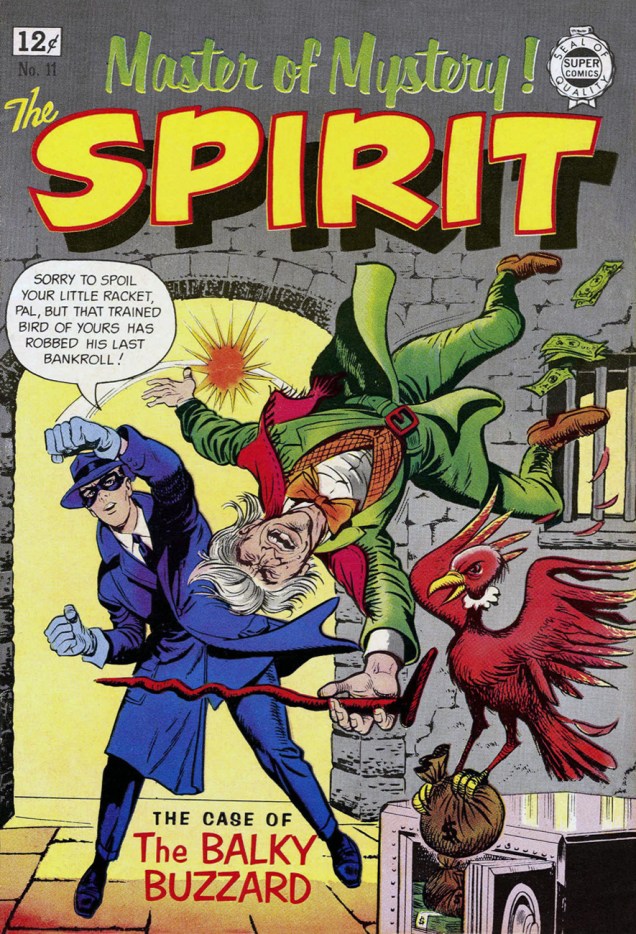
This is The Spiritno. 11 (1963), featuring The Man Who Killed The Spirit(Mar. 24, 1946), cover-featured The Case of the Balky Buzzard (Apr. 21, 1946), Carrion’s Rock (May 19, 1946), all scripted by Eisner, as well as Honeybun and Flatfoot Burns shorts. Cover by Joe Simon (“Joe, did you even read the story you’re depicting?“). This one was well worth one’s hard-earned twelve pennies. Read it here.This is The Spiritno. 12 (1964), featuring, this time, a trio of WWII-era Spirit stories scripted by Manly Wade Wellman and Bill Woolfolk and illustrated by Lou Fine, rounded off with a pair of Flatfoot Burns shorts by Al Stahl . Cover again by Joe Simon. Read it here.
If memory serves, Waldman’s comics craftily bypassed the Comics Code (another exception!) and the newsstands, being exclusively sold in sealed bags of three in bargain-basement department stores. To bait the hook, Waldman paid top dollar for new cover artwork, approaching established pros like Ross Andru (who actually delivered some fun stuff, unlike his unforgivably atrocious turn as DC’s main cover artist in the late 1970s), John Severin, Jack Abel, and in these two cases, Jacob Kurtzberg‘s old partner, Joe Simon.
Unsurprisingly, Waldman skimped on all other materials, particularly the paper his comics were printed on, which means that I.W./Super Comics are pretty hard to come by these days in any kind of decent state, so they’re ironically pricey.
A few years later, Eisner struck a deal with another rascal (albeit one with cleaner fingernails), Alfred Harvey of Harvey Comics, Stan Lee‘s only credible competition in the credit-usurping, I created-the-Universe stakes. Again, two issues, but this time with some new Eisner material, including origin stories for The Spirit (his third, but definitive one), and his arch-nemesis Zitzbath Zark, which you may know as purple glove enthusiast The Octopus.
Harvey’s The Spiritno. 1 (Oct. 1966), featuring the new Origin of the Spirit by Eisner, and classics Lorelei Rox (Sept. 19, 1948), Two Lives (Dec. 12, 1948), Agent Cosmek/Visitor (Feb. 13, 1949), The Story of Rat-Tat the Toy Machine Gun (Sept. 4, 1949), Ten Minutes (Sept. 11, 1949), Thorne Strand (Jan. 23, 1949), Gerhard Shnobble (Sept. 5, 1948), all scripted by Eisner, save Ten Minutes, which hails from the mind of Jules Feiffer.Harvey’s The Spiritno. 2 (March, 1967) features the brand-new Octopus: The Life Story of the King of Crime and 2-pager The Spirit Lab, plus a generous helping of fine oldies, namely Plaster of Paris (Nov. 7, 1948), The Deadly Comic Book (Feb. 27, 1949), Rudy the Barber (Oct. 22, 1950), The Story of Sam, the Saucer That Wanted to Fly (Sept. 17, 1950), Sam Chapparell (Oct. 10, 1948), La Cucaracha (Nov. 19, 1950), The Halloween Spirit of 1948–Ellen Meets Hazel (Oct. 31, 1948), all scripted by Eisner… the book wraps up with a preview of the next issue, which never saw print. And so it goes…
Mr. Eisner then finally had the good fortune to run into an honest man, who would prove in time to be his most steadfast ally: Mr. Denis Kitchen. Their first collaborations were a bit tentative, but quite sympathiques, with Eisner kind of slouching towards the Underground, his creation even cover-featured on Kitchen’s long-running humour anthology Snarf.
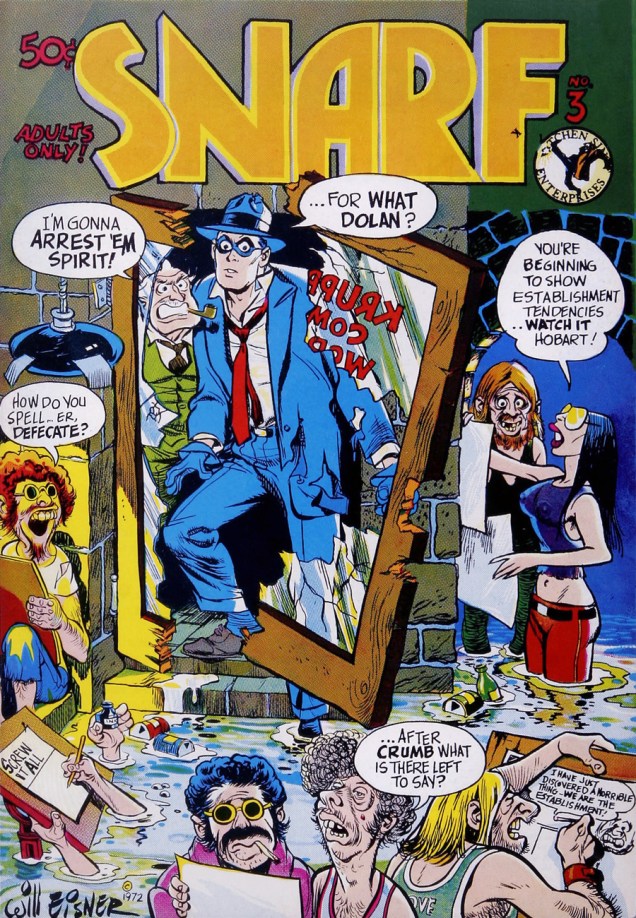
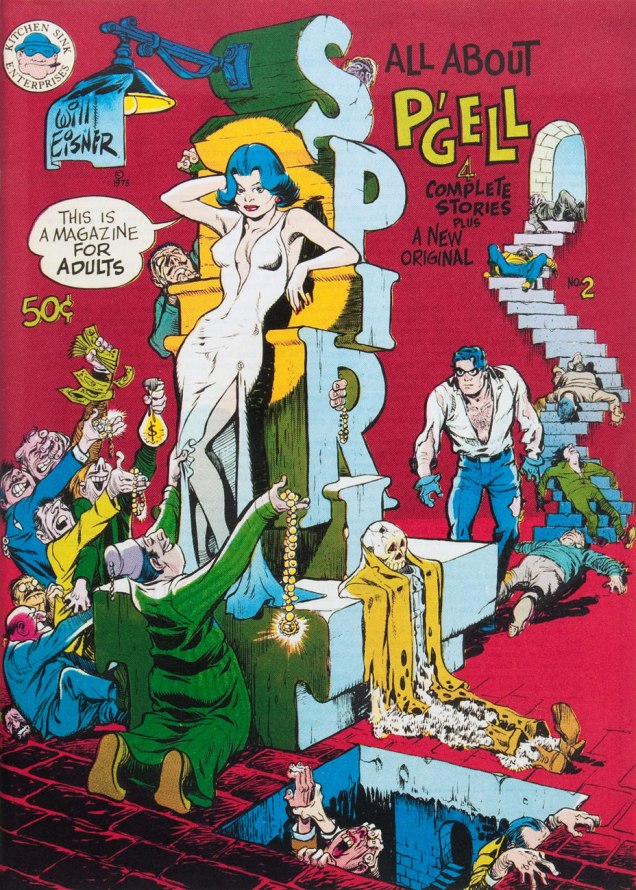
This is Kitchen Sink Enterprises’ Snarfno. 3 (Nov. 1972), featuring an original Eisner cover.Another two-issue run! Kitchen Sink’s The Spiritno. 1 (Jan. 1973), featuring a new cover by Eisner, and precious relics Max Scarr’s Map (Apr. 14, 1946), Caramba (Nov. 10, 1946), Return to Caramba (Nov. 17, 1946), The Rubber Band (June 23, 1946), plus a few brand-new short pieces.Kitchen Sink’s The Spiritno. 2 (Nov. 1973), featuring a new Eisner cover, an original four-pager, The Capistrano Jewels, and, as boasts the cover, all about P’Gell, with Meet P’Gell (Oct. 6, 1946), The School for Girls?? (Jan. 19, 1947), Competition (Aug. 3, 1947) and The Duce’s Locket (May 25, 1947).
Next time out: some interesting times with Warren.
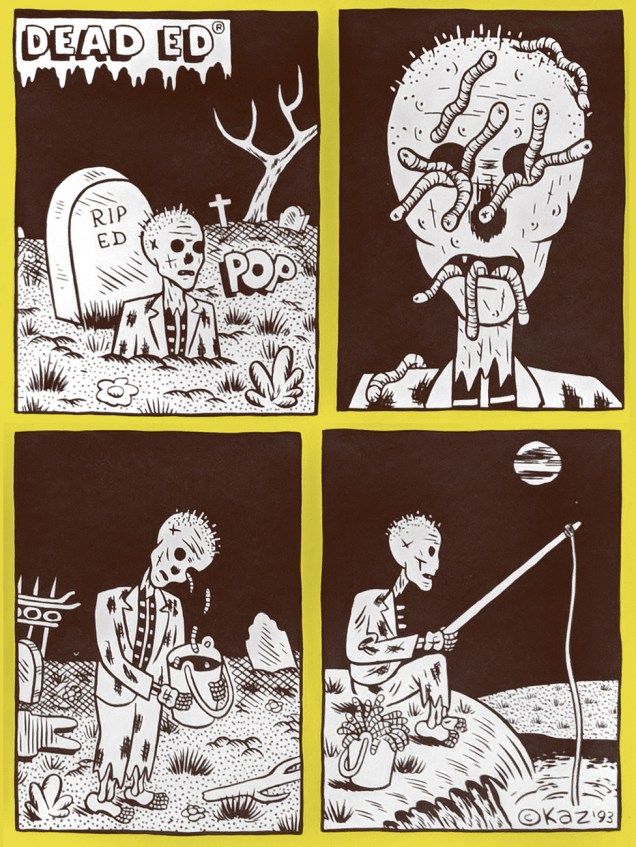
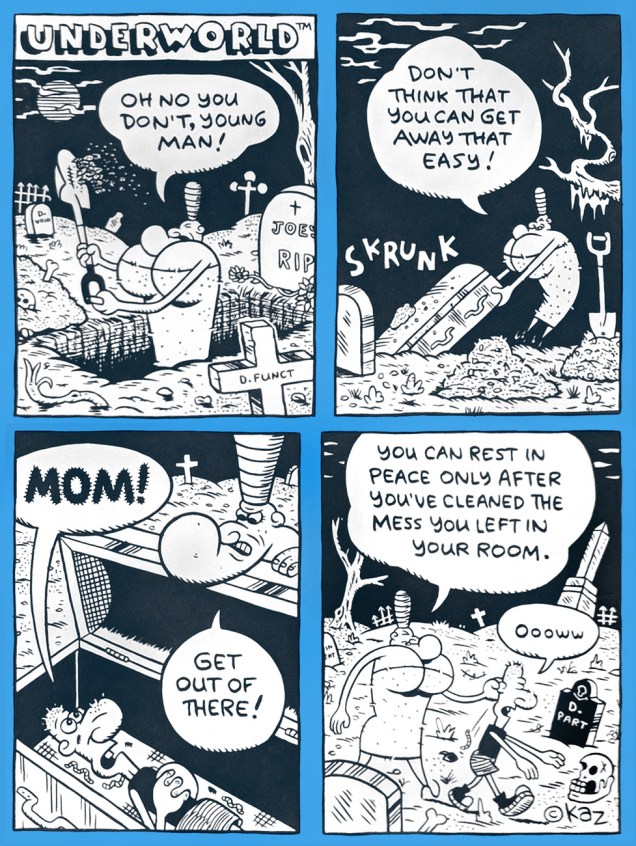
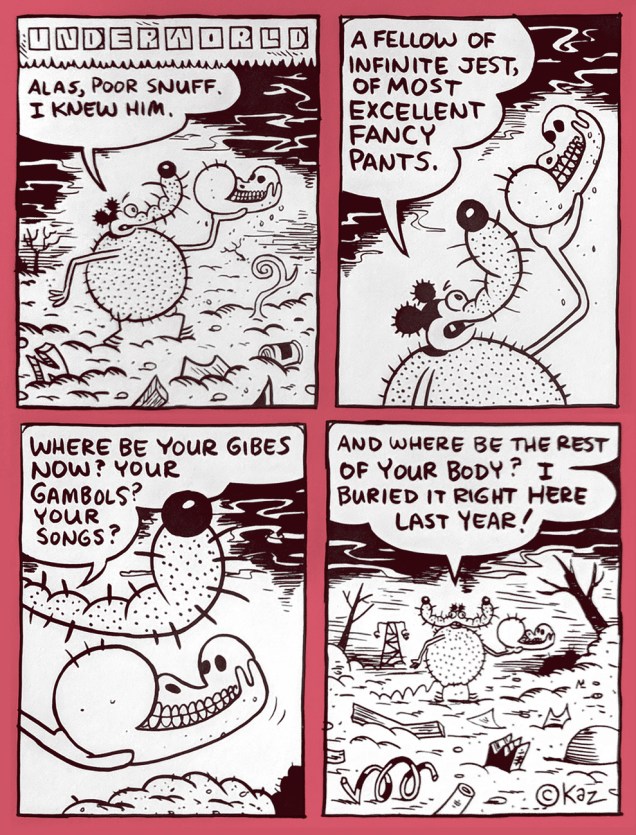
Underworld is the rabid brainchild of American cartoon god (néKazimieras Gediminas Prapuolenis in 1959) alias (for some reason) Kaz. Underworld has been appearing in various alternative weeklies since 1992. But none in my neck of the woods, naturally. Grr.
Fortunately, the discerning folks at Fantagraphics have thus far issued five Underworld collections, plus, a couple years back, an imposing omnibus, each of them wonderful, surreal, morbid and unnaturally comforting. Perfect Hallowe’en reading? You bet. Skrunk!
We have just come back from a lovely vacation in Nova Scotia, one of Canada’s maritime provinces. In the honour of this all-too-short getaway, this Tentacle Tuesday is about Canadian artist Randolph Holton Holmes, who was born in Nova Scotia in 1942 and passed away in British Columbia in 2002, completely at the other end of this big country.
« Rand Holmes was Canada’s most revolutionary artist in his heyday, the star cartoonist at the Georgia Straight newspaper in British Columbia during the 1970s. His hippie hero, Harold Hedd, became the spokesman of the emerging counterculture as he avoided work, explored free love, and flouted drug laws. The Adventures of Harold Hedd spread across the globe in the wave of underground comix and newspapers of the era and Holmes became famous or at least notorious. While his comic character was bold and blatant, the artist was shy and quiet, well on his way to becoming a complete hermit. » (excerpt from Fantagraphics’ The Artist Himself: A Rand Holmes Retrospective)
Glimpsing through Holmes’ body of work, one quickly becomes aware that he displays a special affinity for drawing busty women… and (of more interest to this current post) that he loves to insert tentacles at the drop of a hat, especially if ETs of some kind are involved. A lot of artists use tentacles as a short-hand for aliens, and he’s not alone in that… much to my personal satisfaction.
Slow Death no. 6 (Last Gasp, January 1974). Colonel “Saunders”?Fog City Comics no. 2 (Stampart, October 1978). “Science fantasy at its finest” may be an unfulfilled promise; by all accounts, Rand Holmes’ Killer Planet is the best story of the issue. Fog City Comics was an all-Canadian underground comix anthology and lasted a mere 3 issues.
As I mentioned Holmes’ story Killer Planet, here’s a peek at its manifold tentacles:
A panel from Killer Planet, both written and illustrated by Rand Holmes, originally published in the aforementioned Fog City Comics no. 2, coloured by Bill Poplaski and reprinted in Death Rattle no. 1 (2nd series, Kitchen Sink Press, Oct. 1985).What kind of idiot eats fruit growing on an obviously life-threatening planet? Panels from Killer Planet, both written and illustrated by Rand Holmes, published in Death Rattle no. 1 (Kitchen Sink Press, October 1985).Panels from Killer Planet, both written and illustrated by Rand Holmes, published in Death Rattle no. 1 (Kitchen Sink Press, October 1985). Note the cute mushrooms in the bottom left corner.
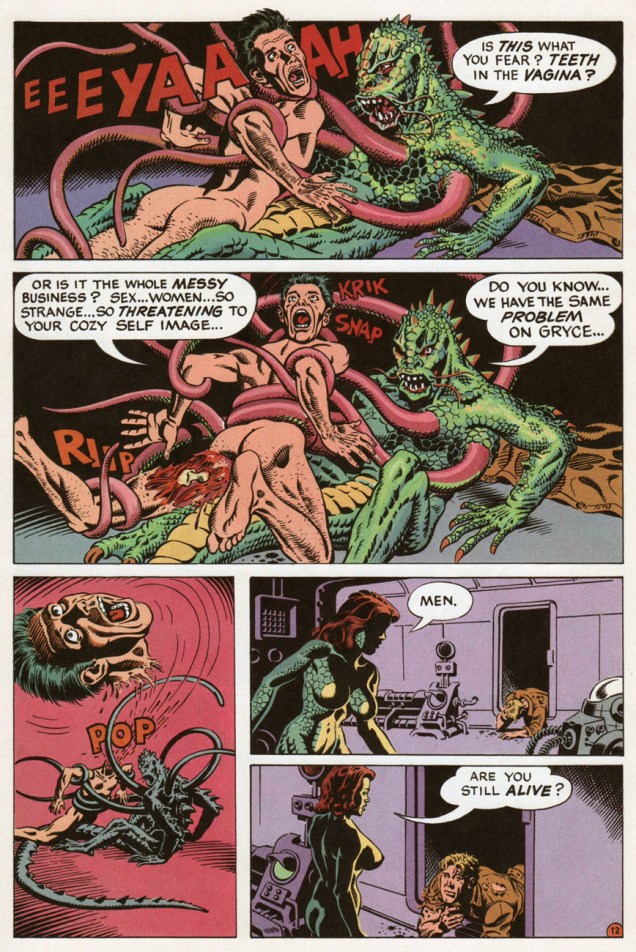
And lastly, for contrast with the cover of Slow Death and its throes-of-ecstasy coupling scene, there’s this:
Vagina Dentata! A page from “Junkyard Dog“, written by Mike Baron. It was published in Death Rattle no. 5 (Kitchen Sink Press, June 1986). The (telepathic) alien female wasn’t unjustified in, erm, chewing up her rapist (the intercourse wasn’t consensual) – he was an unapologetic asshole.
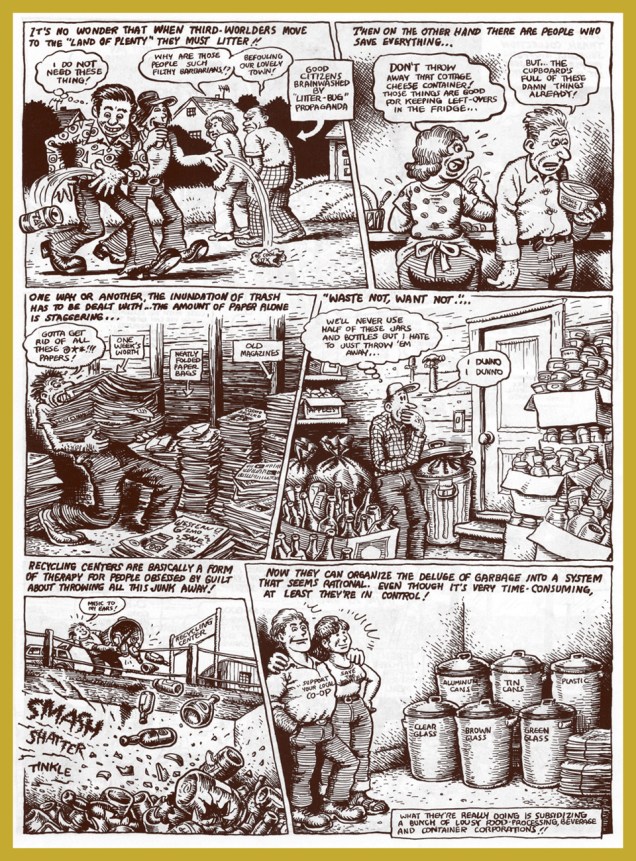
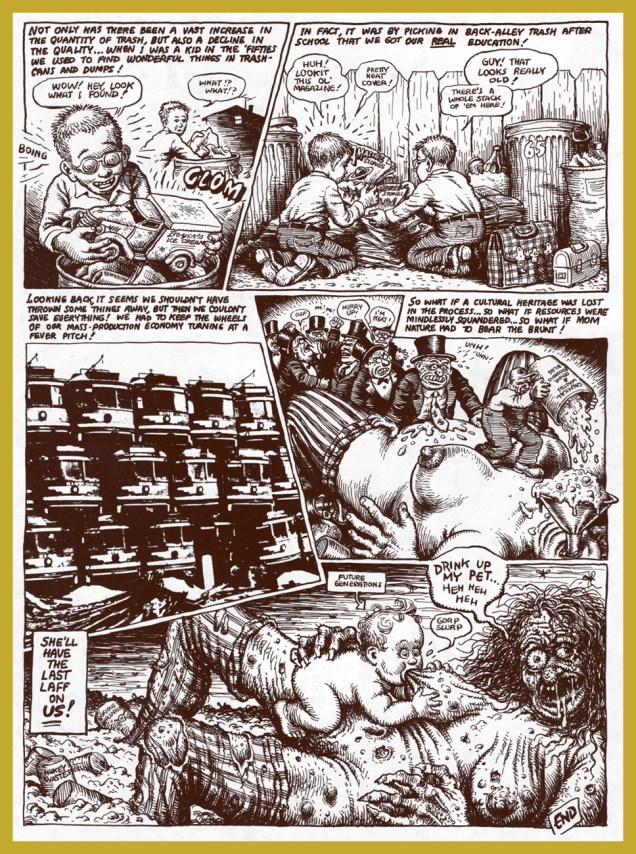
« Maybe we could find some way to send barges of trash to the sun and incinerate it all. Hey, it’s an idea. It’s an idea! » — Adam West
Lately, I’ve noticed that crusty ol’ Bob Crumb is being pilloried… well, more than he usually is. It appears that some members of the, er, younger cartooning generation are taking offense, in the most tone-deaf, irony-deprived and contextually-clueless way imaginable, to a half-a-century old, utterly static, wafer-thin and inaccurate idea of his work. « …old white cartoonists of the most explicitly homophobic, anti-feminist, racist, and controversial comics of 70s/80s ». Funny, I’d say that comment itself is more than slightly racist (not to mention ageist). Guess it’s open season on some targets.
I was going to feature what’s possibly my all-time favourite Crumb story, « The Religious Experience of Philip K. Dick » (Weirdo no. 17, Summer 1986), but lo and behold, it’s already available in full on the philipdick.com site… but as there’s no dearth of first-rate picks, here’s another comics essay from the pages of Weirdo (no. 6, Summer 1982). Please note how fair-minded and even-handed Crumb is here: I’m certainly guilty myself of a couple of the attitudes and behaviours depicted, but since the author’s challenge is so unflinchingly honest, his criticism becomes food for thought. He’s not interested in flattering the comfortable, including, most of the time, himself.
I’ll leave you with some sage words from Alan Moore, who describes the circumstances of his love affair with Angelfood McSpade: « Firstly, and more obviously in the case of this particular image, there was the open sexuality. Not having led a terribly sheltered life, I was familiar with the images of sex to be found in the neighbourhood magazine racks, ranging from Playboy to the Fry-the-Krauts-on-Passion-Bridge ‘Men’s Sweat’ periodicals of the day, to the soft-core titillation of homegrown products like Parade. Judging from the drawings and photographs that graced these magazines’ covers, sex was something that was deadly serious, not to say faintly miserable, smothered as it was in commercial gloss and the self-conscious poutings of the ex-stenographers staked out across the centre spread.
Angelfood was different. She was wearing, in addition to the grass skirt, a big, pleased-with-herself smile rather than the slightly-concussed ‘Just Raped’ look that her cover girl contemporaries were starting to adopt. It was my first taste of the sexual openness of the psychedelic movement, and though it bears little relevance to my overall impression of Crumb’s work, it requires mention in these terms for the personal impact that it had upon me. This is not to say that its effect in other areas was not equally as marked. Sexuality aside, this drawing was subversive.
For one thing, it was subversive in the way it commented upon race. Many cartoonists since Crumb have referred back, ironically, to the stereotyped image of black people that dominated the cartoons of the past, but this was the first time I’d seen it done: the first time I’d seen a cartoon depiction of a Negro so exaggerated that it called attention to the racialism inherent in all such depictions. » (excerpted from “Comments on Crumb”, Blab no. 3, Fall 1988, Kitchen Sink.)
The Old Underground Hall of Legends took some bad hits in 2017, with the losses, within less than a couple of weeks, of Jay Lynch (January 7, 1945 – March 5, 2017) and Mervyn “Skip” Williamson (August 19, 1944 – March 16, 2017). Skip, in fact, would have turned seventy-four today.
Again, we’re dealing with an artist with a long and nomadic career, so it’s best to think small. There’s plenty of excellent, in-depth biographical material on the subject already out there, so I’ll scare up a few scarce items that reflect Skip’s lifelong love of (and involvement with) music.
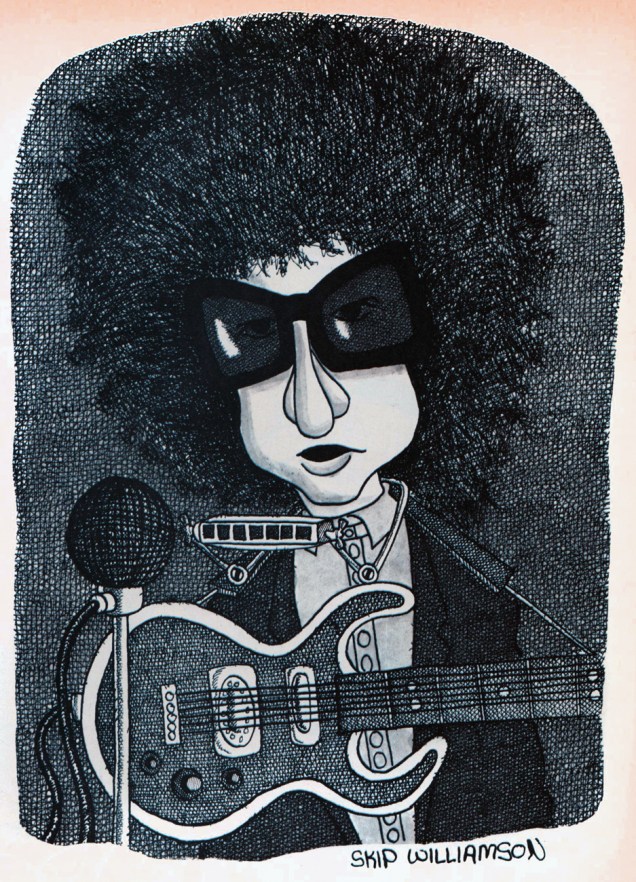
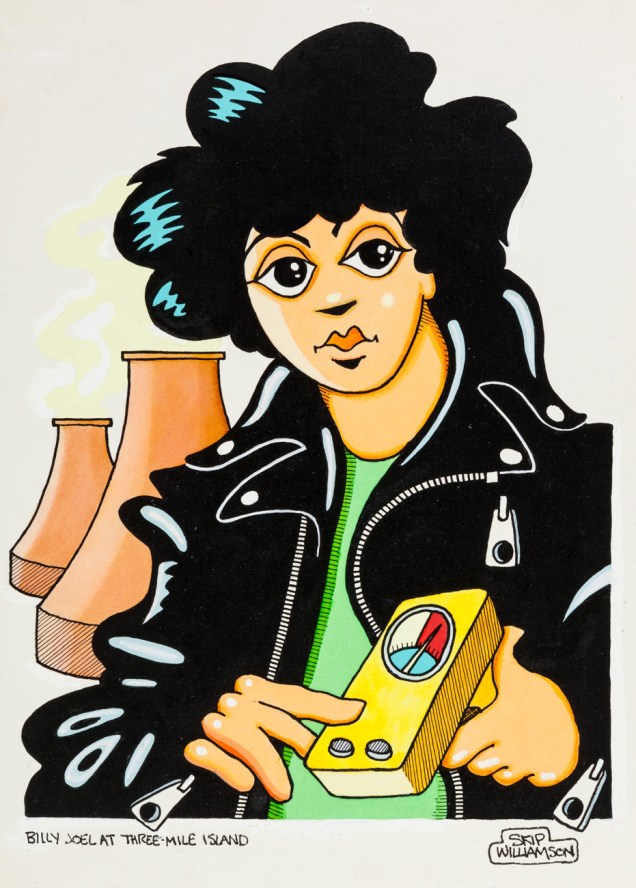
« Right now I’d like to do an original composition which deals with the basic existentialistic thought and parallels between the works of Kafka, Tillich, and Buber in relation to the ‘I-Thou’ concept, and which has just been covered by the Rolling Stones…» Underground comix provocateur Mervyn “Skip” Williamson (born 1944 in San Antonio, TX) takes a witty jab at noted self-mythologist Robert Allen “Bob Dylan” Zimmerman. From the March, 1967 issue of Escapade (incorporating Gentleman!), likely a Charlton Publications product (“Second class postage paid at Derby, Conn.”), a factoid that may someday help you win a bet.« Snuk Comix no. 1 (Skip Williamson, 1970). Extremely rare comic book created for the band Wilderness Road, by Underground Comix artist Skip Williamson. The story is that the printer objected to drug references, and would not deliver the printed comics; Skip managed to grab a few copies before the run was destroyed. As of 2003, only two copies were known to exist; while there have been a few more found since that time, the number of existing copies is staggeringly small… » Typical boorish behaviour on the part of the printer. Most people are unaware of the power that printers held and frequently abused before the salutary advent of digital print. Guys, *first* you nail the printing job (you call that registration?), *then* you indulge in moral grandstanding.1979 original art for a piece Williamson produced for Playboy magazine. « Now what », you may ask « Do Billy Joel and Three Mile Island have to do with one another? » Here’s one account: « Anne had a couple of his 8-tracks, and made plans to see him live at the Hershey Arena during his 1979 tour … plans that were thwarted by a little incident at a nuclear reactor near my home, Three Mile Island. See, when the accident happened, in March of ’79, people had to be evacuated. And those people had to go somewhere. And there just weren’t a whole lot of large buildings suitable for holding thousands of radioactive refugees in the area at that time, so The Hershey Arena had to be put to use, even if it meant canceling a few Hershey Bears games and a Billy Joel concert »
I was too young and in the wrong small town for Underground Comix to reach me back in the 1970s, but when Skip put together the « Playboy Funnies » section (featuring the likes of Bobby London, Jay Lynch, Chris Browne, Art Spiegelman…) for Mr. Hefner’s magazine, I in due course discovered his work since I read Playboy for the cartoons. I immediately took to Williamson’s stylish, bouncy, clean and friendly visuals, paired with his unflagging subversiveness. Not that I got much of said subversiveness at the time… but that’s how it works.
Happy birthday, Skip!
-RG
*Class War (Bijou Funnies no. 3, 1969 The Print Mint)
*That’s Not Safe For Work, for those unfamiliar with the acronym. Turn back while you still can!
We all know that tentacles are often used in comics as a substitute for other, err, organs. Tentacle porn is nothing new. Still, occasionally I stumble upon something that’s just outstandingly odd and perhaps even depraved. Would one be able to find stuff online that’s far stranger and more degenerate? Indubitably. Still, within the context of Tentacle Tuesday, I’d like to think that the following offerings are firmly in the realm of “well, that was strange…”
Our first example of WTF is this cover, drawn by good ol’ William Stout.
Bizarre Sex no. 10 (December 1982, Kitchen Sink Press), cover by William Stout. I imagine the Earthman quivered in horror and became as flaccid as flaccid can be, though who knows what turns people on? The alien creature seems to have its eyes resolutely shut in grim desperation, so perhaps she’s not enjoying it much, either.
« One of the great series in underground history, Denis Kitchen’s Bizarre Sex was launched in May, 1972. One could discern that this would be a “no-holds-barred” type of publication upon perusing the first issue, as the first two stories were about brother/sister incest and interracial homosexuality. Bizarre Sex became best known for issue #9, which introduced Omaha the Cat Dancer with a story that took up the whole book. After another appearance in Bizarre Sex #10, Omaha moved on to its own successful serial. The great thing about Bizarre Sex is the series matured through the years, evolving from a comic book about atypical sex into more of an in-depth review of sexual relations and the human condition. »
As this is no. 10, the last issue of Bizarre Sex, presumably that “in-depth review of the human condition” part is applicable here. The cover could have fooled me… If anyone out there has read it, do let me know!
Chester Brown has always been one sick puppy. If by now his work is creepy and boring, back in the earlier days of his career, his stories were often fascinating… for those of us who enjoy a good mindfuck and have a strong stomach, that is. As for me, I never liked his stuff: far too disturbing, in a viscerally-uncomfortable kind of way. A good demonstration of his typical sense of humour is the following 2-pager with a characteristic blend of onanism, body fluids and irony. This instalment of Adventures in Science was published in Yummy Fur no. 4 (1984).
A little bit of comic relief: a cartoon from “How the Animals Do It” by Larry Feign. Make sure to visit this page for a little video preview of this book: a little animated tale of the barnacle’s super long penis and what s/he does with it, including the brilliant quote « if no resistance is met, in it goes ».
Okay, I’ll bite. Why did the chicken cross the road? Why did the male octopus lose an arm due to sexual promiscuity?
« Male octopuses have a big problem: female octopuses. Each male wants to mate and pass on his genes to a new generation. The trouble is, the female is often larger and hungrier than he is, so there is a constant risk that, instead of mating, the female will strangle him and eat him. The males have a host of tricks to survive the mating process. Some of them can quite literally mate at arm’s length. Others sneak into a female’s den disguised as another gal, or sacrifice their entire mating arm to the female and then make a hasty retreat. » [source: Mystery of Cannibal Octopus Sex ]
Next time we encounter difficulties with our romantic entanglements, let’s remember not to complain.
Our last entry is a little more standard from the perspective of shokushu goukan. The blend of sex-and-religion is also nothing new, although some people seem to be labouring under the impression that it still has some sort of shock value in this day and age (My sleazy ex-boss from the framing store, I’m looking at you.) However, I think these scaly tentacle-penises are a reasonably original take on the theme, and I also like the choreographed sisters, who seem to be doing some sort of interpretative dance while a-waiting to be ravaged.
Page from The Convent of Hell (published in Spanish in 1987, in English in 1998), written by Ricardo Barreiro and illustrated by Ignacio Noé.
You can read the whole thing here – very NSFW, obviously.
« … and now for some of that fun we promised you! Trained chihuahas! Car races! A couple of inspirational documentaries! And a quiz show! Hallelujahgobble! Hallelujahgobble! »
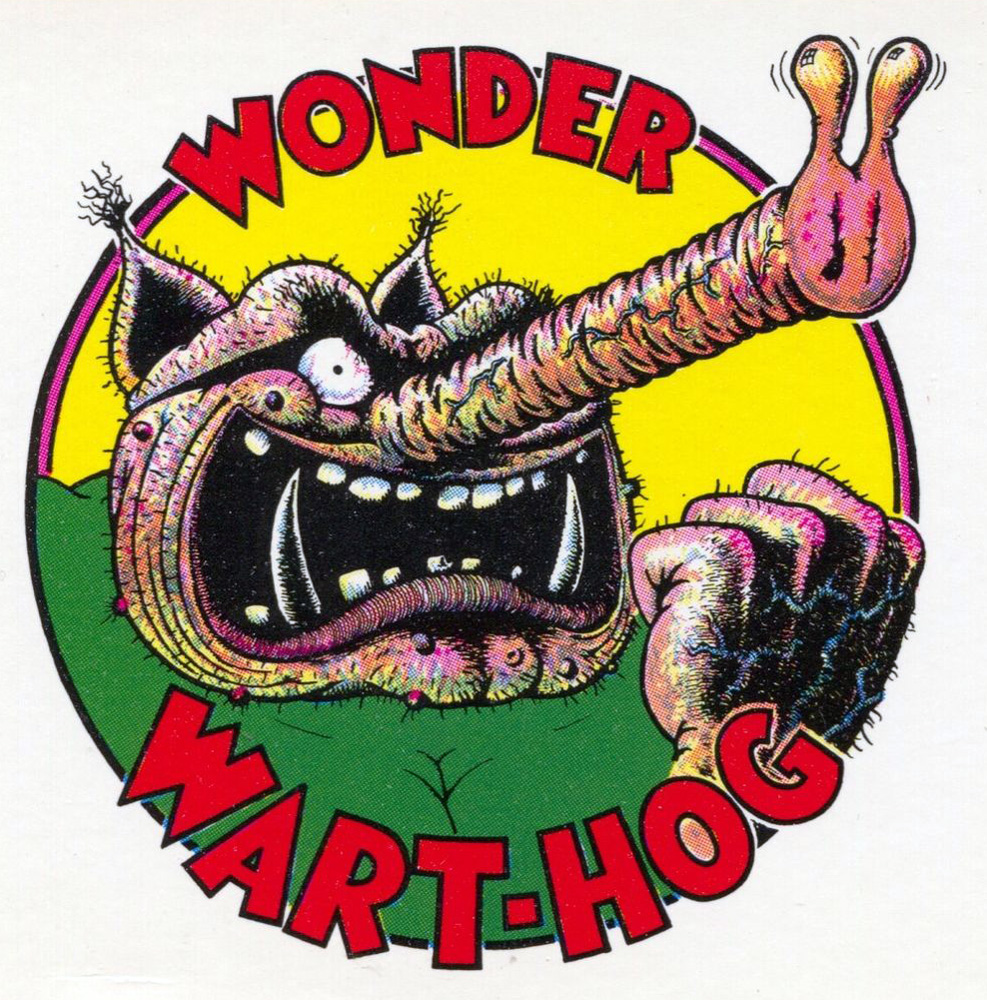
For my money, there’s no funnier man in comics, at least on such a consistent, sustained level, as the extraordinary Gilbert Shelton (born May 31st, 1940, in Houston, TX, which makes him 78 today). Sure, he’s slowed down some since 1959 (the year he foisted upon the world the Wonder Warthog), but the quality of his output has not decreased one iota (quite the contrary, in fact!) It may well be that the secret of his longevity lies in his choice of collaborators, but as far as I’m concerned, that’s just another facet of his talent. I’ll (mostly) let the man’s work speak for itself. Brace yourselves for the ride, here we go!
Enter a captionYeah, that old hippie shit’s totally dated; this has nothing to do with American’s current socio-political situation. Well, it would be nice if Amtrak’s trains ran a bit closer to schedule. This ran as the back cover of « Wonder Wart-Hog and the Nurds of November: Gilbert Shelton’s Exciting Cartoon Novel of Election-Year Politics, International Nuclear Terror, Professional Football, Science Fiction, Motorcycle and Auto Racing, Pestilence, Famine, Economic Collapse and Romantic Love. » (1980, Rip Off Press)
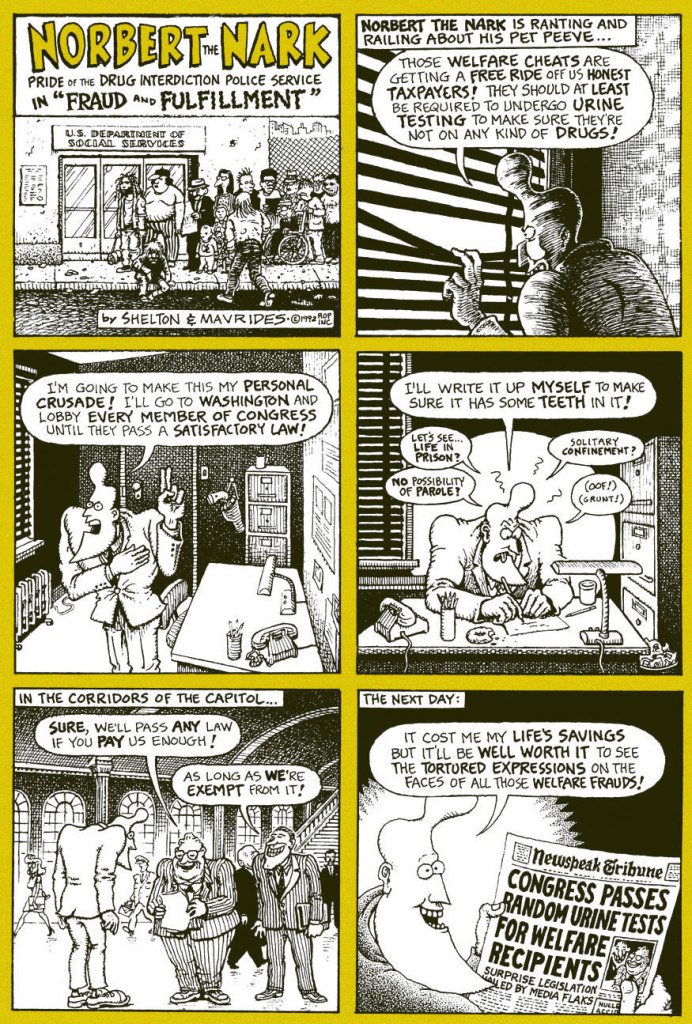
The Brothers’ none-too-effective nemesis Norbert the Nark in the spotlight. From The Fabulous Furry Freak Brothers no. 12 (1992, Rip Off Press).
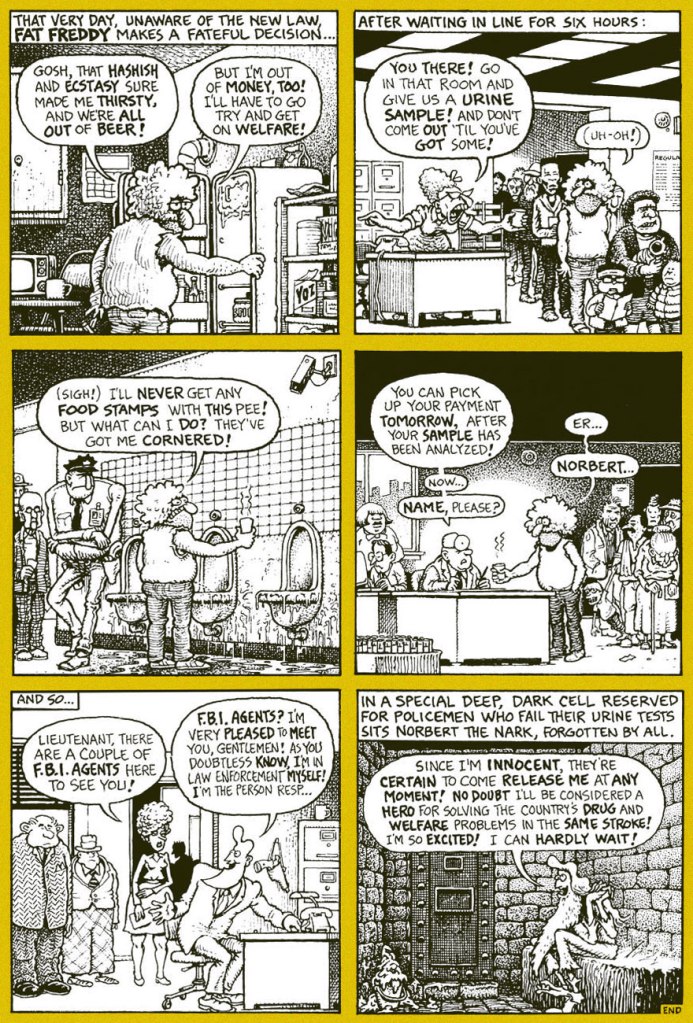
Fat Freddy’s such a good little Suzie Homemaker. Another piece from The Fabulous Furry Freak Brothers no. 12 (1992, Rip Off Press).
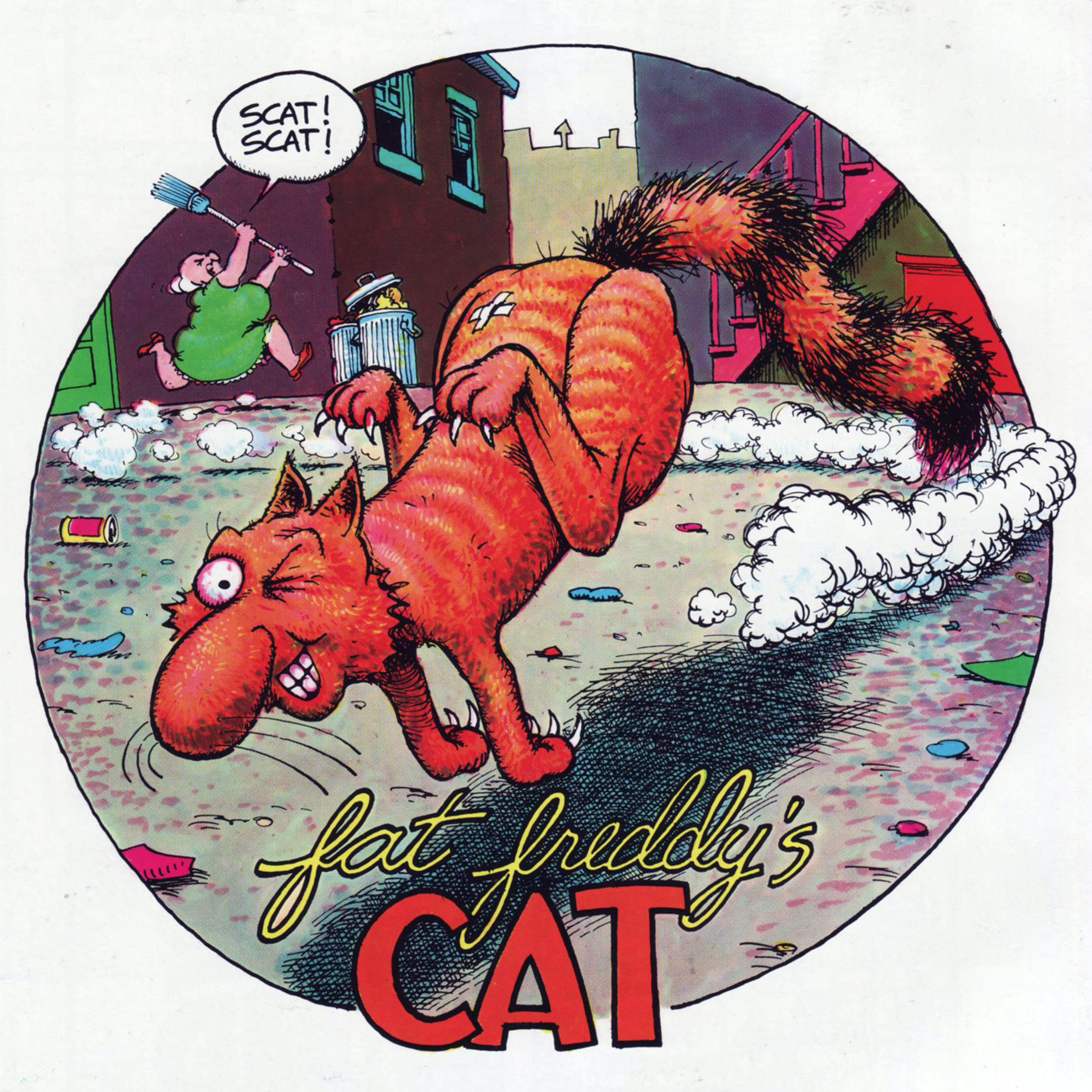
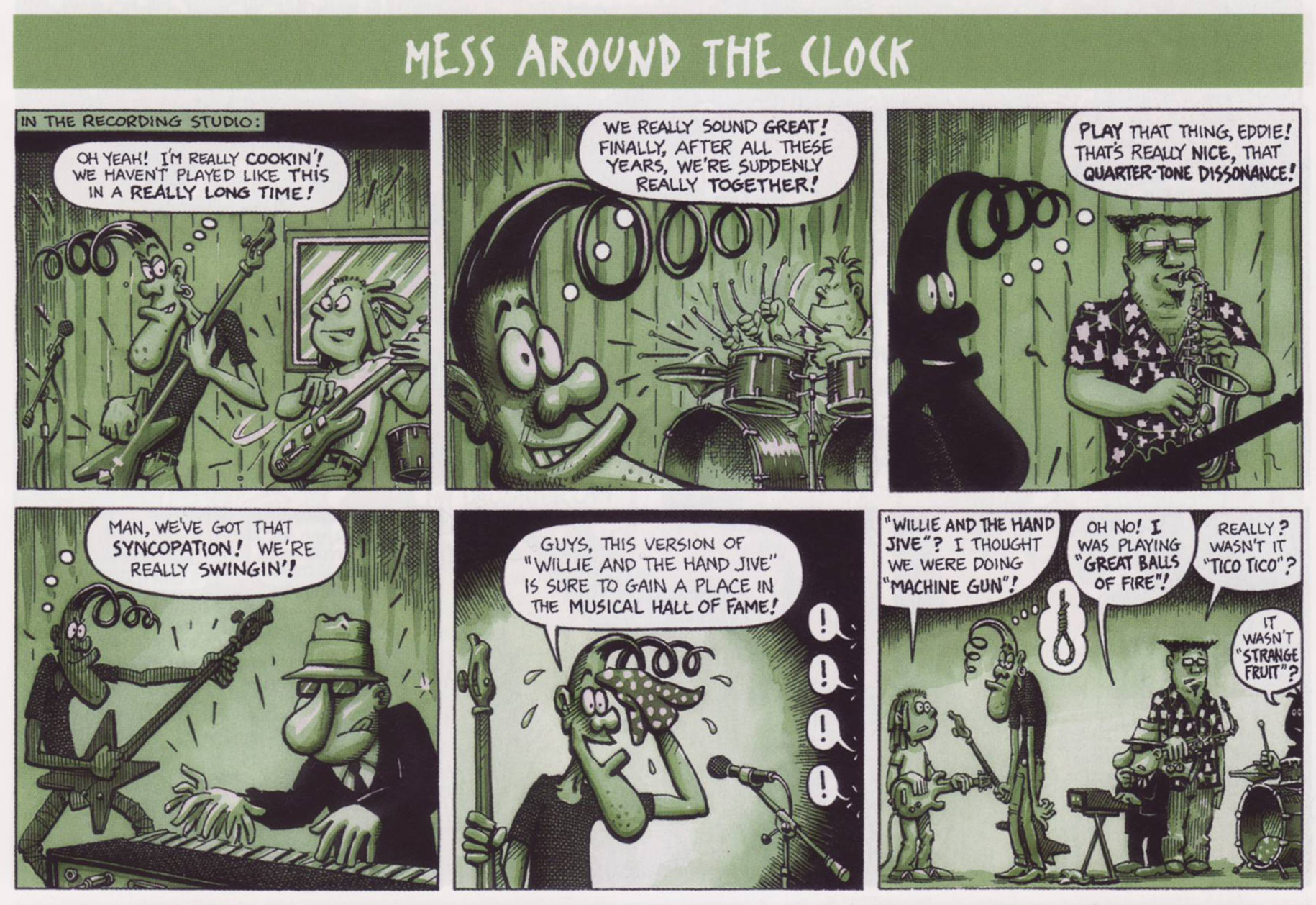
The toilet-training method reportedly works, but it helps to have more than one toilet available. From Fat Freddy’s Cat no. 7 (1993, Rip Off Press)Shelton’s most recent major creation, circa 1988-89, is Not Quite Dead, “the world’s oldest and least successful Rock ‘n’ Roll band”. So far, we’ve been treated to six issues, and the latest, “Last Gig in Shnagrlig” (2009), is quite the epic! A fruitful collaboration with French bédéiste Denis Lelièvre, alias Pic. These vignettes hail from Not Quite Dead no. 5 (2005, Knockabout)Aw, ain’t he adorable, and don’t you just wanna slip the birthday boy a big ol’ sloppy smooch? Photo by Christophe Prébois.
Speaking of collaborators, though it’s none of their birthdays, let’s give a salty salute to Shelton compadres-in-crime Tony Bell, Joe E. Brown Jr., Dave Sheridan, Paul Mavrides and Pic. Did I forget anyone?
-RG
« Last year I went fishing with Salvador Dali. He was using a dotted line. He caught every other fish. » — Steven Wright
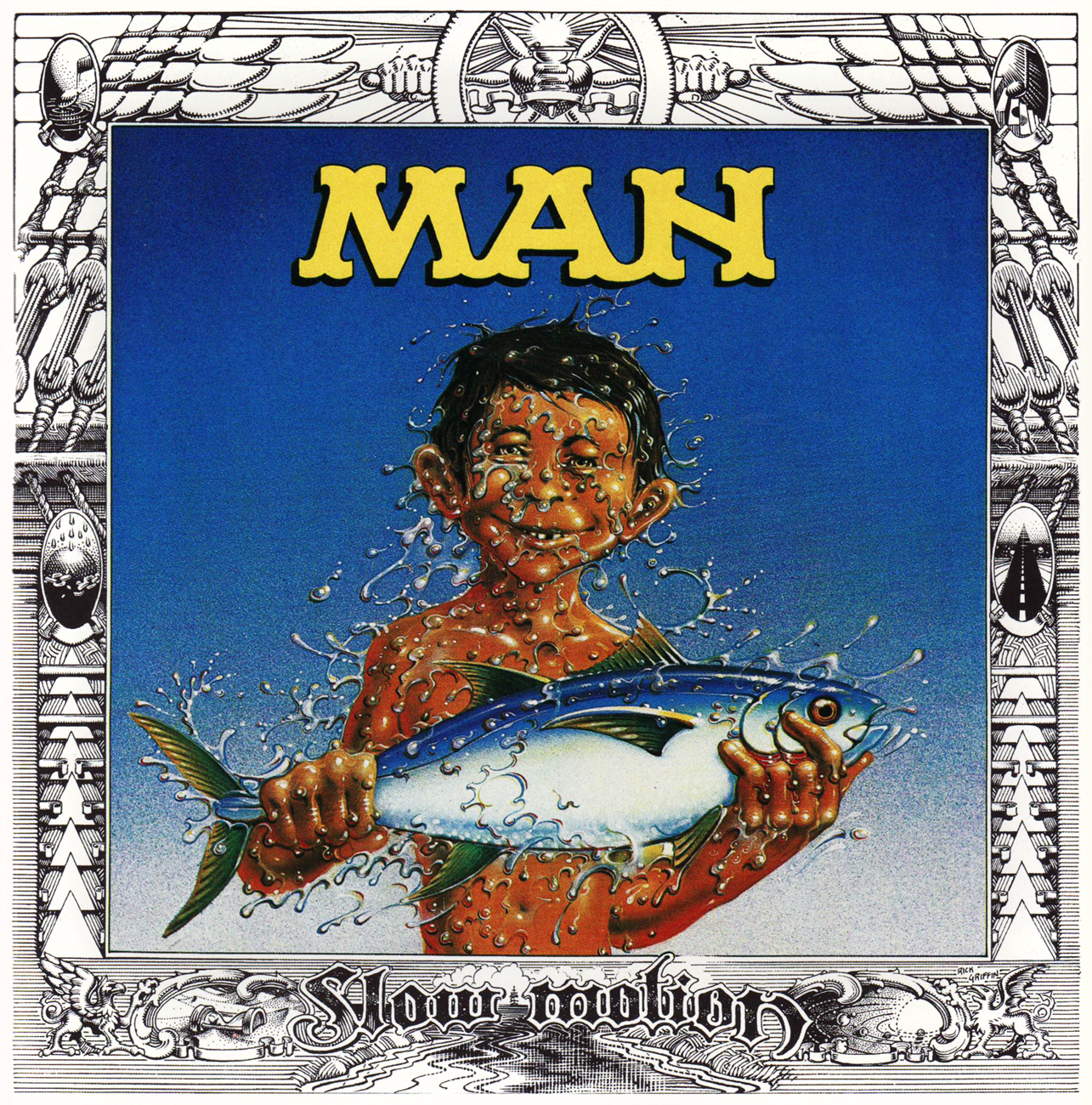
In 1974, prodigious underground cartoonist Rick Griffin was commissioned to design a cover for Welsh rockers Man’s ninth opus… and this is what he came up with.
The original version of Griffin’s proposal, cheekily titled « The Baptism of Alfred E. Neuman. »
While the image of the grinning fool popularly known as Alfred E. Neuman was, and remains in the public domain, Griffin was really pushing his luck, even without MAD Magazine’s distinctive typeface on bold display. Let’s just say William M. Gaines’ lawyers had far more than a leg to stand on.
Understandably reluctant to let such a lovely *and* provocative work of prime Griffin altogether go to waste, Man (and their legal counsel, presumably), engineered a clever and elegant design solution, shown below, which graces the band’s Slow Motion album, issued in late 1974, and still thumbs its nose at MAD Magazine, exceptionally cast in the thankless rôle of the fuddy-duddy villain.
However, here’s an account — circa 2023 — I recently discovered that casts the matter in a whole new light: « John Peel made ‘Day and Night‘ his Single of the Week in Sounds, but it was the album cover that attracted most comment. American counterculture artist Rick Griffin had come up with a design that prominently featured Mad magazine character Alfred E. Neuman, only for the cover to be subsequently cropped so that Mad’s cover boy was merely a peripheral presence. For years it was claimed that Mad had refused permission for Neuman to be shown, but it now appears they had actually given tacit verbal approval, and that it was the record company, United Artists, who made an executive decision to censor the design without contacting the magazine. »
This illuminating bit appears in David Wells’ (of Cherry Red Records) exhaustively researched — and exquisitely written — liner notes to Grapefruit Records’ Patterns on the Windows: The British Progressive Pop Sounds of 1974 boxed set. Recommended, as is the rest of this chronological series.
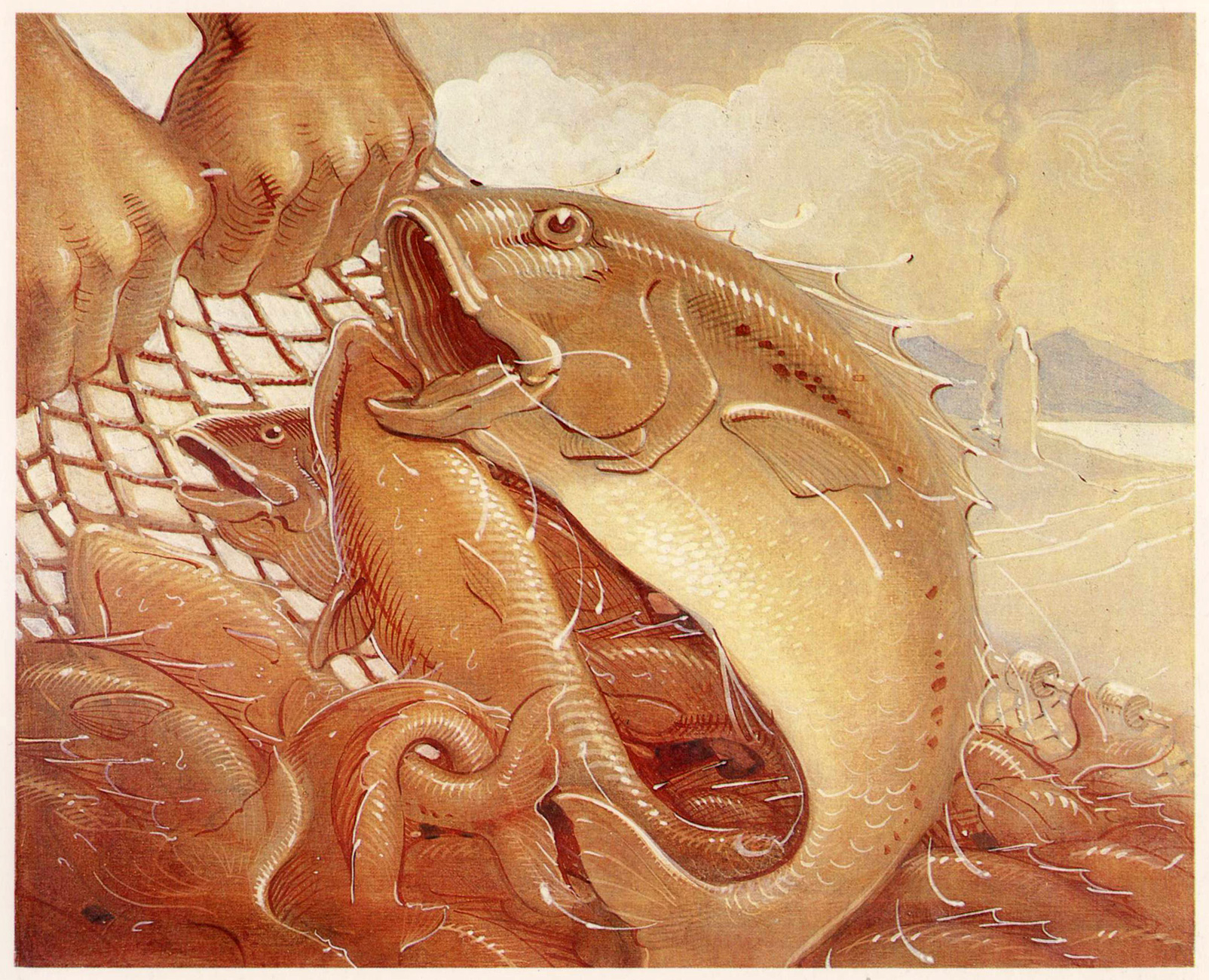
As a born-again Christian (circa 1970) *and* surfer, it follows that fish were, topic-wise, a natural fit for Griffin.
A painting from Griffin’s foremost undertaking of the 1970s, « The Gospel of John » (available to this day!); this one illustrates John 21:6, « And he said unto them, cast the net on the right side of the ship, and ye shall find. They case therefore, and now they were not able to draw it for the multitude of fishes. »
For the record, I prefer my fish alive and swimming free.
It pays to be kind to your cat, particularly if said feline happens to be more than your match. Between dimwit Fat Freddy Freekowtski and F. Frederick Skitty, esq., it’s clearly no contest.
This electrifyin’ strip first saw print in Rip Off Comixno. 23 (Rip Off Press, Summer 1989). Script and art by Gilbert Shelton.
A closer look at the wily furball, cover detail from The Fabulous Furry Freak Brothers no. 6 (Rip Off Press, 1980)

























 Who's Out There?