Hallowe’en Countdown VIII, Day 29

« There’s a saying among prospectors: ‘Go out looking for one thing, and that’s all you’ll ever find. » — Robert J. Flaherty

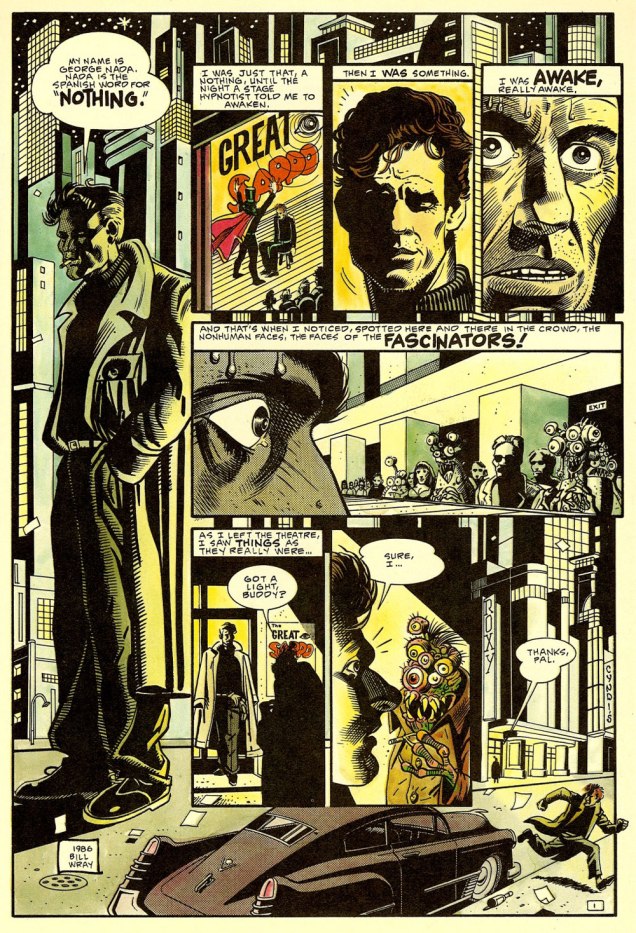
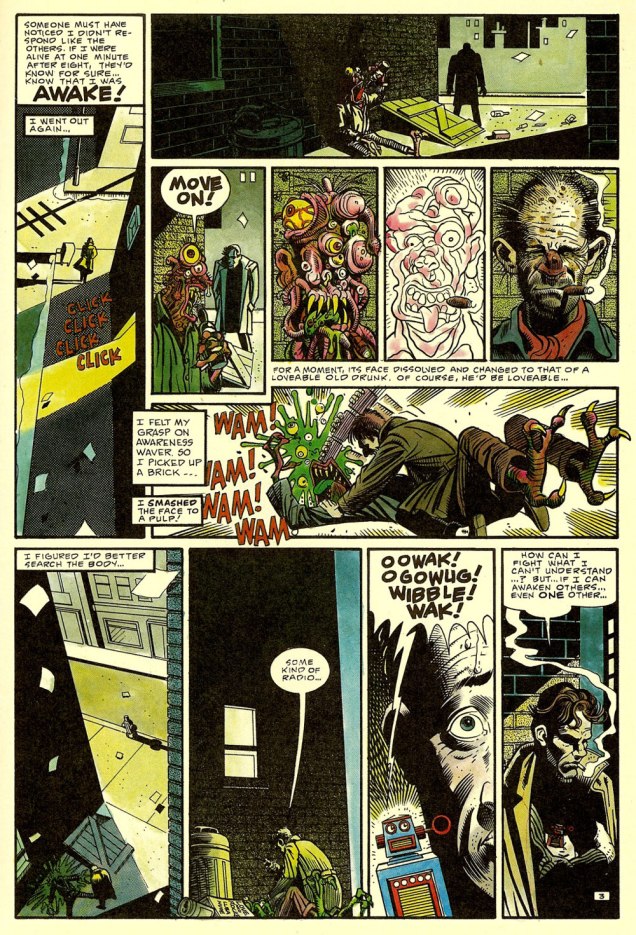
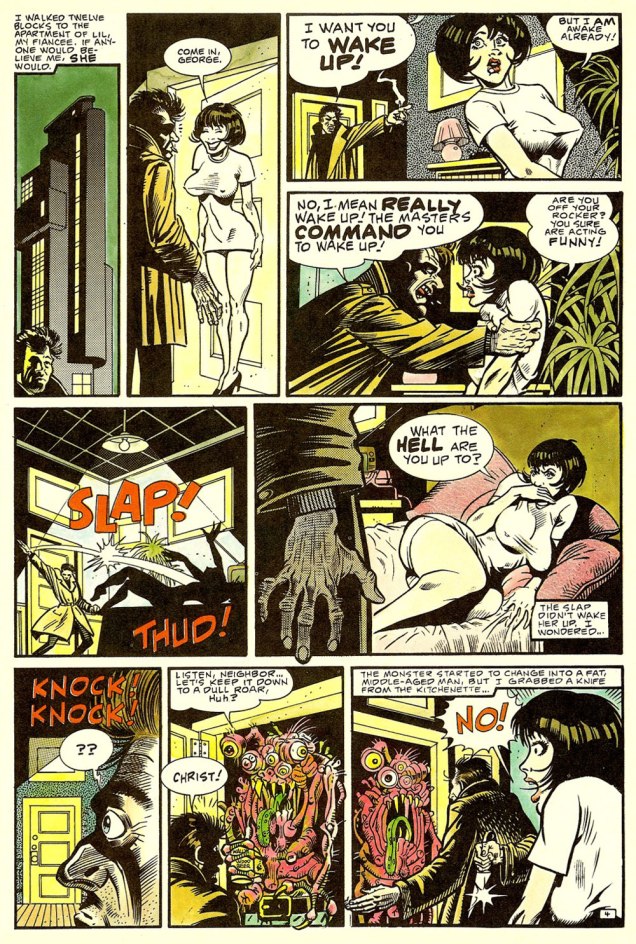
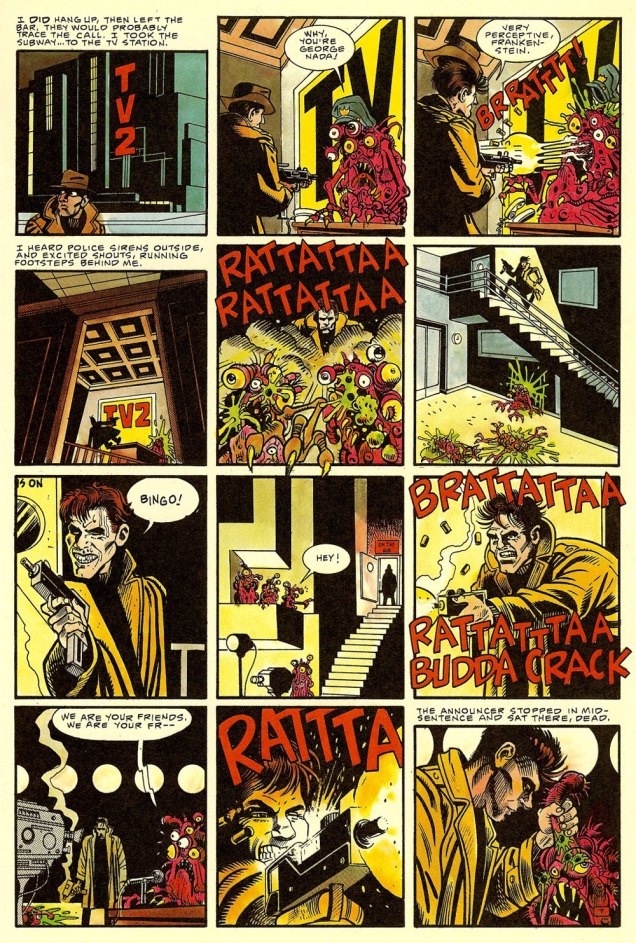
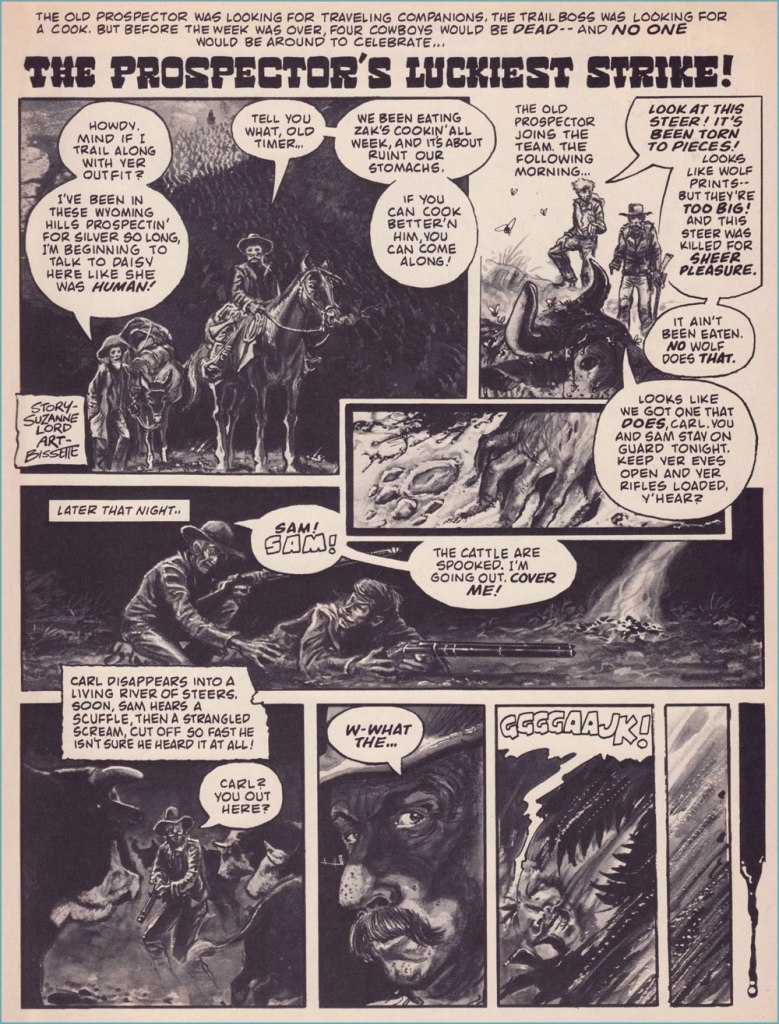
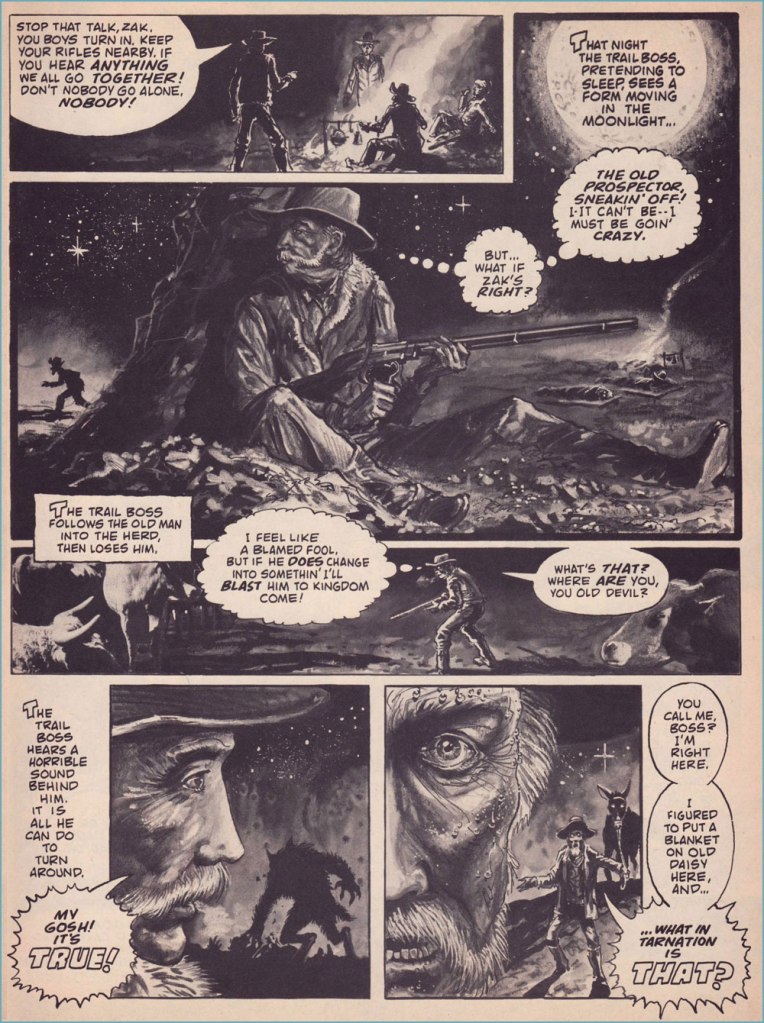
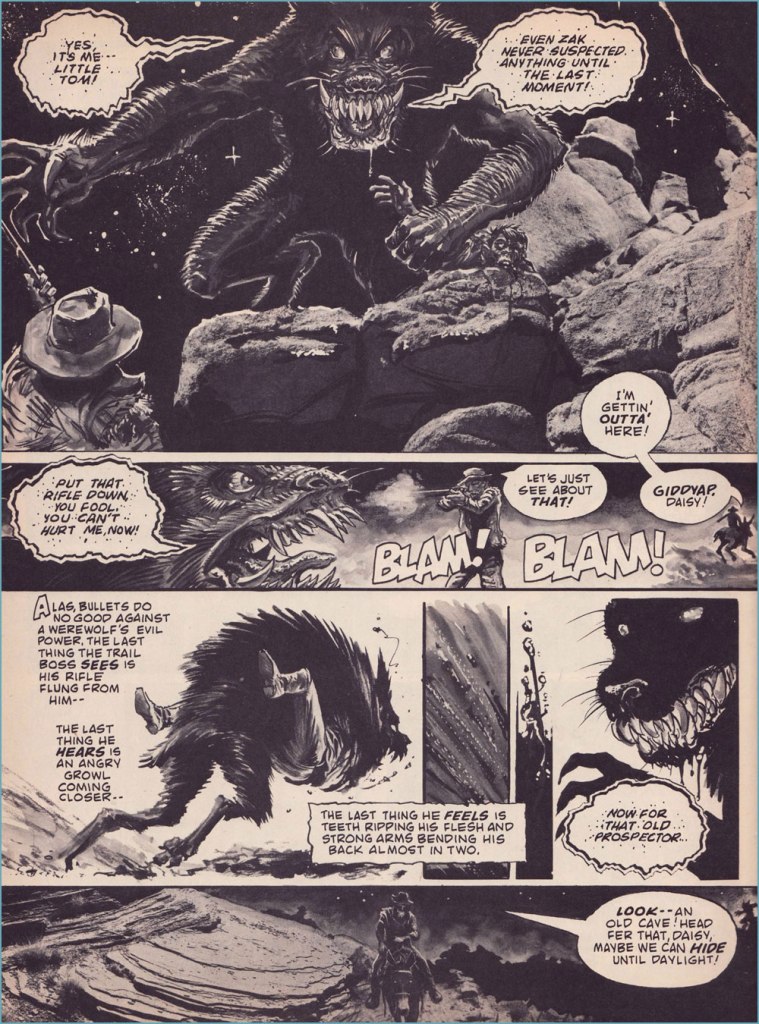
Here’s a rarely-seen Stephen R. Bissette gem, The Prospector’s Luckiest Strike! I wasn’t aware of its existence until recently, when I chanced to purchase an issue of Scholastic’s Bananas devoted entirely to comics. It turned out to hold a pair of Bissette aces, the other being A Toast to Mr. Dalyrimple!. I wondered why these dark lovelies had been left out of Eclipse’s 1985-86 Fearbook and Bedlam, collections of Scholastic material. Were they too recent?

As it turned out, these remaining tales were soon gathered in a one-shot anthology entitled Deadtime Stories (Nov. 1987) published by the short-lived New Comics Group (1987-1989).

Note the discreet, elegant use of photo backgrounds here and there.

I turned to the artist for his recollections, which he most generously provided:

« Scholastic Magazines was one of the luckiest strikes I ever had in my early freelance career, that’s for sure! Between the generous page rates (best I’d earned from any publisher at that time, better even than Heavy Metal), the very kind people I was fortunate enough to be working with—editors Bob and Jane Stine (Bob was later better known as R.L. Stine, author of the Goosebumps empire), art director Bob Feldgus, writers like Suzanne Lord, and everyone at Scholastic at that time—and the frequency of steady freelance assignments from them, I couldn’t have hallucinated a better, more rewarding work relationship or environment in my wildest dreams.

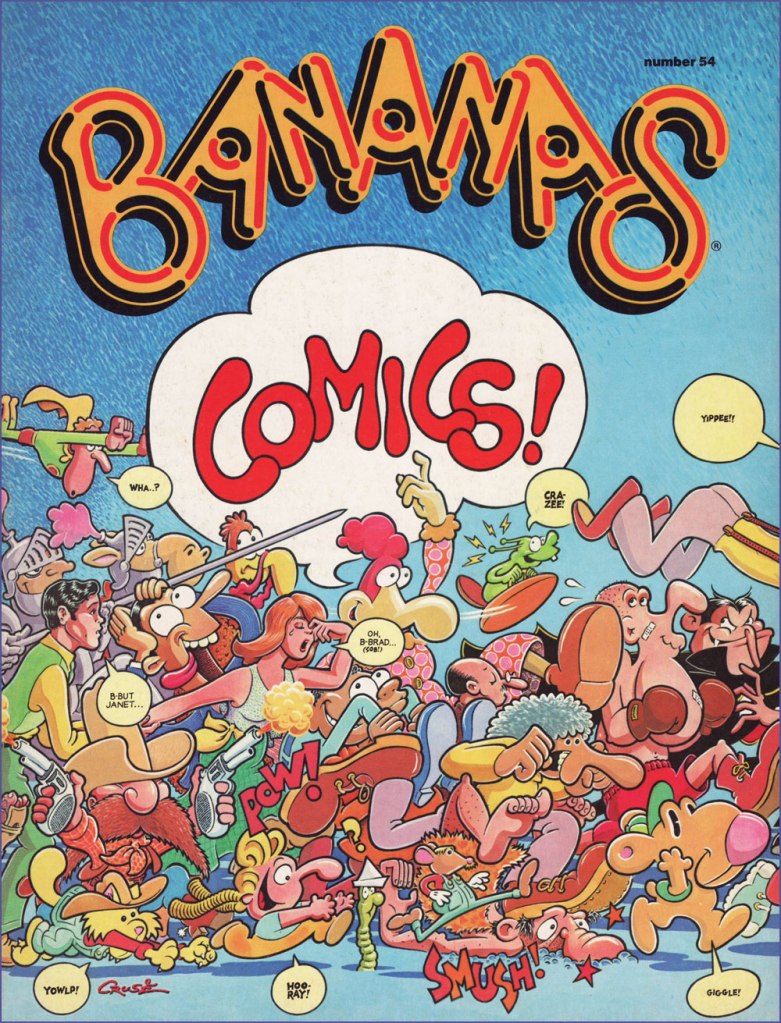
The Prospector’s Luckiest Strike” was late in the game for me, among the Suzanne Lord scripts I was assigned, and I gave it my all for a variety of reasons. First of all, it was exciting to be invited to contribute not one but two stories to the “all comics” issue, and even more exciting because of my friend Howard Cruse doing the cover and a one-pager, closer-still friends Tom Yeates, John Totleben, and Rick Veitch also contributing top-notch work, and Alyse Newman, Bob Taylor, and John Holmstrom (hey, I was a fan of Punk Magazine) also in the lineup. It was an unusual venture and sounded like a great issue, and Bob, Jane, and Bob F. were so enthusiastic about doing it — well, that was contagious. 

The issue in question, with its rollicking Howard Cruse cover.

The deadlines were tight, and I’m not entirely happy with my second story in the issue (Rick Veitch still mocks my splash page for “Mr. Dalyrimple,” justifiably so), but “Prospector’s Luckiest Strike” turned out to be one of my best jobs for Bob, Jane, and Bob. 

It was, sadly, also among the last. Bananas #54 came out in 1982, if memory serves, and I was amid a really screwy project with Marvel at the time (the never-completed, never-published Titan Science Project), and one year later I was both a new father (our firstborn, Maia, born at home April 1983) and working on my first collaborative Saga of the Swamp Thing issues, major life changes, to say the least. »

A huge thank you to Mr. Bissette for his generosity and insight!

-RG

Hallowe’en Countdown VII, Day 29

« Life is like a maze in which you try to avoid the exit. » — Roger von Oech

Some time in the late 1980s, a friend handed me a book, challenging me — I guess — to “see if I could work out the solution.”

He had, however, misread me: altogether lacking that flavour of ambition, I wasn’t in the slightest interested in solving the riddle. Instead, I was quite content to wallow in the uncanny ambiance and enjoy the stunningly wrought textual clues.

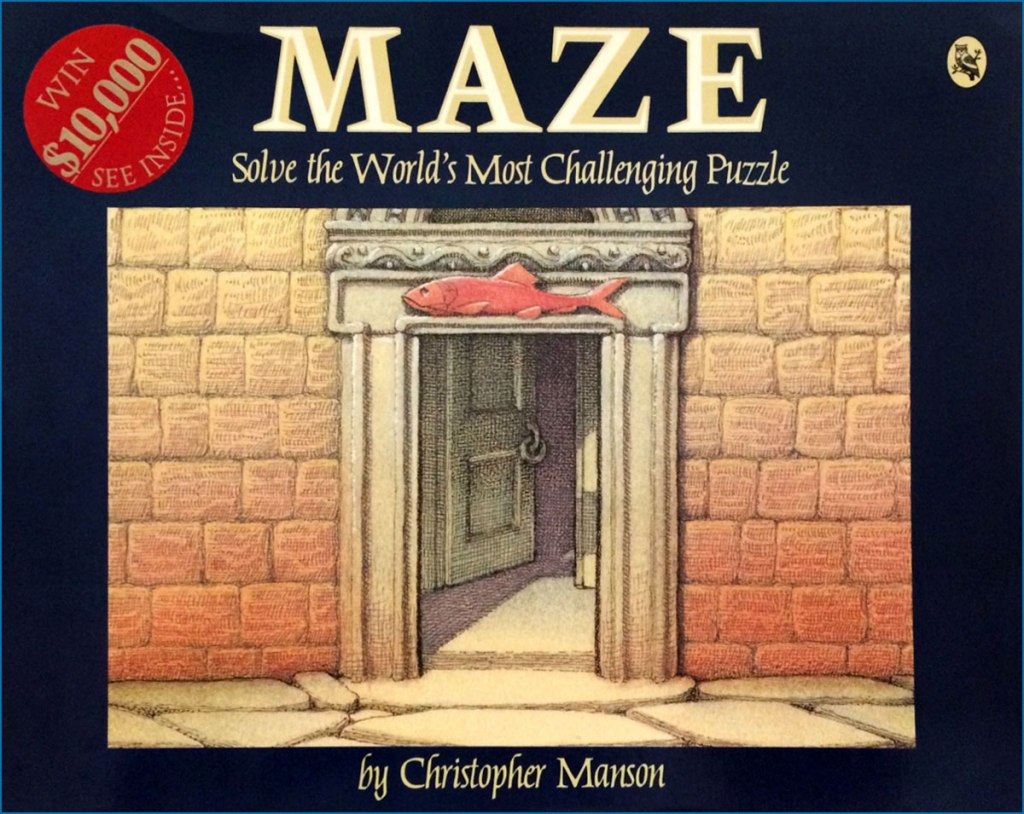
This is Maze (1985, Holt, Rinehart and Winston), written and illustrated by Christopher Manson; Amy Hill, designer.

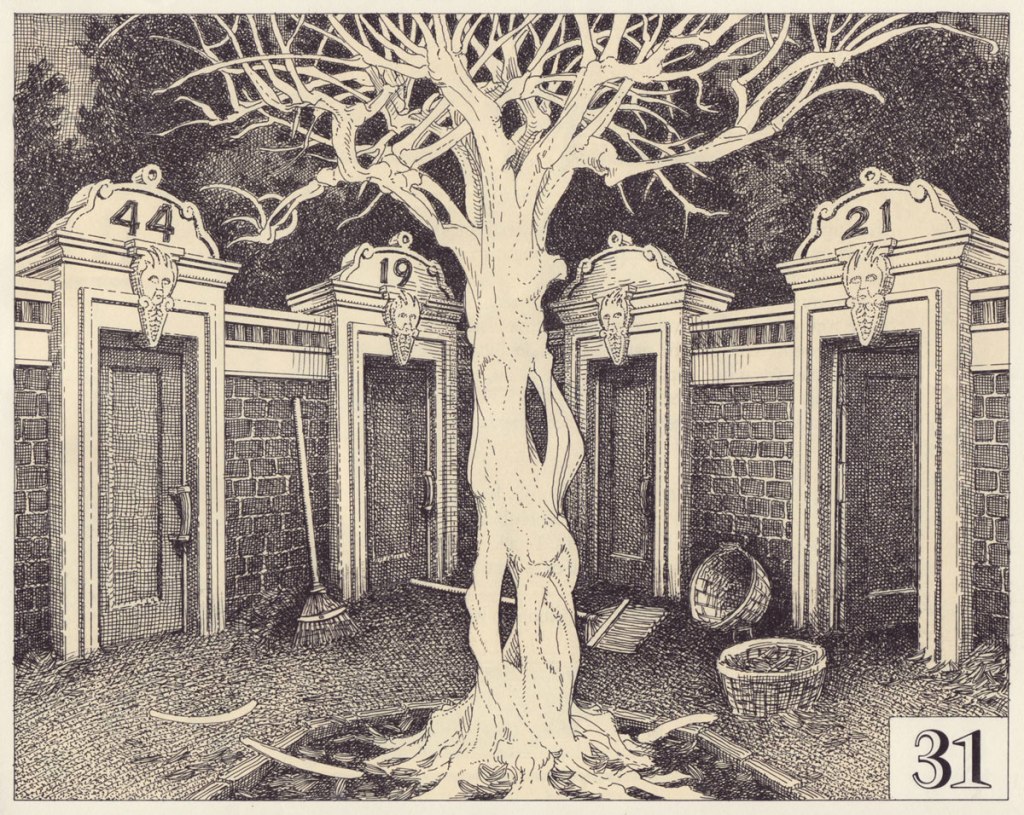
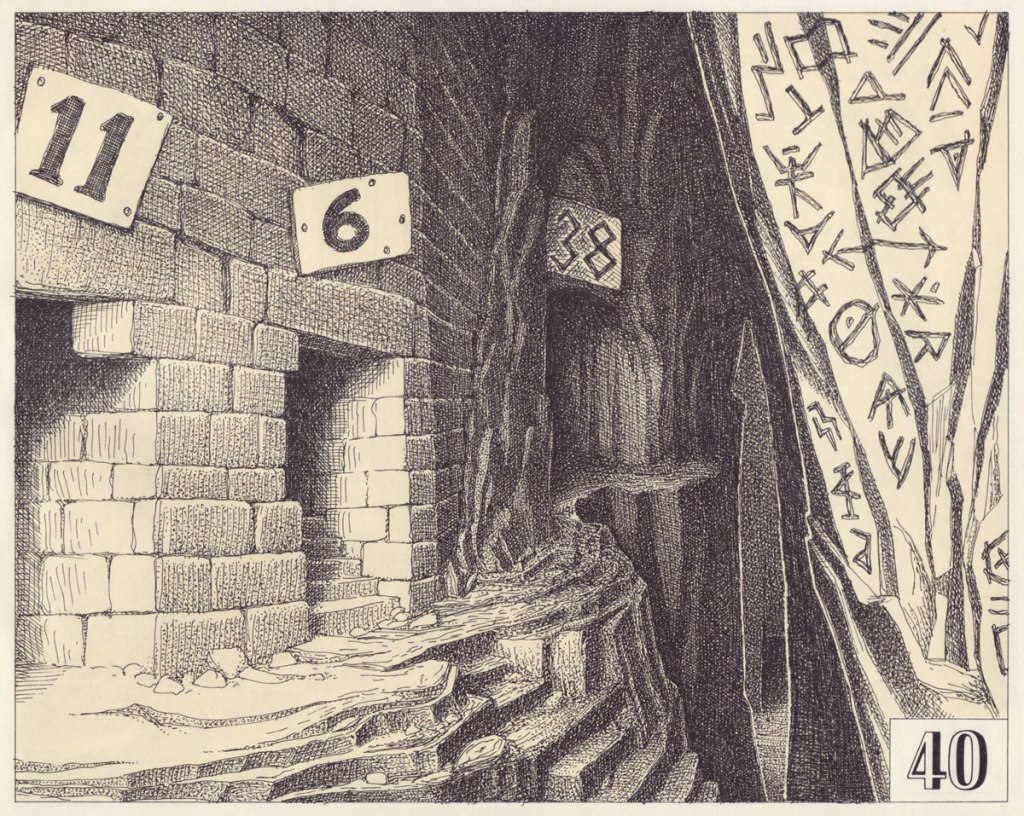
« This is not really a book. This is a building in the shape of a book… a maze. Each numbered page depicts a room in the Maze. The doors in each room lead to other rooms. For example, the room on page 1 has doors leading to rooms 20, 26, 41, and 21. To go through door number 20, simply turn to page 20. Your challenge is to find your way from room 1 to room 45 and then back to room 1 using the shortest possible path. If you use your head, you should be able to make the journey in only sixteen steps. »

« … a gloomy, cavelike place far underground. Even I was oppressed by the weight that hung over our heads. A very small hole, high above, admitted a feeble light. »
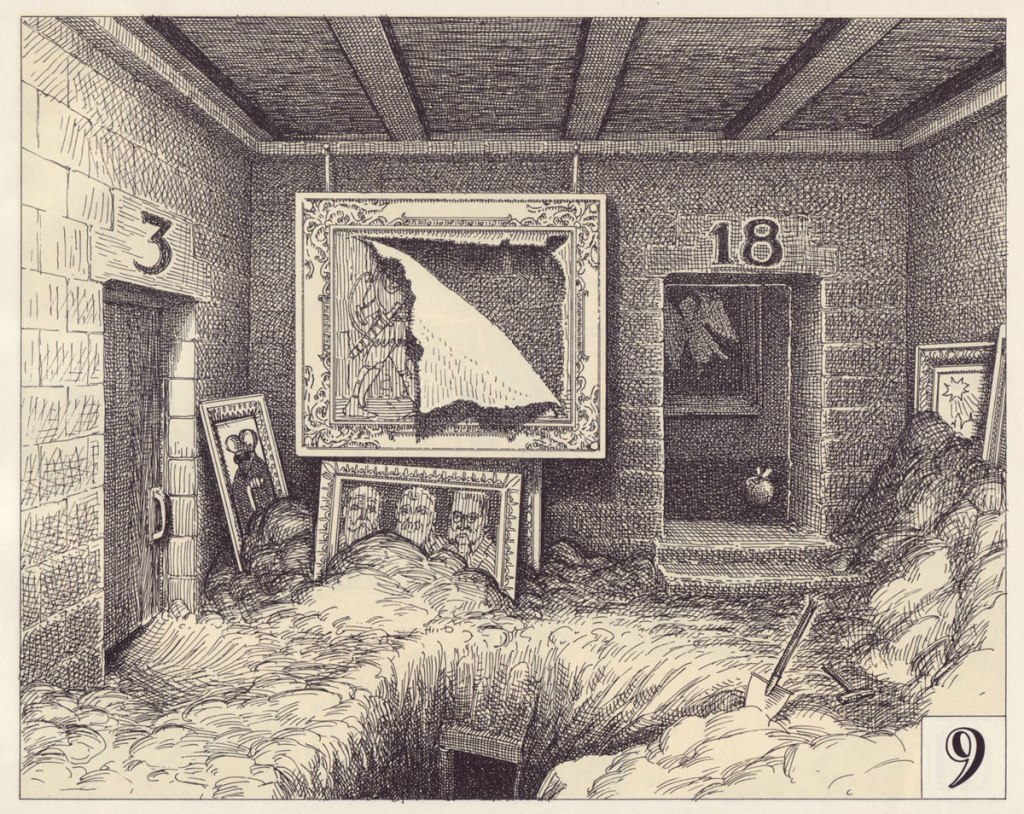
« … what appeared to be an old storeroom. Dust obscured a damaged painting, making it hard to understand just what the artist had intended. »
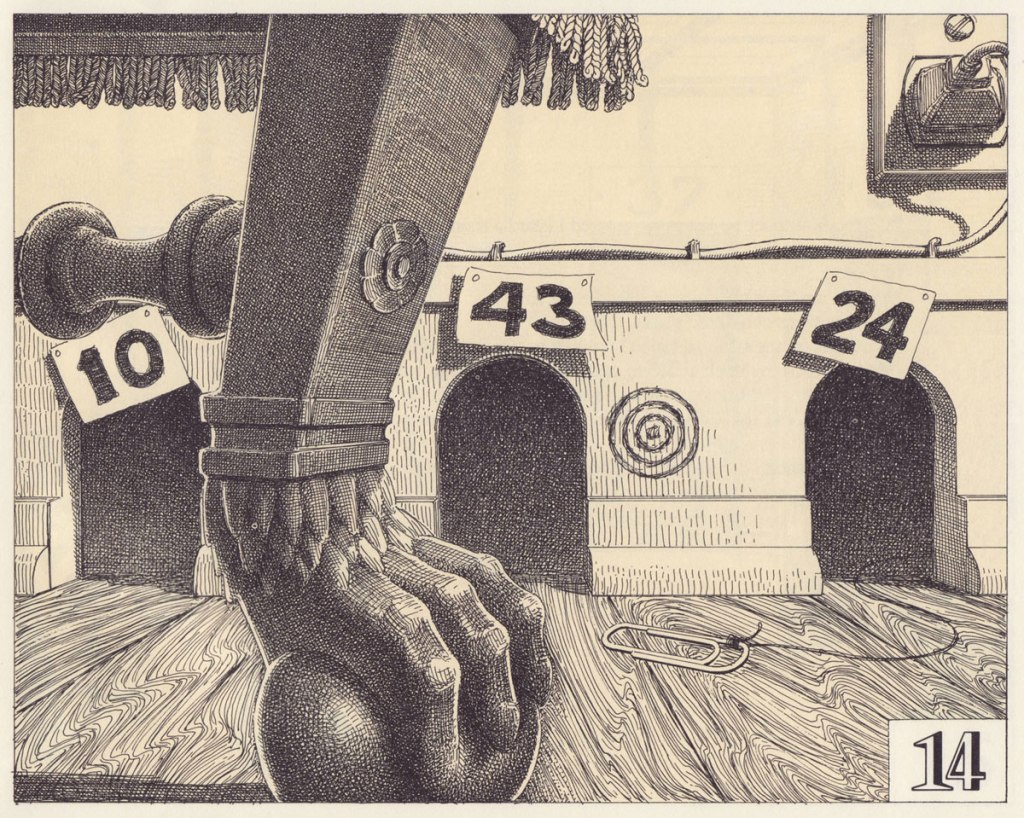
« … one of the biggest rooms in the House. All three doorways were dark. “Afraid to go out?” I asked. »
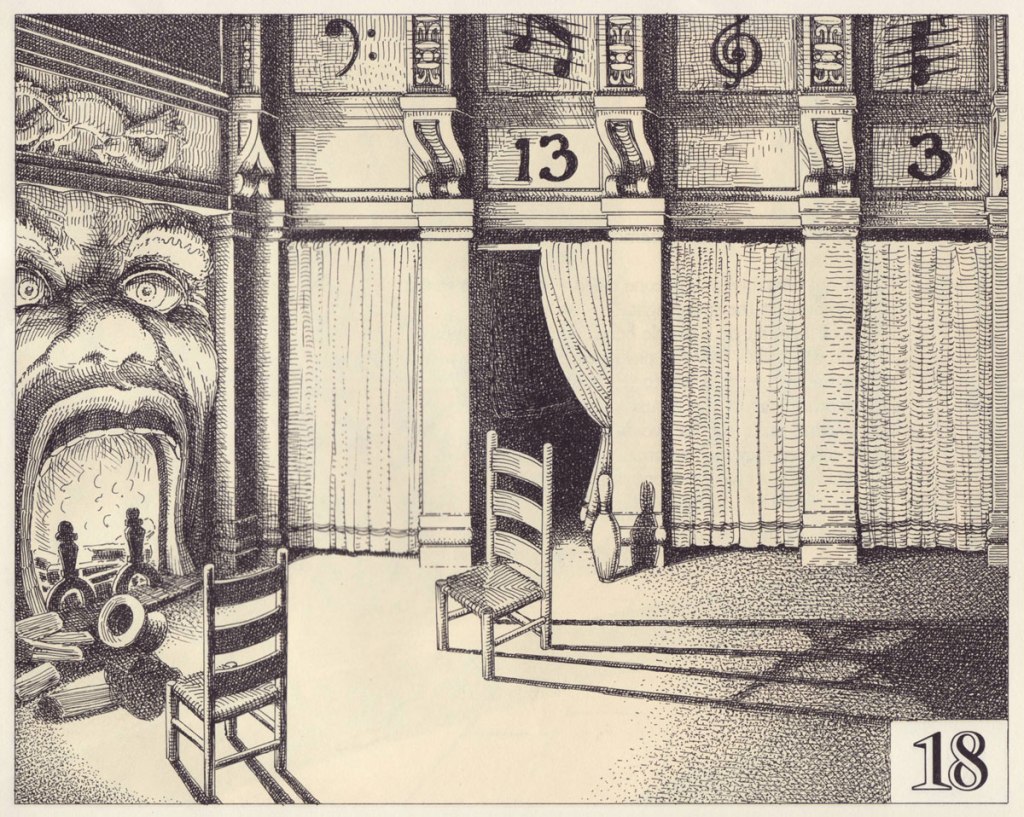
« … a much warmer room. Shadows danced across the floor to the fire’s music. »
« … a dramatic room with four entrances and exits. “Not enough light in here,” they remarked. “Not very tidy either.” »
« … a darkened chamber dominated by a large figure. We could see that someone had been working here recently; the entrance I had so carefully hidden had been uncovered. I made a note to return as soon as I could and fill in the hole again. »
« … a melancholy little courtyard surrounded by a brick wall too high to see over. A dead tree lifted its bone-white branches to a sky filling with gray clouds. »
« … what appeared to be someone’s basement. One of them sank gratefully down on an old couch which promptly collapsed. »
« … the foundations of the Maze. Deep underground stones had been carved and fitted; passage opened in the natural rock. »

Nearly four decades after its publication, Maze’s mystique endures. And interest resolutely lingers, which I salute. Apparently, Maze belongs to a genre termed ‘ergodic fiction‘.

Should you wish to try your hand at the task, the entire book’s available to peruse here.

-RG

Hallowe’en Countdown VII, Day 6

« In old New York it was Turkey Mike, Muggsy and the Big Six.
In San Francisco, Baby Bull, Stretch, and the Say Hey Kid.

Then came the Count, the Hackman, Jack the Ripper
and Will the Thrill.

Barry and Jeff Kent, but a dearth of nicknames,
that is, until… The Giants got the Panda. » — Scott McCaughey, “Panda and The Freak

This year’s Major League Baseball playoffs are about to begin.

In those callow days of youth when I still cared about big league baseball — having lost interest in such matters when Montréal lost its team — the post season was over and done by, say, the 20th of October. Nowadays, with all the extra teams and trimmings, it just seems to go on and on.

I long for the days when only ball players and little kids wore baseball caps, to be honest. Ah, but the sport yet holds some fond memories for me. I recall most fervently the rather outré facets of it, fostered and amplified by the sport’s scads of iconoclasts and loonies*.

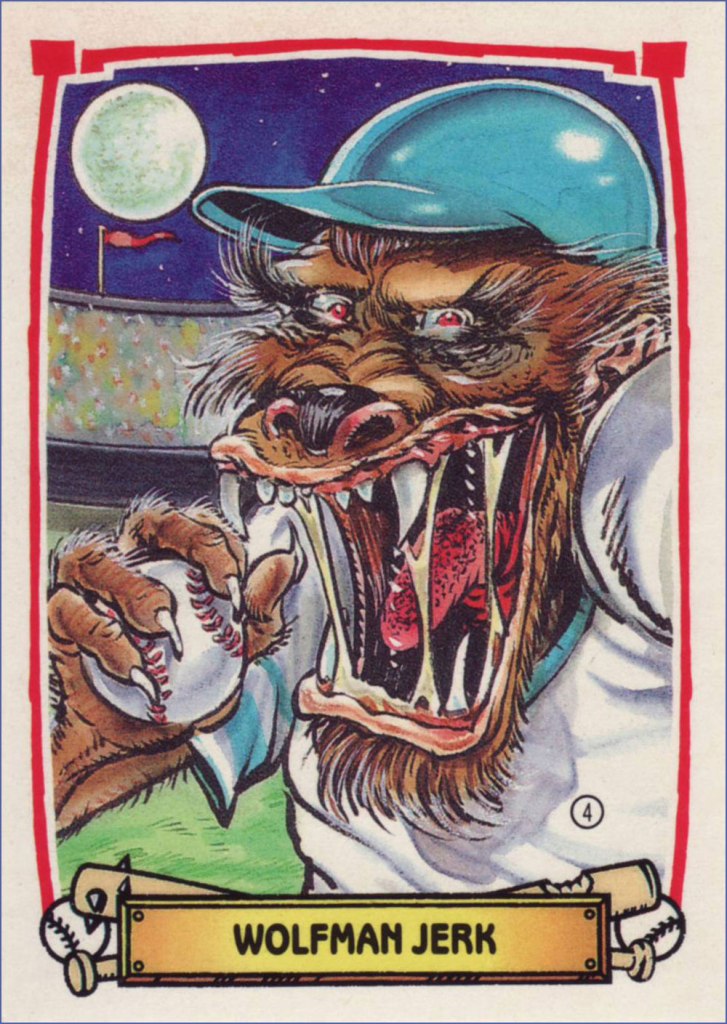
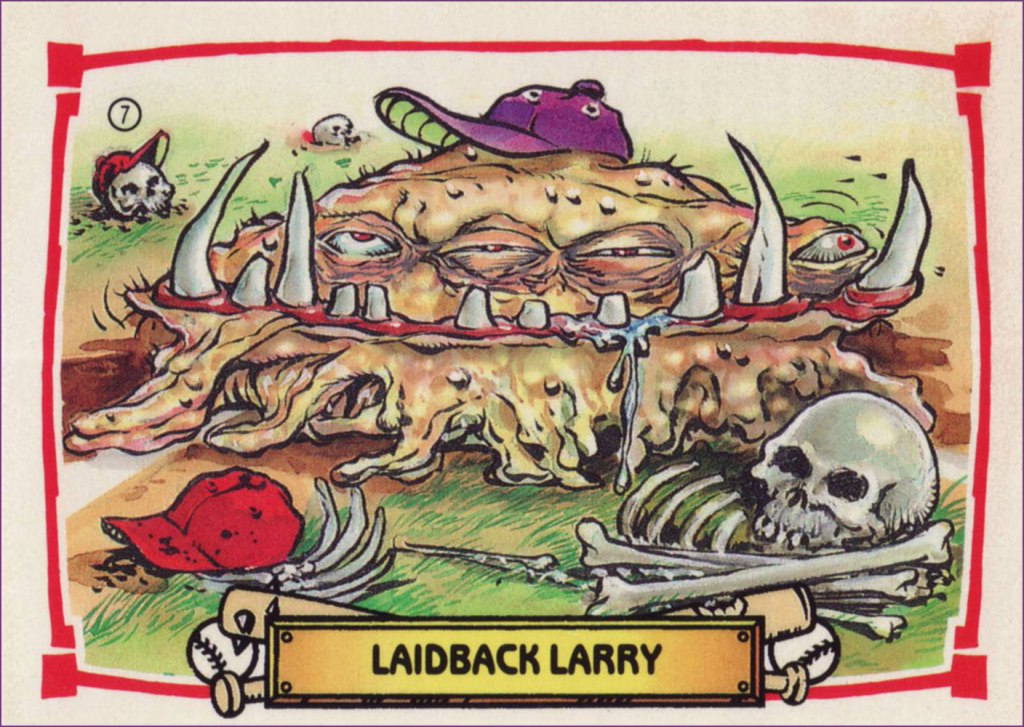
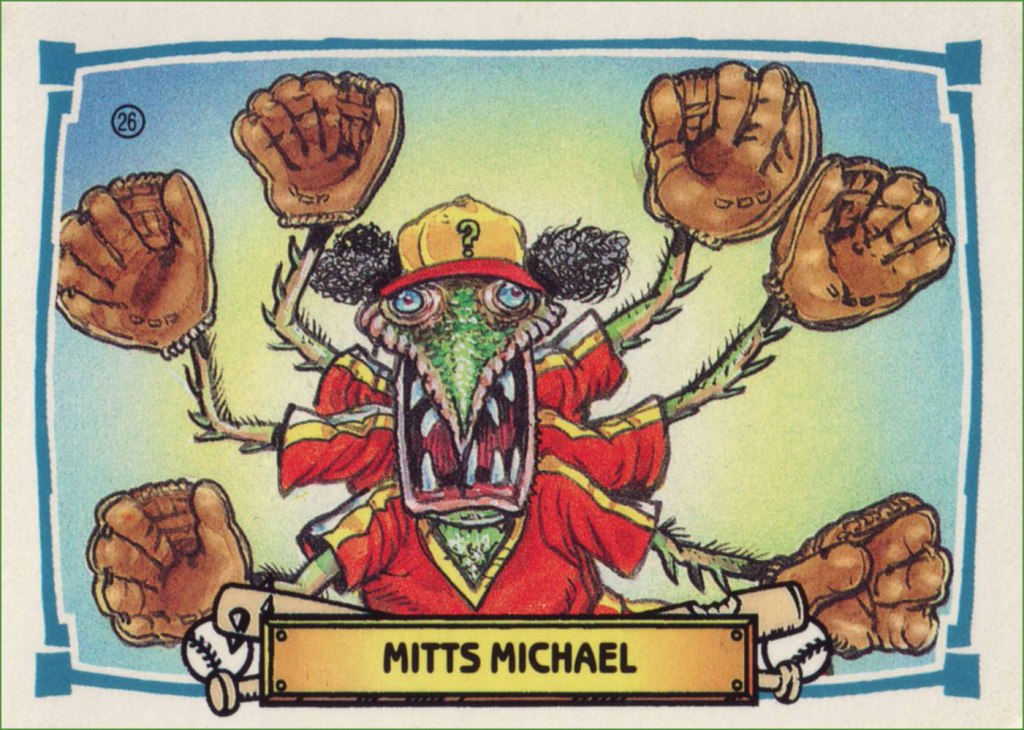
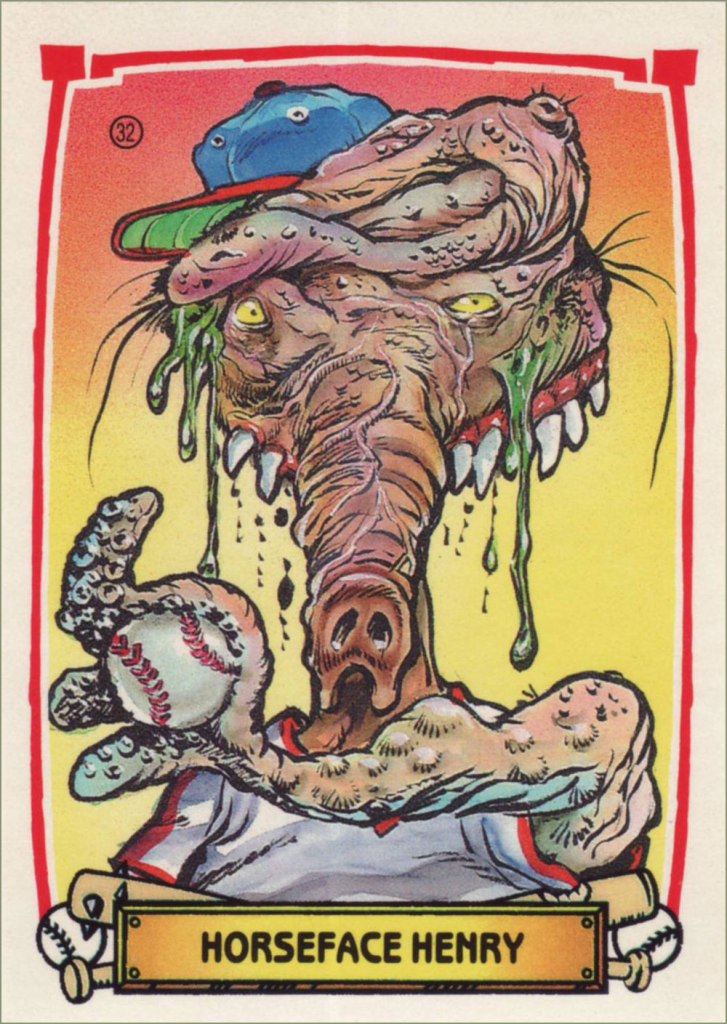
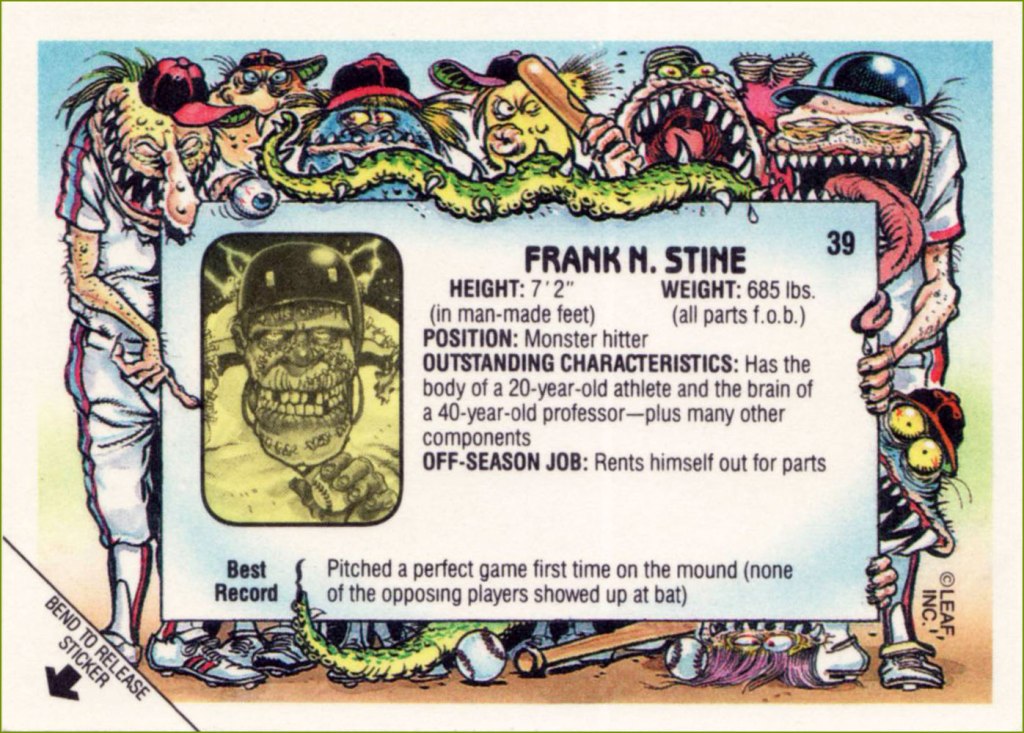
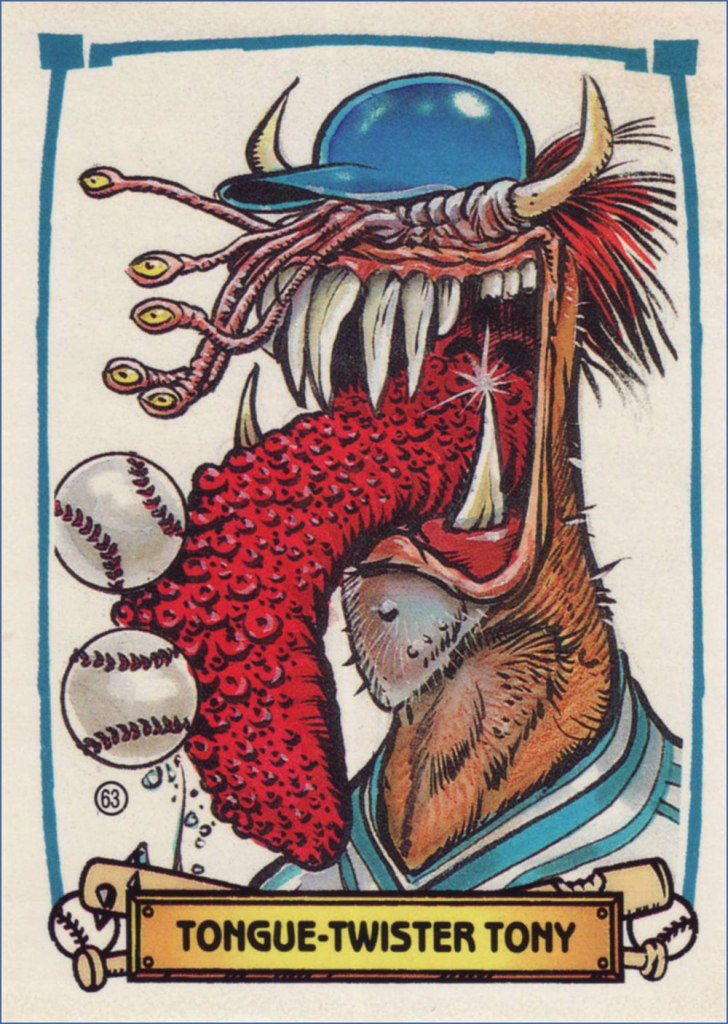
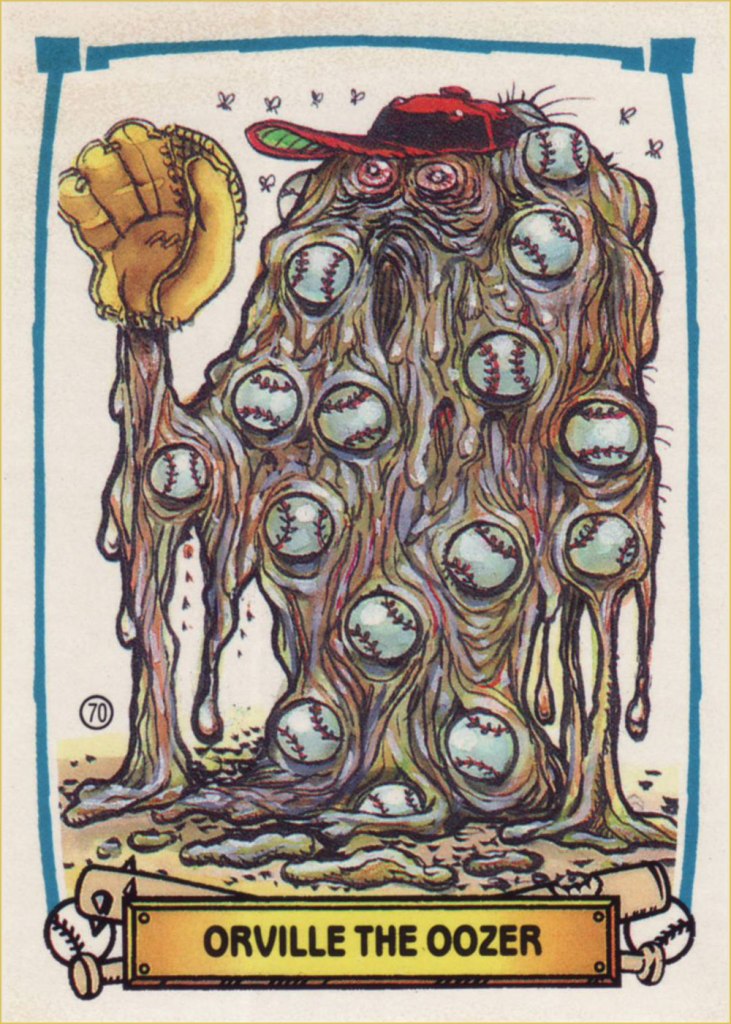
And while we’re on the subject, here are some highlights of Leaf/Donruss‘ 1988 card set Baseball’s Greatest Grossouts, illustrated by the busy yet ever-dazzling B. K. Taylor (Sick Magazine, The National Lampoon, The Muppet Show — he designed Dr. Teeth! — Sesame Street, Dynamite, Mulan…).

I’m mostly featuring the front of the cards, but the backs were also a treat. Love that grotesque wraparound artwork!

-RG

*splendidly — and catchily! — eulogised by supergroup The Baseball Project, featuring members of REM, The Young Fresh Fellows and Dream Syndicate. Four albums on, and their latest, Grand Salami Time!, may just be their finest hour. End of commercial, play ball!

Hallowe’en Countdown VI, Day 29

« I’m alone with the ghost of the swamp, somewhere near the weeping willows. » — Steven Herrick

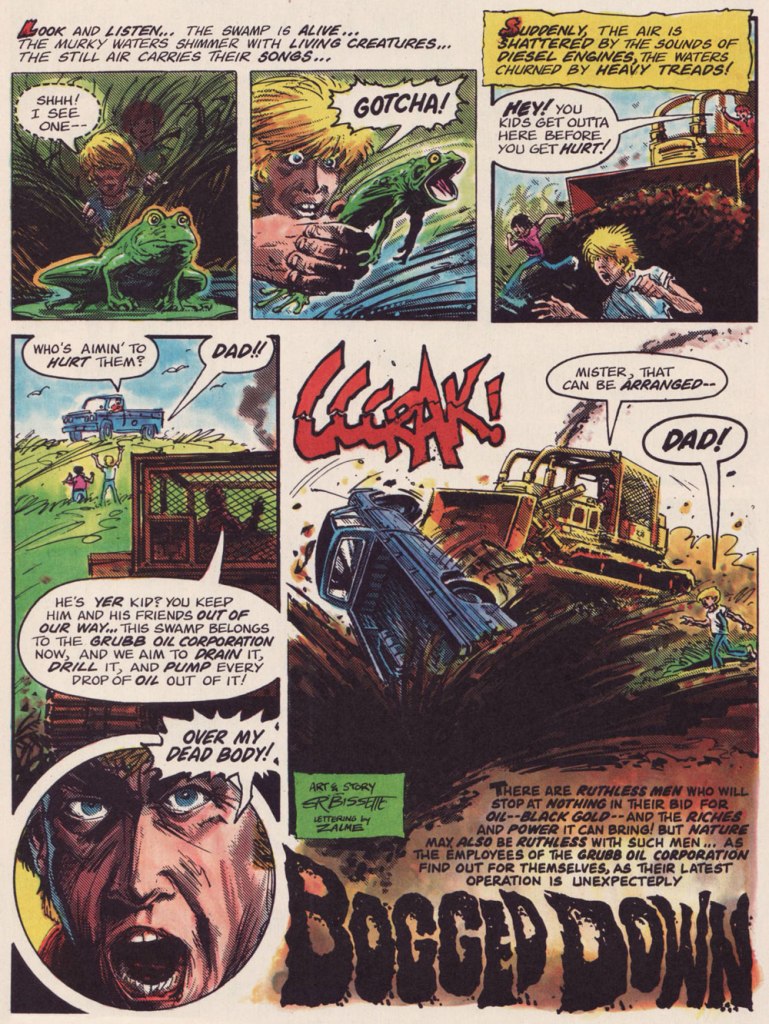
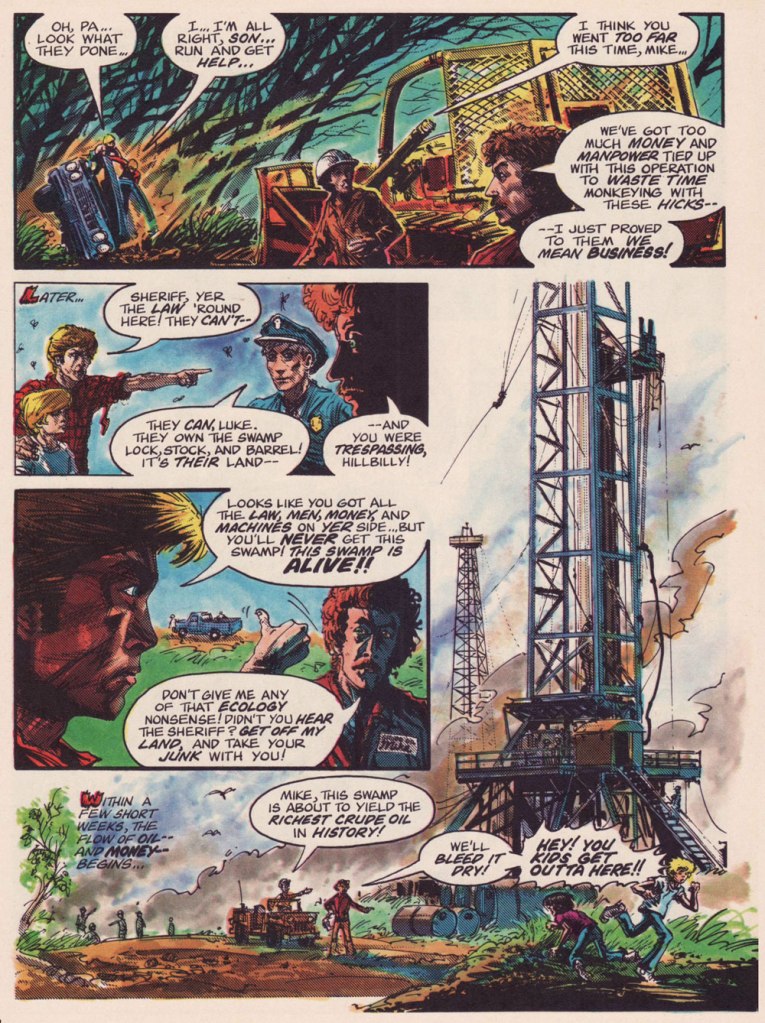
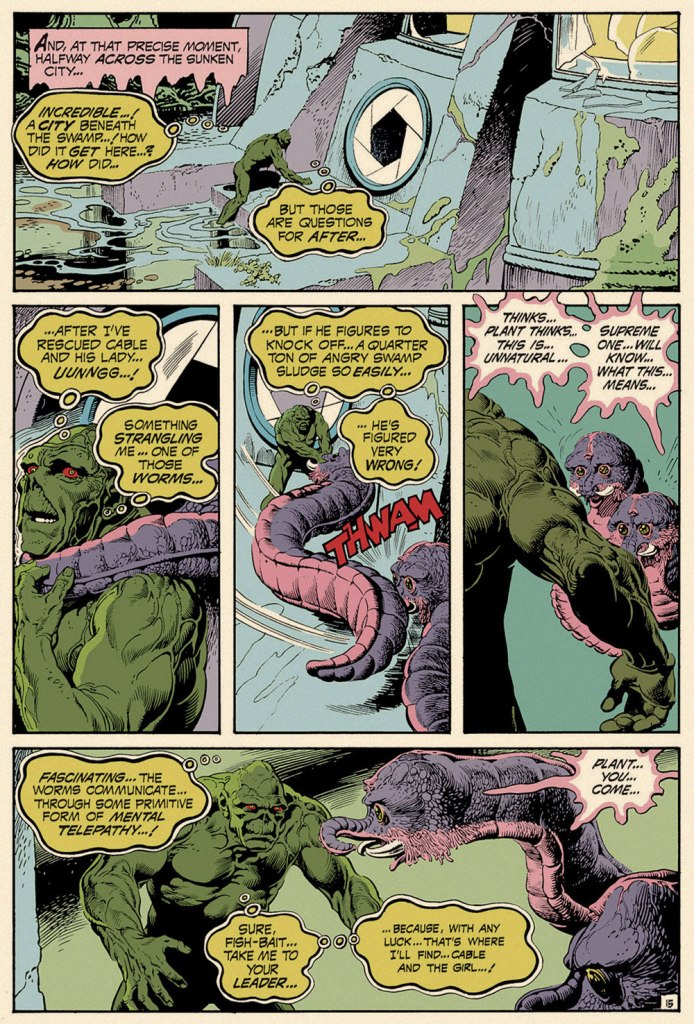
Today, we pull on our wellies and boldly venture into the depths of the mysterious swamp, but not entirely unprepared: on this occasion, I turn the microphone over to an acknowledged expert en la matière visqueuse, Mr. Stephen R. Bissette. I queried Steve about his early work for Scholastic and he most munificently lifted the veil on those wild days of youth:

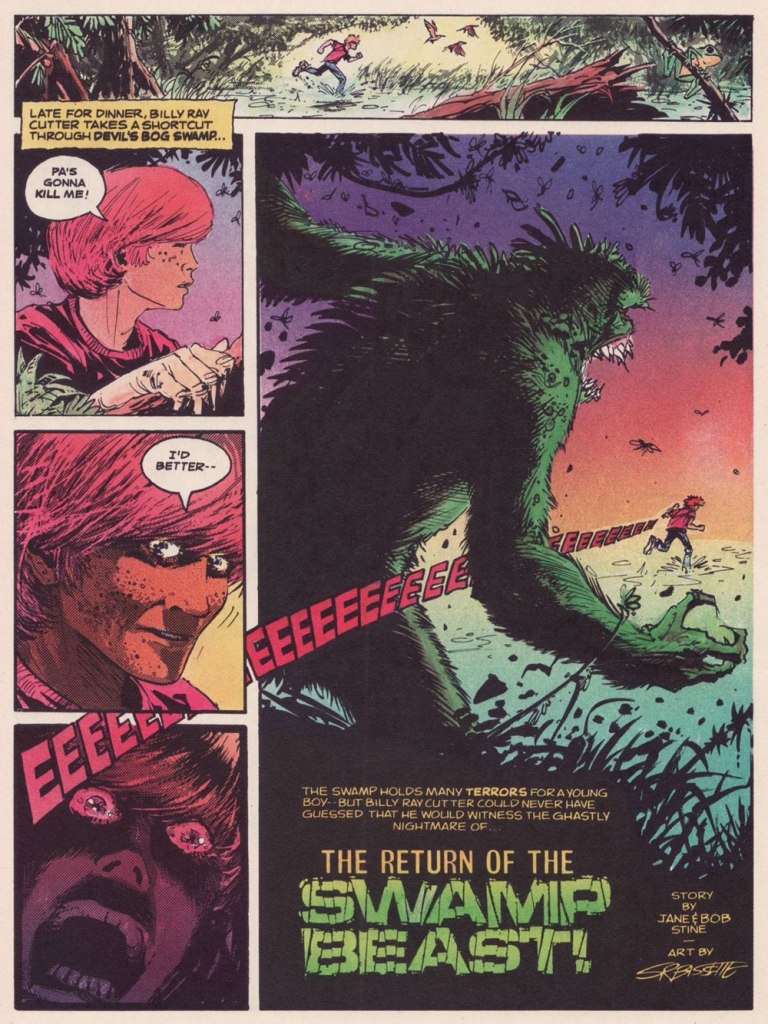
« Well before my stint on Swamp Thing, I drew two swamp monster stories (one of which I’d also scripted) for Weird Worlds for Scholastic Magazines back in the day. The magazine’s editors were Bob and Jane Stine (Bob aka R.L. Stine), who wrote the first of the two stories; the magazine art director was Bob Feldgus, who was always a joy to work with, and trained me well.

The story titles are counter-intuitively reversed, in a way. “The Return of the Swamp Beast” was originally published in Weird Worlds no.3 (October 1979) in black-and-white, colored for its reprint in Yearbook no.1 (and only, 1986). Enjoy! »

The Return of the Swamp Beast was coloured by Brendan McDonough.

« These were among my favorite early freelance gigs, and remain my favorite magazine account and people I was fortunate enough to work with and for. The Stines and Bob Feldgus extended the best, most gracious, most responsive relations with this freelancer of any I had in those formative early years; it also was the best-paying of all the early freelance gigs, extending the greatest freedom for me to do the work itself, and they boasted the best production and printing of any publisher I worked for then (even better than Heavy Metal).

My entry into the Scholastic freelance pool was via a one-shot horror story for Scholastic’s then-new zine Weird Worlds. Joe Kubert brought me into his studio/office in the Baker Mansion (which has long since been the dorm for the Kubert School rather than its headquarters and main building, as it was during its first few years) and asked if I’d be willing to draw a short (three pages, if memory serves) horror story for a magazine intended for schools; I would be doing the whole art job working from a silly but fun script by Bob and Jane Stine, co-editors of the zine, and my name would not go on the job, it would be credited to The Joe Kubert School of Cartoon and Graphic Art, Inc. Fair enough! I was still a student after all, and this was my shot at doing something different.

I was overjoyed to have the shot, and did my best on it. Part of the appeal, mind you, was drawing a horror comic for schools. During my early ’60s childhood, any comics brought to school were verboten and usually confiscated, horror comics above (or beneath, in the minds of my teachers) all. So, drawing a horror story that was intended for distribution to junior high students—sanctioned horror comics for school!—was a hoot and a bit of karmic comeuppance I was happy to be part of.

Joe was delighted with what I did with the script, as was Scholastic. I wanted to do more. One of (many) great acts of generosity Joe extended my way was gifting me with the account with Scholastic when I graduated in the spring of 1978 from the Kubert School, and thus began my happy few years of working with Scholastic—an account that often paid the rent and kept me working when work in comics was hard to come by.

Scholastic treated me like a prince. They paid well, paid promptly upon delivery of the finished pages, and were always a joy to work with. Like all good things, this passed: Weird Worlds was cancelled after a few issues, and after a couple of jobs for Bananas I moved on to other things, including pencilling Saga of the Swamp Thing beginning in 1983. But I always loved working with and for Bob and Bob, and I miss ’em both. I eventually collected some of my work for Scholastic for two comicbooks in the late ’80s, and did so with Scholastic’s permission. »

That source, Bissette & Veitch’s Fear Book (Apr. 1986, Eclipse) is the one we tapped for this post, and the most affordable solution should one crave more of these sharp little tales. Here’s another, this one a Bissette solo (including the colouring), originally from Weird Worlds no. 7 (Jan. 1981, Scholastic).

« Who remembers these magazines? Bananas and Weird Worlds seem to be lost in the limbo of all school zines; no comics sites acknowledge them or offer back issues for sale (none I can find, anyway), and general online searches turned up little. Back in 1995, The New York Times ran an interview/article on Bob Stine when his Goosebumps TV series was about to debut, making mention of Bananas magazine. There’s a number of online sites dedicated to Stine’s famous and beloved Goosebumps books series, but Bananas and Weird Worlds are less than footnotes in the long shadow of Goosebumps.

There’s a handful of affordable back issues of Weird Worlds available on various online venues and auction sites; I’m in almost every issue. One cautionary note: If you go looking on eBay, though, don’t confuse the Scholastic media zine Weird Worlds with the lurid, gore-splattered Eerie Publications 1970s newsstand horror comic magazine Weird Worlds. Those are fun in their way, too, but you won’t find me in there—just my eye-tracks from reading ’em three decades+ ago.

I’ve long wished to convince Scholastic to consider a collected edition of this body of work, but each & every attempt to engage has fallen on deaf ears. I’m still proud of this work, and as a precursor to the very successful R. L. Stine Goosebumps franchise & Scholastic graphic novels of today, can still hope that one day someone at Scholastic will have the “lightbulb” moment… »

I truly can’t thank Steve enough for this bounty of information — you just can’t beat going straight to the source, particularly with a source this friendly and eloquent!

-RG

Hallowe’en Countdown VI, Day 17

« In this club all members are equal, be they of claw, talon or fang; skin, fur or scale; from grave, tomb or laboratory; if they slither, walk or crawl; if they breathe, gasp or do neither. No one monster will take precedence over another. » — Signed EATM Ghoul (Hon Sec)

Like many a horror fan of my generation, I grew up adoring Amicus Productions‘ films, particularly their multi-segment entries, known as Portmanteau movies. These include fine adaptations of Robert Bloch stories, generally scripted by the master himself: Torture Garden (1967), The House That Dripped Blood (1971) and Asylum (1973), and a pair of well-crafted adaptations of EC Comics, 1972’s Tales From the Crypt and 1973’s The Vault of Horror, which unveiled these classics to an eager new audience.

With 1974’s From Beyond the Grave, Amicus partners Milton Subotsky and Max Rosenberg found themselves a new wellspring in British author Ronald Henry Glynn Chetwynd-Hayes (1919-2001). While some consider 1981’s Chetwynd-Hayes portmanteau The Monster Club part of the Amicus œuvre, the company had been dissolved in 1975… but as the film was produced by Subotsky, the notion is not without merit.

And so… comics? Enter UK comics maven Derek ‘Dez’ Skinn. As Dez tells it:

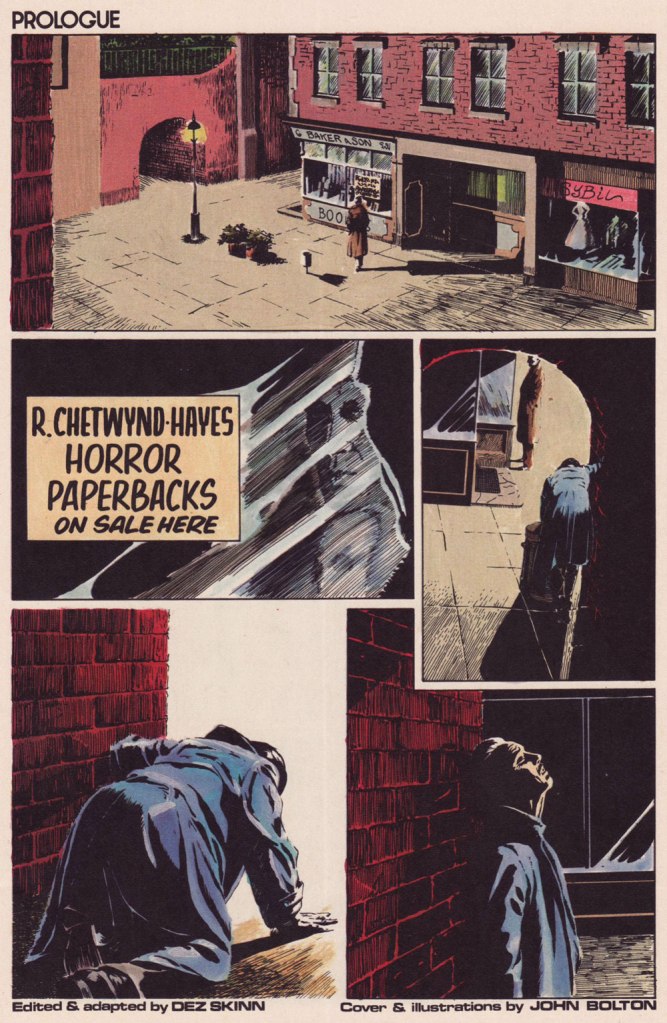
« Milton Subotsky, the London-based US powerhouse behind the horror film company Amicus Films, had always been madly envious that rivals Hammer had their own magazine and was constantly twisting my arm to work with him. When he got a distribution deal on R. Chetwynd-Hayes’ The Monster Club, he saw his chance. Actors including Vincent Price and John Carradine were signed up but there was no time to shoot any footage to promote the production at the Cannes Film Festival. So he called me up and asked if we could adapt the film into comic strip format, much like we’d done with Hammer, so that printed copies could be used to sell the film overseas at Cannes.

We only printed 1,000 copies of The Monster Club, making it an instant collectors’ item in fan circles! Adapting the film script myself, I assigned John Bolton to produce the 26 pages of artwork (although David Lloyd valiantly came in to handle one chapter because of the tight deadline). Targeted at an international audience of film buyers on lush glossy paper, it was surely the most inexpensive yet effective film promotion ever! » [ source ]
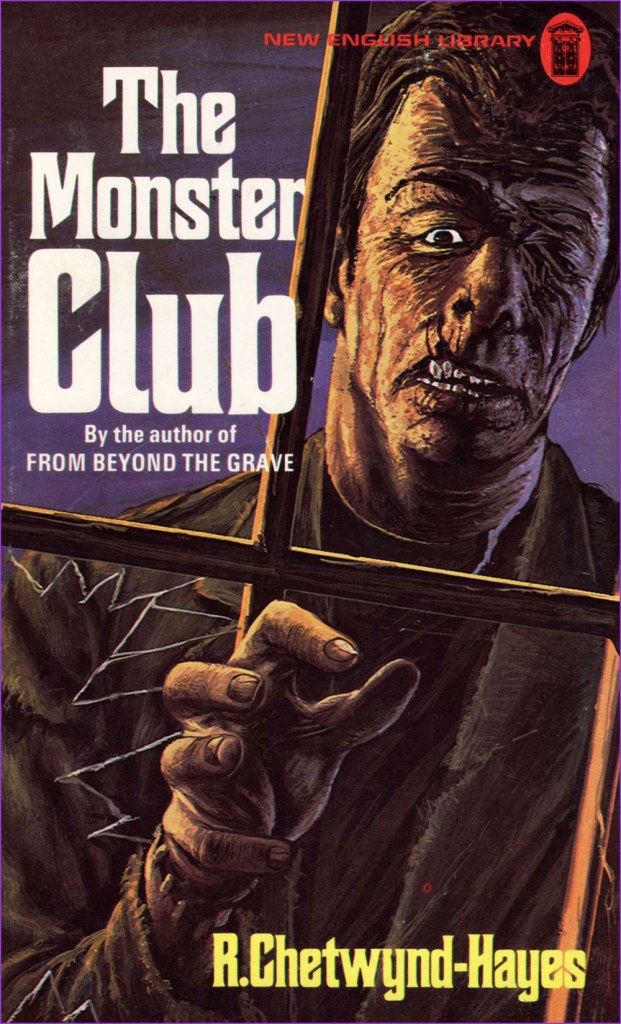
The cover of the original paperback edition (March 1976, New English Library). Would it have killed them to credit the cover artist, whose work is surely a strong selling point?

This material was reprinted (waste not, want not!) in Halls of Horror nos. 25 and 26 in 1983, then in North America, in a coloured version, in John Bolton’s Halls of Horror nos. 1 and 2 (both June 1985, Eclipse). And so here we are.

John Bolton’s (who else?) double spread cover painting.

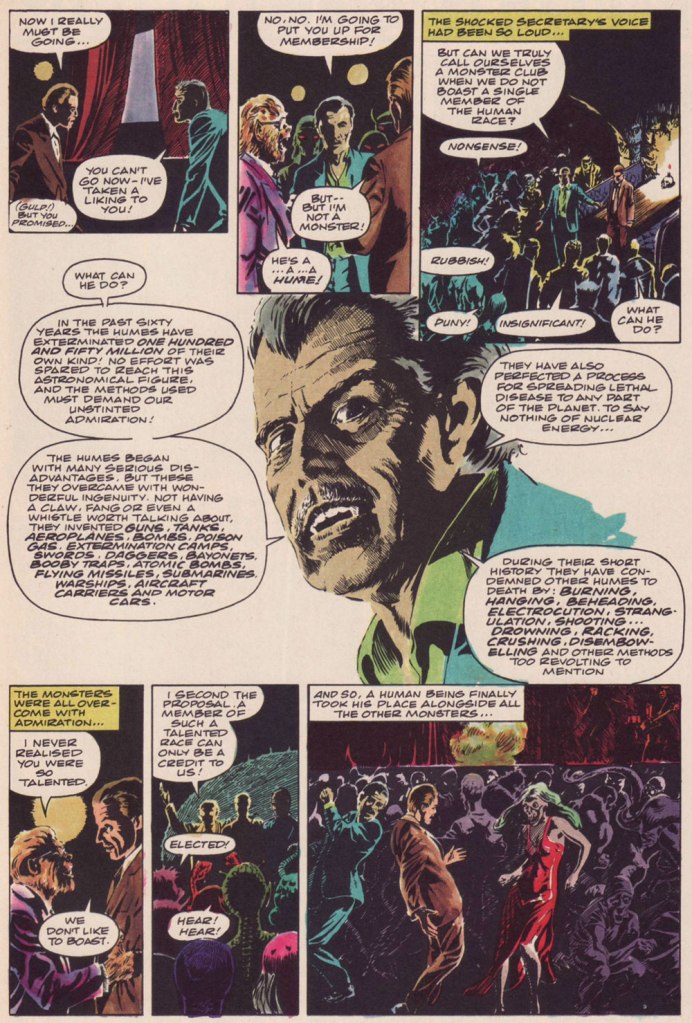
As far as the adaptation goes, I must confess I far prefer the witty linking bits to the stories proper.

Lest we forget, this version was coloured by Tim Smith.

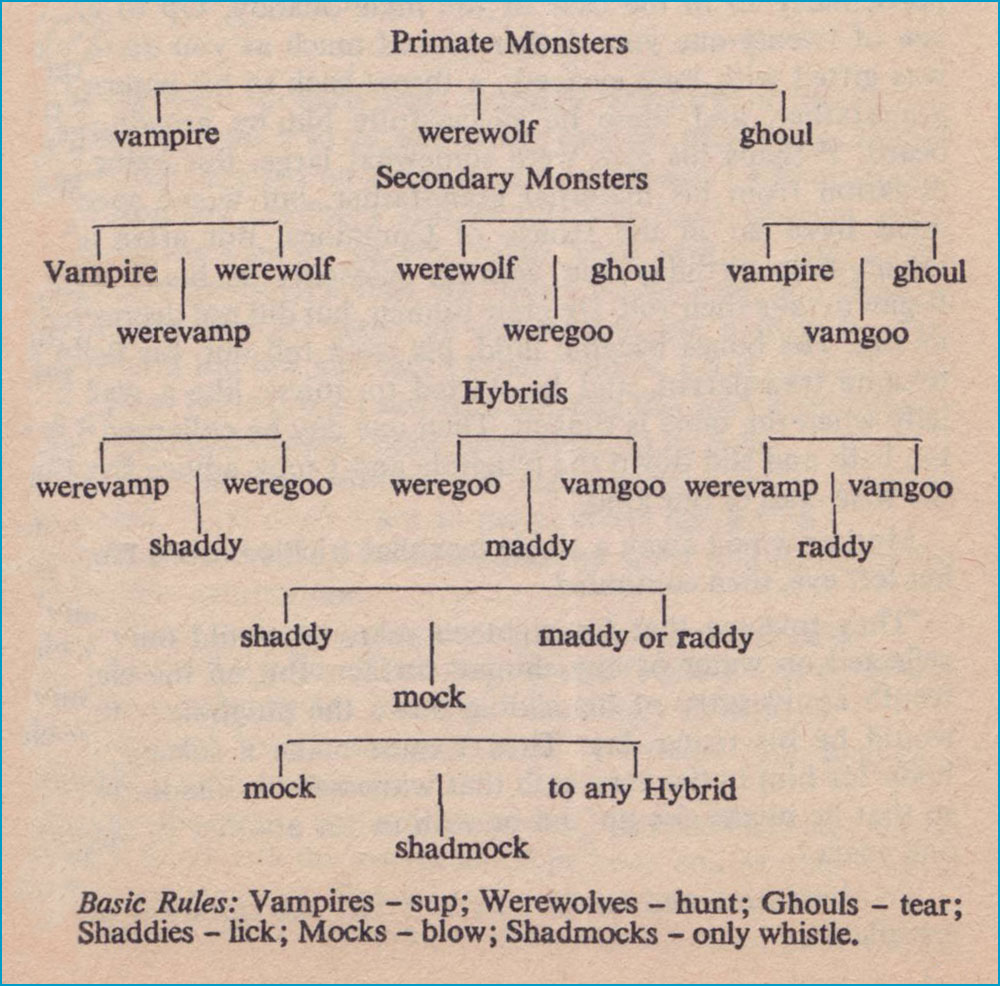
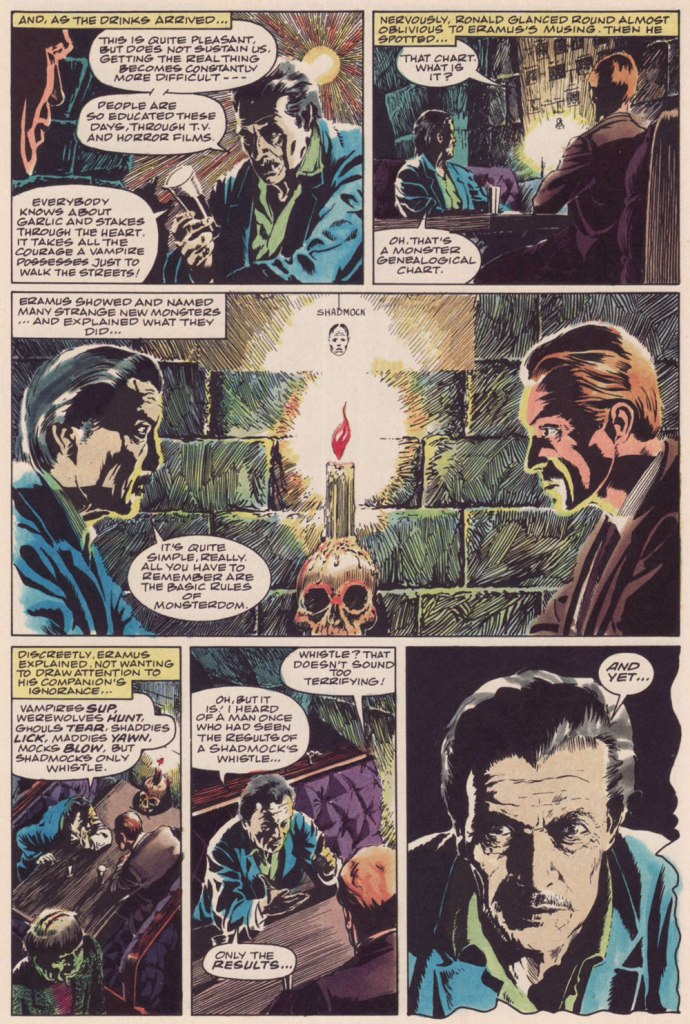
Among the most intriguing features of Chetwynd-Hayes’ book is his clever conceit of monsters forming an oppressed (by humanity) society with its own castes, hybrids, classifications and creeds. Here’s a most helpful table:

And the happy conclusion (after plenty of angst and grue in the stories). The movie’s better and the book better yet, but this was a worthwhile project and a fun curio.

This is The Ghoul, one of a set of specialty images Bolton created for the film’s promotion:

In closing, here’s a catchy musical number from the film, performed by one of my musical heroes, B.A. Robertson… not to be confused with T.M. Robertson, another favourite musician.

-RG

Hallowe’en Countdown VI, Day 6

« There is never enough horsepower… just not enough traction. » — Carroll Shelby

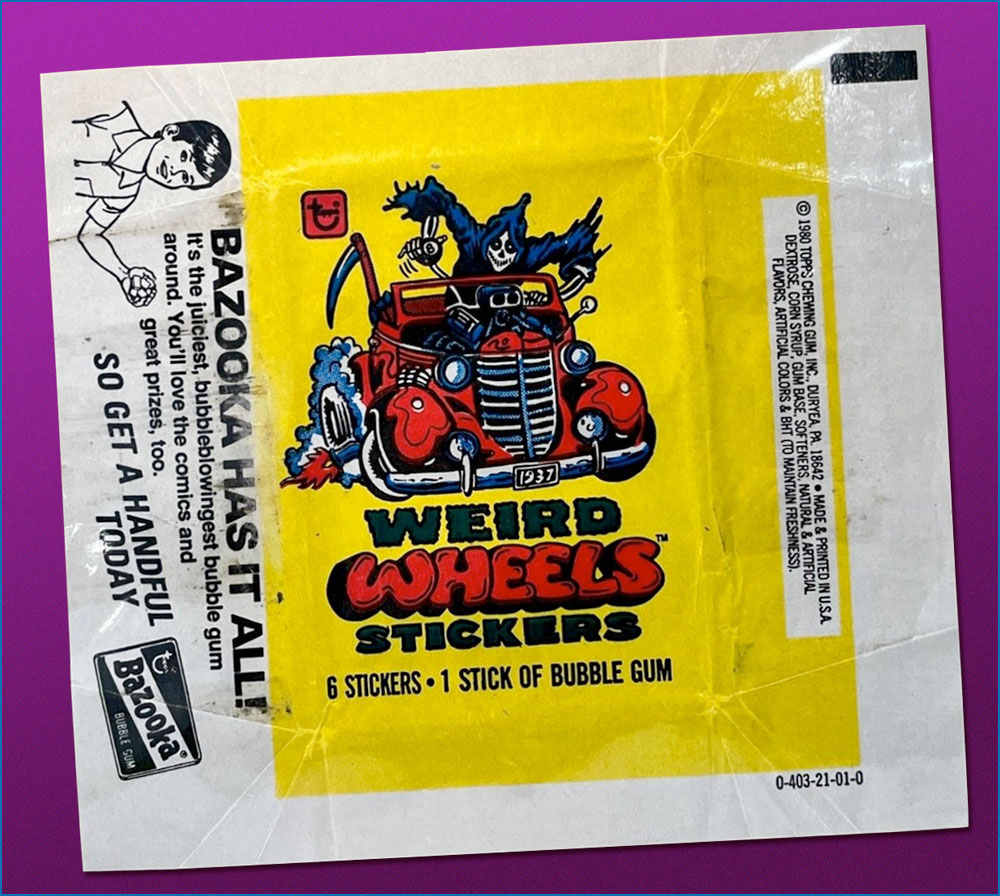
While my co-admin ds has already touched upon the circumstances of Topps’ Weird Wheels in her Purple Tentacle Tuesday post, she was of course thematically constrained there… while I’m free to drill down deeper into the set’s considerable riches. I won’t recount the set’s history, as that haunted ground has long ago been exhaustively explored and trod upon by the mighty Kurt Kuersteiner, monster gum card historian and also owner, operator and distinguished curator of the Jack T. Chick Museum of Fine Art. Peruse at your peril his fine account of what went down when Weird Wheels came down.

No one can claim this didn’t constitute an attractive package!

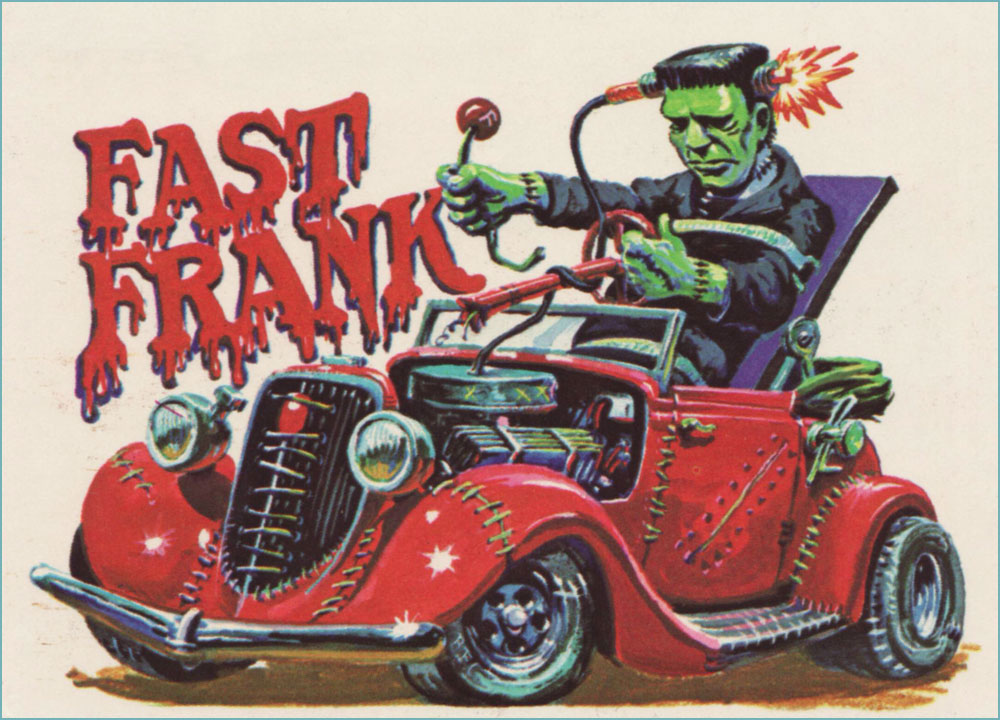
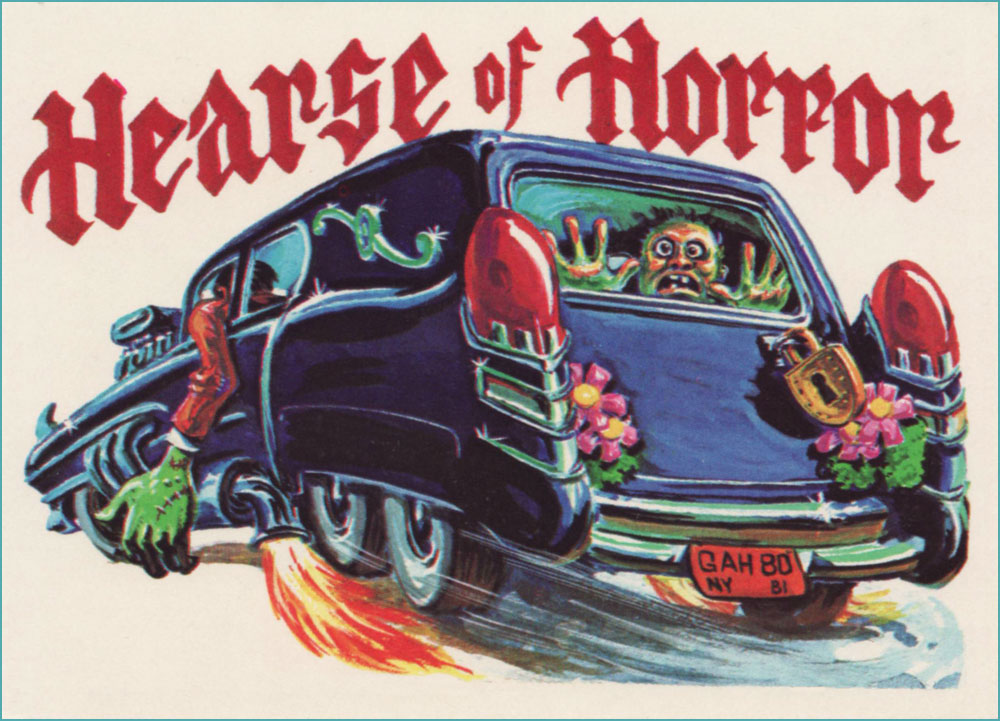
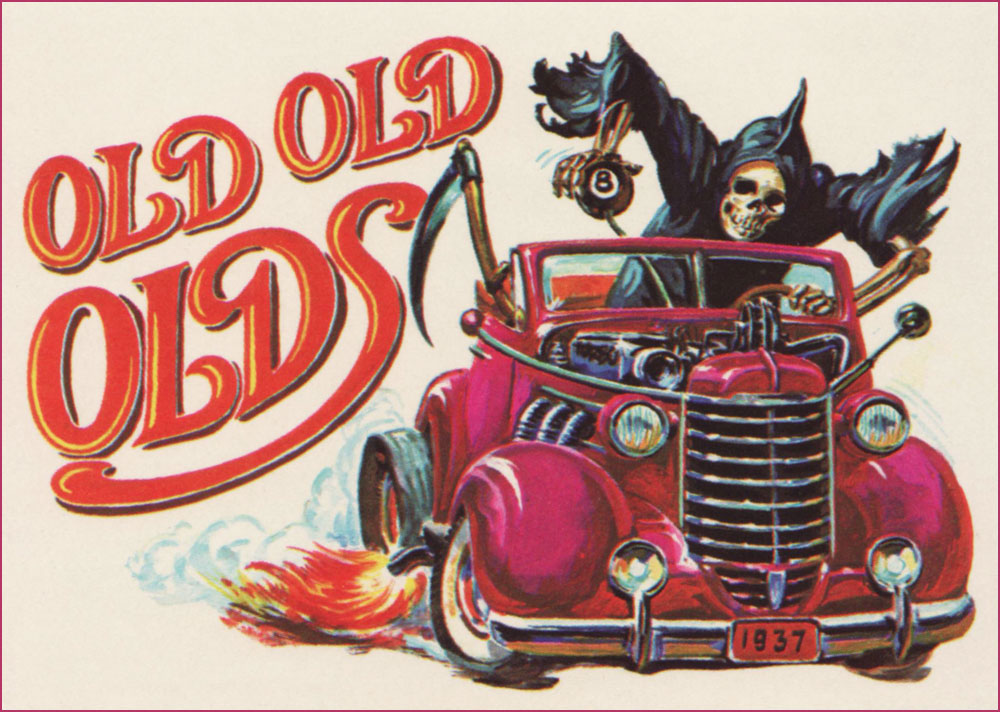
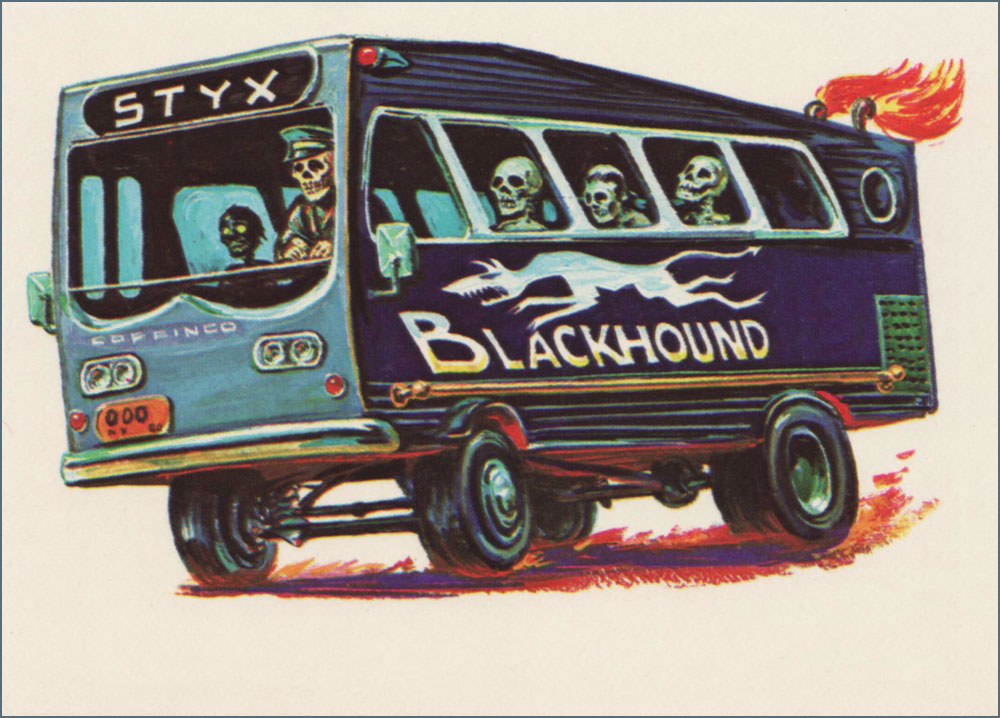
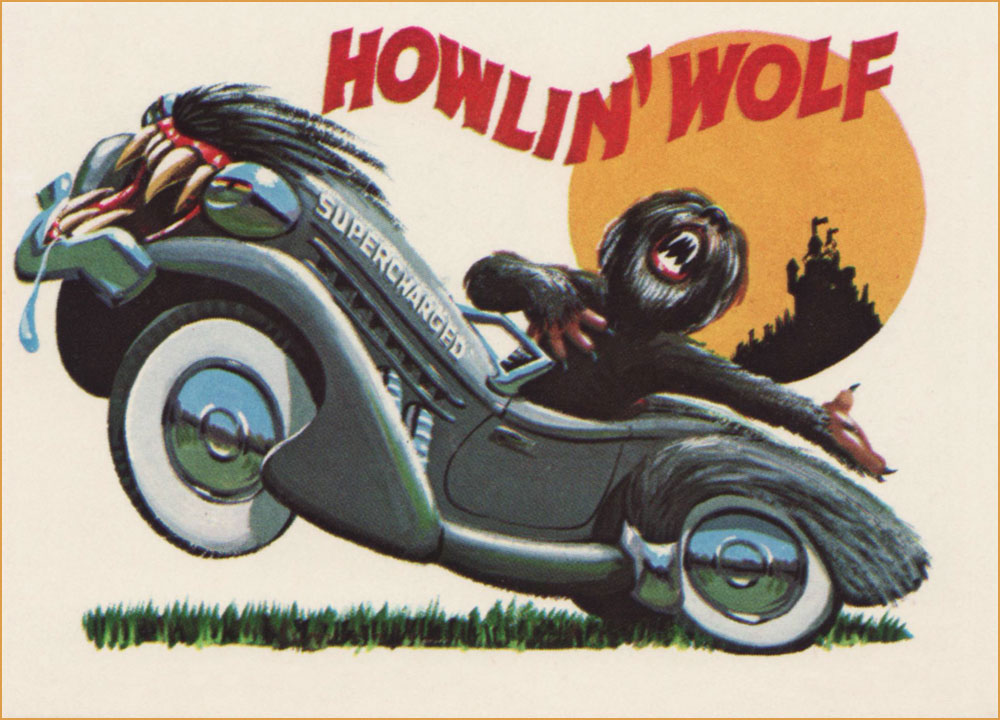
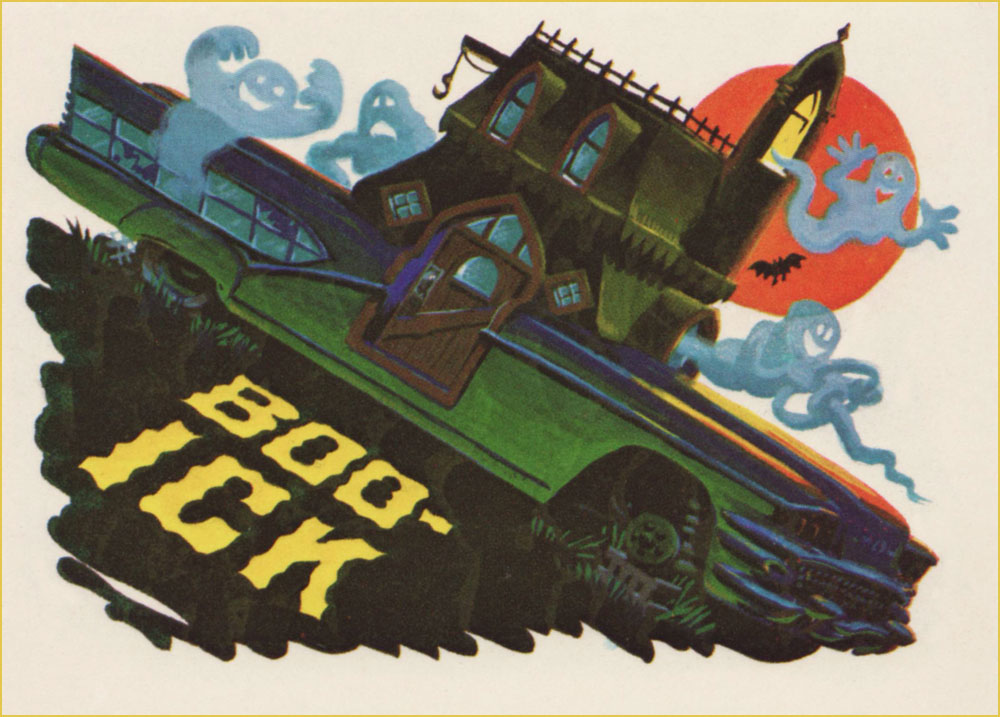
And now, on to the cards… my favourites, anyway. From what’s known, the art duties were shared by Norman Saunders and Gary Hallgren.

Card no. 1. Note the belfry engine.
Card no. 4.
Card no. 9.

Card no. 17.
Card no. 18. Held together, of course, by surgical stitching.

Card no. 22.

Card no. 23. This one, without question, was painted by Gary Hallgren… note the licence plate.
Card no. 26.
Card no. 27.

Card no. 45. Here’s the ideal soundtrack for this scene.
Card no. 54. I love that this heap isn’t going anywhere: it’s on bricks.

-RG

Haven’t You Heard? Santa Claus Is a Killer!

« Like everyone in his right mind, I feared Santa Claus. » — Annie Dillard

’twas 1982, and DC’s mystery anthology titles were dead or dying (the last one standing, The House of Mystery, had but a year or so left to go), and The Unexpected, published since 1956, was a mere two issues away from cancellation. Latter-day editor Dave Manak had done a fine job with the means at his disposal, wisely engaging Joe Kubert (1926-2012) to grace close to ten issues with his ever-elegant artwork.

This is perhaps the finest of the lot, a wistful, old-fashioned cover that dispenses with most of the clichéd Holiday iconography.

This is The Unexpected no. 220 (March 1982, DC). Pencils and inks by Joe Kubert with extra-fine lettering by Gaspar Saladino (1927-2016), truly a key element of the cover’s visual appeal.
Drive carefully, darling!” Is that woman worried about *everything*? Talk about fretful. Insurance agents must adore her. From the Fairhaven and Bon Marché allusions, one may presume that the events are set in the state of Washington.
To give credit where credit is due, the unexplained bit with Santa’s hand on the phone is the story’s subtlest touch. He’s the one who phoned in the tip — anonymously, one presumes. Santa does not abide off-brand competition.

The issue’s lead, Holiday-themed story, boasts gorgeous art by powerful and versatile Puerto Rican cartoonist Ernie Colón (1931-2019), and it’s unusually well-coloured for the era (not to be confused with well-printed!), in that the shadings convey projected light and ambiance, not merely the prevalent, simplistic colour-by-numbers approach.

The writing, on the other hand…

Santa Is a Killer! is an artless hodge-podge of tropes, a kiddie rehash of Johnny Craig’s timeless “… and All Through the House” (Vault of Horror no. 35, Feb. 1954, EC), dressed up with the done-to-death-and-then-some “That — wasn’t *you*? Then — it must have been the –*choke* — real ghost / Satan / Santa Claus / Carlos Santana / Tooth Fairy / Larry “Bud” Melman!) “twist”. Did I mention that I love the art?

Since we strive to avoid repetition, and as my partner-in-mischief ds has already featured this legendary cover in her How do you like *your* Christmas? post, here instead is the original 1954 Silverprint proof, a colour guide for the printer’s edification and coloured by hand, presumably by EC’s resident chromatic conjuress, Marie Severin (1929-2018). Cover art by Johnny Craig.
It’s a little-known fact that VoH35’s dear, doomed wife’s peignoir was later snapped up for a pittance at an estate sale by a young rake by the name of Danny Rand. Soon, with a few minor alterations, he had himself a nifty (and silky!) crime-fighting ensemble. Just don’t ask ‘is that a ladies’ nightgown you’re wearing?‘ if you don’t want your features rearranged. This is Iron Fist no. 8 (Oct. 1976, Marvel). Cover art by John ‘Booster Cogburn‘ Byrne and Dan Adkins. And though « The Canadian Government has apologized for Bryan Adams on several occasions » (and presumably for Céline Dion and Justin Bieber also), I say it’s high time Canuck honchos proffered their excuses as to cuddly Mr. Byrne.
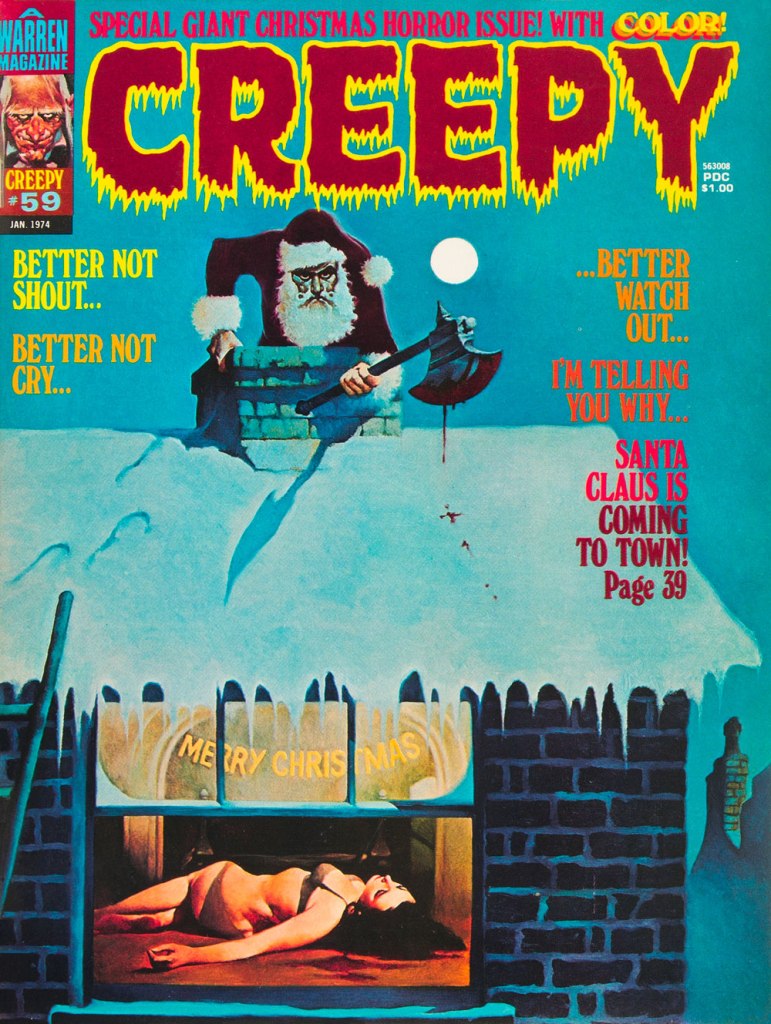
To give you some idea of how prevalent the ‘Santa as homicidal maniac’ notion was by the 1970s, here’s another semi-famous instance: this is Creepy no. 59 (Jan. 1974, Warren); cover by Spain’s Manuel Sanjulián (b. 1941). A year later, writer-director Bob Clark (Porky’s, A Christmas Story) would unleash his influential Black Christmas.

Bonuses:
The film adaptation of Craig’s “… and All Through the House“, starring Joan Collins, from Tales From the Crypt (1972, Amicus), directed by Freddie Francis;

The television adaptation, from Tales From the Crypt (season one, episode two, 1989), directed by Robert Zemeckis.

-RG

Tentacle Tuesday: Can of Worms

Today we play a game: yes, those long slithery things are wrapped around somebody’s ankle… but are they tentacles, or worms?

In real life, worms (even predatory) don’t really wind around their prey or suffocate them. A biologist could tell us whether they ever ‘hunt’ in huge numbers, but I think we can be fairly certain that the scenes depicted below have never happened in real life. If disbelief must be suspended, I’d rather string it up for a cephalopod invasion, rather than a worm onslaught (ick)… But the characters of this post have had to deal with both kinds of threat. Let’s get on to it!

Worm or tentacle? Well, these have eyes at the end of… of whatever it is… and they seem like individuals, so probably worm. Hey, those who have read this issue before, no spoilers, please!

The Saga of Swamp Thing no. 6 (October 1982, DC). Cover by Tom Yeates.

Let take a look inside this issue…

Page from Sins on the Water, scripted by Martin Pasko, pencilled by Tom Yeates and inked Tom Yeates.

What do you think? These seem to originate from the same source. Let’s peek at the next issue – cephalopod confirmed!

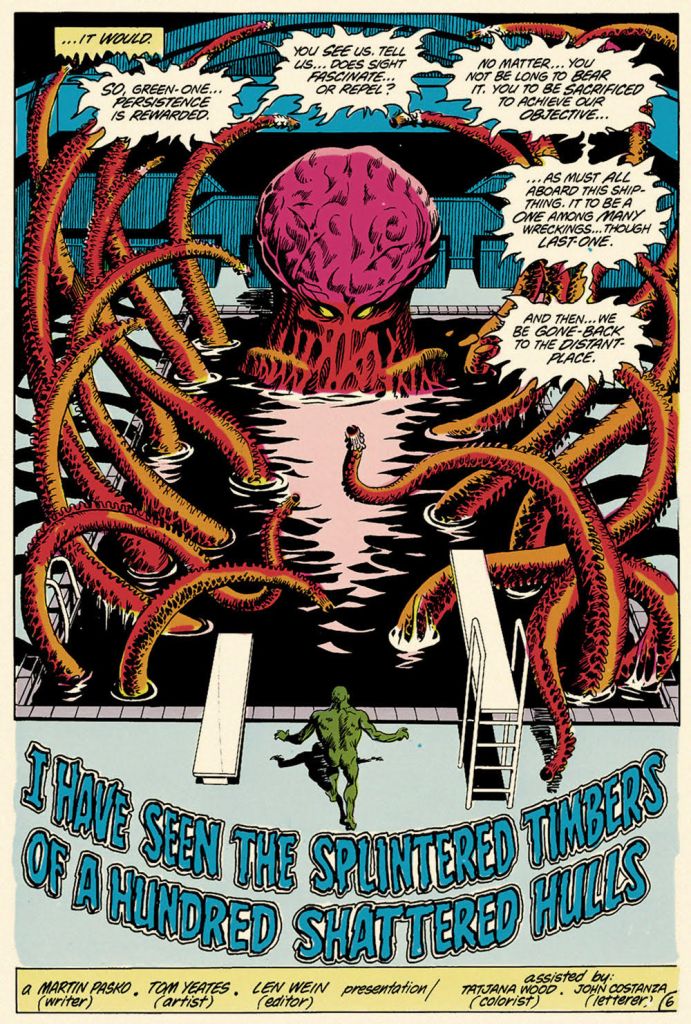
Page from I Have Seen the Splintered Timbers of a Hundred Shattered Hulls, scripted by Martin Pasko and pencilled by Tom Yeates. This story was published in The Saga of Swamp Thing no. 7 (November 1982, DC).

Moving on to our next puzzle! Those are surely tentacles, belonging to some cephalopod monstrosity with a thousand arms:

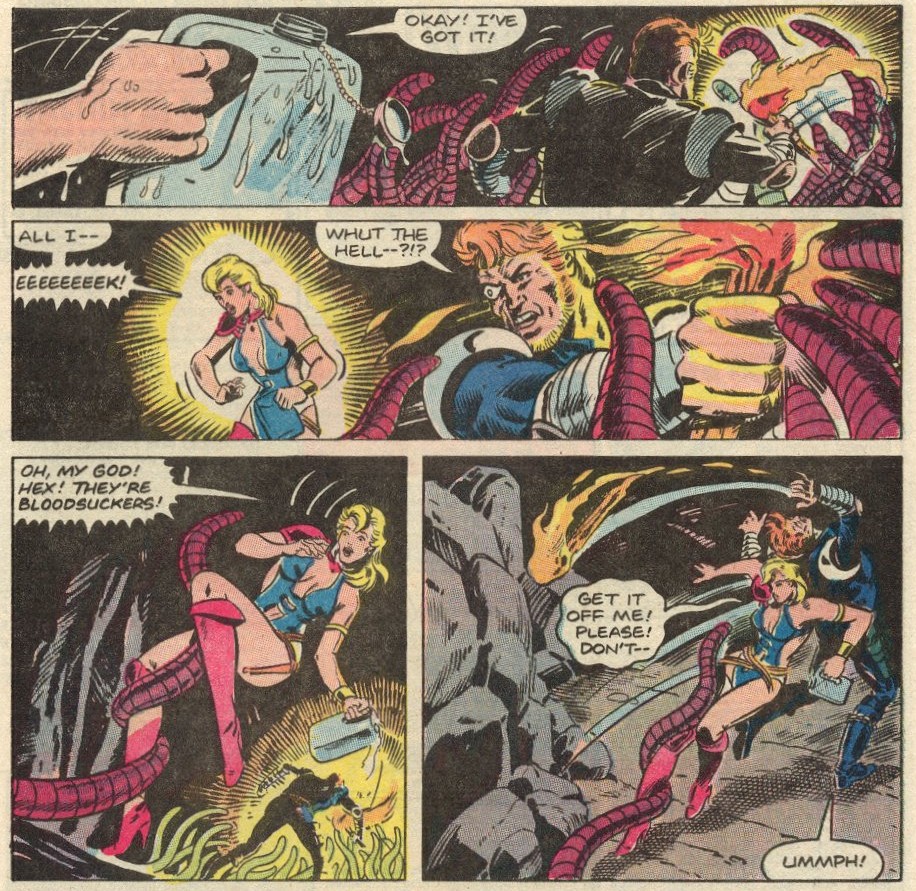
Hex no. 4 (December 1985, DC). Cover pencilled by Mark Texeira and inked by Klaus Janson.

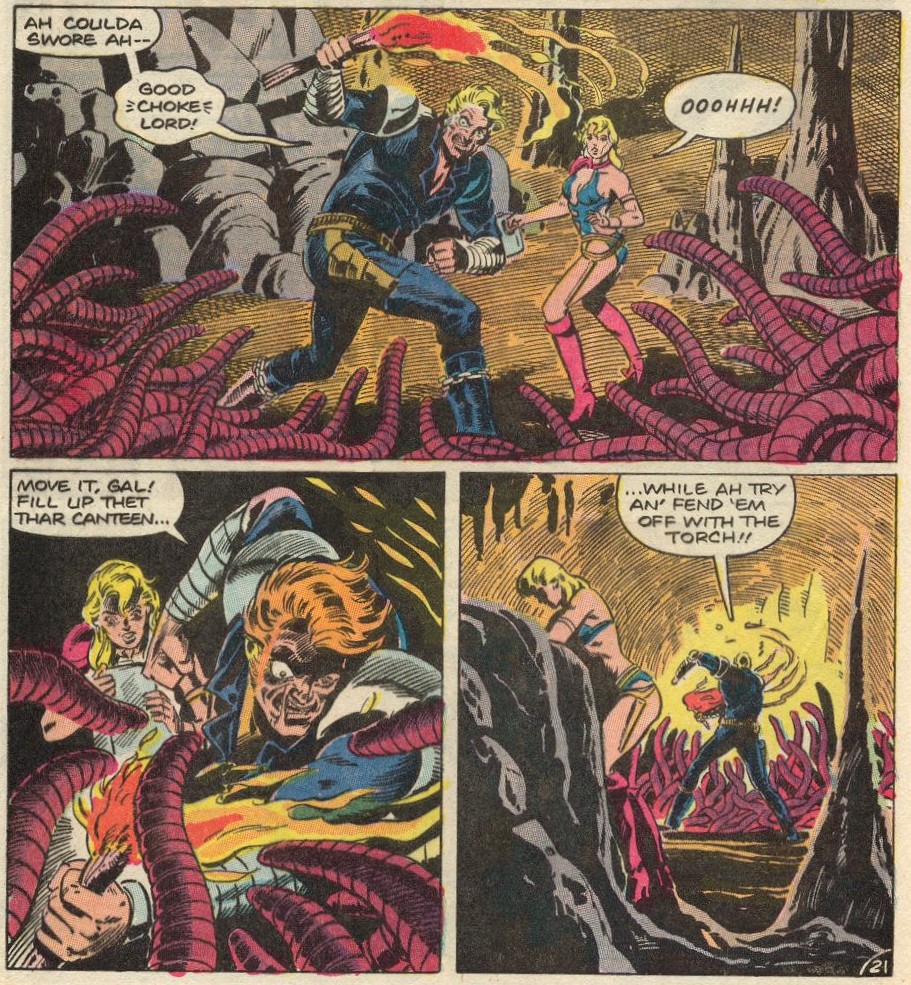
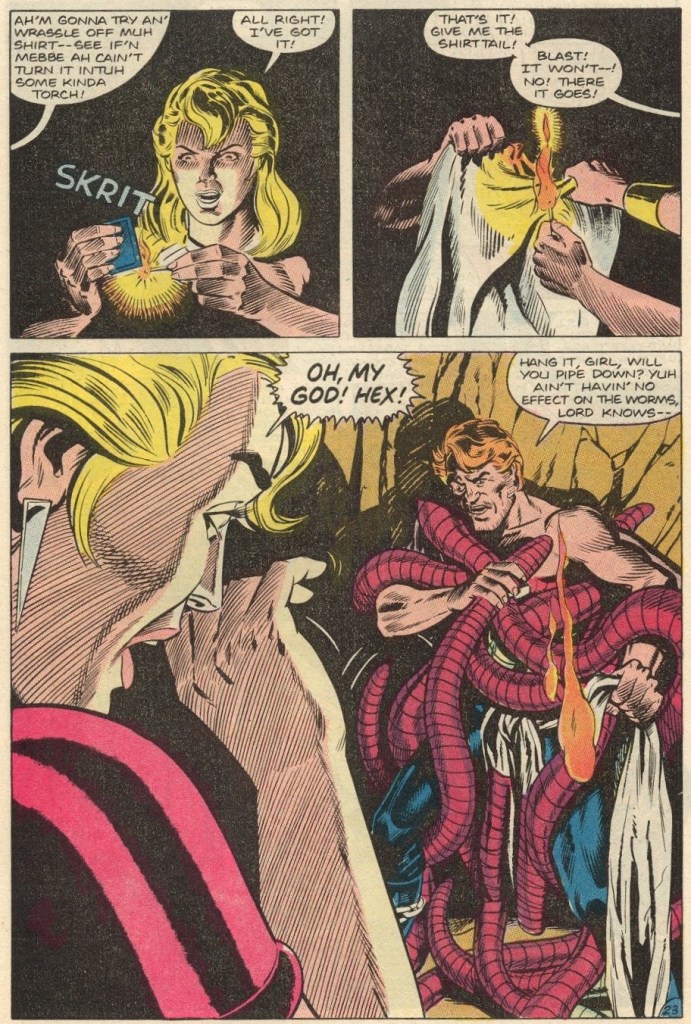
And yet… the cover story is Worms, scripted by Michael Fleisher, pencilled by Ron Wagner and inked by Carlos Garzón. I stand corrected!

Worms. Grabby, slithering worms. Ugh, please.

Moving on! With a texture distinctly reminiscent of some sort of slug, the following whatchamacallits could be either… but the planet that hungers is using its tentacles, and not worms, to feed. Ping! Correct. This makes the following scene no less disquieting – oh, somebody bring me back to the normal, sea-faring octopus…

This is Battlestar Galactica no. 10 (December 1979, Marvel). Cover pencilled by Pat Broderick and inked by Terry Austin.

Let’s have one last go. This cover so clearly depicts Abby getting grabbed by some underwater tentacled monster, that it regularly appears in tentacle-related searches…

Swamp Thing no. 11 (July-August 1974, DC). Cover by Luis Dominguez (speaking of whom, co-admin RG has a treat for you later this week!)

And yet! The cover is the self-explanatory The Conqueror Worms!, scripted by Len Wein and illustrated by Nestor Redondo. The star creatures of this story are actually pretty adorable, especially their mini-trunks and moist, sensitive eyes:

When somebody killed one of those things, I was seriously peeved.

I hope some of these examples gave you pause, even if for just a little bit!

~ ds

Hallowe’en Countdown IV, Day 27

« No — I’m not alive! But we’ll have time to talk about that later! » — the accident-prone stranger

On the magazine front, Scholastic hit its peak in the mid-to-late 1970s with Dynamite (1974-92) Bananas (1975-84) and sundry periodicals aimed at various reading levels. Always comics-friendly, they struck a fruitful alliance with the fledgling Joe Kubert School of Cartoon & Graphic Art, thus granting precious early exposure to some of the institution’s promising early alumni, such as Stephen Bissette, Rick Veitch and John Totleben.

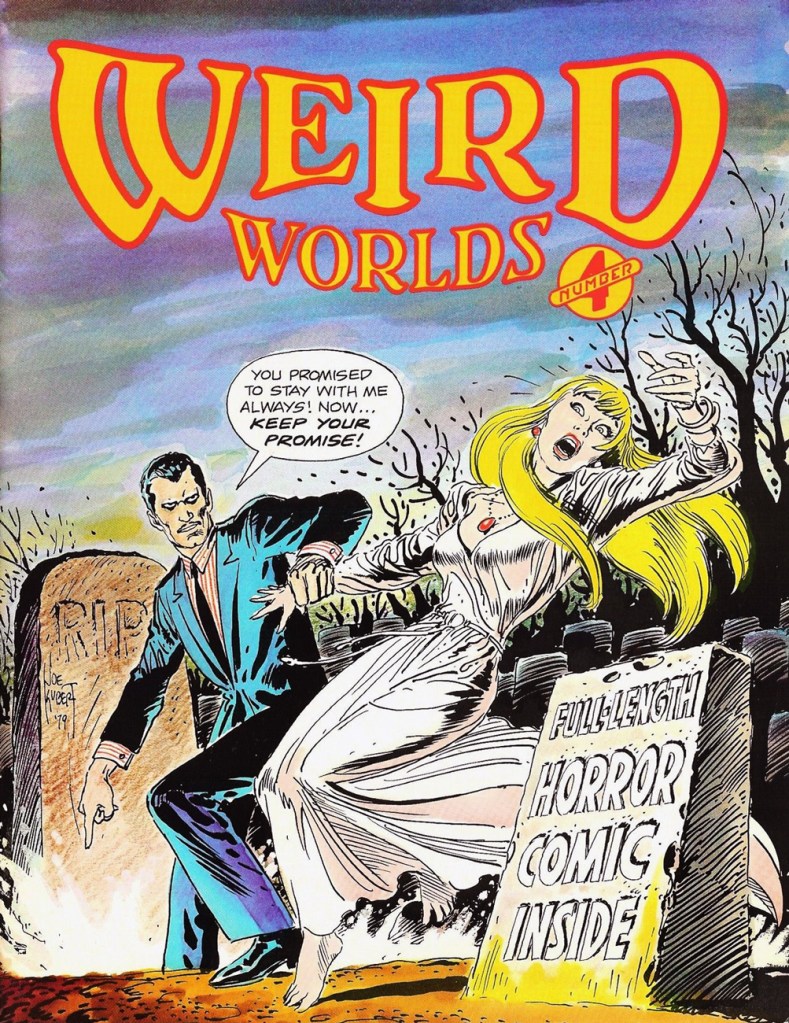
This is Weird Worlds no. 4 (1980, Scholastic). Cover by Joe Kubert. By ‘full-length’, they meant ‘four pages long’. Oh well.

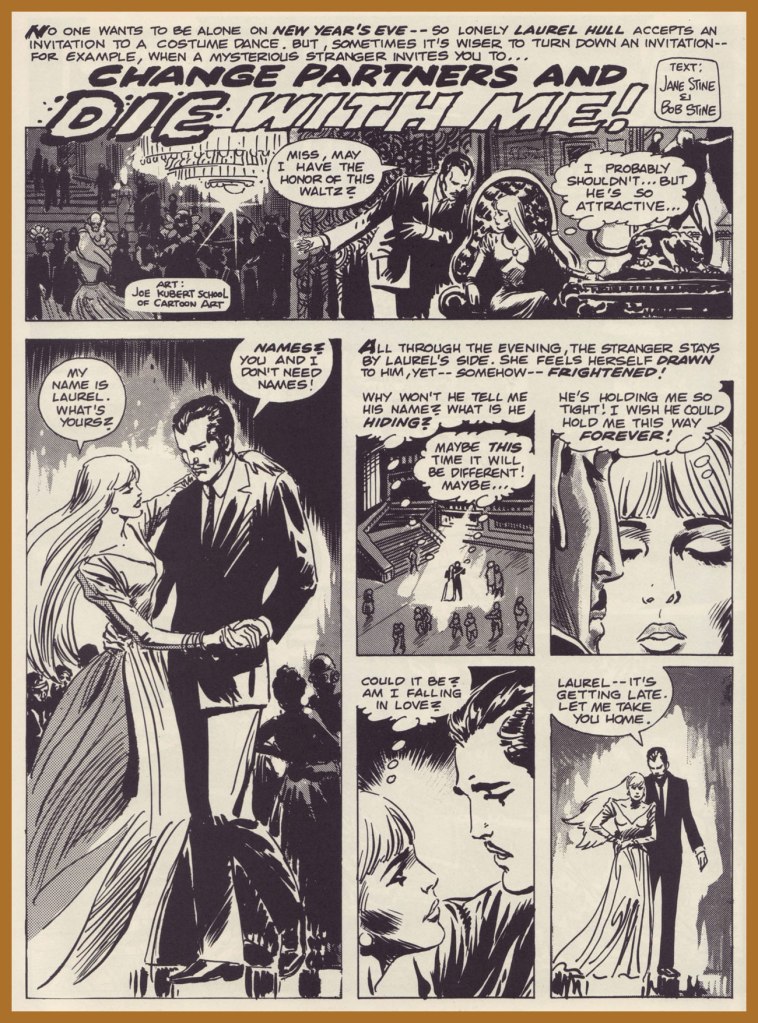
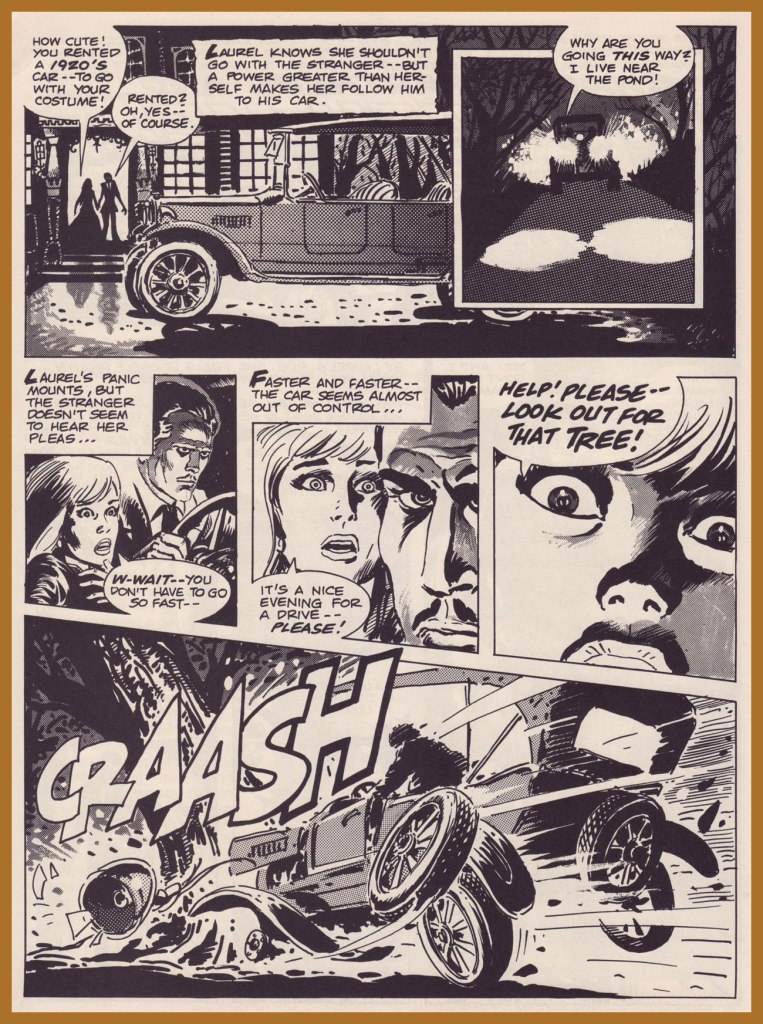
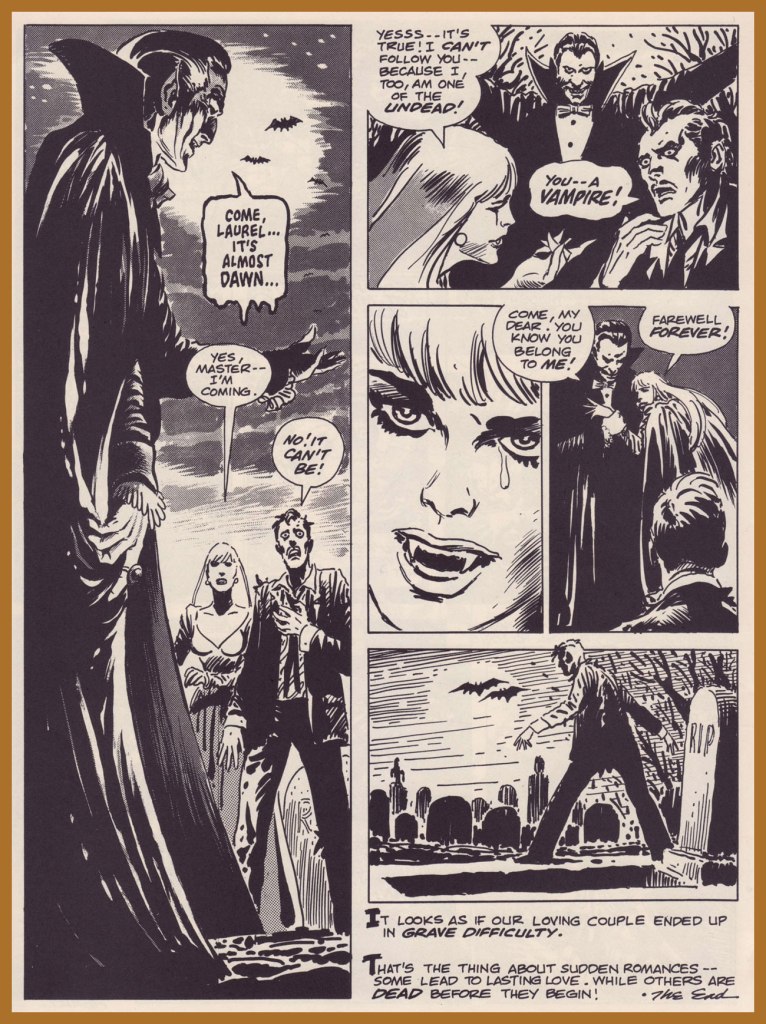
Professorial Joe Kubert leads his students into a moody collaboration with the guiding lights of Dynamite, namely the husband-and-wife team of Jane Stine and ‘Jovial’ Bob Stine (of later R.L. Stine fame and fortune).

Could it be?

Well, Laurel could have fared far worse: her ‘Master’ is squarely in the then-fashionable Frank Langella / George Hamilton leading man mould. There was another alternative, of course:

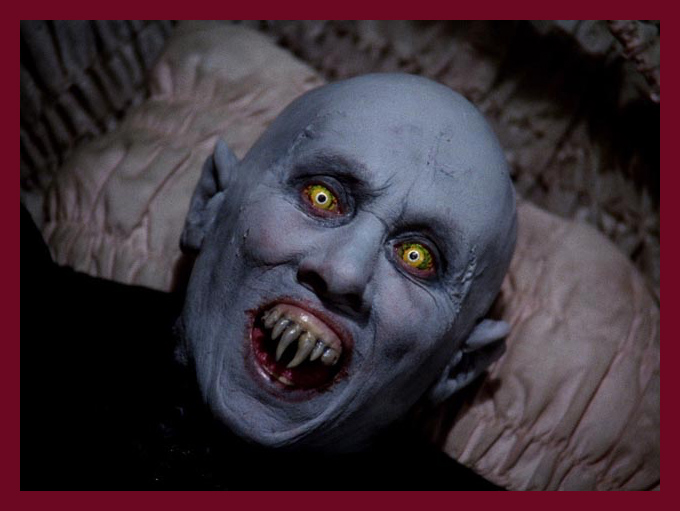
You’ll enjoy Mr. Barlow. And he’ll enjoy you.

Weird Worlds didn’t set this world afire, enduring but eight issues. Still, Scholastic would return to mine the teenage affinity for all things spooky and on that occasion (and further ones) strike gold and raise goosebumps.

-RG

Hallowe’en Countdown IV, Day 6

« And with that awakening, an insane sovereign
once again asserts his rightful dominion over
a night of madness — as the Halloween God!
»

For years after Bernie Wrightson’s career path took him away from DC Comics, cover illustrations purchased by the publisher but left unused gradually trickled into print. Some were too specific and puzzling to be published tel quel, so new stories were written to order. Such a case was Batman no. 320 (February, 1980). This is another, which yielded The Halloween God, written by Gary Cohn and Dan Mishkin, illustrated by Ading “Adrian” Gonzales, and edited by Dave Manak.

This is Secrets of Haunted House no. 44 (Jan. 1982, DC). Cover created by Mr. Wrightson way back in… 1972!

And here’s an interesting twist: Wrightson’s original drawing didn’t quite look that way. As co-writer Gary Cohn told me, a few years ago, « When [editor] Dave Manak showed me this cover, the figure being thrown had a head much like the other goblins. I said, “Can someone change that to a Jack o’lantern head? Then we can write a story called, ‘The Halloween God.’ And so… »

I then asked Mr. Cohn whether he had any recollection as to who might have drawn said Jack o’lantern, as Wrightson was unlikely to be available. He responded: « My recollection might be wrong, but I think it was Dave Manak himself, who is no slouch as an artist. » That light effect on the ground really integrates the change, sells it, so to speak. Kudos to all involved.

-RG