Poise and Prudence: Tove Jansson’s The Moomins

I think it safe to surmise that pretty much everyone is familiar with the light-coloured, pleasantly plump creatures collectively referred to as the Moomins. Even if you’ve never heard of Tove Marika Jansson, their creator, you’ve surely glimpsed a Moomintroll mug, a Snork Maiden tote, or a Little My t-shirt.

Tove Jansson (1914-2001) was a multi-faceted soul: comic strip artist, of course, but also novelist, painter and illustrator (one might argue that these all are related: point taken). She published her first Moomin book in 1945 (The Moomins and the Great Flood) to (eventual) great success; the eight books that followed were equally popular. All have been translated into forty-four languages. The Moomin comic strip, first designed for publication in the children’s section of Swedish newspaper Ny Tid, ran from 1947 to 1975, and was syndicated in 120 countries. (Here’s a detailed timeline of Moomins’ creation and development.) To Anglophone audiences, the strip is known thanks to The London Evening News, which picked it up in 1954.

The commercialization of the Moomin family, the ubiquity of Moomin merchandise overshadow the rest of Jansson’s career – but also cheapen the darling Moomins. (I should talk; I have two favourite Moomin mugs from which I drink kefir.) As with the best writing for children, Moomin stories are fun and easy to follow on the surface – but beneath that cheerful and cute exterior, complex themes are tackled, moral dilemmas remain unresolved, and the world is a confusing, unfair place.

Montréal’s Drawn and Quarterly is currently « reworking classic Moomin stories in full colour, with a kid-proof but kid-friendly size, price, and format » (to quote from their website) for their Enfant collection. « Enfant » means « child », but I think any adult with a sense of humour and just a pinch of childlike innocence will enjoy these stories. Drawn and Quarterly have heretofore published collections of London Evening News strips in black and white; and though the art is beautiful, I really like the way the strips came out in colour.

As little of this stuff is findable online, I’ve selected a few (well, quite a few) favourite pages to whet your appetite – a selection of goofy characters, hard life lessons and good old madcap fun.

MoominWinter01A
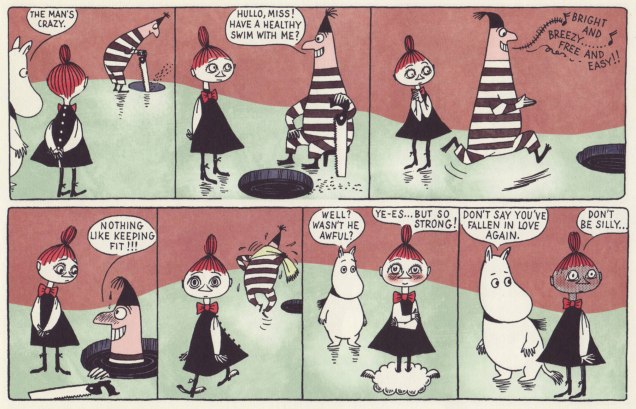
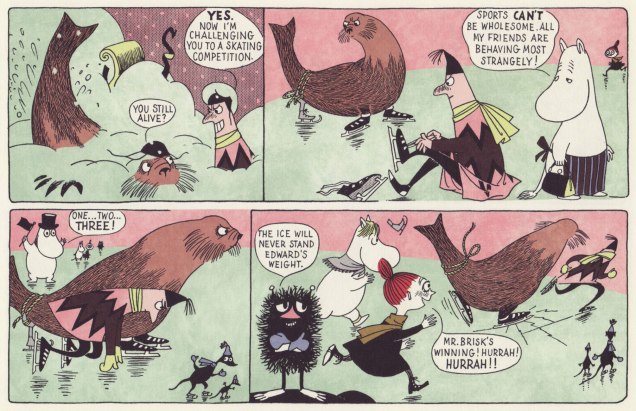
Pages from Moomin’s Winter Follies

MoominWinter02A

MoominHouseA
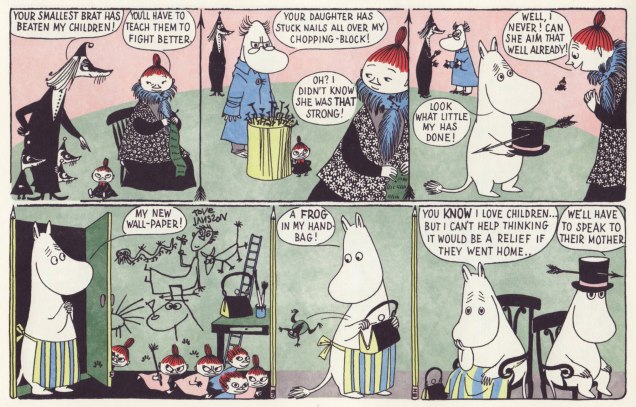
Moomin Builds a House. Little My makes her first appearance in this story. Some parenting advice from Elder Mymble, the mother of this red-haired hoarde: « I don’t like to keep scolding them. I just… pour some water over them. …Or lemonade. »

« Born in 1914, at the onset of World War I, Tove’s childhood and early adulthood took place in a time of intense political upheaval. Artists themselves, her parents were a part of the Swedish-speaking minority in Finland and in those first few years, when the world was at war, Tove and her mother stayed in Stockholm while her father remained in Finland, going on to fight in the Finnish civil war in 1918. That experience, some literary analysts say, is reflected in the missing Moominpappa, who appears only as an allusion in the first chapters of the first book. » (How Tove Jansson’s Moomins conquered readers’ hearts)

ToveJansson-MoominontheRiviera-1
« As springtime dawns in Moominvalley and the first northern crocus opens, Moominpappa and Snorkmaiden, glamorized by the prospects of movie stars and gambling, insist the whole family take a trip down to the Riviera. Reluctantly Moomin and Moominmamma agree to go along, and the Moomins set off on a grand adventure, complete with butlers, luxury shops, indoor swimming pools, and duels at dawn. » Pages from Moomin on the Riviera.

ToveJansson-MoominontheRiviera-2

« Following art school and travels abroad, Jansson drew cartoons for different outlets, including, for fifteen years, the satirical political paper Garm. (“Do as you like,” the editor told her. “Just make sure you hit them in the mouth.”) This is where the Moomins first surfaced publicly. Originally meaner-looking and troll-like creatures called Snorks, they began mostly as marginalia, a kind of signature, and might even be found loitering in a cartoon about the German Army’s evacuation of Lapland. » (The Hands That Made the Moomins)

MoominSeaA
Page from Moomin and the Sea.
MoominMaid01A
Misabel the maid is, as her name suggests, miserable. Afraid of any kind of non-conformist behaviour, scared of enjoying anything, she is anathema to Moomins’ approach to life. Pages from Moominmamma’s Maid.

MoominMaid02A

« Tove’s entire life was filled with bold decisions: selling satirical cartoons mocking Hitler; opposing war; choosing not to marry or have children; and turning down Walt Disney’s offer to buy the Moomin brand. She was the writer, illustrator, designer and controlled the business side of her creation, not trusting anyone else to do it justice. » (Tove Jansson’s Feminist Legacy)

ToveJansson-MoominandtheMartians-1
This sequence with a somewhat indignant cow is one of my favourite moments. Pages from Moomin and the Martians.

ToveJansson-MoominandtheMartians-2

« In like spirit, Moomin hospitality excludes no one—except those prone to electrify the furniture or freeze Moominmamma’s roses. Guests include shrewish Fillyjonks addicted to cleaning; large graceless Hemulens obsessed with classifying and organising; and a philosophical Muskrat who believes only in the pointlessness of everything. » (Tove Jansson, Queen of the Moomins)

MoominNewLife01A
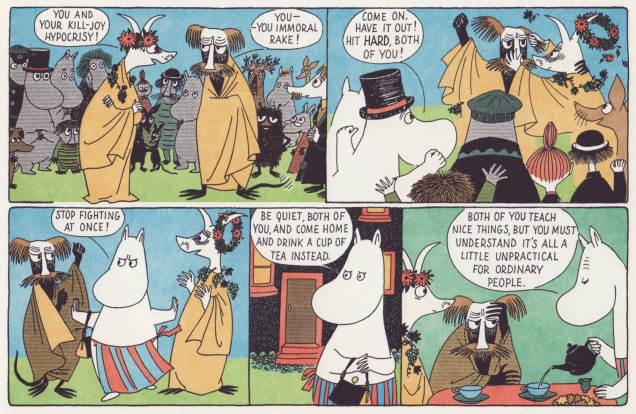
« When a charismatic prophet comes to town, the residents of Moominvalley are easily convinced to follow his doctrine for true happiness. Intrigued by their friends and neighbors’ lifestyle changes, the impressionable Moomins find themselves attempting to adopt the teachings of their new spiritual leader. But the freer they get, the more miserable they feel. Moominvalley’s state of divine chaos is further complicated by the prophet’s well-intentioned decree to free all of the jail’s inmates. » Moomin Begins a New Life.

ToveJansson-MoominStartsaNewLife-2

MoominNewLife02A« Over time, Jansson came to feel exhausted by the Moomins and that their success had obscured her other ambitions as an artist. In 1978, she satirized her situation in a short story titled “The Cartoonist” about a man called Stein contracted to produce a daily strip, Blubby, which has generated a Moomin-like universe of commercial paraphernalia—“Blubby curtains, Blubby jelly, Blubby clocks and Blubby socks, Blubby shirts and Blubby shorts.” “Tell me something,” another cartoonist asks Stein. “Are you one of those people who are prevented from doing Great Art because they draw comic strips?” Stein denies it, but that was precisely Jansson’s fear. » (Tove Jansson: Beyond the Moomins)
ToveJansson-MoominandtheBrigands-1
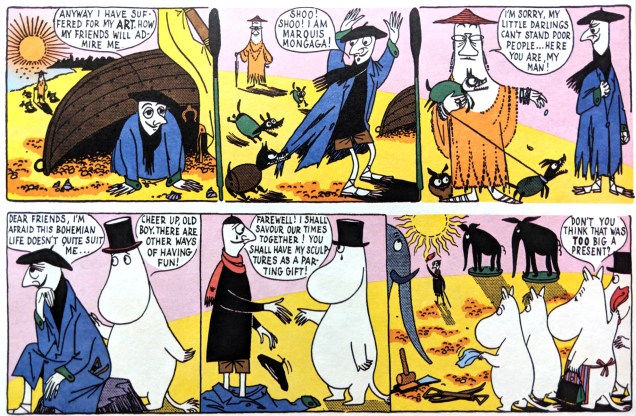
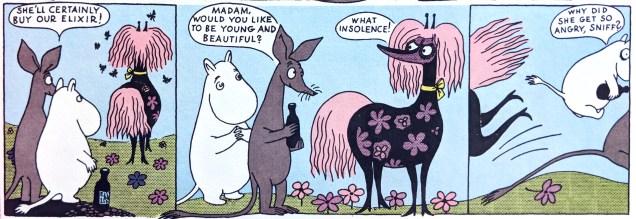
« Moomin’s pushy relations have come to stay, and in the process of getting them out, he unwittingly embarks on a quest for fame and fortune with his sly friend Sniff. But it’s much harder to get rich than either of them expects, whether it’s through selling rare creatures to the zoo, using a fortune-teller to find treasures, or making modern art. » Moomin and the Brigands.

The only (other) thing I’ll add is that Tove Jansson was a lesbian, which tends to get glossed over by (bad) biographies of her. You can read an excellent essay about Jansson and her lifelong partner Tuulikki Pietilä here.

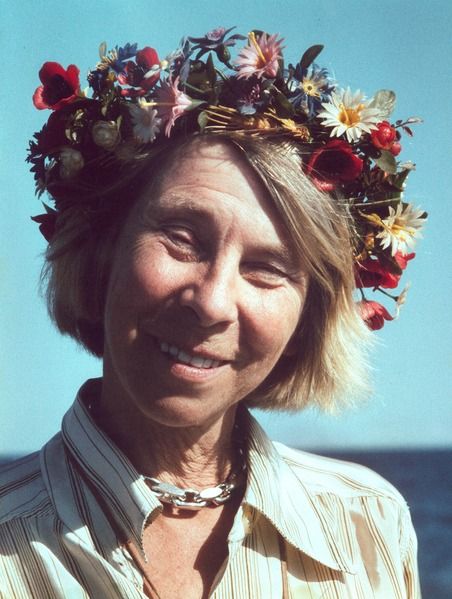
ToveJansson
Tove Jansson photographed by her brother Per Olov.
ToveJansson-partner
Jansson and Pietilä. Sweet!

~ ds

Barracks Life With Le Sergent Laterreur

« Le sergent Laterreur resembles no-one. It’s impossible for anyone to be so ignoble, so sinister, so cruel. One feels that the two poor bastards that created him are exacting their revenge for all the humiliations suffered at the hands of the strong. One wouldn’t have been surprised to discover that the authors of Sergent Laterreur were Jewish, Black, Irish or Czech. They’re Belgian. » — Georges Wolinski

“Le Sergent Laterreur” is a strip that ran in the fabled bédé weekly Pilote from February 1971 to December 1973.

This vitriolic lampoon of military life (no Beetle Bailey this) was the brainchild of Belgians Touïs ( Vivian Miessen, b. 1940) and Gérald Frydman (b. 1942).
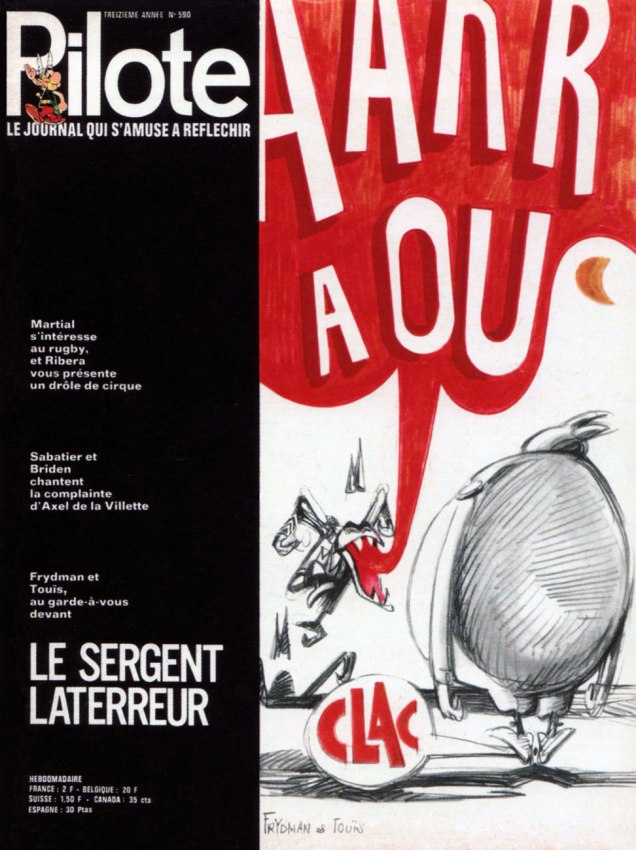
Pilote590A
Pilote no. 590 (February 21, 1971, Dargaud), the Sergent’s third appearance in the magazine and his first (of two) on the cover.

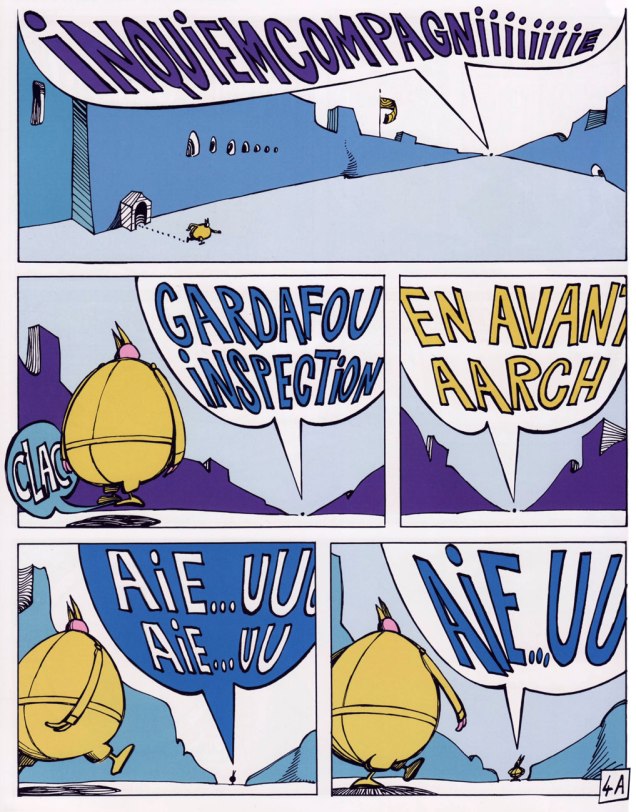
Laterreur4A

Laterreur4B
Episode 4: Flower Power

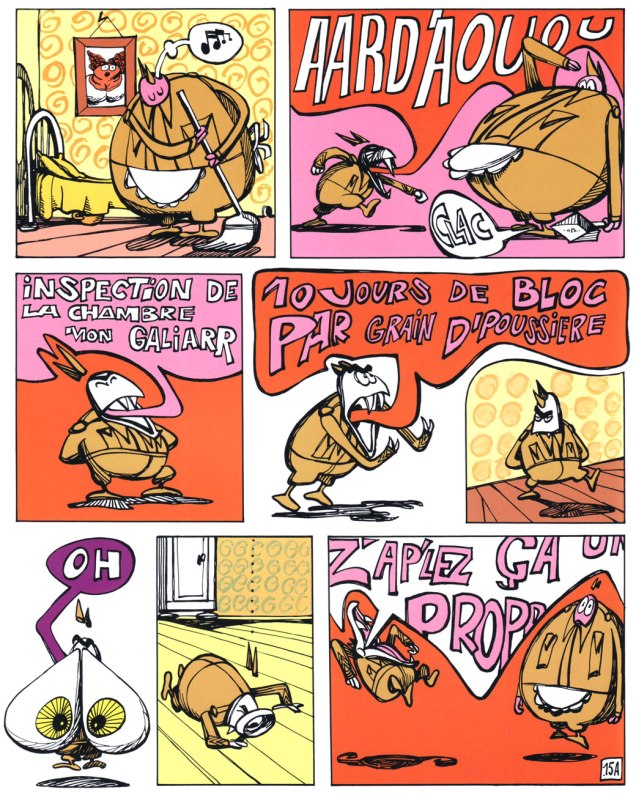
Laterreur15A

Laterreur15B
Episode 15: « Et tu retourneras les poussières ». The Sergent’s immortal maxim: « Don’t forget that dirt is our worst enemy! »

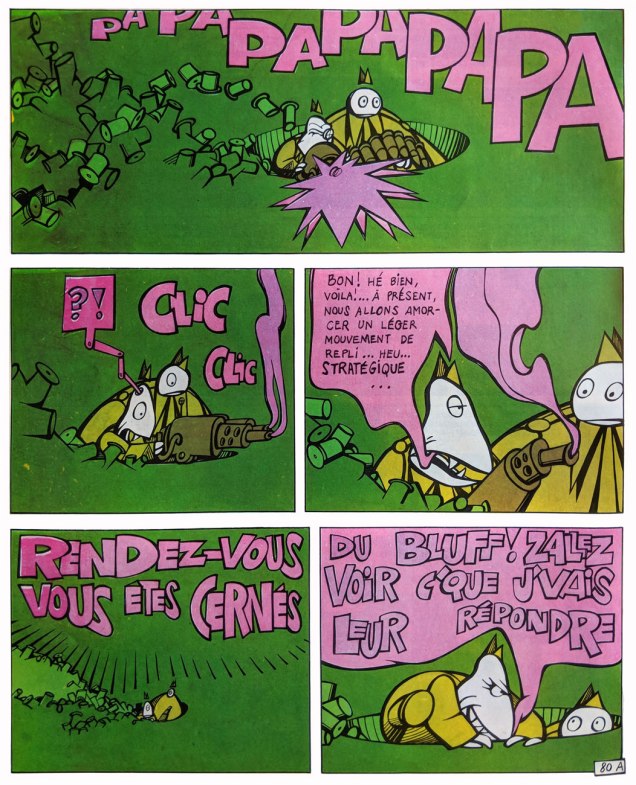
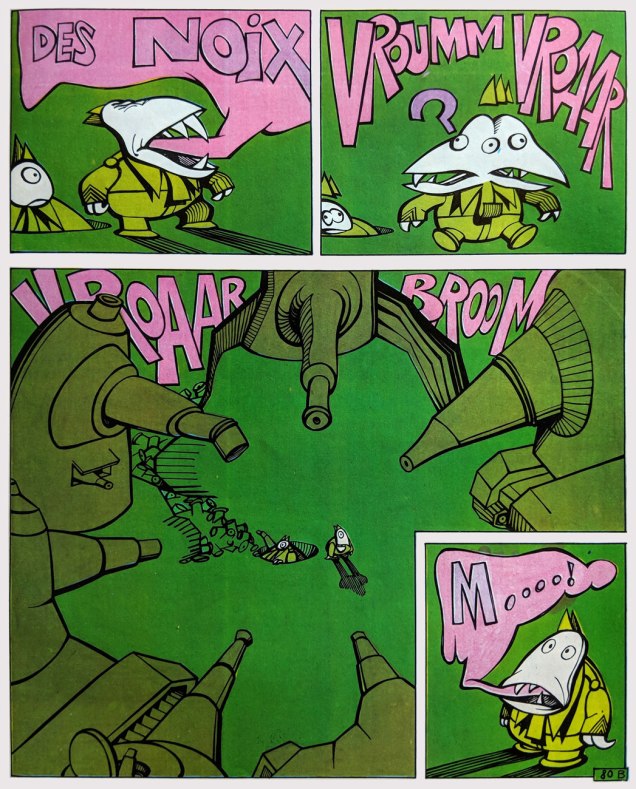
Laterreur80A

Laterreur80B
Episode 80: Les mots historiques. Laterreur thought the enemy was bluffing.

Miessen produced a few more comics during the 70s, and made a notable comeback contribution to L’Association‘s massive anthology Comix 2000, but he chiefly worked in animation. Frydman mostly pursued projects in photography and film, directing several short subjects.

Laterreur’s full effect is best experienced in massive doses, and L’Association, fully cognizant of that fact, issued a splendid Le Sergent Laterreur omnibus in 2006. An obscure creation, it remains obscure, but at least it’s available if you seek it out.

Laterreur85A

Laterreur85B
Episode 85: Du gâteau. A fitting way for a dotty old general to blow out his birthday candles.

Laterreur108A

Laterreur108B
The finale, Episode 108: Tapage nocturne. Now you know how it goes down, so to speak.

Fun factoid: The strip’s name presumably comes from the French title of a USA “boot camp” Korean War propaganda film from 1953, “Take the High Ground!“, directed by Richard Brooks. and starring Richard Widmark and Karl Malden.

– RG

Tentacle Tuesday: Tentacules à la mode

« Les artistes, c’est comme les pieuvres: ils crachent de l’encre pour se cacher. » — Julos Beaucarne*

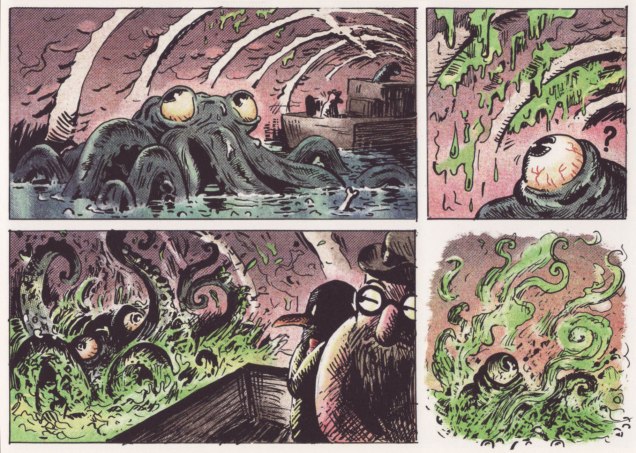
It is time (again) for some French tentacles! (Upon closer inspection, a lot of these actually prove to be Belgian, but my point still holds.) We have all kinds in today’s post: tentacles merry and frightening, realistic or cartoony. There’s even an octopus in a bra (but don’t skip ahead)!

tentacletuesdayicon

Created for Le journal de Tintin in 1963 by Raymond Reding, Vincent Larcher was a professional football player who often used his athletic prowess to defeat evil guys (he also occasionally played football). The first Vincent Larcher story had no supernatural elements, and didn’t seem to make much of a ripple amidst Tintin’s audience. After a 4-year hiatus, Reding re-introduced Vincent Larcher, this time throwing him into a three-part tale with a mad scientist (as usual, hellbent on world domination) and scary aliens. This was later christened the Olympio Trilogy in honour of Olympio, Larcher’s telepathically gifted friend, who was an important figure in these stories. The pages below are from Le zoo du Dr. Ketzal, part three of the aforementioned trilogy, published in Tintin Magazine issues 1039 to 1059 (1969).

le zoo du docteur ketzal-vincentLarcher-1

le zoo du docteur ketzal-vincentLarcher-2

tentacletuesdayicon

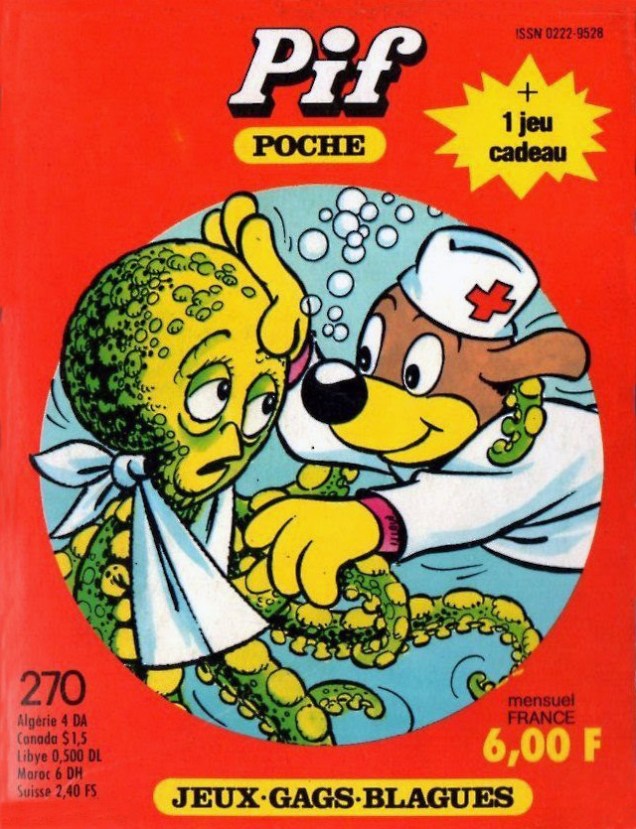
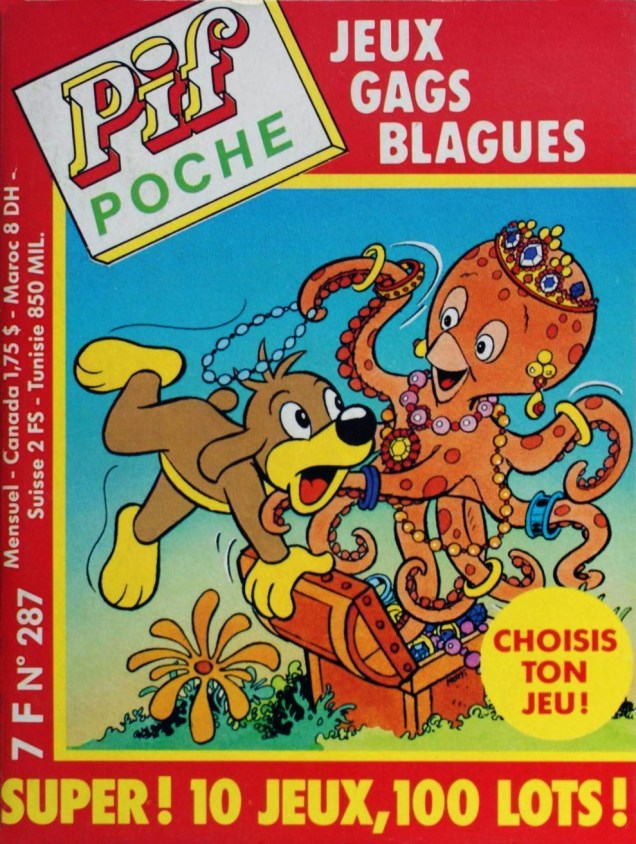
The friendly pooch fraternizing with octopuses is Pif, the mascot of Pif Gadget (« gadget » referred to the fact that each issue of the magazine was accompanied by some thingamajig to amuse the youngsters). Pif Poche were pocket-sized collections of short Pif strips (“poche” means pocket in French), meant to be easily carried to trips, picnics, and probably school as well. Pif was created by José Cabrero Arnal in 1948, who gradually abandoned the strip by the 1960s while other artists took over.

PifPoche-270
Pif Poche no. 270 (Vaillant, 1988)
PifPoche287
Pif Poche no. 287 (Vaillant, 1989)

TentacleTuesdayIcon

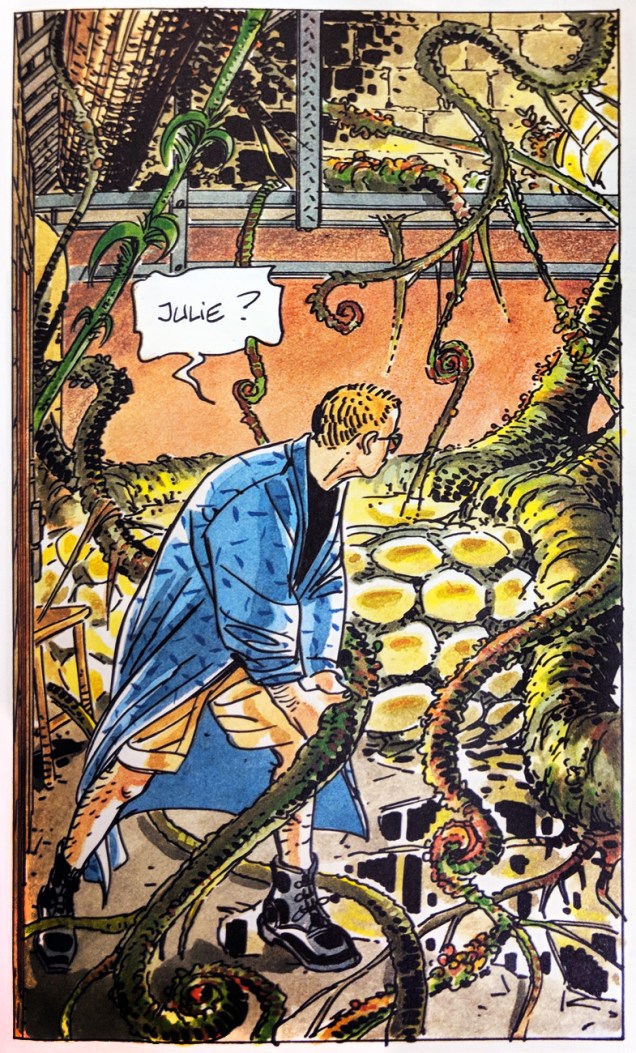
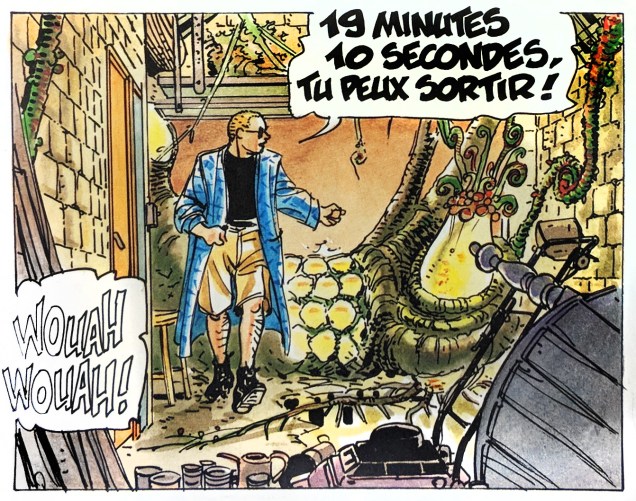
The following panels are from the series Tropique des étoiles by Christian Lamquet, more precisely from volume 4, Le réveil des poussières (1996, Claude Lefrancq).

LeReveilDesPoussieres-Tropiquedesetoiles4-ChrisLamquet1

LeReveilDesPoussieres-Tropiquedesetoiles4-ChrisLamquet2
« 19 minutes, 10 seconds, you can come out! » Experiments performed on a young woman seldom turn out as intended.

TentacleTuesdayIcon

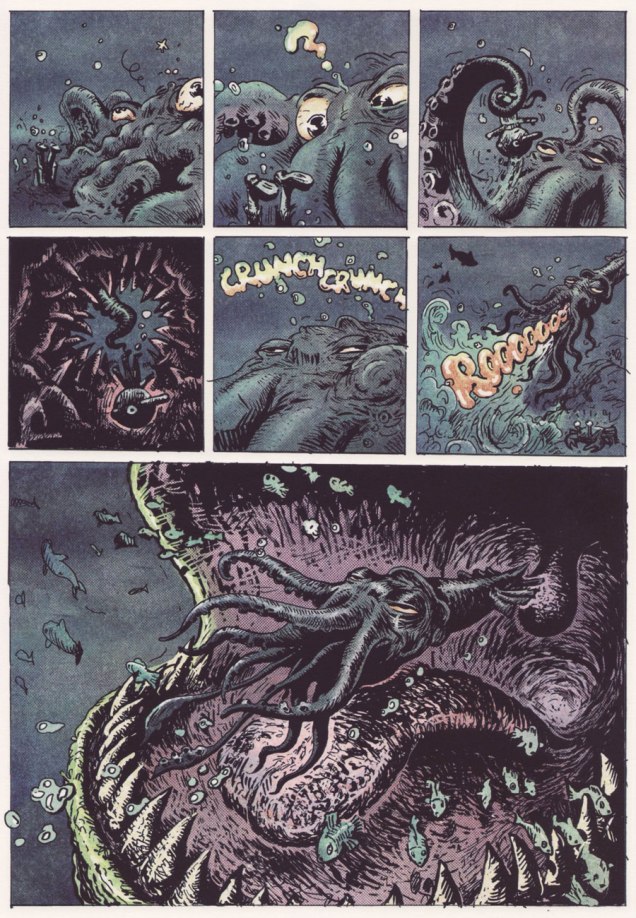
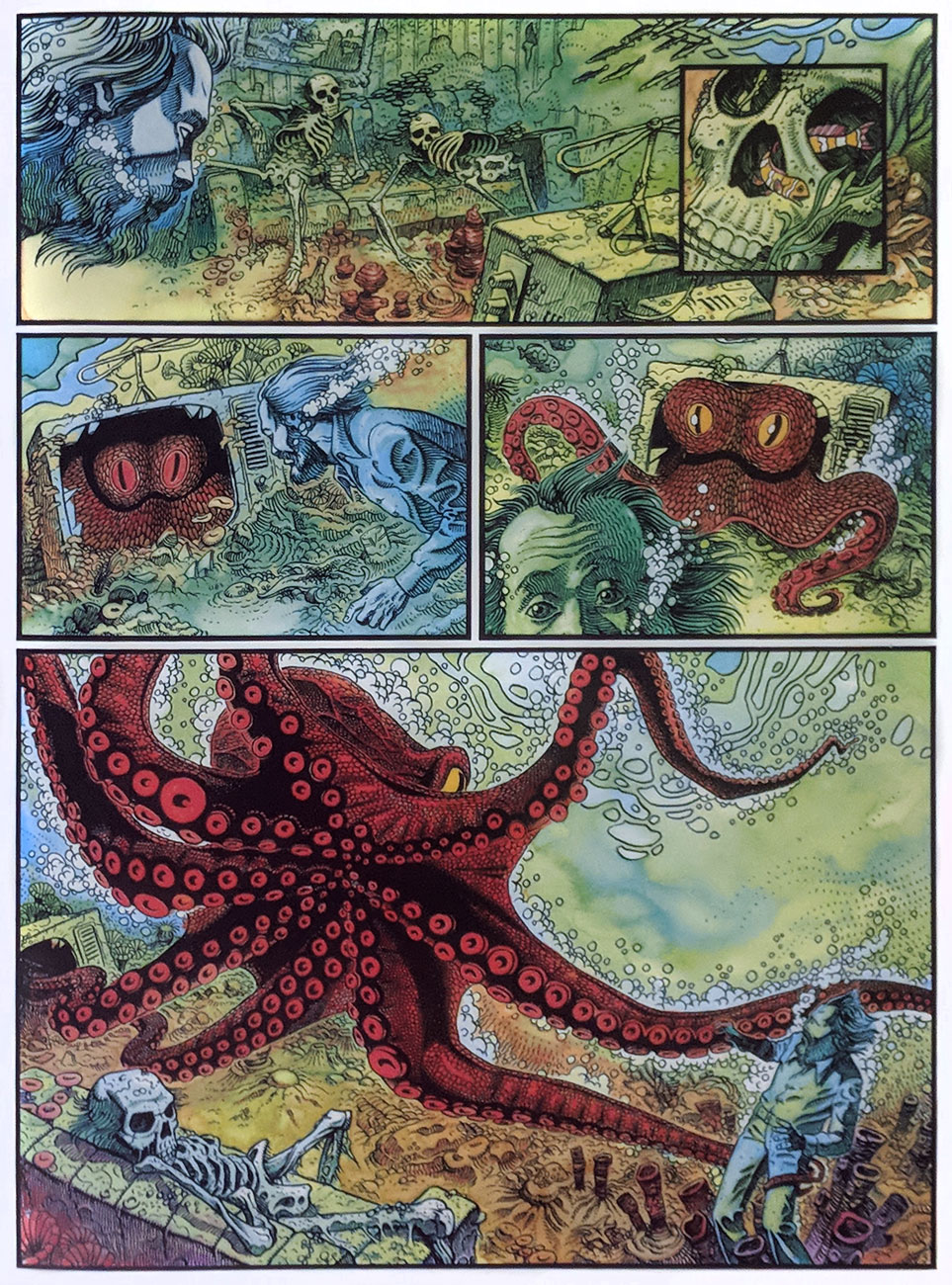
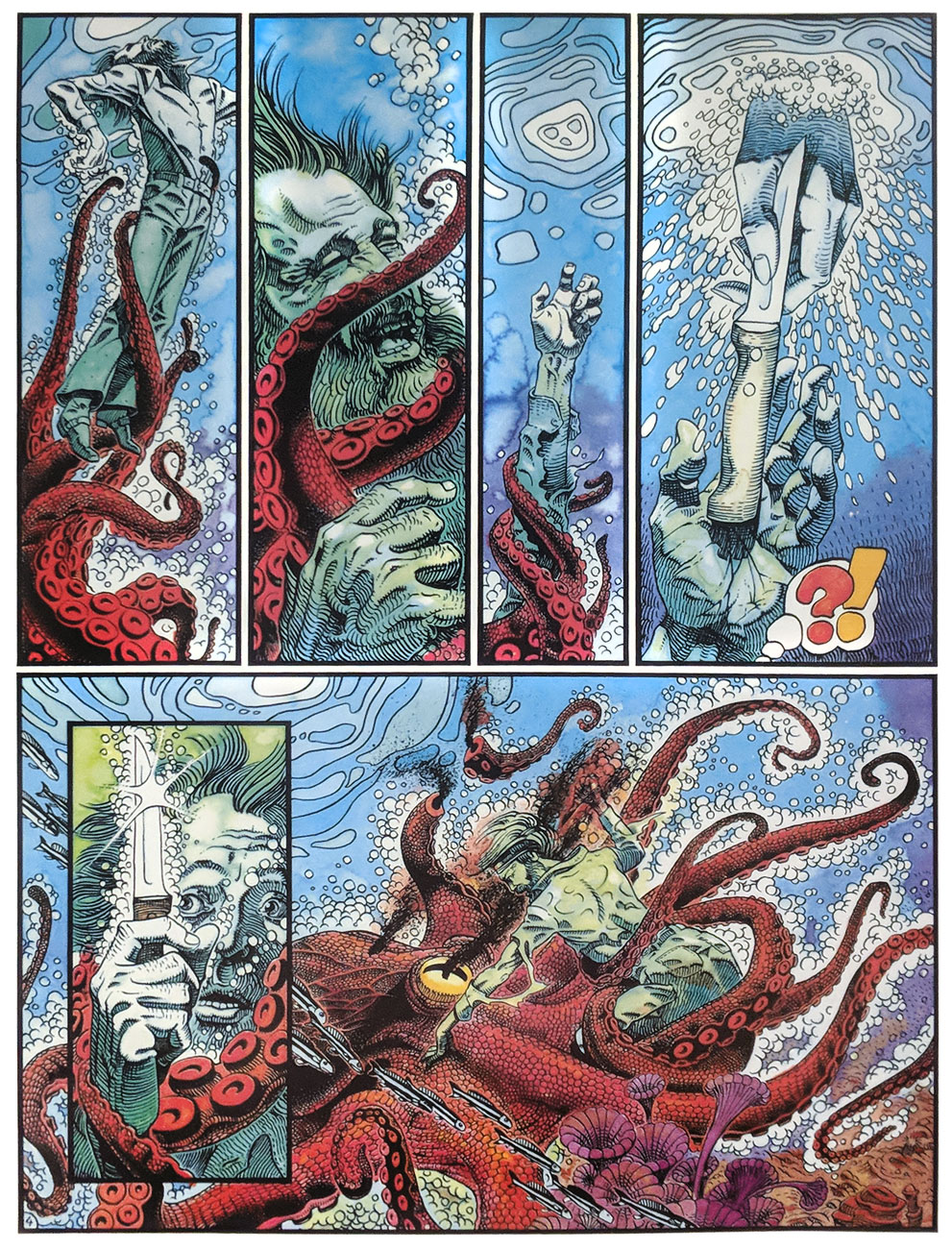
My next peace offering to the cephalopod gods comes in the form of a very loose interpretation of Carlo Collodi‘s Pinocchio, imagined by French artist Winschluss (real name Vincent Paronnaud) and executed with the help of some friends, most notably Cizo on colours. Winschluss’ art can be quite nice, but it gets a massive boost from the first-rate colouring job, so I’d like to emphasize that Cizo deserves a lot of credit for that (the tentacle pages are actually rather dark, as the action occurs undersea, but just take my word for it).

This graphic novel received a few prizes and has been lauded by many parties, but somehow I’ve managed to be quite unaware of its existence until recently. (Frankly, I am somewhat tired of picking up comics that are supposed to be superb and end up being just mediocre, so I don’t tend to pay much attention to awards and other plaudits.) A friendly comic book store clerk pointed it out to me, explaining that it was brought in by an older gentleman whose granddaughter had presented the book to him as a gift, but it wasn’t his thing at all. I was quickly won over by the art, and the story, well… it’s not for the faint-hearted or easily offended, but it’s a good one.

Winschluss’ Pinocchio was originally published in 2008 by Les Requins Marteaux, but has been reprinted several times in French (in increasingly fancier editions) as well as translated into English in 2011.

WinchlussPinocchio01A

« French comics artist Winshluss leaves his robot child hanging beneath a giant lollipop on a hill for a good quarter of his largely dialogue-free adaptation, as regimes fall, fake prophets rise and a pizza delivery girl is saved from torture at the hands of seven dwarves. It’s a grim, puerile and rather brilliant update, combining chaotic, inked panels and gorgeous full-colour paintwork to great effect. Pinocchio, designed as a killing machine, is plunged from crisis to crisis by a series of greedy men and women, his story interrupted by a tortured detective, a grieving couple and Jiminy the cockroach. » |source|

WinchlussPinocchio02A

Actually, don’t take my word for anything, you can admire the colours in this preview:

tentacletuesdayicon

CosmikRoger

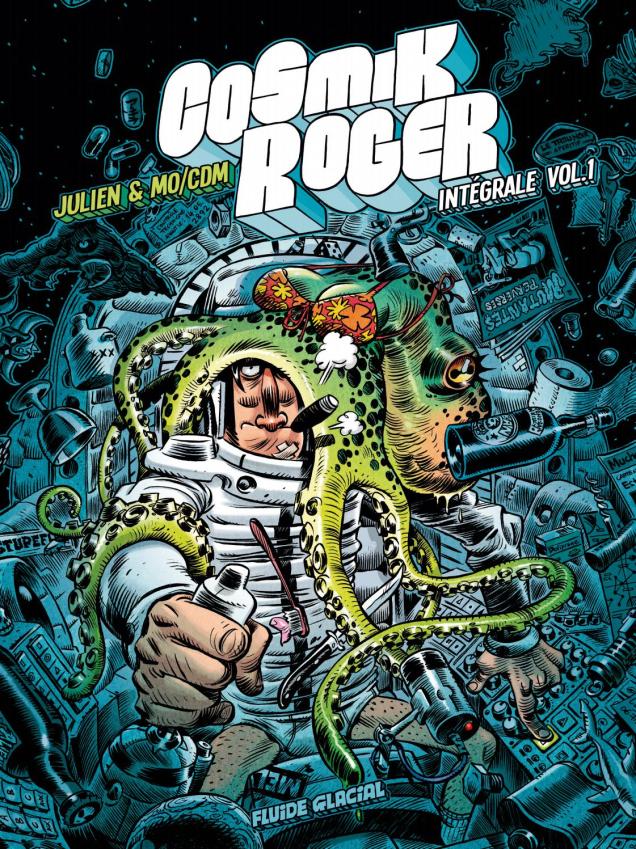
Cosmik Roger is a sci-fi/humour comic series scripted by mo/CDM (no, seriously, that’s his nom de plume, and no, I don’t know what it stands for) and drawn by Julien/CDM (real name Julien Solé – they used to go to school together, which apparently led them to adopting the same stupid monicker). This is the cover of the collected Cosmik Roger (volume 1), published in 2018 by Fluide Glacial.

Just tuning in now? Visit the previous Gallic Tentacle Tuesdays: Tentacle Tuesday: Franco-Belgian Edition, Part I and Tentacle Tuesday: Franco-Belgian Edition, Part II.

~ ds

*artists are like octopuses: they spit out ink to hide.

Marooned in Time With Paul Gillon

« We all have our time machines. Some take us back, they’re called memories. Some take us forward, they’re called dreams. » — Jeremy Irons

Today, we note the birth anniversary of the powerful French bédéiste Paul Gillon (May 11, 1926- May 21, 2011). Working in a classical, realistic style, he began his career in comics with the weekly Vaillant. For daily newspaper France-Soir, he co-created the daily soap opera strip 13, rue de l’Espoir (1959-1962, scripted by Jacques Gall and François Gall), strongly inspired by Elliot Caplin and Stan Drake’s The Heart of Juliet Jones, but set in Paris.

Then, in 1964, for the short-lived bédé newspaper Chouchou (an eight-pager published for a mere 14 issues, a tragedy!), Gillon co-created, with scripter J.C. Valherbe (alias Jean-Claude Forest, of Barbarella fame), one of the great classics of French science-fiction comics, Les naufragés du temps (“Castaways of Time”). Several wonderful features (for instance, Georges Pichard‘s Ténébrax) were left stranded by Chouchou’s demise, including (literally) Les naufragés.

Fortunately, its authors deemed its premise too worthy to let the matter drop forever. Nearly a decade on, Gillon tweaked the saga’s opening pages and resumed the narrative, which France-Soir published. Forest scripted the first four collections (1974-76), then Gillon took full command of the strip, which found a warm new home in Métal hurlant from 1977 right to the end of the series with Le cryptomère (The Cryptomeria), collected in 1989.

GillonNaufragés01AGillonNaufragés02AGillonNaufragés03A

Les naufragés’ premise is this: In 1990, a man (Chris) and a woman (Valérie) are placed into suspended animation. A thousand years hence, the man is picked up and woken. Where’s the woman?, he wants to know. A futuristic bout of cherchez la femme ensues, to make a long story short.

Forest, wrote, in 1967, of his original plans for the saga: « Chris was searching for an image. After many adventures, he manages to find Valérie only to realize that this image no longer fitted that of his dream. »

The sequence presented here comprise the second, third and fourth pages of the first tale, as they appeared in Chouchou in 1964. Say, that cool metal creature reminds me of one of the most ridiculous Marvel super-baddies of the 1960s, disgruntled government employee Alexander Gentry, aka… (see below for the answer).

GillonNaufragésÉtoileA
The first album in the series, L’étoile endormie (The Sleeping Star) – 1974
GillonNaufragésCannibaleA
The fourth album in the series, L’univers cannibale (The Cannibal Universe) – 1976
GillonNaufragésChimèreA
The fifth album in the series, Tendre chimère (Sweet Illusion) – 1977

A peek at a page of original art from album 3, Labyrinthes (1976):

NaufragésOriginalA

More about the series: http://www.coolfrenchcomics.com/naufragesdutemps.htm

… and you can read the entire series here (if you can read French) or, if not, just admire the artwork.

– RG

… and here’s your answer:

TTA48PorcupineA
Stan Lee and Don Heck‘s The ‘Dreaded’ (ha!) Porcupine, or what happens when neither Steve Ditko nor Jack Kirby are on hand to design your costume (and ghost-write your story). Incidentally, Stan, porcupines don’t project their quills. Here he is depicted by Kirby, from the cover of his inaugural appearance, in Tales to Astonish no. 48 (October, 1963).

Jean Cézard and Arthur le fantôme

Writer-Artist-Colourist Jean Cézard ( Jean César), born March 23, 1924 in the small French village of Membray, saw a ghost in his room when he was ten years old. In the morning light, the spectre turned out to be naught but one of his mom’s blouses, but the seed was sown: the incident would inspire his most famous creation, Arthur le fantôme justicier.
Arthur first manifested himself (though still invisible!) in issue 449 of comics weekly Vaillant (December 20, 1953). The editorial team realizing the character’s vast potential and charm, Arthur then returned with issue 451 (January 3, 1954), this time fully visible (when he so desired) and he was set for the afterlife. After his creator’s 1977 passing, Arthur’s adventures continued for a time in lesser hands, but really, Cézard was irreplaceable.

Arthur was Cézard’s favourite series to work on, because he could set the little revenant’s* adventures anywhere and any when, and he certainly did.

Arthur2A
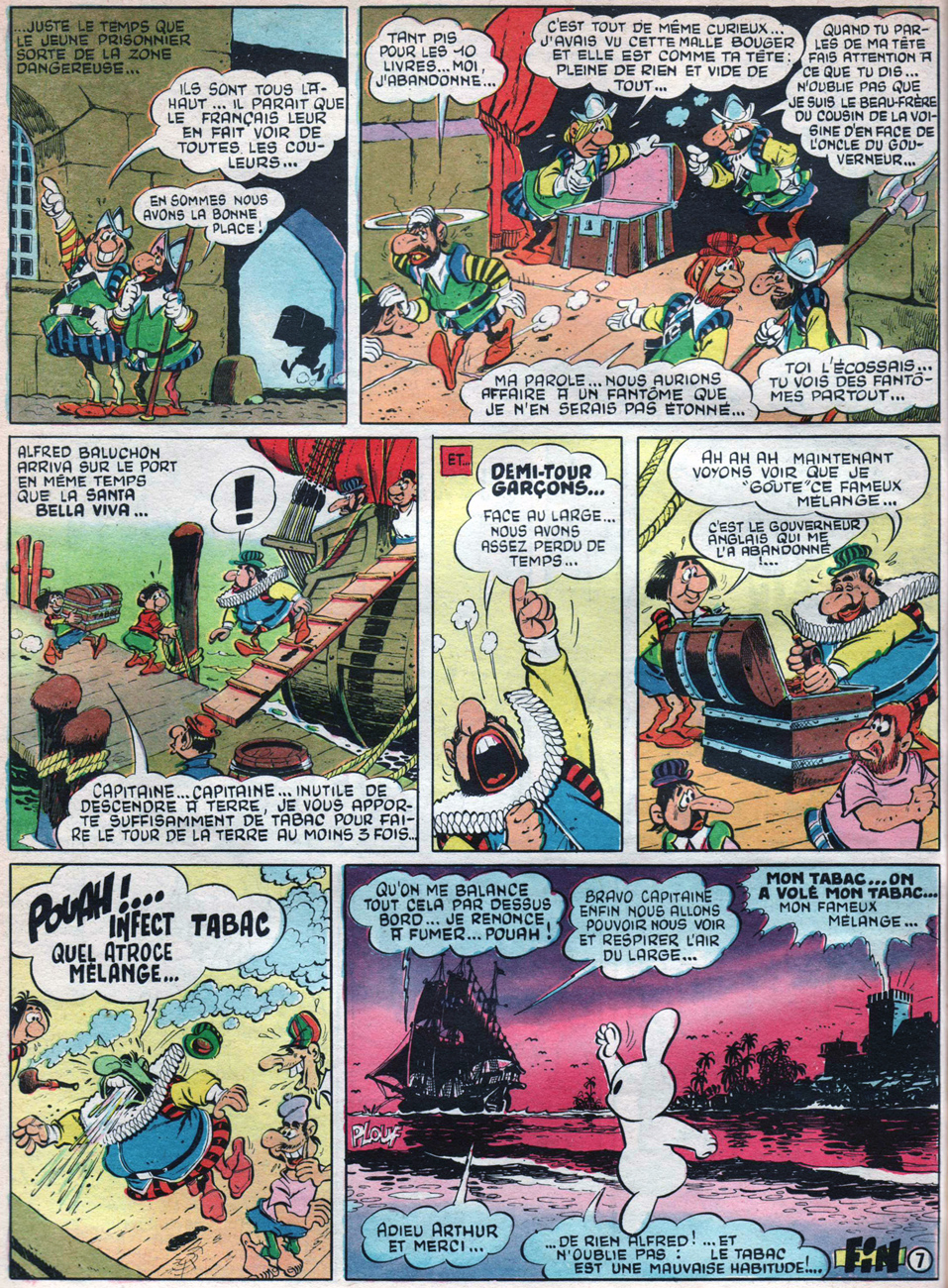
It’s all but impossible to single out an absolute favourite Cézard page, but then again, I’m not held to such arbitrary limitations. Here’s the closing page of Un fameux coup de tabac, from Pif Gadget no. 33 (i.e. Vaillant no. 1271, October, 1969) Those colours!

Arthur3A
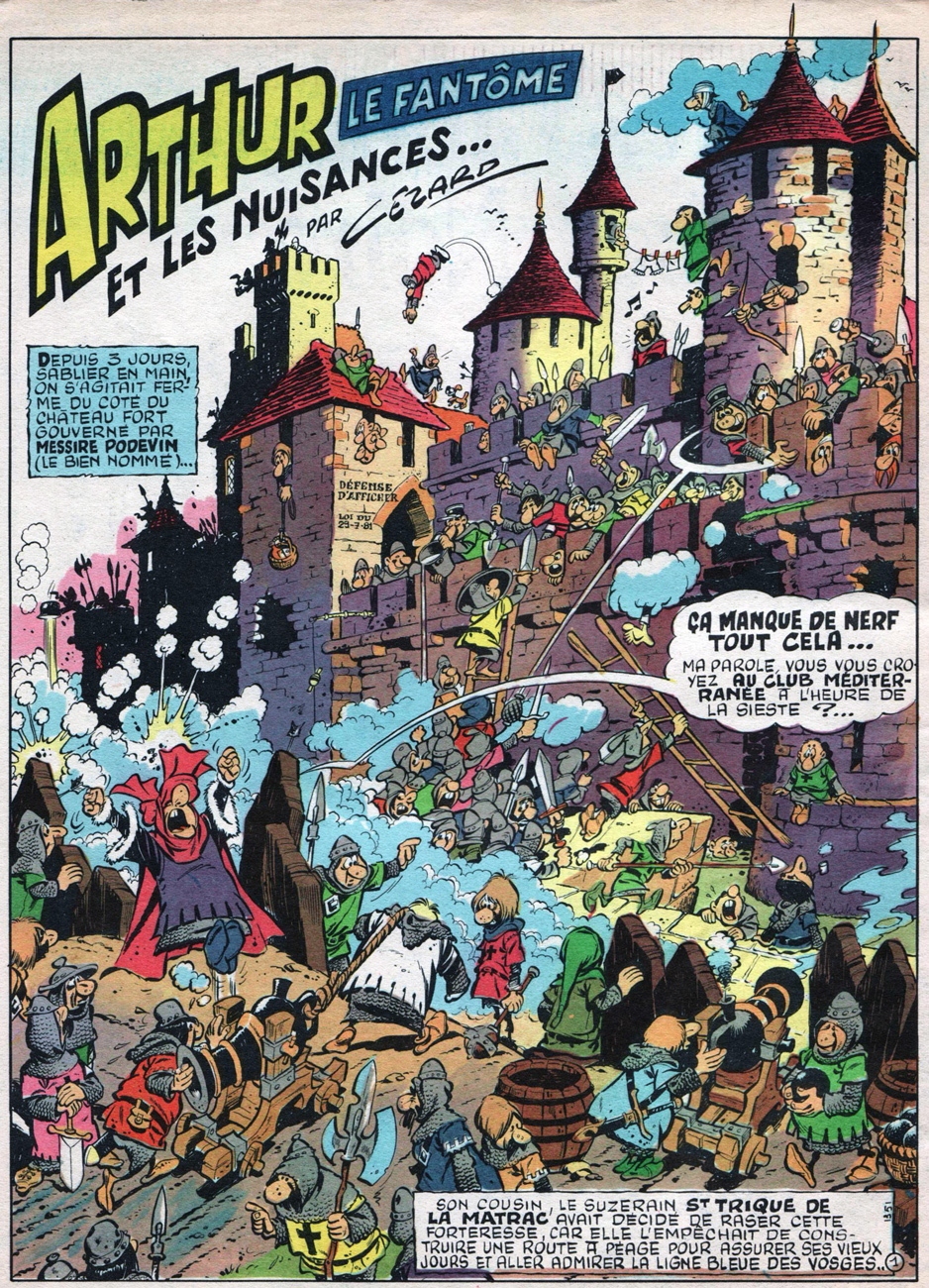
And here we have a true splash by Jean Cézard. I wanted to showcase his astonishing aptitude for rendering castles (haunted or otherwise), not to mention complex action scenes. Arthur le fantôme et les nuisances was published in Pif Gadget no. 113 (Vaillant no. 1350, April, 1971).

Arthur1A
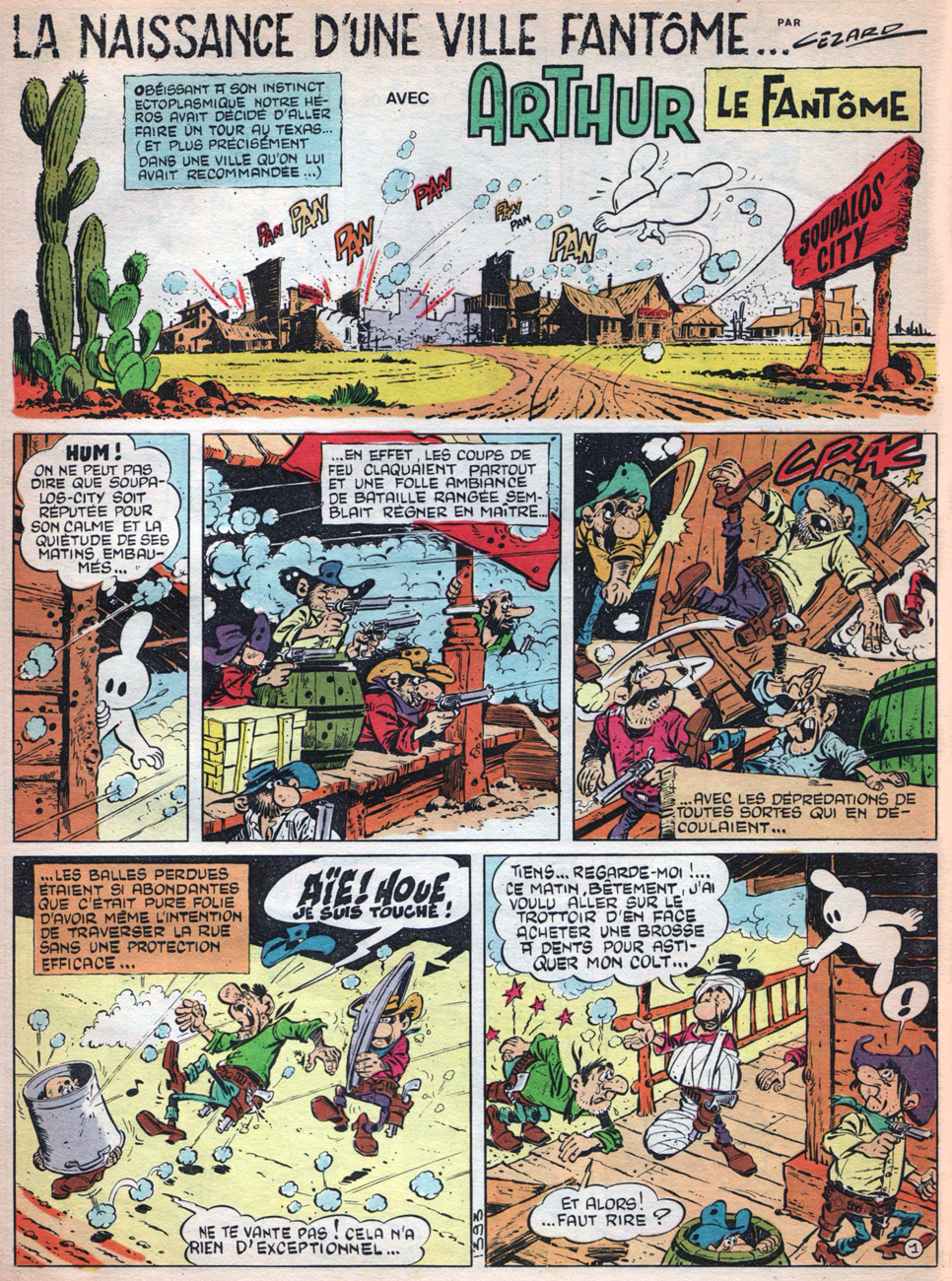
La naissance d’une ville fantôme (“Birth of a Ghost Town”), set of course in the American West (ah, ces Français et leur ‘Far West’) ran in issue 155 of Vaillant’s successor Pif Gadget in February, 1972.

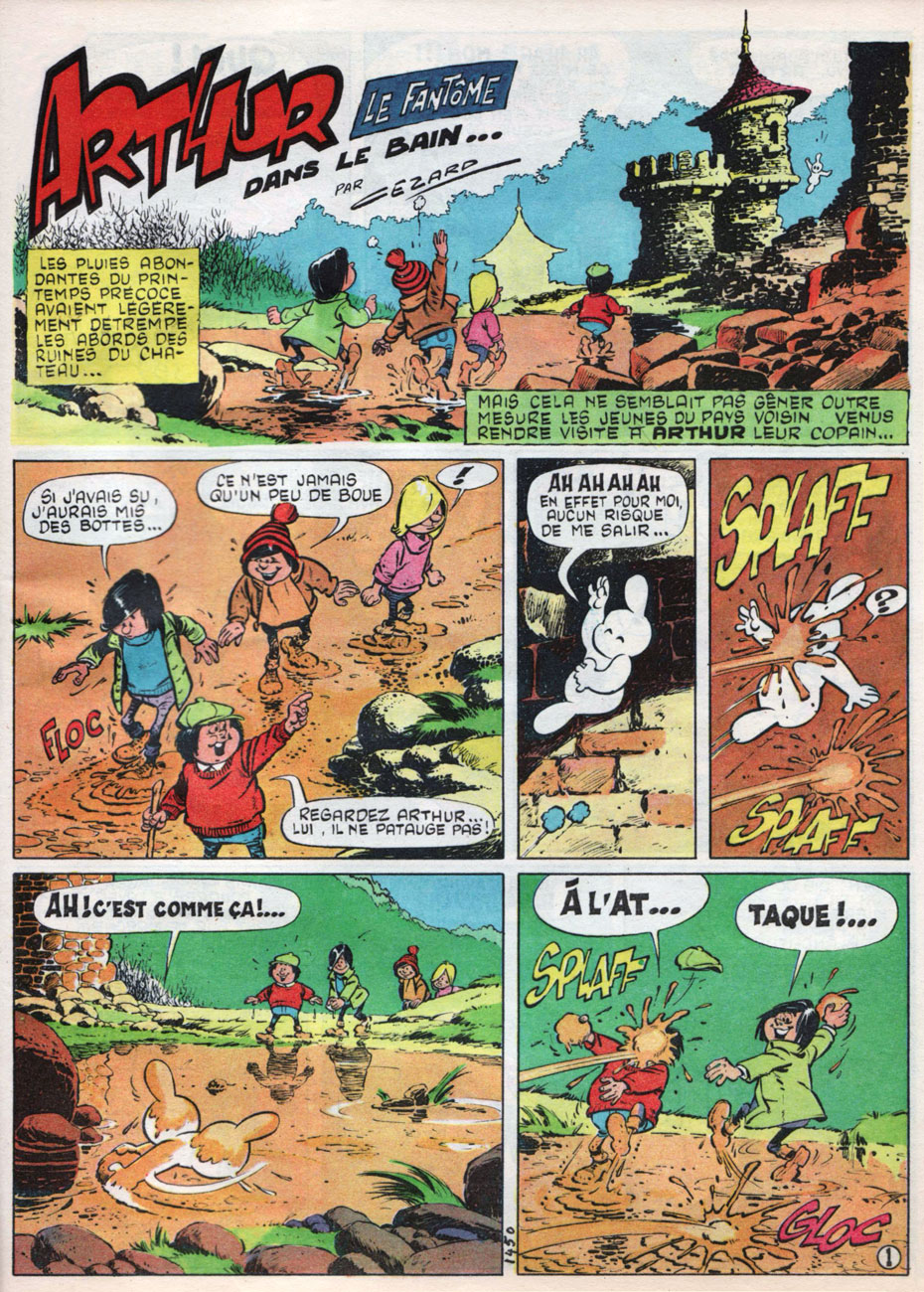
ArthurBainA
Dans le bain… (“In the Bath…”) ran in Pif Gadget no. 212 (March, 1973). By this point, at its peak, with a print run of 540,000 copies, Pif Gadget sold more than its three main competitors (Pilote, Tintin and Spirou) … combined. Then somebody got greedy, with the usual results.

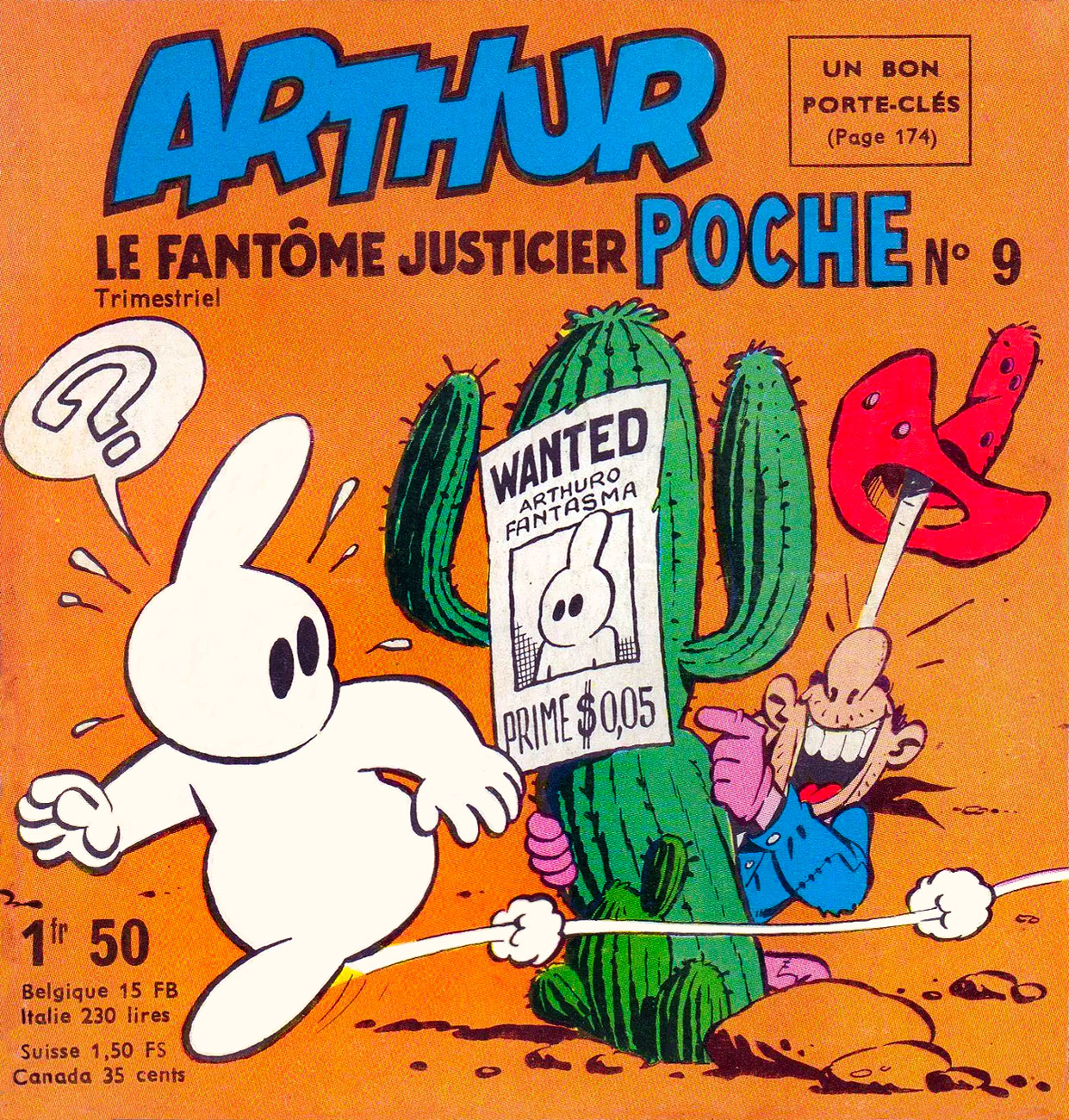
ArthurPoche9A
Should anyone wonder whether Cézard could also handle a less crowded, sparer layout, his covers for Arthur Poche should settle the issue. This is Arthur Poche no. 9 (July, 1966).

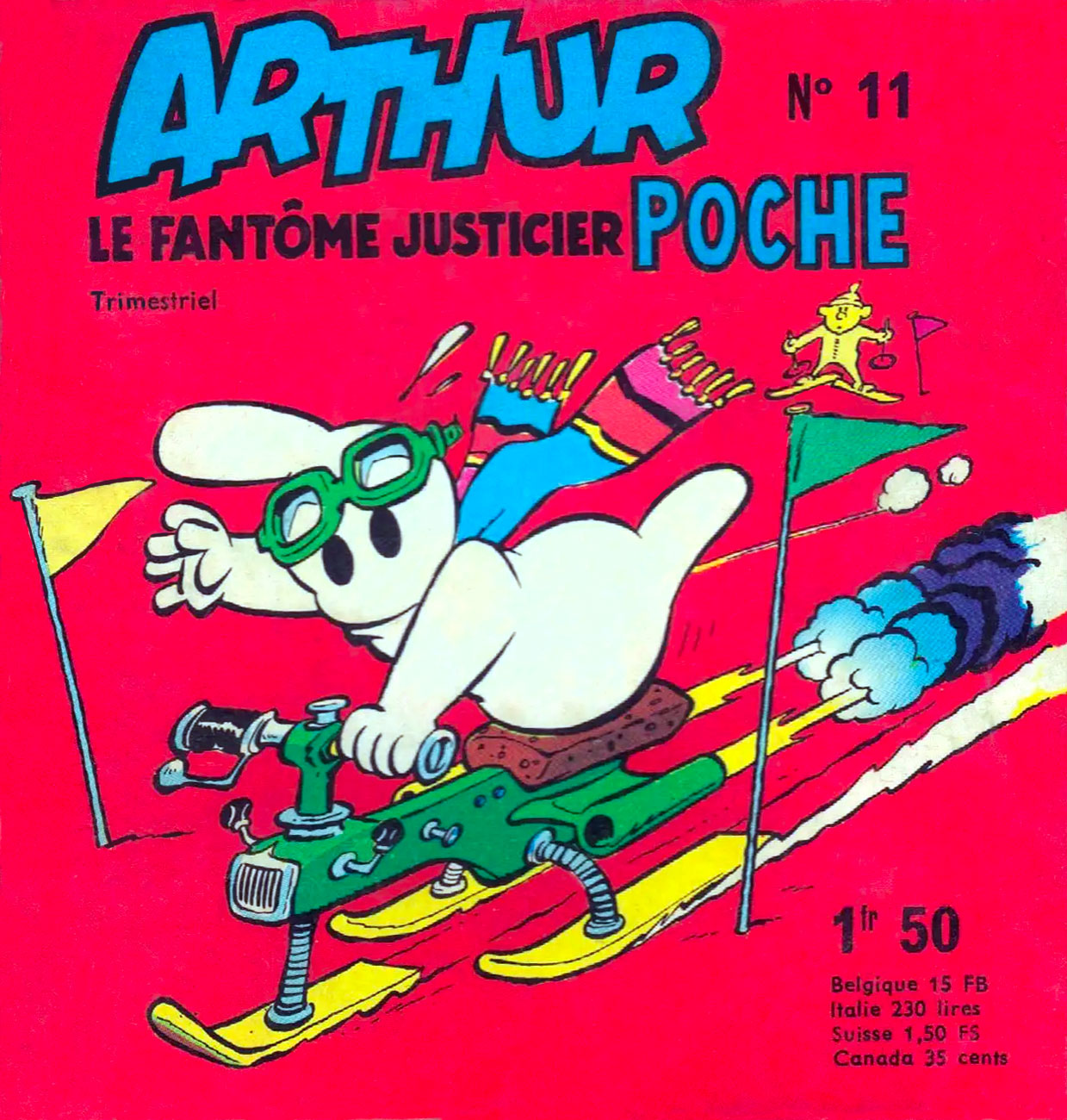
Arthur11A
While Cézard was quite a fast worker (in a given month, he could produce around 20 pages, which means, in his case, writing, pencilling, inking, lettering *and* colouring), when it came to the half-comics, half games pocket-sized quarterly Arthur Poche, he merely provided covers. The Arthur material therein was the work of Cézar-trained Michel-Paul Giroud. This is Arthur Poche no. 11 (January, 1967).

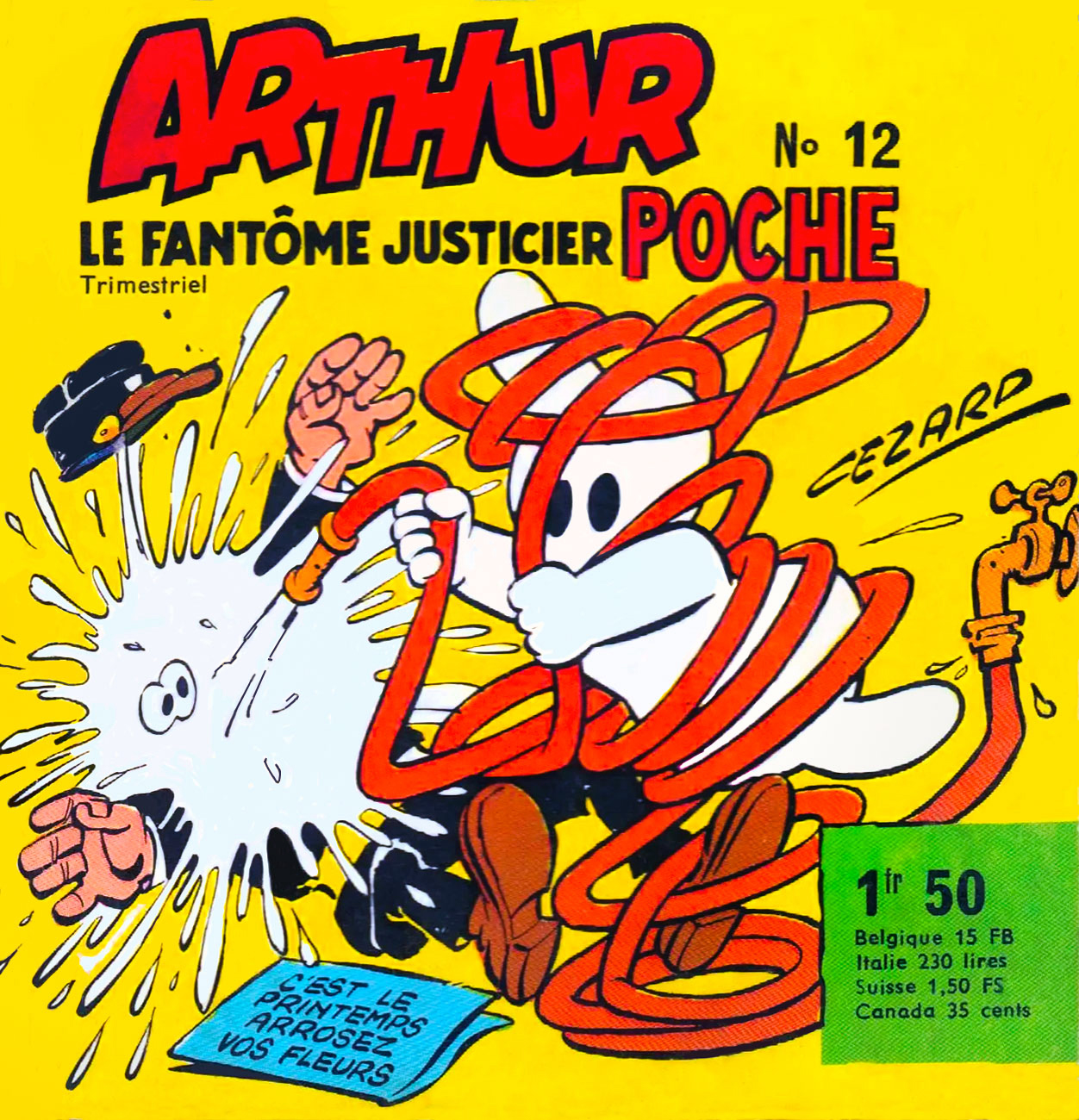
ArthurPoche12A
This is Arthur Poche no. 12 (April, 1967).

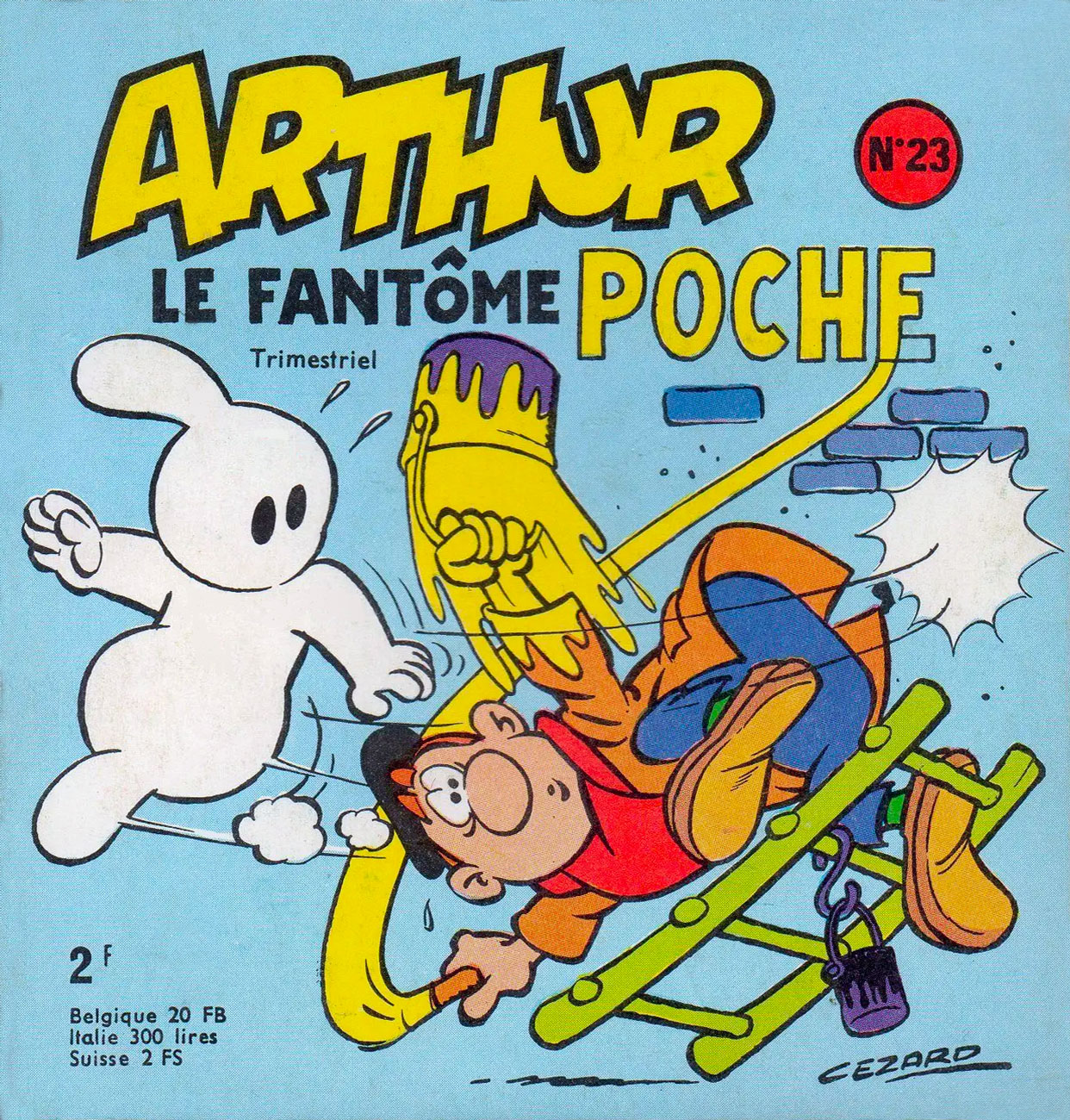
ArthurPoche23A
This is Arthur Poche no. 23 (January, 1970)

Les Éditions Toth, an ambitious Parisian publisher, set out to restore and reprint the works, but after five volumes (2002-2006), the enterprise seems to have stalled. However, another specialty publisher, Éditions du Taupinambour, picked up the gauntlet and published all of Cézard’s Pif Gadget Arthur stories (1969-77) in 13 volumes. That leaves, it seems, a gap of five years or so.

In closing, an anecdote about the loneliness of the long-distance cartoonist, told by Pif’s finest editor-in-chief Richard Medioni (1947-2016) in his definitive chronicle of Vaillant’s rise and fall, Mon camarade, Vaillant, Pif Gadget : l’histoire complète, 1901-1994 (2012, Vaillant Collector): « So I begin to read the episode that Jean has brought — when an author hands me his new pages, I necessarily read them in his presence, because I’m eager to read them, of course, but also out of respect for the work accomplished — and I admire it.

As I read on, Cézard comments here and there… when I laugh, he smiles. Sometimes, he points out a detail in the drawing that I missed… he never ceases to observe me and appears satisfied when I react as he had hoped.

Suddenly, it dawns upon me just how important such a session is to him. I bring up the notion and he explains:

“I spend days at my drawing table, alone, without a soul to appreciate my toil. And it’s a lot of time. No-one to give me a sense of what works and what doesn’t, what will bring a laugh and what will fall flat. So, when I come here, in seeing your response, I get that indispensable connection with my audience…” »

-RG

*Arthur, unlike, say, Casper, isn’t the shade of some dead child: his parents made him the old-fashioned way.

Tentacle Tuesday: A Torrent of Teutonic Tentacles

When one thinks of tentacles, one generally thinks of Japan. Did you know that Germans appear to be equally obsessed with them? “Obsession” is the only way I can explain the following post, in which the same hero trips over tentacles with depressing regularity. And I thought Conan encountered tentacles too often for statistical probability (see here and here).

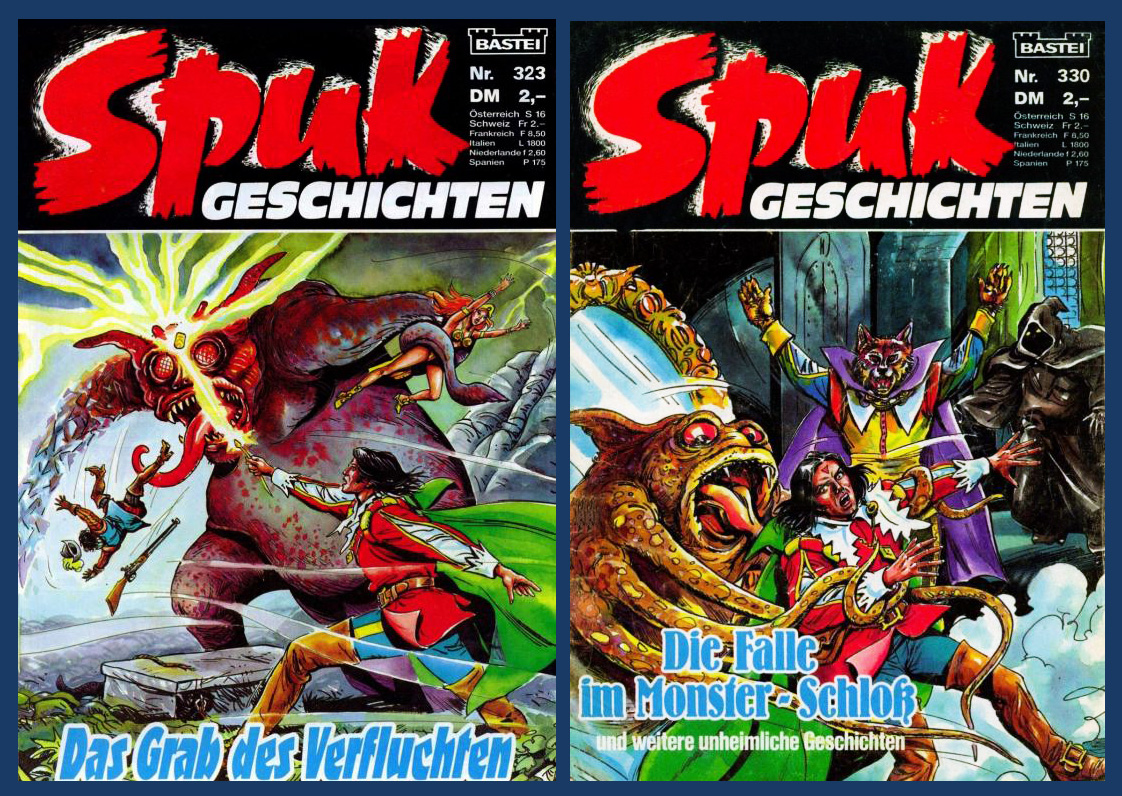
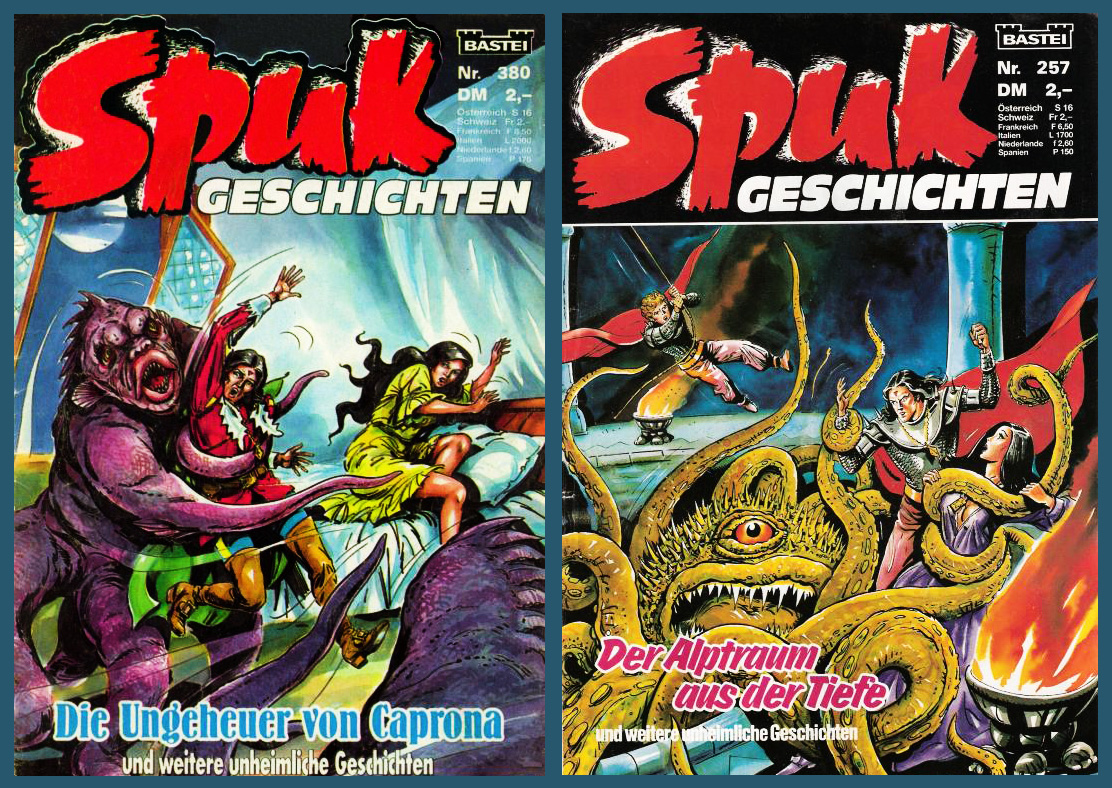
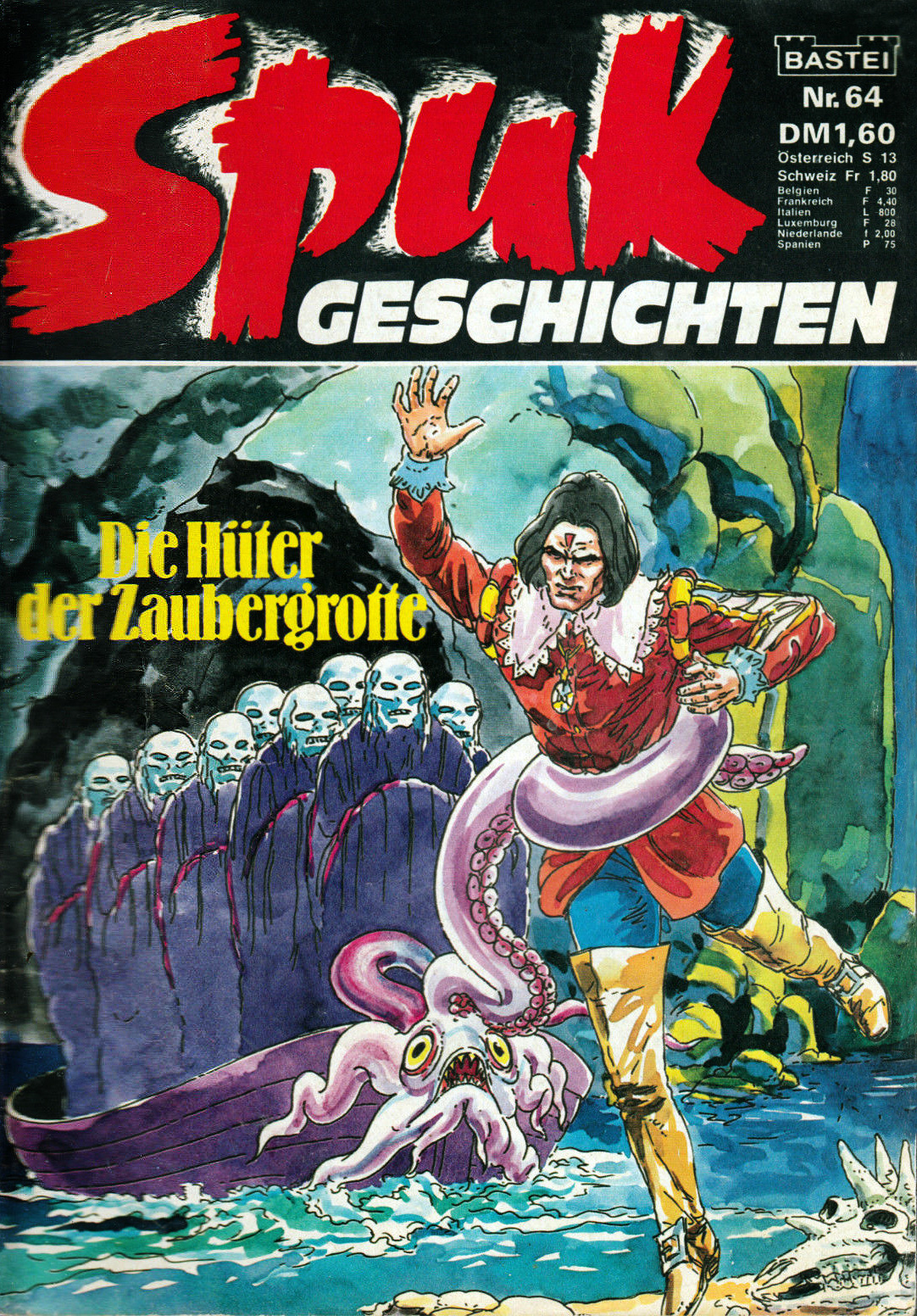
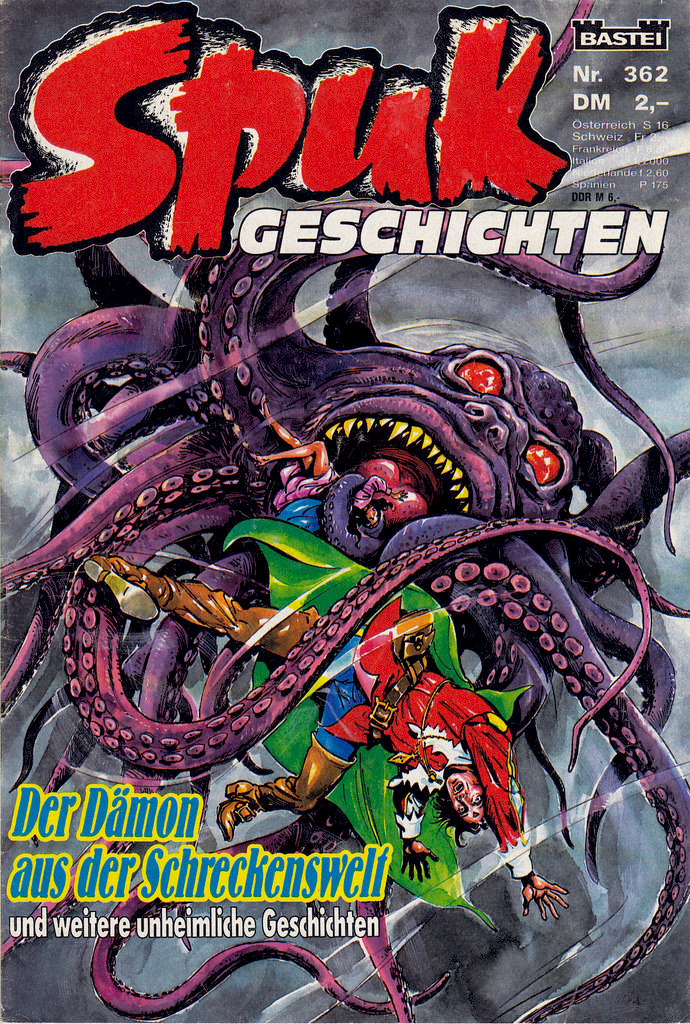
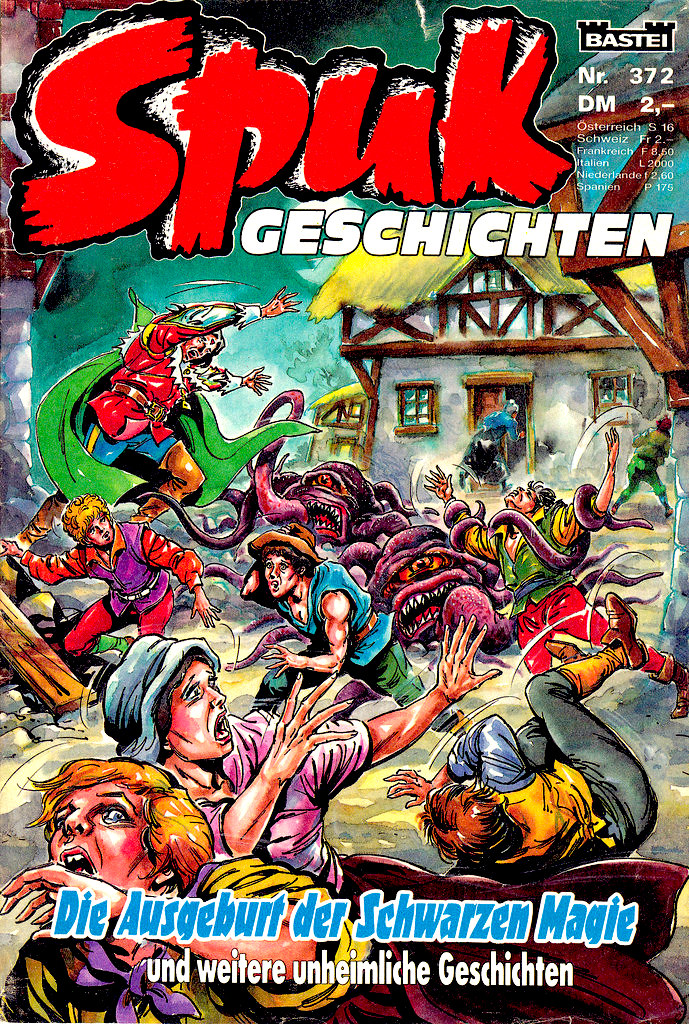
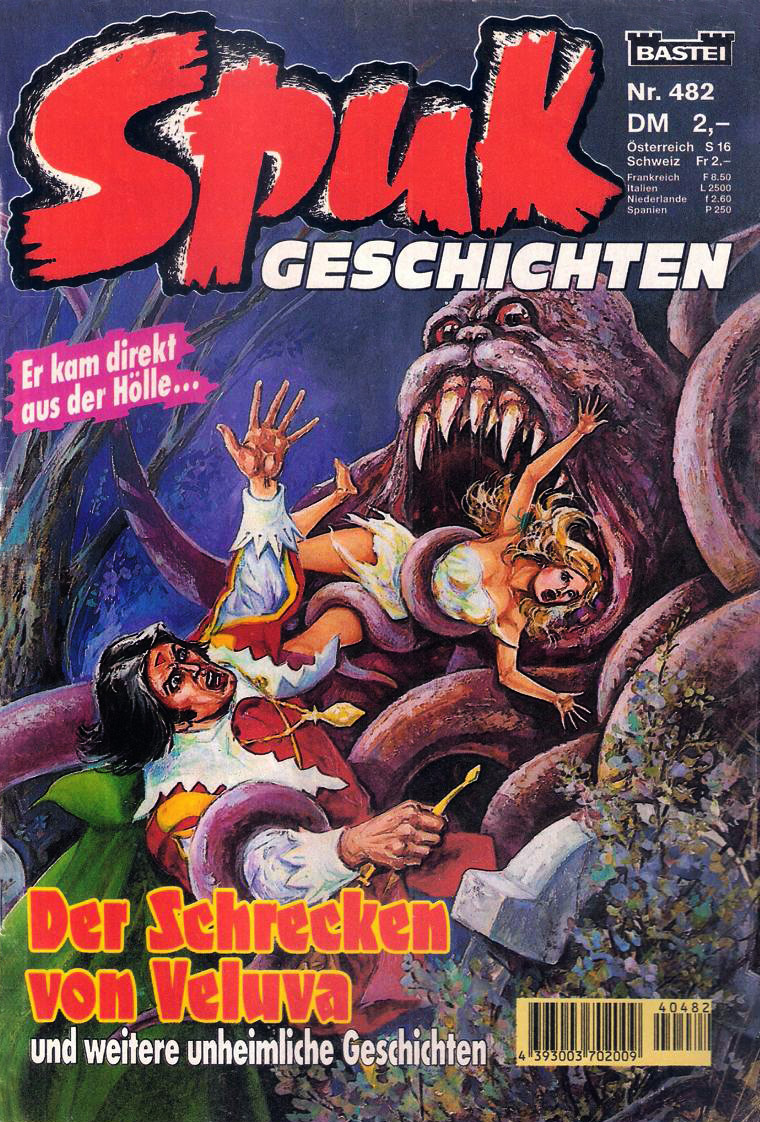
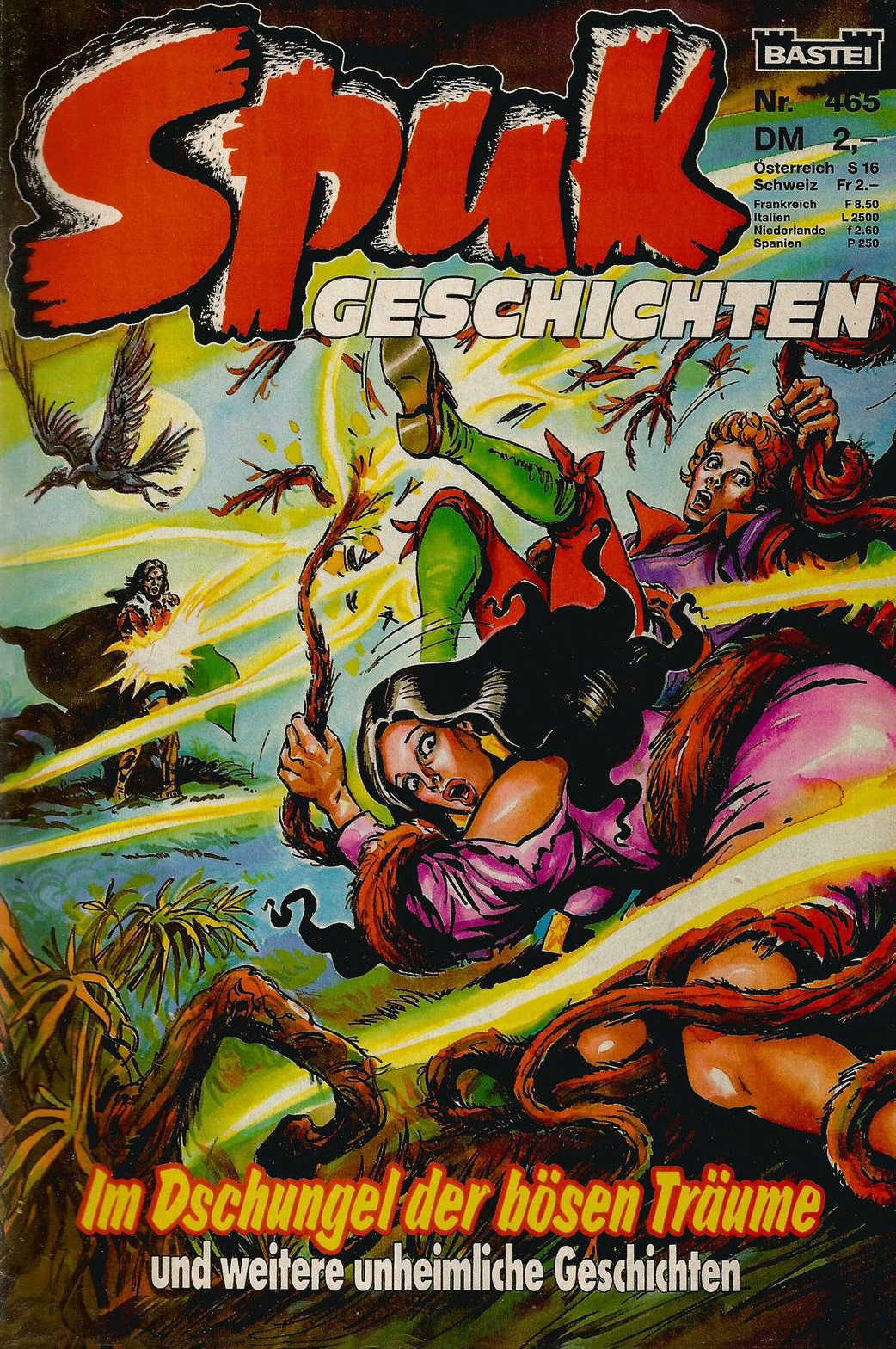
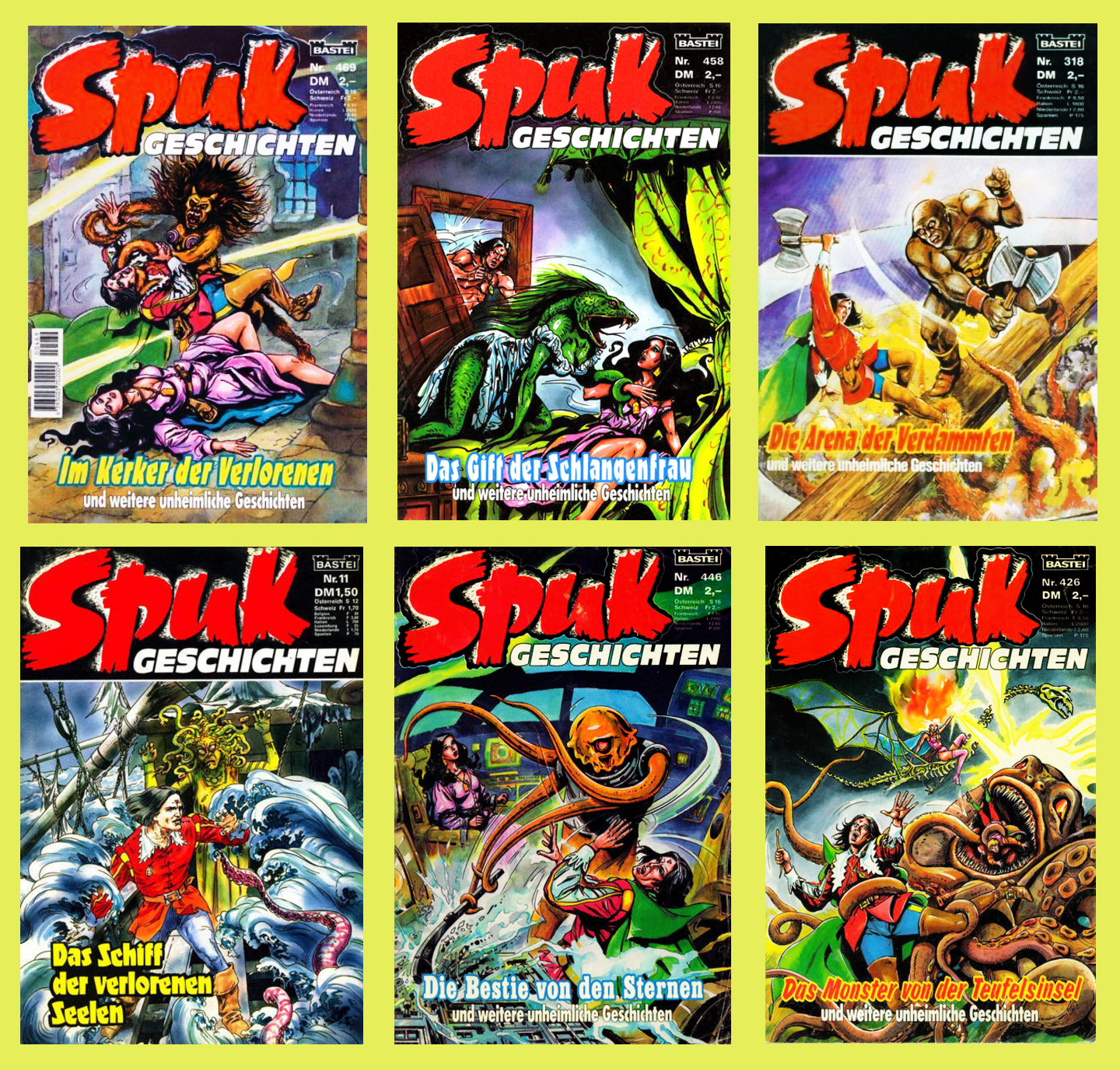
When Gespenster Geschichten (ghost stories), a major comic book series from the publishing house Bastei Verlag, proved to be an unqualified success, it was decided to bring a second horror child into the world in the shape of Spuk Geschichten (spooky stories). The latter, though not quite as long-lived as its sibling, still spanned an impressive 492 issues running between between 1978 and 1995. (For comparison, Gespenster Geschichten lasted from 1974 to 2006.)

SpukGeschichten-1

Both series are easy to recognize thanks to brightly coloured, if not to say garish, covers. The insides, as far as I’ve been able to ascertain, were a mixed bag: some reprints (mostly of American material), some original stories by German artists and writers. I’m rather fond of the loud, red SPUK that’s part of the Spuk Geschichten logo. Rather than reminding me of the English “spook”, it seems like an onomatopoeia: “spuk!”, goes the tentacle slapping some yielding female flesh, “SPUK!”, as it smacks a young man across his chest and sends him flying, topsy-turvy, into the bushes.

Spuk-Geschichten-2

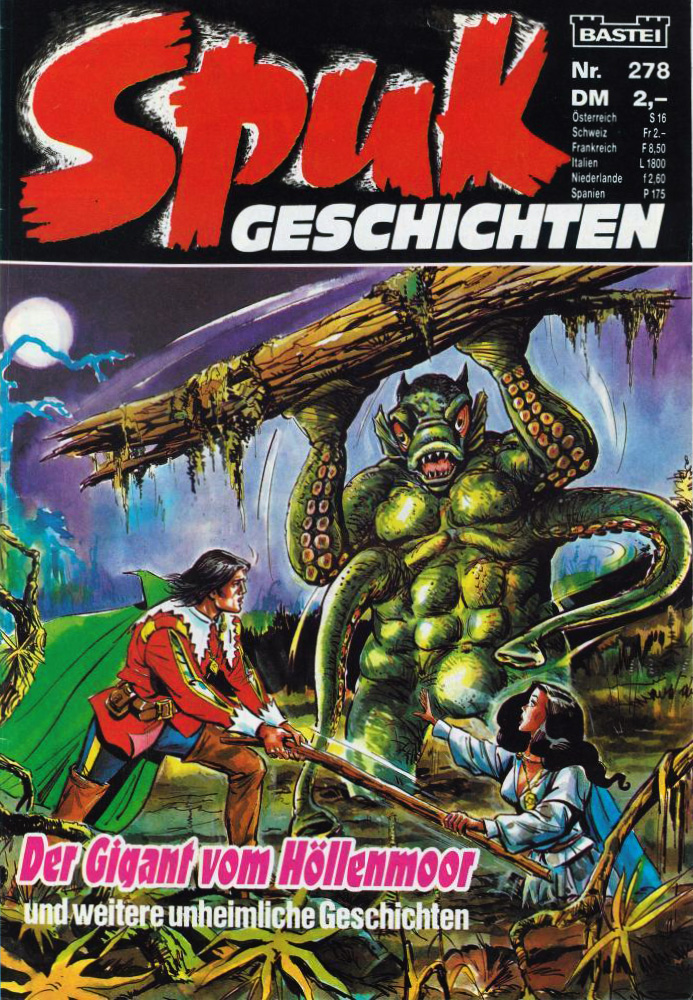
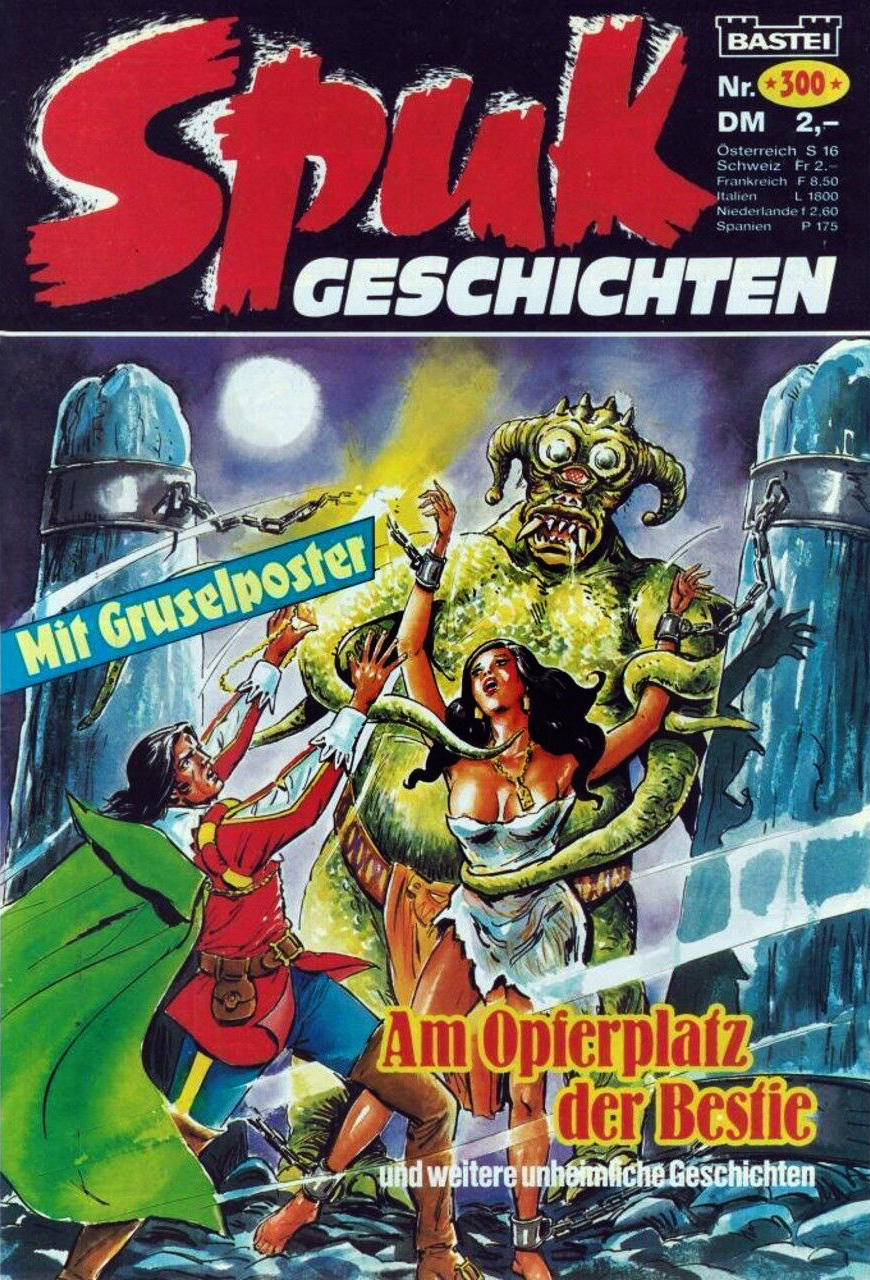
Onward to the gallery of Tentakel! We’ve got green, vaguely apelike monsters…

Spuk278

Spuk300

And a whole family of purple, tentacled atrocities….

Spuk64

Spuk362

Spuk372

Spuk482

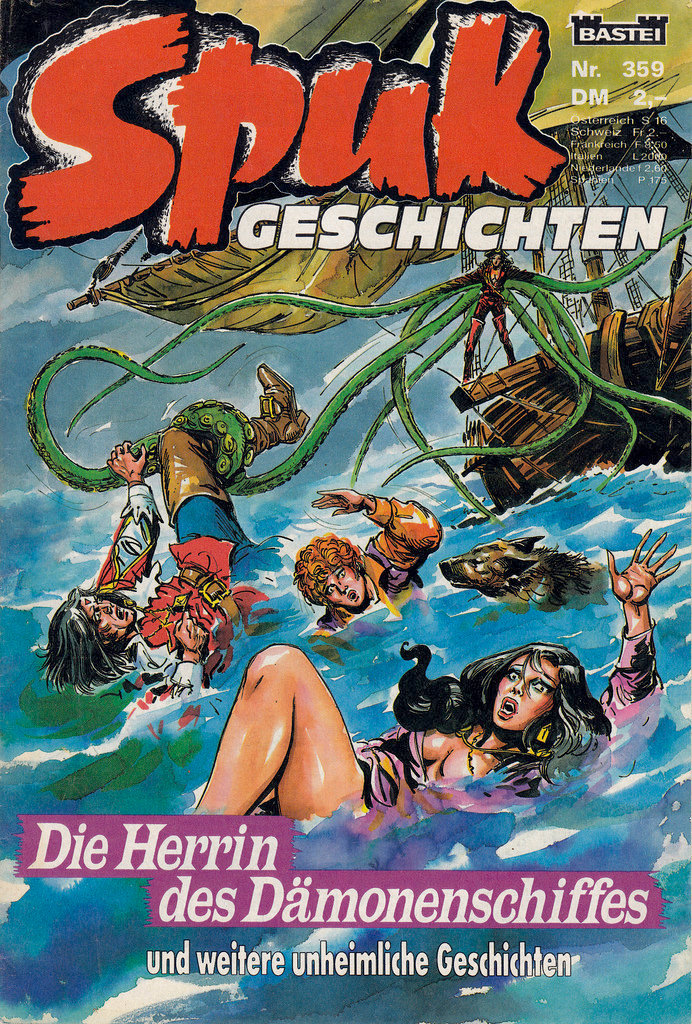
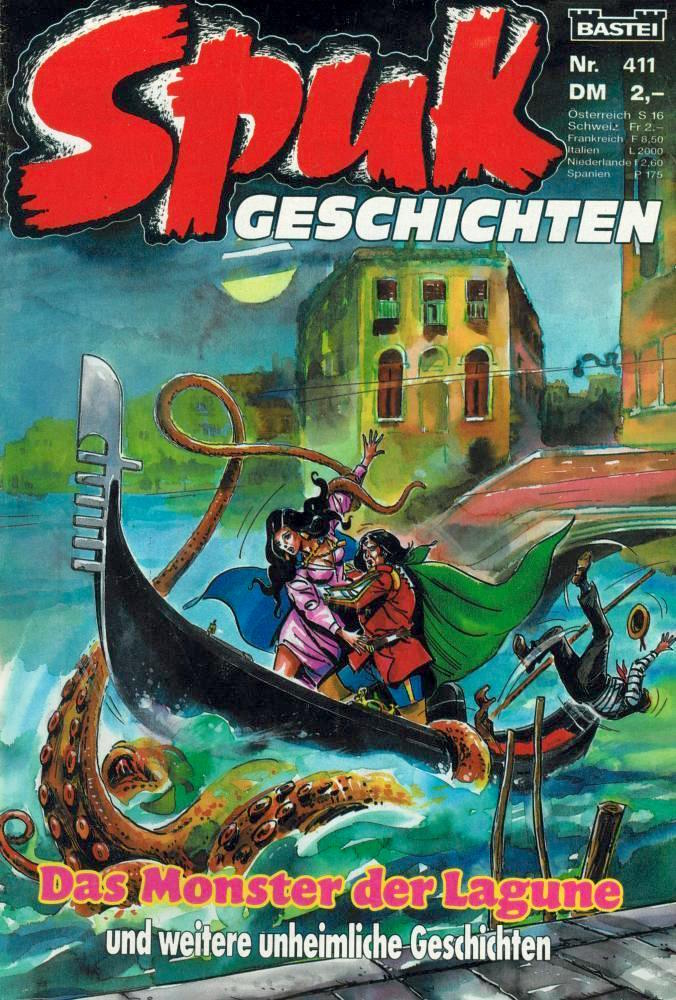
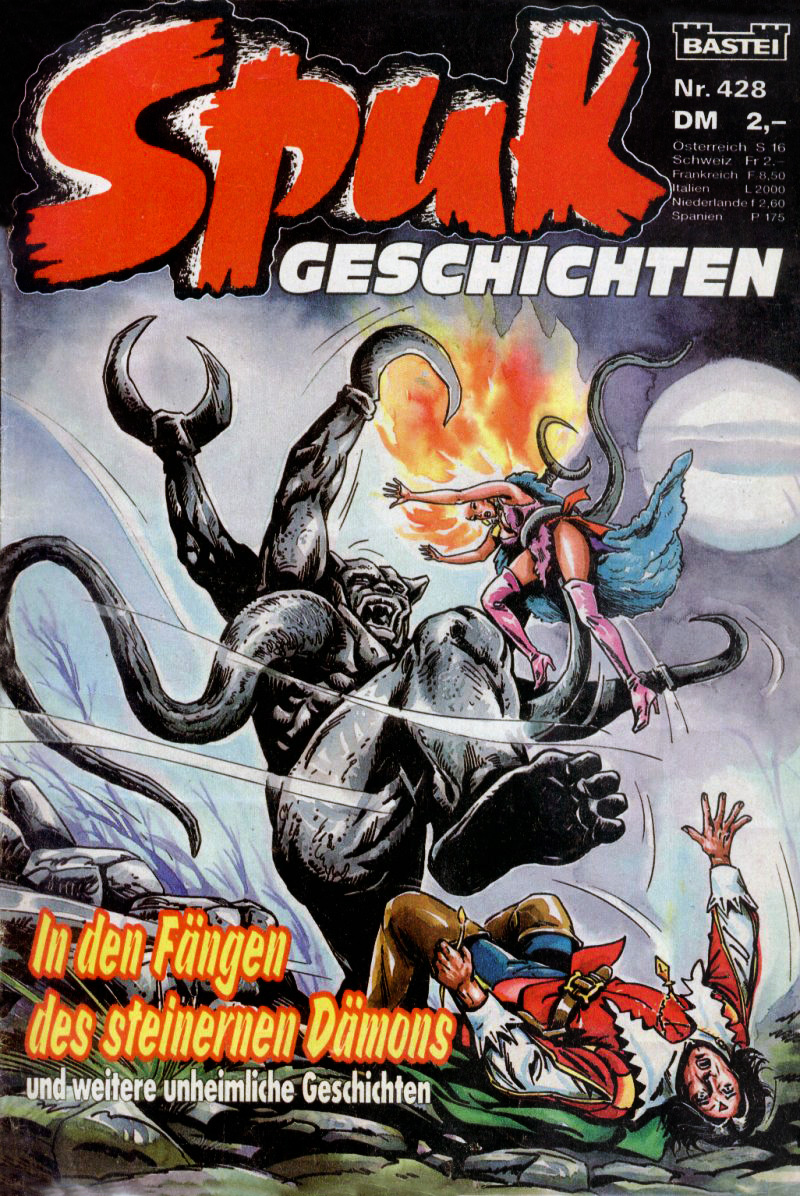
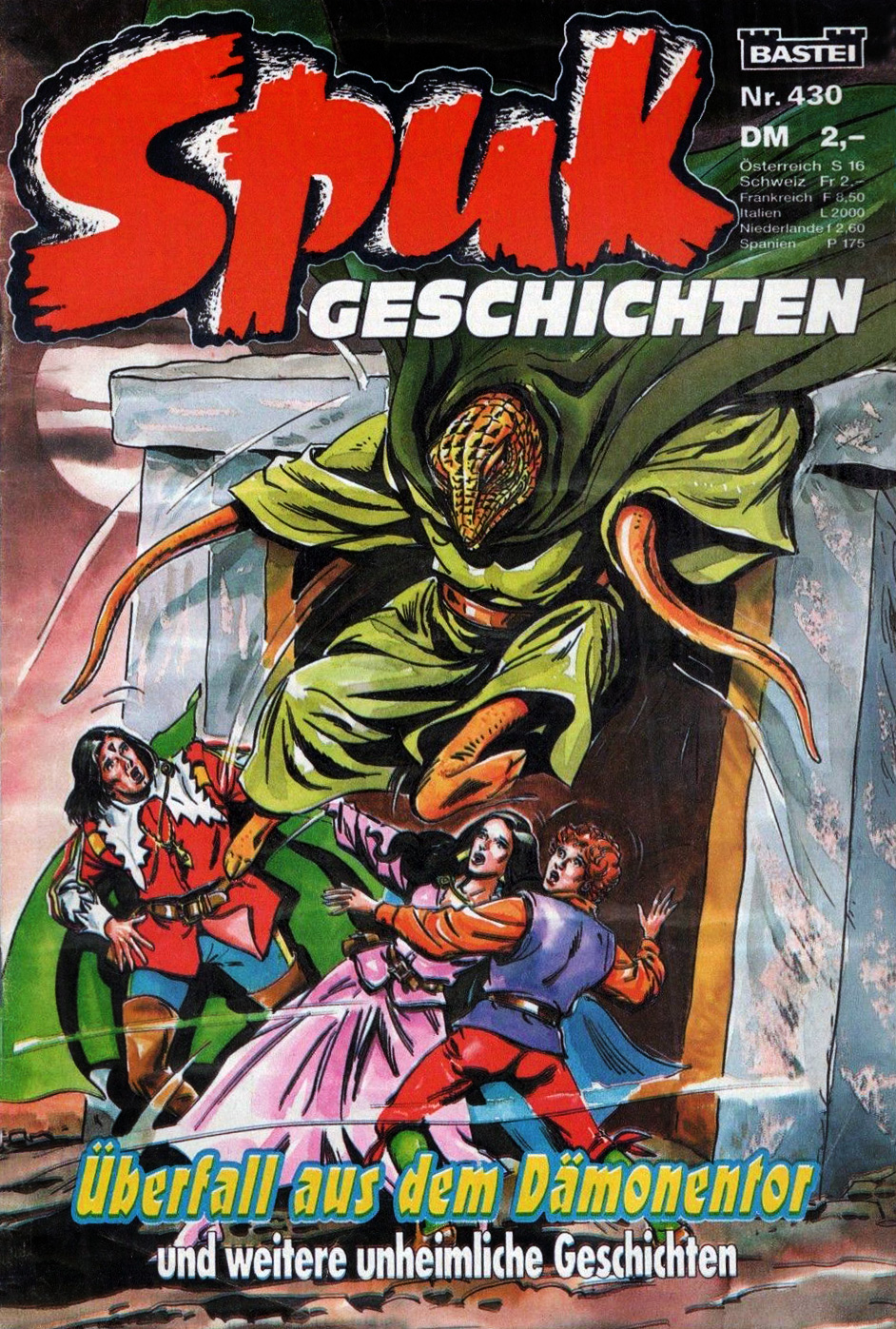
And other assorted tentacular nonsense: gorillas, plants, lizards, female sailors with multiple grabby appendages…

Spuk-Geschichten 359

Spuk411

SPUK428

Spuk430

Spuk465

Through all this, why is the main character still surprised to see a monster with tentacles? One would think he would be profoundly blasé about the whole thing by now, elegantly fending off tentacled creatures while politely covering his yawn with a carefully manicured hand. You think I’ve exhausted the tentacle arsenal of Spuk Geschichten? Ha!

SpukGeschichten-3

And there’s more, but I’m running out of time, space, and, frankly, any interest. In terms of attaching tentacles to completely inappropriate creatures – and a lot of people have tried -, I think Spuk Geschichten reigns supreme in diversity and just, well, sheer numbers.

~ ds

*as usual, writing about comics written in a language I mostly do not understand is tricky. If I’ve committed any faux-pas, please correct me, dear readers!


Tentacle Tuesday: Franco-Belgian Edition, Part II

The world of tentacles is colourful and varied – and very much multi-lingual. For those of our readers who have no access to comics in French (or any idea where to start looking for them), we present this gallery of Gallic comics. For an earlier peek into ze tentacules, visit part I – Tentacle Tuesday: The Franco-Belgian Edition. In case you’re wondering what the heck are Franco-Belgian comics, An Introduction to Franco-Belgian Comics gives a good overview.

Sans plus tarder

cazatentacules01a
What a glorious scene! In this dream sequence, Philippe Caza’s protagonist (clearly a stand-in for himself) battles an octopus that wanted an easy meal and suffered the consequences. This story is called Épaves, which translates in much-more-prosaic-in-English to “shipwrecks”. It was part of Caza’s Scènes de la vie de banlieue cycle, published between 1975 to 1979. Visit Philippe Caza’s Surreal Suburbia for more information.

cazatentacules02a

Caza draws tentacles often and with pleasure. You can keep your Moebius.

philippecaza-tentacules

tentacletuesdayicon

View at Medium.com

Going into slightly less obscure waters, we have a page from Joann Sfar‘s « Petit vampire» series, its 7 volumes published between 1999 and 2005. I deem it somewhat less obscure because part of it has actually been published in English, and that’s how success is measured these days, right? Only the first 3 volumes of Little Vampire have been translated, but that’s better than nothing. In France, Petit vampire is pretty popular, so much so that it has been made into an animated series.

The following page hails from Volume 4: Petit vampire et la maison qui avait l’air normale, or Little Vampire and the House That Seemed Normal, published by Delcourt in 2002.

joannsfar-petitvampire
Here’s a rough translation of the text: « On the road, the soldiers had slaughtered everything they encountered. The Menitsnik, below, was hearing the sound of their boots. He was hearing the explosions. And for once, he wasn’t indifferent, for he knew that this army was heading towards his home. The soldiers began to descend into the lake. One by one, they were crushed by the tentacles. The Menitsnik was crazed with anger because the more soldiers he killed, the more there were to kill. »

tentacletuesdayicon

Speaking of Sfar, I’ll mosey along to the Donjon series (Dungeon in English), created by Sfar and Lewis Trondheim. The latter is another not-to-be-missed artist on the Franco-Belgian comics scene, at the very least because he’s one of the founders of L’Association. To explain:

« L’Association is a French publishing house which publishes comic books. It was founded in May 1990 by Jean-Christophe Menu, Lewis Trondheim, David B., Mattt Konture, Patrice Killoffer, Stanislas, and Mokeït. L’Association is one of the most important publishers to come out of the new wave of Franco-Belgian comics in the 1990s, and remains highly regarded, having won numerous awards at the Angoulême International Comics Festival. They were among the first to publish authors such as Joann Sfar and Marjane Satrapi, and also are known for publishing French translations of the work of North American cartoonists like Julie Doucet and Jim Woodring. »|source|

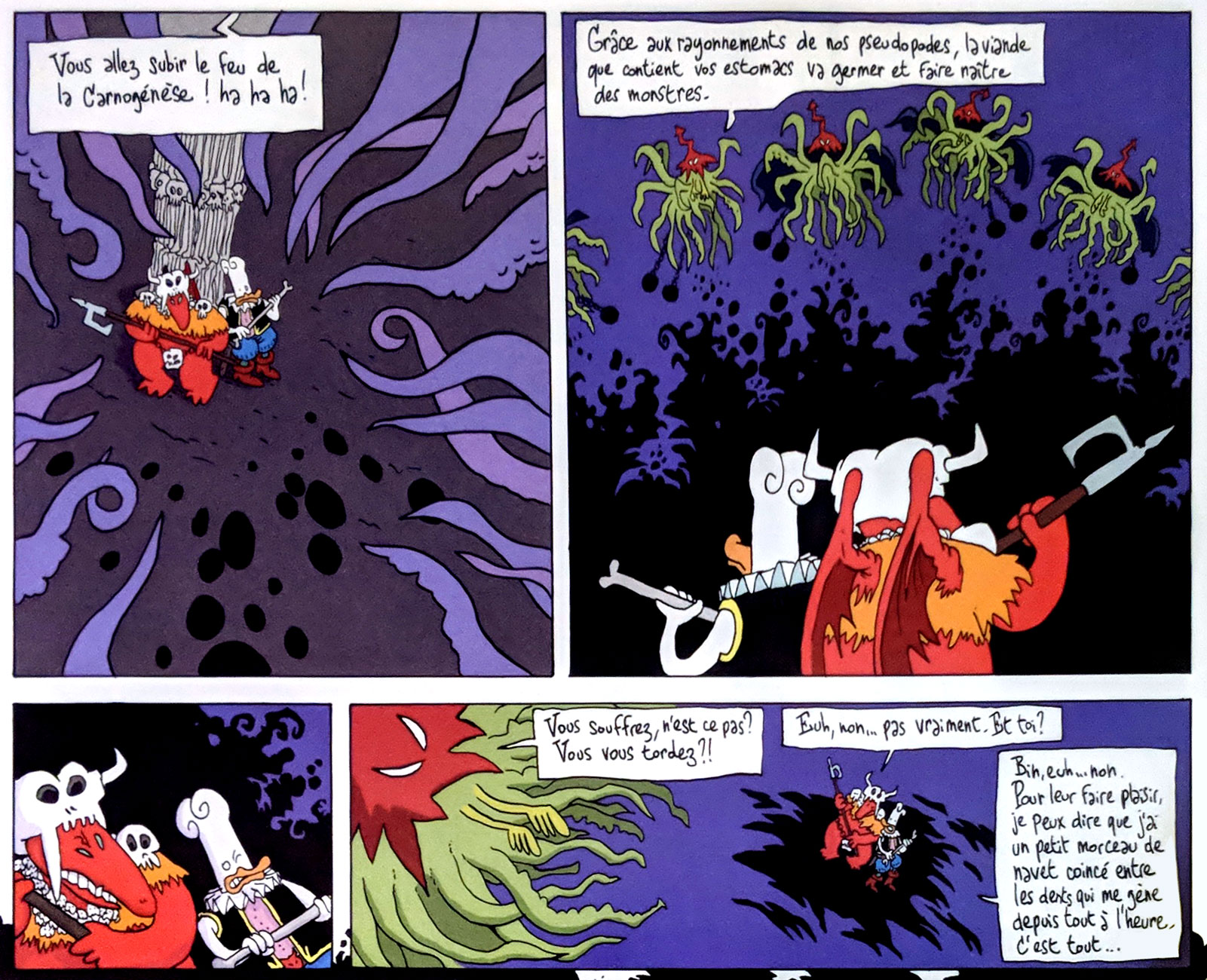
DonjonCarnogénèseA

 Excerpt from Donjon Zénith: Cœur de canard (Delcourt, 1998), written by Sfar and Lewis Trondheim and illustrated by Trondheim.

I only stumbled upon Donjon, a sort of tongue-in-cheek parody of role-playing games, recently. It has a sprawling structure consisting of 5 sub-divisions into stories tied by a common theme – originally the authors were aiming to release 300 volumes (with the help of many contributing artists floating around L’Association), with 36 volumes published so far. It’s more than a handful for someone who’s just starting to read the stuff… but the world is compelling, with a rich array of appealing (if flawed) characters and a complex mythology. It may technically be a parody, but the stories are poignant and imaginative, the language is delightfully playful. Some of the themes are surprisingly dark… this is far from being another dumb Dungeons and Dragons spoof.

DonjonPalmipèdeA

Page from Donjon Zénith: Coeur de canard (Delcourt, 1998), written by Sfar and Lewis Trondheim and illustrated by Trondheim. This volume is full to the gills with tentacles, thanks to the Cthulhian overlords (in pointy red hats) who want to take over the Dungeon.

« I am Octo! The chicken-octopus ninja!! »

donjonoktoa
Panel from Donjon: La Princesse des barbares (Delcourt, 2000), written by Sfar and Lewis Trondheim and illustrated by Trondheim.

tentacletuesdayicon

Our last entry is from Valérian and Laureline, the stunningly influential French comics series created by writer Pierre Christin and artist Jean-Claude Mézières that director Luc Besson besmirched, besmeared and befouled. It can also be noted that a variety of movies “borrowed” from V & L’s rich science-fiction lore, most notably the Star Wars franchise. Should I be happy that more people now know about this series now that a shitty movie “based” on it came out? Nope, sorry. Besson claims to have fallen in love with Valérian et Laureline when he was 8 years old, but with Valerian and the City of a Thousand Planets he demonstrated quite thoroughly that he doesn’t understand the characters in the slightest and is only capable of seeing science-fiction through the lens of chintzy special effects designed to wow idiots.

valérianandlaureline

To which I’ll add that Valérian kind of transcends the science-fiction genre – or perhaps I should say that it’s science-fiction as it was originally meant to be, as an exploration of the possibilities of external and internal worlds. (Technologically upgraded cowboys shooting each other with laser guns in primitive, shallow battles between good and evil? We’ll leave that to crappy movie directors, thanks.) Its plots are elaborate (but they never defy their own internal logic), its characters complex but immensely likable.

In 2007, the series got renamed Valérian and Laureline for its 40th birthday, and I’m glad they renamed it, as Laureline is an integral part of both its appeal and its popularity. She’s every bit as intelligent and determined as her companion, and is certainly no maiden in distress, often sizing situations up quicker than Valérian and subsequently pointing him in the right direction.

~ ds

Georges Pichard: Throwing Curves

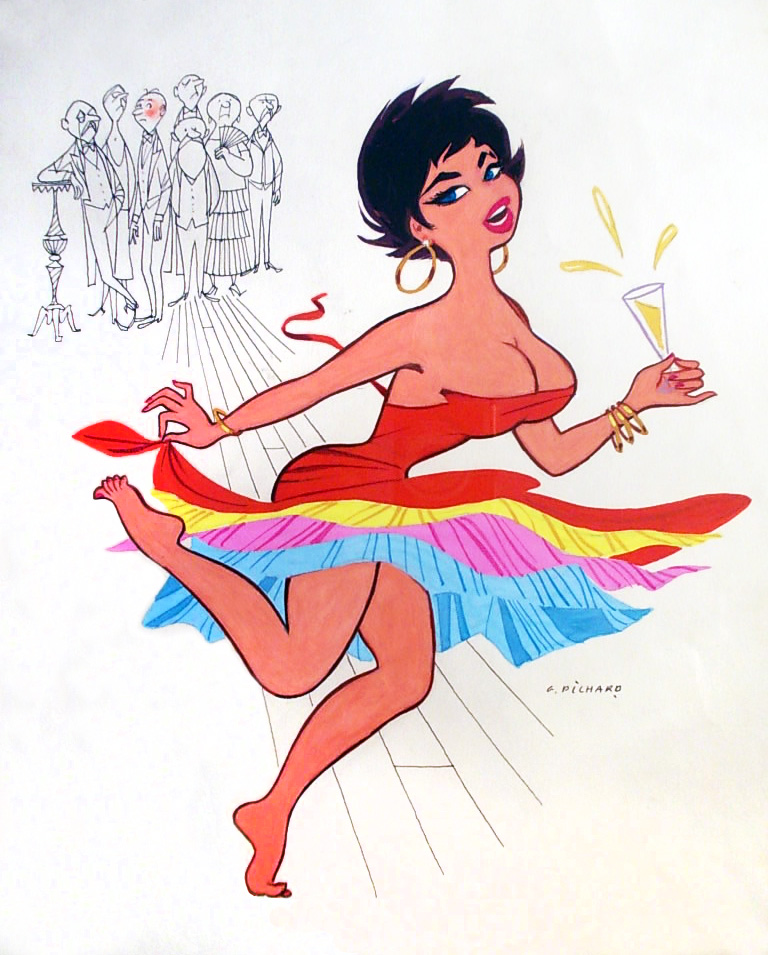
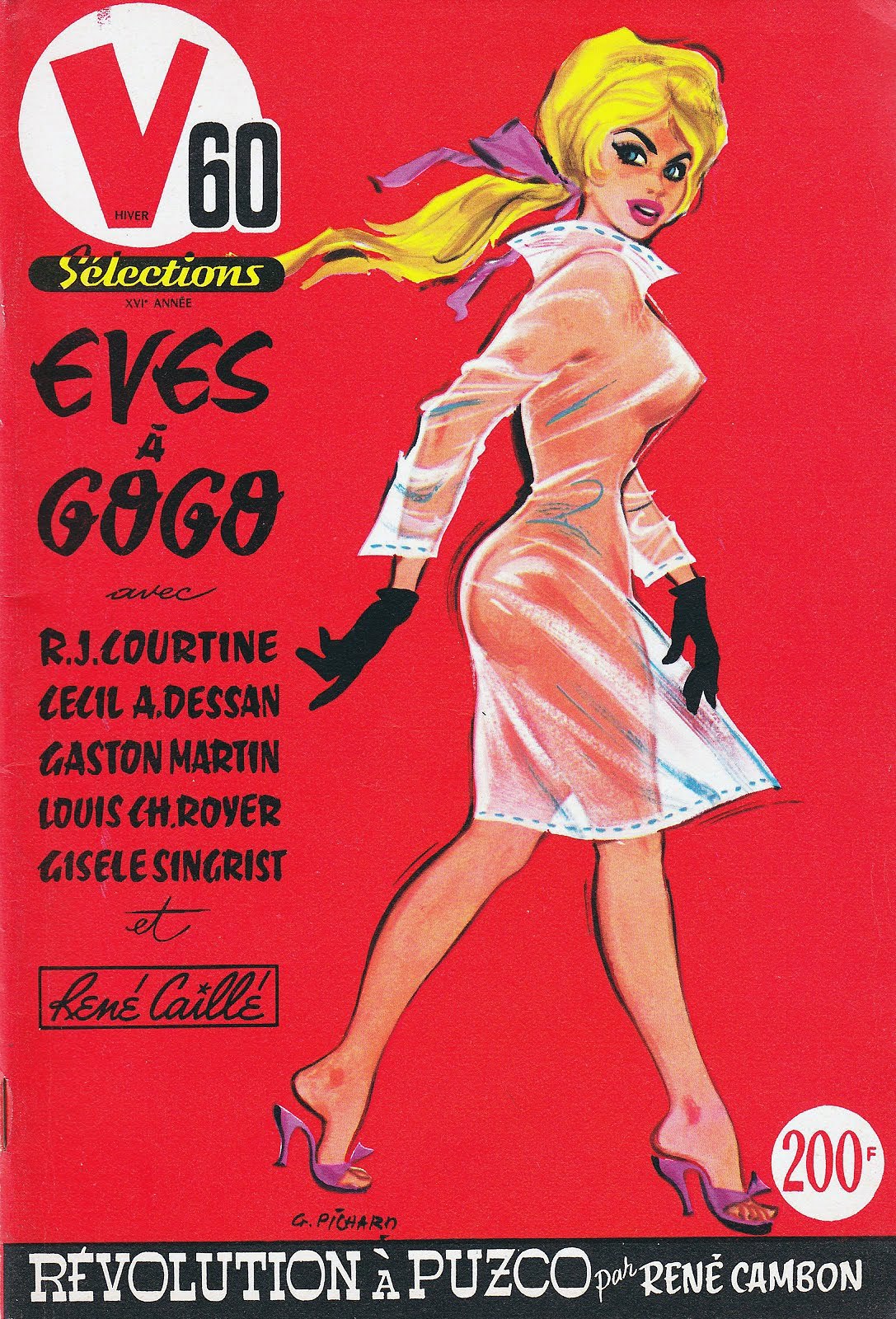
In 1946, Georges Pichard (not sure who he is? Visit our Pichard’s Distressing Damsels for an overview of his later work), heretofore toiling in a marketing agency, started his career as an illustrator. He worked for various French magazines and newspapers (like Le Rire, Fou-Rire and Les Veillées des Chaumières), providing them with covers, cartoons and pin-ups in black-and-white or gorgeous watercolour until the mid 70s, when he switched gears somewhat and dedicated himself to erotic bandes dessinées.

I left image imperfections (due mostly to yellowing of paper over time) and hand-written captions (when available) as is, as I find they provide pleasant texture and context. The jokes are really lame, but we translated them, anyway.

The following three cartoons were published in Le Rire. This first one saw print on the cover of Le Rire no. 22 (nouvelle série, July 1953).

George-Pichard-Sketch2

This one was featured on the cover of Le Rire no. 66 (nouvelle série, March 1957).

GeorgePichard-sketch

George-Pichard-sketch3
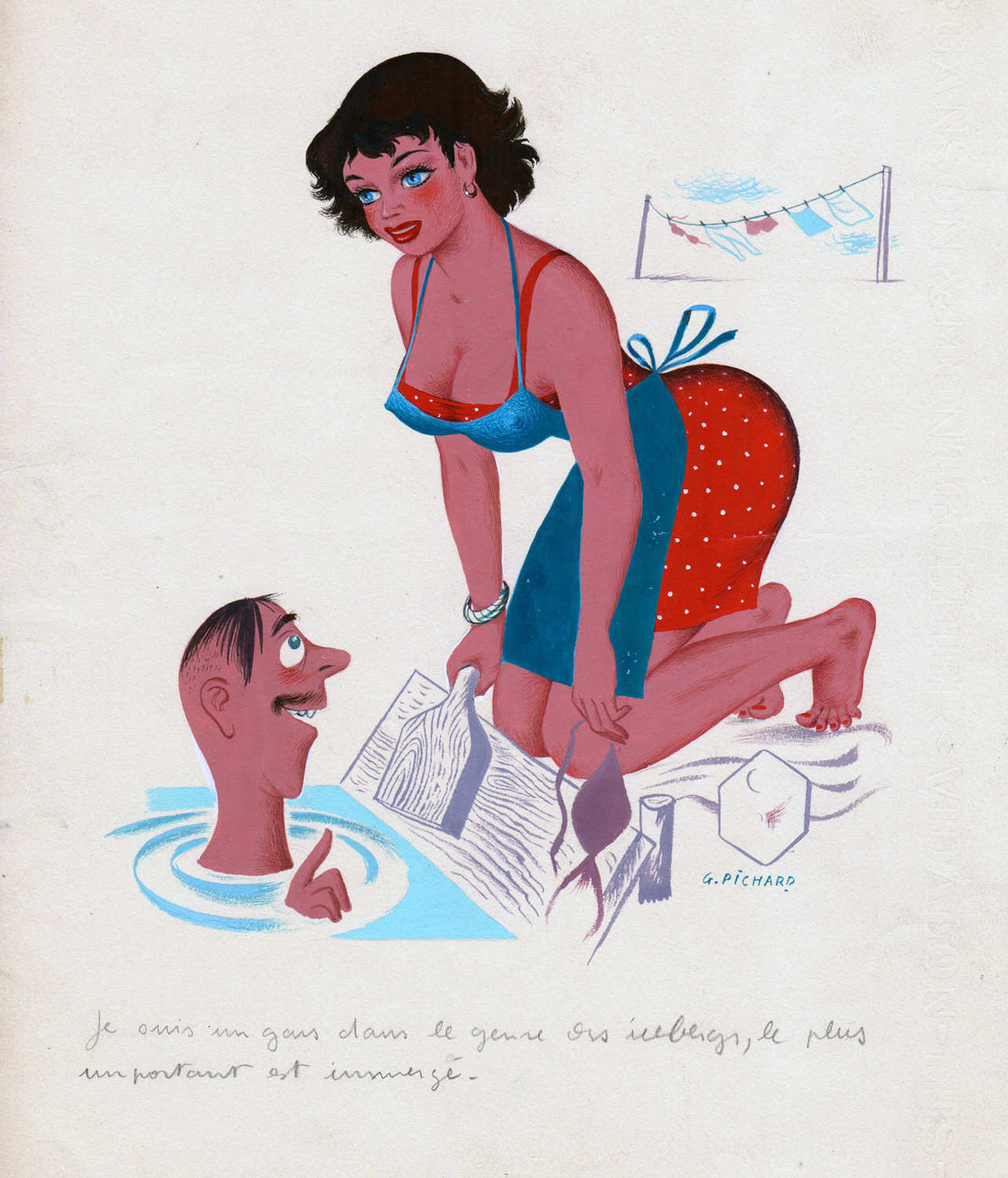
« I’m the sort of guy who’s kind of like an iceberg, the main part is beneath the surface. » The man in question looks very much like a V.I.P. type.

The following are all from Fou-rire:

GeorgesPichard-FourireA
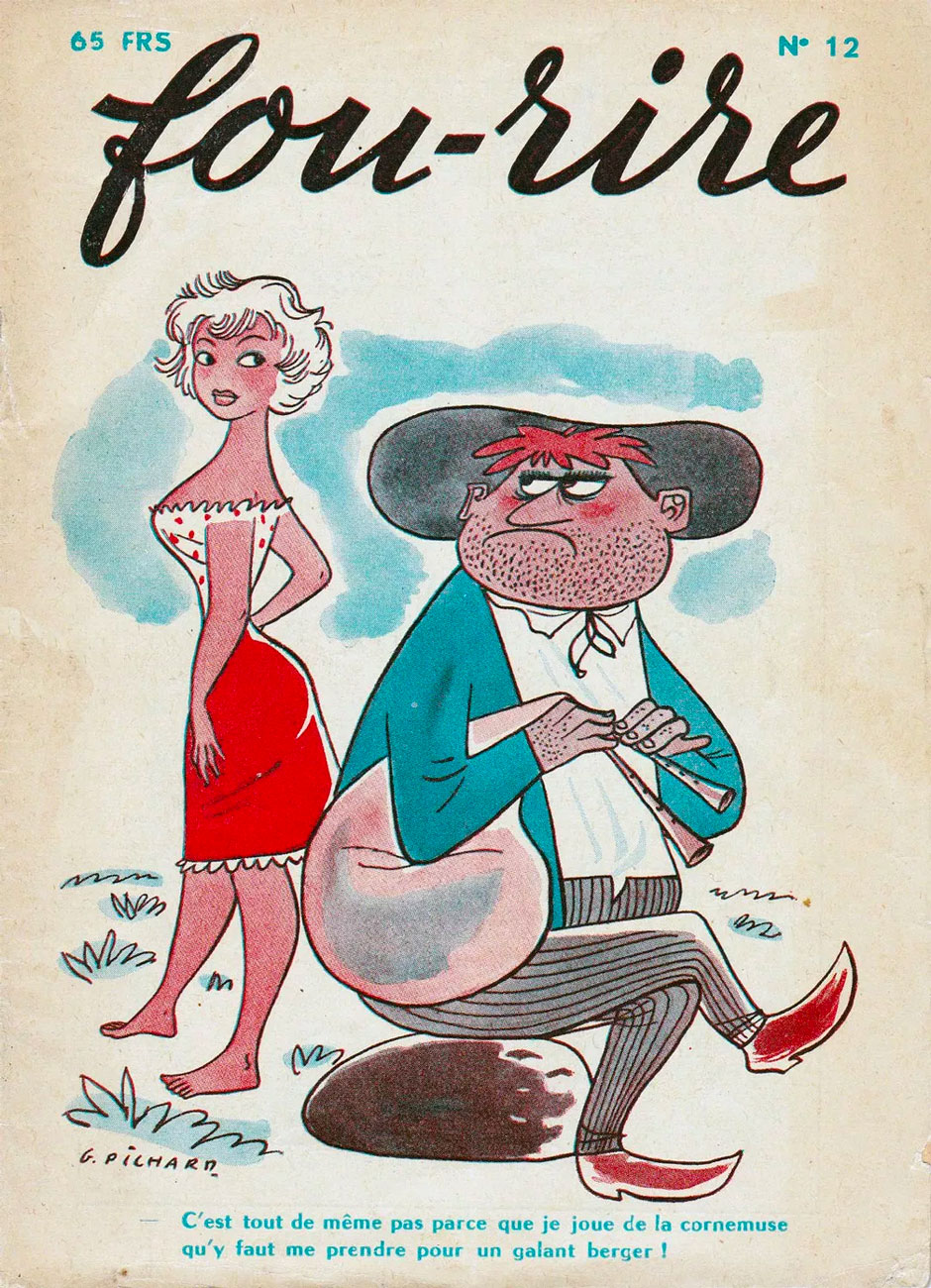
Cover of Fou-rire n°12, mid-50s. « It’s not because I’m playing the bagpipes that you have to take me for a gallant shepherd! »

GeorgePichard- LERIRE76- janvier 1958.
Cartoon from Fou-Rire n° 76, early 60s. « Please be assured, my dear friend, that we are all here quite touched by your wife’s endeavours to set a mood… ».

GeorgePichard=1962
Cartoon from Fou-Rire n° 118, early 60s.  « It would be prudent to seal up your chimney, because when I tell the boss about this… »

GeorgePichard-1961---1962;-French-Magazine-Le-Rire
Fou-Rire n° 118, mid 60s. « And to think that I’ve mislaid the key to this chest full of outfits, each more decent than the last… »

Finally, a couple of pretty loose ends:

GeorgePichard-Jarredor
Original art from Le Rire magazine, 1960s. « But the funniest part happened before I ran into the police officer! »

GeorgePichard-V60
Early 60s.

~ ds

Hallowe’en Countdown II, Day 25

« Plenty of nocturnal ambiance in this book… It stems, I suppose, from an old childhood reminiscence. When I was little, gaslit street lamps were still around, and they created, in the evening, rather extraordinary effects of light. That slightly sinister element stuck with me, and I love to recreate this sort of thing. » – Maurice Tillieux

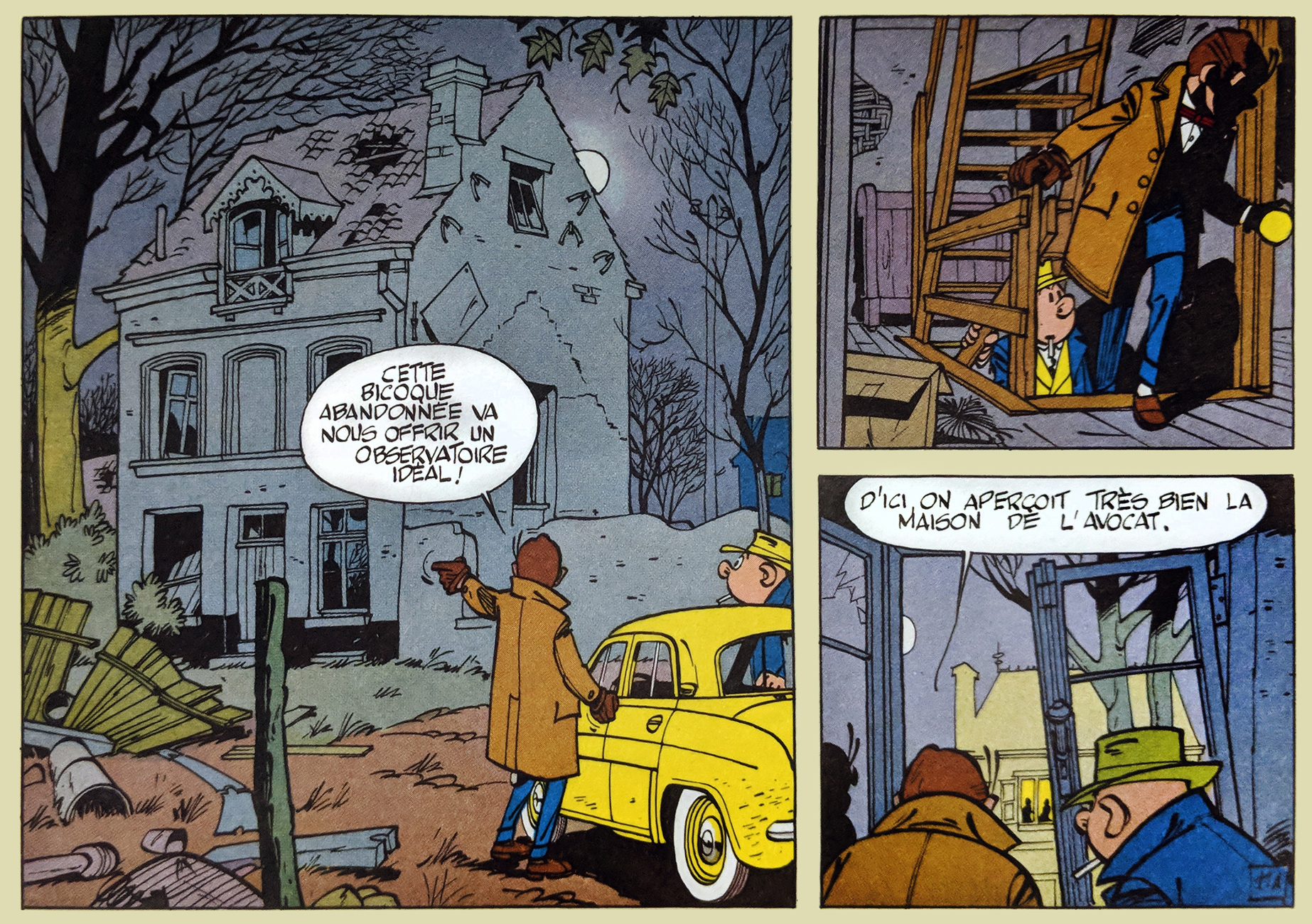
Private detective Gil Jourdan finds the proper spot from which to conduct a nocturnal stakeout, in his fourth (and possibly finest) investigation, « Les cargos du crépuscule », originally serialized weekly in issues 1113 to 1137 of Spirou magazine, back in 1959-60.

Jourdan03A
Story and art by Maurice Tillieux (1921-1978), one of the truly great European masters of…well, everything he handled: humour, atmosphere, pacing, local colour, dialogue...

Ah, but this time, non-French-fluent readers won’t be left out in the cold. The late Fantagraphics co-publisher Kim Thompson was a lifelong fan of Tillieux’s work, and was quite willing to put words into action and bleed some money in the process. Before his passing in 2013, he had time to publish a pair of twofer volumes of Jourdan (slightly renamed Gil Jordan*) adventures, « Murder by High Tide » (which contains this tale, entitled here « Leap of Faith ») and « Ten Thousand Years in Hell ». Fans of clever and suspenseful noir should not miss these babies.

Jourdan01A
Fudging a bit here, this is a panel from « La voiture immergée », aka « Murder by High Tide ». Please forgive this old sinner.

Jourdan04A

Jourdan02A

This being a Hallowe’en post, I’ve squarely put the emphasis on mood rather than action, but let me assure you that these bédés contain plenty of action, and of the highest calibre. Fantagraphics’ promotional blurb gets it right (except that the Hergé comparison is perhaps a bit lazy, but probably necessary given the audience): « Another never-before-translated classic from the Golden Age of Franco-Belgian comics, finally brought to American readers. Imagine the beautifully crisp images of Hergé (Tintin) put in service of a series of wise-cracking, fast-paced detective stories —punctuated with scenes of spectacular vehicular mayhem (including in this volume a dockside pursuit via car and bulldozer) — and you’’ll see why 50 years later Gil Jordan is still considered a masterpiece in Europe. »
– RG
*I can’t help but think that the detective’s renaming to « Gil Jordan » was a bit of a Fantagraphics inside joke, given that the publisher employed, for a couple of decades or so, a news correspondent/translator/editor by the name of… Gil Jordan. It’s not as if « Jourdan » is such an unknown name to Americans.

Hallowe’en Countdown II, Day 14

« In medical practice it is inevitable to observe the details. »
– Dr. Joseph Bell

From France, then, we have the now-whimsical, now-terrifying exploits of Professeur Bell, somewhat loosely based on Joseph Bell, a lecturer at the medical school of the University of Edinburgh, who was Arthur Conan Doyle‘s teacher and the alleged real-life inspiration for Sherlock Holmes.

Joseph_BellA
The good (actual) Dr. Bell. He’s only pretending to read.

Joan Sfar wrote and drew the first two entries in the series, but struggled to achieve the more realistic and detailed style he’d set for himself. With the third volume, he was joined by the skillful and versatile Hervé Tanquerelle, who handled the art chores from then on. A smooth transition.

Sfar has been invoking a marvellously complex and nefarious universe surrounding a « hero » with an increasingly slippery grasp on morality and reality. Heck, even Frank Belknap Long‘s Hounds of Tindalos got a surprise look-in. Recommended.

Published so far in French, Italian, German and Polish…

« L’Irlande à bicyclette » is the fifth and latest in the series, published in 2006. Ahem, fellas… it’s been *quite* a while. La suite, s’il vous plaît?

BellIrlande

Intrigued, as you should be (you do have a pulse, right?)… care for a few furtive glances between the covers?

ProfBellIrlande01AProfBellIrlande02AProfBellIrlande03AProfBellIrlande04AProfBellIrlande05AProfBellIrlande06A

I’m not going to waste my breath trying to explain. Just dig that mood.

-RG