Tentacle Tuesday: Aquaman and his Octopus Sidekicks

When you think of Aquaman, what is the first thing that comes to mind? Is he a brooding, tragic hero? A hapless sap whose prowess extends no further than throwing a starfish at his assailant? A talented swimmer, defender of Earth’s oceans?

« The image of the superhero riding on a chariot made of fish—sporting that classic orange top and green pants—sealed the depths-dweller in public memory as a doofy champion, despite defenders who insist there’s more to Aquaman than talking to fish and riding them places. While later depictions of the character emphasized his serious side, Aquaman jokes abounded especially in the 90s and 2000s—largely thanks to a school of young male animators, including Seth MacFarlane and South Park’s Matt Stone and Trey Parker, who couldn’t help but poke fun at Aquaman’s ineffectual reputation. »|source|

I believe the aforementioned Aquaman’s defenders are slightly missing the point. What’s wrong with catching a ride from a fish, or getting a helping hand from an octopus? In Aquaman’s world, octopuses play the role of indispensable helpers, using their tentacles as lassos, bludgeons and tourniquets, or forming acrobatic formations to give Aquaman a boost. Does this somehow make this superhero wimpy? Do we seriously still believe that treating animals with kindness, or collaborating with them, is emasculating? No wonder this world is going to hell in a handbasket. The audience for superhero comics sometimes seems to be quite devoid of imagination (or a sense of humour).

« Jokes about his wholesome, weak portrayal in Super Friends and perceived feeble powers and abilities [] led DC to attempt to make the character edgier or more powerful in comic books. Modern comic book depictions have attempted to reconcile these various aspects of his public perception, casting Aquaman as serious and brooding, saddled with an ill reputation, and struggling to find a true role and purpose beyond his public side as a deposed king and a fallen hero. » |source|

Okay, I’ve grumbled, and now I’ll move on to the tentacles. Take a seat astride your favourite jellyfish, strap in your fins, and let’s go!

Aquaman, the child of an undersea explorer who learned how to breathe and live underwater “by training and a hundred scientific secrets”, was created in 1941 by Paul Norris and Mort Weisinger. During the Golden Age of comics, he fought various evil guys (usually from water-related professions: sailors, marine biologists, pirates… and Axis villains, too). The whole thing started becoming really interesting (imho) in 1956 (coincidentally, with the advent of Silver Age), when Aquaman acquired his sidekick Topo the Octopus:

AdventureComics#229-Topo
Topo’s first appearance! « Aquaman’s Undersea Partner », drawn by Ramona Fradon, published in Adventure Comics no. 229 (October 1956).

Ramona Fradon handled Aquaman from 1951 to 1959, when she became pregnant and had to temporarily withdraw from the comics field until 1963. She deserves a separate post, really, especially since I love her art. In the meantime, read The Woman Who Made Aquaman a Star. As for Topo, I don’t have to explain why I’m fond of the idea of an octopus sidekick.

A few nice Fradon pages:
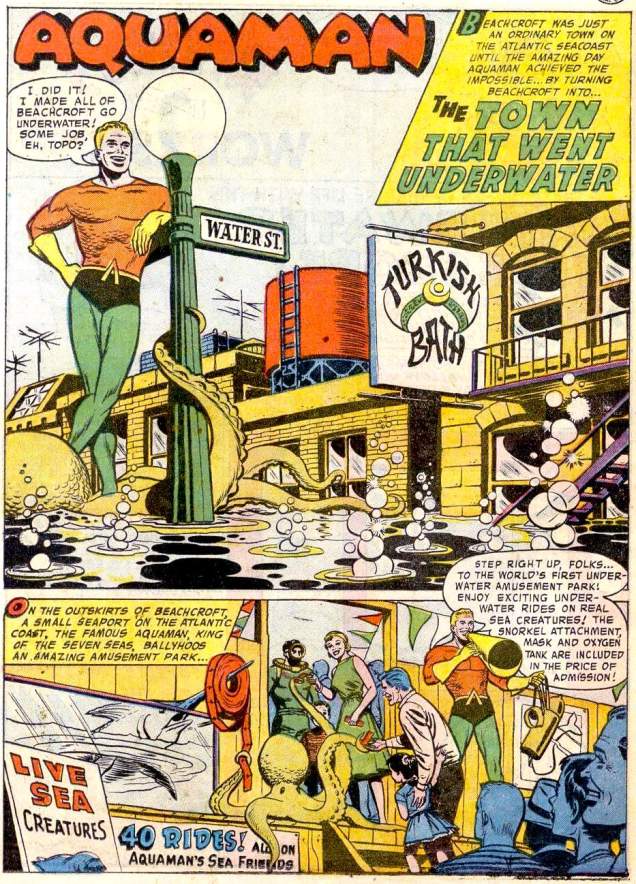
AquamanAdventureComicsIssue#246-theTownThatWentUnderwater-Ramona-Fradon
«The Town That Went Underwater», drawn by Ramona Fradon. It was published in Adventure Comics no. 246 (March 1958).
AquamanAdventureComicsIssue#246-theTownThatWentUnderwater-Ramona-Fradon-2
Another panel from « The Town That Went Underwater ».
Aquaman-Adventure-Comics#262-RamonaFradon-UnderseaHospital
A panel from « The Undersea Hospital! », scripted by Robert Bernstein and drawn by Ramona Fradon. This issue, Adventure Comics no. 262 (July 1959), has not one, but two fun animal stories: the other one – also lovable, imaginative nonsense – is « The Colossal Superdog », scripted by Otto Binder and drawn by George Papp.
Aquaman-Adventure-Comics#262-RamonaFradon-UnderseaHospital-2
Another panel from « The Undersea Hospital! ». Don’t you love the idea of a seaweed stretcher with eel supports?

In 1961, Nick Cardy started working on Aquaman with Showcase no. 31 (March-April 1961). When the sea king got his own title in 1962, Cardy became the regular artist, drawing inside stories and covers until Aquaman no. 39 (May-June 1968), and staying as the cover artist until Aquaman no. 56 (April 1971).

« Cardy proved adept at drawing sea creatures; his fluid, swirling water currents helped create a captivating, eye-pleasing undersea world. He became a fan favorite, not only because of his superb story-telling ability, solid figure work and facile inking, but because of the way he rendered Mera, Aquaman’s girlfriend. Cardy’s women had curves, not angles, and seemed to exist in three dimensions on the two-dimensional page. He never stopped trying to elevate his work, until the later covers in the series were among the most striking and imaginative of the publisher’s entire line.» (source: Comics Journal’s eulogy for Nick Cardy)

Well, that’s high praise indeed, but is it deserved? I can confirm that Cardy covers were really inventive. As for the interior art, let’s take a peek, as these stories conveniently overflow with tentacles.

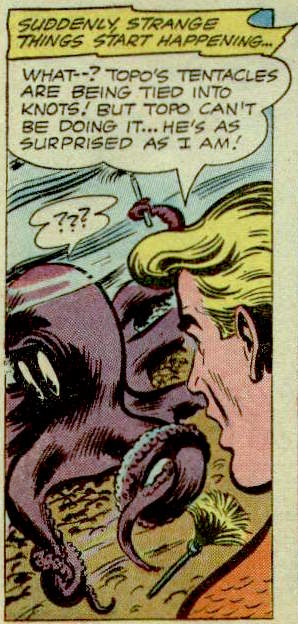
There’s tentacles getting tangled, the octopus equivalent on panties in a twist…
Aquaman#1
Panel from « The Invasion of the Fire Trolls », scripted by Jack Miller and drawn by Nick Cardy, published in Aquaman no. 1 (January-February 1962).
Aquaman#3
Panel from « The Aquaman from Atlantis », scripted by Jack Miller and Nick Cardy, published in Aquaman no. 3 (May-June 1962).

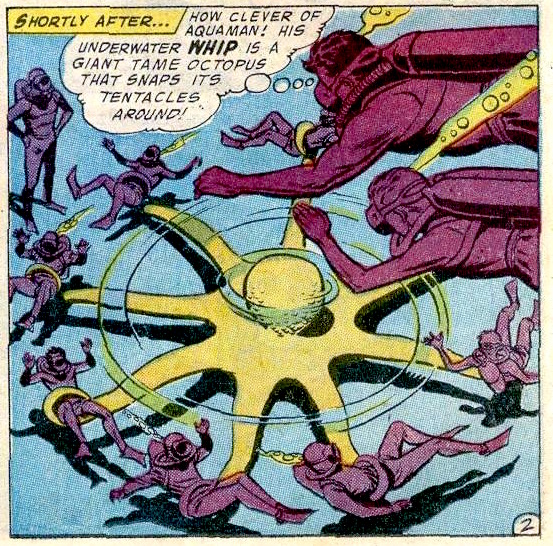
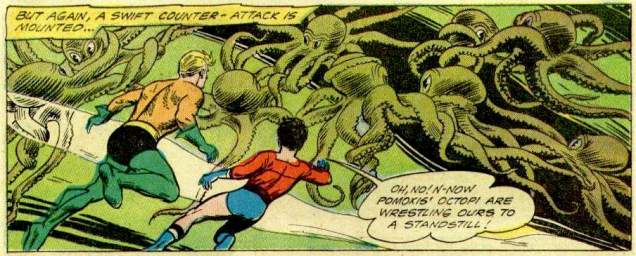
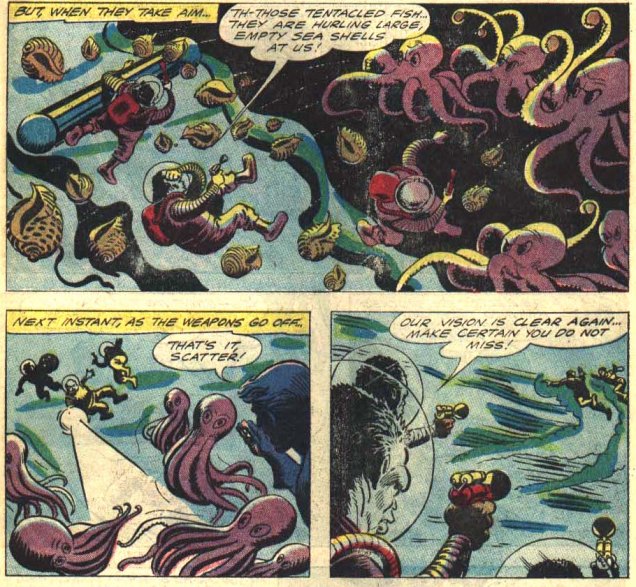
An army of octopus fighters…

Aquaman#4
Page from « The Menace of Alien Island », scripted by Jack Miller and drawn by Nick Cardy, published in Aquaman no. 4 (July-August 1962).

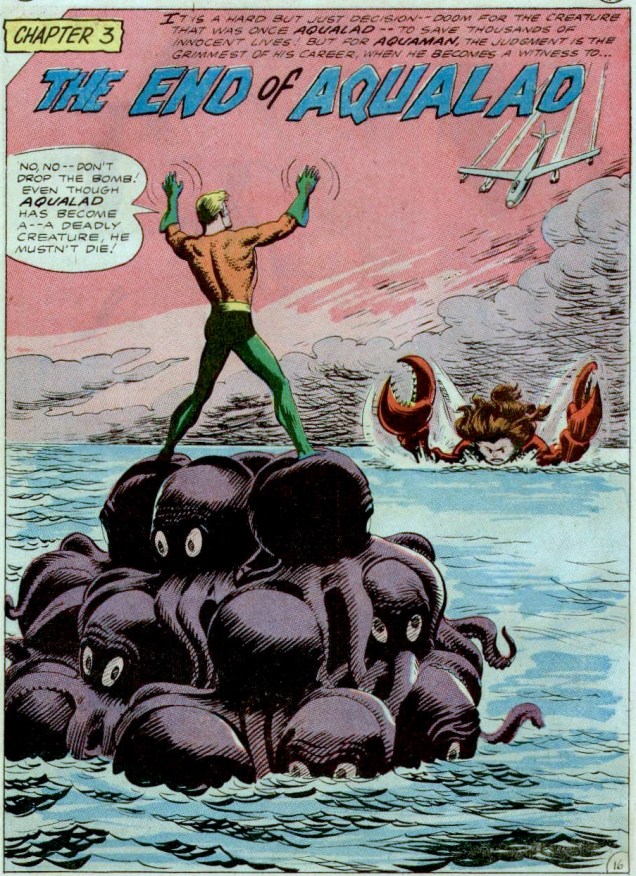
I promised you acrobatics, so here are some octopuses doing a cheerleading routine (Aquaman forgot his pompoms at home):
Aquaman#9-endofAqualad
Aquaman no. 9 (May-June 1963). « The menace of the Aqualad-Creature » is scripted by Jack Miller and drawn by Nick Cardy.
Aquaman#9.jpg
It’s not *all* octopus tentacles. Page from  « The Secret Mission of King Neptune», scripted by Jack Miller and drawn by Nick Cardy, printed in Aquaman no. 9 (May-June 1963).

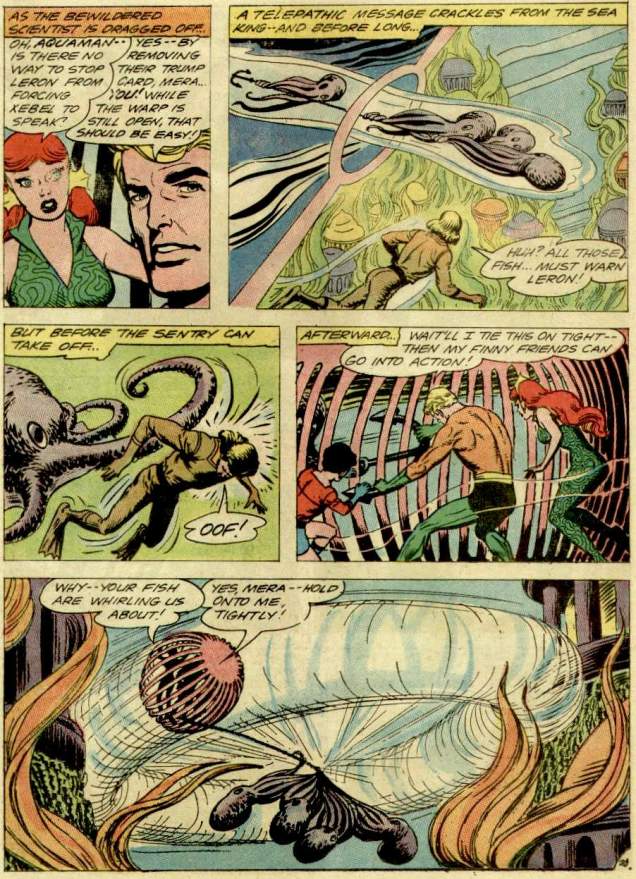
Continuing our tentacle shenanigans…
Aquaman#11
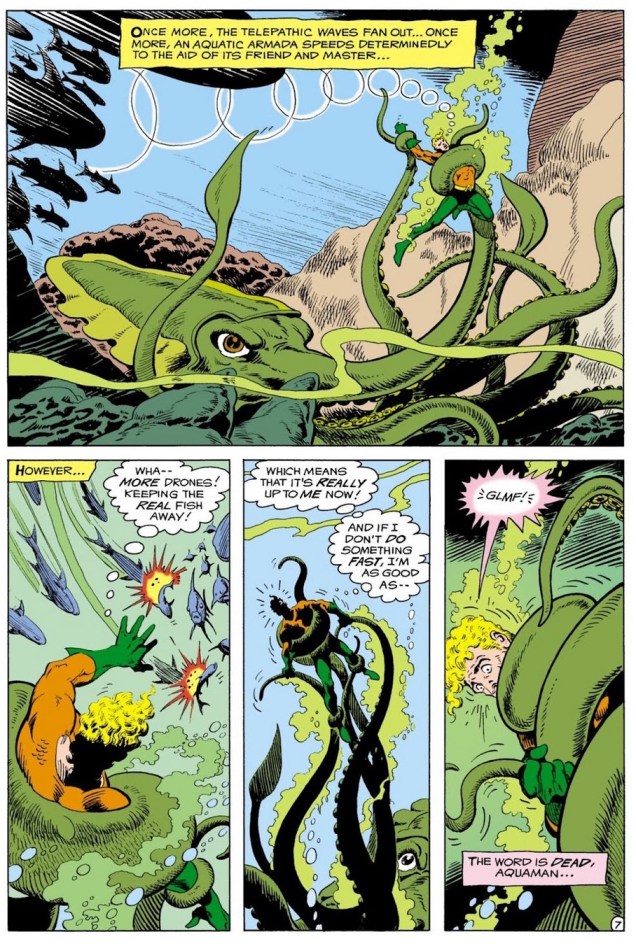
Any jerk who refers to an octopus as a “fish” deserves what’s coming to him. Page from « The Doom from Dimension Aqua », scripted by Jack Miller and drawn by Nick Cardy, published in Aquaman no. 11 (September-October 1963).
Aquaman#18-WifeofAquaman-NickCardy
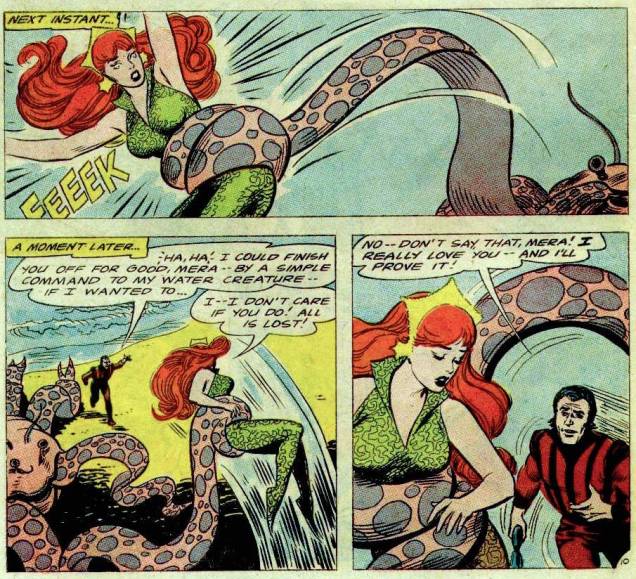
As usual, mind fuckery rears its ugly head whenever romance is part of the plot. “I could kill you! But I really love you, actually!” An eye roll and a sigh. Panels from « The Wife of Aquaman », scripted by Jack Miller and drawn by Nick Cardy, published in Aquaman no. 18 (November-December 1964).
Aquaman#18-WifeofAquaman-NickCardy-2
Page from  « The Wife of Aquaman », scripted by Jack Miller and drawn by Nick Cardy, published in Aquaman no. 18 (November-December 1964).

One of those Nick Cardy covers we were discussing earlier, so you can decide for yourself whether his women are all angles or all curves:

Aquaman#22-NickCardy
Aquaman no. 22 (July-August 1965), cover by Nick Cardy.
Aquaman#22-NickCardy-TrapoftheSeaNymphs
« The Trap of the Sinister Sea Nymphs », published in Aquaman no. 22 (July-August 1965) art by Nick Cardy.

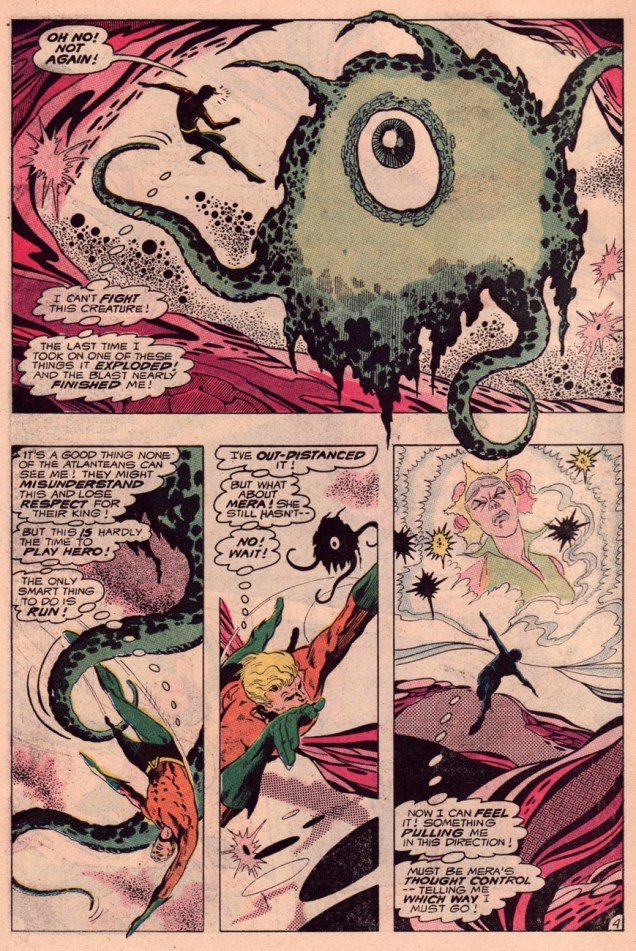
With Aquaman no. 40 (July-August 1968), Jim Aparo replaced Cardy on the inside art. Issues no. 40 to no. 47 (September-October 1969) were scripted by Steve Skeates (a definite favourite of this blog; read co-admin RG’S post “… and the Dog Howls Through the Night!”) and drawn by Jim Aparo. This creative team is a favourite of many an Aquaman fan. Voilà:
Aquaman55A
Page from « Return of the Alien! », scripted by Steve Skeates and drawn by Jim Aparo, printed in Aquaman no. 55 (January-February 1971).
Aquaman55SwishA
Panel from « Return of the Alien! », scripted by Steve Skeates and drawn by Jim Aparo, printed in Aquaman no. 55 (January-February 1971).

More Jim Aparo (sans Skeates):

Aquaman-Adventure Comics #446
« The Manta-Ray Means Murder! », scripted by Paul Levitz and Martin Pasko and drawn by Jim Aparo, published in Adventure Comics no. 446 (July-August 1976).
Aquaman#57-JimAparo
Aquaman no. 57 (August-September 1977), cover by Jim Aparo. I’m angry at that stupid “you could be in the Superman movie” sign that’s far more distracting than it has any right to be.
Aquaman#57-JimAparo-ALifeforaLife-2
Page from « A Life for a Life », scripted by David Michelinie and drawn by Jim Aparo, published in Aquaman no. 57 (August-September 1977).
Aquaman#57-JimAparo-ALifeforaLife
Another page from « A Life for a Life ».
Aquaman#63-JimAparo
Aquaman no. 63 (August-September 1978), cover by Jim Aparo.

You can read issues Aquaman issues no. 1 through to 63 here.

One last thing… I happen to be the proud owner of a piece of original art by Ramona Fradon (of fairly recent vintage), given to me by my sweetie. Lucky me!

RamonaAquamanA
Keep your octopus pals happy and you’re guaranteed a fulfilling relationship.

~ ds
Treasured Stories: “Dragstrip Paved With Gold” (1968)

« Alcohol is for drinking, gas is for cleaning parts, and nitro is for racing! » — Don Garlits

At this time each year, Montréal is beset by its own plague of greedy locusts: it’s Formule 1 Grand Prix time! While our fair city offers other crowd-pleasing events (for instance le Festival international de jazz de Montréal and le Festival Juste pour rire / Just for Laughs), the most glaring distinction between the Grand Prix and the others is that it essentially draws just one type of visitor, a Las Vegas/Florida Spring Break/Nascar sort of randy, aggressive, would-be Alpha Male yob. Imagine hosting the Republican National Convention year upon year, and at eardrum-tormenting sonic levels. Time and time again, the newspapers run the same stories about rampant prostitution and criminal exploitation and how the event only benefits bar, hotel, restaurant and cab operators and variegated pimps… and shafts everyone else. The usual one-percenter bait-and-switch appeal to everyday avarice, it never fails.

Oddly enough, despite my distaste for racing culture proper, I’m paradoxically quite fond of hot rod comics. I was as surprised as anyone when I chanced, several years past, to read an odd issue of Drag n’ Wheels that had come into my possession decades earlier in the midst of an assorted lot (this was no. 46, April 1971)… and greatly enjoyed it. Gripping stuff, as it turned out!

Now, there’s no question that the number one driver of Charlton Comics’ hot-rod line* was Jack Keller (1922-2003), a Golden Age artist who found his true niche with car comics. Around 1967, he was offered an exclusive contract with Marvel to work on their western titles, but Keller declined in order to focus on his Charlton account, where he could write, pencil, ink and letter his own stuff… without having to redraw anything. Moreover, he claimed to favour horsepower over horses.

Keller’s car stories are often a delight, full of knowing detail, clever humour and plenty of thrills. However, if Keller had produced the entire line on his own (as he did, in fact, when it was whittled down to a pair of titles in its final years), the growing bleakness in his work could have become wearying. Drawing from his direct involvement in the racing scene, Keller packed his stories with pompous asses, dangerous egomaniacs, slimy backstabbers, sociopathic glory hogs, and other representatives of a bloodthirsty, mean-spirited mob.

Charlton’s main writer, Joe Gill, filled out the rest of the book, aided by a rotating crew of artists, among them Don Perlin, the tireless Charles Nicholas ‘n’ Vince Alascia duo, Tony Tallarico, Bill Montes, Dick Giordano, Bill Molno, et al.

But in the line’s peak years (1964-1969, also an aesthetic apogee in automotive design), the number two illustrator in Charlton’s racing stable was Edd Ashe (1908-1986), another journeyman from the Golden Age of comics.

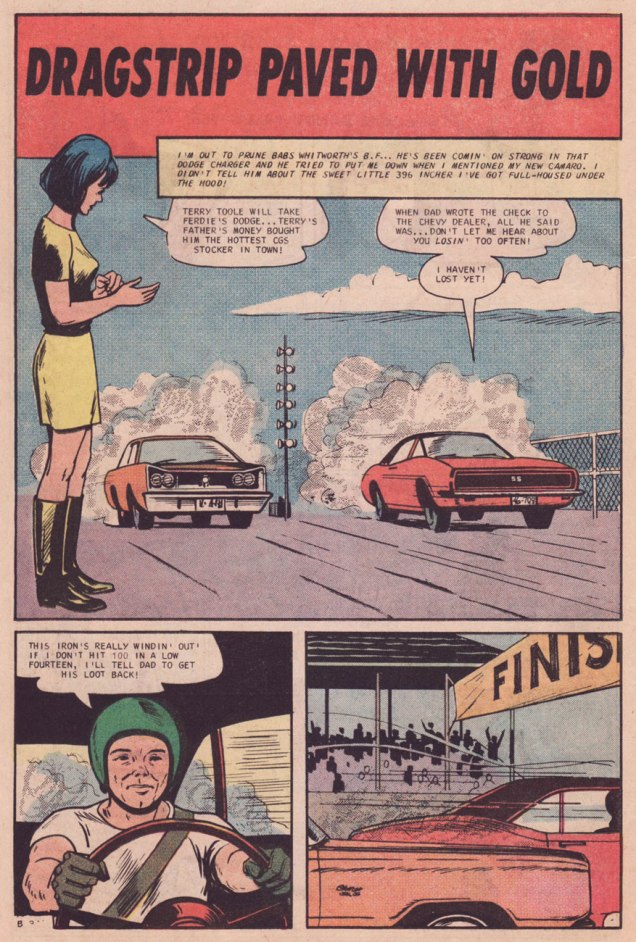
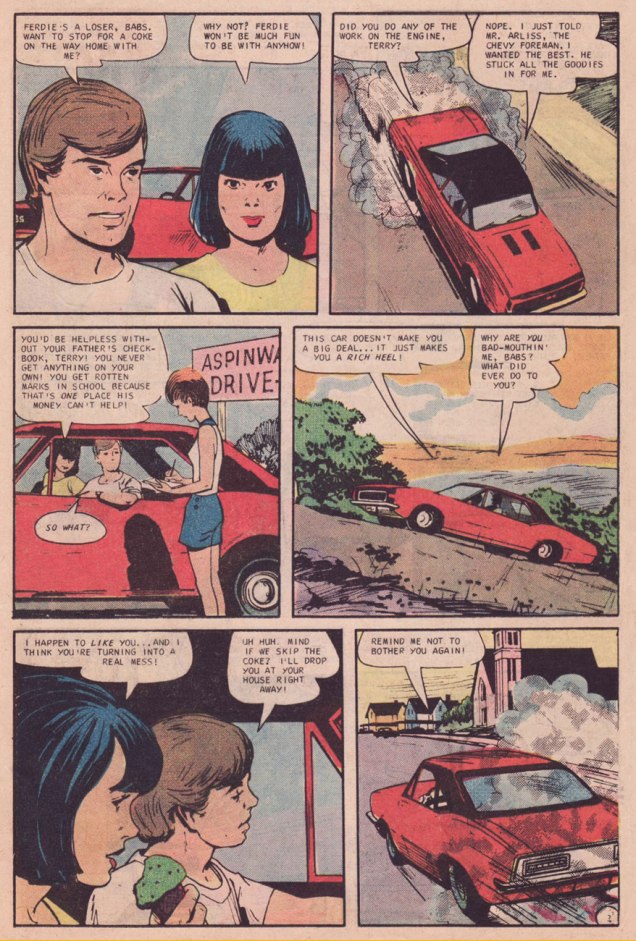
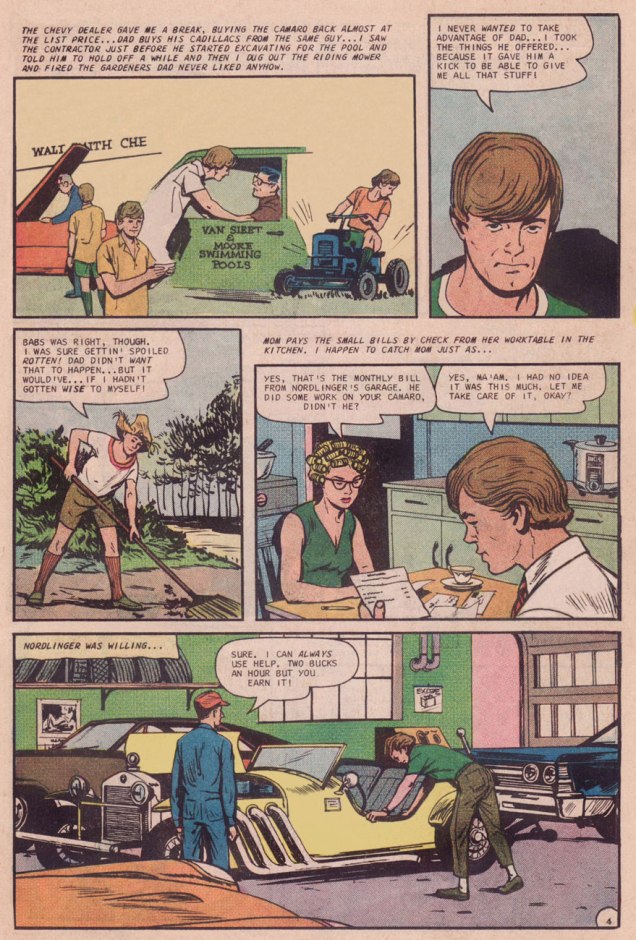
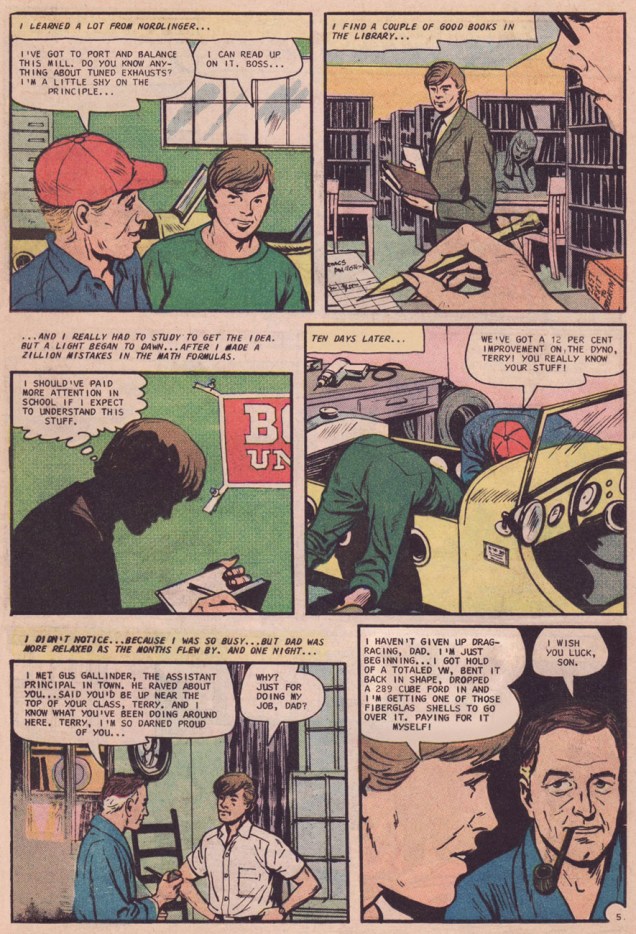
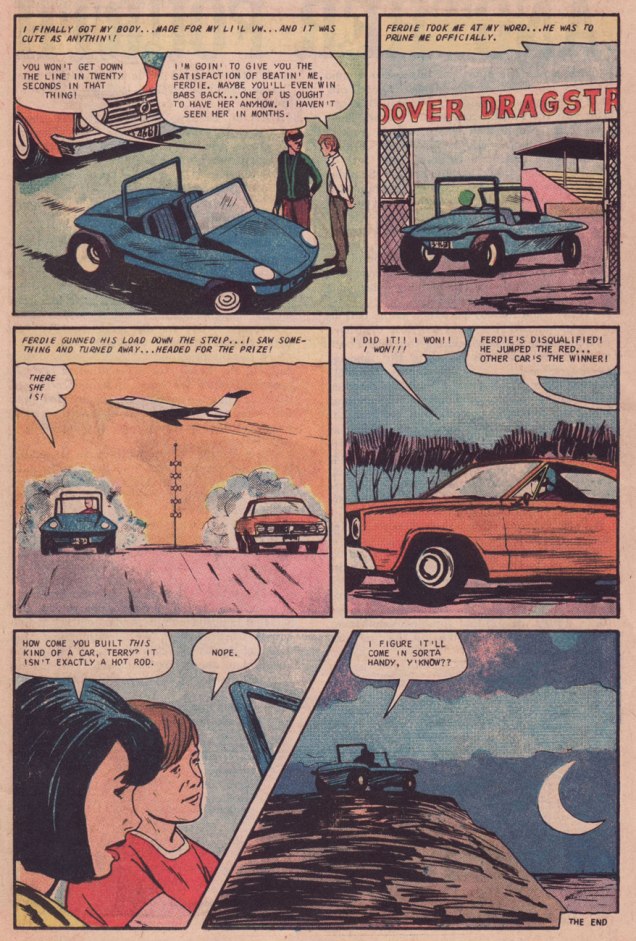
Here, at last, are some actual comics. Dragstrip Paved With Gold appeared in Hot Rods and Racing Cars no. 90 (June 1968, Charlton Comics), and was written by Joe Gill, pencilled by Edd Ashe, and inked by the mysterious and likely pseudonymous T. Roots.

AsheDragstrip01AAsheDragstrip02AAsheDragstrip03AAsheDragstrip04AAsheDragstrip05AAsheDragstrip06A

It might be easy to miss some of the more unusual nuances of Gill’s tale. When faced with the daily task of coming up with material grounded in genres with a limited number of available plots (say, romance, war, horror, hot rods, sports), Gill kept the plot basic and tidy, but enriched his stories with unusual characterization, pertinent technical details, vernacular and jargon… and sometimes moral values quite at odds with the prevailing societal mores. In this story for instance, note that the ladies in Terry and Jim’s lives provide the voices of reason, prodding them gently away from blind ambition, excessive materialism and showboating and toward self-preservation and enlightened self-respect. Dead men can’t keep up with the Joneses… or rather ahead, in this case.

WhoThereLogotype

As a bonus, I’ve compiled a complete-as-far-as-I-know bibliography of Mr. Ashe’s contributions to Charlton hot rod comics (1964-1969); wherever available**, follow the links to read the issue on comicbookplus.com!

Hot Rod Racers 1 : Local Champ / The Compact Cavaliers / Back-Road Champ
Hot Rod Racers 2: The Avenger / Joe’s Jalopy / The Driver, not the Car
Hot Rod Racers 10: Quarter King
Hot Rod Racers 11: Fast Loser
Hot Rod Racers 12: Wrecks to Riches
Hot Rod Racers 13: The Spoiler
Hot Rod Racers 14: The Day the Creampuff Won
Hot Rod Racers 15: You Never Know!

Grand Prix 16: Bossin’ the Turns
Grand Prix 17: Twins’ Trouble / Constant Loser
Grand Prix 18: Gentleman Driver
Grand Prix 19: The Eagles Scream
Grand Prix 20: For Money or Marbles
Grand Prix 21: The Town Wreckers

Drag-Strip Hotrodders 2: Tamed Tiger / Falcon Flyer / Little Eliminator
Drag-Strip Hotrodders 3: English Cousin / 1320 in 13.20 / S/S King
Drag-Strip Hotrodders 5: Great Moments in Racing History: “Rods Across the Sea”
Drag-Strip Hotrodders 10: The Furious 40! / 200 Plus!
Drag-Strip Hotrodders 11: Match Champ
Drag-Strip Hotrodders 12: I’m a Lemon (A Car’s Own Story)
Drag-Strip Hotrodders 13: Speed in All Seasons
Drag-Strip Hotrodders 14: Playin’ the Role!
Drag-Strip Hotrodders 15: “Mighty Mustang”
Drag-Strip Hotrodders 16: Speed at Any Price

World of Wheels 17: Modified Madness
World of Wheels 18: The Astro Rod
World of Wheels 19: “Speedy”
World of Wheels 20: Beast From the East
World of Wheels 21: The Rat Pack
World of Wheels 23: The Wild Ones (Parents)
World of Wheels 27: The Sissy Wagon
World of Wheels 28: Home Town Driver / Lemon at Le Mans (Vince Colletta inks)

Hot Rods and Racing Cars 70: Nightmare at Le Mans
Hot Rods and Racing Cars 72: Farmboy at Le Mans
Hot Rods and Racing Cars 73: Outlaw Hot-Rod / 300 MPH Flying Jet / The Novice / Hold It!
Hot Rods and Racing Cars 74: Final Test (Colletta inks)
Hot Rods and Racing Cars 75: Great Moment in Racing History: “Race to the Sky”
Hot Rods and Racing Cars 78: Great Moment in Racing History: Sebring ’65
Hot Rods and Racing Cars 79: Mille Miglia of 1952
Hot Rods and Racing Cars 80: Great Moment in Racing History: The Vanderbuilt Cup Race of 1937
Hot Rods and Racing Cars 83: The Digyard Demon
Hot Rods and Racing Cars 85: Fast and Furious
Hot Rods and Racing Cars 86: Backyard Grand Prix
Hot Rods and Racing Cars 87: The Pigeon / Just a Country Boy
Hot Rods and Racing Cars 88: Wild Willie & the Black Baron
Hot Rods and Racing Cars 89: The Mighty Midgets
Hot Rods and Racing Cars 90: Dragstrip Paved With Gold
Hot Rods and Racing Cars 91: Piston Head
Hot Rods and Racing Cars 92: Dirt Track Digger
Hot Rods and Racing Cars 93: Tomboy Tornado
Hot Rods and Racing Cars 94: A Friendly Little Car
Hot Rods and Racing Cars 99: The New Breed

Teenage Hotrodders 15: Great Moment in Racing History: The World 600
Teenage Hotrodders 16: Great Moment in Racing History: The Detroit Special
Teenage Hotrodders 17: Great Moment in Racing History: Le Mans 24 Hour Race 1959
Teenage Hotrodders 21: His Big Dream
Teenage Hotrodders 23: Flying Failure

Top Eliminator 25: The Pigeon
Top Eliminator 27: RedLight Express / Mad for Matches
Top Eliminator 28: Blow-Up
Top Eliminator 29: Scarface and the Get Away Gasser

Drag ‘n’ Wheels 32: Weird Willy’s Wild Wagen
Drag ‘n’ Wheels 33: Smoked In
Drag ‘n’ Wheels 34: Wastin’ Time
Drag ‘n’ Wheels 35: The Firecracker 500

– RG

*These were Hot Rods and Racing Cars (1951-1973); Speed Demons (1957-58); Dragstrip Hotrodders / World of Wheels (1963-1970); Teenage Hotrodders / Top Eliminator / Drag ‘n’ Wheels (1963-1973); Hot Rod Racers / Grand Prix (1964-1970); and Surf ‘n’ Wheels (1969-1970).

**Until they wised up sometime in 1968, Charlton didn’t bother to copyright their publications; therefore, they wound up in the Public domain.

Jughead’s Pal, Samm Schwartz

« What is it about me, Pops? Am I different than normal people? »

One (more) thing I’ve learned in this world is that the vast majority of people, from the man or woman in the checkout line to the hard core of comics aficionados… can’t tell Archie artists apart, let alone name any of them.

If you scratch deep enough, one name will come up, like pebbles from a fallow field: Dan DeCarlo. I’m reminded of the annual restaurant poll a local alternative weekly used to hold: McDonald’s unfailingly took its category in a landslide, because of its ubiquitous familiarity. And so it is with Archie artists: DeCarlo must be the best because… well, that’s what we’ve always been told.

If you ask me, much of his peers’ work gets attributed to him. For instance, check out our gallery of Bob White covers. That Archie’s Mad House no. 27 cover, in particular…

WOT’s pick for top artist on the Archie totem is handily Samm Schwartz (1920 – 1997). He’s easily the smoothest, most inventive storyteller in the Archie universe. Despite his skill as a cover designer during Archie’s best years (1959-1965, a figure proposed by cartoonist-scholar Seth and worth carving in stone), there were no Schwartz covers chez Archie after 1965.

The likely reason? In ’65, Schwartz was hired away by Wally Wood‘s Tower Comics (by managing editor Harry Shorten, a former Archie writer-editor) to serve as their art director. While there, he conceived Tower’s relatively prolific teen humour line, featuring Tippy Teen, Go-Go and Animal, and Teen-In, often glibly dismissed as “Archie clones“, by people who clearly haven’t read the work. We’ll return to these eventually.

Now comes the clincher: Schwartz in turn hired some of his former Archie colleagues to pitch in (presumably at higher page rates); DeCarlo (a handful of stories in early issues of Tippy Teen), Harry Lucey (a decent batch, actually) and reportedly Bob White (no sign of him, though). But the bulk of the work was done by Schwartz and future Archie artist Doug Crane.

Now the Archie people didn’t like this one bit; it was a clear case of sedition, a threat to their tidy little work camp system. After the industry’s near-collapse in the mid-1950s, there weren’t a lot of options in the tight-knit little club that remained; let’s not forget that even Jack Kirby was driven to such humbling desperation in the early 1960s. It was all too easy to be blackballed. The Goldwater clan, Archie’s reigning dynasty, took careful note of Schwartz’s break for freedom and the names of his accomplices. After Tower called it a day in 1969, Schwartz went to DC for a year, but it didn’t take. He was forced to return to Archie, which certainly suited the publisher since Schwartz’s signature title, Jughead, had been wilting away in his absence.

The terms of his return are unknown… but against all odds, Samm proceeded to create the finest work of his career, pencilling, inking and lettering hundreds of inspired Jughead stories until, well, until he couldn’t any more. But no covers, considered a plum job: these went exclusively to DeCarlo (with an occasional Lucey) and later to versatile mediocrity Stan Goldberg, aping DeCarlo’s style and random design sense*.

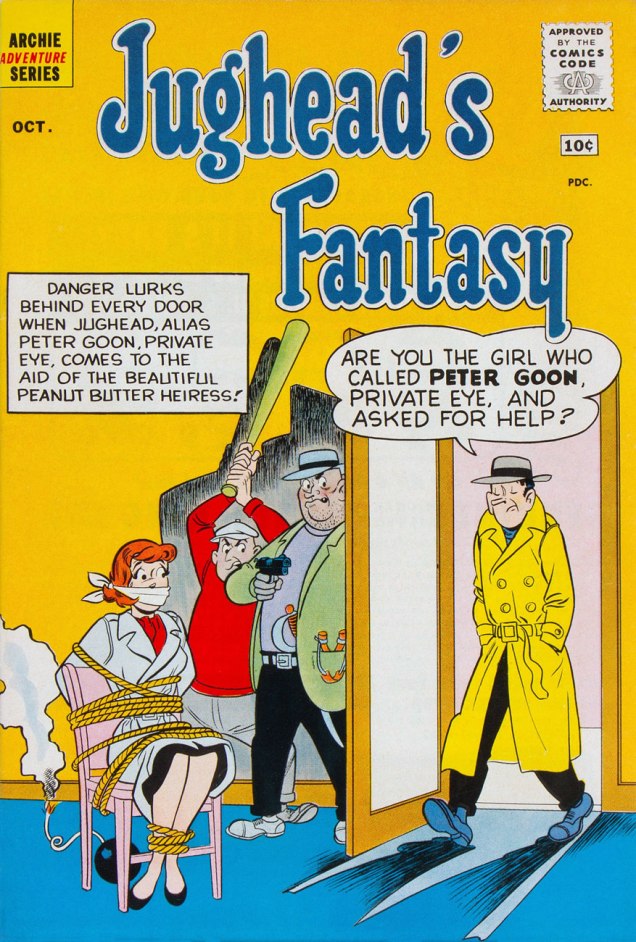
Jughead's-Fantasy02A
Jughead’s Fantasy no. 2 (Oct. 1960); a parody of the excellent 1958-61 detective show… and yes, Peter Gunn did get conked on the head an awful lot.
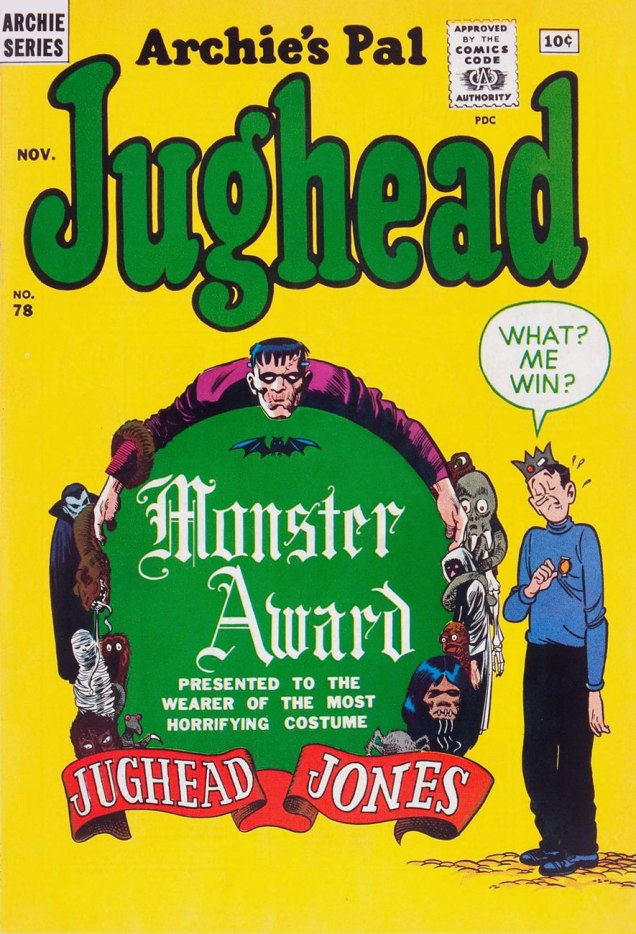
Jughead78A
Archie’s Pal Jughead no. 78 (Nov. 1961)
Jughead81A
Archie’s Pal Jughead no. 81 (Feb. 1962). Check out Reggie’s body language, in particular.
Archie's-Jokes17A
Archie Giant Series Magazine no. 17 (Archie’s Jokes, Summer 1962). There goes Archie, into the next county.
Laugh136A
Laugh Comics no. 136 (July 1962)
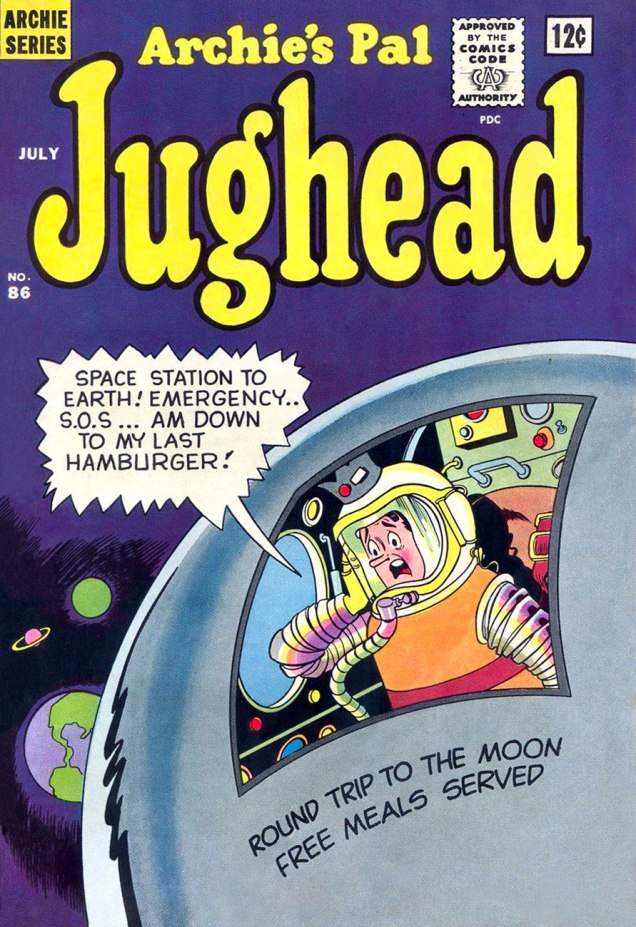
Jughead86A
Archie’s Pal Jughead no. 86 (July 1962)
Jughead89A
Archie’s Pal Jughead no. 89 (Oct. 1962)
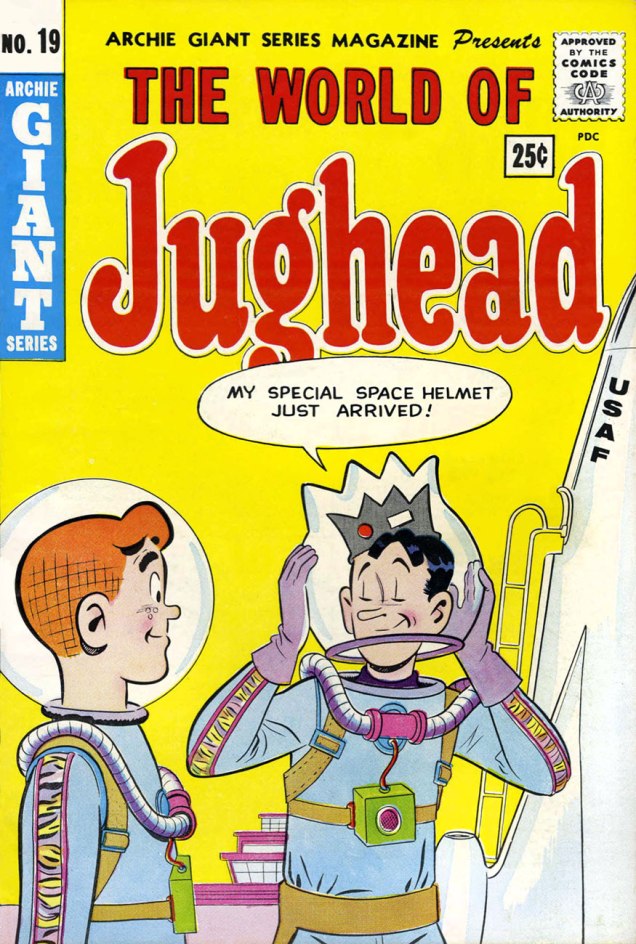
WorldofJughead19A
Er, interesting choice of space pioneers, USAF. Could this mission be some sort of tax dodge? Perhaps Mr. Lodge has a financial stake in it, and gently “suggested” Archie for the possibly one-way trip. Archie Giant Series Magazine no. 19 (World of Jughead, Dec. 1962)
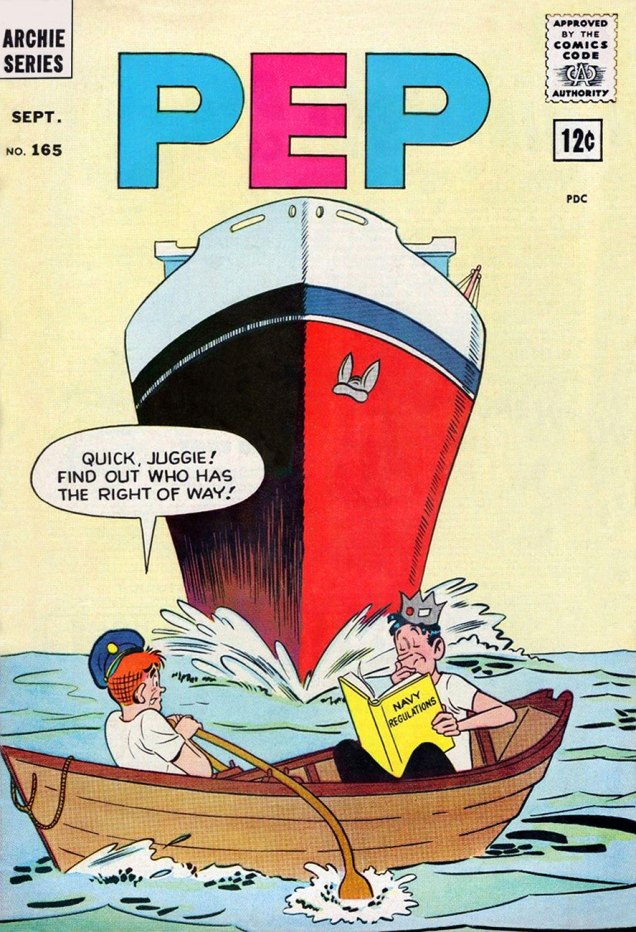
Pep165A
Pep no. 165 (Sept. 1963). My college graphic design teacher told our class that a poster should be “One Angry Fist”, which certainly applies to comic book covers, and this is a fine, fine example of making the most of a format.
Madhouse33A
Archie’s Mad House no. 33 (June 1964)
BettyVeronica102A
Archie’s Girls Betty and Veronica no. 102 (June 1964). The new, definitely not improved cover layout of the Archie line rears its homely head.
SammSchwartzA
Mr. Samm Schwartz, date unknown, though the cars should certainly serve as a clue.

To quote his daughter, Joanne Colt, from the introduction of 2011’s The Best of Samm Schwartz (it isn’t, but it’s pretty good): « He drew for Archie until his death on November 13, 1997, my birthday. There was an unfinished story on his drawing board. »

-RG

*the way I see it, the difference between a Bob White or a Samm Schwartz cover and a DeCarlo is the difference between a considered, effective layout and the act of pointing a camera at random and snapping the shutter. To be fair to DeCarlo, his girlie cartoons for Martin Goodman’s Humorama were excellent, and his first half-decade at Archie (60-65) was fine… then the company wore him down into a sad hack and the unfortunate protagonist-victim of a cautionary tale.

Bill Everett’s Restless Nights of Dread

Today, 102 years ago (!), on May 18th, 1917, William Blake Everett came into the world. He did not become a poet like his ancestor William Blake, nor a politician like Richard Everett, another famous forebear, who founded the city of Springfield, Massachusetts. Bill Everett’s father wanted him to become a cartoonist, and his wish came true, though the elder Mr. Everett died long before before the rebellious Bill found his place in the comics industry.

Bill Everett is best known for creating Namor the Sub-Mariner (visit out Tentacle Tuesday: Prince Namor for an overview of this character’s story and adventures… or read The Brilliance of Bill Everett’s Sub-Mariner, Marvel’s Superman, a great article from Sequart Magazine), but he also had his hand in the creation of Daredevil and Simon Garth, Zombie. Everett excelled in many genres – superheroes, horror, fantasy, science-fiction – but today, since there are far too many covers to feature, I will force myself to focus on horror. Welcome to the ghoulish gallery of my favourite Bill Everett covers! (They’re not necessarily the goriest or scariest – sometimes it’s a mood of quiet menace or a striking composition that sways me.)

BillEverett-Venus19
Venus no. 19 (April 1952). The silent, smirking watchers in the corner are far creepier than the skeleton embracing her!
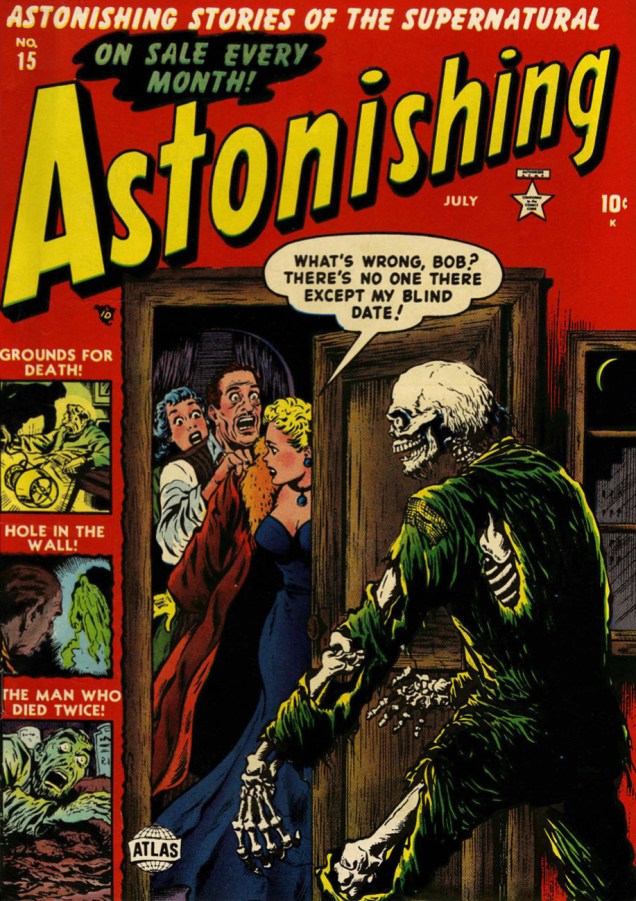
EverettAstonishing15A
Astonishing Tales no. 15 (July 1952). Do a lot of daughters address their fathers by their first name?
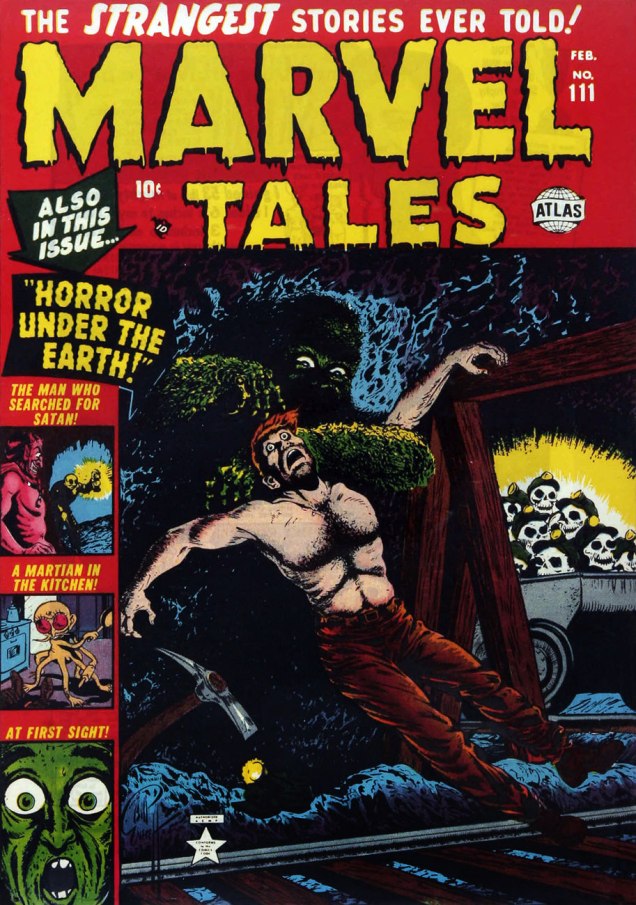
BIllEverett-Marvel-Tales111A
Marvel Tales no. 111 (February 1953)
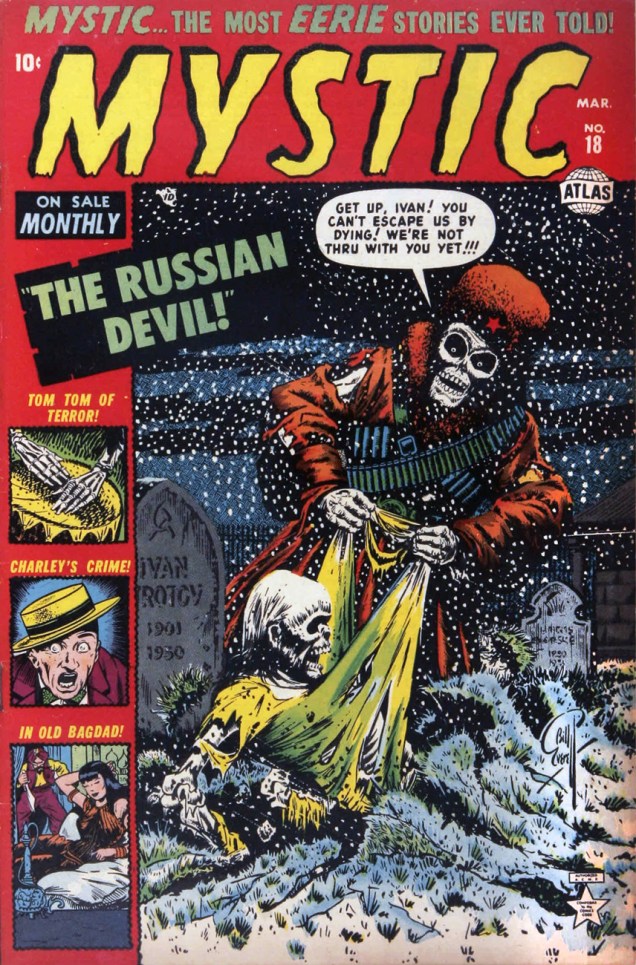
BillEverett-Mystic-#18
Mystic no. 18 (March 1953).
BillEverett-JourneyIntoMystery9A
Journey Into Mystery no. 9 (June 1953)
BillEverett-Marvel-Tales117A
Marvel Tales no. 117 (August 1953)
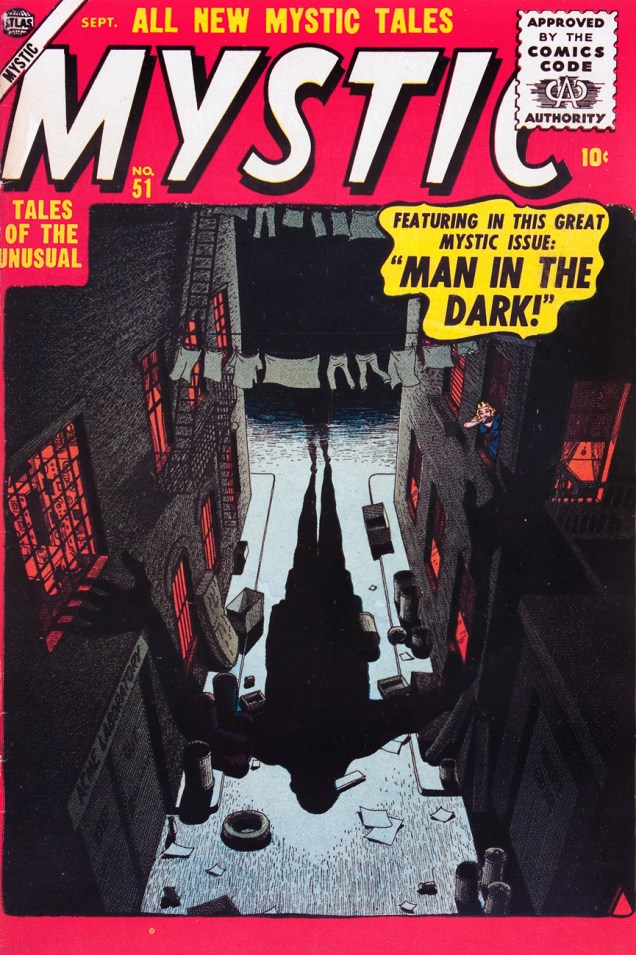
BillEverett-Mystic-#51-(Atlas,-1956)
Mystic no. 51 (September 1956). I love these silent covers where the menace is suggested rather than shown in detail.
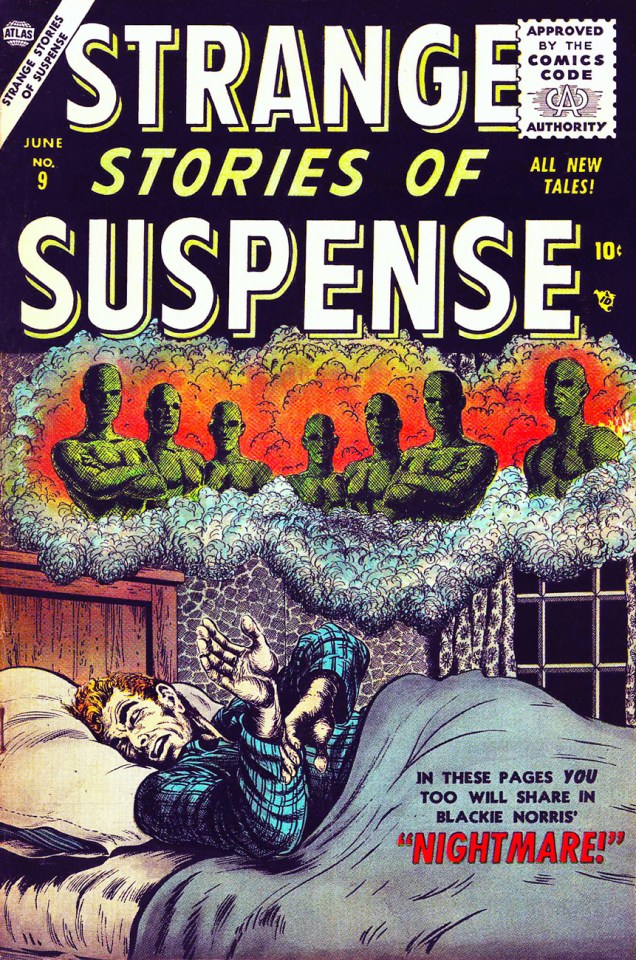
BillEverett-Strange-Stories-of-Suspense-#9
Strange Stories of Suspense no. 9 (June 1956)
BillEverett-MarvelTales151A
Marvel Tales no. 151 (October 1956). Here it’s the composition I especially like – the giant hair isn’t that scary.
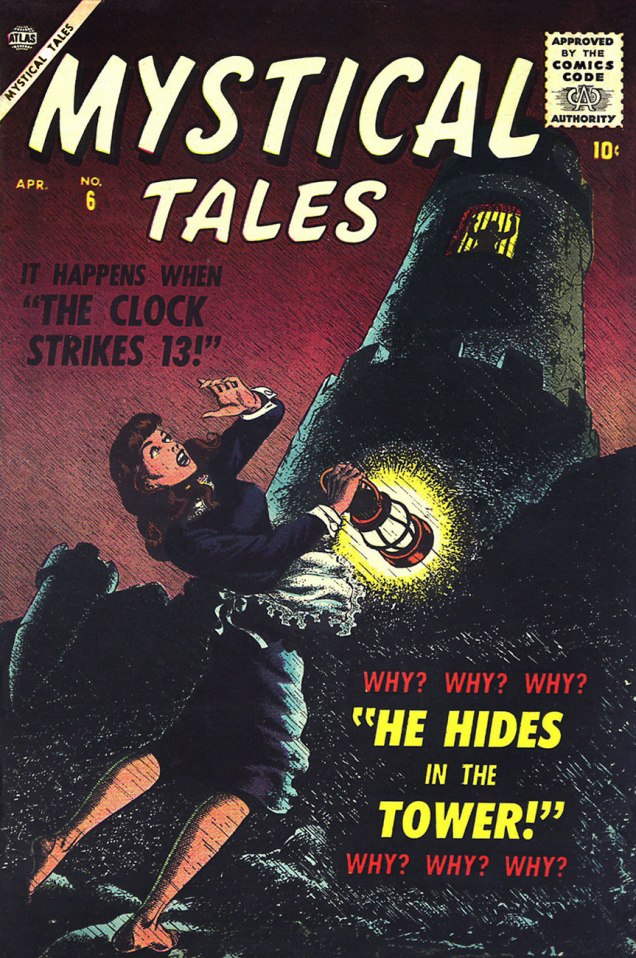
BillEverett-Mystical-Tales-6A
Mystical Tales no. 6 (April 1957). I admit the WHY? WHY? WHY? amuses me WHY? WHY? WHY?; – one inquiry should have sufficed. Speaking of “WHY?”… Why is she barefoot? Those rocks have to be treacherously slippery at the best of times, let alone in a rainstorm.

If you’d like more, you can visit Scott’s Classic Comics Comics Corner: Top 13 Bill Everett Horror Covers – only two of his entries overlap with my own selection, which shows how opinions vary and just how rich this vein is.

~ ds

Tentacle Tuesday: Prince Namor, the Sub-Mariner

Created by Bill Everett, Namor the Sub-Mariner first appeared in Marvel Comics no. 1 (October 1939). The offspring of a human sea captain and a princess of Atlantis (and thus proudly bearing the title of Prince), he possessed the aquatic talents one expects of a regular merman and the exceptional strength of a carnival strongman. The cool thing about Namor is that right off the bat, he was a rather negative character – to be more precise, he was an Enemy of the United States (Everett didn’t mince words or characters, huh?) As Les Daniels states in his Marvel: Five Fabulous Decades of the World’s Greatest Comics (1991), « Namor was a freak in the service of chaos. Although the Sub-Mariner acted like a villain, his cause had some justice, and readers reveled in his assaults on civilization. His enthusiastic fans weren’t offended by the carnage he created as he wrecked everything from ships to skyscrapers. » This chaos culminated in an epic fight with Human Torch in 1941 when Namor took things a little too far and threatened to inundate the whole island of Manhattan. This little skirmish didn’t prevent him from joining the Allies’ side once World War II started, however, which gave a more constructive outlet for his somewhat destructive energies.

Right from the beginning, the Sub-Mariner was a complex character who just wouldn’t fit into the standard good guy/bad guy dichotomy. He underwent through quite a few transformations, disappearing for a bit right after WWII like many of his super-and-anti hero compatriots (but never for more than a couple of years at a time) and resurfacing during the Silver Age as a slightly different character. Namor’s concern about encroaching technology and hate of humanity, his fierce independence, made him a likeable character for those of us who like mavericks. He is a tragic character, a king without a kingdom who finds that Atlantis and its people have been destroyed by nuclear testing. After that, who wouldn’t hold a grudge? Anyway, if you’d like a more cogent overview of the Sub-Mariner’s history, visit The Great Comic Book Heroes.

To get back on topic, given how much time Namor spends underwater, it’s hardly surprising that he quite frequently encounters tentacles.

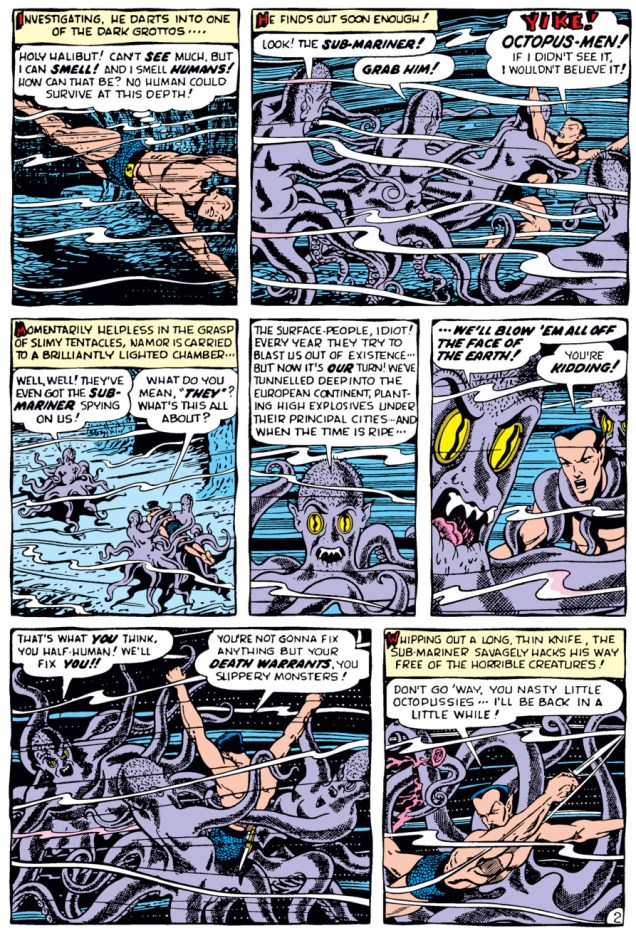
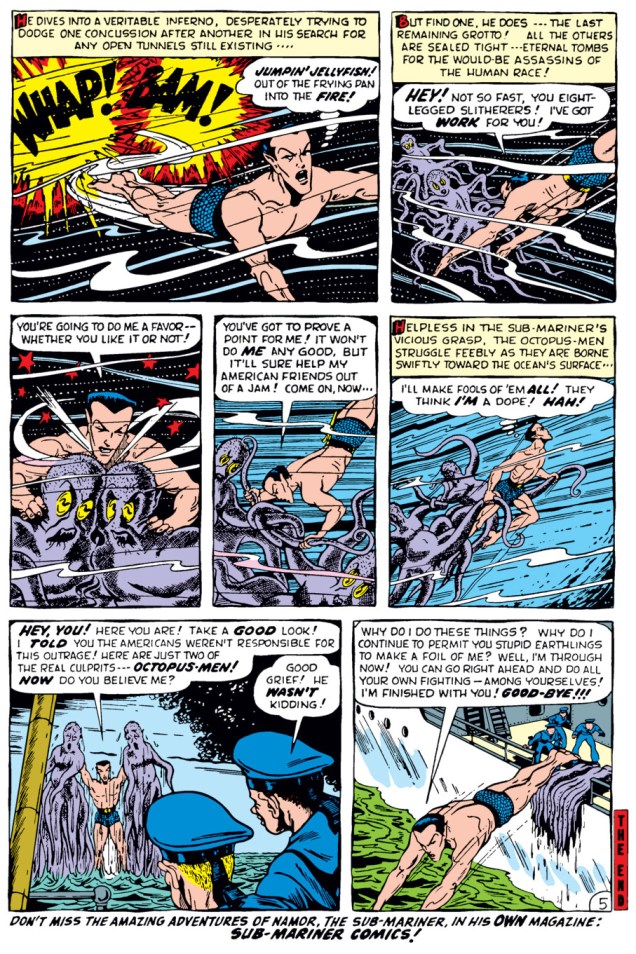
First, a story scripted and drawn by Bill Everett – who better to introduce the character than his creator? This is “The Octopus-Men!”, printed in The Human Torch no. 38 (August 1954).

BillEverett-Submariner-TheHumanTorch38-1
« The Original Aquaman » ? My, aren’t we testy. Now, now, you boys both belong to a long, storied tradition.

BillEverett-Submariner-TheHumanTorch38

BillEverett-Submariner-TheHumanTorch38-2

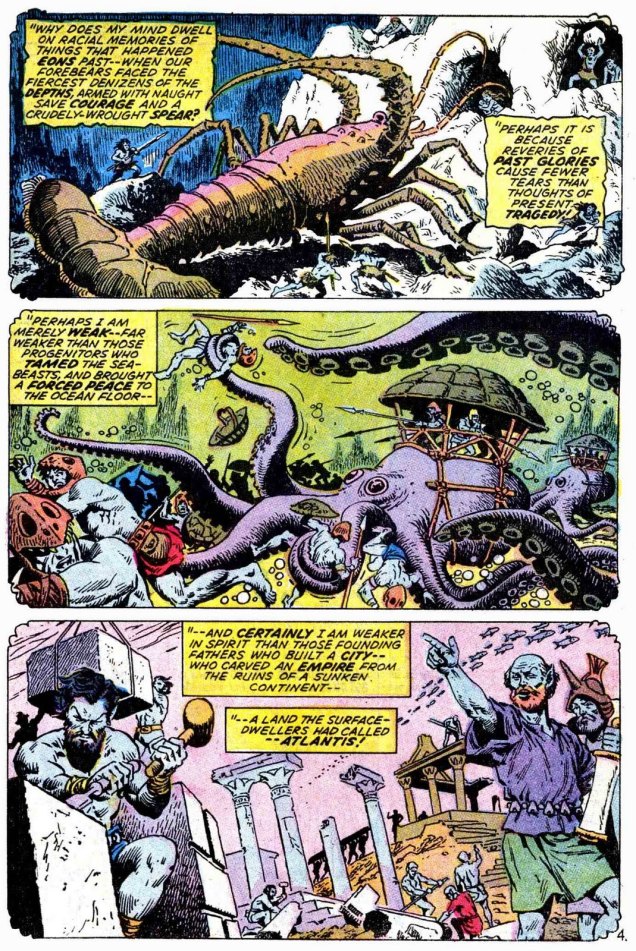
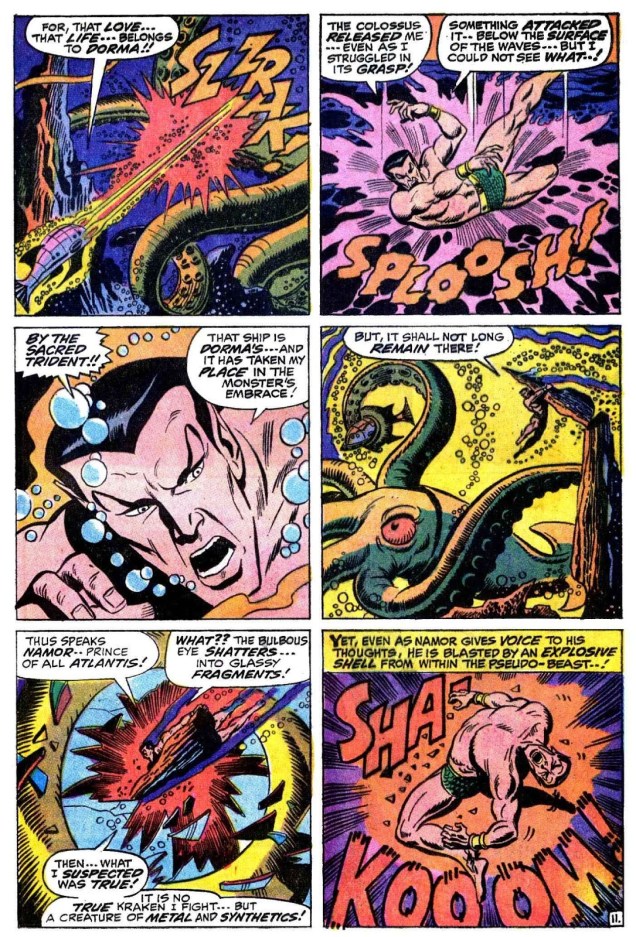
Skipping ahead some twenty years, a page from “Namor Agonistes!”, scripted by Roy Thomas, pencilled by Ross Andru and inked by John Severin, printed in Sub-Mariner no. 38 (June 1971). This is sort of an origin story of the Sub-Mariner. Lovely art, n’est-ce pas?

Submariner38-RossAndru-JohnSeverin

A page from “When Wakes the Kraken!”, scripted by Roy Thomas, pencilled by Sal Buscema and inked by Mike Esposito, printed in Sub-Mariner no. 27 (July 1970):

Sub-Mariner #27-SalBuscema-RoyThomas

Oh, let’s have a couple of covers, too.

Sub-Mariner13
A rather random assortment of creatures, isn’t it? Sub-Mariner no. 13 (May 1969), pencils by Marie Severin and inks by Joe Sinnott.
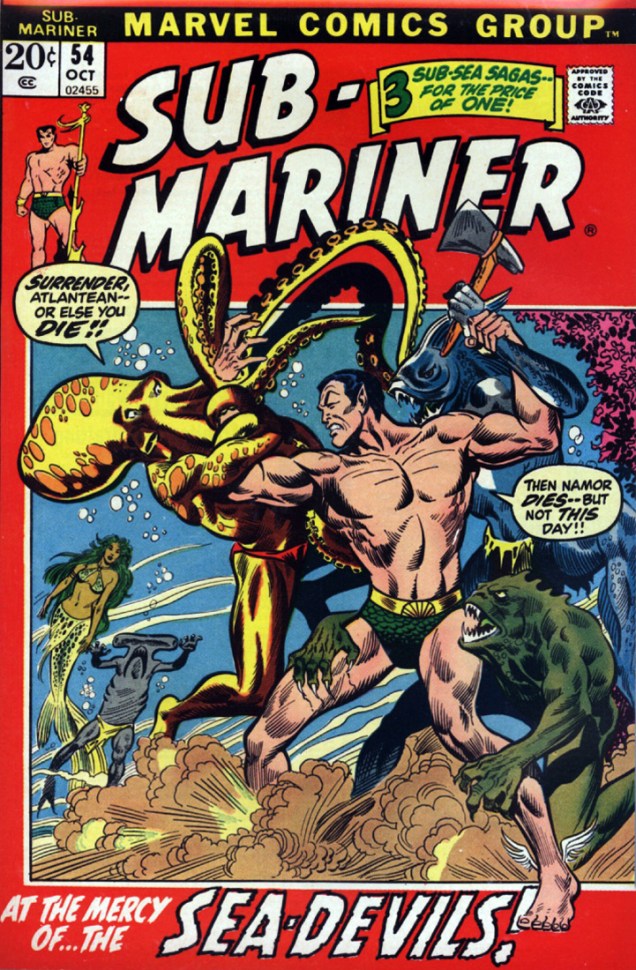
Sub-Mariner54
Umm… why is a piranha wielding an axe? Sub-Mariner no. 54 (October 1972), pencilled by Alan Weiss and inked by Frank Giacoia.

I mostly sneer at modern “reboots” of Golden or Silver Age characters, but Namor’s appearance in the excellent Thor the Mighty Avenger (Marvel, 2010) was completely à propos. (The series is a happy union of an absorbing story with great graphics – it’s written by Roger Langridge with art by Chris Samnee.) Here’s a page from “Thursday Morning“, published in Thor the Mighty Avenger no. 5 (December 2010).

ThorTheMightAvenger

~ ds
Hot Streak: Joe Kubert’s The Atom and Hawkman

« Calm down, Harris… this is no teleportational phenomenon we’re dealing with… » — Hawkman, “Yo-Yo Hangup in the Sky!”.

In 1968, though DC was still handily outselling Marvel, the industry leader was beginning to feel the heat. Now, to be fair, not nearly as much as revisionists would surmise: Marvel’s top-seller, The Amazing Spider-Man, was only in twelfth place. Of course, Marvel was hobbled by distribution issues, but that problem would come to an end that very year.

Anyway, as neither of DC’s solo titles The Atom (38 issues, June-July 1962 – Aug.-Sept. 1968) nor Hawkman (27 issues, Apr.-May 1964 – Aug.-Sept. 1968) were doing all that well (both of them missed the top sixty in 1968), it was decided to attempt to merge the books in order to perhaps save them. Well, it didn’t work, but some splendid covers were created, and that’s what brings us here.

AtomHawk39A
The Atom and Hawkman no. 39 (numbering continued from Atom’s book, not Hawkman’s), November 1968. Insides by Robert Kanigher, Murphy Anderson and Joe Giella. Which one’s the Titan and which the Fury? They take turns. Check it out here.
AtomHawk40A
The Atom and Hawkman no. 40 (Jan. 1969) holds a rare treat: a highly unusual pairing, one that was only repeated once to my knowledge (in the following issue): Joe Kubert on pencils and Murphy Anderson on inks. The tale is The Man With an Inbuilt Panic Button, scripted by Gardner Fox. Peruse it here while you can.
AtomHawk41A
My candidate for the slightest cover of the Atom/Hawkman combo title, but only since the competition is so fierce, and well, it’s kind of busy. This is The Atom & Hawkman no. 41 (Feb.-Mar. 1969), edited by Julius Schwartz and featuring Return of the Seven-Year-Dead Man, written by Gardner Fox, pencilled by Dick Dillin and inked by Sid Greene, and Yo-Yo Hangup in the Sky!, written by Fox, illustrated by Kubert and Anderson. Feast your eyes here.
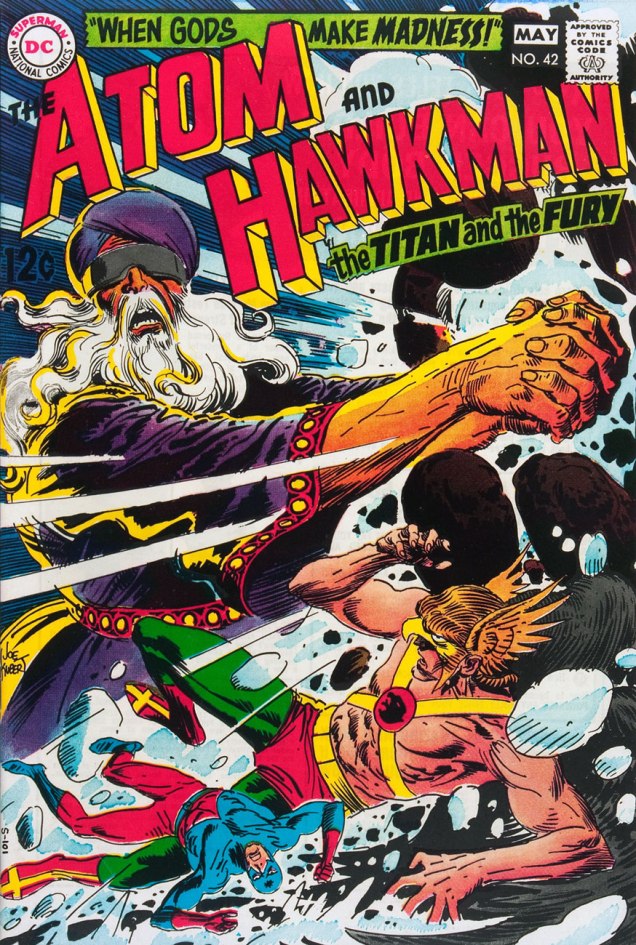
AtomHawkman42A
This is The Atom and Hawkman no. 42 (Apr.-May 1969). Read it here!
AtomHawkman43A
Robert Kanigher & Joe Kubert’s Gentleman Ghost, first appeared (so to speak) in Flash Comics no. 88 (Oct. 1947) had not been seen (hee hee) since the Golden Age, and he returned to pester Hawkgirl and Hawkman in Come to My Hanging, scripted by Kanigher and illustrated by Murphy Anderson. Meanwhile, The Atom stars in Buzzin’, Buzzin’ — Who’s Got the Buzzin’?, scripted by Dennis O’Neil, pencilled by Dick Dillin and inked by Sid Greene. This is The Atom and Hawkman no. 43 (June-July 1969). Read it here!
AtomHawkman44A
Kubert clearly relished delineating his Gentleman Ghost, and who could blame him? That sticky-fingered filcher is one snazzy-looking felon. This is The Atom and Hawkman no. 44 (Aug.-Sept. 1969). Read it here!
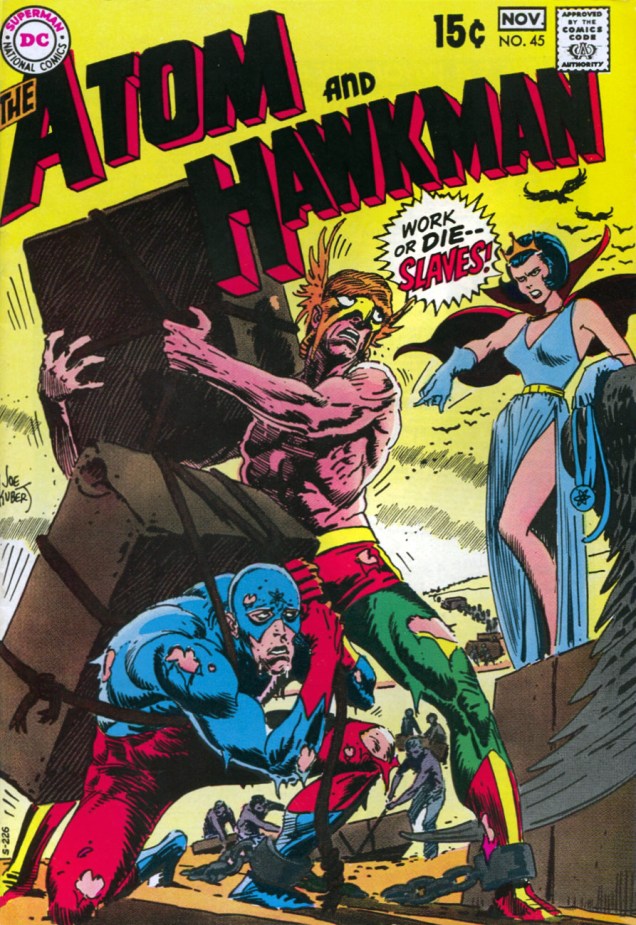
AtomHawkman45A
This is The Atom and Hawkman no. 45 (Oct.-Nov. 1969), featuring Queen Jean, Why Must We Die?, by Denny O’Neil, Dick Dillin and Sid Greene, whereas our heroes are enslaved by Ray “The Atom” Palmer’s girlfriend, Jean Loring. It was a common theme in DC Comics, just ask Superman and Green Lantern, for starters. Anyway, read the whacked-out tale here.

As a bonus, one could consider the final issue of Hawkman (no. 27, Aug.-Sept. 1968), the first entry in Kubert’s streak. Well, I do, and that’s that.

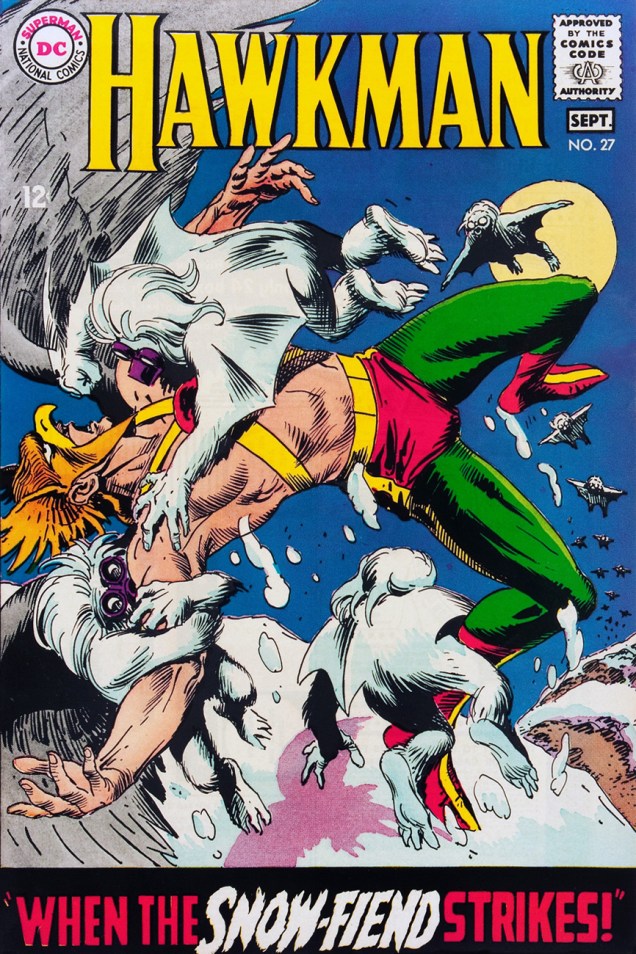
Hawkman27A
It is said that late each year, Thanagarians mark the winter solstice by taking to the snowy skies to join cuddly flying Yeti in frolic. Look at them cute lil’ buggers. When the Snow-Fiend Strikes! is scripted by Raymond Marais, pencilled by Dick Dillin and inked by Chuck Cuidera.

-RG

Don’t Let a Mysogynist Plan Your Wedding: Robert Kanigher and Wonder Woman’s Utterly Unsuitable Suitors

Poor Wonder Woman has gone through quite a few transformations during her lifetime. You can read about her kinky-yet-feminist beginnings elsewhere (for an interesting article about how this character was created, read The Surprising Origin Story of Wonder Woman at the Smithsonian; or take a gander at Wonder Woman, the sexualized superhero for a great discussion of how a character can be objectified or empowered by being portrayed in a sexy way) – today I’m concentrating on some goofy Silver Age covers from DC’s long-running Wonder Woman series.

My interest is twofold. On the positive side, I like the team that worked on WW covers in these days – Ross Andru on pencils and Mike Esposito inking. (All covers in this post are by them.) On a more sour note, I have a whole boneyard to pick with writer Robert Kanigher, whose scripts I generally like… as long as they don’t involve women. Who had the bright idea of choosing a hardened misogynist as writer of a major female superhero? (Purely a rhetorical question, I assure you.) Kanigher took over the scripting with Wonder Woman no. 98 (May 1958), “revamping” (as Wiki gracefully puts it) the character, giving her a new origin story and a new cast. It’s not that I object to the idea in principle, but this so-called revamping involved continually trying to marry the intrepid Amazon off to some schmuck, sticking her into stories that don’t make a lick of sense, making her burst into tears randomly – Like a Real Woman does – and forcing her to make Sophie’s choices between the lives of boyfriends and family, on random shuffle.

So here’s a gallery of covers I like and cover stories I don’t.

Wonder Woman #125
Wonder Woman no. 125 (October 1961).

Well, Mer-Man clearly doesn’t have a leg to stand on in this competition. Come to think of it, neither does Amœba-Man. How are these two even standing? And how would either of these consummate the marriage?

The cover story is Wonder Woman — Battle Prize, a good example of the “marrying Wonder Woman off” theme. “Ages of Heroes, Eras of Men” (by Julian C. Chambliss) explains that sort of thing is designed to « affirm [the super heroines’] proper femininity by regularly demonstrating their heterosexuality“. Now he’s right and all, but for that purpose one could easily come up with something more appealing than a romance with an amoeba, a unicellular organism that reproduces mostly by fission. Stay away from pseudopods and fishy scales, Wonder Woman.

WonderWoman#143
Wonder Woman no. 143 (January 1964).

The Terror Trees (old Bob clearly liked alliteration) are trees that can move and attack, found on a “sinister, uncharted island”. For some reason there’s a Sun Sword (another alliteration) stuck in one of them, which Wonder Woman must retrieve to defeat some nasty alien invaders. At some point, a tree attempts to crush her, leading to an epic scene in which she whirls her head around, using her tiara (made of “amazonium… hardest metal known…”) like a “circular saw” and slicing her way out of the “ruthless tree”. I’m not even going to summarize the rest of this nonsense, but suffice it to say, the story ends – as it always does – on a happy note. Who’s the lizard on the cover, you may ask? No fucking idea, he’s not part of the plot.

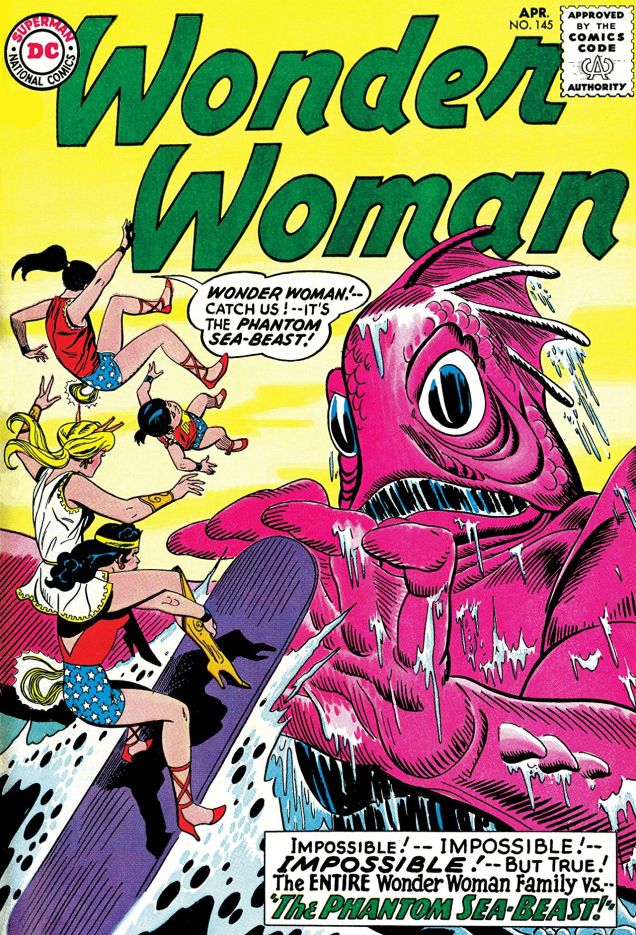
WonderWoman#145
Wonder Woman no. 145 (April 1964).

The Phantom Sea-Beast is just such a tangled mess of claptrap that I don’t even know how to summarize it. It also involves some romance between Mer-Mite and Wonder Tot (in which the former tries to trick the latter into marriage), which is a good representation of what Kanigher seems to think as a Jolly Good Time. Bald zoo-keepers! A fight with a T-Rex! Go read Carol A. Strickland’s review of it, from which I shall quote a paragraph:

« Wonder Tot had just gotten out of the whale. As Wonder Tot surfs alone back to Paradise, she sees her family diving off a cliff and goes to meet them. They practice acrobatic stunts. Not only is Diana surfing in heels, as she is wont to do, but Wonder Girl conveniently wears a Wonder Woman tiara as she has never worn (she’ll need it later in the story). The queen’s pointy crown does not impale her daughter’s head. And even more oddly, gravity does not affect Hippolyta’s skirt. What can I say? It’s just a dream.»

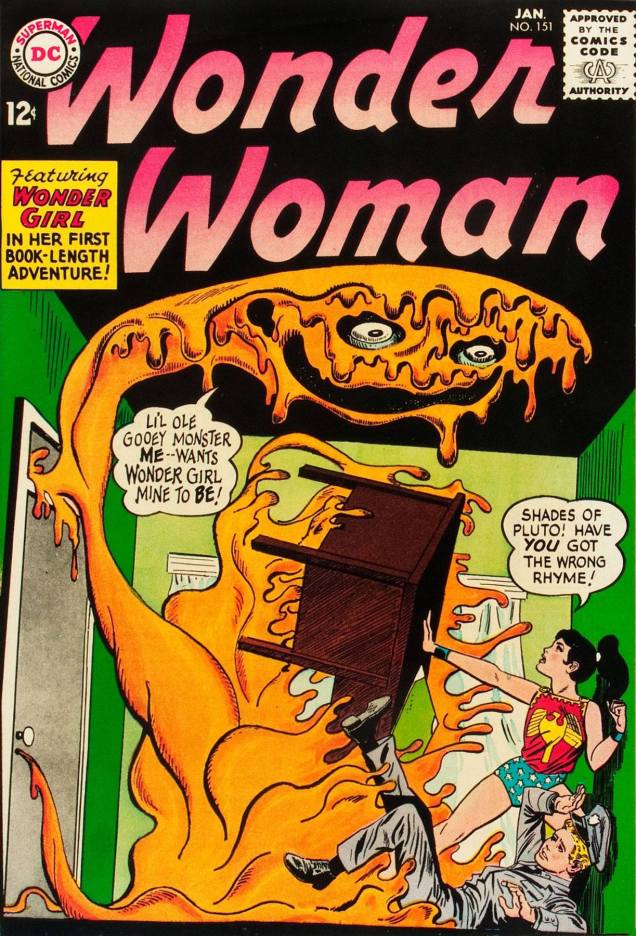
Wonder Woman #151
Wonder Woman no. 151 (January 1965).

In “Wonder Girl vs the Teenage Monster!“, the Glop, a blob-like alien, swallows 100 rock’n’roll records and proceeds to serenade Wonder Girl with regurgitated lyrics, coming up with gems like  “Glop… glop… I’m not a mop! I want my pearl – wonder girl!” And by the way, it was all a dream (a convenient cop-out that Kanigher resorts to far too often): Wonder Girl fell asleep while looking through a photo album with Wonder Woman’s “boyfriends” and mourning her own romantic troubles. We hear you loud and clear, Sir Kanigher: women’s pretty little heads can only think of men and all manner of frilly, sweet things, even if the woman in question possesses great power and even greater intelligence.

That being said, this is probably my favourite cover of the lot. I just melt when presented with a blob of goo!

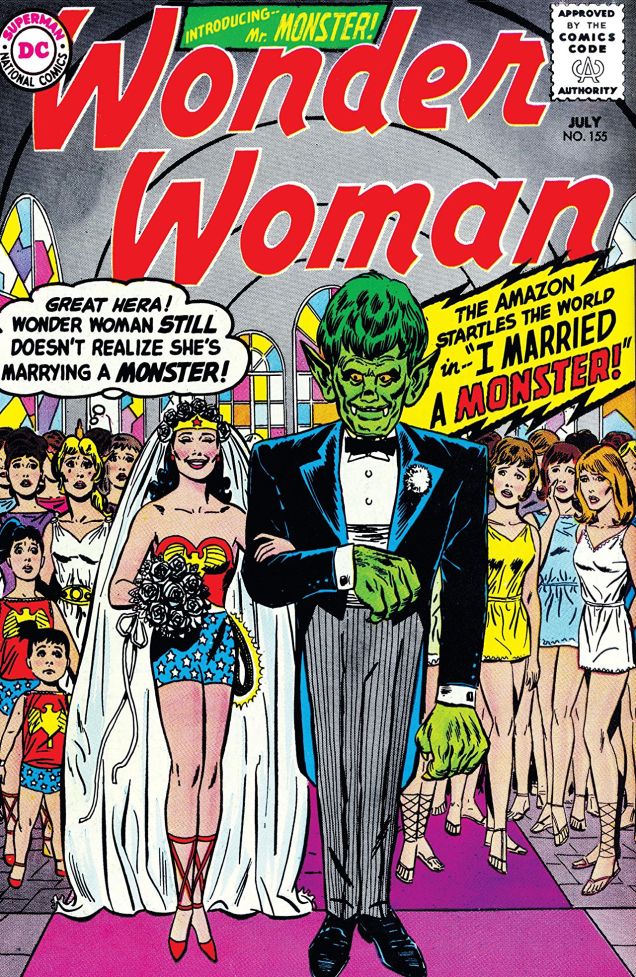
WonderWoman#155
Wonder Woman no. 155 (July 1965).

Groan. Here we go again with this ridiculous obsession of marrying Wonder Woman off. After Wonder Woman is hounded by her usual three beaus who practically threaten her with matrimony (including the awesome line, uttered by Steve Trevor, “When are you going to marry me! Better hurry! Before you’re an old maid!“), she encounters Monster Prince, who, as it turns out later in the story, is handsome when he does good, and ugly when he does evil.

A sample of the romantic dialogue that leads to the altar for these two lovebirds:

Monster Prince: « Stop pretending I’m an ordinary man! You almost sacrificed yourself like a driver taking pity on a dog on the road — and risking her life to avoid hitting him!»

WW:  « Only a man who thinks like a giant — could have defied a whole army of Amazons as you did before! You raged like a storm! You were magnificent! Anyone who married you — would be lucky! »

And that’s it, they’re betrothed! Except that the Prince ditches her at the altar, claiming that he doesn’t want a beautiful girl to sacrifice her life to a monster like him. Err…?? More nonsense follows. It becomes painfully evident that Wonder Woman is attracted to bipolar assholes who make her feel inadequate. It reminds us once again that according to you-know-who, women are emotional weaklings who need an overbearing male hand to tell them what to do (or where to get off). Brr. Read the full synopsis, if you dare, over here.

Wonder Woman #169
Wonder Woman no. 169 (April 1967).

You know how sometimes a restaurant proclaims to have a dish so original that it’s only on offer at that particular joint? It sounds like hype, but occasionally the claim is actually accurate… because the recipe in question combines elements that clash so badly that no normal person would think of combining them. This “most unique villain ever created” is in that category: he’s a bloody stupid idea. He’s not terrifying, he’s silly… though I did develop a headache while trying to figure out how he got into that tight outfit with his 8 sets of arms and 7 sets of legs.

Joanna Sandsmark, who wrote a hilarious review of the Crimson Centipede (be sure to read it here!), remarks that « I am thoroughly convinced that the germ of the story came to Bob Kanigher when his wife had a run-in with a centipede. Somehow, he thought it would be a good idea to have Wonder Woman afraid of it, as his wife was. Apparently, he forgot that Diana was a superhero who had all kinds of powers. Lucky for him, she was female. Problem solved! » (I think I’m not the only one who has a low opinion of Kanigher’s female-depicting prowess.)

So there we have it. Is this bigoted balderdash worthy of a man who co-created Sergeant Rock, or Enemy Ace or the Unknown Soldier? Nope. What do these have in common? There’s no women in these series, or at least no recurring female characters. (Well, okay, the other commonality is Joe Kubert.) Metal Men could have been great… but the presence (and more significantly, characterization) of a female character, Platinum, kills it for me. There’s no doubt that Kanigher *could* wrote emotionally resonant stories with complex characters and excellent internal logic. In the case of the Wonder Woman series, he just chose not to, preferring instead to produce a lot of hooey with giant plot holes and pepper it with sad clichés. It’s a pity.

If you want to see Wonder Woman done right, visit Tentacle Tuesday: H.G. Peter and Wonder Woman Lend a Hand.

~ ds

Peter Tork, Man of Music… and of Comics

« I know she’s having a fit, she doesn’t like me a bit, no bird of grace ever lit on Auntie Grizelda » — Diane Hildebrand / Jack Keller, 1966

Now’s the time to wish Peter Halsten Thorkelson, he of the open, Nordic look, a most joyous 77th birthday, regardless of what Your Auntie Grizelda may think!

Pete was born in Washington, D.C. on February 13, 1942, which makes him the doyen of the group. Like Mike “Wool Hat” Nesmith, he was a musician first, likely the group’s most instrumentally proficient. Peter wound up auditioning for the tv show after his name was suggested by Stephen Stills, who wasn’t quite right for the part… but definitely a good sport.

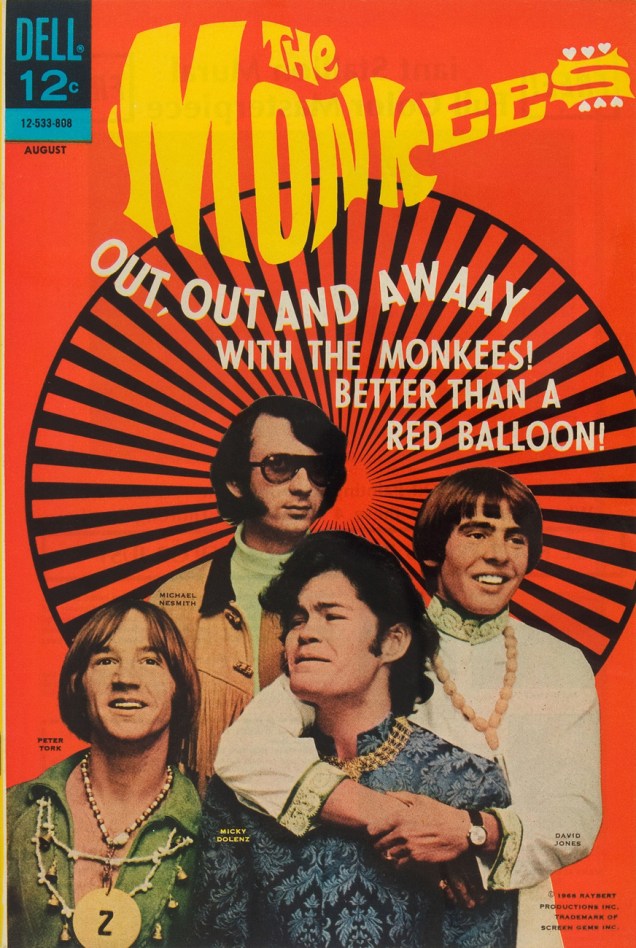
Peter and his fellow Monkees were featured in their own Dell comic book (is there any greater honour?), which lasted from March, 1967 to October, 1969, seventeen issues in all (with some reprinting.) That was one of Dell’s few savvy moves in their waning days, and one of their few readable titles outside John Stanley‘s output.

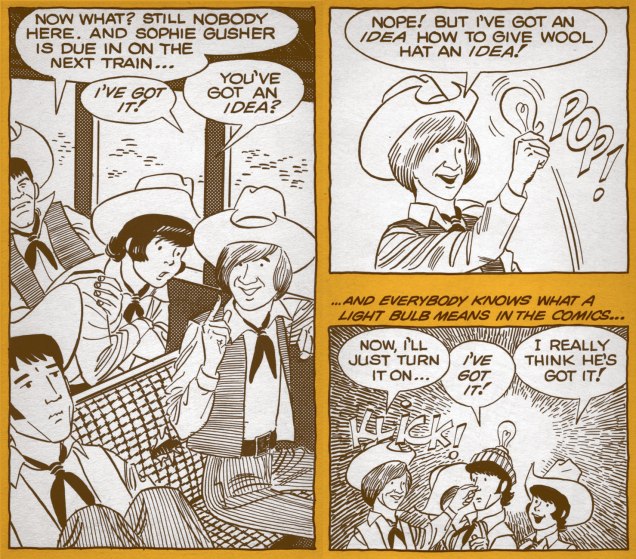
FawcetteMonkeesIdea2A
Peter the muse. From ‘Way-Out’ West, The Monkees (1966, Popular Library). See below!
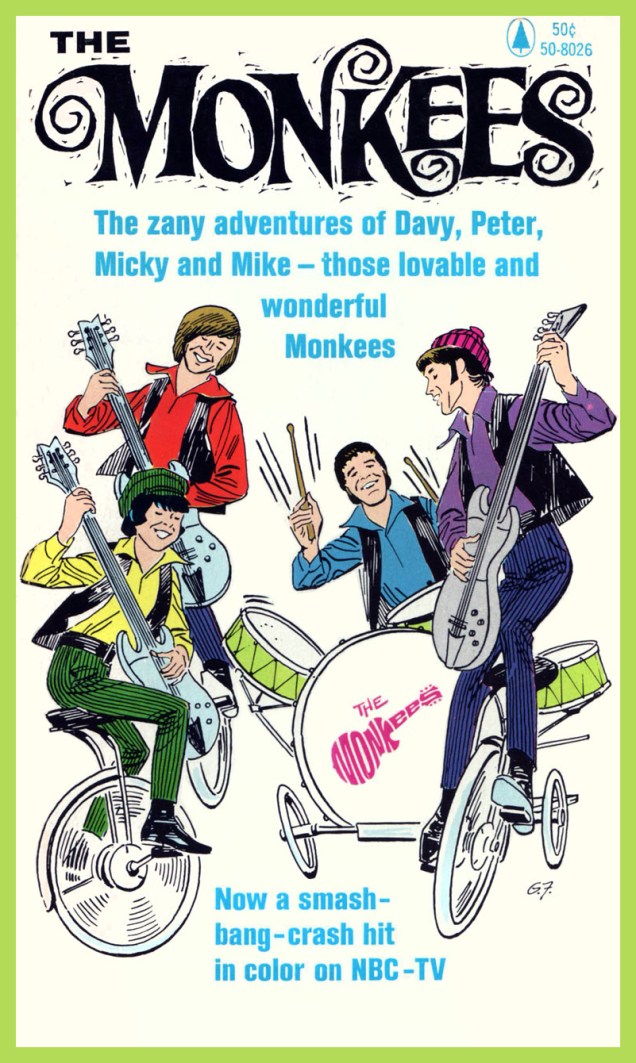
FawcetteMonkeesCoverA
This cute lil’ volume contained a bunch of fun (what else) Monkees romps written by Howard Liss and ably illustrated by Eisner- Iger Studio veteran Gene Fawcette.
DelboMonkeesBeezleA
José Delbo‘s splash page from Beezle, Beezle, Who’s Got the Beezle?, The Monkees no. 8 (Jan. 1968, Dell). Scripter unknown… but he’s pretty good.
Monkees3A
The issue in question: The Monkees no. 8 (Jan. 1968, Dell)
Monkees4A
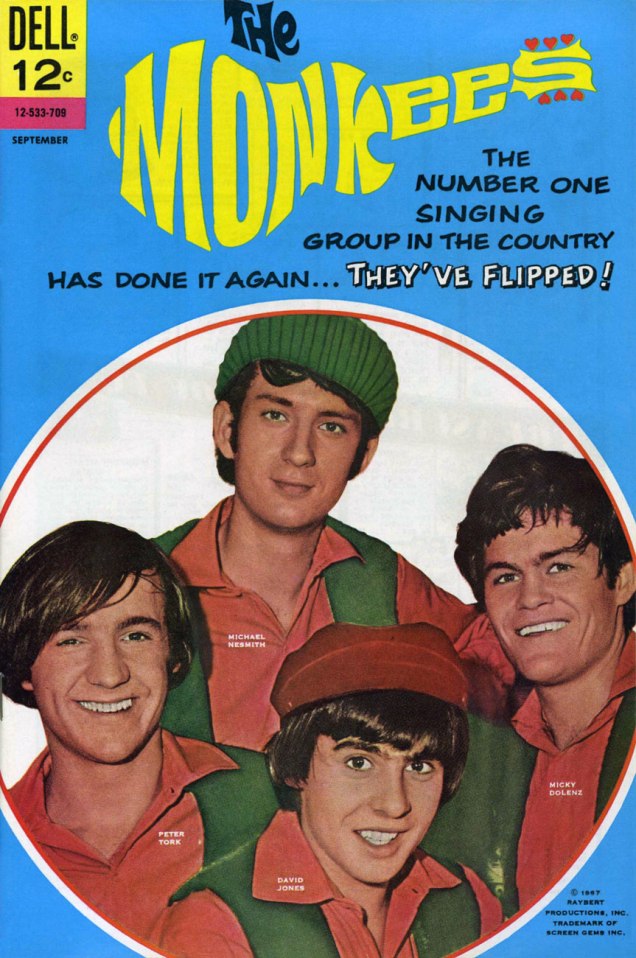
The Monkees no. 4 (Sept. 1967, Dell)
Monkees14A
The Monkees no. 14 (Oct. 1968, Dell)
ClowesGrizeldaA
Ah, but Dan Clowes has known it all along! From Eightball no. 13 (Apr. 1994, Fantagraphics)

Update: Peter Tork passed away on Thursday, February 21, 2019, barely a week beyond his 77th birthday. Au revoir, Peter!

-RG

Nick Cardy’s Romantic Side

« In YOUNG LOVE, how can people talk when they kiss? My mom can’t talk when she’s kissing. Can you? I am nine years old. » — Mary K, an astute young reader

It’s recently occurred to me that, in a year-and-a-half of posting, I’ve utterly neglected to feature one of my favourite artists, Nick Cardy (1920-2013); I suppose he’s been easy to take for granted, as he was DC’s main cover artist during most of Carmine Infantino‘s management years (1967-1976).

Much has been made, in various forums, of Cardy’s covers for Aquaman, the Superman titles, The Teen Titans, the Mystery books, and so on. I figured I’d have to dig a bit deeper. Cardy, ex aequo with the even more underappreciated Bob Oksner, was arguably DC’s primo portrayer of feminine pulchritude, and what I’d seen of his artwork for DC’s romance line was pretty stunning. It just turned out that there was far less of it than I had assumed.

DC’s romance books were sadly treated as the proverbial Siberia of the company’s roster. How else might one explain calling upon top illustrative talent, the likes of Jay Scott Pike, John Rosenberger, Ric Estrada, Werner Roth … then taking these fine men’s work and slathering it with wall-to-wall Vince Collettafinishes. We’ll return to this topic, naturally. This time around, we’ll showcase the sentimental side of Mr. Cardy. He seems to have produced fewer than thirty covers for the romance line (not counting a handful of gothics he did), of which I’ve retained an even dozen. I’m reserving a handful for an eventual thematic post, plus one that Colletta “fixed” (in the criminal, rather than useful, sense.)

fallinginlove113a
Falling in Love no. 115 (Feb. 1970), edited by Murray Boltinoff.
fallinginlove119a
Falling in Love no. 119 (Nov. 1970), edited by Murray Boltinoff. Something tells me Mr. Older Generation is holding a pipe off-panel.
girls27romance144a
« Goodbye, and as my sister once said, good riddance! » This great Nick Cardy cover puts an attractive spin on an issue unfortunately marred by the omnipresent and indigestible Vinnie Colletta sauce over half the stories. Poor Ric Estrada and Werner Roth! Girls’ Romances enjoyed a healthy 160-issue run from 1950 and 1971. This is number 144 (Oct. 1969).
girlslove139a
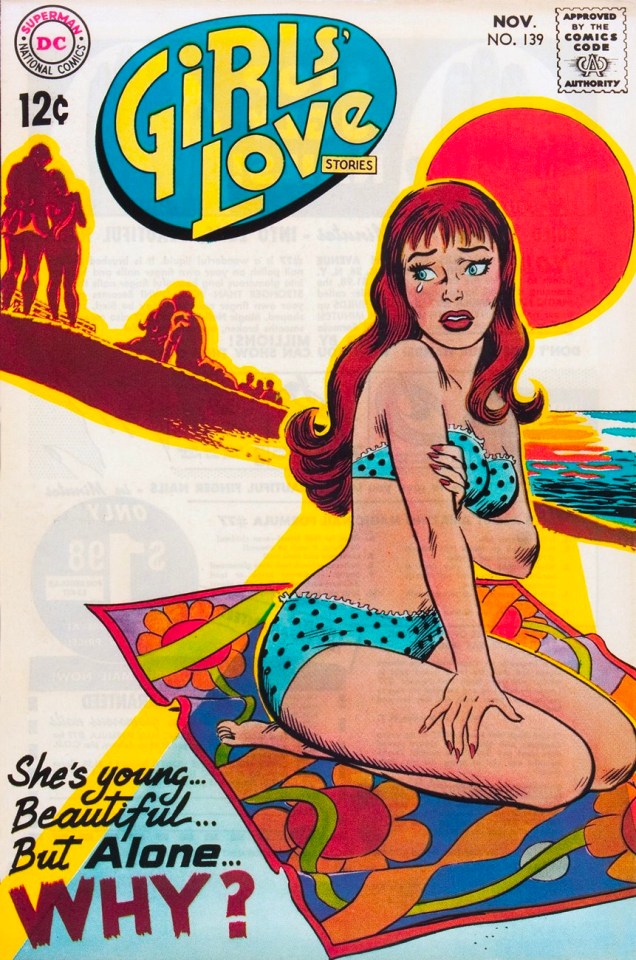
« Rumors are carried by haters, spread by fools and accepted by idiots. » – Unknown purveyor of sage quips –  This is Girls’ Love Stories no. 139 (Nov. 1968) Edited by Jack Miller. Inside: The Only Man for Me, illustrated by Ric Estrada, How Could He Stop Loving Me?, by Tony Abruzzo, a Mad Mad Modes for Moderns from Jay Scott Pike, a reprint from 1963, Kiss Me If You Dare, by John Romita, Sr. and Bernard Sachs, and our cover story, She’s Young, Beautiful–and Alone! … Why?, illustrated by John Rosenberger.
girlslove143a
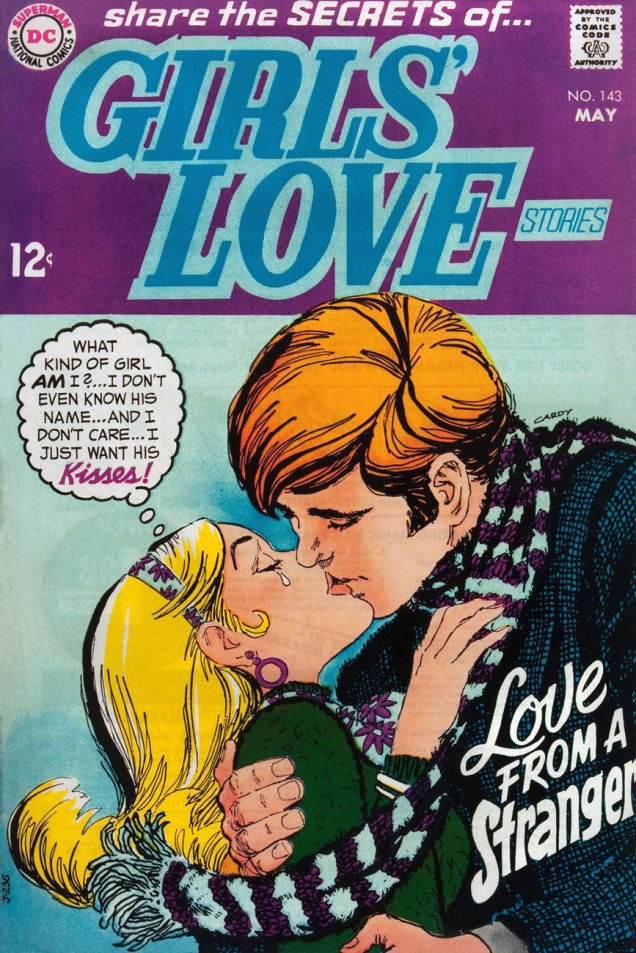
Girls’ Love Stories no. 143 (May 1969), edited by Joe Orlando, who couldn’t be less suited to the genre.  Cover wise, it’s not everyone’s cup of tea, I  suppose, but I adore Cardy’s expressive, roughly organic inks. Still totally in control!
girlslove148a
Girls’ Love Stories no. 148 (Jan. 1970), edited by Joe Orlando.
girlslove151a
Girls’ Love Stories no. 151 (May, 1971), edited by Joe Orlando.
girlsromances147a
Interesting, given that these were the prime days of women’s lib, how little actual sisterhood was in evidence in these comics. Too many *male* cooks, surely. Girls’ Romances no. 147 (Mar. 1970), edited by Murray Boltinoff. Carmine Infantino‘s fingerprints are all over this particular layout… which is more than fine: he’s a master.
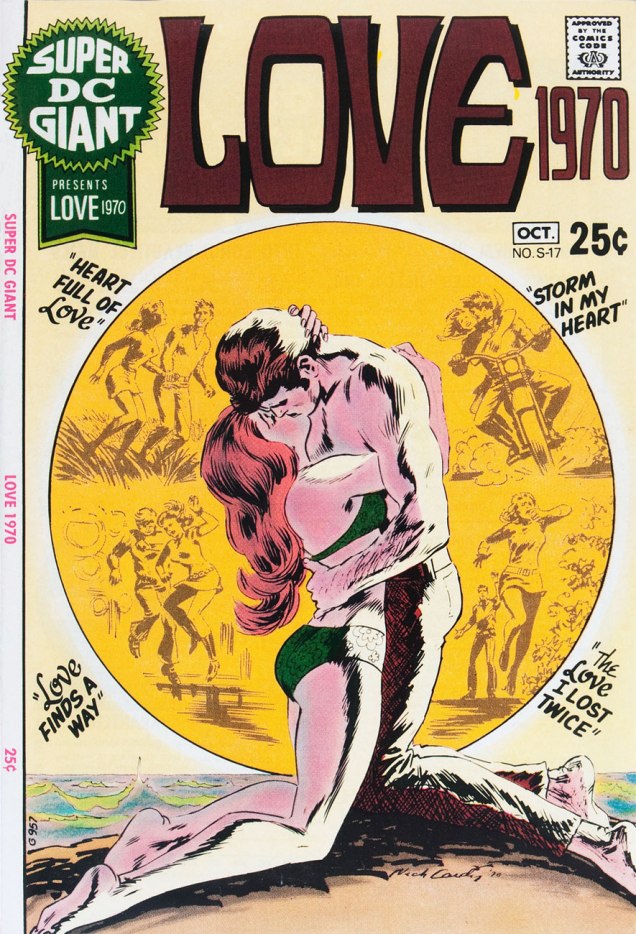
love1970a
This is Super DC Giant no. S-17 (Sept.-Oct. 1970), “edited” by Dick Giordano. Despite comprising nothing but crappy reprints, the scarce item will cost you a pretty penny if you can find it in decent condition. Here’s its only worthy selling point, Mr. Cardy’s cover, of course.
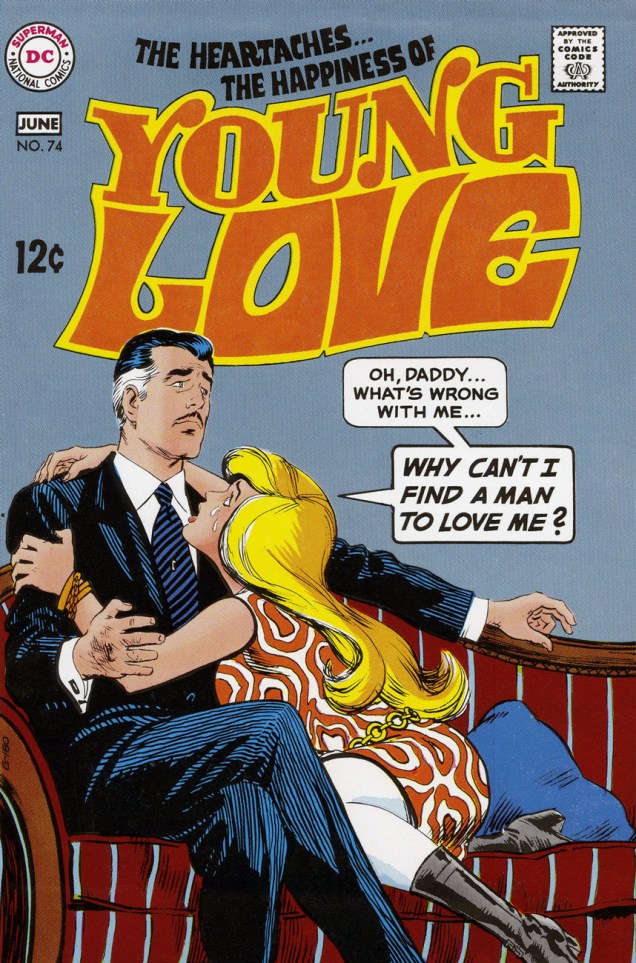
young-love74a
Talk about a question that provides its own answer… this is Young Love no. 74 (May-June, 1969). Edited by Dick Giordano (who lost the bet that month). Cardy’s Alex Toth-ish side rises to the surface.
youngromance157a
Young Romance no. 157 (Dec. 1968 – Jan. 1969), edited by Joe Orlando. Never was the “Have a Fling With…” tag more appropriate… and more disturbing. « Oh, Ann-Margret‘s your mom? »
youngromance163a
Young Romance no. 163 (Dec. 1969 – Jan. 1970), edited by Joe Orlando. YR, as you may know, was the original romance comic book, created way back in 1947 by Joe Simon and Jack Kirby. Things improved near the end of the series’ run, when Simon briefly returned to ride it into the sunset.

-RG

Tentacle Tuesday: Those Blackhawks and Their Marvellous Tentacled Machines

« Blackhawk is helpless! He’s being drawn up by that suction tentacle! »

When my co-admin learned that today’s Tentacle Tuesday is all about Blackhawk, he wanted the answer to an important question. Did I know who created the character? I did not. As some of our readers may be in the same boat, I’ll share what I gleaned.

Blackhawk, the leader of the Blackhawk Squadron, was supposed to have been created by Charles Nicholas ‘Chuck’ Cuidera with assistance from Bob Powell and Will Eisner. Why “supposed”? As with a lot of series that came into existence some 80 years ago (the first appearance of the Blackhawks Squadron was in a Quality Comics issue published from 1941! Holy crap!), and human memory and human’s desire for recognition being what they are, there’s a lot of squabbling about who actually did what.

« Will Eisner has at times been considered the characters’ primary creator, with Eisner himself acknowledging the contributions of Chuck Cuidera and writer Bob Powell. Over the years, Cuidera became increasingly vocal that he did much more work on Blackhawk than Eisner and that he had in fact already started creating the characters prior to joining Eisner’s studio. According to Cuidera, he and Powell fleshed out the concept, deciding on everything from names and nationalities, to the characters’ distinguishing traits, uniforms, and the aircraft they would fly. » |source|

In 1999, Eisner addressed his view of the matter during a Comic-Con panel:

« It’s not important who created it… it’s the guy who kept it going, and made something out if it that’s more important. Whether or not Chuck Cuidera created or thought of Blackhawk to begin with is unimportant. The fact that Chuck Cuidera made Blackhawk what it was is the important thing, and therefore, he should get the credit. »

To me, that sounds like yet another confirmation that Eisner was a really classy guy. At any rate, all we can say with certainty is that Eisner worked on early Blackhawk covers with Cuidera.

Oh, right, we’re here for the tentacles. The Blackhawks have fought a variety of bizarre war machines in their time (and by “bizarre”, I mostly mean preposterous). You can read quite a lot of the DC-published issues (up until no. 273) here, though I’d only recommend it for those of you who don’t mind *really* suspending disbelief while reading a story. If you’re one of those fuddy-duddies who actually insist on plots that make sense, move along!

On a more positive note, the art is usually quite nice. (However, there’s also usually *a lot* of dialogue – peppered with French and German exclamations, as The Blackhawks are an international crew – obscuring the nice art.) The full team consists of the following braves: Blackhawk (American), Olaf Friedriksen (Danish), André (French), Chuck Wilson (American), Hans Hendrickson (Dutch), Stanislaus (Polish), and Chop-Chop (Chinese… seriously, guys? You couldn’t come up with a better name for him?) Oh, and I should probably also explain that events unfold during WWII, and that the Blackhawks are fighting on the Allies’ side (well, obviously).

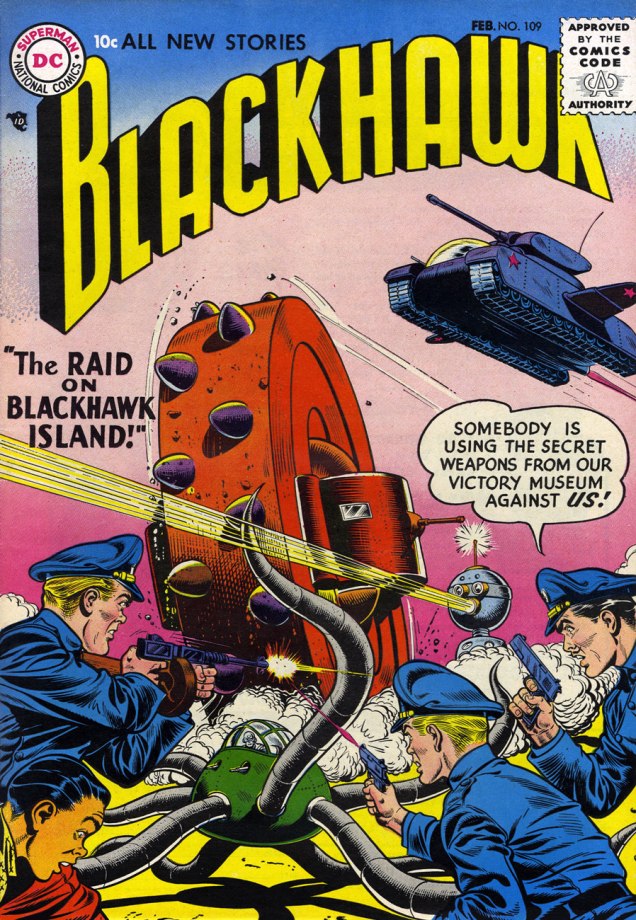
blackhawk109
Blackhawk No.109 (February 1957), pencilled by Dick Dillin and inked by Charles Cuidera.
blackhawk130
Blackhawk no. 130 (Nov. 1958), pencilled by Dick Dillin and inked by Sheldon Moldoff.
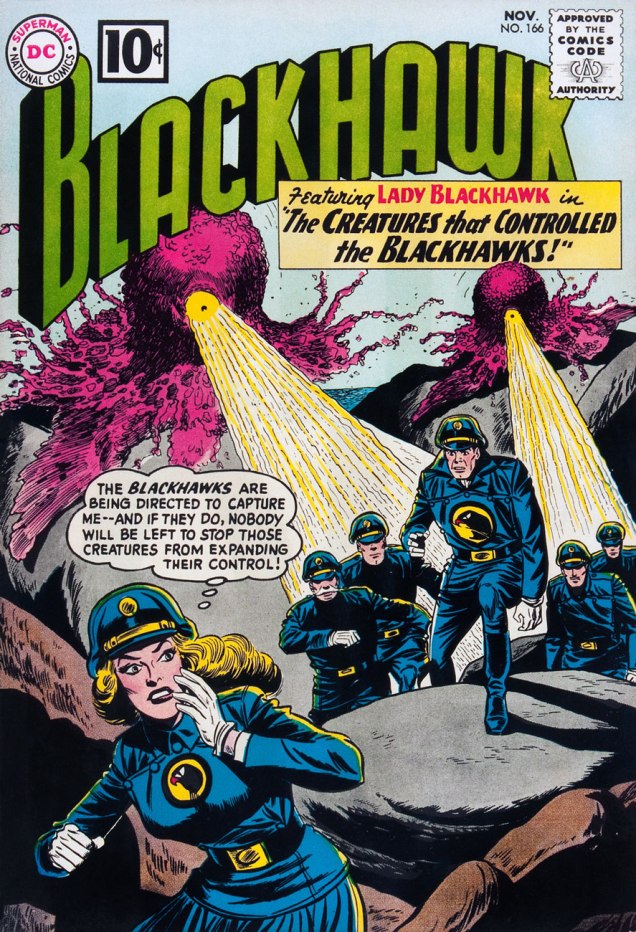
blackhawk166
Blackhawk no. 166 (Nov. 1961), pencilled by Dick Dillin and inked by Sheldon Moldoff.
blackhawk190
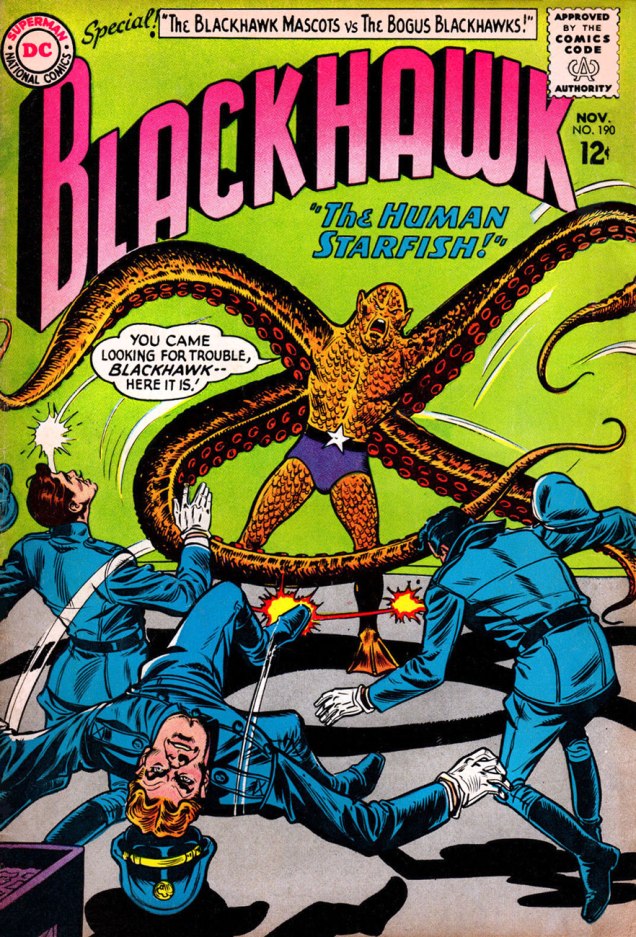
Blackhawk no. 190 (Nov. 1963), pencilled by Dick Dillin and inked by Charles Cuidera.
blackhawk211
Blackhawk no. 211 (Aug. 1965), 
pencilled by Dick Dillin and inked by Charles Cuidera.

One of the rare cases where tentacles are promised *and* delivered inside:

blackhawk (1957) #211-tentacle2
Page from « Nobody Replaces a Blackhawk », pencilled by Dick Dillin and inked by Charles Cuidera. The evil guys here are the Octopus Gang!
blackhawk224
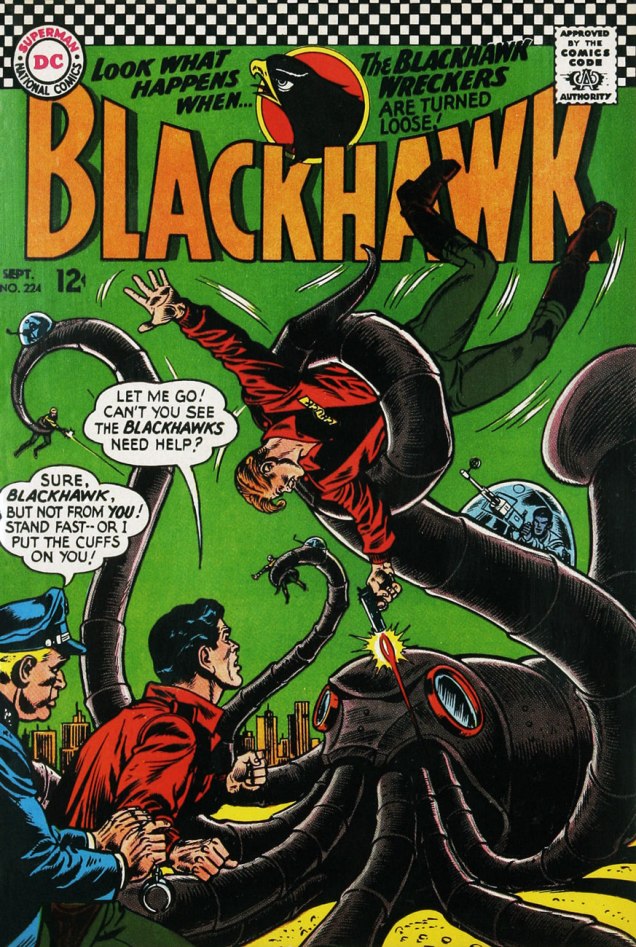
Blackhawk no. 224 (Sept. 1966), pencilled by Dick Dillin and inked by Charles Cuidera.
blackhawks224-page2
Page from « The Blackhawk Wreckers », scripted by Ed Herron, pencilled by Dick Dillin and inked by Charles Cuidera.

I have to admit that while looking up stuff for this post, I grew rather fond of the Blackhawks. It’s fun to follow their adventures in completely improbable situations, to eagerly anticipate the introduction of yet another asinine machine hellbent on destruction. I also enjoyed the international flavour of the team – and Chop Chop, despite his ridiculous name, isn’t treated differently from his teammates.

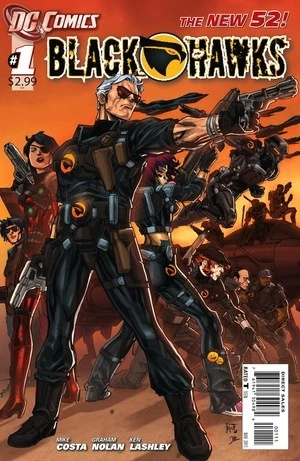
Y’know what the Blackhawks look like these days?

https://vignette.wikia.nocookie.net/marvel_dc/images/9/91/Blackhawks_Vol_1_1.jpg/revision/latest?cb=20110923235035

It’s important to update the image of old heroes so that new audiences can relate. Now let’s go rinse our eyes out with acid.

Signing off before I melt into a big puddle – this post comes to you courtesy of RG’s help cleaning up the images, and of my heavy cold which made me unusually verbose 😉

~ ds