« Thank you for calling customer service. If you’re calm and rational, press 1. If you’re a whiner, press 2. If you’re a hot head, press 3. » — Randy Glasbergen
Comedy oriented towards employees who work in retail is its own breed of humour. I remember my ex-boss warning me early on that ‘the public is stupid’ – and that’s certainly the impression one gets, being confronted (day in, day out) by customers unable to read signs (no matter how big and prominent one makes them), pulling on doors that are meant to be pushed, and asking questions so inane that it feels slightly surreal.
There are myriad comics poking fun at the daily frustrations of retail… most of them making observations of a rather obvious nature, though frustrated employees will still chuckle at them (it feels nice to be ‘seen’!) I have mixed feelings about all the people leaping from ‘look, I doodle in my spare time’ to ‘I am an Artist who has a Webcomic!’, but that’s a topic for another day. Occasionally one stumbles onto a gem amidst all the ugly pebbles.
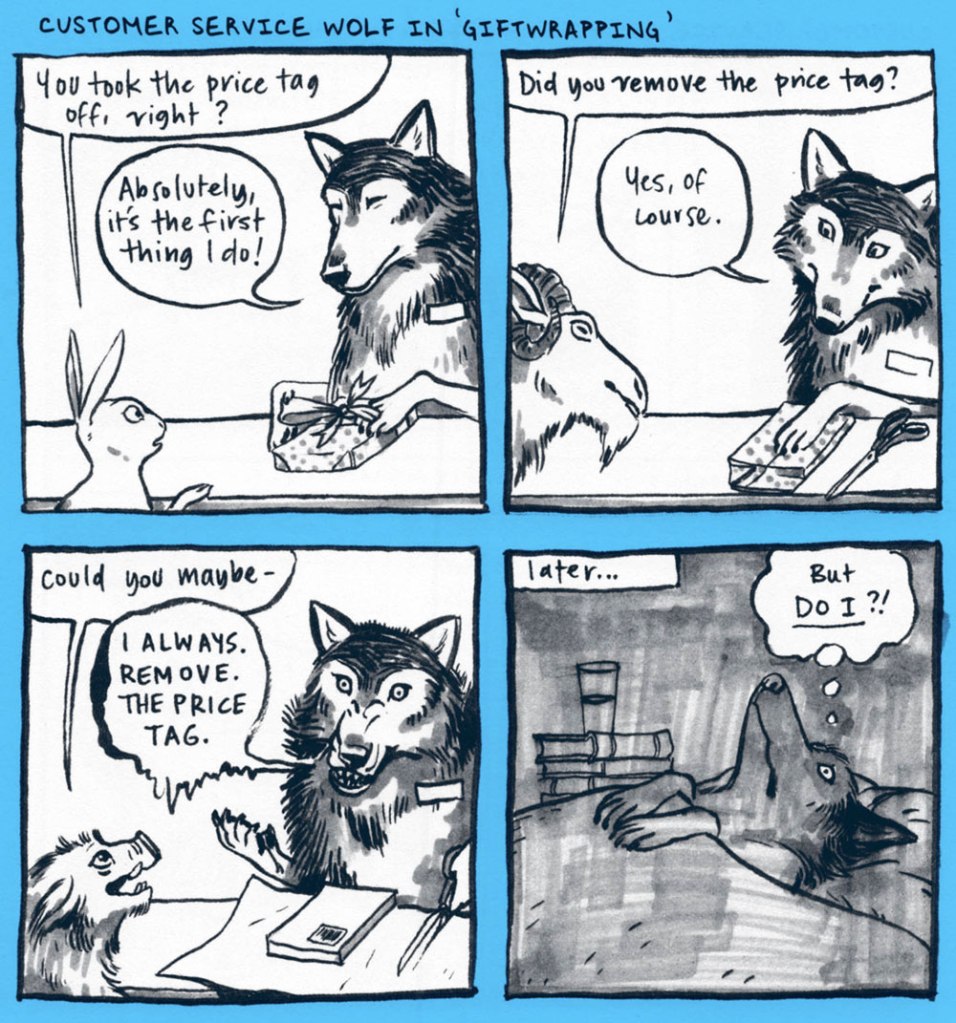
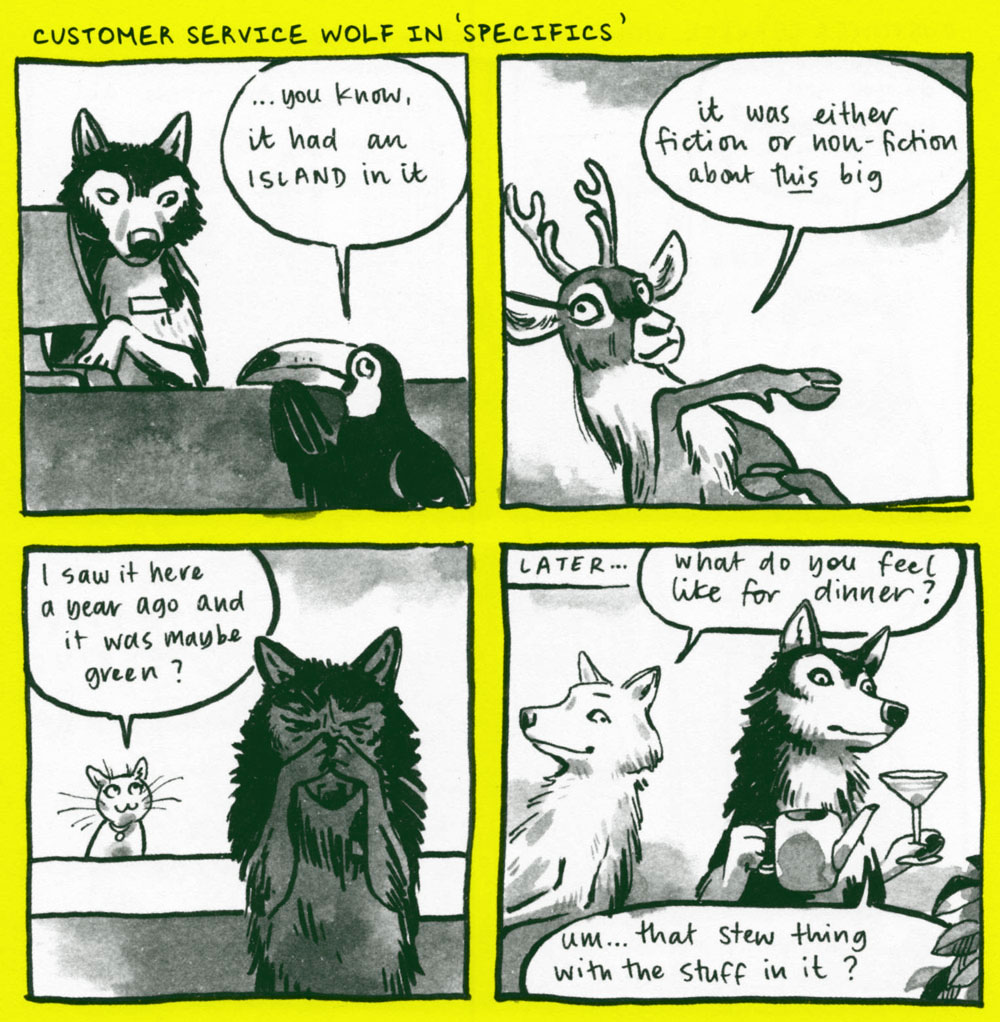
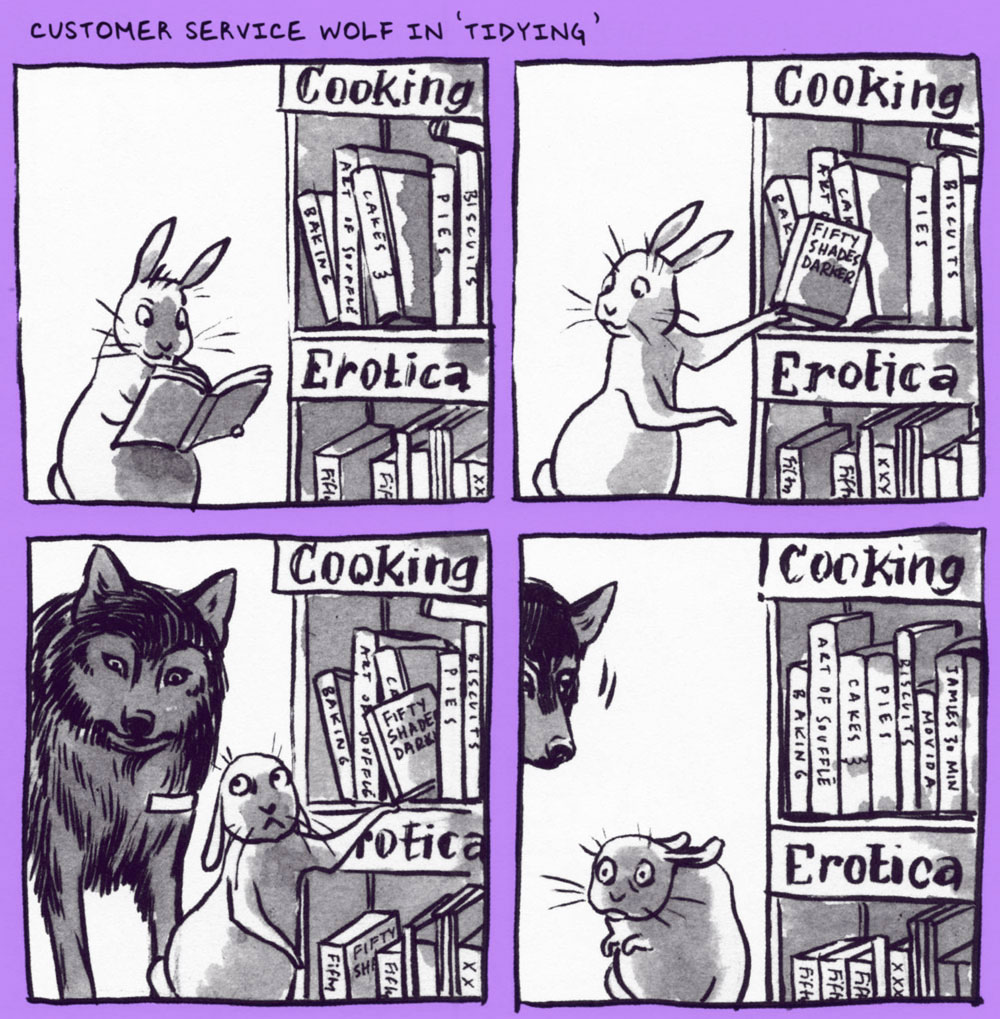
There are several things going for Customer Service Wolf, drawn by Australian illustrator Anne Barnetson. Its immediate appeal is that it’s beautifully drawn, of course. I am impressed at the variety of animals, convincingly depicted. It’s also very self-aware and funny, appending the usual ‘customers are destructive/insane’ stories with an unexpected recurring punchline (hint: it involves a wolf’s sharp jaws). A bookstore is a backdrop for a very special kind of lunacy, and Barnetson has clearly has had her share of it.
The following have been scanned from the collection (2019), but you can view all of them at the Customer Service Wolf tumblr.
One of this strip’s strengths is periodically pointing out that we the employees are not so different from the customers we mock.
« Horse sense is the instinct that keeps horses from betting on men. » — Josephine Tey
While ‘academic’ realism has never been my thing in comics, I’ve always had a soft spot for Gérald Forton (Apr. 10, 1931 – Dec. 18 2021), who left us late last year, and who would be turning 91 today. He’s certainly my favourite Bob Morane artist (1962-67), but that’s not saying much, and besides, not his best work.
And just what is his best work? Ah, that’s easy: Teddy Ted. Just like his forebears, including his grandfather, the legendary Louis Forton (1879-1934), creator of Les Pieds Nickelés and Bibi Fricotin, grew up with an undying passion for horses. The Forton clan bred, raised, sold and raced horses, so it wasn’t a mere case of the banal and stereotypical European passion for the American ‘Far West’ and its Cowboys and Indians.
In 1964, Forton and ace scripter Roger Lécureux (Les pionniers de l’Espérance, Rahan) picked up the reins of a series launched by Jacques Kamb and Francisco Hidalgo and abandoned after three episodes. The new team revamped Teddy Ted, turning the protagonist from a boy to a man and instilling Lécureux’s humanist worldview* into the proceedings.
Teddy Ted and Forton reached their peak soon after the artist left Belgium, and the Bob Morane series, to raise horses in the South of France, a direct source of inspiration and documentation!
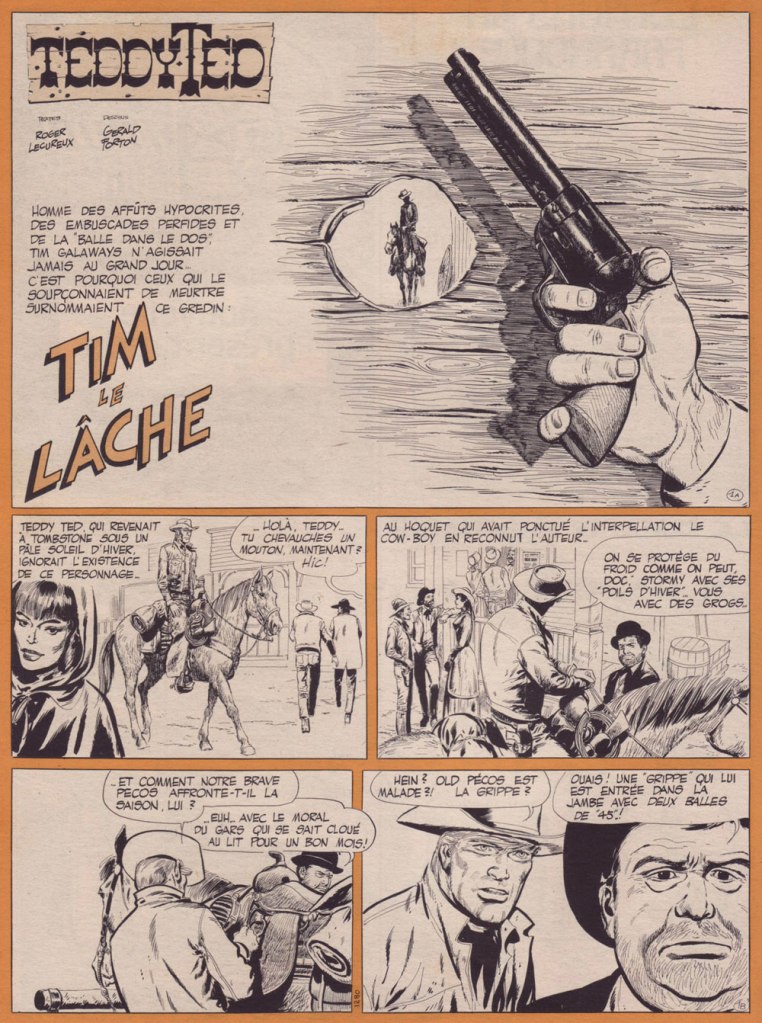
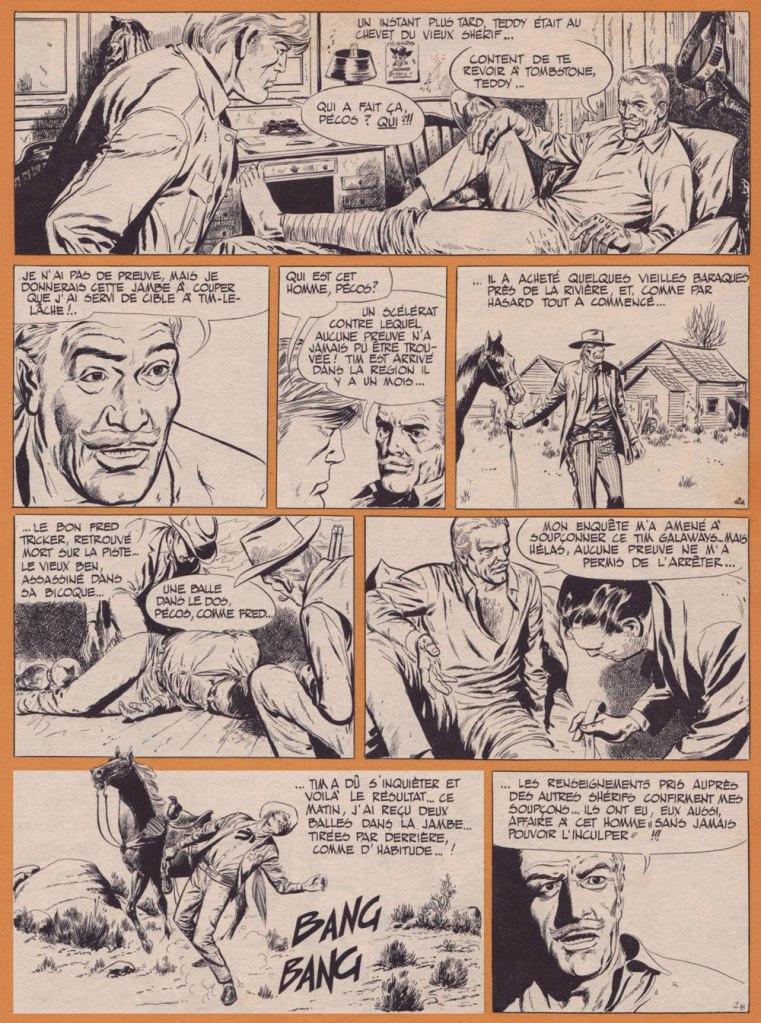
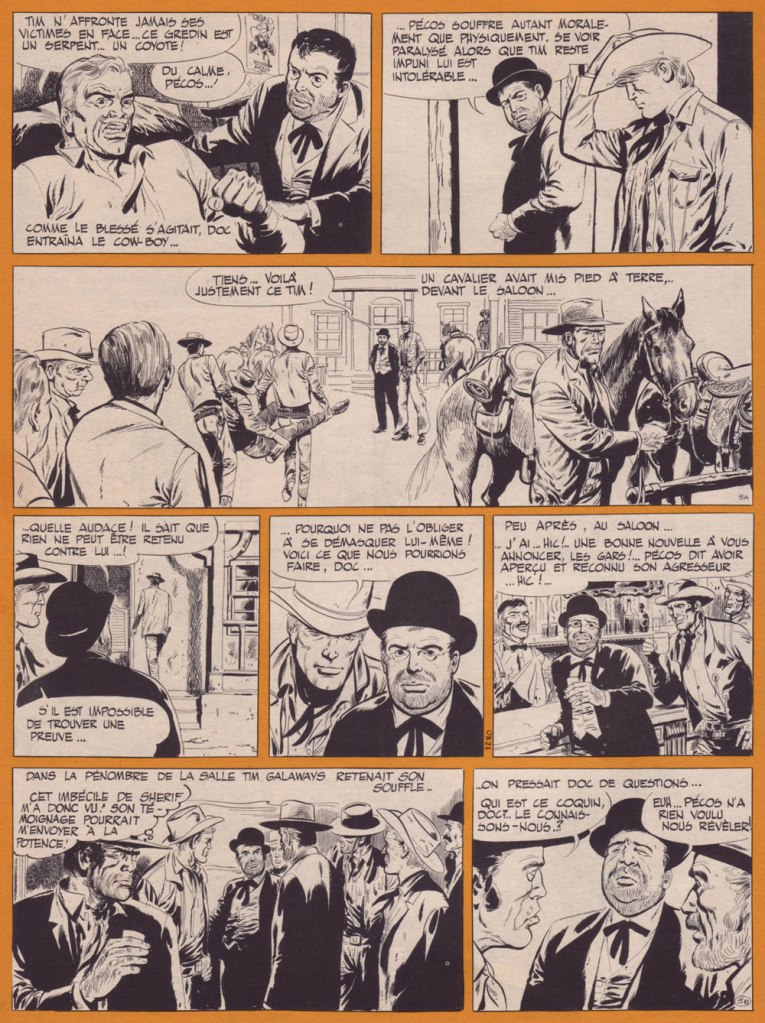
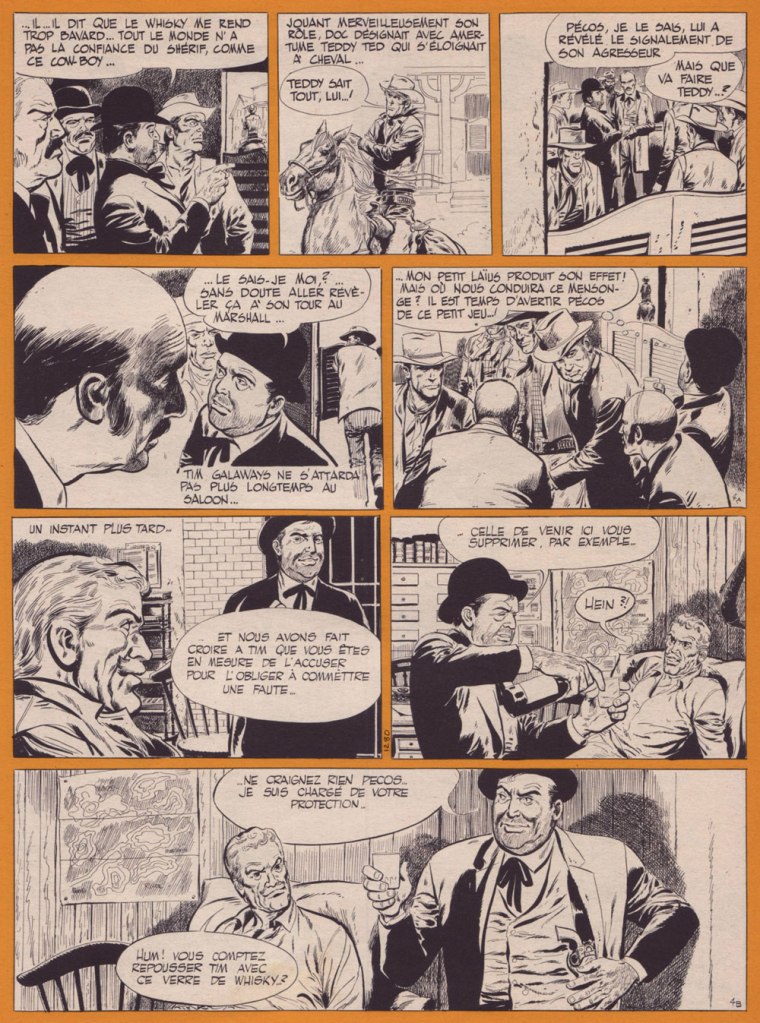
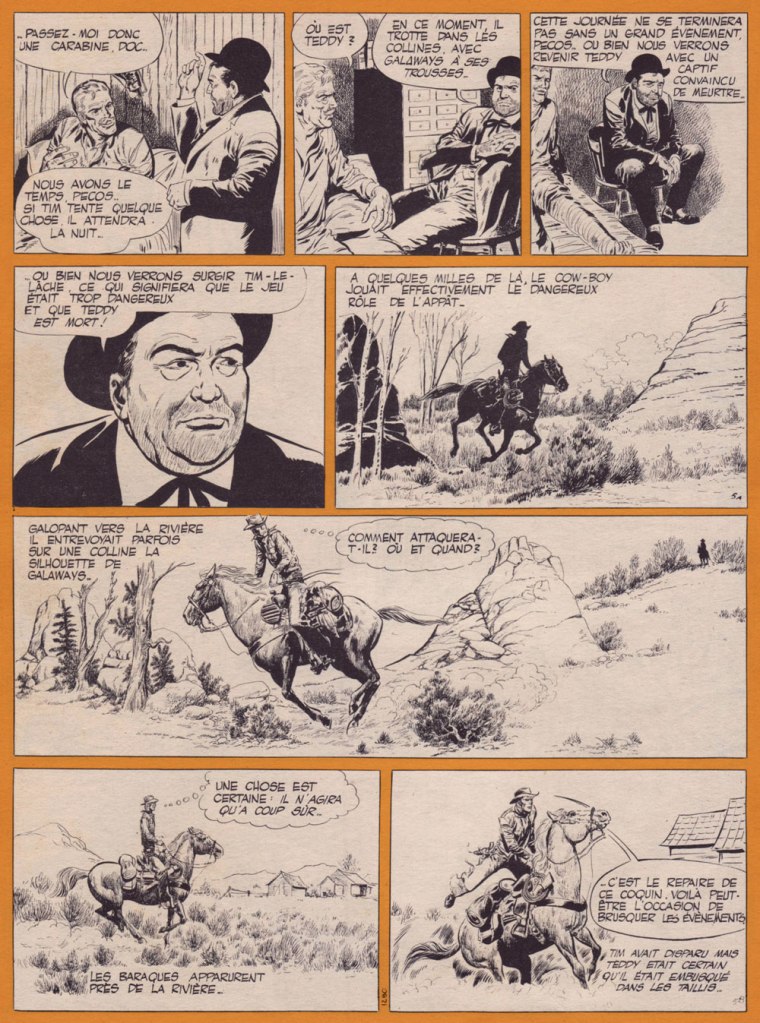
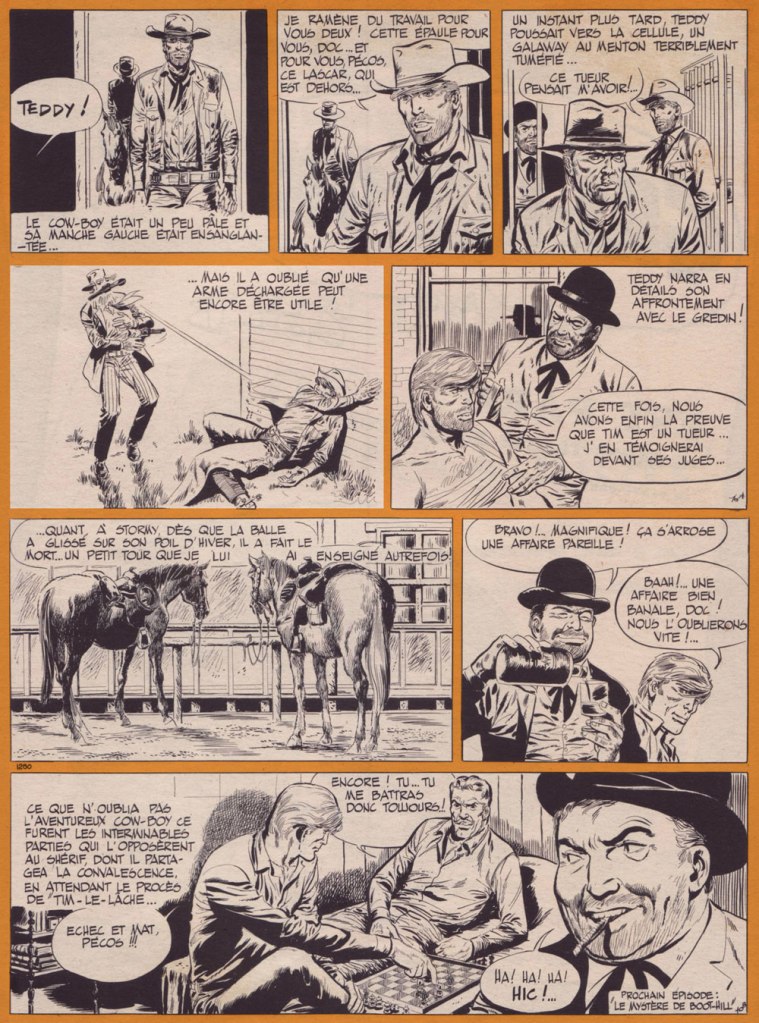
Without further ado, here’s my pick: Tim le lâche, from Pif Gadget no. 42 (Dec. 1969, Vaillant). It’s the tale of a craven back-shooting sneak against whom no-one has been able to garner any evidence, given the lack of survivors or witnesses. Given that Teddy’s close friend Pecos has been ambushed and taken out of commission by Craven Tim Galaways, Teddy and the town drunk (also its doctor!) set a dangerous trap with Teddy as bait and human target.
I’ve long had an aversion to ‘realistic’ European westerns, and that’s largely because of the absurd density of useless detail, the pages so busy and darkly-coloured as to buckle and collapse under the weight of the ink. Forton, by contrast, aside from being a master at spotting blacks, is just as bold in leaving white space where it’s needed, where the reader’s eye needs it. And here, unlike a lot of the technically-challenging genre strips (by which I mean, for instance, aviation, war or car racing, where one all-too-often encounters perfectly depicted machinery and stiff, generic human figures), Forton lavishes attention and care to every single thing, so we don’t wind up with beautiful horses and cardboard everything else. Which brings me around again to my point of Forton’s exceptionalism among the ‘realists’: the verisimilitude of his art is the result of observation, not soulless photo documentation.
After Teddy Ted was dropped from Pif Gadget, circa 1975, by its less-enlightened new management, Forton was picked to illustrate an adaptation of TV’s The Wild, Wild West (“Les mystères de l’Ouest”), which ironically made for the most realistic version of that colourful, but painfully stagey show, thanks to Forton’s excellence at capturing likenesses and conveying wide open spaces and details of period and setting.
By the early 1980s, Forton had moved to the US, where he tentatively freelanced in comic books, where he proved a poor fit. Though the French deemed him one of the most ‘American’ of Franco-Belgian cartoonists, he stood out like a sore thumb in the 1980’s mainstream, likely since his influences hailed not from comic books but rather comic strips, and those of an earlier generation at that (Alex Raymond, Frank Robbins, Milton Caniff… and his idol, Fred Harman).
He then heeded Horace Greeley’s legendary bit of advice and headed to California, bought himself a ranch in Apple Valley and, like many an overqualified but outmoded veteran cartoonist, toiled in mediocre animated shows.
Retiring from the film industry at age 75, he then devoted his time to painting, playing the guitar, riding horses, and burnishing his œuvre for posterity by providing new artwork for reprint collections of his past works, in the midst of a resurgence in Europe.
Humble, active and alert to the very end, Forton finally and peacefully rode into the sunset, at the most venerable age of 90. For more Forton art, check out this lovingly assembled gallery.
-RG
*I’m inclined to draw parallels between Lécureux’s view of the West on Teddy Ted to Star Trek creator Gene Roddenberry‘s approach on Have Gun, Will Travel: compassion, but with a hard edge.
**wherein Will Smith doled out punches rather than slaps
“Oh, another cutesy animal comic”, you may sigh upon glimpsing the preview for this post. Indeed, today’s exhibit A abounds in puns and features a cast of almost every kind of animal one could think of. However, under its cute façade lurks surprising savagery and a kind of philosophical resignation to life’s little foibles.
We’re talked about a number of comics published within the pages of Pif Gadget, here’s another one to join the gang: La jungle en folie, written by Christian Godard and illustrated by Mic Delinx. The title of the series was selected as a nod to Walt Disney’s 1967 animated film The Jungle Book, then at the height of its popularity in France. The pivotal events of 1968, known as May 68, a period of civil unrest in France that paralyzed its economy and marked the minds of the authors and their fellow citizens, surely had something to do with the cynicism of this strip:
«André Glucksmann recalled May 1968 as “a moment, either sublime or detested, that we want to commemorate or bury…. a ‘cadaver,’ from which everyone wants to rob a piece.” His comments sum up the general cynicism and ambivalence of many on the French left when it comes to May ’68: “The hope was to change the world,” he says, “but it was inevitably incomplete, and the institutions of the state are untouched.” Both student and labour groups still managed to push through several significant reforms and win many government concessions before police and De Gaulle supporters rose up in the thousands and quelled the uprising (further evidence, Anne-Elisabeth Moutet argued this month, that “authoritarianism is the norm in France”). »
Just like fairy-tales, animal fables are often quite brutal (whether Aesop’s or La Fontaine’s, to name two widely-known sources), but it’s not easy to get this of mixture to rise just right: too much brutality, you sink into a quagmire of sadism; too much fluff, and it’s just a filler in a magazine. I would argue that LaJungle en folie hits the right balance: the right amount of wit with plenty of nastiness snuck in. Escapism this isn’t, not quite. The doctor is talented but has no issue with sending patients to their death. The inspector is obsessed with finding the guilty party even if it means putting innocents behind bars. Taxmen snatch their (literal) chunk of fur from the backs of unionized workers. Office workers search for the meaning of life (and fail to find it). Wives throw stuff at their husbands’ heads, talentless troubadours are all in love with the same frigid coquette. This world is a very recognizable one, even if it’s a tiger conversing with a worm (or a rhinoceros with a trout).
As for nastiness, one story immediately comes to mind – when Eustache the elephant gets a proboscis-otomy to shorten his trunk (he dreams of having a ‘Greek profile’), the cut-off part ends up at the butcher’s, as the latter buys chopped-off body parts from the doctor to resell as meat. The trunk is sold to Gros Rino as sausages, and by the time Eustache realizes he was better off with his old appendage and looks for it, it is too late, alas – the ‘sausages’ are being grilled over an open fire, and Gros Rino refuses to part with his breakfast, anyway…
Pif Gadget no. 159 (March 1972). Vegetarian tiger Joé (he only eats apples) and food-fixated Gros Rino are best pals.
The first, one-page strip was published in Pif no. 34 (October 13th, 1969). The strip was a quick success, even making it to some covers starting with issue no. 56 (March 1970). After a hiatus in 1974, during which La jungle en folie continued to be published in ‘albums’ by Belgian publishing house Rossel, the strip returned to Pif in 1977 and stayed until 1986, while albums continued to be regularly published until 1988, for 20 published albums overall. They have now been collected in six volumes of Intégrale; the pages below are all taken from Intégrale 1, which includes Les aventures de Joé le tigre, Salut la compagnie! and La conquête de l’espace.
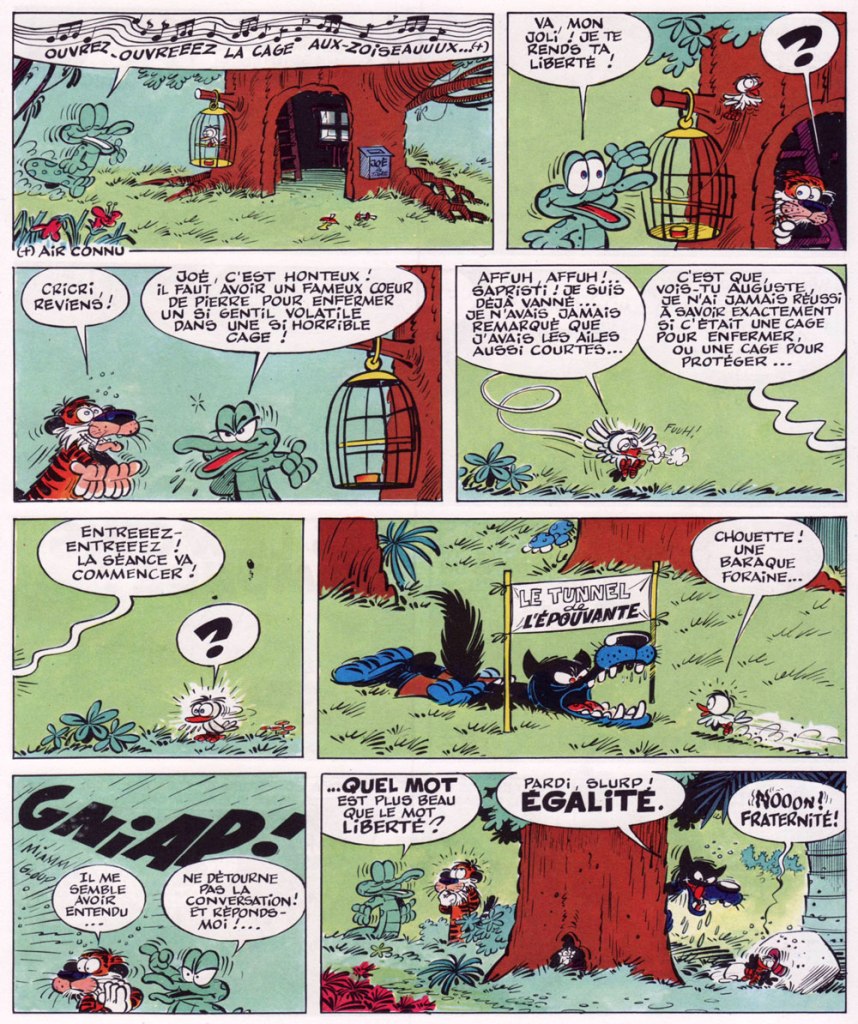
Cage et masti-cage. ‘Cage‘ is self-explanatory, and ‘masticage‘ is the act of chewing (think ‘mastication’). In this story, Auguste the crocodile decides to free Joé’s winged pet, explaining that no bird is made to be imprisoned. ‘You see, Auguste,’ pensively says Joé, ‘I’ve never exactly figured out whether it’s a cage to imprison, or a cage for protection…’ The naive bird gets eaten by a wolf (who lures it into his gaping maw by lying under a ‘the tunnel of horror’ sign). In the final panel, a discussion takes place: what’s the most beautiful word? Liberty, equality or fraternity? Take your pick…
Médor debout (Médor is a typical French name for a dog, the French ‘Fido’). The two pooches take turns walking each other, with the moral (delivered by the noisy magpies – les pies – who always get the last word at the end of the story) of ‘you can make anybody walk on all fours for a few compliments’.
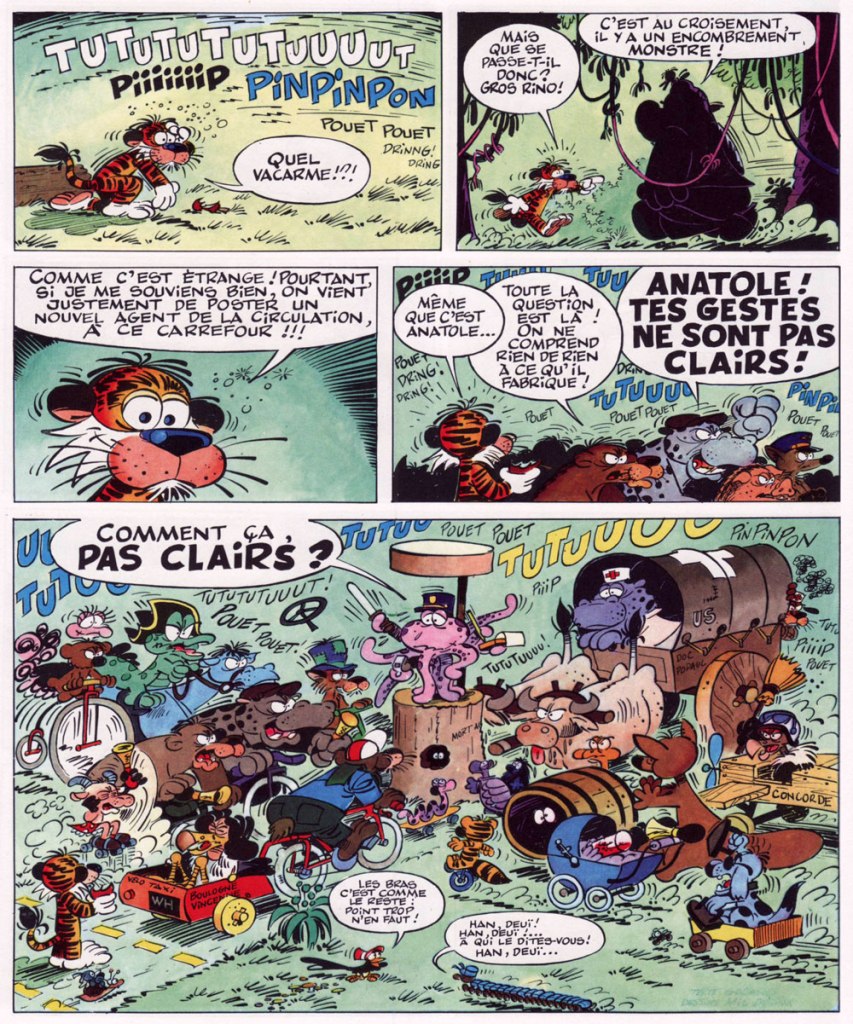
Klaxonneries (klaxonner means to honk one’s horn). Anatole the octopus is a very dutiful agent de circulation (traffic officer)… but the clarity of his gestures leaves something to be desired. I like the variety of animals and means of transport.
Horreurscope (horroscope), probably my favourite strip. After asking Gertrude the trout for her astrological sign (she’s Pisces, of course), Joé reads her horoscope: it speaks of the possibility of dangerous accidents, especially asphyxiation. Skeptical Gertrude thinks it’s ridiculous that a fish should worry about asphyxiation… but in the end, can one escape destiny? Joé decides not to intervene – and suggests Gros Rino should cook her ‘à l’étouffée‘.
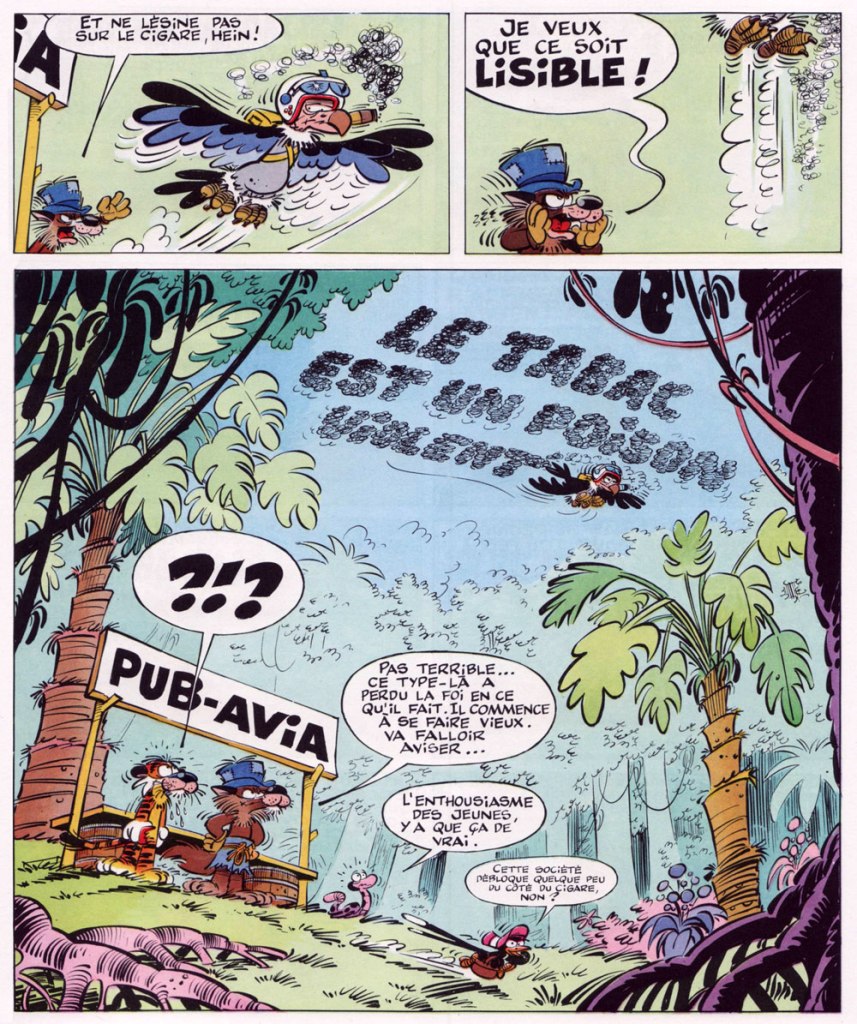
I associate La jungle en folie with one-page strips, but it’s worth taking a little detour into longer stories. The next two pages are Coup de tabac, in which the doctor and Joé try to convince vulture Adhémar to quit smoking. Adhémar is adamant, however: for him, smoking is a question of survival. We learn why in the next page…
‘Here’s today’s advertising message, try to not make spelling mistakes’, says his boss, and Adhémar flies into the skies to write a message in cigar-smoke – “tobacco is poison”.
‘Not great… this guy lost faith in what he’s doing. He’s getting old. I’ll have to look into it…’ says the wolf-boss, as Mortimer the snake remarks ‘a young man’s enthusiasm, it’s all that’s real and true!’
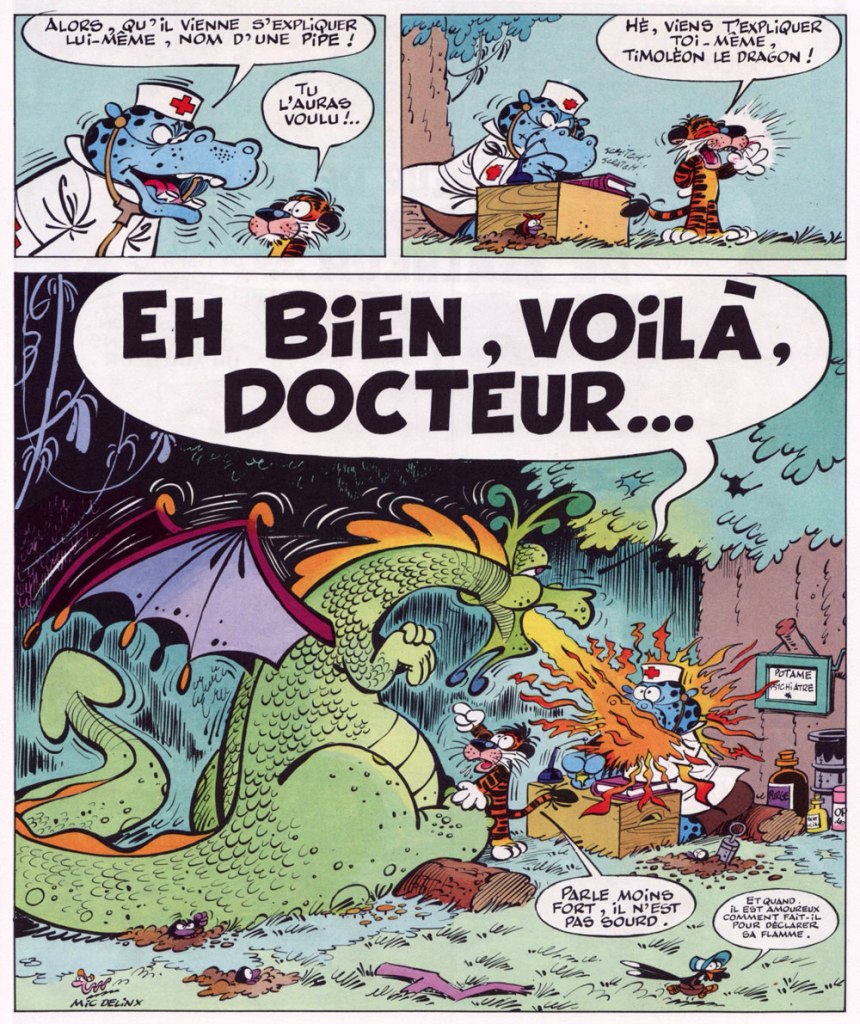
The next two pages are Bouche-dégout, a pun on ‘bouche d’égout‘, drain (dégoût means disgust). Potame le toubib, the doctor, won’t listen to Joé’s explanation of what ails his friend the dragon, jumping to medical conclusions and insisting that Timoléon should speak for himself – with blazing results.
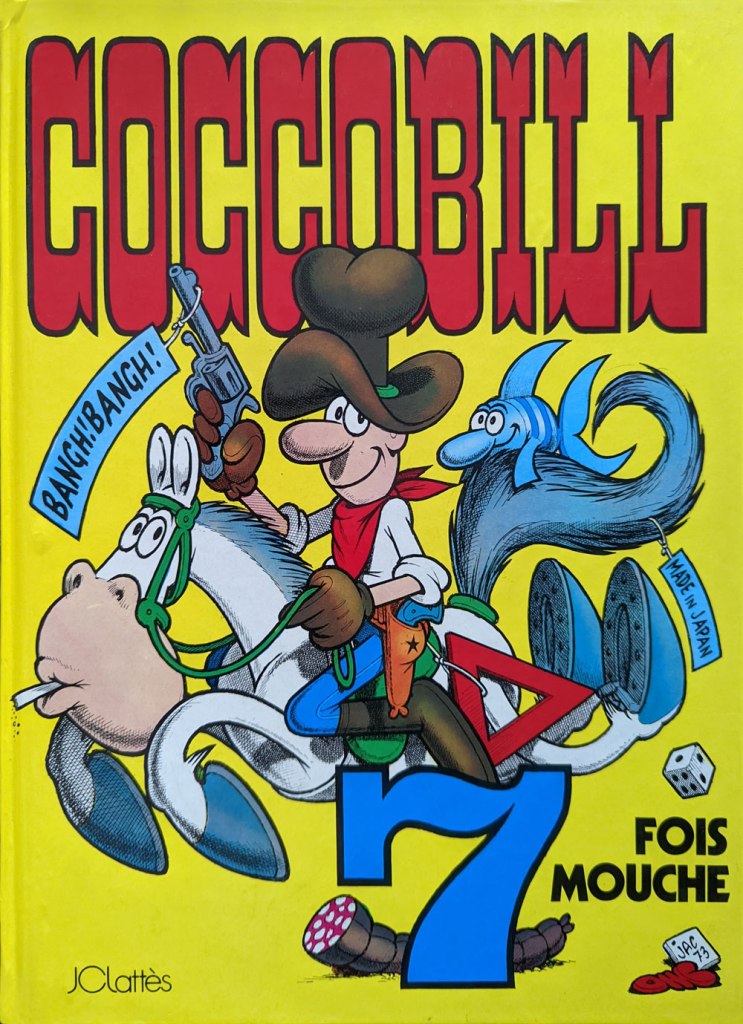
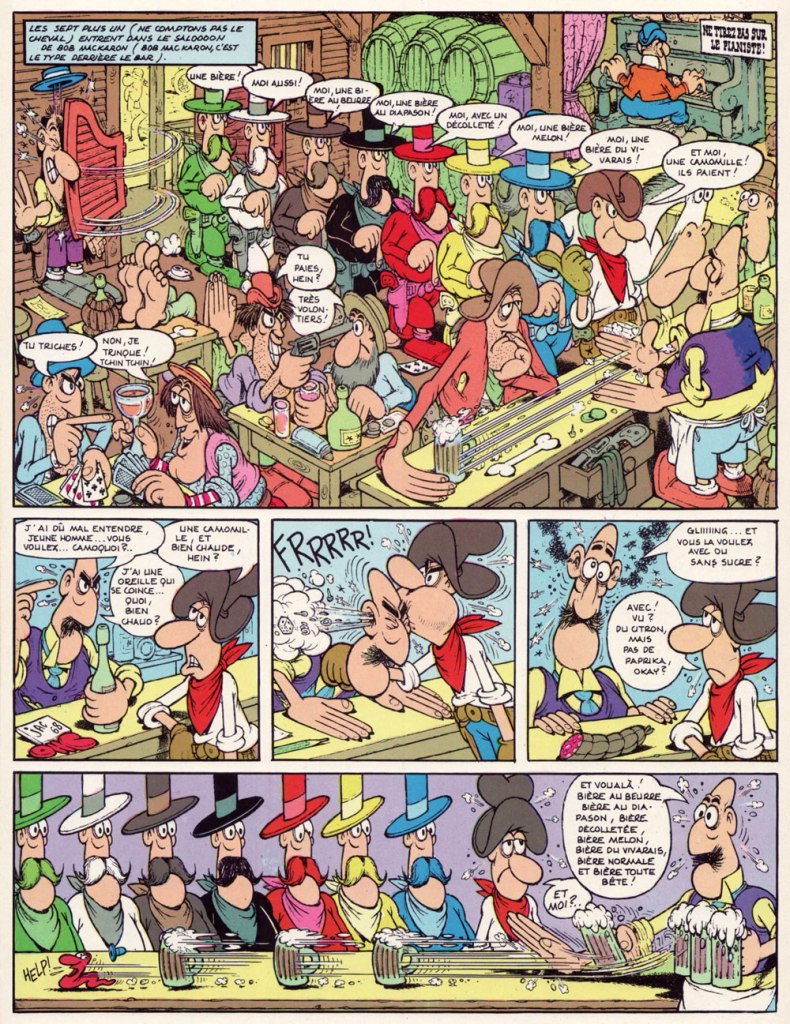
This is 7 fois mouche (1975, JC Lattès, France), originally serialised in Corriere dei Piccoli as “Cocco Bill fa sette più”, 1968-69. In Italy, it was actually number twenty in the series.
With Wolverton, Jacovitti (1923 – 1997) shares an animist sort of predilection for cramming every square centimetre of the panel with absurdist details, facetious sound effects, recurring motifs and symbols and, naturally, gags. It’s a most noble cartooning tradition that runs the course of the medium’s history, from Bill Holman through Kurtzman and Will Elder (chicken fat!) and merrily endures to this day in Dan Piraro and Wayno‘s oft-sublime Bizarro.
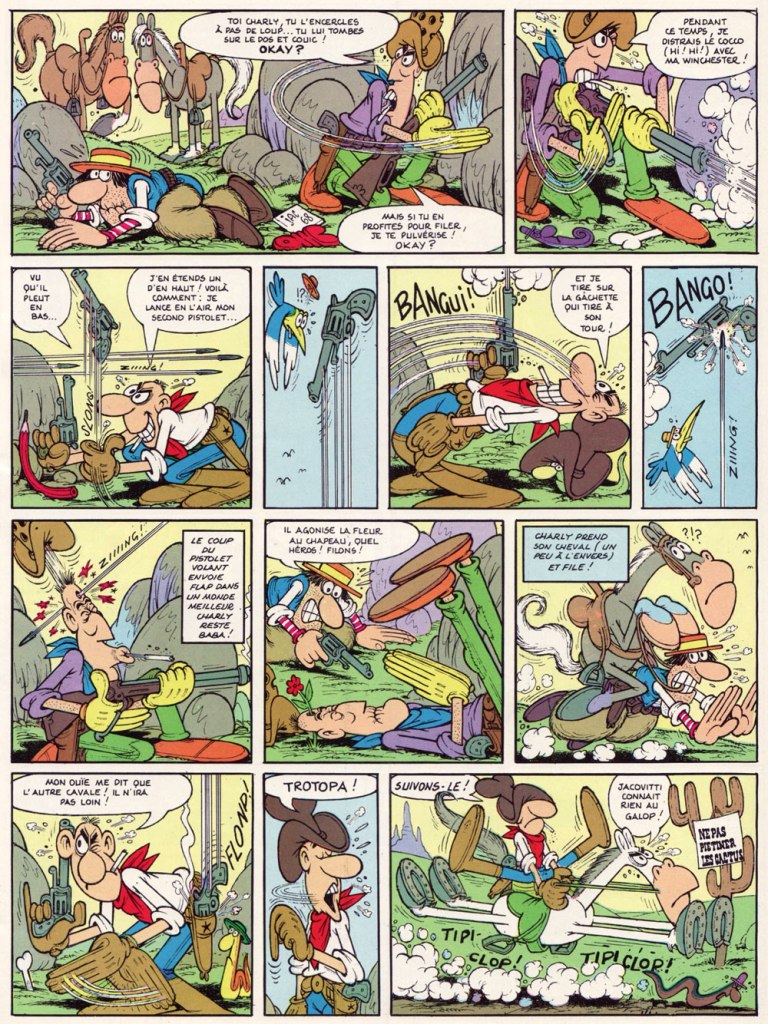
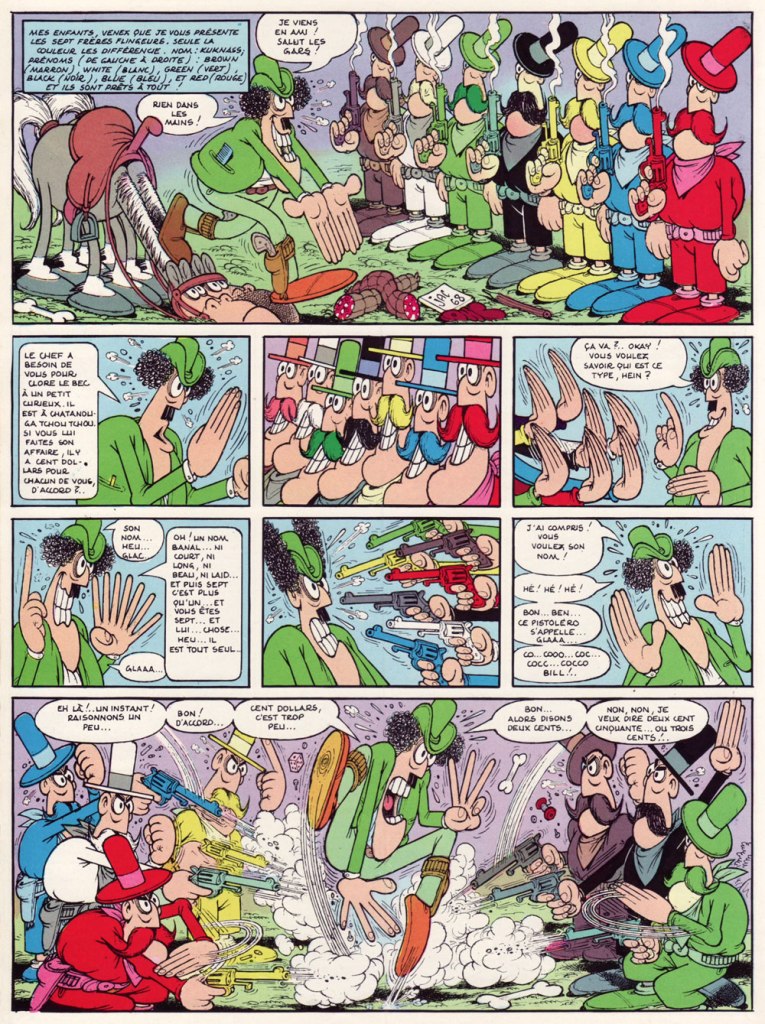
Here’s a two-page ambush sequence that gives you a sense of how handy — and deadly — our protagonist is with a pair of irons.
The sign says: “Do not trample the cacti“. The surviving bushwacker is put out of his misery by the gang’s second-in-command, the Chaplinesque Kruel; you know he’s a villain of substance because he rides a double horse. Pray note the lovely SALOOOOOOOOOOOOOOOOOOON sign with its behatted snake carvings.Meet hired guns the Kuknass Brothers: Brown, White, Green, Black, Yellow, Blue and Red, of course. Like the idea, Quentin? Note the extra digits (the better to count with, panel five). It’s easy to imagine Jacovitti having some influence on Mad’s Don Martin… In the manner of many a pure-hearted cowboy, Cocco Bill’s brew of choice is alcohol-free; his poison is chamomile tea, a drink with numerous health benefits! With sugar and lemon, but hold the paprika, thank you! Note: Don’t Shoot the Piano Player!This is Sur les rails (1975, JC Lattès, France), originally serialised in Corriere dei Piccoli as “Cocco Bill sulle rotaie”, 1969. In Italy, it was number twenty-one in the series.The train meets the stagecoach, and how! A page from Sur les rails.
Last month, my co-admin ds reported, in the course of her spotlight on Massimo Mattioli, that Jacovitti is said to be the Italian cartoonist best known internationally. I have no idea how such popularity is measured, but I do enjoy the idea of a palmarès headed by cartoonists I love, for once. I do, however, suspect that the global reach of animation frequently contributes more to a cartoonist’s name recognition than does his printed work (think Guillermo Mordillo). Case in point: while Cocco Bill strips have been translated and reprinted in several countries, these efforts have been, more often than not, patchy and sporadic. On the other hand, the Cocco Bill TV series (2000-04) ran a healthy 104 episodes. And it looks great, which didn’t hurt. Check out the pilot episode, ‘Cocco Augh‘. For a creator, it’s assuredly a classier calling card than a bunch of sordid sex ‘comedies’.
I’d like to dedicate this post to the fond memory of a departed cartooning colleague, Patrick ‘Henriette Valium’ Henley (1959-2021), since Cocco Bill was, I’ve heard tell, his favourite bédé.
« Topor is probably the greatest graphic mind of the twentieth century. » — Seymour Chwast
Well, that’s quite a lofty claim… but considering the source, one that must be seriously considered.
Are you familiar with Roland Topor‘s work? Perhaps you’ve seen Roman Polanski’s 1976 adaptation of Topor’s novel Le locataire chimérique (1964). Or seen the singular animated film La planète sauvage / The Fantastic Planet (1973). Maybe you’ve seen some of his arresting film poster art (The Tin Drum, Realm of the Senses… and more). Were you perhaps an early reader of France’s legendarily transgressive magazine, Hara-Kiri, journal bête et méchant? Or, at the other end of the scale, did you grow up with Groucha, Lola and the Gluons on his charmingly bizarre 1980’s kids’ show, Téléchat?
All the same, Topor (Jan. 7, 1938 – Apr. 16, 1997) — eighty-four years ago today — is one of those rare fellows (like, say, Shel Silverstein) who achieved great success at whatever they undertook… and without compromising their vision. Painter, actor, scenarist, playwright, director, affichiste, cartoonist, illustrator… he did it all, and he did it all well. I’m happy to say that his legacy seems safe, if his posthumous presence online and in galleries and minds is any indication. And I’ve rarely had so much trouble paring down my selections, so prolific and versatile and hard-hitting was he. Dig in!
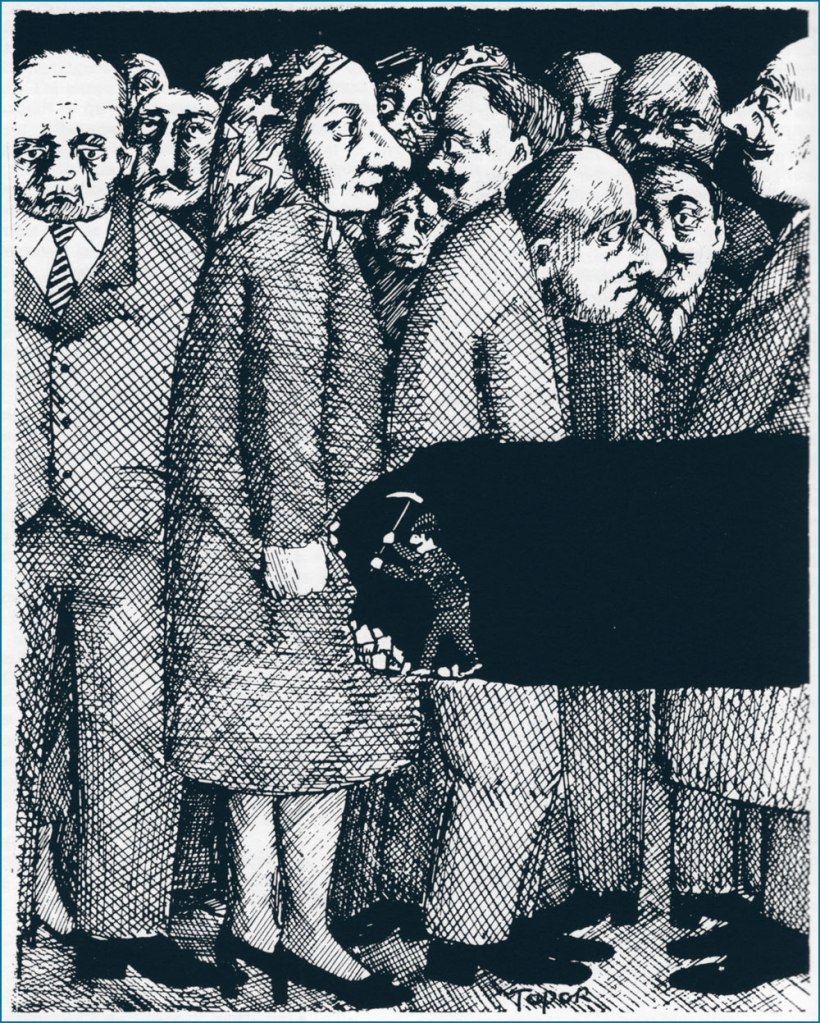
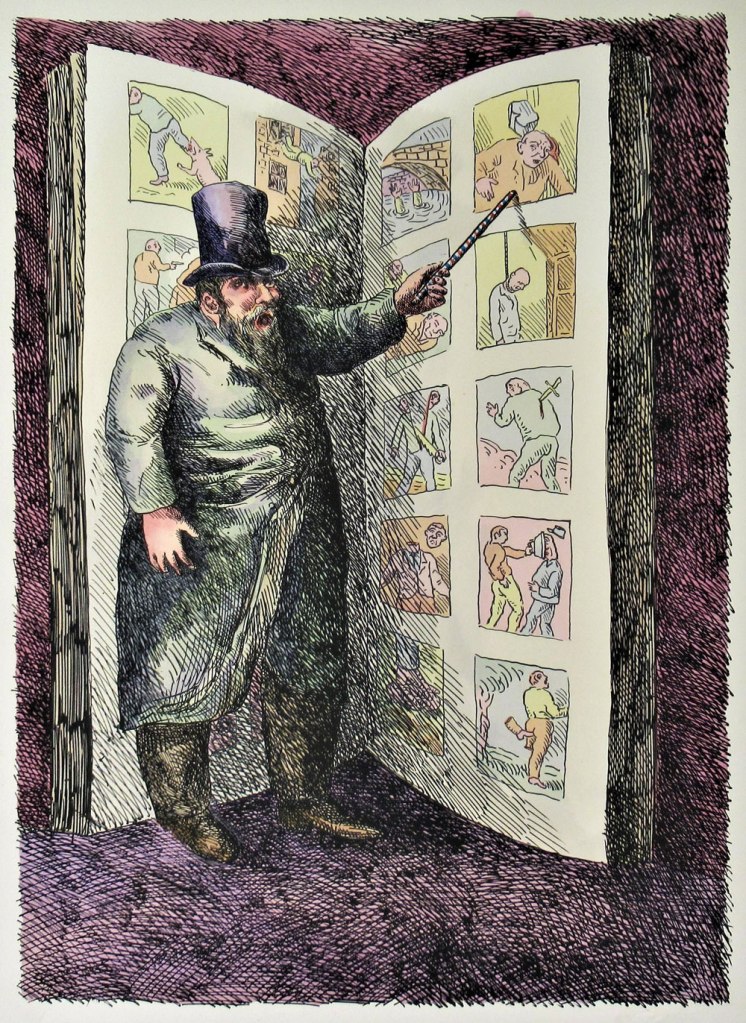
This is a typical, if striking example of the sort of work Topor was producing in the early 1960s (largely for Hara-Kiri — some three hundred drawings in a five-year span), and one wasn’t sure if his draughtsmanship could keep pace with his ideas. I like to call this one ‘La ruelle armée’.
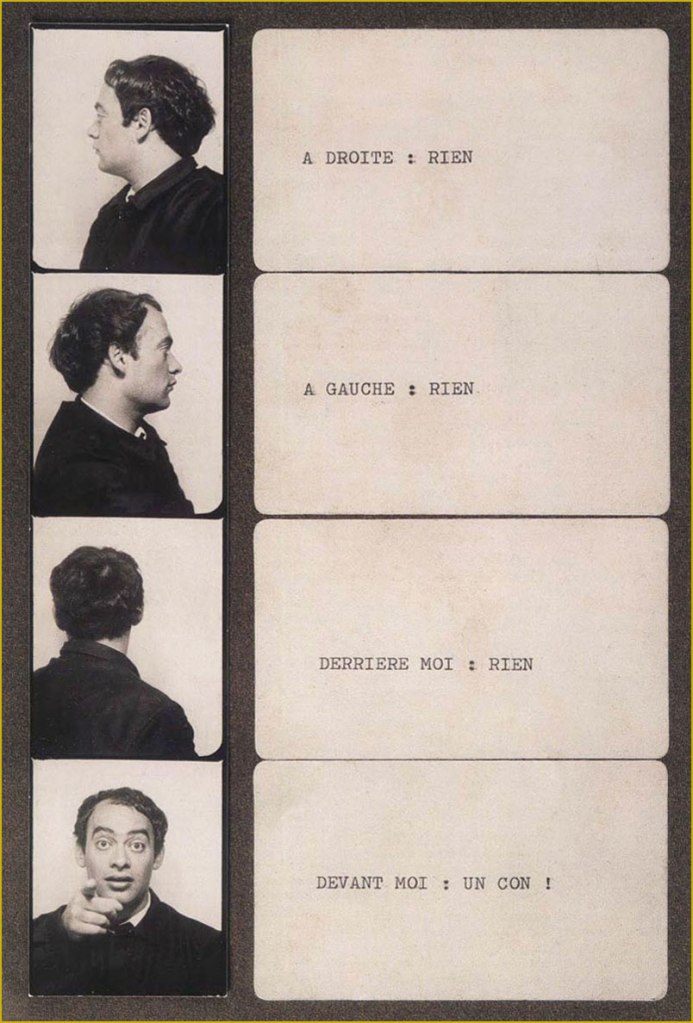
A bit of Photomaton–fumetti from Mr. Topor, circa the 1960s. To the right: nothing. To the left: nothing. Behind me: nothing. Before me: a moron!
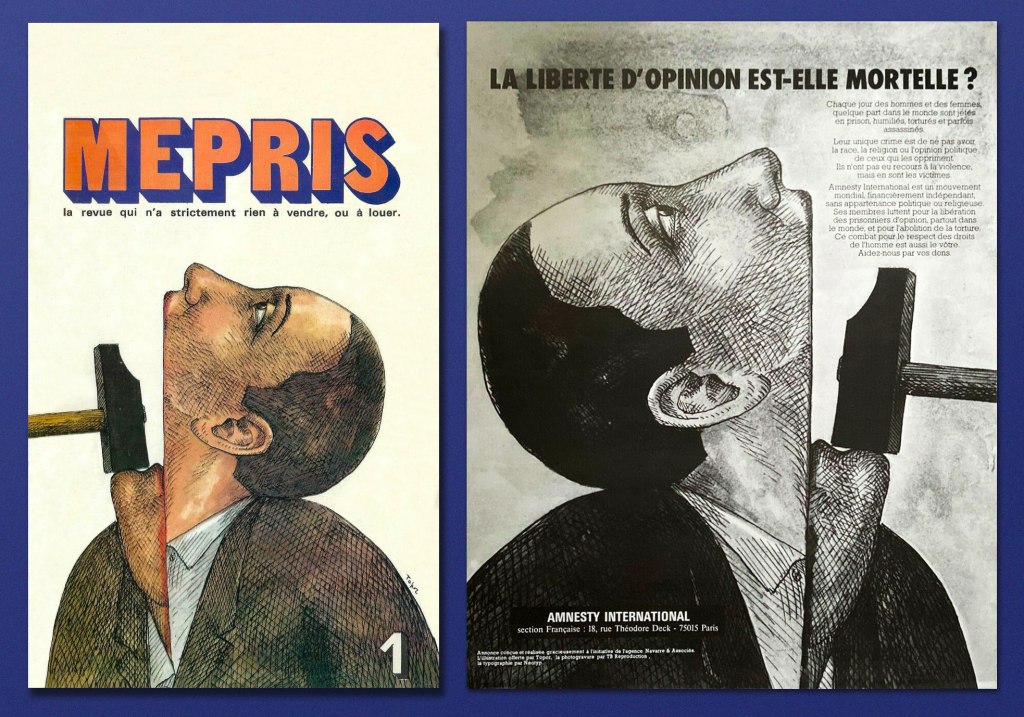
Topor recycled the punch-in-the-kisser motif several times; it was first used for a Hara-Kiri promo poster in 1961.
A pair of excerpts from 1974’s L’Épikon. I love the concept: Topor graphically (and fancifully) elaborated upon some antique pornographic photos. « In Warsaw, a housekeeper, by piety sucked the church candles. By dint of polishing the tallow, she skinned her lips and blushed like a virgin. »
« A Las Vegas whore, who resided in a palace, resorted to a trick to tame phalluses: she illuminated her snatch. » Here’s more from L’Épikon.La roue (the Wheel) — 1973.Another bit of recycling: first created (I think!) for Revue Mépris n° 1 (1973, Éditions Kesselring), Topor donated this powerful piece to Amnesty International for its worthy promotional work, such as this 1977 print ad. « Is Freedom of Speech Lethal? ».
This sardonic piece appeared in the collection L’amour à voix haute (“Love Out Loud”); the English version was entitled Je t’aime: A Pillow Talk, and used it as its cover.
Les nouvelles en trois lignes I (The News in Three Lines) – 1975. Comics!
Le saut périlleux (the somersault) – 1980.
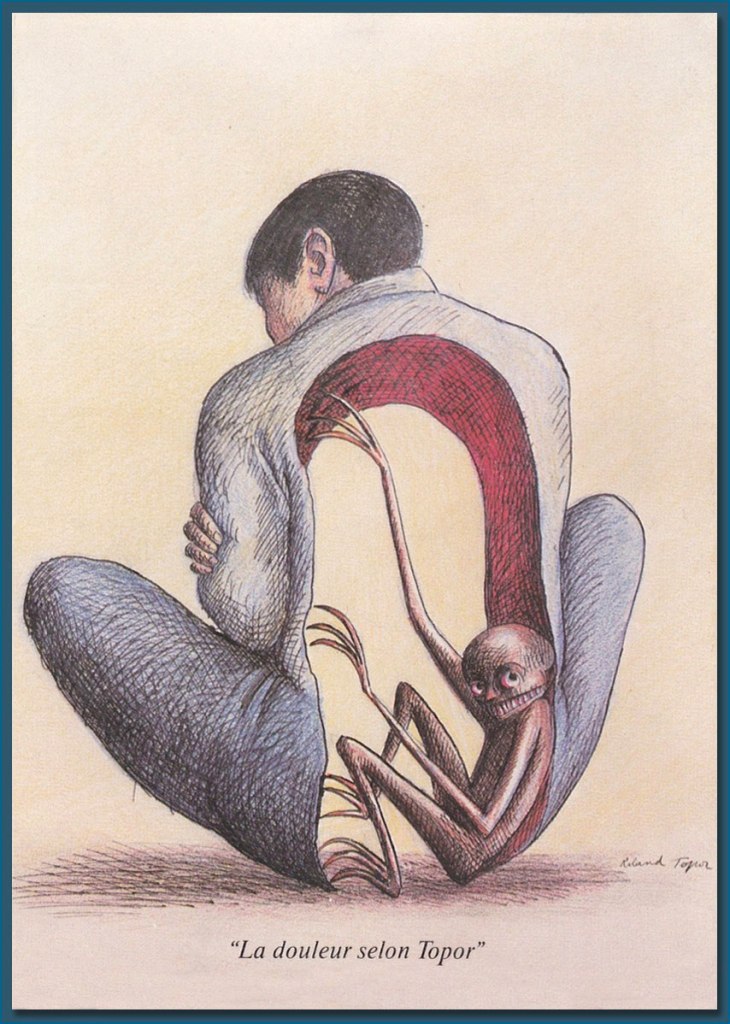
« Pain, according to Topor. »
« Leaving pain behind, according to Topor. » (1982)
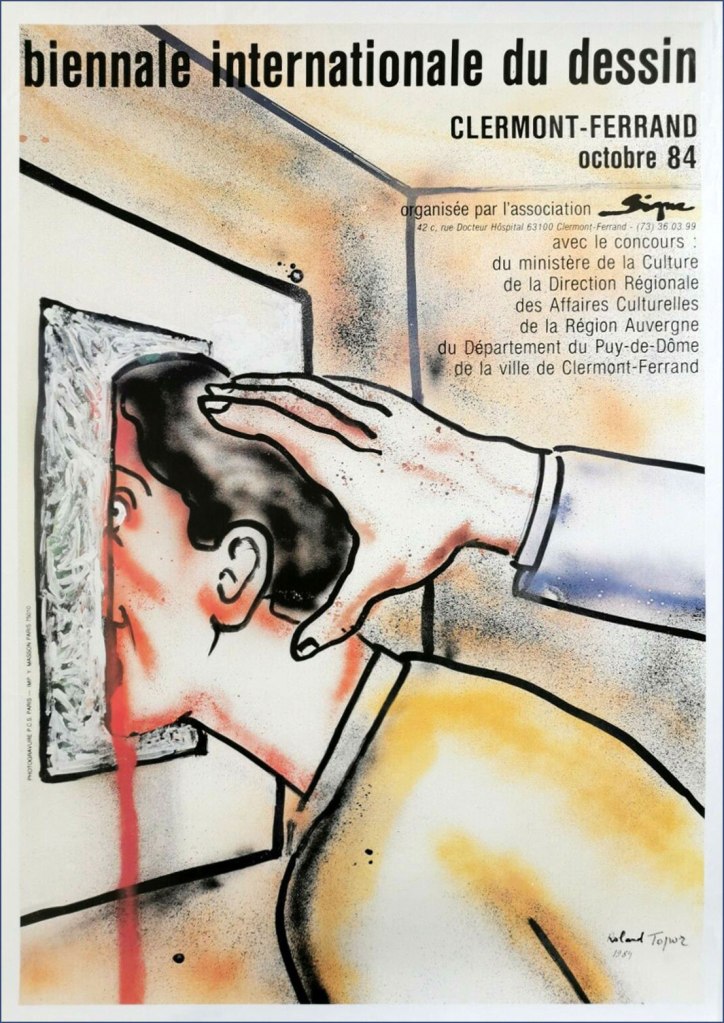
I’m happy to say that, with the years, his work just kept evolving and, in some ways, improving. This poster was created to promote the 1984 edition of a drawing festival held every other year.
Greetings to all! In this New Year, like an alcoholic in remission, I will abstain myself from tentacles (for at least a few months) while I catch up on other things I want to talk about. The first installment of this non-Tentacle Tuesday starts with an M, so it seemed appropriate to run it on Monday.
Massimo Mattioli (1943-2019) may be the second best-known Italian cartoonist abroad, at least according to Lambiek Comiclopedia (the first being Benito Jacovitti, another post in the making). However, an anglophone audience is likely to associate him with uncomfortable levels of violence, as only his 80s-and-onward strips have been translated to English. Case in point: his most notorious creation was Squeak the Mouse, serialized in underground Italian comics magazine Frigidaire in the early 80s. When this strip was imported into the United States, the customs agents seized the lot, as the work was deemed to be obscene and pornographic.
« Laying full-on slasher horror onto wacky cartoon violence, Mattioli’s characters embark on a sadistic bloodthirsty rampage, leaving a trail of mangled corpses and pools of blood in their wake. And the comic’s gratuitous bloodshed is not to be overshadowed by its crude humor and over-the-top sexcapades. In sum, a tour de force of unrelenting transgression, rendered in clean line art and dazzling pastel colors. » [source]
But this isn’t today’s topic. For this post I’d like to go back further in time, to a gentler and arguably more inventive Mattioli, since I don’t believe that over-the-top violence necessarily requires that much imagination. We go back to 1968 and the magical (and I try not to throw this word around lightly) M le magicien. Co-admin RG and I have our separate libraries, but since our tastes overlap by a large margin, we try to keep the number of duplicates to a minimum. Suffice it to say we both have a copy of the collected M le magicien strips (published by L’Association in 2003), and neither of us is parting with ours.
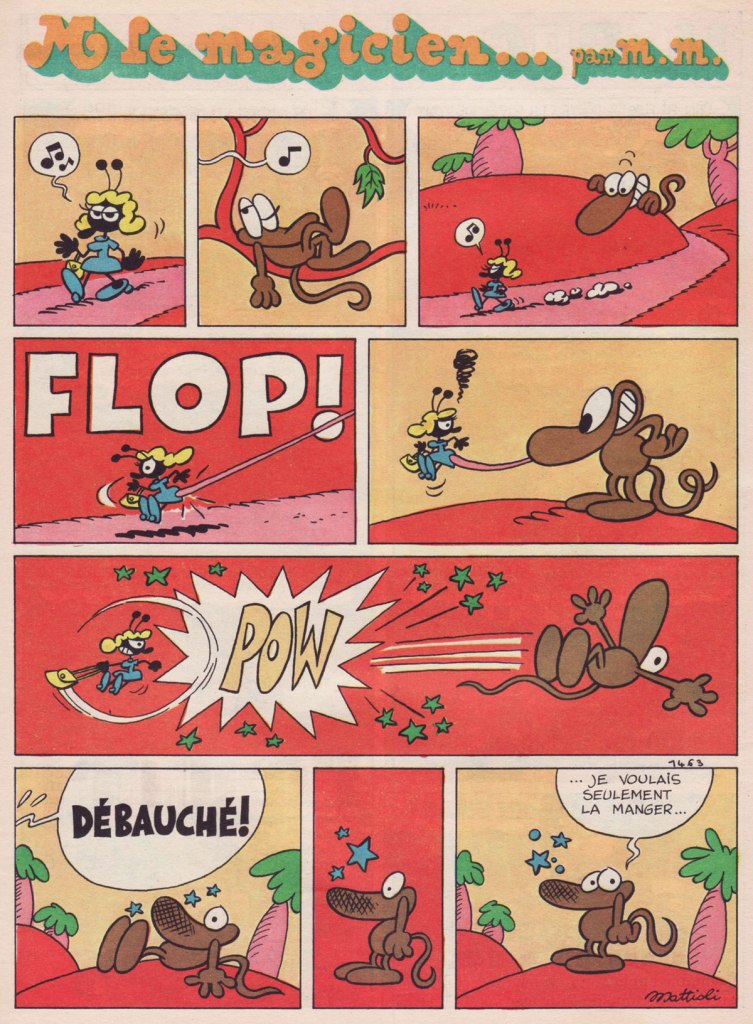
In 1968, 25-year-old Mattioli had moved from his native Rome to Paris, France, and there joined the illustrious ranks of artists revelling in absurdity and tongue-in-cheek humour (for example, Nikita Mandryka and his Le concombre masqué) working for communist magazine Vaillant, which was renamed Pif Gadget a year later. Mattioli’s first long-term project, M le magicien debuted in issue no. 1227 (December 1968), and continued its run until 1973.
It’s not really clear why the series ended – the introduction to L’Association collection just mentions that Mattioli decided to return to Rome. However, it seems likely that the strip was ousted by pressure exerted by Claude Compeyron, président-directeur général (CEO) of Vaillant – obsessed by commercial success and marketing schemes, he saw no point in publishing ‘lesser’ strips that were more difficult to absorb (Hugo Pratt‘s Corto Maltese, Les pionniers de l’espérance) or not immediately appealing to children. Compeyron’s approach to selling magazines (‘a magazine is like any product you sell or buy, like a pair of shoes‘) led to rédacteur en chef (editor-in-chief) Richard Medioni resigning in 1973. Medioni’s departure marked the end of what was arguably Pif Gadget’s golden, ‘red’, period; from that point onward, the editors had to learn to kowtow to the marketing department, and commercialism reigned supreme.*
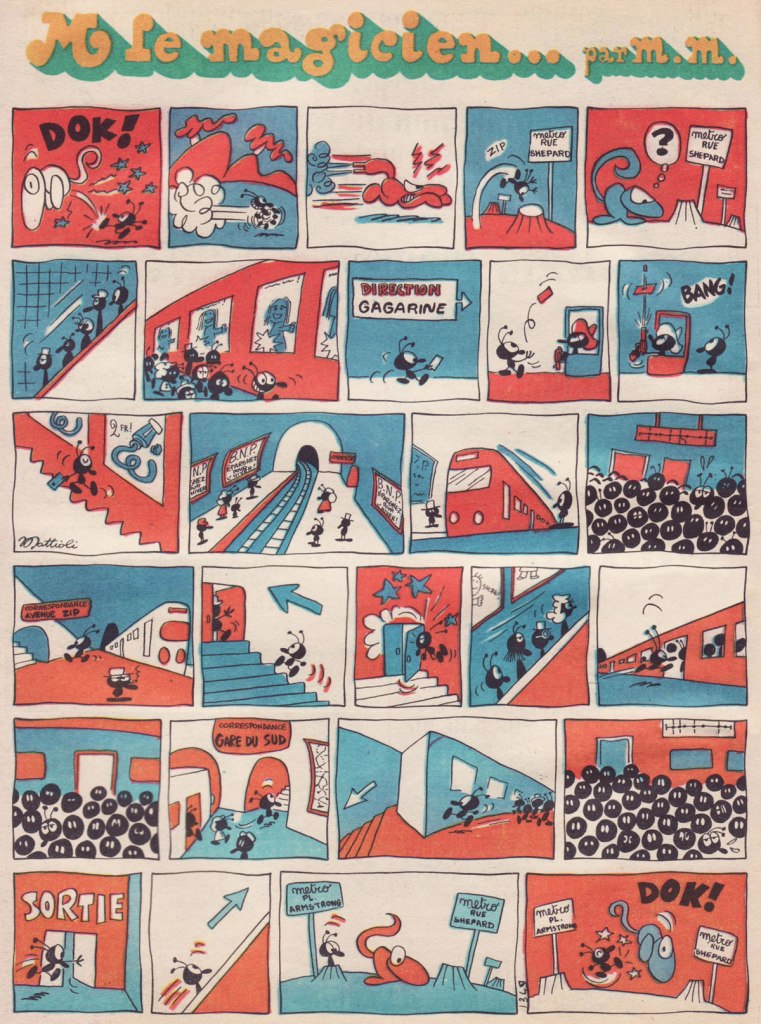
The cast of M le magicien is relatively succinct: the protagonist, your fairly standard magician, his talking magic wand, and a couple of chameleons (who periodically mlem the magician, mistaking him for an insect), two Martians bent on world destruction (or just magician’s castle destruction), a few insects of various shapes and genders, and some talking flowers and mushrooms. The characters are free to roam across pages, consume the backgrounds when they get hungry, and address the reader directly. Mattioli was not confident about his French, so he availed himself of visual humour with fairly simple (sometimes slightly unhinged) dialogues, which added to the charming atmosphere of absurdity.
While (as mentioned previously) we are the proud owners of two copies of the collected M le magicien, I had no wish to destroy either book by attempting to scan pages from it. Luckily, RG put quite a few Pif Gadget issues at my disposal, and I chose my favourites from this lot.
In the early days, Mattioli often stuck to one theme for his page, but tackled it from many angles in each self-contained strip of five panels. The following page vaguely concerns itself with the yellow chameleon’s insatiable appetite, a recurring joke:
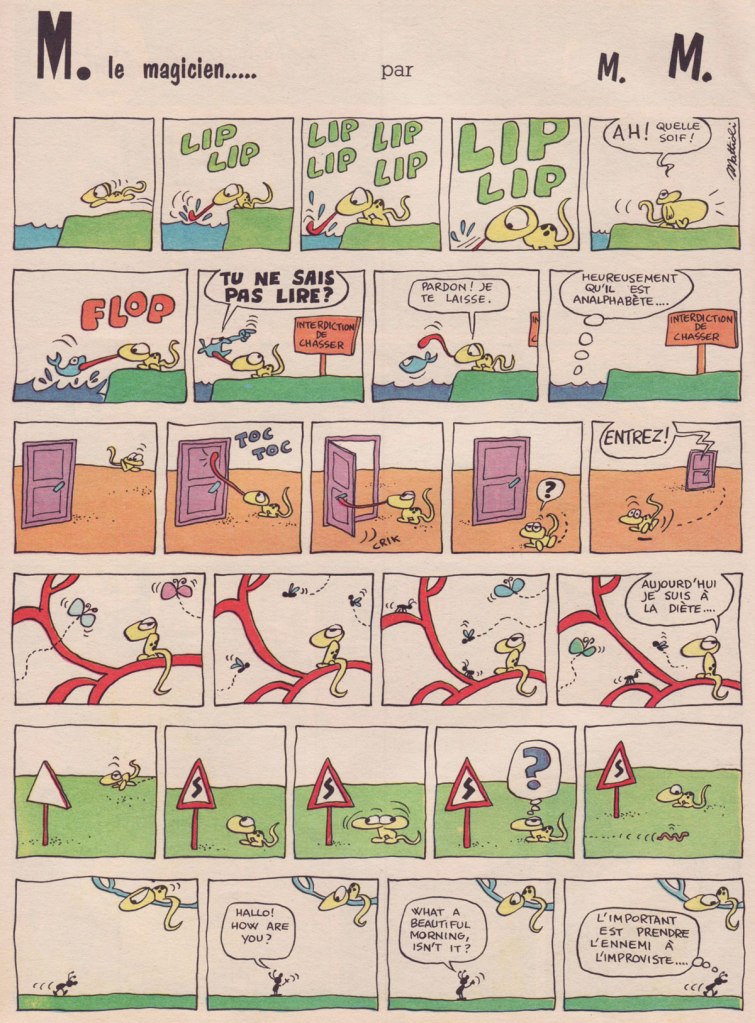
From Pif Gadget no. 31 (September 1969). The first sequence of panels ends with ‘what a thirst!‘ In the second, the fish passes the ‘no hunting’ sign for a ‘no fishing‘ one, since the chameleon is fortunately illiterate. In the third, he’s dieting. Finally, in the fifth, the ant switching to English unexpectedly confuses the chameleon so that he forgets to eat it.
FromPif Gadget no. 53 (February 1970). The snow-averse flower wants somebody to lend it its fur, then complains to the heavens that nobody likes snow (to which the heavens answer, ‘but it’s free!’). Defeated by the snow, the flower concludes with ‘I surrender!’
From Pif Gadget no. 111 (April 1971). I love that the ants have an elaborate underground city – and use it to their advantage. Note that by now M le magicien has an official (and lovely) logo!
From Pif Gadget no. 144 (November 1971). A self-explanatory sequence of head swaps!
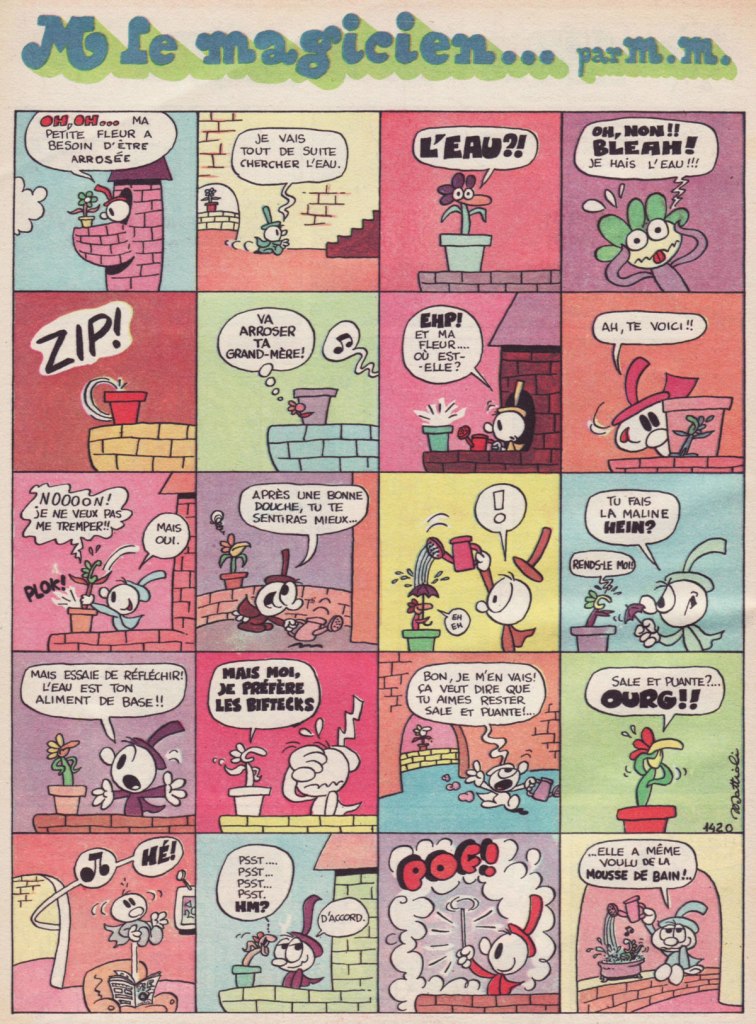
From Pif Gadget no. 182 (August 1972). The flower that hates water (and would rather eat steak) refuses to be watered until the magician mentions that it’s free to remain dirty and smelly if it wants to – then the flower opts for a bubble bath.
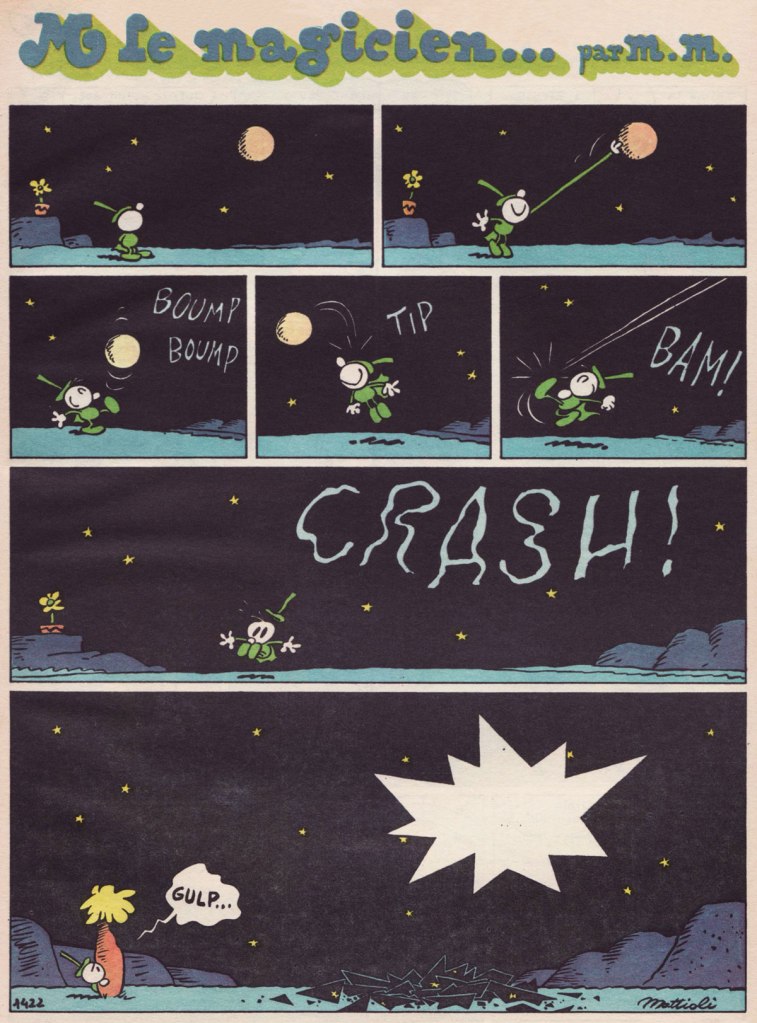
In later issues, Mattioli went for more ambitious, visually stunning but more spare one-page stories, often paying an obvious hommage to Krazy Kat.
From Pif Gadget no. 184 (September 1972).
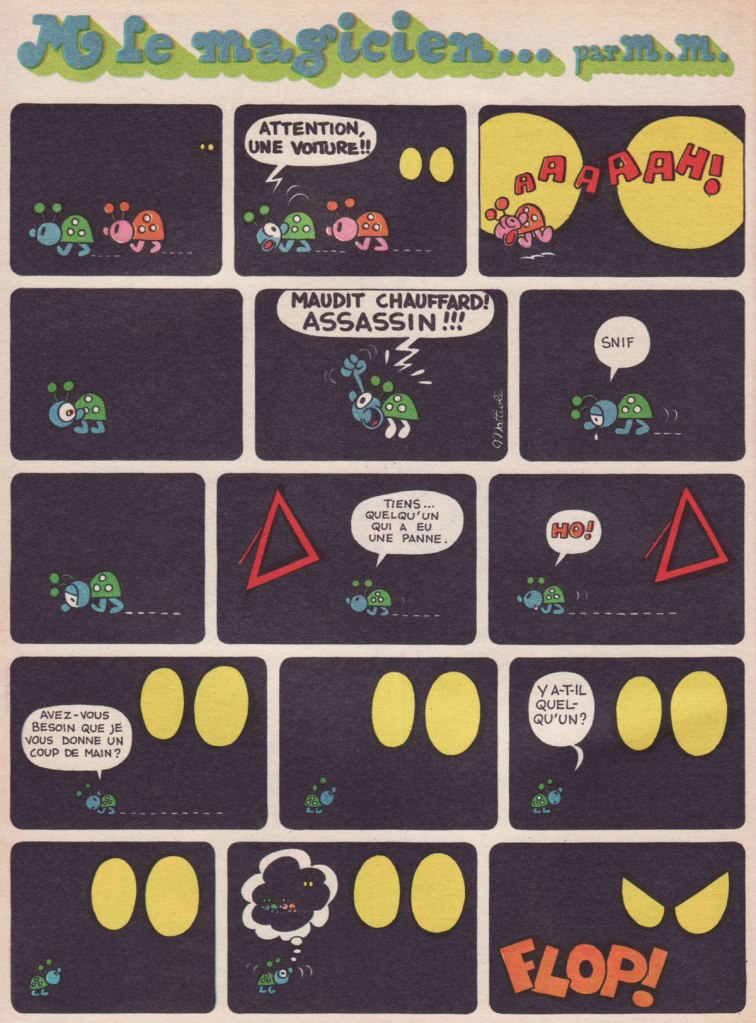
From Pif Gadget no. 185 (September 1972). Starting with a ‘look out, car!‘ warning, this page uses headlights as camouflage for the chameleon, betrayed by the characteristic FLOP sound he makes when gobbling up the remaining bug in the final panel.
From Pif Gadget no. 189 (October 1972). Another Herriman-esque page… with a classic banana gag, to boot (or to slide).
From Pif Gadget no. 225 (June 1973). ‘Pervert!‘, exclaims the indignant ant – to which the chameleon responds with ‘… but I only wanted to eat her…‘
And there we have it, a quick gallop through but a few strips of this masterpiece of humour and poetry. I highly recommend seeking out the omnibus if you speak at least un petit peufrançais.
Looking up meta-humour while I was writing this post, I came across a few choice jokes that made me crack up. While they’re not wholly related to M le magicien, their lovely absurdity fits right in with its spirit.
A dyslexic man walks into a bra.
A non sequitur walks into a bar. In a strong wind, even turkeys can fly.
A guy walks into a bar and says “ouch!”
What do you get when you cross a joke with a rhetorical question?
A dangling participle walks into a bar. Enjoying a cocktail and chatting with the bartender, the evening passes pleasantly.
~ ds
*Which is a (depressing) conversation for another day, but in the meantime, we highly recommend getting it from the horse’s mouth, so to speak, by reading Mon Camarade, Vaillant, Pif Gadget: l’histoire complète 1901-1994 by Richard Medioni.
« Talk about cheap – on Christmas Eve, my neighbor shoots off three blanks and tells his kids Santa Claus just committed suicide.» — Milton Berle
We hope this Christmas day finds you healthy and happy, whether you’re spending it quietly with the nearest and dearest, or stranded far from your family. We all do the best we can.
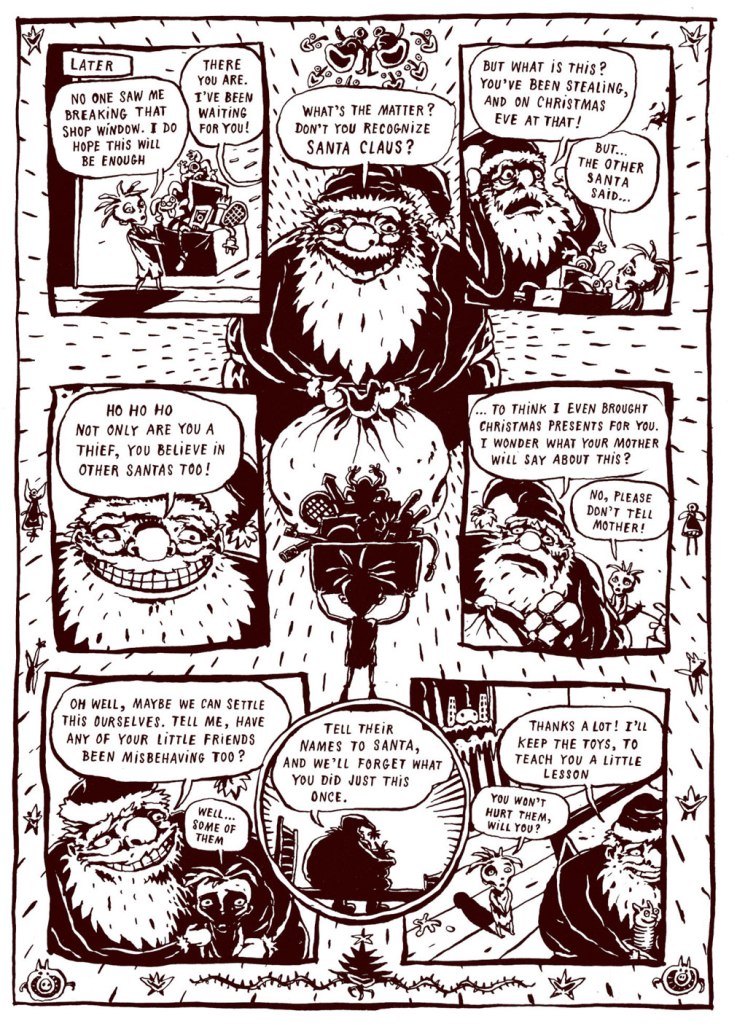
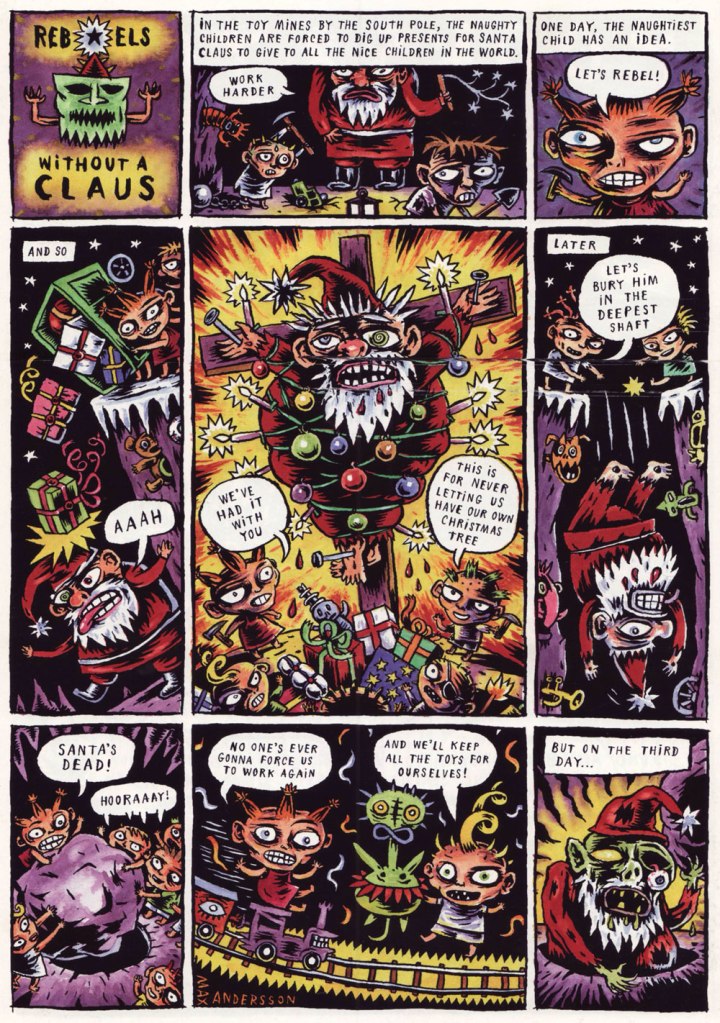
In a slightly different, yet somehow appropriate, vein… the following Christmas story by Max Andersson is a bracing antidote to the usual syrupy cheer of December 25th. As co-admin RG aptly put it*, in Andersson’s world, malevolence is the status quo, and this Jekyll-and-Hyde version of Santa Claus will fluff up the fur of the staunchest anti-Christmas reader.
Good Claus Bad Claus was published in Zero Zero no. 7 (Jan-Feb 1996, Fantagraphics).
As a bonus, we are including the no less cynical, but quite satisfying, back page of Death & Candy no. 1 (December 1999, Fantagraphics). Santa had it coming!
Ho-ho-ho (down the shaft), merry Christmas to all of our kind readers!
« The working class is revolutionary or it is nothing. » — Karl Marx
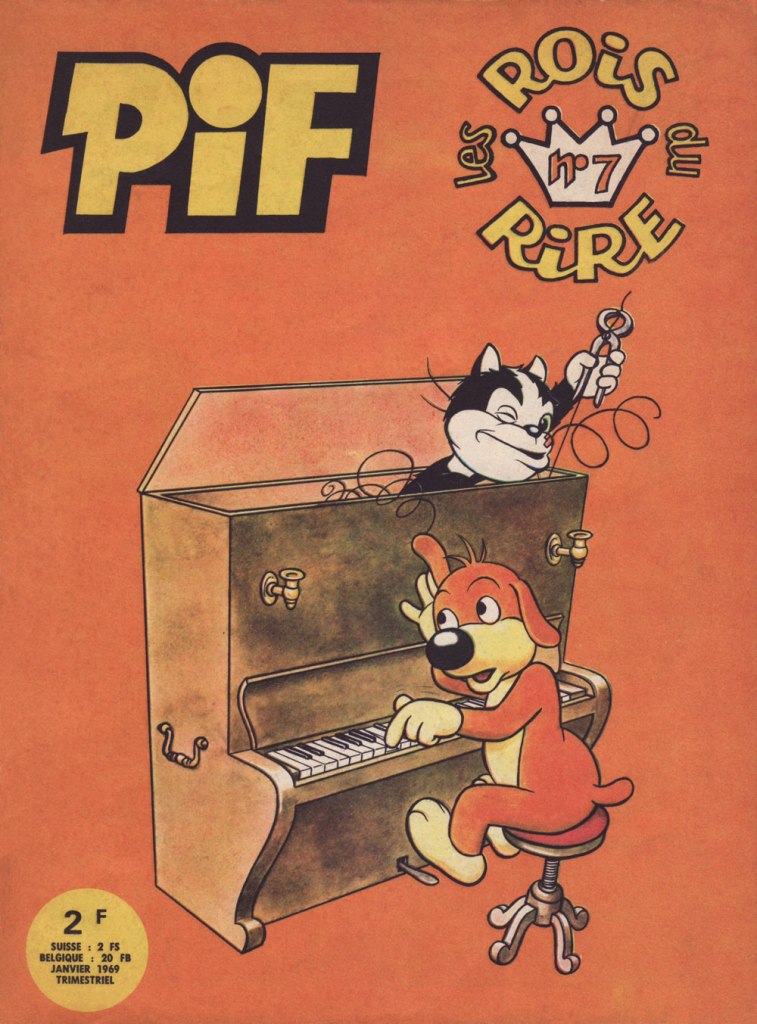
Pif le chien was introduced to the world on March 26, 1948, in the French Communist daily L’Humanité. His strip was intended to replace that of Felix the Cat, who was deemed too bourgeois, what with his magic bag and invisible means of financial support. On the other paw, Pif, early on, was even a stray, homeless and starving. In time, he was taken in by a humble working-class family (as late as 1957, it was the outhouse and public baths), and that’s when the elements clicked into place.
This is Les rois du rire no. 7 (Jan. 1969, Vaillant), a rotating anthology title gathering, in this case, two-pager Pif strips from the pages of Vaillant. Cover art by Pif’s creator, José Cabrero Arnal (1909-1982).
While I greatly admire and enjoy the work of Pif pater José Cabrero Arnal — and trust me, his is a story worth the telling: fought the Fascists in Spain, spent four years in a Nazi Stalag in Austria before being liberated by the Soviets, never quite recovered from the ordeal of his captivity, and remained fragile for the rest of his days. Consequently, in 1953, he handed Pif’s leash over to the truly indefatigable Roger Masmonteil (1924-2010).
Of Masmonteil (who signed R. Mas.), historian Hervé Cultru writes, in his Vaillant, 1942-1969 : La Véritable histoire d’un journal mythique (2006, Vaillant Collector):
« The problem is that, once he got his finger caught in the gears of the freelancing engine, he couldn’t just yank it out! Because giving life to the Césarin family is practically a vocation: one must provide the daily strip, six a week. Over thirty years, Masmonteil, aka Mas, crafted over eleven thousand of them. There are also the Sunday strips, the pages for Vaillant, solo Pifou stories, Léo, created for Pif Gadget. It never ceased. By his career’s end, he had racked up some 45,000 gags or so. »
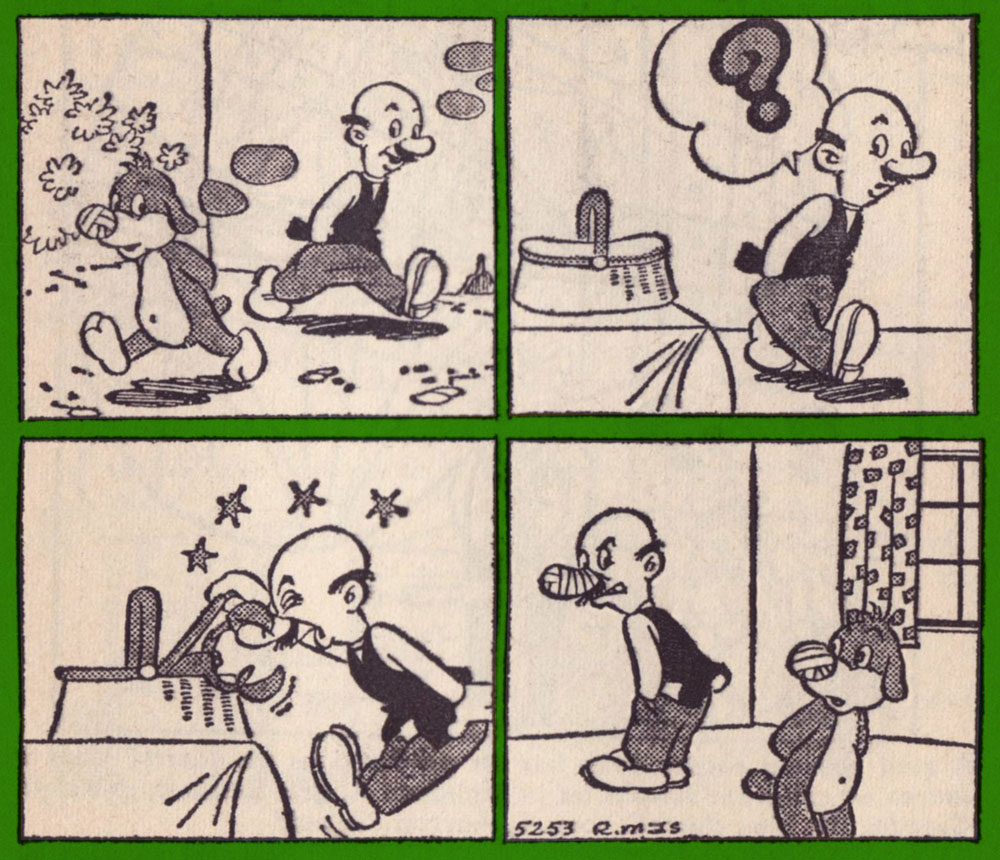
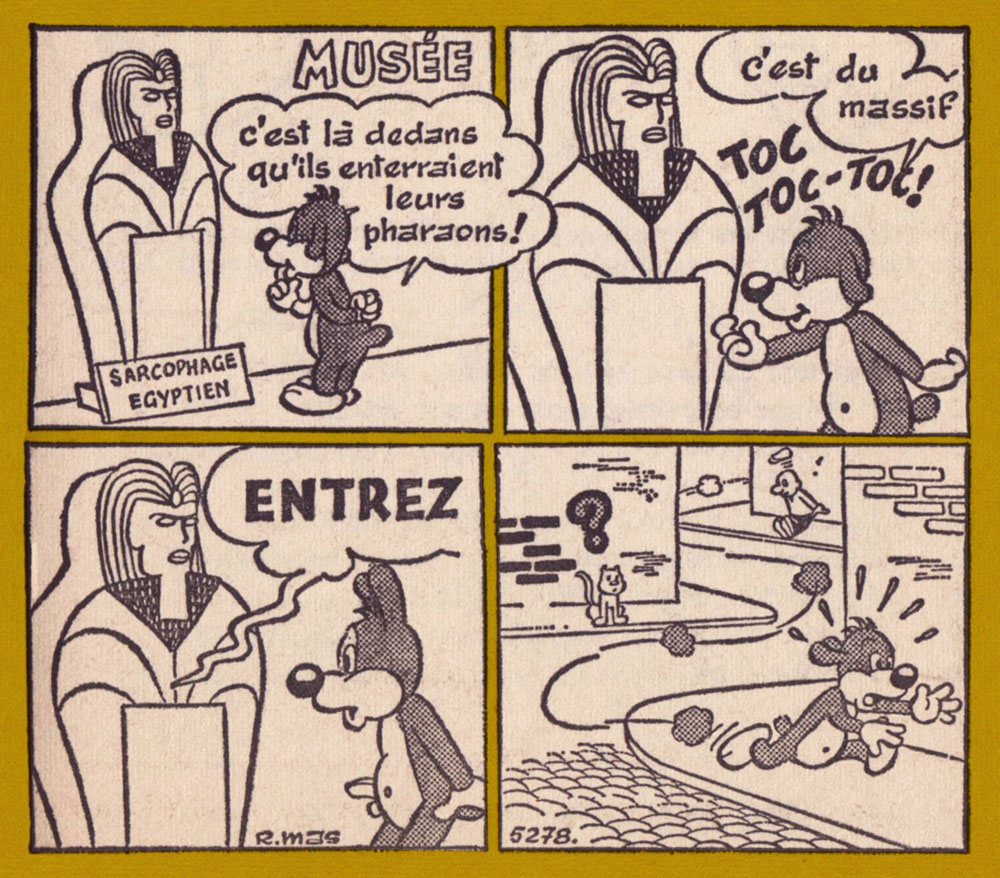
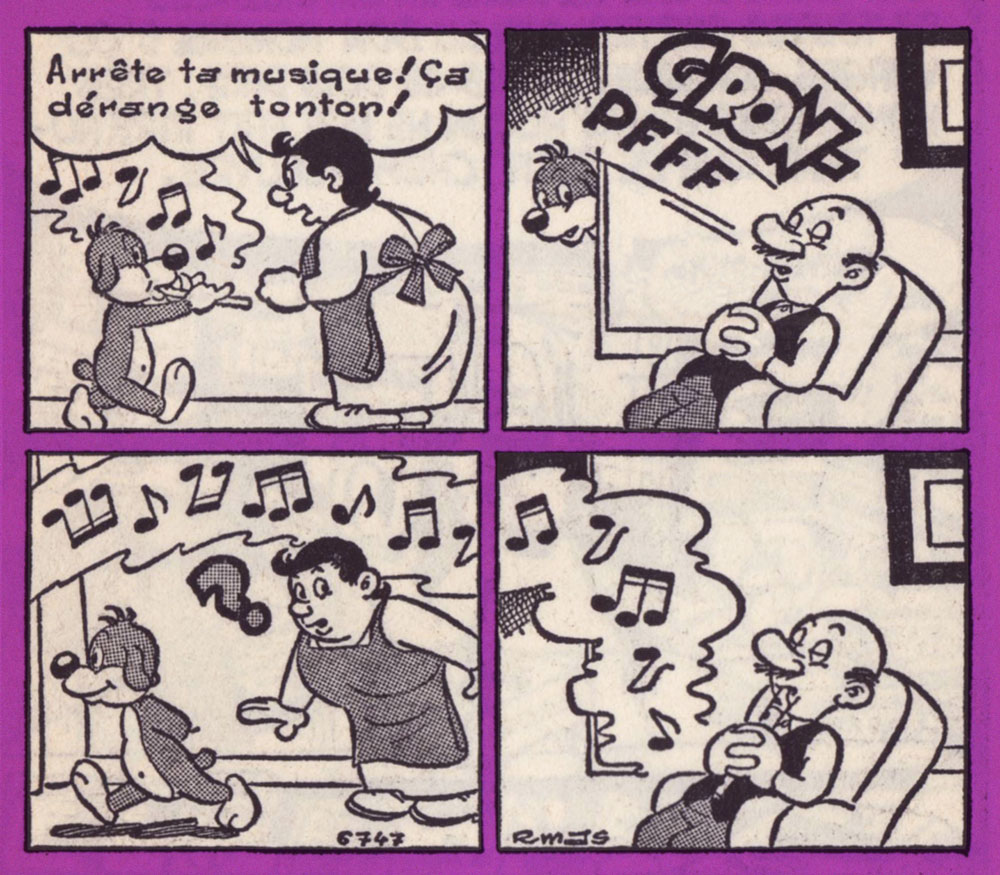
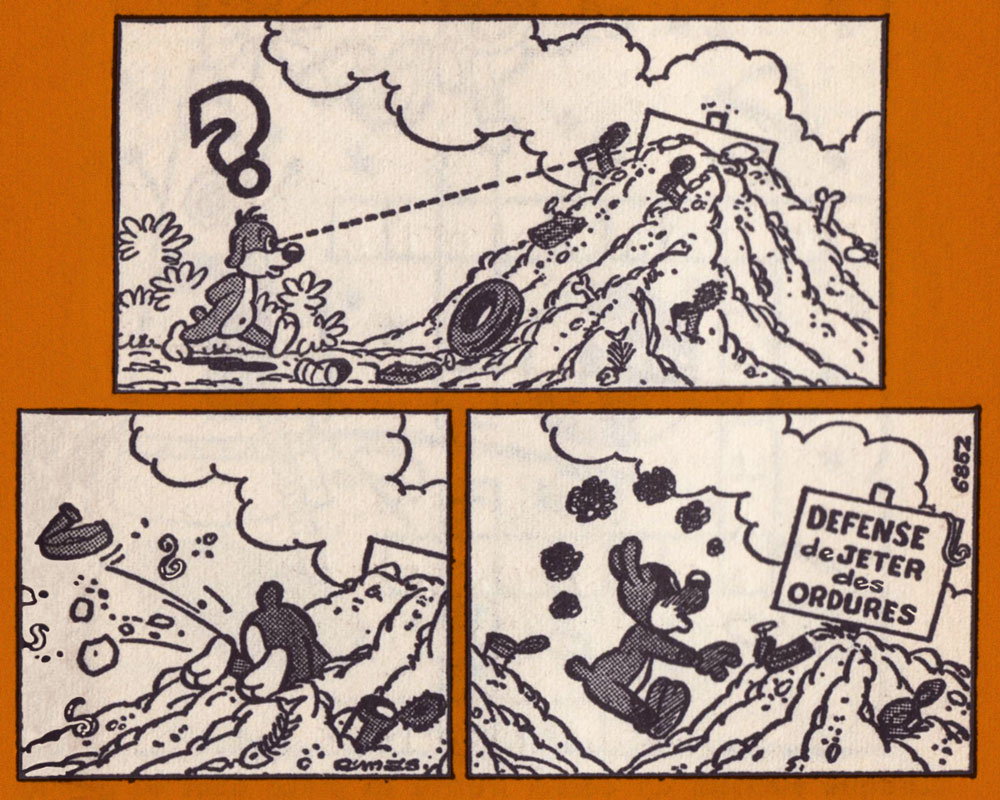
« Unlucky me, I’ve smashed the vase! » « Out of sight, out of mind! » « Bleh! What a revolting aroma! » « I’m found out! »« When the sea is too far, one makes do with a little corner of the Seine! » « I’m the back-float king ! » “Sur mer” (“On-Sea” would be the English equivalent) is a popular suffix to denote a town or resort’s coastal location. The Seine’s toxicity borders on the legendary, but things have actually improved in recent decades.I love a good pantomime gag. And every look is a sideway glance, which makes it even more special.« It’s in these things that they buried their pharaohs! » « That’s solid stuff! » « COME IN ». What most impresses me here is the final panel, with its expert use of a tiny space to convey depth, distance and setting. That’s the cartoonist’s art!« Quit your music! It bothers tonton! ».« And a-one! » « Brr! Doesn’t it cause him pain when you remove the hook? » « Not at all… it’s designed not to hurt… » « Next! » « Quiet! It’s designed not to! » Up yours, René Descartes!A slice (ouch!) of politico-historical guillotine humour.A dollop of social criticism. The sign says, naturally, « No Littering ».Pif’s archenemy, Hercule, at work. « Who’s going to get a good soaking? The Pif, that’s who! » « Failed! »
I’m inclined to admire Mas for the same reasons I hold Nancy’s Ernie Bushmiller in the highest regard: the uncanny ability to find humour in any and every place or situation, to distill and express it in a pared-down visual language made all the more potent by its universal simplicity. But it’s hard work, even if geniuses make it look easy. As Hervé Cultru explains, in Mas’ case:
« … Pif gets the last word in: at night, he haunts Mas’ dreams. The point at which he’s about to doze off is actually one of intense creativity. He constantly keeps a notepad and pencil at his bedside, to jot down ideas straight away, because if he neglects this precaution, all is forgotten by morning. »
An ad from L’Humanité, circa the late 1950s.Our cast: Tante ‘Tata’ Agathe and Oncle César ‘Tonton’ Césarin, Doudou, Pif, Hercule, and Pif’s son, Pifou. This is my copy of Album Vaillant no. 8— 4th series (comprising issues 952 to 960, August to October 1963), its rather fragile spine helpfully reinforced by a previous proprietor. I long wondered why on earth the French call wrestling ‘catch’. Turns out it’s their shorthand version of the forgotten 19th century appellation of the sport as ‘catch-as-catch-can‘.
In April 1967, Mas walks away from the Pif feature in Vaillant (four pages a week!), maintaining the daily in l’Humanité and Pifou’s solo strip. Pif returns briefly to Arnal, who still can’t handle the workload; Pif then passes into other, and decidedly far lesser hands.
Mr. Cultru, again:
« In 1968, the team takes umbrage with the repetitive and by far too ‘domestic’ character of the adventures.It feels that the working class household, typical of certain post-war values, that serves as a setting, has become obsolete, if not grotesque, and that it no longer fits the social context of the times. »
So they methodically excised everything that made Mas’ Pif special, and turned him into another Mickey Mouse, which is to say the familiar mascot or standard-bearer of a company, but one whose adventures nobody reads or truly gives a hoot about. Oh well — you still had a good run, Pif!
« Painting is the art of hollowing a surface. » — Georges Seurat
If you’ll forgive me the venial but gauche sin of quoting myself… three years ago, I posited:
« Luís Ángel Domínguez, reportedly born ninety-five years ago to the day… and still among the living… as far as we know. I like to envision him warmly surrounded by several generations of loved ones and well-wishers, an impish gleam in his eye. »
I found it sadly infuriating that such an important and accomplished artist’s latter-day whereabouts and circumstances were so shrouded in mystery… and largely, it would seem, indifference. The usual story: he didn’t really do superheroes.
Neither Lambiek nor the Grand Comics Database have anything to add on the subject, but a spot of digging turned up that he indeed was still alive until recently, though purportedly afflicted with Alzheimer’s in his waning years. Then I found what may well be his… very basic obituary, placing his date of birth exactly one month off (unsurprisingly, since accounts have long varied) and his date of death as July 1st, 2020, in Miami, FL. Unless something more definitive comes along, it’ll have to do.
I think we can all agree that ninety-six years is a pretty good run, even with the doleful decline near the end. Let’s look back on what’s surely his peak decade in comics, the 1970s. My picks have nothing to do with ‘key’ issues, character débuts or popular crossovers. I’ve judged these on artistic merit, keeping the pernicious influence of nostalgia at arm’s length.
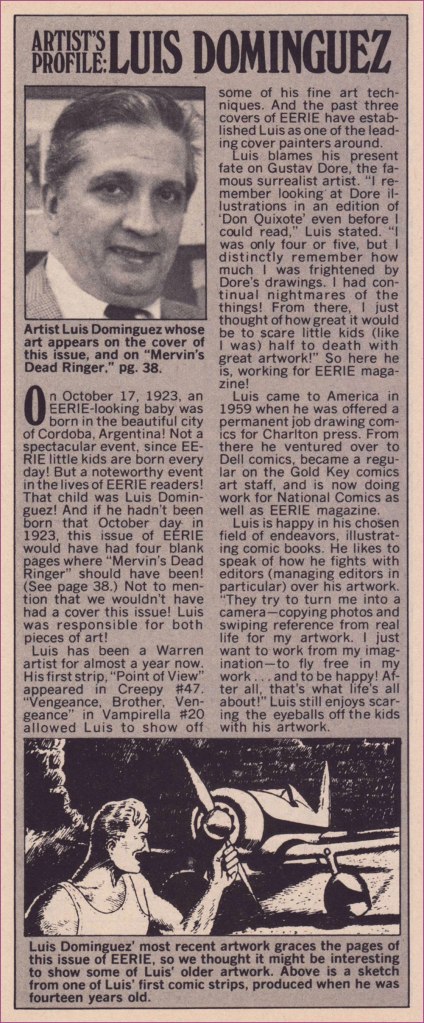
First, a little biographical background! This helpful piece appeared in the pages of Eerie no. 44 (Dec. 1972, Warren), which also boasted a Domínguez cover… albeit reproduced too small.
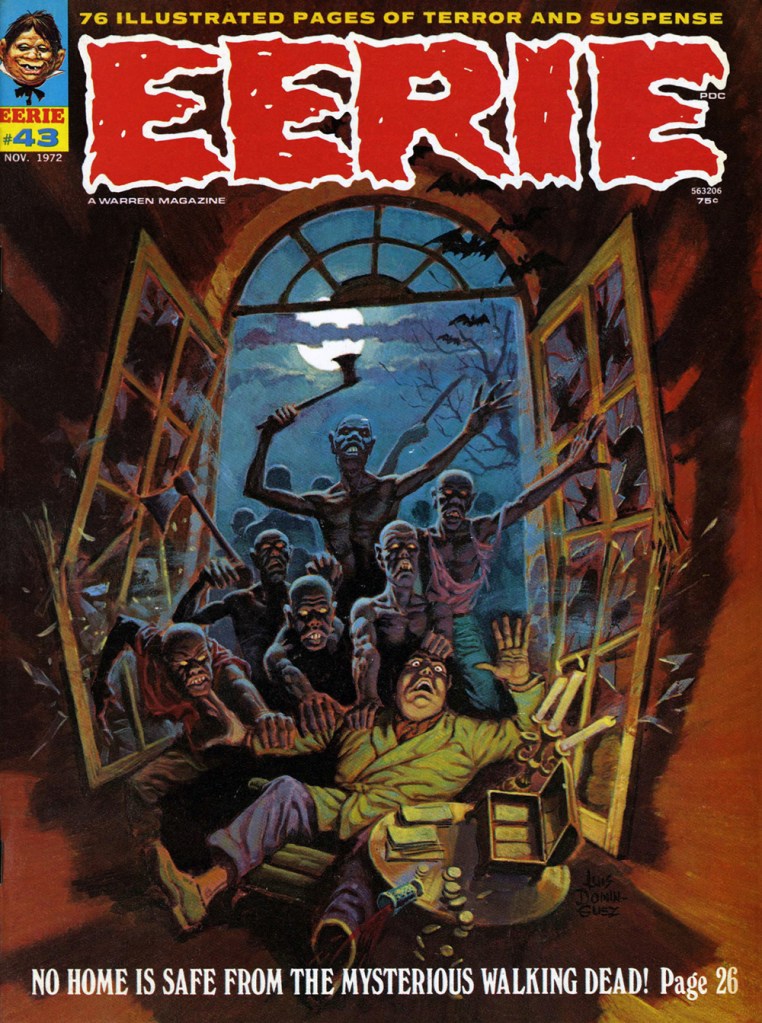
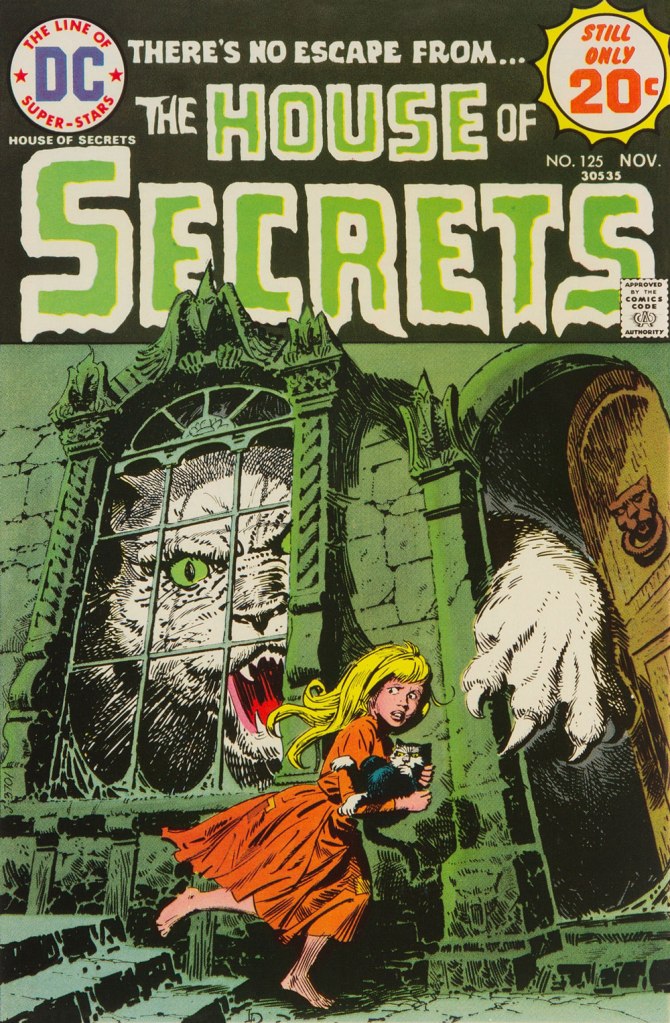
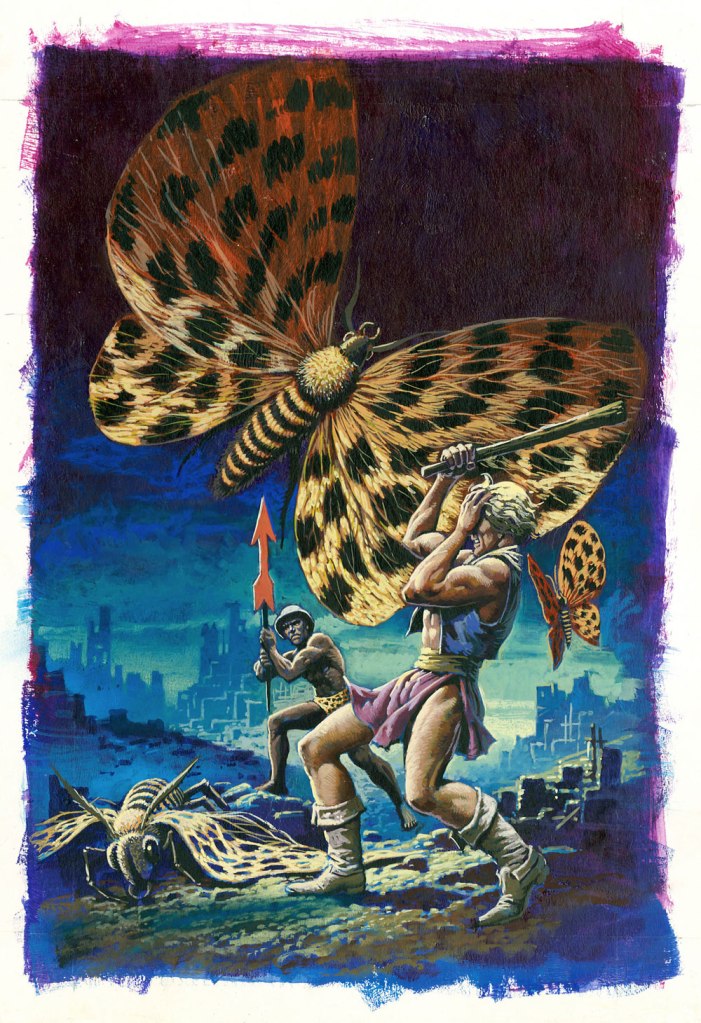
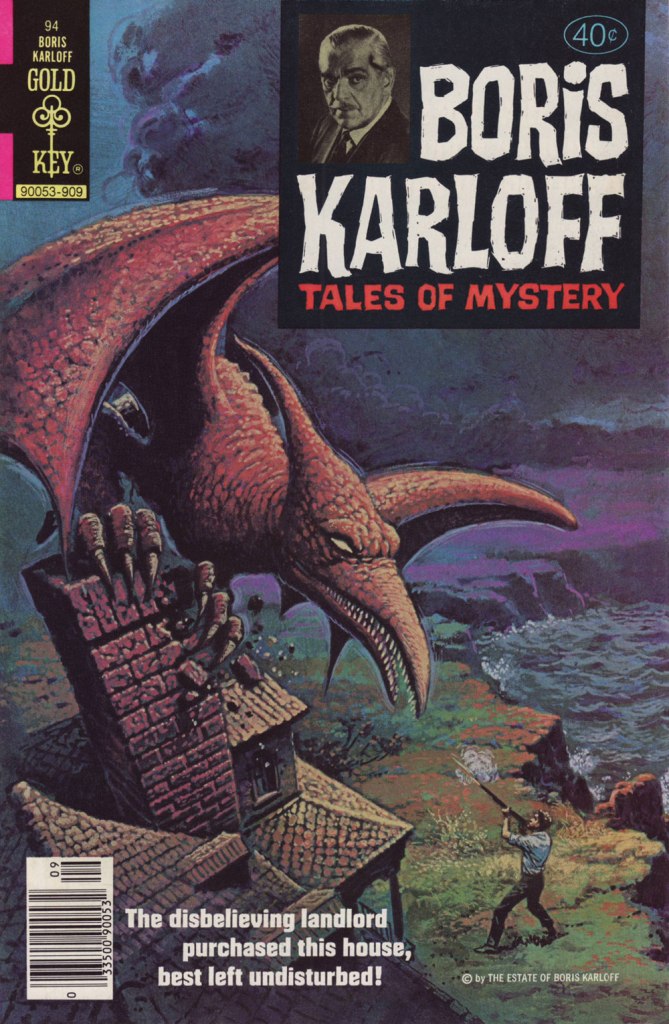
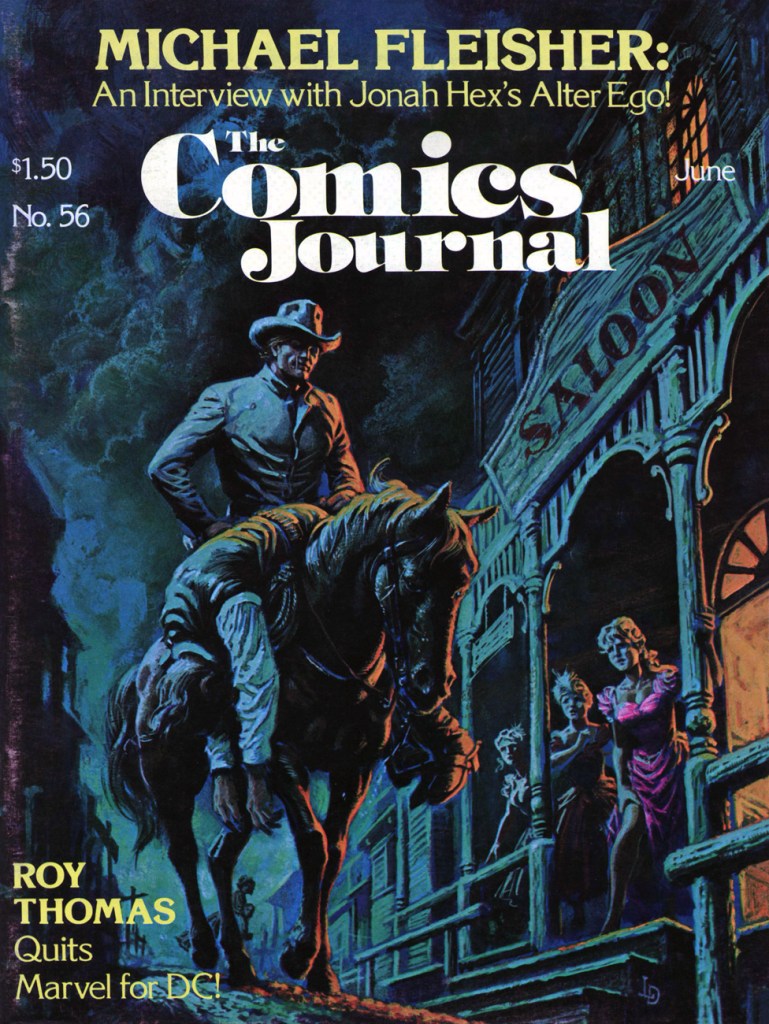
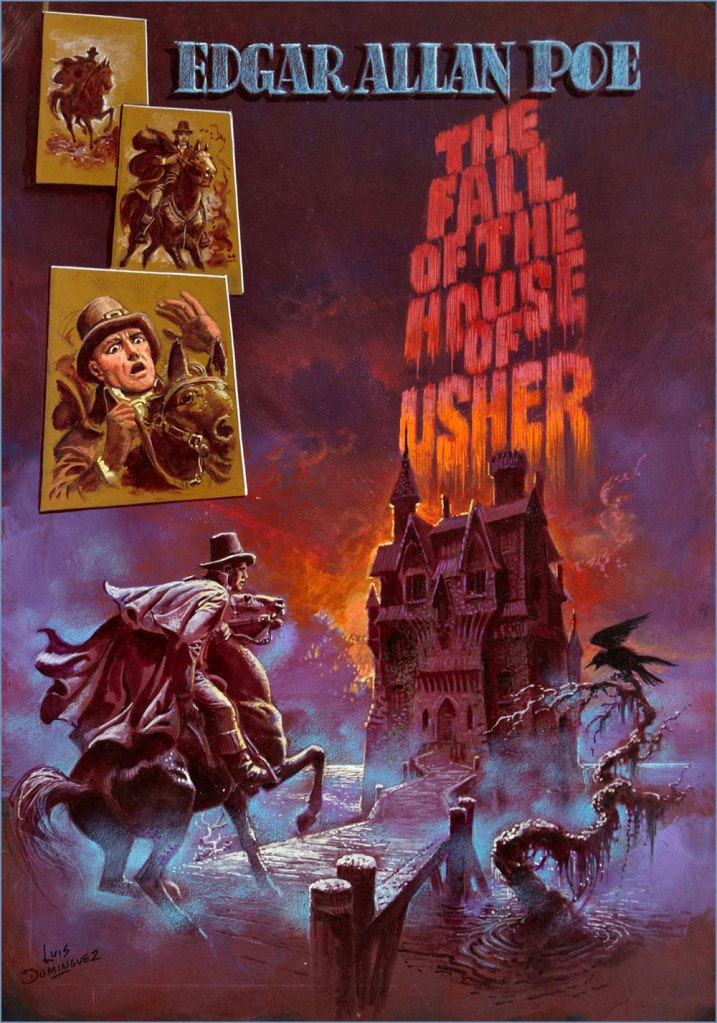
The folks at Warren were apparently first in North America to recognise and call upon señor Domínguez’s masterly painting skills. This is Famous Monsters no. 93 (Oct. 1972, Warren).My personal favourite of his too-few Warren covers, this is Eerie no. 43 (Nov. 1972, Warren).While Luís had been steadily working on the insides of Gold Key comics since 1967, it wasn’t until 1974 that they gave him a crack at a cover. That was either this one, Space Family Robinson no. 40, or Boris Karloff Tales of Mystery no. 55, both cover-dated July, 1974… (incidentally, the GCD misattributes to him several of his colleague George Wilson‘s paintings).DC hardly ever used painted covers, but they did keep Domínguez busy as a cover artist. I assure you, this ambitiously-muted cover must have been a printer’s nightmare. This is The Phantom Stranger no. 32 (Sept. 1974, DC), a great issue that features Arnold Drake and (returning to the Stranger after a 27-issue absence!) Bill Draut‘s It Takes a Witch! and a gorgeous Michael Fleisher–Nestor RedondoBlack Orchid backup.This is House of Secrets no. 125 (Nov. 1974, DC). For once, Domínguez also illustrates the cover-featured story, E. Nelson Bridwell‘s Catch as Cats Can!Then of course, Marvel soon after got in on the act. This is Dracula Lives no. 9 (Nov. 1974, Marvel). I would have picked the even better previous issue, but I’ve already featured it, so you get to enjoy both!The printed version of this piece, featured as the cover of UFO Flying Saucers no. 5 (Feb. 1975, Gold Key) pales in comparison with the surviving original art, so that was an easy choice.This issue’s original art also survived, and seeing both versions is most instructive as an insight into production manager Jack Adler’s methods. This is House of Mystery no. 235 (Sept. 1975, DC), and the original can be viewed here. As an aside, this issue’s The Spawn of the Devil, written by Maxene Fabe and drawn by Ramona Fradon, is the only DC horror story I ever found scary. Perhaps editor Joe Orlando should have hired women more often!Another one whose printed version fails on the reproduction front, this is Mighty Samson no. 31 (Mar. 1976, Gold Key), the title’s final issue. Let’s again rejoice at the original art’s survival!This is Boris Karloff Tales of Mystery no. 94 (Sept. 1979, Gold Key); I hold that Dominguez’ three finest consecutive covers came near the end of Gold Key’s Karloff anthology and, wouldn’t you know it? … we have already featured the other two. You’ll find issue 92 here, and issue 93 (and its original art) in one of ds’ posts, which also showcases another top-flight contender, which I couldn’t use for reason of… tentacles, Dagar the Invincible no. 11. This is The Comics Journal no. 56 (Fantagraphics, May 1980). According to masthead notes, « Luís Dominguez’s painting was originally scheduled for the fourth issue of DC’s Digest Comic, “Jonah Hex and Other Western Tales“, but the title was cancelled with no. 3. » The magazine’s larger size certainly affords us a better view of this richly detailed scene.And as bonus, this mysterious, undated, possibly unpublished cover painting to Edgar Allan Poe‘s famous tale. Acrylic on board, 36 x 50 cm (14″ x 20″). The corners confirm that Domínguez worked from dark to light (which largely accounts for his marvellously luminous colours) and faint lines (on this and other works) indicate that he used a grid to scale up his preliminary sketches accurately.
For more Domínguez delights, just click on this link and explore away! I daresay that I only managed to keep it to an even dozen (difficult!) choices because we’ve already spotlighted many of his finest covers.
Tentacular greetings to all! Today’s post finds us with our feet firmly planted in France (well, maybe with one toe dipping into Belgium, as usual). As friend Barney might say, come for the Important & Serious Artist discussion, stay for the ‘naked man/nubile woman’ fringe benefits…
Many are fans of Jean Henri Gaston Giraud, far better known under his nom de plume, Mœbius. Co-admin RG and my humble self do not belong to this category, which is possibly why he has never been mentioned in WOT before. RG thinks he’s ‘the Serge Gainsbourg of French comics‘ (not a compliment); I do not specifically dislike his work… nor am I interested enough in it to investigate. We could argue about Mœbius’ profound influence on science-fiction and cyperpunk and his lasting impact on comics until we’re blue in the face, so I suggest we look at some tentacles instead!
The original art from Il y a un Prince-Charmant sur Phenixon (Pilote, 1973), published in English in Heavy Metal Magazine v. 4 no. 10 (January 1981) as ‘There Is a Prince Charming on Phenixon’.
The Long Tomorrow was written by American screenwriter Dan O’Bannon and illustrated by Mœbius in 1975. Published in Métal hurlant (nos. 7 and 8) in 1976, it was then picked by Heavy Metal in 1977 for the anglophone market. This story is credited with having heavily influenced a number of movies – Blade Runner gets mentioned a lot, for example. Read the full story (and a little interview with O’Bannon) here.
Page from the story published in Heavy Metal no. 5 (August 1977).
Speaking of Métal hurlant, this cover offers some quality tentacles from French comics artist/illustrator Jean Solé:
Métal Hurlant no. 3 (July 1975), cover by Jean Solé.
Solé liked the absurd, the grotesque, and the psychedelic, so naturally he has more tentacles on offer than just one cover!
Illustration painted for publication in Pilote in 1985.
The last offering of today’s TT is this very dramatic action scene by Claude Serre. Is the surgeon trying to stuff these tentacles back in, or extract them? We shall never know.
Scanned from Serre, a best-of collection published by Glénat in 2001. This illustration was an excerpt from Serre’s Humour noir et hommes en blanc (“Black Humour and Men in White”), a collection of sombrely jocular drawings on the topic of medicine.











































 Who's Out There?