Writer-Artist-Colourist Jean Cézard (né Jean César), born March 23, 1924 in the small French village of Membray, saw a ghost in his room when he was ten years old. In the morning light, the spectre turned out to be naught but one of his mom’s blouses, but the seed was sown: the incident would inspire his most famous creation, Arthur le fantôme justicier.
Arthur first manifested himself (though still invisible!) in issue 449 of comics weekly Vaillant (December 20, 1953). The editorial team realizing the character’s vast potential and charm, Arthur then returned with issue 451 (January 3, 1954), this time fully visible (when he so desired) and he was set for the afterlife. After his creator’s 1977 passing, Arthur’s adventures continued for a time in lesser hands, but really, Cézard was irreplaceable.
Arthur was Cézard’s favourite series to work on, because he could set the little revenant’s* adventures anywhere and any when, and he certainly did.
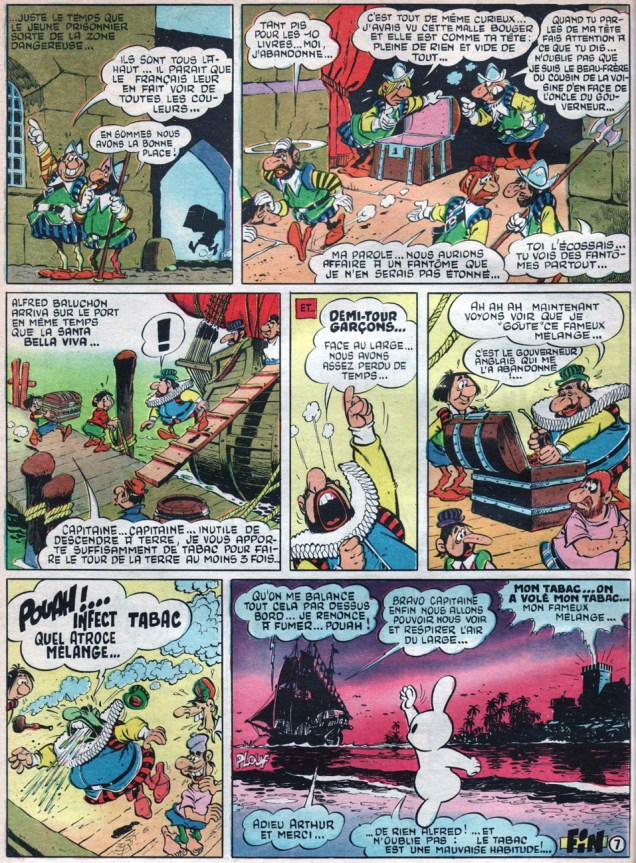
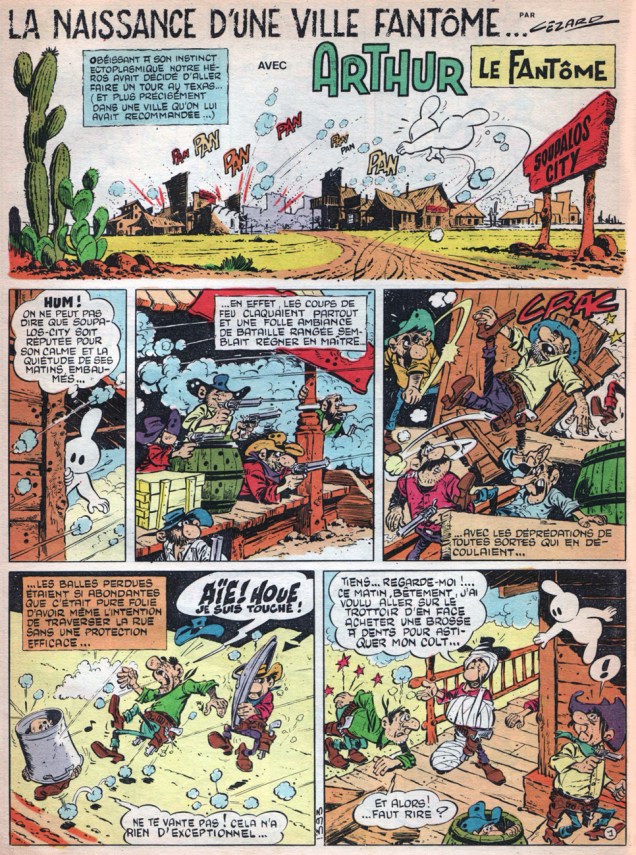
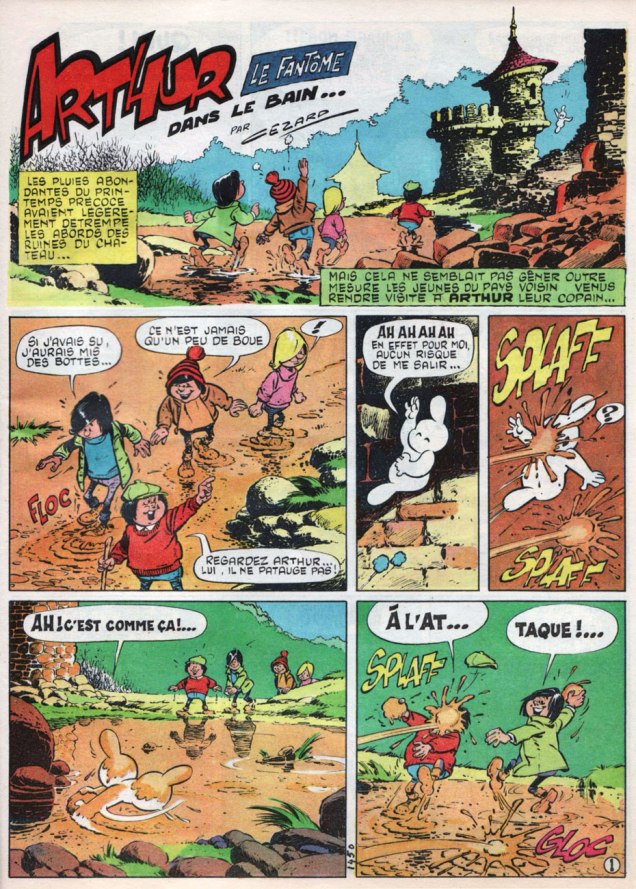
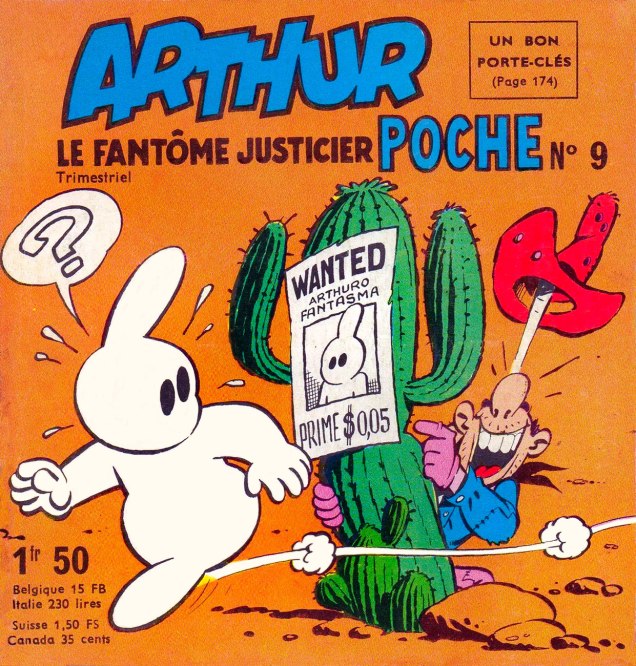
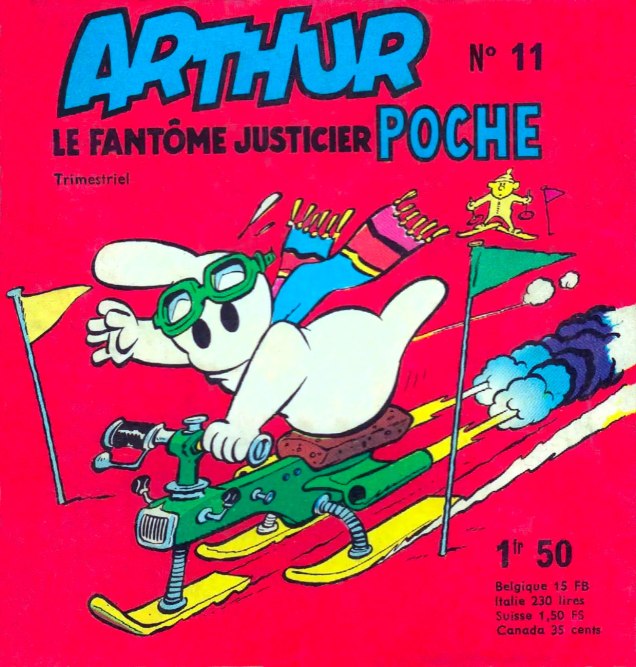
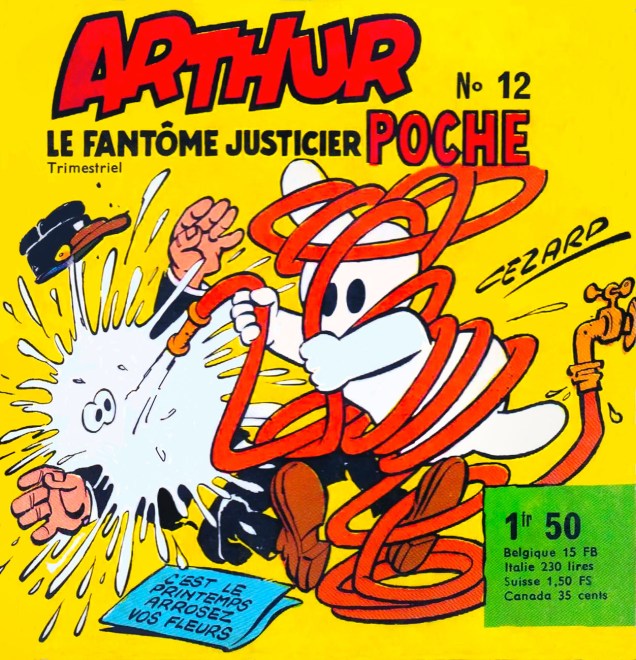
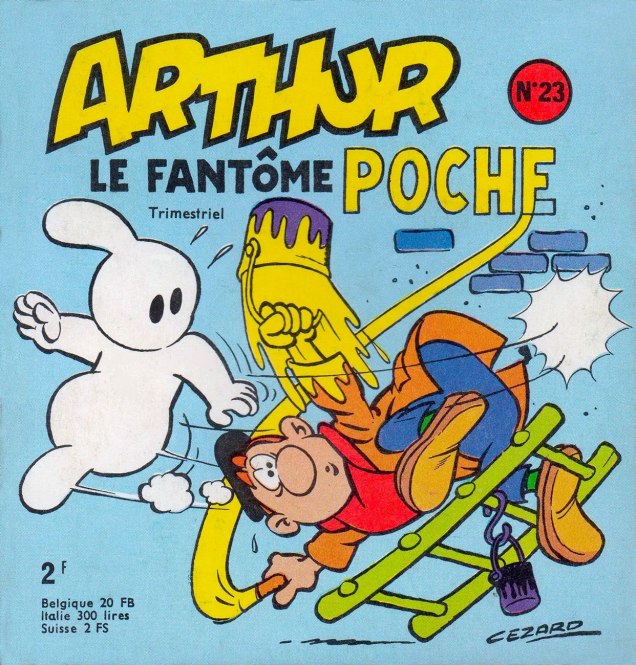
It’s all but impossible to single out an absolute favourite Cézard page, but then again, I’m not held to such arbitrary limitations. Here’s the closing page of Un fameux coup de tabac, from Pif Gadget no. 33 (i.e. Vaillant no. 1271, October, 1969) Those colours!And here we have a true splash by Jean Cézard. I wanted to showcase his astonishing aptitude for rendering castles (haunted or otherwise), not to mention complex action scenes. Arthur le fantôme et les nuisances was published in Pif Gadget no. 113 (Vaillant no. 1350, April, 1971).La naissance d’une ville fantôme (“Birth of a Ghost Town”), set of course in the American West (ah, ces Français et leur ‘Far West’) ran in issue 155 of Vaillant’s successor Pif Gadget in February, 1972.Dans le bain… (“In the Bath…”) ran in Pif Gadget no. 212 (March, 1973). By this point, at its peak, with a print run of 540,000 copies, Pif Gadget sold more than its three main competitors (Pilote, Tintin and Spirou) … combined. Then somebody got greedy, with the usual results.Should anyone wonder whether Cézard could also handle a less crowded, sparer layout, his covers for Arthur Poche should settle the issue. This is Arthur Poche no. 9 (July, 1966).While Cézard was quite a fast worker (in a given month, he could produce around 20 pages, which means, in his case, writing, pencilling, inking, lettering *and* colouring), when it came to the half-comics, half games pocket-sized quarterly Arthur Poche, he merely provided covers. The Arthur material therein was the work of Cézar-trained Michel-Paul Giroud. This is Arthur Poche no. 11 (January, 1967).This is Arthur Poche no. 12 (April, 1967).This is Arthur Poche no. 23 (January, 1970)
Les Éditions Toth, an ambitious Parisian publisher, set out to restore and reprint the works, but after five volumes (2002-2006), the enterprise seems to have stalled. However, another specialty publisher, Éditions du Taupinambour, picked up the gauntlet and published all of Cézard’s Pif Gadget Arthur stories (1969-77) in 13 volumes. That leaves, it seems, a gap of five years or so.
In closing, an anecdote about the loneliness of the long-distance cartoonist, told by Pif’s finest editor-in-chief Richard Medioni (1947-2016) in his definitive chronicle of Vaillant’s rise and fall, Mon camarade, Vaillant, Pif Gadget : l’histoire complète, 1901-1994 (2012, Vaillant Collector): « So I begin to read the episode that Jean has brought — when an author hands me his new pages, I necessarily read them in his presence, because I’m eager to read them, of course, but also out of respect for the work accomplished — and I admire it.
As I read on, Cézard comments here and there… when I laugh, he smiles. Sometimes, he points out a detail in the drawing that I missed… he never ceases to observe me and appears satisfied when I react as he had hoped.
Suddenly, it dawns upon me just how important such a session is to him. I bring up the notion and he explains:
“I spend days at my drawing table, alone, without a soul to appreciate my toil. And it’s a lot of time. No-one to give me a sense of what works and what doesn’t, what will bring a laugh and what will fall flat. So, when I come here, in seeing your response, I get that indispensable connection with my audience…” »
-RG
*Arthur, unlike, say, Casper, isn’t the shade of some dead child: his parents made him the old-fashioned way.
« It’s spring fever. That is what the name of it is. And when you’ve got it, you want—oh, you don’t quite know what it is you do want, but it just fairly makes your heart ache, you want it so! » — Mark Twain
André Montpetit (1943-2012) was a prodigiously talented québécois cartoonist and illustrator who, after wowing the public and his peers in the late 1960s and early 1970s, essentially turned on his heels and walked away from it all. Was it fear of success, fear of failure, self-loathing, self-respect or something else that prompted his slow fade? Hard to tell.
In the meantime, here’s a seasonally sardonic piece he produced in 1971. It saw print in the March 20, 1971 issue of Perspectives, a supplement bundled with each Saturday edition of Québec’s Le Soleil daily newspaper from 1959 to 1982.
The sun appears… the birds return… the flowers grow back… the beasts awaken… the city has an air of joy… it’s the season of love. « Let us go contemplate the marvels of nature! »« Oh, the beautiful pigeon! » « Oh, such a pretty flower! » « Oh! A small, limpid puddle! » « I’ve had enough! I’m going home!!! » « You’re right. It’s going to rain! » IN GENERAL, PEOPLE WATCH THE SPRING ON TELEVISION. IT’S LESS DANGEROUS.
In recent years, writer-director Saël Lacroix endeavoured to put together a documentary to assemble and organize the known facts and to fill in some of the blanks of Montpetit’s troubled career and existence. The result, Sur les traces d’Arthur (aka Tracing Arthur) was released in 2016. Watch the trailer here.
The world of tentacles is colourful and varied – and very much multi-lingual. For those of our readers who have no access to comics in French (or any idea where to start looking for them), we present this gallery of Gallic comics. For an earlier peek into ze tentacules, visit part I – Tentacle Tuesday: The Franco-Belgian Edition. In case you’re wondering what the heck are Franco-Belgian comics, An Introduction to Franco-Belgian Comics gives a good overview.
Sans plus tarder…
What a glorious scene! In this dream sequence, Philippe Caza’s protagonist (clearly a stand-in for himself) battles an octopus that wanted an easy meal and suffered the consequences. This story is called Épaves, which translates in much-more-prosaic-in-English to “shipwrecks”. It was part of Caza’s Scènes de la vie de banlieue cycle, published between 1975 to 1979. Visit Philippe Caza’s Surreal Suburbia for more information.
Caza draws tentacles often and with pleasure. You can keep your Moebius.
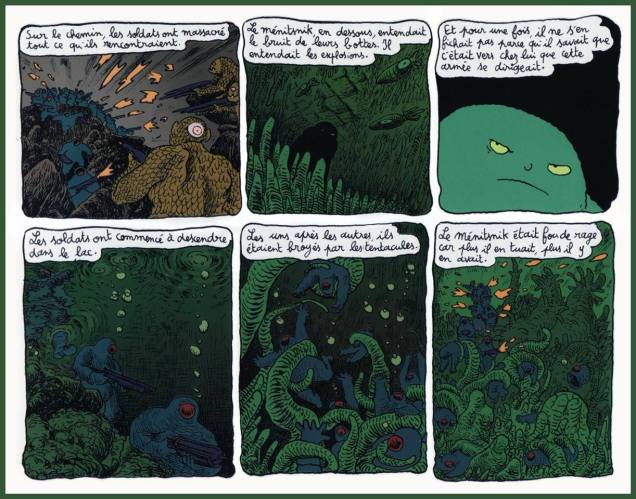
Going into slightly less obscure waters, we have a page from Joann Sfar‘s « Petit vampire» series, its 7 volumes published between 1999 and 2005. I deem it somewhat less obscure because part of it has actually been published in English, and that’s how success is measured these days, right? Only the first 3 volumes of Little Vampire have been translated, but that’s better than nothing. In France, Petit vampire is pretty popular, so much so that it has been made into an animated series.
The following page hails from Volume 4: Petit vampire et la maison qui avait l’air normale, or Little Vampire and the House That Seemed Normal, published by Delcourt in 2002.
Here’s a rough translation of the text: « On the road, the soldiers had slaughtered everything they encountered. The Menitsnik, below, was hearing the sound of their boots. He was hearing the explosions. And for once, he wasn’t indifferent, for he knew that this army was heading towards his home. The soldiers began to descend into the lake. One by one, they were crushed by the tentacles. The Menitsnik was crazed with anger because the more soldiers he killed, the more there were to kill. »
Speaking of Sfar, I’ll mosey along to the Donjon series (Dungeon in English), created by Sfar and Lewis Trondheim. The latter is another not-to-be-missed artist on the Franco-Belgian comics scene, at the very least because he’s one of the founders of L’Association. To explain:
« L’Association is a French publishing house which publishes comic books. It was founded in May 1990 by Jean-Christophe Menu, Lewis Trondheim, David B., Mattt Konture, Patrice Killoffer, Stanislas, and Mokeït. L’Association is one of the most important publishers to come out of the new wave of Franco-Belgian comics in the 1990s, and remains highly regarded, having won numerous awards at the Angoulême International Comics Festival. They were among the first to publish authors such as Joann Sfar and Marjane Satrapi, and also are known for publishing French translations of the work of North American cartoonists like Julie Doucet and Jim Woodring. »|source|
Excerpt from Donjon Zénith: Cœur de canard (Delcourt, 1998), written by Sfar and Lewis Trondheim and illustrated by Trondheim.
I only stumbled upon Donjon, a sort of tongue-in-cheek parody of role-playing games, recently. It has a sprawling structure consisting of 5 sub-divisions into stories tied by a common theme – originally the authors were aiming to release 300 volumes (with the help of many contributing artists floating around L’Association), with 36 volumes published so far. It’s more than a handful for someone who’s just starting to read the stuff… but the world is compelling, with a rich array of appealing (if flawed) characters and a complex mythology. It may technically be a parody, but the stories are poignant and imaginative, the language is delightfully playful. Some of the themes are surprisingly dark… this is far from being another dumb Dungeons and Dragons spoof.
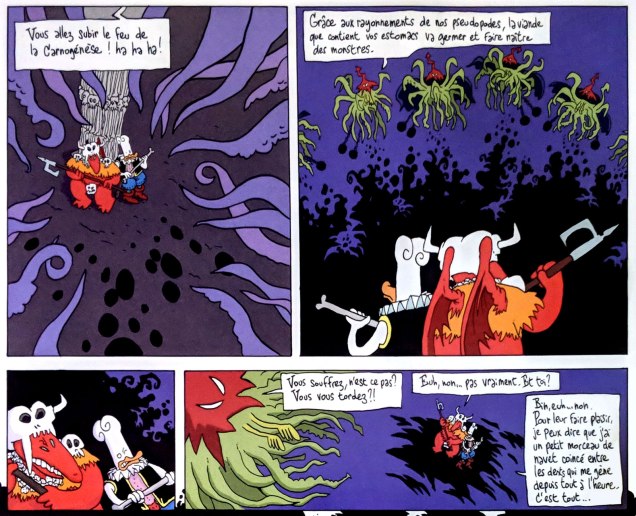
Page from Donjon Zénith: Coeur de canard (Delcourt, 1998), written by Sfar and Lewis Trondheim and illustrated by Trondheim. This volume is full to the gills with tentacles, thanks to the Cthulhian overlords (in pointy red hats) who want to take over the Dungeon.
« I am Octo! The chicken-octopus ninja!!»
Panel from Donjon: La Princesse des barbares (Delcourt, 2000), written by Sfar and Lewis Trondheim and illustrated by Trondheim.
Our last entry is from Valérian and Laureline, the stunningly influential French comics series created by writer Pierre Christin and artist Jean-Claude Mézières that director Luc Besson besmirched, besmeared and befouled. It can also be noted that a variety of movies “borrowed” from V & L’s rich science-fiction lore, most notably the Star Wars franchise. Should I be happy that more people now know about this series now that a shitty movie “based” on it came out? Nope, sorry. Besson claims to have fallen in love with Valérian et Laureline when he was 8 years old, but with Valerian and the City of a Thousand Planets he demonstrated quite thoroughly that he doesn’t understand the characters in the slightest and is only capable of seeing science-fiction through the lens of chintzy special effects designed to wow idiots.
To which I’ll add that Valérian kind of transcends the science-fiction genre – or perhaps I should say that it’s science-fiction as it was originally meant to be, as an exploration of the possibilities of external and internal worlds. (Technologically upgraded cowboys shooting each other with laser guns in primitive, shallow battles between good and evil? We’ll leave that to crappy movie directors, thanks.) Its plots are elaborate (but they never defy their own internal logic), its characters complex but immensely likable.
In 2007, the series got renamed Valérian and Laureline for its 40th birthday, and I’m glad they renamed it, as Laureline is an integral part of both its appeal and its popularity. She’s every bit as intelligent and determined as her companion, and is certainly no maiden in distress, often sizing situations up quicker than Valérian and subsequently pointing him in the right direction.
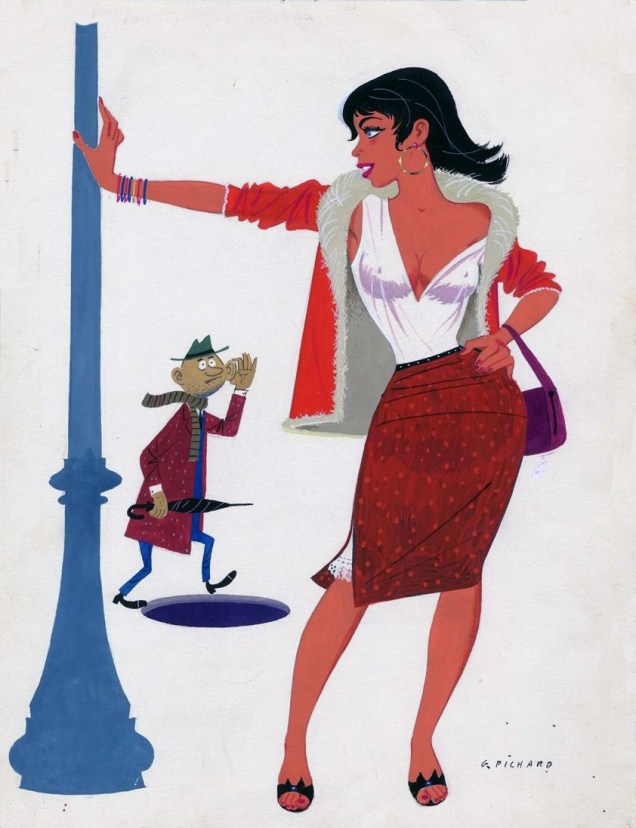
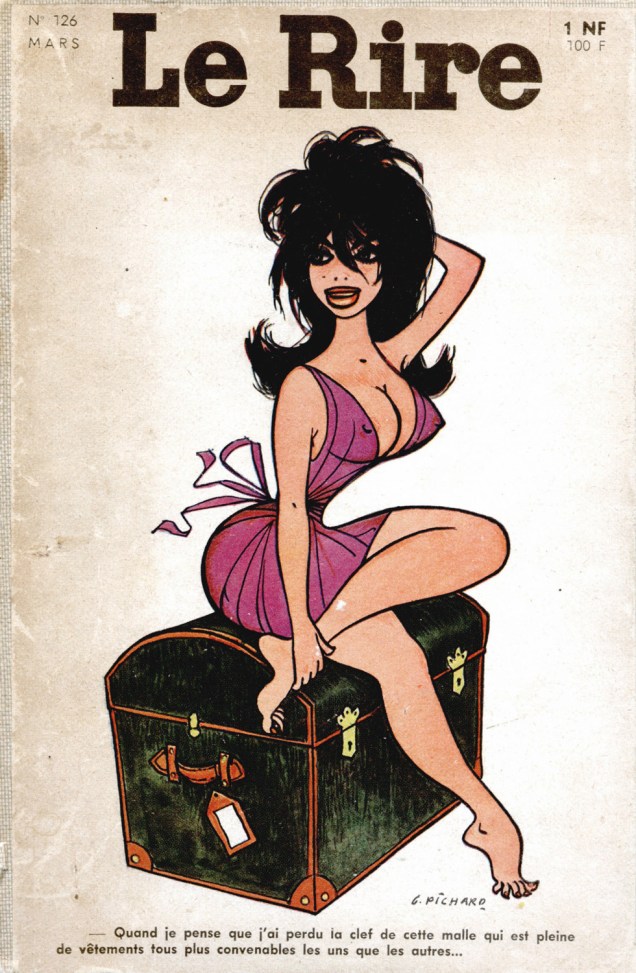
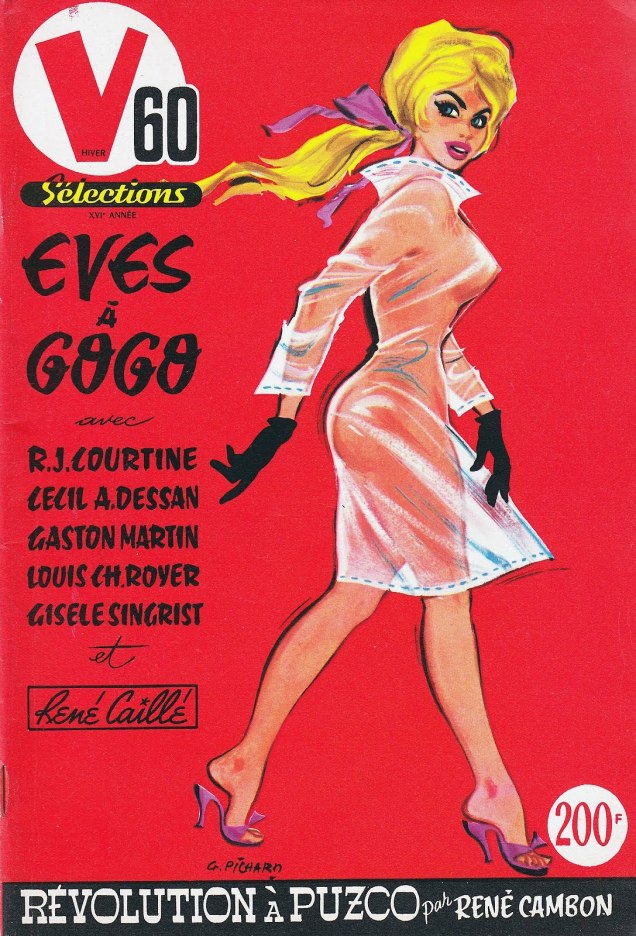
In 1946, Georges Pichard (not sure who he is? Visit our Pichard’s Distressing Damsels for an overview of his later work), heretofore toiling in a marketing agency, started his career as an illustrator. He worked for various French magazines and newspapers (like Le Rire, Fou-Rire and Les Veillées des Chaumières), providing them with covers, cartoons and pin-ups in black-and-white or gorgeous watercolour until the mid 70s, when he switched gears somewhat and dedicated himself to erotic bandes dessinées.
I left image imperfections (due mostly to yellowing of paper over time) and hand-written captions (when available) as is, as I find they provide pleasant texture and context. The jokes are really lame, but we translated them, anyway.
The following three cartoons were published in Le Rire. This first one saw print on the cover of Le Rireno. 22 (nouvelle série, July 1953).
This one was featured on the cover of Le Rireno. 66 (nouvelle série, March 1957).
« I’m the sort of guy who’s kind of like an iceberg, the main part is beneath the surface. » The man in question looks very much like a V.I.P. type.
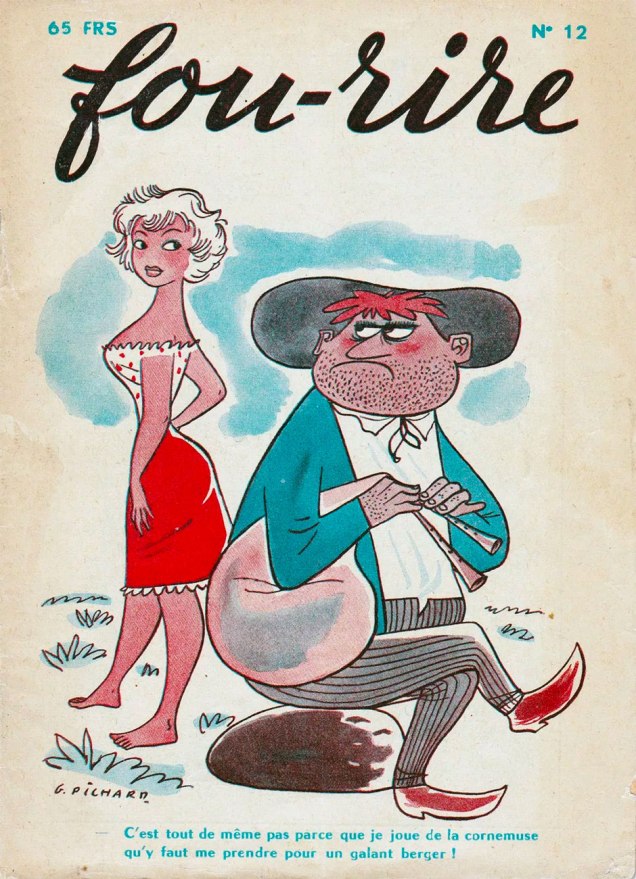
The following are all from Fou-rire:
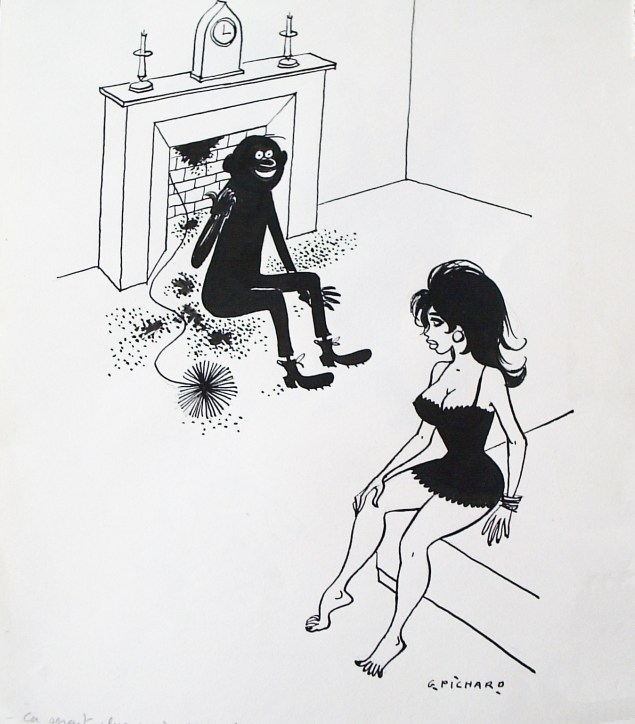
Cover of Fou-rire n°12, mid-50s. « It’s not because I’m playing the bagpipes that you have to take me for a gallant shepherd! »Cartoon from Fou-Rire n° 76, early 60s. « Please be assured, my dear friend, that we are all here quite touched by your wife’s endeavours to set a mood… ».Cartoon from Fou-Rire n° 118, early 60s. « It would be prudent to seal up your chimney, because when I tell the boss about this… »Fou-Rire n° 118, mid 60s. « And to think that I’ve mislaid the key to this chest full of outfits, each more decent than the last… »
Finally, a couple of pretty loose ends:
Original art from Le Rire magazine, 1960s. « But the funniest part happened before I ran into the police officer! »Early 60s.
« Followers in death: Attendants and relatives who were killed so they could be buried in the tomb with the person (normally someone very important or wealthy) who had died. » — The British Museum
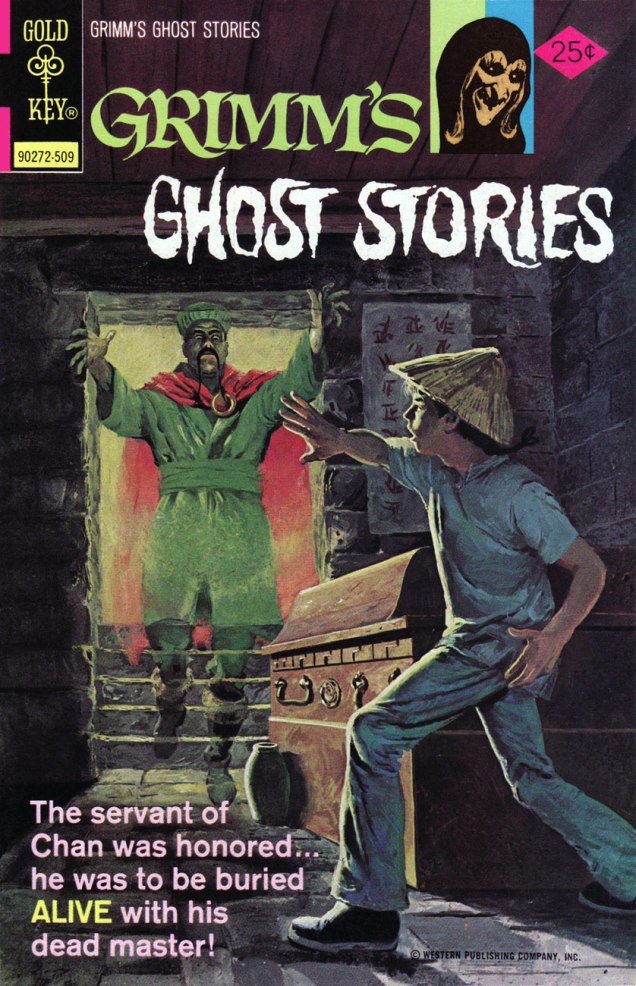
Let’s face it, Gold Key’s would-be-spooky comics rarely lived up to their habitually fine painted covers (mostly courtesy of hard-working George Wilson, with Vic Prezio, Luis Domínguez, Jesse Santos or Jack Sparling occasionally chipping in); as with most things, there were exceptions: I’ve raved earlier about a particular issue of the generally ho-hum Grimm’s Ghost Stories, namely issue 26, boasting, along with the usual Paul S. Newman sleep aids, two excellent yarns from the undervalued Arnold Drake (co-creator of The Doom Patrol, Deadman, and the original Guardians of the Galaxy).
Ah, but today, we’re celebrating Drake’s co-conspirator, the prolific Argentine master (yes, another one) Luis Ángel Domínguez, reportedly born ninety-five years ago to the day (Dec. 5, 1923), and still among the living… as far as we know. I like to envision him warmly surrounded by several generations of loved ones and well-wishers, an impish gleam in his eye.
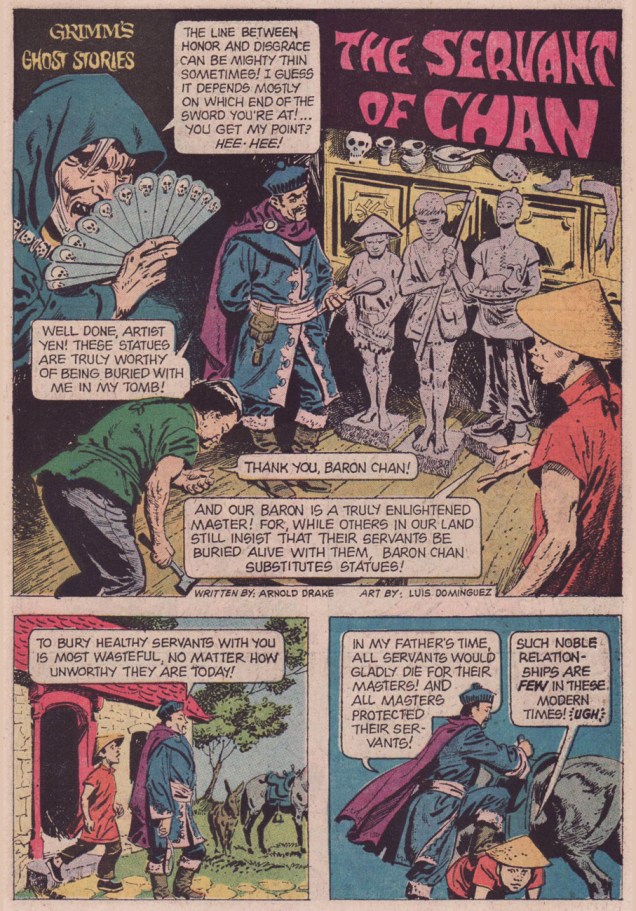
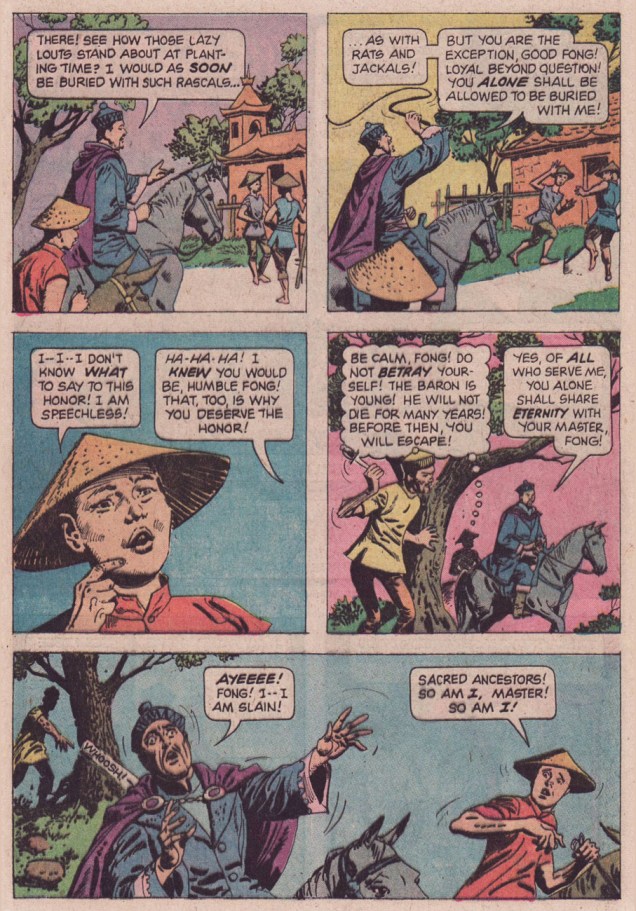
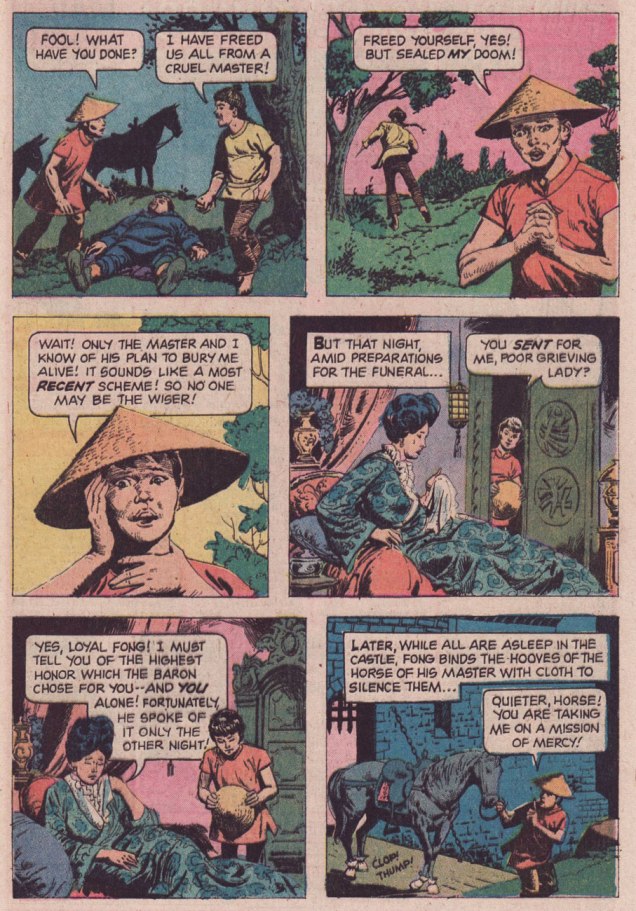
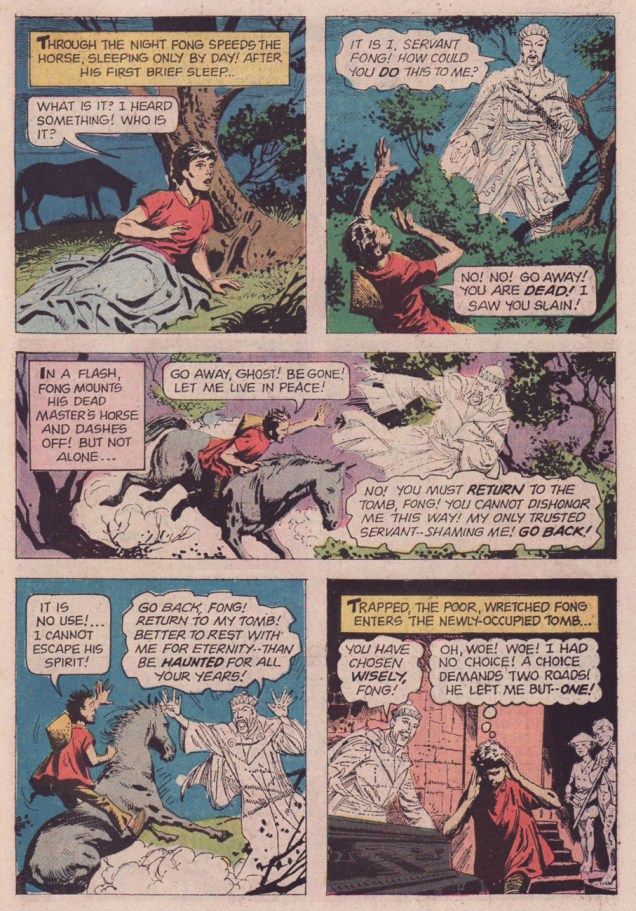
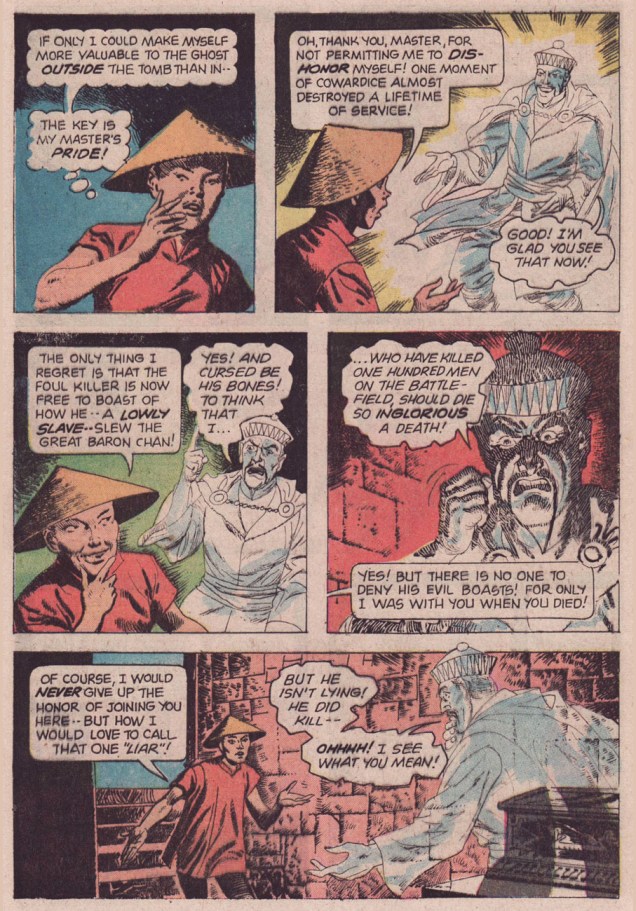
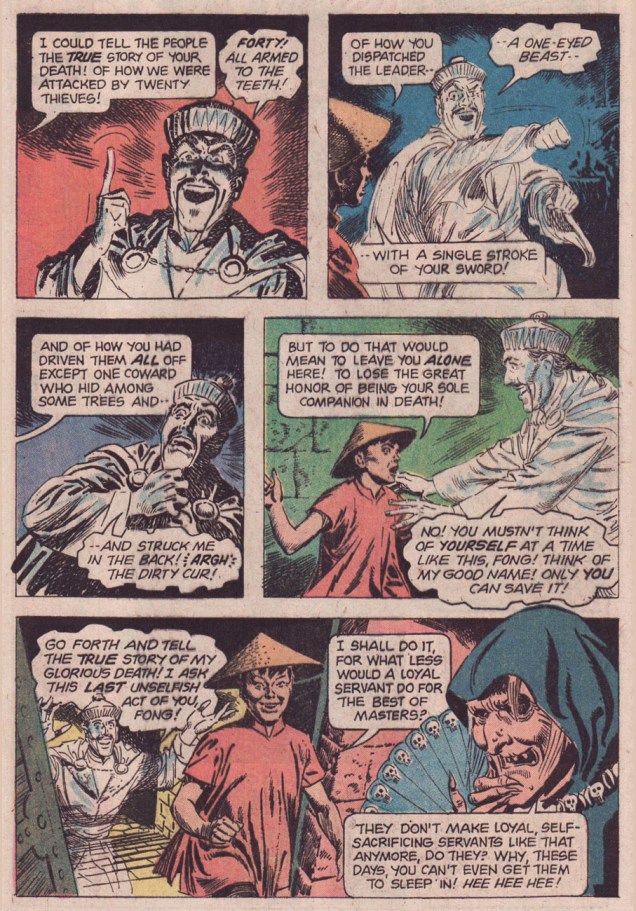
Without further foot-dragging, here’s a vintage tale of quick wits in ruling class hubris from beyond the grave, The Servant of Chan, by that dastardly duo, Drake and Domínguez.
George Wilson’s cover highlights a dramatic scene from our little story. This is Grimm’s Ghost Stories no. 26 (Sept. 1975, Gold Key).
« Slavery in ancient China was not a pleasant experience. The lives of slaves were filled with hardship. Many were abused. Many slaves were children.
Most people who were slaves worked in the fields, alongside of peasants. They did the same job, and had the same hours, and pretty much the same clothing and food, as free farmers. But they were not treated with the same respect given to farmers. Some slaves built roads. Some worked in government.
But slaves who worked for the emperor, the royal family, and sometimes the nobles, had the worst of it. They could only do what they were told to do. They were treated in any way that their master and his family felt like treating them. Many were treated with great cruelty. When their master died, they were killed, and buried with their master in his tomb, so they could continue to serve their master after his death. »
Brr. All the same, if you’ve enjoyed this yarn, check out Arnold Drake’s other contribution to this issue, The Anti-13, which we enthusiastically featured some time ago.
¡Feliz cumpleaños, Señor Domínguez… wherever you may be!
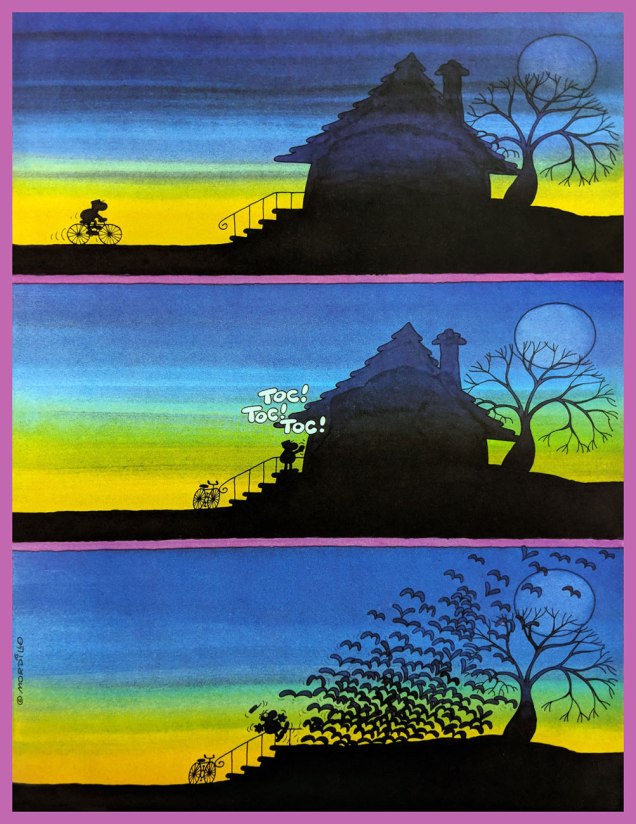
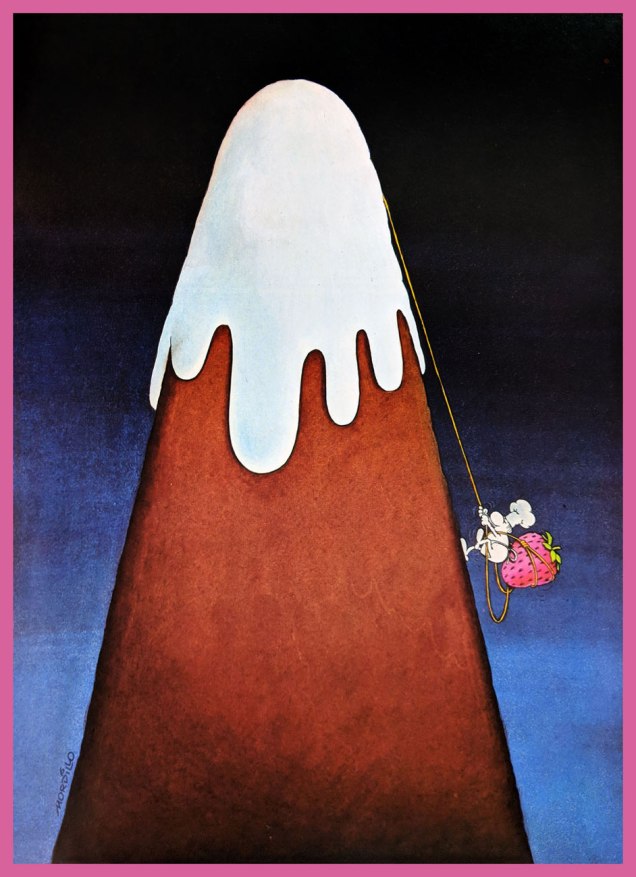
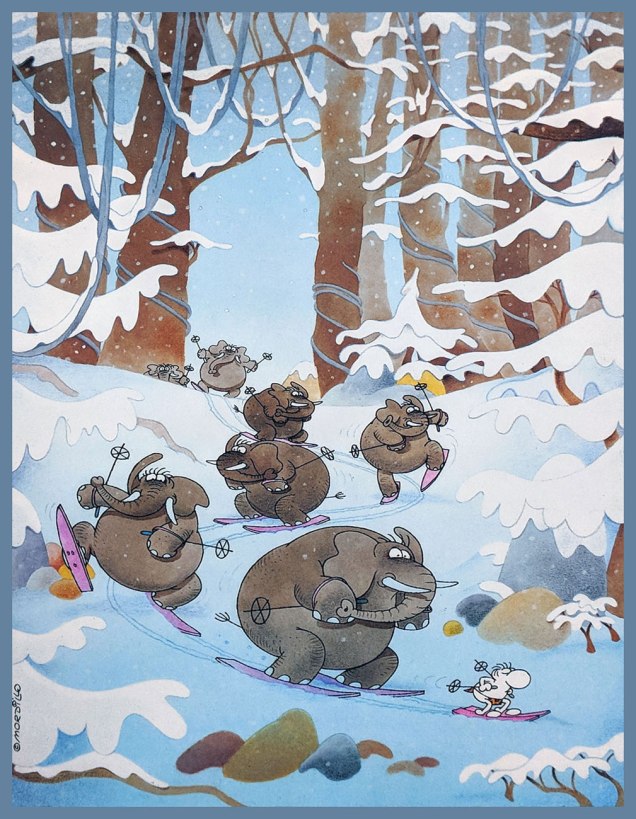
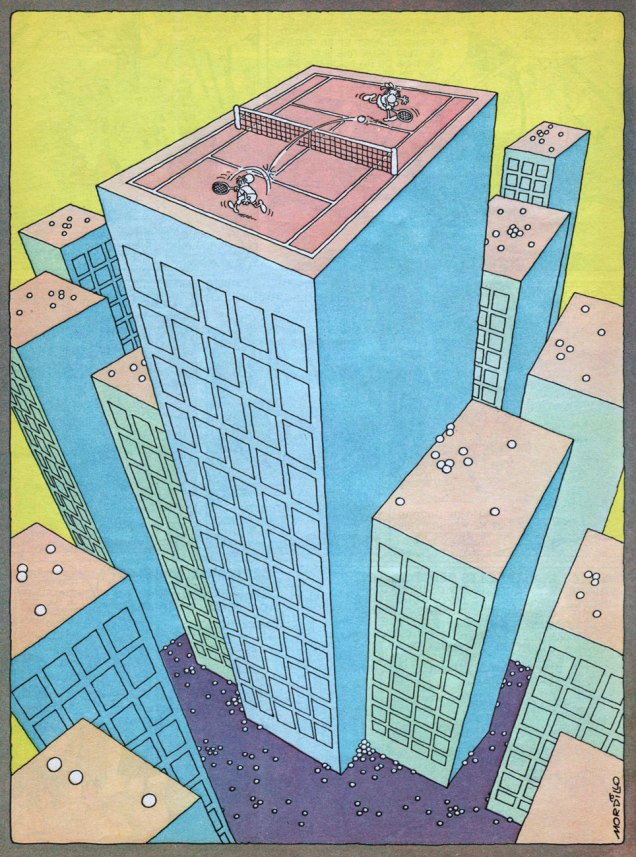
Guillermo Mordillo (1932 – 2019), known simply as Mordillo, was an Argentine artist of Spanish parentage. Through his long and productive career, he released more comic albums than you could shake a stick at… and at 86, was still active in the comics field. His easily recognizable style, love of bright colours and oft-surreal humour make his work memorable despite his persistent profligacy.
It would be impossible to provide an overview of his body of work in one post, but it is my pleasure to furnish a fun sampling of his œuvre. Most images below have been gleaned from Opus 5 (Glénat, 1984) and Safari (Glénat, 1990), unless indicated otherwise.
The following two images were scanned from early 1970s issues of Pif Gadget.
In the mid-70s, Mordillo’s cartoons were used by Slovenian artist Miki Muster to create Mordillo, a series of cartoon animations that ended up being 400 “episodes” long (for a total of 300 minutes – each episode is under a minute). These droll snippets were broadcast in over 30 countries between 1976 and 1981. Should you have a few minutes to spare for a chuckle or two, have a look at this video (recorded by somebody in Germany on VHS tape in the 90s and, many years later, uploaded to Youtube – what lovely, contorted pathways some of these things take).
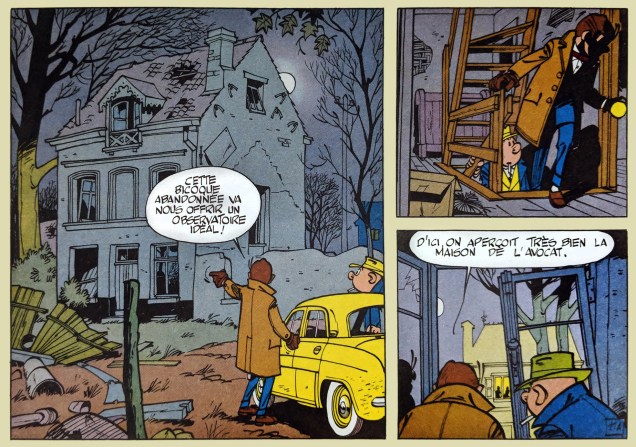
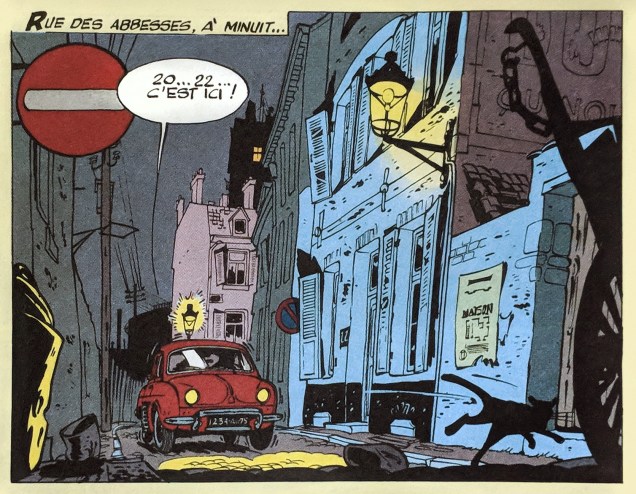
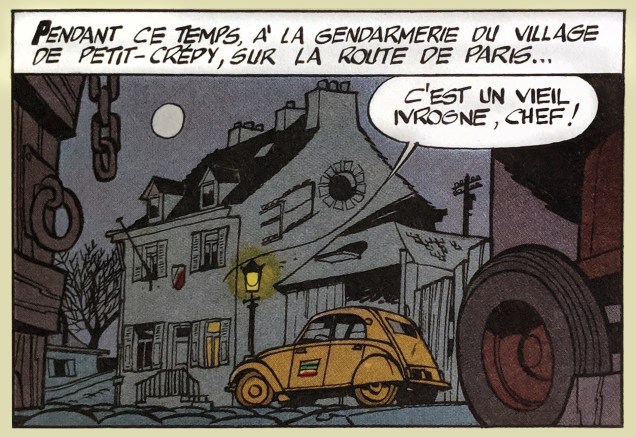
« Plenty of nocturnal ambiance in this book… It stems, I suppose, from an old childhood reminiscence. When I was little, gaslit street lamps were still around, and they created, in the evening, rather extraordinary effects of light. That slightly sinister element stuck with me, and I love to recreate this sort of thing. » – Maurice Tillieux
Private detective Gil Jourdan finds the proper spot from which to conduct a nocturnal stakeout, in his fourth (and possibly finest) investigation, « Les cargos du crépuscule », originally serialized weekly in issues 1113 to 1137 of Spirou magazine, back in 1959-60.
Story and art by Maurice Tillieux (1921-1978), one of the truly great European masters of…well, everything he handled: humour, atmosphere, pacing, local colour, dialogue...
Ah, but this time, non-French-fluent readers won’t be left out in the cold. The late Fantagraphics co-publisher Kim Thompson was a lifelong fan of Tillieux’s work, and was quite willing to put words into action and bleed some money in the process. Before his passing in 2013, he had time to publish a pair of twofer volumes of Jourdan (slightly renamed Gil Jordan*) adventures, « Murder by High Tide » (which contains this tale, entitled here « Leap of Faith ») and « Ten Thousand Years in Hell ». Fans of clever and suspenseful noir should not miss these babies.
Fudging a bit here, this is a panel from « La voiture immergée », aka « Murder by High Tide ». Please forgive this old sinner.
This being a Hallowe’en post, I’ve squarely put the emphasis on mood rather than action, but let me assure you that these bédés contain plenty of action, and of the highest calibre. Fantagraphics’ promotional blurb gets it right (except that the Hergé comparison is perhaps a bit lazy, but probably necessary given the audience): « Another never-before-translated classic from the Golden Age of Franco-Belgian comics, finally brought to American readers. Imagine the beautifully crisp images of Hergé (Tintin) put in service of a series of wise-cracking, fast-paced detective stories punctuated with scenes of spectacular vehicular mayhem (including in this volume a dockside pursuit via car and bulldozer) and you’ll see why 50 years later Gil Jordan is still considered a masterpiece in Europe. »
– RG
*I can’t help but think that the detective’s renaming to « Gil Jordan » was a bit of a Fantagraphics inside joke, given that the publisher employed, for a couple of decades or so, a news correspondent/translator/editor by the name of… Gil Jordan. It’s not as if « Jourdan » is such an unknown name to Americans.
« In medical practice it is inevitable to observe the details. »
– Dr. Joseph Bell
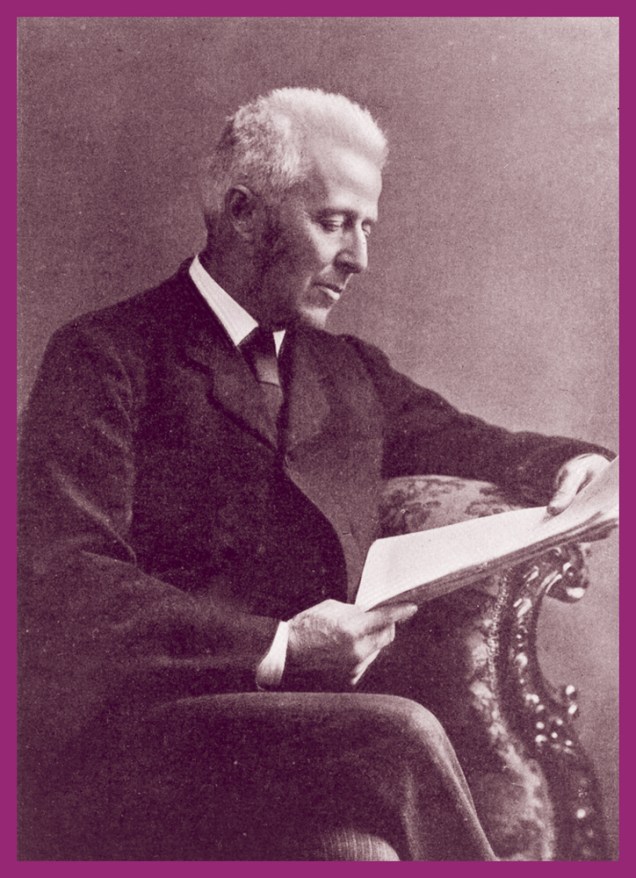
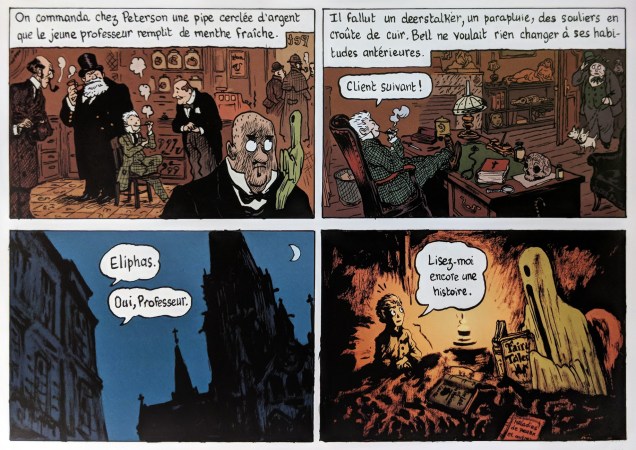
From France, then, we have the now-whimsical, now-terrifying exploits of Professeur Bell, somewhat loosely based on Joseph Bell, a lecturer at the medical school of the University of Edinburgh, who was Arthur Conan Doyle‘s teacher and the alleged real-life inspiration for Sherlock Holmes.
The good (actual) Dr. Bell. He’s only pretending to read.
Joan Sfar wrote and drew the first two entries in the series, but struggled to achieve the more realistic and detailed style he’d set for himself. With the third volume, he was joined by the skillful and versatile Hervé Tanquerelle, who handled the art chores from then on. A smooth transition.
Sfar has been invoking a marvellously complex and nefarious universe surrounding a « hero » with an increasingly slippery grasp on morality and reality. Heck, even Frank Belknap Long‘s Hounds of Tindalos got a surprise look-in. Recommended.
Published so far in French, Italian, German and Polish…
« L’Irlande à bicyclette » is the fifth and latest in the series, published in 2006. Ahem, fellas… it’s been *quite* a while. La suite, s’il vous plaît?
Intrigued, as you should be (you do have a pulse, right?)… care for a few furtive glances between the covers?
I’m not going to waste my breath trying to explain. Just dig that mood.
« But dreams come through stone walls, light up dark rooms, or darken light ones, and their persons make their exits and their entrances as they please, and laugh at locksmiths. » ― Sheridan Le Fanu, Carmilla
This splendid piece comes from the pen of legendary Belfast (Ireland, of course, Eire for you purists) artist Rowel Friers (1920-1998). I unearthed it from a lovely volume ambitiously, but not unjustifiably, titled Best Cartoons from Abroad – 1955, edited by Lawrence Lariar and Ben Roth (Crown Publishers, 1955). It first saw print in Dublin Opinion, a monthly Irish satirical magazine (1922-1968). DI was founded by a pair of cartoonists, Arthur Booth and Charles E. Kelly, and a writer, Thomas J. Collins.
As Hallowe’en is Celtic in origin, it stands to reason that we salute the vital Irish contribution to this most awesome of holidays. For those needing a little refresher, here’s a most helpful précis on the subject, from irelandeye.com:
« Hallowe’en is a remnant of Ireland’s pagan, Celtic past. Samhain was an important Celtic feast celebrated on the last day of October, marking the beginning of winter and the New Year. This fire festival was celebrated at night with ritual sacrifice by the druids of animals. The Celts feasted on the fruits and harvests of the autumn. Ireland’s conversion to Christianity absorbed this Celtic festival and established two significant feast days, All Saints’ Day on 1 November and All Souls’ Day on 2 November. Ireland has always had a special reverence for the dead. Even into the twentieth century, many people in rural Ireland believed that dead family members returned to the fireside on All Souls’ Night. Families went to bed before midnight and left the fire lit. Chairs were arranged around the fireside for the dead family members who returned to the house. »
Another Friers piece published in 1955 in Dublin Opinion. I can vouch for it, Ireland is as green as it gets, but its landscape is also undeniably steeped in soulful melancholy, and I can also attest to that.
« Why do four skeletons and a coffin cross a small fishing village? The question has been asked! »
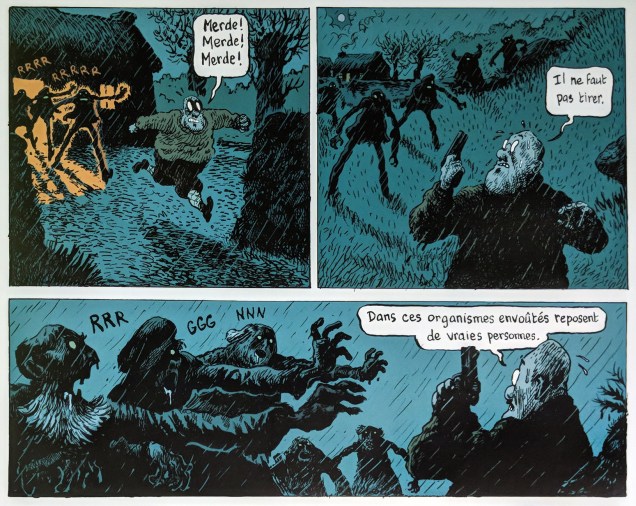
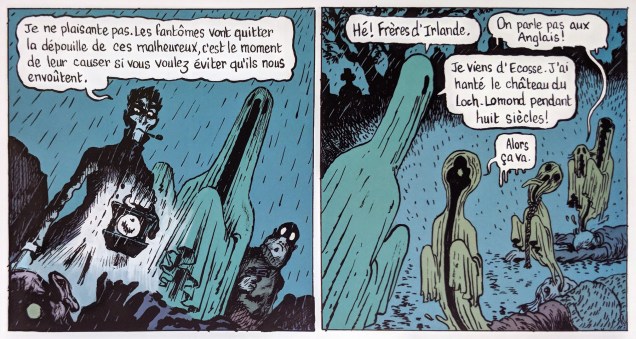
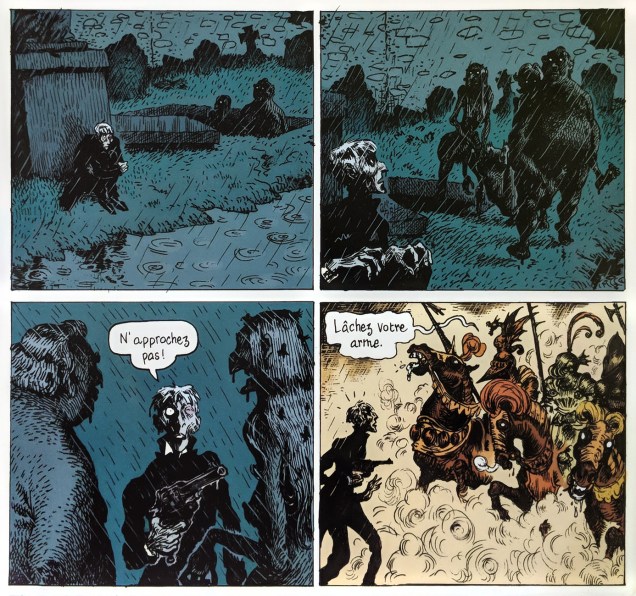
How’s this for setting the mood? Here’s a quintet of panels from Belgians Maurice Tillieux (script) and Willy Maltaite (aka Will, pencils and inks) gently ripped from the exploits of Tif et Tondu, a series that ran in the weekly bandes dessinées magazine Spirou from 1938 to 1997.
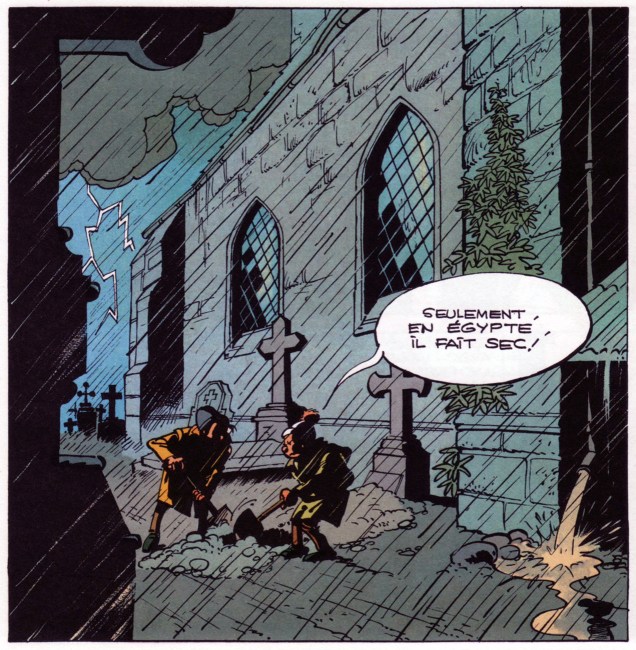
This standalone illustration originally saw print on the cover of Spirou no. 1789, in 1972. Incidentally, the guy on the left is just a passing acquaintance, a soap salesman who also found himself stranded in Brittany, some foggy night.« In Egypt, at least it’s dry! »« There’s still a cottage beyond the old castle. Let’s give it our last shot. » « Talk about a nest for ghosts. He’s straight out of a Perrault fairy tale, that one. »
These three come from the Les Ressuscités (‘The Resurrected”), Tif et Tondu’s 54th adventure overall, but no.20 in the album series), as only the post-1954 stories (when the series’ tone gained some gravitas, as well as its first significant scripter in Rosy) are considered, shall we say… canonical.
Panels from Le retour de la bête (“Return of the Beast”), serialized in issues 1988 to 1999 of Spirou magazine in 1976, sort-of sequel to 1971’s Sorti des abîmes (“Out of the Abyss”).
This is drawn from the 59th Tif et Tondu story (but no.25 in the collection). We’ve already been introduced to the Beast in question, as well as to Tif et Tondu, one misty Tentacle Tuesday last October.
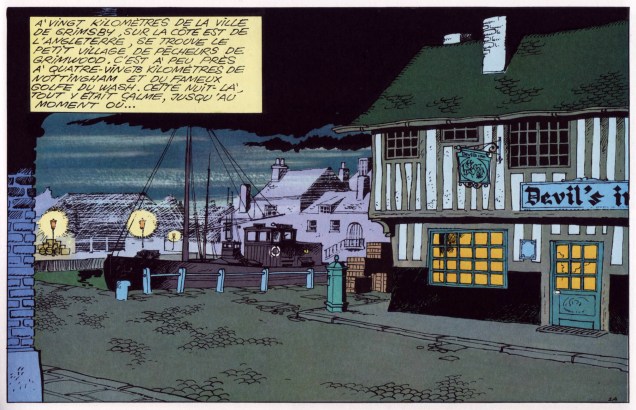
Regrettably, nothing supernatural occurs, but talk about atmosphere! The series does veer into some pretty dark science-fiction at times, especially under Tillieux’s watch (1968-1978, his death).
The mysterious events are set in the fictive village of Grimwood, near the actual town of Grimsby, which is dear, perhaps sarcastically, to Sir Elton John.






















 Who's Out There?