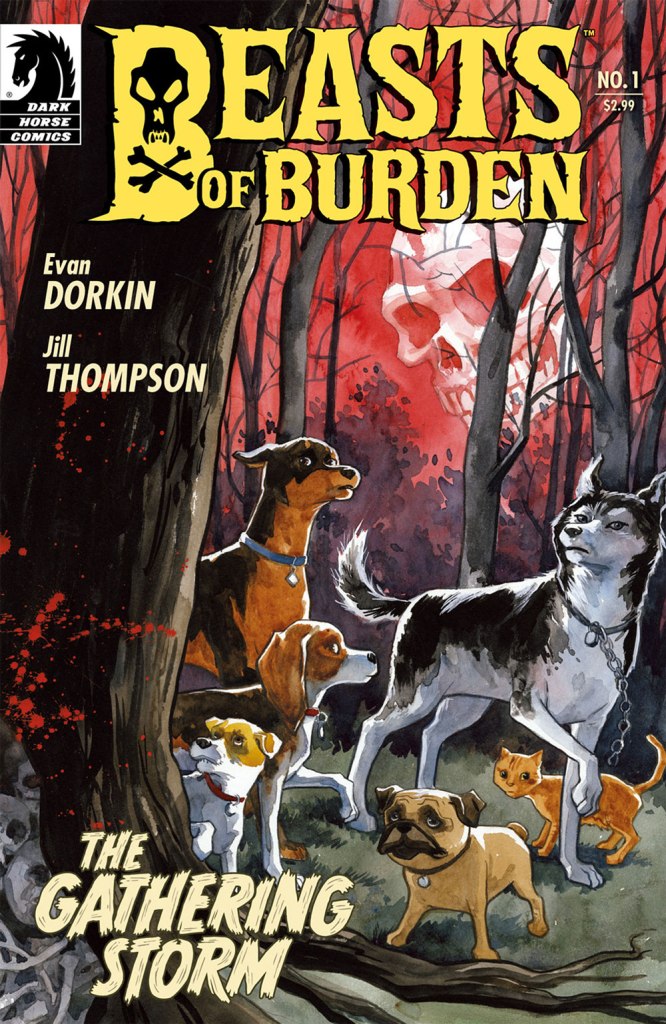
Our heatwave is nowhere as bad as the one afflicting Europe right now, but it’s a heatwave nevertheless, and to cool off I felt like traipsing down the icy corridors of horror. Evan Dorkin‘s series Beasts of Burden, the tale of a (predominantly) canine crew who fight the supernatural to keep their small town community safe, fits the bill: though including elements of adventure, mystery, and humour, it’s genuinely tense in places (and features enough blood and grue to keep the average gorehound satisfied). One expects a comic in which all protagonists are animals to evoke baby-talk sounds of endearment, not send chills down the spine of the more sensitive reader, and yet…
Beasts of Burden no. 1 (September 2009), cover by Jill Thompson.
However, I’ll warn you that a fondness for animals is a prerequisite for enjoying this comic, lest you miss the emotional punch to the gut of moments like a dog searching for her lost puppies, or animals mourning the loss of their friend. Despite the paranormal threats these pooches (and cat!) have to deal with, I would say that it’s that emotional horror that makes these stories memorable, especially to a modern reader well-versed in zombies, werewolves, and witchcraft (yawn, how cliché…) I am quite allergic to animals getting hurt in stories, but Beasts of Burden never feels manipulative in that regard: shit definitely happens, but is overcome through teamwork and courage.
This comic also features loving watercolours by Jill Thompson (according to the DC Comics website, ‘most well-known female comic book artist‘… not sure how they measured that), who’s not only great at evocative woodsy landscapes in all seasons, but also a deft hand at convincing portraits of animals. I have seen too many comic artists who cannot draw a convincing cat or dog (let alone a horse, a true test of artistry…) to take that for granted. This post only spotlights material from the collection Beasts of Burden: Animal Rites (2010, Dark Horse), as Thompson was later on replaced by Benjamin Dewey, whose art I suppose I could bear… if only the standard desaturated colouring job wasn’t the final nail in that coffin. It’s a bitter pill to swallow after Thompson’s bright, organic art.
All stories featured in this post are written by Evan Dorkin and illustrated by Jill Thompson.
A page from Stray, published in Dark Horse Book of Hauntings (August, 2003). This was the first Beasts of Burden story to be published; the characters got more fleshed out, both in writing and in art, later on.
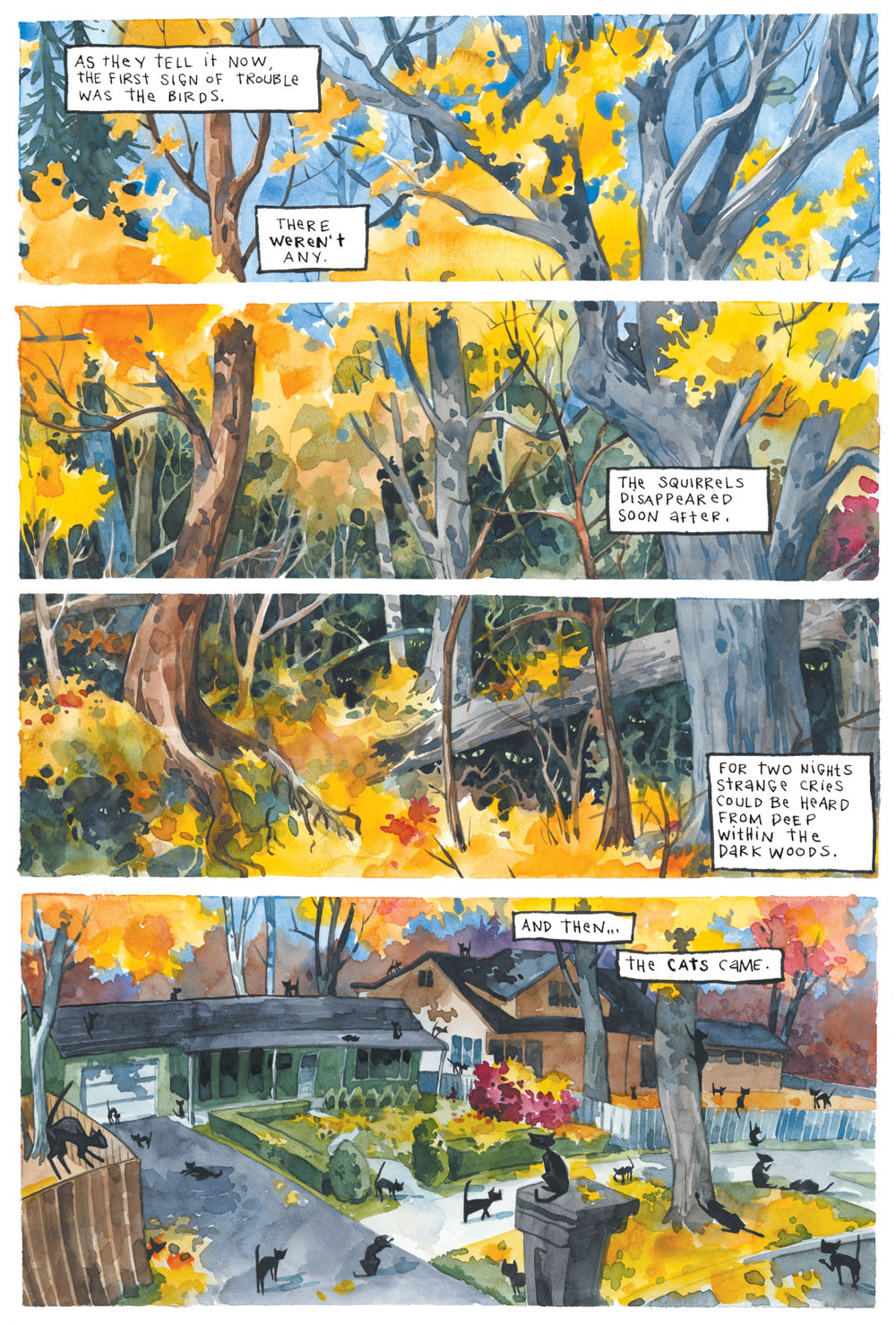
Page from The Unfamiliar, published in The Dark Horse Book of Witchcraft (July 2004). My favourite season is fall, so I couldn’t resist featuring a page of autumnal-blaze trees and black cats.
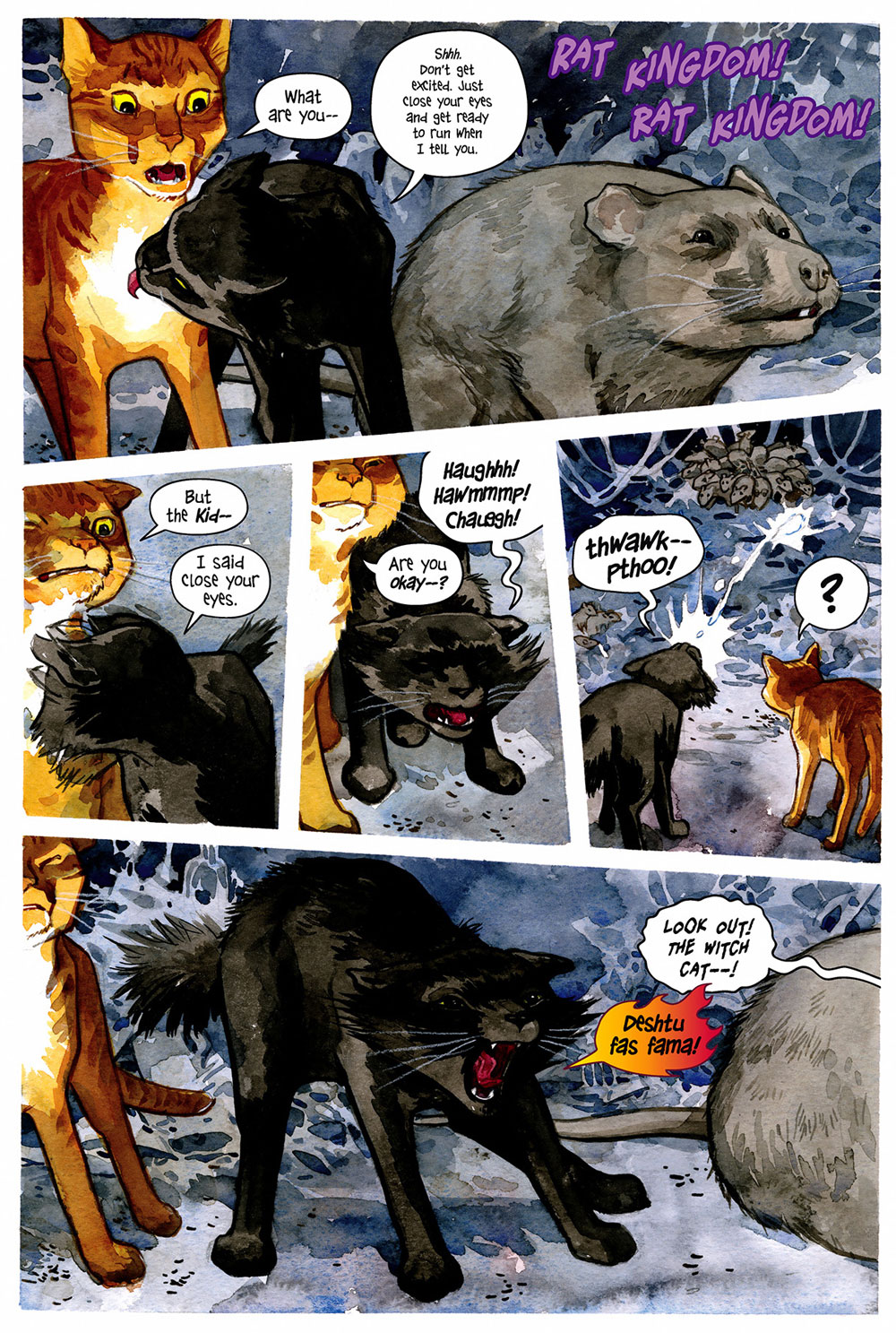
Another page from The Unfamiliar, published in The Dark Horse Book of Witchcraft (July 2004). The normally orange Orphan (who needs a better name, but at least he gets called ‘Orph’ a lot later on) gets dyed black as a subterfuge. This story is pretty goofy (two witches come to town to summon Sekhmet), and my least favourite of the early batch, but at least it has a lot of black cats.
Pages from Let Sleeping Dogs Lie, published in The Dark Horse Book of the Dead (June, 2005), in which Daphne (the black witch cat, who later becomes a part of the regular cast) returns with revenge on her mind.
Page from A Dog and His Boy, published in The Dark Horse Book of Monsters(December 2006).
Page from The Gathering Storm, published in Beasts of Burden no. 1 (September 2009), the moment at which this became an official series, as opposed to a series of one-shot stories. The whole ‘plague of frogs’ thing is of course instantly reminiscent of B.P.R.D., a Dark Horse series that originally appeared in Hellboy.
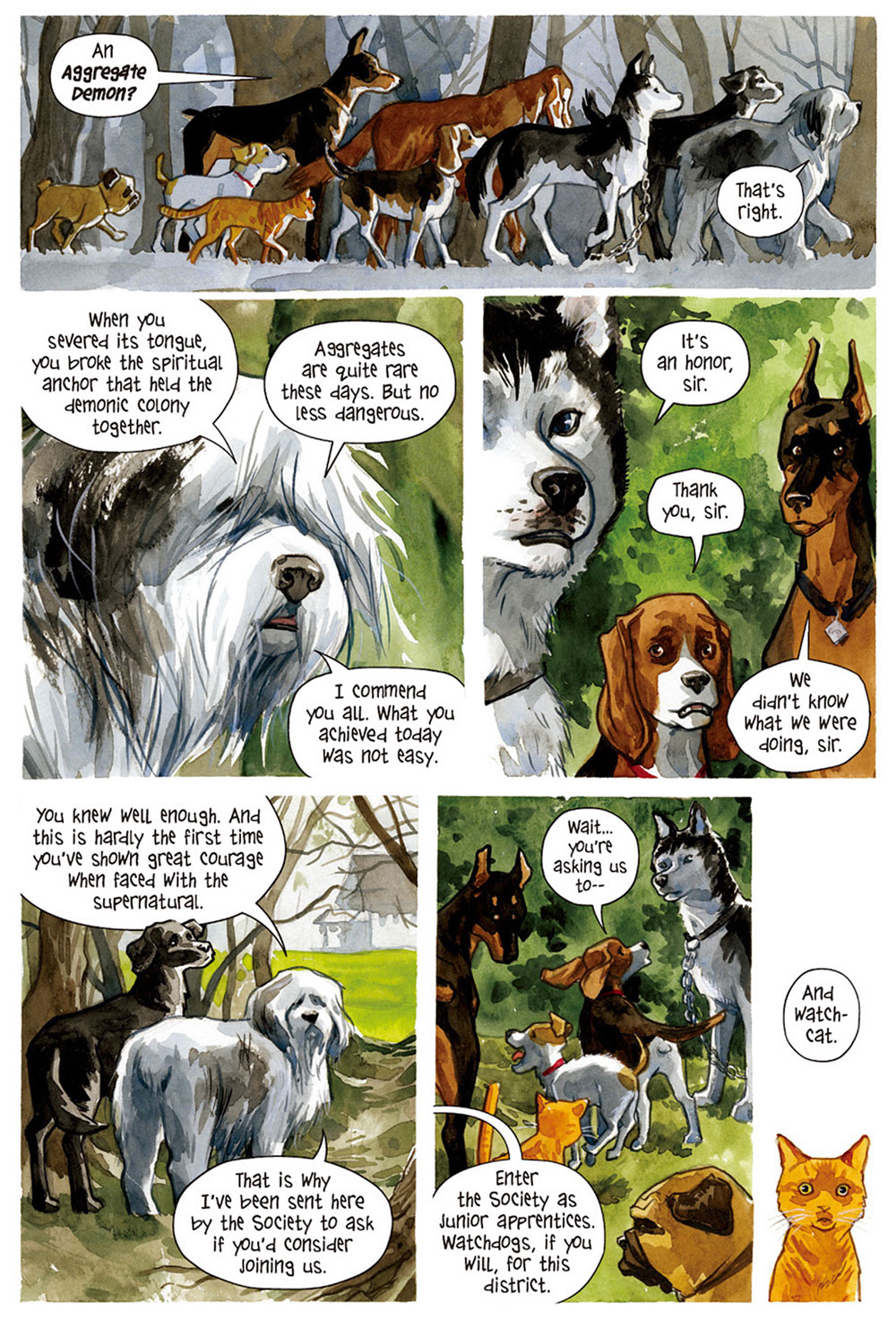
Another page from The Gathering Storm, published in Beasts of Burden no. 1 (September 2009); the moment when the gang officially becomes watchdogs. Most of the dogs have collars, but can dash around with ease, barely ever running into humans.
Art for the cover of Beasts of Burden no. 2 (October 2009).
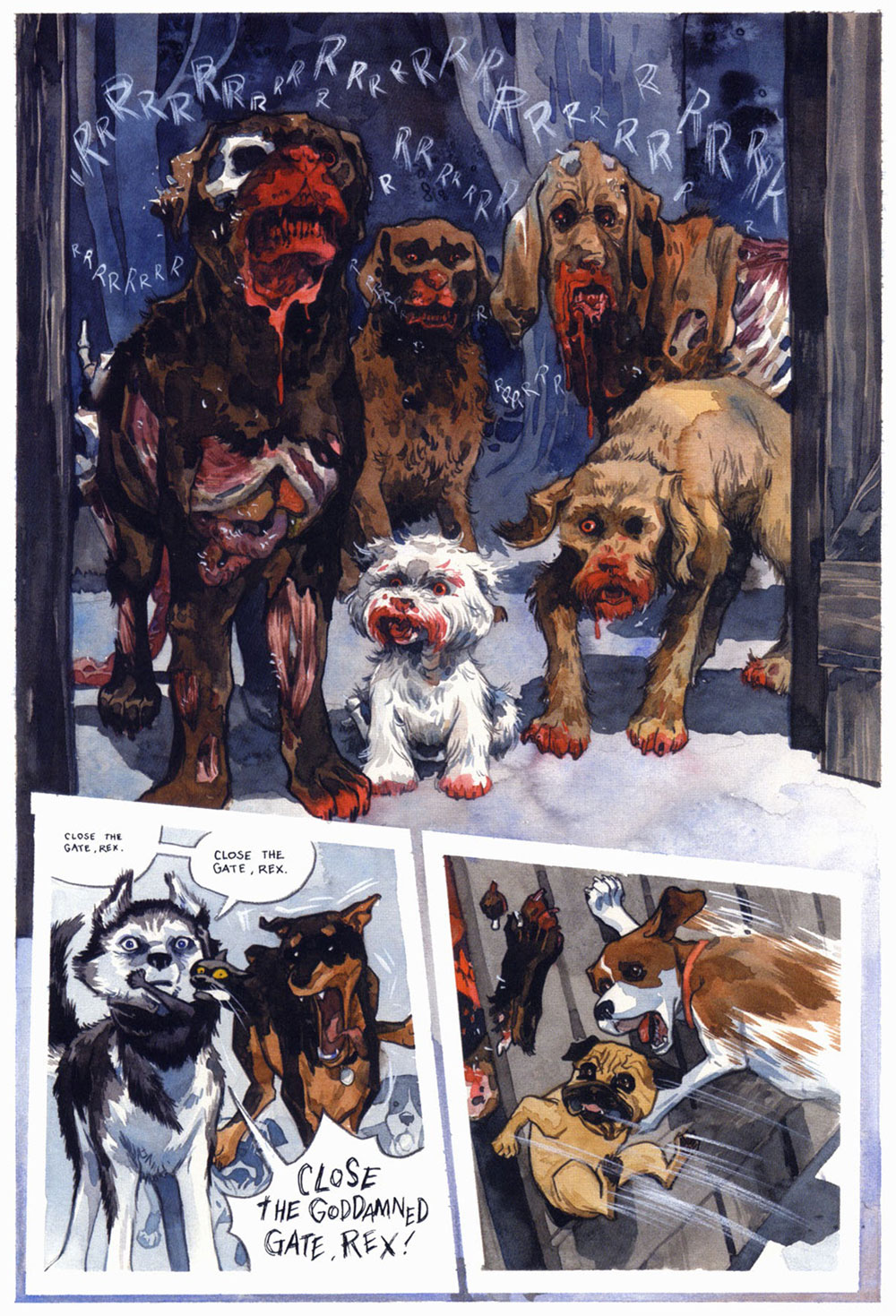
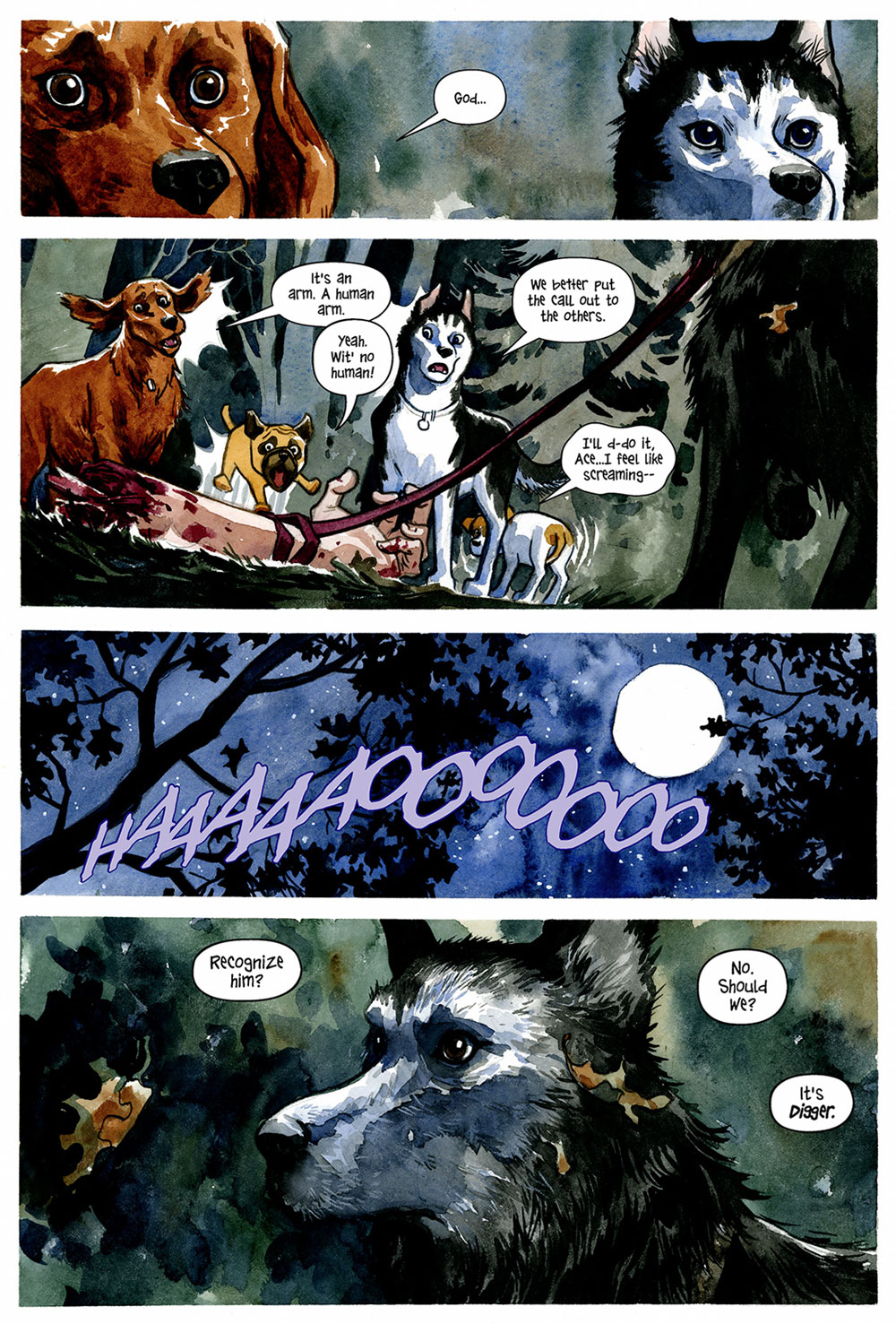
Pages from Lost, published in Beasts of Burden no. 2 (October 2009), a genuinely shocking moment – hurting a human goes against these dogs’ normal code.
Pages from Something Whiskered This Way Comes, published in Beasts of Burden no. 3 (November 2009). This story highlights the somewhat tense relationship between Orphan and his romantic interest/enemy Daphne, the black magic cat from an earlier story.
Page from Grave Happenings, published in Beasts of Burden no. 4 (December 2009).
Beasts of Burden is still ongoing, with the latest installment, Occupied Territory (illustrated by Benjamin Dewey, alas), published in July 2021.
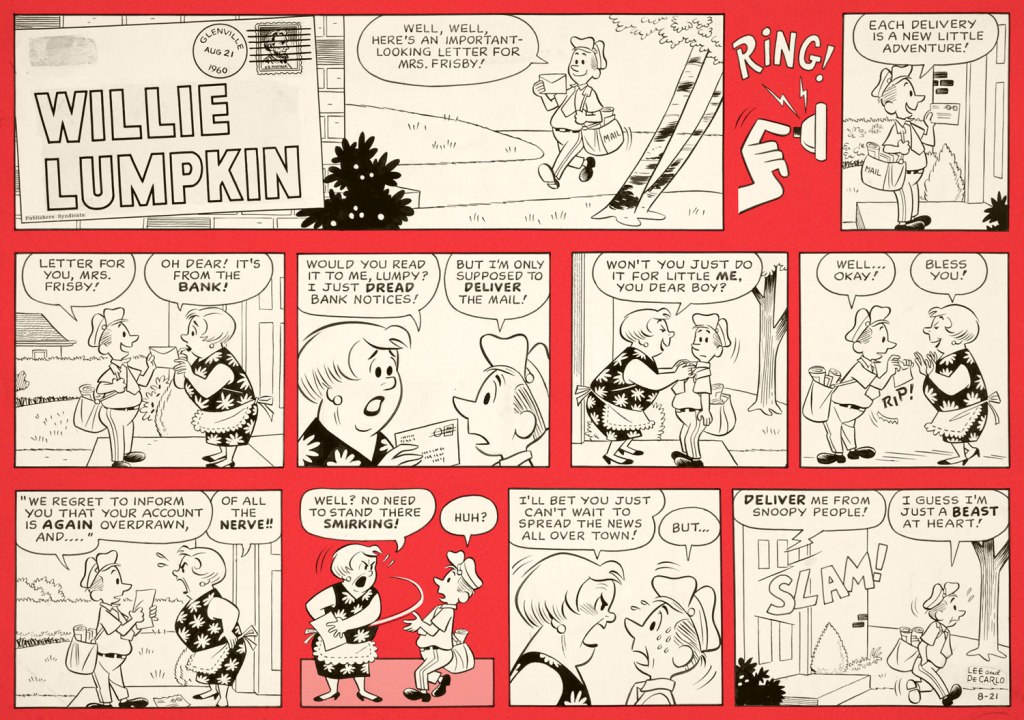
Willie Lumpkin was created by Dan DeCarlo and Stan Lee when Harold Anderson, the head of Publishers Syndicate (which merged into Hall Syndicate, which was eventually purchased by Hearst and is now part of King Features…) wanted a ‘bucolic’ newspaper strip set in some small town. The ‘friendly mailman’ idea is supposed to be Anderson’s, the family name Lee’s.
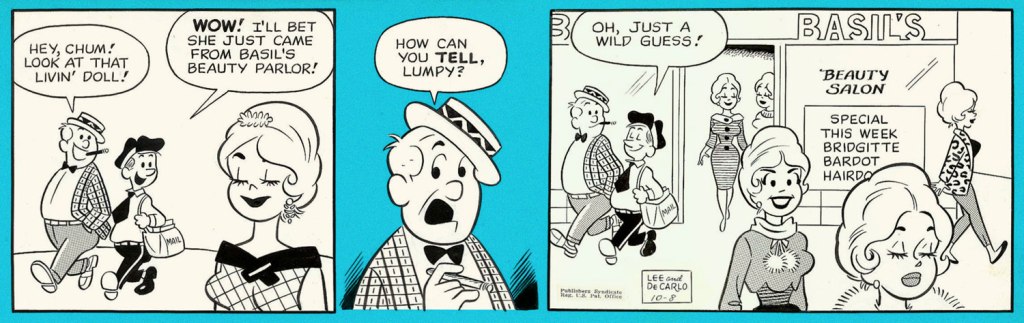
I cannot say that it’s a very funny strip (well, it was written by Lee, need we say more?), but it has a certain charm, and DeCarlo’s art is highly enjoyable, even though one occasionally feels like one has stumbled into an Archie story. DeCarlo liked drawing cheesecake, and we enjoy looking at it (for the heavy guns, visit RG’s Dan DeCarlo at Humorama (1956-63)), but in this case it is the other characters I am interested in, the kids with dirt behind their ears, spinster aunties in funny glasses, and of course the adorably bookish Lumpkin, the glue that holds the denizens of this small town together.
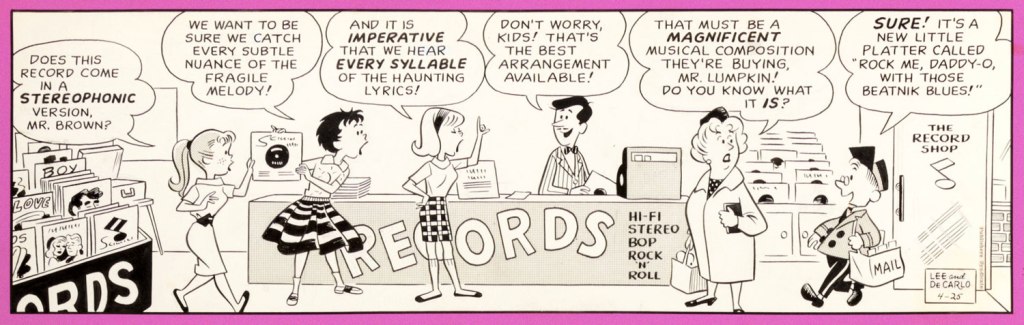
The strip ran from December 1959 to May 1961. Here are a few pickings —
I stayed mostly away from the aforementioned cheesecake, but here is an example of it:
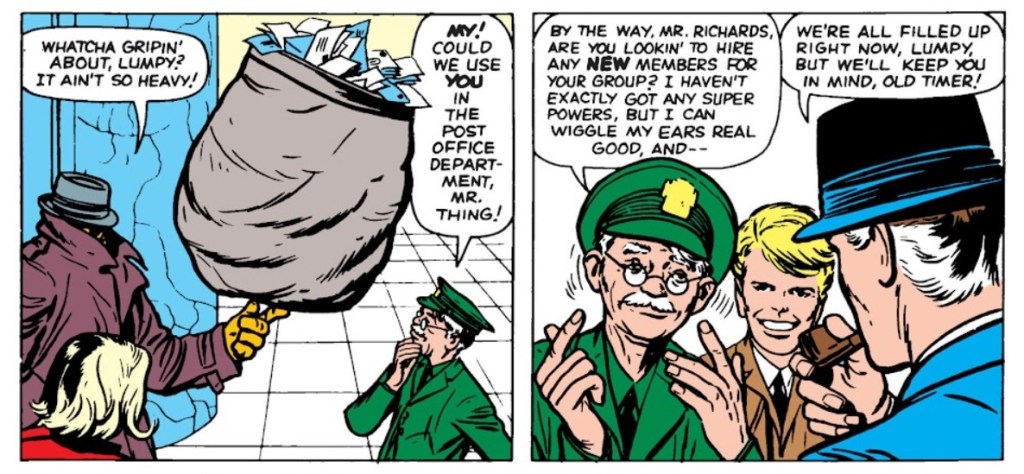
If the name Lumpkin rings some sort of different bell for you, it might be because he got incorporated into the Marvel universe in 1963 – a much older Lumpkin became the Fantastic Four‘s mail carrier with issue no. 11 (February 1963):
Pencilled by Jack Kirby and inked by Dick Ayers.
Over his Marvel years, his back story expanded and expanded, reminding me of the Russian expression ‘a stopper for every barrel’. He seemed to have been shoved into every plot that needed some secondary character to do something, delivering letters left and right, getting wounded multiple times during various epic battles, and accidentally ending up immortal (as of 2019). Same old, same old. I bet he preferred his quieter days among courting teenagers and middle-class families.
People have quite a range of definitions as to what constitutes romance. For some it’s novels of werewolf romance, others prefer completely mind-boggling Fabiosa stories (‘Unborn triplets crashed my husband’s love‘), and some ship (I learned this term from a younger colleague) characters from whatever TV show happens to be in vogue.
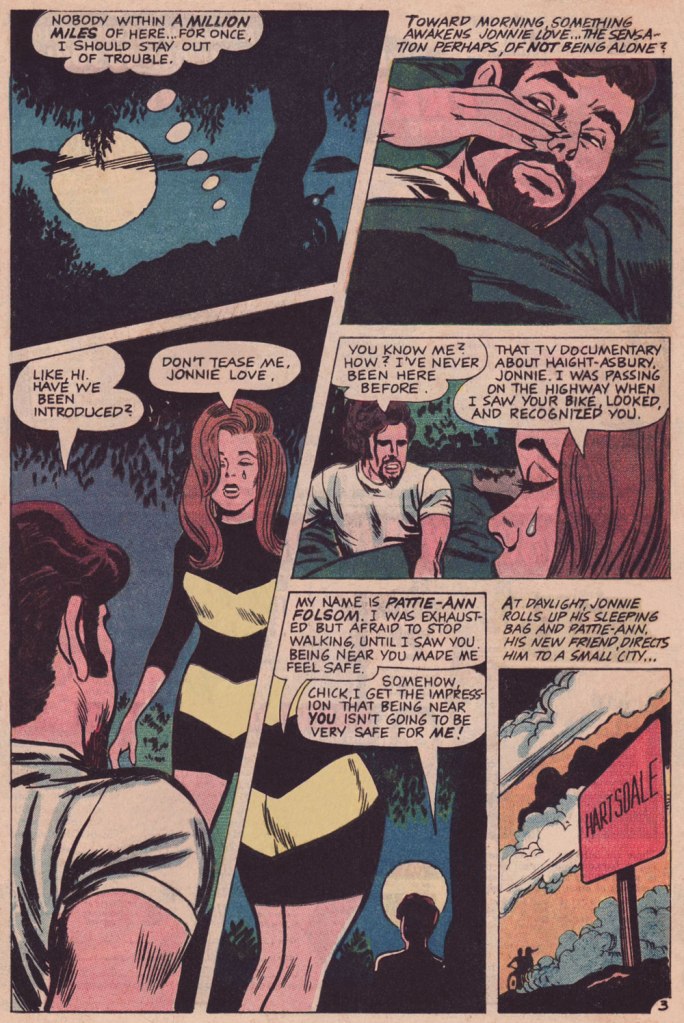
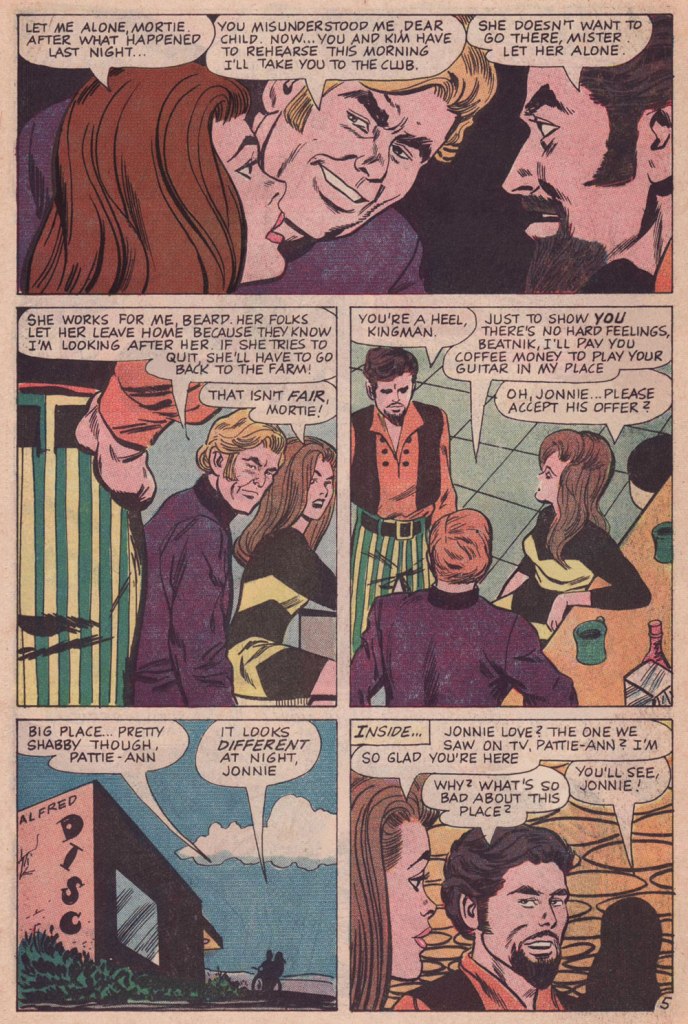
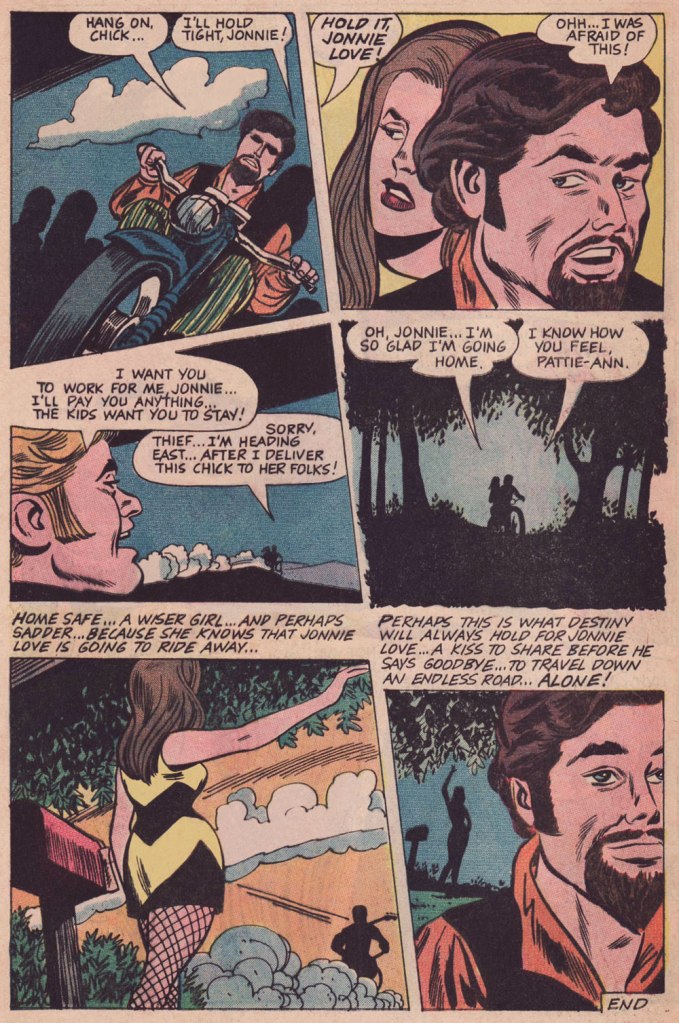
If you were a teenager in the ’50s, 60s, or 70s, you probably would have read romance comics, immensely popular at the time. Charlton Comics published a whole bevy of them, and co-admin RG has amassed a respectable collection. For weeks now I’ve been reading issues of Teen-Age Love during my lunch hour, specifically for their Jonnie Love stories. Introduced in Teen-Age Love no. 61 (November 1968) as the ‘new teen swinger’ – ‘he has a way with a guitar and a way with girls!’, Jonnie lingered within its pages for quite a while, having all kinds of adventures, hanging out with new conquests and lost souls in every issue. As advertised, he was indeed good with a guitar. Joe Gill, who was scripting the stories, wrote him as a kind of chevalier errant, wandering from town to town (with the ultimate goal of going back to his hometown, which he never achieves), offering a helpful hand to damsels in distress who are running away from predatory men, disciplinarian fathers, or just the solitude of a small town.
Jonnie Love stories appeared in 31 issues overall, but I’m most intrigued by those published in Teen-Age Love issues numbers 61-74, as they were created by the same tip-top team: scripted by Joe Gill, pencilled by Bill Fraccio and inked by Tony Tallarico (see RG’s (Fondly) Remembering Tony Tallarico).
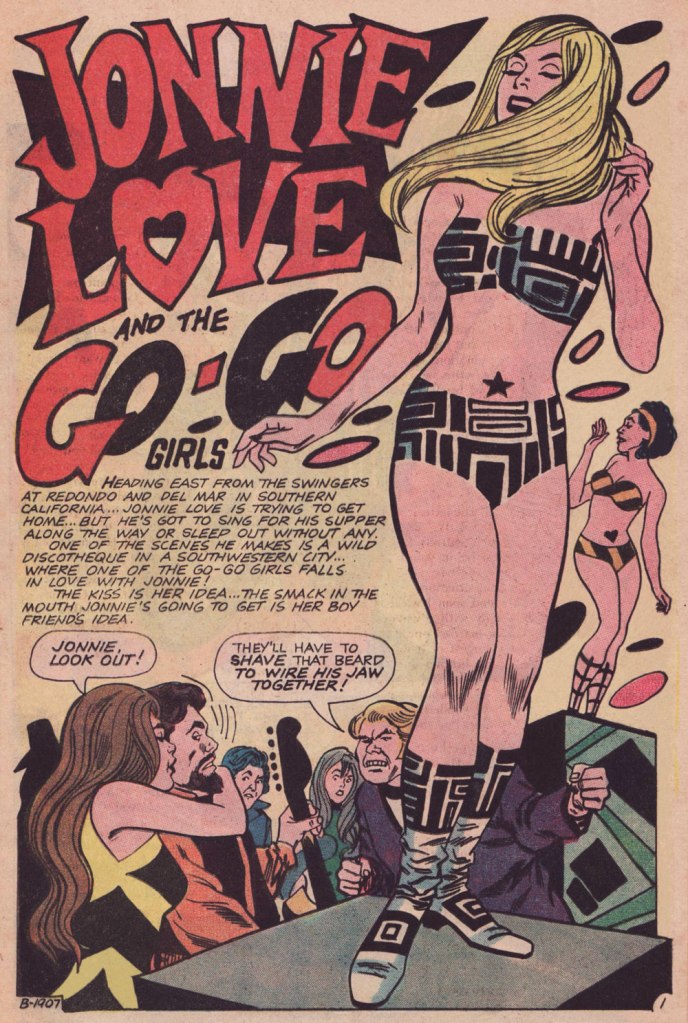
It was actually rather difficult which tale to feature, for they’re all pretty good, and I had to decide on some sort of optimal concomitance of a good plot and how the story was told visually. The final decision was Jonnie Love and the Go-Go Girls, published in Teen-Age Love no. 63 (April 1969), which I think strikes a good balance between plotting and interesting art, and is a fairly typical example of Jonnie’s behaviour in general.
Cover illustrated by the Bill Fraccio and Tony Tallarico combo. Dig the classy tattoo on the girl’s leg, courtesy of the previous owner of this comic (where are you now, Mamie?) The kissing couple in the top left corner is a preview of another story drawn by Vince Colletta. The protagonist is a brunette, whereas Jonnie often consorts with blondes (perhaps a sort of a short-hand for an attractive woman).
This story has several things going for it – an entertainingly evil manager, a grotty dance club, the go-go-dancers, and of course the protagonist, a farmer’s daughter who ran away from her parents to make it big in showbiz (the lines dreaming of glory/twitching like a finger on a trigger of a gun‘ come to mind). ‘Cute‘, notes Jonnie, ‘but there are tens of thousands with as much talent‘. Some romance stories set out to stun their readers with ritzy places, glamorous dates, and finding a rich prince charming; others feature women who give up a life of success for simpler living – a small town, a farm, a cabin in the woods. The latter moral always feels a bit stilted, even aside from me feeling bad for women who have to give up a career they worked so hard to achieve (mostly because such plots are retrograde, and it’s all-too-seldom considered that a woman can marry and continue working).
In Jonnie Love yarns, there is a strong undercurrent of returning ~Home~, home from which one foolishly ran away and which beckons lonesome wanderers back to its comforting womb. The plots are imbued with bittersweet longing for this homecoming, and that is what lingers most in one’s mind after finishing the stories. Yet the people depicted in them are outcasts; Jonnie himself was outed as a weirdo in both dress and thoughts by the people in his home town, which is why he left it in the first place. Returning is hardly the panacea it’s supposed to be (unless one is willing, this time around, to ‘fit in’ properly), and while some of these nomads do manage to make it back, our main character is doomed to forever roam strange towns, sleep in fields, and share sweet kisses with girls he knows he’ll never see again. Rather a tragic figure, really.
« Women: what do they want? They might want to float into the sky while hosting a brunch party. They might want a couple of handsome cops to come over and get rid of a snake problem. They might seek a doctor’s treatment for ‘wise-ass disease‘ or fantasize about revenge and forgiveness at the dentist’s office. And what about men? Mr. Science just wants to carry out his pointless experiments. Earl D. Porker, Social Worker, converses with household items and forgets the cat food. One fellow’s head is a basket of laundry. »
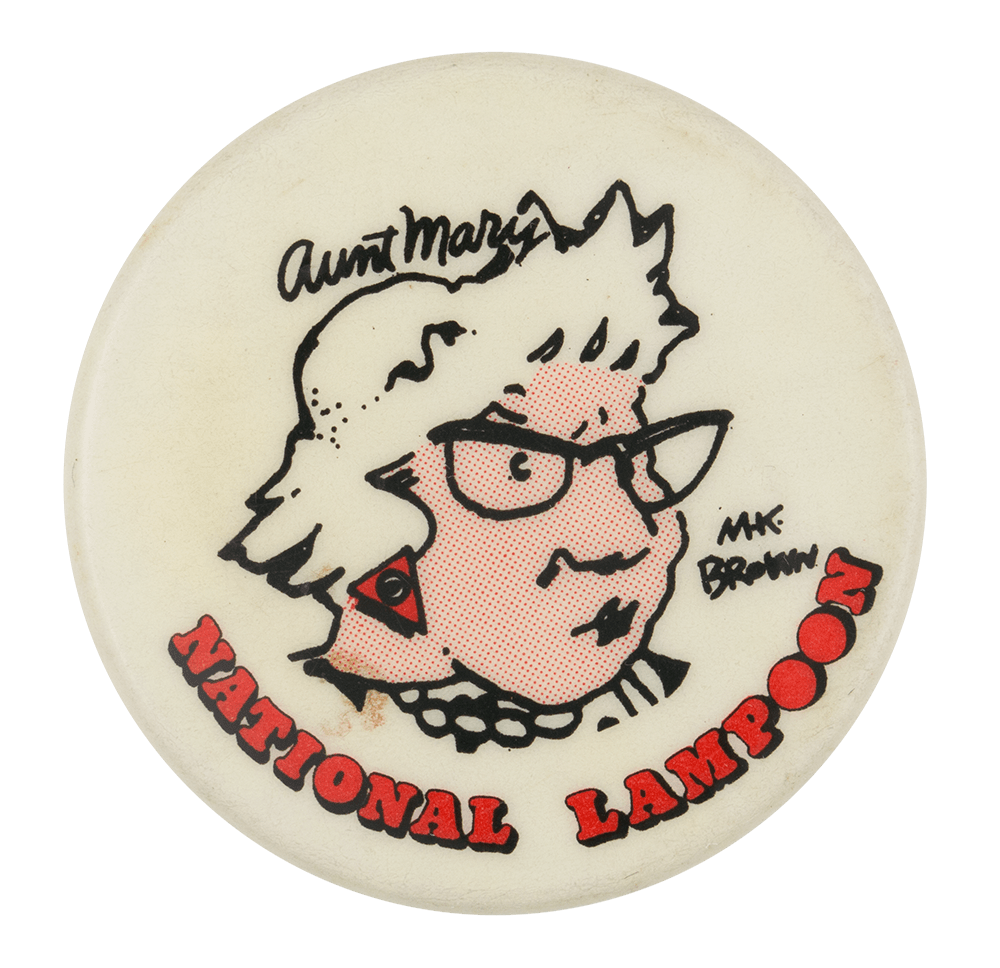
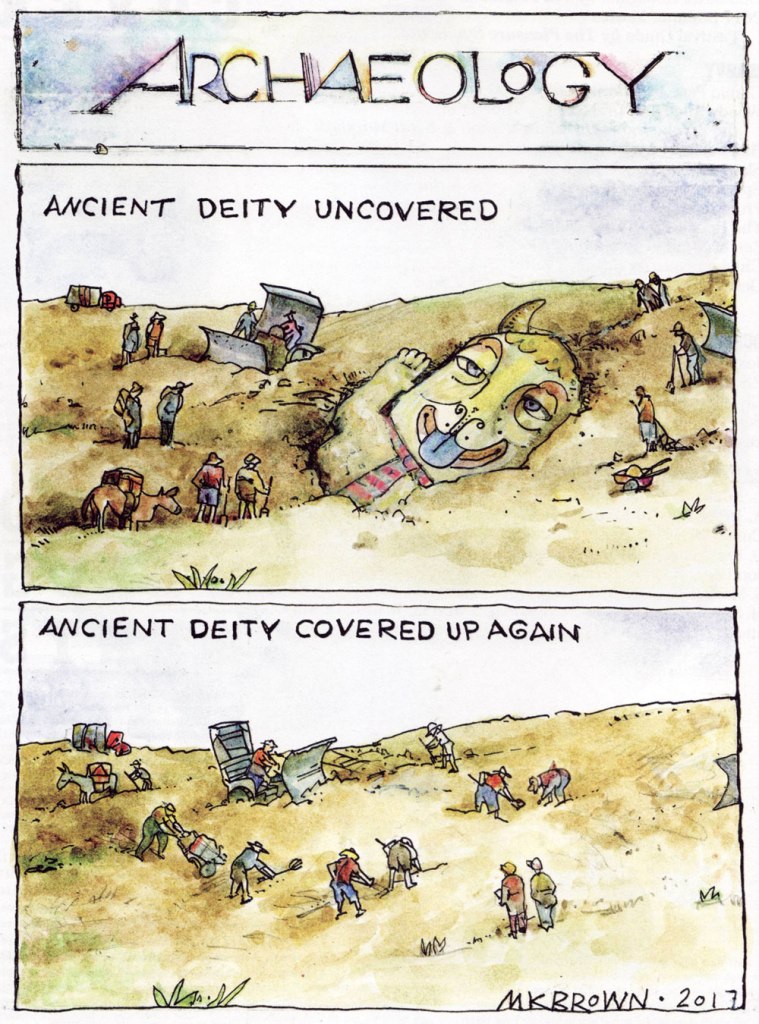
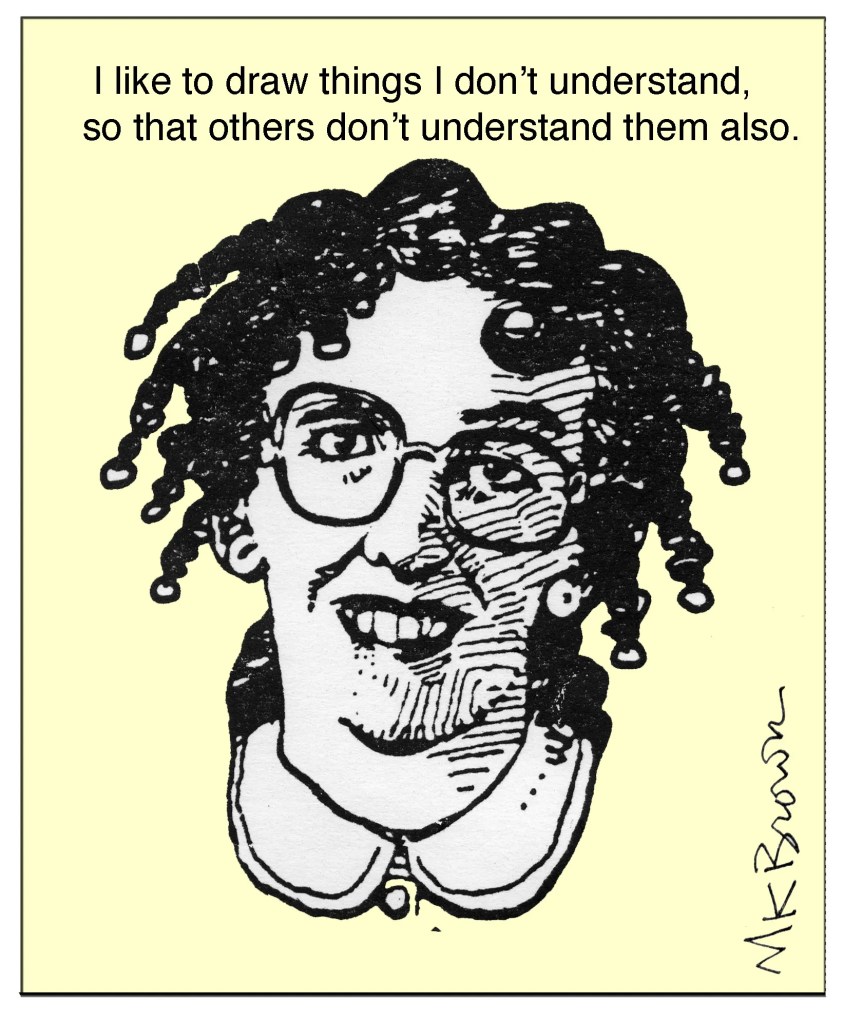
Not much is known about the personal life of the mysterious M. K. Brown*. From her official website, we know that she grew up in Connecticut and New Brunswick, but that’s pretty much it. On the other hand, details from her long and prolific career abound**: she was a mainstay at the National Lampoon Magazine between 1972 and 1981 (including the regular series Aunt Mary’s Kitchen); a frequent contributor to various magazines, most notably Playboy, The New Yorker, and Mother Jones; creator of the animated series Dr. N!Godatu, which ran in the Tracey Ullman Show in 1987 for a mere 6 episodes (two more remain unaired) until it was supplanted by the Simpsons; illustrator of children’s books… and so it goes.
In more recent years, Brown has been hanging out at The American Bystander, which I discovered by accident when co-admin RG (whose intuition for quality is fairly unfailing) picked up an issue of this magazine. A delightful surprise.
Despite the scope of her oeuvre and her very recognizable style, she’s not nearly as well known as she deserves to be. Fantagraphics, coming, as usual, to the rescue, published a sort of best-of in 2014, titled Stranger Than Life: Cartoons and Comics 1970-2013. Interestingly, this collection did little to dispel the clearly purposefully cultivated mystique. Whereas usually one expects an introduction with the author’s birth date and a quick summary of their childhood and proclivities, in this case M.K. Brown remained firmly ensconced within her initials*** and shrouded in pleasant mystery.
* I will mention straight away that she was married to equally eccentric cartoonist B. Kliban (another WOT favourite), not because a woman’s worth is in being a wife to her husband, but because ‘M.K. Brown married to B. Kliban’ has a harmonious ring to it.
** From the category of things not entirely related to her career, she is also an enthusiastic horse owner and rider [source].
*** Her name is Mary Kathleen, which I first found on the Wiki page for B. Kliban, later confirmed through a podcast she was featured on (more about this later).
The first episode of Dr. N!Godatu. Janice’s voice (for those on a first-name basis!) is provided by Julie Payne.
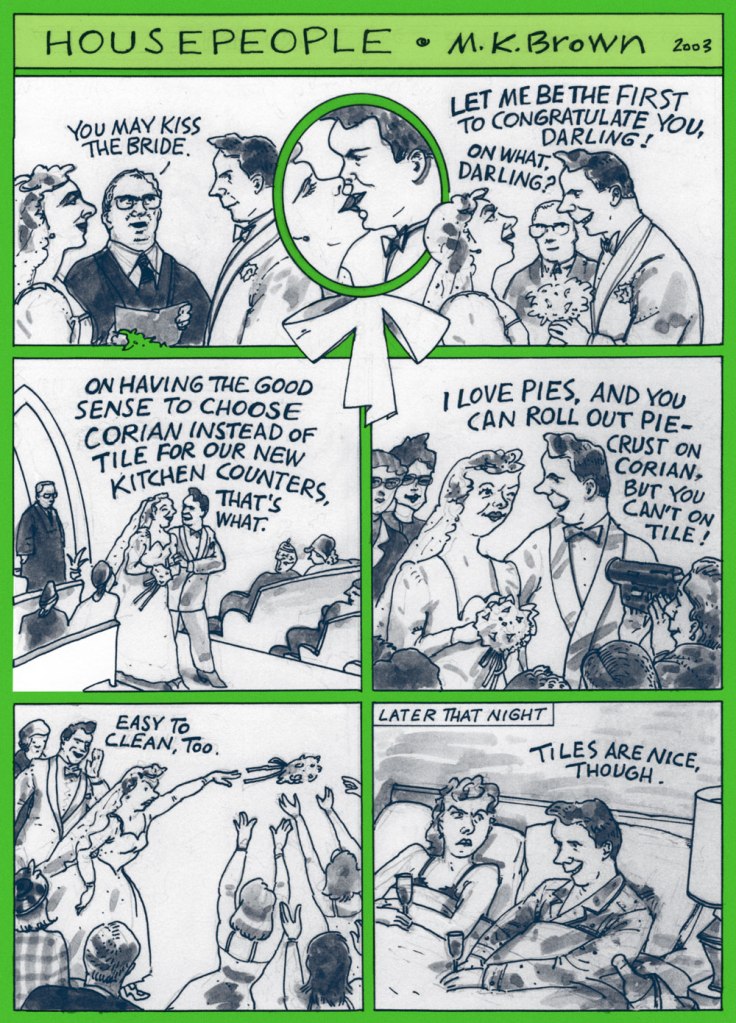
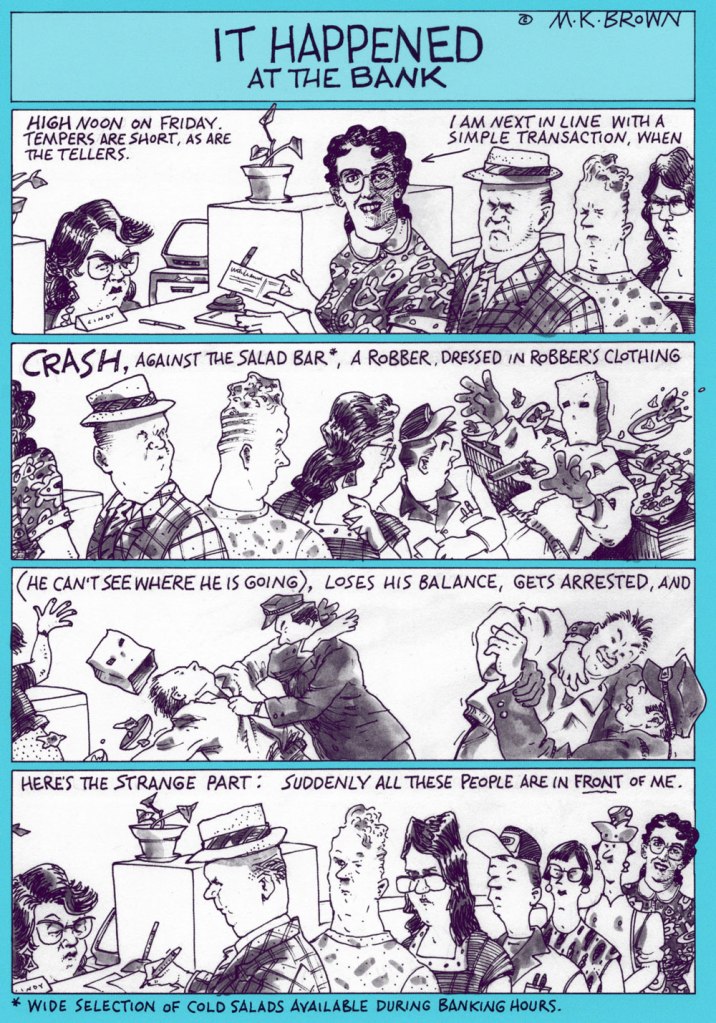
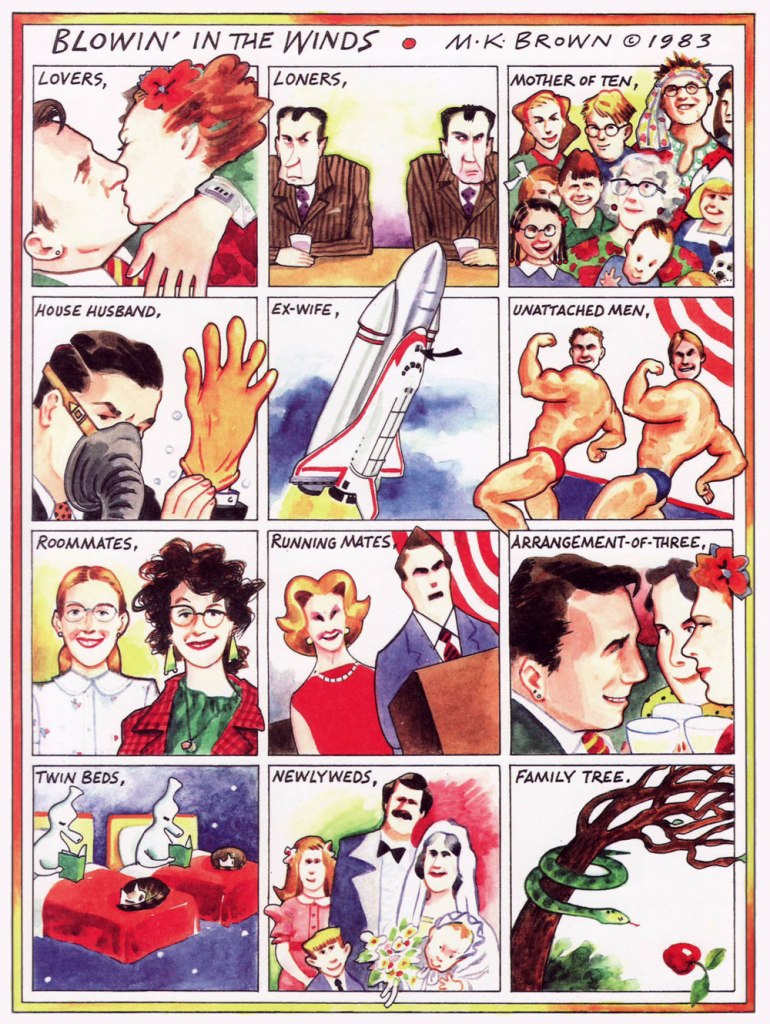
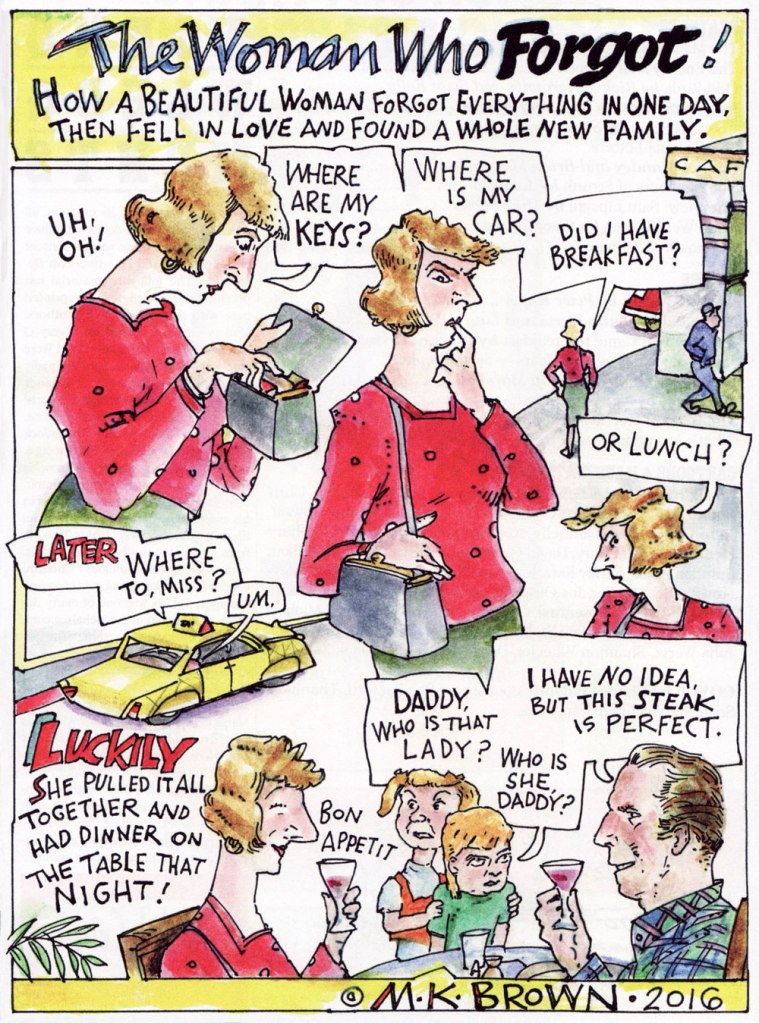
Brown is clearly a female cartoonist, in the sense of never eschewing topics that a doltish reader would expect a woman to talk about just because it’s a ‘female’ leitmotif. She can start with something mundane like a hostess organizing a party, put a surreal spin on it, pepper it with playful language, and end up with a concoction that’s devilishly acerbic, quite strange, and very funny. Bill Griffith put it well – she ‘makes the personal universal, makes the universal personal‘. The result seems quite polarising; it’s the sort of thing you instantly click with, or something so foreign that it’s unappealing. Is any of it dated, as I’ve seen some people suggest? Not in the slightest. Human relationships haven’t changed much over the years, though we like to pat ourselves on the back for being so much more evolved. Focusing on the fact that someone is wearing a suit with shoulder pads (which are, by the way, coming back into fashion) to decide it’s no longer relevant to modern life is daft.
Here are some examples scanned from Stranger than Life of different vintages, lightly colourized by co-admin RG.
This one features Brown’s alter-ego, ‘White Girl’. « She can’t dance or sing the blues, but cluelessly does both anyway. It’s fun to speak through this character. I’m very fond of her. »
Here are three pages from more recent years, which also showcase Brown’s watercolours:
Published in The American Bystander no. 1 (Fall, 2015).
Published in The American Bystander no. 2 (Spring, 2016).
Published in The American Bystander no. 5 (Summer, 2017).
The American Bystander conducted a fun, hour-long podcast with Brown in 2016. I am a visually oriented person, and have immense trouble sitting through a podcast, so I had to tell myself I had to listen for the sake of this blog post – I hope you appreciate this sacrifice. It was a pleasure to listen to Brown, who sounds exactly like I pictured it, though I was somewhat underwhelmed by some of the softball questions she was asked – questions interviewer (in this case, Gil Roth) usually asks of a cartoonist, ‘what were your art influences?’, ‘what explains your sense of humour?’ I believe this has more to do with me than with the actual interview – I by far prefer to glean some understanding of a person through their work, as opposed to discussions about their work (which is a slightly strange stance for a blog writer). There is, however, a fun anecdote about how she used to put up her paintings on the walls to work on them, and had to cover her sleeping nocturnal husband and the bed he was on with plastic not to splatter him with paint. Brown also mentions that she has a stash of drawings which she could never get published because they’re too risqué – oh, how we would all love to see those! Click here if you’d care to listen to it!
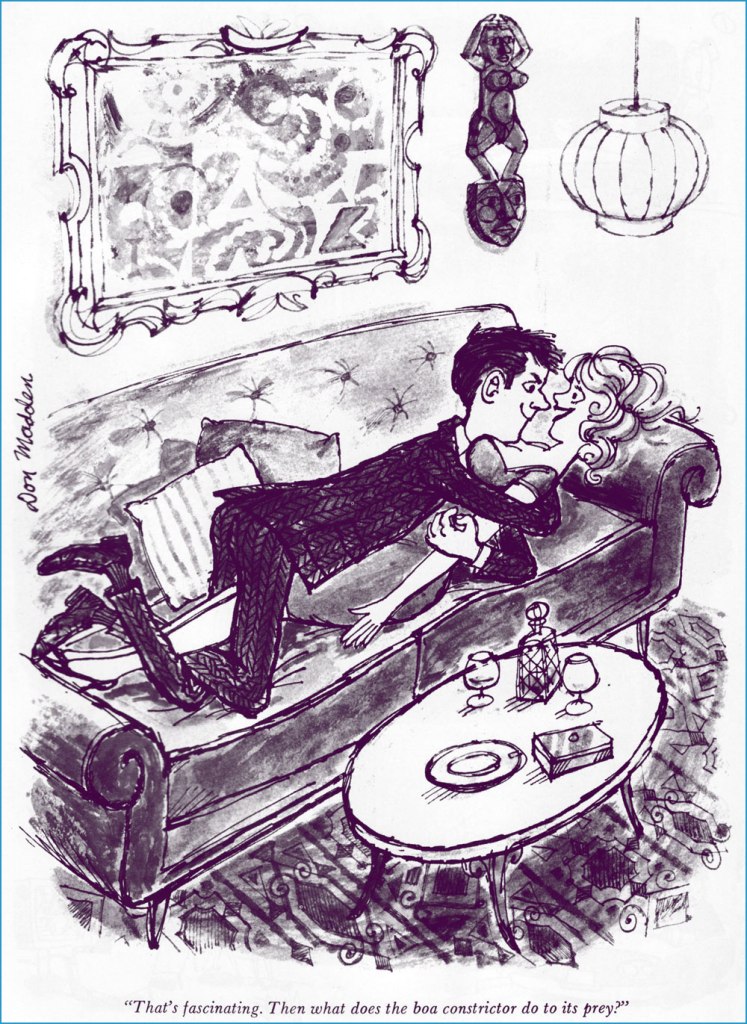
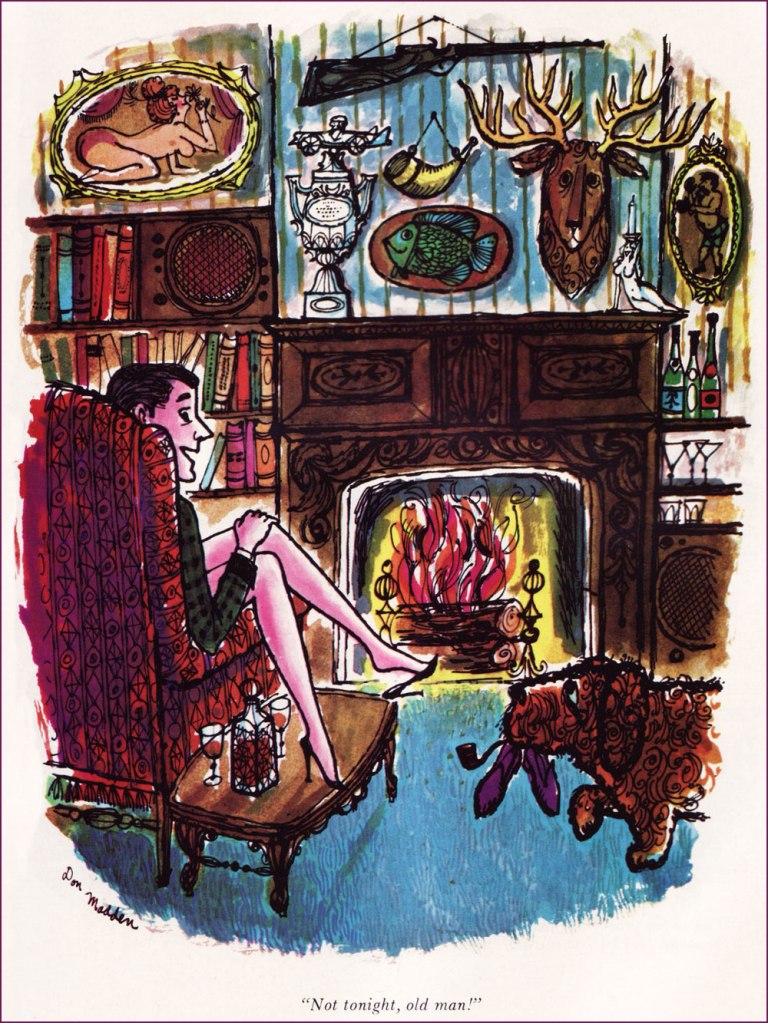
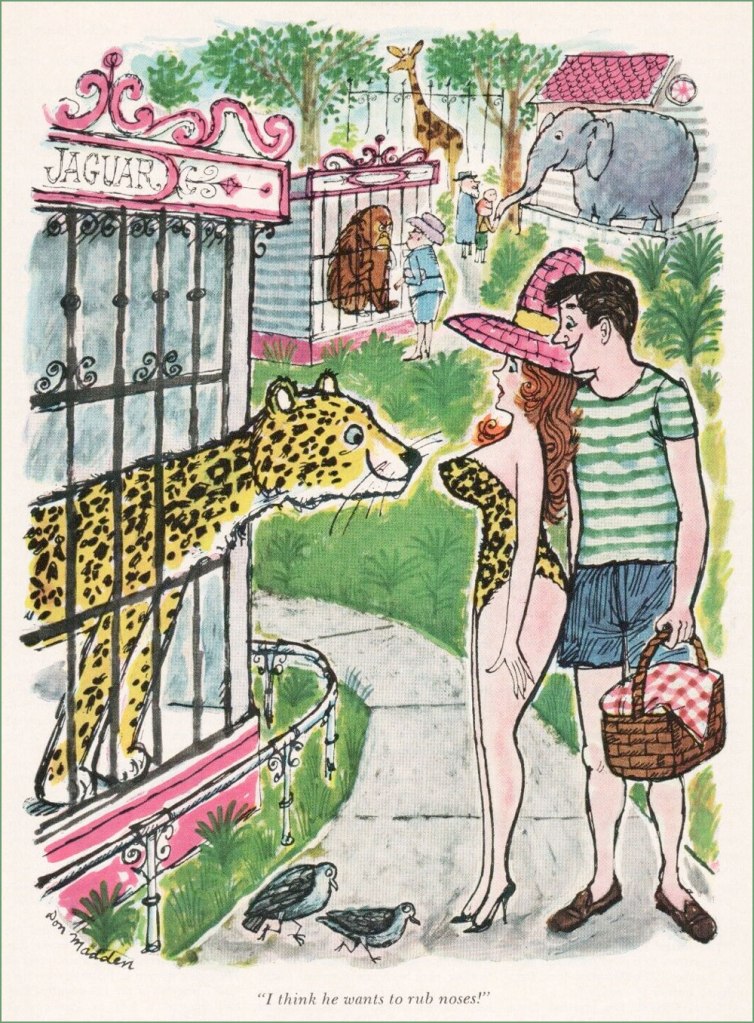
So little is known about cartoonist-illustrator Don Madden (especially given the existence of John Madden, American football coach, who tends to smother all other search results), that I can’t really say much. Born on October 14, 1927, he has drawn a number of cartoons for Playboy, and illustrated and/or written a number of children’s books. Apparently he lives in Ballston Spa, New York… or at least he did in 1993, as claims the blurb to one of his books.
On the (absolutely highly recommended) blog My Retro Reads, I found this, likely taken from the back cover of Oxygen Keeps You Alive (illustrated by Madden and written by Franklyn M. Branley, 1971):
« Don Madden attended the Philadelphia Museum College of Art on a full scholarship. Following graduation, he became a member of the faculty as an instructor in experimental drawing and design. The recipient of gold and silver medals at the Philadelphia Art Director’s Club exhibitions, Madden’s work was selected for reproduction in the New York Art Director’s Annual, in the international advertising art publication, Graphis, and in the Society of Illustrators Annual. In addition to being the author of The Wartville Wizard and Lemonade Serenade: Or the Thing in the Garden, Madden is a well-known children’s book illustrator who has worked on a variety of projects, including Incognito Mosquito, and many books in the HarperCollins Let’s Read and Find Out series. »
The first part of this quick biography is dreadfully boring (I have a short attention span!), but at least it provides us with some context. Interestingly, this makes no mention whatsoever of his Playboy cartoons, probably having decided that children’s books and Playboy do not go hand-in-hand. Madden’s style is easy to recognize, so I have no doubt that all these Maddens are the same person (excepting the football coach, of course). Well, hey, there’s always Shel Silverstein to explore these kinds of dichotomies; see Shel Silverstein: Without Borders and Take Ten With Shel Silverstein, although we’ve never specifically talked about his contribution to children’s literature.
We can assume that Madden has written two books (the aforementioned Lemonade Serenade, Or, the thing in the Garden, 1966 and The Wartville Wizard, 1986) and illustrated a myriad of others. In the latter category, I will make a special note of Harold S. Longman’ The Castle of a Thousand Cats (1972), which I would love to get my hands on someday.
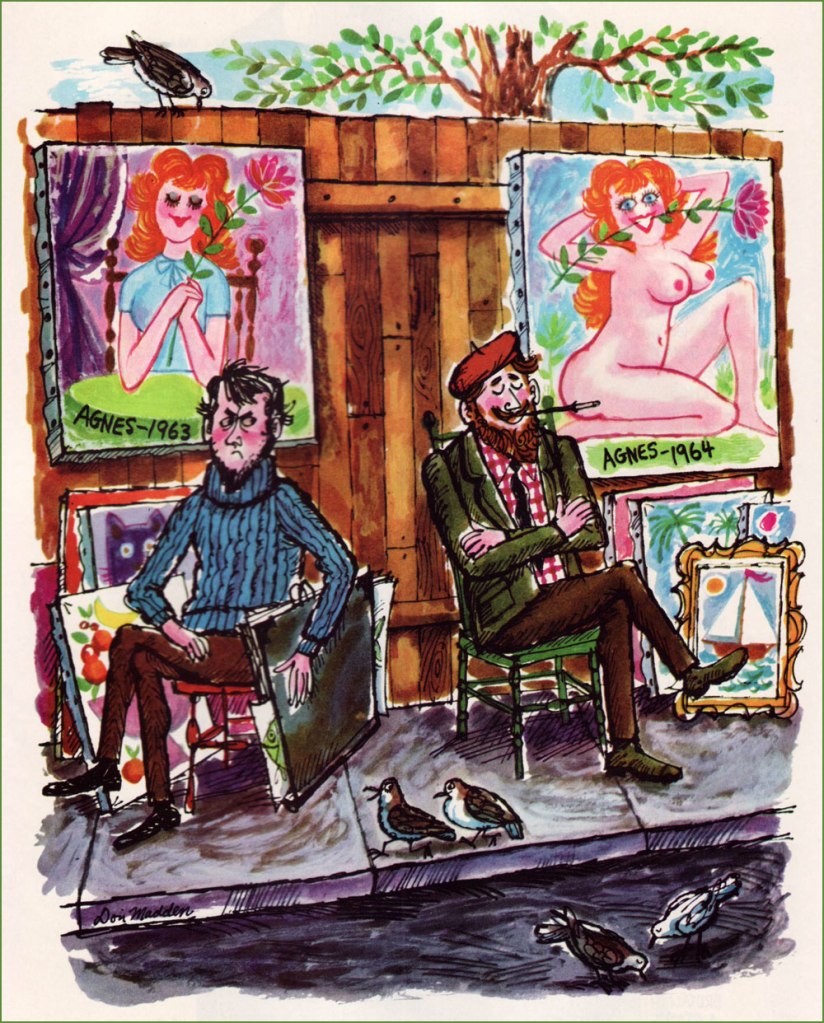
Here is a selection of Don Madden’s Playboy 60s and 70s cartoons (he joined the magazine’s stable at the dawn of the 1960s), as always graciously scanned by co-admin RG from a score of anthologies in our collection.
I see no antagonism between Madden’s girly cartoons and his illustrations of boys hanging out with dogs or cats living in castles; his florid style lends itself equally well to voluptuous women or magical ships, and he clearly has a real affinity for drawing animals replete with personality and charm.
~ ds
A small, sad update: Mr. Madden passed away, after a long, well-lived life — surely, ninety-six years and that body of work ably pass muster — in June of 2024.
I’ve been interested in comics for as long as I can remember, but didn’t really have easy access to them in my teenage years (meaning, I was far too shy to actually walk into a comic book store). So I turned to webcomics, keeping bookmarks organized by days of updates, faithfully opening 20+ tabs every time I turned on my computer to read a new instalment of the dailies. I’ve drifted away from all this over the years – partially because I’m a big girl now, but mostly because most webcomics really aren’t very good, the gems scattered in a murky swamp of badly drawn slice-of-life peppered with Star Wars jokes… not to mention the mind-numbingly boring takes on fantasy/science-fiction/elves-with-big-boobs. A few I’ve retained an affection for, a few have my respect and gratitude (and live rent-free in my head*).
*I’ve only encountered this idiom in a positive context (somebody cooing over a picture of a cute capybara, for example), but I just discovered that it’s supposed to be an insult. Apparently it can be used as either; I associate ‘rent-free’ not with loafers on welfare, but, say, our cats’ lifestyle.
One of the leftovers of that era is Subnormality, created in 2007, priding itself in being a ‘comix with too many words‘. While it can certainly be accused of being quite heavy-handed at times, not to mention self-consciously ponderous, it can also be genuinely touching, portraying society’s outcasts (and supposed bimbos, and successful businessmen…) with unflagging empathy and understanding. Its author is Winston Rowntree, who I believe lives in Toronto, Canada, and is very evasive on the subject of himself.
Subnormality not only has a lot of words, it also has sprawling expanses of panels, so that sometimes reading a comic feels like playing a board game. For that reason, as much as I would love to have a printed version of the stuff, I realize that it would be impossible to fit all that inside physical pages, lest somebody springs for an edition where each page folds out to a poster. It was quite difficult to choose which strips to feature, but below are a few examples that are on the smaller and less wordy side (for an example of the aforementioned mushrooming sequence of panels or prolixity, have a look at no. 244, Subnormality Tells the Truth, or no. 98, 7 Dichotomies in a Bar).
Rowntree also occasionally writes for CRACKED, has two published books (Finding Jesus, 2014, in which you have to locate Jesus in a crowd à la Waldo, and the graphic novel Watching, 2016) and recently-ish (2017 is recent, right?) started an animated web series, People Watching, that’s now in its second season.
No. 42, Sphynx III. An early appearance of the Sphynx, shown in company of other monsters, whereas in latter strips she is usually hanging out with (or devouring) humans.
No. 97, The Further Adventures of the Sphynx. She may be a man-eater, but she’s a very personable one, and one of many recurring characters who’s considerably fleshed out (heh, heh) as the series goes on.
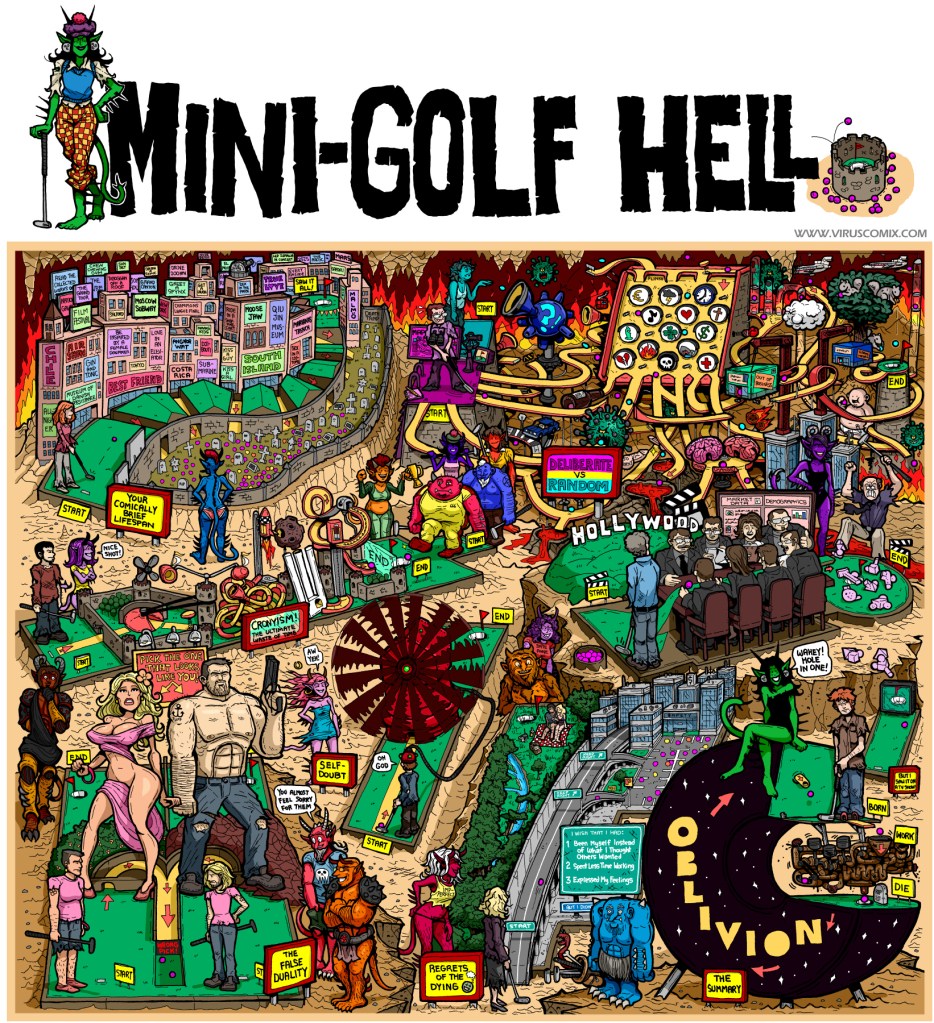
No. 198, Mini-Golf Hell. The green demon lady (sitting on top of Oblivion) is also a recurring character.
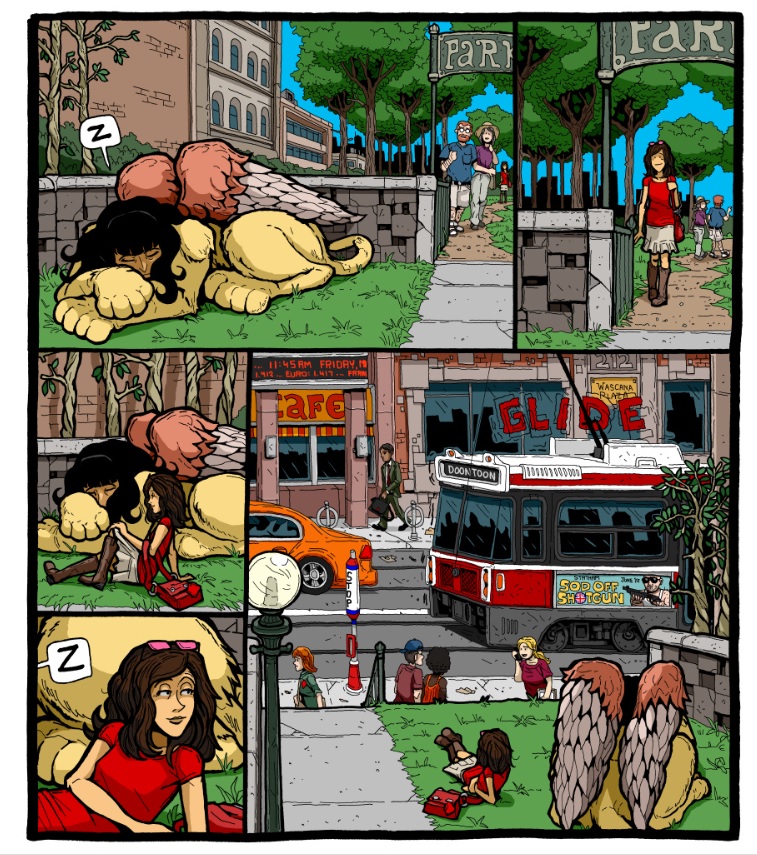
One of my favourites, no. 199 (titled ‘…’), in which two friends hang out and watch the world go by. Read the full thing here.
New strips do come out, though not often (which is understandable, given all the other projects Rowntree is engaged in, not to mention the sheer size of latter-day instalments) – follow Subnormality’s Facebook page, or keep abreast of recent developments on his Twitter.
«— Pickin’ flowers, Lucy? — No, you simple-minded piece of cream cheese – I’m filling the coal scuttle with apple sauce.»
My first exposure to a Rube Goldberg machine was through The Incredible Machine, a DOS game from 1993. I didn’t know at the time who Goldberg was, but I really liked the idea of setting up a chain of events triggering one another in the most convoluted-yet-satisfying of ways.
The machine was of course named after Rube Goldberg (Reuben Garrett Goldberg, 1883-1970), cartoonist, inventor, sculptor, et j’en passe. Given his lasting contribution to culture, it is interesting to consider that in the early days of his career, when he was a struggling cartoonist, Goldberg almost changed his family name to hide his Jewish roots – ultimately deciding that he couldn’t live with himself, had he followed his colleagues’ counsel. ‘Then I realized it was idiotic to even consider such a thing; that I would be ashamed of it all the remainder of my life; and that, if a man’s achievements are no bigger than the sound of his name, it doesn’t much matter what his name may be‘, he later wrote.
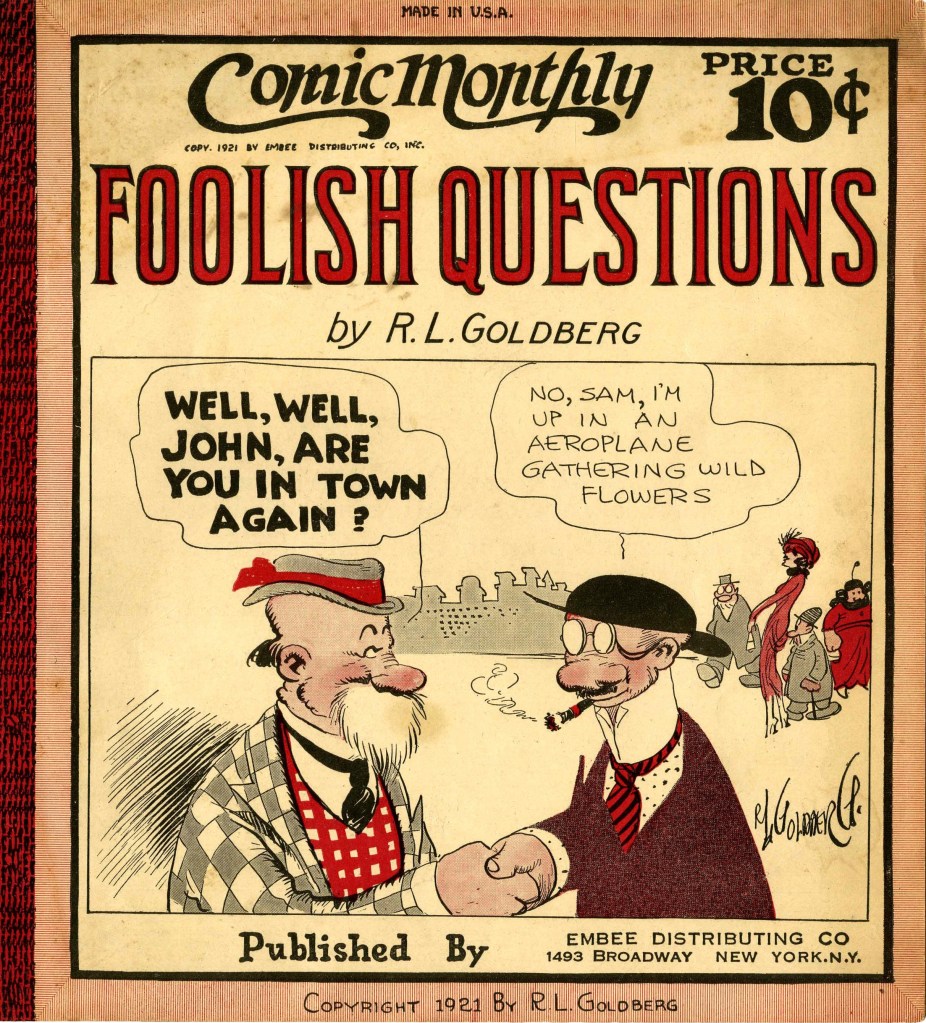
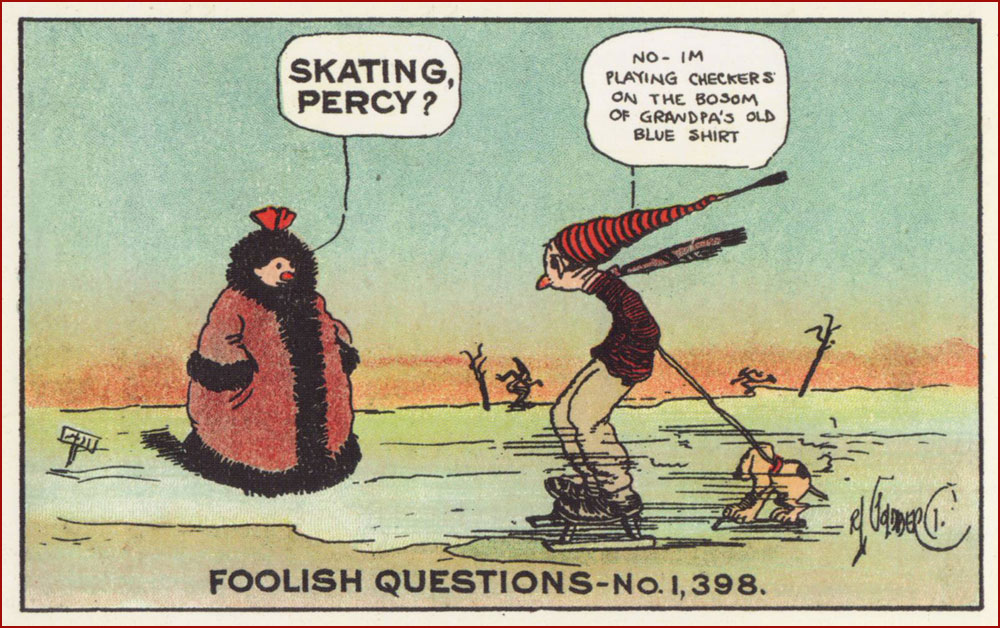
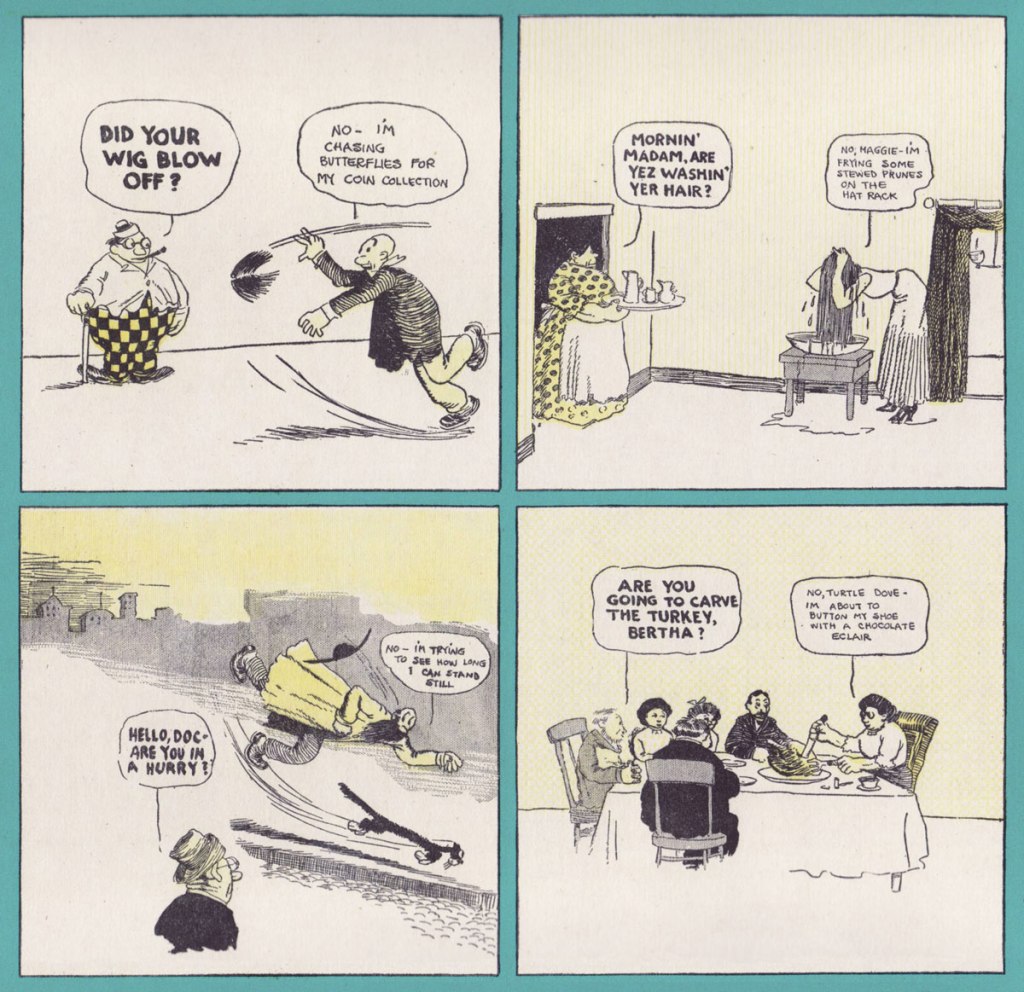
While Goldberg had a degree in engineering and worked for a short while for the San Francisco’s Water and Sewers Department (which perhaps honed his sense of the absurd, if anecdotes about a city’s treatment of sewage are anything to go by), his ambitions lay in the direction of cartooning from a very early age. His first comic, after a couple of years of being a sports cartoonist, was The Look-A-Like Boys, published at the beginning of the century (1907-1908) by the World Color Syndicate. In parallel, he was also working for the New York Evening Mail, for which he created the short-lived Reincarnation, a goofy, modern-day take on historical characters. His next attempt at a series is what initially made him famous (after which he went on to even greater fame): he produced around 450 Foolish Questions between 1908 and 1910; the very first one, published on October 23, 1908 was prosaically titled ‘Foolish Question No. 1’. Questions remained as witless as ever, but the answers got kookier and more surreal over the years!
FQ continued all the way into 1939 with plenty of enthusiasm from readers (who started sending in their own daft questions). It even inspired a song by Billy Murray. Here are some postcards:
In 1909, Goldberg expanded the FQ world into a Sunday strip, Don’t Some People Ask the Biggest Fool Questions?, which collected previously published strips by grouping them into tiers (and occasionally padding this format out with new artwork). In 1912, he went on to unleash the madcap inventions he’s remembered for today upon the world in the shape of The Inventions of Professor Lucifer Gorgonzola Butts, A.K., then shifted to political cartooning (for which he won a Pulitzer Prize in 1948) in 1938, and then recycled himself as a sculptor in the 1960s. Truly a life filled to the brim with adventure!
The examples below have been scanned from Foolish Questions & Other Odd Observations (Early Comics 1909-1919), published by the wonderful Sunday Press in 2017. I highly recommend it; abounding in bonus materials, it also has two introductions for the price of one, namely one by Goldberg’s granddaughter Jennifer George, and another written by comics historian Paul C. Tumey (author of the equally magnificent tome, SCREWBALL! The Cartoonists Who Made the Funnies Funny – read a review of it by Eddie Campbell* here). Goldberg’s sense of the absurd is truly a delight, and I dare you to not giggle while perusing these.
~ ds
* Another WOT favourite that we never really got around to talking about. I will, however, refer you to this interesting discussion about comprehending/perusing comics, in which Cambpell conjures an entertaining mental image, relating to his appearance on TV to talk about why ‘some people just can’t read comics’: «My blather would have been mercifully cut because I launched into an insane mimicry of a theoretical middle-aged woman in tears from not being able to interpret the TV guide.»
« All my life I’ve been torn between frivolity and despair, between the desire to amuse and the desire to annoy, between dread-filled insomnia and a sense of my own goofiness. Just like you, I worry about love and sex and work and suffering and injustice and death, but I also dig drawing bulgy-eyed rabbits with tragic overbites. » — Matt Groening
Unlike most of my peers, I didn’t grow up absorbing The Simpsons, probably because I only watched cartoons on videocassettes instead of actual TV. I also somehow managed to skip Futurama (catching up with it years and years later, with great enjoyment). So the work of Matt Groening* (who probably needs no introduction, but you can get one here) was not really familiar to me at all when co-admin RG introduced me to The Big Book of Hell, though of course I was aware of the Simpsons aesthetic, as one would truly have to live under a rock not to be acquainted with it to at least some degree.
*Here’s how to pronounce ‘Grœning’ correctly and impress all your friends.
Life in Hell crept into the world in 1977 as a self-published book that Groening, freshly moved to Los Angeles from Portland to pursue his ambition of becoming a writer, would give out to friends. He also sold it for two bucks a pop in Licorice Pizza, one of a chain of record stores operated by James Greenwood. As is often the case, Groening’s cartoonist/writer/producer/animator career kicked off by way of serendipity: in 1978, an editor from the charming WET: The Magazine of Gourmet Bathing liked Life in Hell enough to print a few of its strips. From then on, the strip’s popularity snowballed slowly but steadily (from its first regular weekly appearance in the Los Angeles Reader in 1980, to the huge success of a compilation of LIH’s love-centric cartoons, titled Love Is Hell, in 1984, to the strip’s presence in over 250 newspapers by 1986), which eventually led to The Simpsons. Speaking of the latter, I am now shamelessly going to plug a previous post, namely Tentacle Tuesday: Treehouse of Tentacular Horror.
Here’s a selection from several out-of-print anthologies co-admin RG had handy, namely from Love Is Hell (1984), Work Is Hell (1986), School Is Hell (1987), Childhood Is Hell (1988), and How to Get to Hell (1991).
Personal favourites Akbar and Jeff were apparently introduced so that Groening could incorporate real-life conflicts he had with his girlfriend into the strip without it being too obvious about who was who. When we noticed a couple living across the street (two men always dressed in matching, brightly coloured sportswear) we instantly nicknamed them Akbar and Jeff.
An elephant pink crawled outta the sink and snuggled up in my bed A purple mole’s in the goldfish bowl, he’s trying to steal a drink*
Today’s post was originally planned as a panegyric to Larry Marder’s Beanworld, but I quickly realized that attempting to write about it was a bit like trying to dissect a joke. Here I am, then, doing a 180 degree turn to talk about a Soviet cartoonist.
Evgeniy Milutka (Евгений Милутка, b. 1946) was a teacher of Russian literature by profession, but his proclivities clearly lay elsewhere. After teaching in middle school for a few years, he officially switched to the career of a cartoonist in the early 1970s, and quickly rose to the ranks of the best known caricaturists in the USSR, in part thanks to his long-lasting (from mid seventies to mid eighties) collaboration with satirical magazine Krokodil(see Krokodil Smiles: Cartoons in the USSR).
I am most interested, however, in the new, kid-oriented direction his work took in the 1980s, namely the cartoons/comics published within the pages of Веселые Картинки (something like ‘funny pictures’ in translation), a literature-bent humour magazine for kids. Founded in 1956, it was still sort-of around (with some financial issues) when I was a child, and my grandfather, who was always very preoccupied with making sure I grew up knowledgeable and smart (sorry, grandpa?), was kind enough to buy me a subscription.
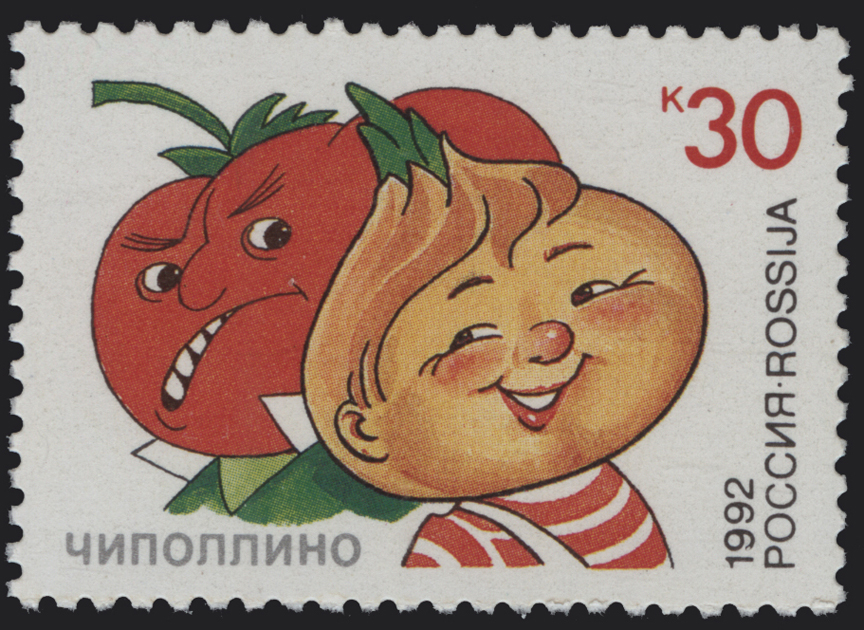
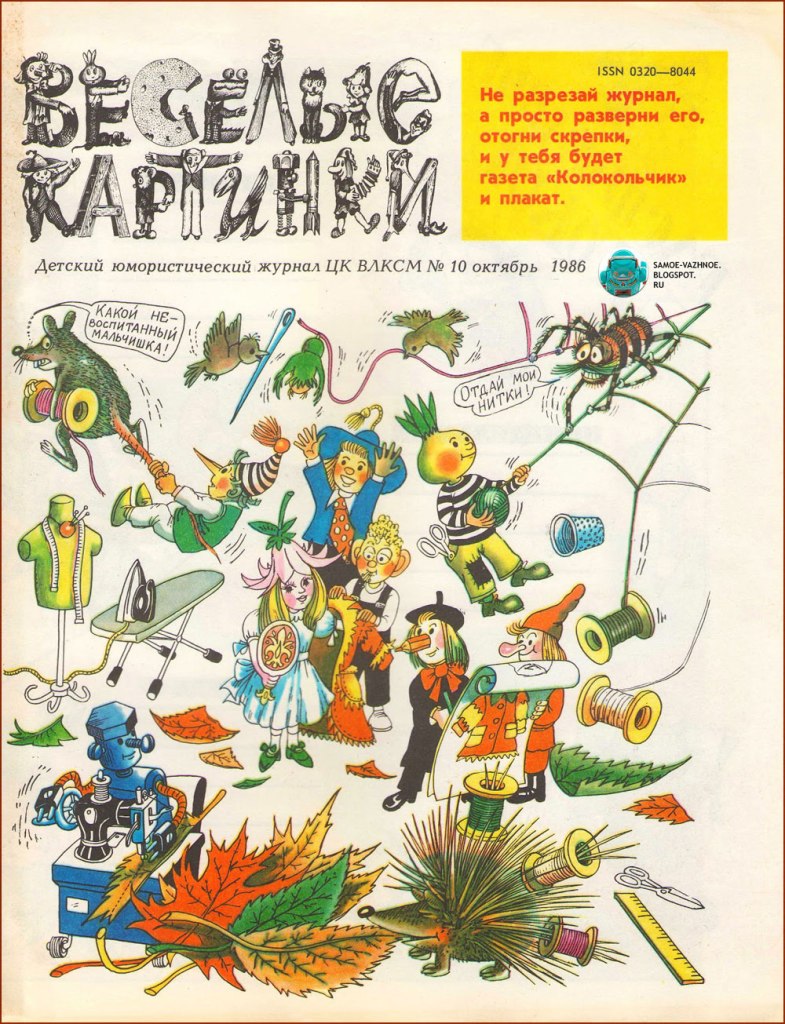
An issue from October 1986, with a cover by Milutka. It features the 8 ‘merry little people’ that were the mascots of this journal and whose adventures Milutka illustrated. This included Karandash (which in Russian means ‘pencil‘), the boy with the pencil nose; Cipollino (little onion), the boy with an onion head, from Gianni Rodari’s Cipollino, a tale that was so popular in the Soviet Union that we even have a Cipollino stamp; Buratino, the Russian Pinocchio; Neznayka, literally translated to ‘don’t know’, a favourite character from Nikolai Nosov‘s merry trilogy of fairy-tales; Petrushka, a character from Slav folk puppetry; Samodelkin, the boy robot whose name translates to something like ‘do-it-yourselfer’; Hurvínek, a character from a Czech puppet duo; and the only girl, Thumbelina.
The first thing that jumps out is that Milutka’s strips are really weird. Green elephants, watermelon men, mosquitoes capable of lifting a person, bats in a cavern made out of teeth, a giant spider wearing running shoes… a lot of it is most delirious delirium tremens. Milutka could aptly handle a variety of styles, but his basic, more recognizable modus operandi is extremely Slavic. The other interesting thing about his work, though you have to take my word for this, is how he squeezed in some distinctly unchildlike content into his strips. He was, after all, a caricaturist, with a keen eye honed by the sometimes subversive Krokodil.
Here is a selection from within the pages of Веселые Картинки from 1991 to 1996, which is pretty much the period I was able to follow in person.
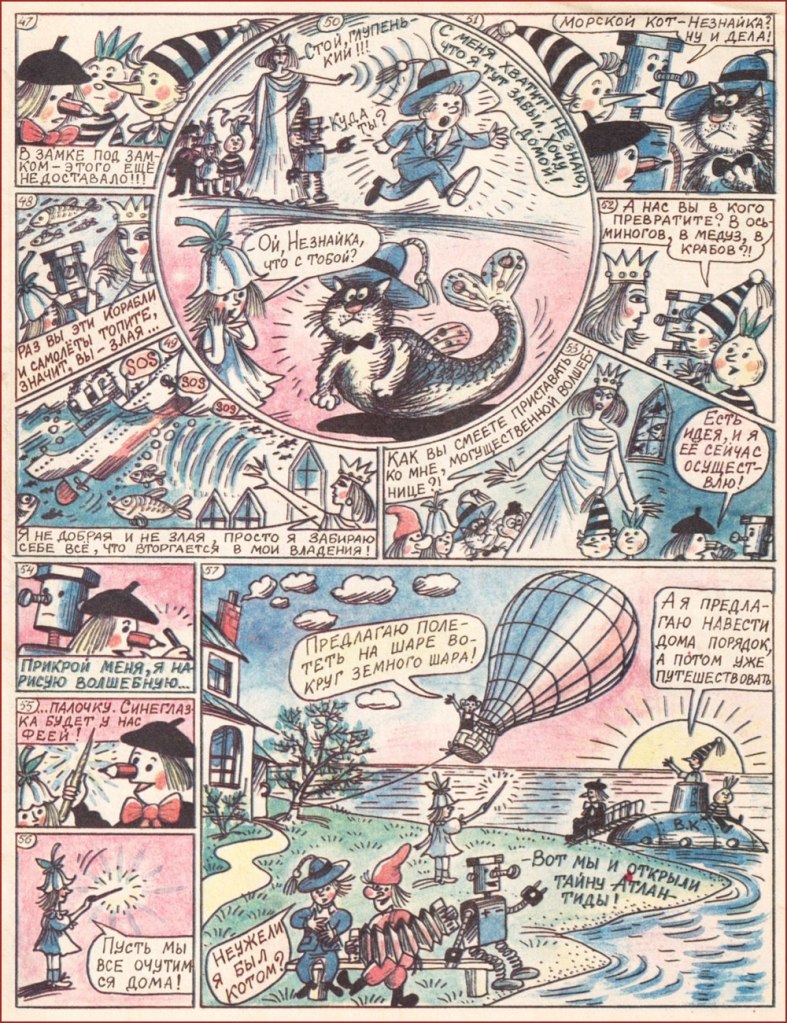
The sorceress gets accused of being evil by Thumbelina, ‘since you crash ships and airplanes‘. ‘I am nor evil nor good,‘ she responds, ‘I just take everything that barges into my kingdom.‘ Nezknayka gets turned into a mer-cat. (1991)
More metamorphosis! The kids keep asking the green elephant ‘what are you? Are you an ungulate? A mammal? Are you an insect? He’s probably an amphibian…‘ but to all their questions, he answers “I dunno…“, which is how they guess that it’s Neznayka in disguise. (1991)
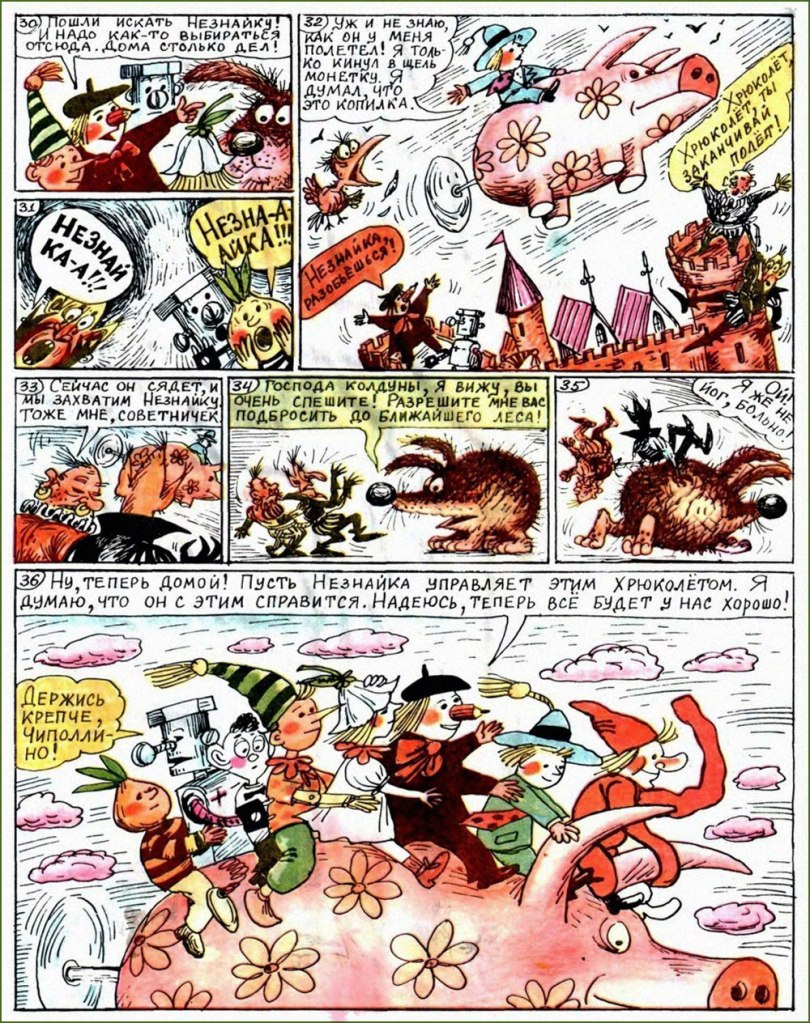
A sword-hog is turned back into a normal hedgehog once he’s fed an apple, and Neznayka, who’s named head advisor to the bad guys (everybody has untranslatable funny names), advises them to tie themselves together with a rope… (1994)
… after which the merry little people escape on a flying pig with a propeller in its ass (1994).
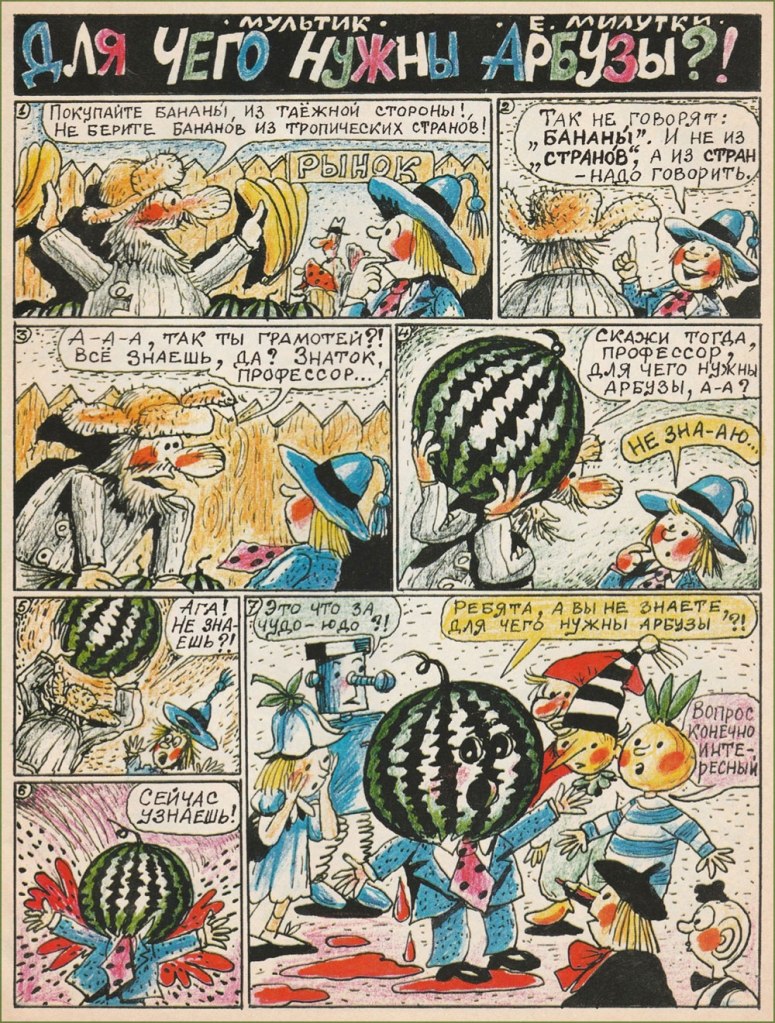
Watermelon man! “Kids, do you know what watermelons are good for?” “It’s an interesting question, of course” (1994).
This is spider named Filia, shod in very nice shoes. Isn’t he cute? (1994)
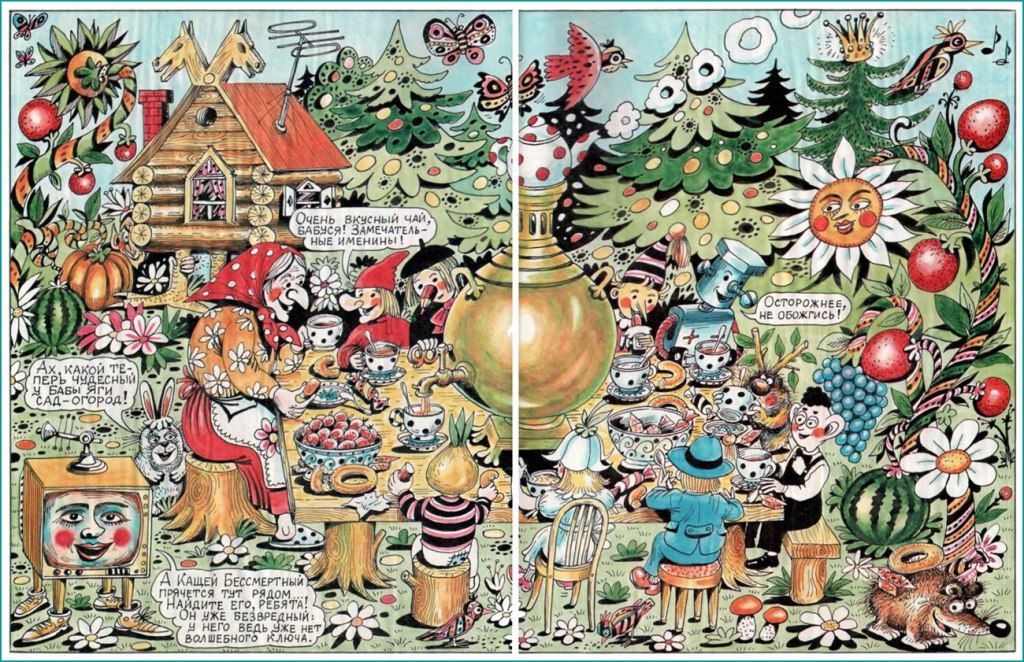
A splash page featuring a prototypical Babushka (actually a Baba Yaga in a good mood!) and an assortment of flora and fauna (1994)
After a lot of untranslatable puns on the word ‘vitamins’, the cat (who’s, once again, Nezknayka, having a pronounced tendency to transform into other creatures) is told to ‘eat the magic balls!‘ to turn back into himself. Thumbelina is also rescued from being… err, whatever that furry thing with the rolled-up nose is. (1995)
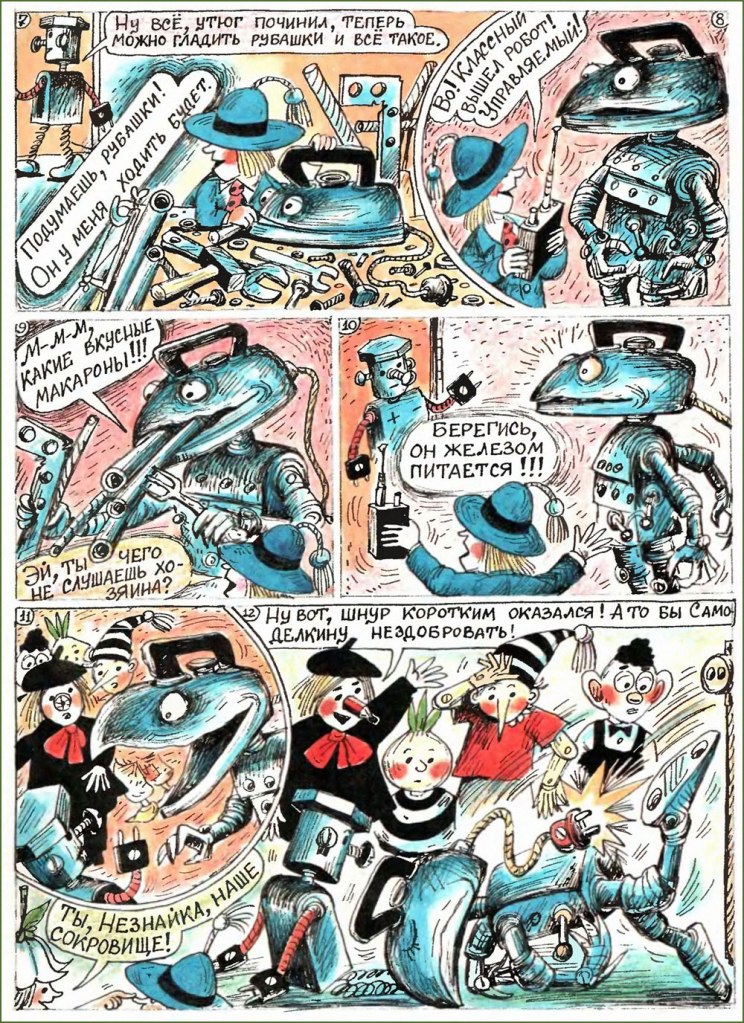
Neznayka invents a robot to do the ironing for him, but the robot is hungry for metal ‘macaroni’ (which we call anything pasta, usually some form of spaghetti) (1996).
A poster advertising the journal (1996), with mushrooms, a Pushkin reference, singing cats, some sort of flying elephant (?) with an accordion, a little furry bee-cat, and so on and so forth.
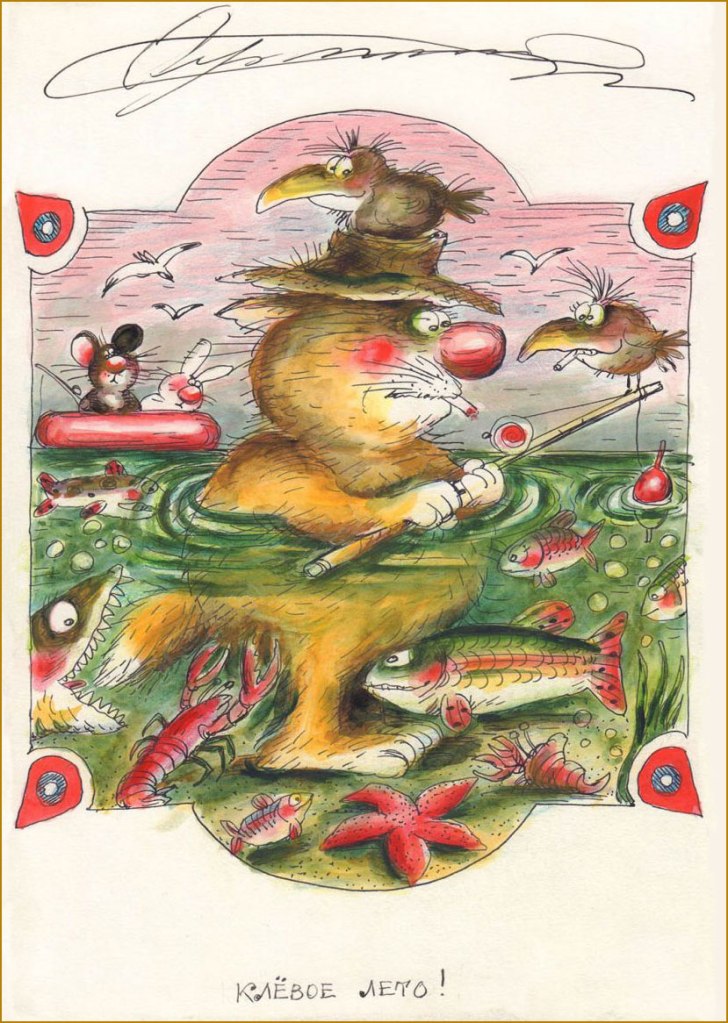
I hope you enjoyed these despite the language barrier! I’ll wrap this up with two fun illustrations from the early 90s:
‘The flight of a bumblebee’
The title is a pun on fish biting and the summer being a neat one.
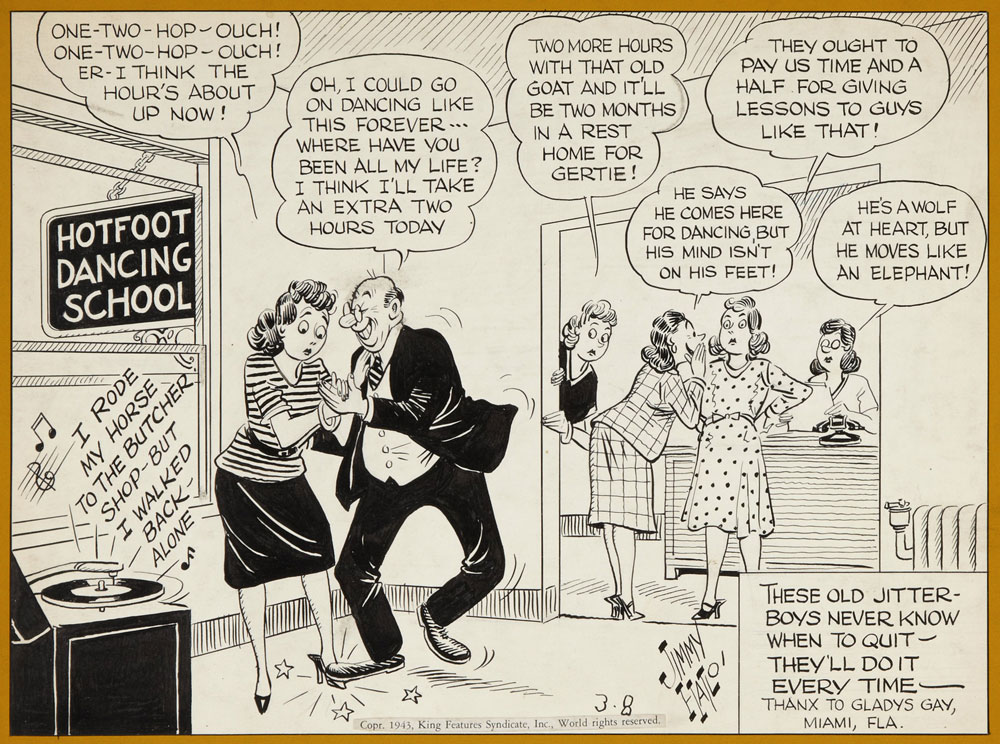
In the beginning of time… or rather the end of the 1930s, which may feel like a similar thing to some… there was Jimmy (James) Hatlo‘s They’ll Do It Every Time, a popular King Features newspaper cartoon with an impressively long run (1929 all the way until 2008, although no longer under Hatlo’s direction since 1963 due to Hatlo’s fairly early demise at 66). Hatlo, a sports cartoonist working for The San Francisco Call-Bulletin, stumbled upon the greatest success of his career by accident – scrambling to fill a void left by a shipped-yet-misplaced package of cartoons that for some reason didn’t make it to the office in time*, he drew the first couple of strips as a bouche-trou, only to find himself with an instant hit. The old problem of running out of ideas was creatively solved – Hatlo asked his readers for suggestions, and the readers, « brimming with seemingly small observations about mundane yet captivating matters, but lacking a way to tell anyone outside their own circles of friends about it » (as Bob Green described it in his Wall Street Journal epitaph A Tip of the Hat to Social Media’s Granddad), were happy to oblige. Hatlo acknowledged every submission with a ‘tip of the Hatlo hat’ – the thrilled reader would get his or her name and hometown displayed prominently in the bottom right corner of the strip.
* Jimmy Hatlo—Man of Many Hats, a detailed article by Ed Black I wholeheartedly recommend, offers another version of this story: « His managing editor, Edgar T. ‘Scoop’ Gleason, was frantic: He had a hole to fill in his comics page when Hearst abruptly ordered him to pull Billy DeBeck’s Bughouse Fables so it could run in the Examiner. Gleason prevailed upon Hatlo to produce something, pronto. »
Strip from sometime in August, 1931 (exact date unknown).
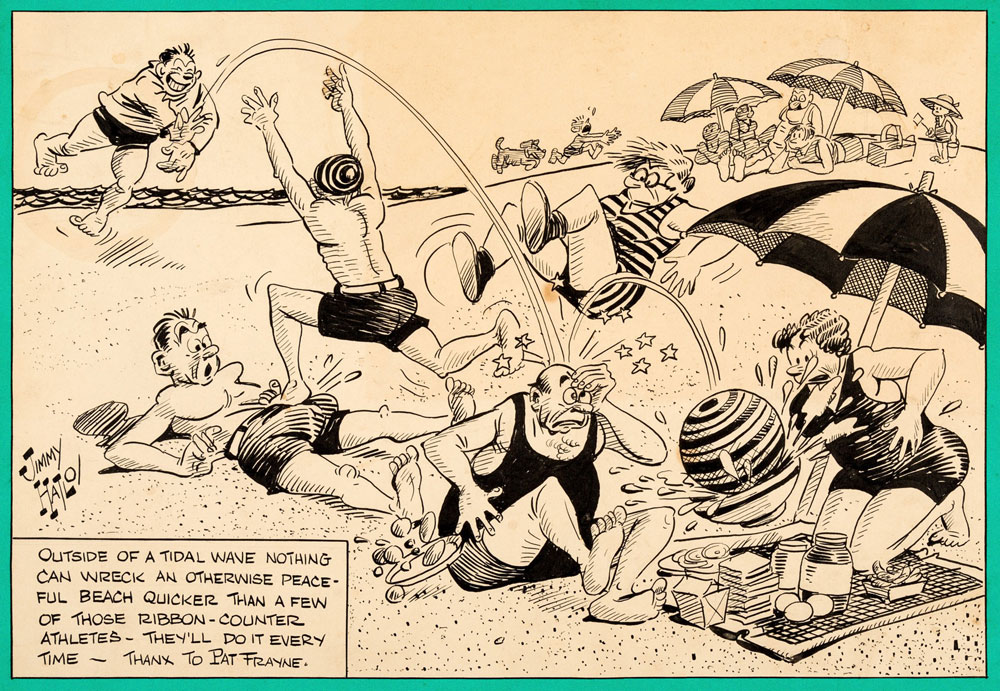
Strip from May 31st, 1939.
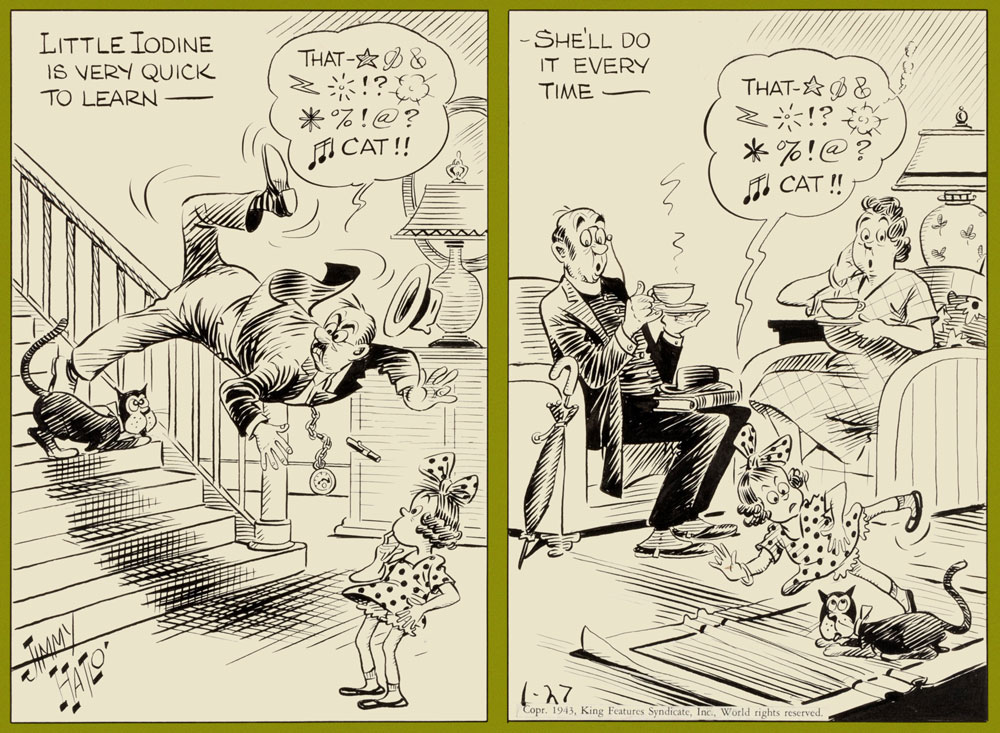
Strip from January 27th, 1943. The character of Little Iodine, born in the pages of They’ll Do It Every Time, « the embodiment of all brats I knew… naughty as hell — and still likable », according to Hatlo, spun off into her own strip, which ran from 1943 to 1983. La petite Iodine, a French translation, first appeared in Saturday editions of Québécois weekly La Patrie in 1945 and 1946, and also made it into some other Québec newspapers later on, where co-admin RG eventually came across it in his youth.
Strip from March 8th, 1943.
Presumed November 30th, 1945.
Strip from August 7th, 1961.
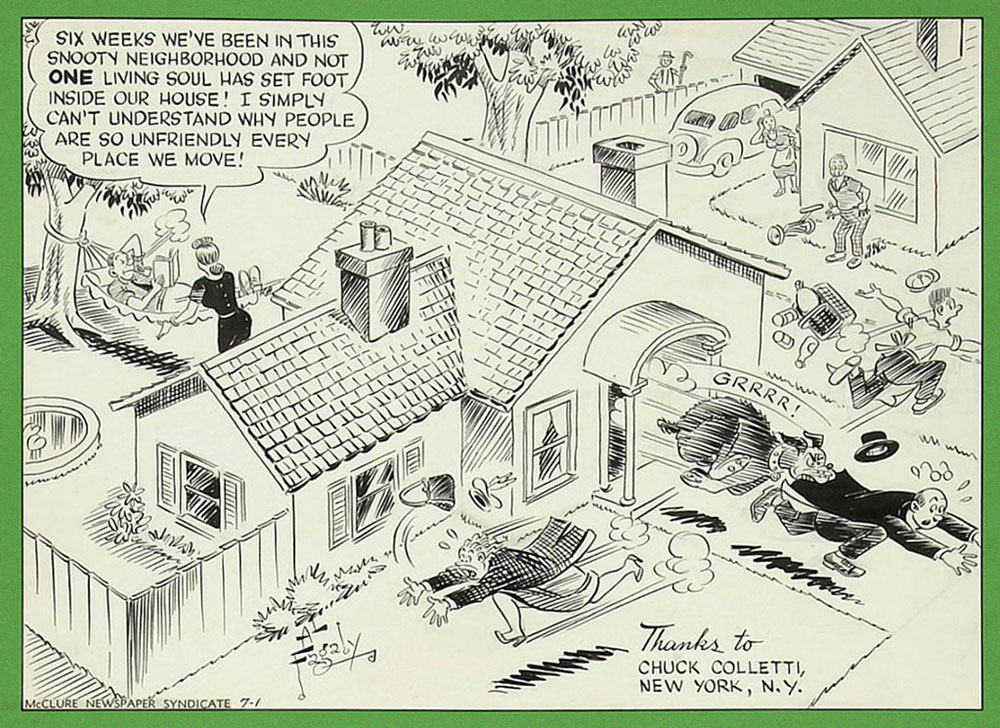
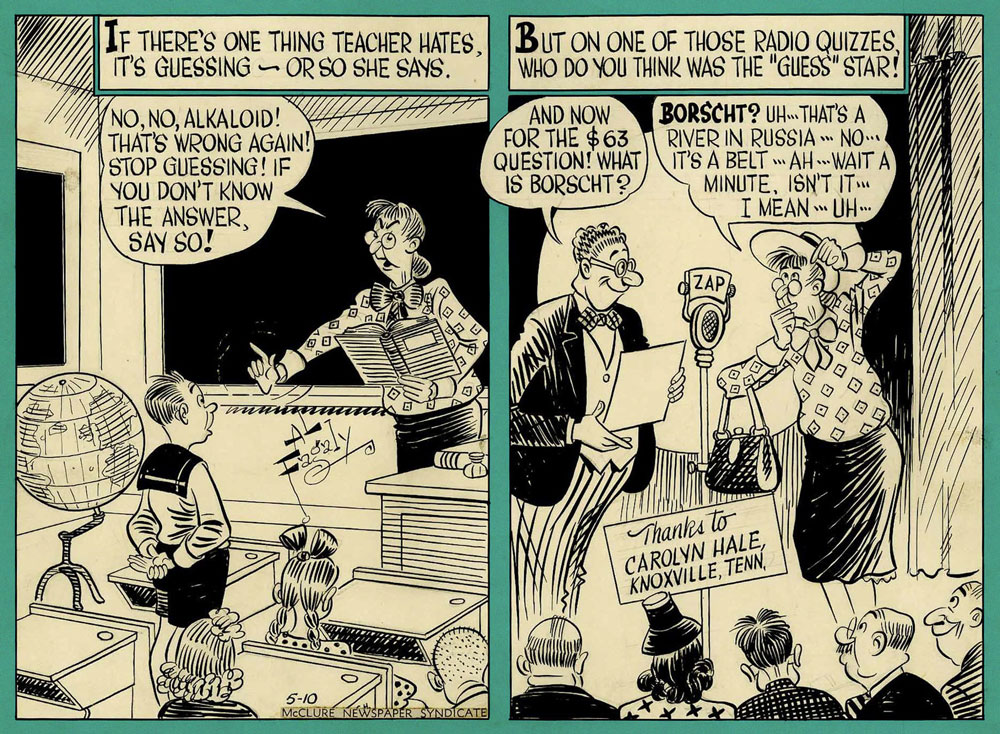
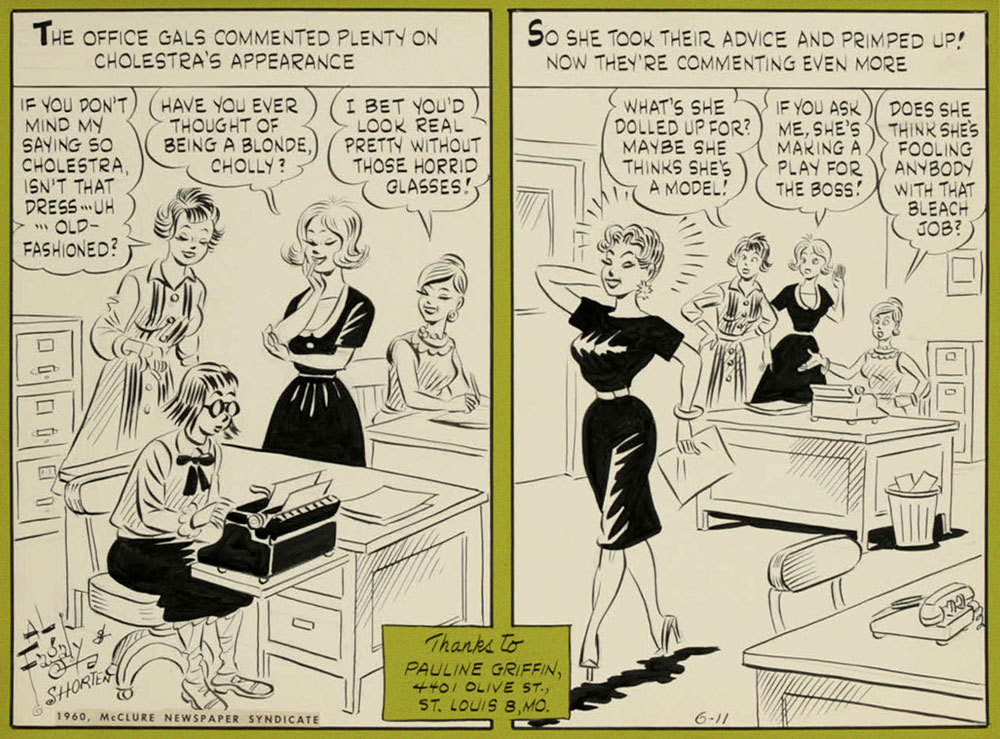
Some twenty years later, in 1948, a ‘blatant’ knock-off – There Oughta Be a Law! – was launched by the McClure Newspaper Syndicate, disturbingly similar in look and tone to the strip it was imitating. It was created by writer Harry Shorten and artist Al Fagaly. Whereas Hatlo’s strip brought him fame, There Oughta… didn’t do much for its creators – though Fagaly (creator of Archie Comics‘ Super Duck) needed no padding on his already impressive (with more to come) résumé. Just like with They’ll Do It Every Time, Fagaly died in 1963 (it was a bad year for cartoonists, it seems), and Warren Whipple took over the illustration duties. Interestingly, Whipple is supposed to have also worked on TDIET at some point (according to this source, and Wikipedia, which copy-pasted it), though I can’t find more information about it.
After a respectable run of 36 years (it ended in 1984), There Oughta Be a Law sank into relative obscurity. One could argue that Hatlo could have sued, had he sufficiently resented the copycat strip – maybe he was too cool a cat for such austerity, maybe imitation is flattery, or They’ll Do It Every Time was sufficiently well-established and popular enough not to have to worry about competition. Hatlo certainly set it up for success, evidence of which is how it ran like a well-oiled machine long after his death. Upon reflection, I prefer the art of TDIET – crisper and more dynamic, it immediately grabs the eye, making these strips enjoyable not only for their humorous observations, but also for their style. I will, however, note that Fagaly had a really fun signature. What do you think, reader?
All of the below strips are circa the 1950s.
I had to include this one, as I am appalled somebody could be unfamiliar with borscht. No, I’m not going to provide a link, look it up yourselves.









































 Who's Out There?