« Adults are just outdated children. » — Dr. Seuss
While some are of the opinion that children should be seen but not heard (and preferably not seen), others coo mindlessly over every mollycoddled tot. I think the truth lies somewhere in the middle, and today I’ll concentrate on courageous, plucky children who are not afraid of diving head first into adventure.
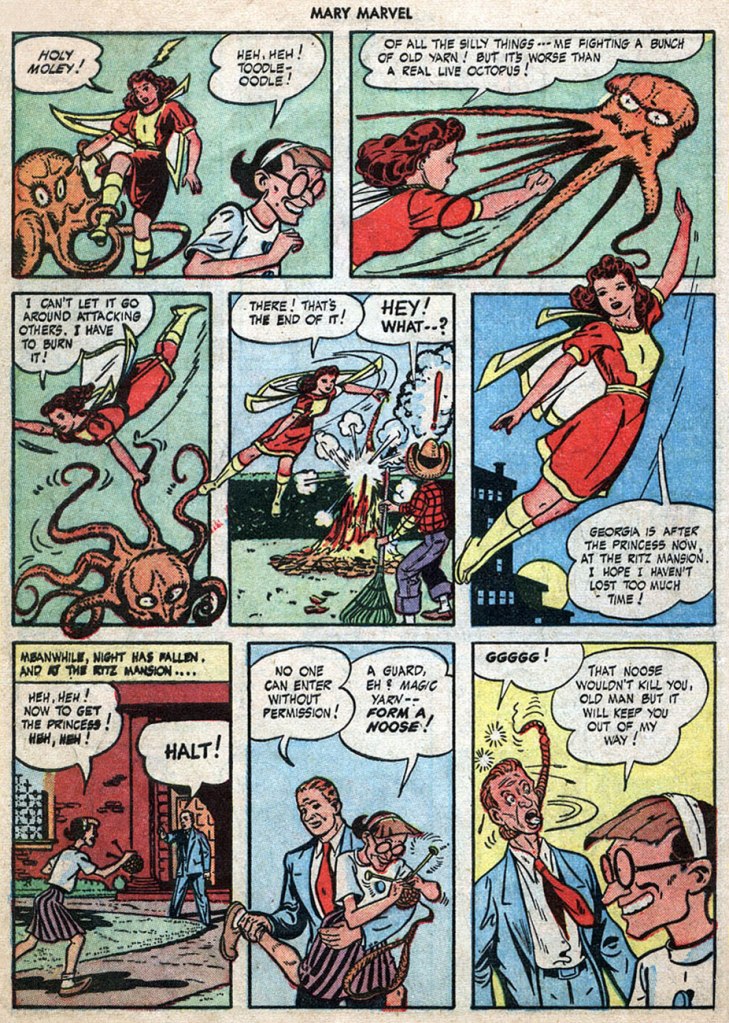
The Magic Yarn, published in Mary Marvel no. 2 (June 1946, Fawcett), was scripted by Otto Binder and drawn by Jack Binder. This immensely entertaining story about an old bat with dreams of world domination involves an octopus, some bondage (of course!), and lots of knitting. (Read it here)
Moving on to actual (rather than knitted) octopuses, here’s the original art from On the Bottom of the Sea, published in Little Max no. 16 (Harvey, April 1952). The story artist may be uncredited on GCD, but we know that it’s Al Avison 😉
The Little Wise Guys tangle with an ornery cephalopod. Giggles ensue! This is Daredevil Comics no. 111 (June 1954, Lev Gleason), with a cover is by Charles Biro. The cover story is Scarecrow’s Lucky Blunder, scripted by Charles Biro and illustrated by Ralph Mayo.
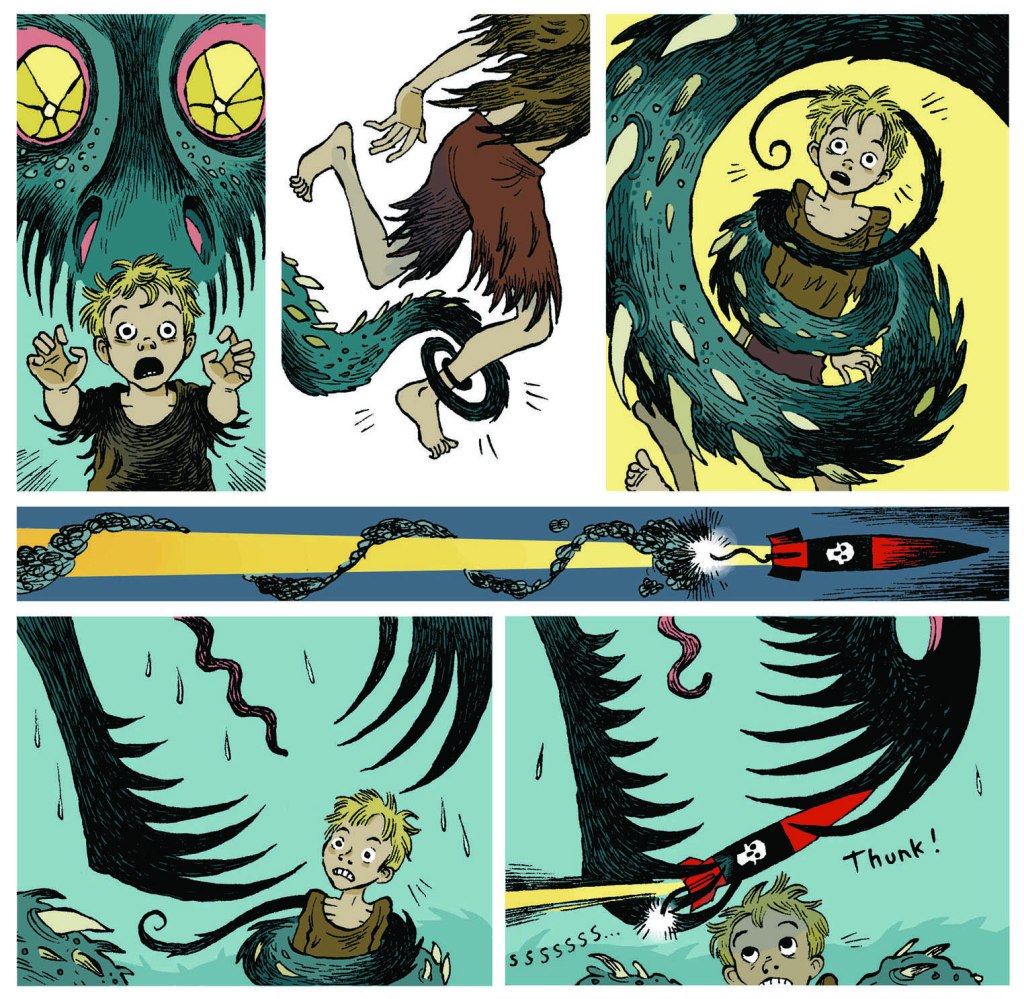
Finally, making an epic effort to wrench myself away from the tender embrace of the Golden Age, I’ll accelerate a little too much and end up in all the way in 2015. Here’s a page from Scarlett Hart: The Tentacles of Terror by Thomas Taylor and Marcus Sedgwick.
“Man is a rope stretched between the animal and the Superman–a rope over an abyss. A dangerous crossing, a dangerous wayfaring, a dangerous looking-back, a dangerous trembling and halting.”
– Friedrich Nietzsche
Superheroes come in all shapes and sizes, and for every successful superhero remembered throughout the ages, there’s probably about a hundred forgotten characters of varying degrees of goofiness. Periodically, some artist or writer digs up one of them from the deep recesses of time, dresses him in a new frock and plugs him into the modern era of Internet and cellphones, with almost universally lacklustre results.
I like to contemplate these bold strangers in their natural habitat — Golden Age comics! And for a 40s superhero, there is simply no better way to demonstrate super powers and a nimble brain than a friendly tussle with a cephalopod.
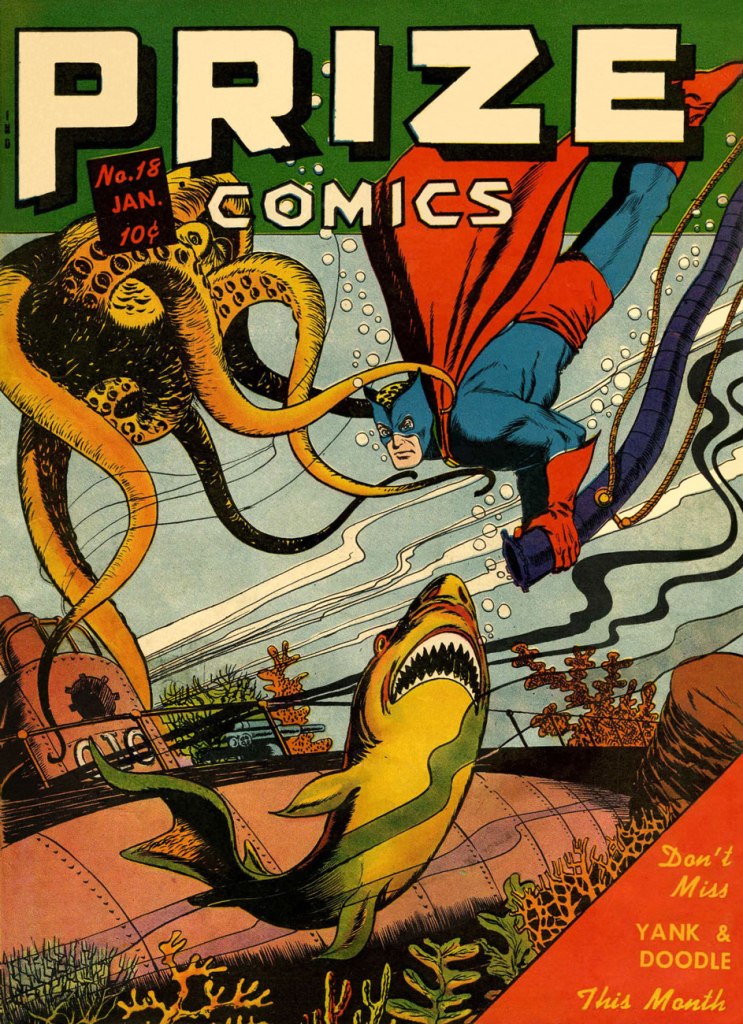
The Black Owl, clad in a red-and-blue costume with some odd leopard-print swimming cap… oh, sorry, that’s his blond hair:
Prize Comics no. 18 (January 1942). Cover by Jack Binder.
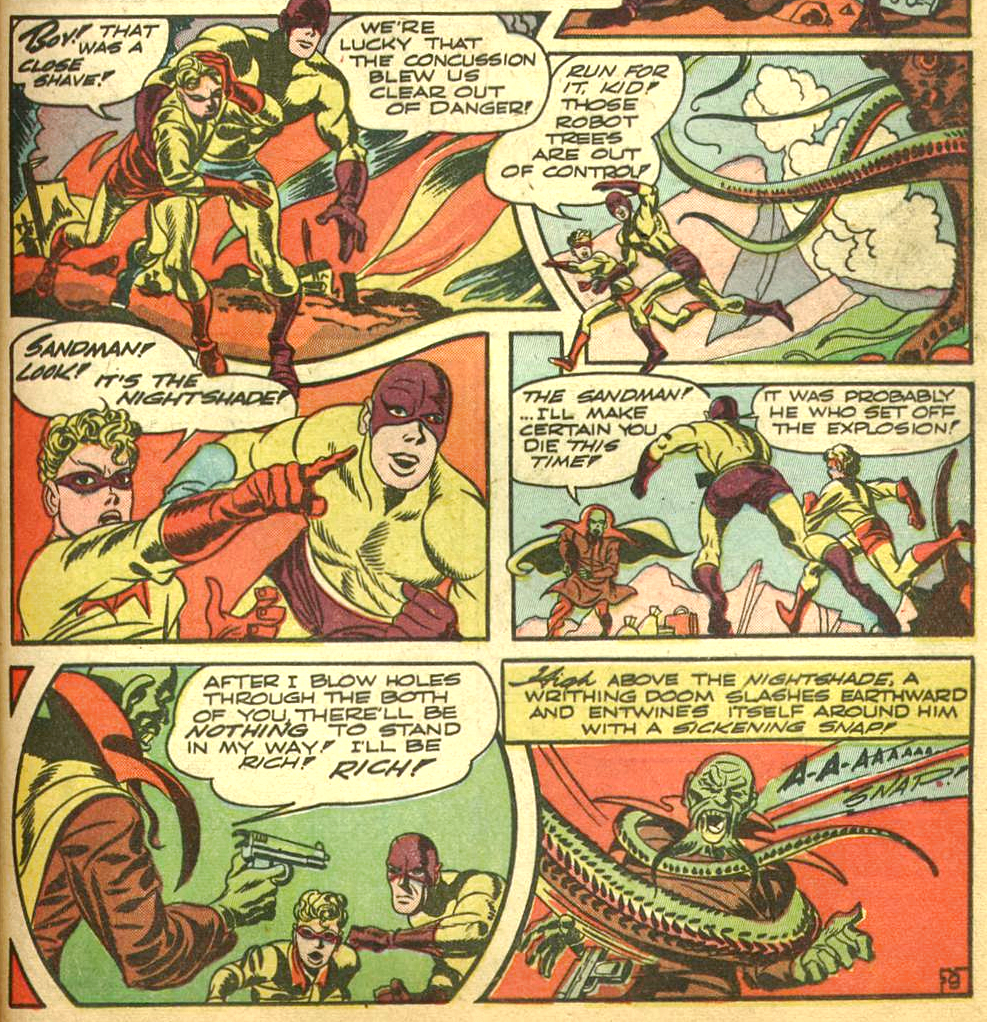
The Sandman… oh shoot, which one? Remember we have both feet firmly planted in the 40s in this post. This Sandman is Wesley Dodds, created by artist Bert Christman and writer Gardner Fox. Accompanied by his sidekick Sandy, this superhero-cum-detective wielded a special gun that could put criminals to sleep or act as a sort of truth serum.
The Adventure of the Magic Forest, published in World’s Finest Comics no. 6 (Summer 1942, DC), was scripted by Jack Kirby (Tentacle Tuesday Master!), pencilled by the King and inked by Joe Simon.
You’re not convinced that those are tentacles? Shame on you. Take a gander at this:
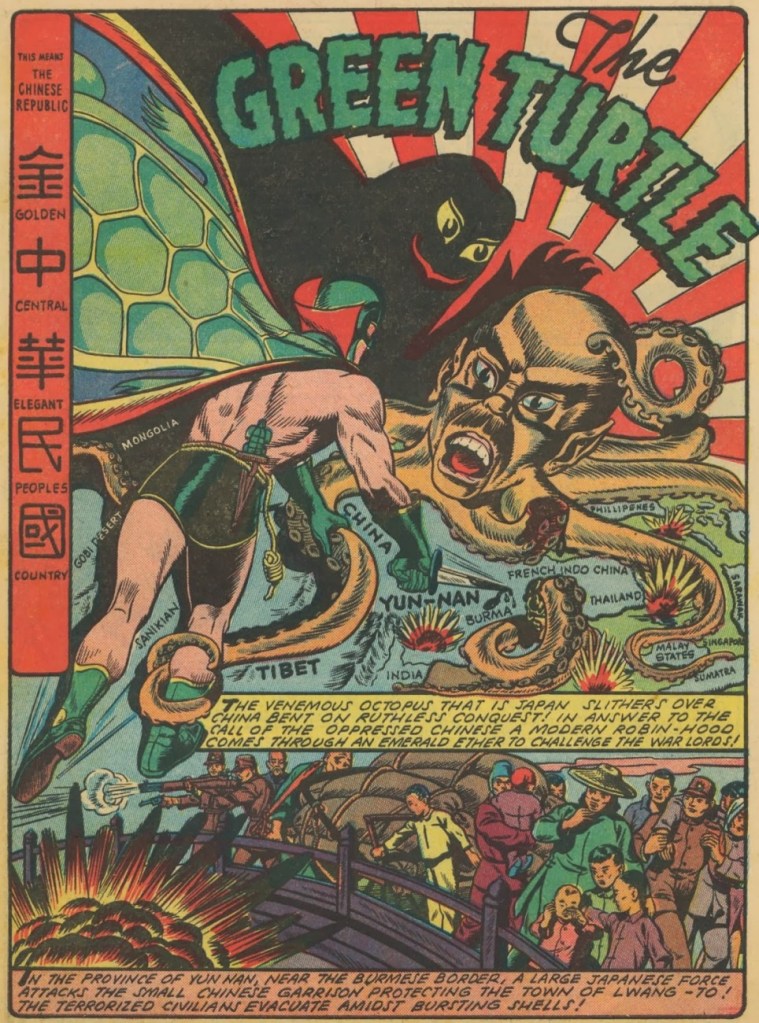
The next superhero (technically with no super powers, but managing beautifully all the same thanks to his lightning-fast reflexes and superior fighting skill) is my personal favourite Green Turtle, a Chinese superhero who fought against Japanese invaders in WWII. Unfortunately, the publisher wouldn’t let creator and artist Chu Fook Hing make his creation obviously Chinese, so the Green Turtle was never seen without a mask. It’s okay, we can read between the lines!
This Green Turtle adventure was scripted and illustrated byChu F. Hing and published in Blazing Comics no. 1 (June 1944, Rural Home). With apologies to our Japanese readers.
Magno the Magnetic Man has, believe it or not, magnetic powers (though I imagine it’s not helping him much in this particular skirmish). He’s irresistible to women (maybe they have metal parts?), impervious to harm, and is accompanied by his side-kick Davey, whom he periodically magnetizes to ensure that the little whippersnapper also has access to magnetic powers.
Super-Mystery Comics vol. 5 no. 4 (February 1946, Ace Magazines). Cover by the sudorific Rudy Palais.
The thing kept coming. “Die, die!” Parke screamed, his nerves breaking. But the thing came on, grinning broadly. “I like quiet protoplasm,” the thing said as its gigantic mouth converged on Parke. “But I also like lively protoplasm.” It gulped once, then drifted out the other side of the field. — excerpt from The Last Weapon by Robert Sheckley
I Am the Living Ghost!, illustrated by Steve Ditko, was published in Tales of Suspense no. 15 (Mar. 1961, Marvel). I came across a reprint of this story while looking for Draculian tentacles (which you can see in Tentacle Tuesday: Dracula Drops In).
Call it goo, label it as a giant amoeba, christen it ectoplasm or protoplasm, but when it starts crawling your way, do remember to beat a hasty retreat.
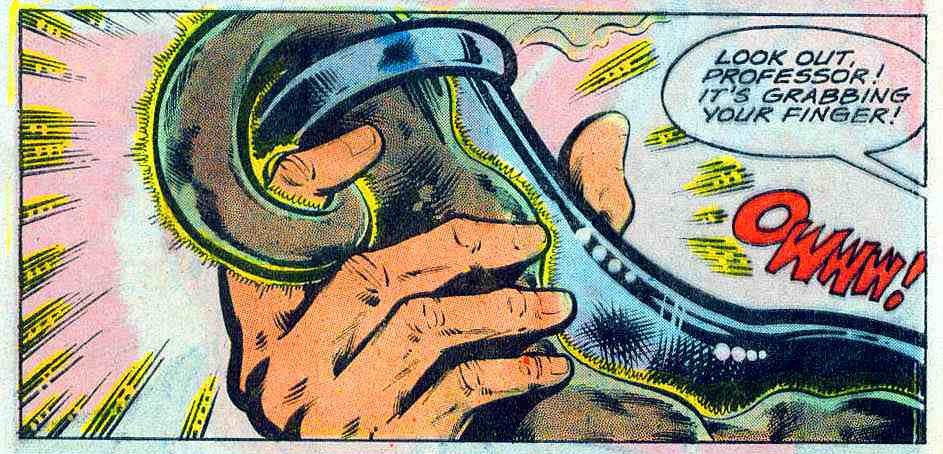
Oh, yeah, and keep your fingers away from it, too.
Coo! this page has everything: a prehensile amoeba, tentacled plants, aliens with cephalopod appendages…
Spawn of Venus was scripted by Bill Gaines and Al Feldstein, and illustrated by the latter. It was published in Weird Science no. 6 (Mar.-Apr. 1951, EC).
… but it’s the amoeba that’s of current interest to us (yes, the one devouring everything in its path, including dawdling professors).
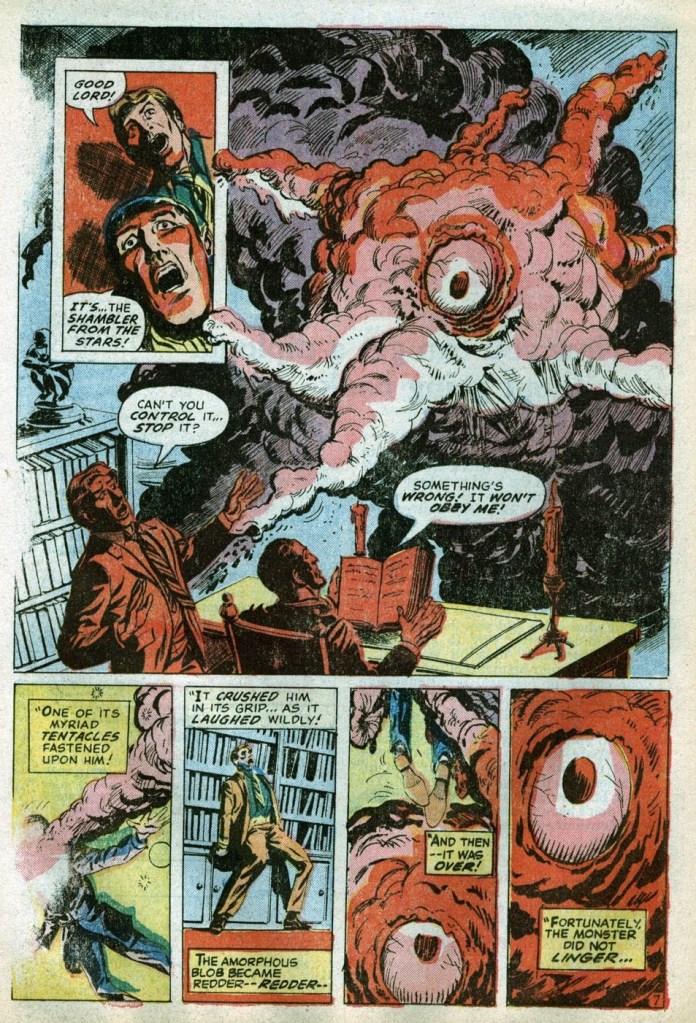
Continuing our literary delusions, a peek at the adventures of a ‘star vampire’, from a (somewhat lackluster) comic book adaptation of a Robert Bloch short story:
The Shambler from the Stars!, based on a story by Robert Bloch, was adapted by Ron Goulart, pencilled by Jim Starlin and inked by Tom Palmer. It was published in Journey into Mystery no. 2 (Feb. 1973, Marvel). An amorphous red blob is not a dog to be ordered around, which explains the poor results.
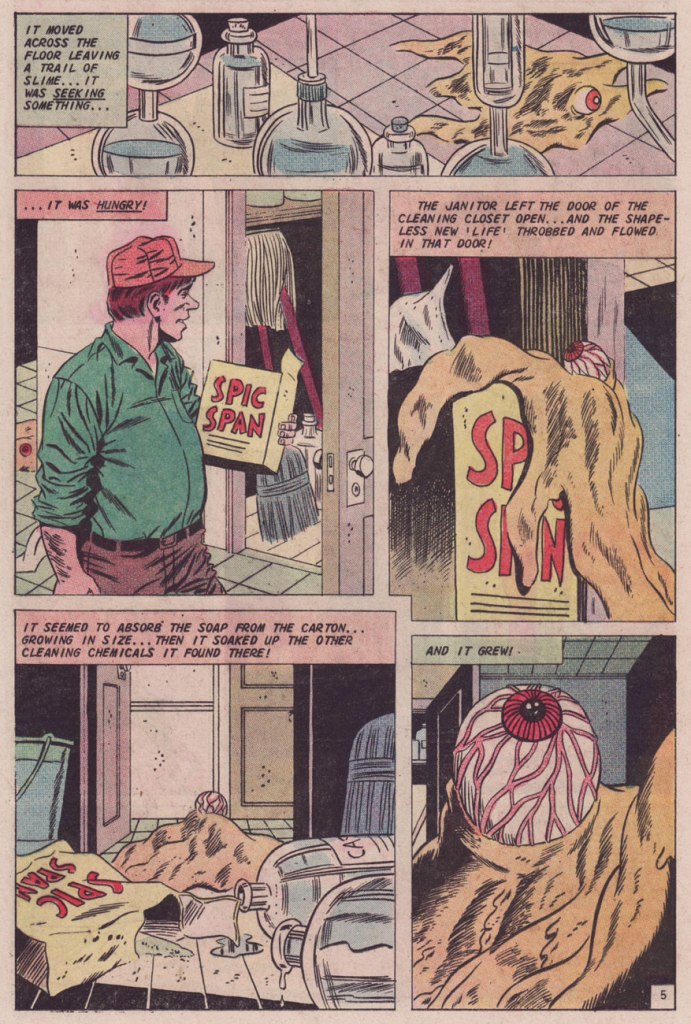
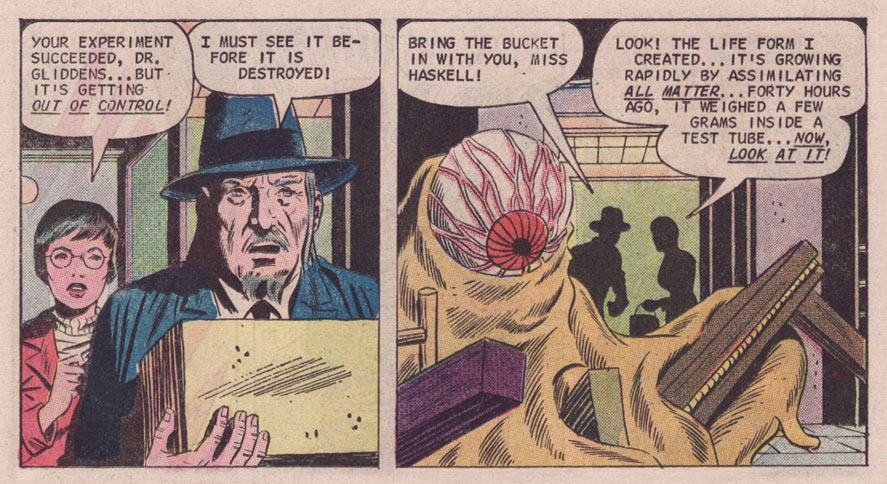
If a tentacled amoeba is scary, just think of how startling it is to run into an amoeba with a single bloodshot eyeball (that feeds on soap, among other things).
A page from Creator of Life, published in Ghost Manor no. 11 (Apr. 1973, Charlton). This story was written by Joe Gill and illustrated by Charles Nicholas and Wayne Howard.
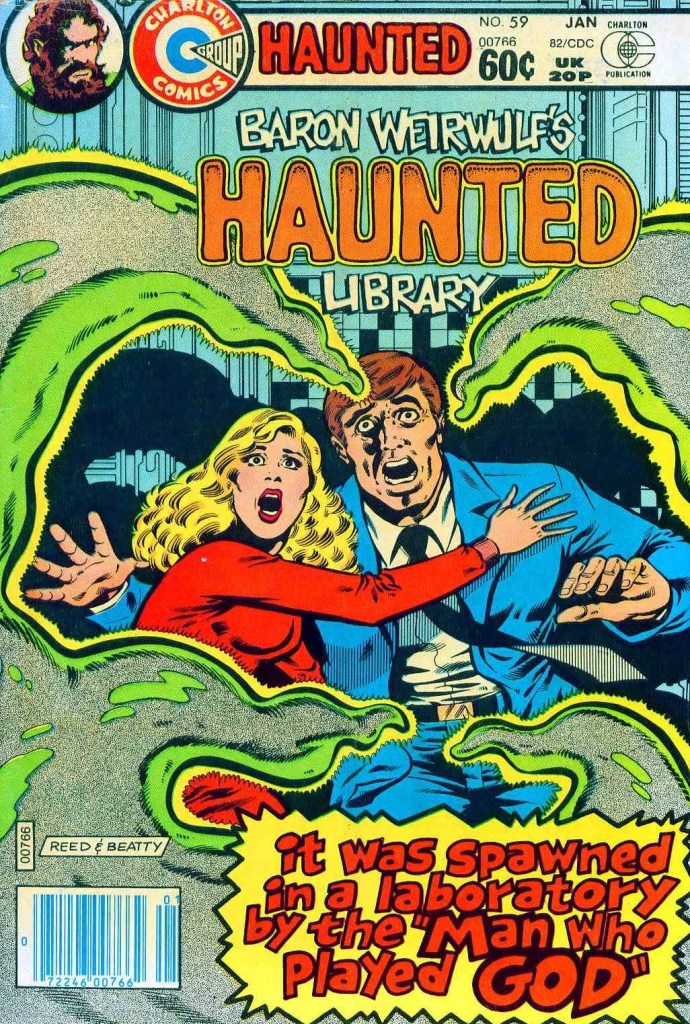
An eyeball in a turtleneck! Scary stuff.
Haunted no. 59 (January 1982), pencilled by Dan Reed and inked by John Beatty.
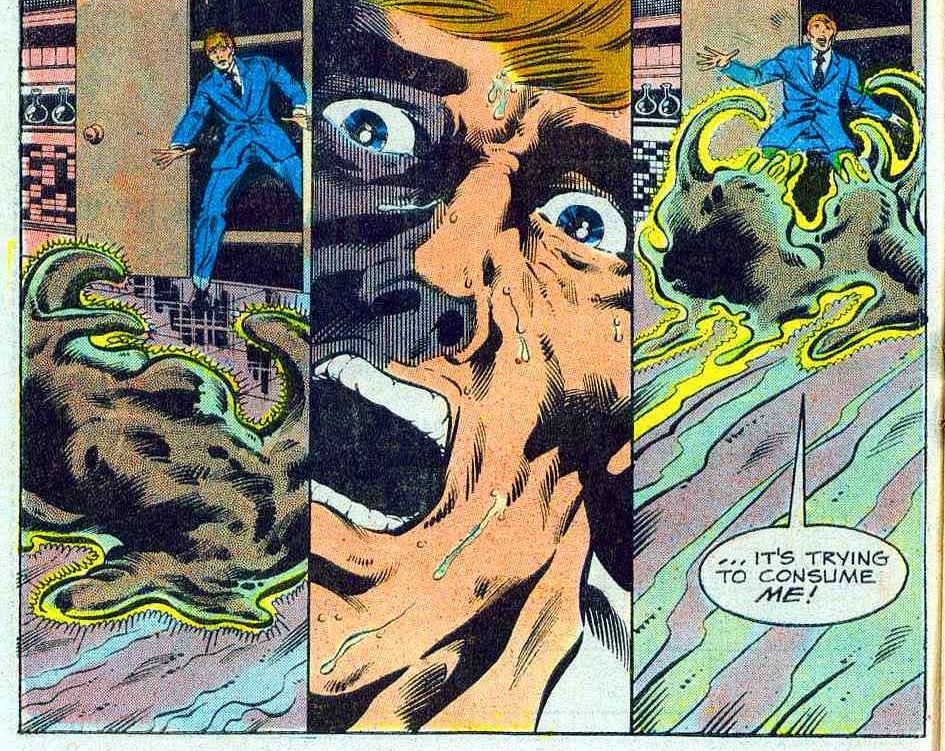
Not only does this monstrosity go after the scientist, instead of pursuing his absurdly attractive assistant…
The Man Who Played God was scripted by Joe Gill (again), pencilled by Dan Reed and inked by John Beatty.
But she’s also the one who saves the situation. Joe Gill, ladies and gentlemen!
I love his tough-guy stance at the end. He surely would have punched the amoeba out, if only the meddling female hadn’t interfered!
« Well, she sneaks around the world from Kiev to Carolina She’s a sticky-fingered filcher from Berlin down to Belize She’ll take you for a ride on a slow boat to China Tell me, where in the world is Carmen Sandiego? »*
Today’s Tentacle Tuesday is for globe-trotters only – but don’t let this post give you an itch for actual travelling: that’s verboten right now.
This Teutonic tentacled cutie appeared on the cover of Moga Mobo no. 3 (1995). The wraparound cover is the work ofJonas Greulich, one of the co-founders of this German comics magazine that began publication in 1994 (the other two artists involved are Titus Ackermann and Thomas Gronle).
Speaking of German comics, does anybody know where this page and its German Captain Nemo come from?
20.000 Leguas de viaje submarino was adapted by Héctor Oesterheld and illustrated by Roberto Regalado. This 23-page story was published in Argentine Billiken Magazine (Editorial Atlantida) in 1974. For those who can read Spanish or would just like to see more images, head over to this article.
One would be remiss in not paying at least a brief visit to Asia:
The cover of a comics anthology from Hong Kong, probably from the 1960s.
And back to Germany at a staggering speed (watch out for whiplash)!
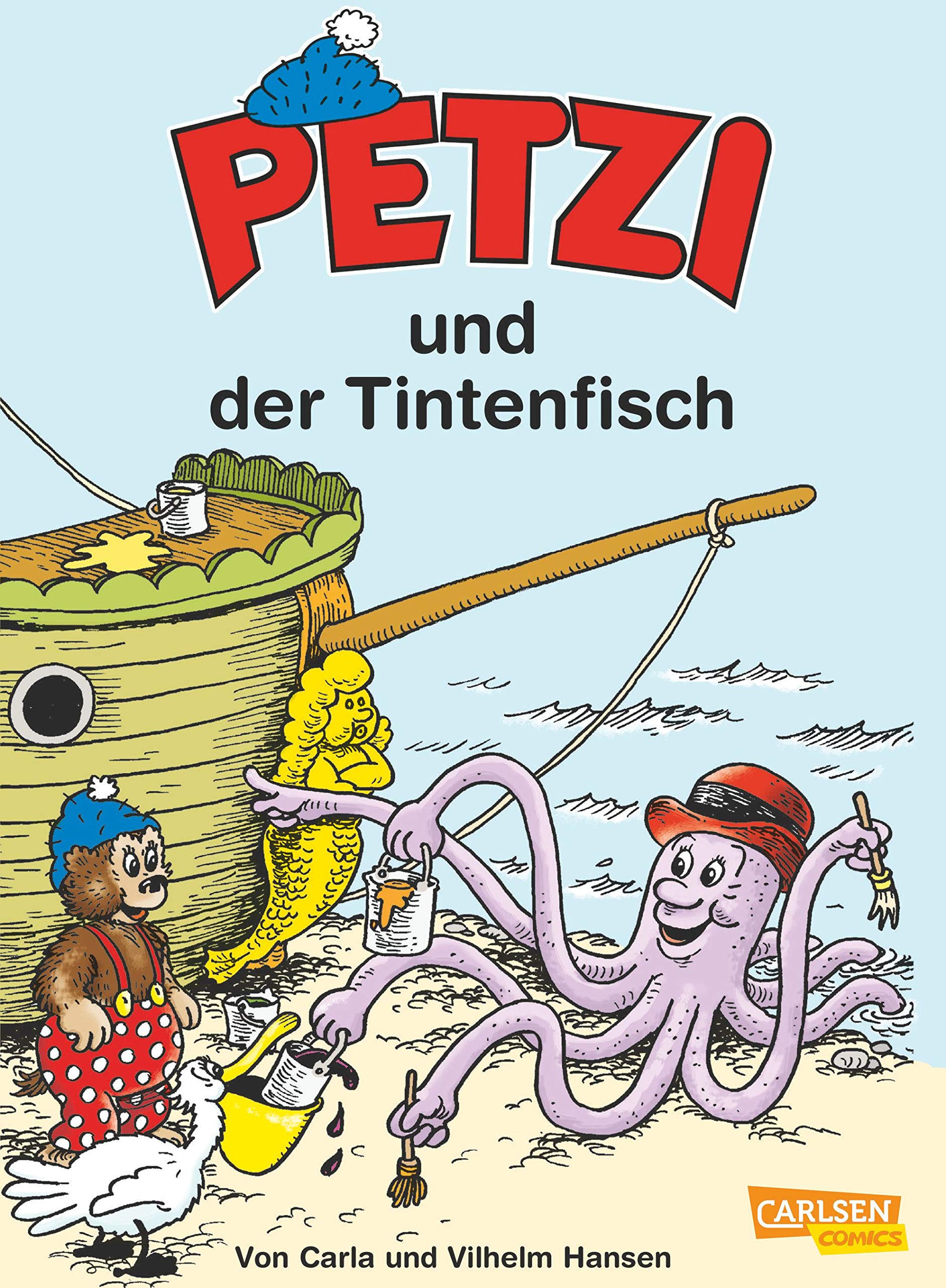
Petzi is actually a translated version of a Danish character named Rasmus Klump, created by a husband-and-wife team Carla and Vilhelm Hansen in 1951. The adventures of the lovable bear cub were popular enough to be translated into many languages, but a hefty price had to be paid – namely, a name change. Rasmus became Petzi in French, German, Italian, Portuguese and Vietnamese, and I’m slightly amazed that such different countries could agree on one name. In English, you will no doubt be familiar with Barnaby Bear. This is Petzi no. 40 (July 2008), a reprint of older material published by Carlsen Comics.
∼ ds
* She’ll go from Nashville to Norway, Bonaire to Zimbabwe
Chicago to Czechoslovakia.. and back!
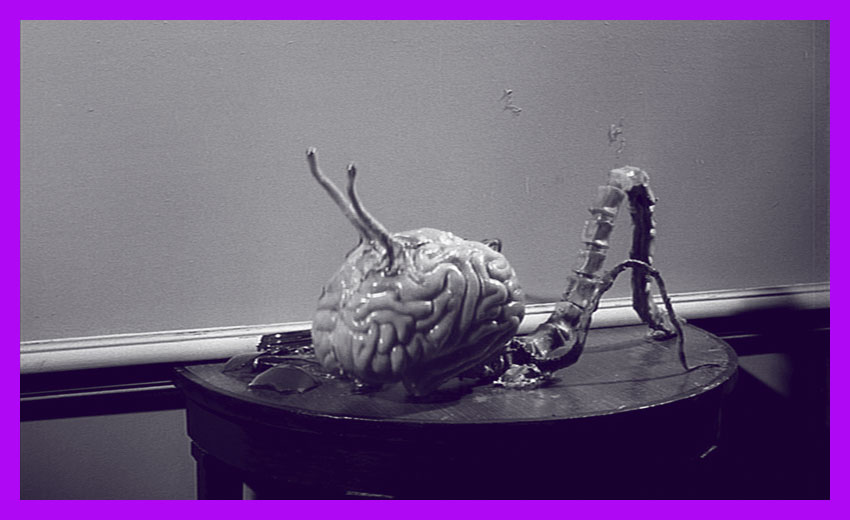
The brain-with-tentacles is curled up at the comfy intersection of two beloved tropes, the Brain Monster and the Tentacled Terror. Through some clever combining, one is guaranteed a truly horrendous creature that’s at least 25% more appalling than either of its step-parents. It’s the favourite of many a filmmaker and comic artist, and the toast of this particular post!
It may be a little too early to wrap yourself around a drink (at least in this part of the world), so you’ll have to enjoy this Tentacle Tuesday sober.
One has to pay one’s dues to the classics: Basil Wolverton‘s The Brain Bats of Venus, originally published in Mister Mystery no. 7 (September 1952), is unquestionably indispensable, so I could hardly turn a blind eye to it. In case you were out that night and missed it, you can read the whole story at The Horrors of It All blog.
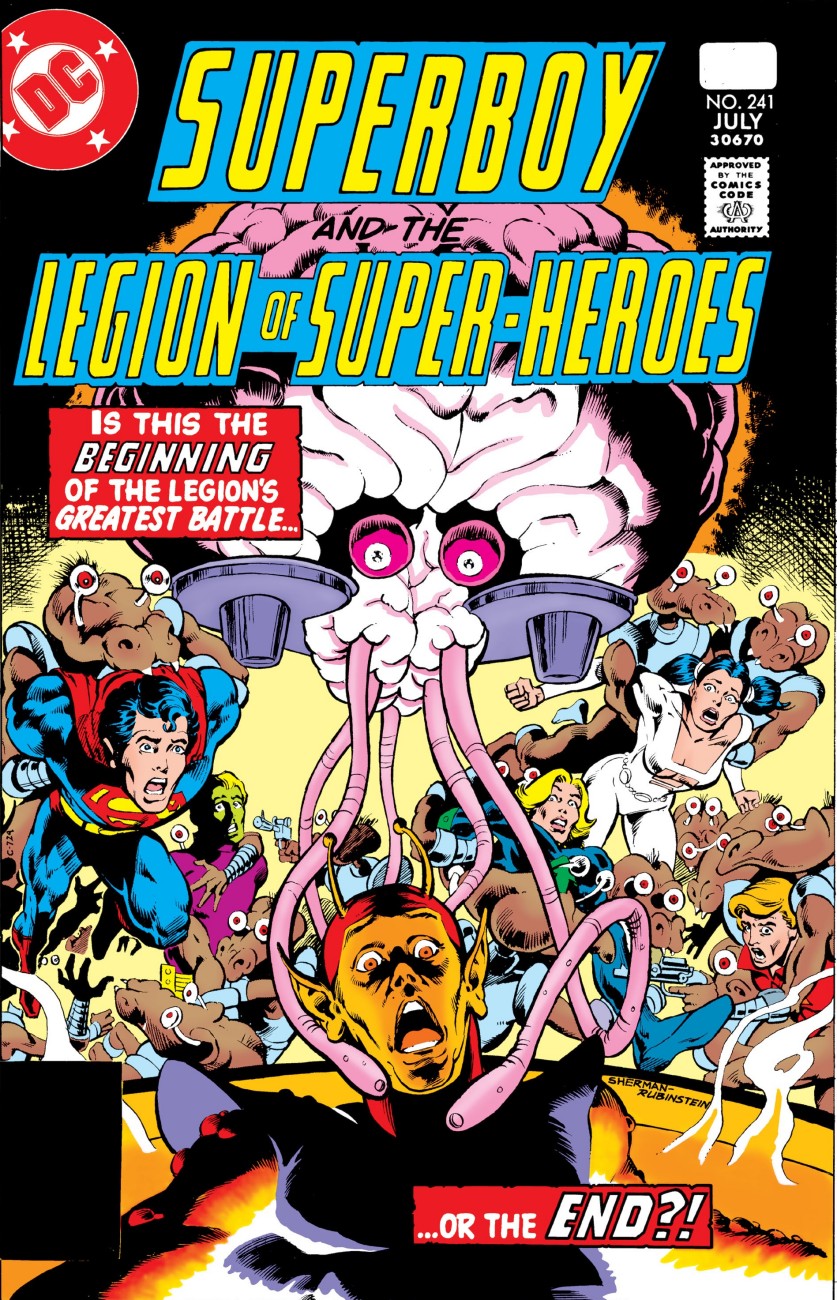
The tentacled brain has several means of locomotion at its disposal, and while crawling around spasmodically is a great mood-setter, floating around gives one much better scope of movement. The following is one of those floaters, aided by some mechanical gizmos.
Superboy & the Legion of Super Heroes no. 241 (July 1978). Cover pencilled by James Sherman and inked by Joe Rubinstein.
The cover story, Prologue to Earthwar is scripted by Paul Levitz, pencilled by James Sherman and inked by Bob McLeod:
It’s just the worst when a brain launches into a tedious monologue after attacking you.
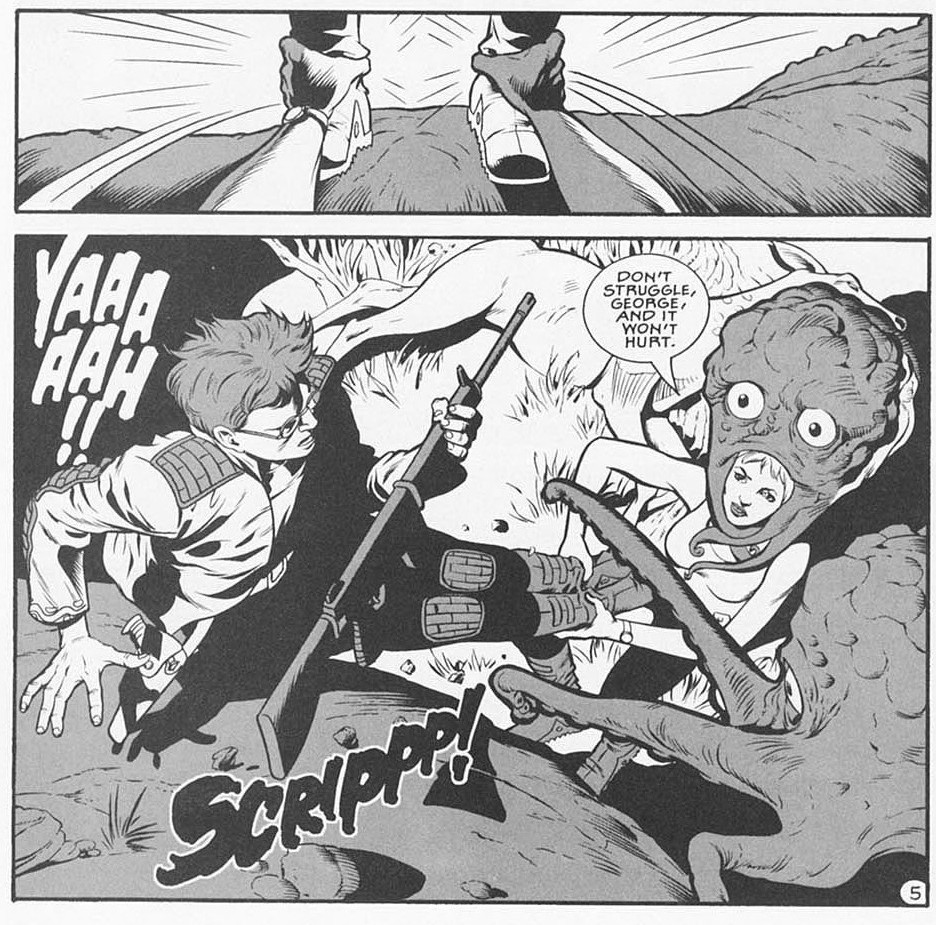
As implicitly suggested earlier by that panel from Brain Bats of Venus, some brain-monsters latch onto their victims’ brains, either sucking them out like you’d do with a coconut and a straw, or taking over people’s minds by puncturing some unsavoury holes I’d rather not think about too closely. A character in the following issue of World Below, when it is kindly suggested to her that perhaps it would be a sound idea to sever her ties with the tentacled thing on her head, mentions that « it hurts them to release — terribly. And it’s hard to reconnect, too. Like surgery without anaesthesia.» The implications are… unpleasant.
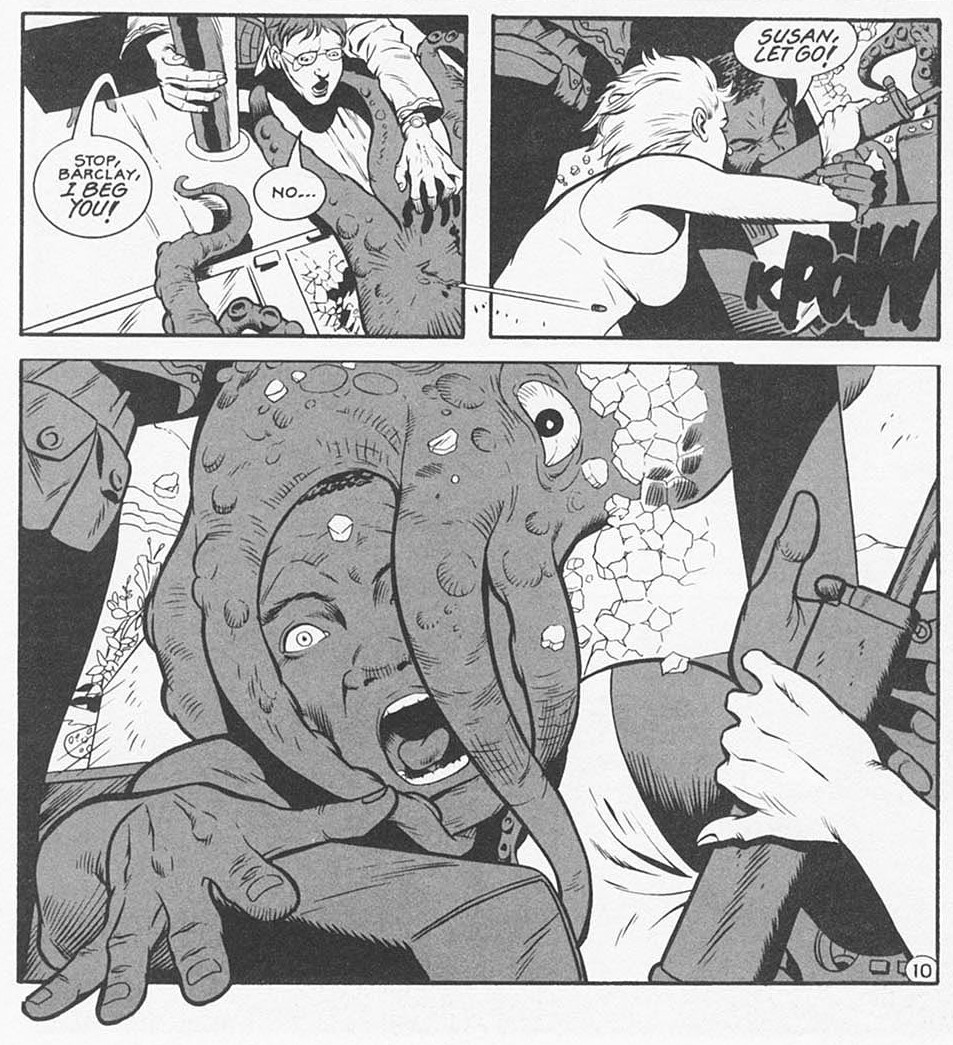
The World Below: Deeper and Stranger no. 2 (January 2000), cover by Paul Chadwick. Say, that’s a stylish hat you’ve got there, fella!
Zombies!is scripted and pencilled by Paul Chadwick and inked by Ron Randall, with grey tone separations by Jason Hvam:
I would recommend not taking advice from women with a cephalopod on their heads.
The headaches this hat must cause… just think of the neck pressure from having to support 40 pounds of octopus-flesh.
Oops, that doesn’t look like it’s going to end well.
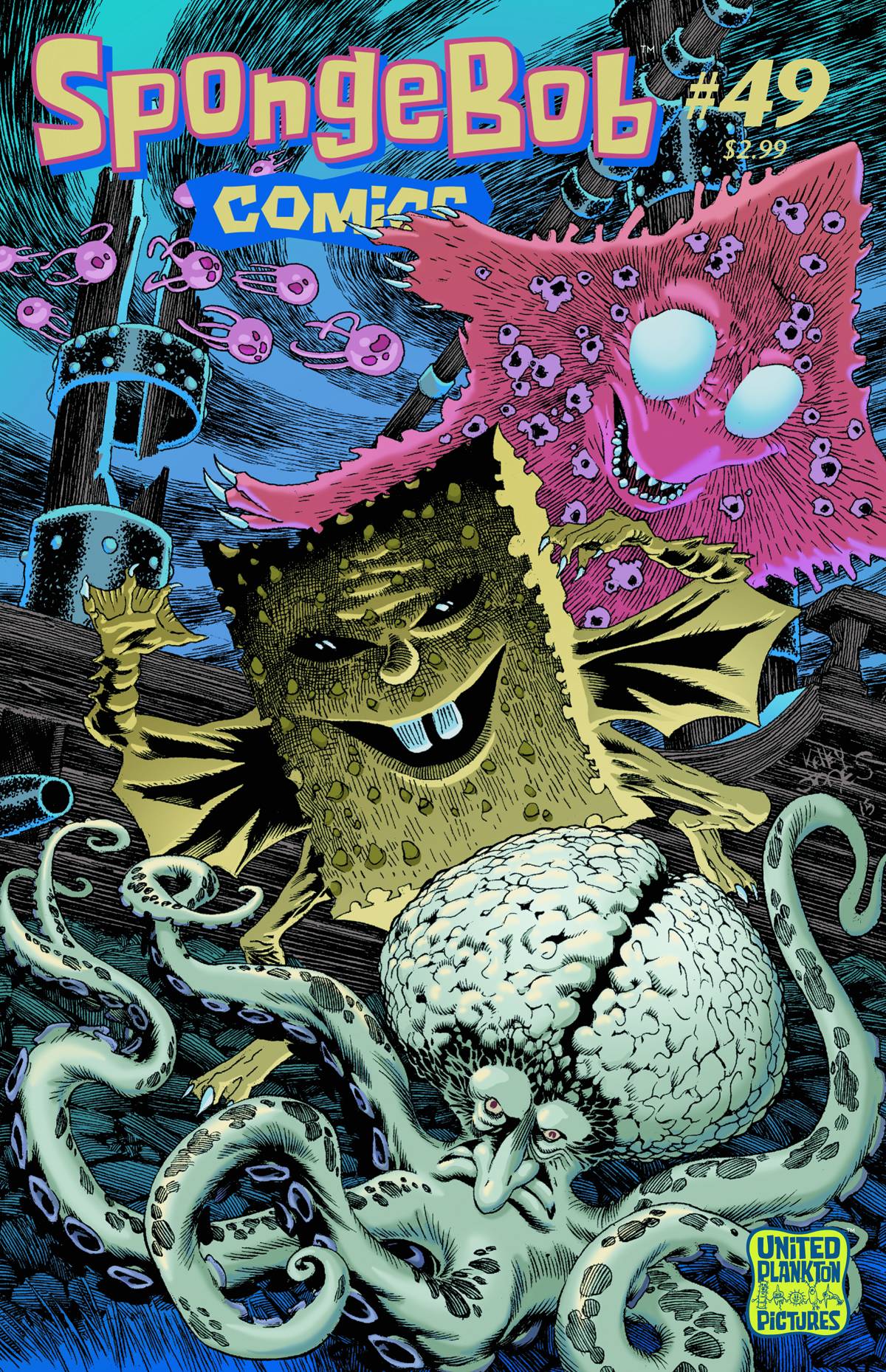
Moving along to goofier pastures…
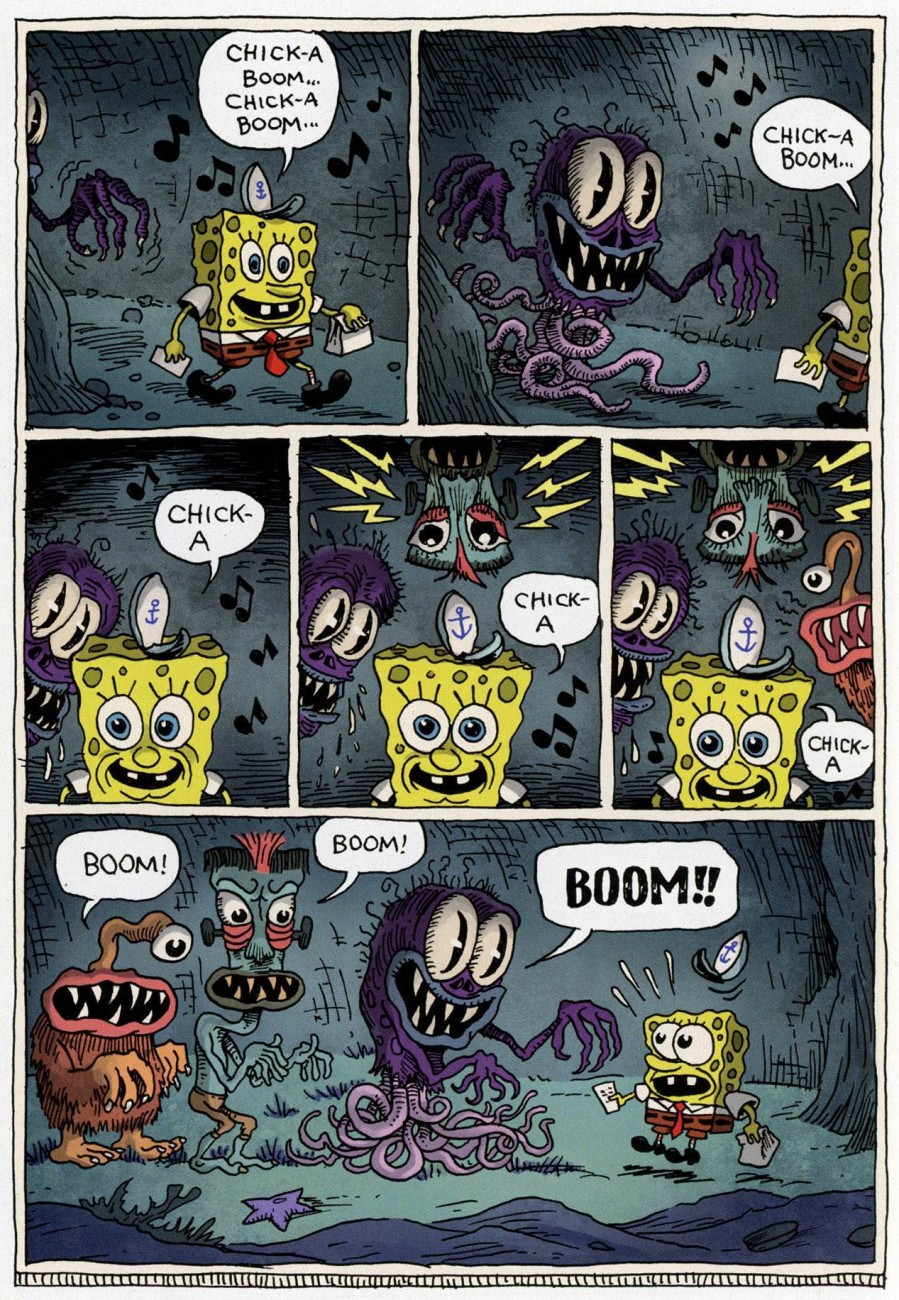
SpongeBob Comics no. 49 (October 2015). Cover by Kelley Jones.
This is perhaps getting ever-so-slightly beyond the parameters of today’s brain theme, but the inside of this issue hides a gem in its otherwise dull pages (although I have to be fair: the stuff is much better than I expected). Behold: Spongebob in Monster Canyon, written by Kaz and drawn by Tony Millionaire, both favourites of this blog. With such excellent parentage, one expects something wonderful, and one is not disappointed.
Keep a close eye on your brains, folks, lest they be transformed into mindless mush by brainy aliens with tentacles with a taste for grey matter. I’d also stay away from TV, just in case…
« The tentacles of my followers shall seek you out and destroy your swiftly! »
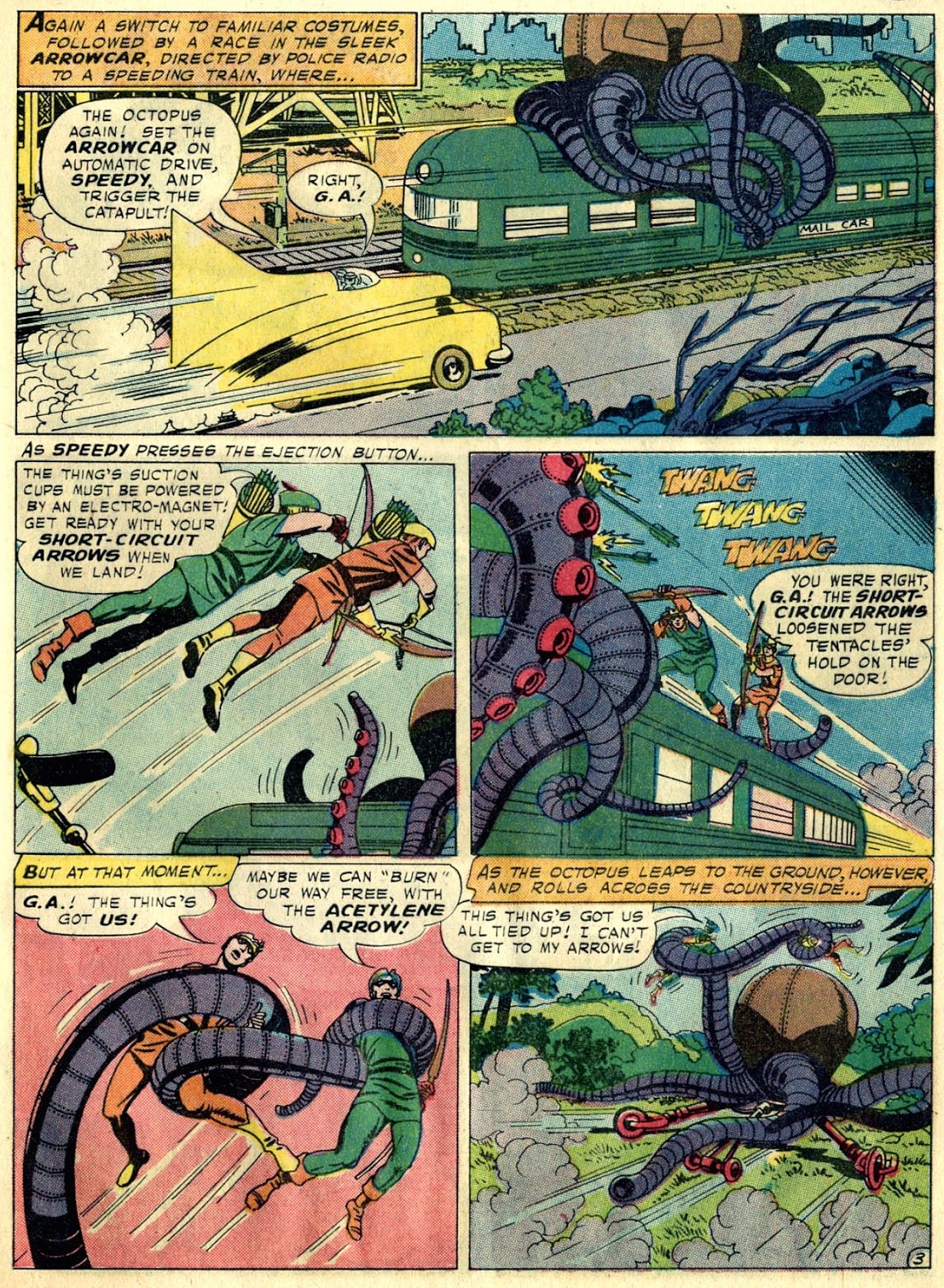
If you like joyous nonsense, this post is for you! As if humanity wasn’t besieged enough by actual cephalopods, evil-but-brilliant minds insist on creating machines with tentacles to horrify and maim. Pain to some, amusement for us!
First, some definite eye candy. The following story is not only convincingly illustrated, but also makes some sense on a scientific basis. The Menace of the Mechanical Octopus was scripted by Ed Herron, and pencilled and inked by Jack Kirby. It was published in Word’s Finest Comics no. 97 (October 1958).
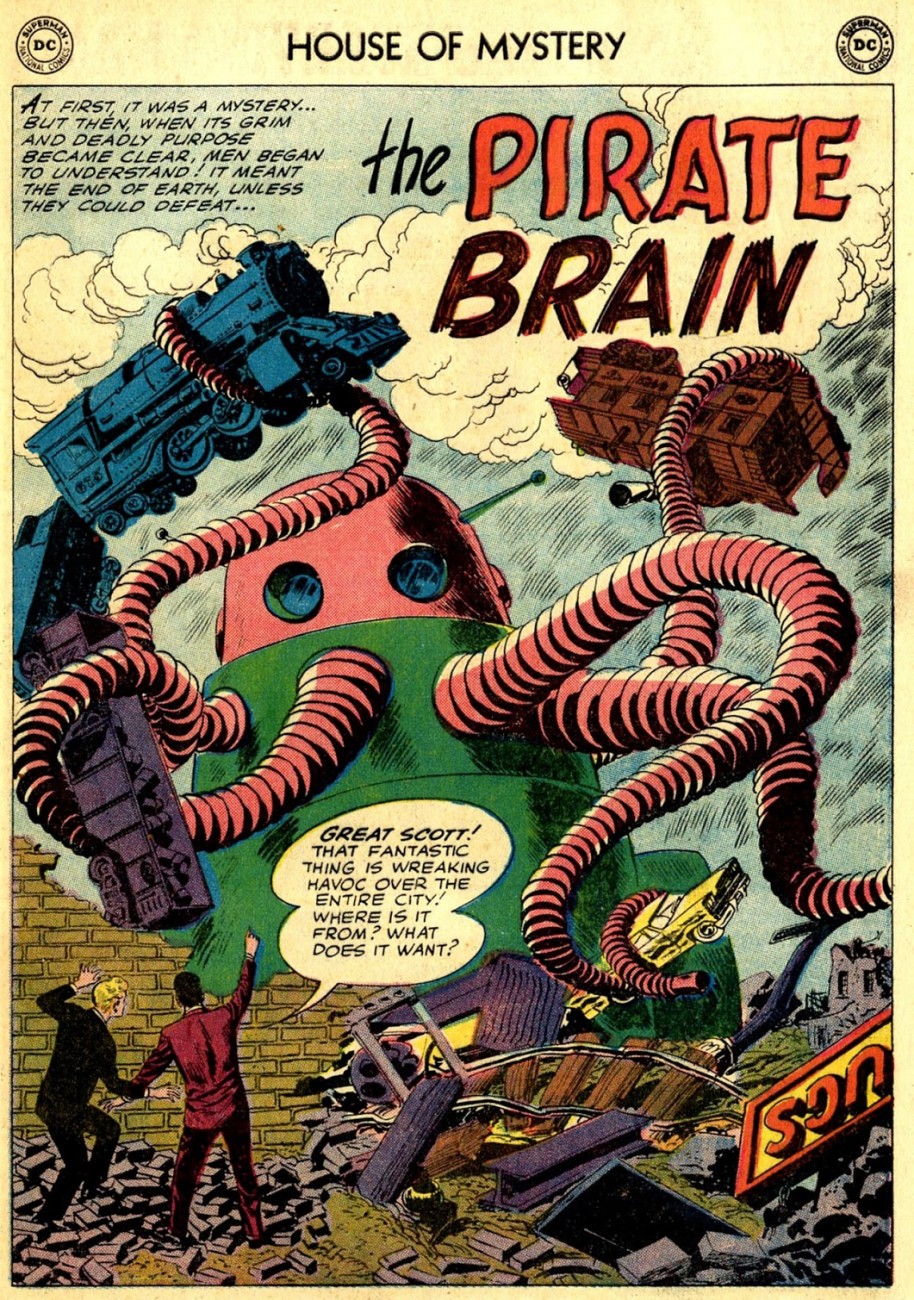
Now we move on to that goofy-yet-fun series, DC’s House of Mystery. I will readily admit that I’m not always a fan. At worst, some of the stories published within its pages have plots so random that amusement becomes irritated incredulity. But keep an open mind, and there are also very creative (sometimes “were these people on drugs?” creative) plots to be enjoyed and great art to be relished.
House of Mystery no. 96 (March 1960), cover is pencilled by Dick Dillin and inked by Sheldon Moldoff.
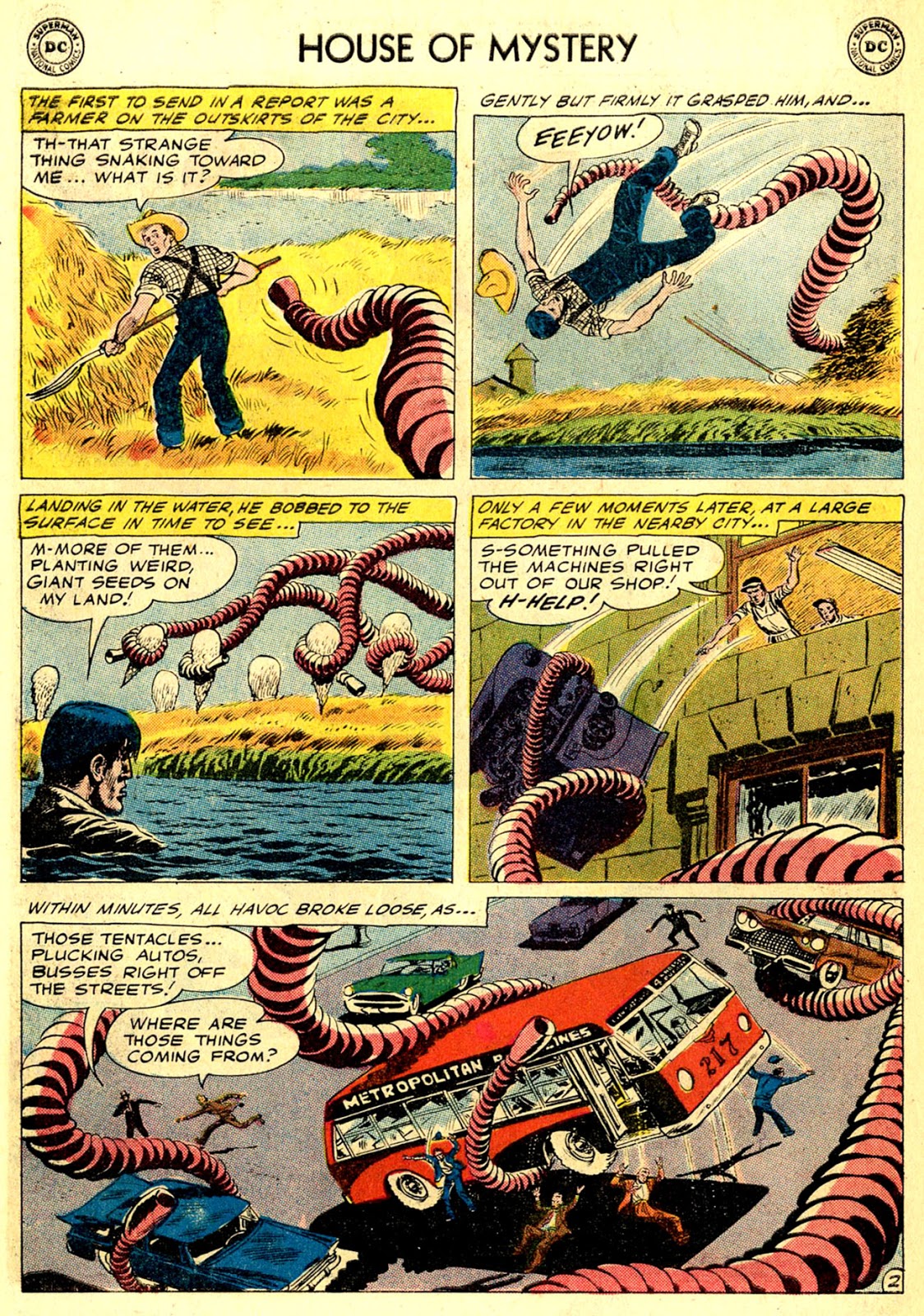
The cover story, The Pirate Brain, was illustrated by Lee Elias:
The ‘weird, giant seeds’ look remarkably like ice cream cones.
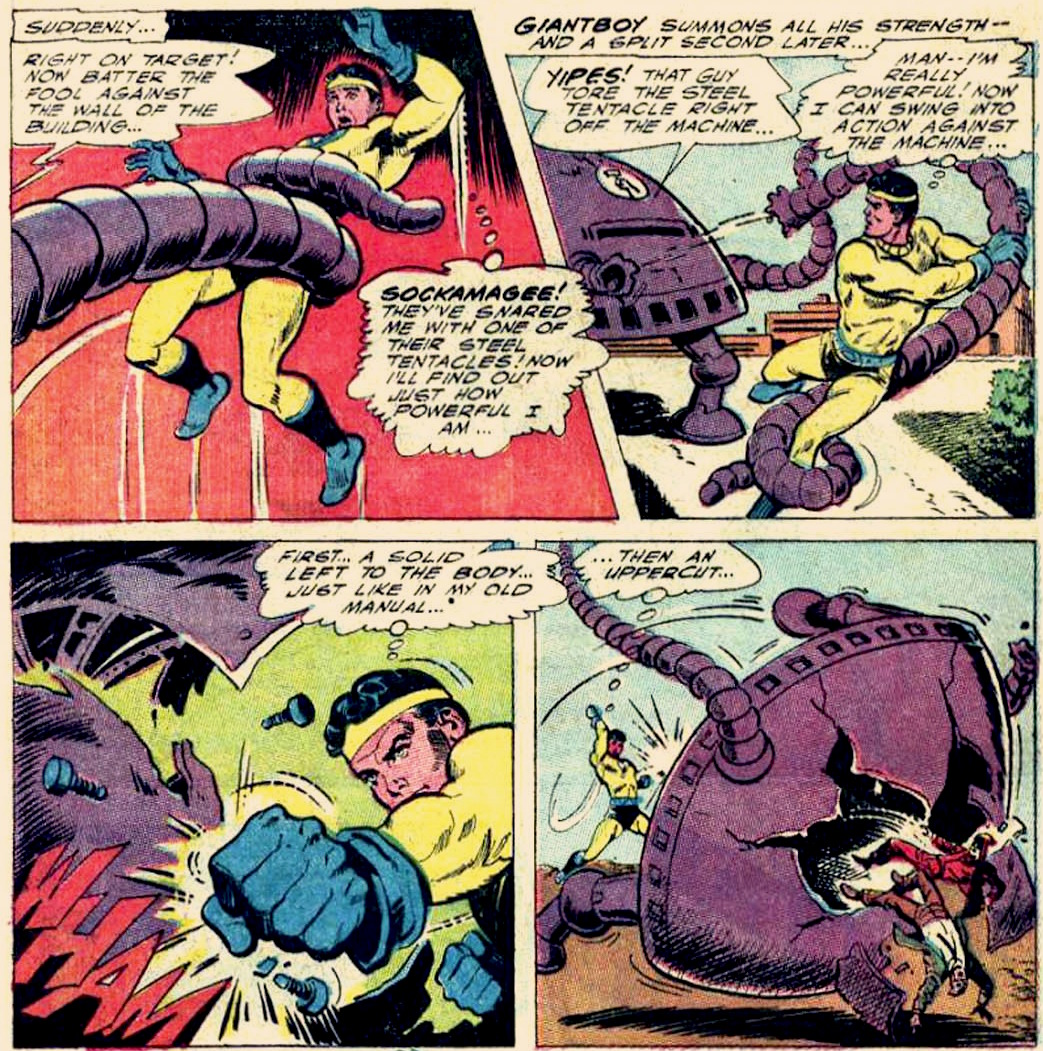
Our next stop concerns Robby Reed, the original owner of the Dial H for Hero gizmo, and his epic (of course) battle with… well, a whole bunch of villains. House of Mystery no. 156 (January 1966) is where he made his début, transforming into the Cometeer, Giantboy and the Mole. So many adventures, all in one (half) issue! This story was scripted by Dan Wood and illustrated byJim Mooney:
From Giantboy we move on to Colossal Boy, more precisely to Colossal Boy’s One-Man War, scripted by Jerry Siegel, pencilled byCurt Swan, and inked by Sheldon Moldoff. It was published in Adventure Comics no. 341 (February 1966).
A story in which everybody talks way too much, and only in clichés.
Skipping ten years ahead, we end up in Marvel territory –
Amazing Adventures no. 31 (July 1975). The cover is by PhilipCraig Russell with modifications by John Romita; lettering by Gaspar Saladino.
The cover story, The Day the Monuments Shattered, is scripted by Don McGregor and illustrated by Russell:
Not Russell’s best work, I think we can safely say.
As a final note, here are some indubitably mechanical, yet not-quite-tentacles – a worthy addition to this post, as far as I’m concerned.
Challengers of the Unknown no. 11 (Dec 1959 – Jan 1960). Cover by Bob Brown, with colours and grey tones by Jack Adler. I love the perturbed flying dinosaur, whose hooves suggest that he has some cow ancestors.
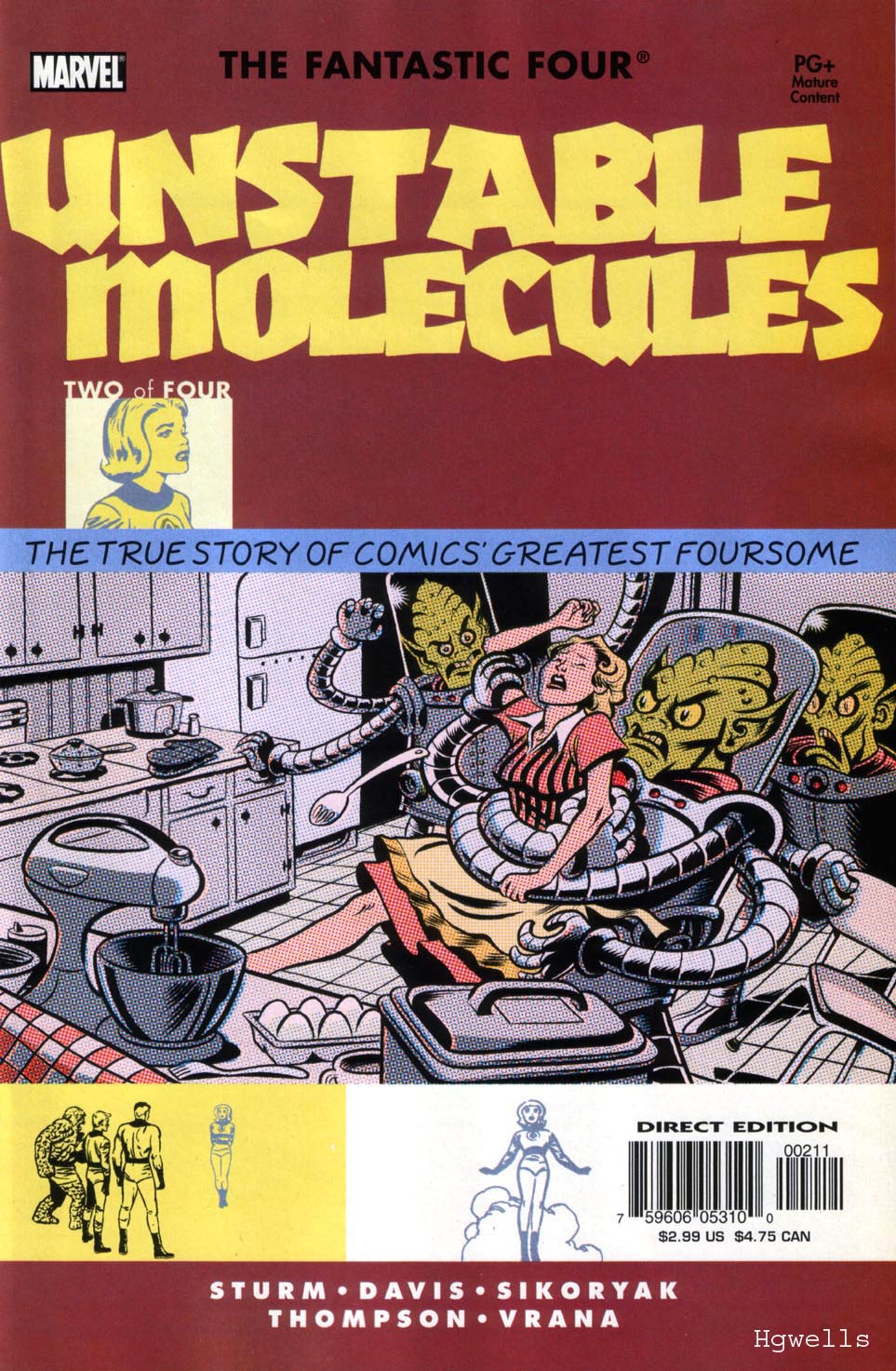
Startling Stories: Fantastic Four – Unstable Molecules no. 2 (April 2003). The cover is by Craig Thompson.
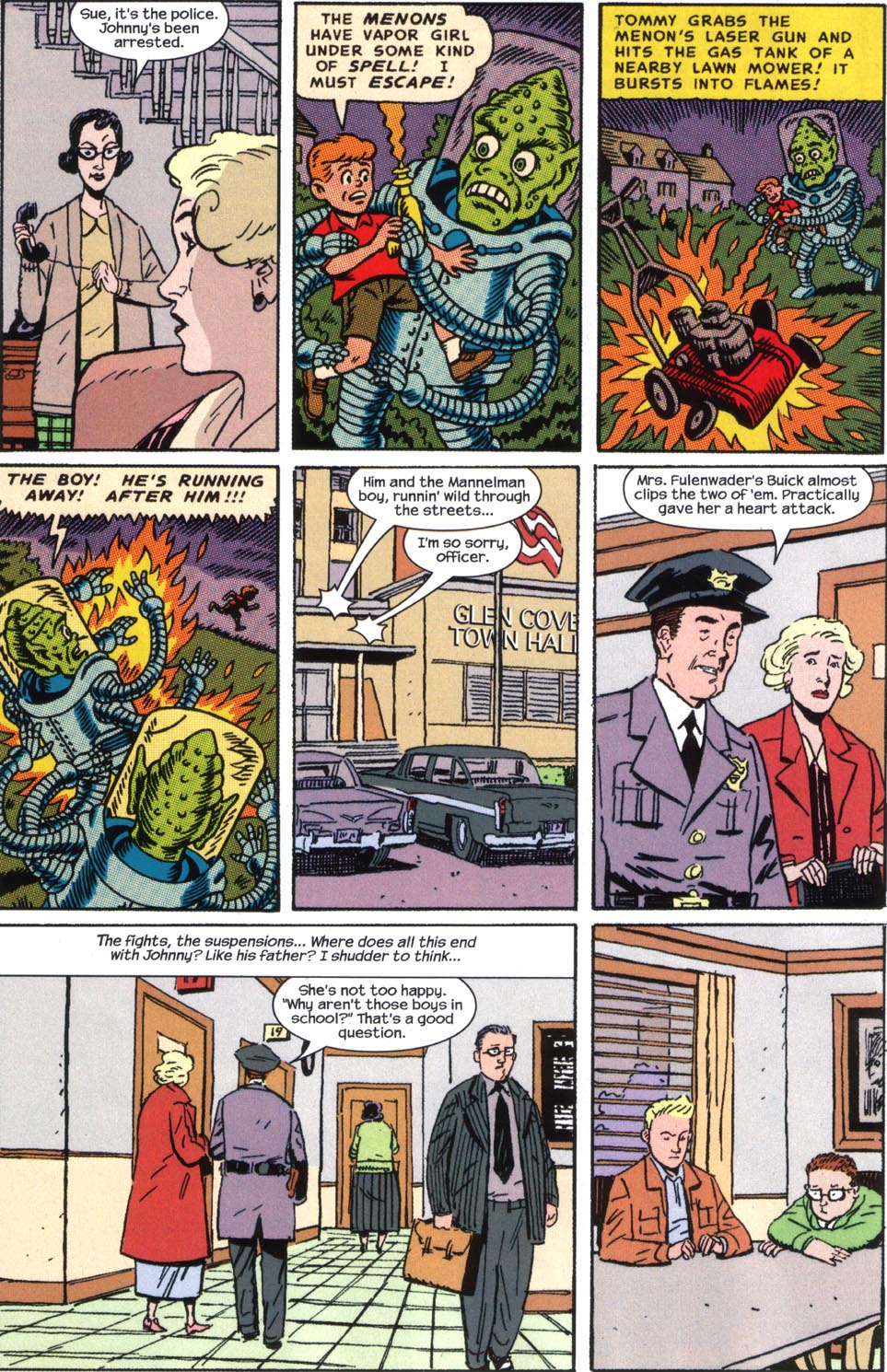
Disappearing Acts is scripted byJames Sturm and illustrated byGuy Davis with assistance from James Sturm. The Vapor Girl insertions (imaginary alien escapades) are by Robert Sikoryak.
Tentacle Tuesdays have been a fixture of this blog since the very beginning (which is to say September, 2017). I am not about to run out of material, but over the years I do tend to accumulate odd and ends that don’t neatly fit into a theme. Though I know of at least one faithful reader of this blog who doesn’t like it much when a TT entry is all over the place, hopefully there’s something in here for everyone. Just consider it the equivalent of spring cleaning in my archives!
Panel from Treasure Chest Vol. 19 no. 6 (Nov. 21, 1963). Written by Dave Hill and illustrated by Fran Matera. Everybody in this panel is adorable, but the octopus is especially fetching, I think.
A cartoon by Rowland Wilson, from Playboy‘s June, 1980 issue. Several tons of meat are going to need a lot of butter. It would be much more economical for the creature to eat the astronaut!
This tentacled-monster-pothole was dreamed up by Richard Thompson and appeared in his Poor Richard’s Almanac. It would make being stuck in traffic jams a lot more entertaining, don’t you think?
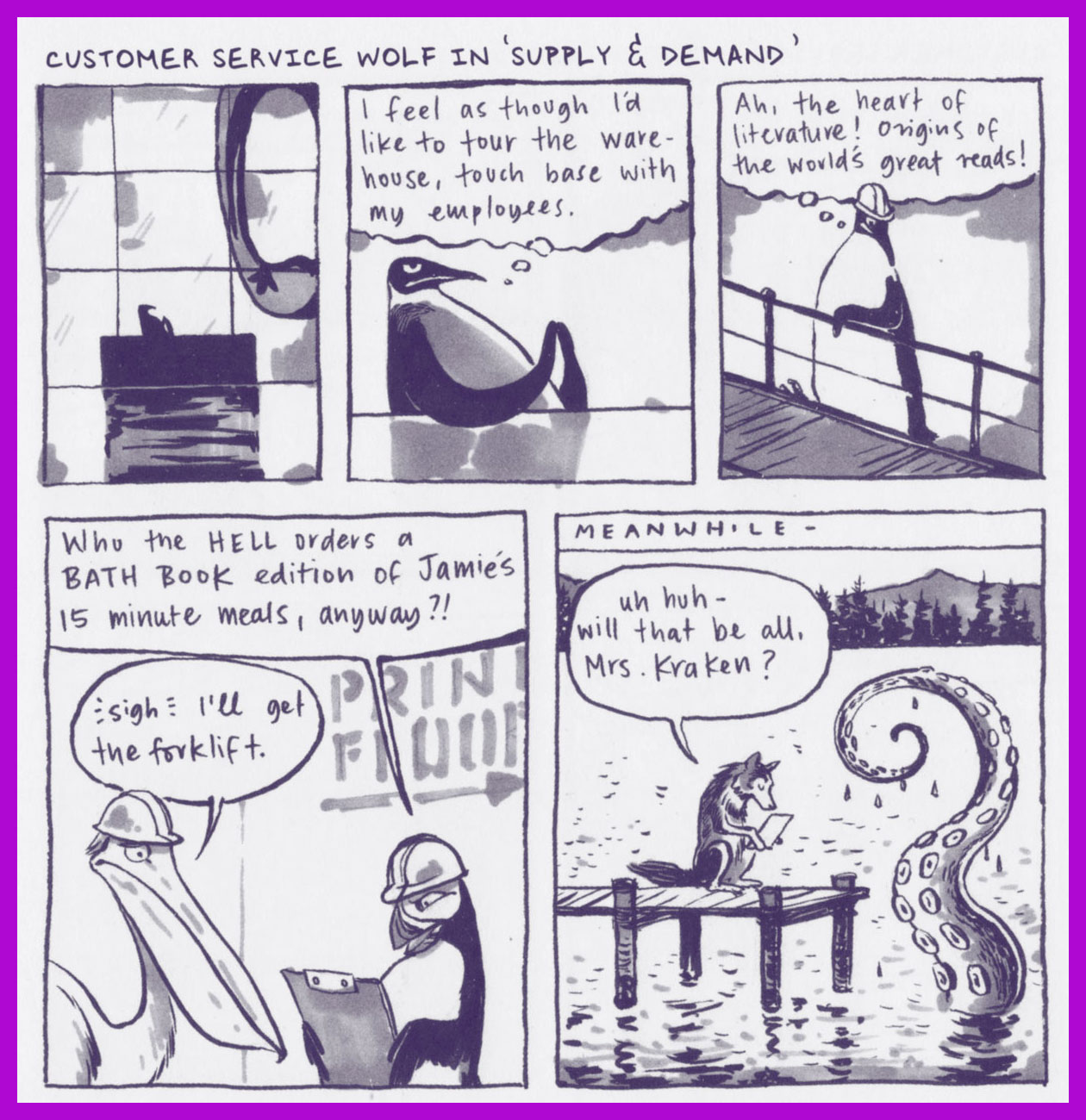
Customer Service Wolf is a hilarious comic strip by Australian illustrator Anne Barnetson, who has worked in a bookstore for long enough for have encountered all kinds of annoying customers. Anyone who has toiled in retail will know that most people are insane, but a bookstore is a backdrop for a very special kind of lunacy.
I’ve been following British sculptress Caroline McFarlane-Watts and her company Tall Tales Productions for a while. She makes incredibly detailed sculptures of all sorts of things, most notably of witches and their ménage (take a discreet peek at their activities on her website, but be careful, they’re cantankerous old bats). McFarlane-Watts also draws, sometimes comics. This pink (take my word for it) octopus is a witch’s best pal!
Thanks for sticking around while I got things off my chest!
It’s difficult to impress me with a magician, unless we’re talking real-life magicians with a strong skeptical streak, like James Randi or Ricky Jay. Given that the concept of a person who has access to ‘mystical’ forces and who can manipulate beings (supernatural or otherwise) has been around for as long as humans have been able to communicate with one another, be it through grunts and squeals, it’s pretty damn difficult to come up with a new wrinkle to this old tired nag. Having no previous experience with the series, I had no high expectations for Steve Ditko‘s Doctor Strange, but I was pleasantly surprised. I liked the earnest, solemn Dr. Strange from the beginning, but it’s Ditko’s mind-boggling, soaring surrealistic landscapes that bloomed over time that really impressed me. It’s not an easy feat to make the reader feel like he’s being transported into another dimension, but Ditko pulled it off beautifully, making us feel Dr. Strange’s disorientation as he gets sucked into yet another psychedelic terrain.
The Dr. Strange stories of the 1960s constructed a cohesive cosmology that would have thrilled any self-respecting theosophist. College students, minds freshly opened by psychedelic experiences and Eastern mysticism, read Ditko’s Dr. Strange stories with the belief of a recent Hare Krishna convert. Meaning was everywhere, and readers analyzed the Dr. Strange stories for their relationship to Egyptian myths, Sumerian gods, and Jungian archetypes.
What does this have to do with the current post? Precious little, actually. I’m a firm believer of not recycling dramatis personae past their due by date (defined, of course, as that time when their creator/author moves on to greener pastures, by design or because he has to). Doctor Strange moulded by other hands loses his raison d’être and becomes just another Joe in a funny cape, uttering ineffable, paranormal gobbledygook. Oh, sure, he’s aided by more mystical artifacts than before. How exciting… if you are excited by gadgets and gimmicks, that is.
He also encounters a lot of tentacles, apparently the most mystical, otherworldly apparitions *this* crew could think of. Welcome to 70’s (for the most part) Doctor Strange!
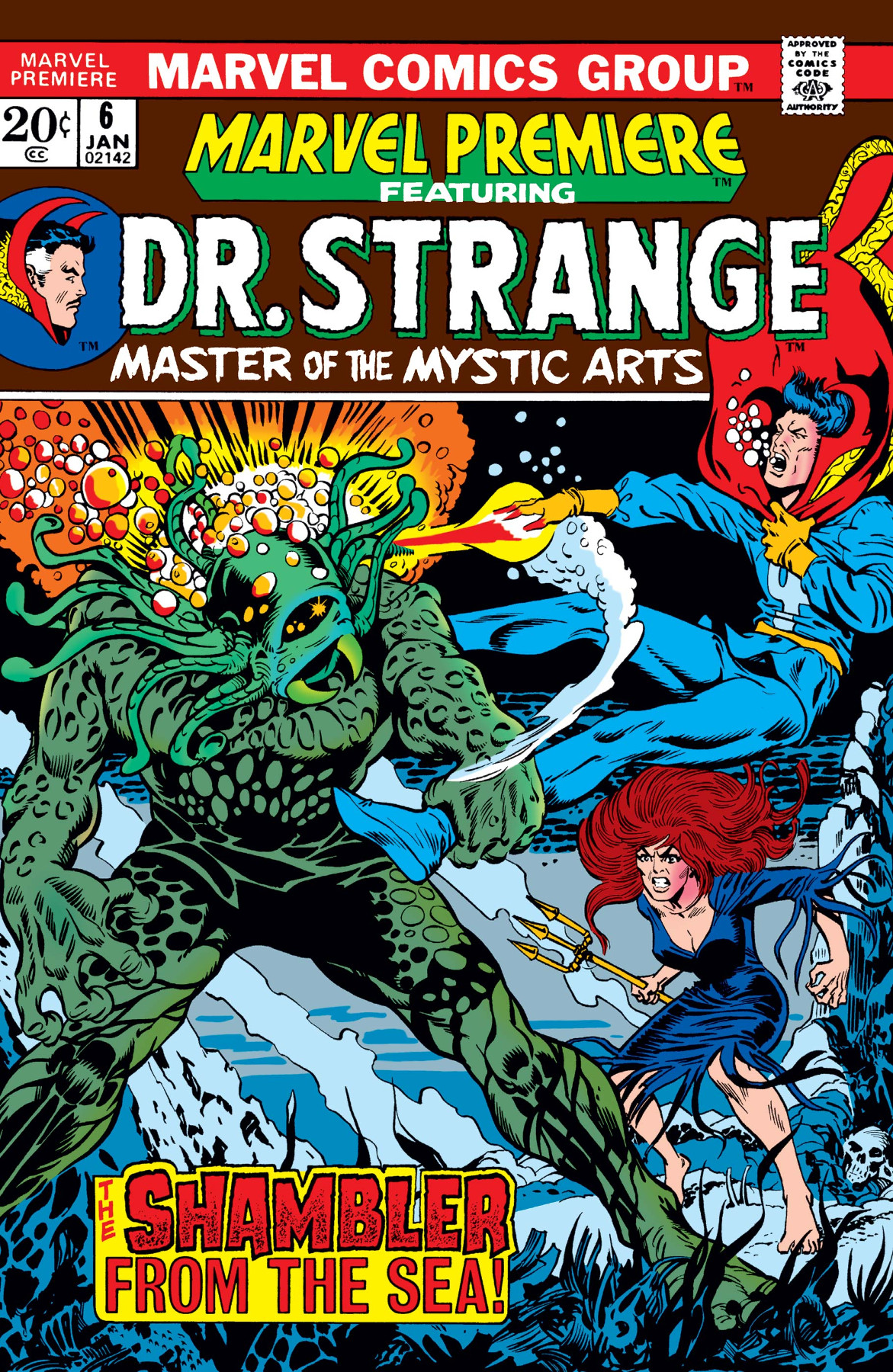
Marvel Premiere no. 6 (January 1973). Cover by Mike Ploog and Frank Giacoia.
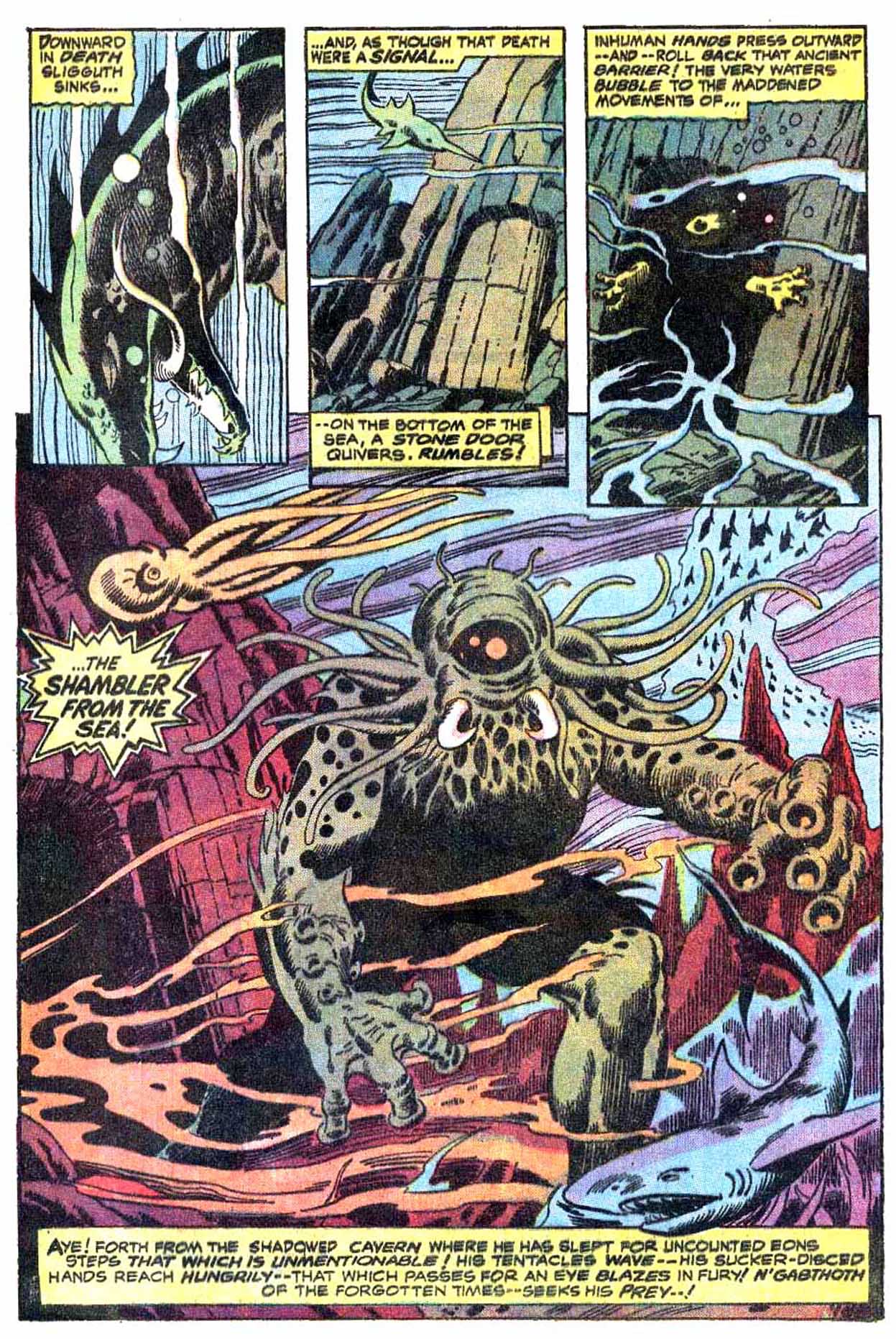
The Shambler from the Sea is scripted by Gardner Fox, pencilled by Frank Brunner, and inked by Sal Buscema and Ralph Reese:
Dr. Strange no. 1 (June 1974). Cover by Frank Brunner.
Through an Orb Darkly is scripted by Steve Englehart and Frank Brunner, pencilled by Frank Brunner and inked by Dick Giordano:
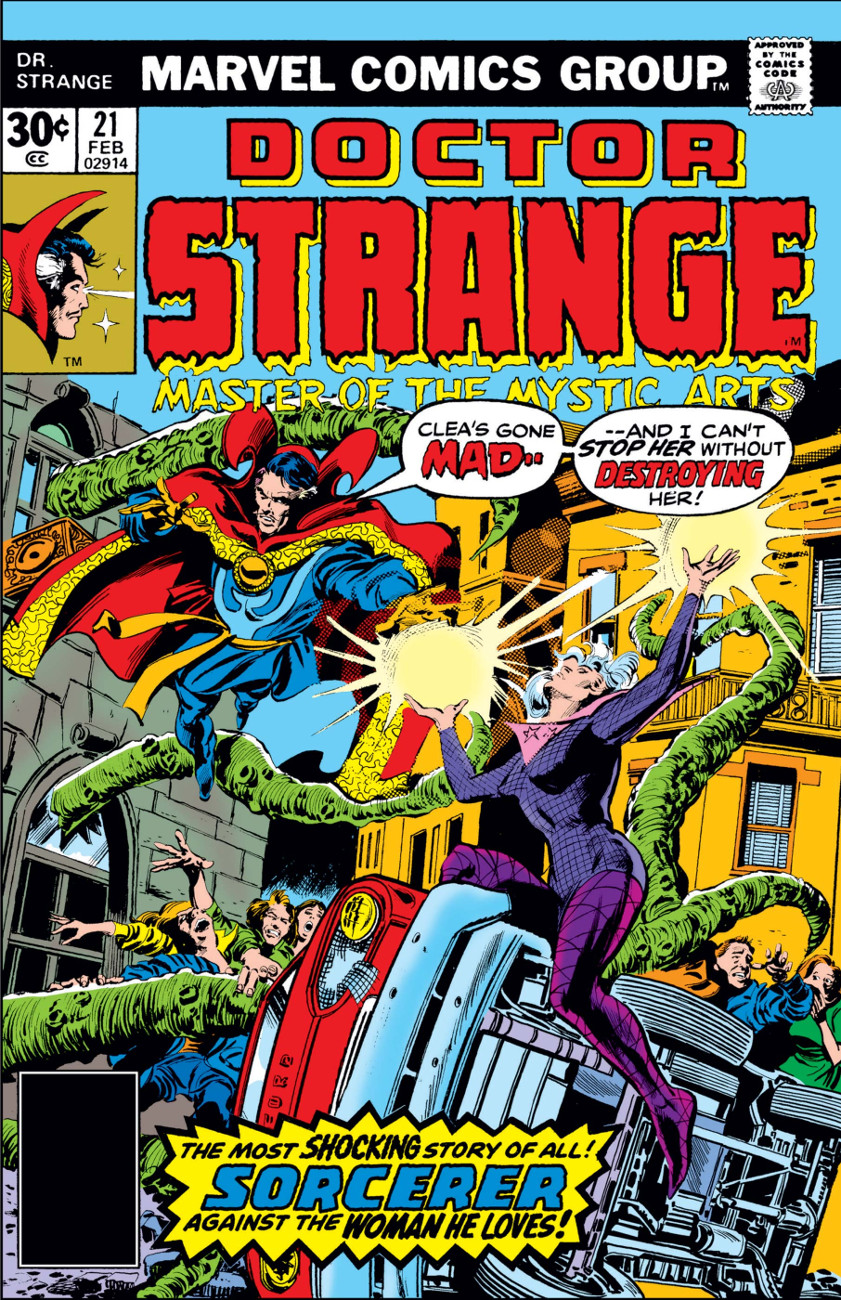
Doctor Strange no. 21 (February 1977). Cover pencilled by Gene Colan and inked by Tom Palmer. Is Clea basically humping the (impeccably, gleaming clean) side of the car, basically?
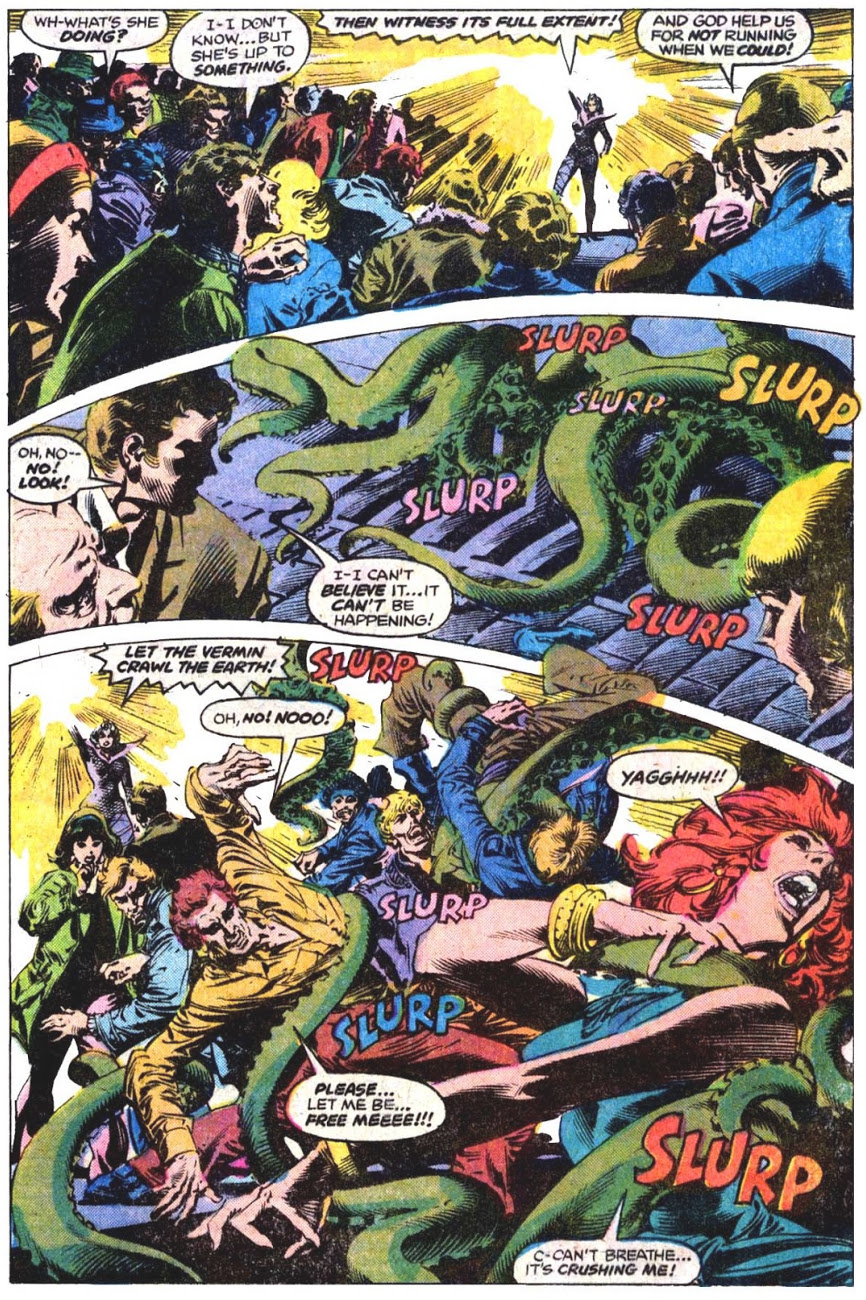
Mind Trip!, scripted by Marv Wolfman and drawn by Rudy Nebres, was published in Doctor Strange no. 22 (April 1977):
That’s quite a group scene *slurp slurp slurp*
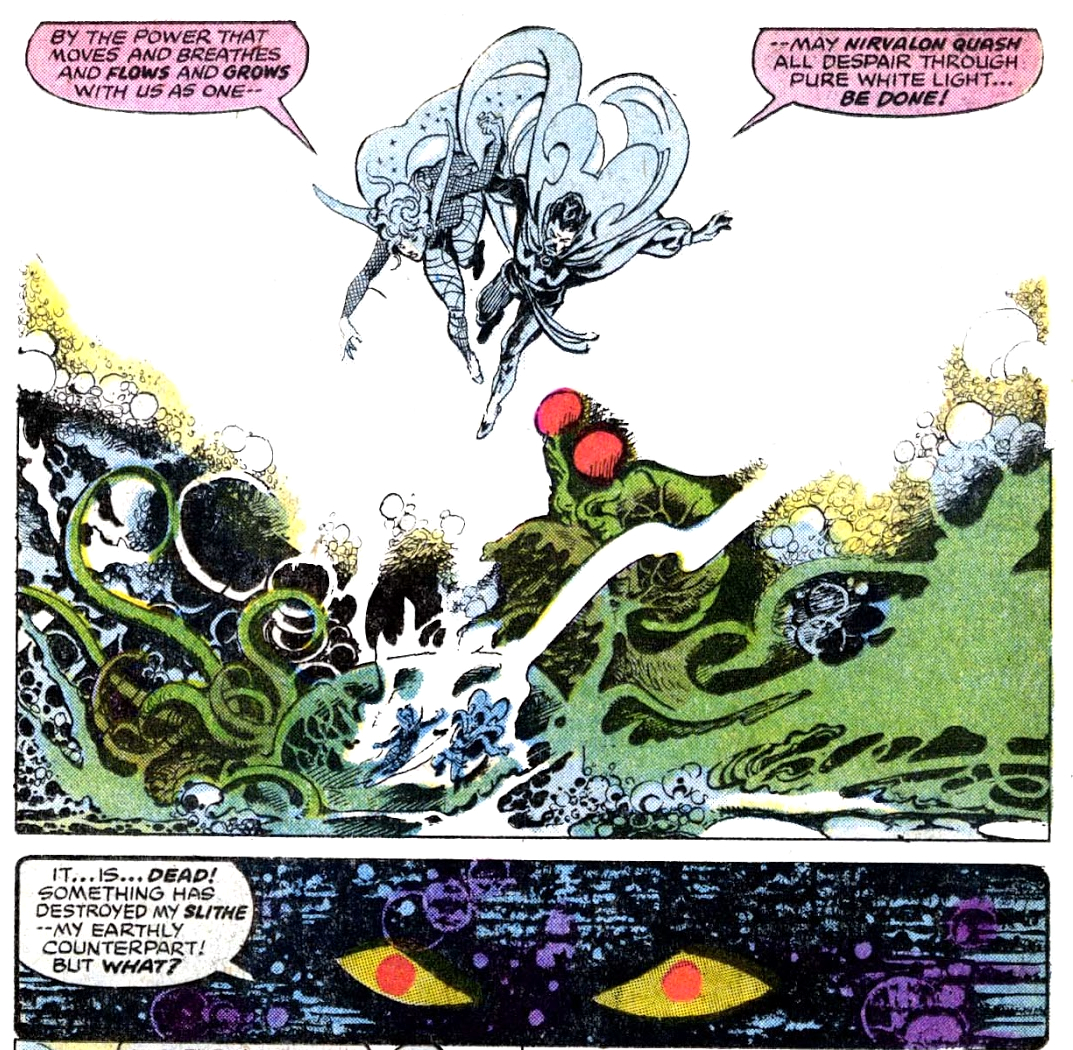
“Why does your image haunt me? Why are my boobs perkily gravitating towards the light?” I can’t even muster a passing interest in figuring out what’s happening in this mess.
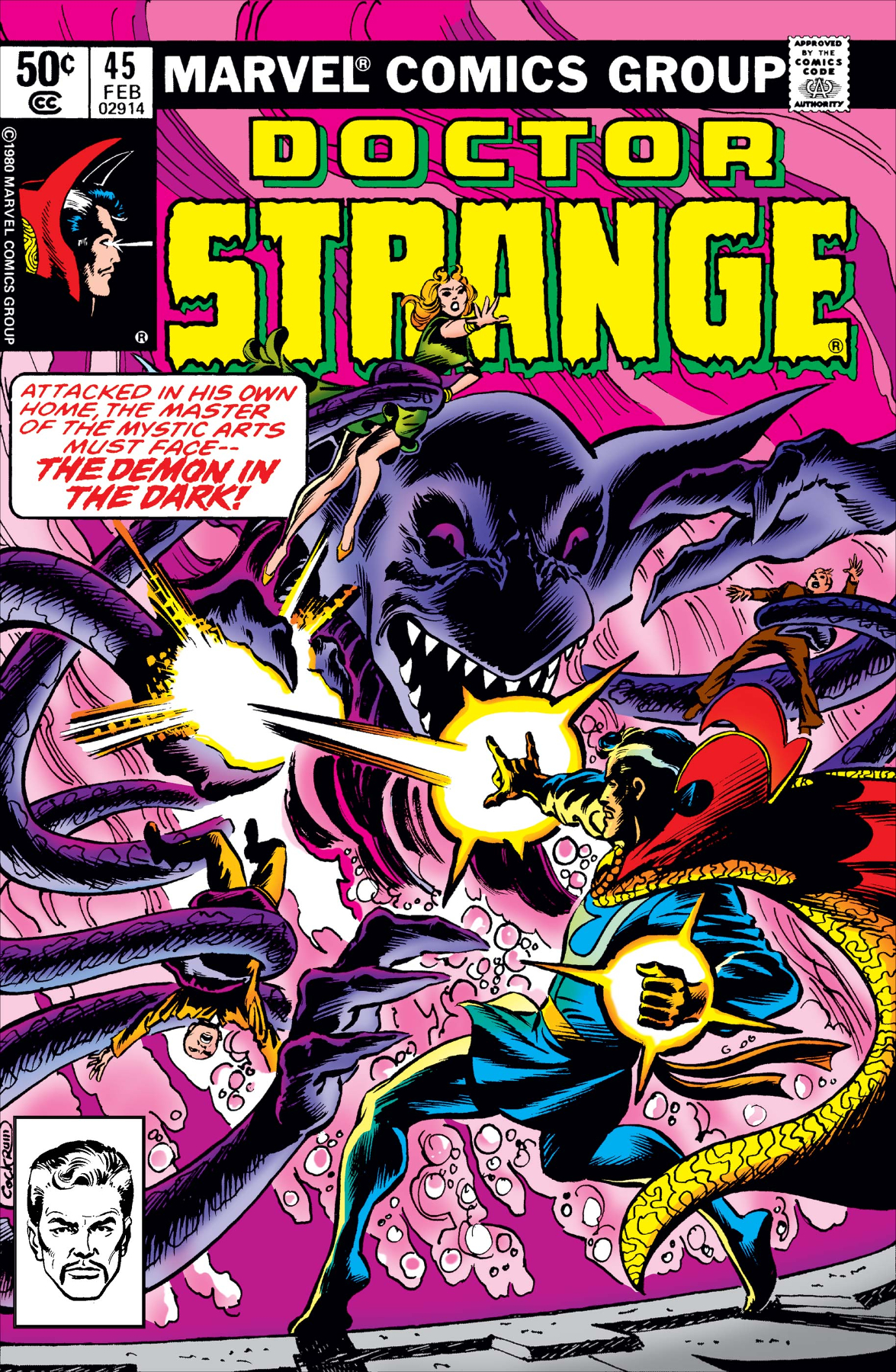
Doctor Strange no. 23 (June 1977). Cover pencilled by Gene Colan and inked by Tom Palmer.
Doctor Strange no. 30 (August 1978). Cover by Frank Brunner.
A Gathering of Fear! is scripted by Roger Stern and illustrated by Tom Sutton:
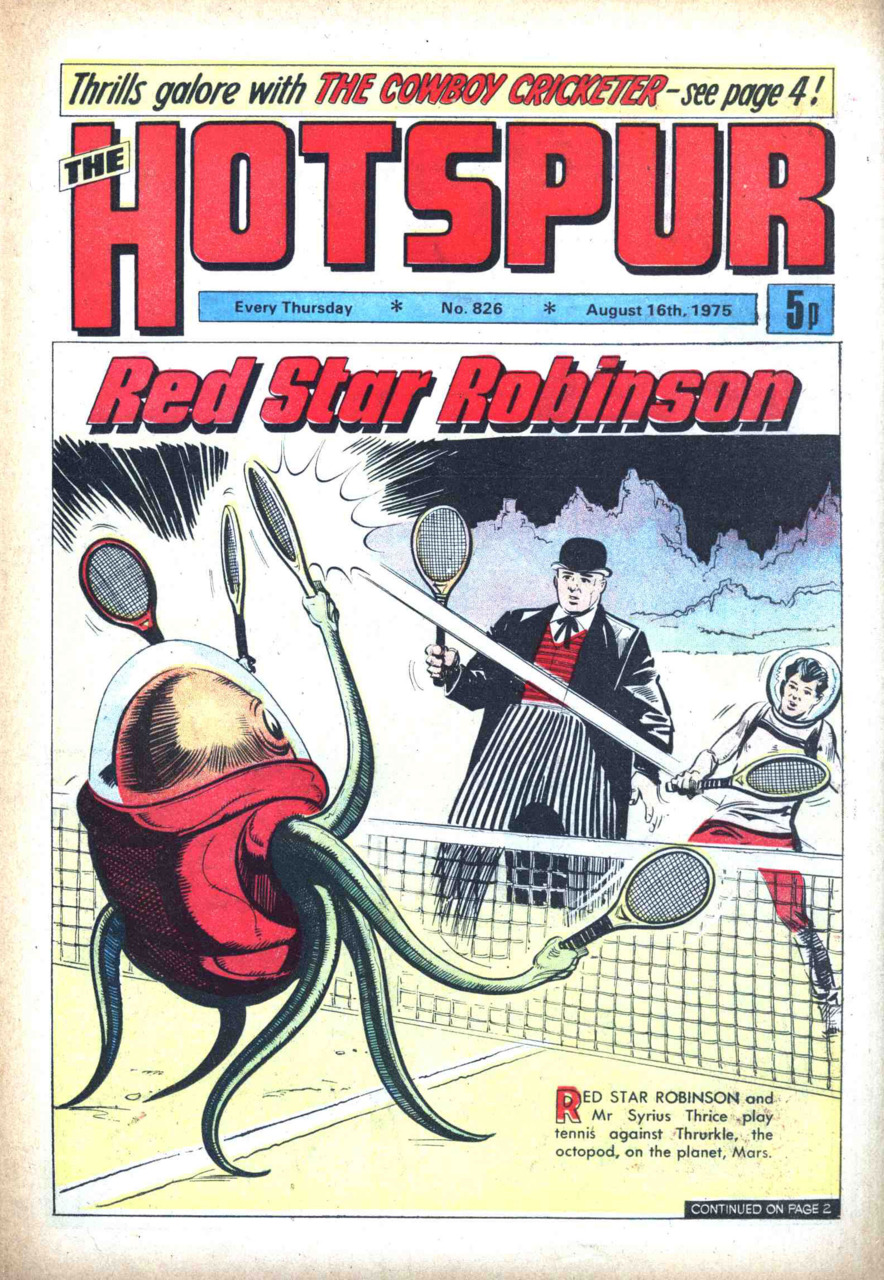
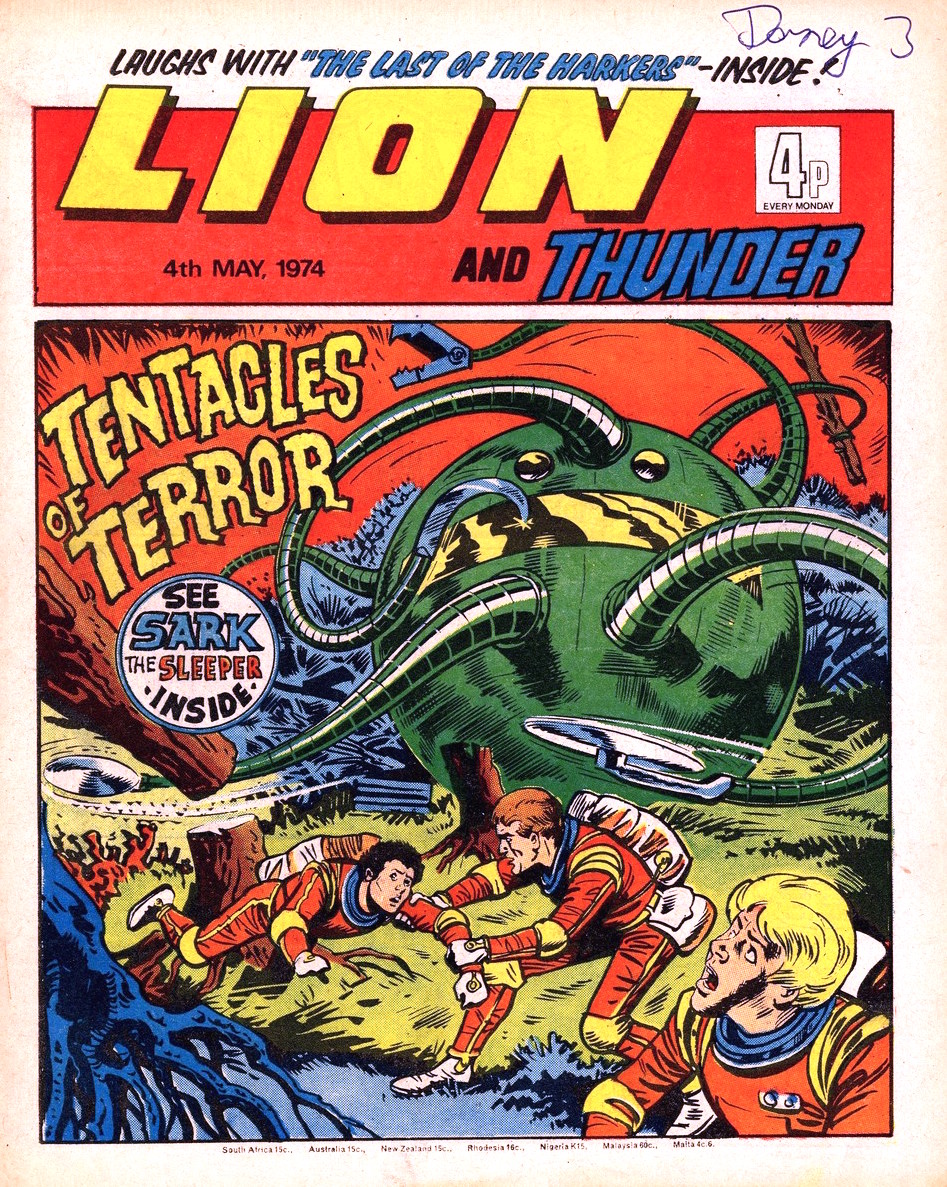
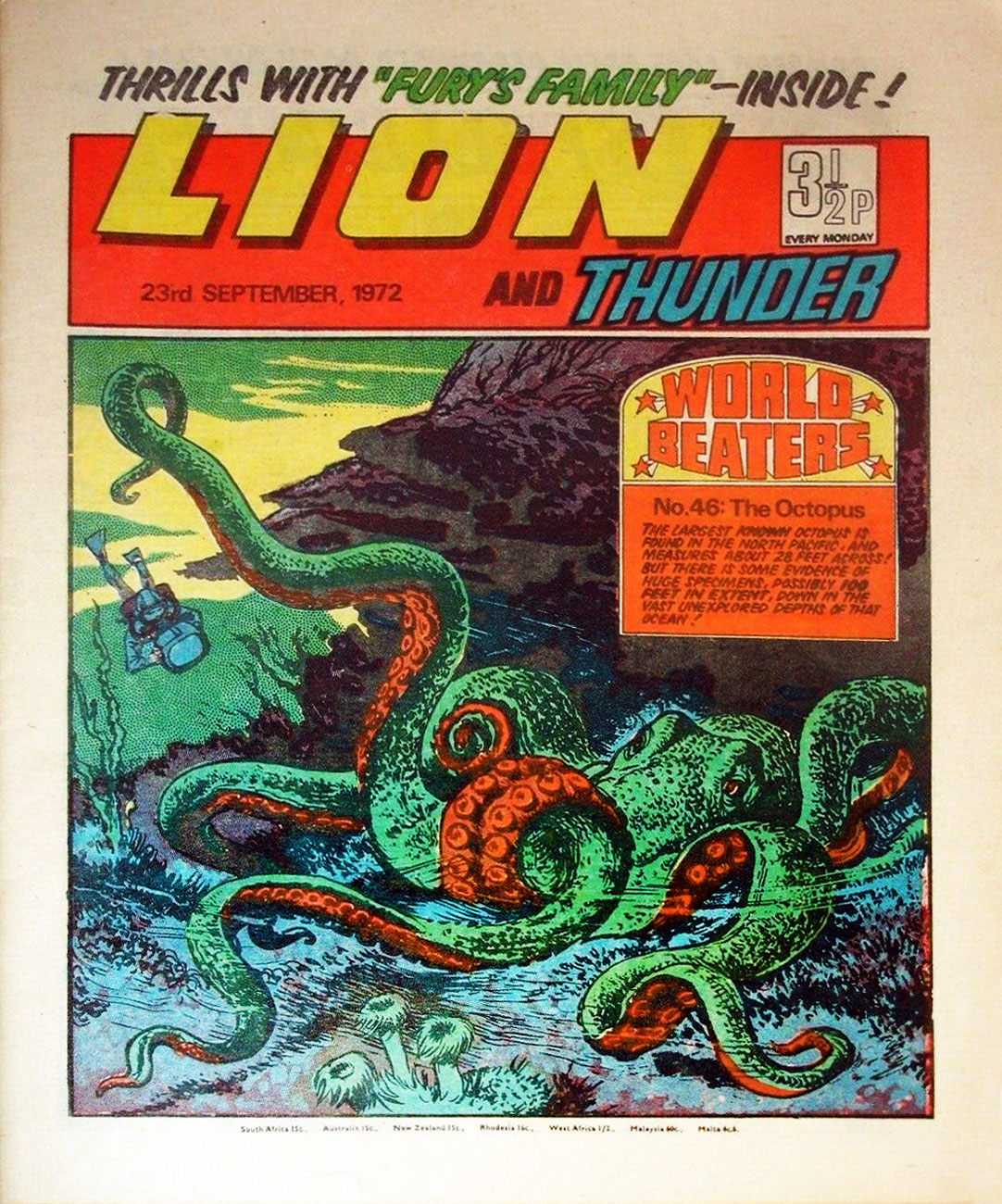
British comic weeklies are a world unto themselves, with their own styles and jargon. A few books have been written on the subject, and a handful of dedicated bloggers have endeavoured to provide interested readers with cover and story scans, as well as historical information, but overall this is largely an unmined field. I don’t know if this situation is caused by a relative lack of interest, or simply because there is just so much material to cover (the most popular of weeklies have thousands of issues). The other problem is that for reasons of mercantile interests (i.e. sales), a lot of these weeklies would be merged with other weeklies, sometimes keeping a double name and occasionally getting renamed altogether, every so often de-merging to continue under the original name to be cancelled altogether or perhaps merge again. Short of being a scholar specialising in this field, keeping track of all this is about as daunting as attempting to interpret this extremely confusing roadway sign.
I’m just a dabbler, tentatively poking a toe into these somewhat intimidating waters once in a while. So far, tentacle-wise, we’ve talked about Eagle’s Dan Dare, the forgotten British master Roy Wilson, and 2000 A.D., among other things… you can see all our British posts here.
The two most popular British comics are deemed to be The Beano and The Dandy, both weeklies for children published by D.C. Thomson (I really have to force myself to not add a p to that) starting in the 1930s. The former reached its four thousandth (!) issue in August 2019, and the latter counts as the world’s third-longest running comic (spot number on is taken by Italian Il Giornalino, and spot number two belongs to Detective Comics).
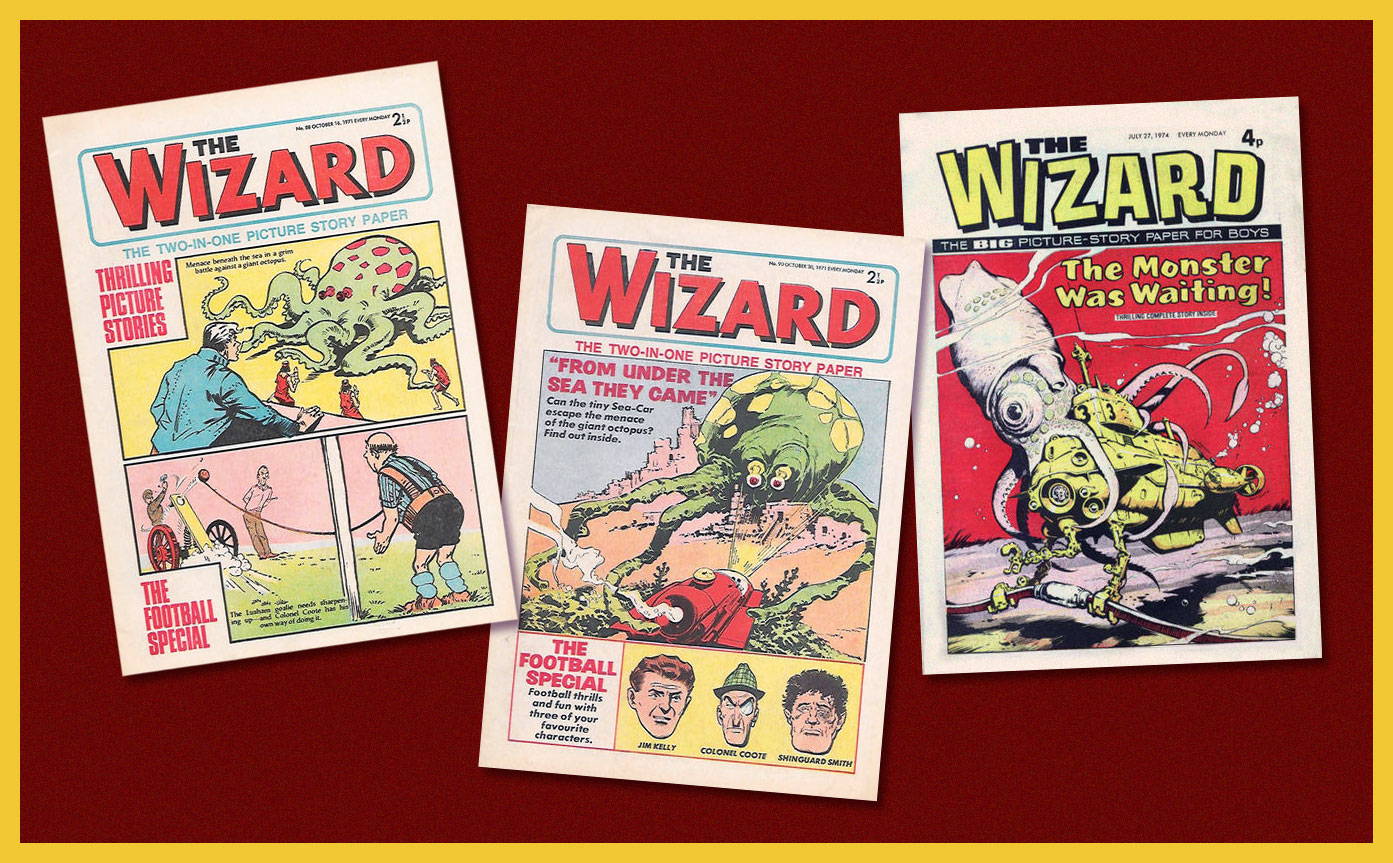
It’s pretty difficult to find high-res scans of most issues of any of the weeklies discussed in this post, so I was definitely limited by that. However, I believe I still managed to cobble together a fairly representative selection, with the help of co-admin RG who had to unwarp, re-colour and trim the heck out of some of these covers. Thanks, partner!
The weekly The Hotspur was published by D.C. Thomson. From its inception in 1933 up until 1959, it was a boys’ story paper, containing text stories and illustrations but no comic strips. It became a comic magazine in October 1959, with the last issue published in January 1981. This is The Hotspur no. 751 (March 9th, 1974).
Hotspur no. 778 (September 14th, 1974).
The Hotspur no. 826 (16th August, 1975).
Lion, published by IPC, was brought to life to compete with the Eagle periodical, which was the home of ever-popular Dan Dare. For proper competition, this new weekly publication needed a science-fiction romp, too, and that’s how Captain Condor – Space Ship Pilot got started. In 1969, the Lion gobbled up its rival Eagle (yum) and they merged into Lion & Eagle (sounds like a pub, not a publication! – RG). As for Lion and Thunder, that was the result of the periodical Thunder (also published by IPC) getting incorporated into Lion in 1972, after only 22 issues. I guess “Thunder Lion” would have put the cart before the horse, or the minor, unsuccessful periodical ahead of the major one.
The Wizard was a weekly “story paper” launched in September 1922, published by D.C. Thomson. It got as far as issue no. 1970, merging with The Rover in 1963 and continuing under Rover and Wizard for a while. The Wizard was relaunched in 1970, and endured until 1978.a while. The Wizard was relaunched in 1970, and.
The Wizard no. 88 (16th October 1971), The Wizard no. 90 (30th October 1971) and The Wizard no. 233 (27th July 1974). I was only able to find these covers in low resolution, sorry!
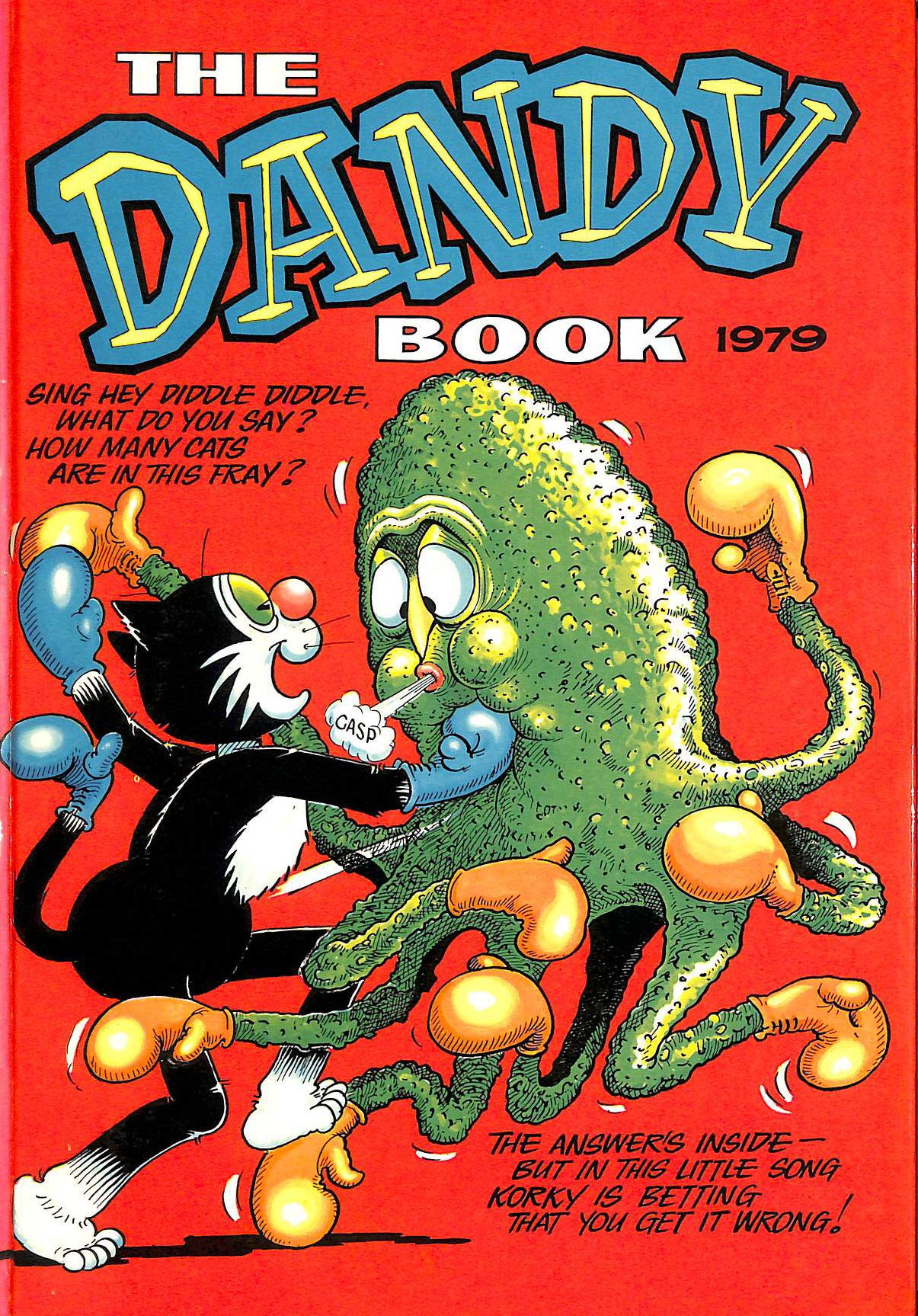
Last (but not least, as they say), no post of this type would be complete without a couple of issues of the aforementioned Dandy!
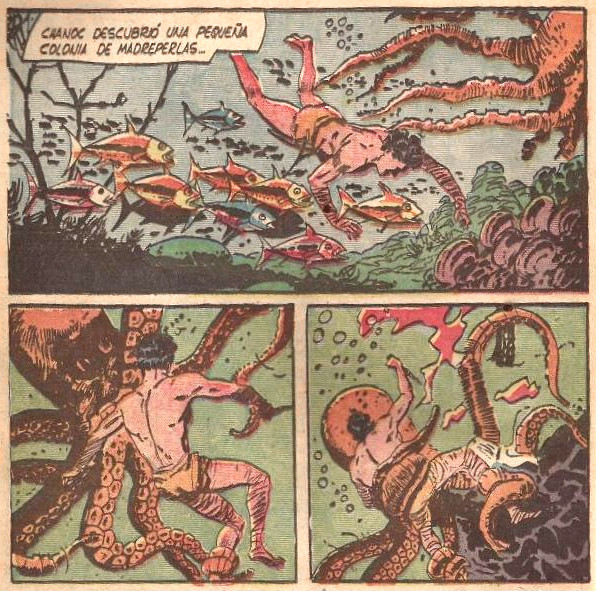
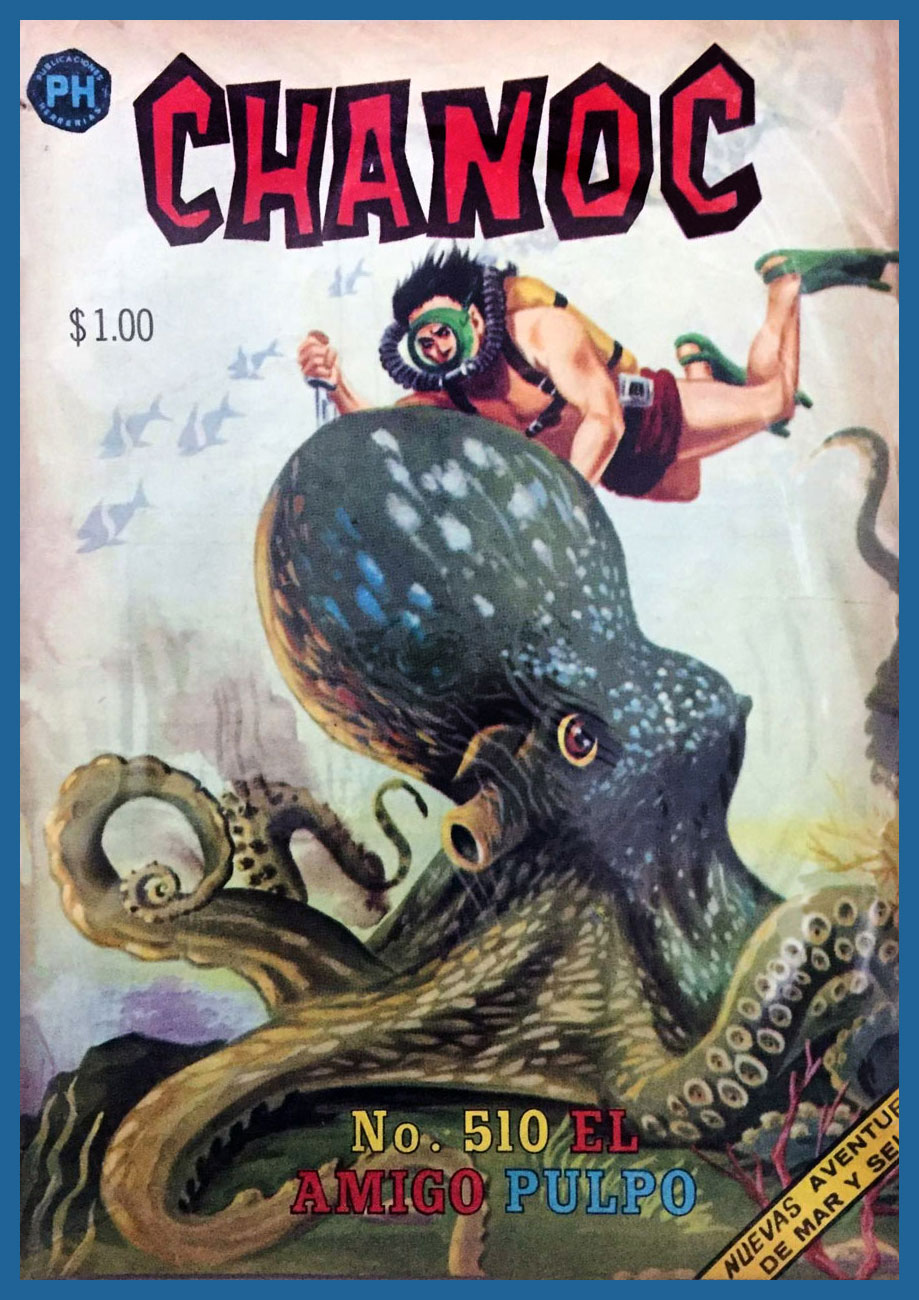
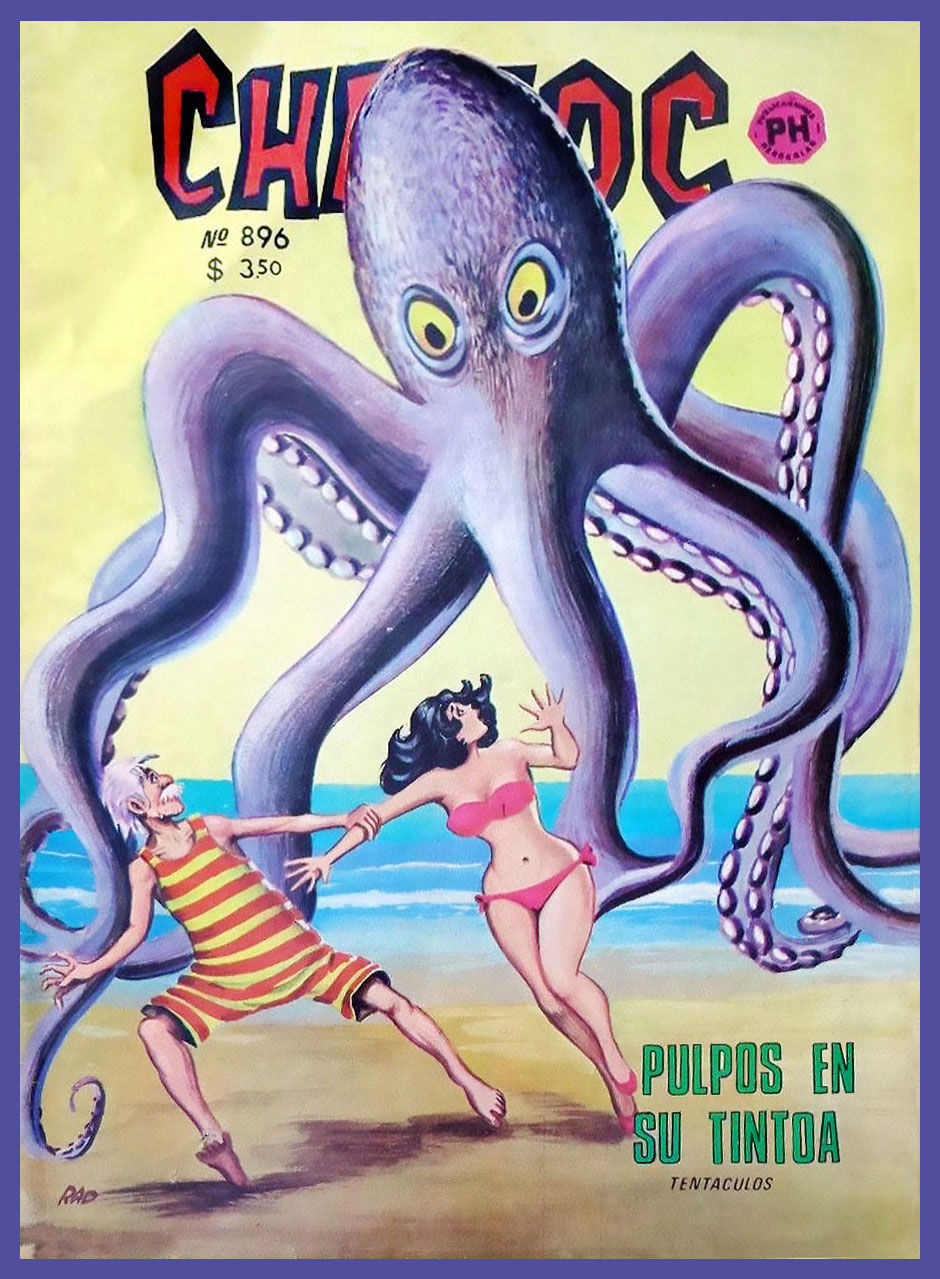
« Chanoc was set in the fictional Mayan fishing village of Ixtac somewhere near Veracruz. The heroes struggled against corrupt foreigner and larger-than-life sea and jungle animals, especially sharks and octopi. An important feature of the comic book was its use of local colour and coastal lore… »
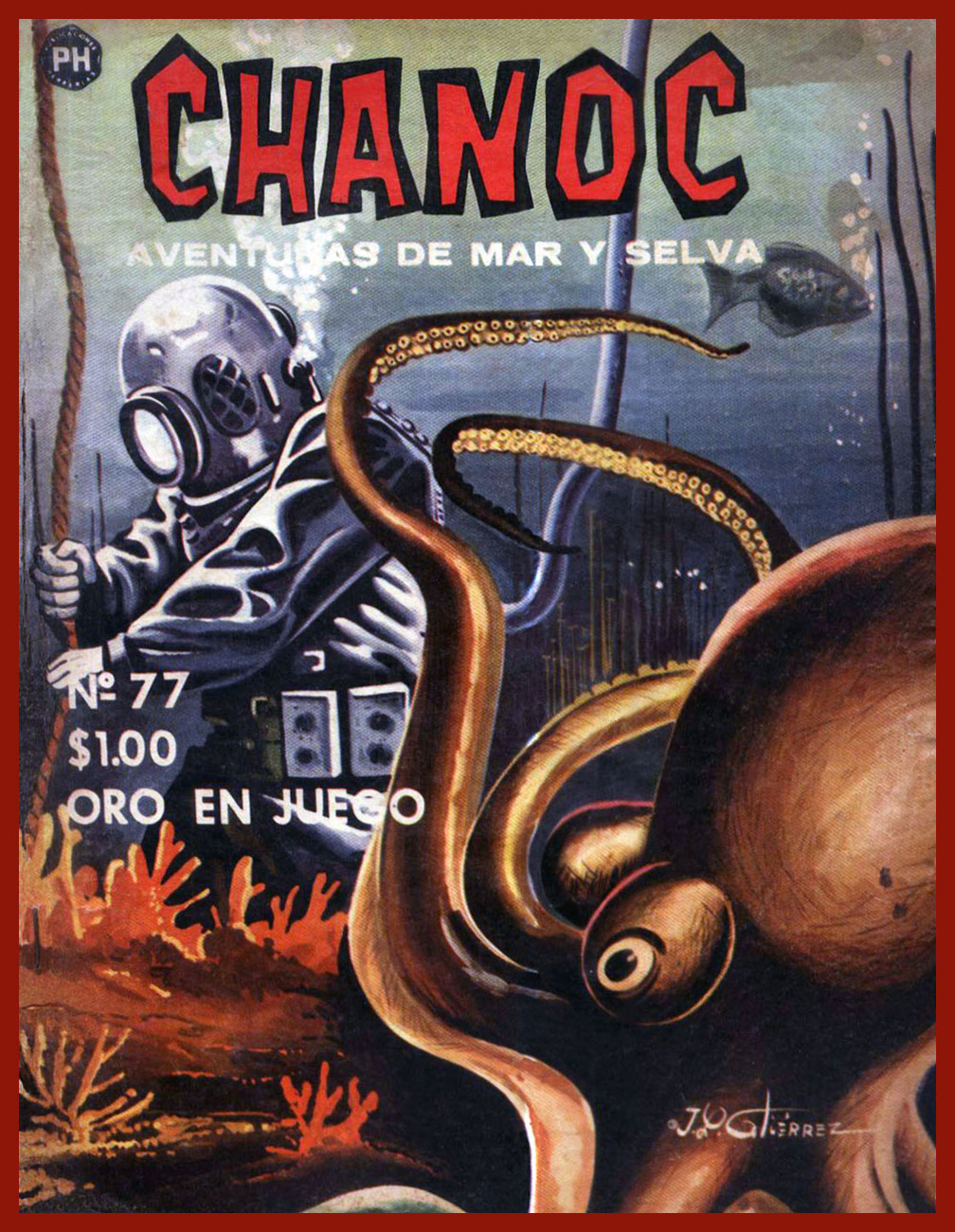
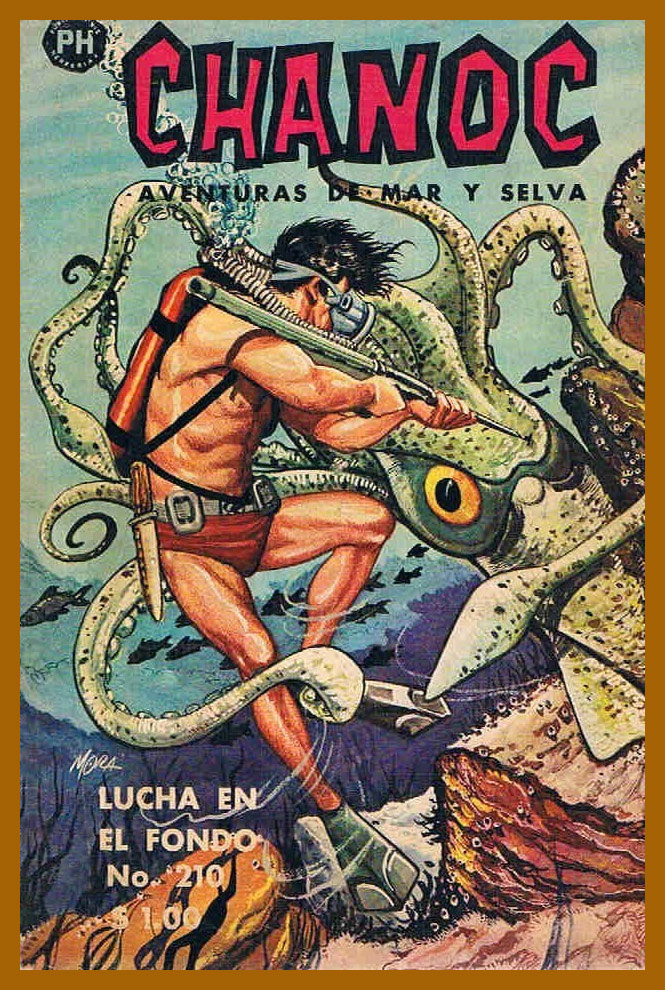
I’m always unpleasantly amazed when I stumble upon a comic series that ran over a thousand issues… and that I’ve never heard of until now. The sting of it is only slightly alleviated by the fact that it was published in a language I don’t speak. I have already written about long-running (and abounding with tentacles) German series Spuk Geschichten; today it’s the turn of Mexican Chanoc. We may be unable to travel right now, but at least we can accompany pearl diver and fisherman Chanoc and his goofily-mustachioed grandfather Tsekub Baloyán in Aventuras de Mar y Selva (adventures on land and sea – in the context of this post, mostly the sea).
Chanoc actually started out as a rejected screenplay by Dr. Ángel Martín de Lucenay, who, undeterred by this failure, cobbled the story into a proposal for a comic strip and brought it to publishing house Publicaciones Herrerías (taken over at a later junction by Novedades Editores). Ángel Mora was recruited to provide the art, and the first issue (32 pages in full colour!) came out in October 1959. Martín died after having written only 20 episodes, and young writer Pedro Zapiain Fernández was hired. He plotted Chanoc for the next eleven years until 1971, at which point his services were dismissed for a variety of reasons.
In Not Just for Children: The Mexican Comic Book in the Late 1960s and 1970s, author Harold E. Hinds argues that it’s Fernández’s involvement that made Chanoc a best-seller.
« In order to continue to improve the characterization of Veracruz culture, Zapiain immersed himself in the coastal environment. He fished, sailed, deep-sea dived, hunted sharks, and was even shipwrecked in a hurricane.
Many of the scenes and characters in the comic book are modeled on real Veracruz vistas and people. Zapiain slowly transformed Chanoc. Adventure faded in importance, although many issues still contained at least one adventure subplot. Comedy became Chanoc’s trademark, the humour ranging from wit and repartee to parody and slapstick comedy. Mild polictal satire and social ciriticism were intoducted and sports themes became a staple. » /source/
Conrado de la Torre took over the writing when Zapiain (who, incidentally, died in 1979, at 48) was fired, but by most accounts Chanoc’s heyday was over, though I’ve seen mentions of the strip still being published as late as mid-90s. Many artists have contributed to Chanoc during the golden years: «painters Landa and José Luis Gutiérrez (both as cover artists ); Guillermo Vigil , who later created the comic El Payo; Antonio Morales, the screenwriter for Viruta y Capulina , and Antonio Salazar Berber, the first sports cartoonist and creator of mascots for Mexican soccer teams. » /source/
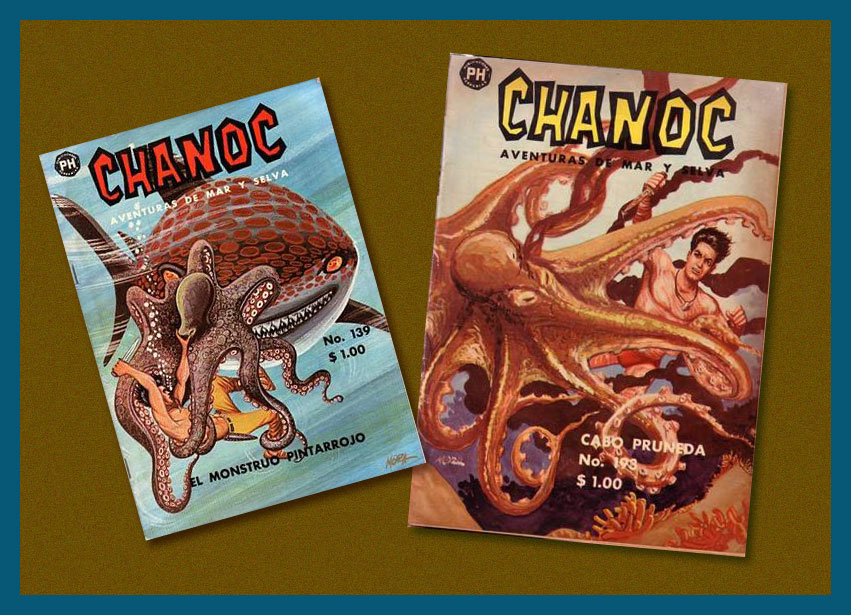
Some covers are, sadly, only available online in extremely poor resolution, so here are two more:
Chanoc no. 139 and Chanoc no. 193 (1963).
« The comic book may be more popular in Mexico than in any other Latin American country. In this essay, Harold Hinds speculates that its decline was due to a number of factors, including the degeneration of one of its main characters, Tsekub, into a mere clown, the inaccessibility of its increasingly “slangy” language, and its tendency towards cuteness rather than meaningful satire. He then examines the main characters. Chanoc is a kind of highly moral Tarzan‐figure who protects the defenseless against villainous exploiters. Tsekub, Chanoc’s sidekick and antithesis, is an old man with a young spirit whose zest for life provides much comedy. Hinds points out that in addition to adventure and humour, Chanoc’s main components, the comic book also deals with foreign, particularly U.S., interference, in Mexico and elsewhere. He also considers a variety of ways in which Chanoc reflects, at times quite subtly, Mexican culture and society; e.g., aspects of regionalism, nationalism, mestizo character, machismo, and modernisation are briefly explored. » (excerpt from Harold E. Hinds’ Chanoc : Adventure and Slapstick on Mexico’s Southeast Coast)





































 Who's Out There?