« With pen and ink, I can achieve a scratchy, foggy effect that is appropriate. It was a continual process of learning. » — Nick Cardy
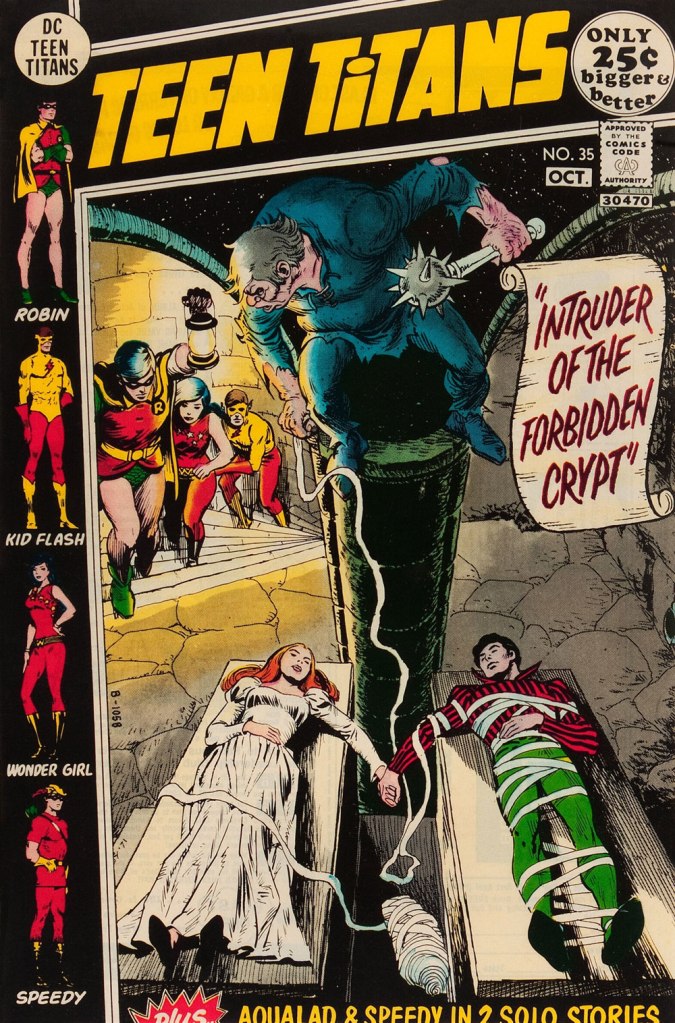
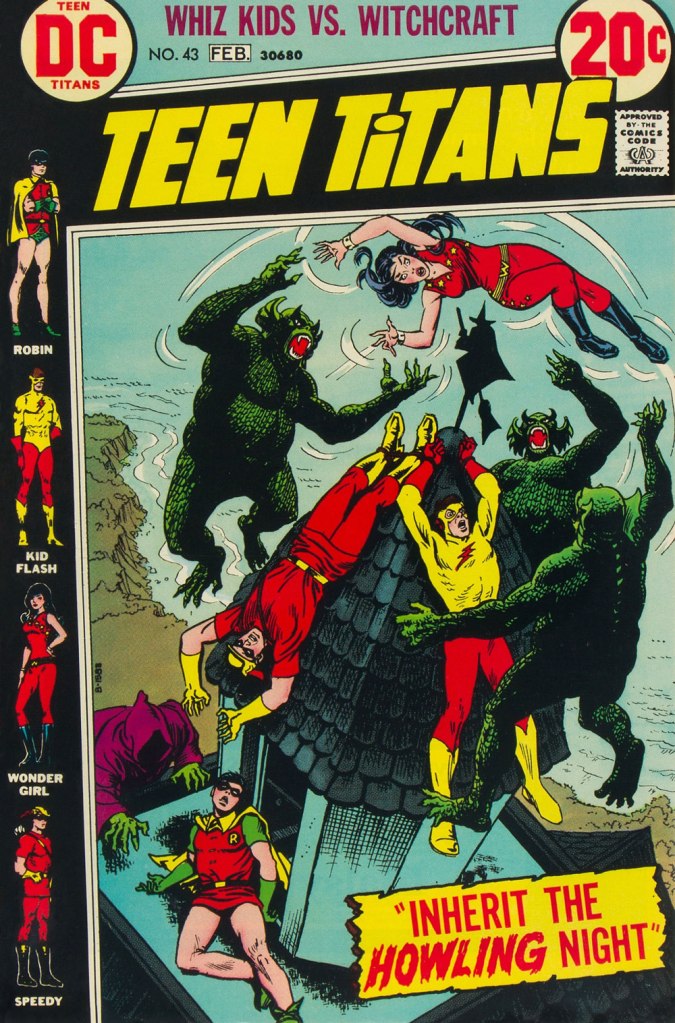
While WOT? favourite Nick Cardy (1920-2013) — who would turn one hundred and four years old today! — spent a lot of time chronicling the undersea adventures of Aquaman, his lingering true love, despite his busy schedule as DC’s premier cover artist, was the Teen Titans — he contributed, either as penciller, inker… or cover artist — to all forty-three issues of the original series.
And what I loved most about editor Murray Boltinoff‘s books is that they were packaged as horror books even when they nominally featured superheroes, a welcome respite. The costumes seemed an afterthought, a most unusual and refreshing attitude. Here, then, is a gallery of Mr. Cardy’s moodiest, most sinister Teen Titans cover artwork.
This is Teen Titans no. 33 (May-June 1971, DC). This is Teen Titans no. 34 (July-Aug. 1971, DC). Lettering by Ben Oda.This is Teen Titans no. 35 (Sept.-Oct. 1971, DC).This is Teen Titans no. 36 (Nov.-Dec. 1971, DC).This is Teen Titans no. 41 (Sept.-Oct. 1972, DC).This is Teen Titans no. 42 (Nov.-Dec. 1972, DC).This is Teen Titans no. 43 (Jan.-Feb. 1973, DC).
« Dick’s Monster was something to behold. Whatever possessed him to put the creature’s nose up on the forehead is beyond us — but it worked, making it possibly the weirdest Frankenstein Monster ever done. » — Ray Funk and Al Dellinges, 2005
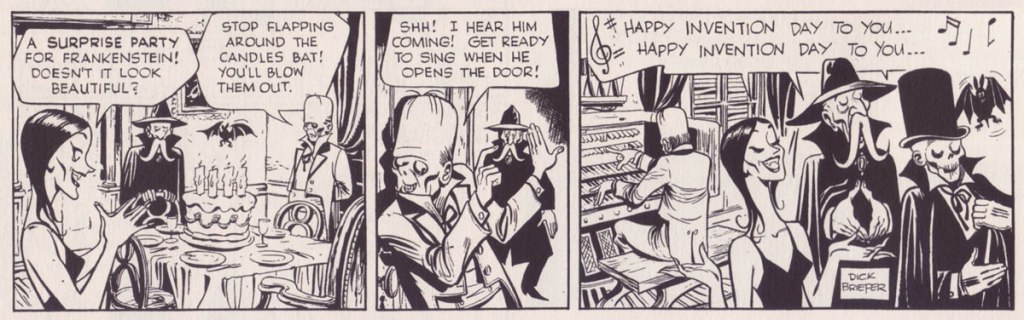
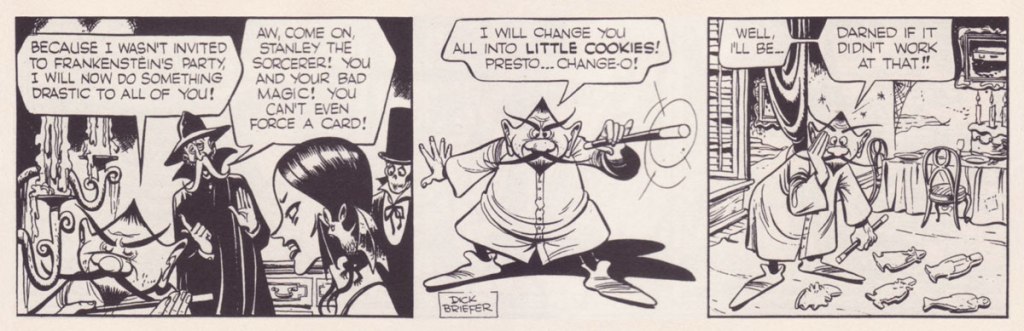
Golden Age cartoonist Richard “Dick” Briefer (1915-1980) had a special fondness for Dr. Frankenstein’s creation. Between 1940 and 1954, he wrote and illustrated scores of the Monster’s further adventures, both as tragedy and as farce… with equal aplomb.
This is Frankenstein no. 7 (May-June 1947, Prize), the lighter version.In a darker vein, this is Frankenstein no. 27 (Oct.-Nov. 1953, Prize), the darker one.
Having left the troubled comics industry after its censor-imposed purge in the mid-50s, Briefer put together an exquisite proposal for a daily newspaper strip featuring the Creature and his pals, thirty-six strips in all. Here’s a handful of them. Don’t you wish comic strips were half as well written and drawn nowadays?
In a 1979 letter to Al Dellinges, Briefer recalled « Frankenstein, the comic version, was always a joy, and I have some superb samples of a projected daily strip that had been turned down by syndicates in the past. At this stage in my life, even though ‘horror’ is ‘in’, I’m too lazy to start sending it out again. »
For further reading on this subject, do seek out the inaugural volume in Craig Yoe’s ‘Chilling Archives of Horror’ series, Dick Briefer’s Frankenstein (2010, IDW).
« Religion is like a blind man looking in a black room for a black cat that isn’t there, and finding it. » — Oscar Wilde
We certainly can’t have an Hallowe’en countdown without at least one black cat, can we?
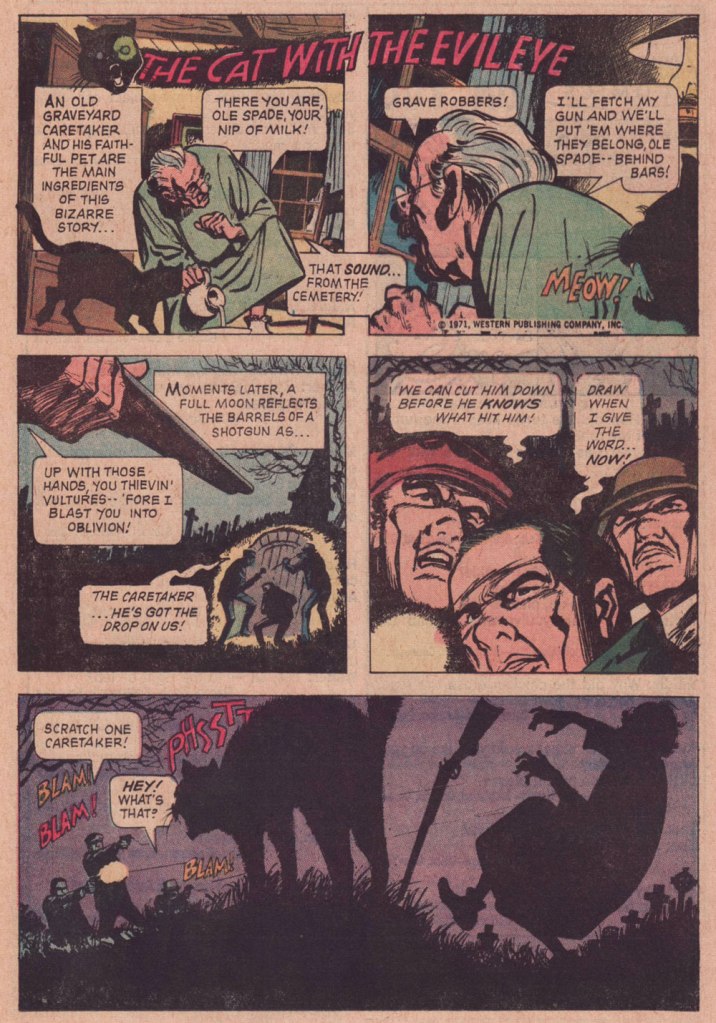
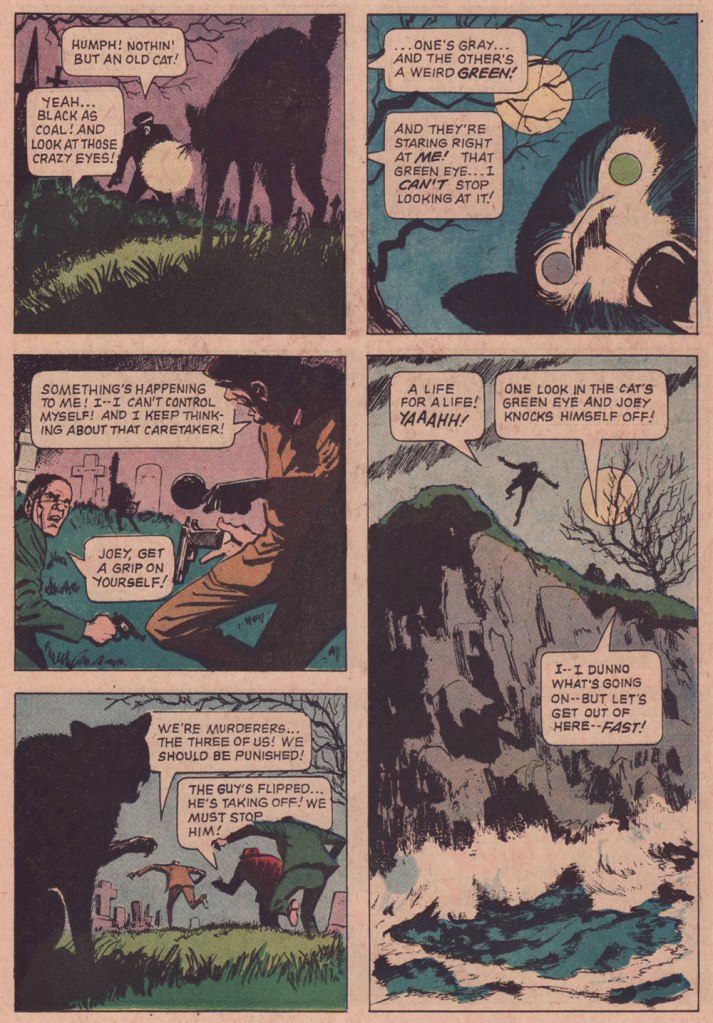
Here we have Hamilton, Ontario’s Win Mortimer (1919-1998) at his most stylish. A competent craftsman, he drew a lot of Superman and Batman for DC in the Golden Age, and may be most remembered by readers of a certain generation for his work on Marvel and The Children’s Television Workshop‘s Spidey Super Stories (57 issues, 1974- 1982). As for me, I was always fondest of his work for Gold Key’s mystery titles, where he seemed to be having more fun.
And never did he cut loose more expressively than with this tale of « The Cat with the Evil Eye », from The Twilight Zone no. 38 (July 1971, Western). Working from a barebones scenario by the über-prolific Paul S. Newman, Win messes around with shapes and textures at a breakneck pace. Four pages flicker by and it’s all over but the mournful yowling.
« His deadline-flouting attention to detail was so ambitious that, whenever one of his jobs was delivered, editor Archie Goodwin reported, everyone gathered around to see what “that crazy bastard Heath” had done. » — Michael Dean
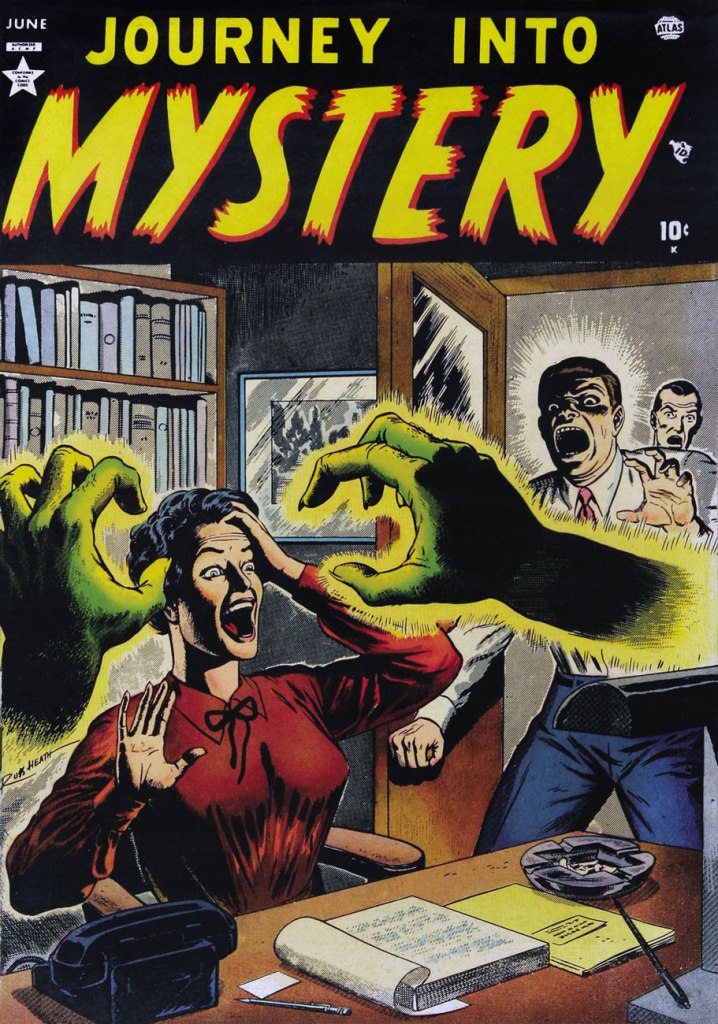
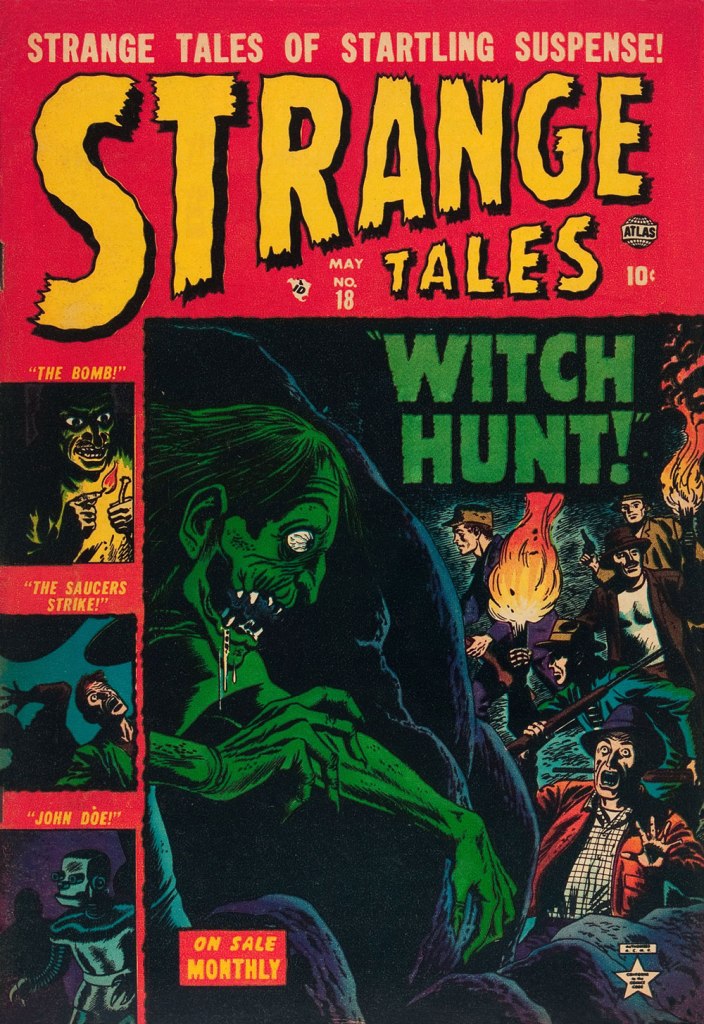
In my opinion, Atlas comics generally weren’t very good. But they remain fascinating because of one impressive asset: the line boasted no less than four absolutely top-notch cover artists, namely Joe Maneely, Bill Everett, John Severin… and Russ Heath. It may seem like nothing, but that was a truly phenomenal assemblage of talent in one place at one time. However, the writing was pedestrian and the second-stringers were, well… second-rate. But oh, some of those covers…
Today, we’ll coyly peek at some of Mr. Heath’s horror covers.
This is Marvel Tales no. 104 (Dec. 1951, Atlas); colours, in every case, by Stan Goldberg.This is Astonishing no. 9 (Feb. 1952, Atlas).This is Suspense no. 14 (Feb. 1952, Atlas). This one’s especially intriguing: there’s so much going on, yet it’s not overly busy… the mark of a first-rate cover designer.This is Journey into Mystery no. 1 (June 1952, Atlas). By now, I have a sneaking suspicion that Mr. Heath liked his ladies… on the buxom side.This is Adventures into Terror no. 11 (Aug. 1952, Atlas).This is Spellbound no. 3 (May 1953, Atlas). Yes, it’s the worm.This is Strange Tales no. 18 (May 1953, Atlas).
« Well, as everyone knows, once witchcraft gets started, there’s no stopping it. » — Mikhail Bulgakov
Another, day, birthday post? Well, it’s still a mighty special occasion, as we’re celebrating the one-hundred and fourth birth anniversary of our beloved Samm Schwartz (1920-1997).
One year ago to the day, we gave you Love in Broom, first of a loosely connected two-parter (‘loosely connected’ is the strongest dose of ‘continuity’ one could expect from the Archie folks in those days).
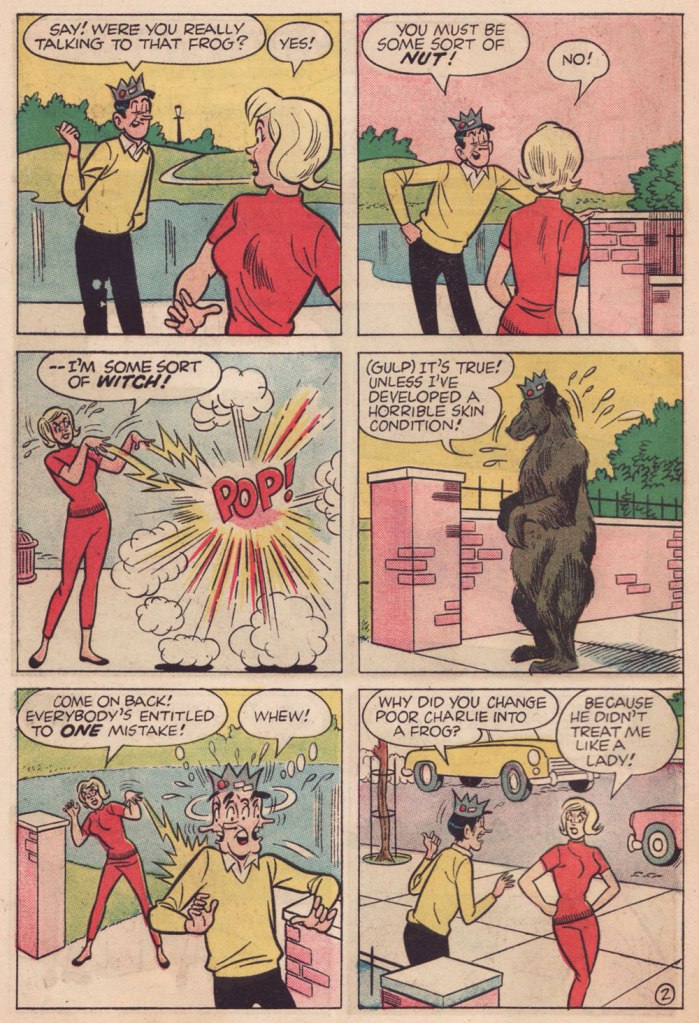
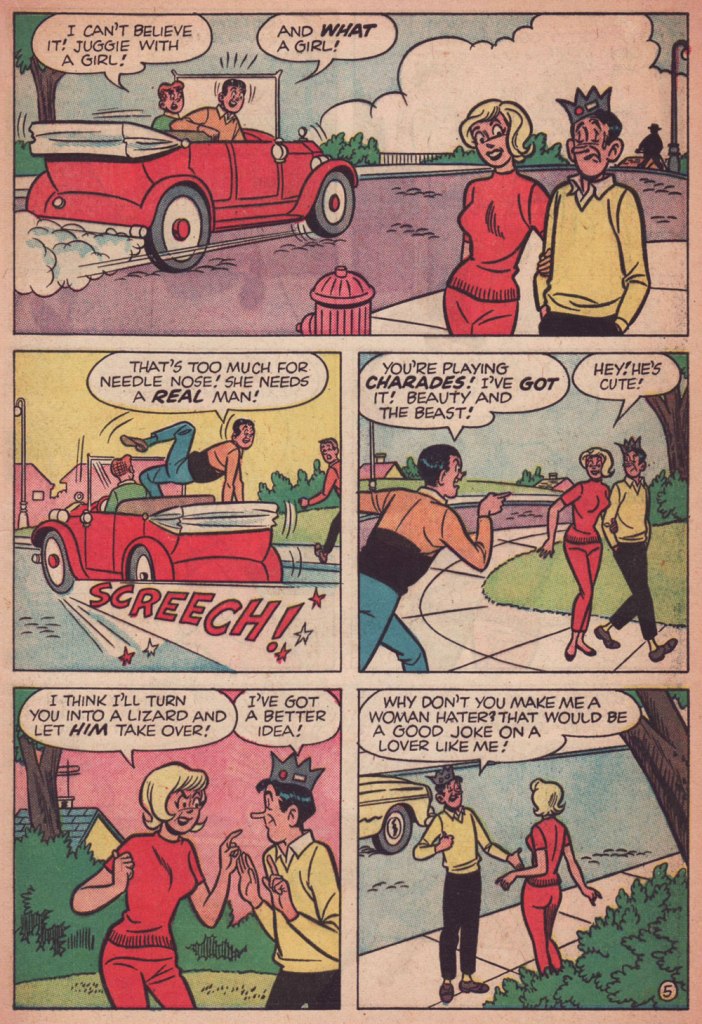
Of course, the now-named Samantha the witch — and the rest of the cast, notably Jughead and Reggie — appear to have forgotten all about their earlier encounter… but that’s just fine: the burden of continuity is one I’m glad to see sloughed. The chief constant is that our witch has quite a yen for Jug.
Switch Witch first appeared in Archie’s Pal Jughead no. 123 (Aug. 1965, Archie). It was presumably scripted by George Gladir (not coincidentally co-creator of Sabrina the Teenage Witch a couple of years earlier), and unmistakably illustrated by Mr. Schwartz. Of Mr. Gladir, Mark Evanier wrote: « Even when they had no credits, you could generally spot a George Gladir script. They were a little wackier, a little sillier, a little more human in their humor. And oh, yes — they were usually fresher than the ones crafted by younger writers. » This certainly fits the bill.
I had to buy three different copies of this issue to get a complete one… and it’s still a brittle mess. But hey, my ordeal, your benefit!
« I’ve had great success being a total idiot. » — Jerry Lewis
Hey, it’s Bob Oksner‘s birthday! I hope you’ll forgive me for double-dipping into that particular well — he also illustrated our earlier Mary Marvel entry — but I still wanted to highlight the occasion, incorrigible Oksner booster that I am.
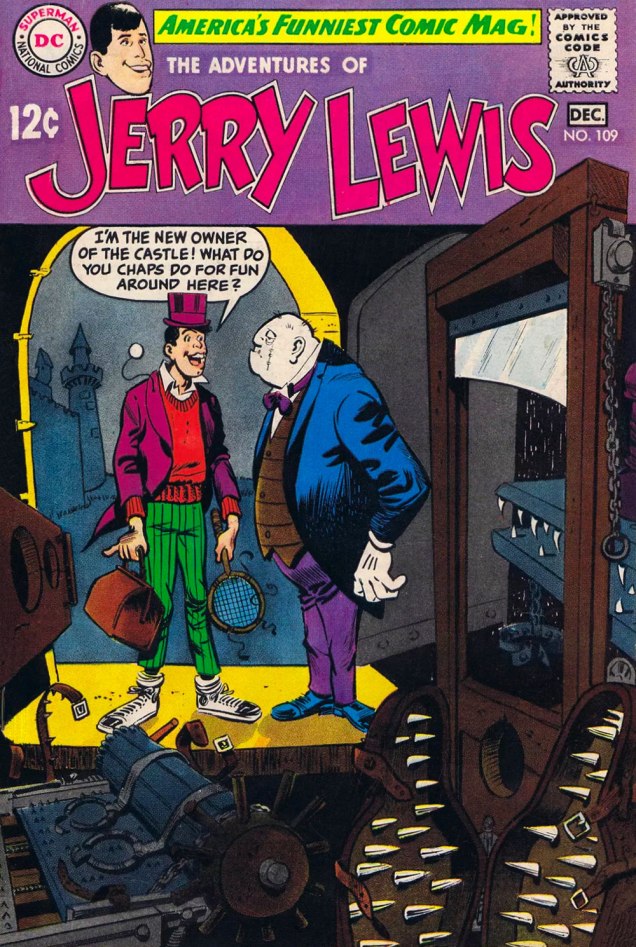
DC’s Jerry Lewis (or Bob Hope, or Dobie Gillis…) comics weren’t even remotely funny, but they sure boasted some spiffy covers. Here’s a gallery of the most Hallowe’en-appropriate, from the pencil and pen of Mr. Oksner.
This is The Adventures of Jerry Lewis no. 87 (Mar.-Apr. 1965, DC).This is The Adventures of Jerry Lewis no. 88 (May-June 1965, DC).
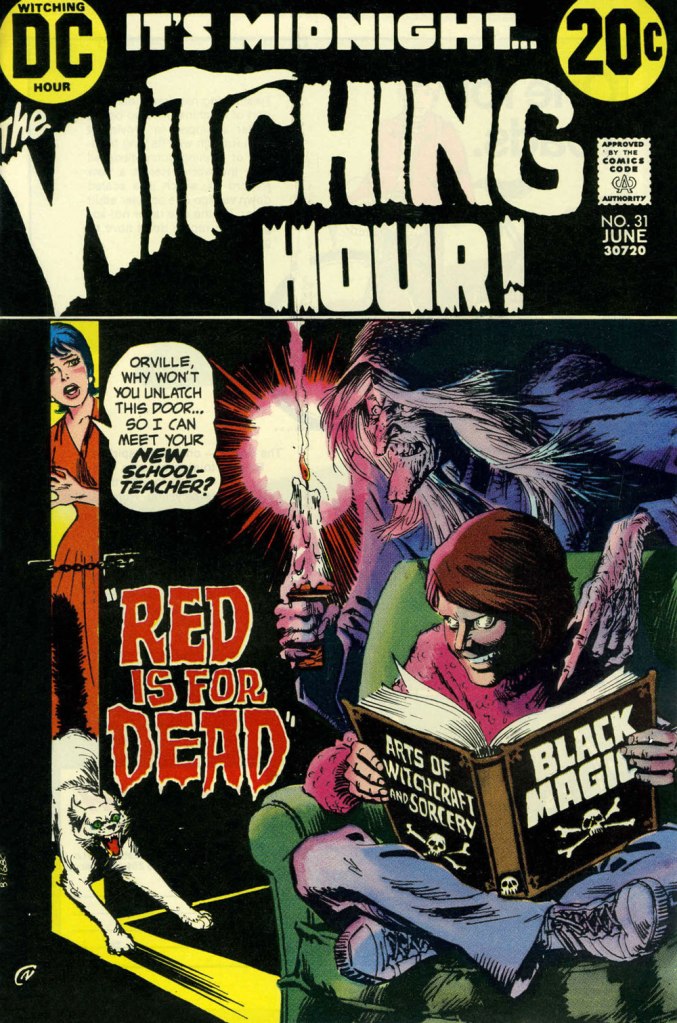
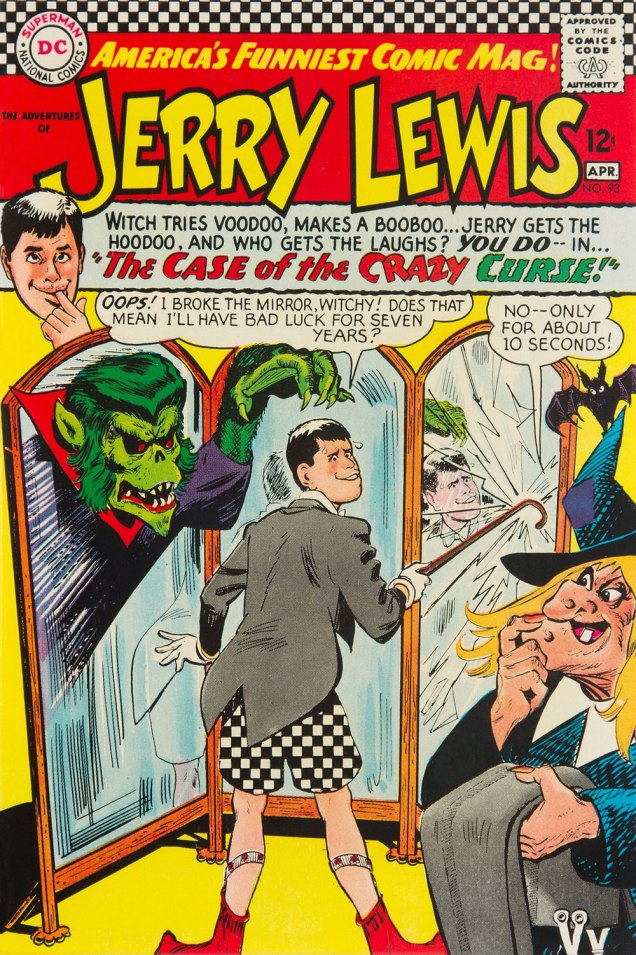
TAoJL editor Murray Boltinoff (1911-1994) had a soft sport for that particular cover concept, since he recycled it, eight years later and with a different tone, for another title he was overseeing:
Here, for comparison, is It’s Midnight… the Witching Hour no. 31 (June 1973, DC). Art by Nick Cardy.This is The Adventures of Jerry Lewis no. 93 (Mar.-Apr. 1966, DC).This is The Adventures of Jerry Lewis no. 94 (May-June 1966, DC).This is The Adventures of Jerry Lewis no. 98 (Jan.-Feb. 1967, DC).And finally, The Adventures of Jerry Lewis no. 109 (Nov.-Dec. 1968, DC). This one’s another riff on a rather hoary theme.
« I won’t put in a load of laundry, because the machine is too loud and would drown out other, more significant noises – namely, the shuffling footsteps of the living dead. » — David Sedaris
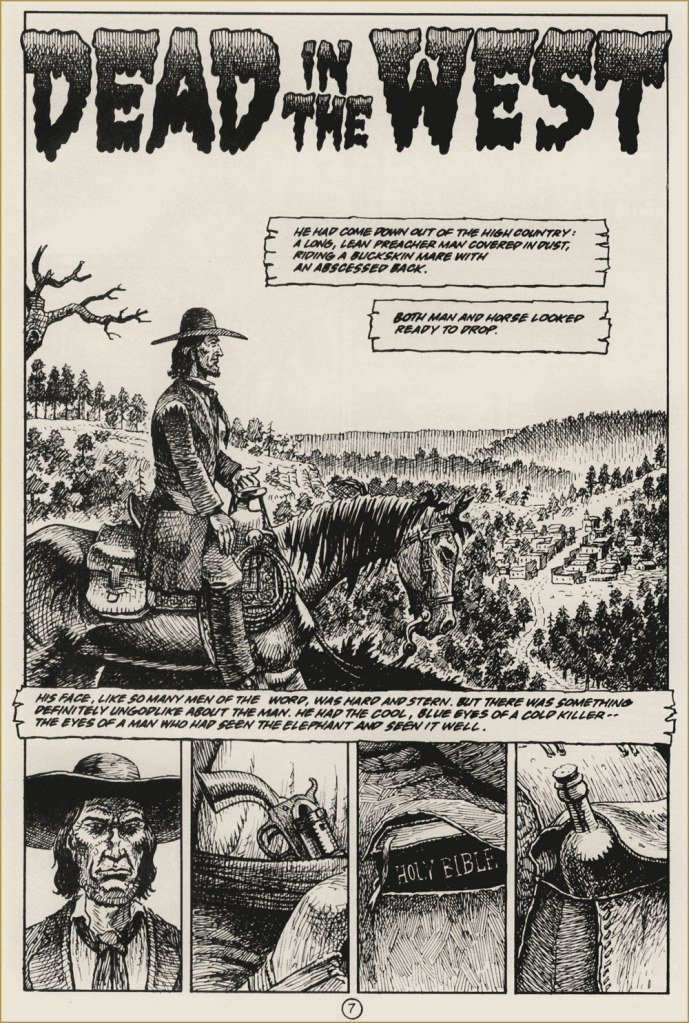
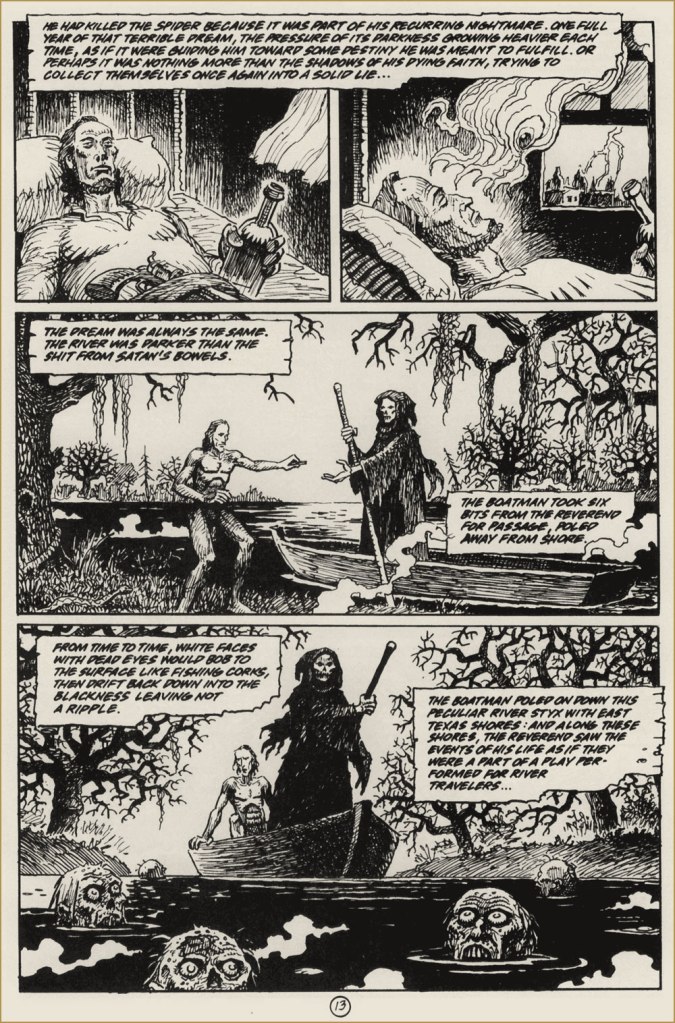
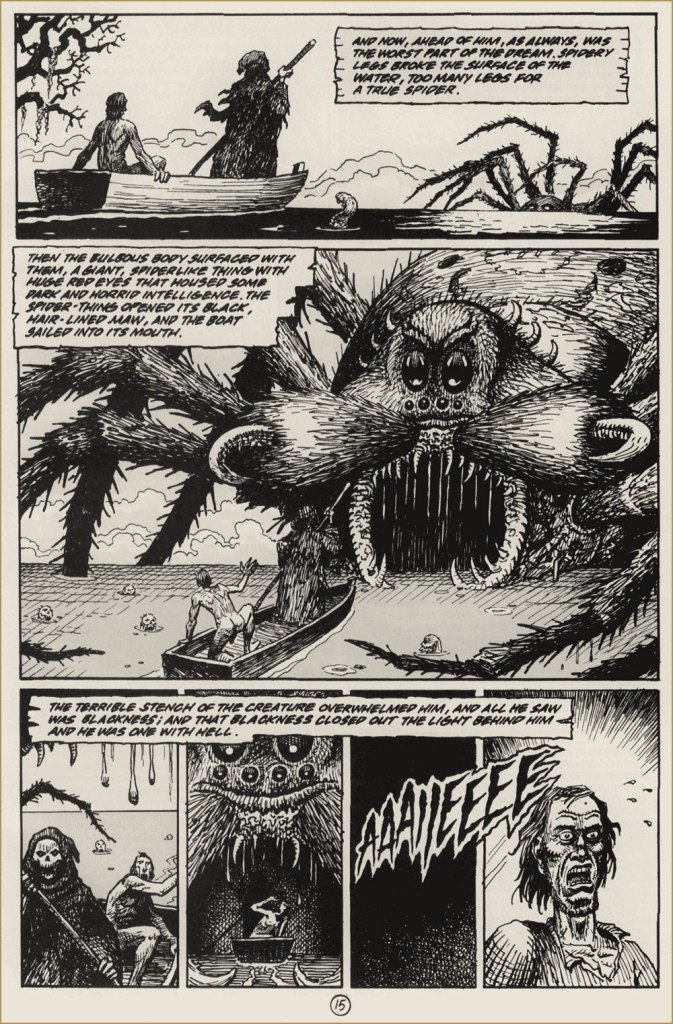
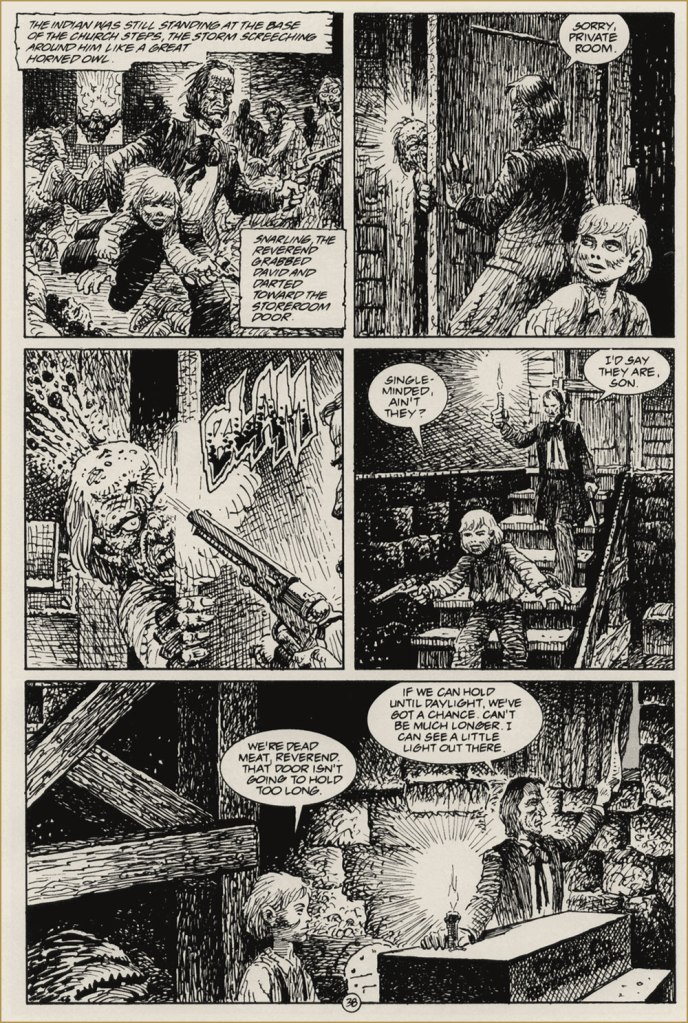
First things first — the general plot: « Dead in the West is a short horror novel written by American author Joe R. Lansdale. It involves the tale of longtime Lansdale character the Reverend Jebediah Mercer: he rides into the town of Mud Creek, Texas that is about to be attacked by an Indian medicine man who was unjustly lynched by the town inhabitants. Soon the dead will rise and seek human flesh and the Reverend finds himself right in the middle of it. He aligns himself with the town doctor and two of the town’s inhabitants, Abbey and David. Together they fight the zombie horde and try to dispatch the medicine man who is the cause of all the evil. » [ source ]
Well, I haven’t read the novel, but the comics adaptation, by seasoned scripter Neal Barrett Jr. (1924-2016) and illustrator Jack ‘Jaxon’ Jackson (1941-2006), is exemplary… well, the results are, at any rate. While we’re not dealing with anything truly new here… I mean, it’s a zombie siege in the well-trod Night of the Living Dead tradition, but in an Old West setting. But the pacing is flawless, the gore and horror balanced with judicious sprinklings of gallows’ humour — served deadpan — and Lansdale’s trademark brutal frankness strikes just the right tone.
Jackson, a fifth-generation Texan and in many ways the original Underground cartoonist, was an inspired choice, as he’s well and truly in his element here.
As this thing is fairly long — as it ought to be! — I’ve just plucked some favourite pages as examples. But if this is up your alley, do yourself a favour and grab yourself copies. Over three decades down the dusty road, these babies are still available at below cover price. It is to weep… but it’s a bargain well worth making.
This is Dead in the West no. 1 (Oct. 1993, Dark Horse); cover by Lansdale regular Timothy Truman. I guess he sells more books than Jaxon, but I’ve never been a fan, save when he’s inked by Sam Glanzman, (1924-2017) who expertly ironed out the chronic stiffness in Truman’s pencilling.I must concede that the giant spiders are a novel touch.This is Dead in the West no. 2 (Oct. 1993, Dark Horse); cover, again, by Mr. Truman.
George Mendoza* does it again! I first stumbled upon Mr. Mendoza’s works through one of his collaborations, The Good Luck Spider: And Other Bad Luck Stories (1970, Doubleday), which was illustrated by the avuncular Gahan Wilson. Since I also happen to be a Mercer Meyer (last mentioned on this blog by ds in 2018!) fan, I did not tarry nor hesitate when I learned, a few years ago, of a dusty tome entitled The Crack in the Wall & Other Terribly Weird Tales (1968, The Dial Press).
Here’s a look at the book’s first yarn, The Devil’s Pocket, a sort of cautionary folk tale/urban legend.
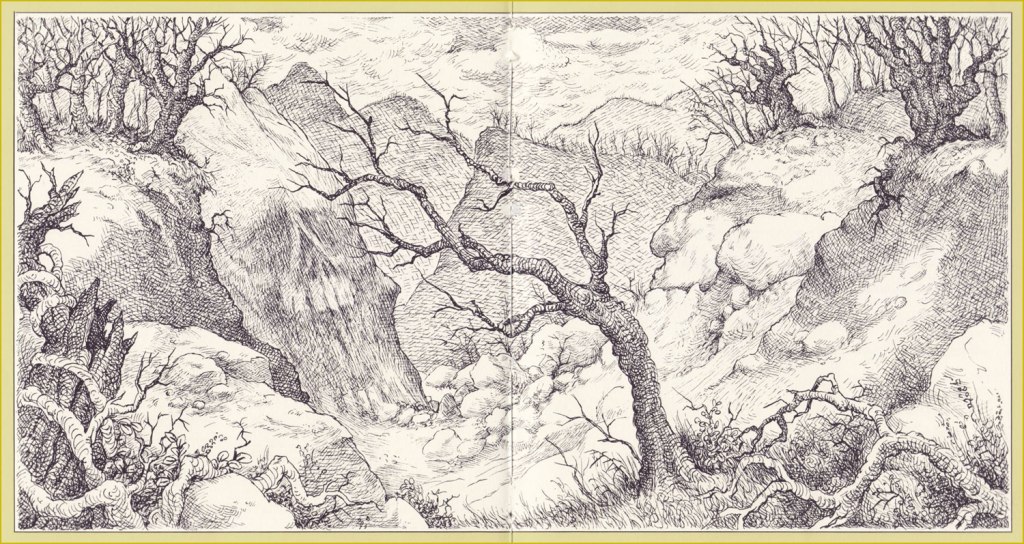
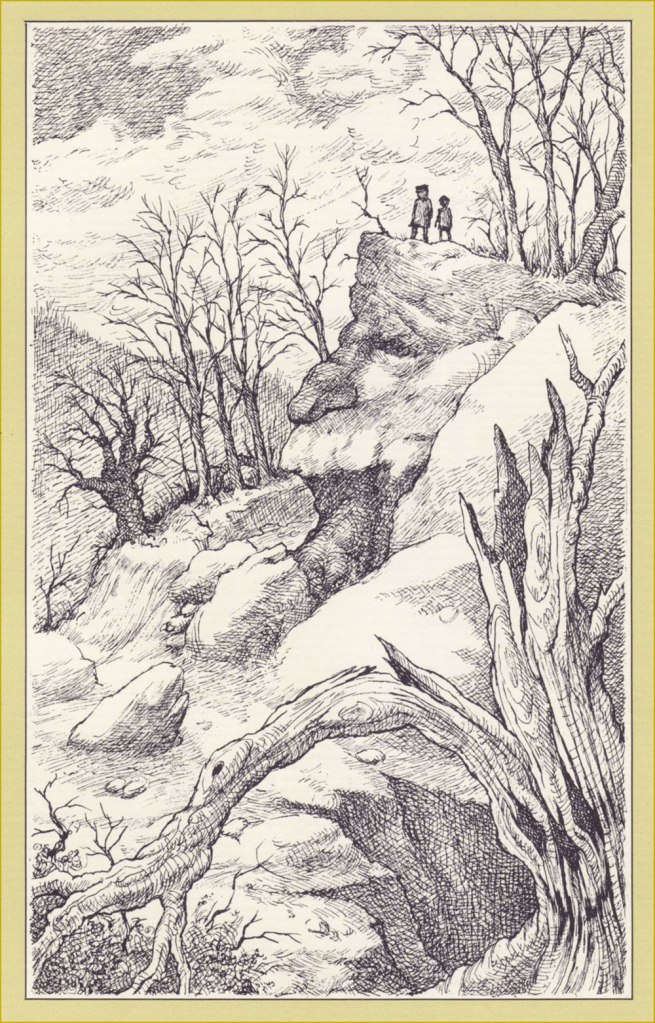
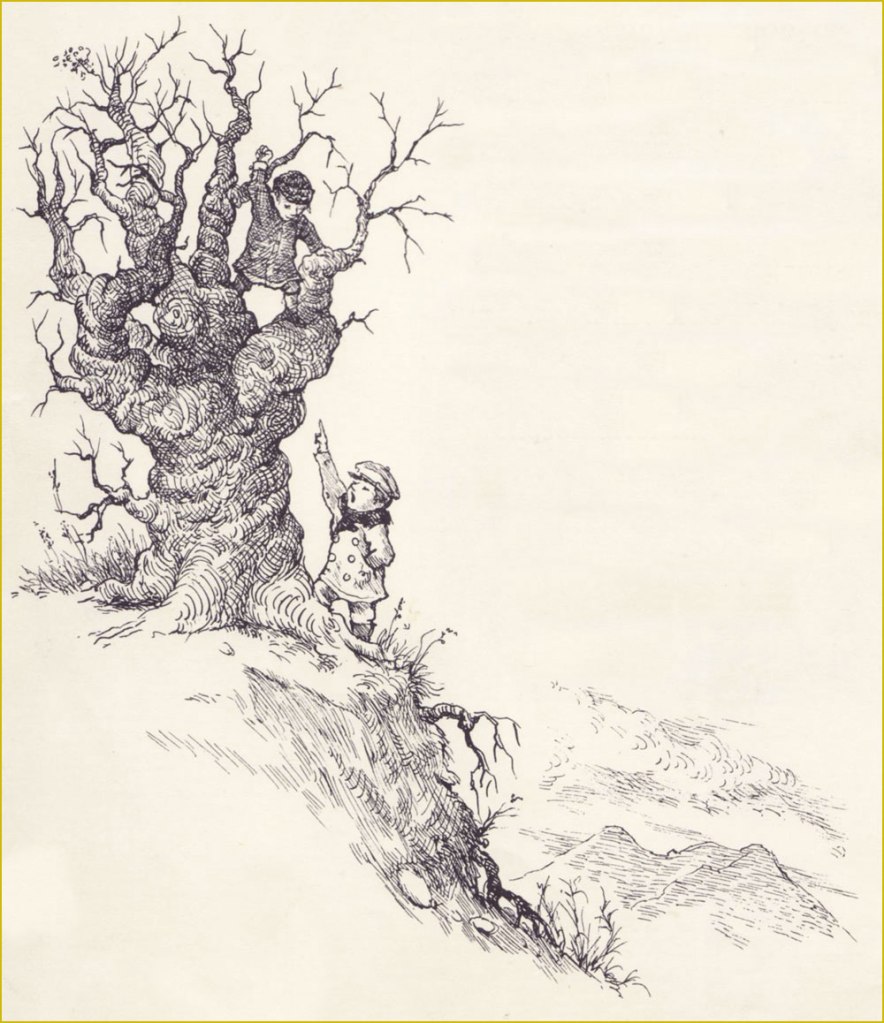
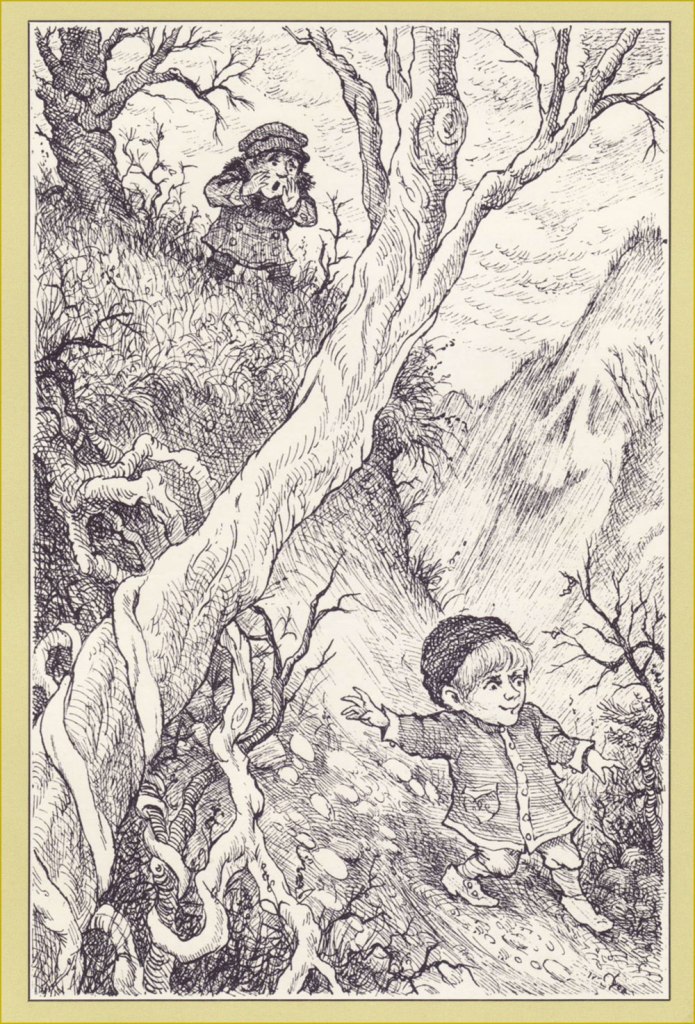
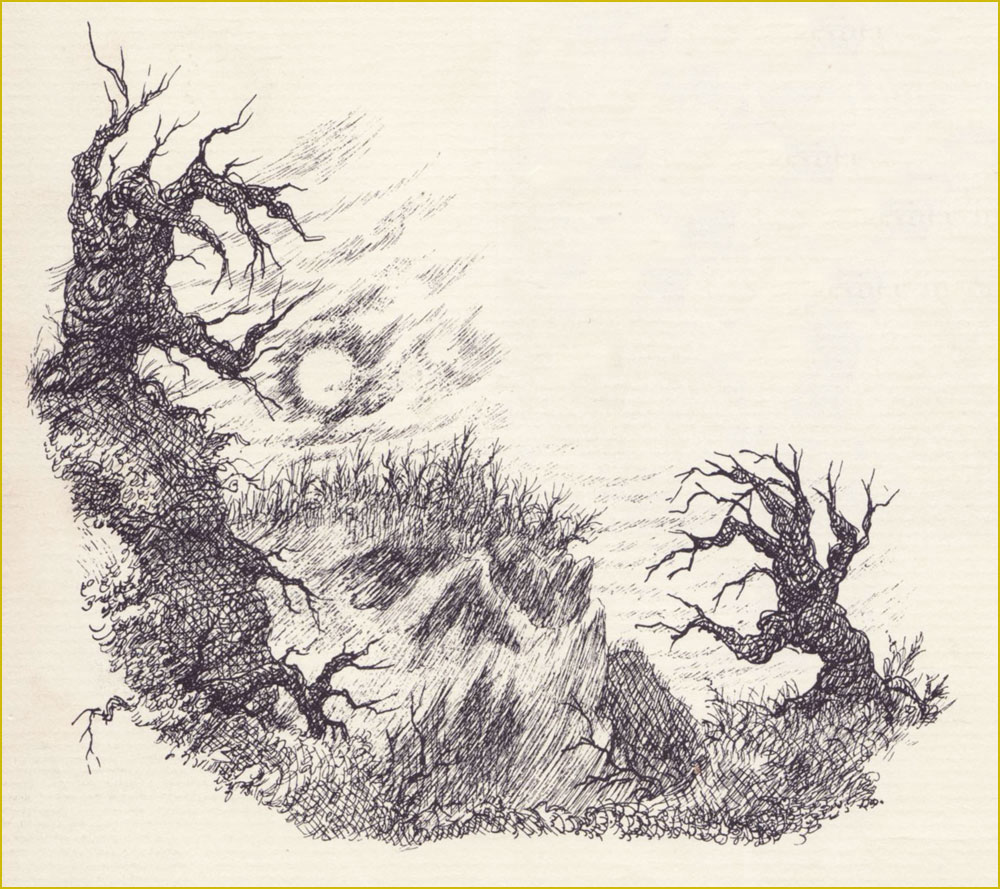
« It was an old, abandoned Vermont quarry, and the two brothers were forbidden to ever climb down into it or even go near it. » « … their father would look up under his glasses, and in his deepest voice he would say, “It’s the devil’s pocket — don’t ever throw a penny into it!” »« But the more stories the boys heard about the quarry, the more fascinated they became with the devil’s pocket. »Mercer Meyer’s uncanny ability to invest the inanimate with animist animosity is on virtuosic display here.« “I’m not afraid,” said Marty, looking down into the bottom of the quarry. “I’m going to throw a penny into it!” »« But it was too late. Marty was already running down the side of the quarry. » « I’m scared,” Marty whimpered, stuffing the penny into his pocket. “Let’s go home.” »« That night both boys had the same dream. They dreamed that the devil’s pocket was calling them, calling them to give back the penny. »« Perhaps it was only a dream, but when morning came, the two brothers found themselves huddled together in one bed, and the penny was gone! »And here’s the front cover of this delightful tome. It’s not cheap, but not entirely unaffordable, either.
-RG
*kudos to fellow blogger Antmusic for digging up as much as could be reasonably dug up about the elusive Mr. Mendoza.
I was recently asked to feature some more Archie artists (other, that is, than my perpetual favourites Samm Schwartz and Bobs Montana and White); while I suppose Orlando Busino (1926-2022) is perhaps an oddball choice to fulfill such a request, it’s his birthday today — he would be ninety-eight years old… but hey, ninety-five is still a pretty good run.
Mr. Busino passed but briefly — but oh so memorably — through the halls of Archie: from 1960 to 1962, before he understandably went off to greater success and better-paying gigs: The Saturday Evening Post, Reader’s Digest (I can confirm that they paid really good rates), McCalls, Good Housekeeping, Boys’ Life… you name it.
Mark Evanier recalls fondly that short Archie stint, where Busino was among the few artists allowed to work outside of the house style and march to his own tune: « I first became familiar with his work, as did my pal Scott Shaw!, during a brief period when Busino worked for the Archie people. His work appeared in Archie’s Madhouse and a wonderful, not-sufficiently-recognized comic book called Tales Calculated to Drive You…BATS. It was kind of like “What if Charles Addams had produced MAD?” Scott and I both remember exactly which newsstand we were patronizing in December of 1961 when we glimpsed the cover of Bats #3 and grabbed up our respective copies. » [ source ]
Signor Busino’s lovely cover for the first issue of Tales Calculated to Drive You Bats (Nov. 1961, Archie).
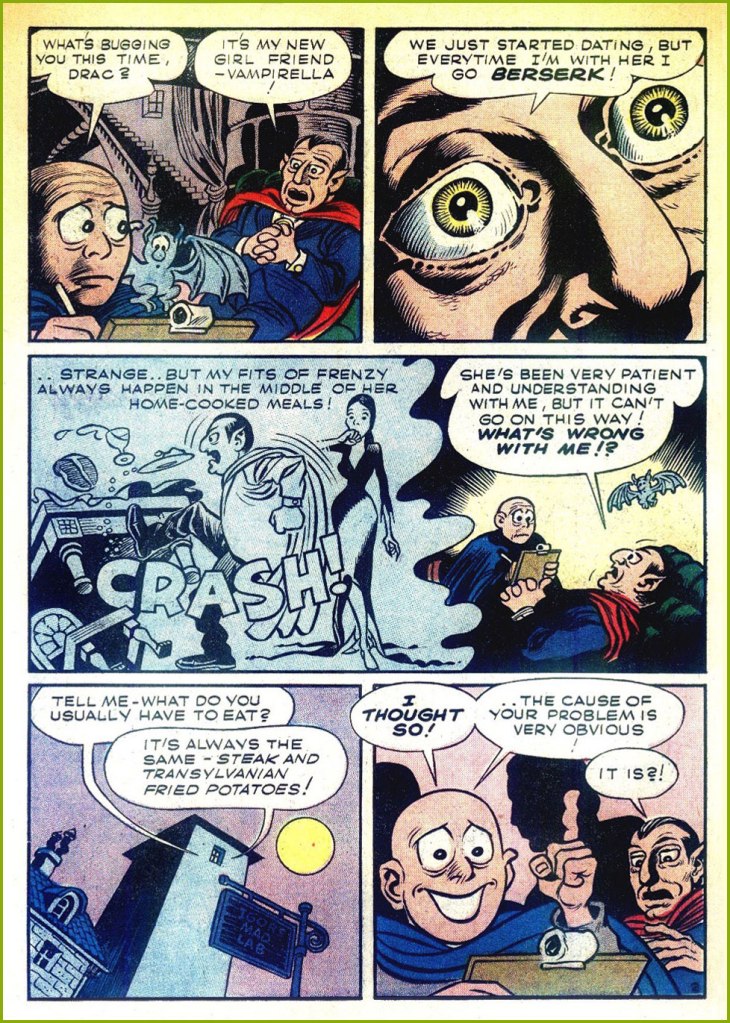
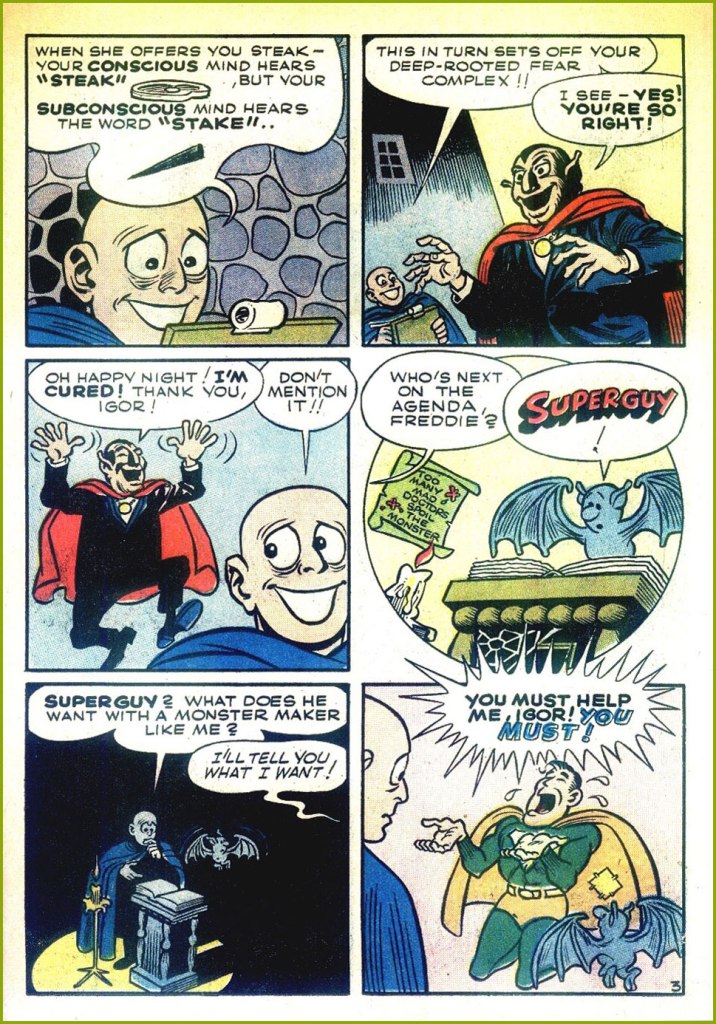
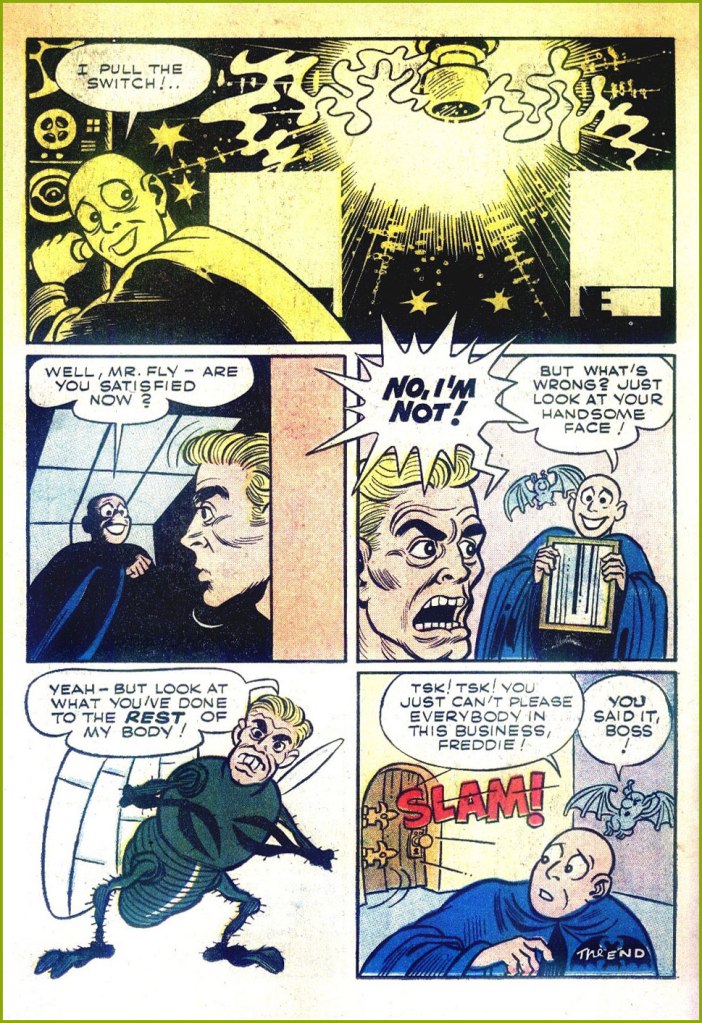
However, our featured tales hails from Tales Calculated to Drive You Bats no. 3 (Mar. 1962, Archie):
And here’s a little something extra from Archie’s Madhouse no. 14 (Aug. 1961, Archie).
Painting your nose the right shade of dill pickle green would also work.
« True terror is to wake up one morning and discover that your high school class is running the country. » — Kurt Vonnegut
Tonight, we’re slumming it up on the cheap side of the tracks. If you thought — and I quite understand you on that point — that Myron Fass’ Eerie Publications were scraping the bottom of the barrel for their market share, then you likely weren’t aware of his fellow cheapjack opportunist Stanley Morse. For a bit of background on Fass, check out these entries from previous countdowns: Hallowe’en Countdown II, Day 1; and Hallowe’en Countdown VI, Day 27… so I don’t have to repeat myself.
Furthermore, here’s my brief introduction to the dodgy wonders of Morse’s ‘Stanley Publications’. I recently came upon all the short-lived line’s covers and was struck by their certain je ne sais quoi. Doubting my senses a little, I queried ds, and she concurred: it’s raw, it’s primitive, but not devoid of a bizarre sort of charm.
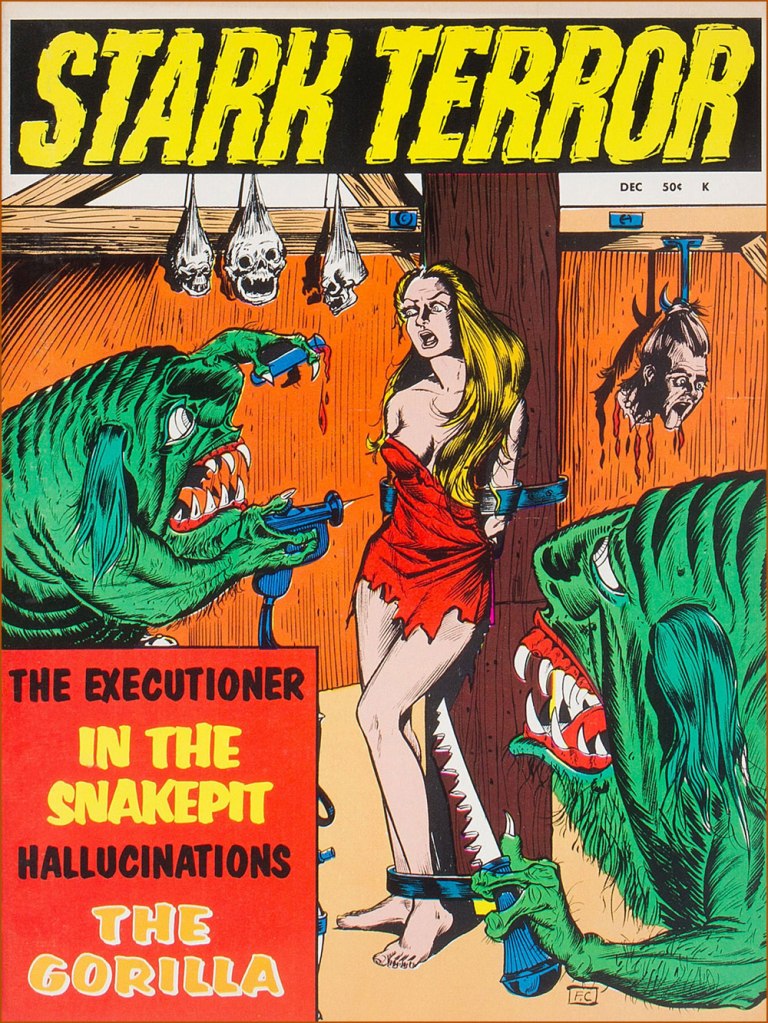
Here, then… is a gallery of the entire run of Stark Terror!
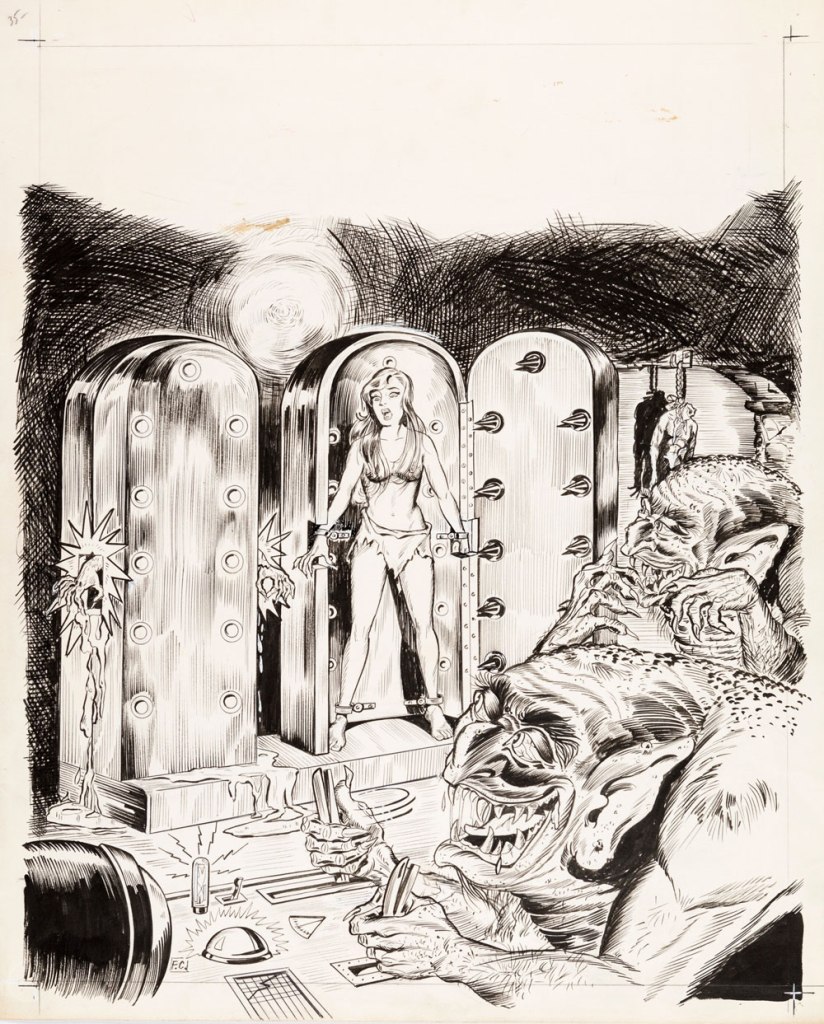
This is Stark Terror no. 1 (Dec. 1970, Stanley); cover art by Frank Carin (né Carino).This is Stark Terror no. 2 (Feb. 1971, Stanley); cover art by Carin.This is Stark Terror no. 3 (Apr. 1971, Stanley); cover art by Mexican illustrator Héctor Castellón .This is Stark Terror no. 4 (June 1971, Stanley); cover art by Carin.This is Stark Terror no. 5 (Aug. 1971, Stanley); cover art by Carin. Just in time for cancellation, a new logo, possibly by Ben Oda.As a bonus, here’s the surviving original art to the publisher’s Ghoul Tales no. 1 (Nov. 1970, Morse); artwork, again, by Mr. Frank Carin.
« Veteran genre-crosser Carin delivered this new-for-1970 cover, insinuating troll-like creeps into a mad-doctor/torture-chamber situation. (The published version contains a touch of self-censorship, obscuring one conspicuous element of nudity with layers of color.) Carin is an enigmatic figure in midcentury comics, traversing the idioms of Funny Animals, Good Girl Art, adventure, and lurid shock value. » [ source ]