Hot Streak: Steve Ditko’s Ghostly Haunts

« There’s no room for professional jealousy around the graveyard, chums… life is too short, as they say… but what comes after that short life may stretch into all eternity! »

I could carry on endlessly (or so it would seem) on any number of obscure topics, but it’s healthy, every once in a while, to take a deep breath, empty one’s mind of its flotsam and jetsam, and reach for an old favourite.

I hadn’t yet written anything about Steve Ditko‘s passing, as I figured it would get lost in the mad shuffle of tributes. That base was well-covered. Still, while I’d known all along the day would come, it was hard to imagine a world without that reclusive genius, likely my very first artistic inspiration.

I didn’t see much of Ditko’s 60s Marvel work until the late 70s pocket book reprints (the period equivalent of watching a movie on one’s cellphone), but the Charlton ghost books grabbed me at a tender age. And so…

As my candidate for Steve Ditko’s finest cover run, at any company, I submit issues 22-27 and 29-30 (curse you for the interruption, Joe Staton!), from January 1972 to March 1973, final year of Ditko’s peak period, imho.

ghostlyhaunts22a
Ghostly Haunts no. 22 (Jan. 1972), an excellently-balanced all-around winner, with the whimsical “Wh-Who’s in Th-There?” (w: Joe Gill p: Charles Nicholas i: Vince Alascia), “Witch’s Brew“, a taste of creepy suburbia with a whiff of Rosemary’s Baby brimstone (w: Joe Gill, p/i Pat Boyette) and our headliner, “The Night of the Lonely Man!” by Gill and Ditko. Read the whole pamphlet here, folks.
ghostlyhaunts23a
Ghostly Haunts no. 23 (Mar. 1972), offers two Gill-Ditko stories: “Treasure of the Tomb” and the cover-featured “Return Visit!“… and I’d be hard-pressed to pick the superior entry. The reader wins. Ah, you cast the deciding vote: read them both here.
ghostlyhaunts24a
Ghostly Tales no. 24 (Apr. 1972), another strong issue, thanks to Gill and Boyette’s “The Other One!” and of course Ditko illustrating “A Man Who Was Here“, Joe Gill’s parable about a Tennessee mountain man displaced, but not entirely, by the construction of a modern superhighway. Read the entire issue here, ladies and gentlemen.
ghostlyhaunts25a
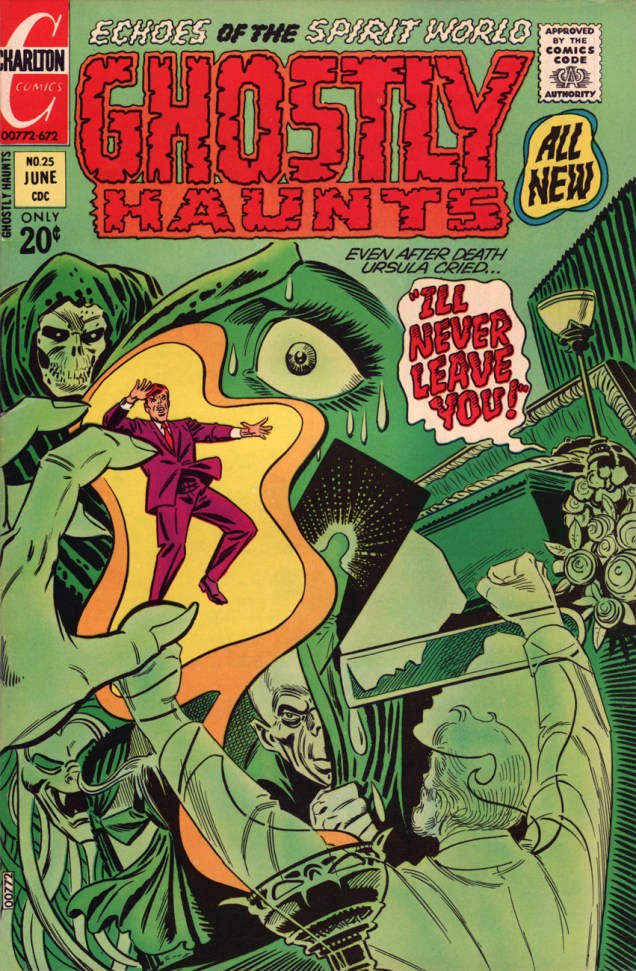
« The butler’s a real monster! » Ghostly Tales no. 25 (June 1972) is where Mr. Ditko demonstrates his unmatched virtuosity in the delicate task of incorporating several elements of a tale without winding up with the dog’s breakfast. Compositional alchemy of the highest order! The cover tale aside, Joe Gill’s wonderfully-titled “What Will Lance Surprise Us with This Time?“, illustrated by Fred Himes, is loads of fun. Read “I’ll Never Leave You!here.
ghostlyhaunts26a
Roger C. Feeney, Indian Affairs bureaucrat from Washington, DC, appears to have stumbled onto the wrong sacred Hopi cave. Uh-oh, Roger, it appears you’ve been noticed by… something. This is Ghostly Haunts no. 26 (Aug. 1972). Beyond the classy Ditko cover, it’s just an okay issue.
ghostlyhaunts27a
« Why does it happen each year? Citizens of Trappton don’t know it, but it always begins right here… at an unmarked grave… » Presumably bearing no direct relation to the 1967 Michael Winner- Orson Welles – Oliver Reed film, I’ll Never Forget What’s-His-Name“, the Gill-Ditko cover story is a classic, the tale of a forgotten man, Bertram Crumm, who merely wanted his existence recognized by the town that spurned him during his lifetime.
It’s too bad Charlton only occasionally featured mystery host Dr. Graves in active (rather than narrative) roles, because when they did, the results were pretty gripping. Unusually, Graves guests outside his own book and in Winnie’s, and we find ourselves with a classic on our hands. This is Ghostly Haunts no. 27 (Nov. 1972). Read the Gill-Ditko story here, but don’t miss the fabulously oddball “The Mine’s All Mine!” by Gill and Stan Asch, featured right here.
ghostlyhaunts29a
« Maybe I’m going mad! I keep imagining I hear his voice! » Ghostly Haunts no. 29 (Jan. 1973) features a striking (gold) exercise in fearful symmetry announcing the Joe Gill – Ditko saga of two untrustworthy acolytes in the Canadian North. Check out “Partners!here.
ghostlyhaunts30
« Ugh! It’s really hideous! Is it a self-portrait of the real you?»  We put the finishing touches on our tour of Steve Ditko covers from 1971-72 with Ghostly Haunts no. 30‘s “Fear Has Three Dimensions” (Mar. 1973). Despite a theme right in Ditko’s wheelhouse, none of his art appears within; the cover feature is handled by Wally Wood disciple Wayne Howard, and the other tales are deftly told by Fred Himes and Warren Sattler.

That just about wraps it up. For further reading on the topic, I recommend you check out Ben Herman’s perspective on some of these very stories, and on Ditko’s spooky Charlton work of the 70s in general.

« Poor Agatha Wilson still has screaming fits! »

-RG

Edgar Allan Poe: Immortality Is but Ubiquity in Time*

« Be silent in that solitude
    which is not loneliness — for then
the spirits of the dead who stood
    in life before thee are again
in death around thee — and their will
shall then overshadow thee: be still. »
— Edgar Allan Poe (1829)

It was on this day, two hundred and ten years ago, that the great writer, poet and posthumous master of all media Edgar Poe (Jan. 19, 1809 – Oct. 7, 1849) was born in Boston, Massachusetts. I’ll spare you the usual biographical details, widely available elsewhere, and we’ll concentrate on his unflagging ubiquity in the medium of comics.

Poe’s literary reputation was in tatters in America, thanks to a rash of hatchet jobs and dismissals, some of the most vicious from the pen of one Rufus Griswold, the very worm he’d named his literary executor (!), as well as such notables as Ralph Waldo Emerson and T.S. Eliot… while his renown was undimmed in Europe, particularly in France (in no small part owing to Charles Beaudelaire’s legendary translations), rehabilitation at home slowly came as the 20th century crept along, but it was likely the publication of Arthur Hobson Quinn’s definitive Poe biography, in 1941, that sealed the deal and opened the floodgates.

spiritushera
Top two tiers from page 2 of The Spirit‘s August 22, 1948 episode. Layout by Will Eisner, pencils and inks by Jerry Grandenetti. As Dave Schreiner puts it: « Grandenetti captures the asthenic look of Roderick Usher that Poe described. The man is a decadent waif; insular, fragile, high-strung, possibly in-bred. »

Classics Illustrated publisher Gilberton was first out of the gate with Poe adaptations, at first tentatively with a pair of poems (Annabel Lee, then The Bells)**, then more substantially with The Murders in the Rue Morgue, in Classic Comics no. 21 3 Famous Mysteries (July, 1944), sharing the stage with Arthur Conan Doyle and Guy de Maupassant. Read it here. Pictured below is Classics Illustrated no. 84 (June 1951, Gilberton), cover by Alex A. Blum. Read the issue here.

classicillustrated84goldbuga
A relevant passage from Simon Singh‘s fascinating (if you’re into that sort of thing… and I hope you are) The Code Book: The Secret History of Codes and Code-Breaking (1999): « On the other side of the Atlantic, Edgar Allan Poe was also developing an interest in cryptanalysis. Writing for Philadelphia’s Alexander Weekly Messenger, he issued a challenge to readers, claiming that he could decipher any monoalphabetic substitution cipher. Hundreds of readers sent in their ciphertexts, and he successfully deciphered them all. Although this required nothing more than frequency analysis, Poe’s readers were astonished by his achievements. One adoring fan proclaimed him ‘the most profound and skilful cryptographer who ever lived’. In 1843, keen to exploit the interest he had generated, Poe wrote a short story about ciphers, which is widely acknowledged by professional cryptographers to be the finest piece of fictional literature on the subject. The Gold Bug tells the story of William Legrand, who discovers an unusual beetle, the gold bug, and collects it using a scrap of paper lying nearby. That evening he sketches the gold bug upon the same piece of paper, and then holds his drawing up to the light of the fire to check its accuracy. However, his sketch is obliterated by an invisible ink, which has been developed by the heat of the flames. Legrand examines the characters that have emerged and becomes convinced that he has in his hands the encrypted directions for finding Captain Kidd’s treasure. »
crandalltelltale2a
A page from EC Comics great Reed Crandall‘s exemplary adaptation of Poe’s The Tell-Tale Heart, from Creepy no. 3 (June, 1965). While Crandall’s work is outstanding, scripter-editor Archie Goodwin tried to ‘improve’ upon Poe by tacking on a tacky ending, a nasty habit he would indulge in again on subsequent adaptations, notably issue 6’s The Cask of Amontillado!. Read The Tell-Tale Heart. And don’t miss The Cask…, if only for the artwork.
creepy70a
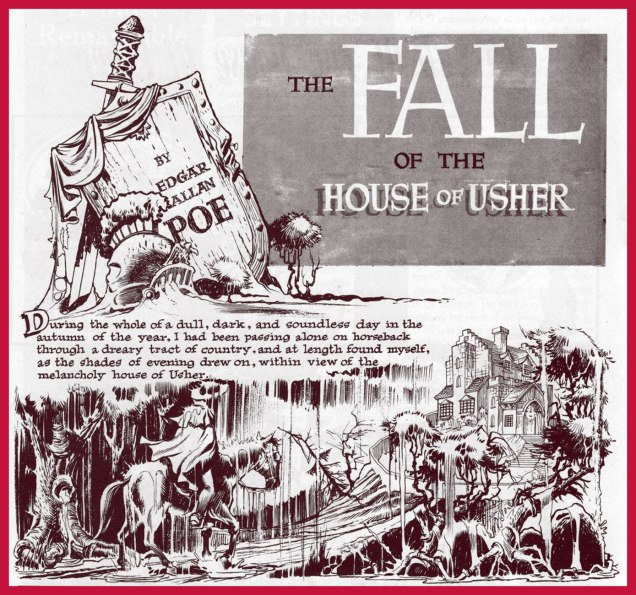
In the mid-70s, Warren would devote two full issues of Creepy to Poe adaptations; issue 69 (Feb. 1975), featured The Pit and the Pendulum, The Fall of the House of Usher, The Premature BurialThe Oval Portrait, MS Found in a Bottle!, Facts in the Case of M. Valdemar; issue 70 (Apr. 1975) comprised The Murders in the Rue Morgue, Man of the Crowd, The Cask of Amontillado!, Shadow, A Descent into the Maelstrom! and Berenice
All stories were adapted, with far greater respect than Mr. Goodwin seemed capable of, by Rich Margopoulos, and illustrated by a host of artists. The project was edited by Bill DuBay, and the cover painting is by Ken Kelly.
isidromontesberenicesplasha
Isidre Monés‘ fabulous opening splash from Creepy no. 70‘s Berenice. Read the story in full here.
wrightsondescenta
« The rays of the moon seemed to search the very bottom of the profound gulf; but still I could make out nothing distinctly, on account of a thick mist in which everything there was enveloped, and over which there hung a magnificent rainbow, like that narrow and tottering bridge which Musselmen say is the only pathway between Time and Eternity. » In 1976, a peak-form Berni Wrightson got out his brushes and paint tubes for a heartfelt portfolio of Poe-inspired oils. A sensitive and subtle sense of colour was among Wrightson’s chief assets; it’s a shame we didn’t see more of it. I opted to feature my favourite piece from the lot, A Descent Into the Maelström, but by all means feast your eyes on the whole shebang.
rudymesinapita
In 1976, Marvel Comics set out to make their mark on the classics… with dubious, but predictable results. It wasn’t what their zombie readership had clamoured for. Here’s the best page (art by Rudy Mesina) from Marvel Classics Comics no. 28, The Pit and the Pendulum (1977), featuring three tales adapted by scripter Don McGregor, and including future superstar Michael Golden‘s abysmal professional début on yet another helping from The Cask of Amontillado, where he demonstrates how he believes wine is to be drunk just like Pepsi. See what I’m griping about here.
poeenchantinglove2a
Think Poe’s all about the horror? Think again! You don’t become a household name by putting all your eggs in the same basket. Meet Edgar ‘Eddie’ Allan Poe, romantic leading man. “Based on actual records…” and sanitized beyond recognition. Given that Virginia and Edgar were first cousins and that they married when she was thirteen, you can see how absurd this strip is. Read the full tale of romance and pathos right here. The Beautiful Annabel Lee appeared in Enchanting Love no. 2 (Nov. 1949, Kirby Publishing). Writer unknown, art by Bill Draut and Bruno Premiani.
skotolsenpoea
Kubert School alum Skot Olsen‘s cover illustration for the revised and expanded second edition (July, 2004) of Graphic Classics‘ Poe compendium.
elderravena
As with, say, Elvis or H.P. Lovecraft, when both legend and œuvre reach a certain tipping point of iconic fame, one can bend and twist the concepts any which way and they’ll still be recognizable. Here’s a panel from Harvey Kurtzman and Will Elder‘s faithful-in-its-fashion take on The Raven, from Mad no. 9 (Feb.-Mar. 1954, EC).
twofistedpoea
Michael Kupperman strikes again. From Snake ‘n Bacon’s Cartoon Cabaret ( 2000, HarperCollins)
snifter2a
Hot off the presses! It’s Edgar Allan Poe’s Snifter of Terror no. 2 (Nov. 2018, Ahoy), featuring a collaboration between Rachel Pollack and the fabulous Rick Geary. Don’t miss it! Oh, and if the pose looks familiar, you’re thinking of this.

Whew — that’s it for now. In closing, I must bow and salute before the gargantuan endeavour accomplished by Mr. Henry R. Kujawa on his truly indispensable blog, Professor H’s Wayback Machine. Thanks for all the heavy lifting, Henry. I get exhausted just thinking about it.

Tintinabulate on, Mr. Poe — wherever you are!

-RG

*my thanks to Herman Melville for those words of wisdom.
**and thanks to the aforementioned Mr. Kujawa for that precious scrap of arcane lore.

Will Eisner’s The Spirit at Warren

« According to statistics, millions of Americans read millions of the most carefully written crime and crime detection stories in the world! Expertly told… and prepared, after exhaustive research — the best of these are, in effect, lessons in crime and criminal psychology! Yet could you, sitting in the trolley or bus or subway at night, pick out the killer sitting opposite you? » — The Killer (Dec. 8, 1946)

Welcome to the fourth entry in our chronicle of the variegated ambulations of the former Denny Colt. Begin if you will, as we did, with his time at Quality, then follow his path through Fiction House, then on to Harvey, Super and Kitchen Sink; at that point, you’ll be all caught up.

Okay, now that we’re all here, let’s pose and answer the next burning question: how did The Spirit come to make landfall at Warren Magazines? Thankfully, we’re spared the motions of idle speculation in this case, since Jim Warren himself revealed all in the course of an interview with Jon B. Cooke, published in The Warren Companion (2001):

JW: « I would have mortgaged everything I owned to publish Will Eisner — to be involved in anything Will Eisner was doing. I called Will and said, ‘Mr. Eisner, I’d like to take you out to lunch.

I knew Will was talking to Stan Lee about The Spirit and that DC was interested in his company, American Visuals. I also knew that Harvey Comics had done a couple of Spirit reprints and that they might be interested again. I had to move fast.

So I took him out to lunch, sat him down, and said, ‘There’s no possible way that I’m going to let the great Will Eisner escape. You are someone I have revered since 1940, when I saw the very first Spirit section in the Philadelphia Record with that splash page that changed my life. Do you think I’m going to let you go to Stan Lee, whom I ‘hate’ and ‘despise’ as a competitor? Do you think I’m going to lose you to that unrepentant sociopath? You’re just going to be a computer number to Marvel; they have a factory, where they cookie-cut comics, turning out 400* titles a month!’

And I saw the expression in Will’s face — he had his pipe in his mouth at the time, just like Commissioner Dolan — and I could see that I had him. »

WhoThereLogotype

Let’s have a look at some covers. Most of the sixteen (plus the colour Special) are terrific, but I skipped a few of the lesser ones: issue one is a not-quite successful Eisner-Basil Gogos painted collaboration, and issue two is just okay. Issue 11 is another Ken Kelly painting over Eisner pencils, and 12 to 16 are composites using inside panels. Fine, but facultative. And now, on to the gems!

warrenspirit3a
This is The Spirit no. 3 (Aug. 1974), reprinting eight post-WWII stories: Black Alley (June 5, 1949), Fox at Bay (Oct. 23, 1949), Surgery… (Nov. 13, 1949), Foul Play (March 27, 1949), The Strange Case of Mrs. Paraffin (March 7, 1948), The Embezzler (Nov. 27, 1949), The Last Hand (May 16, 1948) and Lonesome Cool (Dec. 18, 1949). Cover pencils and inks by Eisner, colours by Richard Corben.
warrenspirit4a
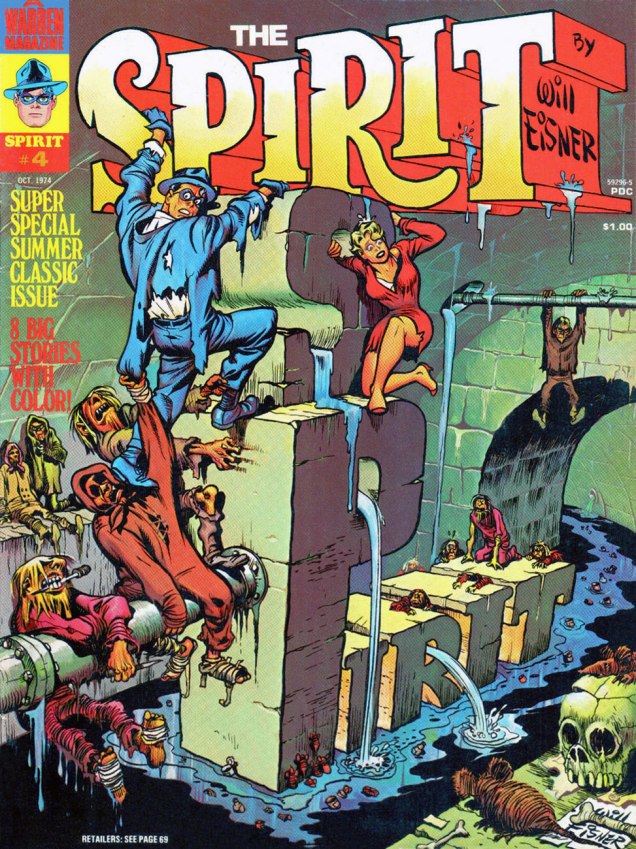
This is The Spirit no. 4 (Oct. 1974), reprinting eight post-WWII stories: Life Below (Feb. 22, 1948), Mr. McDool (Oct. 12, 1947), The Emerald of Rajahpoor (May 30, 1948), Ye Olde Spirit of ’76 (July 3, 1949), The Elevator (June 26, 1949; in colour), The Return of Vino Red (Sept. 25, 1949), The Guilty Gun… (June 6, 1948), and Flaxen Weaver (Dec. 11, 1949). Cover colours by Ken Kelly.
warrenspirit5a
This is The Spirit no. 5 (Dec. 1974), reprinting eight post-WWII stories: The Return (Aug. 14, 1949), The Spirit Now Deputy (Apr. 24, 1949), The Hunted (May 1st, 1949), The Prediction (June 19, 1949), The Deadly Comic Book (Feb. 27, 1949; in colour), Death, Taxes and… The Spirit (Mar. 13, 1949), Hamid Jebru (May 18, 1949), and Ice (Jan. 2, 1949). Cover colours by Ken Kelly.
warrenspirit6a
« You cannot stop me now… I am at the threshold of immortality… Yowch! »
This is The Spirit no. 6 (Feb. 1975), featuring seven black & white (and one full-colour) presentations of tales from the 1940s: Showdown (Aug. 24, 1947), The Wedding (May 2, 1948), The Job (May 9, 1948), The Lamp (July 27, 1947), Glob (March 6, 1949; in colour), The Winnah! (Dec. 3, 1950, This is ‘Wild’ Rice (Apr. 4, 1948) and Taxes and the Spirit (Apr. 16, 1950). Cover colours by Ken Kelly.
warrenspirit7a
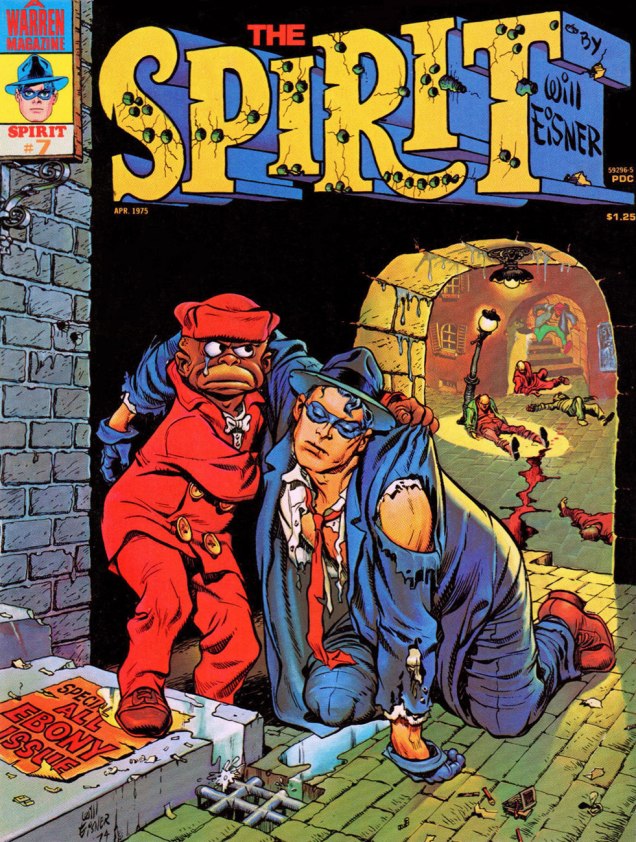
This is The Spirit no. 7 (Apr. 1975), reprinting eight post-WWII stories: The Big Sneeze Caper (Feb. 6, 1949), Hoagy the Yogi (Pt. I) (Mar. 16, 1947), Hoagy the Yogi (Pt. II) (Mar. 23, 1947), Cheap Is Cheap (June 13, 1948), Young Dr. Ebony (May 29, 1949; coloured by John Laney); A Moment of Destiny (Dec. 29, 1946); The Explorer (Jan. 16, 1949); and A Prisoner of Love (Jan. 9, 1949). Cover colours by Ken Kelly.
warrenspirit8a
This is The Spirit no. 8 (Apr. 1975), reprinting eight post-WWII stories: “Sand Saref” (Jan. 8, 1950), “Bring In Sand Saref…” (Jan. 15, 1950), “Thorne Strand” (Jan. 23, 1949), “A Slow Ship to Shanghai” (Jan. 30, 1949), “Assignment: Paris” (May 23, 1948; coloured by Michelle Brand), “A Pot of Gold” (Apr. 3, 1949), “Satin” (June 12, 1949), and “Visitor” (Feb. 13, 1949). Cover colours by Ken Kelly.
warrenspirit9a
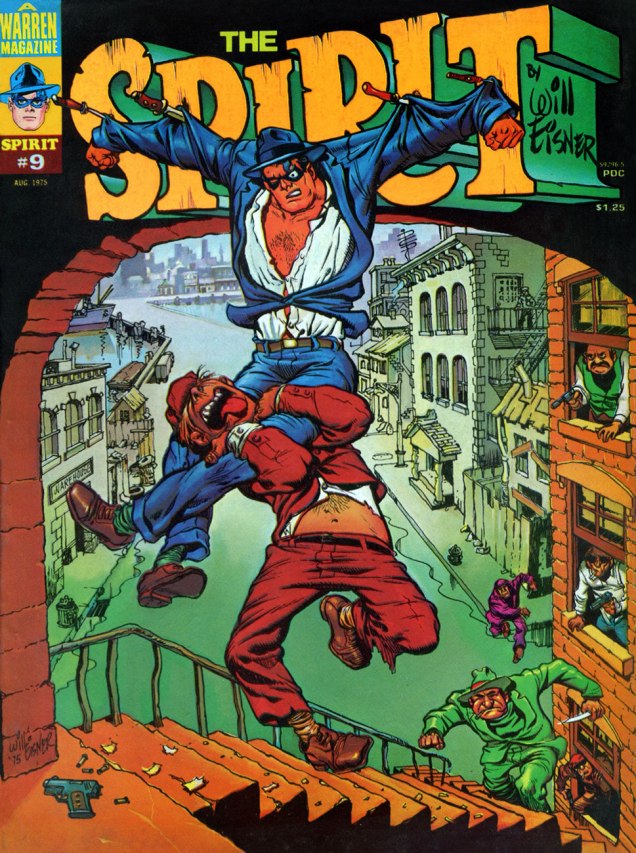
This is The Spirit no. 9 (Aug. 1975), reprinting eight post-WWII stories: The Candidate (Aug. 21, 1949); White Cloud (Aug. 28, 1949); Stop the Plot! (Dec. 5, 1948); Lovely Looie (Apr. 10, 1949); The Space Sniper (May 22, 1949; in colour); The Vernal Equinox (Mar. 20, 1949); Black Gold (June 15, 1947); and Two Lives (Dec. 12, 1948). Cover colours by Ken Kelly.
warrenspirit10a
« The Octopus is at it again. This time his thugs have the Spirit cornered. Has his incredible luck finally run out? A tense moment captured by Will Eisner and Ken Kelly. » Evidently, Warren’s readership wasn’t content with line art covers, fancily wrought and gorgeous as they were; so Ken Kelly was brought in to slap some paint over a tight Eisner layout et voilà! An interesting hybrid, but I’m not quite convinced of its necessity. This is The Spirit no. 10 (Oct. 1975), reprinting a whopping ten post-WWII stories: Heat (July 15, 1951); Quiet! (July 22, 1951); Death Is My Destiny (March 4, 1951); Help Wanted (April 29, 1951); The Origin of the Spirit (From Harvey’s The Spirit No. 1; in colour); Sound (Sept. 24, 1950); A Time-Stop! (Jan. 7, 1951); The Octopus Is Back (Feb. 11, 1951); Hobart (Apr. 22, 1951) and The Meanest Man in the World (Jan. 28, 1951).
eisnerspiritoa
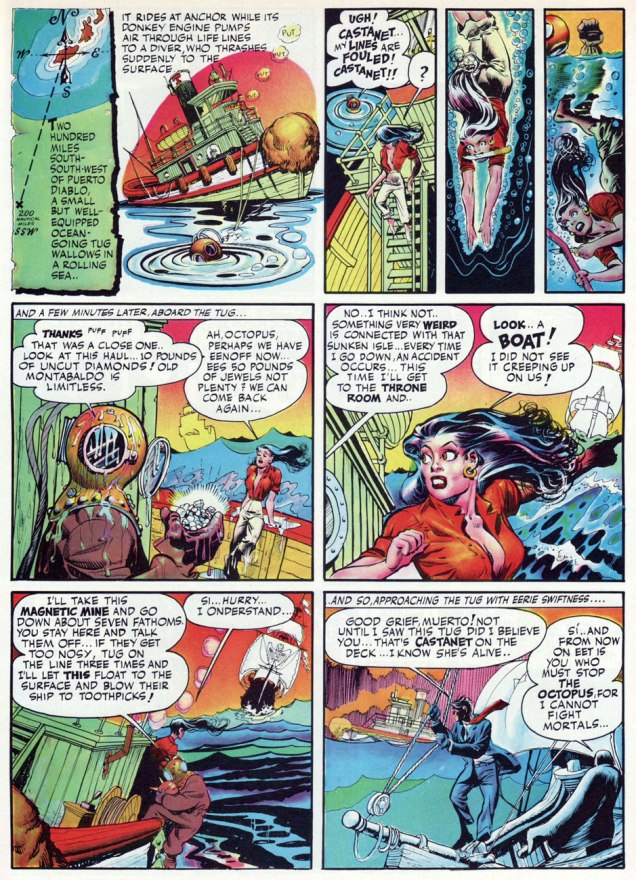
Among my favourite features of the Spirit’s Warren run are the single, well-selected, lushly-coloured story appearing in each of the first ten issues. This, from no. 1, is page 4 of El Spirito (Feb. 1st, 1948). The Octopus’ buxom accomplice is Castanet. While I’m strictly underwhelmed by Rich Corben’s interchangeable tales of bald, lumpy, donkey-donged bodybuilders roaming the land and forever risking ritual castration at the hands of amazon tribes, his colour work here is simply sublime.
thespiritspeciala
As you can see, the panel montages were extremely well-done; The Spirit Special (1975) handily gathered in one place the colour stories from issues one to ten. According to the GCD: « Available through mail purchase only, just over 1500 are thought to have been printed. »

In closing, this final, telling exchange from the Jim Warren interview:

Jon Cooke: Do you recall dealing with Denis Kitchen about The Spirit?
Jim Warren: Will had given his word — and his word is his bond — for Denis to reprint The Spirit (this was before Will and I negotiated a deal). Denis had spent money on preparing the reprints. Will said to me, « It would be a nice gesture if you would reimburse Denis, who is a good guy, for the material he’s already prepared. » I think Will looked on me kindly when I said « Absolutely. » (What Will doesn’t know if that if he had asked for me to give Denis a Rolls-Royce, I would have driven it to Wisconsin myself!)

*an exaggeration, of course, but a pointed one. At the time, Marvel *was* doing its worst to flood the market in order to starve its competitors.

-RG

Just a Humble Boy From Tupelo, Mississippi

« When I was a boy, I always saw myself as a hero in comic books and in movies. I grew up believing this dream. » – Elvis Aaron Presley (1935 — ?)

Today, somewhere, the King of Rock ‘n’ Roll celebrates his eighty-fourth birthday, be he alive, dead or undead, he lives on. And never forget: Elvis is everywhere!

mod1a
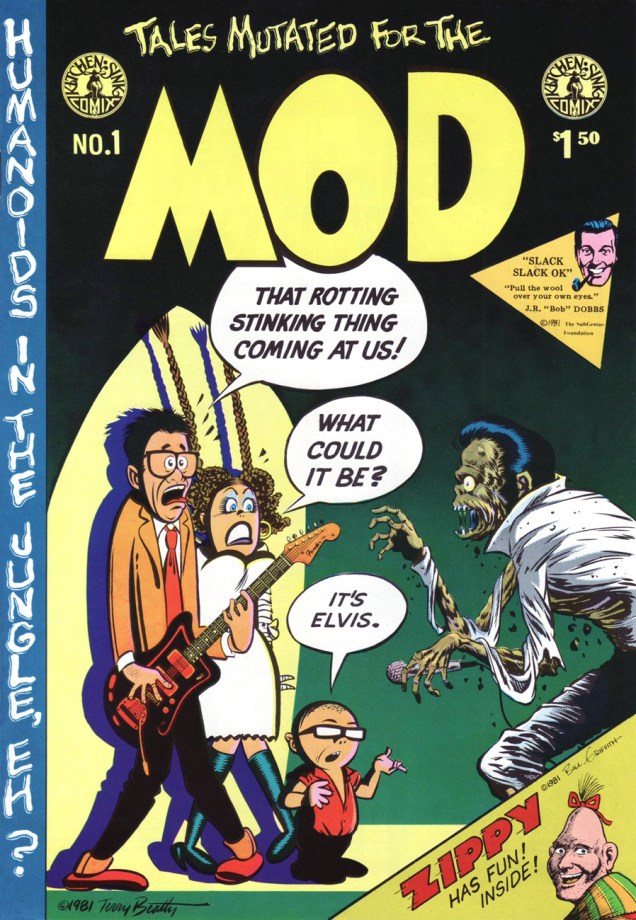
A most salty salute to the King of Rock ‘n’ Roll on his birthday! Compared to earlier decades, the 1980’s (and on!) were not kind to the anthology comic book. Thankfully, the meagre rewards and resounding indifference weren’t enough to quite dissuade some foolhardy souls from giving the format a go. But the fanboys wanted spandex, they wanted continuity and they soon wanted their « decompressed storytelling ». Bah. 
In 1981, Kitchen Sink Comix published the lone issue of Terry Beatty‘s labour of irradiated passion, Tales Mutated for the Mod. (June, 1981). Unlike John Byrne and others’ unceasing and pointless ‘tributes’ to Fantastic Four No. 1, this cover version of Harvey Kurtzman‘s Mad No. 1 is fiendishly clever. Kudos, Mr. Beatty!
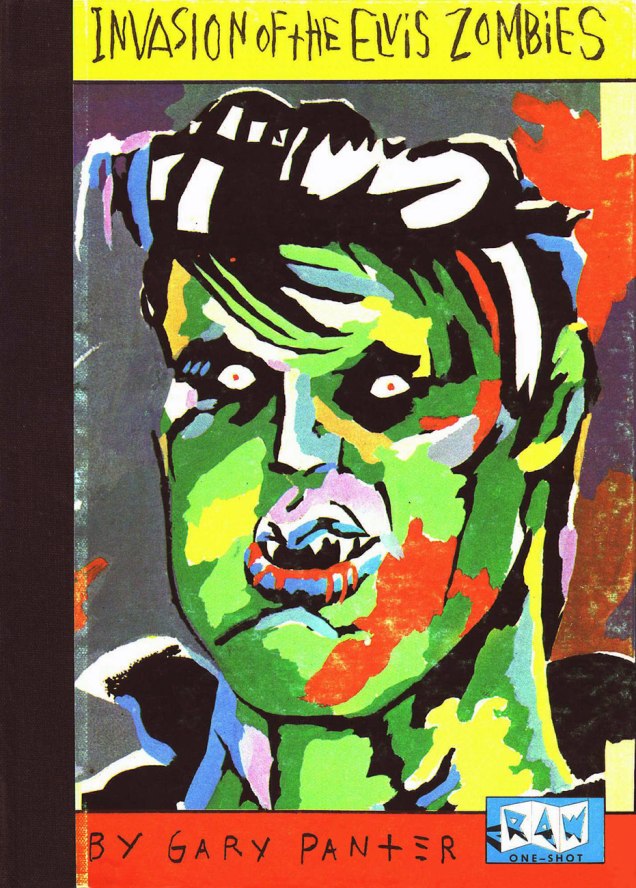
panterelviszombiesa
Gary Panter crafted this loving tribute in 1984, a one-shot published by RAW. Such heady stuff was well ahead of its time!
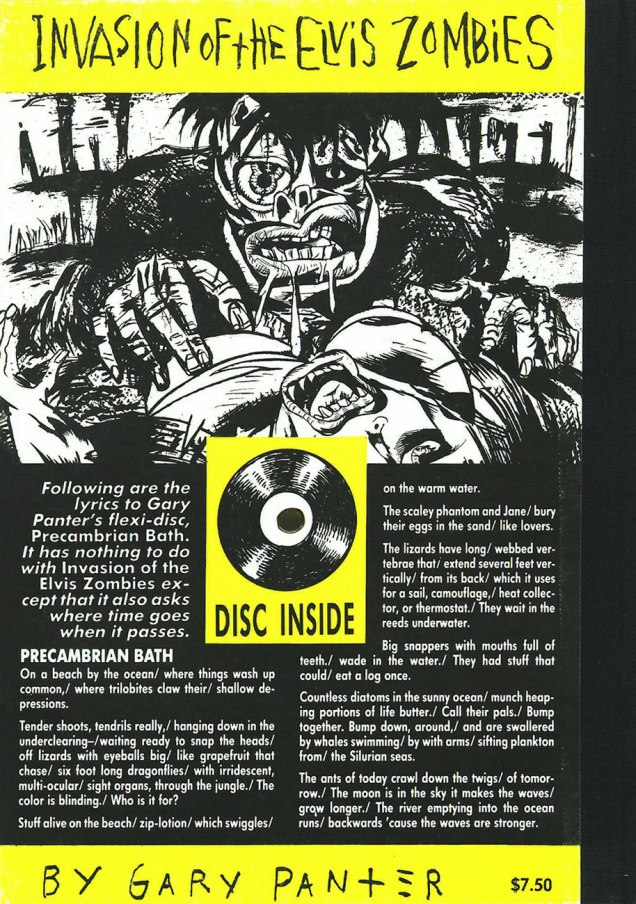
elviszombiesbacka
The back cover… this beats Power Records‘ meek offerings flat!
heartthrobs95a
The oft-inaccurate Grand Comics Database really fumbles it this time: the instantly-recognizable icon on the right is, according to them… Fabian. Dopes. Hamilton, Ontario’s Win Mortimer (1919-1998), inducted into the Joe Shuster Hall of Fame in 2006, drew this cover for DC’s Heart Throbs no. 95 (April-May 1965); given the time period and The Pelvis’ shirt, he would presumably be shooting the dire Paradise, Hawaiian Style. If you’re of a mind to commemorate the King’s anniversary with one of his mid-60s cinematic offerings, better opt for the far finer Tickle Me (1965).
elviseeriea
His (alleged) paper boy claims, and I do want to believe him, that the Big E has peacefully decamped to the quietude of Eerie, Indiana. Looking good, Big E!

-RG

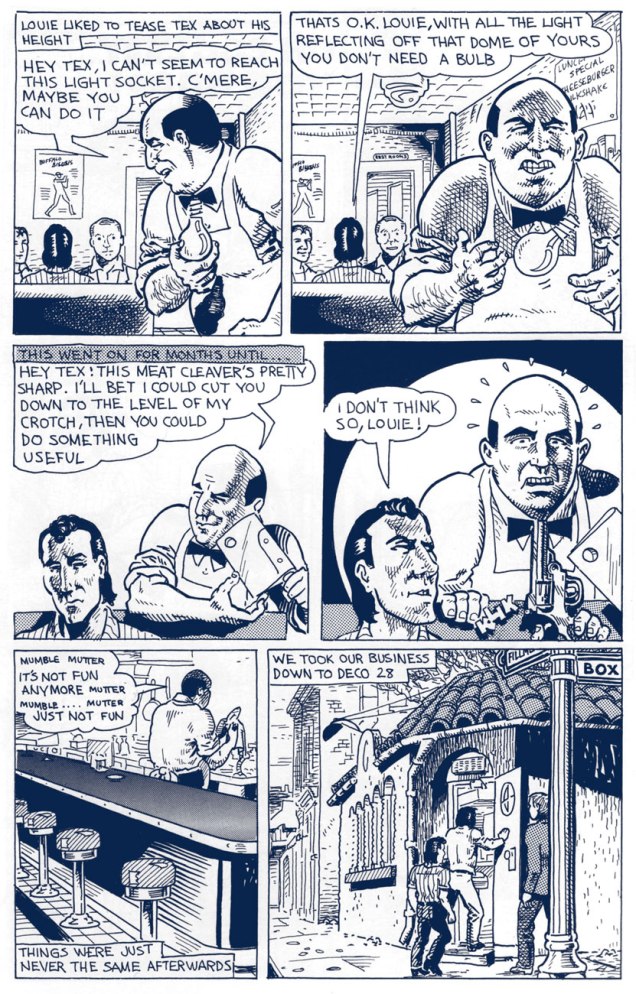
Treasured Stories: «Tex’s Bad Dream or ‘The Egg Lady’s Revenge’» (1988)

« You really saw that things were not at all what was portrayed in the mass media… at least not in our neighborhood. It was just a conclusion that most of the kids of that age came to, that things were extremely corrupt. » — Spain Rodriguez

While plenty of cartoonists trod the path of autobiography before him, it took Manuel ‘Spain’ Rodriguez (1940-2012) to truly show how it should be done: here at last was a genuine full-blooded practitioner, hardly content to merely observe from the sidelines, blending with the wallpaper. Lover, brawler, consummate graphic storyteller: a scarce combination indeed.

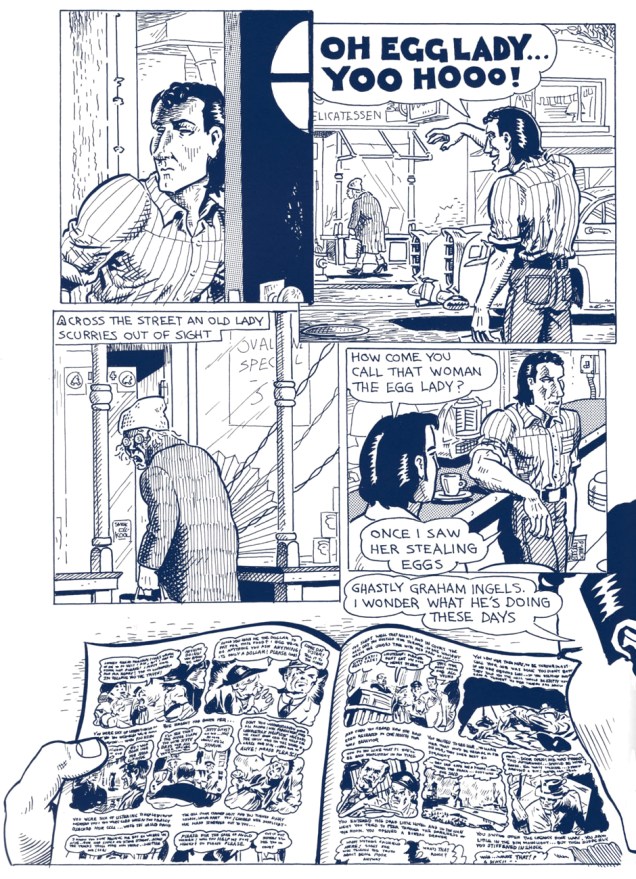
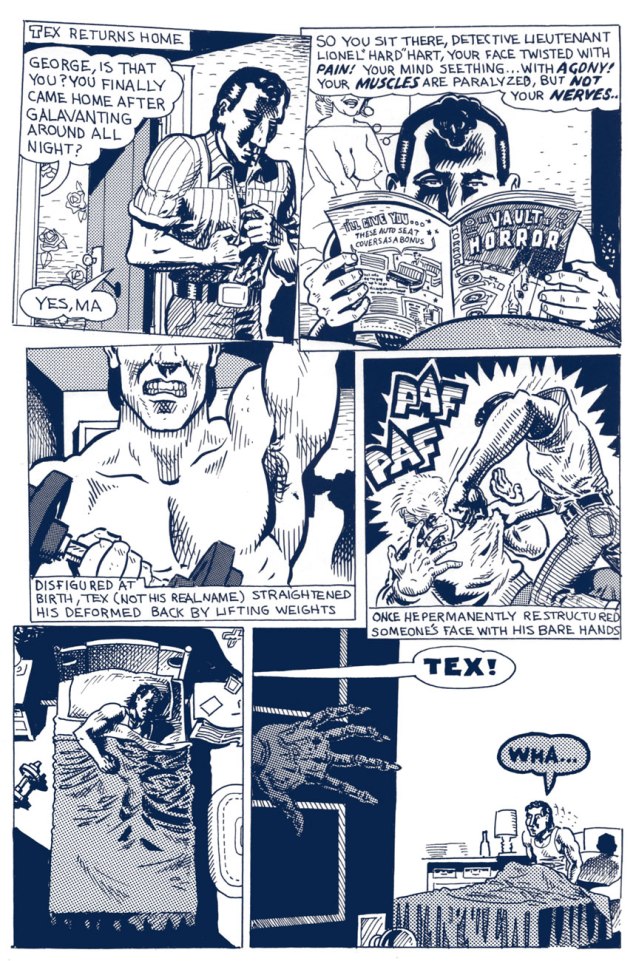
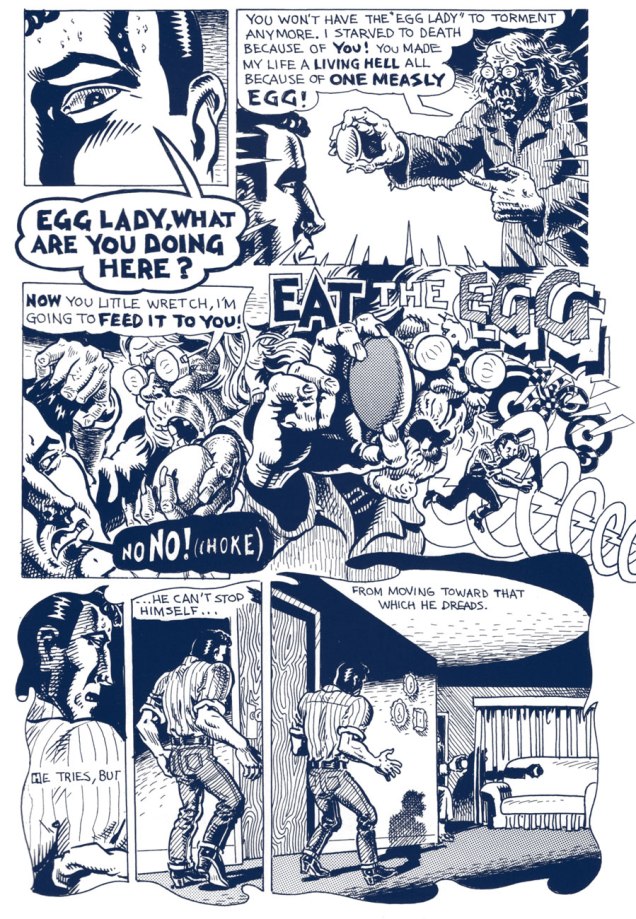
The following tale belongs to a cycle recounting the exploits and insights of The North Fillmore Intelligentsia, Spain’s closest compadres in Buffalo of the 1950s. Tex’s Bad Dream… originally appeared in Blab! No. 3 (Sept. 1988, Kitchen Sink Press); indeed, Spain’s recollections became, over time, the sole reason to purchase the once-excellent Blab! Mercifully, most of these were collected, in their usual exemplary fashion, by Fantagraphics, as Cruisin’ With the Hound (2012). You’ll still be lacking the mysteriously-omitted, quite essential « How I Almost Got Stomped to the “Still of the Night” by the “Five Satins » (Prime Cuts No. 2, Mar. 1987, Fantagraphics), which you can find in another Spain anthology, My True Story (1994, Fanta again).

In the meantime, enjoy, with my compliments, this true-life tale of original EC Fan-Addicts, facial restructuring, cautionary dreams, isometrics and pork sandwiches.

spainegg01aspainegg02aspainegg03aspainegg04aspainegg05aspainegg06aspainegg07aspainegg08a

-RG

The Many Lives of Jerry Robinson

« When comics came along in the 1930s there was a talent pool waiting. And one reason is so many areas were closed to Jews. Colleges, advertising agencies, many of the corporations – the doors that were closed led to the one that was open. » — Jerry Robinson

It’s New Year’s Day, which means it’s also the titanic Sherrill David ‘Jerry’ Robinson‘s birthday. Born on the first of January in 1922, he left us not so long ago, on December 7, 2011. He played at the very least a strong rôle in the creation of Batman’s sidekick Robin, his foes the Joker and Two-Face, his butler Alfred Pennyworth… and much more. Naturally, since we’re entering the murky world of Bob Kane, the whole process is mired in controversy, conflicting accounts and perhaps a little fibbing from certain parties.

Robinson went on to, well, several brilliant careers. In the 1950s, he worked as an instructor at New York City’s School of Visual Arts, where he mentored and considerably influenced a young Steve Ditko (among many others); he had a hand in several successful newspapers strips; served as president of the National Cartoonists Society (1967-69) and of the Association of American Editorial Cartoonists (1973-75); he lobbied hard for cartoonists’ rights, helping Superman creators Jerry Siegel and Joe Shuster obtain long-denied compensation and credit; he wrote, in 1974, The Comics: An Illustrated History of Comic Strip Art. And this is but a sprinkling of highlights…

RobinsonBehindMaskA
We won’t limit ourselves to the obvious Bat-imagery, which was mostly studio work anyway. Here, for instance, is a more obscure but purer œuvre, both pencilled and inked by Robinson: the original art from « Behind the Mask », page 2, originally printed in Atlas’ Marvel Tales no. 103 (Oct. 1951). Writer unknown.
PhantomBrakemanCoverA
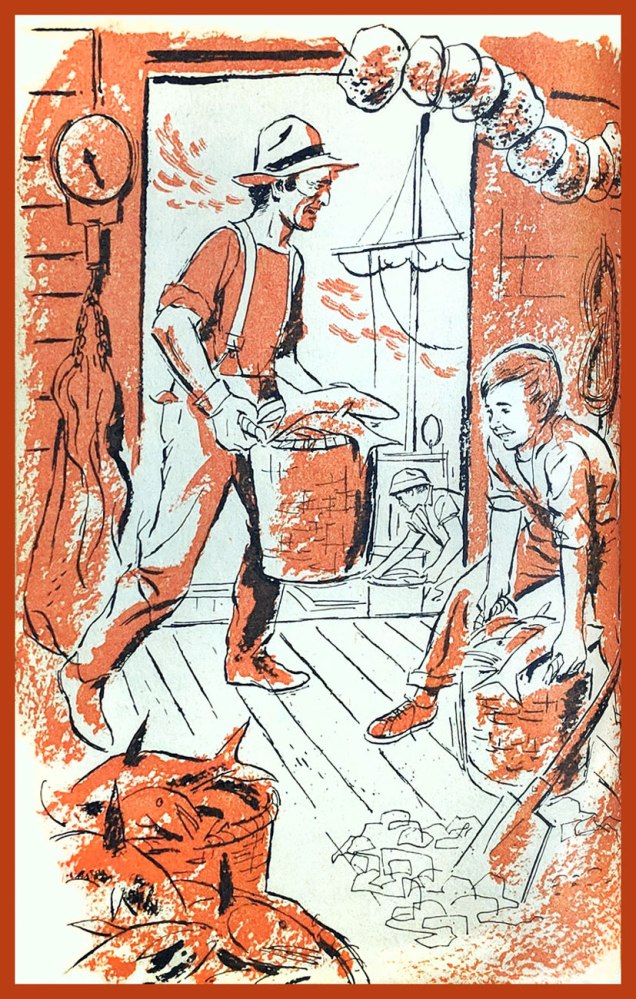
My earliest encounters with Mr. Robinson’s work were through a pair of books for young readers he illustrated in the late 1950s, in a beautifully free and expressive styles. Here’s the cover and one interior vignette from The Phantom Brakeman (1959, Scholastic), written by Freeman Hubbard, then editor of Railroad Magazine.

PhantomBrakemanIlloA

HurricaneLuck01A
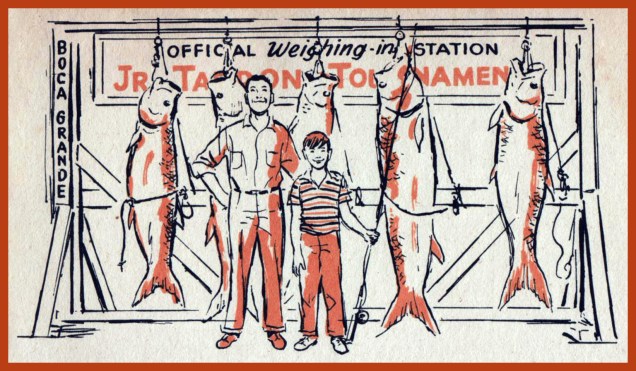
The following two pieces belong to Hurricane Luck (1959, Scholastic), written by Carl Carmer.
HurricaneLuck02A
Spoiler alert: Peter does, in the end, win the Tarpon fishing contest.

« What about Batman? », you might say. Okay, I admit I don’t have a prayer of getting away with a Jerry Robinson tribute devoid of the caped crusader and his trusty bird-themed sidekick, so here goes!

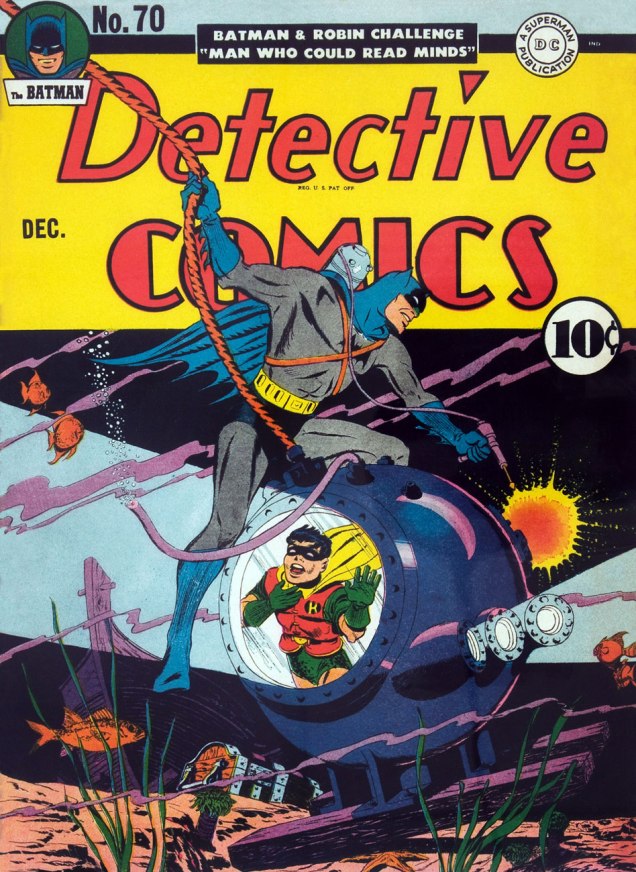
Detective70A
Detective Comics no. 70 (Dec. 1942). Pencils and inks by Robinson.
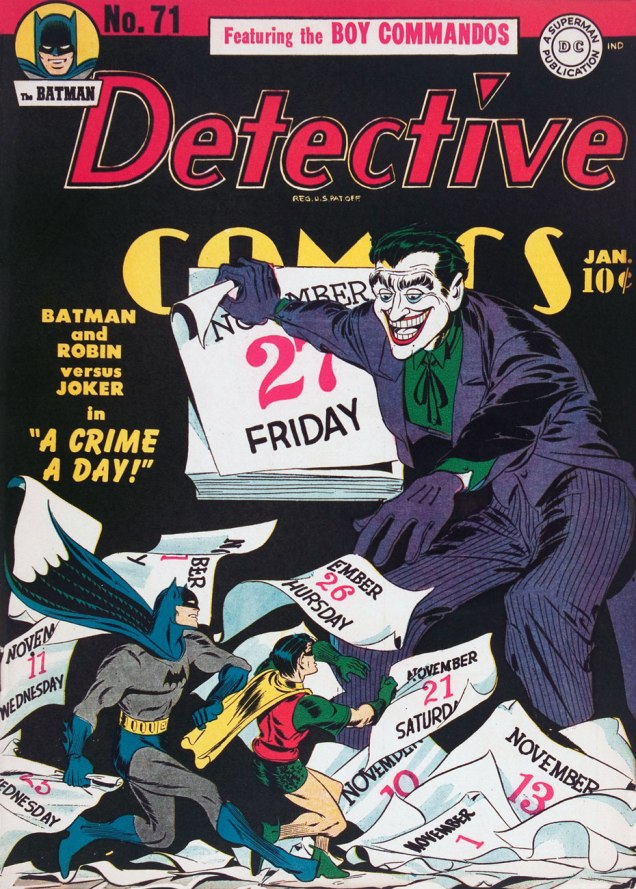
Detective71A
Detective Comics no. 71 (Jan. 1943). Pencils and inks by Robinson.

-RG

The Old Year’s Final Boarding Call

« On New Year’s Eve the whole world celebrates the fact that a date changes. Let us celebrate the dates on which we change the world. » — Akilnathan Logeswaran

Earlier this month, as we showcased Justin Green’s Musical Legends, I mentioned that I was reserving one of the strips for a special occasion, and it has come.

JustinGreenLastTrainA
Originally published in the December, 2001 issue of Pulse!

« Shedding light on past and present musicians — and there are countless possibilities — is  a real challenge. But when it works, the comic vision can change the listening experience. » Justin Green, from his Authoroonist Acknowledgements & Apologies (2004).

This entry stands out from its brethren in that the artist was personally involved in, or more precisely a witness to, the events depicted. In addition, no famous or semi-famous musical figure occupies the spotlight; instead, we get a gentle, low-key, soulful anecdote.

Who’s Out There has had a good year, and so we thank all of you readers around the world (and I do mean around the world: according to WordPress’ statistics, comics fans visited us from a whopping eighty-three countries these past twelve months) and wish each of you a wonderful, or at the very least better, year 2019.

-RG

Little Dot’s Playful Obsession

« Y’gotta develop an annoying compulsion if y’wanta get anywhere in this world! » — Dan Clowes’ Willy Willions (Eightball No. 5, Feb. 1991)

Dorothy Polka, known to the world at large as « Little Dot », made her first appearance in Harvey’s Sad Sack Comics no. 1 (Sept. 1949). All you need to know is that she’s inordinately fond of dots and circles, and that she has an absurdly large extended family. That raises a few choice questions, but we’ll leave them for someone else to tackle.

While I cheerily dismiss the bulk of Harvey Comics’ post-Code output as at best charming in a decidedly minor way, I opt to focus on the line’s most singular highlight: art director/chief artist Warren Kremer‘s endlessly inventive and escalatingly bonkers cover variations on the Harvey stable’s absurdly formulaic monomanias. Kremer clearly viewed the preposterous task he’d been handed as an opportunity to continually challenge himself with elegant design exercices and experiments. While I see little point in collecting, nor even reading most Harvey Comics, my admiration for Mr. Kremer just grows and grows. Perhaps these examples will give you a sense of what I see in them.

Oh, and bonus points to Kremer for his increasingly callous treatment of that omnipresent visual blight, the Comics Code Authority stamp. Clearly, he judged the censorious seal de trop.

LittleDot29A
Little Dot no. 29 (January, 1958)
LittleDot38A
Little Dot no. 38 (October, 1958)
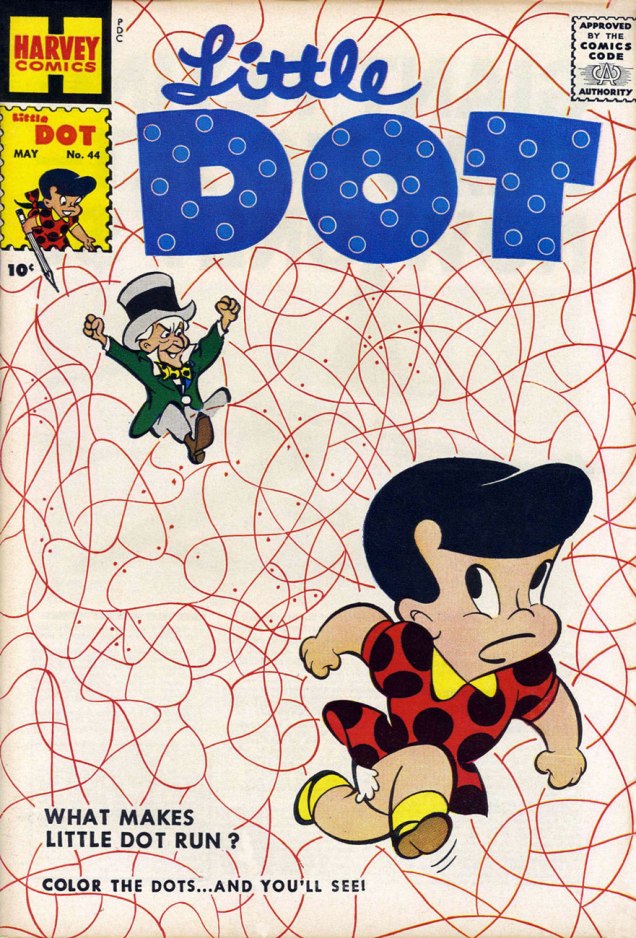
LittleDot44A
Little Dot no. 44 (May, 1958)
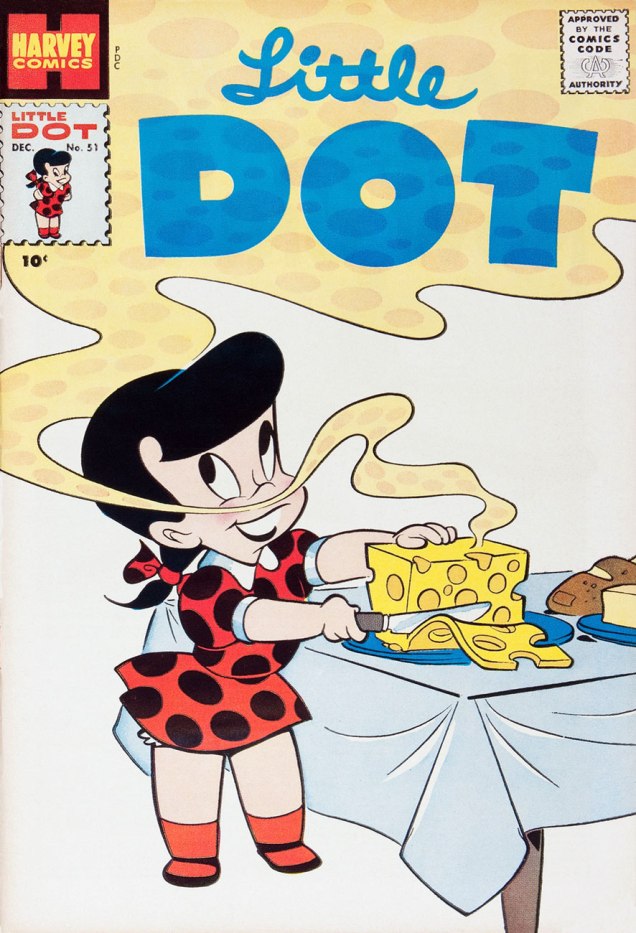
LittleDot51A
Little Dot no. 51 (December, 1959) Gruyère? Impressive refinement for a little kid. Perhaps there’s more to the little lady than meets the eye…
LittleDot52A
Little Dot no. 52 (January, 1959)
LittleDot97A
Little Dot no. 97 (January, 1965)
LittleDot119A
Little Dot no. 119 (October, 1968)
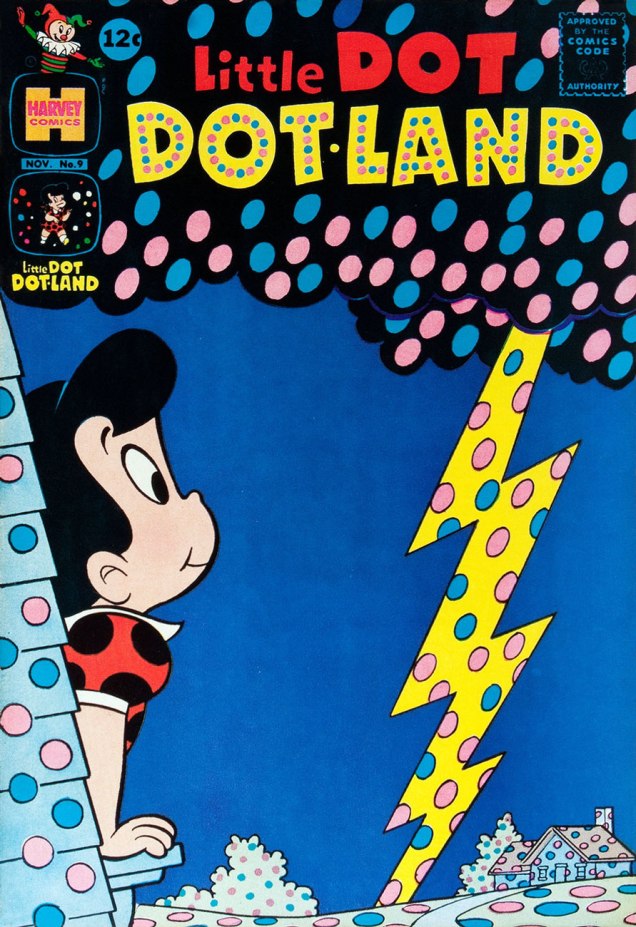
LittleDotland9A
Little Dot Dotland no. 9 (November, 1963)
Dotland38A
A timely one: Little Dot Dotland no. 38 (March, 1969)
DotUncles21A
Little Dot’s Uncle$ and Aunt$ (they’re loaded, I guess) no. 21 (November, 1967)

-RG

John Severin, ‘Super Comics’ Cover Man

« I got into the comic business the same way I got into the bubble gum business: somebody gave me a job. » — John Severin

I’ve said it before, and I still feel that way: If you’re going to discuss a career of such length, variety, depth and consistency as John Severin’s (from the late 1940s to the early 2010s!) it’s simply too easy to lose your way in the details, sidebars and bifurcations. Best to pick a small area and stick to it, particularly if you don’t have the luxury of endless pages to devote to the task.

Speaking of sidebars: In this forum, I keep returning to the topic of Israel Waldman and his dodgy, but mesmerizing publishing ventures. The many scattershot titles issued under the IW / Super Comics (1958-1964) banner were printed on shoddy paper (which makes them, nowadays, nearly impossible to find in any sort of decent shape), were sold outside the usual channels (in bags of three through department stores, and not the fancy ones at that), consisted of rather hoary, indifferently-packaged reprints… but foxy businessman Waldman didn’t scrimp on the one count that mattered: he shelled out top dollar to commission top talent to create attractive covers. That sweet old bait-and-switch.

Sure, some of these random assemblages of decaying pulp happen to be good comics, but given the nature of odds, it was bound to happen.

John Powers Severin, born ninety-seven years ago today (Dec. 26, 1921-Feb. 12, 2012), was part of Waldman’s cadre of cover artistes, and he delivered beautifully, as he always did, right to the end of his career.

Here, then, are some highlights of these little-seen Severin pieces. Happy birthday, Mr. Severin!

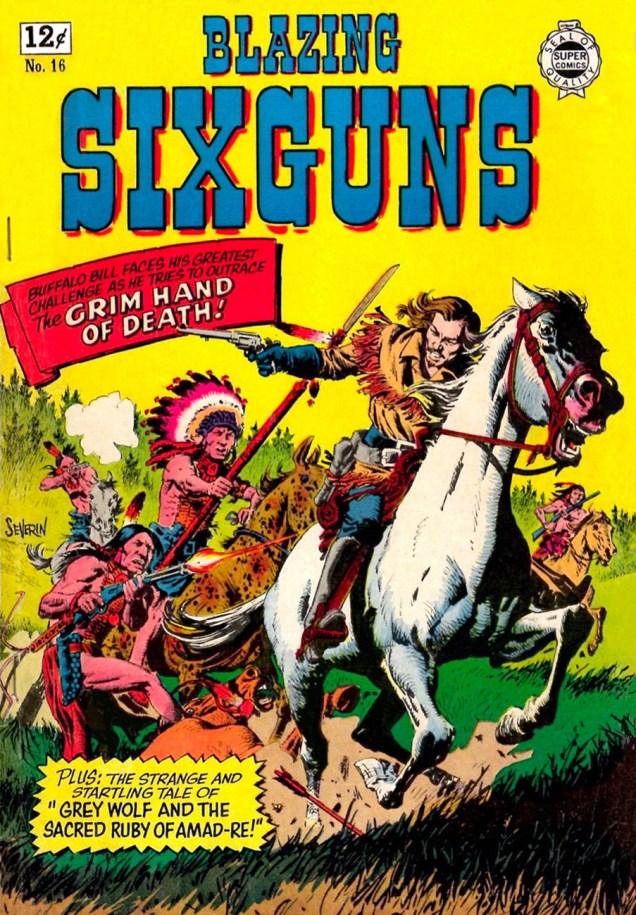
Blazing6guns16A
Blazing Sixguns no. 16 (1964), ten issues, 1958-1964. Read this issue here.
Danger10A
Here’s Danger no. 10 (1963), the first of  seven issues. Read it here.
FantasticAdv10A
This is Fantastic Adventures no. 10 (the first of seven issues, 1963-64). Read it here.
Gufighters18A
Looks like Marvel’s Kid Colt did a bit of moonlighting for Super Comics (as did king of all media Gabby Hayes!). This is Gunfighters no. 18, fifth and final issue of the series (1958-1964).
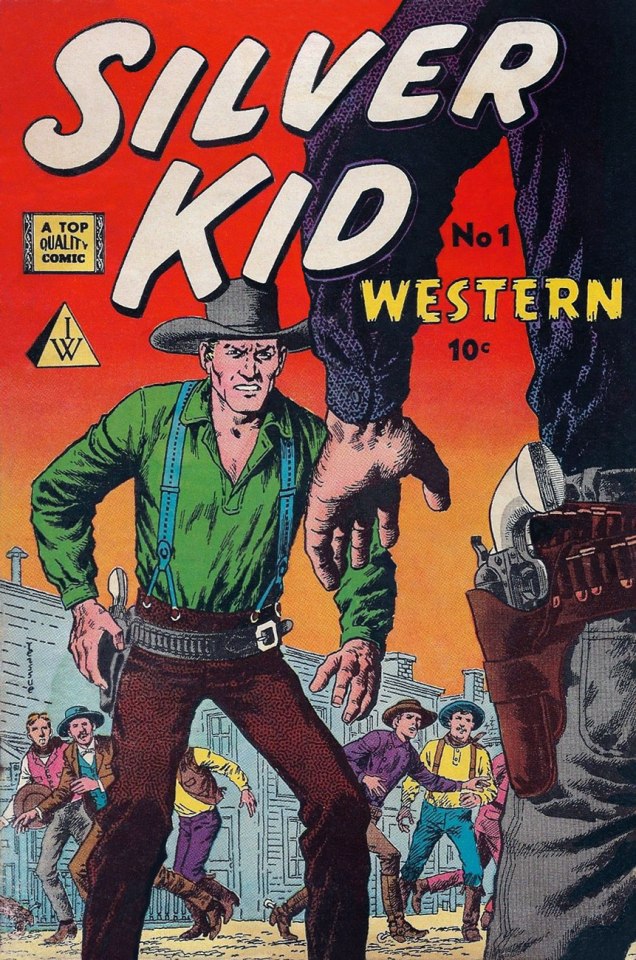
SilverKid01A
This is Silver Kid Western no. 1 (1958), first of two issues. Read it here.
Robin-Hood9A
This is Robin Hood no. 9 (1958),  third of five issues (1958-1964). Read it here.
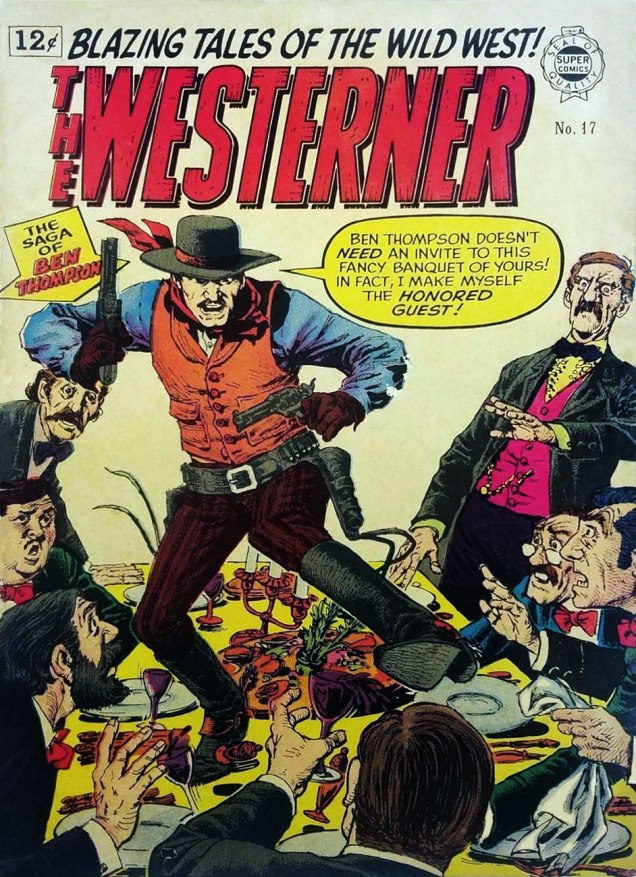
Westerner17A
An alternative view of table étiquette from real-life figure Ben Thompson. This is The Westerner no. 17 (1964), third of three issues.

And if you’re hankering for more John Severin, check out our earlier post and/or this illuminating, life-spanning and definitive Comics Journal interview.

-RG

Dateline: Frontline – The Cary Burkett Interview, Part 3

« From time to time a sputtering doodle-bug shatters the torpor of the overcast sky. One second, sometimes two … at most three … of silence. Visualizing that fat cigar with shark fins as it stops dead, sways, idiotically tips over, then goes into a vertical dive. And explodes. Usually it’s an entire building that’s destroyed. » — Jacques Yonnet

Perhaps the title gave the game away, but we’re back with part three to wrap up (in style!) our talk with Cary Burkett on his and Jerry Grandenetti‘s (and Ric Estrada‘s) Dateline: Frontline (1977-1981).

Who’s Out There: How hands-on an editor was Paul Levitz?

CB: Paul was more hands-on at the beginning. We would have a plot conference and he would toss out suggestions and sometimes specific directions. But Paul was a very smart guy, and he had a way of figuring out how to best to work with individual writers. With me, it usually worked better to plant a seed and let it develop rather than to nail things down too tightly. I didn’t think fast in a plot conference setting, I was too intimidated by Paul’s creativity and confidence. I think Paul figured this out and found ways to drop a little guidance in that I could take time to mull over on my own.

Paul was also extremely busy, not just an Editor but the Editorial Coordinator for the whole line of DC comics, and that is a whopping responsibility. So as things progressed, he was less hands-on. I like to think he began to trust the material I was giving him.

WOT: Was there much distance between the précis Mr. Levitz assigned you to do and the scenario you handed in?

CBI don’t think so.

WOT: Dateline: Frontline is clearly a bit of a ‘pill in the hamburger’, that is to say, instructive, eye-opening material. Was this ‘Trojan Horse’ approach considered and deliberate? (Surely it wasn’t just intended as pure entertainment!)

CBIn a way, it was deliberate, although not carefully considered or planned out. The trajectory was set by Paul when he passed on to me the book The First Casualty as background guidance. The tone of that book and all the eye-opening material in it definitely influenced the approach to the series. The very idea that the main character would be a war correspondent, not a soldier or fighter, meant that these stories would have a different kind of focus. That concept came from Paul, along with the title of the series.

Of course, in comics, you could do a series with a war correspondent where the protagonist becomes a fighter, a behind-the-lines de-facto special forces soldier. If this had been a Jack Kirby strip in the ‘60’s, the correspondent would probably be thrown into situations every issue where he had to fight his way out to save threatened soldiers from some Nazi ambush. You know what I mean.

So we knew we weren’t going for pure entertainment, sure. And the more research I did, the more interested I became in the reality of what happened in the war, and the more I wanted to portray that. And since it was just a 6-page, irregular backup series, we could go in that direction.

WOT: If you were to write this series today, what, if anything, would you do differently? What effect might the intervening years and the current political climate have, for instance?

CBToo much to think about. But I will say this, I think to try to tie the series to any current political issue would tend to push it into something contrived to fit the agenda. In a way, then, it would become a kind of political propaganda, the very opposite of what the series grapples with.

That’s part of why I wasn’t so interested in setting it during the Vietnam War back in 1976 or ’77. Today, it could be put in that setting without triggering a firestorm of controversy which might drown out what the series is trying to show.

My point is that the issue of seeking truth in a time of war is not limited to any time or place. By attaching the theme to a current political hot button issue, it becomes weaker, not stronger. It becomes more limited, not broader. And it’s more difficult to hear.

My preference would be to see the series deal with the questions outside of the current political setting, and hopefully along the way to see in some way how they apply today.

Maybe that is the ‘Trojan Horse’ method you mentioned.

WOT: I’d say you nailed it.

WOT: Were you writing and planning much in advance? Are there any contemplated, but unpublished, plotlines you’d care to share?

CBI wasn’t planning specifically very far in advance. I was never sure which set of stories might be the last. But I had a vague outline in my head that I would progress through the major events of the war, choosing specific ones for Clifford to be present reporting. They would be chosen for their historical significance but also to advance general themes of the conflict between reporting the truth and trying to win a World War.

The final series of stories, I think, would have been centered on events in Hiroshima and Nagasaki, and somehow Clifford would have found a way to write a story about it which revealed some of the horrible details … which of course, would never have seen the light of day. Even now, thinking about this, some lines of dialogue closing out the series kind of come to my mind.

I see Clifford, exhausted and disappointed, having given his all to get this incredible story, bitter and at the breaking point. Like it happens to all of us sometimes, the fact that he can’t publish this story seems to him to be an event that sums up his whole life as a failure. He questions why he made such a herculean effort to get the story, why he ever even bothered to try. All his previous failures to get the truth out come back to accuse him.

Maybe it’s his old mentor, the older reporter who tried to ground him a few times, who has the last word. And those words would be about the truth, and the value of searching for it no matter the outcome. And that the truth itself will stand even if only one person knows it. And the old reporter, cynical as he might have seemed at times, would be shown to have his own ideals which have sustained him through the same battles that Clifford has fought.

Yeah, maybe it sounds a bit corny out of the context of the story. But I think I’d go there. I might even have the old reporter say something like, “Truth may seem to be the first casualty in a war. But Truth can never really die, right? Someday people will know the truth about what happened.”

HA! I never expected a story idea for Dateline:Frontline would pop into my head like that after all these years. Seems like this would be a good closing question for this interview. I appreciate you bringing it up, and thanks for giving me a chance to reminisce.

WOT: And thank you for doing it so thoughtfully and graciously.

WhoThereLogotype

And now, to see our readers off with a story, here, as promised last time, is the concluding episode of Dateline:Frontline’s London trilogy.
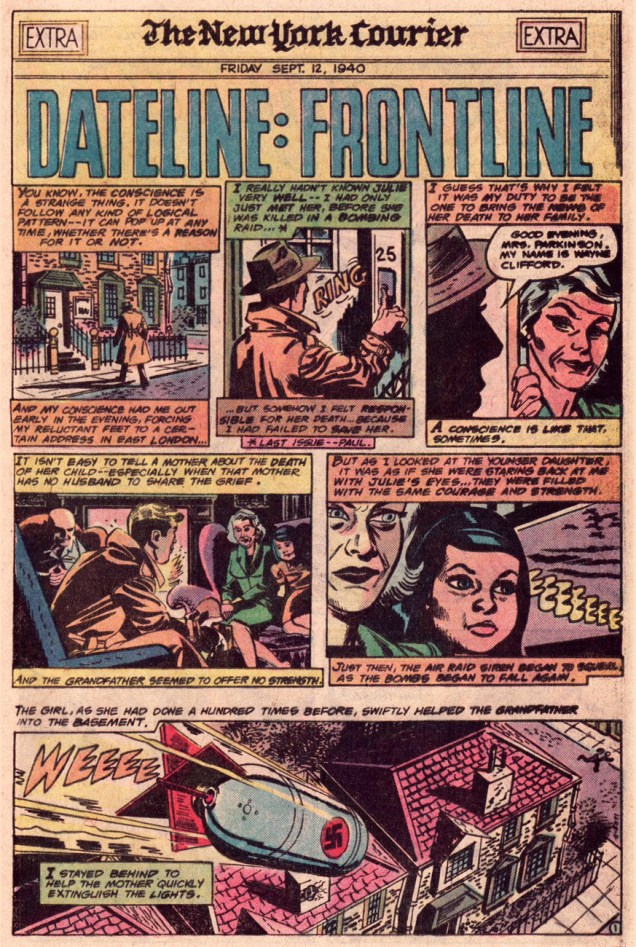
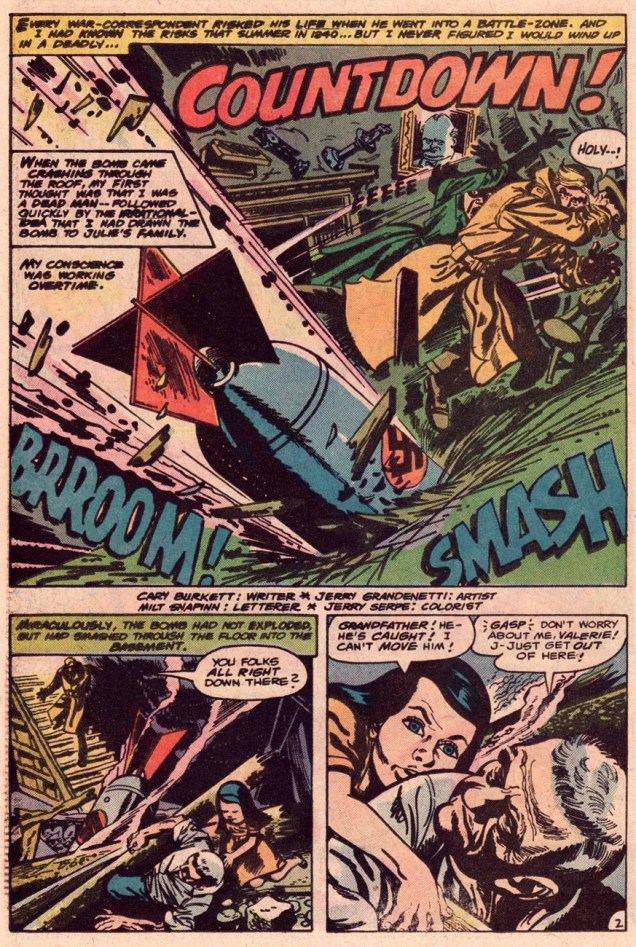
Dateline3London01ADateline3London02ADateline3London03ADateline3London04ADateline3London05ADateline3London06A

And as a parting bonus, a vintage in-house biography of young Mr. Burkett!

BurkettBio78A

-RG