The Quite Wacky Adventures of Cracky

Country Boy: What are you doing?
City Boy: Drawing.
Country Boy: Where are your guns?
— Submitted by Steven Feinstein, 7, Philadelphia, PA (circa 1965)

Cracky the parrot was introduced in the role of mascot for Western Publishing‘s general-interest kids’ mag The Golden Magazine (1964-71), which heavily drew upon the successful Jack and Jill (published since 1938 by The Saturday Evening Post Society) formula.

For much of its existence, The Golden Magazine thrived, having access to top creative talent from the Western publishing empire (Whitman, Gold Key, Golden Press, Golden Book Encyclopedia…)
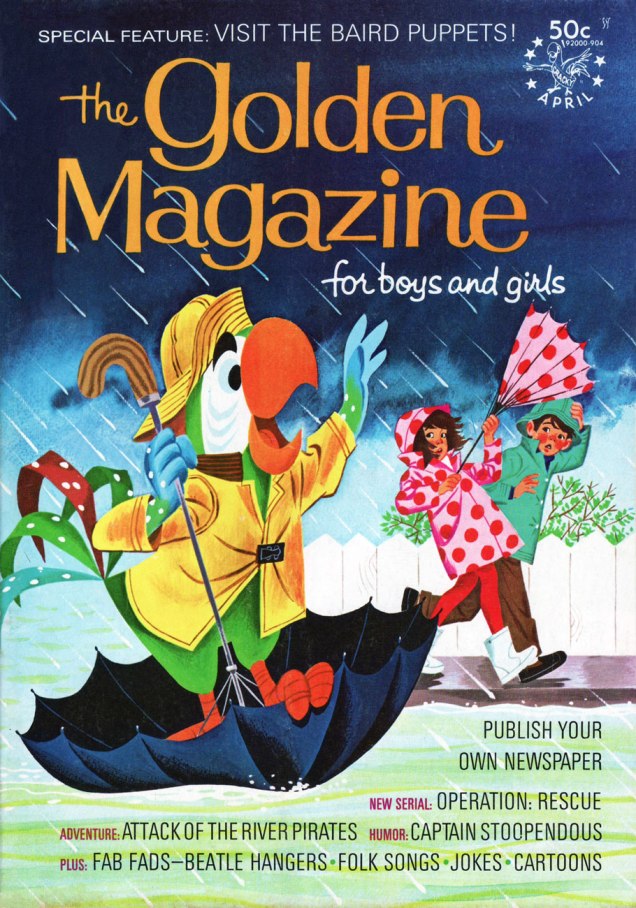
GoldenApr69A
At first, Cracky stuck to sharing reader-submitted jokes. Then, around 1968, he began to show up on covers, generally depicted by versatile Canadian illustrator Mel Crawford (1925-2015). This is one such case, from April, 1969.
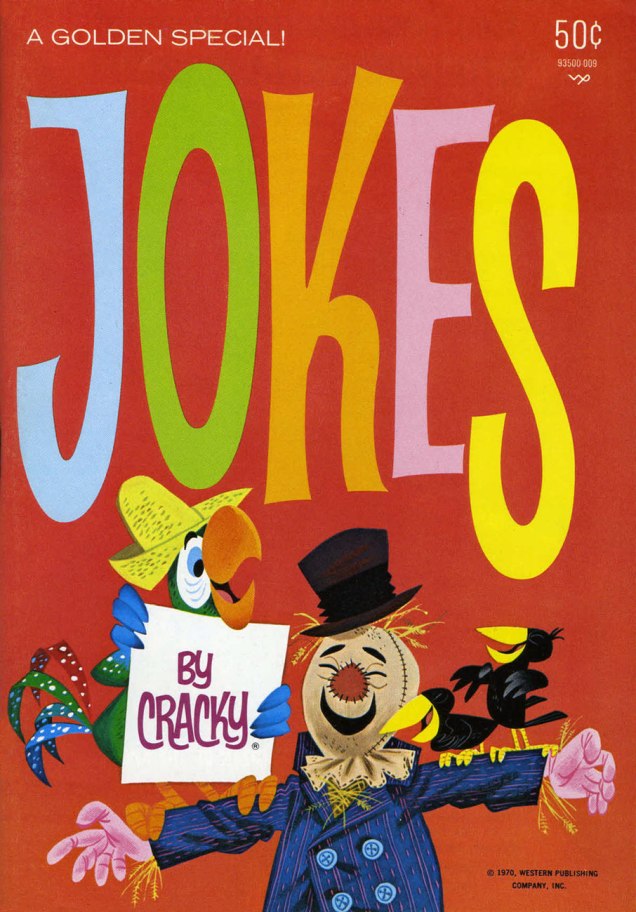
JokesCracky2A
In 1970, Cracky saw his old job expanded, branching out into two titles, Jokes by Cracky and  Pencil Puzzle Fun, the latter outlasting its parent, The Golden Magazine. This is Jokes by Cracky no. 2 (1970); Cover art by Mel Crawford.
CrackyNewJobA
Then, in 1972, it gets interesting: the lowly parrot mascot broke into comics.

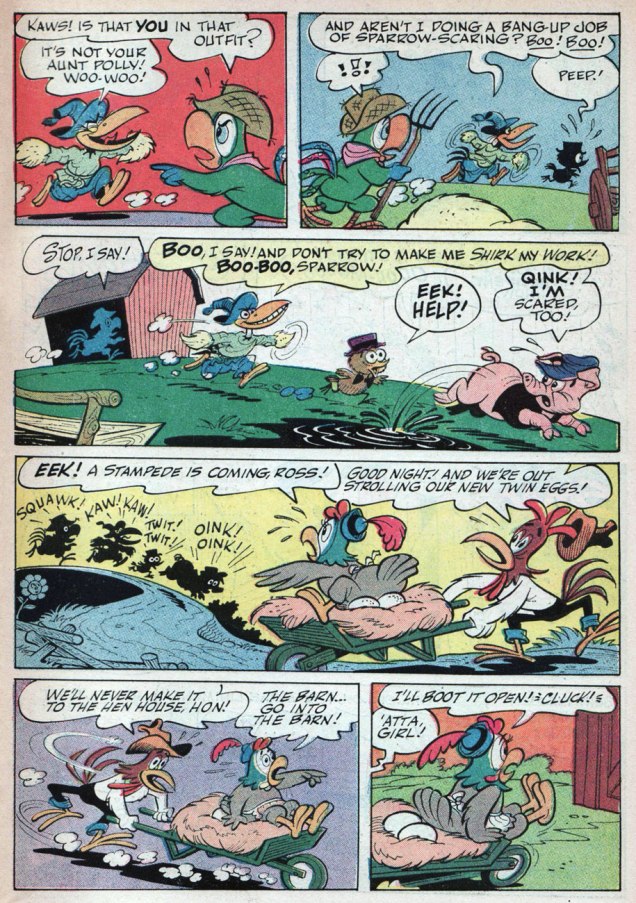
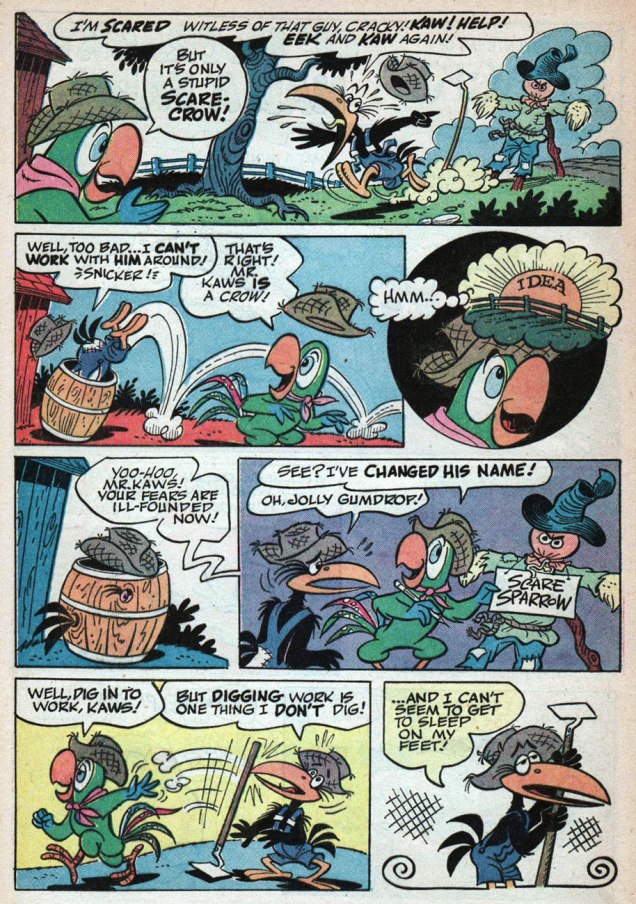
As Archie Comics had their Christian-zealot madman in Al Hartley, so did Western in the person of Vic Lockman. A significant difference, however, is that Hartley, despite quite stiff competition, is arguably the very worst Archie artist; he’s certainly got my vote [Seconded! ~ ds]. Lockman (1927-2016), a prolific but often terrible scriptwriter, was a terrific cartoonist, blessed with a gorgeously fluid line and exemplary design sense, lively and detailed. Here, then, is a story from Wacky Adventures of Cracky no. 3 (June, 1973). Script and art, including his distinctive lettering, by Mr. Lockman.
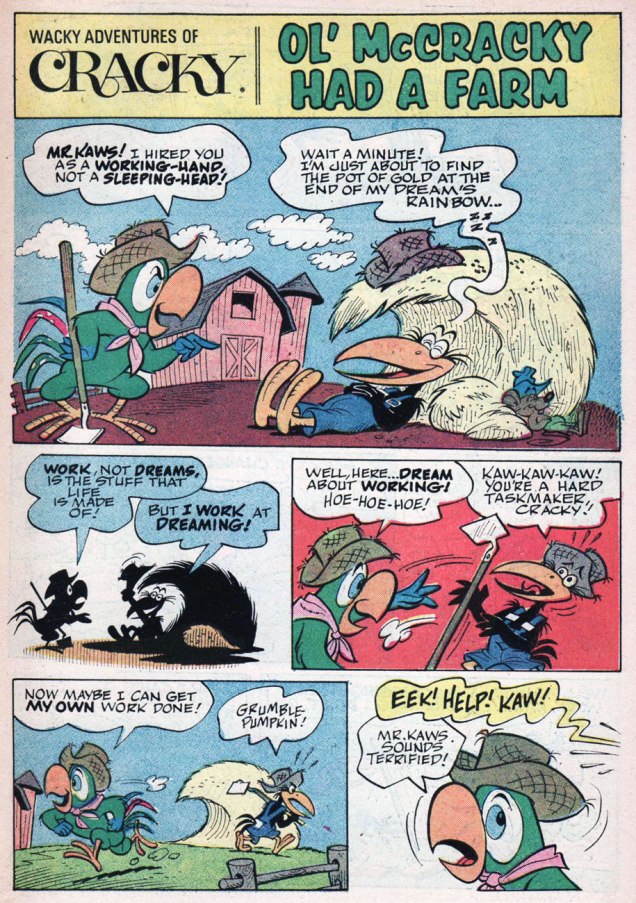
VicLockmanMcCracky01AVicLockmanMcCracky02AVicLockmanMcCracky03AVicLockmanMcCracky04AVicLockmanMcCracky05AVicLockmanMcCracky06A

During the run of his comic book, Cracky (and sidekick Mr. Kaws) wore many hats: detective, inventor (presumably giving Lockman the chance to recycle some of his rejected Gyro Gearloose scripts), ship’s captain, escape artist, sheik… And yes, he did encounter some choice tentacles, but I leave it to my partner to conduct her own investigation. Lockman beautifully handled the first ten issues of WAOC; the instant he stepped away, the thing dissolved into tripe. Avoid accordingly.

Lockman, who seemed a loveable, well-meaning coot, was also twelve kinds of batty. Biblical Economics, anyone? For as full a picture as can be reasonably assembled, read Mark Evanier‘s fine, thoughtful obituary of Lockman.

Lockman was also among those sadly deluded souls (hello, Chuck Dixon) who tried to lay claim to the title of most published comics writer. Let’s face it: the most likely contenders (Joe Gill, Paul S. Newman, Gaylord DuBois) toiled in anonymity for most of their long careers.

CroakyA
In 1971, The Golden Magazine was sold (to The Saturday Evening Post Company!) and renamed, becoming Young World in 1972. Young World, in turn, got incorporated into Child Life in 1979, but that’s a story for another day. Many of TGM’s features were retained but slightly… tweaked. For instance, see who inherited Cracky’s old desk?

« Moo! I say Moo! »

-RG
Will Eisner’s The Spirit at Kitchen Sink (pt. 1)

« Hello… Times? … I want to place an ad in your Situation Wanted column! Wanted… dangerous assignment… will go anyplace, anywhere, anytime… contact The Spirit, Box 35! » – The Spirit, Apr. 30, 1950

If you’ve followed our series dogging the steps of The Spirit, you won’t be in the least surprised that, after a sixteen (plus colour special) residency with Warren Publishing (Apr. 1974 – Oct. 1976), the late Dennis Colt found himself, after a year’s break, updating his mailing address once more. As returning publisher (and later, also Eisner’s agent) Denis Kitchen put it Kitchen Sink’s inaugural magazine issue (no. 17, Winter 1977):

« Welcome back, SPIRIT fans! Several years ago, we launched an experiment, publishing Will Eisner’s SPIRIT in ‘underground’ format. The experiment was so successful that Eisner arranged for Warren Magazines to publish his stories in a larger format, distributed on a national scale. 

Seventeen issues later, we once again have the rights to THE SPIRIT. We will continue publishing stories never before reprinted, on a quarterly basis. In addition, we are adding new features, virtually eliminating the ad pages, and upgrading the quality of the paper. We hope you like the difference and will continue to support THE SPIRIT. »

Well, the first issue was all right, but looked a bit shoddy, a surprise, given the usually-solid production hand of KS’s peerless production man, Pete Poplaski. With the following, er… quarterly issue (five months later), all the kinks had been worked out, and every subsequent entry looks sharp and terrific.

Ah, but there’s the rub: Kitchen Sink’s magazine ran for 25 issues, most of them boasting spectacular, brand-new wraparound watercolour paintings by Eisner. Some brutal excisions had to be made, to say nothing of the backbreaking process of smoothly collating the front and back halves (we have standards!). Hence the necessity of “pt. 1”. Will you settle for my dozen picks of the twenty-five? I’m afraid you’ll have to.

Spirit18A
This is The Spirit no. 18 (May, 1978), featuring a half-dozen Spirit tales, namely: “The Seventh Husband” (May 20, 1951); “Thanksgiving Spirit” (Nov. 20th, 1949); “Future Death” (Jan. 21, 1951); “Barkarolle” (July 18th, 1948); “Mad Moes” (Feb. 9, 1947); “Fan Mail” (Jan. 1, 1950), as well as some vintage Clifford one-pagers by Jules Feiffer.
Spirit19A
This is The Spirit no. 19 (Oct. 1978), featuring five Spirit tales, namely: “Money, Money” (Nov. 23, 1947); “April Fool” (Mar. 30 1947); “Gold” (Oct. 10, 1948); “The Chapparell Lode” (Nov. 14, 1948); “Halloween” (Oct. 31, 1948), as well a pair of Clifford one-pagers by Jules Feiffer, a Lady Luck four-pager by Klaus Nordling, and part one of Eisner’s brand-new, hard-hitting serial, Life on Another Planet (eventually coloured and collected as Signal From Space).
Spirit20A
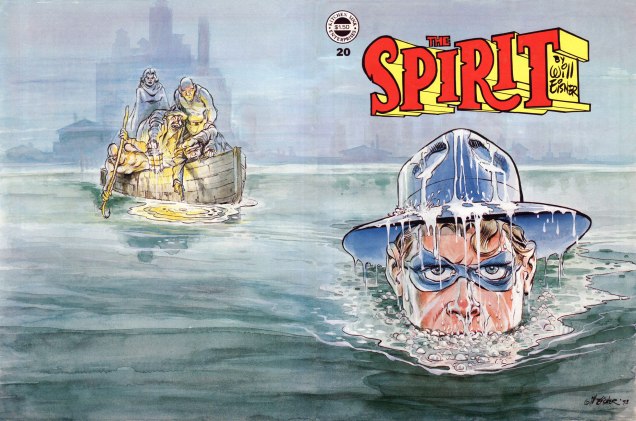
This is The Spirit no. 20 (Mar. 1979), featuring five Spirit tales, namely: “Quirte” (Nov. 21, 1948); “Cromlech Was a Nature Boy!” (July 4, 1948); “War Brides” (Mar. 14, 1948); “Time Bomb” (Apr. 15, 1951); “Census ’50” (June 25, 1950); and “[Mission… the Moon]” (Aug. 3, 1952), plus part two of Eisner’s Life on Another Planet and some informative articles.
Spirit24A
This is The Spirit no. 24 (May 1980), featuring five Spirit tales, namely: “Boombershlag” (Mar. 23, 1941); “Beauty” (June 9, 1946); “Cargo Octopus” (July 14, 1946); “A River of Crime” (Nov. 30, 1947); “Rescue” (Aug. 24, 1952), plus a chapter of Life on Another Planet and a host of other features, including a Spirit checklist
Spirit27A
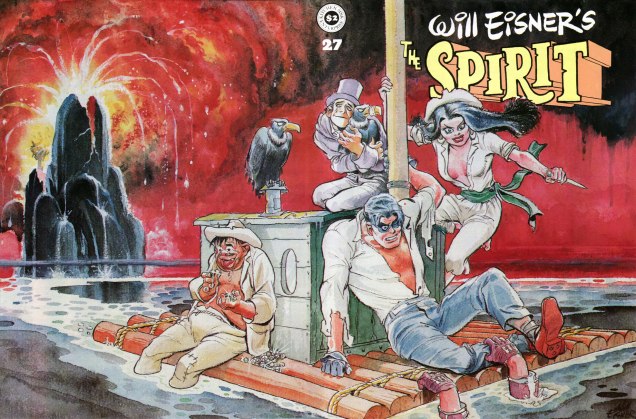
This is The Spirit no. 27 (Feb. 1981), featuring six Spirit tales, namely: “The Devil’s Shoes” (Feb. 1, 1942); “M.U.R.D.E.R.” (July 19, 1942); “Montabaldo” (Jan. 25, 1948); “Rife” (Jan. 14, 1951); “The Amulet of Osiris” (Nov. 28, 1948), “The Return” (Sept. 21, 1952), plus a new Eisner ‘Big City’ nine-pager, “The Treasure of Avenue ‘C‘”… and more.
Spirit29A
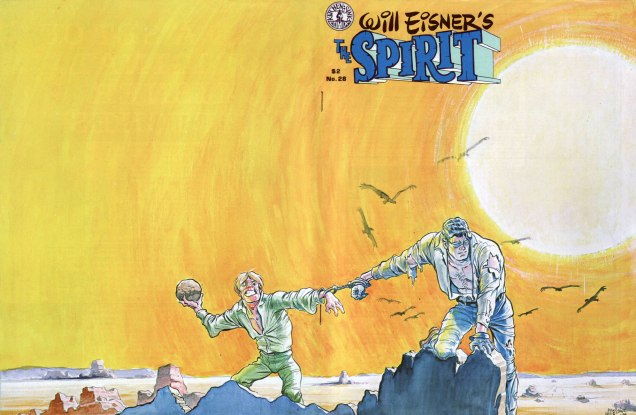
This is The Spirit no. 28 (Apr. 1981), featuring six Spirit tales, namely: “Sphinx & Satin” (Oct. 5, 1941); “Professor Pinx” (Aug. 2, 1942, with Lou Fine); “Survivor” (July 16, 1950); “Deadline” (Dec. 31, 1950); “Return From the Moon” (Sept. 28, 1952), “The Martian” (Oct. 10, 1952), plus a Feiffer Clifford one-pager, a ‘Shop Talk’ discussion between Eisner and Gil Kane, and so forth.

If you’ve just joined us mid-programme, fret not: simply rewind to our earlier instalments, if you will:

… or simply click on its general category, That’s THE SPIRIT!, and find yourself with everything at your blue-gloved fingertips.

-RG

Treasured Stories: “American Squalor” (1988)

« People think the show gave Letterman an opportunity, but they don’t see the table with 10 guys in shorts wearing baseball caps pitching jokes for things for him to say. They don’t see the index cards that say: ‘Ask this first.’ It’s all spelled out for him, and everything is pre-interviews. He’s basically had to be this hand puppet, with everybody’s hands up his butt to tell him what to say and do. » — Joyce Brabner on David Letterman

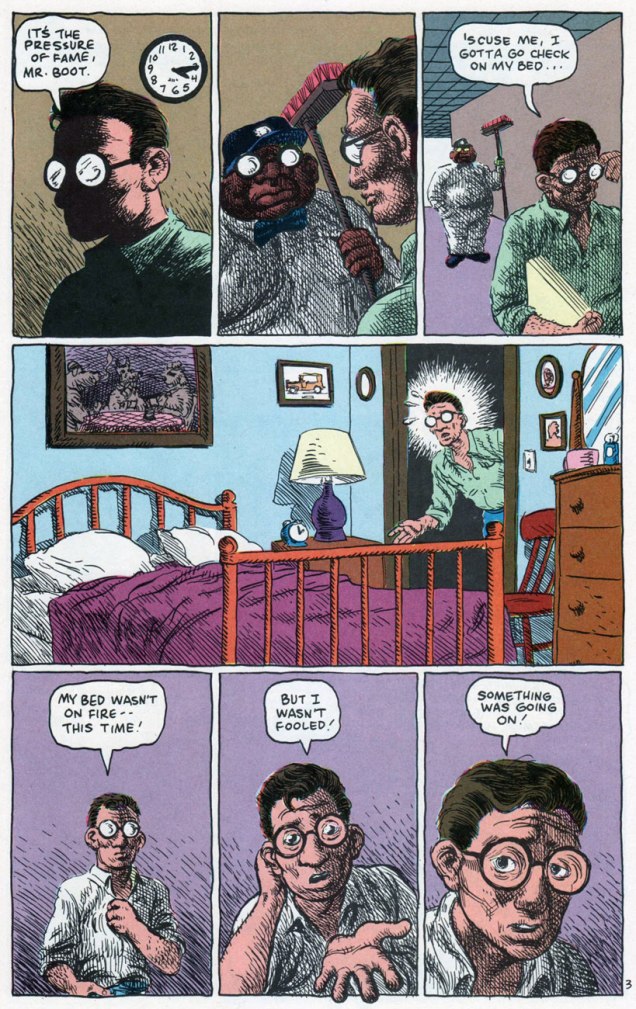
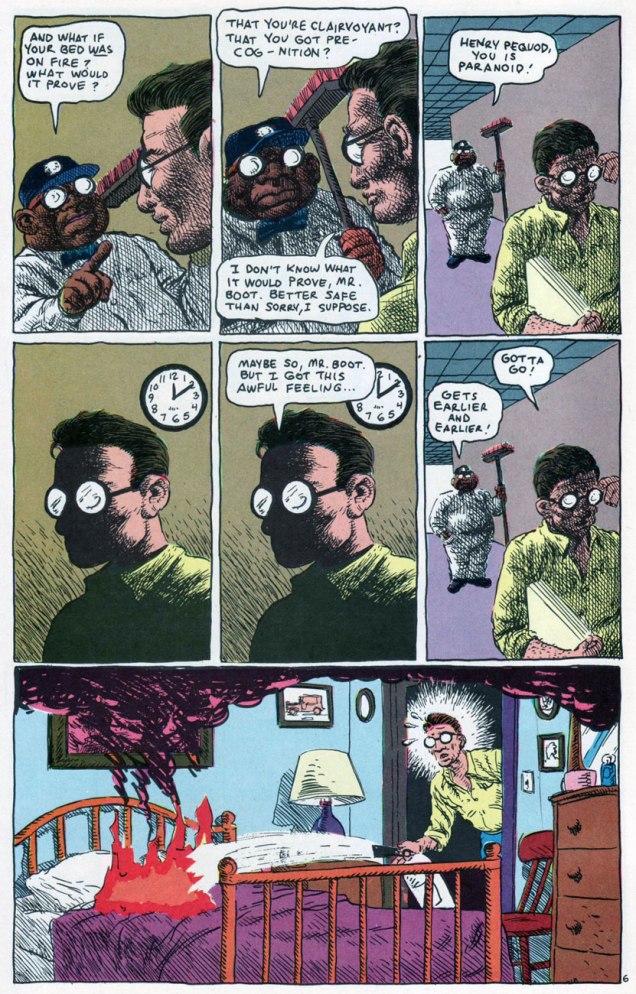
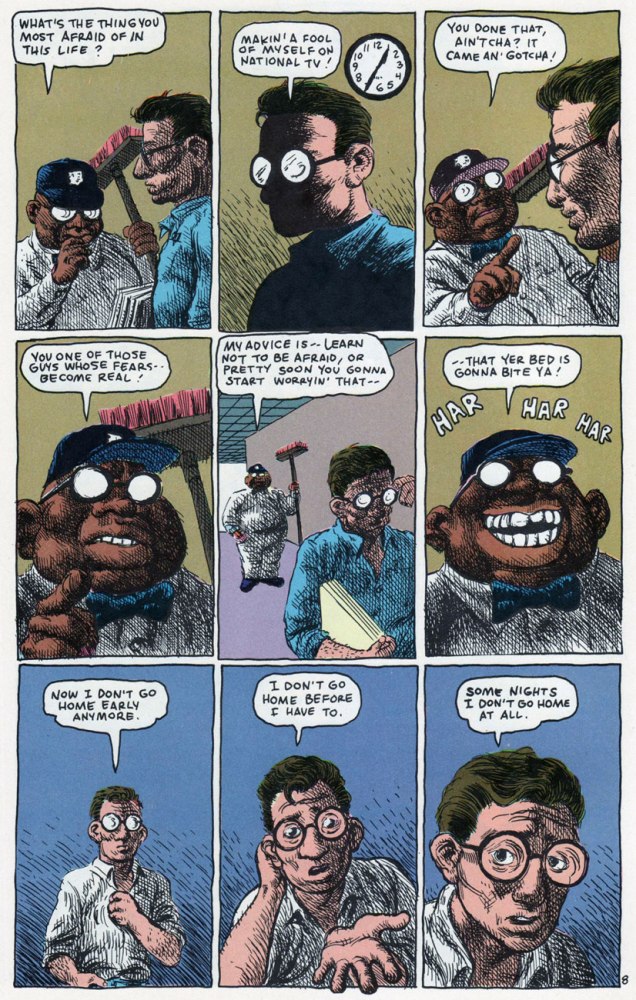
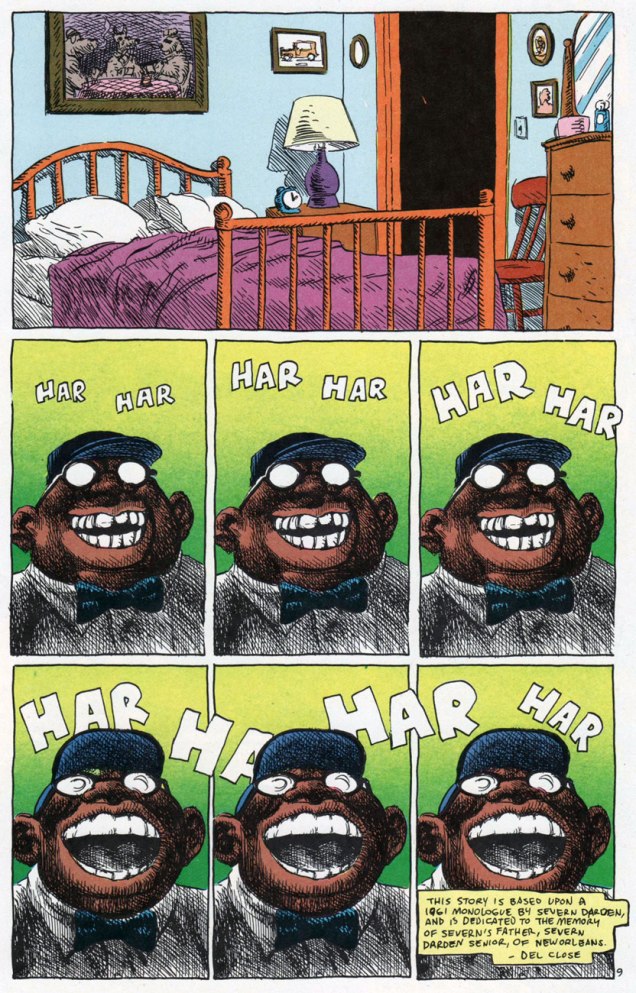
We already snuck a peek at the darker side of DC Comics’ short-lived ’80 mirage Wasteland (18 issues, 1987-89), but the title’s modus operandi was variety… within a set format. Here’s another highlight from one of the earliest and strongest issues, before its co-authors The Second City comedy legend Del Close and Grimjack co-creator John Ostrander lost the plot, interest, or both. This is American Squalor (Wasteland no. 3, Feb. 1988, DC Comics). The underrated Don Simpson, the Wasteland bullpen’s utility player, its most versatile and loyal member, gets to strut his stuff, albeit in a lovely Crumb ersatz, down to the lettering.

« Our next guest works as a file clerk at a Cleveland hospital… »

AmSqualor01AAmSqualor02AAmSqualor03AAmSqualor04AAmSqualor05AAmSqualor06AAmSqualor07AAmSqualor08AAmSqualor09A

What I find so impressive about this story is the scope of its ambition, fulfilled on several unlikely levels: it achieves success as a parody, a pastiche, a tribute, and as its own, standalone bit of workaday folk philosophy. Clearly, calling upon the trappings and rhythms of Crumb and Pekar’s American Splendor was just the starting point.

I’d love to track down (Close’s old Second City colleague) the Severn Darden monologue Close claims to have used as a springboard, but not everything was dutifully recorded for “posterity” in those days…

« I loved Harvey. He was a wonderful guest. The kind you don’t see anymore. The only real problem with Harvey was my immaturity. » — David Letterman

-RG

Jean Cézard and Arthur le fantôme

Writer-Artist-Colourist Jean Cézard ( Jean César), born March 23, 1924 in the small French village of Membray, saw a ghost in his room when he was ten years old. In the morning light, the spectre turned out to be naught but one of his mom’s blouses, but the seed was sown: the incident would inspire his most famous creation, Arthur le fantôme justicier.

Arthur first manifested himself (though still invisible!) in issue 449 of comics weekly Vaillant (December 20, 1953). The editorial team realizing the character’s vast potential and charm, Arthur then returned with issue 451 (January 3, 1954), this time fully visible (when he so desired) and he was set for the afterlife. After his creator’s 1977 passing, Arthur’s adventures continued for a time in lesser hands, but really, Cézard was irreplaceable.

Arthur was Cézard’s favourite series to work on, because he could set the little revenant’s* adventures anywhere and any when, and he certainly did.

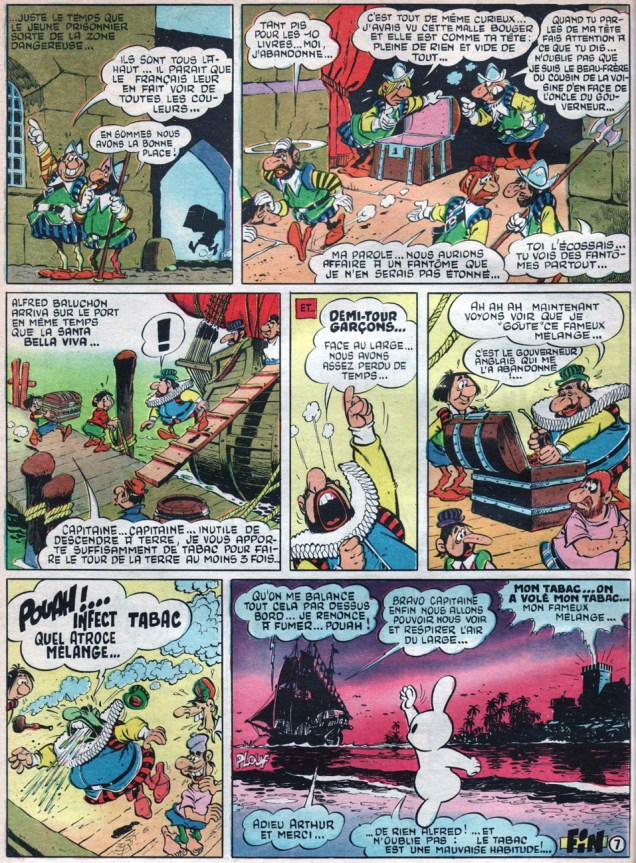
Arthur2A
It’s all but impossible to single out an absolute favourite Cézard page, but then again, I’m not held to such arbitrary limitations. Here’s the closing page of Un fameux coup de tabac, from Pif Gadget no. 33 (i.e. Vaillant no. 1271, October, 1969) Those colours!
Arthur3A
And here we have a true splash by Jean Cézard. I wanted to showcase his astonishing aptitude for rendering castles (haunted or otherwise), not to mention complex action scenes. Arthur le fantôme et les nuisances was published in Pif Gadget no. 113 (Vaillant no. 1350, April, 1971).
Arthur1A
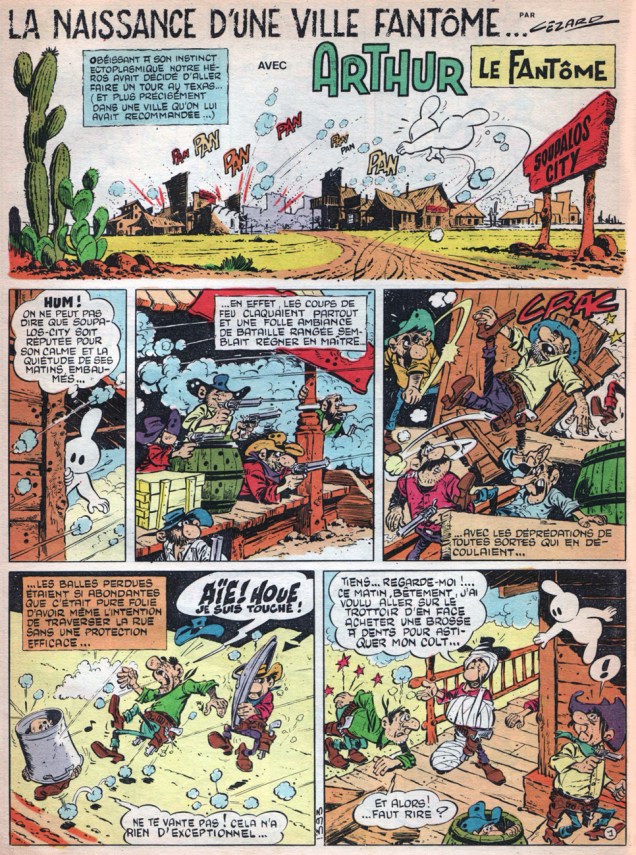
La naissance d’une ville fantôme (“Birth of a Ghost Town”), set of course in the American West (ah, ces Français et leur ‘Far West’) ran in issue 155 of Vaillant’s successor Pif Gadget in February, 1972.
ArthurBainA
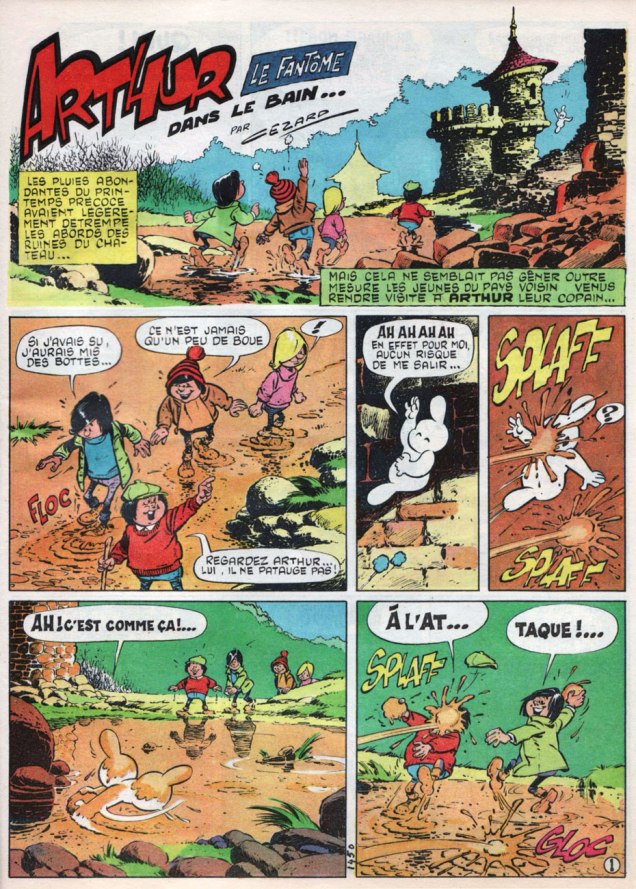
Dans le bain… (“In the Bath…”) ran in Pif Gadget no. 212 (March, 1973). By this point, at its peak, with a print run of 540,000 copies, Pif Gadget sold more than its three main competitors (Pilote, Tintin and Spirou) … combined. Then somebody got greedy, with the usual results.
ArthurPoche9A
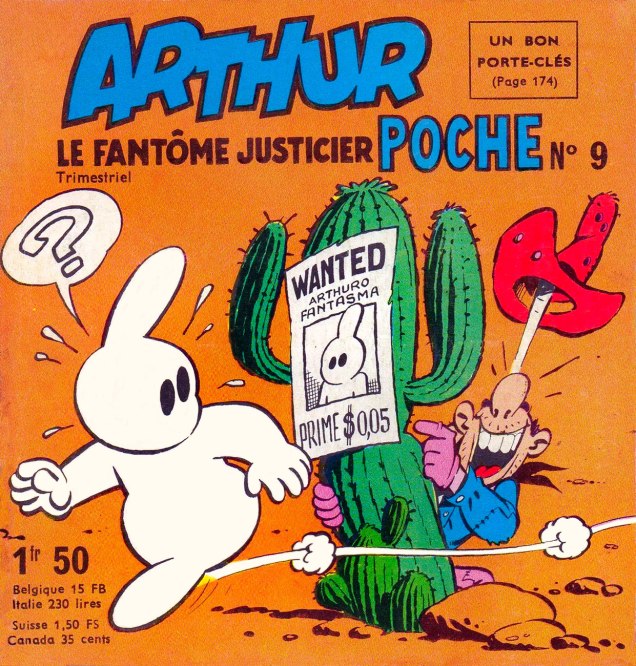
Should anyone wonder whether Cézard could also handle a less crowded, sparer layout, his covers for Arthur Poche should settle the issue. This is Arthur Poche no. 9 (July, 1966).
Arthur11A
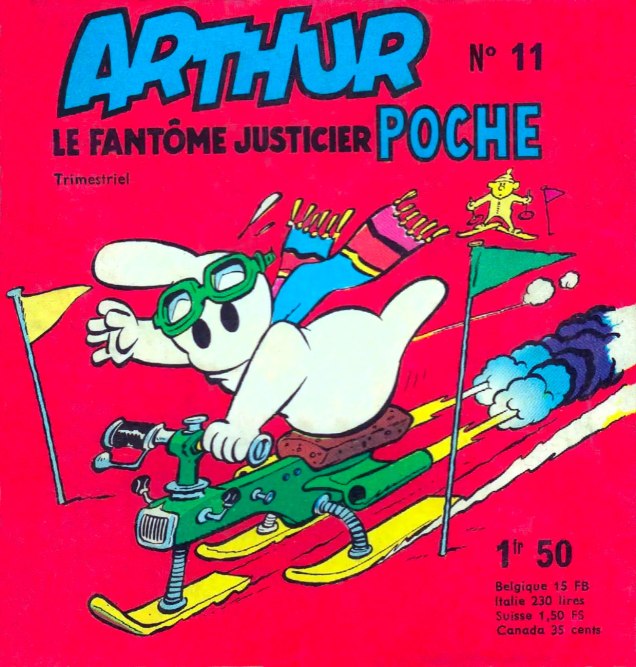
While Cézard was quite a fast worker (in a given month, he could produce around 20 pages, which means, in his case, writing, pencilling, inking, lettering *and* colouring), when it came to the half-comics, half games pocket-sized quarterly Arthur Poche, he merely provided covers. The Arthur material therein was the work of Cézar-trained Michel-Paul Giroud. This is Arthur Poche no. 11 (January, 1967).
ArthurPoche12A
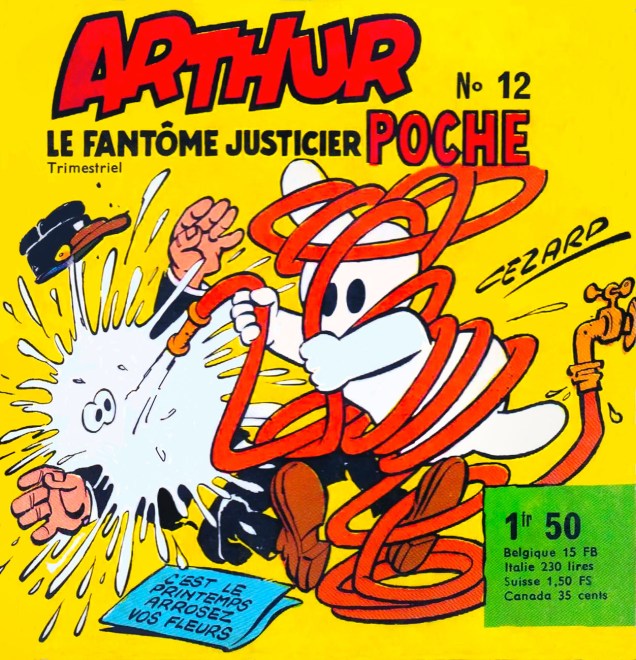
This is Arthur Poche no. 12 (April, 1967).
ArthurPoche23A
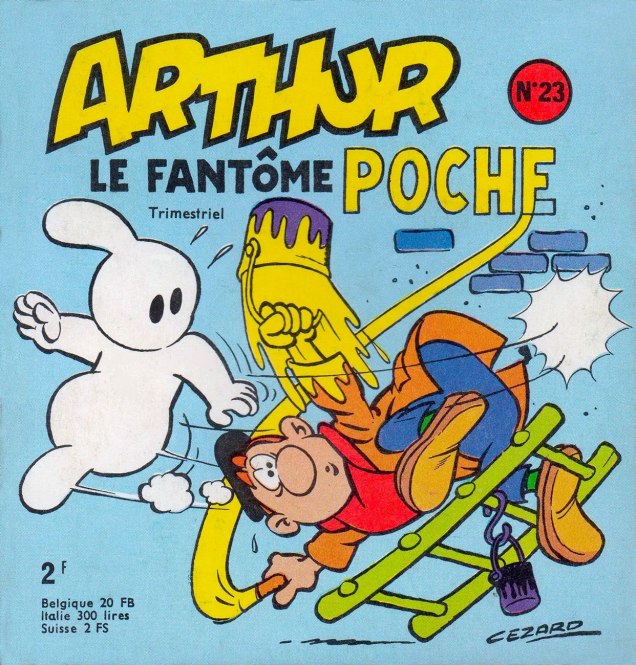
This is Arthur Poche no. 23 (January, 1970)

Les Éditions Toth, an ambitious Parisian publisher, set out to restore and reprint the works, but after five volumes (2002-2006), the enterprise seems to have stalled. However, another specialty publisher, Éditions du Taupinambour, picked up the gauntlet and published all of Cézard’s Pif Gadget Arthur stories (1969-77) in 13 volumes. That leaves, it seems, a gap of five years or so.

In closing, an anecdote about the loneliness of the long-distance cartoonist, told by Pif’s finest editor-in-chief Richard Medioni (1947-2016) in his definitive chronicle of Vaillant’s rise and fall, Mon camarade, Vaillant, Pif Gadget : l’histoire complète, 1901-1994 (2012, Vaillant Collector): « So I begin to read the episode that Jean has brought — when an author hands me his new pages, I necessarily read them in his presence, because I’m eager to read them, of course, but also out of respect for the work accomplished — and I admire it.

As I read on, Cézard comments here and there… when I laugh, he smiles. Sometimes, he points out a detail in the drawing that I missed… he never ceases to observe me and appears satisfied when I react as he had hoped.

Suddenly, it dawns upon me just how important such a session is to him. I bring up the notion and he explains:

“I spend days at my drawing table, alone, without a soul to appreciate my toil. And it’s a lot of time. No-one to give me a sense of what works and what doesn’t, what will bring a laugh and what will fall flat. So, when I come here, in seeing your response, I get that indispensable connection with my audience…” »

-RG

*Arthur, unlike, say, Casper, isn’t the shade of some dead child: his parents made him the old-fashioned way.

Le Printemps and Its Perils

« It’s spring fever. That is what the name of it is. And when you’ve got it, you want—oh, you don’t quite know what it is you do want, but it just fairly makes your heart ache, you want it so! » — Mark Twain

André Montpetit (1943-2012) was a prodigiously talented québécois cartoonist and illustrator who, after wowing the public and his peers in the late 1960s and early 1970s, essentially turned on his heels and walked away from it all. Was it fear of success, fear of failure, self-loathing, self-respect or something else that prompted his slow fade? Hard to tell.

In the meantime, here’s a seasonally sardonic piece he produced in 1971. It saw print in the March 20, 1971 issue of Perspectives, a supplement bundled with each Saturday edition of Québec’s Le Soleil daily newspaper from 1959 to 1982.

MontpetitPrintemps01A
The sun appears… the birds return… the flowers grow back… the beasts awaken… the city has an air of joy… it’s the season of love. « Let us go contemplate the marvels of nature! »
MontpetitPrintemps02A
« Oh, the beautiful pigeon! » « Oh, such a pretty flower! » « Oh! A small, limpid puddle! » « I’ve had enough! I’m going home!!! »  « You’re right. It’s going to rain! » IN GENERAL, PEOPLE WATCH THE SPRING ON TELEVISION. IT’S LESS DANGEROUS.

In recent years, writer-director Saël Lacroix endeavoured to put together a documentary to assemble and organize the known facts and to fill in some of the blanks of Montpetit’s troubled career and existence. The result, Sur les traces d’Arthur (aka Tracing Arthur) was released in 2016. Watch the trailer here.

-RG

Abner Dean’s Universe: … After.

« Everything is vague to a degree you do not realize till you have tried to make it precise. » — Bertrand Russell

When last we left Abner Dean (catch up with Part One), he was contemplating a professional change, something transcendent, something more lasting, but still using most of the traditional tools of cartooning. We can surmise that, at first, the resultant works weren’t necessarily to be shared widely: “I’m at work on a long series of drawings now that are not intended for publication ”, Dean had confided to a friend in 1941.

First came, in 1942, a Life Magazine article premiering a handful of these drawings. Then, in 1945, It’s a Long Way to Heaven landed in bookshelves.

Incredibly (if you’ll forgive the cynicism), the book, and its sequels, were solid sellers. Given the groundbreaking character of these cartoons (for the lack of a more fitting term), such well-merited success is quintuply impressive. Hell, maybe the audience for such material actually existed then.

« Much as he hates to admit it, the life of the average man (which means virtually all of us) tends to assume the form of a longish doze, interrupted by fits and starts of bewildered semi-alertness. We will invent a hundred ways of heading off self-alertness to one that may force us to ask ourselves who the devil we are. You cannot turn on your radio or unfold your newspaper without being offered all the answers. But where shall we go if we wish to be asked the questions? » — Clifton Fadiman, from his “Prefatory Note” to What Am I Doing Here?

Regrettably, Dean’s five books in this new idiom [It’s a Long Way to Heaven (1945); What Am I Doing Here? (1947); And On the Eighth Day (1949); Come As You Are: A Book about People at Parties (1952) and Cave Drawings for the Future (1954)] have all-but-entirely faded from collective memory, but there have been encouraging stirrings of a revival in recent years, owing to the efforts of a dedicated handful of brave souls.

Dedicated… and perhaps influential: What Am I Doing Here? was granted a new facsimile edition in 2016. Here’s a brief review.

As in the case of the couldn’t-be-more-highly-recommended Abner Dean’s Naked People: A Selection of Drawings from Four of His Books (1963), we’re omitting any excerpts from Come As You Are, not because it’s inferior work, quite the contrary, but because it deserves a showcase of its own. We’ll return to it.

In the meantime, enjoy these peeks into Abner Dean’s Id and, I daresay, the human condition at large. Thanks to Dean’s visionary approach, these haven’t acquired a wrinkle in the past eighty or so years.

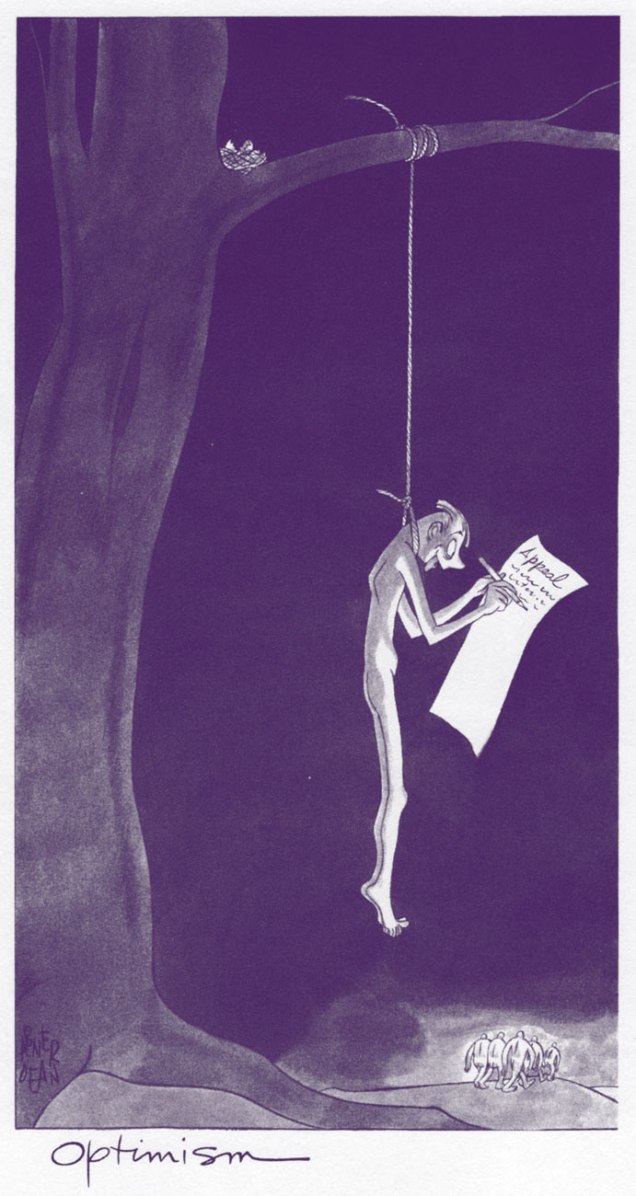
AbnerDeanOptimismA
From It’s a Long Way to Heaven (1945)
AbnerDeanOpportunistA
From It’s a Long Way to Heaven (1945)
AbnerDeanSelectionA
From What Am I Doing Here? (1947)
AbnerDeanKnackA
From What Am I Doing Here? (1947)
AbnerDeanLandA
From What Am I Doing Here? (1947)
AbnerDeanGoodFoodA
From What Am I Doing Here? (1947)
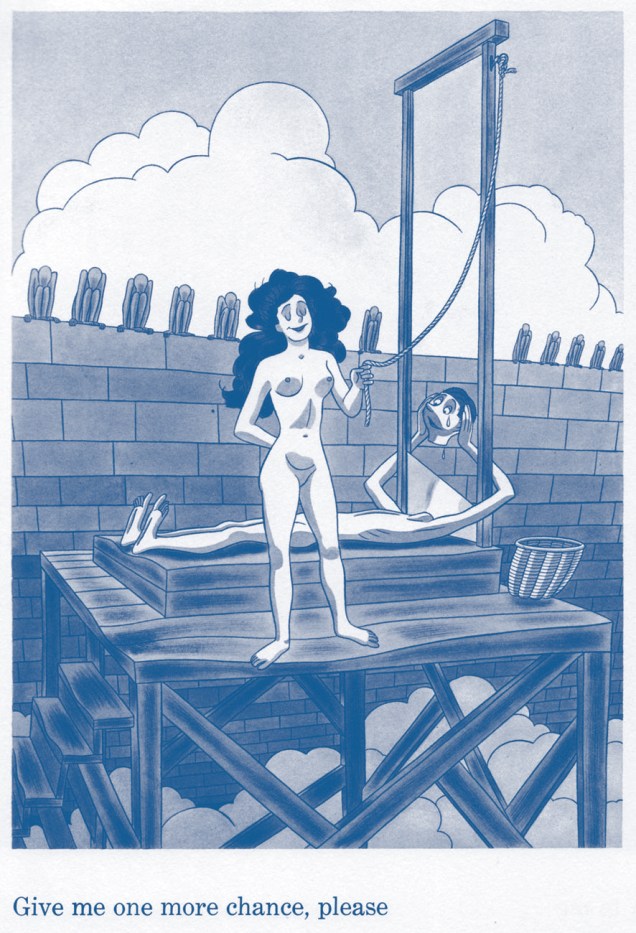
AbnerDeanChanceA
From What Am I Doing Here? (1947)
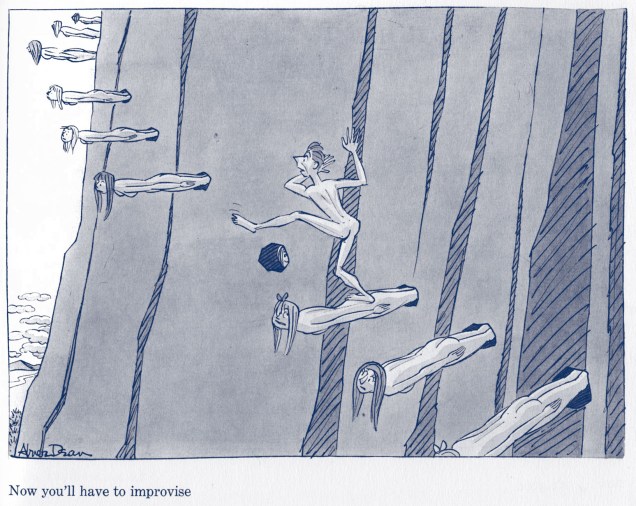
AbnerDeanImproviseA
From And On the Eighth Day (1949)
AbnerDeanUnderstandsA
From Cave Drawings for the Future (1954)

-RG
Kenneth Smith’s Singular Warren Visions

« Quodo seemed to be a paradise. It was a lush green planet of peace and solitude. Then the pilot met the blonde… » — Nicola Cuti, “Weird World”

Kenneth Smith (1943-), the fantasy artist, inhabits the same body as Kenneth Smith, the retired philosophy professor and incorrigible obfuscator. Whereas someone like, say, Bertrand Russell would make his point clearly and concisely, Kenneth would just pile it higher and higher, leaving the reader entangled in a maze of syntax and syllogism.

Since you may not be familiar with the man’s infamous column in The Comics Journal, Dramas of the Mind, here’s a typical quotation from the man, where he, er… takes on “obscurantism”:

« In characterizing realities no less than in taking positions on issues, consciousness generalizes, i.e. genericizes: in articulating or formulating, it reduces things, even our own selves, to forms, abstractions, idealizations, types, archetypes, simplisms. “Thinking” is an activity that ultimately grounds or resolves itself in the satisfying, self-certain form of orthodoxies, preconceptions, uncriticized and imperative norms; and it is overwhelmingly inept to recognize just how pathetic, parasitic or placental is its relation to its “own” fundamental norms of understanding and valuation. Rarely if ever does any act of thinking grow so laserlike or iconoclastically intensive as to escape from the dense miasma of what is acceptable. To think what actually is is even more contranatural for humans than to see what actually is: as subjectivizing as “seeing” is, “thinking” is many degrees or magnitudes more saturated with conditioned biases, delusions, self-deceptions. A program of hygiene or asepsis for the sanity, acuity and clarity of syncretic or wholesided thinking—a discipline of orthotics for sobering, grounding and polemicizing of well-formed gnoseonoesis—is needless to say unknown in modernity. Not just language but virtually all of intellect, education, culture, etc. have been adapted into utilities, tools whose very aspectivity militates against the nakedness of “evidence,” which is to say, against candor and against truth: regardless of what it may be called, “evidence,” even the most obvious and blatant, is in actuality not so “evident” to most people, and the modern development of “sophistication” or “education” typically worsens the obscurantism. »

For all that, I’ll take a guy with such an overflowing abundance of vocabulary and ideas that he doesn’t know when to quit… over most of the boneheads frequently passing for writers nowadays. Still, if you don’t mind, we’ll (mostly) stick to his Warren artwork today.

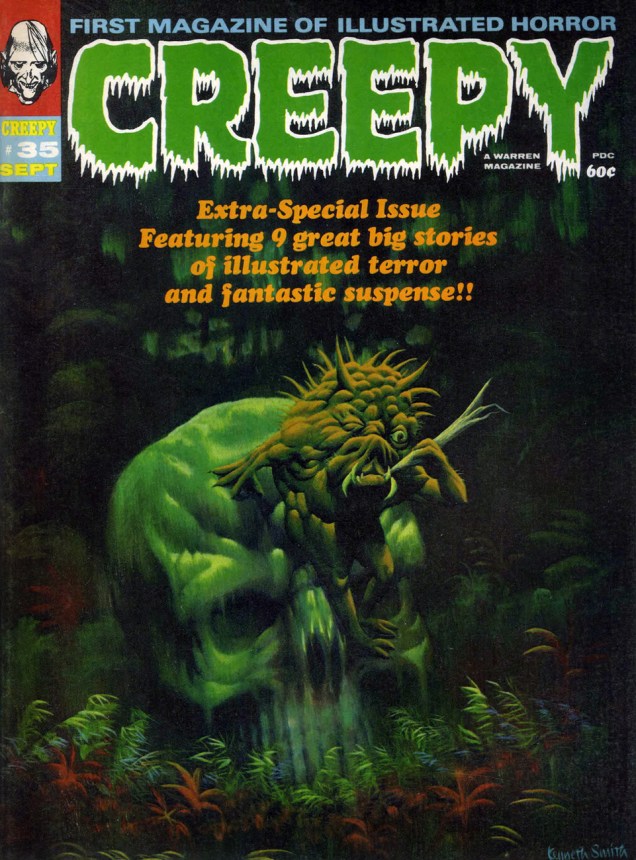
Creepy35A
Creepy no. 35 (Sept. 1970). Regardless of its month of release, its lovely shades of emerald bring thoughts of springtime to mind.
Creepy36A
Creepy no. 36 (Nov. 1970), unique amidst Smith’s Warren covers in that it presents the human form in a somewhat less… grotesque fashion.
SmithCreepy41A
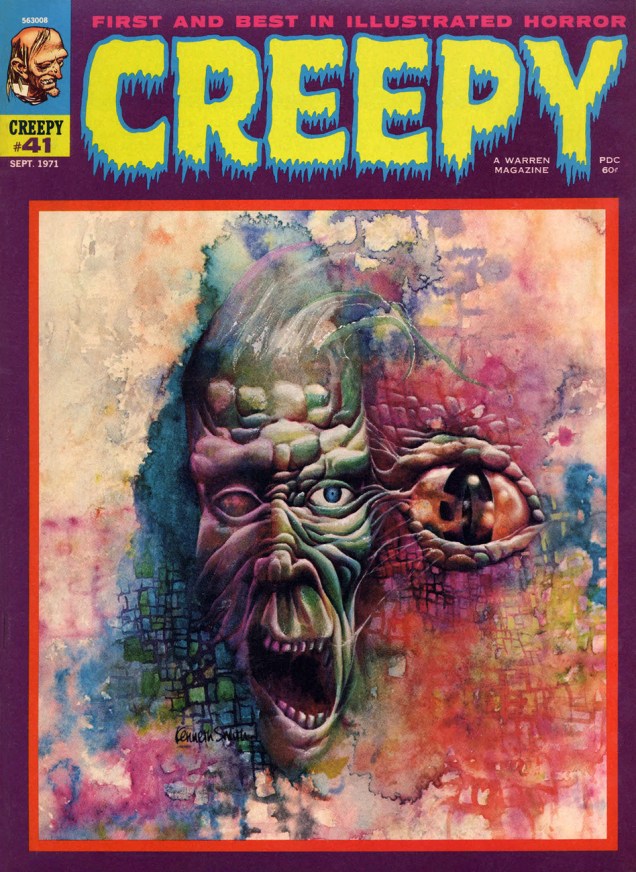
This is Creepy no. 41 (Sept. 1971). Owing to its lower than usual print run, this ranks amongst the scarcest Warren issues.
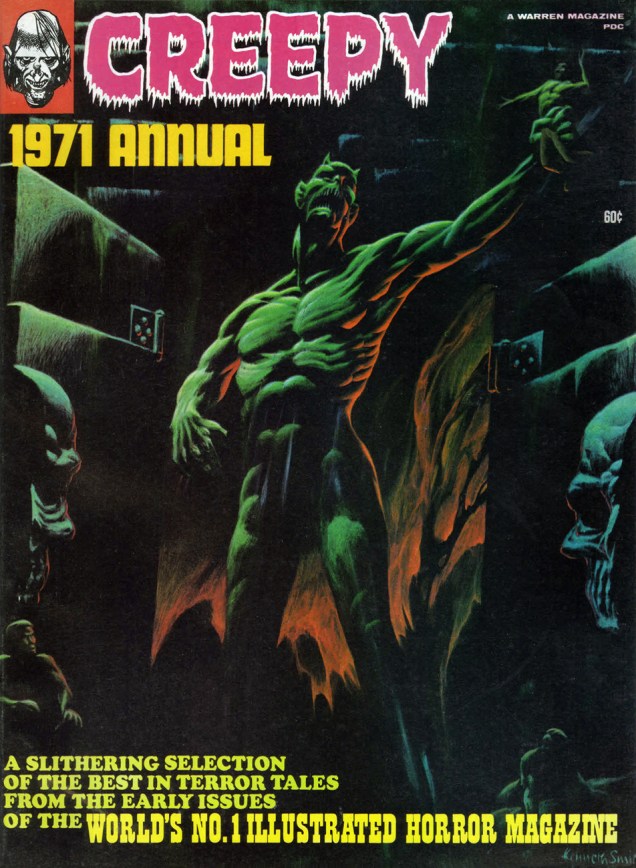
CreepyAnnual1971A
This is Creepy 1971 Annual, all reprints, but quite a choice roster of them: Ditko, Toth, Boyette, Craig, Crandall, Sutton, Adams, and Torres.
EerieAnnual71A
And here we have Mr. Smith’s last, and arguably least, Warren cover. Only a detail of the full painting was used. Eerie 1971 Annual also features naught but reruns.
SmithEerieAnnual1971ORIG
And this is the original painting in its entirety. Sorry about the glare, but this is likely the only publicly available image of this privately-owned piece.

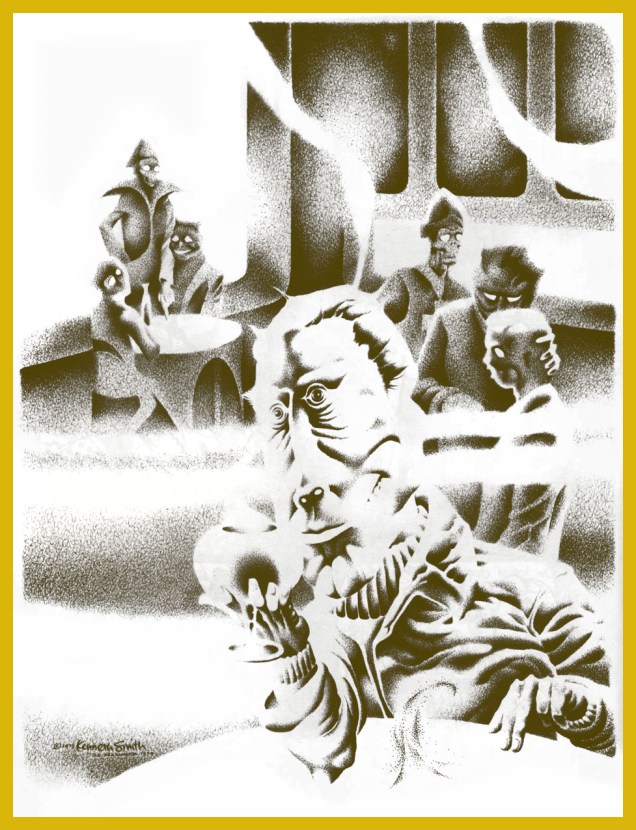
Bonus time: Mr. Smith created this lovely piece to illustrate R.A. Lafferty‘s masterful short story Mr. Hamadryad. I first encountered them* in the anthology Prime Cuts no. 1 (Jan. 1987, Fantagraphics). Hey, any fan of Old Man Lafferty’s is someone I’d happily clink glasses with. Cul sec, Mr. Smith!

SmithHamadryadA
« I believe that Mr. Hamadryad was the oddest-looking person I had ever seen. Surprisingly I regarded him so, for I first became aware of him in The Third Cataract Club in Dongola, and some very odd-looking gentlemen came into The Third Cataract. If you cock an eyebrow at someone in that place, then he’s really odd. » — R.A. Lafferty

*Smith’s illustration first graced Lafferty’s tale in the limited edition (1000 copies) collection Golden Gate and Other Stories (1982, Corroboree Press, MN). However, “Mr. Hamadryad” first turned up in STELLAR I (Judy-Lynn Del Rey, ed., 1974).

-RG
Hot Streak: Joe Kubert’s The Atom and Hawkman

« Calm down, Harris… this is no teleportational phenomenon we’re dealing with… » — Hawkman, “Yo-Yo Hangup in the Sky!”.

In 1968, though DC was still handily outselling Marvel, the industry leader was beginning to feel the heat. Now, to be fair, not nearly as much as revisionists would surmise: Marvel’s top-seller, The Amazing Spider-Man, was only in twelfth place. Of course, Marvel was hobbled by distribution issues, but that problem would come to an end that very year.

Anyway, as neither of DC’s solo titles The Atom (38 issues, June-July 1962 – Aug.-Sept. 1968) nor Hawkman (27 issues, Apr.-May 1964 – Aug.-Sept. 1968) were doing all that well (both of them missed the top sixty in 1968), it was decided to attempt to merge the books in order to perhaps save them. Well, it didn’t work, but some splendid covers were created, and that’s what brings us here.

AtomHawk39A
The Atom and Hawkman no. 39 (numbering continued from Atom’s book, not Hawkman’s), November 1968. Insides by Robert Kanigher, Murphy Anderson and Joe Giella. Which one’s the Titan and which the Fury? They take turns. Check it out here.
AtomHawk40A
The Atom and Hawkman no. 40 (Jan. 1969) holds a rare treat: a highly unusual pairing, one that was only repeated once to my knowledge (in the following issue): Joe Kubert on pencils and Murphy Anderson on inks. The tale is The Man With an Inbuilt Panic Button, scripted by Gardner Fox. Peruse it here while you can.
AtomHawk41A
My candidate for the slightest cover of the Atom/Hawkman combo title, but only since the competition is so fierce, and well, it’s kind of busy. This is The Atom & Hawkman no. 41 (Feb.-Mar. 1969), edited by Julius Schwartz and featuring Return of the Seven-Year-Dead Man, written by Gardner Fox, pencilled by Dick Dillin and inked by Sid Greene, and Yo-Yo Hangup in the Sky!, written by Fox, illustrated by Kubert and Anderson. Feast your eyes here.
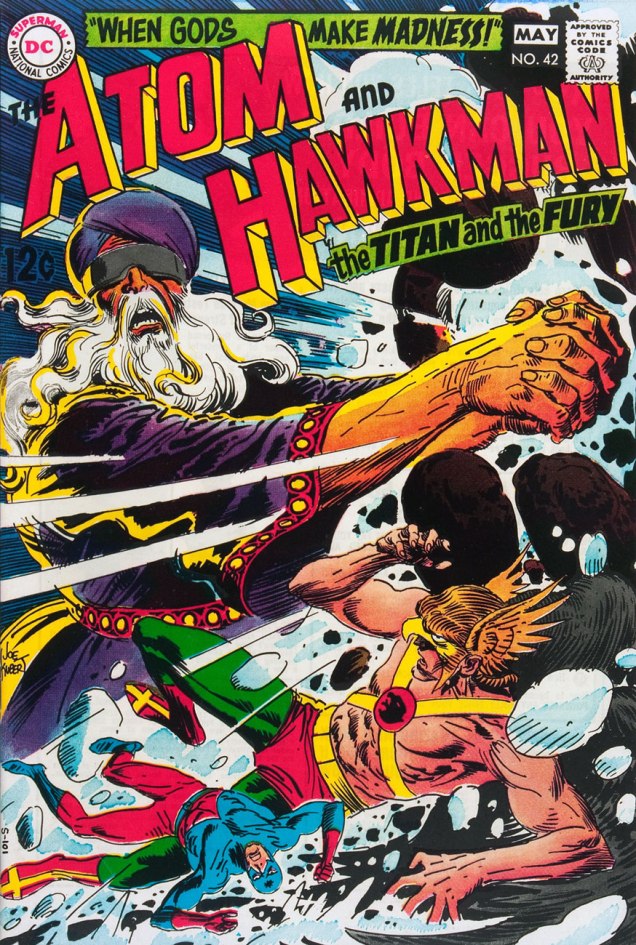
AtomHawkman42A
This is The Atom and Hawkman no. 42 (Apr.-May 1969). Read it here!
AtomHawkman43A
Robert Kanigher & Joe Kubert’s Gentleman Ghost, first appeared (so to speak) in Flash Comics no. 88 (Oct. 1947) had not been seen (hee hee) since the Golden Age, and he returned to pester Hawkgirl and Hawkman in Come to My Hanging, scripted by Kanigher and illustrated by Murphy Anderson. Meanwhile, The Atom stars in Buzzin’, Buzzin’ — Who’s Got the Buzzin’?, scripted by Dennis O’Neil, pencilled by Dick Dillin and inked by Sid Greene. This is The Atom and Hawkman no. 43 (June-July 1969). Read it here!
AtomHawkman44A
Kubert clearly relished delineating his Gentleman Ghost, and who could blame him? That sticky-fingered filcher is one snazzy-looking felon. This is The Atom and Hawkman no. 44 (Aug.-Sept. 1969). Read it here!
AtomHawkman45A
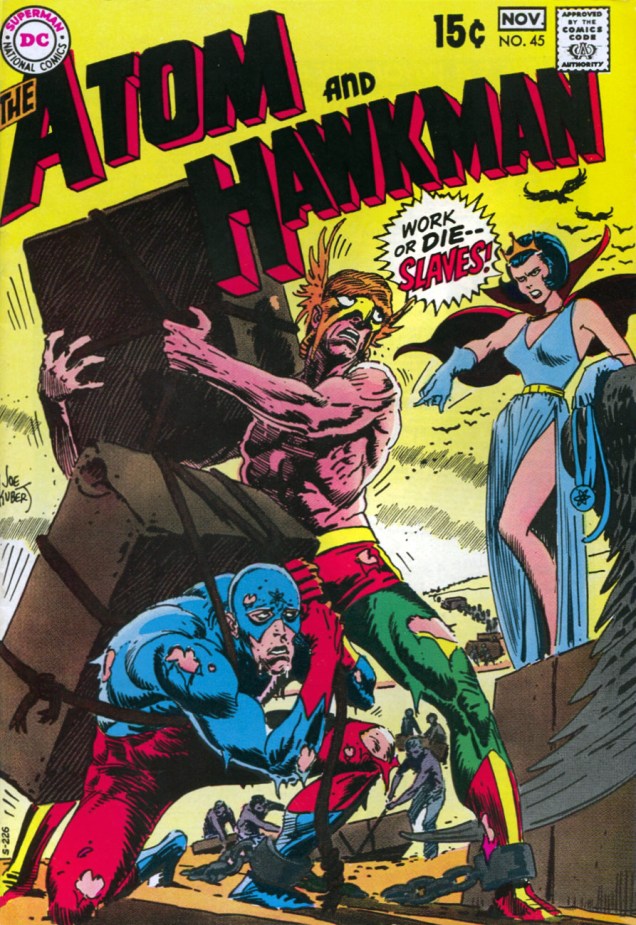
This is The Atom and Hawkman no. 45 (Oct.-Nov. 1969), featuring Queen Jean, Why Must We Die?, by Denny O’Neil, Dick Dillin and Sid Greene, whereas our heroes are enslaved by Ray “The Atom” Palmer’s girlfriend, Jean Loring. It was a common theme in DC Comics, just ask Superman and Green Lantern, for starters. Anyway, read the whacked-out tale here.

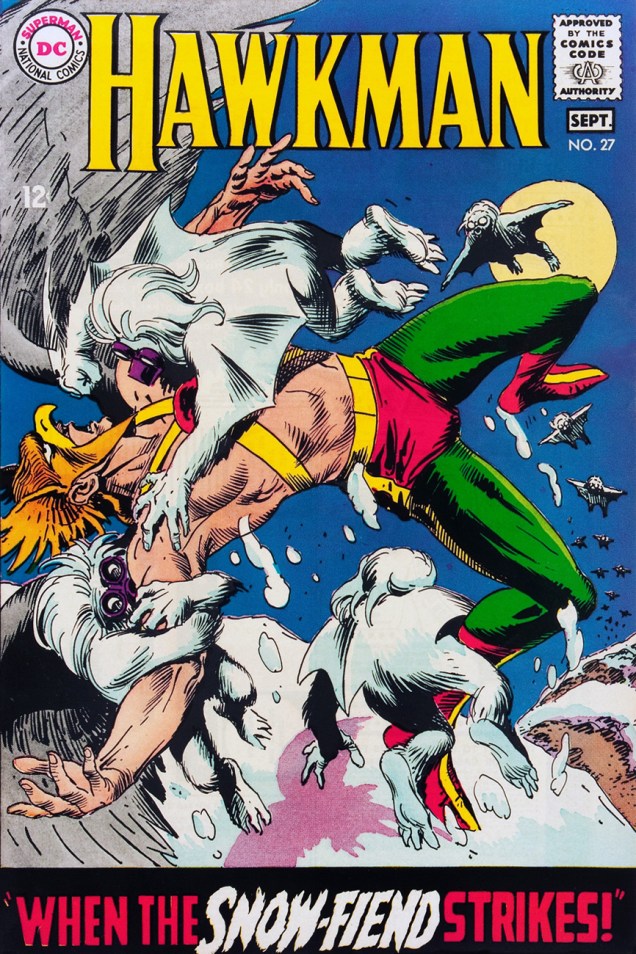
As a bonus, one could consider the final issue of Hawkman (no. 27, Aug.-Sept. 1968), the first entry in Kubert’s streak. Well, I do, and that’s that.

Hawkman27A
It is said that late each year, Thanagarians mark the winter solstice by taking to the snowy skies to join cuddly flying Yeti in frolic. Look at them cute lil’ buggers. When the Snow-Fiend Strikes! is scripted by Raymond Marais, pencilled by Dick Dillin and inked by Chuck Cuidera.

-RG

Edward Gorey: An Author Who Went for a Walk

« Painstaking drawings with an eloquent orchestration of hatchings and tickings, marvelous details of period and setting, a narrative that leapfrogs from the precise to the unexplained, a tone of vague delights in both visual and linguistic oddities. » — ‘Mr. Earbrass Jots Down a Few Visual Notes: The World of Edward Gorey’ by Karen Wilkin (1994)

So very much has already been written and said, in all media, about Edward St. John Gorey (February 22, 1925 – April 15, 2000) that there seems little of substance to add. As his work’s ultimate appeal rests in its enduring, expertly wrought sense of mystery, it should be in the Master’s spirit to show rather than tell. Consequently, here’s a gallery of favourite extracts from Gorey’s voluminous œuvre. I’ve omitted both my personal pick, The Willowdale Handcar or  The Return of the Black Doll (1962) and the too-obvious-by-half The Ghashlycrumb Tinies or After the Outing (1963), the former because I’m planning to examine it more leisurely in the future, while the latter… still manages to squeak in, after a fashion. See our bonus at the end.

GoreyGuestA
The Doubtful Guest (1958).
GoreyHaplessA
The Hapless Child (1961).
GoreyWugglyA
The Wuggly Ump (1963).
GoreyOsbickA
The Osbick Bird (1970).
GoreySummonsA
The Disrespectful Summons (1971).
GoreyNosebleedA
The Glorious Nosebleed (1975).
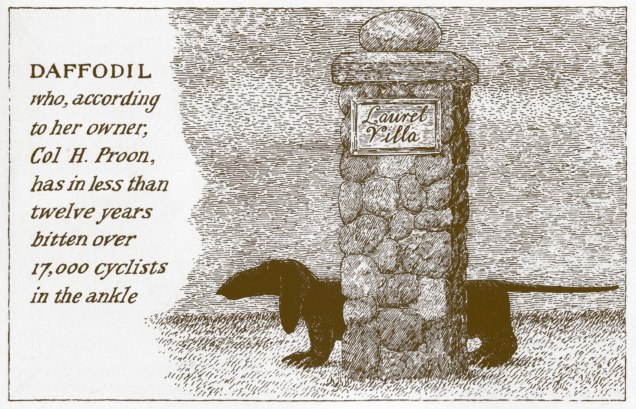
GoreyDaffodilA
The Broken Spoke (1976).
GoreyInsectesA
The Broken Spoke (1976).
GoreyLoathsomeA
The Loathsome Couple (1977).
Gorey&Guest
The author and his creature in New York City, 1958.
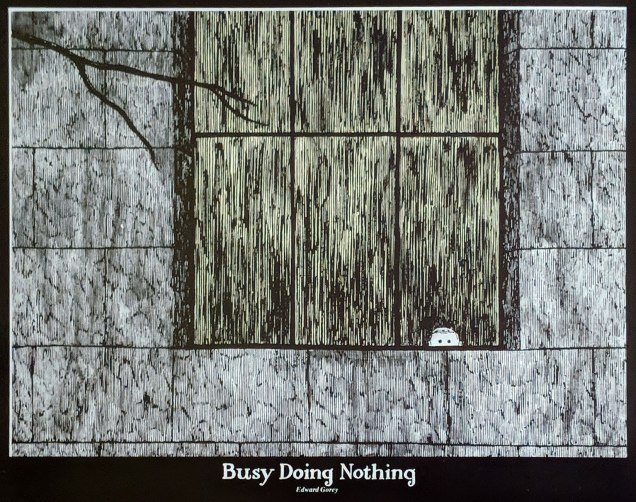
GoreyNothingA
Bonus bits: An entry from The Ghashlycrumb TiniesN is for Neville, who died of ennui ») turned up, of all places, in Byron Preiss‘ splendid The Beach Boys (1979), which chronicled the band’s history up to that point through reams of quotations and illustrations, matching a gazillion visuals artists with a favourite BB tune. Gorey’s entry (reprinted and détournée with the author’s consent) was the setup for a dyptich. It provides a visual for Busy Doin’ Nothing (1968) one of Brian Wilson‘s finest compositions from his years in the wilderness; well before Seinfeld, it’s a song about nothing, set to a lilting bossa beat. Hey, get the mug!
SimonsonGoreyA
I generally have little use for Walt Simonson‘s work, which I find overly-mannered and illegible, but I give him full marks here for wit, creativity and musical discernment. His contribution to Byron Preiss’ book focused on Brian Wilson’s bucolic I Went to Sleep (also 1968), a companion to Busy Doin’ Nothing and a fascinating miniature that gives a sense of Brian’s eventual creative direction had he not been forced to stick with the tried-and-true, official Beach Boys sound to this day. Simonson does a very effective Gorey pastiche, don’t you think?

« You know, the kids had quarrelled, so they’re taken off to see a corpse, which is decayed and completely hanging. It was parody. » — Gorey, interviewed by Clifford Ross (1994)

Oh, and if you should find yourself in the vicinity of in Yarmouth, Massachusetts, do drop by the Edward Gorey House!

-RG

The Unassuming Brilliance of William Van Horn

« Sepulveda Von Lovely looks much better in a handlebar, if I do say so myself! » — ‘Bumps’ (2004)

Since the 1980s, when it came to carrying the torch of Good Duck Man supreme Carl Barks, there have been three clear contenders, namely Daan Jippes, Don Rosa and William Van Horn. All three are outstanding talents, and honestly, no single being can take the place of Barks. In the end, Van Horn is my pick, because he’s the most complete package*, possessing his own lively, economical style in both writing and drawing (and that includes his expressive lettering, a perennially underrated art form). His work is just a pure joy to read, while Jippes is arguably too close to the model and Rosa’s stories sometimes feel like continuity-saddled homework. Van Horn is a natural.

On the occasion of Mr. Van Horn’s eightieth birthday (he was born on February 15, 1939, and is thankfully still with us), here’s a modest Van Horn comics sampler, opening with his first comics series after decades of work in animation and children’s books, Nervous Rex, and continuing into his work for Danish Disney comics packager Egmont**.

NervousRex4A
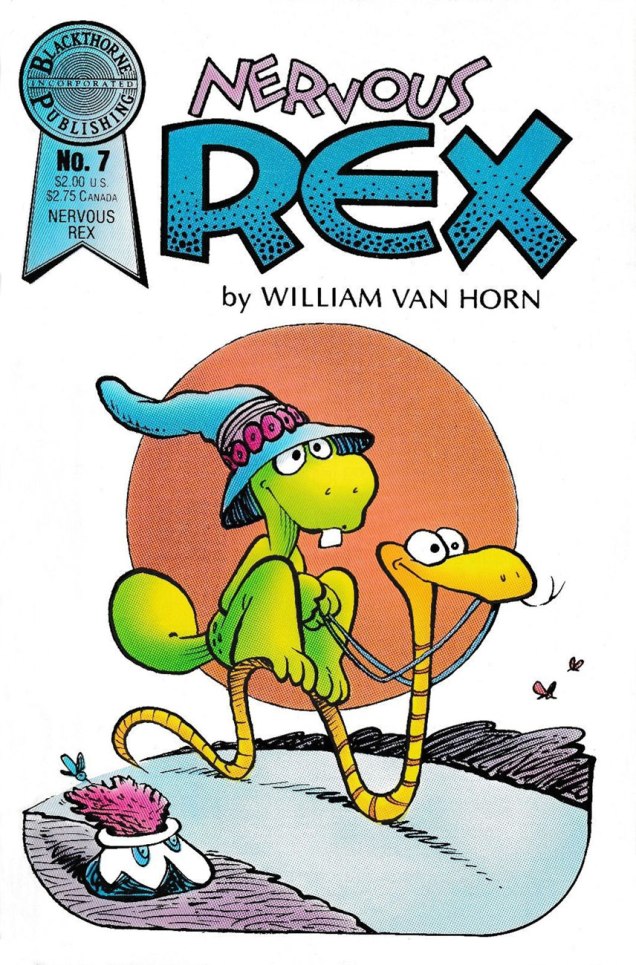
From Don Markstein’s Toonpedia: « Cartoonist William Van Horne created the series, which lasted ten bimonthly issues (September, 1985 through March, 1987). Like Russell Myers, creator of Broom Hilda, he used a style clearly inspired by George Herriman’s Krazy Kat, without being a slavish imitation. Van Horn, who had made his living for decades in commercial art and children’s book illustration, had earlier come to the attention of the comics community with a couple of minor series in Critters, a funny animal anthology published by Fantagraphics Books. »

NervousRex7A

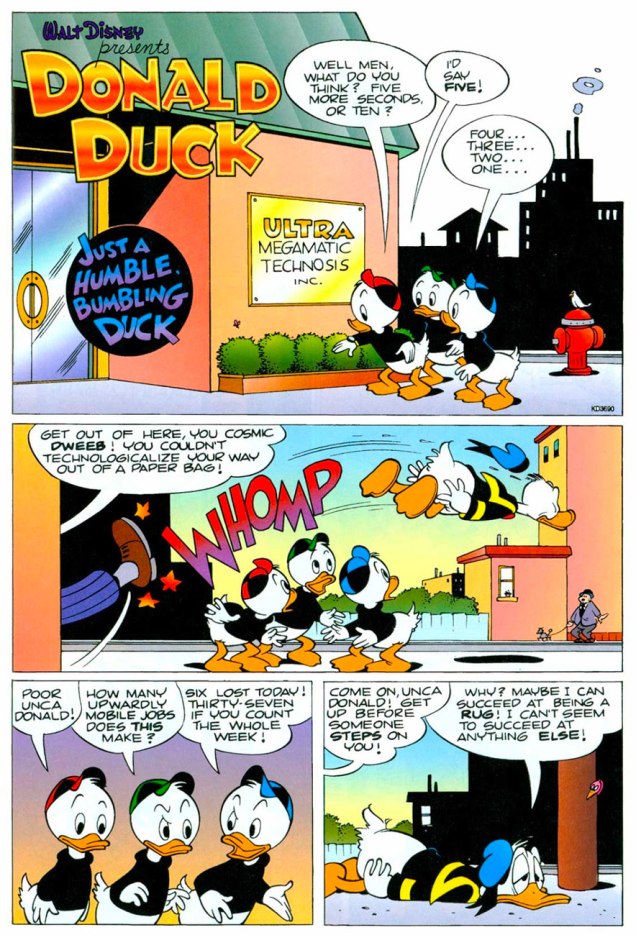
VanHornBumblingWDC&S651A
Here’s the opening of a twelve-pager, Just a Humble, Bumbling Duck, published in Walt Disney’s Donald Duck Adventures no. 13 (June, 1991). Written, drawn and lettered by Van Horn and coloured by Susan Daigle-Leach. Read the issue right here.
VanHornDDA2A
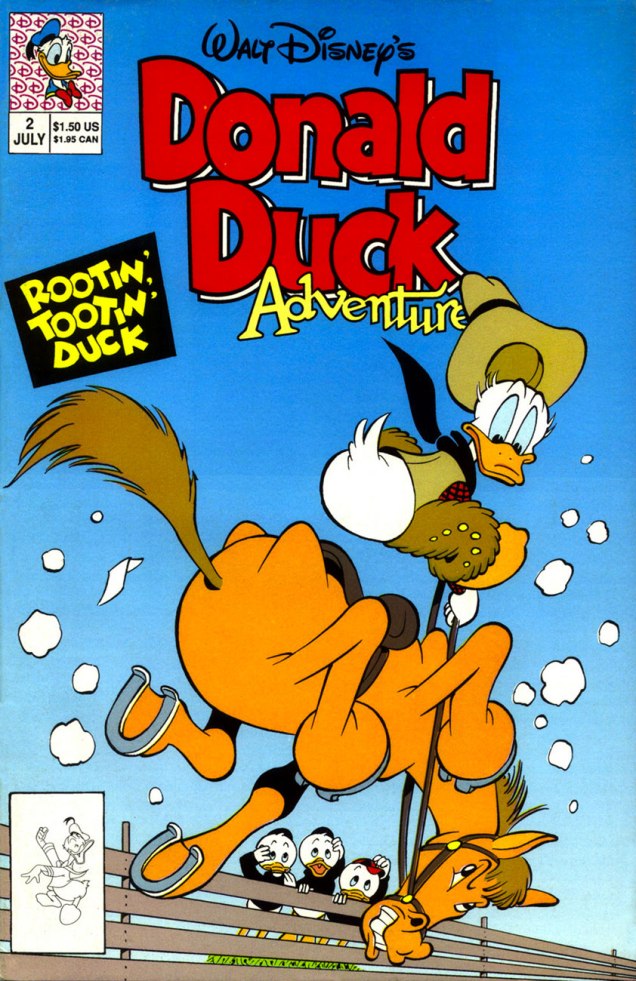
Donald Duck Adventures no. 2 (July 1990, Disney), illustrating Van Horn’s “Rootin’, Tootin’ Duck”. Read it here. You can tell when a soul’s worked in animation. Nary a hint of stiffness.
VanHornDDA18A
Donald Duck Adventures no. 18 (Nov. 1991, Disney), illustrating Van Horn’s “That Ol’ Soft Soap”. read it here.
VanHornWDC&S616A
Walt Disney’s Comics & Stories no. 616 (Sept. 1997, Gladstone), featuring Van Horn’s “Catch of the Day”. Read it here.
UncleScrooge322A
Uncle Scrooge no. 322 (Oct. 2003, Gemstone), illustrating Van Horn’s “The Utter Limits”. Read the issue here.
VanHornWDC&S655A
Walt Disney’s Comics & Stories no. 655 (Apr. 2005, Gemstone), featuring Van Horn’s “Full Circle”. Read it here.
VanHornWDC&S680A
Walt Disney’s Comics & Stories no. 680 (May 2007, Gemstone), featuring Van Horn’s “In a Minor Key”. Read it here.

A most joyous 80th anniversary to you, Mr. Van Horn! Fittingly, I leave the last word to our humble birthday boy: « Let’s create our own classics if we can… but heaven help us if we think we’re doing that. We should follow Barks’ lead and regard these stories as something to pay the rent and buy the pot roast. »

– RG

*it’s pronounced Pah-kawje

**speaking of Egmont, this sobering note from Van Horn, from a brief interview conducted by John Iatrou in 2010: « Disney comic books in North America have been virtually a dead issue (no pun intended) for over a decade, possibly two. Sales here hover around 4000 copies a month! This on a continent of over 350 million people! Egmont has never tried to publish here. They thought about it years ago and decided it wasn’t worth the effort. » So there you have it. Van Horn and Don Rosa have been producing their ducks for the European market, to be then reprinted, with piddling print runs, in North America. Nul n’est prophète en son pays… On the other hand, if you’ll forgive me for saying so, most European Disney comics are utter garbage, and have been for decades. If you like endless arrays of Donald as a superhero, Donald as Michael Jackson or Indiana Jones, Rappin’ Donald… you’ll be in hog heaven. “Opera Mundi crap“, we used to call it.