« Insanity is believing your hallucinations are real. Religion is believing that other peoples’ hallucinations are real. » — Dan Barker
When they talk about ‘adult comics’, they mean this — as opposed to ‘comics for randy teenage boys’. By ‘this’, I refer to adaptations of slow-burning psychological horror (or ‘anguish’, really) novels. These weren’t often about literal demons and ghouls, they were about people slowly but surely losing their grip on reality, through natural circumstances or, in a yet more sinister vein, the process of being gaslit by malevolent parties.
These comics are often extremely understated, and I stayed well away from them as a kid, not that I would have understood what they were about. Returning to them, I’ve come to appreciate their low-key, droning power of fascination.
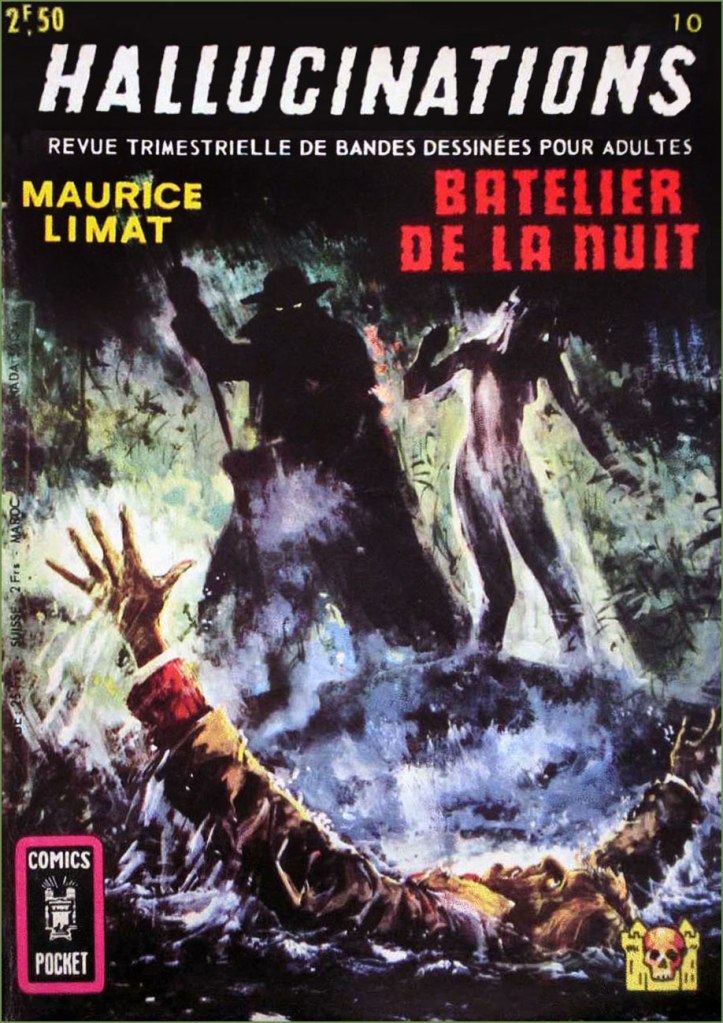
This is Hallucinations no. 2 (Sept. 1969, Arédit). Cover artist unknown. The prolific horror and SF writer André Caroff was a nom de plume of André Carpouzis.This is Hallucinations no. 6 (Sept. 1970, Arédit). The splendid cover painting is the work of Carlo Jacono (thanks for the ID, Caspar!) and the insides by prolific Spanish cartoonist Adolfo Buylla (1927-1998), who contributed to Gold Key’s spooky titles in the 1970s. Marc Agapit was one of the literary pseudonyms used by Adrien Sobra (1897-1985). This is Hallucinations no. 10 (July 1971, Arédit). Cover artist unknown. Maurice Limat (1914-2002) was another busy — but sometimes excellent — writer of SF, crime and horror.
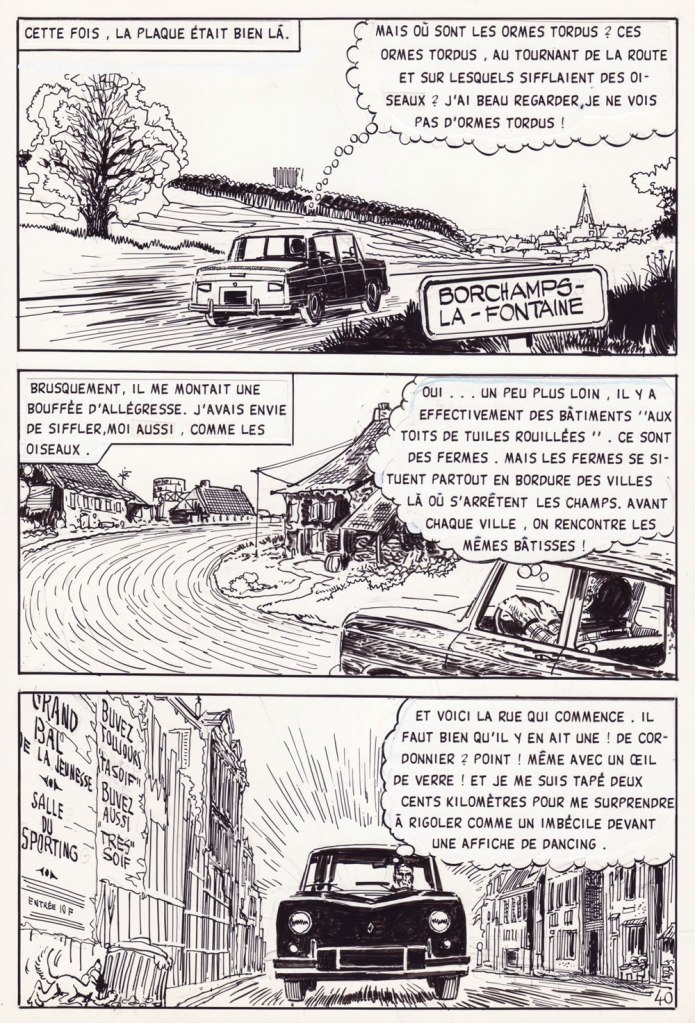
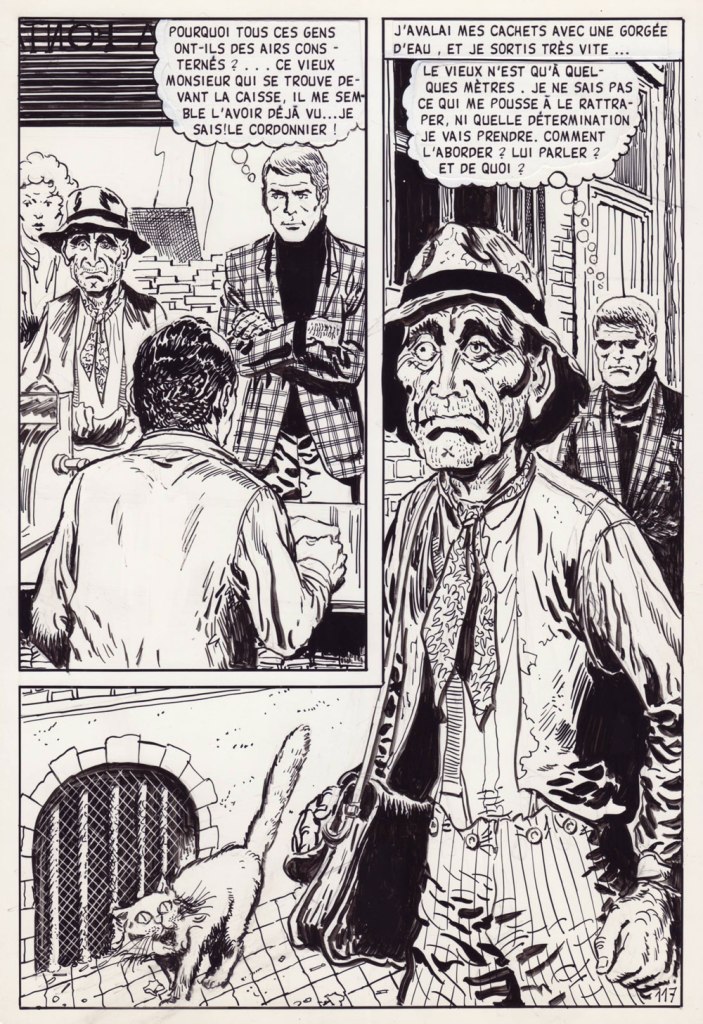
Batelier de la nuit (“Night Boatman”) was also illustrated by Mr. Buylla. Here’s a pair of moody pages involving — of course — hallucinations.
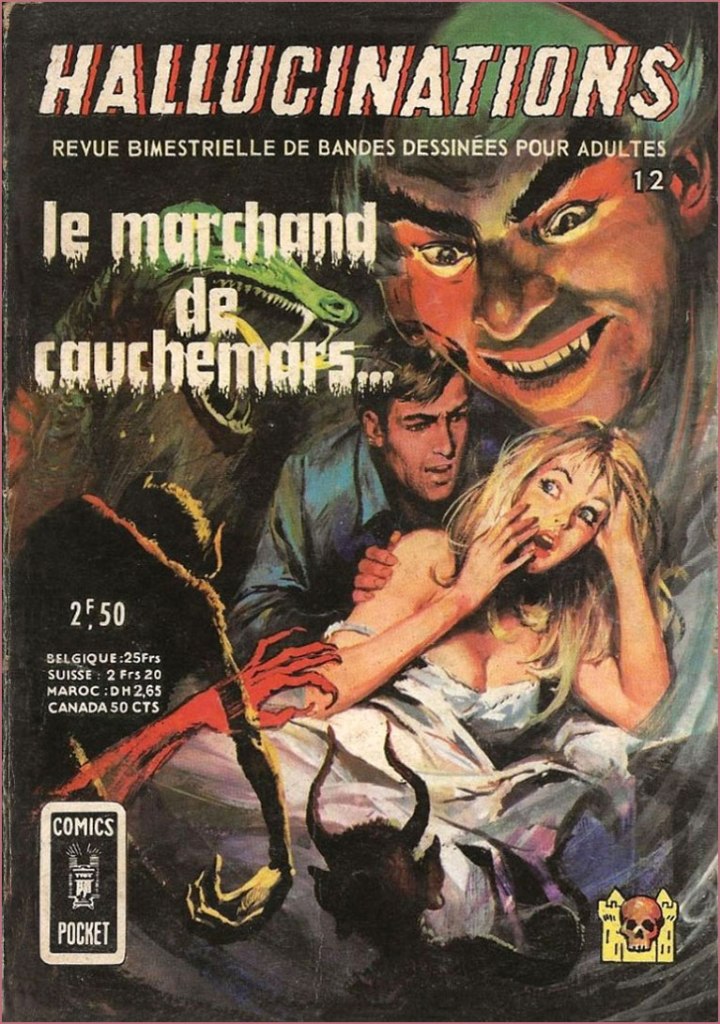
This is Hallucinations no. 12 (Nov. 1971, Arédit). Cover artist unknown. The series must have met with some success, as its publishing frequency increased from quarterly to bi-monthly. I swear I recognise that style; around 1980, I had a European sticker album of spooky scenes that this artist illustrated. I’ll dig it up yet…
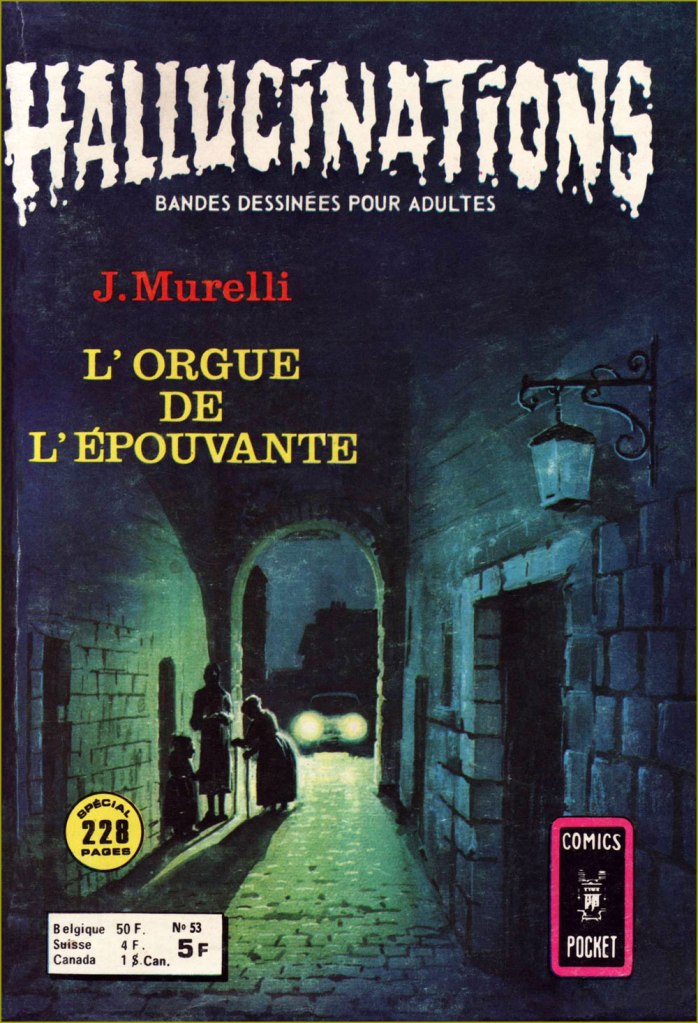
A decade ago, I got my hands on some original art from issue 53 of Hallucinations, “L’orgue de l’épouvante” (“Organ of Terror”, 1975), illustrated by Belgian cartoonist Jean Pleyers, and adapted from Jean Murelli’s novel.
Since I own only six pages of the 200+ tale, I have no solid idea what’s going on, but it’s intriguing. I’ve spotted a cheap copy and should soon be able to fill in the blanks. Here’s a plot blurb: « Reporter Luc Rohard is a hardcore skeptic who refuses to view his colleague Vérac’s disappearance in supernatural terms. His investigation leads him to a small village in which has retired sinister doctor Domitis. Is the latter a mad criminal who’s lost his mind in the course of obscure experiments on the human mind, or…? But who shall ever know the truth about the Vampire of the abbey and his troubling companion? » Cover painting by Michel Gourdon (1925-2011).
« Physics should represent a reality in time and space, free from spooky action at a distance. » — Walter Isaacson
Who’s my favorite Batman foil? Why, The Spook, of course! A brilliant and patient (but twisted, natch) planner, engineer, escape artist and… businessman Val Kaliban was a most worthy opponent for the Batman in detective mode. Let’s sneak a gander at his earliest and most significant appearances.
This is Detective Comics no. 434 (Apr. 1973, DC). A middling cover, certainly not Michael Kaluta‘s best Batman cover… nor his worst. I mean, what’s Batman’s left leg doing exactly?
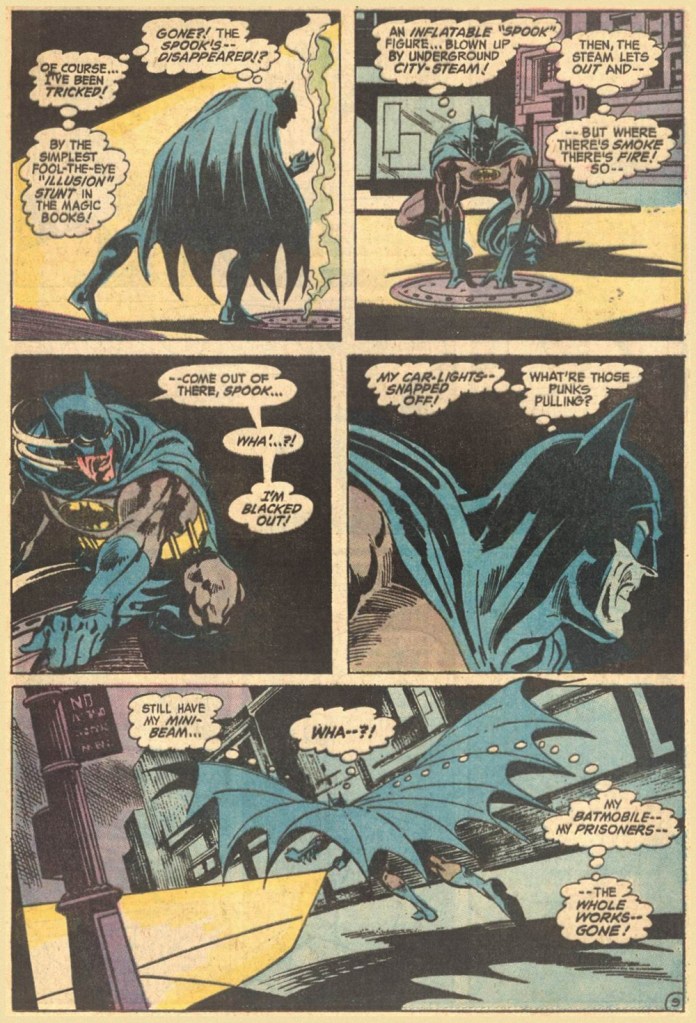
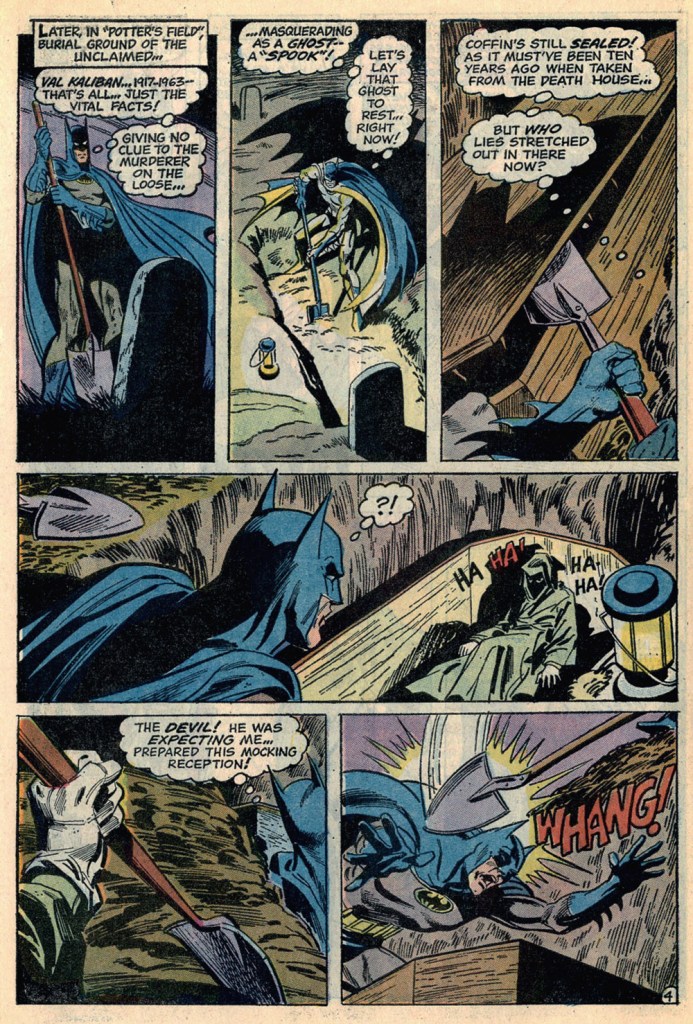
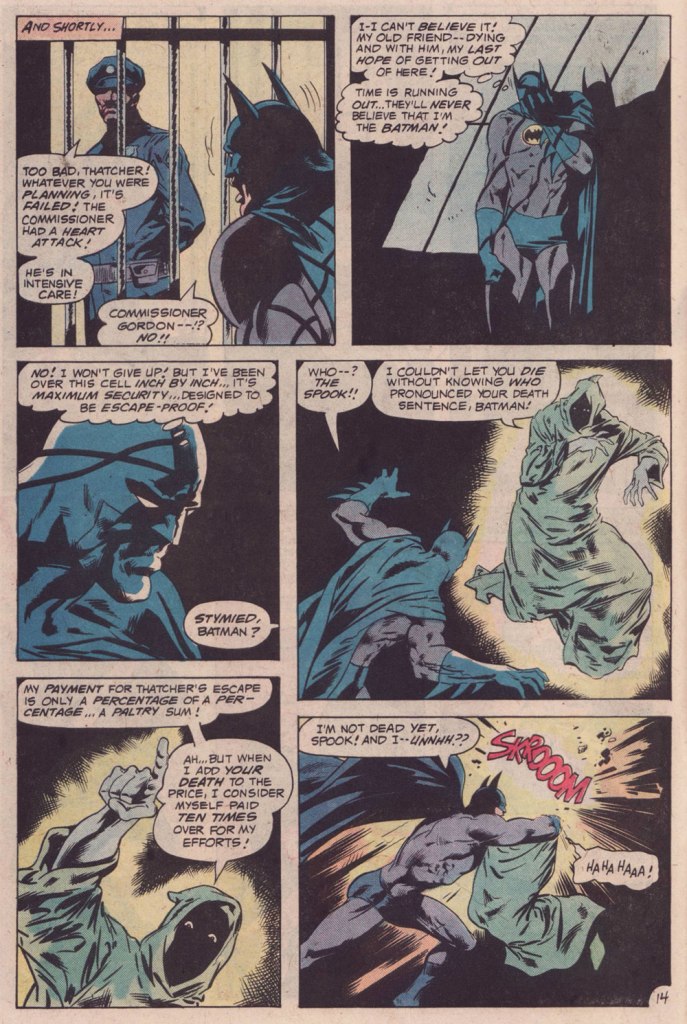
Here’s a fun sequence from the issue’s The Spook That Stalked Batman, scripted by Frank Robbins, pencilled by Irv Novick and inked by Dick Giordano.
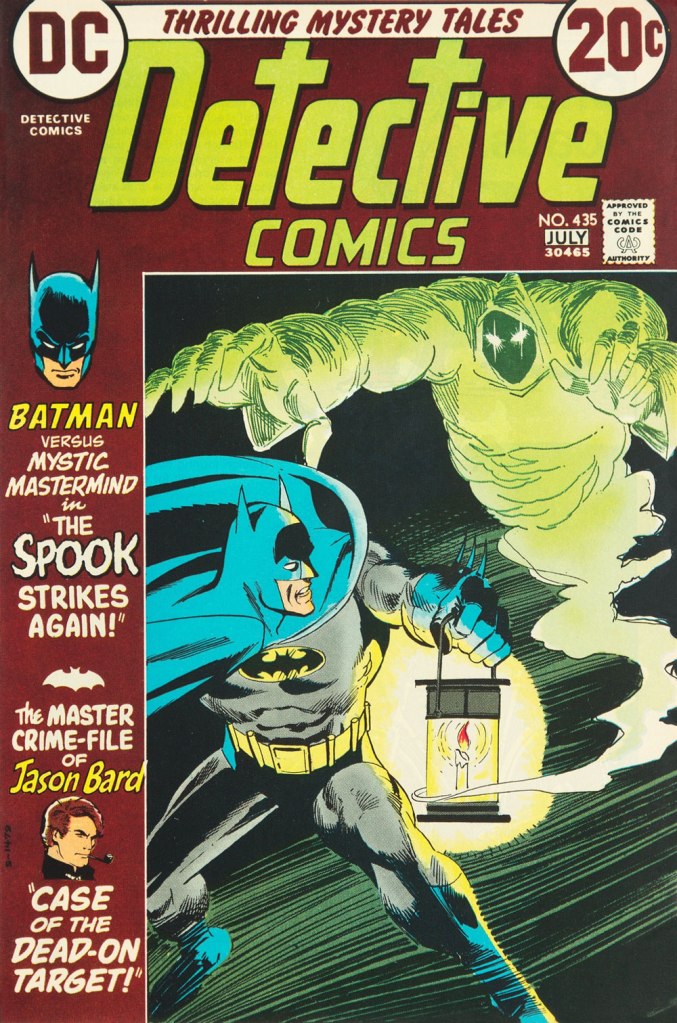
This is Detective Comics no. 435 (June-July 1973, DC); an okay cover by Dick Giordano.Ah, finally… The Spook gets a cover worthy of his mettle. This is Batman no. 252 (Oct. 1973), cover design by Carmine Infantino, pencils and inks by Nick Cardy, and lettering by Gaspar Saladino (well worth mentioning!)
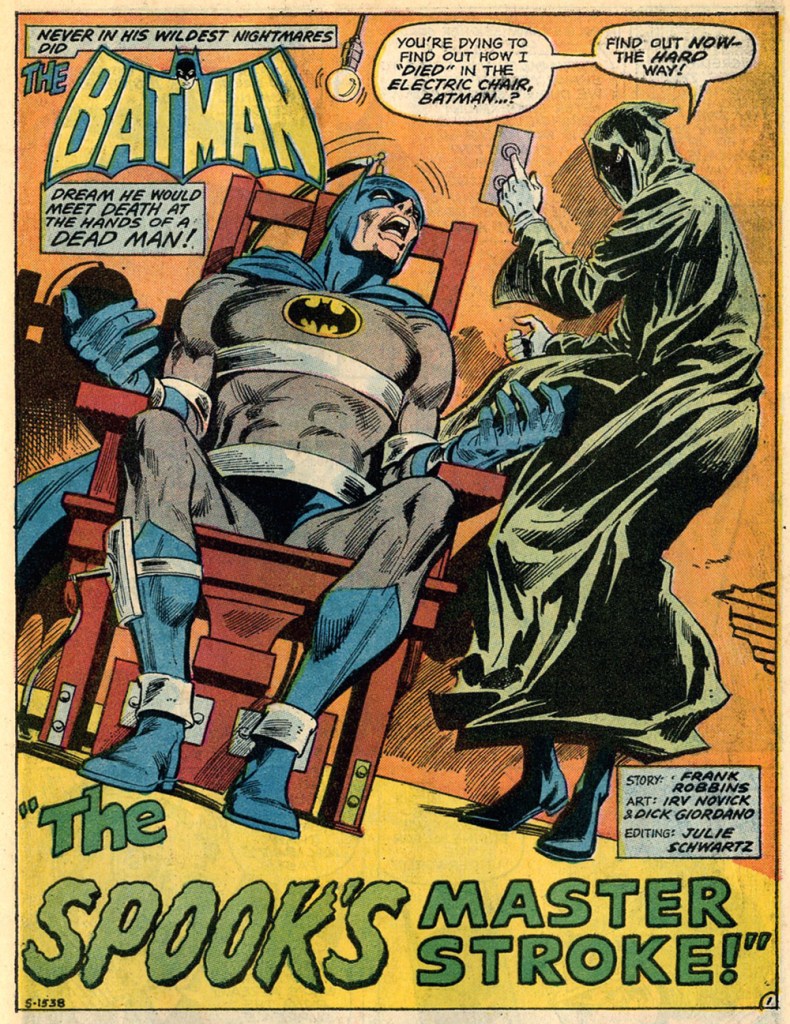
A pair of pages from the issue:
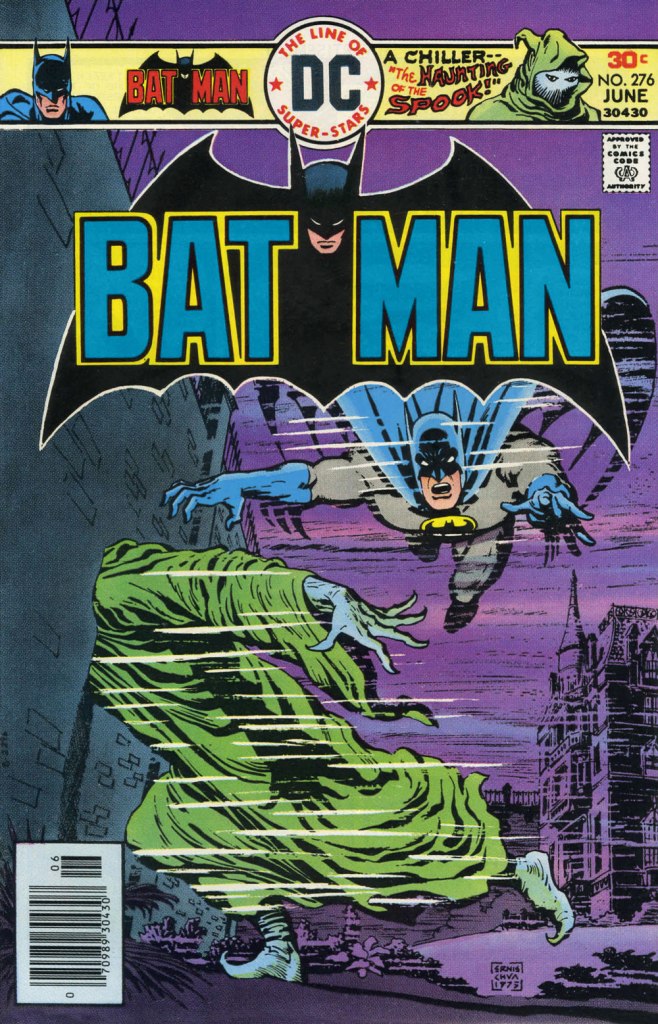
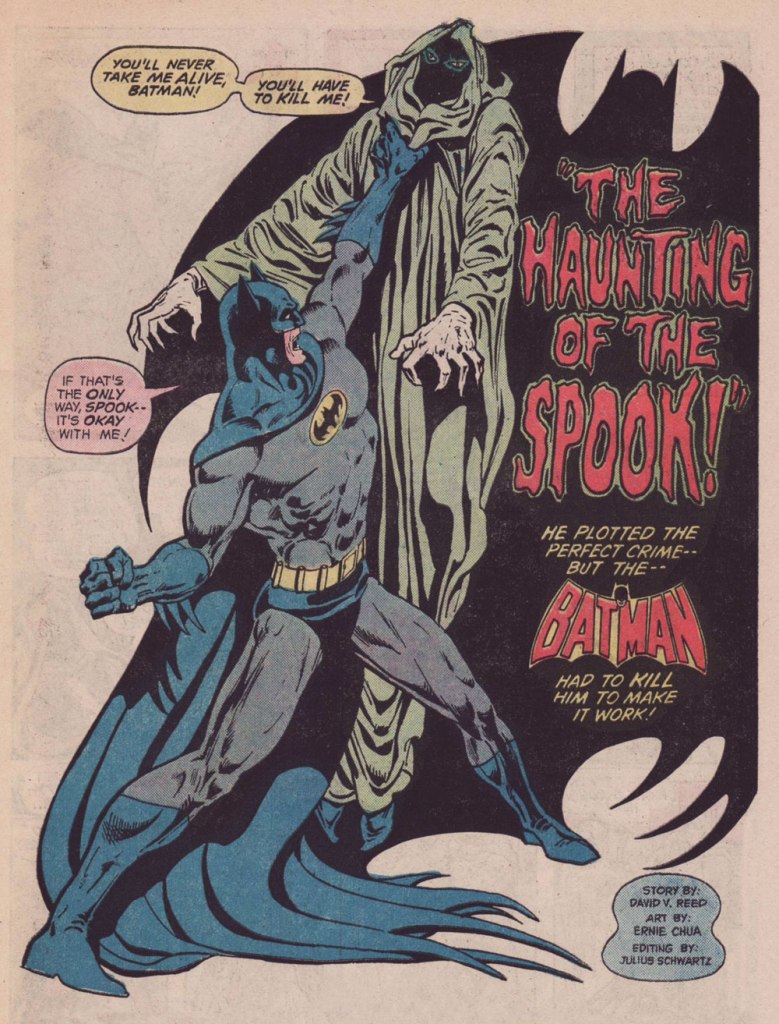
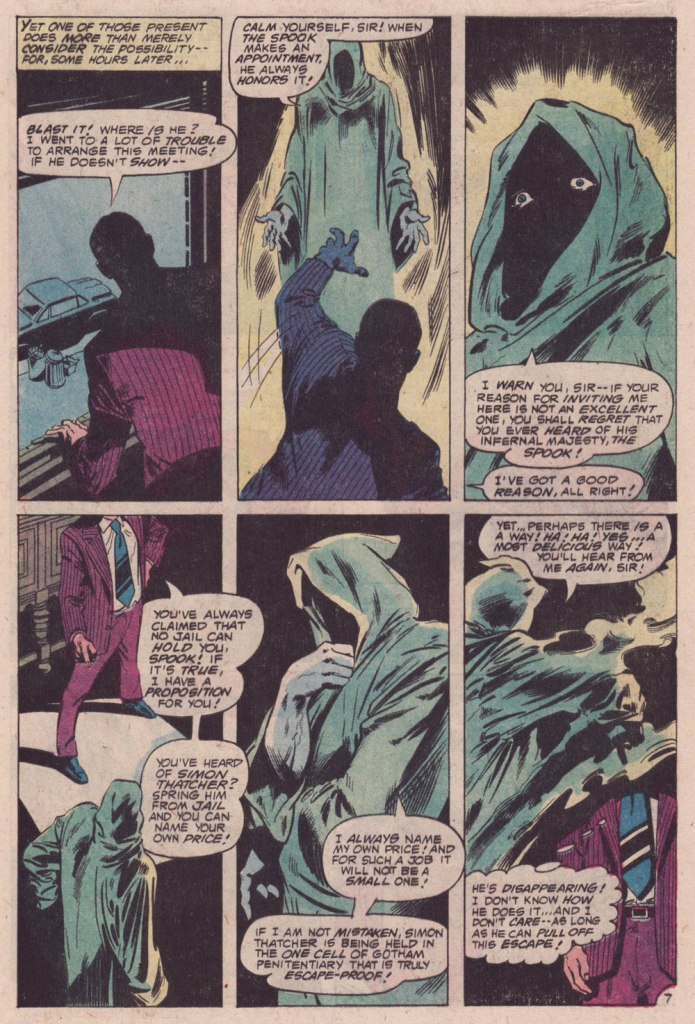
This is Batman no. 276 (June 1976, DC). For the first time, someone other than his creator, Mr. Robbins, handles The Spook. Fortunately, it was talented scribe David Vern (writing as David V. Reed), quite possibly my favourite Batman writer. A fine, moody cover by Ernie Chan.The Spook’s following appearance, in which Dick Giordano demonstrated he could come up with a crappy Andru-Giordano cover… all on his own. This is Detective Comics no. 488 (Feb.-Mar. 1980, DC).
The Spook’s Death Sentence for Batman, written by Cary Burkett, pencilled and inked by the splendid team of Don Newton and Dan Adkins, was a worthy send-off for this fine character. Beyond that… I don’t much care. The Spook is a difficult personage to write for, but he got three solid writers to chronicle his exploits, and that suits me just fine.
My curiosity about this title was piqued at an early age, when tiny-but-alluring reproductions of some of its covers ran in editions of The Overstreet Comic Book price guide.
Here they all are, nice and big and colourful. Oh, and you can read them all here for free!
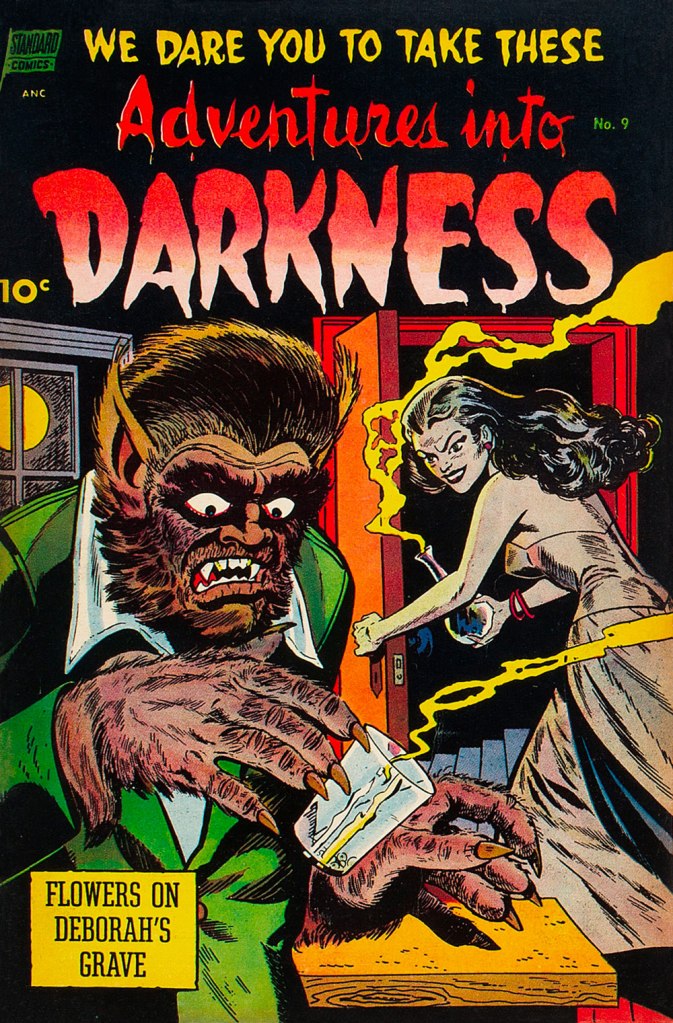
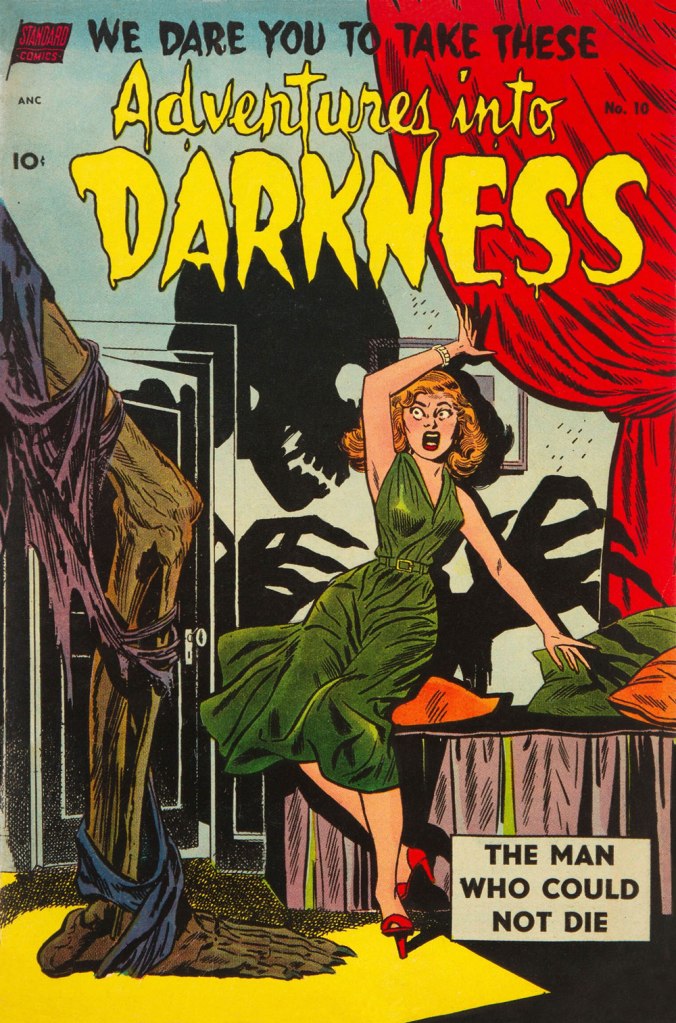
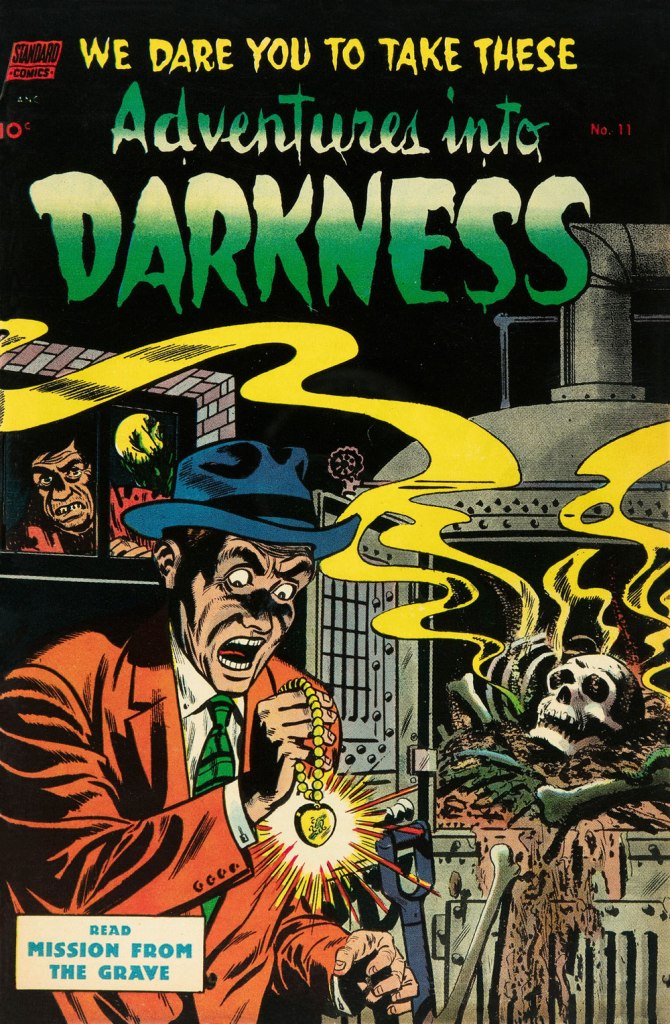
This is Adventures Into Darkness no. 5 — the first issue — don’t ask — (Aug. 1952, Standard). Cover by George Roussos (1915-2000).This low-key entry is Adventures Into Darkness no. 6 (Oct. 1952, Standard). Cover by George Roussos. Though unspectacular, this theme would be taken up and imitated (with variations) a bunch of times, which goes to demonstrate some folk’s morbid fear of marriage.This is Adventures Into Darkness no. 7 (Dec. 1952, Standard). Cover by the remarkably driven Jack Katz (b. 1927)… a most interesting man.This is Adventures Into Darkness no. 8 (Feb. 1953, Standard). Cover by future Charlton Comics pillar Rocco “Rocke” Mastroserio, already showing his tremendous potential as a cover creator. One of my all-time favourite bloggers (et cetera!) Jason Willis, loved this cover so much that he used it to create a bonafide animated commercial for the issue! Bless you, Jason!This is Adventures Into Darkness no. 9 (Apr. 1953, Standard). Cover artist unknown… and what’s going on here? Did the femme fatale turn her unsuspecting victim into a werewolf, or did she doom him with a deadly dose of acid or some other poison?This is Adventures Into Darkness no. 10 (June 1953, Standard). Cover by Ross Andru… possibly my very favourite cover of his — lord knows he dragged his reputation through forty miles of bad road with his dire late 1970s work at DC.This is Adventures Into Darkness no. 11 (Sept. 1953, Standard). And we’re back to Mr. Roussos, who provides more of a crime comic cover this time around. Still grisly, though!This is Adventures Into Darkness no. 12 (Dec. 1953, Standard). Cover by Mike Sekowsky… those cute little caps the mine demons are wearing are a bit of a Sekowsky trademark.
We skip over issue thirteen, not through superstition, but because it’s already been featured in our Mike Sekowsky spotlight — and with good cause, as it’s a spiffy one!
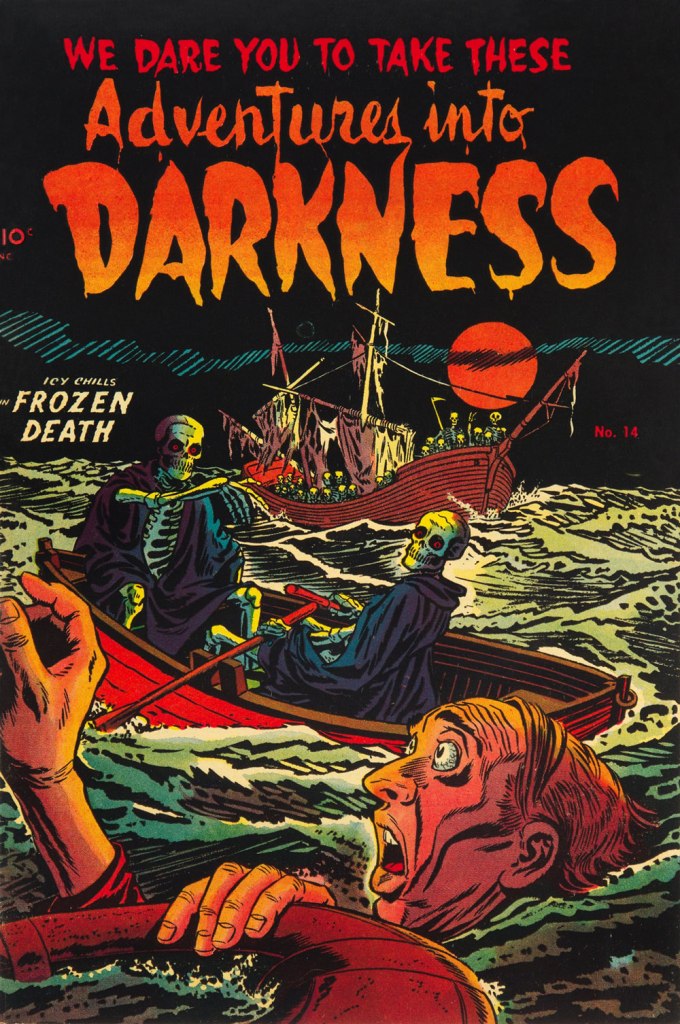
And finally, this is Adventures Into Darkness no. 14 (June 1954, Standard). Cover tentatively attributed to Ross Andru.
A fifteenth (well, eleventh, really) issue had been in the offing, but as censorship tore the comics industry apart in 1954, plans to publish it were abandoned… which brings us full circle to one of our earliest countdown posts on that very topic.
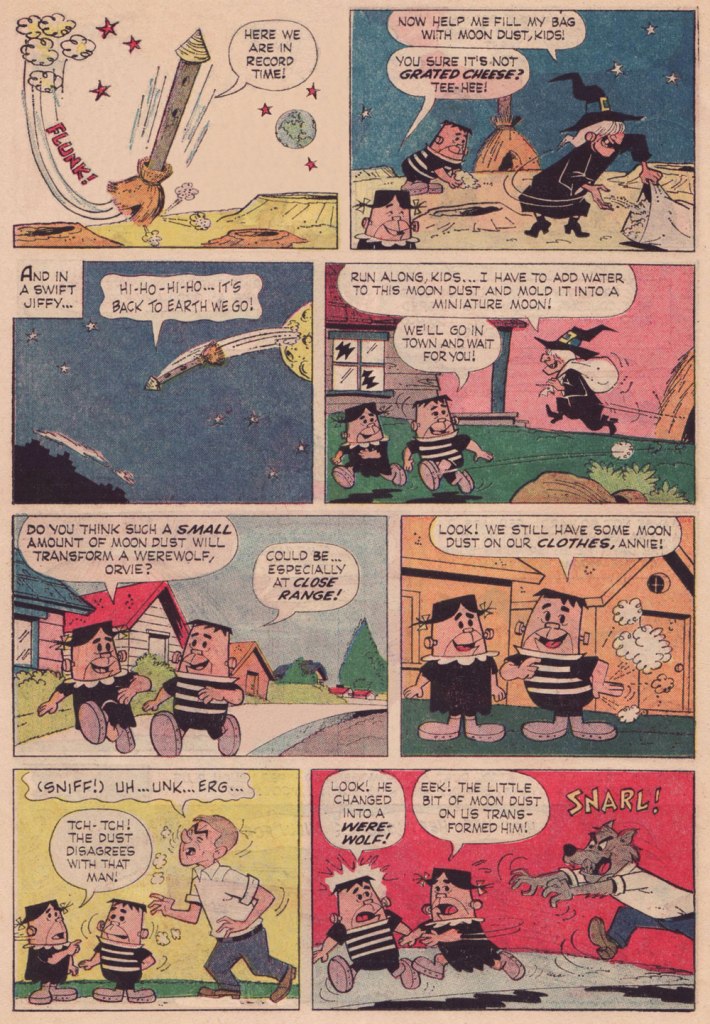
Few things evoke Hallowe’en so vividly to me as Gold Key’s The Little Monsters, one of the publisher’s relatively scarce non-licenced properties…
The series had its unlikely début as a backup feature in The Three Stooges no. 17 (cover-dated May 1964 — meaning it hit the stands in January) — months before The Addams Family (Sept. 18) or The Munsters (Sept. 24) reached television. Which is meaningless, of course, since the source for all of these fiends was Charles Addams’ New Yorker cartoons, wherein the clan did not even bear his name. Monsters everywhere! There must have been been something in the water.
Oddly enough, while Orvie, Annie, Demonica and Mildew soon (Nov. 1964) earned their own book, they remained loyal to Moe, Curly and Larry, retaining their backup slot to the very end of the Stooges’ run (no. 55, June 1972). And while the regular Little Monsters title often comprised reruns — as early as 1971’s issue 13 — the Stooges-sponsored backups never were reprinted.
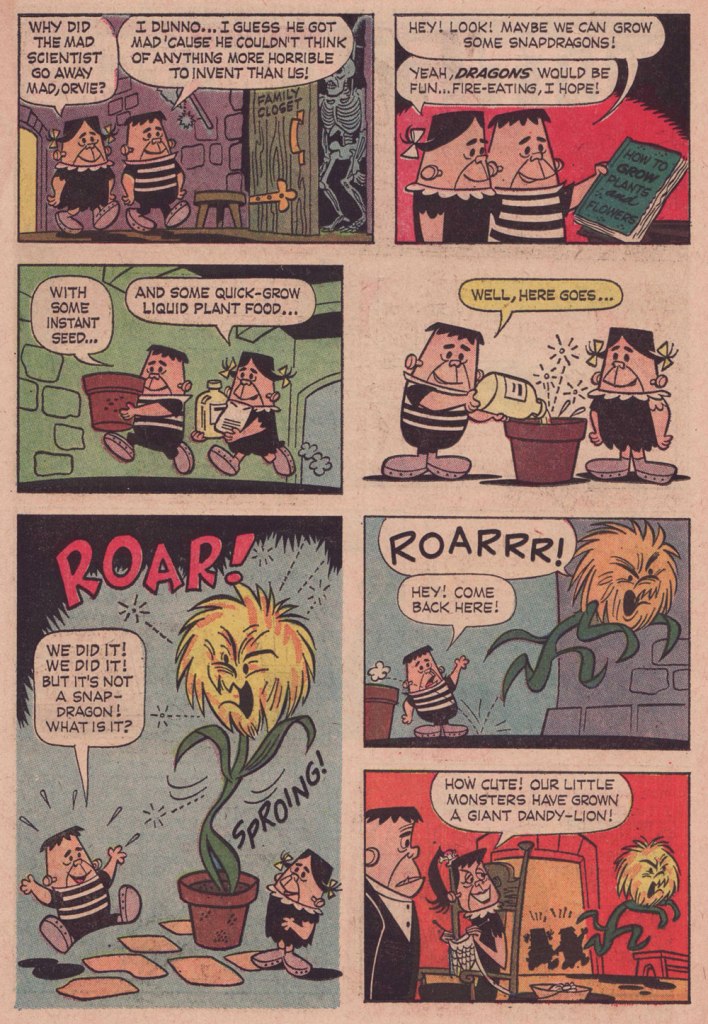
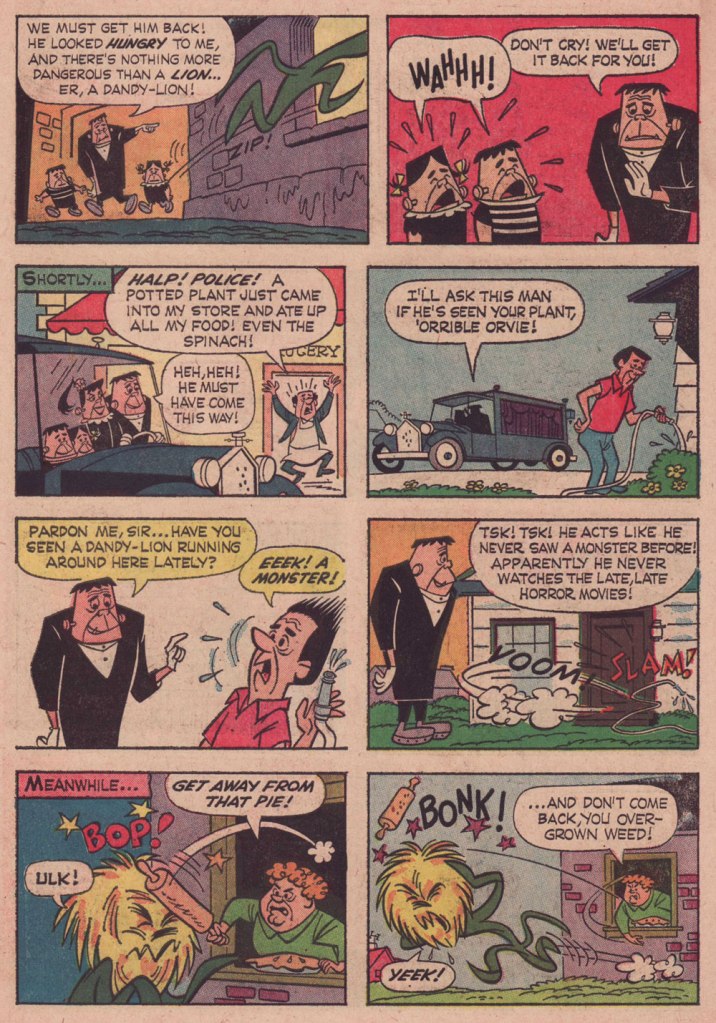
I was all set to run with a furry little yarn from 1965, but then, just a few days ago, my nice mail lady fatefully handed me a box of comics that included The Little Monsters’ titular inaugural appearance.
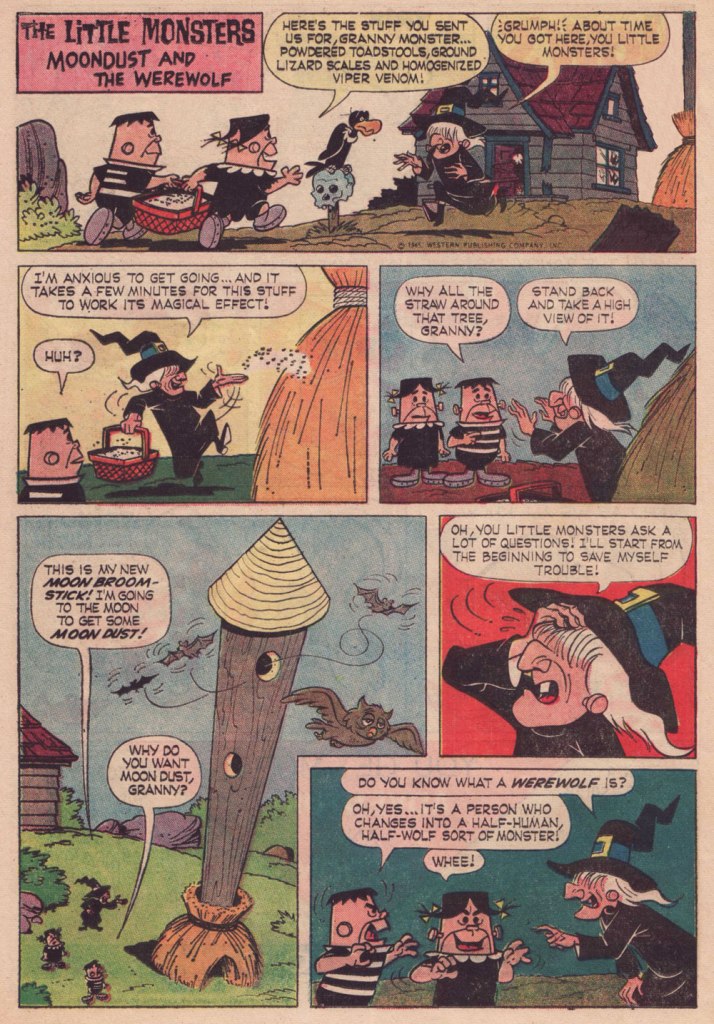
And, having mentioned it, here’s the story I had originally slated for this post: Moondust and the Werewolf from The Three Stooges no. 26 (Nov. 1965, Gold Key).
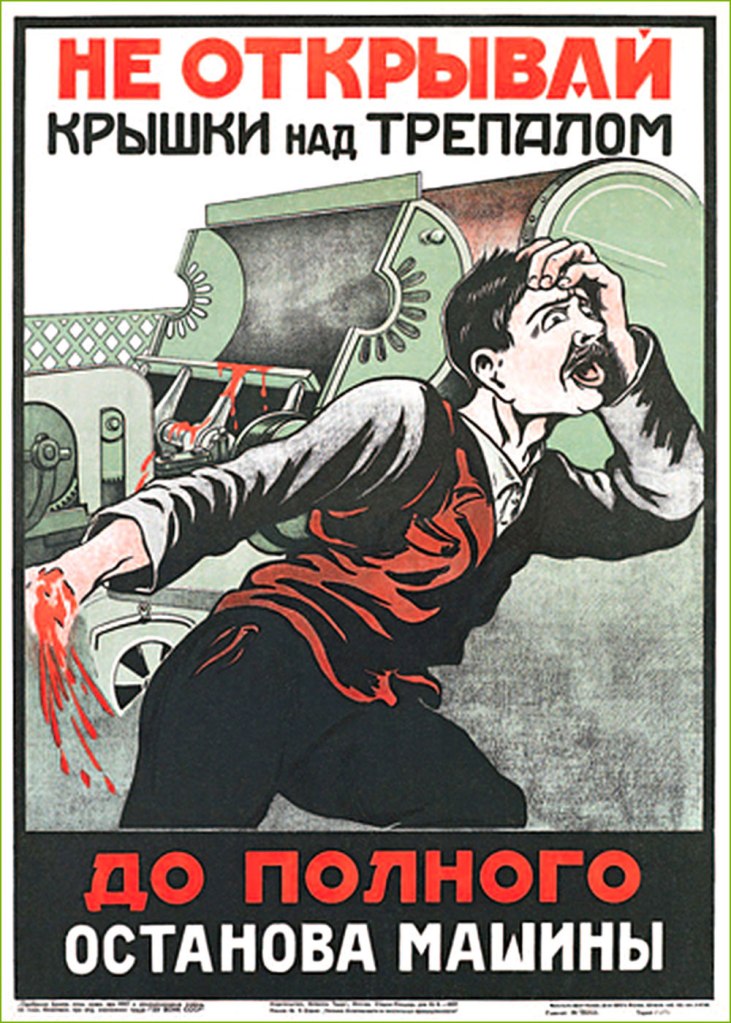
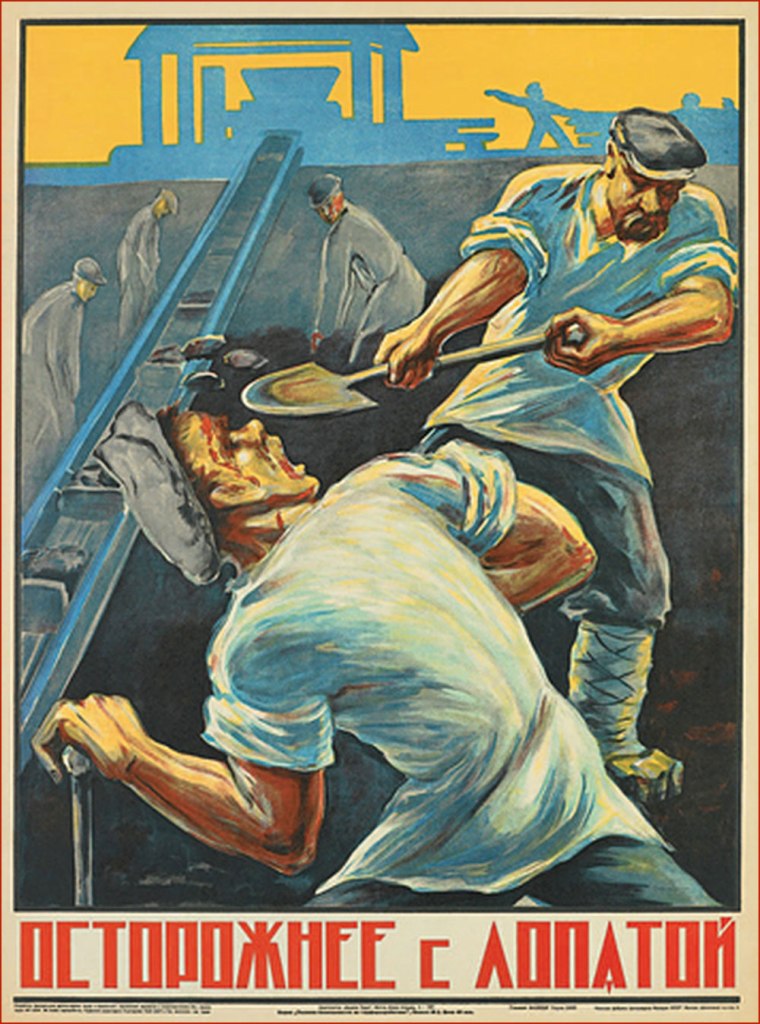
Look, some vintage horror movie posters! Or are they really?
Nope, they’re just posters reminding factory workers of some basic precautionary measures when working with all sorts of heavy equipment.
‘Don’t launch the motor using your hands‘ – ‘Don’t clean the machine while it’s on‘ – ‘An unprotected saw is dangerous – all clear?‘ – ‘Careful with the pitchfork‘
These images are undeniably striking, featuring bold fonts and surprisingly graphic imagery sending one’s imagination into the unpleasantly tactile land of torn appendages and squirting blood. Produced in the early-to-mid 20th century, these were meant to bring home a specific message* during dark times when safety measures were sorely lacking and working personnel was mostly illiterate. Unfortunately, it’s rather difficult to find these posters in decent condition, so today’s selection was somewhat dictated by what could be located online. This leaves out, alas, a couple of particularly gory examples. Still, I think you’ll agree that these fit a Hallowe’en count-down in graphics, if not necessarily in spirit!
*Something that goes like ‘don’t stick your body parts into the machine‘ is a good beginning.
‘Beware of railway couplings‘ – the distorted face of the victim expresses the grotesque horror of a saint being impaled by a devil. These posters must have been a great opportunity for artists to try out different styles in the restrictive atmosphere of the early Soviet union.
‘I was drunk in the workplace!‘
‘Don’t open the lid of the brake before the machine stops completely‘
‘People working above – don’t stand under the scaffolding‘… unless getting your skull smashed by a wrench seems like fun, that is.
‘Don’t leave anything unsecured on the scaffolding‘
‘Mind the wheels! In 1925, 200 people were injured under tramways.‘
‘Acid – follow the rules for its transport‘
The USSR was not the only country to resort to such candidly illustrated images in an effort to improve safety (let’s face it, a worker with fingers missing is no longer a good worker) – for example, Holland seemed to have its share of posters of chopped off fingers and electrocution.
« When asked if they would like to have sex with me, 30 per cent said, “Yes”, while the other 70 per cent replied, “What, again?” — Silvio Berlusconi
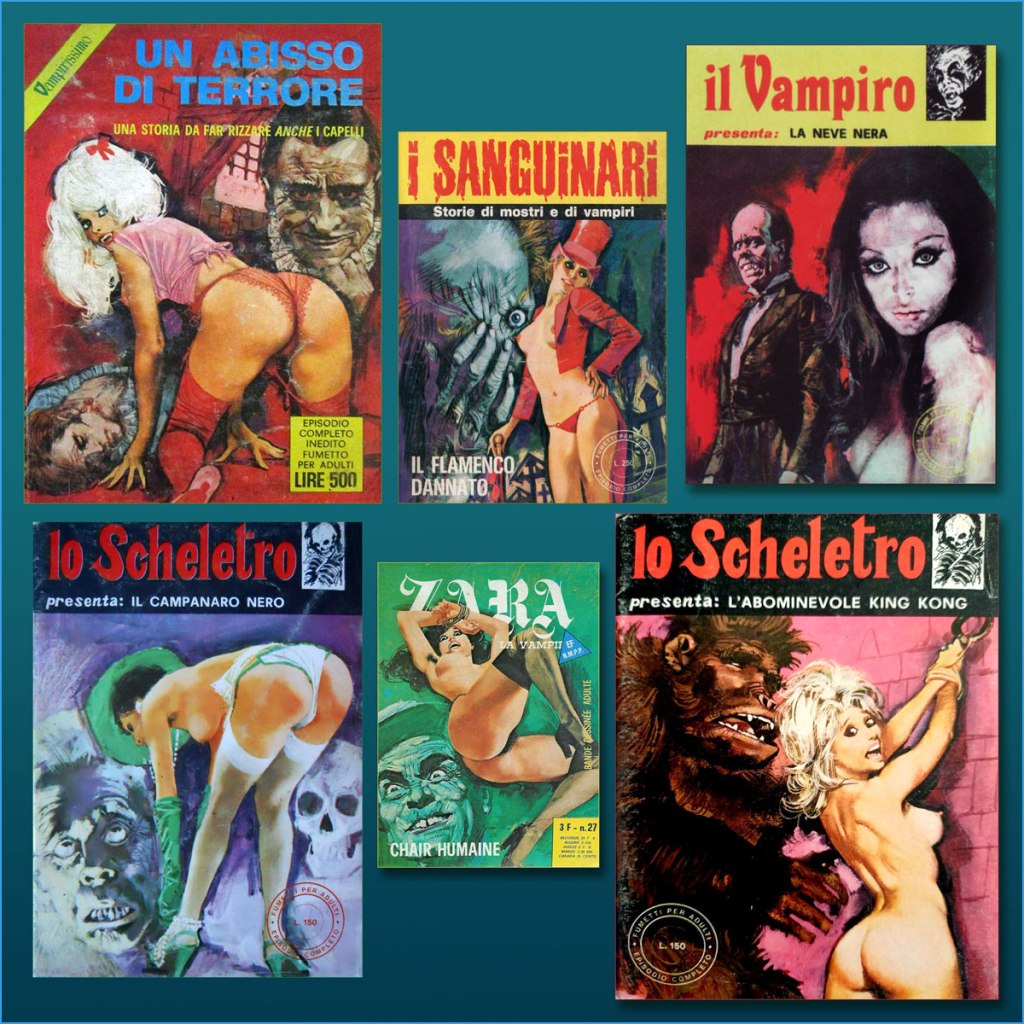
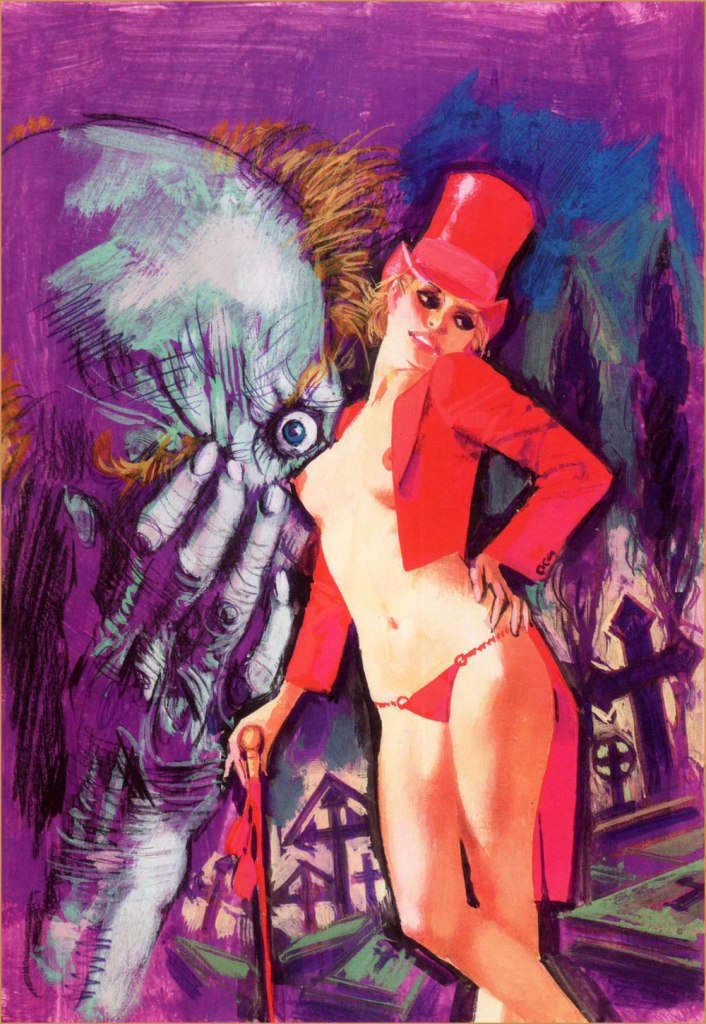
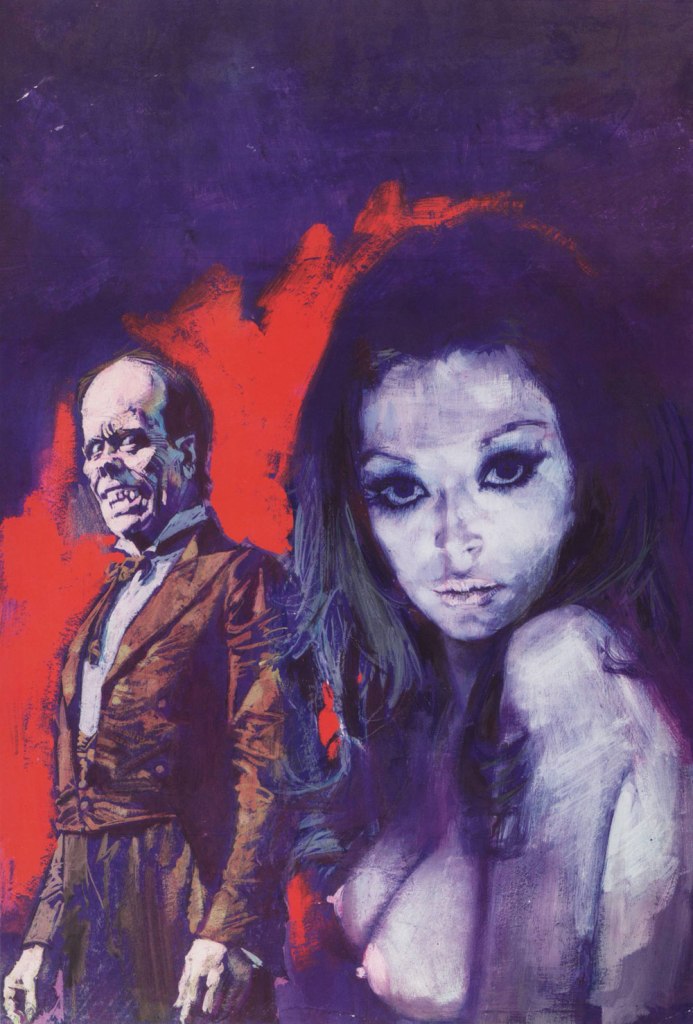
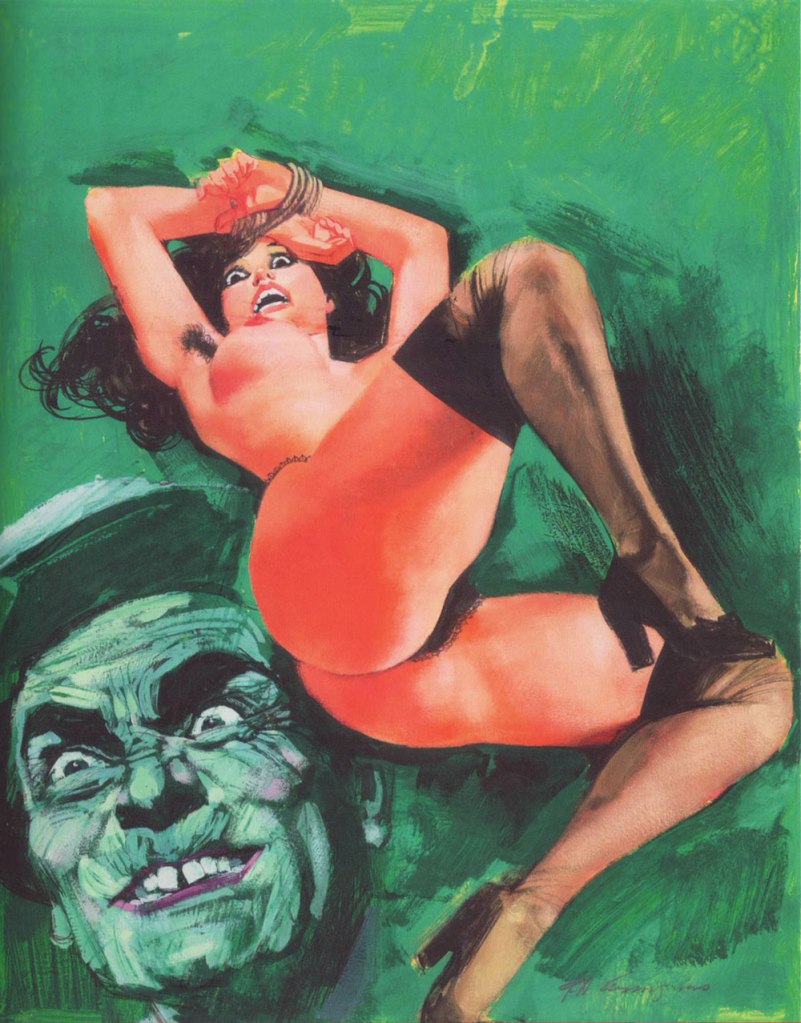
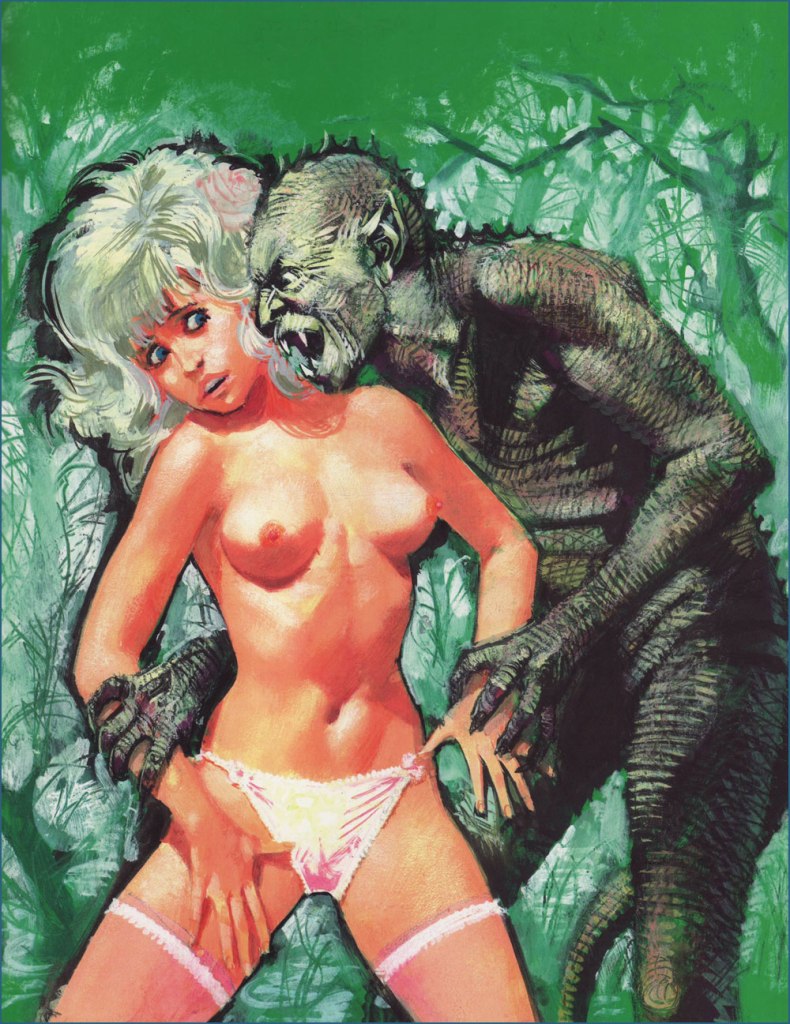
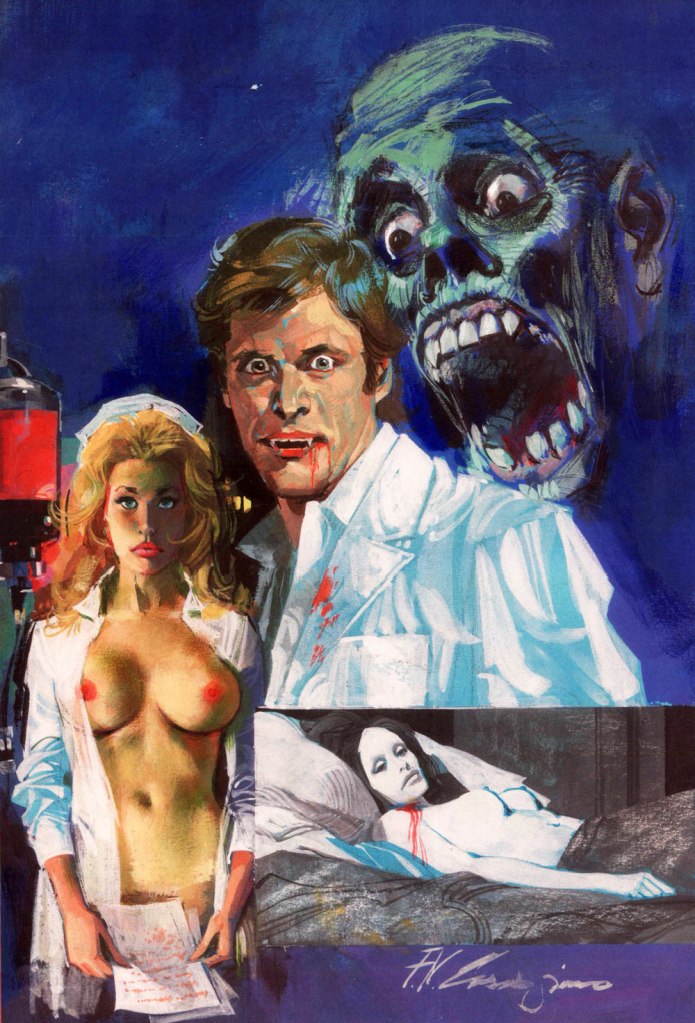
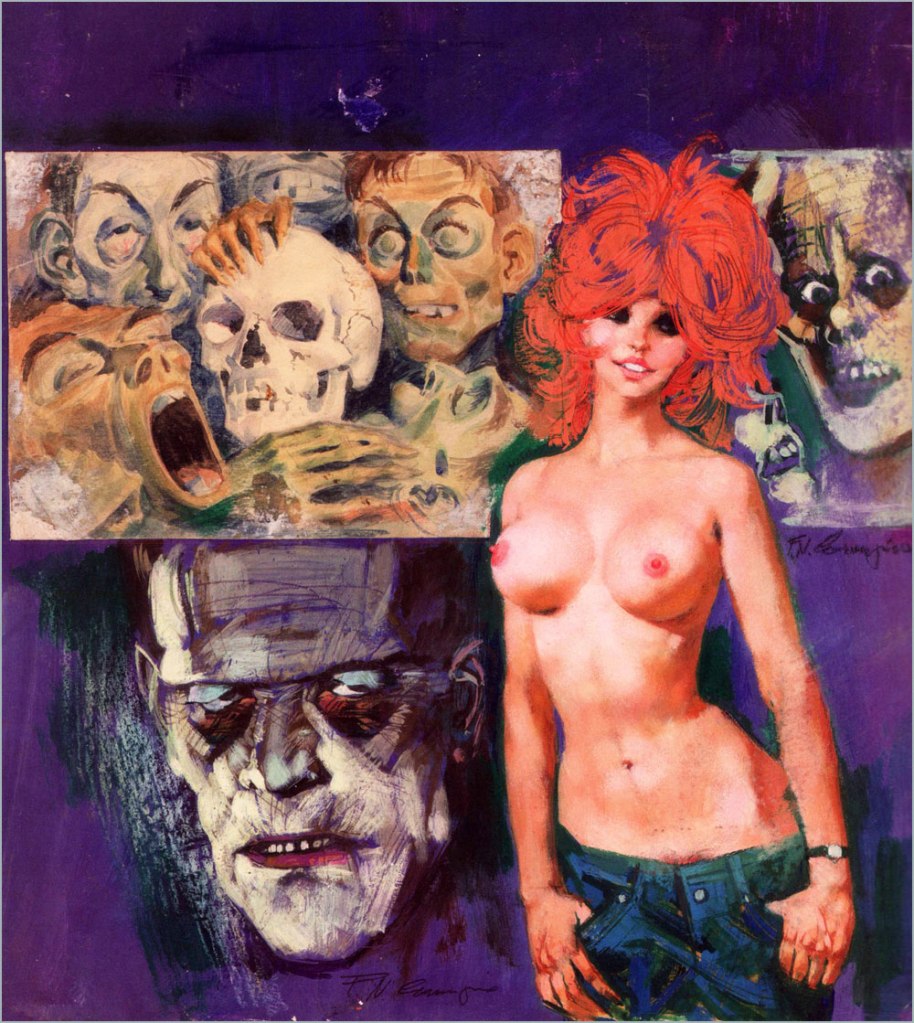
A certain subset of Italian Fumetti— namely the sex and horror digests of the 1970s — constitutes a quagmire of oft-truly repellent material in which indisputable gems yet glimmer bright. Mostly the covers… designed to lure the sailor — or reader — to his doom.
While several of the most prolific artists of the medium were evidently talented fellows, only a couple (Averardo Ciriello being the other one) truly draw my interest, since, despite low pay and a breakneck production pace, they didn’t swipe much… or at all — unlike their colleagues. For most of the industry and society, consent and copyright appeared to be pretty fuzzy, casually dismissed notions.
I favour the work of Fernando Carcupino (1922-2003) over that of his contemporaries because he always knew how to keep things light, bright and original — never wallowing in poor taste or sadism, even when the subject matter called for it, and I thank him for it. Here are some highlights from his illustrious career.
A piece from La Settimana Umoristica no. 5 (Apr. 1954) entitled “Celluloid Terror”. All the classic ghouls are there, even that very year’s Creature From the Black Lagoon. Carcupino could spot an enduring classic from a long way off!A selection of our fine products, as they appeared in print. Vampirissimo no. 11(Nov. 1975, Edifumetto). “An Abyss of Terror”.Leaned in too close and got poked in the eye! I Sanguinari no. 9 (July 1975, Edifumetto). “Flamenco of the Damned”. Il Vampiro no. 5 (March 1974, Edifumetto). “The Black Snow”. Why, hello, Mr. Chaney!Lo Scheletro no. 13 (July 1974, Edifumetto). “The Grim Bell Ringer”. Zora la Vampira no. 1 (Jan. 1974, Edifumetto) — “Human Flesh” In French, Zora became ‘Zara‘, for some reason.Lo Scheletro no. 3 (March 1975, Edifumetto). “The Abominable King Kong”. Tabù no. 23 (Oct. 1975, Edifumetto). “Please Don’t Bite My Butt”. I Notturni no. 9 (Sept. 1973, Edifumetto). “Peter the Fornicator”. Impressive, given his mug. Vampirissimo no. 8 (Aug. 1974, Edifumetto). “Death by Fright”. Oh, he’s a spooky one, all right. Vampirissimo no. 7 (July 1974, Edifumetto). “Monster Dimension”. This is the sort of composition and treatment that Bill Sienkiewicz would “introduce” to mainstream comics a decade later, blowing the minds of Marvel Zombies who’d consumed naught but the House of Ideas’ offal, just as Jim Steranko had blown their older brothers’, a decade prior. Lo Scheletro no. 7 (Apr. 1974, Edifumetto). “Demon in Love”. This fine* monograph from Korero Press (2019) spotlights a certain facet of Carcupino’s œuvre, though it’s pretty light on the horror, which is fine by me. The narrow thematic focus (on sex, the other half of the equation) does manage to render the proceedings a tad tedious after a while, but that’s to be expected. For a better sense of the man’s versatility, check out his website.
-RG
*marred somewhat by the usual “We Italians...” introduction, yet another variation on the line of “we are so passionate, we love women so much, we can’t control ourselves” bullshit. I guess it’s perfectly commonplace, for some people, to confuse misogyny with love . Right…
« Real art must always involve some witchcraft. » — Karen Blixen
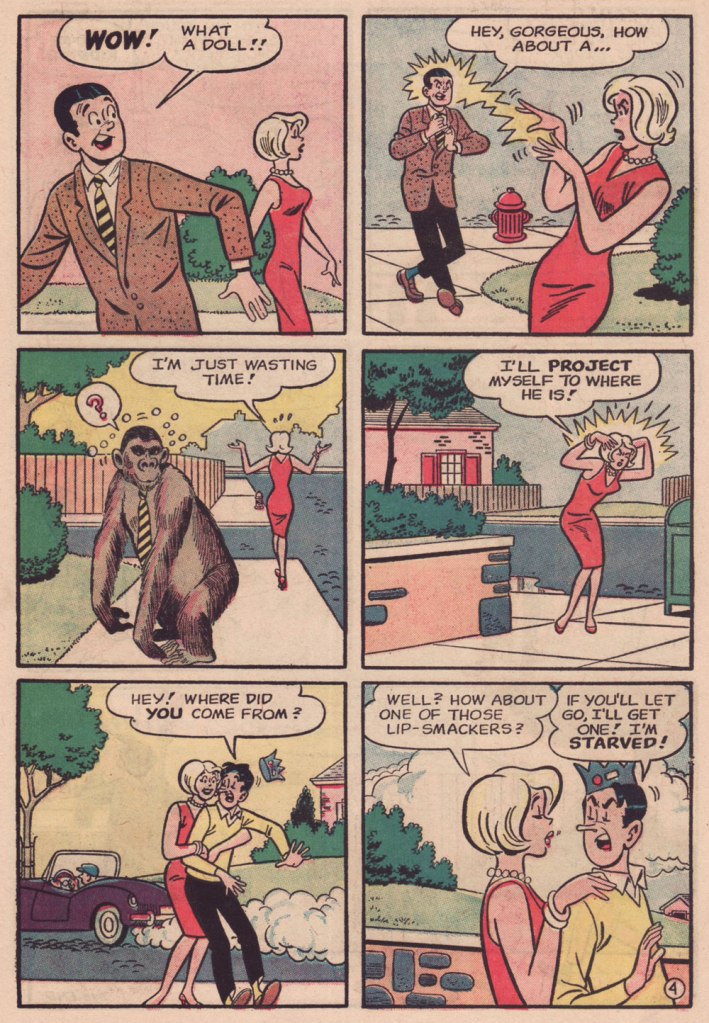
Ah, another Samm Schwartz story! And no wonder: born on October 15, 1920, Mr. S would be ninety-seven today.
“Love in Broom“, scripted by George Gladir and inked by Vincent DeCarlo, saw print in Jughead no. 116 (Jan. 1965, Archie). That amorous witch would return in Jughead no. 123‘s ‘Switch Witch‘. In the Archie universe, that’s *almost* continuity!
Since Jughead no. 116 had a strictly non-oddball cover by Harry Lucey, here’s a more thematically fitting one from local chouchouBob White. This is Archie no. 126 (Apr. 1962, Archie).
« This seems to be the Age of the Monsters. Monsters are all around us. They abound on the motion picture-screens, coming from the depths of the sea, from under the Arctic ice, from outer space, or other such unexplored regions. » — Robert Arthur, ghost-writing Alfred Hitchcock‘s introduction to Monster Museum (1965)
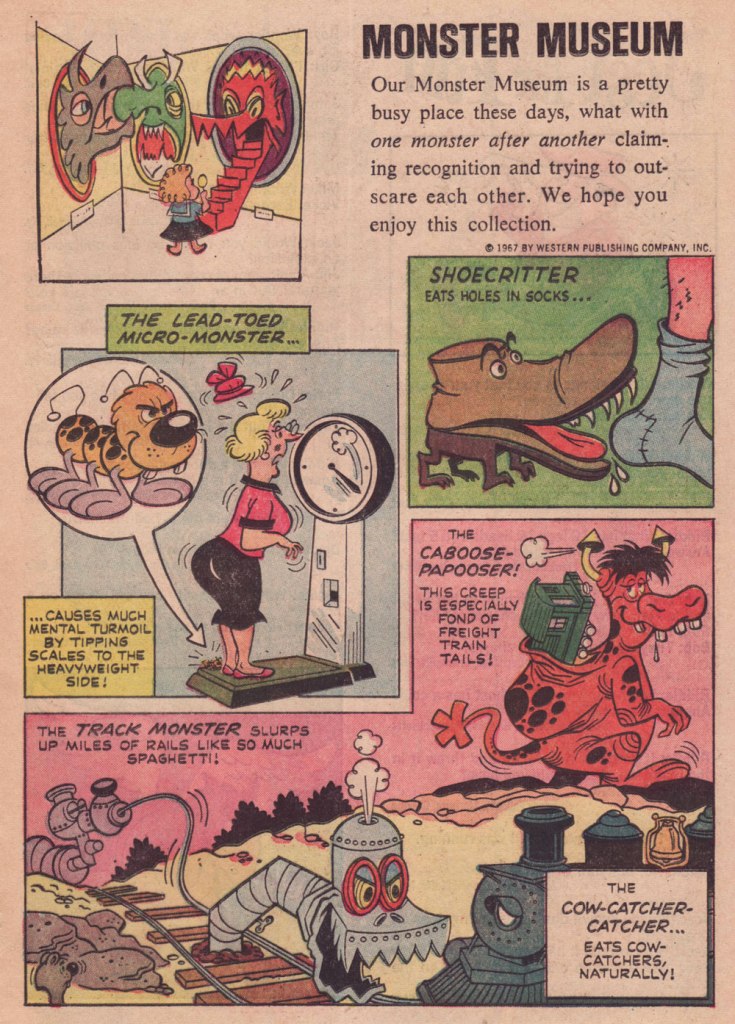
As Gold Key comics published fewer ads than most of their rivals, they could afford such frivolities as joke and riddle pages, even in addition to the legally mandated text pages.
One pleasingly off-kilter feature that appeared in the publisher’s small line of ‘spooky’ titles (Boris Karloff Tales of Mystery, The Twilight Zone and Ripley’s Believe It or Not) was “Monster Museum”. Though it seemingly couldn’t settle on an approach or tone, it was witty, lightweight fun. Here are most of the highlights.
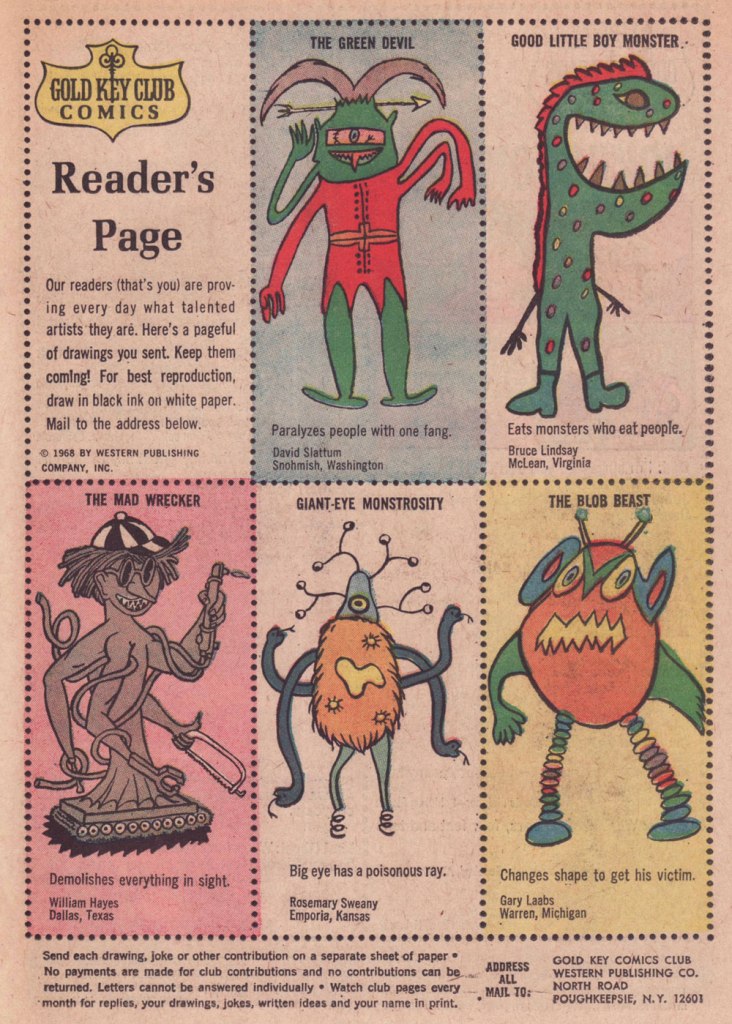
Then, as 1967 gave way to ’68, The Monster Museum became a reader-driven feature… for a single issue, namely Boris Karloff Tales of Mystery no. 22 (June 1968, Gold Key) — and two pages.
I thought it quite charming, brimming with that fascinating little-kid brand of logic we so quickly lose sight of as we ‘grow up’.
« If you don’t go over the top you can’t see what’s on the other side. » — Jim Steinman
On this blog — and these several past countdowns — I haven’t devoted much attention to the 1970s Skywald “Horror-Mood” line, mostly because it doesn’t often catch my fancy. My idea, my sense of Hallowe’en — and horror — is rather moodier and/or more whimsical, more innocent than the strain of the weird gathering momentum by the dawn of the decade, as exemplified by the Skywald line.
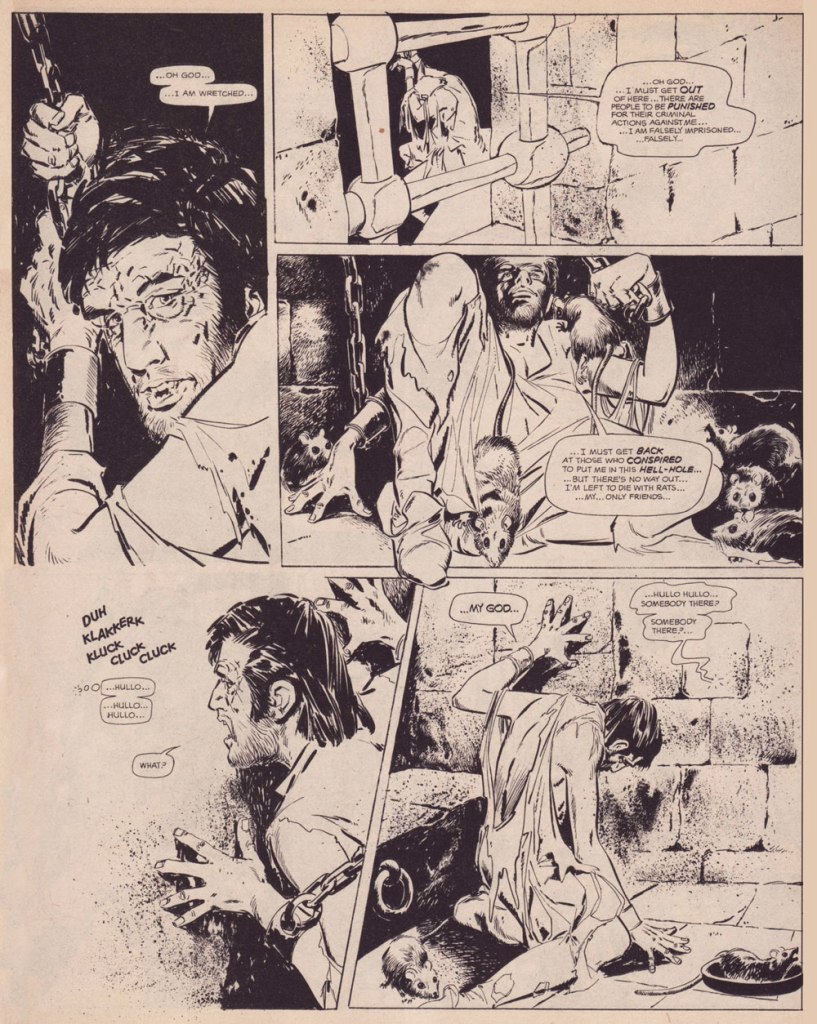
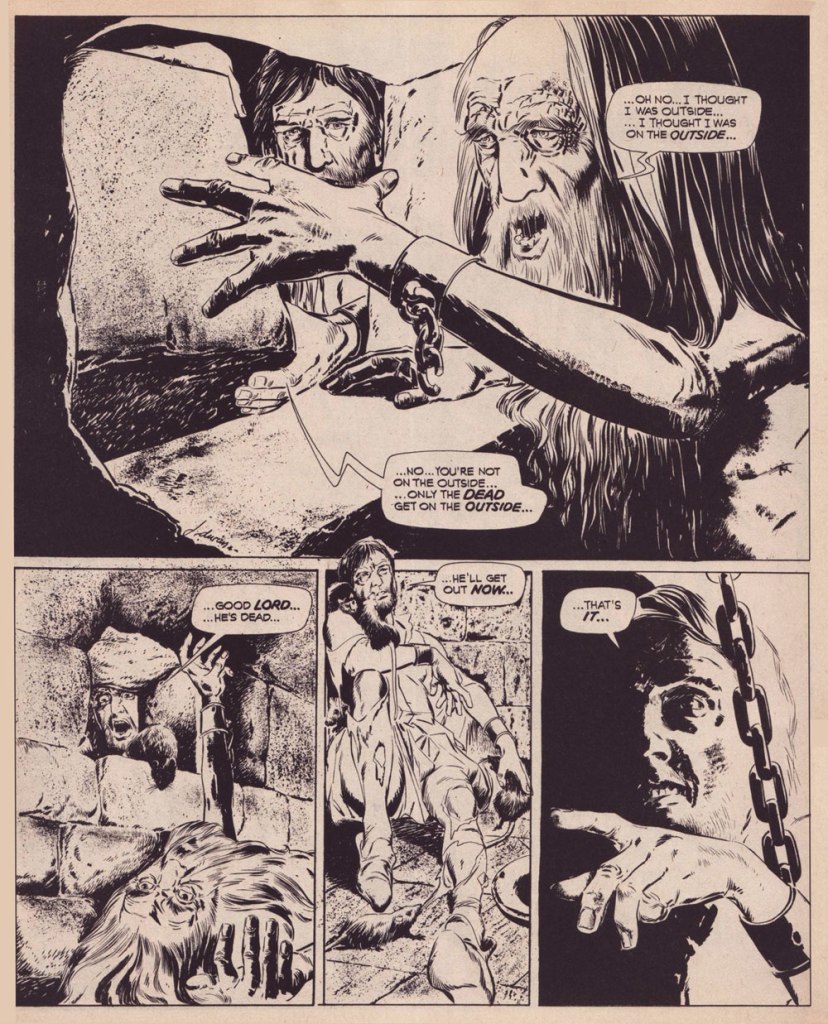
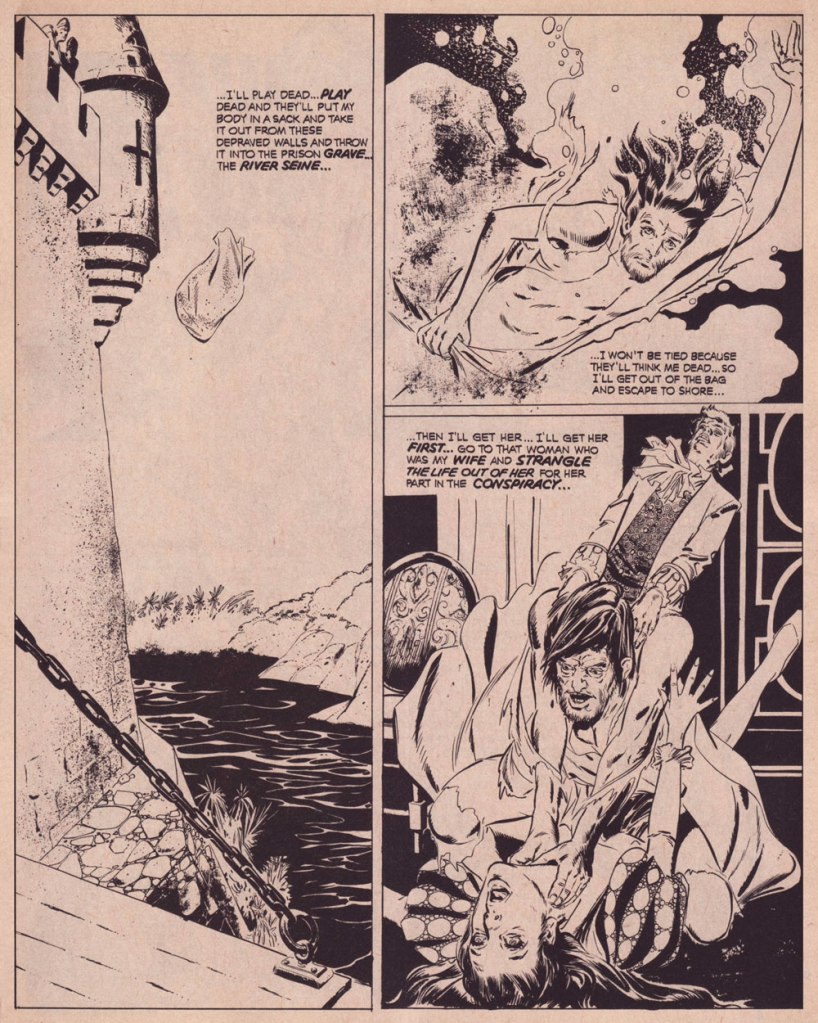
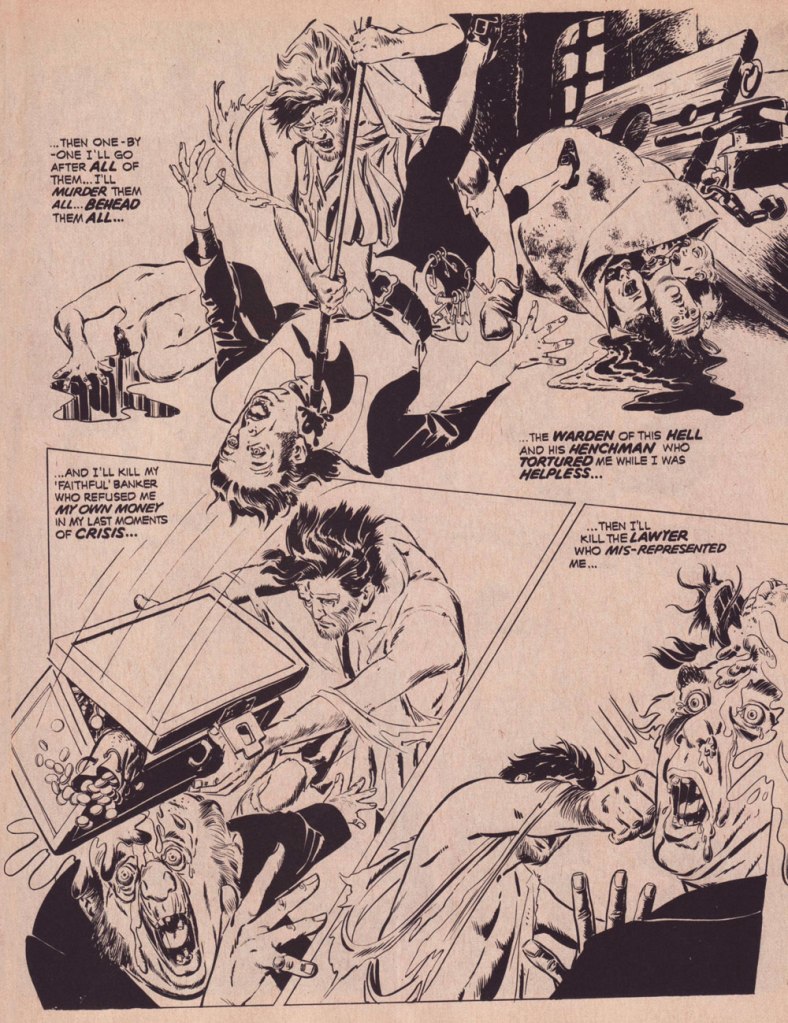
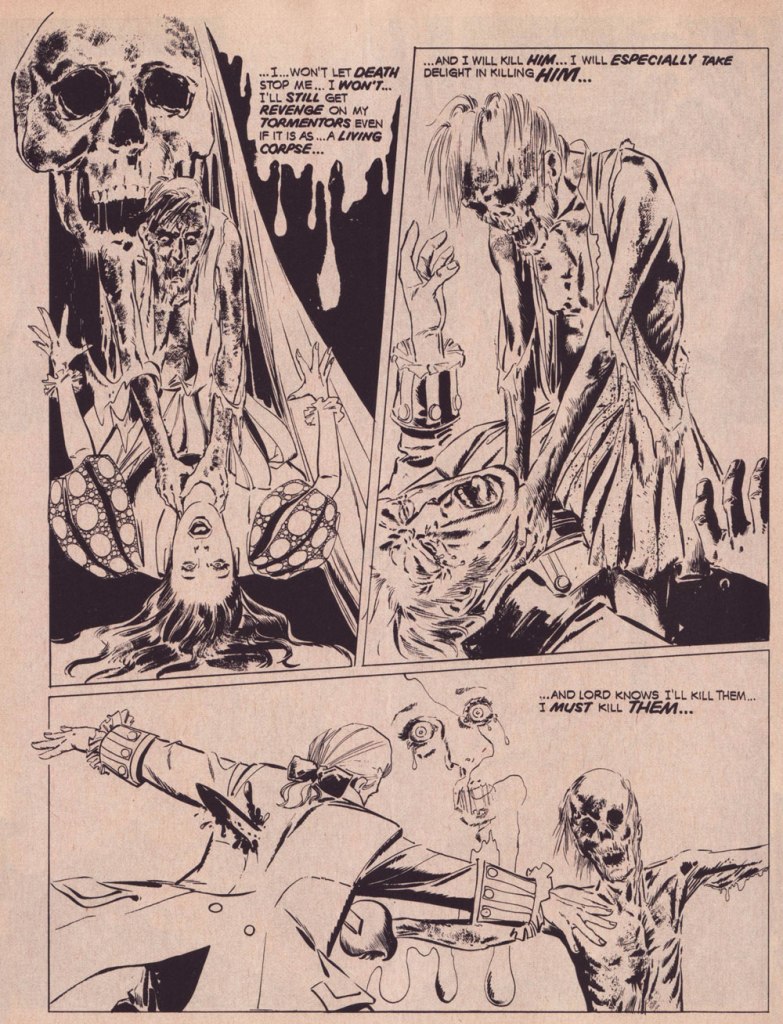
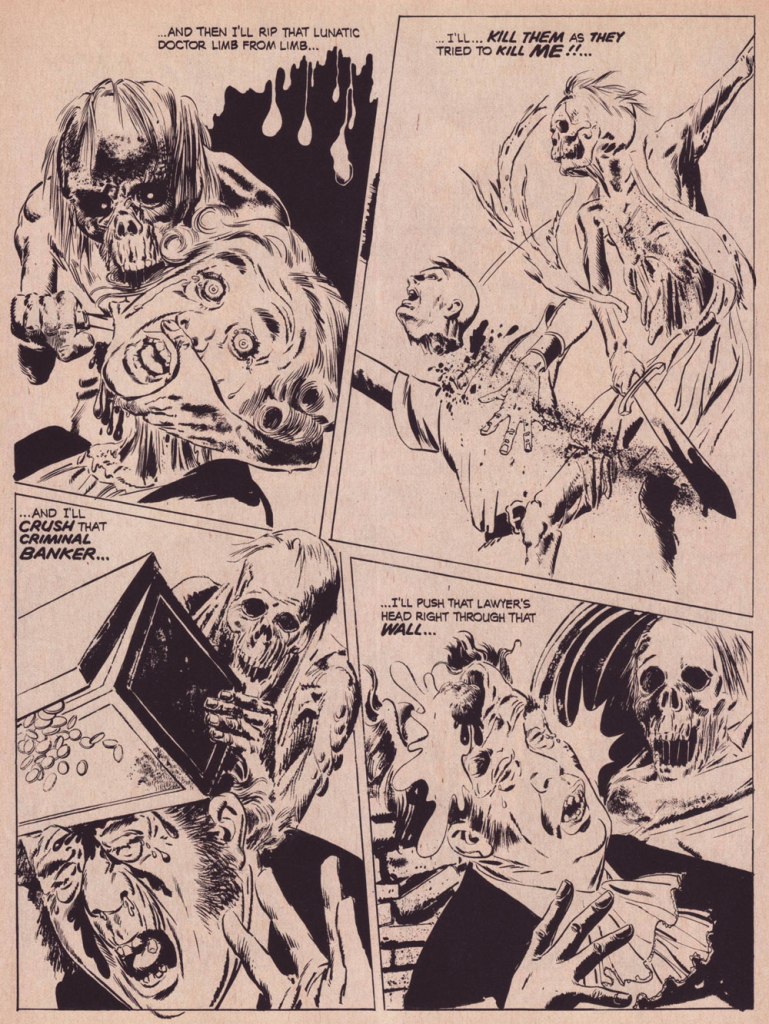
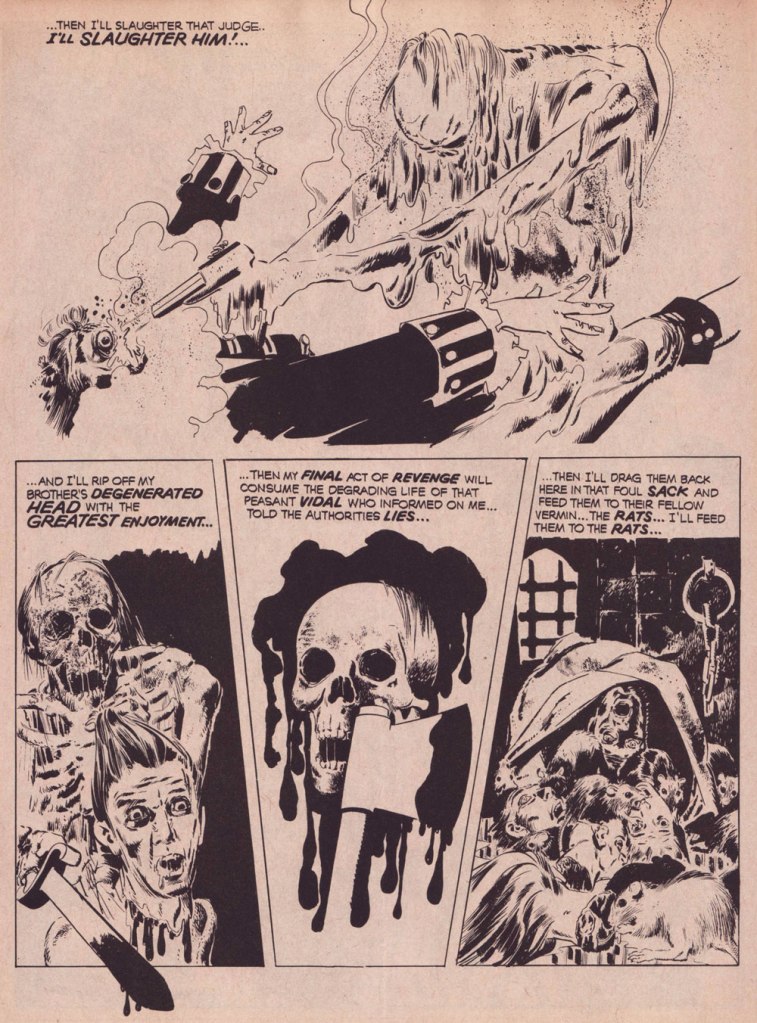
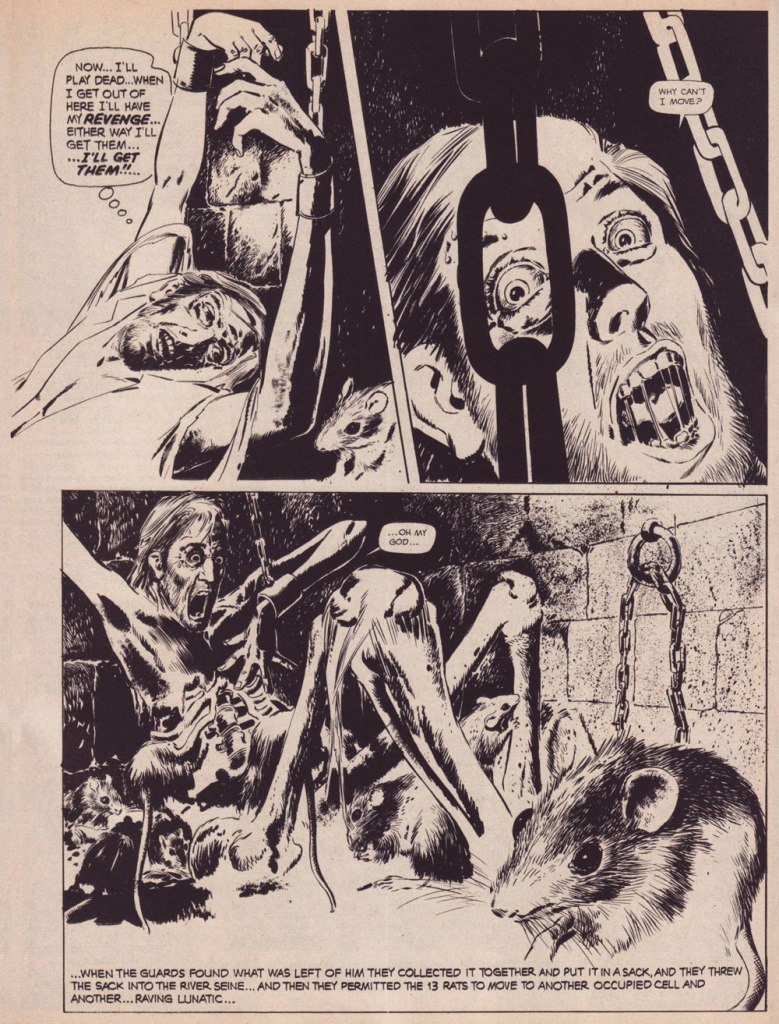
But what makes this entry an exception? Well, this thing’s so enthusiastically bombastic that it’s hard to take seriously. Yet the craft on display is tough to deny. Courtesy of Messrs Alan Hewetson, writer (also the rag’s editor) andJesús Durán Castillo, illustrator, “13” is a messy patchwork of dangling bits purloined from Ambrose Bierce‘s An Occurrence at Owl Creek Bridge, Edgar Allan Poe‘s The Pit and the Pendulum, and (what the heck) traditional French-Canadian folk song Dans la prison de Londres (Hewetson’s Canadian, let’s not forget). It’s also a jaunty, bracing scamper on the bonkers side, a wild ride on the escalating, circular chain of delusional obsession. Buckle up!
If you’ll forgive me the interruption, that top panel is a classic.
Who knows… was this, in some queer fashion, an inspiration for the 1997 Joe Pesci vehicle 8 Heads in a Duffel Bag?
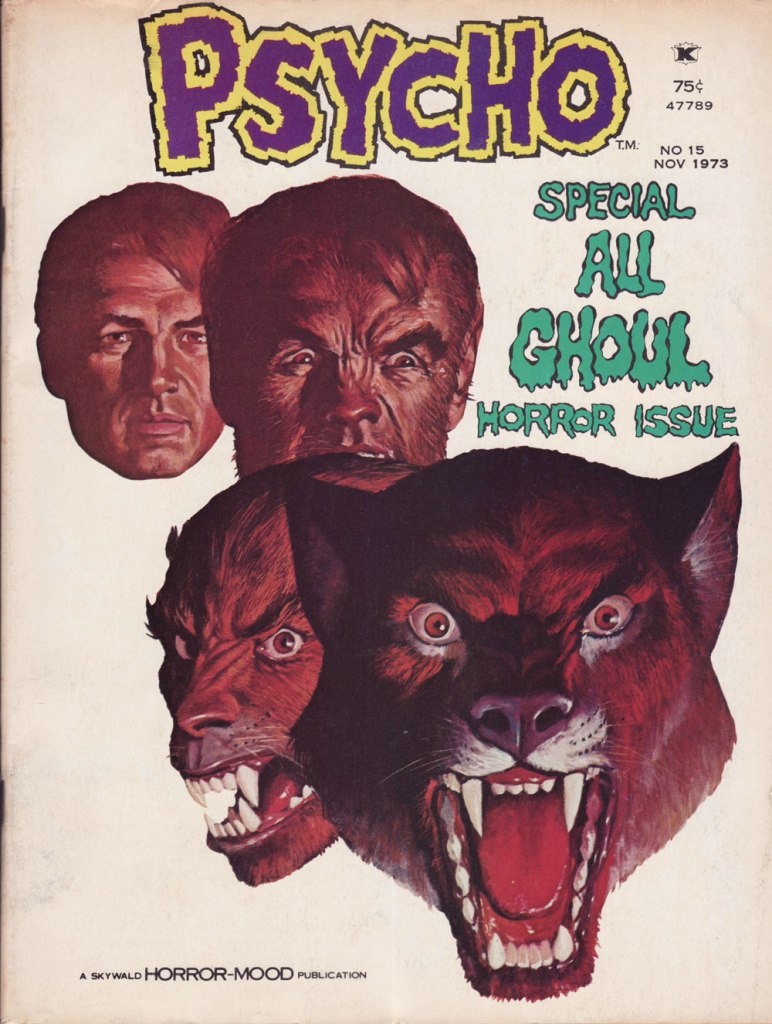
“The 13 Dead Things” appeared in Psycho no. 13 (Nov. 1973, Skywald), bearing this lovely cover painting by Vicente Segrelles.
« There are no innocent bystanders… what are they doing there in the first place? » — William S. Burroughs
I’ve sung the praises of The American Bystander before, and I do believe it could still use whatever publicity it can get. And so here are some choice excerpts from the magazine’s Hallowe’en-themed issue — no. 13 (naturally), Fall 2019… starting with its unfathomably gorgeous double-spread by Armando Veve.
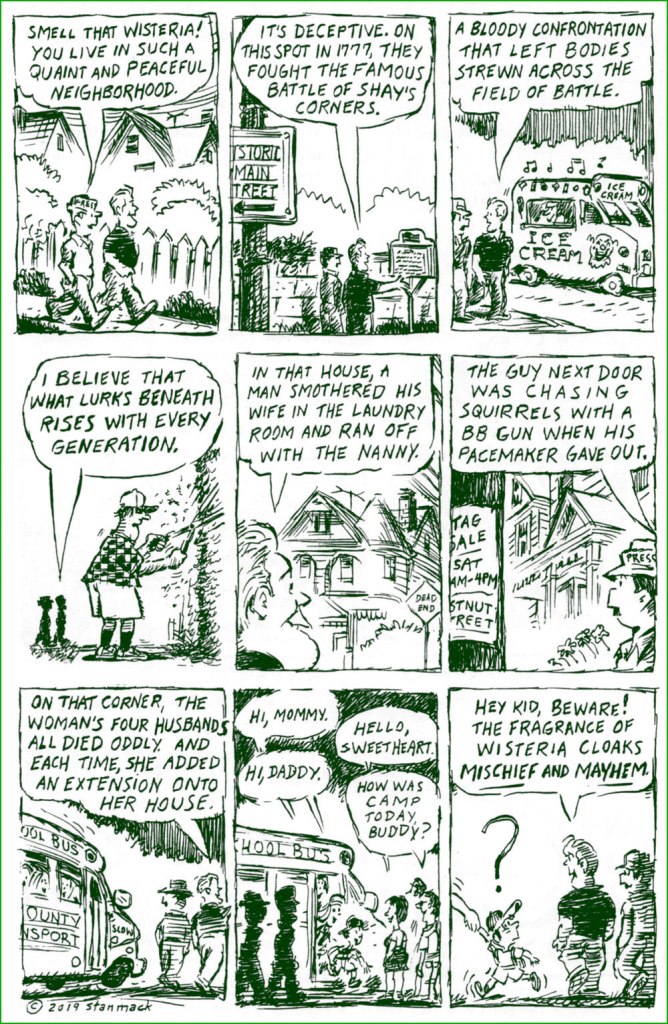
The editor wrote: « Some of our covers are so good they could conjure an entire book, and when Armando Veve delivered his art, a whole story blossomed in my brain. This wired witch is speeding to her digs downtown, a well-appointed brownstone on West 11th between Bleeker and West 4th. She received the deed some years ago from a grateful secretary of state Seward, in exchange for “Mr. Stonewall Jackson’s unfortunate accident.” More recently, she’s occupied herself by magically manipulating the stock market; she delights in dropping enormous, anonymous college scholarships into the laps of earnest high school Wiccans. Most afternoons she can be found at Tartine, eating pastries and slipping love potions into unsuspecting patrons’ teacups. She agrees that the neighborhood isn’t what it used to be but — being 227 — knows it never was. » Horror is around all the year ’round… we just celebrate it more fervently in the Fall. A strip by Brandon Hicks.I certainly hope that’s not Joltin’ Joe DiMaggio‘s spectre on the right, since he couldn’t handle that scene in real life. A cartoon by Matt Percival.I love that extra second-level chuckle (hint… ‘spell’). A cartoon by The New Yorker cartoonist Mick Stevens.A low-key guide to lethal passion in the suburbs from WOT? favourite Stan Mack. And I’m with the squirrels; that neighbour got what he deserved.The kids’ grapevine is utterly unforgiving. If you’re very fortunate, your ill repute will turn over with the next generation. A strip by Jim Siergey (b. 1949).










































 Who's Out There?