Fungus Friday: Ah, the Bohemian Life

« Parmi les champignons se cachent d’ignobles individus, des espèces savoureuses et des sujets tout à fait pacifiques… »

December may not be exactly the month one associates with mushrooms, but that is precisely when mycophiles get broody and start cataloguing (mentally or otherwise) new species encountered during the warmer months*, dreaming about spring and its new flush.

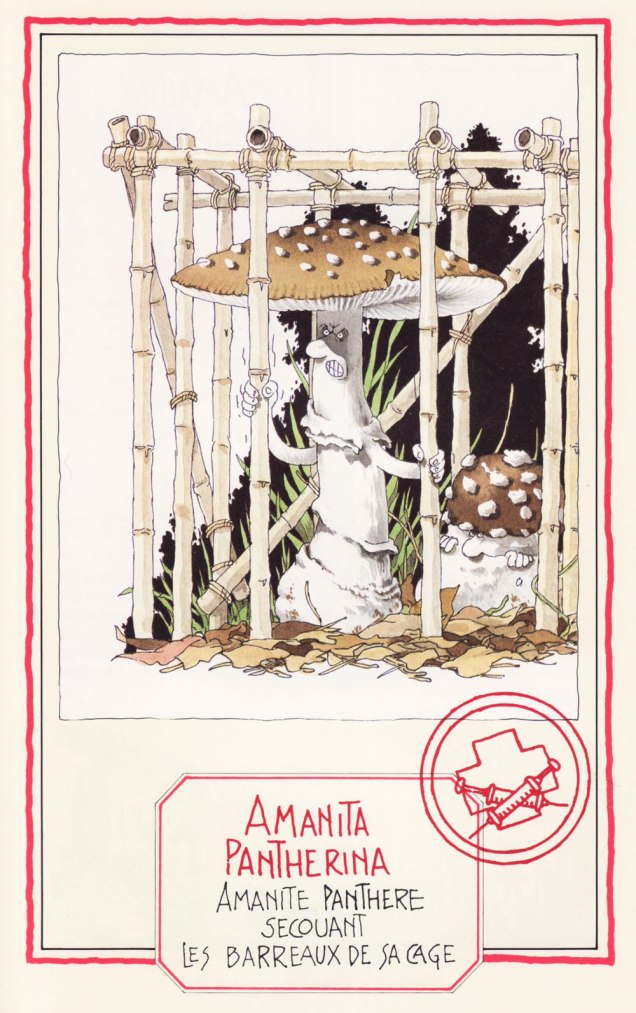
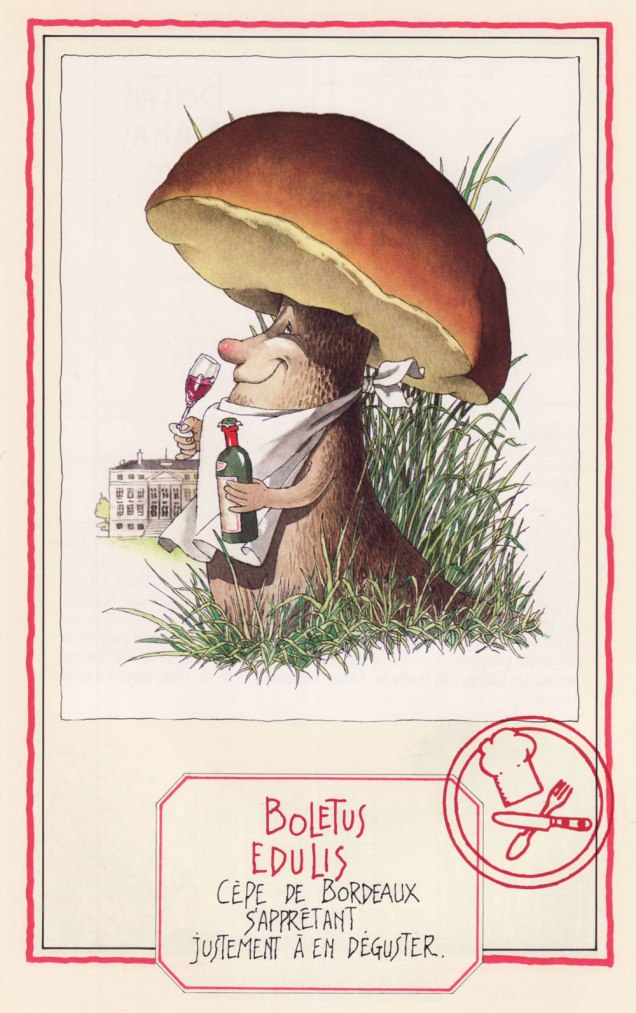
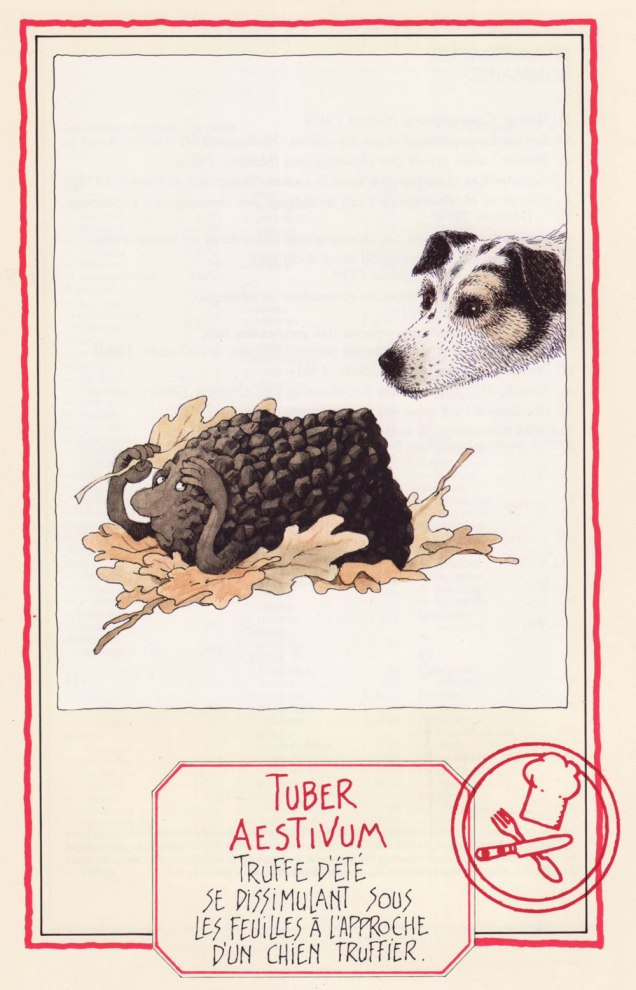
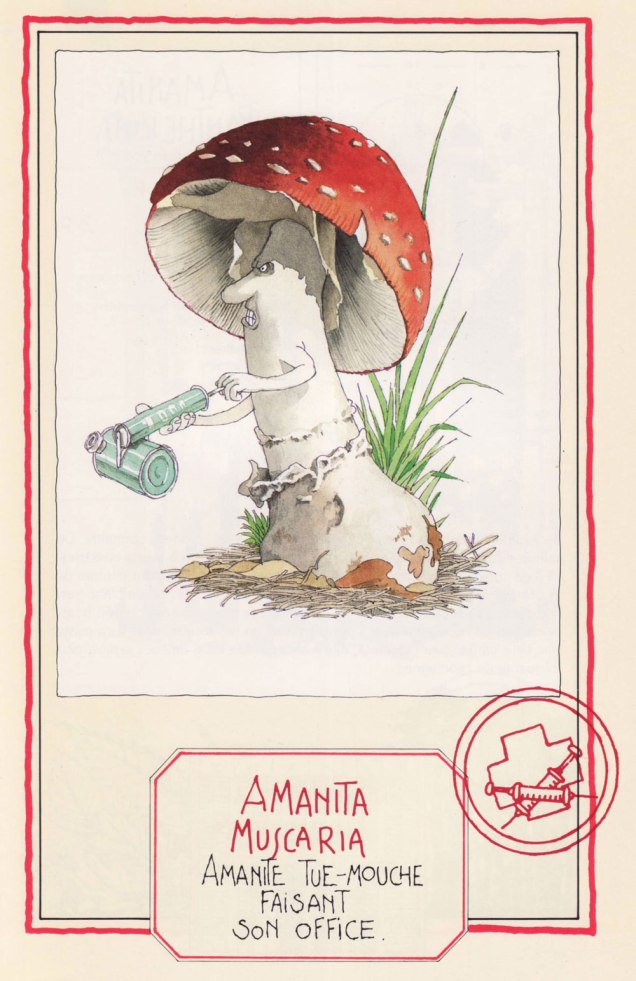
Here’s a selection of mushroom portraits taken from Le gratin des champignons by Roland Sabatier, an outstanding artist previously featured by co-admin RG in « Pépin le Long, You’re Fired! » (and, need I mention, a member of the Mycological Society of France). The second reaction I had upon leafing through this volume’s pages (the first was to squeal delightedly) was stunned admiration regarding the level of detail with which each mushroom is illustrated. I am by no means the first to note this (in his outstanding introduction, Georges Becker**, co-author of this tome, makes much the same point in far more eloquent prose), but it bears mentioning that while Sabatier may have transformed mushrooms into wonderful characters with their own games and stories, he managed to so very rigorously observe and illustrate their characteristics that one could actually use this book as a mushroom guide and not get, you know, poisoned.

Let’s get cooking!

Speaking of getting poisoned, meet four Amanitas, a most deadly genus… with a few delicious, choice morsels thrown in to keep us on our toes:
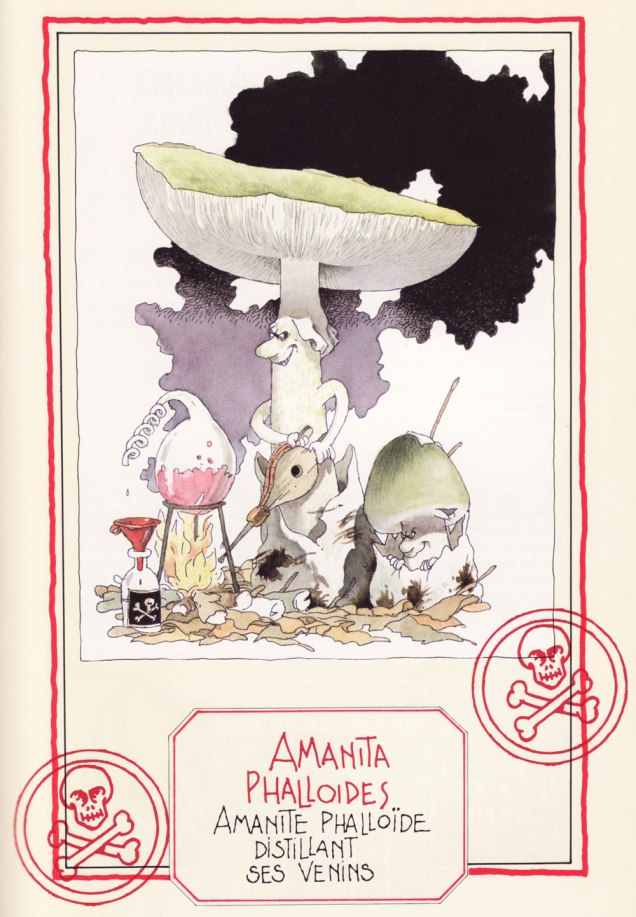
The Death Cap… distilling its own venom. A most lethal animal.
The Fly Agaric, probably the most depicted mushroom in the arts, ‘performing its function‘. Despite its reputation, it is not deadly per se, as alluded to in a previous post (Fungus Friday: Amanita New Year (To Get Over This One)).
The Blusher, so called for its propensity to blush a pink hue when bruised (or embarrassed, one presumes). These wino amanitae exiting the tavern definitely look sloshed.
The handsome Panther Cap, shaking the bars of its cage. Like its Fly Agaric cousin, it’s not deadly as such, and has some psychoactive components. Admire its striking looks here.

Now we move on to more traditionally edible characters —

The Banded Agaric is also known as ‘Pavement mushroom’, which explains this fur-foxed lady showing her goods… walking the beat, as it were. This lady is tough as nails, and has been known to burst right through the pavement. Is she edible? You bet! ***
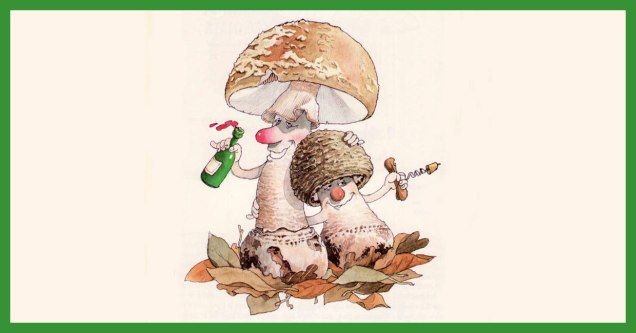
Ah, mushroom of many names (does this make it the rose of mushrooms?) – Penny Bun, Porcino, Cep, call it what you will… highly prized throughout cultures, fragrant à souhait. Here the cèpe de Bordeaux is about to savour some Bordeaux wine.
A favourite of WOT admins, the Fairy Ring Mushroom, saddled with an unfairly gloomy Latin name (‘marasme’ comes with an etymology of ‘wasting away’ or ‘decay’), dancing a ronde. Undemanding and widely spread, this mushroom dries most excellently (sometimes right on the very lawn it grows upon) and enlivens soups and stews throughout winter.
Another well-known mushroom, the Golden Chanterelle, as beautiful as it is fragrant. Will I picture these playing tiny little violins every time I find them in a forest? Absolutely.
We couldn’t resist adding this scene depicting the Summer Truffle trying to camouflage itself as a truffle-sniffing dog approaches. I love the inquisitive gleam in the doggo’s eye.
We wrap up with, well… I trust you can interpret the Latin well enough without me. The Common Stinkhorn (‘stinky satyr indulging in his depravity‘) is actually edible, though not nearly as popular (or tasty) as another member of its family, the pretty Veiled Lady. Whether you would actually want to eat it is another question.

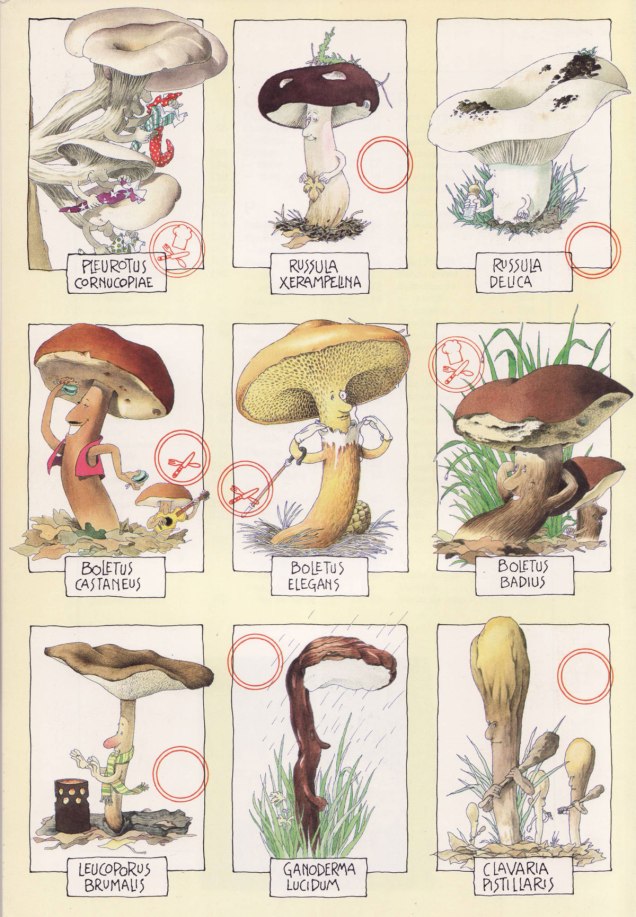
First published in 1986, this book has known several editions to update nomenclature (some mushroom families and names have changed considerably in the last 40 or so years, which is its own topic). We have the 1991 edition, published by Glénat. Sabatier had so many favourite mushrooms he illustrated, they didn’t even all make it into the book officially… which is truly a crime. Take a peek at some other of his mushroom people, only included on the inside of the book’s cover (but at least included in that smaller capacity!):
~ ds

* Technically one can find some mushrooms during winter, but that is not my area of expertise (at least as yet).

** French mycologist of renown (1905-1994), as well as writer, politician and apparently even musician (piano).

*** I’m actually not a big fan. This Agaricus tastes too much like the ‘champignon de Paris’ mushrooms sold in supermarkets to be of much interest.
Fungus Friday: Meet… The Mushroom Man

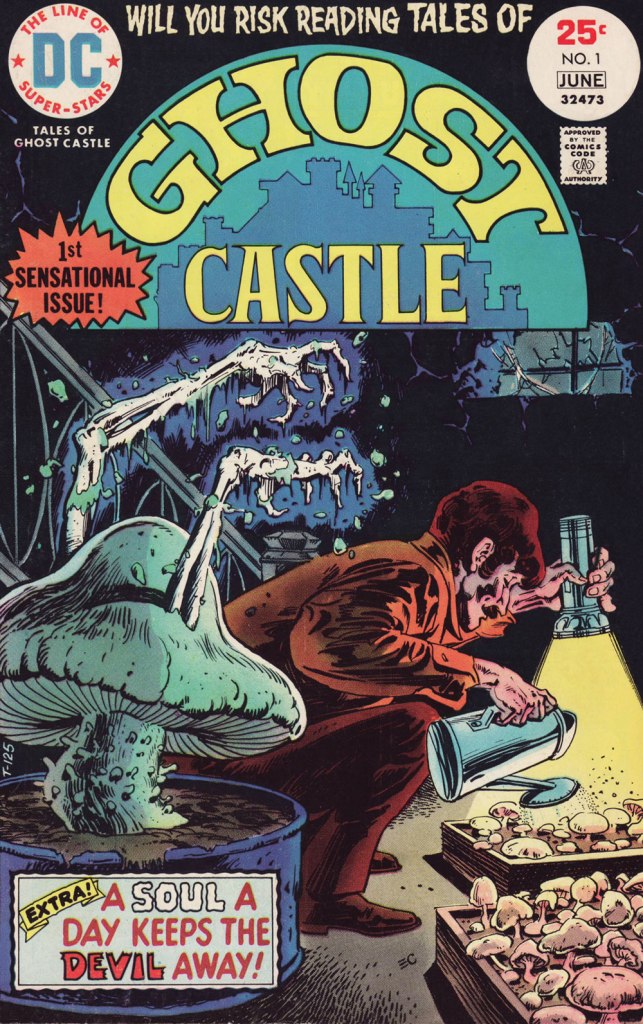
Every once in a while, we celebrate the end of the working week with a leisurely walk through fungal pastures. This week’s installment is a bit on the spooky side, so if you are troubled by a little case of mycophobia, an affliction many suffer from, stick around for a spine-tingling experience. Me, I was definitely rooting for the mushrooms 🍄

The cover of this issue promised some mushroom goodies, so of course my interest was piqued, even though it makes no sense whatsoever to have skeletal arms protruding out of a fungus. Tales of Ghost Castle no. 1 (May-June 1975, DC). Cover by Ernie Chan; Tex Blaisdell, editor.

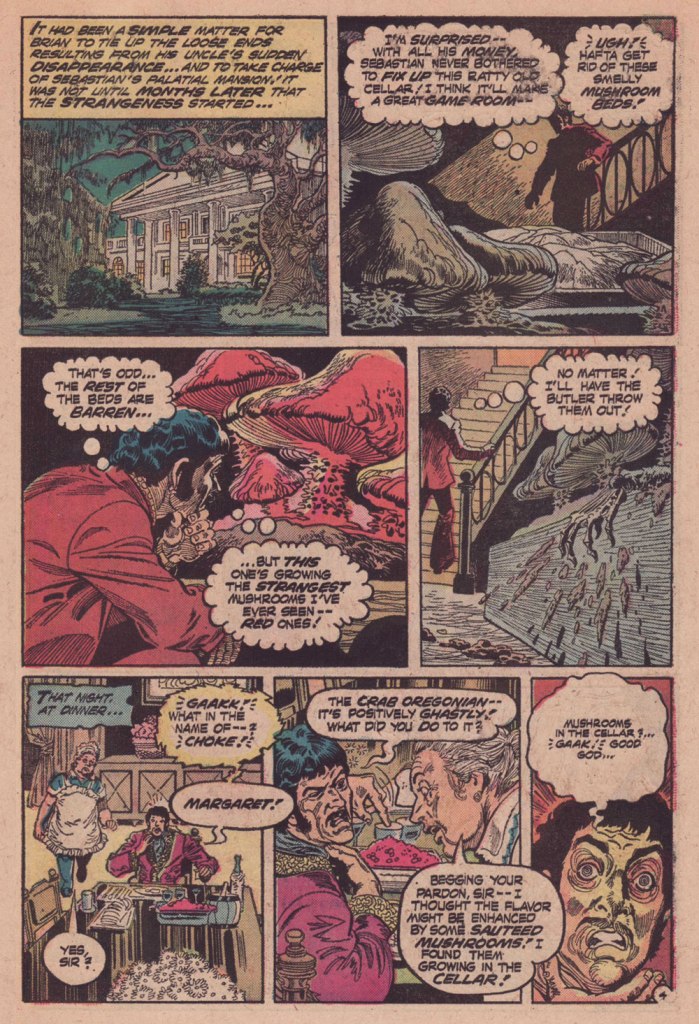
The cover story – 5-pager The Mushroom Man, plotted by David Michelinie, scripted by Martin Pasko, and illustrated by Buddy Gernale – is a tad more mycologically convincing.

Knowing that the fungus fancier is dead right from the beginning depressed me a little bit. However, starting at the scene of the crime to pursue in mushroomy flashbacks makes for good storytelling.
It’s possible for a mushroom to degrade super quickly (see, for example, shaggy manes aka Coprinus comatus that can deliquesce into a puddle of black goo in less than 24 hours after popping up), though 3 hours is pushing it a bit. ‘Nightdreamer’ sounds distinctly psychedelic, so we can take a guess about what kinds of ‘gourmets’ the uncle is referring to.
Did no-one wonder what happened to the uncle?
It’s not a ratty cellar, it’s an appropriately dark and humid cellar, you philistine. A ‘simple matter to tie up loose ends‘? Maybe the police had mycophobia, too, to let the matter drop so easily. One might add that cooking random mushrooms growing in the cellar is not recommended.
Hello, scene from Last of Us.

We are the champignons, my friends! Quite literally, in the case of this money-grabbing, murderous nephew.

~ ds

A Fabulous, Furry Fungus Friday!

« No wonder psychedelics are threatening to an authoritarian religious hierarchy. You don’t need faith to benefit from a psychedelic experience, let alone a priest or even a shaman to interpret it. What you need is courage to drink the brew, eat the mushroom, or whatever it is, and then to pay attention, and make of it what you will. Suddenly, the tools for direct contact with the transcendent other (whether you call it God or something else) is taken from the hands of an anointed elite and given to the individual seeker. » — Dennis McKenna

Sensing that I’ve been neglecting Underground Comix in our coverage, I thought I’d close out the year with a thematic pairing of a favourite comestible with a beloved cartoonist (and his collaborators).

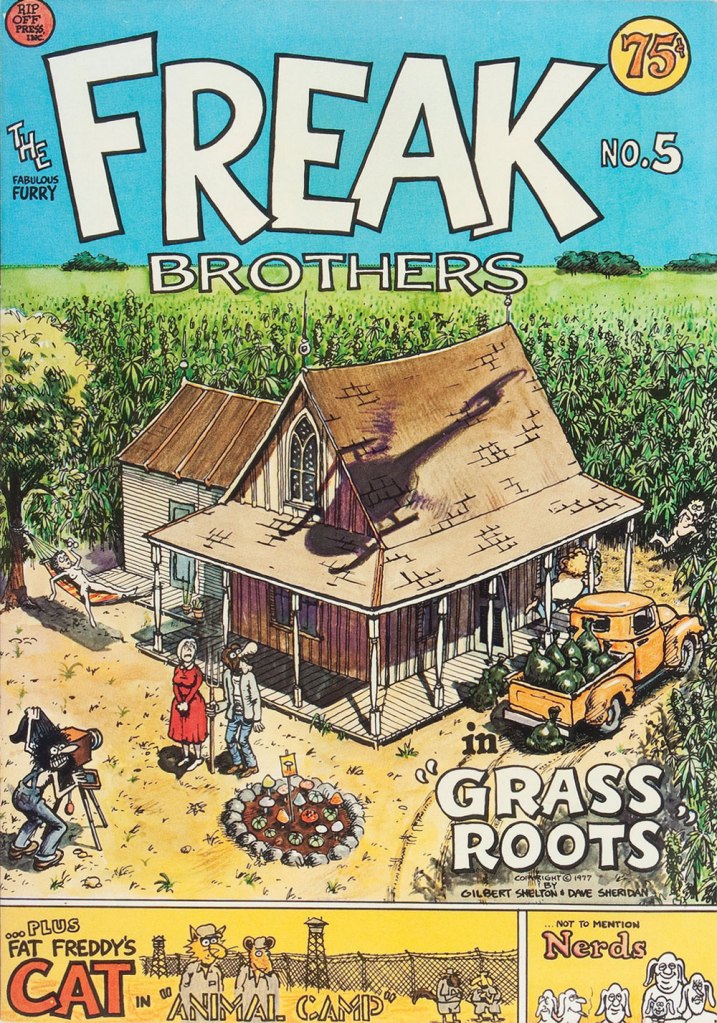
That’s a pretty fanciful mushroom patch there, boys. I doubt that mushrooms would grow much, if at all, in the blazing prairie sun… let alone that neatly. Artistic licence, then! This is The Fabulous Furry Freak Brothers no. 5 (May 1977, Rip Off Press). Cover by Gilbert Shelton and Dave Sheridan.
An old girlfriend of mine once echoed Fat Freddy’s bonehead sentiment: “Ew… mushrooms grow in shit!“, presumably unaware of the role manure has always played in agriculture. She went on to marry a succession of Frenchmen, and given their nation’s appreciation of fungi, I hope she was smart enough to not express out loud that bit of… wisdom.

By the way, Phineas is right, as usual. Here’s more info on the relationship between mushrooms and cow flop, and an ‘easy guide to picking‘…

One Pizza With Mushrooms to Go! first saw print in The Fabulous Furry Freak Brothers no. 4 (November 1975, Rip Off Press). This is Shelton and Sheridan’s original cover art, which fetched a handsome 43,000 dollars and change when it was auctioned off in 2016.
Ah, roommates. One again, Fat Freddy undoes Phineas’ careful efforts. This reminder of the importance of sterilisation in mushroom cultivation comes courtesy of Messrs. Shelton and Paul Mavrides. It appeared in The Fabulous Furry Freak Brothers no. 12 (1992, Rip Off Press).
Talk about a roomful of cartooning genius. Meet Mavrides and Shelton and feel your senses reel!

Honestly, it’s been, for many of us, the kind of year when mutant psychedelic fungus overrunning one’s city would come as a pretty good bit of news. Let’s hope for something even better for 2022!

For more Gilbert Shelton on WOT?, just follow this link!

-RG

It’s Fungus Friday!

Did you hear the joke about fungus? You won’t like it, but it will grow on you.

As promised – though you folks may by far prefer tentacles to mushrooms – I am delighted to present this post about mushrooms both real and imaginary.

First of all why mushrooms? Those who know me are aware of my passion for fungus – it’s a gastronomic interest, as both co-admin RG and I love to cook with them, and also a platonic one, an admiration for their beauty and adaptability. In terms of aliens-on-earth, fungus is surely up there with the extraterrestrial octopus. We are currently on vacation, so this is the perfect moment to both admire some of our finds, and rediscover mushrooms in comics.

Usually people react in one of two ways to mentions of gathering wild mushrooms – ‘but how do you know you won’t poison yourself?‘ or ‘magic mushrooms! yeah!‘ The first question is pertinent, although there’s no need to take that horrified tone, and the second reaction is more than slightly one-track-minded.

Just like in real life, comics fungi come in all shapes and sizes: from cute appearances in the background of a cartoony comic, to psychedelic manifestations of the underground, to horror stories peppered with a slice or two of the deadly toadstool, and everything in between! I’ve tried to go for maximum contrast in this post, and include a little bit of everything. Dive in, like we dove in yesterday into our hedgehog-and-honey-mushrooms-pasta yesterday 😉

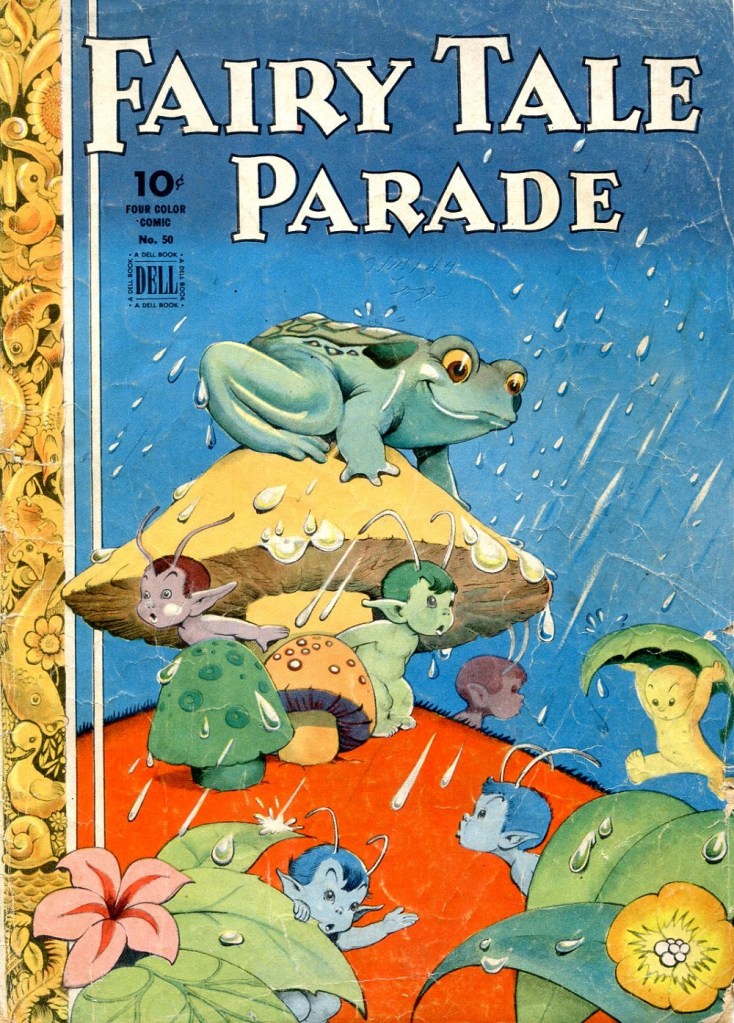
Four Color no. 50 – Fairy Tale Parade (1944-1945, Dell). Cover by Walt Kelly. This is kind of an anonymous mushroom of indeterminate species.
A cartoon by Emile Mercier, Australian cartoonist who is best remembered for his work for the Sydney Sun between 1949 and 1968. This particular piece hails from the late ’50s.

Speaking of Mercier, I love this anecdote: « One day, Claude McKay, the editor-in-chief of Smith’s Weekly, took a dim view of an X Emile Mercier had drawn under the upwardly extended tail on a cat. After a few stern words about “dirty gimmicks in cartoons”, the grim-faced McKay instructed Mercier to get rid of the cross. This presented Mercier with a challenge. He was someone who used to say you “have to think funny as well as draw funny” and he was not keen to let McKay’s prudish approach to his cat go unchallenged. Mercier’s solution was to draw a miniature roller blind under the cat’s perpendicular tail. He was in no doubt the blind would draw more attention to the cat’s anus than the X had. Fortunately for him, McKay saw the funny side of the addition and let the cartoon run. Not a man to push his luck too far, Mercier drew all future cats without an X at the base of their tails. »

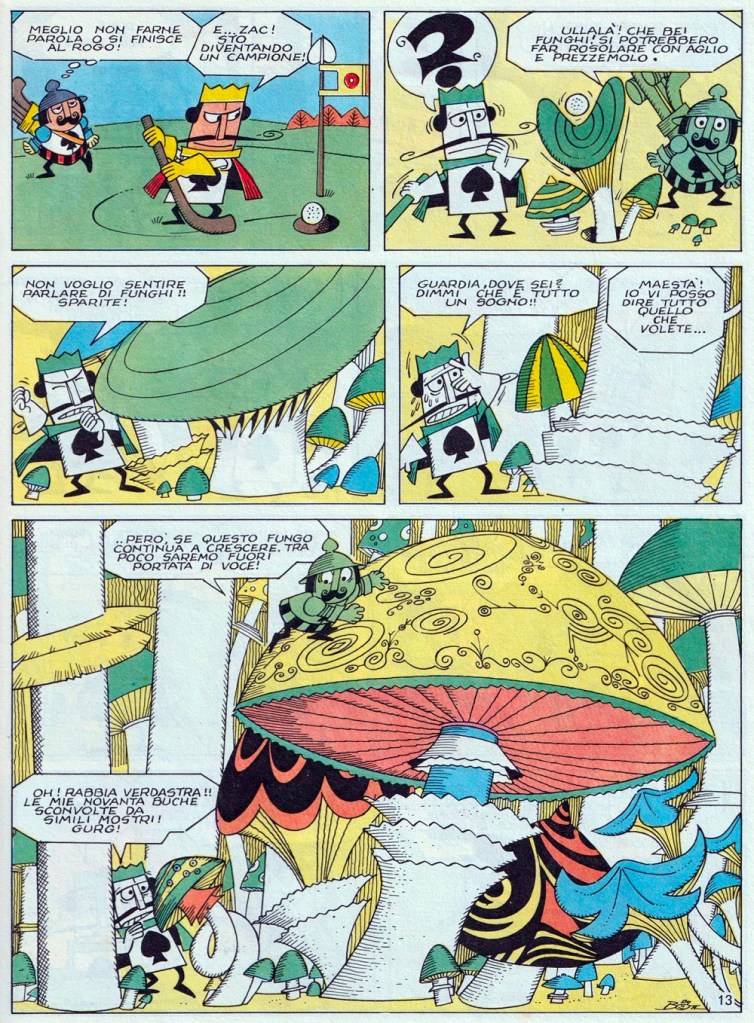
A page from Re di Picche no. 1 (AGIS, 1969), an Italian comics series created by Luciano Bottaro. Re di Picche means ‘king of spades’, and refers to the protagonist of this series (also the title of the magazine it was published in). Inspired by Alice in Wonderland? You bet! This mushroom appears to be some type of Amanita, a mostly deadly but handsome family of ‘shrooms.
The Plot to Destroy Earth, scripted by Dave Wood and illustrated by Jim Mooney, was published in Strange Adventures no. 183 (December 1965, DC). A man who refers to what is very obviously a mushroom as a ‘crazy-looking plant’ won’t impress anyone with his knowledge of nature… but this fungus-as-parachute interlude is entertaining.
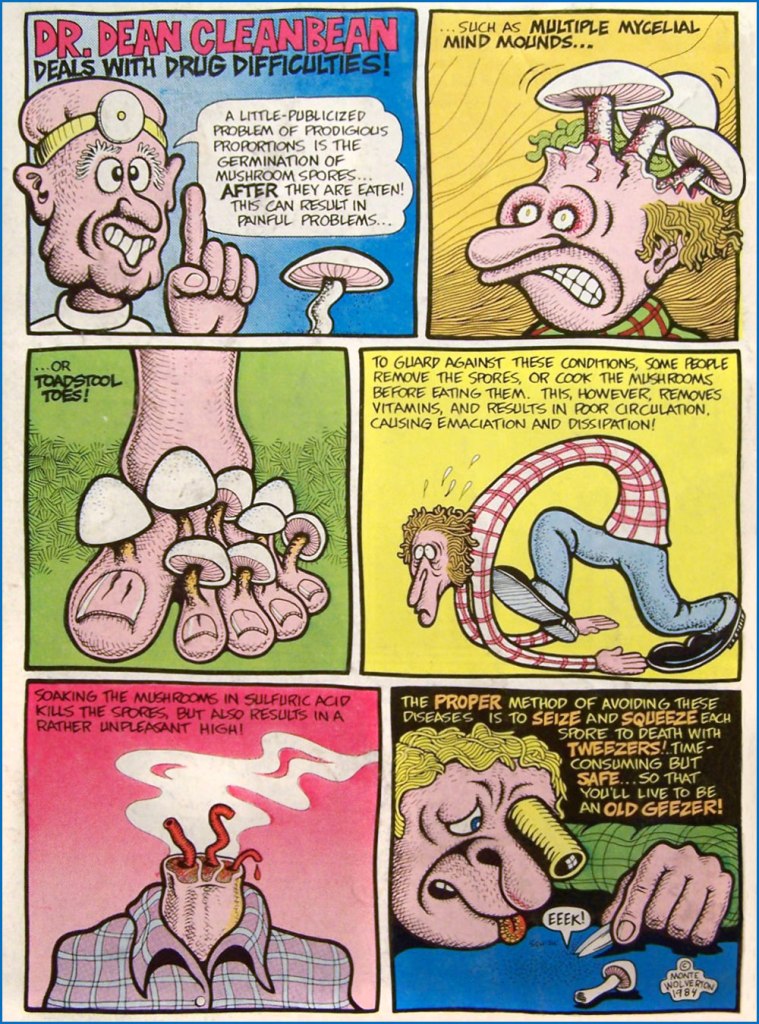
Dr. Dean Cleanbean Deals with Drug Difficulties, scripted and illustrated by Monte Wolverton (Basil Wolverton‘s son!), was the back cover of Dope Comix no. 5 (January 1984). Here we have the very prototypical magic mushrooms, which comes as no surprise.
I promised horror, didn’t I? This is a page from Chapter One, scripted by Mike Mignola and illustrated by Guy Davis, and published in B.P.R.D.: Plague of Frogs no. 1 (February 2011, Dark Horse).
A splash page from The Mushroom Fan Club by Elise Gravel (2018, Enfant – Drawn & Quarterly’s children’s imprint). I wholeheartedly agree with Gravel – mushrooms come in such a variety of shapes and sizes, that it’s crazy to even consider them as the same thing. Note the mischievous bolete (center, brown cap), probably the King Bolete, a.k.a. Penny Bun – it has a feeling of superiority, and we agree.
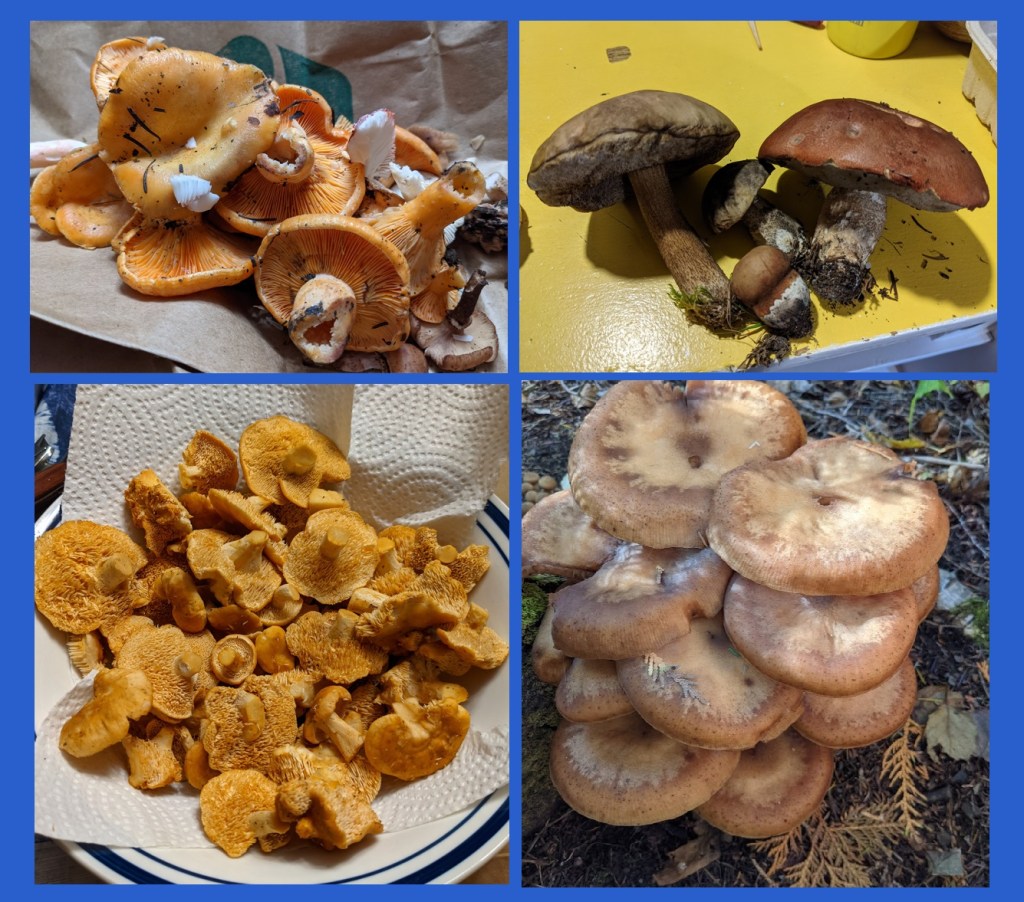
Some of our mushroom crop this week. In the usual clockwise order: Lactarius Deliciosus; various Leccinums (or Bolete); Armillaria gallica (Honey mushrooms) and Hydnums (Hedgehogs).

~ ds

Hot Streak: Bill Everett’s Menace

« I have learned to live each day as it comes, and not to borrow trouble by dreading tomorrow. It is the dark menace of the future that makes cowards of us. » — Dorothy Dix

Menace was a short-lived (11 issues, 1953-54, Atlas) horror anthology title that’s mostly remembered*, if at all, for its one-shot introduction of a zombi by the name of Simon Garth. Because Atlas never really played the gore card, its successor Marvel was able to mine most of its Pre-code material as cheap filler in their 1970s bid to flood the market. Don’t get me wrong, though; these titles were still a lot of primitive fun, and in most cases, I’d pick an issue of Weird Wonder Tales, Where Monsters Dwell or Uncanny Tales From the Grave over the latest Fantastic Four or Spider-Man.

The writing was by no means daring or even coherent, but the artwork was frequently rather fine, with none quite finer than Bill Everett‘s, particularly his covers, which elegantly straddled the line between fearsome and goofy.

I’d be tempted to say that Everett (1917-1973) was at his peak when he created these, but the bittersweet fact of it is that Everett was still at the height of his artistic powers, even as he was slowly dying in the early 1970s.

This particular hot streak ends not because Everett turned in a lesser job, but because other hands provided covers for the rest of the run. Talented hands, at that (Carl Burgos, Gene Colan, Russ Heath, Harry Anderson), but none of the other Menace covers are a patch on Everett’s mighty half-dozen.

Menace01A
These monsters look kind of playful and kooky, don’t they? This is Menace no. 1 (March 1953, Atlas). Inside we find Everett, George Tuska, Russ Heath and Werner Roth art. Oh, and Stan Lee stories. Colours by Stan Goldberg.
Menace02A
This is Menace no. 2 (April 1953, Atlas). Colours by Stan Goldberg.
Menace03A
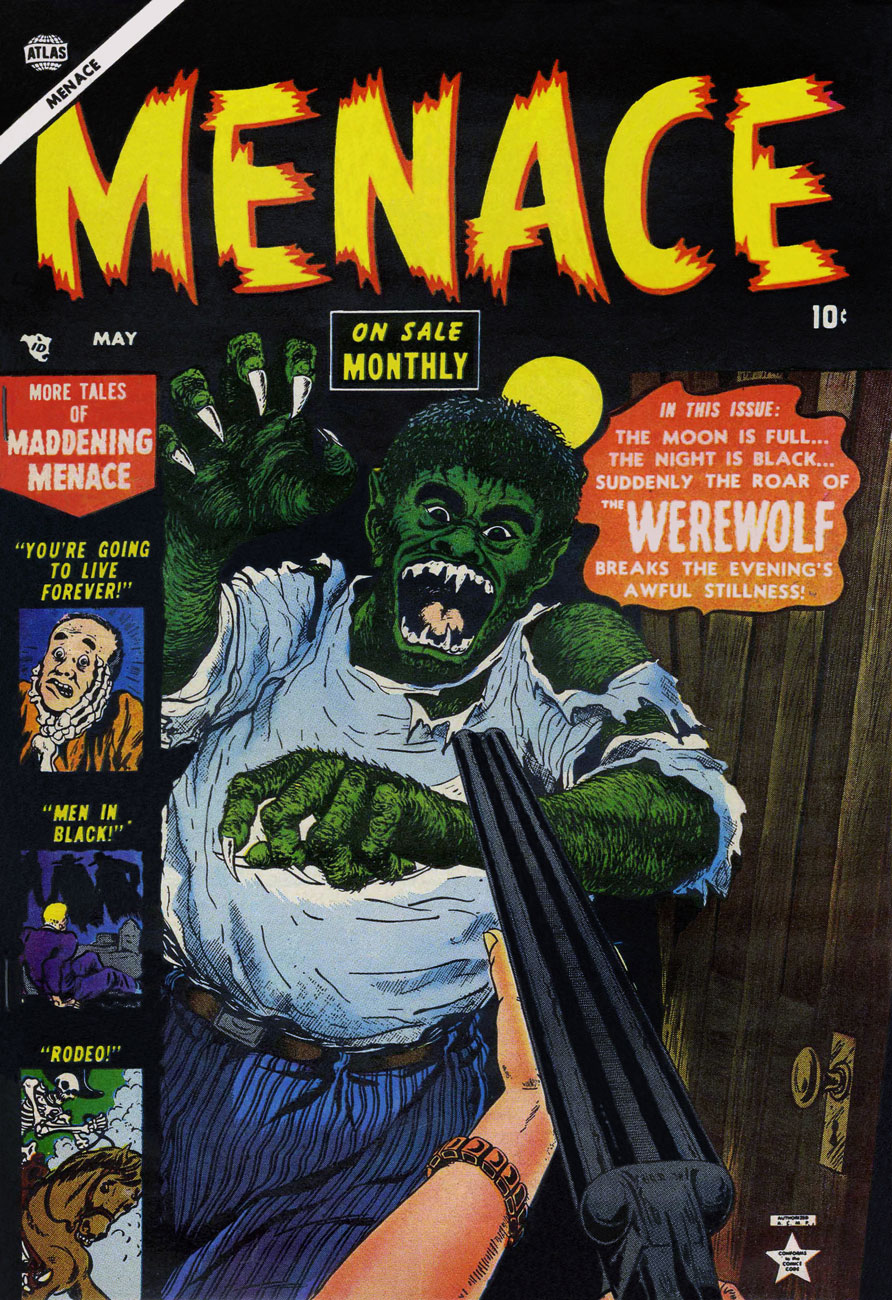
This is Menace no. 3 (May 1953, Atlas). Colours by Stan Goldberg. Was the title’s monthly schedule truly supposed to be a selling point?
Menace04A
This is Menace no. 4 (June 1953, Atlas). Colours by Stan Goldberg.
Menace05A
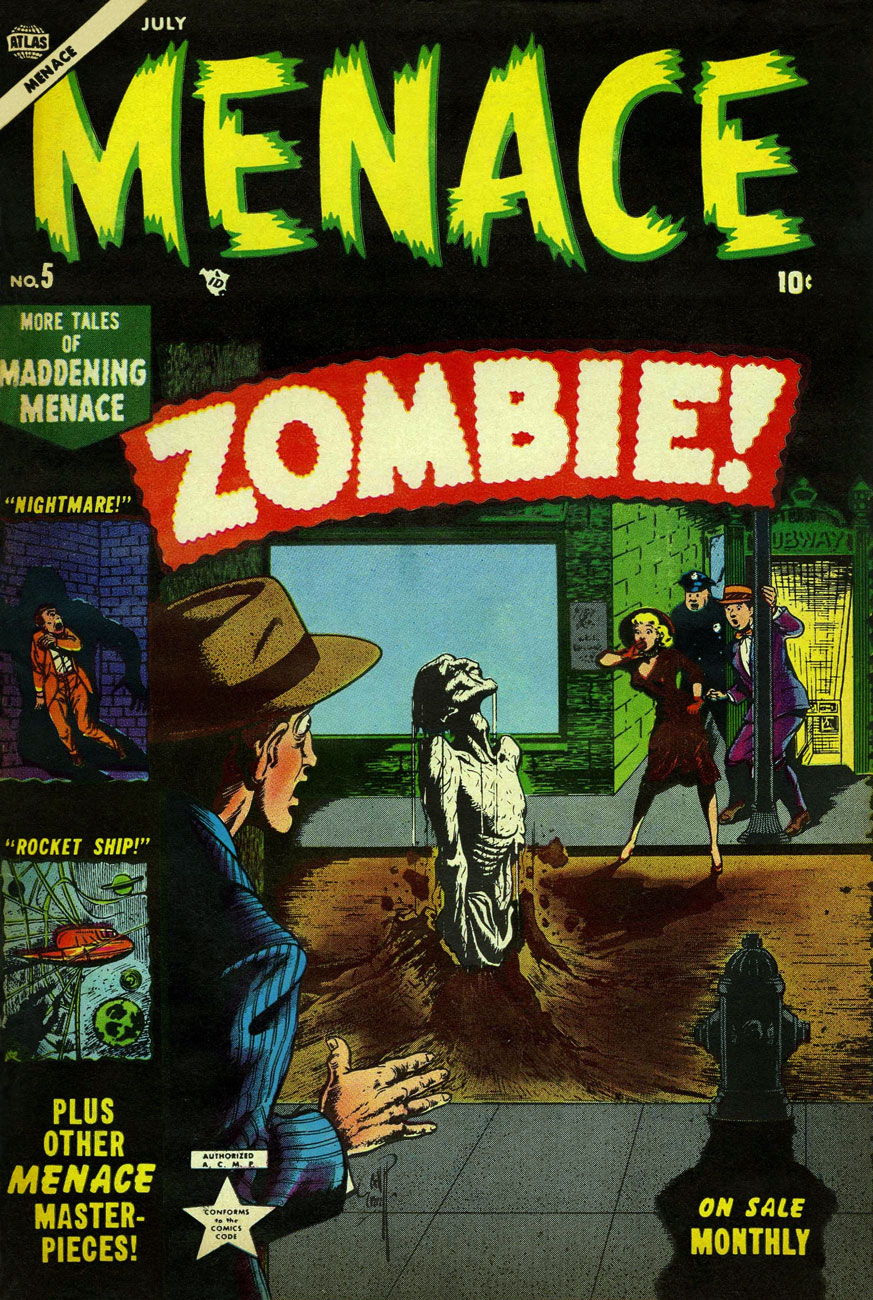
If you think that’s impressive, you should see what mushrooms can do to asphalt!** This is Menace no. 5 (July 1953, Atlas). Simon Garth was dug up (sorry) in 1973, likely at the behest of continuity addict Roy Thomas, to star (if you can call it that) in his own black & white magazine, Tales of the Zombie (10 issues, 1973-75). Like The Man-Thing, he was essentially mindless and shambling, and so mostly a pawn or an uncomprehending witness to others’ tragedies. The best of the mangy lot is, imho, The Blood-Testament of Brian Collier (TotZ no.7… read it here.) It’s not great, but it sure looks pretty, thanks to the sublime Alfredo Alcala, who’s quite in his element here.
BugEyedPair
Don and Warren also met Simon. Read Lee and Everett’s 1953 Zombie!
Menace06A
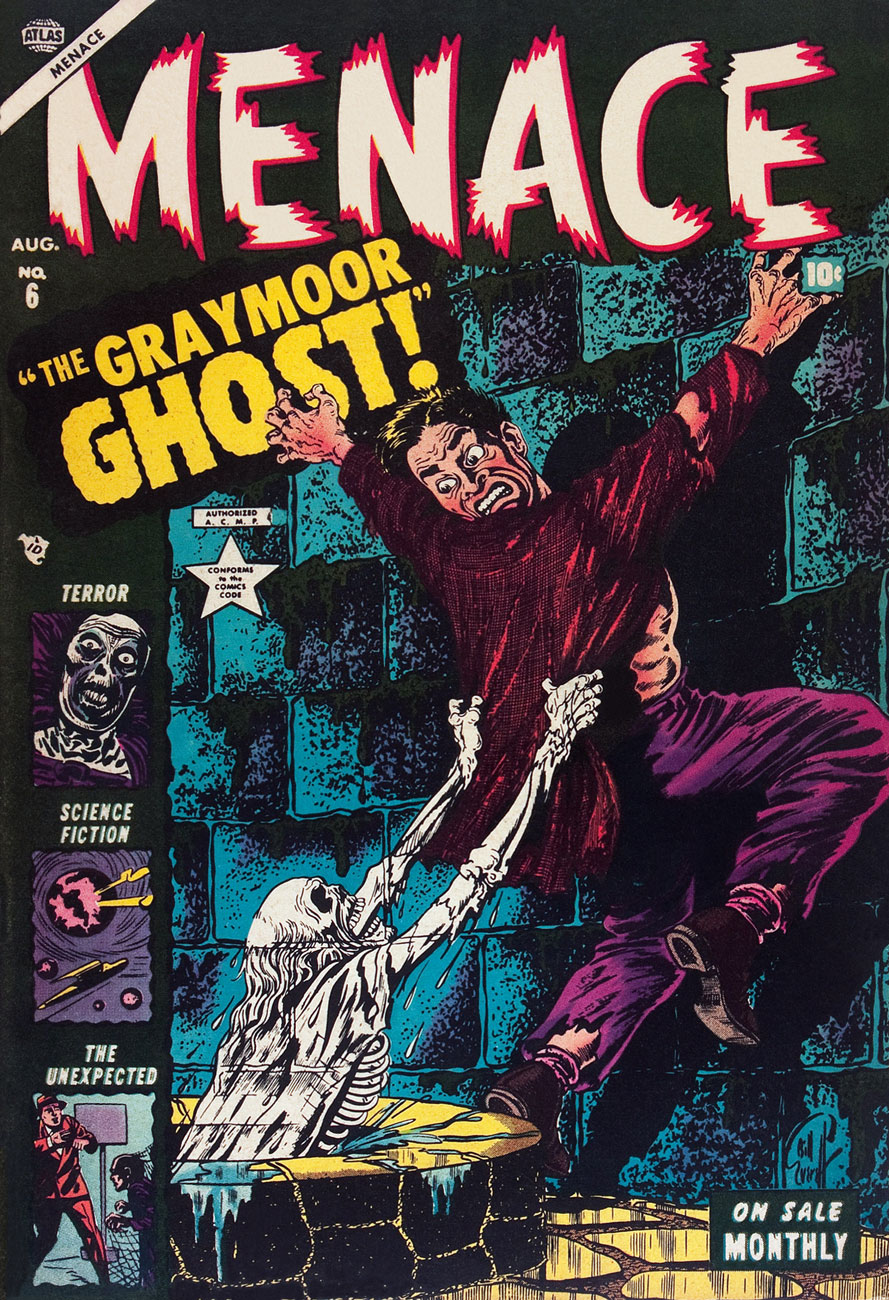
This is Menace no. 6 (August 1953, Atlas). Colours by Stan Goldberg.

That strange compulsion that’s creeping over you, that ungodly craving for more Bill Everett, cannot quite be slaked without incurring a terrible cost, be it in human lives, the forfeiting of your immortal soul, or both. But do check out my co-admin ds’ earlier tribute to Mr. Everett’s nightmares, Bill Everett’s Restless Nights of Dread, it might tide you over until dawn.

-RG

*these babies are rare, in any condition.

**Here’s an example:

« A bump in the garage floor turned into a half meter of mushrooms in little more than three days. It crushed its way through five centimetres of asphalt in Åge Reppes garage in Stord, western Norway. It is the water pressure in the cells of the fungus that makes it able to crack the asphalt, says a biologist at the local university. » [ source ]. These are inky caps. Edible, but some species are toxic when consumed with alcohol. These are commonly known as ‘tippler’s bane‘.