« A knot you are of damned bloodsuckers. » — William Shakespeare
One of my favourite Atlas mood-masters was Anthony Lewis “Tony” DiPreta (July 9, 1921 – June 2, 2010); it appears Mr. DiPreta and his colleague Murphy Anderson share not merely a birthday, but a day of birth as well.
Tony DiPreta’s long career in comics began with his arrival at the “Busy” Arnold studio, with his first credits appearing in early 1942. He worked extensively for Hillman Periodicals, handling such features as Airboy (yay!), Skinny McGinty, Flying Dutchman and Stupid Manny; Lev Gleason Publications (various crime stories and The Little Wise Guys); and of course Atlas Comics, where he chiefly, but not exclusively, cut loose on moody-but-not-gory horror stories, often with a finely-turned streak of gallows’ humour.
Tony survived the post-Code near-collapse of the comics industry when he succeeded Moe Leff on Ham Fisher‘s Joe Palooka strip, which he carried until the feature’s final curtain in 1984. In the 1970s, he also did a bit of moonlighting for Charlton, contributing to a couple of issues of The Flintstones spin-off The Great Gazoo. In 1994, DiPreta took on another venerable, long-running newspaper strip, medical soap opera Rex Morgan, M.D., until his well-earned retirement (DiPreta’s, not Morgan’s) in 2000.
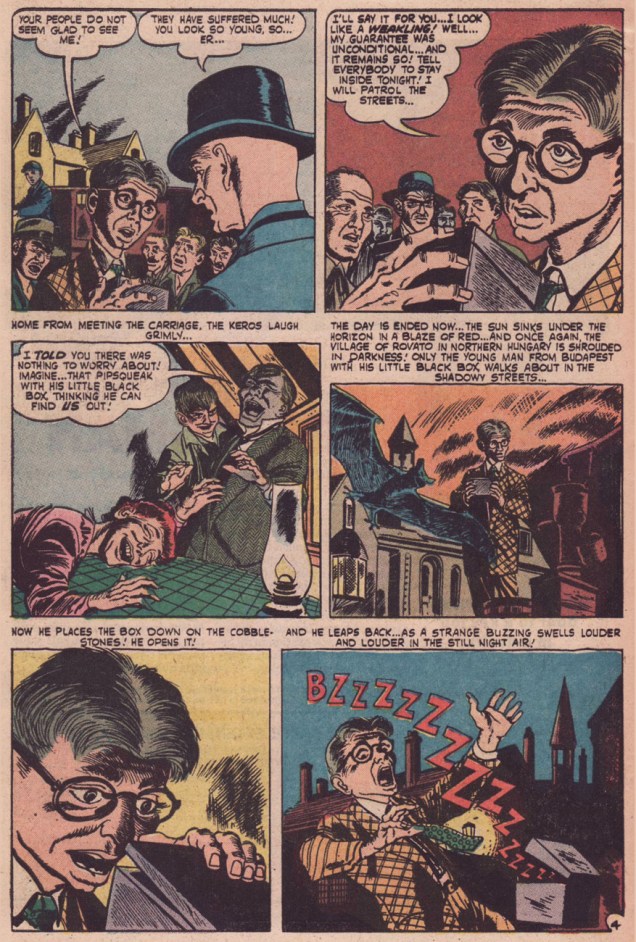
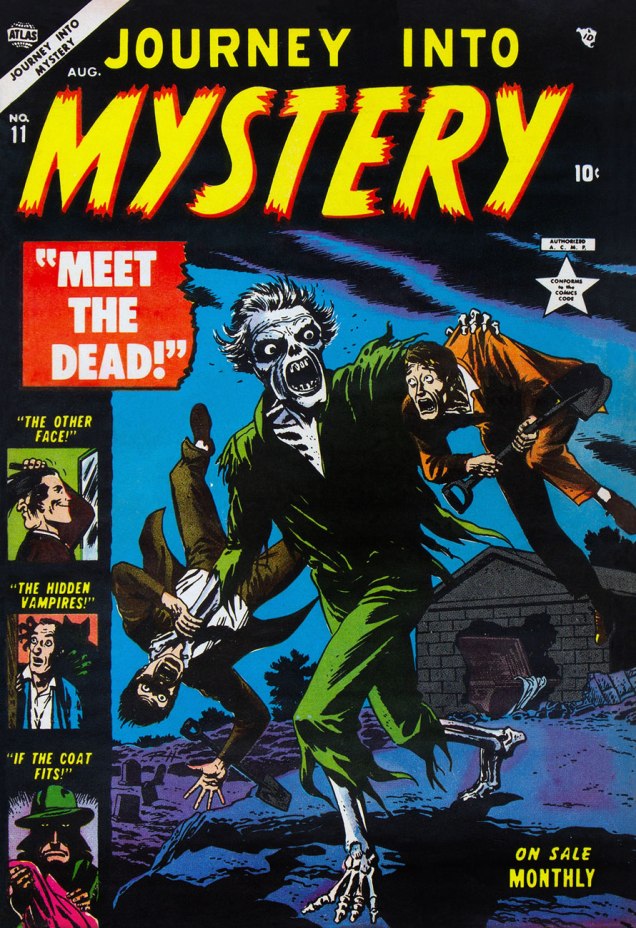
For your reading pleasure and mine, I’ve selected this adorably wacky tale from Atlas’ Journey Into Mystery no. 11 (August, 1953). Writer unknown, which is a shame.
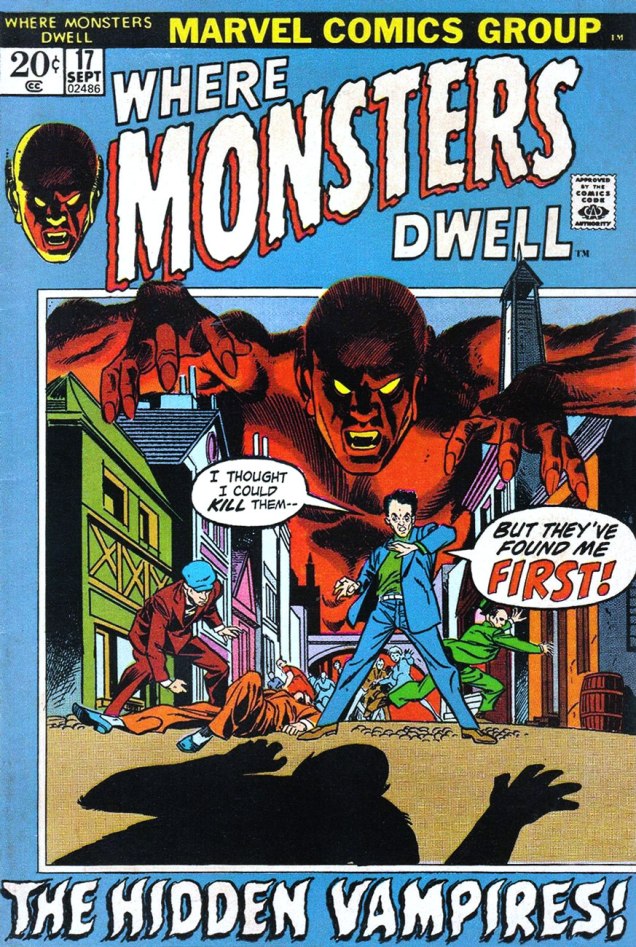
Well, I suppose it might have been simpler to see who wasn’t around in the daytime, but let’s face it, Mazerok’s method is far more entertaining and original.The story was reprinted in Where Monsters Dwell no. 17 (Sept. 1972, Marvel); though cover-featured, the cover itself was a lacklustre job by an overworked and uninspired Gil Kane, stuck here with Vinnie Colletta, though to be fair, there’s nothing here to ruin. Beyond the cover, the insides are great: two Ditko stories (« I Opened the Door to… Nowhere! » and « The World Beyond », a low-key Russ Heath (« If the Coat Fits », also from JIM 11), and our featured yarn.Now that’s more like it! The Hidden Vampires‘ original place of appearance, Journey Into Mystery no. 11 (Aug. 1952, Atlas), boasts a just-about-classic cover by Russ Heath, with a fine colouring job by Stan Goldberg.Heath did a lovely job with the small space allotted to preview the other stories. Pre-Code Atlas books were graced with a clever and attractive cover grid.
Behold! I return to a topic close to my heart, as close as tentacles are close to human flesh in this post! Namely, PG manifestations of shokushu goukan. But I wouldn’t like you to think that I’m one-track minded: today’s crop has its share of fantasy scenes, scantily-clad women who are about to be even further undressed, but! it also includes panoramas of serious (and unsexy) struggle, tongue-in-cheek héroïnes quite nonplussed by their predicament, tentacles overpowering female protagonists despite their superpowers, etc.
Without further ado, I give you… damsels in tentacular distress.
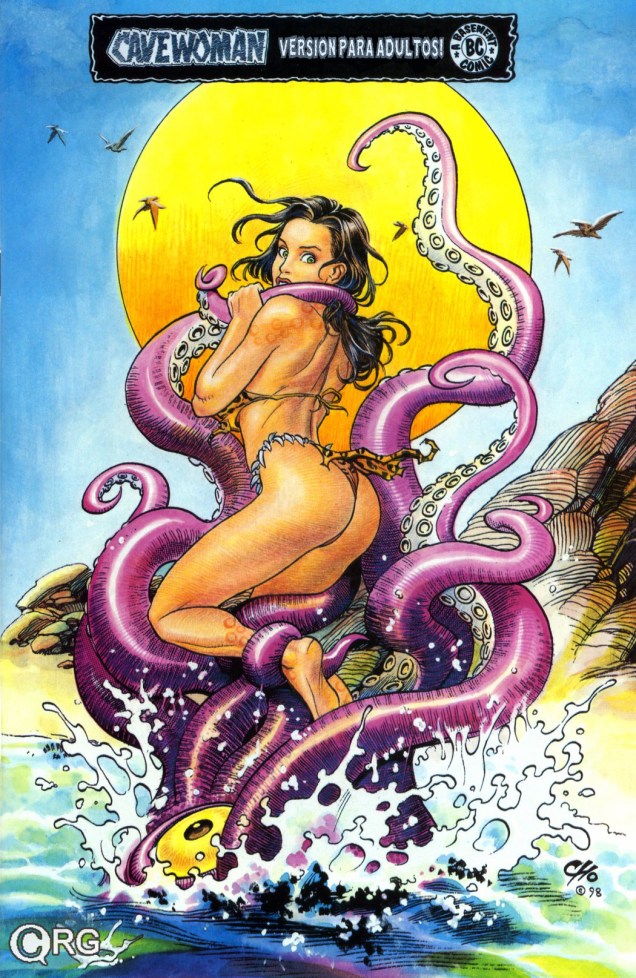
Cover painted by Bernie Wrightson for Nightmare Theater no. 3 (Chaos Comics, 1997).Cover from Pangaean Sea no. 4 (Basement Comics, 2000); art by Budd Root, the owner of this publishing company.Another one from Basement Comics: Jungle Tales of Cavewoman no. 1 (1998), variant cover by Frank Cho. It will come as a surprise to no-one that Cavewoman was created by the aforementioned Budd Root. Cavewoman is Meriem Cooper (I suppose calling her Myriam was too staid). I stumbled upon this amusing quote from Root recently, who said that Meriem was « patterned after pretty much all the women I really respect. She’s got a body with kind of a Little Annie Fannie face with Danni Ashe’s boobs and Nina Hartley’s butt. » No comment.
The maiden doesn’t always need to be rescued, nor does she necessarily *want* to be ravished – here’s a look at some heroines standing their ground against tentacular invasion.
Page from Wonder Woman: The True Amazon (DC, 2016) by Jill Thompson. I wasn’t much impressed by this graphic novel, but I loved Beasts of Burden, a collaboration between Thompson and writer Evan Dorkin.My Greatest Adventure no. 81 (August 1963), art by Bruno Premiani.Or you can resort to other, more… creative… means for getting out of the octopus’ embrace. Pages from Lorna: Heaven is Here (Treize Étrange, 2006) by Brüno.
I promised you superheroines, and by Jove, you shall get some!
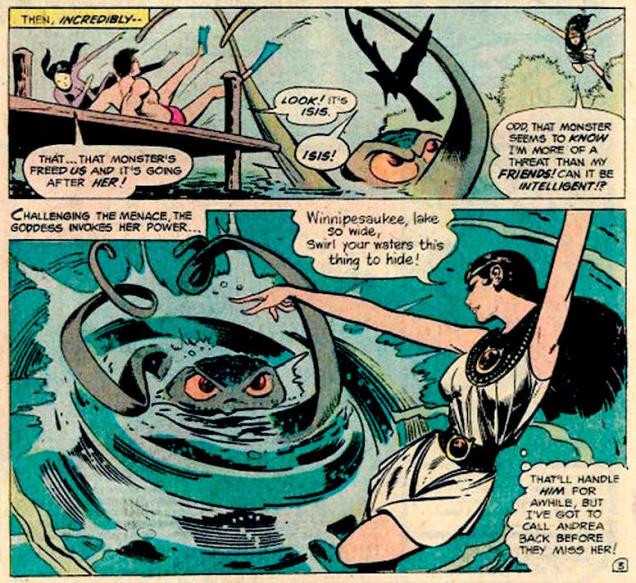
Isis no. 4 (April-May 1977), pencilled by Mike Vosburg and inked by Dick Giordano. Isis clearly used to be a ballerina…. or the artists have a knack for awkward anatomy.Treasure of Lost Lake is scripted by Jack C. Harris, pencilled by Mike Vosburg and inked by Vince Colletta. I honestly can’t recommend this story to you – the art is about as good as the storytelling, which is not a compliment to either.Page from Ferra Naturae, scripted by Bill Mantlo, penciled by Al Milgrom and inked by Jim Mooney, published in Spectacular Spider-Man no. 75 (February 1983). Obviously many have grappled with Dr. Octopus’ tentacles… but I think this particular scene is worthy of inclusion in this post.
« Oh, this is perfect . . . this is exactly what comic books are supposed to look like. » — Chris Samnee on encountering Frank Robbins‘ “Man-Bat Over Vegas” [ source ]
For a change of pace, here’s an artist in the prime of life and at the peak of his powers.
Chris Samnee, born in 1979, first caught my interest when he collaborated with Roger Langridge on Thor: The Mighty Avenger, for which he reaped the 2011 Harvey Award for Most Promising New Talent. But some of my superhero-lovin’ friends had been raving about Samnee’s work for a while.
While obviously a man of his time, he’s clearly drunk deep from the well of classic illustration, comic books and most of all, comic strips. It’s hard to miss in his work echoes of Alex Toth, Doug Wildey, Frank Robbins, Milton Caniff, Will Eisner, Roy Crane… an artistic heritage not too unlike his fellow Daredevil alumnus David Mazzucchelli‘s… fine company, plumb in that sweet spot between ‘realistic’ and ‘cartoony’, and wisely drawing from both.
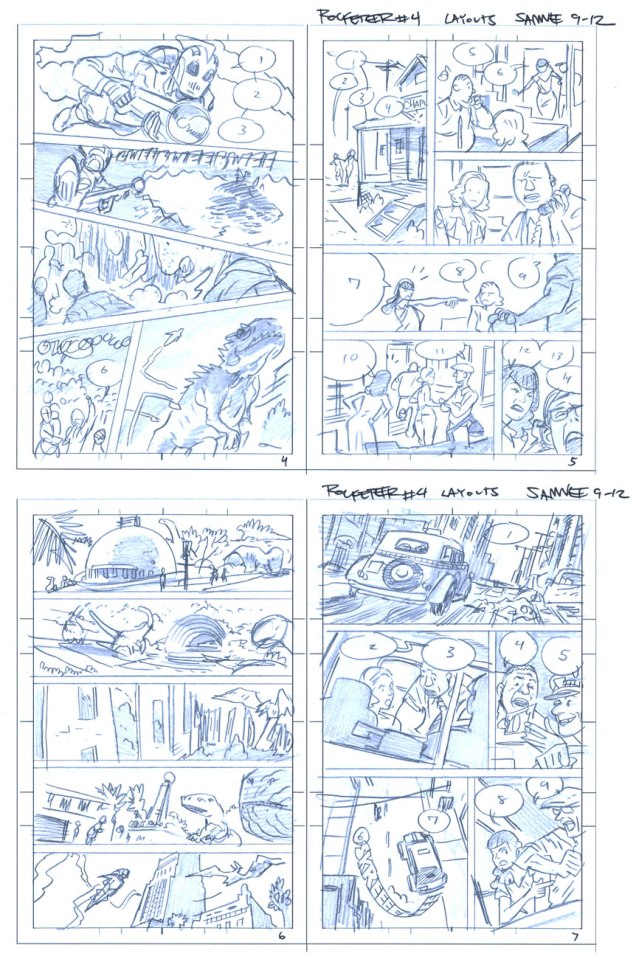
As befits a first-rate cover artist, Samnee thoroughly thinks and feels his pictures through, thumb-nailing his layouts and planning his moves. Here are some of his preliminaries from The Rocketeer: Cargo of Doom (2011), for which he shared (with David Aja) the 2013 Will Eisner Award for Best Penciller/Inker.
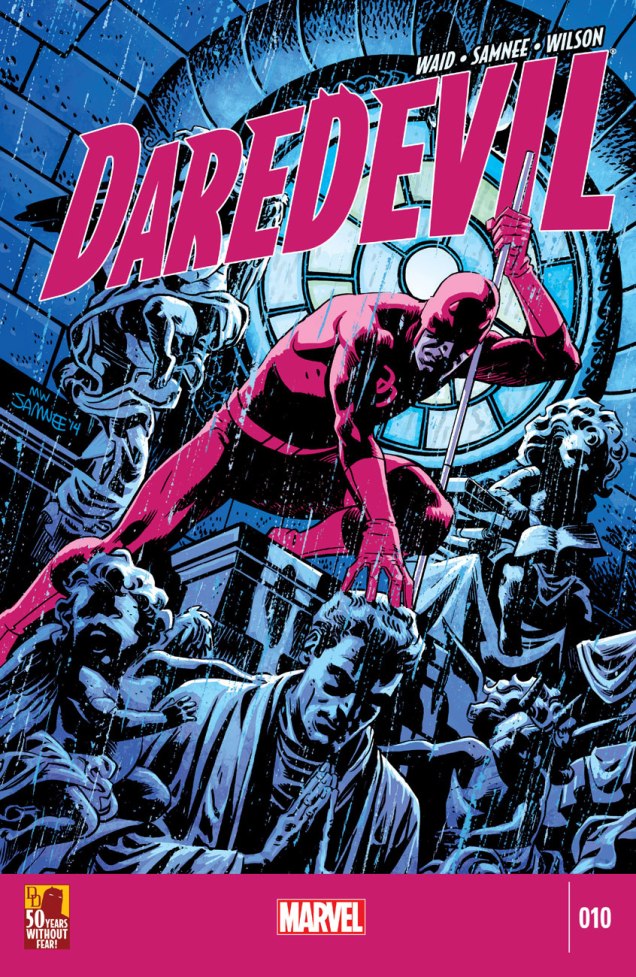
Cargo of Doom marks the first time ever when the character of Betty isn’t sexualized to the hilt. That’s got to count for something.This is Daredevil no. 9 (Dec. 2014). Incidentally, after the intrusion of bar codes on covers in 1975, followed by an increasingly hard-sell culture, the kind of elegantly spare, striking design I personally gravitate to hasn’t had it easy. A surprising step in the right direction came in recent years with the demise of the Comics Code, the introduction of digital editions and the appearance of a handful of enlightened editors (take a bow, Axel Alonso!), first at DC/Vertigo, then (as usual) later at Marvel.This is Daredevil no. 10 (Jan. 2015). Another example of a digital edition: compare this to a 1970s Marvel cover!This is Daredevil no. 11 (Feb. 2015). The Stunt-Master, seen here, first appeared in Daredevil no. 58 (Nov. 1969). It was the era of Evel Knievel and his Daredevils.This is Daredevil no. 11 (Feb. 2015). Hey, even more room for the art!And this is Daredevil no. 13 (Apr. 2015).
And speaking of inks, he sharply stands out in that regard in today’s assembly-line industry. It’s different for every artist, but Samnee loves to ink. He claims: « My pencils are just awful. I can’t imagine anybody else inking me nowadays because most of the work is done in the ink. ». I can relate.
While I greatly enjoyed Thor: The Mighty Avenger, the covers were solid but not outstanding. But Mr. Samnee’s still improving (!), and so a couple of years down the pike, and with the crucial input of colourist Matthew Wilson, a man without fear of colour saturation, we have a hot streak! And yeah, surrounding issues 8 and 14 kind of fell flat, so it’s a fairly short one. But there are quite a few quite outstanding covers outside of this subjective selection, so keep an eye out, and prepare to have it dazzled.
As we’re currently in the blaze of summer (rocketing temperatures and crazy humidity, courtesy of global warming – this June was the hottest June ever, and we’re well on track for beating records for July), a Tentacle Tuesday post about plants seemed appropriate. Did I say “plants”? More like “plantacles”: these vines and tendrils snatch and grab, creep and reach, entwine and writhe just like their cephalopod counterparts.
Pages from Dark Side of the Moon, with art by Maurice Gutwirth, published in Hit Comics no. 2 (June 1941, Quality Comics).
So Blaze Barton encounters some vine tentacles, fine; but he also encounters ‘queer tiny plants‘ that swarm him and attack with what looks very much like octopus appendages. The delightful thing about Hit Comics and particularly Barton’s adventures is that the stories are goofy as hell.
The story continues in the same vein, merrily galloping into insanity… into an ‘evil-infested‘ lake that boasts man-eating weeds, once again complete with tentacles.
Continuing our grabby, carnivorous vines theme, a creepy little tale of a scientist who slightly oversteps his bounds:
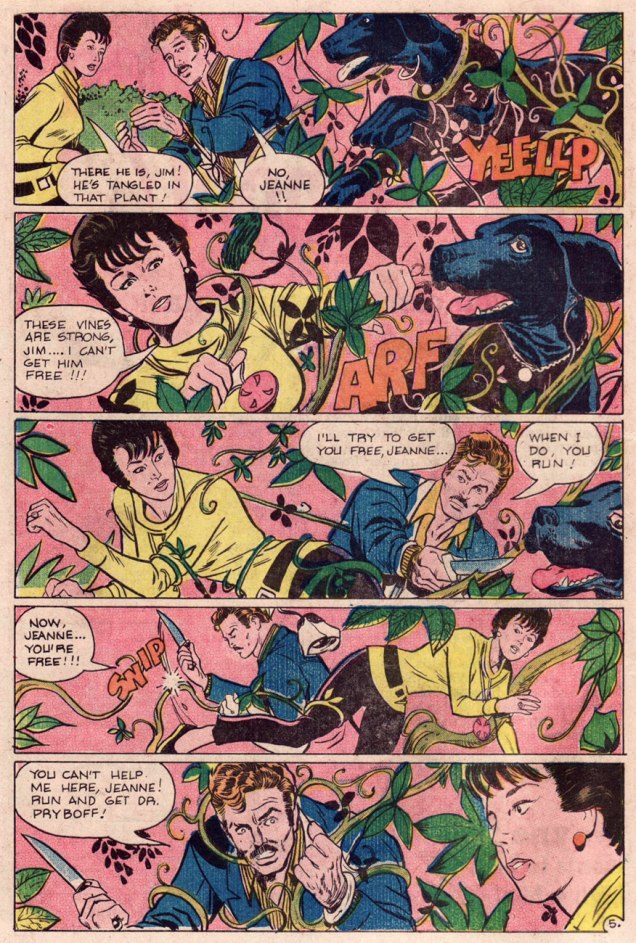
Pages from The Hungry Garden (scripted by Joe Gill and drawn by Fred Himes), published in Ghostly Haunts no. 34 (August 1973). Trespassers will be stung, choked, and then gleefully consumed.Should you be curious or concerned, the pooch makes it out just fine, and in fact goes on to save the day!
Occasionally, an entire tree will decide that it’s more fun to strangle a human than to passively let itself be chopped down. Who could argue with that?
Psychotic Adventures no. 3 (June 1974, Last Gasp). Cover by Charles Dallas. The blog Mars Will Send No More has many Dallas stories (all from Psychotic Adventures) for your perusal; I recommend them heartily.
The cover story, Women of the Wood, is based on a short story by Abraham Merritt that you can read here if you’re so inclined. It’s an excellent creepy tale – though I can’t promise tentacles, I can definitely guarantee murderous trees.
« For all those hundred years there have been hatred and battle between us and the forest. My father, M’sieu, was crushed by a tree; my elder brother crippled by another. My father’s father, woodsman that he was, was lost in the forest — he came back to us with mind gone, raving of wood women who had bewitched and mocked him, luring him into swamp and fen and tangled thicket, tormenting him. In every generation the trees have taken their toll of us — women as well as men — maiming or killing us. »
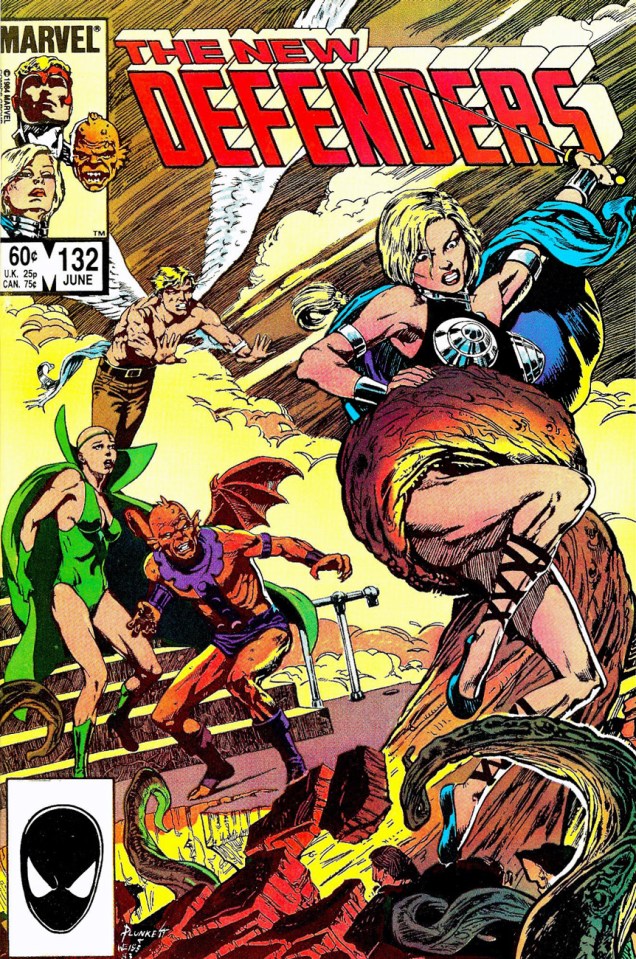
Speaking of attacking tree trunks, I do believe this qualifies:
The Defenders no. 132 (June 1984). Penciled by Sandy Plunkett and inked by Alan Weiss.
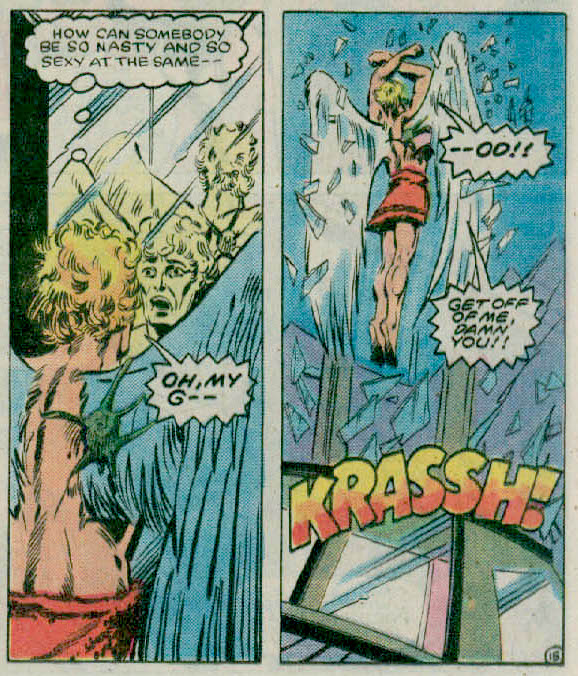
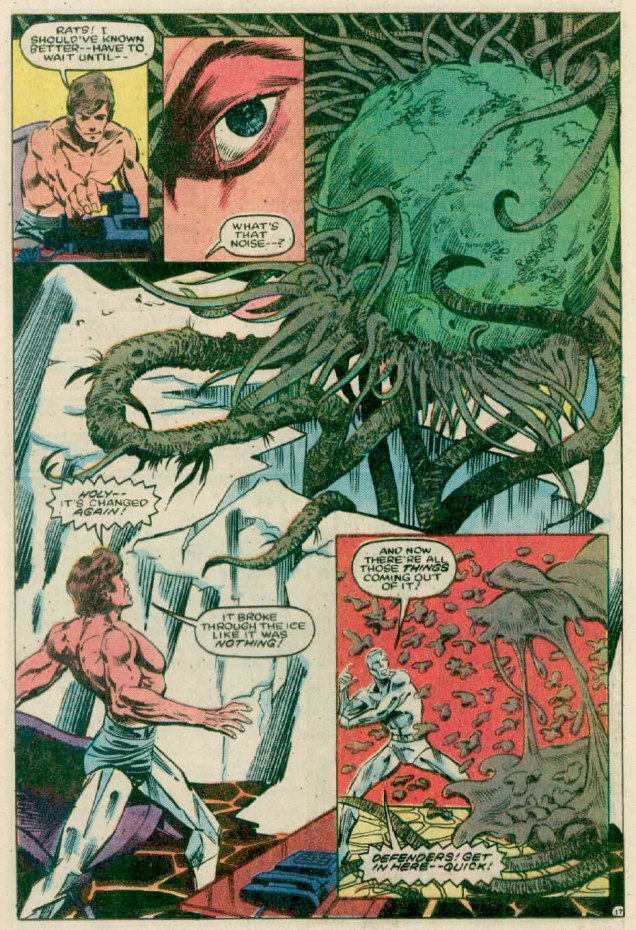
The cover story, The Phantom of Gamma-Ray Flats! (scripted by Peter B. Gillis, penciled by Don Perlin and inked by Kim DeMulder) is quite entertaining – and brimming to the gills with plant tentacles.
Not “rapey”, “ROPEY”.
The tiny remnant of the tentacle creature manages to find a hold on Warren’s back, perfectly à propos to this post… but I couldn’t resist including the other panel revealing his thoughts about his sexy colleague. Warren is Warren Worthington III, aka The Angel, a founding member of the X-Men.
The Savage Sword of Conan no. 42 (July 1979). Cover by Bob Larkin.The Devil-Tree of Gamburu is scripted by Roy Thomas, penciled by John Buscema and inked by Tony DeZuniga.
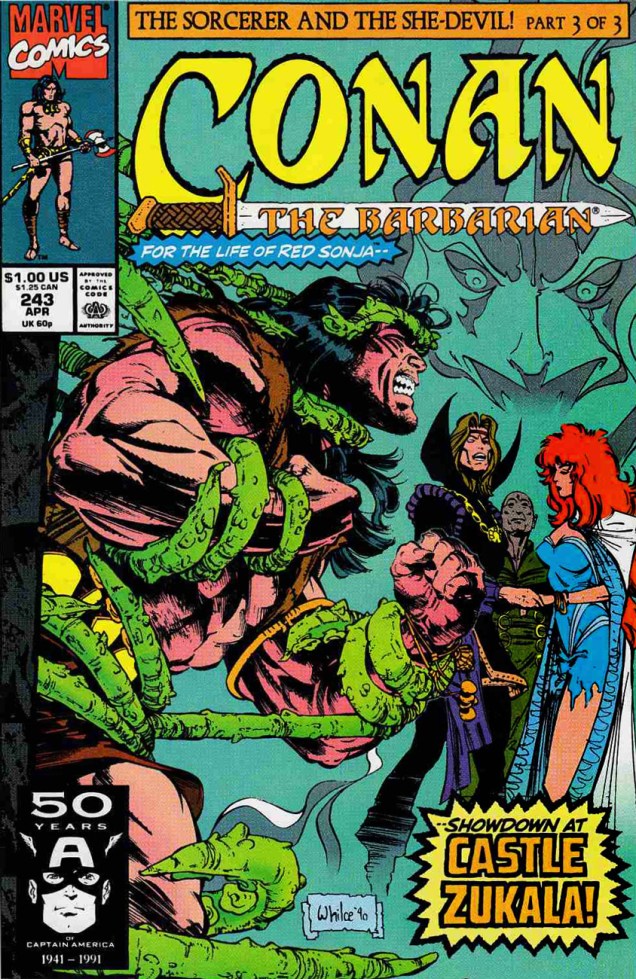
And another Conan cover for the flora hall of tentacles:
Conan the Barbarian no. 243 (April 1991). Cover by Filipino artist Whilce Portacio.
« I say let the world go to hell, but I should always have my tea. » — Fyodor Dostoyevsky
A colleague at work labelled me a “tea whore” the other day. I don’t think that’s an official expression (though apparently one can purchase tea mugs with this message), but I’ll take that as a badge of honour. And therein lies my similarity to my beloved octopods: they never say no to a nice cup of tea, either. Evidence, you may ask? I’ve a-plenty of it. Pour yourself a steaming cup of oolong and join me!
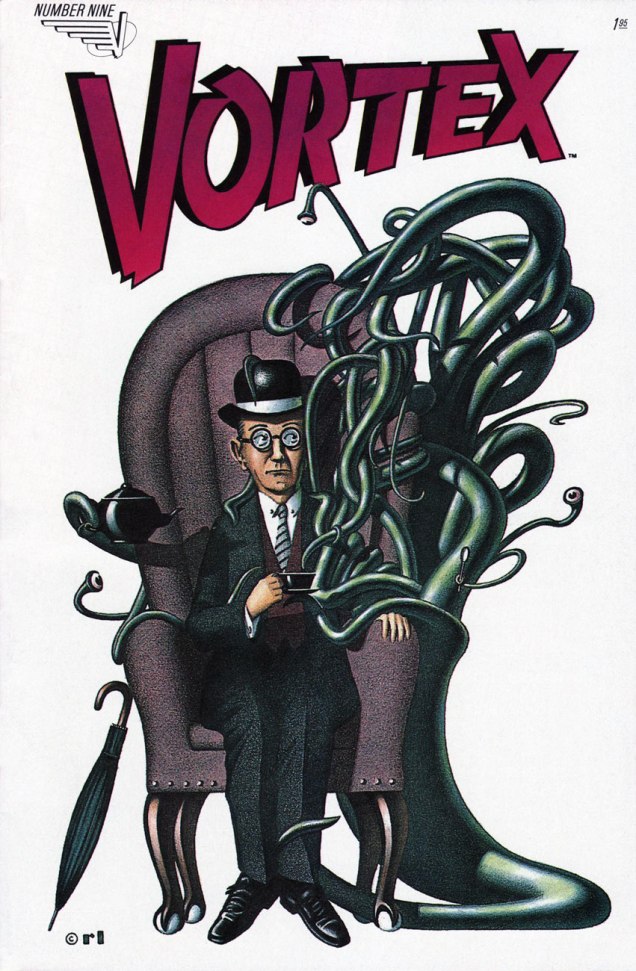
Donald Duck no. 200 (October 1978), cover by Larry Mayer. Incidentally, he has already been part of a Tentacle Tuesday.Surprise: this quintessentially British scene (an umbrella, a cup of tea and a suitably meek accountant) is brought to you by a Canadian comic! This is Vortex no. 9 (May 1984), cover by Ron Lightburn. Vortex was one Canadian Vortex Comics’ titles. Some interesting stuff was published by these guys: Matt Howarth’s Those Annoying Post Bros and Savage Henry, Los Bros Hernandez’s chunk of Mister X, Ted McKeever’s Transit, Chester Brown’s Yummy Fur…
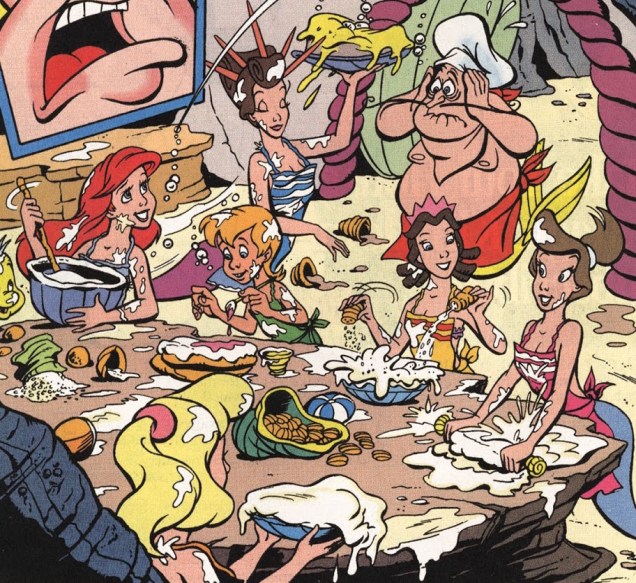
The following pages are from Disney’s The Little Mermaid no. 10 (June 1995). No, no, stick around, it’s worth it. You can read the full issue here.
So far so good, even though this begs some questions (such as “how do you pour a cup of tea underwater?”) But the following dialogue suggests that things other than tea-drinking were on the mind of *this* octopus:
You know how all this ends, don’t you? That’s right:
I tried to make this a purely innocent post, but things didn’t pan out.
Gahan Wilson is always, always good and ready for tentacles. (By the way, he is financially struggling and has dementia, which is both stupefying and depressing. I never cease to be amazed at how someone with such a wide-ranging and fruitful career can end up impoverished… His family raised enough money on GoFundMe – for now – to take care of him, but you should still visit that page for recent pictures and updates about his health.)
Cartoon by Gahan Wilson, published in Playboy’s August 2006 issue.
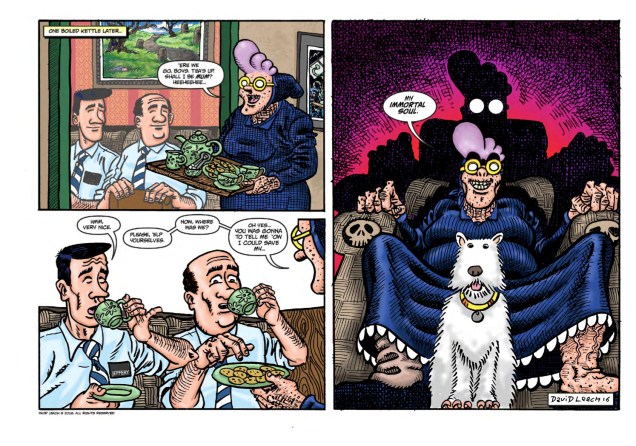
In 1986, British cartoonist David Leach unleashed Psycho Gran upon an unsuspecting world. The « five-foot high, mauve-haired, bespectacled psychotic granny with a pan-dimensional, sentient handbag called Percy, a flying dog called Archie and a pathological loathing of rudeness » first appeared in British children’s comic Oink!, where she lingered for 15 issues, pummeling purse snatchers, clobbering office workers and disciplining rampaging monsters until 1988. In 2011, she came back – her hair more purple than ever, her lust for authoritarianism unabashed – and is currently involved in a four-part mini-series.
And she’s drinking tea with Mr. Cthulhu. I’m jealous.
« We all have grannies. I think there’s something wonderfully exciting, mischievous and dangerous about them, or was that just mine? They’re old and they’re the mum of your mum, plus they spoil you rotten, but they can also tell you what to do, like your own mum does! That seemed so strange when I was a kid, the idea that they could boss not only you but also your mum or dad around. And I think we’re all a little scared of the elderly, no one likes to think that one day they’ll be old themselves, I think we resent them for showing us what we’re going to become. Psycho works because she looks frail and yet she’s super strong and batty. She’s the classic sheep in wolf’s clothing. And there’s something funny about an old granny being lethal and crazy to boot, especially since usually the elderly are portrayed as figures of fun to be mocked and laughed at. » (Look Out, Britain! Psycho Gran is Back!)
And by the way, I wasn’t exaggerating about Psycho Gran’s passion for control (and tea).
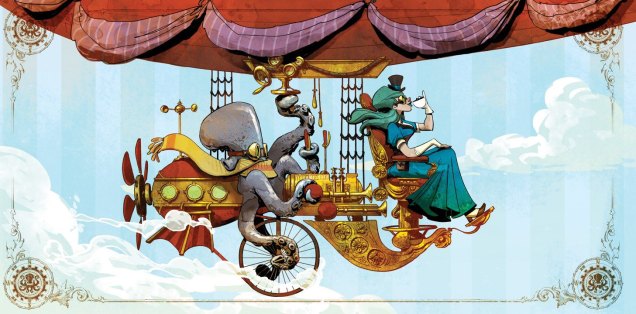
Drink tea with your octopus today… and if you don’t have an octopus, borrow one from a friend. I don’t have a dirigeable (that would be a zeppelin for younger people in the audience) , but I manage. Toodle-oo!
The cover for the 2016 calendar of Otto and Victoria, an adorable steampunk couple created by Brian Kesinger. These two were featured earlier in Tentacle Tuesday: Adopt an Octopus Today!
« Though the refined eyes of the aesthete may consider Kirby’s work crude, ornery, and anti-intellectual, the fact remains that he combined the virtues and limitations of his class with a stubborn genius to produce a body of comics work that has remained consistently true to its source and is unparalleled both in quantity and quality. » (Gary Groth)
Strike while the iron is hot, it is said, and thus part II of our celebration of Jack Kirby‘s tentacle prowess comes hard on the heels of Tentacle Tuesday Masters: Jack Kirby, Part 1. I’d like to thank co-admin RG for his vast knowledge of Kirby comics, as well as his suggestions and scans – that’s what (among other things) partners are for. Whereas part 1 focused on Kirby’s 70’s work for DC, today’s post (also firmly entrenched in the 1970s) is a celebration of his brief but intense return to Marvel Comics.
All art is scripted and penciled by Jack Kirby and inked by Mike Royer, unless otherwise indicated.
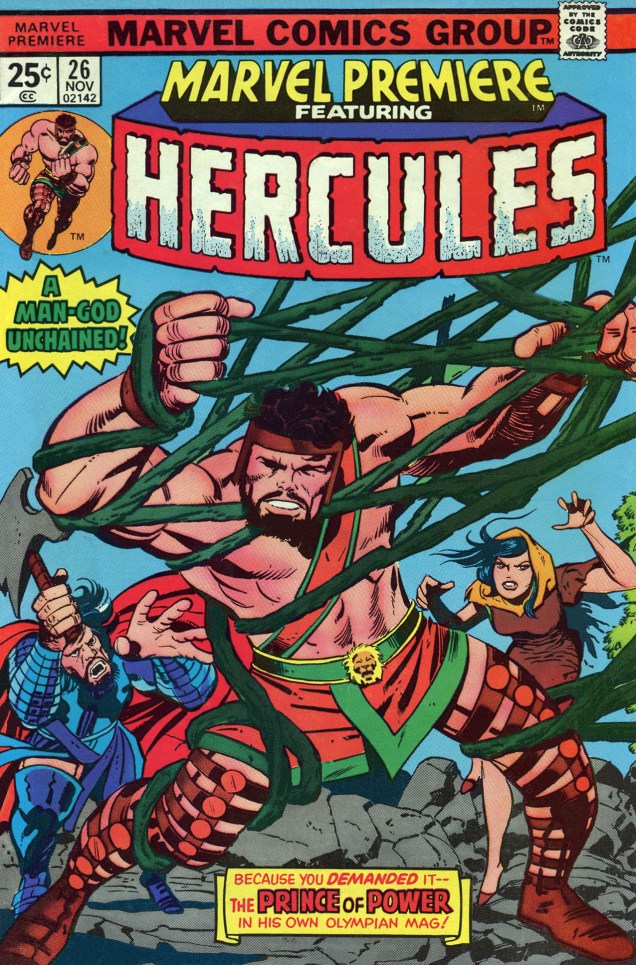
We start with the somewhat less interesting, but nevertheless tentacular, Hercules.
Marvel Premiere no. 26 (November 1975), penciled by Kirby and inked by Vince Colletta. Only the cover is by Kirby, the inside story being a collaboration between Bill Mantlo, George Tuska and Vince Colletta.
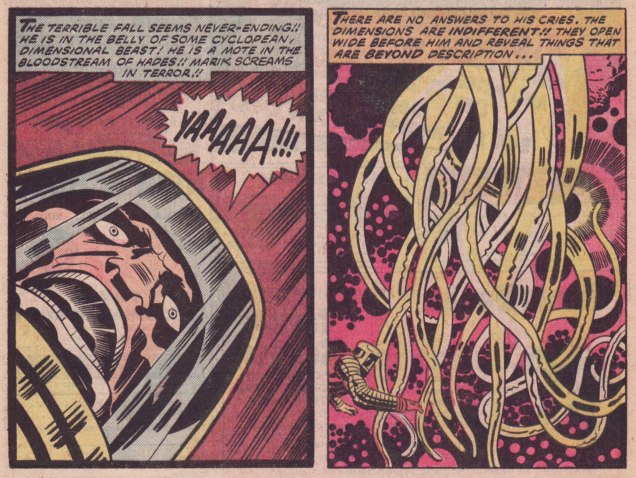
Now that we have the boring stuff over with, we move on to the spacey part of this post: epic voyages into the cosmos, mind-shattering encounters with Gods and fights to the death with unthinkable monsters of fearsome power! As usual, in chronological order: one must respect tradition.
« To make his comic, Kirby watched 2001 again, referenced a stack of stills, and pulled from the screenplay and Arthur C. Clarke’s novelization. The illustrations were instantly recognizable to anyone who’d seen the film, but the characters were uniquely his: beefy and emotive with a touch of uncanny. There are also moments of pure Kirby: a splash page of a spacesuit-clad astronaut gaping at an exploding cosmic sky, an acid-trip interpretation of the climatic Star Gate sequence. »
Pages from Beast-Killer! (read the full story on Diversions of a Groovy Kind) published in 2001, A Space Odyssey no. 1 (December 1976).Panel from Wheels of Death (again, read the story on Diversions of a Groovy Kind) published in 2001: A Space Odyssey no. 4 (March 1977). *My* question is, does anybody remember any tentacles in the film? I know, I really have a one-track mind.
« Kirby was the right choice for the assignment, but, Mark Evanier (a comic book writer, Kirby friend and colleague, and author of the biography Kirby: King of Comics) says, he was wary of taking on someone else’s story, especially one as iconic as Kubrick’s vision of 2001. “He didn’t feel he had a lot of wiggle room to expand or inject himself into it,” Evanier says. “He had to keep reminding himself, ‘That’s my viewpoint, that’s not Stanley Kubrick’s,’ and adjusting.”» (source: The Crazy Legacy of Jack Kirby’s Forgotten 2001: A Space Odyssey)
I wanted to find a good overview of The Eternals, and thought I had found it (plenty of pictures, an overall idea of the leitmotifs driving the series – and importantly, NO MENTION OF THE MOVIE)… until I came to the end of the article in question and saw that the author was next going to read Neil Gaiman‘s take on The Eternals* to see if the latter had fixed some of Kirby’s plot flaws, at which point I choked on the water I was sipping. But, but! the author repented, and so I give you Review: The Eternals by Jack Kirby from the blog Giant Size Marvel.
Panels from God and Men at City College published in The Eternals no. 6 (December 1976).Panel from Disaster Area, published in The Eternals no. 15 (September 1977).The Eternals no. 18 (December 1977), penciled by Jack Kirby and inked by Frank Giacoia.Panels from To Kill a Space God, published in The Eternals no. 18 (December 1977).Panels from To Kill a Space God, published in The Eternals no. 18 (December 1977).
Surely everyone knows Captain America already, but here are his 7 Most Awesome Moments (arguable, but a good starting point) by the good folks at Comic Alliance.
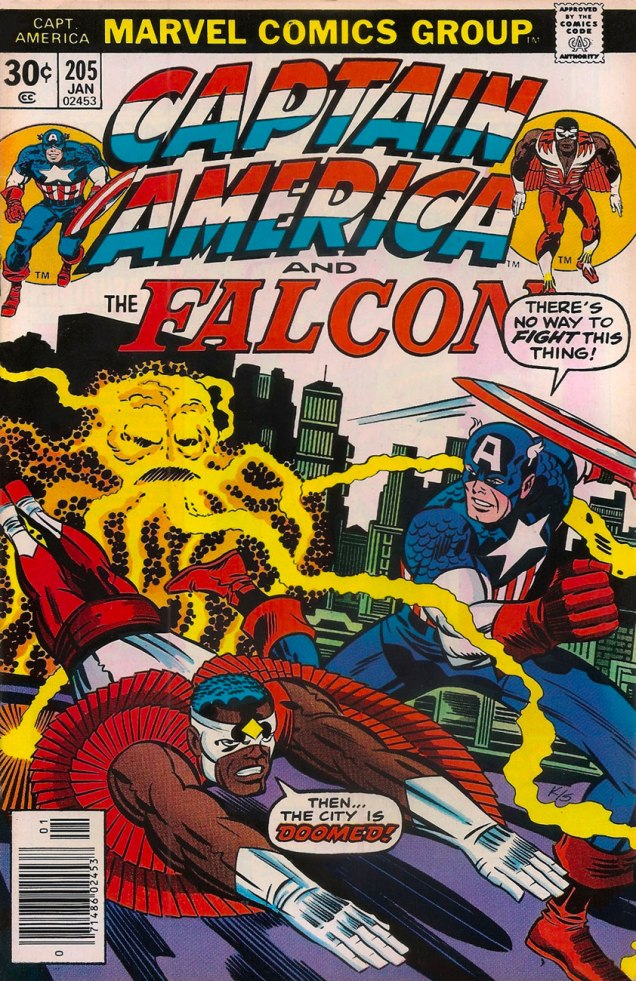
Here we have energetic tentacles, free-flowing-energy cephalopods…
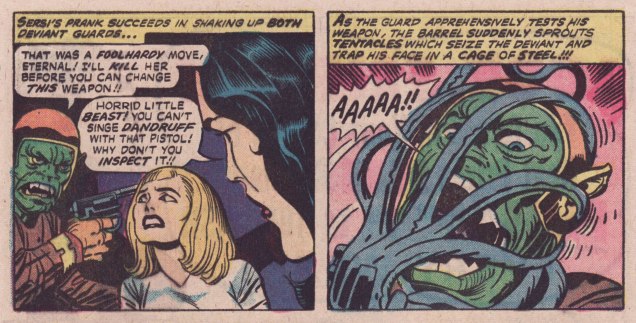
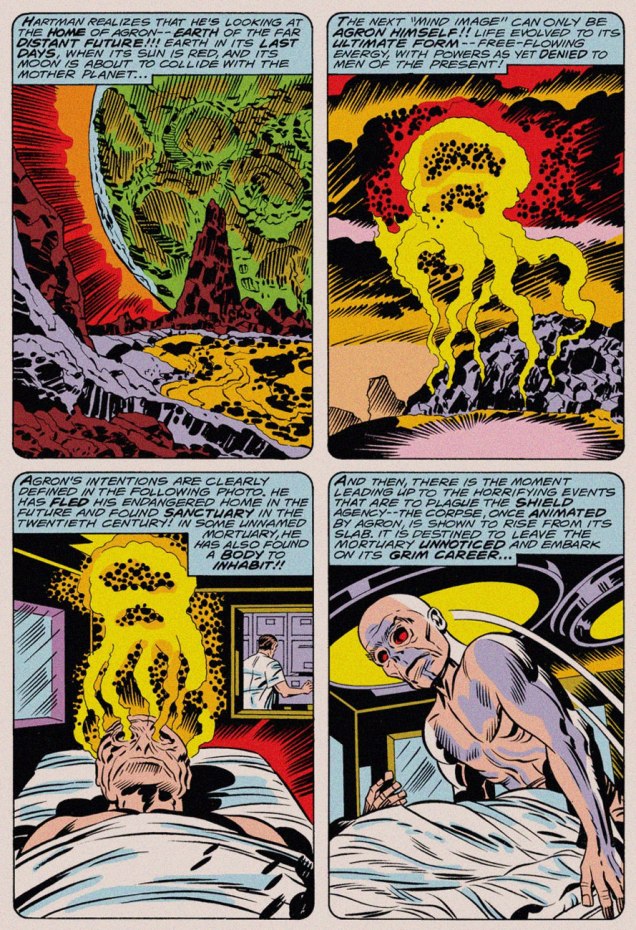
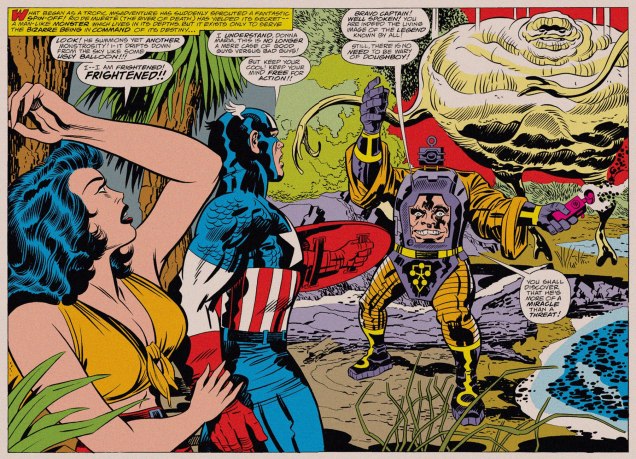
Captain America no. 205 (January 1977), penciled by Jack Kirby and inked by Joe Sinnott. The thing with the tentacles is Agron, who (which?) will eventually learn to animate a corpse, but for now he’s just in his energy form.Page from Agron Walks the Earth!, scripted and penciled by Jack Kirby and inked by John Verpoorten, published in Captain America no. 205 (January 1977). I *told* you Agron would animate a corpse, but did you listen?Double splash from Arnim Zola — The Bio-Fanatic!!, scripted and penciled by Kirby and inked by Frank Giacoia and John Verpoorten, published in Captain America no. 209 (May 1977).
You asked for it (right?): Doughboy in action! Technically, those are rubbery arms, not tentacles, but as someone who regularly makes sourdough bread, I assure you, dough *does* sprout tentacles and will latch onto your hands and arms with them.
Page from Arnim Zola — The Bio-Fanatic!!, scripted and penciled by Kirby and inked by Frank Giacoia and John Verpoorten, published in Captain America no. 209 (May 1977).Captain America no. 210 (June 1977), penciled by Kirby and inked by John Verpoorten. The Red Skull taking a leaf out of Medusa’s book? Seriously, those have *got* to be hair extensions.
You know how women aren’t advised to go out after dark, or to go to parties in revealing clothing because they might get raped and/or murdered? (This is purely a comic blog and we play nice, so I’m not developing that line of thought any further.) In the comic world, until relatively recently, that sort of thing couldn’t really be shown, but aren’t tentacles a rather handy stand-in for more realistic (and far scarier) violence? The only point I wish to state is that a woman can’t even go for a fucking walk without encountering tentacles. Swimming? Just forgetaboutit. Sitting quietly on a log? As long as you’re female, the tentacles will still find you, it scarcely matters whether you’re clad in a swimsuit, a gunny sack, or a parka. If the monster finds you a tad overdressed, it will just rip your clothing off – problem solved!
Blackstone no. 1 (Fall 1947, EC). Blackstone, Master Magician was created in 1946 by Elmer Cecil Stoner (1897-1969; one of the first black comic book artists!) for Vital Publications. The comic had a remarkably short life – one issue published by EC Comics (the one you’re currently looking at), and three more issues published by Timely. Somehow this was enough to spawn a radio series that aired from 1948 to 1950.
Stoner, who worked for a plethora of golden age companies (Timely, Fawcett, EC, Dell…) attracted some pretty heavy criticism in recent years. « Stoner’s drawing is the visual equivalent of fingernails scraped across a slate, and whenever he had a chance to botch the perspective, the composition, or even the inking, he did so with brio », opines Ron Goulart in his Great History of Comic Books. One could make the point that the above cover demonstrates this: the characters seem to be floating, not connected at all with one another or the landscape. However, whatever one thinks of his art, it has to be admitted even by the staunchest critic that Stoner was a pioneer who carved out a path for other African-American artists.
« On December 16, 1969, Elmer Stoner passed away. Since then he has been largely forgotten by the comic book industry and overlooked as a trailblazer. He was no Jackie Robinson, his presence in the comic industry didn’t alter its course. He did, however, pave the path for Al Hollingsworth, Matt Baker, Ezra Jackson, Cal Massey and for every African-American artist who followed. Stoner’s life is worthy of further exploration and his story deserving of wider recognition. He should not remain invisible. » |source, an article by Ken Quattro that’s well worth reading!|
« Miriam and Hester were insane. They took the severed head of a dead man, and sewed it back onto his body. Then, they stripped away their clothes and conjured up a demon! » As usual, Vampirella stories make perfect sense. The Nameless Ravisher, scripted by Flaxman Loew and drawn by Leopold Sanchez, was published in Vampirella no. 40 (March 1975, Warren). Flaxman Loew, by the way, was the somewhat ridiculous nom-de-plume of British Mike Butterworth. His stories seemed to get criticized a lot in the letters’ section, so maybe he deliberately picked a moniker guaranteed to be misspelled. One thing’s for certain – he had a vicious streak, qualified by a fan as a “fizzy, nasty run”. Read the full issue here, if you must; I can’t recommend it.Thank you for underlining the VIOLATING in the narration, Mr. Script Writer (what can you expect out of a man named Flaxman Loew?) – otherwise we would have never figured it out. This story also contains awe-inspiring quotes like « Vampirella! Rend her! Rip her! Now! », and « the water comes… and comes… ravishment by water…! »
You know how I said that swimming is not recommended unless you want a tentacular encounter? Do keep that in mind, especially with summer just around the bend:
Alpha Flight no. 14 (Marvel, September 1984). Cover by John Byrne. Co-admin RG would like to inform everyone that Lake Ontario is not teal-coloured. I’d rather take my chances with the octopus rather than be rescued by that horrible-looking man, but that’s just me (or Byrne’s so-called art).
A closer look at Heather’s rescuer:
Puck is a dwarf, okay, but why does it seem like Byrne has never seen an actual dwarf in his life?
A page from « Biology Class », scripted and drawn by John Byrne. So why doesn’t the athletically-minded Puck jump into the water instead of Heather? She tells him not to: « Stop! You know you can’t swim worth spit! » (Err…?) Is it just me, or do the “deep and dark waters of Lake Ontario” look like a swimming pool?
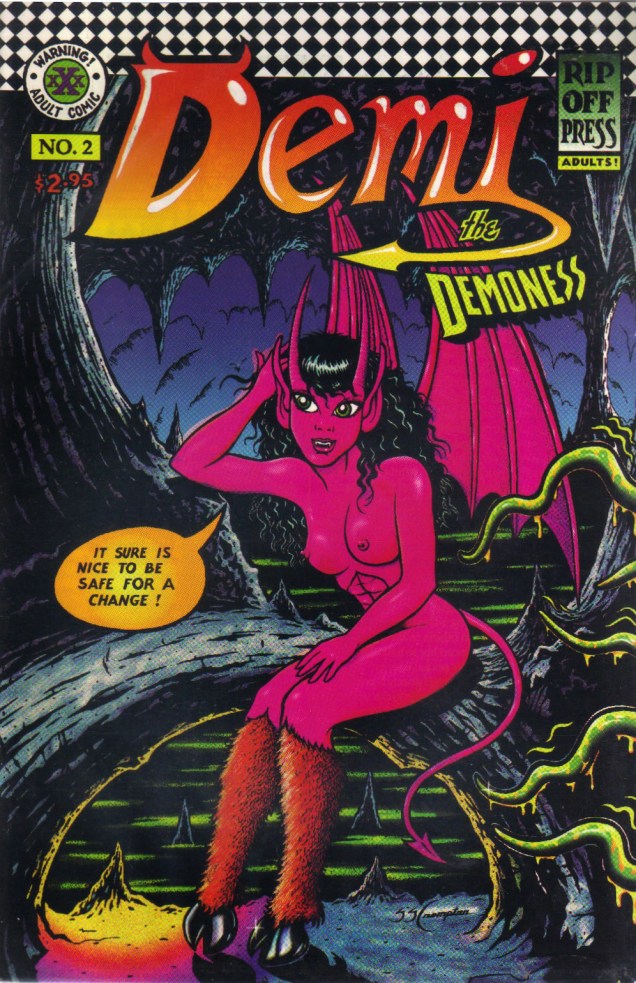
O, cute Demi with your gleaming hooves, beware of the quiet before the (sexy) storm! Demi the Demoness no. 2 (1993, Rip Off Press). The cover is by Demi’s Canadian creator, Steven S. Crompton.
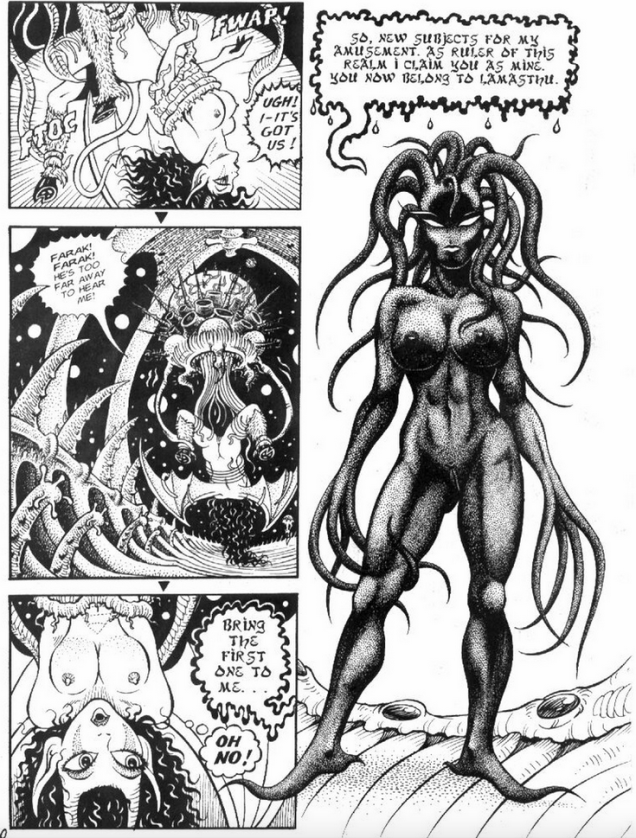
Crompton’s art is not *great*, but it has definite charm: somewhat childlike and proudly cartoony, it underlines Demi’s innocence perfectly, her huge puppy eyes beckoning to the reader while she gets ravished by yet another toothy monster, well-endowed Pegasus, or frisky cat goddess. And I don’t mean to make it sound like she’s lying back and thinking of England, either – in most cases, she’s an enthusiastic participant in the sexy shenanigans.
« Over 35 different Demi the Demoness comics have been published. Numerous artists and authors have worked on Demi comics over the years, including Frank Brunner, Tim Vigil, Seppo Makinen, Philo, Ryan Vella, Gus Norman, Enrico Teodorani, Silvano, Diego Simone, Jay Allen Sanford, and many others. Demi has appeared in numerous comics crossovers with other characters, including Shaundra, Captain Fortune, Mauvette, Vampirooni, Cassiopeia the Witch, Djustine, Crimson Gash, and adult film stars Tracey Adams, Tabitha Stevens, Deja Sin, and Bonnie Michaels.» |source|
Page from « The cumming of Lamasthu », published in Demi the Demoness no. 4 (1994, Rip Off Press). Art by Steven S. Crompton.Page from « The Cumming of Lamasthu », published in Demi the Demoness no. 4 (1994, Rip Off Press). Art by Steven S. Crompton.
You can read a dozen Demi issues on My Hentai Comics… the link is very much not safe for work, unless you work for a sex-obsessed Lord Cthulhu or something. But I can guaran-damn-tee a lot of tentacles!
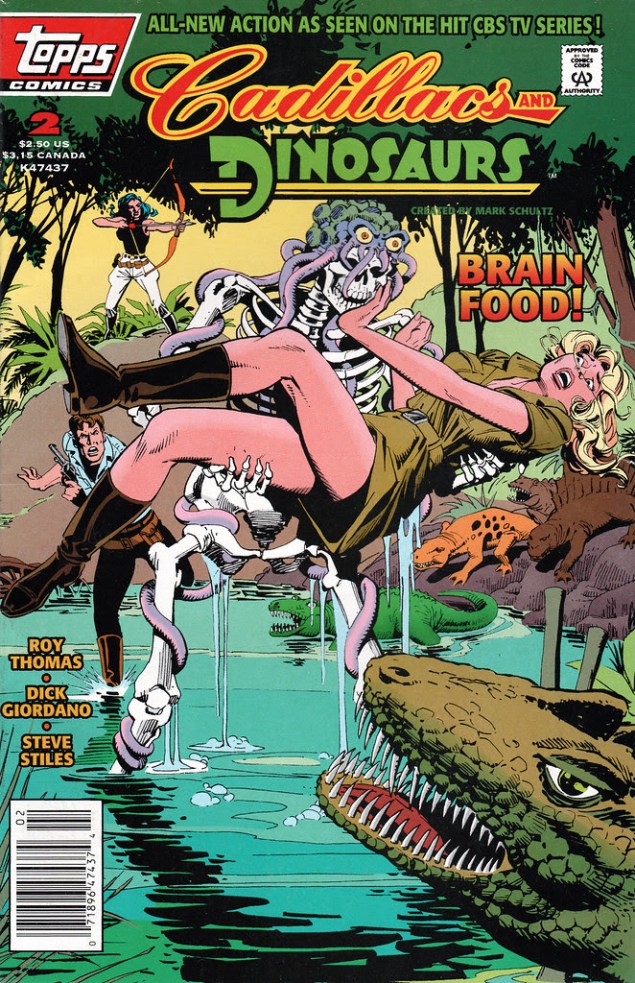
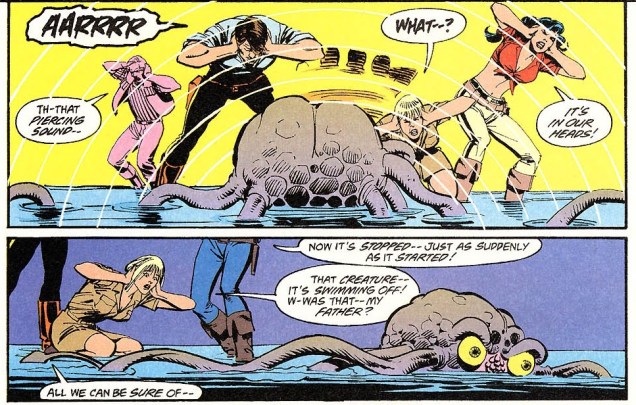
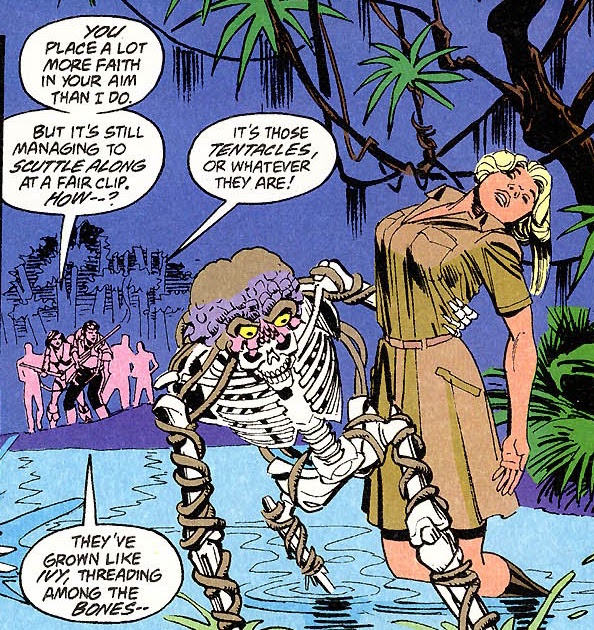
Cadillacs and Dinosaurs no. 2 (March 1994, Topps). Cover by Dick Giordano, who shouldn’t have been let anywhere near Mark Schultz’ characters. I see the lizard has decided to photobomb this romantic scene (the skeleton guy is clearly about to drop Felicia into the murky swamp water.. that’s teal-coloured for some reason… hardly swampy!)
Inside, we get Blood and Bones, Part II: Swamp Things (scripted by Roy Thomas and drawn by Dick Giordano), a Mœbius 2-pager, a couple of pages of captioned Schultz dinosaur illustrations, and – just in time to save this issue from being thoroughly dreadful – Sailor, Take Warning!, scripted by Roy Thomas and drawn by Steve Stiles.
See? Definitely tentacles. Every self-respected brain has ’em.Felicia’s pose looks distinctly unnatural, but she’s doing a good job of letting everyone know she has an impressive bust (a girl has priorities, even while unconscious). Giordano doesn’t seem to know that human hands curl up when at rest.
You know what Blood and Bones, Part II: Swamp Things has, aside from a suspiciously blue and limpid swamp? Dinosaurs. More specifically a T-Rex skeleton controlled by a brain with tentacles, who’s actually the father of one of the characters! It takes a Roy Thomas to cobble up such classic plots.
Maybe, instead of Brainosaurus Rex, he should have been called Daddysaurus, or maybe even Papasaurus Rex?
I hope I have impressed upon you the absolute necessity of caution when taking a stroll – whether your path lies next to a large body of water or leads through a forest. Above all, do not perch on a log when you need a rest, or lean against a tree. Hanging out with magicians is also not recommended.
Until next Tentacle Tuesday, I remain tentacularily yours…
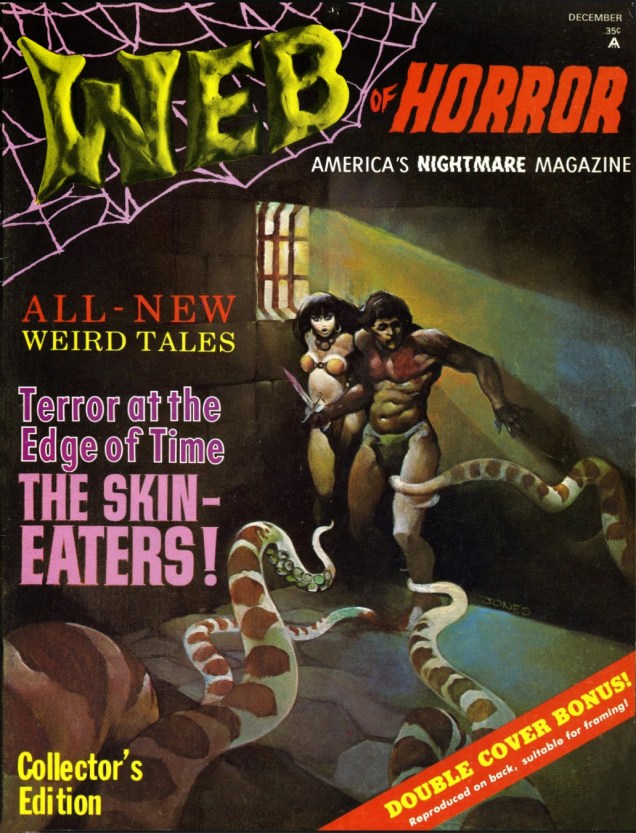
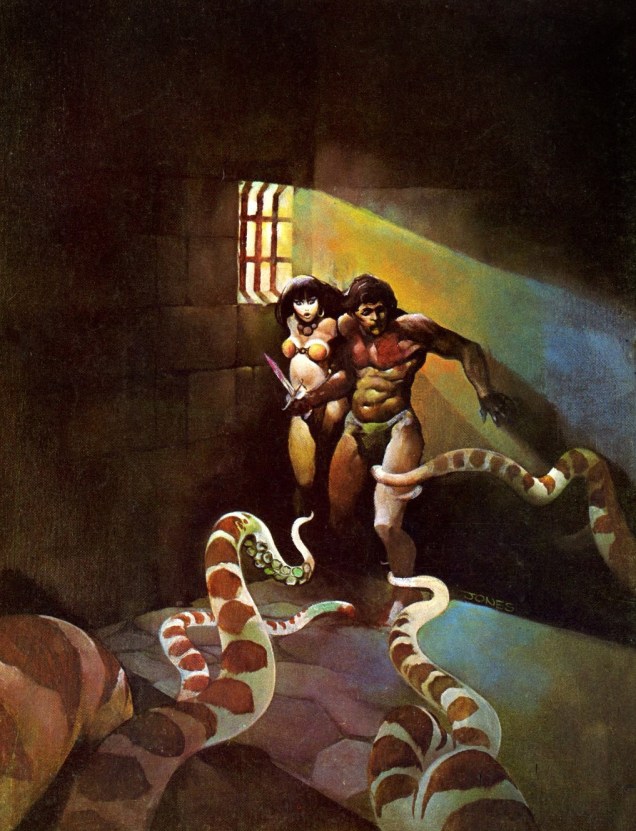
Web of Horror no. 1 (Major Magazines, December 1969). Painting by Jeff Jones.
I understand that the artist left quite a lot of empty space on purpose – to be filled with pointless text – but still, was it necessary to plaster nearly every inch of the image with captions yellow, red and purple? (I do like how the WEB seems to be made out of plasticine… and likely was.) Here’s the cover without all that wordy fluff:
The Rook no. 4 (Warren, August 1980). Cover by Nestor Redondo.
The Rook couldn’t quite kill the fishy brute’s whole family in #4, so he had to confront its slightly more colourful cousin in issue 7:
The Rook no. 7 (Warren, February 1981). Cover by Jordi Penalva. It’s nice to see that men (not exclusively Doc Savage) get strategically ripped shirts, too, sometimes. Eye candy!
Co-admin RG suggested I check Eclipse Magazine‘s tentacular offerings for this post, and he was correct, there was one issue involving an octopus used as a coffee table.
Eclipse Magazine no. 4 (Eclipse, January 1982). Cover by Carl Potts. I went snorkeling a few months ago and the scene was not dissimilar (minus, sadly, the mermaid).
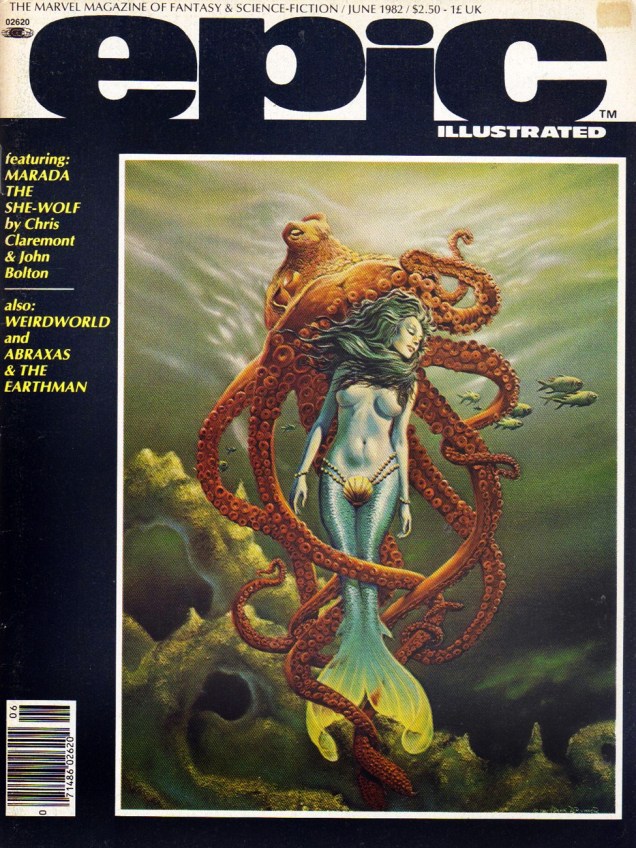
Marvel’s Epic Illustrated, with its 70-odd pages per issue, surely offered something for everyone. The aforementioned offerings were quite hit-or-miss, but the occasional presence of Stephen Bissette, Rick Veitch, Basil Wolverton (in reprints), Berni Wrightson, Ernie Colón, P. Craig Russell, et al. makes it worthwhile to go through its 34 issues (okay, maybe not all in one sitting, unless you have quite a few thermoses of tea prepared – or something stronger).
Epic Illustrated no. 12 (Marvel, June 1982), cover by Frank Brunner. You can read the whole issue here.
Brunner’s painting is rather nice – the mermaid and her friendly octopus both look so serene! – that here it is again. And read an interview with him while you’re at it: Legendary Feathers: Interview with Frank Brunner. (I apologize for linking to a website titled Fanboy Nation, though. Erk.)
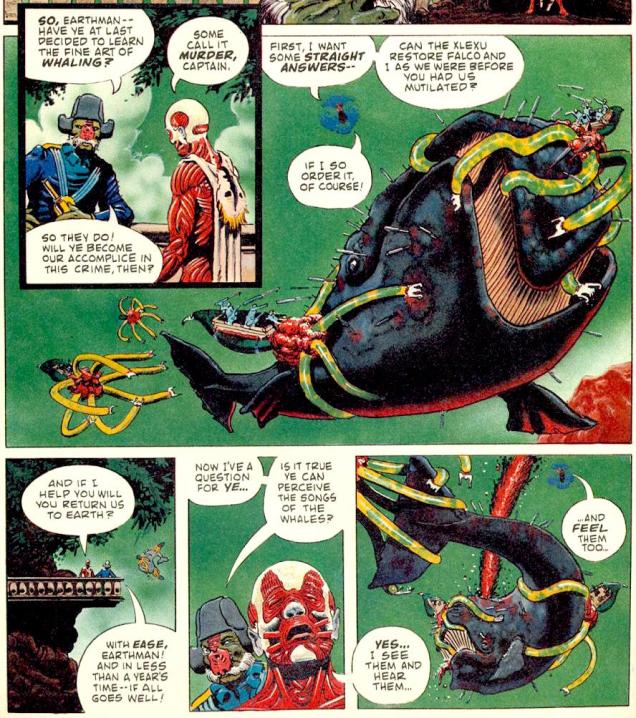
Issues 10 to 17 of Epic Illustrated featured Rick Veitch’s Abraxas and the Earthman, a purported retelling of Moby Dick (although frankly, aside from a vengeful squid, the similarities are not striking). Naturally, tentacles abound. Really freaky, creepy tentacles, much like the rest of the story.
Page from “The Hunt: Chapter Three”, written and drawn by Rick Veitch, printed in Epic Illustrated no. 12.Epic Illustrated no. 17 (Marvel, April 1983), cover by Tim Conrad. Read it here.
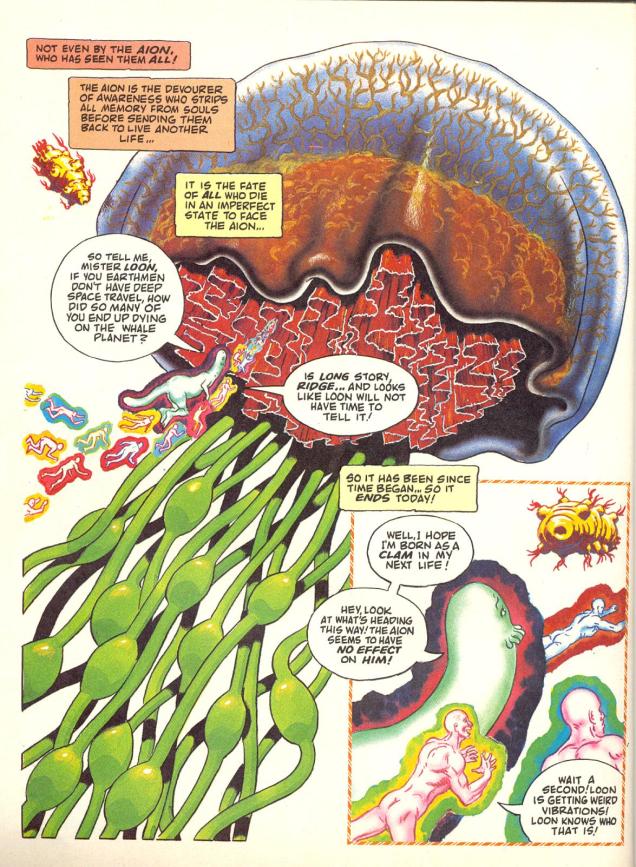
Veitch’s fucked-up (I mean that as a compliment), imaginative tale continues with “Man and Whale (Chapter Eight)”, the final installment. Alongside a plethora of sea-creatures (no longer in the sea), there’s this Devourer of Awareness, Bearer of Tentacles:
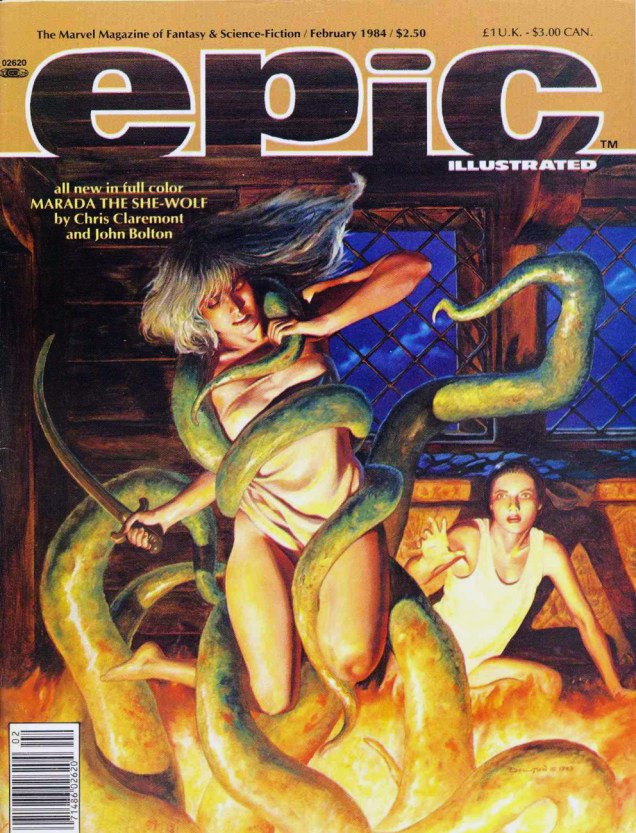
Epic Illustrated no. 22 (Marvel, February 1984). Cover by John Bolton. Read the issue here. It’s a bad, unconvincing cover, but hey, this is an inclusive post.
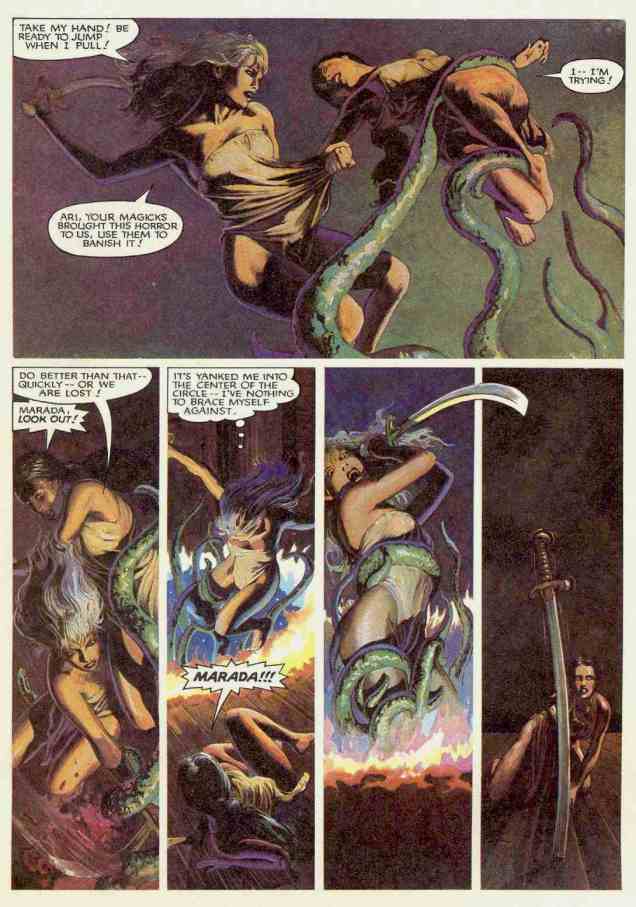
Speaking of Bolton, he drew “Wizard’s Masque” (another chapter in the cycle of Marada the She-Wolf), a story scripted by Christopher Claremont.
Created by Bill Everett, Namor the Sub-Mariner first appeared in Marvel Comics no. 1 (October 1939). The offspring of a human sea captain and a princess of Atlantis (and thus proudly bearing the title of Prince), he possessed the aquatic talents one expects of a regular merman and the exceptional strength of a carnival strongman. The cool thing about Namor is that right off the bat, he was a rather negative character – to be more precise, he was an Enemy of the United States (Everett didn’t mince words or characters, huh?) As Les Daniels states in his Marvel: Five Fabulous Decades of the World’s Greatest Comics (1991), « Namor was a freak in the service of chaos. Although the Sub-Mariner acted like a villain, his cause had some justice, and readers reveled in his assaults on civilization. His enthusiastic fans weren’t offended by the carnage he created as he wrecked everything from ships to skyscrapers. » This chaos culminated in an epic fight with Human Torch in 1941 when Namor took things a little too far and threatened to inundate the whole island of Manhattan. This little skirmish didn’t prevent him from joining the Allies’ side once World War II started, however, which gave a more constructive outlet for his somewhat destructive energies.
Right from the beginning, the Sub-Mariner was a complex character who just wouldn’t fit into the standard good guy/bad guy dichotomy. He underwent through quite a few transformations, disappearing for a bit right after WWII like many of his super-and-anti hero compatriots (but never for more than a couple of years at a time) and resurfacing during the Silver Age as a slightly different character. Namor’s concern about encroaching technology and hate of humanity, his fierce independence, made him a likeable character for those of us who like mavericks. He is a tragic character, a king without a kingdom who finds that Atlantis and its people have been destroyed by nuclear testing. After that, who wouldn’t hold a grudge? Anyway, if you’d like a more cogent overview of the Sub-Mariner’s history, visit The Great Comic Book Heroes.
To get back on topic, given how much time Namor spends underwater, it’s hardly surprising that he quite frequently encounters tentacles.
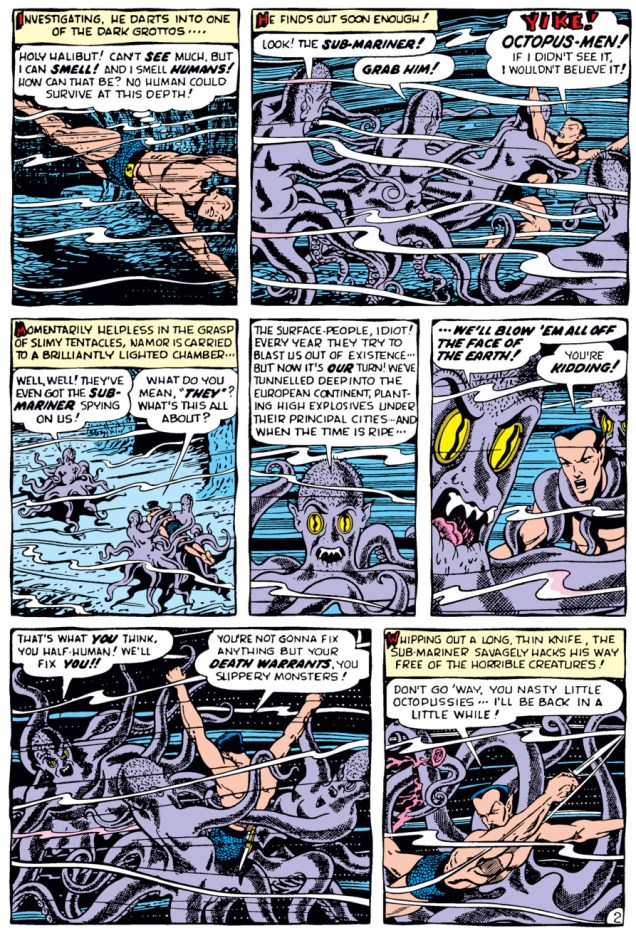
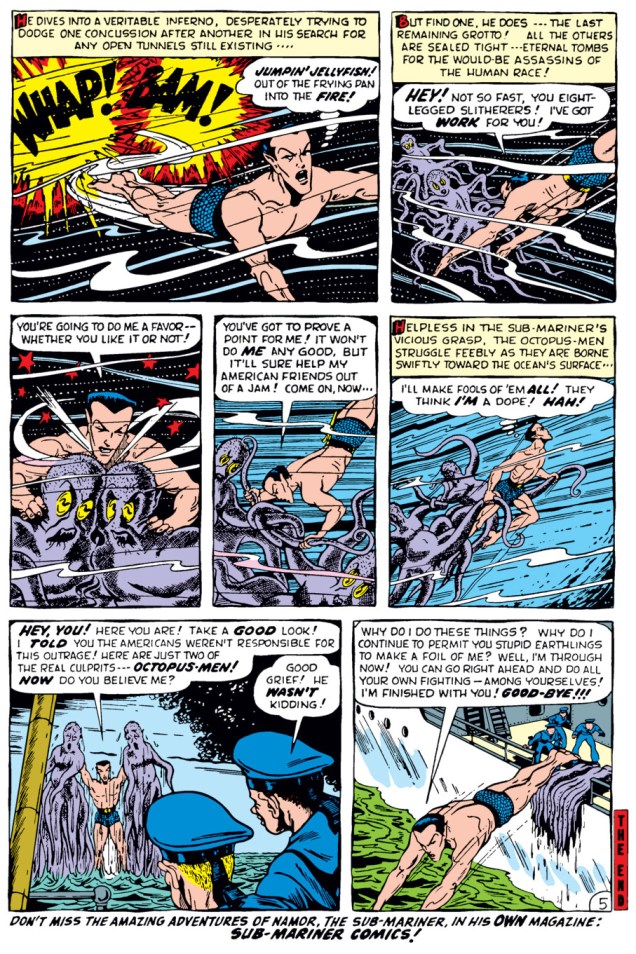
First, a story scripted and drawn by Bill Everett – who better to introduce the character than his creator? This is “The Octopus-Men!”, printed in The Human Torch no. 38 (August 1954).
« The Original Aquaman » ? My, aren’t we testy. Now, now, you boys both belong to a long, storied tradition.
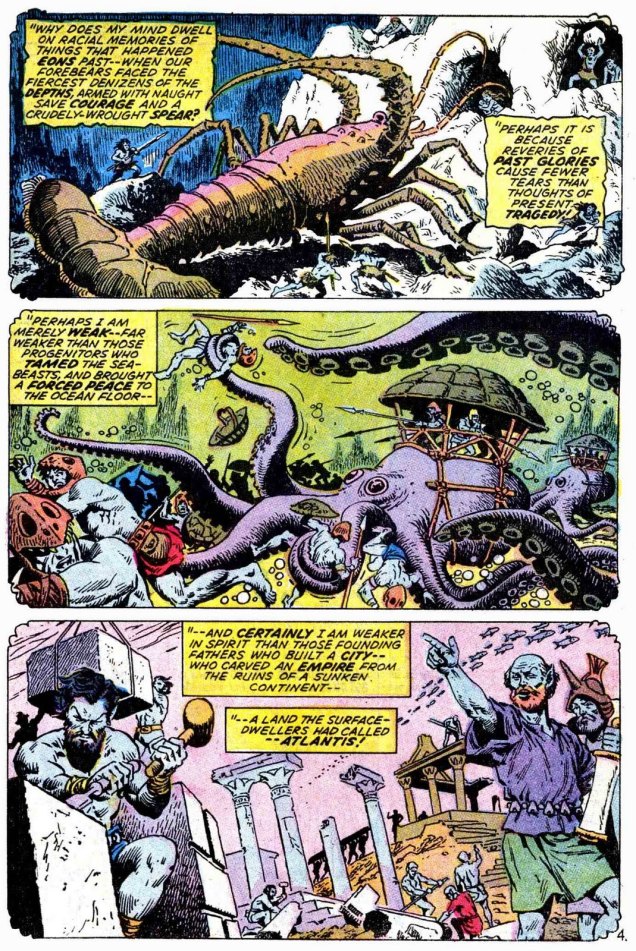
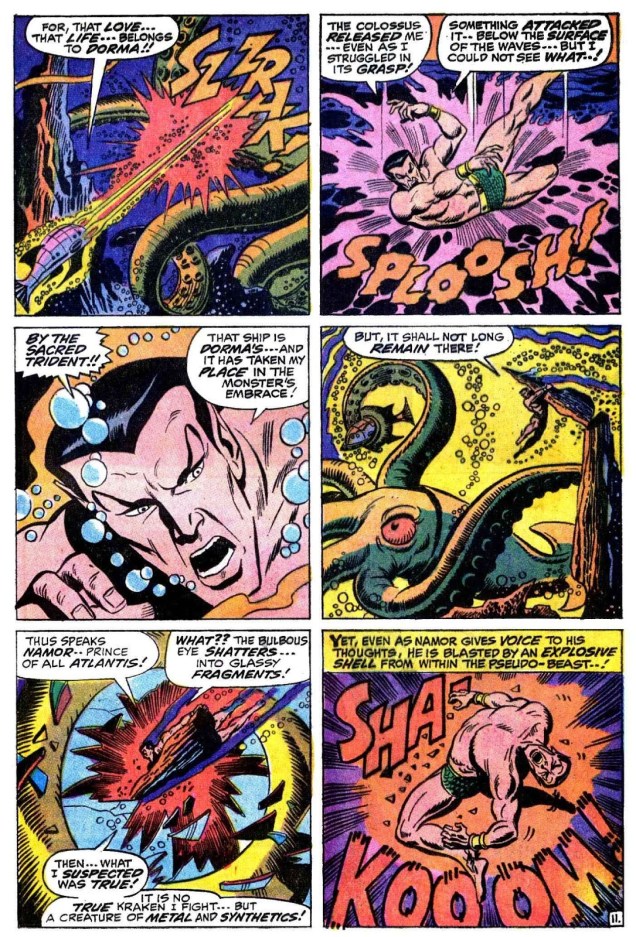
Skipping ahead some twenty years, a page from “Namor Agonistes!”, scripted by Roy Thomas, pencilled by Ross Andru and inked by John Severin, printed in Sub-Mariner no. 38 (June 1971). This is sort of an origin story of the Sub-Mariner. Lovely art, n’est-ce pas?
A page from “When Wakes the Kraken!”, scripted by Roy Thomas, pencilled by Sal Buscema and inked by Mike Esposito, printed in Sub-Mariner no. 27 (July 1970):
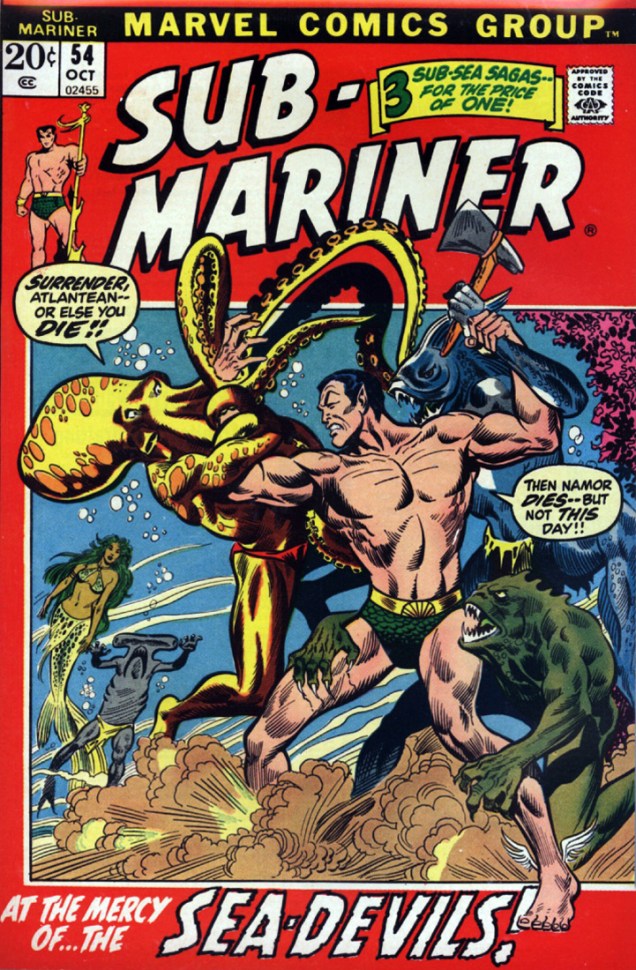
Oh, let’s have a couple of covers, too.
A rather random assortment of creatures, isn’t it? Sub-Mariner no. 13 (May 1969), pencils by Marie Severin and inks by Joe Sinnott.Umm… why is a piranha wielding an axe? Sub-Mariner no. 54 (October 1972), pencilled by Alan Weiss and inked by Frank Giacoia.
I mostly sneer at modern “reboots” of Golden or Silver Age characters, but Namor’s appearance in the excellent Thor the Mighty Avenger (Marvel, 2010) was completely à propos. (The series is a happy union of an absorbing story with great graphics – it’s written by Roger Langridge with art by Chris Samnee.) Here’s a page from “Thursday Morning“, published in Thor the Mighty Avenger no. 5 (December 2010).
« Be silent in that solitude which is not loneliness — for then the spirits of the dead who stood in life before thee are again in death around thee — and their will shall then overshadow thee: be still. »
— Edgar Allan Poe (1829)
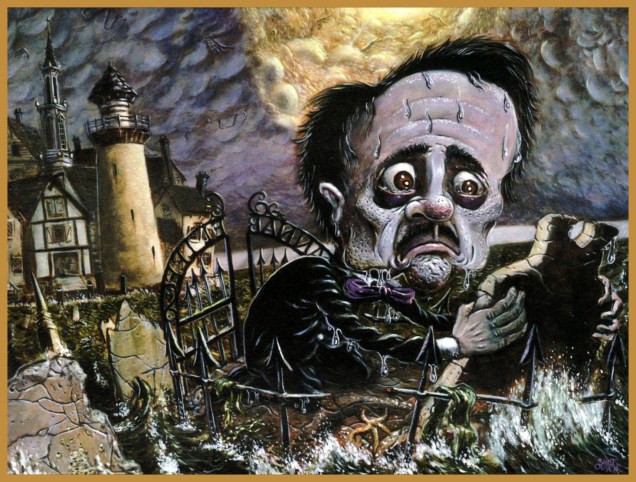
It was on this day, two hundred and ten years ago, that the great writer, poet and posthumous master of all media Edgar Poe (Jan. 19, 1809 – Oct. 7, 1849) was born in Boston, Massachusetts. I’ll spare you the usual biographical details, widely available elsewhere, and we’ll concentrate on his unflagging ubiquity in the medium of comics.
Poe’s literary reputation was in tatters in America, thanks to a rash of hatchet jobs and dismissals, some of the most vicious from the pen of one Rufus Griswold, the very worm he’d named his literary executor (!), as well as such notables as Ralph Waldo Emerson and T.S. Eliot… while his renown was undimmed in Europe, particularly in France (in no small part owing to Charles Beaudelaire’s legendary translations), rehabilitation at home slowly came as the 20th century crept along, but it was likely the publication of Arthur Hobson Quinn’s definitive Poe biography, in 1941, that sealed the deal and opened the floodgates.
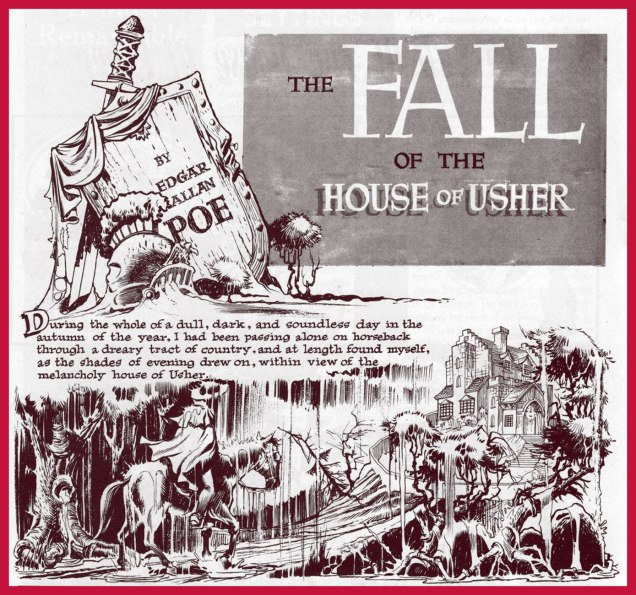
Top two tiers from page 2 of The Spirit‘s August 22, 1948 episode. Layout by Will Eisner, pencils and inks by Jerry Grandenetti. As Dave Schreiner puts it: « Grandenetti captures the asthenic look of Roderick Usher that Poe described. The man is a decadent waif; insular, fragile, high-strung, possibly in-bred. »
Classics Illustrated publisher Gilberton was first out of the gate with Poe adaptations, at first tentatively with a pair of poems (Annabel Lee, then The Bells)**, then more substantially with The Murders in the Rue Morgue, in Classic Comicsno. 21 – 3 Famous Mysteries (July, 1944), sharing the stage with Arthur Conan Doyle and Guy de Maupassant. Read it here. Pictured below is Classics Illustratedno. 84 (June 1951, Gilberton), cover by Alex A. Blum. Read the issue here.
A relevant passage from Simon Singh‘s fascinating (if you’re into that sort of thing… and I hope you are) The Code Book: The Secret History of Codes and Code-Breaking (1999): « On the other side of the Atlantic, Edgar Allan Poe was also developing an interest in cryptanalysis. Writing for Philadelphia’s Alexander Weekly Messenger, he issued a challenge to readers, claiming that he could decipher any monoalphabetic substitution cipher. Hundreds of readers sent in their ciphertexts, and he successfully deciphered them all. Although this required nothing more than frequency analysis, Poe’s readers were astonished by his achievements. One adoring fan proclaimed him ‘the most profound and skilful cryptographer who ever lived’. In 1843, keen to exploit the interest he had generated, Poe wrote a short story about ciphers, which is widely acknowledged by professional cryptographers to be the finest piece of fictional literature on the subject. The Gold Bug tells the story of William Legrand, who discovers an unusual beetle, the gold bug, and collects it using a scrap of paper lying nearby. That evening he sketches the gold bug upon the same piece of paper, and then holds his drawing up to the light of the fire to check its accuracy. However, his sketch is obliterated by an invisible ink, which has been developed by the heat of the flames. Legrand examines the characters that have emerged and becomes convinced that he has in his hands the encrypted directions for finding Captain Kidd’s treasure. »A page from EC Comics great Reed Crandall‘s exemplary adaptation of Poe’s The Tell-Tale Heart, from Creepyno. 3 (June, 1965). While Crandall’s work is outstanding, scripter-editor Archie Goodwin tried to ‘improve’ upon Poe by tacking on a tacky ending, a nasty habit he would indulge in again on subsequent adaptations, notably issue 6’s The Cask of Amontillado!. Read The Tell-Tale Heart. And don’t miss The Cask…, if only for the artwork.In the mid-70s, Warren would devote two full issues of Creepy to Poe adaptations; issue 69 (Feb. 1975), featured The Pit and the Pendulum, The Fall of the House of Usher, The Premature Burial, The Oval Portrait, MS Found in a Bottle!, Facts in the Case of M. Valdemar; issue 70 (Apr. 1975) comprised The Murders in the Rue Morgue, Man of the Crowd, The Cask of Amontillado!, Shadow, A Descent into the Maelstrom! and Berenice; All stories were adapted, with far greater respect than Mr. Goodwin seemed capable of, by Rich Margopoulos, and illustrated by a host of artists. The project was edited by Bill DuBay, and the cover painting is by Ken Kelly.Isidre Monés‘ fabulous opening splash from Creepyno. 70‘s Berenice. Read the story in full here.« The rays of the moon seemed to search the very bottom of the profound gulf; but still I could make out nothing distinctly, on account of a thick mist in which everything there was enveloped, and over which there hung a magnificent rainbow, like that narrow and tottering bridge which Musselmen say is the only pathway between Time and Eternity. » In 1976, a peak-form Berni Wrightson got out his brushes and paint tubes for a heartfelt portfolio of Poe-inspired oils. A sensitive and subtle sense of colour was among Wrightson’s chief assets; it’s a shame we didn’t see more of it. I opted to feature my favourite piece from the lot, A Descent Into the Maelström, but by all means feast your eyes on the whole shebang.In 1976, Marvel Comics set out to make their mark on the classics… with dubious, but predictable results. It wasn’t what their zombie readership had clamoured for. Here’s the best page (art by Rudy Mesina) from Marvel Classics Comicsno. 28, The Pit and the Pendulum (1977), featuring three tales adapted by scripter Don McGregor, and including future superstar Michael Golden‘s abysmal professional début on yet another helping from The Cask of Amontillado, where he demonstrates how he believes wine is to be drunk just like Pepsi. See what I’m griping about here.Think Poe’s all about the horror? Think again! You don’t become a household name by putting all your eggs in the same basket. Meet Edgar ‘Eddie’ Allan Poe, romantic leading man. “Based on actual records…” and sanitized beyond recognition. Given that Virginia and Edgar were first cousins and that they married when she was thirteen, you can see how absurd this strip is. Read the full tale of romance and pathos right here. The Beautiful Annabel Lee appeared in Enchanting Loveno. 2 (Nov. 1949, Kirby Publishing). Writer unknown, art by Bill Draut and Bruno Premiani.Kubert School alum Skot Olsen‘s cover illustration for the revised and expanded second edition (July, 2004) of Graphic Classics‘ Poe compendium.As with, say, Elvis or H.P. Lovecraft, when both legend and œuvre reach a certain tipping point of iconic fame, one can bend and twist the concepts any which way and they’ll still be recognizable. Here’s a panel from Harvey Kurtzman and Will Elder‘s faithful-in-its-fashion take on The Raven, from Madno. 9 (Feb.-Mar. 1954, EC).Michael Kupperman strikes again. From Snake ‘n Bacon’s Cartoon Cabaret ( 2000, HarperCollins)Hot off the presses! It’s Edgar Allan Poe’s Snifter of Terror no. 2 (Nov. 2018, Ahoy), featuring a collaboration between Rachel Pollack and the fabulous Rick Geary. Don’t miss it! Oh, and if the pose looks familiar, you’re thinking of this.
Whew — that’s it for now. In closing, I must bow and salute before the gargantuan endeavour accomplished by Mr. Henry R. Kujawa on his truly indispensable blog, Professor H’s Wayback Machine. Thanks for all the heavy lifting, Henry. I get exhausted just thinking about it.














































 Who's Out There?