We have just come back from a lovely vacation in Nova Scotia, one of Canada’s maritime provinces. In the honour of this all-too-short getaway, this Tentacle Tuesday is about Canadian artist Randolph Holton Holmes, who was born in Nova Scotia in 1942 and passed away in British Columbia in 2002, completely at the other end of this big country.
« Rand Holmes was Canada’s most revolutionary artist in his heyday, the star cartoonist at the Georgia Straight newspaper in British Columbia during the 1970s. His hippie hero, Harold Hedd, became the spokesman of the emerging counterculture as he avoided work, explored free love, and flouted drug laws. The Adventures of Harold Hedd spread across the globe in the wave of underground comix and newspapers of the era and Holmes became famous or at least notorious. While his comic character was bold and blatant, the artist was shy and quiet, well on his way to becoming a complete hermit. » (excerpt from Fantagraphics’ The Artist Himself: A Rand Holmes Retrospective)
Glimpsing through Holmes’ body of work, one quickly becomes aware that he displays a special affinity for drawing busty women… and (of more interest to this current post) that he loves to insert tentacles at the drop of a hat, especially if ETs of some kind are involved. A lot of artists use tentacles as a short-hand for aliens, and he’s not alone in that… much to my personal satisfaction.
Slow Death no. 6 (Last Gasp, January 1974). Colonel “Saunders”?Fog City Comics no. 2 (Stampart, October 1978). “Science fantasy at its finest” may be an unfulfilled promise; by all accounts, Rand Holmes’ Killer Planet is the best story of the issue. Fog City Comics was an all-Canadian underground comix anthology and lasted a mere 3 issues.
As I mentioned Holmes’ story Killer Planet, here’s a peek at its manifold tentacles:
A panel from Killer Planet, both written and illustrated by Rand Holmes, originally published in the aforementioned Fog City Comics no. 2, coloured by Bill Poplaski and reprinted in Death Rattle no. 1 (2nd series, Kitchen Sink Press, Oct. 1985).What kind of idiot eats fruit growing on an obviously life-threatening planet? Panels from Killer Planet, both written and illustrated by Rand Holmes, published in Death Rattle no. 1 (Kitchen Sink Press, October 1985).Panels from Killer Planet, both written and illustrated by Rand Holmes, published in Death Rattle no. 1 (Kitchen Sink Press, October 1985). Note the cute mushrooms in the bottom left corner.
And lastly, for contrast with the cover of Slow Death and its throes-of-ecstasy coupling scene, there’s this:
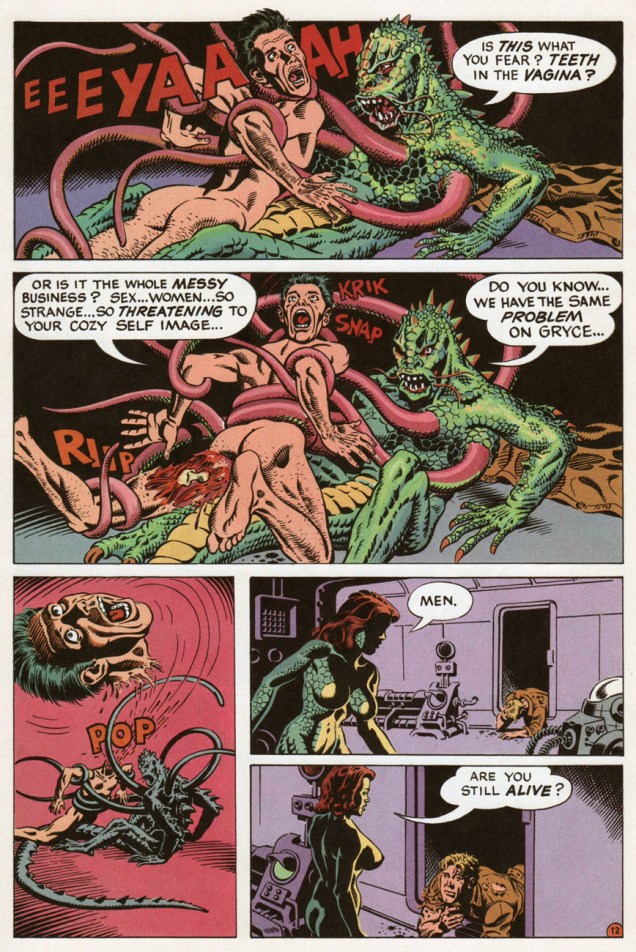
Vagina Dentata! A page from “Junkyard Dog“, written by Mike Baron. It was published in Death Rattle no. 5 (Kitchen Sink Press, June 1986). The (telepathic) alien female wasn’t unjustified in, erm, chewing up her rapist (the intercourse wasn’t consensual) – he was an unapologetic asshole.
*That’s Not Safe For Work, for those unfamiliar with the acronym. Turn back while you still can!
We all know that tentacles are often used in comics as a substitute for other, err, organs. Tentacle porn is nothing new. Still, occasionally I stumble upon something that’s just outstandingly odd and perhaps even depraved. Would one be able to find stuff online that’s far stranger and more degenerate? Indubitably. Still, within the context of Tentacle Tuesday, I’d like to think that the following offerings are firmly in the realm of “well, that was strange…”
Our first example of WTF is this cover, drawn by good ol’ William Stout.
Bizarre Sex no. 10 (December 1982, Kitchen Sink Press), cover by William Stout. I imagine the Earthman quivered in horror and became as flaccid as flaccid can be, though who knows what turns people on? The alien creature seems to have its eyes resolutely shut in grim desperation, so perhaps she’s not enjoying it much, either.
« One of the great series in underground history, Denis Kitchen’s Bizarre Sex was launched in May, 1972. One could discern that this would be a “no-holds-barred” type of publication upon perusing the first issue, as the first two stories were about brother/sister incest and interracial homosexuality. Bizarre Sex became best known for issue #9, which introduced Omaha the Cat Dancer with a story that took up the whole book. After another appearance in Bizarre Sex #10, Omaha moved on to its own successful serial. The great thing about Bizarre Sex is the series matured through the years, evolving from a comic book about atypical sex into more of an in-depth review of sexual relations and the human condition. »
As this is no. 10, the last issue of Bizarre Sex, presumably that “in-depth review of the human condition” part is applicable here. The cover could have fooled me… If anyone out there has read it, do let me know!
Chester Brown has always been one sick puppy. If by now his work is creepy and boring, back in the earlier days of his career, his stories were often fascinating… for those of us who enjoy a good mindfuck and have a strong stomach, that is. As for me, I never liked his stuff: far too disturbing, in a viscerally-uncomfortable kind of way. A good demonstration of his typical sense of humour is the following 2-pager with a characteristic blend of onanism, body fluids and irony. This instalment of Adventures in Science was published in Yummy Fur no. 4 (1984).
A little bit of comic relief: a cartoon from “How the Animals Do It” by Larry Feign. Make sure to visit this page for a little video preview of this book: a little animated tale of the barnacle’s super long penis and what s/he does with it, including the brilliant quote « if no resistance is met, in it goes ».
Okay, I’ll bite. Why did the chicken cross the road? Why did the male octopus lose an arm due to sexual promiscuity?
« Male octopuses have a big problem: female octopuses. Each male wants to mate and pass on his genes to a new generation. The trouble is, the female is often larger and hungrier than he is, so there is a constant risk that, instead of mating, the female will strangle him and eat him. The males have a host of tricks to survive the mating process. Some of them can quite literally mate at arm’s length. Others sneak into a female’s den disguised as another gal, or sacrifice their entire mating arm to the female and then make a hasty retreat. » [source: Mystery of Cannibal Octopus Sex ]
Next time we encounter difficulties with our romantic entanglements, let’s remember not to complain.
Our last entry is a little more standard from the perspective of shokushu goukan. The blend of sex-and-religion is also nothing new, although some people seem to be labouring under the impression that it still has some sort of shock value in this day and age (My sleazy ex-boss from the framing store, I’m looking at you.) However, I think these scaly tentacle-penises are a reasonably original take on the theme, and I also like the choreographed sisters, who seem to be doing some sort of interpretative dance while a-waiting to be ravaged.
Page from The Convent of Hell (published in Spanish in 1987, in English in 1998), written by Ricardo Barreiro and illustrated by Ignacio Noé.
You can read the whole thing here – very NSFW, obviously.
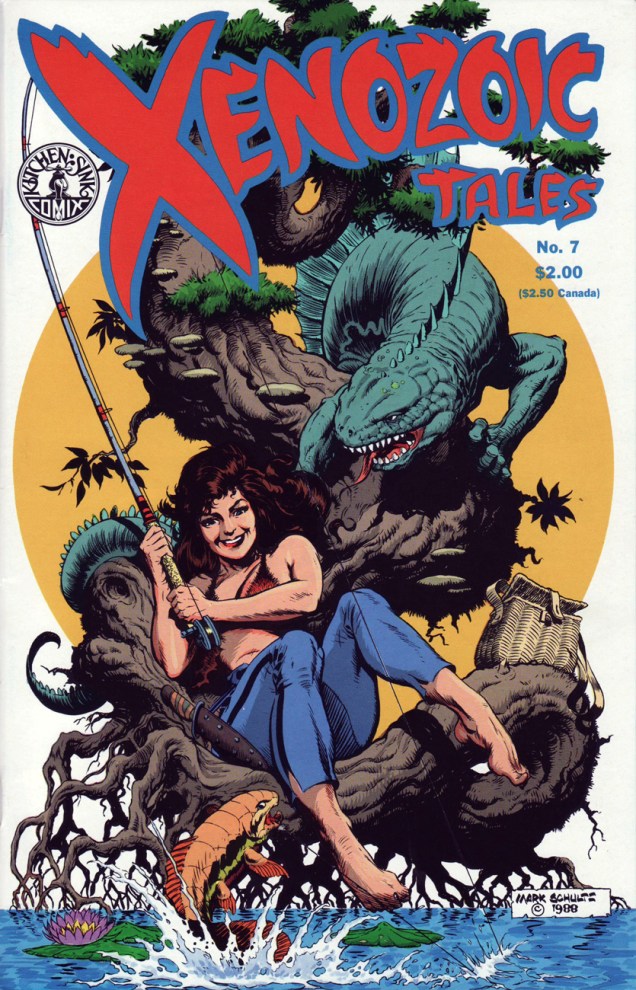
« I had me a scientific career before… ah… circumstances forced me to take up fishin’… »
In case it’s escaped anyone’s notice, summer’s officially arrived.
This is Xenozoic Tales no. 7 (Oct. 1988, Kitchen Sink), a series that presented, wonder of wonders, a post-apocalyptic future that wasn’t strictly doom and gloom. Cover by Mark Schultz. This issue features « The Growing Pool », written and drawn by Schultz, and “Crossed Currents”, written by Schultz and illustrated by Steve Stiles.
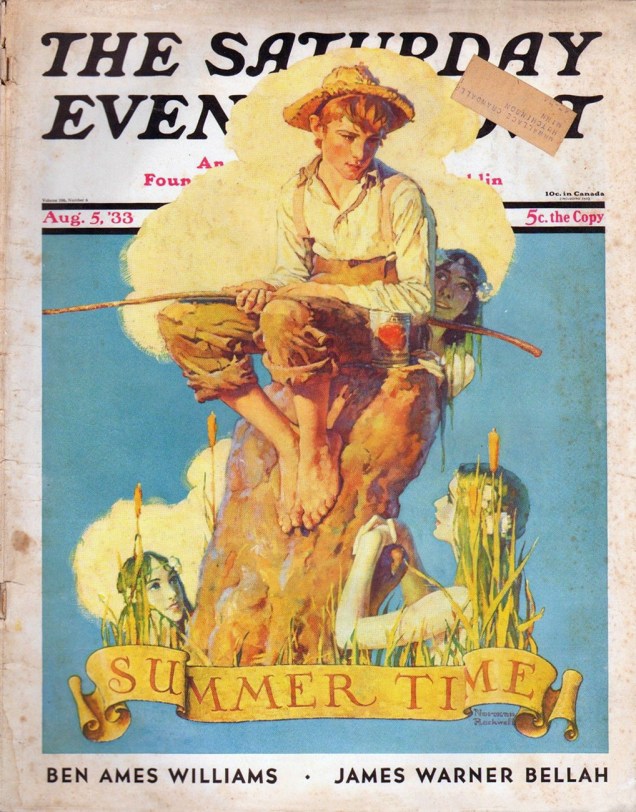
The lady is Hannah Dundee, and she may soon have to share her lunch. Something tells me this illustration is a pastiche of some The Saturday Evening Post-type cover.. there’s something charmingly old-fashioned about it, and I don’t mean Cambrian Age old.
You know, that sort of thing. The Saturday Evening Post‘s August 5, 1933 cover by… who else? Norman Rockwell.It’s the new falconry! Xenozoic Tales’ coexistence of humans and dinosaurs is not your run-of-the-mill anachronism: this is the world of tomorrow, not yesterday’s. This striking portrait of Ms. Dundee was conceived as a t-shirt design in the late 1980s. I should still have mine stashed somewhere…
Tentacles gleefully probing various orifices, that’s what my mind is on this Tentacle Tuesday. We well know that octopuses not only tend to strangle their victims, but also get close up and personal with their anatomy.
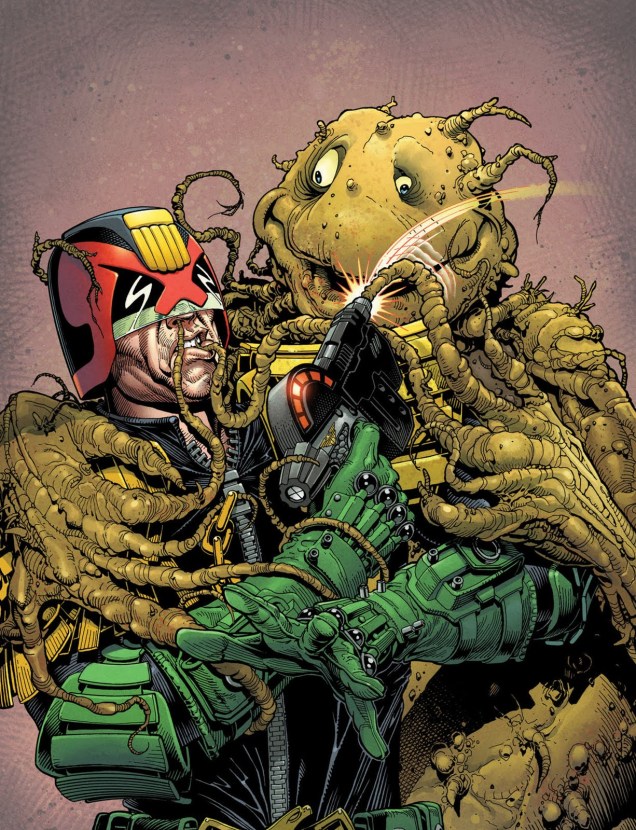
Just look at this adorable (did I say “adorable”? Maybe I meant “horrifyingly ugly”? I always get these two mixed up) cutie wrap Judge Dredd in his affectionate embrace.
I’ll let Pete Wells, owner of the « 200 A.D. Covers Uncovered » blog, explain the Couch Potatoes: « Behold, the god-like Cliff Robinson’s fantastic cover for Prog 1726, which features the welcome return of the Couch Potatoes. Another crazy Mega-City fad, the couch potatoes were lovable humanoid/vegetable lifeforms that sat in front of the Tri-D, repeating common phrases to its owner – think of a Little Britain fan and you’ll get the idea. The creatures were outlawed by the Justice Department when it transpired that they were super-evolving and feeding on their owners! »
Head over to Wells’ blog to watch this cover evolve from a preliminary sketch into a full-blown vision of tentacular glory.
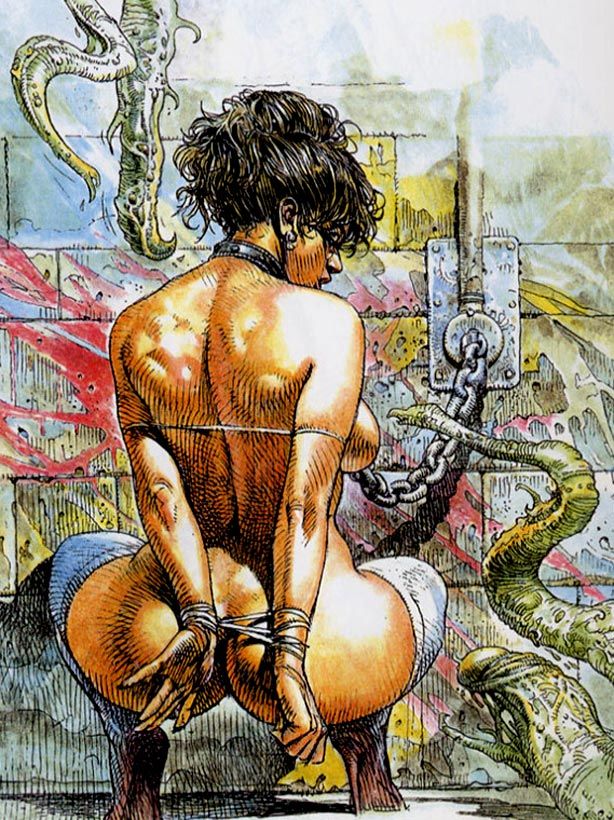
A page from « Children of the Future », drawn by Paolo Eleuteri Serpieri, published in a special edition of Heavy Metal called « Son of Heavy Metal », May 1984. Looks like the children of the future shall be some unholy octopus-human breed. Amusingly, the lecherous multi-tentacled sleazeball is still named Octo despite having many, many more appendages than just 8.
Serpieri is an Italian comic book writer and artist whose main interest is erotica. (His style is not really my thing, but hey, tentacles unite all.) He’s quite well-known for Druuna, a sci-fi/fantasy comic, which is more like an excuse to draw as many accouplements as possible.
Bonus image: Druuna and tentacles! Art by Paolo Eleuteri Serpieri. At least this ass-and-boob shot makes *some* anatomical sense – Druuna’s spine is still in place.
Lambiek Encyclopedia laconically notes that “Serpieri’s highly detailed portrayals of well-endowed heroines have earned him the undisputed title of “Master of the Ass”. Now Serpieri clearly has a huge interest in women’s asses, and he draws them lovingly, but so do a lot of other artists. Undisputed by whom? History is silent on this topic.
You can see more of his stuff here, which is definitely NSFW, unless you work in a brothel.
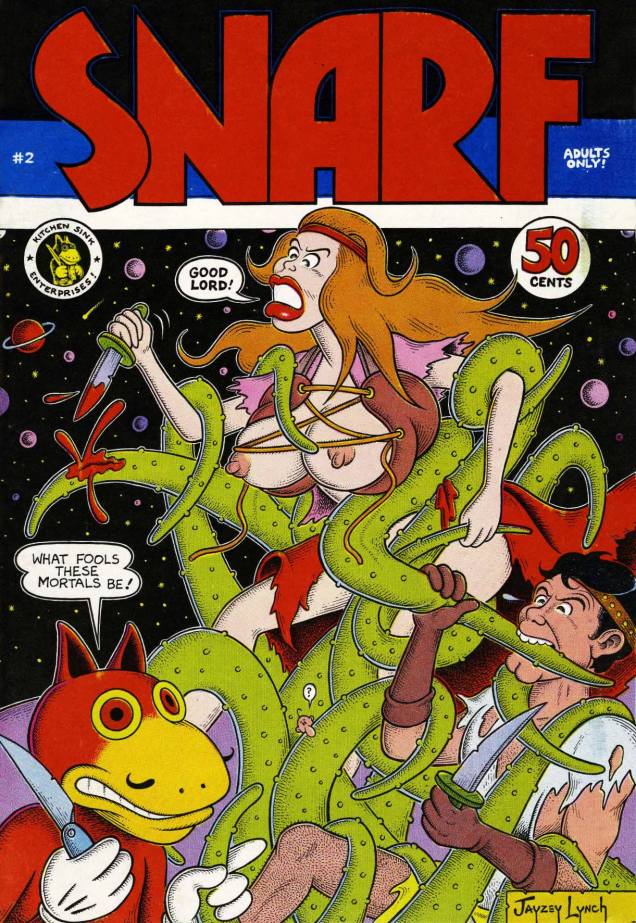
Sometimes you’re just minding your own business, and suddenly something green and scabrous sticks itself into your mouth. Jayzey Lynch is of course Jay Lynch, the artist of this cover (Snarf no. 2, August 1972). “Good lord!”, indeed.
M. Steven Fox of Comix Joint wrote a riveting (as usual) review of Snarf no. 2. Read it here.
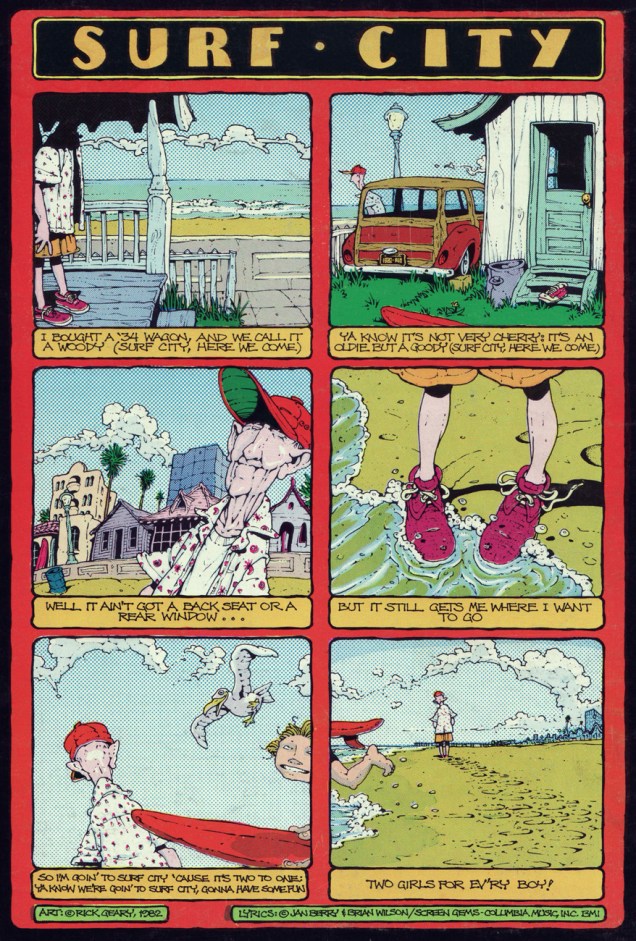
Rail-Bangin’ Rick Geary gives us a not-entirely-literal, yet oddly fitting visual representation of Brian Wilson and Jan Berry’s timeless classic, a number one hit for Jan & Dean in the Spring of 1963. Wilson’s original working title for the tune was “Goody Connie Won’t You Come Back Home“, perhaps a tad less catchy appellation.
Surf City, the strip, appeared on the back cover of the lone issue of Bop, “America’s First & Only Music Comix Magazine“ (1982, Kitchen Sink Press.) Edited by Catherine Yronwode.
Carol Lay (born 1952) is an illustrator and cartoonist who has done a variety of work – some comic books published, collections of Story Minute (probably the strip she’s best known for), as well as illustrations for The New Yorker and such.
Her drawing style is easily recognizable (and not necessarily up at everyone’s street – some people can’t get past her highly stylized way of drawing mouths, for instance), but what makes her work most appealing to me is Lay’s sense of humour. I’m not even sure that “humour” is the right word for it – her stories have set-ups that are imaginative but often completely surreal, if not far-fetched; yet her characterizations of people ring absolutely true.
She excels at one-pagers, but longer stories are great, too. Here’s an example of the former, a typical Story Minute:
There are four collections of Lay’s weekly strips out there: three paperbacks, published by Kitchen Sink (Joy Ride, Strip Joint and Now, Endsville), are quite out of print, so keep an eye out for used copies in second-hand bookstores. The latest one, Illiterature, was published in 2012 by Boom!Town in hardcover (and I believe there was supposed to be a volume 2… still waiting for that one.)
The Kitchen Sink collections have beautiful painted covers, another reason for seeking them out. They also contain some longer (say, around 20 or 30 pages) stories, for instance one of my favourites, Joy Ride (that gave its name to the whole collection), set in a world where minds can be transferred between bodies, being fat is outlawed, and “drivers” are people whose job involves forcing fat people to get into shape by temporarily taking over their personality.
And this is the back:
You can read Lay’s webcomic (some of it includes coloured Story Minute strips – originally, they were black-and-white – and most of it is longer, new stories) at http://www.gocomics.com/lay-lines
Today’s linguistic lesson: what’s a snarf? I’ll let Kurt Vonnegut answer that one:
« Do you know what a twerp is? When I was in Shortridge High School in Indianapolis 65 years ago, a twerp was a guy who stuck a set of false teeth up his butt and bit the buttons off the back seats of taxicabs. (And a snarf was a guy who sniffed the seats of girls’ bicycles.) »
Here’s a typical illustration of a snarf, albeit a shockingly rich one, with a fittingly well-developed proboscis, in his not-so-natural habitat: golden-hour hues, a cozy armchair, and selection of vintage selles de vélo. Next time you see a bicycle with its seat stolen (let’s face it, these saddles *must* be acquired in illicit fashion), you’ll thank me for this mental image.
This is Snarf no. 11, 1989. Dennis Kitchen gave his comic book series an apt title!
The cover by Rand Holmes (1942-2002), a Canadian underground comix artist probably best known for his Harold Hedd comic strip. (Look for the compendium of his exploits published by Last Gasp, Anus Clenching Adventures With Harold Hedd!)












 Who's Out There?