« May the man who has his finger on the button have a lovely day today / Hope nothing hangs him up or ticks him off or bums him out in any way / Lord, help him keep his cool cause he could pull the final curtain on my play / May the man who has his finger on the button have a lovely day today. » — Larry Wilkerson (as warbled by Bobby Bare)
The idea for this post came to me a couple of days ago, and this afternoon, while cobbling together the visual components, it dawned on me that today’s Memorial Day (Remembrance Day for Canadians, and ‘Victory Day‘ for those afflicted with brain worms and/or syphillis), and therefore quite à propos.
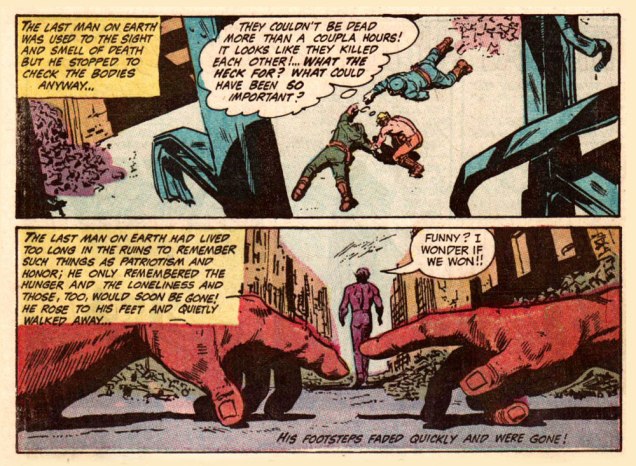
DC’s The Day After Doomsday series first turned up — of all places — in the pages of The Witching Hour, a page and a half bit of filler fluff by Len Wein and Jack Sparling. It must have struck a chord, if not with readers, then with its creators, for the feature stubbornly kept a-rising from its post-apocalyptic grave.
In spite of its episodic and arguably slight nature, TDBD enjoyed surprising longevity. It truly found its home in the Joe Orlando-edited Weird War Tales (1971-1983, DC’s gateway title for war fans into ‘horror’ and vice versa), where most of its dispatches saw print. You never know what’s going to catch on with the unwashed masses.
A most humble beginning for a series, this brief scene appeared in The Witching Hour no. 9 (June/July 1970, DC). Script by Wein, art by Jack Sparling (1916-1997). Dick Giordano, editor.
.
Humour rears its homely head in the concurrently appearing second instalment — too close to call! — this one from House of Secrets no. 86 (June/July 1970, DC). Same creative team.
.
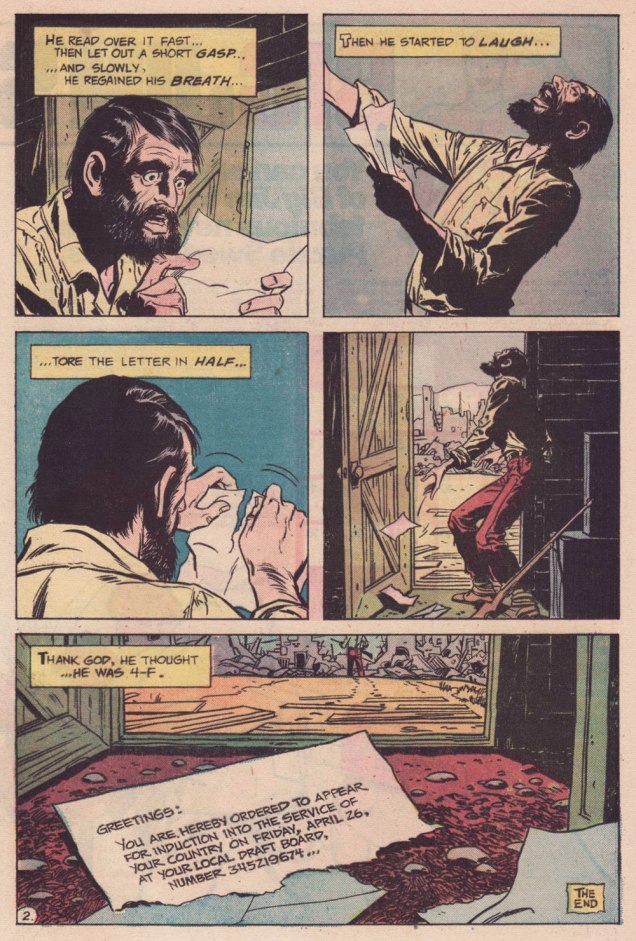
My candidate for the series’ finest hour, this episode elegantly riffs both on the Vietnam War Draft and on Fredric Brown‘s classic 1948 short-short ‘Knock‘, wherein «The last man on Earth sat alone in a room. There was a knock on the door… » 4-F, incidentally, signifies « Registrant not acceptable for military service. To be eligible for Class 4-F, a registrant must have been found not qualified for service in the Armed Forces by an MEPS under the established physical, mental, or moral standards. » And let’s hear it for perennially under-appreciated artiste Bill Draut (1921-1993).
That issue had a splendid cover, and so here it is!
This is Weird War Tales no. 30 (Oct. 1974, DC); cover pencils and inks by Luis Domínguez, from a probable design by publisher Carmine Infantino.
.
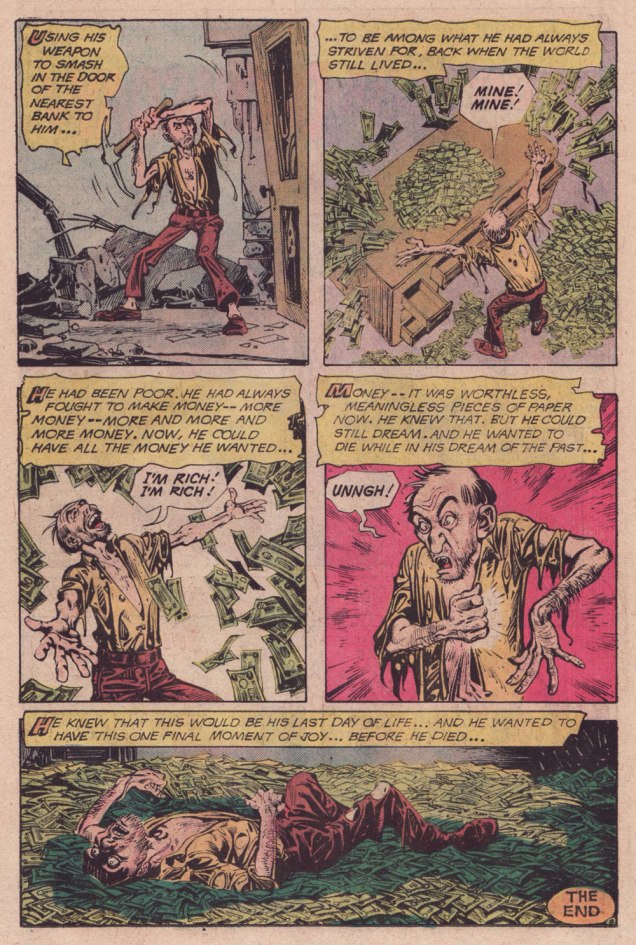
A scroogey teaming of WOT? favourites Steve Skeates and Alfredo Alcala, this turned up in Weird War Tales no. 35 (March 1975, DC). I’ll bet they had trouble deciding whether to run it in Plop! or WWT.
.
Finally, this one appeared in Weird War Tales no. 48 (Sept./Oct. 1976, DC). Script by Skeates, art by Buddy Gernale.
« I think people will believe anything about someone they haven’t seen for a while. » — Gabriel Kaplan
I’ve been meaning to do a Welcome Back, Kotter post for several years. But when I thought about it, I understood that hitching it to the show’s fiftieth anniversary made considerably more sense than, say, its forty-seventh. And while I adore William Johnston‘s sextet of tie-in novels, it would be quite a stretch for a comics blog to cover. Far closer to the mark lies Arnold Drake‘s trio of WBK storybooks, illustrated by Mel Crawford and Jack Sparling. But in the end, I bided my time and managed to get in touch with the scribe first assigned the Kotter Komic assignment, Elliot S! Maggin. And boy, am I glad I did. And so, fifty years to the day of the airing of its pilot episode*, let’s talk Kotter!
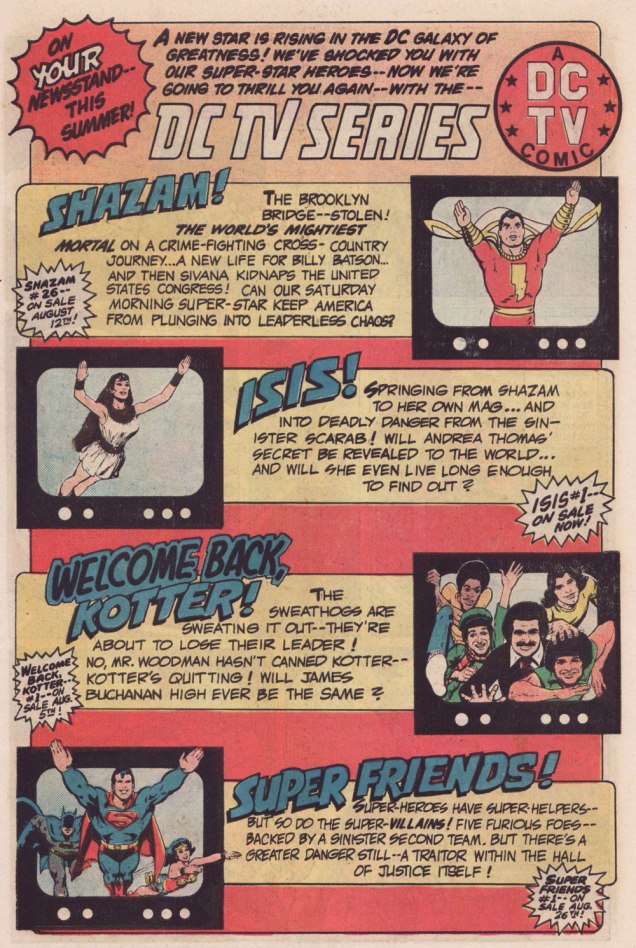
Remember the DC TV line? This ad ran in several DC titles over the summer of ’76.
WOT: First, a bit of context: correct me if I’m wrong, but in the early stages of your career writing comics, you always worked alongside editor Julius Schwartz. Then, in late ’75 or early ’76, something changed, and you began writing for other editors’ titles. What’s the story?
ES!M: Well, Julie was kind of proprietary about me for most of the time I was working with him.
WOT: A sideways sort of compliment.
ES!M: I guess. At some point, Dorothy Woolfolk was editing the Lois Lane book, and… he introduced me to her. She just came into his office for some reason. She said: « Oh, you know, you should write some stuff for me! » And he said « No, he’s very busy, go away! » And he chased her out of the office. And I’m thinking, « Oh, okay. That’s how we’re doing it. »
So I didn’t really go about… I didn’t really make friends with many of the other editors. I tried to make friends with Joe Orlando. You know, I’d have lunch with him once in a while, I guess.
This is Welcome Back, Kotter no. 1 (Nov. 1976, DC); cover by Bob Oksner.
ES!M: But around the time Kotter came out…
You know, people used to hang out outside of Julie’s office door, listening to us plot, because it was so loud. We would yell and scream at each other constantly. He was this Jewish boy from the Bronx, and I was this Jewish boy from Brooklyn, and once I got comfortable working with a guy thirty-five years older than me, we’d just fight all the time. And every once in a while, we’d get serious.
WOT: Serious fighting, or serious work?
ES!M: Yeah, yeah! The fighting was work.
WOT: Sometimes that line is dreadfully thin.
ES!M: I guess at that point, he got mad at me, and I didn’t get work for a couple of weeks. I went to Joe, and I said: « What ya got? », and he said he’s doing this Welcome Back, Kotter book, and I said « Great! I watch that show, that’s fun. » So I wrote the first issue, and that was fine.
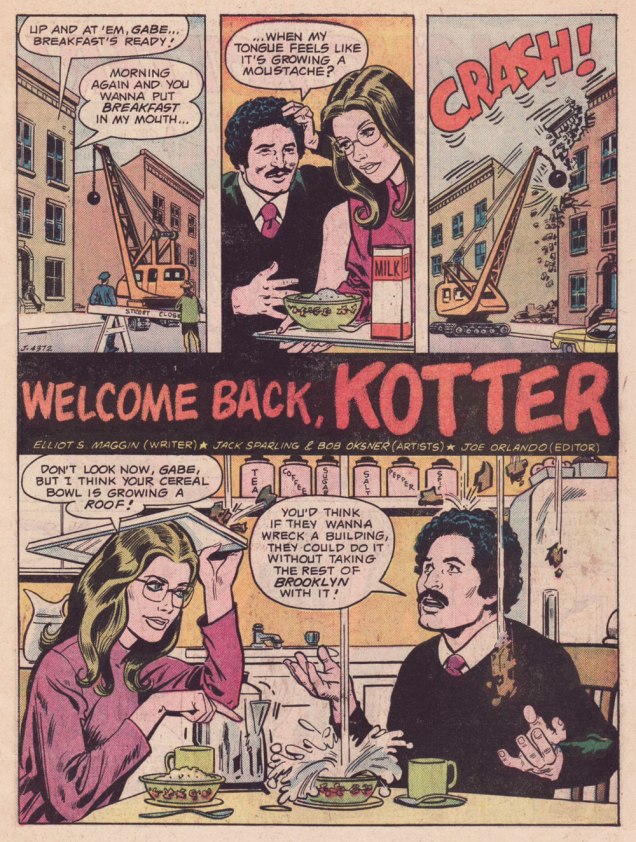
Here’s a quartet of pages from the première issue. Pencils by Sparling and finishes (and surely likenesses) by Oksner.
.
.
Aw, Maggin’s Mr. Pevey would have made a great addition to the TV show’s cast.
ES!M: They called me down in Carmine‘s office, to watch episodes of the show. It had been on maybe six weeks at that point. Episodes I had already seen, but I liked hanging out in Carmine’s office, because it was big, and he had a lot of toys around. So they set up this video tape… thing, and I watched the shows again, and I wrote the second issue.
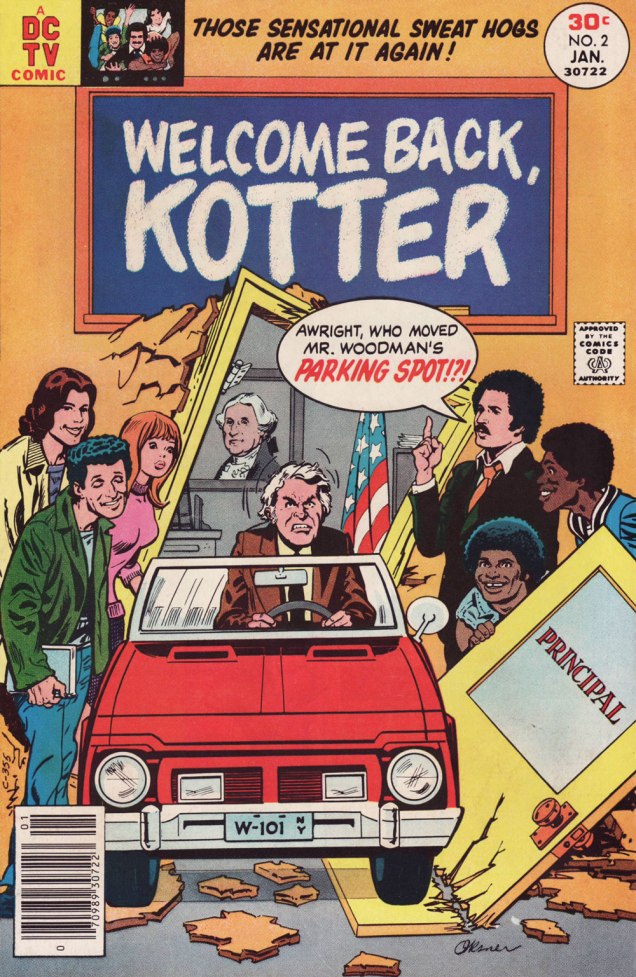
This is Welcome Back, Kotter no. 2 (Jan. 1977, DC); cover by Oksner.Art-wise, the second issue seemed comparatively rushed, and sans Oksner, likenesses pretty arbitrary. See what I mean? The GCD attributes the inks to Sparling, but I lean towards Frank Springer.
ES!M: I was living in an apartment complex on Long Island, and there were all these kids around… little kids. And I would work at home, mostly. So they would hang around with me, whenever they realized I was home. They would… shoot me through the window or… something. At some point, whenever I’d write a gag, I would…
WOT: … run it past them?
ES!M: Yeah! And they’d laugh, and run off and play some more. And I figured, as long as they laughed, it was okay. Because they were hearing the voice of Barbarino, or whoever. At some point Travolta would say, « Uh? », or « Duh », or « What d’you think? », something dull, that he delivered in a funny way. And the kids related what I wrote to what Travolta did on screen, so they were getting it. And at some point I realized that Joe [editor Orlando] didn’t watch the show.
WOT: Oops.
ES!M: And he would then object to my Barbarino bits, or Horshack bits, or whatever. So I told him « You’ve got to watch the show, you’ll get it! » But you know, after maybe… how many issues did I write, three, four?
WOT: Just two, I’m afraid. You wrote the first couple, then Tony Isabella did one, then Mark Evanier…
ES!M: I’m sure he (Evanier) watched the show — he watched everything.
WOT: He was even the show’s story editor for part of its second season. So… then Bob Toomey wrote four issues, Scott Edelman two, and there was a leftover story by Evanier that saw print in the WBK Collector’s Edition in 1978.
ES!M: But Joe did not. I mean, he didn’t have time, and he was madly in love with his wife, and he didn’t watch television at all (laughs). He wasn’t paying attention to the source material.
WOT: That happens. But it seems a pretty unfortunate blind spot for a book’s editor.
ES!M: I wrote two issues, and at some point, Joe said: « You can’t write! ». He said « No, you can’t write! » A blanket condemnation of everything I’d ever done.
WOT: Oooh.
ES!M: By that time, I’d made up with Julie, and I was writing more Superman stuff. After that, wherever any of my fights with Julie got serious, I’d go down the street to Marvel, and do something there. Then I would make up with Julie, and they’d never see me again… until I had another fight with Julie.
That was my experience writing Kotter.
And here’s what undoubtedly has to be the Guernica, if you will, of Kotter art: Bob Oksner‘s superlative cover for Limited Collectors’ Edition C-57, from 1978, DC’s final — and finest — WKB publication. Feel free to open it in another tab for a fuller view… I provided a larger image so you can fully take in the wealth of details.
WOT: In closing, how are you keeping busy these days?
ES!M: I just wrote a book called Lexcorp. A novel. Which you should probably plug.
WOT: Done!
ES!M: It’s a first-person story that Lex Luthor tells. And he identifies himself as an unreliable narrator, like… Huckleberry Finn. But it does tell the story of how he saves the world. Stuff like that.
I’m working on another book, working on a time travel story. And my ex-wife asked me to write an autobiography so my grandchildren know who I am.
I have all these people I know with Pulitzer Prizes; and at some point in the autobiography, I wrote: « I have about a dozen Pulitzers floating around through my life, and none of them are mine. This book is available for consideration. »
WOT: Mr. Maggin, thank you so much for taking the time to share these stories with us!
-RG
*the pilot episode, for some reason, was aired third, on September 23, 1975, while the show premiered on the 9th of September with ‘The Great Debate‘ (featuring a wonderfully smarmy James Woods).
I had initially figured to make this post coincide with World Bicycle Day, but misremembered the date (it’s on the third of June). I briefly considered bumping my post in favour of a pollution-themed one, given the close-to-home current events, but it struck me that people are likelier to need a respite from catastrophe than a reminder of it.
Since I must save up material for my Hallowe’en Countdown all year ’round in order to keep the frenetic pace it requires, I sometimes regret, in other parts of the annum, not featuring spooky stories as often as I’d like. I’ll make an exception this time, since this is more of a summer story with a light touch.
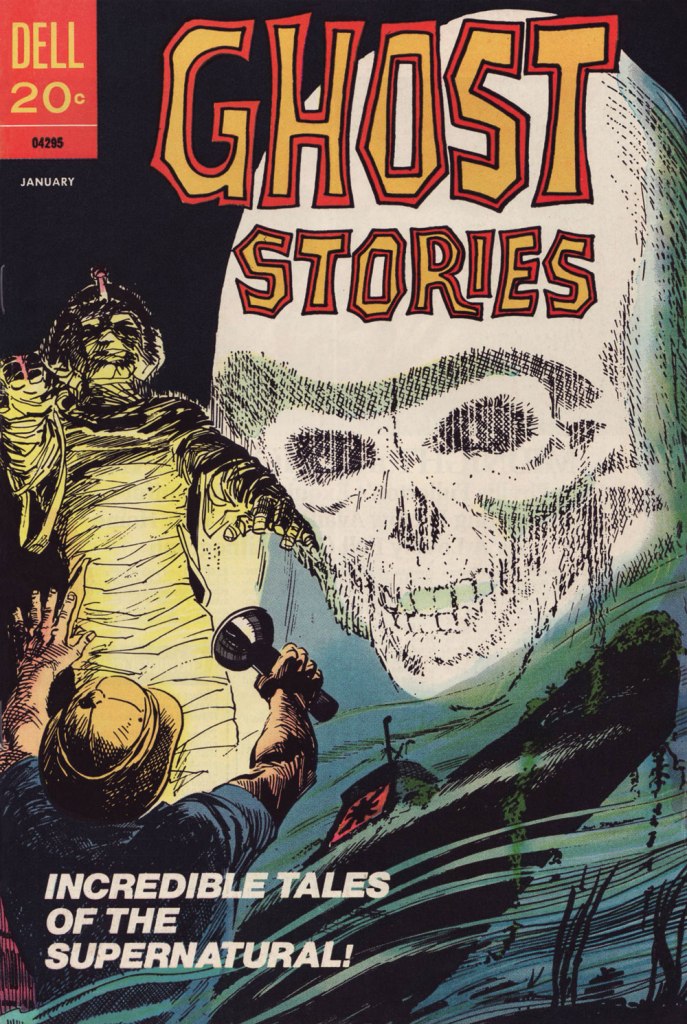
This particular issue of Ghost Stories has the — dubious, I’ll grant — distinction of being the last original comic book published by the once-mighty Dell Comics. How mighty? Well, in 1960, they were smugly ensconced at the top, as they had been for most of the industry’s history. Until the following year: « As publishers began raising prices from the 10¢ mark comics had been at for a quarter of a century, Dell misread the market and went to 15¢ when everyone else went to 12¢. »
That was the beginning of the end for Dell, triggering a long, humiliating slide, going from locomotive to caboose. By 1970, they were just reprinting what little of their once-glorious back catalogue they still retained rights to. I believe their final trio of titles, all reprints, were cover-dated October, 1973 — among them the final issue of Ghost Stories, a straight up reprint of 1966’s no. 16.
I’m not sure why this all-new issue even came to be. Perhaps this was inventory material some editor at Dell saw no point in squandering. If so, this sagacious frugality is appreciated.
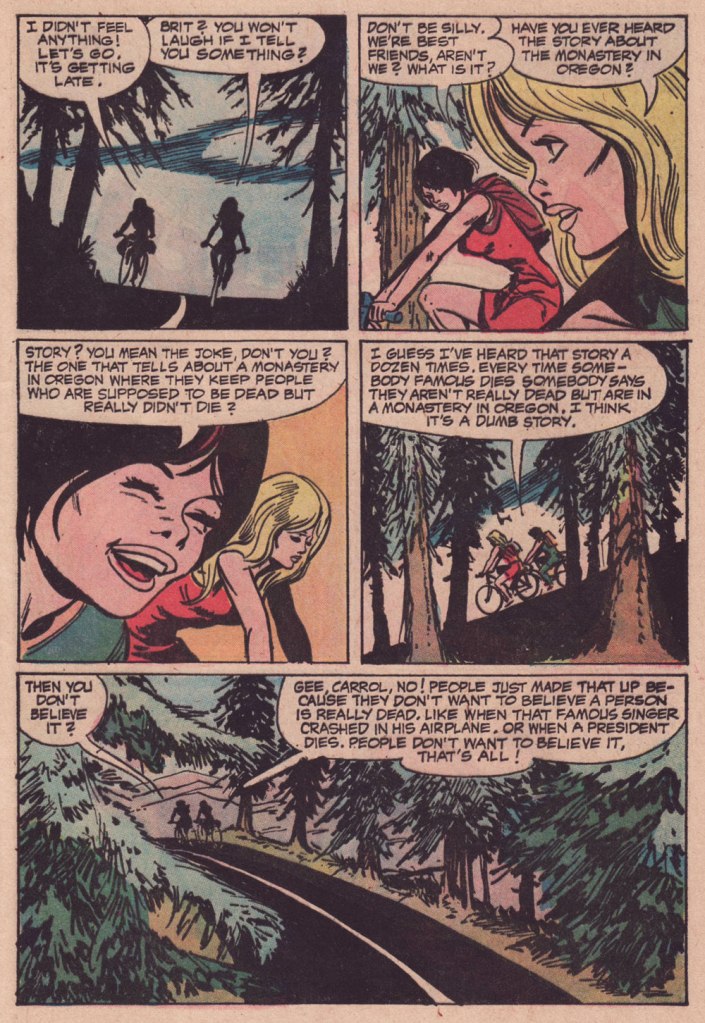
This is Ghost Stories no. 35 (Jan. 1973, Dell); cover by Jack Sparling (1916-1997).
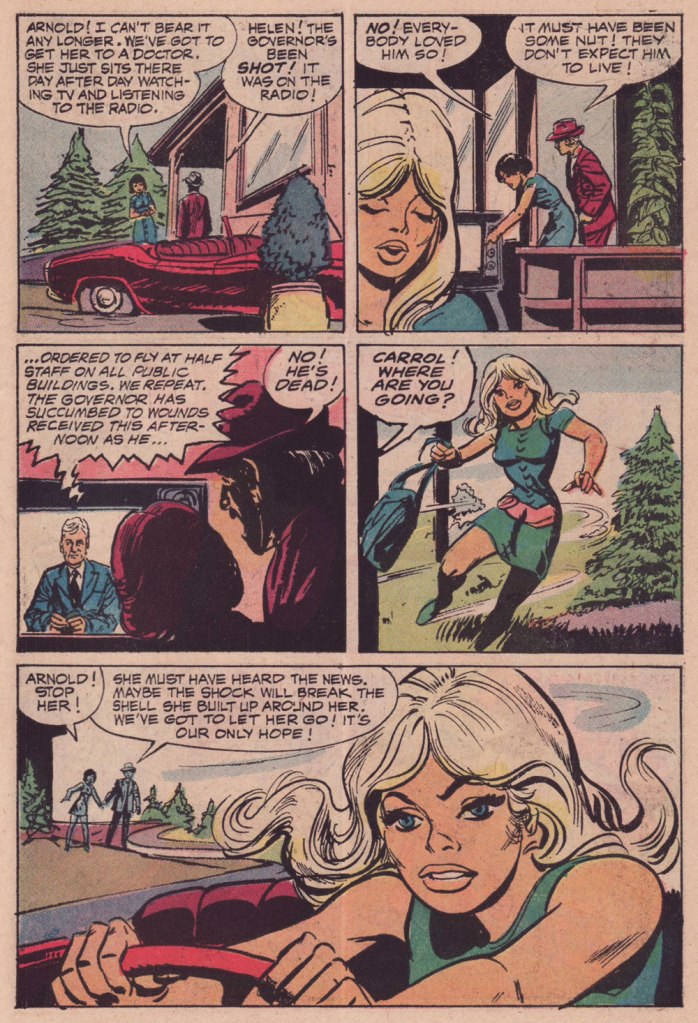
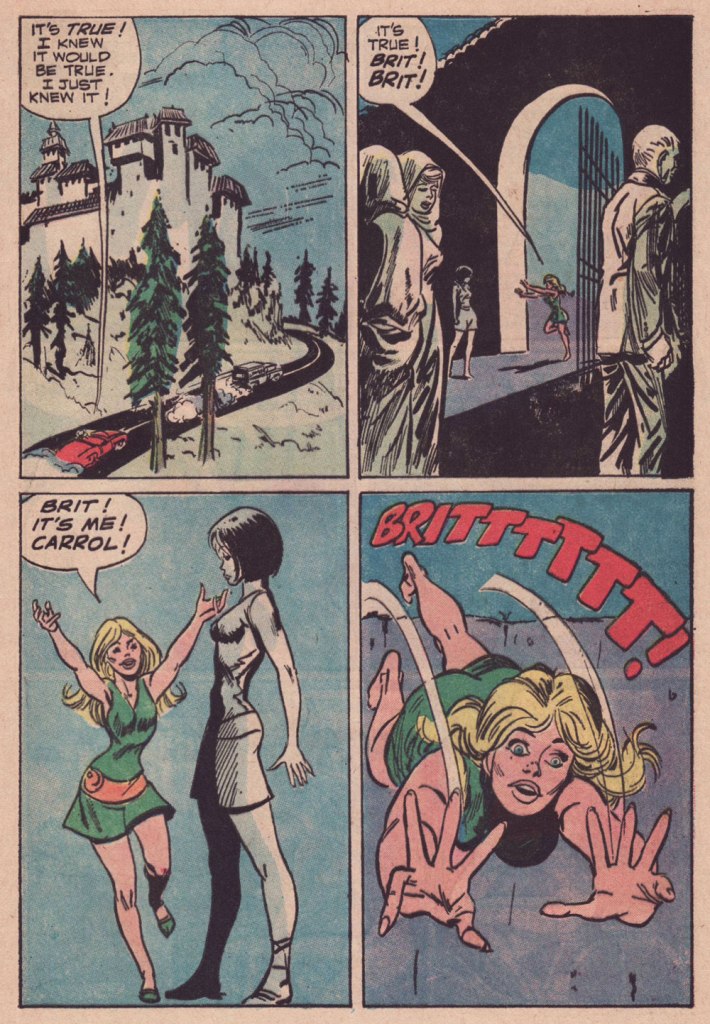
Now, I won’t argue that this is one of Jack Sparling‘s most stellar jobs… it was obviously dashed off in workmanlike fashion, even in comparison to the other tales in the issue. But I really like its themes, which tick a lot of boxes for me, cycling and folklore foremost among them.
I tried to find out whether this purported ‘story about the monastery in Oregon‘ (Mount Angel Abbey being the likeliest model) had any currency in popular culture, and came up empty. Well, essentially. While it’s undeniable that “Conspiracy theories frequently emerge following the deaths of prominent leaders and public figures“, I do think the uncredited and unknown author of this yarn came up with a clever little angle… who’s to say it won’t catch on some day? Unlikelier things have come to pass.
-RG
p.s. It occurs to me that this story handily passes the Bechdel Test, surely a rarity in a mainstream comics story of this vintage.
p.p.s. Another tale in this ‘vanished celebrity’ tradition would be Gerald Kersh‘s superb, Edgar-winning The Oxoxoco Bottle aka The Secret of the Bottle. Read it here!
« I lived on a houseboat in Amsterdam for a year. It was intense, and it’s possible that I even had a few blackouts. » — Wolfgang Beltracchi
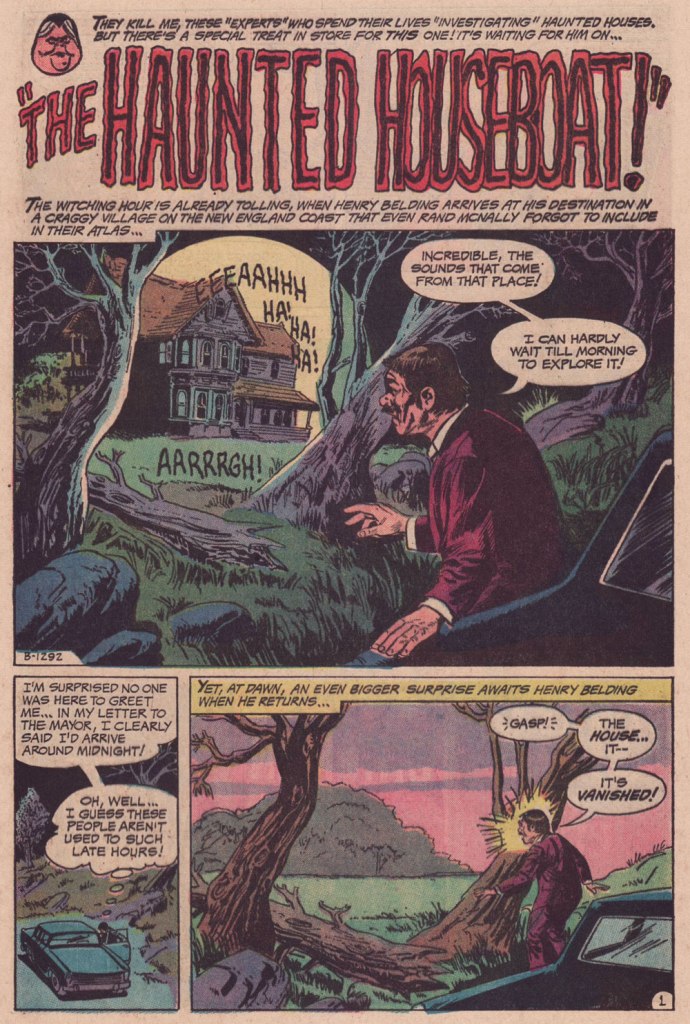
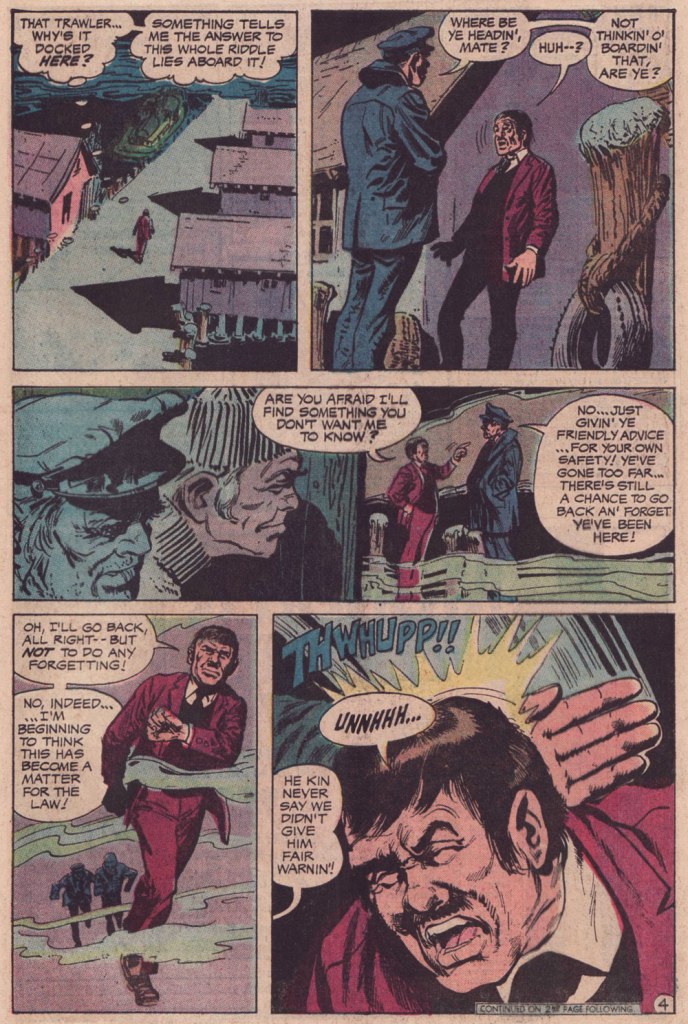
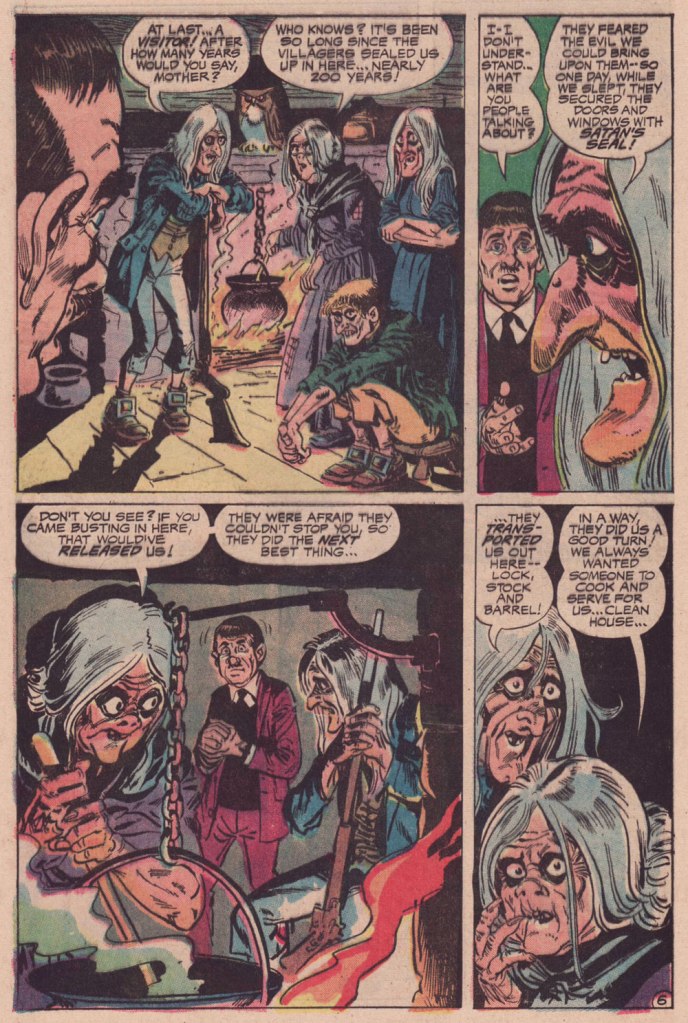
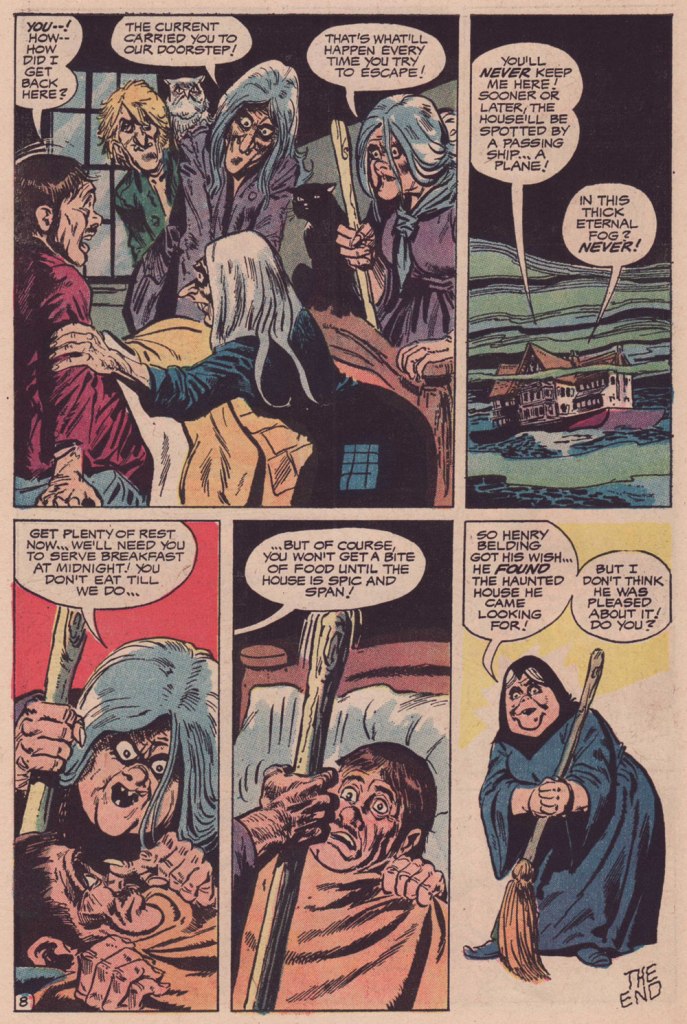
Today’s featured tale is an old favourite illustrated by one of American comics’ perennial mal-aimés, the much-maligned Jack Sparling (1916-1997), a prolific, reliable, distinctive stylist who toiled for just about every publisher on the block. Of course, he’s persona non grata with the superhero set (a compliment in my book!) but his chief strengths lay just about everywhere else, in humour, horror, crime and adventure… you name it.
I love how cosy — that pervasive, foggy ambience! — yet harrowing this tale is. Nice to see one of those insufferable, know-it-all ‘ghost busters’ get his bitter requital. And who knew that some witches were so neat, so domestically inclined? Work that mop, boy!
The writer’s uncredited, and that’s a shame, because this is anything but formulaic — and DC’s mystery books were formulaic to a fault, especially under Joe Orlando‘s guidance. I suspect the author to be editor Murray Boltinoff — he often pitched in, under sundry bynames.This is It’s Midnight… The Witching Hour!no. 21 (June-July 1972, DC), edited by Murray Boltinoff and with cover art by Nick Cardy.
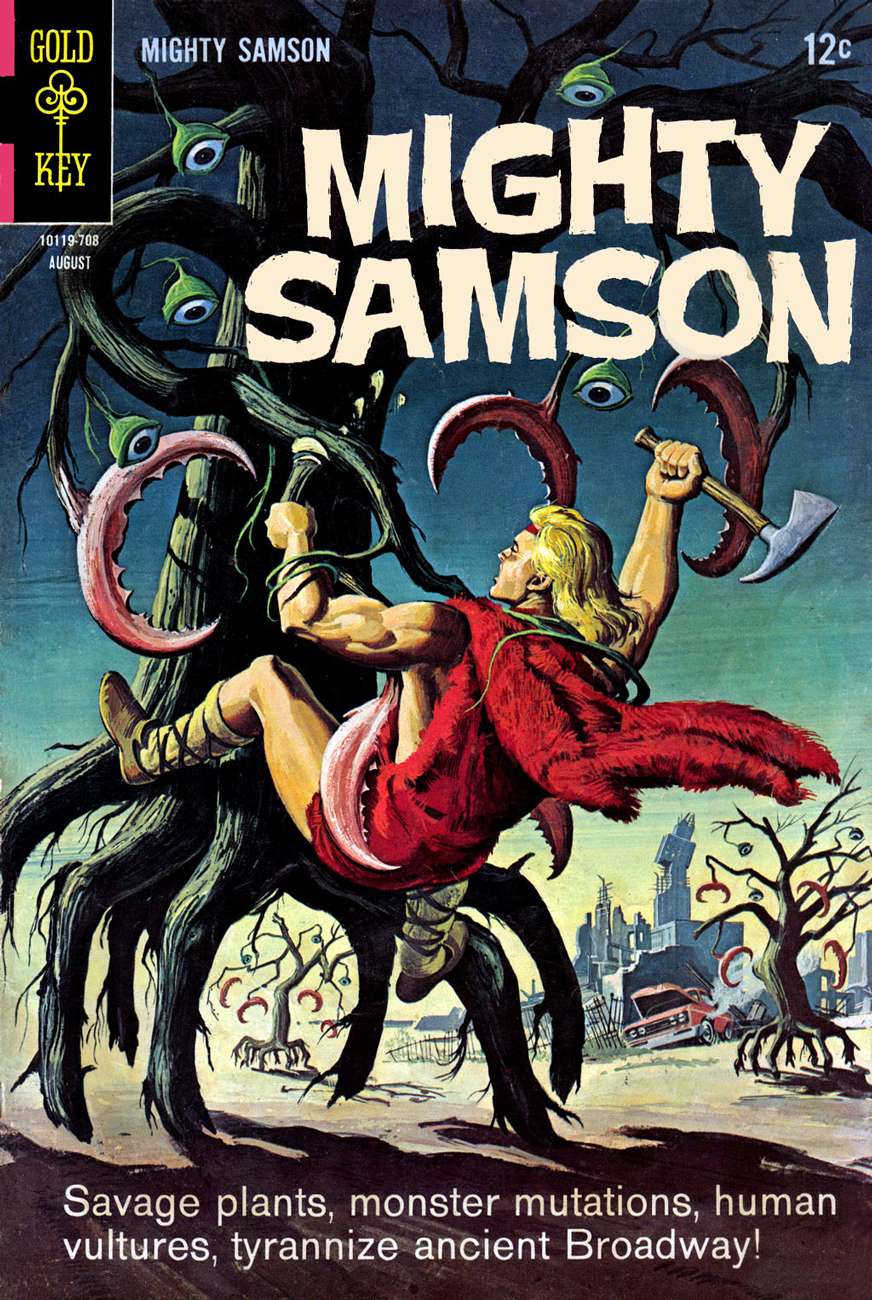
« Savage plants, monster mutations, human vultures… »
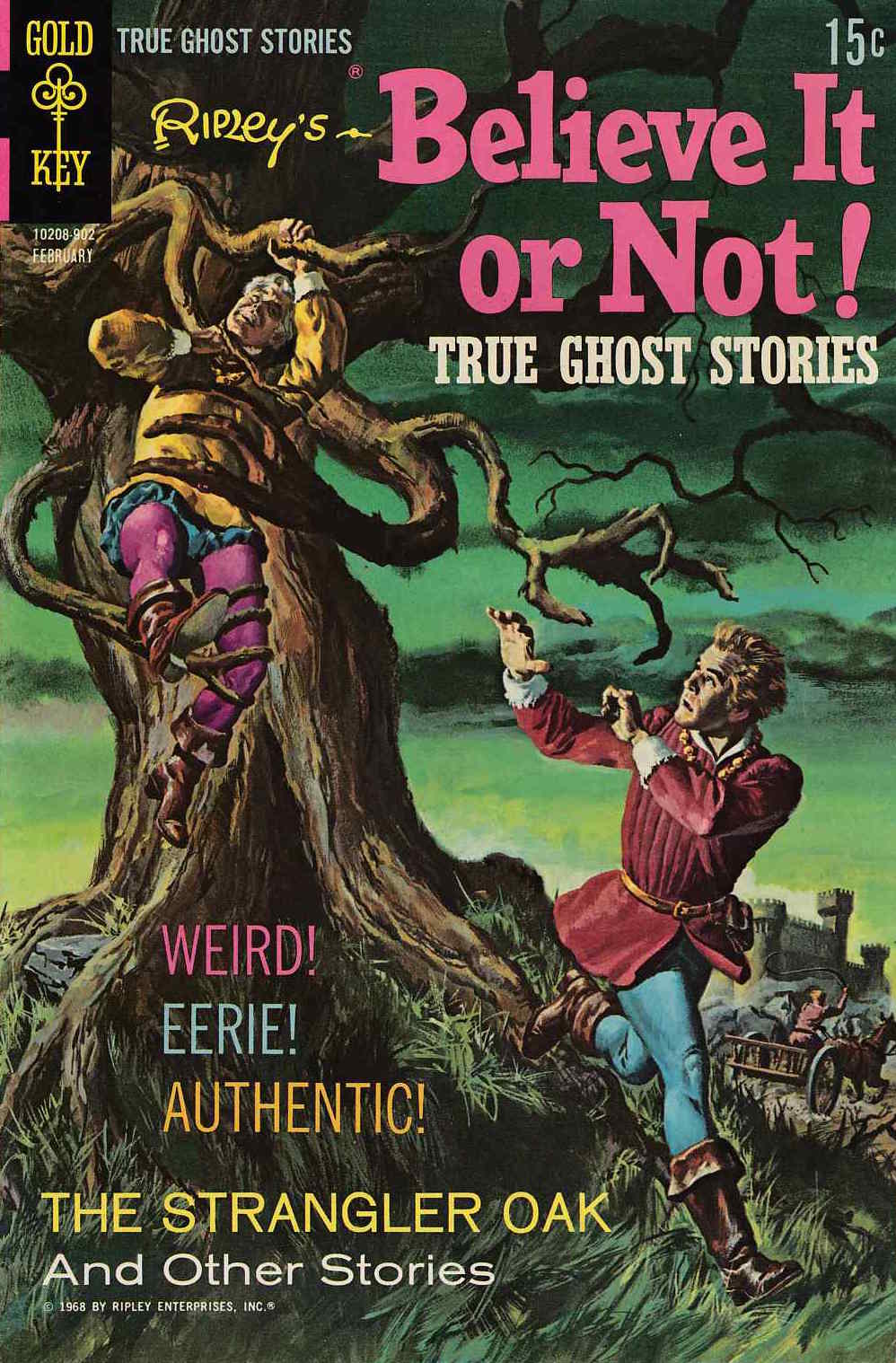
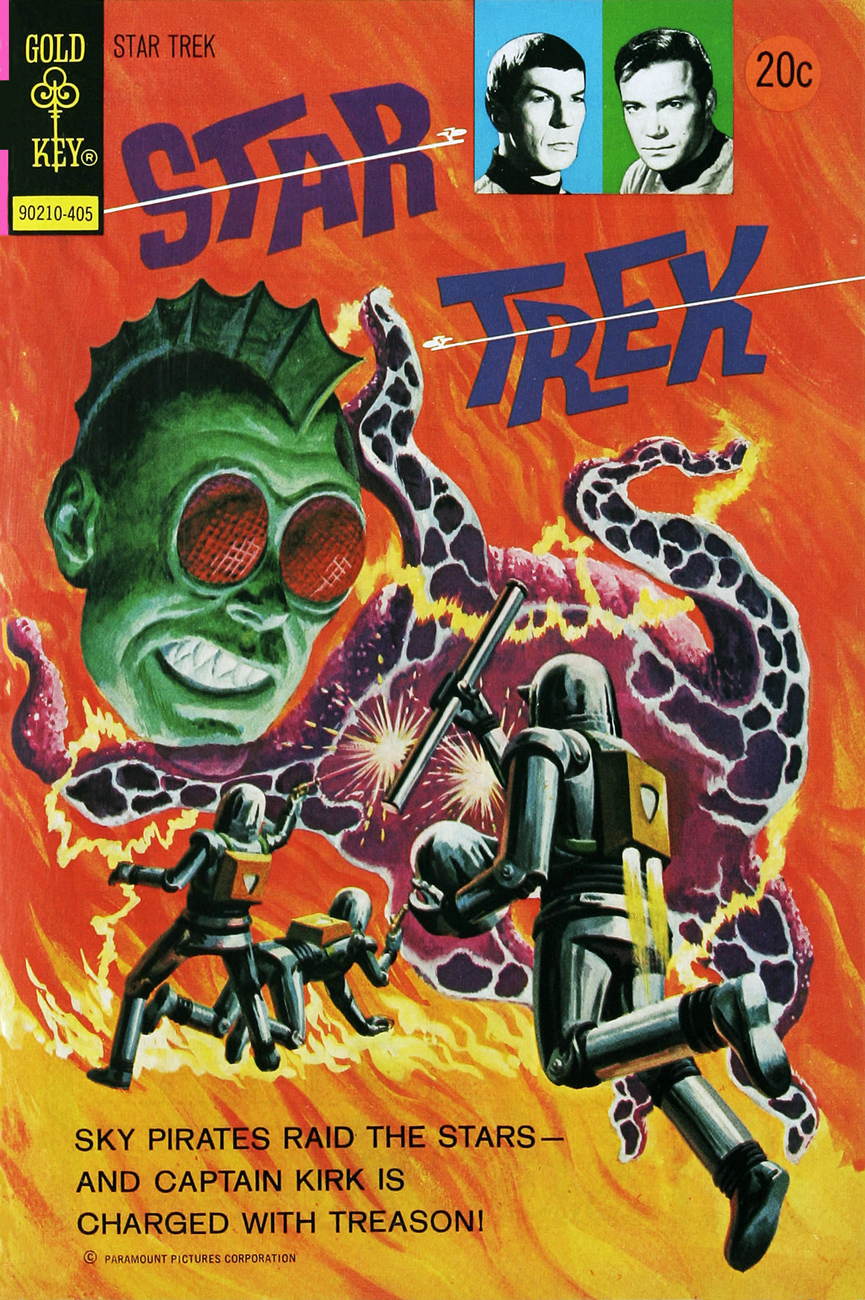
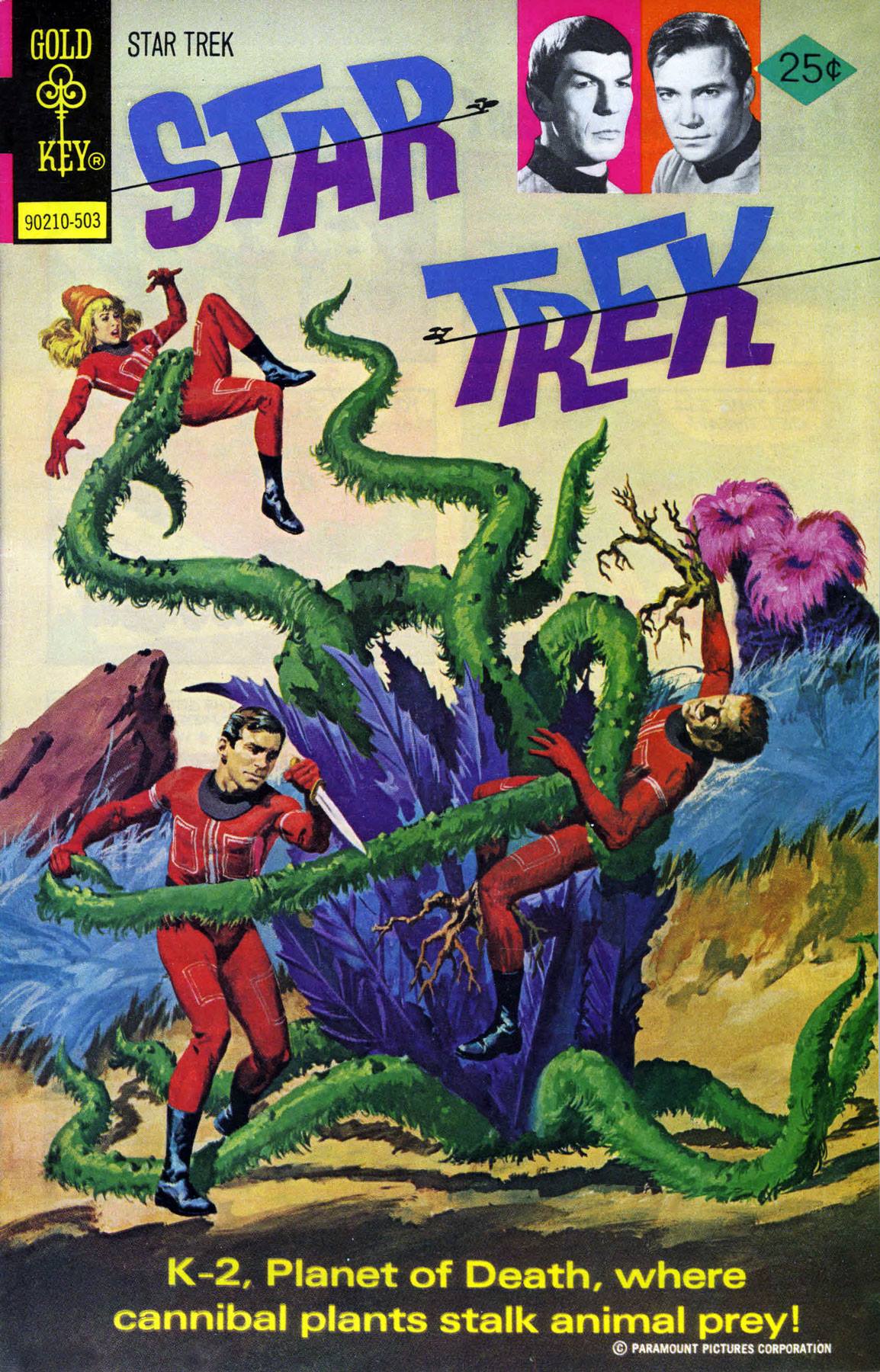
George Wilson (1921-1999), prolific cover illustrator for Dell Comics and Gold Key from the 1950s through to the 1970s, is such a ubiquitous figure for anyone interested in comics of that era that it’s almost like he’s taken for granted by comic aficionados. “Oh, yes, another gorgeous George cover”, we say and move on to something else. Let’s not, shall we? We can admire his trademark bright colours, eye-popping attention to detail and impeccable compositions *and* celebrate Tentacle Tuesday. And there’s all kinds of tentacles in these covers – organic or motorized, animal, mineral, or… plant-like. (I refuse to use “vegetable” as an adjective.)
Mighty Samsonno. 11 (August 1967). This might just be the most random menace (and the most ridiculous set-up) I’ve seen in a while.
Mighty Samson was created by writer Otto Binder and artist Frank Thorne, and involved a heroic barbarian-type sword-and-sandaler loitering around a dystopian, post-nuclear disaster world that has reverted to something resembling the Stone Age. One thing that amused me – not only is our dashing hero blond, but so is his love interest (apparently recessive traits help survive radioactivity). The evil temptress-cum-scientist is a dark-haired femme fatale, obviously. You can read each and every issue of Mighty Samson here.
Panels from “The Swamp Rats“, written by Otto Binder and drawn by Jack Sparling, whose art is for some reason hated by many (the same many who have no trouble with bad art from other, more publicly accepted artists).
Doctor Solar, created by writer Paul S. Newman and editor Matt Murphy, was fairly humble at first, despite his somewhat ponderous moniker. (« The Man of the Atom »!) Originally clad in a normal lab-coat, he acquired his red costume in issue 5. The source of his super-powers? A nuclear disaster, of course. It’s difficult to be impressed by that when everyone and their auntie is getting exposed to radioactivity. I try to keep in mind that Doctor Solar was one of newly-formed Gold Key’s first publications, and in 1962, a nuclear war seemed imminent whatever side of the continent you were on… but I’m still bored. There’s a list of Atomic Superheroes with 27 items in it here, but it only includes public domain characters.
Doctor Solar, Man of the Atomno. 21 (October 1967).
Doctor Solar, Man of the Atomno. 24 (July 1968).
Page from “The Deadly Trio”, written by Dick Wood and drawn by Ernie Colón. That “monstrous master of the sea” is so freaking cute!
All of Gold Key’s Doctor Solar run is available here. How much time do you have on your hands, anyway?
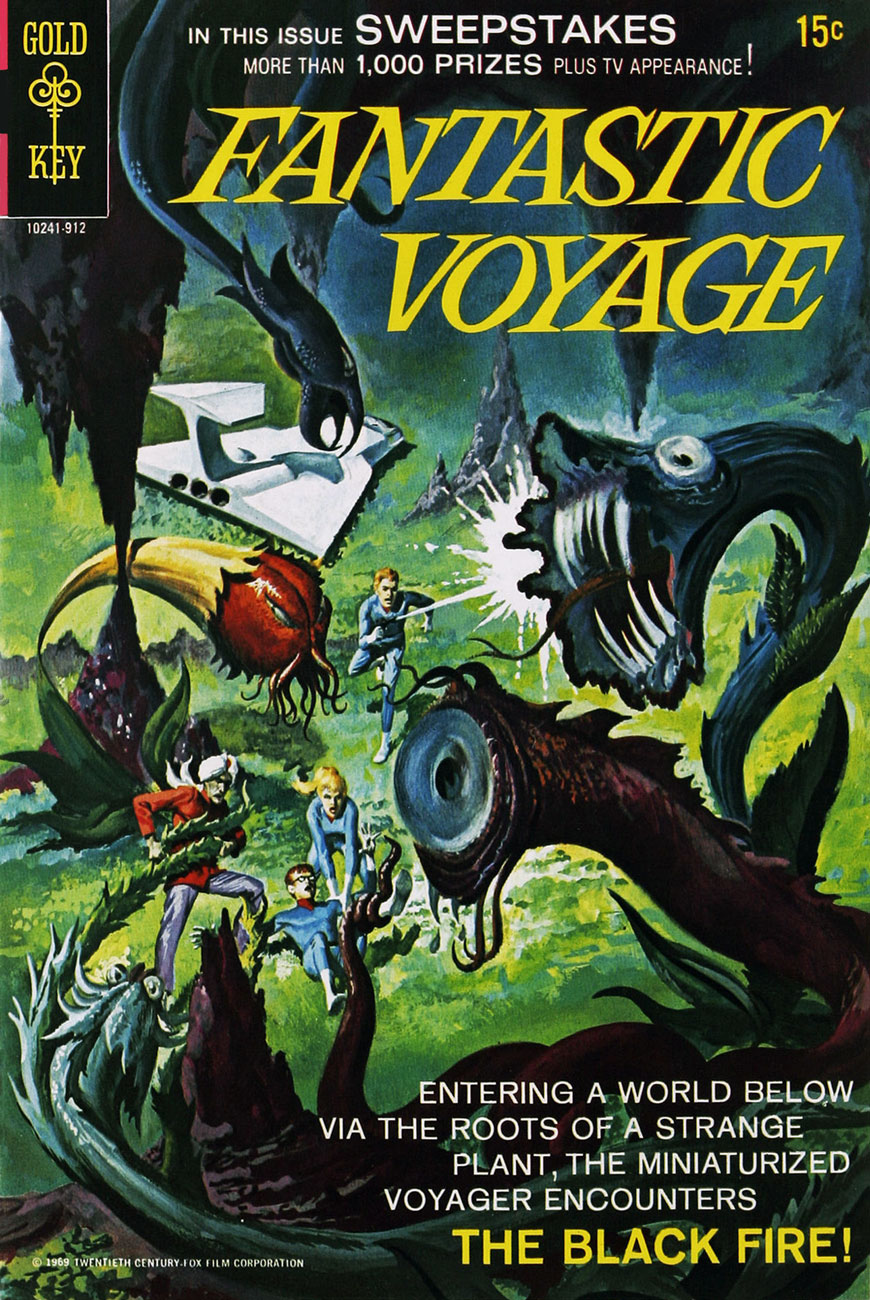
Fantastic Voyageno. 2 (December 1969).
This two-issues “series” features « adventures based on the cartoon about the Combined Miniature Defense Force (CMDF) with Jonathan Kidd, Erika Lane, Dr. Guru, and Busby Birdwell. » Clearly, nobody cared about the comic. Maybe someone cared about the animated TV series the comic was based on.
Speaking of boring… I haven’t yet encountered *one* issue of Ripley’s Believe It or Not! that wouldn’t cause me to yawn or start rolling my eyes. However, painted covers are often worth dwelling on, and the inside art is also occasionally quite nice (especially when it’s by Luis Dominguez).
Ripley’s Believe It or Not!no. 12 (February 1969).
The Microbotsno. 1 (December 1971). The tentacled monster was designed by Jack Sparling, who illustrates This Is the Way the World Ends and Day of the Juggernaut, but the cover art is by George Wilson.
There’s an excellent (and suitably sarky) review of this one issue of Microbots on Gone & Forgotten. Here’s a little taste: « Superstitious, parochial, and frequently eaten alive by mutated elephants, the people of the future world have turned their backs on technology. » Bet you’ve never seen *that* sentence before. Or — « The Microbots are the creation of Dr. Norman Micron (of the Connecticut Microns, I presume), a scientist living in the dire times of a world succumbing to man’s pollution. ‘Mankind had ample warning that he was destroying the world around him’ he muses, standing by a window with a highly-desirable garbage view. »
The crew of the Starship Enterprise keeps running into tentacles, it seems. (Presumably, they couldn’t do it as convincingly on the TV show, as the visual effects weren’t quite up to snuff.)
Star Trekno. 24 (May 1974). Gold Key published Star Trek comics between 1967 and 1978, for a total of 61 issues. They weren’t a rehash of the TV series, and featured original characters and stories, although later issues included sequels to a couple of episodes (which is pretty cool, if you ask me).
Star Trekno. 29 (March 1975).
Gail O’Brien shared this snippet on a forum about Wilson’s art, sadly a fairly typical story: « You might be interested to know that George’s widow (a friend of mine) has had no income from his paintings as they “disappeared” from his estate at his death while they were separated. She is presently living on small retirement from teaching. I’ve tried to influence her to seek legal advice to acquire her share of George’s sales, but she feels it is impossible… hope there is a lawyer who enjoys George’s work, who would want to go on a 50/50 basis to acquire what is rightfully belonging to my friend. » |source|
Look at more (less tentacle-centric) George Wilson art here.
























 Who's Out There?