« The autobiographical narrations by Cruse examining everything from Acid and UFOs, to TV punditry and death itself are priceless! So read on, and enjoy the work of a true master of wit, wisdom, and weirdess! And tell you friends to buy this book! It’s just a matter of time before all copies are seized and burned! For soon a cleansing will surely be upon us! » —Jay Lynch*
Alabama cartoonist Howard Cruse (1944-2019) is usually recognized as the author of Stuck Rubber Baby (1995), a serious graphic novel about a young gay man whose life gets swept up in the American Civil Rights Movement. It was lauded by many, some praising it for its ability to demonstrate that comics can appeal to adults (Harvey Pekar), some for its place in the comic book canon as the ‘Great American Graphic Novel’ (Justin Hall). I am not denying its historical importance, of course, but I am slightly allergic to this idea of the Important Work of Art™.
Once upon a time, my favourite Cruse material was Barefootz (more about further down), but that has changed over the years. My current treasured possession (gift of co-admin RG!) is Dancin’ Nekkid With the Angels (1987, Kitchen Sink Press), which collects some previously unpublished material as well as stories that appeared in various underground publications (Snarf, Bizarre Sex, Gay Comix, of which Cruse was a founding editor**, Dope Comix…) as well as in Village Voice, Heavy Metal, etc. The book was published in a print run limited to 1,082 copies, and strangely enough, some are still available for purchase here, a sad testament to Cruse’s relative lack of renown.

This anthology includes its share of my favourite Cruse pieces (to name a few, Unfinished Pictures, about an artist overstimulated by his own art; the absolutely brutal Creepy Snuff Porn, a satirical piece about the Meese commission of pornography; Dirty Old Lovers, featuring two older gays, Clark Stobber and Luke Tewba, prowling the streets in search of goofy, sexy fun), but the one that lingers most in memory, having sub-rented a permanent room in my brain, is the pitch-perfect, heart-breaking Billy Goes Out (1980), interestingly not even included in the best-of collection The Best Sides of Howard Cruise (2012, Boom Town). Here it is.
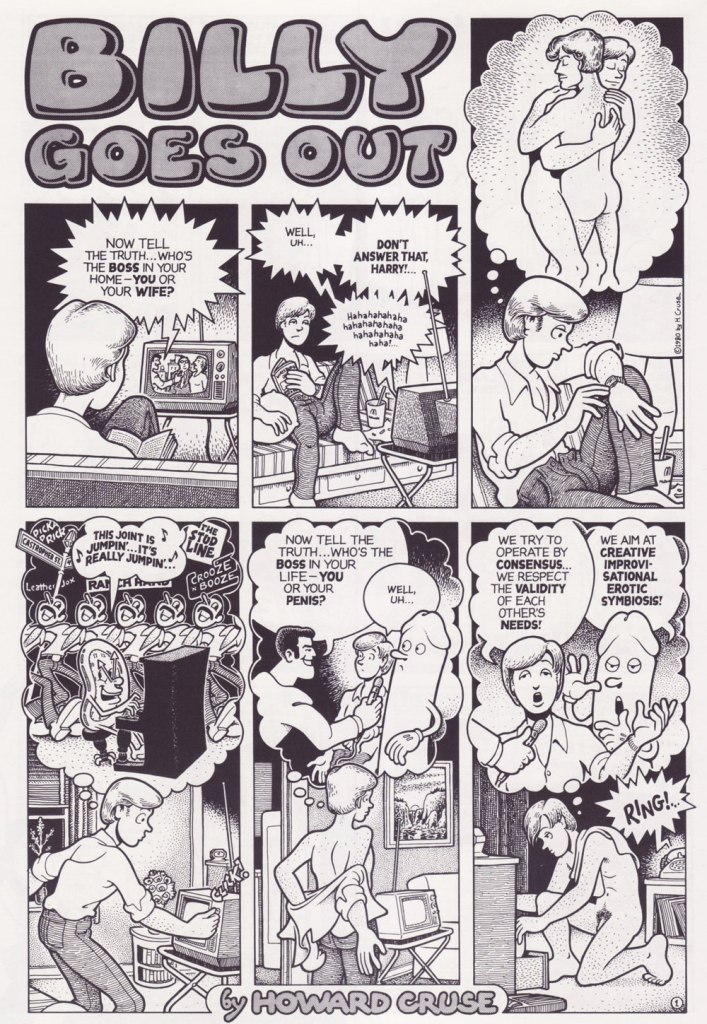


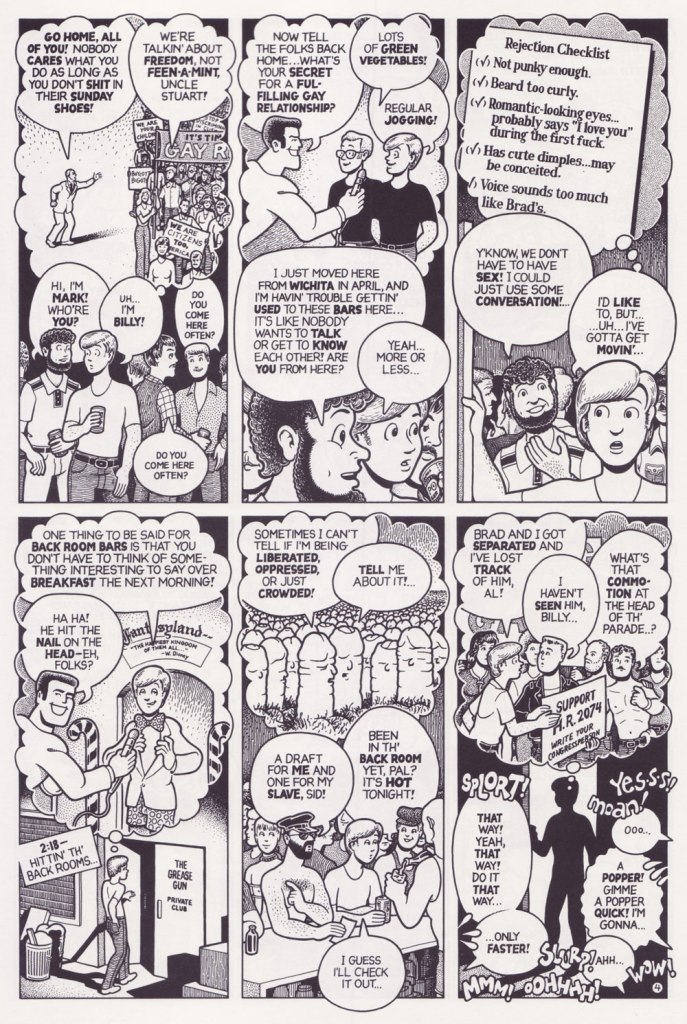
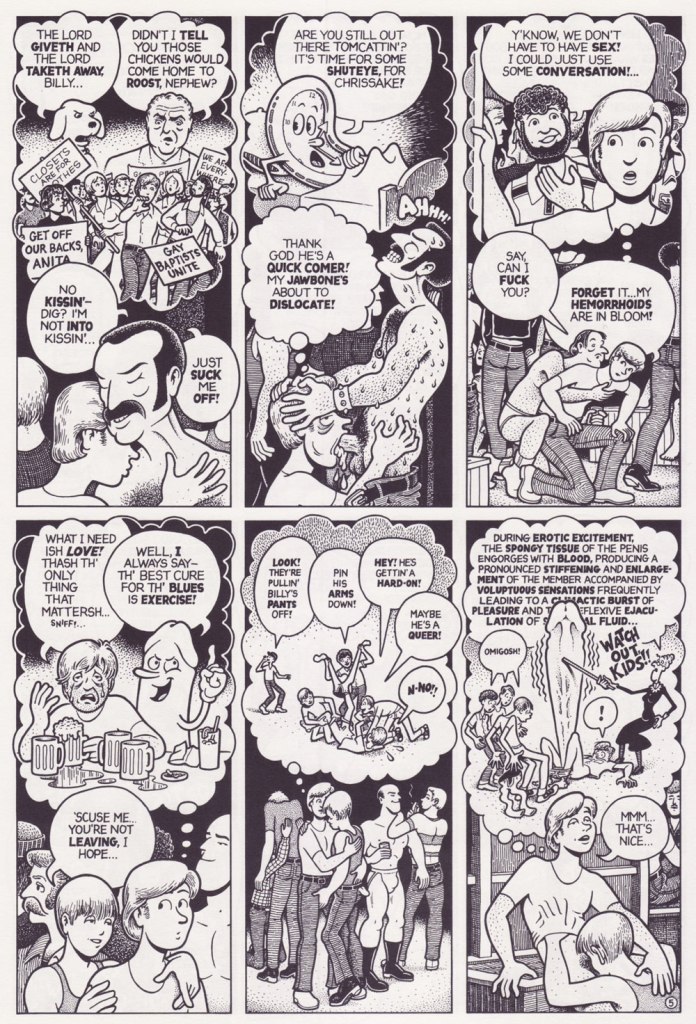


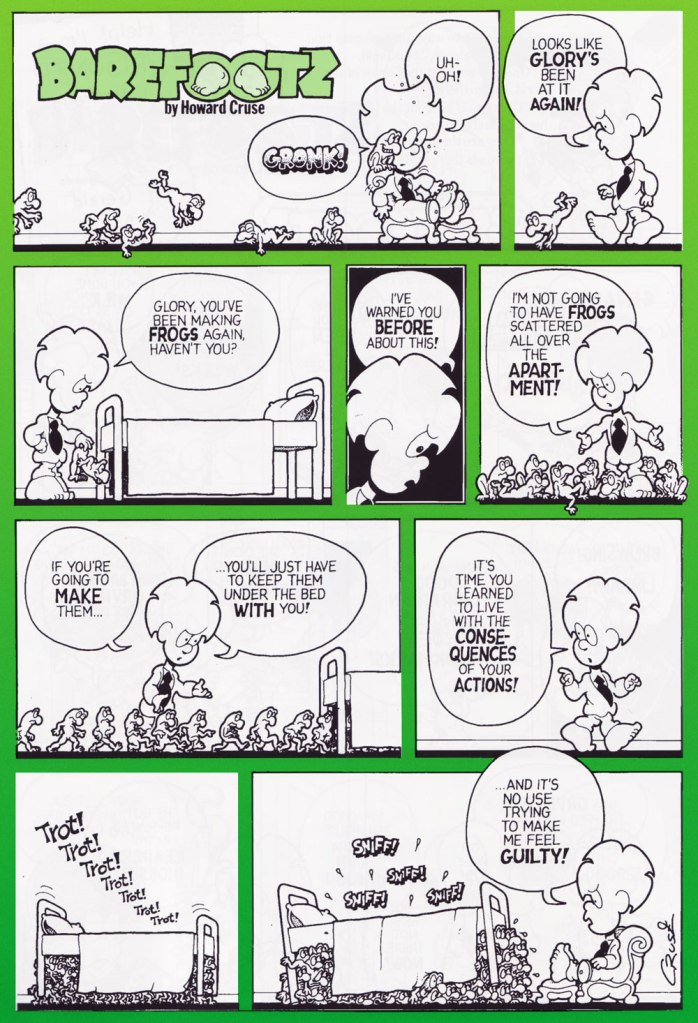
Since I mentioned it earlier, I’d also like to include two pages from Barefootz, a pleasantly surreal, somewhat drug-fueled strip. Its sense of humour is a gentle one, though it demands an ability to enjoy free-form association and controversial topics (death, abortion, cannibalism…), although the latter are inserted with such childlike enjoyment that I am hard-pressed to imagine somebody taking offense. The strip debuted in a university newspaper in 1971, migrating a year later to a few Denis Kitchen publications (Snarf, Commies from Mars, Marvel-packaged Comix Book), and then to its very own home, Barefootz Funnies.
« Compared to fellow underground comic creators, Cruse’s Barefootz character was easy to label “too cute” to be underground, and legend has it that Barefootz Funnies was widely despised by many artists from the era. Barefootz Funnies took an interesting journey from 1975 to 1979. When Barefootz debuted as a comic character in 1971, Cruse was still in the closet about being gay. Cruse later admitted the character was not the most representative of his own personality, since Barefootz wasn’t gay. But in Barefootz no. 2, Cruse revealed that Barefootz’s artist buddy Headrack was gay. This type of revelation ran counter to Barefootz’s reputation as being too cutesy to be part of the underground comic revolution. Cruse’s publicly emerging sexual orientation in real life was leading him to become more bold in his comics, which created ambivalence about the cartoony style and nature of the Barefootz character. Cruse finished the series with one final issue, which featured the cathartic “Barefootz Variations,” a story that summed up his mixed feelings about Barefootz and about cartooning itself. » [source at ComixJoint]
Barefootz himself is a man with inexplicably large and always bare feet, who lives with hundreds of cockroach roommates and a petulant under-the-bed monster called Gloria who coughs up frogs when she’s displeased.


~ ds
* I don’t think I’m imagining the note of bitterness in Jay Lynch‘s voice when he says that ‘cleansing will surely be upon us‘; a cartoonist who has lived through the purges of the U.S. Supreme Court’s 1973 ruling on obscenity, followed by the aforementioned Meese Commission on pornography in 1986, which severely limited the retail outlets carrying underground comics and empowered humourless censors, surely has cause to be embittered.
** In 1979, Denis Kitchen asked Cruse to be an editor of an anthology featuring the work of gay comic artists. Although he hadn’t officially come out as gay at that point, Cruse decided that to refuse would be cowardly, and the first issue of Gay Comix was published in 1980.





 Who's Out There?