« What’s that noise comin’ up from the cellar? It’s the restless bones of Boris and Bela* »
It’s a cinch that William Henry Pratt, back when he was eking out a living in Canada, digging ditches or driving a truck, never suspected that his name, his stage name that is, would still elicit shivers of recognition long after his passing. Here we are, a whole hundred and thirty years past his birth, in Camberwell, South London, on Wednesday, November 23, 1887.
From his ascent to stardom in the early 1930s until his passing in 1969, he certainly lived to see his likeness appear in a bewildering array of toys and games and bedsheets and mugs and a zillion knicknacks and gewgaws, a parade that continues to this day. But he was likely never represented more consistently and abundantly than he was in comic books.
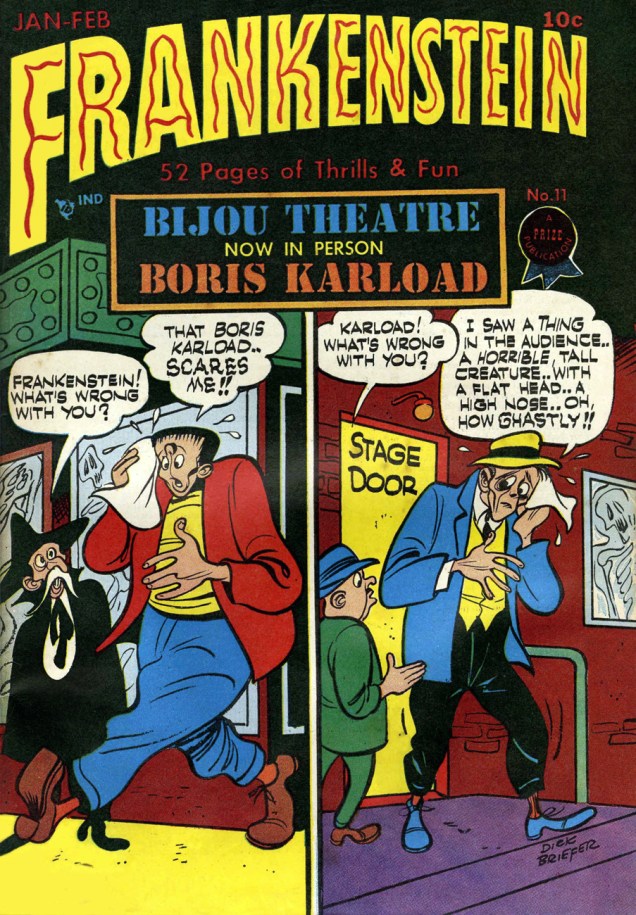
Here, the Monster meets his… inspiration, in « Boris Karload, Master of Horror ». Dick Briefer‘s Frankenstein is a definite highlight of the Golden Age of comics. This is Frankenstein no. 11 (Jan.-Feb. 1948, Prize Comics). Read it here: http://comicbookplus.com/?dlid=39937 And if you, er… dug that, treat yourself to Craig Yoe‘s selection of Briefer’s rendition(s) of the Famous Monster. It’s a great package, and Mr. Yoe can always use the money… to unleash further wonders.
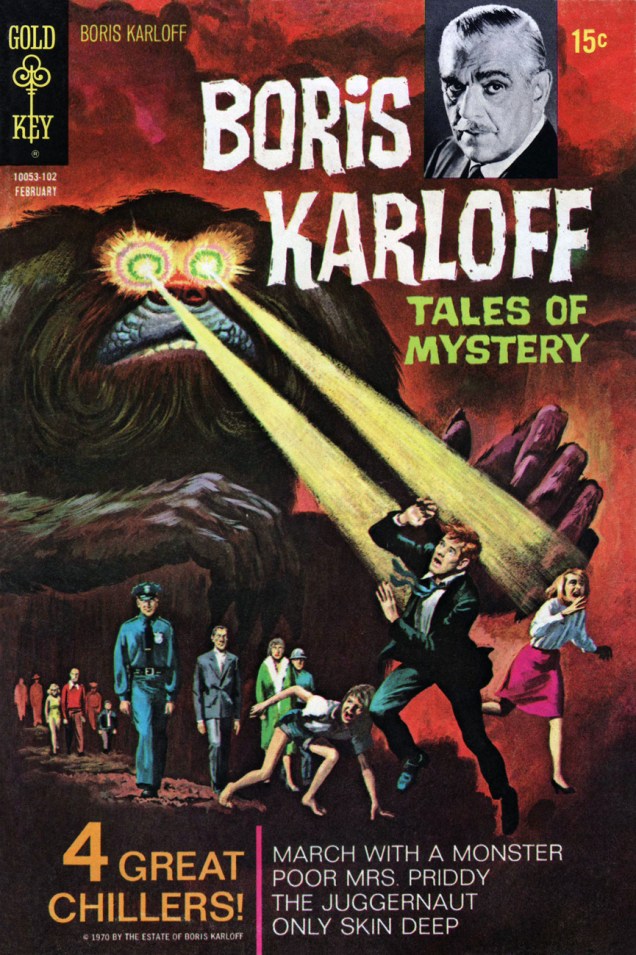
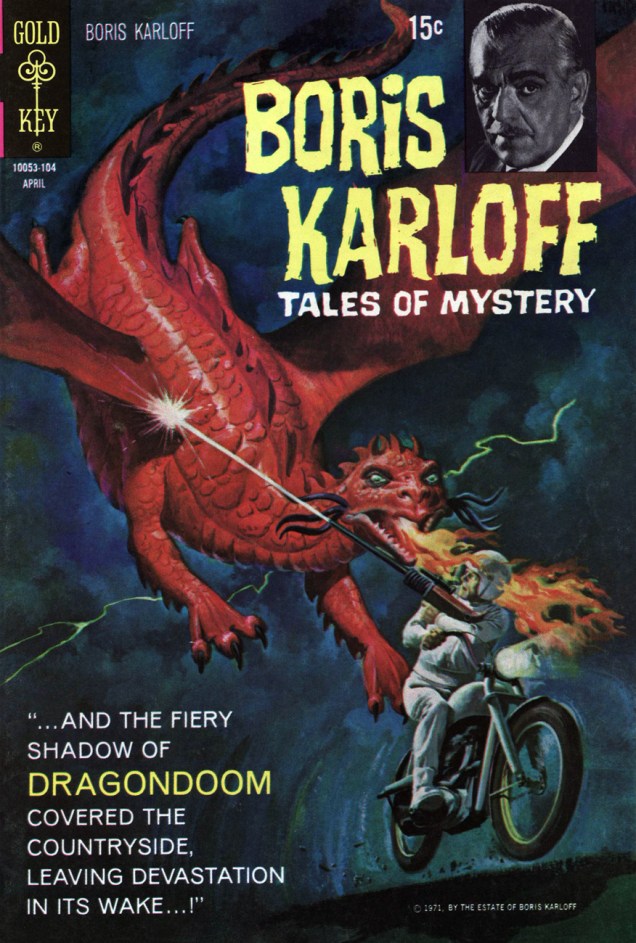
Here’s a gallery of cover highlights from Gold Key Comics’ long-running Boris Karloff Tales of Mystery (95 issues, 1962-80).
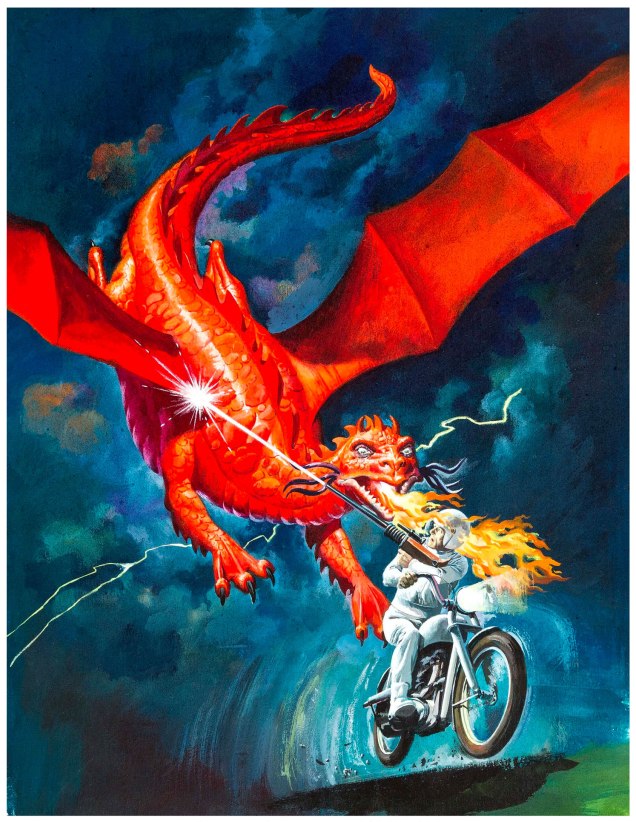
Before there was called Boris Karloff Tales of Mystery, there was, for two issues, Thriller, based on the by-then-cancelled NBC series. Gold Key were often quite slow in making their licensing moves. The TV Thriller was often terrifying (“Pigeons From Hell”, “The Hungry Glass”…), but the comic book never scaled such heights, even sans the emasculating influence of the Comics Code Authority.« You know that one sideways glance from that bug-eyed banshee can turn your brains to prune-whip! » Boris Karloff Tales of Mystery no. 33 (Feb. 1971), Cover painted by George Wilson, illustrating Len Wein, Tom Gill and John Celardo’s March with a Monster.« I’m being scorched by something that shouldn’t even exist! » A laser cannon-equipped Evel Knievel tussling with a badass reptilian nightmare? That’s the Seventies for you. Gold Key’s mystery comics were generally pretty tame fare, but their covers, such covers! This one’s painted by Saint George Wilson. Boris Karloff Tales of Mystery no. 34 (April 1971.) You just know that Dragondoom is written by Lein Wein, because its damsel-in-distress shares his wife’s name, Marvel and DC colourist Glynis.A look at Mr. Wilson’s original painting gives us an idea of just how much was lost in the transition from brush to print. Sometimes it’s better *not* to know.« Feast your eyes upon them, mortal! Do they satisfy your appetite for witchcraft? Hee Hee! » Wayne Howard conjures up some decent monsters inside, but Psychotomimetic George Wilson, who painted this mind-melting cover, shows how it’s *really* done. Boris Karloff Tales of Mystery no. 43 (Oct. 1972.)« The car — being sucked in by this blasted fetid swamp! Goodbye car… goodbye, convention! » Roadside George Wilson strikes again! Boris Karloff Tales of Mystery no. 49 (March 1973.)
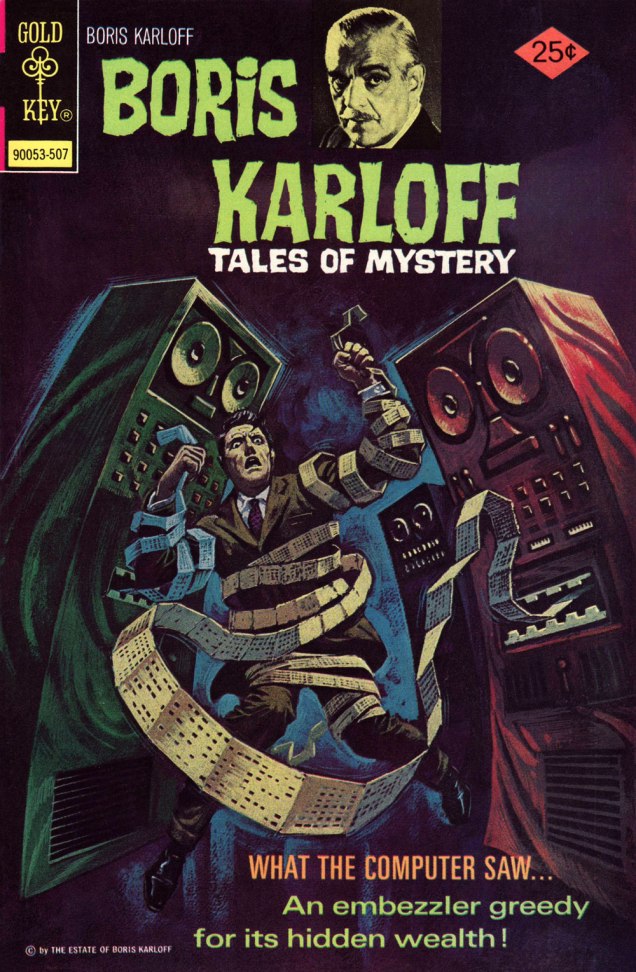
« These computer cards are wonderful… almost as if they were alive! They tell me everything! » Boris Karloff Tales of Mystery no. 62 (July 1973). Luis Angel Dominguez‘s painted cover depicts a scene from Arnold Drake‘s witty It’s in the Cards.
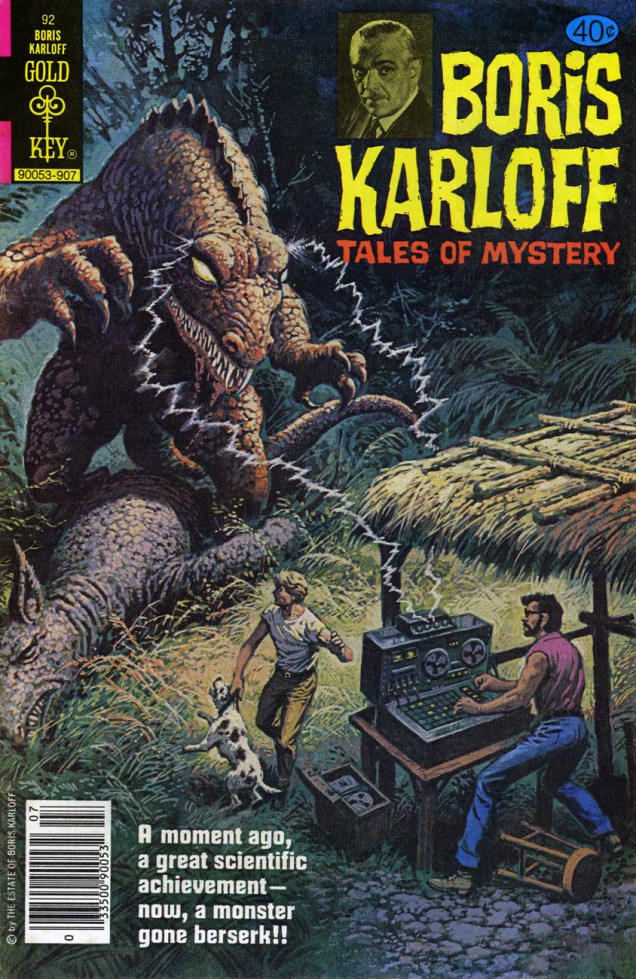
« G-g-get away, B-Bobby! There’s a living horror out there! » « Aww, gee, dad! I’m sorry about that! It’s just my sea monster! » Meet The Mail-Order Monster, a gem from an uncredited scripter (likely Arnold Drake, if the sparkling wit is any indication), and illustrated by Ed Robbins. It’s a fabulously wacky yarn, combining to fine effect good old Sea-Monkeys (brine shrimp, really) and a generous sampling of Ray Bradbury’s Boys! Raise Giant Mushrooms in Your Cellar! This is Boris Karloff Tales of Mystery no. 65 (Dec. 1975), edited by Paul Kuhn. Also within: Don’t Put It on Paper, another of the handful of jobs José Luis García-López did for Gold Key, before settling down at DC later that year. The plot is basically that of Clark Dimond/Terry Bisson & Steve Ditko’s The Sands That Change! (Creepy no. 16, Aug. 1967, Warren), but with a much gentler outcome.« But — why would anyone create something so — so terrifying? » One thing you can nearly always count on in any given issue of BKToM: “scientific” experiments always go awry, and they nearly always yield rampaging monsters. Fitting! Luis Angel Dominguez provides this electrifying cover for issue no. 92 (July, 1979.) The man had such a peerless colour sense.
Let’s reserve our closing words for the man (monster) himself: « Certainly I was typed. But what is typing? It is a trademark, a means by which the public recognizes you. Actors work all their lives to achieve that. I got mine with just one picture. It was a blessing. »
Tuesdays sure roll around quickly, but that’s okay – another week, another fresh batch of prehensile, slimy tentacles for our enjoyment. I’ll open Tentacle Tuesday with an “oldie but goodie”. (Speaking of that, I have an irrational pet peeve: comic shop owners who, upon seeing a customer carefully clutching a stack of 70s comics he meticulously unearthed from a grimy comic box stashed in the darkest corner of the store, say, with a slightly condescending grin, “oh, you’ve found some oldies!” The comment is no doubt well-intentioned, but there are nicer ways to start the conversation.)
And a-one
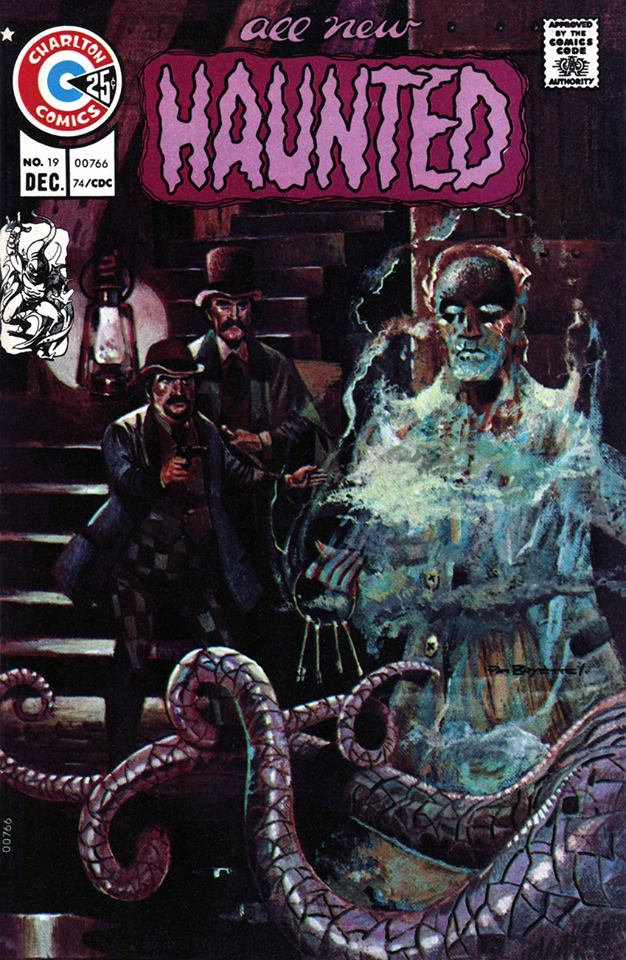
First on the list for today is this painted beauty by Pat Boyette, from Haunted no. 19, December 1974. Just look at those shiny, healthy tentacles – just the kind to gently grab your ankle and drag you into murky waters. Their diaphanous keeper doesn’t exactly inspire confidence, either.
This issue is worth picking up for more than its cover. It remains excellent when one opens its pages: there are three stories, and they’re all worthwhile – the beautiful “The Unholy!” by Pete Morisi (PAM! PAII!) (written by his son, Steve Morisi, and therefore unfortunately not making a lick of sense), the moody “There Ain’t No Hell!” by Sanho Kim and Joe Gill, and, the cherry on the cake (and story on the cover), the quietly-elegant-but-with-tentacles “The Keeper”, illustrated by Boyette (and also written by Joe Gill).
“You bawled me out many a time for not feeding your pets, your lordship… this time, they’ll feast!”
And a-two
Just like octopuses (who eat small crabs and scallops, as well as snails, fish, turtles, crustaceans, and of course other octopuses), I like a little variety in my diet, so number 2 is humorous rather than scary. How did this octopus manage to figure out which of its tentacles to stick into shorts? Who’s the happy little slug with chickenpox holding up letter “A”? Why does an octopus have beaver teeth?
This is Ha Ha Comics no. 66 (Jun – Jul 1949), published by American Comics Group, or more technically Creston, an imprint of ACG. This seems to be a rather rare issue, unavailable on Comic Book Plus although they have pretty much every other issue of Ha Ha. Thanks to an Ebayer selling this comic, however, I can state with some degree of certainly that this issue features – as advertised – an all-star cast, featuring not only the habitués Izzy and Dizzy (a pair of trouble-prone mice), but also Anthony & Cleopatra, the Impulsive Imps, Robespierre, Hard-Hearted Hannah, Wigglin’ Willie the Worm and Shilly and Shally. Doesn’t it all sound like some sort of battle of the bands? As for the artist of the cover, it’s Dan Gordon, storyboard artist and film director mostly known for his work at Famous Studios and Hanna-Barbera Productions – he did quite a few “funny animals” titles for ACG.
And a-three!
T.T. number 3 is colourful. It also leads to the question “vegetable, mineral or animal?” These tentacles seem to be rather plant-like… if plants had eyeballs attached by blood vessels.
Judging by the adventures of Space Family Robinson, most planets are inhabited by aliens with tentacles. One would think that they’d be very well prepared for this eventuality (not to mention kind of bored by it), but no, the tentacles always take them by surprise.
Apart from tentacles, this has some of my other favourite things: a pterodactyl (or at least some creature approximating a pterodactyl), a vibrant sunset, and eyeballs.
This is the back cover of Space Family Robinson no. 9 (Gold Key/Western, August 1964), which is just like the front cover minus the text. Painted by George Wilson, who has a nice sense of colour. (Hurray for saturated colours in this sepia-and-grey or orange-and-teal world.)
In the beginning, oh, long before that. When light was deciding who should be in and who should be out of the spectrum, Yellow was in trouble. Even then it seems that green, you know how green can be, didn’t want yellow in. Some silly primal envy I suppose, but for whatever cause, the effect was bad on yellow. And caused yellow to weep yellow tears for several eternals, before there were years. Until blue heard what was up between green and yellow and took green aside for a serious talk, in which blue pointed out that if yellow and blue were to get together, not that they would, but if they did (a gentle threat), they could make their own green. “Ooh”, said green with some understanding. Naturally, by a sudden change of hue, green saw the light and yellow got in. Worked out fine, yellow got lemons and green got limes.*







 Who's Out There?