Tentacle Tuesday: The Jungle Queens

« Beware, bwana — beware its tentacles! »

Cue in the taut, frantic jungle drums! Picture this: through a thick tangle of brush and tropical vegetation, prances a fair maiden who is quite unaffected by spiky plants or venomous insects. She’s the staunch defender of jungle animals, friend to jaguar or hippo (or whatever other animal the artist’s imagination conjures, even if it’s entirely inappropriate to a jungle… but who cares about zoological accuracy?) One creature this wild child is definitely not a friend to, however, is the octopus: anything with tentacles gets stabbed and killed, as expediently as possible. That’s little cause for concern, however – the real octopus, who lives only in oceans, has little use for a jungle… so whatever’s getting killed must be an impostor or a mutant.

I am amused by jungle comics, which perhaps require an even more dramatic suspension of disbelief than many an equally action-oriented genre.  The female protagonists, usually clad in some sort of leopard/jaguar skin (which makes one wonder why big felines even want to hang out with someone wearing their relatives’ pelt), are usually portrayed as guardians of the wilderness… but some of them kill an awful lot of animals for supposed protectors of the feral kingdom. The blonde Sheena (first female comic book character with her own series), equally blonde Lorna the Jungle Girl (Atlas-published, a rival to Fiction House’s Sheena), Avon’s Taanda – White Princess of the Jungle, Camilla – Wild Girl of the Congo (a case of Fiction House knocking off their own Sheena)… the list definitely goes on. That’s quite a few jungle queens bouncing around, dealing with hostile tribesmen getting uppity, lethal white hunters up to no good and would-be Romeos perpetually being held hostage. Sometimes they even have cat fights and overthrow one another. Very amusing indeed. Pepper the dialogue with lots of bwanas, toss in an epic rescue of hapless natives, and you’re all set.

To be fair, however, some Golden Age jungle comics boast fetching art and compelling stories in which natives are their own agents and her Royal Highness gets to show off her wits (and her gams) to best advantage. It’s hard to dislike stories in which a strong, clever woman gets to save the day.

Without further ado, I present Jungle Queen vs Octopus!

First up, there’s Sheena, who has struggled with quite a few tentacles in her day:

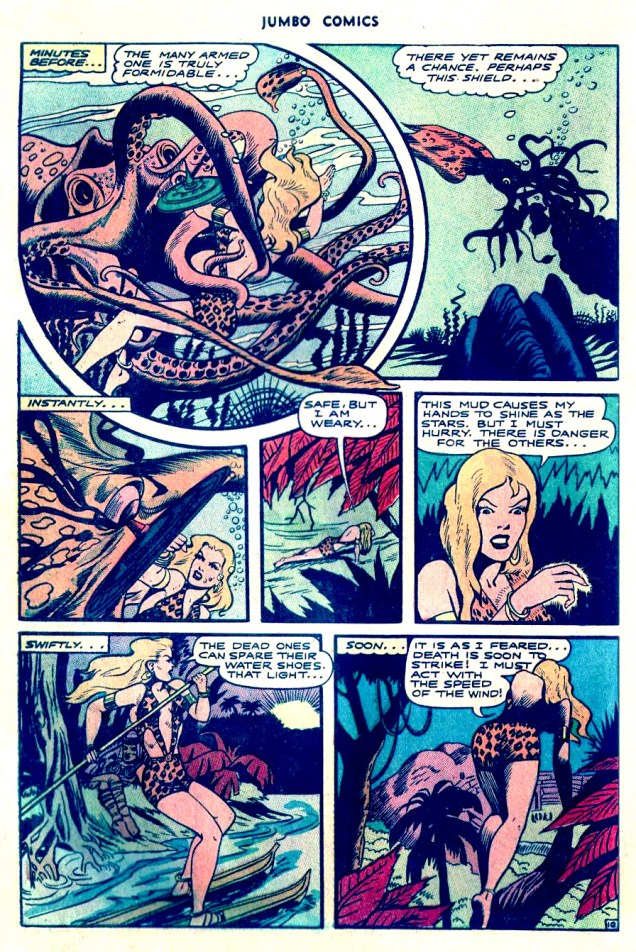
Jumbo Comics #31-Sheena-Voodootreasureofblackslavelake
Page from «Voodoo Treasure of Black Slave Lake», scripted by W. Morgan Thomas, pencilled by Robert Webb, and inked by David Heames, published in Jumbo Comics no. 31 (September 1941, Fiction House).
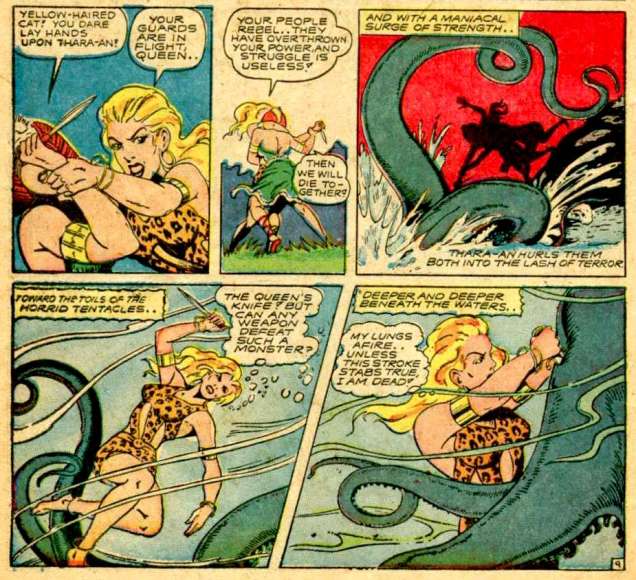
Jumbo Comics #87
«Sargasso of Lost Safaris», pencilled by Robert Webb and inked by Ann Brewster, published in Jumbo Comics no. 87 (May 1946, Fiction House). What the heck does the Sargasso sea have to do with a jungle? I’d like to know.
Sheena, Queen of the Jungle #5
Untitled story from Sheena, Queen of the Jungle no. 5 (Summer 1949, Fiction House). Art by Robert Webb.
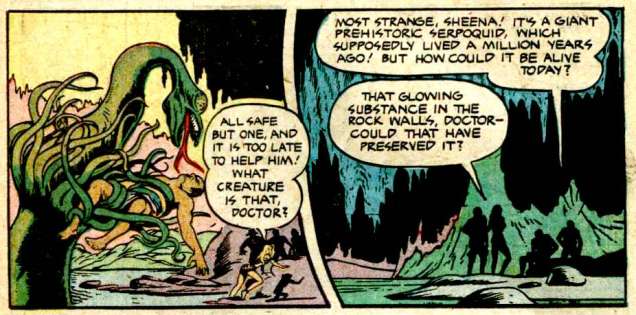
Sheena, Queen of the Jungle #12
Panels from «The Beasts That Dawn Begot!» drawn by Robert Webb, published in Sheena, Queen of the Jungle no. 12 (Summer 1951, Fiction House).

Time for other queens to borrow Sheena’s spotlight:
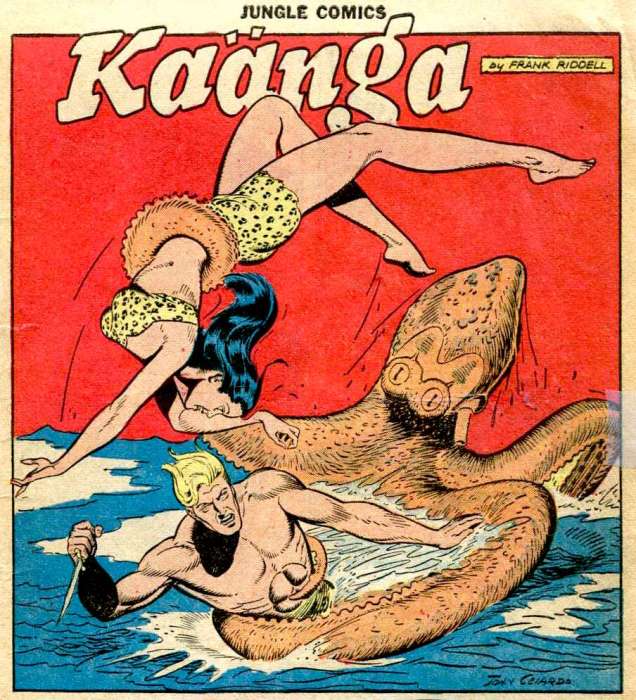
Jungle Comics #105-JohnCelardo
«The Red Witch of Ubangi-Shan», with art by John Celardo, published in Jungle Comics no. 105 (September 1948, Fiction House). Technically, this inclusion goes against my main theme – for Käanga has a very stupid mate who has to be rescued at every turn. She may wear a leopard bikini, but she’s nothing but a Damsel in Distress. Boo.

This Camilla story was scripted by Victor Ibsen and drawn by Ralph Mayo, and was published in Jungle Comics no. 144 (1951, Fiction House):

Jungle Comics #144

Jungle Comics #144 -2
A raft full of musclebound men and Camilla has to be the one to stab the octopus. Her contempt is well justified, as Asheley is clearly a loser.

We’ve had a lot of blondes so far, how about a redhead?

White-Princess-of-the-Jungle-#4
White Princess of the Jungle no. 4 (August 1952, Avon), cover by Everett Raymond Kinstler.

The cover story, «Fangs of the Swamp Beast»:
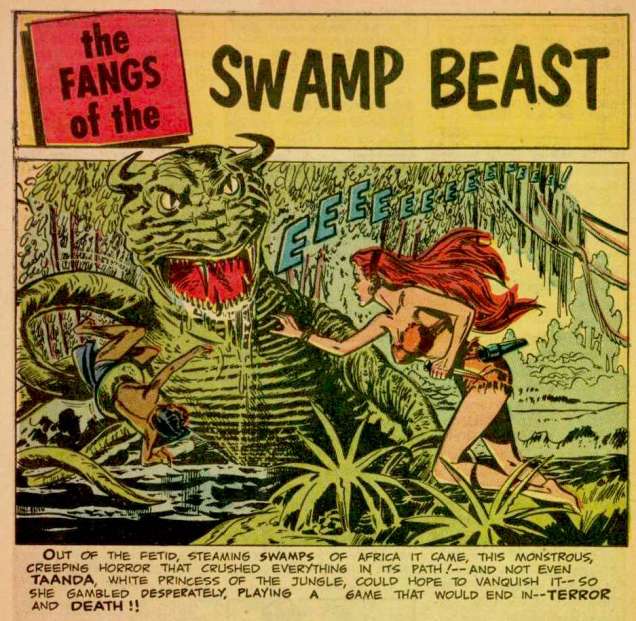
White Princess of the Jungle #4-swampbeast

White Princess of the Jungle #4-1

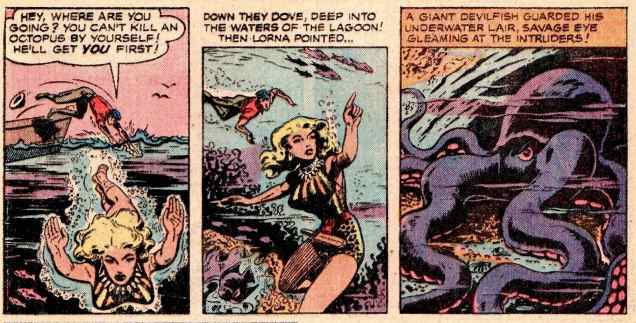
Back to our regularly scheduled blonde heroine! This is «The Devil’s Lagoon», scripted by Don Rico and drawn by Werner Roth, published in Lorna the Jungle Queen no. 4 (December 1953, Atlas):

Lorna the Jungle Queen #4-devil's lagoon
Lorna has the talent of plunging into water boobs first, and using them to optimize buoyancy.
LornaTheJungleQueen#4-devil'slagoon-savageye
Again with the bust-ridiculously-stuck-out pose in the first panel.

LornaTheJungleQueen#4-2

For a chuckle, read Stupid Comics‘ critique of Devil’s Lagoon here. Moving on, I have no wish to be unfair to brunettes, especially given that I generally prefer them:

AllTop16A
All Top Comics no. 16 (March 1949, Fox). Cover by Matt Baker. Sure features plenty of top, doesn’t it? That’s Rulah, by the way – you guessed it, Rulah, the Jungle Goddess (well, at least she’s not a queen), one of those run-amok women who has no qualms killing animal or human.

Here’s a rather amusing explanation for Rulah’s raison d’être from Toonopedia: «One day, while piloting a small plane across Darkest Africa, she crash-landed where civilization had scarcely been heard of. Her clothes were damaged to the point of leaving her butt naked (“like Eve in the Garden,” she mused), modesty preserved only by shadows and strategically-placed vegetation — yet, her skin wasn’t noticeably scratched or abraded. Fortunately, her plane had whacked a giraffe on the way down, so she skinned it and skillfully fashioned a fetching bikini from the raw, uncured pelt. Her uncovered parts were no more bothered by thorns, rough bark, poison ivy and the like, than were her bare feet. Next, she saved a tribe from the local tyrant, a white jungle queen much like herself, and was proclaimed its ruler — provided she could prove herself by killing a starving leopard with nothing but a dagger, which she did.»
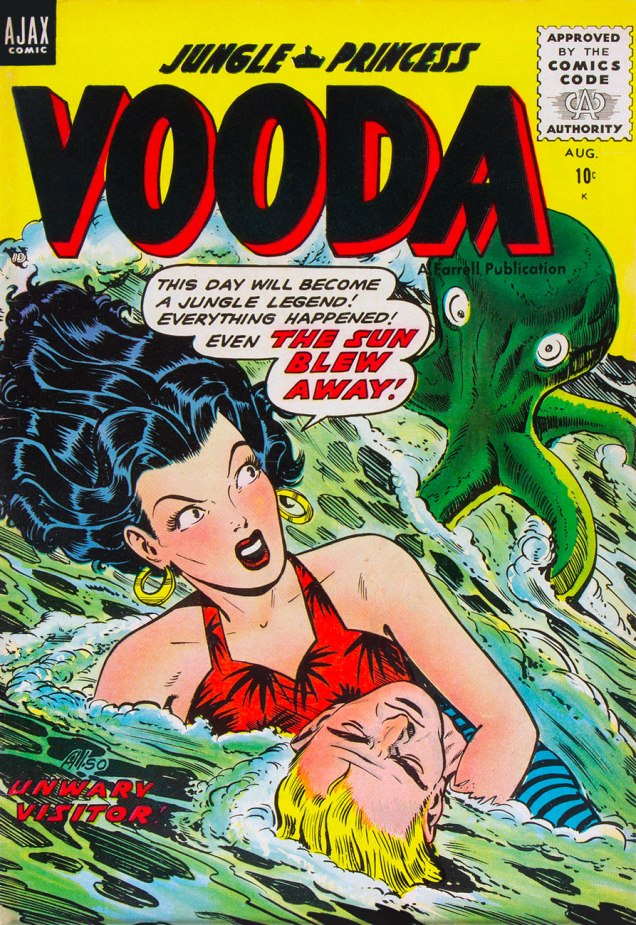
Vooda22A
Another brunette! Vooda no. 22 (August 1955, Farrell). Note that Jungle Queens are only allowed to have hoop earrings, preferably gold.

Phew, that tromp through the jungle wore me out! Until next Tentacle Tuesday…

~ ds

Bill Everett’s Restless Nights of Dread

Today, 102 years ago (!), on May 18th, 1917, William Blake Everett came into the world. He did not become a poet like his ancestor William Blake, nor a politician like Richard Everett, another famous forebear, who founded the city of Springfield, Massachusetts. Bill Everett’s father wanted him to become a cartoonist, and his wish came true, though the elder Mr. Everett died long before before the rebellious Bill found his place in the comics industry.

Bill Everett is best known for creating Namor the Sub-Mariner (visit out Tentacle Tuesday: Prince Namor for an overview of this character’s story and adventures… or read The Brilliance of Bill Everett’s Sub-Mariner, Marvel’s Superman, a great article from Sequart Magazine), but he also had his hand in the creation of Daredevil and Simon Garth, Zombie. Everett excelled in many genres – superheroes, horror, fantasy, science-fiction – but today, since there are far too many covers to feature, I will force myself to focus on horror. Welcome to the ghoulish gallery of my favourite Bill Everett covers! (They’re not necessarily the goriest or scariest – sometimes it’s a mood of quiet menace or a striking composition that sways me.)

BillEverett-Venus19
Venus no. 19 (April 1952). The silent, smirking watchers in the corner are far creepier than the skeleton embracing her!
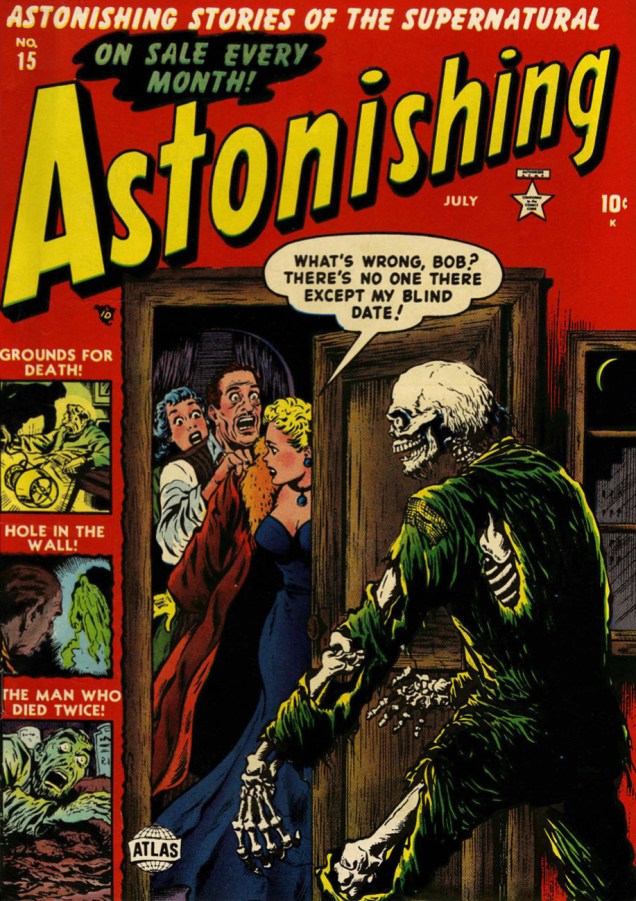
EverettAstonishing15A
Astonishing Tales no. 15 (July 1952). Do a lot of daughters address their fathers by their first name?
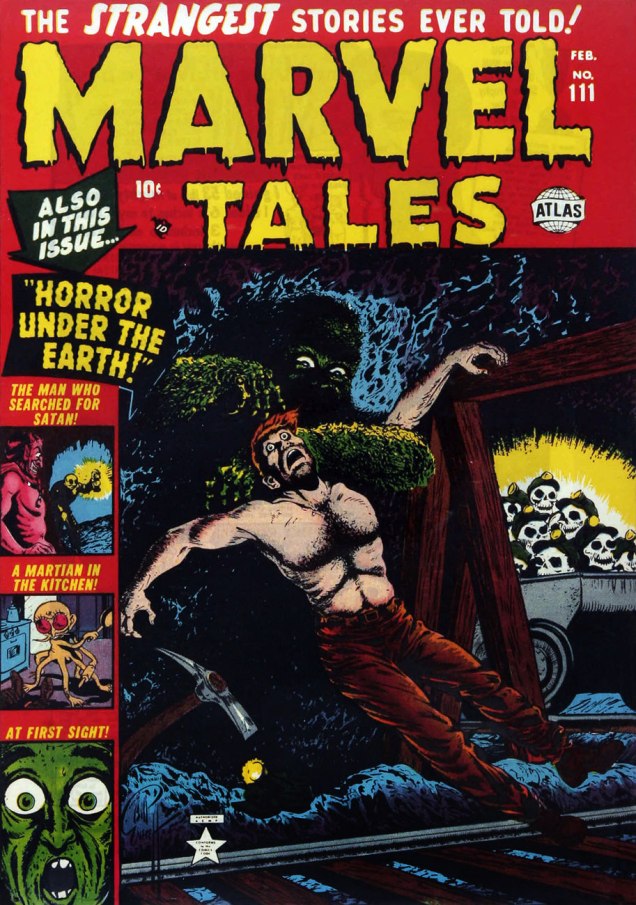
BIllEverett-Marvel-Tales111A
Marvel Tales no. 111 (February 1953)
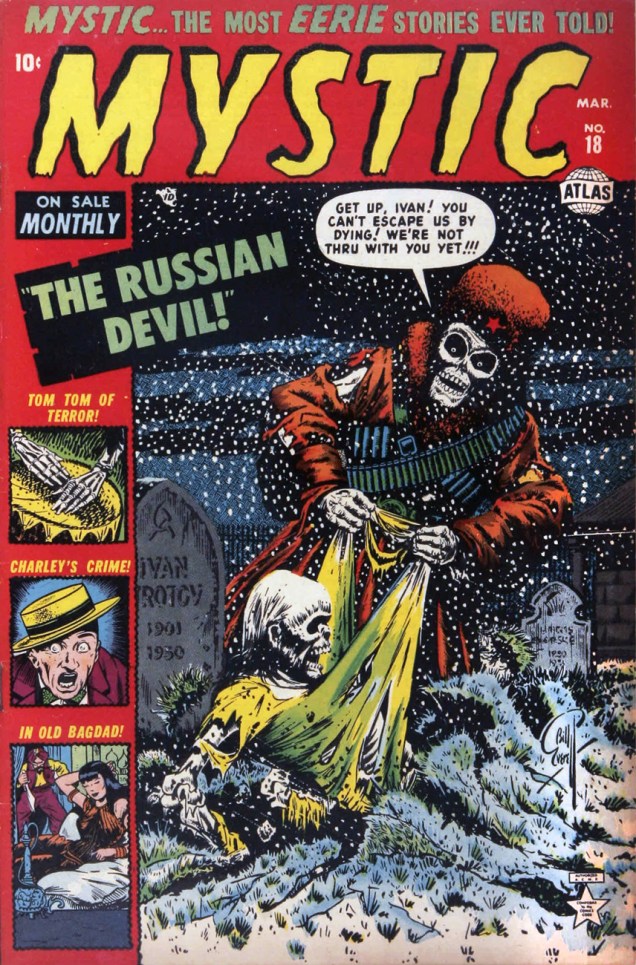
BillEverett-Mystic-#18
Mystic no. 18 (March 1953).
BillEverett-JourneyIntoMystery9A
Journey Into Mystery no. 9 (June 1953)
BillEverett-Marvel-Tales117A
Marvel Tales no. 117 (August 1953)
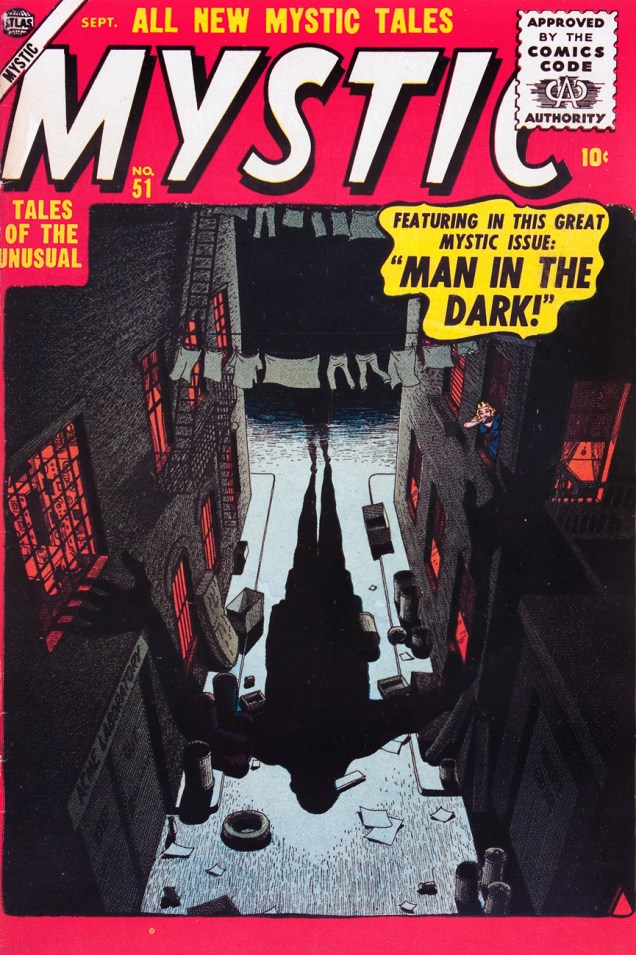
BillEverett-Mystic-#51-(Atlas,-1956)
Mystic no. 51 (September 1956). I love these silent covers where the menace is suggested rather than shown in detail.
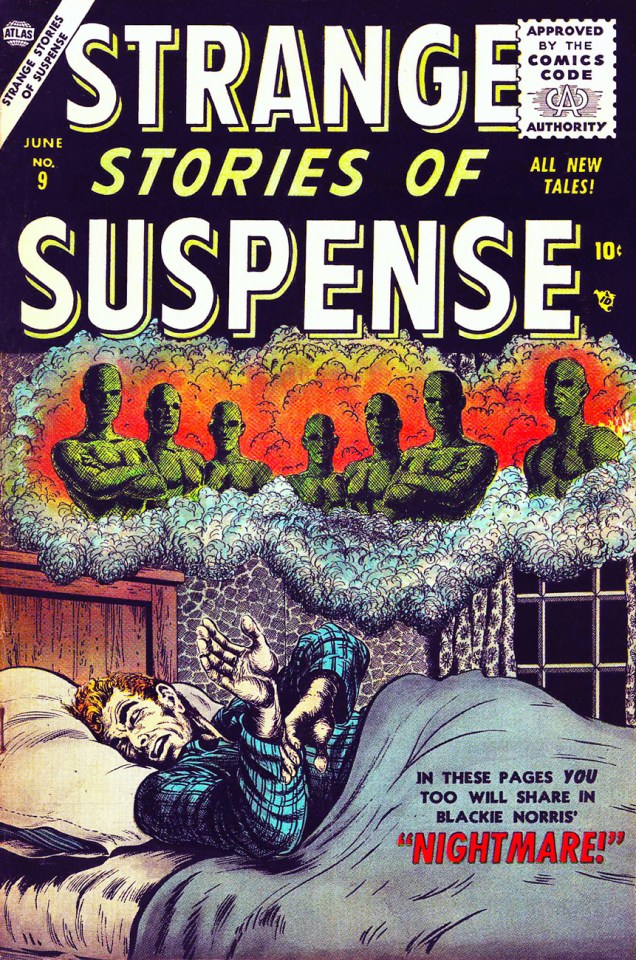
BillEverett-Strange-Stories-of-Suspense-#9
Strange Stories of Suspense no. 9 (June 1956)
BillEverett-MarvelTales151A
Marvel Tales no. 151 (October 1956). Here it’s the composition I especially like – the giant hair isn’t that scary.
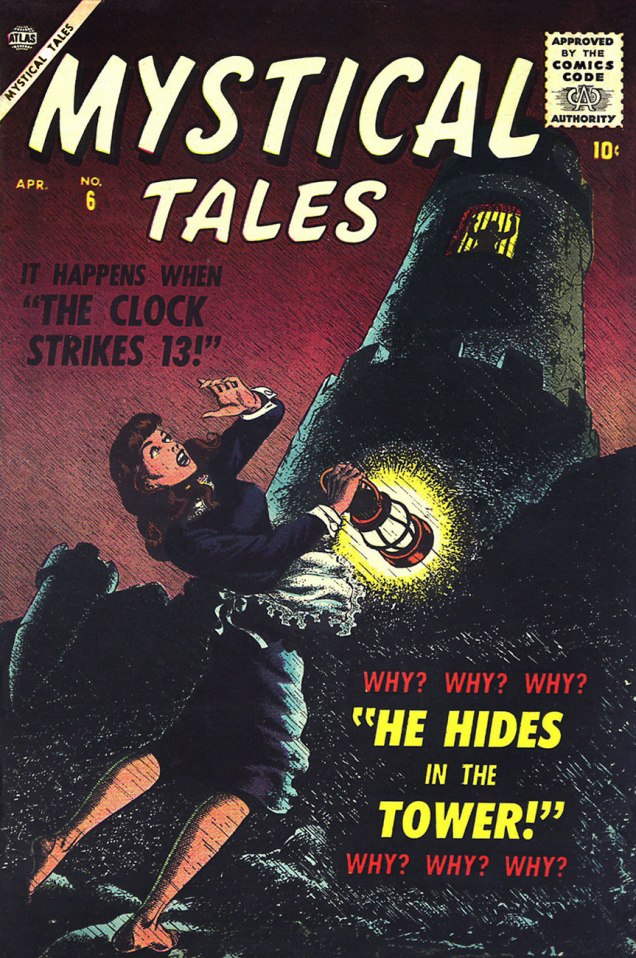
BillEverett-Mystical-Tales-6A
Mystical Tales no. 6 (April 1957). I admit the WHY? WHY? WHY? amuses me WHY? WHY? WHY?; – one inquiry should have sufficed. Speaking of “WHY?”… Why is she barefoot? Those rocks have to be treacherously slippery at the best of times, let alone in a rainstorm.

If you’d like more, you can visit Scott’s Classic Comics Comics Corner: Top 13 Bill Everett Horror Covers – only two of his entries overlap with my own selection, which shows how opinions vary and just how rich this vein is.

~ ds
The Many Lives of Jerry Robinson

« When comics came along in the 1930s there was a talent pool waiting. And one reason is so many areas were closed to Jews. Colleges, advertising agencies, many of the corporations – the doors that were closed led to the one that was open. » — Jerry Robinson

It’s New Year’s Day, which means it’s also the titanic Sherrill David ‘Jerry’ Robinson‘s birthday. Born on the first of January in 1922, he left us not so long ago, on December 7, 2011. He played at the very least a strong rôle in the creation of Batman’s sidekick Robin, his foes the Joker and Two-Face, his butler Alfred Pennyworth… and much more. Naturally, since we’re entering the murky world of Bob Kane, the whole process is mired in controversy, conflicting accounts and perhaps a little fibbing from certain parties.

Robinson went on to, well, several brilliant careers. In the 1950s, he worked as an instructor at New York City’s School of Visual Arts, where he mentored and considerably influenced a young Steve Ditko (among many others); he had a hand in several successful newspapers strips; served as president of the National Cartoonists Society (1967-69) and of the Association of American Editorial Cartoonists (1973-75); he lobbied hard for cartoonists’ rights, helping Superman creators Jerry Siegel and Joe Shuster obtain long-denied compensation and credit; he wrote, in 1974, The Comics: An Illustrated History of Comic Strip Art. And this is but a sprinkling of highlights…

RobinsonBehindMaskA
We won’t limit ourselves to the obvious Bat-imagery, which was mostly studio work anyway. Here, for instance, is a more obscure but purer œuvre, both pencilled and inked by Robinson: the original art from « Behind the Mask », page 2, originally printed in Atlas’ Marvel Tales no. 103 (Oct. 1951). Writer unknown.
PhantomBrakemanCoverA
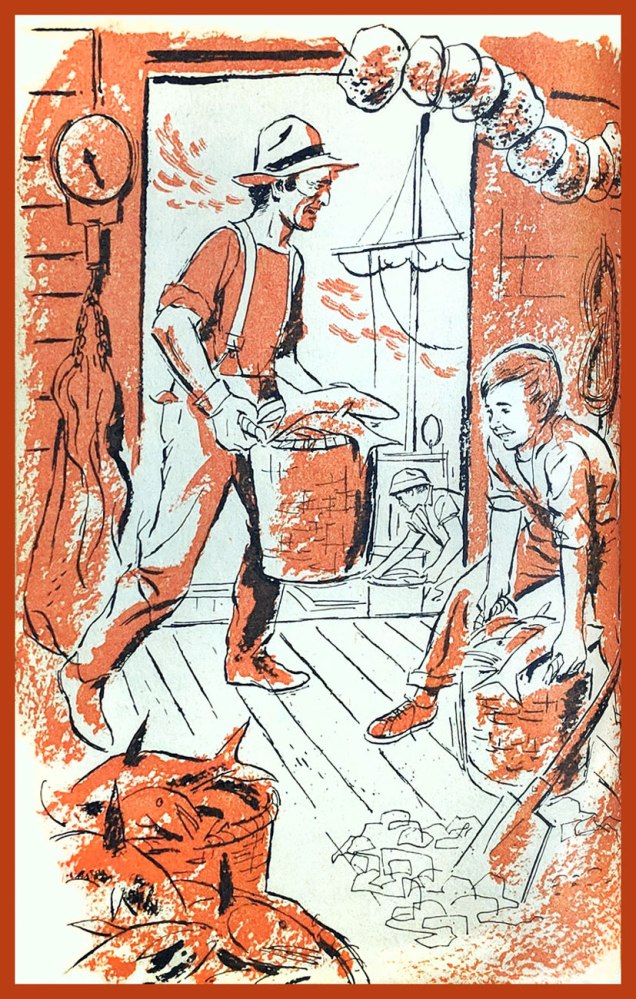
My earliest encounters with Mr. Robinson’s work were through a pair of books for young readers he illustrated in the late 1950s, in a beautifully free and expressive styles. Here’s the cover and one interior vignette from The Phantom Brakeman (1959, Scholastic), written by Freeman Hubbard, then editor of Railroad Magazine.

PhantomBrakemanIlloA

HurricaneLuck01A
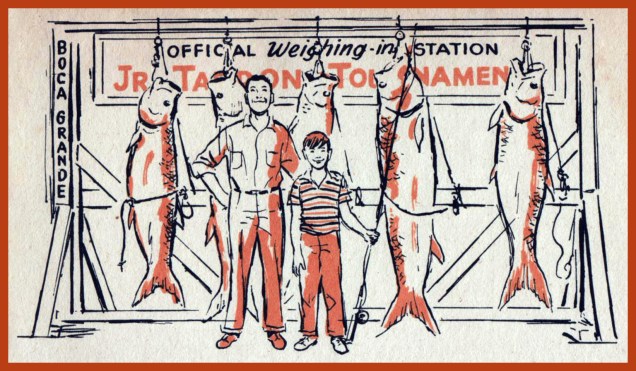
The following two pieces belong to Hurricane Luck (1959, Scholastic), written by Carl Carmer.
HurricaneLuck02A
Spoiler alert: Peter does, in the end, win the Tarpon fishing contest.

« What about Batman? », you might say. Okay, I admit I don’t have a prayer of getting away with a Jerry Robinson tribute devoid of the caped crusader and his trusty bird-themed sidekick, so here goes!

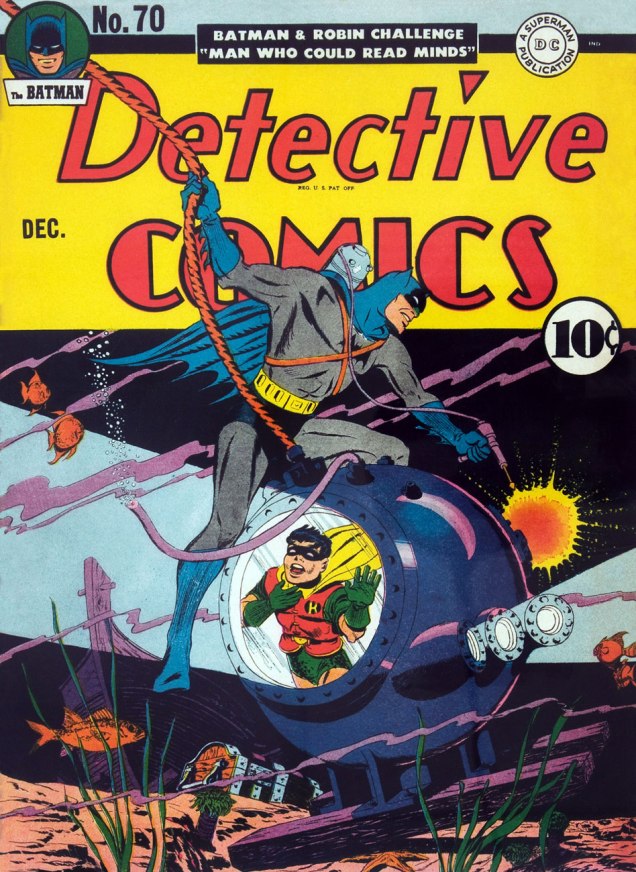
Detective70A
Detective Comics no. 70 (Dec. 1942). Pencils and inks by Robinson.
Detective71A
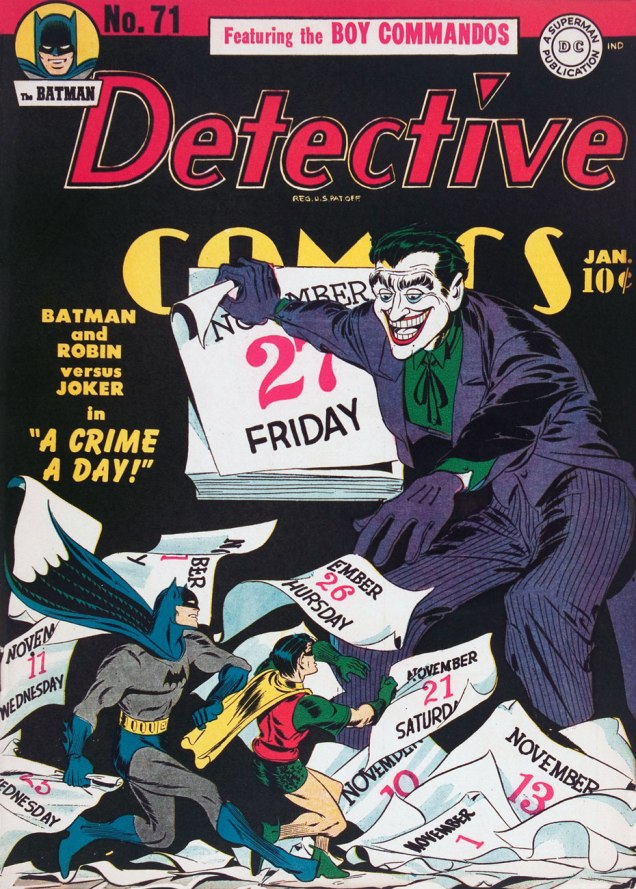
Detective Comics no. 71 (Jan. 1943). Pencils and inks by Robinson.

-RG

Hallowe’en Countdown II, Day 8

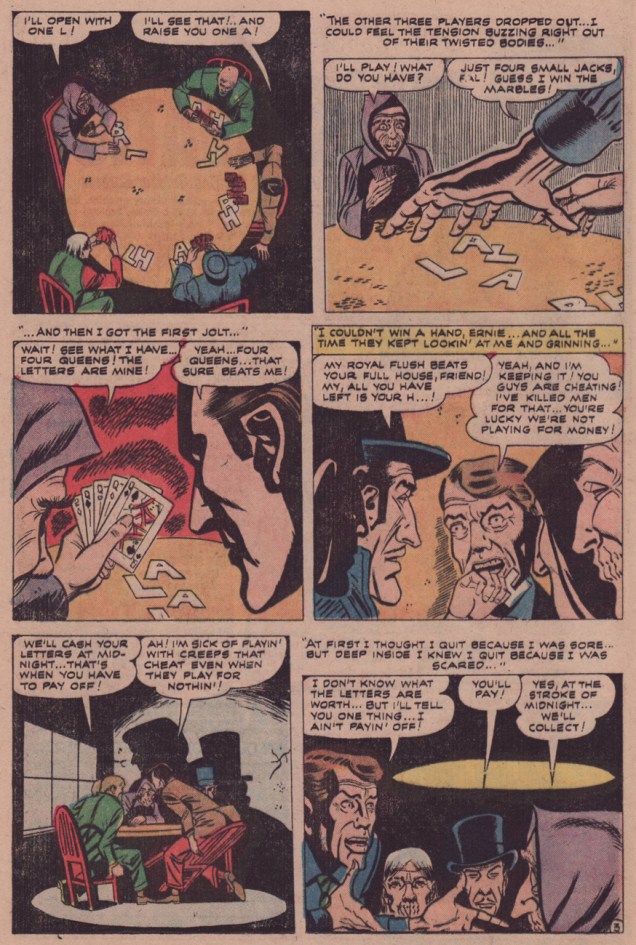
« The other three players dropped out… I could feel the tension buzzing right out of their twisted bodies… »

Poor, naïve Lou Beltram!

I first laid eyes on this one when I visited, in the fall of 1976, a tabagie (a tobacco shop) at a recently-opened shopping mall. For some reason, they had a batch of comics dating from 1973. This was one*.

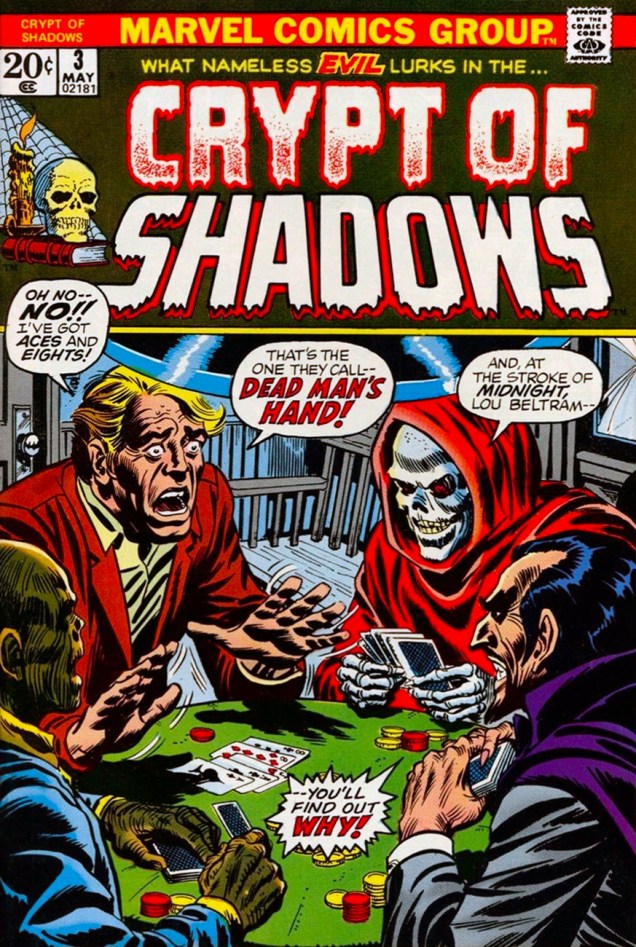
CryptShadows3A

The cover feature, « The Strange Game », is a typical product of the early 1950’s horror boom: it doesn’t make a lick of sense, but it is fairly irresistible stuff, at least from the perspective of an 11-year-old. This wacky cover art, from this May 1973 issue, is the work of company man supreme John Romita Sr., Marvel’s heavy-handed art director of the period.

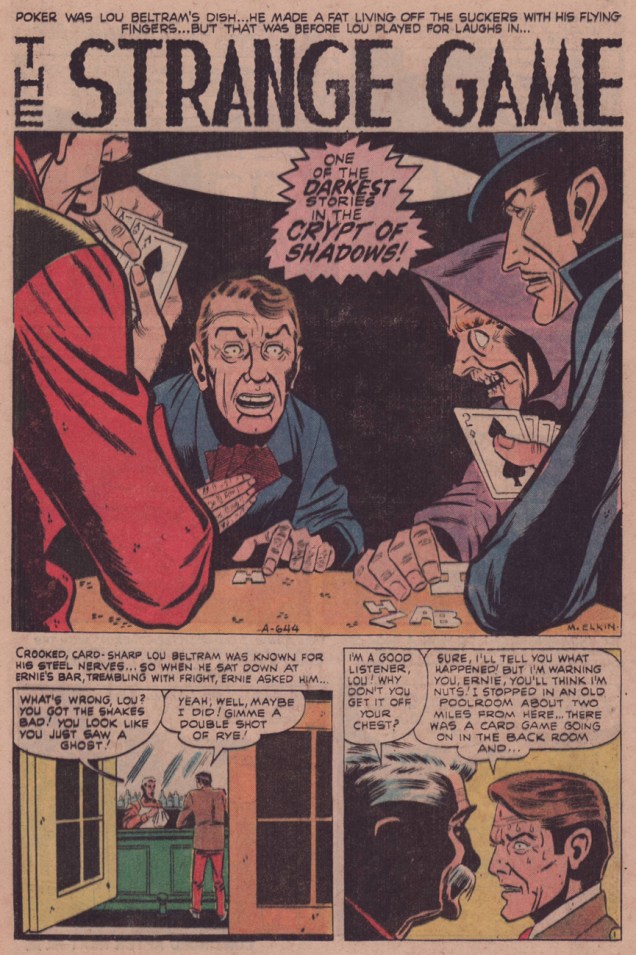
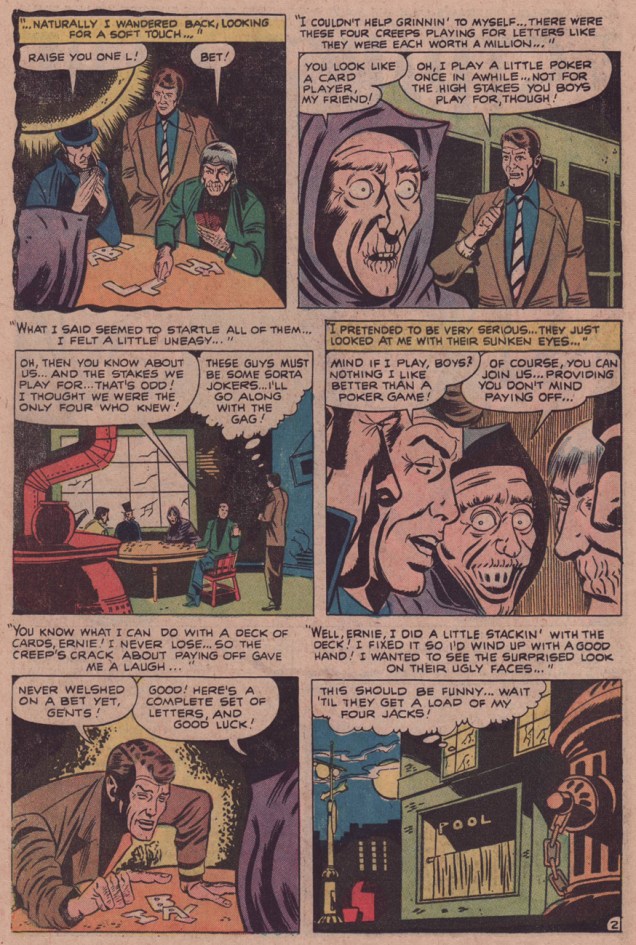
This time (sorry!) you’re getting the story right here, since… who else would get interested in such a boneheaded piece of claptrap, badly drawn to boot? (technically speaking… I do, however, find its primitive ineptitude quite charming). Suspend all disbelief and critical sense, and enjoy!

StrangeGame01AStrangeGame02AStrangeGame03AStrangeGame04A

The tale in question, scripted by an unknown writer and illustrated by Marty Elkin (reportedly Gil Kane‘s cousin!), was reprinted from Atlas’ (what Marvel Comics were called back in the day) Strange Tales #9 (August, 1952).

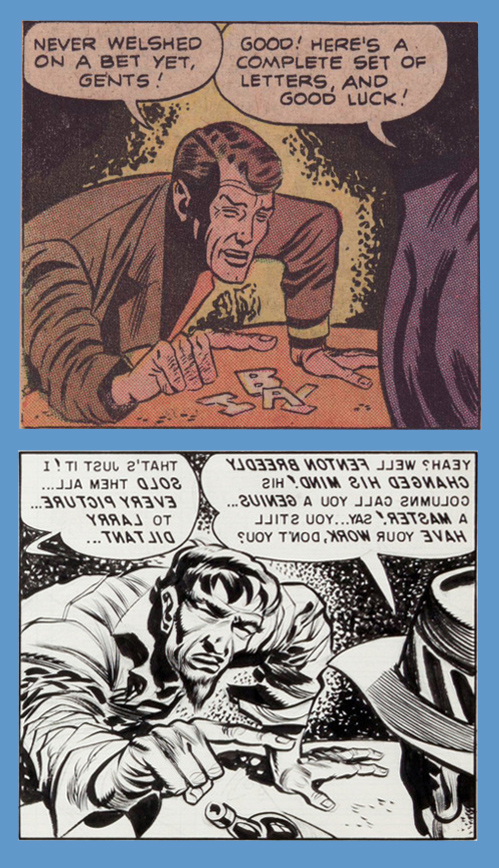
Oh, and something was nagging at me about a particular panel… so I did a little digging, here’s what I found: while swiping from Jack Davis has long been a national pastime, here’s one of the earliest infractions not perpetrated by Howard Nostrand (who’s fine in his own right, but he did have that singular, corner-cutting vice).

StrangeSwipe
It’s a flipped (how devious!) steal from page 2, panel 6 of « Drawn and Quartered! » (script by Al Feldstein, art by Jack Davis), Tales from the Crypt no.26 (Oct.-Nov. 1951, EC Comics). Marty seems a bit hazy on the general concept of hands.

I also suspect page 2’s second panel to be an early EC Joe Orlando or Wally Wood swipe, but I can’t quite nail it down… yet.

-RG

*The Unexpected 146 and The Demon 8 (both cover-dated April 1973) were the others I picked up. What else was there? An issue of The Cat I didn’t buy, but otherwise, I’m drawing a blank. 😉

The Overwrought Allure of Golden Age Romance Comics

I’m reading a play by Anton Chekhov these days. What relevance does this have to comics? Let me explain. I don’t know about the so-called « mysterious Russian soul », but this particular play is histrionic. And the chief cause of drama, of course, is love. One woman tries to poison herself upon discovering her husband has a mistress and is preparing to run off with yet another man’s wife; others literally crawl around while trying to convince the rascal they’ve fallen in love with to condescend to granting them a small sign of affection; small children are threatened with deadly diseases; men launch into hair-tearing monologues, intermittently planning suicide or murder but never actually getting around to it; money is borrowed, and is immediately tossed in the air, friendships are shattered, insults are hurled and then profuse apologies proffered… and everybody, and I do mean everybody, goes hysterical.

Which brings us to Golden Age romance comics. Ha!

I’m not intending to suggest that *all* of them are ridiculously over the top. However, a lot of them are plotted like your average soaper – understandably, as these stories were written with a drama-hungry, lovelorn audience in mind. « Boy meets girl, everything goes well, they’re happy together » is not the kind of thing that moves copies.

Here’s a selection of covers I really like (for various reasons), depicting some common situations in a young woman’s life – like getting back-stabbed or pawed or pregnant while dreaming of some Perfect Love.

WhoThereLogotype

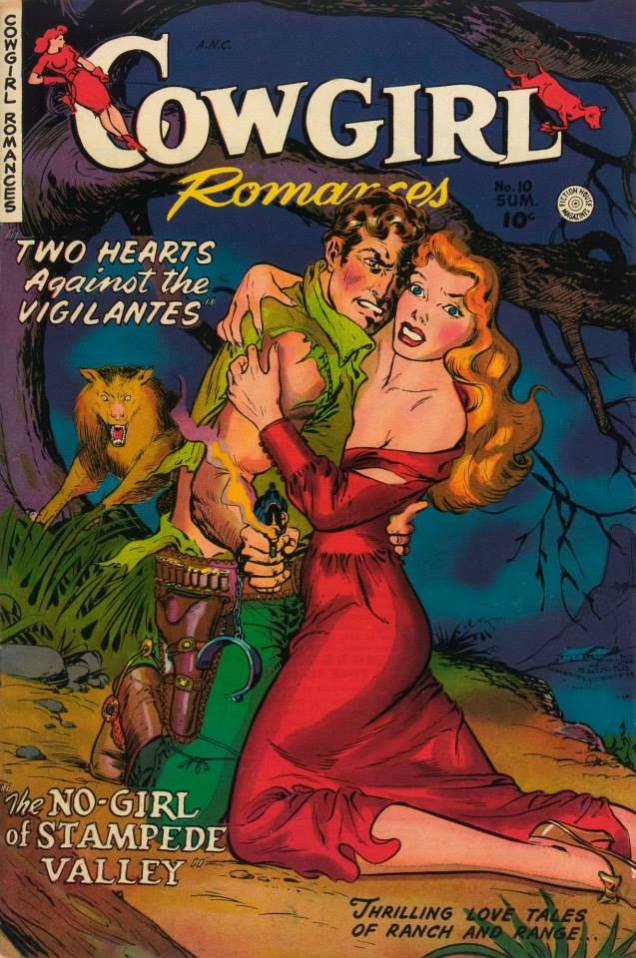
Some gals don’t merely have to contend with vigilantes, but also wolves (of the animal *and* human varieties).

CowgirlRomances10
Cowgirl Romances no. 10 (1950, Fiction House). Cowgirl Romances lasted for 12 issues, and usually featured strong heroines capable of defending themselves… although this one looks like she might need a bit of help. Read it here.
CowgirlRomances10-detail
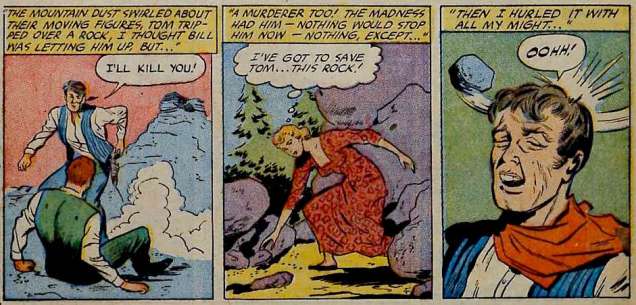
Oh, never mind – she doesn’t need help after all. It’s a refreshing change from women who stand by doing nothing while their loved one gets pummelled… or try to help and end up conking the wrong man.

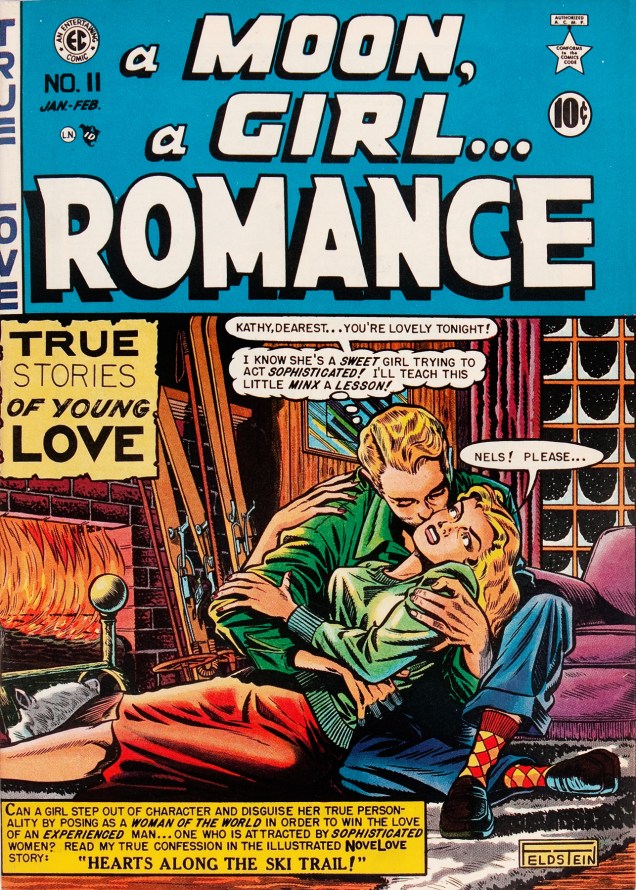
Speaking of wolves, we have this cozy scene with distinctly creepy overtones. Anytime someone mentions an “experienced man”, run the other way.

A-Moon,-A-Girl...Romance-#11
A Moon, a Girl…Romance no. 11 (January-February 1950, EC). Cover by Al Feldstein.

Julie fought, but now she fought as much against her own hungry response as against his muscles. Try as she would, she could not keep herself from returning that kiss with all the fiery ardor of her wild loneliness.” Untamed Love is quite racy, as the title promises, and as much over-the-top as one could wish for. The cover story is about an evil seductress, but the rest of the tales all concern themselves with a love triangle of another kind, one in which a girl has to choose between two guys. This one’s for the ladies – it’s hunks galore!

UntamedLove1A
Untamed Love no. 1 (January 1950, Quality Comics). Cover by Bill Ward. “Scary” comes to mind more than “ravishing”! Read the issue here.

Here’s the “ravishing creature” in action, in case you’re interested:

UntamedLove1-Detail-BillWard

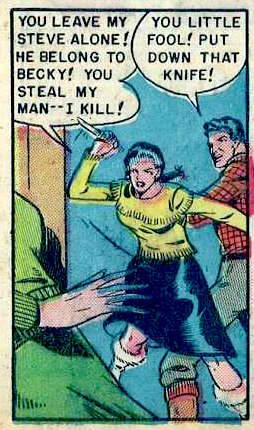
UntamedLove1-RealRoadtoLove


Alaskan beauties don’t understand English grammar, but they dig the language of love! Panel from “The Wrong Road to Love”: “Julie falls in love with truck driver Steve, but he moves to Alaska to become a fisherman. She follows him there, only to discover local resident Becky considers Steve “her man.” Julie is consoled by Steve’s partner Hank. Steve and Becky run off, taking all the money Steve and Hank have earned. Julie decides to go home, but Hank says she can stay — as his wife.


Another sentimental overload (though one would think that being at war was dramatic enough)? The redhead in the square on the right is in love with a gay man! (She was in love with a man’s fiancé, after all.) The girl at the dance is struggling to get away from a grabby asshole! (Unfortunately, all-too-common even today.) The girl in the green dress is faking it because she’s too polite to say no! (Ditto.)

WartimeRomances10
Wartime Romances no. 10 (October 1952, cover by Matt Baker).

“They were like two jailers, my pa and my brother Bill! At 18, I hadn’t tasted the sweetness of courtin’! And I was hungry for it… bitter hungry…” Things quickly get out of hand in this issue of First Love – a young maiden meets a charming young man who kills her brother (by accident), after which she gets shot by her dad (also by accident). The story concludes with the two lovebirds reuniting while the father realizes that “his soul is black with sin“. Geez, the things some people have to go through to reach a happy ending in a comic story.

FirstLoveIllustrated34-1953
First Love Illustrated no. 34, 1953. Read the issue here.

This issue has plenty more “man-starved” maidens up for grabs…

FirstLoveIllustrated34-Detail
Panel from “Bad Girl”, illustrated by John Prentice.

… and one memorable male character, Alan, “the gay, vital, gloriously-alive lover”.

FirstLove34-Detail-Alan
Page from “My Heart Cried Out”, pencils by John Giunta, inks by Manny Stallman.

The next cover reminds us to never send our dates for refreshments (punch, you say? looks more like something out of a witch’s cauldron), for this is where femmes fatales lurk in hopes of snaring fresh prey.

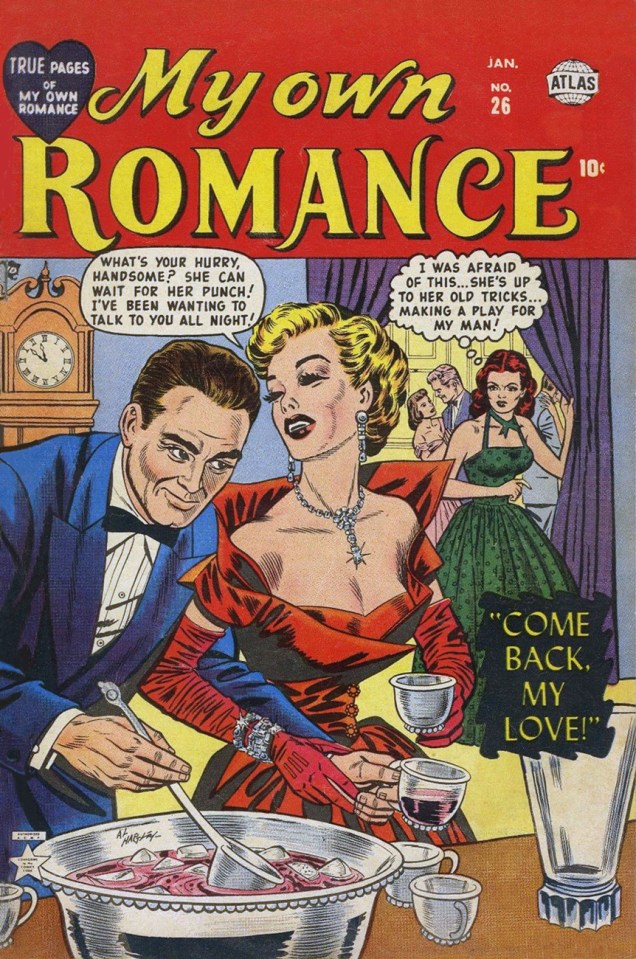
MyOwnRomance26A
My Own Romance no. 26 (January 1953, Marvel). The irresistible team-up of two comic-field professionals who would later become terrible Archie artists: Al Hartley (art) and Stan Goldberg (colours). Is that teacup floating in her hand or what?
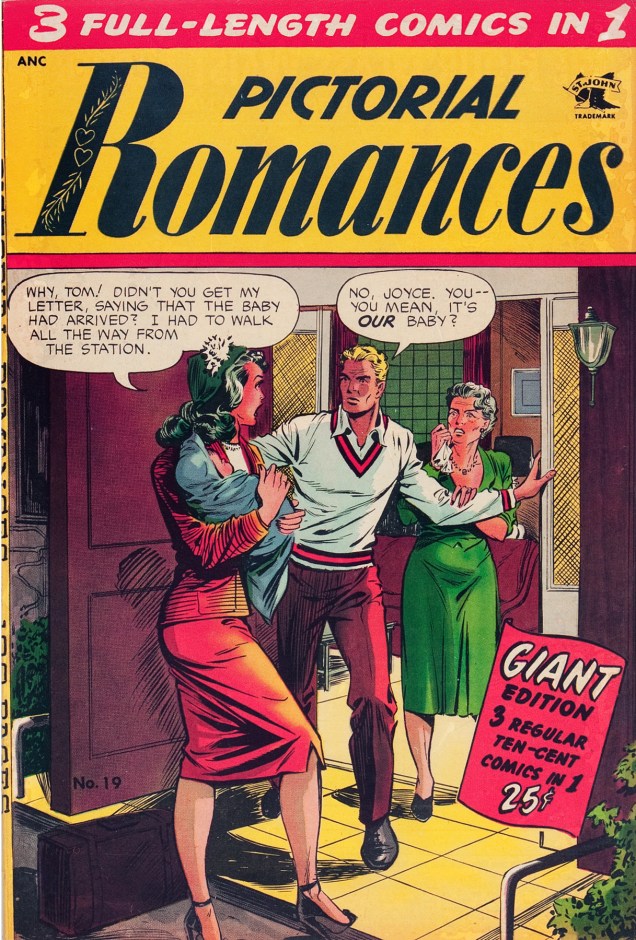
PictorialRomances19-1953
Pictorial Romances no. 19 (May 1953, St. John). Cover by Matt Baker. Read the issue here. If I had to recommend only one issue out of today’s roster, it would be this one: there’s nice art, and the stories are actually detailed and interesting, and even boast a certain internal logic.
PictorialRomances19-MattBaker
It’s important to know the difference in different tinned meats. Art by Matt Baker.

If you want a lover who doesn’t resist, put her in a trance, first, and then Miss Smith won’t be able to help but say “yes!”

Lovers-#50
Lovers no. 50 (June 1953, Atlas). This, again, is the handiwork of those two buffoons, Hartley and Goldberg. Look, she’s still holding the chloroform-dosed handkerchief he used to knock her out!

Romance comics love to pit a woman’s career against everything a female should strive for (i.e. marriage). Am I carping that romance comics weren’t very progressive in the 1950s? Ah, I wouldn’t be, if I didn’t know for a fact that Silver Age romance comics often don’t do that much better in that department.

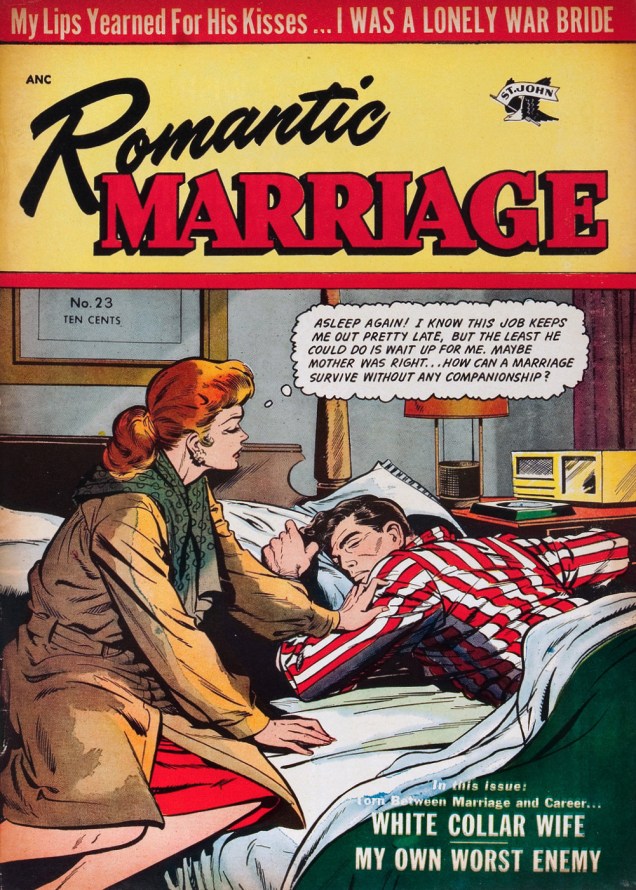
RomanticMarriage23Matt-Baker
Romantic Marriage no. 23 (July 1954, St. John), cover by Matt Baker. “Companionship”, eh? Read the issue here.

What do we have here? Despite what one would tend to think, this necklace was stolen, not given as a romantic offering. Such are true life secrets: kleptomania, clandestine children, and double-crossed partners.

TrueLifeSecrets25
True Life Secrets no. 25 (March 1955, Charlton). Read the issue here.

For an excellently written romp through the history of romance comics, read Tales From the Code: You’ve Lost That Loving Feeling.

~ ds
Felicitous Festivities, Funky Flashman!
Today is birthday number ninety-five for Stanley Lieber, aka Stan Lee. He was hatched on December 28, 1922. Have a good one, Stan.

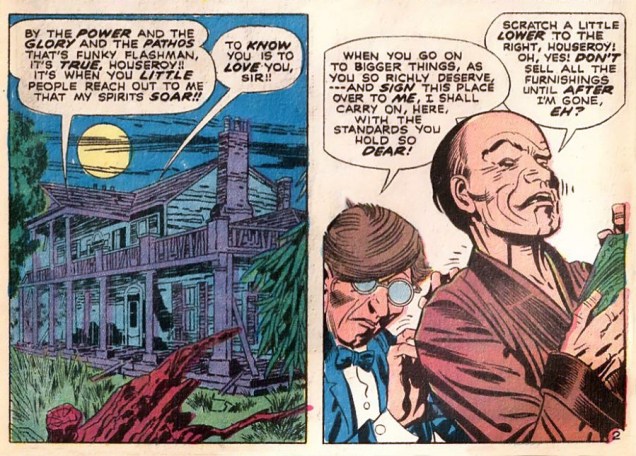
FunkyFlashman
Jack Kirby recalls with fondness his former editor and his toady, in “Funky Flashman!” (Mister Miracle no. 6, January-February 1972, DC).

On this momentous occasion, let’s hear about Stan from some of his colleagues, who knew The Man and obviously loved the experience:

Wally Wood:
« Did I say Stanley had no smarts? Well, he DID come up with two sure fire ideas… the first one was ‘Why not let the artists WRITE the stories as well as draw them?’… And the second was … ‘ALWAYS SIGN YOUR NAME ON TOP… BIG’. And the rest is history… Stanley, of course became rich and famous … over the bodies of people like Bill [Everett] and Jack [Kirby]. Bill, who had created the character that had made his father rich wound up COLORING and doing odd jobs. »

EC legend Bernie Krigstein, who collaborated with Stan at Atlas, and whose « Suppressed Desire » is featured in Spellbound no. 17 (September 1953) , with a glorious cover by the above-mentioned Bill Everett.

EverettSpellbound17A

In the course of a 1960s interview with comics scholar John Benson, Krigstein responded to Benson’s statement of « I guess you know that Stan Lee has been the spearhead of the so-called current revitalization of comics »:

« I’m delighted to learn that. Twenty years of unrelenting editorial effort to suppress the artistic effort, encourage miserable taste, flood the field with degraded imitations and non-stories have certainly qualified him for this respected position. »

Then Gil Kane, who was Marvel’s principal cover artist for much of the 70s, and who collaborated with Lee on The Amazing Spider-Man in some of its most popular years, including the infamous, comics-code unapproved “drug” issues (nos. 96-97, May-June 1971), on the respective creative roles of Stan and Jack Kirby:

« On each page, from 1964 – 1970 next to every single panel Jack wrote extensive margin notes explaining to Lee what was taking place in the story. It took Jack about 2 weeks to do a single story, it may have taken Lee as little as 4 hours to add text to Jack’s art. »

And Steve Ditko, in a letter to the editor of Comic Book Marketplace, published in the magazine’s 63rd issue in 1998, on his and Stan’s respective roles in crafting an issue of Spider-Man:

« The fact is we had no story or idea discussion about Spider-Man books even before issue no. 26 up to when I left the book. Stan never knew what was in my plotted stories until I took in the penciled story, the cover, my script and Sol Brodsky took the material from me and took it all into Stan’s office, so I had to leave without seeing or talking to Stan. »

Further  illuminating reading: http://kirbymuseum.org/blogs/effect/2015/07/25/according-to-kirby-1/

Once again, Happy Birthday to the Funky Flashman! ’nuff said and all that rot.

-RG

Hallowe’en Countdown, Day 22

« Newly dead, the gases of decomposition moving in the stomach… moving the body like a rag doll whose lips flutter and belch… »

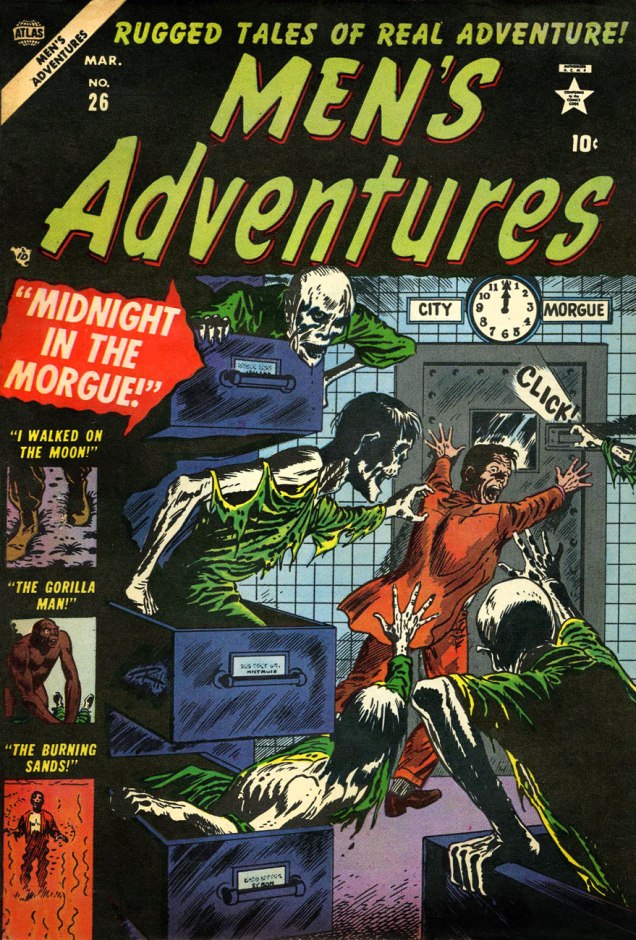
Atlas anthology Men’s Adventures (25 issues, 1950-54) was a pretty schizoid entity, with an editorial emphasis waffling from your typical would-be rugged he-man stuff (issues 4* to 8) to battle action (9 to 20) to mild horror (21-26) to, as a last resort, superheroes (27-28).

Men's-Adventures26A
Russ Heath delivers his usual fine job for Men’s Adventure no. 26 (March 1954, Atlas). I like the matching green outfits on the cadavers. Yay, team!

In the mid-1970s you could tell that Marvel was running low on reprintable pre-Code material when items from Men’s Adventure began to pop up in its mystery anthologies.

COC20A
Our cover story turned up then in Chamber of Chills no. 20 (Jan. 1976) announced by this ridiculous Ron Wilson/Dan Atkins cover.  There’s a Broadway musical in there, I swear.

Since this was 1970s Marvel, the corpse is not only well-preserved, he’s buff as it gets. For comparison, read “Midnight in the Morgue” (writer unknown, art by Dick Ayers), with our thanks and a fond tip of the hat to The Horrors of It All blog.

A more haunting variation on the “trapped in the morgue with the not-quite-dead” theme is Nostalgia Press’ historically significant Horror Comics of the 1950’s (1971, edited by Bhob Stewart, Ron Barlow and original publisher Bill Gaines), which gathered, in full colour, 23 EC classics, including one previously unpublished story, An Eye for an Eye. The cover revives (ha!) Al Feldstein’s Tales From the Crypt no. 23 art from 1951.

HC1950sA
Like many fellow modern-day EC Fan-Addicts, this book first came to my attention through the Captain Company catalogue that occupied the back pages of Warren Magazines. So many elusive, haunting grails… many of them turning out to be great beyond all reasonable expectations.

*the actual first issue… typical 1950s comics numbering scheme.

– RG