In the early 1970s, despite the western genre’s waning prospects in comics, DC found itself with a surprise hit in John Albano and artist Tony DeZuniga‘s antihero Jonah Hex, thanks to a healthy infusion of grit and spaghetti sauce. The battle-scarred Civil War veteran first reared his memorably homely puss in All-Star Western no. 10 (Feb.–Mar. 1972), which soon changed its title to Weird Western Tales with issue 12 to better accommodate its new star.
WWT’s reliably great covers probably didn’t hurt sales. Most of them were the work of Argentine Luis Dominguez, in tandem with the all-star design team of publisher Carmine Infantino, art director Nick Cardy and production manager / colourist Jack Adler. These covers all possess that elusive allure of « Mysterioso », as Infantino termed it.
This is Weird Western no. 25 (Nov.-Dec. 1974), featuring Showdown with the Dangling Man. Script by Michael Fleisher, art by Noly Panaligan.
Before midnight strikes and this Tentacle Tuesday waves us a teary goodbye, I shall endeavour to demonstrate that octopuses are vicious, grabby little miscreants who, in their quest for food and fun, don’t discriminate between species!
Oh, what the hell, I’ll just give three examples.
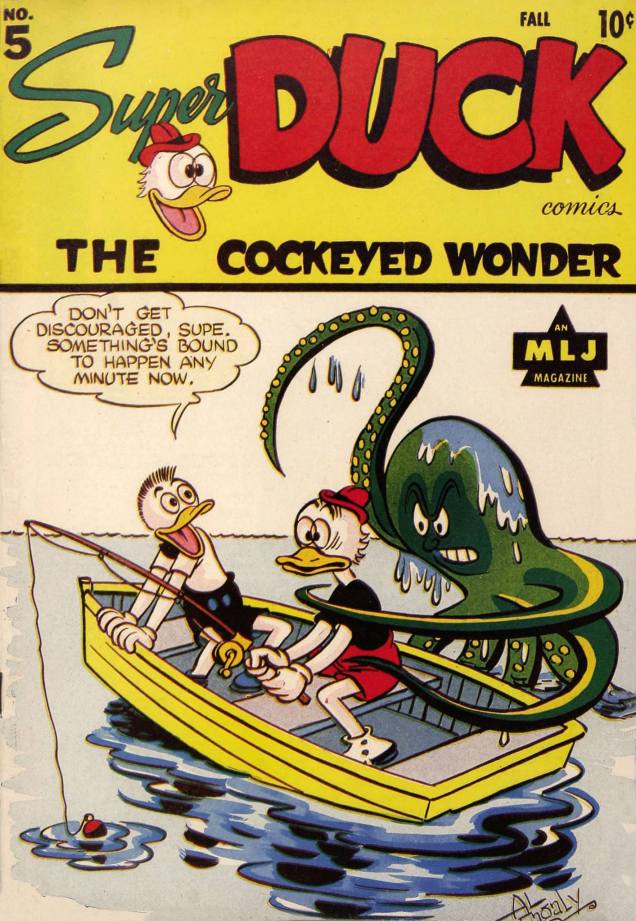
Here’s an octopus attacking a duck (to be more precise, a super duck, which is nevertheless gastronomically similar to its plainer cousin):
Super Duck Comics no. 5, Fall 1945, published by Archie Comics back when they were MLJ. Cover by Al Fagaly.
And here’s one attacking a gorilla… err, sorry, ape.
This is Planet of the Apes no. 15 (December 1975). Art by Bob Larkin.
It’s perhaps worth mentioning that French auteur Pierre Boulle wrote “La planète des singes” in 1963; the latter was translated as “Monkey Planet” in the UK and as “Planet of the Apes” in the US. (For once I’m with the Americans; “ape” sounds considerably more threatening than the childish “monkey”.) Marvel put out both a magazine (29 issues) and a comic book (12 issues) in the 70s – though frankly, there are so many comic tie-ins for this franchise, that I have nor the knowledge nor the desire to figure out what’s what or when or by who it was published. I’ll stick with the “tentacles, girl in bikini, pretty art” bit, though.
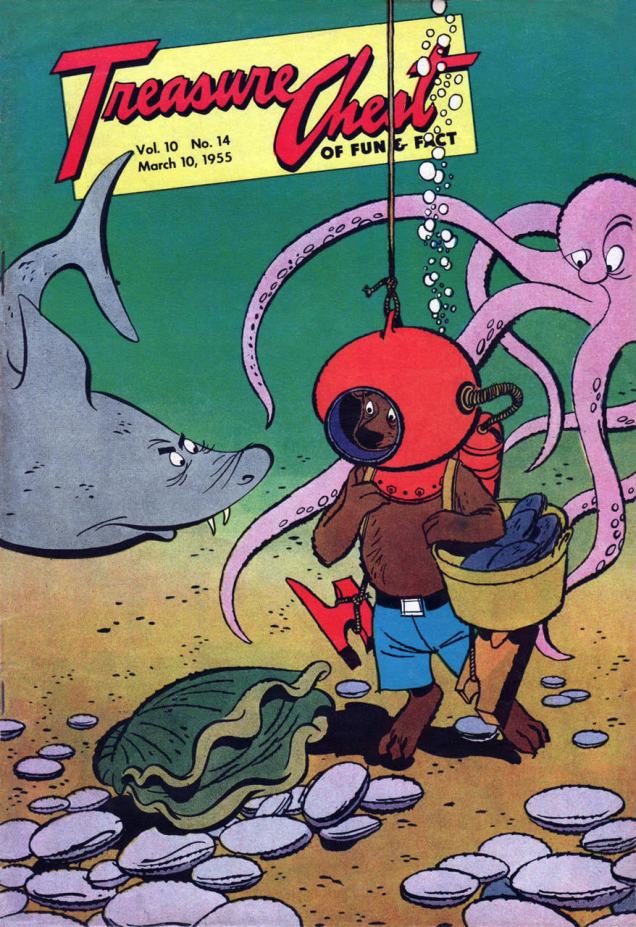
And here’s our last scene for today, an octopus attacking a bear. Actually, on the cover it’s unclear whether it’s attacking or protecting the bear, but having read the story, I can assure you that the pink cephalopod has bear meat on its mind.
Treasure Chest of Fun & Fact, vol. 10, no. 14 (March 19, 1955). The cover story, Pearl Divers, is scripted by Eric St. Clair and illustrated by Paul Eismann.
Treasure Chest of Fun & Fact was a Catholic comic book series distributed in parochial schools from 1946 to 1972… surprisingly, it’s often lots of fun, and occasionally within its pages one stumbles onto the work of a well-known artist like Murphy Anderson.
So whatever anthropomorphic species you may be, remember, don’t get your tuchus too close to the grabby tentacle of a hungry cephalopod!
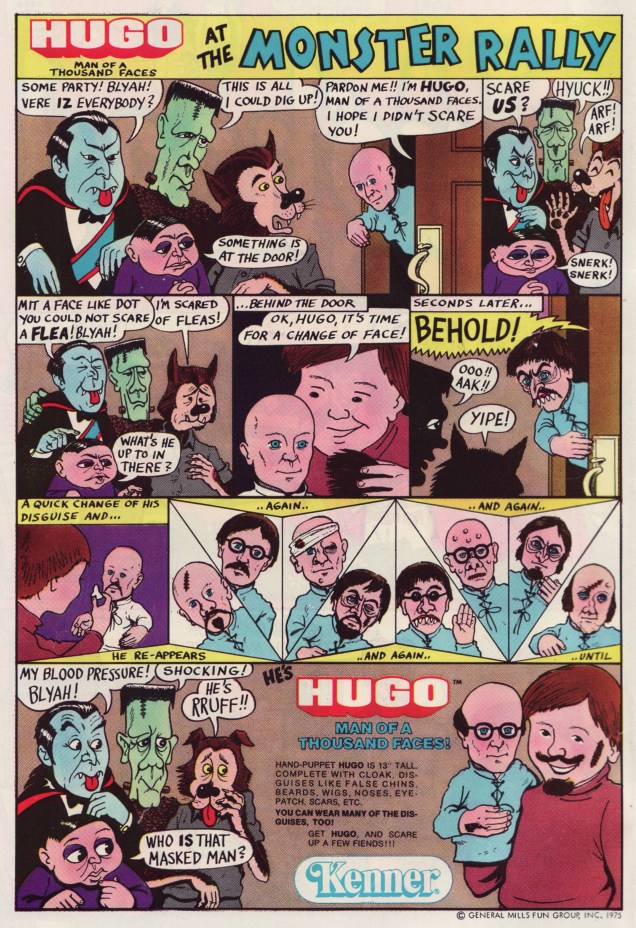
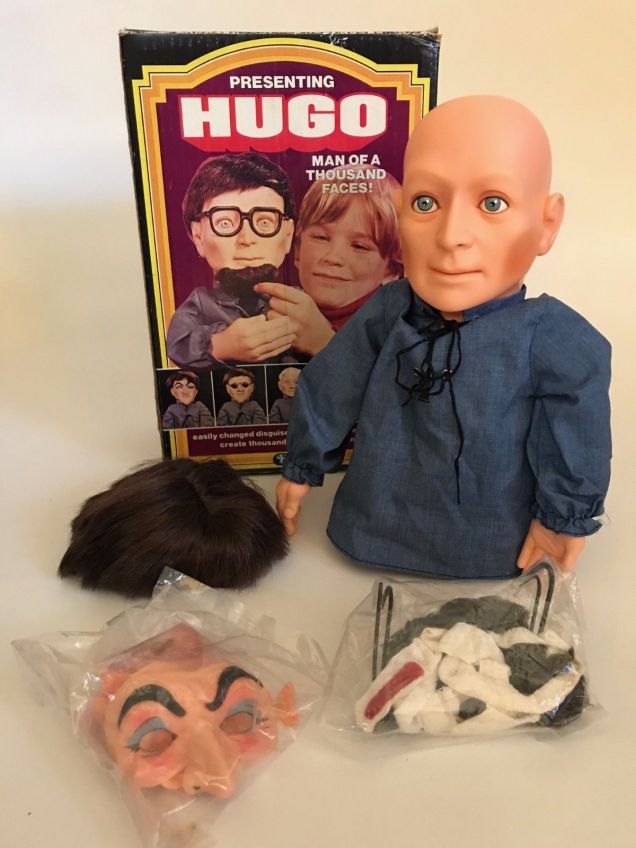
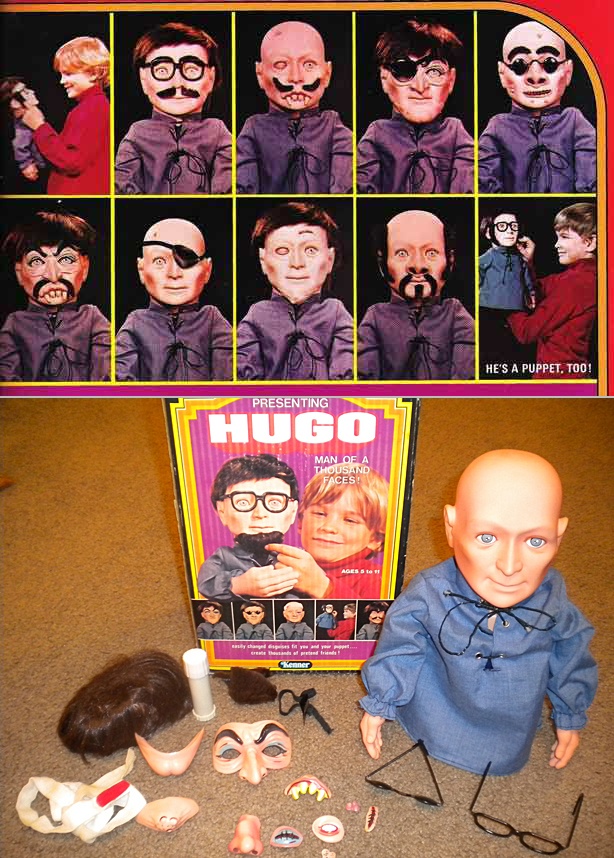
I must confess (good for the soul!) I’ve never actually seen a Hugo doll in the rubbery flesh (not could I afford one at the prices they command nowadays) but I’ve always loved this ad, which appeared in plenty of comic books in the year of our lord 1975.
« Snerk! Snerk! » does sound like something Peter Lorre would say, bless his black soul. Writer and illustrator unknown, regrettably. Anyone?The whole kit and kaboodle. The rest is up to you.« He’s a puppet, too! »
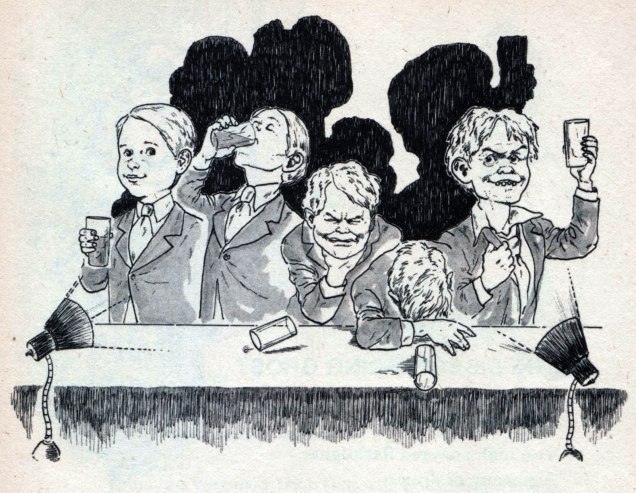
Our boy, pardon, man Hugo was the brainchild of polyvalent filmmaker, author, illustrator and monster maker Alan Ormsby, man of a thousand hats. That explains (nearly) everything! To give you an inkling of the man’s astounding versatility, here are a pair of illustrations from Ormsby’s wonderful Movie Monsters (Scholastic Book Services, 1975), essential reading for the creepy kid lurking within.
Brown Bag Frankenstein: « When you’ve covered the headpiece with paper towels and it’s about half dry, glue the ‘L’ brackets in place on the forehead, as shown. »« How to turn from Dr. Jekyll to Mr. Hyde before their very eyes! ».
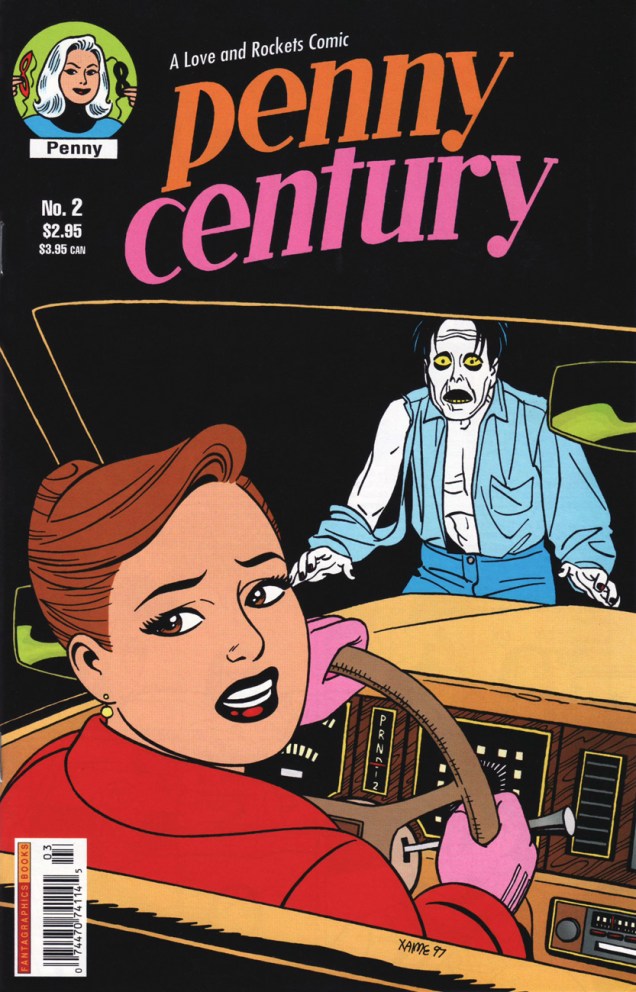
« Oh, it’s just one of those endless dark roads where ghoul men seem to lurk at night. »
Gee, thanks, Penny. At least it’s a shortcut. Jaime Hernandez makes sparing usage of the explicitly supernatural in his work, and he still likes to keep you guessing… but the goosebumps are real, all right.
In « Chiller! », Maggie lets her imagination run wild while driving home on the 696, « The Horror Highway », as Penny Century flippantly puts it.
This is Penny Century #2 (Fantagraphics Books Inc., March, 1998.) Cover and just about everything else by Jaime Hernandez; “Computer colorist: Chris Brownrigg.Maggie and the Ghoul Man go way back, thanks to those spine-tinglers Izzy told her when they were lil’ kids. And hey, there’s that lady from Black Sabbath again! A taste of our cover tale, the aptly-titled « Chiller! »
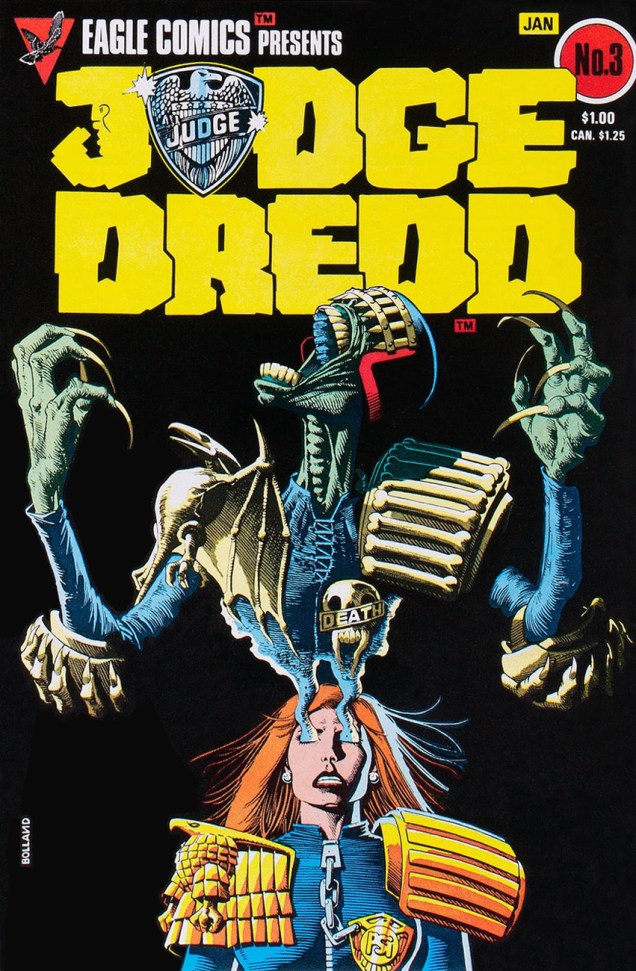
Here’s a fetchingly morbid cover Mr. Brian Bolland crafted for Eagle Comics’ reprints of the dystopian cream of Mega-City One’s hard-working Judges Dredd, Child, Anderson, Smiley, Volt, Stalker, Priest, Fish, De Gaulle… and so on, citizen. Filmic adaptations have largely missed the finer points of this oft-excellent series by focussing on the radical mayhem at the detriment of the protagonist’s unflagging fairness. But then again, such is usually the fate of « badass » characters who are nuanced in comics… think early Jonah Hex, for instance.
This is Judge Dreddno. 3 (January, 1984), featuring Judge Death Lives, by John Wagner and Bolland, from the pages of 2000 ADnos. 224-228 (1981). These are Judges Death and Anderson; I leave it to you to suss out which is which.
Oh, and if you and your three best bros are looking for a high-concept Halloween group costume, why not terrorize the neighbourhood as the Four Dark Judges?
« Deadworld! Long ago its judges realised all crime was committed by the living. Therefore, life itself was declared illegal. » From 2000 AD no. 225 (Aug. 15 1981, IPC) In the usual order: Judges Fire, Fear, Mortis and Death. Art, once more, by Brian Bolland.
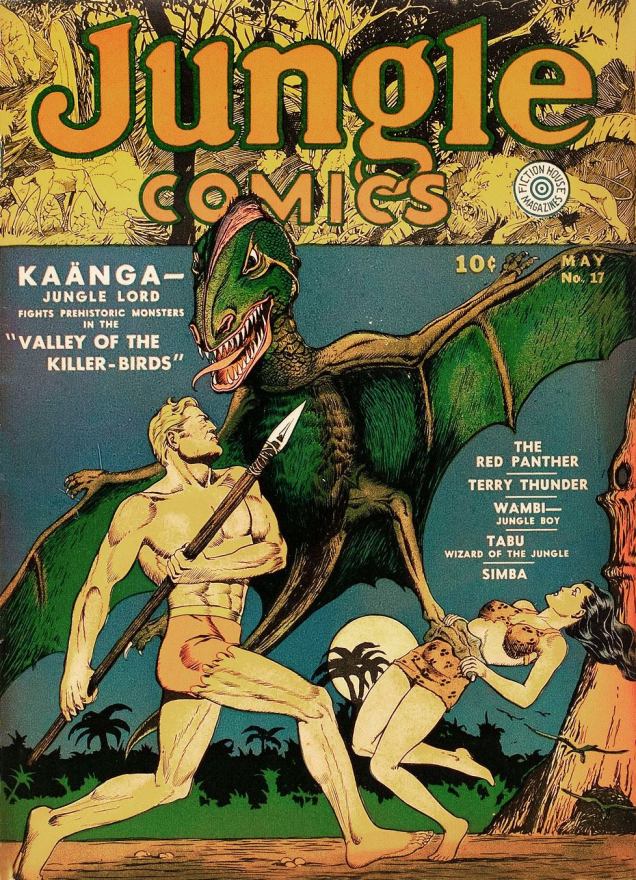
Yes, I’m sure that jungle inhabitants had to fight off vicious, anatomically impossible pterodactyls all the freaking time. Man, has John Celardo, the artist of this cover, ever seen a pterodactyl? … Oh, right, I guess he hasn’t. That still doesn’t justify this monstrosity, though.
Mark Twain comes to mind:
« The less said about the pterodactyl the better. It was a spectacle, that beast! a mixture of buzzard and alligator, a sarcasm, an affront to all animated nature, a butt for the ribald jests of an unfeeling world. »
*This* pterodactyl certainly looks like a butt for jests, given that its spine is twisted like a strand of DNA, and that its head has been put on backwards.
Jungle Comics no. 17 (May 1941). Cover by John Celardo.
The premise of Valley of the Killer-Birds is exactly the same as the raison d’être of all the other ‘Jungle Lord’ comics: Kaänga (who, judging from the umlaut, is probably Danish, just like Häagen-Dazs) has to rescue his damsel-in-distress yet again. I’m sure you are dying to know what the plot is like, so here it is in more detail:
Ann, Kaänga’s mate, is “blown off her perch” (where she was roosting, presumably) by a strong wind, and is carried off by a pterodactyl that just happens to be passing by at the moment, probably on its way to the grocery store. Kaänga tries to follow, but falls off a cliff, is carried (unconscious) through a watery tunnel, and lands in “a weird prehistoric valley”. He then effortlessly kills a a dinosaur that looks like a slightly smaller-than-average T-Rex and climbs into its skin (that somehow fits him perfectly), plays dead, gets carried off by another pterodactyl and dropped off at some random cave, miraculously the same cave where Ann is captive, and even more preposterously just a few meters away from her standing coyly by in a typical “just look at my bikini!” pose. Then he waves at her with his paw (understandably, she doesn’t understand why a dinosaur is waving at her – it’s those super-short front paws, you know), then she gets carried off (again) by a giant ape that shows up from nowhere, and Kaänga, still in T-Rex form, hotly pursues them and kills the ape. Then the hero of our tale, as clean and Arian as he can possibly be (nevermind that he just climbed from the bloody insides of an animal corpse), takes Ann’s hand and leads her out from the tunneled cave, reasoning at some point that if there’s human skulls in the passage, there must be a way out of those tunnels. (Um, no, it just means the pterodactyls and/or giant ape have had a lot of silly little humans for supper that they’ve brought in from elsewhere.)
« That should teach you not to tangle with a tuff little ghost! »
Amongst Harvey Comics’ cast of monomaniacal characters, Spooky the Tuff Little Ghost’s propensity for trying to scare folks out of their skin with a hearty « Boo! » seemed sanest. After all, that’s what ghosts are s’posed to do, even if they’re from Brooklyn.
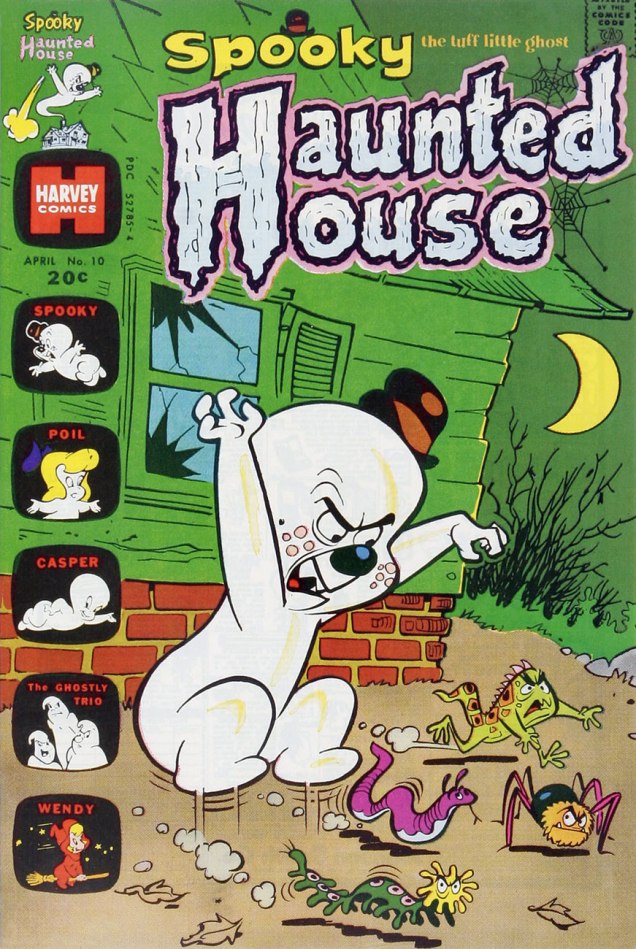
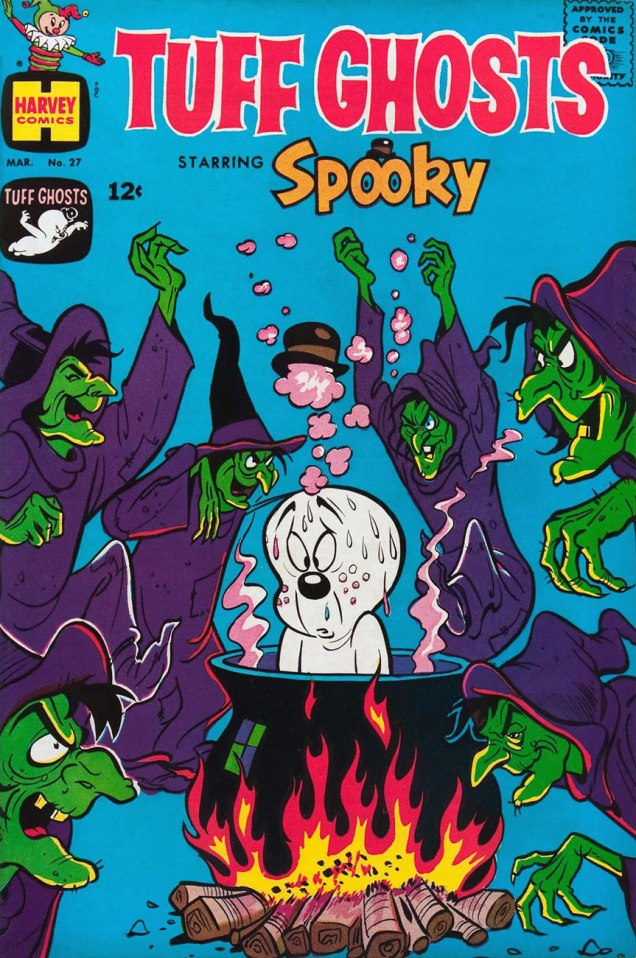
Here’s a tiny sample of some of Spooky’s spookiest covers, from the incredibly fertile mind and pen of unsung conceptual genius Warren Kremer.
Spooky no. 77 (Dec. 1963, Harvey). Say, is that Mrs. Rich getting hit up for some treats?Spooky Haunted House no. 10 (Apr. 1974, Harvey)Spooky Haunted House no. 12 (Aug. 1974, Harvey)Spooky Haunted House no. 13 (Oct. 1974, Harvey)Tuff Ghosts Starring Spooky no. 27 (March 1967, Harvey)
As reading material, the Harvey books were mush for the mind, but they sure had purty covers. Note how Harvey was the only comics company that treated the Comics Code Authority stamp with such contempt: if it doesn’t get half cropped off, it’s coloured as to be barely visible. The damn thing, even at its smallest, *was* a visual blight. Bless that art director! Then came barcodes… and the battle wasn’t even worth waging anymore.
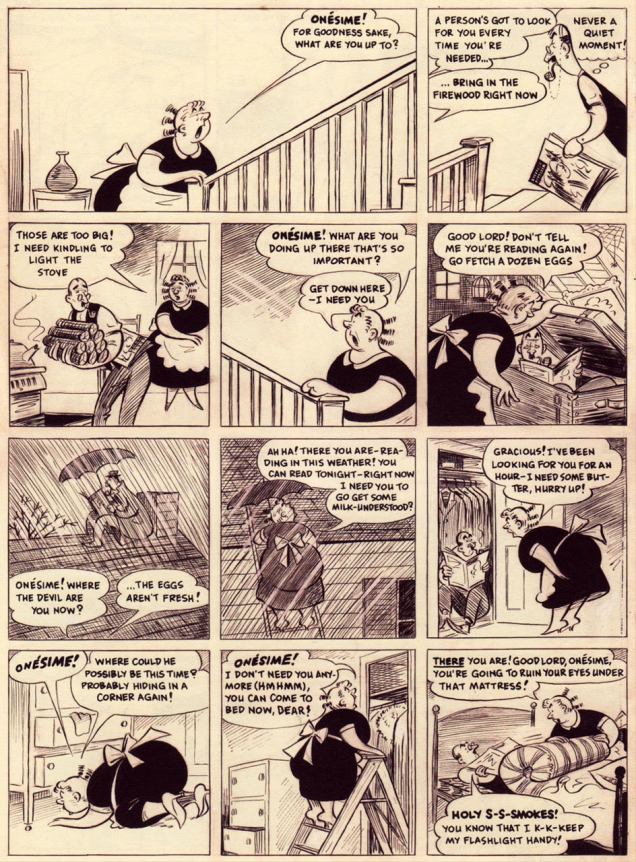
In 1943, Albert Chartier, a French-Canadian cartoonist and illustrator (and commonly accepted as the father of Québec’s “bande dessinée“), was offered the chance of creating his own comic strip for the “Bulletin des agriculteurs” (Farmers’ Bulletin). Thus began Onésime, Chartier’s most popular and enduring œuvre.
Onésime was the perfect strip for the Bulletin’s audience: inspired by life in rural areas of Québec (in particular, picturesque Saint-Jean-de-Matha), it was a charming chronicle of the countryside. It lasted all the way until 2002 (it is said that four generations of Québecois learned to read with Onésime!), and reflected the changes in Quebec’s social landscape, making it a priceless historical document as well an as excellent comic.
This strip (originally published in November 1959) was scanned from Drawn & Quarterly #5 (August 2003). As far as I know, D&Q’s 47 pages of “Albert Chartier – a Retrospective” is the only existing English version of Onésime (the French-to-English translation is credited to Helge Dascher; the redrawn letters, to Dirk Rehm).
While Onésime is Chartier’s best known work, here’s something that’s even harder to come by for your enjoyment – a strip in which Kiki gets carried away. You can meet Kiki in “Une piquante petite brunette” (roughly translated to “a spicy little brunette”), a beautifully done, quite entertaining collection of previously unpublished Chartier strips about a young woman’s adventures (Les 400 coups, 2008).
« It is Friday the 13th and you are right on time — ten minutes to midnight! »
The Anti-13 is that rarest of creatures: an unflinchingly skeptical tale published in the pages of a supernatural-themed comic book in the midst of the 1970s occult craze. Hats off, folks!
As the thirteenth fatefully falls on a Friday this month, I’m inspired to trot out a story from my very favourite issue of Gold Key’s Grimm’s Ghost Stories no. 26 (Sept. 1975). So what elevates this particular entry above its brethren? Admittedly, the competition from other issues is pretty tepid. Truth be told, though, all comers are swept out the door by a winning pair of yarns from the great Arnold Drake (1924 – 2007, co-creator of The Doom Patrol, Deadman and the original Guardians of the Galaxy): The Servant of Chan (illustrated by Luis Dominguez) and this one, the bracingly skeptical The Anti-13 (illustrated by John Celardo).
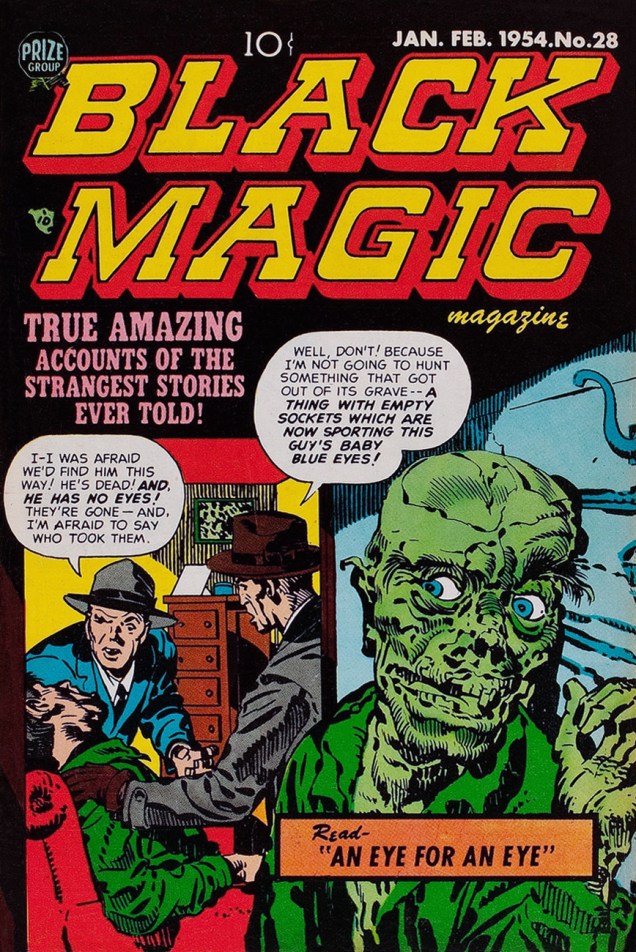
« Within the hour, Roger Parris’ eyes had been removed from his still warm corpse! »
Some specimens of walking corpse are kind enough to just snap your neck or rip out your throat, but not old Roger Parris… he was, and remains, a spiteful coot.
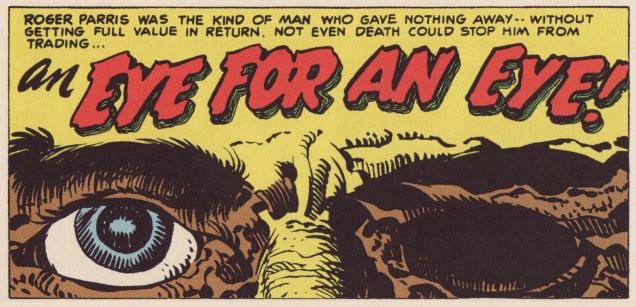
This is Black Magic vol. 4 no. 4 (#28, Jan.-Feb. 1954, Prize), illustrating “An Eye for an Eye”. Pencils by Jack Kirby, inks by Joe Simon and/or Kirby.
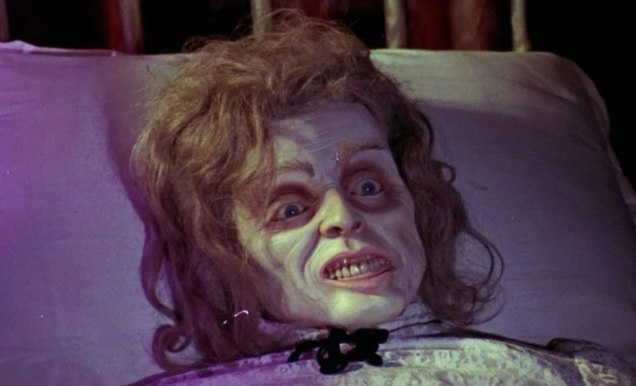
The story’s opening panel. For my money’s S&K’s Black Magic offered the scariest ride in 50s horror… often with unlikely, seemingly innocuous topics, and without showing much in the way of gore or gratuitous imagery. They took the Val Lewton high road, if you will.I’m reminded of another old dear who was inordinately attached to her earthly possessions (in her case, a ring) even after kicking the bucket. Well… not quite, it turned out. From Mario Bava‘s 1963 omnibus film, “I tre volti della paura” (aka “Les trois visages de la peur”, or “Black Sabbath”)’s most spine-tingling segment, “La goccia d’acqua” (“The drop of water”).










 Who's Out There?