« That should teach you not to tangle with a tuff little ghost! »
Amongst Harvey Comics’ cast of monomaniacal characters, Spooky the Tuff Little Ghost’s propensity for trying to scare folks out of their skin with a hearty « Boo! » seemed sanest. After all, that’s what ghosts are s’posed to do, even if they’re from Brooklyn.
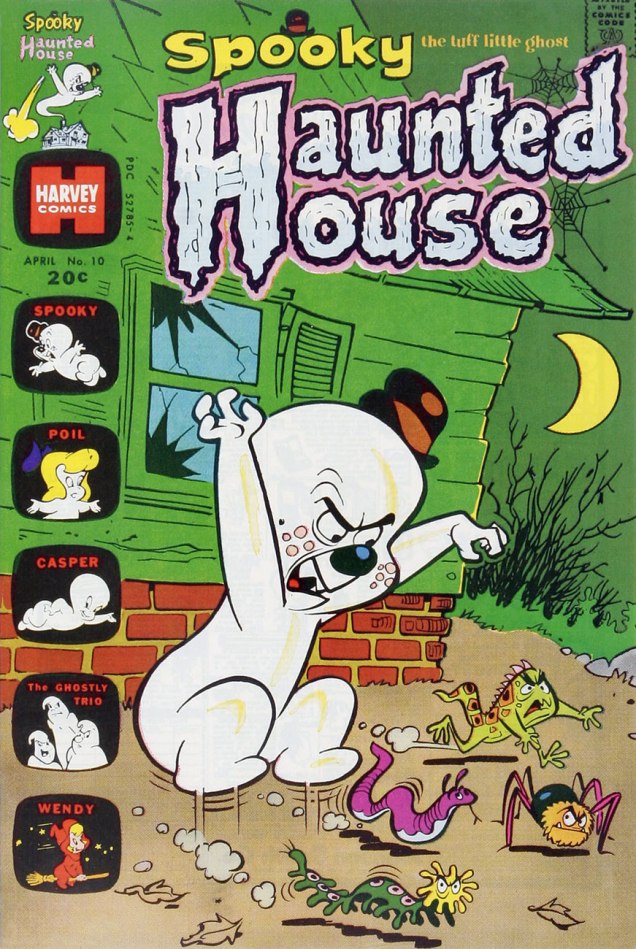
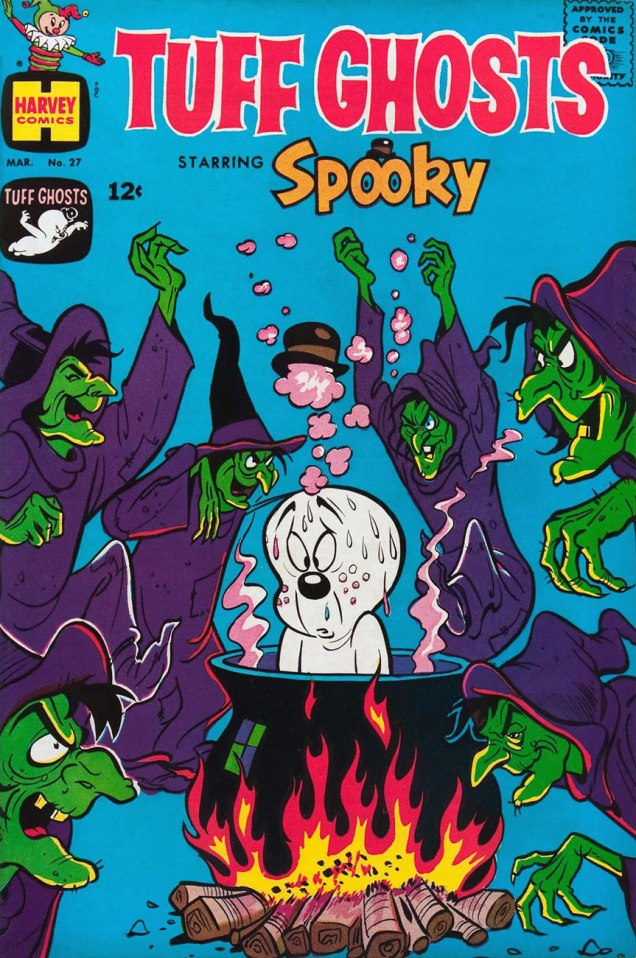
Here’s a tiny sample of some of Spooky’s spookiest covers, from the incredibly fertile mind and pen of unsung conceptual genius Warren Kremer.
Spooky no. 77 (Dec. 1963, Harvey). Say, is that Mrs. Rich getting hit up for some treats?Spooky Haunted House no. 10 (Apr. 1974, Harvey)Spooky Haunted House no. 12 (Aug. 1974, Harvey)Spooky Haunted House no. 13 (Oct. 1974, Harvey)Tuff Ghosts Starring Spooky no. 27 (March 1967, Harvey)
As reading material, the Harvey books were mush for the mind, but they sure had purty covers. Note how Harvey was the only comics company that treated the Comics Code Authority stamp with such contempt: if it doesn’t get half cropped off, it’s coloured as to be barely visible. The damn thing, even at its smallest, *was* a visual blight. Bless that art director! Then came barcodes… and the battle wasn’t even worth waging anymore.
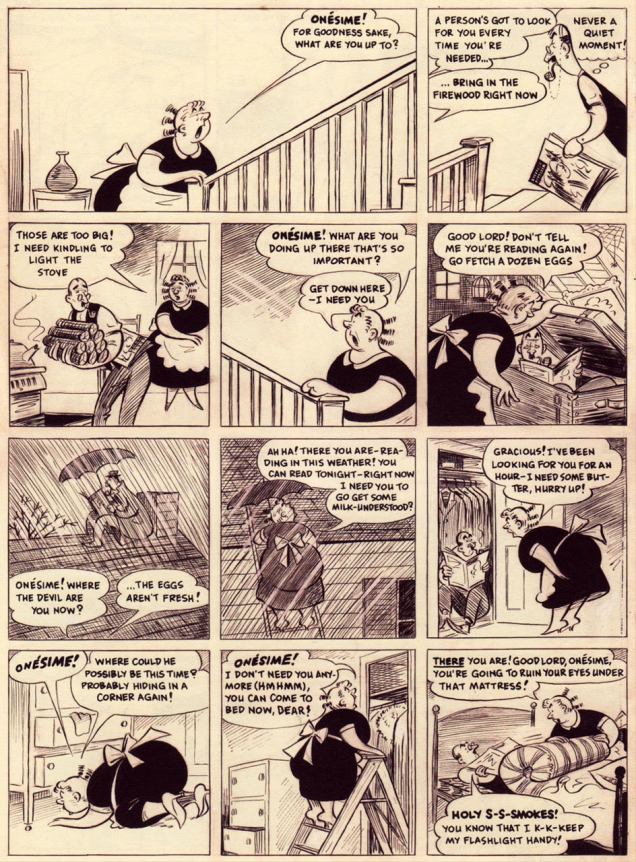
In 1943, Albert Chartier, a French-Canadian cartoonist and illustrator (and commonly accepted as the father of Québec’s “bande dessinée“), was offered the chance of creating his own comic strip for the “Bulletin des agriculteurs” (Farmers’ Bulletin). Thus began Onésime, Chartier’s most popular and enduring œuvre.
Onésime was the perfect strip for the Bulletin’s audience: inspired by life in rural areas of Québec (in particular, picturesque Saint-Jean-de-Matha), it was a charming chronicle of the countryside. It lasted all the way until 2002 (it is said that four generations of Québecois learned to read with Onésime!), and reflected the changes in Quebec’s social landscape, making it a priceless historical document as well an as excellent comic.
This strip (originally published in November 1959) was scanned from Drawn & Quarterly #5 (August 2003). As far as I know, D&Q’s 47 pages of “Albert Chartier – a Retrospective” is the only existing English version of Onésime (the French-to-English translation is credited to Helge Dascher; the redrawn letters, to Dirk Rehm).
While Onésime is Chartier’s best known work, here’s something that’s even harder to come by for your enjoyment – a strip in which Kiki gets carried away. You can meet Kiki in “Une piquante petite brunette” (roughly translated to “a spicy little brunette”), a beautifully done, quite entertaining collection of previously unpublished Chartier strips about a young woman’s adventures (Les 400 coups, 2008).
« It is Friday the 13th and you are right on time — ten minutes to midnight! »
The Anti-13 is that rarest of creatures: an unflinchingly skeptical tale published in the pages of a supernatural-themed comic book in the midst of the 1970s occult craze. Hats off, folks!
As the thirteenth fatefully falls on a Friday this month, I’m inspired to trot out a story from my very favourite issue of Gold Key’s Grimm’s Ghost Stories no. 26 (Sept. 1975). So what elevates this particular entry above its brethren? Admittedly, the competition from other issues is pretty tepid. Truth be told, though, all comers are swept out the door by a winning pair of yarns from the great Arnold Drake (1924 – 2007, co-creator of The Doom Patrol, Deadman and the original Guardians of the Galaxy): The Servant of Chan (illustrated by Luis Dominguez) and this one, the bracingly skeptical The Anti-13 (illustrated by John Celardo).
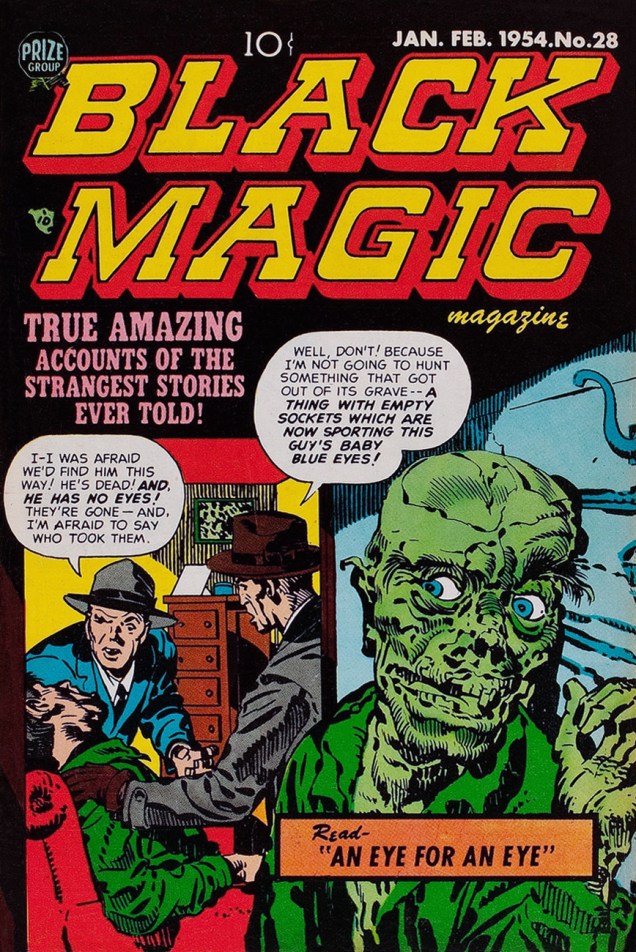
« Within the hour, Roger Parris’ eyes had been removed from his still warm corpse! »
Some specimens of walking corpse are kind enough to just snap your neck or rip out your throat, but not old Roger Parris… he was, and remains, a spiteful coot.
This is Black Magic vol. 4 no. 4 (#28, Jan.-Feb. 1954, Prize), illustrating “An Eye for an Eye”. Pencils by Jack Kirby, inks by Joe Simon and/or Kirby.
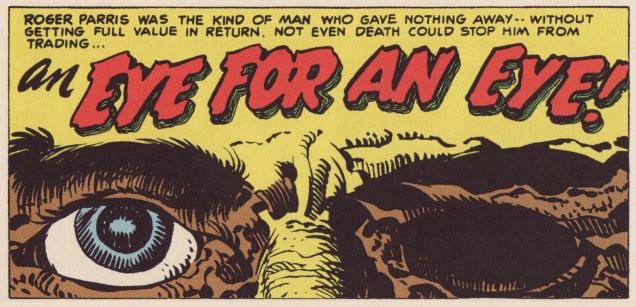
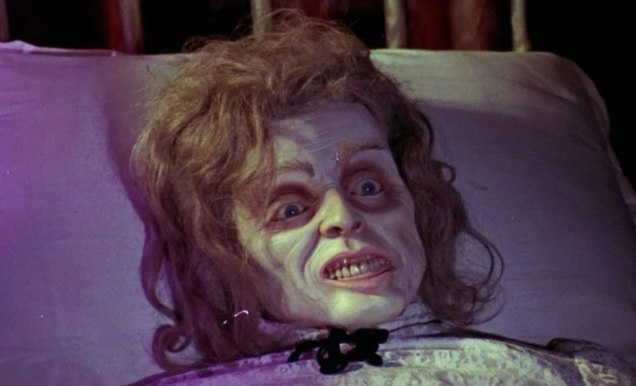
The story’s opening panel. For my money’s S&K’s Black Magic offered the scariest ride in 50s horror… often with unlikely, seemingly innocuous topics, and without showing much in the way of gore or gratuitous imagery. They took the Val Lewton high road, if you will.I’m reminded of another old dear who was inordinately attached to her earthly possessions (in her case, a ring) even after kicking the bucket. Well… not quite, it turned out. From Mario Bava‘s 1963 omnibus film, “I tre volti della paura” (aka “Les trois visages de la peur”, or “Black Sabbath”)’s most spine-tingling segment, “La goccia d’acqua” (“The drop of water”).
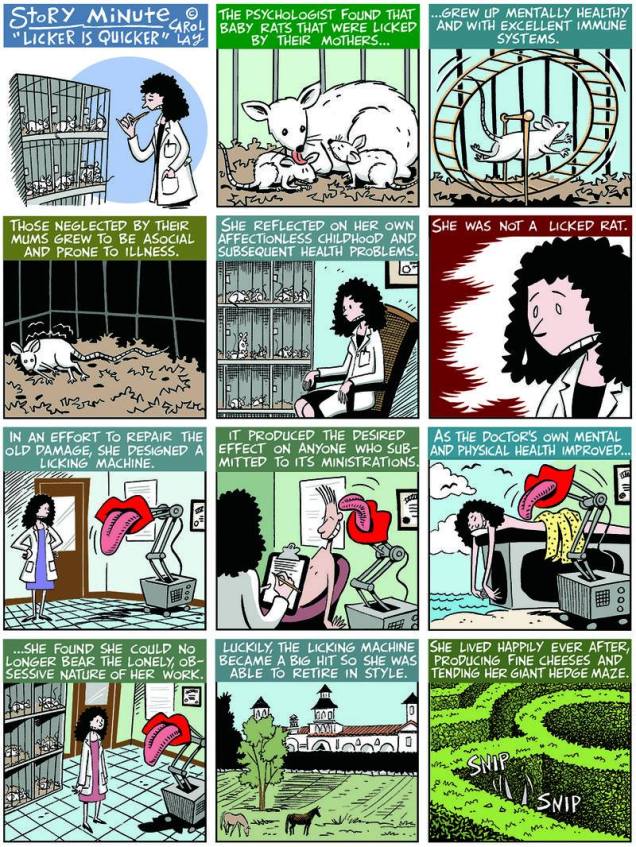
Carol Lay (born 1952) is an illustrator and cartoonist who has done a variety of work – some comic books published, collections of Story Minute (probably the strip she’s best known for), as well as illustrations for The New Yorker and such.
Her drawing style is easily recognizable (and not necessarily up at everyone’s street – some people can’t get past her highly stylized way of drawing mouths, for instance), but what makes her work most appealing to me is Lay’s sense of humour. I’m not even sure that “humour” is the right word for it – her stories have set-ups that are imaginative but often completely surreal, if not far-fetched; yet her characterizations of people ring absolutely true.
She excels at one-pagers, but longer stories are great, too. Here’s an example of the former, a typical Story Minute:
There are four collections of Lay’s weekly strips out there: three paperbacks, published by Kitchen Sink (Joy Ride, Strip Joint and Now, Endsville), are quite out of print, so keep an eye out for used copies in second-hand bookstores. The latest one, Illiterature, was published in 2012 by Boom!Town in hardcover (and I believe there was supposed to be a volume 2… still waiting for that one.)
The Kitchen Sink collections have beautiful painted covers, another reason for seeking them out. They also contain some longer (say, around 20 or 30 pages) stories, for instance one of my favourites, Joy Ride (that gave its name to the whole collection), set in a world where minds can be transferred between bodies, being fat is outlawed, and “drivers” are people whose job involves forcing fat people to get into shape by temporarily taking over their personality.
And this is the back:
You can read Lay’s webcomic (some of it includes coloured Story Minute strips – originally, they were black-and-white – and most of it is longer, new stories) at http://www.gocomics.com/lay-lines
« Geez! What’s he been feedin’ that horse?! I’m runnin’ wide-open — and he’s gainin’ on me! »
I won’t pretend that The Headless Horseman Rides Again is all that good a comic book, even by the standards of 1973 Marvel. It’s a clumsy narrative hodgepodge, a tangle of tough guy private dick clichés and your basic Scooby Doo plot, courtesy of Gary Friedrich (Ghost Rider, Son of Satan). But it’s agreeably moody in spots, considerably helped along by a solid art job by the prolific George Tuska (1916-2009), who’s not, for once at Marvel, saddled (ha!) with the likes of Vince Colletta. Here he’s smartly matched with the fine but generally undervalued Jack Abel (1927-1996), whose velvety strokes significantly add to the fittingly nocturnal ambiance.
I happen to own a page of original art from the issue, and here are some of my favourite panels. This is page 7 of 20. Script by Gary Friedrich, pencils by George Tuska, inks by Jack Abel. Love that Abel smoke!
The issue bears your typical hyperkinetic Gil Kane 70s cover, winningly inked by Ernie Chua/Chan. This is Supernatural Thrillers no. 6 (Nov. 1973, Marvel).
The published version…… and a peek at the original artwork. Note the absence of the alterations presumably made on an overlay, namely the texture on the foreground rock and the halftone mist across the middle.
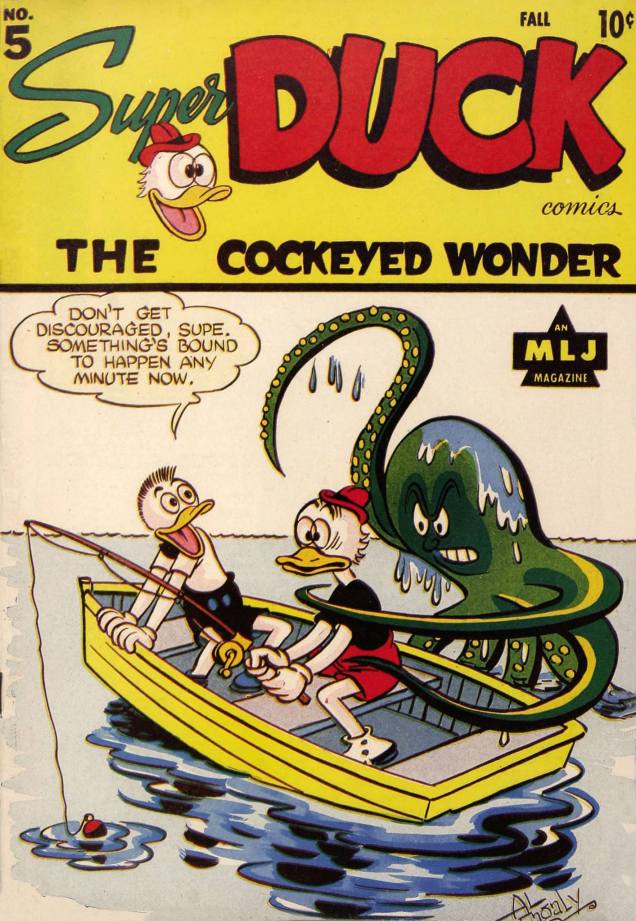
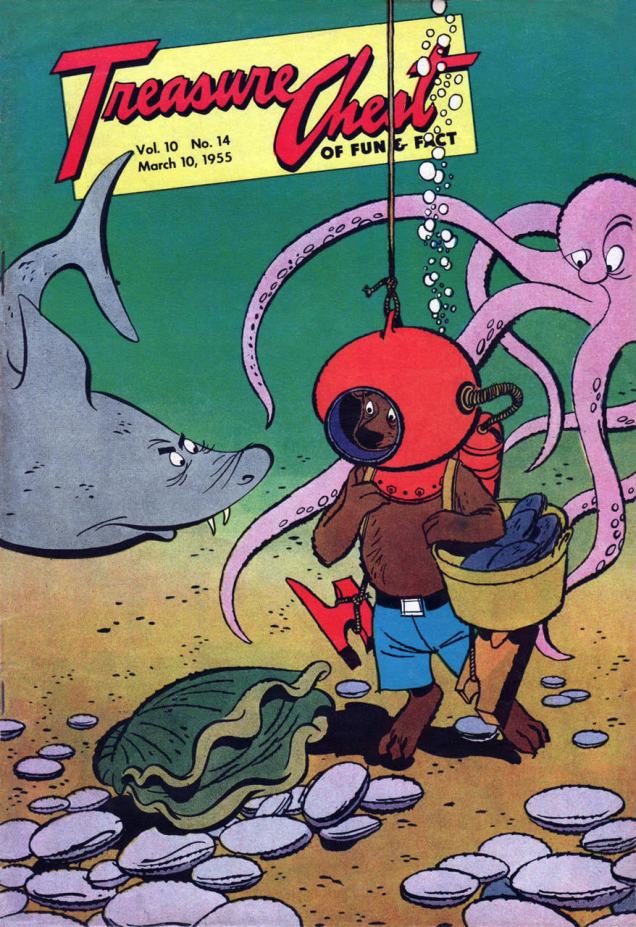
Meet an old man’s pet, Poochy. Like most pets, he gets a little impatient and loud around mealtime, but forgive him – he’s just a healthy animal who needs his calories. Who’s a good boy?
It’s Tentacle Tuesday, and today’s offering is this barking mad (hehe) and delightfully nonsensical story with script and pencils by Jim Starlin and inks by Wayne Howard.
« The Hotel » is a mere 2 pages long, so here it is in its full and unabridged glory:
This is no plebeian octopus. This tentacled horror, this mutated dog-like atrocity, is a force for moral good, dammit, dishing out all the punishment these evil-doers deserve! (Or maybe it’s just hungry.)
This tale of woe comes from Weird Mystery Tales #4 (Jan.-Feb. 1973), with a cover by Jim Aparo. It re-interpreted the story somewhat, making the thug’s comeuppance a little more immediate, but it’s still the same basic plot device: there’s the Deus ex machina, and there’s what I call Sudden Tentacles. Don’t know how to wrap up your story? Bam! tentacles out of nowhere, and everyone forgets that your tale makes no freaking sense.
Continuing this rather disturbing theme of stay-at-home octopuses, we have another contender for someone’s beloved pet: this sweet little (metaphorically speaking) guy from « Dum-Dum’s Basement » (Boris Karloff Tales of Mystery #93, August 1979).
Art by Mel Crawford. Dum-Dum’s pet will soon want flesh instead of fish! (I also like how some people don’t give a shit about having a permanently flooded basement.)
Then we have the prototypical Sudden Tentacles and set at home, too: this panel from a chilling Tom Sutton and Nicola Cuti story called « Those Tentacles! » (inventive title), published in Ghostly Tales #106, August 1973.
“The tree branches remind me of those tentacles… those slimy, winding tentacles squeezing the life from Jake!”
There’s a scene in Nightmare on Elm Street 3: Dream Warriors (at 3:55) that quite terrified me as a kid – a girl reaches over a sink to turn the water on, and the tap sprouts… appendages… and grabs her hand. I wish Freddy Krueger was into tentacles, I would have spent fewer sleepless nights in my youth.
Wishing all of you peaceful nights of slumber… until the next Tentacle Tuesday rolls around – and it will.
This itty-bitty octopus will haunt your nightmares.
« Ever been to a maniac party held in a haunted house? Well, if you don’t frighten easily, you’re welcome to attend Etta Candy’s — but be careful or you’ll lose your scalp! »
Here’s a real hallowe’en corker from the Golden Age of comics, featuring the ageless Wonder Woman, presented here by her original creative team… with a twist. While the story is credited to Charles Moulton (the nom de plume of William Moulton Marston), it was ghost-written by his former student and collaborator Joye Hummel (1924-), the first woman to write Wonder Woman’s adventures. She is frequently credited for being the first woman to script superhero comics, but nope, that’s at least three years after Tarpe Mills gave the world her Miss Fury.
This is Sensation Comics no. 57 (DC, September, 1946). Art by the sensational Harry G. Peter.Now you know what a Maniac Party is. The haunted house and the creepy cemetary (sic) are optional, but they sure do help set the properly demented mood.
Unfortunately, Joye appears to have been left out of the recently-released biopic Professor Marston and the Wonder Women. Too complicated? I guess a ménage à trois is plenty to handle already.
Check out the film’s trailer (well, one of them, at any rate.)
« Who would have thought, in 1974, as I cruised the aisle of the San Francisco Safeway with Art Spiegelman, hunting for likely targets, that our little barbs sent at consumerism and package design would have such staying power? » — Bill Griffith, creator of Zippy the Pinhead
Topps’ legendary Wacky Packages, the bane of school authorities at their peak in the 1970s, have been opening kids’ eyes in the art of tipping over sacred cows for generations. Since everyone’s presumably well-versed in the classics (essentially the initial 1967 and 1973-75 burst of creativity), it wouldn’t be a bad idea to showcase some newer fare. In the wake of an internet-fuelled wave of nostalgic popularity, the Wackies rose again with their All-New Series (2004-), and their quality is every bit as impressive as it ever was… thanks in part to a plethora of new products to lampoon, greater creative latitude for the perpetrators, a motley crew of grizzled veterans and homely new faces.
For your contemplation, here’s a trio of Hallowe’en-appropriate cards from new series 7 (2010).
Painted by Jason Edmiston from a concept by Mark ParisiPainted by Tom Bunk from a concept by Mark ParisiPainted by Brent Engstrom from a concept by Mark Parisi
« But the Ancient Evil remains… waiting to rise and prey on an unsuspecting humanity »
Adapting Howard Phillips Lovecraft’s sinister literature to other media has always been as tempting as it is daunting. It absolutely requires the discernment to know when to hold back and when to go all out, and therein lies the difficulty: it’s a rare gift.
Eureka Productions’ Graphic Classics series of anthologies wisely chose, for the cover of its HPL entry (from 2002), a detail from Todd Schorr’s wry 1993 painting, H.P. Lovecraft’s Fried Seafood Cart.
Schorr, born in 1954 in New York City, first became aware of HPL in high school and « became totally consumed in his writings. » « When read now », continues Todd, « Lovecraft’s work still retains the same spine-shivering thrills I first experienced. »