Catfight (noun):A vicious fight between two women that features biting & scratching and often involves clothes being ripped off.
To which I’ll add that if you put two women with different hair colours in one room, it’s like there’s a chemical reaction that makes them instantly aggressive. In comics, at least – and we all know that comics reflect real life accurately, right? The resulting combativeness is especially obvious when the encounter is between a blonde and a brunette. The women involved must also be beauties – presumably, plainer girls resort to verbal assaults when provoked, eschewing physical violence, unlike their flashier counterparts.
Or it could have something to do with the mostly-male audience who actively likes watching belles brawl. (Perhaps “ogle” would be a better description.) Let’s move on to the ogling bit, then!
Err, agreed on the “talking too much” bit. Manhunt no. 9 (Magazine Enterprises, June 1948). That art’s by Ogden Whitney.
“Jeepers! Baldy’s been skewered through the ticker! He’s defunct!” This charming scene with boob grabbery and skirt rippery (I know, don’t I have a way with words?) is from “Off Stage Kill”, a Dan Turner Hollywood Detective story from Crime Smashers no. 7 (Trojan Magazines, 1951).
Script by Robert Leslie Bellem, pencils and inks by Adolphe Barreaux (who was also the editor). Read the issue here. In case you were wondering, Fifi and Brenda are just acting out a fight scene for a movie, although they do get a little carried away (and accidentally skewer Baldy in the process). How many women have a knife tucked away in their garter belt?
Skipping ahead ten years or so…
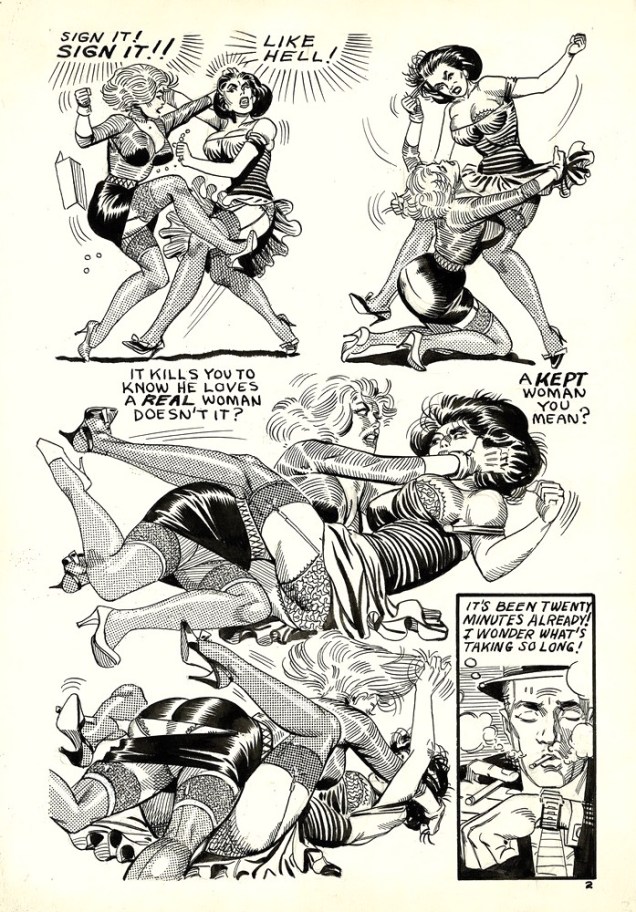
Ditko shared a studio in NYC with artist Eric Stanton between 1958 and 1968, and they collaborated on some bondage comics (or at least it’s commonly assumed that they have – for more information on that, dive into a discussion on the Four Realities blog, or read this excerpt from Fantagraphics’ Dripping with Fear: the Steve Ditko Archives Vol. 5.) This page is from a story published in 1966 and entitled “Divorce Agreement”.
The clothes-shredding and breast-mauling (ouch) continues…
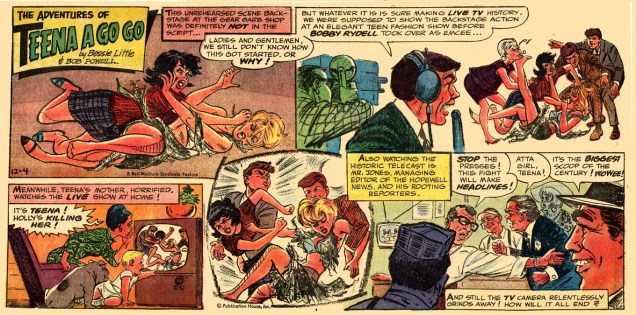
Newspaper comics do it, too! This is Teena A Go Go from December 4th, 1966, written by Bessie Little and illustrated by Bob Powell.
Sometimes Betty and Veronica associations are hard to avoid. These girls also made sure to wear contrasting costumes while fighting, for maximum visual appeal, proving it’s possible to be fashion-conscious even in prehistoric times.
Anthro (the happy teenager watching this scene, and normally a redhead) will marry the victorious maiden… but the fight is a draw, and so he has to marry both in this “The Marriage of Anthro” story. This is Anthro no. 6 (July-Aug. 1969). Pencils by Howard (Howie) Post (who created Anthro, the “first boy”, a Cro-Magnon born to Neanderthal parents) and inks by Wally Wood. Let it be mentioned that Anthro is an immensely fun series, and that I love Howie Post’s art with or without Wood’s beautifying influence.
Women of other cultures aren’t immune from this phenomenon, by the way. Witness Italian chicks fighting:
Maghella no. 13 (Elvifrance, 1975), cover by Averardo Ciriello. ” The title is something like “a scalded pussy doesn’t fear cold water”, a play on “chat échaudé craint l’eau froide“, an idiom that means roughly “twice bitten, once shy” or “a burnt child dreads the fire” and translates literally to “a scalded cat fears cold water”.
Italian erotica can be so entertaining! Maghella means a “young witch” in Italian. “The girl is identified by two braids of black hair and giant breasts with unspecified powers“, reads Wikipedia… Odd, I would have thought that her breasts have very specified powers, indeed. 😉
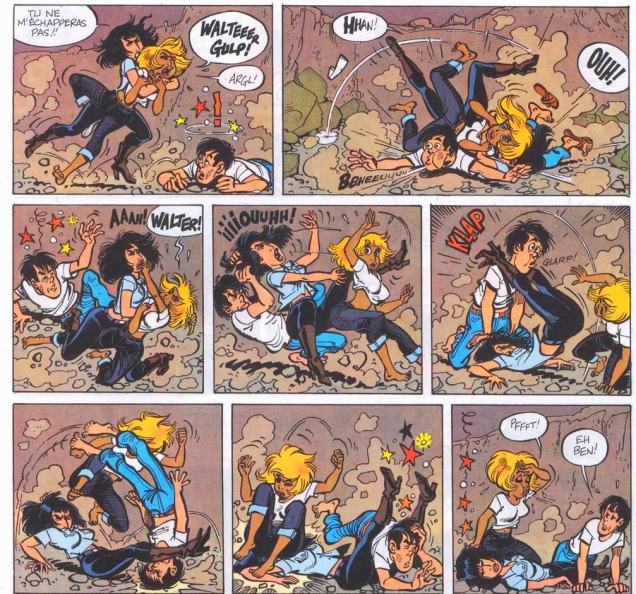
Moving on to French damsels…
Natacha (hôtesse de l’air) is a Franco-Belgian comics series, created by François Walthéry and Gos. This page is from an adventure (one of the final stories scripted by the great Maurice Tillieux) called Le treizième apôtre (The Thirteenth Apostle), published in 1978. The blonde is Natacha, our heroïne.
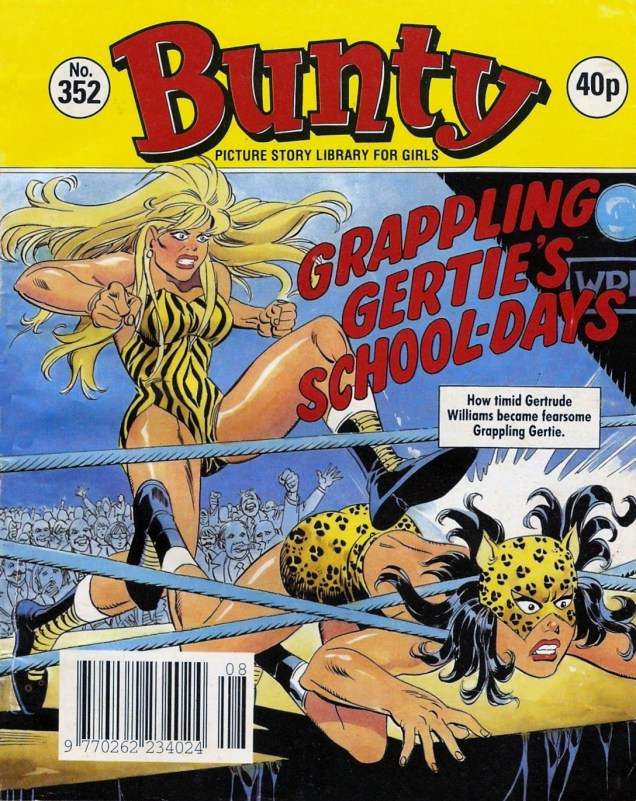
If you want to emphasize the catfight aspect, dress your girls in feline-motif outfits. Oh, I’m sorry – this is no quotidian quarrel, it’s professional wrestling!
Bunty no. 352 (1992) – unfortunately, I don’t know who did the cover. British Picture Story Library was a 62 page a comic digest, published weekly. If you’d like to know how Leopard Lily overcame Tiger Tina, visit Assorted Thoughts from an Unsorted Mind.
I think we need one even more literal interpretation of “cat fight”:
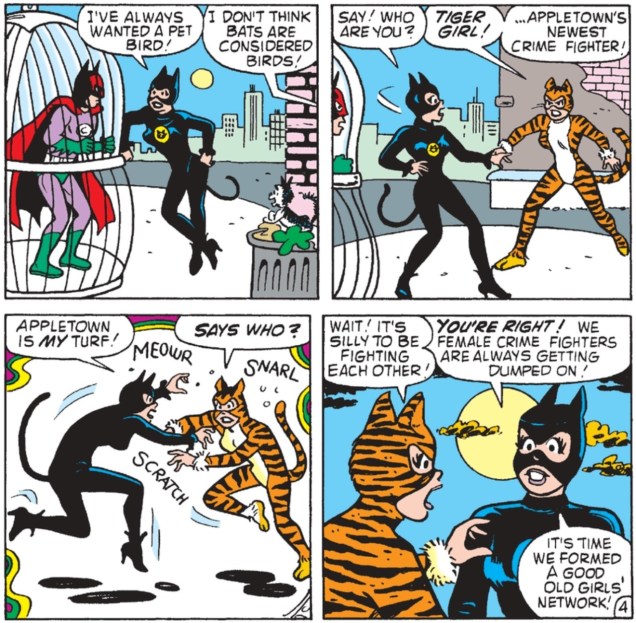
A snippet from “Meow Row”, published in Betty and Veronica no. 59 (January 1993). Script by George Gladir, pencils by Dan DeCarlo, inks by Alison Ford. Now guess who is who. (It’s obvious: Tiger Girl is Betty, and Veronica gets Meow Girl’s sexier costume.)
This is a fairly inexhaustible topic, but one must quit sometime. Cold shower, anyone?
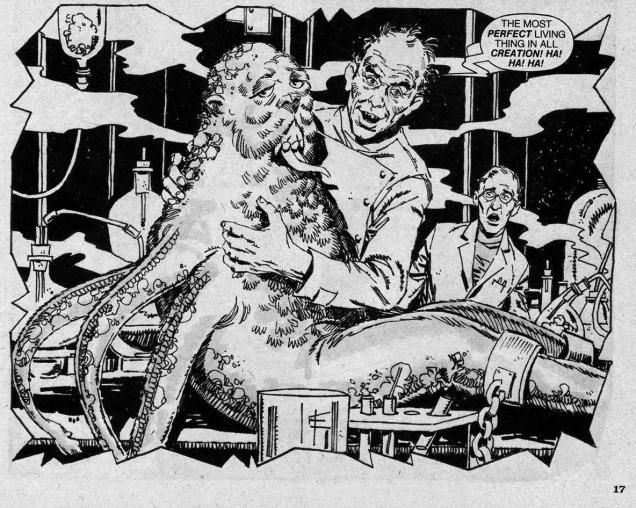
Greetings, tentacle lovers! I’m here with a new batch of Warren-published tentacles – this time, some he-men macho types get tangled up in them, though damsels predominate as usual. Don’t forget to visit part I: Tentacle Tuesday: Warren and Its Many Tentacles.
One thing that can easily be generalized from tentacular covers is that women frequently have a lot more fun on them than their male counterparts. To wit:
Vampirella no. 39 (January 1975). Cover by Ken Kelly. The gal may not be Vampirella, but damn, she’s enjoying herself. I admit that having tentacle-shaped fingers would be… practical.
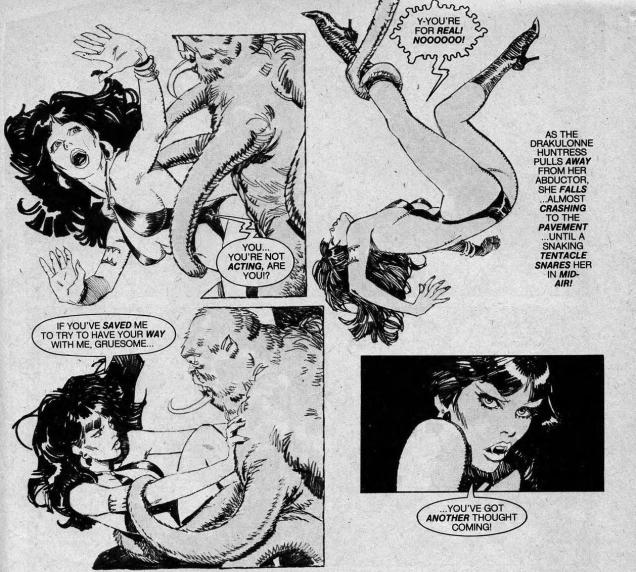
As for poor Vampi, she seems to encounter tentacles wherever she goes.
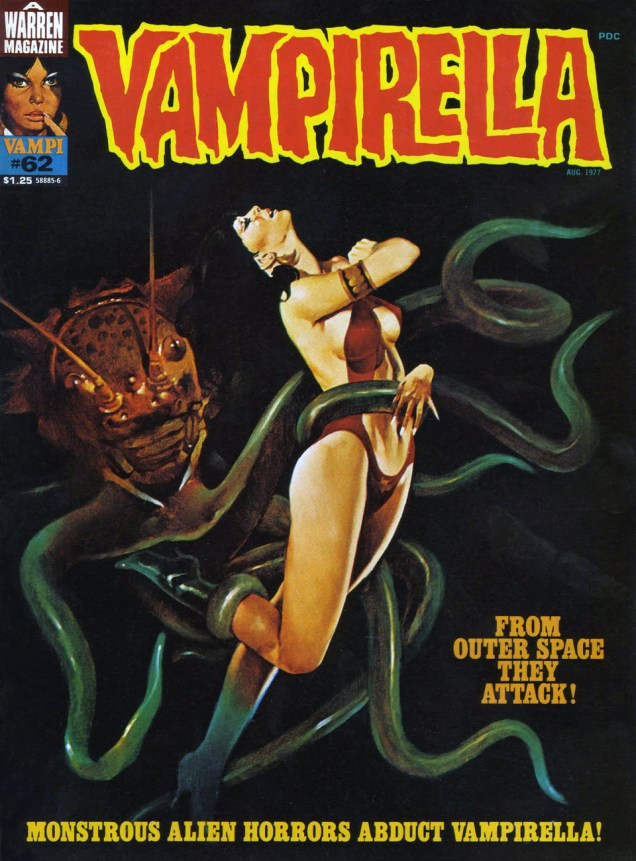
Vampirella no. 62 (August 1977), cover by Spanish artistEnrich, whose real name was Enrique Torres-Prat.
The cover story, Starpatch Quark & Mother Blitz (scripted by Bill DuBay and illustrated by Jose Gonzalez), contains some spectacular, spiky, nasty tentacles.
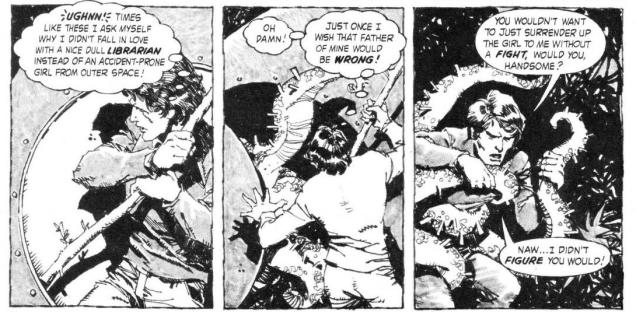
I tried saying « prasptam… hoodjum… billigam… POOT! », but no tentacled creature materialized. How very disappointing. I’d also like to know what kind of slap makes a « SPAKKT! » noise.The non-librarian girl in question is Vampi. Her eyeballs get ripped out by some vengeful queen and get accidentally conjured onto the desk of some random girl with an abusive husband, during which time blind, suffering Vampi is kidnapped by aliens while a handsome youth uses his father’s psychic connection with Vampi’s eyes to watch through them as they are retrieved by a tentacled monster, and… oh, never mind. Go read the story yourself.
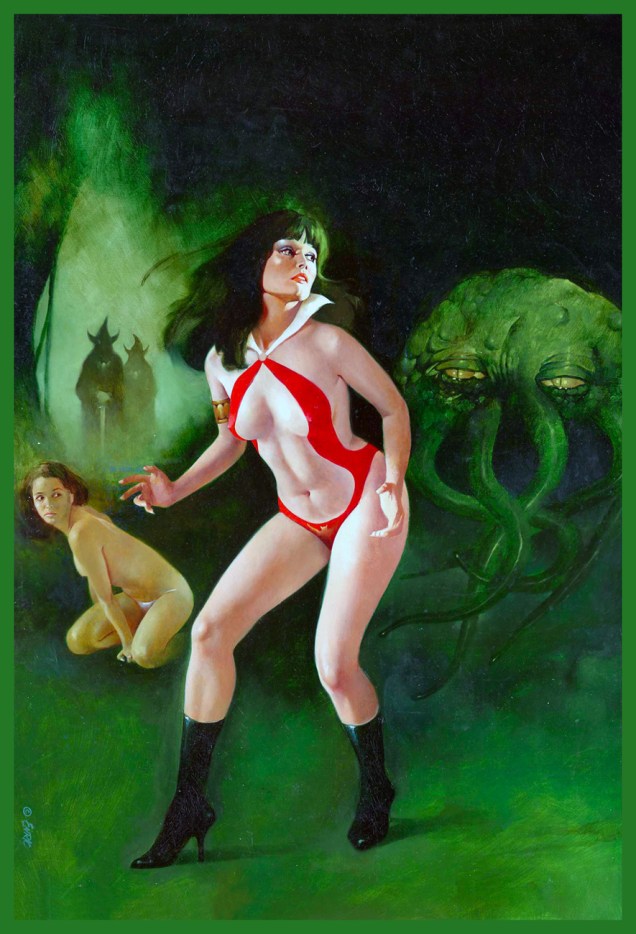
The original cover art of Vampirella no. 105 (May 1982), painted by Enrich. It was printed much darker, so one can barely see tentacles. Fuck that, I say! Let us admire the green creature in its full glory! (And its unfortunate slight family resemblance to Jabba the Hutt…) His gaze seems to be appraising Vampirella – “hm, I wonder if she would be as tasty a snack as she looks?”The printed version of said issue.
The cover story sounds like fun… let’s take a peek.
I’m sorry, but that is not what “Blobs and Behemoths” made me think of. I was expecting something in the class of Cthulhu, not an overweight human walrus with tentacles! Panel from “Horrors of Heartache City”, scripted by Bill DuBay and illustrated by Jose Gonzales (apparently this team specializes in tentacles).
« You’re worried that little Orphee is thinking of making a meal of that luscious girl…? He’s turned down everything from the choicest prime rib to the slimiest of insects, which leads me to believe that he filters nourishment from the very air! »
So much for scientific theories.
I think I promised you some men fighting tentacles. Sigh, so be it.
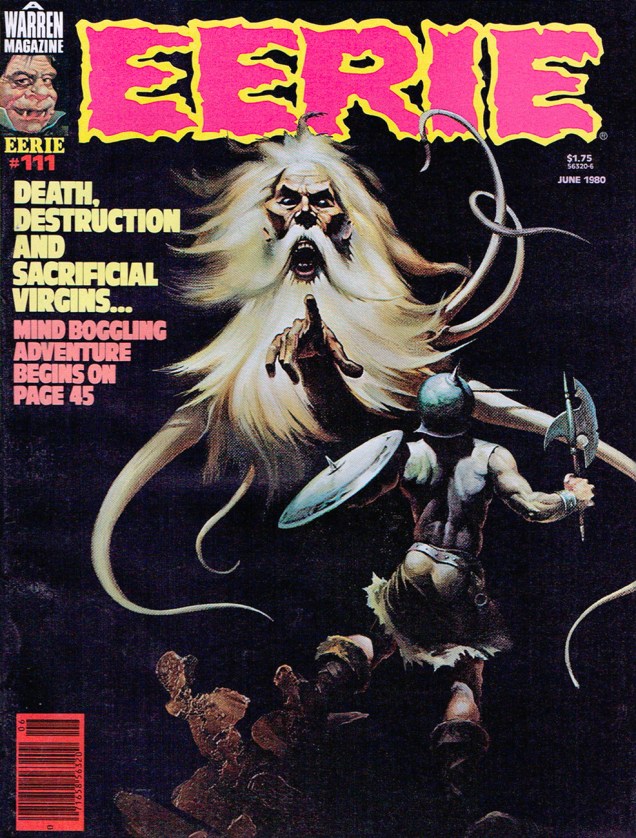
Eerie no. 66 (June 1975), cover by Manuel Sanjulian.Eerie no. 111 (June 1980), cover by Ken Kelly. What’s scarier than an old wizard with a majestic beard whipping in the wind? An old wizard whose head is attached to tentacles, obviously.1994 no. 19 (June 1981), cover by Jordi Penalva. I am totally fascinated by the girl’s expression. Whatever the tentacles behind her are doing, they’re doing it right. As for the guy, he looks like a sanctimonious asshole, from his scowl to his hairy legs.
I had to know what the hell is “The Holy Warrior” about. “Godless commie heathens”? Oh, very subtle, 1994. Given the mention of kicking the living crud out of ’em, it’s tempting to assume that this is satire… unless the author has an amputated sense of humour. I couldn’t find any scans of the story online, but someone on a Very Creepy Blog kindly summarized it as:
“Third is “The Holy Warrior!” by Delando Niño (art) and John Ellis Sech & Bill DuBay (story). This story takes place in a future where there are Jesus clones. Our hero, the Holy Warrior, is seeking to rescue one, which is just a child, from communist enemies. He is able to do so, but the two of them are so hungry that he ends up killing the clone and eating him! Quite a bizarre and heretical ending for this story.”
And I thought that Vampi story was written by someone on drugs. Same author, mind you (Bill DuBay) – there’s definitely a pattern… of nonsense, balderdash and malarkey.
By the way, you can read a bunch of Warren publications online – for free! – here.
« Tous les merdeux ricanaient en se disant qu’une revue sans merdeux à la tête, ça ne marcherait jamais.* »
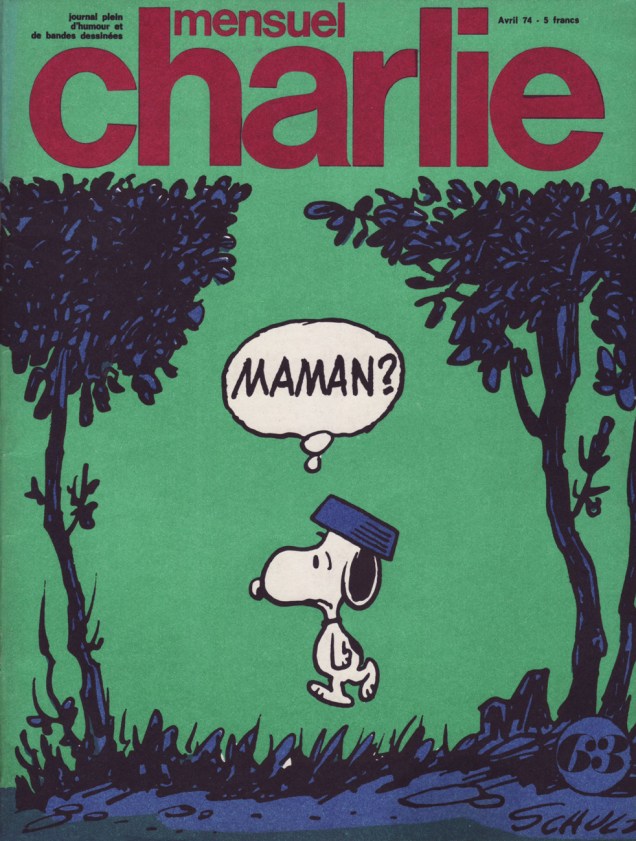
In issue 63 (April, 1974) of the recently rechristened « Charlie Mensuel » (to avoid confusion with its sister publication, Charlie Hebdo, yes, *that* Charlie Hebdo), insightful bandes dessinées critic and French national treasure Yves Frémion-Danet (b. 1947, Lyon), writing under his « Théophraste Épistolier » nom de plume, provided a classic essay accompanying a reprint of Harvey Kurtzman and Will Elder‘s « Goodman Gets a Gun », originally published in Help no. 16 (Nov. 1962, Warren). In his piece, Frémion posits that, with his 28 issues of Mad / Mad Magazine, Kurtzman’s brand of satire completely changed the rules of the game, and that despite an utter lack of commercial success and name recognition for himself and his work (reportedly, a French edition of Mad was published in 1965-66, for six or seven issues) on the continent, his influence on a significant swathe of the subsequent generation of French and Belgian cartoonists easily validates his vital importance.
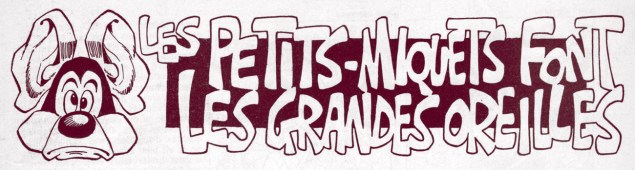
Théophraste Épistolier’s column’s logo, which translates as “Little Mickeys give you big ears”. A “Petit Miquet” is, in french, a generic name for cartoon characters from a dismissive and/or ignorant perspective. Someone to whom Mickey Mouse is the sole precursor of all Little Mickeys. Artwork by Gotlib.
Frémion spares no praise for Kurtzman’s acolytes Elder, Jack Davis, Basil Wolverton, Wally Wood and John Severin, and publisher Bill Gaines, but has nothing but contempt for editorial successor Al Feldstein (“vile copier”, “lumbering”, “regular”…). Frémion charts Kurtzman’s subsequent projects and associations, and his rôle in the rise of Underground Comix. Recommended reading… if you can read french.
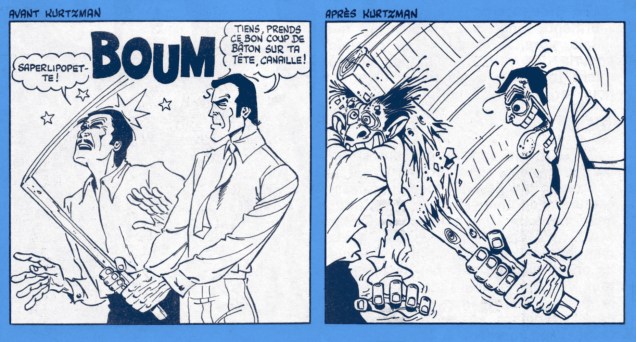
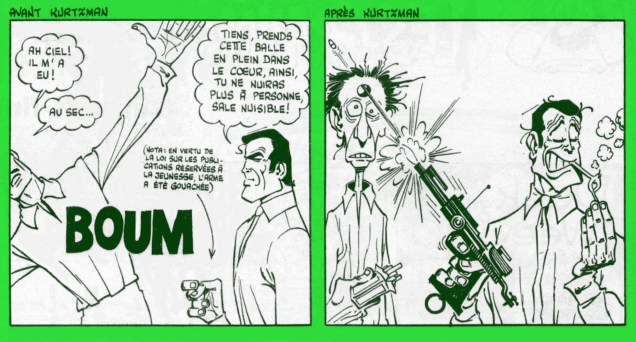
Ah, but that brings us to an apt illustration of that creaky adage, « A picture is worth a thousand words »: as it happens, the legendary Marcel Gotlib (b. 1934, d. 2016), speaking of influential, provided a quartet of original illustrations to put across what comics were like Before and After Kurtzman, commenting at once on American comics and on Franco-Belgian bande dessinée, with a snappy Gallic twist. Like Goofus and Gallant, but with far more tongue.
It took me a long time to come to terms with Gotlib. In my formative years, in Québec, his was such an outsize, smothering influence that one got quite sick of him. To be fair, not of him so much as his multitudinous, third-and-fourth-rate would-be clones. His style was easy to imitate, yet difficult to master. You see how that could easily careen off the rails?
In the left panel, the pistol is missing, having been whited-out « in accordance with the law on publications intended for young people », a quite repressive set of regulations adopted in 1949.More of the same: « Certain body parts have been whited-out. » Gotlib’s point is well made: when something relatively innocuous gets erased, the mind often fills the blanks with more perverse possibilities. Serves you right, censors.The issue in question. Charlie / Charlie Hebdo was published from Feb. 1969 to Feb. 1986, lasting, in fits and starts, 198 issues. It then merged with Pilote… and disappeared. Cover, of course, by Charles Schulz.
-RG
*« All the shitheads giggled, telling themselves that a magazine without an shithead in charge never would stand a chance. » – Théophraste Épistolier
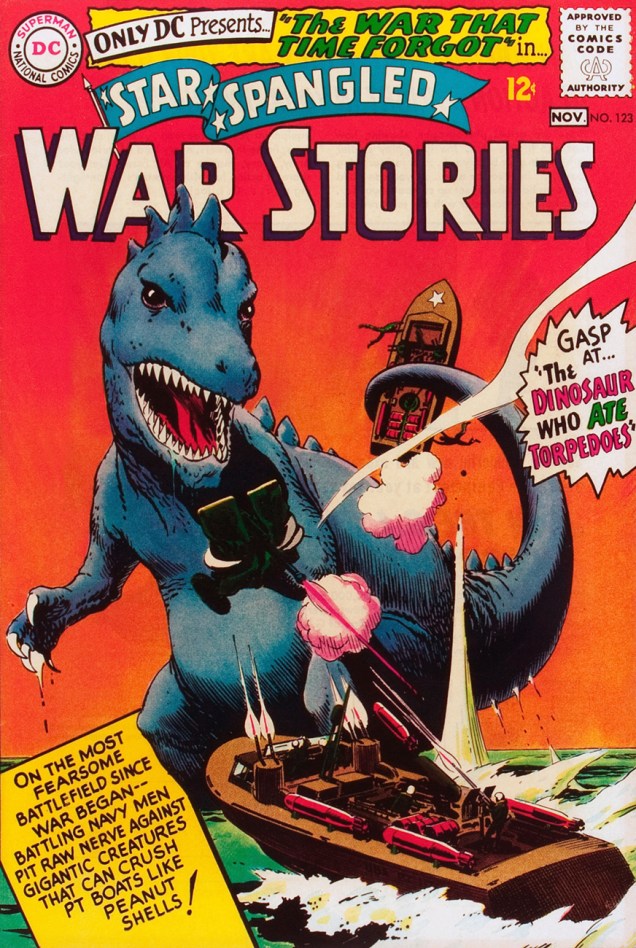
« Look! An undersea monster! Spearing that torpedo like it was a sardine! It’s a nightmare! »
Writer-editor Bob Kanigher, flanked by artists Ross Andru and Mike Esposito, drew first blood in « The War that Time Forgot », chronicled in DC’s Star Spangled War Stories beginning with issue 90 (May, 1960). The idea was scarily basic, but it was an irresistible premise, at least where young boys were concerned: let’s face it… soldiers vs dinosaurs. How might a T-Rex fare against a bazooka charge? Well…
The only time the series (what I’ve read of it… Andru and Esposito are no dream team of mine) did anything for me was a tale about two soldiers, one American and the other Japanese, stranded together on « Monster Island » and having to save each other’s sashimi. And this was before Lee and Toshirô got together on their own little slice of Hell in the Pacific, yet! I enjoyed the human interest aspect of the tale.
While I, like pretty much any other kid, was fascinated by dinosaurs early on, I quickly soured on inaccurate and fanciful depictions of the beasts. The War That Time Forgot is just one long, tedious dino-butchering exercise, be they harmless herbivores or kill-frenzied carnivores. Piss-poor palaeontology, that. Give me King Kirby‘s Devil Dinosaur any old time instead: that series runneth over with surreal, freewheeling fun, with nary a claim to accuracy in sight or in mind.
Ahem. The WTTF ran its course in SSWS until issue 137 (February-March, 1968), and was replaced by the far more nuanced Enemy Ace by Kanigher and Joe Kubert. Their all-time high, arguably in the case of Kubert, and without the faintest shadow of a doubt in Kanigher’s case.
So why am I writing about this series if I care so little about it? Well, when Andru (meh) or Kubert (great, true to form) weren’t handling cover duties, Russ Heath was. And while I’m fairly unmoved by Heath’s skill as a storyteller (too static, too measured), he was a first-rate cover artist, most strikingly for DC’s 1960s war books (and hey, Sea Devils) and Atlas’ 1950s westerns and horror titles.
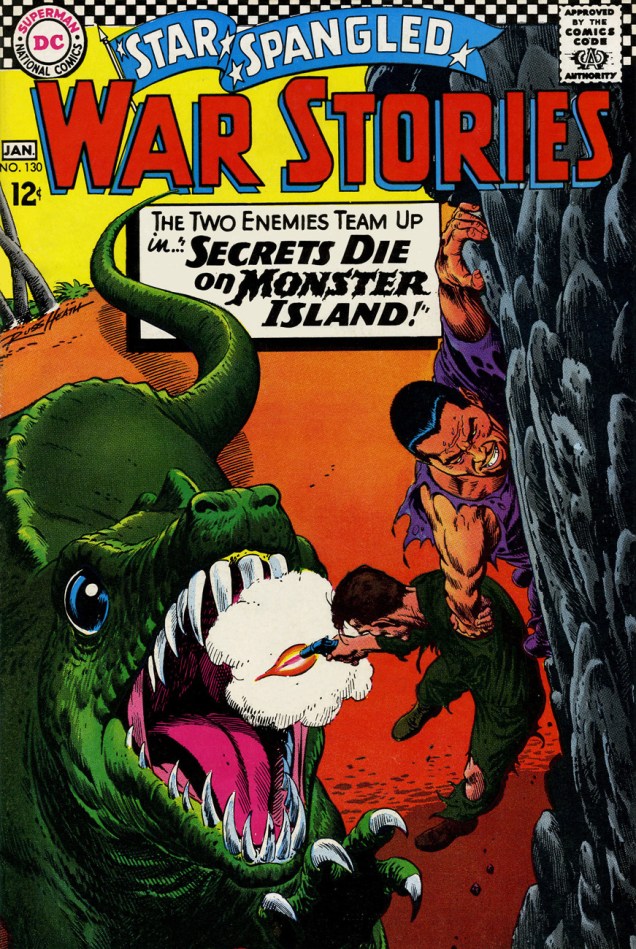
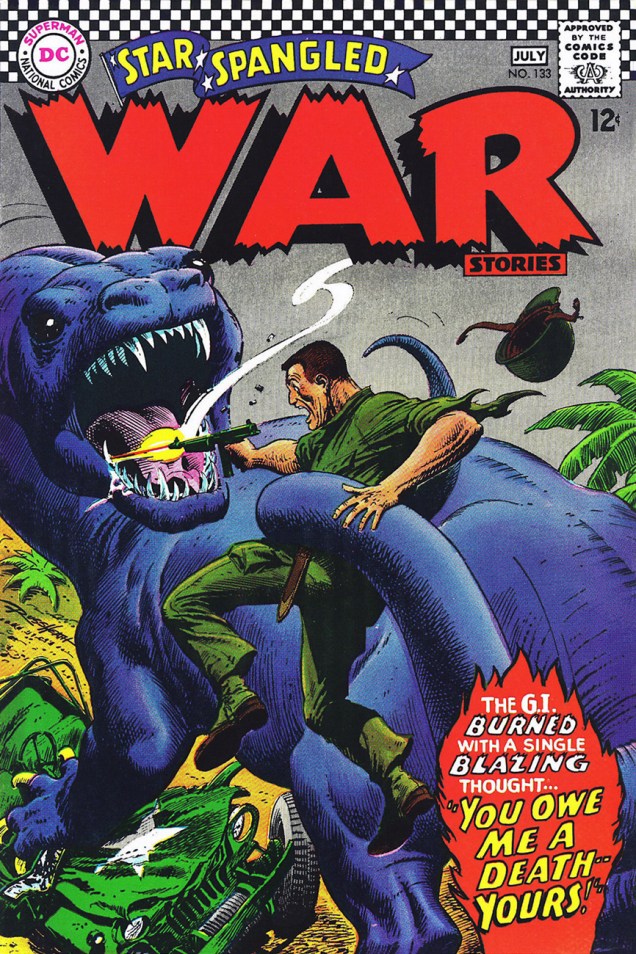
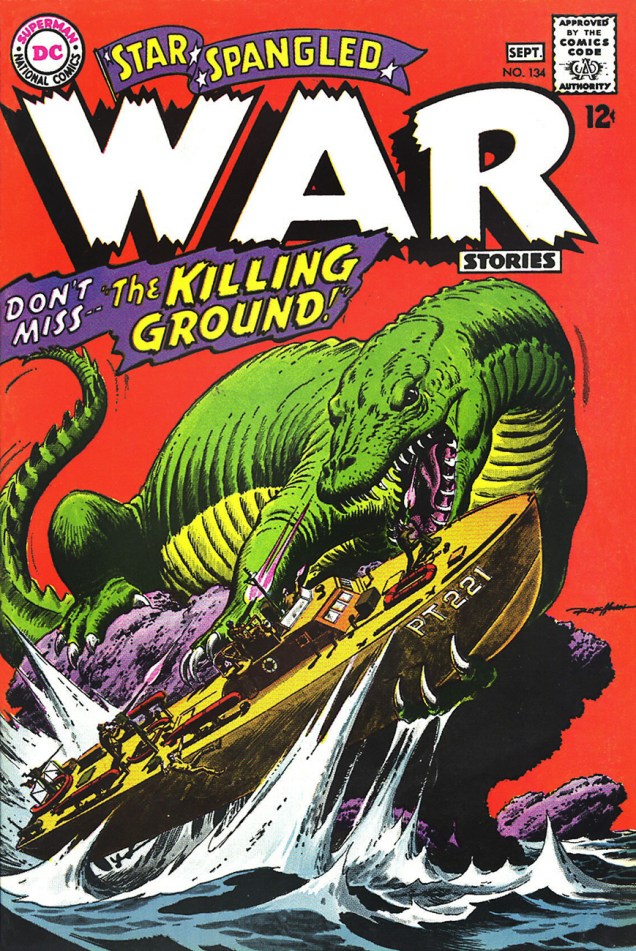
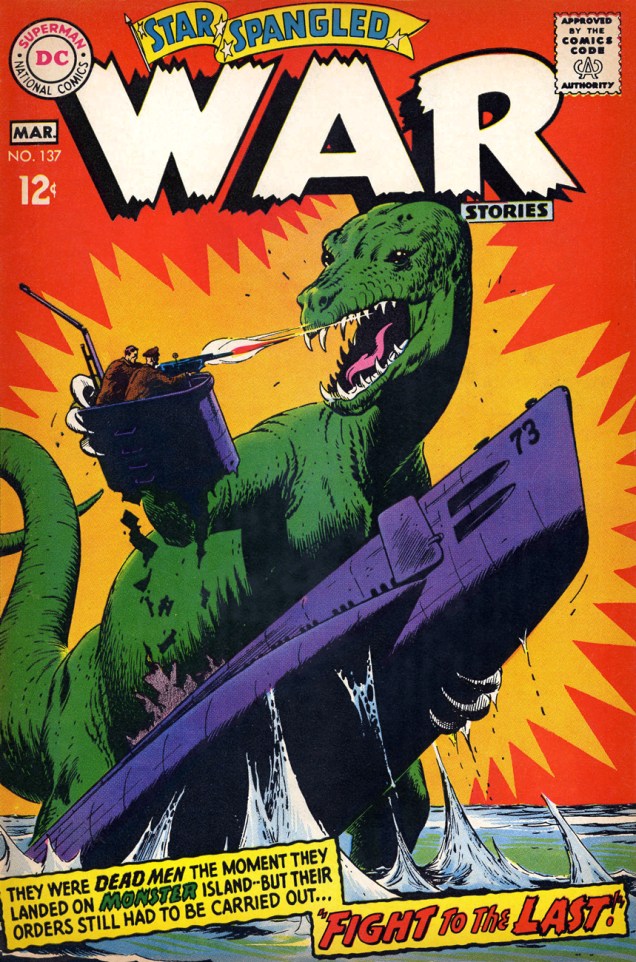
So, in fond remembrance of Mr. Heath, who left us last week at the age of ninety-one, here’s a gallery of his Star Spangled War Stories covers featuring The War That Time Forgot. Thank you, sir.
Star Spangled War Stories no. 122 (Aug. – Sept. 1965). Grey toning and colour by Jack Adler.Star Spangled War Stories no. 123 (Oct. – Nov. 1965). Dinosaurs love those orange skies, which set off their scales to fine advantage.Star Spangled War Stories no. 130 (Dec. 1966 – Jan. 1967). The first Japanese-American “Enemy Mine” team-up, but the Japanese guy gets no redemption before dying. Grey toning and colour by Jack Adler… probably my favourite cover of the lot.The Bird-Man provides a new wrinkle to bloodthirsty war criminal Curtis LeMay‘s « Bomb them back to the Stone Age » pronouncement. Star Spangled War Stories no. 131 (Feb. – Mar. 1967).Star Spangled War Stories no. 132 (Apr. -May 1967).Star Spangled War Stories no. 133 (June – July 1967).Star Spangled War Stories no. 134 (Aug. -Sept. 1967). Once more, grey toning and colour by the indispensable Mr. Adler.Star Spangled War Stories no. 135 (Oct. – Nov. 1967).Last call! Star Spangled War Stories no. 137 (Feb. -Mar. 1968).
Addendum to SSWS 131: apparently, « Bird-Man » started a trend, as everyone and his distant ancestor soon was riding a Pteranodon of his own. To wit: Tomahawk #109 (Mar. – Apr. 1967… just a month later).
What do dinosaurs care about the American Revolutionary War? And yet the poor, noble Pteranodons all perish in the end… « for the cause » . Tomahawk no. 109 (March-April 1967), cover art by Bob Brown.
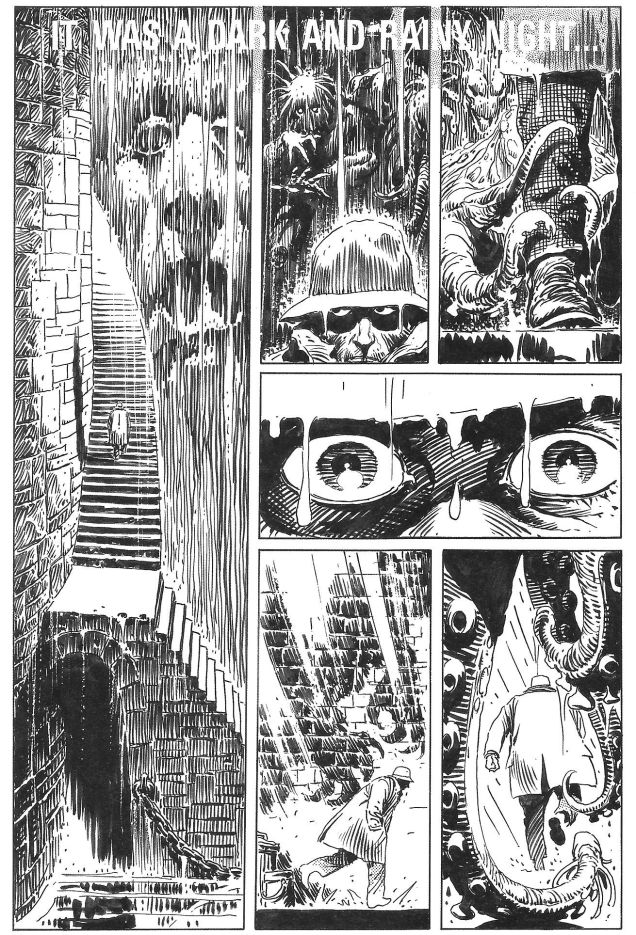
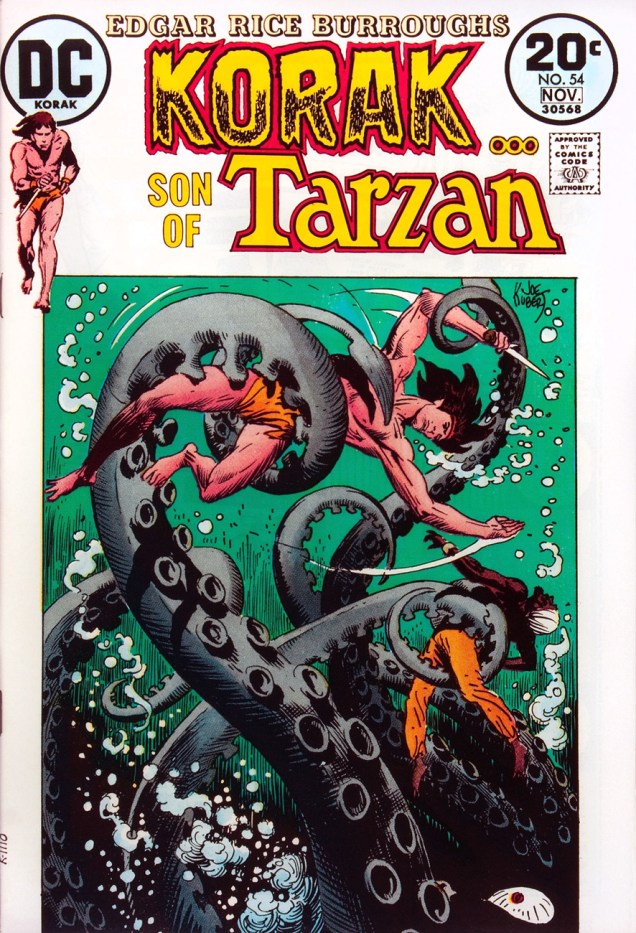
As Tentacle Tuesday lazily unfurls its slimy appendages yet again, we come face-to-face with one of the comic greats, Joe Kubert. And, as luck would have it, his ability to draw pretty much anything extends to depictions of cephalopods.
Page from “It Was a Dark and Heavy Night…”, published in Heavy Metal Special Edition Vol. 11, no. 2 – 20 Years (January 1997).
I’m less engrossed with Kubert’s work on prehistoric cavemen, archetypical feral youngsters or troglodyte adventurers (my interests lie more in the direction of Enemy Ace or Unknown Soldier, as well as Kubert’s solo projects like Abraham Stone). Nevertheless, Korak, his father Tarzan, and the unrelated Tor have all encountered tentacles in their eventful careers of dinosaur skirmishes and vine-swinging. (I also have to admit that if anybody could make me inquisitive about this sort of thing, it would be Kubert. I may yet reconsider, especially in the case of Tor, a comic Kubert both drew and plotted.)
Page from Tor no. 3 (May 1954). Read the whole issue here. The adorable monkey Tor is talking to is Chee Chee, his pet gibbon.See Korak wrestle tentacles on this aquatic Joe Kubert cover! Korak (the ape name for “Killer”) was created by Edgar Rice Burroughs for his Tarzan novels. (Korak was the hero of The Son of Tarzan from 1915; in other novels he was but a young boy, incidental to the plot). This is Korak, Son of Tarzan no. 54 (October-November 1973). This issue has Robert Kanigher and Murphy Anderson on the main story.
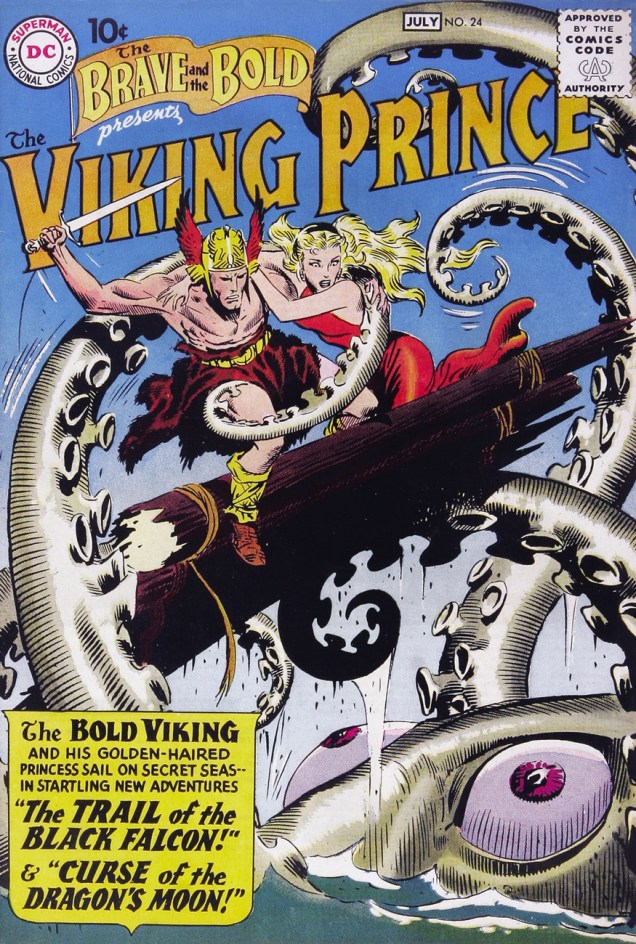
It’s not only prehistoric men who have to put up with tentacles – Scandinavian royalty has to deal with them, too.
The Brave and the Bold no. 24 (June-July 1959). The main two stories, “The Trail of the Black Falcon” and “Curse of the Dragon’s Moon”, both scripted by Bob Haney and drawn by Kubert, are frankly silly.
Moving into a slightly different direction….
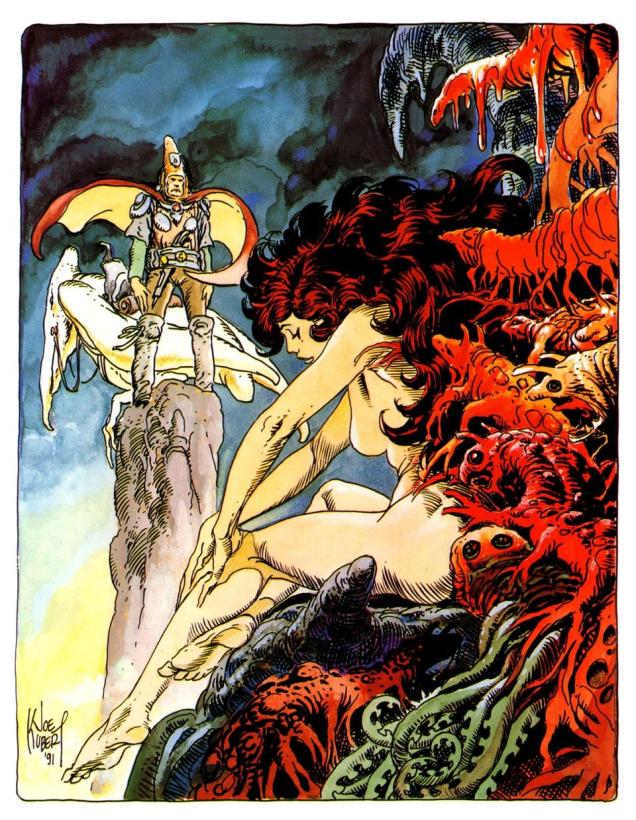
Mystery in Space no. 115 (January 1981). In a Kubert illustration, even monsters have soulful, anguished eyes.Weird War Tales no. 77 (1979). Do all three dooms involve tentacles, by any chance?Kubert’s tribute to Arzach, a comic series by Mœbius. Interesting to see Kubert sort-of imitating someone else’s style – however, the feet, hands and tentacles are obviously his.
« If i should sleep with a lady called death… » – E.E. Cummings
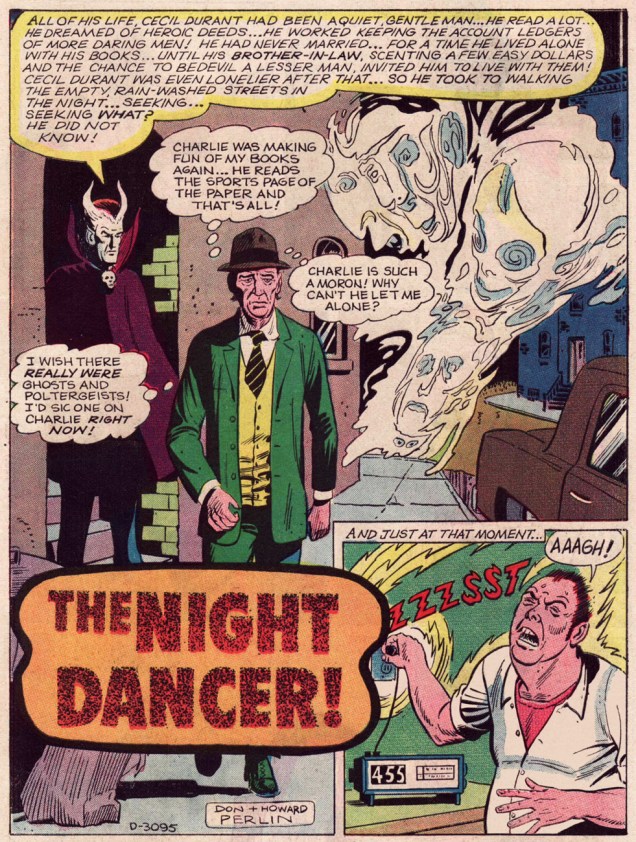
This time out, I’ve plucked a delicate story that’s resonated with me since our first encounter… somehow, the tragic plight of a lonely, vulnerable old man touched me deeply, even if I couldn’t have been more than ten years old when first I read it.
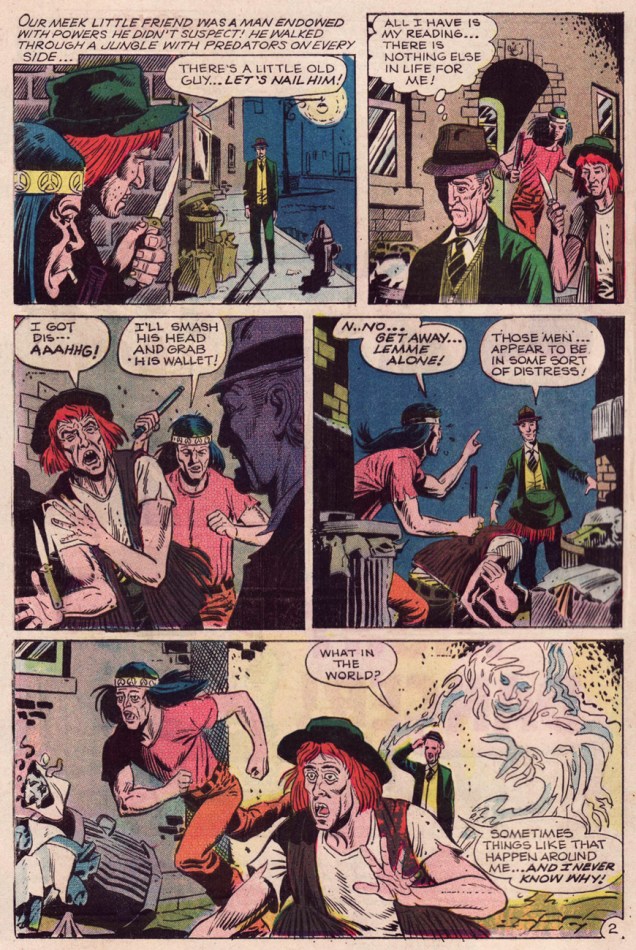
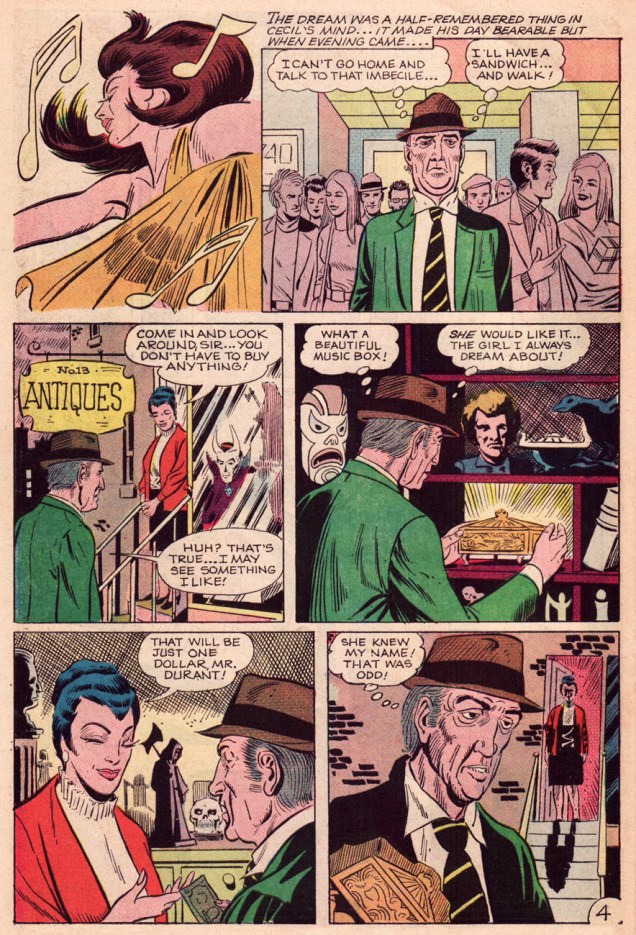
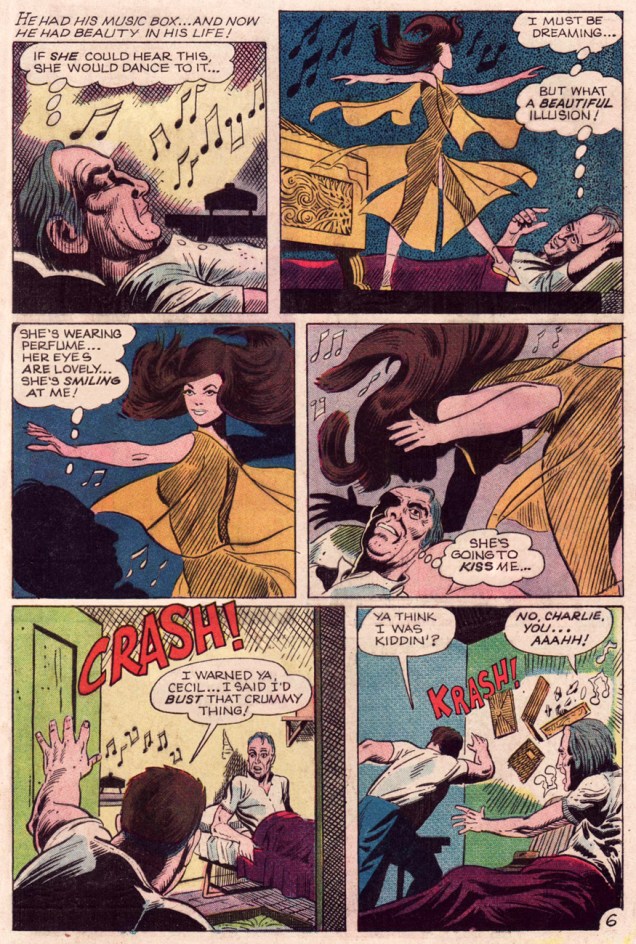
In the intervening years, witnessing the rise of elder abuse, the growing fragility of my own parents, and the sometimes desperate loneliness of acquaintances, old friends and strangers alike, Joe Gill and Don Perlin‘s The Night Dancer! (Ghostly Tales no. 99, Nov. 1972, Charlton) has steadily gained in poignancy. Its spirit, theme and mood remind me of some very fine tales by Joseph Payne Brennan*, who conveyed all too convincingly the quiet desperation of a near-destitute life lived with scant hope or companionship.
On a more cheerful note, it happens that (okay, it’s no accident) ‘Dauntless’ Don Perlin celebrates his eighty-ninth anniversary on this very day. While he’s most appreciated for his runs on Werewolf By Night, Ghost Rider, Moon Knight (his co-creation with writer Doug Moench) and The Defenders at Marvel Comics, I steadfastly cling to the notion that his finest efforts were brought to bear on hot rod and ghostly yarns for Charlton at the dawn of the 1970s. Judging by the results, I’d venture that he’s especially inspired by adventures set in the American Southwestern desert country. I’ll return to this topic in due time and present my case.
Without further tarrying ‘n’ foot dragging, meet our hapless protagonist, Cecil Durant… and his tormentors and benefactors.
While Mr. Perlin never became a superstar (and I suspect it never was his goal), the longevity of his career is easily explained: solid craft, excellent storytelling skills, a clean, unfussy line, and of course that supreme asset: reliability. Incidentally, co-credited Howard Perlin was Don’s young son, who was helping dad out around the studio that day.
Yom hu’ledet sameach, Mr. Perlin… and many happy returns!
– RG
*particularly The Way to the Attic (1967) and Mrs. Clendon’s Place (1984)
Once in a while, I come across an artist I’ve never heard of before but whose work I really like. It’s always a delight to stumble upon an elegant boat afloat daintily on a sea of crap. (Life is full of new things to love that we just haven’t discovered yet, but the trick is to discover them amidst all the noise.)
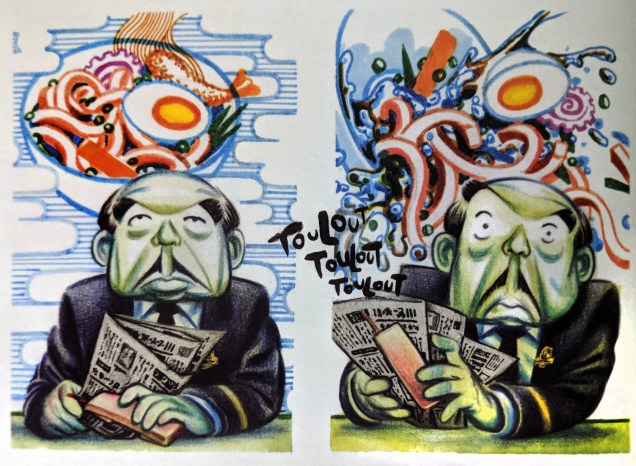
The chief of police dreams of food… but will he be able to find a tasty bowl of udon before all the noodle stalls close for the night? Panels from Petites coupures à Shioguni (Éditions Philippe Picquier, 2015).
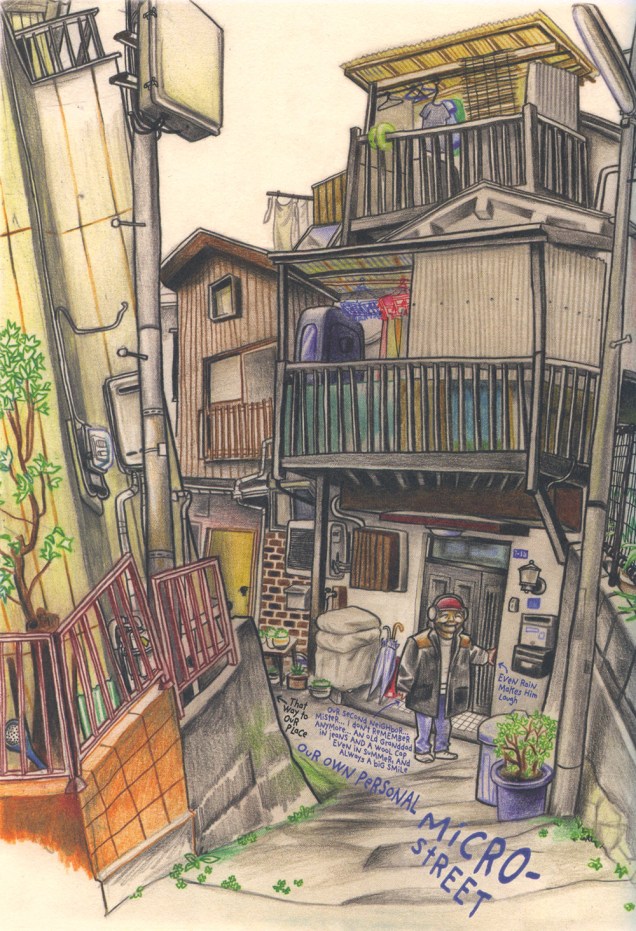
Florent Chavouet is an accomplished artist who prefers bright colours, which predisposed me to liking his art before I even considered the potency of his storytelling. He mostly draws in a cute, cartoony style that’s perfect for all the travelling-around-Japan chronicling he has done. However, architecture doesn’t stump him at all – a lot of his drawings are successful, detailed sketches of streets and apartments – and he’s amply capable of realism when the situation calls for it. And he’s an excellent storyteller, to boot.
My favourite book of his (so far) is my most recent acquisition: Petites coupures à Shioguni (Éditions Philippe Picquier, 2015), a complex story involving many characters and the ways their lives intersect and influence one another during a typical night in Japan. (Well, maybe not typical.) As the story unfolds after sunset, we get treated to a lot of pop-right-out-of-the-book, light-on-dark-background scenes, something Chavouet excels at. The art is his most accomplished yet; his latest book came out in 2016 (L’île Louvre), but I haven’t read it so far. I think we can say with certainty that he’s still developing his talents!
The cab driver has distinctly bad luck on that night. Petites coupures à Shioguni (Éditions Philippe Picquier, 2015).Another lovely feature of Petites coupures à Shioguni (Éditions Philippe Picquier, 2015) is the hand-lettered dialogue – it’s an integral part of the artwork.A promotional presentation of Petites coupures à Shioguni (Éditions Philippe Picquier, 2015).
This graphic novel hasn’t been translated to English yet, so non-French speakers will have to wait for a bit until it is.
Going back in time, but remaining in Japan, here are a few samples from Tokyo on Foot: Travels in the City’s Most Colorful Neighborhoods (Tuttle Publishing, 2011).
A page from Tokyo on Foot: Travels in the City’s Most Colorful Neighborhoods (Tuttle Publishing, 2011); it came out in the original French in 2009. You’ll be encountering scores of intriguing characters if you take Chavouet along as your guide.Tokyo on Foot is full of such isometric-projection layouts of people’s apartments.Tokyo on Foot also has plenty of beautifully rendered night scenes.Page from Tokyo Sanpo (Éditions Philippe Picquier, 2009).
Visit Chavouet’s blog here – if you don’t speak French, you can admire the art (though you’ll be missing the stories he likes to make up for each of his drawings/paintings).
An example of the critters you’ll encounter – which Chavouet calls Yokai, the Japanese word for demons or monsters – on his blog.
« On my entire street there were only two kids that went to high school… that was the equivalent in those days of making Phi Beta Kappa. »
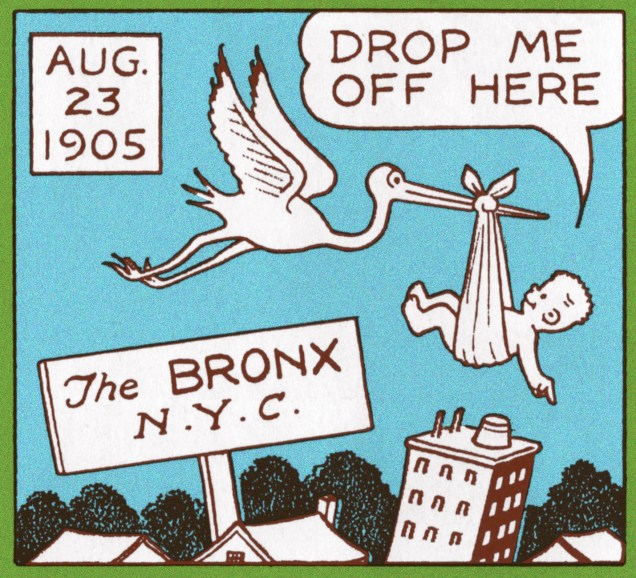
On this, the one-hundred and thirteenth birth anniversary of the oft-misunderstood Ernie Bushmiller (23 August 1905 – 15 August 1982), was I going to go through a veritable mountain of Nancy strips, naïvely hoping to pare it down just the one? No sir, not me. Life’s too short.
A tidy bit of autobiography from the pen of Mr. B.
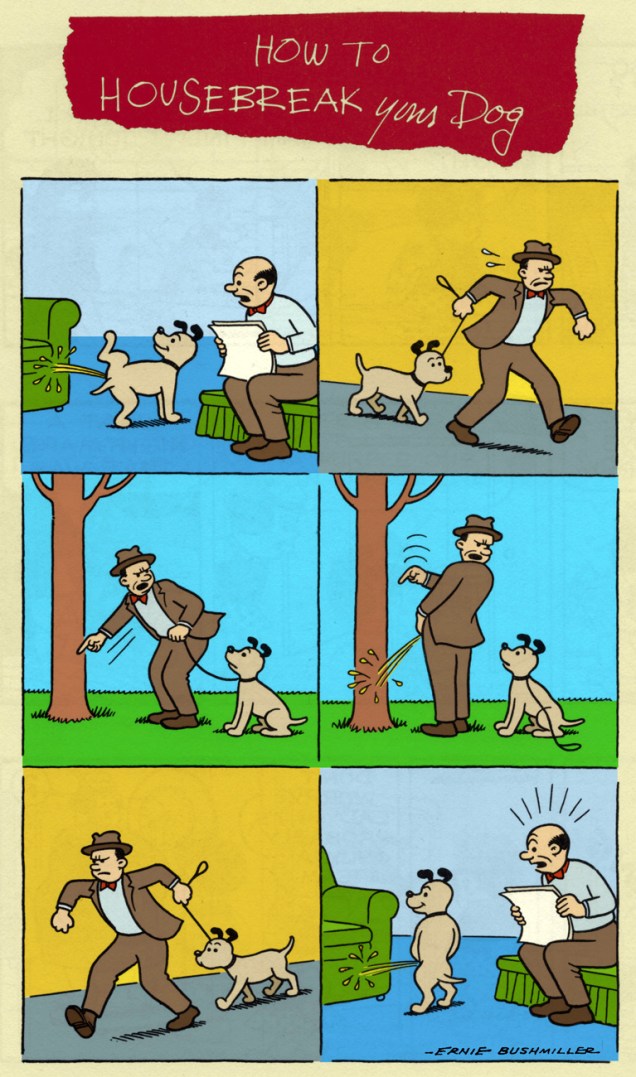
Instead, here’s an oddity that Ernie created, historians say, for the Dutch Treat Club* Yearbook (1961). Bushmiller referred to the often-imitated and bootlegged, now-famous cartoon as « the only dirty thing I ever did ».
I decided, a couple of years back, to colour the piece myself, and to restore Bushmiller’s signature. Can you believe the gall of some people? (Rhetorical question, I know.) Here at WOT, we firmly believe in proper authorial attribution.
Happy birthday, Mr. Bushmiller, and thanks for all the chuckles.
– RG
p.s. Thanks to Bushmiller scholar-cartoonist Mark Newgarden for doing the legwork as to provenance. I’m standing on the shoulders of giants, as usual! Oh, and since it’s quite relevant (and even if it wasn’t), if you’re a true-blue Bushmiller aficionado, you owe it to yourself to check out Messrs Paul Karasik and Newgarden’s « How to Read Nancy » (2017, Fantagraphics).
A portrait of Ernie from the brush of his esteemed colleague Frank Godwin.
*If you’re, er… qualified, it’s not too late to join the Dutch Treat Club!
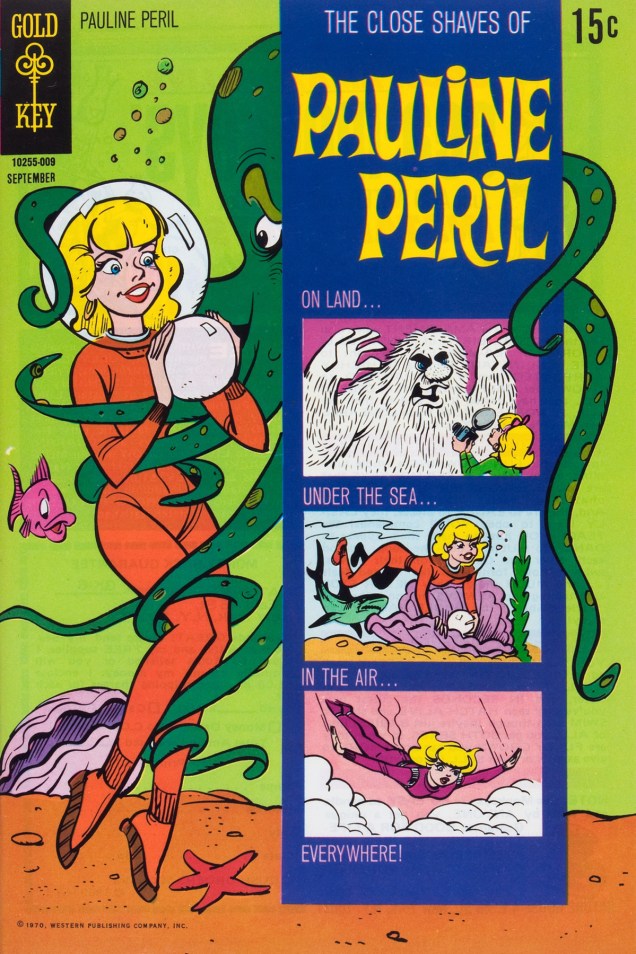
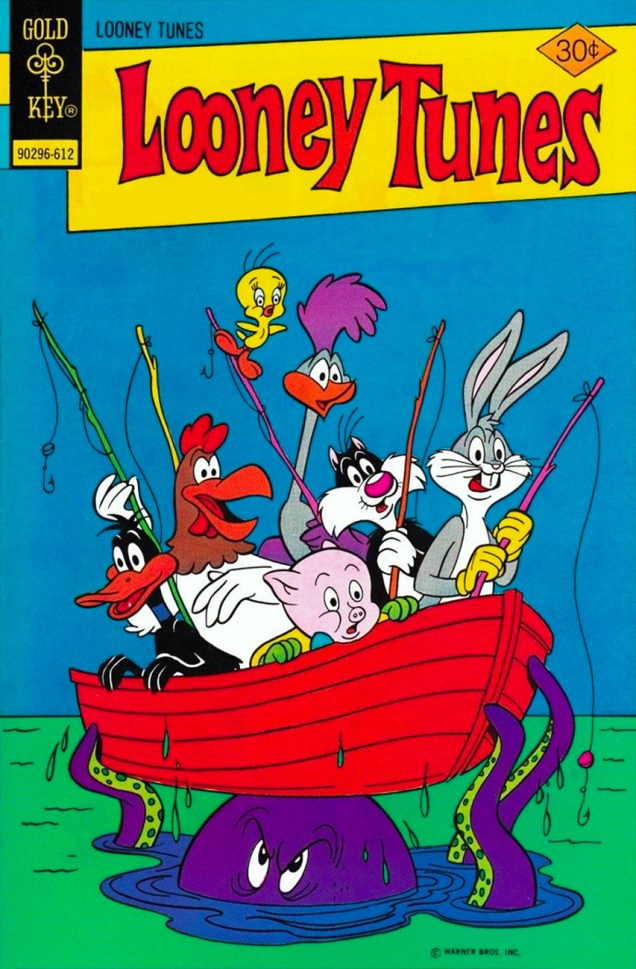
Today’s tentacle adventure brings us a bounty of Gold Key covers.
The Close Shaves of Pauline Peril no. 2 (September 1970). Cover by Jack Manning. I love the Pauline Peril series – it’s such loveable nonsense, with dynamic art and fusillade-style dialogue. However tempting it may be to jump to that conclusion, It’s not a comic-book adaptation of a TV cartoon. Read a whole issue (number four, to be more precise, the last one) at, appropriately, the Ominous Octopus Omnibus blog.Hanna-BarberaThe Addams Family no. 3 (April 1975). The adorable cover is by Bill Ziegler. Is there anything groovier than a froggy belt-buckle? I think not.Looney Tunes no. 11, 1976. Cover artist unknown. The boat has been filled beyond legal capacity, and no-one’s wearing their mandatory Mae West. The Safety Octopus is here to ensure that the offending parties are brought up to standards (or at least given a tentacle slap on the wrist).
And just to offset all the cartoony, cutesy stuff, here’s a cover featuring an epic struggle, a life-or-death situation, a decisive skirmish between Man and Beast. (I’ll let you guess which is which, though.)
Boris Karloff Tales of Mystery no. 37 (October 1971), cover by George Wilson. Here we have a tentacled creature – “Sea-Beast” for friends – defending a village of innocent people against some sort of flaming monstrosity by shooting water from its tentacles (trunks?) at the flames. Hey, somebody should hire it as a firefighter!
The Old Underground Hall of Legends took some bad hits in 2017, with the losses, within less than a couple of weeks, of Jay Lynch (January 7, 1945 – March 5, 2017) and Mervyn “Skip” Williamson (August 19, 1944 – March 16, 2017). Skip, in fact, would have turned seventy-four today.
Again, we’re dealing with an artist with a long and nomadic career, so it’s best to think small. There’s plenty of excellent, in-depth biographical material on the subject already out there, so I’ll scare up a few scarce items that reflect Skip’s lifelong love of (and involvement with) music.
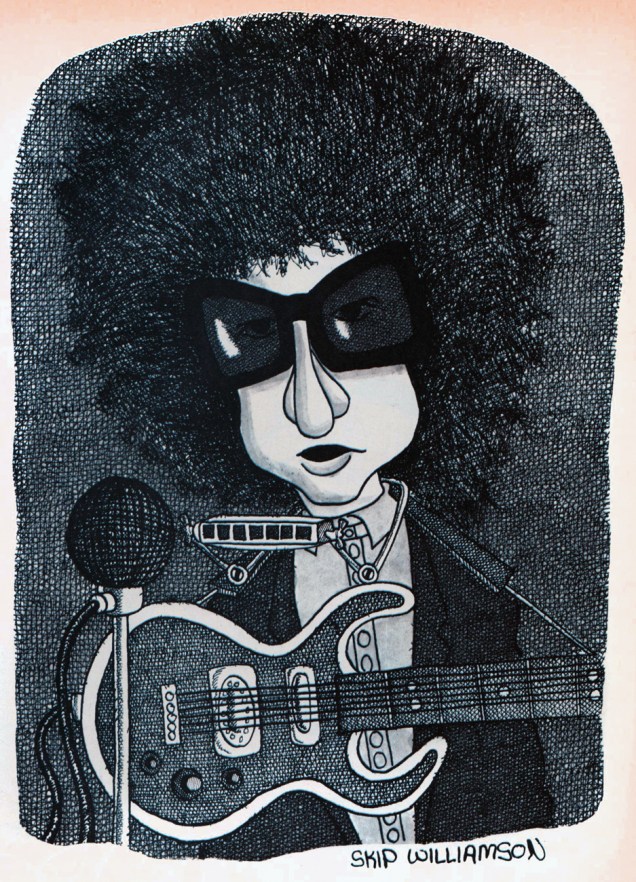
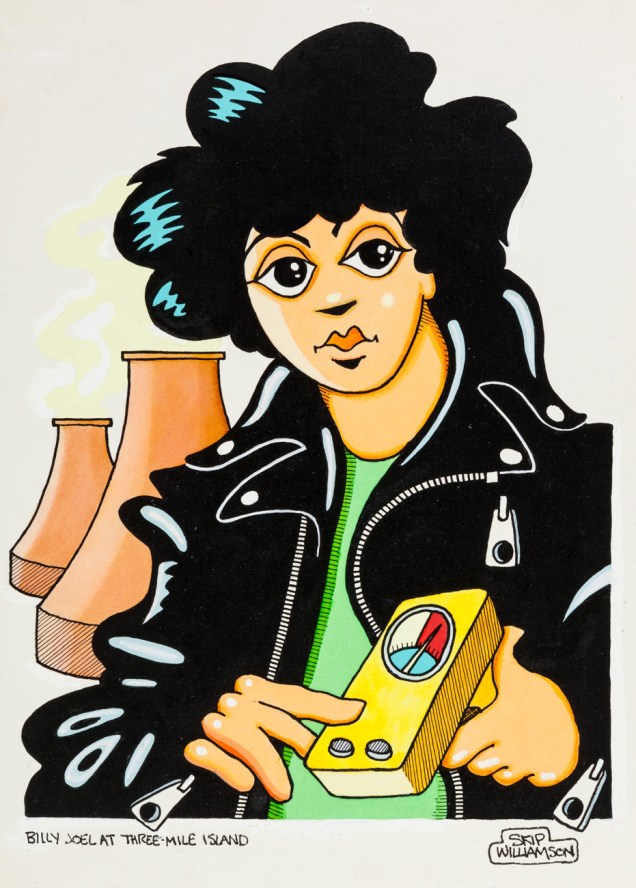
« Right now I’d like to do an original composition which deals with the basic existentialistic thought and parallels between the works of Kafka, Tillich, and Buber in relation to the ‘I-Thou’ concept, and which has just been covered by the Rolling Stones…» Underground comix provocateur Mervyn “Skip” Williamson (born 1944 in San Antonio, TX) takes a witty jab at noted self-mythologist Robert Allen “Bob Dylan” Zimmerman. From the March, 1967 issue of Escapade (incorporating Gentleman!), likely a Charlton Publications product (“Second class postage paid at Derby, Conn.”), a factoid that may someday help you win a bet.« Snuk Comix no. 1 (Skip Williamson, 1970). Extremely rare comic book created for the band Wilderness Road, by Underground Comix artist Skip Williamson. The story is that the printer objected to drug references, and would not deliver the printed comics; Skip managed to grab a few copies before the run was destroyed. As of 2003, only two copies were known to exist; while there have been a few more found since that time, the number of existing copies is staggeringly small… » Typical boorish behaviour on the part of the printer. Most people are unaware of the power that printers held and frequently abused before the salutary advent of digital print. Guys, *first* you nail the printing job (you call that registration?), *then* you indulge in moral grandstanding.1979 original art for a piece Williamson produced for Playboy magazine. « Now what », you may ask « Do Billy Joel and Three Mile Island have to do with one another? » Here’s one account: « Anne had a couple of his 8-tracks, and made plans to see him live at the Hershey Arena during his 1979 tour … plans that were thwarted by a little incident at a nuclear reactor near my home, Three Mile Island. See, when the accident happened, in March of ’79, people had to be evacuated. And those people had to go somewhere. And there just weren’t a whole lot of large buildings suitable for holding thousands of radioactive refugees in the area at that time, so The Hershey Arena had to be put to use, even if it meant canceling a few Hershey Bears games and a Billy Joel concert »
I was too young and in the wrong small town for Underground Comix to reach me back in the 1970s, but when Skip put together the « Playboy Funnies » section (featuring the likes of Bobby London, Jay Lynch, Chris Browne, Art Spiegelman…) for Mr. Hefner’s magazine, I in due course discovered his work since I read Playboy for the cartoons. I immediately took to Williamson’s stylish, bouncy, clean and friendly visuals, paired with his unflagging subversiveness. Not that I got much of said subversiveness at the time… but that’s how it works.
Happy birthday, Skip!
-RG
*Class War (Bijou Funnies no. 3, 1969 The Print Mint)